

Australian Mud Company Pty Ltd v Coretell Pty Ltd (No 4) [2015] FCA 1372
IN THE FEDERAL COURT OF AUSTRALIA | |
new south wales DISTRICT REGISTRY | |
DATE OF ORDER: | |
WHERE MADE: |
THE COURT ORDERS THAT:
1. The Applicants file and serve a minute of orders reflecting these reasons within 30 days.
2. The Respondents file any responsive material within a further 21 days.
3. A further directions hearing be scheduled in late February 2016 to make and/or program the making of orders consequent upon these reasons and directions as to the future conduct of the proceeding.
Note: Entry of orders is dealt with in Rule 39.32 of the Federal Court Rules 2011.
new south wales DISTRICT REGISTRY | |
GENERAL DIVISION | NSD 2082 of 2011 |
BETWEEN: | AUSTRALIAN MUD COMPANY PTY LTD ACN 009 283 416 First Applicant/First Cross-Respondent REFLEX INSTRUMENTS ASIA PACIFIC PTY LTD ACN 124 204 191 Second Applicant/Second Cross-Respondent |
AND: | CORETELL PTY LTD ACN 119 188 493 First Respondent/Cross-Claimant MINCREST HOLDINGS PTY LTD ACN 068 672 471 (TRADING AS CAMTEQ INSTRUMENTS) Second Respondent NICKY KLEYN Third Respondent KLEYN INVESTMENTS PTY LTD ACN 118 967 687 (TRADING AS CAMTEQ INTERNATIONAL SERVICES) Fourth Respondent |
JUDGE: | MCKERRACHER J |
DATE: | 4 DECEMBER 2015 |
PLACE: | PERTH |
REASONS FOR JUDGMENT
[1] | |
[11] | |
[14] | |
[17] | |
[19] | |
[46] | |
[48] | |
[55] | |
[73] | |
[74] | |
[74] | |
[75] | |
[78] | |
[80] | |
[80] | |
4.1.4.2 Sales and supply of ORIshot Tools, supply of ORIshot Tools for use | [82] |
[84] | |
[87] | |
[95] | |
[98] | |
[98] | |
[101] | |
[103] | |
[109] | |
[110] | |
[113] | |
[122] | |
[126] | |
[159] | |
[216] | |
[216] | |
[220] | |
[222] | |
[224] | |
[233] | |
[241] | |
[250] | |
[255] | |
[263] | |
[264] | |
7.5 Consideration of the liability of each of the respondents | [369] |
[419] | |
[422] | |
[425] | |
[430] | |
[437] | |
[460] | |
[473] | |
[475] | |
[475] | |
[476] | |
[482] | |
[488] | |
[489] | |
[494] | |
[498] | |
[502] | |
[503] | |
[506] | |
[512] | |
[513] | |
[516] | |
[519] | |
[522] | |
[525] | |
[526] | |
[529] | |
[531] | |
[536] | |
[540] | |
[604] | |
[668] | |
[683] | |
[687] | |
[696] | |
[720] | |
[730] | |
[734] | |
[737] | |
[758] | |
[765] | |
[770] | |
[773] | |
[774] |
1 This proceeding commences, in this iteration at least, as a claim for relief in respect of infringement of two innovation patents. The Patents relate to a system and method for orienting core samples extracted from the ground, commonly used in connection with geological surveying operations and other drilling operations.
2 Underground samples of ore bodies are collected by a drill which extracts a core. The core samples so collected can be analysed for their geological content. The quality of that analysis depends in part on identifying the orientation of the core sample relative to the host material from which the core has been extracted. Tools have been invented to enable the core sample orientation to be identified. This case involves consideration of such tools, practices and, particularly, the Patents in suit.
3 For the applicants, the primary participants are Australian Mud Company Pty Ltd (AMC) and Reflex Instruments Asia Pacific Pty Ltd. They are respectively the patentee and exclusive licensee of the Patents. In turn, they are wholly owned subsidiaries of the publicly listed company, Imdex Limited.
4 The tool which has been developed and commercialised by AMC for the orienting of core samples is described in the evidence as being the ‘ACT Tool’ or the ‘Ace Core Tool’.
5 The respondent corporations are a group of associated companies. Mr Nicky Kleyn is the sole shareholder in, director and company secretary of the first respondent, Coretell, and the fourth respondent, Kleyn Investments Pty Ltd. He is one of two shareholders in, and directors of, the second respondent, Mincrest Holdings Pty Ltd (the other being his wife). Mr Kleyn is the third respondent. Coretell causes to be made and thereafter hires or causes to be hired, core orientation apparatus known or described as the ‘ORIshot’ or ‘ORIShot Tool’, both in Australia and in countries outside of Australia. The ORIshot apparatus is used by exploration drillers under hiring arrangements with Coretell. According to the respondents, Mincrest does not carry out trade or business in Australia, but acts as a trustee for a third party unconnected with the present proceedings or with any trade or business concerned with the ORIshot apparatus. The respondents say that Kleyn Investments is not involved in any exploitation of the ORIshot apparatus. It trades in a different apparatus known as the ‘Camteq Pro-Shot Multi shot Survey Instrument’.
6 The applicants’ case is that the respondents have infringed the Patents by making, selling, supplying and otherwise dealing in various tools for orienting core samples and have done so flagrantly, with knowledge of, and in disregard of, the applicants’ rights under the Patents, such as to support an award of additional damages for patent infringement under s 122(1A) of the Patents Act 1990 (Cth).
7 However, by order made by Justice Nicholas on 4 May 2012 all of the issues as to the quantum of pecuniary relief, if any, have been reserved for later determination.
8 The applicants also seek post-expiry injunctive relief consequent upon the alleged infringements that were committed during the term of the Patents.
9 AMC contends that the ORIshot Tool infringes its Patents. The respondents refute this on several grounds.
10 Coretell (independent of the other respondents) also advances cross-claims which allege the invalidity of the Patents on numerous grounds, including lack of novelty on the basis of prior art and prior use. In about September 1990, Messrs Skopec, Mann, Jeffers and Grier published a conference paper entitled ‘Horizontal Core Acquisition and Orientation for Formation Evaluation’ at a 1990 Conference in New Orleans, which was later published: Skopec et al, “Horizontal Core Acquisition and Orientation for Formation Evaluation” (1992) 7(1) Society of Petroleum Engineers Drilling Engineering 47 (Skopec Paper). In January 2004, Mr Chris Bradford, an employee of Imdex, collected two ACT Tools from Mr Parfitt of the entity Chardec Consultants Limited in the United Kingdom. Those ACT Tools were alleged to have been used subsequently at operations conducted by:
(a) Mosslake Drilling at Manjimup in April 2004;
(b) Drill Corp in Kalgoorlie in April 2004; and
(c) Barminco in Kalgoorlie in May 2004.
11 The two Patents are no 2010101356, which is the System Patent and no 2011101041, which is the Method Patent. They are in similar terms.
12 I will refer first to the content of the System Patent.
13 The System Patent explains that the field of the invention relates to an orientation device, which is used for providing an indication of the orientation of a core sample relative to a body of material from which the core has been extracted, and also to a method of core sample orientation identification.
14 There is a brief section dealing with ‘Background Art’, which explains the need for core sampling in geological surveying operations and the fact that core samples are obtained through core drilling operations. Those operations, it is said, are typically conducted with a core drill comprising outer and inner tube assemblies. A cutting head is attached to the outer tube assembly so that rotational torque applied to the outer tube assembly is transmitted to the cutting head. A core is generated during the drilling operation, with the core progressively extending along the inner tube assembly as drilling progresses. When a core sample is acquired, the core within the inner tube assembly is fractured. The inner tube assembly and the fractured core sample contained in the inner tube are then retrieved from within the drill hole, typically by way of a retrieval cable lowered down the drill hole. Once the inner tube assembly has been brought to the ground surface, the core sample can be removed and subjected to the necessary analysis.
15 In discussing the background art, the System Patent explains that typically core drilling operations are performed at an angle to the vertical because it is desirable, for analysis purposes, to have an indication of the orientation of the core sample relative to the ground from which it was extracted. It is therefore important there be some means of identifying the orientation of the core sample relative to the ground prior to it having been brought to the surface. So, the System Patent explains that core orientation devices have been used to provide an indication of the orientation of the core sample.
16 The System Patent explains that a common way of obtaining an indication of the orientation of a core sample is through the use of an orientation spear comprising a marker, such as a crayon projecting from one end of a thin steel shank, the other end of which is attached to a wire line (Spear Method). The spear is then lowered down the drill hole prior to the inner tube assembly being introduced. The marker on the orientation spear strikes the facing surface of material from which the core is to be generated, leaving a mark on it. That mark is on the lower side of the drill hole because of the operation of gravity. The inner tube assembly is then introduced into the outer tube assembly in the drill hole. As drilling proceeds, a core sample is generated within the inner tube assembly. The core sample so generated continues to carry the mark which was previously applied. Upon completion of the core drilling run and retrieval of the core sample, the mark gives an indication of the orientation of the core sample at the time it was in the ground. In addition to this method, there are other mechanical core orientation devices for marking a core sample prior to its extraction from the drill hole. Those devices are typically adapted to be incorporated in the inner tube assembly for marking the core.
2.2 Disclosure of the invention
17 Under the heading ‘Disclosure of the Invention’, there is then a description of the way the invention operates as against the background of problems and difficulties associated with previous methodology. In the disclosure of the invention, it is explained that in accordance with an aspect of the present invention, a core orientation system is provided for use with a core drill, the core drill having an inner tube and the system comprising:
means for providing signals associated with the physical orientation of the inner tube of the core drill during drilling;
means for measuring a time measurement indicative of the time during drilling when the core sample is detached from the body of material from which it is taken and held in fixed relation to the inner tube;
input means for imputing the time measurement into the system;
one or more processing means for processing the signals to produce data indicative of the orientation of the inner tube;
one or more processing means for processing the data produced and the inputted time measurement to produce an indication of the orientation of the core sample relative to the material from which it is detached; and
display means for the indication of the orientation of the core sample relative to the material from which it is detached.
(The consistory statements.)
18 There are several preferences indicated in the System Patent, specifically under the disclosure of the invention:
Preferably, the system comprises one or more means for storing the data produced and the indication of the orientation of the core sample.
Preferably, the means for storing the data comprised memory, the system comprising interface means having first means for storing the data in the memory and second means for accessing the memory to produce the indication of the orientation of the core sample when detached when required.
Preferably, the means for storing data comprises memory, the system comprising a timer for determining predetermined time intervals relative to a reference time, and a means for storing the data in the memory upon each of the predetermined time intervals terminating.
Preferably, the physical orientation of the core sample comprises: a rotational orientation about a longitudinal axis of the core sample; and/or an angular orientation of a longitudinal axis of the core sample above or below a horizontal plane.
2.3 Best mode for carrying out the invention
19 There is then a ‘Brief Description of the Drawings’, which describes one specific embodiment of the invention and accompanying drawings. The drawings are annexed to these reasons.
20 Figure 1 in the drawing is a schematic view of a core drill with an orientation device according to the embodiment. Figure 2 is a schematic side elevation view of the arrangement shown in Figure 1. Figure 3 is a further schematic side elevation view of a lower part of the arrangement shown in Figure 2. Figure 4 is a schematic side elevational view in section of the orientation device. Figure 5 is a block diagram illustrating various components of the orientation device. Figure 6 is a schematic plan view of a keypad and display provided at one end of the orientation device.
21 Still continuing with the preferred embodiment, the System Patent goes on to describe the ‘best mode(s) for carrying out the invention’ by reference to the drawing figures which are annexed to these reasons. The numbers in the following text correspond to the numbers in the annexed drawings of Figures. The best mode shows, by referring to Figure 1, that there is a core orientation device 10 for a core drill 12. The device 10 comprises an arrangement 14 for providing signals 16 associated with a physical orientation of the core orientation device 10. According to the preferred embodiment, the physical orientation of the core orientation device 10 comprises rotation orientation 18 about a longitudinal axis 20 of the core orientation device 10. The device includes processing means 22 for processing the signals 16 provided by the arrangement 14 so as to provide processed data 23 from which a measure 24 of the rotational orientation 18 of the core orientation device 10 can be established. The measure 24 is associated with the rotational orientation 18 of the device 10 at a particular moment in time.
22 Continuing with the preferred embodiment discussion of the best mode for carrying out the invention, the System Patent indicates that a memory 26 is coupled to the processing means 22 for storing the processed data 23. To this end there is provided an interface means 27 comprising first means 28 for storing the processed data 23, processed by the processing means 22 in the memory 26 and the second means 30 for accessing the memory 26 to provide the measure 24 of the rotational orientation 18 of core orientation device 10. This allows the measure 24 to be obtained when required.
23 Figure 2 shows the core drill 12 comprises an outer tube assembly 34 and an inner tube assembly 36 of ‘generally conventional construction’. The orientation device 10 according to the embodiment is accommodated along the length 38 of the inner tube assembly 36, as shown in Figure 2.
24 Under that arrangement, the inner tube assembly 36 comprises upper and lower parts 36a, 36b between which the orientation device 10 is fitted. The upper part 36a includes a bearing 40, with the portion above the bearing 40 being rotatable with the outer tube assembly 34 and the portion below the bearing 40 being restrained against rotation because of frictional engagement with the core being generated. Thus, in this manner, the bearing 40 allows the core orientation device 10 to rotate relative to the outer tube assembly 34 but not relative to the core sample when the core is received.
25 It is explained that incorporating the orientation device 10 in the inner tube assembly 36 increases the overall length of the inner tube assembly 36, a consequence of which is that the overall length of the outer tube assembly 34 needs also to be increased. A spacer 42 is provided in the outer tube assembly 34 for this purpose. Apart from the modification to the inner tube assembly 36 to accommodate the orientation tool 10, and also the spacer 42 provided in the outer tube assembly 36, the core drill is of conventional construction and operates in a conventional way.
26 Then by reference to Figure 3, it can be seen that the inner tube assembly 36 comprises a back end assembly 33, a replacement grease sub 35, the core orientation device 10, three metres of inner tube 37 and core lifter case 39.
27 Figure 4 shows that the orientation device comprises a housing 44 of general cylindrical construction thereby defining the central longitudinal access 20. The housing 44 has a general cylindrical side wall 46 and two opposed ends 48 and 50. The end 48 is open and internally threaded to provide a female thread formation. A male threaded formation 52 is provided on the cylindrical side 46 of the housing 40 inwardly spaced from the other end 50. The effect of these two formations is that the orientation device 10 can be installed between, and in threaded engagement with, the upper and lower parts, 36a and 36b of the inner tube assembly 36, as shown in Figure 2. The inner tube assembly 36 has complementary threaded portions which provide means for accommodating the core orientation device 10 along the length of the inner tube assembly 36.
28 There is also an internal chassis 54 shown in the housing 44. That chassis 54 has a cavity 56 which accommodates shock absorbing material 57 encasing a triaxial accelerometer means 58. The shock absorbing material 57 comprises several layers of cushioning and there is an outer cushioning layer, an immediate cushioning layer and an inner cushioning layer embracing the triaxial accelerometer means 58. The robustness of cushioning progressively decreases from the outer layer to the inner layer.
29 Figure 5 shows the housing 44 accommodating a main printed circuit board 60 and an electrical power source 62 in the form of a lithium battery pack. The processing means 22 comprises an electronic circuit with chip on the main printed circuit board 60. The processing means 22 incorporates an analogue to digital converter 64, a low power microcontroller 66, which provides a processor, a timer and non-volatile memory 70, as illustrated in Figure 6. Thus, in this embodiment the memory 26 forms part of the processing means 22.
30 It is explained further in the System Patent that the interface means 27 forms part of the processing means 22 while having first means 28 for storing the process data 23 and second means 30 for accessing the memory 26 to provide the measure 24 of the rotational orientation 18 of the core orientation device 10 at the associated time. There is a ‘watchdog circuit’ 71 provided for watching the system. In instances where the device 10 shuts down, it can be reset at the surface.
31 The triaxial accelerometer means 58 comprises three internal silicon accelerometers operating along orthogonal directions X, Y and Z. The three accelerometers measure components of the earth’s gravitational field. Mathematically transforming the outputs from the three accelerometers allows the rotational orientation 18 of the device 10 about its longitudinal axis 20 to be determined. More particularly, the signals 16 produced by the triaxial accelerometer means 43 are determinative of the change in orientation of the device 10 and are transmitted to the analogue to digital converter 64, which in turn transmits signals or signal data to the microcontroller 66.
32 The timer 68 is provided for ensuring that the processing means processes signals from the arrangement over predetermined time intervals. In this embodiment, the processor means 22 includes integration means for integrating signals over a particular predetermined time interval of one minute. When device 10 is operating, the relative operation of the device is determined at regular intervals as determined by processing means 22. The processing means 22 employs the interface means 27 and second means 30 to store the processed data 23 and memory 26. In this embodiment, the time intervals at which the orientation is determined and stored comprise intervals of one minute. In this way, there is a stored record of the orientation of the device 10 at minute intervals. The orientation of the device 10 corresponds to the orientation of the lower part 36b of the inner tube assembly 36, which in turn corresponds to the orientation of a core sample progressively entering the inner tube assembly 36, as the lower part 36b does not rotate relative to the core sample.
33 In the operation of the core orientation device and the core drill, a first step comprises moving the core drill 12, having the core orientation device 12 forming part thereof from a first location to a drilling location. After this, the core drill is operated to drill a core sample. When the core drill is moved from the first location to the drilling location, the core orientation device generates acceleration signals associated with the rotational orientation 18 of the core orientation device 10. The processing means 22 then processes the signals 16 to provide processed data 23 from which the measure 24 of rotational orientation 18 of the device 10 at a drilling location can be established. The processed data 23 is stored in memory 26 for later recall such that the measure 23 of the rotational orientation of the device 10 can be obtained from it. By using integration means and time intervals of one minute, the processed data 23 indicates the change orientation of the device 10 in one minute intervals commencing from the reference time that corresponds to the time at which the orientation device 10 was started.
34 In this embodiment, as shown in Figure 6, the core orientation device includes a membrane keypad 72 and an LCD display 74, both of which are provided at end 50 of the device 10. With this arrangement, the keypad 72 is accessible for operation from the end 50 and the display 74 is also visible from that end, but of course only when the orientation device 10 is not connected to the upper part 36a of the inner tube assembly 36. The keypad 72 incorporates a window section 76 through which the LCD display 74 is visible. In this embodiment, the keypad has four keys identified in Figure 4 as ‘N’, ‘R’, ‘+’ and ‘-’ keys. The membrane keypad 72 and the display 74 are protected by the inner tube assembly 36 when accommodated in the female threaded portion.
35 In this particular embodiment, the orientation device 10 is started by pressing the ‘N’ key on the keypad 72. It is also necessary to record the time duration between starting the core orientation device 10 and extracting the core sample. Typically, that is achieved by starting an external stopwatch at the time of starting the orientation device 10. The System Patent states that the ‘[o]ther arrangements are, of course, possible’.
36 In this embodiment, the stopwatch is started at the time that the orientation device 10 displays a signal on the display 31 indicating that the operation of the orientation device has started. This provides for added accuracy. Once the orientation device has been started and recording of the subsequent time duration has commenced, the inner tube assembly 36 is inserted into a drill hole for reception in the outer tube assembly 13. The core drilling operation is then commenced. During the drilling operation, a core is progressively generated within the inner tube assembly. When it is ready to be extracted, the core drill operator refers to the timer and notes the time duration involved. Specifically, the operator will note either the full minute that has previously elapsed or waits until the next full minute elapses, and then records that time (as it must be recalled later). The operator then initiates the procedure for breaking the core from the body of material, ensuring that no rotation of the inner tube assembly 36 occurs.
37 The inner tube assembly 36 is retrieved from the drill hole in the conventional manner. Once it is at the surface, the upper part 36a of the inner tube assembly 36 is unscrewed from the orientation device 10, so as to expose the end 50 to provide access to the keypad 72 and the display 74. The frictional engagement of the core and the inner tube assembly 36b along with bearing 40 allows the lower part 36b to rotate relative to the outer tube assembly 34, but not relative to the core sample.
38 The device 10 includes means 80 for relating the measurement of the orientation of the core orientation device 10 with the current rotational orientation. It allows for the core orientation device to consequently be rotated to reflect the measure of the device.
39 In this embodiment, this is achieved by imputing the time duration as measured by an external stop watch into the orientation device 10 through the keypad 72. That is done by pressing the ‘R’ key to display numbers ‘00’ and then pressing the ‘+/-’ keys to display the relevant time duration in minutes. Once that time has been entered, the ‘R’ key is pressed once causing the means 80 for relating the core orientation device to the current rotational orientation thereof, to determine a current rotational orientation 81 from the processing means 22 and display a graphical indication 83 of the direction in which the orientation device 10 and the lower part 36b of the inner tube assembly 36 attached to it should be rotated. Rotating the device and lower part 36b in this direction causes the core contained within the inner tube assembly 36b to move into an orientation corresponding to its orientation at the time that it was in the ground before extraction. At this time, there is a symbol 85 displayed to alert the operator.
40 Once the required orientation has been established, the core sample can be marked as necessary and removed from the lower part of the inner tube assembly 36b with the upper part 36a being fitted onto the orientation device 10 and the inner tube assembly 36 used for the next core sample drilling stage.
41 The process by which the device determines and provides a graphical indication of the direction in which it should be rotated, together with the lower part 15b of the inner tube assembly 36 in order to be at an orientation corresponding to the orientation of the core sample in its original position within the ground, operates on the following basis.
42 The time measurement measured by the operator and entered into the keypad 72 represents the duration of time between starting the orientation device 10 and the point at which the particular drilling process was terminated in order to fracture the core sample from the body of material to which it is attached so that the core sample could be retrieved from the drill hole and brought to the surface level.
43 The orientation is determined at predetermined intervals of a minute in this embodiment. The timer simply allows identification of the particular minute interval at which the appropriate reading was taken and recorded.
44 Inputting of the time measurement into the keypad 72 allows the controller 66 to compare the inputted reading to the various stored readings, and identify the relevant orientation reading. The triaxial accelerometer means 58 provides signals responsive to the orientation of the orientation device 10 at any instant in time, including when operating at surface level. Such signals allow the controller 66 to process the signals and determine orientation of the device at any instant. The controller 53 can compare the instant of the device at surface level at any instant in time to the particular recorded reading corresponding to the orientation of the device at the time that the core sample was separated from the body of material to which it was previously attached. This comparison is processed to provide data which is outputted to the display 74 to provide a visual indication of the direction in which the orientation device should be rotated.
45 What this means is that in this orientation device, the orientation device does not require physical marking of a core sample prior to extraction from the ground. Indeed, the orientation device according to the embodiment is particularly convenient for an operator to use, it is said, because all that is required is for the operator to start the device prior to the inner tube assembly 36 being inserted into the drill hole, and contemporaneously start a timer for recording the time duration before the drilling operation ceases to allow the core sample to be retrieved.
46 There are then the claims of the invention which correspond with the consistory statements, being in the following terms:
1. A core orientation system for use with a core drill, the core drill having an inner tube, the system comprising:
means to providing signals associated with the physical orientation of the inner tube of the core drill during drilling;
means for measuring a time measurement indicative of the time during drilling when the core sample is detached from the body of material from which it is taken and held in fixed relation to the inner tube;
input means for inputting the time measurement into the system;
one or more processing means for processing the signals to produce data indicative of the orientation of the inner tube;
one or more processing means for processing the data produced and the inputted time measurement to produce an indication of the orientation of the core sample relative to the material from which it is detached; and
display means for the indication of the orientation of the core sample relative to the material from which it is detached.
2. A system as claimed in claim 1, comprising one or more means for storing the data produced and the indication of the orientation of the core sample.
3. A system as claimed in claim 2, wherein the means for storing the data comprise memory, the system comprising interface means having first means for storing the data in the memory and second means for accessing the memory to produce the indication of the orientation of the core sample when detached when required.
4. A system as claimed in claim 1 or 2, wherein the means to storing the data comprises memory, the system comprising a timer for determining predetermined time intervals relative to a reference time, and means for storing the data in the memory upon each of the predetermined time intervals terminating.
5. A system as claimed in any one of the claims 1 to 4, wherein the physical orientation of the core sample comprises: a rotational orientation about a longitudinal axis of the core sample; and/or an angular orientation of a longitudinal axis of the core sample above or below a horizontal plane.
47 The Method Patent is in very similar terms, with the attached diagrams being the same. Of course it relates to a method rather than a system.
48 The System Patent and the Method Patent were granted on 16 December 2010 and 15 September 2011 respectively. The date of each Patent, however, is earlier because they were granted on divisional applications filed pursuant to s 79B of the Act and are associated with a series of earlier patent applications.
49 The Patents are a divisional of standard patent application no 2010200162, filed on 15 January 2010, which, in turn, is a divisional of standard patent application no 2005256104 filed on 5 September 2005 (Complete Application). Each claims priority from the Provisional Patent Application no 2004905021 filed on 3 September 2004. This is a key date in Coretell’s invalidity case.
50 As a result, although the System Patent and the Method Patent were applied for and granted in 2010 and 2011, prima facie, the date of the Patents is 5 September 2005, as this was the date of the filing of the Complete Application.
51 Thus, the eight year term of the Patents under s 68 of the Act commenced on 5 September 2005 and ended on 5 September 2013. As a result, the Patents had expired at the time of trial. Although the Patents have expired, the applicants seek relief in respect of infringements that allegedly occurred up to and including 5 September 2013.
52 In summary then, the System Patent was:
(a) granted on 16 December 2010;
(b) certified on 5 September 2011; and
(c) claims priority from the Provisional Application filed on 3 September 2004.
53 The Method Patent was;
(a) granted on 15 September 2011;
(b) certified on 1 November 2011; and
(c) claims priority from the Provisional Application filed on 3 September 2004.
54 The priority date claimed under the Patents is 3 September 2004, being the date of filing of the Provisional Application. Although this is not relevant to the applicants’ infringement contentions, it goes to the question as to the validity of the Patents raised by Coretell, which will be discussed below.
55 As noted, each of AMC and Reflex are wholly owned subsidiaries of Imdex. They were incorporated in 1987 and 2007 respectively. While AMC is the registered owner of the Patents, Reflex, which supplies digital surveying core orientation equipment to the mineral exploration drilling industry, is the exclusive licensee of the Patents.
56 Coretell was incorporated in 2006. It is associated, within the meaning of s 50AAA of the Corporations Act 2001 (Cth) (CA), with Mincrest, which trades as Camteq Instruments. Coretell’s business address is at 6 Davison Street, Maddington, Western Australia (Maddington Warehouse).
57 Mincrest was incorporated in 1995 and is also associated, as is Coretell, with Kleyn Investments pursuant to s 50AAA CA. Mincrest is also the trustee of the Kleyn Family Trust ABN 39 593 588 385. Mincrest ceased trading in approximately February 2010.
58 Kleyn Investments was incorporated in 2006 and is the owner of the business name ‘Camteq International Services’ and is the trustee of the Kleyn Investment Trust ABN 71 981 737 047. The business address of Kleyn Investments is the Maddington Warehouse.
59 In respect of Coretell, Mincrest and Kleyn Investments, the third respondent, Mr Kleyn, is realistically the controlling mind and will in that he is:
(a) the sole shareholder in, and director and company secretary of, Coretell;
(b) one of two shareholders in, and directors of, Mincrest (the other being his wife who did not give evidence); and
(c) the sole shareholder in, and director and company secretary of, Kleyn Investments.
60 As noted, the equipment under consideration in this proceeding involves core orientation tools, which indicate the orientation of core samples, and also in survey instruments which determine the geo-spatial properties of down-hole environments. These pieces of equipment are complementary products. Typically drilling rig operators require the supply of both before commencing drilling and mineral exploration activities.
61 The applicants’ core orientation tool, the ACT Tool, was, from the date of its release on the Australian market until mid-2007, marketed by Ace Drilling Supplies, a business division of Imdex. Imdex acquired Reflex’s parent company on 1 August 2006 and merged Ace Drilling’s business into Reflex in July 2007.
62 There are two relevant models of Coretell equipment, the first being the Coretell Orientation Tool (First Tool) as described in the document entitled ‘Camteq-Orientation Tool quick user guide’ (Camteq User Manual); and secondly, the core orientation tool known as the ‘ORIshot’ referred to above. This is described in the documents entitled ‘ORIshot Tool – quick user guide’ and ‘ORIshot multifunction Orientation Instrument’ (together the ORIshot User Manual). The ORIshot Tool is comprised of a probe (part no CNPS100), and a handset (part no CNH 100). Coretell updated, amongst other things, the ORIshot Tools’ handset design and wireless communication means in about May 2012.
63 Mincrest manufactured, or caused to be manufactured, the First Tool between 5 September 2005 and November 2006, and kept stocks of the First Tool at Lot 4 Reservoir Road, Orange Grove, Western Australia (Orange Grove Premises). Mincrest supplied six of the First Tool to MTL Philippines on 31 October 2006. In or about July 2007, all dealings in relation to the First Tool ceased.
64 Since January 2009, Coretell has made and thereafter supplied, hired, offered for supply and hire, and kept for the purposes of supply and hire, ORIshot Tools to customers and distribution agents in Australia and countries outside Australia. It has kept ORIshot Tools at the Orange Grove Premises and, since September 2010, at the Maddington Warehouse. Coretell has also supplied ORIshot Tools to customers and distribution agents in Australia and in countries outside Australia, together with the ORIshot User Manual, and such ORIshot Tools have been used in accordance with the ORIshot User Manual.
65 The First Tool and the ORIshot Tool were the subject of a claim by Imdex, AMC and Reflex of patent infringement of Innovation Patent no 2006100113, which claim was dismissed, both at first instance by Justice Barker in Australian Mud Company Pty Ltd v Coretell Pty Ltd (2010) 88 IPR 270 (AMC No 1) and on appeal by the Full Court (Bennett, Gilmour and Yates JJ) in Australian Mud Company Pty Ltd v Coretell Pty Ltd (2011) 93 IPR 188 (AMC Full Court).
66 The ORIshot Tool comprises three components:
(a) a pair of down-hole orientation tools;
(b) two adaptors; and
(c) a handset controller.
67 An expert, Dr Anton Kepic, called by AMC explained that in general terms the ORIshot Tools are sent down a drilling exploration hole with a core drill. Two such tools are provided so that one can be down the hole while the other is on the surface with information being read from it by the operator.
68 The down-hole component of the ORIshot Tool continuously logs orientation data at set intervals while drilling proceeds. After the core sample is obtained, that component is retrieved and taken to the surface. By using the handset, orientation data is then displayed. It is the data recorded immediately prior to the core sample being broken away from its in situ location. Instructions on how to place the retrieved core in that in situ orientation are displayed on the handset.
69 The ORIshot Tool works by way of time synchronisation between two time keeping devices. One is located in the down-hole orientation tool and the other is located in the handset controller. Once the two time keeping devices are synchronised, the down-hole orientation tool is attached to the inner tube assembly of the core drill and sent down the hole. Drilling is then commenced and a core sample is generated. The inner tube assembly attaches to the rock core so that it cannot rotate relative to the core sample. Because the orientation tool is firmly attached to the inner tube assembly, which is in turn attached to the core sample, the orientation of the down-hole orientation tool corresponds to that of the core sample. Orientation data then is generated and recorded at set time intervals during this process in the manner described above. The data is generated by means of accelerometers.
70 When the operator is ready to break the core sample away from its in situ location, a ‘TAKE MEASUREMENT’ button is pressed on the handset controller. That function logs the elapsed time from the synchronisation time or reference time to the point of taking the measurement. This is recorded in the handset controller.
71 The down-hole orientation tool, which is attached to the inner tube, which is in turn attached to the core sample, is then retrieved to the surface along with a core sample. At the surface, the down-hole orientation tool and the handset controller then communicate with each by way of radio frequency modules.
72 There is then a display of orientation data on the handset controller. This is achieved by pressing appropriate buttons on the handset controller obtained through communication with the down-hole orientation tool. By pressing a button entitled ‘VIEW DATA’ on the handset controller, the core sample can be placed in its original in situ orientation when the ‘TAKE MEASUREMENT’ button is pressed immediately prior to the core being broken away from its in situ location. Symbols are then displayed on an LCD display of the handset controller showing which way the core should be rotated to coincide with its in situ orientation. For example, ‘>>>>’ indicates that the core should be rotated clockwise and ‘<<<<’ indicates that it should be rotated anti-clockwise. The display also indicates the ‘dip’ or ‘inclination’ at which the core sample was taken.
73 The following are the areas of dispute in relation to infringement.
4.1.1 Exclusive licensee and priority dates
74 The parties are in dispute regarding whether:
(a) Reflex is and was at all times the exclusive licensee of the Patents; and
(b) the Patents take the priority date of the Provisional Application filed on 3 September 2004; and
(c) the Patents expired on 5 September 2013 so that the applicants’ entitlement to relief ceased at that date.
4.1.2 Claims of direct infringement
75 The applicants’ claims relate to alleged acts of any of the respondents between 5 September 2005, being the date on which the Complete Application was filed and, in the alternative, since 16 December 2010 being the day after the divisional parent application was filed. The applicants allege direct infringement of both of the Patents by all of the corporate respondents.
76 Coretell admits to making and supplying the ORIshot Tools from 16 December 2010, and that customers used those tools in accordance with instructions provided, but the respondents otherwise deny the allegations of infringement.
77 The respondents further dispute that the applicants could be entitled to any relief consequent on any activities by the respondents in countries outside Australia.
78 The respondents contend, and the applicants dispute, that on a proper construction of the claims of the Patents, having regard to their respective specifications, the claimed ‘system’ of each of claims 1 to 5 of the System Patent, and the claimed ‘method’ of each of claims 1 to 5 of the Method Patent, are each relevantly confined in their scope to a system and method carried out by an integrated unitary electronic apparatus in one piece as described and as illustrated in the Patents so that, by reason of that construction, the ORIshot Tools do not infringe the Patents.
79 Coretell further contends, and the applicants dispute, that:
(a) if, as the applicants contend (but Coretell rejects) the integers of ‘input means’ and ‘inputting’ as they variously appear throughout the claims of the System Patent and the Method Patent, exclude activities or operations carried out by the driller/operator at the surface such as to record the time of detachment of the core sample, then there can be no infringement by the ORIshot Tools which has such activities carried out ‘externally’ on the surface by the operator in conjunction with a handset; and
(b) the integer ‘indication of the orientation’ as it variously appears throughout the claims which is said by the applicants to require a visual indication of the direction in which the core sample should be rotated is not present in the ORIshot Tools in the “Real-time Roll” method of display as that method displays only the current roll angle and roll angle at the time of detachment of the core sample
4.1.4 Infringement of System Patent
80 As already noted, the applicants allege that since 16 December 2010, and further since 5 September 2005, the corporate respondents made core sample orientation tools. The respondents admit that Coretell has made, and offered for that purpose, the ORIshot Tools since 16 December 2010.
81 The respondents deny that Mincrest or Kleyn Investments made or offered to make any core sample orientation tools as alleged.
4.1.4.2 Sales and supply of ORIshot Tools, supply of ORIshot Tools for use
82 The applicants allege that since 16 December 2010, and further since 5 September 2005, the corporate respondents sold, or otherwise disposed of, offered to sell or otherwise dispose of the ORIshot Tools. The respondents admit that since 16 December 2010 Coretell has supplied, hired and offered for supply and hire core orientation tools.
83 The respondents deny that Mincrest or Kleyn Investments supplied, hired and offered for supply and hire core orientation tools as alleged.
84 The applicants allege that the ORIshot Tools include the features of each of the claims of the System Patent.
85 The respondents deny these allegations about the ORIshot Tools.
86 The respondents further allege that the applicants had no granted and published patent rights on 16 December 2010.
4.1.5 Infringement of Method Patent
87 The applicants allege that the ORIshot Tools are:
(a) capable of being used in a method including the features of each of the claims of the Method Patent; and
(b) are only capable of that one reasonable use having regard to their nature or design.
88 The respondents deny these allegations about the ORIshot Tools.
89 The applicants allege that the ORIshot Tools are:
(a) not staple commercial products; and
(b) the corporate respondents had reason to believe that the persons to whom they were supplied would use them in a method including each of the claims of the Method Patent.
90 Coretell admits that it had reason to believe that its customers would use the ORIshot Tools in accordance with the instructions provided with those tools. Otherwise, the respondents deny these allegations.
91 The applicants allege that the corporate respondents have given, or published advertisements containing, instructions or inducements for the use of the ORIshot Tools and use of the ORIshot Tools in accordance with those instructions or inducements will involve them being used in a method including the features of the claims of the Method Patent.
92 Coretell admits that it supplied and hired the ORIshot Tools with instructions for the use of those tools. Otherwise, the respondents deny these allegations.
93 The applicants allege that since 16 December 2010, alternatively since 5 September 2005, the respondents have authorised, procured, induced or joined in a common design with persons to whom the ORIshot Tools have been supplied to use those ORIshot Tools in a method including the features of the claims of the Method Patent and those persons have so used the ORIshot Tools.
94 Coretell admits that it supplied and hired ORIshot Tools with instructions with reason to believe that the tools would be used in accordance with the instructions. Otherwise, the respondents deny these allegations.
4.1.5.1 Sale etc of ORIshot Tools
95 The applicants allege that the respondents have infringed the claims of the Method Patent by reason of:
(a) their unauthorised acts since 16 December 2010, alternatively since 5 September 2005, of making, selling, supplying or otherwise disposing of, or offering for those purposes, ORIshot Tools;
(b) their supply since 16 December 2010, alternatively since 5 September 2005, of ORIshot Tools for use;
(c) the use of ORIshot Tools since 16 December 2010, alternatively since 5 September 2005, in a method including the features of each of the claims in the Method Patent.
96 These claims are denied by the respondents.
97 The respondents further allege that the applicants had no granted and published patent rights in respect of the Method Patent prior to 29 September 2011 and had no granted and published patent rights on 16 December 2010.
4.1.6.1 Mincrest and Kleyn Investments
98 The applicants allege that Mincrest or Kleyn Investments authorised, procured or induced, or joined in a common design with Coretell to do the acts alleged to amount of infringement.
99 The respondents deny the above allegations and contend further that:
(a) Mincrest did not carry on any trade or business in Australia at all material times after 16 December 2010; and
(b) Kleyn Investments’ business has been solely concerned since 16 December 2010 with exploitation of the Pro-Shot and not with any exploitation of the ORIshot Tools.
100 The applicants dispute the contentions in (a) and (b) above.
101 The applicants allege that Mr Kleyn has authorised, procured or induced or joined in a common design with the corporate respondents to do the acts alleged to amount of infringement.
102 The respondents deny these allegations.
103 The applicants allege that:
(a) the Patents are entitled to claim priority from the Provisional Application filed on 3 September 2004;
(b) the Complete Application, filed on 5 September 2005:
(i) is the divisional parent of the divisional parent application filed on 15 January 2010; and
(ii) therefore the divisional grandparent of the Patents.
104 This is denied by the respondents.
105 The applicants allege that the System Patent was granted to AMC on 16 December 2010. The respondents allege that the System Patent was granted to AMC on 6 January 2011.
106 The applicants allege that the Method Patent was granted to AMC on 15 September 2011. The respondents allege that the Method Patent was granted to AMC on 29 September 2011.
107 Coretell contends that:
(a) it is for the applicants to establish the ‘fair basis’ for their claim to a priority date for the Patents of 3 September 2004 based on the asserted disclosure in the Provisional Application; and
(b) if the Court construes the scope of the claims of the System Patent and the Method Patent as being broad enough to comprehend the Coretell tools involving two separate devices which are in dynamic electronic communication, there is no requisite disclosure in the priority documents to support the claims as so broadly construed and consequently denies the applicants’ entitlement to rely on that priority date of 3 September 2004.
108 Coretell also contends (and the applicants dispute) that:
(a) an essential feature of the invention as variously claimed in the Patents is that the core sample as a unitary piece, that is, unfractured, be held in fixed relation to the inner tube at the time of detachment from the body of material;
(b) further essential features are the feature to the effect of ‘removing the inner tube, with the core sample held therein in fixed relation to it, from the body of material’ and/or the feature to the effect of ‘means for measuring a time measurement indicative of the time during drilling when the core sample is detached from the body of material from which it is taken and held in fixed relation to the inner tube’;
(c) neither the provisional specification nor the complete specification disclose these essential features and, accordingly, the Patents are not entitled to any earlier priority date than the respective dates of filing of the Patents.
109 The respondents rely on s 123(1) of the Act and contend that, if the Court finds that Coretell or any of the other respondents infringed the Patents, or one of them, then the respondents were not aware, and had no reason to believe, that a patent for the invention existed or that their acts constituted infringement. Accordingly the applicants would be disentitled to relief for any such infringement.
110 Coretell, while denying any infringement, also contends by cross-claim that the Patents are invalid on numerous grounds, which will be developed fully in the section concerned with Coretell’s cross-claims. Those grounds involving consideration of:
the priority date;
lack of novelty - prior art;
lack of novelty - prior use;
lack of innovative step;
lack of fair basis;
patents obtained by false suggestion or misrepresentation;
lack of utility;
insufficiency of description;
inadequate definition;
inadequate clarity;
prior secret use; and
no manner of manufacture disclosed.
111 Coretell also claims in relation to unjustified threats and/or statutory breaches of the Australian Consumer Law, which is contained in Sch 2 of the Competition and Consumer Act 2010 (Cth) (ACL).
112 The applicants take issue with all of these allegations.
5. SOME GUIDING PRINCIPLES ON CONSTRUCTION
113 I intend at this point only to touch lightly upon principles of construction for two reasons. First, the principles are not contentious and not being contested in this proceeding. Secondly, I have dealt with the authorities below, topic by topic in relation to each of the specifically disputed areas.
114 It is impermissible for either the Court or the witnesses to approach the issues of construction with any regard to the alleged infringing articles: Fresenius Medical Care Australia Pty Limited v Gambro Pty Limited (2005) 67 IPR 230 per Wilcox, Branson and Bennett JJ (at [95]). As observed by Heerey J in Welcome Real-Time SA v Catuity Inc (2001) 51 IPR 327 (at [21]):
All that needs be added is the perhaps trite observation that the alleged infringement is to be ignored when construing the patent. Although the forensic contest will throw up the particular construction issues to be resolved, a patent must, as the saying goes, be construed as if the infringer had never been born.
115 This was also confirmed in Danisco A/S v Novozymes A/S (No 2) (2011) 91 IPR 209 per Bennett J (at [38]) and Sanofi-Aventis Australia Pty Ltd v Apotex Pty Ltd (No 3) (2011) 281 ALR 705 per Jagot J (at [135] and [153]).
116 Overall, the question of construction of a patent specification is a question for the Court. The specification is a public document and not a document operating inter partes. However, the Court is to place itself in the position of a person acquainted with the state of the art and manufacture at the relevant time and educate itself about the meaning of the technical terms, if any: Kimberly-Clark Australia Pty Ltd v Arico Trading International Pty Ltd (2001) 207 CLR 1 (at [24]).
117 Justice Hely in Flexible Steel Lacings Co v Beltreco Ltd (2000) 49 IPR 331 (at [81]) said:
…the construction of the specification is for the Court, not for the expert witness. Insofar as a view expressed by an expert depends upon a reading of the patent, it cannot carry the day unless the Court reads the patent in the same way. …
118 The specification, including the claims, is not to be read in the abstract but construed in light of the common general knowledge and the art as at the priority date: Kimberly-Clark.
119 The words of a specification should generally be given their ordinary English meaning, unless a person skilled in the art would, in the context of the claims, give the words a special meaning, or unless the specification ascribes a special meaning to them: Britax Childcare Pty Ltd v Infa-Secure Pty Ltd (2012) 290 ALR 47 per Middleton J (at [224]).
120 As a general proposition, patent specifications should be construed with a view to validity and making the patent work: H Lundbeck A/S v Alphapharm Pty Ltd (2009) 177 FCR 151 per Emmett J (at [52]-[53]).
121 The specification and claims must be construed in light of the common general knowledge of a worker in the field before the priority date. Traditionally, such a person (or persons) come within the description of a hypothetical, non-inventive worker in the relevant field of technology in Australia, who is equipped with the common general knowledge in the art: Minnesota Mining and Manufacturing Company v Beiersdorf (Australia) Limited (1980) 144 CLR 253.
6. AN OVERVIEW OF THE ORAL EVIDENCE
122 As will be apparent, I will address the applicants’ case first and, secondly, Coretell’s cross-claim. This accords with the order in which the cases were presented. Both cases were put very strenuously. There were, in some instances, strong credit attacks in respect of various witnesses. The respondents, through Coretell, put numerous defence and cross-claim allegations against the applicants’ case or as senior counsel for the applicants described it, ‘every imaginable defence’. The applicants’ case was, by comparison, relatively focused.
123 Many rulings were made in the course of the trial on objections. The rulings did not warrant separate recording in these reasons, with the possible exception only of one ruling, and one anticipated ruling, which I have discussed in Appendix B to these reasons.
124 I propose to say something now of the role played by various witnesses in connection with the issues in the case and the extent to which I regarded the evidence of those witnesses, in a general sense, as assisting the case advanced by the party calling the witness.
125 It should be emphasised that I am presently dealing with general observations on some of the more important witnesses. More detailed attention to the evidence of those and other witnesses appears topic by topic.
126 Insofar as infringement was concerned, the applicants called Dr Kepic as an independent expert. Dr Kepic is an Associate Professor of the Department of Exploration Geophysics at Curtin University, Western Australia. He, along with virtually all witnesses in the case, has provided one or more witness statements or affidavits on which he was examined and cross-examined.
127 Dr Kepic has substantial practical and academic experience in the exploration drilling industry, including direct experience with core sampling operations, although he had not himself been involved in the operation of core orientation tools at an operational drilling rig. Dr Kepic gave evidence relevant to the construction of the claims of the Patents and the features of the respondents’ tools.
128 I accepted the evidence of Dr Kepic, including concessions that he made which were potentially of assistance to the respondents. He has practical and academic experience in the exploration industry, including experience in dealing with core samples.
129 Dr Kepic was well placed to give evidence on the Patents from the perspective of a person skilled in the art. By that expression, I mean a person with a ‘practical interest in the subject matter of the invention’: see, for example, Root Quality Pty Ltd v Root Control Technologies Pty Ltd (2000) 49 IPR 225 per Finkelstein J (at [40] and [46]). The relevant subject matter for present purposes in which a practical interest is required is the subject matter of the techniques and technology used in core sample orientation. Dr Kepic has considerable experience in the hard rock exploration industry. He designed and operated bore hole survey instruments from 1997 to 2002. Although he has not, himself, been an operator of core orientation tools at an operational drilling rig, nevertheless, his knowledge of the technology was substantial. During his professional duties at Australian mining sites, he has been involved in inspecting recovered drill core and making measurements of the core immediately after the drilling sequence. Only qualified drillers are permitted to use core orientation tools and other drilling equipment, so it is unsurprising that Dr Kepic has not operated a drill himself.
130 The respondents did not file any directly responsive expert evidence commenting on that of Dr Kepic. They relied upon their cross-examination of him. They have not, in my view, called any skilled person with greater or more direct experience in relation to the technology, which is the subject of the Patents. The respondents did not rely upon any positive evidence on the infringement case advanced by the applicants. Rather they sought to extinguish the applicants’ case. I will not at this point comment in detail as to all of the evidence of Dr Kepic, other than to identify that he gave detailed evidence in his first affidavit in relation to the construction of the Patents and the features of the respondents’ ORIshot Tool. He concluded, and I accept, that the ORIshot Tool, in each of its three versions, incorporates the features of each of the claims of the System Patent and the Method Patent.
131 A significant feature of Dr Kepic’s cross-examination was devoted to the respondents’ argument that the ORIshot Tool is a two part device, unlike the ACT Tool. Dr Kepic adhered to the views expressed in his first affidavit in cross-examination. He said:
Well, Dr Kepic, that’s a matter for his Honour, but can I just make this last observation, that – I’m going to put this to: that when you gave the evidence in the earlier trial when we were involved in this handset issue – I will quote it to you. That part of your evidence was that you would – that one would have to be literal in the meanest sense to say that the Coretell equipment is excluded from claim 1 of the patent. Paragraph 74 of his Honour’s judgment. Now, I’m going to put this to you, Dr Kepic, that the whole approach that you’re taking to your evidence here is precisely that. That you’re motivated by saying that you would have to be the meanest person not to have the Coretell equipment within these claims?---Well, again, quoted – it seemed to me, and it still seems to me, the word “mean”, “narrow”, “literal” – if I step back and away from the detail and the wording and such, and I look at the equipment that I was given and said “Here is a patent. Here is the equipment. Does this equipment look like it acts as you might expect something out of that patent would be developed?” And when I looked at, it ticks nearly every box. That’s why I consider this whole handset peripheral, moving functionality in or out of the thing, it – it’s sort of a sideshow. If I look objectively and think to myself, “Okay” – and as you pointed out, we’ve just gone at length – if we decide to have a scheme where we have a data logger in the hole, we have synchronisation at the surface, etcetera, etcetera, what’s the logical progression? All the logical elements are there and, as I see it, they’re in the patent. So when I step back and just look at it, it’s – it seems to me, as an expert, that you could almost read the patent and develop that tool as I saw it in there. It largely has – all the elements are there. Again, whether or not I’m the expert, to be honest, the whole device/devices thing is – is just something that’s very foreign to me as a scientist, as a – and such. It’s just a minor part of something that is – so obviously translates one to one from the claims in its functionality and what it does, when I could design two or three variants that would not even transgress this patent. 2004, right now, whatever. So I just find it very hard to sympathise, if you will, on the great details when it’s – it’s relative easy, to be honest, to tick the boxes and see this tool looks pretty much like what the patent says.
132 I accept Dr Kepic’s evidence that the process which was undertaken is a relatively straightforward one of comparing the features of the ORIshot Tool and its mode of operation with the features of the claims as he understood them. This was a conventional approach. Specifically, on the main line of cross-examination, Dr Kepic consistently rejected the contention that the claims did not contemplate a ‘two part device’. He also rejected the argument put to him in cross-examination that pressing the ORIshot Tool’s ‘TAKE MEASUREMENT’ button was an ‘input means’ or ‘inputting’ and, further, that its ‘Real-Time Roll’ display was not an ‘indication of orientation of the core sample’. I accept Dr Kepic’s answers and the explanations for them.
133 Another expert witness called for the applicants on the infringement case was Mr Andrew Ross, a chartered accountant. Mr Ross addresses the financial and operational involvement of the respondents in the Camteq business, and the extent to which Mr Kleyn and others have, or have not, benefitted from that business.
134 The evidence of Mr Ross was compelling. It entirely accorded with what will be seen to be my rejection of the evidence given by Mr Kleyn. He presented two expert reports, which will be discussed at greater length below, but I note that the evidence is that, apart from a brief period in late 2012, Coretell did not employ any of the numerous staff working for the Coretell business, did not incur operational expenses, such as wages, plant and equipment, office expenses and such, associated with its multi-million dollar core tool business and, apart from a single motor vehicle, did not own any of the plant or equipment at the business premises at the Maddington Warehouse. Rather, the evidence shows that it was Kleyn Investments which engaged the staff and paid certain operational expenses associated with Coretell’s core tool business. Prior to moving to the Maddington Warehouse, Mincrest bore these expenses. No rent was paid to the related company, Goldview Assets Pty Ltd in certain periods and, accordingly, Mr Ross concluded that ‘Coretell was not operating as an independent entity’ during the periods for which he was supplied with accounting records.
135 Rather, Kleyn Investments and Mincrest provided significant financial assistance to Coretell, namely, $185,000 from Mincrest, $433,427 from Mincrest as trustee of the Kleyn Family Trust, and $437,000 from Kleyn Investments as trustee of the Kleyn Investment Trust. These amounts were necessary for Coretell to conduct its core tool business. Accordingly, Mr Ross gave evidence that had Coretell not received distributions from trusts administered by Mincrest and Kleyn Investments as trustees, it would have reported significant cumulative losses for the financial years ending 2007 to 2011.
136 The explanation provided by the respondents for the distribution of funds was that the trust distributions were made to Coretell to avoid adverse tax consequences, and that it made rational economic sense for the businesses to move staff from one business to another as required and to use a single warehouse. Mr Ross accepted these propositions and, indeed, observed that they supported his thesis that Coretell was not acting independently. He gave evidence that if those events took place in the context of a group of related entities, they would make commercial sense, but if they were not related, then those arrangements would not make commercial sense. In large measure I accepted the evidence of Mr Ross.
137 Mr Robert Kleyn was not required for cross-examination, but his affidavit was tendered. He is the brother of the third respondent, Mr Nicky Kleyn. He gave evidence regarding aspects of the development of the respondents’ first generation ORIshot Tool and discussions with his brother. Mr Robert Kleyn swore an affidavit in which he said that Mr Nicky Kleyn informed him that he was developing a core orientation tool with the assistance of Ashley Barker in about 2005 and that ‘we’ve copied it from Ace’s new core tool but we’re planning to make one or two changes to it’. Mr Robert Kleyn purportedly asked him ‘won’t Ace know you copied it?’ to which Mr Nicky Kleyn said ‘maybe, but they’ll have to prove it’.
138 In addition, in his affidavit, Mr Robert Kleyn said that Mr Nicky Kleyn said to him:
The shit might hit the fan with this orientation tool. So what I’ve set up is a company that will have no assets and take the fall if things go wrong in court. I’m setting up another company called Goldview Asset that will hold all the assets of the business. You will be one director of one of them. Don’t worry you won’t have to do anything. They won’t come after you because you’ve got no money.
139 Mr Robert Kleyn said he later rejected that proposal.
140 Mr Nicky Kleyn described his estranged brother, Mr Robert Kleyn, as being an habitual liar. Despite this, Mr Robert Kleyn was not required for cross-examination on his affidavit. In due course I will discuss the weight, if any, to be given to these statements.
141 Mr Stephen Budiselic, general manager in the Asia Pacific region for Reflex, dealt with the market for core orientation and survey tools, and instances of the promotion by the respondents and of their supply and distribution of the ORIshot Tool, including at the Maddington Warehouse.
142 I placed limited reliance on the evidence of Mr Budiselic. I formed the impression that Mr Budiselic was something of an advocate for the applicants’ case. His enthusiasm to champion the cause of the applicants might be explained by the fact of his position as an employee of Reflex. Equally, however, I think that senior counsel for the respondents overstated the matter considerably in describing Mr Budiselic as being ‘a great mischief maker … who is duplicitous, to say the least. He purports to have been a friend of Mr Kleyn over many, many years and he advances evidence which is at best misleading, if not wrong’. I rate Mr Budiselic, in witness terms, somewhere between that description by senior counsel for the respondents and the favourable embrace received by senior counsel for the applicants. Much of Mr Budiselic’s evidence was borderline in terms of admissibility.
143 Mr Budiselic has had long experience in the mining industry. He has known Mr Kleyn for almost 17 years and had always understood him to be representing the ‘Camteq’ business. He gave evidence which supports the applicants’ case, but on which I do not need to rely in order to reach the finding that in 2009, whilst employed for a customer of Camteq, Supply Force International, he was told by Mr Kleyn that he had split his business into Camteq and Coretell divisions to ‘alleviate legal issues later on’. Mr Budiselic’s evidence was directed to overcoming the fact that, as I subsequently find, Mr Kleyn moved his business arrangements in such a way as to minimise any capacity for liability to the applicants in this or any subsequent proceeding. The evidence of Mr Budiselic was not particularly helpful in reaching that conclusion. I reached the conclusion that these are the steps he took based on Mr Kleyn’s own evidence in cross-examination and the objective facts.
144 Mr Kelvin Brown was an impressive witness. At the time of giving evidence, he was the ‘Global Products Manager’ for Reflex. Mr Brown has over 19 years of experience in the supply and use of equipment in mineral exploration drilling, including experience in core sample operations at hard rock drilling rigs. Mr Brown’s first affidavit dealt with a design feature of the respondents’ tool, and instances of the respondents’ promotion and supply of the ORIshot Tool. He also gave evidence on the topic invalidity, to which I will refer to below.
145 The respondents also accept that Mr Brown was truthful and reliable witness. Mr Brown also assisted the respondents’ case. He readily admitted that he had no formal training in aspects of core orientation technology. Notwithstanding this, he had extensive knowledge and practical experience with procedures and equipment involved in core orientation as at 3 September 2004. He gave evidence relevant to several issues in the case, including the alleged prior disclosures in the Skopec Paper, his experience with testing procedures for prototype equipment at drilling rigs, and prior art methods for orienting core samples in mineral exploration in Australia before 3 September 2004. He explained three methods in use, namely, the Spear Method, the ‘Ball-Mark’ method and the ‘Ezy-Mark’ method. Mr Brown identified functional and accuracy issues with those respective methods in use prior to 3 September 2004.
146 For the respondents, evidence was given by Mr Kleyn. His evidence addressed the activities of the corporate respondents and his involvement in selling, supplying and offering the ORIshot Tool to customers in Australia.
147 I regret to say that I found Mr Kleyn’s evidence unsatisfactory. The applicants submit that Mr Kleyn was:
[a] combative and dishonest witness whose evidence should not be accepted on any issue adverse to the respondents’ case unless it is corroborated by a credible witness or contemporaneous document.
148 The applicants’ attack on Mr Kleyn was very forceful. Equally, I feel that the applicants’ submissions in relation to Mr Kleyn are somewhat more strenuous than warranted. I should stress, however, Mr Kleyn’s evidence that the ORIshot Tool was transferred by Mincrest to Coretell and the Pro-Shot from Mincrest to Kleyn Investments, as part of undocumented transfers was, in my assessment as I will later explain, a fabrication.
149 Mr Kleyn does appear to have specifically avoided disclosing in his affidavit evidence that he had given instructions to Mr Barker, the inventor of the ORIshot Tool, which included references to taking the ACT Tool into account and his advice to Mr Barker that he was introducing Coretell into the business to quarantine any liability for patent infringement. I do note that Mr Kleyn exercised his right to be present in court for each day of the hearing prior to his own oral testimony.
150 I have no doubt that Mr Kleyn structured his affairs to minimise his financial exposure should this litigation, or subsequent patent litigation against the respondents, succeed. I totally reject the evidence he gave of the transfers of the various businesses. I accept the submission for the applicants that the evidence of Mr Kleyn should be accepted only if it is independently corroborated by other credible witnesses or documents.
151 The respondents also called Mr Zane Kenny on infringement. At the time of giving evidence, Mr Kenny was an accountant and director of the firm of accountants who prepare financial statements for the respondents. His evidence was directed, amongst other things, to the relationship between the corporate respondents.
152 I consider Mr Kenny was a good witness and gave evidence to the best of his ability.
153 Mr Kenny was not an expert as such, but simply the external accountant for the corporate respondents. He did not give expert evidence and made it clear that he knew nothing of the professional obligations which are involved in giving expert evidence.
154 Without being critical in any way of Mr Kenny, on the topic of the relationship within the group, I firmly prefer the evidence of Mr Ross who was called for the applicants. This is as much a reflection on Mr Kenny’s briefing as anything else. In substance, Mr Kenny’s evidence was reduced to identifying the financial statements of the corporate respondents, which had been prepared on instructions given from Mr Kleyn and his employees. To the extent that his evidence purported to go further than that, it did not have an adequate evidentiary basis upon which to do so.
155 It was clear that Mr Kenny had not been supplied with any written instructions and had not been supplied with a range of documents which would enable him to better understand the terms of operation of a business and, as conceded by the respondents, Mr Kenny ‘[did not] know how the business is conducted at the management level or an operational level’. Mr Kenny made it clear that he did not know about the relationship between Coretell and Mincrest, particularly in respect of how they operated their business. The statement in his affidavit to the effect that Coretell was the sole operator of the business supplying the ORIshot Tool from November 2006 does not have an adequate evidentiary basis. It was based, first on the solicitor for the respondents’ undisclosed oral instructions, and secondly, on the respondents’ taxation returns and financial statements and, thirdly, on discussions which took place between Mr Kenny and Mr Kleyn. Mr Kenny had not been provided with sufficient information, nor given an adequate opportunity in order for him to express a view, such as that in his affidavit regarding the need for Mincrest to compensate Kleyn Investments for services.
156 Mr Kenny was not in close contact with Mr Kleyn, nor with Mr Kleyn’s wife, notwithstanding the suggestion in his affidavit that he was in regular contact with them. In fact, he met with Mr Kleyn only a couple of times a year if everything was going well, or a few more if it was not. Similarly, Mr Kenny only met with Mrs Kleyn two or three times a year.
157 I did not attach weight to Mr Kenny’s evidence in chief, but I am not critical of his attempts to give evidence to the best of his ability.
158 From the foregoing brief discussion, although there were numerous witnesses on both cases, those I have mentioned collectively strongly supported the case of infringement by all of the respondents.
159 On the invalidity case for the respondents, evidence was given by Mr Bradford, a purchasing officer at an engineering and constructions firm. In January 1995 to January 2005, Mr Bradford was the ‘rental and repair coordinator’ with Ace Drilling Supplies business, a business unit of Imdex. Mr Bradford gave evidence regarding alleged prior use of the prototype ACT Tool before the filing of the Provisional Application, including at test sites in Kalgoorlie and Manjimup.
160 I found Mr Bradford to be an unimpressive witness and I was unable to accept much of his evidence. He was neither an ‘executive’ nor an ‘accredited executive’. Indeed, he did not know what that term meant even though this was the basis on which he was described in opening by the respondents. One of the difficulties with the evidence from Mr Bradford was that, although he worked with the Ace Drilling business from about January 1995 to January 2005, Imdex terminated his employment due to his unsatisfactory performance and concerns that he was dishonest. He has known Mr Kleyn since at least 1995 when he commenced employment with Ace Drilling.
161 The unreliability Mr Bradford poses is a central difficulty for the respondents as central aspects of the cross-claim brought by Coretell are heavily dependent upon Mr Bradford’s evidence, in particular in relation to prior use. In the first of his two affidavits, he gave an account of events surrounding the development and release of the ACT Tool. In giving that evidence he:
(a) challenged Mr Parfitt’s status as the sole inventor of the ACT Tool, which was an allegation going to entitlement to grant, which allegation was abandoned by the respondents the day before the hearing commenced;
(b) contended that from early 2004, that is, before the Priority Date of 3 September 2004, the ACT Tool prototypes were ‘demonstrated’ to customers for the purpose of promoting and marketing the ACT Tool, which was the central allegation behind his evidence; and
(c) alleged that the first batch of 50 ACT Tools arrived in Australia in July 2004 and were supplied to customers immediately and thus before the Priority Date.
162 As it transpired, this critical evidence was seriously inaccurate on a number of counts, but it appears that Mr Bradford did not have the benefit of examining all of the documentation which should have made clear to him that his recollection was obviously incorrect.
163 I find it difficult to conclude that Mr Bradford’s evidence was given objectively. He admitted being offended and hurt by the fact that Imdex had terminated his employment.
164 The applicants filed affidavits from seven witnesses in response to the contentions raised by Mr Bradford in his first affidavit. In every instance, his version of events was contradicted. I do not believe that they could all be wrong. The evidence in response made clear that Mr Bradford and the respondents had, as the applicants’ submit, ‘overreached this aspect of the case’. The evidence from the witnesses for the applicants was essentially confirmed and corroborated by contemporaneous documents.
165 Notwithstanding this, the respondents attempted to negotiate around those difficulties by preparing and filing a second affidavit by which Mr Bradford maintained his account of events often by offering speculation to answer the evidence from the witnesses who contradicted his accounts. Certain paragraphs of his ‘evidence’ were struck out in his second affidavit.
166 Ultimately, the important issues arising from Mr Bradford’s evidence were the three central topics on which there was a deal of focus on the invalidity argument. The first one was whether the operation of the prototypes on the applicants’ customers’ drilling sites prior to 3 September 2004, the Priority Date, was for the purpose of trialling or, whether it was for marketing and promotion. The second issue on which Mr Bradford gave evidence was the question of whether the first batch of 50 ACT Tools to be commercially released in Australia arrived in July 2004 or in September 2004. There is no cogent reliable evidence to displace the evidence, which I accept, which is that the first commercial shipment arrived after the Priority Date. The third issue was whether the first batch of ACT Tools were, in fact, promoted and released into the market in July or October 2004.
167 I will, of course, return to these issues, which are of significant importance to the invalidity case.
168 Mr Alun Thomas, a patent attorney and consultant, gave evidence, amongst other things, on patent attorney practice regarding the filing of a provisional or complete patent application. I consider that Mr Thomas was an honest expert witness who did his best given the circumstances of his briefing. For example, he worked on the assumption, which I reject, that Mr Parfitt had assured Mr Bradford in January 2004 that the ACT Tool and its method of working was completed in its development. He was also informed, which I reject, that the ACT Tool had been publicly disclosed and exploited commercially by April 2004. These two fundamental errors in his briefing undermined the entirety of his evidence. Naturally, he worked on the assumption that the information he was given was correct and based his evidence on that expectation.
169 Mr Thomas was willing to qualify and modify a number of the opinions that he had expressed in his affidavit in the course of cross-examination and he fully accepted, as would be expected, that the inventions claimed in the Patents would be required to work in real world field conditions and that the testing for that purpose need not be confined to a single drilling site. I accept the submissions for the applicants that Mr Thomas was not a person skilled in the art. While he expressed some opinions in his affidavits about the level of complexity of the inventions, he accepted unequivocally that he would not put himself forward as a person skilled in the art in the sense in which that phrase is used in the Act relevant to this invention. He also accepted unequivocally that his characterisation of the subject matter of the Patents’ specifications was not intended to be from the perspective of a person skilled in the art of core orientation devices, being someone to whom the Patents’ specifications are addressed.
170 Mr Scott is a former employee of Barminco and at the time of giving evidence was the rental manager with Camteq International Services. Mr Scott gave evidence that during his employment as drill supervisor with Barminco, he operated the ACT Tool at Sunrise Dam. He also gave evidence about aspects of the Camteq business.
171 An independent expert called for the respondents, Mr Raul Ballantyne, is a sales manager for Sandvik Mining and a former employee of Reflex. Mr Ballantyne’s evidence concerned the background knowledge of a drilling rig operator as at 3 September 2004. He carried out an assessment of what the operation of the ACT Tool would have disclosed to him at the Priority Date. Mr Ballantyne was called by the respondents to explain that the operating instructions for the ACT Tool disclosed the inventions claimed in the Patents.
172 This argument did not, as the applicants submit, survive cross-examination. This is, again, by no means an adverse reflection on Mr Ballantyne, whom I consider to be an honest witness, but the events concerned took place at least 10 years ago. He explained that he had experience as a drilling assistant, a drilling offsider and a driller with two drilling contractors before September 2004, namely, Ausdrill and Barminco. He was involved in drilling in both above ground and underground operations. As such, he was involved in obtaining core samples in the context of mineral exploration and drilling in hard rock environments. I accept the applicants’ case that this is the context of core drilling with which the Patents are concerned, notwithstanding the lack of specific reference in the Patents to hard rock. The only orientation method of which Mr Ballantyne was aware as at 3 September 2004 was the Spear Method, which was commonly used in such drilling operations before that time. The Spear Method was, of course, one of the prior art methods expressly described in the ‘Background Art’ section of the Patents.
173 Mr Ballantyne’s evidence was that down-hole survey tools or cameras are different from core orientation tools because they cannot be used to orient core samples. Nevertheless, he gave evidence that the two are complementary in the sense that they are typically to be found in the same type of drilling operations and used by the same companies. The tools go hand in hand with the day to day running of a drilling operation.
174 Mr Ronald Munro was called for the respondents. He was born in 1943 and is now retired. He was the branch manager of Ace Drilling’s Kalgoorlie’s office from 1997 to 2007. He gave evidence concerning a demonstration of the ACT Tool at the Sunrise Dam and at Ausdrill’s office in Kambalda. Mr Munro was certainly an honest witness, but was not of assistance to the respondents.
175 Mr Munro had worked at Barminco from 1994 to 1996. While he was there, Mr Koushappi was his foreman and Mr Koushappi succeeded him after his departure. As a sales manager acting for Ace Drilling, Mr Munro enjoyed a good relationship with Barminco and Mr Koushappi. He was able to open doors at Barminco in relation to the supply of products. Mr Weston had identified these factors as relevant to Ace Drilling’s decision to request Barminco to assist it by trialling the ACT Tool prototypes. Unassisted by materials, unsurprisingly, Mr Munro had difficulty in recalling the events. Mr Munro was unaware, as an example, that it was clear that he had participated in the trial of the ACT Tool prototypes with Barminco personnel in May 2004. This was in contrast to his recollection.
176 The first documented Barminco purchase order is 31 December 2004, but it appears that this was not drawn to Mr Munro’s attention prior to giving his evidence. In contrast, the document which Mr Munro was shown before swearing his affidavit was Mr Scott’s affidavit which erroneously recalled that he had seen the ACT Tool in ordinary commercial operation at Sunrise Dam in July or August 2004. (Mr Scott was also not shown the materials which would have demonstrated that this fairly distant recollection was erroneous.)
177 It was only in the course of cross-examination that Mr Munro was happy to accept that if he had been shown a copy of Barminco’s purchase order at the time his affidavit was prepared, that document would have assisted him in recalling the time of which the demonstration at Sunrise Dam occurred.
178 From a timing point of view, Mr Munro does not assist the respondents’ case on invalidity. Neither on his evidence, nor the evidence generally, do I accept that there was any commercialisation of the ACT Tool prior to 3 September 2004.
179 Mr Raymond Hill is an independent expert who was called for the respondents. He is a consultant and former employee of Sandvik Mining with experience in product development in the automotive, solar hot watering, and reverse circulation drilling industry. During this time he assisted in the preparation of patent specifications. Mr Hill gave evidence concerning, amongst other things, Sandvik Mining’s protocols and procedures for testing new products.
180 The applicants submit that Mr Hill’s evidence should be given no weight on the basis that it is irrelevant as much of what he said was directed to the position of Sandvik Mining, which was in a very different position to AMC as at 3 September 2004.
181 I had no concerns about the credit or reliability of Mr Hill, but I did have misgivings as to the helpfulness of the evidence which he was asked to give and, in saying this, I certainly direct no criticism to Mr Hill.
182 He described himself as being an ‘independent consultant’, but, in fact, he had orally accepted an offer of employment from Global Tech Corporation at the time he made his affidavit. While that acceptance required confirmation, nevertheless, he had a relationship with Global Tech which was not disclosed in his affidavit evidence. He indicated that he had informed a member of the respondents’ legal team of the prospective employment position. Notwithstanding the fact that his employment had not been confirmed, he had made known in his publically available profile on the LinkedIn website that he had commenced employment with Global Tech in September 2013.
183 Global Tech is a competitor of the applicants, including in relation to core orientation technology. This is significant because Global Tech has a product called the ‘ORI Finder’ which the applicants have also alleged infringes the Patents presently in suit. The applicants and Global Tech are involved in a dispute about this issue. Mr Hill confirmed that he was aware of those matters when he gave his evidence, at least in general terms, if not as to the fine details. Essentially this means that Mr Hill, while purportedly an independent expert was, in fact, engaged to be employed by a competitor who is also the subject of a patent infringement allegation in respect of the same Patents.
184 There are other difficulties. Mr Hill was not actually working in the mining industry in 2004 and had only ever worked for one company in the industry when he made his affidavit, namely, Sandvik, with whom he did not commence until 2007. He had previously had no involvement in the management practices of other mining products companies during the period from 2007 to 2013. It followed that his experience in the management practices of other companies in relation to the development and protection of inventions in the material years was non-existent.
185 I hasten to add that Mr Hill did not suggest otherwise. He made it clear that he had no experience in core orientation technology as at 3 September 2004, nor when he made his affidavit. It is clear that Sandvik, as with other companies with which Mr Hill had been employed, adopted a more sophisticated intellectual property approach than that of many companies. I accept that it is the case, as submitted for the applicants and, as Mr Hill readily agreed, that not all companies in the mining industry have an approach as sophisticated to patenting as Sandvik, and certainly not all of them have in-house patent departments.
186 In any event, in matters of substance rather than form, it seems to me that the approach taken by the applicants, which is discussed elsewhere, to protect their invention, largely accorded with the approach taken by Sandvik.
187 Mr Hill also expressed views on the Patents in the context of inventive step or novelty. He contended that the technology was ‘straightforward’, ‘basic’ and ‘kindergarten stuff’ as at 3 September 2004 and that he ‘could have come up with something like that’. I give these observations little weight. Mr Hill was not a person skilled in the relevant art. He was not experienced in core orientation technology as at 3 September 2004 or at the time of giving evidence. He did not direct his review of the Patents to the Priority Date and did not, and could not, read them in light of the common general knowledge as 3 September 2004.
188 Further, the views expressed by Mr Hill on this topic were after he had reviewed the Patents, rather than being confronted with a problem and devising a solution. The ex post facto, or benefit of hindsight, observations should be accorded little weight in context of inventive step: Lockwood Security Products Pty Ltd v Doric Products Pty Ltd (2007) 235 CLR 173 (Lockwood No 2) (at [46]) and in the context of novelty: Fieldturf Tarkett Inc v Tigerturf International Limited [2014] FCA 647 per Jagot J (at [42]).
189 Dr Robert Skopec was the lead expert for the respondents. He is a petrophysicist geologist with Petrophysical Applications International Inc. He is a co-author of the Skopec Paper. Dr Skopec gave evidence concerning, amongst other things, the construction of the claims in the Patents and the extent to which his paper and prior uses said to have been made by him disclosed the feature of the claims in the Patents. He also gave evidence regarding the workability of the patented invention.
190 While I found aspects of Dr Skopec’s explanation as to core orientation very helpful, I found that parts of his evidence in cross-examination were unhelpful. Generally speaking, I prefer the evidence of Dr Kepic, who I considered was more suitably qualified. It was clear that Dr Skopec had little or no familiarity with hard rock drilling and mineral exploration of the kind with which the Patents are concerned. Obviously I will discuss his evidence in greater detail below, but while Dr Skopec is undoubtedly both experienced in core sampling in the context of petroleum exploration, he is not as experienced, if at all, in the context of mineral exploration to which I consider the Patents in suit are directed. The respondents would challenge this and would say that this matters not, but in the context of this litigation, I consider that it is an important distinction. For example, Dr Skopec was not familiar with either of the commercially available orientation tools produced by the parties, being the ACT Tool and the ORIshot Tool, before being given information about them for the purposes of giving evidence in this case. Nor was he aware of the three prior art mechanical core orientation methods described in the ‘Background Art’ section of the Patents or used in Australia before 3 September 2004. This would be inconsequential if there was no difference relevant to this proceeding between core sampling in the context of petroleum exploration and core sampling in the context of mineral exploration. In my view, there are important differences for the purposes of this case.
191 While Dr Skopec emphasised that petroleum exploration may include drilling in hard rock environments, an important distinction is that hard rock is of necessity in those environments in order to support an environment for the existence of petroleum, and is highly fractured. Hydrocarbon reservoirs do not exist in unfractured hard rock. They are present in loose sediments or in hard rock which is highly fractured. In contrast, mineral exploration typically takes place in hard rock environments where fractures are unlikely to occur. As the evidence makes clear, this is an important difference because it affects the nature of the techniques that will be suitable for use in core sampling operations. It explains why it is appropriate in the context of hard rock drilling in mineral exploration to work on the assumption that a sample of the core will usually be found in a single piece. Alternatively, if the core is actually fractured the pieces will be such that it will readily be able to put them back together at the surface. The Patents and the mechanical prior art methods used in mineral exploration, including those described in the Patents, rely on an assumption to that effect.
192 For the applicants on invalidity, evidence was given by Mr Noel Desmond Forde, an operations manager at Boart Longyear Pty Ltd. In April 2004, Mr Forde was employed by Drill Corp as an operations coordinator.
193 I accepted Mr Forde’s evidence. Mr Forde gave evidence that Mr Bradford visited Drill Corp’s Wangara premises in Perth in April 2004 to organise field testing of the ACT Tool prototype, and that field testing was subsequently conducted at a Drill Corp rigs outside of Kalgoorlie. Mr Forde gave evidence that he had provided feedback to Ace Drilling regarding possible alterations to the ACT Tool following the field test. After Mr Forde had provided that feedback, he said that it was ‘several months before the [ACT Tool] come [sic] into production’. This evidence is more consistent with the applicants’ account that there was no commercialisation of the ACT Tool prior to early September 2004.
194 Mr Forde also gave evidence that it was clear to him that the purpose of the meeting with Mr Bradford in April 2004 was to discuss testing of the prototype at a working rig to assess performance and identify any technical improvements before commercial release. He said that he appreciated that, at the time, the field testing would have been important for a tool like the ACT Tool, which operated electronically.
195 Mr Forde gave evidence that it was standard practice for developers of new technology to be involved with, and attend a meeting with, the management team of Drill Corp at Wangara before a prototype was allowed onsite for testing. This also involved having a ‘verbal rundown’ about how the equipment would work, which was necessary and ‘standard procedure’ in such meetings.
196 Contrary to the evidence of Mr Bradford, he said, and I accept, that he did not believe Mr McConachy, Mr Shine or Mr Blackburne-Kane attended the meeting.
197 I also accept the evidence from Mr Forde about the limited accessibility of mining sites in Western Australia. He gave evidence that ‘[t]here’s no open sites in Western Australia. You have to get permission to go on a site, and you have to do the appropriate paperwork’. Evidence was given about the Wigi-Malta site, which was used during testing. Mr Forde explained that this site was remote with relatively few people, on average about four or five.
198 As to the commercial implications of this field testing, Mr Forde gave evidence that Drill Corp had never received any direct benefit from agreeing to trial the ACT Tool prototype. He said that, rather, Drill Corp agreed to participate in the trial of the prototype because it was in everyone’s interest that the workability of the ACT Tool be determined and established before its commercial release. He described it in the following terms:
You do it for the industry. If there’s something new on the market and you need to put it onto your clients, then you have to test it. You don’t give it to your clients if it doesn’t work properly, so it would be in any drilling company’s interest to make sure it actually worked, which is why the visual look and the field test.
199 Most significantly, Mr Forde gave evidence, which I accept, that Drill Corp was first contacted about potential hiring of the ACT Tool in late September 2004.
200 Mr David Miitel was, at the time of giving evidence, employed by Barminco as the general manager for diamond drilling. In 2004, Mr Miitel was the human resources and operations manager at Mosslake. He gave evidence that he arranged for the field testing of Ace Drilling’s prototype core tool at Mosslake’s Manjimup site in rural southwest, Western Australia, in April 2004, and gave evidence in relation to the testing that was conducted.
201 Mr Miitel was a good witness. He demonstrated a sound recollection of events in September 2004.
202 Mr Miitel made it clear that the ACT Tool was never on hire to Mosslake in March 2004, and that it was his understanding that the ACT Tool required testing. According to Mr Miitel, Manjimup had been selected as an appropriate site because it had shallow holes that made the testing more efficient. He gave evidence that the trial site in Manjimup was at an isolated location, which was a 45 minute drive from Manjimup. It was difficult to access and only had a few authorised personnel onsite. He confirmed that Mr Bradford was present throughout the testing.
203 Following the testing, Mr Miitel said that he had provided feedback to Ace Drilling on the delays which drillers at Manjimup had experienced due to the length of the chassis. He suggested to Ace Drilling that modifying the tool length could be a way to remedy the problems which had been encountered at Manjimup.
204 This observation and feedback of Mr Miitel, when viewed objectively, is consistent with the nature of testing of a product or a prototype of a product. Indeed, Mr Miitel, importantly confirmed that the difficulties experienced with the tool while on trial in Manjimup meant that further testing was not viable at Mosslake. He also confirmed that Mosslake did not have the facilities at Manjimup to transport the ACT Tool to Kalgoorlie, which was a distance of 800 kilometres. In his oral evidence Mr Miitel said:
… he took the tool back out, because we really didn’t have a way or means of taking the tool from there, 800 kilometres to Kalgoorlie. It would have had to come back through Perth and we didn’t have the facilities to do that. And that’s why I asked them, make sure you’ve got a guy to do it, because otherwise, not only do we perform the test for these guys, we’re actually out of pocket transporting it around the place and it’s not what we do.
205 Consequently, I find that it is highly unlikely that Mr Bradford did not take the tool with him when he left the Manjimup site. I reject Mr Bradford’s evidence that the ACT Tool was left at the Manjimup site.
206 Mr Duncan McConachy was, at the time of giving evidence, employed as an operations manager at DDH1 Drilling Pty Ltd. He gave evidence that he had no recollection of ever having a core orientation tool demonstrated to him as alleged by Mr Bradford.
207 Mr Brown, previously referred to in relation to infringement, gave evidence that he had carried out in excess of 90,000 metres of core drilling and orientation operations, and had participated in about six field trials of drilling equipment at core drilling rigs. He also gave evidence that the prior disclosures alleged by Dr Skopec did not disclose various features of the claims of the Patents. His evidence also addressed the requirement of orienting core samples during mineral exploration drilling, his experience with testing procedures with prototype equipment at drilling rigs, and the mechanical techniques in equipment in use in Australia for retrieving and orienting a drill core at the Priority Date.
208 Mr Richard Parfitt, was an impressive witness. He was the chief electronic engineer at Imdex Technology UK, which was formerly known as Chardec. Mr Parfitt gave evidence that he had over 20 years of experience in the field of electronics, sensors and down-hole instrumentation. Originally, there was a challenge by the respondents as to whether Mr Parfitt was the sole inventor of the methods and systems claimed by the Patents. That challenge was abandoned. Nonetheless, his evidence addressed, amongst other things, the nature of the field testing of the two ACT Tool prototypes in April and May 2004, and his relationship with the applicants at, and prior to, that testing.
209 Mr Parfitt’s affidavit evidence was initially directed to the respondents’ challenge on the grounds of lack of entitlement, that is, the contention that Mr Parfitt was not the inventor. As noted, this assertion was abandoned shortly before commencement of the trial. Nevertheless, Mr Parfitt’s evidence addressed his development of the inventions claimed in the Patents, the release of the prototype ACT Tool for field testing in April and May 2004, the need for such fielding testing, the negotiation of a distribution agreement with the applicants, and the subsequent dispatch by Chardec of the first commercial shipment of 10 units of the ACT Tool in late September 2004.
210 I accepted the evidence of Mr Parfitt and, in particular, accept his denial of the proposition put to him in cross-examination that there was some commercial arrangement documented or otherwise for purchase of the ACT Tool prior to September 2004. I accept that Mr Parfitt was particularly careful, as was Chardec, that there was no commercialisation prior to 3 September 2004.
211 Professor Jonathan Tapson, an independent expert, at the time of giving evidence was the deputy dean of the school of computing, engineering and mathematics at the University of Western Sydney. He gave evidence that he had over 20 years of academic and practical experience in the field of electronics, sensors and instrumentation, including designing orientation systems in drilling environments. He gave evidence that the prior disclosures alleged by Dr Skopec did not disclose all features of the claims of the Patents, and that these differences make a substantial difference to the working of the inventions claimed by the Patents.
212 Professor Tapson was an impressive witness. His evidence was directed to the asserted prior disclosures contained in the Skopec Paper, and other alleged prior art, as well as Dr Skopec’s assertions about the inutility of the inventions, and certain matters relevant to infringement. I will discuss this evidence in greater length below. I accept the evidence of Professor Tapson. He also explained the context of the Patents and the differences between core sampling in mineral and petroleum exploration.
213 Mr Gary Weston was a part-time consultant with Imdex, which is the parent company of the applicants. At the relevant time, Mr Weston was general manager of the Ace Drilling business division of Imdex, and head of the project team that tested the prototype ACT Tool and its method of operation before filing for patent protection. He gave evidence about the field testing of the ACT Tool and his responsibility in negotiating the distribution agreement with Chardec to commercialise the new tool in Australia.
214 Mr Weston was a good witness. I considered that his account was entirely credible and truthful and accorded with the documentary record. As with other witnesses, Mr Weston’s evidence will be discussed further below in relation to specific issues.
215 This general overview only of some key witnesses shows that Coretell’s invalidity cross-claim had a very weak foundation. In particular, the prior use claim upon which Coretell relied heavily was seriously flawed on the evidence as found.
216 The parties were involved in a previous proceeding in this Court which was determined by Justice Barker in AMC No 1, and on appeal in AMC Full Court where the first instance decision was upheld by the Full Court.
217 The applicants stress that the prior proceedings involved a different patent, which was part of the same family as the System Patent and the Method Patent but had differently worded claims directed to a core orientation ‘device’ (Device Patent). The reasoning of Barker J and the Full Court reveals that the differences in wording by reference to ‘a device’ were material for the purposes of the present case. Both Barker J and the Full Court held that the Device Patent was not infringed by the respondents’ core orientation tools because the claims were directed to a single or ‘unitary’ device, whereas the respondents’ tools included two physically separate components that operated in conjunction with each other.
218 The applicants argue, and I accept, that the earlier decisions of Barker J and the Full Court do not bear upon the issues of infringement in issue in this proceeding because the decisions involved an issue of construction that does not arise in this case. The Full Court acknowledged (at [74]-[81]) that the case turned on the construction of the word ‘device’ as used in the claims of the Device Patent.
219 The word ‘device’ is not used in the claims of the System Patent or the Method Patent in this proceeding. The applicants assert, and I accept, that the claims in the Patents are clearly not limited to the use of a unitary device in which all of the defined components are in one physical unit.
7.2 The respondents’ arguments on infringement
220 It is necessary to say a little more about the respondents’ core orientation tools. There are three versions of the ORIshot Tool, each manufactured by the respondents at different times. The first is the ‘Camteq ORIshot Tool’, which was supplied from November 2006 to July 2007 (Version 1). The second is the ‘ORIshot’ tool, which was supplied from November 2008 (Version 2). The third is a revised version of the ORIshot Tool, which was supplied from May 2012 (Version 3).
221 The ORIshot Tool comprises three components being: first, a pair of down-hole orientation tools; secondly, two adaptors; and thirdly, a handset controller. The orientation tools are intended to be sent down the hole with a core drill. Two of them are provided so that one can be down the hole while the other is on the surface so that information can be read from it by the operator. The adapters are for attaching the orientation tools to the inner tube assembly of the core drill, and the handset control is used to interact with, and read information from, the orientation tools when they are on the surface, that is, after the core sample has been extracted.
7.2.1 The structure of the argument on infringement
222 The way that the respondents deal with the infringement aspect of the claim is to identify four arguments, any one of which, they say would defeat the infringement claim.
223 It is implicit, if not express, but in any event I so find, that but for these four suggested differences between the ORIShot Tools and the claims of the System or Method Patents, the ORIshot Tools otherwise satisfy the claims and perform essentially identical functions in an extremely similar manner and by the same system and method as that specified in the respective Patents in suit. But for those four suggested differences, infringement could not otherwise be contested.
224 The respondents’ contention is that the only invention described in the Patents is an invention which uses an integrated unitary, or one piece, electronic device attached to the inner tube back end assembly. They submit that this device directly receives orientation information and has direct user input via a keypad and visually displays that orientation information to an operator by an integrally operated visual display. They argue that, if fairly based and conforming with the evidence, the claims of the System Patent and of the Method Patent, properly construed, must be read in conjunction with an orientation device of the kind described and illustrated in the Patents. According to the respondents, they do not comprehend a system and method for orientating a core sample involving the dynamic interchange of electronic data between two separated devices as occurs with ORIshot down-hole unit and separate handset, and no such two part device is described. Nor has the inventor or the patentee ever described a core orientation apparatus and its ‘system’ or ‘method’ of operation involving the dynamic interchange of electronic data between two separate electronic devices to orientate a core sample, as done with the Coretell apparatus.
225 The respondents stress that any system or method carried out by operation of Coretell ORIshot apparatus cannot be an infringement of the claims of the Patents because when properly construed, the claims must be confined to a ‘system’ and a ‘method’ carried out by an integrated unitary electronic apparatus in one piece as described and illustrated in the Patents. It is contended that the non-infringement consequence is entirely consistent with the policy of the patent system, which in return for publication of the invention confers a monopoly for a described invention so as to encourage innovative development around the monopoly with the dual aims of advancing and learning in the art and encouraging competitive technology during the term of the patent. The respondents contend that that is what has happened here with the development of Coretell’s ORIshot apparatus.
226 There is no doubt that the Coretell ORIshot apparatus is a two part device, but the Patents do not disclose any such limitation in the claims to a unitary device. To suggest there is such a limitation involves a misconstruction of the claims. The correct approach is simply to examine the actual words of the claims of the Patents and to construe them in the context of the specifications and common general knowledge. Once this exercise is pursued, the claims in the Patents are not limited in the manner which the respondents contend. Specifically, for example, in relation to the Method Patent, there is no use of any particular ‘device’ indicated. Rather, a method is described. There is no requirement that any such device must not be a two part device, nor is there any requirement that a so-called ‘unitary device’, to which the respondents point, must be used. Indeed, no particular device, whether unitary, two part or otherwise, is required. There is nothing in the Patents which give rise to the limitation for which the respondents contend. By reference to the Patents, I expressly focus on the claims which define the monopoly. Claim 1 matches the description which is set out in the ‘Disclosure of the Invention’ section.
227 If there is any support for the respondents’ claim, it would be best found in the description of the preferred embodiment contained in the specification under the heading ‘Best Mode(s) for Carrying Out the Invention’. But again, it is impermissible to rely upon the preferred embodiment rather than the wording of the claims themselves.
228 In Welch Perrin & Co Pty Ltd v Worrel (1961) 106 CLR 588 the High Court held (at 610):
…The specification must be read as a whole. But it is a whole made up of several parts, and those parts have different functions. Courts have often insisted that it is not legitimate to narrow or expand the boundaries of monopoly as fixed by the words of a claim by adding to those words glosses drawn from other parts of the specification. …
229 I accept the submission for the applicants that, in addition to the preceding reasoning on which I rely for rejecting the unitary device argument, there was evidentiary support which also confirms this.
230 Dr Kepic made clear in his cross-examination that he maintained the view that the claims encompassed the use of a ‘two part device’, such as the ORIshot Tool. Dr Skopec also, in my view, correctly, conceded that in his cross-examination, during the course of which he accepted that, on the one hand, there is a difference between the ORIshot orientation system and the device described in the specifications, but that difference did not lead him to conclude that the ORIshot orientation system was outside the scope of the claims of the Patents. Dr Skopec gave evidence that ‘[t]he same objectives are there for both systems. They just operate differently’. He went on to accept that the features of the claims were there for both systems.
231 There is a substantial difference between this proceeding and that determined by Justice Barker in the prior proceedings, which turned on claims which were differently worded and which were directed to a particular ‘device’. It was the usage and construction of that particular word which led to the conclusion that the claims were limited to the use of a so-called ‘unitary’ device. That conclusion is not applicable to the Patents in suit.
232 I reject the respondents’ construction of the claims so as to exclude the use of a ‘two part device’.
7.2.3 ‘Input means’ or ‘inputting’
233 The respondents point out that with the ORIshot Tool, the operator at the relevant time of the cessation of the drilling sequence will press the ‘TAKE MEASUREMENT’ button at the time of cessation of drilling. Thereafter, the down-hole unit is returned to the surface. The down-hole unit and the handset then electronically communicate with each other and the processing activity takes place to thereby achieve the requisite visual display of the desired core orientation in the display of the handset. The respondents argue that the operator on the surface only does one ‘input step’ and that is by the operator pressing the ‘TAKE MEASUREMENT’ button. Once the down-hole unit returns to the surface there is no input activity undertaken by the operator and there is no input of any elapsed time in the sense described in the Patents as a separate action or task to be undertaken by the operator once the down-hole unit returns to the surface.
234 The respondents contend that a distinction is drawn, however, in each of the System Patent and the Method Patent descriptions and claims between the means of measuring an elapsed time at which the core sample is detached (by say a stopwatch) and the keypad on the device as an input means by which the measured or elapsed time is input thereafter into the system or method.
235 It is clear, the respondents contend, that the time measurement action and the inputting action are two separate features or integers, and necessarily must be so because:
(a) the measured or elapsed time occurs by an operator pressing the stopwatch at the surface at the time the drilling sequence has ceased and when the device is still down the hole and recording that time; and
(b) the recorded measured or elapsed time can be input into the device only after the device is retrieved from the bottom of the hole and returned to the surface. It is a step done by the operator separately and subsequently to the elapsed time measurement.
236 Although Professor Tapson initially considered that recording and inputting were two separate actions, he subsequently took a different view, which the respondents contend was a ‘contrived and unconvincing recantation’. I reject that submission.
237 The respondents argue that Dr Kepic avoided dealing with this issue in his written evidence. The respondents maintain that Dr Kepic conceded in cross-examination that there were two different steps involved in the claims, that is, that the elapsed time measurement step was a separate and different step to the inputting step, and they were separate actions, separate steps and separate tasks.
238 The real question, in my view, is whether there is any requirement in the claims that two separate actions be taken by the operator in order to input, and then to separately record, the data into the system. In my view, there is not. Once again, the respondents’ argument does not point to any specific words which identify the necessity that there be two separate actions involved. It is difficult to conceive of why it would be thought that two actions would or should be required, rather than one. The claims encompass the possibility that there could be two actions or one action. For that reason, Professor Tapson refuted the idea that the inputting and the recording must be separate actions in all circumstances. His evidence was that the relevant features were present in the ORIshot Tool. He noted that the ‘TAKE MEASUREMENT’ button was an input means for inputting the time measurement into the system as required by claim 1 of the System Patent. Moreover, the pressing of the ‘TAKE MEASUREMENT’ button constituted, in his view, the step of inputting a time measurement as required by claims 1- 4 of the Method Patent. It was immaterial, in his view that, unlike the device in the preferred embodiment of the Patents, the ORIshot Tool did not require above ground surface logging. That was because the ORIshot Tool still contained the ‘input means’ as required by the claims of the System Patent. Professor Tapson adhered to his views when he was pressed on this topic at considerable length in cross-examination. Professor Tapson was clear that he did not agree that the only way he could read the claims of the Patents was that the recording of the time step was a separate and discrete action which was removed in time from the inputting time step.
239 Although the respondents were emphatic that Professor Tapson had changed his evidence, he was equally emphatic that he had not. In either event, insofar as the claims themselves are concerned, the proposition that the only way that they can be interpreted is that the recording of the time is a separate and discrete action removed in time from the inputting of the time is incorrect, as a matter of construction. There could be two actions or one action.
240 This contention for the respondents in response to the applicants’ infringement argument therefore fails.
7.2.4 Context of the Patents – hard rock
241 Before turning to the next infringement defence, it is important to reiterate the context of the claims.
242 As noted, the claims must be construed in the context of the specification in which they appear. Looking to, amongst other things, the field in which the inventions are directed as indicated from the specification, it is quite clear that the context of the Patents is mineral exploration. The evidence is that the claimed inventions are directed to core sampling and rock formations where exploration has been carried out for minerals. Such formations are hard rock, in which fractures are unlikely to occur and which include unfractured igneous and metamorphic rock formations.
243 In contrast, the formations, as the expert evidence clearly established, in petroleum exploration were likely to be soft, brittle or highly fractured. These features are requisite features in order for hydrocarbons supporting the existence of petroleum to be present. It is clear that the claimed inventions are not intended for use in orienting core in such formations and, indeed, they would not work in such formations. I am satisfied on the expert evidence that the person skilled in the art would clearly understand that such inventions would not be expected to be used other than in mineral exploration. The specifications of the Patents themselves describe the prior art methods. They are peculiar to the context of mineral exploration and drilling in hard, unfractured or solid rock. The references to the prior art methods in the ‘Background Art’ sections of the Patents are plainly directed to that context.
244 The Skopec Paper deals with different and more sophisticated techniques than the prior art in the context of petroleum exploration, but there is no discussion in the Patents of such techniques at all. This is because the Patents are not directed to drilling in the context of petroleum exploration in soft, brittle or highly fractured formations.
245 There is ample evidence on this point, including that of Professor Tapson, who indicated in his second affidavit, after referring to the requirement that the core sample be ‘held in fixed relation’ to the inner tube assembly (being a requirement of both the description and the claims in both Patents) said:
The presence of these words tells me based upon my experience that this is an invention intended for use in hard rock drilling. In hard rock environments it is possible to fixedly hold a core sample within an inner barrel at the time of detachment because of the integrity of the core generated in those environments makes it possible to frictionally engage the final piece of core and therein the entire sample. As [the Skopec Paper] makes clear, it is not possible to fixedly “hold” a core sample in petroleum bearing environments consisting of, amongst other things, liquid or gas enclosures and loose or unstable sediment. This is because sections of the core generated in such geology will move irrespective of any holding mechanism at the base of the drill for holding the final piece of core.
246 Professor Tapson also said that:
… anyone reading [the claims] would make the reasonable assumption that they will not work in 100 per cent of conditions. For example, they would not work in a very soft medium like clay…
247 Although Dr Skopec raised the question of whether the description of ‘hard rock’ environments was inherently ambiguous, I accept Professor Tapson’s response to this in which he acknowledged Dr Skopec’s point in his cross-examination:
… I believe we would have had more clarity, both Dr Skopec and I, from the beginning, if it had referred to “brittle” or “fractured” formations as opposed to – and “solid” formations because we have been using “hard rock” as a shorthand for rock which will not break or in which fracture will not occur in “soft rock” as a shorthand for formations in which fracture may occur and those are not – that’s terminological in its aptitude (sic-in-exactitude).
248 Professor Tapson continued that it was ‘intrinsic in a petroleum environment that you would be looking at fractured formations because you don’t get the presence of oil or gas in solid rock, you get it in fractured formations’. This evidence was also supported by Mr Brown.
249 These Patents relate to hard rock drilling.
7.2.5 ‘Held in fixed relationship’
250 The third infringement defence related to the fixing of the core sample.
251 The claims deal with the core sample being held ‘in fixed relation to the inner (core) tube’, and the removal of the inner tube from the body of material from which the core sample has been extracted.
252 The respondents contend that there was no infringement of this integer as the only support for it came from Dr Kepic, who formed his opinion solely on his inspection and working of the equipment at offices of the solicitors. He never went to a drilling site where the Coretell orientation apparatus was working, and never operated any Coretell orientation apparatus at any drilling site. Dr Kepic never saw it being operated or used other than in the demonstration. According to the respondents, it is important that in the demonstration at the solicitors’ offices, there was no core tube and there was no retained core sample, and Dr Kepic did not scientifically test whether or not the core was held in fixed relation. It did not occur to him to test it and he was never asked to be given the opportunity to do so.
253 The respondents argue that, in truth, all that Dr Kepic has tested was that the handset and down-hole unit would work in the solicitors’ offices, and all that he had established was that the two separate devices would communicate to each other. The respondents argue that the ‘held in fixed relationship’ point is important because, Dr Kepic and the other witnesses have all recognised that there could be relative movement between the inner tube and the core as the operational sequence is taking place or as the core sample and inner tube are being returned to the surface. The Coretell document named ‘Coretell Apparatus – Makeup and Manner of Working’ has no disclosure of the relevant feature and there is no other material before the Court, the respondents contend, which deals with the question of whether or not the core is held in fixed relationship to the inner tube. Dr Kepic also recognised that there was no explicit disclosure in that document. In the context of the requirement that infringement must be strictly proven, the respondents say that the applicants have fallen well short.
254 I set out above the passages of Dr Kepic’s evidence as to the operation of the ORIshot Tool which make it quite clear that it was necessary that the core be held in fixed relation when it was brought to the surface. That aspect of his evidence has not been challenged and although this topic was faintly raised in closing by the respondents, in my view, the evidence of Dr Kepic is to be accepted. It is clear that the ORIshot Tool does in fact keep the core in fixed relation to the inner tube.
255 Finally, although it was not expressly raised in closing submissions for the respondents, there appeared to also be a ‘real time roll mode’ argument, which related only to one of the three modes.
256 As I understood the argument, it was that as the ORIshot Tool did not provide a graphical or visual indication of the direction of rotation to a drill operator, the system would not fall within the claims.
257 In the relevant mode, the ORIshot tool would provide a digital reading of the down-hole roll in terms of degrees which enables the drill operator to rotate the surface ORIshot Tool to match the down-hole angle.
258 It is not clear to me that this argument is still pressed by the respondents, but in any event, in my view, it is incorrect. I accept the submissions for the applicants that by displaying the angles referred to, the real time roll mode provides a visual indication of the orientation of the core sample to the operator. This means that the features of the claims directed to this topic are present in the ORIshot Tool. There is support for this from the expert evidence of Dr Kepic, who was pressed on the topic in cross-examination.
259 Dr Kepic noted that the method provided in the ORIshot Tool ‘would be completely useless if there was not a … sort of zero degree mark on the tool’, so that the information achieved by the aligning the bars was the most useful visual identification for the way in which the tube had to be rotated.
260 Professor Tapson was also pressed on the point. The following was put to him in cross-examination:
And I’m putting to you, therefore, that a mere indication of an angle is not an indication of orientation of the nature about which you have previously given your
evidence …
261 In response, Professor Tapson said that he absolutely failed to see what the issue was, and said:
[I]f one …wants to know how fast one’s car is going. One could have needle speedometer or a number. They are both visual indications, and they both provide the information one is seeking, and it seems to me that that’s the same case here. But where – if it’s merely a number, how does it tell you any indication of orientation? And you say, I think further than that, it’s got to be an indication – visual indication of orientation. It’s also got to be an indication of the direction in which the inner tube should be rotated…any engineer would know …how to use an angle to rotate an object to – to bring it to the, you know, to zero that angle or to place it at that particular position.
262 In my view, the respondents’ argument on this topic fails. However, this is a peripheral issue because the ORIshot Tool includes two other display modes which involve directional arrows and use of bars which, even the respondents accept, incorporates this feature of the claims of the Patents.
7.3 Conclusion on infringement
263 Accordingly, on the basis indicated above in 7.2.1, as to the manner to which the case was argued, as none of the respondents’ arguments in response to the applicants’ infringement claims has succeeded, infringement of the Patents has been established.
7.4 Liability of each of the respondents
264 Infringement having been established, the question is which respondent has infringed the Patents. The answer to that question, for reasons which follow, is that all respondents have infringed the Patents.
265 The applicants have advanced intricate and detailed arguments, both on the evidence and at law, in relation to the involvement of all the respondents in the infringement.
266 I have endeavoured to deal with the arguments by the parties in relation to most of those intricate arguments. But before dealing with that detail, the following fundamental factual findings need to be recorded to make the position quite clear.
267 First, I have found that Mr Kleyn deliberately set out to produce a tool which embraced or copied the features of the tool designed in accordance with the Patents in suit.
268 Having achieved that objective in design, production, sale and promotion of such a tool through corporate vehicles, he subsequently became aware of a real risk of exposure to damages for patent infringement.
269 Mr Kleyn then set about attempting to organise his corporate affairs through the respondent companies, of which he was the sole directing mind and will, so as to shelter and protect assets within the corporate structures. To this end he purported to assign and transfer assets from the primary infringing company to another company. This assignment or transfer was entirely fictitious and never occurred. His subsequent attempts to isolate and segregate the activities of the respective corporations to at least create the impression that only the corporation with no assets was involved with infringement have failed. There is ample evidence to show that all of the respondents, including Mr Kleyn personally, participated in the activities which infringed the Patents. They all participated directly as a result of his personal control, decisions and actions.
270 The respondents’ attempt to show otherwise, either through the evidence of Mr Kleyn or the evidence of Mr Kenny, has failed.
271 Having summarised the above findings on the basis of oral evidence and documentation adduced in the trial which I have discussed previously, and in the passages to follow in these reasons, I turn then to the more elaborate and detailed arguments advanced by the applicants.
272 The applicants’ case is that each of the respondents is liable for infringement of the Patents, although the details of the allegations against each respondent differ according to the nature and role of the particular respondent and the claims of the Patents under consideration.
273 As explained by the applicants, direct infringement occurs where a person exploits, within the meaning of the Act, the invention claimed in any claim of the Patents. In the case of a claim to a product, such as those in the System Patent, this includes making, selling or otherwise disposing of the product, as well as using the product. For a claim to a method, such as those described in the Method Patent, it includes using the method.
274 Infringement may also be indirect. Indirect infringement may arise on several bases. These bases include where a person authorises another to exploit the invention, is a joint tortfeasor in such exploitation, or pursuant to the specific contributory infringement provisions set out in s 117 of the Act. Section 117 of the Act provides as follows:
117 Infringement by supply of products
(1) If the use of a product by a person would infringe a patent, the supply of that product by one person to another is an infringement of the patent by the supplier unless the supplier is the patentee or licensee of the patent.
(2) A reference in subsection (1) to the use of a product by a person is a reference to:
(a) if the product is capable of only one reasonable use, having regard to its nature or design-that use; or
(b) if the product is not a staple commercial product-any use of the product, if the supplier had reason to believe that the person would put it to that use; or
(c) in any case-the use of the product in accordance with any instructions for the use of the product, or any inducement to use the product, given to the person by the supplier or contained in an advertisement published by or with the authority of the supplier.
275 Mr Kleyn gave evidence that he transferred the proprietary and intellectual property rights in the ORIshot Tool from Mincrest to Coretell in November 2006. The transfer is uncorroborated by documentary or other evidence.
276 Mr Kleyn also gave evidence that Mincrest, trading as Camteq Instruments, transferred all of its camera business, including the Proshot, to Kleyn Investments, trading as Camteq International Services, shortly before trial in the prior proceedings heard by Justice Barker, AMC No 1, in around February 2010, although this was an undocumented transaction.
277 The respondents argue that liability, if any, could only be as against Coretell. They rely on the argument that there was an undocumented transfer of assets from Camteq Instruments to Camteq International Services shortly before the previous proceeding. This was allegedly a transfer which took place, as far as the evidence shows, only in the mind of Mr Kleyn. There is no contemporaneous documentary corroboration of it and certainly no witness to confirm that the transfer occurred. As noted above, the applicants relied upon the expert evidence of Mr Ross to address the financial and operational involvement of Camteq Instruments and Camteq International Services in Coretell’s business, and the extent to which Mr Kleyn benefited from the activities undertaken by those entities.
278 The three corporate respondents are said to have directly infringed the System Patent by making, selling and otherwise exploiting the ORIshot Tool. There are limited admissions in respect of Coretell, which are largely to the effect that Coretell did make and supply Version 2 and Version 3 of the ORIshot from 16 December 2010 onwards. In other respects, the involvement of the corporate respondents has been in contention. (As noted by Barker J in AMC No 1 (at [7]) it was acknowledged that there was no relevant difference between the operation of Version 1 and Version 2 of the ORIshot Tool.) The respondents’ pleadings dispute that Coretell made and supplied Version 1 of the ORIshot Tool. The respondents also contend that the date of production of Version 1 is at a date outside the period in respect of which there is any capacity for the applicants to pursue proceedings for patent infringement. The respondents also dispute that Mincrest (Camteq Instruments) or Kleyn Investments (Camteq International Services) have engaged in any relevant conduct.
279 The applicants argue that this position is untenable. The applicants rely upon the second further amended particulars of infringement by which the following matters are listed (at [2]-[20]):
Manufacture in Australia
2. [Coretell]:
(i) from about November 2006 to about July 2007 manufactured the “Camteq ORI-tool” core orientation tool, as described in the document entitled “Orientation Tool quick user guide”, formerly available at http:www.camteq.com.au\Quickuserguide (Version 1);
(ii) since about November 2008 has manufactured, and continues to manufacture, the “ORIshot” core orientation tool, model numbers CNPS100 and CNH100, as described in the document entitled “ORIshot multifunction Orientation Instrument - User Manual” (2009) (Version 2); and
(iii) since about May 2012 has manufactured, and continues to manufacture, the “ORIshot” core orientation tool, model numbers CNPS100 and CNH100, as described in the document entitled “ORIshot multifunction Orientation Instrument - User Manual” available at http://www.coretell.com.au/ppp_oritool.htm (Version 3),
(Version 1, Version 2 and Version 3 together being referred to below as the Coretell Equipment).
3. [Mincrest] manufactured Version 1 of the Coretell Equipment from before 5 September 2005 to about November 2006.
4. In about October 2008, [Coretell] entered into a development and manufacturing agreement with the entity referred to in item 1 of the Confidential Schedule, and that entity developed Version 2 and Version 3 of the Coretell Equipment in Australia pursuant to the terms of that agreement.
5. Before 5 September 2005, [Mincrest] entered into a development and manufacturing agreement with the person referred to in item 2 of the Confidential Schedule, and that person developed Version 1 of the Coretell Equipment in Australia pursuant to the terms of that agreement.
Sale and supply in Australia
6. [Coretell] has sold, supplied and offered the Coretell Equipment to customers in Australia including to the following customers on or about the dates identified in [Coretell’s] confidential general ledgers (2007-2011):
(i) Macquarie Drilling Pty Ltd;
(ii) Tom Browne Drilling Services Pty Ltd;
(iii) Australian Exploration Drilling Co Pty Ltd;
(iv) Australian Mineral & Waterwell Drilling Pty Ltd;
(v) DDH1 Drilling Pty Ltd;
(vi) Budd Drilling Pty Ltd;
(vii) War (NQ) Pty Ltd;
(viii) Deepcore Drilling Pty Ltd; and
(xi) Australian Contract Mining Pty Ltd.
7. [Coretell] has sold, supplied and offered the Coretell Equipment for sale or supply to suppliers in Australia including to the following suppliers on or about the dates identified in [Coretell’s] confidential general ledgers (2007-2011) under the description “Agent”:
(i) Drillshop Pty Ltd (trading as the Drill Shop);
(ii) Asahi Diamond Industrial Australia Pty Ltd;,
and such suppliers have sold, supplied and offered the Coretell Equipment for sale or supply in Australia.
8. [Mincrest] has sold, supplied and offered the Coretell Equipment to customers in Australia including by:
(i) advertising Version 1 for sale or supply to customers in Australia on the website www.camteq.com.au from before 5 September 2005 to at least 3 March 2007;
(ii) offering the Coretell Equipment to customers in Australia calling the telephone number listed on www.camteq.com.au or contacting Camteq Instruments since before 5 September 2005; and
(iii) supplying the Coretell Equipment to customers in Australia requiring survey and/or core orientation equipment since before 5 September 2005, including supplies made to the entity referred to in item 13 of the Confidential Schedule on 31 January 2007.
9. [Mincrest] has since about November 2011 sold, supplied and offered the Coretell Equipment to the distribution agent referred to in item 3 of the Confidential Schedule pursuant to its obligations under a confidential agreement with that entity, and such agent has sold, supplied and offered the Coretell Equipment for sale or supply in Australia, including under the description “Camteq – Ori-Shot – Backend core orientation device”.
10. [Kleyn Investments] has sold, supplied and offered the Coretell Equipment to customers in Australia including:
(i) offering the Coretell Equipment to customers in Australia calling the telephone number listed on www.camteq.com.au or contacting Camteq International since before 5 September 2005;
(ii) supplying or offering to supply the Coretell Equipment to customers in Australia requiring survey and/or core orientation equipment since November 2010, including to the entity referred to in item 15.
(iii) supplying or offering to supply the Coretell Equipment to the distribution agent referred to in item 9 of the Confidential Schedule and such agent has sold, supplied and offered the Coretell Equipment for sale or supply in Australia.
11. Further to paragraphs 6 to 10 above, to the best of the applicants’ knowledge, the versions of the Coretell Equipment sold, supplied and offered by [Coretell], [Mincrest] and [Kleyn Investments] as referred to in those paragraphs were Version 1 from before 5 September 2005 to about November 2008, Version 2 since about November 2008, and Version 3 since about May 2012.
Export and supply from Australia
12. [Coretell] has, from Australia, exported the Coretell Equipment to customers outside Australia including to the following customers on or about the dates identified in [Coretell’s] confidential general ledgers (2007-2011):
(i) The Indodrill Group of Companies;
(ii) The Drill Corp Group of Companies;
(iii) The Maxidrill Group of Companies;
(iv) PT Promincon Indonesia; and
(v) BintangMandiri Perkasa PT (trading as BMP Drilling).;
13. [Mincrest] has, from Australia, sold, supplied and offered the Coretell Equipment to customers outside Australia, including by:
(i) advertising Version 1 for sale or supply to customers outside Australia on the website www.camteq.com.au from before 5 September 2005 to at least 2 March 2007;
(iii) offering Coretell Equipment to customers outside Australia calling the telephone number listed on www.camteq.com.au or contacting Camteq Instruments since before 5 September 2005; and
(ii) supplying Coretell Equipment to customers outside Australia requiring survey and/or core orientation equipment, including supplies made to MTL Philippines on 31 October 2007 and Geodrill Ltd in about November 2009.
14. [Kleyn Investments] has, from Australia, sold, supplied and offered the Coretell Equipment to customers outside Australia, including by:
(i) offering Coretell Equipment to customers outside Australia calling the telephone number listed on www.camteq.com.au or contacting Camteq International since before 5 September 2005; and
(ii) supplying, from Australia, Coretell Equipment to customers outside Australia requiring survey equipment and/or core orientation equipment, including supplies made to the entities referred to in items 6 and 14 of the Confidential Schedule.
15. [Kleyn Investments] has, from Australia, sold, supplied and offered the Coretell Equipment to the distribution agent referred to in item 4 of the Confidential Schedule as the defined “supplier” in the confidential agreement with that entity, and such agent has sold, supplied and offered the Coretell Equipment for sale or supply outside Australia.
16. [Coretell] has, from Australia, supplied or offered to supply Coretell Equipment to the distribution agent referred to item 5 of the Confidential Schedule since 1 August 2012, and such agent has sold, supplied and offered the Coretell Equipment outside Australia.
17 [Kleyn Investments] has appointed [Coretell] as its defined “African Agent” in respect of the confidential agreement referred to in paragraph 16 above, which agreement relates to supply from Australia of Coretell Equipment and camera equipment outside Australia.
18. Further to paragraphs 12 to 17 above, to the best of the applicants’ knowledge, the versions of the Coretell Equipment exported and supplied by [Coretell], [Mincrest] and [Kleyn Investments] as referred to in those paragraphs were Version 1 from about May 2006 to about November 2008, Version 2 since about November 2008, and Version 3 since about May 2012.
Keeping in Australia
19. [Coretell], [Mincrest] and/or [Kleyn Investments] have kept the Coretell Equipment at Lot 4 Reservoir Road, Orange Grove, Western Australia (Kleyn Family Residence) since before 5 September 2005 and 6 Davison Street, Maddington, Western Australia (Maddington Warehouse) since about September 2010.
Documents relied upon
20. Without limiting the foregoing, in respect of their allegations of against [Coretell], [Mincrest] and [Kleyn Investments], the applicants rely upon:
(i) the admissions set out in paragraph 8 of the third further amended defence dated 16 October 2013;
(ii) the manufacturing invoices from the person referred to in item 2 of the Confidential Schedule to [Coretell] dated from January 2007 to July 2007 appearing at Annexure NK-11 of the Confidential Affidavit Nicky Kleyn sworn 27 March 2013;
(iii) the manufacturing invoices from the entity referred to in item 1 of the Confidential Schedule to [Coretell] dated from December 2010 discovered as Respondents’ Discovery Documents Nos 69 to 117
(v) [Coretell’s] financial records set out in its confidential general ledgers (2007-2011) appearing at Annexures ZK-2 to ZK-6 of the Confidential Affidavit of Zane Kenny sworn 28 March 2013 and bundle of supply invoices in respect of Coretell Equipment dated 2007 to 2013;
(vi) [Mincrest’s] supply invoice in respect of Coretell Equipment to MTL Philippines dated 31 October 2006 appearing at Annexure NK-6 of the Confidential Affidavit of Nicky Kleyn sworn 27 March 2013;
(vii) [Mincrest’s] supply invoices in respect of Coretell Equipment to the entity referred to in item 13 of the Confidential Schedule dated 31 January 2007;
(xxii) the respondents’ admission in WAD 132 of 2007 that Versions 1 and 2 of the Coretell Equipment adopt the same make up and manner of working.
280 First, the applicants contend that the three corporate respondents, Coretell, Mincrest and Kleyn Investments, have directly infringed the System Patent by making, selling and otherwise exploiting the ORIshot Tool. The applicants argue that the evidence above, and other matters, together constitute evidence that:
(a) each of Coretell and Mincrest (trading as Camteq Instruments) has manufactured and developed versions of the ORIshot Tool in Australia;
(b) each of the three corporate respondents has promoted and supplied the ORIshot Tool to customers, suppliers and distribution agents in Australia; and
(c) each of the three corporate respondents has exported the ORIshot Tool from Australia for supply to customers outside Australia, either themselves or through intermediaries such as distribution agents.
281 The second basis upon which the applicants assert that the corporate respondents have infringed the System Patent is that they have also authorised, procured, induced or joined in the common design with customers or end users to whom the ORIshot Tool has been supplied to use the ORIshot Tool as a core orientation tool, and have thereby indirectly infringed the System Patent.
282 With regard to this aspect of the claim, the applicants rely on s 13 of the Act, which provides as follows:
13 Exclusive rights given by patent
(1) Subject to this Act, a patent gives the patentee the exclusive rights, during the term of the patent, to exploit the invention and to authorise another person to exploit the invention.
(2) The exclusive rights are personal property and are capable of assignment and of devolution by law.
(3) A patent has effect throughout the patent area.
283 The contention that they have ‘authorised’ the acts of customers or end users is based specifically on s 13(1) of the Act. The effect of s 13(1) is that a patent gives the patentee the exclusive right to ‘exploit the invention and to authorise another person to exploit the invention’. This exclusive entitlement was summarised by Justice Bennett in Inverness Medical Switzerland GmbH v MDS Diagnostics Pty Ltd (2010) 85 IPR 525 in the following way (at [194]):
194 It is an infringement of the patentee’s exclusive rights not only to exploit an invention but also to authorise another person to exploit it (s 13 of the 1990 Act). The word “authorise” in s 13 has the meaning in the comparable context of the Copyright Act (Bristol-Myers Squibb Company v F H Faulding & Co Ltd (2000) 97 FCR 524 at [97] per Black CJ and Lehane J; see also Rescare at 155 per Gummow J). A person authorises an infringement if he or she “sanctions, approves or countenances’” the infringement (University of New South Wales v Moorhouse (1975) 133 CLR 1 at 12 per Gibbs J, at 20-21 per Jacobs J (McTiernan ACJ agreeing); Cooper at [137]-[140] per Kenny J (French J agreeing)). As Burchett J said in Kimberly-Clark Australia Pty Ltd v Arico Trading International Pty Ltd (1998) 42 IPR 111 at 129 (appeal allowed on validity, but not on infringement), s 13 at least embraces the case where a person ‘made himself a party to the act of infringement’ (Walker v Alemite Corp (1933) 49 CLR 643 at 658 per Dixon J).
284 The applicants also rely upon the common law principles of joint tortfeasance. Such principles are applicable to patent infringement, which is a statutory tort. French J (as his Honour then was) explained the position in Collins v Northern Territory (2007) 161 FCR 549 in the following way (at [24]-[26], [28] and [30]):
Accessorial liability for infringement before contributory infringement
24 Prior to the enactment of the Act there was no liability under Australian law for merely facilitating infringement. The same was true in the United Kingdom before the enactment of the Patents Act 1977 (UK). Suggestions to the contrary were rejected by Jessell MR in Townsend v Haworth (1875) 48 LJ Ch 770, noted in Sykes v Howarth (1879) 12 Ch D 826:
You cannot make out the proposition that any person selling any article, either organic or inorganic, either produced by nature or produced by art, which could in any way be used in the making of a patented article can be sued as an infringer, because he knows that the purchaser intends to make use of it for that purpose.
That authority was followed and applied by the Court of Appeal in Dunlop Pneumatic Tyre Company Ltd v David Moseley & Sons Ltd [1904] 1 Ch 612. See also Adhesive Dry Mounting Company Ltd v Trapp & Company (1910) 27 RPC 341 at 353 and Belegging-en Exploitatiemaatschappij Lavender BV v Witten Industrial Diamonds Ltd [1979] FSR 59 at 64-66.
25 Despite the absence of statutory provisions relating to contributory or indirect infringement it always was, as it still is, the law that a person is liable as an infringer who aids or induces or procures another to infringe a patent. In Gibson v Brand (1841) 1 WPC 627, Tindal CJ said:
… he that causes or procures to be made, may well be said to have made them himself.
To attract that accessorial tortious liability, it is not enough to sell an article knowing that it would be used in a way which would infringe the patent of another: Dow Chemical AG v Spence Bryson & Company Ltd [1982] FSR 397. What was, and still is, required was conduct of the kind that would characterise a person as a joint tortfeasor at common law. As was said in Terrell on The Law of Patents (16th ed, Sweet & Maxwell, 2006) at [8-40]:
Persons may be liable for infringement if their acts are such as would make them joint tortfeasors under the general law.
Liability as a joint tortfeasor has been said to require concerted action with another in the commission of the infringement or a “concerted design”: Morton-Norwich Products Inc v Intercen Ltd [1978] RPC 501 at 513 (Graham J). There is other authority for the proposition that inducing or procuring an infringement attracts liability as a joint tortfeasor. Some of the cases seem to use the words “joint tortfeasor” to refer only to the class of persons involved in a common or concerted design to infringe and assign liability to persons inducing or procuring infringement under a wider head of accessorial tortious liability. Whatever the proper nomenclature, mere facilitation of an infringement does not amount to procuration of or involvement in it: Molnlycke AB v Procter & Gamble Ltd (No 4) [1992] RPC 21 at 29 (Dillon LJ).
26 The rejection by the English Courts of the proposition that conduct merely facilitating infringement is a species of infringement, was followed by the High Court in Walker v Alemite Corporation (1933) 49 CLR 643 at 650 (Rich J), 654 (Starke J, Evatt J agreeing) and 658 (Dixon J, McTiernan J agreeing). Dixon J put it thus (at 658):
… it is settled law that the exclusive property in a combination invention is not infringed upon by the sale of the components … that selling articles to persons to be used for the purpose of infringing a patent is not an infringement of the patent … and that sale with a knowledge that the purchaser will use the articles for infringement is not itself an infringement although the vendor gives the purchaser an indemnity: the vendor must have made himself a party to the act of infringement … Further … it is not enough that the article sold has no other use than a use in the course of what amounts to infringement. The basis upon which these rules rest is that whatever is not included in the monopoly granted is publici juris and may be freely used as of common right.
…
28 Involvement as an accessorial or joint tortfeasor continues in both the United Kingdom and Australia as a basis for imposing liability notwithstanding the enactment of statutory provisions for contributory infringement in s 60(2) of the Patents Act 1977 (UK) and s 117 of the Act …
…
30 The application of the joint tortfeasor or accessorial tortious liability doctrine to the statutory liability for infringement of a patent is referred to as background to the enactment of s 117 and for a better understanding of the mischief to which it was directed. Section 117 necessarily travels beyond the range of tortious accessorial liability for infringement.
(emphasis added)
285 The respondents have made certain admissions, but they are quite limited. For example, they have made limited admissions as to instructions being provided by Coretell for use of the ORIshot Tool. The respondents otherwise dispute the claimed authorisation or joint tortfeasance.
286 The applicant’s second further amended particulars of infringement continue (at [21]-[30]):
Sale and supply of tools
21. The applicants repeat the particulars in paragraphs 4 to 18 above.
Inducements and use of tools
22. [Coretell] has since at least November 2006 promoted the Coretell Equipment and given instructions and inducements for its use on [Coretell’s] website http://www.coretell.com.au/products.htm and in kits of Coretell Equipment supplied or offered to be supplied, including to the entities referred to in paragraphs 6, 7 and 12 above.
23. The entities referred to in paragraphs 6, 7 and 12 above have used, or caused others to whom they supplied the Coretell Equipment to use, the Coretell Equipment in accordance with the instructions and inducements referred to in paragraph 22 above.
24. [Coretell] knew, or ought to have known, that the Coretell Equipment would be used in the manner referred to in paragraph 23 above.
25. [Mincrest] has since before 5 September 2005 promoted the Coretell Equipment and given instructions and inducements for its use, including to the entities referred to in paragraphs 8, 9 and 13 above, and including:
(i) the instructions and inducements provided by [Mincrest] in respect of Version 1 from before 5 September 2005 to at least 3 March 2007 on the website http://www.camteq.com.au/products and in kits of Coretell Equipment supplied or offered to be supplied;
(ii) the instructions and inducements in respect of Versions 2 and 3 provided by [Mincrest] to the entity referred to item 3 of the Confidential Schedule pursuant to its obligations under confidential agreement with that entity since November 2011.
26. The entities referred to in paragraphs 8, 9 and 13 above have used, or caused others to whom they supplied the Coretell Equipment to use, the Coretell Equipment in accordance with the instructions and inducements referred to in paragraph 25 above.
27. [Mincrest] knew, or ought to have known, that the Coretell Equipment would be used in the manner referred to in paragraph 26 above.
28. [Kleyn Investments] has promoted Coretell Equipment and given instructions and inducements for its use, including to the entities referred to in paragraphs 10, 14, 15 and 16 above, and including the instructions and inducements provided in kits of Coretell Equipment supplied or offered to be supplied, including pursuant to the terms of the confidential agreements described in paragraphs 15 and 16 above.
29. The entities referred to in paragraphs 10, 14, 15 and 16 above have used, or caused others to whom they supplied the Coretell Equipment to use, the Coretell Equipment in accordance with the instructions and inducements referred to in paragraph 28 above.
30. [Kleyn Investments] knew, or ought to have known, that the Coretell Equipment would be used in the manner referred to in paragraph 29 above.
287 Again, in summary, the applicants say that the evidence shows that each of the three corporate respondents have sold or supplied the ORIshot Tool, promoted and given instructions or inducements for the use of the ORIshot Tool, and that in doing so each of them had reason to believe that the ORIshot Tool would be used by customers or end users. It follows, therefore, that each is liable for the infringing use of the ORIshot Tool by customers or end users on the principles set out above.
288 Thirdly, the corporate respondents are said to have infringed the Method Patent pursuant to s 117 of the Act by supplying the ORIshot Tool.
289 In Apotex Pty Ltd v Sanofi-Aventis Australia Pty Ltd (2013) 304 ALR 1, after discussing s 117 of the Act, the High Court addressed (at [298]-[304]) an approved product information document which contained the following statements:
INDICATIONS
Apo-Leflunomide is indicated for the treatment of:
. Active Rheumatoid Arthritis.
. Active Psoriatic Arthritis. Apo-Leflunomide is not indicated for the treatment of psoriasis that is not associated with manifestations of arthritic disease.
290 The High Court held that Apotex's approved product information document did not instruct recipients to use the unpatented pharmaceutical substance which it proposed to supply in accordance with the patented method, and therefore the product information document did not engage s 117(2)(c) of the Act. For the purposes of the application of s 117(2)(b), it was not shown, nor could it be inferred, that Apotex had reason to believe that the unpatented pharmaceutical substance, which it proposed to supply, would be used by recipients in accordance with the patented method, contrary to the indications in Apotex's approved product information document.
291 In the present case, the position was different on the evidence. Liability in this third way, the applicants say, is satisfied because the first requirement, s 117(1), is met. Namely, that the use of the ORIshot Tool would infringe the Method Patent.
292 Under s 117(2) of the Act, there are three independent heads of infringement through use, each of which is relied upon by the applicants.
293 The applicants rely upon s 117(2)(a) of the Act and contend that the evidence establishes that the product has only one reasonable use, which is obviously to orient a core in the manner disclosed in the evidence. I accept that the tool is a special purpose piece of equipment which is designed to be put to a particular specific use. It is a ‘staple commercial product’ for the purposes of s 117(2)(b) of the Act, that is, it is not something supplied commercially for various uses as discussed in Northern Territory v Collins (2008) 235 CLR 619 (High Court) (at [41]) per Hayne J and (at [145]) per Crennan J. Additionally, the applicants contend that the respondents had reason to believe that the ORIshot Tool would be used in a manner that would infringe the Method Patent. Namely, the use for which the tool is intended and for which the respondents instruct it to be used.
294 The applicants also say that the supply of the product infringes the Patents, contrary to s 117(2)(c) of the Act, because the supplier gave instructions or inducements for the infringing use. In this case, the ORIshot Tool instruction manuals and ‘quick start guides’ supplied by the respondents instruct the use of the tools in accordance with the claims of the Method Patent.
295 Fourthly, the applicants contend that all of the corporate respondents are liable for indirectly infringing the Method Patent through the authorisation of the customers of the corporate respondents and end users to use the ORIshot Tool in the method claimed in the Patents. The evidence relied upon to support this basis of liability is similar to that which is relied upon for the claims under s 117 of the Act, but also relies on general principles of authorisation and joint tortfeasance outlined above.
296 The fifth means of attaching liability is also indirect. The respondents dispute that Mincrest and Kleyn Investments were involved in the relevant conduct. The applicants contend in the alternative that, to the extent that Mincrest and Kleyn Investments did not themselves engage in the relevant conduct, they nevertheless infringed the Patents indirectly by authorising or as joint tortfeasors with Coretell. The applicants rely on the same evidence of the alleged direct infringement by Mincrest, trading as Camteq Instruments, and Kleyn Investments, trading as Camteq International Services, but based on the interdependence of the corporate entities in operating the Camteq businesses in the manner set out in the second further amended particulars of infringement (at [34]-[44]):
[Mincrest]
34. The applicants repeat the particulars in paragraphs 3, 5, 8, 9, 13, 19, 25 and 27 above.
35. [Mincrest], by payment of monies to the person referred to in item 2 of the Confidential Schedule from before 5 September 2005 to about July 2007, has funded the development, manufacture and servicing of Version 1, including on behalf of [Coretell] since about November 2006.
36. [Mincrest] has since about May 2006 provided financial and operational assistance to [Coretell] on the dates specified in the confidential financial statements for [Coretell] and [Mincrest] (2006 – 2011), including by way of:
(i) transfer of monies to [Coretell] in 2007 and 2008 totalling the amount specified in item 16 of the Confidential Schedule;
(ii) transfer of monies to [Coretell] in its capacity as trustee of the Kleyn Family Trust in the amount specified in item 17 of the Confidential Schedule;
(iii) inter-company loan payments, including deposits made under the descriptions appearing “Mincrest Loan Account”; and
(v) provision of operational assistance, including engagement of staff and payment of operational expenses such as wages, plant and equipment, office expenses and promotional expenses before February 2010,
which [Coretell] has used to do the acts referred to in paragraphs 2, 6, 7, 12, 19 and 22 above.
36A. Without the financial and operational assistance in paragraph 36 above, [Coretell] could not have carried out the acts referred to in paragraphs 2, 6, 7, 12, 19 and 22 above.
37. [Mincrest] has requested and been supplied with products and services for the repair or servicing of Coretell Equipment by the entities referred to in items 10 and 11 of the Confidential Schedule, and such products and services have been used by [Coretell] to do the acts referred to in paragraphs 2, 6, 7 and 12 above.
38. [Mincrest] knew, or ought to have known that [Coretell] would use the financial and operational assistance and products and services referred to in paragraph 36 and 37 above in the manner referred to in paragraphs 36 and 37 above.
Paragraph 9 – [Kleyn Investments]
39. The applicants repeat the particulars in paragraphs 10, 14 to 17 and 28 above.
40. [Kleyn Investments] has since at least September 2010 prominently displayed its trading name on the Maddington Warehouse wherein the respondents have kept, sold and otherwise exploited the Coretell Equipment.
41. [Kleyn Investments] has provided financial and operational assistance to [Coretell] on the dates specified in the respondents’ confidential financial statements (2006 – 2011), including by way of:
(i) transfer of monies to [Coretell] in its capacity as trustee of the Kleyn Investment Trust in the amount specified in item 18 of the Confidential Schedule;
(ii) inter-company loan deposits, including deposits made under the description appearing as “Camteq International Loan Account”; and
(iii) provision of operational assistance, including engagement of staff and payment of operational expenses such as wages, plant and equipment, office expenses and promotional expenses (including to the entity referred to in item 19 of the Confidential Schedule) after February 2010,
which [Coretell] has used to do the acts referred to in paragraphs 2, 6, 7, 12, 19 and 22 above.
41A. Without the financial and operational assistance in paragraph 41 above, the first respondent could not have carried out the acts referred to in paragraphs 2, 6, 7, 12, 19 and 22 above.
42. [Kleyn Investments] has requested and been supplied with products for the repair or servicing of the Coretell Equipment by the entity referred to in item 12 of the Confidential Schedule since about January 2011, and such products have been used by [Coretell] to do the acts referred to in paragraphs 2, 6, 7 and 12 above.
43. [Kleyn Investments] knew, or ought to have known that [Coretell] would use the financial and operational assistance and products referred to in paragraphs 41 and 42 above in the manner referred to in paragraphs 41 and 42 above.
Documents relied upon
44. Without limiting the foregoing, in respect of their allegations against [Mincrest] and [Kleyn Investments], the applicants rely upon:
(i) [Coretell’s] financial records set out in its confidential general ledgers (2007-2011) appearing at Annexures ZK-2 to ZK-6 of the Confidential Affidavit of Zane Kenny sworn 28 March 2013;
(ii) the matters set out in paragraphs 25 to 43 of the Affidavit of Stephen David Budiselic sworn 30 November 2012;
(iii) the Camteq / Coretell promotional video appearing as Exhibit SDB-4 of the Affidavit of Stephen David Budiselic sworn 30 November 2012;
(iv) the matters set out in the Affidavit of Andrew Murray Ross sworn 30 November 2012;
(v) the matters set out in paragraphs 6 to 88 of the Affidavit of Nicky Kleyn sworn 27 March 2013;
(vi) the matters set out in paragraphs 4 to 14 of the Second Affidavit of Stephen David Budiselic sworn sworn [sic] 13 June 2013;
(vii) the matters set out in the Second Affidavit of Andrew Murray Ross sworn 13 June 2013; and
(viii) the matters set out in paragraphs 3 to 8 of the Affidavit of Sean Stanley Coleman sworn 2 May 2012; and
(ix) the purchase orders for equipment used in the Coretell Equipment, including those appearing at pages 434, 438, 439, 446, 447 and 454 to 457 of the Fourth Affidavit of Christopher Edmund Duvall Williams sworn 30 November 2012; and
(x) the business expenses appearing at pages 513 to 517 of the Fourth Affidavit of Christopher Edmund Duvall Williams sworn 30 November 2012.
297 Finally, the liability in respect of Mr Kleyn is based on authorising, procuring, inducing or joining in a common design in the various infringing acts of the corporate respondents because of his effective total control of each of the corporate respondents.
298 The applicants place reliance on s 13 of the Act and on the principles in Collins v Northern Territory (Full Court judgment) per French J (as his Honour then was) (at [24]-[30]) and particularly at [28]). See also the discussion by the Full Court in Keller v LED Technologies Pty Ltd (2010) 185 FCR 449 where emphasis was placed by Emmett J (at [83]-[88]), Besanko J (at [292]-[293]) and Jessup J (at [404]-[408]) on the need for close personal involvement of the individual in the conduct in question as distinct from that of a person merely acting as an officer or servant of the company. The applicants’ case, which I fully accept, is that Mr Kleyn was totally ‘hands on’.
299 The applicants rely upon the following facts, which they argue, and I accept, have been established on the evidence, in support of the tests set out in Keller as set out in the second further amended particulars of infringement (at [45]-[55]):
45. [Mr Kleyn] is and has been at all material times:
(i) the sole director and secretary of each of [Coretell], [Mincrest] and [Kleyn Investments];
(ii) a shareholder of each of [Coretell], [Mincrest] and [Kleyn Investments]; and
(iii) engaged in and responsible for directing the conduct, management, control and day-to-day operations of each of [Coretell], [Mincrest] and [Kleyn Investments], including their activities particularised above.
46. [Mr Kleyn] has been directly and personally involved in [Coretell], [Mincrest] and [Kleyn Investments’] sale, supply and offering of the Coretell Equipment to customers in Australia, including to the entities referred to in paragraphs 6 to 10 and 12 to 16 above.
47. [Mr Kleyn] has been directly and personally involved in [Coretell], [Mincrest] and [Kleyn Investments]’ provision of instructional information for the use of Coretell Equipment, including to the entities referred to in paragraphs 22, 25 and 28 above.
48. [Mr Kleyn] has been directly and personally involved in [Coretell], [Mincrest] and [Kleyn Investments]’ supply from Australia of advertising and demonstration models to customers and agents, including to the entities specified in items 3 to 9 of the Confidential Schedule.
49. [Mr Kleyn] is and has been at all material times the owner as tenant in common of the Kleyn Family Residence wherein the respondents have kept, sold or otherwise exploited their Coretell Equipment.
50. [Mr Kleyn] is and has at all material times been the sole director, secretary and shareholder of the company owner of the Maddington Warehouse wherein the respondents have kept, sold or otherwise exploited their Coretell Equipment, Goldview Asset Pty Ltd (ACN 078 643 428) since September 2010.
51. In particular, without limiting paragraphs 45 to 50 above, [Mr Kleyn] has been directly and personally involved in:
(i) commissioning the person referred to in item 2 of the Confidential Schedule to design and manufacture Version 1 of the Coretell Equipment from before 5 September 2005;
(ii) commissioning the person referred to in item 2 of the Confidential Schedule to develop user guides in respect of that tool including commissioning that person to develop revised versions of the user guides in about June 2007;
(iii) correspondence with customers and agents regarding supply or potential supply of Version 1 of the Coretell Equipment, including for example correspondence with the entity referred to in item 7 of the Confidential Schedule on 11 April 2007;
(iv) commissioning the entity identified in item 1 of the Confidentiality Schedule to design and manufacture Version 2 and Version 3 of the Coretell Equipment from about October 2008;
(v) commissioning the entity identified in item 1 of the Confidential Schedule to draft user guides for the Version 2 and Version 3 of the Coretell Equipment from about October 2008;
(vi) providing demonstration kits of Coretell Equipment to the respondents’ customers and agents, including for example to the entities referred to in items 3, 4 and 5 of the Confidential Schedule from about November 2011;
(vii) providing technical support to the respondents’ customers and agents, including for example technical support provided to the entity referred to in item 8 of the Confidential Schedule on about January 2012; and
(viii) corresponding with the respondents’ customers and agents regarding supply or potential supply of versions 2 and 3 of the Coretell Equipment, including for example correspondence with the entity referred to in item 9 of the Confidential Schedule on about February 2012.
52. [Mr Kleyn] has received dividends and drawings from the profits of [Coretell], [Mincrest] and [Kleyn Investments] arising out of their activities particularised above.
53. [Mr Kleyn] has been the principal beneficiary of [Coretell], [Mincrest] and [Kleyn Investments’] activities particularised above.
54. At all times [Mr Kleyn] knew and intended that:
(a) [Coretell], [Mincrest] and [Kleyn Investments] would carry out their activities particularised above; and
(b) he would be the principal beneficiary of those activities.
300 Shortly put, the applicants contend that Mr Kleyn is, and has been, directly and closely involved in the conduct of all three corporate respondents such as to make his conduct effectively their own conduct. As already noted, the evidence indicates that he is:
(a) the sole director and secretary of two of the three corporate respondents;
(b) a shareholder of each of the corporate respondents; and
(c) engaged in, and responsible for, directing the conduct, management, control and day to day operations of each of the corporate respondents, including their activities outlined above.
301 Equally, the applicants argue, and I accept, that the evidence also indicates that Mr Kleyn had been directly and personally involved in the corporate respondents’ activities in selling, supplying and offering the ORIshot Tool to customers in Australia, the provision of instructional information for the use of the ORIshot Tool, and the advertising and demonstration of the ORIshot Tool to the customers and agents. Samples of the ORIshot Tool have been kept at Mr Kleyn’s residence and he is also the sole director, secretary and shareholder of the company that owns the warehouse used by the corporate respondents. He has received dividends and profits from the corporate respondents arising out of their allegedly infringing activities, and allegedly has been the principal beneficiary of those activities.
302 There cannot be any doubt, on the evidence, that Mr Kleyn knew and intended that the corporate respondents would carry out their activities in relation to the ORIshot Tools and that he would be the principal beneficiary of those activities. No other person has identified as controlling the activities of the corporate respondents.
303 The respondents also devoted a significant amount of energy in relation to this topic in many pages of submissions. The respondents referred to the relevant law set out in [42]-[84] of the respondents’ opening submissions and supplementary note. In summary they argue that:
(a) joint tortfeasorship requires two or more persons or entities having a common design to engage in a course of action, which amounts to exploitation of a patent without the licence of the patentee: Morton-Norwich Products Inc v lntercen Ltd [1978] RPC 501 (at 514) where Graham J said: ‘two persons who agree on common action in the course of and to further which one of them commits a tort in this country are joint tortfeasors. There is … one tort committed by one of them on behalf of and in concert with the other’;
(b) to establish joint tortfeasorship in patent infringement according to Wilcox J in BEST Australia Ltd v Aquagas Marketing Pty Ltd (1988) 12 IPR 143 (at 147): ‘what is necessary is that there be participation, rather than mere facilitation, by the alleged joint tortfeasor’;
(c) common directorship, which the applicants have emphasised in this case, is not sufficient, as without more, this gives sufficient weight to the fact that two companies are separate legal entities;
(d) to establish joint tortfeasorship in patent infringement, it is necessary that there be proved active participation by either of the corporate respondents in the activities of Coretell: Apotex Pty Ltd v Les Laboratoires Servier (No 2) (2012) 293 ALR 272 per Bennett J (at [23]);
(e) in relation to personal liability of a director, such as Mr Kleyn, for joint tortfeasorship with companies which he directs, the authorities establish that ‘a finding that a director who held an honest belief that the acts which he or she directed or procured were not unlawful is a significant consideration telling against the director’s liability’, and such a finding may be decisive: Sporte Leisure Pty Ltd v Paul’s International Pty Ltd (No 3) (2010) 88 IPR 242 per Nicholas J (at [118]); see also the decision of the majority of the Full Court in Keller and, particularly, to the judgment of Jessup J (at [354] to [408]) and Emmett J (at [83] and [88]);
(f) the primary support provided by the corporate respondents to Coretell was in the form of tax-effective assistance to cover the respondents’ large legal expenses as a result of the applicants’ threats and commencement of proceeding WAD 132 of 2007 against Coretell and Mincrest; it does not establish some joint engagement in the venture of supplying core orientation tools or some common design to do so;
(g) Mr Ross’ evidence should be reviewed in light of the comments of Bennet J in Les Laboratoires Servier (at [23]) that, although it is relevant, ‘a close relationship between the companies is not, of itself sufficient, even if there were overall control, both financial and voting and the companies regarded themselves as a single economic unit’; and
(h) the applicants’ further allegations concerned with authorising, procuring and inducing cannot succeed.
304 The case for the respondents is that the corporate respondents have been engaged in two distinct businesses over time in the circumstances which are detailed by the respondents as follows.
305 The respondents argue that the Camteq camera business has been the ‘mainstay’ of the separate business which has been successfully run by Mr Kleyn. That business was originally conducted under the name ‘Camteq Instruments’, a business name owned by Mincrest. It was very successful as evidenced by corporate accounts produced in discovery. Nevertheless, for internal management reasons, in about February 2010, the Camteq camera business was assigned or transferred to Kleyn Investments, under the new trading name ‘Camteq International Services’. The respondents say that, thereafter, the business activities of Mincrest were run down and had ceased by the time of completion of the trial, and the ‘Camteq Instruments’ business name was kept viable, but had recently expired at the time of the completion of the trial. Accordingly, the respondents argue that the Camteq camera business has been conducted by Kleyn Investments under the name ‘Camteq International Services’ and continues to be very successful. They submit that it is a corporate entity, independent of Coretell.
306 The respondents contend that, on the evidence, commencing in about late 2004 Mr Kleyn began to take steps to develop a core orientation tool of the nature the subject of proceeding before Barker J, and now the subject of this proceeding. That work was initially commissioned by Mincrest and that position remained until early 2006. In May 2006, Mr Kleyn caused Coretell to be incorporated as the vehicle by which the core orientation tool business was to be conducted. There was a period during 2006 during which Mincrest continued to conduct some activities in relation to the core orientation tool, but those activities ceased by about November 2006. After this time, the respondents contend that Coretell was the sole corporate entity responsible for all of the business activities concerning the core orientation tool the subject of the present proceeding. Like Mincrest, the business was very successful and would have been more so but for a period of some two years when Coretell (with limited exception) was out of the market by reason of its cessation of business consequent on threats of the patent infringement received from the applicants in November 2006.
307 Mr Kleyn, the respondents argue, but I reject, gave convincing evidence of the reason for the separate incorporation of Coretell and, particularly, his desire to have a separate viable entity to sell as a going concern.
308 As against that, the applicants continued to assert that the sole reason for the separate incorporation of Coretell by Mr Kleyn was to protect his other business enterprises and assets from any adverse liability finding on patent infringement. Nothing adduced in the cross-examination, the respondents argue, supported the contention raised by the applicants.
309 The respondents submit that Mr Kleyn’s explanation for the separate incorporation of Coretell is entirely sensible, particularly having regard to its considerable financial success in the years since its incorporation.
310 The respondents also argue that the involvement by Mincrest in Coretell’s core orientation business was already determined in AMC No 1. At least, the greater portion of the conduct in 2006 and 2007 by Mincrest and Coretell was canvassed in detail in that proceeding and dealt with in his Honour’s judgment. The respondents argue that those findings are incapable of being disturbed. Without this argument being fully developed I am not in a position to accept it. The respondents contend that the applicants are seeking to challenge the conclusions reached by Barker J in AMC No 1 by pursing a collateral attack which turns essentially on joint tortfeasorship. As indicated, I do not accept this contention. The issues in their current form were not the subject of argument before his Honour. Nor has that brief submission been pleaded or raised in the parties’ statement of issues.
311 The respondents submit that, on the evidence established at trial, as has always been the case, the applicants cannot establish that:
(a) either Mincrest or Kleyn Investments were involved in any direct infringement of the System Patent by making, selling or otherwise exploiting the orientation tools;
(b) either Mincrest or Kleyn Investments were involved in any indirect infringement of the System Patent by authorising, procuring, inducing or joining in a common design with its customers or end users;
(c) either Mincrest or Kleyn Investments was involved in any direct infringement of the Method Patent by supplying the orientation tools or instructions for the use thereof;
(d) either Mincrest or Kleyn Investments were involved in any direct infringement of the Method Patent by authorising, procuring, inducing or engaging in a common design with customers or end users to use the relevant core orientation methods;
(e) either Mincrest or Kleyn Investments authorised, procured or induced or joined in a common design with Coretell to do any of the conduct above;
(f) Mr Kleyn was a director of the corporate entities, Mincrest or Kleyn Investments, authorised, procured or induced or joined in the common design with either of those entities to cause or reflect the conduct alleged above; or
(g) for Mr Kleyn, any activities by him amounted to any authorisation, procurement, inducement, or common design by him other than in his capacity as a director of Coretell.
312 The respondents make the point that vast quantities of financial information had been provided to the applicants to enable them to be satisfied as to the correctness of the position as advanced by the respondents. The respondents argue that it is plain on any view of the financial statements that the corporate entities have maintained comprehensive and separate general ledgers on a ‘QuickBooks’ accounting basis, which have then formed the foundation for comprehensive annual accounts to be prepared by the responsible accounting firm, more specifically, by Mr Kenny, who gave evidence. The respondents refer to trading statements, profit and loss accounts and balance sheets which it says make clear that the financial position of each entity has been diligently, accurately recorded and reported, such that there can be no possible suggestion of any sham or cover up. Indeed, the respondents assert that none appears to be suggested in the expert evidence of Mr Ross. The financial statements provide compelling evidence, it is said, that at all material times relevant to any liability issues in the proceeding, Coretell is, and always has been, an independent successful trading entity in its own right. The respondents contend that the viability of Coretell as an independent trading entity, relevant to issues of liability in this proceeding, is clearly established from the respective trading statements over the years since 2009, from which it is evident that Coretell’s gross revenue in 2009 was $21,556, in 2010 $358,498, in 2011 $989,900, in 2012 $2,022,540, and in 2013 $1,083,560.
313 One of the main drains on that revenue, however, were the legal expenses and the fact that Coretell was out of the market for approximately two years between November 2006 and January 2009 as a result of threats of legal proceedings concerning patent infringement made by the applicants. Coretell, it is said, has incurred massive legal expenses in successfully defending the previous legal proceedings, but also in defending the present proceedings.
314 The respondents claim that in order to maintain its viability, Coretell has received financial support from the other two corporate respondents by way of received discretionary trust distributions. Absent such distributions, Coretell would have ceased to exist and the applicants would have gained a de facto victory from the previous proceeding to which they had no entitlement. The legal expenses for each relevant financial year are indeed considerable, particularly, in 2009 $228,090; in 2010 $501,920; in 2011 $71,408; in 2012 $646,387; and in 2013 $594,219.
315 Moreover, the respondents stress, on any objective and rational review it is abundantly clear that Coretell trades as a stand-alone or single purpose corporate entity. It says that this is evidenced by the following indicia:
(a) its separate incorporation;
(b) different products, namely, core orientation tool and ancillary products unrelated to cameras and ancillary products;
(c) a separate business name and no use by Coretell of the Camteq name or any derivation thereof;
(d) its own separate corporate Coretell bank account and associated records;
(e) its own separate Coretell accounting/ledger database and financial statements;
(f) separate Coretell invoices for suppliers and hires and thousands of invoices all in the name of Coretell;
(g) as a general rule, separate invoices to Coretell from suppliers, for example from High Tech Laboratories and Precept Pty Ltd;
(h) as shown in separate Coretell outwards invoices:
(i) separate Coretell stationary/printable headers;
(ii) separate ABNs and ACNs;
(iii) separate contract emails for invoice queries;
(iv) separate bank accounts for accounts payable;
(v) separate phone lines as indicated in Coretell and Camteq invoices;
(vi) separate hire contracts with customers;
(vii) separate Coretell ORIshot instruction book;
(viii) separate websites;
(ix) separate tenancies and rent payments;
(x) separate logos for Coretell and Camteq International Services and promotional material; and
(xi) separate and promptly displayed external signage at the Maddington Warehouse.
316 The common directorship of Mr Kleyn is obviously accepted. That renders the corporations as being associated within the meaning of the CA, but such common directorship alone, the respondents submit, is insufficient to establish joint tortfeasorship. The respondents stress that it is not to the point that Mr Kleyn might attend to the business of both companies from the same office or on the same site visits, or that Mr Kleyn or Mr Scott had business cards with separate corporate logos on the same card. All that establishes the respondents contend is the fact is that there were two separate enterprises conducted by separate companies, each of which was controlled by Mr Kleyn.
317 The respondents argue that the weakness of the applicants’ position is demonstrated by the emphasis on Mr Kleyn’s ‘two hats’, which the respondents say recognises the very point that the respondents make, namely, that there were two entities. However, to be liable for joint liability in the manner asserted by the applicants, the respondents argue that the evidence must establish that the director has caused or directed a company concerned deliberately, knowingly and willingly to adopt a course of conduct likely to constitute infringement of the patent, or that the director was indifferent to the risk of that infringement.
318 There is no basis on the facts in this case, it is argued by the respondents, for a finding that there was any dimension to Mr Kleyn’s role with the corporate respondents which was separate from the good faith discharge of his duties as a director in the service of those companies. Accepting that Mr Kleyn is the sole director alone is not sufficient to make him liable with the companies in any way. There is no evidence, the respondents say, that Mr Kleyn intended and procured that infringement would take place or was indifferent to such matters in the manner described by Jessup J in Keller and as noted by Nicholas J in Sporte Leisure.
319 The respondents argue that Mr Kleyn was, and is, entitled to hold the reasonable view that the applicants had put forward their best case of patent infringement against the corporate respondents in the earlier proceeding AMC No 1, and a single judge and subsequently three judges of the Full Court in AMC Full Court found that there was no basis to those allegations. In fact, on the evidence Mr Kleyn was only aware of the existence of the Patents, the subject of these proceedings after 20 October 2011 and only received correspondence in this matter through his solicitors on 2 November 2011. As a consequence, Mr Kleyn was properly entitled to continue with the business activities of these companies, notwithstanding any allegations by the applicants of patent infringement. The respondents say that Mr Kleyn’s position as a director of the corporate respondents and his position as to ‘non-infringement’ having been upheld by four judges of the Court, means that the Court ‘could not now find’ that Mr Kleyn ‘intended’ and/or procured patent infringement through the corporate respondents or was indifferent to that position.
320 As to Mr Ross’ evidence on financial support provided to Coretell by Mincrest and Kleyn Investments from 2006 onwards, the respondents say that on the evidence all such support was to keep Coretell viable through a period of significant legal costs caused by the applicants’ past and present legal proceedings. The respondents contend that none of the support was demonstrated by the applicants to be for any operational matters concerning any alleged infringing conduct. The mere provision of the financial support could rise no higher than ‘facilitation’, which is insufficient to establish the applicants’ case.
321 The respondents argue that although it is clear that the trust distributions kept Coretell alive by the payment of accruing legal expenses, it is not established on the evidence that the trust distributions assisted Coretell’s business activities. Specifically, it is not established that the asserted infringing conduct was supported by this funding. The evidence simply supports the conclusion, the respondents argue, that the trust distributions were largely used to fund the past and present legal battle commenced by the applicants and their parent company against Coretell and Mincrest and now also Kleyn Investments. The distributions to the companies were at times when the companies were being sued, or being threatened with suit, as infringers of the applicants’ Patents and, accordingly, each had an interest in defending its own position as well as the collective position. The respondents argue that, moreover, Coretell had a direct interest in preserving its core orientation tool business, but as a consequence of the applicants’ demands, Coretell was out of the market for some two years, during which time it could not derive any revenue by which to defend itself.
322 The respondents rely on the contentions that Mr Ross accepted under cross-examination, namely, that the trust distributions were essentially tax effective, that is, if the trust distributions had not been made, the trust would have been required to pay tax penalties. Although his response was guarded on these points, it is clear that a trading trust, such as Mincrest or Kleyn Investments, would be taxed at the highest rate on any undistributed retained earnings and also the distributions from a trading trust would be liable to tax as income in the hands of the beneficiary, whereas the tax impact could be lessened or negated by allocating expenses and losses. It was therefore tax affective for Coretell to receive the distributions rather than for Mr Kleyn to receive them. Secondly, the respondents contend that Mr Ross conceded that the distributions received largely matched the legal expenses incurred by Coretell. Thirdly, the respondents submit that Coretell would have had some difficulty obtaining independent financing given its financial position. Fourthly, it is submitted for the respondents that, as consistent with Mr Ross’ written evidence, the distributions made commercial sense between a group of related entities.
323 On this topic, the respondents contend that it is plain from the general ledgers and the financial statements of Coretell that in the financial years 2007 and 2008 Mincrest had made funds available or had paid invoices for services provided by others to Coretell. These were booked to the Coretell accounts as loans made by Mincrest and over those years had an accumulated carry forward value of $185,000. The respondents say that Mr Ross advanced this matter as a separate item of financial support provided by Mincrest to Coretell and further confirmed this position in evidence in chief. The inference from this evidence, it is argued, is that the funding was then in two parts, namely, loans in the initial period and, after that time, trust distributions. But this evidence was incorrect because Mr Ross properly conceded in cross-examination that the carry forward/accrued loan amounts booked in the Coretell accounts were acquitted by the trust distribution received from Mincrest in the 2008 year. Therefore the payments initially treated in the ledgers as loans to Coretell were later acquitted by reason of the trust distributions. The only funding falling for consideration, therefore, are the trust distributions themselves.
324 Mr Ross’ evidence suggested that Camteq, that is, Kleyn Investments, paid Coretell’s expenses in addition to paying trust distributions to Coretell. That was a theme raised in the cross-examination of Mr Kenny and, in particular, in relation to the 2008/2009 financial years. The cross-examination was not in accordance with the facts in the accounts and, to that extent, was mischievous according to the respondents. The respondents argue that the asserted entries to which the cross-examination was directed were plainly recorded in the general ledger as accruing loans and were acquitted at the end of the financial year by the associated trust distribution as recorded in financial statements.
325 The respondents argue that Mr Kenny’s evidence is wholly supported by the financial records which show that:
(a) incremental payments were made as necessary to Coretell on its behalf and were accrued and recorded in the relevant loan account in the general ledger (see accruals to the ‘Camteq loan account’ in the 2009 general ledger); these accruals record payments to third parties as described, notably a substantial number of payments were stated as being for legal expenses;
(b) the loan amount accrued throughout the course of the year as at 30 June 2009 totalled an amount owed to Camteq of $158,507.42; these amounts are plainly recorded as owing from Coretell to Camteq;
(c) at the end of the financial year, as recorded in the financial statements, Coretell received as income a trust distribution of $242,127 from the Kleyn Family Trust, according to the 2009 financial statement; and
(d) as a result of that trust distribution and reconciliation, the Camteq loan account for that year was recorded in the Coretell balance sheet as an asset of $83,357, thereby recording an obligation on Camteq to pay Coretell the further balance of that amount.
326 The respondents say that Mr Ross should have been aware from the financial statements that the asserted non-cash benefits where he referred to were not amounts independent of the trust distributions, but were the same amounts separately referred to by him. The financial statements do not reveal payment of expenses and trust distributions, but trust distributions received to acquit accumulating loan amounts caused by the earlier payment of cash to Coretell and at times, expenses paid on behalf of Coretell. The respondents submit that the amounts are not cumulative, rather, they are individual aspects of the same transactional activities.
327 I will discuss this further below, but there was cross-examination of Mr Kenny on this topic. The respondents submit that it was based on either a mistaken or misrepresented position. This was said to arise from the snap shot financial statements of Coretell and Kleyn Investments put to Mr Kenny during cross-examination. The cross-examination proceeded on the basis that:
(a) in 2011, Coretell had a turnover of $989,800;
(b) in the same year, minimal operating expenses of around $15,000 were incurred by Coretell by excluding legal expenses of about $70,000 and rent of about $24,000;
(c) in that year, Kleyn Investments had a turnover of $1,457,911;
(d) in that year, substantial expenses of around $1 million were incurred by Kleyn Investments, which included rent; and
(e) accordingly, Coretell had a ‘stellar’ performance compared to Kleyn Investments.
328 The respondents argue that this was a false basis on which to proceed because those assumptions in the cross-examination did not compare like with like, in that:
(a) raw materials and consumables for Kleyn Investments of $536,384 were included as part of the expenses for Kleyn Investments; and
(b) costs of sales purchases of $408,812 were wrongly excluded from the operating expenses of Coretell.
329 Thus, the respondents argue, the propositions put to Mr Kenny excluded a substantial part of Coretell’s business costs but did not exclude any equivalent substantial part of the Kleyn Investments’ business costs. With a proper comparison, the respondents argue, the higher turnover business, Kleyn Investments, had the higher expenses. Nonetheless, both businesses had substantial expenses.
330 The respondents say that, properly understood, both companies reflected similar profits of about $400,000, but the major difference in the cost base between them was the lack of employment expenditure for 2011 by Coretell. The reason for that lack of employment expenditure was to do with the different operating bases of the businesses. In essence, a large difference was due to the fact that Coretell was a much simpler business. Unlike Kleyn Investments, it does not manufacture the component parts of the products, which it hires. Consequently, its cost of goods sold incorporates a great deal of the labour component for the products dealt with by Coretell.
331 Further, in his cross-examination, Mr Kleyn noted that Mincrest had provided start-up financial support in the early development of the core orientation tool. This was prior to the commencement of the subsequent Coretell business activities and occurred at a time when the proprietary rights in the core orientation tool remained with Mincrest. The respondents submit that this has no bearing upon the evidence by Mr Ross as to the claims of financial support between the entities or of any joint tortfeasorship.
332 The respondents argue that any claim of financial support is weak. The primary support provided by the other corporate respondents to Coretell was simply in the form of financial assistance on a tax effective basis to both entities in each instance to cover the large legal expenses being paid by Coretell as a result of the applicants’ commencement of proceedings. According to the respondents, that sort of support cannot be relied upon to establish some joint engagement in the venture of supplying core orientation tools or some common design to do so.
333 While the applicants contend that employment support has been provided to Coretell, noting that Coretell did not incur wage expenses for the period considered in Mr Ross’ evidence, the respondents say that the 2013 accounts make it clear that that is not the current position. Again, they stress that Coretell is a much simpler business operation than the Camteq camera business, that is, Kleyn Investments, and does not require significant permanent wage costs. Much of Coretell’s work has been performed by Mr Kleyn or his family. Over time, intermittent paid labour has been provided as required from available employees of either Mincrest or Kleyn Investments. There are no ongoing permanent staff in Coretell.
334 Consistent with this, the respondents say:
(a) Coretell had limited business from the period in late-2006 to mid-2007 and was dormant, as far as business dealings were concerned, from mid-2007 to early-2009; Mr Kleyn ran the business and did what work was required;
(b) Coretell’s business was extremely simple, mostly relying on purchasing, sub-contracted components, rather than manufacturing the core orientation tools directly; it was a much simpler business than the Camteq cameral business;
(c) broken core orientation tools are disposed of, whereas cameras are repaired;
(d) the Camteq camera business charged management fees to Coretell for work by employees of Kleyn Investments; and
(e) notwithstanding that no management fees were charged in 2010-2011 and 2011-2012, there was a charge during 2012-2013, in addition to Coretell paying its own wages for the period of Mr Scott’s employment.
335 The respondents contend that there is no evidence to suggest that the management fees as paid to date do not accurately reflect the value of the intermittent paid labour provided in this manner, and that the attack by the applicants is artificial.
336 In any event, the respondents submit that the provision of intermittent paid labour from Camteq, rather than some independent third party, does not provide factual support for the allegation that the provider of the labour, whether it be Camteq or such a third party, is relevantly complicit in the activities of Coretell. At the most basic level, issues of vicarious liability must arise. The respondents allege that the position is a long way removed from any probative material supporting any joint tortfeasorship finding against the corporate respondents or Mr Kleyn.
337 Other activity and support to which Mr Ross points include rent and sundry expenses. In relation to rent, Coretell was engaged in limited or no business activity for a substantial period between the receipt of the threats by the applicants in early 2009. The respondents argue that accordingly Coretell can be expected to have taken up minimal space and to have been required to pay minimal rent in that period.
338 During the period from early-2009 until September 2010, both of the Coretell and Camteq businesses operated from Mr Kleyn’s domestic premises. The respondents say that the non-payment of rent by either entity would simply have been commercially prudent, and does not establish any financial support being provided one way or the other.
339 With respect to Coretell and the Camteq business moving to the Maddington Warehouse, each shared the liability for a half share of the rent. The rent liability for Coretell was plainly recognised in the accounts, and as at the date of the evidence given by Mr Ross, Coretell had made payments for 21 out of the 24 months, and had booked a continued and accrued liability for three months of rent.
340 In relation to sundry expenses referred to by Mr Ross, they are argued to be trifling in the context, and in no way could support the alleged joint tortfeasorship claim.
341 The applicants refer to the sharing of premises at the Maddington Warehouse by the Coretell and Camteq businesses. The existence of the two separate businesses within the space is plainly stated on the external signage and the existence of the two separate businesses has been well recognised for a long time, including by the applicants’ principal witness on the topic, Mr Budiselic, during cross-examination. This was contrary to his original evidence.
342 The applicants also appear to rely upon the evidence from a ‘trap’ telephone call. Mr Coleman, a solicitor, deposed to calling the Camteq business number and asking a number of questions about the business structure and core orientation tools. He was informed, correctly according to the respondents, that he had called the Camteq line, rather than the Coretell line and that ‘Camteq does the ProShot Survey Camera and Coretell does the orientation stuff … but we are the same people’. The respondents say the information that Mr Coleman said that he received was entirely consistent with the operation of the two separate businesses from the Maddington Warehouse premises, and the entirety of the evidence given by the respondents. It has always been the respondents’ position that Mr Kleyn manages both businesses and his wife and daughter assist in the administration of both businesses. The respondents assert that answers given to Mr Coleman were entirely against the applicants’ case.
343 The respondents also contend that the business cards of Messrs Kleyn and Scott each sensibly show that, despite having one business card for both businesses with one telephone number to ‘capture’ incoming business before it is thereafter directed to the appropriate entity, the cards show the cardholder as representing the two separate businesses identified by the individual corporate logos on the card. The respondents submit that using one business card makes commercial sense, and saves expense and that the Court must accept that the purpose of business cards is simplicity of message.
344 The applicants also rely upon the conduct of third parties. Evidence was given concerning the attendance by Messrs Budiselic and Brown at separate trade exhibitions and conferences. The respondents argue that this evidence is very weak and non-probative, and that it cannot possibly support any inference against either Mincrest or Kleyn Investments insofar as it concerns business activities concerned with a core orientation tool.
345 They rely upon the Australian Drilling Fluids (ADF) pricelist, which described both Coretell and Kleyn Investments’ equipment as Camteq equipment. On the other hand, there is evidence that Coretell and Kleyn Investments rendered separate invoices to ADF.
346 Another third party document is a pricelist which purports to have the Pro-Shot equipment and the ORIshot Tool equipment in the one listing. This document was of no assistance to the applicants, the respondents contend.
347 There was a quotation from ‘Down Hole Surveys’ (DHS) relied upon by Mr Budiselic. This document records no more, the respondents say, that, at the date of the document, DHS offered equipment from the Camteq business and the Coretell business and other sources including, apparently, one of the applicant companies on the one document.
348 There are various other documents which the respondents argue did not improve the applicants’ case, including occasional invoices to the incorrect company from suppliers, an agency agreement with DHS and purchase orders from the same company, freight documents or packing lists, occasional purchase orders or inquiries by third parties, a listing on the website of the Australian Drilling Association referring to Camteq International Services dealing in orientation equipment.
349 The respondents argue that the applicants’ reliance upon an ‘obviously incomplete’ LinkedIn profile which contains obvious mistakes, referring to Mr Kleyn as representing Camteq International Services from 1995 until the present, but with no reference to Coretell is misplaced. The applicants rely on website registration details which suggest that Mr Kleyn is the licensee for the websites for both Camteq and Coretell and the applicants rely upon freight packing slips from Coretell which include Pro-Shots.
350 The respondents say that all of the above evidence is trivial, peripheral and cannot support the serious claims asserted by the applicants. The respondents also referred to numerous additional documents which were raised by the applicants in the course of the proceeding, and which they say cannot support the applicants’ claim of joint tortfeasorship. The documents to which I have not specifically made reference do not in any way alter the conclusion that I have reached on the issue of joint tortfeasorship.
351 As to the agencies and agency agreements, the respondents say that the historical accounting records for the years since 2009 plainly show that each of Coretell and the Camteq camera business have had extensive and successful business activities involving the hiring of multiple core orientation tools and ancillary equipment and Camteq camera products and ancillary equipment, respectively, to a great range of persons and entities, both within Australia and internationally. According to the respondents, there can be no dispute that as a matter of common sense business practice, where practical, common agents would be used to represent the separate business enterprise.
352 There was an agency agreement with DHS, prepared by Ms Karen Gibbons of DHS apparently at the instruction of Mr Scott, who was then an employee of DHS and did not then have an employment relationship with any of the corporate respondents. The respondents say that the document represents a mistaken view of the factual position by DHS, and although accepted by Mr Kleyn as it was signed by him, it was obviously simply a slip due to lack of care in checking its content. This document refers to the disused business name of Camteq Instrument Services that had not been in use since Mr Kleyn performed instrument service and repair work as director of Mincrest. Mr Kleyn says that he did not notice the reference to this business name and that the compelling factual position is that Camteq International Services and Coretell respectively, and separately, invoiced DHS for their respective products, and DHS has consistently paid the different companies for the different products.
353 The respondents say that the applicants’ reliance on one executed and one unexecuted agency agreement between Coretell and different agents in Africa, where Coretell was to provide core orientation tools and also Camteq cameras, is also weak. The respondents submit that no reliance should be placed on the unexecuted draft agreement. As to the second document prepared by Mr Scott on behalf of Coretell, it was simply selected for business reasons as the principal entity and it had its own hiring arrangements with Camteq for the supply of any required cameras and for onward supply to the South African agent. This, again, is said by the respondents to be a sensible commercial arrangement, and non-probative in support of any inference of joint tortfeasorship in relation to the core orientation tool business.
354 The applicants also rely upon a further draft unexecuted agency agreement prepared by Mr Scott pursuant to which Coretell and Kleyn Investments were to enter into a common agency agreement with a particular agent. Mr Kleyn’s evidence was that the unexecuted document was never put into effect and never adopted by Mr Kleyn and can have no probative value in support of any inference of joint tortfeasorship, say the respondents.
355 There were some remaining allegations in the evidence adduced by Mr Budiselic and Mr Robert Kleyn. The applicants’ case appeared to be that Coretell was incorporated solely to avoid liability for patent infringement. That position is directly answered, the respondents say, by the evidence of Mr Kleyn, who comprehensively stated that the reasons for Coretell’s incorporation were not to avoid liability for any patent infringement. I have already recorded my views as to Mr Kleyn’s credit. I have rejected most of his uncorroborated evidence. Insofar as the evidence on this topic in the applicants’ case is dependent upon the evidence of Messrs Brown, Budiselic and Robert Kleyn, the respondents submit that those witnesses should be disbelieved.
356 Mr Budiselic, as noted, is an employee of the applicants’ group. I have already indicated the reservations that I have about Mr Budiselic’s independence and impartiality. The respondents say that his written evidence was unconvincing and did not survive cross-examination. Generally speaking, I do not consider that it is appropriate that I should rely upon oral evidence of conversations by Mr Budiselic, who is clearly a partial and involved witness, for such a serious allegation.
357 As to Mr Robert Kleyn, the position is much the same. The two brothers are estranged. While I have serious reservations about any evidence of Mr Nicky Kleyn that is not corroborated, I would not rely upon Mr Robert Kleyn’s evidence, taken alone, to support the applicants’ case. The conversations on which he relies occurred many years ago and he was not present for cross-examination and was not cross-examined.
358 It is necessary, in my view, to look for objective indicators and clear inferences to support the applicants’ serious assertions. The objective indicators I look for are the actual dealings of the businesses and the actual treatment of their finances. If the applicants’ case relied upon the oral evidence of Mr Budiselic or Mr Robert Kleyn only, I would not conclude that the applicants had discharged their case on the balance of probabilities.
359 A significant factor, in my view, is the applicants’ contention that it is unbelievable that Mr Kleyn could hand over rights in a device by way of an oral or mental assignment, although there is no evidence about any words being spoken from one company to another. As to this, the respondents say the contention is without merit and that even the applicants rely upon an oral assignment of the ACT Tool rights from Mr Parfitt to Chardec. The respondents say that such an ‘oral’ assignment is perfected by the fact, as equity would well recognise. One of the many difficulties the respondents face was that there is no evidence of any ‘oral’ assignment at all. At best, it apparently took place in Mr Kleyn’s head. There is no evidence that he said anything to anyone – even to himself.
360 In relation to the applicants’ allegation of authorisation of infringement, by which it is pleaded that the respondents have authorised, procured or induced the infringing conduct of various persons or entities, the respondents have advanced the following additional submissions on these topics.
361 In relation to authorisation of infringement, the respondents’ note that ‘authorise’ in s 13(1) of the Act has a comparable meaning as in the Copyright Act 1968 (Cth): Bristol-Myers Squibb Company v F H Faulding & Co Ltd (2000) 97 FCR 524 per Black CJ and Lehane J (at [97]). In WEA International Inc v Hanimex Corporation Ltd (1987) 17 FCR 274 per Gummow J (at 286) it was held that ‘authorised’ under the Copyright Act means ‘sanction, approve, countenance’. See also Inverness Medical Switzerland GmbH per Bennett J (at [199]).
362 The High Court in Roadshow Films Pty Ltd v iiNet Limited (2012) 248 CLR 42, dealt with the issue of authorisation of infringement. Although the decision involved copyright law, there is little reason to think that the principles applicable in patent law would be very different, although it should be noted that under the Copyright Act there is a separate provision (s 101(1A)), which provides guidance as to the meaning of authorisation under the Act.
363 In the iiNet case, the High Court found there was no authorisation by iiNet of the acts of primary infringement. In particular, the High Court looked at the power that iiNet did or did not have to prevent the acts of primary infringement. French CJ, Crennan and Kiefel JJ said (at [69]-[70]) (footnotes omitted):
69 Even it if were possible to be satisfied that iiNet's inactivity after receipt of the AFACT notices, and its subsequent media releases, "supported" or "encouraged" its customers to continue to make certain films available online, s 101(1A) (construed with both s 22(6) and s 112E) makes it plain that that would not be enough to make iiNet a secondary infringer. An alleged authoriser must have a power to prevent the primary infringements. Australasian Performing Right Association Ltd v Jain, Tape Manufacturers, Kazaa and Cooper all confirm that there must be such a power to prevent. So much had been recognised earlier, in any event, in Adelaide Corporation and Moorhouse.
70 As explained, the extent of iiNet's power was limited. It had no direct power to prevent the primary infringements and could only ensure that result indirectly by terminating the contractual relationship it had with its customers.
364 On the respondents’ submission, it is clear that relevant ‘authorisation’ only occurs when the secondary infringer has some kind of residual power over the primary infringer, so as to be able to control the activities of the primary infringer.
365 The respondents argue that it cannot be said that Mincrest, or Mr Kleyn or Kleyn Investments had power over Coretell, or customers of Coretell, in the sense of dictating to Coretell or its customers what they could or could not do with respect to the relevant asserted infringing acts. The corporate respondents are run as distinct businesses and the customers of Coretell are independent persons and entities carrying out activities. Similarly, it is argued that it cannot be established that Coretell has power over its customers in the sense of dictating to customers what they could or could not do with respect to the relevant alleged infringing acts.
366 In relation to procurement and inducement, the respondents submit that these are not the same as facilitation (or supply), but require further conduct such as ‘persuading’ a person to do a particular infringing act: Dow Chemical AG v Spence Bryson & Company Ltd [1984] RPC 359 (at 389-391); Belegging-en Exploitatiemaatschappij Lavender BV v Whitten Industrial Diamonds Limited [1979] FSR 59 (at 66); Ramset Fasteners (Aust) Pty Ltd v Advanced Building Systems Pty Ltd (1999) 164 ALR 239 per Burchett, Sackville and Lehane JJ (at [91]). The respondents argue that it cannot be said that Mincrest, Mr Kleyn or Kleyn Investments ‘procured’ acts of infringement by Coretell, or customers of Coretell, in the sense of persuading Coretell or its customers to carry out the said alleged infringing acts. Similarly, it is said that it cannot be established that Coretell has power over its customers in the sense of persuading them to carry out the alleged infringing acts.
367 The corporate respondents are run as distinct businesses and the customers of Coretell are independent persons and entities carrying out activities.
368 In the respondents’ submission, the allegations of authorising, procuring or inducing infringement, or engaging in a common design, are not made out on the evidence.
7.5 Consideration of the liability of each of the respondents
369 The case for the applicants is that without any independent corroboration whatsoever, Mr Kleyn contends that the company, which has both assets and liability, if any, for patent infringement, will not be susceptible to asset execution as the assets, particularly the very assets which infringed the Patents, have been somehow assigned out to another company under his control (Notional Assignment).
370 It is for that reason that the applicants have taken the precaution of joining all of the corporate respondents. I have outlined above the basic assertions advanced for the applicants in support of their case in relation to the Notional Assignment.
371 I am left with the strong impression that the Notional Assignments were totally defective and that they were indeed simply concepts thought up after the event in order to minimise exposure if patent liability was established. I reach that conclusion, notwithstanding the respondents’ arguments that I have listed in detail above, for the reasons expressed below and the findings of fact that I make below in connection with this aspect of the applicants’ case.
372 As a general observation, some of the evidence advanced in this case by the applicants, taken alone, is not probative evidence of the shifting of assets point, but when added to the collection of much of the other evidence, can be considered as part of the totality of actions. So, for example, while I would ordinarily place little weight on oral admissions relied upon in evidence, given that the admissions accord with much of the paperwork and other practical evidence, the admissions hold more weight than they otherwise might. Some of the evidence advanced for the applicants is not of assistance in either the shifting of assets’ case or the collective involvement case, using non-technical expressions. However, much of the evidence is capable of supporting both of those inferences.
373 I will now discuss the more detailed evidence.
374 Traditionally, the respondents have always traded as the ‘Camteq’ business. They have participated operationally and financially in the conduct of the one Camteq business. That business offers different products to the drilling industry. The ORIshot Tool and the Pro-Shot are two of the key products.
375 The Camteq business commenced in 1994, having been established by Mr Kleyn, then as a sole trader. The business commenced as a business of repairing and maintaining Ace Drilling’s cameras. In 1995, it began operating through Mincrest, according to Mr Kleyn. He also made it clear that the products offered by the business expanded over time. With the release of the ORIshot Tool, I conclude that considerations associated with patent litigation led Mr Kleyn to procure Coretell and Kleyn Investments, trading as Camteq International Services, to act as additional trading vehicles for the business in an attempt to quarantine any liability arising out of making, and dealing in, the ORIshot Tool.
376 The applicants point out, and I accept, that Mr Kleyn made clear in the previous proceedings before Justice Barker that although Camteq Instruments was the original business name under which Mincrest traded, it became known as ‘Camteq’ after a period of time. He also made it clear that it became known in the marketplace under the name Camteq. Mr Kleyn confirmed that some people still referred to the business conducted by the respondents as being Camteq.
377 There was other evidentiary support for ‘Camteq’ being the known business name. For example, in the documents used by DHS, an authorised distributor, referred to in its published product offering list to ‘Camteq products’, including the ORIshot Tool. Another distributor, ADF also set out its pricelist by reference to ‘Camteq Equipment’, including the ORIshot Tool. Industry association also recorded Camteq International Services as being the supplier of, amongst other things, the ORIshot Tool.
378 Taken alone, these third party records would be of little assistance in ascertaining whether the applicants’ case has been made out, but given that the information they record, at least ostensibly, comes from the respondents, it is not inconsistent with Mr Kleyn’s observation that some people do refer to ‘us as Camteq’. Taken with other evidence, such evidence capable of contributing to the material on which an inference might be drawn that the business run by the respondents is, for all practical purposes, still the one original Camteq business.
379 There is support for this from other materials. For example, Mr Kleyn’s professional record in a LinkedIn profile on the internet records his role as being managing director of Camteq International Services since 1995 (although Mr Kleyn tried to avoid this by describing it as an error in cross-examination).
380 As noted, Ace Drilling released the ACT Tool onto the market in late September 2004. The evidence is that Mincrest found out about the ACT Tool in late November 2004. There was evidence that Mr Kleyn responded to this without delay by engaging the inventor, Mr Barker, who traded under the business name Hightech. He was retained in December 2004 to design and develop the ORIshot Tool. In the course of doing so he considered the ACT Tool, which was the only electronic core orientation tool on the market at that time. In September 2006, Mr Kleyn explained that Version 1 of the ORIshot Tool was duly released onto the market. The applicants make much of the naming of the ORIshot Tool, but I consider that this adds little or nothing to the applicants’ case.
381 As the applicants note, the ORIshot Tool was marketed by Mr Kleyn to Camteq’s existing Pro-Shot users. Although Mr Kleyn originally denied this, he accepted this when he was taken to his affidavit in the previous proceeding where he had given that evidence. When Version 2 of the ORIshot Tool was released in April 2009, Mr Kleyn explained in cross-examination that it was also promoted to existing Pro-Shot users. In the meantime, shortly after its release, Mr Kleyn gave evidence that he received a letter of demand addressed to Mincrest on about 16 November 2006. This demand alleged that Mincrest was infringing the Patents by making and dealing in the ORIshot Tool. Mr Kleyn’s evidence was that he was concerned about the allegations and did not wish to risk the prospect of Mincrest, or Coretell, having to pay damages if found liable. He agreed that he began ostensibly trading through Coretell after having received the letter, and that doing so was no coincidence. Coretell was introduced, therefore, as an additional trading vehicle operating within the business after the letter of demand was received.
382 I accept the applicants’ submission, not just on this evidence but on other evidence to which I will refer, that Mr Kleyn was attempting to confine liability to Coretell. Mr Kleyn made remarks to a number of people which confirmed this. Any one of those remarks taken alone would be a relatively insignificant piece of information, but when it is all put together it is difficult to resist the conclusion that Mr Kleyn’s intentions were to protect the assets then held by Mincrest while, at the same time, benefitting from trading in the ORIshot Tool. The attempt to confine liability to Coretell accorded with remarks which Mr Kleyn had made to several witnesses and other people.
383 Mr Barker recalled having a conversation with Mr Kleyn and deposed to it in an affidavit drafted, settled and filed by the respondents’ legal representatives in the prior proceeding. Although Mr Kleyn denied making such remarks to Mr Barker, I accept Mr Barker’s evidence.
384 There is also evidence from Mr Weston in particular, who said he was told by Mr Kleyn that he had transferred assets into other companies to avoid the consequences of any adverse judgment in the previous proceeding. Mr Budiselic also gave evidence of a conversation with Mr Kleyn to the same effect.
385 Mr Kleyn has suggested in his evidence in chief that he actually transferred the ‘proprietary rights’ in the ORIshot Tool from Mincrest to Coretell in November 2006. I do not accept this evidence. There is no document, contemporaneous or otherwise, to record this supposed transaction. It was not an allegation that was proved by the respondents in the previous proceeding. It is not apparent that any good will was transferred, as might be expected. There was no suggestion that the transfer was supported by any consideration whatsoever. It is completely uncorroborated, inherently unlikely and dependent only upon the evidence of a witness whom I have found to be unreliable.
386 As indicated above, I accept the evidence of Mr Weston and consider him to be a reliable and credible witness. As also noted above, I consider Mr Budiselic’s evidence on this topic to not be particularly helpful. I am satisfied on the basis of Mr Kleyn’s evidence and the evidence of Mr Barker and Mr Weston that the transfer was a sham. I accept the submission from the applicants that the Notional Assignment is a recent invention, which has been tailored for the purposes of this litigation.
387 It was plain from the cross-examination of Mr Kleyn, and equally correspondingly opaque from the content of his own statement, that there was a significant lack of specificity or clarity about precisely what was conveyed and when and how. It appears that at best Mr Kleyn can try to prove that he may have had some conversation with himself which resulted in the effective transfer of at least part of a business. Mr Kleyn’s version was that, on behalf of Mincrest, he handed the product to Coretell and he received it on behalf of Coretell.
388 In any event, it is clear on the evidence that Mincrest did continue to be involved in dealing with the ORIshot Tool. It sent invoices on 31 January 2007 to Silver City. Manufacturing invoices from Hightech Laboratories were also sent to Camteq Instruments, that is, Mincrest. Web extracts from Camteq’s webpage at www.camteq.com.au on 2 March 2007 showed dealings with Oritech. The agreement between Mincrest and DHS on 11 November 2011 included reference to Oritech. Purchase orders from DHS to Mincrest, trading as Camteq Instruments, from November 2011, include Oritech.
389 I also conclude that there was financial and operational inter-dependence between Mincrest and Coretell in various ways, for example, prior to moving into the Maddington Warehouse, Coretell did not employ any of the numerous staff working for the Coretell business; did not incur operational expenses, such as wages, plant and equipment, office expenses; and, apart from a motor vehicle, did not own any plant or equipment. It was Camteq that bore all of those expenses. Coretell was not operating as an independent company during any of the periods for which the accounting records were provided. Without the trust distributions, Coretell would have reported significant cumulative losses. This was confirmed by the evidence of Mr Ross.
390 The evidence of Mr Kleyn was that, following the assignment of the ORIshot Tool and all of the intellectual property rights in it to Coretell, that is, mentally, while sitting in his office, the intellectual property rights remained and continue to remain with Coretell. This does not accord with reality as another group member, Reservoir Nominees, registered the trade mark ‘ORIshot’. It was quite unclear as to how Reservoir Nominees came to register a trade mark which Mr Kleyn said was held by Coretell. Mr Kleyn said that he was able, to the extent that he wanted something done within the group, to arrange it by letter or ‘verbally as well’, that is, by having a conversation with himself.
391 Mr Kleyn explained that Reservoir Nominees holds the intellectual property rights, such as the registered trade mark for ‘ORIshot’ and the various patents that would cover the ORIshot Tool ‘because I’ve told [Reservoir Nominees] to hold it’.
392 It is clear that all of these arrangements are entirely fanciful and are no more than an idea constructed after the event. There is no effective assignment and Mincrest continues to own the intellectual property in the ORIshot Tool and any associated assets, even though Coretell deals with the ORIshot Tool (as though it were licensed to do so) as well as the books and the associated revenue. The Camteq business continues to operate, albeit that there are different trading and corporate entities within the respondents’ business.
393 In February 2010, as the trial in the previous proceeding before Justice Barker was about to commence on 19 April 2010, Mr Kleyn took the additional step of arranging for Kleyn Investments to become another trading vehicle in the business. His evidence was that he did so for the purpose of having it deal solely with the Pro-Shot. I draw the inference, as invited to do so by the applicants, that his logic was to leave Mincrest with nothing, given its exposure to patent infringement liability for making and dealing in the ORIshot Tool.
394 This notional assignment from Mincrest to Kleyn Investments in respect of the Pro-Shot was as ineffective and fanciful as the assignment from Mincrest to Coretell in respect of the ORIshot. I find that it did not take place.
395 Alternatively, if it did take place very informally somehow in the same mental manner described as above in respect of the notional Coretell assignment, it was entirely ineffective.
396 The fact that Reservoir Nominees has registered the trade mark ‘PROSHOT’ contradicts Mr Kleyn’s suggestion that all of the intellectual property in the Pro-Shot was assigned to Kleyn Investments.
397 It follows then that in the absence of any effective assignment, all of the intellectual property rights and other assets continue to be held by Mincrest. Although Kleyn Investments continues to deal with the Pro-Shot, as though under a licence to do so, deriving associated sales revenue and incurring operational costs, the assets of the business remain with Mincrest.
398 Although Mr Kleyn gave evidence that Mincrest ceased to trade in February 2010, he renewed Mincrest’s business name on 18 March 2010. There is no documentary corroboration of Mincrest having ceased trading on the date suggested. Indeed, it continued to be involved in the operation of the business. Mincrest continued to bear expenses for both Coretell and Kleyn Investments in the 2010 financial year, at a time after it is said to have ceased trading. Those statements reveal that neither Coretell, nor Kleyn Investments, paid wages in that year.
399 The respondents’ suggestion that a management fee compensates Kleyn Investments is not plausible. 2009 was the only relevant year in which a fee was charged. The fee itself was determined arbitrarily by Mr Kleyn depending on what he considered to be ‘fair’ and the state of Coretell’s finances, because according to Mr Kleyn, he can decide what he wants to do. The rent for occupation of the Maddington Warehouse is also arbitrary. Mr Kleyn determines rent payments for Coretell and Kleyn Investments as he sees fit. He does so because, in his own words, he ‘can’. Coretell has often not paid rent. (It is said by Mr Kenny to have accrued.) These are not commercially based payments, but strategic creations.
400 Calls made to the same office at the Maddington Warehouse on one or other of the phone lines are dealt with by the one person. For instance, as Mr Kleyn accepted in responding to Mr Coleman’s evidence of having called the office, a call to the Kleyn Investments line to deal with Coretell is dealt with by the same person, namely, a Kleyn Investments employee or a Kleyn family member, because Coretell has no staff.
401 At the accounting level, Mr Ross’ opinion, in the context of the respondents’ claim that Coretell operates alone in dealing with the ORIshot Tool, is that:
(a) Coretell does not operate as an independent entity;
(b) Mincrest and Kleyn Investments provide Coretell with significant financial assistance, for example, $185,000 from Mincrest, $433,000 from Mincrest as trustee for the Kleyn Family Trust, and $437,000 form Kleyn Investments as trustee for the Kleyn Investment Trust; without those contributions Coretell would have incurred significant cumulative losses from 2007 to 2011.
402 There is further evidence in support of this conclusion. In relation to Coretell, there are admissions as to the primary facts set out in [8] of the third further amended defence in the following terms:
8 (a) They admit that since 16 December 2010, [Coretell] has, in Australia, made, supplied, hired and offered for supply and hire and kept for the purposes of supply and hire, core sample orientation tools comprising probe Part Number CNPS100 and handset Part Number CNH100.
(b) They further admit that since 16 December 2010, [Coretell] has rented a section of warehouse premises at 6 Davison Street, Maddington, Western Australia wherein only [Coretell] has from time to time kept for the purposes of supply and hire, core sample orientation tools comprising probe Part Number CNPS100 and handset Part Number CNH100.
(c) They otherwise deny the allegations made in paragraph 8 thereof and say further that he said System Patent and said Method Patent have at all times been invalid and liable to be revoked on the grounds appearing in the Further Amended Particulars of Invalidity filed and served with the Further Amended Statement of Cross-Claim herein.
(d) They say further that the System Patent and the Method Patent expired on 5 September 2013.
403 The respondents accept that Coretell have made and supplied Version 2 and Version 3 of the ORIshot Tool since 16 December 2010 and that Mincrest dealt with the ORIshot Tool. Mr Kleyn accepted that Mincrest marketed and sold the ORIshot Tool as well. There is evidence that Mincrest sold the ORIshot Tool to overseas customers, for example, on 31 October 2006. Mincrest traded in the ORIshot Tool with customers, including Silver City and GOS Drilling. Mincrest was still promoting the ORIshot Tool on its website in March 2007 and financed Coretell’s commencement as a trading vehicle. Mincrest entered into a distributorship agreement with DHS in November 2011.
404 Similar evidence supports the infringement by the respondents of the System Patent by authorising the use and other activities of the ORIshot Tool. The corporate respondents have authorised, procured, induced and used or engaged in a common design with customers or end users to whom the ORIshot Tool has been supplied to use the ORIshot Tool as a core orientation tool, thereby indirectly infringing the System Patent.
405 They have authorised the acts of customers and users, in the sense spelled out in s 13(1) of the Act, which provides that a patent gives the patentee the exclusive entitlement to ‘exploit the invention and to authorise another person to exploit the invention’. I have previously referred to Inverness Medical where Bennett J summarised the relevant principles. I have also previously referred to the decision of French J (as his Honour then was) in Collins in the Full Court decision, where his Honour set out the applicable principles in relation to the common law principles of joint tortfeasance.
406 To support this contention, there were various submissions made by the applicants, but there was also a deal of evidence alluded to in relation to this topic generally. For example, the fact that the respondents have all been involved in supplying instructions to customers and end users, principally in the written form of the Camteq User Manual, the ORIshot User Manual and the Quick Start Guides, which were made available for download by Coretell from its website and by Mincrest or Kleyn Investments from the Camteq website. The authorised distributors and customers possessed the documents, for example, they were produced by DHS and ADF, who are distributors and a customer, Drill Shot, in response to subpoenas.
407 Each of the corporate respondents has been involved in selling and/or supplying the ORIshot Tool’, in promoting, giving instructions or inducements for the use of the ORIshot Tool, and in doing so each of them had reason to believe that the ORIshot Tool would be used by customers or end users and, indeed, had that intention. Therefore, they are liable for the infringing use of the ORIshot Tool by customers or end users.
408 I accept the applicants’ submission that the corporate respondents have directly infringed the System Patent by making, selling and otherwise exploiting the ORIshot Tool as pleaded.
409 In relation to the Method Patent, I am satisfied the applicants have proven that the corporate respondents have infringed the Method Patent by supplying the ORIshot Tool pursuant to s 117 of the Act. There is no doubt as to the satisfaction of the first requirement of s 117 of the Act, namely, that the ORIshot Tool would infringe the Method Patent. Section 117(2) provides three independent heads of infringement. The applicants rely on each of them. I have previously referred to these heads under s 117(2)(a) and s 117(2)(b) and s 117(2)(c), and I am satisfied that infringement under each paragraph is established.
410 As to infringement of the Method Patent by authorising the use of the ORIshot Tool, there is no doubt that the corporate respondents have also indirectly infringed the Method Patent by authorising their customers and end users to use the ORIshot Tool in the method claimed in the Patents. Indeed, they have encouraged this use. The evidence in support of that has already been outlined and the approach to the construction of the statute is similar to the preceding commentary on the approach under s 117 of the Act, albeit that it involves the application of general principles of authorisation and joint tortfeasance, also discussed above.
411 The applicants argue in the alternative, that to the extent that Mincrest and Kleyn Investments did not actually engage in the relevant conduct, they nevertheless infringed the Patents indirectly by authorising or as joint tortfeasors with Coretell. This assertion relies on the same evidence that supports the claims that Mincrest and Kleyn Investments have directly infringed in the manner set out above. I have already found that Mincrest and Kleyn Investments are involved in the infringement, however, in the alternative, I also find that this claim has been established.
412 The liability of Mr Kleyn for infringement depends on the applicants proving that he has authorised, procured, induced or joined in a common design in the various infringing acts of the corporate respondents and has thereby infringed each of the Patents.
413 The evidence in support of this claim is replete. There is no doubt that Mr Kleyn is, and has been, directly and closely involved in the conduct of all three of the corporate respondents, such as to make their conduct his own.
414 There is also no doubt that Mr Kleyn has also been directly and personally involved in the corporate respondents’ activities in selling, supplying and offering the ORIshot Tool to customers in Australia, in the provision of instructional information for the use of the ORIshot Tool, and in the advertising and demonstration of the ORIshot Tool to customers and agents.
415 He is also the sole director and secretary, and a shareholder in, each of the corporate respondents and the company that owns the Maddington Warehouse used by the corporate respondents. He has received dividends and profits from the corporate respondents arising out of their infringing activities, and has been the principal beneficiary of those activities.
416 Mr Kleyn at all times knew and intended that the corporate respondents would pursue the activities discussed in these reasons in relation to the ORIshot Tool with a view to his being the principal beneficiary of those activities. Further, it was Mr Kleyn’s idea to create the ORIshot Tool and the Pro-Shot. He brought about the design and development, including by procuring the services of High Tech Laboratories and then Procept. He then arranged for the manufacture of them, and arranged for the necessary financing of the project through the corporate members of the group.
417 It follows that Mr Kleyn should be personally liable for the infringements committed by the corporate respondents. He had a close personal involvement in the infringing conduct in question in the sense discussed in Keller. Mr Kleyn was not merely acting as an officer or servant of the company. I find that he had effective total control of each of the corporate respondents.
418 In conclusion on this topic, I am satisfied that the applicants have established their case on liability in respect of infringement against each of the respondents on each of the pleaded bases.
7.6 Defence of innocent infringement
419 There is a defence raised by the respondents, but barely developed, of innocent infringement under s 123 of the Act. That provision in these terms:
123 Innocent infringement
(1) A court may refuse to award damages, or to make an order for an account of profits, in respect of an infringement of a patent if the defendant satisfies the court that, at the date of the infringement, the defendant was not aware, and had no reason to believe, that a patent for the invention existed.
(2) If patented products, marked so as to indicate that they are patented in Australia, were sold or used in the patent area to a substantial extent before the date of the infringement, the defendant is to be taken to have been aware of the existence of the patent unless the contrary is established.
(3) Nothing in this section affects a court’s power to grant relief by way of an injunction.
The respondents refer to the decision of Allsop J (as his Honour then was) in Unilin Beeher BV v Huili Building Materials Pty Ltd (No 2) [2007] FCA 1615 (at [70]-[83]) regarding the Court’s discretion under this section.
420 In relation to innocent infringement, the onus is on the respondents to show that, at the date of infringement, they were not aware and did not have reason to believe that a patent for the invention existed. This defence has no prospect of success. The respondents were informed promptly of the existence of the Patents at the time that those Patents were granted and, in respect of the period prior to grant, they were aware of the existence of the earlier patent applications on which the applicants’ claim for the relief depends.
421 The defence of innocent infringement cannot be made out.
7.7 Activities outside Australia
422 As already stated, the respondents deny any liability to the applicants for any activities carried out in countries outside Australia. The patent grant extends only to Australia and the applicants’ monopoly therefore extends only to Australia. Conduct by the respondents in foreign jurisdictions is said by the respondents to be irrelevant to these proceedings.
423 In my view, it is clear on the evidence, and I find, that the activities of the respondents did extend to conduct in promoting and selling the contravening tool outside of Australia. I have set out the particulars and referred briefly to some of the evidence on this claim.
424 It is unclear whether this would give rise to any particular relief because the nature of that activity was only briefly described. If there is to be a hearing on quantum, it would be necessary to consider this issue further.
7.8 A claim for additional damages
425 The applicants have also claimed additional damages based on s 122(1A) of the Act, which was introduced with effect from 28 September 2006, and has application to infringements occurring on or after that date. That subsection provides as follows:
122 Relief for infringement of patent
…
(1A) A court may include an additional amount in an assessment of damages for an infringement of a patent, if the court considers it appropriate to do so having regard to:
(a) the flagrancy of the infringement; and
(b) the need to deter similar infringements of patents; and
(c) the conduct of the party that infringed the patent that occurred:
(i) after the act constituting the infringement; or
(ii) after that party was informed that it had allegedly infringed the patent; and
(d) any benefit shown to have accrued to that party because of the infringement; and
(e) all other relevant matters.
…
(emphasis added)
426 The factors listed in this subsection mirror those provided under s 115(4) of the Copyright Act. The applicants argue that the case law relevant to that equivalent provision is capable of being used analogously in patent cases: Zetco Pty Ltd v Austworld Commodities Pty Ltd (No 2) [2011] FCA 848 per Justice Bennett citing Raben Footwear Pty Ltd v Polygram Records Inc (1997) 5 FCR 88 per Burchett J (at 93) and Tamberlin J (at 103-104).
427 The applicants argue that this case strongly supports an award of additional damages when the factors listed in s 122(1A) are taken into account. This hearing is not concerned with quantum, but the applicants pressed for findings relevant to s 122(1A) of the Act.
428 I consider that the infringement was flagrant. I accept that the conduct after becoming aware of the allegation of infringement, which has been outlined above, was an artificial contrivance perpetuated through the course of the trial at considerable length. The benefit of the infringement in the sales of the ORIshot Tool have been significant. The credibility and conduct of Mr Kleyn and, therefore, the respondents generally, on the topics in issue would certainly not assist the respondents in resisting an award of additional damages.
429 Beyond reiterating those observations, which do no more than restate conclusions and findings that I have already made, the applicants would be entitled to an award for additional damages, but, again, the resolution of this would be deferred to any hearing of quantum.
8. CORETELL’S CROSS-CLAIM – INVALIDITY
430 Coretell advances numerous bases upon which it asserts that the Patents are invalid. It focusses particular attention on its prior use claim, but there are numerous aspects to its cross-claim. The cross-claim was brought by Coretell alone.
431 In its closing submissions, Coretell followed a different order to that in its statement of cross-claim. First, Coretell dealt with some general invalidity grounds, then novelty with regard to the evidence of Dr Skopec on prior art, followed by further invalidity claims, and finally separate submissions concerning novelty with regard to prior use of the ACT Tool. I have largely adopted the structure of Coretell’s closing submissions.
432 It is helpful to reiterate the pleaded elements of the cross-claim, at least initially in skeletal form, so that further discussion can be appreciated in total context. Coretell relies upon the following contentions in support of its cross-claim that the Patents are invalid and liable to be revoked:
(a) the priority date is not earlier than the dates of filing the applications for the Patents, or alternatively, is not 3 September 2004, being the date of filing of the Provisional Application if on a proper construction of the claims the claims of the System Patent and/or Method Patent are so construed as to comprehend the OriShot Tool;
(b) lack of novelty – prior art;
(c) lack of novelty – prior use;
(d) lack of innovative step;
(e) lack of fair basis;
(f) the patents were obtained by false suggestion or misrepresentation;
(g) lack of utility;
(h) insufficient description of the invention;
(i) failure to define the invention;
(j) lack of clarity;
(k) prior secret use; and
(l) no manner of manufacture.
433 Coretell also claims that the applicants made unjustified threats and/or breaches of the Australian Consumer Law contained in Sch 2 of the ACL.
434 The applicants join issue with all the above and further allege in response to the contentions in (a), (b) and (c) above that the ‘grace period’ under s 24(1) of the Act applies.
435 Behind a number of Coretell’s arguments is the assertion that if the Court rejects its position and accepts the applicants’ argument on what it describes as the ‘broad claim construction’ which would embrace a unitary device and a device comprising more than one piece, then invalidity consequences must necessarily follow due to ambiguity, lack of internal and external fair basis, and lack of novelty and any innovative step over the Skopec prior art and practices. Coretell argues that if its construction of the claims is rejected, then the limit of the claimed monopoly would become uncertain in scope and subject matter, thereby making it impossible to say with confidence what is or is not covered by the claims. On that basis, the lack of clarity in the claims would render the Patents invalid.
436 Coretell says that if the claims are to be so broadly construed without limitation to any form of core orientation device or the limitation aspect of the preferred embodiment description to such a device, then the claims must be invalid because they lack any innovative step:
(a) over and above the prior art practised and described by Dr Skopec; and
(b) as being no more than the logical and necessary steps that would be practised by a person such as Dr Kepic if asked to design an electronic core orientation device at the Priority Date of 3 September 2004.
437 The Patents claim priority from the filing of the Provisional Application on 3 September 2004. Coretell attacks the validity of the Patents by challenging the Priority Date. It is common ground that if the Priority Date is later than 3 September 2004, the Patents are invalid in view of the publication of the ACT Tool after that date.
438 There is debate between the parties as to who bears the onus of establishing the Priority Date. Coretell asserts that it is for the applicants to establish an entitlement to the Priority Date. The applicants reject this. They say that the issue arises only on Coretell’s attack on the validity of the Patents, so they bear the onus of establishing that the Priority Date is that for which they contend: Sigma Pharmaceuticals (Australia) Pty Ltd v Wyeth (2009) 81 IPR 339 (at [21]) per Sundberg J; and Aspirating IP Ltd v Vision Systems Ltd (2010) 88 IPR 52 (at [83]) per Besanko J. Moreover, this is consistent with the wording of the Act and the Patents Regulations 1991 (Cth).
439 In my view, Coretell bears the onus, but whether or not this is so, in this case, is academic. The arguments advanced by Coretell in support of the Priority Date contention depend upon other arguments on which I have ruled in favour of the applicants, and against the respondents.
440 The provisions governing the Priority Date of the Patents are to be found in s 43 and s 79B of the Patents and reg 3.12 of the Regulations.
441 Respectively, s 43and s 79B provide as follows:
43 Priority dates
(1) Each claim of a specification must have a priority date.
(2) The priority date of a claim is:
(a) the date of filing of the specification; or
(b) where the regulations provide for the determination of a different date as the priority date—the date determined under the regulations.
(3) Where a claim defines more than one form of an invention, then, for the purposes of determining the priority date of the claim, it must be treated as if it were a separate claim for each form of the invention that is defined.
(4) The priority date of a claim of a specification may be different from the priority date of any other claim of the specification.
Priority date if claim arises from further application for an innovation patent provided for in section 79C
(5) If:
(a) an innovation patent has been granted following an application provided for in section 79C; and
(b) a request for the examination of the patent has been made within the period prescribed in the regulations;
the priority date of each claim in the specification is the date determined under the regulations.
(6) If:
(a) an innovation patent has been granted following an application provided for in section 79C; and
(b) a request for the examination of the patent has not been made within the period prescribed in the regulations;
the priority date of each claim in the specification must not be a date earlier than the date of filing of the application provided for in section 79C.
79B Divisional applications prior to grant of patent
(1) If a complete patent application for a patent is made (but has not lapsed or been refused or withdrawn), the applicant may, in accordance with the regulations, make a further complete application for a patent for an invention:
(a) disclosed in the specification filed in respect of the first mentioned application; and
(b) where the first mentioned application is for a standard patent and at least 3 months have elapsed since the publication of a notice of acceptance of the relevant patent request and specification in the Official Journal-falling within the scope of the claims of the accepted specification.
(1A) The reference to a complete patent application first mentioned in subsection (1) does not include a reference to a divisional application for an innovation patent provided for in section 79C.
(2) In this section:
applicant has the same meaning as in section 38.
442 In summary s 79B of the Act permits a divisional application to be made for an invention disclosed in one or more earlier patent applications. Thus, the effect of s 43 and reg 3.12 in such circumstances will be that claims in the later divisional application take priority through those earlier applications, including any provisional application with which they are associated, if those claims are fairly based on matters disclosed in the earlier applications, including any such provisional application. The priority date of each claim will be independent of the others.
443 The question is whether the claims of the Patents in suit are fairly based on matters disclosed in the Provisional Application. If they are, then it will follow that they are also fairly based on matter disclosed in the later patent applications through which priority is claimed. This will mean that the requirements of s 43 and s 79B of the Act and reg 3.12 will be satisfied.
444 This appears to be common ground.
445 As to the principles to be applied, ‘fair basis’ for this purpose will be assessed according to the principles set out in Lockwood Security Products Pty Ltd v Doric Products Pty Ltd (2004) 217 CLR 274 (Lockwood No 1):
(a) fair basis may be provided by a so-called ‘consistory statement’, read in light of the specifications as a whole (at [38], [91]-[93]);
(b) what is required for fair basis is simply a ‘real and reasonably clear disclosure’ in the description of what is claimed (at [69]);
(c) the question is one of breadth and whether the claims as expressed ‘travel beyond’ the matter described in the specification (at [83]);
(d) it is wrong for this purpose to seek to isolate in the description ‘essential integers’ or ‘essential features’ of the invention and to ask whether they correspond with the integers of the claims (at [68]); and
(e) it is wrong to employ ‘an over meticulous verbal analysis’ (at [68]).
446 When the principles are applied in this case, it is clear that the claims of the Patents are fairly based on matter disclosed in the Provisional Application. The analysis by the respondents of the Provisional Application, much like their analysis of the Patents, focusses on particular words and phrases without due regard to the description as a whole, including in particular, the parts of it that describe the invention in its broad form.
447 In my view the two part device argument reflects this flaw. Coretell’s primary argument is that the Provisional Application is limited to the use of a so-called ‘unitary device’ on the grounds that the description does not encompass the use of a ‘two part device’. As I have noted, this mirrors the respondents’ arguments on the construction of the claims, which I have rejected. When the Provisional Application is viewed as a whole, it is true that a particular device is described as one aspect of the invention. Importantly, the invention described in the Provisional Application is not limited to that device, and, in particular, is not limited to the use of a so-called ‘unitary device’.
448 ‘Core Sample Orientation’ is the title of the Provisional Application. The invention is directed generally to the orientation of core samples, and is not limited to any particular device. The ‘Field of the Invention’ introduces the invention in general terms which pertain to identification of core sample orientation and a method which indicates the orientation of a core sample relative to a body of material. While what is being described is a device and a method, there is nothing which limits the method to the use of a device referred to, or any particular device. The method is expressed in general terms. There is nothing in the discussion of the ‘Background Art’ in the Provisional Application which limits the invention to the use of any particular device.
449 Under ‘Disclosure of the Invention’, five aspects of it are identified. The first two are core orientation devices. The following two are core drills incorporating such devices. The fifth aspect is a method, which is expressed in functional terms, by reference to the steps to be carried out in order to achieve core sample orientation, but it is not defined by reference to the use of any particular device to perform those steps, including that just described. It is in these terms:
According to a fifth aspect of the invention there is provided a method of providing an indication of the orientation of a core sample relative to a body of material from which the core sample has been extracted, the method comprising: drilling a core sample from a body of material with a core drill having an inner tube assembly; recorded the orientation of the inner tube at predetermined time intervals with reference to an initial reference time during said drilling: recording the specific time interval beyond the reference time at which the core sample was separated from the body of material; removing the inner tube assembly and core sample contained therein from the body of material; and relating the recorded specific time to the recorded time intervals to obtain an indication of the orientation of the inner tube and consequently the core contained therein at the specific time interval.
450 There is no reference to the use of any particular device, be it unitary or otherwise. Rather, it is defined as a series of steps. These are expressed in terms of function.
451 The next passage in the Provisional Application also makes it clear that the invention is not limited to any particular device. It refers to a method that may ‘preferably’ be performed using an orientation device in accordance with either the first or second aspects of the invention. This is confirmation that while the use of a particular device is preferred in one way, it is it is expressed to not be the only way of carrying out the invention.
452 There is no claim to only one particular way of achieving the invention. The inventor has obtained, and disclosed as the fifth aspect of the invention in the Provisional Application, namely, a new method of providing core sample orientation. It is not defined by reference to the use of any particular device. The claim to a monopoly is not so limited.
453 Coretell relies on evidence of Dr Skopec, but his evidence was not directed to the ‘two part device’ argument. His evidence, at least in cross-examination, was that the disclosure in the Provisional Application was no narrower, and was actually ‘a bit broader’, than that of the Patents. On this feature, Coretell’s argument is rejected.
454 Coretell’s second argument in support of its attack on the Priority Date of the Patents. Coretell argues that the Provisional Application does not provide support for the ‘held in fixed relation’ requirement.
455 As the applicants submit, and I accept, the very basis on which the invention works is by the core sample being held in fixed relation to the inner tube at the time of its detachment from the rock from which it is extracted as claimed in the Patents. The means of indicating the orientation of the core sample is obtained by relating the time measurement to the time interval at which the sample was detached. This is indicated by the reference to ‘removing the inner tube assembly and core sample contained therein from the body of material’.
456 The evidence indicates that the standard inner tube assemblies used in coring operations in mineral exploration as at the Priority Date incorporated a core lifter for fixedly holding the sample. Mr Brown, Dr Kepic, Mr Ballantyne and Dr Skopec all gave evidence confirming that was so. In the absence of any specification to the contrary, the drilling equipment disclosed in the Provisional Application, taken in context, would necessarily include such a component.
457 Dr Skopec was the only one to initially raise a challenge to this aspect, but on cross-examination he accepted that the ‘held in fixed relation to’ feature was disclosed. The following exchange occurred in cross-examination of Dr Skopec:
Can I ask you to look at the next phrase in that passage which says:
And relating the recorded specific time to the recorded time intervals to obtain an indication of the orientation of the inner tube and, consequently, the core contained therein at the specific time interval.
Do you see that? --- Yes.
That’s telling you, isn’t it, that the indication of the orientation of the inner tube is intended to give an indication of the orientation of the core contained therein at the time of detachment. That’s right, isn’t it --- Right, assuming that the core and the inner tube are one and the same and there has been no rotation or movement and it’s one continuous homogeneous piece of rock.
In order for that to happen, that is, in order for the indication of the orientation of the inner tube to give you an indication of the orientation of the core contained in the inner tube, you have to have the core held in fixed relation to the inner tube since the time of detachment, don’t you? --- You do.
You understand that from reading this passage, don’t you? --- Yes.
I suggest then that that subsequent phrase is indicating to you that in order for this fifth aspect of the invention to work as is set out the core must have been held in fixed relation to the inner tube since the time of detachment. That’s right, isn’t it? --- If we work on that assumption.
Well that’s what it’s telling you as to how it’s intended to work, isn’t it --- Right. Yes. I – not that I accept it but I agreed that that’s what they’re trying to explain.
That’s what it’s disclosing to you; correct? --- Right.
You have an issue with whether or not it would actually work that way in practice?--- Correct.
(emphasis added)
458 This cross-examination was directly on point.
459 The respondents’ challenge to the validity of the Patents on the basis of the Priority Date fails.
460 Coretell relies on the contention that the Patents are invalid due to lack of novelty as required by s 18(1A)(b)(i) of the Act, which requires that a patentable invention, so far as claimed in any claim, must be novel when compared with the prior art base as it existed before the priority date of the claim.
461 Coretell’s novelty challenge is based on invalidity arising from both the publication of prior art documents and from acts of prior use of the system and method claimed in the Patents before the Priority Date. I will first consider Coretell’s prior act claim.
462 As noted in s 7(1) of the Act, an invention is taken to be novel when compared with the prior art base unless it is not novel in the light of information made publicly available.
463 For documentary prior art to anticipate the patentee’s claim, the prior publication must satisfy the legal requirements as to a novelty challenge.
464 Each of the documents relied on for a novelty challenge must be read by a person skilled in the art and also taking into account the matters of common general knowledge known to that person. Each alleged anticipation must be individually considered and the alleged anticipation must be read at its own publication date. To be relevantly anticipatory, the alleged prior disclosure must disclose all of the essential integers of the invention as claimed in each and all of the claims: Nicaro Holdings Pty Ltd v Martin Engineering Co (1990) 16 IPR 545 per Gummow JJ (at 559-560) .
465 This is assessed by way of the ‘reverse infringement’ test, which stems from the Court of Appeal decision in General Tire & Rubber Co v Firestone Tyre & Rubber Co Limited [1972] RPC 457 (at 485-486). The anticipation requires prior disclosure of subject matter which, when performed, would necessarily infringe a patented invention: Synthon BV v SmithKline Beecham plc (2006) RPC 333. This is reflected in the observations of Gyles J in Apotex Pty Ltd v Sanofi-Aventis (2008) 78 IPR 485, where his Honour said (at [54]):
The patent in suit in General Tire & Rubber Co was for a process for making a compound suitable for tyre treads by mixing synthetic rubber with oil and carbon black and for the compound thus made at IPR 125; RPC 470. The issue in General Tire & Rubber Co, as appears from the general treatment of anticipation from at IPR 137; RPC 486–497, focussed upon the method or process. The references to a signpost and a flag, which have excited later imaginations, deal with a situation in which the language and the directions given as to process or method were equivocal. The main principle is that, if the prior inventor’s publication contains a clear description of something that would infringe the patentee’s claim if carried out after the grant of the patentee’s patent, the patentee’s claim will have been shown to lack the necessary novelty. Alternatively, if the prior inventor’s publication contains clear instructions to do or make something that would infringe the patentee’s claim if carried out after the grant of the patentee’s patent, the patentee’s claim will have been shown to lack the necessary novelty.
(original emphasis)
466 In Eli Lilly & Co Ltd v Apotex Pty Ltd (2013) 100 IPR 451, Middleton J observed (at [272]-[273]) that everything will depend upon the extent of disclosure in the prior art document, and the context in which that disclosure appears. His Honour emphasised that a prior disclosure must provide ‘clear and unmistakeable directions’ to the claimed invention, as was emphasised in General Tire (at 485-486).
467 As each of the parties has pointed out, ‘anticipation is deadly but requires the accuracy of a sniper, not the firing of a 12 gauge shotgun’, citing the often referred to passage by Justice Gyles in Apotex Pty Ltd v Sanofi-Aventis (at [91]). It is not sufficient that a prior publication merely includes or encompasses the claimed invention. A broad disclosure will not necessarily anticipate a later more specific claim. The applicants rely upon the expression in General Tire (at 485-486) that ‘the prior inventor must clearly be shown to have planted his flag at the precise destination before the patentee’.
468 Further, to be publicly available within the meaning of s 7(1) of the Act requires a prior disclosure in circumstances in which the persons whom the relevant disclosure was made were free to use information disclosed and were not subject to any duty of confidence restricting disclosure. As noted further by Gyles J in Delnorth Pty Ltd v Dura-Post (Aust) Pty Ltd (2008) 78 IPR 463 (at [73]), where his Honour contrasted the circumstances in Jupiters Ltd v Neurizon Pty Ltd (2005) 222 ALR 155 where a system was operating in what amounted to a public place and it could be observed, confidentiality may be inferred.
469 Against these principles, it is necessary to consider the various alleged instances of anticipation relied upon by Coretell in support of this ground:
(a) the Skopec Paper;
(b) the Sperry Sun and Baker Hughes Manuals referred to by Dr Skopec; and
(c) the alleged publication of the ACT Tool operating instructions.
470 The novelty destroying disclosures which allegedly occurred prior to 3 September 2004 arise from the use of systems and methods in the Skopec Paper, related publications of Dr Skopec and core orientation workers concerned with exploration and drilling activities in the United States of America in 1990. The Skopec Paper appeared to be the major example upon which reliance was placed.
471 The applicants’ repeated theme, which I think is justified, is that the context of the Skopec Paper makes it clear that it was directed to core orientation in the context of petroleum exploration, in which the rock formation from which the core is being taken is highly fractured. As Dr Skopec accepted, the Skopec Paper seeks to deal with overcoming the problem of achieving core orientation in formations of fractured rock. The features of the system described in the paper were directed to orientating core in fractured rock by adopting very specific features. These included a fibre glass inner core tube with a low coefficient of friction (frictional engagement was not a feature of this system), scribe knives to mark the core sample along its length as an essential component of the system, and there was to be rotation of the core sample relative to the inner tube during drilling. In contrast, no scribe knives are involved with the Patents. The Patents rely upon friction between the core sample and the inner tube to actual resist rotation of the core sample comparative to the inner tube. The functions were quite different in highly fractured rock.
472 It is common ground that the publications of Dr Skopec and the other described publications took place. The debate lies in whether the disclosures were relevantly anticipatory for the purposes of the Act.
8.3 Consideration of novelty – prior art
473 The prior art argument requires examination of the agreed integers of the Patents’ claims to see whether those integers are disclosed in the Skopec Paper or otherwise.
474 In support of the case on prior art, Coretell relies upon two integer tables to which the applicants have also responded seriatim.
8.3.1 Skopec Paper and integers of the System Patent
475 Dealing first with the System Patent, it is common ground that the first three integers are disclosed in the Skopec Paper. Integer S1 is ‘[a] core orientation system for use with a core drill’. Integer S2 is ‘[the] core drilling having an inner tube’. Integer S3 is ‘[a] means for providing signals associated with the physical orientation of the inner tube of the core drill during drilling’.
476 Integer S4 requires:
means for measuring a time measurement indicative of the time during drilling when the core sample is detached from the body of material from which it is taken … and held in fixed relation to the inner tube’.
477 Dr Skopec’s evidence was that the requirements of the first part of this integer, that is, the ‘means for measuring a time measurement’ is met by a stopwatch synchronised with the CHAMP EMI Tool as disclosed in the Skopec Paper.
478 In relation to the second part of integer S4, that is, ‘held in fixed relation to the inner tube’ Dr Skopec did not agree that this integer required explicit means to hold the core sample, but, in any event, opined that there was a use of ‘shims’ and a ‘hard rock core catcher’ that frictionally engaged the core sample. Coretell says that Dr Skopec agreed in cross-examination that neither the shims nor the hard rock core catcher were described in Skopec Paper and that this was not unexpected as they were ‘not a necessary step in this operation’ and the paper was not an ‘operation manual’. Mr Brown did not initially identify this integer as being undisclosed in the Skopec Paper.
479 I prefer the evidence of Professor Tapson. In my view, there is no disclosure of this feature in the Skopec Paper. In particular, there is no disclosure of any means for measuring the particular time at which the core sample is ‘detached from the body of material’, or of the core sample being ‘held in fixed relation to the inner tube’. There is reference to a stopwatch in the Skopec Paper, but as explained by Professor Tapson, this is directed to measuring depth and penetration levels, and not the time when drill rotation ceases and the core sample is broken from its surrounding rock as required by integer S4.
480 In cross-examination, Dr Skopec agreed that the final element of integer S4, ‘held in fixed relation to the inner tube’, was not disclosed in the Skopec Paper as it simply was not a necessary step in the operation described in that paper.
481 This integer is not anticipated in the Skopec Paper.
482 This integer requires an ‘input means for inputting the time measurement into the system’. The Skopec Paper explains that the time reference was measured by the stopwatch and would also be used to maintain a core log where, at set intervals, the operator would record the time and various drilling parameters, such as the rate of penetration of the drilling tool, drilling torque, weight on the drilling bit and drilling fluid flow rate. The operator would also record on this core log the time that coring started and the time when the core sample was detached. Dr Skopec points out that this feature is not limited to ‘electronic’ input, or that the core log is external to the system, or that there be a requirement for automatic processing, or any sensible distinction between inputting and recording.
483 It was put to Dr Skopec in cross-examination that the Skopec Paper does not describe any input feature, such as a push button on a keypad for entering the required time measurement into any system for subsequent processing. Dr Skopec agreed that this was correct, but, of course, there was no input keypad included with the CHAMP EMI Tool, and he emphasised that there were multiple inputs of the time of detachment. He did agree that there was no input means when the time of detachment was written into a core log, but, in any event, stated that this came later.
484 Coretell submits that Mr Brown’s evidence in chief was that the integer required an ‘electronic’ input means and that the driller’s task of maintaining a core log as described in the Skopec Paper was external to the claimed system. He disagreed that writing in a core log was an input means. Mr Brown interpreted this integer as requiring ‘inputting’ into the device.
485 In my view, the Skopec Paper did not expressly disclose this integer. Dr Skopec contended that a skilled reader would ‘inherently’ appreciate that an operator of the CHAMP EMI Tool should write down the time of detachment in a core log. In my view, this is not sufficient to satisfy integer S5.
486 In context, ‘input means’ and ‘inputting’ relate to a computational input feature for entering data electronically into the system, as indicated by Professor Tapson and Mr Brown, and accepted by Dr Kepic in cross-examination. Professor Tapson explained that the specification of the System Patent itself distinguished between the acts of ‘noting’, that is, recording in a core log, and ‘inputting’ a time measurement into the system. Dr Skopec accepted that human correlating was not ‘processing’ in this context.
487 This integer is not disclosed in the Skopec Paper.
488 As I understand it, integer S6 was not contested as being disclosed. Integer 6 is ‘one or more processing means for processing the signals to produce dated indicative of the orientation of the inner tube’.
489 Once again, reference is made in this integer to:
one or more processing means for processing the data produced and the inputted time measurement to produce an indication of the orientation of the core sample relative to the material from which it is detached.
490 In the Skopec Paper, the CHAMP EMI Tool was retrieved and the timing and core orientation data subsequently downloaded from the non-volatile memory to a personal computer where it could be displayed or printed out as required to orient the core. The displayed orientation data was in tabular form, showing at least the shot number, that is, the number of the data record, the time of the ‘shot’, referenced back to the synchronised stopwatch, and the orientation data for each tine interval. To obtain an indication of the orientation of the core sample at the time the sample was detached, the detachment time as recorded was correlated against the tabulated timing and orientation data from the CHAMP EMI Tool to determine the orientation data at the recorded detachment time to indicate the orientation of the core sample which would be read from the table or a personal computer display.
491 Dr Skopec explained that the requirements of the integer are met by correlating the timing data with the orientation data using a personal computer. According to Dr Skopec, ‘one or more processing means’ is not limited to automatic processing. The personal computer of the Skopec Paper was not limited to retrieval of data. Dr Skopec’s evidence was that the ‘indication of the orientation’ was the orientation data produced by the CHAMP EMI Tool, either in printed form or displayed on the personal computer. He said that an indication does not need to show the drill operator how to rotate the core and an ‘indication’ has no special technical meaning in coring operations. Dr Skopec did agree in cross-examination that the data was distilled from a much larger data set, which, when printed out could vary from a page to several pages, but 30 pages would be highly unusual. He accepted that the data set itself did not provide an indication of orientation, but that it was one variable in the equation and that the data would need to be applied to the core.
492 In cross-examination, Dr Skopec agreed that the data set produced by the taking of one core sample in the process described in the paper did not of itself provide an indication of the orientation of the core sample relative to the material from which it was detached.
493 It follows, in my view, that in the Skopec Paper, the data set produced by the taking of one core sample in the process described there did not itself provide an indication of the orientation of the core sample relative to the material from which it was detached. This integer, therefore, is not anticipated by the Skopec Paper.
494 The requirement under this integer is for a ‘display means for the indication of the orientation of the core sample relative to the material from which it is detached’.
495 As noted in relation to integer S7, the orientation data was either displayed on a personal computer display or on a printout including the orientation data at the time of detachment. The data could also be saved onto a ‘floppy disc’ and then displayed on another computer or further printed if required. Dr Skopec maintained that the requirements of this integer were met by either a printout or the personal computer display, displaying the orientation data of integer S7. He expressed the view that it was not necessary to provide a visual indication of the direction on which the orientation device should be rotated, nor was the data limited to a number of records, nor did it matter that there was additional information included in the table. Dr Skopec accepted in cross-examination that the Skopec Paper did not disclose a display means for the indication of the orientation directly from the tool.
496 Although Mr Brown did not initially identify the integer as being undisclosed in the Skopec Paper, Coretell says that his cross-examination did appear to suggest that the system described in the Skopec Paper gave an indication of orientation.
497 I do not consider this integer is disclosed in the Skopec Paper. The data values in the table referred to by Dr Skopec related more to the position of the inner tube, rather than to the orientation of the core sample. In any event, as I perceive the evidence, Dr Skopec effectively accepted that the data did not disclose a display means for the indication of the orientation. This was an appropriate concession.
498 Under this integer, it is necessary for there to be ‘one or more means for storing the data produced and the indication of the orientation of the core sample’.
499 The Skopec Paper described that the CHAMP EMI Tool included non-volatile memory that stored the timing and orientation information of up to a maximum of 1,023 data shots. Dr Skopec expressed the view that the data produced was stored in the CHAMP EMI Tool, and that there was an indication of the orientation stored in the memory of the personal computer. Mr Brown appeared to accept in cross-examination that the integer was disclosed.
500 Again, Dr Skopec agreed in cross-examination that there was no indication of orientation stored. While the CHAMP EMI Tool includes memory which stores some data, he agreed that that relevant memory did not store the indication of the orientation of the core sample.
501 I consider that there was a blurring of the issues in relation to this integer. In my view, there is no indication in the Skopec Paper of orientation stored, although the CHAMP EMI Tool did include memory which stores some data. That memory itself did not store the indication or the orientation of the core sample. This integer was not disclosed.
502 Both these integers were disclosed in the Skopec Paper. Integer S10 is ‘wherein the means for storing the data comprise memory’. Integer S11 is ‘the system comprising interface means having first means for storing the data in the memory’.
503 Integer S12 required a ‘second means for accessing the memory to produce the indication of the orientation of the core sample when detached when required’.
504 The Skopec Paper provided that that timing and orientation data was accessed and retrieved from the CHAMP EMI Tool using a personal computer, including the orientation data corresponding to when the sample was detached. Dr Skopec accepted in cross-examination that the act of downloading itself did not produce the indication of orientation, but was ‘one variable in the equation of applying the data to the core sample’. The requirement that the downloading in and of itself produce the indication was never viewed as a requirement of this integer by Dr Skopec.
505 The position, acknowledged by Mr Brown, was that the indication of orientation could be produced, but only after more processes and steps were taken. The evidence of Professor Tapson and Mr Brown, which I accepted, is that this integer was not disclosed in the Skopec Paper.
506 It is not contested that integers S13 to S16 were disclosed in the Skopec Paper.
507 Integer 13 is ‘the system comprising a timer for determining predetermined time intervals relative to a reference time’.
508 Integer S14 requires a ‘means for storing the data in the memory upon each of the predetermined time intervals terminating’.
509 Integer S15 is ‘wherein the physical orientation of the core sample comprises: a rotational orientation about a longitudinal axis of the core orientation sample’.
510 Integer S16 is ‘an angular orientation of a longitudinal access of the core sample above or below a horizontal plane’.
511 It follows from the foregoing that not all of the integers of the System Patent were disclosed in the Skopec Paper.
8.3.2 Skopec Paper and Integers of the Method Patent
512 As to the Method Patent, it is unnecessary to consider the integers in the same detail as the evidence is very similar. Dr Skopec confirmed that his answers in relation to the System Patent integers applied generally to the corresponding Method Patent integers. Accordingly, integers that were similar to those previously disclosed were moved past in cross-examination. I have reduced discussion on the Method Patent integers accordingly.
8.3.2.1 Integers M4, M13, M20, M25
513 Integer M4, which requires ‘inputting the specific time beyond the reference time representative of when the core sample was separated from the body of material’, once again, is not satisfied by ‘noting’ a time measurement in a core log. That did not, on the evidence of Professor Tapson, whose evidence I accept, constitute ‘inputting’ for the purpose of integer M4. He gave evidence that ‘inputting’, where used in relation to this integer, means the entry of data into a computer or equipment, not the manual writing of information on a core log.
514 Not only was Professor Tapson’s evidence supported by Mr Brown, but ultimately, Dr Skopec accepted this position. Dr Skopec accepted there was no disclosure in the Skopec Paper of inputting the specific time of detachment. Once again, he made the point that the Skopec Paper was not meant to be an operation manual.
515 As the applicants point out, the absence of integer M4 precludes the disclosure of various other integers which depend upon it, such as:
M13, which requires ‘inputting the time measurement’;
M20, which requires ‘inputting the time instant during drilling of the core sample when the core sample is detached from a body of material at the drilling location’; and
M25, which requires ‘inputting the selected time interval’.
516 Integer M5 requires ‘removing the inner tube, with the core sample held therein in fixed relation to it, from the body of material.’ This integer is similar to the final part of integer S4 (‘held in fixed relation to the inner tube’), which has been discussed above. Dr Skopec agreed in cross examination that the final element of S4 was not disclosed in the Skopec Paper as it was not a necessary step in the operation described. He agreed that his answers in relation to integer S4 would apply to integer M5.
517 Professor Tapson also gave evidence that the Skopec Paper did not disclose integer M5 because the instrument described in the paper did not depend on establishing a fixed relationship at the time of detachment. He explained that, the CHAMP EMI Tool used scribe knives to mark the core as it entered the inner tube, and, along with other data, those marks were used to establish orientation.
518 In my view, integer M5 was not disclosed in the Skopec Paper.
519 Integer M6 requires ‘relating the inputted specific time to the recorded time intervals to obtain an indication of the orientation of the inner tube and consequently the core contained therein at the specific time’. Once again, Dr Skopec explained that the requirements of this integer were satisfied by downloading orientation data from the CHAMP EMI Tool and correlating the inputted time against the timing and orientation data from the tool as shown by a table which he produced.
520 I accept the evidence of Mr Brown that integer M6 was also not disclosed in the Skopec Paper.
521 As a result of the non-disclosure of integer M6, it follows that integers M14 and M26 were also not disclosed.
522 Integer M7 requires ‘providing the indication’. The displayed orientation data was set out either on a computer screen or printed out in hard copy, as shown in the table produced by Dr Skopec.
523 This integer was not disclosed in the Skopec Paper because the paper contained no disclosure of an indication of the orientation of the core sample being provided. Again, Dr Skopec accepted that integer M7 was not reflected in the Skopec Paper, explaining that the indication which was to be provided was not until ‘we get to the later stage. It’s very much a multi-step process’.
524 The same finding applies to integers M21 and M27.
525 This integer refers to ‘determining and storing orientation of the core sample at predetermined time intervals relative to a referenced time’. Dr Skopec, himself, agreed that there is no such step disclosed in the Skopec Paper. I accept that this is so.
526 Integers M28 and M29 require respectively ‘comparing the orientation of the core sample at the selected time interval to the orientation of the core sample at any subsequent time’ and ‘providing an indication of the direction in which the core sample should be rotated in order to bring it into an orientation corresponding to the orientation of the core sample and the selected time’.
527 Professor Tapson and Mr Brown gave evidence, which I accept, that these integers were not disclosed in the Skopec Paper. Dr Skopec also agreed, and pointed out that ‘[i]t’s not until we get to the laboratory that we apply the data and we have the true orientation’.
528 It follows then that multiple integers of the claims in the Method Patent are also not disclosed by the Skopec Paper. To the extent Coretell’s case relies on that paper, it fails.
8.3.3 The Sperry-Sun and Baker Hughes manuals
529 It is not clear that reliance is still based on these documents. If the case based on the Skopec Paper fails, then reliance on these documents must also fail. I accept the evidence of Professor Tapson in relation to each of these documents. In particular, his explanation that they did not disclose various features of the claims of the Patents.
530 To the extent that the lack of novelty contention is based on these papers, I reject it.
8.3.4 Dr Skopec’s own alleged prior ‘use’
531 While this topic relates to prior use rather than prior art, it is convenient to consider it at this point while discussing the evidence of Dr Skopec.
532 The respondents contend that the actual activities as disclosed in the Skopec Paper, and as practised by Dr Skopec, fully anticipated the invention.
533 I note, and accept, the submission for the applicants both during trial and in written submissions that evidence of prior use in this context should be closely scrutinised and requires a ‘relatively high standard of proof’: Myall Australia Pty Ltd v RPL Central Pty Ltd (2011) 93 IPR 1 per Aggarwal, Delegate of the Commissioner of Patents (at [23]). It has also been observed in Windsurfing International Inc v Petit (1984) 3 IPR 449 that uncorroborated evidence should be ‘scrutinised with particular care’.
534 In any event, at a technical level, reliance upon this particular form of prior use fails because it was clear on the evidence that the activities in question were not conducted in public. The only persons present while the activities in question were being conducted were representatives of the four organisations participating in the research. Aside from those representatives, the site was not open to the general public and, as Dr Skopec explained, it was all ‘proprietary work’. These activities did not, therefore, make ‘publicly available’ any information that could anticipate the claimed inventions. These activities were all private and internal. There is no information that persons received the relevant information and were free to use it, not being subject to any duty of confidence restricting its disclosure. Indeed, the evidence is to the contrary. It was not until the Skopec Paper itself was subsequently prepared and published by Dr Skopec and his colleagues that the details of the work was made available to the public. As I have found that the Skopec Paper does not anticipate the claims of the inventions, the preceding work relied upon in the Skopec Paper certainly did not do so.
535 Coretell attempted to suggest that there was a difference between the activities and what was published in the paper, because, for example, Dr Skopec used a split ring core lifter of the kind that wold hold the bottom piece of core ‘in fixed relation to’ the inner tube when the core sample was being extracted. Such a feature was not clearly and unmistakeably disclosed. As Professor Tapson said, it is inconceivable that Dr Skopec would have written the entire paper and left out that information. He said in cross-examination: ‘[t]herefore, it is clearly obvious to me that he was not operating that way at the time he wrote the – the system paper’. In any event, Professor Tapson’s view was that, whilst the technology was analogous, the method was different. I accept the submission that if the process of using the split ring core lifter had been of utility to Dr Skopec, he would have put that into his paper and would not be recalling a different method at 24 years removed.
8.3.5 Publication of the ACT Tool operating instructions
536 Coretell also argues that the Patents lack of novelty is due to the publication prior to the Priority Date of the operating instructions for the ACT Tool. Coretell relied upon two versions of operating instructions. They have been introduced into evidence by Mr Ballantyne and have been referred to as the ‘July 2004 ACT Operating Instruction’ and the ‘November 2004 ACT Operating Instruction’.
537 The evidence of publication of these documents on the dates asserted is not established. Importantly, in any event, the documents do not disclose all of the features of the claims of the Patents.
538 The dates of publication are advanced by Mr Bradford in his evidence. I reject this evidence to the extent that it is inconsistent with the evidence of Mr Weston as to the actual date of publication of operating instructions. On this topic, Mr Weston gave affidavit evidence that electronic and print mail-outs were not sent to customers of Imdex until approximately mid to late September 2004, not June 2004 as suggested by Mr Bradford. According to Mr Weston, emails were sent first to a total of 11 customers between 27 September 2004 and 10 October 2004, together with examples of the attached copies of the ‘ACT Flyer and Operating Instructions’ that were sent. He said that there were no earlier emails of that kind or otherwise or copies of other correspondence which sent material to customers within the applicants’ records. The same evidence was given for the first electronic distribution of the ‘Ace Core Tool Brochure’ and ‘Ace Core Tool Instructions’ to potential customers.
539 In my view, the documents do not disclose all of the features of the claims of the Patents. It is apparent from the documents that they contain no express disclosure of all of the features of any of the claims of the Patents. Various features are absent.
540 The second and major challenge to novelty is said by Coretell to arise from the extensive prior use and related publications that took place both in the United Kingdom and Australia before 3 September 2004 by or on behalf of Chardec or by or on behalf of AMC or its parent Imdex.
541 Prior use will only be anticipatory if it discloses information that renders the invention as claimed not novel. As noted by Justice Jagot in Beadcrete Pty Ltd v Fei Yu (t/as Jewels 4 Pools) (No 2) (2013) 100 IPR 188 (at [100]) (citations omitted):
The test for anticipation by use is no less stringent than in the test for anticipation in a published document ...
Importantly, information made publicly available by the doing of an act must be such as to enable a person skilled in the relevant art to put the claimed invention into practice if it is to amount to an anticipation of a patent claim for the purposes of English law… A full court … referred to Quantel and held that to be novelty destroying the prior public use had to be such as enable disclosure of the essential features of the use which were said to anticipate the claimed invention … The effect of that requirement is that any alleged prior use of a Beadcrete product must have been such as to enable the observation of the essential features of that product being features reflected in the claims in the Patent.
542 Coretell focussed vigorously and predominantly on this line of attack, both in interlocutory applications and throughout the trial. Coretell’s written submissions in support of this line of attack alone were in the order of 100 pages. I have addressed Coretell’s submissions in the order in which they were advanced by Coretell in its separate closing submissions on prior use.
543 The argument starts with the role of Chardec, which as at the Priority Date, 3 September 2004, was the owner of the intellectual property rights in respect of the ACT Tool. It was on 16 September 2004 that Chardec reached agreement with AMC as to the terms of a distribution agreement by which AMC obtained the right to apply for a patent in respect of the ACT Tool. Coretell makes a passing remark in brackets, amongst hundreds of pages of submissions, that it appears that the rights in the invention were never formally assigned to AMC. In any event, that passing remark is not developed in any form of a submission.
544 The difference between this circumstance and Mr Kleyn’s Notional Assignment is that this was at arm’s length, commercially logical and supported by ample contemporaneous documentation. Under cl 2.4 of the ‘Heads of Agreement’ reached between the parties on 7 June 2004, it was provided that ‘[a]ll patents, design rights, copyright and all other intellectual property rights in or related to the Prototype and the Product shall be the ACT Tool exclusive property of [Chardec]’.
545 The applicants deny that any assignment of the intellectual property rights in the ACT Tool from Chardec to AMC took place on 20 July 2004 because, even by virtue of cl 12.1 of the distribution agreement between Chardec and AMC of 16 September 2004, Chardec remained possessed of ‘Chardec Intellectual Property Rights’ in respect of the ACT Tool and nothing in the agreement was to transfer to AMC any right or interest in the Chardec Intellectual Property Rights. Therefore, prior to 3 September 2004, Chardec was the owner of the intellectual property rights in the ACT Tool.
546 Coretell submits that there is no basis for any case that Chardec was merely acting as a contract manufacturer for AMC, or that Chardec never had any relevant rights in the ACT Tool. The evidence of Mr Parfitt was that he ‘conceived of and developed the tool and its method of operation’. (Previously Coretell had denied that Mr Parfitt was the inventor, but abandoned this contention prior to the commencement of the trial). Mr Parfitt agreed that the demonstration of the tools to Mr Bradford in the United Kingdom in January 2004 was in the nature of a demonstration to a customer and that Imdex, at that stage, had the potential to be a customer if the tools worked well.
547 On this topic, Coretell relies very heavily on the evidence of Mr Bradford. I have already indicated that I did not find Mr Bradford’s evidence at all persuasive and, in many respects, firmly reject it. Nevertheless, it is necessary to outline the manner in which his evidence is relied upon in the course of considering this topic.
548 Mr Bradford said that during the whole of the period of his employment with Ace Drilling, Mr Parfitt and a Mr Trant, who were both employed by Chardec in the United Kingdom, never had any direct employment or consultancy arrangements with Imdex or Ace Drilling or any other subsidiary of Imdex, such as AMC. Coretell argues that the evidence of Mr Bradford was that Mr Parfitt refused to ship any ACT Tools to Ace Drilling/Imdex or AMC prior to September 2004 and demanded that a formal distribution agreement be put in place before any such shipment. This supports the inference that Mr Parfitt/Chardec was dealing at an arms length in a normal supplier/customer relationship with Ace Drilling/Imdex and AMC in relation to the supply of the ACT Tools. Coretell contends that the issue of prior use is to be considered against the activities of Chardec and its employee, Mr Parfitt, in the United Kingdom before 3 September 2004. The Court must also consider, Coretell says, the activities of Imdex through Ace Drilling and Surtron Technologies Australia Pty Ltd (a subsidiary of Imdex) and, separately, the activities of Imdex’s wholly owned subsidiary, AMC, in respect of the ACT Tool.
549 The case put by Coretell through its particulars of invalidity was that the Patents in suit were invalid by a multitude of prior acts and/or disclosures of Chardec and Ace Drilling/Imdex before the Priority Date. It groups those acts and discloses into various categories, which it says are:
(a) disclosure of the ACT Tool by Chardec (the owner of the relevant rights) to a representative third party (Ace Drilling/Imdex) via Mr Bradford in January 2004;
(b) disclosure of the ACT Tool by the third party (Ace Drilling/Imdex) to its customers in Australia between March 2004 and 2 September 2004, including Mosslake, Drill Corp and Barminco;
(c) the use in turn by those customers of the ACT Tool in a largely unsupervised fashion and for commercial purposes on working drill rigs between March 2004 and 3 September 2004 at various sites in Western Australia;
(d) Chardec’s holding itself ready to supply, and then receive, an order of 50 units of the ACT Tools from Ace Drilling/Imdex in June 2004, being invalidating commercial dealings in the ACT Tool preceded by a period in which:
(i) Chardec entered into a ‘Letter of Intent’ and/or a ‘Heads of Agreement’ with AMC in late May and early June 2004 in respect of the proposed commercial dealings with the ACT Tool; and
(ii) Chardec commenced the manufacturing of core orientation tools in June 2004, consequent upon commercial negotiations with Ace Drilling/Imdex.
550 I pause to stress by way of clarification that these are Coretell’s pleaded allegations. In my view, the evidence falls well short of the allegations being established.
551 In respect of category (b), the applicants assert that the three confined instances of disclosure during the three specific periods were not novelty destroying disclosures. The applicants rely upon s 24(1)(a), s 24(1)(b) of the Act and reg 2.2(2)(d). The applicants assert that the three activities were comprehended by those sections, and the relevant regulations, to thereby exclude the prior use claim. Alternatively, Coretell says, they assert that if there were activities which were otherwise invalidating uses of the ACT Tool, they were done without consent.
552 Besides those three confined instances in which the reasonable trial is pleaded, Coretell says the applicants have made no answer to other prior use activities, which it says disclose commercial dealings. Coretell seeks to rely upon other contemporaneous documents in relation to this aspect of its case.
553 Coretell stresses that novelty is to be assessed against a worldwide prior art base of prior publications and activities. It says that only one instance of prior use is enough to deprive the patents of novelty. Here, it relies on ‘a host of prior uses, including more extensive prior use revealed for the first time after the April/May hearing session when further business records of the applicants and Imdex Limited were belatedly produced’.
554 Coretell says that it is unclear why the applicants continue to pursue their claims when the Patents are so obviously invalid by way of multiple instances of prior use before the Priority Date, all of which it says, are known to the applicants.
555 Coretell points to the fact that the applicants were silent about prior use in the proceedings before Justice Barker and, thus, it remained unknown to Coretell during the entire course of that proceeding. Coretell says that there was no discovery about the prior use, which only came to light subsequently in the course of this proceeding when Mr Kleyn became aware of the relevant information from Mr Bradford about the prior use activity. Coretell also makes the point that it was disclosed for the first time in this proceeding when there was reference to the field testing on a confidential basis.
556 In support of the prior use argument, Coretell argues that the evidence shows that the first time AMC or Imdex ever considered obtaining patent protection for the ACT Tool was at a meeting with Surtron on 29 April 2004, which was after the Mosslake test at Manjimup and on the same day as a Drill Corp test in Kalgoorlie. The whole ‘test’ program at Ace Drilling/Imdex was, it is said, commenced and substantially carried out without any thought of obtaining patent protection for the ACT Tool or describing the testing activities in a patent.
557 Coretell contends that this is fundamentally at variance with authority in relation to reasonable trial and experiment, for example, in Longworth v Emerton (1951) 83 CLR 539, where, the High Court said (at 549-551) (citations omitted):
With reference to these facts, Roper C.J. in Eq. said that on the face of the evidence he thought that it had established a prior user, but that the plaintiff, the appellant, contended that all he did was experimental. After discussing s. 124 of the Patents Act his Honour said "I find it impossible in this case to regard the 1935 user as experimental or as a test. It seems to me to go far beyond that and to be a user of a machine the utility of which had already been established, at all events in 1934, and in my opinion it is a user which invalidates the patent". His Honour said the plaintiff impressed him as a frank and reasonably reliable witness.
…
The character of the invention itself may be important in considering what degree of disclosure is inevitable in the course of developing the invention. An example is provided by the case of Honiball v. Bloomer, where the invention in question related to an anchor, a thing not easily made the subject of secret experiment or testing. Martin B. there said that he thought that if the inventor had put the anchor on board a steam boat for the purpose of trying whether it would answer and it did not answer and then it was returned, so that the user was really an experiment, that would not interfere with the patent.
There is perhaps no stronger decision that a disclosure in the course of testing an invention or employing it experimentally does not amount to prior public user than In re Newall and Elliot, and upon that authority the appellant greatly relied. The invention in that case related to a device for use in laying submarine telegraph cables. As the cable was uncoiled it was passed round a cone or several cones for the purpose of preventing it kinking. Thence it passed through a pulley and so to the break wheel before going over the stern of the ship. Experiments made on land to test the invention were not found satisfactory. The plaintiff who became the patentee had a contract to lay a cable in the Black Sea. He determined to employ the invention in carrying out the work and so to test it. This involved fitting the device upon the cable-laying vessel. The first ship to sail with it met with an accident owing to bad weather and was forced to put into the Thames where the cable was transferred to another ship. Precautions were taken to prevent what was going on being known, but persons neither employed by the plaintiff nor by the Government visited the ships and had an opportunity of becoming acquainted with the apparatus, and when the second ship reached the Black Sea and the apparatus was set up for use its nature was necessarily seen by those aboard or connected with the work. An arbitrator decided that the patent was not invalid by reason of the publication of the invention during the operations of the ships or of the use by the plaintiff prior to the date of the letters patent of the apparatus in executing a contract for profit. But the arbitrator stated a case. Upon the case stated the Court of Common Pleas upheld the award. Byles J., who delivered the judgment, said: " . . . a necessary and unavoidable disclosure to others, such as here appears, if it be only made in the course of mere experiments, is no publication; although the same disclosure, if made in the course of a profitable use of an invention previously ascertained to be useful, would be a publication". And later in the reasons the learned judge said:- "The true question, therefore - looking at the decision of the arbitrator - seems to be this: is an experiment performed in the presence of others, which not only turns out to be successful, but actually beneficial in the particular instance, necessarily a gift of the invention to the world? We think it is not. In the case under consideration, experiments on dry land are found to be indecisive. The decisive experiment still remains to be made on a large scale, and in deep water. An opportunity presents itself, in the course of a government contract, - not a contract for the use of this particular apparatus, but a contract for laying down the cable by any means the contractor may select. The experimentor is obliged either to experiment in a way that may turn out to be useful in the particular instance, or else not to make any efficient and decisive experiment at all. The coincidence of an experiment with actual immediate profit or advantage from it, if successful, is unavoidable".
It will be seen that the essential conditions of fact upon which this decision is based are (1) that an experiment at sea was necessary to determine the sufficiency or utility of the invention; (2) that to perform it the disclosure was unavoidable; (3) that the profit or advantage was an accidental though necessary concomitant; and (4) the use was in fact experimental. The decision cannot be pressed further and it is not in our opinion applicable to the facts of the present case.
On the facts of the present case it appears to be reasonably plain that the appellant used his invention freely in the district in which he and his brother and brother-in-law lived, taking no precautions to keep its character secret or to confine its use to those who were in confidential relations with him, and that he did so without any view to definite improvements or experiment of a specific character and not for the purpose of developing the actual invention applied for. The use was not experimental except in the possible but vague sense that the appellant might not have been quite satisfied that the qualities of the machine had been fully tested and might have remained uncertain whether some further improvements might not be effected to make it more efficient. This, in our opinion, was not enough to protect the disclosure which he made in the course of the use of the machine. The use seems to have been wide and unguarded and it could not be considered as reasonably necessary in order to bring the invention to such a condition that he might apply for a patent and describe his invention in a specification, whether complete or provisional. We cannot agree in the contention that it is for an inventor to judge what experimentation is required or how far it should be carried. The criticism made of the conclusion of Roper C.J. in Eq. that he substituted his view of what was necessary for that of the patentee has therefore no basis. Nor do we agree with the contention that his Honour concerned himself rather with commercial than with public user. Apart from the possible effect of s. 124 of the Act 1903-1946, we think that there was public user which would invalidate the patent.
(emphasis added)
558 Coretell stresses that ‘reasonable trial’ is use that is reasonably necessary in order to bring the invention to such a condition that the inventor might apply for a patent and describe his invention in a specification, whether complete or provisional. On the chronology of events in this instance, however, Coretell says that there was no such purpose to the Mosslake and the Drill Corp test. Coretell claims that patenting the ACT Tool had not even been thought of by AMC/Imdex at that stage. Even after what was said to be the first discussion of the possibility of patenting at the Surtron meeting on 29 April 2004, Coretell says that there was nothing in the contemporaneous records to suggest that the ACT Tool was given to Barminco in May 2004 with any intention of ‘reasonable trial’ for patenting purposes. Nor, Coretell says, were there any records to support any other of the extensive prior uses before 3 September 2004 as being testing or trialling for patenting purposes.
559 At the time of the asserted reasonable trials in April and May 2004 in Western Australia, the relevant owner of the intellectual property rights was not AMC or Imdex, but rather, Chardec. Mr Parfitt, as the director and most senior employee of Chardec, said that he had given no thought or intention at all to obtaining patent protection for the ACT Tool and that such an application would be too expensive. Coretell points to the cross-examination of Mr Parfitt. Mr Parfitt said that Chardec was not interested in filing a patent application. He had had previous experience of applying for a patent in the United Kingdom. He knew about the system in that country and acknowledged that he could have applied for a patent by January 2004, prior to or at the time of handing the ACT Tool to Mr Bradford of Ace Drilling/Imdex, had he wanted to do so with Chardec being recorded as the patent holder and Mr Parfitt as the named inventor. He agreed that as at January 2004, he would have been in a position to describe the invention to a patent agent for the purpose of preparing a patent specification and the description would have been generally similar to what is shown in the Provisional Application. Mr Parfitt also acknowledged that the drawings that appear in the Provisional Application had been done by him almost in July, August and December 2003.
560 Coretell relies on the fact that Mr Parfitt acknowledged that he could have applied for a patent in the United Kingdom well prior to handing the first two ACT Tools to Mr Bradford in January 2004, but had chosen not to do so. He further accepted that his patent agent, alternatively, could have prepared an application to be made in Australia.
561 This was prior to the three instances of prior use by Mosslake, Drill Corp and Barminco. It is obvious, Coretell says, that they were not intended by Chardec or even AMC or Imdex to be reasonable trial for patenting purposes. Therefore, reasonable trial could not fall within s 24 as reasonable trial for patenting purposes because there was no ‘patenting purpose’ or intention of Chardec at the time as a matter of both fact and law.
562 While outlining Coretell’s contentions, I must observe in passing that, in my view, this submission for Coretell misapprehends the effect of Longworth v Emerton which is focussed upon the nature of the testing, not only the subjective intention of the tester. Indeed, the testing conducted in remote rural areas was much more akin to the testing of the device for use in laying submarine telegraph cable in Re Newall & Elliot & Glass (1858) 140 ER 1087. As the testing was necessary on site, the testing in the current case satisfies the summary of Newall in Longworth v Emerton (at [8]).
563 Coretell contends that AMC’s decision to file the Provisional Application for the ACT Tool, rather than a complete application, precludes any reliance on the grace period of 12 months for the purposes of s 24 of the Act. Amendments to the Act effected by the Patents Amendment Act 2001 (Cth), which came into operation on 1 April 2002 in respect of complete applications filed after that date, provide that a patent application may publicly disclose the invention, but will not destroy its novelty or inventiveness provided that the patent applicant files a complete application within 12 months after the date of publication: s 24(1) and reg 2.2.
564 Coretell makes the point that Mr Weston was provided with patent attorney advice from Wrays & Associates from around mid-2003, which it says is a reasonably early date, so should have had advice as to the possibility of filing either a provisional or a complete application, but AMC chose to file a provisional application despite knowing of the ‘extensive prior public use and disclosure’ of the ACT Tool to various customers.
565 Coretell says that the filing of a provisional application leads to a longer period of monopoly. Accordingly, by filing a provisional application on 3 September 2004 and a complete application approximately 12 months later, on 5 September 2005, AMC obtained an extra 12 months of monopoly protection. That is, eight years from 5 September 2005, rather than from 3 September 2004. Coretell says that AMC chose to file a provisional application to gain an extended monopoly, but the consequence is that the benefit of grace period ‘is lost’ so that the risk always existed that if the prior uses prior to 3 September 2004 came to light at a subsequent time, the Patents in suit (and any other patent based on a provisional application) would be invalid for lack of novelty. AMC and Imdex chose to take that risk, according to Coretell, and cannot now complain if the Patents are invalid because the previously suppressed prior uses have finally come to light.
566 Coretell relies on the five ‘principles’ or tests enunciated by the Full Court in Insta Image Pty Ltd v KD Kanopy Australasia Pty Ltd [2008] FCAFC 139 per Lindgren, Bennett And Logan JJ (at [124]), where the tests were described as follows:
124 In respect of the issue whether information was “publicly available” before the priority date, the following principles emerge from the cases:
• The information must have been made available to at least one member of the public who, in that capacity, was free, in law and equity, to make use of it (PLG Research Ltd v Ardon International Ltd [1993] FSR 197 at 226 per Aldous J cited in Jupiters at [141]). (This test of communication to a member of the public who is free in law or equity to use the information as he or she pleases had been enunciated by the English Court of Appeal as early as 1887 in Humpherson v Syer (1887) 4 RPC 407 at 413 per Bowen LJ.)
• It is immaterial whether or not the invention has become known to many people or a few people (Sunbeam Corporation v Morphy-Richards (Aust) Pty Ltd (1961) 180 CLR 98 at 111 per Windeyer J). As long as it was made available to persons as members of the public, the number of those persons is not relevant. Availability to one or two people as members of the public is sufficient in the absence of any associated obligation of confidentiality (Fomento Industrial S.A. v Mentmore Manufacturing Co Ltd [1956] RPC 87 at 99–100; Re Bristol-Myers Co’s Application [1969] RPC 146 at 155 per Parker LJ).
• The question is not whether access to an invented product was actually availed of but whether the product was made available to the public without restraint at law or in equity (Merck & Co Inc v Arrow Pharmaceuticals Ltd (2006) 154 FCR 31 (Merck) at [98]–[103]).
• In order to be “available”, information said to destroy novelty must be of a kind that would disclose to a person skilled in the relevant art all of the essential features or integers of the invention (cf RD Werner & Co Inc v Bailey Aluminium Products Pty Ltd (1989) 25 FCR 565 at 593–594).
• In order to be “available”, information said to destroy novelty must “enable” the notional person skilled in the art at once to perceive, to understand, and to be able practically to apply the discovery, without the need to carry out further experiments in order to arrive at that point (Stanway Oyster at 581–582).
567 Coretell says that the two ACT Tools delivered to Mr Bradford had all of the features of the claims of the Patents in suit. Mr Bradford’s evidence was that Mr Parfitt told him that he had tested the tools and was satisfied with the results, that the tools function in a laboratory setting, and that they both appeared to be doing what they were designed to do. Mr Bradford said that he had never heard of the term ‘prototypes’ used by Mr Parfitt in relation to the tools, and that he would not have gone to the trouble of taking delivery of the tools and bringing such heavy objects back to Australia in his hand luggage if they did not work.
568 Mr Bradford’s evidence was also that Mr Parfitt told him that he had completed the two working tools and had tested them in his workshop as far as that was possible. Mr Parfitt said in cross-examination that the two tools were working and he demonstrated them to Mr Bradford on the bench.
569 There is an important dispute between the parties as to the existence of an order to Chardec from Ace Drilling for the supply by Chardec of 50 ACT Tools to Ace Drilling before the Priority Date. Coretell still contends that such an order existed. I am not satisfied that it did. The evidence falls well short of establishing this.
570 Coretell relies upon negotiations between Chardec and Ace Drilling/Imdex and AMC. The negotiations gave rise to execution of a ‘letter of intent’ in May 2004 and the signing of the ‘Heads of Agreement’ on 7 June 2004.
571 Coretell also relies on business records comprising contemporaneous emails, and other documentary records refer to an order of 50 ACT Tools by Ace Drilling/Imdex upon Chardec in June 2004. Mr Bradford gave evidence as to the existence of the order. On this topic, I reject the evidence of Mr Bradford as to the existence of an order. The documents are entirely equivocal. The witnesses, whose testimony I prefer, denied the actual existence of such an order. I am firmly satisfied that, on the evidence, there was no such order.
572 Coretell says that the applicants have produced no formal written purchase order document, but that this is not probative as they have produced no written purchase orders at any stage during the proceeding. For example, this is the case in respect of the 50 ACT Tools delivered after 3 September 2004, and other orders made upon Chardec after the Priority Date. The only documents produced evidencing commercial dealings between Chardec and Ace Drilling/Imdex or AMC have been Chardec documents in the nature of way bills, commercial invoices and sales invoices for the supply of goods and Imdex records of international banking transfers for payments of invoices. The applicants did not discover or produce any further documents giving indications that an order was placed before the Priority Date. The only evidence Coretell said that it possessed was Mr Bradford’s ‘clear recollection’ of placing the order to Chardec by telephone in June 2004. Mr Parfitt’s written evidence was that he did not recall receiving or accepting a telephone call order from Mr Bradford for ACT Tools in June 2004. Coretell submits Mr Parfitt cannot be believed on this aspect. I reject this submission. Rather, I reject the evidence of Mr Bradford. I do not accept that he made the order by telephone or any other means.
573 Coretell says that there is evidence in the Imdex ‘managing director’s report’ of May 2004, reporting that an initial order of 50 units of the ACT Tool had been ordered from the United Kingdom manufacturer. It also relies upon a report in June 2004 that the purchase orders were placed for the first 40 units of the ACT Tool and that it was anticipated the first order would be introduced to the market in August. In the following month, July 2004, Coretell says that the managing directors report noted that the distribution agreement and the application for a provisional patent were delaying the marketing of the units, but it was anticipated that these matters would be resolved in the short term.
574 Further, on 17 June 2004, at a Surtron management meeting, Coretell says that the minutes provide that Mr Bradford advised that all criteria had been met with Mr Parfitt and 50 units of the ACT Tool were ‘now in production’ with the final price of €1800, ten units being expected in four to five weeks. He said that he advised that the back ends were being machined and the cases organised.
575 In the Ace Drilling monthly report for June 2004, Coretell says that there were reports that a total effort had been placed on organising manufacturing of the first five ACT Tools and all associated equipment, and that the first units were expected for hire into the market in early August 2004. In the minutes of the ‘Ace Core Orientation Tool’ meeting on 2 July 2004, Mr Bradford advised that 50 units of the ACT Tool were on order from Chardec and the design was accepted, and carry cases were also on order from a local manufacturer. It is recorded that Ms Gregg had spoken to Chardec regarding further units awaiting the go ahead for manufacturing and was under control.
576 From the minutes of the Surtron management meeting of 15 July 2004, Mr Bradford advised that the back ends of the ACT Tool were being machined and the cases manufactured and would be in stock by the end of the next week. He said that ‘the kits should be ready by 1 August 2004’ and that he had pre-rented two units which were at ‘Wallis Drilling’ and at ‘Australian Diamond Drillers’. From the 29 July 2004 Surtron management meeting, it was reported that the orientation tools were waiting on finalisation of the patent and contract agreement before Chardec would send any units. At the 5 August 2004 Surtron management meeting, it was reported that the ACT Tools were still waiting on finalisation of the patent and contract agreement, but that Chardec were ready to send the units as soon as the contract was signed.
577 While Coretell suggests that there is, therefore, ample support for prior commercial dealings, in my view, all that these meeting minutes suggest is that, although arrangements had been discussed and tentatively put in place, no one was making any commitment until after the patent application was lodged.
578 There are other miscellaneous emails which are neutral in terms of timing of availability of commercial units. While they may speak about present manufacture being undertaken or future intentions, none of them reflects the delivery of any units prior to September 2004. There may well have been aspirations or intentions on the part of Mr Bradford in earlier months, but that does not reflect actual ordering, actual purchase or actual delivery.
579 Nevertheless, the question is whether Chardec’s receipt of an order for the ACT Tool before the Priority Date and manufacturing of the ACT Tool (if that occurred), before the Priority Date, constituted commercial exploitation in the invention so as to invalidate the Patents. Coretell stresses that it does not matter that the ACT Tool was not delivered to the purchaser, AMC, until after the Priority Date. In Re Wheatley's Patent Application (1984) 2 IPR 450, Lawton LJ said (at 453) that:
… By agreeing to sell, the applicant had used his invention to achieve his commercial object. He had dealt in the products of invention before he had obtained any patent rights. This was doing one of the things which the Statute of Monopolies 1623 was intended to prevent, namely getting a monopoly after having already dealt commercially with the invention…
580 The focus, of course, of Coretell’s argument is on Chardec at this stage. In effect, Coretell says that, by entering into the commercial dealings with AMC before the Priority Date, the owner of the rights, Chardec, exploited the invention and gained the benefit of a de facto extension of the patent term. Coretell says that such an act is unacceptable and invalidates the patent on the ground of prior use: see Azuko Pty Ltd v Old Digger Pty Ltd (2001) 52 IPR 75, where the decision of the Full Court suggests that merely manufacturing for the purpose of warehousing without any particular client in mind would not be invalidating of prior secret use, but manufacturing in fulfilment of an order before the Priority Date would be an invalidating prior or secret use under the Act.
581 Coretell points out that the applicants have not pleaded that the act of Chardec contracting with a third party, AMC, for the sale of 50 ACT Tools constitutes reasonable trial under s 24(1) of the Act. Clearly, there is no reasonable trial aspect to such a commercial dealing. The act was authorised by the owner of the relevant rights, Chardec. The novelty of the Patents, Coretell says, was, therefore, lost. However, I expressly find that no such contract has been proven. It did not exist.
582 Coretell also asserts that the relevant pleaded prior use by Ace Drilling/Imdex must be considered against the fact that the ultimate patent applicant was AMC as a separate corporate entity to Ace Drilling/Imdex. It argues that those uses between January and July 2004 were as follows:
(a) by display, inspection, demonstration and testing the ACT Tools, including by ‘fitment’ to modified back end componentry of a down-hole core tube assembly;
(b) prior use by Ace Drilling/Imdex to Mosslake in Perth on 11 or 12 March;
(c) prior use by Ace Drilling/Imdex to Drill Corp at Drill Corp’s offices at Wangara in Perth in April 2004;
(d) prior use by Ace Drilling/Imdex and/or Mosslake at Manjimup to Mosslake;
(e) prior use by Ace Drilling/Imdex and/or Drill Corp near Kalgoorlie in Western Australia on 29 and 30 April 2004;
(f) prior use by Ace Drilling/Imdex and/or Barminco at Kalgoorlie during 19 and 26 May; and
(g) prior use by Ace Drilling by offers for supply to the public in Australia of ACT Tools before 3 September 2004, including offers made in June/July 2004.
583 Dealing with these in turn, Coretell relies on the fact that Mr Parfitt had no intention of patenting the tool, he was indifferent as to how many people saw the tool, where the tool went, or the way in which the trialling was conducted. Coretell says that he had no thought or intention at all of obtaining patent protection for the ACT Tool as such an application would be too expensive. According to Coretell, no confidentiality attaches to these tests, nor is it pleaded that they were ‘reasonable trial’. So treating Imdex as a member of the public, Coretell says that Chardec’s release of the ACT Tool to Imdex in this way was prior use for the purpose of item (a).
584 In relation to item (b), there was a demonstration by Mr Bradford to Mr Miitel of Mosslake in Perth, according to Coretell. I found this evidence to be very unsatisfactory. I would not be prepared to conclude that these activities constituted prior use.
585 As to item (c) (the display, demonstration and description of the ACT Tool by Ace Drilling/Imdex to Drill Corp representatives at Wangara, Perth in April 2004), Coretell says that the applicants have not pleaded that this act constituted reasonable trial, and that the demonstration of the ACT Tool and its method of working could not have been reasonable trial because Mr Parfitt had no intention of patenting it.
586 Items (d), (e) and (f), are the activities alleged to be reasonable trial by the applicants. In relation to reasonable trial, Coretell stresses that, pursuant to reg 2.2B (which I take to mean reg 2.2(2)(d)) and s 24(1) of the Act, for the purpose of deciding whether an invention is novel or involves an inventive step or innovative step, the decision-maker must disregard the circumstance of the working of the invention by or with the consent of the nominated person or patentee or the predecessor in title of the nominated person or patentee for the purposes of reasonable trial. The defined ‘circumstance’ under reg 2.2(2)(d) is that:
(a) the information has been made by public because the invention was worked in public; and
(b) the working of the invention was for the purposes of a reasonable trial of the invention; and
(c) because of the nature of the invention, it was reasonably necessary for the working to be in public.
587 Coretell argues that the limits of asserted trial were set down in Longworth v Emerton, including the requirement that the use or working in public must be reasonably necessary in order to bring the invention to such a condition that the inventor may apply for a patent to describe his or her invention in a specification, whether complete or provisional.
588 According to Coretell, the evidence is that such a description could easily have been given prior to this date. As to the necessity for the working to be in public, Coretell says that the evidence in this case is against the need for any public trials, let alone multiple public trials with multiple ‘trial lists’. Coretell says the applicants have failed to establish any reason why obligations of confidence could not have been imposed on those third parties who were involved in the working of the applicants’ ACT Tool prior to the Priority Date. The evidence of Mr Hill, a mechanical engineer specialising in product development in the mining industry, formerly of Sandvik, was that if there was any possibility that the circumstance of testing could lead to the disclosure of the invention it would invariably be the case that those involved in the testing would be required to enter into specific confidentiality agreements. Sandvik was an altogether different company.
589 I do not consider Mr Hill’s evidence to be of great moment in relation to the circumstances of this case, where the trialling was on a very small scale, and involved a very small number of people in remote locations. It is true that there are no confidentiality agreements in place. This does not mean the inventions were made public. They were not.
590 Coretell also emphasise that:
(a) there was no need for any working of the ACT Tool before the Priority Date by Mosslake, Drill Corp or Barminco as the invention was in patentable condition and a provisional patent application could have been filed prior to the prototypes being handed over by Chardec/Mr Parfitt to Ace Drilling/Mr Bradford in January 2004;
(b) any working that did occur could readily have been accomplished under obligations of confidence and supervision by representatives of the inventor or the patentee, this was not done;
(c) in any event, as noted above, the owner of any intellectual property rights in the invention at the time of the asserted ‘trialling’ in April and May 2004 was Chardec, and Mr Parfitt gave evidence that Chardec had no interest of obtaining any patent rights in relation to the ACT Tool;
(d) the applicant for the patent, AMC, had no involvement in the asserted testing or trialling; the prior use by Ace Drilling/Imdex, Mosslake, Drill Corp and Barminco falls outside the statutory provision in that there is no evidence that three pleaded instances of prior use were done by or with consent of the nominated person or patentee, AMC, or the predecessor in title of the nominated person or patentee, Chardec; on the evidence, AMC had no role in authorising or arranging new set of trials; Chardec gave no consent to specific trials and merely handed the tools to Mr Bradford of Ace Drilling; Chardec had no interest in patenting and wanted to ensure that the ACT Tool was shown to as many people as possible;
(e) even if, which Coretell denies, there was a need for trial or a test for the ACT Tool before filing a patent specification, this could readily have been accomplished by one test with one customer and on a confined basis; here, however, the ACT Tool was disclosed to multiple customers of the applicants over an extended period of time; such actions were not reasonably necessary for trial purposes; evidence of Mr Bradford showed the extent of the trialling (but I have previously commented on my views about Mr Bradford’s evidence);
(f) the only former employees of Ace Drilling/Imdex who have come forward to give evidence about participation in the asserted ‘trials’, Mr Bradford and Mr Munro, stated that they were not ‘trials’ for research and testing purposes, but rather, were of a promotional character designed to obtain customer feedback in relation to the ACT Tool and to ascertain whether a market could exist for the ACT Tool; the applicants chose to call no witnesses from their organisations to give evidence about the testing and the ‘ACT Project’ other than Mr Weston, and he never attended any of the asserted field trials; the evidence of Ms Gregg, Mr Reed and Mr Munyard, as witnesses for the applicants was telling; Mr Weston gave evidence that Ms Gregg is still in Perth and one of Imdex’s clients;
(g) according to Mr Weston, managing director of Imdex, Mr Ridgeway was also heavily involved in the ACT Tool project and was ‘fully aware of everything associated with the [ACT Tool]’; he also failed to appear to give evidence; Mr Ridgeway had a ‘daily knowledge of what was going on’ and was ‘fully informed’, attended weekly meetings and would advise the board through his monthly report as to the progress of the project, given that it was a really important part of the business and the company was ‘under a lot of pressure from Mr Kleyn’ with the camera business; Mr Weston’s evidence can leave no doubt, Coretell says, that Mr Ridgeway had accurate knowledge of the progress of the ACT Tool project and his reports to the board on the subject would have been accurate; Mr Weston also said that the order upon Chardec was ‘collectively placed’ by himself and Mr Ridgeway; given that Mr Weston and Mr Ridgeway had the necessary authority to enter into the contract of higher value, Mr Weston $500,000, Mr Ridgeway, $1 million; again, there can be no doubt that Mr Ridgeway was fully involved in the decision to make the first commercial order of ACT Tools on Chardec and would not normally have made a mistake about such matters in his reports to the board; Coretell submits that the applicants appear to have made no efforts to bring Mr Ridgeway or any of the other employees referred to above to Court to give evidence; an inference should be drawn that their evidence would not assist the applicants’ case;
(h) Coretell contends that as Mr Bradford states, immediately after bringing the ACT Tool back to Australia in January 2004, Mr Weston told him to show the tool around to potential users in the industry and to promote and market the tools to the drilling industry; he took steps to follow these instructions and his actions thereafter and, particularly, in respect to demonstrate the tool to Mosslake and Drill Corp must be seen in that context; he insisted that he was promoting and marketing the tools to potential customers and that no effort was taken to ‘keep personnel away … it was done in front of everyone.
591 Coretell submits that it is clear that there was a demand in the mining industry for the ACT Tool. Mr Bradford’s instructions from Mr Weston and Ms Gregg were to get the ACT Tool out to customers to demonstrate it as soon as possible and to try to harness some of that demand. All of Mosslake, Drill Corp and Barminco were customers of Ace Drilling/Imdex. Coretell submits that it would have been commercially sensible to show the new ACT Tool to those customers as soon as possible in order to gauge their interest in the ACT Tool and to determine if there was sufficient basis to go forward with the commercial order on Chardec for the product. Coretell says that Mr Weston agreed that all of the three entities were close trusted customers of Ace Drilling/Imdex for products such as the down-hole motors, drilling fluid and cameras and good potential customers for the ACT Tool. Coretell says that Mr Weston further noted that when he said that trials of the ACT Tool took place at the working drilling sites, this drilling was taking place on a commercial basis, done on behalf of the drilling company’s client. Coretell says that Drill Corp would want to use a new tool for their clients provided that they knew it worked.
592 Coretell submits that, properly considered, reasonable trial within the meaning of the statutory provision must relate only to the circumstance where the invention has been developed beyond a mere experimental stage by requires some final testing in order to achieve a patentable result to be described in a patent specification. According to Coretell, the Court must look to what is reasonable in the circumstances of each case. The questions essentially become what trials are, and what period is, reasonably necessary for the inventor to have identified and understood all the elements of the invention ‘so that he might apply for a patent and describe his invention in a specification’: Longworth v Emerton per Dixon, McTiernan and Kitto JJ (at 548 and 550); Perard Engineering Ltd (Hubbard’s) Application (1976) RPC 363; Harrison v Project & Design Co (Redcar) Ltd (1978) FSR 81; Bradken Resources Pty Ltd v Lynx Engineering Consultants Pty Ltd (2012) 210 FLR 21 (at [356]). According to Coretell, the test is objective and all the objective evidence is against the applicants.
593 Coretell also refers to United States law on the issue of prior use and the doctrine of readiness to patent derived from the US Supreme Court decision of Pfaff v Wells Electronics Inc 525 U.S. 55 (1998). Pursuant to the Pfaff decision, Coretell says that the crucial question is whether prior to the critical date the claimed invention was (a) the subject of a commercial offer for sale or was used by a person other than the inventor who is under no confidentiality obligation; and (b) was ready for patenting. According to the Supreme Court (at 67) ‘readiness for patenting’ may be established by proof of reduction to practice before the critical date, or by proof that prior to the critical date, the inventor had prepared drawings or other descriptions of the invention that were sufficiently specific to enable a person skilled in the art to practise the invention. Once an invention is ‘ready for patenting’ no activities thereafter can be ‘reasonable trial’.
594 In this case there is abundant evidence, Coretell says, that the ACT Tool was ready for patenting and was capable of being described in a patent specification by at least January 2004, being the date when Mr Parfitt of Chardec handed over two fully working examples of the product to its customer, Ace Drilling/Imdex and described their method and system of operation to Mr Bradford. Coretell says that this is clear from the drawings in Mr Parfitt’s notes and the fact of the product of two working examples of the product. Further, according to Coretell, the evidence establishes that there was no need for the extensive working of the invention to be in public, or at the least without steps being taken to maintain confidentiality. Coretell submits that the subjective view of Mr Parfitt and Mr Weston put by the applicants as to the purpose of the prior use is essentially irrelevant. Their belief as stated in their written evidence appears to be that trialling could continue so long as there was no definite commercial intention in respect of the product. Coretell says this is contrary to the High Court authority to Longworth v Emerton. Particularly, once patentable subject matter is achieved, Coretell says that it cannot be for the inventor to defer making the requisite patent application under the guise of prolonged public trialling to thereby extend the term of the patent monopoly. The test must be objective and must be referable to patentable subject matter. It cannot be whether a working embodiment of the invention is suitable for commercial exploitation. This wrongly confuses and conflates the invention with the commercial product. Coretell says that the evidence of Mr Miitel about the length of the back end assembly was similarly irrelevant.
595 Coretell argues that Mr Weston’s oral evidence as to the motivations behind the ‘testing’ was telling. Mr Weston said that the first priority was to have a tool that worked ‘and would satisfy the customers’ requirements. The second priority was to commercialise the tool’. He added that ‘our focus prior to that [September 2004] was to get a tool that worked so that we could commercialise the tool’. Further, ‘we were working towards commercialisation which worked hand in hand in trying to get a position where the customer was satisfied with the tool and that was the purpose of the trials’. Mr Weston said he ‘wanted to ensure that – that the – the future customers were completely, you know – would be completely satisfied’. When presented with contemporaneous emails of December 2003 and January 2004 indicating customer demand for the tool, Mr Weston stated that Ace Drilling was ‘trying to hurry Mr Parfitt up so that we could have some tools that we could demonstrate’.
596 Coretell says that it is notable that Mr Parfitt said that testing was necessary to ensure ‘robustness’ of the prototypes and ‘evaluate their concept more generally before the core tool’s commercial release to the market’. From such statements Coretell submits that it is plain that the focus by Mr Parfitt was upon the physical form of the device he had constructed (its ‘robustness’) rather than the invention as later claimed in the patents in suit. Further, the reference to ‘commercial release’ reinforces his preoccupation with obtaining a working embodiment suitable for commercial release, which, as noted, is not relevant for patenting considerations. This is particularly so since the patent claims were directed to methods and systems rather than to a ‘device’ or ‘product’. Further references to ‘commercial release’ are scattered through Mr Parfitt’s evidence.
597 Coretell contends that Mr Parfitt’s reference to the working of the tool in ‘real world conditions’ and his re-examination to this effect also confuses the patentable invention and the commercial embodiment/device. As noted by the patent attorney, Mr Thomas, and the former Sandvik engineer, Mr Hill, patents are readily and frequently obtained for inventions in respect of products as early as the conceptual stage. To obtain patent protection, it is unnecessary to have resolved all minor technical issues. As noted above, in cross-examination Mr Parfitt conceded this point, noting that it would have been possible for him to obtain patent protection for the invention as early as January 2004, but that he had chosen not to do so, and, in fact, had no interest whatsoever in obtaining any patent rights in respect of the ACT Tool. His evidence was that he had no thought or intention at all to obtaining patent protection for the ACT Tool and that such an application would be too expensive. Mr Parfitt said he (and Chardec) were not interested in filing a patent application.
598 According to Coretell, Mr Weston’s evidence appears to advance a subjective position which was that in 2004 Ace Drilling/Imdex had no significant research and development capabilities and had never been involved in patenting in Australia or elsewhere. However, Coretell says that this misses the point that up until the Priority Date and beyond (until at least the date of the distribution agreement between Chardec and Coretell on 16 September 2004) the relevant intellectual property rights in the ACT Tool continued to reside in Chardec, and Chardec had experience of patenting, but had deliberately chosen not to apply for any patent in respect of the ACT Tool. Further, Mr Weston’s written evidence was changed by his oral evidence that he did have patent attorney advice during the development period of the ACT Tool, from around mid-2003, and that this advice continued during the period in which the asserted ‘trialling’ took place in 2004.
599 Coretell argues that Mr Weston failed to deal adequately with Mr Hill’s evidence of the importance of confidentiality agreements and timely provisional patent applications when conducting testing of new technology. Neither Sandvik nor Ace Drilling/Imdex had its own test rigs, and Coretell says that it is appropriate to compare the reasonable steps taken by Sandvik to protect its intellectual property (confidentiality agreements, provisional patent applications and sometimes shrouding of products) against the actions taken by Ace Drilling/Imdex (no confidentiality agreements, ‘testing’ with multiple customers, delayed provision patent application and no shrouding of products). Indeed, Mr Bradford stated that it would not have been necessary to field test the ACT Tool with multiple customers of Ace Drilling as ‘confidential testing of the tool and its method of operation could easily have been arranged with one drilling contractor engaged by Ace Drilling for the purpose of such testing, even if multiple runs were required’. Coretell says that Mr Brown largely agreed with this in cross-examination. He said that each of Mosslake, Barminco and Drill Corp had multiple rigs operating in various parts of Australia and a range of experimental testing could have been done with one company. Mr Weston agreed that all of Mosslake, Barminco and Drill Corp had multiple rigs spread all over Australia which operated in different conditions.
600 Moreover, Coretell asserts, as the intellectual property rights in the ACT Tool remained in Chardec until at least 16 September 2004, it is particularly relevant to consider the reasonableness or otherwise of Chardec’s conduct. Mr Parfitt had no concern about patenting and merely handed the two ACT Tools to Mr Bradford in January 2004 with the intent the ACT Tools should be put out to as many people and customers as possible. Coretell submits that he was indifferent as to how many people saw the ACT Tool, where the ACT Tool went, or the way in which the ‘trialling’ was conducted. According to Coretell, Ace Drilling in turn got the ACT Tool out to as many people as possible, taking no real precautions at all to protect any inherent intellectual property rights in the product. Mr Brown agreed that all of Drill Corp, Barminco and Mosslake were good potential customers for the ACT Tool if it worked and that it would be expected that when the ACT Tool was tested, information about it would leak into the industry generally, as everyone would ‘talk’ and ‘gossip’, leading to widespread knowledge about the ACT Tool. Coretell says that this ‘leakage’ was objectively confirmed by Mr Kleyn’s evidence, where he stated that in May 2004, Barminco had told him about the applicants’ ACT Tool when he received a call from Mr Koushappi of Barminco who described the ACT Tool and how it worked. Mr Weston agreed that it as a fact that ‘news travels very fast in the mining industry’.
601 Coretell submits that Ace Drilling had no concern about protection of intellectual property rights because, as noted, until 29 April 2004 no-one at Ace Drilling/Imdex had turned their minds to whether or not the ACT Tool included patentable subject matter. Minutes of the Surtron management meeting, 29 April 2004, noted that Mr Munyard considered that the ACT Tool was not an original idea.
602 Coretell points to the fact that no reports of any research activities by any of the entities or any of the applicants have been discovered, and contends that it is reasonable to conclude that no such research reports were ever prepared. Although a number of photographs were taken by Mr Bradford of the drilling operations at Manjimup, they were no more than a photographic record of the visit to client’s operations and not a research report. I accept this submission.
603 For the Drill Corp demonstration, Coretell points out that no witness from Drill Corp who was present at the demonstration was called to give evidence.
8.5 Consideration of the prior use arguments
604 Coretell has repeatedly submitted that there was ‘extensive prior use’ of the ACT Tool before the Priority Date of 3 September 2004. As indicated in addressing Coretell’s submissions, the contention is that either the applicants or their predecessor in title, Chardec, made the inventions publicly available before 3 September 2004 by use, promotion, demonstration and public exposure of the ACT Tool.
605 The applicants contend that this argument should be rejected for two separate reasons. First, they argue that Coretell has not established that there was any public disclosure of the ACT Tool before 3 September 2004 such as to render the inventions as claimed not novel at that date.
606 Secondly, in any event, if there was such disclosure, the grace period pursuant to s 24(1) of the Act applies such that any information made publicly available was not available for consideration as to novelty or innovative step.
607 Broadly speaking, the argument for the applicants is that the ACT Tool was not supplied and used commercially until after 3 September 2004, and that all of the activities associated with its development and testing before that date were confidential, and did not render the claimed inventions publicly available.
608 On the topic generally, and in particular in relation to Coretell’s assertions that the applicants failed to call various persons, the applicants stress, and I accept, that the onus is on Coretell to establish public availability. It is not for the applicants to prove that the persons involved in the development and testing of the ACT Tool were subject to an obligation of confidence. Rather, it is for Coretell to prove the contrary. Additionally, the applicants argue that confidentiality may be implied in the circumstances without the need for proof of any written or unwritten confidentiality arrangements.
609 In Delnorth, where Justice Gyles considered circumstances involving a discussion between parties about the potential manufacture of posts according to the prototype, his Honour concluded (at [71]-[76]) that it was not shown that the proposed manufacturer was free in law and equity to use the information conveyed for any purpose. In those paragraphs, his Honour said:
71 The second aspect of this matter is – whether, and, if so, what, information was made publicly available by the doing of an act. The “act” pleaded was “the development and design of a post formed of spring steel by Mr Peter Turner … which act was made publicly available when disclosed at least to Mr Michael Turner in approximately 1999”. The somewhat awkward statutory phrase is “information made publicly available … through doing [an] act”. Construed liberally, this could encompass giving the prototype to Mr Michael Turner.
72 This topic was discussed by the Full Court recently in Insta Image Pty Ltd v KD Kanopy Australasia Pty Ltd [2008] FCAFC 139, the principle being discussed at [121]–[125]. Reference was made to the earlier discussion of the topic by the Full Court in Jupiters Ltd v Neurizon Pty Ltd [2005] FCAFC 90, (2005) 222 ALR 155, (2005) 65 IPR 86 and Merck & Co Inc v Arrow Pharmaceuticals Ltd (2006) 154 FCR 31, particularly at [98]–[103].
73 The present case is not like Jupiters, where the system was operating in what amounted to a public place and could be observed. In my view, the evidence does not enable any such finding to be made here. Even if it was left around the factory, nobody was invited to look at it and nobody would have had any occasion to take any notice of it. In any event, the matter was not pleaded in that way. Rather, the case turns on the principle that, if a product is made available to a member of the public without restraint at law or in equity as to the use of that product that is regarded as public disclosure. That principle has been applied for a very long time when various formulations of the statutory test have applied. In the present context, that would be the equivalent of making the information publicly available by an act. It is well-recognised that a duty of confidence in the recipient would negate the public nature of the act.
74 Insta Image illustrates both branches. It was held that there was public disclosure at motocross and jet-ski races open to the public where the article was present. On the other hand, the inventor went to a metal fabricator to have parts welded and that fabricator and his employee were involved and observed the articles. The trial judge had held that the circumstances strongly suggested that the information contained was confidential and could not be imparted by the fabricator to others or used by himself. The Full Court said the following (Insta Image at [153]–[156]):
The primary Judge recorded that Mr McKinnon showed the Original to Mr Forster and Mr Soward for the purposes of their assisting in the design and manufacture of the structure (at [65]). Mr Soward was the “owner” of Tom Soward Steel Fabrication Pty Ltd which was to undertake the manufacture of the brackets. Mr Forster was an employee. The primary Judge concluded that the circumstances of the collaboration were such that it could not be inferred that they were at liberty to make use of the Original. The circumstances, she said, strongly suggested that the information available from an inspection of the Original was confidential and could not be imparted to others or utilised by Mr Soward or Mr Forster (at [72]).
The appellants maintain that they did not rely on Mr Soward and Mr Forster seeing the structure in the course of design and manufacture as an instance of public use. They rely upon evidence not adverted to by the primary Judge concerning the showing of the Original to Mr Soward after his company had fabricated the brackets and Mr McKinnon had taken them away to assemble his canopy. This, the appellants submit, constituted an open disclosure, unaffected by any confidentiality, and a demonstration to Mr Soward of the way in which the canopy worked.
We are not satisfied that the evidence establishes that the confidential relationship between Mr McKinnon and Mr Soward, as found by her Honour, did not still exist when Mr McKinnon showed Mr Soward the finished product. We are not satisfied that her Honour was in error in finding that the showing of the canopy to Mr Soward did not constitute a prior use for novelty purposes within the meaning of the Act, whether the demonstration was of the finished product before or after parts were manufactured by Mr Soward.
Her Honour specifically concluded that the circumstances of the relationship with Mr McKinnon “suggest strongly that the information … was confidential and could not be imparted to others” (at [72]). No error is shown in this conclusion or in her Honour’s resolution of the issue of disclosure to Mr Soward and Mr Forster.
75 To like effect is the judgment of Kiefel J in Richsell Pty Ltd v Khoury (1994) 30 IPR 129 at 135–136 dealing with designs in a similar context. See also Lloyd-Jacob J in Re Gallay Ltd’s Application [1959] RPC 141, particularly at 144–145, in circumstances more complex than the present, but similar in substance.
76 In my opinion, Mr Michael Turner was not given or shown the prototype in order that he could use it as he sought fit without restraint. In my opinion, he was under a duty not to use it or disclose it without the consent of Mr Peter Turner. It is also clear enough that there was a duty of confidence between Mr Turner and Mr Denison. Indeed, that case was not made. Thus, in my view, the information represented by the prototype was not made publicly available through doing an act as alleged.
(emphasis added)
610 The applicants argue, and I accept, that if the facts in Delnorth support a finding of absence of any public disclosure, then the facts of the present case are well within that ambit.
611 I consider that the activities that took place in relation to the ACT Tool prior to 3 September 2004 involved the testing of prototypes, and that testing was for the purpose of reasonable trial.
612 It is common ground that in early 2002, Mr Parfitt visited Ace Drilling at Osborne Park in Western Australia. He was at that time, in effect, the owner of Chardec. Chardec were the manufacturers and designers of the Reflex and ‘Flexit’ down-hole cameras. While visiting, Mr Parfitt discussed with Mr Munyard of Ace Drilling the possibility of developing an electronic core orientation tool.
613 Almost two years later in late 2003, Mr Parfitt informed Ace Drilling that he had prepared two prototype tools. He requested that field testing be conducted to determine, amongst other things, how the tool would perform, ‘in the field’.
614 After Mr Bradford attended Chardec’s workshop in the United Kingdom in mid-January 2004, and took delivery of the two units of the ACT Tool prototype for field testing at drilling rigs, those tests were conducted on the three key occasions. No remuneration was received for any of the trials, which is standard for commercial demonstrations. They were supervised by Imdex employees and feedback from the tests was provided to Chardec on the prototypes’ performance. As a result, subsequent changes were made to the ACT Tool prototype. Mr Parfitt gave evidence to this effect. A number of modifications were made as a result of recommendations and observations, including, as explained in detail by Mr Parfitt:
(a) shortening the top coupling as a result of the operational time delays revealed during the Mosslake trial;
(b) re-design of the connector wires, which had dislodged during the Drill Corp test, causing the tool to lock up;
(c) modification of the display case, resulting from water ingress and corrosion encountered during the Barminco trial; and
(d) reprogramming of the microprocessor to enable an 999 minute coring operation.
615 There was some debate, following evidence from Mr Bradford, as to who had control over the ACT Tool equipment, but specifically in the case of the Manjimup and Drill Corp tests. I have found that the Ace Drilling employees operated the prototype equipment and took it away with them after the testing.
616 It is clear that the field testing involved different types of locations. The Mosslake test involved a small portable surface rig at shallow depths. The Drill Corp tests, on the other hand, involved a high powered rig with large hydraulic pumps in deep clawing operations. The test with Barminco involved testing the prototype in an underground rig environment. Feedback was obtained from the drilling rig operators in each of the trials in relation to the accuracy of the ACT Tool and with suggestions as to potential design changes.
617 Although the technical team gave consideration to conducting laboratory testing, it was decided that field testing would be the most appropriate test because of the harsh and onerous environment that such a tool would encounter. The view was taken that, in the absence of specimen data about conditions encountered underground, vibration testing would be difficult to replicate in a laboratory and would not, in any event, measure all of the forces encountered during drilling.
618 It is true that following the field testing of the prototype ACT Tool in April and May 2004, Chardec and AMC discussed terms for the supply and manufacture of the ACT Tool. There were a number of emails on this topic and in June 2004, the negotiation of the distribution agreement commenced. It concluded during Mr Weston’s visit to the United Kingdom in September 2004.
619 I find that the delivery of the first units of the ACT Tool for commercial usage did not take place until after signing of the distribution agreement. Chardec finalised the first ten units of the ACT Tool and arranged for them to be shipped from the United Kingdom to AMC on 17 September 2004. I find that the first shipment of tools was not received by AMC until 24 September 2004 and from that date onwards, AMC commenced commercialising the tool.
620 I find that Coretell’s case about earlier deliveries (as distinct from discussion about deliveries) is entirely speculative. It is true that reference was made to forthcoming deliveries at earlier dates, but there is no evidence that any of these came about. All indications are quite to the contrary. Actual commercialisation itself was certainly not implemented until late September 2004.
621 Consistent with this finding of fact was the acute awareness on the part of key AMC witnesses that commercialisation could not be effected until the application for the patent had been lodged. While Coretell seizes on the fact that Mr Parfitt was keen for there to be as much testing as possible, his evidence, which I accept, was that he most likely informed Mr Bradford that field testing should be carried out ‘as confidentially as possible … with as little fanfare as possible’. Nevertheless, Mr Parfitt knew from the outset of the project that the prototype ACT Tool and its operational sequence would require testing on actual drilling rigs in different locations. Mr Parfitt considered that this was essential to determine whether the concept and design for an electronic core tool would work in real world conditions.
622 Coretell emphasises that Mr Parfitt wanted the prototypes to be tested in the widest number of holes possible and also for a broad range of people to operate the tools. It is clear from the records, as well as the evidence of Mr Parfitt, which I accept, that in view of the fact that the orientation sensors sat behind the bottom of hole assembly engaging with the native rock, it was clear the tool needed to be run in a variety of holes to see whether it was sufficiently reliant to withstand the drilling process. In cross-examination, he agreed that he knew that they would need deep holes, as well as shallow holes, to get different pressure depths, different hydrostatic pressure and different temperatures.
623 Mr Parfitt was strenuously pressed on the proposition that Chardec would not have ordered component parts of the ACT Tool without having already received a purchase order from AMC for the ACT Tools. Mr Parfitt consistently rejected this proposition. By placing confidence in the testing of the tool and the modification of it resulting in an effective product, he took a gamble ordering long lead time parts in the hope that a distribution agreement would eventually be finalised. There is no evidence, however, that he received any order for ACT Tools until after the distribution agreement was signed. There is no evidence that anyone confirmed unequivocally that such an order would be placed.
624 I accept Mr Parfitt’s evidence in the following passage from the transcript:
Right? --- And July time, we were talking about the distribution agreement already then, and terms of that, so we started to feel some confidence that we could start to order stock, I guess.
Well, the position was, though, was it not, that you had previously, I think, accepted the position that you weren’t prepared to have Chardec enter into large component purchase obligations, payment obligations, unless you had some assurance from Imdex that you were going to be paid. Really, that’s the broad position, isn’t it? --- I can imagine that later on we got some comfort that we could potentially sell the product elsewhere if Imdex weren’t interested, so it was at that point we could start to, you know – to take a gamble and invest some money into stock. At least long lead time components.
Well, surely you’re not telling his Honour that you’re doing this on spec without some commitment from Imdex? --- No. That’s what we were doing.
Is it? We were taking – yes, I guess that we were taking a gamble at that point.
625 Mr Parfitt also made it clear that while he had built up certain stock for the ACT Tool, it did not follow that he was actually assembling them because his practice was to carry out the assembly in the last few days before shipment.
626 In my assessment, this accorded with the documents as objectively viewed. Undoubtedly, each party was hoping that there would be business opportunity. I find that each party was equally cautious to ensure that it would be safe to make a commitment. This was confirmed by Mr Weston, who gave evidence that the prototype equipment for the ACT Tool was wholly developed by Mr Parfitt in his laboratory. He said that its design consisted of custom-built components, for example, a new assembly, unique command codes, a novel sensory arrangement along the inner tube, bespoke circuit boards, connecting wires, key-pad, display, processor etc) designed to interact with each other and the human operator in a manner that had never been tested in a core drilling environment. Mr Weston said that, amongst other things, the underground conditions in which the equipment was required to operate involved extreme rotational forces, vibration, fluid submersion and extreme heat conditions. These forces were especially acute given that the ACT Tool is located in the back end assembly behind the spinning drill bit engaging with the native hard rock which, in diamond exploration drilling, can be as hard as the drill bit itself. He explained that these forces cannot be replicated in a laboratory. At the time, he considered that testing in the field was necessary to demonstrate that the features of the prototype design and their method of operation in fact worked in the drilling environments that the tool was required to operate in.
627 Mr Weston noted that the tasks the ACT Tool would be required to carry out involved extraction, retrieval and re-orientation of physical drill matter, which could not be reliably assessed in a laboratory. Amongst other things, Mr Weston said that laboratory tests are not capable of accounting for, or revealing, the range of operational and human issues that, in practice, dramatically affect the performance or utility of an operational sequence devised solely by an electrical engineer in a laboratory. He gave evidence that he approved the field testing in 2004 as he considered that the tasks the ACT Tool was designed to carry out, namely, the extraction, retrieval and re-orientation of physical drill matter, were better assessed in the field involving physical drill matters than in the laboratory. This goes directly to the Longworth v Emerton point.
628 Mr Weston also stressed that the testing included practical measures to put be in place in order to limit the information provided to drillers to mitigate the risk of unauthorised disclosure. Those measures he described as being as follows:
(a) Drillers were not provided with, or permitted to inspect, the configuration or assembly of the tool’s internal components or the manner in which those internal components operated.
(b) Drillers were not provided with any document outlining the technical features or operational steps carried out by the test equipment. As far as I am aware, they were simply told, to the extent required, what buttons to press on the tool, when to press those buttons and how to lay out the core. Ace [Drilling] did not prepare a technical document or manual for the ACT [Tool] until after the testing phase had concluded.
(c) Ace Drilling representatives were on hand to supervise and provide assistance during the testing. According to Mr Bradford, he carried out many of the operational steps during the Mosslake test in Manjimup and the Drill Corp test in Kalgoorlie.
(d) The testing took place with trusted rig operators in remote locations that are not publically accessible. No one from the public is permitted to enter a rig site who is not authorised to be there.
(e) The field testing involved, in total, what I regard to be a relatively short duration of time for equipment of this sort (ie about 10 days in total; as compared with the many months for which a core tool is required to operate in practice).
(f) Ace [Drilling] employees dispatched and removed all test equipment from site following the field tests.
(emphasis added)
629 Mr Weston was emphatic that this was not a commercial trial or demonstration. No remuneration was received by Ace Drilling for the field tests. No invoices were raised or rental order forms sent or requested, which would be standard practice, according to Mr Weston, for a commercial trial or demonstration. He was adamant, and I accept, that this was not a marketing exercise. Similar to Mr Parfitt, he spoke of the cross-section of different rigs set ups, core depth levels, rock formations and various measures taken to restrict access to Ace Drilling’s prototype technology.
630 The contemporaneous documentation accords with the prototypes being purely field trialled. There were occasional slips in documents on which Coretell quite fairly pounced. For example, the following exchange examined in cross-examination where the word ‘hire’ was, I find, mistakenly used in an email:
Now, this is an email to Bradford, and the words that she uses are:
‘Could you make mention to Richard that the unit we had on hire to Mosslake had a glitch.’
Do you see those words? --- I see those words.
Now, she doesn’t, for instance, say, “the unit we had on trial”? --- Yes.
Do you see that? --- Purely just a – there certainly was no hire, and that – that was certainly just a mistake in terminology. So
Well, again, I will put to you that it’s entirely correct? --- I disagree with that, Mr Hess.
All right. That, in fact, the proposition was that the tool was on hire to Mosslake and the place was Australian Mines? --- No. That is totally incorrect.
631 The applicants rely on the Ace Drilling ‘management reports’ which also accord with the demonstration being field testing and trialling. Those reports are in the following terms:
Date | Ace Drilling Management Report(s) |
Jan-Mar 04 | N/A |
April 04 | During the month of April 2004 both Mosslake Drilling and Drill Corp field tested the core orientator. Mosslake trialled this unit for two days at Manjimup and test results were very encouraging. Comment received was that the unit was fast and accurate in its operation. It should be stated that this unit was lowered on wireline, therefore, experiencing little terminal shock or vibration Drill Corp WDHD trialled this unit for a week just out of Kalgoorlie. The drilling parametres of this test allowed for the tool to be pumped into position rather than lowered by wireline. By using this system it exerts more stress on the tool, as it locates against the landing ring – this drilling method is more common and gives a better indication of the robustness of the tool. Again the results were very encouraging. This unit will be trialled during May 2004 with Barminco |
May 04 | During the month of May 2004 Harry Koushappi, Barminco’s Drilling Manager and Darby Munro, Ace Drilling’s Kalgoorlie Sales Manager visited Southern Cross Underground Mine site to trial the Core Orientation Tool. |
June 04 | No more field tests were undertaken with the Prototype Core Orientation Tool during the month of June 2004. The Orientation Tool was returned to Chardec for internal inspection … |
July–Sept 04 | N/A |
632 As to Mr Bradford’s evidence that he had placed an order with Chardec for 50 ACT Tools in June 2004, Mr Weston explained that Mr Bradford did not have the authority to place a purchase order to Chardec in June 2004 for 50 units. Further, Mr Weston gave evidence that there was no way that Mr Parfitt from Chardec was going to release any tools until an agreement was signed. There was definitely no agreement in place until September 2004. There was no purchase order and the only agreement, Mr Weston said, was an agreement to try to produce a product which was going to be commercially acceptable to the market place.
633 One of the reasons this account by Mr Weston is consistent with the evidence of Mr Parfitt, and also entirely plausible, was that Mr Weston was acutely aware of the dangers of commercialising the invention prior to the lodging of the provisional patent. His evidence was that:
[o]nce the provisional patent was in place then, you know, we were advised that we could commercialise the tool and so we didn’t do anything, your Honour, until – on a marketing or on a distribution of the product basis until that was available and then the other problem for us was that we had to negotiate a final agreement with Mr Parfitt on the distribution agreement. So that was a second point. The first point was the provisional patent.
634 Although Coretell consistently pressed this issue very hard with the applicants’ witnesses, I am entirely satisfied that the answers given by Mr Weston and Mr Parfitt were truthful accounts. I expressly find, lest there be any doubt about it, that on the evidence, no purchase order was ever placed or accepted before 3 September 2004. Further, as to the commercialisation generally, I reject Mr Bradford’s evidence that 50 ACT Tools arrived in July 2004. I reject his evidence that the tools were hired to Drill Corp, Mosslake, Barminco and Kluck Drilling in August 2004.
635 The documentary evidence produced by Mr Weston, subsequent to Coretell grasping Mr Bradford’s evidence in support of their defence, showed no commercial dealings prior to 3 September 2004. There were no promotional and marketing campaigns in July 2004, as Mr Bradford had alleged. What the documents do show are internal marketing discussions, but with particular care being taken to comply with the patent attorney advice that Mr Weston had received that no marketing or promotional activities were to be conducted until after the Provisional Application had been filed.
636 The internal Imdex ‘Managing Director Reports’ accord with this position. They reveal that in June 2004 a distribution agreement was being negotiated and the possibility to take out patent protection was being investigated. The report said that the units would not be hired into the market until the patent investigations were completed, including the application of a provisional patent, if possible. By July 2004, the managing director reported that the distribution agreement and the application of a provision patent were delaying the marketing of the units. In August 2004, the managing director reported that it was anticipated that the distribution agreement would be finalised and signed in the week ending 17 September 2004 and that the units should be introduced to the market in late September 2004. By September 2004, the managing director reported that a patent was lodged on 4 September 2004 on the core orientation tool and the distribution agreement with Chardec was also finalised and signed. The report also reveals the true position on actual delivery:
The delays experienced in finalising the agreement with the manufacture [sic] caused delays in the manufacture of the core tools. Only 10 units (5 packs) were received prior to the end of the month, however, they were received too late to have any impact in September. Additional units are being received in early October and the first units will be introduced to the market in early to mid-October.
637 This evidence displaces Coretell’s speculation about earlier orders of ACT Tool, which relied almost entirely on Mr Bradford’s evidence. Objectively viewed, Mr Bradford is a disaffected and unhappy ex-employee whose account was, and should have been, more seriously examined by Coretell before resting such heavy reliance upon it.
638 Coretell have placed less emphasis on the evidence given by Mr Bradford about Mr Wallace of Kluck Drilling. The evidence of Mr Bradford on this topic had been that the first ‘step to promote and market the tool to the drilling industry’ was taken by him in early 2004, when he showed one of the prototypes to Mr Wallace of Kluck Drilling, while Mr Wallace was visiting Ace Drilling’s premises. Mr Bradford said that he summarised the operation of the prototype by describing it in a similar way to the instruction document. In fact, at that stage there were no operating instruction documents.
639 Mr Wallace, however, by an affidavit put to Mr Bradford in cross-examination, had an entirely different recollection of the occasion. Mr Wallace said that Mr Bradford actually identified the tool as a prototype and that it needed to be field tested. According to Mr Wallace, the discussion was of five minutes duration and there was no explanation of the kind identified in the operation instruction document. Mr Bradford conceded this in cross-examination. It was clear that Mr Bradford could not have shown the tool’s method of operation to Mr Wallace in the way described in the operating instructions as the version shown to him was not a working prototype. It was simply, in effect, a ‘dummy’. Mr Wallace said that Mr Bradford did not invite him to submit an order and he had no further communications with Ace Drilling about the ACT Tool until about October 2004. It might, nevertheless, be thought that this dealing, very brief though it was, had none of the testing characteristics of the three main field tests. On the other hand, it took place well before any commercialisation was remotely possible in either a practical, or a legal, sense. There was apparently no follow up by either party until October. No commercial benefit of any description prior to September is apparent. The only item shown was a dummy tool. I do not consider that exercise was invalidating. As I understand it, Coretell no longer relies on this event as being invalidating, but in any event, it was not.
640 Other witnesses were called by the applicants to deal with Mr Bradford’s evidence concerning the demonstrations. In relation to Mosslake at Manjimup, Mr Bradford’s evidence was that in April 2004 he organised with Mr Miitel of Mosslake to demonstrate the prototype at Manjimup, and that he then did so in the presence of two drillers. More accurately, Mr Weston explained that it was Ms Gregg, manager of Ace Drilling, who organised the ‘field test’. It was not a promotion or even a demonstration. Ultimately, Mr Bradford accepted that what he meant by demonstration was trialling how the prototype was working. Consistently with the trial not being for marketing and promotional purposes, the operation of the prototypes was conducted only in the presence of drillers. Their presence was necessary. There were no Drill Corp decision-makers who possessed the ability to influence the placing of an order.
641 In the case of the demonstration to Drill Corp in Kalgoorlie, the evidence of Mr Bradford was that in April 2004 he demonstrated the prototype to several Drill Corp officers at their corporate headquarters. He said those persons were Mr Forde, Mr McConachy, Mr Shine and someone called ‘Lyndon’. This evidence was also incorrect. Mr Forde said that he alone amongst those identified by Mr Bradford was present at the meeting and that its purpose was to organise field testing and to identify any technical improvements. He could not recall Mr Bradford giving any detailed instructions as to the operation of the prototype. He himself was not a driller and was not to assist in the operation of the prototype on site. He did meet with Mr Bradford again after the field test to discuss possible alterations to the ACT Tool. Mr McConachy’s evidence was that he had no recollection of ever being at such a meeting. The position of Mr Shine was the same. Mr Bradford was not apparently made aware of the responses of Mr Forde, Mr Shine and Mr McConachy, who quite plainly contradicted his evidence. He had no opportunity to reconsider the correctness of his evidence before committing to it once again in the witness box.
642 Again, there were problems with Mr Bradford’s account of the testing conducted in Manjimup. It was not until cross-examination that Mr Bradford conceded that he was not present at Manjimup to try to sell, market or even promote the prototype.
643 Although Coretell persisted with the submission as to the date of first ordering of the ACT Tool, the contemporaneous business records in the form of Mr Parfitt’s email, the invoice, air weigh bills issued by Chardec, email from Ms Gregg to Mr Parfitt of 23 September 2004 and Imdex’s subsequent payments to Chardec on 15 November 2004 and 7 January 2005 reflected in Imdex’s bank statements (consistent with Imdex’s obligation to pay for the ACT Tool within 30 days) all made it quite clear that the first commercial orders were well after filing the Provisional Patent. Notwithstanding this, Coretell proceeded to subpoena the Australian Customs and Border Protection for documents generated by the arrival of any goods sent by Chardec for the period July to September 2004. The production of this material confirmed the same facts as the contemporaneous documents referred to above. Notwithstanding this, Coretell persisted with its contention based only on Mr Bradford’s memory, unassisted with other documents and unsupported by the accounts of other persons.
644 Significantly, even Mr Bradford’s own email of 8 September 2004 announcing the first shipment of the ACT Tool in Australia contradicted his version of events. Mr Bradford had not been shown this email when committing to his account that the first delivery took place in July 2004.
645 The correct account is also reflected in Imdex’s news bulletin in October 2004, which confirmed the first ACT Tool had been received in late September 2004 and would be placed on hire in October 2004.
646 Documents from the ‘Aluminium Road Case Company’ were also consistent with the applicants’ account and negated Coretell’s case on the date of delivery of the ACT Tool (in contrast to Reflex camera cases).
647 Mr Munro, who was, in my view, an honest witness, was again not assisted by Coretell with contemporaneous documents. He was called to support Coretell’s account by giving evidence of orders being placed after demonstration of the ACT Tool at the Barminco site at Sunrise Dam. His evidence was that this took place in May 2004. It was quite evident, and Mr Munro readily accepted, that he was mistaken in his recollection as to the timing. The ultimate effect of Mr Munro’s evidence was that correspondence in October and December 2004, including a purchase order and an invoice dated 7 December 2004 to AusDrill, made it clear that the first demonstration of the ACT Tool to AusDrill occurred in October 2004.
648 Mr Scott was in a similar position. He was called to say that he first saw the ACT Tool in use in July 2004. Ultimately he accepted that his estimate was incorrect, and it was more likely that he saw the ACT Tool in operation in December 2004 or January 2005.
649 As to public disclosure, Mr Ballantyne of Sandvik, the independent expert called by Coretell, also gave evidence that it would not have been possible for members of the public to perceive the ACT Tool or its features on site where it was trialled before September 2004. This was for several reasons. First, permission was needed to enter the mine site from either, or both, the mine site operator and the drilling contractor. Secondly, where a person is permitted to enter the site, an induction would take place in most cases involving instruction about the site, safety issues and the like. Thirdly, there is a further layer of restrictions on access to the particular site of the mine where drilling was taking place. This involved further limits on access and required permission. Fourthly, and significantly, there is an exclusion zone around a drilling site where only authorised persons involved in the drilling operation will be allowed inside. This limits the ability of anyone present who was not involved in the drilling operation itself to see the detail of what is happening. Mr Ballantyne accepted that, as a result, a person unfamiliar with core orientation tools who managed to obtain access would still not be able to appreciate the detail of what was happening in such an operation.
650 As noted earlier, Coretell also called Mr Thomas, a patent attorney, to criticise the approach taken by the applicants. Coretell sought to establish the difference between an invention, on the one hand, and an embodiment of the invention, on the other. This was designed to support a submission that although field trials which took place for the prototype ACT Tool may have been reasonable in the circumstance, field trials of the actual inventions claimed in the Patents were not.
651 This submission is difficult to understand in the context of the facts of this case. It is clear that the ACT Tool was an embodiment of the invention claimed in the System Patent, and its method of use was an embodiment of the invention claimed in the Method Patent. The trialling of the ACT Tool enabled the trialling of those inventions. It was not possible to conduct a trial in relation to the invention without a physical model of it. On the evidence, it is not something that could be tested in the abstract.
652 The other argument advanced for Coretell, relying on expert evidence from Mr Thomas, is that the applicants failed to take the necessary precautions to ensure that the trialling of the ACT Tool was conducted confidentially and not in public. The evidence showed that the trialling was not conducted in public. The drilling sites and, in particular, the location at which the prototypes were tested were very much private. That was all Mr Thomas meant when speaking about restricted access. He was describing a location where the public generally did not have access where the invention was being tested. That certainly adequately describes the locations at which the drilling occurred. They were not open to the public, and they were also subject to significant access restrictions.
653 Although Mr Thomas spoke about confidentiality agreements, it is also clear that, as he accepted, informal arrangements may be adopted and in this case there was evidence as to confidentiality surrounding the testing. Mr Weston gave evidence as to that in his statement, as did Mr Brown. I accept those accounts.
654 In addition, Coretell called Mr Hill to discuss the adequacy of the approach of the applicants. The account given in his evidence in chief was largely compromised in cross-examination. The effect of his evidence in cross-examination was that it would not have been practical to test the ACT Tool without the drill crew involved becoming aware of what was being tested. I have already indicated that, in my view, his evidence should be given little or no weight in the circumstances of this case.
655 Finally, on this topic it is necessary to say something about the applicants’ argument, which is brought in the alternative, that if I am against them and find that there was public disclosure of the invention, the grace period provisions apply such that the information made publicly available must be disregarded for the purpose of deciding whether the invention is novel.
656 Section 24 of the Act provides as follows:
24 Validity not affected by certain publication or use
(1) For the purpose of deciding whether an invention is novel or involves an inventive step or an innovative step, the person making the decision must disregard:
(a) any information made publicly available, through any publication or use of the invention in the prescribed circumstances, by or with the consent of the nominated person or patentee, or the predecessor in title of the nominated person or patentee; and
(b) any information made publicly available without the consent of the nominated person or patentee, through any publication or use of the invention by another person who derived the information from the nominated person or patentee or from the predecessor in title of the nominated person or patentee;
but only if a patent application for the invention is made within the prescribed period.
(2) For the purpose of deciding whether an invention is novel or involves an inventive step or an innovative step, the person making the decision must disregard:
(a) any information given by, or with the consent of, the nominated person or the patentee, or his or her predecessor in title, to any of the following, but to no other person or organisation:
(i) the Commonwealth or a State or Territory, or an authority of the Commonwealth of a State or Territory;
(ii) a person authorised by the Commonwealth or a State or Territory to investigate the invention; and
(b) anything done for the purpose of an investigation mentioned in subparagraph (a)(ii).
657 The applicants primarily rely on s 24(1)(a) read with reg 2.2(2)(d) and reg 2.3(1)(c), which together provide that any working in public of the inventions claimed in the Patents by or with the consent of the applicants or Chardec before 3 September 2004 must be disregarded if:
(a) it was for the purposes of reasonable trial: reg 2.2(2)(d)(i);
(b) because of the nature of the invention, it was reasonably necessary for the working to be in public: reg 2.2(2)(d)(ii); and
(c) it took place within 12 months before 3 September 2004, the Priority Date, being the date on which the first patent application for the invention (the Provisional Application) was made: reg 2.3(1)(c).
658 I have previously referred to the authorities concerning prior use and reasonable trial. I accept the submissions for the applicants that the activities conducted by Chardec and the applicants before 3 September 2004, as detailed in the above evidence, comfortably satisfy the reasonable trial description. In Grove Hill Pty Ltd v Great Western Corporation Pty Ltd (2002) 55 IPR 257, Dowsett J commented (at [231]-[232]) as follows on the nature of ‘reasonable trial’:
... The structured and specific research processes often adopted in experimentation will not necessarily be relevant in trials. The latter process may simply involve “seeing how it goes”, when the invention is employed in the field. In such a situation adjustment and fine tuning may not be recorded as would be the results of laboratory experiments.
In assessing what might be reasonable for present purposes, it is necessary to keep in mind the nature of the equipment in question, the tasks for which it was designed, and the conditions under which it is to be used. Clearly, a row cultivator or a tool for a row cultivator will have to be very robust to enable it to resist the rough nature of its likely employment. It will be expected to perform in a wide variety of conditions, both of weather and terrain. It is easy to accept that such a piece of equipment could not be subjected to reasonable trials in anything less than a year, particularly given the seasonal nature of its employment.
659 These comments were made in the context of an allegation of secret use, but are equally applicable to the grace period under s 24(1)(a) of the Act and reg 2.2(2)(d) and reg 2.3(1)(c). I referred to his Honour’s comments in Bradken at [347]. As is apparent from Bradken:
(a) even if the use in question involves a commercial context, that does not preclude it from being regarded as reasonable trial: Bradken (at [351] and [361]); and
(b) it is not necessary that changes be made in testing that find expression in the claims of the patent: (Bradken (at [335]); it is enough that testing is reasonable for the purpose of assessing or evaluating performance of the invention.
660 Moreover, what is ‘reasonable’ in this context will extend beyond merely confirming that the product is functional. It includes trials to learn whether a product needs improvement or to learn how it may be improved: Melbourne J.S. v Terry Fluid Controls Pty Ltd (1993) 26 IPR 292 per Jenkinson J (at 302). It will also include trials aiming to perfect the product, or to test its suitability for commercial use: Bristol-Myers Co v Beecham Group Ltd [1974] AC 646 (at 680-681).
661 The applicants refer to a Canadian Federal Court case, Varco Canada Limited v Pason Systems Corp 2013 FC 750, where prototype drilling equipment was found (at [53]) to be ‘pretty well perfected’, but the inventor ‘felt that he had to do further testing to ensure his device would work as intended’ on a working drill rig. The absence of a confidentiality agreement with the drilling company was not fatal as there was ‘no suggestion that [it was] thought that the testing was not confidential nor is there evidence of enabling disclosure during the test period (at [304]).
662 Coretell contends that the opportunity for ‘reasonable trial’ ceases once a working prototype of the invention is available that would be capable of being described in a patent application. I disagree. The wording of the legislation itself indicates the contrary. The statute expressly contemplates that ‘the working in public of the invention within the period of 12 months before the priority date’ may be conducted ‘for the purposes of reasonable trial’: reg 2.2(2)(d)(i).
663 Coretell also argues that the grace period provisions are not applicable to a provisional application, which the applicants’ application is, as opposed to a complete application, and accordingly the Patents are invalid for lack of novelty.
664 As I have found that there was no relevant public use or disclosure of the invention prior to the Priority Date, it is unnecessary to resolve the grace period argument.
665 The applicants also rely on the other aspect of the grace period under s 24(1), being that under s 24(1)(b) of the Act. Section 24(1)(b) deals with unauthorised use or disclosure of the invention. When read with reg 2.3(2) of the Regulations it provides that such information is to be disregarded if:
(a) it was made publicly available without the consent of the applicants or Chardec;
(b) it was made publicly available by a person who derived the information from them; and
(c) it took place within 12 months before 3 September 2004, being the date on which the Provisional Application was made: reg 2.3(2).
666 Again, it is not necessary to consider s 24(1)(b) for the reason indicated above in respect of s 24(1)(a) of the Act, namely, because I have found that on the evidence there was no public use or disclosure of the invention prior to the Priority Date.
667 In conclusion on the prior use claim, it is unnecessary to address every piece of evidence relied upon by the parties for and against their positions in relation to Coretell’s prior use claim. As indicated above, I have found the evidence of Mr Bradford to be wholly unreliable, other than when his account is supported by contemporaneous documents or other plausible witnesses. Coretell’s case on prior use of the ACT Tool must fail.
8.6 Innovative step – s 18(1A)(b)(ii)
668 The respondents also contend that the inventions claimed in the Patents do not involve an innovative step under s 18(1A)(b)(ii) and, accordingly, the invention is not a patentable invention under s 138(3)(b) of the Act. A significant innovative step issue arises, they say, if the Court rejects the respondents’ constructions of the claims as being limited to performance of the claimed system or claimed method by a unitary electronic core orientation device, but instead, finds in favour of the applicants’ broader construction of the claims of the System Patent and the Method Patent without any limitation to embodiment in a unitary electronic core orientation device.
669 Having regard to the broad scope of the claims asserted by the applicants, Coretell submits that the absence of an innovative step is established by the evidence of Dr Skopec as ‘a person skilled in the art’ armed with the common general knowledge. Such evidence is, they say, well supported by the evidence of Dr Kepic.
670 Coretell relies on the evidence of Dr Skopec, whose view is that the claims of the System Patent related to nothing more than the minimum components in any operational electronic core orientation system. He considered the claims of the Method Patent as merely setting out the minimal steps that would be practised in any operational core orientation system. Dr Skopec referred to the CHAMP EMI Tool as described in his paper which was published prior to the Patents, and contended that it practised each and every feature of the System Patent. He identified three other core orientation devices in use before the Priority Date, being the ‘Sperry Sun Electronic Survey System’ tool, the ‘Baker Hughes INTEQ Electronic Magnetic Surveyor’ tool, and the ‘Baker Hughes INTEQ Modular Magnetic’ tool. Dr Skopec said that any one of the above tools were of equivalent capability to the CHAMP EMI Tool and that their use in the core orientating activities equivalent to those described in the Skopec Paper would also result in the claims of the Method Patent and System Patent being practised.
671 This case for Coretell is difficult to advance because, as I perceive it, they adduced no evidence to support the case. Additionally, although there was evidence led by Professor Tapson on this topic, he was not cross-examined on this issue. In those circumstances, while it could be dispensed with altogether, I propose to examine the issue, but not at great length.
672 It is common ground that Coretell’s invalidity challenge on the basis of innovative step arises under s 138(3)(b) and s 18(1A)(b)(ii) of the Act, which together provide that an invention claimed in an innovation patent, which the Patents are, must involve an innovative step. The assessment of innovative step is to be conducted in accordance with of s 7(4) and s 7(5) of the Act. As already noted, by s 7(4) of the Act, the invention is taken to meet the requirement of an innovative step unless it would, to a person skilled in the relevant art, in the light of the common general knowledge as it existed in the patent area prior to the Priority Date, only vary from the kinds of information in the cited prior art ‘in ways that make no substantial contribution to the working of the invention’. Such an assessment is to be made by reference to the particular disclosures, which can be in the form of documents or acts: s 7(5).
673 As noted recently in Garford Pty Ltd v DYWIDAG Systems International Pty Ltd (2015) 110 IPR 30 by the Full Court (Dowsett, McKerracher and Nicholas JJ) (at [44]):
44 There are three other matters of importance in relation to the question of obviousness:
• The Court must be wary of the misuse of hindsight or ex post facto analysis in deciding whether a claimed invention lacks an inventive step. There are many authoritative warnings to this effect including those of Aickin J in Minnesota Mining and Manufacturing Company v Beiersdorf (Australia) Limited (1980) 144 CLR 253 (3M) at 293-294 and Wellcome at 286. In Alphapharm the plurality said at [21]:
The defendant to an infringement action who cross-claims for revocation on the ground of obviousness bears the onus of establishing that case. This obliges the defendant to lead evidence looking back to the priority date, sometimes, as here, many years before trial. In those circumstances, the warnings in the authorities against the misuse of hindsight are not to be repeated as but prefatory averments and statements of trite law. The danger of such misuse will be particularly acute where what is claimed is a new and inventive combination for the interaction of integers, some or all of which are known. It is worth repeating what was said by Lord Diplock in Technograph Printed Circuits Ltd v Mills & Rockley (Electronics) Ltd [[1972] RPC 346 at 362]:
Once an invention has been made it is generally possible to postulate a combination of steps by which the inventor might have arrived at the invention that he claims in his specification if he started from something that was already known. But it is only because the invention has been made and has proved successful that it is possible to postulate from what starting point and by what particular combination of steps the inventor could have arrived at his invention. It may be that taken in isolation none of the steps which it is now possible to postulate, if taken in isolation, appears to call for any inventive ingenuity. It is improbable that this reconstruction a posteriori represents the mental process by which the inventor in fact arrived at his invention, but, even if it were, inventive ingenuity lay in perceiving that the final result which it was the object of the inventor to achieve was attainable from the particular starting point and in his selection of the particular combination of steps which would lead to that result.
• Whether an invention is obvious is a question of fact or, as it is sometimes described, “a kind of jury question”. However, the question is not whether the claimed invention is obvious to the Court, but whether it would be obvious to the hypothetical person skilled in the relevant art: Doric No 2 at [51].
• The inventiveness required to sustain a patent for a claimed invention is quite small. A “scintilla” of inventiveness is all that is required: Alphapharm at [195]. However, there must still be “some difficulty overcome, some barrier crossed” (per Lockhart J in RD Werner & Co Inc v Bailey Aluminium Products Pty Ltd (1989) 25 FCR 565 at 574) or some contribution to the art “beyond the skill of the calling” (Allsop Inc v Bintang Ltd (1989) 15 IPR 686 at 701).
(emphasis added)
674 In 2009, the Full Court considered s 7(4) in Dura-Post (Aust) Pty Ltd v Delnorth Pty Ltd (2009) 177 FCR 239. Justices Kenny and Stone confirmed (at [33]) that ‘invention’ in s 7(4) of the Act means the invention ‘so far as claimed in any claim’ from reading s 7(4) and s 18(1A) together. Therefore, the phrase ‘the working of the invention’ refers to the ‘working of the invention so far as claimed in any claim’. Thus, the provision requires a claim by claim analysis, having regard to the features of each claim. This is confirmed by the reference in s 7(4) to ‘the priority date of the relevant claim’.
675 The Full Court also confirmed (at [83]-[84], [95]-[96]) that it is impermissible to disregard features of the claims on the basis that they are ‘desiderata’ or not relevant to the ‘advance’ provided by the invention. This is apparent from the fact that s 7(4) requires a comparison with the invention claimed, not the inventive idea or concept.
676 In discussing the role of the common general knowledge, the Full Court in Dura-Post said (at [74]) that it is the background knowledge with which the person skilled in the relevant art is equipped in identifying and assessing the significance of the variations between the invention as claimed and the prior disclosure. The prior disclosure under consideration cannot be supplemented with additional features drawn from common general knowledge.
677 The Full Court (at [85]) also indicated that the word ‘substantial’ in s 7(4) does not mean ‘great’ or ‘weighty’, but ‘rather “real” or “of substance”’ as contrasted with distinctions without a difference.
678 For reasons which adopt previous analyses on prior art, it cannot be said that the publications by the Skopec Paper, the ‘Sperry-Sun Manual’ and the ‘Baker Hughes Manual’ and the alleged acts of prior use by Dr Skopec support a case for lack of innovative step because, as previously discussed, the invention claimed in each of the Patents differs from the contents of the alleged prior disclosures in ways that make a substantial contribution to the working of the invention.
679 The Patents include significant differences from, and advantages over, the procedures described in the prior art. Those were discussed by Professor Tapson. He was not cross-examined on this topic.
680 Dr Skopec also agreed that the ACT Tool and the ORIshot Tool were simpler than the technology discussed in the Skopec Paper, as they did not include scribe knives or any other similar marker, the use of which he had accepted was a critical step in core orientation surveys. He accepted that, assuming the ACT Tool and ORIshot Tool had been proven to be usable and reliable in hard rock drilling in Australia, the ability to do so without scribe knives was a radical departure from the design of the systems on which he had given evidence in the Skopec Paper system and elsewhere.
681 The requirement in the Patents that the core sample not move relative to the inner tube, and that it be held in fixed relation to the inner tube, did not apply to the system in the Skopec Paper, which allowed instead the use of scribe knives to mark the core. These differences were also true of the systems described in the Sperry-Sun Manual and the Baker Hughes Manual.
682 On this topic on which Coretell bears the onus, the evidence falls well short of establishing a lack of innovative step.
8.7 Lack of fair basis – s 40(3)
683 The parties have drawn the Court’s attention to the fact that the version of s 40 of the Act which is applicable to this case is not that which is in force following the passing of the Intellectual Property Laws Amendment (Raising the Bar) Act 2012 (Cth). Rather, it is the version as it existed prior to those amendments, which came into effect on 15 April 2013.
684 Section 40, prior to the amendments mentioned above, read as follows:
40 Specifications
(1) A provisional specification must describe the invention.
(2) A complete specification must:
(a) describe the invention fully, including the best method known to the applicant of performing the invention; and
(b) where it relates to an application for a standard patent—end with a claim or claims defining the invention; and
(c) where it relates to an application for an innovation patent—end with at least one and no more than 5 claims.
(3) The claim or claims must be clear and succinct and fairly based on the matter described in the specification.
(4) The claim or claims must relate to one invention only.
685 In relation to fair basis, also described by s 40(3) of the Act as a requirement that the claims be fairly based on the matter described in the specification, the principles are as indicated above in Lockwood No 2. To reiterate some of the principles, fair basis may be provided by a so-called ‘consistory statement’ read in light of the specifications as a whole, and real and reasonably clear disclosure in the description of what is claimed is required. The question, therefore, is whether the claims as expressed ‘travel beyond’ the matters disclosed in the specification. These are all practical questions and the Court has stressed the need to avoid an ‘over-meticulous verbal analysis’.
686 The respondents rely, again, on the argument that if the claims are construed as encompassing a two part device, they cannot be fairly based since there is no description of such a device. I disagree. This is not, in my view, consistent with the practical approach required in considering this section: see the Full Court’s analysis in Bitech Engineering v Garth Living Pty Ltd (2010) 86 IPR 468 per Sundberg, Bennett and Yates JJ (at [39]-[48]).
8.8 False suggestion or misrepresentation – s 138(3)(d)
687 Coretell contends that the Patents were obtained by false suggestion or misrepresentation contrary to s 138(3)(d) of the Act. It claims that the applicants omitted to give an accurate description of the prior art at the earliest claimed priority date, or the ‘problem’ faced by the inventor. If such a description had been given, Coretell contends that the Commissioner of Patents would not have allowed the Patents to proceed to grant. AMC disputes this contention.
688 Coretell argues that ‘[s]ignificant false suggestion or misrepresentation invalidity issues arise here in two different respects …’. The first issue arises on the broad construction of the claims contended for by the applicants, and the second from the activities of Chardec and Ace Drilling/Imdex in the months of 2004 prior to the filing of the Provisional Application on 3 September 2004.
689 According to Coretell, the first misrepresentation is that there was no disclosure of the Skopec prior art. Coretell argues that if the Court finds favour with the applicants’ contended broad construction of the claims of the Patents ‘without any limitation to any form of core orientation device or to any limitations arising by resort to aspects of the preferred embodiment’, it is clear that those claims were properly considered by Dr Skopec to comprehend the technology that he had practised since the 1990s in the fields of oil and gas exploration drilling. Coretell specifically argues that claims of such broad scope would not have been allowed by the Commissioner of Patents had there been disclosure of the Skopec prior art to the Commissioner.
690 The second misrepresentation is said by Coretell to be that:
for many months prior to the [Provisional Application] on 3 September 2004, there had been widespread public and open demonstrations of the working tools that became the subject of the [Provisional Application].
691 Coretell argues that the narrative of each of the Patents are ‘entirely silent about these demonstrations’, which it says went ‘well beyond any reasonable trial or experiment and could not be within any statutory exception’. Coretell contends that had disclosure of these activities been made to the Commissioner of Patents, no patent could have been allowed by the Commissioner.
692 Coretell has not established that there is a statutory requirement that a patent specification include a full description of all prior art relevant to the invention or the problem the inventor was seeking to address. There is no such requirement. Neither the Act nor the authorities suggest this is so. The important requirement is to provide a full description of the invention in accordance with s 40(2)(a), not an entire history of prior art.
693 More importantly, there is nothing in the specifications that is false or misleading. They provide in the section headed ‘Background Art’ a fair account of the background to core samples and core sample orientation, particularly in the context of hard rock mineral exploration in Australia as at 3 September 2004. There is abundant evidence that the prior art orientation method included the Spear Method. Messrs Brown and Ballantyne referred to this in their evidence. That method is, on the evidence, fairly and accurately described in the ‘Background Art’ section of the specifications. Although Dr Skopec was not aware of these methods, that is because his expertise is in petroleum exploration, rather than in mineral exploration. The methods of electronic core orientation described by Dr Skopec in the Skopec Paper were not used in the context of mineral exploration in Australia before 3 September 2004. The discussion of those techniques makes it obvious that hard rock is the relevant context, not fractured rock. There is no misrepresentation by omitting reference to irrelevant usages and, importantly, as a matter of principle, there is no obligation to provide a comprehensive description of all of the prior art.
694 Coretell also advances the argument that a description of the applicants’ ACT Tool ought to have been included in the specifications. I reject this submission. The ACT Tool does not constitute prior art in relation to the Patents. The recent trialling and testing of a prototype is not prior art.
695 There is no support, no evidence, and no validity in the contention that the alleged misrepresentation of omitting information from the specifications of the Patents was material to their grant. There is, unsurprisingly, no evidence from the Commissioner to support such a contention.
8.9 Lack of utility – s 18(1A)(c)
696 Coretell contends that the invention as claimed in the Patents is not a patentable invention pursuant to s 138(3)(b) as the invention is not useful, contrary to s 18(1A)(c) of the Act, and therefore the Patents are invalid as the invention as claimed in the Patents does not achieve the promises set out in the specifications, which are as follows:
(a) the inner tube assembly includes a bearing, the upper portion of which is rotatable with the outer tube assembly and the lower proportion is restrained because of frictional engagement with the core, such that the device rotates relative to the outer tube assembly but not relative to the core sample when the core is received; and
(b) the device does not require physical marking of a core sample prior to extraction from the ground.
697 Coretell relies upon the following promises in the specifications which it has extracted as follows:
(a) The upper part 36a includes a bearing 40, with the portion above the bearing 40 being rotatable with the outer tube assembly 34 and the portion below the bearing 40 being restrained against rotation because of frictional engagement with the core being generated. Thus, in this manner the bearing 40 allows the core orientation device 10 to rotate relative to the outer tube assembly 34 but not relative to the core sample when the core sample is being received.
(b) The orientation of the orientation device 10 of course corresponds to the orientation of the lower part 36b of the inner tube assembly 36 which in turn corresponds to the orientation of a core sample progressively entering the inner tube assembly 36, as lower part 36b does not rotate to the core sample. … rotating the device and lower part 36b … causes the core contained within the inner tube assembly 36b to move into an orientation corresponding to its orientation at the time it was in the ground before extraction.
(Coretell’s original emphasis)
698 Coretell argues that these statements promise an orientation system or method as an improvement over the prior art. It promises to achieve accurate ‘bottom of the hole’ core orientation corresponding to the core orientation before extraction without having to mark the core sample prior to extraction from the ground as, for example, in the Spear Method and ‘Ezi-Mark’ method described in the ‘Background Art’ section of the Patents.
699 I cannot agree that that is what the underlined portions promise at all, but it is true that what is promised is orientation which does not require the physical marking of the core sample prior to extraction from the ground.
700 Coretell argues that the described orientation system and method of the Patents rely on an orientation device that can only measure its own orientation and that of the core tube to which it is fixedly coupled. It relies on determining the orientation of the inner tube that progressively receives the core sample during drilling. This is also the case with CHAMP EMI Tool based system of the Skopec Paper. The Patents entirely ignore, Coretell says, the possible rotation of the inner tube assembly and orientation device coupled to it because the bearing 40 is not ‘frictionless’ or for other reasons where the rotational torque applied to the outer barrel is transferred to the inner tube. During drilling, Coretell says that this will result in some of the rotational torque applied to the outer tube being transferred through the bearing or outer barrel to the inner tube causing relative rotation of the latter with respect to the core sample as drilling progresses.
701 Coretell argues that the system described in the Skopec Paper and as practised by Dr Skopec, however, realistically recognises that the orientation of the orientation device/inner tube combination can become decoupled from the orientation of the core sample during drilling. In contrast, Coretell says that the Patents assert that the ACT Tool, and core tube do not rotate with respect to the core sample during drilling due to an asserted frictional engagement between the inner tube assembly and the core sample being generated. As a result, the asserted and promised indication of core orientation is said to be achieved in the Patents.
702 Coretell says, however, it is significant that the evidence reveals that the asserted ‘frictional engagement between inner tube and core sample asserted by the two [Patents]’ to prevent rotation could not occur because there then would be jamming of the core sample in the inner tube and the core orientation activities could not continue.
703 Coretell says, in summary, that the key points arising from the evidence of Dr Skopec are as follows:
(a) the above extracted parts of the description of the Patents are unambiguous statements about the performance/accuracy of the orientation results achieved by the described and claimed system (method);
(b) there is no reference or statement in the Patents that the described and illustrated process is directed either to one particular area of exploration drilling (mining not petroleum) or to exploration drilling involving igneous or metamorphic rock;
(c) there is no reference or statement in the Patents that the described and illustrated process is limited to core samples that are continuous and integral to the exclusion of core samples that may be fractured or otherwise non-continuous;
(d) the Patents are extremely rudimentary in their description (making it unreliable/unusable in the field) because the system (method) has no features for:
(i) determining whether there has been relative rotation between the inner tube and core sample;
(ii) determining the initial alignment of the core orientation device with a means to mark the core sample as a critical step and thereafter marking the core sample as it progressively enters the inner tube;
(e) reliance on the asserted but incorrect and misleading statements in the Patents relating to frictional engagement between the core sample and the inner tube would mean that the claims would include systems or methods which would fail to achieve useable, reliable or accurate core orientation results. Furthermore, and importantly, operators in these circumstances would be unaware that the claimed core orientation method and system of the Patent had failed to provide a useable, reliable or accurate core orientation;
(f) the asserted frictional engagement between the core sample and the inner tube would not occur and if it did, there would be ‘jamming’ of the core sample and drilling could not continue;
(g) measurement of orientation when drill rotation ceased (as the asserted only measurement of interest by Professor Tapson) misses the point because it fails to allow for any relative rotation of the core sample and the inner tube in the case of fractures or breaks in the core as the core sample progressively enters the inner tube and the measured orientation of the inner tube by the orientation device can become progressively decoupled from true orientation of sections of the core sample;
(h) the described and claimed process may work if:
(i) the retrieved core sample is continuous without fractures or breaks;
(ii) there is no rotation of the core sample in the inner tube as the core sample is being brought to the surface and through any subsequent reorientation of the inner tube (see claim 5 of the Method Patent).
704 Coretell says that none of the above can be assumed and the Patents are not so confined.
705 Coretell says that the key points of Professor Tapson and Mr Brown’s evidence are as follows:
(a) There are no promises in the patent specification(s) of the nature asserted by Dr Skopec;
(b) The [Patents] are concerned with hard rock exploration drilling (and igneous/metamorphic rock) exploration drilling by contrast to the activity in petroleum (oil and gas) as practised by Dr Skopec. The commercial success of the [applicants’ ACT Tool] shows that the tools work in practice in the field (in Western Australia)?) [sic].
(c) For hard rock drilling, scribe knives are unnecessary.
(d) For Mr Brown, the promised result is achieved by the asserted “frictional engagement” between the core sample and the core lifter.
(e) For [Professor] Tapson (but not Mr Brown) the history of relative motion prior to detachment of the core sample is irrelevant and has no effect on accuracy of the core orientation described and claimed in the [Patents].
For [Professor] Tapson (but not Mr Brown), in the system described and claimed by the [Patents], any scribe knife feature is unnecessary as the only measurement of interest is the measurement taken at the time when drilling rotation has ceased and before the core is detached. The absence of torque then means that orientation of the core sample at the time of detachment accurately reflects the in situ orientation of the core at the time of the detachment and thereafter when the core sample is brought to the surface.
706 In summary, Coretell argues that the claims must be invalid as they include, within their scope, reasonable or practical processes or orientation activities which will not achieve the promised results of accurate, reliable core orientation. On that basis, Coretell says that the Patents lack utility and must be invalid.
707 The applicants point to the fact that Dr Skopec was the chief source of evidence in Coretell’s case on this topic. Coretell seeks to prove that the Patents do not achieve the results promised in the specifications. From the applicants’ perspective, they contend that Coretell cannot successfully establish this for the following two reasons:
(a) the specifications of the Patents do not contain promises of the kind alleged by Coretell or any other relevant promise; and
(b) the evidence does not establish, in any event, that the inventions failed to meet such promises, or that they are unreliable or unusable in practice.
708 In fact, all indications are that the inventions claimed in the Patents do succeed as promised in hard rock environments. Coretell asserts that the specifications to the Patents fail to meet the promises that the inventions will work in soft or fractured rock environments, and that the Patents are not restricted to hard rock environments. I have already indicated above that I consider that the relevant context is hard rock. In any case, the applicants submit that Coretell contends for an inappropriate means of testing utility, as is demonstrated by the case law.
709 Justice Jagot in Apotex Pty Ltd v AstraZeneca AB (No 4) (2013) 100 IPR 285 (at [352]) noted:
To the extent that Watson and Ascent pressed the issue, AZ conveniently identified the applicable principles:
Section 18(1)(c) requires that an invention be “useful”. This will be the case if the claimed invention does what it is intended by the patentee to do, in the sense of meeting the object or promise in the specification, and the end result obtained is itself useful [Ranbaxy Australia Pty Ltd v Warner-Lambert Co LLC (2008) 77 IPR 449; [2008] FCAFC 82 at [141]]. For this purpose, the claims must be construed from the perspective of a skilled person in a commonsense way, and not in a way that any such addressee would appreciate would lead to an unworkable result [SNF (Australia) Pty Ltd v Ciba Specialty Chemicals Water Treatments Ltd (2011) 92 IPR 46; [2011] FCA 452 at [293]].
It is not necessary for the description in the specification to spell out matters which the skilled person could supply without the exercise of any inventive faculty in order to achieve the promise of the invention. The patentee is entitled to assume that the reader has a reasonably competent knowledge of what was known before and reasonably competent skill in the practical mode of doing what was then known. A purposeful adoption of an embodiment that would obviously lead to an unworkable or inferior result is not an appropriate way of testing utility. It is also relevant to pay attention to the nature of the alleged “promise” in the specification. See, by way of analogy, Austal Ships Pty Ltd v Stena Rederi Aktiebolag (2005) 66 IPR 420; [2005] FCA 805] at [254]-[255]. Ultimately, an asserted lack of utility must be established by appropriate evidence, not by mere speculation that the invention will not work or meet the promise set out in the specification.
(emphasis added)
710 The predominant attack by Coretell in relation to inutility arises from three passages in the specifications of the Patents. These passages are said to convey promises as to the utility of the inventions. By their particulars of invalidity, the respondents (now only Coretell) particularise the claim as follows:
19 The System Patent is liable to be revoked pursuant to s138(3)(b) of the [Act] because the alleged invention, so far as claimed in each and all claims of the complete specification of the System Patent is not a patentable invention in that it is not useful.
Particulars
(a) It is promised by statement in the specification of the System Patent, page 6, lines 1 to 8 that the upper part of the inner tube assembly includes a bearing such that the portion above the bearing is rotatable with the outer tube assembly and the portion below the bearing is restrained against rotation because of frictional engagement with the core being generated. It is further promised that in this manner, the bearing allows the core orientation device to rotate relative to the outer tube assembly but not relative to the core sample when the core is received.
(b) It is further promised by statement at page 10, lines 1 to 3 of the specification of the System Patent that the frictional engagement of the core and the inner tube assembly along with the bearing allows the lower part to rotate relative to the outer tube assembly but not relative to the core sample.
(c) Another promise by statement at page 11, paragraph 4 of the specification of the System Patent is that “ ...it is evident that the present invention provides an orientation device which does not require physical marking of a core sample prior to extraction thereof from the ground. Indeed, the orientation device according to the embodiment is particularly convenient for an operator to use.”
(d) The invention claimed in each claim of the System Patent does not achieve the above-described promises because in actual operation the core sample or parts thereof can rotate relative to the core tube so that an accurate core orientation of the received core sample will not be provided.
(e) The Cross-Claimant will refer to and rely upon the Applicants ' own [ACT Tool] as failing to fulfil the promise of the specification in that the core sample or parts thereof can rotate relative to the core tube so that an accurate core orientation of the received core sample will not be provided.
(f) The Cross-Claimants may provide further particulars after full discovery from the Applicants and [lmdex].
20 The Method Patent is liable to be revoked pursuant to s138(3)(b) of the [Act] because the alleged invention, so far as claimed in each and all claims of the complete specification of the Method Patent is not a patentable invention in that it is not useful.
Particulars
(a) It is promised in the specification of the Method Patent, page 8, lines 1 to 7 that the upper part of the inner tube assembly includes a bearing such that the portion above the bearing is rotatable with the outer tube assembly and the portion below the bearing is restrained against rotation because of frictional engagement with the core being generated. It is further promised that in this manner, the bearing allows the core orientation device to rotate relative to the outer tube assembly but not relative to the core sample when the core is received.
(b) It is further promised by statement at page 12, lines 12 to 15 of the specification of the Method Patent that the frictional engagement of the core and the inner tube assembly along with the bearing allows the lower part to rotate relative to the outer tube assembly but not relative to the core sample.
(c) Another promise by statement at page 14, lines 10-13 of the specification of the Method Patent is that “...it is evident that the present invention provides an orientation device which does not require physical marking of a core sample prior to extraction thereof from the ground. Indeed, the orientation device according to the embodiment is particularly convenient for an operator to use."
(d) The invention claimed in each claim of the Method Patent does not achieve the above-described promises because in actual operation the core sample or parts thereof can rotate relative to the core tube so that an accurate core orientation of the received core sample will not be provided.
(e) The Cross-Claimant will refer to and rely upon use of the Applicants' own [ACT Tool] as failing to fulfil the promise of the specification in that when the device is used in accordance with the claimed method, the core sample or parts thereof can rotate relative to the core tube so that an accurate core orientation of the received core sample will not be provided.
(f) The Cross-Claimants may provide further particulars after full discovery from the Applicants and [lmdex].
(emphasis added)
711 In addition to those particulars, reference was also made by Coretell to a further statement contained in the System Patent at p 8, lines 12-16, and the Method Patent at p 10, lines 15-19. These words are similar in substance to the three passages mentioned above, which concern the inner tube assembly being restrained against rotation relative to the core sample because of frictional engagement with the core sample and, thus, there being no physical marking required.
712 In my view, there is nothing in these passages which constitutes promises or representations of general application to the effect that the invention as claimed will always work in a particular way, or that the processes described will be effective in all environments. They are merely part of the detailed description of the best mode for carrying out the invention is intended to work.
713 Within the actual specifications, there are no such statements of similar nature, in particular, in the ‘Background Art’ section of the specifications or in the section headed ‘Disclosure of the Invention’.
714 I have already found that it is clear that the statements concerned must be construed in the context in which they appear, and from the perspective of a person skilled in the relevant art who has knowledge of how such things work. Such a person would know that it is clear that the inventions are directed to core sampling in hard rock formations where there is unlikely to be fractured rock. They are not directed to petroleum exploration in soft, fractured or brittle rock. There has been much discussion of this topic in these reasons.
715 I accept the applicants’ submissions, and the evidence upon which they rely, that a skilled person with knowledge of core orientation systems would simply not expect or understand that equipment of this kind would be able to successfully orient core in all types of rock formations, or in all cases in which it is used.
716 Dr Skopec accepted that there was no promise or statement in the ‘Background Art’ section that the system would be useful in petroleum exploration. He also accepted, as a reader of each of the Patents, that the statements discussed above which Coretell refer to in support of the inutility argument were statements simply contained in the description of the ‘Best Mode for Carrying Out the Invention’. They did not constitute promises that every system having the features of the claims would work in that particular way.
717 I accept the evidence of Professor Tapson that he did not understand the Patents to make the ‘promises’ which were suggested by Coretell in reliance upon the initial evidence of Dr Skopec. Professor Tapson’s observation was that the passage concerning rotation during drilling did not suggest or promise that there would be no relative motion between the inner tube and the core sample during drilling. Rather, the passage simply described the function and configuration of the bearing arrangement.
718 As noted by Professor Tapson, the Patents made no promises about the accuracy or reliability of the inventions, nor did Coretell identify any such promises in the specification. Professor Tapson is an example of a person skilled in the art who gave evidence that the claimed inventions made it clear that they were intended for use in mineral exploration and hard rock formations in which fracture is unlikely to occur. He gave evidence that no reasonable, skilled engineer would understand the claims to be directed to geology or drilling applications that are inherently unsuitable to the working of the invention claimed by the Patents. Similar evidence was also advanced by Mr Brown which confirmed this at a practical level.
719 In conclusion, in my opinion, Coretell has not established the relevant promises, and, crucially, no evidence has been advanced to demonstrate that the alleged promises were not satisfied or met. Indeed, all the evidence is to the contrary.
8.10 Insufficiency of description – s 40(2)(a)
720 Coretell appears to still contend that the Patents are invalid pursuant to s 40(2)(a) in that the specifications do not describe the inventions fully and are insufficient, including the best method known to the applicants in that:
(a) in actual operation of the invention as described and claimed. the invention does not achieve the promises described above in relation to a lack of utility; and
(b) there is no sufficient description in the Patents for the skilled addressee to achieve an unfractured core sample or the feature to the effect of ‘removing the inner tube, with the core sample held therein in fixed relation to it, from the body of material’ or the feature to the effect of ‘means for measuring a time measurement indicative of the time during drilling when the core sample is detached from the body of material from which it is taken and held in fixed relation to the inner tube.’
721 Section 40 requires that ‘a complete specification must … describe the invention fully, including the best method known to the applicant of performing the invention’.
722 It is common ground on the case law that that the specification must enable a person skilled in the relevant art to produce something within each claim without new inventions or additions or prolonged study of matters presenting additional difficulty: Lockwood (No 2) (at [60]). It is only necessary for the description to enable a single embodiment within each claim. The question is whether these requirements are satisfied in the present instance.
723 Coretell contends that it is an agreed fact that the pleaded aspect of ‘the core sample being held in fixed relation to the inner tube’ must be considered as an essential feature expressly, or by implication, in all the claims being:
(a) System Patent (claim 1), expressly;
(b) Method Patent (claim 1 and claim 2), expressly; and
(c) Method Patent (claims 3-5), by implication.
724 Coretell notes that Professor Tapson in his written evidence advanced the following as being essential requirements for the working of the claimed invention:
(a) the core sample must be unitary and unfractured as would occur with ‘hard rock exploration activity’, by contrast to the Skopec technology application; and
(b) following detachment, the core sample must be held in fixed relation to the inner tube at the time of detachment and this was achieved by the core lifter.
725 However, Coretell suggests that Professor Tapson subsequently qualified this evidence in what it says was an ‘unconvincing’ manner.
726 Coretell says that Dr Skopec noted that there is no description in the Patents to provide support for this claimed essential feature. In summary, according to Coretell, Dr Skopec states that the oblique reference to a core lifter does not provide any information as to the function that that core lifter is to perform, including particularly as to the holding of any core sample in the claimed fixed relation to the inner tube and maintaining this throughout the orientation process.
727 In consequence, Coretell argues, the specification description is insufficient in its instructions as to the working of the invention as claimed in order to ensure that fulfilment of the claimed essential feature. In particular, without continuing experimentation in an operation context, Coretell says that it could never be clear whether or not the core sample is held within the requisite fixed relation with the tube and there is no description as to how this would be achieved. Dr Skopec commented that various types of core lifters or core catchers could be applicable, and there is no delineation of any particular type of core catcher that meets the claimed requirement. Coretell says that it follows that both Patents must be invalid because of the insufficiency of description.
728 The applicants argue that the requirements are satisfied by the detailed description of the preferred embodiment in the section of the Patents headed ‘Best Mode(s) for Carrying Out the Invention’ by reference to the accompanying drawings. The applicants say that to succeed Coretell would have to adduce evidence which establishes that a skilled person would not be capable of applying that description to produce something within each claim.
729 The applicants contend, and I accept, that Coretell has not adduced evidence from any such person to that effect, nor is there any evidence to support the contention that a skilled person would be incapable of achieving the required result that the core sample would be held in fixed relation to the inner tube as claimed by following the description. The applicants contend, and I accept, that the sufficiency grounds fails on this basis.
8.11 Definition of the invention – s 40(2)(c)
730 Coretell contends that if the Court construes the claims of the Patents as encompassing a two part device, the claims would not define the invention as required by s 40(2)(c) of the Act, that is, that the specification does not ‘end with at least one and no more than 5 claims’ defining the invention.
731 I have already found that the description and claims of the Patents are not limited to the use of a unitary device.
732 To the extent that Coretell relies on the assertion that the claims are ambiguous to support this ground, the case law indicates that invalidity will only arise under s 40(2)(c) of the Act if the claim is ambiguous to the extent that it is ‘incapable of resolution by a skilled addressed by the application of common sense and common knowledge’: PhotoCure ASA v Queen's University at Kingston (2005) 216 ALR 41 per Merkel J (at [117]).
733 In my view, this argument cannot succeed. It cannot be said, and there is no evidence to support Coretell’s argument, that the claims are ambiguous to such an extent.
734 In relation to clarity, the same theme continues for Coretell, who contends that the claims are not clear as required by s 40(3) of the Act, given the finding that the claims encompass a two part device.
735 Section 40(3) requires that the claims must be ‘clear and succinct’. The appropriate test is whether the claim is drafted to a workable standard suitable to the intended use: Minnesota Mining & Manufacturing Co per Aickin J (at 274). Thus, the High Court observed in Welch Perrin (at [610]) that ‘any purely verbal or grammatical question that can be resolved according to ordinary rules for the construction of written documents, does not, once it has been resolved, leave uncertain the ambit of the monopoly claimed’.
736 In my view, fact that the applicants did not invent or describe a two part device, in contrast to a ‘unitary’ device, does not lead to a lack of clarity within the statutory meaning. The claimed system and method, as has been previously held, encompass the use of a ‘two part device’. There is no evidence in support of the assertion that a skilled person could not readily understand what is claimed for lack of clarity as to whether the claim concerned a unitary or two part device. There is no support for the lack of clarity ground. This ground is rejected.
8.13 Prior secret use – s 18(1A)(d)
737 Coretell contends that the Patents are liable to be revoked pursuant to s 138(3)(b) because invention as claimed in the Patents was secretly used in Australia within the meaning of s 18(1A)(d) of the Act. Coretell’s claim is that it is not a patentable invention because there have been acts of secret use before the Priority Date, 3 September 2004, by, or on behalf of Chardec, AMC or Imdex (Ace Drilling).
738 This ground is an alternative to Coretell’s primary attack of prior use, which is the second part of the novelty challenge considered above. Coretell says that it is clear from the evidence that the admitted prior uses were not confidential or secret, and, in fact, were public. If it is found that they were private, Coretell argues that there has been prior secret use.
739 The challenge under either head, including the secret use challenge, arise from the ‘extensive activities’, Coretell says, caused to take place before 3 September 2004 by, or on behalf of Chardec, and by, or on behalf of, Imdex/Ace Drilling. Coretell submits these activities included commercial dealings and use on multiple occasions for commercial promotions at various drilling sites of the orientation device described in the Patents, and the method and system were disclosed.
740 By s 9 of the Act, certain matters are ‘not to be taken as secret use’, including:
(a) any use of the invention by or on behalf of, or with the authority of, the patentee or nominated person, or his or her predecessor in title to the invention, for the purpose of reasonable trial or experiment only.
(emphasis added)
741 Secret use was considered in some detail in Grove Hill, and Azuko and Bradken. In Azuko, Gyles J (with whom Beaumont J agreed) dismissed (at [180]-[183]) the mischief to which the invalidating ground of secret use is directed. According to Gyles J (at [181]), a patent will be invalid if the patentee has engaged in conduct before the priority date which results in ‘a de facto extension of the patent term’.
742 Coretell argues there was extensive secret use of the invention in the Patents with customers or potential customers when the ACT Tool was demonstrated to customers for purposes including to evaluate its commercial acceptability. Particularly, Coretell says that the inventor, Mr Parfitt, on behalf of Chardec, disclosed full working examples of the invention to its customer, Ace Drilling/Imdex, who in turn disclosed those working examples of the invention to other customers, or potential customers. Coretell submits that Mr Parfitt allowed ‘wide and unguarded use of the invention in Australia’ before any application for a patent was made. Coretell says that the evidence is against such disclosures being in confidence, however, it is clear on the evidence that the purpose of the disclosures included assessing commercial acceptability of the invention prior to determination of whether to proceed with a full-scale marketing and production programme. Coretell contends that, despite the proven working readiness of the ACT Tool, the filing of any patent application was unreasonably delayed for many months, and as a consequence the duration of the monopoly obtained was extended.
743 Coretell refers to and repeats its submissions made with respect to novelty and the failure of the applicants to establish the defence of reasonable trial under s 24(1) of the Act.
744 Coretell argues that the applicants bear the onus of proof in establishing that the use of the ACT Tool was not secret use. It is important to deal with this onus argument at the outset.
745 The starting point is that Coretell, as the party seeking to establish invalidity of the Patents, has the onus of establishing this ground of revocation pursuant to s 138(3)(b) of the Act by non-compliance with s 18(1A)(d). The onus is on Coretell to prove a ‘secret use’ of the invention occurred in a manner contrary to s 18(1A)(d) of the Act.
746 In my view, it is clear that the onus borne by Coretell includes the onus of establishing that the use does not fall within any of the categories of use listed in s 9(a) to s 9(d) of the Act, which are excluded from the definition of ‘secret use’. It is not apparent to me that s 9 of the Act sets up a positive defence which must be proved by the party against whom the assertion of secret use is advanced. Rather, it is necessary for the party on whom the general onus of establishing that secret use occurred to eliminate the uses in s 9(a) to s 9(d) of the Act.
747 In this particular case very little turns on whose onus it is, but the better view, in my opinion, is that the onus remains on the party asserting secret use throughout in proving secret use. In this case, that party is Coretell.
748 I note that this approach appears to be consistent with the views expressed by Dowsett J in Grove Hill when considering authorities relevant to the onus of establishing secret use (at [214]-[220]). His Honour concluded in the following terms (at [221]):
… Whilst there may have been an evidential onus upon the [patentee] to raise the issue of reasonable trial or experiment, and perhaps even to address that issue in so far as it lay within its knowledge, it did so by calling Mr Mansur to give relevant evidence. In the end, however, the onus remained upon the [party alleging secret use] to satisfy the Court that there had been a disqualifying secret use, having regard to the combined operation of ss 9 and 18. Proof of use which may have been for the purpose of trial or experiment only would not have discharged that onus. It is worth observing that in virtually all cases, the invention in question will have been secretly used for necessary experimental and/or trial purposes. It cannot have been intended that in proceedings for revocation, the inventor should be put to proof of the reasonableness of such use simply because the applicant for revocation alleges disqualifying secret use. Such an outcome, if intended, would surely have been directly addressed.
(emphasis added)
749 Importantly, his Honour observed in that passage that proof of use which may have been for the purpose of trial or experiment only by the party alleging secret use would not have discharged the onus of proving secret use. I followed that approach in Bradken (at [366]).
750 It is necessary then to consider the meaning of the matters which are ‘not to be taken as secret use’, including s 9(a) of the Act which is extracted above. In particular, the meaning of the expression ‘… for the purpose of reasonable trial or experiment only’.
751 The principles relevant to what constitutes ‘reasonable trial or experiment only’ were considered in Grove Hill and Bradken. The view taken by Justice Dowsett in Grove Hill (at [229]) was that any collateral commercial advantage from ‘field trials’ was irrelevant if the true purpose of the use was for trial, and the trial was necessary. In Bradken, I took the view (at [359]-[360]) that the word ‘only’ in s 9(a) of the Act did not exclude the anticipation of any ultimate commercial benefit through the use in question, as that could be expected to be theoretically present in any case. The approach taken in Bradken was intended to accord with the approach of Dowsett J in Grove Hill.
752 In my view, the state of the law is that the concept of ‘reasonable trial and experiment’ itself does not preclude that such trial and experiment be conducted in a circumstance which has in mind an ultimate commercial benefit. The word ‘only’ must be read in this light, otherwise almost all trial and experiment would be excluded. To the contrary, it is not intended under the Act that any and all commercial considerations be removed from ‘reasonable trial and experiment’. This would be quite unrealistic and unworkable.
753 The question then is whether Coretell has established that the authorised use of the prototype ACT Tool before the Priority Date was not for the purpose of ‘reasonable trial and experiment only’ within the meaning of s 9(a) of the Act. As I have already found, the prototype had to be trialled in real world conditions and it was reasonable to do so in different locations, having regard to the different conditions experienced in those locations which could affect the nature of the apparatus and the claimed invention. This was discussed in detail in dealing with the prior use case, but I reiterate that my conclusion, for the reasons already given, is that activities which took place in Australia prior to 3 September 2004 involved the reasonable trial of the ACT Tool and did not involve any commercial exploitation. There were no orders for the ACT Tool submitted or received before 3 September 2004, indeed, there was not a distributorship agreement which would have permitted such commercial dealing until after that date. While that would not in itself be determinative, the parties made it clear that until the agreement was formally reached, there would be no orders submitted and delivered, either between the applicants and Chardec or from third parties.
754 Coretell also argues that steps undertaken by Mr Parfitt to order parts for the ACT Tool involved a use that was not for the purposes of reasonable trial or experiment. However, such activities did not involve any use of the claimed inventions, namely, the system and the method in the Patents.
755 To the extent that Coretell relies upon the argument that Mr Parfitt himself had no intention of patenting the invention, in my view, this does not assist Coretell as the real question is not only the subjective intention of the inventor was, but what actually occurred in the trial processes. It was abundantly clear that those who were to file a provisional patent intended to do so. The whole exercise of trialling the ACT Tool prototype was occurring in conjunction with preparations for filing a provisional patent and in conjunction with negotiating and arriving at terms on the distributorship agreement. All of these things had to come together. Unless the tool worked in the trials, either modified or unmodified (and the evidence is clear that modifications were made following the trials), clearly the parties would not have reached the ultimate distributorship agreement, nor would there have been any purpose in filing a provisional patent.
756 In any event, to the extent that the respondents rely upon activity of Mr Parfitt outside of Australia, and it may be that they do not, that activity could not be secret use ‘within the patent area’ as required by s 18(1A)(d) of the Act. The secret use argument must be rejected.
757 My assessment of the evidence on the disclosure prior to 3 September 2004 was set out above in considerable detail in relation to Coretell’s claim of invalidity for lack of novelty due to prior use.
8.14 No manner of manufacture – s 18(1A)(a)
758 Coretell further contends that each of the Patents is liable to be revoked pursuant to s 138(3)(b) of the Act as there is no subject matter in the Patents and no manner of manufacture within the meaning of s 18(1A)(a) of the Act and s 6 of the Statute of Monopolies 1623 (UK). Coretell claims that, by reason of disclosure to the public of the ACT Tool prior to 3 September 2004, the claims of the Patents are merely to a working direction as a method or a system for the use or performance of, by then, a known and published apparatus in the form of a core orientation tool as described in the Patents in a manner inherently appropriate to the working performance of the core orientation tool as designed.
759 Coretell, in referring to these extensive disclosures, says that they were ‘to the many members of the exploration drilling community to whom the tools were published in the months prior to 3 September 2004’. I reject this submission. In my view, the evidence falls dramatically short of the submissions advanced for Coretell.
760 On the other hand, I accept that Mr Brown agreed that Drill Corp, Barminco and Mosslake were good potential customers for the new tool if it worked, and I accept that there is some evidence that when the tools were so tested with those entities, information about the tools may leak into the industry generally.
761 I do not accept Mr Kleyn’s evidence on this topic. I do not accept that there were widespread disclosures to the public, or even to a relevant section of the public concerned with the tools. The evidence fell well short of this, as I indicated in detail in relation to prior use. I do not accept the factual submission that on or before 3 September 2004 the ACT Tool was well known and its manner of operation was well understood, contrary to the sense discussed by the Full Court in Merck & Co Inc v Arrow Pharmaceuticals Limited (2006) 154 FCR 31, where it was found (at [75]) that the relevant patent specification disclosed ‘no new substance, no new characteristic …, no new use and no new method’.
762 Coretell argues that ‘[g]iven the wide and unguarded disclosures of the [ACT Tool], how it works or performs as a system or method, was already known to interested persons in the field of exploration drilling’. I reject the description of the disclosures as being ‘wide and unguarded’, and also reject that the evidence establishes the degree of knowledge for which Coretell contends.
763 In addition, it is argued by Coretell that the system of the ACT Tool and its method of working was so simple and straightforward that the tool was simply left with experienced drillers without the need for any detailed instruction or supervision before the Priority Date. I reject this submission as to the state of the evidence. I reject entirely this ground of invalidity.
764 There is nothing on the face of the Patents to suggest that what is claimed is not new or otherwise lacks the necessary quality of inventiveness. There is no admission to that effect, nor is any inference open. Both of the Patents claim a manner of manufacture which satisfy the requirements outlined in Commissioner of Patents v Microcell Ltd (1959) 102 CLR 232.
8.15 Unjustified threats and the ACL claims
765 Coretell contends that threats were made within the meaning of s 128 of the Act, against Coretell because the applicants alleged and maintained that Coretell was infringing the Patents, and also DHS, as a customer or potential customer of Coretell, because the applicants notified it that it had commenced this proceeding and recommended that it seek independent legal advice.
766 Coretell further alleges that:
(a) the unjustified threats to DHS would also be understood to mean that the Patents would be found to be valid and enforceable, the respondents would be found to have infringed the Patents and the applicants would succeed in the proceeding;
(b) those statements were false and published maliciously;
(c) those statements were calculated to cause Coretell’s customers or potential customers to avoid or cease business dealings with Coretell and to cause pecuniary damage to Coretell; and
(d) Coretell has been injured and suffered general loss in its business and loss and damage.
767 Coretell further alleges that the unjustified threat to DHS also amounted to a future representation that the Patents would be found to be valid and enforceable, the respondents would be found to have infringed the Patents and the applicant would succeed in the proceeding, which representations were false or alternatively misleading or deceptive, in contravention of s 18(1) of the ACL.
768 The applicants admit sending the letter dated 6 December 2011 to DHS, but deny it gives rise to an entitlement to pecuniary relief arising out of the threats or representations.
769 These claims by Coretell cannot succeed in light of the conclusion that I have reached in favour of the applicants on infringement.
770 It has been agreed that the granting of any relief, and it will be in favour of the applicants only, should be deferred until after delivery of these reasons. It should be apparent from the foregoing, however, that I have found that the Patents are valid and that they have been infringed. Obviously, the consequences of those conclusions will require consideration.
771 The cross-claim will be dismissed. Other questions, such as post-expiry injunctions can be the subject of specific submissions.
772 On the basis for the foregoing, I make the following orders:
1. The Applicants file and serve a minute of orders reflecting these reasons within 30 days.
2. The Respondents file any responsive material within a further 21 days.
3. A further directions hearing be scheduled in late February 2016 to make and/or program the making of orders consequent upon these reasons and directions as to the future conduct of the proceeding.
I certify that the preceding seven hundred and seventy-two (772) numbered paragraphs are a true copy of the Reasons for Judgment herein of the Honourable Justice McKerracher. |
Associate:
The figures are as follows:
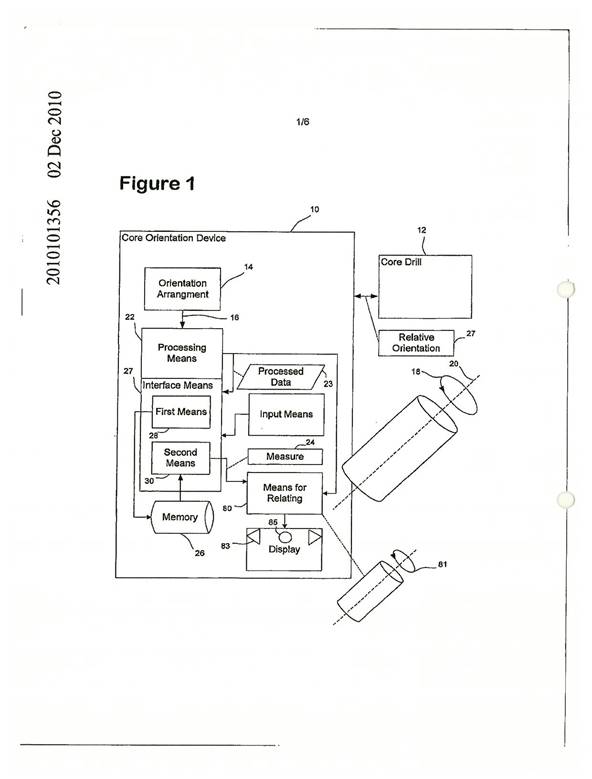
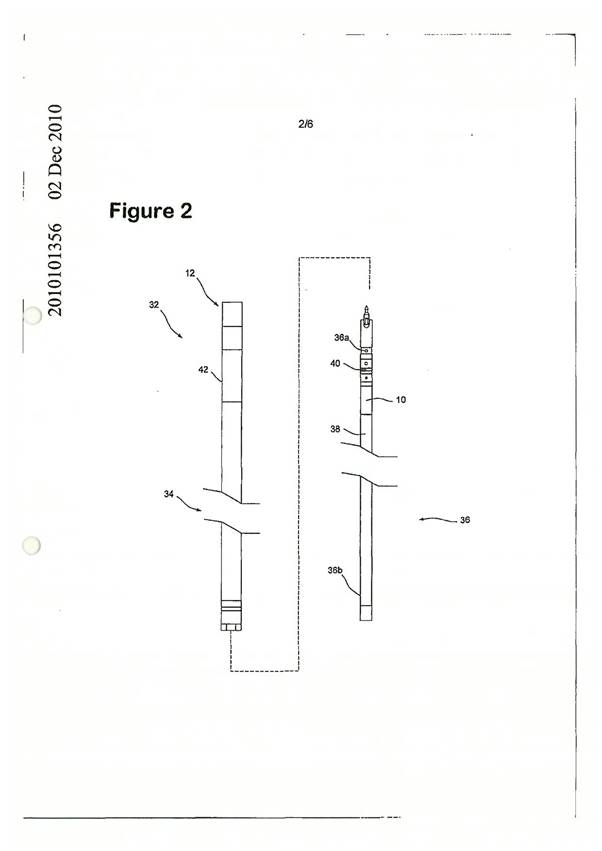
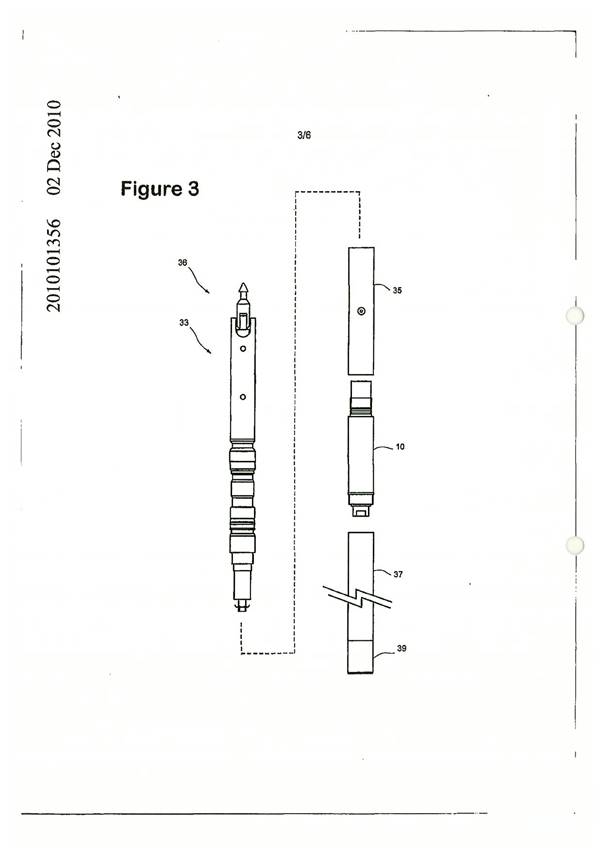
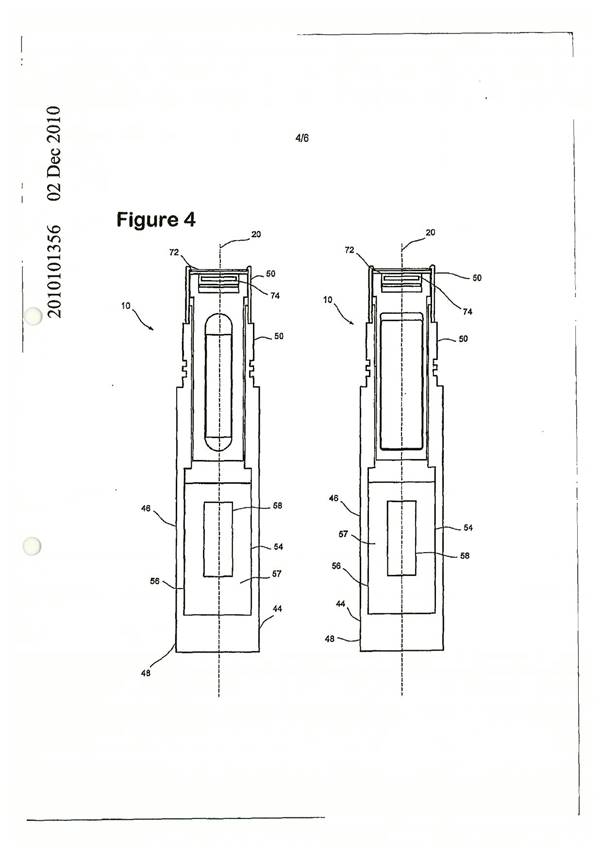
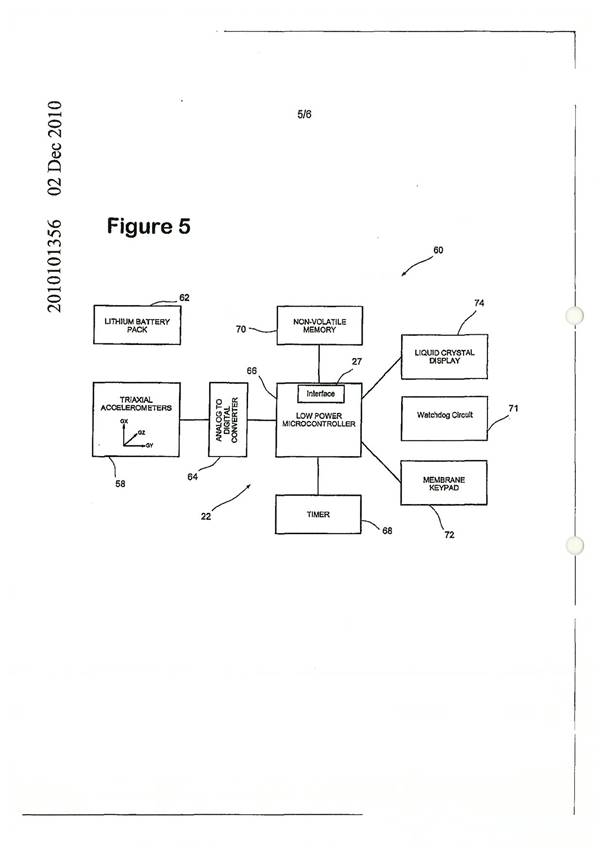
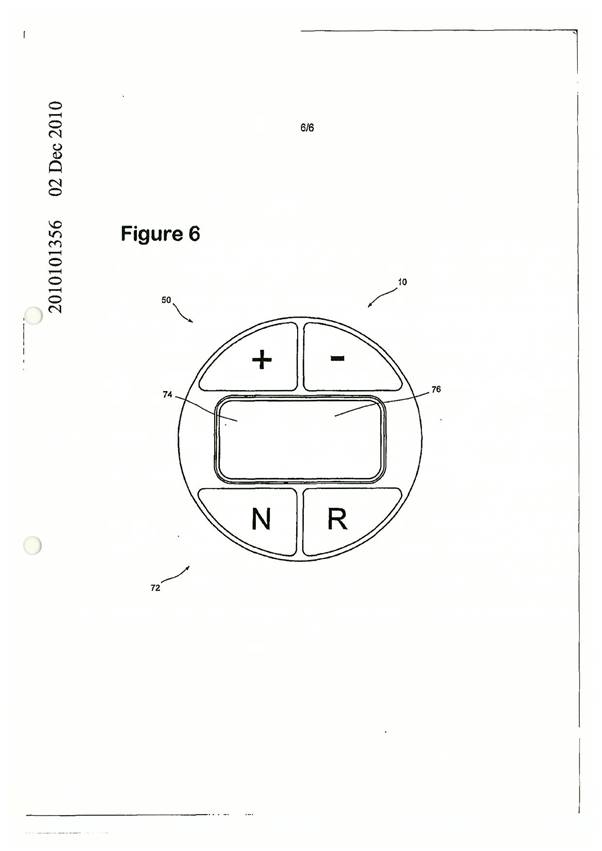
1. I have annexed evidentiary reasons for two rulings given in the course of the trial.
RULING MADE ON 30 APRIL 2014 (Day 10 of the trial):
2. In his second affidavit, sworn on 30 October 2013. with the benefit of some discovery and some affidavits sworn in response to his first affidavit, Mr Bradford swore a 48 page affidavit in reply to the affidavits for the applicants which take substantial issue with the contents of his first affidavit. It was clear that there was a very stark distinction between the evidence to be adduced by the applicants and the respondents about events that took place in 2003 and 2004.
3. The objection in issue arose in respect of a paragraph of the second affidavit which deals with the use of the ACT Tool subsequent to May 2004. The evidence was sought to be adduced (at [109]) as follows:
… As noted above, the core orientation tool with serial number 0001 was sent back to Mr Parfitt in the United Kingdom for inspection on or about 24 June 2004 and was returned to Ace Drilling not long afterwards. I refer to confidential exhibit CB-20, being the email from Ms Gregg to myself and Mr Reid dated 23 June 2004, and an email from me to Mr Parfitt dated 24 June 2004. Between 26 May 2004 and 24 June 2004, core orientation tool 0001 continued to be used in the field in Australia. The tools were given to clients who were considered good customers of Ace Drilling…
4. Objection was taken and upheld to a passage which followed the passage extracted above and read in the following terms ‘… and showed some interest in hiring the tools’.
5. I granted senior counsel for the respondents leave to develop that point in examination in chief. In examination in chief the following exchanges occurred:
And you might remember – and you’ve given evidence about these tools going out to various drilling sites and demonstrations with various customers, or being shown to various customers, to use the word neutrally. Do you remember that?---Yes.
And that had finished about May 2004?---Yes.
Speak up a bit, Mr Bradford, if you?---Yes, it was. Yes.
Thank you. After May 2004. Thereafter, what, in your knowledge, happened with those tools?---Once I had completed demonstrating those tools to clients. I believe those tools were sent to Kalgoorlie for our Kalgoorlie manager to show another client.
Yes. And after that date – after the Kalgoorlie showing, what then happened to the tools? Do you have any?---I believe the tools went on hire.
Yes. On hire?---Yes.
To whom?---It would be one of four companies that ..... dealt with.
And who were they?
MR HENNESSY: I object, your Honour. Well, just by virtue of the last sentence, it’s plain that the witness is now just going to speculate. It’s not sufficient foundation for---
MR HESS: Well, perhaps I will go back a step. You say one of four companies. Can you identify the four companies?
MR HENNESSY: No. I object. We – just getting at it another way. All he has done – the last question---
HIS HONOUR: Mr Bradford, would you mind just stepping outside the court for a short moment. We will just discuss this. We won’t be a moment.
6. I allowed the objection on the basis that the very general nature of the description of the clients and the interest that they showed was inadmissible hearsay and summary.
7. In my view, in light of the importance of this evidence, the proper way to adduce it would be to call evidence from anyone who actually took and used the machine as suggested. It is clear and taken in context, that this evidence is hearsay, speculative and imprecise. I do not consider it is appropriate that such important evidence should be led in that fashion. Given its importance, it should be given on a first hand basis from an actual user. Alternatively, if the witness is able to identify (admissibly) with precision exactly who received a tool from whom within the company, then that evidence could be given, but beyond that, it is not admissible.
8. I disallowed any further questioning of Mr Bradford on this topic.
A CALL FOR DOCUMENTS – THURSDAY, 1 MAY 2014 (Day 11 of the trial)
9. At the end of day 10 of the trial senior counsel for the respondents produced a subpoena dated 20 December 2013 for production of documents by Imdex, a non-party company which is related to the applicants.
10. The schedule of documents in the subpoena was extensive.
11. It is common ground that documents were produced under the subpoena but senior counsel for the respondents contends that other documents referred to in cross-examination were not produced. The respondents sought orders that those documents be produced by Imdex. Production was opposed. No notice had been given to the applicants of any such application but the respondents answered this complaint by indicating that they were not in a position to understand the internal workings of the applicants and Imdex until cross-examination. Senior counsel for the applicants complained that these matters should have been pursued by interlocutory applications for compliance in December 2013 rather than by way of ambush, effectively, at trial. There was no response to that complaint other than the fact that the respondents did not know of the internal workings of Imdex in December 2013.
12. The documentation sought, if it exists, is, at least arguably, relevant to the cross-claim advanced by the respondents in relation to commercialisation of the invention.
13. Ultimately, reliance on the submission was abandoned. Nevertheless, I did indicate that I would expect that the question of whether such reports exist or not to be clarified by Imdex or the applicants and, if they existed, I would expect them to be produced. If they no longer existed, having been created over 10 years ago and search for them revealed that they no longer existed, evidence to that effect should be adduced, failing which I indicated that I may entertain a further application.
14. During a break in the trial, counsel informed me that such documentation was pursued and produced by the applicants.


