

Leedham Papertalk on behalf of the Mullewa Wadjari people v State of Western Australia [2015] FCA 1342
IN THE FEDERAL COURT OF AUSTRALIA | |
LEEDHAM PAPERTALK & ORS ON BEHALF OF THE MULLEWA WADJARI PEOPLE Applicant | |
AND: | STATE OF WESTERN AUSTRALIA & ORS Respondents |
DATE OF ORDER: | |
WHERE MADE: |
THE COURT ORDERS THAT:
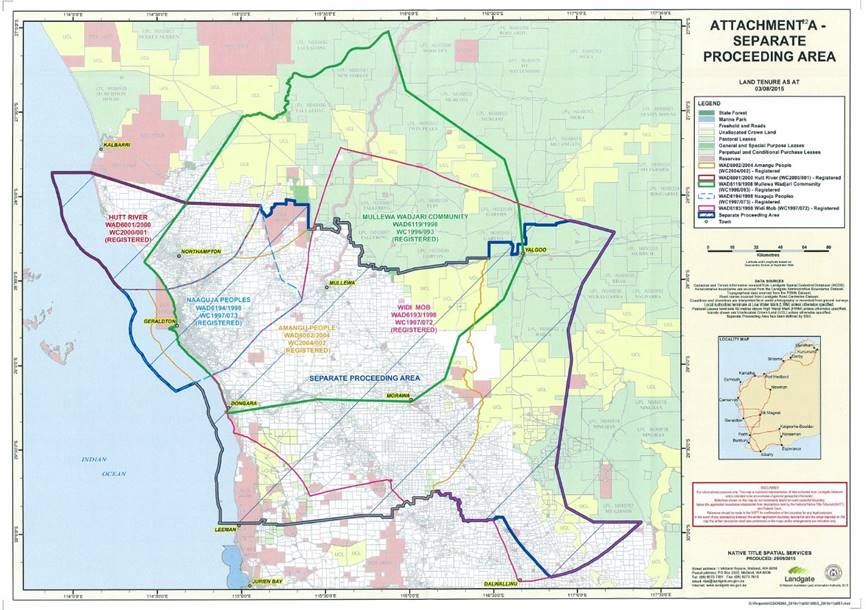
1. The following case management orders apply to the claimant applications WAD6119/1998 (Mullewa Wadjari), WAD6193/1998 (Widi Mob), WAD6194/1998 (Naaguja), WAD6001/2000 (Hutt River) and WAD6002/2004 (Amangu). In these orders the claimant in each case is referred to as the claimant and the claimants together are referred to as the claimants. The five proceedings are referred to as the claimant applications. The first respondent is referred to as the State. The separate proceeding area is that area depicted and described as such in Attachment A to these orders.
2. These orders are designed to achieve the following purposes:
(1) in the short-term, to:
(a) enable greater specificity to be provided by the parties as to the tenure underlying the claimant applications so that the land and waters available for claim under the Native Title Act 1993 (Cth) (NTA) in each proceeding are capable of being identified with reasonable particularity, if not absolute perfection;
(b) enable the claimants to resolve their differences, if possible, where the claim areas of the claimant applications overlap, so that the overlaps no longer exist;
(c) enable the claimants to formulate any proposals that they might together or in other combinations or individually wish to put to the State, and/or any other respondent with a relevant interest, to resolve the claimant applications which may include seeking orders under s 87 of the NTA;
(d) provide an opportunity, should it be considered appropriate by the relevant parties, for the relevant parties to consider and negotiate a consent order or an agreement to resolve the claimant applications which may include seeking orders under s 87 of the NTA; and
(2) in the event any or all of the claimant applications are not resolved and must proceed to a contested hearing, to program the claimant applications to a final hearing in respect of the separate proceeding area.
3. The Registrar, in order to achieve the purposes set out in order 2(1), above, is:
(a) to convene a further case management hearing between the claimants, the State and other respondents with a relevant interest to explore the means available, if any, by which the National Native Title Tribunal may be able to assist the parties to identify those portions of land and waters within the claim areas which are available to be claimed under the NTA by the claimants;
(b) to that end, and as appropriate, to invite the relevant member or officers of the National Native Title Tribunal to attend or assist in the process of identifying what land or waters are available to be claimed under the NTA by the claimants;
(c) in the light of such conferral and assistance, to complete case management hearings with those parties with a view to identifying those portions of land and waters that are available to be claimed under the NTA by the claimants; and
(d) to report back to the Court by 1 July 2016 as to what portions of land and waters are available to be claimed under the NTA by the claimants.
4. The questions of:
(a) the overlaps between the claimant applications, if any; and
(b) what proposal or proposals the claimants may wish to put to the State and/or other relevant respondents with a view to resolution of the claimant applications, which may include seeking orders under s 87 of the NTA,
be forthwith referred to mediation.
5. The mediation referred to in order 4 be conducted by a Registrar and a mediator identified by the Court, acting as co-mediators as they shall arrange between them.
6. The co-mediators shall report back to the Court on the two questions in order 4 at such time as they may consider convenient and in any event by 30 September 2016.
7. Subject to the content of and any recommendations made in the co-mediators’ report or reports, the Court may consider and make further orders to facilitate negotiations between the parties with a view to the resolution of the claimant applications which may include seeking orders under s 87 of the NTA.
8. For the purpose of achieving the goal set out in order 2(2) above, if by 31 March 2017 any claimant application has not been determined or otherwise resolved without the need for a final hearing, and subject to any other order of the Court, it will be listed for a final hearing to be conducted in August 2018 and the following programming orders shall apply.
9. Pursuant to s 67(2) of the NTA:
(a) application WAD6119/1998 (Mullewa Wadjari application) be divided into two parts, to be called “Mullewa Wadjari Part A”, consisting of that portion of the Mullewa Wadjari application which is not overlapped by WAD6136/1998 (Nanda) or WAD6033/1998 (Wajarri Yamatji) and “Mullewa Wadjari Part B” consisting of the remainder of the Mullewa Wadjari application;
(b) application WAD6193/1998 (Widi Mob application) be divided into two parts, to be called “Widi Mob Part A”, consisting of that portion of the Widi Mob application which is not overlapped by WAD6033/1998 (Wajarri Yamatji), WAD6192/1998 (Yued) or WAD6006/2003 (Single Noongar Claim #1), and “Widi Mob Part B” consisting of the remainder of the Widi Mob application;
(c) Mullewa Wadjari Part B be considered separately to Mullewa Wadjari Part A; and
(d) Widi Mob Part B be considered separately to Widi Mob Part A.
10. Pursuant to s 67(1) of the NTA, Mullewa Wadjari Part A, Widi Mob Part A, WAD6194/1998 (Naaguja), WAD6001/2000 (Hutt River) and WAD6002/2004 (Amangu) be heard together in a separate proceeding (see separate proceeding area in Attachment A).
11. Any document filed in accordance with these programming orders for the separate proceeding shall bear the heading in WAD6002/2004 (Amangu), and need only be filed on the court file in relation to WAD6002/2004 (Amangu).
12. Evidence given in one of the proceedings comprising the separate proceeding shall be evidence in each of the other proceedings comprising the separate proceeding.
Particularisation of claimed areas
13. On or before 30 June 2017 each claimant is to file a notice which identifies those claimed areas which are within the separate proceeding and in relation to which the claimant seeks a determination that native title rights and interests exist.
14. Any notice filed in accordance with order 13 is to identify the claimed areas as specifically as is reasonably practicable, including by reference to a lot on plan number, reserve number or lease number of any relevant parcel where available.
15. On or before 28 July 2017, the separate proceeding is to be listed for a case management hearing to consider whether the separate proceeding area ought to be amended having regard to the notices filed in accordance with order 13.
Separate questions
16. The following separate questions are to be set down for hearing in respect of the separate proceeding:
(1) does native title exist in relation to land and waters in the separate proceeding area?
(2) If the answer to (1) above is yes:
(a) who are the persons or each group of persons holding the individual, common or group rights comprising the native title?
(b) what are the native title rights and interests held by the native title holders identified in (a) above?
17. As to issues concerning the extinguishment of any native title in the separate proceeding area, including the time for filing pleadings and evidence in respect of those matters, the Court will make further orders following the determination of the separate questions.
Service of documents
18. On or before 30 March 2018, a participating respondent party, other than the State, may file a notice indicating:
(a) that it wishes to take an active part in the hearing of the entirety or part of the separate proceeding, including the extent to which it wishes to actively participate in the hearing of the separate questions; and/or
(b) whether it requires that it be served with any or all documents filed in relation to the hearing of the separate questions.
19. The parties are excused from serving any documents on any respondent party who has not filed a notice pursuant to order 18 above to the effect that the respondent party requires that it be served with any or all documents filed in relation to the hearing of the separate questions.
Pleadings
20. On or before 1 September 2017 each claimant is to file a statement of facts, issues and contentions (SFIC) concerning the separate questions.
21. On or before 27 October 2017 each claimant and any indigenous respondent is to file its response to any SFIC filed in accordance with order 20, which was not filed by the responding claimant.
22. On or before 2 March 2018 the State is to file and serve its response to the SFICs filed in accordance with order 20.
23. On or before 30 March 2018 the participating respondents (other than the State) are to file and serve any response to one or more of the SFICs filed in accordance with order 20, which that respondent party seeks to rely upon.
Claimants’ lay evidence
24. On or before 1 September 2017 each claimant will file:
(a) a statement of evidence for each witness (other than expert witnesses) upon whose evidence the claimant will rely for the hearing of the separate questions; and
(b) a copy of each photograph or other document (appropriately captioned or described) which it proposes to tender or refer to in the evidence of a witness whose statement is given in accordance with order 24(a).
25. A claimant shall not be entitled to rely upon, or seek to adduce, the evidence of any lay witness who has not given a statement of evidence filed in accordance with order 24 above, without first obtaining leave of the Court.
Respondents’ lay evidence
26. On or before 2 March 2018 each participating respondent who is not indigenous intending to lead evidence from a witness (other than an expert witness) in respect of the hearing of the separate questions, will file and serve:
(a) an affidavit for each witness (other than an expert witness) upon whose evidence the respondent will rely; and
(b) a copy of each photograph or other document (appropriately captioned or described) which it proposes to tender or refer to in the evidence of that witness.
27. Such respondent shall not be entitled to rely upon the evidence of any lay witness who has not given an affidavit filed in accordance with order 26 above, without first obtaining leave of the Court.
Claimants’ responsive evidence
28. On or before 30 March 2018 each claimant may file any supplementary statement of evidence responding to any matters raised by the lay evidence filed on behalf of another party in accordance with order 24 or order 26.
Objection to lay evidence
29. On or before 1 June 2018 the parties may each file a notice identifying:
(a) any part of a statement of evidence filed in accordance with order 24 or order 28 which is required to be led orally; and
(b) any part of a statement of evidence, affidavit or document filed in accordance with order 24, order 26 or order 28 objected to and the ground for such objection.
30. Except insofar as part of a statement of evidence is the subject of a notice under order 29 above the statement of evidence shall, upon adoption of that part of the statement by the witness in question, stand as the evidence-in-chief of the witness.
Claimants’ expert evidence, genealogies and site materials
31. On or before 1 September 2017, each claimant is to file and serve:
(a) any final reports of expert witnesses containing the expert evidence upon which the claimant will rely at trial of the separate questions, such reports to comply with the Court’s Guidelines for Expert Witnesses contained in Practice Note CM 7;
(b) where available, one or more genealogies showing the biological, adoptive or other connections of each member of the native title claim group; and
(c) a map showing sites of significance to the native title claim group on or near the area of the separate proceeding, together with a register of those sites that is cross-referenced to the map or maps and provides: the name(s), location and physical description of each site; and, where relevant, a summary of the significance of the site and/or the mythology associated with it.
Respondents’ expert evidence
32. On or before 2 March 2018, the State file and serve final reports of any expert witnesses upon which it intends to rely at trial of the separate questions, such reports to comply with the Court’s Guidelines for Expert Witnesses contained in Practice Note CM 7.
33. On or before 30 March 2018, any other participating respondent file and serve final reports of any expert witnesses upon which they intend to rely at trial of the separate questions, such reports to comply with the Court’s Guidelines for Expert Witnesses contained in Practice Note CM 7.
34. Upon request of another party, a party who has filed an expert’s report shall allow the requesting party to inspect and, if requested, provide at the requesting party’s expense, copies of all the documents referred to in the expert’s report, which are unpublished or not reasonably accessible by the requesting party’s experts, within 14 days of such a request.
Objection to experts’ reports
35. If a party not calling the expert witness does not consent to the whole or any part of the final report of the expert witness being admitted into evidence-inchief, it will file and serve, on or before 27 April 2018, a notice identifying:
(a) those reports or annexed documents or parts of them to which that party objects on the grounds that the report or the annexed documents or parts of them (identifying which part) are not admissible, stating the basis for each objection; and
(b) those reports or annexed documents or parts of them which that party disputes or does not concede and, if that party has filed an expert report addressing the same topic or topics, identifying (by reference to the paragraph, page or other convenient reference) that part of that expert report which addresses that topic or topics.
36. Subject to any further order, any expert whose evidence is to be adduced at the hearing shall be available for cross-examination.
Statement of cultural and customary concern
37. On or before 27 April 2018, each claimant is to file an interlocutory application seeking any order or orders that the Court take account of identified cultural or customary concerns of the claimant and/or a particular witness, as the case may be. Where it is otherwise applicable, such application shall include, but is not limited to:
(a) any restrictions as to the persons who are to hear particular evidence being given;
(b) any restrictions to the publication of any particular evidence; and
(c) any procedures for particular witnesses to give evidence at the hearing, including whether a witness is to give evidence while seated in a group.
38. On or before 18 May 2018 the respondent parties will file any evidence or other reply to any interlocutory application filed in accordance with order 37.
39. All interlocutory applications filed in accordance with order 37 will be heard on a date to be fixed.
Other documentary evidence
40. On or before 1 June 2018, the claimants will each file and serve an index of any other documents that they intend to tender as evidence at trial, and make available for inspection copies of the documents listed in the index.
41. On or before 29 June 2018, the State will file and serve an index of any other documents that it intends to tender as evidence at trial, and make available for inspection copies of the documents listed in the index.
42. On or before 13 July 2018, any other participating respondent will file and serve an index of any other documents that it intends to tender as evidence at trial, and make available for inspection copies of the documents listed in the index.
43. On or before 27 July 2018, the parties will file and serve an index of, and copies of, documents which may be tendered at trial, identifying:
(a) those documents which the parties agree are admissible and can be tendered;
(b) those documents which are not agreed and which the claimant seeks to tender; and
(c) those documents which are not agreed and which the respondents seek to tender.
Arrangements for trial
44. On a date to be fixed, not less than 30 days before the hearing, there will be a case management hearing before the trial judge to consider final arrangements concerning the hearing, such matters having previously been the subject of case management under the direction of a Registrar.
45. The opening address of each of the claimants and the hearing of all evidence apart from expert evidence is set down for hearing commencing 13 August 2018, at a location and for a period to be determined.
46. The hearing of expert evidence in relation to the separate questions is set down for hearing at Perth for a period of time to be fixed and commencing on a date to be fixed.
Note: Entry of orders is dealt with in Rule 39.32 of the Federal Court Rules 2011.
IN THE FEDERAL COURT OF AUSTRALIA | |
WESTERN AUSTRALIA DISTRICT REGISTRY | |
GENERAL DIVISION | WAD 6193 of 1998 |
BETWEEN: | IRWIN TASMAN LEWIS & ORS ON BEHALF OF THE WIDI MOB Applicant |
AND: | STATE OF WESTERN AUSTRALIA & ORS Respondents |
JUDGE: | BARKER J |
DATE OF ORDER: | 27 NOVEMBER 2015 |
WHERE MADE: | PERTH |
THE COURT ORDERS THAT:
1. The following case management orders apply to the claimant applications WAD6119/1998 (Mullewa Wadjari), WAD6193/1998 (Widi Mob), WAD6194/1998 (Naaguja), WAD6001/2000 (Hutt River) and WAD6002/2004 (Amangu). In these orders the claimant in each case is referred to as the claimant and the claimants together are referred to as the claimants. The five proceedings are referred to as the claimant applications. The first respondent is referred to as the State. The separate proceeding area is that area depicted and described as such in Attachment A to these orders.
2. These orders are designed to achieve the following purposes:
(1) in the short-term, to:
(a) enable greater specificity to be provided by the parties as to the tenure underlying the claimant applications so that the land and waters available for claim under the Native Title Act 1993 (Cth) (NTA) in each proceeding are capable of being identified with reasonable particularity, if not absolute perfection;
(b) enable the claimants to resolve their differences, if possible, where the claim areas of the claimant applications overlap, so that the overlaps no longer exist;
(c) enable the claimants to formulate any proposals that they might together or in other combinations or individually wish to put to the State, and/or any other respondent with a relevant interest, to resolve the claimant applications which may include seeking orders under s 87 of the NTA;
(d) provide an opportunity, should it be considered appropriate by the relevant parties, for the relevant parties to consider and negotiate a consent order or an agreement to resolve the claimant applications which may include seeking orders under s 87 of the NTA; and
(2) in the event any or all of the claimant applications are not resolved and must proceed to a contested hearing, to program the claimant applications to a final hearing in respect of the separate proceeding area.
3. The Registrar, in order to achieve the purposes set out in order 2(1), above, is:
(a) to convene a further case management hearing between the claimants, the State and other respondents with a relevant interest to explore the means available, if any, by which the National Native Title Tribunal may be able to assist the parties to identify those portions of land and waters within the claim areas which are available to be claimed under the NTA by the claimants;
(b) to that end, and as appropriate, to invite the relevant member or officers of the National Native Title Tribunal to attend or assist in the process of identifying what land or waters are available to be claimed under the NTA by the claimants;
(c) in the light of such conferral and assistance, to complete case management hearings with those parties with a view to identifying those portions of land and waters that are available to be claimed under the NTA by the claimants; and
(d) to report back to the Court by 1 July 2016 as to what portions of land and waters are available to be claimed under the NTA by the claimants.
4. The questions of:
(a) the overlaps between the claimant applications, if any; and
(b) what proposal or proposals the claimants may wish to put to the State and/or other relevant respondents with a view to resolution of the claimant applications, which may include seeking orders under s 87 of the NTA,
be forthwith referred to mediation.
5. The mediation referred to in order 4 be conducted by a Registrar and a mediator identified by the Court, acting as co-mediators as they shall arrange between them.
6. The co-mediators shall report back to the Court on the two questions in order 4 at such time as they may consider convenient and in any event by 30 September 2016.
7. Subject to the content of and any recommendations made in the co-mediators’ report or reports, the Court may consider and make further orders to facilitate negotiations between the parties with a view to the resolution of the claimant applications which may include seeking orders under s 87 of the NTA.
8. For the purpose of achieving the goal set out in order 2(2) above, if by 31 March 2017 any claimant application has not been determined or otherwise resolved without the need for a final hearing, and subject to any other order of the Court, it will be listed for a final hearing to be conducted in August 2018 and the following programming orders shall apply.
9. Pursuant to s 67(2) of the NTA:
(a) application WAD6119/1998 (Mullewa Wadjari application) be divided into two parts, to be called “Mullewa Wadjari Part A”, consisting of that portion of the Mullewa Wadjari application which is not overlapped by WAD6136/1998 (Nanda) or WAD6033/1998 (Wajarri Yamatji) and “Mullewa Wadjari Part B” consisting of the remainder of the Mullewa Wadjari application;
(b) application WAD6193/1998 (Widi Mob application) be divided into two parts, to be called “Widi Mob Part A”, consisting of that portion of the Widi Mob application which is not overlapped by WAD6033/1998 (Wajarri Yamatji), WAD6192/1998 (Yued) or WAD6006/2003 (Single Noongar Claim #1), and “Widi Mob Part B” consisting of the remainder of the Widi Mob application;
(c) Mullewa Wadjari Part B be considered separately to Mullewa Wadjari Part A; and
(d) Widi Mob Part B be considered separately to Widi Mob Part A.
10. Pursuant to s 67(1) of the NTA, Mullewa Wadjari Part A, Widi Mob Part A, WAD6194/1998 (Naaguja), WAD6001/2000 (Hutt River) and WAD6002/2004 (Amangu) be heard together in a separate proceeding (see separate proceeding area in Attachment A).
11. Any document filed in accordance with these programming orders for the separate proceeding shall bear the heading in WAD6002/2004 (Amangu), and need only be filed on the court file in relation to WAD6002/2004 (Amangu).
12. Evidence given in one of the proceedings comprising the separate proceeding shall be evidence in each of the other proceedings comprising the separate proceeding.
Particularisation of claimed areas
13. On or before 30 June 2017 each claimant is to file a notice which identifies those claimed areas which are within the separate proceeding and in relation to which the claimant seeks a determination that native title rights and interests exist.
14. Any notice filed in accordance with order 13 is to identify the claimed areas as specifically as is reasonably practicable, including by reference to a lot on plan number, reserve number or lease number of any relevant parcel where available.
15. On or before 28 July 2017, the separate proceeding is to be listed for a case management hearing to consider whether the separate proceeding area ought to be amended having regard to the notices filed in accordance with order 13.
Separate questions
16. The following separate questions are to be set down for hearing in respect of the separate proceeding:
(1) does native title exist in relation to land and waters in the separate proceeding area?
(2) If the answer to (1) above is yes:
(a) who are the persons or each group of persons holding the individual, common or group rights comprising the native title?
(b) what are the native title rights and interests held by the native title holders identified in (a) above?
17. As to issues concerning the extinguishment of any native title in the separate proceeding area, including the time for filing pleadings and evidence in respect of those matters, the Court will make further orders following the determination of the separate questions.
Service of documents
18. On or before 30 March 2018, a participating respondent party, other than the State, may file a notice indicating:
(a) that it wishes to take an active part in the hearing of the entirety or part of the separate proceeding, including the extent to which it wishes to actively participate in the hearing of the separate questions; and/or
(b) whether it requires that it be served with any or all documents filed in relation to the hearing of the separate questions.
19. The parties are excused from serving any documents on any respondent party who has not filed a notice pursuant to order 18 above to the effect that the respondent party requires that it be served with any or all documents filed in relation to the hearing of the separate questions.
Pleadings
20. On or before 1 September 2017 each claimant is to file a statement of facts, issues and contentions (SFIC) concerning the separate questions.
21. On or before 27 October 2017 each claimant and any indigenous respondent is to file its response to any SFIC filed in accordance with order 20, which was not filed by the responding claimant.
22. On or before 2 March 2018 the State is to file and serve its response to the SFICs filed in accordance with order 20.
23. On or before 30 March 2018 the participating respondents (other than the State) are to file and serve any response to one or more of the SFICs filed in accordance with order 20, which that respondent party seeks to rely upon.
Claimants’ lay evidence
24. On or before 1 September 2017 each claimant will file:
(a) a statement of evidence for each witness (other than expert witnesses) upon whose evidence the claimant will rely for the hearing of the separate questions; and
(b) a copy of each photograph or other document (appropriately captioned or described) which it proposes to tender or refer to in the evidence of a witness whose statement is given in accordance with order 24(a).
25. A claimant shall not be entitled to rely upon, or seek to adduce, the evidence of any lay witness who has not given a statement of evidence filed in accordance with order 24 above, without first obtaining leave of the Court.
Respondents’ lay evidence
26. On or before 2 March 2018 each participating respondent who is not indigenous intending to lead evidence from a witness (other than an expert witness) in respect of the hearing of the separate questions, will file and serve:
(a) an affidavit for each witness (other than an expert witness) upon whose evidence the respondent will rely; and
(b) a copy of each photograph or other document (appropriately captioned or described) which it proposes to tender or refer to in the evidence of that witness.
27. Such respondent shall not be entitled to rely upon the evidence of any lay witness who has not given an affidavit filed in accordance with order 26 above, without first obtaining leave of the Court.
Claimants’ responsive evidence
28. On or before 30 March 2018 each claimant may file any supplementary statement of evidence responding to any matters raised by the lay evidence filed on behalf of another party in accordance with order 24 or order 26.
Objection to lay evidence
29. On or before 1 June 2018 the parties may each file a notice identifying:
(a) any part of a statement of evidence filed in accordance with order 24 or order 28 which is required to be led orally; and
(b) any part of a statement of evidence, affidavit or document filed in accordance with order 24, order 26 or order 28 objected to and the ground for such objection.
30. Except insofar as part of a statement of evidence is the subject of a notice under order 29 above the statement of evidence shall, upon adoption of that part of the statement by the witness in question, stand as the evidence-in-chief of the witness.
Claimants’ expert evidence, genealogies and site materials
31. On or before 1 September 2017, each claimant is to file and serve:
(a) any final reports of expert witnesses containing the expert evidence upon which the claimant will rely at trial of the separate questions, such reports to comply with the Court’s Guidelines for Expert Witnesses contained in Practice Note CM 7;
(b) where available, one or more genealogies showing the biological, adoptive or other connections of each member of the native title claim group; and
(c) a map showing sites of significance to the native title claim group on or near the area of the separate proceeding, together with a register of those sites that is cross-referenced to the map or maps and provides: the name(s), location and physical description of each site; and, where relevant, a summary of the significance of the site and/or the mythology associated with it.
Respondents’ expert evidence
32. On or before 2 March 2018, the State file and serve final reports of any expert witnesses upon which it intends to rely at trial of the separate questions, such reports to comply with the Court’s Guidelines for Expert Witnesses contained in Practice Note CM 7.
33. On or before 30 March 2018, any other participating respondent file and serve final reports of any expert witnesses upon which they intend to rely at trial of the separate questions, such reports to comply with the Court’s Guidelines for Expert Witnesses contained in Practice Note CM 7.
34. Upon request of another party, a party who has filed an expert’s report shall allow the requesting party to inspect and, if requested, provide at the requesting party’s expense, copies of all the documents referred to in the expert’s report, which are unpublished or not reasonably accessible by the requesting party’s experts, within 14 days of such a request.
Objection to experts’ reports
35. If a party not calling the expert witness does not consent to the whole or any part of the final report of the expert witness being admitted into evidence-inchief, it will file and serve, on or before 27 April 2018, a notice identifying:
(a) those reports or annexed documents or parts of them to which that party objects on the grounds that the report or the annexed documents or parts of them (identifying which part) are not admissible, stating the basis for each objection; and
(b) those reports or annexed documents or parts of them which that party disputes or does not concede and, if that party has filed an expert report addressing the same topic or topics, identifying (by reference to the paragraph, page or other convenient reference) that part of that expert report which addresses that topic or topics.
36. Subject to any further order, any expert whose evidence is to be adduced at the hearing shall be available for cross-examination.
Statement of cultural and customary concern
37. On or before 27 April 2018, each claimant is to file an interlocutory application seeking any order or orders that the Court take account of identified cultural or customary concerns of the claimant and/or a particular witness, as the case may be. Where it is otherwise applicable, such application shall include, but is not limited to:
(a) any restrictions as to the persons who are to hear particular evidence being given;
(b) any restrictions to the publication of any particular evidence; and
(c) any procedures for particular witnesses to give evidence at the hearing, including whether a witness is to give evidence while seated in a group.
38. On or before 18 May 2018 the respondent parties will file any evidence or other reply to any interlocutory application filed in accordance with order 37.
39. All interlocutory applications filed in accordance with order 37 will be heard on a date to be fixed.
Other documentary evidence
40. On or before 1 June 2018, the claimants will each file and serve an index of any other documents that they intend to tender as evidence at trial, and make available for inspection copies of the documents listed in the index.
41. On or before 29 June 2018, the State will file and serve an index of any other documents that it intends to tender as evidence at trial, and make available for inspection copies of the documents listed in the index.
42. On or before 13 July 2018, any other participating respondent will file and serve an index of any other documents that it intends to tender as evidence at trial, and make available for inspection copies of the documents listed in the index.
43. On or before 27 July 2018, the parties will file and serve an index of, and copies of, documents which may be tendered at trial, identifying:
(a) those documents which the parties agree are admissible and can be tendered;
(b) those documents which are not agreed and which the claimant seeks to tender; and
(c) those documents which are not agreed and which the respondents seek to tender.
Arrangements for trial
44. On a date to be fixed, not less than 30 days before the hearing, there will be a case management hearing before the trial judge to consider final arrangements concerning the hearing, such matters having previously been the subject of case management under the direction of a Registrar.
45. The opening address of each of the claimants and the hearing of all evidence apart from expert evidence is set down for hearing commencing 13 August 2018, at a location and for a period to be determined.
46. The hearing of expert evidence in relation to the separate questions is set down for hearing at Perth for a period of time to be fixed and commencing on a date to be fixed.
Note: Entry of orders is dealt with in Rule 39.32 of the Federal Court Rules 2011.
IN THE FEDERAL COURT OF AUSTRALIA | |
WESTERN AUSTRALIA DISTRICT REGISTRY | |
GENERAL DIVISION | WAD 6194 of 1998 |
BETWEEN: | KEITH COUNCILLOR & ORS ON BEHALF OF THE NAAGUJA PEOPLE Applicant |
AND: | STATE OF WESTERN AUSTRALIA & ORS Respondents |
JUDGE: | BARKER J |
DATE OF ORDER: | 27 NOVEMBER 2015 |
WHERE MADE: | PERTH |
THE COURT ORDERS THAT:
1. The following case management orders apply to the claimant applications WAD6119/1998 (Mullewa Wadjari), WAD6193/1998 (Widi Mob), WAD6194/1998 (Naaguja), WAD6001/2000 (Hutt River) and WAD6002/2004 (Amangu). In these orders the claimant in each case is referred to as the claimant and the claimants together are referred to as the claimants. The five proceedings are referred to as the claimant applications. The first respondent is referred to as the State. The separate proceeding area is that area depicted and described as such in Attachment A to these orders.
2. These orders are designed to achieve the following purposes:
(1) in the short-term, to:
(a) enable greater specificity to be provided by the parties as to the tenure underlying the claimant applications so that the land and waters available for claim under the Native Title Act 1993 (Cth) (NTA) in each proceeding are capable of being identified with reasonable particularity, if not absolute perfection;
(b) enable the claimants to resolve their differences, if possible, where the claim areas of the claimant applications overlap, so that the overlaps no longer exist;
(c) enable the claimants to formulate any proposals that they might together or in other combinations or individually wish to put to the State, and/or any other respondent with a relevant interest, to resolve the claimant applications which may include seeking orders under s 87 of the NTA;
(d) provide an opportunity, should it be considered appropriate by the relevant parties, for the relevant parties to consider and negotiate a consent order or an agreement to resolve the claimant applications which may include seeking orders under s 87 of the NTA; and
(2) in the event any or all of the claimant applications are not resolved and must proceed to a contested hearing, to program the claimant applications to a final hearing in respect of the separate proceeding area.
3. The Registrar, in order to achieve the purposes set out in order 2(1), above, is:
(a) to convene a further case management hearing between the claimants, the State and other respondents with a relevant interest to explore the means available, if any, by which the National Native Title Tribunal may be able to assist the parties to identify those portions of land and waters within the claim areas which are available to be claimed under the NTA by the claimants;
(b) to that end, and as appropriate, to invite the relevant member or officers of the National Native Title Tribunal to attend or assist in the process of identifying what land or waters are available to be claimed under the NTA by the claimants;
(c) in the light of such conferral and assistance, to complete case management hearings with those parties with a view to identifying those portions of land and waters that are available to be claimed under the NTA by the claimants; and
(d) to report back to the Court by 1 July 2016 as to what portions of land and waters are available to be claimed under the NTA by the claimants.
4. The questions of:
(a) the overlaps between the claimant applications, if any; and
(b) what proposal or proposals the claimants may wish to put to the State and/or other relevant respondents with a view to resolution of the claimant applications, which may include seeking orders under s 87 of the NTA,
be forthwith referred to mediation.
5. The mediation referred to in order 4 be conducted by a Registrar and a mediator identified by the Court, acting as co-mediators as they shall arrange between them.
6. The co-mediators shall report back to the Court on the two questions in order 4 at such time as they may consider convenient and in any event by 30 September 2016.
7. Subject to the content of and any recommendations made in the co-mediators’ report or reports, the Court may consider and make further orders to facilitate negotiations between the parties with a view to the resolution of the claimant applications which may include seeking orders under s 87 of the NTA.
8. For the purpose of achieving the goal set out in order 2(2) above, if by 31 March 2017 any claimant application has not been determined or otherwise resolved without the need for a final hearing, and subject to any other order of the Court, it will be listed for a final hearing to be conducted in August 2018 and the following programming orders shall apply.
9. Pursuant to s 67(2) of the NTA:
(a) application WAD6119/1998 (Mullewa Wadjari application) be divided into two parts, to be called “Mullewa Wadjari Part A”, consisting of that portion of the Mullewa Wadjari application which is not overlapped by WAD6136/1998 (Nanda) or WAD6033/1998 (Wajarri Yamatji) and “Mullewa Wadjari Part B” consisting of the remainder of the Mullewa Wadjari application;
(b) application WAD6193/1998 (Widi Mob application) be divided into two parts, to be called “Widi Mob Part A”, consisting of that portion of the Widi Mob application which is not overlapped by WAD6033/1998 (Wajarri Yamatji), WAD6192/1998 (Yued) or WAD6006/2003 (Single Noongar Claim #1), and “Widi Mob Part B” consisting of the remainder of the Widi Mob application;
(c) Mullewa Wadjari Part B be considered separately to Mullewa Wadjari Part A; and
(d) Widi Mob Part B be considered separately to Widi Mob Part A.
10. Pursuant to s 67(1) of the NTA, Mullewa Wadjari Part A, Widi Mob Part A, WAD6194/1998 (Naaguja), WAD6001/2000 (Hutt River) and WAD6002/2004 (Amangu) be heard together in a separate proceeding (see separate proceeding area in Attachment A).
11. Any document filed in accordance with these programming orders for the separate proceeding shall bear the heading in WAD6002/2004 (Amangu), and need only be filed on the court file in relation to WAD6002/2004 (Amangu).
12. Evidence given in one of the proceedings comprising the separate proceeding shall be evidence in each of the other proceedings comprising the separate proceeding.
Particularisation of claimed areas
13. On or before 30 June 2017 each claimant is to file a notice which identifies those claimed areas which are within the separate proceeding and in relation to which the claimant seeks a determination that native title rights and interests exist.
14. Any notice filed in accordance with order 13 is to identify the claimed areas as specifically as is reasonably practicable, including by reference to a lot on plan number, reserve number or lease number of any relevant parcel where available.
15. On or before 28 July 2017, the separate proceeding is to be listed for a case management hearing to consider whether the separate proceeding area ought to be amended having regard to the notices filed in accordance with order 13.
Separate questions
16. The following separate questions are to be set down for hearing in respect of the separate proceeding:
(1) does native title exist in relation to land and waters in the separate proceeding area?
(2) If the answer to (1) above is yes:
(a) who are the persons or each group of persons holding the individual, common or group rights comprising the native title?
(b) what are the native title rights and interests held by the native title holders identified in (a) above?
17. As to issues concerning the extinguishment of any native title in the separate proceeding area, including the time for filing pleadings and evidence in respect of those matters, the Court will make further orders following the determination of the separate questions.
Service of documents
18. On or before 30 March 2018, a participating respondent party, other than the State, may file a notice indicating:
(a) that it wishes to take an active part in the hearing of the entirety or part of the separate proceeding, including the extent to which it wishes to actively participate in the hearing of the separate questions; and/or
(b) whether it requires that it be served with any or all documents filed in relation to the hearing of the separate questions.
19. The parties are excused from serving any documents on any respondent party who has not filed a notice pursuant to order 18 above to the effect that the respondent party requires that it be served with any or all documents filed in relation to the hearing of the separate questions.
Pleadings
20. On or before 1 September 2017 each claimant is to file a statement of facts, issues and contentions (SFIC) concerning the separate questions.
21. On or before 27 October 2017 each claimant and any indigenous respondent is to file its response to any SFIC filed in accordance with order 20, which was not filed by the responding claimant.
22. On or before 2 March 2018 the State is to file and serve its response to the SFICs filed in accordance with order 20.
23. On or before 30 March 2018 the participating respondents (other than the State) are to file and serve any response to one or more of the SFICs filed in accordance with order 20, which that respondent party seeks to rely upon.
Claimants’ lay evidence
24. On or before 1 September 2017 each claimant will file:
(a) a statement of evidence for each witness (other than expert witnesses) upon whose evidence the claimant will rely for the hearing of the separate questions; and
(b) a copy of each photograph or other document (appropriately captioned or described) which it proposes to tender or refer to in the evidence of a witness whose statement is given in accordance with order 24(a).
25. A claimant shall not be entitled to rely upon, or seek to adduce, the evidence of any lay witness who has not given a statement of evidence filed in accordance with order 24 above, without first obtaining leave of the Court.
Respondents’ lay evidence
26. On or before 2 March 2018 each participating respondent who is not indigenous intending to lead evidence from a witness (other than an expert witness) in respect of the hearing of the separate questions, will file and serve:
(a) an affidavit for each witness (other than an expert witness) upon whose evidence the respondent will rely; and
(b) a copy of each photograph or other document (appropriately captioned or described) which it proposes to tender or refer to in the evidence of that witness.
27. Such respondent shall not be entitled to rely upon the evidence of any lay witness who has not given an affidavit filed in accordance with order 26 above, without first obtaining leave of the Court.
Claimants’ responsive evidence
28. On or before 30 March 2018 each claimant may file any supplementary statement of evidence responding to any matters raised by the lay evidence filed on behalf of another party in accordance with order 24 or order 26.
Objection to lay evidence
29. On or before 1 June 2018 the parties may each file a notice identifying:
(a) any part of a statement of evidence filed in accordance with order 24 or order 28 which is required to be led orally; and
(b) any part of a statement of evidence, affidavit or document filed in accordance with order 24, order 26 or order 28 objected to and the ground for such objection.
30. Except insofar as part of a statement of evidence is the subject of a notice under order 29 above the statement of evidence shall, upon adoption of that part of the statement by the witness in question, stand as the evidence-in-chief of the witness.
Claimants’ expert evidence, genealogies and site materials
31. On or before 1 September 2017, each claimant is to file and serve:
(a) any final reports of expert witnesses containing the expert evidence upon which the claimant will rely at trial of the separate questions, such reports to comply with the Court’s Guidelines for Expert Witnesses contained in Practice Note CM 7;
(b) where available, one or more genealogies showing the biological, adoptive or other connections of each member of the native title claim group; and
(c) a map showing sites of significance to the native title claim group on or near the area of the separate proceeding, together with a register of those sites that is cross-referenced to the map or maps and provides: the name(s), location and physical description of each site; and, where relevant, a summary of the significance of the site and/or the mythology associated with it.
Respondents’ expert evidence
32. On or before 2 March 2018, the State file and serve final reports of any expert witnesses upon which it intends to rely at trial of the separate questions, such reports to comply with the Court’s Guidelines for Expert Witnesses contained in Practice Note CM 7.
33. On or before 30 March 2018, any other participating respondent file and serve final reports of any expert witnesses upon which they intend to rely at trial of the separate questions, such reports to comply with the Court’s Guidelines for Expert Witnesses contained in Practice Note CM 7.
34. Upon request of another party, a party who has filed an expert’s report shall allow the requesting party to inspect and, if requested, provide at the requesting party’s expense, copies of all the documents referred to in the expert’s report, which are unpublished or not reasonably accessible by the requesting party’s experts, within 14 days of such a request.
Objection to experts’ reports
35. If a party not calling the expert witness does not consent to the whole or any part of the final report of the expert witness being admitted into evidence-inchief, it will file and serve, on or before 27 April 2018, a notice identifying:
(a) those reports or annexed documents or parts of them to which that party objects on the grounds that the report or the annexed documents or parts of them (identifying which part) are not admissible, stating the basis for each objection; and
(b) those reports or annexed documents or parts of them which that party disputes or does not concede and, if that party has filed an expert report addressing the same topic or topics, identifying (by reference to the paragraph, page or other convenient reference) that part of that expert report which addresses that topic or topics.
36. Subject to any further order, any expert whose evidence is to be adduced at the hearing shall be available for cross-examination.
Statement of cultural and customary concern
37. On or before 27 April 2018, each claimant is to file an interlocutory application seeking any order or orders that the Court take account of identified cultural or customary concerns of the claimant and/or a particular witness, as the case may be. Where it is otherwise applicable, such application shall include, but is not limited to:
(a) any restrictions as to the persons who are to hear particular evidence being given;
(b) any restrictions to the publication of any particular evidence; and
(c) any procedures for particular witnesses to give evidence at the hearing, including whether a witness is to give evidence while seated in a group.
38. On or before 18 May 2018 the respondent parties will file any evidence or other reply to any interlocutory application filed in accordance with order 37.
39. All interlocutory applications filed in accordance with order 37 will be heard on a date to be fixed.
Other documentary evidence
40. On or before 1 June 2018, the claimants will each file and serve an index of any other documents that they intend to tender as evidence at trial, and make available for inspection copies of the documents listed in the index.
41. On or before 29 June 2018, the State will file and serve an index of any other documents that it intends to tender as evidence at trial, and make available for inspection copies of the documents listed in the index.
42. On or before 13 July 2018, any other participating respondent will file and serve an index of any other documents that it intends to tender as evidence at trial, and make available for inspection copies of the documents listed in the index.
43. On or before 27 July 2018, the parties will file and serve an index of, and copies of, documents which may be tendered at trial, identifying:
(a) those documents which the parties agree are admissible and can be tendered;
(b) those documents which are not agreed and which the claimant seeks to tender; and
(c) those documents which are not agreed and which the respondents seek to tender.
Arrangements for trial
44. On a date to be fixed, not less than 30 days before the hearing, there will be a case management hearing before the trial judge to consider final arrangements concerning the hearing, such matters having previously been the subject of case management under the direction of a Registrar.
45. The opening address of each of the claimants and the hearing of all evidence apart from expert evidence is set down for hearing commencing 13 August 2018, at a location and for a period to be determined.
46. The hearing of expert evidence in relation to the separate questions is set down for hearing at Perth for a period of time to be fixed and commencing on a date to be fixed.
Note: Entry of orders is dealt with in Rule 39.32 of the Federal Court Rules 2011.
IN THE FEDERAL COURT OF AUSTRALIA | |
WESTERN AUSTRALIA DISTRICT REGISTRY | |
GENERAL DIVISION | WAD 6001 of 2000 |
BETWEEN: | GC (DECEASED) & ORS ON BEHALF OF THE HUTT RIVER PEOPLE Applicant |
AND: | STATE OF WESTERN AUSTRALIA & ORS Respondents |
JUDGE: | BARKER J |
DATE OF ORDER: | 27 NOVEMBER 2015 |
WHERE MADE: | PERTH |
THE COURT ORDERS THAT:
1. The following case management orders apply to the claimant applications WAD6119/1998 (Mullewa Wadjari), WAD6193/1998 (Widi Mob), WAD6194/1998 (Naaguja), WAD6001/2000 (Hutt River) and WAD6002/2004 (Amangu). In these orders the claimant in each case is referred to as the claimant and the claimants together are referred to as the claimants. The five proceedings are referred to as the claimant applications. The first respondent is referred to as the State. The separate proceeding area is that area depicted and described as such in Attachment A to these orders.
2. These orders are designed to achieve the following purposes:
(1) in the short-term, to:
(a) enable greater specificity to be provided by the parties as to the tenure underlying the claimant applications so that the land and waters available for claim under the Native Title Act 1993 (Cth) (NTA) in each proceeding are capable of being identified with reasonable particularity, if not absolute perfection;
(b) enable the claimants to resolve their differences, if possible, where the claim areas of the claimant applications overlap, so that the overlaps no longer exist;
(c) enable the claimants to formulate any proposals that they might together or in other combinations or individually wish to put to the State, and/or any other respondent with a relevant interest, to resolve the claimant applications which may include seeking orders under s 87 of the NTA;
(d) provide an opportunity, should it be considered appropriate by the relevant parties, for the relevant parties to consider and negotiate a consent order or an agreement to resolve the claimant applications which may include seeking orders under s 87 of the NTA; and
(2) in the event any or all of the claimant applications are not resolved and must proceed to a contested hearing, to program the claimant applications to a final hearing in respect of the separate proceeding area.
3. The Registrar, in order to achieve the purposes set out in order 2(1), above, is:
(a) to convene a further case management hearing between the claimants, the State and other respondents with a relevant interest to explore the means available, if any, by which the National Native Title Tribunal may be able to assist the parties to identify those portions of land and waters within the claim areas which are available to be claimed under the NTA by the claimants;
(b) to that end, and as appropriate, to invite the relevant member or officers of the National Native Title Tribunal to attend or assist in the process of identifying what land or waters are available to be claimed under the NTA by the claimants;
(c) in the light of such conferral and assistance, to complete case management hearings with those parties with a view to identifying those portions of land and waters that are available to be claimed under the NTA by the claimants; and
(d) to report back to the Court by 1 July 2016 as to what portions of land and waters are available to be claimed under the NTA by the claimants.
4. The questions of:
(a) the overlaps between the claimant applications, if any; and
(b) what proposal or proposals the claimants may wish to put to the State and/or other relevant respondents with a view to resolution of the claimant applications, which may include seeking orders under s 87 of the NTA,
be forthwith referred to mediation.
5. The mediation referred to in order 4 be conducted by a Registrar and a mediator identified by the Court, acting as co-mediators as they shall arrange between them.
6. The co-mediators shall report back to the Court on the two questions in order 4 at such time as they may consider convenient and in any event by 30 September 2016.
7. Subject to the content of and any recommendations made in the co-mediators’ report or reports, the Court may consider and make further orders to facilitate negotiations between the parties with a view to the resolution of the claimant applications which may include seeking orders under s 87 of the NTA.
8. For the purpose of achieving the goal set out in order 2(2) above, if by 31 March 2017 any claimant application has not been determined or otherwise resolved without the need for a final hearing, and subject to any other order of the Court, it will be listed for a final hearing to be conducted in August 2018 and the following programming orders shall apply.
9. Pursuant to s 67(2) of the NTA:
(a) application WAD6119/1998 (Mullewa Wadjari application) be divided into two parts, to be called “Mullewa Wadjari Part A”, consisting of that portion of the Mullewa Wadjari application which is not overlapped by WAD6136/1998 (Nanda) or WAD6033/1998 (Wajarri Yamatji) and “Mullewa Wadjari Part B” consisting of the remainder of the Mullewa Wadjari application;
(b) application WAD6193/1998 (Widi Mob application) be divided into two parts, to be called “Widi Mob Part A”, consisting of that portion of the Widi Mob application which is not overlapped by WAD6033/1998 (Wajarri Yamatji), WAD6192/1998 (Yued) or WAD6006/2003 (Single Noongar Claim #1), and “Widi Mob Part B” consisting of the remainder of the Widi Mob application;
(c) Mullewa Wadjari Part B be considered separately to Mullewa Wadjari Part A; and
(d) Widi Mob Part B be considered separately to Widi Mob Part A.
10. Pursuant to s 67(1) of the NTA, Mullewa Wadjari Part A, Widi Mob Part A, WAD6194/1998 (Naaguja), WAD6001/2000 (Hutt River) and WAD6002/2004 (Amangu) be heard together in a separate proceeding (see separate proceeding area in Attachment A).
11. Any document filed in accordance with these programming orders for the separate proceeding shall bear the heading in WAD6002/2004 (Amangu), and need only be filed on the court file in relation to WAD6002/2004 (Amangu).
12. Evidence given in one of the proceedings comprising the separate proceeding shall be evidence in each of the other proceedings comprising the separate proceeding.
Particularisation of claimed areas
13. On or before 30 June 2017 each claimant is to file a notice which identifies those claimed areas which are within the separate proceeding and in relation to which the claimant seeks a determination that native title rights and interests exist.
14. Any notice filed in accordance with order 13 is to identify the claimed areas as specifically as is reasonably practicable, including by reference to a lot on plan number, reserve number or lease number of any relevant parcel where available.
15. On or before 28 July 2017, the separate proceeding is to be listed for a case management hearing to consider whether the separate proceeding area ought to be amended having regard to the notices filed in accordance with order 13.
Separate questions
16. The following separate questions are to be set down for hearing in respect of the separate proceeding:
(1) does native title exist in relation to land and waters in the separate proceeding area?
(2) If the answer to (1) above is yes:
(a) who are the persons or each group of persons holding the individual, common or group rights comprising the native title?
(b) what are the native title rights and interests held by the native title holders identified in (a) above?
17. As to issues concerning the extinguishment of any native title in the separate proceeding area, including the time for filing pleadings and evidence in respect of those matters, the Court will make further orders following the determination of the separate questions.
Service of documents
18. On or before 30 March 2018, a participating respondent party, other than the State, may file a notice indicating:
(a) that it wishes to take an active part in the hearing of the entirety or part of the separate proceeding, including the extent to which it wishes to actively participate in the hearing of the separate questions; and/or
(b) whether it requires that it be served with any or all documents filed in relation to the hearing of the separate questions.
19. The parties are excused from serving any documents on any respondent party who has not filed a notice pursuant to order 18 above to the effect that the respondent party requires that it be served with any or all documents filed in relation to the hearing of the separate questions.
Pleadings
20. On or before 1 September 2017 each claimant is to file a statement of facts, issues and contentions (SFIC) concerning the separate questions.
21. On or before 27 October 2017 each claimant and any indigenous respondent is to file its response to any SFIC filed in accordance with order 20, which was not filed by the responding claimant.
22. On or before 2 March 2018 the State is to file and serve its response to the SFICs filed in accordance with order 20.
23. On or before 30 March 2018 the participating respondents (other than the State) are to file and serve any response to one or more of the SFICs filed in accordance with order 20, which that respondent party seeks to rely upon.
Claimants’ lay evidence
24. On or before 1 September 2017 each claimant will file:
(a) a statement of evidence for each witness (other than expert witnesses) upon whose evidence the claimant will rely for the hearing of the separate questions; and
(b) a copy of each photograph or other document (appropriately captioned or described) which it proposes to tender or refer to in the evidence of a witness whose statement is given in accordance with order 24(a).
25. A claimant shall not be entitled to rely upon, or seek to adduce, the evidence of any lay witness who has not given a statement of evidence filed in accordance with order 24 above, without first obtaining leave of the Court.
Respondents’ lay evidence
26. On or before 2 March 2018 each participating respondent who is not indigenous intending to lead evidence from a witness (other than an expert witness) in respect of the hearing of the separate questions, will file and serve:
(a) an affidavit for each witness (other than an expert witness) upon whose evidence the respondent will rely; and
(b) a copy of each photograph or other document (appropriately captioned or described) which it proposes to tender or refer to in the evidence of that witness.
27. Such respondent shall not be entitled to rely upon the evidence of any lay witness who has not given an affidavit filed in accordance with order 26 above, without first obtaining leave of the Court.
Claimants’ responsive evidence
28. On or before 30 March 2018 each claimant may file any supplementary statement of evidence responding to any matters raised by the lay evidence filed on behalf of another party in accordance with order 24 or order 26.
Objection to lay evidence
29. On or before 1 June 2018 the parties may each file a notice identifying:
(a) any part of a statement of evidence filed in accordance with order 24 or order 28 which is required to be led orally; and
(b) any part of a statement of evidence, affidavit or document filed in accordance with order 24, order 26 or order 28 objected to and the ground for such objection.
30. Except insofar as part of a statement of evidence is the subject of a notice under order 29 above the statement of evidence shall, upon adoption of that part of the statement by the witness in question, stand as the evidence-in-chief of the witness.
Claimants’ expert evidence, genealogies and site materials
31. On or before 1 September 2017, each claimant is to file and serve:
(a) any final reports of expert witnesses containing the expert evidence upon which the claimant will rely at trial of the separate questions, such reports to comply with the Court’s Guidelines for Expert Witnesses contained in Practice Note CM 7;
(b) where available, one or more genealogies showing the biological, adoptive or other connections of each member of the native title claim group; and
(c) a map showing sites of significance to the native title claim group on or near the area of the separate proceeding, together with a register of those sites that is cross-referenced to the map or maps and provides: the name(s), location and physical description of each site; and, where relevant, a summary of the significance of the site and/or the mythology associated with it.
Respondents’ expert evidence
32. On or before 2 March 2018, the State file and serve final reports of any expert witnesses upon which it intends to rely at trial of the separate questions, such reports to comply with the Court’s Guidelines for Expert Witnesses contained in Practice Note CM 7.
33. On or before 30 March 2018, any other participating respondent file and serve final reports of any expert witnesses upon which they intend to rely at trial of the separate questions, such reports to comply with the Court’s Guidelines for Expert Witnesses contained in Practice Note CM 7.
34. Upon request of another party, a party who has filed an expert’s report shall allow the requesting party to inspect and, if requested, provide at the requesting party’s expense, copies of all the documents referred to in the expert’s report, which are unpublished or not reasonably accessible by the requesting party’s experts, within 14 days of such a request.
Objection to experts’ reports
35. If a party not calling the expert witness does not consent to the whole or any part of the final report of the expert witness being admitted into evidence-inchief, it will file and serve, on or before 27 April 2018, a notice identifying:
(a) those reports or annexed documents or parts of them to which that party objects on the grounds that the report or the annexed documents or parts of them (identifying which part) are not admissible, stating the basis for each objection; and
(b) those reports or annexed documents or parts of them which that party disputes or does not concede and, if that party has filed an expert report addressing the same topic or topics, identifying (by reference to the paragraph, page or other convenient reference) that part of that expert report which addresses that topic or topics.
36. Subject to any further order, any expert whose evidence is to be adduced at the hearing shall be available for cross-examination.
Statement of cultural and customary concern
37. On or before 27 April 2018, each claimant is to file an interlocutory application seeking any order or orders that the Court take account of identified cultural or customary concerns of the claimant and/or a particular witness, as the case may be. Where it is otherwise applicable, such application shall include, but is not limited to:
(a) any restrictions as to the persons who are to hear particular evidence being given;
(b) any restrictions to the publication of any particular evidence; and
(c) any procedures for particular witnesses to give evidence at the hearing, including whether a witness is to give evidence while seated in a group.
38. On or before 18 May 2018 the respondent parties will file any evidence or other reply to any interlocutory application filed in accordance with order 37.
39. All interlocutory applications filed in accordance with order 37 will be heard on a date to be fixed.
Other documentary evidence
40. On or before 1 June 2018, the claimants will each file and serve an index of any other documents that they intend to tender as evidence at trial, and make available for inspection copies of the documents listed in the index.
41. On or before 29 June 2018, the State will file and serve an index of any other documents that it intends to tender as evidence at trial, and make available for inspection copies of the documents listed in the index.
42. On or before 13 July 2018, any other participating respondent will file and serve an index of any other documents that it intends to tender as evidence at trial, and make available for inspection copies of the documents listed in the index.
43. On or before 27 July 2018, the parties will file and serve an index of, and copies of, documents which may be tendered at trial, identifying:
(a) those documents which the parties agree are admissible and can be tendered;
(b) those documents which are not agreed and which the claimant seeks to tender; and
(c) those documents which are not agreed and which the respondents seek to tender.
Arrangements for trial
44. On a date to be fixed, not less than 30 days before the hearing, there will be a case management hearing before the trial judge to consider final arrangements concerning the hearing, such matters having previously been the subject of case management under the direction of a Registrar.
45. The opening address of each of the claimants and the hearing of all evidence apart from expert evidence is set down for hearing commencing 13 August 2018, at a location and for a period to be determined.
46. The hearing of expert evidence in relation to the separate questions is set down for hearing at Perth for a period of time to be fixed and commencing on a date to be fixed.
Note: Entry of orders is dealt with in Rule 39.32 of the Federal Court Rules 2011.
IN THE FEDERAL COURT OF AUSTRALIA | |
WESTERN AUSTRALIA DISTRICT REGISTRY | |
GENERAL DIVISION | WAD 6002 of 2004 |
BETWEEN: | FREDERICK TAYLOR SENIOR & ORS ON BEHALF OF THE AMANGU PEOPLE Applicant |
AND: | STATE OF WESTERN AUSTRALIA & ORS Respondent |
JUDGE: | BARKER J |
DATE OF ORDER: | 27 NOVEMBER 2015 |
WHERE MADE: | PERTH |
THE COURT ORDERS THAT:
1. The following case management orders apply to the claimant applications WAD6119/1998 (Mullewa Wadjari), WAD6193/1998 (Widi Mob), WAD6194/1998 (Naaguja), WAD6001/2000 (Hutt River) and WAD6002/2004 (Amangu). In these orders the claimant in each case is referred to as the claimant and the claimants together are referred to as the claimants. The five proceedings are referred to as the claimant applications. The first respondent is referred to as the State. The separate proceeding area is that area depicted and described as such in Attachment A to these orders.
2. These orders are designed to achieve the following purposes:
(1) in the short-term, to:
(a) enable greater specificity to be provided by the parties as to the tenure underlying the claimant applications so that the land and waters available for claim under the Native Title Act 1993 (Cth) (NTA) in each proceeding are capable of being identified with reasonable particularity, if not absolute perfection;
(b) enable the claimants to resolve their differences, if possible, where the claim areas of the claimant applications overlap, so that the overlaps no longer exist;
(c) enable the claimants to formulate any proposals that they might together or in other combinations or individually wish to put to the State, and/or any other respondent with a relevant interest, to resolve the claimant applications which may include seeking orders under s 87 of the NTA;
(d) provide an opportunity, should it be considered appropriate by the relevant parties, for the relevant parties to consider and negotiate a consent order or an agreement to resolve the claimant applications which may include seeking orders under s 87 of the NTA; and
(2) in the event any or all of the claimant applications are not resolved and must proceed to a contested hearing, to program the claimant applications to a final hearing in respect of the separate proceeding area.
3. The Registrar, in order to achieve the purposes set out in order 2(1), above, is:
(a) to convene a further case management hearing between the claimants, the State and other respondents with a relevant interest to explore the means available, if any, by which the National Native Title Tribunal may be able to assist the parties to identify those portions of land and waters within the claim areas which are available to be claimed under the NTA by the claimants;
(b) to that end, and as appropriate, to invite the relevant member or officers of the National Native Title Tribunal to attend or assist in the process of identifying what land or waters are available to be claimed under the NTA by the claimants;
(c) in the light of such conferral and assistance, to complete case management hearings with those parties with a view to identifying those portions of land and waters that are available to be claimed under the NTA by the claimants; and
(d) to report back to the Court by 1 July 2016 as to what portions of land and waters are available to be claimed under the NTA by the claimants.
4. The questions of:
(a) the overlaps between the claimant applications, if any; and
(b) what proposal or proposals the claimants may wish to put to the State and/or other relevant respondents with a view to resolution of the claimant applications, which may include seeking orders under s 87 of the NTA,
be forthwith referred to mediation.
5. The mediation referred to in order 4 be conducted by a Registrar and a mediator identified by the Court, acting as co-mediators as they shall arrange between them.
6. The co-mediators shall report back to the Court on the two questions in order 4 at such time as they may consider convenient and in any event by 30 September 2016.
7. Subject to the content of and any recommendations made in the co-mediators’ report or reports, the Court may consider and make further orders to facilitate negotiations between the parties with a view to the resolution of the claimant applications which may include seeking orders under s 87 of the NTA.
8. For the purpose of achieving the goal set out in order 2(2) above, if by 31 March 2017 any claimant application has not been determined or otherwise resolved without the need for a final hearing, and subject to any other order of the Court, it will be listed for a final hearing to be conducted in August 2018 and the following programming orders shall apply.
9. Pursuant to s 67(2) of the NTA:
(a) application WAD6119/1998 (Mullewa Wadjari application) be divided into two parts, to be called “Mullewa Wadjari Part A”, consisting of that portion of the Mullewa Wadjari application which is not overlapped by WAD6136/1998 (Nanda) or WAD6033/1998 (Wajarri Yamatji) and “Mullewa Wadjari Part B” consisting of the remainder of the Mullewa Wadjari application;
(b) application WAD6193/1998 (Widi Mob application) be divided into two parts, to be called “Widi Mob Part A”, consisting of that portion of the Widi Mob application which is not overlapped by WAD6033/1998 (Wajarri Yamatji), WAD6192/1998 (Yued) or WAD6006/2003 (Single Noongar Claim #1), and “Widi Mob Part B” consisting of the remainder of the Widi Mob application;
(c) Mullewa Wadjari Part B be considered separately to Mullewa Wadjari Part A; and
(d) Widi Mob Part B be considered separately to Widi Mob Part A.
10. Pursuant to s 67(1) of the NTA, Mullewa Wadjari Part A, Widi Mob Part A, WAD6194/1998 (Naaguja), WAD6001/2000 (Hutt River) and WAD6002/2004 (Amangu) be heard together in a separate proceeding (see separate proceeding area in Attachment A).
11. Any document filed in accordance with these programming orders for the separate proceeding shall bear the heading in WAD6002/2004 (Amangu), and need only be filed on the court file in relation to WAD6002/2004 (Amangu).
12. Evidence given in one of the proceedings comprising the separate proceeding shall be evidence in each of the other proceedings comprising the separate proceeding.
Particularisation of claimed areas
13. On or before 30 June 2017 each claimant is to file a notice which identifies those claimed areas which are within the separate proceeding and in relation to which the claimant seeks a determination that native title rights and interests exist.
14. Any notice filed in accordance with order 13 is to identify the claimed areas as specifically as is reasonably practicable, including by reference to a lot on plan number, reserve number or lease number of any relevant parcel where available.
15. On or before 28 July 2017, the separate proceeding is to be listed for a case management hearing to consider whether the separate proceeding area ought to be amended having regard to the notices filed in accordance with order 13.
Separate questions
16. The following separate questions are to be set down for hearing in respect of the separate proceeding:
(1) does native title exist in relation to land and waters in the separate proceeding area?
(2) If the answer to (1) above is yes:
(a) who are the persons or each group of persons holding the individual, common or group rights comprising the native title?
(b) what are the native title rights and interests held by the native title holders identified in (a) above?
17. As to issues concerning the extinguishment of any native title in the separate proceeding area, including the time for filing pleadings and evidence in respect of those matters, the Court will make further orders following the determination of the separate questions.
Service of documents
18. On or before 30 March 2018, a participating respondent party, other than the State, may file a notice indicating:
(a) that it wishes to take an active part in the hearing of the entirety or part of the separate proceeding, including the extent to which it wishes to actively participate in the hearing of the separate questions; and/or
(b) whether it requires that it be served with any or all documents filed in relation to the hearing of the separate questions.
19. The parties are excused from serving any documents on any respondent party who has not filed a notice pursuant to order 18 above to the effect that the respondent party requires that it be served with any or all documents filed in relation to the hearing of the separate questions.
Pleadings
20. On or before 1 September 2017 each claimant is to file a statement of facts, issues and contentions (SFIC) concerning the separate questions.
21. On or before 27 October 2017 each claimant and any indigenous respondent is to file its response to any SFIC filed in accordance with order 20, which was not filed by the responding claimant.
22. On or before 2 March 2018 the State is to file and serve its response to the SFICs filed in accordance with order 20.
23. On or before 30 March 2018 the participating respondents (other than the State) are to file and serve any response to one or more of the SFICs filed in accordance with order 20, which that respondent party seeks to rely upon.
Claimants’ lay evidence
24. On or before 1 September 2017 each claimant will file:
(a) a statement of evidence for each witness (other than expert witnesses) upon whose evidence the claimant will rely for the hearing of the separate questions; and
(b) a copy of each photograph or other document (appropriately captioned or described) which it proposes to tender or refer to in the evidence of a witness whose statement is given in accordance with order 24(a).
25. A claimant shall not be entitled to rely upon, or seek to adduce, the evidence of any lay witness who has not given a statement of evidence filed in accordance with order 24 above, without first obtaining leave of the Court.
Respondents’ lay evidence
26. On or before 2 March 2018 each participating respondent who is not indigenous intending to lead evidence from a witness (other than an expert witness) in respect of the hearing of the separate questions, will file and serve:
(a) an affidavit for each witness (other than an expert witness) upon whose evidence the respondent will rely; and
(b) a copy of each photograph or other document (appropriately captioned or described) which it proposes to tender or refer to in the evidence of that witness.
27. Such respondent shall not be entitled to rely upon the evidence of any lay witness who has not given an affidavit filed in accordance with order 26 above, without first obtaining leave of the Court.
Claimants’ responsive evidence
28. On or before 30 March 2018 each claimant may file any supplementary statement of evidence responding to any matters raised by the lay evidence filed on behalf of another party in accordance with order 24 or order 26.
Objection to lay evidence
29. On or before 1 June 2018 the parties may each file a notice identifying:
(a) any part of a statement of evidence filed in accordance with order 24 or order 28 which is required to be led orally; and
(b) any part of a statement of evidence, affidavit or document filed in accordance with order 24, order 26 or order 28 objected to and the ground for such objection.
30. Except insofar as part of a statement of evidence is the subject of a notice under order 29 above the statement of evidence shall, upon adoption of that part of the statement by the witness in question, stand as the evidence-in-chief of the witness.
Claimants’ expert evidence, genealogies and site materials
31. On or before 1 September 2017, each claimant is to file and serve:
(a) any final reports of expert witnesses containing the expert evidence upon which the claimant will rely at trial of the separate questions, such reports to comply with the Court’s Guidelines for Expert Witnesses contained in Practice Note CM 7;
(b) where available, one or more genealogies showing the biological, adoptive or other connections of each member of the native title claim group; and
(c) a map showing sites of significance to the native title claim group on or near the area of the separate proceeding, together with a register of those sites that is cross-referenced to the map or maps and provides: the name(s), location and physical description of each site; and, where relevant, a summary of the significance of the site and/or the mythology associated with it.
Respondents’ expert evidence
32. On or before 2 March 2018, the State file and serve final reports of any expert witnesses upon which it intends to rely at trial of the separate questions, such reports to comply with the Court’s Guidelines for Expert Witnesses contained in Practice Note CM 7.
33. On or before 30 March 2018, any other participating respondent file and serve final reports of any expert witnesses upon which they intend to rely at trial of the separate questions, such reports to comply with the Court’s Guidelines for Expert Witnesses contained in Practice Note CM 7.
34. Upon request of another party, a party who has filed an expert’s report shall allow the requesting party to inspect and, if requested, provide at the requesting party’s expense, copies of all the documents referred to in the expert’s report, which are unpublished or not reasonably accessible by the requesting party’s experts, within 14 days of such a request.
Objection to experts’ reports
35. If a party not calling the expert witness does not consent to the whole or any part of the final report of the expert witness being admitted into evidence-inchief, it will file and serve, on or before 27 April 2018, a notice identifying:
(a) those reports or annexed documents or parts of them to which that party objects on the grounds that the report or the annexed documents or parts of them (identifying which part) are not admissible, stating the basis for each objection; and
(b) those reports or annexed documents or parts of them which that party disputes or does not concede and, if that party has filed an expert report addressing the same topic or topics, identifying (by reference to the paragraph, page or other convenient reference) that part of that expert report which addresses that topic or topics.
36. Subject to any further order, any expert whose evidence is to be adduced at the hearing shall be available for cross-examination.
Statement of cultural and customary concern
37. On or before 27 April 2018, each claimant is to file an interlocutory application seeking any order or orders that the Court take account of identified cultural or customary concerns of the claimant and/or a particular witness, as the case may be. Where it is otherwise applicable, such application shall include, but is not limited to:
(a) any restrictions as to the persons who are to hear particular evidence being given;
(b) any restrictions to the publication of any particular evidence; and
(c) any procedures for particular witnesses to give evidence at the hearing, including whether a witness is to give evidence while seated in a group.
38. On or before 18 May 2018 the respondent parties will file any evidence or other reply to any interlocutory application filed in accordance with order 37.
39. All interlocutory applications filed in accordance with order 37 will be heard on a date to be fixed.
Other documentary evidence
40. On or before 1 June 2018, the claimants will each file and serve an index of any other documents that they intend to tender as evidence at trial, and make available for inspection copies of the documents listed in the index.
41. On or before 29 June 2018, the State will file and serve an index of any other documents that it intends to tender as evidence at trial, and make available for inspection copies of the documents listed in the index.
42. On or before 13 July 2018, any other participating respondent will file and serve an index of any other documents that it intends to tender as evidence at trial, and make available for inspection copies of the documents listed in the index.
43. On or before 27 July 2018, the parties will file and serve an index of, and copies of, documents which may be tendered at trial, identifying:
(a) those documents which the parties agree are admissible and can be tendered;
(b) those documents which are not agreed and which the claimant seeks to tender; and
(c) those documents which are not agreed and which the respondents seek to tender.
Arrangements for trial
44. On a date to be fixed, not less than 30 days before the hearing, there will be a case management hearing before the trial judge to consider final arrangements concerning the hearing, such matters having previously been the subject of case management under the direction of a Registrar.
45. The opening address of each of the claimants and the hearing of all evidence apart from expert evidence is set down for hearing commencing 13 August 2018, at a location and for a period to be determined.
46. The hearing of expert evidence in relation to the separate questions is set down for hearing at Perth for a period of time to be fixed and commencing on a date to be fixed.
Note: Entry of orders is dealt with in Rule 39.32 of the Federal Court Rules 2011.
IN THE FEDERAL COURT OF AUSTRALIA | |
WESTERN AUSTRALIA DISTRICT REGISTRY | |
GENERAL DIVISION | WAD 6119 of 1998 |
BETWEEN: | LEEDHAM PAPERTALK & ORS ON BEHALF OF THE MULLEWA WADJARI PEOPLE Applicant |
AND: | STATE OF WESTERN AUSTRALIA & ORS Respondents |
IN THE FEDERAL COURT OF AUSTRALIA | |
WESTERN AUSTRALIA DISTRICT REGISTRY | |
GENERAL DIVISION | WAD 6193 of 1998 |
BETWEEN: | IRWIN TASMAN LEWIS & ORS ON BEHALF OF THE WIDI MOB Applicant | |
AND: | STATE OF WESTERN AUSTRALIA & ORS Respondents | |
IN THE FEDERAL COURT OF AUSTRALIA | ||
WESTERN AUSTRALIA DISTRICT REGISTRY | ||
GENERAL DIVISION | WAD 6194 of 1998 | |
BETWEEN: | KEITH COUNCILLOR & ORS ON BEHALF OF THE NAAGUJA PEOPLE Applicant | |
AND: | STATE OF WESTERN AUSTRALIA & ORS Respondents | |
IN THE FEDERAL COURT OF AUSTRALIA | ||
WESTERN AUSTRALIA DISTRICT REGISTRY | ||
GENERAL DIVISION | WAD 6001 of 2000 | |
BETWEEN: | GC (DECEASED) & ORS ON BEHALF OF THE HUTT RIVER PEOPLE Applicant | |
AND: | STATE OF WESTERN AUSTRALIA & ORS Respondents | |
IN THE FEDERAL COURT OF AUSTRALIA | ||
WESTERN AUSTRALIA DISTRICT REGISTRY | ||
GENERAL DIVISION | WAD 6002 of 2004 | |
BETWEEN: | FREDERICK TAYLOR SENIOR & ORS ON BEHALF OF THE AMANGU PEOPLE Applicant |
AND: | STATE OF WESTERN AUSTRALIA & ORS Respondents |
JUDGE: | BARKER J |
DATE: | 27 NOVEMBER 2015 |
PLACE: | PERTH |
REASONS FOR JUDGMENT
1 These reasons are published to explain in a reasonably concise way the case management orders above.
2 These related proceedings involve native title claimant applications, under the Native Title Act 1993 (Cth) (NTA), in respect of land and waters in the general vicinity of Geraldton, a coastal city in the mid-west of Western Australia.
3 A number of the claimant applications overlap, such that there is potential for a degree of disagreement between claimants as to who are, in traditional terms, the right people for country.
4 There is also what might be termed a difficult relationship between the claimants and the State of Western Australia. A number of years ago, the State indicated that it was unwilling to continue negotiations with respect to the claims.
5 Historically, over a number of years, the claimants, or at least some of them – principally those for whom the Yamatji Marlpa Aboriginal Corporation (YMAC) act – have said they were ready, willing and able to enter into constructive negotiations with the State with a view to resolving their claims.
6 Any more detailed account of this difficult relationship is presently unlikely to be productive.
7 Suffice to say, at a recent case management hearing, on 3 November 2015, the State moved for orders to list the proceedings for trial in respect of a separate proceeding area that includes parts of the areas the subject of each of the claimant applications. The claimants, or most of them, resisted the State’s approach, indicating among other things that they are not sufficiently advanced in their preparations for a trial or adequately funded to that end.
8 Prior to the State moving in these terms, pursuant to earlier case management orders of the Court, the State and the claimants (led by those claimants for whom YMAC act) were endeavouring to identify current tenure to land the subject of the claims with a view to clarifying what land, if any, within the claim areas was the subject of claim under the NTA.
9 An inquiry of this nature is of particular relevance in these proceedings for a number of reasons. First, following the settlement by the British of the Swan River Colony and the assertion of the sovereignty of the British Crown over Western Australia, these claim areas were the subject of early intensive settlement and grants of a range of interests including freehold title. It is well understood that a historic grant of freehold title extinguished any native title rights that then existed in relation to the grant area. See Fejo v Northern Territory of Australia (1998) 195 CLR 96; [1998] HCA 58. As a result, in the various claim areas it is likely that there will be relatively little land available for claim under the NTA. This is recognised by most, if not all, of the claimants, and at least their advisors.
10 For that reason, most, if not all, of the claimants appreciate that it could be to their combined advantage to complete an early identification of just what land is actually available for claim under the NTA and then to consider approaching the State with a view to exploring constructive negotiations with the State as to settlements that might be made alternative to a determination that native title exists or does not exist. The dealings between the State and the claimants in relation to the single Noongar claim provide a significant example of what might possibly be achieved in this regard between relevant negotiating parties. See Corunna v South West Aboriginal Land and Sea Council [2015] FCA 491 at [2]-[5].
11 Secondly, if, as explained below, the claimant applications are not capable of resolution in this way, and must proceed to trial, then the tenure analysis will be important to the conduct of the trial.
12 Following the making of submissions by the parties about the most desirable way forward, I reserved my decision. I have decided that the various matters should proceed effectively in two stages.
13 The first would involve an early mediation between the contesting claimants in respect of current overlap areas with a view to resolving those disputes without delay.
14 If those disputes can be resolved without delay, then there may be some prospect of the claimants, as a group, considering alternative settlement proposals that they might wish to put to the State, in the hope that the State might review its current unwillingness to engage in such negotiations.
15 With a view to ensuring that the parties are able to consider their final positions with clarity as to what land actually is capable of being the subject of a positive native title determination, and also with a view to making clear just what land is the subject of claim should the various matters proceed to a trial, the tenure analysis which has been commenced should be completed. To that end it is appropriate that the parties explore, with the National Native Title Tribunal, at any early date, ways of providing clarity as to what lands, if any, are subject to claim in the various proceedings.
16 The orders that I will make provide for mediation to assist the parties in relation to what, if any, proposals might be explored with a view to achieving some alternative settlement of these claims.
17 There is no doubt that if, by one mechanism or another, the parties to these various proceedings can reach a sensible accommodation, alternative to a contested trial, much time and considerable expense, not to mention anguish, will be saved. There are many instances, quite apart from the single Noongar negotiations referred to above, where the State and native title parties in Western Australia have achieved important consent determinations and other resolutions relating to native title determination claims under the NTA without resort to a trial.
18 The orders I propose to make therefore provide an initial period in which the claimants will need to deal with whatever difficulties remain between them and then to explore the possibilities of reaching an alternative settlement with the State.
19 If that form of resolution to the proceedings cannot be achieved by early 2017, then the matters will necessarily have to proceed to a trial. In that regard, the orders I propose will also lay out a detailed timetable to trial.
20 The effect of these orders is that claimants will need to crystallise their positions and decide on how they wish to deal with each other, and the State, in a relatively short time period. These various matters have been outstanding for many years without any noticeable advancement of the principal issues, and the time has come for the claimants to take stock of their positions.
21 If, as noted, the various matters must proceed to trial, then the time for the commencement of that trial is sufficiently far off to enable the claimants to properly prepare for trial, including obtaining necessary funding, representation, expert witnesses and the like.
22 Because of the history of these matters, the claimants should not expect that there will be any deviation from the programming orders made, either by way of the first mediation and alternative settlement proposal period, or any subsequent trial program.
23 Because the orders comprehend that there will be a tenure analysis period in the next short while, hopefully with the assistance of the National Native Title Tribunal, the claimants should, if necessary, in accordance with the trial programming orders, be in a position to clarify exactly what areas will actually be claimed at any trial.
24 Similarly, for those reasons, the State should be in a position, at trial, to deal not only with questions of connection, but also, if necessary, soon thereafter, questions of extinguishment.
25 As a result, an initial proposal by the State that any trial should be limited to connection issues, and that the question of extinguishment should be left until later, including after any appeals, has not been fully adopted.
26 With those broad and generalised comments, the orders proposed are now made and will apply in the terms stated at the outset of these reasons.
I certify that the preceding twenty-six (26) numbered paragraphs are a true copy of the Reasons for Judgment herein of the Honourable Justice Barker. |
Associate:


