FEDERAL COURT OF AUSTRALIA
Kanakaridis v Westpac Banking Corporation [2015] FCA 1146
IN THE FEDERAL COURT OF AUSTRALIA | |
First Applicant QIN QIN HOU Second Applicant | |
AND: | WESTPAC BANKING CORPORATION (ABN 33 007 457 141) First Respondent THE REGISTRAR OF TITLES Second Respondent |
DATE OF ORDER: | 27 October 2015 |
WHERE MADE: |
THE COURT ORDERS THAT:
1. The applicants’ proceeding be dismissed.
2. The applicants pay the first respondent’s costs of and incidental to the proceeding including the first respondent’s costs of its interlocutory application and all reserved costs.
Note: Entry of orders is dealt with in Rule 39.32 of the Federal Court Rules 2011.
VICTORIA DISTRICT REGISTRY | |
GENERAL DIVISION | VID 149 of 2015 |
BETWEEN: | SAVVAS KANAKARIDIS First Applicant QIN QIN HOU Second Applicant |
AND: | WESTPAC BANKING CORPORATION (ABN 33 007 457 141) First Respondent THE REGISTRAR OF TITLES Second Respondent |
JUDGE: | BEACH J |
DATE: | 27 October 2015 |
PLACE: | MELBOURNE |
REASONS FOR JUDGMENT
1 The applicants have brought the present proceeding seeking to set aside or prevent the enforcement of various loan agreements and mortgages entered into with Westpac Banking Corporation (Westpac).
2 Many of the issues that the applicants seek to litigate in this Court have already been litigated to finality in the Supreme Court of Victoria where summary judgments have been given in favour of Westpac.
3 In the proceeding before me, Westpac has filed an interlocutory application seeking summary dismissal on the grounds of res judicata, issue estoppel, Anshun estoppel and, generally, on the ground that the present proceeding is an abuse of process. Westpac also contends that, in any event, the various claims sought to be pursued by the applicants are untenable and have no reasonable prospects of success.
4 In my view, and for the reasons that follow, Westpac is entitled to an order that the applicants’ proceeding be dismissed.
5 The applicants have also sought to make claims against various Government agencies. Those claims are misconceived. In any event, they are derivative upon establishing their claims against Westpac. They should also be dismissed. I previously removed the “Department of Justice and Regulation” as a party as it seemed to have been joined for the purpose of preventing execution on the Supreme Court judgments in favour of Westpac; the appropriate forum within which to apply to stay execution (including any steps that might be taken by the Sheriff) was the Supreme Court, not this Court. In any event, such a claim was derivative.
6 Before dealing with the substance of Westpac’s application, it is necessary to set out the procedural history.
Procedural history
7 The applicants did not appear on the hearing of Westpac’s interlocutory application. Nevertheless, they had an appropriate opportunity to do so and to put forward such material as they considered necessary in opposition. It is appropriate to record the following procedural steps:
(a) On 24 April 2015, Westpac filed its interlocutory application which was made returnable on 1 May 2015.
(b) On 1 May 2015, I made directions for the hearing of the interlocutory application and fixed it for hearing on 12 June 2015. I also made changes to the parties to the proceeding. I substituted the Registrar of Titles as a second respondent in place of the “Department of Environment, Land, Water and Planning” and removed the third respondent, the “Department of Justice and Regulation”, as a party. The joinder of such Departments was misconceived. Subsequently, the applicants sought an extension of time within which to apply for leave to appeal from my orders altering the parties, but that extension of time application was refused by another judge (see subparagraph (h)).
(c) Prior to 12 June 2015, the applicants sought an adjournment of the hearing of the interlocutory application. Mr Kanakaridis relied upon a medical certificate stating that he was “unfit to prepare documentation and attend Court until 30 June 2015”. Over the opposition of Westpac I adjourned the hearing listed for 12 June 2015 until 7 August 2015 and modified the directions concerning the filing of the applicants’ material in opposition.
(d) On 17 July 2015, on the request of the applicants I further extended the time for the filing of the applicants’ material.
(e) On 6 August 2015, the applicants sought a further adjournment of the hearing of the matter listed for 7 August 2015. In an email to my Chambers Mr Kanakaridis said that he had “chronic” appendicitis. Various, but unsatisfactory, medical documents were provided. The further adjournment was opposed by Westpac.
(f) On 7 August 2015, I granted the further adjournment sought by the applicants until 10 September 2015 (no issue was raised with me at that time or thereafter that 10 September 2015 was not an appropriate date, until the matters raised by the applicants on 8 September 2015 (subparagraph (k))) and made the following tailored orders:
1. The first respondent’s application be adjourned to 10 September 2015 at 11:00am.
2. Any application by the applicants, or any of them, to further adjourn the first respondent’s application must be communicated to the first respondent’s solicitors in writing by 4:00pm on 7 September 2015. Such application must be accompanied by an affidavit of any applicant seeking an adjournment outlining the basis for the adjournment and exhibiting any relevant documents in support.
3. If any application made under paragraph 2 above is made on medical grounds, each applicant seeking the adjournment must also file and serve by 7 September 2015 a medical certificate and a detailed medical report outlining the applicant’s condition, prescribed medications, prognosis and capacity to appear in court, such medical certificate and medical report to be exhibited to an affidavit by the relevant treating doctor from whom the certificate and report has been obtained which sets out her or his qualifications and area(s) of specialisation (if any).
4. Any treating doctor who gives an affidavit under paragraph 3 above is to be provided with a copy of this order by any applicant seeking an adjournment and must be available to attend the hearing of the adjournment application to be cross examined by the first respondent’s representatives on 10 September 2015 at 11:00am.
(g) Subsequently, the applicants sought leave to appeal from such orders. On 21 August 2015, the applicants filed an application for leave to appeal my 7 August 2015 orders. Nevertheless at no stage were those orders stayed. On or about 28 August 2015, the applicants also filed an application to extend the time for applying for leave to appeal against the 1 May 2015 orders.
(h) The extension of time application and the leave application were listed to be heard on 9 September 2015 before another judge, the day before the hearing on 10 September 2015 of Westpac’s interlocutory application before me. For various reasons that I do not need to elaborate on, those applications were heard instead on 15 September 2015 by another judge and dismissed on 16 September 2015 (see Kanakaridis v Westpac Banking Corporation [2015] FCA 1034). The reasons for that dismissal provide additional background. It is to be noted that the applicants had caused the hearing of those applications on 9 September 2015 to be adjourned until 15 September 2015, a time after the listing before me on 10 September 2015.
(i) Notwithstanding that as at 10 September 2015 the extension of time application and leave application had not been disposed of, I proceeded to hear Westpac’s application. The background is as follows.
(j) On 8 September 2015 at 4.37pm my Chambers sent an email to the parties saying that the matter would proceed on 10 September 2015.
(k) On the same day at 4.51pm, the applicants responded by email stating that:
There are 2 (Two) Appeals on foot in relation to this matter and so the matter cannot proceed as listed.
(l) On the same day at 5.43pm, my Chambers sent an email in response stating that the matter would proceed on 10 September 2015 as there had been no application for a stay.
(m) On 9 September 2015, the applicants filed an interlocutory application seeking to vacate the 10 September 2015 hearing pending the outcome of the “appeals” and purported “criminal charges”.
(n) At 4.33pm on that day, my Chambers sent an email to the parties stating that the applicants’ 9 September 2015 interlocutory application would be listed for hearing on 10 September 2015 and would be dealt with at that time. The email stated:
His Honour expects all parties to be in attendance tomorrow at this time.
(o) At 5.15pm the applicants sent an email to my Chambers stating:
Please note that this matter cannot proceed tomorrow before Justice Beach.
Also please note that the First Respondent has been contacted by the Ombudsman with a request to reply, in relation to an application that we submitted to the Ombudsman on or about the 1st of September 2015
The First Respondent is to reply to the ombudsman by the 22nd of September 2015 and the first respondent has known of this for over 1 week and has been concealing this issue from the court.
Also I note that the other parties to the proceeding have not been notified by the court.
Therefore no proceeding between the parties can continue at this present time.
(p) At 5.28pm, my Chambers sent an email to the applicants stating:
Please be advised that the hearing will proceed tomorrow at 11.00 am.
All of the issues raised in your email below [this was part of an email chain] can be raised before his Honour at this time.
As previously advised, his Honour expects all parties to attend.
(q) On 10 September 2015, the hearing of Westpac’s application proceeded. The applicants did not attend. On 11 September 2015 my Chambers forwarded an email to the applicants enclosing a copy of the transcript of the hearing on 10 September 2015. The email set out that the applicants would be given until 18 September 2015 to make any further written submissions that they saw fit. The email was in the following terms:
Please find enclosed a copy of the transcript of the interlocutory hearing that proceeded before Justice Beach yesterday at 11.00 am.
As outlined in the transcript, his Honour has directed that the transcript be sent to you and that any further submissions in relation to your application [are] to be filed and served by 1.00 pm on 18 September 2015) (limited to 10 pages only).
His Honour will proceed to deliver his reasons for judgment in due course even if no submissions are filed by this date.
(r) On 17 September 2015, the applicants by email at 12.11pm sent to my Chambers sought a further extension of time in the following terms:
I acknowledge receipt of the transcript but I am going through a personal and family crisis at the moment and I will not be able to make submissions by the 18th of September and so I require a further 7 days to make those submissions.
(s) On the same day at 4.31pm, my Chambers sent an email to the applicants in terms:
As per the email below [part of an email chain], his Honour indicated that he would deliver his reasons for judgment in due course even if no further submissions were filed by 18 September 2015.
However, his Honour is minded to grant one more further indulgence and extend the time for the applicants to file further submissions (limited to 10 pages only) to 1.00 pm on Friday 25 September 2015.
It cannot be assumed that any further indulgences will be granted by the Court. If no further submissions are filed by this time, as previously stated, his Honour will deliver his reasons for judgment in any event.
(t) No further written submissions have been received. There have been further emails sent to my Chambers by the applicants, but it is neither productive nor necessary to set them out.
8 It is appropriate to make the following observations.
9 I proceeded on 10 September 2015 to hear Westpac’s interlocutory application notwithstanding the then unresolved applications before the other judge for various reasons. First, there had been significant delay in dealing with Westpac’s application to that point which was no fault of Westpac. Second, the outcome of Westpac’s application in relation to the claims made against it did not depend one way or the other on the validity of the orders changing the parties that I had made on 1 May 2015. Third, the leave application against the orders that I made on 7 August 2015 dealing with the conditions for any further adjournment did not necessitate any adjournment of the matter before me on 10 September 2015. No reason had been advanced prior to 10 September 2015 to adjourn the 10 September 2015 hearing on medical grounds. Fourth, there had been no suggestion from the applicants prior to 8 September 2015 that 10 September 2015 was not a suitable date. Fifth, no stay was obtained of the 10 September 2015 hearing. Sixth, the applicants did not appear on 10 September 2015 to argue for a stay, notwithstanding that they were specifically advised by my Chambers on 9 September 2015 that they needed to attend on 10 September 2015 and make their application at that time. Seventh, what was to proceed on 10 September 2015 was essentially legal argument. Prior to 10 September 2015 the applicants had in substance been given Westpac’s written case. Moreover, the applicants had had an opportunity to respond. Equally importantly, I intended to give and did give the applicants a further opportunity after 10 September 2015 to respond in writing to what Westpac had said to me on 10 September 2015; I provided a copy of the transcript to the applicants for that purpose. Generally, I did not consider there to be a proper basis to adjourn the 10 September 2015 hearing notwithstanding the outstanding applications before the other judge. Such applications did not touch on the real issues that I had to deal with on 10 September 2015. Moreover, the applicants chose not to attend on 10 September 2015 in circumstances where they could not have reasonably doubted that I required their attendance.
10 In some of the material provided by the applicants there was a suggestion that I should disqualify myself for apprehended bias (see Mr Kanakaridis’ affidavits of 7 August 2015 and 9 September 2015 and attachments). But no formal application was made. If it had been made I would have rejected it. As I perceive it, one concern was that Justice David Beach (my brother) had sat on the Victorian Court of Appeal in a decision involving the applicants that I will refer to later. If that was the ground, it had no substance. The interlocutory application of Westpac required me to accept the Court of Appeal’s decision as a given, but to determine whether any res judicata, issue estoppel or Anshun estoppel arose therefrom. No part of the matter before me required me to sit in judgment on its correctness. It only had relevance as to its legal consequence in terms of whether any one or more of the three estoppels arose from it. Another potential concern related to the purported “criminal charges” filed against me by the applicants. But I do not consider that such unilateral conduct of the applicants could in and of itself bring about a situation where disqualification at the request of the applicants ought result.
11 In order to establish apprehended bias, two steps are involved (Ebner v Official Trustee in Bankruptcy (2000) 205 CLR 337 at [8] per Gleeson CJ, McHugh, Gummow and Hayne JJ and Isbester v Knox City Council (2015) 320 ALR 432; [2015] HCA 20 at [21] per Kiefel, Bell, Keane and Nettle JJ). There must be:
(a) an identification of what it is said might lead me to decide the case other than on its legal and factual merits; and
(b) an articulation of the logical connection between such matters and the “feared deviation from the course of deciding the case on its merits”.
12 Even if one accepts in favour of the applicants for present purposes that step (a) has been satisfied, in my view step (b) has not been satisfied. But even if step (b) had been satisfied, it would not have justified disqualification. Moreover, it is important to recall what was said by Mason J in Re JRL; Ex parte CJL (1986) 161 CLR 342 at 352 that “it is equally important that judicial officers discharge their duty to sit and do not, by acceding too readily to suggestions of appearance of bias, encourage parties to believe that by seeking the disqualification of a judge, they will have their case tried by someone thought to be more likely to decide the case in their favour”.
Application for summary dismissal
13 Westpac has applied for summary dismissal on the grounds that:
(a) the applicants have no reasonable prospect of success (see s 31A(2) of the Federal Court of Australia Act 1976 (Cth) and r 26.01(1)(a) of the Federal Court Rules 2011 (Cth));
(b) the proceeding is frivolous and vexatious (r 26.01(1)(b));
(c) no reasonable cause of action is disclosed (r 26.01(1)(c)); and
(d) the proceeding is an abuse of process (r 26.01(1)(d)).
14 In support of its application, Westpac has filed and served:
(a) a defence dated 15 May 2015 to the applicants’ statement of claim dated 23 March 2015;
(b) the affidavits of Annette Leigh Gaber affirmed on 24 April, 14 May, 7 August and 10 September 2015;
(c) the affidavits of Stefan Koulocheris affirmed on 15 and 19 May 2015; and
(d) the affidavit of Rebecca Lamshed affirmed on 30 July 2015.
15 The applicants have filed material in opposition, which I have taken into account, including:
(a) The originating application and statement of claim;
(b) The affidavits of Mr Kanakaridis affirmed on 24 July and 7 August 2015;
(c) The email of 7 August 2015 at 4.54am sent to my Chambers with voluminous attachments.
ISSUES RAISED IN THE PROCEEDING
(a) Applicants’ allegations concerning three properties
16 The applicants have made various claims against Westpac in relation to loans and mortgages secured over three properties, namely, the Brighton property (349 Nepean Highway, Brighton East, 3187), the South Melbourne property (308 Ferrars Street, South Melbourne, 3205) and the Elwood property (2/6 Broadway, Elwood, 3184). The applicants assert that Westpac’s conduct was fraudulent, deceptive and unconscionable. The specific claims in respect of each property are substantially the same and can be summarised as follows.
17 First, the applicants assert that Westpac fraudulently and deceptively procured mortgages over the Brighton property (on or about 27 September 2003), the South Melbourne property (on 23 September 2003) and the Elwood property (on 17 September 2003). It is said that the applicants did not grant such mortgages to Westpac or the Bank of Melbourne. In any event, the applicants allege that the mortgages were invalid pursuant to the Instruments Act 1958, the Transfer of Land Act 1958 and the Instruments (Powers of Attorney) Act 1980, apparently on the basis that the mortgages were not witnessed or endorsed as having been accepted by the legal representatives of Westpac or the Bank of Melbourne.
18 Second, the applicants assert that they did not enter into any loan agreements with the Bank of Melbourne or Westpac relating to advances secured by the Brighton property, the South Melbourne property or the Elwood property. Further, it is claimed that the purported loan agreements with the Bank of Melbourne were invalid as the Bank was unregistered. It is also alleged that the loan agreements did not display any credit licence number or Australian financial services licence number for either Westpac or the Bank of Melbourne. Further, it is said that the loan agreements and any related documents were void on the basis of unfair terms and conditions.
19 Third, the applicants assert that they did not enter into any credit contracts with the Bank of Melbourne or Westpac relating to the Brighton property, the South Melbourne property or the Elwood property. Further, the applicants claim that the Bank of Melbourne was deregistered with ASIC and as a “bank”.
20 Fourth, the applicants claim that at the time of the alleged mortgages they did not see any memorandum of common provisions that was asserted by Westpac to have been incorporated into the mortgages, and nor did they ever sign any such memorandum. In any event, it is said that the memorandum was invalid as it purported to create an irrevocable power of attorney in favour of Westpac, that the power of attorney was invalid pursuant to the Instruments Act 1958 and the Instruments (Powers of Attorney) Act 1980 as it was not executed by the applicants, that the applicants did not grant any power of attorney to Westpac and that the memorandum in creating an irrevocable power of attorney gave rise to a conflict of interest.
21 Fifth, the applicants allege that Westpac has unlawfully obstructed the development, sale and transfer of the Brighton property and South Melbourne property and has caused the applicants losses of $3.5 million and $1.5 million respectively (see paragraphs 1(g) and 2(g) of the statement of claim). Further, Westpac has allegedly unlawfully withheld approximately $650,000 from the sale of the Elwood property thereby causing losses of $900,000 (see paragraph 3(g) of the statement of claim).
(b) Other allegations made by the applicants
22 The applicants claim that neither Westpac nor the Bank of Melbourne held an Australian financial services licence or a credit licence. It is also said that neither Westpac nor the Bank of Melbourne were authorised under an Australian credit licence to deal in credit and mortgage products and that the Bank of Melbourne was not licensed or authorised to offer financial services or deal in securities. The applicants also allege that the Bank of Melbourne was not a division of Westpac and that both Westpac and the Bank of Melbourne were deregistered on 3 May 1998.
23 Further, the applicants assert that Westpac did not provide any real or monetary consideration and that in any event any consideration would have been a fraudulent fabrication of data entries by Westpac. The applicants assert that Westpac obtained a financial benefit by deception and fraudulently dealt in the relevant securities by way of securitization, sale and trading of derivatives without the applicants’ consent. It is also said that Westpac “harassed and pressured” the applicants for the payment of money to remove the mortgages from the properties.
24 The applicants have sought $5.9 million in respect of alleged losses suffered as a result of the registration of and failure to remove the mortgages. They have also sought the removal of the mortgages.
Prior supreme court proceedings
25 The existence and enforceability of the loan agreements and mortgages that have been entered into between Westpac and the applicants concerning the South Melbourne property, the Brighton property and the Elwood property have been the subject of three prior proceedings in the Supreme Court of Victoria instituted by Westpac on 16 December 2010, being:
(a) Supreme Court proceeding S CI 2010 06772 against both applicants in relation to the Brighton property (Brighton action);
(b) Supreme Court proceeding S CI 2010 06774 against the second applicant in relation to the South Melbourne property (South Melbourne action);
(c) Supreme Court proceeding S CI 2010 06797 against both applicants in respect of the Elwood property (Elwood action).
26 The Brighton action and the South Melbourne action were pursued to finality with judgments against the applicants. The Elwood action was discontinued in circumstances that I explain later.
(a) The Brighton action and the South Melbourne action (S CI 2010 06772 and 06774)
27 The Brighton action sought to enforce a loan agreement dated 23 September 2003 advancing $420,000 (which was varied to $496,000 on 24 March 2004) to the applicants and seeking to enforce a mortgage over the Brighton property given by the applicants to Westpac as security for that loan. In 2007, the Brighton property, still the subject of the mortgage, was transferred into the name of the second applicant. An order for possession of the Brighton property was sought under the mortgage together with judgment for the liquidated sum owing under the loan agreement of $587,134.69 as at 10 December 2010 together with interest.
28 The South Melbourne action sought to enforce a loan agreement dated 23 September 2003 advancing $384,000 (which was varied several times to increase the limit to $434,000) to the second applicant and seeking to enforce a mortgage over the South Melbourne property given by the second applicant to Westpac as security for that loan. An order for possession of the South Melbourne property was sought under the mortgage together with judgment for the liquidated sum owing under the loan agreement of $499,050.11 as at 10 December 2010 together with interest.
29 Defences and amended defences were filed by the applicants in each proceeding, which had been prepared and filed by lawyers acting on their behalf, Wantrup & Associates.
30 Relevantly, in the South Melbourne action, the second applicant admitted in the amended defence:
(a) Westpac’s capacity to sue;
(b) the loan as pleaded and its terms;
(c) the mortgage as pleaded and its terms.
31 There was little, if anything, pleaded as affirmative defences in relation to the matters now raised in the Federal Court proceeding.
32 A similar observation can be made concerning the Brighton action. Relevantly, in the Brighton action, similar admissions were made in the amended defence. Further, there was little, if anything, pleaded in relation to the matters now raised in the Federal Court proceeding.
33 In each of the South Melbourne action and the Brighton action, Westpac applied for summary judgment. Those applications were heard by Associate Justice Lansdowne on 2 April 2014. On that day her Honour granted summary judgment in favour of Westpac in each of the actions. The orders that she made were the following:
S CI 2010 06772
THE COURT ORDERS THAT:
1. The defendants’ application for an adjournment is refused.
2. Pursuant to r 36.01 of the Supreme Court (General Civil Procedure) Rules 2005, the plaintiff has leave to file an amended statement of claim substantially in the form contained in exhibit “JP-11” to the affidavit of John Pastro sworn on 2 September 2011 with corrections to the particulars subjoined to paragraph 15 by 4pm on 3 April 2014.
3. The plaintiff serve the amended statement of claim within 7 days.
THE JUDGMENT OF THE COURT IS THAT:
4. Pursuant to ss 61 and 63 of the Civil Procedure Act 2010 (Vic) (the CPA):
a. the plaintiff recover from the firstnamed defendant possession of all that piece of land more particularly described in Certificate of Title Volume 04861 Folio 124 and being the land located at and known as 349 Nepean Highway, Brighton East, in the State of Victoria; and
b. the firstnamed defendant pay the plaintiff the sum of $737,224.27 together with interest on that sum pursuant to statute.
5. Pursuant to ss 61 and 63 of the CPA, the secondnamed defendant pay the plaintiff the sum of $737,224.27 together with interest on that sum pursuant to statute.
6. The defendants pay the plaintiff’s costs of this application and of the proceeding on an indemnity basis.
S CI 2010 06774
THE COURT ORDERS THAT:
1. The defendant’s application for an adjournment is refused.
2. Pursuant to r 36.01 of the Supreme Court (General Civil Procedure) Rules 2005, the plaintiff has leave to file in court an amended statement of claim substantially in the form contained in exhibit “JP-11” to the affidavit of John Pastro sworn on 2 September 2011.
3. The plaintiff serve the amended statement of claim within 7 days.
THE JUDGMENT OF THE COURT IS THAT:
4. Pursuant to ss 61 and 63 of the Civil Procedure Act 2010 (Vic):
a. the plaintiff recover from the defendant possession of all that piece of land being Lot 1 on Title Plan 019744G and being more particularly described in Certificate of Title Volume 10557 Folio 876 and being the land located at and known as 308 Ferrars Street, South Melbourne, in the State of Victoria; and
b. the defendant pay the plaintiff the sum of $627,424.65 together with
interest on that sum pursuant to statute.
5. The defendant pay the plaintiff’s costs of this application and of the proceeding on an indemnity basis.
34 On 2 April 2014, the applicants were represented by counsel, but only to argue for an adjournment, which adjournment was refused by her Honour.
35 Her Honour delivered reasons for her decision in each action on 14 July 2014; [2014] VSC 329 in the South Melbourne action and [2014] VSC 330 in the Brighton action.
36 On 19 August 2014, appeals from her Honour’s decision in each matter took place before Chief Justice Warren. The first applicant represented himself and the second applicant on the appeals. There was an issue as to how such appeals proceeded given that her Honour proceeded through the lens of addressing perceived errors of law. The applicants sought to raise a number of new matters, which her Honour dealt with in part but only through that narrower lens.
37 On 5 December 2014, each appeal was dismissed ([2014] VSC 606). Her Honour addressed and rejected arguments raised by the applicants that the loan agreements were null and void because:
(a) the Bank of Melbourne/Westpac was unregistered, unlicensed and acting illegally;
(b) the loan agreements were not signed.
She also rejected an argument that the mortgages did not validly incorporate the memorandum of common provisions.
38 Nevertheless it is fair to say that her Honour proceeded on the basis principally that as the new points had not been raised before Lansdowne AsJ, they could not be raised before her.
39 On 28 January 2015, the applicants filed applications seeking an extension of time within which to seek leave to appeal to the Court of Appeal in each of the matters. On 1 April 2015, the Court of Appeal heard both the extension of time and leave applications in each matter. On 8 April 2015, the Court of Appeal (Whelan and Beach JJA) delivered judgment granting the extension of time applications but refusing leave to appeal in each matter ([2015] VSCA 57). Their Honours rejected assertions:
(a) that Westpac did not hold the required licences;
(b) that the applicants had not signed the loan agreements or the mortgages;
(c) concerning the applicants’ arguments relating to the Bank of Melbourne, securitization, the tender of “bills of exchange”, and the memorandum of common provisions.
(b) The Elwood action (S CI 2010 06797)
40 On 16 December 2010, Westpac issued the Elwood action against the applicants seeking to enforce a loan agreement dated 17 September 2003 advancing the sum of $440,000 and seeking to enforce a mortgage over the Elwood property given by the second applicant to Westpac as security for that loan. An order for possession of the Elwood property was sought under the mortgage together with judgment for the liquidated sum owing under the loan agreement of $557,332.74 as at 10 December 2010 together with interest.
41 Subsequently, the proceeding was discontinued by Westpac with the consent of the applicants as a result of the loan the subject of that proceeding being paid out by the applicants. Westpac discharged the mortgage held over the Elwood property when it was sold by the second applicant with Westpac being paid out on settlement of the sale, although there was a small residual amount still owing. It is appropriate to elaborate on some aspects.
42 On 11 July 2011, Wantrup & Associates, the solicitors for the applicants, emailed Westpac’s solicitors an executed contract of sale dated 9 July 2011 for the Elwood property. It recorded that the second applicant had sold the Elwood property for $675,000 with settlement due on 9 September 2011.
43 On 9 September 2011, settlement of the sale of the Elwood property occurred and the sum of $603,900.77 was collected by Westpac. This amount was subsequently deposited into the Elwood property loan account. At settlement, Westpac discharged the Elwood property mortgage.
44 For a time prior to settlement the applicants had been making payments to Westpac under the Elwood property mortgage under protest. However, immediately prior to the settlement of the sale the applicants provided a full release in favour of Westpac in relation to the Elwood property loan contract, the Elwood property mortgage and the Elwood action. The release was in evidence. It is instructive to set out part of the email chain of 9 September 2011:
From: Patrick Toscano [patrick@wantrup.com.au]
Sent: Friday, 9 September 2011 4:05 PM
To: Annette Gaber
Subject: Re: FW: Attn Annette Gaber, URGENT re Westpac (Elwood settlement)
Dear Annette, this confirms that the Bank may rely upon the release as effective and binding and as a complete answer to any claim, demand, complaint, dispute etc (as referred to in the release) in connection with loan agreement, mortgage and Elwood Property the subject of proceeding 6797/2010 including interest on the loan and costs. Charles Wantrup
Wantrup & Associates
Solicitors for the mortgagors
On Fri, Sep 9, 2011 at 3:47PM, Annette Gaber <AGaber@vic.gadens.com.au> wrote:
Dear Patrick,
You have clarified that your clients give a release merely without admission of liability. On the basis of that advice, we confirm and it is agreed that the release provided by your clients is effective and binding and may be relied upon by the Bank as a complete answer to any claim, action, demand, complaint, dispute etc (as referred to in the release set out in our previous correspondence) in connection with the loan agreement, mortgage and Elwood Property the subject of proceeding 6797/2010 (for the avoidance of doubt this includes interest on the loan and costs).
We also note your assurance that your clients will agree to withdraw the FOS complaint in connection with the Elwood Property and account secured by same.
Subject to confirmation of the above, the Bank is in a position to proceed with settlement upon receipt of the executed Consent Orders.
Yours faithfully
Annette Gaber | senior associate | gadens lawyers melbourne
…
From: Patrick Toscano [mailto:patrick@wantrup.com.au]
Sent: Friday, 9 September 2011 3:41 PM
To: Annette Gaber; Theresa Melia; Chris Rigopoulos; charles wantrup
Subject: Re: FW: Attn Annette Gaber, URGENT re Westpac (Elwood settlement)
9 September 2011.
Dear Ms. Gaber
Our client will agree to withdraw the FOS complaint insofar as the Elwood account is concerned.
This is agreed to on the basis that our clients make no concessions or admissions against interest.
Please confirm that this is acceptable to the bank urgently.
Patrick
WANTRUP AND ASSOCIATES
45 The Elwood action was discontinued by Westpac with the consent of the applicants on 22 September 2011.
46 Subsequently, the applicants withdrew a complaint that they had lodged with the Financial Services Ombudsman insofar as that complaint concerned the Elwood property loan contract and Elwood property mortgage. Documents evidencing the withdrawal of the complaint were in evidence. Such conduct was consistent with the release that had been given.
47 Finally, in evidence were loan account statements for the Elwood property loan account which recorded:
(a) the advance of the Elwood property loan on 22 October 2003;
(b) the limit increase to $465,000 on 12 November 2007;
(c) the fact that no payments were being made on the Elwood property loan in the lead up to the issue of default notices on 19 February 2010;
(d) a deposit of $603,900.77 on 9 September 2011, which was the Elwood property sale proceeds; and
(e) the outstanding balance as at 22 April 2015 of the account of $2,968.45.
48 Westpac has not pursued the applicants for this outstanding balance.
GRounds for summary dismissal
49 Westpac contends that it is entitled to summary dismissal of the whole of the applicants’ claims. In summary it has contended the following:
(a) Westpac sought and obtained judgments in the Supreme Court of Victoria for debt and possession of the Brighton property and the South Melbourne property in reliance upon, and pursuant to, valid and binding loan agreements and registered mortgages upon the applicants’ default under such instruments. Those judgments have not been set aside despite two sets of appeal proceedings in the Supreme Court. Accordingly, it is said that principles of res judicata, issue estoppel and Anshun estoppel bar the applicants’ claims relating to such mortgages and loan agreements. Relatedly, it is said that the applicants’ present claims and their pursuit are an abuse of process.
(b) In relation to the Elwood property claims, it is said that the claims made are untenable and have no reasonable prospect of success.
(c) Further, in relation to the other claims pressed by the applicants, it is said that they are manifestly unsustainable in fact and in law.
(a) Section 31A and rule 26.01
50 Section 31A(2) provides as follows:
(2) The Court may give judgment for one party against another in relation to the whole or any part of a proceeding if:
(a) the first party is defending the proceeding or that part of the proceeding; and
(b) the Court is satisfied that the other party has no reasonable prospect of successfully prosecuting the proceeding or that part of the proceeding.
51 In relation to s 31A(2), a number of propositions should be stated (Spencer v Commonwealth of Australia (2010) 241 CLR 118). First, a proceeding need not be “hopeless” or “bound to fail” for it to have no reasonable prospect of success (s 31A(3)). Second, s 31A(2) may justify summary dismissal (French CJ and Gummow J at [22]) where, inter alia:
(a) the pleadings disclose no reasonable cause of action, with the deficiency being incurable;
(b) there is unanswerable or unanswered evidence of a fact fatal to the pleaded case or any permissible modification;
(c) the case is frivolous or vexatious; or
(d) the case otherwise amounts to an abuse of process.
52 But s 31A(2) is not limited to such categories. The content and boundaries of “no reasonable prospect of success” are not to be confined to taxonomies, lexicons or intensifying epithets (Hayne, Crennan, Kiefel and Bell JJ at [58] to [60]). Third, the exercise of power under s 31A(2) should be used with caution, particularly where complex questions of fact are involved.
53 Rule 26.01(1) provides as follows:
(1) A party may apply to the Court for an order that judgment be given against another party because:
(a) the applicant has no reasonable prospect of successfully prosecuting the proceeding or part of the proceeding; or
(b) the proceeding is frivolous or vexatious; or
(c) no reasonable cause of action is disclosed; or
(d) the proceeding is an abuse of the process of the Court; or
…
54 Before proceeding further I should note that given that res judicata, issue estoppel and Anshun estoppel have been raised by Westpac, it was open to it to apply to have the proceedings dismissed as an abuse of process, seek an order for summary dismissal or plead the matter as a defence and have the issue disposed of finally. Although Westpac has pleaded such matters in its defence, its application seeks dismissal on the first two bases under s 31A and r 26.01(1).
(b) Res judicata
55 For res judicata, which I will confine to what has been termed as “cause of action” estoppel, the question is whether the cause of action claimed in the latter proceeding has in the earlier proceeding passed into judgment (in the sense of a final judgment or order) such that the cause of action (as found to exist) has been merged and no longer has independent existence. As was said in Western Australia v Fazeldean (No 2) (2013) 211 FCR 150 at [25] per Allsop CJ, Marshall and Mansfield JJ:
Where an action has been brought and judgment entered on the action, no other proceeding may be maintained on the same cause of action. If the cause of action was recognised to exist in the judgment, it merges in the judgment and no longer exists; if it was found not to exist, the unsuccessful party may no longer assert that it does.
Only the actual record (in terms of the originating process, pleadings and judgment) are relevant to consider, as compared with the case of an issue estoppel where any material may be looked at that will show what issues were raised and decided (Fernando v Commonwealth (2014) 231 FCR 251 at [45] per Besanko and Robertson JJ). As to what is meant by “cause of action”, some authorities indicate that it is simply the combination of facts giving rise to a right to sue and to obtain the particular remedy, rather than used in a strict or technical sense, but I do not need to linger on such questions.
56 Westpac has contended that:
the question of the enforceability of the Brighton and South Melbourne loan agreements (and mortgages) has been resolved in favour of Westpac by the judgments given by her Honour Associate Justice Lansdowne of the Supreme Court on 2 April 2014. Accordingly, the loan agreements have merged with those judgments: Maganja v Arthur [1984] 3 NSWLR 561 at 563 per Yeldham J.
57 In essence, it is said that the judgments given in favour of Westpac in the Supreme Court have given rise to a res judicata as to the enforceability and validity of the Brighton property and South Melbourne property loan agreements and mortgages.
58 In my view, and assuming for the moment the relevant finality of the Supreme Court judgments (I will elaborate on this aspect when dealing with issue estoppel), it is arguable whether, strictly, any res judicata has arisen. Westpac’s causes of action may have merged with the judgments (not the “loan agreements” as asserted by Westpac), but the applicants’ asserted causes of action are arguably strictly separate. I would prefer to deal with Westpac’s entitlement to summary dismissal in terms of issue estoppel, Anshun estoppel and abuse of process, rather than res judicata.
(c) Issue estoppel
59 An issue estoppel covers those matters which the prior judgment necessarily established as the legal foundation for its conclusion. The question is whether there is an issue of fact or law that is alleged or denied, the existence of which is a matter that has necessarily been decided by the prior judgment. But “[n]othing but what is legally indispensable to the conclusion is thus finally closed or precluded” (Blair v Curran (1939) 62 CLR 464 at 532 per Dixon J). The issue estoppel is confined (as Dixon J went on to say) to “those ultimate facts which form the ingredients in the cause of action, that is, the title to the right established”, but it is not confined to the ultimate legal conclusion expressed in the judgment. Further, as he explained:
the judicial determination concludes, not merely as to the point actually decided, but as to a matter which it was necessary to decide and which was actually decided as the groundwork of the decision itself, though not then directly the point at issue. Matters cardinal to the latter claim or contention cannot be raised if to raise them is necessarily to assert that the former decision was erroneous.
60 In my view, various issues estoppel have arisen from the Brighton action and the South Melbourne action and the related judgments such as to preclude the applicants from now making the claims that they have concerning the Brighton property and the South Melbourne property and the related loan agreements and mortgages. In my view, they are precluded from arguing that they were not entered into, they were not valid, and they were not enforceable according to their terms; moreover, they are precluded from arguing against the legal status of Westpac.
61 As a result of the judgments entered, in my view issues estoppel operate to bar the applicants from asserting such matters.
62 One matter that has caused me to pause (although Westpac did not trouble itself to make any submissions thereon) concerns the question of the finality of the decisions of the Associate Justice of the Supreme Court and whether the characterisation of being final for the purposes of the principle of res judicata and issue estoppel could be applied to the summary judgments given in favour of Westpac. In one sense, whichever way one resolves this question may not affect the result because of my findings on Anshun estoppel and abuse of process in relation to the applicants’ attempt to relitigate before me issues that either were litigated or should have been litigated in the Supreme Court proceedings concerning the Brighton property and the South Melbourne property. But my views can be shortly summarised as follows:
(a) First, those judgments were interlocutory in form.
(b) Second, those judgments, although interlocutory in form, were final in substance. Such judgments disposed of all claims in those proceedings. Further, the decisions involved the granting of summary judgments in favour of Westpac rather than their refusal.
(c) Third, a res judicata or issue estoppel can arise from an interlocutory decision (see Spencer Bower and Handley: Res Judicata (4th ed, 2009, LexisNexis) at [5.31] and Electra Private Equity Partners (a limited partnership) v KPMG Peat Marwick (a firm) [2001] 1 BCLC 589, although the nature of the hearing giving rise to the decision may be important in determining that question).
(d) Fourth, a res judicata or issue estoppel can arise from a consent judgment (Kinch v Walcott [1929] AC 482 at 493 per Lord Blanesburgh) or a default judgment (New Brunswick Railway Co v British and French Trust Corporation Ltd [1939] AC 1 at 19 to 21 per Lord Maugham LC). That being the case, I see no good reason why a res judicata or issue estoppel cannot arise from a summary judgment, which delves to some extent more into the merits (albeit incompletely) than a consent judgment or a default judgment, even though the summary judgment in form may strictly be an interlocutory judgment.
(d) Anshun estoppel
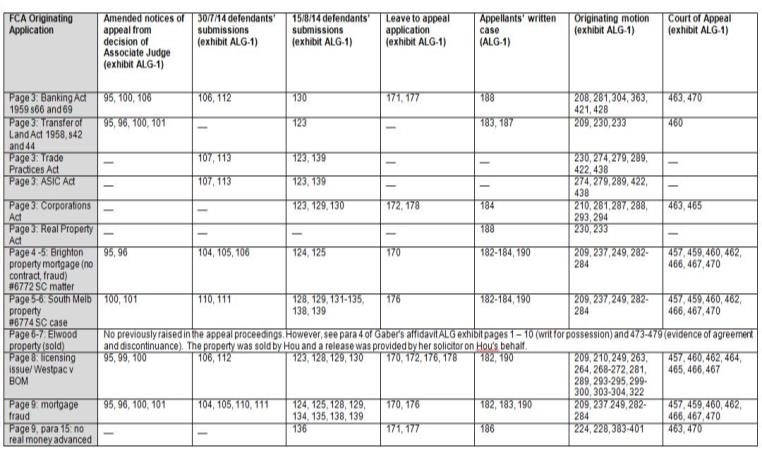
63 Even if the claims raised by the applicants in this proceeding in relation to the Brighton property and the South Melbourne property are assumed in some way to be different to those raised by them previously before summary judgments were entered by Lansdowne AsJ, given the nature of the complaints now made the doctrine of Anshun estoppel operates to preclude the applicants from pursuing the current claims made in this Court. Nothing prevented the applicants raising the current claims by way of defence or counterclaim in the Supreme Court at a time before the judgments of Lansdowne AsJ were given. At least for some part of the Supreme Court proceedings, the applicants were legally represented. It was unreasonable for the applicants not to have ventilated their current claims in the Supreme Court at a time before such judgments were given. There is no doubt that the applicants ventilated such claims after such judgments were given (see Annexure A to these reasons). This demonstrates that such matters could have been ventilated at a time before such judgments were given and that it was unreasonable not to have done so.
64 An Anshun estoppel (Port of Melbourne Authority v Anshun Pty Ltd (1981) 147 CLR 589 at 602 and 603 per Gibbs CJ, Mason and Aickin JJ) arises where the matter relied upon as a defence or claim in the second action was so connected to the subject matter of the first action that it would have been unreasonable in the context of the first action for the relevant claim not to have been made or the issue not to have been raised in the first action (see Tomlinson v Ramsey Food Processing Pty Ltd (2015) 323 ALR 1 at [22] per French CJ, Bell, Gageler and Keane JJ). The question is whether it would have been expected that the matters raised in the second action should have been raised in the first action to enable all issues or related issues to be determined in the one proceeding. Parties to litigation are expected to bring forward their whole case. It is not appropriate to permit the same parties to open the same subject of litigation in respect of matter which might have been brought forward as part of the subject in contest where it was unreasonable not to have agitated such issues in the earlier case. The question is whether there was a basis for the applicants justifiably refraining from litigating in the Supreme Court proceedings what they now want to litigate in the proceeding before me. There was no such basis in relation to the Brighton property and the South Melbourne property.
(e) Abuse of process
65 An attempt to litigate in this Court an issue or matter which has been resolved in earlier litigation in another court may amount to an abuse of process, even if none of the three forms of estoppel, res judicata, issue estoppel or Anshun estoppel, arises; see Coffey v Secretary, Department of Social Security (1999) 86 FCR 434 at [25] per von Doussa, Branson and Sundberg JJ and Spalla v St George Motor Finance Ltd (No 6) [2004] FCA 1699 at [58] to [69] per French J.
66 The concept of abuse of process is broader and more flexible than the three forms of estoppel such that it is “capable of application in any circumstances in which the use of a court’s procedures would be unjustifiably oppressive to a party or would bring the administration of justice into disrepute” (Tomlinson at [25] per French CJ, Bell, Gageler and Keane JJ). So, making a claim or raising an issue which ought reasonably to have been made or raised in the earlier proceeding can constitute an abuse of process (Tomlinson at [26]). I do not need to dwell on the overlap between Anshun estoppel and abuse of process where the abuse identified is said to involve the relitigation of issues.
67 Relatedly, a litigant’s unwillingness to accept findings in earlier litigation may be indicative of later claims constituting an abuse of process (see Garrett v Make Wine Pty Ltd (2014) 323 ALR 652 at [147] to [151] per Mortimer J).
68 As Annexure A demonstrates, the present proceeding attempts to impermissibly relitigate matters that could have been resolved (and were resolved) by the Supreme Court in relation to the Brighton property and the South Melbourne property and amounts to an abuse of process.
(f) Other claims
69 Even if one accepts that the applicants were free to raise the other diffuse claims made in their statement of claim, such claims do not enjoy any reasonable prospect of success. In this regard:
(a) The contentions based on the “Bank of Melbourne” complaint are misconceived. The relevant instruments reflect that Westpac was the contracting party and security holder.
(b) The credit licence complaint is misconceived. Westpac has held a credit licence since 1 March 2011 as required by the National Consumer Credit Protection Act 2009 (Cth). Prior to that time, there was no requirement to hold a credit licence under the earlier Consumer Credit (Victoria) Act 1995 (Vic); there was only a requirement (Part 4) to be registered in Victoria with the Victorian Business Licensing Authority; Westpac was so registered (see the affidavit of Stefan Koulocheris affirmed on 15 May 2015). In any event, this complaint provides no basis for any of the relief sought by the applicants.
(c) As to the Australian financial services licence complaint, there was no relevant dealing between the parties which required Westpac to hold such a licence. In any event, Westpac held one (see the affidavit of Annette Gaber affirmed 14 May 2015).
(d) The applicants’ complaints based on the Instruments Act 1958 (Vic) and the Transfer of Land Act 1958 (Vic) are devoid of merit. The mortgages were registered and Westpac had the benefit of indefeasibility.
(e) The memorandum of common provisions was incorporated into the relevant mortgages by reference. There is no substance to this complaint. Further, the complaint based upon matters concerning a power of attorney is untenable. In any event, no recourse has been had to any such power.
(f) In relation to the Elwood property claims, they lack any substance. Further, the applicants gave a relevant release as I have previously indicated in relation to the claims concerning the Elwood property. Accordingly there is no basis for the award of any damages. The claims have no reasonable prospect of success. Further, they should be dismissed as an abuse of process given the terms of the release.
(g) The claim based on the absence of the giving of “real or monetary consideration” is misconceived.
(h) The unparticularised allegations of fraud are unsustainable.
(i) Finally, the allegations and assertions of loss and damage that I have identified earlier (see at [21]) were unsubstantiated factually and legally and have no substance.
70 On 7 August 2015 Mr Kanakaridis filed a supplementary affidavit affirmed on 7 August 2015 of 147 pages. None of its contents has any substance or discloses an arguable claim. But to put the matter beyond doubt I will specifically address it.
71 Paragraphs 1 to 3 concern the authority of Annette Gaber and Gadens to act for Westpac. There is no basis to question Gadens’ or Ms Gaber’s authority (see the affidavit of Rebecca Lamshed affirmed 30 July 2015). Moreover, the point goes nowhere in seeking to establish any arguable claim.
72 Paragraphs 5 to 16 assert that the loan agreements and mortgages were not “lawfully signed or witnessed” between the parties and allege that Westpac had acted fraudulently during its enforcement action. These allegations are without merit.
73 Paragraphs 17 and 18 set out “key legal issues” that:
(a) no contracts or mortgages were entered into with Westpac;
(b) the mortgages were not signed;
(c) the memorandum of common provisions incorporated into the mortgages were not sighted;
(d) no real money was advanced to the applicants;
(e) the applicants have repaid the debt to Westpac by tendering a bill of exchange;
(f) Westpac has no standing to enforce the contracts or mortgages due to securitization of the loans; and
(g) Westpac does not hold relevant licences to operate as a bank or to provide credit.
74 None of these assertions have any substance as I address later when dealing with the later detail in his affidavit.
75 Paragraphs 19 to 43 respond to the affidavit of Annette Gaber affirmed on 24 April 2015. Mr Kanakaridis alleges that: (a) the courts have been lied to and misled; (b) no real money was advanced; (c) the summary judgments were invalid; (d) no contracts were entered into; (e) the mortgages are a fraud; and (f) the loans have been securitized. None of these matters have any substance. Paragraphs 19 to 43 also contain other baseless assertions that in any event do not disclose a cause of action. I have dealt with the bias issue earlier.
76 Paragraphs 44 to 55 respond to the affidavit of Annette Gaber affirmed on 14 May 2015. Mr Kanakaridis says that: (a) settlement of the Elwood property occurred under protest; (b) the loan contract and mortgage pertaining to the Elwood property were invalid; and (c) there has been “creative accounting” in the loan account secured by the Elwood property. The allegation of creative accounting is without merit. The points concerning the Elwood property have not been shown to have any substance. The affidavit of Annette Gaber affirmed 14 May 2015 at [5] to [17] sets out specific detail concerning the Elwood property to which the applicants have provided no meaningful answer. No cause of action, let alone one with reasonable prospects of success, is disclosed. Moreover, the applicants have given a release. Their claims also constitute an abuse of process in the face of the release.
77 Paragraphs 56 to 129 contain assertions about: (a) alleged fraudulent practices of Westpac; (b) no real money having been advanced/no consideration under the contracts; and (c) the loans being securitized. These points are misconceived.
78 Paragraphs 130 to 139 contain a further challenge to Westpac having held relevant licence(s) at the time of providing the loans. The point has no substance (see the affidavits of Stefan Koulocheris affirmed on 15 May 2015 and 19 May 2015).
79 Paragraphs 141 to 150 discuss the affidavit of Stefan Koulocheris affirmed 15 May 2015. Mr Kanakaridis has sought to attack Mr Koulocheris’ credibility and accuses him of perjury. The allegations are baseless. Paragraphs 151 to 162 discuss the affidavit of Mr Koulocheris affirmed 19 May 2015. The assertion that Westpac needed to apply to APRA for a new banking licence when it already held a banking licence under pre-existing legislation is misconceived. The effect of the current legislative provisions is that the licence exhibited to the first affidavit of Mr Koulocheris is taken to be an authority under s 9(3) of the current Banking Act 1959 (Cth) after the commencement of the Australian Prudential Regulation Authority Act 1998 (Cth). Schedule 19, Pt 1, s 2 of the Financial Sector Reform (Amendments and Transitional Provisions) Act 1998 (Cth) provided as follows:
2 Treatment of section 9 authorities
(1) This item applies to an authority that, immediately before the APRA commencement, was:
(a) in force under section 9 of the old Act [Banking Act 1959 before APRA commencement]; or
(b) deemed by subsection 9(1) of the old Act to be an authority under section 9 of that Act.
(2) The authority is to be taken, after that commencement, to be an authority under subsection 9(3) of the amended Act [Banking Act 1959 after APRA commencement].
(3) Any conditions to which the authority was subject immediately before the APRA commencement are to be taken, after that commencement, to be conditions imposed under subsection 9(4) of the amended Act.
Accordingly, Westpac did not need to apply to APRA for a licence under s 9(3) of the Banking Act 1959 as it already held a licence for the purpose of that Act.
80 Paragraphs 163 to 171 dispute that the banking licence granted to the Bank of New South Wales continues to operate in favour of Westpac. The argument is misconceived. The Bank of New South Wales is the former name of Westpac.
81 Paragraphs 172 to 175 contain a chronology of events concerning the history of the Bank of Melbourne Ltd and its merger with Westpac. It is said that as a consequence, Westpac was deregistered. The conclusionary assertion lacks any substance. It is well apparent that upon the merger, Westpac became the successor in law to the Bank of Melbourne Ltd. Paragraphs 176 to 186 raise the general issue of securitization. But even assuming in favour of the applicants for the sake of argument that the relevant mortgages to which they were party were securitized, and there is no evidence of this, nothing has been shown to deny the title of Westpac to enforce the same.
82 Paragraphs 187 to 199 discuss bills of exchange and also allege that Westpac is insolvent. The applicants’ argument that they satisfied the debt owed to Westpac by tendering a “bill of exchange” is misconceived. The allegation that Westpac is insolvent is untenable.
83 Paragraph 200 and onwards raise no new matter and reproduce the originating application.
84 Finally, if it is necessary to say so, the contents of Mr Kanakaridis’ affidavit affirmed 24 July 2015 do not raise any arguable claim or proper basis for refusing the relief sought by Westpac.
Conclusion
85 Pursuant to s 31A(2) of the Act, Westpac is entitled to judgment dismissing the whole of the applicants’ claims.
86 In my opinion, in relation to the allegations and claims concerning the Brighton property and the South Melbourne property:
(a) they are the subject of issues estoppel which defeat such claims;
(b) they are in any event the subject of Anshun estoppels;
(c) moreover, to pursue such claims amounts to an abuse of process.
87 Generally they have no reasonable prospect of success within the meaning of s 31A(2)(b) and r 26.01(1)(a). Moreover, they amount to an abuse of process.
88 In relation to the allegations and claims concerning the Elwood loan and property, in my view they have no reasonable prospect of success on their merits. Further, no reasonable cause of action is disclosed. Further, they constitute an abuse of process in the face of the release.
89 In relation to the more diffuse allegations and claims which indirectly touch on the Brighton, South Melbourne and Elwood loans and properties:
(a) none of these allegations and claims have any substance;
(b) accordingly, they lack any reasonable prospect of success.
90 I should say that although some of those more diffuse allegations were raised and dealt with in the Supreme Court, they were only dealt with after the judgments of Lansdowne AsJ. Accordingly, no res judicata or issue estoppel arose therefrom. There is, however, an Anshun estoppel concerning the same, but only to the extent that they concerned the Brighton property and the South Melbourne property. But I would prefer to base my decision on these more diffuse allegations on the foundation of my own assessment that no reasonable cause of action has been disclosed and that they have no merit. Accordingly they have no reasonable prospect of success. But if it is necessary to say so, such allegations are also barred by an Anshun estoppel and constitute an abuse of process.
91 In my view, Westpac is entitled to a dismissal of the claims against it, whether under s 31A or r 26.01.
92 Finally, there are no sustainable claims against any other party. In any event, such claims, to the extent that they are derivative (in terms of assuming that the applicants successfully maintain the claims against Westpac), fail for the lack of foundation.
93 The proceeding must be dismissed with costs.
I certify that the preceding ninety-three (93) numbered paragraphs are a true copy of the Reasons for Judgment herein of the Honourable Justice Beach. |
Associate:
Annexure A
Table cross-referencing complaints raised in “originating application” with Supreme Court material. The far left column sets out references to the applicants’ originating process filed in the Federal Court. All other columns refer to various documents relating to the Supreme Court proceedings.