

FEDERAL COURT OF AUSTRALIA
Gorringe on behalf of the Mithaka People v State of Queensland [2015] FCA 1116
IN THE FEDERAL COURT OF AUSTRALIA | |
SCOTT GORRINGE, RICHARD “DARBY” MCCARTHY, JOCELYN HAYLOCK, LORRAINE MCKELLAR and ROSE TURNBULL ON BEHALF OF THE MITHAKA PEOPLE Applicant | |
AND: | First Respondent BARCOO SHIRE COUNCIL Second Respondent DIAMANTINA SHIRE COUNCIL Third Respondent ERGON ENERGY CORPORATION LIMITED Fourth Respondent TELSTRA CORPORATION LIMITED (ACN 33 051 775 556) Fifth Respondent DELHI PETROLEUM PTY LTD Sixth Respondent OIL COMPANY OF AUSTRALIA LIMITED Seventh Respondent ORIGIN ENERGY RESOURCES LIMITED Eighth Respondent SANTOS AUSTRALIAN HYDROCARBONS PTY LTD Ninth Respondent SANTOS LIMITED Tenth Respondent SANTOS PETROLEUM PTY LTD Eleventh Respondent VAMGAS PTY LTD Twelfth Respondent AA COMPANY PTY LTD Thirteenth Respondent ARRABURY PASTORAL COMPANY PTY LTD Fourteenth Respondent DAVID BROOK Fifteenth Respondent BROOKLANDS PASTORAL CO PTY LTD Sixteenth Respondent ESTATE OF THE LATE FRANCIS WILLIAM BROOK Seventeenth Respondent JAMES W KIDD Eighteenth Respondent NORTH AUSTRALIAN PASTORAL COMPANY PTY LTD Nineteenth Respondent RD OLDFIELD PTY LTD Twentieth Respondent S KIDMAN & CO LTD Twenty-First Respondent |
DATE OF ORDER: | |
WHERE MADE: |
BEING SATISFIED that an order in the terms set out below is within the power of the Court, and it appearing appropriate to the Court to do so, pursuant to s 87 of the Native Title Act 1993 (Cth).
BY CONSENT THE COURT ORDERS THAT:
1. There be a determination of native title in the terms set out below (“the determination”).
2. Each party to the proceedings is to bear its own costs.
BY CONSENT THE COURT DETERMINES THAT:
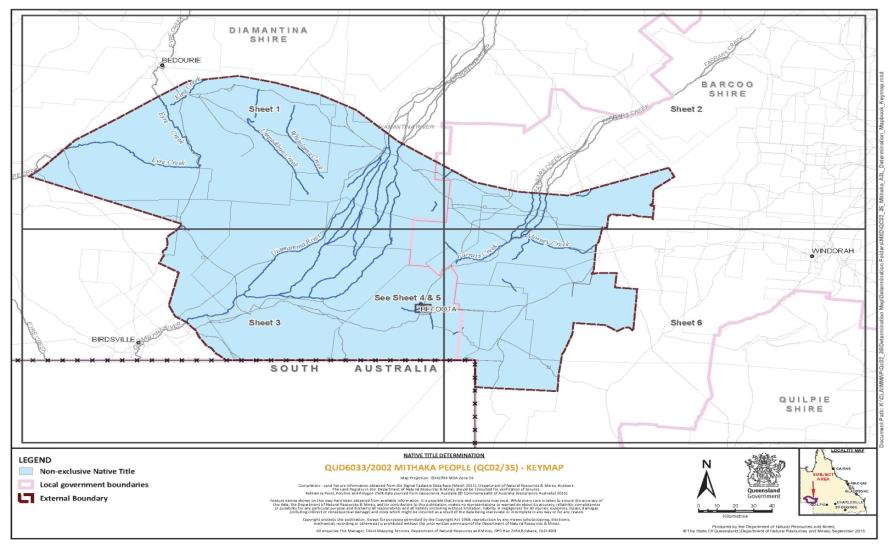
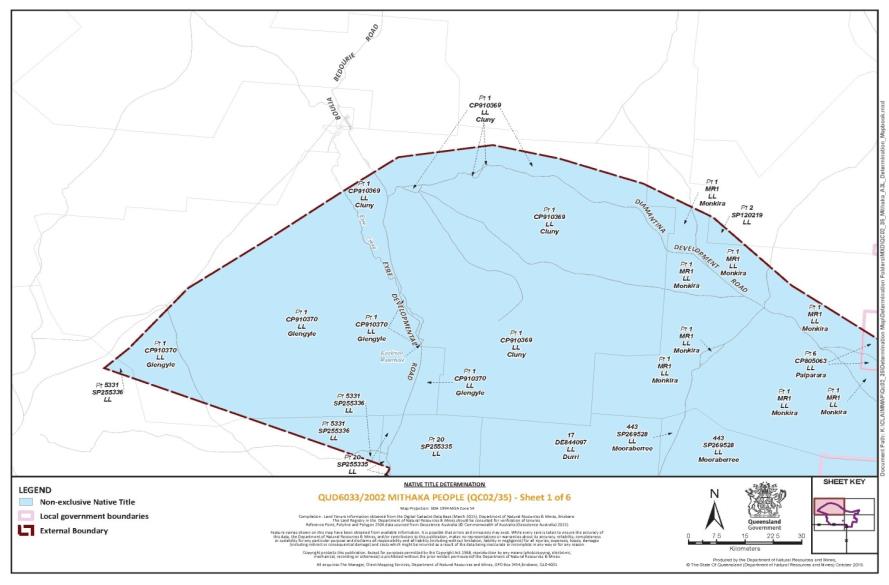
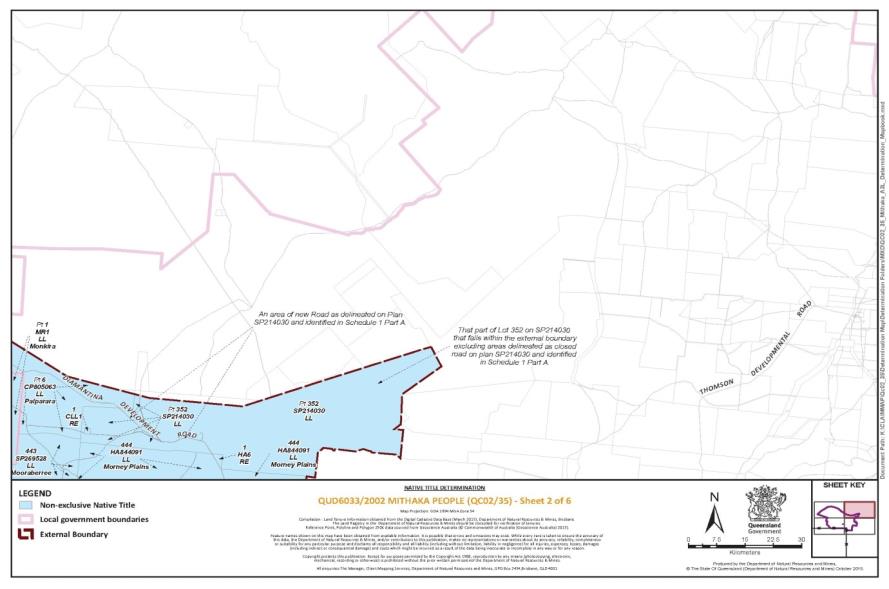
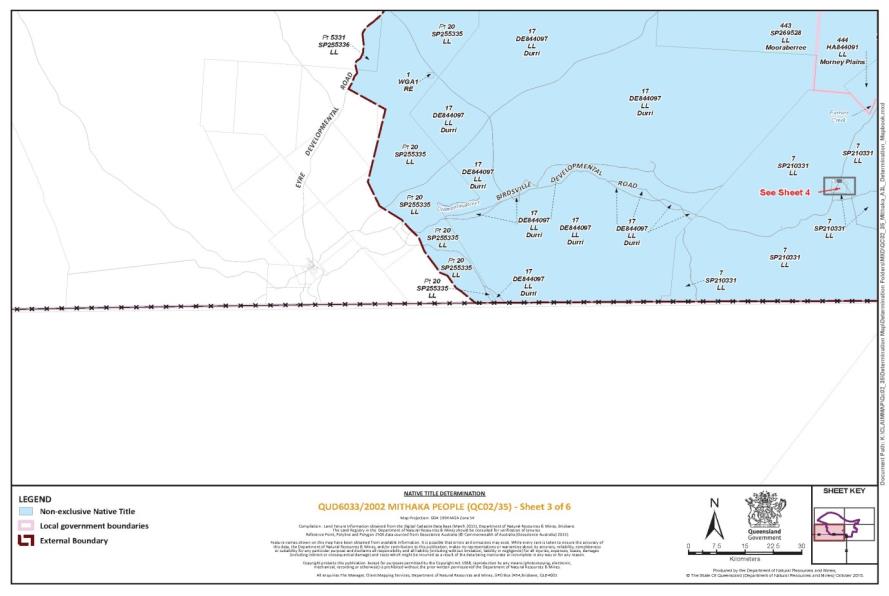
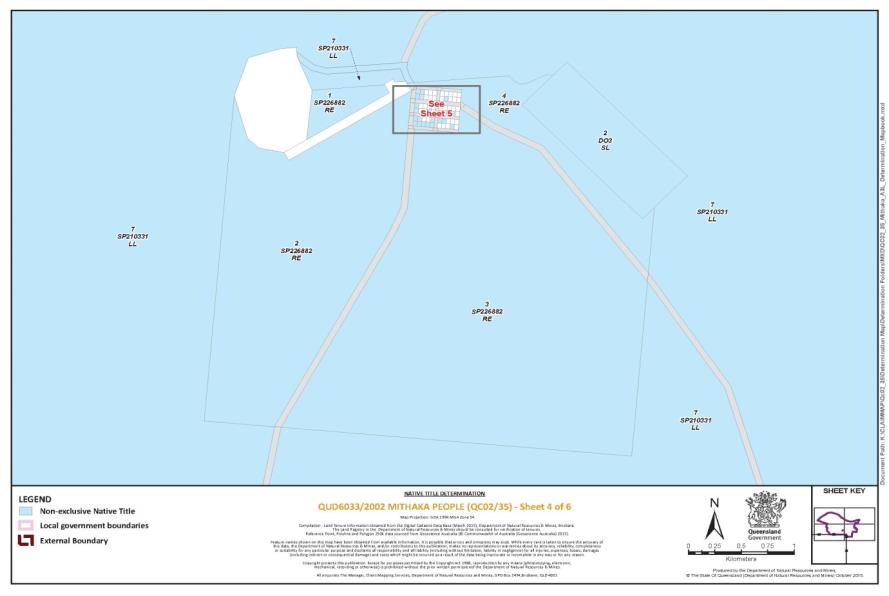
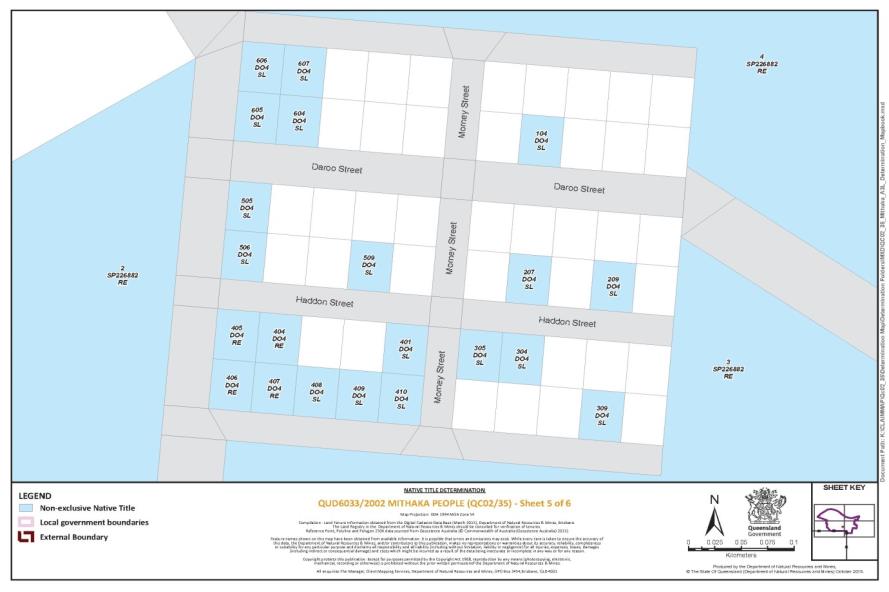
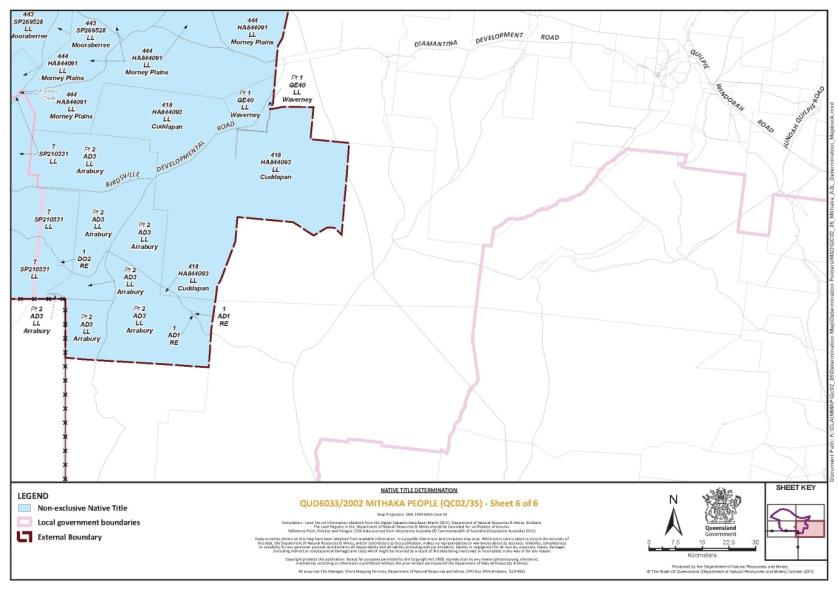
3. The Determination Area is the land and waters described in Schedule 1, and depicted in the map attached to Schedule 1.
4. Native title exists in relation to the Determination Area described in Schedule 1.
5. The native title is held by the Mithaka People described in Schedule 3 (“the native title holders”).
6. Subject to paragraphs 7, 8 and 9 below the nature and extent of the native title rights and interests in relation to the land and waters described in Schedule 1 are the non-exclusive rights to:
(a) access, be present on, move about on and travel over the area;
(b) camp, and live temporarily on the area as part of camping, and for that purpose build temporary shelters;
(c) hunt, fish and gather on the land and waters of the area for personal, domestic and non-commercial communal purposes;
(d) take, use and share and exchange Natural Resources from the land and waters of the area for personal, domestic and non-commercial communal purposes;
(e) take and use the Water of the area for personal, domestic and non-commercial communal purposes;
(f) conduct ceremonies;
(g) hold meetings on the area;
(h) teach on the area the physical and spiritual attributes of the area;
(i) maintain places of importance and areas of significance to the native title holders under their traditional laws and customs and protect those places and areas from physical harm;
(j) light fires on the area for domestic purposes including cooking, but not for the purpose of hunting or clearing vegetation;
(k) to be buried and to bury native title holders on the area; and
(l) be accompanied onto the area by certain non-Mithaka People, being:
(i) immediate family of the native title holders, pursuant to the exercise of traditional laws acknowledged and customs observed by the native title holders; and
(ii) people required under the traditional laws acknowledged and customs observed by the native title holders for the performance of, or participation in, ceremonies.
7. The native title rights and interests are subject to and exercisable in accordance with:
(a) the Laws of the State and the Commonwealth; and
(b) the traditional laws acknowledged and traditional customs observed by the native title holders.
8. The native title rights and interests referred to in Paragraph 6 do not confer possession, occupation, use or enjoyment to the exclusion of all others.
9. There are no native title rights in or in relation to minerals as defined by the Mineral Resources Act 1989 (Qld) and petroleum as defined by the Petroleum Act 1923 (Qld) and the Petroleum and Gas (Production and Safety) Act 2004 (Qld).
10. The nature and extent of any other interests in relation to the Determination Area (or respective parts thereof) are set out in Schedule 4.
11. The relationship between the native title rights and interests described in paragraph 6 and the other interests described in Schedule 4 (the “other interests”) is that:
(a) the other interests continue to have effect, and the rights conferred by or held under the other interests may be exercised notwithstanding the existence of the native title rights and interests;
(b) to the extent the other interests are inconsistent with the continued existence, enjoyment or exercise of the native title rights and interests in relation to the land and waters of the Determination Area, the native title continues to exist in its entirety but the native title rights and interests have no effect in relation to the other interests to the extent of the inconsistency for so long as the other interests exist; and
(c) the other interests and any activity that is required or permitted by or under, and done in accordance with, the other interests, or any activity that is associated with or incidental to such an activity, prevail over the native title rights and interests and any exercise of the native title rights and interests.
Definitions and Interpretation
12. In this determination, unless the contrary intention appears:
“land” and “waters”, respectively, have the same meanings as in the Native Title Act 1993 (Cth); |
“Laws of the State and the Commonwealth” means the common law and the laws of the State of Queensland and the Commonwealth of Australia, and includes legislation, regulations, statutory instruments, local planning instruments and local laws; |
“Local Government Act” has the same meaning as in the Local Government Act 2009 (Qld) |
“Local Government Area” has the same meaning as in the Local Government Act 2009 (Qld) |
“Natural Resources” means: |
(a) any animal, plant, fish and bird life found on or in the lands and waters of the Determination Area; and |
(b) any clays, soil, sand, gravel or rock found on or below the surface of the Determination Area. |
that have traditionally been taken and used by the native title holders, but does not include: |
(a) minerals as defined in the Mineral Resources Act 1989 (Qld); or |
(b) petroleum as defined in the Petroleum Act 1923 (Qld) and the Petroleum and Gas (Production and Safety) Act 2004 (Qld); |
“Reserves” means reserves that are dedicated and taken to be reserves under the Land Act 1994 (Qld). |
“Water” means: |
(a) water which flows, whether permanently or intermittently, within a river, creek or stream; |
(b) water from an underground water source; and |
(c) any natural collection of water, whether permanent or intermittent |
Other words and expressions used in this Determination have the same meanings as they have in Part 15 of the Native Title Act 1993 (Cth).
THE COURT DETERMINES THAT:
13. Upon the determination taking effect:
(a) The native title is held in trust;
(b) The Mithaka Aboriginal Corporation, incorporated under the Corporations (Aboriginal and Torres Strait Islander) Act 2006 (Cth), is to:
(i) be the prescribed body corporate for the purpose of ss 56(2)(b) and 56(3) of the Native Title Act 1993 (Cth); and
(ii) perform the functions mentioned in s 57(1) of the Native Title Act 1993 (Cth) after becoming a registered native title body corporate.
Schedule 1 - DETERMINATION AREA
A. Description of Determination Area
The Determination Area comprises all of the land and waters described in Part 1 below, to the extent that they are located within the External Boundary described in Part 2, and depicted in the map contained in Part B, excluding the areas described in Schedule 2.
To the extent of any inconsistency, the written description set out in Part 1 and Part 2 prevails over the map contained in Part B.
Part 1 - Determination Area:
a) The land and waters comprised of the lots and part lots described below to the extent that they are located within the External Boundary:
Area Description |
That part of Lot 2 on AD3 that falls within the External Boundary |
Lot 7 on SP210331 |
An area identified as new Road being Diagram A on SP210331 and delineated by stations 41-51-29-28-52-45-41 |
That part of Lot 1 on CP910369 that falls within the External Boundary |
That part of Lot 1 on CP910370 that falls within the External Boundary |
Lot 17 on DE844097 |
That part of Lot 1 on GE40 that falls within the External Boundary |
Lot 444 on HA844091 |
Lot 418 on HA844093 |
That part of Lot 1 on MR1 that falls within the External Boundary |
Lot 443 on SP269528 (formerly Lot 443 on PH1645) |
That part of Lot 352 on SP214030 that falls within the External Boundary excluding an area identified as closed road and delineated by stations: A’-B’-J-C’- D’-N-E’-F’-G’-H’-L’-K’-G-A’; I’-J’-K’-L’-I’; O-W’-S’-P’-X’-Y’-Z’-A”-Q’-R’-B”-O’-O; and M’-T’-U’-V’-M’ |
An area identified as new Road on SP214030 and delineated by stations: A-B-C-D-E-F-G-H-I-J-K-L-M-N-A; and O’-P-Q-R-O’ |
That part of Lot 5331 on SP255336 that falls within the External Boundary |
That part of Lot 20 on SP255335 that falls within the External Boundary |
That part of Lot 2 on SP120219 that falls within the External Boundary |
Lot 1 on AD1 |
Lot 1 on CLL1 |
Lot 1 on DO2 |
Lot 404 on DO4 |
Lot 405 on DO4 |
Lot 406 on DO4 |
Lot 407 on DO4 |
Lot 1 on HA6 |
Lot 1 on WGA1 |
Lot 1on SP226882 |
Lot 2 on SP226882 |
Lot 3 on SP226882 |
Lot 4 on SP226882 |
Lot 2 on DO3 |
Lot 104 on DO4 |
Lot 207 on DO4 |
Lot 209 on DO4 |
Lot 304 on DO4 |
Lot 305 on DO4 |
Lot 309 on DO4 |
Lot 401 on DO4 |
Lot 408 on DO4 |
Lot 409 on DO4 |
Lot 410 on DO4 |
Lot 505 on DO4 |
Lot 506 on DO4 |
Lot 509 on DO4 |
Lot 604 on DO4 |
Lot 605 on DO4 |
Lot 606 on DO4 |
Lot 607 on DO4 |
That part of Lot 6 on CP805063 that falls within the External Boundary |
(b) The waters within the External Boundary Description including but not limited to:
i. Diamantina River;
ii. Eyre Creek;
iii. Farrars Creek; and
iv. Koolivoo Waterhole
Part 2 - External Boundary of Determination Area:
The External Boundary of the Determination Area commences at a point on the north-eastern external boundary of Native Title Determination SAD6016/98 Wangkangurru/Yarluyandi at Longitude 138.816582° East, Latitude 24.968954° South and extending generally north-easterly, south-easterly and south-westerly passing through the following coordinate points:
Longitude(East) | Latitude(South) |
138.881985 | 24.919380 |
139.040055 | 24.766492 |
139.257724 | 24.639516 |
139.439115 | 24.528087 |
139.594411 | 24.436296 |
139.841681 | 24.407207 |
140.016225 | 24.443571 |
140.234405 | 24.509024 |
140.416222 | 24.596296 |
140.620762 | 24.771674 |
140.993913 | 24.999710 |
141.208940 | 25.054472 |
141.454782 | 25.075466 |
141.693416 | 25.000148 |
141.925699 | 24.927671 |
Then north-easterly along a line drawn to Longitude 141.980234° East, Latitude 24.912455° South to its intersection with an eastern boundary of Lot 352 on Plan SP214030; then generally southerly, generally westerly, again generally southerly and westerly along boundaries of that lot to the easternmost north-eastern corner of Lot 444 on Plan HA844091; then generally southerly along eastern boundaries of that lot, eastern boundaries of the western severance of lot 1on Plan GE40 and western boundaries of an unnamed road to a corner of that lot at Latitude 25.513115° South; then easterly to the northernmost north-western corner of the eastern severance of Lot418 on Plan HA844093; then generally easterly and generally southerly along boundaries of that lot and eastern boundaries of Lot to 2 on Plan AD3 to its intersection with a line drawn between Longitude 141.458082° East, Latitude 26.170177° South and Longitude 141.382014° East, Latitude 26.169554° South; then westerly along that line and generally westerly to a point on the South Australian / Queensland State Border at Latitude 26.145612°South passing through the following coordinate points:
Longitude(East) | Latitude(South) |
141.279499 | 26.162203 |
141.056101 | 26.150258 |
Then northerly and westerly along that state border to Longitude 139.780453° East, a point on the on the external boundary of Native title Determination SAD6016/1998 The Wangkangurru/Yarluyandi; then generally north-westerly along the external boundary of determination through Grahams Bluff and Louies Hill to a point located near Annuary Waterhole at Longitude 139.499580°East and Latitude 25.688832°South passing through the following coordinate points.
Longitude(East) | Latitude(South) |
139.744844 | 25.968019 |
139.728970 | 25.957294 |
139.707090 | 25.926833 |
139.688213 | 25.919540 |
139.670194 | 25.895515 |
139.646598 | 25.864625 |
139.632440 | 25.829874 |
139.608415 | 25.807565 |
139.587822 | 25.784827 |
139.530186 | 25.750357 |
Then north easterly and north westerly again along the external boundary of that determination passing through a point located near Woolmarlie Tank at Longitude 139.548430°East, Latitude 25.506101° South to a point on the centreline of Eyre Developmental Road at Latitude 25.453526° South.
Then generally north easterly along the centreline of that road to Latitude 25.233670°South; then north-westerly to Longitude 139.424460°East, Latitude 25.184468°South, again a point on the external boundary of Native title Determination SAD6016/1998 The Wangkangurru/Yarluyandi; then north-westerly along the external boundary of that determination back to the commencement point.
Note:
The application area does not include any areas subject to:
I. SAD6016/1998 Wangkangurru/Yarluyandi Native title Claim as determined by the Federal Court 3 October 2014.
Reference datum
Geographical coordinates have been provided by the NNTT Geospatial Unit and are referenced to the Geocentric Datum of Australia 1994 (GDA94), in decimal degrees and are based on the spatial reference data acquired from the various custodians at the time.
Data Reference and source
Boundary compiled by Queensland South Native title Services based in part on data sourced from the Commonwealth of Australia, NNTT (May 2015).
Cadastral data, State borders and road centreline data sourced from State of Queensland, DNR&M (February 2015).
Localities data is © Commonwealth of Australia (Geoscience Australia) 2010.
Use of Coordinates
Where coordinates are used within the description to represent cadastral or topographical boundaries or the intersection with such, they are intended as a guide only. As an outcome to the custodians of cadastral and topographic data continuously recalculating the geographic position of their data based on improved survey and data maintenance procedures, it is not possible to accurately define such a position other than by detailed ground survey.
B. Map of Determination Area
Schedule 2 - AREAS NOT FORMING PART OF THE DETERMINATION AREA
The following areas of land and waters are excluded from the Determination Area:
1. Those land and waters within the External Boundary, which at the time the native title determination application was made:
(a) were the subject of one or more Previous Exclusive Possession Acts, within the meaning of s 23B of the Native Title Act 1993 (Cth); and
(b) to which none of ss 47, 47A or 47B of the Native Title Act 1993 (Cth) applied at the time of the native title determination application;
are excluded from the Determination Area as they could not be claimed in accordance with s 61A of the Native Title Act 1993 (Cth).
2. Specifically, and to avoid any doubt, the land and waters described in (1) above includes:
(a) the tenure based exclusions under ss 23B(2) and 23B(3) of the Native Title Act 1993 (Cth) to which s 20 of the Native Title (Queensland) Act 1993 (Qld) applies;
(b) the land or waters on which any public work, as defined in s 253 of the Native Title Act 1993 (Cth), is or was constructed, established or situated, and to which ss 23B(7) and 23C(2) of the Native Title Act 1993 (Cth) and to which s 21 of the Native Title (Queensland) Act 1993 (Qld), applies, together with any adjacent land or waters in accordance with s 251D of the Native Title Act 1993 (Cth); and
(c) includes, but is not limited to, the whole of the land and waters described as:
(i) Lot 7 on CP844089;
(ii) Lot 9 on CP844094;
(iii) Lot 10 on CP844095;
(iv) Lot 12 on CP844098;
(v) Lot 7 on HA844090; and
(vi) Lot 8 on HA844092.
Schedule 3 - NATIVE TITLE HOLDERS
1. The native title holders are the Mithaka People.
2. The Mithaka People are Aboriginal people who:
(a) are descendants of one or more of the following people:
(i) Nangkaliya (alternatively spelled ‘Nuncleer’);
(ii) Katie/Kitty Wallerina (also known as Kathleen Mallyer and Kathleen Thompson);
(iii) Njira Taffy;
(iv) Mingelli Joe (also known as Joe St Clair / Mentuli / Minchoolie / Mintulee / Joe the Rainmaker);
(v) Maggie (sister of Mingelli Joe);
(vi) Donald Morney;
(vii) Bunbili;
(viii) Jacky Frew;
(ix) Pantya-Wanku-Ngawiranha;
(x) Tyuka-Putali;
(xi) Cameron Downs;
(xii) Puthi (also known as Frank);
(xiii) Natkillie Billy; and
(xiv) Warinyawarinyi (also known as Jacky).
(b) Identify themselves as Mithaka People.
Schedule 4 - OTHER INTERESTS IN THE DETERMINATION AREA
The nature and extent of the other interests in relation to the Determination Area are the following as they exist as at the date of the determination:
1. The rights and interests of the parties under the following agreements:
(a) the agreement between Scott Gorringe, Jocelyn Haylock, Richard McCarthy, Lorraine McKellar and Rose Turnbull, the Mithaka Aboriginal Corporation and Dalene Marie Wray, Anthony William Brook, Gary Francis Brook, Karen Liana Brook, and Jenna Louise Brook, which was authorised by the native title claim group on 6 September 2015 (the Mithaka People/Adria Downs ILUA), and that agreement once it becomes registered as a body corporate ILUA following execution of the agreement by the registered native title body corporate;
(b) the agreement between Scott Gorringe, Jocelyn Haylock, Richard McCarthy, Lorraine McKellar and Rose Turnbull, the Mithaka Aboriginal Corporation and Arrabury Pastoral Company Pty Ltd (ACN 009 658 851)which was authorised by the native title claim group on 6 September 2015 (the Mithaka People/Arrabury, Cluny and Mt Leonard ILUA), and that agreement once it becomes registered as a body corporate ILUA following execution of the agreement by the registered native title body corporate;
(c) the agreement between Scott Gorringe, Jocelyn Haylock, Richard McCarthy, Lorraine McKellar and Rose Turnbull, the Mithaka Aboriginal Corporation and S Kidman & Co Ltd (ACN 007 872 317), which was authorised by the native title claim group on 6 September 2015 (the Mithaka People/Cuddapan, Durri, Glengyle, Mooraberree and Morney Plains ILUA), and that agreement once it becomes registered as a body corporate ILUA following execution of the agreement by the registered native title body corporate;
(d) the agreement between Scott Gorringe, Jocelyn Haylock, Richard McCarthy, Lorraine McKellar and Rose Turnbull, the Mithaka Aboriginal Corporation and R D Oldfield Pty Ltd (ACN 388 631 231), which was authorised by the native title claim group on 6 September 2015 (the Mithaka People/Currawilla ILUA), and that agreement once it becomes registered as a body corporate ILUA following execution of the agreement by the registered native title body corporate;
(e) the agreement between Scott Gorringe, Jocelyn Haylock, Richard McCarthy, Lorraine McKellar and Rose Turnbull, the Mithaka Aboriginal Corporation and Paraway Pastoral Company Limited (ACN 122 572 641), which was authorised by the native title claim group on 6 September 2015 (the Mithaka People/Davenport Downs and Palparara ILUA), and that agreement once it becomes registered as a body corporate ILUA following execution of the agreement by the registered native title body corporate;
(f) the agreement between Scott Gorringe, Jocelyn Haylock, Richard McCarthy, Lorraine McKellar and Rose Turnbull, the Mithaka Aboriginal Corporation and North Australian Pastoral Company Pty Limited (ACN 009 591 511), which was authorised by the native title claim group on 6 September 2015 (the Mithaka People/ Monkira ILUA), and that agreement once it becomes registered as a body corporate ILUA following execution of the agreement by the registered native title body corporate;
(g) the agreement between Scott Gorringe, Jocelyn Haylock, Richard McCarthy, Lorraine McKellar and Rose Turnbull, the Mithaka Aboriginal Corporation and A A Company Pty Ltd (ACN 010 317 067)which was authorised by the native title claim group on 6 September 2015 (the Mithaka People/Waverney ILUA), and that agreement once it becomes registered as a body corporate ILUA following execution of the agreement by the registered native title body corporate;
2. The rights and interests of Santos QNT Pty Ltd as holder of Authority to Prospect No. 661 granted under the Petroleum and Gas (Production and Safety Act) 2004 (Qld).
3. The rights and interests of Telstra Corporation Limited (ACN 051 775 556):
(a) as the owner or operator of telecommunications facilities within the Determination Area;
(b) created pursuant to the Post and Telegraph Act 1901 (Cth), the Telecommunications Act 1975 (Cth), the Australian Telecommunications Corporation Act 1989 (Cth), the Telecommunications Act 1991 (Cth) and the Telecommunications Act 1997 (Cth), including rights:
(i) to inspect land;
(ii) to install and operate telecommunication facilities; and
(iii) to alter, remove, replace, maintain, repair and ensure the proper functioning of its telecommunications facilities;
(c) for its employees, agents or contractors to access its telecommunications facilities in and in the vicinity of the Determination Area in the performance of their duties; and
(d) under any lease, licence, access agreement or easement relating to its telecommunications facilities in the Determination Area.
4. The rights and interests of Ergon Energy Corporation Limited (ABN 50 087 646 062):
(a) as the owner and operator of any “Works” as that term is defined in the Electricity Act 1994 (Qld) within the Determination Area;
(b) as a distribution entity and the holder of a distribution authority under the Electricity Act 1994 (Qld);
(c) created under the Electricity Act 1994 (Qld) and the Government Owned Corporations Act 1993 (Qld) including:
(i) rights in relation to any agreement relating to the Determination Area existing or entered into before the date on which these orders are made;
(ii) rights to enter the Determination Area by its employees, agents or contractors to exercise any of the rights and interests referred to in this paragraph; and
(iii) to inspect, maintain and manage any Works in the Determination Area.
5. The rights and interests of the State of Queensland, the Barcoo Shire Council and the Diamantina Shire Council to access, use, operate, maintain and control the dedicated roads in the Determination Area and the rights and interests of the public to use and access the roads.
6. The rights and interests of the Barcoo Shire Council and the Diamantina Shire Council as the local governments for that part of the Determination Area within their respective Local Government Areas, including:
(a) their powers, functions, responsibilities and jurisdiction under the Local Government Act 2009 (Qld);
(b) their rights and interests under any interest in land or waters within the Determination Area, including under any lease, licence, access agreement, easement or reserve in the Determination Area;
(c) the right to use, operate, maintain, replace, restore, remediate, repair and otherwise exercise all other rights as the owners and operators of infrastructure, structures, earth works, access works, facilities and other improvements within the Determination Area;
(d) the rights under any agreements between the Barcoo Shire Council, Diamantina Shire Council or Quilpie Shire Council and any third party which relate to land or waters within the Determination Area; and
(e) the rights of their employees, agents and contractors to enter upon the Determination Area for the purpose of performing their powers and responsibilities under sub-paragraphs (a)–(d).
7. The rights and interests of the State of Queensland in Reserves, the rights and interests of the trustees of those Reserves and of the persons entitled to access and use those Reserves for the respective purpose for which they are reserved.
8. The rights and interests of the holders of any authority, permit, lease or licence made, granted, issued or entered into under the Land Act 1994 (Qld).
9. The rights and interests of members of the public arising under the common law, including but not limited to
(a) any subsisting public right to fish; and
(b) the public right to navigate.
10. So far as confirmed pursuant to s 212(2) of the Native Title Act 1993 (Cth) and s 18 of the Native Title Act (Queensland) Act 1993 (Qld) as at the date of this Determination, any existing public access to, and enjoyment of, the following places in the Determination Area:
(a) waterways;
(b) beds and banks or foreshores of waterways;
(c) stock routes; and
(d) areas that were public places at the end of 31 December 1993.
11. Any other rights and interests:
(a) held by the State of Queensland or Commonwealth of Australia; or
(b) existing by reason of the force and operation of the Laws of the State and the Commonwealth.
Note: Entry of orders is dealt with in Rule 39.32 of the Federal Court Rules 2011.
QUEENSLAND DISTRICT REGISTRY | |
GENERAL DIVISION | QUD 6033 of 2002 |
BETWEEN: | SCOTT GORRINGE, RICHARD “DARBY” MCCARTHY, JOCELYN HAYLOCK, LORRAINE MCKELLAR and ROSE TURNBULL ON BEHALF OF THE MITHAKA PEOPLE Applicant |
AND: | STATE OF QUEENSLAND First Respondent BARCOO SHIRE COUNCIL Second Respondent DIAMANTINA SHIRE COUNCIL Third Respondent ERGON ENERGY CORPORATION LIMITED Fourth Respondent TELSTRA CORPORATION LIMITED (ACN 33 051 775 556) Fifth Respondent DELHI PETROLEUM PTY LTD Sixth Respondent OIL COMPANY OF AUSTRALIA LIMITED Seventh Respondent ORIGIN ENERGY RESOURCES LIMITED Eighth Respondent SANTOS AUSTRALIAN HYDROCARBONS PTY LTD Ninth Respondent SANTOS LIMITED Tenth Respondent SANTOS PETROLEUM PTY LTD Eleventh Respondent VAMGAS PTY LTD Twelfth Respondent AA COMPANY PTY LTD Thirteenth Respondent ARRABURY PASTORAL COMPANY PTY LTD Fourteenth Respondent DAVID BROOK Fifteenth Respondent BROOKLANDS PASTORAL CO PTY LTD Sixteenth Respondent ESTATE OF THE LATE FRANCIS WILLIAM BROOK Seventeenth Respondent JAMES W KIDD Eighteenth Respondent NORTH AUSTRALIAN PASTORAL COMPANY PTY LTD Nineteenth Respondent RD OLDFIELD PTY LTD Twentieth Respondent S KIDMAN & CO LTD Twenty-First Respondent |
JUDGE: | RANGIAH J |
DATE: | 27 OCTOBER 2015 |
PLACE: | WINDORAH |
REASONS FOR JUDGMENT
1 The Federal Court has been asked to make orders under s 87 of the Native Title Act 1993 (Cth) (“the Act”) that take effect as a determination of native title on behalf of the Mithaka People. The application, filed on 28 November 2002 and covering an area of approximately 33,752 square kilometres of primarily pastoral lease tenures in south-western Queensland, is brought on behalf of the claim group by Richard “Darby” McCarthy, Rose Turnbull, Jocelyn Haylock, Scott Gorringe and Lorraine McKellar under s 61(1) of the Act.
2 On 24 December 2002, the application passed the registration test pursuant to s 190A of the Act and since that date it has remained on the Register of Native Title Claims. The application has been amended on three occasions to correct some anomalies between the written description and map in the Form 1, to reduce the claim area to reflect the outcomes of mediation with the Wangkangurru/Yarluyandi and Yandruwandha/Yawarrawarrka Peoples and most recently, to amend the composition of the applicant and the claim group.
3 The application was notified by the Native Title Registrar and the parties who remain as respondents to the application are the State of Queensland, the Barcoo and Diamantina Shire Councils, Ergon Energy Corporation Limited, Telstra Corporation Limited and various pastoral and mining parties.
4 Queensland South Native Title Services is the native title representative body for the area the subject of the application and is the legal representative for the Mithaka People. All of the respondent parties are legally represented.
5 The application was referred to mediation by the National Native Title Tribunal on 28 October 2003. Mediation ceased on 10 September 2012 when the application was placed in intensive case management by a Registrar of the Court. In mid 2010, the matter was moved to the substantive docket of Mansfield J and, on 11 February 2011, the Court appointed Professor David Trigger as the Court’s expert. The Applicant and the State of Queensland jointly sought the appointment of the expert to assess the anthropological material that was held by the Applicant and to identify any additional material that was required to satisfy the requirements of s 123 of the Act. The costs of the anthropological research were shared by the Applicant and the State.
6 The parties have reached a final agreement in respect to this application. The agreement has been executed by all of the parties for the purposes of a consent determination by the Court under s 87 of the Act.
7 I am satisfied that it is appropriate to make the proposed orders.
8 The Court will determine that native title is held by the Mithaka People in the determination area referred to in Schedule 1 of the Orders. The Court will also determine, amongst other things, the nature and extent of the native title rights and interests and the relationship between native title rights and interests and other interests in the determination area.
9 By the Court’s orders, the Australian community collectively recognises the status of the Mithaka People as the traditional owners of the land and waters in the determination area. It is important to emphasise that the Court’s orders do not grant that status. The Court orders merely recognise that they are the traditional owners and have been since before the European settlement.
The Mithaka People, their society and history
10 The applicant has filed a number of anthropological reports that have been prepared by Professor Trigger with Dr Andrew Snedden, Dr Kevin Murphy and Dr Paul Gorecki. Important evidence in relation to the current exercise of traditional rights and interests has been provided in affidavit form by members of the claim group, Sharon Leigh-Ann Challenor, Scott Desmond Gorringe, Lorraine Violet McKellar, Jocelyn Haylock, Maxwell Phillip Gorringe, Raymond George Gorringe, Toby David Gorringe, Betty Dawn Gorringe, Helen Jean Gorringe, Alice Marrie Naish, Thelma Joyce Lander, Dean William Challenor and Noel Michael Francis Curran. The evidence of members of the native title claim group about their traditional laws and customs and rights and responsibilities in respect to land and waters is of the highest importance: Sampi v Western Australia [2005] FCA 777 at [48] per French J.
11 The pre and post-sovereignty reports by Dr Kevin Murphy have provided a broad analysis and overview of the earlier research undertaken by linguists and anthropologists working in the claim area over many years.
12 The affidavits and the anthropological reports are important, not only for this case, but as records of the history of the Mithaka People. They deserve to be read in full. For present purposes, I can only provide a brief summary of the evidence before the Court.
13 Dr Murphy’s Report provides the following summary of the impact of European settlement in the region:
The first European explorations of the region were from the 1840s to the 1860s, and invasion by squatters moving in from the east and south followed shortly after. There are few records that describe interactions between the local Aboriginal population and the incoming squatters. On the adjacent region to the east, Longhurst writes:
By 1846 there was virtual open warfare on the frontier, with dozens of isolated shepherds losing their lives on the Barwon, Namoi, McIntyre and Maranoa, and a totally inadequate police force, unable to protect Aborigines or Europeans.
The situation further west appears to have been more mixed, while there were some killings of Europeans by Aborigines and of Aborigines by Europeans, evidently some local people acted as guides and helped the first squatters establish their runs. By the 1860s squatters had taken over land on the Warrego, Paroo, Bulloo and Wilson Rivers, and by the 1870s on Coopers Creek and the Diamantina River. In addition to frontier violence and new diseases, occupation of the land by Europeans with sheep, horses and cattle had devastating consequences for the Aboriginal inhabitants. Squatters took exclusive control of the permanent waters, which were vital to the Aboriginal economy in an environment where prolonged drought was common. Spearing of Europeans and their stock by Aborigines led to reprisals by squatters and Mounted Native Police, and there were numerous massacres throughout south-west Queensland in the first few decades of white occupation. Ecological damage caused by stock, restrictions on access to resource-rich water sources, and population decline led quickly to dependence of the Aboriginal population on the pastoralists for subsistence. No longer able to live independently on their own land, men and women were exploited for their labour and usually paid only in rations. Sexual exploitation of Aboriginal women by European men was commonplace, resulting in the birth of many children with European fathers. It was rare for them to acknowledge their children and, with some exceptions, they did not normally take a social role as the fathers of their offspring. The brutal treatment of Aboriginal men by Europeans was described by Meston in his account of a trip through south-western Queensland in 1900:
Never before had I seen aboriginal men living under such extraordinary terrorism, … many of them had long been treated as the dogs are treated and were scared into a belief that their employers wielded the power of life and death. They also knew that among most of the stations there was a mutual understanding that any run-away would be hunted and brought back, and as they had no one to whom they could appeal and no where to go they finally regarded their doom as inevitable and bore their wrongs in silence. The aboriginal men who work on the stations are frequently as competent as any white men and yet they receive usually only their food and clothing, the food being the roughest description and the clothing of the cheapest kind.
Meston also notes that there were some exceptions: “a few stations are remarkable for the fairness with which they treat their blacks”. This led to a relative concentration of the Aboriginal population at those stations such as Tinnenburra, Caiwarro, Comongin and a few others, where they were treated more humanely.
From the late 1890s the Queensland government assumed extraordinary powers over the living conditions and movement of Aboriginal people, including instituting a system of reserves to which people could be removed. From 1900 people in south-west Queensland were being removed from camps they had established on the fringes of towns; from Meston’s records on the first few years of the 20th century, most of these appear to have been elderly or sick and unable to work on the stations. For the first three decades of the 20th century there was a deliberate government policy of removing Aboriginal people to reserves, and a combination of economic depression, drought and the breaking up of large stations into smaller blocks led to a reduced demand for Aboriginal labour. Many moved to fringe camps on the edges of the towns, and from there some were taken to reserves far from their homelands, while other remained to work on stations and many of the town fringe camps remained, populated largely by elderly people along with women and children whose husbands and fathers were away much of the time working on stations.
The Queensland government continued to maintain extraordinary control over many aspects of the lives of Aboriginal people until the 1970s. The policies of Aboriginal “protection” included control over wages, with most being withheld and government approval required to spend money, control over where people could work and live, who they could marry, and prohibition of the consumption of alcohol. While on the one hand they were required to “assimilate” with the broader Australian population, at the same time most remained impoverished and many continued to live at town fringe camps, which they called yambas, while others remained at the government reserves.
The passage of the Native Title Act in 1993 brought a new set of circumstances into being. Whereas for over a century the Aboriginal people of south west Queensland had been physically and legally dispossessed of their land, all of a sudden the government presented the possibility that their traditional rights and interests in their ancestral lands could be legally recognised.
14 The evidence establishes that at sovereignty the Mithaka People were a distinct group who were united by a sense of shared affinity and language. They exercised rights over country that had their genesis in the traditional laws and customs that had been transmitted through descent.
15 The native title claim group now seeking to have their native title recognised is comprised of all of the persons descended from one or more of the following persons:
(a) Nangkaliya (alternatively spelled “Nuncleer”);
(b) Katie/Kitty Wallerina (also known as Kathleen Mallyer and Kathleen Thompson);
(c) Njira Taffy;
(d) Mingelli Joe (also known as Joe St Clair/Mentuli/Minchoolie/Mintulee/Joe the Rainmaker);
(e) Maggie (sister of Mingelli Joe);
(f) Donald Morney;
(g) Bunbili;
(h) Jacky Frew;
(i) Pantya-Wanku-Ngawiranha;
(j) Tyuka-Putali;
(k) Cameron Downs;
(l) Puthi (also known as Frank);
(m) Natkillie Billy;
(n) Warinyawarinyi (also known as Jacky).
16 Contemporary group membership is governed by the following rules:
(a) a demonstrated continuous blood relation with an ancestor who is a “Mithaka person” is required;
(b) it does not matter if the ancestor is male or female;
(c) physical separation from the claim area (eg due to forced removal) does not exclude a person or family from group membership;
(d) the principle of adoption is also fully accepted.
The rights and interests
17 The evidence establishes, and the parties are agreed, that the nature and extent of the native title rights and interests in relation to the determination area are non-exclusive rights to:
(a) access, be present on, move about on and travel over the area;
(b) camp and live temporarily on the area as part of camping, and for that purpose erect temporary shelters;
(c) hunt, fish and gather on the land and waters of the area for personal, domestic and non-commercial communal purposes;
(d) take, use and share and exchange Natural Resources from the land and waters of the area for personal, domestic and non-commercial communal purposes;
(e) take and use the Water of the area for personal, domestic and non-commercial communal purposes;
(f) conduct ceremonies;
(g) hold meetings on the area;
(h) teach on the area the physical and spiritual attributes of the area;
(i) maintain places of importance and areas of significance to the native title holders under their traditional laws and customs and protect those places and areas, by lawful means, from physical harm;
(j) light fires on the area for domestic purposes including cooking, but not for the purpose of hunting or clearing vegetation;
(k) to be buried and to bury native title holders on the area; and
(l) be accompanied onto the area by certain non-Mithaka People, being:
(i) immediate family of the native title holders, pursuant to the exercise of traditional laws acknowledged and customs observed by the native title holders; and
(ii) people required under the traditional laws acknowledged and customs observed by the native title holders for the performance of, or participation in, ceremonies.
18 The anthropological evidence includes material addressing the nature and content of the rights and interests possessed by the Mithaka People under traditional law and custom. Professor Trigger expresses the opinion that “claim group members adopt a proprietary attitude to the claim area which is commonly expressed as a right of access to fish or camp, and the rights and responsibilities in relation to land derive from descent from ancestors who occupied that land and possessed rights and interests before the arrival of European settlers”.
19 The Mithaka People share the fundamental belief that their country was created by the Rainbow Serpent and this information continues to be passed down to members of the claim group. They also share a general belief in spirits and other beings and continue to believe that the spirits of deceased forebears remain connected to the claim area. The evidence reveals continuing observance of ceremonies, including smoking which the Mithaka People believe will ward off bad spirits.
20 Mithaka People have a number of rules that are connected with the taking of bush resources, hunting, fishing and gathering other materials. The evidence demonstrates the continued operation of food restrictions to ensure sustainability and regeneration and other land management obligations.
21 The evidence demonstrates that the Mithaka People have held rights and interests in the determination area under their traditional laws and customs since prior to sovereignty and have continued to do so to the present time. They have also continued to exist as a society.
22 The native title rights and interests do not confer possession, occupation, use or enjoyment to the exclusion of all others. The rights and interests are subject to and exercisable in accordance with the laws of the State and the Commonwealth and the traditional laws acknowledged and the traditional customs observed by the native title holders.
23 The orders that the Court will make set out the nature and extent of other interests in relation to the determination area and the relationship between native title rights and interests and the other interests.
Section 87
24 Section 87 of the Act empowers the Court to make a determination over a claim area in accordance with the orders agreed between the parties without conducting a hearing. The policy reflects the objective of the Act of resolving claims by agreement and without the need for litigation.
25 The Court is able to make a determination by consent without a hearing under s 87 if the following conditions are met:
(a) each of the parties to the proceeding have reached agreement on a proposed determination of native title in respect of the claim area: s 87(1)(a);
(b) the period specified in the notice given under s 66 of the Act has ended: s 87(1);
(c) the terms of the proposed determination agreement are in writing and have been signed by or on behalf of each of those parties, and a copy filed with the Court on 19 October 2015: s 87(1)(b);
(d) the Court is satisfied that an order in, or consistent with, those terms would be within its power: s 87(1)(c); and
(e) the Court considers that making such an order would be appropriate: s 87(2).
26 The Court is not required to embark upon an inquiry as to the merits of the claim to be satisfied that the orders are supportable and in accordance with law: Cox on behalf of the Yungngora People v State of Western Australia [2007] FCA 588 at [3] per French J. However, the Court will consider evidence for the limited purpose of determining whether the parties who have agreed to compromise the claim, particularly the State on behalf of the community generally, have made a rational decision and are acting in good faith: Munn for and on behalf of the Gunggari People v State of Queensland (2001) 115 FCR 109 at [30] per Emmett J. The primary consideration of the Court is to determine whether there is an agreement and whether it was freely entered on an informed basis: Nangkiriny v State of Western Australia (2002) 117 FCR 6 at[14] per North J.
27 These principles have been considered and applied in many decisions of this Court. I consider that it is appropriate to apply them in the present proceeding.
28 Section 94A of the Act requires the Court to set out details of the matters mentioned in s 225 when making a determination of native title. Section 225 of the Act defines a determination of native title as follows:
A determination of native title is a determination whether or not native title exists in relation to a particular area (the determination area) of land and waters and, if it does exist, a determination of:
(a) who the persons, or each group of persons, holding the common or group rights comprising the native title are; and
(b) the nature and extent of the native title rights and interests in relation to the determination area; and
(c) the nature and extent of any other interests in relation to the determination area; and
(d) the relationship between the rights and interests in paragraphs (b) and (c) (taking into account the effect of this Act); and
(e) to the extent that the land or waters in the determination area are not covered by a non-exclusive agricultural lease or a non-exclusive pastoral lease -- whether the native title rights and interests confer possession, occupation, use and enjoyment of that land or waters on the native title holders to the exclusion of all others.
29 I accept, by reference to the s 87 agreement, that s 225 of the Act is satisfied. I consider that it is appropriate that the Court make a determination in terms of the parties agreement because the State of Queensland, acting on behalf of the community generally, has played an active role in the negotiation of the proposed determination and is satisfied that the determination is justified in all the circumstances and all of the parties have agreed upon the nature and extent of native title rights and interests in relation to the determination area.
Prescribed Body Corporate
30 Section 55 of the Act requires the Court to make such determinations as are required by ss 56 and 57 at the same time as or as soon as practicable after the determination. Order 13 of the s 87 agreement signed by the parties seeks a determination that the Mithaka Aboriginal Corporation is to be the prescribed body corporate for the purposes of ss 56(2)(b) and 56(3) of the Act to perform the functions set out in s 57(1).
31 The nomination is supported by the affidavit of Ronald Charles Fogarty affirmed on 14 October 2015, which deposed that on 12 October 2015, Raymond George Gorringe, formally nominated the Mithaka Aboriginal Corporation to be the prescribed body corporate for the purposes of s 56(2)(a) of the Act. Mr Fogarty further deposes that the Mithaka Aboriginal Corporation has consented to such nomination.
32 Accordingly, the Court determines that the Mithaka Aboriginal Corporation is to be the prescribed body corporate for the purposes of s 56(1) of the Act.
33 For the reasons outlined above, I will make orders in terms of the agreement reached by the parties.
I certify that the preceding thirty-three (33) numbered paragraphs are a true copy of the Reasons for Judgment herein of the Honourable Justice Rangiah. |


