

FEDERAL COURT OF AUSTRALIA
National Tertiary Education Industry Union v Swinburne University of Technology (No 2) [2015] FCA 1080
IN THE FEDERAL COURT OF AUSTRALIA | |
VICTORIA DISTRICT REGISTRY | |
VID 1127 of 2013 |
NATIONAL TERTIARY EDUCATION INDUSTRY UNION Applicant
| |
AND: | SWINBURNE UNIVERSITY OF TECHNOLOGY First Respondent SWINBURNE COLLEGE PTY LTD Second Respondent |
MORTIMER J | |
DATE OF ORDER: | |
WHERE MADE: | MELBOURNE |
THE COURT DECLARES THAT:
1. In making, and then taking steps to implement, a decision to transfer from the first respondent to the second respondent the teaching and delivery of Foundation Studies and Unilink Diploma courses (collectively known as Pathways courses), as well as English Language Intensive Courses for Overseas Students, and for the first respondent thereafter to cease teaching and delivery of those courses, the first respondent contravened s 340(1)(a)(i) of the Fair Work Act 2009 (Cth) by threatening to alter the position of Swinburne College teaching staff and senior educators to their prejudice, for reasons including a substantive and operative reason that they had an entitlement to the benefit of an industrial instrument, being the Victorian TAFE Teaching Staff Multi-Business Agreement 2009.
THE COURT ORDERS THAT:
1. The first respondent pay a penalty in the sum of $14,000, such penalty to be payable into consolidated revenue.
2. The proceeding against the first respondent is otherwise dismissed.
3. The proceeding against the second respondent is dismissed.
Note: Entry of orders is dealt with in Rule 39.32 of the Federal Court Rules 2011 (Cth).
vICTORIA DISTRICT REGISTRY | |
FAIR WORK DIVISION | VID 1127 of 2013 |
BETWEEN: | NATIONAL TERTIARY EDUCATION INDUSTRY UNION Applicant |
AND: | SWINBURNE UNIVERSITY OF TECHNOLOGY First Respondent SWINBURNE COLLEGE PTY LTD Second Respondent |
JUDGE: | mORTIMER J |
DATE: | 8 OCTOBER 2015 |
PLACE: | MELBOURNE |
REASONS FOR JUDGMENT
introduction and summary
1 The present proceeding concerns decision-making by the first respondent Swinburne University of Technology (Swinburne) regarding the proposed restructure and outsourcing of certain courses and programs it delivered, and the way in which that decision-making affected the employment of staff.
2 The National Tertiary Education Industry Union (NTEU) commenced this proceeding on 30 October 2013 against the first respondent only. By an interlocutory judgment dated 12 June 2014, the second respondent Swinburne College Pty Ltd (SCPL) was joined and I granted leave to the applicant to file and serve an amended originating application and further amended statement of claim: see National Tertiary Education Industry Union v Swinburne University of Technology [2014] FCA 606.
3 The proceeding was actively defended until 20 March 2015, on which date the parties informed the Court that terms of settlement had been concluded. The parties proposed orders preparing the matter for hearing on the issue of penalty only, on the basis that Swinburne would admit to a single contravention of s 340 of the Fair Work Act 2009 (Cth).
4 The parties filed a statement of agreed contravention and facts, annexing a number of documents the parties agreed were relevant to the Court’s determination of contravention and penalty. The applicant filed a written statement from an NTEU official, with which I deal in greater detail at [8]-[10] below. The parties also filed written submissions. Swinburne has had the conduct of the proceeding on behalf of both respondents and SCPL has not played any active or separate role in the proceeding.
5 For the reasons that follow, I am satisfied there has been a contravention of the Fair Work Act and find that a penalty of $14,000 should be imposed on the first respondent, and that it should be payable into consolidated revenue.
EVIDENCE BEFORE THE COURT
6 At the hearing, it became apparent in the course of argument that there were some deficiencies in the evidence before the Court, and that some of the matters to which the parties adverted in their submissions, and on which they both wished to rely, were not the subject of agreed facts pursuant to s 191 of the Evidence Act 1995 (Cth), nor the subject of any other evidence. Directions were made to remedy that position.
7 On 26 June 2015 the parties filed a further short agreed statement of facts pursuant to s 191 of the Evidence Act.
8 The applicant also sought to rely on evidence from Mr Joshua Cullinan. Mr Cullinan is a Senior Industrial Officer in the NTEU and has worked for the union for ten years. From early 2011 until to the end of 2013 (broadly, being a considerable part of the period over which the contravention is alleged to have occurred), Mr Cullinan was based at Swinburne, where the NTEU had a branch and staff based full-time. In his role at Swinburne on behalf of the NTEU Mr Cullinan gained, I accept, first-hand knowledge and experience of key personnel within Swinburne, the general operations and decision-making processes within Swinburne, the mechanisms by which important decisions affecting, or possibly affecting, NTEU members were made, and the role of Swinburne’s Human Resources Department in resolving workplace issues.
9 The respondents objected to the entirety of Mr Cullinan’s evidence on a number of bases, although they agreed to the admission of five documents annexed to his statement. In response, the NTEU did not press aspects of Mr Cullinan’s written statement. At the hearing I ruled on the respondents’ global and specific objections, which meant that some further parts of Mr Cullinan’s written statement were not admissible. Pursuant to directions given, the parties subsequently filed an agreed form of Mr Cullinan’s written statement reflecting my rulings, together with its annexures, which formed the principal part of his evidence-in-chief. Mr Cullinan also gave some short additional evidence-in-chief and was briefly cross-examined: these aspects of his evidence are relevant to one particular issue, to which I refer at [122] below.
10 To remedy some obvious defects in the form of his written evidence, I permitted Mr Cullinan to adopt in oral evidence those parts of his written statement which were pressed by the NTEU and which I had ruled admissible, together with the annexures to this written statement.
11 The findings I make in the next section of these reasons are based on the two agreed statements of facts filed pursuant to s 191 of the Evidence Act, the documents attached to the agreed statements, Mr Cullinan’s evidence and the documents adduced through him.
FACTUAL FINDINGS
12 As part of its pre-university programs, Swinburne offers Foundation Studies and Unilink Diploma courses (collectively known as Pathways courses), as well as English Language Intensive Courses for Overseas Students which are known by the acronym “ELICOS”. Historically, the programs have been delivered through Swinburne College, which is described as an “organisational department” of Swinburne.
13 After preliminary work in late 2008 and the first half of 2009, Swinburne’s then Deputy Vice Chancellor, Development and Engagement, Mr Stephen Connelly, and its then Director, Enterprise Development, International & Development Division, Mr Nigel Wood produced a document entitled “Reinvigorating Swinburne College – A proposal to accelerate progress toward 2015 University goals”.
14 The proposal bears a date of July 2009, and was submitted to Swinburne’s Finance Committee for consideration. The Finance Committee is a Standing Committee of the Swinburne University Council. In its executive summary and recommendations (at p 1) the proposal states:
This proposal is designed to establish Swinburne College on a more commercial footing – by reconstituting it within a free-standing company, initially wholly owned by the University. The company would become a Commonwealth recognised Higher Education Provider (HEP), with externally accredited pathways programs.
15 In the executive summary, the authors noted that demand for specific pathways education was growing at a faster rate than demand for tertiary and secondary education in general, and the authors compared the development of pathways programs at other tertiary institutions, including those which were not “cross-sectoral”, as Swinburne was. They summarised the development of Swinburne College as the entity through which the pathways programs were delivered to date, noting that various reviews of the Swinburne College structure and performance showed there was a “compelling case for the adoption of a new business and education model to reinvigorate Swinburne College and open up attractive new education business opportunities.”
16 The executive summary described the advantages of the recommended new arrangements:
The advantages of the arrangements recommended in this paper include:
• very substantial improvements to the financial benefits the University can generate from pathways delivery, thereby creating a new income stream for the University
• a substantially increased flow of fee paying UG and PG students to the University via the entity’s revised academic and ELICOS pathway programs
• the creation of a valuable, profit focussed, University owned education business with the ability to design and deliver programs which are largely free of the inflexibilities which flow from being University accredited programs delivered under inappropriate industrial arrangements
• the ability for the University to profit significantly in future from the partial or full sale of the valuable enterprise created, and
• removal of the risk to reputation that continuation of the current arrangements could produce.
17 The NTEU sought to emphasise the role of the third dot point. Swinburne submitted it was but one of five identified advantages. There is no doubt, in my opinion, that this proposal from the outset was one with much more broadly based and systemic aims than simply introducing changes to industrial arrangements designed to produce cost savings. I accept the respondents’ submissions that the objectives of the reforms were broader than that.
18 That said, the NTEU is correct to characterise the proposal as placing some emphasis on the advantages of changed industrial arrangements. Further into the same document, under the heading “Industrial relations arrangement”, the proposal states (omitting parts which were redacted on the basis of client legal privilege in the copy of this document in evidence):
Most (if not all) of the current staff of the College would likely be required by a repositioned and growing College. Current teaching staff are employed on state-wide TAFE Institute terms and conditions while administrative staff are engaged under University higher education general staff industrial arrangements. … It is also likely that a specific focus on the teacher qualifications and experience which are relevant to the nature of the programs taught by the College would be established, rather than specific reliance on TAFE industry focussed arrangements as at present. These options are not available under the current TAFE arrangements.
19 On 10 August 2009, the Swinburne University Council agreed in principle with the proposed restructure. Following revisions to reflect governance concerns raised by the Council, the Council passed motions approving the formation of SCPL on 7 December 2009. SCPL was incorporated on 16 March 2010.
20 The effect of the Council’s decision was that Swinburne would transfer, over time, the functions and operations of Swinburne College to SCPL, including the delivery of the same or similar courses to those previously delivered by Swinburne College. The likely consequence, I infer, would be that Swinburne College would cease to deliver those courses, and affected teaching staff would either have to move to SCPL, or find employment elsewhere, whether with Swinburne or not.
21 It was this transfer decision, and the steps taken to implement it, that both parties’ submissions identified as a threat to take adverse action for reasons including workplace rights enjoyed by the affected employees, and as a contravention of s 340(1)(a)(i) of the Fair Work Act.
22 The NTEU submitted, and I accept, that the fact this decision was made by Swinburne’s Council, together with the seniority of those involved in conceiving and planning the creation of SCPL and the transfer of teaching and program delivery functions to it, should be taken into account in assessing penalty. Swinburne did not cavil with this proposition. I have taken these matters into account.
23 A written services agreement between Swinburne and SCPL was executed on 27 May 2011 and commenced from 1 July 2011. That agreement was in evidence in this proceeding. It does not cover teaching services, but appears otherwise to contemplate a full range of financial, administrative and legal support services being given to SCPL by Swinburne.
24 Swinburne contemplated expressly there would be further agreements, whereby SCPL would deliver programs previously delivered by Swinburne College. In a briefing update given in June 2011 the following statements were made:
At the November 2010 meeting of the SCPL Board there was discussion about the dramatic change in market conditions, the financial performance of the College and the implications for the role to be played by the Company and the Directors. The Directors asked that consideration be given to a revised operating model for the Company and formally resolved “that the CEO undertake further analysis and planning for the transition of College operations to the Company.”
The revised model proposed to Directors and subsequently agreed would see the Company hold relevant registrations and, where appropriate, deliver SUT programs under agreement.
The rationale provided to support this approach:
• Independent operations and registration are consistent with the benefits outlined in the proposal adopted by SUT Council to incorporate a separate entity of the University to provide education, training and related services to support the objects of the University.
• The opportunity to pursue new business as a registered HE provider delivering accredited and non-accredited programs through partnerships or direct delivery models while maintaining SUT oversight of accredited program integrity and quality
• Increased financial return to the university through direct contribution and throughput of fee-paying graduates into TAFE and HE courses.
• Increased capacity for timely product development to meet market needs
• Development of fit for purpose employment arrangements that recognise the specific nature of operating in the international context, particularly in relation to ELICOS and pathways teaching.
• Increased accountability for financial performance at local level and greater internal transparency of financial contribution made to the University
• Greater flexibility arising from the ability to enter education service contracts independent of the University, including additional onshore and offshore delivery locations, aid and development contracts and non-accredited study programs
• Capacity to attract and make external investments that ultimately increase the financial contribution to SUT
• Continued uncertainty associated with the transition to national regulatory arrangements and the subsequent impact on VRQA processes and operations
(Emphasis added, footnotes omitted.)
25 Three options were set out in this proposal: the “status quo” (keeping Swinburne College as a division of the University); the “approved operating model” (registering SCPL to deliver Swinburne College’s programs); and “full privatisation” (SCPL registered and accredited independently to deliver all of Swinburne College’s programs). One of the stated rationales for the establishment of SCPL was the opportunity for a “changed workforce model”. The new workforce model was described as “common law contracts/EBA underpinned by the relevant modern award”. The document expressly contemplated favourable impacts on operating costs and profitability from this change.
26 The plan that SCPL operate separately from Swinburne and itself become registered and accredited to deliver ELICOS and Pathways programs led to the preparation (in November 2011) of a confidential paper for the then CEO of SCPL, Andrew Smith, setting out the process required to establish SCPL as a private entity for the delivery and administration support of Swinburne College’s ELICOS and Pathways programs and transnational education programs.
27 Under the heading “Vision”, this document listed four objectives: a “committed professional workforce”; a supportive environment which “develops our talent”; a “flexible workforce model”; and “improved profitability”. The “vision” was generally described as:
To establish a fit for purpose workforce model that recognises the specific delivery and service contexts in which Swinburne College operates …
28 Relevantly to the alleged contravention, under the objective of a “flexible workforce model”, the following more detailed objectives were set out:
A productive workplace that benefits all staff requires a workforce model that is aligned with the activities of the College. The workforce model must be flexible and responsive to a changing operating environment.
A fit for purpose workforce model that recognises the specific delivery and service contexts in which Swinburne College operates requires:
• An organisational structure which ensures that each employee has clear task ownership, variety, responsibility, autonomy and defined outcomes & performance measures that contribute to the College
• Establishment of appropriate flexibility provisions including use of ongoing, contract and sessional staff, seasonal and annualised employment
• Workforce arrangements adapted to meet onshore and offshore leadership,
delivery and support model
• Workforce arrangements that accommodate a year round academic calendar.
29 Under the objective heading of “improved profitability”, the following objectives were set out:
Employment conditions that appropriately recognise the experience and contribution of staff while delivering improved profitability. Replacing the Victorian TAFE Teaching Staff Multi-Business Agreement 2009 with the Educational Services (Post-Secondary Education) Award 2010 as the base for determining employment conditions allows a net benefit to be gained through consideration:
• Revised salary scales (see Appendix 1 for Award comparisons)
• Revised leave arrangements
• Annualising of hours – TAFE MBA prescribes up to 800 teaching hours while Post-secondary Award allows up to 1200 teaching hours
• Performance based remuneration
• Professional development and reward processes linked to College goals
• Recognition of trans-national engagement by staff.
30 At the end of the document was a comparative salary scale. If SCPL could use the Post-Secondary Award, that table indicated significantly lower salaries would be payable to teaching staff.
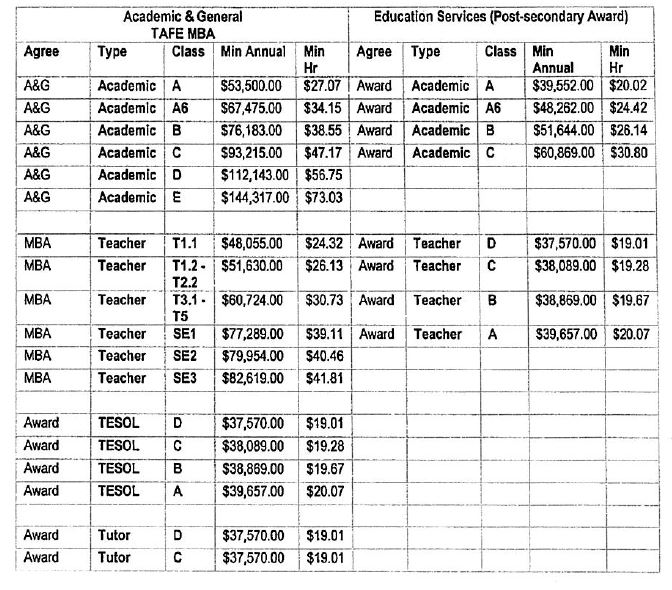
31 For example:
A teacher on the lowest pay scale received $48,055 under the TAFE MBA but on the Post-Secondary Award received $37,570.
A teacher on the highest pay scale received $82,619 under the TAFE MBA but on the Post-Secondary Award received $39,657.
32 The strategy to establish SCPL was described in this document in the following terms:
The rationale for establishing a new corporate entity included the capacity to employ teaching and general staff under conditions more suited to the nature of the entity’s operations.
In engaging employees it is clear that SCPL may be exposed to the transfer of business provisions of the Fair Work Act 2009 if Swinburne transfers TAFE teachers or general staff currently employed by Swinburne to employment with SCPL.
In the case of a TAFE teacher transfer, the Victorian TAFE Teaching Staff Multi-Business Agreement 2009 will transfer to SCPL. In the case of a general staff transfer, the Swinburne University of Technology, Academic and General Staff Enterprise Agreement to SCPL.
The following strategy sets out the key stages in establishing a private provider and managing the internal consultation process with Swinburne College staff and unions to ensure that the transfer of staff is achieved in a way that realises the vision as outlined.
33 In terms of the proposal for staff recruitment, this document notes the intention to employ staff who are not current employees of Swinburne so as to avoid triggering the “transfer of business” provisions in the Fair Work Act (see Pt 2-8, and in particular ss 311 to 313). The stated reason for seeking to avoid these provisions is the transferring staff would transfer with the benefit of the TAFE MBA (in the case of teaching staff). There was no suggestion in submissions that this document was anything other than accurate in its description of the consequences of triggering the “transfer of business” provisions. I find that is a consequence Swinburne planned actively to avoid, if it could.
34 Instead, the proposal was for direct recruitment of new staff, or recruitment through an agency. A mechanism was then suggested in the paper, so as to seek to satisfy the “genuine agreement” provisions in the Fair Work Act, whereby SCPL could negotiate an enterprise agreement. The mechanism was to employ one person in each classification of the Post-Secondary Award: manager, teacher, tutor, administrative support staff and general staff member. As I describe below, it was this aspect of the proposal that led to the actual employment of four individuals by SCPL.
35 In March 2012, the SCPL Board endorsed a transition plan for SCPL. Amongst the items in the transition plan was the design and implementation of a “workforce model” for staffing, with the stated implementation due date of 31 December 2012.
36 It appears that the first signs of any changes for Swinburne College staff may have been during 2012, when the reporting structure for Swinburne College general staff changed, and they began reporting ultimately to a person – Mr Tony Reed – who was not part of Swinburne College.
37 During 2012, planning for staffing changes to facilitate the move of all courses from Swinburne College to SCPL continued. Mr Smith prepared a document entitled “Swinburne College: Workforce Project Plan”, which is relevant to the alleged contraventions. The evidence does not disclose the date on which this document was prepared, but I infer from its contents that it was in the second half of 2012. This document noted the following as “background” to the matters it dealt with:
Swinburne College Pty Ltd (SCPL) is a wholly owned subsidiary of Swinburne University which was set up to deliver education programs and services. SCPL is governed by a board of directors consisting of University senior executives and independent directors.
SCPL does not currently have any employees or enrolled students but is progressively attaining the accreditations required to deliver its intended programs.
Swinburne College (SC), which is a part of Swinburne University of Technology (SUT), currently delivers a range of courses that are similar to those intended to be delivered by SCPL. It is intended that when SCPL commences delivering courses, SC will cease delivery of these courses.
38 The workforce project objective was described in the following way:
The purpose of this project is to establish fit for purpose employment arrangements that:
• Provide SCPL with maximum flexibility with respect to determining suitable terms and conditions of employment for its employees;
• Minimise union involvement and disputation; and
• Avoid the agreements currently in place at SUT applying to SCPL as a result of a transmission of business.
39 This document noted as the first of the outcomes to be achieved that contracts of employment would be based on the Post-Secondary Award. It then set out a number of actions, in table form, together with their purpose or rationale and estimated completion dates. The first was to reduce the ongoing workforce in Swinburne College by 30 September 2012, which was described as “complete”. The second action was to allow fixed-term contracts to end through the effluxion of time – no completion of this process was noted. The third was the relocation of general staff to centralised administrative areas, in order to “limit impact of changes to teaching staff and therefore minimis[ing] the obligation to consult NTEU”. The timing on this was identified as 31 October 2012, and the action was expressed to be complete. Mr Cullinan’s evidence confirms that on 30 September 2012 there were 13 full-time equivalent general staff in the organisational area of Swinburne College, but by December 2012 there was only one.
40 The need to recruit new staff in each award classification area, as I have described above, was also noted in this document, as was the preference for hiring non-transferring employees and the bargaining process for a new enterprise agreement. Potential liability for redeployment of staff under the TAFE MBA, on cessation of Swinburne delivering the teaching services, was also noted. The document identified the budget for these workforce changes as $110,000, comprising $65,000 for legal fees associated with the enterprise agreements, human resources policies and employment contracts and $45,000 for legal fees associated with Fair Work Commission approval processes.
41 The evidence suggests, and I find, that this planning, and these actions, were undertaken without notice to the NTEU, or to the Swinburne College staff concerned. This is confirmed by Mr Cullinan’s evidence, to which I return below. That is not to say, as the respondents submitted, there was a clear legal obligation to consult with the NTEU, given the TAFE MBA nominated the Australian Education Union (AEU) as the relevant union. I note however cl 9.5 of the TAFE MBA contains a broad consultation obligation expressly in relation to employees.
42 Reports to the Board of Directors from mid-2012 note that progress on implementing all necessary changes for SCPL to become operational were slower than expected because of volatility in the international student market and a transition of regulatory responsibility for registration of providers and accreditation of providers and courses from the State to the Commonwealth (see the Tertiary Education Quality and Standards Agency Act 2011 (Cth)).
43 By December 2012, the plan to employ one person in each relevant classification had come to fruition and SCPL employed four employees each commencing on 14 January 2013: Mr Tim Field in the position of Teacher; Ms Margot Tucker in the position of Business Development Manager; Mr Craig Taylor in the position of Academic Teacher (for 0.2 of full-time equivalent) and Ms Nancy Capitano in the position of Tutor/Instructor (for 0.4 of full-time equivalent). This enabled SCPL to commence the bargaining process under the Fair Work Act in mid-January 2013 but only with these four employees, which it did.
44 On 22 February 2013, SCPL applied to the Fair Work Commission for approval of the proposed Swinburne College Pty Ltd Enterprise Agreement 2013. SCPL’s consultations being limited to the four employees hired in December 2012 is apparent from the application itself. In terms of the close connection between Swinburne and SCPL, I note that the employer declaration on the application is signed by the then Vice Chancellor and President of Swinburne, Professor Linda Kristjanson, as a Director of SCPL.
45 By this time, the NTEU was well aware of the plans for SCPL. Mr Cullinan described in his evidence how, earlier in 2013, the NTEU found out what was occurring:
On or about 6 March 2013, numerous NTEU members and other staff of Swinburne
College contacted NTEU about announcements that had been made by the University. Those announcements included the announcement that Swinburne College was about to make an application to the Fair Work Commission for approval of the proposed SCPL enterprise agreement. I later became aware that it was Swinburne College Pty Ltd that had made an application to approve the Swinburne College Pty Ltd Enterprise Agreement 2013.
In March 2013 I spoke to dozens of Swinburne College staff, including many Swinburne College general staff to try and identify what was occurring. It was around this time that Swinburne College general staff told me they had been moved from the organisational area of Swinburne College within Chancellery to the organisational area of Student Operations within “Student and Corporate Services”. I was unable to determine exactly when that had occurred in 2012.
Prior to this time I was not aware of any proposals to change Swinburne College or to
create a new company to deliver Swinburne College programs.
46 As early as February 2013, the NTEU attempted to start negotiations with Swinburne (on behalf of SCPL), and although receipt of the NTEU communication was acknowledged by Professor Kristjanson, there was no substantive response by Swinburne for some time. Some notes created by Mr Smith in some time in February 2013 contain what appears to be a draft of a response to Mr Cullinan, but nothing beyond this seems to have occurred. Those notes record that the application for approval of the enterprise agreement was lodged “today” at the Fair Work Commission, which would place the document at about 22 February 2013. On 26 February 2013, Mr Smith did respond to Mr Cullinan, to the following effect:
Swinburne College Pty Ltd: I have been asked to respond on behalf of Professor Kristjanson to your email to her dated 19 February 2013. As you are aware, Swinburne University has given notice that it is bargaining in relation to a new enterprise agreement – see the Notice of Employee Representational Rights (http://www.swinburne.edu.au/corporate/hr/ebnotice). As outlined in the notice, the Agreement will not cover ‘employees employed by any entity other than Swinburne University’ – this includes Swinburne College Pty Ltd, as well as NICA and SSAA.
47 Communications by Swinburne with either the AEU (and not the NTEU) or the relevant Swinburne College employees (that is, aside from the four SCPL employees) in relation to the application for approval of that enterprise agreement did not occur until 5, 14 and 26 March 2013. Those communications were by email and were in evidence. The evidence revealed there was also a meeting called by Mr Smith with some Swinburne College employees prior to these emails being sent. What was said at that meeting was not in evidence, other than through the references in Mr Smith’s emails of 14 and 26 March 2013.
48 The communication on 5 March 2013 was from Ms Erin Freeman, a human resources consultant for Swinburne, to the AEU representative, Mr Francis Lawlor. It stated, amongst other matters:
One of the updates Andrew provided today was that the new company has developed tailored workforce arrangements that have been submitted to Fair Work Australia. The new company has hired some staff, holds registration as a higher education provider, has one accredited higher education program and is in the process of accrediting its remaining higher education courses.
49 There was no reference to the plan simply to allow fixed-term contracts to expire. Nor was there a reference to the plan not to hire existing Swinburne College staff at SCPL. There was a Delphic reference to the change in employment conditions (including salaries), with the assertion that “[s]ome staff may find this attractive, others may not”.
50 Ms Freeman’s planning for what Swinburne had decided would happen to current staff is revealed in an email she sent to Mr Smith on 13 March 2013, which was exhibited to Mr Cullinan’s written statement:
We’re at a stage where we need to start assessing the potential impact on each staff member within the College. This will also assist in discussions with the AEU. My aim is to have a suitable alternative position for each ongoing staff member in the College. If some staff choose to apply for vacancies that arise in Pty Ltd, they can.
I suggest we work through the attached spreadsheet and collect as much detail about the staff as possible, particularly the ongoing staff.
We will then need to secure support from the VC to transfer (not redeploy) staff from the College back in to the TAFE schools in place of current fixed term or sessional staff. Once we have this support, we will need discuss with Jennelle and then identify with the three Executive Directors (Sharon, Coralie and Ingrid) appropriate transfers. I will generate staff lists in the centres so we can see what may be possible.
I’m wondering if Chris could assist with any blanks in the qualifications and also fill in the current program area as a starting point? Perhaps we could then meet to discuss possible options for each staff member.
51 The spreadsheet attached to this email demonstrates that some staff members had been employed by Swinburne since the early and mid-1990s, and a significant number for more than a decade.
52 On 14 March 2013 an email was sent to Swinburne College teaching staff and senior educators by Mr Smith, following up on a commitment he had made at a meeting of staff the previous week. The omissions to which I have referred in [49] above were evident in the terms of this email as well. A further email from Mr Smith to Swinburne College staff on 26 March 2013 was a little more forthcoming about the fate which might await staff on fixed-term contracts at the expiration of their contracts, but stated that future hiring processes would have to be the subject of later confirmation.
53 In these communications, it was made clear that general staff would not be moved across to SCPL, or be able to apply for positions with SCPL, but rather would continue to be employed by Swinburne.
54 On 12 March 2013 NTEU sought to intervene in SCPL’s application for approval of the SCPL Enterprise Agreement. It also subsequently sought production of documents, over which there was dispute, and adduced evidence and made submissions in relation to the proposed agreement. The dispute in the Commission continued through April and May 2013, and culminated on 13 May 2013 when SCPL ultimately withdrew its application for approval.
55 The position therefore is that at the time the Court came to consider the alleged contravention and any applicable penalty, the transfer of teaching programs from Swinburne College to SCPL had never occurred, and the foreshadowed impacts on teaching staff at Swinburne College did not, in fact, occur.
56 The respondents submitted the Court could infer that the acceptance of an admitted contravention is the reason that the SCPL proposal is not going ahead, and that this was not a decision Swinburne reached lightly, given the effort, resources and time which had been invested. I am prepared to draw that inference.
THE COURSE OF THIS PROCEEDING
57 This proceeding was commenced by the NTEU in October 2013. To begin with, Swinburne was the only respondent. SCPL was joined in June 2014, but no relief was sought against it. New allegations of contraventions were made at this time. It was not until September 2014, in the further amended originating application and second further amended statement of claim, that relief was sought against SCPL.
58 On 24 December 2014, a third further amended statement of claim was filed. As the respondents submitted, this was filed without leave and without the respondents’ consent. Further contraventions of Pt 3-1 of the Fair Work Act were alleged, and it is fair to say, as the respondents submitted, that the claims against the respondents were broadened yet again.
59 As I noted above, the proceeding was actively contested until March 2015 when a settlement was reached, resulting in the respondents admitting one contravention of s 340(1)(a)(i) of the Fair Work Act.
Relevant legislative provisions
60 Section 340(1) of the Fair Work Act provides:
A person must not take adverse action against another person:
(a) because the other person:
(i) has a workplace right; or
(ii) has, or has not, exercised a workplace right; or
(iii) proposes or proposes not to, or has at any time proposed or proposed not to, exercise a workplace right; or
(b) …
Note: This subsection is a civil remedy provision (see Part 4-1).
61 The definition of “adverse action” is set out in s 342(1). Relevantly under item 1 of the table set out in s 342(1), an employer is deemed to have taken adverse action against an employee if the employer alters the position of the employee to the employee’s prejudice.
62 Relevantly to this proceeding, by s 342(2)(a), adverse action further includes threatening to take any action covered by the table in s 342(1).
63 The definition of a “workplace right” is set out in s 341(1). Under s 341(1)(a), a person has a workplace right if she or he “is entitled to the benefit of … a workplace law, workplace instrument or order made by an industrial body”. Section 12 defines a “workplace instrument” to be:
An instrument that:
(a) is made under, or recognised by, a workplace law; and
(b) concerns the relationships between employers and employees.
64 There is no dispute, and I am satisfied, that the TAFE MBA is such an instrument.
65 In relation to the imposition of penalties for contraventions of a civil remedy provision of the Fair Work Act, s 546 of the Act provides:
Pecuniary penalty orders
(1) The Federal Court, the Federal Circuit Court or an eligible State or Territory court may, on application, order a person to pay a pecuniary penalty that the court considers is appropriate if the court is satisfied that the person has contravened a civil remedy provision.
Note: Pecuniary penalty orders cannot be made in relation to conduct that contravenes a term of a modern award, a national minimum wage order or an enterprise agreement only because of the retrospective effect of a determination (see subsections 167(3) and 298(2)).
Determining amount of pecuniary penalty
(2) The pecuniary penalty must not be more than:
(a) if the person is an individual—the maximum number of penalty units referred to in the relevant item in column 4 of the table in subsection 539(2); or
(b) if the person is a body corporate—5 times the maximum number of penalty units referred to in the relevant item in column 4 of the table in subsection 539(2).
Payment of penalty
(3) The court may order that the pecuniary penalty, or a part of the penalty, be paid to:
(a) the Commonwealth; or
(b) a particular organisation; or
(c) a particular person.
Recovery of penalty
(4) The pecuniary penalty may be recovered as a debt due to the person to whom the penalty is payable.
No limitation on orders
(5) To avoid doubt, a court may make a pecuniary penalty order in addition to one or more orders under section 545.
66 The penalties that may be imposed by this Court are set out in s 539 of the Fair Work Act. Relevantly, s 539 provides:
Applications for orders in relation to contraventions of civil remedy provisions
(1) A provision referred to in column 1 of an item in the table in subsection (2) is a civil remedy provision.
(2) For each civil remedy provision, the persons referred to in column 2 of the item may, subject to sections 540 and 544 and Subdivision B, apply to the courts referred to in column 3 of the item for orders in relation to a contravention or proposed contravention of the provision, including the maximum penalty referred to in column 4 of the item.
Note 1: Civil remedy provisions within a single Part may be grouped together in a single item of the table.
Note 2: Applications cannot be made by an inspector in relation to a contravention of a civil remedy provision by a person in certain cases where an undertaking or compliance notice has been given (see subsections 715(4) and 716(4A)).
Note 3: The regulations may also prescribe persons for the purposes of an item in column 2 of the table (see subsection 540(8)).
67 Section 340(1) is included as a civil remedy provision at item 11 of the table set out in s 539(2). Under that item, the maximum penalty to be imposed for a contravention of s 340(1) is 60 penalty units. Further, the maximum penalty to be imposed on a body corporate pursuant to s 546(2)(b) of the Fair Work Act is five times the maximum number of penalty units referred to in the relevant item of the table in s 539(2).
68 Section 4AA of the Crimes Act 1914 (Cth) determines the rate of a penalty unit. The rate is currently fixed at $180, having been adjusted from $170 with effect from 31 July 2015. I have not taken the 31 July 2015 rate change into account in fixing the appropriate penalty, since the contravention was complete before 31 July 2015.
69 There was no dispute at hearing (shortly prior to that adjustment) that the relevant maximum penalty that may be imposed for the admitted contravention was 60 penalty units x 5 x $170, which is $51,000. Swinburne submits, however, that the vast majority of the conduct constituting the contravention occurred prior to 28 December 2012, when the value of the penalty unit was adjusted from $110 to $170. Accordingly, it submits that for the majority of the conduct, the Court should take into account that a lower penalty rate applied at that time, and the maximum penalty would have been correspondingly lower. If all the conduct had occurred during the period of time when the penalty rate was $110, the maximum penalty would be $33,000. I accept the respondents’ submission that the applicable penalty rate is fixed by reference to the date of the contravening conduct: Murrihy v Betezy.com.au Pty Ltd (No 2) [2013] FCA 1146; 221 FCR 118 at [6]-[28]. However in this case, the element of the contravention constituted by the threat of taking adverse action is accepted by the respondents to have occurred by the emails sent in March 2013. At that time, the applicable penalty rate was $170. It is accurate, however, to say that the reason for the adverse action was a reason identified in the planning for the SCPL proposal that occurred at earlier dates, and indeed as early as 2011, when the penalty unit was fixed at $110.
70 Accordingly, I do propose, in application of the totality principle, to take the different penalty rates into account in fixing an appropriate penalty.
RELEVANT INDUSTRIAL INSTRUMENTS
71 The parties identified three relevant industrial instruments:
(1) The Swinburne University of Technology, Academic & General Staff Certified Agreement 2006 – 2008 commenced operation on 1 July 2006 and continued to operate until replaced with effect from 30 March 2010. Whilst in operation, it was an instrument to which each of Swinburne and the NTEU were parties and covered the employment terms and conditions of general staff employed by Swinburne to perform work in Swinburne College.
(2) The Swinburne University of Technology, Academic & General Staff Enterprise Agreement 2009 replaced that agreement with effect from 30 March 2010. Whilst in operation, it applied to Swinburne and covered the NTEU, and covered the employment terms and conditions of general staff employed by Swinburne to perform work in Swinburne College.
(3) The TAFE MBA commenced operation in June 2009 and continues in operation. Swinburne is a party to and bound by the TAFE MBA. The TAFE MBA covers the employment terms and conditions of teaching staff employed by Swinburne who performed teaching duties in Swinburne College (referred to by the parties as the “SC Teaching Staff”) and those who were senior educators such as Directors of Studies who performed some duties related to studies within Swinburne College (referred to by the parties as the “Senior Educators”).
72 Each of these agreements is in evidence and is agreed to be a workplace instrument for the purposes of the Fair Work Act.
73 The parties are agreed that the Swinburne College teaching staff and senior educators worked solely on Swinburne College operations, whereas only some general staff employed by Swinburne performed work for Swinburne College.
admitted contravention
74 Paragraphs 25 and 26 of the second further amended statement of claim allege:
25. In or about November-December 2009, the First Respondent decided:
(a) to establish SCPL; and
(b) to transfer, over time, SC’s operation to SCPL, including for SPCL [sic] to deliver the same or similar courses to those previously delivered by SC and for SC to thereafter cease to deliver those courses,
(the transfer decision).
Particulars
The best particulars able to be given by the Applicant at the present time are that in the above period the First Respondent’s Council endorsed or approved a recommendation or proposal to the effect alleged above.
Further particulars will be provided after further discovery.
26. In the period since the making of the transfer decision until about 2013, the First Respondent has taken various steps to implement the transfer decision including by:
(a) incorporating SCPL as alleged in subparagraphs 3(a) and (b) above;
(c) entering into a written services agreement dated 27 May 2011 with SCPL pursuant to which the First Respondent agreed to provide SCPL with various administrative and operational services including student and corporate services, financial services, international and development services, chancellery services, strategic planning and quality services and internal audit services; and
(i) preparing in 2012 a written “Swinburne College: Workforce Project Plan,” “to establish fit for purpose employment arrangements” for SCPL to achieve identified objectives and outcomes.
Particulars
Further particulars will be provided after discovery.
75 By the statement of agreed contravention and agreed facts filed on 4 June 2015, Swinburne admits a single contravention of s 340 of the Fair Work Act, namely that:
by its conduct in making, and taking steps to implement, the transfer decision as alleged in paragraphs 25 and 26 of the 2FASOC, in contravention of section 340(1)(a)(i) of the Fair Work Act 2009 (C’th), it threatened to take adverse action against Swinburne College employees, being the SC Teaching Staff and Senior Educators, for reasons including a substantive and operative reason that they had an entitlement to the benefit of an industrial instrument, being the TAFE MBA.
76 The elements of the admitted contravention were admitted to be the following:
By the conduct alleged in paragraphs 25 and 26 of the 2FASOC, and through the communications dated 5, 14 and 26 March 2013, Swinburne threatened to engage in adverse action against the SC Teaching Staff and the Senior Educators.
The threat was to the effect that, if the Swinburne College Pty Ltd Enterprise Agreement 2013 was approved by the Fair Work Commission, the security of employment of the SC Teaching Staff and Senior Educators would be diminished in that:
(a) there was a prospect that the courses which they were engaged to teach could have been discontinued if SCPL started to conduct those courses; and
(b) if the courses that they were engaged to teach were in fact discontinued by Swinburne, their position may become redundant resulting in termination of employment or non-renewal of their contract.
The reasons for the threatened action included a substantial and operative reason that the SC Teaching Staff and the Senior Educators were entitled to the benefit of a workplace instrument, being the TAFE MBA.
77 It should be noted that the admitted contravention thus deals only with the workplace rights of Swinburne College teaching staff and senior educators, not general staff.
RESOLUTION
The conduct constituting the contravention
78 It was apparent from the parties’ written submissions that discrete areas of disagreement remained in respect of the scope of the admitted contravention.
79 In particular, the NTEU initially contended that the threatened action, if carried out, would have constituted a prejudicial alteration to the position of the employees and/or an injury to the employees in their employment. Swinburne accepted that the threatened action would, if carried out, have led to prejudicial alteration within the meaning of item 1(c) of s 342(1) of the Fair Work Act, but did not concede any threat to injure any employees in their employment. Ultimately the NTEU did not press any allegation of injury to Swinburne College employees in their employment, within the meaning of item 1(b) of s 342(1) of the Fair Work Act.
80 The parties diverged somewhat as to the conduct constituting the threat to take adverse action, and how it could be said the threat was communicated. The parties were agreed that as a matter of law a threat to take adverse action must be communicated: Construction, Forestry, Mining and Energy Union v Bengalla Mining Company Pty Limited (No 2) [2013] FCA 362 at [29] per Katzmann J and Construction, Forestry, Mining and Energy Union v State of Victoria [2013] FCA 445, 302 ALR 1 per Bromberg J; though not necessarily to a specific person nor to the person threatened: Gietzelt v Craig-Williams Pty Ltd (No 2) (1959) 1 FLR 465, per Dunphy J at 467-468 and per Morgan J at 468; as considered in Community and Public Sector Union v Telstra Corporation Limited [2000] FCA 872; 101 FCR 45 per Finkelstein J. At [15], Finkelstein J held:
the communication need not be directly to the person threatened but could be just as effectively made if it is communicated to a person in circumstances where it is intended to or is likely to find its way to the person threatened.
81 The NTEU contended that the threat was communicated variously by:
(1) the endorsement by the Swinburne University Council of the proposal;
(2) the preparation and promulgation of the “Swinburne College: Background Briefing” document to which I have referred at [24]-[25] above;
(3) the preparation and promulgation of the document titled “Commercial In Confidence – Establishment of Private Provider” to which I have referred at [26]-[34] above;
(4) the preparation and promulgation of the documents titled:
(a) “2012-2015 College Plan”; and
(b) “2012-2013 SCPL Transition Plan” (the latter referred to at [35] above);
(5) the preparation and promulgation of the document titled “Swinburne College: Workforce Project Plan” to which I have referred at [37]-[40];
(6) the communications on 5, 14 and 26 March 2013; and
(7) the making of the application to approve the proposed SCPL enterprise agreement.
82 In contrast, Swinburne admitted only the communication of the threat by reason of (6) and (7) above, and submitted there was no evidence to indicate that the matters in (1) to (5) above were relevantly promulgated or communicated.
Contravention
83 It is clear from the authorities to which I have referred that the gravamen of a threat is its communication to the person subjected to the threat. While that communication need not be direct, there must be some conduct identified as the way in which the person or persons said to be subjected to the threat come to learn about it. I find that by email communications on 5, 14 and 26 March 2013 Swinburne, through or on the authority of its Vice President (Engagement) Mr Andrew Smith, threatened to take adverse action against Swinburne College teaching staff and senior educators. The threat was communicated to staff through these emails directly on 14 and 26 March, and indirectly on 5 March because the latter email was sent by Ms Freeman (Swinburne’s human resources consultant) to the AEU. Similarly the lodging of the proposed new enterprise agreement with the Fair Work Commission (item (7)) is also capable of constituting a “threat” as the authorities have explained that word.
84 I do not accept the applicant’s submission that the threat was also constituted by the matters set out in paragraph [81(1)]-[81(5)] above. On the evidence there was no direct or indirect communication of the contents of those proposals or documents to the affected Swinburne College staff. The contents of those documents certainly reveal the reasons for the SCPL proposal, and the threat of adverse action, including the prohibited reason I have identified. However they do not in and of themselves constitute a threat.
85 The adverse action threatened was that the security and continuation of their employment was likely to be diminished or adversely affected; the courses they were currently teaching were likely to be transferred to SCPL for delivery and their position may therefore eventually become redundant, resulting in termination of employment or non-renewal of their contract. The planning for this action occurred much earlier than the time at which the threat was conveyed. From the facts as I have found them to be above, the planning began in late 2008, the changes were approved by the Swinburne University Council in 2009 and the details of the implementation were actively considered and worked through from 2011 onwards.
86 A substantive and operative reason for the threatened adverse action was that the Swinburne College teaching staff and senior educators had an entitlement to the benefit of an industrial instrument, being the TAFE MBA, which Swinburne’s proposals consciously did not envisage being part of the industrial arrangements for the new SCPL workforce, because the entitlements under that TAFE MBA were not of the kind Swinburne wished to perpetuate in the new SCPL working environment.
87 Accordingly, there should be declarations giving effect to this finding of contravention.
Approach to penalty
88 Swinburne accepted in its submissions it was appropriate for the Court to impose a penalty, and that was a proper and responsible concession, for which it deserves credit.
89 In Australian Federation of Air Pilots v HNZ Australia Pty Ltd [2015] FCA 755 at [28] I set out what I consider to be the appropriate approach to determining penalty, and I need not repeat those observations.
90 As the respondents emphasised, the Court should ensure that the penalty imposed is proportionate to the gravity of the contravening conduct and reflects a “just sentence” for the whole of the conduct: Attorney-General v Tichy (1982) 30 SASR 84 at 93; AB v The Queen [1999] HCA 46; 198 CLR 111 at [14]; Royer v Western Australia [2009] WASCA 139; 197 A Crim R 319 at [21]-[22] per Owen JA. Taking into account the parties’ respective submissions, and from my own consideration of the evidence, I accept the following factors are relevant in the circumstances of this particular contravention.
91 I turn first to consider the nature and seriousness of the conduct, recalling that the conduct is a threat to take adverse action, not the taking of adverse action.
92 It was expressly contemplated that the casual and fixed-term employees at Swinburne College should not be the persons who would be employed by SCPL. Ms Freeman’s email to Mr Smith of 13 March 2013 shows that Swinburne engaged in some planning for ongoing employees – to find them alternate placements outside Swinburne College, but not by way of transfers to SCPL. I accept the applicant’s submission that the inference is there were not going to be placement attempts even at that level on behalf of casual and fixed-term employees. The respondents have not pointed to any evidence demonstrating positive consideration of the fate of those employees.
93 Many of those employees had been employed at Swinburne for long periods of time, over a decade. Swinburne’s plans were to see them lose their employment, and there was a conscious plan to employ new people so as to avoid the protective transfer provisions of the Fair Work Act applying so as to engage the TAFE MBA within the SCPL work environment.
94 The evidence is clear that, even if some existing casual and fixed-term employees had secured employment with SCPL, they are likely to have done so on less favourable conditions than those which existed under the TAFE MBA. The comparative pay scales to which I have referred above amply make that point. Examples given in submissions by the applicant are apposite. If the evidence about the four representative employees is considered, Mr Tim Field, who was employed as a general staff member, would have received $105,000 plus superannuation under the TAFE MBA. Under proposed enterprise agreement, and assuming Mr Field was employed at the highest classification level, the maximum he could have received would have been $89,910 plus superannuation. Similarly for Ms Capitano: her annualised salary under the TAFE MBA would have been $82,000 plus superannuation, but under the proposed enterprise agreement she was classified as at the maximum level of level 7, to receive was $64,040 plus superannuation.
95 I also accept Mr Cullinan’s evidence that the employees’ access to industrial representation and advice was likely to have been diminished, a fact that the documentary evidence reveals was not lost on Swinburne’s senior leadership.
96 I accept the respondents’ submissions that there is a degree of speculation inherent in considering what might have occurred had the SCPL proposal been permitted to come to fruition. I do not consider the speculative aspects of Mr Cullinan’s evidence carry much weight. What in my opinion is entitled to more weight are the contemporaneous statements in the documents, to which I have referred above, which demonstrate that Swinburne senior management actively and consciously intended there to be cost savings, and industrial outcomes favourable to Swinburne and (one can readily infer) less favourable to its employees. That is a consideration to which I attach some weight.
97 It is true, as the respondents submitted, that the contravening conduct could not be identified as the “touchstone” for the planned restructure. The restructure had broader, and legitimate, aims. However, the “workforce planning”, as it was described in the documents, was integral to the proposal and features prominently in the contemporaneous documentation. That planning revolved around creating a more constrained industrial and employment environment.
98 Finally, in terms of the nature and seriousness of the conduct, I accept the respondents’ submission that the effects of the proposal on the general staff of Swinburne do not form part of the contravention. At hearing, I understood the applicant to accept as much. The general staff were intended to provide support services to SCPL under services agreement, but to remain as employees of Swinburne, and there is no basis to infer the security of their employment was planned to be diminished or adversely affected.
99 Moving on from the nature and seriousness of the conduct, some of the features of Swinburne as an institution are also relevant. It is a large institution, able to source experienced legal and industrial advice, well used to working with unions on industrial matters. Senior management was closely involved, including the Vice Chancellor, and the University Council. The CEO of Swinburne College and SCPL and later Vice President (Engagement) of Swinburne, Mr Andrew Smith, was one of the architects of the SCPL proposal, and the member of Swinburne’s senior management charged to implement it.
100 The part of senior officers within Swinburne in the contravention is now a matter of public record, through these reasons for judgment, and that in itself is some punishment, as well as operating, I consider, as a form of general and specific deterrence.
101 However the seniority of those involved does say something about the calculated nature of the contravention, because for those at such senior levels to be involved, it is clear that this was a carefully planned course of action, over a considerable period of time, with objectives and outcomes to which experienced and senior people had turned their minds. Part of that plan (I accept, not the whole of it) included a consciousness that the entitlements of employees at Swinburne College could be adversely affected if the proposal went ahead. Indeed the cost savings and more favourable industrial landscape for Swinburne (especially at the expense of its casual and fixed-term employees) were motivating factors in the proposal.
102 The parties made competing submissions about the relevance of other contraventions of the Fair Work Act in which Swinburne has been found to have engaged: see National Tertiary Education Industry Union v Swinburne University of Technology [2013] FCA 1128.
103 That is a judgment of Tracey J published on 30 October 2013. Coincidentally, that is the same date on which these proceedings were commenced by the NTEU. The proceeding before Tracey J concerned conduct in the first half of 2012, consequent upon a Victorian Government decision in May 2012 to make substantial changes to the funding models for vocational education and training. This decision led Swinburne to decide to stop offering some courses at its Lilydale campus, a decision which was taken, so the NTEU alleged and ultimately Swinburne admitted, in contravention of certain requirements of the relevant enterprise agreement.
104 In his decision Tracey J expressly took into account (at [26]) that the University had not previously been found by a court to have contravened the enterprise agreement or any Commonwealth workplace laws. Swinburne therefore gained the benefit of that fact in the exercise of the penalty discretion by Tracey J. It cannot gain that benefit for a second time.
105 In my opinion, at the time at which the Court determines penalty in this matter, it is a fact that Swinburne has now been found to have contravened, for the second time, provisions of the Fair Work Act. There is, in those circumstances, a greater need for specific deterrence, even taking into account the deterrent effect of the publication of these orders and reasons for judgment, setting out the course of conduct in which Swinburne’s senior management engaged.
106 The imperatives to organise and operate higher education institutions in ways that are competitive and economically efficient are capable of coming into conflict with an employer’s industrial and employment obligations under the Fair Work Act and applicable industrial instruments. This is what has occurred in both of Swinburne’s contraventions. Considerations of both specific and general deterrence arise in those circumstances. Swinburne itself should be put formally on notice that it needs to look more carefully at its obligations before planning and engaging in a course of conduct such as the one set out in these reasons, or the one with which Tracey J dealt. Other higher education institutions also need to be on notice that industrial and employment protections and commitments, even when they are perceived to “cost” an employer more, or to make for a less “flexible” workforce, are to be adhered to and respected, or appropriately re-negotiated.
107 One feature of this matter which calls for both specific and general deterrence is for the Court by its penalty to disapprove of the lack of transparency in what Swinburne was planning to do. There was a conscious decision to keep these plans away from Swinburne’s affected employees, and away from the NTEU (and the AEU). The fact that Swinburne ultimately abandoned the proposal, having expended, I infer, considerable financial and staffing resources on planning the proposal, as well as securing legal and other advice, suggests that better transparency earlier on may have exposed the legal difficulties with the proposed course, and may have produced an alternative negotiated outcome where resources and funds were not wasted, and employees had the voice they were entitled to.
108 In fixing a penalty, I have not given any weight to the “promotion” of Mr Andrew Smith by Swinburne to the position of Vice President (Engagement). This occurred during the period of time covered by the planning stages preparatory to the contravening conduct. The applicant relied on what it described as Mr Smith’s promotion as a factor which demonstrated Swinburne was intent on rewarding a person for what was ultimately accepted to be unlawful conduct in which he played a central part. The reason for Mr Smith’s appointment was outlined in Swinburne’s 2013 Annual Report: namely, he was appointed to an office created so Swinburne could better engage with industry and the community. There was no evidence adduced from Mr Smith by either party, nor from any other witness, about how his new appointment came about. I do not propose to draw inferences about the reasons he received the appointment he did with Swinburne.
109 I accept, as the respondents submitted, that Swinburne has acted appropriately in compromising this proceeding without the need for a full trial and judgment by this Court. The savings in time and resources to the Court and to the parties should be recognised. I do not accept that the admission of one contravention necessarily demonstrates any contrition or remorse. The reasons for the admission form no part of the evidence before me. I cannot see in the evidence any statements which approach expressions of regret, or acknowledgment of wrongdoing as between Swinburne and the NTEU, or, more importantly, Swinburne and its Swinburne College staff. If a respondent to a contravention wishes to take advantage of sentencing principles concerning remorse and contrition, there are plain and clear ways to achieve that through the tender of evidence with appropriate content. That has not occurred in this proceeding.
Appropriate penalty
110 In Director, Fair Work Building Industry Inspectorate v Construction, Forestry, Mining and Energy Union [2015] FCAFC 59; 229 FCR 331 at [252] the Full Court indicated it was appropriate for judges imposing penalties to look at previous decisions so as to ensure the development of a consistent approach to the fixing of pecuniary penalties.
111 In this case, the parties, and the respondents in particular, have referred to a number of previous decisions, although they did not agree on the relevance of the previous decisions to the circumstances of the current contravention. I set out the cases I consider have the most relevance below.
112 There are some examples of small employer organisations, operating not for profit, who dismissed employees for prohibited reasons and received relatively small fines: see Australian Nursing Federation v Alcheringa Hostel Inc [2004] FCA 375; 136 FCR 530 ($400 for each of eight contraventions). See also Fair Work Ombudsman v A Dalley Holdings Pty Ltd [2013] FCA 509 at [19(4)]. There are examples of large employers engaging in conduct intended to affect a large number of employees, but where the conduct was not actually carried through: see Community and Public Sector Union v Telstra Corporation Limited [2001] FCA 1364; 108 IR 228 ($74,507.60 imposed by way of penalty, calculated by reference to a small dollar sum for each affected employee).
113 In Automotive, Food, Metals, Engineering, Printing & Kindred Industries v DMG Industries Pty Ltd [2000] FCA 1492; 102 IR 175, an employer who made threats to take action against a number of employees had a small penalty imposed for one breach but a penalty close to the maximum penalty imposed for others (making a total penalty of $17,796.55), although a discount was given for the employer paying the union’s legal fees.
114 In Director of the Fair Work Building Industry Inspectorate v Construction, Forestry, Mining and Energy Union (No 2) [2015] FCA 407, Tracey J imposed penalties of $7,500, $7,500 and $15,000 respectively for three separate breaches of s 340(1). A factor which weighed with Tracey J in that case was the repeated nature of the respondent’s contraventions (see at [106]).
115 Here, there is a single course of conduct, constituted by the making of threats principally by email, and through the conduct of lodging the application for approval of the enterprise agreement which would have related to the position of the affected employees. Neither party suggested this course of conduct should be viewed as anything other than a single contravention, and I agree with that approach. From the outset, the planning in which Swinburne engaged was to have a single industrial and employment outcome from a significant change in the way it delivered its teaching services and programs. Part but not all of that plan involved the contravening conduct.
116 That is quite different from, for example, the situation facing Tracey J in Director of the Fair Work Building Industry Inspectorate v Construction, Forestry, Mining and Energy Union (No 2) where there were separate threats on separate occasions for related purposes.
117 It is critical, as the respondents submitted, to ensure that what is punished is the making of the threat, the action which was the subject matter of the threat having never been implemented. Nevertheless, the fact that the threat involved serious consequences for employees is also important.
118 Taking all the circumstances into account, in my opinion the appropriate penalty is $14,000.
To whom should the penalty be paid?
119 It was an agreed fact in this proceeding that if the Court found a contravention of the Fair Work Act, Swinburne would pay the NTEU the sum of $120,000 in respect of costs of and related to the bringing of this proceeding.
120 In light of that fact, the parties made competing submissions on the question of to whom the penalty should be paid. The NTEU submitted that it had “‘shouldered for itself’ the burden of the conduct of the litigation”, for the benefit of its members and for purposes of general enforcement of the Fair Work Act.
121 In contrast, the fact that Swinburne will already have paid the NTEU $120,000 in legal costs is said by the respondents to be sufficient recompense and encouragement for the enforcement of the protective provisions of the Fair Work Act, as articulated by Gray J in National Tertiary Education Union v Royal Melbourne Institute of Technology [2013] FCA 451; 234 IR 139 at [146]. Swinburne submitted any penalty imposed by the Court should be ordered to be paid into consolidated revenue.
122 The applicant, relying in large part on the evidence of Mr Cullinan, points out that significant costs have already been disbursed to pay external legal fees to its former solicitors Maurice Blackburn, and he expects the total paid to solicitors and counsel to exceed $120,000. His evidence was that since late November 2014 the union has used its internal resources to conduct this proceeding, at an internal cost to itself, for which it seeks to be reimbursed. Mr Cullinan’s evidence was that the union used an in-house lawyer who could “direct brief” counsel in the proceeding.
123 There was no evidence before the Court about the reasonableness or otherwise of the fees paid or payable by the NTEU to external solicitors, nor even any evidence of what those fees were said to cover. This matter had not proceeded to the point of the filing of evidence on liability. Without evidence, it is unclear how more than $120,000 in legal fees was incurred up to November 2014.
124 There was no evidence about why the union decided in November 2014 to cease retaining Maurice Blackburn for this proceeding.
125 In circumstances where Swinburne has agreed to pay $120,000 to the union for its legal costs if a contravention is found proven, and without further evidence to support the submission made, I am not inclined to order that the penalty be paid to the union as some kind of recompense. Without any more detailed evidence on the subject being available, I consider that if there is to be some financial “encouragement” to an organisation such as the NTEU to enforce the provisions of the Fair Work Act for the benefit of its members, then the payment by Swinburne of $120,000 towards its legal costs provides such encouragement.
126 In my opinion it is appropriate in the circumstances of this case to order that the penalty be paid to consolidated revenue.
The balance of the proceeding
127 In its statement of claim in this proceeding, the NTEU made a number of allegations of contraventions of the Fair Work Act. The parties reached an agreed position on one such contravention. They jointly submitted to the Court that their agreed position on the balance of the proceeding and appropriate orders would be the dismissal of all claims against Swinburne in the originating application other than the contravention it has admitted and the dismissal of the proceeding as against SCPL. The parties agreed there should be no orders as to costs (noting Swinburne’s agreement to pay $120,000 to the NTEU).
128 I am satisfied that the orders proposed concerning the balance of the proceeding are appropriate, and should be made.
I certify that the preceding one hundred and twenty-eight (128) numbered paragraphs are a true copy of the Reasons for Judgment herein of the Honourable Justice Mortimer. |
Associate:


