

FEDERAL COURT OF AUSTRALIA
Wintawari Guruma Aboriginal Corporation RNTBC v State of Western Australia [2015] FCA 1053
IN THE FEDERAL COURT OF AUSTRALIA | |
WINTAWARI GURUMA ABORIGINAL CORPORATION RNTBC Applicant | |
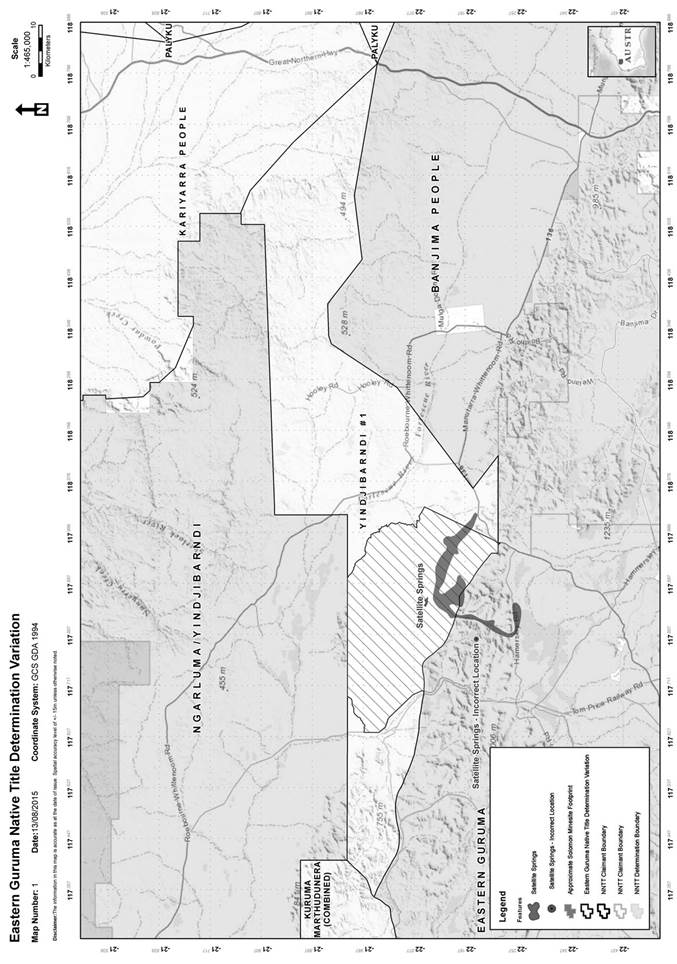
AND: | Respondent |
DATE OF ORDER: | |
WHERE MADE: |
THE COURT ORDERS THAT:
1. The proceedings be dismissed.
Note: Entry of orders is dealt with in Rule 39.32 of the Federal Court Rules 2011.
IN THE FEDERAL COURT OF AUSTRALIA | |
WESTERN AUSTRALIA DISTRICT REGISTRY | |
GENERAL DIVISION | WAD 6005 of 2003 |
BETWEEN: | TJ AND OTHERS (AS PER SCHEDULE) Applicant |
AND: | STATE OF WESTERN AUSTRALIA AND OTHERS (AS PER SCHEDULE) (YINDJIBARNDI) Respondent |
JUDGE: | RARES J |
DATE OF ORDER: | 25 AUGUST 2015 |
WHERE MADE: | PERTH |
THE COURT ORDERS THAT:
1. The interlocutory application filed on 11 August 2015 be dismissed.
Note: Entry of orders is dealt with in Rule 39.32 of the Federal Court Rules 2011.
IN THE FEDERAL COURT OF AUSTRALIA | |
WESTERN AUSTRALIA DISTRICT REGISTRY | |
GENERAL DIVISION | WAD 434 of 2015 |
BETWEEN: | WINTAWARI GURUMA ABORIGINAL CORPORATION RNTBC Applicant |
AND: | STATE OF WESTERN AUSTRALIA Respondent |
JUDGE: | RARES J |
DATE OF ORDER: | 25 September 2015 |
WHERE MADE: | PERTH |
THE COURT ORDERS THAT:
1. Order 2 pronounced on 25 August 2015 be set aside.
2. The applicant in these proceedings pay the costs of the respondent, that is the applicant in proceedings WAD 6005 of 2003, on an indemnity basis.
Note: Entry of orders is dealt with in Rule 39.32 of the Federal Court Rules 2011.
IN THE FEDERAL COURT OF AUSTRALIA | |
WESTERN AUSTRALIA DISTRICT REGISTRY | |
GENERAL DIVISION | WAD 6005 of 2003 |
BETWEEN: | TJ AND OTHERS (AS PER SCHEDULE) Applicant |
AND: | STATE OF WESTERN AUSTRALIA AND OTHERS (AS PER SCHEDULE) (YINDJIBARNDI) Respondent |
JUDGE: | RARES J |
DATE OF ORDER: | 25 SEPTEMBER 2015 |
WHERE MADE: | PERTH |
THE COURT ORDERS THAT:
1. Order 2 pronounced on 25 August 2015 be set aside.
2. Wintawari Guruma Aboriginal Corporation pay the costs of the applicant of the interlocutory application filed on 11 August 2015 on an indemnity basis.
Note: Entry of orders is dealt with in Rule 39.32 of the Federal Court Rules 2011.
WESTERN AUSTRALIA DISTRICT REGISTRY | |
GENERAL DIVISION | WAD 434 of 2015 |
BETWEEN: | WINTAWARI GURUMA ABORIGINAL CORPORATION RNTBC Applicant |
AND: | STATE OF WESTERN AUSTRALIA Respondent |
IN THE FEDERAL COURT OF AUSTRALIA | |
WESTERN AUSTRALIA DISTRICT REGISTRY | |
GENERAL DIVISION | WAD 6005 of 2003 |
BETWEEN: | TJ AND OTHERS (AS PER SCHEDULE) Applicant |
AND: | STATE OF WESTERN AUSTRALIA AND OTHERS (AS PER SCHEDULE ) (YINDJIBARNDI) Respondent |
JUDGE: | RARES J |
DATE: | 25 september 2015 |
PLACE: | PERTH |
REASONS FOR JUDGMENT
1 On 11 August 2015, the Wintawari Guruma Aboriginal Corporation RNTBC (WGAC) filed an interlocutory application (the joinder application) pursuant to s 84(5) of the Native Title Act 1993 (Cth) seeking to be joined as a party to the Yindjibarndi people’s application for a determination of native title in these proceedings, TJ v State of Western Australia (WAD 6005 of 2003) (the Yindjibarndi proceedings). The Yindjibarndi proceedings had been set down to be heard on country, in the Pilbara, commencing on 7 September 2015.
2 Next, on 18 August 2015, WGAC filed a revised native title determination application (the revised application) in new proceedings (WAD 434 of 2015), applying for the variation of two approved determinations of native title held by the Eastern Guruma people that Bennett J had made, by consent, on two occasions: Hughes (on behalf of the Eastern Guruma People) v State of Western Australia [2007] FCA 365 (Hughes (No 1)) on 1 March 2007, and Hughes on behalf of the Eastern Guruma People (No 2) v State of Western Australia [2012] FCA 1267 (Hughes (No 2)) on 20 November 2012. Bennett J made the following order in each determination:
The Wintawari Guruma Aboriginal Corporation shall hold the determined native title in trust for the native title holders pursuant to section 56(2) of the Native Title Act 1993 (Cth).
3 WGAC claimed in [2] of its revised application that it “is entitled make this application as the registered native title body corporation [sic], which holds on trust the native title rights and interests of the native title holders recognised in [the two decisions by Bennett J] pursuant to s 6(1) of the Native Title Act 1993 (Cth)”.
4 The land and waters in those determinations are immediately below the southern boundary of the land and waters claimed in the Yindjibarndi people’s current application for a determination of native title. The area of the land and waters claimed in the revised application, of about 700 km2, (the new claim area) overlaps about one quarter of, and divides into two, the area of about 2,800 km2 claimed in the Yindjibarndi proceedings (the Yindjibarndi claim area).
5 Both the joinder and revised applications were before me on 25 August 2015. On that occasion I dismissed both applications and ordered WGAC to pay the Yindjibarndi applicants’ costs of them on an indemnity basis. I delivered ex tempore reasons that I have revised and used as the basis for these reasons except in one respect, namely, where erroneously I took into account, for the purposes of the costs orders, evidence that WGAC had filed but not formally read. Having reflected on this, I have decided to set aside and remake each of the orders for costs that I made on 25 August 2015, under r 39.04 of the Federal Court Rules 2011 (Cth). Those orders have not been entered. Because I am satisfied that I erred in taking into account material that was not formally in evidence when I made the costs orders, I consider that there is some matter calling for review justifying my re-exercising the power to make the costs orders: Smith v New South Wales Bar Association (1992) 176 CLR 256 at 265 per Brennan, Dawson, Toohey and Gaudron JJ.
6 The principal issue is whether WGAC’s claimed status to bring both the revised application and the joinder application has any apparent legal foundation.
Background
7 The nature of the interest asserted by WGAC in support of the joinder application is the same as that asserted in its revised application. In Schedule F of the revised application, WGAC asserted that it holds on trust the native title rights and interests of the native title holders that were identified in the Eastern Guruma native title determinations made by Bennett J in Hughes (No 1) [2007] FCA 365 and Hughes (No 2) [2012] FCA 1264. Those determinations were recorded on the National Native Title Register and, by force of the recording of WGAC in the Register as the prescribed body corporate that held those rights and interests in trust under the determinations, WGAC became a registered native title body corporate within the meaning of s 253. Thus, WGAC asserted that it had the status of a registered native title body corporate for the purposes of meeting the requirement in item (1) of the table in s 61(1) in respect of persons who could make a revised application.
8 WGAC asserted that it had discovered that the boundaries of the determinations made by Bennett J, that are set out in attachment D to the revised application, were incorrect. In Schedule F, WGAC claimed that one of its members had discovered, in late 2015 when watching a documentary on television, that the area determined by Bennett J was incorrect. That date appears to be an error for an earlier date.
9 The revised application then alleged that the previously understood location of a site of particular significance to the Eastern Guruma people, known as “Satellite Springs”, had been believed at the time of the two consent determinations to be within the determined area but that :
[f]urther investigation has discovered that the site known by the Eastern Guruma people as ‘Satellite Springs’ is located within the area the subject of this variation application.
10 The new claim area very significantly bifurcates the Yindjibarndi claim area as is shown in the map that is annexed to these reasons that the parties have prepared. The new claim area, if recognised in a determination of native title, would reduce the Yindjibarndi claim area. The revised application appears to involve a not insubstantial area of land and waters that lie immediately to the north of the northern boundary of the areas determined by Bennett J to be those held on trust by WGAC, under s 56(2) of the Act.
11 If WGAC were successful in its application for joinder under s 84(5) of the Act, the extensive preparation for the on-country trial that, at 25 August 2015, was imminent, would have been significantly disrupted since the parties to the Yindjibarndi proceedings had not prepared, among other things, anthropology or other factual evidence to deal with the newly asserted claims of WGAC on behalf of the Eastern Guruma people claim group.
12 There was no suggestion in the revised application that WGAC had been authorised, under s 251B of the Act, to make that application on behalf of any persons who are common law native title holders, or any group of persons asserting such a claim. So much was acknowledged by senior counsel appearing for WGAC at the hearing on 25 August 2015. Moreover, senior counsel also acknowledged that the new claim area was not the subject of any previous application by or on behalf of the Eastern Guruma people, including in the application originally filed in October 1997 for a determination of the areas the subject of the two determinations of native title made by Bennett J in 2007 and 2012.
13 Indeed, the revised application had, as attachment F, an affidavit filed in support of the joinder application on 11 August 2015 by Susanne Boyd, a member of WGAC and elder of the Eastern Guruma people. There she said that she had drawn the original map to show the area claimed in the Eastern Guruma application when it was lodged in October 1997. She asserted that she “inadvertently missed out the section the subject to these proceedings” (i.e. the new claim area). Ms Boyd then asserted that she could see that the area that her 1997 map claimed “included a place marked as Satellite Springs” and that she knew both its significance and that it was in Eastern Guruma country. She said that she now knew that “the area marked as Satellite Springs, had been recorded by white men in the wrong place” and that the location of that site was in the Yindjibarndi claim area.
14 Attachment G to the revised application was another affidavit filed on 11 August 2015 in support of the joinder application, affirmed by another elder of the Eastern Guruma people, Michael Hughes. Mr Hughes said that “[f]ollowing a revision of the Eastern Guruma Claim boundaries by WGAC, I now believe that the northern boundary of the Eastern Guruma Claim are incorrect” and that the boundary should extend into the Yindjibarndi claim area. Mr Hughes attached to that affidavit the affidavit that he had affirmed on 5 October 2005 in support of the claim to the area in the proceedings before Bennett J. In his 2005 affidavit, Mr Hughes gave a detailed description of the northern and other boundaries of the area claimed and made no mention of Satellite Springs. The northern boundary is that in the 2007 determination made by Bennett J. No indigenous language name for Satellite Springs appeared anywhere in the revised application.
The statutory scheme
15 Relevantly, s 13(1)(b) of the Act provides that an application can be made to this Court under Pt 3 (of Div 1, in which ss 61-68 are found) “to revoke or vary an approved determination of native title on the grounds set out in subsection (5)”. An approved determination of native title includes a determination by this Court on an application made under s 13(1)(a) in relation to an area for which there is no approved determination of native title. Importantly, s 13 (4) and (5) provide:
Variation or revocation of determinations
(4) If an approved determination of native title is varied or revoked on the grounds set out in subsection (5) by:
(a) the Federal Court, in determining an application under Part 3; or
…
then:
(c) in the case of a variation – the determination as varied becomes an approved determination of native title in place of the original; and
…
Grounds for variation or revocation
(5) For the purposes of subsection (4), the grounds for variation or revocation of an approved determination of native title are:
(a) that events have taken place since the determination was made that have caused the determination no longer to be correct; or
(b) that the interests of justice require the variation or revocation of the determination.
16 Next, the table to s 61(1) provides that a revised application as identified in s 13(1) can be made on the grounds in s 13(5) by the registered native title body corporate (such as WGAC), a Minister of the Commonwealth or the State or Territory in which the determination is sought, or the Native Title Registrar.
17 The significance of the role of a prescribed body corporate derives from s 56(1)-(4) that provide, relevantly:
56 Determination whether native title to be held in trust
Trust determination
(1) One of the determinations that the Federal Court must make is whether the native title is to be held in trust, and, if so, by whom.
Steps in making determination
(2) The Federal Court is to take the following steps in making the determination:
(a) first, it must request a representative of the persons it proposes to include in the determination of native title as the native title holders (the common law holders) to indicate whether the common law holders intend to have the native title held in trust by:
(i) nominating, in writing given to the Federal Court within a specified period, a prescribed body corporate to be trustee of the native title; and
(ii) including with the nomination the written consent of the body corporate; and
(b) secondly, if the common law holders give the nomination within the period, the Federal Court must determine that the prescribed body corporate is to hold the rights and interests from time to time comprising the native title in trust for the common law holders; and
Native title held in trust
(3) On the making of a determination under paragraph (2)(b), the prescribed body corporate holds, in accordance with the regulations, the rights and interests from time to time comprising the native title in trust for the common law holders.
Other matters relating to the trust to be dealt with by regulation
(4) The regulations may also make provision in respect of:
(a) the following matters relating to the holding in trust of the native title rights and interests:
(i) the functions to be performed by the body corporate;
(ii) the nature of any consultation with, or other role for, the common law holders;
(iii) the circumstances in which the rights and interests may be surrendered, transferred or otherwise dealt with; (emphasis added)
18 And, s 64(1A) allows an application to be made at any time to reduce the area covered by an application and s 64(1B) deems such a reduction to have been made when the Court makes a consent determination under s 87A that determines any then extant claim for a determination of native title. Critically, s 64(1) provides:
Amendment not to result in inclusion of additional areas
(1) An amendment of an application must not result in the inclusion of any area of land or waters that was not covered by the original application. (emphasis added)
19 When the Court makes an order, such as those Bennett J made, for a determination of native title, s 94A requires that it set out the details of the matters mentioned in s 225, which provides:
225 Determination of native title
A determination of native title is a determination whether or not native title exists in relation to a particular area (the determination area) of land or waters and, if it does exist, a determination of:
(a) who the persons, or each group of persons, holding the common or group rights comprising the native title are; and
(b) the nature and extent of the native title rights and interests in relation to the determination area; and
(c) the nature and extent of any other interests in relation to the determination area; and
(d) the relationship between the rights and interests in paragraphs (b) and (c) (taking into account the effect of this Act); and (emphasis added)
20 And, fundamentally, s 251B(b) provides:
251B Authorising the making of applications
For the purposes of this Act, all the persons in a native title claim group or compensation claim group authorise a person or persons to make a native title determination application or a compensation application, and to deal with matters arising in relation to it, if:
…
(b) where there is no such process – the persons in the native title claim group or compensation claim group authorise the other person or persons to make the application and to deal with the matters in accordance with a process of decision making agreed to and adopted, by the persons in the native title claim group or compensation claim group, in relation to authorising the making of the application and dealing with the matters, or in relation to doing things of that kind. (non-italic emphasis added)
WGAC’s submissions
21 By force of s 64(1) of the Act, it is not possible to amend the Eastern Guruma application to include any area that was not covered by the original 1997 application. Nonetheless, WGAC argued that it had the right, under s 13(1)(b) of the Act, to apply to vary an approved determination of native title to increase that area, pursuant to s 13(5) and because of its status as a registered native title body corporate for the purposes of making an application within the table in s 61(1) of the Act.
22 WGAC argued that the trust created by the orders creating the statutory trust under s 56(2) of the Act extended to native title rights and interests that were not the subject of the determination but that might have been so included had there not been a mistake or misadventure of the kind the subject of the revised application, namely a mistake as to the boundaries claimed by reason of a failure to include a further area than that the subject of the 1997 claim.
Consideration
23 In my opinion, both the revised and the joinder applications are incapable of being made in accordance with the Act.
24 First, the determinations of native title made by Bennett J identified the native title rights and interests held immediately before her Honour’s determination by the common law native title holders known as the East Guruma people. Her Honour identified, with precision, the nature and extent of those native title rights and interests in accordance with s 225 of the Act, in the determinations that she made by consent. She also, by consent, appointed WGAC to hold those rights and interests, and no others, on trust for the common law holders. Secondly, her Honour had no power to permit the creation of, or to declare, a trust over land and waters that had not been claimed in the 1997 application that she was determining initially in 2007 under s 87 and, apparently, in 2012, either under s 87 or s 87A if, as appears to be the case, the 2012 determination finally disposed of the 1997 application. In those circumstances her Honour could not have intended, and had no power, to make any determination that WGAC would hold, on trust, any native title rights and interests in lands and waters that not only were not, but could not have been, included in the 1997 application by amendment pursuant to s 64(1).
25 The capacity of any person entitled to apply to the Court to revoke or vary an approved determination of native title on the grounds set out in s 13(1)(b) and (5) cannot be invoked in respect of any area of land and waters other than the actual area that was included in the application as originally filed. That is because s 64(1) precludes the inclusion of any such area in an amended application.
26 I am of opinion that no amendment to the original application made by the Eastern Guruma people in 1997 could have been made to include an area of land and waters not covered by that application. Accordingly, no application to vary or revoke the 2007 or 2012 applications, so as to include a greater or extraneous area than had originally been claimed, is capable of being made under the Act. It follows that the status that WGAC asserted in making both the joinder application and the revised application had no foundation in the Act. Accordingly, it had no capacity to make such a claim at all and the Court has no jurisdiction to grant the relief sought in each of the joinder and the revised applications because WGAC lacked the capacity to make those applications.
27 That is not to say that, in any event, there would not have been significant juridical difficulties in conceiving how the allegedly mistaken map, drawn by the party claiming native title whose rights and interests have determined in a consent determination, could have been set aside subsequently under s 13(5). This is so, particularly, having regard to the nature of the ordinary principles applicable to varying an order made by consent that Dixon CJ, McTiernan, Williams, Webb and Fullagar JJ discussed in Harvey v Phillips (1956) 95 CLR 235 at 243-244, namely:
But in the case of a compromise which is made within the actual as well as apparent authority of counsel a court does not appear to possess a discretion to rescind it or set it aside. The question whether the compromise is to be set aside depends upon the existence of a ground which would suffice to render a simple contract void or voidable or to entitle the party to equitable relief against it, grounds for example such as illegality, misrepresentation, non-disclosure of a material fact where disclosure is required, duress, mistake, undue influence, abuse of confidence or the like. (emphasis added)
28 Moreover, those common law grounds have to be understood in the context of the specific statutory jurisdiction under s 13(5), but it is not necessary to explore that matter further.
29 In my opinion, the requirements of the Act for the making of applications for native title make it clear beyond argument that no one can make an application for native title over land and waters that have not been the subject of, first, a process of authorisation by a native title claim group pursuant to s 251B and, secondly, the ordinary processes of the Act, including giving notice of such an application to the National Native Title Tribunal, the publication by the Tribunal of that notice and the subsequent application of the registration test under s 190A.
30 Moreover, I was satisfied that there was no legitimate basis upon which WGAC was entitled to assert, or, indeed, capable of asserting, any right to be joined as a party to the Yindjibarndi proceedings or to commence the revised application. It had no authority to act beyond the execution of the trusts that Bennett J appointed it to administer in relation to the Eastern Guruma people’s native title rights and interests in land and waters the subject of those trusts. Those trusts did not extend to lands and waters outside the areas the subject of the determinations made by Bennett J.
31 This construction of the operation of the Act is reinforced by a consideration of the functions of a prescribed body corporate, provided for in regs 6 and 8 of the Native Title (Prescribed Bodies Corporate) Regulations 1999 (Cth). Regulation 6(1)(a) provides that, for the purposes of s 56(4) of the Act, where a prescribed body corporate holds native title rights and interests in trust under s 56, it has a function to manage the native title rights and interests of the common law holders of those rights and interests. That function could only be exercised in respect of the native title rights and interests the subject of the determination by the Court under s 56, as to the land and waters the subject of the statutory trust.
32 There is no basis in the Act to extend the functions of a prescribed body corporate first, to make a claim to previously undetermined native title rights and interests which may or may not be the subject of claims by other persons, secondly, to do so over an area that the persons for whom it acts as trustee had not previously claimed and, thirdly, to do so when the new area for which a determination of native title it seeks has not been the subject of the processes prescribed by the Act to authorise the assertion of those rights and interests and, in due course, their determination by the Court.
33 Moreover, reg 8(1) provides that a prescribed body corporate that holds native title rights and interests in trust for common law holders has to consult with, and obtain the consent of, the common law holders in accordance with that regulation, relevantly, where it proposes to make a native title decision. Such a decision is defined as one to surrender native title rights and interests in relation to lands or waters, or to do or agree to any other act that would affect native title rights and interests of the common law holders. The meaning of the words “affect native title rights and interests” derives from s 227 of the Act. That provides that an act affects native title “if it extinguishes the native title rights and interests or if it is otherwise wholly or partly inconsistent with their continued existence, enjoyment or exercise”.
34 These considerations, again, suggest that the role of a prescribed body corporate is not to assert new native title rights and interests, but to act as a trustee ordinarily would act in the performance, and within the mandate, of the trust instrument or order of the Court appointing it, and within the constraints of the Act and Regulations governing the exercise of its powers.
Conclusion
35 For all of these reasons, I was of opinion that each of the joinder application and the revised application was fundamentally misconceived and an abuse of the process of the Court. I ordered that both be dismissed.
Costs
36 In my opinion, WGAC should be required to pay the costs of the Yindjibarndi applicant of both applications on an indemnity basis.
37 Persons seeking to involve themselves in, or who are parties to, native title applications are not immune from the principled application of the Court’s powers to order them to pay costs in order to compensate properly other parties to proceedings who have been caused to expend moneys because of an unreasonable act or omission caused by the institution or conduct of a proceeding or interlocutory step, as s 85A(2) of the Act and s 43 of the Federal Court of Australia Act 1976 (Cth) recognise.
38 WGAC’s actions in filing both applications was a paradigm case. It was entirely unreasonable for WGAC to have commenced either application where WGAC had no status under the Act or otherwise to do so, and where no authorisation process under s 251B had conferred such a status on anyone other than the Yindjibarndi applicant, to make a claim over the lands and waters the subject of the revised application or to assert the rights and interests that WGAC sought in its joinder application.
39 Moreover, the applications were made very late in the piece, in circumstances where WGAC’s own evidence in the revised application showed that for at least one year it had been aware of the asserted error in the description of the Eastern Guruma determination area. Yet, WGAC made no attempt to assert this new claim until 11 August 2015, immediately before, as it knew, the Court was to sit on country to determine the Yindjibarndi proceeding.
40 In my opinion, such unreasonable behaviour was calculated to cause significant disruption and expenditure of significant costs by the Yindjibarndi applicant, by reason of the interruption to its preparation of its case for the imminent hearing. The Yindjibarndi applicant would have incurred significant costs in meeting what, in my opinion, were two misconceived, baseless applications.
41 For those reasons, I am of opinion that WGAC should be ordered to pay the costs of the Yindjibarndi applicant of the joinder application and the revised application on an indemnity basis.
I certify that the preceding forty-one (41) numbered paragraphs are a true copy of the Reasons for Judgment herein of the Honourable Justice Rares. |
Associate:
SCHEDULE
WAD 6005 OF 2003
BETWEEN:
ALLUM CHEEDY, JUDITH COPPIN, KEVIN GUINNESS, JOYCE HUBERT, MAISIE INGIE, THOMAS JACOB, ANGUS MACK, JEAN NORMAN, ESTHER PAT, PANSY SAMBO, STANLEY WARRIE and MICHAEL WOODLEY
Applicant
AND:
STATE OF WESTERN AUSTRALIA
First Respondent
FMG PILBARA PTY LTD, FORTESCUE METALS GROUP PTY LTD, HAMMERSLEY EXPLORATION PTY LTD, ROBE RIVER MINING CO PTY LTD,
THE PILBARA INFRASTRUCTURE PTY LTD
Second Respondents
PETER GILBERT COOK, COOLAWANYA PASTORAL CO PTY LTD, GEORGINA HOPE RINEHART AND HANCOCK PROSPECTING PTY LTD, TONY RICHARD RICHARDSON
Third Respondents
PHYLLIS HARRIS (TODD), LINDSAY TODD, MARGARET TODD, YAMATJI MARLPA ABORIGINAL CORPORATION
Fourth Respondents


