FEDERAL COURT OF AUSTRALIA
Mineralogy Pty Ltd v Sino Iron Pty Ltd (No 6) [2015] FCA 825
Table of Corrections | |
27 August 2015 | Minor amendments have been made in paragraphs 284, 430, 436, 441, 442, 456, 547, 725, 779, 934, 996, 1017 and 1031 |
IN THE FEDERAL COURT OF AUSTRALIA | |
DATE OF ORDER: | |
WHERE MADE: |
THE COURT ORDERS THAT:
1. The application is dismissed.
2. The applicant is permanently restrained from acting upon the termination notices issued to the first and second respondents on 25 November 2014.
3. Other than order 2 above, the cross-claim is dismissed.
Note: Entry of orders is dealt with in Rule 39.32 of the Federal Court Rules 2011.
WESTERN AUSTRALIA DISTRICT REGISTRY | |
GENERAL DIVISION | WAD 110 of 2013 |
BETWEEN: | MINERALOGY PTY LTD ACN 010 582 680 Applicant SINO IRON PTY LTD ACN 058 429 708 First Cross-Claimant KOREAN STEEL PTY LTD ACN 058 429 600 Second Cross-Claimant |
AND: | SINO IRON PTY LTD ACN 058 429 708 First Respondent KOREAN STEEL PTY LTD ACN 058 429 600 Second Respondent CITIC PACIFIC LTD Third Respondent CITIC PACIFIC MINING MANAGEMENT PTY LTD ACN 119 578 371 Fourth Respondent MINERALOGY PTY LTD ACN 010 582 680 Cross-Respondent ATTORNEY GENERAL FOR WESTERN AUSTRALIA Intervener |
JUDGE: | EDELMAN J |
DATE: | 14 august 2015 |
PLACE: | brisbane (via video link to perth) (HEARD IN PERTH) |
REASONS FOR JUDGMENT
TABLE OF CONTENTS
1 The primary issue in this case concerns whether the applicant, Mineralogy, has terminated Facilities Deeds with two of the respondents, Sino Iron and Korean Steel.
2 Sino Iron and Korean Steel entered into the Facilities Deeds with Mineralogy while they were its subsidiaries. Subsequently, CITIC Pacific Ltd (now CITIC Ltd) acquired all of the shares in Sino Iron and Korean Steel. Together with CITIC Pacific Mining Management (CPMM), which is an Australian wholly owned subsidiary of CITIC Ltd, the respondents are collectively referred to as the CITIC parties.
3 If the Facilities Deeds have been terminated then the multi-billion dollar project established by the CITIC parties will come to an end.
4 When there are billions of dollars at stake there can sometimes be an unfortunate tendency to attempt to raise any and every issue that might be thought to be arguable. It is even more unfortunate when the case presented is constantly shifting. This case began in April 2013 with a heavy focus on Mineralogy’s rights as designated Port Operator (on 31 January 2013) under the Maritime Transport and Offshore Facilities Security Act 2003 (Cth) (the MTOFS Act). But the decision to appoint Mineralogy as Port Operator was quashed by the Full Court of the Federal Court in Sino Iron Pty Ltd v Secretary of the Department of Infrastructure and Transport [2014] FCAFC 103; (2014) 225 FCR 22. With several changes of counsel, there were a number of significant changes in Mineralogy’s focus.
5 In these reasons, particularly in the early sections, I describe a number of matters that were not part of Mineralogy’s pleaded case. This is because there were a number of attempts by Mineralogy to change its case during trial, often in major respects, and sometimes without any attempt to amend its pleadings. Even as late as the final day of trial, after millions of dollars had been spent on this litigation, Mineralogy sought to amend four of its five grounds of relief. Some of the amendments raised significant new points in an attempt to rectify deficiencies in Mineralogy’s case. The proposed amendments were subsequently abandoned (ts 638).
6 My ultimate conclusion is that Mineralogy’s claims fail for a litany of reasons. The section which follows describes an outline of my reasons. This outline is necessarily broad and abbreviated. It does not, and cannot, attempt to capture the detail of the vast volume of factual material and legal issues raised.
7 Although there were many factual issues explored, at the heart of this dispute are a series of legal issues. Most of the numerous legal issues were agitated by the respondent CITIC parties. The headline issues concern questions of contractual construction, implication of terms including a protean obligation of good faith, issues of estoppel by convention, relief against forfeiture, the penalties doctrine, and the effect of non-joinder of third parties on a power to grant injunctions or declarations. The CITIC parties have ultimately been successful on almost all of these issues.
1.2 Summary of the case and my decision
8 In 2001, a number of companies including Sino Iron and Korean Steel separately entered into Subleases and Facilities Deeds with their then parent company, Mineralogy. The transactions concerned areas of land, including areas within a future port in the West Pilbara region of Western Australia, approximately 100 km to the south-west of Karratha.
9 In a series of transaction documents between 2006 and 2008, the respondent CITIC parties took over Sino Iron and Korean Steel. The CITIC parties paid $415 million as part of the takeover process. Following government approvals in 2008, the CITIC parties began constructing facilities and preparing for mining and export of magnetite ore under the revised agreements with Mineralogy. Those revised agreements included Mining Right and Site Lease Agreements (MRSLAs) which had replaced the Subleases, and variations to the Facilities Deeds.
10 The CITIC parties built facilities, including port facilities. They constructed a fully integrated mining and export project which is described as the Sino Iron Project or the Project. It is hard to express in words the extent to which every aspect of the Project is dependent upon other aspects of the Project. A view of the Sino Iron Project taken by the Court on the third day of the trial made the extent of integration extremely clear. The cessation of operations in relation to any significant aspect of the Project will bring the entirety of the Project to a halt.
11 The CITIC parties spent billions of dollars constructing the facilities. The CITIC parties have always controlled and operated the facilities although there is some ambiguity in the Facilities Deeds concerning the party who is obliged to operate the facilities. Some of the facilities are contained in an area of the Port of Cape Preston described in the pleadings as the Circled Area. Construction work in the port area at Cape Preston began as early as August 2008.
12 From February 2008, before construction of the facilities, Mineralogy, together with Sino Iron or Korean Steel, submitted a series of project proposals to the State of Western Australia. The proposals were approved. On at least 29 occasions in those proposals, expressly or impliedly, Mineralogy represented that CPMM would be the operator of the port facilities. This was a matter of importance to the State of Western Australia.
13 On 23 March 2010, Mineralogy and the CITIC parties reached an agreement, in a letter signed by Mineralogy and also signed as “acknowledged and agreed” by the CITIC parties. The agreement was that whilst the Port was a single-user port CPMM would perform the role of Terminal Operator in respect of the facilities to be developed for on or behalf of the CITIC parties (which include the facilities in the Circled Area) and that Mineralogy would be responsible for the Harbour Master role. One of the obligations upon CPMM in this Port Terminal Operator Agreement was to pay $3 million to Mineralogy. CPMM made this payment.
14 In September 2010, after the CITIC parties had spent $6 billion on the Sino Iron Project, Mineralogy confirmed that, consistently with its obligations under the Port Terminal Operator Agreement under which it had been paid $3 million, it did “not plan to get involved in [CPMM’s] operations” [tb 4930].
15 In 2012, after the CITIC parties had spent billions more dollars on the Sino Iron Project, Mineralogy changed its mind. Mineralogy then brought proceedings in this Court for various forms of relief including a declaration that it has an entitlement to possession and control of the Port and the Facilities within the Circled Area “within the terms of the Project Agreements”. It brought these proceedings despite the project proposals, despite the Port Terminal Operator Agreement under which it had accepted $3 million, and despite its September 2010 acknowledgement.
16 After the litigation had been underway for considerable time, Mineralogy amended its application to bring a new claim. The new claim became the primary relief that Mineralogy sought. The new claim relied upon four termination notices that Mineralogy issued to the CITIC parties on 25 November 2014 while this litigation was ongoing. The primary relief sought by Mineralogy became a claim for a declaration that these termination notices were valid and a declaration that the Facilities Deeds had terminated.
17 It is surprising that Mineralogy sent the termination notices while the litigation was on foot. It is even more surprising that Mineralogy alleged in those notices that the Facilities Deeds would come to an end prior to the date set for the trial of the litigation concerning whether the CITIC parties had a right to control the port facilities over which they have spent billions of dollars.
18 When the terms of the termination notices are considered, the issue of those notices by Mineralogy is not merely surprising. It is astonishing. Many aspects of the termination notices are farcical.
19 One termination notice relied upon one of a number of contractual provisions concerned with requirements for Government Approvals. The contractual provision required the CITIC parties to comply with by-laws. It was an admitted fact that neither the draft “by-laws” attached to the Facilities Deeds, nor any others, had been enacted by government. Yet Mineralogy asserted that the CITIC parties had committed a serious and persistent breach of the Facilities Deeds simply by refusing to acknowledge the validity of draft “by-laws” which Mineralogy knew, and admitted in these proceedings, had not been promulgated. Even if they had been promulgated, there was no term of the Facilities Deeds that imposed an obligation upon the CITIC parties to acknowledge the validity of any by-laws.
20 Apart from the mere act of defending these proceedings, the only act which Mineralogy alleged to constitute the breach by the CITIC parties was one paragraph in a three page letter to Mineralogy’s solicitors. The allegedly offending paragraph asserted (as Mineralogy knew to be correct) that the “By-Laws attached to the Facilities Deeds were not approved by the relevant government agencies of the State of Western Australia and that this has been communicated to Mineralogy” [tb 9212].
21 In summary, Mineralogy effectively alleged in the first termination notice that the CITIC parties had committed a “serious breach” (i) of a non-existent obligation to acknowledge the validity of “by-laws”, (ii) where the “by laws” had not been promulgated, and (iii) where the “breach” consisted of statements made by solicitors for the CITIC parties, which Mineralogy accepted were true.
22 Another termination notice asserted that the CITIC parties had committed a serious and persistent breach by filing a defence in this proceeding. The termination notice demanded that the CITIC parties remedy this breach by a date which was one month before the date which was then scheduled for this trial. Unsurprisingly, Mineralogy could not point to any express or implied obligation in the Facilities Deeds which prohibited the CITIC parties from defending legal proceedings brought against them.
23 In other words, the CITIC parties were alleged to have breached a term that was neither express nor implied, yet which somehow required them to capitulate to proceedings involving potentially billions of dollars. In its written closing submissions, Mineralogy said that a reason why this so-called “breach” was “serious and persistent” was because the CITIC parties had, in these proceedings, “run arguments, relying on implied terms and contractual interpretation”: [4.1.71]. Not only was there no obligation, nor any breach, but many of these arguments run by the CITIC parties concerning implication and interpretation were correct.
24 A third termination notice asserted that the CITIC parties had committed a breach of the Facilities Deeds simply because they had disputed the legal validity of a notice issued by Mineralogy. The notice about which the validity was disputed was a notice that a company, Australasian Resources Limited (ARH), had been approved by Mineralogy to use facilities at the Cape Preston Port. ARH had no mine from which it was supposed to produce product for which it was supposed to use the facilities. ARH had not announced any decision to mine. ARH did not have the billions of dollars necessary to create a mining operation. It was effectively insolvent with less than $130,000 in the bank and kept afloat only by loans from Mr Palmer.
25 Once again, no clause of the Facilities Deeds obliged the CITIC parties to abstain from disputing the validity of a notice. And, in any event, the CITIC parties’ allegations about the validity of the notice were correct. Mineralogy omitted to mention in the termination notice any of the qualifications upon its power to approve use of the facilities. A central qualification was that there must be spare capacity in the facilities. That requires an estimate of the extent to which the facilities would be used. Mineralogy had (unsurprisingly) not provided any estimate of the extent to which the facilities would need to be used for the imaginary processing and export from a non-existent mine funded by a company which was practically insolvent.
26 A fourth termination notice concerned an alleged failure by the CITIC parties to provide Mineralogy with “shipping schedules”. In previous communications Mineralogy had described notices provided by the CITIC parties as shipping schedules. But in the termination notice, Mineralogy said that notices that had been provided by the CITIC parties were not “shipping schedules”. The fourth termination notice relied only on a letter sent in 2013 by Mineralogy to the CITIC parties. The CITIC parties had responded to that letter in a manner that one of Mineralogy’s main witnesses described as a “fair and reasonable” response (ts 436). Mineralogy never replied to that reasonable response. Indeed, Mineralogy did nothing in response for 19 months, other than receive many of the notices that it had described as shipping schedules without any complaint about their validity. Then Mineralogy sent a termination notice.
27 Mineralogy’s claim that it is entitled to terminate the Facilities Deeds for breaches of the Facilities Deeds is without any substance. The termination notices did not allege any genuine breach. They did not involve any serious or persistent breach. They did not provide for any reasonable time to rectify any breach. Although no obligation of good faith is implied into the Facilities Deeds, the termination notices were issued as a lever for future commercial negotiations and they were not issued in good faith.
28 That was Mineralogy’s primary case.
29 Mineralogy’s three other claims became Mineralogy’s alternative relief. For numerous reasons, each of the alternative claims fails. The claims were based upon a misunderstanding of ambiguous clauses in the Facilities Deeds. But even if Mineralogy’s understanding had been correct, the claims would have failed for a number of other reasons.
30 At the end of this trial, senior counsel for Mineralogy sought to make radical changes to Mineralogy’s alternative forms of relief to try to resuscitate Mineralogy’s case. Ultimately, he withdrew that application, but he did not abandon the relief sought.
31 In the alternative relief Mineralogy sought injunctions and declarations. In Mineralogy’s written closing submissions, but not in the grounds for relief, these alternative claims were succinctly described as “declarations that it is entitled to possession and control of the port”. Mineralogy said that the “essence” of its alternative case is that the regime created by the Facilities Deeds gave control of the operation of the port to Mineralogy so that a number of entities could use the port in a coordinated way. Mineralogy said in its written closing submissions that the CITIC parties had set out to “stymie the inception and operation of other projects by blocking access to the port and by asserting control over it”: [2.2.2].
32 The premise of Mineralogy’s alternative claims is misconceived. It was common ground that the facilities with which this litigation is concerned are not Shared Facilities (as defined by the Facilities Deeds). If some of them, or all of them, were ever to become Shared Facilities (with the associated financial obligations, and subject to the restrictions in the Facilities Deeds) then different issues might arise. One of those issues would be the extent to which later agreements had varied the operation of the Facilities Deeds in relation to Shared Facilities and would need to be considered separately. For instance, cl 3.3(c) of the Fortescue Coordination Deed provides that a number of the facilities with which this litigation is concerned “will not constitute ‘Shared Facilities’ or ‘Approved Shared Facilities’ for the purposes of the Facilities Deeds”. Other clauses in different agreements between the parties constrained the operation of Shared Facilities: eg cl 3.6.2 of the Direct Agreement in January 2008. But those issues are not the concern of this litigation.
33 The alternative claims fail for a multitude of reasons. Most fundamentally, not only does Mineralogy not have rights to possess, control, own, operate or manage the port terminal facilities, but the CITIC parties were under a duty to operate and maintain them by the operation of provisions in later agreements.
34 The reasons why Mineralogy’s alternative claims fail are:
(1) the alternative relief cannot be ordered in the absence of a directly interested party to these proceedings (the State of Western Australia). Despite being put on notice of this issue as early as 29 April 2013, Mineralogy failed to take any steps to join the State as a party and opposed even the last minute application by the State for limited intervention to make submissions concerning matters of law;
(2) Mineralogy’s alternative relief is precluded due to the abstract nature of Mineralogy’s alternative claims, including restating contractual relief in terms which do not resolve the factual controversy;
(3) significant parts of Mineralogy’s alternative relief are unavailable in light of the proper concession in closing oral submissions by Mineralogy that private parties cannot, by private agreement, vary or alter a regime of public law legislation and regulation;
(4) Mineralogy’s alternative relief depends upon a construction of the Facilities Deeds that I reject;
(5) even if Mineralogy’s construction of the Facilities Deeds were correct, those rights cannot be asserted, nor any alternative relief based upon them, due to each of the following, as independent and separate matters: (i) the State Agreement and Approved Proposals, (ii) the MRSLAs, (iii) the Fortescue Coordination Deed, and (iv) the Port Terminal Operator Agreement. In each case the “new contract must override the old contracts so far as their terms clash and the old contracts even if they are not rescinded rendered inoperative to this extent”: Tallerman & Co Pty Ltd v Nathan’s Merchandise (Vic) Pty Ltd [1957] HCA 10; (1957) 98 CLR 93, 128 (Williams J); and
(6) if Mineralogy had rights of “possession”, “control”, “ownership” or “operation and maintenance” over the port terminal facilities, which had not been varied by any of the above agreements, then it could not exercise those rights due to an estoppel by convention.
2. BACKGROUND, EVIDENCE AND CONCEPTS
2.1 Unpleaded matters attempted to be raised by Mineralogy
35 During the course of trial, a number of new, unpleaded matters were raised. Some of those were subsequently withdrawn, although at points during the trial some of those withdrawn points appeared to resurface.
36 First, Mineralogy applied to amend its Reply to make numerous allegations in relation to an alleged Port Terminal Operator Agreement. The CITIC parties had pleaded this agreement as a defence. Mineralogy had pleaded that it was not a legally binding agreement. Mineralogy’s only reason given for this denial was to assert that a “contingency” had not been fulfilled.
37 After opening submissions, and immediately before the weekend preceding the cross-examination of Mineralogy’s witnesses, Mineralogy sought to amend its Reply to raise a suite of other reasons why the alleged Port Terminal Operator Agreement was not binding. Evidence was filed in relation to this amendment application. Submissions were made. Then the amendment application was withdrawn: Mineralogy Pty Ltd v Sino Iron Pty Ltd (No 4) [2015] FCA 570. The withdrawn amendment application had included proposed allegations concerning the Port Terminal Operator Agreement that:
(1) no agreement was formed because the 23 March 2010 letter was too uncertain;
(2) any agreement was abandoned;
(3) this was not an agreement to which Sino Iron and Korean Steel were parties;
(4) the Port Terminal Operator Agreement did not vary the Facilities Deeds;
(5) the Port Terminal Operator Agreement did not permit CPMM to subcontract the role of terminal operator to any other party; and
(6) the Port Terminal Operator Agreement was not performed.
38 Despite these proposed amendments having been withdrawn, Mineralogy made closing written submissions as if the proposed amendments (3), (5), and (6) had been maintained and allowed (see [6.3.192] – [6.3.194]). As I explain later in these reasons, these matters were raised in different contexts. It was too late, in closing submissions, to raise these new issues when millions of dollars had been spent on legal fees, and vast time and energy over two years, as well as cross-examination of witnesses, had been focused on the case as pleaded.
39 Secondly, in closing there were additional unpleaded allegations made by Mineralogy concerning the Port Terminal Operator Agreement which had not been the subject of the withdrawn amendment application. It was submitted that issues arose concerning when Mr Fitzgerald signed that agreement and why it was signed. It was submitted that the agreement might not have come to the attention of Mineralogy, or that it might not have been approved by senior management. All of these submissions are without foundation and were later withdrawn orally (ts 705, 773).
40 Thirdly, in closing written submissions, Mineralogy also treated its pleading that the Port Terminal Operator Agreement was “contingent” upon the parties “agreeing a set of port operating protocols” to mean that it was contingent upon the parties agreeing “the roles of Terminal Operator and Harbour master”. As I explain in more detail later in these reasons, the concepts of “port operating protocols” and a delineation of a “Terminal Operator’s role” or “Harbour Master’s role” involve potentially different cases. The CITIC parties’ objection to Mineralogy running its case in this way in closing is upheld.
41 Fourthly, another unpleaded case that Mineralogy attempted to run in closing written submissions, and to which the CITIC parties objected, was to attempt to justify the Termination Notices by reference to matters that were not pleaded and not contained in the Termination Notices. Those matters were:
(1) the CITIC parties failed to provide a Shared Facilities Register: [4.1.26];
(2) the CITIC parties refused to supply information needed by Mineralogy to administer the Shared Facilities: [4.1.28]; and
(3) the CITIC parties refused to provide information sought by Mineralogy in relation to the operation and maintenance necessary to operate the Port: [4.1.71(c)].
42 Senior counsel for Mineralogy submitted in closing oral submissions in reply that these unpleaded matters as bases for termination could be taken into account even though the CITIC parties had never been put on notice that termination was alleged for these reasons. He said that they could be taken into account because they had been pleaded in the different context of why Mineralogy was not ready and able to act as a port operator (ts 774). But that different context requires no consideration of numerous different issues which would be raised by the new plea that these matters could permit termination. These new issues would include considering these allegations in light of the terms or the context of the termination notices to see if they were somehow contained by implication (they were not expressed) within the termination notices. Evidence would potentially have been required of the context in which they were raised as matters that could entitle termination. In any event, in the context of litigation of this size, it was too late for Mineralogy to run this unpleaded case in closing submissions.
43 Fifthly, another unpleaded case that Mineralogy sought to run in closing written and oral submissions was that Sino Iron and Korean Steel had breached the Facilities Deeds by objecting to the designation of Mineralogy as the Port Operator under the MTOFS Act: [4.1.19]-[4.1.20], (ts 593-594). Again, this matter was not contained in any termination notice expressly. For the same reasons as the alleged implications concerning refusal to supply information, it is too late to raise this unpleaded allegation of implication.
44 Sixthly, another unpleaded case that Mineralogy attempted to run in its closing written submissions was that the timing and quality of information provided in emails was such that the emails could not constitute shipping schedules and therefore a breach alleged in the termination notices had been proved: [4.1.84]. This was another new case.
45 Until closing submissions, Mineralogy’s pleaded case, consistently with the terms of the termination notices, had been that the CITIC parties had breached the Facilities Deeds by failing or refusing to advise Mineralogy of their proposed shipping schedules. Mineralogy’s case was not that defective shipping schedules had been provided. Nor was its case that the information provided by the CITIC parties was incapable of being construed as a shipping schedule because its timing and quality was so deficient to deprive the information of being a “shipping schedule”. Either case would have invited a close examination of the content of the communications concerning ship arrivals. There may have been a need for expert evidence concerning the quality of information necessary to constitute a shipping schedule in the industry, and whether that quality would differ according to the nature of the recipient.
46 Although I consider that Mineralogy should be entitled to run a case that the shipping communications, on their face, simply did not constitute shipping schedules, Mineralogy’s detailed focus on timing and quality of information was beyond the scope of the pleadings and should not be allowed.
47 Seventhly, Mineralogy attempted to run a case in closing that the CITIC parties’ acts have stymied the operation of other projects and made it impossible for third parties to have access or be assured of access for the purpose of constructing additional facilities and exporting iron ore product: [2.2.2], [6.3.67]. This was another unpleaded case. The closest that Mineralogy’s pleadings came to a pleading of such a case was its particulars of the alleged “serious” nature of breaches by the CITIC parties. Those particulars alleged that Mineralogy was deprived of a “practical commercial advantage” by the CITIC parties’ breaches, which included an alleged effect on the preparedness of a purchaser to purchase Mineralogy’s rights or its shares. That is the extent to which Mineralogy should be permitted to run that case.
48 Eighthly, Mineralogy attempted to run a case in closing concerning failures by the CITIC parties to comply with the terms of State Proposals. This issue arose in the context of one of the CITIC parties’ defences to Mineralogy’s claims that the Facilities in the Circled Area had vested in it, that Mineralogy is the operator of the Port, and that Mineralogy has responsibility for scheduling operations at the Port and the Facilities. At [31] of the CITIC parties’ defence, they plead numerous matters, including that they have implemented State Agreement Proposals consistently with the State Agreement, which State Agreement (by incorporation of the Proposals) is inconsistent with Mineralogy’s claims. At [22A(a)] of Mineralogy’s Reply, Mineralogy denied all of the many and varied matters pleaded in the CITIC parties defence at [31].
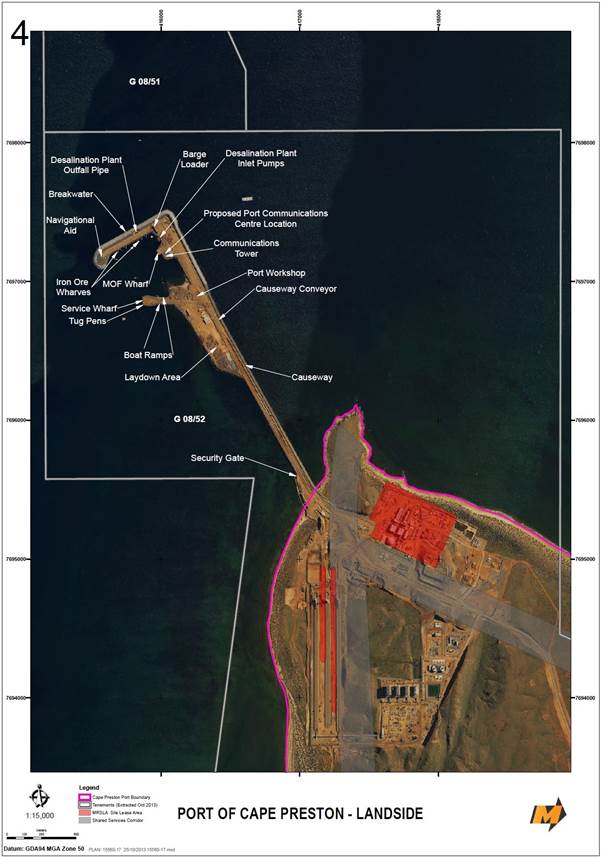
49 Mineralogy submitted that this bare denial permitted it to raise very particular factual allegations concerning breaches by the CITIC parties of the Proposals approved under the State Agreement. They raised these arguments in closing written submissions for the purposes of alleging that the CITIC parties are not entitled to the “benefit of the effect of the proposals without being obliged to comply with them”: [6.1.97].
50 This submission, raising unpleaded matters, and made in closing submissions is contrary to a host of court rules: Federal Court Rules 2011 (Cth) r 16.03(1)(b), r 16.08(a), r 16.08(b), r 16.08(c). More fundamentally, the submission is contrary to basic fairness. Mineralogy’s allegations at [6.1.93]-[6.1.109] and [6.1.119]-[6.1.121] of its closing written submissions raise numerous particular matters of fact which should have been pleaded in any litigation before closing submissions but particularly in a proceeding involving billions of dollars, and where millions of dollars have been spent on legal fees and preparation of evidence. Those submissions included unpleaded allegations that:
(1) Cape Preston Port Company (CPPC) is an independent contractor and is not an agent of CPPM which is alleged to be the party authorised to implement the Sino Iron Project under the Project Proposals;
(2) there was a “blatant flouting” of the Approved Proposals because the CITIC parties had no intention of building a pellet plant or exporting pellets; and
(3) the CITIC parties have not, more than five years after the approvals, put in place equipment to permit the production or export of 21.6 mtpa of concentrate.
51 Mineralogy should not be permitted to raise any of these unpleaded matters. All can immediately be seen to be significant matters, but later in these reasons I explain the gaps in the evidence and submissions that would exist, in relation to (1), even if Mineralogy had applied in closing submissions to amend its pleading to raise these matters. The same point can be made in relation to (2) and (3). Apart from the need to make legal submissions about the relevance and effect of these matters to the pleaded relief, focused evidence would need to have been prepared by the CITIC parties based upon the intentions of the CITIC parties and the precise steps that they have taken in the last five years if these matters were relevant to a pleaded issue.
52 Ninthly, Mineralogy sought to run a new case in closing submissions in response to a matter pleaded in [31] of the CITIC parties’ defence. The matter specifically pleaded in [31] of the CITIC parties’ defence was that the alternative relief sought by Mineralogy was not available because the grant of that alternative relief would have the effect that the implementation or continuous operation of the Sino Iron Project would cease, in breach of various express and implied provisions of the State Agreement including implied terms which required Mineralogy to take steps to prevent it from occurring. This matter was just generally denied by Mineralogy in its reply pleading which contained a broad denial of the whole of [31] of the defence.
53 In closing submissions, Mineralogy sought to rely on cl 33 of the State Agreement in response to this submission. Mineralogy alleged that this clause had the effect that obligations of a party under the State Agreement would be suspended while that party was prevented or delayed from complying with those obligations by an event or circumstance beyond the power or control of the responsible party. Mineralogy then alleged that a serious breach of the Facilities Deed, and a failure to remedy a serious breach, are matters beyond the control of Mineralogy so that there could be no breach by Mineralogy of an obligation to ensure the continuous operation of the Sino Iron Project.
54 Again, this matter was not pleaded. The CITIC parties objected to it being raised. Once again, and particularly in the context of this litigation, this unpleaded allegation cannot be raised by Mineralogy. Evidence could have been led on this point from the parties. And the State had no opportunity to respond to it at all.
2.2 Objections to evidence in the trial bundle
2.2.1 The objections concerning evidence tendered before or during trial
55 The objections were not in an entirely satisfactory state.
56 At the start of this trial I made a number of remarks to counsel about the manner in which I considered it appropriate to deal with the many objections to relevance concerning many exhibits which comprised more than 12,000 pages in the trial bundle. The parties subsequently agreed a regime consistent with my remarks by which objections would be raised and documents would be admitted. One condition of the agreed regime concerning admissibility was that “unless a document is expressly referred to in oral or written submissions it shall be taken as rejected on the ground of relevance and will at the conclusion of the hearing be removed from the Court Book”. I endorsed that regime and the trial proceeded on that basis.
57 After trial, an index to the trial bundle was produced. The parties produced a long list with various different categories of objections in different colours. Some of these objections had been conceded expressly or impliedly. The basis for others was not wholly clear. Ultimately, by emails to the court on 22 July 2015, in response to a query from my associate on 13 July 2015, the parties confirmed that the only objections were by the CITIC parties and were in the following categories:
(1) the documents in categories 1 and 2 of the Addendum to Mineralogy’s closing submissions;
(2) the “Disputed Documents” listed in an email from the legal representatives of the CITIC parties to my associate on 26 June 2015;
(3) in relation to document 263 an objection that the signature of the CITIC representative was made without the CITIC parties’ authority; and
(4) documents 57, 66 and 352 being annexures AVH-2, AVH-3, and AVH-4 to Mr van der Heyden’s first affidavit on the basis that the whole of the affidavit is inadmissible.
58 As to (1), this is considered separately in section 2.2.2 below.
59 As to (2), at the conclusion of the trial, the parties were in dispute concerning whether reference had been made to 48 documents that Mineralogy asserted to be relevant and which Mineralogy asserted had been relied upon in its written submissions. Those 48 documents, described as the “Disputed Documents” are documents numbered 185, 187, 274, 277, 278, 279, 316, 322, 331, 332, 333, 335, 336, 350, 351, 358, 359, 362, 370, 377, 378, 383, 388, 392, 416, 419, 420, 423, 425, 443, 451, 452, 453, 456, 457, 508, 509, 513, 515, 516, 520, 522, 523, 537, 561, 563, 568, and 569.
60 Mineralogy submitted that all of these documents were referred to in its closing submissions in [2.7.4], [2.7.20], and [4.1.47]. These were three short paragraphs in 250 pages of submissions. It is helpful to set out those paragraphs in full:
2.7.4. Each of [International Minerals, Resourcehouse and its subsidiary China First Iron Ore] had an interest in the development of a port for the exporting of any product they produced. The documents at PER-31 to the First Robinson Affidavit make clear that they were closely involved in developing the Port Construction Proposal to accommodate other interests.
2.7.20. The correspondence between Mineralogy, the CITIC parties and ProMet consistently contemplated that the Port would be designed to permit of third party use. Much of the relevant correspondence is contained in Attachment PER-31 to Mr Robinson’s first affidavit. [Submissions are then made about a number of particular documents].
4.1.47. Mr Northey said that, given the prospective expansion of the operation to ten lines and about 40 million tonnes per annum, as he was designing, he was “leaving space” so as not to impede the future expansion by the construction of a trestle jetty. It is noted, also, that the construction of a trestle jetty features at many points in the correspondence in “PER-31” where Mineralogy and CITIC agreed upon arrangements being made for third party use.
61 Annexure PER-31 is 246 pages. In the index to Mr Robinson’s affidavit, the annexure is described as “a bundle of copies of correspondence, minutes and plans which includes some discussions about third party use of the Port, the facilities generally, and their context”.
62 The effect of Mineralogy’s submission, if accepted, would be that in the 24 hours following the receipt of Mineralogy’s 250 pages of written submissions and before closing oral submissions, the CITIC parties would be required to trawl through 246 pages of documents to determine what matters were relevant to the subsidiary issues raised in three short paragraphs of Mineralogy’s submissions. This approach would be inconsistent with the regime agreed by the parties for admissibility and endorsed by the Court. It would also create substantial unfairness to the CITIC parties.
63 Mineralogy was both capable of, and did, expressly refer to a number of the documents relevant to these issues. Those documents expressly referred to are relevant. In [2.7.20], Mineralogy gives detailed consideration to fourteen documents from PER-31. The thirteen of those documents that have document numbers are 168, 172, 206, 218, 241, 257, 258, 270, 271, 397, 420, 424, and 457. They are all relevant on the basis of the agreed regime. But only two of those (420, 457) are in the list of the 48 Disputed Documents.
64 There was a live issue concerning the matters raised in [2.7.20] of Mineralogy’s closing submissions in which Mineralogy referred to these fourteen documents. In [2.7.20], Mineralogy refers to matters concerning third party access to the facilities constructed by the CITIC parties in the Port area. But ultimately if there is any probative value, beyond the fourteen documents to which Mineralogy referred, and beyond Mr Northey’s evidence described below, then the probative value in unspecified statements contained in unspecified documents is exceeded by the prejudicial effect of admitting those statements contrary to the agreed regime.
65 All of the documents in the list of disputed documents, apart from 420 and 457, are inadmissible.
66 As to (3), namely document 263, the CITIC parties asserted that the signature of the CITIC representative was made without the CITIC parties’ authority. The letter was sent from Mineralogy and signed with a signature and handwritten words that appear to say “Milton Law” and “Received and accepted by CITIC 5 August 2010”. Almost no submissions were made about this disputed signature by either Mineralogy or the CITIC parties. The onus to prove authority was on Mineralogy: Lysaght Brothers v Falk (No 1) [1905] HCA 7; (1905) 2 CLR 421, 427 (Griffith CJ).
67 Mineralogy asserted that Mr Law signed the letter as a director (but did not say of which company he was a director). Document 940 (which Mineralogy tendered without reference to the relevance of it) establishes that Mr Law was a director of Sino Iron from 6 July 2006 to 1 April 2015 and a director of Korean Steel from 22 October 2008 to 1 April 2015. The parties were aware that Mr Law was a representative of the CITIC parties and had attended meetings in that capacity and been involved in high level negotiations. Document 263 is admissible and I am also satisfied that Mr Law had, at least, ostensible authority to sign the letter on behalf of Korean Steel or Sino Iron.
68 As to (4), Mr van der Heyden’s evidence, this is entirely inadmissible for reasons explained later.
2.2.2 Additional evidence that Mineralogy sought to tender after the trial
69 At the conclusion of both written and oral closing addresses, senior counsel for Mineralogy foreshadowed that he would provide an addendum to the Court which would set out a number of additional documents which he wished to have included in the trial bundle. These were not documents to which Mineralogy had referred in its written or oral closing submissions. This procedure was not consistent with the agreed regime for treatment of relevant documents.
70 Senior counsel for Mineralogy confirmed that the addendum that he would provide would set out the relevance of the additional documents by reference to the paragraphs of Mineralogy’s written submissions (ts 763). I expected that the addendum would contain a few documents which had inadvertently been omitted from written submissions, but which raised no new factual or legal issue. I expected that the addendum would refer to those few documents that had been omitted, with a reference to the paragraph in its submissions, or the footnote, where the documents should have been included. This was not what happened.
71 Mineralogy subsequently provided an addendum which referred to 65 additional documents. The 65 documents fell into four categories. Shortly after Mineralogy provided its Addendum, the legal representatives for the CITIC parties emailed to my associate the CITIC parties’ objection to categories 1 and 2.
72 Apart from a broad, generalised reference to the issues involved in each of the four categories, Mineralogy did not explain how any of the 65 documents related to the pleaded issues in dispute. Mineralogy did not explain with any precision how any of the 65 documents supported any of its oral or written submissions. The provision of these documents was contrary to the agreed regime for the admission of documents upon which the trial had been conducted. Further, the CITIC parties were deprived of the opportunity of responding to any of these submissions even if they could have discerned how each of the 65 documents was said to support Mineralogy’s case. Apart from a handful of documents about which there was no issue, I reject the admission of all the remaining documents in categories 1 and 2 for these general reasons. I also reject them for the specific reasons below.
73 Mineralogy said that the first category of documents were relevant “to show the full scope and frequency of ongoing negotiations between the applicant and the respondents about their respective roles in the operation of the Port” as described in Mineralogy’s supplementary submissions: [46]. As I explain later in these reasons, in the context of the Port Terminal Operator Agreement, during trial the parties had focused closely upon the timing and chronology of events and the terms of the communications. For instance, there was little attention given in submissions to any issue arising from other negotiations concerning amendments to the Facilities Deeds or other project documents. It is unfair on the CITIC parties for documents to be admitted against them without any particular submission in support of the relevance of those documents. The CITIC parties had no opportunity to consider whether they wished to make reference to (and hence tender) other documents which would have thrown different light on the documents that Mineralogy now seeks to rely upon generally.
74 There was no dispute about the admission of four documents in this category (203, 213, 226, and 237). Those are the only documents that are admitted.
75 The documents in the second category were said by Mineralogy to be relevant to “the issue of whether or not there were potential users [of the port] apart from the CITIC parties”: addendum [2]. Two of those documents (47 and 56) were referred to in submissions and no objection was taken to the tender of document 60. Apart from those three documents, Mineralogy said that the remainder of the documents were relevant to inferences that the Court might draw about the need for co-ordination at a multi-user port which, in turn, was relied upon to establish that alleged breaches of the Facilities Deeds were “serious”.
76 Mineralogy pointed to reports from a stock broker and merchant banks expressing views about the value of projects for mining iron ore from Mineralogy’s tenements. It was submitted that the availability of these reports is evidence that shows that the tenements were likely to be valuable to Mineralogy if it could satisfy investors that it could guarantee access to the port. The CITIC parties were not given the opportunity of considering whether any part of the reports was inconsistent with such a submission. They did not have the opportunity to tender any document which might have suggested a more limited operation or function of such reports.
77 There is again unfairness in inviting the Court to draw inferences and find facts on the basis of documents to which the CITIC parties, relying upon the agreed regime, have not had the opportunity to respond either by submission or by tender of additional documents. None of the documents in this category, other than the three I have mentioned, is admitted.
78 As the CITIC parties’ did not object to any of the documents in categories 3 and 4, those documents will be admitted. However, had an objection been raised in relation to these documents, I would not have allowed the admission of the documents for the following reasons.
79 The documents in category 3 concerned ten further emails between Mineralogy and the CITIC parties concerning the issue of ship scheduling. As I explain below, this was an issue upon which Mineralogy claimed to be entitled to terminate the Facilities Deeds in the context of the $15 billion Sino Iron Project. Mineralogy’s case in closing relied upon a table involving numerous emails. The CITIC parties made various forensic decisions about how to respond to those submissions. Mineralogy now seeks to tender an additional ten emails. If those emails do not add anything to Mineralogy’s submissions then they are not needed. Indeed, if they added nothing it is unlikely that senior counsel for Mineralogy, consistent with his obligations to the Court, would have sought to tender an additional ten documents in a manner contrary to the agreed regime. But if the documents added something to Mineralogy’s case, as would be expected, then this was never clearly explained. However, as the CITIC parties raised no objection to these documents they are admitted.
80 As to category 4, Mineralogy tendered the CITIC parties’ Further Amended Defence filed on 13 February 2014 to which reference was made in various Notices of Termination. Submissions were made about that Further Amended Defence. Its terms were a live issue. It should be admitted.
81 Mineralogy also sought to include document 940 (mis-described as document 941). This was approximately 80 pages of ASIC company search records. Mineralogy simply said in its supplementary submissions that these documents “should be uncontroversial”: [51]. Mineralogy did not explain what issue these documents were relevant to establish or why they needed to be tendered. Mineralogy did not suggest that there was any dispute arising from the pleadings concerning the dates when any company had commenced or its officers. Again, despite the lack of clarity regarding the relevance of the ASIC company search records, there was no objection to these documents and they are admitted.
2.3 Background and relevant chronology
82 This section of my reasons sets out, in chronological sequence, the key events relevant to this litigation. Later in these reasons, I make reference to some of these events and the evidence concerning them in more detail. This section merely establishes the background and sequence of the most significant events.
83 On 12 December 1990, Exploration Licences 08/117 and 08/118 were transferred to Mineralogy. These exploration licences are within a location described as Bilanoo. They can be seen in Annexure 1 to these reasons.
84 On 28 September 1992, Mining Leases 08/118 to 08/128 were issued to Mineralogy. Their commencement date was 23 June 1993. These mining leases can be seen in Annexures 1 and 2 to these reasons. They are described as the “Balmoral tenements”.
85 The Balmoral tenements run in a corridor which is approximately 5km wide and 30km long in a northerly direction. As can be seen in Annexure 1 to these reasons, the Balmoral tenements are divided into Balmoral North, Balmoral Central (including the George Palmer Deposit), and Balmoral South.
86 The Sino Iron Project Area, as it later became, includes the Balmoral Central tenements (08/123 to 08/125) from this corridor. Mineralogy holds a number of nearby tenements including other mining leases in this corridor. Mineralogy also holds General Purposes Leases 08/63 (from 27 August 2009) and 08/74 (from 24 September 2009) and Miscellaneous Licence 08/20 (from 5 March 2004). These leases and licences can be seen in Annexures 1 and 2 to these reasons.
87 23 June 1993 was the commencement date of Exploration Licence 08/636 granted to Mineralogy by the State of Western Australia. The area of Exploration Licence 08/636 can be seen in Annexure 3 to these reasons. The importance of this area of Exploration Licence 08/636 is that it includes the area of the port terminal facilities (which are part of the Sino Iron Project) which are at the heart of this dispute. In the Facilities Deeds, the area of Exploration Licence 08/636 is defined as the Preston Area. Clause 33(h) of the Facilities Deeds requires that on termination of the Facilities Deeds, Sino Iron and Korean Steel (in each case) “shall vacate the Preston Area”.
88 On 14 February 2001, Mineralogy obtained Mining Leases 08/264, 08/265, and 08/266. As can be seen from Annexure 2 to these reasons, these later formed part of the Sino Iron Project Area.
89 On 25 October 2001, Mineralogy entered into Sublease Agreements with (i) Sino Iron (by its former name, Bellswater), and (ii) Korean Steel. The Sublease Agreements recited that Mineralogy was the holder of Mining Leases 08/118 to 08/130 and Exploration Licence 08/636, and that each of Sino Iron and Korean Steel wished to acquire a right to mine in the Project Area, which is part of the mining leases, to enable the company to mine iron ore.
90 On 26 October 2001, Mineralogy entered into Facilities Deeds with six companies:
(1) Bellswater Pty Ltd (subsequently Sino Iron);
(2) Korean Steel Pty Ltd;
(3) Brunei Steel Pty Ltd;
(4) International Minerals Pty Ltd;
(5) Austeel Pty Ltd; and
(6) Balmoral Iron Pty Ltd.
91 The terms of the Facilities Deeds are considered at length later in these reasons. In very broad terms, and as amended, they relate to the construction, operation, maintenance, and use of facilities for the extraction, processing, transport, and export operations in a project for the export of magnetite ore.
92 On 26 October 2001, Mineralogy, Korean Steel, Sino Iron, and others entered into the Fortescue Projects Consolidation Agreement.
93 On 5 December 2001, Mineralogy entered into the Iron Ore Processing (Mineralogy Pty Ltd) Agreement (the State Agreement) with companies including Korean Steel, Sino Iron, and the State of Western Australia.
94 The recitals to the State Agreement, in broad terms, described how Mineralogy is the holder of mining tenements in the Pilbara region and has granted various rights in relation to certain of the mining tenements to the Co-Proponents (including Sino Iron and Korean Steel) and that Mineralogy (by itself or with a Co-Proponent) wishes to develop projects incorporating the mining, processing, transport and shipping of iron ore, including the establishment of new port facilities in the Pilbara region.
95 On 14 December 2007, the parties agreed on certain variations to the State Agreement.
96 On 24 September 2002, the Iron Ore Processing (Mineralogy Pty Ltd) Agreement Act 2002 (WA) (Agreement Act) came into operation with Royal Assent. This had the effect of bringing the State Agreement into force.
97 On 20 October 2003, Ministerial Statement 635 issued to Mineralogy, under the Environment Protection Act 1986 (WA). In that Ministerial Statement, Mineralogy was the Proponent, with responsibility “for the implementation of the proposal” which was described in Schedule 1 as being “to establish and operate an iron ore mine, process plant (pelletising, direct reduced iron and hot-briquetted iron), accommodation and port facility in the Cape Preston area”. The Proposal was described as including “stockpiling, seawater desalination plant and port facilities at Cape Preston and off Preston Island”.
98 10 December 2003 was the commencement date for General Purpose Lease 08/52. As I have explained, this is the general purpose lease which covers the area of the port facilities which are in dispute.
99 Mineralogy pleads, and the CITIC parties admit, that the Facilities that Sino Iron and Korean Steel have constructed are located within General Purpose Lease 08/52 and are in the area comprising the Preston Area (as defined in the Facilities Deeds).
100 In April 2004, ARH submitted its first Project Proposal under the State Agreement.
101 30 April 2004 was the commencement date for General Purpose Lease 08/51. As can be seen in Annexure 2 to these reasons, this is the general purpose lease which covers the area of water seaward of the port facilities which are in dispute.
102 On 12 March 2005, Mineralogy and Mineralogy Mine Management Pty Ltd entered into a Joint Development Agreement with three Co-Proponents, including Sino Iron but not Korean Steel.
103 On 21 March 2006, Mineralogy and Sino Iron, and Mineralogy and Korean Steel, varied and re-stated the terms of their respective (amended) Subleases. The new agreements became the Sino Iron MRSLA and Korean Steel MRSLA. Mineralogy also entered into MRSLAs with Brunei Steel, Balmoral Iron, and International Minerals.
104 The Sino Iron MRSLA and the Korean Steel MRSLA were both concerned with matters arising from the Balmoral Central tenements (Mining Leases 08/123 to 08/125). They provided for a total extraction limit of 1 billion tonnes and an annual extraction limit sufficient to produce 12 mtpa.
105 On 8 January 2008, Mineralogy and Sino Iron entered into a deed amending the Sino Iron MRSLA.
106 On 21 March 2006, Mineralogy and Sino Iron, and Mineralogy and Korean Steel amended the terms of their Facilities Deeds.
107 On 31 March 2006, Mineralogy, Sino Iron, Sino Iron Holdings Pty Ltd, and CITIC Pacific Ltd entered into a Takeover Agreement by which Sino Iron Holdings Pty Ltd (a company controlled by CITIC Pacific Ltd) agreed to acquire all of the issued share capital of Sino Iron for US $215 million.
108 On 8 May 2006, CITIC Pacific Ltd became the ultimate holding company of Sino Iron.
109 On 6 July 2006, Sino Iron Holdings completed the acquisition of Sino Iron pursuant to the terms of the Sino Iron Takeover Agreement.
110 In November 2007, Mineralogy and Sino Iron prepared the February 2008 Sino Iron Pellet Project Proposal for the Balmoral Central tenements (Mining Leases 08/123, 08/124, and 08/125).
111 On 1 November 2007, Mr Palmer, Mineralogy, Balmoral Iron Holdings Pty Ltd, Korean Steel, CITIC Pacific Ltd, and Sino Iron entered into a Takeover Agreement pursuant to which Balmoral Iron Holdings agreed to acquire all of the issued share capital of Korean Steel for a consideration of US $200 million, subject to certain adjustments.
112 On 19 November 2007, Sino Iron and Mineralogy as Co-Proponents submitted a compliant Proposal to the State under cl 6(1) and cl 6(2) of the State Agreement.
113 On 29 February 2008, an amended version of this Proposal was submitted (the February 2008 Sino Iron Pellet Proposal).
114 On 2 May 2008, the February 2008 Sino Iron Pellet Proposal was approved. In a later publication by the CITIC parties, this was described as a “major milestone” [tb 10223].
115 In August 2008, CPMM mobilised its construction team to commence work at Cape Preston.
116 It is also admitted on the pleadings that the CITIC parties have constructed at least the following facilities in the Preston Area with the exception of the facilities at (q), (r), and (bb) which the CITIC parties deny having completely built at the time these proceedings were commenced and which I do not accept to have been proved to have been entirely completed at the time of these proceedings:
(a) Causeway;
(b) Breakwater;
(c) Causeway Conveyor;
(d) Barge Loader;
(e) Iron Ore Wharves;
(f) Materials Offloading Facility (MOF) Wharf;
(g) Service Wharf;
(h) Laydown Area (including any materials or stock piles to be used to construct further Facilities at the Port);
(i) Boat Ramps;
(j) Tug pens;
(k) Navigational Aid;
(l) Can buoys for vessel mooring;
(m) Port Workshop and Site Offices;
(n) Security Gate and Fencing;
(o) Security Office located adjacent to the Security Gate;
(p) Lighting System;
(q) CCTV System;
(r) Site Offices located next to the MOF used for Port Communications and Scheduling;
(s) Communications Tower;
(t) Fibre optic communications cable network (underground);
(u) Power Distribution System (underground transmission lines and surface transmission lines running along the Causeway Conveyor);
(v) Corrosion Protection System, made up of: Cathodic protection systems for the Service Wharf, MOF Wharf and Desalination Plant Outfall Pipe; andAnodic protection system for the stiff leg and to stop dolphins at the Iron Ore Wharves;
(w) Potable Water System (underground);
(x) Raw Water System (underground);
(y) Fire Water System (underground pipes and above ground pipes running along length of the Breakwater and hydrants on the Causeway and the access ramps to the Service Wharf and MOF Wharf);
(z) Waste Water/Sewage System (underground);
(aa) Desalination Plant Inlet Pump and Outfall Pipe (and all associated underground pipelines within the Circled Area); and
(bb) Roads within the Circled Area (being the roads running along the Causeway on either side of the Causeway Conveyor, the access road to the MOF Wharf, the access road to the Service Wharf and the road along the Breakwater).
117 On 6 March 2008, Exploration Licence 08/1414 commenced.
118 On 22 April 2008, Exploration Licence 08/1451 commenced.
119 On 22 July 2008, Mineralogy, Sino Iron, Korean Steel, and the State agreed to amendments to the State Agreement.
120 On 23 September 2008, the Minister declared the Port of Cape Preston was subject to the Occupational Safety and Health Act 1984 (WA).
121 On 22 October 2008, completion of the acquisition of Korean Steel by Balmoral Iron Holdings pursuant to the Korean Takeover Agreement. CITIC Pacific Ltd became the ultimate holding company of Korean Steel. On the same day Mineralogy and Korean Steel entered into a deed amending the Korean Steel MRSLA.
122 On 22 October 2008, Mineralogy, CITIC Pacific Ltd, Sino Iron, and Korean Steel entered into the Fortescue Coordination Deed.
123 The Fortescue Coordination Deed included provisions requiring the transfer of Mineralogy’s status as Proponent under Ministerial Statement 635. The Fortescue Coordination Deed also provided that unless the Joint Development Agreement is reinstated as a result of the CITIC Option lapsing, “CITIC or its nominee will be solely responsible for the planning and conduct of Mining Operations by each of the Mining Right Holders”: cl 2.4(c).
124 On 14 November 2008, Mineralogy, Korean Steel, Sino Iron, and the State executed an amendment to the State Agreement. That amendment took effect when legislated on 10 December 2008 in the Iron Ore Processing (Mineralogy Pty Ltd) Agreement Amendment Act 2008 (WA).
125 In February 2009, CPMM commenced construction of the causeway at Cape Preston.
126 On 30 March 2009, Mineralogy and Korean Steel submitted the Korean Steel Concentrate Project Proposal for Mining Leases M08/123, M08/124, and M08/125.
127 On 22 April 2009, the Sino Iron Concentrate Proposal submitted to the State under cl 8(1) of the State Agreement.
128 On 22 April 2009, Korean Steel Concentrate Proposal submitted to the State under cl 6 of the State Agreement.
129 On 20 May 2009, the Minister for State Development consented for the Korean Steel Project to use facilities constructed as part of the Sino Iron Project in the conduct of its proposed project.
130 In June 2009, CPMM commended construction of the breakwater at Cape Preston.
131 On 11 June 2009, the Korean Steel Concentrate Proposal was approved by the State (the April 2009 Korean Steel Concentrate Project Proposal). As explained, as part of the Korean Steel Concentrate Proposal, Korean Steel had obtained consent to use Sino Iron’s facilities.
132 On 22 June 2009, the Minister for State Development approved the Sino Iron Concentrate Project – Additional Project Proposal (the April 2009 Sino Iron Concentrate Proposal), regarding production and export overseas of iron ore concentrates.
133 On 3 July 2009, State environmental approval was granted permitting the production of iron ore concentrate to be increased from 19.6 mtpa to 27.6 mtpa.
134 This approval was significant to the CITIC parties. In the CITIC annual report for 2009 [tb 4403] it was said:
All major approvals for the construction and operation of the project have now been received. In 2009, we obtained approval under the Western Australian Government’s Environmental Protection Act and Iron Ore Processing (Mineralogy Pty Ltd) Agreement Act to build our port and expand the project to export 28 mtpa of concentrate product.
135 The 2009 CITIC annual report also explained that once “the project goes into operation, product ready for export will be moved from land to vessels berthed at sea via transshipment. Transshippers, barges and tugs are now under construction in China” [tb 4406].
136 In July 2009, Sino Iron submitted a development proposal to Mineralogy under the Sino Iron Facilities Deed. The proposal was for the “construction of a port” for the Sino Iron Pellet Project.
137 In October 2009, a further Amended Port Construction Proposal was submitted by Sino Iron and Korean Steel to Mineralogy.
138 In November 2009, construction of a barge loader for the Project commenced in China.
139 On 10 November 2009, the Second Sino Iron Concentrate Proposal submitted to the State under cl 8(1) of the State Agreement.
140 On 10 November 2009, the Second Korean Steel Concentrate Proposal submitted to the State under cl 8(1) of the State Agreement.
141 In December 2009, a Further Amended Port Construction Proposal was submitted by Sino Iron and Korean Steel to Mineralogy. The construction of the permanent causeway at Cape Preston was completed.
142 On 15 December 2009, ProMet Engineers advised Mineralogy on quality of amended Port Proposal.
143 On 17 December 2009, Commonwealth Environmental Approval EPBC 2008/4236 decision.
144 On 23 December 2009, Ministerial Statement 822 was published 23 December 2009 (varying Ministerial Statement 635). Ministerial Statement 823 was published in relation to the Balmoral South Project.
145 On 6 January 2010, the Second Sino Iron Concentrate Proposal (the November 2009 Second Sino Iron Concentrate Proposal) and the Second Korean Steel Concentrate Proposal (the November 2009 Second Korean Steel Concentrate Proposal) were approved by the State.
146 These additional Project Proposal approvals authorised the expansion of the Sino Iron Project and the Korean Steel Project to support production and export of 27.6 mtpa of iron ore concentrate in addition to the 6 mtpa of pellets for the Sino Iron project, with Sino Iron and Korean Steel each being permitted to produce and export 13.8 mtpa of iron ore concentrates.
147 On or about 1 March 2010, Mineralogy established an Administration Fund under the Facilities Deeds.
148 In March 2010, the first ball mill was installed at the processing plant.
149 On 9 March 2010, Ministerial Statement 827 was published (varying Ministerial Statement 823).
150 On 23 March 2010, Mineralogy and the CITIC parties entered into the Port Terminal Operator Agreement.
151 In May 2010, the first autogenous grinding mill was installed at the processing plant.
152 In June 2010, construction of the barge loader was completed in China and construction of the barge loading facility commenced at Cape Preston.
153 In August 2010, construction of the barge loading facility at Cape Preston was completed.
154 On 2 November 2010, the Minister declared the Port was subject to the Mining Act 1978 (WA).
155 In January 2011, the construction of the breakwater at Cape Preston was completed.
156 In March 2011, installation of the barge loader was completed and installation of conveyors along the breakwater commenced.
157 In September 2011, the barges and transshipper were delivered to the Port area.
158 On 22 November 2011, the Minister declared the Port was subject to the Mining Safety and Inspection Regulations 1995 (WA).
159 On 23 November 2011, the last version of Port Construction Proposal was submitted by Sino Iron and Korean Steel to Mineralogy.
160 On 22 March 2012, Mineralogy was granted a non-exclusive Jetty Licence by the Manager, Property Services Coastal Facilities of the Western Australian Department of Transport.
161 On 11 May 2012, Mr Sharma, the Managing Director for Mineralogy in Western Australia, wrote to the CITIC parties, asserting Mineralogy’s ownership of “our port facilities” and saying that Mineralogy needed time to recruit operating personnel for equipment including the dewatering plant, the stackers and reclaimers, all pumping equipment in the Port area, all conveyors in the Port area, the barge loader, the water intake and outlet for the desalination plant, and all other equipment installed in the Port area. Mr Sharma also urgently sought information for the operation of the port terminal facilities and stressed the urgency of obtaining that information “prior to taking over operation”.
162 In June 2012, dry commissioning of the barge loader, conveyor and transshipment fleet for the Project was in progress.
163 In November 2012, Sino Iron and Korean Steel commenced trial production.
164 On 31 January 2013, the Commonwealth Department of Infrastructure and Regional Development Office of Transport Security declared the Port of Cape Preston to be a security regulated port and designated Mineralogy as Port Operator under the MTOFS Act.
165 On 27 February 2013, the CITIC parties sent a three page letter to Mineralogy saying that the “by-laws” attached to the Facilities Deeds were not approved by the relevant government agencies of the State of Western Australia (as was correct).
166 Mineralogy later relied on this letter as the basis for termination notices which it purported to issue under the Facilities Deeds.
167 On 18 March 2013, Mineralogy commenced Federal Court of Australia Proceeding WAD 83 of 2013.
168 On 2 April 2013, HopgoodGanim, the solicitors for Mineralogy, sent a letter to Allens, solicitors for the CITIC parties, demanding handover of, and control of, the Port Facilities.
169 On 5 April 2013, Mineralogy served a notice of demand on CITIC Pacific Ltd, Sino Iron, and Korean Steel requesting that they hand over possession of the Port.
170 On 12 April 2013, the solicitors for the CITIC parties sent a five page letter to the solicitors for Mineralogy responding to various allegations made by Mineralogy including allegations concerning the Port.
171 Mineralogy later relied on this letter as a basis for Termination Notices which they purported to issue under the Facilities Deeds.
172 On 15 April 2013, Mineralogy withdrew Federal Court of Australia Proceeding WAD 83 of 2013.
173 On 16 April 2013, Mineralogy commenced this proceeding.
174 On 19 April 2013, CITIC Pacific announced that the first shipment of iron ore concentrate was expected to be in the second half of May 2013.
175 On 22 April 2013, Mineralogy wrote to Sino Iron and Korean Steel referring to CITIC Pacific Ltd’s recent announcement stating that the first shipment of iron ore concentrate is expected to be in the second half of May 2013, and alleging that cl 25 of the Facilities Deeds says that Mineralogy is responsible for all scheduling and that Sino and Korean shall advise Mineralogy of all proposed shipping schedules. Mineralogy said that it looked “forward to receiving your schedules without further delay” [tb 9653].
176 On 3 May 2013, CPMM responded to Mineralogy’s 22 April 2013 letter and said that “once our shipping schedule is firm and we have a vessel committed for first shipment we will provide you a copy of the shipping schedule” [tb 9799A]. CPMM also said that it did “not expect Mineralogy to make any amendments to the shipping schedule when it is issued” because cl 25(b) of the Facilities Deeds permits Mineralogy to amend CITIC’s shipping schedules only “for good cause” [tb 9799A]. CPMM asserted that CITIC has priority rights to access and use the Facilities it has constructed and that no scheduling conflicts should arise as CITIC is currently the only authorised user of the Port. CPMM asked Mineralogy to “please let us know if Mineralogy insists on a formal consultation process in relation to the shipping schedule” [tb 9799A].
177 This letter from CPMM later formed the basis for termination notices which Mineralogy purported to issue under the Facilities Deeds.
178 On 17 September 2013, CPMM wrote to the Department of Mines and Petroleum in respect of a notification under s 4(3) of the Mine Safety and Inspection Act 1994 (WA).
179 On 29 September 2013, the Department of Mines and Petroleum, together with the State Mining Engineer, notified CPMM pursuant to s 4(3) of the Mine Safety and Inspection Act.
180 On 11 November 2013, the Commonwealth Department of Infrastructure and Regional Development Office of Transport Security approved CPPC's Maritime Security Plan for a Port Facility Operator pursuant to the MTOFS Act.
181 On 29 November 2013, Mineralogy replied to CPMM’s letter of 28 November 2013 advising that as the port owner and operator, the purported proposed shipping schedule was not approved and that CPPC should not undertake any operations at the Port of Cape Preston.
182 On 2 December 2013, CPMM issued a press release announcing that the first shipment of magnetite ore was being loaded before it set sail for China. The press announcement explained that the first concentrator line was operational and that the second was in process. The critical components surrounding the concentrator line were also operational. These are the power plant, slurry pipeline, desalination plant, and Port Facilities [tb 10371].
183 On 13 February 2014, the CITIC parties’ Further Amended Defence was filed in these proceedings. Mineralogy later alleged that filing this defence was a serious breach of the Facilities Deeds in a Termination Notice that Mineralogy issued, purportedly under the Facilities Deeds.
184 On 3 June 2014, Mineralogy wrote to Sino Iron and Korean Steel giving notice that it approved the use of the Facilities by ARH. Mineralogy said that it would “determine pursuant to Clause 8.7(a) the amount that [ARH] will pay to your companies, based on tonnage of products to be shipped from time to time prior to [ARH] commencing such shipments” [tb 10859].
185 On 12 June 2014, CPMM wrote to Mineralogy denying the validity of the notice by Mineralogy that ARH had been given approval to use the facilities and saying that ARH “has made no announcement to the market that it has made a decision to mine. In the context of a listed company that has a market capitalisation of less than $10 million dollars, it is inconceivable that such a decision would not require disclosure in accordance with its continuous disclosure obligations” [tb 10920].
186 This response later formed the basis for Termination Notices issued by Mineralogy purportedly under the Facilities Deeds.
187 On 20 August 2014, the Full Court of the Federal Court set aside the decision to designate Mineralogy as Port Operator for Cape Preston.
188 On 26 September 2014, in the Supreme Court of Western Australia, I granted an interim injunction restraining Mineralogy from issuing default notices and termination notices under the MRSLAs.
189 On 25 November 2014, Mineralogy issued Termination Notices to Sino Iron and Korean Steel under the Facilities Deeds. These Termination Notices became the basis for Mineralogy’s primary relief in this action.
190 On 6 February 2015, in the Supreme Court of Western Australia, I made a declaration that Mineralogy was obliged by cl 20.1(a) of the Fortescue Coordination Deed to make an application to the Western Australian Minister for the Environment for the transfer to Sino Iron and Korean Steel of the status of proponent under Ministerial Statement 635 (as amended) and Ministerial Statement 822.
2.4 Witness statements and affidavit evidence
191 Witness statements and affidavit evidence, following amendments after conferral and rulings, were tendered as set out below. As I explain later, exhibits G and H are inadmissible.
(1) Exhibit A: Witness statement of Mr Holtshausen (28 November 2014);
(2) Exhibit B: Witness statement of Mr Holtshausen (8 May 2015);
(3) Exhibit C: Witness statement of Mr Holtshausen (27 May 2015);
(4) Exhibit D: Witness statement of Mr Cribbes (14 April 2015);
(5) Exhibit E: Witness statement of Mr Cribbes (13 May 2015);
(6) Exhibit F: Witness statement of Mr Cribbes (9 June 2015);
(7) Exhibit G: Affidavit of Mr Van der Heyden (17 April 2015)
(8) Exhibit H: Second affidavit of Mr Van der Heyden (9 June 2015)
(9) Exhibit I: Affidavit of Mr Robinson (17 April 2015);
(10) Exhibit I1: Corrections to Mr Robinson’s affidavit (17 April 2015);
(11) Exhibit J: Affidavit of Mr Robinson (13 May 2015);
(12) Exhibit K: Witness statement of Mr Mason (7 May 2015);
(13) Exhibit L: Witness statement of Mr Rayson (30 October 2015);
(14) Exhibit M: Witness statement of Mr Northey (7 May 2015);
(15) Exhibit N: Witness statement of Mr Watson (30 October 2015);
(16) Exhibit O: Witness statement of Mr Watson (8 May 2015);
(17) Exhibit P: Affidavit of Mr Richardson (7 May 2015);
(18) Exhibit Q: Affidavit of Mr Richardson (8 June 2015); and
(19) Exhibit R: Affidavit of Mr Richardson (9 June 2015).
192 In the reasons which follow, there are numerous aspects of the witness statements and affidavit evidence to which I make no reference. The same approach was taken by the parties in written submissions. As I will explain, many of the central issues in this case were matters of law. Some issues of fact were so peripheral that they almost became a distraction.
2.5 The oral evidence: particular findings and admissibility rulings
193 Oral evidence was given by three witnesses for Mineralogy and four witnesses for the CITIC parties. I consider that all witnesses were honest. All witnesses genuinely attempted to assist the Court for most of their evidence. However, as I explain, the degree to which I find the evidence of the witnesses to be reliable varies greatly.
194 With one exception, all admissibility rulings to the evidence of witnesses were given during the course of the trial. The one exception was an objection to the whole of Mr van der Heyden’s evidence. That objection was made prior to Mr van der Heyden’s evidence and dismissed. But it was renewed when new information came to light immediately before Mr van der Heyden’s evidence. It was pressed immediately after Mr van der Heyden gave evidence. Both parties were content that this ruling should be made in the course of my reasons for decision. As I explain below, the entirety of Mr van der Heyden’s evidence is inadmissible.
195 The remainder of this section sets out my general findings on those aspects of the witnesses’ evidence which were the subject of oral submissions. Later in my reasons I return to some of this evidence in greater particularity.
196 Mr Holtshausen is the managing director of the CPPC. He has held that position since 28 February 2014. Mr Holtshausen said that CPPC is responsible for the maintenance, operation and control of the various marine assets, infrastructure, superstructure, and transshipment facilities which comprise the Port.
197 He was an extremely impressive witness, with a mastery of every detail of the subject matter on which he gave evidence. Some difficulty arose in his cross-examination because Mr Holtshausen was also, quite properly, extremely precise. For instance, during the course of a long cross-examination about the capacity of barge loaders he described how small barges took three hours to load and large barges took four hours to load. When asked whether it would take ten hours to load two small and one large barge he answered “no”. It later became apparent that the reason why 3 + 3 + 4 does not equal ten is because barges are not always available to be loaded (ts 292).
198 Although I accept Mr Holtshausen’s evidence, three of the key matters in his evidence are described below.
2.5.1.1 The extent of production by the Sino Iron Project
199 Mineralogy relied on evidence from Mr Holtshausen for its assertion that the Sino Iron Project is currently producing considerably less than the 27.6 mtpa envisaged by the Project Approvals. This is correct. Mr Holtshausen said that the CITIC parties were currently only loading 5 mtpa (ts 293). The reason why they are only loading 5 mtpa is partly due to the operation of only two of the six processing lines. In turn, this is due to delays by a contractor (ts 500: Mr Northey).
200 Mineralogy also asserted that on the evidence of Mr Holtshausen the CITIC parties had not, some five years and five months after the date of the last of the approvals on 6 January 2010, put in place equipment permits the production of 27.6 mtpa or the export of 27.6 mtpa of product.
201 This submission about capacity is also correct, although I have explained above at [48] – [51] why this evidence was relied upon by Mineralogy for an unpleaded allegation that it was too late to make.
202 Mr Holtshausen said in cross-examination that he expected that the production would eventually increase to 24-27 mtpa but the transshipping system currently prevented that (ts 293). The current transshippers only permit 19.2 mtpa (ts 301). At the current level of operations, the equipment of the CITIC parties does not permit the production and export of 27.6 mtpa of product.
203 Although I accept this factual submission by Mineralogy, if it had been relevant I would not have accepted Mineralogy’s additional submission in written closing submissions that “the CITIC parties have conceived, designed and implemented a system which is incapable of complying with the State approved proposals and have no plan capable of remedying the defects at any time in the foreseeable future”: [6.1.108].
204 Mr Holtshausen’s evidence was that there were a number of options being examined by CPPC to reach the capacity of 24-27 mtpa. One of those options is a trestle jetty. Another is the possibility of running motorised barges and the transshippers at the same time, like a hybrid operation.
205 Apart from the transshippers, there are other reasons for the operations currently being below capacity. But the CITIC parties are considering remedies in these other cases as well. For instance, they discovered that magnetite concentrate, due to its size and moisture content, tended to “stick in the transfer chutes” (ts 282). When operations commenced in February 2014, the chutes would be blocked within two hours (ts 282). This required operations to cease while the transfer chutes were cleaned. Mr Holtshausen explained that “[r]ight now” the chutes are being redesigned (ts 282).
206 Ultimately, Mr Holtshausen was emphatic that the Port Facilities cannot be the bottleneck, slowing down the integrated process of extraction, processing, and export (ts 301-302, 305-306).
2.5.1.2 The commissioning phase of the Project
207 There was some focus in evidence upon whether the Facilities which were the subject of Mineralogy’s claim to possession had been “commissioned”. This issue arose because of an alternative defence ([18(b)]) by the CITIC parties that the Facilities could only “vest” (within cl 24(b) of the Facilities Deeds) if they had been completed and commissioned, and were operating to their annual extraction limit of 27.6 mtpa.
208 Although this alternative plea was not abandoned, it did not feature in the CITIC parties’ closing submissions, either written or oral. It is not necessary to consider the implication because the conclusion that I have reached is that title to Company Facilities, as defined in the Facilities Deeds, does not pass to Mineralogy.
209 However, if it had been necessary to resolve this issue I would not have made the implication sought by the CITIC parties, which would create considerable uncertainty and is far from obvious. What is meant by “commissioned” in the proposed implication? When would assets be “completed” so that title could pass? If the facilities, as integrated, never reached 27.6 mtpa would this mean that title could never pass?
210 As I explain below, although I would not have made this implication, the uncertainties surrounding the implication are also matters that reinforce my conclusion that cl 24(b) does not mean that title to the Company Facilities would pass to Mineralogy. The same uncertainties vex the question of when that title would pass.
211 In any event, for completeness, I accept Mr Holtshausen’s evidence from his witness statement that export operations and facilities in the Port area are in a commissioning phase. The assets are still undergoing modifications so that they can operate at nameplate capacity, and receive a certificate of compliance by the manufacturer. Two examples can be given.
212 One example is Mr Holtshausen’s lengthy exposition in cross-examination of modifications, alterations and changes to the stackers. He explained how before the stockyard management system can be fully operational, the stackers and the reclaimers must “communicate with each other on a continuous basis, i.e., the stackers will communicate to the reclaime[r] exactly what the profile of the stack is that it has just created” (ts 302).
213 Another example is that currently only two processing lines are operational. Full commissioning will require all six processing lines to be operational and the terminal facilities will operate 24 hours a day, for ten months of the year (due to weather conditions) to process the material from those six lines.
2.5.1.3 The scheduling of the arrival of vessels
214 Another aspect of Mr Holtshausen’s evidence to which Mineralogy referred was his evidence concerning the scheduling of vessel arrivals. Mr Holtshausen said (at ts 294):
The vessels’ arrivals is planned on a monthly basis ... The reason why we only plan on a monthly basis is because I cannot determine what will happen to the vessel at the discharge port. The vessel at the discharge port is reliant on not only weather but is also reliant on its ability, in our particular company’s case, to get up the Yangtze River. He will be slotted and scheduled up the river which means he potentially could lose one, two or three days. I therefore do not know exactly at what time that particular vessel will return. Secondly, not all the vessels that we currently operate belong to CITIC. We only have two of our own vessels, our own mini-capes. The rest are market vessels. And, once again, for me to determine exactly when that vessel will get to port, I – not me in particular, but the marketing team go to market and then seek mini-cape vessels with a specific laydays, ie the times that the vessel will arrive at the port, and then we take the laydays and plan that into our monthly plan. You cannot do that on a 365-day basis. You cannot even do that on a two-month basis because shipping by nature is very erratic. It is weather related, it is discharge port related, it is equipment related. It’s extremely difficult.
215 Mr Holtshausen had described the operation of this scheduling in detail in his first witness statement:
45. Planning for incoming OGVs [ocean going vessels] begins a month before the arrival of the vessel. CPPC’s shipping schedulers create a Gant chart which indicates, among other things, the anticipated arrival time for the vessel, its expected tonnage and any operating conditions which have been placed on the vessel. Marked on the aerial photograph near the service wharf is the CPPC port communication centre where the ship schedulers work. Behind tab 26 is a photograph taken inside the port communication centre which is located inside the temporary Port offices shown on the aerial photograph. CPPC’s schedulers are responsible for the scheduling of labour at the Port and will prepare the loading plan for the OGV.
46. Each OGV intending to load at the Port will appoint its own shipping agent who liaises with the Port. The OGV will typically instruct its shipping agent to make contact with CPPC about two weeks before it is due to arrive at the Port. The OGV through its agent will advise CPPC of its planed operations, the equipment, fuel and water that it is carrying on board, and confirm its compliance with any conditions which have been placed on its operating licence.
47. In order to efficiently load and tranship magnetite concentrate at the Port, CPPC must:
(a) prepare a plan for the loading of each barge to suit the OGV’s stow plan. The stow plan of an OGV sets out how much tonnage is to be located in each of the hatches on the vessel; and
(b) coordinate operations and develop detailed plans …
48. The OGV contacts CPPC’s shipping schedulers directly by radio once it arrives at the Port, and the shipping schedulers will allocate a pilot to the vessel. The pilot goes out to the OGV on the crew transfer vessel and the pilot then pilots the OGV to the designated anchorage. The Master will then notify the shipping schedulers when the OGV has anchored and will tender a notice of readiness at this time …
216 In cross-examination, Mr Holtshausen accepted that in order to schedule the arrival of vessels a month’s notice was required (ts 295). He accepted that from the perspective of a scheduler, notice that a ship was going to arrive tomorrow was hopeless (ts 295).
217 Senior counsel for Mineralogy relied upon Mr Holtshausen’s evidence for the submission that the CITIC parties had breached cl 25(b) of the Facilities Deeds requiring Sino Iron and Korean Steel to “advise Mineralogy of all the proposed shipping schedules”. This omits important parts of cl 25(b), and misrepresents its meaning. Senior counsel also pointed to Mr Holtshausen’s acceptance of the proposition that an email saying a ship will arrive tomorrow could not be described as a shipping schedule. Although I accept this point in the abstract, the meaning of a “proposed shipping schedule” in cl 25(b) is a legal question of construction which depends upon the purpose for which the “shipping schedule” is being provided. This is not a matter which can be answered conclusively by a witness. That legal question is addressed later in these reasons.
218 Mr Cribbes is an engineer. He has worked in the mining industry for more than 40 years. He was the founding shareholder and Chairman of ProMet Engineers Pty Ltd and, for nine years until 2009, was its managing director.
219 I have approached the specific evidence of Mr Cribbes concerning the Sino Iron Project and the Port Terminal Facilities with considerable caution. Although Mr Cribbes expressed some matters relating to these subjects with confidence, with the exceptions of matters (including those discussed immediately below) where I specifically accept Mr Cribbes’ evidence, I do not consider his evidence on these subjects generally to be sufficiently reliable to be accepted.
220 It was not until cross-examination that Mr Cribbes conceded that (ts 346):
(1) he had never operated a terminal facility at a port;
(2) he had never had responsibility for operating barge loaders;
(3) the only time he had ever visited the Sino Iron Project and the Facilities was when he flew over the plant and mine (which was recently for 30 minutes);
(4) he accepted that he had expressed opinions about technical matters in [66] of his first affidavit even though he had undertaken no technical assessment and would have needed to undertake a site visit in order to do so (ts 363); and
(5) he had never been involved in the operation of any export facilities (ts 363).
221 Mr Cribbes gave evidence in his first witness statement, and I accept, that ProMet had provided estimates for the capital and operating costs of one of Mineralogy’s projects for the export of magnetite concentrate through the Port at Cape Preston. He annexed a report on that project provided by Mr King who was said to be an international expert but who was not called to give evidence. The content of Mr King’s report has no weight. There was also little focus in any cross-examination or submissions on the capital or operating costs that Mr Cribbes assessed. The capital costs were in excess of $1 billion. As I explain later, there was no evidence sufficient to draw any conclusion other than that no company which was party to a Facilities Deed with Mineralogy (other than the CITIC parties) had any prospect of raising this finance.
222 Mr Cribbes said, and clarified in a later affidavit, that ProMet’s preferred option for development of a port was a transshipping facility with a deep water jetty as an option for when increased export capacity was required. I accept his evidence that this was ProMet’s preferred option, although in terms of any sharing of a transshipping facility, ProMet has not done any detailed work to examine the possibility of access to CITIC’s transshipment facility, and Mr Cribbes accepted that there would need to be operational adjustments made (vehicle, vessel and personnel movements, security etc) to co-ordinate access to either a deep water jetty or to the transshipment facility.
223 Mr Cribbes also gave evidence, which I accept, that there is a public user facility at Utah Point at Port Hedland Harbour. He observed that the use of that facility was contingent upon other parties ceasing operations, but he accepted that Atlas Iron had recently terminated its operations. Mr Cribbes said that Utah Point was 350km away from the tenements. He described the capital cost as $1.5 million per kilometre. This amounts to a total capital cost of around a half a billion dollars.
224 Mr Cribbes also described a bankable feasibility study that had been prepared for the Balmoral South Iron Ore Project. But that study was not tendered.
225 Mr van der Heyden is geologist who was called by Mineralogy as an expert. He is the managing director of a geological consulting company, H & S Consultants, which was used by Mineralogy to provide geological services between 2001 and 2012. Mr van der Heyden has over 30 years of experience as a geologist.
226 The central conclusion which Mineralogy sought to draw from Mr van der Heyden’s evidence is that the Mineralogy’s tenements contain magnetite mineralisation of between 60 and 160 billion tonnes (ts 316-317).
227 Mr van der Heyden provided a short affidavit with four annexures. The annexures were as follows:
(1) a copy of his curriculum vitae; and
(2) a copy of a report (the 2004 Report) which he said was dated 10 November 2004. He described the report in his affidavit as being a report “on all the potential magnetite mineralisation based on all drilling and other exploration carried out up until 2004”. He said that the conclusion was that “there is potentially between 60 and 160 billion tonnes of iron ore in Mineralogy Area A” which area consists of Mining Leases 08/118 to 08/130 and Exploration Licences 08/117 to 08/118 (Bilanoo). These areas can be seen on the map which is Annexure 1 to these reasons.
(3) A report dated December 2005 prepared by H & S Consultants and entitled “Revised Resource estimate and potential Mineralisation for the George Palmer Iron Ore Deposit, Pilbara WA” (the 2005 Report).
(4) A report dated 30 May 2011 prepared by H & S Consultants and entitled “Resourcehouse Ltd – Independent Geologist Report” (the 2011 Report).
228 Prior to Mr van der Heyden giving evidence, the CITIC parties challenged the admissibility of his affidavit evidence in chief. A core part of his affidavit evidence was a report which I will describe as his 2004 Report. For reasons which I will later explain that description is misleading because although the report was dated 2004 it was produced at some unknown later time by Mr van der Heyden, possibly with additions from unknown persons.
229 The CITIC parties’ challenge to Mr van der Heyden’s evidence was heard in the late afternoon on 8 June 2015. In his submissions, junior counsel for the CITIC parties submitted that the affidavit of Mr van der Heyden was inadmissible, relying on submissions of irrelevance, lack of proper form, and the exercise of discretion under s 135 and s 136 of the Evidence Act 1995 (Cth). I ruled that Mr van der Heyden’s evidence was admissible. One reason for this was because the assumptions underlying the 2004 Report were not necessarily so lacking in transparency or so incapable of justification to make the evidence inadmissible: Mineralogy Pty Ltd v Sino Iron Pty Ltd (No 5) [2015] FCA 571 [16].
230 After the admissibility argument on 8 June 2015, the CITIC parties were provided with a second affidavit from Mr van der Heyden. That second affidavit contained six versions of the 2004 Report which Mr van der Heyden had prepared. However, that affidavit was not initially tendered by Mineralogy. Senior counsel for Mineralogy had, quite properly, only produced the second affidavit for the purpose of explaining a correction in Mr van der Heyden’s 2004 Report. That correction was made in oral examination in chief.
231 After the second affidavit was provided to the CITIC parties, the CITIC parties renewed their objection about the admissibility of Mr van der Heyden’s evidence. But after an exchange with the Court, senior counsel for the CITIC parties accepted that the efficient course would be for Mr van der Heyden to be cross-examined and for the admissibility of his evidence to be revisited in light of the cross-examination, including any cross-examination on the fresh matters in Mr van der Heyden’s second affidavit which had not been tendered at that stage.
232 At common law, the Court has power to revisit questions of admissibility, even after evidence has been given, in light of new information: In the Marriage of UI and DB Bowron (1982) 8 Fam LR 651, 656-657 (Baker J). This power was not abrogated by the Evidence Act and it can be exercised in relation to a ruling under s 135 of the Evidence Act, including where it becomes apparent that the probative value of the evidence is outweighed by its unfair prejudice to a party. The power to revisit admissibility rulings has long been recognised in the criminal context: R v Watson [1980] 2 All ER 293, 295 (the Court); Cornelius v The King [1936] HCA 25; (1936) 55 CLR 235, 249 (Dixon, Evatt and McTiernan JJ); Sinclair v The King [1946] HCA 55; (1946) 73 CLR 316, 324 (Latham CJ). In criminal proceedings, the ruling becomes final once the jury has returned a verdict: R v GK [2001] NSWCCA 413; (2001) 53 NSWLR 317, 335 [74(5)] (Sully J). In civil proceedings the ruling will become final when judgment is delivered and orders are made.
233 As I explain below, the six versions of the 2004 Report differed in a number of significant respects from each other and from the initially tendered version. Although cross-examination was conducted by senior counsel for the CITIC parties by reference to the six additional reports, that cross-examination was essentially confined to (i) inconsistencies between those reports and the 2004 Report, and (ii) the provenance of those reports and how they had been altered and used.
234 Prior to re-examination, senior counsel for Mineralogy properly sought to tender Mr van der Heyden’s second affidavit and the six additional reports on the basis that they had been the subject of cross-examination. The second affidavit was admitted into evidence but I ruled that the second affidavit and the six additional reports would be admitted under s 136 of the Evidence Act only as evidence in relation to those matters upon which cross-examination had been conducted. The reason for this ruling was that the second affidavit was lengthy and had been provided to the CITIC parties on the evening prior to Mr van der Heyden’s cross-examination, outside the Court ordered regime for filing of witness statements. The second affidavit was produced simply to explain what was said to be the correct date when the 2004 Report was produced rather than to rely upon the substance of the additional reports (ts 309, 328, 375). It would have been unfairly prejudicial to the CITIC parties to have allowed Mineralogy to tender in re-examination, for the truth of its contents, the voluminous substance of the reports in the second affidavit beyond the limited use to which the second affidavit had been put in cross-examination.
235 I conclude that the whole of Mr van der Heyden’s evidence should be excluded under s 135(a) and s 135(b) of the Evidence Act for three reasons in combination. These reasons are (i) the defects in Mr van der Heyden’s 2004 Report, (ii) the unexplained, and sometimes bizarre, nature of the additional six reports, and (iii) my assessment of Mr van der Heyden during cross-examination. Overall, the probative value of his evidence was substantially outweighed by the unfair prejudice that it would cause to the CITIC parties if it were admitted. The probative value of his evidence would also be substantially outweighed by its misleading and confusing nature. The evidence cannot be saved in part. For the reasons below, I consider that the appropriate exercise of discretion is to exclude Mr van der Heyden’s evidence in its entirety.
236 First, there is the confusion about when Mr van der Heyden’s 2004 Report was produced. In examination in chief he said that although it was dated 2004, it was produced on 30 October 2008. Then he said that it was produced on 21 August 2008. He said that the date of 21 August 2008 was the date he had discovered in the “properties” section of the document on his laptop computer. He said that the previous day he had realised that the 2004 Report could not have been produced in 2004 because it contained a table in it with results from a 2005 estimate. He then said that:
(1) it was possible that the 2004 Report had never been fully or properly updated (ts 382);
(2) it was possible that the 2004 Report had never been used or provided to anyone (ts 382);
(3) there were at least six versions of the 2004 Report that he found on his laptop, and although he did not expect that there were more, he did not search through the directory (ts 383);
(4) there were at least two of the six versions, which contained Chinese characters, that he could not possibly have prepared (ts 383);
(5) he took no steps to determine the provenance of the two versions that could not have come from him (ts 384); and
(6) his usual process was to provide his reports to Mineralogy and then to consider any changes suggested by Mineralogy (ts 384).
237 These matters, by themselves, coupled with Mr van der Heyden’s lack of concern about the provenance of his 2004 Report and whether it was complete, or whether it had been properly updated (including after any suggested amendments by Mineralogy), would have caused me to exercise my discretion to exclude Mr van der Heyden’s evidence. But combined with the further matters below, the conclusion that his evidence should be excluded is inevitable.
238 Secondly, significant parts of the 2004 Report are based on data that is not identified in the 2004 Report, nor provided with the 2004 Report. For example, Mr van der Heyden’s methodology in the 2004 Report was to begin with a base case and then to create a number of additional cases with different assumptions. In the base case, the 2004 Report sets out numerous figures including amounts of magnetite ore (in tonnes) and the iron percentage in various zones and domains. Mr van der Heyden accepted that this information was based on data and that the data was not provided with his affidavit (ts 385). Resources which he concluded were “inferred resources” relied on drill hole data. That data was not provided with his report or affidavit (ts 385). Resources which he concluded were “potential resources” relied on digitising of outcrop maps. The digitised outcrop maps were not provided with his report or affidavit (ts 386).
239 Thirdly, important matters upon which the 2004 Report was based were either wrong or unexplained based on Mr van der Heyden’s oral evidence. For instance, on page 1 of the 2004 Report, Mr van der Heyden says that he had not examined drilling at Balmoral North and Bilanoo, and that there was no drilling at Balmoral South. But in cross-examination he said that he was relying on some drilling data and that he had derived numbers in the tables based on that data (ts 385).
240 Fourthly, as to the “additional cases” in Mr van der Heyden’s 2004 Report which were based on the “base case”, some numbers in the base cases were changed by Mr van der Heyden sometime between 2004 and 2008 but no corresponding change was made to the additional cases. For instance, he made a change of around 2 billion tonnes in relation to the Balmoral North base case (from 5.8 billion to 3.5 billion tonnes) but no change was made to the additional cases. Mr van der Heyden sought to explain this as a trivial change (in terms of final outcome), but he nevertheless accepted that he had not given any explanation for why he made it (ts 404).
241 Fifthly, the 2005 Report concerned only the Balmoral Central tenements that are mined by the CITIC parties. Its relevance to these proceedings concerned only the extent to which anything can be extrapolated from that report to draw an inference about the other Mineralogy tenements. Any such inferences would require some degree of reliability of Mr van der Heyden’s evidence generally. The interrelationship of the 2004 Report and 2005 Report exacerbated the unreliability, prejudice to the CITIC parties, and the confusion that arose from both.
242 For instance, in the 2005 Report, Mr van der Heyden referred to “substantial inaccuracies in the Hanna interpretation of the surface geology”: page 19. He also referred to “a number of substantial changes in the geological interpretation” which led to a substantial decrease in the amount of the inferred resource: page 29. He also referred to drilling which had revealed “poor resource continuity between holes”: page 19. The problem that all of these matters present for an understanding of Mr van der Heyden’s reports is that it is impossible to know whether any or all of these matters had been taken into account in the 2004 Report and, if so, how they had been taken into account. If it had been known that the 2004 Report was produced in 2004 then it would have been possible to consider the extent to which the inaccuracies in the Hanna interpretation affected the 2004 Report. On its face, the 2004 Report appeared to rely on the Hanna surface geology maps. But if the 2004 Report was actually produced in 2008 then these inaccuracies should have been taken into account and should have led to adjustments. Such adjustments may indeed have been made in one of the six versions of the 2004 Report, including one of the two which contained Chinese characters. But, as with the change explained in point four above, the nature and extent of any such alteration was not explained.
243 Sixthly, in the section on “data analysis” in the 2005 Report, Mr van der Heyden said that data upon which the 2005 Report was based (Appendix 1) was not subjected to any “detailed analysis”: page 20. Mr van der Heyden said that a “cursory examination” did not reveal any obvious problems: page 20. That data had not even been produced by Mr van der Heyden. Appendix 1 (which contained the data) was not included in the 2005 Report.
244 Seventhly, as to the 2011 Report, that report was expressed to have been prepared in accordance with the Joint Ore Reserves Committee Code 2004 which contains the guidelines for reporting of ore reserves. Mr van der Heyden gave no evidence about whether the report would be compliant with the Joint Ore Reserves Committee Code 2012. He accepted that the number of drill holes in the Bilanoo area from which his conclusions had been based was “miniscule” (ts 399). The sole purpose for which the 2011 Report was prepared was to be included in the Resourcehouse prospectus, concerning a South Australian magnetite deposit owned by Resourcehouse.
245 Eighthly, again in relation to the 2011 Report, Mr van der Heyden accepted that the age and variability of some of the historical data and the general lack of independent quality control and quality assurance measures for drilling, sampling and assaying required some checking and verification of the historical data. But gave evidence that he did not check or verify any of the historical data that he relied upon for that report (ts 402). Nor was any person called by Mineralogy to establish the accuracy or authenticity of that historical data. Mr van der Heyden’s conclusions in his 2011 Report are meaningless in the absence of any substantial evidence from which to assess the accuracy of the data upon which the conclusions were based.
246 Ultimately, as I have explained, the conclusion which Mineralogy sought to draw from Mr van der Heyden’s evidence was that the Mineralogy tenements contained magnetite mineralisation of between 60 and 160 billion tonnes. Mr van der Heyden accepted that “[o]nly a very small proportion of [that is] actually a resource” because most of it was exploration potential (ts 389). The accuracy of this assessment about the “small proportion” that is a resource, and any estimate of what that small proportion would be, would depend upon Mr van der Heyden’s reports having some degree of reliability. They have none.
247 Even as an expert geologist, Mr van der Heyden properly accepted that his 2004 Report was “an extremely confusing document” (ts 389) and that it was “misleading” (ts 394). For the reasons I have given above, that assessment is correct. It was impossible for senior counsel for the CITIC parties meaningfully to cross-examine Mr van der Heyden on the data in his 2004 Report. And the confusion and misleading nature of the 2004 Report infects the 2005 Report and the 2011 Report. When this is combined with defects in the 2005 Report and the 2011 Report those reports should also be excluded due to the extent to which the CITIC parties are prejudiced by them and due to their confusing nature.
248 The entirety of Mr van der Heyden’s affidavit evidence is excluded under s 135(a) and s 135(b) of the Evidence Act.
249 For completeness, I do not accept the submission by the CITIC parties that an inference arises against Mineralogy based on its failure to call its own in house geologist, Mr Speivogel (ts 424): see Jones v Dunkel [1959] HCA 8; (1959) 101 CLR 298. The possibility that Mineralogy might have called its own geologist neither supports nor detracts from the state of Mr van der Heyden’s evidence.
250 Mr Robinson is an employee of Mineralogy. He has a background in engineering. On 4 January 2010, Mr Robinson commenced as the Chief Executive Officer of Cape Preston Port Operations. He describes himself as responsible for operational issues at the Port of Cape Preston.
251 Much of Mr Robinson’s affidavit evidence in chief involved annexures of thousands of pages, including the key project agreements. However, Mr Robinson also gave evidence on a number of operational matters. For a number of reasons set out below, including my general assessment of his manner and style of evidence, I do not consider that Mr Robinson’s evidence on operational matters is sufficiently reliable to be accepted. This includes his evidence concerning requirements for shipping schedules and his assertion that Mineralogy had not received any shipping schedules from the CITIC parties. As I explain later in these reasons, this was not Mineralogy’s position in written correspondence where it described emails sent to it as “shipping schedules”.
252 First, although Mr Robinson was an honest witness, he did not have anywhere near the level of experience with the relevant facilities in this case or the knowledge of technical detail in any of the respective areas of Mr Holtshausen, Mr Northey, or Mr Mason. Nor did he claim to have that degree of particular experience or knowledge.
253 Secondly, Mr Robinson was limited in his understanding of important aspects of the operations. For instance, Mr Robinson’s evidence as to the capacity of the barge loader was given despite the fact that Mr Robinson has never operated an export facility with a barge loader (ts 421). As to the operational constraints of a barge loader, Mr Robinson accepted that he would defer to someone with day-to-day familiarity of operating a barge loader (ts 453). Mr Robinson also expressed conclusions about the state of development of the Project facilities based only upon a 30 minute helicopter trip over the site (ts 458).
254 Thirdly, Mr Robinson also candidly accepted, when put to him in cross-examination, that he made a mistake in his understanding of the barge operations (ts 452).
255 Fourthly, in terms of Mineralogy’s operations, Mr Robinson also said in his affidavit that he had sent the CITIC parties an invoice requiring payment to an administrative fund (under the Facilities Deeds) for the years 2010, 2011, 2012, and 2013. He said that those invoices had been paid. But Mr Robinson had neglected to mention that the payments for the years 2011 ($5.5 million), 2012 ($13.4 million), and 2013 ($13.4 million) had only been made under protest and had been fully refunded (ts 457). I consider that this was an honest mistake, but Mr Robinson’s omission in relation to such significant sums illustrates the unreliable nature of his evidence about the operations.
256 Fifthly, aspects of Mr Robinson’s evidence were pitched at too high a level of abstraction to be of assistance. For instance, on a number of occasions Mr Robinson gave evidence that Mineralogy was trying to establish a “multi-user operation” (ts 444). It is likely that all he meant by this was that Mineralogy hoped that one day a multi-user operation might be possible. But the evidence did not support the conclusion that there was any prospect of a multi-user operation occurring at any time in the future. Mr Robinson, quite properly, did not claim that there was any such prospect. For instance, he said that he did not even know if financing might be years away (ts 444).
257 Mr Mason is a geologist with responsibility for the mining and processing steps in the supply chain. He was called by the CITIC parties to give evidence about the operation of the Sino Iron Project. As a geologist, his role at the Sino Iron Project is to ensure that the mine operates at optimal capacity to ensure a direct line of product to the processing plant.
258 The core of Mr Mason’s evidence concerned the integrated nature of the mining, processing, and export operation. I consider those aspects of his evidence separately below in that context. His evidence on these matters was cogent and coalesced with the evidence of Mr Northey and Mr Holtshausen.
259 Mr Rayson is the General Manager of Health and Safety for CPMM. Very little of his evidence was seriously challenged and I accept all his evidence.
260 Part of Mineralogy’s case concerning its alleged right to possession was that it had been excluded from possession of the facilities because from about 4 July 2013 when the CITIC parties set up a checkpoint at the causeway that precluded Mineralogy staff from entering the area, except by the permission of the CITIC parties.
261 Mr Rayson’s evidence was relevant in part to this allegation. He described how the safety and security measures that are necessary for the Sino Iron Project are considerable. Mr Rayson explained that since 29 November 2014, CPMM has had three “Area Registered Managers” under the Mines and Safety Inspection Act 1994 (WA), each responsible for a different part of the site.
262 Mr Rayson explained how the security procedures in place at the site are to both protect the safety of persons on the site and also to protect the assets and infrastructure on the site. There are three security gatehouses at the Sino Iron Project Site: the Balmoral Main Gate, the Breakwater Access Gate, and the Eramurra Village Gate.
263 Mr Rayson described the process for entry to the site from the Balmoral Main Gate including safety induction and a Site Access Card that allows for unescorted access, or a visitor’s pass for escorted access.
264 As for access to the Port area, this is regulated by the Breakwater Access Gate and is managed by CPPC and requires compliance with the MTOFS Act. Again, there are security and safety requirements before access can be permitted.
265 Mr Rayson’s evidence was that a number of Mineralogy employees have been issued Site Access Cards. Mr Rayson said, and I accept, that no one from Mineralogy, who had complied with the site access process, had been refused access (ts 480).
266 Mineralogy is correct in its submission that the CITIC parties have precluded Mineralogy staff from entering the area except with permission. But this permission has always been granted, and the need for permission is for safety and security reasons; Mineralogy is treated no differently from any other person in this respect.
267 Mr Northey was another witness who gave evidence for the CITIC parties. He was the project director for CPMM who was initially responsible for construction and integration of the infrastructure for the Sino Iron Project and about 9 months later had the overall responsibility for overseeing the construction and integration of all facilities and infrastructure for the Sino Iron Project. He was employed by CPMM in those positions from January 2007 until November 2009. Mr Northey said that his “role in life” was to design the facilities (ts 491).
268 Mr Northey was an extremely impressive witness. His answers were precise and considered. His command of technical detail was remarkable. His answers were compelling. I have no hesitation in treating the whole of his evidence as both reliable and cogent.
269 I explain Mr Northey’s evidence concerning the integrated design of the Sino Iron Project below. Broadly, his design was based upon his understanding that the facilities were to be designed as a continuous operation “with CITIC as the operator of the whole facility” (ts 491).
2.6 The interests of third parties in the port area
2.6.1 Mineralogy’s inaccurate use of various terminology
270 Mineralogy’s case placed a heavy emphasis on a submission that third parties have an interest in the use of the Port. However, throughout Mineralogy’s submissions, Mineralogy confused several different concepts, using them interchangeably as if they had the same meaning (which they do not). The different concepts include (i) the Port, (ii) the port, (iii) the port facilities operator (or port terminal facilities operator), (iv) the Port Operator, and (v) the Harbour Master.
2.6.1.1 The meaning of “The Port”
271 The Port (capitalised) is a defined term in the Facilities Agreements. It is defined to mean the Port to be located at Cape Preston, Western Australia the limits of which may be laid down in accordance with s 10(1) of the Shipping and Pilotage Act 1967 (WA).
272 Section 10 of the Shipping and Pilotage Act provides as follows:
Declaration of ports and other areas
(1) The regulations may declare an area of water, or land and water, intended for use either wholly or partly in connection with the movement, loading, unloading, maintenance or provisioning of vessels to be a port for the purposes of this Act.
(1a) A port is to be —
(a) known by the name; and
(b) bounded by the limits,
specified in the regulations in relation to that port.
(1b) A port named in the Port Authorities Act 1999 Schedule 1 is not a port for the purposes of this Act and a declaration under subsection (1) cannot relate to a port so named.
(1c) The regulations may declare an area of water outside a port to be an area in which pilotage services are to be used.
(2) The Governor may by proclamation —
(a) declare any place described in the proclamation to be a fishing boat harbour or mooring control area for the purposes of this Act; or
(b) vary the boundaries of a place declared to be a fishing boat harbour or mooring control area under this subsection, or declare a fishing boat harbour or mooring control area to be no longer a fishing boat harbour or mooring control area, as the case may be, for the purposes of this Act; or
(ba) in relation to a fishing boat harbour or mooring control area, specify a body corporate or the Department as the controlling authority of the fishing boat harbour or mooring control area; or
(c) vary or revoke any proclamation made under this section.
(3) In subsections (4) and (5) —
existing port means a port specified in the Schedule repealed by the Shipping and Pilotage Amendment Act 2006 section 14;
regulations means regulations made for the purposes of subsection (1).
(4) An area declared to be a port by the initial regulations is taken to be the same port as an existing port of the same name even if it is bounded by different limits.
(5) If —
(a) the initial regulations divide an existing port into 2 or more ports; or
(b) subsequent regulations divide a port into 2 or more ports,
the regulations may contain any transitional provisions that are necessary or convenient in relation to the division.
273 On 4 June 2010, the Port of Cape Preston was declared a Port under the Shipping and Pilotage Act and the Shipping and Pilotage (Ports and Harbours) Regulations 1966 (WA). This was done by the insertion of a new Schedule 1A into the Shipping and Pilotage (Ports and Harbours) Amendment Regulations 2010 (WA).
274 The declared Port is not coterminous with General Purpose Leases 08/51 and 08/52, nor is it coterminous with the Circled Area or the Preston Area as defined in the Facilities Deeds (the area of Exploration Licence 08/636). The Port includes areas of open water over which no tenure exists. It also covers an area known as “Cape Preston East” over which Iron Ore Holdings Limited has approval, as Proponent, for the construction and operation of an iron ore export facility, which will be multi-user and open access: [tb 10225]; see also [tb 9550], [tb 9846], [tb 9552].
275 On 31 January 2013, the Commonwealth Department of Infrastructure and Regional Development Office of Transport Security declared the Port to be a security regulated port under s 14 of the MTOFS Act. The Commonwealth declaration of the Port provided that it had the same limits as the declared Port under the State Shipping and Pilotage Act.
276 Apart from the State Shipping and Pilotage Act and the Commonwealth MTOFS Act, there are a number of other legislative instruments also affecting various port operations. These include:
(1) the Marine and Harbours Act 1981 (WA);
(2) the Mining Act 1978 (WA);
(3) the Mines Safety and Inspection Act 1994 (WA);
(4) the Environmental Protection Act 1986 (WA);
(5) the Jetties Act 1926 (WA); and
(6) the Customs Act 1981 (Cth).
2.6.1.2 The meaning and role of a Port Operator
277 The MTOFS Act, s 14(1), provides for the designation by gazettal of a person as a “Port Operator” for a security regulated port. No legislation in Western Australia provides for the role of a Port Operator.
278 Regulations have been enacted under the MTOFS Act which include duties of a Port Operator: see Maritime Transport and Offshore Facilities Security Regulations 2003 (Cth) (the MTOFS Regulations). The duties include:
(1) a requirement to have a maritime security plan (s 42(1) of the MTOFS Act) which contains details provided in Pt 3, Div 3.2 of the MTOFS Regulations;
(2) a strict liability duty to monitor and control access to any land-side restricted zone in the security regulated port in which the zone is established: r 6.33 of the MTOFS Regulations;
(3) a duty where a water-side restricted zone is established to give notice of the establishment and the boundaries of the water-side restricted zone by: (a) water-based identification measures (such as buoys, picket boats and booms); or (b) land-side signs; or (c) posting, publishing or broadcasting notices; or (d) using any other means that have the effect of informing persons in or in the vicinity of the security regulated port about the establishment of the zone and its boundaries: r 6.65 of the MTOFS Regulations; and
(4) an obligation where the Secretary gives notice of the establishment of a ship security zone in a security regulated port, to ensure that persons who are in, or in the vicinity of, the port are informed, in accordance with the operator's maritime security plan, that: (a) access to the zone is controlled, and (b) any unauthorised entry into the zone is an offence under the Regulations: r 6.95 of the MTOFS Regulations.
279 On 31 January 2013, when the Port was declared to be a security regulated port, Mineralogy was designated as Port Operator under the MTOFS Act. That decision was subsequently quashed by the Full Court of the Federal Court on 20 August 2014 in Sino Iron Pty Ltd v Secretary of the Department of Infrastructure and Transport [2014] FCAFC 103; (2014) 225 FCR 22.
280 In May 2015, the Director General of the Western Australian Department of Transport was designated as the Port Operator under the MTOFS Act [tb 13074_001].
2.6.1.3 The meaning and role of a Harbour Master
281 Section 4 of the Shipping and Pilotage Act provides that the State Minister may, in writing, appoint any person to be the Harbour Master of a port. Under s 5(1), the Harbour Master has powers including to:
(a) control the entry and departure of vessels into and from the port;
(b) control the berthing, mooring and moving of vessels within the port;
(c) exercise such other powers relating to the control and the direction of vessels and persons within the port and the maintaining of good order within the port, as are prescribed;
(d) remove any wreckage that is within, or in or about the approaches to, the waters of the port and is obstructing or likely to obstruct the safe movement of vessels therein; and
(e) control the movement of vessels in a prescribed control area outside the port.
282 The Governor of Western Australia has also promulgated regulations under s 12(1) of the Shipping and Pilotage Act providing for additional powers of the Harbour Master including, under reg 19(2) of the Shipping and Pilotage (Ports and Harbours) Regulations to confer on the Harbour Master “the entire control of the anchoring, mooring, berthing and movement of all vessels within the port, and [to] appoint the place where any vessel is to anchor, moor or lie in the port and the berth that any vessel is to occupy”.
283 It is an offence to fail to comply with any order or direction given by a Harbour Master: s 11(a).
284 On 16 January 2013, Captain Gooderham was appointed Harbour Master of the Port of Cape Preston. On 15 February 2013, Captain Gooderham issued Operating Requirements for the Port of Cape Preston covering matters such as vessel movements, pilotage, anchoring, and good order within the Port.
285 On 19 July 2014, Captain Wenban replaced Captain Gooderham as Harbour Master.
286 Captain Wenban and the two deputy Harbour Masters are employees of the Western Australian Department of Transport [tb 10924].
2.6.1.4 The meanings of Port Facility Operator and Port Terminal Operator
287 Under the MTOFS Act, s 10, a Port Facility Operator is defined as a person who operates a port facility. A port facility is defined as an area of land or water, or land and water, within a security regulated port (including any buildings, installations or equipment in or on the area) used either wholly or partly in connection with the loading or unloading of security regulated ships.
288 A Port Facility Operator is required to have a maritime security plan: MTOFS Act, s 42(1)(b).
289 The only Port Facility Operator at the Port of Cape Preston is CPPC. It has a maritime security plan.
290 As a Port Facility Operator, CPPC is also a “Terminal Operator” and a “Transshipment Operator” within the meaning of the Operating Requirements established by the Harbour Master. In these capacities CPPC has complied with those Operating Requirements including establishing a Cyclone Contingency Plan and a Transshipment Operations Plan.
291 CPPC also holds numerous approvals that are required to operate the Terminal Facilities and the Port. Nineteen of those approvals are set out in Schedule A to the CITIC parties’ defence (see Defence [30(a)(iv)]). Mineralogy denies that CPPC holds these approvals but there was little or no focus in the trial on many of these particular approvals.
2.6.2 The area of Mineralogy’s General Purpose Lease was intended to accommodate third party use
292 I accept Mineralogy’s submission that the area of General Purpose Lease 08/52 (see Annexure 2 to these reasons) was intended to be developed in a manner which accommodated the possibility that third parties might use facilities in the area.
293 One way that development could occur in this manner was for the development by the CITIC parties of facilities in a way which left space for third parties also to build facilities. A second way was for the CITIC facilities themselves to accommodate third party use of the CITIC facilities, either as designed or after expansion. As I explain below, the parties envisaged constraints upon this second option including that third party use generally would not be imposed unless the Facilities met conditions by which they could become Shared Facilities under the Facilities Deeds.
294 As explained above, on 26 October 2001 Mineralogy simultaneously entered six Facilities Deeds with six wholly owned subsidiaries: Bellswater Pty Ltd (subsequently Sino Iron), Korean Steel Pty Ltd, Brunei Steel Pty Ltd, International Minerals Pty Ltd, Austeel Pty Ltd, and Balmoral Iron Pty Ltd. All of these companies were also parties to the Fortescue Projects Consolidation Agreement entered on the same day as the Facilities Deeds with Mineralogy.
295 The Facilities Deeds each provide for a scheme by which each company can make a Company Development Proposal to Mineralogy. Mineralogy can either approve the proposal or propose an alternative, with less capital costs, including contributing to, and using, Shared Facilities (cl 3.2). Mineralogy also has the power to impose conditions “which are reasonable to ensure such Company Facilities are suitable for expansion and for the use of Third Parties and/or Mineralogy as New Shared Facilities” (cl 3.3). As I explain later in these reasons, the trial was run on the basis that the facilities that were constructed by the CITIC parties are not currently Shared Facilities.
296 Mineralogy relied on evidence in support of its submission that the facilities in the area of General Purpose Lease 08/52 were required to accommodate third party use. But the issue of whether the facilities were required to accommodate third parties is not assisted by evidence of whether they are capable of doing so. An assessment of whether the facilities in the area of General Purpose Lease 08/52 were required to accommodate third party use is a matter of construction of the Facilities Deeds, and any conditions imposed on the Company Development Proposal.
297 For instance, the evidence that Mineralogy called from Mr Cribbes that International Minerals had commissioned a report in 2005 or that Resourcehouse (by China First Iron Ore) had commissioned and obtained a report in 2011 supports only the conclusion that at the time of the issue of the termination notices, one option for these companies, if they were to mine, might be the sharing of facilities at Cape Preston to the extent to which sharing is possible. Stated in these terms, evidence such as this is of no assistance. There was no dispute that there were companies in existence that, if they were to mine (which assumes many matters including their financial ability to do so, the economic viability of doing so, the mineralisation of the ground and so on) might consider as one option the export of product from Cape Preston and, if so, might consider one option to be the use of existing facilities for that purpose.
2.6.3 There was, and there remains, scope for third party development of port facilities
298 Mr Northey gave evidence in his witness statement that the facilities were designed to be operated and used only by CPMM or its contractor: [15]. He said that the design would have been different if the intention had been to allow a third party to have access to any of the terminal facilities at the port.
299 The reason why a different design would be needed for third party access, use and operation of all facilities is to preserve the integrity and efficiency of the CITIC supply chain. For instance, there would need to be an increase in the stockpile capacity because the integrated facilities were designed to have the minimum storage capacity necessary to achieve the ideal output of 27.6 mtpa. He said that at [80]:
My practice was to ensure that the design achieved CITIC's minimum requirements for throughput at minimum cost taking cognisance of CITICs possible future requirements.
300 Mr Northey said that the prospect of third party use of the facilities constructed by the CITIC parties at the Port was dealt with by leaving space for such facilities to be developed separately in the future. He described how his dealings with Mineralogy were focused upon identifying space to be included in the design for the possible development of third party use. The provision of space included:
(1) space for third parties to construct conveyors on the planned trestle jetty (although that jetty did not ultimately eventuate);
(2) space for third party users to construct their own port infrastructure including a third party trestle jetty;
(3) a breakwater with space for additional conveyors for the use of third parties to be constructed beside or above CPMM’s conveyors;
(4) space for third parties to install its own conveyors and power lines in a corridor of access; and
(5) space for third party stockpiles and desalination plants to be built in the future.
301 In re-examination, Mr Northey also clarified that space had been provided by positioning the power plant further away from the processing plant. Although this decision meant increased expense to the CITIC parties in the transmission of power to the processing plant, the positioning left space for expansion of the power station which could accommodate third parties (ts 510).
302 Mr Northey said that other than the provision of space, he did not design or construct facilities or infrastructure with a view to them being shared with, or operated by, third parties: [77]-[78]. He explained at [15] that it “would have made a very significant difference to the way I designed the Project and made decisions about the Project if I had been told that the export terminal would be under the control and operation of someone other than CPMM”. He said, at [81], that if he had been told of the possibility of third party operation of the facilities he would have sought clear instructions from Mineralogy as to how it intended to operate the export facilities that CPMM was designing and constructing. The usual procedure would be to “lock down” arrangements with the third party operator at the outset: [82].
303 Mr Northey’s evidence on these matters at times conflated the notions of use and operation of the facilities. For the reasons I have already explained (and which I explain further below), I accept that significant changes to the design of the fully integrated facilities would be required if the facilities were to be operated by someone other than the CITIC parties or their contractor. But I do not accept that this is necessarily the case in relation to use of the facilities.
304 Mr Northey accepted in cross-examination that there was a prospect that the use of the facilities could be shared. This is consistent with statements made by the CITIC parties in project information booklets in July 2010 [tb 4790]. Indeed, work had been done to establish capacity for the facilities to process up to 40 mtpa which was considerably in excess of the amount which the CITIC parties were permitted to produce. Mr Northey also said that sharing could be done “relatively easily” with a third party under the auspices of CPMM (ts 497). He said that co-ordination would be more difficult for multiple users, particularly in relation to ship scheduling (ts 497). Although there would be co-ordination difficulties, the facilities as currently designed were, and are, capable in principle of being shared.
305 My conclusion that the CITIC parties’ facilities are capable in principle of being shared, as co-ordinated through CPMM, is a conclusion expressed at an extremely high, and abstract, level of generality. None of the evidence descended below this level of generality for the obvious reason that there was no evidence of a third party operation in existence that required a particular use of some or all facilities for a particular amount of production.
306 Whether a particular facility could practically be shared would depend on many factors including (i) the capacity of that particular facility including in light of its integration within the Project, (ii) the current utilisation of that facility, (iii) the scheme and design for the use of that facility, (iv) the extent to which that facility was proposed to be used, and (v) the period over which that facility was proposed to be used. These matters, and others, would also need to be considered in light of the complete integration of the Project, as I explain in the next section in these reasons.
307 Apart from these practical restrictions on third party use of facilities, there are also legal constraints. I have already mentioned some of the restrictions in the Facilities Deeds for third party use and I discuss those further later in these reasons (eg cl 8.7, cl 8.4, cl 20.2, etc).
308 Other examples of legal constraints on third party use of facilities are the exemptions (Export Wharves) and restrictions (“unduly prejudice or interfere”) in the State Agreement.
309 The CITIC parties are obliged under cl 6(5) of the State Agreement to “make reasonable provision for future third party use of port facilities as provided for in subclause (3) of Clause 21”. That subclause provides (with the 2008 amendments underlined):
Use of shipping facilities
(3) The Company and the Project Proponents shall subject to and in accordance with by-laws (which shall include provision for reasonable charges) from time to time to be made and altered as provided in subclause (4) and subject thereto, or if no such by-laws are made or in force then upon reasonable terms and at reasonable charges (having regard to the cost thereof to the Company or the Project Proponents as the case may be) and in accordance with the principles for access contained in section 6(4) of the Competition Principles Agreement made on 11 April 1995 between the Commonwealth, New South Wales, Queensland, Western Australia, South Australia, Tasmania, the Australian Capital Territory and the Northern Territory allow the State and third parties to use any wharf and port installations wharf machinery and equipment and wharf and port services and facilities constructed or provided by the Company and the Project Proponents or either of them (excepting the Export Wharves and Associated Facilities) PROVIDED THAT such use shall not in the reasonable opinion (after consultation with the Project Proponents) of an Independent Person unduly prejudice or interfere with the Company’s or the Project Proponents’ operations hereunder and that the mechanics of such use shall be subject to the prior approval of the Company or the Project Proponents as the case may require. (which approval shall not be unreasonably withheld. …
310 The exemption in relation to the “Export Wharves and Associated Facilities” was introduced in late 2008. Export Wharves and Associated Facilities is defined (in cl 25(d)(b)) as “the wharf or wharves, stockpile areas, conveyors and ship loaders constructed or provided by the Company and the Project Proponents or either of them at Cape Preston for the export from the said State of iron ore concentrates and other final products produced as part of a Project”.
311 The restriction concerning undue prejudice or interference with the operations of the CITIC parties is also consistent with assurances given by Mineralogy to the CITIC parties on 22 July 2008 [tb 2984] that the “capacity of Mineralogy to provide third party access to the ‘export component’ of the port infrastructure will be limited by the utilisation of that infrastructure by the various CITIC projects which are in operation from to time to time”.
2.7 The fully integrated nature of the Sino Iron Project
312 It is difficult to describe in words the extent to which the Sino Iron Project is fully integrated. Many pictures and photographs in evidence portray this integration but I did not fully understand those pictures until I undertook a “view” or inspection of the project on the third day of the trial. Every part of the project is dependent on other parts. The project is fully integrated from the point at which the ore is removed from the ground, through to the points where it is taken through primary crushers at the mine and then conveyed, processed, stockpiled, reclaimed, and ultimately moved to the transshipper which delivers it to ocean going vessels.
313 It is a commercial and logistical nonsense to suggest that, with the way the project has been designed, any part of the project could currently be operated or managed independently from any other part. Vast work would need to be done to redesign the project to allow this to occur. This section of my reasons is designed to illustrate that point as best as can be done in words. Many of the references, particularly those in the evidence of Mr Northey, Mr Mason, and Mr Holtshausen, which I accept, were helpfully collated by the CITIC parties in Appendix B to their closing submissions. Before turning to the evidence of each of them concerning integration, I summarise below the operation of the different stages of the Sino Iron Project from their evidence. The location of facilities at some of these stages of the process can be seen on Annexure 3 to these reasons.
314 First, ore is extracted from the mine pit using considerable machinery: drilling rigs, hydraulic shovels, excavators, haul trucks, and so on.
315 Second, ore that is extracted from the mine is either placed into the in-pit primary crushers or, if there is no capacity in the crushers, in the “Run of Mine” (ROM) stockpile. Ore that is placed in the ROM stockpile is subsequently moved to the primary crushers. The purpose of maintaining a ROM stockpile is to ensure a ready supply of ore to be placed into the primary crushers in the event that mining cannot take place (for example if the pit becomes flooded).
316 The primary crushers reduce the size of the ore to make it suitable for transportation by conveyor.
317 Third, the crushed material is then conveyed to a crushed ore stockpile from which it is dropped onto conveyors which then move it into the processing plant.
318 Fourth, the processing plant involves a series of steps on a processing “line”. Although there are currently only two processing lines in operation, when fully commissioned the processing plant will have six lines. Each line is essentially identical.
319 Each processing line involves the ore being transported by a conveyor to an autogenous grinding mill with water from the desalination plant. The autogenous grinding mill reduces the size of the ore. The ore and water mixture is then passed through a magnetic separator to separate the magnetite from the non-magnetic waste. The magnetic material is then passed with water into a ball mill, which further reduces the size of the material. The material and water is then passed through a set of three magnetic separators. Finally, the ore concentrate is processed through a thickening process, producing a concentrate slurry.
320 Fifth, the concentrate slurry is then pumped into the slurry pipeline and pumped 29km to the dewatering plant located at Cape Preston. At the dewatering plant, the concentrate is filtered and the moisture content is reduced to make the concentrate suitable for export.
321 Sixth, the concentrate is then conveyed to the concentrate stockpiles at Cape Preston prior to export.
322 Magnetite concentrate is reclaimed from the concentrate stockpiles and is transferred by conveyor to the barge loader on the breakwater. From the barge loader the magnetite concentrate is then loaded on to barges. The barges transport the magnetite concentrate to floating transshippers which are moored alongside the ocean going vessels at inner transshipment anchorages approximately 7 km offshore. The floating transshippers unload the magnetite concentrate from the barges and load it on to the ocean going vessels for export.
323 With this broad introduction to the integrated nature of the Project, I turn to the evidence of each of Mr Mason, Mr Northey, and Mr Holtshausen concerning the extent of integration.
324 First, there is the evidence of Mr Mason.
325 Mr Mason described in his witness statement how each process in the supply chain for mining, processing, and exporting magnetite ore is “closely connected and interdependent” upon another: [15]. He described the three principal areas of operation of the Project as the mine, the processing plant, and the facilities at Cape Preston.
326 Mr Mason explained how “[i]nterruptions to the operations in one component of the chain of production, at any point in that chain, [have] the capacity to affect all other components in the chain even to the point of bringing the chain of production to a halt”: [15].
327 For example, Mr Mason described the role of the desalination plant that is located at Cape Preston. Despite being located away from the processing plant, the water produced by the desalination plant is vital to the operation of the processing plant.
328 Another example is that there is only one stockpile area for the processed ore, which is the concentrate stockpiles at Cape Preston. These stockpiles have a limited capacity. Hence, an inability to clear the concentrate stockpiles at Cape Preston will slow, or halt, production at the processing plant which will, in turn, slow or halt extraction at the mine.
329 A final example is the facilities at Cape Preston. Mr Mason said that the facilities at Cape Preston are “critical to the whole mining operation because of [its] completely integrated nature”: [27].
330 Then there is the evidence of Mr Northey.
331 Mr Northey explained how the capacity of the concentrate stockpiles are a feature of the integrated nature of the facilities. Mr Northey said in his witness statement at [71]:
The product stockpiles act as a buffer that allows the concentrator to operate continuously while building up sufficient magnetite concentrate to load a ship over the period that is required for loading depending on the ship's capacity, when the ship is on station ready to load. The product stockpiles also enable the mine and concentrator to continue to operate if facilities at the export terminal such as the barge loader require maintenance. While it would be unusual for the concentrator to shut down entirely, at any given time one or more of the mill lines may be closed for maintenance causing the concentrator to operate at a reduced level. With proper planning, the product stockpiles will allow the export terminal to continue to operate during planned maintenance of the facilities that comprise the processing plant. The size of the product stockyards has been designed to take into account anticipated downtime for facilities in the concentrator and also anticipated downtime for facilities at the export terminal including closure of the terminal during bad weather and cyclones.
332 Finally, there is the evidence of Mr Holtshausen.
333 Mr Holtshausen described the management of the landside infrastructure and marine operations at the export terminal at the Port of Cape Preston. The Project operations there extend from the port stockpiles to the vessel loading.
334 Mr Holtshausen described in his first witness statement an efficient supply chain designed with the object of facilitating the transport and export of at least 24 mtpa of magnetite concentrate: [7]-[8]. The supply chain consists of:
(a) a land based supply chain which deposits magnetite concentrate into the stockyards and then takes it (using the reclaimer) from those stockyards and transports it by conveyor to the barge loader on the breakwater; and
(b) a marine supply chain which takes magnetite concentrate from the barge loader on the breakwater to the ocean going vessels at the offshore anchorages for export.
335 In Mr Holtshausen’s first witness statement he explained how the land based and marine supply chains must operate in tandem in order for the overall supply chain to operate efficiently: [9]. In addition to the land supply chain and the marine supply chain operating in tandem, they also form a “vertically integrated supply chain” from the Mine to the processing plant to the Terminal Facilities: [18].
336 As Mr Holthausen explained, the importance of integration is such that if a problem occurs at any of the stages in the supply chain the whole chain will be affected.
337 One example is if the Terminal Facilities ceased operations for an extended period of time, the processing plant and mine would have nowhere to place their product, while if the mine ceased operations, the processing plant and Terminal Facilities would have no product to process and export.
338 Another example is if synchronisation does not occur between processing, then dewatering, and then stacking then the finished product stockyards become a bottleneck for the dewatering and processing plants.
339 Another example is the operation of the barge loader is dependent upon the rate at which the reclaimer is operated. In turn, the operation of the barge loader also depends on the scheduling of shipping at the export terminal and several random variables including the weather, vessels, and tugs.
340 Each step in the supply chain is dependent upon another step. The chain is only as strong as is weakest link.
341 An important aspect of the integrated supply chain is the desalination plant. That plant provides water which powers the steam turbines of the power plant. The water is also essential for the autogeneous grinding mills because there the crushed ore is suspended in water while it is refined. If the desalination plant experiences difficulty then this affects the power plant and the autogenous grinding mills.
342 As senior counsel for Mineralogy accepted, the desalination plant is not within the Circled Area (ts 35). As I explain later in these reasons, this concession presents fundamental difficulties for the practical operation of some of the declarations and injunctions sought by Mineralogy, particularly in relation to Mineralogy’s claimed rights to possession of the desalination plant outfall pipe and the desalination plant inlet pumps. How would it be possible for Mineralogy to take possession of that outfall pipe and those inlet pumps when neither the outfall pipe nor the inlet pumps can have any real existence or operation independently of the desalination plant?
343 This point applies to every aspect of the terminal facilities in the Circled Area because the whole design of the Project assumes (and requires) a continuous stream of product which is continuously cleared by means of export from Cape Preston. There is little capacity in the supply chain for holdups or breakdowns. The facilities comprising the export terminal are the lynchpin of the integrated supply chain. The port is the bottleneck. There is no additional room for storage at the export terminal if export operations are interrupted outside the concentrate stockpiles. As Mr Holtshausen said (ts 306):
There is no stockyard, or there is no stacking between processing and the port. The only place that you can put product is in the port. So the port is basically the stockholding for this entire product, i.e. the finished product stockholding. If the port, particularly the stockyards, become congested, then everything upstream stops, which means dewatering stops, processing stops, mining stops. It’s an overtly integrated operation and the key in this entire operation is the port, because of the stockyard holding. If you did a calculation… you will find that the port has approximately 18 days stockholding before it becomes congested. Once again, we manage that stockholding very carefully and we plan the vessels very carefully to ensure that the stockyards never become congested.
344 Mr Mason also reiterated this point in his witness statement at [27]-[28]:
The operation of the Cape Preston Facilities is critical to the whole mining operation because of the completely integrated nature of the Mine, the Processing Plant and the Cape Preston Facilities. The product processed at the Processing Plant must be exported via the Cape Preston Facilities in order for there to be a continuous clearing of the concentrate stockpiles. Those stockpiles have a finite capacity, so that if export of the concentrate stopped for any prolonged period of time, production at the Processing Plant would have to stop, as the only destination for the processed ore is Cape Preston via the slurry pipeline.
There is no stockpiling facility physically located at the Processing Plant to store the ore once processed through the [autogeneous grinding] Mill, the Ball Mill or the separators. Nor is there any means of transporting the processed product other than via the slurry pipeline to Cape Preston. As described above, the whole design of the mining process is that of a continuous stream being cleared by means of export from Cape Preston. There is a very limited ability to continue processing if, for example, there is any holdup or breakdown of operations of the Cape Preston Facilities. This limit is dictated by the finite capacity of the concentrate stockpiles.
3. MINERALOGY’S RIGHTS AND OBLIGATIONS RELEVANT TO ITS RELIEF
345 In section 5.1 of Mineralogy’s closing submissions it was asserted that Mineralogy seeks relief on two broad bases: (1) by reason of its rights under the various mining leases, and (2) by reason of its contractual entitlements under the Facilities Deeds. This section of my reasons considers the nature and operation of Mineralogy’s rights and obligations arising from the relevant instruments.
3.1 Mineralogy’s rights under the general purpose leases
346 The mining leases which include the Circled Area, including the port facilities upon which Mineralogy principally relied, are the two General Purpose Leases to Mineralogy. These are General Purpose Lease 08/51 and General Purpose Lease 08/52.
347 Mineralogy relies on its rights under General Purpose Leases 08/51 [tb 1292] and 08/52 [tb 1271]. The areas of these General Purpose Leases can be seen in Annexure 1 to these reasons.
348 General Purpose Lease 08/52 (which encompasses the area which includes the Port terminal facilities) described the purpose of the grant as follows:
Infrastructure facility including any [sic] the following: 1) a road, railway, bridge or other transport facility 2) a jetty or port 3) an airport or landing strip 4) an electricity generation, transmission or distribution facility 5) a storage, distribution or gathering or other transmission facility for: oil and gas; or derivatives of oil or gas 6) a storage or transportation facility for coal, any other material or mineral concentrate; 7) a dam, pipeline, channel or other water mgt, distribution or reticulation facility; 8) a cable, antenna, tower or other communication facility.
349 One of the conditions (conditions five and six respectively) attached to General Purpose Leases 08/51 and 08/52 was compliance with the terms and conditions of Ministerial Statement 635. I return to that condition later in these reasons.
350 Section 86(1) of the Mining Act 1978 (WA) provides that the Minister may grant “a lease to be known as a general purpose lease for use … in respect to mining operations on such terms and conditions as the Minister considers reasonable”. Section 87 then provides as follows:
(1) A general purpose lease entitles the lessee thereof and his agents and employees to the exclusive occupation of the land in respect of which the general purpose lease was granted for one or more of the following purposes —
(a) for erecting, placing and operating machinery thereon in connection with the mining operations carried on by the lessee in relation to which the general purpose lease was granted;
(b) for depositing or treating thereon minerals or tailings obtained from any land in accordance with this Act;
(c) for using the land for any other specified purpose directly connected with mining operations.
(2) The purpose or purposes for which a general purpose lease is granted shall be specified in the lease.
351 Rights and obligations under a “general purpose lease” are not to be determined by a focus on the use of the word “lease”: State of Western Australia v Brown [2014] HCA 8; (2014) 88 ALJR 461, 469 [43] (the Court); Wik Peoples v Queensland [1996] HCA 40; (1996) 187 CLR 1, 117 (Toohey J). For instance, the grant of a mineral lease might give no more than a liberty against the State to use the land, coupled with a right to take any minerals found. In Newcrest Mining (WA) Ltd v The Commonwealth [1997] HCA 38; (1997) 190 CLR 513, 616, Gummow J quoted Lord Cairns’ common law description of a mineral lease as a “liberty given to a particular individual, for a specific length of time, to go into and under the land, and to get certain things there if he can find them, and to take them away, just as if he had bought so much of the soil” (see Gowan v Christie (1873) LR 2 Sc & Div 273, 284). That passage was later quoted with approval by a joint judgment of the High Court to describe the rights under a mineral lease granted under the Mining Act 1904 (WA). The Court explained that the rights were in the nature of a “liberty to go into and under the land, during the currency of the mineral lease, and to get and take away the iron ore that they found there”: State of Western Australia v Brown [2014] HCA 8; (2014) 88 ALJR 461, 469 [44].
352 In TEC Desert Pty Ltd v Commissioner of State Revenue [2010] HCA 49; (2010) 241 CLR 576, the High Court in a joint judgment explained the history by which fixtures are treated in relation to mining “leases” under the Mining Act. Their Honours began by explaining the general law operation for fixtures which is that whatever is permanently attached to the land is usually objectively intended to become part of it (585-586 [23]-[24]).
353 The common law in England applied these principles in a particular way in the context of mining licences and tenements. The High Court observed in TEC Desert that the scheme of legislation in Australia had been anticipated by this common law. The case instanced by their Honours was Wake v Hall (1883) 8 App Cas 195. In that case, miners were entitled to pull down and remove machinery and buildings they had placed upon the land for mining purposes. No trespass was committed by doing so.
354 In North Shore Gas Co Ltd v Commissioner of Stamp Duties (NSW) [1940] HCA 7; (1940) 63 CLR 52, 68, Dixon J considered that in Wake v Hall none of Lords Watson, Bramwell or FitzGerald gave “a chattel character to the machinery and buildings” although their Lordships had decided that the machinery and buildings did not pass to the owner of the land. However, in TEC Desert, the High Court explained that Wake v Hall concerned the statutory recognition by the High Peak Mining Customs and Mineral Courts Act 1851 (UK) 14 & 15 Vict c 94 of the ancient customs for the working of a lead mine in the King's Field in the Duchy of Lancaster. The High Court quoted from Lord FitzGerald in Wake v Hall at 216:
In my humble opinion, the machinery and buildings never ceased to be the property of the miners and removable by them, both are treated together as forming mineral property – property of the miners in the nature of personalty, and there seems no pretence for the contention that the right to remove them had been abandoned.
355 Since a mining lease gives the “lessee” only a liberty to go on to the land to take minerals, and an interest in the machinery and buildings in the nature of personalty, it has been assumed that a mining lease under the Mining Act does not give rise to an estate or interest in land: Hancock Prospecting Pty Ltd v Wright Prospecting Pty Ltd [2012] WASCA 216 [72] (McLure P; Newnes JA and Le Miere J agreeing).
356 Although the rights conferred by a general purpose lease are arguably not interests in the land, they are still interests capable of protection. In The State of Western Australia v Ward [2002] HCA 28; (2002) 213 CLR 1, 165-166 [308], Gleeson CJ, Gaudron, Gummow and Hayne JJ considered the right to exclusive occupation for mining purposes for a mining lease under s 85 of the Mining Act:
The grant of exclusive possession for mining purposes is directed at preventing others from carrying out mining and related activities on the relevant land. Although the lessee could prevent anyone else seeking to use the land for mining purposes, it does not follow that all others were necessarily excluded from all parts of the lease area … The holder of a mining lease having a right to exclude for the specified purposes, the holder may exercise that right in a way which would prevent the exercise of some relevant native title right or interest for so long as the holder of the mining lease carries on that activity. Just as the erection by a pastoral lease holder of some shed or other structure on the land may prevent native title holders gathering certain foods in that place, so too the use of land for mining purposes may prevent the exercise of native title rights and interests on some parts (even, in some cases, perhaps the whole) of the leased area.
357 In Ward, their Honours also explained that although the grant of a “mining lease” was not inconsistent with native title rights (which, I interpolate, might be described in this sense as a liberty), the grant would be inconsistent with any native title right that existed to control access to the land (166 [309]). The same conclusion about a lack of inconsistency was reached in relation to general purpose leases under s 87 of the Mining Act (176 [340]).
358 Consequently, in Ward, Gleeson CJ, Gaudron, Gummow and Hayne JJ also emphasised that the right in s 85 of the Mining Act to exclusive possession for mining purposes is one which could be protected by injunction (160 [291] footnotes omitted):
There are many examples of the exercise by equity of its jurisdiction to enjoin interference with the enjoyment by the plaintiff of rights (not necessarily proprietary in nature) conferred upon it by or under statute. The rights conferred by s 85 of the WA Mining Act would remain fixed for the duration of the grant, but the practical content and thus the scope for injunctive or other appropriate remedies would vary with the actual or intended activities of the grantee of the statutory rights. Notwithstanding the limited legislative purpose in enacting s 85(3) of the WA Mining Act, it would appear that the holder of a mining lease granted under that statute would be protected in this way against interference by others with the enjoyment of the rights conferred by s 85(1) and (2), and that this protection would not be confined to the activities of defendants asserting a concurrent right to prospect or mine. The holder of a mining lease is entitled to the law's protection (for example, by way of injunction) to prevent any person interfering with the exercise of those rights which are conferred by the grant.
359 The same reasoning would apply to the right to “exclusive occupation” in s 87 of the Mining Act. An injunction can issue to enjoin any interference with the enjoyment of the rightholder of the rights under the general purpose lease for the purpose for which those rights are granted.
3.2 Mineralogy’s rights and obligations under the Facilities Deeds
3.2.1 Background to the Facilities Deeds
360 On 26 October 2001, Mineralogy executed Facilities Deeds with six companies including Sino Iron (then called Bellswater), Korean Steel, and International Minerals. This was the day after Mineralogy had entered into Sublease agreements with Sino Iron and Korean Steel.
361 Each Facilities Deed refers to the relevant company which is party to the Deed with Mineralogy as Company. For convenience, I have referred in these reasons to the two most relevant Facilities Deeds as the Sino Iron Facilities Deed and the Korean Steel Facilities Deed.
362 Prior to entry into the Subleases and Facilities Deeds, Mineralogy held rights including the Balmoral tenements (Mining Leases 08/118 to 08/130) and Exploration Licence 08/636.
363 At the time Mineralogy entered the Facilities Deeds, on 26 October 2001, it had limited rights in relation to the Preston Area. Mineralogy’s rights in relation to the Preston Area were granted by the general purpose leases on 10 December 2003. However, it was contemplated by the agreement in the Facilities Deeds that:
(1) Mineralogy would become the holder of rights including general purposes leases to enable the development of facilities in the Preston Area (see cl 2.2); and
(2) if the project or projects proceeded, Sino Iron and Korean Steel would invest vast sums of money (which could easily have been anticipated to be, at least, in the region of hundreds of millions of dollars) to develop “Transport Facilities” (cl 1.1) to export iron ore products from their mining operation (recital B(c), and cl 1.1 definition of “Company Products”).
364 The Facilities Deeds are not well drafted, although they were drafted by a law firm. There are grammatical errors in important clauses that assume real significance. There are gaps and omissions which are unexplained.
365 The Facilities Deeds employ a technique of defined terms involving primary, secondary, and tertiary definitions without expressly setting out that structure. On any view, there is considerable ambiguity in the Facilities Deeds, particularly in crucial subclauses of cl 24 which contains a miscellany of provisions towards the end of the Facilities Deeds.
366 The ambiguity of relevant terms in the Facilities Deeds is important in this case. The reason why it is important is because a central plank in Mineralogy’s case, reiterated on many occasions, was the submission that if Mineralogy’s construction of the Facilities Deeds is correct then it was highly unlikely that the parties would, by subsequent instruments or by estoppel by convention, have impliedly amended the Facilities Deeds. This was said to be particularly unlikely because the parties made numerous statements affirming the continuing operation of the Facilities Deeds. One basic difficulty for this submission is that the manner of operation of the Facilities Deeds is ambiguous. Even if Mineralogy’s construction were correct, a reasonable person could easily have understood the Facilities Deeds as not conferring any of the rights or obligations that Mineralogy asserted. Indeed, I consider that the best construction of the Facilities Deeds is that Mineralogy does not have the rights to Company Facilities that it claims to have. As I will explain later, numerous subsequent agreements also proceeded on this basis.
3.2.2 The nature of the Facilities in the Circled Area
367 One matter of relevant background to the Facilities Deeds is the general law position concerning ownership of mining facilities. As I have explained, at general law mining facilities on the land are in the nature of personalty. Mineralogy’s submission was that although the CITIC parties would be expected to spend at least hundreds of millions of dollars building the port terminal facilities, and although the CITIC parties would be the general law owner of those facilities as personalty, the Facilities Deeds provided that Mineralogy became the owner of those facilities (as some undefined point in time).
368 Mineralogy said that it was the owner and operator of the port terminal facilities even though, under the Facilities Deeds, those facilities were not “Shared Facilities”.
369 It is important to emphasise that this trial was run on the basis that the Facilities are not Shared Facilities. The reason why this point is important is because again, and again, in submissions Mineralogy asserted that if the Facilities Deeds had been varied in relation to Mineralogy’s asserted “right” to own, operate, and maintain the Facilities then there would be no remaining role for the Facilities Deeds. This is incorrect. The predominant focus of the Facilities Deeds was the ownership, use, operation, and funding of Shared Facilities. This trial was not concerned with the extent to which any of the later agreements had varied any of the many clauses in the Facilities Deeds concerning Shared Facilities.
370 There can be no doubt that this trial was not about Shared Facilities. Mineralogy had relied in its pleading upon the denial by the CITIC parties that the Facilities were Shared Facilities: Reply [24(a)]. The CITIC parties also denied in opening written submissions that the port terminal facilities in the Circled Area the subject of this litigation were Shared Facilities: [358]-[359]. In opening ([5.3.2.9]), and closing ([6.6.13]), Mineralogy submitted that the facilities were not Shared Facilities. Mineralogy did not seek at any stage in the trial to establish facts that would be necessary to prove that the Facilities were Shared Facilities (ts 144, 195, 608, 632, [tb 4292]). Mr Robinson, for Mineralogy, said that he was not aware that Mineralogy was operating any Administrative Fund that would be required for Shared Facilities (ts 457). The trial therefore proceeded on the basis that the port terminal facilities were not Shared Facilities, under either the Sino Iron Facilities Deed or the Korean Steel Facilities Deed. As I explain, they could only be (or be in the process of becoming) Company Facilities.
371 It also does not matter for the purposes of these reasons whether the facilities have become Company Facilities or whether they only become Company Facilities upon completion, or commissioning, or operation at nameplate capacity. Neither party made submissions on the point at which the construction of facilities would become Company Facilities. For convenience, I will treat the port terminal facilities in these reasons as Company Facilities.
3.2.3 The hierarchical definitions of Facility in the Facilities Deeds
372 Central to the parties’ dispute about the Facilities Deeds is the operation of the definition of “Facilities” in cl 24(b). An understanding of the operation of that definition in cl 24(b) requires an explanation of the relationship between the different definitions of facilities.
373 As I explain below, for each of the six companies that is a party to a separate Facilities Deed there is implicit in definitions of different types of facility, a hierarchy that operates as follows:
(1) Level 1: Facilities;
(2) Level 2: Approved Company Facilities; and
(3) Level 3: Approved Shared Facilities (which include Approved New Shared Facilities and Approved Existing Shared Facilities).
374 Central to the understanding of this hierarchy is an appreciation of various matters.
375 First, “Facilities” are defined very broadly. There are six Facilities Deeds which all came into simultaneous operation. When considered in this context and with the broad definition of Facilities, the “Facilities” which are “approved by Mineralogy” include Facilities that are approved for any of these six companies. The same is true of Shared Facilities (but not the Approved Shared Facilities which concerns the approval of a shared facility particular to a company that is party to a single Facilities Deed).
376 Secondly, the definition of “Approved Company Facilities” describes only those Facilities that are the facilities of the company that is party to the particular Facilities Deed. So, in the Sino Iron Facilities Deed the reference to Company Facilities is a reference to the Facilities of Sino Iron. In the Korean Steel Facilities Deed the reference to Company Facilities is a reference to the Facilities of Korean Steel and so on.
377 Thirdly, the definition of “Company Facilities” has no operation independently of Approved Company Facilities and Approved Shared Facilities. The Facilities Deeds assume that Company Facilities will be developed after approval from Mineralogy and the Government. In other words, the definition of Company Facilities serves only to define the content of Approved Company Facilities.
378 Fourthly, although Approved Company Facilities can become Approved Shared Facilities the reverse is not true. Approved New Shared Facilities can never become Approved Company Facilities for a different company. In each Facilities Deed, “Approved Company Facilities” describes a different company. But in each Facilities Deed, “Shared Facilities” describes those facilities which would be shared amongst all the companies. In one respect, therefore, the definition of Shared Facilities is broader than just being a sub-set of the Facilities of the particular company which is party to each Facilities Deed. The Shared Facilities could include Company Facilities of Sino Iron under the Sino Iron Facilities Deed which become Shared Facilities. They could include Company Facilities of Korean Steel under the Korean Steel Facilities Deed which become Shared Facilities. And so on.
379 Level 1. The first level of the hierarchy (Facilities) operates as follows.
380 The Facilities Deeds define the central concept of Facilities as follows in cl 1.1:
Facilities means any one or more of the Marine Facilities, Transport Facilities and Preston Facilities or other Facilities approved by Mineralogy from time to time.
381 Within the central concept of Facilities there is an extremely wide range of facilities covered, ranging between the company’s mine and the port:
(1) Marine Facilities means the port to be developed at Cape Preston, including jetties, loading and unloading facilities and related infrastructure, and any additional requirements of Mineralogy in accordance with sound operations of the Cape Preston Port;
(2) Transport Facilities shall mean corridors, from the Company’s mine on the Project Area to around Cape Preston for power lines, pipelines, roads, bridges, causeways, railways, pipelines and maintenance facilities and other facilities necessary for Company’s Development Proposal or Third Party Development Proposals or any other Approved Development Proposal; and
(3) Preston Facilities shall mean rail and rail unloading facilities, materials handling, conveyors, stock piles, stackers and reclaimers, desalination plants, power transmission lines, power plants, pipelines, marine facilities, jetties, including, tugs, causeways, ship loaders, port facilities, including but not limited to navigational aids, beacons, lightings, railway, roads and other appropriate infrastructure for the development of port facilities necessary to export Hot Briquette Iron, Pellets and/or Concentrate.
382 Level 2. Having defined Facilities extremely broadly, the Facilities Deeds define Company Facilities in cl 1.1 as follows:
Company Facilities means any one or more of the Facilities described in the Company Development Proposal from time to time to enable Company to export Company’s Product for the purposes of the Company Project, or any item or land being used by Company for any purpose related to the Company Project or Company’s operations.
383 The Company Development Proposal is defined as the “Development Proposal formulated by Company for Facilities in the Preston Area”. The definition of Development Proposal is “a proposal to Develop Facilities on Cape Preston to enable Company Products [up to the defined limit for the particular company] to be exported”. And “Develop” is defined as including “to design, erect, procure, supply, establish, construct, complete, upgrade or repair the Facility, as the context requires…”. The meaning of Developed is “paid for”.
384 The effect of these definitions, within this implicit level 2, is that each particular Facilities Deed creates the possibility of a proposal for development of Company Facilities by each particular company. As I explain below, the Facilities Deeds also create a concept of approval for the proposed developments. One condition of approval is that Company Facilities may be used by Mineralogy or third parties from time to time but in accordance with the Facilities Deed. The restriction I have italicised incorporates particular restrictions on Mineralogy’s approval in cl 8.7 of the Facilities Deeds.
385 Level 3. The third level of the hierarchy is concerned with those Company Facilities which become Shared Facilities. These are defined as follows in cl 1.1:
Shared Facilities means the Facilities identified by Mineralogy from time to time in the Shared Facilities Register as facilities which may service more than one User.
386 A User is defined as a “user of Shared Facilities”. The common definition of User in each of the Facilities Deeds means that the user of Shared Facilities could include any of the parties to any other Facilities Deed.
387 Within Shared Facilities there are the following:
(1) New Shared Facilities means Shared Facilities proposed to be Developed (paid for) after the Commencement Date.
(2) Existing Shared Facilities means Shared Facilities Developed (ie Shared Facilities paid for) or approved by Mineralogy for Development prior to the submission of a Development Proposal under this Agreement.
388 Company Facilities (which arise after submission of a Development Proposal and could therefore only ever become New Shared Facilities) will not become (New) Shared Facilities until those particular Company Facilities have been identified by Mineralogy in the Shared Facilities Register as facilities which may service more than one user.
389 The concept of Shared Facilities applies across all Facilities Deeds. But the concept of an Approved Shared Facility is concerned only with those facilities that are approved by the operation of a particular Facilities Deed.
390 The concept of approval. The Facilities Deeds create a concept of approval. The Facilities Deeds contemplate that the Facilities were to be developed by the Company on land to which Mineralogy provided the Company with “access”: cl 2.1. The development of the Facilities by the Company was to occur by a Development Proposal formulated by the Company and approved by Mineralogy. The approval process is governed by cl 3.2 which provides as follows:
Mineralogy approval
Within 90 days of Company’s submission of information under clause 3.1(b),
Mineralogy will:
(a) approve the Company Development Proposal; or
(b) propose to Company an Alternative Development Proposal in which Mineralogy may require Company to, without limitation:
(i) utilise Existing Shared Facilities and/or New Shared Facilities in lieu of the proposed Company Facilities or as Mineralogy may determine;
(ii) contribute to any Development of Existing Shared Facilities;
(iii) contribute to any Development of New Shared Facilities; and
(iv) pay or reimburse any reasonable capital amount to any Third Parties which originally Developed Existing Shared Facilities, provided that such Alternative Development Proposal shall not require Company to incur a greater capital cost than that which it would incur under Company’s Development Proposal.
391 Clause 3.3(c) provides that “[i]t shall be a condition of any approval by Mineralogy of any Company Facilities that such Facilities may be used by Mineralogy or Third Parties from time to time in accordance with the terms of this Deed”. The concluding words of cl 3.3(c) direct attention to the circumstances in which use by a third party or Mineralogy is permitted by the terms of the Facilities Deed. One relevant clause is cl 8.7(a).
392 The Facilities Deeds define Approved Facilities as (cl 1.1):
Approved Facilities means any one or more of the Approved Company Facilities, Approved New Shared Facilities and Approved Existing Shared Facilities, as the context requires.
393 Consistently with this, the definitions of Company Facilities and Shared Facilities serve to define, for each company, the meaning of the ultimate concept of an Approved Company Facility or an Approved Shared Facility (either New or Existing). Each involves definitions in the Facilities Deeds as follows:
(1) Approved Company Facilities (any one or more Company Facilities approved in accordance with cl 3 and cl 4);
(2) Approved New Shared Facilities (any one or more existing Shared Facilities approved in accordance with cl 3 and cl 4); and
(3) Approved Existing Shared Facilities (any one or more existing Shared Facilities approved in accordance with cl 3 and cl 4).
394 Clauses 3 and 4 of the Facilities Deeds are concerned with approvals for the particular company that is party to the Facilities Deed. The effect of this is that “Shared Facilities” include the Approved New Shared Facilities and Approved Existing Shared Facilities for each company under each Facilities Deed. The definition of Shared Facilities, with a breadth like the definition of Facilities, extends to the two types of approved Shared Facilities across all the Facilities Deeds.
3.2.4 The Shared Facilities provisions that appear before cl 24
395 The first 23 clauses of the Facilities Deeds establish a very detailed regime which focuses heavily on Shared Facilities. The following are features of that detailed regime:
(1) Shared Facilities are structures, plant, equipment, pipes wires, cables or ducts and similar assets which are identified by Mineralogy from time to time in the Shared Facilities Register as facilities which may service more than one User: cl 1.1, cl 18.3;
(2) the Shared Facilities Register regulates who may use Shared Facilities and the Company may only use Shared Facilities according to that Register: cl 18.2;
(3) Shared Facilities are owned by Mineralogy for the following two cumulative reasons: (i) Mineralogy is the “holder of the land” on which they are located (cl 18.3), and (ii) at the commencement of the Facilities Deeds, if Mineralogy were not already the “holder of” the various leases and licences, then it was required to apply for them and such “titles will remain in Mineralogy’s name and ownership”: cl 2.2;
(4) Mineralogy must operate and maintain Shared Facilities on behalf of the users; cl 22.2;
(5) Mineralogy may subcontract or appoint contractors to perform any of its obligations for Shared Facilities: cl 22.1, cl 23.1;
(6) if Mineralogy or its subcontractor refuses or neglects to operate and maintain the Approved Shared Facility as required or there is an emergency, and there is likely loss or damage then the Company may perform urgent repair, maintenance or other work (cl 22.3); and
(7) an Administrative Fund is established for the purposes of paying day to day expenses including of operating, maintaining and repairing Approved Facilities: cl 5. This clause is an example where, within the definition of Approved Facilities, the “context requires” that the term be read as Approved Shared Facilities. This is made clear from cl 8 which provides for the formula to calculate the contributions levied for the Administrative Fund. That formula contains a denominator which is “the aggregate volume of Company Products and all products allocated to other users of the Approved Shared Facility for the Production Year”.
(8) A Sinking Fund is also established for payments for capital works to and replacements of Approved Shared Facilities (cl 6, cl 8.2(b)).
3.2.5 Clause 24 of the Facilities Deeds
396 Clause 24 of the Sino Iron and Korean Steel Facilities Deeds provides as follows below.
24 Facilities Operation
(a1) (a) Mineralogy or its contractor shall be the operator of the Port. Company shall be responsible for the payment of US$2,600,000 per annum to Andhika as provided in the Port Agreement or such lesser amounts that Mineralogy may determine each Production Year when payments are required to be made to Andhika under the provisions of the “Port Agreement”. Mineralogy or its sub-contractor shall be the operator of the Port. The Company shall be responsible for paying to Andhika, as provided in the Port Agreement, that proportion of the US $2,600,000 per annum fee payable under the Port Agreement that the Company’s contribution to the Port’s operating costs bear to the total operating costs of the Port in the most recent Production Year, or such lesser amounts that Mineralogy may determine each Production Year when payments are required to be made to Andhika under the provisions of the Port Agreement.
(a2) Mineralogy must reconcile the contributions of all Users to the fees payable by Andhika under the Port Agreement at the end of each Production Year and the use of the Port by each User and make adjustments between the Users on the basis set out in clause 10.
(b) The parties acknowledge that the Facilities, the Facilities operation and maintenance shall vest in Mineralogy.
(c) Company may at its own costs register the terms and conditions of this Deed with the West Australian Department of Mines and lodge a caveat over any title to which Company's rights may be affected under this Deed.
(d) Company agrees to comply with the By-Laws as amended from time to time by Mineralogy and any other procedure or rules adopted by Mineralogy for the safe and orderly operation of the Facilities Mineralogy or the State may impose.
(e) Company shall be responsible for all operational costs and maintenance of the Facilities in direct proportional to Company’s Product capacity as represented over the total amount of nominal product (being five million tonnes) or as Mineralogy may determine in the event of an increase in Company Production Plans.
3.2.6 Clause 24(a1) of the Facilities Deeds
397 Almost all of the content of cl 24(a1) is redundant. All of cl 24(a1), apart from the first sentence (and its revision in the first sentence of the amendments), is concerned with payments to Andhika and the role of the Port Agreement.
398 The Port Agreement is defined in cl 1.1 as “the agreement between Andhika Shipmanagement Pte Ltd (“Andhika”) and Mineralogy dated 20 August 1998 which deals with management of the Port at Cape Preston”.
399 There was no evidence that Andhika played any role in relation to the Port or that the Port Agreement was in force. Andhika was renamed on 21 April 2004 as Altus Maritime Service Pte Ltd. Altus currently holds US $77,640 of assets and has accumulated losses of US $3,558,468. Mr Richardson’s evidence is that it is gazetted to be struck off.
400 Senior counsel for Mineralogy conceded that “Andhika was a company which was contemplated would be the subcontractor to operate the port at an early stage”. He said that this “fell by the wayside” but that Andhika was not replaced by any other subcontractor because an impasse was reached (ts 46).
401 All that remains of cl 24(a1) is the statement that “Mineralogy or its sub-contractor shall be the operator of the Port”. As senior counsel for the CITIC parties said, in a submission which generously aimed to give some content to cl 24(a1), this is an “aspirational” statement.
402 As I have explained above, a number of different concepts were used interchangeably or in an overlapping manner by Mineralogy throughout this trial. These were (i) the Port, (ii) the port, (iii) the port facilities or port terminal facilities, (iv) the Port Operator, and (v) the Harbour Master.
403 Clause 24(a1) was concerned with the Port (capitalised) as a defined term in the Facilities Agreements. To reiterate, it was defined to mean the Port to be located at Cape Preston, Western Australia the limits of which may be laid down in accordance with s 10(1) of the Shipping and Pilotage Act. It is a geographical area of land and water including areas over which Mineralogy has no rights at all.
404 It is simply impossible for Mineralogy and Sino Iron (in the Sino Iron Facilities Deed) or Mineralogy and Korean Steel (in the Korean Steel Facilities Deed) to agree that Mineralogy “shall be the operator of the Port”. As I have explained, the operations at the Port are governed by a host of legislation, State and Commonwealth. Even if the Shipping and Pilotage Act were the only legislation that was relevant, private parties could not contract for themselves in mandatory terms (“shall be the operator”) to have power over areas regulated in public law by legislation.
405 Even if the meaning of Port could be read as something other than its defined term, no private party could agree that Mineralogy could “operate” any part of the Port. As I have explained, the Harbour Master has sweeping powers of control over operations at the Port including under s 5(1) of the Shipping and Pilotage Act to control the entry, berthing, mooring, moving, direction, and departure of vessels into and from the port. Mineralogy is not, and has never been, designated Harbour Master of the Port.
406 Nor could it be said that despite the definition, cl 24(a1) somehow referred to the role of a Port Operator under the MTOFS Act. Again, the appointment of a Port Operator under the MTOFS Act is not a matter for private agreement. In any event, Mineralogy has never had a Maritime Security Plan as would be required to acts as a Port Operator under the MTOFS Act (ts 422). And, as I have said, Mineralogy’s appointment as that Port Operator was quashed.
407 In closing oral submissions, senior counsel for Mineralogy submitted that the “common sense construction” of cl 24(a1) was that (ts 530)
if there is a choice as to who is to be the operator of the port within the constraints imposed by State rules and regulations it is Mineralogy. The scope of the role will necessarily be defined by the Shipping and Pilotage Act and so forth, for example. But to the extent that there is a role, that role is Mineralogy’s and it is not Korean’s and it is not Sino Iron’s.
408 Two points should be made about this submission.
409 First, as senior counsel for the CITIC parties correctly submitted, this submission means that Mineralogy cannot succeed on grounds 2 and 3 of their alternative relief. Those grounds must fail even if only for this reason. It may have been this implicit concession that led senior counsel for Mineralogy to apply (in an application which was abandoned) to amend Mineralogy’s alternative ground of relief.
410 Secondly, and in any event, Mineralogy’s submission cannot be accepted. Just as Mineralogy had no power, by private agreement, to make itself the operator of the Port it also had no power, by private agreement, to fetter any choices made under public law regulations concerning the identity of any person involved in any aspect of port operations.
3.2.7 Clause 24(b) of the Facilities Deeds
411 The immediate point about cl 24(b) is that, read literally, it is a linguistic nonsense. How could the parties “acknowledge” that the operation of facilities could vest in Mineralogy? The “operation” of facilities is not something that vests in any sense of that word. Still less is “maintenance” something that can vest in Mineralogy.
412 The second point to note is that the word Facilities, as defined, is the first level of the hierarchy described above. It includes all Company Facilities that all six companies who are parties to Facilities Deeds might develop. It also includes all Shared Facilities.
413 The third point to note is that at the time the Facilities Deeds were agreed there were no Facilities in existence. Mineralogy’s submission that the word “shall” in cl 24 “denotes the present imperative” would mean that the clause had no content at all because at the time the Facilities Deeds were agreed (which is the time when they are construed) there were no Facilities upon which the clause could operate.
414 There are three non-literal senses in which cl 24(b) can be read which are not a literal nonsense. They can be described as having the following effects:
(1) the parties acknowledge that ownership of all future Facilities will vest in Mineralogy and that Mineralogy has the future right to operate and to maintain all those Facilities; or
(2) the parties acknowledge that the possession of all future Facilities will vest in Mineralogy as needed for the discharge of its obligations to operate and maintain Shared Facilities; or
(3) the parties acknowledge that the possession of all future Facilities will vest in Mineralogy as needed for the discharge of its obligations of operating and maintaining the Facilities which it is obliged to operate.
415 The CITIC parties’ submission was close to (2). Mineralogy’s submission was close to (1). Mineralogy’s construction is the least plausible for eight reasons. I consider those reasons below before turning to the best construction amongst (2) and (3). The difference between these two other possibilities turns on the meaning of “Facilities” in this context. The best construction is (3).
3.2.8 Mineralogy’s construction of cl 24(b)
416 There are eight reasons why Mineralogy’s construction of cl 24(b) should not be accepted.
417 First, the constructions in (2) and (3) are the closest to the actual language of the clause.
418 Putting to one side the meaning of “Facilities”, for each of those two meanings to save the clause from being a linguistic nonsense it requires only a little punctuation and a coordinating conjunction. With punctuation, the clause can be read as follows: “The parties acknowledge that the Facilities, for the Facilities[’] operation and maintenance [,] shall vest in Mineralogy”. In other words, the clause is an acknowledgement that the Facilities “vest” in Mineralogy to the extent needed for operation and maintenance of the Facilities by other clauses. In this sense, “vest” as a transitive verb corresponds with a common dictionary definition being “to place, settle or secure something in the possession of a person” (Oxford English Dictionary (2nd ed, Clarendon Press, 1989) p 575. See also Macquarie Dictionary (5th ed, Macquarie Dictionary Publishers, 2009) p 1831.
419 In contrast, serious violence must be done to the language of cl 24(b) for the subclause to confer any rights of ownership or rights to operate as Mineralogy submitted and as (1) would suggest.
420 Mineralogy submitted that the subclause could have the intended effect of (1) simply by replacing a comma with “and” as follows: “The parties acknowledge that the Facilities and the Facilities operation and maintenance shall vest in Mineralogy”. Apart from the nonsense of operation and maintenance “vesting” in Mineralogy, this does not achieve the effect that Mineralogy desired. It does not involve the conferral of any right to operate and maintain. Nor does it create any right of ownership. It merely acknowledges a “vesting” which must occur in the future (when the Facilities are constructed). The subject matter of that vesting, which is acknowledged, must be found elsewhere.
421 Mineralogy’s concept of a “right” to operate and maintain future Facilities must have been intended by Mineralogy as the correlative of the duty upon the CITIC parties not to interfere with Mineralogy’s exercise of this right. When the right is stated in terms of this correlative obligation the violence to cl 24(b) can readily be seen. It would require a mere “acknowledgement” by the CITIC parties of a “vesting” to confer a positive duty upon them not to interfere with the operation and maintenance of the Facilities.
422 Mineralogy’s construction therefore requires the words to be read as though they contained substantive additional content which had been omitted, not merely punctuation. In a contract with this much detail, drafted by lawyers, there is little ground for “supposing that the parties have failed to address their minds to the question at issue”: Codelfa Construction Pty Ltd v State Rail Authority of NSW [1982] HCA 24; (1982) 149 CLR 337, 346 (Mason J).
423 Secondly, if Mineralogy had the right to operate and maintain all Facilities, the scheme of the Facilities Deeds would leave significant gaps in relation to matters concerning the funding of expenses for the operation and maintenance of Company Facilities.
424 One significant gap would arise due to the absence of any accounting requirement. Clause 9.2 requires Mineralogy to keep separate records and account for Administration Costs and each Approved Shared Facility. Administration Costs are defined in cl 1.1 as including costs such as “insurance premiums”, “insurance broker fees”, “management fees”, and “postage”. There is no obligation to keep records or account for the Company Facilities.
425 Another significant gap would be in relation to refunds of overpaid contributions. There is provision for a mechanism for Mineralogy to refund overpaid contributions by the respective Companies for overpayments based on Mineralogy’s operation of Shared Facilities (cl 10). But there is no provision for repayments of amounts paid for the operation of Company Facilities.
426 Thirdly, if Mineralogy had the right to operate and maintain all Facilities the scheme of the Facilities Deeds would leave significant gaps in relation to matters concerning access for emergency works or access to information.
427 Mineralogy’s construction would have the effect that express provision is made for the Company to have access to perform repairs or maintenance of Approved Shared Facilities (ie those Shared Facilities approved for the particular company) in the emergency situation defined in cl 22.3 but it would have to leave for implication a right to access for the very same repairs or maintenance to those Approved Company Facilities which are not Shared.
428 Mineralogy’s construction would also have the effect that express provision is made for Mineralogy to have access to information to be provided by the Company which is needed for the administration of Shared Facilities by Mineralogy (cl 19.2) but it would have to leave for implication the provision of information to Mineralogy concerning how to administer Company Facilities.
429 Fourthly, cl 24(b) is expressed as an acknowledgement rather than a clause creating rights. The difficulty for Mineralogy’s construction is that the clause contrasts with ownership provisions such as cl 18.3 which provides that Shared Facilities are owned by “the holder of the land on which they are located”. It contrasts with right-creating provisions such as cl 19.1 which provides that the “Company has the right to use Shared Facilities according to the Shared Facilities Register if…”. This contrast is even more stark in circumstances in which it must have been anticipated at the time of the Facilities Deeds that the cost of building the Facilities would be hundreds of millions of dollars. Before the ownership to those constructed facilities could be lost, clear words such as those in cl 18.3 would be needed.
430 As I explain below, the nature of cl 24(b) as an “acknowledgement” sits comfortably with the other two constructions which both relate to an acknowledgement of the vesting of possession in Mineralogy in order to support other obligations. The use of “vest” alongside “acknowledge” also supports the limited meaning of the word “vest” that I have mentioned. By analogy, a similar meaning was given to the word “vested” when used by the legislature in The City of Perth v Crystal Park Ltd [1940] HCA 35; (1940) 64 CLR 153. At 168, Williams J said, by reference to several other authorities:
The word “vest” is a word of elastic import, and a declaration that lands are vested in a public body for public purposes may “pass only such powers of control and management and such proprietary interest as may be necessary to enable that body to discharge its public functions effectively”.
431 Fifthly, it makes no sense for both parties to acknowledge that Mineralogy has ownership of all the Facilities and for both parties to acknowledge that Mineralogy has a right to operate and maintain the Facilities. The party who would need to recognise Mineralogy’s rights would only be the Company (Sino Iron, Korean Steel, etc).
432 Sixthly, there would be considerable uncertainty if cl 24(b) meant that ownership of Company Facilities transferred from the CITIC parties to Mineralogy. Unlike Shared Facilities, which become shared when they are entered on the Shared Facilities Register (including after compliance with cl 8.7 and financial obligations such as cl 8.4 and cl 20.2 that arise before a facility can become Shared), there is no provision which establishes when ownership of Company Facilities would pass to Mineralogy. Would it be when construction of the Company Facilities commences? Would it be when construction is completed? Would it be when the Company Facilities are commissioned? Would it be when the Company Facilities are fully operational? Would it be when the Company Facilities are operating at nameplate capacity?
433 Mineralogy itself accepted in its written closing submissions that the lack of clarity in these options meant that no term could be implied concerning a requirement of “commissioning”: [6.2.59]. I accept this submission. It also points powerfully against a construction that title to the Company Facilities would transfer at some unknown point in time to Mineralogy.
434 Seventhly, the place in the Facilities Deed in which cl 24 appears, and the regime for funding the operations of Shared Facilities, militates against Mineralogy’s construction.
435 As I have explained above, cl 24 comes at the end of a series of clauses, all of which are concerned with detailed provisions about Shared Facilities: an overview of Shared Facilities (cl 18), rights to use shared facilities (cl 19), Mineralogy’s powers to deal with Approved Shared Facilities (cl 20), the Approved Shared Facilities Register (cl 21), Maintaining Shared Facilities (cl 22), and contracts for Shared Facilities (cl 23).
436 This sequence of clauses establishes a comprehensive regime governing the operation, use, ownership, and payment for Shared Facilities, including where the Company is making use of Shared Facilities which have been developed by another company. There is no such regime for Company Facilities which, on Mineralogy’s construction, are to be owned by Mineralogy and operated by Mineralogy (the cost for which operation, on this construction, Mineralogy would, it would be expected, have a right to be reimbursed).
437 The scheme for funding of Facilities is not simple. It operates as follows:
(1) an Administrative Fund is established for purposes including Administration Costs (insurance premiums, management fees, stationery, etc) and the expenses of establishing, maintaining and operating Approved Facilities for Company, Mineralogy or Third Parties (cl 5);
(2) the Administration Costs component of the Administration Fund (insurance premiums, management fees, stationery, etc) is to be calculated by a formula which takes the budgeted Administration Costs with a 5% margin (ts 217) and apportions that amount according to a proportion for the forthcoming Production Year of (i) the volume of Company Products that the Company intends to export, compared with (ii) that volume that the Company intends to export plus the volume of all products allocated to other users of “the Approved Shared Facility” (cl 8.2);
(3) the component of the Administrative Fund concerned with expenses of establishing, maintaining, and operating Approved Facilities for Company, Mineralogy or Third Parties permits Mineralogy to pay for these items or for the fund to reimburse “Company and Third Parties for operational, maintenance and repair work they have carried out to Approved facilities which is approved by Mineralogy” (cl 5);
(4) a Sinking Fund, based on a budget, is established to pay to Mineralogy, Company, or Third Parties, for capital works to, or reimburse for work they have carried out to Approved Shared Facilities; and
(5) the budget for the Sinking Fund (expressly concerned only with Approved Shared Facilities) and the budget for the Administrative Fund expenses described in (3) above, must be prepared with best endeavours to prepare budgets “that are consistent with the reasonable operating costs and capital replacement requirements of the Facilities” (cl 7.4).
438 The effect of this scheme is essentially that:
(1) for Shared Facilities (which Mineralogy is obliged to operate) it is entitled to be funded from the Administrative Fund for expenses that it incurs in maintaining, operating, and repairing the Shared Facilities and the Sinking Fund for capital works; and
(2) to the extent to which the scheme applies to other Approved Facilities, Mineralogy is entitled to be funded in the same way from each Fund if it incurs those expenses, but the Company and Third Parties are also entitled to be funded from the Sinking Fund for approved capital works and replacements to Shared Facilities.
439 This regime neither requires nor presupposes that Mineralogy will improve, operate or maintain any Company Facilities. The assumption is that Mineralogy will not operate the Company Facilities.
440 Clause 5 (Administrative Fund) refers to payments and reimbursements for the operations of Approved Facilities (which is defined as meaning Approved Company Facilities or each type of Approved Shared Facilities depending on context). But although budgets are required for Approved Shared Facilities, there is no budget required or even contemplated for the costs of operating and maintaining a Company Facility.
441 Further, cl 5 contemplates that the Company might recover costs spent by the Company on operations and maintenance of Company Facilities (which would generally be Company Facilities since Mineralogy is obliged to operate Shared Facilities). But there is no provision for Mineralogy to recover costs spent on Company Facilities or to recover any deficiency in costs arising from Company Facilities operation. Although there is a power for Mineralogy to use the Administrative Fund to pay operational costs for operating or repairing Approved Facilities this does not require that Mineralogy has been responsible for that operation and maintenance (as it is for Shared Facilities). Mineralogy could simply be making a direct payment under cl 5(a) in circumstances in which Mineralogy considers it appropriate for those costs, rather than reimbursing the Company for approved expenses under cl 5(b). Those circumstances are not likely to be common if the Company is generally operating and managing the Company Facilities.
442 Although the assumption of cl 5, and the surrounding provisions, is that Mineralogy will not operate and maintain Company Facilities, there are limited circumstances in which it might do so. Clause 5 would permit it to pay costs in those circumstances. They could include where the Company’s rights have been suspended (eg cl 14.5), or where Mineralogy operated Company Facilities with the consent of the Company.
443 Mineralogy submitted that a regime for funding the operation of Facilities, including Company Facilities, was established by cl 24(e). This would be a very surprising consequence because cl 24(e) is a single sentence subclause appearing in a clause dealing with a miscellany of matters. Clause 24(e) contrasts with the detailed and elaborate scheme I have described concerning the funding of Approved Facilities and Shared Facilities which involves budgeting, creation of a fund, and expenditure on matters within the ambit of the fund. The consequence suggested by Mineralogy would mean that cl 24(e) would effectively replace the entirety of the funding scheme for Shared Facilities and Approved Facilities.
444 The proper construction of cl 24(e) is that the subclause is simply to establish the ultimate responsibility of each Company under the provisions of the particular Facilities Deed for all operational costs and maintenance by reference to that Company’s product capacity. As I explain below, this is consistent with the construction of cl 24(b) in which that clause is also dependent on obligations elsewhere in the Facilities Deed. It would be nonsense for the Company to be responsible for all Facilities including those Facilities constructed and used exclusively by a different company under another Facilities Deed.
445 Eighthly, a construction which recognises the nature of cl 24(b) as acknowledging an obligation upon Mineralogy (to be found elsewhere in the Facilities Deeds), but not creating a right, is also consistent with the structure of the Facilities Deeds in relation to Shared Facilities.
446 Shared Facilities are operated for the benefit of the users. Mineralogy’s obligation to operate Shared Facilities is not a right but a duty. It would be for the users to agree to waive Mineralogy’s obligation to operate the Shared Facilities if, for instance, they reached agreement with Mineralogy that one of them should be the operator. It would not be for Mineralogy to insist upon being an operator as a right to be asserted against the users. Since Company Facilities can become Shared Facilities, this means that even if Mineralogy had an obligation to operate Company Facilities (which it does not) it could not be a right to do so.
3.2.9 The best construction of cl 24(b)
447 There are two remaining possible constructions of cl 24(b) which I have described above. Both of these constructions focus upon an acknowledgement of the vesting of Mineralogy’s possession of Facilities for the purposes of discharging its obligations of maintaining Facilities. The constructions differ according to whether “Facilities” is to be read as only “Shared Facilities”.
448 The first remaining possibility is the submission of the CITIC parties (construction (2)) that Facilities must be read as “Shared Facilities”.
449 I accept that in the context of the Facilities Deeds there are significant indicators that the use of the defined term “Facilities” in cl 24(b) might not be decisive: see the observations in B S & N Ltd (BVI) v Micado Shipping Ltd (Malta) (“The Seaflower”) [2001] CLC 421, 437 (Jonathan Parker LJ).
450 I also accept that the heading is not relevant to the interpretation. Although cl 24 has the heading “Facilities Operation”, cl 1.3 provides that headings “are for convenience only and shall not affect the interpretation or construction of this Deed”.
451 Further, the Facilities Deeds do not always employ a careful technique of exclusive use of defined terms. For instance, the very definition of Approved Facilities (which all Facilities are) includes any one or more of the Approved Company Facilities, Approved New Shared Facilities, and Approved Existing Shared Facilities, as the context requires. An example is cl 3.5, in which both the Company and Mineralogy are required to ensure that Approved Facilities shall be of sufficient capacity to allow the Company to export Company Products as specified in accordance with the Facilities Deed. It is not clear whether “Approved” in this subclause refers to “Approved Shared Facilities” as the title suggests (but see cl 1.3). If so, why would it be necessary to ensure that Shared Facilities retained sufficient capacity to allow the Company to export Company Products if the Company Facilities had sufficient capacity? This would especially be the case if the Approved Shared Facilities had been developed by a different company under a different Facilities Deed.
452 Another example of a loose use of defined terms is cl 24(b) of the International Minerals Facilities Deed. Although Mr Robinson in his first affidavit said the six Facilities Deeds between Mineralogy and Bellswater Pty Ltd, Korean Steel Pty Ltd, Brunei Steel Pty Ltd, International Minerals Pty Ltd, Austeel Pty Ltd, and Balmoral Iron Pty Ltd were “in identical form”, there is a key difference between the International Minerals facilities deed and the other five. The International Minerals Facilities Deed contains cl 24(b) in different terms. Instead of the word “Facilities”, the International Minerals Facilities Deed contains the word “Approved Facilities”. By the definition of Approved Facilities, those could be Company Facilities or Shared Facilities (or both) as the context requires.
453 Although, for these reasons, I accept that it is possible to construe the word “Facilities” as meaning only “Shared Facilities”, it is still a significant step to take in construction of a legally drafted instrument to give one defined term a meaning as if it were a different defined term.
454 There is a strong reason why a construction of cl 24(b) as an “acknowledgement”, extending beyond merely Shared Facilities, sits comfortably with the language of cl 24(b) and the remainder of the Facilities Deed. There are at least three different circumstances in which the cl 24(b) acknowledgement will relevantly operate to recognise Mineralogy’s right to possess the Facilities for the purposes of other clauses. Two of these three circumstances are situations where cl 24(b) will apply because Mineralogy might be responsible for non-Shared Facilities, based on obligations or powers arising from matters elsewhere than cl 24(b) (and therefore “acknowledged” in cl 24(b)).
455 One circumstance is where Mineralogy operates and maintains Shared Facilities under any of the six Facilities Deeds by Mineralogy (which Mineralogy is obliged to operate and maintain).
456 A second circumstance may arise because although there is no power provided in the Facilities Deeds for Mineralogy to operate and maintain Company Facilities, there are circumstances in which it might become responsible to do so. One instance might be where Mineralogy does so with the consent of the Company. The most obvious circumstance in which this might occur, recalling that all six Facilities Deeds are in near identical form and were drafted when Mineralogy was the parent company, is where a subsidiary of Mineralogy develops Company Facilities and Mineralogy agrees to operate and manage them for the subsidiary. Another instance might be if a Company’s rights have been suspended (eg cl 14.5). The need to maintain and preserve the Company Facilities in order to preserve the possibility of those Company Facilities later becoming Shared Facilities might require Mineralogy then to operate and maintain the Facilities if the Company is not willing or able to do so. Mineralogy could use the Administrative Fund to pay the expenses of operation (cl 5(a)).
457 A third circumstance where Mineralogy may need the acknowledgement that it has possession of the Facilities (vested) concerns the common condition in a mining lease (the grant of which was anticipated by Mineralogy at the time of the Facilities Deeds) which requires the removal of all buildings and structures from the site at the completion of operations under the mining lease: see TEC Desert Pty Ltd v Commissioner of State Revenue [2010] HCA 49; (2010) 241 CLR 576, 588-589 [35] (the Court); Western Australia v Ward [2002] HCA 28; (2002) 213 CLR 1, 161-162 [295] (Gleeson CJ, Gaudron, Gummow and Hayne JJ).
458 The effect of cl 33(h) of the Facilities Deeds requiring the Company to vacate the area containing the Facilities on termination must be read together with s 114 of the Mining Act. That section gives Mineralogy a power, when the mining tenement expires or is surrendered in whole or in part or forfeited, to remove the Facilities even if Mineralogy is not the owner of the Facilities.
459 Section 114 of the Mining Act provides that:
mining plant means any building, plant, machinery, equipment, tools or any other property of any kind whether affixed to land or not so affixed;
prescribed period means a period of 3 months after a mining tenement expires or is surrendered or forfeited or such longer period thereafter as the Minister from time to time or in any particular case determines and is hereby authorised to determine.
(2) When a mining tenement expires or is surrendered in whole or in part or forfeited —
(a) the person who was the holder of the mining tenement immediately prior to such expiry, surrender or forfeiture; or
(b) any other person, who is entitled to any mining plant lawfully erected or brought onto the land or the part of the land to which the mining tenement related by a former holder thereof or any predecessor in title, may, within the prescribed period, remove any such mining plant.
460 The person described in s 114(2)(a) with the power to remove a Company Facility or a Shared Facility is Mineralogy. The person described in s 144(2)(b) with the power to remove a Company Facility is the Company. If Mineralogy is required to remove a Company Facility then this obligation would carry with it a concomitant right of possession to operate the Facility for that purpose.
461 For these reasons, the correct construction is (3) (ie “vesting” for the discharge of the obligations of operating and maintaining Facilities for which Mineralogy is responsible under other provisions). Apart from the limited examples mentioned in the paragraphs above, the Facilities Deeds do not impose an obligation, or confer a power, upon Mineralogy generally to operate and maintain all Facilities. Hence cl 24(b) should be construed as acknowledging that Mineralogy will possess the Facilities for the purposes of discharging only those limited obligations found elsewhere.
462 The conclusion that (3) is the best construction is also supported by the context of the other subclauses in cl 24. Clause 24 contains a grab bag of assorted subclauses relevant to Facilities which generally acknowledge the operation of other clauses in the Facilities Deed. I have already mentioned how cl 24(e) simply reiterates the liability and responsibility of the Company for operational expenses and maintenance. Similarly, cl 24(c) recognises (or, more accurately, acknowledges) the legal power for the Company to lodge a caveat over any title to which its rights may be affected. And cl 24(d) is concerned with recognising the Company’s agreement to comply with by-Laws and other procedures or rules that are adopted by Mineralogy: those obligations are reflected elsewhere in the Facilities Deeds including cl 4(e) and under the particular procedures adopted.
463 The construction in (3) is also consistent with the use of the defined term “Facilities” in cl 32.2(b). That clause provides that the
Company shall execute and deliver all documents and do all things reasonably required by Mineralogy to ensure that the Facilities operate and exist for the beneficial use of all Users [which is defined as a User of Shared Facilities].
464 The word “Facilities” cannot be used here to include those Company Facilities which do not service other users. It must be read in each Facilities Deed only as describing the obligation upon each Company to ensure that the Facilities, to the extent that they are required to do so or might be required to do so, operate and exist for the beneficial use of all users.
465 Mineralogy submitted that a construction that recognised different ownership and different operators of Company Facilities and Shared Facilities could be productive of serious commercial inconvenience. Mineralogy submitted that if there were separate operators and separate owners then the Facilities would move in and out of a single regime.
466 I accept that the ownership and operation of Facilities will move into a different regime when Facilities which had been owned and operated by the particular Company are declared to be Shared Facilities and placed on the Shared Facilities Register. But this is precisely why there is such a comprehensive and detailed regime concerning Shared Facilities including (i) the payment for Shared Facilities operations, (ii) the reimbursement of capital costs of Shared Facilities, (iii) the accounting requirements for Shared Facilities, and (iv) the restrictions upon making Company Facilities into Shared Facilities.
467 The reason why Mineralogy is the party obliged to act as the operator of Shared Facilities is that, by definition, the Facilities are shared by, and funded by, different companies. Mineralogy acts as the arbiter and, by a contractor, can operate those Shared Facilities for all companies. This also reinforces the nature of the provisions as creating an obligation upon Mineralogy not a right. Again, to reiterate, the operation of the Shared Facilities is for the benefit of the users. It is not for the benefit of Mineralogy only.
468 For these reasons, I conclude that the best construction of cl 24(b) is one which had the following effect at the time it entered into force, and subsequently:
The parties acknowledge that the possession of all future Facilities will vest in Mineralogy as needed for the discharge of its obligations of operating and maintaining those Facilities which it is obliged to operate.
3.2.10 Clause 33(h) of the Facilities Deeds is not a penalty
469 In their pleaded defence, and in opening submissions, the CITIC parties submitted that cl 33(h) of the Facilities Deeds is a penalty. This point was only faintly pressed. It was not mentioned in their updated written closing submissions.
470 Their claim that cl 33(h) is a penalty relied on a unified approach to the penalty doctrine, drawing on both common law and equity: Andrews v Australia and New Zealand Banking Group Ltd [2012] HCA 30; (2012) 247 CLR 205, 236 [77] (the Court).
471 Whether a clause is a penalty falls to be determined at the time of entry into the contract, not some later time: Paciocco v Australia and New Zealand Banking Group Limited [2015] FCAFC 50 [95] (Allsop CJ). The Facilities Deeds were agreed on 26 October 2001 between Mineralogy and (separately) each of its subsidiaries, Sino Iron (as it became), and Korean Steel. Contemporaneous agreements between the parties included the Subleases and the Fortescue Projects Consolidation Agreement.
472 Clause 33(h) of the Facilities Deeds provides as follows:
On termination of this Agreement Company [Sino Iron or Korean Steel respectively] shall vacate the Preston Area (but subject to it first complying with clause 3) and at that time, Mineralogy may exercise on its own behalf all the rights and privileges conferred by the Tenements or any of them.
473 The “Preston Area” is defined in cl 1.1 as “the area covered by Western Australian exploration licence number 08/636 as at the Commencement Date”. That area is shown in Annexure 3 to these reasons. It includes all of the port facilities.
474 The word “Tenements” is undefined in the Facilities Deeds. It was defined in 2001 at the time of the Facilities Deeds in the contemporaneous Subleases between the parties (which later became the MRSLAs) to mean “Western Australian Mining Leases 08/118 to 08/130 inclusive together with Exploration Licence 08/636 and any other Title held by Mineralogy over these areas”.
475 The 2001 Subleases, contemporaneous with the Facilities Deeds, contained a similar provision to cl 33(h) of the Facilities Deeds. In cl 15.8 of the Subleases, the parties agreed that on termination the Project Area (defined broadly as including those parts of Mining Leases 08/118 to 08/130 that Sino Iron or Korean Steel were mining) shall be vacated:
On termination of this Agreement Company shall vacate the Project Area (but subject to it first complying with clause 3) and at that time, Mineralogy may exercise on its own behalf all the rights and privileges conferred by the Tenements or any of them.
476 The effect of these definitions is that cl 33(h) in each Facilities Deed operates to require Sino Iron and Korean Steel to vacate the area which was the subject of their rights under the Mining Right and Site Lease Agreements.
477 In Andrews v Australia and New Zealand Banking Group Ltd [2012] HCA 30; (2012) 247 CLR 205, 216 [10], the High Court said (footnotes omitted):
In general terms, a stipulation prima facie imposes a penalty on a party ("the first party") if, as a matter of substance, it is collateral (or accessory) to a primary stipulation in favour of a second party and this collateral stipulation, upon the failure of the primary stipulation, imposes upon the first party an additional detriment, the penalty, to the benefit of the second party. In that sense, the collateral or accessory stipulation is described as being in the nature of a security for and in terrorem of the satisfaction of the primary stipulation. If compensation can be made to the second party for the prejudice suffered by failure of the primary stipulation, the collateral stipulation and the penalty are enforced only to the extent of that compensation. The first party is relieved to that degree from liability to satisfy the collateral stipulation.
478 In Paciocco v Australia and New Zealand Banking Group Limited [2015] FCAFC 50 [95] Allsop CJ explained that an assessment of whether the stipulation is in the nature of security for the primary obligation and in terrorem requires consideration of a number of required matters:
It is to be recalled that the task of the court is to assess whether the clause in question is penal in character. The task (or technique) is one of construction in a wide sense, falling to be decided by the meaning and content of the words and on the inherent circumstances of each particular contract, judged at the time of its making: Dunlop [Dunlop Pneumatic Tyre Company Limited v New Garage and Motor Company Limited [1915] AC 79] at 86-87. As discussed later, this involves the related tasks of ascription of meaning and content to the relevant clause by the process of contractual construction and interpretation, and also any necessary characterisation of the clause with that legal meaning in its full context. That is the technique; the requisite character involves the essential features of penalty: the secondary stipulation is, as a matter of substance, collateral or accessory to a primary stipulation in favour of the obligee and upon failure of which, the secondary stipulation imposes an additional detriment for the benefit of the obligee: Andrews [v Australia and New Zealand Banking Group Ltd [2012] HCA 30; (2012) 247 CLR 205] at [10]; the secondary stipulation is in the nature of security for, and in terrorem of, the satisfaction of the primary stipulation: Andrews (HC) at [10]; and (as an essential element) the secondary stipulation imposes an additional detriment that is out of all proportion to the loss suffered by the obligee on the failure of the primary stipulation or that is inordinate or extravagant or oppressive: Ringrow [Pty Ltd v BP Australia Pty Ltd [2005] HCA 71; (2005) 224 CLR 656, 665-666 [21], 668 [28], and 669 [32]].
479 There are four reasons why cl 33(h) is not a penalty.
480 First, cl 33(h) does not operate upon the failure of a primary stipulation, nor is it consequential upon breach. In Andrews, the High Court observed at 217 [12] that the primary stipulation “may be the occurrence or non-occurrence of an event which need not be the payment of money”. Their Honours referred to Story, Commentaries on Equity Jurisprudence as Administered in England and America (13th ed, Little Brown and Company, 1886) vol 2, [1314]. In that passage, Story wrote of the “variety of cases” other than payments of money “where other things are to be done and other objects are contracted for”. He also described “the performance of some collateral act or undertaking”. The focus of a primary stipulation is upon a primary obligation of performance. It is that failure of performance with which the secondary stipulation is concerned.
481 The requirement to vacate the Preston Area arises upon the happening of the particular event of termination. Termination is not a primary stipulation. It involves no performance, no act, and no undertaking. The relevant act or undertaking is the issue of a Termination Notice, and the termination (including matters giving effect to the termination such as vacation of the Preston Area) is the consequential or collateral consequence arising upon the issue of that notice for events including under cl 33(c) (serious or persistent breach), cl 33(e) (insolvency event), cl 33(a) (conclusion of operations), or 33(b) (termination of the MRSLAs). The CITIC parties did not plead, or submit, that this automatic termination under any of these clauses was a penalty.
482 Secondly, and related to the first point, the requirement for vacation of the Preston Area is not in the nature of security for, and in terrorem of, the satisfaction of any primary stipulation.
483 The High Court in Andrews also explained that the language of “stipulation” had been used because it “reflects the origin of the penal obligation or condition, as known today, in the stipulations (stipulatio) in Roman law at a period where stipulations for the payment of money were alone valid” (224 [37]).
484 The stipulatio in classical Roman law was a unilateral contract verbis. One common use of stipulatio was the security given by an adpromissore for a primary debt. The potential liability of the adpromissore could be vast and procedural protections (such as a requirement to sue the principal debtor first) were initially absent. Gaius refers to Republican legislation which operated to curtail the excesses of this liability. A Lex Cornelia of Sulla provided that, with limited exceptions, a stipulation would be void to the extent that it exceeded 20,000 sesterces of suretyship for the same debtor to the same creditor in any year: G.Inst III. 124-125. The historical emphasis of stipulatio to which the High Court was referring is as a security stipulation.
485 To reiterate, cl 33(h) was not a conferral of security. It merely gives effect to the termination. The CITIC parties did not allege that termination (including the effect of termination being the vacation of the Preston Area) was a penalty in terrorem of the satisfaction of primary obligations of performance.
486 Thirdly, as the High Court explained in Andrews, the penalty doctrine is not engaged if the prejudice or damage to the interests of the second party by the failure of the primary stipulation is insusceptible of evaluation and assessment in money terms. The operation of the penalties doctrine depends upon an assessment of fair compensation so that the collateral stipulation and the penalty are enforced only to the extent of that compensation.
487 Clause 33(h) is not a consequence of a primary obligation which is capable of assessment in terms of compensation. It is either a necessary effect of termination or a consequence of termination. In the circumstances of this case, the only way in which cl 33(h) could have arisen is if:
(1) a serious breach (or a persistent breach which has become serious) had occurred;
(2) Mineralogy had issued a Termination Notice for the serious breach requiring it to be remedied or compensation paid if it was not remediable;
(3) Mineralogy had acted bona fide for the purposes for which the termination provision existed in issuing the notice;
(4) the serious breach was not remedied by Sino Iron or Korean Steel within a reasonable time or, if the breach was not remediable, compensation was not paid within a reasonable time; and
(5) the Facilities Deeds had been validly terminated.
488 It is arguable that the automatic termination in cl 33(c) (not cl 33(h)) could be a penalty in circumstances in which, for example, it could operate to require forfeiture of rights of possession over the Preston Area in favour of Mineralogy, rights potentially worth billions of dollars, as a penalty for failure to pay a sum of compensation which would have been much smaller. In Andrews v Australia and New Zealand Banking Group Ltd [2012] HCA 30; (2012) 247 CLR 205, 230-231 [56], the High Court quoted Tindal CJ in Kemble v Farren (1829) 6 Bing 141, 148; (1829) 130 ER 1234, 1237 who gave as an example of a penalty which is “precisely that in which courts of equity have always relieved” being a situation in which “a very large sum should become immediately payable, in consequence of the non-payment of a very small sum”. But no such case was run by the CITIC parties.
489 Fourthly, cl 33(h) does not impose an additional detriment that is inordinate or extravagant or oppressive. In every case in which it operates, the effect of the clause is simply to give effect to the end of the Sino Iron Project following termination. It is not oppressive to require that the Preston Area be vacated by the CITIC parties when the project is completed (cl 33(a)). It is not oppressive to require that the Preston Area be vacated by the CITIC parties if the Facilities Deed has terminated because the mining leases are terminated (cl 33(b)). It is not oppressive to require that the Preston Area be vacated by the CITIC parties if the Facilities Deed has terminated because there was an insolvency event (cl 33(e)). And it is not oppressive to require the CITIC parties to vacate the Preston Area if the Facilities Deed is validly terminated because there is a serious breach of the Facilities Deed which is not remedied in a reasonable time (cl 33(c)).
490 The only suggestion by the CITIC parties that cl 33(h) might be oppressive was a submission that the clause did not merely require the vacation of the area to which the Facilities Deeds related, but that it also required vacation of the area of the Tenements which were the subject of the Subleases in 2001 (now the MRLSAs).
491 The CITIC parties did not explain how the Sino Iron Project could continue, or how it could have been contemplated in 2001 to continue, without the use of the port facilities which were governed by the Facilities Deeds. Indeed, as I have explained, at the heart of the submissions of the CITIC parties in this case was the proposition that the Sino Iron Project was a fully integrated project. The termination of all rights to use the facilities at the port would, for all practical purposes, bring to an end the benefit of any rights under the MRLSAs (previously the Subleases). As Mr Mason explained, the vacation of the Preston Area would result in loss of operation and control of facilities that form an integral part of the integrated mining, processing and export chain.
492 Clause 33(h) is not a penalty.
3.3 Mineralogy’s rights and obligations under the State Agreement and the Approved Proposals
3.3.1 The ratification of the State Agreement
493 On 5 December 2001, the State of Western Australia entered an agreement with a number of other parties including Mineralogy, Sino Iron (as it later became known), and Korean Steel.
494 On 24 September 2002, the State Agreement was ratified by Parliament as the Agreement Act and varied in 2008 by the Iron Ore Processing (Mineralogy Pty Ltd) Agreement Amendment Act 2008 (WA). Ratification by Parliament of the State Agreement was necessary because dealings in Crown land, including minerals, can only be authorised and supported by statute: Western Australian Constitution Act 1890 (Imp).
3.3.2 The effect of the State Agreement and the Approved Proposals
495 The State Agreement falls within the definition of “Government Agreement” in s 2 of the Government Agreements Act 1979 (WA). That definition includes within a Government Agreement “any document or instrument, including any grant, lease, licence, permit, approval, authorisation, right, concession, or exemption, or any other thing made, executed, issued, or obtained for the purposes of that agreement or its implementation” (emphasis added).
496 Section 3(a) of the Government Agreements Act provides, “for the removal of doubt” that “each provision of a Government agreement shall operate and take effect, and shall be deemed to have operated and taken effect from its inception, according to its terms notwithstanding any other Act or law” (emphasis added). The same provision is reiterated in s 4(3) of the Agreement Act.
497 These provisions are important for the legal effect of the proposals to which reference is made below. Those proposals, which were made by Mineralogy together with Sino Iron or Korean Steel, were documents which were approved containing matters concerned with the purposes of the implementation of the State Agreement. Hence, provisions in the proposals will take effect according to their terms and notwithstanding any other Act or law. As I will explain below, independently of whether a matter in a proposal is properly characterised as a provision, the terms of the State Agreement also require that the Approved Proposals are implemented according to their terms. The focus in this case was upon what “terms” were contained in the proposals.
498 In the circumstances of this case (include the absence of any relevant issue concerning modification of State laws), the general rule applies that the State Agreement takes effect between the parties as a commercial contract and the usual principles of contractual construction apply: Hancock Prospecting Pty Ltd v Wright Prospecting Pty Ltd [2012] WASCA 216; (2012) 45 WAR 29; Mineralogy Pty Ltd v The State of Western Australia [2005] WASCA 69.
499 These principles include the statement of the High Court of Australia in Electricity Generation Corporation v Woodside Energy Ltd [2014] HCA 7; (2014) 251 CLR 640, 656-657 [35] (footnotes omitted):
The meaning of the terms of a commercial contract is to be determined by what a reasonable businessperson would have understood those terms to mean. That approach is not unfamiliar. As reaffirmed, it will require consideration of the language used by the parties, the surrounding circumstances known to them and the commercial purpose or objects to be secured by the contract. Appreciation of the commercial purpose or objects is facilitated by an understanding “of the genesis of the transaction, the background, the context [and] the market in which the parties are operating”. As Arden LJ observed in Re Golden Key Ltd, unless a contrary intention is indicated, a court is entitled to approach the task of giving a commercial contract a businesslike interpretation on the assumption “that the parties ... intended to produce a commercial result”. A commercial contract is to be construed so as to avoid it “making commercial nonsense or working commercial inconvenience”.
3.3.3 The terms and operation of the State Agreement
500 Mineralogy was defined in the State Agreement as the Company. I will not use that description in order to avoid confusion with the use of Company in the Facilities Deeds to describe Sino Iron or Korean Steel.
501 The State Agreement defined a Project in cl 1 as the export of iron ore concentrates to overseas purchasers. The Project Proponents were defined as Mineralogy and any Co-Proponent with whom Mineralogy submitted a proposal. The State Agreement contemplated four different types of Projects (described as Projects 1-4). They are for the production of pellets, DRI (direct reduced iron), steel, and/or iron ore concentrates. The Projects were defined so that they may include a port “and any other necessary facilities to enable [product] to be produced transported and shipped”.
502 The preamble to the State Agreement provided as follows:
WHEREAS:
(a) [Mineralogy] is the holder of mining tenements in the Pilbara region;
(b) [Mineralogy] has granted various rights in relation to certain of the said mining tenements to the Co-Proponents as set out in the Subsidiary agreements (as hereinafter defined);
(c) [Mineralogy] by itself or in conjunction with one or more of the Co-Proponents wishes to develop projects incorporating –
(i) the mining and concentration of iron ore in Area A (as hereinafter defined);
(ii) the processing of that iron ore predominantly as magnetite in Area A or elsewhere in the Pilbara region principally for the production and sale of high grade pellets, direct reduced iron and/or hot briquetted iron or steel;
(iii) the transport of magnetite concentrates and processed iron ore within the Pilbara region;
(iv) the establishment of new port facilities in the Pilbara region; and
(v) the shipping of processed iron ore through such port facilities;
(d) The State, for the purpose of promoting employment opportunity and industrial development in Western Australia, has agreed to assist the establishment of the proposed projects upon and subject to the terms of this Agreement.
503 There are several key terms of the State Agreement.
504 Responsibility. Clause 6 is concerned with Project proposals. It provides that Mineralogy can submit a “Project proposal” for one of the types of Project either alone or with a Co-Proponent. This contemplates that responsibility for production might be allocated to either Sino Iron alone, or to Sino Iron together with Mineralogy. As counsel for the State correctly submitted, the possibility of Sino Iron being a primary obligor is an indicator that a Project proposal would not require primary responsibility for every obligation in a proposal to be undertaken by all the parties to that proposal. The other parties would, in such cases, only be responsible to procure the performance by the primary obligor.
505 Operations and management. The proposal is to contain, to the fullest extent reasonably practicable, detailed proposals (including plans where practicable and specifications where reasonably required). The matters which the Project proposal must address concerning the “establishment and operation” of the Project are set out in cl 6(2).
506 Mineralogy submitted that cl 6(2) had not included any matters relating to the management or operation of the project. This was said to be unnecessary because these were matters for Mineralogy and Co-Proponents and not matters of concern to the State.
507 Contrary to Mineralogy’s submission, the requirements of detail in a proposal concerning operations of the Project are comprehensive.
508 The State has a significant concern with matters concerning the management and operation of the Project. The operator of the Project, including the port facilities, would be the party who will generate the royalties and will also be the employer of potentially thousands of Western Australians. The manner of operation of the Project will directly affect those royalties and that employment. Consistently with this, the matters in cl 6(2) concerning “operation of the project” include matters relating to the commencement and construction of the project or the provision of various matters below if and as they are applicable to the Project:
(1) transportation of iron ore concentrates and/or products of iron ore concentrates (including as part of a blended product): cl 6(2)(g);
(2) production of final products from iron ore concentrates (including for sale within Australia or for export to overseas purchasers): cl 6(2)(l);
(3) proposed infrastructure including causeways, roads, railway (if applicable), pipelines, transmission lines, and conveyors: cl 6(2)(n);
(4) use of local labour professional services manufacturers suppliers contractors and materials and measures to be taken with respect to the engagement and training of employees by the Project Proponents and their agents and contractors: cl 6(2)(p); and
(5) port development works including wharf, jetty and causeway works, dredging and dredge spoil disposal, storage and ship loading of iron ore concentrates and the final products: cl 6(2)(m).
509 In other words, a proposal needed to include detail of matters such as provision of transportation of concentrates, the production of final products for export, the infrastructure, employment and training, and the port development works.
510 In addition, cl 6(6) requires that the Project Proponents demonstrate to the Minister’s satisfaction that there is finance available to carry out and complete the Project the subject of the Project proposal and “the readiness of the Project Proponents in all other respects to commence, complete and thereafter operate the project the subject of the Project proposal” (emphasis added).
511 In addition to comprehensive concern for detail in the proposal for the financing, construction, and operation of the Project, the State Agreement also provides for other matters that emphasise the importance of the identity of the party implementing the proposal. Clause 31(1) provides that Mineralogy or a Co-Proponent can only assign or encumber any of its rights with the consent of the Minister, and an assignment will also require execution of a Deed “to comply with observe and perform the provisions hereof on the part of [Mineralogy] or the Co-Proponent”.
512 Clause 8 of the State Agreement further reinforces the importance of the detail of a proposal concerning the operation of the Project. That clause requires consent from the Minister, following another “detailed proposal” if the Project Proponents “at any time during the continuance of this Agreement desire to significantly modify expand or otherwise vary their activities carried on pursuant to this Agreement” (emphasis added). This is still further reinforced by cl 7(6), to which I turn now, which includes an obligation for the continuous operation of the project.
513 Continuous operation in accordance with the terms of proposals. Clause 7(6) of the State Agreement provided as follows:
Implementation of proposals
(6) In respect of each proposal hereunder the Project Proponents in relation thereto shall subject to and in accordance with the EP Act and any approvals and licences required under that Act implement the approved proposals in respect of the Project in accordance with the terms thereof and subject to marketing arrangements and reasonable maintenance and operational shut down requirements the Project Proponents shall ensure continuous operation of the Project.
514 The Proposals fall within the Government Agreements Act 1979 as documents, which were approved, containing matters concerned with the purposes of the implementation of the State Agreement. Clause 7(6) requires the Project Proponents (including Mineralogy, Sino Iron, and Korean Steel) to implement the Proposals in accordance with the terms thereof. It also required the Project Proponents, subject to the limited exceptions, to ensure continuous operation of the Project.
515 There is no need to gloss the two obligations in cl 7(6). They mean what they say. The obligation of Mineralogy, Sino Iron, and Korean Steel is to implement the Approved Proposals “in accordance with their terms”. And, with various exceptions which are not applicable in this case, the obligation of Mineralogy, Sino Iron and Korean Steel, is to ensure “continuous operation of the Project”.
516 Mineralogy submitted that the meaning of cl 7(6) must be understood in the context of cl 35(1)(a)(i). In very broad terms, that clause is concerned with a default by Mineralogy or a Project Proponent which the State considers to be material. If this occurs then the State can give a notice of default and the defaulting party must remedy the default within six months, failing which the State can terminate the State Agreement to the extent to which the default relates to a Project.
517 Mineralogy submitted that the effect of cl 35(1)(a)(i) is that if there has been a breach of cl 7(6) then no immediate rights of the State arise. That submission cannot be sustained. The requirement of notice in cl 35(1)(a)(i) is concerned with termination for material breaches. It does not extinguish the primary obligation for any period before termination. It says nothing of any obligation to pay damages. It says nothing of any right to specific performance or an injunction. In Concut Pty Ltd v Worrell [2000] HCA 64; (2000) 176 ALR 693, 699 - 700 [23], Gleeson CJ, Gaudron and Gummow JJ quoted from Hope JA in Castlemaine Tooheys Ltd v Carlton & United Breweries Ltd (1987) 10 NSWLR 468, 487 describing (footnotes omitted)
the “familiar principle of construction that clear words are needed to rebut the presumption that a contracting party does not intend to abandon any remedies for breach of the contract arising by operation of law”. Thus, an express provision for termination for breach in certain circumstances may be regarded as designed to augment rather than to restrict or remove the rights at common law which a party otherwise would have had on breach.
3.3.4 Relevant terms of the Approved Proposals
518 On five occasions over nearly two years, Mineralogy combined with either Sino Iron or Korean Steel as Co-Proponents to make various project proposals to the State of Western Australia (the Project Proposals). A central issue in this trial was whether there was any representation in those Proposals by the parties to the State, and to each other, concerning the management by the CITIC parties of the export parts of the Sino Iron Project or the use of Facilities in the port area.
519 Both parties made lengthy submissions about the content of the Proposals.
520 The discussion of the terms of the Project Proposals below illustrates that there were numerous representations that the projects as proposed were concerned with export operations (including the use of facilities in the port area) and that CPMM would act as the agent of Sino Iron and Korean Steel. The representations were not passing references or fleeting statements. They involved many statements on these matters which the State of Western Australia, as the parties knew, had a strong interest. The many statements which represented that CPMM would manage the project, including the port and export facilities, are reinforced by the complete absence of any reference to Mineralogy being the manager or operator of any part of the Project. Indeed, on occasion, Mineralogy is described as the owner of the tenements which contrasts with the references to Sino Iron and CPMM as operators and managers.
521 The State was concerned with the identity of the person who would be managing the Project. The Proposals were also focused upon all aspects of the project including management of the facilities at the port. It could not be realistically submitted, as Mineralogy suggested, that the Proposals were not concerned with the operation of the Facilities in the port area. As I explain below, on many occasions the Proposals describe the Project as “fully integrated” or refer to the “export facilities”. The State of Western Australia has a strong interest in the export part of the Project Proposals for the reasons below. The references to CPMM as the manager of the Project must be understood in light of that strong State interest in the export part of the operation.
522 The interests of the State, including in the export part of the Project are described at page 44 of the February 2008 Proposal which summarises the benefits to the State of Western Australia of the Proposal that was being made by Mineralogy and Sino Iron. Those benefits included:
(1) private investment in regional infrastructure including port facilities;
(2) private investment in regional infrastructure including importation facilities; and
(3) 500 operating jobs over the mine’s 25 year life where (as I explain below) a significant number of those jobs will be in relation to the port facilities.
523 In addition to these benefits to the State there is the State Government Royalty estimated at AUD $32 million a year. The export of concentrate affects the liability to pay that royalty in a number of ways. The calculation of the State Government Royalty was, and is, payable to the State in respect of iron ore concentrates from a date after the first date when the minerals are “disposed of” (see cl 11(3) of the State Agreement). The words “disposed of” are defined in cl 11(6)(b) as meaning “obtained from a Mining Lease and shipped, sold, transferred or otherwise disposed of”. Further, under the Mining Act s 109, regulations can be passed which prescribe matters concerning royalties and Mining Regulations 1981 (WA) reg 86AD(2)(a) provides for the royalty value of iron ore as the gross invoice value of the ore less shipping costs for the ore in circumstances where “the first sale of the ore is effected by delivery onto or from a ship exporting the ore from Australia (as evidenced by a bill of lading)”.
3.3.5 The February 2008 Sino Iron Pellet Proposal
524 In February 2008, a proposal from Mineralogy and Sino Iron, as Proponent and Co-Proponent respectively, was approved by the State of Western Australia for a Sino Iron Pellet Project under cl 6 of the State Agreement. On numerous occasions throughout the Proposal, Mineralogy and Sino Iron represented to the State that Sino Iron (through its agent CPMM) would operate and manage the Project including the export aspects of the Project.
525 First, in the executive summary, the Project is described as involving an expenditure of approximately AUD $3.5 billion on facilities including export port facilities. Mineralogy and Sino Iron say that the Project will employ approximately 2,500 people and Sino Iron “will conduct extensive training for all parts of the Project for its [ie Sino Iron’s] employees prior to the operational phase of the project”. This emphasises the managerial role of Sino Iron in relation to matters including the port operations.
526 Second, on page 1, Mineralogy and Sino Iron say that “CPMM was established to manage the development and ongoing operation of the Sino Iron Pellet Project … and/or future potential projects”. They emphasise that CPMM “will be responsible for all aspects of the implementation of the Project” (my emphasis). In contrast, Mineralogy is described only as the tenement holder but not in any operational capacity.
527 Mineralogy submitted that the reference to “operations” here should be read only as meaning “employment of staff” rather than “operation of the facilities”. The purpose for this exercise in reading down the reference to “operations” as not meaning “operations” was to sustain Mineralogy’s submission that the Approved Proposals made no mention of operation of the Facilities. This submission is not merely contrary to the plain words of this Proposal. It is also contrary to the Proposal’s context and purpose. That context and purpose includes the importance of operations and management to the State of Western Australia as I have described above at [508]-[512] and [522]-[523]. The context and purpose also includes the emphasis in the State Agreement on the need for content in a proposal concerning operations and management.
528 Mineralogy also submitted that these references were in a “background” section of the Proposal. This is correct, but it does not diminish the importance of statements in this section. The background section was the first section of the Proposal after the executive summary. It was the window into the entire Proposal.
529 Third, on page 1 is a diagram showing the “Ownership of the project”. Mineralogy is described as the “proponent under State Agreement” and “original owner”. CPMM is described as “management company” and “operational vehicle” of Sino Iron.
530 Fourth, on page 2, Mineralogy and Sino Iron say that the Project has obtained environmental approval. That environmental approval, Ministerial Statement 635, is described in Schedule 1 as involving the establishment and operation of “an iron ore mine, process plant (pelletising, direct reduced iron and hot-briquetted iron), accommodation and port facility in the Cape Preston area” (my emphasis). The same schedule to Ministerial Statement 635 describes the Project as having components including a “25 kilometre long infrastructure corridor (conveyor or haul road) from the mine and process plant site to Cape Preston”, “bridging structures or rock causeway from Cape Preston to Preston Island”, and “stockpiling, seawater desalination plant and port facilities at Cape Preston and off Preston Island”.
531 The Proposal again emphasised the Ministerial Statement at page 41 where it was described as the “cornerstone for environmental management for the Project”. Mineralogy and Sino Iron represented to the State that the “construction and operational activities will therefore be subject to the suite of environmental management plans required by Statement 635”.
532 As I explain later in these reasons, at [619], since 1 November 2007, under the Korean Steel Takeover Agreement, Mineralogy had acknowledged that it would “transfer to Sino Iron the Environmental Approval in accordance with the Sino Iron Takeover Agreement as those benefits may apply to the Project”.
533 In other words, Sino Iron and Mineralogy represented to the State of Western Australia that Ministerial Statement 635 would apply to the Project. This included the obligations concerning management of the Facilities that were part of the export operation. These representations were made in the context of (i) the State of Western Australia being told that CPMM was responsible for all aspects of the implementation of the Project, and (ii) in the context in which Mineralogy had acknowledged that it would transfer that environmental approval to Sino Iron.
534 Fifth, under “5.4 Causeway, Jetty and Wharf”, Mineralogy and Sino Iron represented to the State that Sino Iron is “investigating an alternative design for the Project port/ship loading facility”. They continued, explaining that if an alternative design is adopted, then Sino Iron will “submit a Proposal amendment to the Minister for State Development”. Again, this emphasised that Sino Iron was the party which is managing the design of the port facilities. The importance of the port facilities was reiterated in Appendix A to the Project Proposal which described the items under cl 6(2) of the State Agreement. That clause of the State Agreement was concerned with various matters relating to the content of proposals. Appendix A summarised and indexed the key matters about which the Project was concerned. The matters described in Appendix A included “Port development works including wharf, jetty and causeway works, dredging and dredge disposal and storage and ship loading of the final products”.
535 Sixth, on page 31 many details are provided in relation to workforce. That section refers to Sino Iron’s workforce. Further, Mineralogy and Sino Iron represented to the State that “CPMM has established a good working relationship with the Shire of Roebourne with regard to accommodation, and will seek Building Licences for accommodation and like facilities”. By CPMM having sole responsibility of the workforce, it reinforced to the State CPMM’s role as the person responsible for the management of the Project. On page 32, dealing with the production workforce, Mineralogy and Sino Iron indicated that Sino Iron will be using Karratha Airport for start-up and that Sino Iron is planning to construct an airstrip for the Project and that Sino Iron has a strategic alliance with an indigenous owned contracting company. Later, the State was told that Sino Iron was investigating the possibility of converting the Port Construction Village into a permanent village and that if this was considered suitable then Sino Iron would submit a proposal to the Minister for State Development.
536 Seventh, in section 8, dealing with construction and equipment, Mineralogy and Sino Iron set out the mining and infrastructure capital cost for Sino Iron to produce 6 mtpa of pellets. One of these items of cost was for “port handling and ship loading”. The capital cost to Sino Iron was described as $548 million for that item. The mention of this cost to Sino Iron, in the context above, is also a strong representation that Sino Iron, through its agent, would be the person responsible for the operations of the Project.
537 Eighth, on page 39 in relation to finance, Mineralogy and Sino Iron addressed the requirement in cl 6(6)(b)(i) of the State Agreement that they “demonstrate to the Minister’s satisfaction … the availability of finance necessary to carry out and complete the project the subject of the Project proposal”. They explained on page 39 that Project Funding had been approved by the Board of Directors of Sino Iron, and that CPMM had been appointed to “manage the design, construction and operation of the Project on behalf of Sino Iron” (my emphasis). Again, the focus was on the management and operation of the Project by CPMM.
538 Ninth, Mineralogy and Sino Iron represented to the State under the heading “11.1 Project Management”, that CPMM had established a Project management plan that includes local content. They described CPMM’s “team of experienced mining and construction specialists” and explained how under the State Agreement, and as part of the Project management plan, CPMM will employ local labour where available. CPMM’s local policy content was pictured.
539 Tenth, on page 42, in relation to their consideration of operations, Mineralogy and Sino Iron represented to the State that management of the operations will be by CPMM on behalf of Sino Iron. They explain that while some contract operations will be set up to provide site services, the core operations will be by employees of CPMM. In relation to the port there is reference to a contemplated subcontract between CPMM with Altus Shipping and Logistics Pty Ltd to manage the “the shipping management and shiploading”. This subcontract shows that it was CPMM that was represented as managing the port.
540 Mineralogy submitted that the points being made here included that the subcontract with Altus meant that CPMM would not be managing shipping management and shiploading. That misunderstands the representation about subcontracting. The contractor is the party who remains responsible. Mineralogy also said that the discussion in these paragraphs concerned only the relationship between Sino Iron and CPMM. That is true, but the essential point was that the management of operations was not said to be by Mineralogy. The obligation was placed on CPMM as an agent of Sino Iron.
3.3.6 The April 2009 Korean Steel Concentrate Proposal
541 In April 2009, a proposal made by Mineralogy and Korean Steel, as Proponent and Co-Proponent respectively, was approved by the State of Western Australia under cl 6 of the State Agreement for a Korean Steel Concentrate Project. The Proposal recorded that on 4 December 2008 the Parliament of Western Australia had amended the State Agreement to allow the production and export of iron ore concentrate.
542 This Korean Steel Proposal built on the Sino Iron Pellet Proposal in February 2008. In the background section of the Proposal, Mineralogy and Korean Steel explain that the Korean Steel April 2009 Proposal should be read with the Sino Iron Concentrate Proposal (discussed below) and the February 2008 Sino Iron Pellet Proposal. Together these Proposals were described as the “Expanded Proposal”. There was no suggestion of any departure from the representations in the Sino Iron Pellet Proposal that CPMM would manage and operate the port facilities.
543 The executive summary of the April 2009 Proposal explained that Sino Iron and Korean Steel “have sought to export concentrate and pellets from the Mining Leases”. After referring to the approved February 2008 Sino Iron Pellet Proposal, Mineralogy and Korean Steel say that they were submitting a proposal to “mine, process and export 6 mtpa of concentrate by using the Sino Iron facilities, equipment and services…” (my emphasis). Consistently with the February 2008 Sino Iron Pellet Proposal, the Korean Steel Proposal in April 2009 was also a proposal for export and also represented that the management and operation of the Project would be by CPMM, as agent for Korean Steel.
544 Eleventh, on page 1 of the Proposal, Mineralogy and Korean Steel represented to the State that the Proposal is to mine, process and export 6 mtpa of concentrate using the Sino Iron facilities, equipment and services established by Sino Iron. They further represented that Sino Iron will construct and operate all of the necessary infrastructure to produce 19.6 mtpa “as described and consistent with the Sino Iron Pellet Approval”.
545 Twelfth, as I have explained above, on page 3 under background, Mineralogy and Korean Steel defined the “Expanded Proposal” to include the Sino Iron Pellet Approval and well as the Sino Iron Concentrate Proposal and the Korean Steel Concentrate Proposal. A possible inference to be drawn was that CPMM was to be the operator and manager of the Korean Steel Concentrate Proposal as it was for the Sino Iron Pellet Approval (for the February 2008 Sino Iron Pellet Proposal). This inference is reinforced by the overall representations made in the Proposals.
546 Thirteenth, Mineralogy and Korean Steel again represented that the Sino Iron Project (comprising the Expanded Proposal) was being managed under the Environmental Protection Act. Since 1 November 2007, under the Korean Steel Takeover Agreement, Mineralogy had acknowledged that it would “transfer to Sino Iron the Environmental Approval in accordance with the Sino Iron Takeover Agreement as those benefits may apply to the Project” (Schedule 8, cl 13.1(a)).
547 Further, since 22 October 2008, Mineralogy and Sino Iron and Korean Steel had entered into the Fortescue Coordination Deed. Clause 20.1(a) of that Deed provides that “Mineralogy acknowledges that it will transfer to Sino Iron and Korean the Environmental Approval in accordance with the Sino Iron Takeover Agreement and the Korean Takeover Agreement, respectively, as those benefits may apply to the Project”. Again, this emphasises the role of CPMM, as agent for the CITIC parties, as the operator and manager of all of the Sino Iron Project.
548 Fourteenth, on page 3, Mineralogy and Korean Steel represent to the State that the facilities, equipment, and services are to be developed and operated by Sino Iron.
549 Fifteenth, and again on page 3, Mineralogy and Korean Steel represent that the Sino Iron Pellet Project, the Sino Iron Concentrate Project and the Korean Steel Concentrate Project will be “operated as a single seamless mining, processing and export project (under the name the Sino Iron Project)”.
550 As I explain later, this phrase “single seamless mining, processing and export project” recurs through the Proposals. Mineralogy submitted in its written closing submissions that this phrase “says nothing about the entity which will be the operator of the … port facilities”: [6.1.76]. I do not accept this submission. It is hard to see how a reference to a single, seamless operation could connote to any reasonable reader the idea that facilities in one part of the Project would be managed and operated by an entity that is completely independent of the operator of facilities involved in another part of the Project.
551 Sixteenth, on page 4 Mineralogy and Korean Steel represent that in each of the sections of the Proposal are described “the facilities that Sino Iron has approved or has requested approval to construct and will operate” (my emphasis). If there were any doubt from this sentence that Sino Iron was to be the operator, the doubt is removed by the next sentence where the parties represent further that Korean Steel is only documenting these facilities “to ensure that it is clear which facilities of Sino Iron’s it will be using to produce the 6 mtpa of concentrate under this proposal” (my emphasis). Again, on page 17, in relation to the Port Facilities, Mineralogy and Korean Steel represented to the State that Korean Steel would use the port facilities “for the Sino Iron Project as described in the Sino Iron Pellet Approval”. As I have explained above, that Approval was for a Proposal with CPMM as operator.
552 Seventeenth, in section 6.1, entitled “Product Transport”, Mineralogy and Korean Steel said that Korean Steel will use Sino Iron’s product transport facilities. Under “6.3 Port Facilities”, they said that Korean Steel will use Sino Iron’s port facilities and that Sino Iron requested approval for two additional stockpiles and a second stacker reclaimer in the Sino Iron Concentrate Proposal to make available to Korean Steel so that no further port facilities are required to implement the Proposal. Crucially, the request for the additional stockpiles had come from Sino Iron not from Mineralogy. This is yet another statement that reinforces the many representations that Sino Iron would be operating the Project, through CPMM.
3.3.7 The April 2009 Sino Iron Concentrate Proposal
553 In April 2009, a further Proposal made by Mineralogy and Sino Iron, as Proponent and Co-Proponent respectively, was approved by the State of Western Australia under cl 6 of the State Agreement for a Sino Iron Concentrate Proposal. The Proposal again recorded that the Parliament of Western Australia had amended the State Agreement to allow the production and export of iron ore concentrate. This Proposal was to increase the concentrate plant capacity to 19.6 mtpa (from 13.6 mtpa).
554 Once again, numerous representations were made by Mineralogy and Sino Iron to the State of Western Australia that the Project, including the export facilities, would be managed and operated by Sino Iron.
555 Eighteenth, the Proposal, on page 1, said that it was to “allow for sharing of Sino Iron’s infrastructure with Mineralogy and Korean Steel” and that a separate Project Proposal would be submitted by Mineralogy and Korean Steel to produce and export concentrate “using Sino Iron’s infrastructure” (emphasis added).
556 Mineralogy submitted that these references had not altered the rights which it said Mineralogy had under the Facilities Deeds (but which I have rejected). Mineralogy said that the reference to “Sino Iron’s infrastructure” was a reference to the infrastructure owned by Mineralogy. This cannot be correct.
557 Mineralogy also submitted that its asserted “right” to operate and maintain the Facilities was not altered by this paragraph because the paragraph referred to Sino Iron sharing its facilities with Mineralogy and Korean Steel. But the reference to sharing was to a sharing as described by the purposes of the Korean Steel Concentrate Proposal. As I have explained, that Proposal had said that it was to be read together with the Sino Iron Concentrate Proposal. Neither Proposal contemplated any role for Mineralogy as an operator of facilities.
558 Nineteenth, in the background section of the Proposal, Mineralogy and Sino Iron again explain that the facilities, equipment and services developed and operated by Sino Iron under the Pellet Approvals and the additional Concentrate Proposal “will be made available to Korean Steel for the purposes of its proposed project so that the Sino Iron Pellet Project, the Sino Iron Concentrate Project and the Korean Steel Concentrate Project will be operated as a single seamless mining, processing and export project” (my emphasis). The use, again, of this phrase again emphasises the integrated nature of the mining and export operations. Accordingly, as the operator of the mining operations it is implied that Sino Iron will be operating the whole of the project, not merely the mining operations even if those operations could somehow be severed from the operation of the port facilities.
559 Twentieth, in relation to the Port Facilities at page 17, Mineralogy and Sino Iron said that the Proposal “will utilise the port facilities approved in the Sino Iron Pellet Proposal and Ministerial Statement 635”. They noted that Pellet Proposal approved two pellet stockpiles to be built at Cape Preston. They noted that Sino Iron (not Mineralogy) “requests approval for the additional two stockpiles and [an associated] second stacker/reclaimer”. Again, the emphasis was on Sino Iron as the operator of port facilities.
560 Twenty first, in relation to project management on page 23, Mineralogy and Sino Iron said that no change was required to the existing project management plan. It will be recalled from [538] above that this project management plan was the plan that CPMM developed.
3.3.8 The January 2010 Second Sino Iron Concentrate Proposal
561 This January 2010 Proposal again retained continuity with the previous Proposals. In the Executive Summary, the January 2010 Proposal referred to the three earlier Proposals discussed above (the pellet Proposal and the two concentrate Proposals) as the “Approved Proposals”. In this January 2010 Proposal, Mineralogy and Sino Iron explained that the Approved Proposals had allowed for production of 19.6 mtpa of concentrate by Sino Iron and Korean Steel, 6 mtpa of which was to be processed into pellets with the remainder exported as concentrate. Mineralogy and Sino Iron also explained that the Minister for the Environment had approved an application to expand mining and processing rates from 19.6 mtpa to 27.6 mtpa. The purpose of the January 2010 Proposal was “to increase the mine, processing and operational areas to be capable of producing 27.6 mtpa of concentrate”.
562 Once again, numerous representations were made by Mineralogy and Sino Iron to the State of Western Australia that the project, including the export facilities, would be managed and operated by Sino Iron.
563 Twenty second, in describing the background to the Proposal, the Sino Iron Pellet Proposal, the First Sino Iron Concentrate Proposal and the First Korean Steel Concentrate Proposal are again referred to collectively as the “Expanded Proposals”. The Expanded Proposals are described in the background section of this proposal as jointly representing “the Sino Iron Project as it is being managed and implemented under the Environmental Protection Act 1986”. The description of this January 2010 Proposal as “consistent” with the Expanded Proposal implicitly repeats the representation that the new proposal will be managed in the same way as the Expanded Proposals.
564 Twenty third, on page 1, CPMM is again described as having been established to manage the implementation of the Sino Iron and Korean Steel Proposals. It is reiterated that the facilities, equipment and services developed by Sino Iron will be made available to Korean Steel so that the Proposals operates as a “single seamless mining, processing and export project”.
565 Twenty fourth, on page 2, Mineralogy and Sino Iron represent that Sino Iron has approved or requested approval to construct all of the facilities described in the Proposal and will operate the facilities described in each section of the Proposal. The Proposal includes a section entitled “Transport” which includes the port facilities.
566 Twenty fifth, on page 12, when considering the port facilities, Mineralogy and Sino Iron represent that “[n]o change is required to the port facilities to accommodate the increased throughput” because there is sufficient room under the Approved Proposals. By implication, Mineralogy and Sino Iron were representing to the State that no change was sought from all of the previous representations, including that the port would be operated by CPMM as contemplated in the Approved Proposals.
3.3.9 The January 2010 Second Korean Steel Concentrate Proposal
567 The final Proposal was made by Korean Steel and approved in January 2010. The Proposal again described how the Approved Proposals had allowed for production of 19.6 mtpa of concentrate by Sino Iron and Korean Steel (respectively 7.6 mtpa and 6 mtpa of concentrate for export, and 6 mtpa of which was to be processed by Sino Iron into pellets). Mineralogy and Korean Steel reiterated that the Minister for the Environment had approved an application to expand mining and processing rates from 19.6 mtpa to 27.6 mtpa. The purpose of the January 2010 Second Korean Steel Concentrate Proposal was to expand the April 2009 Korean Steel Concentrate Proposal.
568 Once again, Mineralogy and Korean Steel represented, and maintained the representations from the four previous Proposals, that the project, including the export facilities, would be managed and operated by Sino Iron.
569 Twenty sixth, in the executive summary they said that “Sino Iron will construct and operate all of the necessary infrastructure to produce 27.6 mtpa of product” and that this infrastructure will be made available by Sino Iron to Korean Steel for it to produce and export 13.8 mtpa of concentrate.
570 Twenty seventh, Mineralogy and Korean Steel confirmed that the Sino Iron facilities, equipment and services that are being used and shared by Korean Steel, included transport facilities. As described in the background to the Proposal, the facilities and resources referred to in the Proposal “will effectively be any or all of the resources and facilities approved under the Approved Proposals”.
571 Mineralogy submitted that this section does nothing more than identify that no additional transport or port infrastructure is required. But this ignores the description of the facilities as “Sino Iron’s”. Mineralogy then submitted that the reference to transport facilities did not include “port facilities”. It cannot be accepted that proposals of this level of detail would have conveyed to a reasonable reader that transport facilities in a single seamless mining operation would be operated by Sino Iron but that, without mentioning it, all other related port facilities would be operated by Mineralogy.
572 Twenty eighth, the background to the Proposal again provided that CPMM was established to manage the implementation of the Sino Iron and Korean Steel proposals.
573 Twenty ninth, on page 15, when considering the port facilities, Mineralogy and Korean Steel again represented that “[n]o change is required to the port facilities to accommodate the increased throughput” because there is sufficient room under the Approved Proposals. Again, by implication, Mineralogy and Sino Iron were representing to the State that no change was sought from all of the previous representations, including that the port would be operated by CPMM as contemplated in the Approved Proposals.
3.3.10 The State Agreement and Proposals varied the Facilities Deeds to the extent necessary
574 As I have explained above, the Facilities Deeds did not give Mineralogy any right to operate any of the Facilities. The Facilities Deeds did not even oblige Mineralogy to operate any of the Facilities until those facilities had become Shared Facilities.
575 An alternative claim for the CITIC parties was that if the Facilities Deeds had given Mineralogy a right to possess or to operate or maintain the Company Facilities, then the State Agreement, incorporating the Proposals, had varied that right by providing, on many occasions in the Proposals, that CPMM would manage the project, including the port and export facilities.
576 In other words, the CITIC parties alleged that there had been a variation of any right that Mineralogy had to operate and manage Company Facilities of Sino Iron or Korean Steel until they had become Shared Facilities.
577 For the twenty nine reasons above, if Mineralogy had any right to operate or maintain the Company Facilities (which it did not) then cl 7(6) of the State Agreement would have varied any such right in the Facilities Deeds so that Mineralogy no longer had a right to operate Company Facilities of Sino Iron or Korean Steel.
578 This conclusion concerning the operation of cl 7(6) is fortified by other provisions of the State Agreement.
579 In cl 29 of the State Agreement, Mineralogy warranted that it had reached agreement with Sino Iron and Korean Steel concerning matters in any Proposals that had required provision of facilities by Mineralogy to Sino Iron or Korean Steel. Clause 29 provides as follows:
Infrastructure and lands
Where any proposals submitted under this Agreement provide for the provision by [Mineralogy] to Project Proponents of any works plant or facilities or the use thereof or access to or use of any lands granted to [Mineralogy] hereunder or existing mining leases or further mining leases, [Mineralogy] shall warrant to the State at the time of submission of those proposals that agreement has been reached between [Mineralogy] and the Project Proponents in relation thereto for the purpose of the implementation of those proposals by the Project Proponents.
580 The possibility of variation of the Facilities Deeds, including variation by the obligation in cl 7(6) to implement the Proposals in accordance with their terms, is expressly contemplated by the State Agreement cl 28 which provides as follows (and the Facilities Deeds are defined as a Subsidiary agreement):
Co-Proponents’ interests
(1) The provisions of this Agreement shall take effect notwithstanding the provisions of the Subsidiary agreements.
(2) [Mineralogy] and the Co-Proponents hereby agree with the State that the Subsidiary agreements and any tenures licences titles authorities and other permissions now or hereafter granted to them or any of them under those agreements or any of them shall be subject to the provisions of this Agreement except that, without affecting the provisions of subclause (2) of Clause 31, the consent of the Minister under subclause (1) of Clause 31 shall not be required in respect of the matters effected by the Subsidiary agreements as advised to the State before the date hereof that would otherwise have required that consent and [Mineralogy] and the Co-Proponents further agree with the State that the State may deal with [Mineralogy] pursuant to this Agreement without regard to the provisions of the Subsidiary agreements.
(3) (a) For the purposes of this subclause (3) the “State” includes the Minister, the Minister for Mines, any other Minister for the time being in the Government of the State, any department for the time being of the Government of the State, any governmental or semi-governmental body, any statutory authority or agency and the agents, servants, employees and contractors from time to time of each of them.
(b) Except as otherwise provided in this Agreement the State may in respect of a Project or proposed Project communicate directly with any Project Proponent or proposed Project Proponent for that Project without involving any other Project Proponent or proposed Project Proponent for that Project. However, such communication shall not bind such other Project Proponent or proposed Project Proponent.
581 Mineralogy made a number of points in response to this submission by the CITIC parties that any right of Mineralogy had been varied so that Mineralogy had no right to operate the facilities and CPMM had an obligation to do so. Each of these submissions must be rejected.
582 First, as I have mentioned, Mineralogy submitted that the Proposals were not concerned with any matters involving the operation of the port facilities or the identity of the operator of facilities at the port.
583 As I have explained, there are 29 reasons why the Proposals were concerned with the port facilities and their operation. This is unsurprising. All of the context surrounding the Proposals illustrated the importance of the port facilities and their operation, including the identity of the operator. To summarise the points explained above:
(1) the State had an obvious and direct interest that the Project be operated efficiently and continuously, due to matters including royalties and employment of thousands of Western Australians;
(2) the recitals to the State Agreement had described the importance of the facilities at the port;
(3) the definition of Project in the State Agreement also made reference to a port “and any other necessary facilities to enable [product] to be produced transported and shipped”;
(4) clause 6 had expressly required considerable detail in the Proposal. It could hardly be supposed that this wealth of detail must be provided but that matters such as the person with responsibility for essential aspects of the management and operation of the Project could be omitted;
(5) clause 6(6) required that the Project Proponents demonstrate to the Minister’s satisfaction that there is finance available to carry out and complete the project the subject of the Project Proposal which indicates the importance of the identity of the person carrying out the Proposal;
(6) clause 6(6) also referred to “the readiness of the Project Proponents in all other respects to commence, complete and thereafter operate the project the subject of the Project proposal” (italics added). As counsel for the State submitted, the Minister could not be satisfied about readiness without an explanation of who and how the Proposal would be carried out;
(7) clause 8 focused upon the activities carried out under the State Agreement; and
(8) clause 21 included an obligation on Mineralogy to develop port facilities for the Projects in accordance with Approved Proposals.
584 Secondly, Mineralogy submitted that none of the statements in the Proposals was a “term” of the Proposals so that none of them was an obligation under cl 7(6) of the State Agreement. Put another way, Mineralogy’s submission was that there was no term of the Proposals, either express or implied, that concerned the identity of the operator of the facilities. This submission should be rejected in light of:
(1) the 29 matters in the Proposals described above;
(2) the importance to the State of the identity of the operator of the port facilities; and
(3) the provisions of the State Agreement that focus on operations and include a focus upon the identity of the operator, discussed above in the “operations and management” discussion of the State Agreement at [505]-[512].
585 Thirdly, Mineralogy submitted in written closing submissions that the contention by the CITIC parties that the proposals had varied the Facilities Deeds was “so remarkable as to be untenable”: [6.1.51]. The reason why Mineralogy thought the contention to be remarkable was because Mineralogy said that the CITIC parties had not explained whether the effect of cl 7(6) of the State Agreement was to relieve Mineralogy, Sino Iron, Korean Steel, CPMM or all of them of their obligations to comply with the Proposals. But cl 7(6) did not have any of those effects. The CITIC parties did not plead or submit that cl 7(6) released any of the parties from their obligations. Mineralogy did not plead that any party was released from obligations by cl 7(6).
586 This submission by Mineralogy was another example of its unpleaded allegation that the CITIC parties were in breach of obligations arising from cl 7(6) and the Proposals because CPPC was not an agent of CPMM. As I have explained above at [50]-[51] and below at [672]-[674], it was too late for Mineralogy to run that case.
587 Fourthly, Mineralogy submitted that the parties were all aware of the Facilities Deeds and could not have intended to amend them circuitously by cl 7(6) of the State Agreement together with the Proposals. Mineralogy submitted in written closing submissions that it could not have “lost its rights by accident”: [6.1.65]. It said that the inclusion of the Facilities Deeds in the first schedule to the State Agreement demonstrates that the State was aware of the Facilities Deeds.
588 The apparent reason why any required amendment to the Facilities Deeds was not made expressly was because the parties had proceeded on the basis that no amendment was required. They reasonably assumed that the Facilities Deeds did not give Mineralogy any right to own, operate, or maintain Company Facilities. This is also the conclusion I have reached as a matter of proper construction. But even if my conclusion on this point were not correct, it is a conclusion that could be reasonably held by the parties and was, indeed, the basis upon which the MRSLAs were drafted in 2008 and the basis upon which the Fortescue Coordination Deed was drafted in 2008.
589 Fifthly, Mineralogy submitted that any variation of the Facilities Deeds by the State Agreement and Approved Proposals would necessarily also vary cl 8 and cl 10 of the Fortescue Projects Consolidation Agreement. Mineralogy then said that because there were additional parties to the Fortescue Projects Consolidation Agreement any variation would have the effect that the State Agreement varied the rights of non-parties to that agreement. Hence, Mineralogy submitted, no variation could occur.
590 There are fundamental problems with this submission.
591 One problem with the submission is that the only party to the Fortescue Projects Consolidation Agreement who is not a party to the State Agreement is Balmoral Mining Pty Ltd, and the State Agreement did not need to vary any of Balmoral Mining’s rights because the State Agreement preceded the Fortescue Projects Consolidation Agreement.
592 More fundamentally, the two clauses of the Fortescue Projects Consolidation Agreement upon which Mineralogy relied do not support its assertion that any variation to the Facilities Deeds could affect the rights of Balmoral Mining.
593 Those two provisions are as follows:
8. Port Facilities
Each of the parties to this Agreement other than Mineralogy hereby undertakes and agrees to do everything necessary or desirable on its part to be done in order to enable Mineralogy to comply with its obligations and responsibilities under the State Agreement in relation to the development of port facilities in accordance with approved proposals.
10. Infrastructure and land usage
Each of the parties to this Agreement other than Mineralogy acknowledges and agrees that for purposes of the State Agreement they will, at Mineralogy’s request, do everything necessary or desirable to be done on their respective parts and enter into negotiations and agreements in good faith with Mineralogy for the implementation of any proposals involving the provision by Mineralogy to such parties of any works plant or facilities or the use thereof or access to or use of any lands granted to Mineralogy under the State Agreement or the subject of existing mining leases or further mining leases.
594 These provisions broadly require Balmoral Mining to do everything necessary or desirable to enable Mineralogy to comply with its obligations under the State Agreement and for the implementation of Proposals by Mineralogy. The content of those clauses depends on the meaning of the State Agreement and future proposals made under it. They applied according to their terms, irrespective of whether the effect of the State Agreement and Approved Proposals was to vary the Facilities Deeds.
595 In summary, if Mineralogy had any right to operate the Facilities (which I have rejected), then the State Agreement and Approved Proposals would have varied that right, so far as it applied to Sino Iron and Korean Steel. Mineralogy would have had no such right and CPMM would have been obliged to operate the facilities.
596 This conclusion needs only to be expressed in relation to Company Facilities because it was not submitted in this case, nor proved, that any of the facilities had become Shared Facilities. It is unnecessary in these reasons to speculate upon the legal situation that would arise if any of the Facilities become Shared Facilities.
3.4 Mineralogy’s rights and obligations under the Mining Right and Site Lease Agreements
3.4.1 Background to the MRSLAs
597 On 8 January 2008 and 22 October 2008 respectively, Mineralogy entered into MRSLAs with Sino Iron and Korean Steel. These MRSLAs substantially revised and restated the terms of the Sublease agreements which had been entered into contemporaneously with the Facilities Deeds while Sino Iron and Korean Steel were subsidiaries of Mineralogy.
598 The parties accepted that, for the purposes of these proceedings, the MRSLAs were in force.
599 The MRSLAs both provide that they supersede all previous agreements (which includes the Facilities Deeds) on that subject matter: cl 38.7.
600 The terms of the MRSLAs and their operation were not the subject of comprehensive submissions by Mineralogy at trial. Part of the reason for this may have been because Mineralogy assumed that the MRSLAs were not relevant since its amended relief, ground 4B, provided that the CITIC parties were not required to vacate those parts of the Preston Area which fell within the Site Leases granted under the MRSLAs. But, the lack of clarity in the expression in ground 4B of Mineralogy’s amended relief (“the subject of the grant of Site Leases”) is itself a sufficient reason to refuse the mandatory injunction requiring the CITIC parties to vacate the Preston Area.
601 The difficulty for Mineralogy’s claimed relief concerns whether “the subject of the grant of Site Leases” includes only those areas defined as “Site Lease Areas” in the MRSLAs or whether it also includes areas defined as “Access Areas” or “Project Areas”. If ground 4B of Mineralogy’s amended relief did not include the Access Areas or Project Areas then Mineralogy never explained why a mandatory injunction should issue to preclude the CITIC parties from accessing areas to which they had rights of access.
3.4.2 The operation of the MRSLAs
602 Each of the MRSLAs in cl 1.1 defined Sino’s Project Facilities and Korean’s Project Facilities as follows:
Sino’s Project Facilities means the Mine Facilities constructed or installed within the Mine Area, the Processing Facilities constructed or installed within the Site Lease Area, and any other plant, facilities or infrastructure constructed or installed by Sino pursuant to its rights under this Agreement within the Mine Area, Site Lease Area or under the Facilities Deed in the Access Areas or elsewhere within the Project Area. (Emphasis added).
603 In each of the MRSLAs, the “Site Lease Area” is defined in cl 4.1 as the area shown in red on the plan attached as Annexure 1. The same red shaded area in the plan which is attached as Annexure 1 to the MRSLAs is attached as Annexure 2 to these reasons. This Site Lease Area includes facilities operated by the CITIC parties including the desalination plant, the dewatering facility and the concentrate stockyards.
604 The “Access Area” is defined in the MRSLAs in cl 1.1 as the area made available by Mineralogy to Sino Iron or Korean Steel (respectively) in accordance with cl 12. Clause 12.1(a) contains a grant from Mineralogy to Sino Iron or Korean Steel of a nonexclusive right to access and use specified access routes and areas within the Project Area “for purposes necessary or incidental to the development and operation of Sino’s [or Korean Steel’s] Project”, including for the purposes specified in (i) to (v). The purpose specified in (v) is “access to the areas and facilities to be located in the areas coloured in solid grey on the plan attached to this Agreement as Annexure 1”. The CITIC parties submitted, without demur from Mineralogy, that this area includes the area on which the terminal facilities came to be located (subject to a realignment of the “hook” at the end of the causeway so that it turns south-west rather than north-east).
605 The “Project Area” is defined in cl 1.1 to mean Mining Leases 08/123 to 08/125, together with the Site Lease Area (being the area outlined in red in the plan marked “B” in Annexure 1 to the MRSLA), Mining Leases 08/264 to 08/266, Miscellaneous Licence 08/20, and General Purpose Leases 08/52 to 08/54 inclusive. That area can be seen as the combination of the red shaded areas and the green shaded areas in Annexure 2 to these reasons. According to this definition, all of the terminal facilities were constructed by the CITIC parties in the Access Areas or elsewhere within the Project Area. All of them fall within the definition of Sino’s Project Facilities or Korean’s Project Facilities. It is very difficult to see how Mineralogy could maintain that there is any part of the Preston Area involving facilities operated by Sino Iron or Korean Steel that does not fall within the MRSLAs.
606 If Mineralogy had a right “to operate and maintain” (which Mineralogy submitted was a composite expression) the port terminal facilities, and to exclude the CITIC parties from operating and maintaining them, then this right would be inconsistent with cl 16.2(a) of the MRSLAs. That clause provides that “[a]t all times during the Term of this Agreement, [Sino Iron and Korean Steel respectively] will, as often as is needed, carry out such Maintenance on [Sino Iron’s and Korean Steel’s] Project Facilities as is necessary to maintain the same in a safe and workable condition and in accordance with Legal Requirements”. “Maintenance” is defined in cl 1.1 as including “maintenance, repairs, remedial work, cleaning, replacement of damaged items and the rectification of defects”.
607 The MRSLAs do not limit the obligations imposed on the CITIC parties to maintenance. Instead, the obligations imposed also extend to operations. For instance, cl 15.1(a) of each MRSLA provides that Sino Iron or Korean Steel will be responsible for obtaining all Government Approvals required to implement their Activities. Their Activities are defined as “all activities and operations undertaken by [Sino Iron or Korean Steel] pursuant to [the MRSLA], including without limitation … all activities and operations associated with Sino Iron’s use of the Access Areas” (emphasis added). In other words, the assumption of cl 15.1 is that Sino Iron and Korean Steel are obliged to obtain Government Approvals for all of the operations conducted by them in the area. There is no provision for them to obtain Government Approvals for operations conducted by Mineralogy in the area.
608 The same pattern can be seen in numerous other clauses in the MRSLAs.
609 Clause 12.1(e) requires Sino Iron and Korean Steel to comply with the terms of the Facilities Deeds in relation to its facilities and improvements within the Access Areas. Again, the assumption is that Sino Iron and Korean Steel will operate and maintain the Facilities and that this is the effect of the Facilities Deeds.
610 Clause 15.2(a) of each MRSLA provides that each of Sino Iron and Korean Steel will comply with, and observe all, Legal Requirements affecting their Project Facilities and their Activities, including Legal Requirements requiring the carrying out of any Remediation Work, repairs, alterations or other works.
611 Clause 16.1 of each MRSLA provides that each of Sino Iron and Korean Steel must carry out all their Activities to the standard of care, skill, and diligence that would normally be expected internationally of a professional and competent organisation implementing a project equivalent to their Project, and in accordance with Good Industry Practice.
612 Clause 12.1(f) of each MRSLA provides that each of Sino Iron and Korean Steel will be responsible for construction and maintaining all necessary roads within the Access Area and keeping Access Areas reasonably clear of vegetation and accessible for repairs and maintenance, where applicable, of infrastructure located thereupon.
613 Clause 18.1 of each MRSLA provides that each of Sino Iron and Korean Steel shall be responsible for the health and safety of all persons engaged in connection with Sino’s Activities within the Project Area.
614 None of these provisions describes any of the activities as being undertaken by Mineralogy. None imposes any obligation upon Mineralogy. All of them impose obligations on Sino Iron and Korean Steel in relation to their operations.
3.4.3 Conclusion concerning the MRSLAs
615 The CITIC parties submitted that the MRSLAs establish an agreement between the parties, postdating the Facilities Deeds, that Sino Iron and Korean Steel will operate and maintain the port terminal facilities.
616 This submission by the CITIC parties would only be relevant if I had concluded, which I do not, that the Facilities Deeds provided either a right or an obligation for Mineralogy to possess, operate, and maintain the port terminal facilities.
617 Whether expressed as a right (which would include a duty upon Sino Iron and Korean Steel not to interfere) or an obligation, the effect of either expression would be inconsistent with the duties of operation and maintenance of the port terminal facilities placed upon Sino Iron and Korean Steel in the MRSLAs. To the extent that any such right or obligation to possess, operate, or maintain Company Facilities was conferred upon Mineralogy by the Facilities Deeds, that right was varied by the MRSLAs to require that Sino Iron and Korean Steel became the parties obliged to operate and to maintain the port terminal facilities.
3.5 Mineralogy’s rights and obligations under the Fortescue Coordination Deed
3.5.1 Background to the Fortescue Coordination Deed
618 On 22 October 2008, Mineralogy entered into the Fortescue Coordination Deed with Sino Iron, Korean Steel, and CITIC Pacific Ltd.
619 Following the takeover by CITIC Pacific Ltd of Sino Iron and Korean Steel there was a transfer of rights and responsibilities from Mineralogy to Sino Iron and Korean Steel for the Sino Iron Project. The Fortescue Coordination Deed was the culmination of that process of transfer of rights and duties from Mineralogy to the CITIC parties. In Sino Iron Pty Ltd v Mineralogy Pty Ltd (No 2) [2014] WASC 444 [129], I explained the process by which a transition, seamless in time, occurred from (i) the obligations in Schedule 8 of the Korean Steel Takeover Agreement which arose upon payment of the amount due under that agreement by the CITIC parties to (ii) the obligations in the Fortescue Coordination Deed.
620 The Mining Right Holders are defined to include Sino Iron and Korean Steel.
621 The Fortescue Coordination Deed “constitutes the entire agreement of the parties about its subject matter and supersedes all previous agreements, understandings and negotiations on that subject matter” (cl 17.7). As I explain below, the subject matter includes the operations of the port facilities.
3.5.2 The conferral of responsibility on the CITIC parties for Mining Operations
622 Clause 2.4 of the Fortescue Coordination Deed provides as follows:
2.4 Mining Operations and Mine Costs
Unless the Joint Development Agreement is reinstated as a result of the CITIC Option lapsing:
(a) CITIC or its nominee will be solely responsible for the planning and conduct of Mining Operations by each of the Mining Right Holders.
(b) CITIC or its nominee will be responsible for carrying out all of those functions and responsibilities that were, under the Joint Development Agreement, to have been carried out by the Manager thereunder, including without limitation the engagement of a mining contractor and the giving of directions and instructions to the mining contractor.
(c) CITIC or its nominee will be responsible for coordinating the activities of the Mining Right Holders.
(d) CITIC and the Mining Right Holders will be solely responsible for all Mine Costs incurred on the Mining Leases and will indemnify Mineralogy against all such Mine Costs.
623 The CITIC parties focused upon cl 2.4(a) which provided for the sole responsibility of CITIC for the conduct of Sino Iron’s and Korean Steel’s Mining Operations.
624 Clause 2.4 does not provide, as Mineralogy submitted in closing written submissions, that “whatever mining operations Sino Iron and Korean Steel have, CITIC will be responsible for them”: [6.3.60]. Instead, it expressly provides for sole responsibility for all matters that fall within the definition of Mining Operations.
625 The words “Mining Operations” are not defined in the definitions section (cl 1.1).
626 Clause 1.2 provides that if a term is not defined in cl 1.1 it has the same meaning as the definition in Annexure 1.
627 Annexure 1, cl 1, defines Mining Operations as having “the same meaning as is set out in Clause 4.2 hereof”.
628 Clause 4.2 of Annexure 1 defines Mining Operations, in an inclusive definition, as:
4.2 Scope of Mining Operations
Mining Operations include all activities in connection with:
(a) development of one or more Mines within the Mine Area in accordance with the Mine Plan;
(b) mining of Magnetite Ore from the Mine;
(c) establishment and operation of Mine Facilities as necessary to support mining operations;
(d) creation and operation of all necessary stockpiles and waste dumps;
(e) applying for and obtaining necessary Government Approvals associated with mining operations;
(f) acquiring power, water and other services and utilities as required for mining operations; and
(g) all activities incidental to the foregoing.
629 The effect of including this definition within cl 4.2 is that CITIC or its nominee are solely responsible for planning or conduct of activities including all of the activities above and all activities incidental to them.
630 Contrary to the submissions of Mineralogy, the only legitimate approach to the meaning of “Mining Operations” in cl 2.4 of the Fortescue Coordination Deed is to use the definition in cl 4.2 of Annexure 1 (not, as Mineralogy submitted, cl 4.1 and cl 4.2) and insert it in to cl 2.4.
631 In his dissent (although not on this point of principle) in Kelly v The Queen [2004] HCA 12; (2004) 218 CLR 216, 253 [103], and in the majority in Allianz Australia Insurance Ltd v GSF Australia Pty Ltd [2005] HCA 26; (2005) 221 CLR 568, 574-575 [12], McHugh J explained that this approach taken by the CITIC parties (but not by Mineralogy) is the proper approach to be taken to the construction of a statute:
the function of a definition is not to enact substantive law. It is to provide aid in construing the statute. Nothing is more likely to defeat the intention of the legislature than to give a definition a narrow, literal meaning and then use that meaning to negate the evident policy or purpose of a substantive enactment. There is, of course, always a question whether the definition is expressly or impliedly excluded. But once it is clear that the definition applies, the better - I think the only proper - course is to read the words of the definition into the substantive enactment and then construe the substantive enactment - in its extended or confined sense - in its context and bearing in mind its purpose and the mischief that it was designed to overcome.
632 This approach has been applied on a number of occasions in cases involving construction of contracts or deeds involving defined terms: Technomin Australia Pty Ltd v Xstrata Nickel Australasia Operations Pty Ltd [No 3] [2012] WASC 481 [131] (Allanson J); Horsell International Pty Ltd v Divetwo Pty Ltd [2013] NSWCA 368 [158] (McColl JA; Beazley P agreeing); Segelov v Ernst & Young Services Pty Ltd [2015] NSWCA 156 [88] (Gleeson JA; Meagher JA and Leeming JA agreeing).
633 The remaining question then is whether the definition of Mining Operations (for which CITIC or its nominee are solely responsible under cl 2.4) includes the operation of the port terminal facilities.
634 It is noteworthy that in the definition of Mining Operations in cl 4.2, apart from cl 4.2(a), none of the activities has a geographical limitation. Mineralogy’s submission that the whole of cl 4.2 is confined to the Mine Area is simply wrong.
635 The planning and conduct of the cl 4.2 activities includes activities undertaken in the Circled Area facilities. For instance, in relation to cl 4.2(f), as Mr Mason ([31(i))] and Mr Holtshausen in his first witness statement ([21]-[22]) explain, the desalination plant in the Circled Area (see Annexure 4 to these reasons) provides the required water for mining operations and for the power station which is the sole supply of electricity for the project. Or, in relation to cl 4.2(d), a stockpile is contained in the Circled Area and operated so that magnetite concentrate is reclaimed by the bucket wheel reclaimer (which sits on rails between two stockpiles) and transferred by conveyor to the barge loading facilities.
636 More generally, as discussed above in section 2.7, the facilities in the Circled Area are part of a single, integrated, and seamless operation. Those facilities are all activities “in connection with” mining of magnetite ore from the mine (cl 4.2(b)). At the very least, they are incidental to activities in connection with mining of magnetite ore from the mine.
637 There are five other matters which reinforce this conclusion.
638 First, the word “activities” like “mining operations” is very broad. In The State of Western Australia v Ward [2002] HCA 28; (2002) 213 CLR 1, 165-166 [308], Gleeson CJ, Gaudron, Gummow and Hayne JJ explained that some assistance in determining the meaning of the words “mining operations” could be found in legislation giving favourable treatment to taxpayers engaged in that activity. Their Honours said that “mining operations” embraces operations pertaining to mining beyond the extraction of minerals from the soil and “is a very large expression”.
639 In addition to the breadth of the expression “mining operations”, the expression “in connection with” is a connector of very wide operation. It is commonly described as a phrase of “wide import”: Claremont Petroleum NL v Cummings & Anor [1992] FCA 446; (1992) 110 ALR 239, 280 (Wilcox J); Burswood Management Ltd v Attorney General (Cth) [1990] FCA 203; (1990) 23 FCR 144, 146 (Lockhart, Wilcox and Hill JJ); R v Orcher [1999] NSWCCA 356; (1999) 48 NSWLR 273, 278 [30] (Spigelman CJ; Grove and Sully JJ agreeing).
640 The scope of the connection becomes even wider when it is only necessary that the activities be incidental to those in connection with the relevant mining operations. The connection is not, as Mineralogy submitted, one which is concerned with matters that are incidental to the relevant mining operations. The connection is those matters that are incidental to matters connected with the relevant mining operations.
641 Secondly, the inclusion of port terminal facilities within the definition of Mining Operations for which the CITIC parties have sole responsibility for conduct should be read together with the definition of Project.
642 The recitals to the Fortescue Coordination Deed described how the parties had entered into various project agreements and that CITIC Pacific Ltd had taken control over Sino Iron and Korean Steel. The recitals also recorded that the parties entered the Deed “in order to confirm the manner in which each of the Mining Right Holders will carry out and coordinate their respective Project activities, and to confirm the Project Area that will apply to such activities”.
643 The definition of “Project” was expanded during the process of takeover. On 31 March 2006, the Sino Iron Takeover Agreement, cl 19.1, had defined Project as “the development of a mine or mines to mine Magnetite Ore in Area A” and establishing “access to, and operation of, further processing and related infrastructure needed to process Magnetite Ore into concentrate, pellets or HBI…”. On 1 November 2007, the Korean Steel Takeover Agreement had used the same definition, and the same definition had been proposed for the China Project Option Agreement (annexed to the Korean Steel Takeover Agreement). But this definition was expanded in the Fortescue Coordination Deed, cl 1.1, as follows:
Project means the Project for the production of approximately 24 million tonnes of iron ore concentrate per annum and a six million tonne per annum pellet plant together with power plant and power transmission infrastructure, water desalination facility, materials handling facility and necessary mine infrastructure to support the export of 18 million tonnes of iron ore concentrate per annum and 6 million tonnes of iron ore pellets per annum. Where clause 26 applies, this definition will be amended to refer to 27.6 million tonnes of iron ore concentrate produced per annum and 21.6 million tonnes of iron ore concentrate exported per annum. (Emphasis added).
644 Mr Cribbes, whose expertise included materials handling (although his knowledge and experience of the Project was very limited), gave evidence which I accept on this point, describing a “materials handling facility” as involving “all the mining, the processing … [e]verything to get onto the vessel” (ts 374). The port terminal facilities (including the stacker, the conveyers, and the barge loading facility) were all part of the materials handling facility. They were also “necessary mine infrastructure to support the export of iron ore concentrate”. This is because of the fully integrated nature of the Sino Iron Project that I have discussed earlier in these reasons.
645 Thirdly, Mineralogy’s submission that the Fortescue Coordination Deed does not extend to include operations of the port terminal facilities is contradicted by the terms of General Purpose Lease 08/52. The Fortescue Coordination Deed should be read consistently with the scope of General Purpose Lease 08/52 which governs the rights conferred upon Mineralogy which are the background to the subject matter of the Fortescue Coordination Deed.
646 As I have explained at [350], the statutory power to grant general purpose leases in s 87(1) of the Mining Act is, relevantly, for purposes involving “erecting, placing and operating machinery thereon in connection with the mining operations…” and “for using the land for any other specified purpose directly connected with mining operations”. The reference to Mining Operations, and broad definition of Mining Operations in the Fortescue Coordination Deed, reflects the purpose of the grant of the General Purpose Lease 08/52 over the area where the port terminal facilities are contained.
647 Fourthly, cl 11.3(a) also contradicts Mineralogy’s suggestion that the Project could be filleted into those aspects concerned with Mining Operations and those aspects concerned with port terminal facilities somehow divorced from Mining Operations. Clause 11.3(a) obliges the CITIC parties to comply with all Legal Requirements affecting their operations on the Project Area. Legal Requirements is defined in broad terms in Annexure 1 which include “any Government Approvals relating to the Mine Area or Mine Operations”. The breadth of the obligation concerning Legal Requirements, and the unlikelihood of a construction that would sever the operation of Legal Requirements by reference to geographical area in an integrated project, militates against Mineralogy’s assertion that it is responsible for the Legal Requirements concerning the port terminal facilities but that the CITIC parties would be responsible for the rest.
648 Fifthly, an important matter of context to the Fortescue Coordination Deed is the provisions concerning the transition of responsibility for the whole Project generally, not merely in the definition of Project. For instance cl 4.2 provides as follows:
Each of Sino Iron and Korean Steel will cooperate with Mineralogy to ensure a smooth transition of responsibility for matters connected with the Project, from Mineralogy to Sino Iron or Korean (as applicable). Each of Sino Iron and Korean will attend meetings arranged by Mineralogy with Government Authorities for the purpose of introducing each of them and to facilitate the handover of responsibility to Sino Iron and/or Korean (as applicable).
649 Consistently with this general regime for transition of responsibility for all aspects of the Project, the Fortescue Coordination Deed contained provisions concerning the transfer of all Government Approvals to the CITIC parties, in their own name, “which are required to implement the Project”: cl 3.3(a).
650 Another provision consistent with this broad transfer of responsibility is the obligation in cl 20 for Mineralogy to take steps to transfer the status of proponent of Ministerial Statement 635 to Sino Iron and Korean Steel. In Sino Iron Pty Ltd v Mineralogy Pty Ltd (No 2) [2014] WASC 444 (S), I made the following declaration which is binding upon Mineralogy as against CITIC Pacific Ltd, Sino Iron and Korean Steel in these proceedings:
It is declared that, by reference to cl 20.1(a) of the Fortescue Coordination Deed dated 22 October 2008 between the plaintiffs [ie Sino Iron and Korean Steel], the defendant [ie Mineralogy] and Citic Pacific Ltd, the defendant is obliged to make an application to the Minister for the Environment for the transfer to the plaintiffs of the status of proponent under Ministerial Statement 635 (as amended) and Ministerial Statement 822.
651 I will not repeat all the reasons for decision that I gave in that case, although I adhere to all of those reasons which were adopted by the CITIC parties. It suffices to emphasise that the scope of Ministerial Statement 635 was (by cl 1-1 and cl 3-1) to impose upon the proponent the responsibility “for the implementation of the proposal”. The proposal was described in Schedule 1 as follows:
The proposal is to establish and operate an iron ore mine, process plant (pelletising, direct reduced iron and hot-briquetted iron), accommodation and port facility in the Cape Preston area. (Figure 1 shows the project site).
The project has the following main components:
• conventional open pit mining of the George Palmer orebody (Figure 2);
• stockpiling, waste and tailings storage facilities at the mine site;
• process plant for pelletising, and the production of direct reduced iron and hot-briquetted iron;
• gas-fired power station;
• 25 kilometre long infrastructure corridor (conveyor or haul road) from the mine and process plant site to Cape Preston;
• bridging structures or rock causeway from Cape Preston to Preston Island; and
• stockpiling, seawater desalination plant and port facilities at Cape Preston and off Preston Island.
(Emphasis added).
652 The express inclusion of responsibility for port facilities in Ministerial Statement 635, and the obligation in the Fortescue Coordination Deed on Mineralogy to transfer that status to Sino Iron and Korean Steel, are strong indicators that the Fortescue Coordination Deed intended that the primary responsibility for the operation of the port facilities was to be imposed upon Sino Iron and Korean Steel.
3.5.3 Mineralogy’s submission that the Fortescue Coordination Deed did not vary the Facilities Deeds
653 Mineralogy submitted that this construction of the Fortescue Coordination Deed should not be adopted, despite its meaning and definitions, because to do so would vary Mineralogy’s rights under the Facilities Deeds without expressly saying so. Such a variation was said to be unlikely because of other express references to the Facilities Deeds which assumed that those Facilities Deeds continued in force, unamended. There are three reasons why this submission is incorrect.
654 First, and most obviously, as I have explained above, Mineralogy had no rights under cl 24(a1) or cl 24(b). Those clauses merely acknowledged the obligations that Mineralogy had, arising from other provisions of the Facilities Deeds, concerning the operation and maintenance of the Facilities.
655 Secondly, and in any event, even if Mineralogy’s submissions to the contrary were correct, there is, at the very least, significant ambiguity about its construction. The Fortescue Coordination Deed would have resolved the ambiguity or uncertainty that would arise if Mineralogy’s construction of the Facilities Deeds were correct.
656 As I have explained above, the assumption that Mineralogy had no rights to own or operate in relation to the Company Facilities was the basis upon which the State Agreement proceeded. It was the basis upon which the MRSLAs were drafted. And it was also the basis upon which the Fortescue Coordination Deed was drafted. Indeed, in relation to ownership, that premise is made express in cl 3.3(c) which is concerned to ensure that some Company Facilities can never become Shared Facilities. Clause 3.3(c) provides in relation to those assets (desalination plant, power station, etc), “the title to those assets remains the sole property of whichever of Sino Iron or Korean Steel constructed the asset” (emphasis added). Hence, it is unsurprising that the Fortescue Coordination Deed did not expressly vary a right which was assumed not to exist.
657 Thirdly, Mineralogy’s submission is not assisted by the operation of the Joint Development Agreement upon which it relied heavily.
658 Mineralogy relied upon the opening words of cl 2.4 in the Fortescue Coordination Deed, which qualify CITIC’s “sole responsibility” for Mining Operations. Those opening words are “[u]nless the Joint Development Agreement is reinstated as a result of the CITIC Option lapsing”. The CITIC Option could lapse under the China Project Option Agreement.
659 If the Joint Development Agreement had been in force then the sole responsibility for Mining Operations would be with Mineralogy Mine Management. Mineralogy submitted that the meaning of Mining Operations in cl 5.2 of the Joint Development Agreement should therefore inform the meaning of Mining Operations in cl 4.2 of Annexure 1 of the Fortescue Coordination Deed.
660 There was a substantial change in circumstances between the time of the Joint Development Agreement and the time of the Fortescue Coordination Deed. At the time of the Joint Development Agreement, Sino Iron and Korean Steel were subsidiaries of Mineralogy. Although Sino Iron was a party to the Joint Development Agreement, Korean Steel was not.
661 The Joint Development Agreement contained a definition of Mining Operations (in cl 5.2) which bore some resemblance to the definition in cl 4.2 of Annexure 1 of the Fortescue Coordination Deed. But one very significant difference was that cl 5.2(b) included within Mining Operations all activities in connection with “mining of Magnetite Ore from the Mine and delivery of the Magnetite Ore to the Mine Participants at their respective Delivery Points”. The Delivery Point was defined to be “the point or points at which the Mine Participant wishes to take delivery of its entitlement to Magnetite Ore under its Mining Right”.
662 The regime involving a “delivery point” between extraction and processing was a central part of the Joint Development Agreement. The Joint Development Agreement therefore needed to carve out from the breadth of Mining Operations all of those operations beyond the delivery point. Clause 5.3 provided as follows:
5.3 Activities beyond Delivery Point
(a) Mining Operations do not include any activities beyond the point at which Magnetite Ore has been delivered to each Mine Participant at its Delivery Point. Mining Operations do not include arrangements for sale, transportation or handling of the Magnetite Ore after it has been delivered to individual Mine Participants. Each Mine Participant is individually responsible for these matters.
(b) Mining Operations do not include any processing or beneficiation of Magnetite Ore. All processing and beneficiation of Magnetite Ore after the point at which it has been delivered to individual Mine Participants is the sole responsibility of the individual Mine Participants.
663 The “carve out” in cl 5.3 of the Joint Development Agreement was removed in the Fortescue Coordination Deed. This removal makes plain that which the Joint Development Agreement assumed to be the case: without a restriction such as cl 5.3, the definition of Mining Operations would include those operations at the point of processing and beyond.
3.5.4 Conclusion in relation to the Fortescue Coordination Deed
664 If Mineralogy had been correct in its submission that it had the right or the obligation to possess, operate or maintain the port terminal facilities while they were Company Facilities under the Facilities Deeds then the Fortescue Coordination Deed would have varied that right or obligation by providing that CITIC or its nominee was solely responsible for the planning and conduct of activities including the use of the port terminal facilities.
3.6 Mineralogy’s rights and obligations under the Port Terminal Operator Agreement
3.6.1 The dispute about the Port Terminal Operator Agreement
665 In considering this issue it is essential to observe at the outset those matters that were, and those that were not, issues in dispute.
666 In the CITIC parties’ defence, they plead as follows:
24 On or about 23 March 2010 Mineralogy and the CITIC Parties agreed, whilst the Port was a single-user port, that the CITIC Pacific Mining Management Pty Ltd CPMM would perform the role of Terminal Operator (in respect of the facilities to be developed for on or behalf of the CITIC Parties which include the facilities in the Circled Area) and that Mineralogy would be responsible for the Harbour Master role in the Port.
Particulars
Letter from Mineralogy Pty Ltd to CITIC Pacific Mining Management Pty Ltd dated 23 March 2010.
667 Mineralogy replied to this allegation as follows:
15 As to paragraph 24 of the defence, Mineralogy denies the allegations contained therein and says further that:
(a) any agreement that CPMM would perform the role of Terminal Operator was contingent on the parties agreeing a set of port operating protocols; and
(b) such port operating protocols were never agreed.
Particulars
Mineralogy refers to the letter of Mineralogy addressed to Sino, Korean and CITIC Pacific dated 5 August 2010 and the letters of Mineralogy addressed to CPMM of 10 December 2010 and 9 March 2011. [Mineralogy also amended these particulars to refer to (i) an email dated 15 March 2010 and (ii) a letter dated 17 March 2010].
668 The additional bracketed particulars concerning the 15 March 2010 email and the 17 March 2010 letter were added during the hearing (ts 267-268). Prior to this addition all three of the particularised letters were matters that post-dated the date of the agreement embodied in the letter of 23 March 2010.
669 Mineralogy did not, at any stage, plead that the Port Terminal Operator Agreement contained different terms from those expressed in the 23 March 2010 letter. Nor did Mineralogy plead that the 23 March 2010 letter was an incomplete reflection of an agreement that had not been reduced fully to writing because it was partly written and partly oral. Nor did Mineralogy plead that the Port Terminal Operator Agreement was partly written and partly based upon the conduct of the parties.
670 As I mentioned at the start of these reasons, but must reiterate here, there were a number of unpleaded allegations concerning the Port Terminal Operator Agreement that were made in submissions by Mineralogy. During the trial, Mineralogy applied to amend its pleading to introduce these allegations. During the hearing of that application, Mineralogy withdrew the application. It was right to do so. The trial would have needed to be vacated, potentially for a long period of time, and the amendments would have caused substantial prejudice to the CITIC parties. I described the withdrawn amendments in Mineralogy Pty Ltd v Sino Iron Pty Ltd (No 4) [2015] FCA 570 [22]-[23]. They included allegations that:
(1) no agreement was formed because the 23 March 2010 letter was too uncertain;
(2) any agreement was abandoned;
(3) this was not an agreement to which Sino Iron and Korean Steel were parties;
(4) the Port Terminal Operator Agreement did not vary the Facilities Deeds;
(5) the Port Terminal Operator Agreement did not permit CPMM to subcontract the role of terminal operator to any other party; and
(6) the Port Terminal Operator Agreement was not performed.
671 After the proposed amendments were withdrawn in oral submissions, senior counsel for Mineralogy confirmed that Mineralogy’s pleading was intended to be a pleading that the Port Terminal Operator Agreement was an agreement of the third type described in Masters v Cameron [1954] HCA 72; (1954) 91 CLR 353. He said that this was the reason why it was not binding (ts 268). But in written closing submissions, Mineralogy made submissions as if the proposed amendments (3), (5), and (6) had been maintained and allowed: see [6.3.192]-[6.3.194]. Those submissions must be rejected because those cases were not pleaded, the proposed amendments had been withdrawn during trial, and it is too late, and too unfair, for them to be run now.
672 In particular, the submissions that CPMM has never carried out the role of Terminal Operator and that CPPC cannot be described as CPMM’s agent were matters raised by Mineralogy in a variety of different ways in closing submissions. They were raised particularly in the context of the Port Terminal Operator Agreement. These are matters that would have required substantial evidence and submissions.
673 An example of the evidence that would have been required is the nature of the relationship between CPMM and CPPC. For instance, Mr Holtshausen in his first witness statement said that they are both members of the CITIC group of companies and that the Chief Executive Officer of CPPC reports directly to the Chairman of CITIC Ltd: [12]. He said that as managing director of CPPC he has regular meetings with the Chief Executive Officer of CPMM. He did not descend to the details of those meetings or the reporting structure to which he, and CPPC, was subject.
674 Mr Holtshausen also annexed to his first witness statement a copy of a Service Level Agreement between CPMM and CPPC dated 1 September 2011. But he did so in circumstances in which there was no pleaded issue about CPPC, rather than CPMM, being responsible for the facilities in the Port. Mineralogy did not make any submission about the Service Level Agreement. Provisions of the Service Level Agreement that were redacted as commercially sensitive might have become relevant. Evidence might need to have been given about the surrounding context to the Service Level Agreement such as emails (see PER 76 to Mr Robinson’s first affidavit) sent by CPPC on behalf of CPMM. Submissions would need to have been made about the terms of the Service Level Agreement, including whether CPPC was performing its duties as agent for CPMM (for instance, the powers of CPMM over CPPC under cl 3.3(b), cl 4, cl 6.3, cl 12, and cl 13) including the dependence of CPPC on the rights of CPMM (cl 2).
675 Mineralogy must be held to its only case which, I reiterate, was that the Port Terminal Operator Agreement was an agreement of the third type described in Masters v Cameron [1954] HCA 72; (1954) 91 CLR 353.
676 In Masters v Cameron, the High Court explained three possible legal characterisations of an agreement which was expressed to be “subject to contract”. One category is that the parties intended to be bound immediately so that the restatement in a later contract was a mere formality. The second category is a circumstance in which the parties intend to be bound immediately but performance is suspended until they execute a formal contract. The third category is a circumstance in which the parties do not intend to be bound until a formal agreement is executed. In Masters v Cameron the High Court said at 361:
Cases of the third class are fundamentally different. They are cases in which the terms of agreement are not intended to have, and therefore do not have, any binding effect of their own … The parties may have so provided either because they have dealt only with major matters and contemplate that others will or may be regulated by provisions to be introduced into the formal document … or simply because they wish to reserve to themselves a right to withdraw at any time until the formal document is signed.
677 The terms contained in the signed 23 March 2010 letter were conveniently described in the submissions by the CITIC parties as the Port Terminal Operator Agreement. I will follow that convenient nomenclature because, as I explain below, the 23 March 2010 letter embodied, and was expressed as being, the terms of an agreement between Mineralogy and the CITIC parties. That 23 March 2010 letter was signed by Mr Robinson as Chief Executive of Port Palmer Operations, and written on Mineralogy letterhead. It was addressed to Mr Lam from CPMM and signed as “acknowledged and agreed” by Mr Fitzgerald for CPMM. The background to that letter and the terms of Mr Robinson’s letter need to be considered closely because Mineralogy’s claim was that there was no intention by the parties to be bound by the 23 March 2010 letter.
678 There was considerable focus in submissions on the background to the 23 March 2010 letter. It was submitted, especially by senior counsel for Mineralogy, that these pre-contractual matters were essential background context to show that the parties intended the Port Terminal Operator Agreement to be binding only if a “contingency” was fulfilled. However, much of the material may, properly characterised, be antecedent negotiations rather than material which objectively demonstrates an intention or lack of intention to be bound. With this characterisation, the material is not admissible. The discussion below of alleged “surrounding circumstances” must be considered in light of the impermissible use of what are properly construed only to be pre-contractual negotiations. In Codelfa Construction Pty Ltd v State Rail Authority of NSW [1982] HCA 24; (1982) 149 CLR 337, 347, Mason J said that
[t]he broad purpose of the parol evidence rule is to exclude extrinsic evidence (except as to surrounding circumstances), including direct statements of intention (except in cases of latent ambiguity) and antecedent negotiations, to subtract from, add to, vary or contradict the language of a written instrument (Goss v. Lord Nugent [(1833) 5 B & Ad 58, 64-65; 110 ER 713, 716]. Although the traditional expositions of the rule did not in terms deny resort to extrinsic evidence for the purpose of interpreting the written instrument, it has often been regarded as prohibiting the use of extrinsic evidence for this purpose. No doubt this was due to the theory which came to prevail in English legal thinking in the first half of this century that the words of a contract are ordinarily to be given their plain and ordinary meaning. Recourse to extrinsic evidence is then superfluous. At best it confirms what has been definitely established by other means; at worst it tends ineffectively to modify what has been so established.
3.6.2 Background to the Port Terminal Operator Agreement
679 On 20 January 2010, Mr Smith from Mineralogy wrote to Mr Lam from CITIC Pacific. Mr Smith referred to previous correspondence and set out a list of matters that he wished CITIC to address. One of those matters, item 13, concerned “Office at Cape Preston”. Mr Smith said that “Mineralogy Pty Ltd as port operator will need offices and accommodation for at least ten (10) staff”. He asked whether CITIC was able to provide such offices and accommodation “[p]ending completion of the port” [tb 4293].
680 It is likely that Mineralogy’s 20 January 2010 letter caused some confusion among the CITIC parties. Why did Mineralogy require offices and accommodation? Why was Mineralogy asserting that it was the port operator? What did Mineralogy consider to be its roles and responsibilities at the Port?
681 The CITIC parties later sought clarification of the “roles and responsibilities” of the people in Port Palmer Operations [tb 4359]. A representative of Mineralogy also later explained that Port Palmer Operations was “not sure of our roles and tasks” but said that Mr Robinson of Mineralogy was not “empire building” and that Mineralogy has no “ulterior motive” [tb 4369-4370].
682 On 10 February 2010, a meeting was held at the offices of CPMM. The people attending the meeting from Mineralogy included Mr Palmer, Mr Smith, Mr Sharma, and Mr Robinson. The people attending from CITIC included Mr Law, Mr Xu, and Mr Lam. During the meeting, Mineralogy agreed that “[CPMM] performs the duties of the day to day operation and maintenance at the port and associated facilities whilst Mineralogy performs the role required to ensure its regulatory and statutory responsibilities are satisfied” [tb 4326]. Mr Palmer also observed that “from his perspective the party who uses the facility should also operate it” [tb 4326]. CITIC agreed with this principle [tb 4326].
683 On 16 February 2010, Mr Lam from CITIC emailed the Mineralogy attendees at the 10 February 2010 meeting. Mr Lam attached a summary of the meeting. Mr Lam referred to a “need that both Mineralogy and CPM review existing agreements to identify any necessary clarifications and amendments to align with discussions held and the roles and responsibilities of each party carrying forward” [tb 4325].
684 On 17 February 2010, Mr Sharma from Mineralogy replied to Mr Lam, saying that Mineralogy was happy to resolve the matters but that Mineralogy cannot amend agreements as this would impact third parties [tb 4328].
685 On 19 February 2010, Mr Robinson from Mineralogy wrote to Mr Lam providing Mineralogy’s summary of the meeting that had been held on 10 February 2010. Mr Robinson described only “one key action” that was discussed at the conclusion of the meeting. This was the need for a “clear understanding, between Mineralogy and [CPMM] … of the functions each party is obligated to undertake with respect to the Port Agreement (excluding all other agreements.)” and to “[f]inalise and obtain Mineralogy’s approval of the port development proposal” [tb 4330].
686 On 22 February 2010, in a communication with only Mineralogy and not the CITIC parties, Mr Hoogendoorn from Altus Shipping and Logistics Pte Ltd emailed Mr Robinson, Mr Sharma, and Ms Wilson attaching a proposed scope of works whereby two employees of Altus would become embedded in Mineralogy’s “Port Management Team”. Altus proposed that it would manage the “shipping schedules and act as the ‘neutral umpire’ for disputes between terminal operators and/or ship masters or shipping agents” [tb 4334]. Altus was not contemplating that it would act as a terminal operator. Indeed, Altus proposed that it would liaise with stakeholders, including terminal operators.
687 On 26 February 2010, Mr Robinson provided CITIC with an invoice for more than $5 million. In an email later that day to Mr Lam, Mr Robinson said that the invoice was “based on a revised organisation structure and salary budget taking into account [CPMM] will be operating and maintaining the shared facilities” [tb 4345]. The invoice was expressed to be for “the contribution to Mineralogy’s Administration Fund, pursuant to the terms of the Facilities Deed as amended” [tb 4346].
688 On 4 March 2010, Mr Robinson emailed Mr Law requesting that the invoices for January and February be paid by the close of business on 10 March 2010. This was described as a “critical issue” [tb 4375]. Also on that day, Mr Robinson, Mr Webb, and Ms Wilson for Mineralogy met with Mr Lam, Mr Kirke, and Ms Dillon for CPMM. Agenda items included the resolution of which roles and functions CPMM and Mineralogy will be performing for the Port Operations and the Administration Fund [tb 4355-4356]. The meeting summary that was produced after the meeting described how Mineralogy had outlined the core functions of Port Palmer Operations and how Mineralogy had cut back its estimates to 19 full-time employees [tb 4358-4359]. CPMM sought “detailed clarification” of the roles and responsibilities of individual positions in the organisation [tb 4359]. In the meeting summary it was recorded that at this meeting Mineralogy “had an appreciation of [CPMM’s] concerns for the first time” [tb 4368] and that Mr Robinson said that he was not “empire building” [tb 4369] and that Mineralogy did not have an “ulterior motive” [tb 4370].
689 On 9 March 2010, Mr Lam emailed Mr Robinson in response to the summary of the meeting on 4 March 2010. Mr Lam explained that the summary omitted the “mutual understanding that [CPMM] will be the terminal operator at Cape Preston and Mineralogy would fulfil the Harbor Master role” [tb 4374].
690 On 15 March 2010, Mr Lam sent an email to Mr Robinson attaching a marked up version of the meeting summary notes from 4 March 2010. Mr Lam observed that the discussions with Mr Webb and Mr Robinson had been meaningful. One of those matters, point 2A, was that “Mineralogy [will] confirm in letter that [CPMM] will be the Terminal Operator running day to day operations and maintenance of the facilities … [and that] Mineralogy will retain the Harbour Master role” [tb 4584]. Mr Lam said that “[Mineralogy] will further expand on what are the roles of Terminal Operator for [CPMM’s] consideration to avoid misunderstanding” [tb 4584].
691 The meeting summary that was marked up notes a “clarifying discussion was entered in regards to the Port Operator role” and that Mr Robinson “advised that [Mineralogy] were approaching this as they [Mineralogy] were responsible for the Harbour Master role and that [CPMM] were responsible for the Terminal Operations” [tb 4590].
692 The marked up document also said that Mineralogy and CPMM agreed with this description.
693 On 17 March 2010, Mr Robinson wrote to Mr Lam clarifying issues that have been resolved. One of the issues that was resolved was that CPMM will be responsible for the Terminal Operator role and that Mineralogy will be responsible for the Harbour Master role [tb 4598]. Mr Robinson observed that an operations level agreement “pertaining to the Terminal Operator role is yet to be negotiated” [tb 4598].
694 On 18 March 2010, version 2 of the 2010 budget for the Administration Fund was prepared [tb 4600]. The budget provided that the scope of Port Palmer Operations’ engagement was for the Operations Level Team to (i) manage the safe operations of the Port, (ii) plan for the future development of the Port to meeting user needs, (iii) facilitate trade in the Port, (iv) manage the environment within the Port, and (v) maintain security within the Port. Accompanying the budget was an appendix describing an 11 person structure for the Port Palmer Operations Organisation. The invoice (version 2) to CPMM for its contribution to the Administrative Fund had been reduced to $3 million.
695 On 19 March 2010, Mr Lam sent to Mr Robinson a memorandum negotiating various matters raised in the budget and the appendix. Mr Lam said that CPMM “maintained that some of the roles identified in the eleven person structure would only be partially needed and engaged on matters for which we will receive direct benefit” [tb 4609_003]. Mr Lam also observed that “[CPMM] is not aware of a requirement to establish an Operations Level Agreement” and that [CPMM] does not “agree that the Administrative Fund will be subject to it” [tb 4609_003]. Mr Lam also said that the $3 million should be all inclusive and he requested that Mineralogy refrain from employing any new persons in April 2010 who had not been employed in the existing Port Palmer Operations because those people were not required in April 2010 [tb 4609_004].
696 On 23 March 2010, the parties entered the Port Terminal Operator Agreement by a letter signed by both parties. The Port Terminal Operator Agreement was signed “Acknowledged and Agreed” by Mr Fitzgerald [tb 4613]. The letter attached an invoice (version 3) for CPMM’s Administrative Fund contribution for 2010 for $3 million. The letter, and the terms of the Port Terminal Operator Agreement are set out in full below.
697 On 23 March 2010, at 4.20pm Mr Robinson emailed Mr Sharma and “Terry Smith” (apparently a pseudonym for Mr Palmer) saying: “Finally got through the detail of this to get it across the line. Attached is the letter signed off by myself [for Mineralogy] and Barry Fitzgerald [for CPMM] this afternoon outlining the agreements on the key issues and the payment of the administration fund invoices through to the end of the year” [tb 4613_002].
3.6.3 The terms of the Port Terminal Operator Agreement
698 The letter upon which the CITIC parties relied as the Port Terminal Operator Agreement was dated 23 March 2010. It was sent from Mr Robinson at Mineralogy to Mr Lam at CPMM. It said the following:
Re: Port Palmer Operations, Administrative Fund 2010
Please find attached version 3 of the Invoice for CITIC Pacific Mining Management Pty Ltd (“CPM”) on behalf of Sino Iron Pty Ltd and Korean Steel Pty Ltd as to their contribution to Mineralogy Pty Ltd (“MIN”) Administration Fund for the 12 months ended 31st December 2010 (“Budget”).
I understand that the issues have been resolved as follows:
1) MIN and CPM agree to the position that historical and future time and associated costs incurred by MIN external to the PPO will not be charged. For clarity, this includes time and associated costs applicable to Vimal Sharma incurred prior to 31 December 2009.
2) The base case organisation structure commencing in 2010 will be 11.3 people and any changes in the number of people or remuneration package to the Budget will be discussed prior to any change occurring.
3) MIN agree that positions not already engaged would be discussed with CPM in relation to: i) the timing of engagement; ii) required functions and responsibilities of the role; and iii) necessity of the role.
4) MIN will provide CPM with a monthly report summarising PPO activities. This will be an indicator for CPM management to see the PPO team are meeting their performance objectives.
5) MIN have included a nominal amount of $100k in the Budget. MIN and CPM agree consultants’ costs greater than the nominal amount will be paid on an ‘as incurred’ basis. MIN will consult in good faith with CPM prior to consultant engagement and seek to support this process to ensure ease of consultants’ payment.
6) Both MIN and CPM agree that the Budget is the best estimate and may increase or decrease as things progress.
7) In line with The Facilities Deed section 10, MIN will perform a reconciliation of costs at the end of the calendar year.
8) MIN and CPM agree to a review process prior to the end of 2010.
MIN and CPM agree that MIN will perform the role of Harbour Master and CPM will perform the role of Terminal Operator whilst the port is a single user port.
I trust this letter supports your approval process and look forward to working together in the future.
3.6.4 Reasons why the Port Terminal Operator Agreement was binding
699 A number of Mineralogy’s submissions in relation to this issue travelled some distance from Mineralogy’s pleaded case. The CITIC parties strenuously objected to this. As I have mentioned, Mineralogy’s pleaded case was a denial that the Port Terminal Operator Agreement was binding and a further (but not alternative) plea that “any agreement that CPMM would perform the role of Terminal Operator was contingent on the parties agreeing a set of port operating protocols”. Senior counsel for Mineralogy had confirmed that this was only an allegation of Masters v Cameron, category 3.
700 As I explain below, an immediate difficulty for Mineralogy’s plea is that the meaning of “port operating protocols” (a term never mentioned in the Port Terminal Operator Agreement) is not clear. On one view, it would be a reference to a Port Operator under the MTOFS Act. But in closing written submissions, Mineralogy said that “port operating protocols” was intended to be a reference to an agreement about the role of a “Terminal Operator” and the role of a “Harbour Master”. In closing oral submissions this became a submission that “port operating protocols” means the delineated roles of a Terminal Operator and a Harbour Master. The obvious reason for Mineralogy’s submission is that the pleaded contingency (“port operating protocols”) is not based upon the text of the Port Operator Agreement. Hence, Mineralogy was required to submit that words that were not contained in the Port Terminal Operator Agreement should be implied into that agreement and then given a completely different meaning.
701 Mineralogy’s pleaded case relied upon three letters sent before the Port Terminal Operator Agreement and one letter and one email sent after it. The discussion in these reasons canvasses far more of the documents than those particularised, but it must be recalled throughout that Mineralogy’s only allegation was that the Port Terminal Operator Agreement was not binding because it was contingent upon agreement of a set of port operating protocols and those protocols were not agreed.
702 The question of whether the Port Terminal Operator Agreement is immediately binding is a question to be determined objectively in light of “the subject matter of the agreement, the status of the parties to it, their relationship to one another, and other surrounding circumstances”: Ermogenous v Greek Orthodox Community of SA Inc [2002] HCA 8; (2002) 209 CLR 95, 105-106 [25] (Gaudron, McHugh, Hayne and Callinan JJ).
703 There are a number of factors that point strongly towards the unconditional, binding nature of the Port Terminal Operator Agreement in the 23 March 2010 letter. There are no significant factors that point against it being binding and unconditional.
704 First, after referring to the invoice, the letter that comprises the Port Terminal Operator Agreement begins with the language that “the issues have been resolved as follows”. Against the background discussed above the statement that the issues have been “resolved” is the language of binding agreement.
705 Secondly, on seven occasions in the Port Terminal Operator Agreement the word “agree” is used, including in the paragraph which is most pertinent to this dispute that “MIN and CPM agree that MIN will perform the role of Harbour Master and CPM will perform the role of Terminal Operator whilst the port is a single user port”.
706 Thirdly, on numerous other occasions the obligations are expressed in mandatory terms. For instance, “The base case … will be 11.3 people” and “any changes…will be discussed” or “MIN will provide” or “MIN will consult” or “MIN will perform a reconciliation”. Again, in the paragraph that is crucial to this aspect of the litigation, the Port Terminal Operator Agreement expresses the obligation in mandatory terms: “CPM will perform the role of Terminal Operator whilst the port is a single user port”.
707 Fourthly, the Port Terminal Operator Agreement is signed by representatives of both parties. It is signed as a letter, “yours sincerely”, by Mr Robinson. And it is signed by Mr Fitzgerald for CPMM with the words “Acknowledged and Agreed”.
708 In closing written submissions, Mineralogy asserted that there was no evidence concerning when Mr Fitzgerald had signed the letter for CPMM. Mineralogy asserted that adverse inferences should be drawn as a result of the failure of the CITIC parties to call evidence or cross-examine on this issue. He alleged that inferences might be drawn from the fact that it was Mr Fitzgerald (as a director of CPMM) who signed the letter rather than Mr Lam who was the addressee and only a manager. Many of these submissions were withdrawn in light of Mr Robinson’s email on 23 March 2010. All of them should have been withdrawn. On 23 March 2010, Mr Robinson for Mineralogy had plainly known, and represented to Mr Palmer and others, that the terms of the letter had been “signed off” by Mr Fitzgerald that afternoon “outlining the agreements on key issues and the payment of the administrative fund invoices through to the end of the year”.
709 The presence of signature is significant. In Toll (FGCT) Pty Ltd v Alphapharm Pty Ltd [2004] HCA 52; (2004) 219 CLR 165, 180 [42]-[43] a joint judgment of the High Court described the significance which the law attaches to the signature (or execution) of a contractual document. Their Honours said (quoting from Mellish LJ in Parker v South Eastern Railway Company (1877) 2 CPD 416, 421) that in the ordinary case where a written agreement is signed, “the agreement is proved by proving his signature, and, in the absence of fraud, it is wholly immaterial that he has not read the agreement and does not know its contents”. Their Honours also quoted from Latham CJ in Wilton v Farnworth [1948] HCA 20; (1948) 76 CLR 646, 649 that:
In the absence of fraud or some other of the special circumstances of the character mentioned, a man cannot escape the consequences of signing a document by saying, and proving, that he did not understand it. Unless he was prepared to take the chance of being bound by the terms of the document, whatever they might be, it was for him to protect himself by abstaining from signing the document until he understood it and was satisfied with it. Any weakening of these principles would make chaos of every-day business transactions.
710 Mineralogy did not explain why both parties signed the Port Terminal Operator Agreement if there was no intention to be bound by it. Nor did Mineralogy explain why it was signed by a director of CPMM with the words “Acknowledged and Agreed” if there were no intention to be legally bound by it. Nor did Mineralogy explain why Mr Robinson had, on Mineralogy’s own case, somehow been mistaken in reaching the conclusion that the letter had outlined “agreements on the key issues and the payment of the administration fund through to the end of the year”. There was no evidence of any reply from Mr Palmer to Mr Robinson’s email. There was no evidence that when Mineralogy accepted the $3 million payment by CPMM it had suggested that the agreement by which the money was paid was not binding.
711 Fifthly, there is the background and surrounding context to the Port Terminal Operator Agreement. That background has been set out above. Senior counsel for both parties made detailed submissions on the background. Both parties assumed that the background the 23 March 2010 letter was admissible as surrounding context. It is not necessary to determine whether that assumption was correct or whether much of the correspondence prior to 23 March 2010 is properly characterised only as inadmissible pre-contractual negotiations. The reason why it is not necessary to determine whether the assumption was correct is because the background supports, rather than contradicts, the conclusion that the Port Terminal Operator Agreement was intended to be binding and unconditional. As I also explain below, the circumstances of urgency with which the Port Terminal Operator Agreement was agreed also explains why the letter was not in the form of a formal deed.
712 Sixthly, there is nothing in the 23 March 2010 letter that suggested that the Port Terminal Operator Agreement was conditional or “contingent” on anything. If there were other matters that were “to be introduced into the formal document” then they were not mentioned. If the parties wished “to reserve to themselves a right to withdraw at any time until the formal document is signed” then they did not say so, expressly or by implication. It would have been simple for Mr Robinson to have included an additional sentence saying that the Port Terminal Operator Agreement would only become binding when “port operating protocols” (whatever that term is supposed to mean) were agreed. But he did not do so. Even if the parties objectively intended that the Port Terminal Operator Agreement would contain further terms concerning “port operating protocols”, they had manifested an intention that the Port Terminal Operator Agreement would be binding until those further additions or substitutions: GR Securities Pty Ltd v Baulkham Hills Private Hospital Pty Ltd (1986) 40 NSWLR 631.
713 To the extent to which it is useful to refer to “categories” into which contracts might or might not fall, the contrast between this case and the usual type of case involving the third class of Masters v Cameron is stark. In almost all the cases involving Masters v Cameron submissions, courts will usually encounter express language in the instrument or purported agreement making the arrangement “subject to contract” or conditional in some way. For instance, in Factory 5 Pty Ltd (In Liq) v State of Victoria (No 2) [2012] FCAFC 150, a contract was held to fall within the third category of Masters v Cameron where the parties had expressly made the contractual appointment of the appellant subject to three express conditions none of which was ever satisfied. One of those conditions was that the parties reach “agreement on a legally binding long form agreement”. Another was “the board of Melbourne 2006 approving the actual terms of the document to govern the parties’ relationship” (see [64] (Rares and Dodds-Streeton JJ)).
714 Seventhly, a final difficulty with the pleading that the Port Terminal Operator Agreement was contingent upon an unstated condition that it would not be binding without the parties agreeing “port operating protocols” is that it is not clear what is meant by the pleading of “port operating protocols”. There is ambiguity in the meaning of “port” as I have discussed earlier in these reasons. As I have mentioned, Mineralogy attempted to avoid this difficulty by defining “port operating protocols” to be “role of a Terminal Operator” in its written closing submissions: [6.3.133]-[6.3.138], [6.3.142]-[6.3.143], [6.3.151]). As I have explained in section 2.6.1 of these reasons, a Port Operator is a different concept from a Terminal Operator. This is yet another reason for the impossibility of the implication.
715 For these seven reasons, the Port Terminal Operator Agreement was immediately binding. In a submission in closing, Mineralogy asserted that the agreement “on its own terms” was an interim one, which would only endure whilst the port “is a single user port”. This may be so, but it has no relevance to these proceedings in circumstances in which the agreement contemplated that the CITIC parties would be treated as a single user, which is currently the case. Mineralogy did not plead that the Port Terminal Operator Agreement could have no operation because the reference to “single user port” in the Port Terminal Operator Agreement was intended to mean a port that was only used by either Sino Iron or Korean Steel. If that were so, then the words “whilst the port is a single user port” would have been meaningless. This is because, as the Project Proposals prior to the Port Terminal Operator Agreement illustrated, at the time of the Port Terminal Operator Agreement the parties all contemplated that CPMM would operate the port facilities on behalf of both Sino Iron and Korean Steel. In any event, as I explain later, Mineralogy’s own subsequent correspondence described the port as a “single user port”.
3.6.5 The post-contractual conduct argument
716 Mineralogy and the CITIC parties both relied on a number of matters of post-contractual conduct in support of assertions concerning whether the Port Terminal Operator Agreement was binding. Senior counsel for the CITIC parties relied only on this subsequent conduct as an alternative submission. His primary submission was that the post-contractual conduct was irrelevant in this case. If it were necessary to determine this point I would accept that submission. The reason it is not necessary to determine the point finally is because, in any event, the post-contractual conduct reinforces rather than detracts from the binding nature of the Port Terminal Operator Agreement.
3.6.6 Legal principles concerning post contractual conduct
717 It is commonly said that there is a difference between (i) the impermissible use of subsequent acts of the parties as evidence from which to construe the terms of the contract, and (ii) the permissible use of subsequent acts of the parties as evidence from which to determine whether a contract was made or was binding.
718 As to (i), in Agricultural & Rural Finance Pty Ltd v Gardiner [2008] HCA 57; (2008) 238 CLR 570, 582 [35], Gummow, Hayne and Kiefel JJ referred to the general principle that “it is not legitimate to use as an aid in the construction of [a] contract anything which the parties said or did after it was made”. One of the cases cited by their Honours as support for this general principle was the decision of Gibbs J in Administration of Papua and New Guinea v Daera Guba [1973] HCA 59; (1973) 130 CLR 353, 446. In that case, Gibbs J had said that there was a criticised exception, which might possibly be supported, that “evidence may be given of the subsequent conduct of the parties for the purpose of resolving an ambiguity in an instrument relating to land”. The decision from which that exception derived was once described by Lord Wilberforce as “the refuge of the desperate”: L Schuler AG v Wickman Machine Tool Sales Ltd [1973] UKHL 2; [1974] AC 235, 261.
719 There are, however, legitimate exceptions to the general principle of inadmissibility of post-contractual conduct for the purposes of interpretation. One of these is where evidence of subsequent conduct is admitted for the purpose of showing the meaning of words in ancient documents where the meaning of those words is now obscure: L Schuler AG v Wickman Machine Tool Sales Ltd [1973] UKHL 2; [1974] AC 235, 261 (Lord Wilberforce). Another is where there is dispute about whether the written instrument, or some part of it, is genuine. Subsequent conduct can establish whether the disputed words were genuinely part of the document at the relevant time: Netglory Pty Ltd v Caratti [2013] WASC 364.
720 These exceptions concerning admissibility do not affect the time at which the question concerning interpretation is to be asked. In Administration of Papua and New Guinea, Gibbs J cited strong authority that the (objective) intention of the parties is to be determined at the time of the contract. For instance, in Whitworth Street Estates (Manchester) Ltd v James Miller & Partners Ltd [1970] AC 583, 603, Lord Reid said that if subsequent conduct were admissible then “one might have the result that a contract meant one thing the day it was signed, but by reason of subsequent events meant something different a month or a year later”. In another passage from Whitworth Street Estates, also cited by Gibbs J, Viscount Dilhorne said at 611 that he did
not consider that one can properly have regard to the parties’ conduct after the contract has been entered into when considering whether an inference can be drawn as to their intention when they entered into the contract, though subsequent conduct by one party may give rise to an estoppel.
721 As Gibbs J observed in Administration of Papua and New Guinea, this passage from Viscount Dilhorne was also approved by Lord Simon in L Schuler AG v Wickman Machine Tool Sales Ltd [1973] UKHL 2; [1974] AC 235, 267.
722 As to (ii), the issue of timing is the same. The time at which the court considers whether a contract was intended to be binding is the time at which it was entered. The circumstances in which subsequent evidence is admitted must be considered in that light. So, in cases involving a dispute about an oral contract, evidence of subsequent acts of the parties can be used to resolve the questions of what was said at the time of the alleged contract and the context in which a reasonable person would have understood the words to have meant in the manner and circumstances in which they were spoken: Fazio v Fazio [2012] WASCA 72 [193] (Murphy JA; Pullin and Newnes JJA agreeing); In the matter of Kit Digital Australia Pty Ltd (in liq) [2014] NSWSC 1547 [11] (Black J); JR Consulting & Drafting Pty Ltd v Cummings [2014] NSWSC 1252 [167] (Black J). The same is true in cases of where there is a dispute concerning the binding nature of an agreement which is informal in whole or in part, involving oral or inferred terms: Allen v Carbone [1975] HCA 14; (1975) 132 CLR 528, 532 – 533 (the Court).
723 There is no inconsistency between the rule (i) above which generally prohibits the admissibility of subsequent acts to be used to construe a contract and rule (ii) which generally allows subsequent acts in cases of informal contracts. The reason why there is no inconsistency is because in cases involving informal contracts the subsequent conduct is generally used to establish the cogency of the evidence of what was said or what inference should be drawn at the time of the alleged contract. As McLelland J said in Film Bars Pty Ltd v Pacific Film Laboratories Pty Ltd [1979] 1 BPR 9251, 9255, “the probative value of such subsequent communications must be found in the light they throw on the proper interpretation of the earlier communications alleged to constitute the contract”. For instance, they might “show that at the time of the allegedly contractual communications there were other, uncompleted, negotiations between the parties concerning matters omitted from the allegedly contractual communications”.
724 As a matter of principle, there will rarely be any occasion for a legitimate use of subsequent acts in a dispute involving whether a purely written contract is binding. Where one party alleges that a contract has been formed solely by a written document, then whether that written document is binding is a matter of objective construction of the written document in the context of the circumstances surrounding it. In Ermogenous v Greek Orthodox Community of SA Inc [2002] HCA 8; (2002) 209 CLR 95, 105-106 [25], Gaudron, McHugh, Hayne and Callinan JJ said that the search for the “intention to create contractual relations” requires an “objective assessment of the state of affairs between the parties (as distinct from the identification of any uncommunicated subjective reservation or intention that either may harbour)”. Their Honours added that although no prescriptive rules about “intention” could be formulated, the word “intention” in this context “[d]escribes what it is that would objectively be conveyed by what was said or done, having regard to the circumstances in which those statements and actions happened”. The exercise in determining whether a written document is binding is therefore the same exercise of construction of the words, in their surrounding circumstances, as that to which Gummow, Hayne and Kiefel JJ referred in Agricultural & Rural Finance Pty Ltd. This was the point being made by Viscount Dilhorne in the passage quoted above at [720].
725 In other words, unless there is dispute about whether the written document is genuine, or unless there are questions concerning whether it has been subsequently varied or abandoned, or unless one party asserts that an estoppel arises from subsequent conduct, then subsequent acts by the parties will rarely affect whether the written document is binding. If they could otherwise affect whether the written instrument was binding then, to adapt the words of Lord Reid (above), one might reach the conclusion that a document was a binding contract on the day it was signed but, by reason of subsequent events, was not binding a month or a year later even though it had not been varied or abandoned.
726 However, senior counsel for Mineralogy pointed to authorities that he said supported the use of subsequent acts of the parties in cases involving a dispute about whether a purely written document is binding. For instance, in an extempore decision in Barrier Wharfs Ltd v W Scott Fell & Co Ltd [1908] HCA 88; (1908) 5 CLR 647, 669 Griffith CJ held that letters exchanged between the parties did not, on their face, establish a binding contract. However, the Chief Justice also held that if they did prima facie establish a binding contract then “the subsequent correspondence shows that it was not in the contemplation of the parties that they were to be bound until all the essential preliminaries had been agreed to, nor until a formal contract had been drawn up”. The other justices held only that no binding contract was established.
727 The reference by Griffith CJ to a prima facie binding contract might be understood to be a reference to a contract which, if binding, was later abandoned as to its binding effect by the conduct of the parties. Such subsequent conduct has also been loosely described as an “admission”: see Film Bars Pty Ltd v Pacific Film Laboratories Pty Ltd [1979] 1 BPR 9251, 9256 but compare Sagacious Procurement Pty Ltd v Symbion Health Ltd [2008] NSWCA 149 [106] (Giles JA). If the decision of the Chief Justice went further than this then, at the least, there would be tension between it and the later decision of the High Court in Lennon v Scarlett & Co [1921] HCA 42; (1921) 29 CLR 499, 509 where the Court, quoting from Fry on Specific Performance said:
if the letters of proposal and acceptance in fact contain all the terms agreed on at the time, and were written with the intent of binding the writers, this complete contract could not be affected by subsequent negotiations not resulting in a new contract.
728 Senior counsel for Mineralogy also pointed to the decision in Lym International Pty Ltd v Marcolongo [2011] NSWCA 303 [144], where Campbell JA (Basten JA and Sackar J agreeing) said:
A different task again is deciding whether particular writing is or is not a contract. The cases cited by McColl JA in County [Securities Pty Ltd v Challenger Group Holdings Pty Ltd [2008] NSWCA 193 [161]] show that the admissibility of conduct that is subsequent to the writing is well recognised for the purposes of that task. That is because that task is a specialised subcategory of the task of "ascertaining what has been agreed", and subsequent conduct like the parties continuing to negotiate, or failing to act at times when action would be called for if they had in truth made a contract, can assist in deciding whether the particular writing has been agreed on: cf Sagacious Procurement Pty Ltd v Symbion Health Ltd [2008] NSWCA 149 at [99]-[106].
729 The same conclusion was expressed in Sagacious Procurement Pty Ltd v Symbion Health Ltd [2008] NSWCA 149 [105] where Giles JA (Hodgson and Campbell JJA agreeing) suggested that subsequent communications were facts which are themselves probative of contractual intention. However, his Honour also reiterated, at [113], the point from Lennon v Scarlett & Co that if a binding contract had been made then “subsequent negotiations not resulting in a new contract would not affect it”.
730 Senior counsel for Mineralogy submitted that the authorities in the previous two paragraphs establish a general proposition that it is permissible to have regard to subsequent acts manifesting the views of one of the parties that a written document was not binding on it. Those submissions were not made by reference to any close examination of those cases. There was no consideration of the extent to which those authorities were purporting to establish any general principle. As Warren CJ and Ferguson JA observed in Cornerstone Hardware Brokers (Australia) Pty Ltd v Methven Australia Pty Ltd [2015] VSCA 128 [98], those cases ultimately turn on their own facts. To the extent to which the authorities in the previous two paragraphs were setting out a general proposition of the nature submitted by Mineralogy, no substantial submissions were made by the CITIC parties about whether I should depart from them. Although I seriously doubt the correctness of the legal proposition in the terms submitted by Mineralogy concerning the general admissibility of post-contractual conduct for assessment of whether there was an intention to be bound, it is ultimately unnecessary to consider these questions. This is because the post-contractual conduct does not assist Mineralogy.
731 For completeness, however, I should reiterate that I accept the approach of McLelland J in Film Bars Pty Ltd which is that the subsequent communications may be relevant to establish that, apart from the written document, there exists other relevant material which itself exists at the time of the alleged contract or which might shed a different light on other material existing at the time of the alleged contract. Further, the subsequent communications could also support an argument based on allegations of sham, estoppel, variation, or abandonment of an otherwise binding earlier contract. But those circumstances are very different from subsequent, often self-serving, statements by a party that it had not subjectively intended to be bound, or that it had subjectively intended an agreement to be conditional.
3.6.7 The post-contractual communications do not support Mineralogy in any event
732 As I have explained, it is hard to see how any of the post-contractual communications can be relevant to Mineralogy’s case other than to show that a set of port operating protocols had not been agreed. But if the Port Terminal Operator Agreement were binding without those protocols then this would be irrelevant.
733 In any event, the subsequent communications, whether internal to Mineralogy or whether between the parties, do not establish that the Port Terminal Operator Agreement was not objectively intended to be binding until a condition of agreeing port operating protocols was fulfilled. If the subsequent communications were relevant they support the claim by the CITIC parties that the Port Terminal Operator Agreement was intended to be binding.
734 First, as I have mentioned, on 23 March 2010, Mr Robinson emailed Mr Sharma and “Terry Smith” (Mr Palmer) saying that he had finally “got through the detail of this to get it across the line”. He described the letter as “signed off by myself and Barry Fitzgerald this afternoon outlining the agreements on the key issues and the payment of the administration fund invoices through to the end of the year”.
735 Secondly, on 29 March 2010, Mr Lam emailed Mr Robinson and Mr Webb a high level summary of discussions from 25 March 2010. Point 9 dealt with both “parties’ obligations, responsibilities and compliance for operational phase” [tb 4651]. In that point 9, Mineralogy suggested that an external lawyer, Blake Dawson, should be engaged, “who is familiar with Mineralogy contracts and WA regulations to produce a list of obligations for both parties to follow” [tb 4651]. Mr Robinson commented in relation to this issue that “the engagement of an external lawyer would be to focus specifically on legal interpretations throughout the relevant agreements” [tb 4651]. This communication established that there might be uncertainty arising from any or all of the “Mineralogy contracts”. There was no suggestion that any of those contracts were not binding or had been contingent.
736 Thirdly, in April/May 2010, the Port Palmer Operations monthly report was produced which summarised activities for the month [tb 5143-5146]. The provision of monthly reports was one of the obligations in the Port Terminal Operator Agreement.
737 Fourthly, on 5 May 2010, Mr Robinson and Ms Wilson for Mineralogy met with Mr Lam and Ms Dillon for the CITIC parties. At the meeting, there was discussion of the role of Port Operator and Terminal Operator [tb 4666]. Mineralogy requested consideration of a number of matters involving the Terminal Operator because there was no definition of Terminal Operator contained in “the various agreements” (emphasis added). The CITIC parties expressed their view that the Terminal Operator role was “signed off on the document that approved the administration fund” (the 23 March 2010 letter) [tb 4666].
738 Fifthly, on 24 May 2010, Mr Robinson wrote to Dr Hua, the chairman of CPMM. Mr Robinson observed that on 23 March 2010, “both Mineralogy and CPM agreed to Mineralogy establishing a team with a base case organisational structure of 11.3 people” [tb 4694] (emphasis added). This was the matter agreed in point 2 of the Port Terminal Operator Agreement.
739 Sixthly, on 1 September 2010, at the monthly executive meeting, Mr Crockford for Mineralogy said that it was “Mineralogy’s intention to liaise with [CPMM] and function practically together in the operation of the port” and that “Mineralogy does not plan to get involved in [CPMM’s] operations, but need[ed] to know what they are doing to satisfying compliance obligations” [tb 4930].
740 In contrast with these six matters, and in contrast with the payment of $3 million by CPMM as required by the Port Terminal Operator Agreement (invoice version 3 which was attached), there are only two matters of post-contractual conduct that might, at first blush, suggest that the Port Terminal Operator Agreement was not intended to be legally binding. On closer examination neither matter assists Mineralogy’s case.
741 Mineralogy relied on a letter sent on 5 August 2010 by Mr Palmer to the directors of the CITIC parties. In the letter, Mr Palmer referred to discussions where “core commercial principles” were agreed between Mineralogy and CITIC “that will inform the preparation of a detailed protocol … delineating the respective roles and responsibilities of CITIC and Mineralogy … in connection with the operation of the port at Cape Preston” [tb 4850]. Mr Palmer observed that the parties agreed that they will use their best endeavours to finalise the protocol by 15 September 2010. Mr Palmer also said:
Provided that Mineralogy gives CITIC not less than 3 months prior notice in writing, the commercial principles set out in this letter and the terms of the Protocol will cease to apply on 31st March 2012. If these commercial principles and Protocol cease to apply the Facilities Deed between the Parties will apply in accordance with its terms.
742 The 5 August 2010 letter was signed with the words “Received and accepted by CITIC 5 August 2010”. The words under the signature appear to be “Milton Law” and then “Authorised Citic Representative”. The parties were aware that Mr Law was a representative of the CITIC parties and had attended meetings in that capacity and been involved in high level negotiations. On 5 August 2010 he was a director of Korean Steel and Sino Iron. As I explained above at [67], I am satisfied that Mr Law had at least ostensible authority to sign on behalf of Korean Steel or Sino Iron.
743 The 5 August 2010 letter may show that on 5 August 2010 the parties had not agreed particular protocols. But it does not establish that the 23 March 2010 Port Terminal Operator Agreement was contingent upon terminal operator protocols being agreed. There was no suggestion in the 5 August 2010 letter that the Port Terminal Operator Agreement was not binding. Indeed, the 5 August 2010 letter did not mention the letter comprising Port Terminal Operator Agreement at all.
744 It seems that in the 5 August 2010 letter, Mineralogy was proposing that neither the Facilities Deeds nor any other agreement would be amended. Indeed, on 17 August 2010, Mr Robinson sent an email to Mr Lam from CPMM containing a letter with proposed port operating protocols which included the statement that the protocol does not “expressly or impliedly, vary amend or replace any contractual rights and obligations of the Parties…” [tb 4858]. The letter referred to the “matters contemplated by the Facilities Deed” and of circumstances in which the protocol would not apply and “the terms of the Facilities Deeds will continue to apply”. But there was no mention of what terms of the Facilities Deeds “would continue to apply” when the protocol ceased, how they would apply, or why the proposed protocol (which contemplated that the CITIC parties would be the terminal operator) had not varied them.
745 The proposed protocol was consistent with an agreement having been reached in the form of the Port Terminal Operator Agreement. The protocol was described as following a “structure” of distinguishing between “the respective [existing] accountabilities Mineralogy as the Port Operator has with the government regulators and CITIC as the Terminal Operator” [tb 4858]. It was expressed as being “focussed on the operational relationship between Mineralogy and CITIC whilst operating as a ‘single user’ environment” [tb 4859].
746 The proposed protocol was never agreed.
747 Mineralogy also referred to a number of self-serving letters written to the CITIC parties. Letters of 15 July 2010 and 19 July 2010 were said to support Mineralogy’s assertion that it saw its role as “the complete operator of the Port”. Perhaps the most overt of these was a letter on 10 December 2010 where Mr Robinson asserted that “all of the points referred to in the letter of the 23rd March 2010 can … be considered null and void” because the fundamental basis of the letter, that Mineralogy would perform the Harbour Master role while CPMM would perform the role of Terminal Operator whilst the port was a single user power, was understood to be no longer the case [tb 5149].
748 Mr Robinson’s unilateral assertions are no more relevant than those of Mr Xu (a director of CPMM) who wrote two days earlier to Mineralogy describing the Port Terminal Operator Agreement in the 23 March 2010 letter as an “agreement reached between our Companies”, and requesting the provision of monthly reports which was a term of the Port Terminal Operator Agreement [tb 5138].
749 Plainly, even if it were relevant, Mr Robinson’s unilateral assertions, based on a layperson’s “understanding” of how Mineralogy saw its role and his understanding of the Port Terminal Operator Agreement could not terminate the operation of the Port Terminal Operator Agreement. And his unilateral assertion, if relevant (which it is not) contradicted all of the other post-contractual conduct by Mineralogy to which I have referred.
3.6.8 Mineralogy’s argument that the Port Terminal Operator Agreement could not have amended the formal Facilities Deeds
750 One of Mineralogy’s main submissions about why the Port Terminal Operator Agreement was not binding was because, it was said, a letter agreement in that form could not objectively have been intended to amend the formal Facilities Deeds. There are several reasons why this argument is misconceived.
751 First, the absence of the expression of the Port Terminal Operator Agreement in a formal deed cannot be sufficient to establish that any agreement was contingent on an unstated condition in the agreement that “port operating protocols” be agreed. Even if it was objectively likely that the parties would reach an agreement that effected amendments to the Facilities Deeds without using the form of a deed (an incorrect assumption which I address below), the lack of a deed could not establish that the parties intended the letter agreement only to be binding upon an unstated, and undefined, notion of agreeing “port operating protocols”.
752 Secondly, this submission by Mineralogy also assumes that there is such clarity in the terms of the Facilities Deeds that its construction of the terms of those Deeds would need clear expression in an amending Deed. As I have explained, Mineralogy’s construction is not one which is clear. Indeed, it is wrong.
753 Thirdly, the apparent reason why the Port Terminal Operator Agreement was not in a formal form is because the conduct of the parties leading up to the Port Terminal Operator Agreement was one of some urgency.
754 For Mineralogy’s part, as I have explained, one of the key matters in the Port Terminal Operator Agreement was the payment by CPMM of the invoice (version 3) for $3 million. It was admitted by Mineralogy that this amount was subsequently paid. The demands for payment of various amounts, initially $5 million, had been made on a number of occasions with short times provided for payment. On 4 March 2010, Mineralogy had demanded payment by 10 March 2010. Payment by that date was described by Mineralogy as a “critical issue” [tb 4351]. The final sentence of the 23 March 2010 letter comprising the Port Terminal Operator Agreement reiterated Mineralogy’s concern about payment of the invoice and the need to support the “approval process” so that the CITIC parties would pay the invoice.
755 As for the CITIC parties, the references in meeting notes to statements that Mineralogy was not “empire building” and that it had no “ulterior motive” illustrate that there was a growing pressure and suspicion between the parties. The background to the project and the billions spent by CPMM, together with this growing suspicion would also have made it clear to Mineralogy that (as was the case) these issues were very important to CPMM and required urgent resolution. The expression of relief by Mr Robinson when the Port Terminal Operator Agreement was signed (“finally got through the detail of this to get it across the line”) again illustrates the pressure on both parties to reach agreement on these matters.
3.7 Restraints upon Mineralogy’s rights arising by estoppel by convention
756 The CITIC parties submitted that if Mineralogy had any rights under the Facilities Deeds to possess, operate or maintain the port terminal facilities (which are Company Facilities under the Sino Iron and Korean Steel Facilities Deeds) then an estoppel by convention would preclude Mineralogy from exercising those rights. The estoppel by convention was pleaded at [31(b)(i)] of the defence. It was said to arise because Mineralogy “by its approval and submission of the Approved State Agreement Proposals, adopted a common position with the CITIC parties that the Sino Iron Project would operate in the manner set out in the Approved State Agreement Proposals [in various respects]”.
757 For the reasons below, if Mineralogy had any obligations or rights under the Facilities Deeds to possess, operate or maintain Company Facilities (which it did not), and if those rights had not been varied by subsequent contractual arrangements (which they would have been), then an estoppel by convention would have arisen.
3.7.1 The legal test for estoppel by convention
758 In Con-Stan Industries of Australia Pty Ltd v Norwich Winterthur Insurance (Australia) Ltd [1986] HCA 14; (1985) 160 CLR 226, 244, Gibbs CJ, Mason, Wilson, Brennan and Dawson JJ observed that estoppel by convention “is a form of estoppel founded not on a representation of fact made by a representor and acted on by a representee to his detriment, but on the conduct of relations between the parties on the basis of an agreed or assumed state of facts, which both will be estopped from denying”.
759 There was no dispute in this case that the doctrine of estoppel by convention is also capable of applying in cases where the common assumption concerns a matter relating to private legal rights. There is considerable authority to support that proposition and I proceed on that basis: Eslea Holdings Ltd (formerly IPEC Holdings Ltd) v Butts (1986) 6 NSWLR 175, 185-189 (Samuels JA, Kirby P agreeing); Government Employees Superannuation Board v Martin (1997) 19 WAR 224, 242-244 (Ipp J); Riseda Nominees Pty Ltd v St Vincent's Hospital (Melbourne) Ltd [1998] 2 VR 70, 76-77 (Callaway JA, Brooking and Kenny JJA agreeing); Santos v Delphi Petroleum Pty Ltd [2002] SASC 272 [474], [489] (Lander J); Heggies Bulkhaul Ltd v Global Minerals Australia Pty Ltd [2003] NSWCA 851; (2003) 59 NSWLR 312, 348-350 [147]-[155] (Austin J); GEC Marconi Systems Pty Ltd v BHP Information Technology Pty Ltd [2003] FCA 50; (2003) 128 FCR 1, 105-106 [426] (Finn J); Equuscorp Pty Ltd v Glengallan Investments Pty Ltd [2006] QCA 194 [112] (Holmes J); Ryledar Pty Ltd t/as Volume Plus & Anor v Euphoric Pty Ltd; Ryledar Pty Ltd t/as Volume Plus v Euphoric Pty Ltd [2007] NSWCA 65; (2007) 69 NSWLR 603, 644 [194] (Tobias JA, Mason P and Campbell JA agreeing); Foran v Wight [1989] HCA 51; (1989) 168 CLR 385, 435 (Deane J).
760 A commonly cited Australian authority on estoppel by convention is the decision of Brereton J in Moratic Pty Ltd v Lawrence James Gordon [2007] NSWSC 5; (2007) 13 BPR 24,713, 24,722 [31]-[33]. The principles set out in that decision have been adopted on a number of occasions: Sze Tu v Lowe [2014] NSWCA 462 [431] (Gleeson JA, with Meagher and Barrett JJA agreeing); Noon v Bondi Beach Astra Retirement Village Pty Ltd [2010] NSWCA 202 [235] (Young JA); Franklins Pty Ltd v Metcash Trading Ltd [2009] NSWCA 407; (2009) 76 NSWLR 603, 738 [573] (Campbell JA); Ryledar Pty Ltd t/as Volume Plus & Anor v Euphoric Pty Ltd; Ryledar Pty Ltd t/as Volume Plus v Euphoric Pty Ltd [2007] NSWCA 65; (2007) 69 NSWLR 603, 645 [199]-[200] (Tobias JA with Mason P agreeing). In Sze Tu v Lowe Gleeson JA, with whom Meagher and Barrett JJA agreed, summarised Brereton J’s reasoning as requiring five elements to be satisfied before an estoppel by convention can arise, precluding a denial of the assumed state of affairs:
(1) the plaintiff has adopted an assumption as to the terms of its legal relationship with the defendant;
(2) the defendant has adopted the same assumption;
(3) both parties have conducted their relationship on the basis of that mutual assumption;
(4) each party knows or intends that the other will act on that basis; and
(5) departure from the assumption will cause detriment to one of them.
761 Four points of clarification should be made about the requirements expressed above.
762 First, the statement by Brereton J concerning an assumption as to the terms of a legal relationship assumes an existing factual or legal state of affairs rather than one concerning future rights or conduct. That is the existing orthodoxy: Scottish & Newcastle Plc v Lancashire Mortgage Corporation Ltd [2007] EWCA Civ 684 [62] (Mummery LJ).
763 Strong reasons have been given to doubt that orthodoxy: Bant E and Bryan M, “Fact, Future and Fiction: Risk and Reasonable Reliance in Estoppel” (2015) 35(3) Oxford Journal of Legal Studies 1 (online advance access), 21-22. But, for two reasons, it is not necessary in this case to consider whether any authority precludes expanding the assumption which is the subject of the estoppel to circumstances involving future factual or legal states of affairs. The first reason is that Mineralogy and the CITIC parties both treated the assumption as one which was concerned with existing legal rights to operate the facilities when they were operational. The second reason is that at least for some of the time that the CITIC parties were expending money on construction of the facilities they were also operating them.
764 Secondly, although some cases have included a separate requirement that departure from the assumption would be “unconscionable”, this is not a separate requirement and was not included in the list of elements of the estoppel by convention above. Unconscionability is a principle expressed at a high level of abstraction. In Australian Competition and Consumer Commission v CG Berbatis Holdings Pty Ltd [2003] HCA 18; (2003) 214 CLR 51, 73 [43], Gummow and Hayne JJ approved remarks of John McGhee QC that the broad use of terms like unconscionable and unconscientious “may have masked rather than illuminated the underlying principles at stake”. Again, in Garcia v National Australia Bank [1998] HCA 48; (1998) 194 CLR 395, 409 [34], Gaudron, McHugh, Gummow and Hayne JJ said that “the statement that enforcement of the transaction would be ‘unconscionable’ is to characterise the result rather than to identify the reasoning that leads to the application of that description”.
765 Thirdly, the elements for an estoppel by convention described by Brereton J do not dictate whether the effect of the estoppel is suspensory (and limited) or permanent. The parties proceeded on the basis that if the estoppel were established it would apply permanently according to its terms.
766 On the other hand, it has been suggested that where estoppel by convention involves promises concerning private legal rights then the estoppel might operate only to suspend those rights not to extinguish them: Feltham P, Hochberg D and Leech T, Spencer Bower Estoppel by Representation (4th ed, LexisNexis, 2004) pp 181-182 [VIII.2.3].
767 This argument of the editors of Spencer Bower was not made by Mineralogy. I consider that Mineralogy was right not to do so. The argument, in the terms put by Spencer Bower, is advanced upon two premises which, at the very least, are doubtful in Australia.
768 One doubtful premise is that an estoppel by convention is not a separate species of estoppel but instead is either a promissory estoppel (where the convention is the making of a binding promise) or an estoppel by representation or proprietary estoppel (where the convention concerns a representation or an entitlement to rights over property).
769 Another doubtful premise is that where the convention is a binding promise the estoppel would be suspensory because promissory estoppel does not operate as a cause of action. It is not yet finally resolved in Australia whether promissory estoppel can operate as a cause of action. In New South Wales it has been said that it is not: eg Saleh v Romanous [2010] NSWCA 274; (2010) 79 NSWLR 453, 462 [74] (Handley AJA; Giles JA and Sackville AJA agreeing). However, as Bathurst CJ said in Ashton v Pratt [2015] NSWCA 12; (2015) 318 ALR 260, 287 [138], “it must be acknowledged that there is significant dicta contrary to this limitation on promissory estoppel”.
770 Fourthly, in the five elements set out by Brereton J there is no explicit requirement of causation or a connecting link, although two must be implicit. There are two connecting links that must be proved. First, in relation to (3), it must be proved by the plaintiff that there is a connecting link between some action or inaction taken and the common assumption. Secondly, in relation to (5), there must also be a connecting link between the action or inaction taken and the detriment that will be suffered if there is a departure from the common assumption.
771 The two connecting links can be seen in the remarks made by Dixon J in relation to the common law estoppel in Grundt v Great Boulder Pty Gold Mines Ltd [1937] HCA 58; (1937) 59 CLR 641, 674-675:
His action or inaction must be such that, if the assumption upon which he proceeded were shown to be wrong and an inconsistent state of affairs were accepted as the foundation of the rights and duties of himself and the opposite party, the consequence would be to make his original act or failure to act a source of prejudice.
772 In many cases both connecting links will be established by a plaintiff proving that (i) she relied upon the common assumption to act in a way in which she would not otherwise have done, and (ii) if there were departure from the common assumption, those acts would cause detriment that would not otherwise have occurred.
773 For instance, in Grundt, Dixon J gave the example from Holt v Markham [1923] 1 KB 504 where the defendant, relying upon an assumption that money was his to spend, spent the money. A departure from that assumption would cause detriment by requiring the defendant to repay money which he no longer had.
774 Although the “but for” or “necessity” test for causation can often suffice to establish the connecting links required, the question is whether it is the only way to establish these connecting links. In written submissions, Mineralogy asserted that it was the only way. Mineralogy submitted that it was necessary for the CITIC parties to prove that the connecting link is a “but for” test of causation at both stages. In other words, Mineralogy submitted in written closing submissions that the CITIC parties were required to prove (i) that but for the CITIC parties’ reliance on a common assumption, they would not have constructed the facilities and (ii) that the departure from the common assumption would cause them prejudice that would not otherwise have occurred: [6.4.4]-[6.4.7]. No authority was cited for the alleged requirement of this “but for” causal test at either stage.
775 In Newbon v City Mutual Life Assurance Society Ltd [1935] HCA 33; (1935) 52 CLR 723, 735, Rich, Dixon and Evatt JJ described the link between an assumption and the position of detriment as one which requires that the assumption be “a contributing cause”. The language of “contributing cause”, like that of “material contribution” is ambiguous: see, eg, Bailey SH, “Causation in Negligence: What is a Material Contribution?” (2010) 30 Legal Studies 167. It could mean that a plaintiff must prove that the assumption was a contributing, but not a necessary, factor for the action, without which the detriment would not have been suffered. Or it could mean that the assumption was necessary for the action, without which the detriment would not have been suffered.
776 In Sidhu v Van Dyke [2014] HCA 19; (2014) 251 CLR 505, 526 [73], French CJ, Kiefel, Bell and Keane JJ quoted with approval from Neuberger LJ in Steria Ltd v Hutchison [2006] EWCA Civ 1551 that “the representation was a significant factor which he took into account when deciding whether to [act as he did].” Their Honours also quoted with approval from Robert Goff J in the estoppel by convention case of Amalgamated Investment & Property Co Ltd (in liq) v Texas Commerce International Bank Ltd [1982] QB 84, 104-105 that
the question is not whether the representee acted, or desisted from acting, solely in reliance on the encouragement or representation of the other party; the question is rather whether his conduct was so influenced by the encouragement or representation ... that it would be unconscionable for the representor thereafter to enforce his strict legal rights.
777 It is clear that Robert Goff J, in this passage, was not proposing a “but for” test of causation. At 105, after this quoted passage, he gave the following example where B’s involvement in A’s decision was a factor of significance but the decision would probably have been made in any event:
Let it be supposed that A and B are neighbours, and that A proposes to build a wall, on what is in fact B’s land, though both parties mistakenly believe it to be A’s. A invites B’s co-operation in the building of the wall, for example, by providing a means of access over his land for the purposes of building work or by supporting an application for planning permission. B co-operates as requested, and the wall is built at A’s expense. In such circumstances it may well be unconscionable for B thereafter to assert his strict legal rights.
778 In a forthcoming chapter, the same point has been made by Ms Hudson. She explains that, for a proprietary estoppel, the “tenor of the formulations” of the joint judgment in Sidhu is that there is no requirement for the connecting link to detriment to be a “but for” causal link: Hudson J, “Equitable Compensation for Equitable Estoppels” in S Degeling and J Varuhas, Equitable Compensation and Disgorgement of Profit (Hart,2016, forthcoming).
779 In light of the weight of authority on this point, and the difficulty in justifying a difference between the requisite connecting link to detriment in cases of proprietary estoppel and estoppel by convention, it is unnecessary to examine the reasons which justify this departure from a necessity, or “but for”, causal link in cases of estoppel by convention. It suffices to say that one view is that such a requirement is dispensed with in cases involving mental decision processes: Stapleton J, “Unnecessary Causes” (2013) 129 Law Quarterly Review 39, 45-46. Compare, in relation to innocent misrepresentation, Standard Chartered Bank v Pakistan National Shipping Corp (No 2) [2003] 1 AC 959, 967 (Lord Hoffmann).
3.7.2 The requirements for estoppel by convention would have been established
780 In their estoppel plea, the CITIC parties said that they and Mineralogy had both adopted a common position (or assumption) that the Sino Iron Project would operate in the manner set out in the Approved Proposals, including:
(1) CPMM will be responsible for all aspects of implementation of the Project described in the Proposals;
(2) management of all operations will be by CPMM; and
(3) Mineralogy was to have no implementation or operational role in the Sino Iron Project.
781 Point (3) is the essential point for this litigation. But the same result is reached by the assumptions in (1) and (2). If management of all operations is by CPMM then there is no scope for an implementation or operational role for Mineralogy. This is particularly so in a fully integrated single, seamless mining processing and export operation.
782 The common assumption was formed while the facilities were Company Facilities under either the Sino Iron Facilities Deed or the Korean Steel Facilities Deed. They were not, and are not, Shared Facilities. The facilities remain Company Facilities. It is not necessary to consider the extent to which the common assumption would, or could, operate if the facilities become Shared Facilities.
783 The CITIC parties plead that on the basis of the common assumption they commenced, and continued, the construction of the entire Sino Iron Project. They say that it would be unconscionable to allow Mineralogy to depart from the common assumption since (i) Mineralogy jointly approved and submitted the Proposals, and (ii) since the CITIC parties, as Mineralogy knew, had incurred vast expense in the construction of the Project in reliance upon the Approved Proposals.
784 I have already explained above that the terms of the Approved Proposals, which had binding force by cl 7(6) of the State Agreement, included a term that CPMM would manage the Project, including the port and export facilities. As I explained at [574] – [596], this meant that there had been a variation of any right that Mineralogy had to operate and manage Company Facilities of Sino Iron or Korean Steel until they had become Shared Facilities.
785 If these terms of the Approved Proposals did not have contractual effect then they were a common position adopted by Mineralogy, Sino Iron, and Korean Steel. Each of these parties was aware of the importance of the wording of the Proposals. Each was aware that the State Agreement required the Sino Iron Project to be implemented in accordance with the Proposals and that the Approved Proposals took precedence over other project agreements.
786 It is sufficient in this case to express the assumption of the CITIC parties, based upon the Proposals, as being an assumption that a CITIC entity would be responsible for the implementation and management of all Project operations. That CITIC entity can be expressed as CPMM, although for the purposes of the estoppel it does not matter which CITIC entity was the basis of the assumption because (i) the effect of the estoppel depends in this case on the common assumption (3), and (ii) as I have explained at [672]-[674], there was no pleaded case by Mineralogy that alleged that CPPC was not an agent of CPMM.
787 There are many indicators that the CITIC parties acted upon the assumption from the Approved Proposals that their entity would operate and manage all of the Project and that Mineralogy would not operate or manage any part of the Project.
788 The chronology set out in these reasons, together with the documentary evidence, reveals the inference, complemented by direct evidence, that the construction of the Sino Iron Project had been undertaken on the basis of (i) the approval by the State of Western Australia of the Proposals and (ii) the common assumption held the CITIC parties.
789 One example of the reliance by the CITIC parties upon the Approved Proposals and the common assumption, as the basis for commencing construction is that in a project information booklet which described major milestones, one of those milestones was May 2008 where the CITIC parties described “Government approval to start construction” [tb 10223]. A construction team was mobilised to site within months of the approval of the first Proposal.
790 There are a number of other examples of documentary evidence that reveal the assumption of the CITIC parties that their expenditure on construction was associated with a Project that they would operate:
(1) In the annual report for 2010, the Chairman referred to the high costs of constructing and operating a magnetite mine [tb 5250];
(2) in a June 2011 project booklet, CITIC described the operation as employing more than 800 people [tb 6021] in the context in which the Approved Proposals, and assumption, had been that the Project was a single, seamless mining operation; and
(3) Mr Holtshausen’s evidence, described above at [333] – [343], was that the Sino Iron Project would be so tightly integrated that operations would eventually be able to be managed from Perth.
791 I have also described above, in section 2.6.3, Mr Northey’s evidence in chief which was that the facilities were designed on the assumption that they would be operated by the CITIC parties. In cross-examination, Mr Northey said that the design of the port facilities would have been quite different if this assumption had been changed (ts 503). Mr Northey’s evidence was compelling and, as I have said, I accept it. In particular, I accept his explanation that if he had been told of the possibility of third party operation of the facilities he would have sought clear instructions from Mineralogy as to how Mineralogy intended to operate the export facilities that CPMM was designing and constructing, and that these instructions would have caused a different design.
792 These matters alone lead to the conclusions that:
(1) the parties adopted a common assumption based upon the Approved Proposals, from 2 May 2008, that (in broad summary) CPMM would be responsible for implementing and operating the Project while the Company Facilities were not Shared Facilities and that Mineralogy would have no role in operating and managing the Company Facilities;
(2) as a party to the Approved Proposals and the State Agreement, Mineralogy knew that the CITIC parties would proceed on the basis that the Project would be implemented according to the Approved Proposals;
(3) the common assumption was a significant factor in the CITIC parties commencing, and continuing, construction of the facilities, including the port terminal facilities in the manner in which they were constructed; and
(4) the CITIC parties would suffer detriment if that common assumption was departed from because they spent at least hundreds of millions of dollars upon a design that would have been different but for the assumption they made and considerable disruption and massive cost and delay (to put the matter at its very lowest) if part of the Project were operated now by a different operator.
793 Some considerable time after 2 May 2008, at various points after construction had commenced and continued, there were statements from Mineralogy that might be characterised as attempts to resile from the common assumption. That correspondence has been discussed above in relation to the Port Terminal Operator Agreement. However, as I have explained, the culmination of those discussions resulted in the Port Terminal Operator Agreement on 23 March 2010 confirming that the CITIC parties will perform the role of Terminal Operator whilst the port is a single user port. The common assumption was then continued. Further, in September 2010, at a formal meeting, Mineralogy confirmed that it “did not plan to get involved in [CPMM’s] operations” [tb 4930]. Again, in December 2010, Mr Robinson assured CPMM that “CITIC will have full control of their supply chain unless a statutory safety, environmental or security issue necessitates otherwise” [tb 5152].
794 Mineralogy clearly sought to resile from the common assumption in its letter on 11 May 2012 which asserted that it required information to recruit personnel to operate many of the port terminal facilities, and which stressed the urgency of Mineralogy obtaining that information “prior to taking over operation” [tb 7222]. If Mineralogy were not contractually precluded from resiling from the common assumption, an estoppel by convention would have precluded it from doing so.
4. MINERALOGY’S PRIMARY RELIEF: TERMINATION OF THE FACILITIES DEEDS
795 The primary relief sought by Mineralogy was ground 4A. Although the other relief was not expressed in the alternative in Mineralogy’s application, senior counsel for Mineralogy explained in opening that all other relief was sought by Mineralogy in the alternative. The primary relief sought was:
(1) a declaration that each of the four Termination Notices dated 25 November 2014 is valid, and
(2) a declaration that each of the Sino Iron and Korean Steel Facilities Deeds terminated on 24 February 2015.
796 Mineralogy’s primary relief relies upon cl 33(c) of the Facilities Deeds which provides as follows:
If Company [ie Sino Iron or Korean Steel respectively in each Deed] commits any serious or persistent breach of this Agreement, Mineralogy may give notice to Company:
(i) specifying the breach; and
(ii) if remediable, requiring Company to remedy the same within a specified reasonable time; or
(iii) if not remediable, requiring Company to pay reasonable compensation to Mineralogy within ninety days of the giving of the notice, and, if Company shall fail to remedy the breach or pay compensation as aforesaid, this Agreement shall terminate on the expiration of the period specified in that notice.
797 On 25 November 2014, Mineralogy issued Sino Iron and Korean Steel with four termination notices under cl 33(c) (the Termination Notices).
798 For four independent reasons, I reject Mineralogy’s primary relief which relies upon those Termination Notices:
(1) none of the Termination Notices involved any breach of the Facilities Deeds;
(2) any breach of the Facilities Deeds that existed as alleged in the Termination Notices could not have been “serious or persistent”;
(3) the Termination Notices were all invalid because a reasonable time was not provided to remedy any breach; and
(4) no relief is available because the State of Western Australia was not joined as a party.
799 After explaining the context and terms of each Termination Notice, each of these matters is considered in turn below, together with additional submissions made by the CITIC parties concerning good faith and relief against forfeiture.
4.1.1 The first Termination Notice: alleged breaches by defending these proceedings
800 In the first Termination Notice issued to Sino Iron and Korean Steel, Mineralogy relied on two alleged breaches.
801 The first breach involved an alleged compound “serious and persistent” breach consisting of “refusing to acknowledge Mineralogy’s right to be operator of the Port and by preventing or impeding Mineralogy’s exercise of the right to operate the Port”. Mineralogy asserted that its right to be operator of the Port arose by cl 24(a1) of the Facilities Deed.
802 Two particulars of this breach were given: (i) a letter between the solicitors for the parties on 12 April 2013, and (ii) the CITIC parties’ Further Amended Defence in these proceedings filed on 13 February 2014.
803 Sino Iron and Korean Steel were required to remedy the breach on or before 24 February 2015. By that date, they were required (i) to acknowledge in writing unequivocally that Mineralogy is the operator of the Port; and (ii) to refrain from preventing or impeding Mineralogy from exercising its right to be the operator of the Port.
804 In written closing submissions at [4.1.72], Mineralogy said that the CITIC parties’ breach was serious and persistent because they had “run arguments, relying on implied terms and contractual interpretation” that the Facilities Deeds have been varied.
805 There was a second breach alleged in the first Termination Notice to each of Sino Iron and Korean Steel. The second alleged breach was a compound breach that Sino Iron and Korean Steel each committed a serious and persistent breach of the Facilities Deeds (i) by denying that the Facilities are vested in, or owned by, Mineralogy and (ii) by preventing or impeding Mineralogy from exercising its rights as the party in whom the Facilities are vested and as owner. Mineralogy’s first Termination Notice relied on cl 2.2 and cl 24(b) of the Facilities Deed to assert that “all facilities within the circled area as defined in the Further Amended Statement of Claim in proceedings WAD 110 of 2013 in the Federal Court of Australia have vested in Mineralogy”.
806 The particulars of the second breach was again the Further Amended Defence filed in these proceedings by the CITIC parties and the contention in [34(l)(ii)] of that Amended Defence that all facilities within the circled area are Shared Facilities.
807 Sino Iron and Korean Steel were required to remedy the second breach on or before 24 February 2015 by: (i) unequivocally acknowledging in writing that all Facilities within the Circled Area as defined are vested in Mineralogy and that Mineralogy is the owner of all Shared Facilities in the Circled Area, and (ii) refraining from any step to prevent or impede Mineralogy from exercising its rights as the party in which the Facilities are vested and as owner.
4.1.2 The second Termination Notice: alleged breaches by asserting in a defence in this proceeding that draft by-laws were not in force
808 The second Termination Notice to each of Sino Iron and Korean Steel relied on only one “serious and persistent breach” of the Facilities Deed. This was “by refusing to comply with the By-laws and by asserting that the By-laws are not binding and have no application”. Mineralogy said in the notices that Sino Iron and Korean Steel had acknowledged in cl 4(e) of the Facilities Deeds that they “would comply with the By-laws, which were defined by the Facilities Deed as a set of draft By-laws annexed to the Deed and marked with the letter ‘A’”.
809 The particulars of the second Termination Notice were letters from CITIC to Mineralogy on 27 February 2013 and 12 April 2013, and the CITIC parties’ Further Amended Defence.
810 Sino Iron and Korean Steel were required to remedy the breach on or before 24 February 2015 by (i) unequivocally undertaking to comply with the by-laws, and (ii) thereafter complying with the by-laws. There was no allegation at trial that they had failed to comply with any particular “by-law”. The submission, to the extent that one was made, focused upon the failure by Sino Iron and Korean Steel to undertake to comply with the “by laws”.
4.1.3 The third Termination Notice: alleged breaches by failing to acknowledge a disputed approval
811 The third Termination Notice to each of Sino Iron and Korean Steel relied on only one “serious and persistent breach” of the Facilities Deed. This was that in a letter dated 12 June 2014, Sino Iron and Korean Steel denied the validity of, and refused to “comply with”, Mineralogy’s “notice” that it approved the use of the Approved Facilities by ARH. Mineralogy relied upon cl 8.7(a) of the Facilities Deed which Mineralogy said “provides that Mineralogy may at any time approve any Third Party use of the Approved Facilities”.
812 The particulars of the third Termination Notice were this letter from CITIC to Mineralogy on 12 June 2014.
813 Sino Iron and Korean Steel were required to remedy the breach on or before 24 February 2015 by unequivocally acknowledging in the writing that Mineralogy has validly approved the use by ARH of the Approved Facilities.
4.1.4 The fourth Termination Notice: alleged breaches by failing to advise of all proposed shipping schedules
814 The fourth Termination Notice to each of Sino Iron and Korean Steel relied on only one “serious and persistent breach” of the Facilities Deed. This was based on a letter dated 22 April 2013, in which Mineralogy requested that Sino Iron and Korean Steel provide “all proposed shipping schedules”. Mineralogy said that Sino Iron and Korean Steel breached the Facilities Deed by “failing or refusing to advise Mineralogy of its proposed shipping schedules”. Mineralogy relied upon cl 25(b) of the Facilities Deed which Mineralogy said required Sino Iron and Korean Steel “to advise Mineralogy of all proposed shipping schedules in respect of [each of their] operations”.
815 Sino Iron and Korean Steel were required to remedy the breach on or before 24 February 2015 by (i) unequivocally undertaking in writing on or before 24 February 2015 to provide to Mineralogy all proposed shipping schedules, and (ii) thereafter provide to Mineralogy all proposed shipping schedules.
4.2 Reason 1: the Termination Notices were all invalid as no breach occurred
816 This first ground of invalidity encompasses a number of different reasons why the Termination Notices were invalid. In all cases, no obligation was imposed on the CITIC parties by the provision of the Facilities Deed that Mineralogy alleged had been breached by the CITIC parties. Further, in all cases, even if some obligation could have been found, it would not have been in the terms alleged by Mineralogy. And even if it were, generally there would have been no breach. In short, the Termination Notices were wholly misconceived.
4.2.1 The first Termination Notice
4.2.1.1 the first Termination Notice: cl 24(a1)
817 The first alleged breach by Sino Iron and Korean Steel in this notice was “persistently refusing to acknowledge Mineralogy’s right to be operator of the Port and by preventing or impeding Mineralogy’s exercise of the right to operate the Port”. Mineralogy asserted that its right to be operator of the Port arose by cl 24(a1) of the Facilities Deed. There was no breach of the Facilities Deed as Mineralogy alleged for six reasons.
818 First, cl 24(a1) of each Facilities Deed imposed no obligation on Sino Iron or Korean Steel. As I have explained, cl 24(a1) contained the statement that “Mineralogy or its sub-contractor shall be the operator of the Port”. And cl 1.1 defined Port as “the Port to be located at Cape Preston, Western Australia the limits of which may be laid down in accordance with section 10(1) of the Shipping and Pilotage Act 1967”.
819 Mineralogy did not attempt to prove that it was the operator of the Port. This was for the obvious reason that it was not. Senior counsel for Mineralogy accepted (at ts 530) that any “operation” of the “Port” is an issue which is constrained by Western Australian legislation and regulations. As I have explained above at [397] – [410], understood in this way cl 24(a1) is, at best, merely aspirational. It imposes no duties. It confers no rights.
820 Confronted by the lack of any obligation in cl 24(a1), senior counsel for Mineralogy submitted that (ts 530):
the common-sense construction of [24(a1)] is that, as between Mineralogy and Sino Iron or Korean, if there is a choice as to who is to be the operator of the [P]ort within the constraints imposed by State rules and regulations it is Mineralogy. The scope of the role will necessarily be defined by the Shipping and Pilotage Act and so forth, for example. But to the extent that there is a role, that role is Mineralogy’s and it is not Korean’s and it is not Sino Iron’s.
821 As I have explained above, this construction is neither what cl 24(a1) says, nor is it a matter of “common sense”. It is not a matter of common sense because it assumes that any choice about the operator of the Port could be made by Sino Iron, Korean Steel or Mineralogy, rather than the State of Western Australia. No submission was made to justify that surprising assumption or to explain why a reasonable reader of the Facilities Deed in 2001 would make such an assumption.
822 Even if cl 24(a1) could be construed in the way that senior counsel for Mineralogy submitted, it would still impose no duties. Clause 24(a1), on Mineralogy’s construction, was simply to determine which party would have a right if there were a choice. The clause, even on Mineralogy’s construction, imposed no positive obligation upon Sino Iron and Korean Steel to exercise any choice that they have (if such a choice were to exist) concerning the operator of the Port in favour of Mineralogy.
823 Secondly, even if some positive obligation could be manufactured from cl 24(a1) it would not be the obligation that Sino Iron and Korean Steel were said to have breached in the Termination Notice. That alleged obligation was a duty on each of them to “acknowledge Mineralogy’s right to be operator of the Port” and not to “prevent or impede Mineralogy’s exercise of the right to operate the Port”. Such an obligation is a nonsense. It would be an obligation to acknowledge a right which does not exist and an obligation not to interfere with the exercise of a right which does not exist.
824 For these obvious reasons, Mineralogy’s written closing submissions effectively abandoned any reliance upon the breach alleged in the Termination Notice. Over 23 pages of submissions (pages 59 to 82) Mineralogy alleged new, unpleaded breaches. These were matters that needed to be pleaded so that the CITIC parties could have led evidence about the context surrounding the Termination Notices and so that they could have made submissions about the difficulties in implying these unstated matters into Termination Notices.
825 Even if these new breaches had been pleaded, none of them is contained within the first Termination Notice. None of them satisfies the requirement of cl 33(c)(i) that Mineralogy may give notice to Company specifying the breach.
826 In relation to the degree of specificity of breach, cl 33(c)(i) is very similar to the language of s 129 of the Conveyancing Act 1919 (NSW). That section provides that for a restriction on a right of re-entry or forfeiture of a lease where the lessor serves on the lessee a notice “specifying the particular breach complained of” and “if the breach is capable of remedy, requiring the lessee to remedy the breach”. An action for re-entry or forfeiture can be brought if the lessee “fails within a reasonable time thereafter to remedy the breach”.
827 In Macquarie International Health Clinic Pty Ltd v Sydney South West Area Health Service [2010] NSWCA 268 [321], Hodgson JA quoted with approval from Johnson v Senes & Berger (1961) 78 WN (NSW) 861, 864 where Wallace J (as his Honour was then) said that the object of the legislation includes “the placing of the lessee in a completely informed position so as to enable him to elect what shall be his subsequent conduct”. Hodgson JA had explained at [309] that “a proper opportunity is not afforded unless the lessee is alerted to the particular breaches on which the lessor proposes to rely and what the lessor requires in order to bring about a position where termination would not occur”. His Honour also continued, at [323]-[324], in a passage which I would adopt as applying equally in relation to s 33(c)(i):
In my opinion, the above authorities clearly indicate that a notice under s 129 must not only allege breach, but must also describe the particular acts or omissions constituting the alleged breach; and the notice must indicate the acts of the tenant which the landlord would consider sufficient for the lease to continue, and upon completion of which the landlord would abandon its claim to forfeit. The standard of particulars or degree of specificity depends upon the circumstances, including the nature of the covenant alleged to be breached, the tenant's actual or constructive knowledge, and whether the landlord claims reasonable compensation. To use the example of Lord Buckmaster LC, where there are several options open to a tenant to waterproof a leaking ceiling, then that choice is at the tenant's discretion. Thus s 129 is, in my opinion, directed at allowing the tenant to bring about (within a reasonable time) a state of affairs under which the landlord would not pursue forfeiture.
In particular, the lessee should not be left to speculate as to whether, if it took whatever action it could to remedy the specified breaches, the lessor might nevertheless proceed to terminate the lease on the basis that the breaches were not capable of remedy or that, because what the lessee did was insufficient to eliminate loss caused to the lessor by the late performance of the lessee's obligations, the lessee was still in breach.
(Emphasis added).
828 Even if the new breaches had been pleaded, Mineralogy could not rely upon these assertions of breach made in its written closing submissions that are not contained within the Termination Notices at all, and certainly not with any degree of specificity, including allegations that:
(1) the CITIC parties denied Mineralogy the “right” to “maintain an administrative fund which would be used to pay for costs associated with operating and maintaining the Facilities”: [4.1.5(d)];
(2) the CITIC parties “set up a checkpoint at the causeway that precluded Mineralogy staff from entering the area except by the permission of the CITIC parties”: [4.1.15];
(3) the CITIC parties failed to provide a Shared Facilities Register: [4.1.26];
(4) the CITIC parties refused to supply information needed by Mineralogy to administer the Shared Facilities: [4.1.28]; and
(5) the CITIC parties refused to provide information sought by Mineralogy in relation to the operation and maintenance necessary to operate the Port: [4.1.71(c)].
829 Thirdly, even if the alleged obligation in the Termination Notice could be rewritten to mean an obligation to “acknowledge Mineralogy’s right to be the recipient of any choice that might be made by Sino Iron or Korean Steel for it to be operator of the port” and not to “prevent or impede Mineralogy’s receipt of that choice”, Mineralogy failed to show how that nonsensical obligation had been breached.
830 Mineralogy never explained how the writing of a good faith letter by the CITIC parties’ solicitors, and the filing of a defence in these proceedings, was conduct by the CITIC parties which prevented or impeded Mineralogy from doing or receiving anything. It was obviously impossible for Mineralogy to prove it had been prevented or impeded in any way in the exercise or receipt of any right which it did not prove that it had. But Mineralogy did not even prove that any third party had even seen the letter sent by the solicitors for the CITIC parties or the defence filed by the CITIC parties.
831 Fourthly, Mineralogy’s claim fails even if the (incorrect) assumptions were made that (i) Mineralogy had a right to be acknowledged as operator of the Port and a right not to be prevented or impeded in the exercise of its right to operate the Port, and (ii) those rights could somehow have been breached. Mineralogy’s claim would fail even on these assumptions because to the extent that they made any sense they would appear to include an inability for the CITIC parties to operate the port terminal facilities (which are in the area of the Port). The allegation in this respect would be precluded by the operation of the State Agreement and Approved Proposals (see section 3.3 of these reasons above) or an estoppel by convention (see section 3.7 of these reasons above).
832 Fifthly, and again on the incorrect assumptions made above, Mineralogy’s claim would fail even on Mineralogy’s assumptions because to the extent that they made any sense, and included the operation of the port terminal facilities, they would be precluded by the operation of the MRSLAs (see above section 3.4) or the Fortescue Coordination Deed (see above section 3.5).
833 Sixthly, and again on the incorrect assumptions made above, Mineralogy’s claim would fail even on Mineralogy’s assumptions because to the extent that they made any sense, and included the operation of the port terminal facilities, they would be precluded by the operation of the Port Terminal Operator Agreement (see section 3.6 of these reasons above).
4.2.1.2 the first Termination Notice: cl 2.2 and cl 24(b)
834 The second alleged breach in the first Termination Notice was also not a breach for six reasons.
835 First, as I have explained above in section 3.2, cl 24(b) of each Facilities Deed did not create any obligation at all.
836 Secondly, even if the obligation that Mineralogy submitted had been created by cl 24(b), that obligation was a right for Mineralogy to operate and maintain the port facilities, it was not an obligation upon the CITIC parties to refrain from “denying that the facilities are vested in or owned by Mineralogy”. Nor was it an obligation to refrain from preventing or impeding Mineralogy from exercising its rights as party in whom the Facilities are vested and as owner.
837 Thirdly, even if there were a notion of potentially breaching cl 24(b) of the Facilities Deed by including a paragraph in a legal defence, as I explain in section 3.2 above, the Facilities had not “vested” in Mineralogy in the sense of being “owned by” Mineralogy.
838 Fourthly, even if the Facilities had “vested” in Mineralogy, or even if Mineralogy were the “owner” of those Facilities under cl 24(b) of the Facilities Deeds, it was not entitled at the date of the Termination Notices to exercise those rights of ownership in a manner contrary to CPMM’s obligation to operate the port facilities, due to estoppel by convention (see section 3.7 above).
839 Fifthly, even if the Facilities had “vested” in Mineralogy, or even if Mineralogy was the “owner” of those Facilities under cl 24(b) of the Facilities Deeds, Mineralogy was not entitled at the date of the Termination Notices to exercise rights of ownership in a manner contrary to CPMM’s obligation to operate the port facilities due to the operation of each of
(1) the State Agreement (see above section 3.3);
(2) the MRSLAs (see above section 3.4);
(3) the Fortescue Coordination Deed (see above section 3.5); and
(4) the Port Terminal Operator Agreement (see above section 3.6).
840 Sixthly, to the extent to which any argument was maintained by Mineralogy that there was some obligation upon Sino Iron and Korean Steel to acknowledge that “Mineralogy is the owner of all Shared Facilities in the Circled Area”, it was common ground (see above at [370]) that the Facilities in the Circled Area are not Shared Facilities.
4.2.2 The second Termination Notice
841 As I have explained, the second Termination Notice sent to each of Sino Iron and Korean Steel relied on an alleged “serious and persistent breach” of “refusing to comply with the By-laws and by asserting that the By-laws are not binding and have no application”.
842 Clause 4(e) of each of the Facilities Deeds provides that each of Sino Iron and Korean Steel “acknowledges that it will comply with the By-Laws and any amendments made from time to time”. That clause is contained together with a series of subclauses concerned with Government Approval.
843 Clause 24(d) of the Facilities Deeds provides that each of Sino Iron and Korean Steel
agrees to comply with the By-Laws as amended from time to time by Mineralogy and any other procedure or rules adopted by Mineralogy for the safe and orderly operation of the Facilities, Mineralogy or the State may impose.
844 There are two reasons why Mineralogy cannot succeed in any allegation that the second Termination Notice involved a breach of the Facilities Deeds.
845 First, Mineralogy’s pleaded case in this regard was nonsense. Mineralogy pleaded that the CITIC parties had “persistently refused to comply with the By-laws and asserted that the By-laws are not binding on them and have no application”.
846 The particulars relied upon in support of this pleading are two letters between solicitors for the parties which made legal submissions and a defence filed in these proceedings. In opening submissions, Mineralogy made no reference to these alleged breaches. In oral closing submissions, senior counsel for Mineralogy made no reference to the by-laws as the basis for any breach. The by-laws were mentioned in Mineralogy’s closing written submissions but these made no reference to how two letters between solicitors and a filed defence amounted to a failure to comply with the by-laws.
847 In Mineralogy’s written closing submissions, Mineralogy asserted that “the CITIC parties have clearly breached the terms of clause[s] 4(d) and 24(d) by resiling from the acknowledgement that they will observe the by-laws”. There was no explanation for (i) how it was “clear” that there was any obligation in the Facilities Deeds not to instruct lawyers who would communicate and defend alleged legal rights, or (ii) how it was clear that the communication by the lawyers or the allegation that the by-laws were not binding amounted to a failure to comply with the by-laws, still less a “persistent” failure to do so. There were no such obligations.
848 Secondly, even if the CITIC parties could somehow breach the by-laws by their lawyers making submissions about the operation of the by-laws, the reference in cl 24(d) of the Facilities Deeds to the “By-Laws” with which Sino Iron and Korean Steel must comply, and the reference in cl 4(e) to the “acknowledgement”, were not references to an obligation or agreement to comply with existing or future procedural rules adopted only by Mineralogy. Rather, their effect is to create an obligation to comply with by-laws “as amended from time to time by Mineralogy” that are promulgated by the State. Although, on any view, the grammar of cl 24(d) is erroneous and productive of confusion, there are numerous reasons why this is the proper construction of cl 24(d) and cl 4(e).
849 One reason is that cl 24(d) refers to rules that Mineralogy or the State may impose. It is not an agreement to comply immediately with draft by-laws which have not yet been imposed. The same language is employed in cl 4(e) in which Sino Iron and Korean Steel “acknowledge” that they “will comply” with the by-laws. The “acknowledgement” contemplates that the obligation will arise at some time in the future rather than being a presently existing obligation.
850 The language of an “acknowledgement” contrasts with the language in other sub-clauses in cl 4 which provide that the relevant company is immediately bound to do various matters concerned with Government Approvals: “shall proceed with the Approved Development Proposal…” (cl 4(a)); “shall … obtain … all necessary Government Approvals …” (cl 4(b)); “shall provide Mineralogy with access” (cl 4(c)); “shall comply with Legislative Requirements” (cl 4(d)); or “shall promptly pay…” (cl 4(f)).
851 A second matter that supports the construction of cl 24(d) as imposing no immediate obligation is that the definition of by-laws in cl 1.1 was “[t]he set of draft By-laws annexed to this Deed and marked with the letter “A” proposed for the operation of the Cape Preston Port as amended from time to time by Mineralogy” (emphasis added).
852 A third and related matter that illustrates that the draft by-laws contemplated that they would come into effect, if ever, in the very distant future is that by-law 2 contemplated that the draft by-laws (necessarily subject to amendments and promulgation) would come into effect “on the establishment of Wharves” which was defined as “Export Wharves and Service Wharves”. The reasonable expectation in 2001 when the Facilities Deeds entered into force would have been that the State would not promulgate by-laws until Wharves were established. Although it was an admitted fact that a Materials Offloading Wharf and a Service Wharf had been built at the time of the pleaded defence in this action, at the time of the Facilities Deeds in 2001 the establishment of Wharves could reasonably have been expected to be years away.
853 A fourth matter that supports the construction of cl 24(d) that by-laws needed to be promulgated is that their very description as “by-laws” does not connote private rules between two parties. The reference to “by-laws” contrasts with “other procedural rules adopted by Mineralogy”.
854 The use of the description “by laws” is consonant with the position of other ports in Western Australia at the time the Facilities Deeds were signed in 2001. Public by-laws had been imposed for port areas prior to that time by enacted regulation. For instance, the Iron Ore (Robe River) Cape Lambert Ore and Service Wharves By-laws 1995 (WA) were enacted in 1995 to apply to a company’s “Ore Wharf and Service Wharf at Cape Lambert and to all Berths, wharves, marine installations, structures, service facilities, buoys, dolphins, navigational aids on or adjacent to or associated with the area the subject of Crown Lease 306/1970” (reg 3).
855 A fifth matter that supports this construction of cl 24(d) is the operation of cl 24(a1) (or cl 24(a) as the clause was in 2001). That clause provided that “Mineralogy or its contractor shall be the operator of the Port”. As I have explained earlier in these reasons, cl 24(a) was aspirational. It employed the future tense “Mineralogy shall be”. It expressed the proposition that Mineralogy intended to become the operator of the Port. Naturally, this was not a decision that could be made by Mineralogy or by Sino Iron or Korean Steel. Clause 24(d), and an imposed (but not draft) set of by-laws, would operate if Mineralogy became the operator of the Port.
856 A sixth matter that supports the construction of cl 24(d) as being concerned with imposed by-laws rather than merely draft by-laws is the terms of the by-laws themselves. They could not have been intended to have any contractual force prior to being enacted as a regulation. For instance, the by-laws contemplated liability being imposed on persons who were not parties to the Facilities Deeds. Hence:
(1) by-law 5 purports to impose responsibility upon the Master of a vessel for the safety and proper navigation of the vessel;
(2) by-law 6 purports to impose liability on the owner or Master of a vessel for damage to Mineralogy’s property;
(3) by-laws 7 and 12 purports to limit Mineralogy’s liability for various damage;
(4) by-law 24 purports to require the Master of any vessel to comply with any direction given by the Marine Manager; and
(5) by-law 41 purports to give Mineralogy the right to recover pollution clean-up costs from a vessel and the owners or agent or Master of the vessel.
857 A seventh matter that supports the construction of cl 24(d) was concerned with imposed, not draft, by-laws is that they were inconsistent with the existing statutory and regulatory framework governing the Port in 2001 when the Facilities Deeds were signed. Under s 5(1) of the Shipping and Pilotage Act, to which reference was made in the definition of Port in cl 1.1 of the Facilities Deeds, it is the Harbour Master who has the responsibility for matters including the entry and departure of vessels into and from the port and the berthing, mooring, and moving of vessels within the port. The Marine Manager contemplated by the draft by-laws could not have been intended to supplant the powers created by statutory regulation and conferred upon the Harbour Master. But many of the powers of the Marine Manager were identical to those of the Harbour Master (see also part 7 of the draft by-laws and Part 7, division 2 of the Shipping and Pilotage (Ports and Harbours) Regulations 1966 (WA)).
858 An eighth matter which supports the construction of cl 24(d) as concerned with imposed by-laws is the related provision of the State Agreement, which was entered into by parties which included Mineralogy, Sino Iron and Korean Steel barely a month after the Facilities Deeds. This must have been in contemplation at the time of the Facilities Deeds. Clause 21(4) of the State Agreement provides:
By-laws
(4) The Minister may upon recommendation by [Mineralogy] or Project Proponents make alter and repeal by-laws for the purpose of enabling [Mineralogy] and the Project Proponents to fulfil their obligations under subclause (3) upon terms and subject to conditions (including terms and conditions as to user charging and limitation of the liability of [Mineralogy] or the Project Proponents) as set out in such by-laws consistent with the provisions hereof. Should the Minister at any time consider that any by-law made hereunder has as a result of altered circumstances become unreasonable or inapplicable then [Mineralogy] or Project Proponents as the case may require shall recommend such alteration or repeal thereof as the Minister may reasonably require or (in the event of there being any dispute as to the reasonableness of such requirement) as may be decided by arbitration hereunder.
859 Even without the seven preceding matters, this eighth point is sufficient by itself for an inference to be drawn that the draft by-laws in the Facilities Deed were those which were to be recommended by Mineralogy to the Minister.
860 In summary, this allegation of breach in the Termination Notice cannot be maintained. It was understandable that it was only faintly maintained in legal argument in a case where Mineralogy made express admissions of the following [tb 12751]:
(1) the draft by-laws (as defined in the Facilities Deeds) have never been approved, adopted or implemented by the Harbour Master of the Port of Cape Preston;
(2) there has been no delegation of any of the Harbour Master's powers to Mineralogy in respect of the by-laws;
(3) the Minister has never made any by-laws in accordance with cl 21(4) of the State Agreement; and
(4) there is no other subordinate legislation in the form of the by-laws that applies to the Port.
4.2.3 The third Termination Notice
861 On 3 June 2014, Mineralogy wrote to CPMM as follows [tb 10859]:
I refer to clause 8.7(a) of the Facilities Deed and I provide you notice by this letter that Mineralogy Pty Ltd has this day approved the use of approved facilities developed at Cape Preston Port for the use of Australasian Resources Ltd [ARH]. Mineralogy will determine pursuant to Clause 8.7(a) the amount that Australasian Resources Limited will pay to your companies, based on tonnage of products to be shipped from time to time prior to Australasian Resources Ltd [ARH] commencing such shipments.
862 The third Termination Notice relied exclusively on a letter from CPMM to Mineralogy in response on 12 June 2014. In that letter, a director of CPMM responded to a purported notice by Mineralogy that Mineralogy had approved facilities developed at Cape Preston for the use of ARH. The director of CPMM said the following [tb 10920]:
Your letter does not constitute a valid notice as if fails to comply with the requirements of the Facilities Deeds and the Mineralogy State Agreement.
It is relevant to note that Australasian Resources has made no announcement to the market that it has made a decision to mine. In the context of a listed company that has a market capitalisation of less than $10 million dollars, it is inconceivable that such a decision would not require disclosure in accordance with its continuous disclosure obligations.
In the circumstances, [CPMM] considers your defective notice to be another ill-conceived and improper attempt to interfere with our integrated mining, processing and shipping operations at Cape Preston. We will continue to resist such interference to our operations.
863 Mineralogy’s third Termination Notice relied upon cl 8.7(a) of the Facilities Deed which Mineralogy said “provides that Mineralogy may at any time approve any Third Party use of the Approved Facilities”.
864 For four reasons, there was no breach of cl 8.7(a) of the Facilities Deeds as Mineralogy had alleged in the third Termination Notice.
865 First, Mineralogy misrepresented the terms of cl 8.7(a) in its Termination Notice. The clause does not provide that Mineralogy may at any time approve any Third Party use of the Approved Facilities. The clause provides that Mineralogy can make such an approval provided that various conditions are satisfied including that the Approved Facilities shall, after the addition of such use by Third Parties, retain the capacity to export the product from Sino Iron and Korean Steel. Set out in full, cl 8.7(a) of the Facilities Deeds provides as follows:
Mineralogy may at any time approve any Third Party use of the Approved Facilities or any expansion of any Approved Facilities provided such Approved Facilities shall after the addition of such use by Third Parties and/or expansion by Third Parties, still retain the capacity to export Company’s Product and further provided the parties who shall participate in any further development or use shall either refund the pro rata capital costs of establishing the Approved Facilities to Company and/or the parties who have established the Approved facilities as determined by Mineralogy provided always instead of such refund or in addition to such refund referred to in this clause Mineralogy may determine that any user of the Facilities pay an amount to Company based on the tonnage of Product to be shipped from time to time as Mineralogy may determine appropriate.
866 Secondly, even if Mineralogy had accurately represented the terms of cl 8.7(a) in its Termination Notice, there is nothing express or implied in cl 8.7(a) which obliges the CITIC parties to do anything. There is certainly no obligation on the CITIC parties to refrain from making an allegation that a notice approving the use of facilities is invalid. Nor is there any obligation on Sino Iron and Korean Steel, as parties to the Facilities Agreements, to ensure that CPMM, made no allegations.
867 Thirdly, even if an obligation were to exist which somehow obliged the CITIC parties to refrain from making an allegation that a notice is invalid, it could not exist in the form alleged in the third Termination Notice. There could not be any obligation requiring the CITIC parties to acknowledge the validity of an invalid notice under cl 8.7(a). Mineralogy’s Termination Notice required the CITIC parties to acknowledge “in writing that Mineralogy has validly approved the use by [ARH] of the approved facilities”. How were the CITIC parties supposed to do this? A notice could only be given under cl 8.7(a) if the Approved Facilities, after the addition of the use sought, would retain the capacity to export the product from Sino Iron and Korean Steel. But Mineralogy’s notice did not specify the amount of product that ARH wished to use the Facilities to process.
868 Fourthly, and in any event, to the extent to which it is meaningful even to speak of the “validity” of a “notice” (neither concept of which is described in cl 8.7(a)), and to the extent to which there could be any obligation on the CITIC parties, the CITIC parties’ allegation was correct. Mineralogy’s “notice” was invalid because it gave no information about the quantity of product that ARH wished to use the Facilities to process. Without that information, it was impossible for the CITIC parties to assess the capacity of the Approved Facilities to accommodate their product.
4.2.4 The fourth Termination Notice
869 The fourth Termination Notice alleged that the CITIC parties had failed or refused to advise Mineralogy of all the proposed shipping schedules in breach of cl 25(b) of the Facilities Deeds. The fourth Termination Notice relied on a letter dated 22 April 2013.
870 There are three reasons why the fourth Termination Notice is invalid.
871 First, cl 25(b) of the Facilities Deeds imposed no obligation on the CITIC parties to advise Mineralogy of the proposed shipping schedules while the Port was a single user port and while the port facilities were being operated by the CITIC parties.
872 Clause 25(b) of the Facilities Deeds provides as follows:
Company [ie Sino Iron or Korean Steel respectively] shall advise Mineralogy of all the proposed shipping schedules. Such schedules may be amended or altered for good cause by Mineralogy on suitable notice to Company, provided always that Mineralogy shall use its best endeavours to accommodate Company’s requirements subject to the other operational and contractual restraints in operating the Port.
873 The premise of this clause, and the basis of any obligation upon Sino Iron or Korean Steel to advise Mineralogy of proposed shipping schedules, is that Mineralogy would be the “operator” of the “Port”. To reiterate, “Port” is defined in cl 1.1 as the “Port to be located at Cape Preston, Western Australia the limits of which may be laid down in accordance with section 10(1) of the Shipping and Pilotage Act 1967”. Clause 25(b) therefore contemplated that Mineralogy would be the “operator” of the Port (as defined). This also appears from the “best endeavours” statement in relation to “operating the Port”. If Mineralogy were the “operator” of a multi-user Port, on any meaning of a concept of an “operator” of the Port, there would be a need for Mineralogy to be informed of proposed shipping schedules.
874 I consider that what was meant by “operating the Port” in the premise of cl 25(b) was the concept of a “Harbour Master”. In other words, the CITIC parties were required to provide Mineralogy with shipping schedules in Mineralogy’s capacity as Harbour Master. This seems to fit comfortably with the duties of the Harbour Master to control the entry and departure of vessels. A schedule would be needed in order to perform that duty.
875 Mineralogy is not, and never has been, the Harbour Master.
876 Alternatively, but considerably less likely, it may be that “Port operator” in the premise of cl 25(b) contemplated that Mineralogy would be the designated Port Operator under the MTOFS Act. But this would not necessarily require Mineralogy to obtain shipping schedules. It would require Mineralogy to have a maritime security plan (s 42(1) of the MTOFS Act) which it does not (ts 422). It would require Mineralogy to perform a strict liability duty to monitor and control access to any land-side restricted zone.
877 Although Mineralogy was designated as Port Operator under the MTOFS Act on 31 January 2013, that designation was quashed on 20 August 2014 by the Full Court of the Federal Court. In May 2015, the Director General of the Western Australian Department of Transport was designated as the Port Operator under the MTOFS Act.
878 Mineralogy submitted in written closing submissions that the premise of cl 25(b) was “to Permit Mineralogy a role in the co-ordination of movements from the Port Facilities”: [4.1.81]. But Mineralogy never explained what this role might be. Would Mineralogy attempt to refuse ships permission to arrive, or ocean going vessels permission to leave? How could Mineralogy do so without being Harbour Master? Could Mineralogy’s “amendments” to a shipping schedule involve prohibiting the CITIC parties from allowing a ship to arrive or depart (subject to the Harbour Master’s requirements)? If so, where would that power come from? If not, for what other purpose would shipping schedules be amended? Perhaps most fundamentally, this construction of the clause cannot have any meaning in the absence of any third party user at the Port, because in the absence of such a third party what purpose could be served by Mineralogy amending any shipping schedules or attempting to “accommodat[e] Company’s requirements”?
879 Since, on any view, the premise of cl 25(b) has no current application, any future obligation envisaged by the clause is either an obligation with no current content or an obligation which could never be breached in a serious manner and could never sound in any loss to Mineralogy. It is unnecessary to engage in the interesting jurisprudential excursus concerning which of these two options applies in this case. There are no practical consequences which depend on which of these two alternatives is correct. Sensibly, neither party made any submissions on this point.
880 Secondly, the conduct of which Mineralogy complained in the Termination Notice did not involve a renunciation of any duty by the CITIC parties to provide shipping schedules. This was the only breach which, on its proper construction, the Termination Notice could have alleged.
881 Unless the fourth Termination Notice were alleging a complete renunciation of any cl 25(b) obligation by the CITIC parties, the fourth Termination Notice would be a nonsense. The breach alleged was a refusal or failure to advise of proposed shipping schedules in the past. If the breach were not alleging a renunciation by the CITIC parties of their obligations then that breach would be remediable by the provision of those schedules (in which case a reasonable time was required for the CITIC parties to remedy it). But Mineralogy’s proposed remedy included the provision by the CITIC parties of all proposed shipping schedules in the future.
882 In other words, the remedy demanded by Mineralogy could only be responding to a circumstance in which the CITIC parties had refused to provide any shipping schedules. The demanded remedy was not a response to a failure to provide some shipping schedules or to a breach that involved the provision of defective shipping schedules.
883 The 22 April 2013 letter referred to in the particulars was a letter from Mineralogy as follows [tb 9653]:
Further to CITIC Pacific Ltd’s recent announcement stating that the first shipment of iron ore concentrate is expected to be in the second half of May 2013, we remind you of the obligations that Sino Iron Pty Ltd (Sino) and Korean Steel Pty Ltd (Korean) have under clause 25 of the Facilities Deeds as amended. This states that Mineralogy is responsible for all scheduling and that Sino and Korean shall advise Mineralogy of all proposed shipping schedules. We must point out that if you do not keep Mineralogy fully informed, delays will be inevitable.
We look forward to receiving your schedules without further delay.
884 On 3 May 2013, CPMM responded as follows [tb 9799A]:
We refer to your letter dated 22 April 2013.
At this time our first shipment schedule is still to be finalised as we are still considering a number of different vessels and shipment dates to suit our operational requirements. However, once our shipping schedule is firm and we have a vessel committed for first shipment we will provide you a copy of the shipping schedule.
We do not expect Mineralogy to make any amendments to the shipping schedule when it is issued. As you are no doubt aware, clause 25(b) of the Facilities Deeds permits Mineralogy to amend CITIC’s shipping schedules only ‘for good cause’ and requires Mineralogy to ‘use its best endeavours to accommodate Company’s requirements’. As stated in our previous correspondence dated 27 February 2013 and 12 April 2013:
(a) CITIC has priority rights to access and use the Facilities it has constructed; and
(b) no scheduling conflicts should arise as CITIC is currently the only authorised user of the Port.
Therefore, we can see no basis on which Mineralogy would have ‘good cause’ to amend our shipping schedule after using its ‘best endeavours’ to accommodate our requirements. However, please let us know if Mineralogy insists on a formal consultation process in relation to the shipping schedule.
Yours sincerely
CITIC Pacific Mining Management Pty Ltd
885 Nothing in this letter suggested a renunciation by the CITIC parties of any obligation to provide shipping schedules. Indeed, in cross-examination Mr Robinson described this response as a “fair and reasonable” response. He also said that he could not recall any response to it by Mineralogy (ts 436).
886 Even if the CITIC parties’ letter of response could somehow have raised a dispute about the meaning of cl 25(b), this dispute was in good faith and could not amount to a renunciation. In DTR Nominees Pty Ltd v Mona Homes Pty Ltd [1978] HCA 12; (1978) 138 CLR 423, 432-433, Stephen, Mason and Jacobs JJ said that
on the evidence this Court would not be justified in finding that the appellant acted otherwise than in accordance with a bona fide belief as to the correctness of the interpretation which it sought to place upon the contract. Consequently it is a case of a bona fide dispute as to the true construction of a contract expressed in terms which are by no means clear … In these circumstances the Court is not justified in drawing an inference that the appellant intended not to perform the contract according to its terms or that it repudiated the contract.
887 Thirdly, any breach of “failing or refusing to provide proposed shipping schedules” must have been waived by Mineralogy. The defence of waiver was relied upon by the CITIC parties as a defence to all breaches and it is considered in detail below at [936] - [940]. In relation to this particular allegation of breach, any possible breach must have been waived by Mineralogy in circumstances in which prior to the issue of the Termination Notice:
(1) the allegation of breach was based only on a letter sent by Mineralogy on 22 April 2013, more than 18 months earlier;
(2) the reply from the CITIC parties invited a formal consultation about the shipping schedules which was never taken up by Mineralogy;
(3) the CITIC parties did not ship their first trial shipment from the Port until about eight months later; and
(4) eight months’ later, but prior to the first trial shipment occurring, the CITIC parties sent a letter to Mineralogy with an email containing scheduling details that explained that the vessel LI DIAN 6 was due to arrive on the evening of 29 November or the morning of 30 November 2013 [tb 10313]. An email confirming arrival was sent on 29 November 2013 [tb 10323]. Mineralogy’s reply did not complain about any matter relating to the provision of information, nor did it allege that the email was not a shipping schedule [tb 10322]. Mineralogy’s reply was particularly telling. It was entitled “Cape Preston Shipping Schedule”. It began with the words “We acknowledge receipt of your letter dated 28 November 2013 with an attached shipping schedule. Mineralogy Pty Ltd (Mineralogy) as the Port owner and operator do [sic] not approve this shipping schedule” (emphasis added). The various complaints in Mineralogy’s reply (and the erroneous suggestion that Mineralogy was the Port operator) were conceded by Mr Robinson to have been based on a misunderstanding of the MTOFS Act: ts 438-439.
(5) Further emails were sent to Mineralogy concerning the arrival, loading, and departure of the LI DIAN 6. No reply was received from Mineralogy.
(6) In the months following this first trial shipment, emails containing shipping details were sent to Mineralogy regularly. No complaint was made by Mineralogy. In cross-examination, Mr Robinson accepted that he never wrote to CPPC’s Ship Scheduler saying “I’m sorry. This is not a discharge of the obligations under the [F]acilities [D]eed. These are not shipping schedules of the kind that are required under the [D]eeds” (ts 436; also ts 435).
888 Against this background, when Mineralogy commenced this legal proceeding raising numerous matters of dispute between the parties concerning the port facilities, but without making any allegation concerning the shipping schedules, any reasonable person would have understood that any complaint by Mineralogy about shipping schedules had been waived.
4.3 Reason 2: the Termination Notices were all invalid because any breach was not serious or persistent
4.3.1 The meaning of a serious or persistent breach
889 Mineralogy and the CITIC parties made different submissions about the meaning of “serious or persistent breach”.
890 The CITIC parties submitted that the phrase was a composite one. They said that a persistent, but trivial, series of breaches would not permit a notice to be issued. A Termination Notice could only be issued for a serious breach or a persistence of non-serious breaches which became serious. The CITIC parties referred to a number of authorities in support of this submission. Ultimately, however, each of those authorities turned upon the particular terms and context of the contracts in question in those cases.
891 Mineralogy submitted that the phrase “serious or persistent” was disjunctive. Mineralogy appeared to suggest that a trivial, but continuing, breach with no serious consequence could entitle Mineralogy to issue a Termination Notice. Ultimately, Mineralogy did not strongly press the submission that a Termination Notice might be issued for a series of trivial breaches with no serious consequences. The reason for this may have been that the Termination Notices all alleged that the breaches were serious and persistent. Like the CITIC parties, Mineralogy’s submissions focused upon whether the breaches were “serious”.
892 In any event, I am satisfied that the phrase “serious or persistent” is to be read as a composite phrase. The word “persistent” has meanings in the Macquarie Dictionary which vary from “lasting or enduring” to “continuing or permanent”: Macquarie Dictionary (5th ed, Macquarie Dictionary Publishers, 2009) p 1243. The connotation of “persistent” takes its colour not merely from its inclusion with “serious” as part of a composite phrase but also from the consequences of a “serious or persistent breach”.
893 The consequences of a serious or persistent breach are potentially very significant. It empowers the possibility of termination of a multi-billion dollar project, and a requirement to “vacate the Preston Area” where the Facilities Deeds were intended to operate for many years (see cl 33(a)). By the time of each of the MRSLAs, the annual extraction limits of magnetite ore to which the Facilities Deeds would relate was expressed as 1 billion tonnes. The seriousness of these consequences militates against a construction of “serious or persistent” which would permit the issue of a Termination Notice for continuing trivial breaches which are of no serious consequence either individually or collectively.
894 Another context of the use of the phrase “serious or persistent” is that it empowers the issue of a Termination Notice. As Mineralogy submits, and I accept, an apt analogy is with the common law power to terminate for breach. That common law power arises for breach of an essential term or breach of a non-essential term with sufficiently serious consequences to warrant termination: see Koompahtoo Local Aboriginal Land Council v Sanpine Pty Limited [2007] HCA 61; (2007) 233 CLR 115.
895 A serious single breach will be a “serious or persistent” breach. Or a series of trivial breaches that are continuing and, owing to their continuing nature, have serious consequences will be a “serious or persistent” breach. But a series of trivial breaches which have no serious consequence, individually or collectively, will not be a “serious or persistent” breach.
4.3.2 The first Termination Notice
896 As explained above, the first Termination Notice alleged breaches of duties which did not exist. But even if any duty existed, any breaches could not have been a serious or persistent breach. In particular, the alleged breaches consisted of the CITIC parties filing a Further Amended Defence in these legal proceedings and the solicitors for the CITIC parties sending a letter to the solicitors for Mineralogy. The act of invoking legal rights, even if a breach, could not be a serious one in the context of the Facilities Deeds.
897 Even if a defence in legal proceedings and a letter from solicitors could amount to breaches, there was also no evidence that the CITIC parties had sent the amendments to the defence to any third party or that any third party might have acted differently based on CITIC’s defence of proceedings or a letter written by their solicitors.
898 The 12 April 2013 letter was also innocuous. It was a five page letter written by the solicitors for the CITIC parties to the solicitors for Mineralogy. In that letter, the solicitors for the CITIC parties responded to various allegations made by Mineralogy including allegations concerning the Port. The closest that the letter comes to a “denial” of any rights Mineralogy had to be operator of the Port was as follows [tb 9631]:
The access arrangements proposed in paragraph 18 of your letter are entirely inadequate in that they fail to recognise the important rights of our clients referred to above. Nor do they provide any assurance that our clients’ rights of use and access will, in fact, be honoured. Your clients make no more than a vague and imprecise offer that ‘consideration will be given’ to our clients’ future access to the facilities at the Port subject to a number of conditions, some of which are unworkable. In this respect, your letter represents a serious overstatement of your client’s right’s [sic] under the State Agreement, the Project Agreements and other relevant regulatory instruments and is in conflict with our clients’ rights under those instruments and documents. Those arrangements and the level of control and discretion they purport to confer on your client constitute a threat to the security of our clients’ supply chain and to the revenue of the State in the form of royalty receipts from the Sino Iron Project.
899 In the letter, the solicitors for the CITIC parties also observed that “questions as to our respective clients’ rights of possession at and in the vicinity of the Port have now been raised by your client in the Supreme Court of Western Australia and in the Federal Court of Australia” [tb 9632]. They explained that they disagreed with the proposition that Mineralogy has the authority to regulate access to the facilities at the Port but said that “it makes sense for the parties to engage in meaningful and good faith discussions” [tb 9632]. The CITIC parties said that they remained ready and willing to resume discussions with Mineralogy.
900 For these reasons, even if amending of a defence in legal proceedings and the sending of this private letter by the solicitors for the CITIC parties had amounted to a breach of the Facilities Deeds, those actions had, and could have, no serious consequences for Mineralogy.
4.3.3 The second Termination Notice
901 Mineralogy’s allegation in the second Termination Notice was said to be a serious and persistent breach because the CITIC parties had “persistently refused to comply with the By-laws and asserted that the By-laws are not binding on them and have no application”. Even if it was a breach to challenge the validity of draft by-laws that had not been promulgated, this would not have been a serious breach.
902 Mineralogy’s submission that the CITIC parties resiled “from the acknowledgement that they will observe the by-laws” relied upon correspondence between solicitors for the parties, and a defence filed in these proceedings: [4.1.122]. The only relevant passage in the legal correspondence relied upon by Mineralogy was one paragraph in a three page letter from CITIC to Mineralogy on 27 February 2013. In that paragraph, the CITIC parties said the following [tb 9212]:
We understand that the By-Laws attached to the Facilities Deeds were not approved by the relevant government agencies of the State of Western Australia and that this has been communicated to Mineralogy. The applicable procedures governing the Port are the Operating Requirements recently issued by the Harbour Master of the Port of Cape Preston. Clause 24(d) of the Facilities Deeds clearly envisages that the State may impose procedures for the Port, which it has done, and CITIC will comply with those procedures.
903 The matters asserted in this paragraph were correct, as Mineralogy knew, and as Mineralogy had admitted in these proceedings.
904 In any event, there was no evidence that the letter had been communicated by the CITIC parties to any third party. Any breach could not be serious.
4.3.4 The third Termination Notice
905 As I have explained, Mineralogy’s allegation in relation to the third Termination Notice was that the CITIC parties had committed a serious breach due to a letter in which CPMM denied the validity of Mineralogy’s 3 June 2014 allegation that ARH had been approved to use facilities at the Cape Preston Port.
906 Even if the letter had been capable of amounting to a breach, any consequences of a letter sent by CPMM only to Mineralogy could not have been serious in light of the following matters concerning the status of ARH at the time of Mineralogy’s letter, and CPMM’s response:
(1) the 2014 Annual Report for ARH described ARH as having cash and cash equivalents of $129,604 and had $6,086 the previous year [tb 11712];
(2) the 2014 Annual Report also shows that ARH “requires ongoing funding to enable it to meet its operating commitments as and when they fall due” and if Mr Palmer (who owns 70% of the ARH shares: [tb 12005]) were to withdraw his financial support then in the absence of other funding there would be significant uncertainty about whether ARH could continue as a going concern [tb 11715];
(3) ARH has two part-time employees (ts 424-426, 441). There was no evidence that ARH had even begun to take any steps to comply with any of the conditions imposed by the State of Western Australia upon approval of a proposal by International Minerals (in which ARH has a 50% interest) [tb 11006];
(4) the Chairman of ARH filed two affidavits in these proceedings but he was not called as a witness; and
(5) even as at 9 June 2015, ARH was not conducting any activities in relation to the Balmoral South Project [tb 12005].
907 Even if ARH had any genuine plans to mine the Balmoral South tenements (which the evidence did not support), and even if there were evidence that mining were realistically planned for some time in near future (which there was not), and even if there were evidence that the Balmoral South Project were likely to be approved (which there was not), the dispute by the CITIC parties about the validity of Mineralogy’s approval of ARH did not affect other options that ARH had for the location of port facilities (discussed at [274] above and [921] below).
908 There are no consequences for Mineralogy arising from any refusal by the CITIC parties to comply with the third Termination Notice. Any breach was not serious.
4.3.5 The fourth Termination Notice
909 Even if there were a breach of cl 25(b), the breach was not serious because there were no consequences for Mineralogy arising from any failure by the CITIC parties to provide Mineralogy with the shipping schedules. Mineralogy submitted in closing written submissions ([4.1.95]) that its interest in “keeping abreast” of ship schedules was in its capacity as Port Operator. But, because its designation was quashed, Mineralogy was not, and is not, the Port Operator (see above at [277]-[280]).
910 Even if Mineralogy were the Port Operator, it is telling that the notice of termination which alleged this breach was sent to the CITIC parties more than 19 months after the alleged breach occurred. During these 19 months, Mr Robinson did not write to CPPC’s Ship Scheduler alleging that CITIC emails with details about shipments were not shipping schedules.
911 In cross-examination Mr Robinson accepted that none of the four companies with Facilities Deeds with Mineralogy (other than the CITIC parties) was even “remotely close” to having shipping operations. Mr Robinson accepted that Mineralogy had no need to manage any competing shipping schedules (ts 441-442). After being asked the question several times, Mr Robinson eventually conceded that there were no shipments other than those managed by the CITIC parties and, in that sense, no “practical reason” for Mineralogy to require shipping schedules (ts 445).
912 Not only was there no practical reason for Mineralogy to be provided with shipping schedules but Mineralogy could not have done anything with those shipping schedules. Clause 25(b) prevented Mineralogy from altering or amending the shipping schedules other than “for good cause” and “provided always that Mineralogy shall use its best endeavours to accommodate [Sino Iron and Korean Steel’s] requirements”. Mineralogy did not submit, and could not submit, that there was any existing basis on which it could alter any shipping schedule. Mr Robinson conceded that on the only occasion Mineralogy objected to an emailed notification of shipping details, the objection was based on a misunderstanding of the operation of the MTOFS Act (ts 438-439). And even if Mineralogy had attempted to identify even some basis upon which it might have altered shipping schedules this would have raised questions about whether it had the power to do so in circumstances in which the State Proposals gave Mineralogy no role in the scheduling or conducting of shipping operations.
4.3.6 Mineralogy’s allegations of damage are unsustainable
913 The analysis above explains why none of the alleged breaches in any Termination Notice, even if they existed, had any serious consequence, either individually or collectively. However, Mineralogy pleaded in its Reply at [29A], in a manner abstracted from the particular Termination Notices, that the reason why the alleged breaches had serious consequences was because the “breach by Sino Iron and Korean Steel has prevented Mineralogy from being able to take any practical commercial advantage of its ownership of the Port, the vesting of the facilities in it, and its right to operate the Port and the facilities”.
914 Mineralogy particularised this pleading of alleged inability to take practical advantage by alleging that the CITIC parties allegedly prevented Mineralogy from making money from its assets for a number of cumulative reasons. In summary:
(1) land which is the subject of mining leases and exploration licences (at Bilanoo, Balmoral, and Balmoral South) held by Mineralogy has billions of tonnes of iron ore, over which the rights of Mineralogy are worth at least hundreds of millions of dollars, the iron ore can be mined by subsidiaries of Mineralogy because it owns some or all of the shares in four companies that have Facilities Deeds and tenements containing iron ore: Austeel Pty Ltd, Balmoral Iron Pty Ltd, Brunei Steel Pty Ltd, and International Minerals Pty Ltd;
(2) the only practical means of exporting iron ore mined from those tenements is through the Port;
(3) the facilities are capable of use to export iron ore from those tenements and the Port is capable of further development to permit the export of iron ore from those tenements; and
(4) the preparedness of a purchaser to purchase the mining rights or the shares in any of the companies, or the ability to fund an iron ore mining and export project by either debt funding or capital raising is dependent upon certain and satisfactory access to the Port. This satisfactory access is needed for the construction of additional facilities and for use to export iron ore products. Mineralogy is prevented from this by the various denials by the CITIC parties (of Mineralogy’s rights of ownership and operation of the Port, of the validity of the by-laws) and failure to provide shipping schedules and to grant third parties rights of use of the facilities.
915 It is not a proper approach to the assessment of the validity of a Termination Notice to consider these allegations of seriousness, effectively in bulk in a manner abstracted from the particular Termination Notices. But, even if it were, the allegations of damage are unsustainable. It would be sufficient if one of these propositions was not proved. But every one of these propositions was either unproved or incorrect.
916 As to (1), Mineralogy relied on Mr van der Heyden’s evidence for the assertion that land (apart from that involved in the Sino Iron Project) over which Mineralogy has mining leases and exploration licences has billions of tonnes of iron ore which can be mined. But as I have explained above in section 2.5.3, Mr van der Heyden’s evidence was inadmissible.
917 The only admissible evidence to which Mineralogy pointed was evidence from Mr Mason of resource estimates of iron ore in three tenements mined by the CITIC parties (M08/123, M08/124, and M08/125), in some proximity to some of Mineralogy’s other tenements (see Annexure 1 to these reasons), had more than 5 billion tonnes of as a resource estimate (ts 467). But an inference (or, more accurately, an uninformed guess) about the quantity of ore as a resource, based upon a nearby tenement, cannot be made in the absence of expert evidence which sets out clearly the reasoning for that inference and the assumptions upon which it is based.
918 In any event, there is insufficient evidence from which any inference could be drawn that any iron ore that is contained within that land could be economically mined. The evidence suggests the opposite. Long before the collapse in the iron ore price, attempts to raise funds for the mining of Balmoral South had failed (ts 353).
919 Further still, even if the iron ore could be economically mined, there was insufficient evidence to suggest that it could be mined by Austeel Pty Ltd, Balmoral Iron Pty Ltd, Brunei Steel Pty Ltd or International Minerals Pty Ltd. Mr Robinson accepted that the first three of these four companies were shelf companies (ts 440). And Mr Robinson admitted in cross-examination that the fourth, International Minerals, has no mines, no environmental approval to do anything in the port area, and no more than two part time employees (ts 441-442).
920 As to (2), I consider that there is a real likelihood that it would be more cost efficient for Mineralogy to export iron ore from a different Port. There was certainly not sufficient evidence to support Mineralogy’s assertion that the only practical means of exporting iron ore mined from those tenements is through the Cape Preston Port.
921 As I have explained, Mr Cribbes gave evidence in his first affidavit for Mineralogy that there is a public user facility at Utah Point within the Port Hedland Harbour: [36]. The total capital cost of transport over the 350 km to Utah Point would be around a half a billion dollars. But this cost pales in comparison with the estimate of Mr Northey, whose evidence I accept, that the likely cost of a trestle jetty at the Cape Preston Port terminal would be measured in the billions (ts 509). It will be recalled that Mr Cribbes’ evidence was that ProMet’s preferred option for Mineralogy was to develop a deep water jetty as an option for when increased export capacity was required.
922 As to (3), I explained above at [304]-[311] that the facilities are capable in principle of being shared, as coordinated by CPMM. But whether a particular facility could actually be shared would depend upon evidence on many matters which was absent. What amount of additional production would that facility be required to support? When would the product be provided? How would the product be provided? Would the facility require expansion? These are just some of the practical questions that would arise. And, as I explained, there are also legal restrictions upon future sharing of facilities that are currently Company Facilities.
923 More fundamentally, there was no evidence to suggest that any third party had been impeded or prevented by the CITIC parties of developing a new terminal in the Port area. A third party could also co-operate with the CITIC parties to develop additional facilities at the CITIC terminal utilising the space that the CITIC parties have left at that terminal.
924 As to (4), there was simply no evidence to prove any of the following: (i) the existence of any potential purchaser who might even consider purchasing rights for a new project from Mineralogy, and (ii) whether any potential purchaser’s consideration of a purchase might be affected in any way by the absence of existing arrangements for the use of the facilities constructed by the CITIC parties.
925 The only inference that could be drawn from the evidence before the court concerning the state of development of Mineralogy’s interests in other land in the area, is that independently of any port considerations there is not yet any serious possibility of the existence of a potential purchaser.
4.4 Reason 3: the Termination Notices were all invalid as a reasonable time was not provided
926 One of the responses of the CITIC parties in their defence to Mineralogy’s relief based on the Termination Notices was that the sending of those notices involved Mineralogy “acting unreasonably and in breach of the implied duty to act in good faith” for a number of reasons: [53(h)]. One of those factors of “acting unreasonably” was as follows:
the fact that, as at the time of issuing the notices, the date specified in the notice for remedying of the alleged breaches (24 February 2015) fell before the date on which these proceedings were due to be heard, namely 16 March 2015 and following, and before questions of proper construction of the Project Agreements including the Facilities Deeds could be definitively resolved.
927 During closing submissions, I raised with the parties questions concerning the construction of cl 33(c) and the effect of various constructions on particular aspects of the Termination Notice. Senior counsel for Mineralogy sought, and was granted, leave to address this question in supplementary closing written submissions (ts 801).
928 Several days before supplementary written submissions were due, my associate emailed the parties explaining that the written submissions should also address whether the pleading in [53(h)] of the CITIC parties’ defence alleged a failure of Mineralogy to afford a “reasonable time” to remedy any breach, contrary to cl 33(c) of the Facilities Deeds. Clause 33(c) of the Facilities Deeds requires that a Termination Notice specify the breach and, if remediable, require Sino Iron or Korean Steel to “remedy the same within a specified reasonable time”.
929 Mineralogy’s supplementary written submission on this issue was twofold. First, it made a bare assertion that the time provided in the Termination Notices was reasonable: [22]. Then Mineralogy asserted that the CITIC parties had not alleged that “the time actually allowed to remedy the breaches was insufficient or unreasonable”: [24]. This is simply false. Although the CITIC parties did not specifically refer to cl 33(c), their plea, set out above, had the identical effect. It was a plea that Mineralogy had acted “unreasonably” because of the date specified in the notice for remedying the alleged breaches fell before the date on which these proceedings were due to be heard. As the CITIC parties correctly submitted in their closing written supplementary submissions, making an allegation of “unreasonable demand” due to this question of timing or making an allegation that that the time for remedy was not “reasonable” within cl 33(c) involved the same issue: “the nominated date of 24 February 2014 effectively [and unreasonably] required the CITIC parties to capitulate in their defence of the proceedings”: [15]. For the reasons below, the CITIC parties submissions about the effect of cl 33(c) should be accepted.
930 As I have explained, each Termination Notice required the alleged breach to be remedied by 24 February 2015. Mineralogy asserted that the time period for remedying any breaches was reasonable. Mineralogy made this assertion despite its statement in the letter accompanying the Termination Notices that Mineralogy “anticipates that [Sino Iron and Korean Steel] will not remedy the breaches in the time prescribed by the notices” [tb 11913].
931 One reason why Mineralogy might not have anticipated that Sino Iron and Korean Steel would remedy the breaches by 24 February 2015 is that these issues were the subject of litigation. As Mineralogy might have expected, Sino Iron and Korean Steel were unlikely to capitulate in the legal proceedings simply because a Termination Notice required rectification before the litigation had been heard. As Mineralogy said at the time of issue of the Termination Notices, “the issues arising from the Notices are to a very great extent already at large in the proceedings” [tb 11913].
932 At the time the Termination Notices were issued, Mineralogy explained that an amended statement of claim would soon be served “containing a pleading with respect to the Notices and the consequence of non-compliance” [tb 11913]. On 12 December 2014, Mineralogy amended its statement of claim to introduce in the proceedings the questions of whether the breaches had occurred, and whether they were serious or persistent breaches which entitled it to terminate. The trial was, at that stage, scheduled to take place on 24 March 2015. There is no suggestion, nor could there be, that Sino Iron or Korean Steel were acting other than in good faith in defending the allegations before this Court.
933 In summary, Mineralogy submits that it was reasonable for it to require Sino Iron and Korean Steel to remedy breaches which they disputed in good faith in a period which Mineralogy expected would conclude a month before a scheduled court hearing to determine whether the events alleged in the Termination Notices were breaches.
934 The question of reasonableness of the time prescription is an objective question. Nevertheless, both parties knew that it was nonsensical for the CITIC parties to “rectify” the alleged breaches when (i) litigation was to address those questions within weeks and, (ii) in circumstances in which there were no immediate consequences for Mineralogy.
935 The period for any remedy was unreasonable. At the time of the 25 November 2014 letter, there would have been no prejudice to Mineralogy if it had demanded that the alleged breaches be remedied within a short period after the litigation had concluded. It was unreasonable for Mineralogy to demand that alleged breaches be remedied one month before the date when it expected that the very validity of those breaches was to be heard. It was unreasonable for Mineralogy to expect that Sino Iron and Korean Steel should capitulate in their good faith defences of very significant matters which were to be heard by a court only a month later than the date provided.
936 Although I conclude that the time for remedying any breach was not reasonable, I do not accept the submission by the CITIC parties that Mineralogy waived any power to rely on all the Termination Notices.
937 Historically, the doctrine of waiver was closely associated with the defence of laches since many cases involving delay were relied upon as having involved a waiver. In Lindsay Petroleum Co v Hurd (1873-74) LR 5 PC 221, 239-240, Sir Barnes Peacock said that the doctrine was not arbitrary or technical. It was applied “[w]here it would be practically unjust to give a remedy … because the party has, by his conduct, done that which might fairly be regarded as equivalent to a waiver of it”.
938 In Expense Reduction Analysts Group Pty Ltd v Armstrong Strategic Management and Marketing Pty Limited [2013] HCA 46; 250 CLR 303, 315-316 [31], a joint judgment of the High Court explained (in the context of legal professional privilege) that the concept of fairness was not at large (footnotes omitted):
In Craine v Colonial Mutual Fire Insurance Co Ltd, it was explained that “‘[w]aiver’ is a doctrine of some arbitrariness introduced by the law to prevent a man in certain circumstances from taking up two inconsistent positions ... It is a conclusion of law when the necessary facts are established. It looks, however, chiefly to the conduct and position of the person who is said to have waived, in order to see whether he has ‘approbated’ so as to prevent him from ‘reprobating’”. In Mann v Carnell, it was said that it is considerations of fairness which inform the court's view about an inconsistency which may be seen between the conduct of a party and the maintenance of confidentiality, though “not some overriding principle of fairness operating at large”.
939 In the context of the waiver of a right to treat a contract as being at an end the same approach is applied. In this context, Stephen J said in Sargent v ASL Developments Ltd [1974] HCA 40; (1974) 131 CLR 634, 641:
It is not by mere delay that it is said that the right of rescission was lost but rather by conduct evincing an intention to keep the contracts on foot at a time when the alternative, but inconsistent, right of rescission had become available. The vendors having two inconsistent rights were, it is said, bound to elect as between them and having elected to treat the contracts as subsisting they were thereafter bound by their election and thus forfeited their right of rescission. The doctrine of election as between two inconsistent legal rights is well established but certain of is features are not without their obscurities.
The doctrine only applies if the rights are inconsistent the one with the other and it is this concurrent existence of inconsistent sets of rights which explains the doctrine; because they are inconsistent neither one may be enjoyed without the extinction of the other and that extinction confers upon the elector the benefit of enjoying the other, a benefit denied to him so long as both remained in existence.
940 Mineralogy’s positions were that (1) alleged breaches had been committed and must be remedied before 24 February 2015, and (2) the Court should determine whether any breaches had occurred on 24 March 2015 (the date when the trial had been scheduled to be heard at that time). These two positions are unreasonable but not necessarily inconsistent. For instance, if maintaining a position in good faith in a defence were truly a breach of the Facilities Deed then, although it would be unreasonable to demand that the position to be abandoned a month before the matter is litigated where there was no prejudice to Mineralogy in waiting for a decision, this demand is not inconsistent with the assertion that the Facilities Deeds would have terminated before the hearing commenced. By proceeding with the litigation Mineralogy did not represent or maintain that the Facilities Deeds would not terminate. Rather, and unreasonably, Mineralogy maintained that the Facilities Deeds would terminate prior to the hearing at which the validity of the Termination Notices would be determined.
4.5 Reason 4: no relief is available because of the failure to join the State of Western Australia as a party
941 The CITIC parties submitted that Mineralogy’s failure to join the State of Western Australia as a party to these proceedings meant that Mineralogy could not obtain the discretionary relief of injunctions and declarations because that relief would directly affect the rights of the State. This submission extends to the refusal of both Mineralogy’s primary relief and its alternative relief. The submission should be accepted.
4.5.1 The principles concerning the failure to join a necessary party
942 It is well established that a declaration generally should not be made unless all persons interested in the declaration are made parties to the application: Cordina Chicken Farms Pty Ltd v Poultry Meat Industry Committee [2004] NSWSC 197 [101] (Young CJ in Eq); Dairy Farmers’ Co-operative Milk Co Ltd v Commonwealth [1946] HCA 49; (1946) 73 CLR 381, 392 (Latham CJ, Rich, Dixon, McTiernan and Williams JJ).
943 In Sons of Gwalia Limited (Subject to Deed of Company Arrangement) v Margaretic [2006] FCAFC 17; (2006) 149 FCR 227, 231 [9], Finkelstein J explained the basis for this principle:
An action for a declaration of rights serves a legitimate purpose where all persons who are interested in or might be affected by the enforcement of such rights and who might question in a court the existence and scope of such rights, are parties to the action and have an opportunity to be heard. Persons who are not parties to a declaratory judgment are not bound by it: London Passenger Transport Board v Moscrop [1942] AC 332 at 345. For them the declaratory judgment is a mere academic pronouncement. For this reason a court will not ordinarily grant declaratory relief unless all persons interested are made parties by representation orders or otherwise.
944 In other words, the reason why a declaration will not usually be made where all interested parties have not been joined is because it can be futile to grant a declaration that would otherwise affect the rights of interested parties, where the interested parties have not been afforded sufficient procedural fairness for them to be bound by the declaration.
945 Case management considerations will also be relevant. Although r 9.07 of the Federal Court Rules 2011 (Cth) provides that a proceeding will not be defeated only because a person who should have been joined as a proper or necessary party has not been joined, this rule has not removed the need for proceedings to be properly constituted: Dowell v Custombuilt Homes Pty Ltd [2004] WASCA 171 [89] (EM Heenan AJA). Rather, the rule illustrates the discretionary, and pragmatic, decision that must be made in deciding whether to withhold relief when relevant parties are not present.
946 The decision whether to grant or withhold declaratory relief in the absence of a party was described by Greenwood J in Mentink v Registrar of the Australian Register of Ships [2014] FCA 1138; (2014) 320 ALR 137, 164 [172] (quoting Zamir I and Woolf J, The Declaratory Judgment (4th ed, Sweet & Maxwell, 2011) [6-16]) as involving an “extremely pragmatic” approach.
947 Very similar considerations apply in a case where an injunction is sought which would potentially interfere with the rights of parties who are not before the court. As I explain below, the effect on third parties was treated as raising the same issues for both the declaration and the injunction sought in Australasian Oil Exploration Ltd v Lachberg [1958] HCA 51; (1958) 101 CLR 119.
948 In the context of an interlocutory injunction, the High Court of Australia has emphasised that court will not ordinarily grant an injunction when it will have “have the effect of very materially injuring the rights of third persons not before the courts”. The High Court included within the concept the court’s consideration of the interests of the “public generally”: Patrick Stevedores Operations v Maritime Union of Australia [1998] HCA 30; (1998) 195 CLR 1, 42, Brennan CJ, McHugh, Gummow, Kirby and Hayne JJ (quoting with approval from Dr Spry).
4.5.2 The State of Western Australia should have been joined
949 The State of Western Australia should have been joined to these proceedings as a party. By the time that the State was informed of these proceedings, and applied to intervene, a large discovery and inspection had been completed and almost all the evidence had been filed. At that time, the State of Western Australia, understandably, applied only to intervene on the basis that it make submissions on limited issues of law. That application was made shortly before trial, and heard on the first day of trial.
950 When the application to intervene was heard on the first day of trial, it became apparent to me that there was a very strong argument that the State had a direct interest in the outcome of the proceedings and that its rights could be directly affected by orders made. One possibility was that I vacate the trial and order that the State be joined as a party. I did not raise this issue with the parties for several reasons. The first was that vacating the trial would have had the effect that proceedings which had taken years to get to trial, and which had involved the expenditure of millions of dollars in legal fees, would have been delayed for many months at a time when all parties were prepared to begin. Another reason was that no party sought this outcome. No doubt, the failure by counsel for the State to apply to be joined as a party with rights to lead evidence and cross-examine, was a decision made in light of the effect of a delay on these proceedings. A third reason was that the party who was most at risk by the failure to obtain the relief sought was Mineralogy and Mineralogy had been on notice of the issues arising from the absence of joinder for well over a year [tb 9686_001]. Mineralogy made a conscious decision not to apply to join the State as a party.
951 As counsel for the State explained in closing submissions, the State did not have the opportunity to participate as fully in the trial as it might otherwise have done (ts 766). The State was not able to call evidence prior to the trial. It was not able to cross-examine. It was not given leave to make submissions concerning the evidence. It did not even see the evidence in chief filed by the parties until the first day of trial.
952 The State was a necessary party for the relief sought by Mineralogy for the three reasons below. It would have been necessary to hear from the State as a full party, to provide it with an opportunity to call evidence and cross-examine, before the relief sought by Mineralogy was granted. It is reasonably clear, even without the submission by counsel for the State, that the State would likely have participated more fully in the trial if it had been joined at an appropriate time as a party.
953 First, and perhaps the most obvious reason why the State was a necessary party is because the declarations sought in grounds for relief 1 and 2 are for declaratory relief “pursuant to the project agreements” or “in accordance with the terms of the Project Agreements”. The Project Agreements are defined in [1c] and [8] of Mineralogy’s Statement of Claim as including the State Agreement. The State of Western Australia is a directly interested party in the State Agreement.
954 Secondly, as I have explained at [522]-[523], the State was directly interested in the relief sought in grounds for relief 3, 4A and (consequent upon 4A) 4B in the Second Further Amended Origination Application. This is because cl 7(6) of the State Agreement required the Project Proponents (including Mineralogy) to “ensure continuous operation of the Project” (subject to maintenance and operational shutdown requirements). The relief sought by Mineralogy in grounds 3 and 4B would have the necessary effect that the Sino Iron Project would cease operation at least for a period of time which, on my assessment of all the evidence including the integrated nature of the operation, would potentially involve cessation for months (at a minimum) and likely for years. Further, given the automatic operation of cl 33(h) of the Facilities Deed, the relief sought in ground 4A would also have this necessary effect.
955 Mineralogy submitted in its closing written submissions at [6.1.116] that if the Project was not operated continuously, and if a breach of cl 7(6) occurred due to the conduct of the CITIC parties, then Mineralogy was not responsible for the lack of continuous operation of the project. In other words, although cl 7(6) apparently provides for joint and several responsibility to ensure the continuous operation of the project, Mineralogy submitted that a “commonsense commercial approach” was that Mineralogy’s obligation was dependent upon the CITIC parties fulfilling their contractual obligations to perform.
956 It may be, despite its terms, that Mineralogy’s obligation under cl 7(6) is not strict (subject to the narrow exceptions in cl 7(6)). But this does not mean that Mineralogy would be released from its obligation to ensure continuous performance whenever the CITIC parties were in breach. Mineralogy might not even be released from its obligation in cases where the CITIC parties’ breach permitted Mineralogy to suspend or terminate their rights. To take a simple example, if the CITIC parties breached cl 14.5 by failing to pay Mineralogy any amount which was due under the Facilities Deeds, it is arguable that Mineralogy would breach cl 7(6) by suspending the CITIC parties’ rights in such a way that would cause continuous operation of the project to cease. These issues are fact intensive. The State of Western Australia was deprived of the opportunity to explore the fact intensive context of the question in this case.
957 Thirdly, the relief sought by Mineralogy in grounds for relief 3, 4A and 4B involved substantial changes to the Project Proposals, particularly because if the relief were granted then none of the CITIC parties would operate the Project. Clause 7(6) of the State Agreement required the Project Proponents (including Mineralogy) to “implement the approved proposals in respect of the Project in accordance with the terms thereof”. The State did not have a proper opportunity to make submissions on these issues or to lead evidence on them including the effect on the Project Proposals.
4.5.3 The failure by the CITIC parties to plead this issue does not mean that it can be ignored
958 Although this issue was raised fully in oral and written submissions, the CITIC parties did not plead that the absence of the State was a bar to relief. Mineralogy submitted that this meant that the injunctions and declarations it sought could therefore be granted. Mineralogy’s submission was effectively that no matter how drastic the practical effect of the court orders would be upon parties not present before the court, those orders should still be made simply because a defendant did not formally plead that the effect on third parties was a matter that might preclude the relief sought.
959 There is an interesting question concerning whether it is the CITIC parties or Mineralogy who is required to plead the effect on third parties of the relief sought. Neither Mineralogy nor the CITIC parties cited any authority that directly addressed this point. As a matter of principle, there is no reason generally why either party would be in a better position to know whether third party rights would be affected by the grant of an injunction. In some cases there might be no pleaded fact which would suggest that third party rights would be affected. But where pleaded facts suggest that third party rights might be involved it is arguable that the party seeking an injunction must at least plead, and satisfy an evidentiary onus, that the injunction or declaration that the party seeks can be granted without serious inconvenience to others.
960 Even when this pleading onus is resolved, there is a difficult question of which party bears the legal or substantive onus to prove that an injunction should not be awarded because rights of third parties would be affected. This question was addressed recently in Coventry v Lawrence [2014] UKSC 13; [2014] AC 822 in the context of the legal onus to prove that damages should be awarded in lieu of an injunction. At 854 [121], Lord Neuberger said that when a claimant is prima facie entitled to an injunction, the legal onus is upon the defendant to show that an injunction should not be granted and that, instead, the court should award damages in lieu of an injunction. Lord Clarke expressly declined to decide this point (866 [170]). But this is a matter of legal onus rather than the onus to plead this alternative form of relief.
961 It is unnecessary in this case to resolve the question concerning the party who properly bears the onus of pleading that the injunctions and declarations sought could be granted or must be refused due to third party rights. The reason why it is not necessary to resolve this issue is because this case is a step removed from that pleading issue. The question in this case is whether a directly affected third party should have been joined to this proceeding. This is not a matter which should be pleaded by either party. It is a question of the proper constitution of court proceedings.
962 Even if the CITIC parties bore the onus to plead this issue, I do not consider that the absence of this as a pleaded allegation could permit orders to be made that would not otherwise have been made for three reasons.
963 First, although this point was not formally pleaded, the position of the CITIC parties was made plain on the first day of trial (ts 26), the issue was fully argued, and there is no possibility of prejudice arising from the failure of the CITIC parties formally to have pleaded the point.
964 The reason why there is no possibility of any prejudice to Mineralogy due to the failure of the CITIC parties to have pleaded this point is because the issue of joinder was raised by the CITIC parties as early as 29 April 2013 [tb 9686_001]. Mineralogy made a conscious decision not to join the State as a party. Even when the consequences of Mineralogy’s failure to join the State had been squarely raised by the CITIC parties in submissions prior to trial, Mineralogy continued to oppose even the limited involvement of the State of Western Australia as an intervener with limited rights to make submissions on matters of law concerning its rights. In Mineralogy’s submissions it maintained that the State of Western Australia did not even have sufficient interest to intervene on this limited basis: Mineralogy Pty Ltd v Sino Iron Pty Ltd (No 3) [2015] FCA 542 [5].
965 Secondly, the power of a court to withhold injunctive or declaratory relief due to the absence of proper parties is not limited to matters arising from the pleadings because the court retains power over the constitution of proceedings before it. For instance, in many jurisdictions, the court has a unilateral power to order that persons who are necessary or proper parties be joined to a proceeding, or whose joinder is necessary to ensure that each issue in dispute in the proceeding is able to be heard and finally determined (with their consent). In this jurisdiction, and in this case, that power arises by a combination of r 1.40 and r 9.05(1)(b)(ii) of the Federal Court Rules.
966 Thirdly, there is significant analogous authority supporting the refusal of declaratory or injunctive relief despite the matter not having been pleaded. This is the decision of the High Court of Australia in Australasian Oil Exploration Ltd v Lachberg [1958] HCA 51; (1958) 101 CLR 119.
967 In Australasian Oil Exploration Ltd, at first instance Wolff J had granted a declaration that a contract between two companies, AOE and MKI, for the sale of shares was ultra vires and invalid. The plaintiffs were shareholders of AOE who sought the declaration against AOE. In addition to the declaration, his Honour also restrained AOE from registering any transfer of its shares made pursuant to acceptances of the offer made to that company's shareholders by MKI.
968 The High Court set aside those orders. In a joint judgment, the High Court observed that MKI had a direct interest in the validity of the agreement and the shareholders of AOE had a direct interest in resisting any injunction. The joint judgment of the High Court observed at 124 that no objection was raised by the defendant either by its statement of defence or at the hearing. It was only when the parties spoke in the Supreme Court to the minutes of the order that the defendant objected to any order being made in a form which would purport to bind any person or company who was not a party.
969 Although the High Court had heard full argument on the matter, the Court concluded that “it [was] beyond doubt that MKI should have been a party to the proceedings before the declaratory order was made and, also, that there was no proper basis upon which the injunction could have been granted” (133). The matter was remitted to the court at first instance for joinder of MKI and for further consideration.
970 For these reasons, Mineralogy’s primary relief concerning declarations of termination, as well as all of Mineralogy’s alternative relief seeking declarations and injunctions, must fail because of its failure to join the State of Western Australia as a party.
4.6 Lack of readiness and ability by Mineralogy to operate the port terminal facilities
971 One allegation made by the CITIC parties was that termination should not occur because Mineralogy is not ready or willing to operate the port terminal facilities in the Circled Area.
972 Mineralogy accepted that it was not ready and able to operate the port terminal facilities. But it pleaded in Reply at [23] that its lack of readiness or ability to operate and maintain the facilities in the Circled Area was due to breaches of obligations by the CITIC parties, such as failure to supply information and failure to keep Mineralogy fully informed. The dispute therefore reduced to the question of whether Mineralogy’s lack of readiness or ability to operate and maintain the Circled Area facilities was due to a breach by the CITIC parties and, if so, whether this precluded termination. It is not necessary to deal with this point for three reasons.
973 First, it is both unnecessary and undesirable to deal with this submission because it is based on premises that are false. A premise of Mineralogy’s submission that it was entitled to be “fully informed and to … provide information … to enable it to operate and maintain the Facilities” (Reply [23(ac)]) was that Mineralogy was entitled to operate and maintain the Facilities. I have rejected this submission which was based on cl 24(b).
974 Even if I had accepted that submission concerning cl 24(b), it would have been necessary to determine the extent to which that obligation (or, as Mineralogy described it, “entitlement”) was varied by the MRSLAs, the Fortescue Coordination Deed, the Port Terminal Operator Agreement, and estoppel by convention. I have concluded that any such “entitlement” of Mineralogy could not exist at all after these agreements and after any estoppel by convention. If it could exist, then the extent to which it could exist would depend upon the extent to which those contracts and estoppel had altered the “entitlement”.
975 Secondly, a party with a direct interest in this submission is the State of Western Australia. It is possible that the effect of Mineralogy’s submission would be that it is relieved from its obligation under cl 7(6) of the State Agreement to “ensure continuous operation of the Project” where the reason for failure to perform that obligation is a combination of (i) Mineralogy’s valid exercise of a power to issue a Termination Notice, and (ii) breaches by the CITIC parties which preclude Mineralogy from continuous operation.
976 The State of Western Australia should have been given the opportunity of responding to this pleading and submission with evidence and submissions. For instance, it might have been argued that the extent to which Mineralogy is relieved from obligations to ensure continuous operation of the Project will be affected by the precise nature of (ii), ie the precise nature of the breaches by the CITIC parties. That would require a close consideration of the evidence of those breaches in light of the terms and context of cl 7(6). Argument might also have been required concerning the consequences of any breach of cl 7(6) by Mineralogy. For instance, would the State of Western Australia be entitled to an injunction to restrain Mineralogy from acting in a manner to give effect to the automatic termination?
977 Thirdly, it may be that a lack of readiness and ability to perform will not necessarily preclude termination under an agreed termination provision. There is much to be said for the view that whether termination is possible in such circumstances will depend upon a construction of that particular provision in all the circumstances: Allphones Retail Pty Ltd v Hoy Mobile Pty Ltd [2009] FCAFC 85; (2009) 178 FCR 57, 69-72 [55]-[76] (Perram J). No substantial submissions were made concerning whether the Facilities Deeds should be construed so that readiness and willingness was, or was not, a precondition to termination. Again, this is a matter upon which the State may have had a significant interest in making submissions.
4.7 The CITIC parties’ submissions concerning relief against forfeiture
978 The CITIC parties also seek relief against forfeiture. In the opening words of [66] of their defence, the CITIC parties express the plea of relief against forfeiture as one which arises if Mineralogy is entitled to terminate the Facilities Deeds by reason of the Termination Notices. The reason why relief against forfeiture is pleaded to arise is because the termination would be inequitable and unconscionable. Particulars are given of this inequitability and unconscionability.
979 The CITIC parties ran their case concerning relief against forfeiture on the basis that the rights about which they wished to be relieved from forfeiture were the contractual rights under the Facilities Deeds. The CITIC parties did not point to any proprietary right for which they wished to be relieved from forfeiture.
980 Mineralogy’s primary submission for why relief against forfeiture was said to be unavailable was that relief against forfeiture was said only to be available where the subject matter over which relief is sought is a proprietary right.
981 On the one hand, there are authorities which have suggested that the doctrine might not be so limited and might apply, for instance, to a contractual licence: Chaka Holdings Pty Ltd v Sunsim Pty Ltd (1987) BPR 18,171, 18,182 (Young J); Milton v Proctor (1989) 4 BPR 9654, 9659-9660 (McHugh JA); Rossiter CJ, Penalties and Forfeiture: Judicial Review of Contractual Penalties and Relief Against Forfeiture (Law Book Co., 1992) 201.
982 On the other hand, there are authorities that can be read as supporting the proposition that relief against forfeiture is only available to protect a proprietary right: Scandanavian Trading Tanker Co AB v Flota Petrolera Ecuatoriana (The Scraptrade) [1983] 2 AC 694; Sport International Bussum BV v Inter-footwear Ltd [1984] 1 WLR 776. In Shiloh Spinners Ltd v Harding [1973] AC 691, 722, Lord Wilberforce spoke of the jurisdiction to “relieve against the forfeiture of property”.
983 One difficulty with the insistence that relief against forfeiture operates only to relieve from forfeiture of proprietary rights is the issue of the principle. Why should the doctrine be confined to property rights? None of the cases addresses this point.
984 As a matter of principle, there might be very fine distinctions between relieving from forfeiture of a proprietary right and relieving from forfeiture of a non-proprietary right. For instance, as Professor McFarlane insightfully observes, it is consistent with the decision of the Privy Council in Cukurova Finance International Ltd v Alfa Telecom Turkey Ltd (British Virgin Islands) [2013] UKPC 2; [2015] 2 WLR 875 that if “B has a purely contractual right against X, and then mortgages that right to A as security for a loan … there is no reason in principle why B could not seek relief from forfeiture if A attempted to retain that contractual right”: McFarlane B, “Penalties and Forfeiture” in McGhee J (ed), Snell’s Equity (33rd ed, Sweet & Maxwell, 2015) at [13-023].
985 A second difficulty concerns the meaning of a “proprietary right”. A blind adherence to older authority that suggests that relief against forfeiture is unavailable for non-proprietary rights simply shifts the enquiry into the meaning of a proprietary right. Are patent rights “proprietary” (see BICC Plc v Burndy Corp [1985] Ch 232)? Should a contractual right fall within this category to the extent that it can be characterised as “quasi-proprietary” (see Zhu v Treasurer of NSW [2004] HCA 56; (2004) 218 CLR 530, 573-574 [126] (the Court))?
986 A third difficulty concerns the line of cases involving termination of contracts for the purchase of land where relief against forfeiture is allowed, or considered, without any suggestion that such cases are beyond the scope of relief against forfeiture: eg Legione v Hateley [1983] HCA 11; (1983) 152 CLR 406; Stern v MacArthur [1983] HCA 26; (1983) 153 CLR 438.
987 Although the vendor of a contract for the sale of land has sometimes been described as a “trustee” for the purchaser, in the joint judgment in the High Court in Tanwar Enterprises Pty Ltd v Cauchi [2003] HCA 57; (2003) 217 CLR 315, 330 [53], their Honours said that “the description of the vendor as a trustee tends to conceal the essentially contractual relationship which, rather than the relationship of trustee and beneficiary, governs the rights and duties of the respective parties” (quoting Chang v Registrar of Titles [1976] HCA 1; (1976) 137 CLR 177, 190 (Jacobs J)). Even if the purchaser under a contract for the sale of land is described as the beneficiary of a trust, this still begs the question of whether a trust interest should be characterised as “proprietary”. At the very least, it could only be “proprietary” if that word is used in a very different sense from that which describes an estate in land or possession or ownership of goods.
988 A fourth difficulty with the proprietary restriction is that at least one foundational reason for relief against forfeiture is not tied to the existence of a proprietary right. As I explained in Hampton v BHP Billiton Minerals Pty Ltd (No 2) [2012] WASC 285 [239]-[240], a plea of relief against forfeiture acts as a constraint upon the exercise of a contractual power. In the words of Professor Getzler, equity does not “act in order to protect an estate contract from being unconscionably cancelled by the vendor, but rather scrutinised the vendor's resort to a contractual power”: Getzler J, “Forfeiture for Breach of a Time Condition” (2004) 120 Law Quarterly Review 203, 205. For that reason, courts have denied the availability of relief against forfeiture where the termination occurs independently of the exercise of a power by the other party, such as after the failure of a condition subsequent: Kayserian Nominees (No 1) Pty Ltd v J R Garner Pty Ltd [2008] NSWSC 803 [50]-[51] (Brereton J); Elderslie Property Investments No 2 Pty Ltd v Dunn [2007] QSC 372 [66] (McMurdo J).
989 One suggestion which might assist the view that relief against forfeiture requires forfeiture of a proprietary right is that a doctrine of relief against forfeiture can be separated from a different doctrine which relieves against the unconscientious exercise of a contractual power: Heydon JD, Leeming MJ and Turner PG, Meagher, Gummow and Lehane’s Equity Doctrines and Remedies (5th ed, LexisNexis Butterworths, 2015) 601 at [18-340] relying upon an interpretation of Tanwar Enterprises Pty Ltd v Cauchi [2003] HCA 57; (2003) 217 CLR 315. It may be that if this deconstruction exercise were undertaken then relief against forfeiture might be divided into different restraints on the exercise of different types of contractual power. On such an approach, the ultimate conclusion may be that there is nothing left of relief against forfeiture: Worthington S “What is Left of Equity’s Relief Against Forfeiture” in E Bant and M Harding, Exploring Private Law (Cambridge University Press, 2010) 249.
990 It is sufficient for the purposes of this case to proceed on the basis that, however characterised, the relief that the CITIC parties were seeking was not precluded merely because they did not seek relief from the forfeiture of a proprietary right.
991 However, I do not accept that relief against forfeiture is available as an alternative plea in light of the conclusions I have reached in this case. In other words, this claim for relief against forfeiture would only fall to be considered if contrary to my findings on all of the matters below:
(1) a serious breach (or a persistent breach which has become serious) had occurred;
(2) Mineralogy had validly issued a Termination Notice requiring the serious breach to be remedied within a reasonable time;
(3) Mineralogy had acted bona fide for the purposes for which the termination provision existed in issuing the notice; and
(4) the serious breach had not been remedied within that reasonable time.
992 In all of these circumstances there could be no basis to relieve the CITIC parties from automatic forfeiture because of the large financial consequences to them of their failure to rectify a serious breach within a reasonable time. For these reasons, it is sufficient to say that I do not accept that relief against forfeiture is available as a final alternative to all the pleas considered above.
4.8 The CITIC parties’ submissions concerning lack of good faith
993 The CITIC parties rely upon an implied term in the Facilities Deeds that Mineralogy would act reasonably and in “good faith” when it issued a notice specifying the breach and requiring it to be remedied within a reasonable time. Mineralogy denies both the existence of any implied term and the allegation that it had been breached.
994 For the reasons below, I consider that it is arguable (and I put it no higher than that) that there could be a “reasonableness” or “good faith” implication into cl 33(c) if the qualification “serious or persistent”, in the power to terminate for “serious or persistent” breaches, were construed to permit termination for a non-serious breach. But there is not otherwise such an implication that can be made. And since I have concluded that a termination notice cannot be issued for a non-serious, but persistent, breach, I conclude that there is no good faith implication that can be made in this case.
995 My conclusion that a good faith qualification upon the power to issue a Termination Notice could not be implied into cl 33(c) is dependent upon my reasoning that, (i) as a matter of construction, a Termination Notice could not be issued other than for a serious breach (including a persistent series of breaches that become serious), (ii) a reasonable time was required to be provided to the CITIC parties to remedy any serious breach that is remediable, and (iii) if the breach were remedied the Facilities Deed would not terminate.
996 For completeness, however, and in circumstances in which this issue was argued in detail, I explain below that if an implication had been possible I would have concluded that the Termination Notices had not been issued “reasonably” or in “good faith”. Any distinction between “reasonableness” and “good faith” has little significance in this case because the Termination Notices were “unreasonable” and in “bad faith” in almost any sense in which those phrases can be used.
997 Mineralogy’s power to issue a notice under cl 33(c) is discretionary: Mineralogy may issue the notice but it is not required to do so. The question whether “good faith” should condition the operation of this discretion by Mineralogy raises four related issues. The first is the test for implication of a duty. The second is the differing content of any implied duty contained in the protean notion of “good faith”. The third is whether any such duty should be implied in this case. The fourth is whether it was breached.
4.8.1 The test for implication of a term
998 In BP Refinery (Westernport) Pty Ltd v Shire of Hastings (1977) 180 CLR 266, 283, the Privy Council described five criteria for implication of a term which “must be satisfied”.
999 The state of law in Australia requires the five BP Refinery criteria to be satisfied. The five requirements were described by Mason J (with whom Stephen and Wilson JJ agreed) as “conditions necessary” in Codelfa Construction Pty Ltd v State Rail Authority of NSW [1982] HCA 24; (1982) 149 CLR 337, 347. See also Secured Income Real Estate (Australia) Ltd v St Martins Investments Pty Ltd [1979] HCA 51; (1979) 144 CLR 596, 605-606 (Mason J).
1000 The five necessary conditions before a term can be implied are as follows. The proposed implied term:
(1) must be reasonable and equitable;
(2) must be necessary to give business efficacy to the contract so that no term will be implied if the contract is effective without it;
(3) must be so obvious that “it goes without saying”;
(4) must be capable of clear expression; and
(5) must not contradict any express terms of the contract.
1001 In Attorney General of Belize v Belize Telecom [2009] UKPC 10; [2009] 1 WLR 1988, 1994 [21], Lord Hoffmann, delivering the advice of the Privy Council, said that the criteria are not “to be treated as different or additional tests”. On the approach of the Privy Council, there is only one question. That question is what would the instrument, read as a whole against the relevant background, reasonably be understood to mean. The test for implication therefore merges with construction of the instrument.
1002 There is much force and clarity to the approach of the Privy Council, particularly in a case like this involving reasonableness constraints implied as restrictions upon the exercise of a contractual discretion. A similar implication into statute has not required satisfaction of the same five BP Refinery criteria even though it has been said that the approach to contractual construction is matched by that of statutory construction: see [1014] below. Nevertheless, the approach of the Privy Council does not currently represent Australian law.
4.8.2 The meaning of an implied term of “good faith”
1003 One difficulty with the implication of a term of “good faith” is that although it has been overtly recognised for centuries across many different legal contexts, and across both the civil law and common law, it is a principle that can mean different things in different contexts.
1004 When contracts incorporate an express obligation of good faith then the meaning and content of that obligation must be determined in that particular contract. When, as in this case, a contract does not expressly incorporate an obligation of good faith then the question becomes one of what is required to be implied, in line with the test for the implication of terms.
1005 In Macquarie International Health Clinic Pty Ltd v Sydney South West Area Health Service [2010] NSWCA 268 [12], Allsop P extracted three particular rules which will usually form the content of the expression “good faith”, although recognising the content of the obligation will always depend on the terms of the contract: (i) obligations to act honestly and with a fidelity to the bargain, (ii) obligations not to act dishonestly and not to act to undermine the bargain entered or the substance of the contractual benefit bargained for, and (iii) an obligation to act reasonably and with fair dealing having regard to the interests of the parties (which will, inevitably, at times conflict) and to the provisions, aims and purposes of the contract, objectively ascertained. None of these obligations requires the interests of a party to be subordinated to those of the other.
1006 The Victorian Court of Appeal has said that they did “not accept that an obligation of good faith should be implied indiscriminately into all commercial contracts”: Androvitsaneas v Members First Broker Network [2013] VSCA 212 [108]. There are two related reasons why this conclusion must be accepted. The first is that questions of implication, like those of construction, require close focus upon the terms of the contract itself. Where a duty is said to arise because of the manifest agreement of the parties, it is always necessary to examine the terms of the contract itself. The second reason is the potential for the content of “good faith” to differ from one contractual context to another.
1007 These two reasons (the need to focus on the terms of the contract and the potentially different content of the abstract principle of good faith) mean that to the extent that other decisions have suggested that there exists a universal implication of any particular duty to be discerned from the principle of good faith then those authorities should not be followed: Bhasin v Hrynew [2014] SCC 71; [2014] 3 SCR 495; Pacific Brands Sport & Leisure Pty Ltd v Underworks Pty Ltd [2005] FCA 288 [64] (Finkelstein J), not addressed on appeal in Pacific Brands Sport & Leisure Pty Ltd v Underworks Pty Ltd [2006] FCAFC 40; (2006) 149 FCR 395, 423 [119] (Finn and Sundberg JJ).
1008 An example of an unusual meaning given to an express term of “good faith” based upon the particular circumstances of the contract is the decision in Strzelecki Holdings Pty Ltd v Cable Sands Pty Ltd [2010] WASCA 222; (2010) 41 WAR 318, 339 [61]. There, Pullin JA (with whom Newnes JA agreed) said that the natural and ordinary meaning of an express term of good faith in that case required only that parties deal with each other honestly. It is unlikely that such a construction will be commonly encountered. In many contexts if a term requiring “good faith” were limited to an agreed duty of honesty then the term would have no content at all because honesty is a duty which is generally imposed on the parties irrespective of whatever they agree: Nocton v Lord Ashburton [1914] AC 932, 954 (Lord Haldane); Magill v Magill [2006] HCA 51; (2006) 226 CLR 551, 561 [17] (Gleeson CJ), 615 [207] (Heydon J).
1009 For these reasons, at least where “good faith” is described as an implied obligation, the notion of “good faith” is better understood as a norm underlying, and shaping, a particular duty or duties. In Paciocco v Australia and New Zealand Banking Group Limited [2015] FCAFC 50 [287], [290] Allsop CJ described “good faith” as a “value” and a “normative standard”. Allsop CJ said at [289]:
As Posner J said in Market Street Associates Limited Partnership v Frey [[1991] USCA7 746;] 941 F.2d 588 (1991) the contractual notion of good faith varies in what is required for its satisfaction by reference to the nature of the contract. But the notion is rooted in the bargain and requires behaviour to support it, not undermine it, and not to take advantage of oversight, slips and the like in it. To do so is akin to theft, and if permitted by the law led to over-elaborate contracts, and defensive and mistrustful attitudes among contracting parties.
1010 In the context of a contractual clause which empowers one party to act to the detriment of another, the content of the norm of good faith has often been described as requiring “reasonableness” in the exercise of the power, or, in more detail, “to act reasonably and with fair dealing having regard to the interests of the parties (which will, inevitably, at times conflict) and to the provisions, aims and purposes of the contract, objectively ascertained”: Paciocco v Australia and New Zealand Banking Group Limited [2015] FCAFC 50 [288] (Allsop CJ citing Renard Constructions, Hughes Bros Pty Ltd v Trustees of the Roman Catholic Church for the Archdiocese of Sydney (1993) 31 NSWLR 91, Burger King Corporation v Hungry Jack’s Pty Ltd [2001] NSWCA 187; (2001) 69 NSWLR 558, and Alcatel Australia Ltd v Scarcella [1998] NSWSC 483; (1998) 44 NSWLR 349).
1011 This concept of “reasonableness” was the subject of detailed consideration in Braganza v BP Shipping Ltd [2015] UKSC 17; [2015] 1 WLR 1661. In that case, the Supreme Court of the United Kingdom considered the exercise of a contractual discretion by a company to deny a death benefit to a widow of the Chief Engineer on its oil tanker. The company’s decision was based on a clause in the deceased’s employment contract. That clause permitted the benefit to be denied “if, in the opinion of the Company or its insurers, the death, accidental injury or illness resulted from amongst other things, the Officer's wilful act, default or misconduct whether at sea or ashore”. The company formed that opinion and denied the benefit. In the Supreme Court, Lady Hale (with whom Lord Kerr agreed) considered the general issue of “what it means to say that the decision of a contractual fact-finder must be a reasonable one”: 1669 [17]. Lady Hale explained at 1669 [18]:
Contractual terms in which one party to the contract is given the power to exercise a discretion, or to form an opinion as to relevant facts, are extremely common. It is not for the courts to re-write the parties' bargain for them, still less to substitute themselves for the contractually agreed decision-maker. Nevertheless, the party who is charged with making decisions which affect the rights of both parties to the contract has a clear conflict of interest. That conflict is heightened where there is a significant imbalance of power between the contracting parties as there often will be in an employment contract. The courts have therefore sought to ensure that such contractual powers are not abused. They have done so by implying a term as to the manner in which such powers may be exercised, a term which may vary according to the terms of the contract and the context in which the decision-making power is given.
1012 Lady Hale explained that an implication concerning the manner in which the discretion may be exercised was one which was “drawing closer and closer to the principles applicable in judicial review”: 1672 [28]. Those principles, deriving from the approach of Lord Greene MR in Associated Provincial Pictures Houses Ltd v Wednesbury Corporation [1948] 1 KB 223, 233-234, generally require that a decision be qualified (i) as to outcome so that it is not so outrageous that no reasonable decision-maker could have reached it, and (ii) as to the reasoning process which must be rational, taking into account relevant and not extraneous considerations. Lord Hodge and Lord Neuberger (with whom Lord Wilson agreed) expressed similar views at 1677 [53] and 1688 [103].
1013 Consistently with this decision, a strong argument has been made in England that an approach which recognises restrictions upon contractual discretions should also be applied to a contractual discretion to terminate. There is no material difference between the two: Hooley R, “Controlling Contractual Discretion” (2013) 72 Cambridge Law Journal 65, 89.
1014 In Australia, it might also be said that a unitary approach to “reasonableness” implications concerning contractual discretions should also mirror the reasonableness requirement in judicial review which arises as a matter of statutory implication: Minister for Immigration and Citizenship v Li [2013] HCA 18; (2013) 249 CLR 332, 363-364 [67] (Hayne, Kiefel and Bell JJ). In Byrnes v Kendle [2011] HCA 26; (2011) 243 CLR 253, 283 [98], Heydon and Crennan JJ said that the approach taken to statutory construction is “matched” by that which is taken to contractual construction.
1015 Although there are good reasons why this English approach should be applied to permit an Australian implication of reasonableness in the exercise of a discretionary statutory or contractual power, I doubt whether there should be a general limitation upon an implied qualification of “reasonableness” so that the obligation applies only to circumstances of irrationality or where the outcome of the exercise of the power is so unreasonable that no reasonable power holder could ever have acted in that way. Once again, the existence and content of the implication in any case will depend on the context. It may also be that any “reasonableness” implication would not be confined by adjectives such as “outrageous” or “so unreasonable that no reasonable decision maker would make it”: compare Minister for Immigration and Citizenship v Li [2013] HCA 18; (2013) 249 CLR 332, 364 [68] (Hayne, Kiefel and Bell JJ).
4.8.3 The context affects the content of any implication of a duty of good faith
1016 In Braganza, although Lady Hale described the implication of reasonableness in general terms, she emphasised that the implication is one which will always depend on the terms of the contract. Fifty years ago, Lord Reid made a similar point in White and Carter (Councils) Ltd v McGregor [1962] AC 413, 430 when he said that it “[i]t might be, but it never has been, the law that a person is only entitled to enforce his contractual rights in a reasonable way and that a court will not support an attempt to enforce them in an unreasonable way”. Lord Reid recognised that a rule of that nature, imposed upon contractual rights would create too much uncertainty in requiring a court to decide in every case “whether it is reasonable or equitable to allow a party to enforce his full rights under a contract”.
1017 The particular context of termination clauses is a good illustration of the need for a close focus upon the terms of the contract in determining the content of any implication of a duty based upon abstract principles of “good faith”. An example in that context is the existence of a contractual discretion to terminate a contract “for convenience”. In the words of Kenneth Martin J (extrajudicially), these clauses envisage an (almost) “unfettered right to terminate at will”: see Thomson J, Warnick L and Martin K, Commercial Contract Clauses: Principles and Interpretation (Thomson Reuters, 2012) p 614 [100990].
1018 An example is the decision in Arcos v Ronaassen [1933] AC 470, the House of Lords held that buyers were entitled to reject timber for a breach of a condition so that they could take advantage of a falling market. Lord Atkin explained that “in a falling market I find that buyers are often as eager to insist on their legal rights as courts of law are ready to maintain them” (480). That decision was approved by Brennan J in Foran v Wight [1989] HCA 51; (1989) 168 CLR 385, 417 where his Honour said that a promisor “may take advantage of any supervening circumstance which justifies him in refusing to perform when the time for performance comes”.
1019 Another example, in the context of a termination clause, can be seen in Thiess Contractors Pty Ltd v Placer (Granny Smith) Pty Ltd [2000] WASCA 102 [6], which empowered one party to terminate “at any time and for any reason it might deem advisable”. Another example is Trans Petroleum (Australia) Pty Ltd v White Gum Petroleum Pty Ltd [2012] WASCA 165; (2012) 268 FLR 433, 459-460 [153]-[155]. These broad powers to terminate are subject to very little constraint. Apart from the duty of honesty, which is a universally imposed duty, there is difficulty with implying further restrictions from a principle of “good faith” to limit a contractual termination “for convenience” power.
4.8.4 The difficulty in implying a term of reasonableness into cl 33(c)
1020 An implication of any obligation upon Mineralogy to act reasonably in issuing a Termination Notice, including for a persistent breach which is not serious, ultimately requires an assessment of “reasonableness” as a fact, having regard to all the circumstances of the case. As a general matter, and whether or not expressed with the addition of an epithet such as Wednesbury as the United Kingdom Supreme Court did in Braganza, a contractual context will often require that a “reasonableness” implication afford considerable latitude for any rational decision making process. This is because fair dealing will involve having regard to the interests of the parties which will, inevitably, at times conflict and to the provisions, aims, and purposes of the contract, objectively ascertained. And, outside the fiduciary context, it will be extremely rare for any implication to be made which would require one party’s interests to be subordinated to those of another party.
1021 Turning then to the context in which the contractual discretion arises in this case, there are three important matters of context which affect the existence and extent of any “reasonableness” limitation upon the exercise of Mineralogy’s power to issue a Termination Notice.
1022 The first matter of context is that the discretion in cl 33(c) concerns the issue of Termination Notices, not termination itself. Other than in cases where the breach cannot be remedied so that compensation must be paid, the recipient has the opportunity to remedy the defect.
1023 The second matter of context has been discussed above. It is that a reasonable time must be given to remedy the breach.
1024 The third matter of context is that the discretion can only be exercised where the breach is, objectively determined, a “serious or persistent” breach. As I have explained above, the notion of a persistent breach is coloured by the concept of seriousness. The qualification “serious or persistent” breach does not contemplate a Termination Notice for a persistent trivial breach which never becomes serious.
1025 In the context of these three matters, there is no room for any further implication to qualify the exercise of contractual discretion to issue a Termination Notice. The three matters collectively have the effect that the Facilities Deeds will have business efficacy without requiring a broad consideration of the rationality or subjective basis for Mineralogy’s decision to issue a Termination Notice, and without any assessment of the reasonableness of the outcome of that decision by Mineralogy. In particular, only serious breaches (or breaches which are collectively serious) can entitle the power to be exercised and Sino Iron and Korean Steel must have a reasonable time to remedy, or pay compensation, before the Facilities Deeds would terminate.
4.8.5 Any implied term would have been breached by Mineralogy
1026 Although I have concluded that there is no implication that can be made into cl 33(c) of the Facilities Deeds, for completeness I explain below why any limited implication, in terms sought by the CITIC parties, would have led to a conclusion that the term had been breached in this case.
1027 If any implication could have been made in this case, I would have limited any implication of reasonableness in cl 33(c) to the rationality of the decision making process, requiring that the power to issue a Termination Notice be exercised bona fide for the purpose of ensuring that a serious breach is remedied.
1028 There is authority for this limited type of implication although in the context of a type of much more broadly worded vendor termination clause. In Gardiner v Orchard [1910] HCA 18; (1910) 10 CLR 722, 739, Isaacs J emphasised that a court must bear in mind three things in the context of a vendor’s unilateral power to terminate which, read literally, would otherwise confer a power to terminate for arbitrary reasons: (1) the purpose of the power to terminate, (2) whether the party seeking to terminate is exercising the power bona fide for that purpose, and (3) whether the termination is reasonable. Although his Honour expressed the third point as a separate condition, it is also a conclusion that flows from a finding that the power is not exercised bona fide for the purpose for which the power was conferred. See also Godfrey Constructions Pty Ltd v Kanangra Park Pty Ltd [1972] HCA 36; (1972) 128 CLR 529, 552 (Stephen J).
1029 I am satisfied that Mineralogy acted unreasonably or without good faith within this limited implication of reasonableness, restricting only Mineralogy’s issue of a Termination Notice to be bona fide for the purpose of ensuring that serious breaches are remedied, or that compensation is paid for serious breaches that cannot be remedied.
1030 My reasons for reaching this conclusion are sixfold.
1031 First, the potential consequences to the CITIC parties of a failure to remedy the breach which was the subject of a Termination Notice would be the termination and loss of a multi-billion dollar project. Yet, at least some of the alleged breaches, as I have explained above, were farcical, particularly the allegations that a breach occurred simply by filing a defence or that a breach was committed simply by alleging that a notice or by-laws were not valid. The farcical nature of these allegations casts serious doubt upon whether any Termination Notice was issued bona fide for the purpose of requiring a breach to be remedied.
1032 Secondly, as I have explained, none of the alleged breaches has caused any loss to Mineralogy.
1033 Thirdly, the Termination Notices and the alleged breaches were not issued until 18 months after this litigation had commenced.
1034 Fourthly, the Termination Notices were issued with an unreasonable time to “remedy” the alleged breaches.
1035 Fifthly, the context in which the Termination Notices were issued on 25 November 2014 includes proceedings that Mineralogy had commenced on 7 February 2014 seeking to wind up Sino Iron on the basis of an alleged failure to make a payment into the Administrative Fund. That application was subsequently discontinued with orders that Mineralogy pay indemnity costs. The context also includes the issue by Mineralogy, between 10 January 2012 and 18 September 2014, of at least 54 Termination Notices, default notices, and Direct Agreement notices. Many of these were subsequently withdrawn.
1036 Sixthly, in its written submissions in this court, in both opening and closing, Mineralogy said that the declarations that the Facilities Deeds have been terminated and orders requiring the CITIC parties to vacate the Preston Area will compel the CITIC parties to act in commercial manner in future negotiations (ie written closing submissions [2.1.7]). A party who exercises a contractual power for proper purposes is entitled to any consequential commercial benefits that might flow from the exercise of that power. If Mineralogy had genuinely issued the Termination Notices for the purposes of ensuring that serious breaches are remedied then it would be entitled to use its power to waive any automatic termination as a lever for future negotiations. But in the circumstances in which the Termination Notices were issued, Mineralogy’s submissions take on a strong flavour of admission that this lever was the only purpose for the issue of the Termination Notices.
1037 In support of this submission concerning a lack of good faith or reasonableness, the CITIC parties also tendered numerous records of public media statements by Mineralogy or its officers. I do not consider that these media statements, some of which were highly inflammatory, add anything to the consideration of whether the Termination Notices were issued bona fide for the purpose of ensuring that serious breaches are remedied. It has been recognised in different contexts that there is a difference between purpose and motive. For instance, it has been said in the context of director’s duties that “the exercise of a power for an ulterior or impermissible purpose is bad notwithstanding that the motives of the donee of the power in so exercising it are substantially altruistic”: Whitehouse v Carlton Hotel Pty Ltd [1987] HCA 11; (1987) 162 CLR 285, 293 (Mason, Deane and Dawson JJ). Similarly, it is possible that a purpose might be permissible notwithstanding that the motives of the donee of the power are alleged to be deplorable.
5. MINERALOGY’S ALTERNATIVE RELIEF
1038 Mineralogy’s alternative relief is as follows:
1. A declaration that, pursuant to the project agreements pleaded in paragraphs 6 to 9 of the Statement of Claim (Project Agreements), the Facilities contained in the Circled Area have vested in the Applicant.
2. A declaration that the Applicant has an entitlement to possession and control of the Port and an entitlement to possession, control and ownership of the Facilities thereon within the Circled Area in accordance with the terms of the Project Agreements.
3. Alternatively to paragraph 4A and 4B, an injunction that the Respondents, their employees, directors and/or agents and servants be restrained from:
(a) obstructing the Applicant from operating the Port and carrying out and discharging its responsibilities pleaded in paragraphs 18 to 19 of the Statement of Claim;
(b) obstructing the Applicant from exercising its rights of ownership in relation to the Facilities, subject to the terms of the Project Agreements; and
(c) occupying the Port to the exclusion of the Applicant.
[4A: Primary relief arising from the termination notices, considered above].
4B. An order that the Respondents vacate the Preston Area other than those parts of the Preston Area which are the subject of the grant of Site Leases pursuant to the Mining Right & Site Lease Agreements between the Applicant and the First and Second Respondents.
1039 Senior counsel for Mineralogy submitted that all of these prayers for relief were in the alternative to the declarations of termination in 4A (ts 30). Although I have treated prayer for relief 4B together with the other alternative prayers for relief in some of the matters considered below, 4B is not an alternative to the declarations of termination in 4A. This is because the only basis upon which Mineralogy sought the 4B mandatory injunction requiring vacation of the Preston Area was based upon termination of the Facilities Deeds. The failure of Mineralogy’s claim in relation to 4A necessarily means that 4B must fail.
1040 In closing submissions, senior counsel for Mineralogy properly conceded that there was a “cogent argument” that the declarations in grounds for relief 1 and 2 are too broad and extend beyond the issues raised in the proceedings (ts 638). This is just one of the many obstacles faced by the declarations sought by Mineralogy. Recognising these obstacles, Mineralogy applied to amend all of the alternative relief during its closing submissions. The amendments extended beyond the original relief sought. The application was subsequently withdrawn. But the unamended alternative relief was still sought.
5.1 The reasons why Mineralogy’s alternative relief fails
1041 Mineralogy’s alternative claims for relief must fail for eight reasons, each of which would be independently sufficient. Each of those reasons is considered separately below.
5.1.1 Reason 1: The absence of the State of Western Australia as a party
1042 As I have explained in section 4.5, all of Mineralogy’s alternative relief must fail because of the absence of the State of Western Australia as a party to the proceedings.
5.1.2 Reason 2: The abstract nature of the alternative relief sought
1043 Another reason why the alternative relief should be refused is because neither the injunctions nor the declarations sought would resolve a controversy between the parties. In each case the injunctions and declarations are expressed in terms which are far abstracted from the facts, and which seek to make declarations or require conduct in language which reiterates the very matters in dispute. Each injunction and declaration would also be likely to cause significant confusion.
1044 In Bass v Permanent Trustee Company Ltd [1999] HCA 9; (1999) 198 CLR 334, 357 [49], Gleeson CJ, Gaudron, McHugh, Gummow, Hayne and Callinan JJ explained that the efficient administration of the business of courts is incompatible with answering hypothetical questions “which frequently require considerable time and cause considerable expense to the parties, expense which may eventually be seen to be unnecessarily incurred”. Their Honours characterised a hypothetical or advisory opinion as involving the following at 356-357 [48]:
If ... the dispute is not attached to specific facts, and the question is only whether the plaintiff is generally entitled to act in a certain way, the issue will still be considered theoretical. The main reason for this is that there may be no certainty that such a general declaration will settle the dispute finally. Subsequent to that declaration a person (the defendant himself or someone else) may be adversely affected by a particular act of the plaintiff. It may then be doubtful whether this act is covered by the declaration. In such a case the affected person will probably be entitled to raise the issue again on its special facts. Indeed, such a declaration will in effect be a mere advisory opinion.
1045 Their Honours then explained at 357 [49] the reasons why the Full Court had erred in that case:
As the answers given by the Full Court and the declaration it made were not based on facts, found or agreed, they were purely hypothetical. At best, the answers do no more than declare that the law dictates a particular result when certain facts in the material or pleadings are established. What those facts are is not stated, nor can they be identified with any precision. They may be all or some only of the facts. What facts are determinative of the legal issue involved in the question asked is left open. Such a result cannot assist the efficient administration of justice. It does not finally resolve the dispute or quell the controversy. Nor does it constitute a step that will in the course of the proceedings necessarily dictate the result of those proceedings. Since the relevant facts are not identified and the existence of some of them is apparently in dispute, the answers given by the Full Court may be of no use at all to the parties and may even mislead them as to their rights. Courts have traditionally declined to state - let alone answer - preliminary questions when the answers will neither determine the rights of the parties nor necessarily lead to the final determination of their rights. The efficient administration of the business of courts is incompatible with answering hypothetical questions which frequently require considerable time and cause considerable expense to the parties, expense which may eventually be seen to be unnecessarily incurred.
1046 The first example of the abstract nature of the relief sought is in ground of relief 1, which seeks a declaration that “pursuant to the project agreements” (pleaded as the Facilities Deeds, Consolidation Agreement, and State Agreement) “the Facilities contained in the Circled Area have vested in the Applicant”. As I have explained at [411]-[468], the concept of “vesting”, referred to in cl 24(b) of the Facilities Deeds, is confusing and unclear in its meaning. The declaration sought relies upon a confusing and unclear term from the Facilities Deeds.
1047 Even if the proposed declaration were intended to express Mineralogy’s construction of the concept of vesting in cl 24(b), there would still be the confusion of why the declaration is not confined to the Facilities Deeds. In what sense have the Facilities “vested” in Mineralogy under the Consolidation Agreement and the State Agreement? How have those agreements affected the rights that have “vested”? No answer to these questions is apparent from the terms of the declarations sought.
1048 A further lack of clarity concerns the “Facilities” that are said by Mineralogy’s proposed declaration to have “vested” in it. As I have explained in section 3.2.3, the definition of Facilities in the Facilities Deeds includes all facilities that are constructed by all parties to a Facilities Deed. But, apart from Sino Iron and Korean Steel, the other four parties to Facilities Deeds were not parties to this litigation. A declaration concerning “Facilities” (as defined) would purport to affect their future rights if they constructed any Facilities.
1049 As to Mineralogy’s proposed relief in grounds 2, 3(a), and 3(c), I have explained in section 3.2.6 that these grounds were based on a misunderstanding of cl 24(a1) of the Facilities Deeds. In closing oral submissions Mineralogy accepted that it had no power to compel Sino Iron or Korean Steel to recognise any “entitlement to possession and control of the Port” for Mineralogy or any right to “operate the Port” or “occupy the Port”. These were, and are, matters of public law governed by a host of legislation and regulations. These declarations cannot be made if “Port” is to have its defined meaning. But if “Port” in these proposed declarations and injunctions was intended by Mineralogy to mean something other than its definition in the Facilities Agreements then it is not clear what that meaning is intended to be. Mineralogy did not seek to amend its proposed declarations to clarify the content of “Port”.
1050 If such amendment had been sought, it would have been necessary for Mineralogy to explain which parts of the “Port”, under this new definition, the CITIC parties were not entitled to occupy under the MRSLAs. As I have explained, Mineralogy conceded for the purposes of these proceedings that the MRSLAs were on foot and Mineralogy had therefore sought to carve out from prayer for relief 4B any obligation upon the CITIC parties to vacate areas governed by the MRSLAs. Nor could the “Port” be confined to the areas of Mineralogy’s General Purpose Leases 08/51 and 08/52 by an easy amendment. This would raise a very different case. For instance, senior counsel for the CITIC parties submitted in closing submissions that there was a pastoral lease over some of the area of General Purpose Lease 08/52 (see ts 648).
1051 It would also have been necessary for Mineralogy to explain how any “entitlement” that it had to possession of the acilities in the Circled Area could practically have effect and how that possession could be effected. For instance, senior counsel for Mineralogy conceded that the desalination plant was not within the Circled Area (ts 35). The location of the desalination plant can be seen in Annexure 3 to these reasons. But how would Mineralogy’s asserted right to possession and control operate in relation to the Facilities in the Circled Area that are essential to, and connected with, the desalination plant such as the desalination plant outfall pipe and the desalination plant inlet pumps? These points are discussed above at [342] and must be understood in light of the integrated nature of the Sino Iron Project discussed at section 2.7.
1052 As for ground of relief 3(b), this ground seeks an injunction by reference to Mineralogy’s “ownership of the Facilities”. It is unclear what “ownership” means in this proposed injunction. In opening submissions, senior counsel for Mineralogy accepted that Mineralogy had no “ownership” in the sense of a freehold or a leasehold title that would sometimes carry with it (ts 47). As I have explained above in section 3.1 of these reasons, Mineralogy also could not claim to have “ownership” in the sense of an entitlement to the Facilities as personalty.
1053 If Mineralogy’s claim for injunctive relief in ground 3(b) was intended by Mineralogy to restrain the CITIC parties from interfering with Mineralogy’s rights to possession, then it is unclear why the word “ownership” was used. But if the injunction were intended to restrain interference with a right to possession then why was it expressed to be “subject to the Project Agreements”? How could the CITIC parties know whether they had infringed the injunction which is made subject to several contracts involving numerous provisions and about which there has been lengthy dispute?
1054 Another example of a lack of clarity in the injunctions and declarations is the mandatory injunction sought in ground of relief 4B requiring the CITIC parties to vacate the Preston Area. Mineralogy amended that claimed relief to carve out from it those parts of the Preston Area which fell within the Site Leases granted under the MRSLAs.
1055 There is ambiguity in the carve out in the MRSLAs of “those parts of the Preston Area which are the subject of the grant of Site Leases”. I have explained above in section 3.4 that the area of operation of the MRSLA Site Leases extends to all of the facilities operated by the CITIC parties in the Preston Area. This means that the proposed mandatory injunction in ground 4B is wholly inutile if the carve out is intended to encompass the whole area of operation of the MRSLAs. Mineralogy did not accept this construction of the MRSLAs. But it did not explain precisely which parts of the Preston Area would be exempted from the operation of ground for relief 4B due to the operation of the MRSLAs.
1056 At the very least, the proposed mandatory injunction in ground 4B is unclear and productive of significant confusion.
5.1.3 Reason 3: The lack of any legal right in the Facilities Deeds for ownership or operation of Company Facilities
1057 As I explained in the introduction to these reasons, Mineralogy’s alternative relief was expressed as a claim of entitlement to the possession and control of the “Port”. Even if this relief were understood to be concerned with possession and control of the port terminal facilities, it was common ground that each of Mineralogy’s grounds for relief 1, 2 and 3 depended on the CITIC parties not having any obligation to operate and maintain the port terminal facilities. Such an obligation would necessarily have required the CITIC parties, or any of them individually, to possess the facilities for this purpose rather than Mineralogy. Mineralogy therefore submitted that cl 23(b) of the Facilities Deeds imposed the obligation to operate and maintain the facilities upon it, not upon the CITIC parties.
1058 For the reasons explained in section 3.2 of these reasons, Mineralogy had, and has, no legal right to ownership or operation of the facilities constructed by the CITIC parties under the Facilities Deed (which are currently Company Facilities). Nor did it have any obligation to operate and maintain those facilities as Company Facilities. I reiterate that Mineralogy did not establish, nor did it seek to establish, that the facilities were Shared Facilities.
1059 In its pleaded case, Mineralogy relied upon a letter written by CITIC Pacific to its shareholders dated 8 May 2006 and provided to the Hong Kong Stock Exchange. Mineralogy alleged that this letter showed that “at all material times” an admission had been made by the CITIC parties that “the title to the Facilities within the Circled Area comprising the Port remains with Mineralogy”.
1060 The letter to which Mineralogy referred to is 40 pages long (including appendices) and discusses in broad terms CITIC Pacific’s transactions with Mineralogy to acquire the mining rights [tb 2291]. The alleged “admission” is contained in one sentence in a paragraph in relation to “Capital Expenditure” [tb 2101] and another in an appendix to the letter [tb 2118]:
Some of the infrastructure for which Sino-Iron and Balmoral are required to fund construction is outside the project area of Sino-Iron and Balmoral. According to the preliminary plan which is subject to final feasibility study, infrastructure outside the project area of Sino-Iron and Balmoral may include conveyor belt to the port, port facilities (including jetties, loading and unloading facilities and related infrastructure) and water and power lines and desalination plant (the estimated cost expenditure for which is approximately US$735 million (approximately HK$5,733 million), being part of the US$2,470 million (US$1,370 million for Sino-Iron and US$1,100 million for Balmoral) payable by Sino-Iron and Balmoral for the estimated capital expenditure). Title to those facilities will remain with Mineralogy as it is the owner of the land. However, Sino-Iron and Balmoral will have the right to use the facilities, on paying the operation and maintenance cost and on terms which are fair and equal as compared to other users of the facilities, during the Project life. If there are other projects commenced in the area by participants seeking to use the port or other facilities, those new participants will be obliged to pay an amount to Sino-Iron and Balmoral, to effectively share the capital costs associated with construction of the facilities. The intended capacity of the port to be constructed by Sino-Iron is sufficient to cater for the needs of Balmoral and Sino-Iron in relation to export of the products. (my emphasis).
1061 The second relevant paragraph is in Appendix II to the letter discussing risk factors:
Title to those facilities will remain with Mineralogy as it holds the necessary right to occupy the land on which those facilities will be constructed and the contractual arrangements between Mineralogy, Sino-Iron, Balmoral and any further company that may be acquired under the Options provide that Mineralogy will own those facilities. However, Sino-Iron and Balmoral will have the right to use the facilities, on paying the operation and maintenance cost and on terms which are fair and equal as compared to other users of those facilities, during the Project life.
1062 Mineralogy made no substantive submissions on this point either orally or in writing. The only reference Mineralogy made to this argument was by reproducing the former paragraph in a background discussion in written submissions. Mineralogy did not explain how these two references, expressing an erroneous conclusion of law, were capable of amounting to an ongoing admission that the Facilities belong to Mineralogy.
1063 If Mineralogy were correct that the statement by CITIC Pacific in the letter was suggesting that Mineralogy was the owner of all facilities then it would be based upon two misconceptions. The first misconception would be that Mineralogy is the owner of the land. It is not. As the Annexures to these reasons show, Mineralogy holds various rights in relation to the land. The second misconception would be that, as the owner of the land, Mineralogy becomes the owner of the Facilities. I have explained in section 3.1 above why this is also incorrect.
1064 However, it may be that the passage in the letter was discussing the circumstance where there were multiple users of the facilities, so that the facilities were Shared Facilities. This would explain the reference to “other users of the facilities”. It would also explain the reference to sharing of the capital costs. As I have explained, those circumstances do not currently exist and are not the subject of this litigation.
1065 In any event, even if this were not the proper construction of the sentence, an incorrect expression of a legal proposition does not amount to an “admission” that creates a transfer of title has has not transferred. Mineralogy, quite properly, did not submit that the statements in the letter could amount to a gift by the CITIC parties of their assets to Mineralogy.
1066 Finally, if the statement in the letter could somehow have constituted an admission then any such admission would have been rescinded by cl 3.3(c) of the Fortescue Coordination Deed, which I have discussed earlier in these reasons but reiterate here. That clause provides that:
Mineralogy agrees that the desalination plant, power station, stockpiles, tailings dams and water reticulation facility, dewatering facility, pellet plants and slurry pipelines, constructed by Sino Iron or Korean will not constitute “Shared Facilities” or “Approved Shared Facilities” for the purposes of the Facilities Deeds. As between Mineralogy, Sino Iron and Korean, the title to those assets remains the sole property of whichever of Sino Iron or Korean constructed the asset. (Emphasis added).
5.1.4 Reason 4: The variation by the State Agreement and Approved Proposals of any right to operate or maintain that existed
1067 For the reasons explained above in section 3.3, if Mineralogy had a “right” or an obligation to operate and maintain the port terminal facilities then any right and any obligation was varied by the operation of the State Agreement and the Approved Proposals. The State Agreement provided in cl 28(1) that its terms took effect notwithstanding subsidiary agreements including the Facilities Deeds.
1068 The effect of cl 7(6) of the State Agreement and the Approved Proposals was that Mineralogy had agreed that the Project would be implemented in accordance with the Proposals. This required that the operation and maintenance of the port facilities was not by Mineralogy. The Approved Proposals required the operation and maintenance to be by CPMM.
5.1.5 Reason 5: The variation by the MRSLAs of any right to operate or maintain that existed
1069 The terms of the MRSLAs are another reason why each of grounds for relief 1, 2 and 3 must fail.
1070 The MRSLAs provide that they supersede all previous agreements (which includes the Facilities Deeds) on their subject matter: cl 38.7.
1071 As I have explained in section 3.4, the operation of the MRSLAs is not limited to the Site Lease Area (which is the area of Mining Leases 08/123 to 08/125 shown in Annexure 2 to these reasons). The subject matter of the MRSLAs includes the Access Area which includes the area on which the terminal facilities came to be located and the “Project Area” which included the area of General Purpose Lease 08/52 which contained the port terminal facilities.
1072 For the reasons explained above in section 3.4, even if Mineralogy had a right or an obligation to operate and maintain the port terminal facilities (which Mineralogy asserted to be a “composite right”), then the provision in the MRSLAs requiring maintenance to be undertaken by Sino Iron varied that “right” so that the “right” was held by Sino Iron and Korean Steel who, under each respective MRSLA, were required to undertake maintenance of the port terminal facilities. Further, under the MRSLAs, Sino Iron and Korean Steel both had obligations to operate and maintain the port terminal facilities, which necessarily required a right to possession of them.
5.1.6 Reason 6: The variation by the Fortescue Coordination Deed of any right to operate or maintain that existed
1073 A further reason why Mineralogy’s grounds for relief 1, 2 and 3 must fail (again on the assumption that they could be redrafted to claim rights to exclude the CITIC parties from operating and maintaining the port terminal facilities) is the operation of the Fortescue Coordination Deed.
1074 As I have explained in section 3.5, the Fortescue Coordination Deed “constitutes the entire agreement of the parties about its subject matter and supersedes all previous agreements, understandings and negotiations on that subject matter”: cl 17.7. The subject matter of the Fortescue Coordination Deed includes the operations of the port facilities.
1075 If Mineralogy had been correct in its submission that it had the right to possess, operate or maintain the port terminal facilities while they were Company Facilities then the Fortescue Coordination Deed varied that right by providing that it was not Mineralogy but CITIC or its nominee who had this right. More accurately, the CITIC parties had the obligation of planning and conduct of activities including the use of the port terminal facilities. The CITIC parties were obliged to possess the port terminal facilities for the purpose of performing their obligations.
1076 My reasons for this conclusion are set out in section 3.5. However, it is worth reiterating one surprising aspect of Mineralogy’s submissions. Mineralogy submitted that the Fortescue Coordination Deed did not have this effect because the operation of the port terminal facilities was not “Mining Operations” within the broad definition of the Fortescue Coordination Deed. If this were correct, then it is very likely that those operations would not be “mining operations” within the meaning of s 87(1) of the Mining Act.
1077 Mineralogy never explained how the operation of the port terminal facilities by the CITIC parties was not Mining Operations within the Fortescue Coordination Deed, although Mineralogy’s asserted right to operate those facilities under the Facilities Deeds was “mining operations” within the statutory grant to it of the general purpose lease. That grant of a general purpose lease under s 87(1) of the Mining Act was, relevantly for purposes involving “erecting, placing and operating machinery thereon in connection with the mining operations...” and “for using the land for any other specified purpose directly connected with mining operations”.
5.1.7 Reason 7: The variation by the Port Terminal Operator Agreement of any right of operation that existed
1078 A further reason still why Mineralogy’s grounds for relief 1, 2 and 3 must fail is the operation of the Port Terminal Operator Agreement.
1079 As I have explained in section 3.6, the Port Terminal Operator Agreement was a binding agreement made on 23 March 2010 that included terms that CPMM will perform the role of Terminal Operator whilst the port is a single user port. This necessarily varied any asserted right that Mineralogy had to possession of the port terminal facilities. Any “right” to possession of the port terminal facilities would be held by CPMM as the party obliged to undertake the obligations of Terminal Operator under the Port Terminal Operator Agreement.
5.1.8 Reason 8: Estoppel by convention would prevent exercise of any right of operation that existed
1080 If, contrary to my reasons above, (i) Mineralogy had a right to own, operate, and maintain Company Facilities under the Facilities Deeds, and if (also contrary to my reasons) (ii) those rights permitted Mineralogy to exclude the CITIC parties from operating and maintaining the Company Facilities under all the subsequent agreements, then (iii) an estoppel by convention would arise to preclude Mineralogy from exercising its rights at least while the port terminal facilities remained Company Facilities.
1081 My reasons for the conclusion that an estoppel by convention would arise are set out above in section 3.7.
5.2 The relief sought by the CITIC parties in the cross-claim
1082 In the CITIC parties cross-claim, the relief they sought was as follows:
1. An order permanently restraining Mineralogy from:
(a) terminating or purporting to terminate the Facilities Deeds;
(b) acting upon the Termination Notices; or
(c) issuing any further termination notices under clause 33(c) of the Facilities Deeds.
2. A declaration that, under the State Agreement, Mineralogy must:
(a) do all things necessary to implement the Sino Iron Project in accordance with the terms of the Approved State Agreement Proposals;
(b) ensure continuous operation of the Sino Iron Project in accordance with the terms of the Approved Statement Agreement Proposals; and
(c) not engage in any act which will interfere with the implementation or continuous operation by the CITIC Parties of the Sino Iron Project in accordance with the terms of the Approved State Agreement Proposals.
1083 In closing submissions, as a consequence of matters raised during the trial, the CITIC parties reduced the scope of their relief substantially. The relief that they sought was only the relief contained in ground 1(b) (ts 691). This ground was the converse of Mineralogy’s claim that the Termination Notices were valid. In terms of the cross-claim, this had also been essentially the only matter in the cross-claim to which the parties focussed in any substantial submissions.
1084 This concession was appropriately made. As to ground of relief 2, the terms of each of the declarations sought in ground 2 were too abstracted from any concrete facts to be of any utility: Bass v Permanent Trustee Company Ltd [1999] HCA 9; (1999) 198 CLR 334, 356-357 [48]-[49] (Gleeson CJ, Gaudron, McHugh, Gummow, Hayne and Callinan JJ). They were restatements of obligations contained in the State Agreement without focus upon what was required by those obligations in any factual circumstance.
1085 As to the terms of 1(a) and 1(c), they were expressed too broadly. For instance, it would preclude Mineralogy from issuing a Termination Notice for any serious or persistent breach including even (as an extreme example) a renunciation by the CITIC parties of all their obligations under the Facilities Deeds. It would also preclude Mineralogy from issuing a termination notice for an Insolvency Event under cl 33(d) and cl 33(e).
1086 An injunction in terms of 1(b) should be made. The Termination Notices are invalid for all the reasons I have given in relation to Mineralogy’s claim.
1087 All of Mineralogy’s claims are dismissed. The cross-claim by the CITIC parties is allowed in the form of the order sought that Mineralogy be permanently restrained from acting upon the Termination Notices.
1088 It is lamentable that despite many millions of dollars that have been spent on this litigation alone, there remain numerous issues in dispute between the parties arising from their long term contractual relationship. Most of those remaining disputes are being litigated in the Supreme Court of Western Australia. In some matters Mineralogy is the plaintiff. In others the CITIC parties are the plaintiffs. The litigation between the parties, and the associated uncertainty, might last for years. It could consume many more millions of dollars in legal fees. These consequences offer no advantage to anyone. They might be avoided if the parties are able to negotiate in a commercial manner, reasonably, and in good faith, towards terms that will clarify their rights and expectations for the long term. Such negotiation might have good prospects of success if it could take place without the shadow of existing or threatened litigation.
I certify that the preceding one thousand and eighty-eight (1088) numbered paragraphs are a true copy of the Reasons for Judgment herein of the Honourable Justice Edelman. |
Associate:
Annexure 1: Mining Leases, Exploration Licences, and General Purpose Leases
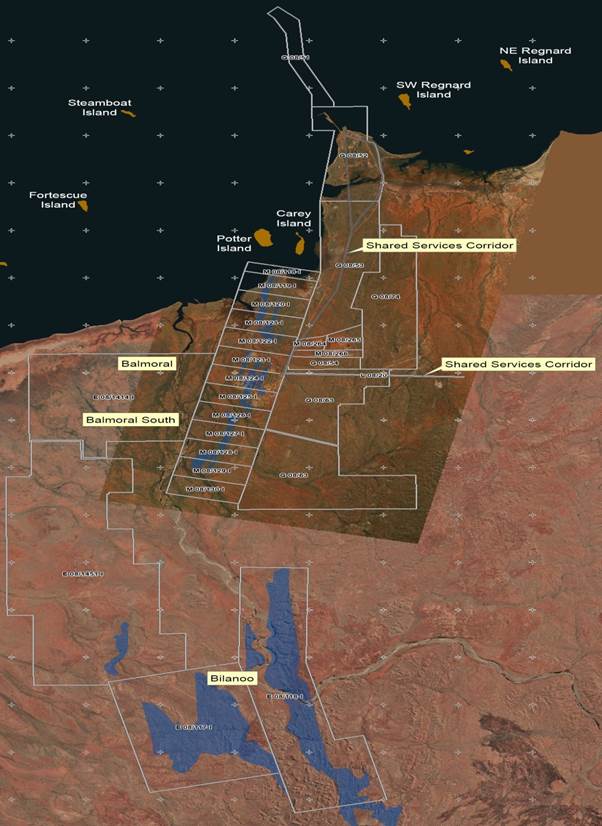
Annexure 2: MRSLA Site Lease Area and Project Area
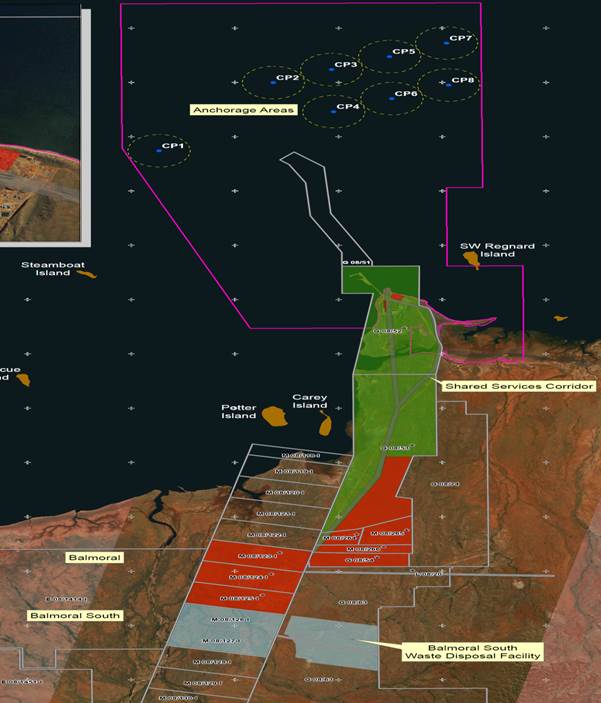
Annexure 3: The area of Exploration Licence 08/636
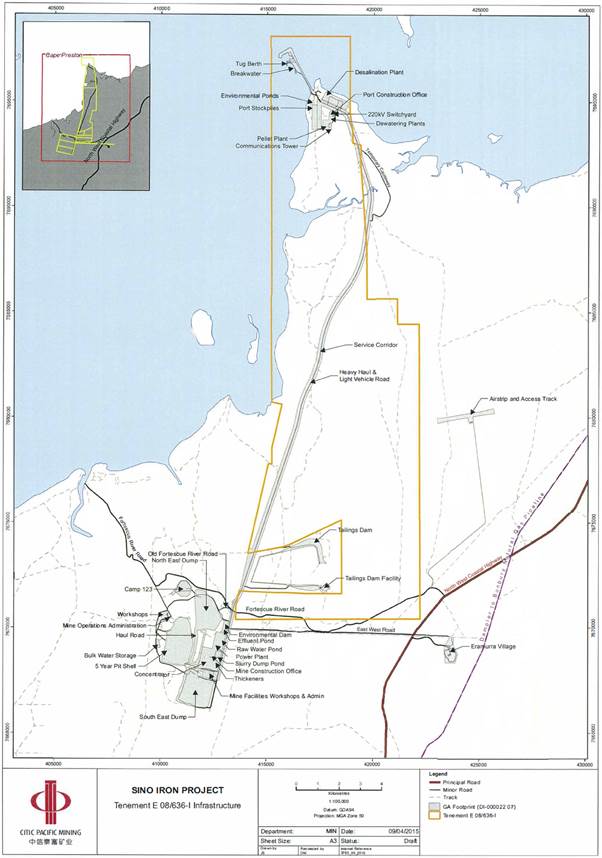
Annexure 4: Location of various port terminal facilities in the area of General Purpose Lease 08/52