

FEDERAL COURT OF AUSTRALIA
Anderson on behalf of the Wulli Wulli People v State of Queensland (No 3) [2015] FCA 821
Table of Corrections | |
4 February 2016 | On page 29 of the Orders, in the last paragraph, “25.111904°” has been replaced with “25.110904°”. |
IN THE FEDERAL COURT OF AUSTRALIA | |
First Applicant ELIZABETH BLUCHER Second Applicant ROBERT BOND Third Applicant ROBERT CLANCY Fourth Applicant BRIAN CLANCY Fifth Applicant DESMOND DODD Sixth Applicant ANNETTE FULLER Seventh Applicant ELIZABETH LAW Eighth Applicant DREW MILLAR Ninth Applicant MARJORIE REID Tenth Applicant IVAN SALTNER Eleventh Applicant NEIL SALTNER Twelfth Applicant CELESTE WILLIAMS Thirteenth Applicant JEFFREY WILLIAMS Fourteenth Applicant JILL WILSON Fifteenth Applicant | |
AND: | First Respondent BANANA SHIRE COUNCIL Second respondent NORTH BURNETT REGIONAL COUNCIL Third Respondent ERGON ENERGY CORPORATION LIMITED Fourth Respondent TELSTRA CORPORATION LIMITED (ACN 33 051 775 556) Fifth Respondent ANGLO COAL (DAWSON SOUTH) PTY LTD (formerly Theodore Coal (Assets) Pty Ltd) Sixth Respondent QCOAL PTY LTD Seventh Respondent SANTOS QNT PTY LTD (ABN 33 083 077 196) Eighth Respondent ANGLO COAL (THEODORE SOUTH) PTY LTD (formerly Anglo Coal (Dawson) Pty Ltd) Ninth Respondent CAMBOON RACE & RECREATIONAL CLUB INC Tenth Respondent CECILY HELEN BRADSHAW Eleventh Respondent DALE ROBERT BRADSHAW Twelfth Respondent SANDRA LEE CLARKE Thirteenth Respondent THOMAS JOHN CLARKE Fourteenth Respondent JANELLE ELIZABETH CONNOLLY Fifteenth Respondent JOHN STEPHEN CRUICKSHANK Sixteenth Respondent PENELOPE JANE FLOOD Seventeenth Respondent LURLINE ANNE GRAVING Eighteenth Respondent GYRANDA NOMINEES PTY LTD Nineteenth Respondent JUDITH ANN HAMILTON Twentieth Respondent PHILLIP VICTOR HAMILTON Twenty-first Respondent CHERYL MARY LAMB Twenty-second Respondent STEPHEN JOHN LAMB Twenty-third Respondent ARTHUR ANDREW MCINTYRE Twenty-fourth Respondent CAMERON ANDREW REID MCINTYRE Twenty-fifth Respondent MALCOLM THOMAS MCINTYRE Twenty-sixth Respondent GORDON ROSS MUIRHEAD Twenty-seventh Respondent MARJORIE MASON ORR Twenty-eighth Respondent DAVID ALLAN WHITE Twenty-ninth Respondent LOIS ANN WHITE Thirtieth Respondent ERROL JOSEPH CONACHAN Thirty-first Respondent THOMAS CHARLES MCMAHON Thirty-second Respondent GARY THOMAS PALMER Thirty-third Respondent KEITH DOUGLAS PALMER Thirty-fourth Respondent |
DATE OF ORDER: | |
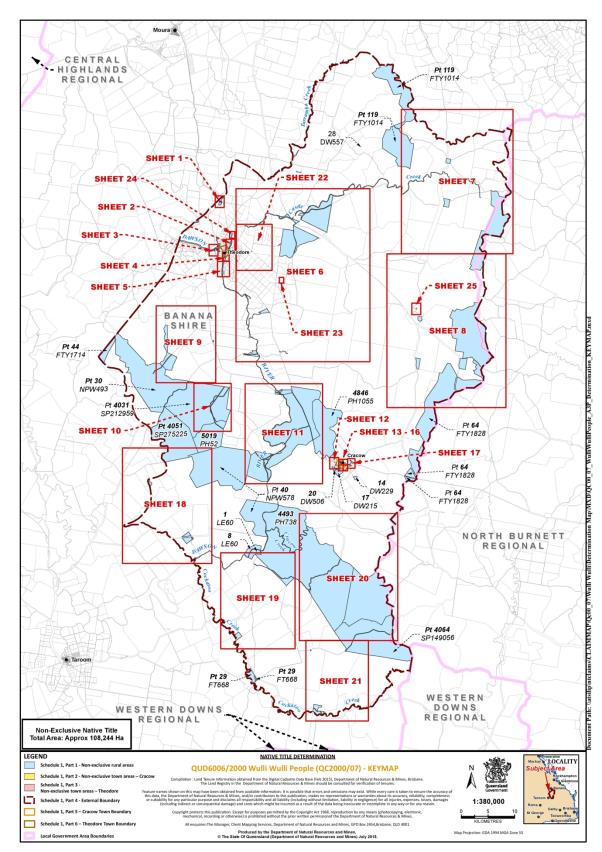
WHERE MADE: |
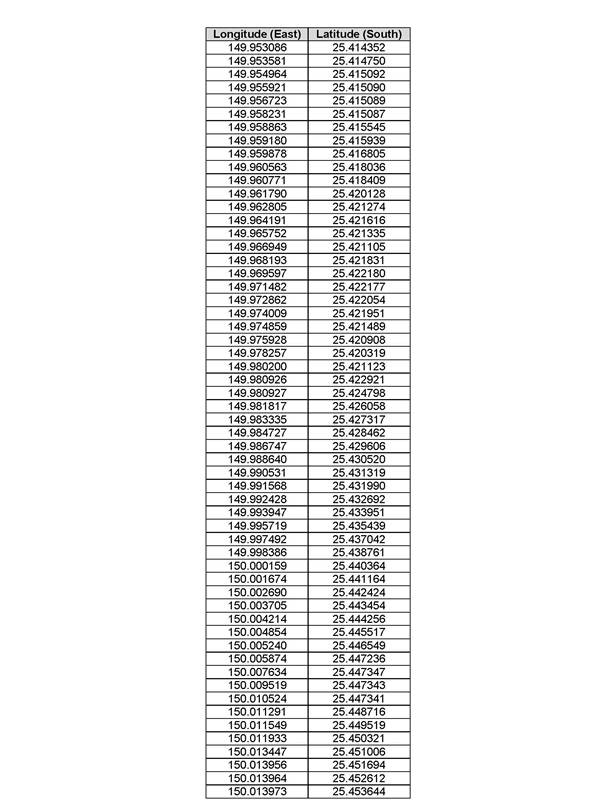
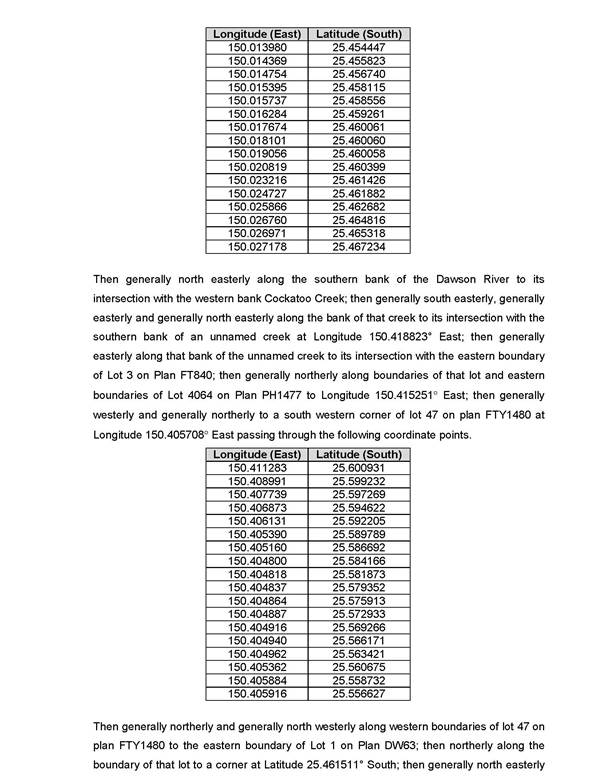
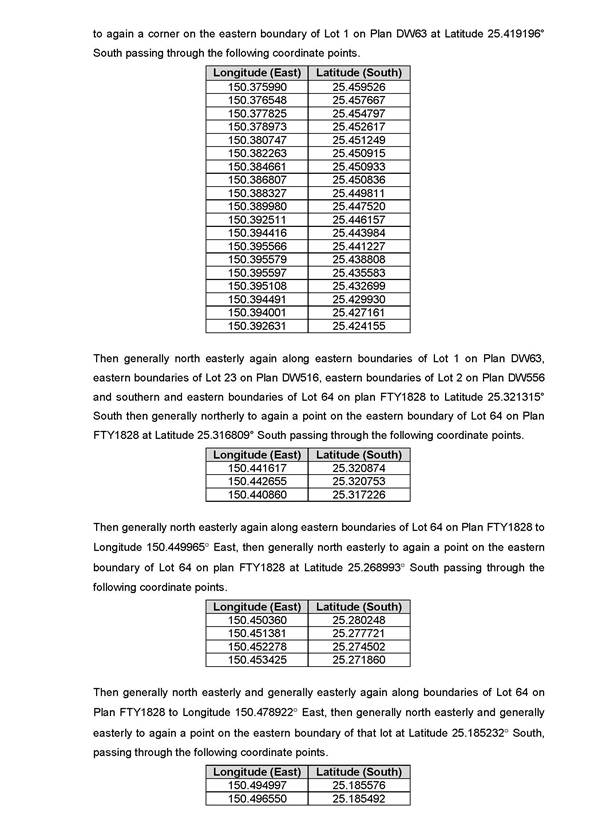
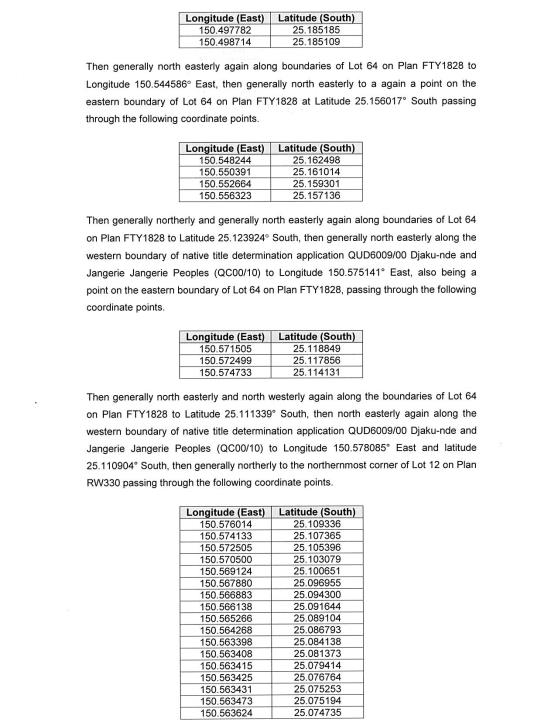
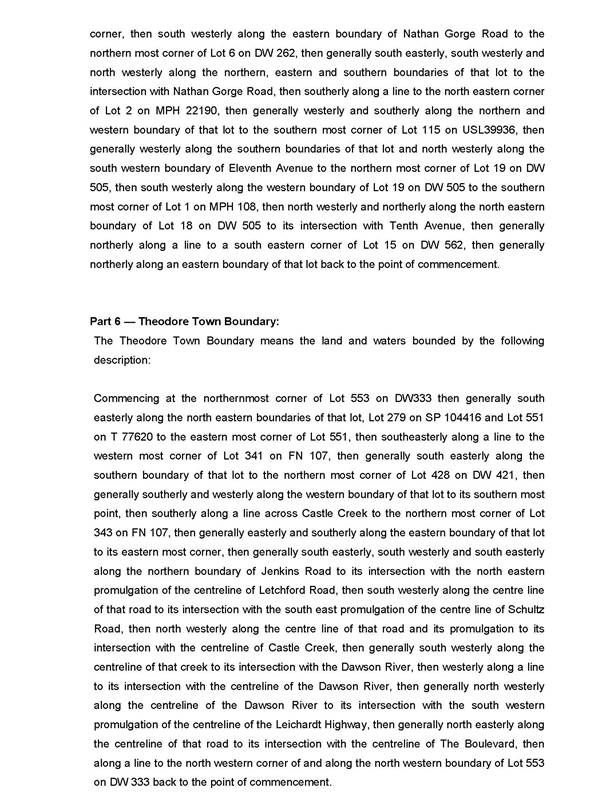
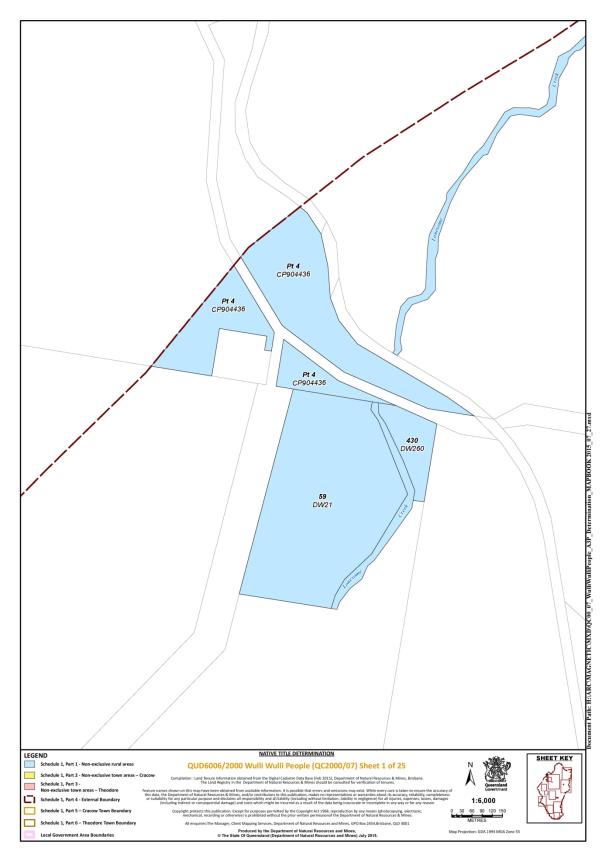
BEING SATISFIED that an order in the terms set out below is within the power of the Court, and it appearing appropriate to the Court to do so, pursuant to section 87A of the Native Title Act 1993 (Cth)
THE COURT ORDERS BY CONSENT THAT:
1. There be a determination of native title in the terms set out below (the determination).
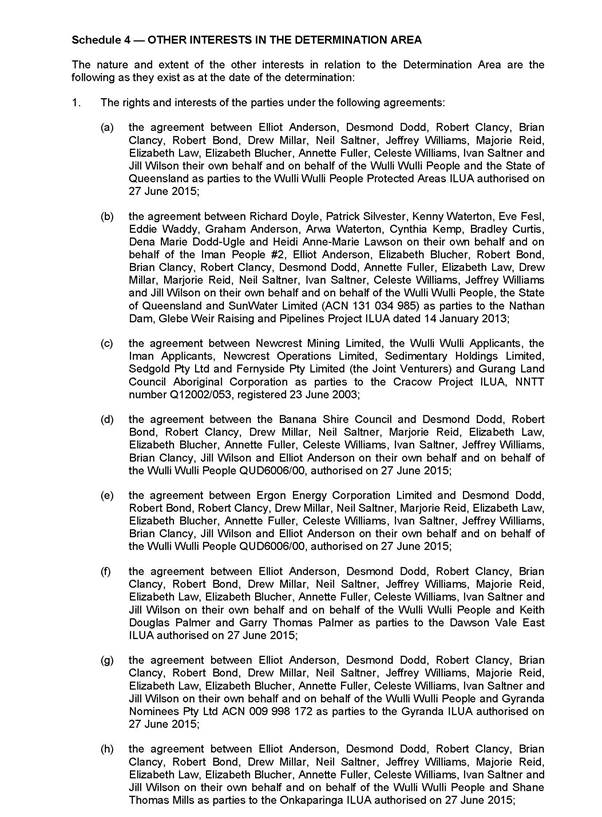
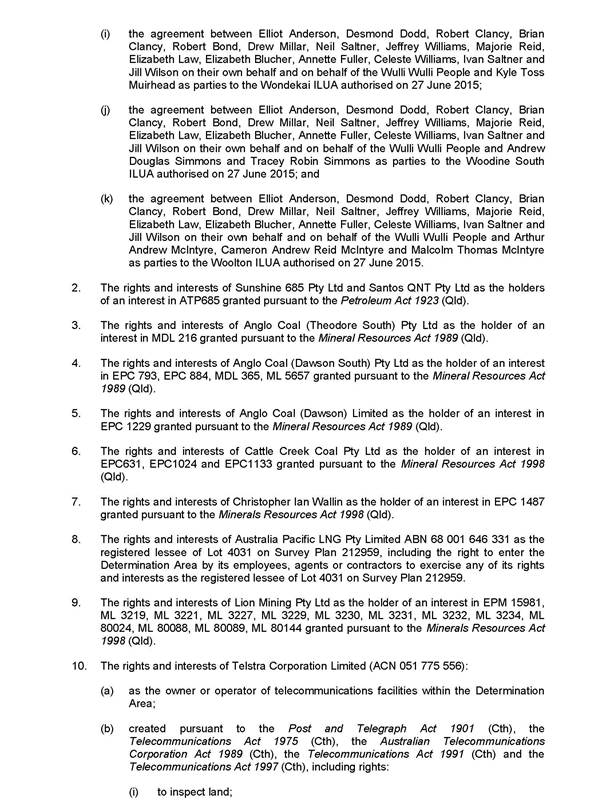
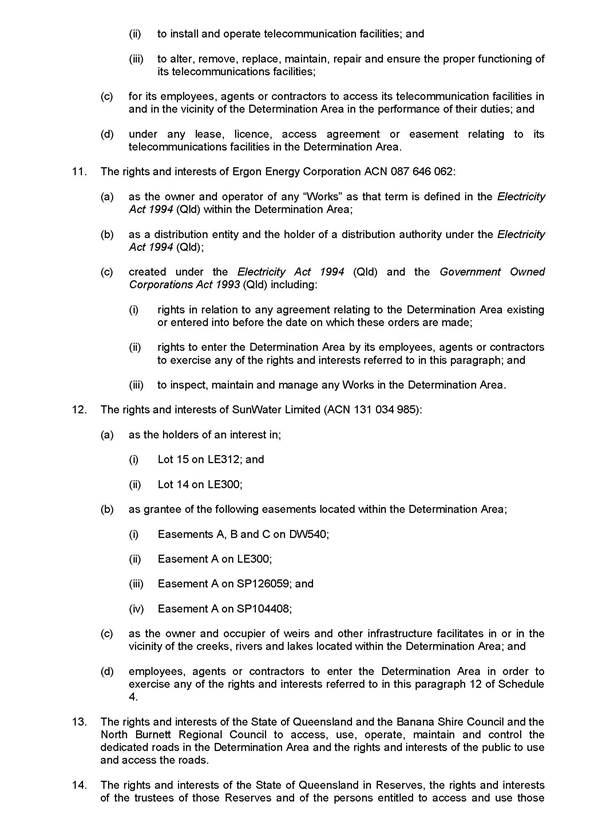
2. The determination will take effect upon the agreements referred to in paragraph 1 of Schedule 4 being registered on the Register of Indigenous Land Use Agreements.
3. In the event that the agreements referred to in paragraph 2 are not registered on the Register of Indigenous Land Use Agreements within six (6) months of the date of this order or such later time as this Court may order, the matter is to be listed for further directions.
4. Each party to the proceedings is to bear its own costs.
THE COURT DETERMINES BY CONSENT THAT:
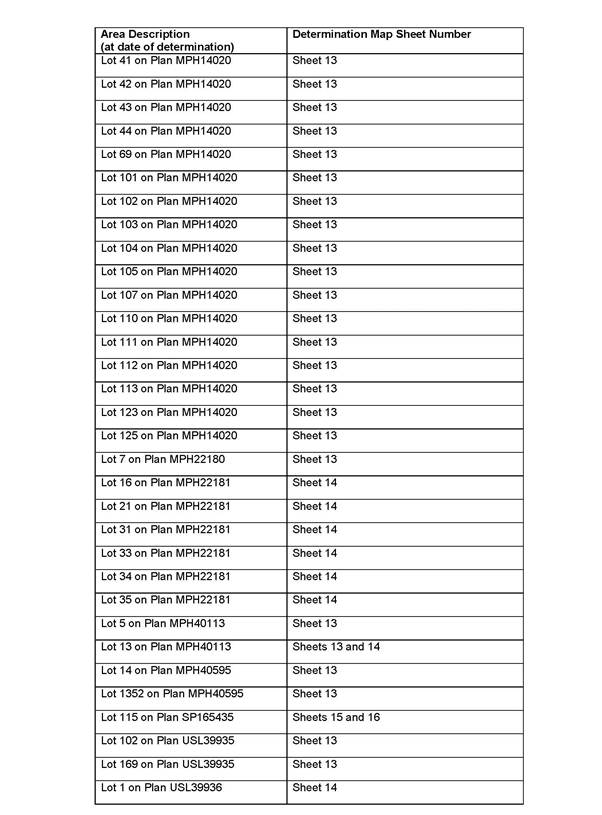
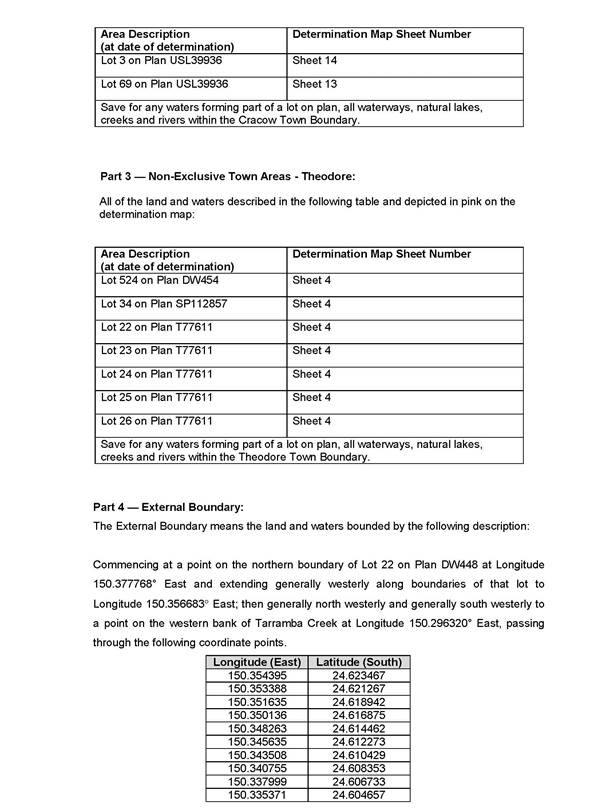
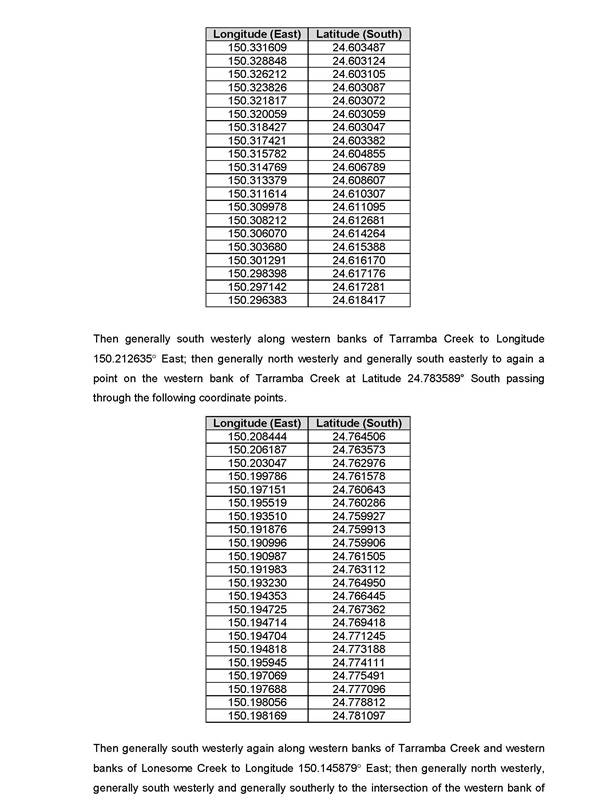
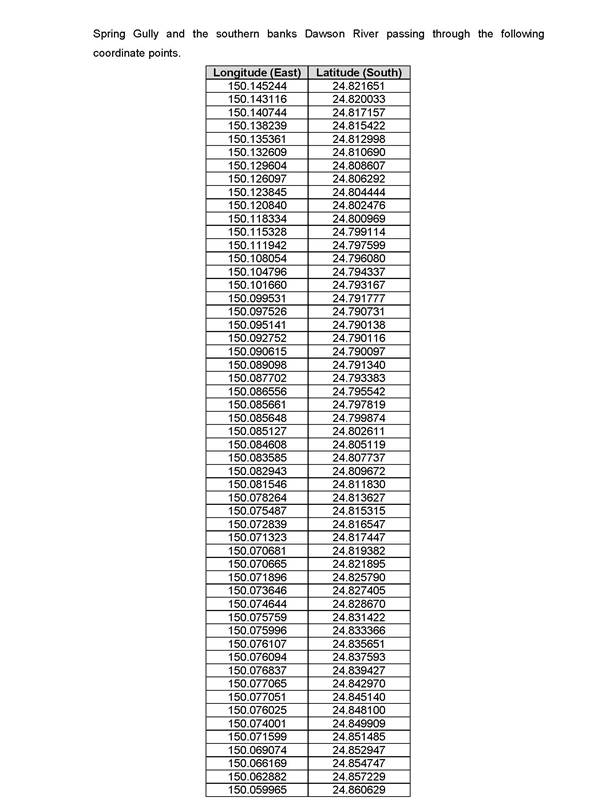
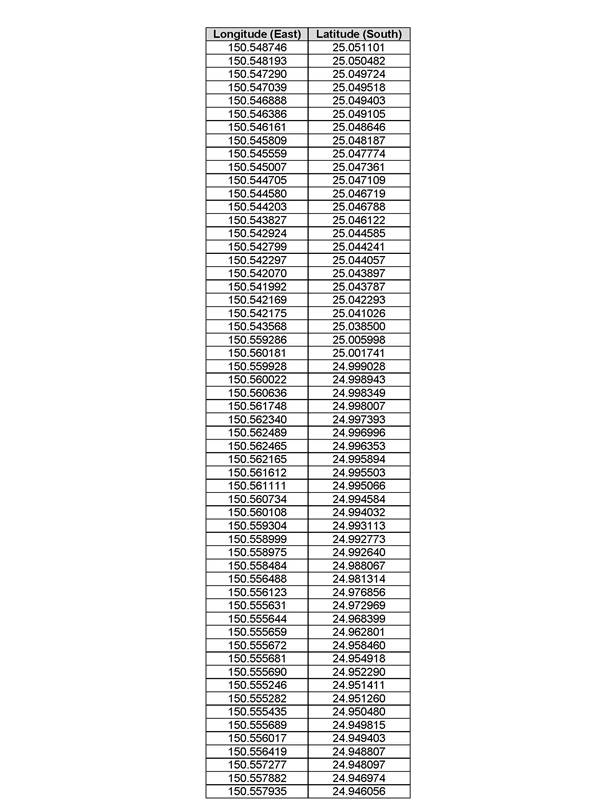
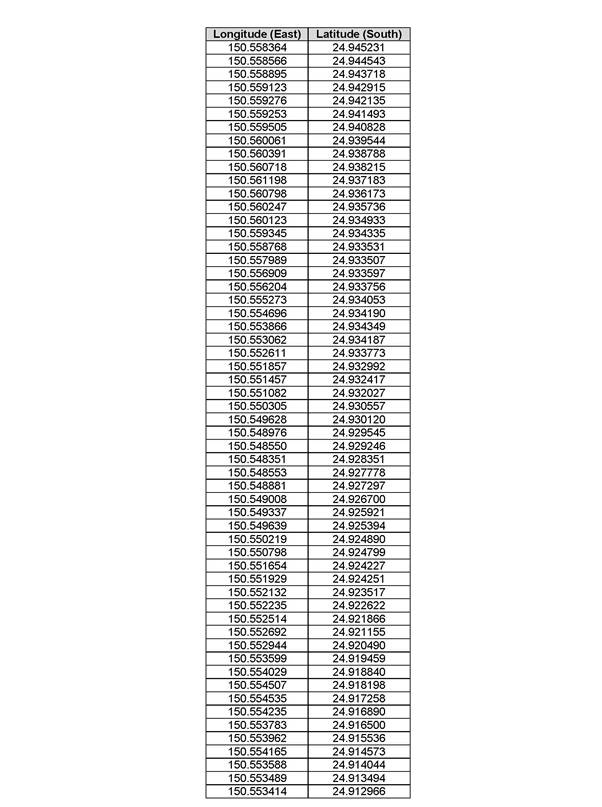
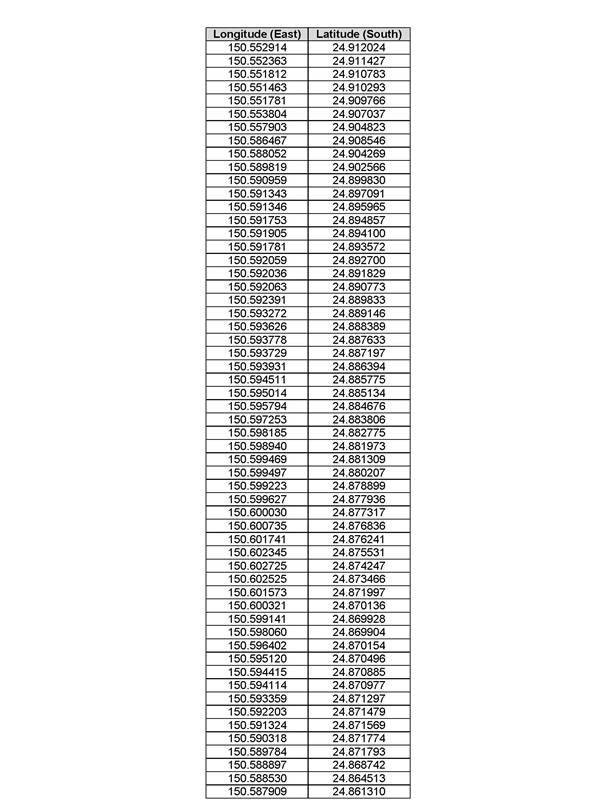
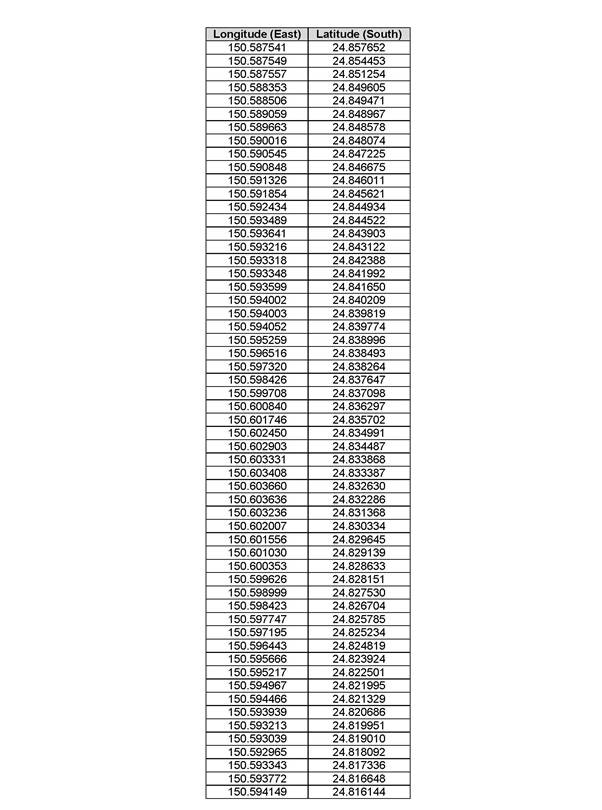
5. The Determination Area is the land and waters described in Schedule 1, and depicted in the map attached to Schedule 1. To the extent of any inconsistency between the written description and the map, the written description prevails.
6. Native title exists in relation to the Determination Area described in Parts 1, 2, and 3 of Schedule 1.
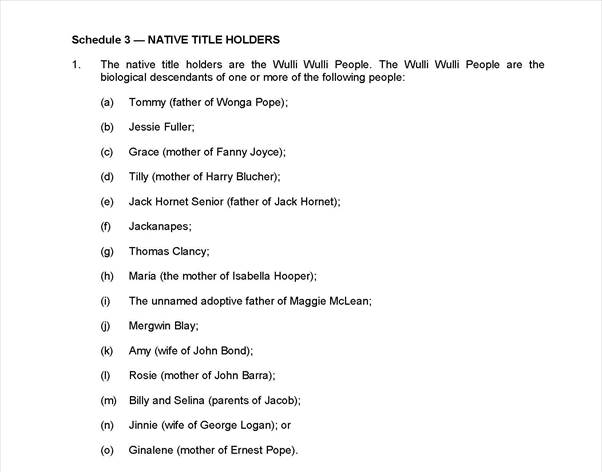
7. The native title is held by the Wulli Wulli People described in Schedule 3 (the native title holders).
8. Subject to paragraphs 11, 12 and 13 below the nature and extent of the native title rights and interests in relation to the land and waters described in Part 1 of Schedule 1 are the non-exclusive rights to:
(a) access, be present on, move about on and travel over the area;
(b) camp, and live temporarily on the area as part of camping, and for that purpose build temporary shelters;
(c) hunt, fish and gather on the land and waters of the area for personal, domestic and non-commercial communal purposes;
(d) take, use, share and exchange Natural Resources from the land and waters of the area for personal, domestic and non-commercial communal purposes;
(e) take and use the Water of the area for personal, domestic and non-commercial communal purposes;
(f) conduct ceremonies on the area;
(g) be buried and bury native title holders within the area;
(h) maintain places of importance and areas of significance to the native title holders under their traditional laws and customs and protect those places and areas from physical harm;
(i) teach on the area the physical and spiritual attributes of the area;
(j) hold meetings on the area; and
(k) light fires on the area for domestic purposes including cooking, but not for the purpose of hunting or clearing vegetation.
9. Subject to paragraphs 11, 12 and 13 below the nature and extent of the native title rights and interests in relation to the land and waters described in Part 2 of Schedule 1 are the non-exclusive rights to:
(a) access, be present on, move about on and travel over the area;
(b) gather on the land and waters of the area for personal, domestic and non-commercial communal purposes; and
(c) teach on the area the physical and spiritual attributes of the area.
10. Subject to paragraphs 11, 12 and 13 below the nature and extent of the native title rights and interests in relation to the land and waters described in Part 3 of Schedule 1 are the non-exclusive rights to:
(a) access, be present on, move about on and travel over the area;
(b) hunt, fish and gather on the land and waters of the area for personal, domestic and non-commercial communal purposes; and
(c) teach on the area the physical and spiritual attributes of the area.
11. The native title rights and interests are subject to and exercisable in accordance with:
(a) the Laws of the State and the Commonwealth;
(b) the traditional laws acknowledged and traditional customs observed by the native title holders; and
(c) the terms and conditions of the agreements referred to in paragraph 1 of Schedule 4.
12. The native title rights and interests referred to in paragraphs 8, 9 and 10 do not confer possession, occupation, use or enjoyment to the exclusion of all others.
13. There are no native title rights in or in relation to minerals as defined by the Mineral Resources Act 1989 (Qld) and petroleum as defined by the Petroleum Act 1923 (Qld) and the Petroleum and Gas (Production and Safety) Act 2004 (Qld).
14. The nature and extent of any other interests in relation to the Determination Area (or respective parts thereof) are set out in Schedule 4.
15. The relationship between the native title rights and interests described in paragraphs 8, 9 and 10 and the other interests described in Schedule 4 (the “other interests”) is that:
(a) the other interests continue to have effect, and the rights conferred by or held under the other interests may be exercised notwithstanding the existence of the native title rights and interests;
(b) to the extent the other interests are inconsistent with the continued existence, enjoyment or exercise of the native title rights and interests in relation to the land and waters of the Determination Area, the native title continues to exist in its entirety but the native title rights and interests have no effect in relation to the other interests to the extent of the inconsistency for so long as the other interests exist;
(c) the other interests and any activity that is required or permitted by or under, and done in accordance with, the other interests, or any activity that is associated with or incidental to such an activity, prevail over the native title rights and interests and any exercise of the native title rights and interests; and
(d) without limiting the operation of paragraphs 15(a) to (c) above, before the native title rights and interests (referred to in paragraph 8 above) are exercised on state forest land over which a term lease for grazing purposes has been granted, the native title holders must contact the lessee of the grazing lease, provided their contact details have been provided to the Wulli Wulli Nation Aboriginal Corporation, and discuss any safety issues associated with the proposed exercise of native title rights and interests and make reasonable efforts to agree on the route of access.
DEFINITIONS AND INTERPRETATION
16. In this determination, unless the contrary intention appears:
“land” and “waters”, respectively, have the same meanings as in the Native Title Act 1993 (Cth);
“Laws of the State and the Commonwealth” means the common law and the laws of the State of Queensland and the Commonwealth of Australia, and includes legislation, regulations, statutory instruments, local planning instruments and local laws;
“Local Government Act” has the meaning in the Local Government Act 2009 (Qld);
“Local Government Area” has the meaning in the Local Government Act 2009 (Qld);
“Natural Resources” means:
(a) any animal, plant, fish and bird life found on or in the lands and waters of the Determination Area; and
(b) any clays, soil, sand, gravel or rock found on or below the surface of the Determination Area,
that have traditionally been taken and used by the native title holders, but does not include:
(a) animals that are the private personal property of another;
(b) crops that are the private personal property of another; and
(c) minerals as defined in the Mineral Resources Act 1989 (Qld) or petroleum as defined in the Petroleum Act 1923 (Qld) and the Petroleum and Gas (Production and Safety) Act 2004 (Qld);
“Reserves” means reserves that are dedicated or taken to be reserves under the Land Act 1994 (Qld);
“Water” means:
(a) water which flows, whether permanently or intermittently, within a river, creek or stream;
(b) any natural collection of water, whether permanent or intermittent.
Other words and expressions used in this Determination have the same meanings as they have in Part 15 of the Native Title Act 1993 (Cth).
THE COURT DETERMINES THAT:
17. Upon the determination taking effect:
(a) The native title is held in trust;
(b) The Wulli Wulli Nation Aboriginal Corporation (ICN: 8263), incorporated under the Corporations (Aboriginal and Torres Strait Islander) Act 2006 (Cth), is to:
(i) be the prescribed body corporate for the purpose of section 56(2)(b) and section 56(3) of the Native Title Act 1993 (Cth); and
(ii) perform the functions mentioned in section 57(1) of the Native Title Act 1993 (Cth) after becoming a registered native title body corporate.
Note: Entry of orders is dealt with in Rule 39.32 of the Federal Court Rules 2011.
LIST OF SCHEDULES
Schedule 1 — DETERMINATION AREA………………………………………………….10
Schedule 2 — AREAS NOT FORMING PART OF THE DETERMINATION AREA……67
Schedule 3 — NATIVE TITLE HOLDERS…………………………………………………68
Schedule 4 — OTHER INTERESTS IN THE DETERMINATION AREA………………..69
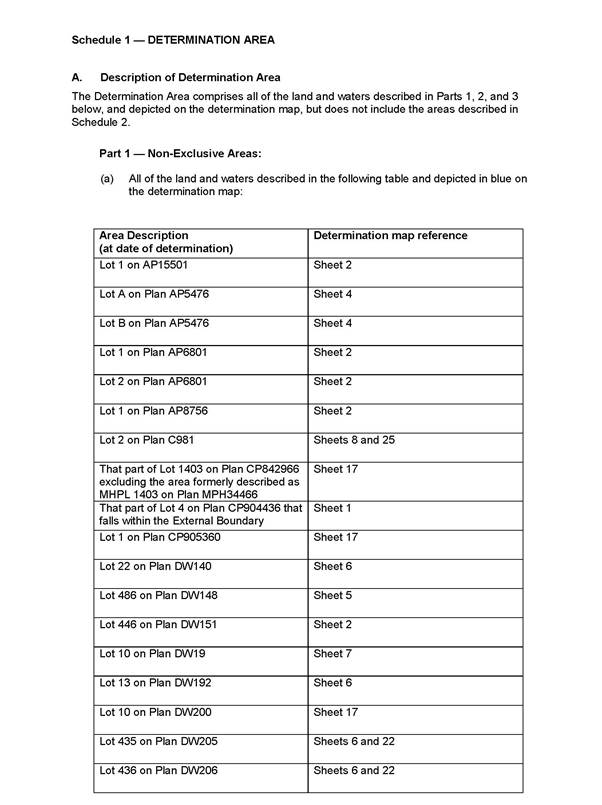
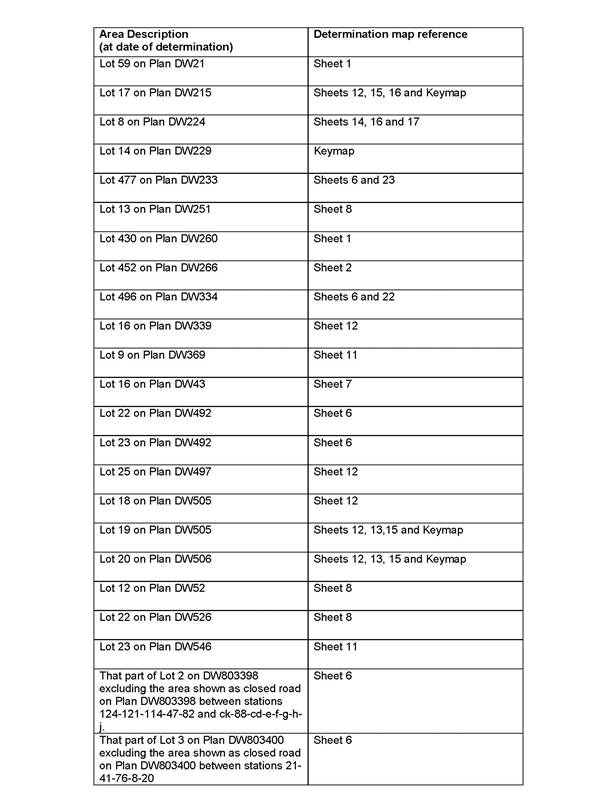
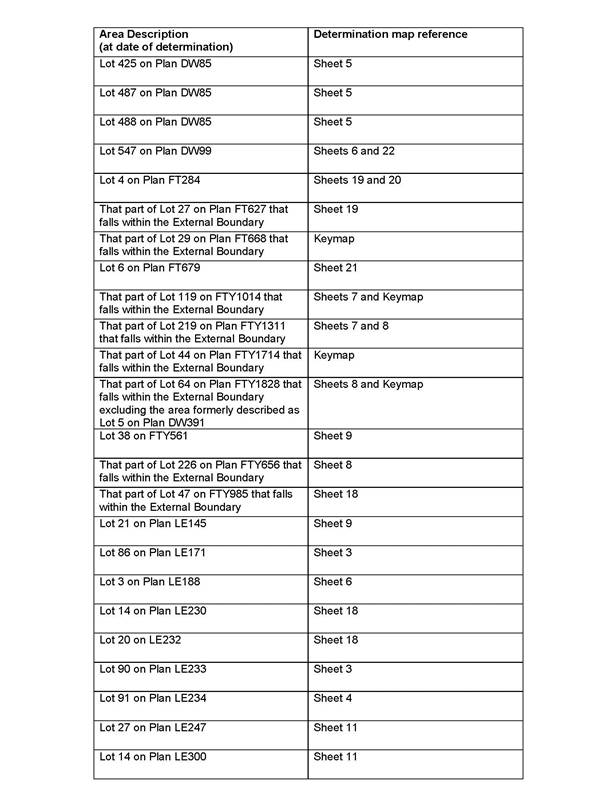
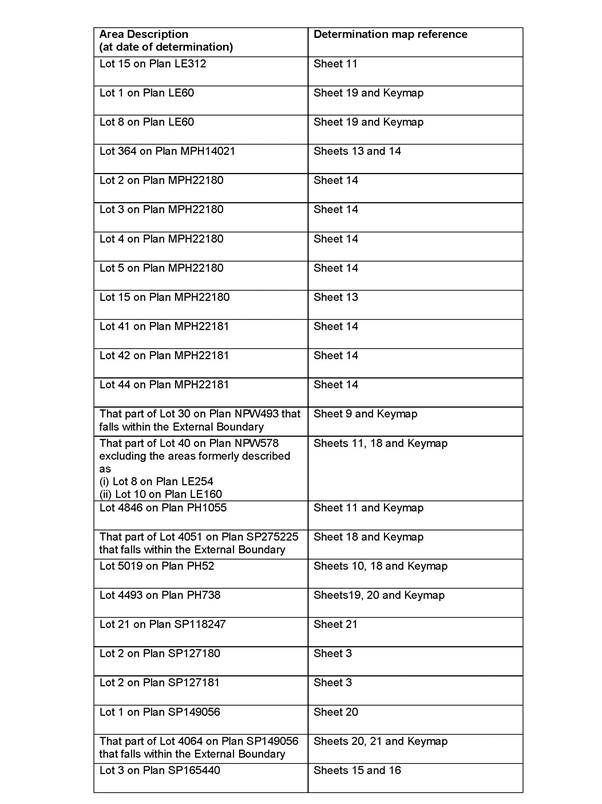
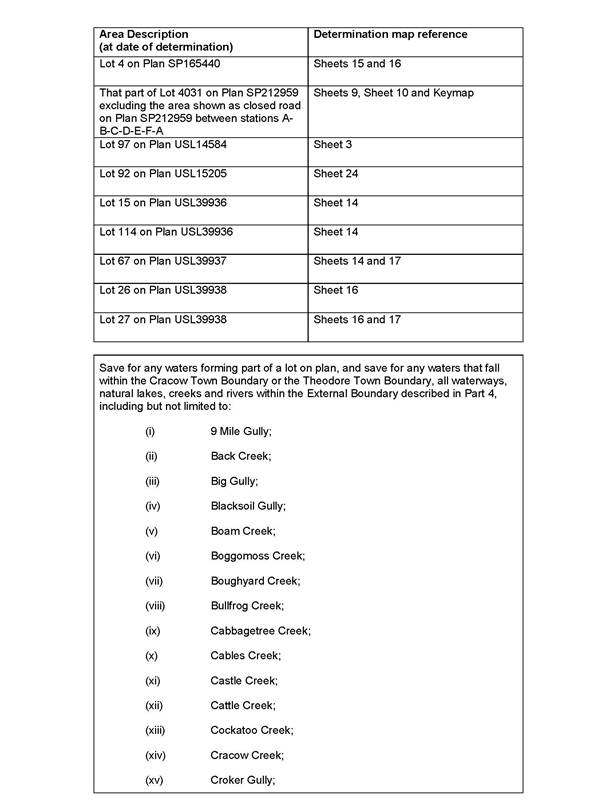
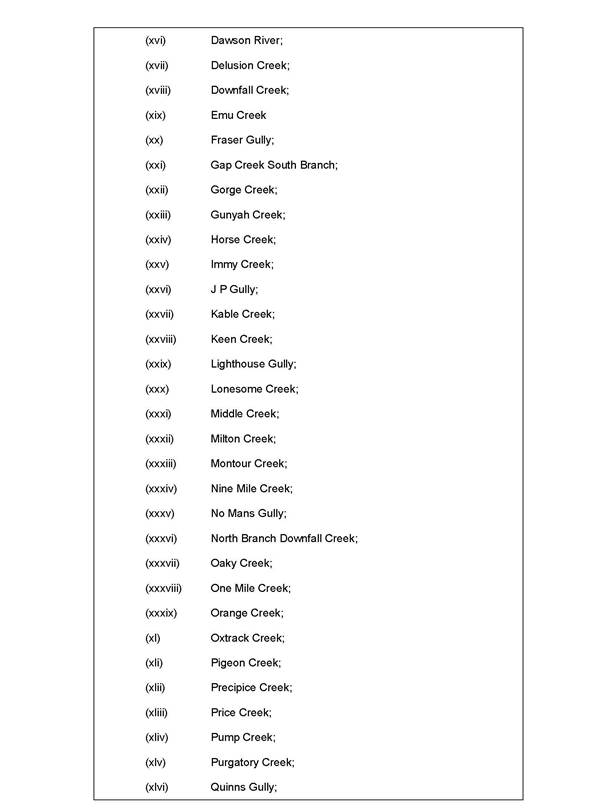
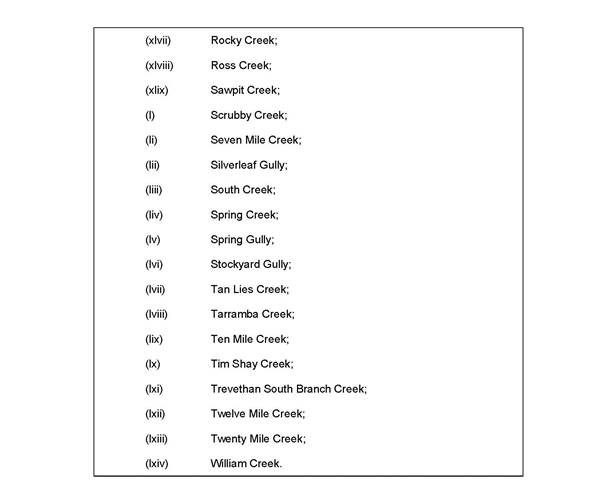
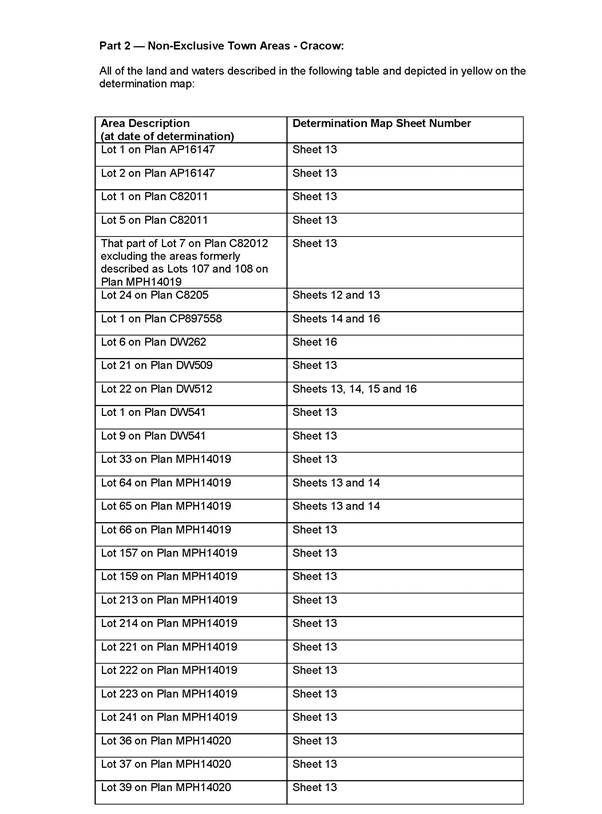
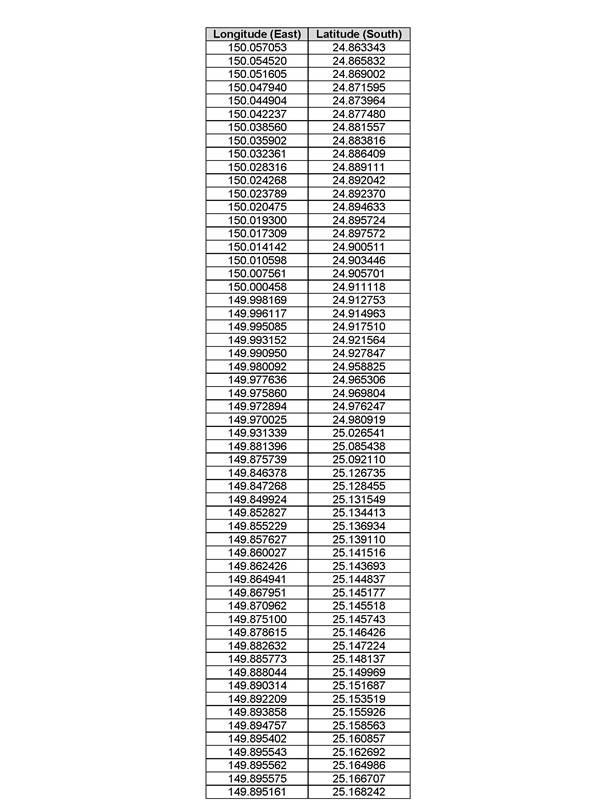
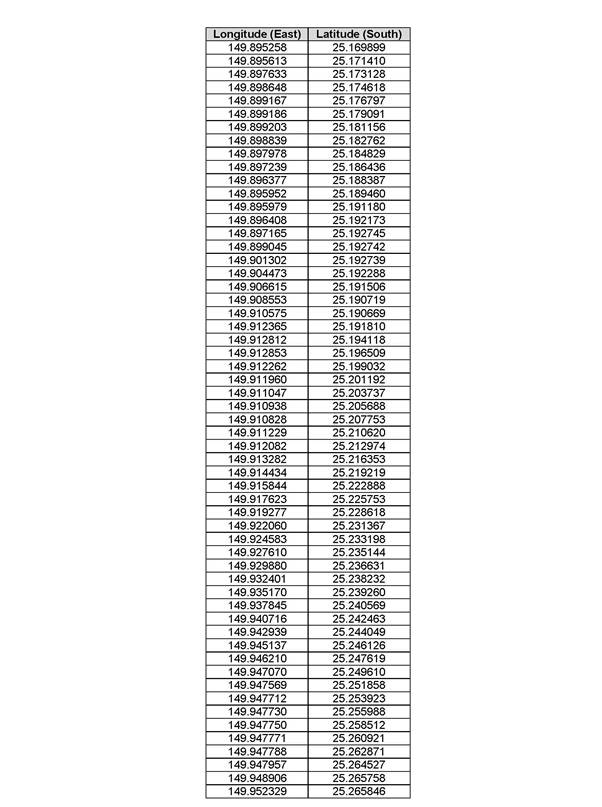
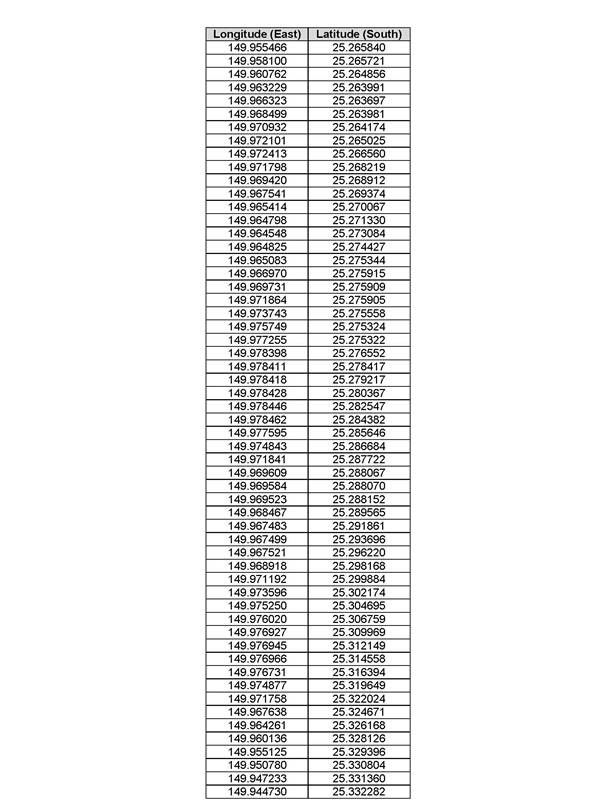
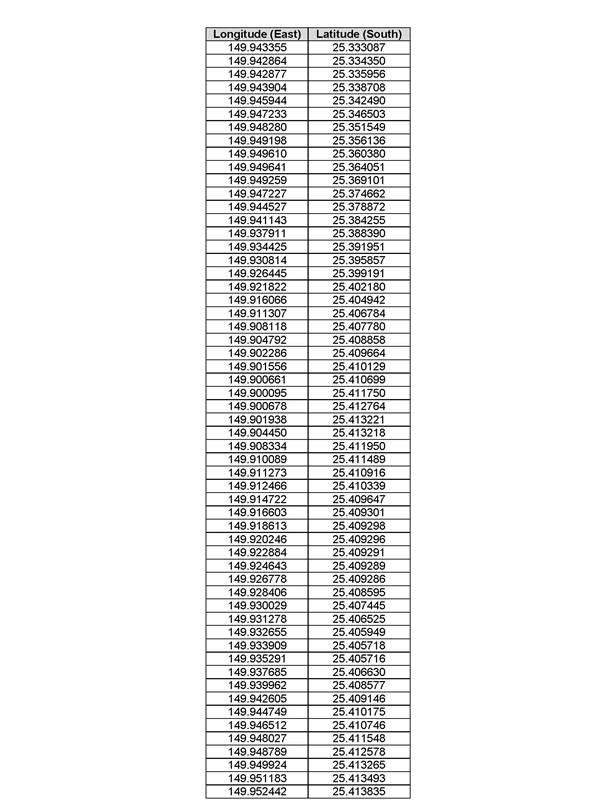

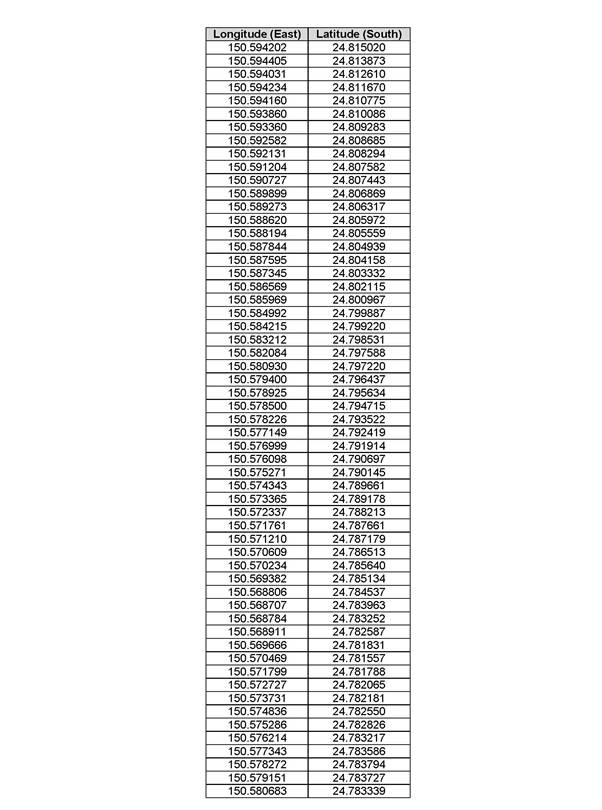
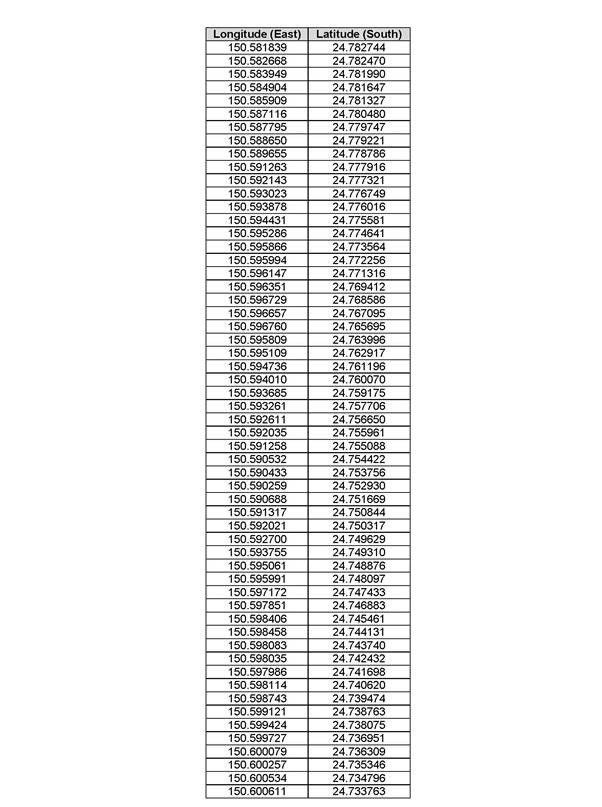
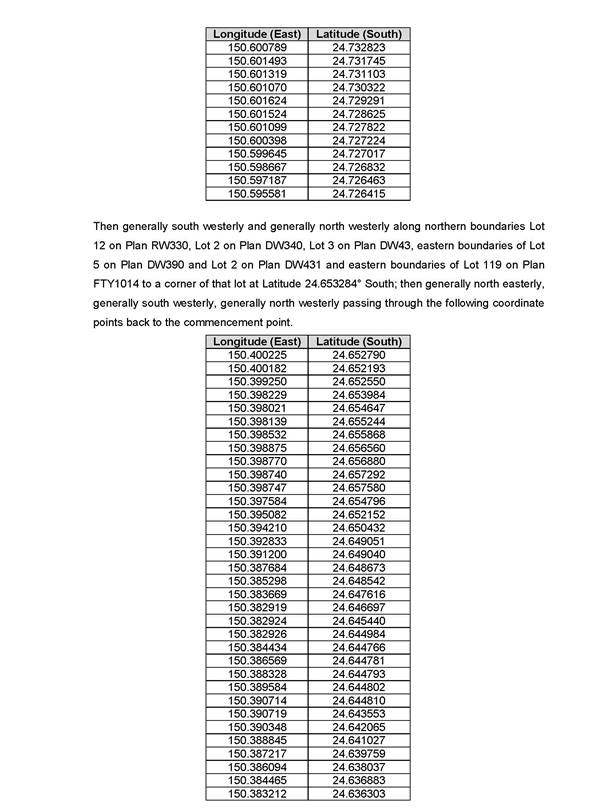
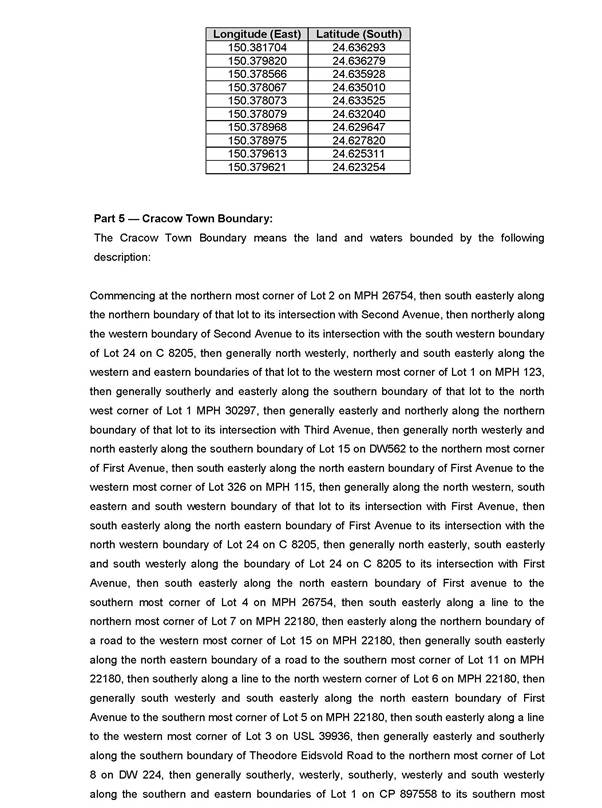
B. Map of Determination Area
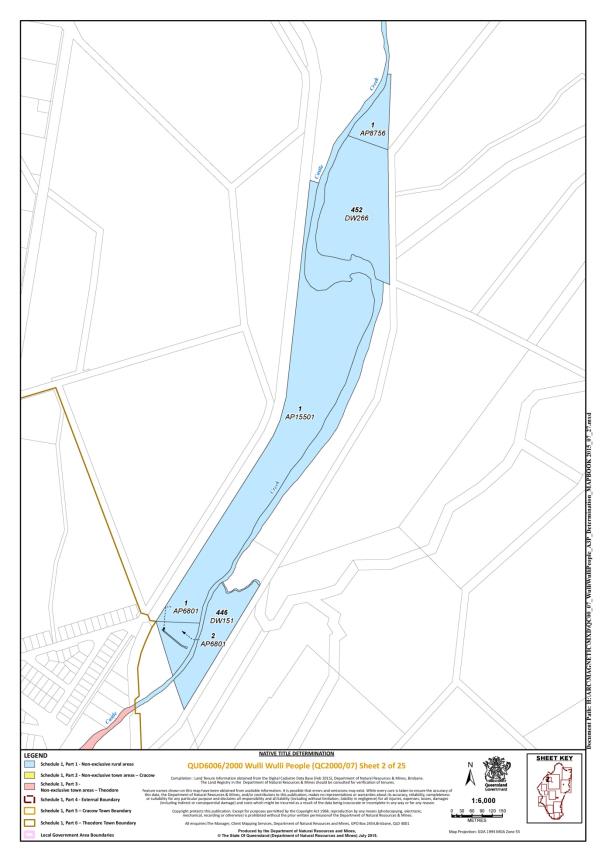
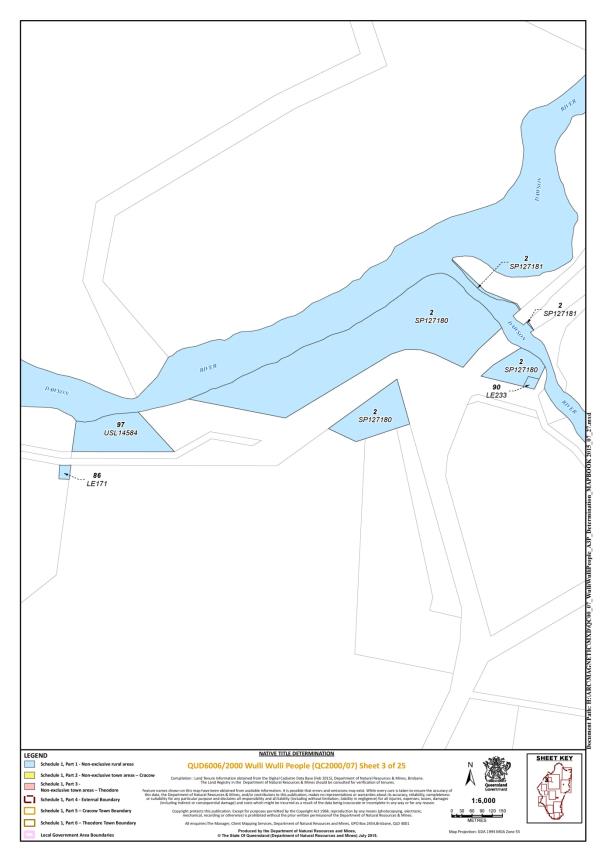
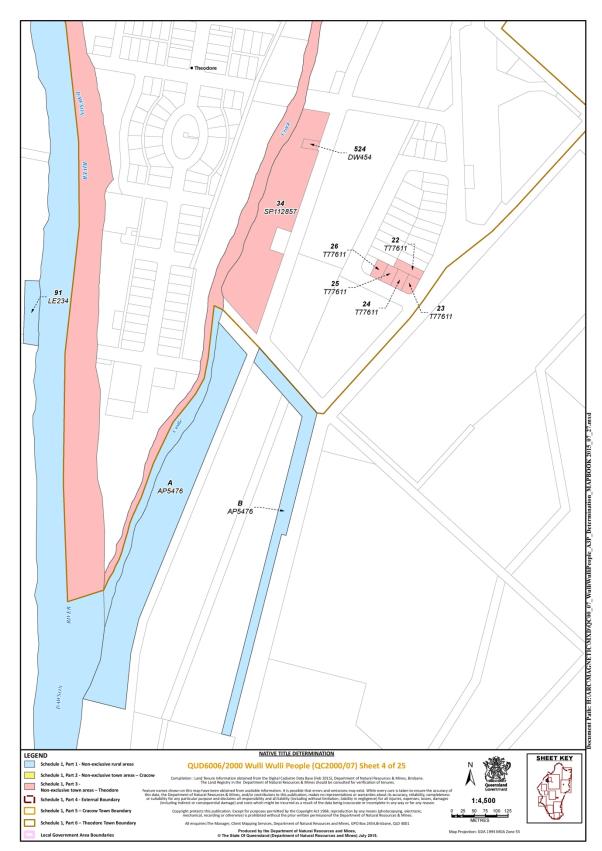
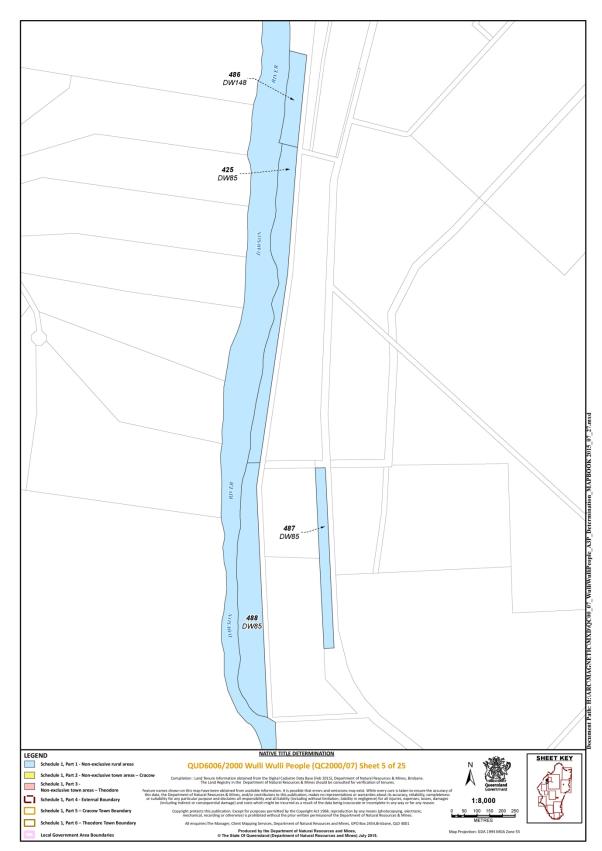
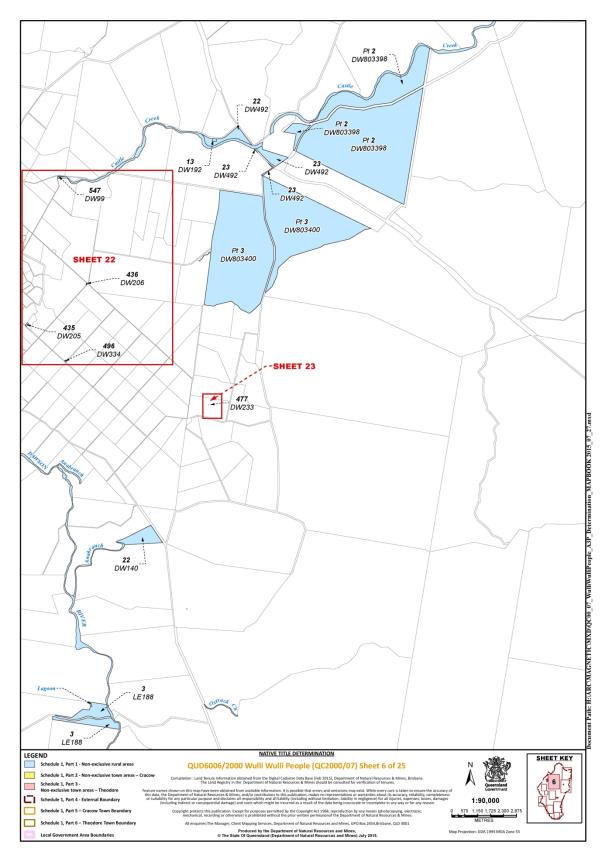
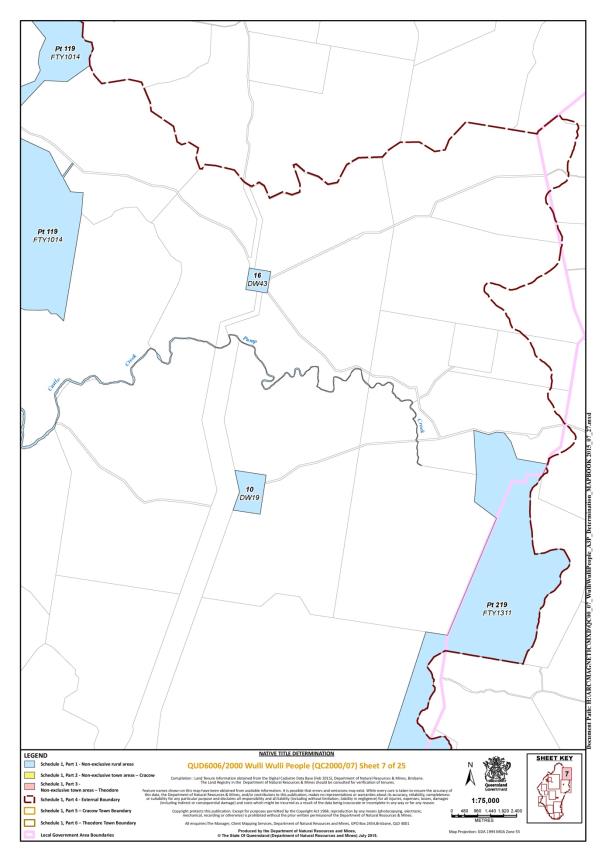
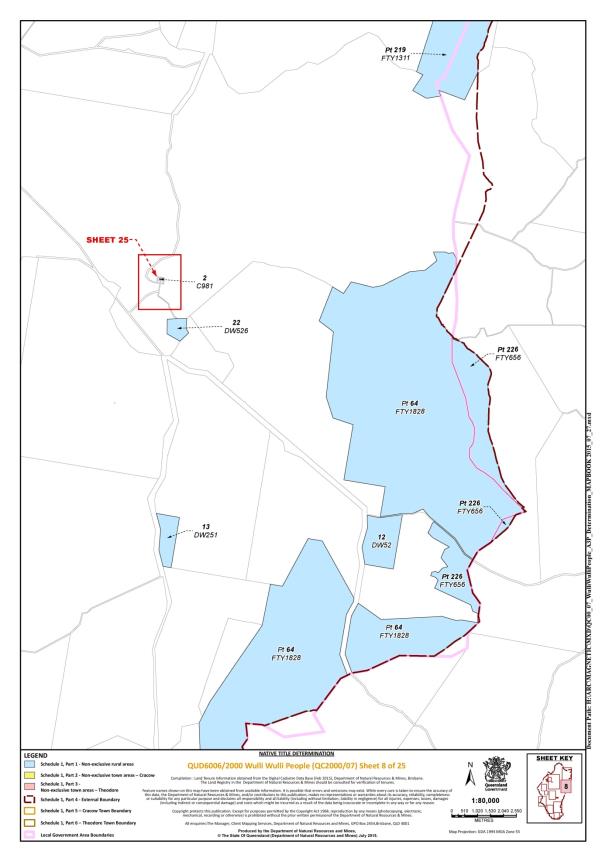
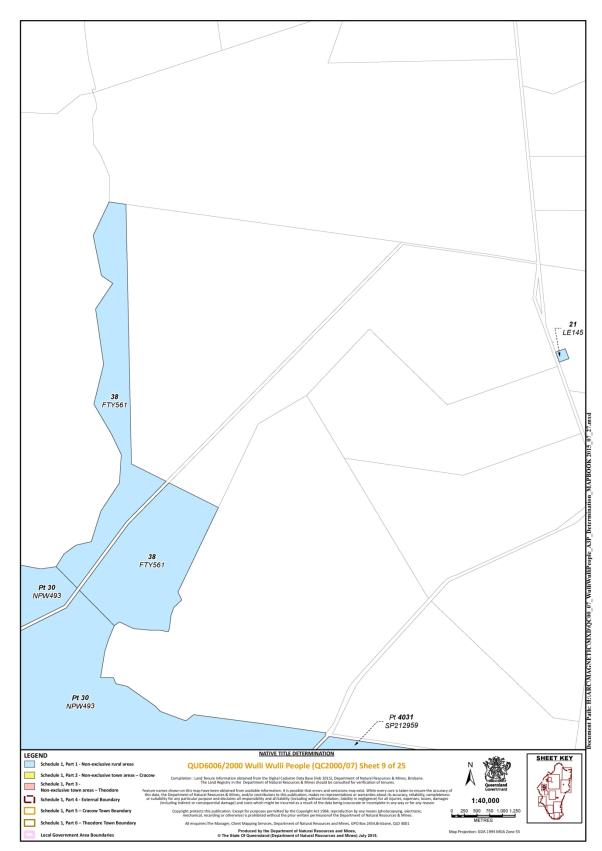
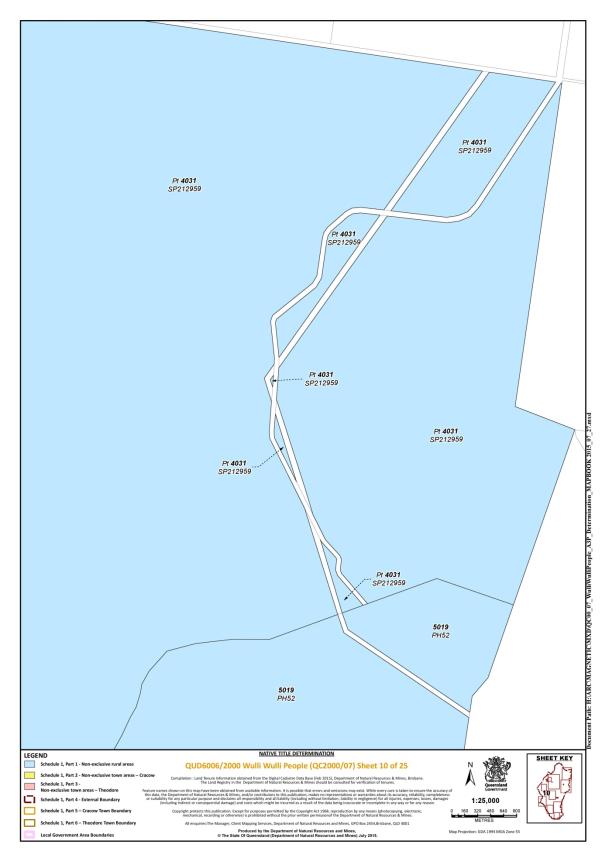
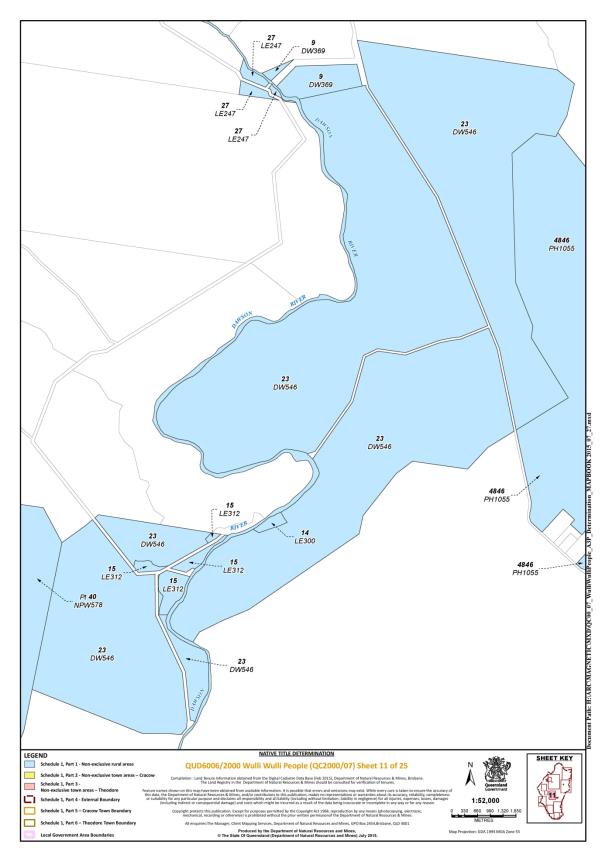
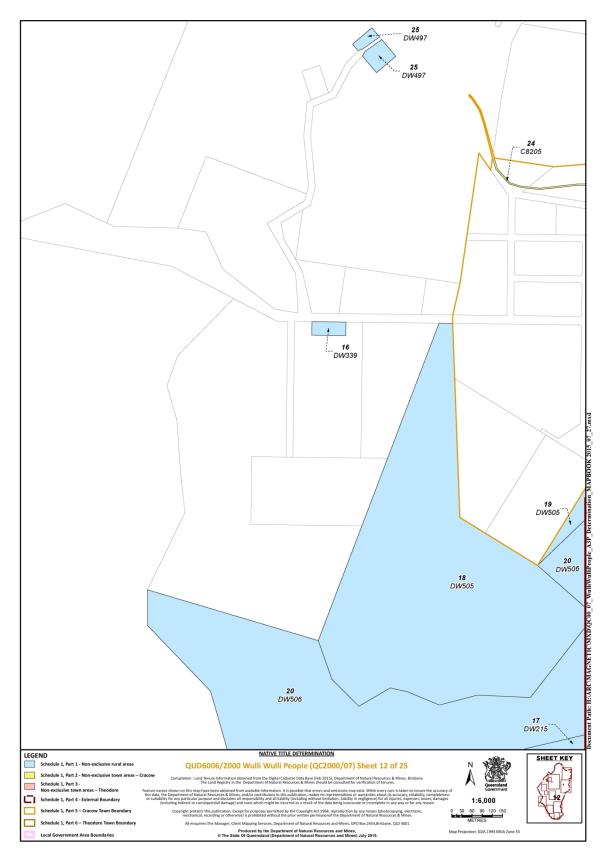
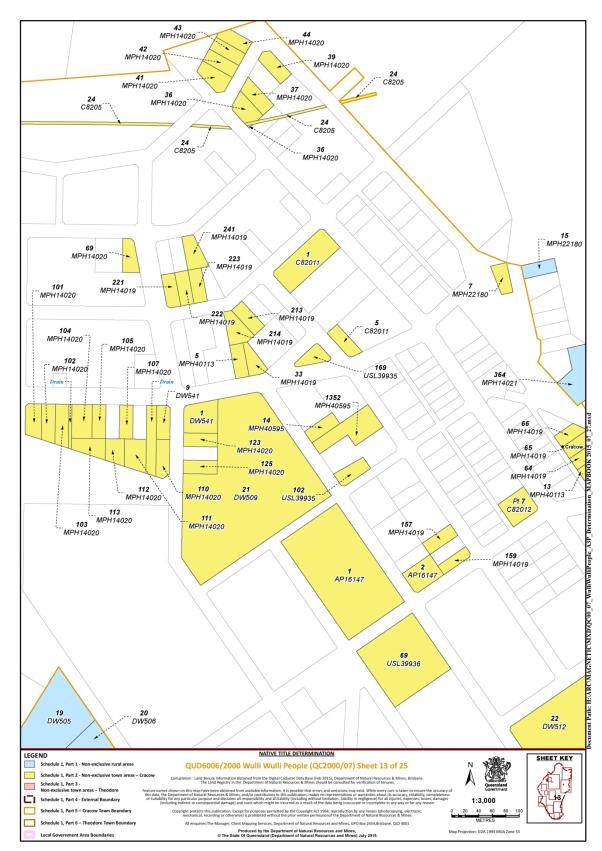
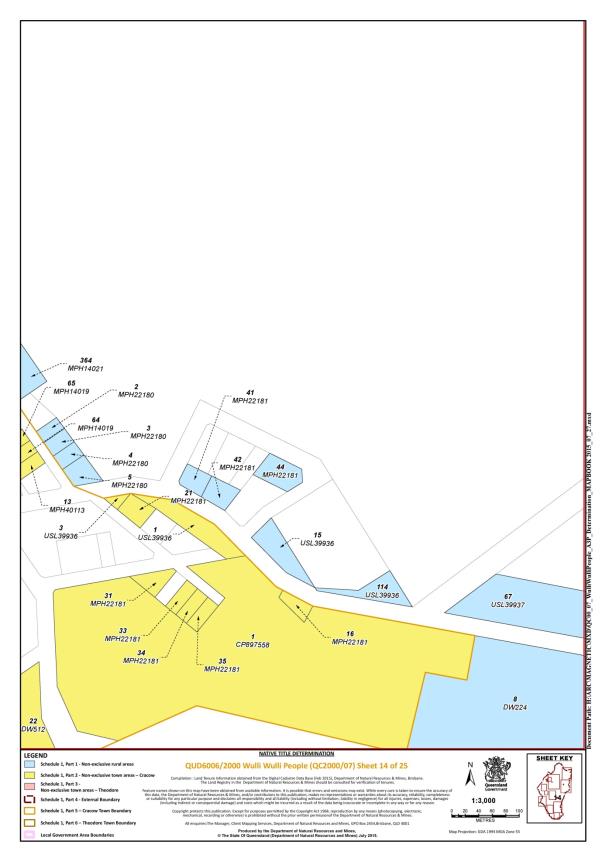
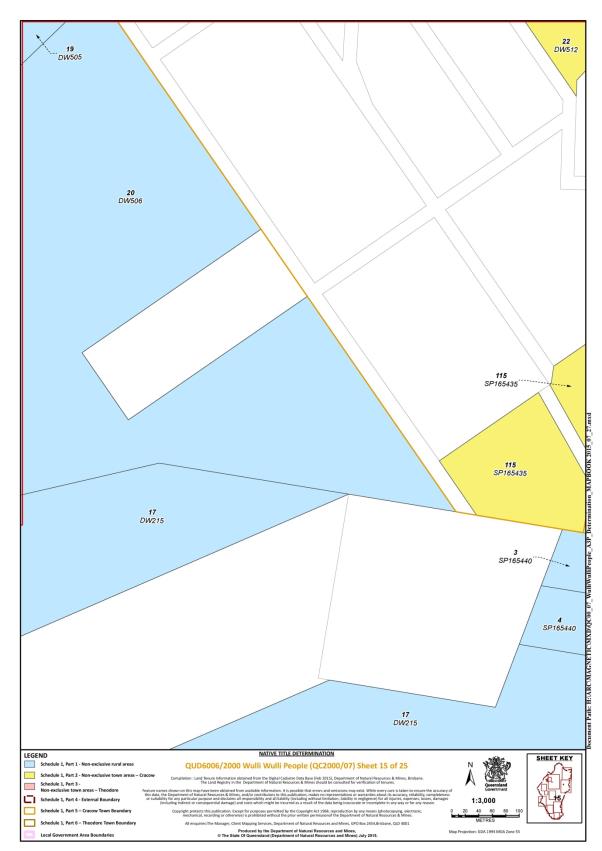
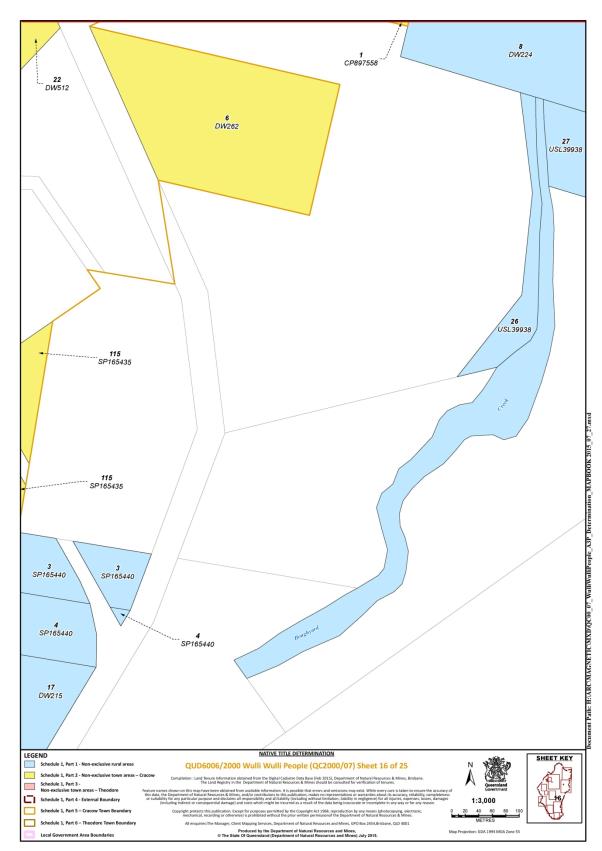
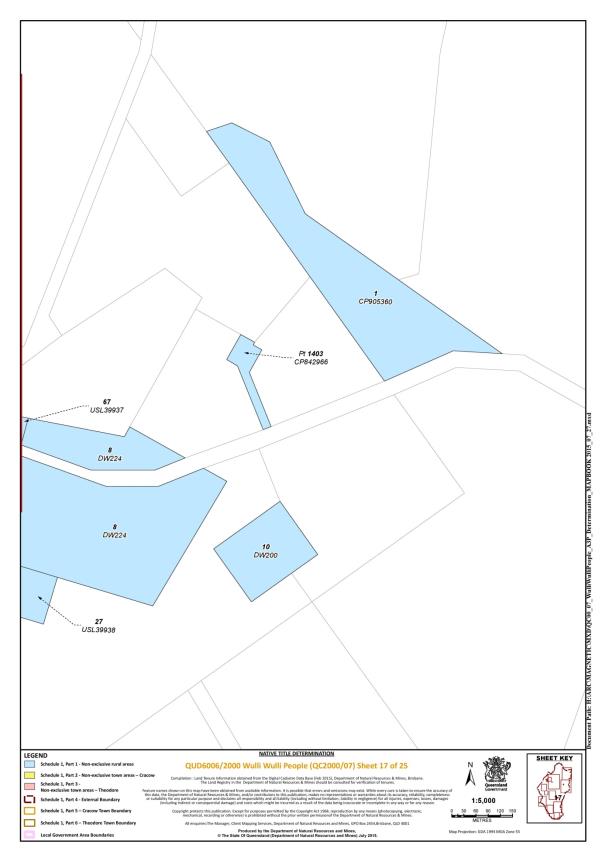
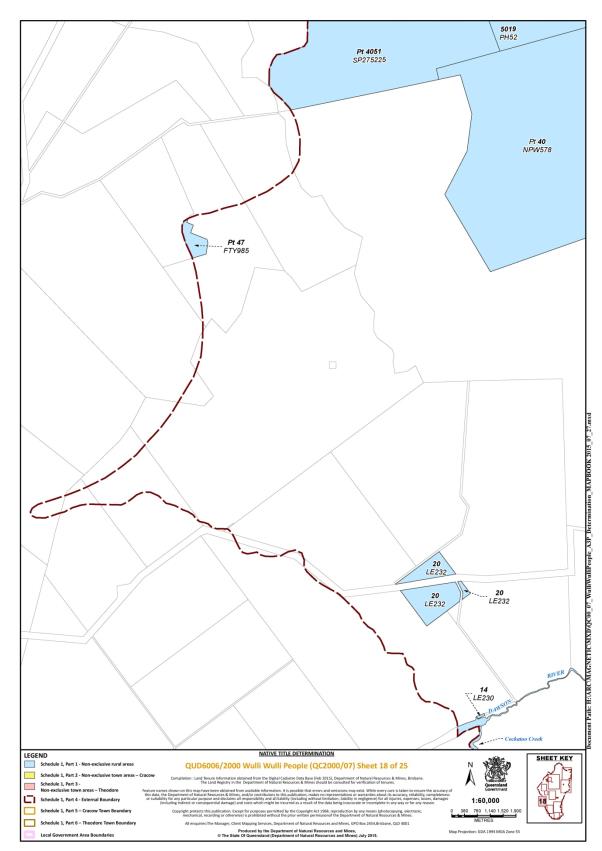
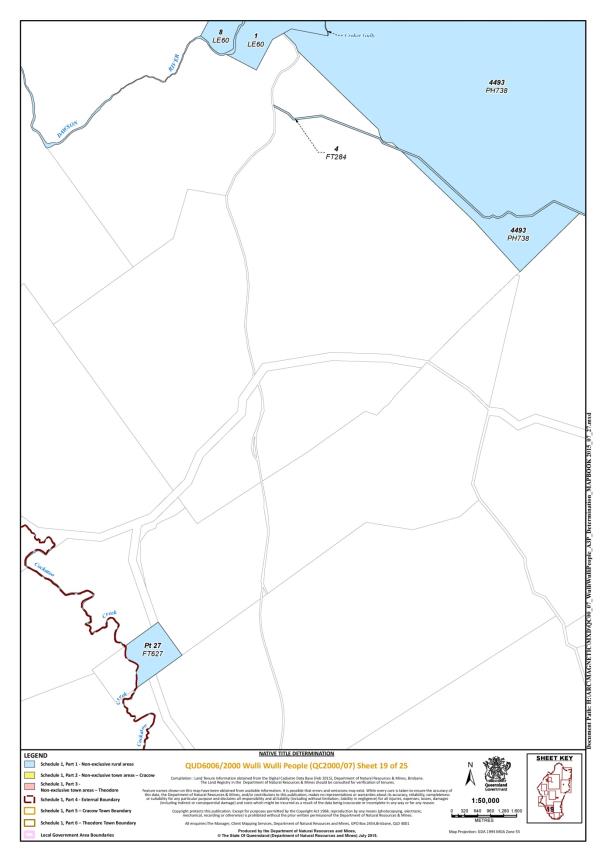
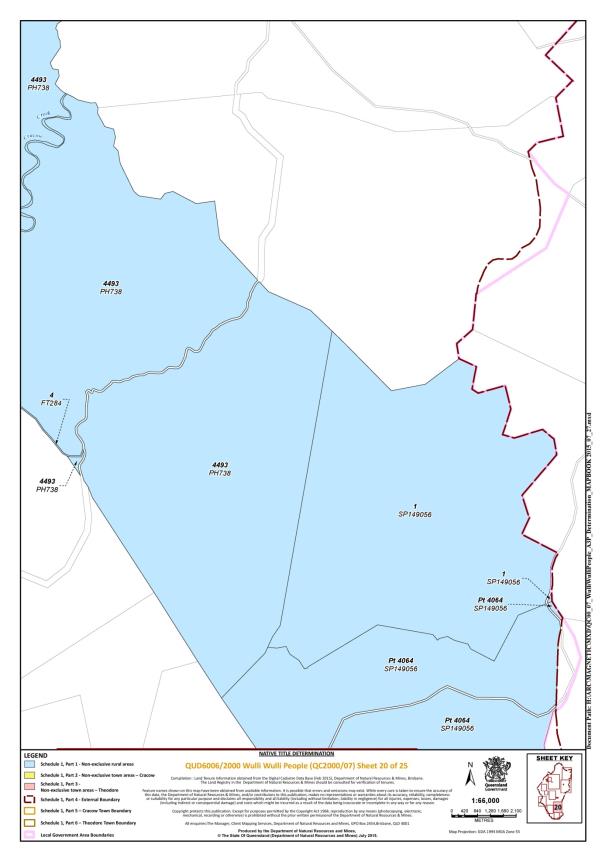
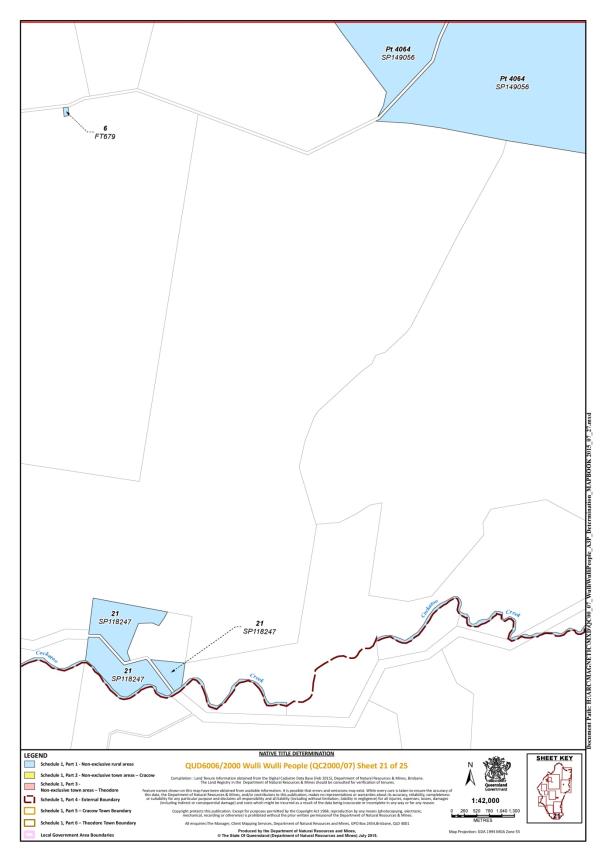
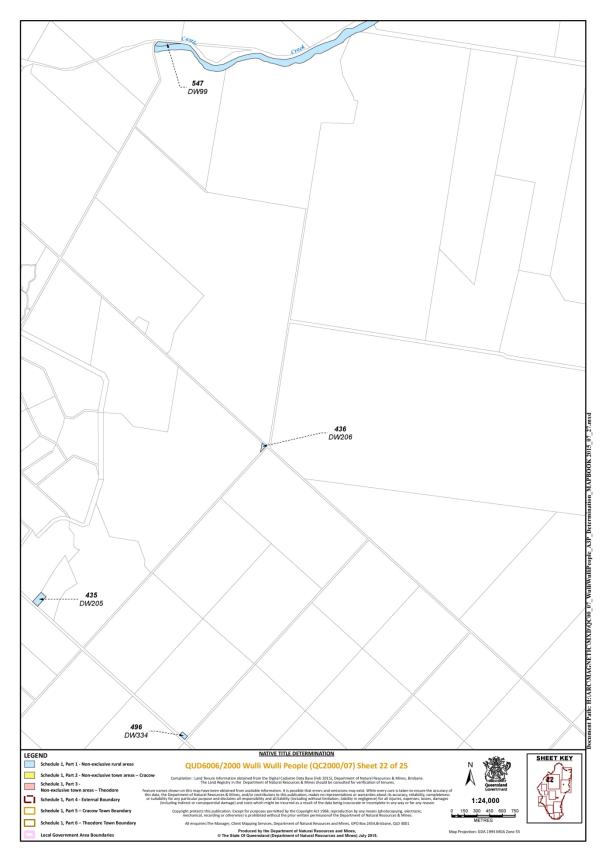

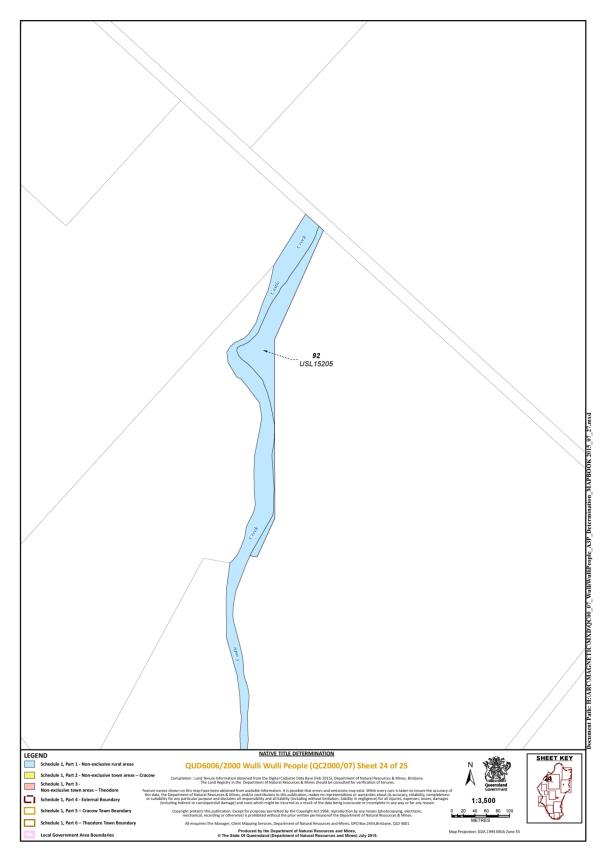
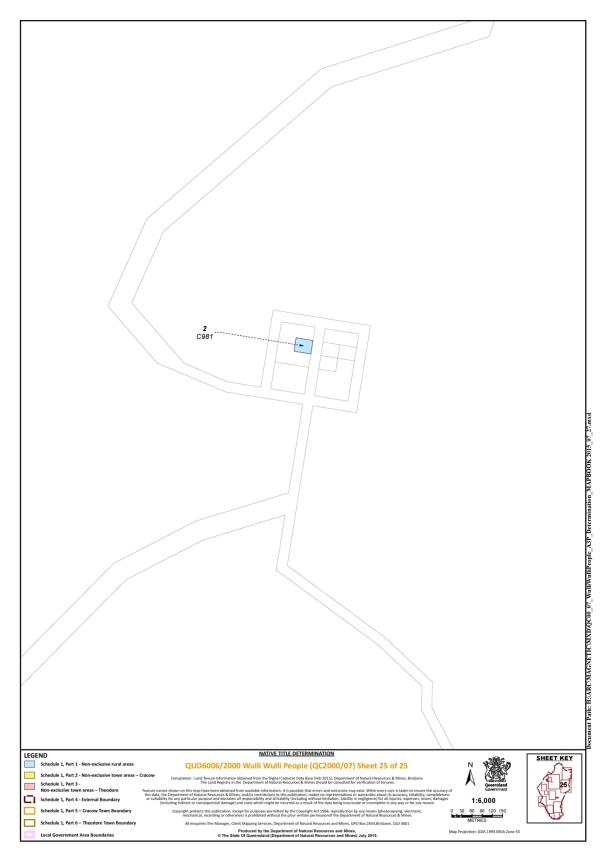
QUEENSLAND DISTRICT REGISTRY | |
GENERAL DIVISION | QUD 6006 of 2000 |
BETWEEN: | ELLIOT ANDERSON First Applicant ELIZABETH BLUCHER Second Applicant ROBERT BOND Third Applicant ROBERT CLANCY Fourth Applicant BRIAN CLANCY Fifth Applicant DESMOND DODD Sixth Applicant ANNETTE FULLER Seventh Applicant ELIZABETH LAW Eighth Applicant DREW MILLAR Ninth Applicant MARJORIE REID Tenth Applicant IVAN SALTNER Eleventh Applicant NEIL SALTNER Twelfth Applicant CELESTE WILLIAMS Thirteenth Applicant JEFFREY WILLIAMS Fourteenth Applicant JILL WILSON Fifteenth Applicant |
AND: | STATE OF QUEENSLAND First Respondent BANANA SHIRE COUNCIL Second Respondent NORTH BURNETT REGIONAL COUNCIL Third Respondent ERGON ENERGY CORPORATION LIMITED Fourth Respondent TELSTRA CORPORATION LIMITED (ACN 33 051 775 556) Fifth Respondent ANGLO COAL (DAWSON SOUTH) PTY LTD (formerly Theodore Coal (Assets) Pty Ltd) Sixth Respondent QCOAL PTY LTD Seventh Respondent SANTOS QNT PTY LTD (ABN 33 083 077 196) Eighth Respondent ANGLO COAL (THEODORE SOUTH) PTY LTD (formerly Anglo Coal (Dawson) Pty Ltd) Ninth Respondent CAMBOON RACE & RECREATIONAL CLUB INC Tenth Respondent CECILY HELEN BRADSHAW Eleventh Respondent DALE ROBERT BRADSHAW Twelfth Respondent SANDRA LEE CLARKE Thirteenth Respondent THOMAS JOHN CLARKE Fourteenth Respondent JANELLE ELIZABETH CONNOLLY Fifteenth Respondent JOHN STEPHEN CRUICKSHANK Sixteenth Respondent PENELOPE JANE FLOOD Seventeenth Respondent LURLINE ANNE GRAVING Eighteenth Respondent GYRANDA NOMINEES PTY LTD Nineteenth Respondent JUDITH ANN HAMILTON Twentieth Respondent PHILLIP VICTOR HAMILTON Twenty-First Respondent CHERYL MARY LAMB Twenty-Second Respondent STEPHEN JOHN LAMB Twenty-Third Respondent ARTHUR ANDREW MCINTYRE Twenty-Fourth Respondent CAMERON ANDREW REID MCINTYRE Twenty-Fifth Respondent MALCOLM THOMAS MCINTYRE Twenty-Sixth Respondent GORDON ROSS MUIRHEAD Twenty-Seventh Respondent MARJORIE MASON ORR Twenty-Eighth Respondent DAVID ALLAN WHITE Twenty-Ninth Respondent LOIS ANN WHITE Thirtieth Respondent ERROL JOSEPH CONACHAN Thirty-First Respondent THOMAS CHARLES MCMAHON Thirty-Second Respondent GARY THOMAS PALMER Thirty-Third Respondent KEITH DOUGLAS PALMER Thirty-Fourth Respondent |
JUDGE: | COLLIER J |
DATE: | 13 AUGUST 2015 |
PLACE: | THEODORE |
REASONS FOR JUDGMENT
1 Before the Court is a further amended native title determination application (the application) filed on 27 July 2015 pursuant to the Native Title Act 1993 (Cth) (the Act) and in accordance with orders of the Court dated 22 July 2015. The applicant is collectively Elliott Anderson, Elizabeth Blucher, Robert Bond, Robert Clancy, Brian Clancy, Desmond Dodd, Annette Fuller, Elizabeth Law, Drew Millar, Marjorie Reid, Ivan Saltner, Neil Saltner, Celeste Williams, Jeffrey Williams, and Jill Wilson on behalf of the Wulli Wulli People. The applicant has applied for a determination of native title under s 61(1) of the Act in respect of an area of land and waters covering approximately 5,432 square kilometres in central Queensland (determination area). Generally the determination area falls in the region between Tarramba Creek in the north and Cockatoo Creek in the south, and between the Auburn Range in the east and the Dawson River in the west. In the region there are two towns (Theodore and Cracow), two national parks (Isla Gorge National Park and the Precipice National Park), and pastoral properties including “Camboon”, “Glandore”, “Moocoorooba” and “Gyranda”.
2 The pleading before me is a further amended application. This reflects the fact that there have been earlier versions of this application brought on behalf of the Wulli Wulli People under s 61(1) of the Act. In summary, the procedural background to the application currently before the Court is as follows:
the Wulli Wulli native title application was filed with the Federal Court on 17 July 2000;
the claim was entered on the Register of Claims maintained by the Native Title Registrar on 6 April 2001;
on 25 July 2001 the claim was notified in accordance with s 66 of the Act by the Native Title Registrar, with a notification closing date of 24 October 2001;
subsequently the respondents other than the first respondent were joined as parties;
the Court granted leave to amend the Wulli Wulli native title application on 3 December 2009 and it again passed the registration test on 31 March 2010;
leave was granted to further amend the Wulli Wulli native title application in relatively minor particulars on 22 July 2015.
3 It is not in dispute that relevant applications, and in particular the application currently before the Court, were authorised and made in accordance with the Act. Similarly, it is not in dispute that the determination area is not the subject of any previously approved determination of native title.
4 All parties to this application are legally represented (with the apparent exception of QCoal Pty Ltd). I note that the applicant is represented by Just Us Lawyers, which has played a significant part in respect of the organisation of authorisation meetings of the native title claimant group, accumulation of relevant (and, in my view, very persuasive) evidence in support of the application, and provision of helpful submissions for consideration by the Court in respect of determination of the application.
5 On 17 July 2015 the applicant filed further submissions in support of a minute of a proposed consent determination. On 6 August 2015 the applicant filed an agreement under s 87A of the Act, signed by all parties, in which the parties agreed to the making of orders by consent granting native title to the applicant.
6 The key issues before me are:
whether the Court is satisfied that it has power to make orders in, or consistent with, the minute of proposed consent determination of native title (s 87A(4)(a) and (5)(a)); and
whether it appears to the Court to be appropriate to make the orders sought by the parties (s 87A(4)(b) and (5)(b)).
7 In my view the proposed orders are within the power of the Court, and it is appropriate for me to make the orders sought. My reasons for forming this view are as follows.
DETERMINATION AREA
8 I have generally described the determination area the subject of this application. A useful map identifying the external boundaries has been provided by the parties and is as follows:
9 The external boundaries are more specifically described in Schedule 1 of the Orders in this judgment, with more detailed maps, including those to which reference is made on the map set out in the previous paragraph.
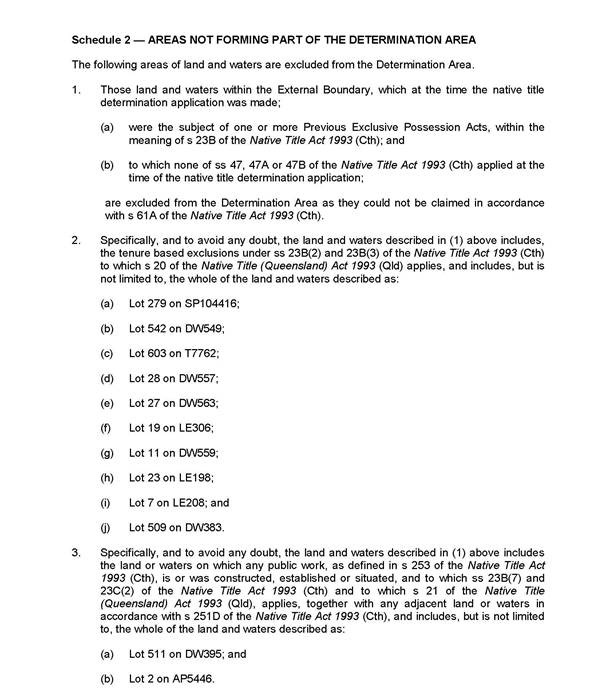
10 Also, and importantly, there are a number of areas which are excluded from native title in the determination area. These areas are those which, at the time the native title determination application was made:
were the subject of one or more Previous Exclusive Possession Acts, within the meaning of s 23B of the Act; and
to which none of ss 47, 47A or 47B of the Act applied at the time of the native title determination application.
11 The parties have indicated their agreement that these areas could not be claimed in accordance with s 61A of the Act. Those areas are more particularly described in Schedule 2 of the Orders in this judgment.
12 Further, there are a significant number of other interests in relation to the determination area (or various parts thereof) which are recognised by all parties to the application. These other interests include numerous agreements between, inter alia, members of the applicant and third parties (including respondents to this application); rights and interests of a number of the respondents under statutes including the Petroleum Act 1923 (Qld), the Mineral Resources Act 1998 (Qld), the Post and Telegraph Act 1901 (Cth) and other telecommunications legislation, the Electricity Act 1994 (Qld); and nominated rights and interests of local and State governments. Those interests are more particularly described in Schedule 4 of the Orders in this judgment.
THE NATIVE TITLE CLAIM GROUP
13 The native title claimants are succinctly described in Schedule 3 of the Orders in this judgment. They identify themselves, collectively, as the Wulli Wulli People. In the application the applicant affirms that it was authorised to make the application on behalf of the Wulli Wulli People, most recently by a meeting of the native title claim group on 27-28 June 2015 in Mundubbera. The claim group is described in the application as being persons:
1. who are recognised by other members of the claim group as being descended (which may include by adoption) from a deceased person who they recognise as having been a member of the aboriginal land holding group for the determination area. These ancestors are described in the application as “apical ancestors”; and
2. who are descendants of an apical ancestor, and identifies himself or herself as a Wulli Wulli person.
14 The claim group accepts that adoption may take place, and where adoption has occurred it confers upon the adoptee the right to identify as a member of the claim group.
15 The apical ancestors are listed in the application and Schedule 3 of the section 87A agreement as the following persons:
Tommy (father of Wonga Pope)
Jessie Fuller
Grace, the mother of Fanny Joyce
Tilly, the mother of Harry Blucher
Jack Hornet Senior, the father of Jack Hornet
Jackanapes
Thomas Clancy
Ginalene, the mother of Ernest Pope
Billy and Selina, parents of Jacob
Maria, the mother of Isabella Hooper
Amy, wife of John Bond
Rosie, the mother of John Barra
The unnamed adoptive father of Maggie McLean
Mergwin Blay
Jinnie, the wife of George Logan.
16 Extensive lay evidence has been given in this proceeding by members of the claim group. I shall examine this evidence later in this judgment. At this stage I note that there are twenty-two affidavits of members of the claim group, in each of which the deponent identifies his or her claim to be a member of the Wulli Wulli People and the basis of that claim.
17 A number of detailed expert reports have also been filed in support of this application. They are:
an historical report prepared by Dr Rosalind Kidd, dated November 2012;
a linguistic report prepared by Dr Michael Walsh, dated 30 November 2012;
an anthropological report prepared by Dr Fiona Powell, dated 30 November 2012;
an archaeological cultural heritage review prepared by Ms Susan Davies, dated 2012.
18 I shall return to consideration of these reports later in this judgment.
NOMINATION OF PRESCRIBED BODY CORPORATE
19 The parties have agreed that the Wulli Wulli National Aboriginal Corporation (ICN 8263) (WWNAC), incorporated under the Corporations (Aboriginal and Torres Strait Islander) Act 2006 (Cth), be the prescribed body corporate for the purposes of s 56(2)(b) and s 56(3) of the Act, and perform the functions mentioned in s 57(1) of the Act after becoming a registered native title body corporate.
20 On 29 July 2015 the applicant filed submissions in support of the appointment of WWNAC as the prescribed body corporate for the purposes of s 56 and s 57 of the Act, and in support of an order that native title be held on trust by WWNAC.
21 In this respect the applicant relies primarily on the affidavit of Mr Edward Besley, solicitor for the applicant, affirmed 28 July 2015. In that affidavit Mr Besley deposed, in summary:
The Wulli Wulli People resolved at a meeting held at Mundubbera on 27-28 June 2015 to establish a prescribed body corporate to hold the determined native title rights on trust for the common law holders.
He was present at that meeting.
To that end the Wulli Wulli People directed their lawyers to advise the Court, for the purposes of s 56(2)(a) of the Act, that the common law holders intended to have the native title held on trust by WWNAC.
Seven members of the claim group were elected at the Mundubbera meeting to form WWNAC’s initial board of directors. The directors indicated to the Wulli Wulli People at the Mundubbera meeting that upon its registration, WWNAC would consent to being the prescribed body corporate to hold the determined native title rights on trust for the common law holders.
The board of directors has since chosen Ms Julianne Eisemann to be WWNAC’s secretary/contact person.
The membership of WWNAC is limited to Aboriginal and Torres Strait Islander people.
The rules of WWNAC provide that its membership may comprise all adult Wulli Wulli People.
The objectives of WWNAC include:
○ to be the subject of a determination under ss 55, 57(2) and 57(3) of the Act in respect of the Wulli Wulli proceeding;
○ to perform the role and functions of an agent or a trustee prescribed body corporate in accordance with the Act and the Native Title (Prescribed Bodies Corporate) Regulations 1999 (Cth) for and on behalf of the Wulli Wulli People;
○ to become a registered native title body corporate within the meaning of the Act, and carry out its functions for and on behalf of the Wulli Wulli People; and
○ to protect, promote and manage the native title rights and interests of the common law holders as authorised by the common law holders.
22 Mr Besley deposed that WWNAC was registered by the Office of the Registrar of Aboriginal Corporations on 24 July 2015. A copy of the certificate of registration was annexed to his affidavit.
23 Further, Mr Besley deposed that on 28 July 2015 he received a letter from Ms Eisemann in her capacity as secretary/contact person for WWNAC, in which Ms Eisemann confirmed that WWNAC consented to being the prescribed body corporate to hold the determined native title rights on trust for the common law holders. A copy of Ms Eisemann’s letter was also annexed to Mr Besley’s affidavit.
ORDERS SOUGHT
24 The parties to the application have agreed on orders they seek in relation to the determination area and, as I have already noted, they have filed an agreement in writing setting out the terms of the agreement reached.
25 Importantly, the parties ask the Court to make consent orders pursuant to s 87A of the Act acknowledging that native title exists as described in the determination area.
26 The orders sought by the parties are lengthy, primarily because of the extreme – and necessary – detail required to identify the determination area over which native title is agreed. Otherwise, the orders sought by the parties include that:
native title exists in the determination area, being the land and waters described in Schedule 1 to the section 87A agreement reached by the parties.
In respect of non-exclusive areas generally: the relevant native title rights and interests are non-exclusive rights to engage in activities such as access and travel over the land; camp and live on the land; hunt, fish and gather on the land and waters; take, use, share and exchange natural resources from the land and waters of the area for personal, domestic and non-commercial communal purposes; conduct ceremonies on the area; be buried and bury native title holders within the area; maintain places and areas of importance; teach on the area the physical and spiritual attributes of the area; hold meetings on the area; and light fires for personal and domestic purposes.
In respect of non-exclusive town areas in Cracow: the members of the claim group have non-exclusive rights to access and travel over the land; gather on the land and waters of the area for personal, domestic and non-commercial communal purposes; and teach on the area the physical and spiritual attributes of the area.
In respect of non-exclusive town areas in Theodore: the members of the claim group have non-exclusive rights to access and travel over the land; hunt, fish and gather on the land and waters; and teach on the area the physical and spiritual attributes of the area.
there be no native title rights in or in relation to minerals as defined by the Mineral Resources Act 1989 (Qld) and petroleum as defined by the Petroleum Act 1923 (Qld) and the Petroleum and Gas (Production and Safety) Act 2004 (Qld).
any rights granted are subject to limitations concerning the exercise of native title rights and interests, and acknowledge that any native title rights and interests granted do not confer, inter alia, possession to the exclusion of all others.
RELEVANT LEGISLATION
27 The jurisdiction of the Court in these proceedings, being proceedings in respect of which the parties seek a consent determination, is found in s 87A of the Act. Section 87A provides as follows:
Power of Federal Court to make determination for part of an area
Application
(1) This section applies if:
(a) there is a proceeding in relation to an application for a determination of native title; and
(b) at any stage of the proceeding after the end of the period specified in the notice given under section 66, agreement is reached on a proposed determination of native title in relation to an area (the determination area ) included in the area covered by the application; and
(c) all of the following persons are parties to the agreement:
(i) the applicant;
(ii) each registered native title claimant in relation to any part of the determination area who is a party to the proceeding at the time the agreement is made;
(iv) each representative Aboriginal/Torres Strait Islander body for any part of the determination area who is a party to the proceeding at the time the agreement is made;
(v) each person who holds an interest in relation to land or waters in any part of the determination area at the time the agreement is made, and who is a party to the proceeding at the time the agreement is made;
(vi) each person who claims to hold native title in relation to land or waters in the determination area and who is a party to the proceeding at the time the agreement is made;
(vii) the Commonwealth Minister, if the Commonwealth Minister is a party to the proceeding at the time the agreement is made or has intervened in the proceeding at any time before the agreement is made;
(viii) if any part of the determination area is within the jurisdictional limits of a State or Territory, the State or Territory Minister for the State or Territory if the State or Territory Minister is a party to the proceeding at the time the agreement is made;
(ix) any local government body for any part of the determination area who is a party to the proceeding at the time the agreement is made; and
(d) the terms of the proposed determination are in writing and signed by or on behalf of each of those parties.
Proposed determination may be filed with the Court
(2) A party to the agreement may file a copy of the terms of the proposed determination of native title with the Federal Court.
Certain parties to the proceeding to be given notice
(3) The Registrar of the Federal Court must give notice to the other parties to the proceeding that the proposed determination of native title has been filed with the Court.
Orders may be made
(4) The Court may make an order in, or consistent with, the terms of the proposed determination of native title without holding a hearing, or if a hearing has started, without completing the hearing, if the Court considers that:
(a) an order in, or consistent with, the terms of the proposed determination would be within its power; and
(b) it would be appropriate to do so.
Note: As the Court's order involves making a determination of native title, the order needs to comply with section 94A (which deals with the requirements of native title determination orders).
(5) Without limiting subsection (4), if the Court makes an order under that subsection, the Court may also make an order under this subsection that gives effect to terms of the agreement that involve matters other than native title if the Court considers that:
(a) the order would be within its power; and
(b) it would be appropriate to do so.
(6) The jurisdiction conferred on the Court by this Act extends to making an order under subsection (5).
(7) The regulations may specify the kinds of matters other than native title that an order under subsection (5) may give effect to.
Objections
(8) In considering whether to make an order under subsection (4) or (5), the Court must take into account any objections made by the other parties to the proceedings.
Agreed statement of facts
(9) If some or all of the parties to the proceeding have reached agreement on a statement of facts, one of those parties may file a copy of the statement with the Court.
(10) Within 7 days after a statement of facts agreed to by some of the parties to the proceeding is filed, the Registrar of the Court must give notice to the other parties to the proceeding that the statement has been filed with the Court.
(11) In considering whether to make an order under subsection (4) or (5), the Court may accept a statement of facts that has been agreed to by some or all of the parties to the proceedings but only if those parties include:
(a) the applicant; and
(b) the party that the Court considers was the principal government respondent in relation to the proceedings at the time the agreement was reached.
(12) In considering whether to accept under subsection (11) a statement of facts agreed to by some of the parties to the proceedings, the Court must take into account any objections that are made by the other parties to the proceedings within 21 days after the notice is given under subsection (10).
28 Section 94A, to which reference is made in s 87A, provides:
An order in which the Federal Court makes a determination of native title must set out details of the matters mentioned in section 225 (which defines determination of native title).
29 In turn, s 225 provides:
A determination of native title is a determination whether or not native title exists in relation to a particular area (the determination area) of land or waters and, if it does exist, a determination of:
(a) who the persons, or each group of persons, holding the common or group rights comprising the native title are; and
(b) the nature and extent of the native title rights and interests in relation to the determination area; and
(c) the nature and extent of any other interests in relation to the determination area; and
(d) the relationship between the rights and interests in paragraphs (b) and (c) (taking into account the effect of this Act); and
(e) to the extent that the land or waters in the determination area are not covered by a non-exclusive agricultural lease or a non-exclusive pastoral lease--whether the native title rights and interests confer possession, occupation, use and enjoyment of that land or waters on the native title holders to the exclusion of all others.
Note: The determination may deal with the matters in paragraphs (c) and (d) by referring to a particular kind or particular kinds of non-native title interests.
30 It is not in dispute that the relevant notification period under s 66 of the Act has expired and that no approved determination of native title has previously existed in respect of the determination area.
31 In light of these provisions and the agreement I have identified, I now turn to the evidence before me.
EXPERT EVIDENCE BEFORE THE COURT
32 As I have already observed, a considerable volume of material prepared by expert witnesses has been filed to support the application before me. In particular, historical, linguistic, anthropological and archaeological evidence has been provided to substantiate the claim of the applicant that the Wulli Wulli People have native title rights and interests in respect of the determination area within the meaning of the Act. It is appropriate to examine this evidence in more detail.
Historical Report
33 In her historical report, Dr Kidd was asked to provide her professional opinion in respect of the following matters:
(a) When and how was the whole of each claim area, or parts thereof, first occupied and used by Europeans (“Early Settlers”) for pastoral and/or other purposes?
(b) What was written about the Aboriginal people who occupied the claim areas, or parts thereof, at that time?
(c) What was the nature and extent of the interaction between Early Settlers and the Aboriginal people who occupied the claim areas, or parts thereof, at that time?
(d) What has been the nature and extent of the interaction between Early Settlers and Aboriginal people since then and to what extent did that interaction allow members of the Wulli Wulli native title claim group (past and present) to physically occupy or access the claim areas?
(e) What impact has legislation and other events had on the ability of the Wulli Wulli native title claim group (past and present) to physically occupy or access the claim areas?
o principal factors and changes affecting Aboriginal people in the claim area;
o evidence that people remained in or near claim lands from European settlement to the present.
34 Dr Kidd writes that European explorer Ludwig Leichhardt travelled northward along the Dawson River in 1843 and 1848, and explored districts west of the Wulli Wulli claim areas in his journeys to discover a route north to near Darwin. Perhaps more relevantly for current purposes, pastoralist and explorer Henry Stuart Russell also journeyed west from Tiaro to cross the Stuart, Burnett and Boyne rivers in around 1842, and had identified these areas as prime sheep country. Russell noted in his writings at the time that the Bunnia Bunnia country was “swarming with natives”, and later leased an area on the Boyne River, calling it Burrandowan Station.
35 In relation to the areas around the Boyne and Stuart river watersheds, Henry Glover, who was a member of Russell’s party and later manager of Burrandowan Station, wrote:
I found them in considerable numbers, and have seen even four hundred men at a time, with not an old man amongst them; they are generally a fine-formed race, both men and women, many of the former six feet tall …
36 Records show that the occupation of fertile lands and waterways in the area threatened the survival of the local Aboriginal people, who began to demonstrate resistance, including armed resistance. This trend became particularly overt with the arrival in the area of brothers Thomas and Charles Archer in mid-1848. The Archers brought massive flocks of sheep, triggering intense local Aboriginal hostility. It appears that in addition to hostility to the arriving European settlers, there was also inter-tribal rivalry in the area.
37 At the same time other sheep stations were established, including Hawkwood, Juandah, Dykehead, Calrossie and Knockbreak. On Camboon Station – taken up in 1851 – there was a significant meeting ground for the local Aboriginal people, where “they carried out their initiation ceremonies” attended by hundreds of Aboriginal people from surrounding areas. Knockbreak homestead was built on a traditional track used by Aboriginal people to cross the mountains to the tribal grounds on Camboon Station.
38 From the early 1850s station owners employed Aboriginal workers as shepherds for the sheep flocks. By late 1856 the country north and west of the Dawson River was opened up to squatters, and local Aboriginal people helped chart and construct a road between Cockatoo and Cracow creeks.
39 In and from 1857 relations between the local Aboriginal people and white settlers deteriorated significantly. Aboriginal people killed two shepherds and stole sheep, and white settlers retaliated with firearms and bayonets. Eleven Europeans were killed at Hornet Bank Station. Reprisal attacks on local Aboriginal people were conducted, and Aboriginal people were massacred in attacks over a wide area. In April 1858 four non-Aboriginal people were killed, and reprisals followed, with many Aboriginal people shot.
40 Notwithstanding this extensive loss of life it is clear that an Aboriginal presence persisted in the determination area. Aboriginal labour was needed on the sheep stations, and Aboriginal camps continued on several stations during the 1870s. Records were kept of the names of local Aboriginal people, including those to whom blankets were distributed as part of government policy. Similarly, records showed that local settlers (including Mr Willie Walsh who was born at Camboon Station in 1865) knew of the local Aboriginal people as “Wuli Wuli”.
41 I note from the report of Dr Kidd, as well as the reports of the other experts, that the spelling of “Wulli Wulli” varied at different times, and included such variations at “Wuli Wuli” and “Wulili”.
42 Despite instances of removal of local Aboriginal people and camps from some stations, by the end of the nineteenth century the official trend was to encourage Aboriginal people to either move to reserves or stay on their tribal land in camps close to property head stations. Dr Kidd notes that in doing so, the Aboriginal people provided a low-cost local labour pool for pastoralists. She also notes that the regulation of Aboriginal employment between 1900 and 1970 generated detailed records, and those records give a valuable history of Aboriginal movements and family relations.
43 Examples of continuing traditions of Aboriginal people in the determination area at the beginning of the twentieth century were described by Dr Kidd as follows:
2.3.6 In 1902 it was still unexceptional for large Aboriginal groups to maintain their treks to HAWKWOOD; the DYKEHEAD diaries in mid-December 1902 note: ‘Mobs of blacks passed on their way to HAWKWOOD.’ This may be a portion of the traditional pathway which also ran past KNOCKBREAK to the ‘tribal grounds’ at CAMBOON. According to Bell, there was a large camp at HAWKWOOD at the turn of the century. One of this group would have been BILLY BUTTONS, who shared with Bloxsome’s children the story about how MOUNT NARAYEN got its name.
2.3.7 …
2.3.8 …
2.3.9 … JOHN STANLEY, one of the workers at MULGILDIE and a well-known jockey, was the last to be buried in the Aboriginal Burying Ground at EIDSVOLD. The ground was on a sand ridge beyond a clump of brigalow trees ‘on the way to the present racecourse’. Any who died at the hospital after 1910 were wrapped in sacking and also buried there to the wailing cries of circling Aboriginal elders …
2.3.10 …
2.3.11 …
2.3.12 …
2.3.13 Taroom settlement, established by the government in 1911 on a 7000 acre site on the Dawson River, was another institution receiving people sent from the stations in south-east Queensland. One of the five main camping groups comprised people from the Burnett area. Government funding for the two settlements was minimal, and in the early decades families relied on hunting, fishing and food gathering knowledge to sustain themselves. In those decades also, corroborees were regular events, as were public demonstrations of boomerang and spear throwing. These practices enabled the continuation of cultural instruction, just as languages could be maintained in the spatially detached camping areas.
(footnotes omitted.)
44 Dr Kidd details many examples of Aboriginal people being removed from stations in the area, including the names of those people removed. She notes, however, that many people “removed” to settlements simply absconded and returned to their own localities, because it was practically impossible to prevent them from walking off settlements (2.3.26). In addition to this, other Aboriginal families who were exempted from direct government control under the relevant legislation based themselves in towns in the determination area including Eidsvold. Dr Kidd notes that in 1966 there were sixty-two Aboriginal children attending the Eidsvold school, representing about thirty percent of the pupils.
45 In Chapter 3 of her report Dr Kidd sets out historical biographical detail of Aboriginal people who lived in the determination area from the mid-nineteenth century through to the second half of the twentieth century.
46 The historical report of Dr Kidd supports a finding that Aboriginal people had lived in the determination area prior to the arrival of white explorers and settlers, and that those Aboriginal people lived in an observable pre-sovereignty society.
Linguistic Report
47 The brief for the linguistic report of Dr Walsh was as follows:
(a) What evidence was there that shows certain languages were spoken by Aboriginal people in each claim area, or parts thereof, prior to and after 1788?
(b) What languages were they and how closely related are they?
(c) What evidence is there that shows that those languages have continued to be spoken?
(d) To what extent have those languages experienced change and adaptation since 1788?
(e) Who has continued to speak them and to what extent?
48 In the report Dr Walsh details his qualifications and experience, including that he has a PhD in Linguistics from the Australian National University, and has been carrying out fieldwork in Aboriginal Australia since 1972 in many parts of the country. I am satisfied that Dr Walsh’s expertise is such that the Court can comfortably accept the contents of his report as expert evidence.
49 Dr Walsh observed that numerous commentators had placed the languages associated with the claim area in a Waka-Kabic Group of languages or its near equivalent. Accordingly “Wuli Wuli” is usually classified as a subset of a larger grouping which includes Waka Waka, and that grouping may also be called “Waka Waka”. Dr Walsh referred to maps prepared by linguists including Schmidt (1919) and Tindale (1940) in which Wuli Wuli was identified as a language.
50 At paragraph 47 of his report Dr Walsh observes:
For the purposes of this report what is important is that claimants assert that Waka Waka and Wuli Wuli have distinct territories and as forms of speech they are similar but distinct. Agnes Hoehne’s affidavit at para 17 emphasises that these languages have distinct territories:
I don’t claim my father’s country and I don’t claim to be Wakka. I follow my mother who was a Wulli Wulli woman. I was reared in Wulli Wulli country and that is where I belong. I know this because my mother told me this. And I know that country. My blood belongs to that country and that country knows me.
At para 28 she indicates the linguistic distinctiveness: Wulli Wulli and Wakka Wakka are a little bit like each other and also a little bit different.
51 In considering the linguistic aspects of the culture of the determination area, Dr Walsh reached conclusions which can be summarised as follows:
Despite the plethora of labels and the variety of mapped representations, the languages and their locations in and around the claim areas are generally consistent and have remained stable (at [56]).
It is reasonable to assume that the locations of group territories in the Wulli Wulli claim areas have remained constant (at [58]).
The known sources of language documentation for Waka Waka vary in quality (at [63]).
Reverend John Mathew clearly distinguished between Waka Waka and Wuli Wuli (at [66]). The Reverend Mathew lived in the area for six years from 1865, and his work is generally well-regarded and seen as valuable early documentation of a number of languages based on long term contact.
Numerous surveys and reports on the current state of Australian languages indicate that the majority of languages are no longer spoken as a matter of course by children. Often the only speakers left are at an advanced age and even those few speakers do not use the language on a day to day basis. Statistics on numbers of speakers vary considerably and need to be treated with caution (at [75]).
Most Aboriginal people in the determination area know only a relatively meagre amount of the Wulli Wulli language. This is an expected outcome of dislocation from traditional territory, a lesser use of traditional language and increasing preoccupation with non-Aboriginal concerns. In situations of language decline it is not uncommon for people to mix words together from what would once have been separate linguistic varieties. People do however distinguish differences (at [82]).
There are many people who identify as Wulli Wulli, some as Djakunda and some have multiple identities. That identity is based not so much on language knowledge and use, as on language ownership and acceptance of that ascription by others (at [85]).
Like most Aboriginal languages in the more settled parts of Australia there has been considerable language attrition among languages in and around the claim areas. These languages have adapted to new conditions by taking in loan words from English. Boundaries between dialects are not as strong as they once were and some Aboriginal words have been ingested into English (at [91]).
52 Importantly for the purposes of this judgment, Dr Walsh also concluded at [93] that there is ample evidence from the late 1880s as to which languages were spoken in the claim areas, and it could reasonably be supposed that this regime goes back to 1788 and earlier.
Anthropological Report
53 The anthropological report of Dr Fiona Powell has been prepared on the basis that it is confidential and subject to legal professional privilege. Notwithstanding this, it is both necessary and appropriate that I make reference to a number of the findings of Dr Powell in considering the application before me.
54 I note that Dr Powell is a very experienced anthropologist, whose doctoral research culminating in a PhD in 1976 investigated developments in the social organisation of Aboriginal society in south-east Cape York in Queensland. Dr Powell has provided advice on native title matters in Torres Strait, New South Wales, Queensland and Western Australia. In preparing this report she gathered information from a wide range of published and unpublished written materials as well as oral history information.
55 The instructions to Dr Powell are in Appendix E of her report. I note that the instructions are lengthy and detailed. On comparison of the instructions with her report I am satisfied that she has prepared a report in response to those instructions. In so commenting, I also note that Dr Powell’s report deals with not only this claim, but the native title claim in Wulli Wulli People #2 QUD 311/2011. Accordingly her research extends past matters specifically relevant to this application. In considering her report I am, of course, only concerned with the application before me.
Pre-sovereignty occupation
56 Dr Powell states that following the expedition by Ludwig Leichhardt in 1844 the first pastoral leases in the area were selected in 1845, and European occupation commenced in the area around 1847. The Burnett district was gazetted in 1848. It follows that although British sovereignty over the lands and waters of eastern Australia was declared in 1788, effective sovereignty in the determination areas occurred in approximately 1849-1850 by which time the land throughout and around this region was occupied by pastoralists and their large flocks of sheep.
57 During his expedition in 1844, Leichhardt travelled through Dawson River country and observed evidence of Aboriginal habitation of the region. A subsequent explorer, Christopher Hodgson, had contact with the local indigenous people in 1845, and wrote in respect of one group of people:
With them their gins and piccanninies, opossums and other food. We kept them at a distance of fifty yards, having determined to spell before making our forced marches. They remained with us the whole day, and in the evening came down painted and variegated after different fashions and colours. I gave them some flour, and made signs to them that we intended to leave a large portion of our stores under a certain tree until our return … we prepared to sleep but the noise of singing kept us on the “qui vive” … it was an unpleasant time, but we had not the remotest foundation for suspecting their intentions were hostile; in fact their whole line of conduct was only that of people curious to see all that was to be seen, without giving offence … The gins were covered with kangaroo cloaks branded with fantastical figures and signs, all of which were representations or memorials of some ancient custom.
58 Hodgson also remarked on the firing of the country by the local people – an issue further noted by explorer Robert Miller. Miller had travelled up the Boyne River and described the reactions of the indigenous people when encountered, their burning of country, their hunting and fishing activities, their use of bark to construct huts and several camps of varying sizes.
59 Dr Powell is of the view that these mentions of Aboriginal people and/or evidence of their presence in areas at the periphery of the determination area indicate that it is most probable that indigenous people also inhabited the surrounding region. She notes that archaeological research supports that opinion, and referred to research of Ms Susan Davies who has also provided an expert report. Dr Powell gives the opinion that the first contact and archaeological records indicate the probability that the indigenous inhabitants of the determination area were living an organised life.
South-east Queensland
60 Dr Powell refers to early records about a cultural bloc in south-east Queensland, identified as the “Dippil nation” in or about 1898, and later described as a “Kabi Type” of social organisation. This bloc was characterised by named moieties, a number of sections/marriage classes, and a tribal kinship of marriages. Dr Powell notes evidence of a number of marriages contracted by Wulli Wulli People in accordance with these tribal rules. She considered that this evidence indicated that the indigenous inhabitants of the determination area were subject to Kabi Type laws and customs, and that these laws and customs continued to be practised by the predecessors of the Wulli Wulli People for at least a century after the date of effective sovereignty in the determination area.
61 Dr Powell considers that the religious beliefs of indigenous people in this cultural bloc could be described as totemism. This meant veneration of the interconnectedness of humans and particular fauna, flora, topographical formations and the elements, as well as sacred beings such as a Creator, the Rainbow Serpent and other spirits. In her research Dr Powell found that belief in these spirits was widely held by the Wulli Wulli People, and that particular men and women were believed to have a special relationship with the religious realm.
62 Records show that indigenous people would regularly travel on a well-defined track in the determination area, between the Auburn and Dawson regions, and through country of the Auburn Range near the homestead on Knockbreak station, to attend corroborees at Camboon. Records also showed that it was customary for groups in the area to combine not only for initiation ceremonies, but also for dispute settlement, trade and bunya harvesting. Settler records from the region report that men from the determination area and its surrounds would raid other areas for wives, for example:
67. Mr D.C. McConnel of Cressbrook, Toogoolawah, Queensland, formerly of Auburn and Glenhaughton stations, quotes West as saying that there was a war between the Bunya Mountains blacks and the Auburn River blacks at one time. ‘The Bunya Mountain blacks came into Auburn River territory and killed most of the males of the tribe. However the Bunya blacks were pushed back into their own territory. ‘The Auburn blacks joined with the Dawson blacks because of the shortage of males and had a big rejoicing of the victory in the area near Glenhaughton. (Reid 1982: 56-57).
63 So far as concerns a tenurial system of land, Dr Powell refers to evidence that the system was characterised by sets of land-holding peoples, whose territorial boundaries were maintained and recognised, and whose members relied upon their respective territories to sustain themselves.
Languages associated with the determination area
64 Dr Powell’s research found that records associate the determination area with languages of the type identified as Barunggam, Djakunda, Gureng-Gureng, Waka-Waka and Wuli-Wuli, and that of these languages the two with the greatest longevity and broadest geographical extent are Waka-Waka and Wuli-Wuli/Wulili. Her research shows that a wordlist of the Wuli-Wuli language may first have been recorded in about 1885, and that this language is associated with, inter alia, Walloon, Camboon and the Dawson River in the determination area.
65 Dr Powell’s consideration of linguistic records found that the name “Wulli Wulli” derives from the repetition of the pronoun “wuli” meaning “they”, which is unique to the Wulli Wulli language. She observes that there are few reports about “Wuli-Wuli” or variants, and that this shows that “Wuli-Wuli” has more than one meaning and may be used to signify the name of a language and/or group and/or area associated with that language and/or its speakers.
66 Dr Powell’s research of languages and language countries associated with the determination area found that the majority of the Wulli Wulli claimants identify the determination area and themselves as Wulli Wulli. They also claim ownership of the Wuli-Wuli language, notwithstanding different levels of competency amongst them with respect to their knowledge of and use of the language by themselves and their immediate forebears. She found that Wulli Wulli claimants regard the Wuli-Wuli language as belonging to the region covered by (materially) this application. While there were other languages associated with the claimed area, the Wuli-Wuli/Wulli Wulli language seems to have the most extensive and enduring stability in relation to the region.
Traditional lands of the Wulli Wulli People
67 Dr Powell considers that, based on her consideration of available materials, Wulli Wulli traditional country included some of the western Upper Burnett region; that the Nogo River may have been significant in marking the north-easterly bounds of Wulli Wulli country, the Burnett and Boyne Rivers the south-easterly boundary, the Great Dividing Range the southern limits and the Dawson River the north-western limits. Wulli Wulli country extended east and west of the Auburn range.
Pre-sovereignty laws and customs of the south-east Queensland cultural bloc
68 Dr Powell writes extensively on this topic in her report, including in the context of the determination area. Key points may be summarised as follows:
The indigenous people lived in family groups which combined together at certain times and places.
The most common way members were recruited to land-holding groups was through filiation. Although patri-filiation may have been predominant in circumstances where, for example, a marriage broke down – resulting in custody of the children of the marriage vesting in the father’s family – matri-filiation was also important in the system of naming the children. Totems were also inherited from the mother’s side. Evidence indicated that marriage with a person of the same totem was forbidden, as was marriage with a member of one of the associated totems.
Members of pre-sovereignty land-holding groups were entitled to exercise core proprietary/beneficiary rights in relation to the territory of the land-holding group to which they were affiliated, and to particular places and resources within that area. Those core rights were occupation and economic rights, control and management rights, rights concerned with speaking for the country and maintaining the cultural estate, and rights to determine membership of the land-holding group and resolution of disputes among members.
Marriage gave spouses access to their inlaws’ country and its resources. These rights were not automatically transferable to the holder’s descendants. Otherwise, members of land-holding groups could access areas held by other groups depending on affiliations to totemic matri-groupings, whose members were distributed throughout the region.
Rights and interests would have derived from responsibilities held in relation to particular totemic sites, which may have been located outside the territories of some totemites. It is likely that members of pre-sovereignty society had rights mediated through factors such as marriage, totemic affiliation and/or ceremonial links to areas or resources or particular places in territories controlled by others.
The native title claim group
69 In summary, Dr Powell found that the Wulli Wulli People comprise a set of cognatic descent groups whose members are descended from identified apical ancestors. By way of introduction to her discussion, Dr Powell writes:
182. Consistent with the system of laws and customs pertaining to this region, membership of Wulli Wulli People is based on the following criteria:
a) Descent from one or more apical ancestors who are recognised as belonging to the Claimed Areas. The claimants refer to this descent as having a “blood line to country”;
b) Self-identification; and
c) Recognition by others of this connection and this identification.
70 To support this opinion Dr Powell quotes from the affidavit of one of the native title claim group, Mr Harold Chapman, as follows:
5. … My biological father Percy Saltner was a Wulli Wulli man and I follow him and claim my country through his side because he always claimed me as his son and his side of my family always claimed me. That is how a person is recognised as a Wulli Wulli. You have to be recognised by Wulli Wulli as born into a Wulli Wulli family.
…
8. … Under blackfellow law, you have a choice. You can follow your mother’s side or father’s side. Once you make your choice, you should stick to it. I follow my father’s side because he claimed me and his side of my family has always claimed me.
71 Dr Powell also noted that some claimants self-identify as Wulli Wulli on the basis of their ownership of the Wuli-Wuli language, however while this is not a basis for asserting membership of the Wulli Wulli People it is one of the criteria underpinning why some people self-identify in this way.
72 The primary means of identification as a member of the claim group being descended from named apical ancestors, Dr Powell notes that the dates of birth of those ancestors:
were officially recorded for only two of the ancestors (Thomas Clancy and Jessie Fuller);
were otherwise based on records pertaining to the ancestors themselves, or records kept by or oral history of their descendants;
in the case of half of the apical ancestors – predated effective sovereignty; and
in the case of most of the remainder – occurred during the immediate post-sovereignty period.
73 In Dr Powell’s view, the list of apical ancestors who describe the application before the Court is comprehensive, and includes all those ancestors who have been identified through the written records and/or oral tradition as having an association with the land-holding group for the determination area.
74 Dr Powell also sets out summary accounts of the groups descended from the apical ancestors, including detailed genealogical information.
Acknowledgement of laws and customs
75 In her report Dr Powell said that, according to the available research, the claimants acknowledge and observe laws and customs that relate to the ownership of the determination area. Dr Powell referred to lay evidence in this proceeding, and noted that claimants refer to this system of laws and customs variously as “blackfellow law”, “bloodline law”, “our rules/law”, Wulli Wulli law and custom, and Aboriginal law and custom. More specifically, Dr Powell wrote:
302. My consideration of these statements about “blackfellow law” or “bloodline law” and the information in the ethno-historical records about the pre-sovereignty society laws and customs that pertained to the ownership of land found that both systems are based in principles of filiation and descent …
303. I found evidence of the continuity of the principles that underlay the pre-sovereignty society laws and customs firstly in the claimants’ acknowledgment that those who are descended from the pre-sovereignty inhabitants of the Claimed Areas have the right to assert proprietary rights to the Claimed areas. It does not suffice that an ancestor has a long historical association with one or the other of the Claimed Areas. What is required is that, irrespective of the length of his/her historical association with the Claimed Areas, the ancestor in question is recognised by others so descended and/or similarly connected the [sic] Claimed Areas, as originating from the Claimed Areas …
304. I have observed several instances where claimants exercised their law and custom in relation to land-related matters. These have occurred with respect to the selection and deployment of Walkers for various cultural Heritage and Site Clearance Projects. Only those who are descended from an ancestor who is recognised as an ancestor for the Claimed Areas are eligible to work as a Walker for projects in the Claimed Areas …
(Footnotes omitted.)
Continuity of laws and customs
76 Dr Powell said that her research found evidence that claimants have continued to uphold the laws and customs pertaining to the Aboriginal ownership, access and use of the land according to rules taught to them by their old people. Dr Powell noted that the older Wulli Wulli claimants continue to teach their younger people what they themselves learned from their parents and grandparents, in particular to respect old campsites, bora rings, burial places, water wells, quarries, rock art, sacred waterholes and any artefacts found during site clearance and Cultural Heritage work.
77 Her research found that as the local – and mostly unpaid – workforce for pastoralists, the claimants’ forebears had uninterrupted access to their traditional lands, and for successive generations sustained themselves by traditional hunting and gathering. Significantly Dr Powell continued:
306. … Station work was usually seasonal and poorly recompensed. Claimants state that their families always had to supplement station rations with traditional hunting and gathering, and in off-seasons, subsist completely through hunting, fishing and gathering. Older claimants state that they and their parents and grandparents undertook these activities following traditional practices, but also taking advantage of changes in tools and technology. Thus, rifles eventually replaced spears and steel axes the stone axes and so on. However, the wealth of traditional knowledge about the habits of fish and animals, and the how, when and where to hunt, fish and gather was relied upon to obtain such bush foods. The claim group includes middle-aged and elderly persons who spent their youth in the Claimed Areas and who themselves grew up subsisting in this manner, and who now pass this traditional knowledge and these skills to their own children and grandchildren.
(footnotes omitted.)
78 Dr Powell’s further findings in respect of this issue can be summarised as follows:
The history of physical connection has enabled successive generations of descendants to maintain their spiritual attachments to their country and, to a certain extent, to maintain and protect its sites.
Particular topographical features, including some mountains and waterholes, are regarded as sacred, which means that access to and information about them is restricted. In respect of these places the claim group Elders learned the location of these places from their parents, and in turn warn younger people to show respect.
The transmission of knowledge and connection through successive generations has occurred within limits imposed by European ownership of the land. This is particularly so on those properties where the station owners have long and amicable relations with the region’s indigenous people, and hold (and have held) an appreciation of indigenous connection to the land.
There are similarities between the pre-sovereignty and contemporary tenurial systems, in that both rely upon filiation and cognation to identify those who have the right to succeed to rights and interests in the land and waters of the native title group. In Dr Powell’s view this indicates that, since the time of pre-sovereignty, there has been continuity in the land tenurial system.
The primary mode of transmission of laws and customs has been tuition by parents and older relatives of younger members of the group. Dr Powell noted that claimants believe that those who transgress the rules in relation to traditional laws and customs risk incurring serious punishment to themselves or close family members.
79 I consider significant Dr Powell’s view that she found no evidence of changes to the principles that underlay the traditional laws and customs of the pre-sovereignty land-holding group that relate to the ownership and use of land – in particular, that only those who are rightfully connected to the land as set down under traditional laws and customs are entitled to assert a proprietary or beneficial right to the determination area. One example of these principles is that claimants continue to uphold totemic affiliations, and believe that their totems protect them.
80 Dr Powell did, however, find evidence of adaptation of some traditional practices, resulting from changes to the socio-economic and political conditions experienced by descendants of the pre-sovereignty population. Examples of such changes arise from legislative restrictions on access to fire arms to procure traditional game, and the lighting of fires in public areas. Further, whereas in past times indigenous people may have gathered because of traditional ceremonial events, today events such as sports meetings, local Shows, and Indigenous Land Use meetings provide occasions for the claim group to assemble.
Rights and interests claimed
81 Dr Powell notes that the native title claimants assert the following rights and interests:
a) The right to live on and be present on the area;
b) The right to take, use, share and exchange Traditional Natural Resources for personal, domestic and non-commercial purposes;
c) The right to conduct burial rites;
d) The right to conduct ceremonies;
e) The right to teach on the area about the physical and spiritual attributes of the area;
f) The right to maintain places of importance and areas of significance to the native title holders under their traditional laws and customs and protect those places and areas from physical harm;
g) The right to light fires for domestic purposes including cooking, but not for the purpose of hunting or clearing vegetation;
h) The right to be accompanied into the area by non-claimants being
• People required by traditional law and custom, for the performance of ceremonies and cultural activities and
• People required by the claimants to assist in observing or recording traditional activities on the area;
i) The right to take and use Traditional Natural Resources from the water for personal, domestic and non-commercial communal purposes; and
j) The right to take and use the water for personal, domestic and non-commercial purposes.
82 In examining these traditional rights and interests, Dr Powell concluded that the native title claimants continue to exercise and enjoy those rights and interests. In summary, Dr Powell observed:
The rights and interests held by claimants under their traditional laws and customs are generally communal, although certain families and individuals are acknowledged as having associations with certain places and areas that entitle them to be consulted over how they are accessed and/or used.
Affidavit evidence of native title claim group members demonstrates that claimants exercise their claimed native title rights and interests, but do so in various ways, depending on factors such as age, knowledge, physical condition and place of residence. Other factors affecting the exercise of those rights include subdivision and fencing of pastoral leases, location of public access areas, and access protocols with pastoralists.
Ways in which claim group members continue to exercise rights and interests include:
○ enjoying a physical and spiritual connection to the determination area (“belonging to country”);
○ participating in social and cultural events which re-affirm their bonds as Wulli Wulli People; and
○ taking pride in the part played by their ancestors in the history of the determination area.
Continuity of connection to the determination area
83 Dr Powell states that claimants’ genealogies, the written records, and claimants’ oral histories demonstrate that successive generations of the claimants’ predecessors have lived in the determination area and have sustained themselves from its natural resources. Her research also supports a finding that the claimants continue to maintain their connections to the determination area through regular visiting, active participation in caring for its sites of religious and other significance, and hunting and gathering whenever the opportunity arises. Following incidents in the 1850s, where settlers were killed, there were many instances of massacres of indigenous people (including children) in the determination area by settlers. Evidence suggests that the authorities stepped in to bring a halt to this slaughter in the 1860s.
84 Dr Powell also notes that the predecessors of some claimants were removed to government settlements, such as Barambah, Purga, Taroom, Woorabinda and Cherbourg, but that while a few of those people who were removed remained at those settlements, many others returned to their own country. On the other hand, most of the claimants’ forebears were not removed from Wulli Wulli country, but rather lived in camps. Many became workers in the pastoral industry, but continued hunting and gathering to sustain themselves.
85 Further, while the ancestors of claimants may have lived on pastoral properties and only occasionally visited towns in the determination area, the pattern today is reversed. In current times, claimants primarily live in towns either in the determination area or close by, and visit pastoral properties for short periods to engage in such activities as procuring bush food and medicines, and teaching younger relatives about their history and connections.
86 While the subdivision and fencing of properties has caused some impediments to claimants to access their traditional lands, Dr Powell notes that claimants have developed access protocols with pastoralists with whom they have longstanding relationships.
87 Dr Powell concluded:
471. When the evidence in the regional and local ethno-historical and linguistic materials and contemporary evidence are considered together, the weight of the evidence, in my opinion, shows that the claimants maintain the traditional laws and customs that relate to the ownership, access, care and use of the Claimed Areas. In my opinion, the claimants’ contemporary laws, customs and practices, and their interactions with other groups in local and regional affairs, demonstrate continuity of acknowledgement and observance of their traditional laws and customs.
Archaeological cultural heritage review
88 The report of Ms Davies has been prepared on the basis that it is confidential with restricted access. Notwithstanding this it is both necessary and appropriate that I make reference to a number of the findings of Ms Davies in considering the application before me.
89 I have examined the curriculum vitae of Ms Davies. I am satisfied that Ms Davies is a very experienced archaeologist, and that her work has included cultural heritage assessments, archaeological fieldwork and managed cultural projects over many years. I accept Ms Davies’ report as authoritative and persuasive.
90 The brief for the report required the following issues to be addressed:
• what evidence is there that each claim area, or parts thereof, were occupied and used by Aboriginal people prior to and after contact (approximately 1845);
• does the evidence referred to above indicate that each claim area, or parts thereof, were used for specific purposes or for certain activities, and if so, what were they; and
• describe and show the location of areas referred to above by reference to a map and relevant geographical features.
91 Like Dr Powell’s report, I note that Ms Davies’ report also deals with the native title claim in Wulli Wulli People #2 QUD 311/2011. Accordingly her research extends past matters specifically relevant to this application. In considering her report I am, of course, only concerned with the application before me.
92 Ms Davies’ report is very detailed. In relation to the tasks she was requested to undertake, her results can be summarised as follows:
Ms Davies reviewed a total of 48 archaeological assessment reports, two anthropological reports, three reports discussing other research, five books and two manuscripts. This review provided ample evidence of indigenous occupation of the determination area prior to and after approximately 1845.
The evidence indicates that occupation of the determination area by indigenous people was extensive, and in some areas intensive.
Only a very small percentage of cultural heritage sites within the area have been dated. Based on the presence of particular artefact types a relative date of occupation may be ascertained, indicating that occupation may have commenced prior to 10,000 years ago and continued into the contact and post-contact periods.
The rock art sites within the general area also conform to this time period. There is a relatively lower percentage of rockshelters/art sites within the determination area than in contiguous areas. This is possibly because the determination area does not feature rugged terrain where rockshelters/burials/art sites would occur.
Recordings of archaeological sites in the determination area are primarily the result of archaeological surveys for proposed development locations.
Archaeological sites in the area, pre-contact and post-contact, include:
○ burial grounds
○ earthen and stone arrangements
○ fringe camps
○ grinding grooves
○ hearths/earth ovens
○ quarries/raw material source areas
○ reserves
○ rock art
○ rock shelters
○ scarred trees
○ shell middens/scatters
○ station camps
○ stone artefact scatters
○ wells
Cultural site types in the area, pre-contact and post-contact, include:
○ birthing place
○ dangerous places
○ mythological/spiritual sites
○ massacre sites (post-contact)
○ pathways and travel routes
○ resources and good food places
○ story places
○ women’s places
Of those sites, Ms Davies concludes that knowledge would have been passed from the pre-contact period to the post-contact period.
The results strongly indicated that the terrain within the area was used for the placement/establishment of a variety of sites representing extensive and intensive occupation, from pre-contact to after non-indigenous settlement of the region.
Within the archaeological sites there are a variety of stone artefact types present, including flakes, flaked pieces, broken flakes, cores, grindstone and other implements, as well as wooden artefacts including message sticks, boomerangs, shield and digging sticks. Ms Davies concludes that these artefacts are indicative of a wide range of subsistence and other activities being undertaken within the area, including:
○ gathering food and other resources
○ food processing
○ hunting
○ manufacture of material cultural items
○ maintenance of material cultural items
○ ceremonial activities
Very few sites would have been used for one specific purpose – for example:
○ rockshelters were used for camping, art and the placement of burials;
○ within stone artefact scatters, fire places were constructed, stone artefact manufacture occurred, food was processed and consumed, and wooden artefacts manufactured and maintained.
An example of a site or place with multiple and interrelated purposes was Camboon: mythological, resources, ceremonial, meeting place, art, burials, pathway, historic camp.
93 Ms Davies concludes:
The site types (and material cultural items within some site types) support the premise that there is an extraordinary wealth and diversity of Aboriginal cultural heritage within the Project Area. On the basis of this diversity the Project Area can be interpreted as a landscape in which social, economic, ceremonial, religious and ritual components are all present; all these values are integrated/connected as part of a cultural landscape which was utilised/occupied from pre- to the post-contact period.
94 In my view this is a reasonable conclusion to draw based on the researched findings.
Lay evidence filed in support of the application
95 Affidavits in support of the application have been affirmed by members of the native title claim group, namely:
(1) Mr Jeffrey Hooper Williams, affirmed 6 June 2013.
(2) Mr Edward James Fuller, affirmed 23 May 2013.
(3) Mr Stephen Joseph Collins, affirmed 23 May 2013.
(4) Mr Thomas Anthony Blucher, affirmed 10 May 2013.
(5) Mr Drew Keith Anthony Millar, affirmed 28 November 2012.
(6) Mr Brian Allen Clancy, affirmed 27 November 2012.
(7) Mr Kevin Leonard Clancy, affirmed 26 November 2012.
(8) Ms Daphne Jill Wilson, affirmed 23 November 2012.
(9) Mr Alick James Saltner, affirmed 20 November 2012.
(10) Mr Rodney Wayne Fuller, affirmed 2 September 2012.
(11) Mr Rodney James Dodd, affirmed 2 September 2012.
(12) Ms Margaret Francis Hure, affirmed 23 August 2012.
(13) Mr Harry Thomas Blucher, affirmed 9 August 2012.
(14) Ms Elizabeth Patricia Law, affirmed 9 August 2012.
(15) Mr Harold John Chapman, affirmed 8 August 2012.
(16) Ms Rose Margaret Dodd, affirmed 31 March 2012.
(17) Ms Pamela Judith Blucher, affirmed 30 March 2012.
(18) Ms Agnes Hoehne, affirmed 2 March 2012.
(19) Mr Leonard John Clancy, affirmed 2 March 2012.
(20) Mr Douglas Graham Hoehne, affirmed 2 March 2012.
(21) Ms Audrey Jane Clancy, affirmed 2 March 2012.
(22) Mr Robert Arnold Bond, sworn 22 February 2012.
96 The affidavits of these witnesses make fascinating reading. There is much commonality in this evidence in relation to such matters as respect for Elders and old people, the importance of family, bush tucker and bush medicine, hunting and gathering, spirits and totems, relationships within the family and the relationship of the Wulli Wulli People with their country. A persuasive case for the reliability of this evidence can be seen in the fact that all of the experts, to varying degrees, rely on evidence of these deponents.
97 Another deponent, Mr Ernest Bell, who affirmed an affidavit on 17 November 2012, is the grandson of James TM Bell who acquired the Camboon pastoral lease in 1875.
98 It is useful to highlight some of the evidence from each of these witnesses.
Mr Jeffrey Hooper Williams
99 Mr Williams is a Wulli Wulli man, a descendant of the apical ancestor named Rosie, and is the grandson of her son John Barra, who was a stockman. After he completed his schooling Mr Williams joined his father working as a stockman and ringer. Mr Williams deposed that his parents and grandparents taught him that being a descendant of a traditional owner like his grandfather meant that he had certain rights and interests in his country which other people did not have. Those rights included the right to go on to his ancestors’ country, visit places of significance to them, stay there and take bush tucker and bush medicine if he wanted. He gave evidence as to traditional laws and customs, including the following:
10. … Elders such as my parents, grandparents and Aunties and Uncles have authority because of their age and knowledge. My parents told me to never walk in front of an Elder, avoid eye contact and don’t step over their swag or their legs if they are sitting on the ground. It was also a rule that we were not allowed to sit on beds or tables. When I was growing up, the number one rule was to respect your Elders. They told me what I could do and what I could not do on our country and how to behave properly. They told me I could only take what I needed from our country to get a feed, but to leave enough for next time. They taught me not to be greedy, to let the country replenish itself. They also told me to not take anything from the country unless given by an Elder. The general rule I was taught is to “look but not touch”, especially when it comes to places such as burial places, ceremonial grounds and other special places.
11. I was shown by my father where certain important places are in Wulli Wulli country. For example, I know the location of bora rings on Appletree, Piggott, Hawkwood and Hainault stations. I have also been told by my father that there are more on other stations in our country such as Camboon, Gyranda and Knockbreak. He told me that these are places where initiation and other ceremonies took place in the past. As such, they are important places for the Wulli Wulli people that should be protected and preserved …
100 Mr Williams also talked about hunting, recognising plants and fruits which were edible as well those which were poisonous, fishing, and gathering products such as honey. He said, for example:
24. My parents, grandparents and other Elders such as my Aunties and uncles also taught me about the edible plants and fruits that grow throughout our country. They taught me to look out for the vines from which the different (white, pink or yellow) types of edible yams grow. Bulbs from the water lily are also good to eat. They are peeled first, then cooked in the fire and taste a bit like potatoes. The root of kurrajong saplings can be chewed to quench your thirst and can also be eaten after being boiled first. Native fruits we eat include: wild plums, blackberries; wild limes; a tiny pink and white fruit which grows along the ground and tastes a lot like apples, wild tomatoes, wild grapes and wild cucumbers.
101 Mr Williams gave evidence as to his belief in spirits, for example that the spirits of his ancestors still live in his country, that “janjarries” would steal children who were not home before dark, and that “clever fellers” could put a spell on a person by having something from a part of their body.
102 He also said that he had passed on much of what he knows to his children and grandchildren, as required by traditional laws and customs.
Mr Edward James Fuller
103 Mr Fuller is a Wulli Wulli man. He is a descendant of Ernest and Wonga Pope, and Jessie Fuller. On the basis of information from his parents and grandparents, Mr Fuller identified Wulli Wulli country as stretching from:
places like Boondooma, Coonambula and Hawkwood in the south and goes up through Cracow to Theodore and as far north as stations like Waloon and Camboon. Our country is drained by major rivers such as the Dawson River in the north and the Auburn, Boyne and Burnett Rivers in the south.
104 Mr Fuller worked as a drover and a ringbarker. He said that in his youth he knew many older Wulli Wulli People who spoke their traditional language, and that he knew it well enough to understand. He said that he could still remember some words.
105 Mr Fuller spoke of rules and customs such as respecting Elders, and never to take things such as stones, axes or other things which belong to the country. He explained:
18. My parents and Elders told me that I must only take from our land what I need and not to waste anything. It is our law that we must share what we have with our family, the Elders having the first choice and the best. To not do this is to disrespect them. Children never go hungry. This is part of the rules we must live by which include the duties we owe to our extended family. We have to look after our relatives as if they are our own …
106 Traditional food identified by Mr Fuller, which he said his family ate when food was scarce in his youth, included wallaby, kangaroo, echidna, turkeys, emu, pigeons, ducks, sand goanna, carpet snakes, doon doon (witchedy grubs), fish, turtle, yabbies and honey from the native bee.
Mr Stephen Joseph Collins
107 Mr Collins is a Wulli Wulli man, descended from apical ancestors Billy and Selina (parents of Jacob) and Ernest and Wonga Pope. Mr Collins worked as a ringbarker on his country after finishing school, but eventually enlisted to undertake National Service, and went to Vietnam for a tour of duty during the Vietnam war.
108 Mr Collins hunted with his grandparents on country when he was a child, and later with the men he worked with on properties in Wulli Wulli country. He hunted echidnas, possums, kangaroo, wallaby, turkeys, birds, goanna and doon doon (witchedy grubs). He continued:
13. My grandparents told me I was not allowed to kill or eat the emu, its eggs or oil. They told me it was our bird, our totem. They told me that bird would protect me and show me things …
109 Mr Collins also discussed bush medicines, for example:
14. … My grandparents told me that doon doon are also used to soothe the gums of babies when they are teething. Tommy Bucher (sic) also told me about using the sap from blue gums for the same purpose …
15. There is an orchid that grows throughout my country which Wulli Wulli people call yungarm. The inside of the stem is chewed for stomach ache and diarrhoea. I was also taught to use gambi gambi leaves which can either be bruised and chewed or boiled into a bitter liquid to treat colds, flu and other illnesses …
Mr Thomas Anthony Blucher
110 Mr Blucher is a Wulli Wulli man through his mother and her parents. He explained that his grandmother was the main influence on his life and that:
3. She taught me that being a Wulli Wulli means I have certain rights and interests in my ancestors’ country that other people do not have. She told me that I have the right to go onto our country, stay there and take bush tucker and bush medicine if I want. She also told me to look after the country too, not just take things.
111 Mr Blucher talked about his family and his early life, his relationship with his extended family, and hunting with his relatives. He gave evidence of the need to show respect for Elders, and customs of the Wulli Wulli People. He explained:
24. I was brought up to believe that my ancestors’ spirits are in Wulli country. For this reason, many of my Elders and relatives have returned to country or nearby before they die. These days we cannot get buried in the cemeteries on the stations in our country like the one at Hawkwood. I plan to be cremated and my ashes spread on country near Mr Nerayen so my spirit can go home.
Mr Drew Keith Anthony Millar
112 Mr Millar is a Wulli Wulli man and an applicant on the current application. He traces his connection to country through his mother, a granddaughter of Jackanapes, also known as Johnny Nipps. In his affidavit he said:
4. From what Mum has told me and what I have been told by other Wulli Wulli people, being a Wulli Wulli person gives us rights and interests in our ancestors’ country which other people do not have. We have the right to go and stay there if we are able to negotiate access from pastoralists and other land owners. When on our country, we can hunt native animals and gather natural resources such as bush tucker and bush medicine. Mum taught me that, along with these rights and interests, come obligations. For example, Mum told me that being a Wulli Wulli person means I have to protect and preserve my Great Grandfather’s country so that it is passed on to the next generation like it was passed on to me. From what Mum has told me and what I have been told by other Wulli Wulli people, I believe anyone other than Wulli Wulli people should come to us and ask for our permission before entering onto our land and developing it in any way …
Mr Brian Allen Clancy
113 Mr Clancy is a Wulli Wulli man through his parents, both of whom are Wulli Wulli People, and an applicant on the application before the Court. He deposes in his affidavit that his parents explained to him where the boundaries of his country were, and what he could do and what he could not do on country. He learned to respect the authority of Wulli Wulli Elders, to treat his older relatives with respect, and to treat his cousins like they were his brothers and sisters. In relation to spiritual beliefs of the Wulli Wulli, Mr Clancy said:
15. I also remember Mum telling me when I was in primary school not to put a baby down at dusk so their footprint is left in the dust. She told me that if this was done, a janjarrie could come and take the baby away. Janjarries are little hairy fellas who live throughout our country. They protect our country and the special place there. I was told by my parents and members of my extended family that if you do the wrong thing, janjarries come for you and make you sick. I remember Mum telling me from a very young age about one of the men from the West family who was choked in his sleep by a Janjarrie that lived in a gumtree at Auburn station where the postman would set up his camp. Dad also told me about a janjarrie that lives at St John’s creek which runs off the Auburn River. He told me a member of a well-known pastoral family called the Joyces ran into him and got sick as a result.
114 Mr Clancy said that his parents told him that the tawny frogmouth owl is his family’s totem, that it would protect him, and that he ought not hurt that bird.
Mr Kevin Leonard Clancy
115 Mr Clancy is a Wulli Wulli man through his parents, both of whom are Wulli Wulli People. His evidence is similar to that of his brother, Mr Brian Clancy. He spoke of the obligation to respect Elders and older relatives, spiritual beliefs in such beings as the janjarrie, and significant sites in Wulli Wulli country. He explained aspects of his country as told to him by his parents, for example:
34. Dad taught me to read certain signs from plants in our country. For example, he told me that when the bottlebrush are flowering, the bush turkey is laying its eggs. I was taught by him to only take a few of the eggs from each nest and leave the rest to hatch so there will be enough for the future. Dad also told me that when the bottlebrush flower, it is a good time to fish for jew as they often build their nests close to the bank and under the bottlebrush trees that overhang the water. The jew are not very energetic and feed off insects that fall from the bottlebrush flower. Dad also told me that dingos have their pups when the wattle trees are flowering in our country. Another sign he taught me that when you see a moos moos or bearded dragon standing with his tail and head held high, it means heavy rain is coming …
Ms Daphne Jill Wilson
116 Ms Wilson is a Wulli Wulli woman and a descendant of Maggie McLean, an apical ancestor in this application. She explained:
4. … I follow her Wulli Wulli side and identify as a Wulli Wulli woman and my Wulli Wulli country is the Auburn-Dawson area. To be a Wulli Wulli, you have to come down from a grandparent who is a Wulli Wulli, it’s your bloodline that gives you your connection to Wulli Wulli and Wulli Wulli country.
5. Usually when we meet people for the first time, we exchange information about who our old people are and about where they are from. This is because under our law and custom, who you are depends upon who your ancestors are and where they come from. These connections are part of you, and stay with you, no matter where you live. We were taught as children that it’s important to know these connections, so that you know how to behave when you become an adult and when you meet people for the first time.
117 Ms Wilson was a teacher by profession, and deposed that since her young days she has been learning and passing on knowledge about these connections, and that she continues to pass this knowledge to her children and grandchildren. Ms Wilson emphasised the strict rules about behaviour to older people, and helping relations. She noted that her mother’s totems are the frog, freshwater crawfish and water, and that it was important not to harm totems.
Mr Alick James Saltner
118 Mr Saltner is a Wulli Wulli man, descended from apical ancestors through Ernest and Wonga Pope. In relation to the Wulli Wulli language he said:
11. I grew up hearing my old people talking in an Aboriginal language, which we call lingo. When I was a child, you could hear people all around the Auburn region speaking the Aboriginal language. My father spoke this language, and so did my grandmother, Lottie West. I picked the language up as a little child, just be hearing it spoken all around the place, and I still remember some of my own language – like: bread – muntha, grubs – doon doon, meat – yuurii, foot – mundii, deaf – binaal, horse – yarraman, cattle – bulaa and snot – buukaar.
119 Mr Saltner explained that his mother’s totem was a willy wagtail, and he follows her totem, understanding that he must never harm it. In his affidavit he discussed traditional food, hunting, cooking bush foods and bush medicine.
Mr Ernest Timothy Norton Bell
120 As I noted earlier in this judgment Mr Bell is a descendant of a leaseholder of Camboon station. Mr Bell was born at Mundubbera, and spent forty years living and working at Camboon. He said that during that time he came to know some of the Aboriginal people who lived and worked on Camboon. Mr Bell deposed to finding Aboriginal stone tools near Camboon homestead, and visiting a cave approximately five miles from Camboon homestead which has Aboriginal hand stencils in it. He also said:
10. I remember Aboriginal people with the surnames Dodd, Fuller, Saltner, Bond and Cressbrook were living and working at Camboon during my time there. Early on, I remember the Dodds, Bonds and Fullers being there. From the Fuller family, I recall Jimmy Fuller and his wife Bertha and Nancy. I also recall Connie Fuller and Podgo Fuller being at Camboon when I was young. Another family was the Andersons. There was Iris and her father Claude Anderson who worked at an outstation of Camboon called Woolshed. Agnes Dodd and her sisters Amie, Gracie, Rosie and May were there when I was young and their brothers Fred, Victor, Douglas and Danie worked for us as stockmen. Their mother was Queenie Dodd and their father was Fred Senior …
Mr Rodney Wayne Fuller
121 Mr Fuller is a Wulli Wulli man, a descendant of apical ancestor Jessie Fuller. He only learned later in his life that he was of the Wulli Wulli People. Elders of the Wulli Wulli People have taught him knowledge about Wulli Wulli traditions and culture, and that through his father he had rights and interests in the country. He continued:
Aunty Alice has told me a number of times that we are entitled to go out to Wulli Wulli country because she said that she considered us to be traditional owners as our dad was born on his country. Aunty Alice said we could go stay there if we want but I should contact her first to make sure it is OK. That is a protocol of our people which Aunty Alice taught me. She also told me that I could hunt and take other bush tucker if I wanted to but that I must only take what I needed, to take nothing away and leave things as they were. I have always followed these rules and protocols.
Mr Rodney James Dodd
122 Mr Dodd is a Wulli Wulli man. His grandmother, Queenie Dodd, was a respected Elder in the camp.
123 He said:
5. Being a Wulli Wulli person allows you to go to our country, stay there, protect our special places, do our traditional business and take bush tucker. Other people do not have those rights. They should come and talk to us before they go onto Wulli Wulli land and do anything. This is because we have to look after our ancestor’s country. Our Elders should be consulted over what happens on Wulli country. My mother, her sister Agnes and Aunty Alice West are some of our Elders.
124 Mr Dodd gave detailed evidence including that he was taught as a boy by his uncles how to track and hunt animals, how to make weapons including boomerangs and spears, how certain parts of the country required burning at different times, and how to make a gunya or humpy. He deposed that his family ate a lot of bush tucker when he was a boy, and that they also used bush medicines from their country.
125 In relation to animals, he explained:
15. There were a couple of animals I was told by my mum and Granny Queenie not to harm. They told me the curlew was a messenger of death and not to harm him if he came by. I remember a curlew coming to the caravan park I was staying in at Eidsvold for the whole week before Granny Queenie died. He came to tell me she was passing on. Mum and Granny Queenie told me the willy wagtail was more of a general messenger and not to harm him either. When my family was in Cracow, a willy wagtail would come to our house and mum would say that we should expect some visitors. Sure enough, people would come to our house not long after.
16. My mum and Granny Queenie also told me not to harm the mopoke owl because it was my family’s totem …
Ms Margaret Francis Hure
126 Ms Hure is a Wulli Wulli woman by descent through both her parents. Her mother was a descendant of Jackanapes (also known as Johnny Nipps).
127 Ms Hure deposed:
7. Dad and Uncle Herbert told me when I was a young girl that I had a direct bloodline to Wulli Wulli country through Grandfather Little. They told me that that was my country and that I stop there and take bush tucker from there if I wanted to. I remember Mum telling me that her family ate a lot of bush tucker which they got from Wulli Wulli country when she was young.
8. Dad used to mix bush medicine which he put on our cuts and sores. He also used to brew up certain leaves with native trees and would give the drink to us children when we had colds.
9. Aunty Ivy told me that the following places are in Wulli Wulli country – Cracow Station; from Cracow and Orange Creek right up to the Dawson River at Theodore. I also remember Mum telling me that Camboon and Cockatoo Stations are in our country …
Mr Harry Thomas Blucher
128 Mr Blucher is a Wulli Wulli man. His great-grandmother was the apical ancestor Tilly, the mother of Harry Blucher. He deposed:
3. Wulli Wulli country goes from around Walloon, Camboon, Theodore right up the Dawson River and down into the Auburn River. Places on it are Auburn, Hawkwood, Dykehead, Delubra, Bottletree, Redbank, Rockybar, Cracow, Yerilla, Moorcoorooba, Calrossie and Barwwod. Today there are a lot of places on it because the big properties that were around when I was growing up have been cut up.
129 He discussed his family history in great detail, and concluded:
21. I have told my children about our country. They are all Wulli Wulli from both sides. I have told them there is plenty of food there if they want it. They can walk along the rivers but get permission from the owners of all these new stations. Because I am Wulli Wulli I can hunt, fish and camp in Wulli Wulli country. People who are not Wulli Wulli have to get permission …
Ms Elizabeth Patricia Law
130 Ms Law is a Wulli Wulli woman and an applicant in respect of this claim. She claims her identity as a Wulli Wulli person through her mother, and, among other ancestors, Wonga Pope. Ms Law gave detailed evidence about her family background, including her grandfather Dick West, and her youth during which she and her family sometimes lived in tents on the banks of the Auburn River. She said:
30. Occasionally we were allowed downstream to swim or go for a “bogey” as the elders would say. “Bogey” means bath. There is a water hole on the topside of the river where we got our drinking water. We weren’t allowed to go there. One day, curiosity got the better of me and I snuck up there by myself. I knew what the consequences were if I was caught. To my surprise the water was clear with what looked like huge rocks protruding above the still water. That area was so peaceful and quiet I could understand why Granny Lottie didn’t want it disturbed. In recent times I asked my Auntie Alice why we were not allowed to go there and she told me that it was because the rainbow serpent lives in the Auburn River.
31. Aunty Alice has told me that the Rainbow Serpent is sacred for us. It made our rivers and mountains. Mount Narayen is also very sacred for us. Granny Lottie West told me that Mount Narayen is the place where our ancestors are buried. I learned about Narayen from Grannie Lottie. When we lived at Piggott, she would call out to Narayen. She used to cry for that name and that mountain …
131 Ms Law deposed that she had been taught how to prepare traditional food, and how to hunt for game including kangaroo rats. She explained that she had been taught to behave on her country, including:
63. … Mum taught us never to harm the mussmuss (frilled lizard) because they are part of our Lightning-Storm Story and if we kill one, this will bring on a big storm. We feared lightning storms, and we were taught to cover up anything shiny if one was coming, even our finger nails, in case we were struck.
132 She concludes:
99. The spiritual connection to country is always with me. No matter where I am, the country calls me back. I believe the country owns me. I don’t own the country. My ancestors are in this country, and when I am out there, I know they know I am there. When I take people out there who don’t come from there, I let the ancestors know. I talk to them. This is our Wulli custom. I do the same at cemeteries. When I go there, I sit and chat to my loved ones buried there. If I could, I would take them all back and bury them on country.
Mr Harold John Chapman
133 Mr Chapman is a Wulli Wulli man and the biological son of Percy Saltner, a Wulli Wulli man. His children are also Wulli Wulli. He grew up at Cherbourg with his mother and her husband, but his biological father and his relatives claimed Mr Chapman, and Mr Chapman spent school holidays with those relatives. His father’s family told him about his connections with Wulli Wulli country. For example:
34. Old Uncle George West told me not to take any girls to the Dykehead area because he told me that is where the boys used to be put through law. They were circumcised at a special waterhole there on the Auburn River and I have seen it. It is beyond Auburn Falls. Uncle George and Ned West told me that there is a serpent in that waterhole and to avoid that place because it is dangerous …
Ms Rose Margaret Dodd
134 Ms Dodd is a Wulli Wulli woman, and traces her ancestry through her grandparents Ernest and Wonga Pope. She gave extensive evidence about her life, and her family.
135 She said:
29. I now live in Eidsvold. When I have the opportunity, my family takes me out to my country. It is not far from where I now live at Eidsvold. My home country is all changed from when I was a child and now the Yanks own Camboon Station and we cannot go back there to live. But even though we cannot live on Camboon now, we (my brothers and sisters and me) know that we all came from Camoon. It is where we began, so we still call Camboon home.
136 Ms Dodd said that her totem is the eaglehawk, that it was her mother’s totem, and that her people always follow their mothers for their totem.
137 In relation to intra-family relationships Ms Dodd said:
44. My Granny and Mum taught my brothers and sisters and me strict rules. We were not allowed to step over our brothers’ legs. We were taught that when a sister sit near her brother, she have to wait until the brother turns his back before she can walk past him. We were not told the reason for these rules. In my young days, we were not allowed to question our elders. We just had to do as we were told. In that way, I learnt that when my brothers Daney and Doug were sitting nearby in the camp, I would have to wait until they had turned their backs they learnt not to look at me as I went past. We brothers and sisters all slept in the one tent, but the boys were not allowed to sleep near the girls and that is a strict rule.
Ms Pamela Judith Blucher
138 Ms Blucher is a Wulli Wulli woman, on her mother’s side. Her husband is a Wulli Wulli man as well. She deposed that she was the eldest child of the family, and that under Wulli Wulli law and custom the eldest child is often given to a grandparent to raise. Ms Blucher said that because of this she spent more time with her grandparents than did her younger brothers and sisters.
139 Ms Blucher learned some of the Wulli Wulli language from listening to her older relatives. She said:
30. When I was with Granny Lottie, I would listen to her telling my mother things about Wulli Wulli culture and country and this is how I learnt – by listening to them – as well as being told by them. For example, when we were all fishing together, I learnt about fishing. Other times, my mother told me what Granny Lottie had told her. Aunty Alice also told me things that Granny Lottie had told her and my Mum. Some of the things they told me were about where the best waterholes were on Wulli Wulli country for fishing and which ones had to be left alone, and which places to avoid. They showed me places that held water in dry times, like the big rock holes at the top of the Auburn Falls. Mum did a lot of walking around in our country and we children went with her and in this way we learnt about the country. She took me to the Auburn Falls for the first time. She told me about a janjarrie who lives there and she told me to behave respectfully there and not take anything away. I was shown small holes in the rocks at the top of the Auburn Falls and told we could get water from there even in dry times.
140 She also gave evidence of learning to hunt bush animals, gathering bush medicines, and finding bush tucker.
Ms Agnes Hoehne
141 Ms Hoehne is a Wulli Wulli woman, born on 12 July 1922. She claims the Auburn Dawson as her country because it is her mother’s country and the country of her parents and their parents. Her parents were Queenie and Fred Dodd. Queenie Dodd’s parents were Ernest and Wonga Pope.
142 Ms Hoehne remembered that after horse races there was always a dance and a corroboree, and at Camboon the corroboree was held on the old bora ground down from the homestead. She said:
28. My mother spoke Wulli Wulli and so did my Dad, my Grandfather Pope and Granny Wonga and all us children and our relatives. My father also spoke Wakka Wakka and my mother could speak this language too. Wulli Wulli and Wakka Wakka are a little bit like each other and also a little bit different …
143 Ms Hoehne gave evidence about eating bush tucker when she was growing up, learning to hunt and fish, making bush medicine, the strict rules of dealing with siblings, spirits who live in the country, and special places in the country. She concludes:
62. I have passed on to my son Douglas Hoehne all my knowledge about my Wulli country, my Wulli history and my Wulli people. My country is the land along the Dawson from Walloon down to around where Taroom is today and the Auburn River area, through my mother’s parents, grandparents and great-grandparents. All my country is covered by pastoral properties and has been that way for a long time and the pastoralists know my family well.
Mr Leonard John Clancy
144 Mr Clancy is a Wulli Wulli man, through bloodline as well as adoption by another Wulli Wulli man Mr Thomas Blucher. He explains his family history in detail in his affidavit.
145 He writes that he was taught by his mother to use the bush orchid as a treatment for gastric troubles, and black wattle as a treatment for eczema. He gives evidence about spiritual beliefs, including the janjarrie. He learned how to hunt by going out with relatives, and was taught what to eat and where to find it. He said that his totem is the frog-mouthed owl. He deposes:
39. My children follow me and my wife, and are all Wulli Wulli. To be a Wulli person, you have to have a bloodline to our country and raised so that you know the rules about that country. I know that many of my ancestors come from that area and I have been taught by older Wulli Wulli people about that area and about its rules.
Mr Douglas Graham Hoehne
146 Mr Hoehne is the son of Ms Agnes Hoehne, and is a Wulli Wulli man. He gives evidence that he learned about his country from older Wulli Wulli People, including places to avoid and places which were safe. He says:
15. When I was young, I also learnt the rules about how to behave on my country by listening to the older Wulli people and by noticing what they did. I have learnt that there are some things that you are not allowed to touch or take because it is not safe. For example, Old Harry Hornet carried around with him a small stone, which he called his gundil rock. No one, apart from him was allowed to touch it. I keep to this rule and teach this to my children. Old Wulli men like Old Harry Hornet, Old Feller Fuller, Uncle Doug Dodd told me what things I could not touch or take. That is how I know that if I touch something I should not or take something that I should not, something bad will happen. I would never take a rock or anything else from someone else’s country. The older Wulli people told me to leave things as they were and I keep to this rule unless something is going to get destroyed. When this might happen, I make sure that the artefact is protected in the Wulli Keeping Place at Cracow …
Ms Audrey Jane Clancy
147 Ms Clancy is a Wulli Wulli woman on both sides of the family. Through her father she is descended from Ernest and Wonga Pope, through her mother she is descended from Jessie Fuller. Ms Clancy gives a detailed account of her family and family background. Like many other deponents, Ms Clancy gives evidence of the strict rules with which she was raised, the need to respect Elders, the language used by many of the older people, and the need to be cautious of spirits including the janjarrie.
148 Ms Clancy deposed:
21. When I was growing up, the adults talked Aboriginal amongst themselves but English to us children. they spoke both English and lingo and I could understand some of it but could not speak it. I used to hear my Granny Lottie talking Aboriginal with Dad when we lived in Eidsvold. I was about 10 years old at the time. She was staying with Pamela and Harry Blucher and then with Stella Boyle, who are all my relations. We were staying with Granny Hayden so we could go to school I did not learn to speak our language because in those days the grownups spoke English to us and we children had to speak English when we went to school.
Mr Robert Arnold Bond
149 Mr Bond is a Wulli Wulli man through his father and his grandmother, Lizzy Pope, and an applicant to this application. He deposed that being descended from ancestors who belong to country gives one rights and interests in that country, and that the Wulli Wulli also recognise people who have been adopted into their families. Like many other witnesses, Mr Bond gives evidence of the need to look after country and protect it from harm, to ask permission before going onto other people’s land, and the importance of family. He also gives evidence of eating bush tucker, using bush medicine, and hunting.
150 So, for example, Mr Bond said:
14. Under our law and custom, nieces and nephews are treated like direct family by their Uncles and Aunties. that is why my Uncles and Granny Bligh took care of me after my mum died. this still happens today. We look after our blood relatives’ children as if they are our own. My mum, Dad and my grandparents taught me to treat my Uncles and aunties with utmost respect. this still occurs today. We expect our children to respect their Aunties and Uncles. I class my wife’s three children from her first marriage to my cousin, Peter Bond, as my own. this is because I reared them as my own. Peter’s father was Ernie bond, my Dad’s brother.
...
...
19. Dad also told me to not whistle after dark at Wallaby Lodge because that would alert the Junjarrie. I remember one time when we were hunting porcupines at Wallaby Lodge late in the afternoon one of our dogs found something up ahead and was barking loudly. It was Tom Blucher's dog. the sun was settling and I offered to go ahead and see what it was that the dog had found. My Dad told me not to in no uncertain terms. I then offered to whistle to the dog to come back but he told me very firmly not to. I did not ask any questions and I follow these rules to this day.
20. Another place Dad told me to avoid was at Auburn Falls. He told me that a Junjarrie lived there too. Even the pastoralists knew about it and used to call it “Hairy Man’s Cave”. It's right on the waterfall.
...
...
30. When we were working together, Dad told me that certain areas of our country should be “burned off” at particular times. He told me that our ancestors burned off areas to improve the grass and other feed. this attracted the wildlife which they relied on for food. He also told me that burning off helped prevent bushfires. I remember him telling me that our ancestors would burn off certain sections of their country at particular times and then move on to the next place. In this way, he explained to me, our ancestors kept their country productive and safe. I remember him telling me that most pastoralists in or country did not burn off and it was something he wished he could do again. One owner, Mr Kenny Payne from Lelant, did consult with my Dad from time to time about when to burn off but he was an exception to the rule.
CONSIDERATION
151 Pursuant to s 223(1) of the Act, “native title” or “native title rights and interests” means the communal, group or individual rights and interests of Aboriginal peoples or Torres Strait Islanders in relation to land or waters, where:
(a) the rights and interests are possessed under the traditional laws acknowledged, and the traditional customs observed, by the Aboriginal peoples or Torres Strait Islanders
(b) the Aboriginal peoples or Torres Strait Islanders, by those laws and customs, have a connection with the land or waters; and
(c) the rights and interests are recognised by the common law of Australia.
152 In Munn for and on behalf of the Gunggari People v State of Queensland [2001] FCA 1229 at [22]-[32] Emmett J set out factors for consideration by the Court in determining whether to make consent orders granting native title. The observations of Emmett J have been cited in more recent decisions including Watson on behalf of the Nyikina Mangala People v State of Western Australia (No 6) [2014] FCA 545; Lampton on behalf of the Juru People v State of Queensland [2014] FCA 736 and McKellar on behalf of the Budjiti People v State of Queensland [2015] FCA 601.
153 Relevant factors include:
The Court must exercise caution where any declaratory order involving property rights is sought.
Orders that have particular public interest elements require closer examination by the Court than orders which operate solely inter partes. A determination of native title operates against the entire world and has public interest elements.
The Court must act judicially and not capriciously having regard to the objects and purposes of the Act. An important object of the Act is that issues and disputes concerning native title be resolved where possible by mediation and agreement rather than by Court determination.
It is relevant to consider whether those likely to be affected by an order have had independent and competent legal representation.
The State in a very real sense appears in the capacity of parens patriae to look after the interests of the community generally.
The Court should be satisfied that the parties who have agreed to compromise the matter are acting in good faith and rationally, particularly the State which is acting on behalf of the community generally.
The Court should consider whether the native title rights and interests that are sought to be declared are cognisable by the law of Australia or the State.
The Court should consider whether native title has, in fact, been extinguished.
The Court should be satisfied that all of the requirements of the Act have been complied with, such as s 94A and s 225.
The Court should be satisfied that the proposed orders are unambiguous and certain as to the rights declared.
154 It is clear that the Court may make a determination of native title by consent without holding a hearing. In King v South Australia (2011) 285 ALR 454 Keane CJ reviewed the approach to be adopted in determining whether such orders are appropriate. His Honour noted the processes in which the States and territories engage to determine whether they are satisfied that native title rights and interests exist within the meaning of s 223 of the Act. His Honour observed at [19]:
More recently, the Court has been prepared to rely upon the processes of the relevant State or Territory about the requirements of s 223 being met to be satisfied that the making of the agreed orders is appropriate. That is because each State and Territory has developed a protocol or procedure by which it determines whether native title (as defined in s 223) has been established. It acts in the public interest and as the public guardian in doing so. It has access to anthropological, and where appropriate, archaeological, historical and linguistic expertise. It has a legal team to manage and supervise the testing as to the existence of native title in the claimant group. Although the Court must, of course, preserve to itself the question whether it is satisfied that the proposed orders are appropriate in the circumstances of each particular application, generally the Court reaches the required satisfaction by reliance upon those processes. They are commonly explained in the joint submissions of the parties in support of the orders agreed. That is the case in this instance.
155 His Honour then referred to comments of North J in Lovett on behalf of the Gunditjmara People v Victoria [2007] FCA 474 at [36]-[37] where his Honour said:
36. The focus of the section is on the making of an agreement by the parties. This reflects the importance placed by the Act on mediation as the primary means of resolving native title applications. Indeed, Parliament has established the National Native Title Tribunal with the function of conducting mediations in such cases. The Act is designed to encourage parties to take responsibility for resolving proceedings without the need for litigation. Section 87 must be construed in this context. The power must be exercised flexibly and with regard to the purpose for which the section is designed.
37. In this context, when the Court is examining the appropriateness of an agreement, it is not required to examine whether the agreement is grounded on a factual basis which would satisfy the Court at a hearing of the application. The primary consideration of the Court is to determine whether there is an agreement and whether it was freely entered into on an informed basis: Nangkiriny v State of Western Australia (2002) 117 FCR 6, Ward v State of Western Australia [2006] FCA 1848. Insofar as this latter consideration applies to a State party, it will require the Court to be satisfied that the State party has taken steps to satisfy itself that there is a credible basis for an application: Munn v Queensland (2001) 115 FCR 109. There is a question as to how far a State party is required to investigate in order to satisfy itself of a credible basis for an application. One reason for the often inordinate time taken to resolve some of these cases is the overly demanding nature of the investigation conducted by State parties. The scope of these investigations demanded by some States is reflected in the complex connection guidelines published by some States.
156 Taking all of these matters into account, in summary in this case:
I am satisfied from the evidence that the applicant has “native title rights and interests” as defined in s 223(1) of the Act in the determination area. In particular, I am satisfied that material in the historical report prepared by Dr Rosalind Kidd, the linguistic report prepared by Dr Michael Walsh, the anthropological report prepared by Dr Fiona Powell and the archaeological cultural heritage review prepared by Ms Susan Davies, as well as the extensive lay evidence before the Court, all support the conclusion that the applicant has native title rights and interests in the determination area.
I am also satisfied from that material that:
○ there is sufficient evidence of continued pre- and post-sovereignty connection to the claim area by members of the claim group;
○ there is sufficient evidence of continued pre- and post-sovereignty adherence by members of the claim group to its laws and customs;
○ members of the claim group are still actively engaged in and affected by their traditions;
○ members of the claim group engage in the activities identified as rights and interests included in the application; and
○ these rights and interests arise from traditional law and customs.
I am satisfied that the agreement of the parties has been recorded in the section 87A agreement.
I am satisfied that all of the parties to the proceeding are legally represented other than QCoal Pty Ltd, which is a commercial entity of substance and I assume was not legally represented by choice rather than force of circumstances.
I am satisfied that the agreement of the parties has been freely entered on an informed basis and with the benefit of appropriate legal and other expert advice (cf comments of Dowsett J in Wonga on behalf of the Wanyurr Majay People v State of Queensland [2011] FCA 1055 at [4]).
It is not in dispute that the State of Queensland has played an active role in the negotiation of the proposed orders, after extensive investigation of the merits of the native title application before me. An agreement pursuant to s 87A of the Act has been signed by the State as well as the applicant and all other respondents.
There are no other proceedings before the Court relating to native title determination applications that cover any part of the determination area which would require orders pursuant to s 67 of the Act.
The agreement takes into account areas within the determination area where the parties agree there is no native title, and makes provision for those areas.
The nomination of WWNAC as the prescribed body corporate to hold native title on trust is uncontentious. This appointment is recognised by s 56 of the act, and on the material before the Court has been carried out in a proper fashion with appropriate endorsement by the claim group members.
The proposed orders are unambiguous and certain as to the rights declared.
157 The orders in the terms agreed by the parties to these proceedings, within their agreement under s 87A of the Act, are within the power of the Court. I am satisfied that the material filed by the parties in these proceedings evidences native title rights and interests in the claim group as defined by s 223(1) of the Act. In the circumstances, I am satisfied that orders in the terms proposed by the parties are appropriate.
I certify that the preceding one hundred and fifty-seven (157) numbered paragraphs are a true copy of the Reasons for Judgment herein of the Honourable Justice Collier. |
Associate:


