

FEDERAL COURT OF AUSTRALIA
Mulhern v Official Receiver [2015] FCA 807
IN THE FEDERAL COURT OF AUSTRALIA | |
First Applicant JACQUELINE PATRICIA MULHERN Second Applicant | |
AND: | Respondent |
DATE OF ORDER: | |
WHERE MADE: |
THE COURT ORDERS THAT:
1. The name of the respondent is amended to “Official Receiver”.
2. The time for the filing of the respondent’s application for summary judgment be extended to 25 May 2015 nunc pro tunc.
3. The applicants’ interlocutory application filed on 27 May 2015 is dismissed.
4. The applicants’ originating application filed on 3 April 2015 is dismissed.
5. The respondent pay the applicants’ costs (if any) thrown away by reason of the respondent’s failure to comply with the order of the Court made on 27 April 2015.
6. The applicants otherwise pay the respondent’s costs of the proceeding.
Note: Entry of orders is dealt with in Rule 39.32 of the Federal Court Rules 2011.
NEW SOUTH WALES DISTRICT REGISTRY | |
GENERAL DIVISION | NSD 371 of 2015 |
BETWEEN: | MICHAEL RICHARD MULHERN First Applicant JACQUELINE PATRICIA MULHERN Second Applicant |
AND: | OFFICIAL RECEIVER Respondent |
JUDGE: | RANGIAH J |
DATE: | 10 AUGUST 2015 |
PLACE: | BRISBANE (VIA VIDEOLINK TO SYDNEY) |
REASONS FOR JUDGMENT
1 On 3 April 2015 the applicants, Michael Richard Mulhern and Jacqueline Patricia Mulhern, filed an originating application seeking a number of declarations against the respondent, an Official Receiver.
2 At a directions hearing on 27 April 2015, the respondent foreshadowed filing an application for summary judgment. I then made directions to facilitate the hearing of that application, including an order that the respondent file and serve any application by 4 pm on 18 May 2015. The respondent’s application was not filed until 25 May 2015.
3 On 27 May 2015, by reason of the respondent’s default in complying with the order, the applicants filed an interlocutory application seeking orders preventing the respondent from pursuing its application for summary dismissal.
4 The respondent has now applied for an extension of time to file the application for summary judgment.
5 For the reasons that follow, the respondent should be granted an extension of time and should have summary judgment against the applicants. The applicants’ interlocutory application and their originating application will be dismissed.
Background
6 The applicants are married to each other. Each of them is an undischarged bankrupt.
7 In Mulhern v Pearce (No 3) [2015] FCA 806, I described the various proceedings that Mr Mulhern commenced against the trustees of his estate. He has repeatedly sought orders for the annulment or discharge of his bankruptcy and the return of his Irish passport and US Green Card. He has been unsuccessful in each of those proceedings.
8 Mr Mulhern’s bankruptcy stems from a judgment debt: see Dodrill v The Irish Restaurant & Bar Co Pty Ltd & Ors [2009] QSC 317. On 2 October 2009, Daubney J of the Supreme Court of Queensland conducted a trial at which Mr Mulhern failed to appear. By that time Mr Mulhern had left Australia and was living in the United States of America. Daubney J made a number of orders against Mr Mulhern, including the following order:
5. Mulhern Constructions Pty Ltd (A.C.N. 060 410 102) and Michael Richard Mulhern pay the Second Applicant the sum of $334,875 within 21 days of the service of a copy of this order.
9 The “Second Applicant” referred to in the order of Daubney J was John Anthony Dodrill. On 1 April 2009, the Supreme Court had given Mr Mulhern’s solicitors leave to withdraw from the proceedings, but an order was made that “Shand Taylor Lawyers shall until further order remain the address for service [for Mr Mulhern].” In their written submissions, the applicants seem to acknowledge that the order made by Daubney J was served upon Shand Taylor. The applicants have certainly not contended that the order was not served on Shand Taylor.
10 On 26 October 2009, on the application of Mr Dodrill, an Official Receiver in bankruptcy issued a bankruptcy notice directed to Mr Mulhern. The bankruptcy notice was founded on the judgment debt. The bankruptcy notice set out an address for Mr Mulhern which was his address at some time before he left Australia. The bankruptcy notice read, relevantly, as follows:
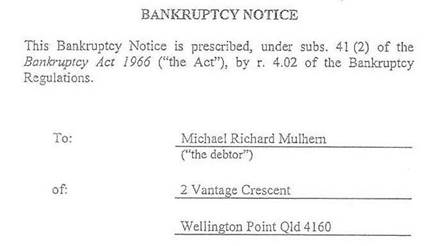
11 On 4 November 2009, Burnett FM (as his Honour was then) of the Federal Magistrates Court of Australia ordered that service of the bankruptcy notice be effected by service on Shand Taylor Lawyers. Mr Mulhern did not comply with the bankruptcy notice.
12 On 3 February 2010, a Registrar of the Federal Magistrates Court made a sequestration order against Mr Mulhern’s estate. Mr Mulhern states that he did not become aware of the sequestration order until 1 March 2010.
13 The history of Mrs Mulhern’s bankruptcy is described in the judgment of Jacobson J in Mulhern v Bank of Queensland Ltd [2014] FCA 26. Mrs Mulhern was a director of five companies known as the Mulhern Group. Some days before the Bank of Queensland Ltd (“the Bank”) appointed receivers to the Mulhern Group, Mrs Mulhern transferred $480,000 from the companies’ bank accounts to her personal account. The Bank obtained Mareva relief against her in the Supreme Court of Queensland. Mrs Mulhern was unsuccessful in her application to set the freezing orders aside, resulting in a costs order being made against her: see Mulhern Constructions & Ors v Mulhern [2012] QSC 120.
14 On 2 February 2012, Mrs Mulhern was ordered to pay the costs assessed in the amount of $24,181.60. The Bank applied for the issue of a bankruptcy notice on the basis of that debt. On 14 March 2012, an Official Receiver issued a bankruptcy notice addressed to Mrs Mulhern.
15 Mrs Mulhern left Australia in May 2011 for the United States. Since May 2012, she has since resided in Northern Ireland. A Registrar of the Federal Magistrates Court made an order permitting service of the bankruptcy notice on Mrs Mulhern outside Australia on 11 May 2012. Mrs Mulhern did not comply with the notice.
16 On 10 July 2012, the Bank filed a creditor’s petition against Mrs Mulhern. An order was made on 2 August 2012 permitting service outside Australia. A sequestration order was then made by a Registrar of the Federal Magistrates Court on 30 August 2012.
17 Mrs Mulhern then sought an order annulling her bankruptcy. She argued that service was not validly effected and that she had not received the bankruptcy notice, that the order for substituted service did not cover the supporting documents accompanying the creditor’s petition and that there had been short service of the creditor’s petition. She also argued that the sequestration order should not have been made because she was solvent, because the proceedings underlying the judgment debt had not been concluded, because the creditor had unreasonably refused offers to settle and because the requirements of s 43(1) of the Bankruptcy Act 1966 (Cth) had not been satisfied. On 4 December 2012, Burnett FM dismissed Mrs Mulhern’s application for annulment with costs: Mulhern v Bank of Queensland Ltd [2012] FMCA 1266. Mrs Mulhern did not appeal.
18 On 5 September 2013, Mrs Mulhern filed an application in this Court again seeking an order that the sequestration order be annulled, or alternatively, be set aside. Jacobson J summarily dismissed the application as an abuse of process on the basis that the application was an attempt to relitigate an application which had been decided against her in the Federal Magistrates Court: Mulhern v Bank of Queensland Ltd [2014] FCA 26. Mrs Mulhern did not seek leave to appeal against that judgment.
19 More recently, the applicants, together with a number of companies, brought proceedings in this Court seeking damages against the Bank. On 5 February 2015, Gleeson J made orders giving summary judgment for the Bank against the applicants in relation to their claims for relief arising out of orders made by the Supreme Court of Queensland, Mrs Mulhern’s claims for relief arising out of her sequestration order and Mr Mulhern’s claim for damages for false imprisonment. The proceedings brought by Mr and Mrs Mulhern were otherwise stayed until the conclusion of their bankruptcies: Mulhern v Bank of Queensland Ltd [2015] FCA 44.
20 Having been unsuccessful in their various applications for annulment of their bankruptcies, Mr and Mrs Mulhern have now tried a different approach. They have turned their attention to the Official Receiver.
The applications
21 In their originating application, the applicants apply for the following declarations:
As for the First Applicant
1. A declaration that the decision of the Official Receiver to issue a Bankruptcy Notice addressed to Michael Richard Mulhern was an improper exercise of the power conferred because the judgment was not a final judgment; and/or
2. A declaration that the decision by the Official Receiver to issue a Bankruptcy Notice addressed to Michael Richard Mulhern was improper exercise of the power conferred because the Judgment was not a final Judgment and because the address provided on the Bankruptcy Notice was a false address; and/or
3. A declaration that the decision of the Official Receiver to issue a Bankruptcy Notice issued addressed to Michael Richard Mulhern was an improper exercise of that power conferred because the Judgment was misleading to the debtor.
As for the Second Applicant
4. A declaration that the decision of the Official Receiver to issue a Bankruptcy Notice addressed to Jacqueline Patricia Mulhern was an improper exercise of the power conferred because the judgment was based upon was a debt for costs created by ex-parte Orders obtained by the Petitioning Creditor which were unenforceable as a consequence of the operation of Section 129(2) of the Uniform Civil Procedure Rules 1999 Queensland and therefore not a final judgment; and/or
5. A declaration that the Official Receiver was misled by the Petitioning Creditor into issuing the Bankruptcy Notice as against the Second Applicant was because the Petitioning Creditor was at all material times aware of the Second Applicants prior equitable Australian interests of at least (Thirty Million Australian Dollars) $30,000,000.00 because the Petitioning creditor was the Second Applicants’ Australian banker.
6. A declaration that the decision of the Official Receiver to issue the Bankruptcy Notice at the request of the Petitioning creditor was void because the Petitioning of the Second Applicant based upon the Bankruptcy Notice was used by the Petitioning Creditor for an improper purpose namely to prevent the Second Applicant from having any standing to complain to any authority with respect to the Petitioning Creditor's overcharging of interest.
22 The respondent’s interlocutory application seeks the following orders:
1. The application be dismissed pursuant to s 31A of the Federal Court of Australia Act 1976 on the basis that the applicants have no reasonable prospect of successfully prosecuting the proceeding.
2. The applicants pay the costs of the respondent.
23 The applicants’ interlocutory application seeks orders including the following:
1. A declaration that the Respondent be restrained by permanent injunction with respect to its foreshadowed application for summary dismissal.
2. A declaration that because of the default of the respondent in failing to comply with an order of this Court that the Court give Judgment in favour of the applicants in accordance with the final orders being sought in the Originating Application filed in these proceedings on 17 April 2015. alternatively
3. Summary judgment in favour of the Applicants pursuant to Section 31A of Federal Court of Australia Act 1976.
Consideration
The applicants’ interlocutory application
24 The applicants’ interlocutory application is based upon the failure of the respondent to comply with the Court’s order that the respondent file any application for summary judgment by 4 pm on 18 May 2015. The applicants submit that “[d]elay is the denial of justice”. They submit that the failure to comply with orders is particularly egregious because the respondent is an officer of the Commonwealth. They rely on Aon Risk Services Australia Ltd v Australian National University (2009) 239 CLR 175 for the proposition that if a party unilaterally disregards directions then such unwillingness or inability to comply without adequate justification may justify dismissal.
25 The respondent submits that the delay was short, the application being filed a week out of time. The delay was explained, from the bar table, as “solicitor error” related to illness of the solicitor responsible for the carriage of the matter. The respondent argues that there is no prejudice to the applicants by reason of the delay. The respondent submits that an extension of time to file the application for summary judgment should be granted.
26 The respondent did not comply with the Court’s order. The order ought to have been complied with. The respondent should have explained its failure to comply with the order on affidavit. However, the failure to provide an explanation is not fatal. It is relevant that the respondent did seek the applicants’ consent to the variation of the order to extend the time for compliance shortly prior to the expiration of the time for compliance with the order, but consent was refused by the applicants. The applicants have not identified any prejudice to them as a result of the non-compliance with the order, given that the application was filed a week later. Any prejudice to the applicants in terms of any costs they have wasted as a result of the default can be dealt with by an appropriate costs order. In these circumstances, the respondent will be allowed an extension of time nunc pro tunc. I will dismiss the applicants’ interlocutory application.
The respondent’s application for summary judgment
27 The respondent’s application for summary judgment relies on s 31A of the Federal Court of Australia Act 1976 (Cth). Section 31A provides, relevantly:
(2) The Court may give judgment for one party against another in relation to the whole or any part of a proceeding if:
(a) the first party is defending the proceeding or that part of the proceeding; and
(b) the Court is satisfied that the other party has no reasonable prospect of successfully prosecuting the proceeding or that part of the proceeding.
(3) For the purposes of this section, a defence or a proceeding or part of a proceeding need not be:
(a) hopeless; or
(b) bound to fail;
for it to have no reasonable prospect of success.
28 In Mulhern v Bank of Queensland [2015] FCA 44 at [56]–[61], Gleeson J set out a summary of the principles relevant to an application under s 31A. I respectfully adopt that summary.
29 The applicants challenge the decision of an Official Receiver made on 26 October 2009 to issue the bankruptcy notice addressed to Mr Mulhern and the decision made on 14 March 2012 to issue the bankruptcy notice addressed to Mrs Mulhern.
30 The applicants filed a voluminous affidavit of Mr Mulhern with their originating application. They have indicated that they do not intend to file any further affidavits in the proceedings. The respondent submits that the applicants’ submissions and material disclose that they have no reasonable prospect of successfully prosecuting the proceeding.
31 It may be said that much of the applicants’ written and oral submissions are emotive, unhelpful and irrelevant. While the applicants submit that the respondent made a number of legal errors when issuing the bankruptcy notices, their submissions are not always easy to follow.
32 The applicants submit that the Court’s power to make the declarations they seek arises under s 39B of the Judiciary Act 1903 (Cth) and s 15(5) of the Bankruptcy Act. The parties did not address the question of the applicants’ standing, as bankrupts, to bring the proceedings. In the absence of a submission by the respondent to the contrary, I will proceed on the assumption that they have standing.
33 Section 39B of the Judiciary Act provides, relevantly:
39B Original jurisdiction of Federal Court of Australia
Scope of original jurisdiction
(1) …the original jurisdiction of the Federal Court of Australia includes jurisdiction with respect to any matter in which a writ of mandamus or prohibition or an injunction is sought against an officer or officers of the Commonwealth.
(1A) The original jurisdiction of the Federal Court of Australia also includes jurisdiction in any matter:
…
(c) arising under any laws made by the Parliament…
34 Section 21 of the Federal Court of Australia Act allows the Court to make binding declarations of right, whether or not consequential relief is or could be claimed, in civil matters in which it has original jurisdiction.
35 Section 15 of the Bankruptcy Act provides, relevantly:
15 Official Receivers
(1) There is to be such number of Official Receivers as the Minister thinks necessary.
(3) Each Official Receiver has such powers and functions as are conferred or imposed on an Official Receiver by this Act.
…
(5) The Court may review an act done by an Official Receiver.
36 In CK Nominees Australia Pty Ltd v Official Receiver (WA) (2007) 160 FCR 524; [2007] FCAFC 118, the Full Court was concerned with an application under s 15(5) of the Bankruptcy Act for review of the decision of the Official Receiver to issue notices under s 77C of the Bankruptcy Act. Gyles J (with whom Tamberlin J agreed), considered the nature of the review conducted under s 15(5):
[49] As submitted for the appellant, s 15(5) of the Act provides a clear basis for the challenge to the giving of the notices in question by the Official Receiver. There is no warrant for reading s 15(5) down to exclude those acts that are subject to the ADJR Act. There is no need to decide whether the appellant is correct in submitting that s 30 would also provide an independent basis for the proceeding. The courts have long had a general supervisory role in bankruptcy. Section 178 of the Act in relation to trustees provides a procedure comparable with s 15(5)…
37 Gyles J described the procedure under s 15(5) as comparable to that under s 178. The latter section provides for review by the Court of a trustee’s acts and allows the Court to make such orders as it thinks just and equitable. Section 178 gives the Court the widest possible discretion as to the appropriate order: Re Tyndall; Ex parte Official Receiver (1977) 17 ALR 182 at 186 per Deane J. However, the applicant must identify a ground on which the trustees act is to be reviewed: Re Wheeler; Ex parte Wheeler v Halse (1994) 54 FCR 166 at 170 per Lee J.
38 In CK Nominees Australia, Moore J’s view as to the role of the reviewing Court seems similar to the majority’s view:
[36] I am inclined to the view that because of the Court’s role in bankruptcy historically, the width of the powers conferred by s 30 — “full power to decide questions of law and fact” (emphasis added), — together with the explicit, and in terms unconstrained, conferral of power by s 15(5) to review an act done by an Official Receiver, the powers exercised by this Court in such a review is not constrained by limits ordinarily attending judicial review. That is not to say that the Court can place itself in the same position as the Official Receiver and decide what terms an impugned notice should be in as a matter of mere preference. But that is not the case we are presently considering.
39 An application for review under s 15(5) is therefore not a merits review of the kind requiring the Court to stand in the shoes of the decision maker and make the decision for itself. The originating application identifies grounds of review. Each of the declarations sought by the applicants relies upon “an improper exercise of the power conferred” on the Official Receiver. It is necessary to consider whether the applicants have a reasonable prospect of obtaining any of the declarations on the grounds they identify.
The first declaration sought
40 The first declaration sought by the applicants is:
A declaration that the decision of the Official Receiver to issue a Bankruptcy Notice addressed to Michael Richard Mulhern was an improper exercise of the power conferred because the judgment was not a final judgment.
41 Section 41 of the Bankruptcy Act provides, relevantly:
(1) An Official Receiver may issue a bankruptcy notice on the application of a creditor who has obtained against a debtor:
(a) a final judgment or final order that:
(i) is of the kind described in paragraph 40(1)(g); and
(ii) is for an amount of at least $5,000; or
…
(2) The notice must be in accordance with the form prescribed by the regulations.
(3) A bankruptcy notice shall not be issued in relation to a debtor:
(a) except on the application of a creditor who has obtained against the debtor a final judgment or final order within the meaning of paragraph 40(1)(g) or a person who, by virtue of paragraph 40(3)(d), is to be deemed to be such a creditor;
(b) if, at the time of the application for the issue of the bankruptcy notice, execution of a judgment or order to which it relates has been stayed; or
42 Section 40 of the Bankruptcy Act provides, relevantly:
(1) A debtor commits an act of bankruptcy in each of the following cases:
…
(g) if a creditor who has obtained against the debtor a final judgment or final order, being a judgment or order the execution of which has not been stayed, has served on the debtor in Australia or, by leave of the Court, elsewhere, a bankruptcy notice under this Act and the debtor does not:
(i) where the notice was served in Australia–within the time specified in the notice; or
(ii) where the notice was served elsewhere–within the time fixed for the purpose by the order giving leave to effect the service;
comply with the requirements of the notice or satisfy the Court that he or she has a counter-claim, set-off or cross demand equal to or exceeding the amount of the judgment debt or sum payable under the final order, as the case may be, being a counter-claim, set-off or cross demand that he or she could not have set up in the action or proceeding in which the judgment or order was obtained;
43 The applicants’ submission is that the judgment that founded the bankruptcy notice served on Mr Mulhern was not “a final judgment or final order being a judgment or order the execution of which has not been stayed.” The basis of that submission is that the judgment obtained by the petitioning creditor required Mr Mulhern to pay the petitioning creditor the sum of $334,875 “within 21 days of the service of a copy of this order.” The applicants contend that this was a judgment which was conditional upon service. They submit that a “conditional judgment” of this kind, is not a “final judgment”.
44 In Clyne v Deputy Commissioner of Taxation (NSW) (No 3) (1983) 48 ALR 545, Gibbs CJ (with whom Murphy, Wilson, Brennan and Deane JJ agreed) held at 547–548:
A final judgment within the meaning of the provisions of the Bankruptcy Act has been held to mean a judgment obtained in an action by which the question whether there was a pre-existing right of the plaintiff against the defendant is ascertained or established: Opie v Opie (1951) 84 CLR 362 at 372. In other words it is a judgment which finally disposes of the rights of the parties: see Licul v Corney (1976) 8 ALR 437; 50 ALJR 439 at 444. The fact that a judgment is subject to appeal or that it may later be set aside or become inoperative does not mean that it is not final: Re Hanby; Ex parte Flemington Central Spares Pty Ltd (1967) 10 FLR 378.
45 In Abigroup Ltd v Abignano (1992) 39 FCR 74, Lockhart, Morling and Gummow JJ held at 80:
[T]he ground of non-compliance with the requirements of a bankruptcy notice, now embodied in s 40(1)(g), is available only, to borrow the words of Bowen LJ in Blanchett (at 307):
“to a creditor who has prosecuted his claim to judgment, and if execution on the judgment has not been stayed - to a creditor between whom and the full fruition of his claim there stands only a process of the law uncompleted. It is only this kind of creditor who is now entitled to issue a bankruptcy notice. This affords an excellent reason for not extending the construction of subs (l)(g), beyond the plain letter of the words.”
Woodall, Ide and Re Richards; Ex parte Sommers (1947) 14 ABC 112 are all examples of numerous cases where execution had not been stayed, but the judgment creditor had not put himself in the position of being able to issue execution, so execution was deemed or considered to be stayed on the ground that he was not entitled at the date of the issue of the bankruptcy notice to issue immediate execution on the judgment: see also Re Pannowitz (supra) at 291.
46 The applicants do not dispute that the petitioning creditor served the order of the Supreme Court at Mr Mulhern’s address for service in the Supreme Court proceedings, namely the offices of his former solicitors, Shand Taylor. There is no suggestion by the applicants that the bankruptcy notice was issued less than 21 days after such service. The petitioning creditor was entitled to immediate execution of the judgment at the date on which the bankruptcy notice was issued.
47 The judgment or order was final in the sense described in Clyne. The judgment finally disposed of the rights of the parties. The fact that the order would have been inoperative if it was not served does not mean that it was not final. It was served. Its execution cannot be considered to have been stayed after it was served.
48 In these circumstances, I am persuaded that the applicants have no reasonable prospect of obtaining the first declaration they seek.
The second declaration sought
49 The second declaration sought by the applicants is:
A declaration that the decision by the Official Receiver to issue a Bankruptcy Notice addressed to Michael Richard Mulhern was improper exercise of the power conferred because the Judgment was not a final Judgment and because the address provided on the Bankruptcy Notice was a false address.
50 In oral submissions, the applicants submitted that the inclusion of an address for Mr Mulhern in the bankruptcy notice which the petitioning creditor knew to be false was fraudulent. They contend that the petitioning creditor knew that the address given in the bankruptcy notice was one at which Mr Mulhern had not resided since 5 November 2007. They submit that the Official Receiver was misled into issuing the bankruptcy notice by the inclusion of the wrong address. The applicants rely on the principle that “fraud unravels everything” discussed in SZFDE v Minister for Immigration and Citizenship (2007) 232 CLR 189; [2007] HCA 35.
51 In Minister for Immigration and Citizenship v SZLIX (2008) 245 ALR 501; [2008] FCAFC 17, the Full Court, discussing an allegation of fraud on the Refugee Review Tribunal, said at 509:
[33] …This said, an agent may be fraudulent in his dealings with a visa applicant in such a manner as results directly in a fraud on the tribunal in relation to the due discharge of its Div 4 of Pt 7 functions. SZFDE is testament to this. But SZFDE requires that the agent in question is fraudulent in a way that affects the tribunal’s Pt 7 decision-making process. An omission to notify the date of a hearing to a visa applicant may have adverse consequences for that applicant if, as here, the tribunal proceeds to make a decision under s 426A in the applicant’s absence. But before that omission can properly be said to have occasioned a fraud on the tribunal, it must itself be able properly to be characterised as a fraudulent omission vis-à-vis the visa applicant: SZFDE at [51]. The simple fact of a failure to inform or bare negligence or inadvertence will not necessarily be sufficient to give rise to fraud on the tribunal.
52 It is necessary to consider the Bankruptcy Regulations 1996 (Cth) in their form when the petitioning creditor applied for the issue of a bankruptcy notice. Regulation 4.01 then provided:
4.01(1) In order to apply for the issue of a bankruptcy notice, a person must lodge with the Official Receiver:
(a) a duly completed draft bankruptcy notice; and
(b) one of the following documents in respect of the final judgment or final order specified by the person on the approved form:
(i) a sealed or certified copy of the judgment or order;
…
53 At the time the bankruptcy notice was issued, reg 4.02 of the Bankruptcy Regulations provided, and still provides:
4.02(1) For the purposes of subsection 41(2) of the Act, the form of bankruptcy notice set out in Form 1 is prescribed.
4.02(2) A bankruptcy notice must follow Form 1 in respect of its format (for example, bold or italic typeface, underlining and notes).
4.02(3) Subregulation (2) is not to be taken as expressing an intention contrary to section 25C of the Acts Interpretation Act 1901.
54 It may be seen that the creditor was required to provide the Official Receiver with a draft bankruptcy notice in Form 1. At the relevant time, Form 1 commenced as follows:
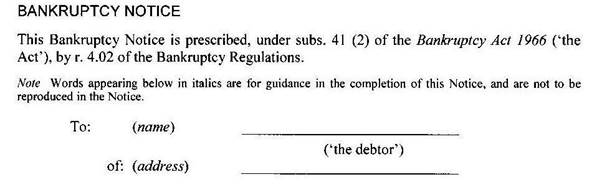
55 The Form 1 required the creditor to add the name and address of the debtor. In this case, the address inserted by the creditor (2 Vantage Crescent, Wellington Point) was an address at which Mr Mulhern says he had not lived for some three years prior to the application for the issuing of the bankruptcy notice. The effect of the applicants’ argument must be that it is a fraud on an Official Receiver to insert an address for the debtor which the creditor knows is not the current address of the debtor.
56 I do not accept that argument. The Form 1 indicated that the word “address” is there “for guidance in the completion of this Notice”. The form required only that an “address” be inserted, not the “current address”. It is unlikely that the form would mandate that the current address must be inserted because in many instances a creditor would not know the current address of the debtor. That is recognised by reg 16.01 which allows a bankruptcy notice to be served, inter alia, by sending it to the debtor at his or her last known address or leaving it at the debtor’s last known address. I consider, therefore, that the Form 1 did not require that only the current address of the debtor could be inserted.
57 It was not misleading or fraudulent for the petitioning creditor to insert Mr Mulhern’s former address in the draft bankruptcy notice provided to the Official Receiver. In any event, there is no evidence that if the Official Receiver had known that the address in the draft bankruptcy notice was not Mr Mulhern’s current address, the bankruptcy notice would not have been issued.
58 In these circumstances, the applicants’ claim for a declaration on the basis that the petitioning creditor procured the issuing of the bankruptcy notice by a fraud on the Official Receiver has no reasonable prospect of success.
The third declaration sought
59 The third declaration sought by the applicants is:
A declaration that the decision of the Official Receiver to issue a Bankruptcy Notice issued addressed to Michael Richard Mulhern was an improper exercise of that power conferred because the Judgment was misleading to the debtor.
60 The applicants submit that the bankruptcy notice was confusing and capable of misleading the debtor. They note that the order of the Supreme Court was that Mulhern Constructions Pty Ltd and Mr Mulhern pay the petitioning creditor the sum of $334,875. The bankruptcy notice required Mr Mulhern to pay the amount. The applicants argue that the order was confusing as to whether the company and Mr Mulhern were jointly and severally liable to pay the whole amount. They argue that it is unclear as to whether Mr Mulhern was required to pay the whole of the amount or part of it. They argue that confusion as to the order means that the bankruptcy notice was capable of confusing Mr Mulhern and is void.
61 I do not accept that the order of the Supreme Court was unclear. It ordered, relevantly, that Mr Mulhern pay the amount of $334,875 to Mr Dodrill. The bankruptcy notice itself was clear and unambiguous. It stated that the named creditor claimed that Mr Mulhern owed him a debt of $334,875 as shown in the Schedule. The bankruptcy notice stated that the creditor claimed that the debt was due and payable by Mr Mulhern. It stated that Mr Mulhern was required, within 21 days after 25 November 2009, to pay the amount of the debt to the creditor or make an arrangement to the creditor’s satisfaction for settlement of the debt.
62 The applicants pointed to no authority that indicates that a decision of the Official Receiver to issue a bankruptcy notice is an improper exercise of power in circumstances where a Court’s order may be misleading to the debtor. Further, there is no evidence that Mr Mulhern was misled by the order.
63 The applicants’ submission that the decision to issue the bankruptcy notice was an improper exercise of that power on the basis that the judgment was misleading enjoys no reasonable prospect of success.
The fourth declaration sought
64 The fourth declaration sought by the applicants is:
A declaration that the decision of the Official Receiver to issue a Bankruptcy Notice addressed to Jacqueline Patricia Mulhern was an improper exercise of the power conferred because the judgment was based upon was a debt for costs created by ex-parte Orders obtained by the Petitioning Creditor which were unenforceable as a consequence of the operation of Section 129(2) of the Uniform Civil Procedure Rules 1999 Queensland and therefore not a final judgment
65 The applicants submit that the order on which the bankruptcy notice issued against Mrs Mulhern was based was not a final judgment or order. As I understand it, the argument is that it was not final because it was an “illegal” judgment or order. They submit that the Supreme Court of Queensland acted outside its powers by entertaining the application for the freezing orders in circumstances where Mrs Mulhern was living in the United States. The applicants assert that freezing orders are “illegal and unenforceable” in the United States. Rule 129 of the Uniform Civil Procedure Rules 1999 (Qld) (“the UCPR”) provides that Pts 1 to 5 of the UCPR apply to service outside Australia of an originating process, but that nothing in the UCPR, or in any order of the Court made under the UCPR, authorises or requires the doing of anything in a country in which service is to be effected that is contrary to the law of the country. They argue that the freezing orders made by the Supreme Court of Queensland on 26 May 2010 are “illegal” and that the Court had no power to make the subsequent costs order.
66 In Mulhern v Bank of Queensland [2015] FCA 44, Gleeson J noted that on 12 June 2012 Mrs Mulhern had filed an application in the Supreme Court for orders that included a declaration that the freezing orders were “illegally obtained, in absolute breach of the law…an abuse of process on an acknowledged and recognized resident of the State of New York in the United States of America.” Her Honour noted that Mrs Mulhern’s application was dismissed by Martin J of the Supreme Court on 19 June 2012.
67 Gleeson J noted that the statement of claim before her Honour pleaded that the freezing orders were obtained in breach of the Bank’s obligations under the Hague Convention rules for the service of documents, in breach of the UCPR and in breach of the rules of procedural fairness. The statement of claim sought damages for the effects of the freezing orders on each applicant. Gleeson J held at [87]–[88]:
87 To the extent that the plaintiffs’ claims are based upon contentions that orders were wrongfully obtained in the Supreme Court, the proceedings are an abuse of process because they are a collateral attack upon a final decision of that court: cf Stergiou v McGrail [1994] FCA 1041 at [8]; Shaw v MAB Corporation Pty Ltd [2014] FCA 62; 220 FCR 425; at [60]. In any event, this court does not have jurisdiction or power to set aside orders of the Supreme Court of Queensland: cf Shaw v MAB Corporation Pty Ltd [2013] FCA 1231 at [44]; Birdon Pty Ltd v Houben Marine Pty Ltd [2011] FCAFC 126; (2011) 197 FCR 25 at [96] (Rares J); Re Baxter; ex parte Official Receiver v Baxter (1986) 10 FCR 398 at 401. To the contrary, a decision of the Supreme Court may create an “issue estoppel” if it determines an issue in a cause of action as an essential step in its reasoning, precluding re-litigation of that issue: cf Stergiou at [8].
88 In particular, in relation to claims based upon the allegation that the Bank wrongfully obtained the freezing orders, that order was unsuccessfully challenged by Mrs Mulhern, when she applied to have the order varied or discharged. Subsequently, the freezing orders were superseded by the Supreme Court’s decision in May 2012 that the Bank was entitled to the funds affected by the order. Although Mrs Mulhern commenced an appeal from that decision, it was ultimately dismissed. These matters place insuperable constraints around the prospect of any action arising out of the freezing orders.
68 In an application to set aside a bankruptcy notice or an application for a sequestration order, the judgment or order upon which the bankruptcy notice is based is not conclusive of the existence of the debt: Wren v Mahony (1972) 126 CLR 212; [1972] HCA 5 at 224–225, Olivieri v Stafford (1989) 24 FCR 413 at 430–431, Xu v Wan Ze Property Development (Aust) Pty Ltd (in liq) (2014) 315 ALR 523; [2014] FCA 461 at 533 [55] per Robertson J, Khouzame v All Seasons Air Pty Ltd [2014] FCA 1319 at [14] per Flick J. The parties have not advanced any argument as to whether the same principle applies where there is an attack upon the judgment or order founding the bankruptcy notice in an application for review of a decision of an Official Receiver to issue the bankruptcy notice.
69 However, it is not necessary to decide that issue. If the orders of the Supreme Court are conclusive, then the applicants’ attempt to collaterally attack the orders as “illegal” in this proceeding is an abuse of process. If the orders of the Supreme Court are not conclusive, the circumstances in which a Court exercising jurisdiction in bankruptcy will exercise its discretion to “go behind” those orders are limited to where there is prima facie case of fraud or collusion or miscarriage of justice: Corney v Brien (1951) 84 CLR 343, at 347 per Dixon, Williams, Webb and Kitto JJ, at 356-357 per Fullagar J. The applicants’ prospects of persuading a Court to do so are negligible in circumstances where there was a contested application in the Supreme Court to set aside the freezing orders which failed.
70 I consider that the applicants have no reasonable prospect of obtaining the fourth declaration they seek.
The fifth declaration sought
71 The fifth declaration sought by the applicants is:
A declaration that the Official Receiver was misled by the Petitioning Creditor into issuing the Bankruptcy Notice as against the Second Applicant was because the Petitioning Creditor was at all material times aware of the Second Applicants prior equitable Australian interests of at least (Thirty Million Australian Dollars) $30,000,000.00 because the Petitioning creditor was the Second Applicants’ Australian banker.
72 The applicants submit that the Official Receiver was misled by the creditor into issuing the bankruptcy notice. They assert that on 28 June 2005, the Bank acknowledged that the Mulhern Group had a prior equitable interest in certain secured properties to the extent of $30 million and that the Mulhern Group owed Mr and Mrs Mulhern $3.5 million. They allege that this was not disclosed to the Official Receiver. The allegation seems to be that this was a fraud on the Official Receiver.
73 The submission that it was the Mulhern Group which had a prior equitable interest seems inconsistent with the terms of the declaration sought. However, for present purposes, I will assume that the truth of the allegation that Mrs Mulhern had equitable interests in secured properties exceeding the amount set out in the bankruptcy notice can be established. The applicants have not pointed to any requirement on the part of the creditor to disclose those interests to the Official Receiver. The creditor had the benefit of an order of the Supreme Court. It was entitled to rely on that debt created by that order to obtain the issuing of a bankruptcy notice.
74 Further, to the extent that the fifth declaration challenges the order of the Supreme Court, this is an abuse of process. Alternatively, the applicants have no reasonable prospect of persuading the Court to “go behind” the order of the Supreme Court.
75 For these reasons, the applicants have no reasonable prospect of obtaining the fifth declaration.
The sixth declaration sought
76 The sixth declaration sought by the applicants is:
A declaration that the decision of the Official Receiver to issue the Bankruptcy Notice at the request of the Petitioning creditor was void because the Petitioning of the Second Applicant based upon the Bankruptcy Notice was used by the Petitioning Creditor for an improper purpose namely to prevent the Second Applicant from having any standing to complain to any authority with respect to the Petitioning Creditor's overcharging of interest.
77 This complaint seems to be that the creditor’s petition was used for an improper purpose, namely to stop Mrs Mulhern from making some form of complaint about the petitioning creditor’s overcharging of interest. The applicants appear to submit that the improper purpose for which the creditor’s petition was used means that the Official Receiver’s decision to issue the bankruptcy notice was void.
78 There are several difficulties for the applicants in seeking the sixth declaration. It is entirely unclear as to which authority the applicants allege that Mrs Mulhern is no longer able to make a complaint to. They do not suggest that the Official Receiver was aware of the allegedly improper purpose. They have not explained how the purpose for which the creditor’s petition was later used affects the legality of the Official Receiver’s earlier decision to issue the bankruptcy notice. They have not pointed to any authority that supports their argument.
79 In my opinion, the applicants have no reasonable prospect of obtaining the sixth declaration.
Conclusion
80 The applicants have no reasonable prospect of obtaining any of the six declarations that they seek in their originating application. Accordingly, the originating application must be dismissed.
81 I will order nunc pro tunc that the respondent have an extension of time until 25 May 2015 to file their application for summary judgment. The applicants’ interlocutory application for orders preventing the respondent from prosecuting its summary judgment application will be dismissed.
82 Section 15(1) of the Bankruptcy Act provides for the appointment of a number of “Official Receivers”. The originating application misdescribes the respondent as “Official Receiver in Bankruptcy”. The name of the respondent should be amended to “Official Receiver”.
83 I will order that the applicants pay the respondent’s costs of the proceeding, save that the respondent should pay the applicants’ costs (if any) thrown away by the respondent’s failure to comply with the Court’s order made on 27 April 2015.
I certify that the preceding eighty-three (83) numbered paragraphs are a true copy of the Reasons for Judgment herein of the Honourable Justice Rangiah. |
Associate:


