

FEDERAL COURT OF AUSTRALIA
Esso Australia Pty Ltd v The Australian Workers’ Union [2015] FCA 758
Table of Corrections | |
In para 109, at the end of the second sentence, the words “as on matters of construction” have been replaced with “as a matter of construction”. |
IN THE FEDERAL COURT OF AUSTRALIA | |
ESSO AUSTRALIA PTY LTD (ABN 49 000 018 566) Applicant | |
AND: | Respondent |
DATE OF ORDER: | |
WHERE MADE: |
THE COURT ORDERS THAT:
1. The proceeding be listed for a case management hearing at a time to be notified.
Note: Entry of orders is dealt with in Rule 39.32 of the Federal Court Rules 2011.
VICTORIA DISTRICT REGISTRY | |
FAIR WORK DIVISION | VID 115 of 2015 |
BETWEEN: | ESSO AUSTRALIA PTY LTD (ABN 49 000 018 566) Applicant |
AND: | THE THE AUSTRALIAN WORKERS’ UNION Respondent |
JUDGE: | JESSUP J |
DATE: | 24 JULY 2015 |
PLACE: | MELBOURNE |
REASONS FOR JUDGMENT
1 In this proceeding, the applicant, Esso Australia Pty Ltd, alleges that the respondent, The Australian Workers’ Union, contravened ss 340(1), 343(1), 346, 348 and 421(1) of the Fair Work Act 2009 (Cth) (“the FW Act”) when it organised industrial action by its members employed by the applicant at its plant at Longford, Victoria. The fact that industrial action, in the form of bans and stoppages, was taken by those members, and was organised by the respondent, is uncontroversial. The issues in the case are whether the organisation of action amounted, in the circumstances which existed, to contraventions of the provisions referred to.
Background
2 The applicant is in the business of the exploration for and the production of oil and gas, the refining of petroleum and the supply of fuels, including natural gas. Relevantly to the present proceeding, the applicant operates three onshore facilities in Gippsland, and a number (presently 23) of offshore platforms, and associated infrastructure, in Bass Strait. The onshore facilities are at Longford, Long Island Point and Barry Beach.
3 The Longford Plant is the onshore receiving point for all of the crude oil and gas produced by the applicant’s offshore platforms in Bass Strait. It consists of three separate gas plants, a crude oil stabilisation plant and an ethylene glycol plant. Two pipelines run 220 km from Longford to Long Island Point, carrying crude oil for storage and distribution and gas liquids for final processing and distribution. These pipelines are managed and maintained by Longford-based personnel.
4 Hydrocarbons recovered from the seafloor are initially separated, at the offshore platforms, into two streams consisting of unstabilised crude oil and raw gas. These streams are piped separately to the plant at Longford, where impurities are removed and the two streams processed into stabilised products. These products are methane gas, which is sold directly to customers as natural gas, heavier hydrocarbon liquids (ethane and LPG), and stabilised crude oil. The LPG and the crude oil are sent for further processing and storage at Long Island Point.
5 Operations (ie as distinct from maintenance) personnel employed by the applicant at the facilities referred to are represented industrially by the respondent. They, and other personnel, are covered by industrial agreements approved under the FW Act, namely –
the Esso Gippsland (Longford and Long Island Point) Enterprise Agreement 2011, which covers employees at two of the applicant’s onshore processing operations (Longford and Long Island Point);
the Esso Offshore Enterprise Agreement 2011, which covers employees at the applicant’s offshore oil and gas platforms; and
the Esso Gippsland (Barry Beach Marine Terminal) Enterprise Agreement 2011, which covers employees at the applicant’s Barry Beach Marine Terminal.
The nominal expiry date of each of these agreements (see FW Act, s 186(5)) was 1 October 2014.
6 Since about June 2014, the applicant and the unions representing its employees, including the respondent, have been engaged in bargaining for the making of a new enterprise agreement, or agreements, to take the place of those referred to in the previous paragraph. The respondent is a bargaining representative for the applicant’s operations employees. It is clear that much has happened in that bargaining, including, at times, proceedings in the Fair Work Commission (“the Commission”). Save to the extent mentioned below, it is not necessary to refer further to those proceedings.
7 I shall further address the applicant’s operations in some detail in the next section of these reasons, but, by way of broad introduction, I indicate now that the setting for the controversy which has led the parties to court is the return to operational service of items of plant or equipment which have earlier been taken out of service to have some work, such as repair, maintenance or upgrading, carried out on them. That work will normally have been carried out either by the applicant’s own maintenance personnel or by specialised contractors. The present case is not directly concerned with this work. The employees whose work is directly relevant, rather, are the operational personnel employed by the applicant. They control and monitor the plant and equipment in its normal operating state. They also have responsibilities at the point of removing plant and equipment from service for work to be done on it, and at the point of returning plant and equipment to service after the work has been completed. The industrial action organised at Longford which became the subject of this case was directed to the latter area of activity.
The applicant’s operations at Longford
8 The applicant’s operations at Longford involve the processing of highly toxic, volatile, pressurised and flammable products. Plant and equipment required to process these products involves heat, flame and pressure. Potential ignition sources are adjacent to highly flammable hydrocarbons. The risk of fire or explosion is ever-present, and the applicant has in place an “Operations Integrity Management System” to control this risk. Within that, System 6-4 is concerned with the subject of “work management”. It lays down the rules, protocols and procedures to be followed when work is to be carried out on plant or equipment at the applicant’s facilities.
9 The “Scope & Objectives” of System 6-4 are as follows:
The purpose of this System is to ensure that the work activities at Unit-operated or controlled sites are undertaken in a structured and controlled manner to reduce the risk of incidents. This System provides a structure for managing the risks associated with the work to be performed and confirming that interfaces with the work activities are appropriately considered.
The System objectives are:
• Work Permits are executed to protect personnel, equipment, and the environment from mechanical and operational risks.
• Controls are in place for the temporary disarming, deactivation, or unavailability of integrity critical equipment.
• Operational interfaces at the work site and the impact of shift handover on work activities are managed.
10 The work management process is described under the headings “Work Management”, “Work Permitting”, “Energy Isolation and Temporary Defeat” and “Interface Management”. It is the “energy isolation” aspect of the third of these areas which is of particular interest in this proceeding. In System 6-4, it is stated as follows:
– The isolation of facility systems and equipment for maintenance or other work activities and subsequent reinstatement to normal safe operating conditions are integral parts of the work permitting process….
+ Any activity that requires breaking containment of an energy source when preparing equipment for intrusive work requires an “energy isolation” process to manage the safety and environmental aspects of the hazards associated with the energy sources. The isolation philosophy includes verification of the isolations and demonstration of “zero energy” to the Permit Holder so that work on facilities and equipment does not cause any unexpected or uncontrolled release of energy that could cause injury to personnel, damage to the facilities or the environment, or inadvertent operation of the isolated equipment while work is being performed.
11 The detailed processes in relation to work permits and isolation procedures are prescribed in a separate procedures manual, called the Work Management System (“WMS”) manual. All operations personnel employed by the applicant have been trained in the provisions of this manual, and refresher training is also undertaken. The WMS manual is available at the relevant workplaces, in both electronic and paper forms. Some of the relevant definitions contained in the WMS manual are the following:
Air freeing | Removing oxygen from process equipment to prevent flammable mixtures occurring when hydrocarbons are reintroduced. |
… | … |
Blinding | The process of installing pressure-rated blinds or spades into process piping and equipment. |
… | … |
De-isolations | Unlocking and moving isolation valves, reconnecting systems, removal of blinds, and unlocking electrical switches to their normal operating state. |
… | … |
Energy isolation (lock-out/tag-out) | Energy isolation (lock-out/tag-out) is a process used to facilitate and maintain equipment and systems at a zero energy state. This could involve positioning isolation valves, physical disconnection, blinding, securing electrical breakers and switches, and other approved isolation methods. |
Equipment testing | The process of temporarily de-isolating equipment and energizing to a live-state for operational testing or fault finding. |
… | … |
Leak testing | Introducing pressure to the system to confirm that integrity has been restored and there are no leaks. |
… | … |
Recommissioning | At the conclusion of work, the process of reinstating equipment components (for example, pipework, flanges, circuit breakers and control systems) removing blinds and spades, and confirming that the system integrity is restored. |
… | … |
Zero Energy | Zero Energy state is achieved when sources are isolated, there is no potential for inadvertent or accidental de-isolation while work is being conducted, and there is no energy that would be hazardous to people while breaking containment or working on the equipment. |
12 Two main sections of the WMS manual are of relevance in the present case, Section 4.5 on the subject, “Isolating Systems and Equipment” and Section 4.6, “Reinstating Facility Systems and Equipment”. In Section 4.5 of the WMS manual, it is stated that “[e]nergy isolations are intended to remove all sources of energy from equipment to enable them to be safely removed from service, and keep them out of service for the duration of the work”. It is stated:
The Company’s energy isolation practice is to achieve “zero energy” and demonstrate zero energy to the Permit Holder. This ensures that work on facilities and equipment does not cause any unexpected or uncontrolled release of energy that can cause injury to personnel or damage to the facilities or the environment.
“Isolation activities” include the following:
• Energy isolations (process, mechanical, and electrical)
• Draining and depressurizing
• Hydrocarbon freeing
• Breaking containment
• Blinding
• Cleaning
13 In the “Introduction” to Section 4.6 of the WMS manual, “Reinstating Facility Systems and Equipment”, it is stated:
This section describes the procedures and precautions to be followed when reinstating equipment and facilities and defines personnel responsibilities. The general sequence of events, when reinstating equipment and facilities, is as follows:
• Recommissioning
Note: Recommissioning is an activity that takes place throughout the reinstatement. Mechanical completion checks must be made before and after equipment testing, air freeing, leak testing, and de-isolating.
• Equipment testing
• Air freeing
• Leak testing
• Removing energy isolations (mechanical, electrical, instrument)
• Removing temporary defeats
• Acceptance testing
Of particular significance in the present case, according to the applicant, is the separate identification of these stages in the reinstatement process.
14 The WMS manual then proceeds to deal in detail with the stages of “Recommissioning” (3 pages in the manual), “Equipment Testing” (2 pages), “Leak Testing” (8 pages), “Air Freeing” (7 pages), “Removing Energy Isolations” (3 pages) and “Acceptance Testing” (2 pages).
15 Section 4.6.3 deals with “Leak Testing”, and gives the following as the “goal” of this process:
The leak test confirms that the integrity of flanges, seals, glands, and so forth, is restored. The prevention of leaks is vitally important where flammable or toxic fluids can affect personnel or cause environmental damage.
The procedure to be followed when testing the equipment concerned for leaks is then set out, stepwise, in detail.
16 Section 4.6.4 deals with “Air Freeing”. It is introduced with the following passage:
This section provides guidelines to protect personnel and equipment when performing air freeing (purging air from a hydrocarbon system) activities. Air freeing should take place as soon as possible after a vessel or system is recommissioned or leak tested.
The [air freeing] activity must be performed with all isolation valves that could introduce hydrocarbons in the isolated state. These hydrocarbon isolation valves must not be moved to the de-isolated state until an inert atmosphere is obtained.
In point of sequence, it will be noted that the first paragraph in this passage states that air freeing should be done after the vessel or system has been “recommissioned or leak tested”. From the evidence in this case, it seems that the practice at Longford is to carry out air freeing before leak testing.
17 In Section 4.6.4 of the WMS manual, the “goal” of air freeing is stated as follows:
The goal of air freeing is to remove an oxygen environment from facility systems that were opened to the atmosphere before introducing hydrocarbons to avoid combustible mixtures.
The best practice when air freeing is to avoid a gas-air mixture during the air freeing process by purging or displacing air with an inert medium such as water or nitrogen, followed by the introduction of hydrocarbons.
As in the case of leak testing, the WMS manual then sets out the procedure to be followed for air freeing in detail.
18 Section 4.6.5 deals with “Removing Energy Isolations”, the “goal” of which is “to enable the introduction of process fluids and the re-energization of facility equipment so that the facility can be started up”. The energy isolation removal procedure is as follows:
• Upon completion of all recommissioning, leak testing, and air freeing, the Permit Holder brings the Isolation Control Certificate to the Area Operator or CCR and advises that the system is ready to be de-isolated.
• The Isolating Authority and Area Authority must confirm that it is safe to perform the requested de-isolations.
• The Area Operator must confirm that the isolated system has been recommissioned, leak tested, and air freed, if required.
– The Area Operator must confirm that no other planned or ongoing work required any of the existing isolation points to remain isolated.
• The Area Operator collects the original and all copies of the Isolation Control Certificate and requests the Area Authority to approve for reinstatement. The Area Authority approves the de-isolation activities to commence.
• For remote locations where the Area Authority is not present, the Area Operator or Permit Holder acts as the Area Authority and approves the de-isolation activities to commence.
• Once the Area Authority or designate has approved the de-isolation:
– The Permit Holders remove their Functional lock(s) from the isolation control point (ICP).
– The Area Operator removes his or her Functional lock from the ICP.
– The Isolating Authority obtains the key(s) from the ICP and removes the locks and tags the isolation points.
• The Area Operator is responsible for coordinating the de-isolating of the equipment.
– The Isolation Control Certificate (ICC) is closed out.
19 Section 4.5 of the WMS manual refers to an electronic artefact known as the Isolation Control Certificate (“ICC”). There are designated persons responsible for preparing and issuing the ICC to record the fact that the isolation has been requested and approved. The ICC becomes part of the work permit documentation. According to the WMS manual, the ICC “must be used to document the isolation and approval of equipment or systems and will be used to track the status of all isolations”. The manual continues:
The ICC must be cross-referenced to all relevant work permits and is the principal control once isolations are in place. The ICC performs the following functions:
• Lists the location of the isolation points and their normal status.
• It is a record of any fittings (such as analyzer points, sample points and plugs) that have been removed or moved from their normal state to ensure that they are reinstated.
• It is a record of all drain, vent, and bleed points for valve integrity tests. (Operation of these valves does not need to be recorded as an amendment on the ICC but would be checked when returning equipment to service.)
• Authorizes any temporary de-isolation for equipment testing (Sanction to Test).
• Authorizes and records each de-isolated point.
• As necessary, includes attachments of marked-up P&IDs, electrical diagrams, and isolation plans/procedures.
20 The following chart demonstrates schematically what is described as the “isolation certificate process”:
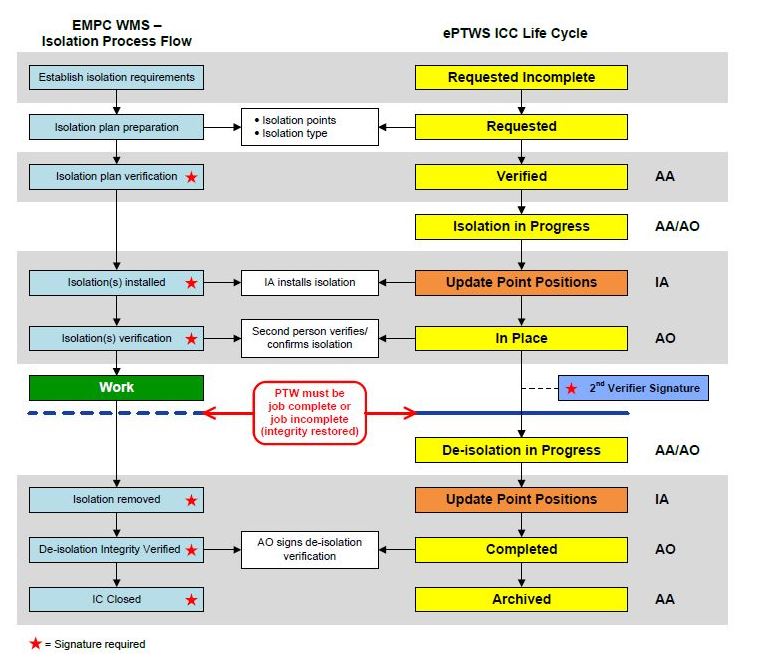
21 It will be noted that this flow chart, as it may be called, has two vertically-arranged streams. That on the left refers to the sequential stages of the functions that are necessary in taking the equipment from, and returning it to, service. That on the right refers to the corresponding headings on the ICC, the result of entries made by supervisors and operators (as the situation requires) to indicate the stage that has been reached. It will be noted that neither stream refers to the tasks or functions that must be performed at any stage: it is a given that those involved in this work will know what is required.
22 By reference to the flow chart, one commences with the equipment in question being in service in the normal way. The first step would be to “establish isolation requirements”, that is to say, to identify what equipment needs to be isolated for the intended work to be carried out. At this point, the ICC would be headed “Requested Incomplete”. Someone would have selected that entry from a drop-down menu on the computer screen accessible to operators in the relevant area of the plant. Next, when the isolation plan was being prepared, the heading “Requested” would be selected from the ICC drop-down menu. Next, the plan would be verified by the “AA” (area authority), one of the supervisors in that area. Once this was done, the heading “Verified” would be selected in the ICC. To this point, no concrete step would have been taken with respect to the equipment to be taken out of service: everything done was in the nature of preparation and planning.
23 Then the isolation process itself would commence to be carried out. Before anything is done, the ICC heading would have to be changed to “Isolation in Progress”. The point of this is that anyone wanting to know the status of the equipment concerned could check the computer and be informed that an isolation was being undertaken. On the functional side, the flow chart records that isolations are installed. The tasks that must actually be performed in this regard are not referred to on the flow chart. But, on the ICC side, the entry “Update Point Positions” is significant. The “points” referred to are the various valves and other pieces of apparatus that must be manipulated in order to achieve the desired isolation. In the ICC software, the “isolated state” and the “[de-isolated] state” of each of these points is shown – in all cases, as “open” or “closed”. So too is the “current state”. Each time the state of a point is changed along the road to isolating the equipment concerned, the “current state” must be correspondingly recorded on the computer. It will, of course, be a change from the de-isolated state to the isolated state (be it open or closed as the case requires).
24 When the isolation is complete, it must be verified, and confirmed by a second person. Then the heading from the drop-down menu in the ICC software will be changed to “In Place”. At this point, the work can be carried out. That is the function of other personnel, such as maintenance staff employed by the applicant, external contractors, or whoever is required. On the functional side of the flow chart, this stage is signified as “Work”. For however long the work lasts, anyone who consulted the ICC on the computer would see that an isolation was “In Place”. The work itself, of course, would be carried out subject to the necessary permit or permits.
25 When the work is completed, the equipment must be returned to service. Once again, the applicant’s operational personnel become involved. The first thing to be done is to alter the heading on the ICC to “[De-isolation] in Progress”. Again, this would be achieved by the selection of that designation from the drop-down menu. Thereafter, anyone who consulted the ICC on the computer would see that a de-isolation was “in progress”. The various physical tasks involved in removing the isolations would be carried out: they are not mentioned on the functional side of the flow chart, but are implied under “Isolation removed”. Correspondingly, on the ICC side of the flow chart, the operator is required to “Update Point Positions” to record the changes made to the state of the various points. This will involve returning the points to their “[De-isolated] State”, be it open or closed.
26 Finally, when all the necessary tasks have been completed, the de-isolation integrity of the equipment must be verified in writing by the area operator and, when this has been done, the heading “Completed” is selected from the drop-down menu on the ICC software. When the ICC itself is closed, it is “Archived”. From the archived records, the state of the ICC at any stage during the previous shutdown of a piece of equipment can be recovered as a report, and printed out. A number of such iterations of ICCs were tendered in evidence, from which it was possible to note, for example, the exact state of each relevant point at a particular stage during “Isolation in Progress” and “[De-isolation] in Progress”.
27 Finally in this section of my reasons, I refer to the evidence of one of the operators at Longford about two aspects of the processes described in Section 4.6 of the WMS manual. Kain Jackson is an operations technician level 2 at Longford. He has been employed by the applicant since about 2008. During the past 12 months, he has from time-to-time acted as temporary supervisor. He has often provided advice to supervisors, senior supervisors, discipline supervisors, and other operations and maintenance staff about the WMS and the applicant’s electronic permit to work system. He is trained to perform de-isolations of equipment, and regularly does so. He was one of the employees responsible for providing training to others about the WMS and the permit to work system, which he did for about three months. He also worked on a project with the aim of identifying efficiencies in the implementation of the WMS, in which his role was as a resource for employees in the interpretation, intent and use of the WMS. He also played a lead role in the cross-site steering committee for the WMS and the electronic permit to work system.
28 Mr Jackson gave evidence about the concrete steps he takes in carrying out the work involved in air freeing and leak testing. He commences by putting the ICC to “De-isolation in Progress”. He prints a hard copy of the ICC which he takes into the “field”, that is, to the physical location of the vessel upon which he proposes to undertake certain functions. He will also have with him a “job safety analysis”, to make sure that he has covered all the hazards and risks associated with those functions. Where the vessel requires air freeing, that will be done first. Depending on the circumstances, there may be a pressure safety valve to be put into service at this point. The air freeing itself involves connecting a nitrogen supply to the vessel and opening a bleeder that will direct the contents of the vessel to a safe location. Once he is satisfied that the vessel has been purged in this way, Mr Jackson will close the bleeder and use nitrogen to increase the pressure to anything up to 400 kPa, to test for leaks. Once he is satisfied that there is no obvious leak, he will introduce another hydrocarbon, with a view to raising the pressure to 80% of the design rating of the vessel, or the “pressure safety valve” rating of that vessel. With the vessel under this pressure, Mr Jackson will check for leaks at various points. During each of these stages, each time he manipulates a point, he will mark, or tick, the hard copy of the ICC that he is carrying with him. He will then return to the computer and transfer on to the ICC itself the changed status of the points concerned.
Circumstances leading to this proceeding
29 Once the nominal expiry date of the enterprise agreements binding the applicant passed (see FW Act, s 417), the respondent and its members were in a position, subject to compliance with the procedures mandated by the FW Act, to take protected industrial action in support of their claims in their bargaining with the applicant (see FW Act, s 409(1)). One of the procedures referred to was the requirement to give the applicant written notice of the industrial action proposed (see FW Act, ss 413(4) and 414). Such a notice was required to “specify the nature of the action and the day on which it will start” (see FW Act, s 414(6)). Industrial action which had not been specified in such a notice would not be protected industrial action within the meaning of the FW Act. The allegation that industrial action organised by the respondent, and taken by its members, in March 2015 was not protected industrial action lies at the centre of the applicant’s case in this proceeding.
30 Over the period which is relevant in this proceeding, the respondent gave the applicant eight notices of intention to take protected industrial action. Save that they were given on 16, 22 and 30 January 2015, nothing further needs to be said about the first three notices.
31 On 3 February 2015, the respondent gave its fourth notice of intention to take protected industrial action. The notice was in the form of a letter over the hand of Ben Davis, Victorian Branch Secretary of the respondent. Although lengthy, for reasons which will appear, the full terms of this letter are presently material. Omitting formal parts, those terms were as follows:
The Australian Workers’ Union (“AWU”), as bargaining representative for employees of Esso Australia Pty Ltd who are currently covered by the below named enterprise agreements, and who will be covered by a proposed enterprise agreement or agreements to succeed those agreements, hereby gives notice of the intention of the aforesaid employees to take the following employee claim action.
The relevant enterprise agreements are (defined herein as ‘the Agreements’):
a) Esso Offshore Enterprise Agreement 2011
b) Esso Gippsland (Barry Beach Marine Terminal) Enterprise Agreement 2011
c) Esso Gippsland (Longford and Long Island Point) Enterprise Agreement 2011
Employee claim action:
a) An indefinite ban on the issuing of electronic permits by employees covered by the Agreements between the hours of 6.00 a.m. and 10.00 a.m. commencing on Thursday, 12 February 2015. This ban does not apply to the issuing of paper permits.
b) An indefinite ban on the use of email as a site communication device by employees covered by the Agreements commencing at 12.01 a.m. on Thursday, 12 February 2015.
c) An indefinite ban on the performance of higher duties by employees covered by the Agreements commencing at 12.01 a.m. on Thursday, 12 February 2015.
d) An indefinite ban on the performance of project work by employees covered by the Agreements commencing at 12.01 a.m. on Thursday, 12 February 2015.
e) An indefinite ban on the de-isolation of equipment by employees covered by the Agreements commencing at 12.01 a.m. on Thursday, 12 February 2015.
f) A stoppage of the performance of all work by Longford employees covered by the Esso Gippsland (Longford and Long Island Point) Enterprise Agreement 2011 for a duration of 1 hour commencing at 1.30 p.m. on Thursday, 12 February 2015 and occurring at that time on each subsequent day until notified otherwise.
g) A stoppage of the performance of all work by Long Island Point employees covered by the Esso Gippsland (Longford and Long Island Point) Enterprise Agreement 2011 for a duration of 1 hour commencing at 1.30 p.m. on Thursday, 12 February 2015 and occurring at that time on each subsequent day until notified otherwise.
h) A stoppage of the performance of all work by employees covered by the Esso Gippsland (Barry Beach Marine Terminal) Enterprise Agreement 2011 for a duration of 1 hour commencing at 4.00 p.m. on Thursday, 12 February 2015 and occurring at that time on each subsequent day until notified otherwise.
i) A stoppage of the performance of all work by employees classified as offshore operations technician employees covered by the Esso Offshore Enterprise Agreement 2011 for a duration of 1 hour commencing at 10.00 a.m. on Thursday, 12 February 2015 and occurring at that time on each subsequent day until notified otherwise.
j) A stoppage of the performance of all work by employees classified as platform services employees covered by the Esso Offshore Enterprise Agreement 2011 for a duration of 1 hour commencing at 12.30 p.m. on Thursday, 12 February 2015 and occurring at that time on each subsequent day until notified otherwise.
k) A stoppage of the performance of all work by employees classified as maintenance employees covered by the Esso Offshore Enterprise Agreement 2011 for a duration of 1 hour commencing at 12.30 p.m. on Thursday, 12 February 2015 and occurring at that time on each subsequent day until notified otherwise.
The AWU refers to the undertaking in relation to health and safety provided in proceedings before Commissioner Cribb in the Fair Work Commission and affirms that commitment in relation to the aforesaid employee claim action.
ln relation to the aforesaid actions the following commitments are provided:
a) During all employee claim action employees will maintain their assigned emergency response roles and assume them immediately should an emergency arise
b) During the employee claim action all employees who are assigned a radio will keep the radios on their person and switched on and will monitor and respond to health and safety situations and environmental situations (marine environment)
c) During the employee claim action employees whose duties include the monitoring of control panels will monitor control panels and process, acknowledge, assess and respond to alarms that are deemed to impact on health, safety and environment. All employees will take all action required under their roles and responsibilities to respond to those alarms.
d) If in doubt, normal processes will prevail to determine if a health, safety or environment situation exists.
e) Any refusal or failure to perform any action required under these exclusions is not authorised by or done pursuant to this notice.
Of the bans referred to in this letter, the “ban on the de-isolation of equipment” has been of particular importance in this proceeding.
32 Members of the respondent took industrial action on 10 February 2015. The applicant applied for an order under s 418 of the FW Act, subss (1) and (3) of which provide as follows:
(1) If it appears to the FWC that industrial action by one or more employees or employers that is not, or would not be, protected industrial action:
(a) is happening; or
(b) is threatened, impending or probable; or
(c) is being organised;
the FWC must make an order that the industrial action stop, not occur or not be organised (as the case may be) for a period (the stop period) specified in the order.
…
(3) In making the order, the FWC does not have to specify the particular industrial action.
33 The applicant’s application of 10 February 2015 was settled in the course of a conciliation conference in the Commission.
34 12 February 2015 was the first day of a maintenance shutdown which had been planned by the applicant over the course of about the previous 18 months. Two major items of plant which were shut down were the Crude Oil Stabilisation Plant and Gas Plant 1, both situated at Longford. It was intended that they would be out of service between 12 and 24 February 2015. However, the course of the maintenance and other work to be undertaken in the shutdown was substantially slowed by the industrial action which had been notified to commence, and which did commence, on 12 February 2015.
35 At Longford, the industrial actions, organised by the respondent, which were taken on and from 12 February 2015 were the five bans referred to in items (a)-(e) of the respondent’s letter of 3 February 2015 and the stoppages referred to in item (f). The bans referred to in items (b)-(e) remained in place until an order made by the court on 17 March 2015 (see para 65 below). The ban referred to in item (a) remained in place until withdrawn on 13 March 2015. The stoppages referred to in item (f) continued until 12 March 2015.
36 On 16 February 2015, the applicant applied to the Commission for an order under s 418 of the FW Act, its grounds being as follows:
4.19 On 15 February 2015, Esso identified that it required overtime to cover shifts for Monday 16 February and Tuesday 17 February 2015.
4.20 The designated shift operator contacted 32 employees to cover these vacancies. Again, all operators that were called refused to perform the overtime.
4.21 Overtime will be required on Tuesday 17 February 2015 and on a daily basis thereafter.
Requirements for the issuing of an order
4.22 The refusal to perform overtime is industrial action, as it is a “ban, limitation or restriction ... on the acceptance of or offering for work by an employee” (s. 19(1)(b); Australian Workers Union v Bluescope Steel Ltd (2008) 171 IR 115, [8]).
4.23 The action is of an industrial character, being taken in response to Esso notifying employees of the deduction of pay (Australian Workers Union v Bluescope Steel Ltd (2008) 171 IR 115, [9]-[11]).
4.24 It is unprotected industrial action, not being subject of a notice (s. 418(1)).
4.25 It is happening, and being organised. It is being [sic] continues to be threatened, and is impending or probable (s. 418(1)(a) to (c)).
4.26 As the requirements of s. 418(1) are met, the Commission is under a mandatory obligation to make an order that the industrial action stop, not occur and not be organised.
37 On 17 February 2015, Deputy President Hamilton heard the applicant’s s 418 application, and received evidence in that regard. After a short break, he announced his decision, and gave his reasons. He first rejected a submission of the respondent that the bans on overtime were protected industrial action because the maintenance shutdown involved “project work”, which was covered by item (d) in the respondent’s notice of 3 February 2015. He then considered whether it had been established on the evidence that there was a ban on the working of overtime. Apparently the respondent asked the Deputy President to accept that the fact that a number of employees who had been contacted about working overtime and had declined to make themselves available did not justify the conclusion that there was such a ban. Dealing with this aspect, Hamilton DP said:
Taken together, it beggars belief that in these circumstances employees, simply coincidentally refused to work overtime, rather than engaging in collective action. All the evidence direct and circumstantial points to this being organised collective action by the AWU, delegates and members. In my view, industrial action has occurred and has been organised. In my view, industrial action is happening within section 418(1) of the Act. I am therefore required to issue an order and will do so.
The Deputy President granted the applicant’s application for a s 418 order.
38 The Commission’s order was in the following terms:
1. TITLE
This order shall be known as the Esso Australia Pty Ltd Industrial Action Order 2015 No 1 (the Order).
2. APPLICATION and PARTIES BOUND
The parties bound by this order are:
2.1 This Order is binding on and applies to:
(a) the Australian Workers Union (the AWU);
(b) the delegates, officers, employees, servants, and agents of the AWU;
(c) employees of Esso Australia Pty Ltd (Esso) who are members of the AWU (collectively, the Employees); and
(d) Esso
3. DEFINITIONS
3.1 For the purposes of this Order, ‘Industrial Action’ has the meaning prescribed by section 19 of the Fair Work Act 2009 (Act) and includes:
(a) the performance of work in a manner different from that in which it is customarily performed, or the adoption of a practice in relation to work the result of which is a restriction or limitation on, or a delay in, the performance of the work;
(b) a ban, limitation or restriction on the performance of work, or on acceptance of or offering for work;
(c) a failure or refusal by employees to attend for work or a failure or refusal to perform any work at all by employees who attend for work; and
(d) in particular, a ban on the performance of overtime contrary to the Esso Gippsland (Longford and Long Island Point) Enterprise Agreement 2011 and contrary to custom and practice regarding availability for and the performance of overtime;
but excludes:
(e) protected action within the meaning of the Act;
(f) action by an employee that is authorised or agreed to by Esso; and
(g) action by an employee if such action was based upon the employee’s reasonable concern about an imminent risk to the employee’s health or safety, and the employee did not unreasonably fail to comply with the directions of the employee’s employer to perform other available work, whether at the same or another workplace, that was safe and appropriate for the employee to perform.
4. INDUSTRIAL ACTION MUST STOP, NOT OCCUR AND NOT BE ORGANISED
4.1 On and from the time specified in clause 6.1 of this Order:
(a) the AWU;
(b) delegates, officers, employees, and agents of the AWU;
(c) the Employees;
Must not organise any industrial action.
Employees must not engage in industrial action.
5. SERVICE OF ORDER
5.1 The AWU must:
(a) as soon as practicable following the time specified in clause 6.1 of this Order, prepare a written notice (the Written Notice) signed by an authorised official of the AWU in the following terms:
“The Fair Work Commission has issued a section 418 order to stop or prevent industrial action.
The order is called the Esso Australia Pty Ltd Industrial Action Order 2015 No 1 (the “Order”).
The Order prohibits the AWU, and its members from organising and engaging in unprotected industrial action.
The Order applies to:
(i) the AWU;
(ii) delegates, officers, employees, and agents of the AWU; and
(iii) employees of Esso Australia Pty Ltd who are members of the AWU.
All AWU members, delegates, officers, employees, agents of the AWU must not take any unprotected industrial action for the duration of the order – and in particular, must not take or institute any ban on the performance of overtime which is contrary to the Esso Gippsland (Longford and Long Island Point) Enterprise Agreement 2011 and contrary to custom and practice regarding availability for and the performance of overtime.”
(b) by 5:00 pm on 18 February 2015 the AWU must:
(i) distribute the Written Notice to all members by email and by SMS message “Esso members are prohibited from taking unprotected industrial action. Please see link:” with a link to the Written Notice;
(ii) provide a copy of the Written Notice to Esso;
(iii) publish the Written Notice on a prominent place on the AWU website www.awu.net.au;
5.2 As soon as practicable following the time specified in clause 6.1 of this Order, Esso must:
(a) email all Employees, which must:
(a) attach a copy of this order; and
(b) contain the text of the Written Notice outlined in 6.1(a) but adapted to clarify that the Written Notice is communicated by Esso to the Employees.
(b) place a copy of this order on the notice board(s) usually used by Esso for the purposes of communicating with the Employees.
6. TERM AND DATE OF EFFECT
6.1 This order shall come into effect from 1.00 am on 18 February 2015.
6.2 The stop period for the purposes of section 418(1) of the Act is specified as being the period from the commencement of this order until 5.00pm on 17 March 2015.
39 The respondent discontinued its ban on overtime in compliance with cl 4.1 of the above order, but its members continued taking other forms of industrial action as notified on 3 February 2015.
40 On the same day as the Commission made its order, 17 February 2015, the respondent gave a fifth notice of intention to take protected industrial action, namely, an “indefinite ban on the performance of overtime by Longford employees commencing at 12.01 a.m., Thursday, 26 February 2015”. That ban was implemented on 26 February 2015 as notified, and remained in place until 17 March 2015.
41 The respondent gave its sixth protected industrial action notice on 26 February 2015, but nothing appears to turn on it in the determination of the controversial questions in the present proceeding.
42 On 2 March 2015, the respondent gave its seventh protected industrial action notice. By this notice, and effective on and from 12 March 2015, the stoppage referred to in item (f) in the respondent’s letter of 3 February 2015 was replaced by a like stoppage of Longford employees, but commencing at 7.30 am each day. Those stoppages continued until 17 March 2015.
43 On 3 March 2015, the applicant made a further application for an order under s 418 of the FW Act in relation to industrial action being taken by the respondent’s members. The argument was that implementation of the de-isolation bans in relation to some equipment that was imposed by the respondent were posing a risk to health and safety and were, therefore, within the exclusions from protected industrial action stated in the various notices, of which that set out in para 31 above is an example.
44 In the meantime, in response to the respondent’s ban on the “de-isolation of equipment”, the applicant had instructed its supervisors to perform de-isolations. It seems that there were at least two, and possibly more, de-isolations performed by supervisors in the period which followed the respondent’s notice of 3 February 2015. Ross Dunbar, the Operations Superintendent – Gas Asset of the applicant (whose normal responsibilities lie in the area of the applicant’s offshore facilities but who was temporarily working at Longford in the co-ordination of de-isolation activities at this time) said in his affidavit that the first de-isolation by a supervisor was done on 19 February 2015. Robert Steed, an operations technician and a delegate of the respondent, said in his affidavit that de-isolations were done by supervisors on 26 February and 3 March 2015. It is sufficient to find that, by the latter date at the latest, it would have been apparent to the respondent and its members at Longford that the applicant had developed a modus operandi by which equipment de-isolations, banned by the respondent since 12 February 2015, could be done by supervisors.
45 Over the period 28 February to 2 March 2015, preparations began for the de-isolation of the Gas Plant 1 rich oil fractionator tower. The scoping of these works included operations supervisors reviewing the ICC and drawings, and walking the process lines in the field. On 3 March 2015, as part of these preparations, supervisors were involved in de-isolating the rich oil fractionator tower level bridle, which was required to allow the tower de-isolation to commence the following day.
46 At about 4:45 pm on 4 March 2015, Messrs Dunbar and Mackie met with Messrs Steed and Jackson. Mr Steed told Messrs Dunbar and Mackie that it was the respondent’s position that the de-isolation ban included air freeing and leak testing, and that all members of the respondent were aligned to that position. After a 30 minute break in this meeting, Mr Steed reiterated that this was the respondent’s position, and that its members would refuse to perform air freeing or leak testing if required to do so. James Kristeff, the Maintenance Superintendent at Longford telephoned Mr Davis, who confirmed what Mr Steed had said.
47 On 5 March 2015, the Commission dealt with the applicant’s application of 3 March 2015. At the conclusion of the hearing, Deputy President Hamilton said that he was satisfied that the implementation of particular de-isolation bans fell within the health and safety exemption in the respondent’s s 414 notice, and was, to that extent, unprotected. Noting the terms of s 418(3), he said that the order he proposed to make would refer to “industrial action generally”.
48 The Commission’s s 418 order of 5 March 2015 was in the following relevant terms:
1. TITLE
This order shall be known as the Esso Australia Pty Ltd Industrial Order 2015 No 2 (the Order).
2. APPLICATION and PARTIES BOUND
The Order is binding on and applies to:
2.1 the Australian Workers’ Union (the AWU);
2.2 the delegates, officers, employees, servants, and agents of the AWU;
…
2.5 employees of Esso Australia Pty Ltd who are:
(a) members of the AWU and who are covered by the Esso Offshore Enterprise Agreement 2011;
…
(collectively, the Employees); and
2.6 Esso Australia Pty Ltd (Esso).
3. DEFINITIONS
For the purposes of this Order, ‘Industrial Action’ has the meaning prescribed by section 19 of the Fair Work Act 2009 (Act) and includes:
3.1 the performance of work in a manner different from that in which it is customarily performed, or the adoption of a practice in relation to work the result of which is a restriction or limitation on, or a delay in, the performance of the work;
3.2 a ban, limitation or restriction on the performance of work, or on acceptance of or offering for work;
3.3 a failure or refusal by employees to attend for work or a failure or refusal to perform any work at all by employees who attend for work;
but excludes:
3.4 protected industrial action within the meaning of the Act;
3.5 action by an employee that is authorised or agreed to by Esso; and
3.6 action by an employee if such action was based upon the employee’s reasonable concern about an imminent risk to the employee’s health or safety, and the employee did not unreasonably fail to comply with the directions of the employee’s employer to perform other available work, whether at the same or another workplace, that was safe and appropriate for the employee to perform.
4. INDUSTRIAL ACTION MUST STOP AND NOT BE ORGANISED
4.1 On and from the time specified in clause 6.1 of this Order:
(a) the AWU;
(b) delegates, officers, employees, and agents of the AWU;
…
(e) the Employees;
Must not organise any industrial action.
4.2 On and from the time specified in clause 6.1 of this Order, Employees must not engage in industrial action.
5. SERVICE OF ORDER
5.1 [T]he AWU must:
(a) as soon as practicable following the time specified in clause 6.1 of this Order, prepare a written notice (the Written Notice) signed by an authorised official of the AWU in the following terms:
“The Fair Work Commission has issued a section 418 order to stop or prevent unprotected industrial action. The unprotected industrial action identified by the Fair Work Commission was the refusal of employees to perform de-isolation work required to restore fuel gas supply to 11 offshore platforms.
The order is called the Esso Australia Pty Ltd Industrial Action Order 2015 No 2 (the “Order”).
The Order prohibits the AWU, … and members from [sic] the AWU … from organising and engaging in unprotected industrial action.
The Order applies to:
(i) the AWU;
(ii) delegates, officers, employees, and agents of the AWU;
…
(v) employees of Esso Australia Pty Ltd who are members of the AWU … and who are covered by the Esso Offshore Enterprise Agreement 2011.
All AWU members, delegates, officers, employees, agents of the AWU must not take any unprotected industrial action for the duration of the order.”
(b) by 5:00 pm on 5 March 2015, the AWU must:
(i) distribute the Written Notice to all Employees who are members of the AWU by email and by SMS message “Esso members are prohibited from taking unprotected industrial action. Please see link:” with a link to the Written Notice;
(ii) provide a copy of the Written Notice to Esso;
(iii) publish the Written Notice on a prominent place on the AWU website www.awu.net.au.
…
5.3 As soon as practicable following the time specified in clause 6.1 of this Order, Esso must:
(a) email all Employees, which must:
(i) attach a copy of this order; and
(ii) contain the text of the Written Notice outlined in 5.1(a) and 5.2(a) but adapted to clarify that the Written Notice is communicated by Esso to the Employees.
(b) place a copy of this order on the notice board(s) usually used by Esso for the purposes of communicating with the Employees.
6. TERM AND DATE OF EFFECT
6.1 This order shall come into effect on Thursday 5 March at 5.00 pm.
6.2 The stop period for the purposes of section 418(1) of the Act is specified as being the period from the commencement of this Order until 5.00 pm on Thursday 19 March 2015 (two weeks).
49 On the same day, 5 March 2015, the applicant made a further application for an order under s 418 of the FW Act. The applicant’s grounds in this application (save for matters of background, context and jurisdiction) were as follows:
4.4 Following the issuance of the Notice, the Employees engaged in a ban on the performance of de-isolation of equipment at the Longford Plant.
4.5 Esso responded by arranging for its managerial and supervisory employees to carry out that task.
4.6 Since 2 March 2015, the Employees have expanded their ban to testing procedures associated with the recommissioning of plant and equipment. In particular, the Employees have refused to perform equipment testing, air freeing, and leak testing (the Action).
4.7 In recent days, Esso managers have pointed out to the AWU that the Action is not protected industrial action because it is not covered by the Notice. The AWU, through the local delegate Rob Steed and the Victorian Branch Secretary Ben Davis, confirmed that: (i) the Action was in place; and (ii) the Action would continue because the AWU regarded the Action as part of the notified ban on de-isolation of equipment.
50 As is apparent from these grounds, on this occasion the applicant raised its contention that equipment testing, air freeing and leak testing did not fall within the meaning of “the de-isolation of equipment” in the respondent’s notice of 3 February 2015, and that the bans on such operations were not, therefore, protected. When the applicant’s application came before the Commission on 6 March 2015, the respondent contended otherwise. After hearing the evidence and the submissions of the parties, the Commission gave its decision. Deputy President Hamilton referred to para 4.6 of the applicant’s grounds, and accepted that bans as there alleged were being imposed. He accepted evidence led by the applicant that, “on 2 March 2015, operators began to advise their supervisors that they would not perform air freeing or leak testing required to be performed for de-isolations”. The question, therefore, was whether these bans were protected industrial action, and the Commission determined that they were not.
51 The Deputy President’s reasons for that determination are not binding on the court, but they were placed into evidence without objection. Those reasons were as follows:
In this case, a notice of protected industrial action was served on Esso Australia by the Australian Workers Union on 3 February 2015. This notice is contained in exhibit E1 at paragraph (e), where Esso is notified of:
an indefinite ban on the de-isolation of equipment by employees covered by the agreements, commencing at 12.01 am on Thursday, 12 February 2015.
In this present matter, the AWU considers that the bans in (e) referred to on air-testing, equipment testing, air-freeing and leak testing as included within that paragraph. Esso disagrees.
Now, in interpreting paragraph (e), my attention was drawn to the Telstra Corporation v CEPU [2009] 190 IR 342 and in particular at paragraph 12. This is a decision of the Full Bench of the Commission. The sense of the submission put by Esso was that the purpose of the notice is to give them notice of the industrial action and its occurrence. Now, in this case the parties take a different view as to the meaning of the term.
Various phrases were used by the AWU to describe their understanding, including “custom and practice” and “the ordinary usage in the workplace.” A number of phrases were used. The employer on the other hand relies on the definitions used in safety manuals produced by them in accordance with their extremely important obligations to provide a safe workplace. These obligations are in any sense critical. Their ability to function depends on implementation of proper safety procedures.
Extracts of those procedures were contained in the attachment to Mr Kristeff’s statement in exhibit JKI, JK2 and JK3. At JK3, a number of definitions are recorded, including definitions of air-freeing, blinding, de-isolations and equipment testing. The evidence of Mr Kristeff was that these are critical documents that employees are trained … [with] at induction and elsewhere, and required to comply with them.
Some challenge was made to this by witnesses appearing for the AWU. Mr Johnson and Mr Steed did refer to instances of alleged use of terms such as de-isolation in a manner which is inconsistent with those definitions. However, the evidence of Mr Johnson and Mr Steed was on occasion somewhat inconsistent. Both accepted they had to comply with a manual and accepted that it was of some importance that they comply with the manual, including with the definitions.
Their description of the alleged custom and practice or ordinary usage of the term “de-isolation” was, at best, somewhat vague. It may be that on occasion terms are used in the workplace of a shorthand nature, which is quite understandable. That is, however, no substitute for critical documents on which the ability of Esso to operate its plants depends and on which safety of employees and the workplace as a whole depends.
In my view, the attachments referred to are appropriate definitions of terms and should be followed by me in this case. One difficulty with me not following them is the lack of a clear alternative set of definitions which is supported by the evidence. My attention was taken to other parts of the document, including 4-36, 4.5, Isolating Systems and Equipment. Again, this seems to be something different to de-isolation, a specific term.
Similarly, my attention was drawn to 4.6, Reinstating facility systems and equipment at 4.8(4). Again, this appears to be a different function. I note in particular under the heading Recommissioning, that a distinction is drawn between equipment testing, air-freeing, leak testing and de-isolating. They are not treated in that document as synonyms. The reverse is the case; they are separate concepts.
I also note the evidence of Mr Trindade in exhibit E3. Esso relied on the definitions of de-isolation given by a Mr Patterson, a production technician on the Bream A Offshore platform and an AWU health and safety representative, and a Mr Corless. That evidence is consistent with the submissions put by Esso.
A number of other challenges were made to Mr Kristeff’s evidence, including that he was not an operator and did not supervise operators. However, these documents also on his evidence apply to maintenance and it is clear he speaks with some authority on the issue of the importance of those documents. Indeed, his evidence to that effect was largely confirmed by the evidence of Mr Johnson and Mr Steed.
I accept the evidence of Mr Kristeff in preference to other evidence and I find that the term “de-isolation” used in exhibit El at paragraph (e) has the meaning set out in the Esso safety documents, if I could call them that in a generic sense.
That means that the action taken, the bans instituted by the AWU and its members, are not protected industrial action as they have not been the subject of a notice to take protective industrial action. Therefore the requirement of section 418(1) is met.
52 In consequence of that determination, and of the other findings made by the Commission on 6 March 2015, Deputy President Hamilton made a s 418 order in the following terms:
1. TITLE
This Order shall be known as the Esso Australia Pty Ltd Industrial Action Order 2015 No 3 (the Order).
2. APPLICATION and PARTIES BOUND
This Order is binding on and applies to:
(a) the Australian Workers’ Union (the AWU);
(b) the delegates, officers, employees, servants, and agents of the AWU;
(c) employees of Esso Australia Pty Ltd who are members of the AWU and who are covered by the Esso Gippsland Longford and Long Island Point Enterprise Agreement 2011 (Employees);
(d) Esso Australia Pty Ltd (Esso).
3. DEFINITIONS
3.1 Subject to 3.2, for the purposes of this Order, ‘Industrial Action’ has the meaning prescribed by section 19 of the Fair Work Act 2009 (Act) and includes:
(a) the performance of work in a manner different from that in which it is customarily performed, or the adoption of a practice in relation to work the result of which is a restriction or limitation on, or a delay in, the performance of equipment testing, air freeing, and leak testing;
(b) a ban, limitation or restriction on the performance of work on the performance of equipment testing, air freeing, and leak testing.
3.2 For the purpose of this Order, industrial action excludes any ban on the performance of equipment testing where that ban is the subject of a proper notice of employee claim action.
4. INDUSTRIAL ACTION MUST STOP AND NOT BE ORGANISED
4.1 On and from the time specified in clause 6.1 of this Order:
(a) the AWU;
(b) delegates, officers, employees, and agents of the AWU;
(c) the Employees;
must not organise any Industrial Action.
4.2 On and from the time specified in clause 6.1 of this Order, Employees must not engage in Industrial Action.
5. SERVICE OF ORDER
5.1 The AWU must:
(a) as soon as practicable following the time specified in clause 6.1 of this Order, prepare a written notice (the Written Notice) signed by an authorised official of the AWU in the following terms:
“The Fair Work Commission has issued a section 418 order to stop or prevent unprotected industrial action. The unprotected industrial action identified by the Fair Work Commission was the refusal of employees to perform equipment testing, air freeing and leak testing.
The order is called the Esso Australia Pty Ltd Industrial Action Order 2015 No 3 (the “Order”).
The Order prohibits the AWU and members of the AWU from organising and engaging in any ban, limitation or restriction on the performance of equipment testing, air freeing and leak testing.
The Order applies to:
(i) the AWU;
(ii) delegates, officers, employees, and agents of the AWU;
(iii) employees of Esso Australia Pty Ltd who are members of the AWU and who are covered by the Esso Longford and Long Island Point Agreement 2011.
AWU members must not refuse to perform, or impose limitations or restrictions on the performance of equipment testing, air freeing and leak testing for the duration of the order.”
(b) by 6.00 pm on 6 March 2015, the AWU must:
(i) distribute the Written Notice to all Employees who are members of the AWU by email and by SMS message “Esso members are prohibited from taking unprotected industrial action. Please see link:” with a link to the Written Notice;
(ii) provide a copy of the Written Notice to Esso;
(iii) publish the Written Notice on a prominent place on the AWU website www.awu.net.au;
5.2 As soon as practicable following the time specified in clause 6.1 of this Order, Esso must:
(a) email all Employees, which must:
(i) attach a copy of this order; and
(ii) contain the text of the Written Notice outlined in 5.1(a) but adapted to clarify that the Written Notice is communicated by Esso to the Employees.
(b) place a copy of this order on the notice board(s) usually used by Esso for the purposes of communicating with the Employees.
6. TERM AND DATE OF EFFECT
This order shall come into effect at 6.00 pm on Friday 6 March 2015 and shall cease to have effect at 6.00 pm on Friday 20 March 2015.
The wording added at the end of each of paras (a) and (b) of cl 3.1 of this order should be noted.
53 At the hearing when the Commission made this order, the respondent was represented by its organiser with responsibility for the Longford plant, James Ward. Two of the respondent’s delegates at Longford, Mr Steed and Mark Vos, were also present. The order was made at about 3.30 pm on 6 March 2015, and Mr Ward sent a copy of it to Mr Steed by email at about 4.40 pm. Mr Steed received it on his way back to Longford. He then held a telephone conference with the delegates at Longford to inform them of the outcome in the Commission, and of the order that had been made. He directed those delegates to hold meetings of their shifts to advise the respondent’s members of the orders, and what was prohibited under them. Although not mentioned by Mr Steed, one of those delegates, Anthony Malady, gave evidence that he first became aware of the Commission’s order on the afternoon of 6 March 2015 (before Mr Steed’s telephone conference) when he received what was a group message from Mr Steed, stating that orders had been made which required the operators to perform leak testing and air freeing, but, the “[b]an on de-isolations remains”. Mr Steed sent a copy of the Commission’s orders to the other delegates at about 9.10 am on 7 March 2015.
54 On that day, 7 March 2015, there were three items of work scheduled for leak testing and air freeing at Longford which Mark Lloyd, Operations Supervisor – Longford Plants, described as follows:
(a) air freeing on the ‘frac system’, which is work associated with what is known as the ‘Kipper Mercury Removal’ project (KMR Project); and
(b) leak testing on the ‘crude header’, which relates to work on the Crude Oil Stabilisation Plant to rectify some corrosion; and
(c) pressure testing the ‘propane header’, which also relates to work on the Crude Oil Stabilisation Plant to replace a worn valve.
Three employees were to be allocated this air freeing and leak testing work.
55 One of those employees was Gary Jones, an operator and a member of the respondent. On the morning of 7 March 2015, the members of his shift held a meeting. They were addressed by their delegate, Karl Tschugguel. He informed them of the Commission’s order, and what it required. He said that they were not to ban air freeing and leak testing work. There followed a discussion about what could be done without breaching the order. The operators decided that, if points were listed on the ICC, they were de-isolation work and were covered by the ban. They decided that, under the ban, it was open to them to refuse to manipulate the points or valves.
56 At approximately 9:00 am, Mr Lloyd met with Mr Jones. They discussed the leak testing to be performed on the propane header, the pressure rating on the vessels, and the scope of the work generally. Mr Lloyd came away from those discussions with the understanding that Mr Jones was going to perform the leak testing.
57 Mr Jones then spoke to Mr Tschugguel, and informed him that Mr Lloyd had requested that he perform leak testing work on the propane header. He sought clarification as to what he could and could not do as part of the protected industrial action. He told Mr Tschugguel that a bleeder valve on the propane header would have to be manipulated before he could conduct pressure testing. Mr Tschugguel then asked Mr Jones to access a computer to check the electronic ICC. Having done so, Mr Jones said that the ICC was “in place”, and that it also listed the bleeder valve as a tagged valve. The valve was also tagged “in the field”. On the basis of this information, Mr Tschugguel advised Mr Jones that, if a supervisor manipulated the bleeder valve and recorded “de-isolation in progress” on the ICC, both on the computer and in the field, he should comply with the Commission’s order and perform the pressure test.
58 At about 9:30 am, Mr Jones returned to Mr Lloyd’s office and informed him that he would not shut the bleeder valves to facilitate the leak testing. Mr Jones said that he was refusing to do this because the open/shut status of bleeders was recorded on the ICC, and, accordingly, work involving the manipulation of bleeder valves formed part of the de-isolation process. It was, therefore, as Mr Jones informed Mr Lloyd, covered by the ban imposed upon de-isolations of equipment notified on 12 February 2015. Mr Jones said that he was willing to perform the leak testing if a supervisor manipulated the bleeder valves. Mr Lloyd’s response, as stated in his evidence-in-chief, was as follows:
I questioned that. To me it wasn’t part of a ban. I was under the impression we were okay to purge and pressure test, and there was no protected action around that. I felt I understood the ban on de-isolation of equipment. I certainly wasn’t asking him to de-isolate any equipment. I was asking him to perform a leak test. So I suggested he think about that, because I was just asking him to manipulate some bleeders so we could start the pressure test.
59 According to the evidence of Mr Lloyd, Mr Jones also said that he had made this decision after consulting his delegate, Mr Tschugguel. In his evidence-in-chief, Mr Jones denied that, adding that Mr Tschugguel was present at the time, as was another of the respondent’s delegates, Brian Rawnson. Neither Mr Lloyd nor Mr Jones was cross-examined about this point of disagreement. However, what I have said in para 60 of these reasons is taken from the unchallenged evidence of Mr Tschugguel, from which it appears that Mr Jones had indeed had the consultation referred to in Mr Lloyd’s evidence.
60 Mr Lloyd then asked Mr Tschugguel to come to his office, which he did. He (Tschugguel) confirmed that he had instructed Mr Jones not to shut any bleeder valves to progress the leak testing. He said that he had told Mr Jones to undertake pressure testing only after a supervisor had put the “de-isolation in progress” on the computer and manipulated the bleeder valve listed on the ICC. According to Mr Tschugguel’s evidence, the respondent’s members were not refusing to perform air freeing or leak testing as such.
61 This meeting was followed by another at about 10:45 am, also in Mr Lloyd’s office. In addition to Mr Lloyd himself and Mr Tschugguel, Mr Jones and Rob Mahon, Operations Supervisor at Longford, were present. Mr Lloyd stated the applicant’s position that the manipulation of bleeder valves was work that formed part of air freeing and leak testing. Mr Tschugguel then asked Mr Rawnson, to join the meeting. Having done so, Mr Rawnson confirmed, on behalf of Mr Tschugguel and Mr Jones, that it was the respondent’s position that bleeder valve manipulation formed part of the ban on the de-isolation of equipment. He confirmed that the respondent’s members would perform air freeing and leak testing once all bleeder valve manipulations had been completed by supervisory staff.
62 At about 3:30 pm, there was yet another meeting in Mr Lloyd’s office, convened by Mr Kristeff. In addition to Messrs Lloyd and Kristeff, Messrs Rawnson and Tschugguel were present, as was Rob Mackie, Operations Superintendent at Longford. At the meeting, Mr Kristeff asked Messrs Rawnson and Tschugguel whether they had been provided with the Commission’s order made the previous day. They said that they had. Mr Kristeff said that the Commission had made a ruling about what a de-isolation was, which confirmed the applicant’s view that leak testing and air freeing were not part of the ban. He said that de-isolations were defined in the WMS, and did not include leak testing and air freeing. He directed Messrs Rawnson and Tschugguel to perform leak testing and air freeing when that work became available later in the day.
63 Messrs Rawnson and Tschugguel did not agree with Mr Kristeff. They held to the respondent’s position as explained to Mr Lloyd earlier that day. They said that they would not perform the manipulation of bleeder valves because that was identified on the ICC. Mr Kristeff asked them, and they agreed, to confirm their position after speaking to Mr Steed. The meeting concluded on that note.
64 At about 4:15 pm on 7 March 2015, Messrs Rawnson and Tschugguel met with Messrs Kristeff and Mackie in Mr Kristeff’s office. They telephoned Mr Steed, who joined the conversation on speaker phone. He told Mr Kristeff that the respondent’s position was that its members would not shut bleeder valves as part of air freeing or leak testing, because bleeder valves were identified on the ICC. He said that supervisors would need to shut bleeders, and to direct operators what to do subsequently, if air freeing or leak testing were to proceed.
65 After some correspondence between the applicant’s solicitors and the respondent, the present proceeding was commenced on 16 March 2015. On 17 March 2015, the court made an interim injunction lasting until 4:00 pm on 25 March 2015, restraining the respondent from organising industrial action relating to bargaining for a replacement enterprise for the agreements referred to in para 5 above. On 25 March 2015, the court made an interlocutory injunction restraining the respondent, pending the hearing and determination of this proceeding, from organising industrial action at Longford of various descriptions, including “bans on de-isolations, equipment testing, air freeing and leak testing”.
Scope of the respondent’s s 414 Notices
66 As mentioned above, on 3 February 2015 the respondent notified the applicant of a ban on the “de-isolation of equipment”. An important question is whether that notification covered the respondent’s members’ refusal to carry out air freeing and leak testing and, from 7 March 2015, their refusal to manipulate bleeder valves.
67 The provision which required the respondent to “specify the nature of the action”, subs 414(6) of the FW Act, has been part of the legislation since introduced as s 170PH(3) of the Industrial Relations Act 1988 (Cth) by the Industrial Relations Reform Act 1993 (Cth) (albeit then referring to the “intended” action). In 1999 when the Full Court decided Davids Distribution Pty Ltd v National Union of Workers (1999) 91 FCR 463, the provision was s 170MO(5) of the Workplace Relations Act 1996 (Cth) (“the WR Act”). Of that subsection, Wilcox and Cooper JJ said (91 FCR at 495 [87]-[89]):
We think s 170MO(5) was designed to ensure that industrial disputants who are to become affected by protected action, in relation to which their usual legal rights are significantly diminished, are at least able to take appropriate defensive action. For example, an employer may operate a sophisticated item of equipment that will be damaged if precipitately shutdown. If warned in advance of a ban that might affect the continued operation of that plant, the employer might choose a controlled shutdown during the period of the notice. More commonly, perhaps, an employer might use the notice time to communicate with suppliers and customers, and thereby reduce the consequences for them of the notified industrial action. Very often, the recipient of the notice will respond in a way that has a legal dimension. For example, a union might react to a notice by an employer of intent to lock out some employees by giving notice that all employees will strike indefinitely as from the commencement of the lockout. Similarly, an employer might respond to an employees’ notice of bans by giving notice of a lockout of some or all employees.
It will be apparent we think it necessary, and sufficient, for parties to describe the intended action in ordinary industrial English; for example, “an indefinite strike of all employees”, “a lockout of all employees employed in the AB fabrication plant”, “a ban on overtime”, “a ban of the use of MN equipment”, “rolling stoppages throughout the mine”, “a ban on the servicing of delivery vehicles”.
If we are correct in this approach, it follows that a notice that refers only to “bans and rolling stoppages”, without any indication of the nature of the bans or the location of the rolling stoppages, does not adequately disclose “the nature of the intended action”. It certainly does not convey to a reader an intention to mount a picket at which truck drivers will be hindered in entering the employer’s premises.
Albeit that they were obiter, these considered observations represent the only occasion when a Full Court has dealt with the meaning of the expression “the nature of the intended action”.
68 In Davids Distribution the Full Court was concerned with the correctness of the ruling of the primary Judge that it would be sufficient compliance with s 170MO(5) for the giver of the notice to identify the category of industrial action to which resort was intended by reference to those set out in the statutory definition (see now s 19 of the FW Act). Once the point was reached that a notice was required to give more information than this, their Honours in the Full Court did not consider the level of detail that was required by the word “nature” in the subsection. The examples they gave would provide some encouragement for a contention that the legislative scheme contemplated the giving of notices in general, albeit not purely generic, terms, but, for reasons to which I shall now turn, that conclusion does not really come to grips with the issue which confronts the court in the present case.
69 The applicant’s complaint is not that the respondent’s notice of 3 February 2015 was bad for want of sufficient specificity. Indeed, the applicant says that it well understood what was conveyed by the notice: the de-isolation of equipment in the defined sense under the WMS manual, which involved, it is said, both positive and negative aspects. Positively, the WMS manual provided a definition which referred to unlocking and moving isolation valves, reconnecting systems, removing blinds, and unlocking electrical switches to their normal operating state. Negatively, the WMS manual provided separate definitions of “air freeing” and “leak testing”, thereby suggesting that these operations were not the same as de-isolations. Either way, it is said, the respondent’s notice should be understood as a reference to de-isolation of equipment as such, and as not including air freeing, leak testing or the manipulation of bleeder valves preparatory to, or associated with, those tasks.
70 By contrast, it was submitted on behalf of the respondent that the term “de-isolation of equipment” had an accepted, and well-understood, meaning at Longford. It was by reference to that meaning that the applicant’s management would have understood the respondent’s notice of 3 February 2015. In considering this submission, it is necessary to commence with the purely factual question whether there was such an accepted and well-understood meaning, both on the part of the operators employed by the applicant and on the part of the managers whose function it was to consider what was conveyed by the notice.
71 Mr Jackson has been referred to previously in these reasons. He said that the term “reinstating facility systems and equipment” was not used at Longford before the WMS became operational. At that time, the term “de-isolating equipment” had been used. Referring to the definition of “de-isolations” in the WMS manual, Mr Jackson said:
The key part of this definition is “reconnecting systems ... to their normal operating state”. At a major hazard facility like Longford, an item of plant or equipment which has been taken off-line can only be returned to its normal operating state safely if it has been leak tested and pressure tested. These tests are an integral part of the process by which plant is reconnected.
So far as it went, nothing in that evidence could be understood as controverting the applicant’s case as to the denotation of the term “de-isolation of equipment”. Such expressions as “returned to its normal operating state” and “reconnected” are not inconsistent with that case. Under cross-examination, Mr Jackson said that air freeing and pressure testing were covered by the definition of de-isolation in the WMS manual: “… you can’t introduce the process – if you like – to that piece of equipment unless you have purged, pressure tested and leak tested a piece of equipment because it’s not safe to return it to its normal operating state.”
72 It was submitted on behalf of the respondent that Mr Jackson’s evidence “on the use of the term ‘de-isolation’ was clear and unambiguous”. It here relied on the evidence to which I have referred at length at paras 27-28 above. I would not accept that that evidence made any contribution to the respondent’s case that “de-isolation”, as a matter of common terminology at Longford, referred to all of the tasks that were undertaken while the ICC was headed “[De-isolation] in Progress”. I accept that the evidence was clear and unambiguous – and, as will be clear, I have found it valuable in understanding the steps that are carried out in returning an item of equipment to service – but it did not go far enough to make the crucial discriminations about terminology around which this aspect of the respondent’s case revolved. When, under cross-examination, Mr Jackson was asked specifically about one such discrimination, he responded – as set out at the end of the previous paragraph – in terms which were consistent with the applicant’s case that air freeing and pressure testing had to be done before the equipment in question was de-isolated.
73 Mr Steed (referred to elsewhere in these reasons) is an operations technician, level 2, at Longford. He has been in that employment for eight years. He regularly performs de-isolations. In his affidavit, he referred at some length to provisions of the WMS manual, but he said that he found the definition of “de isolations” “difficult to interpret”. In particular, it was not clear to him what “reconnecting systems” meant. He had never had this definition explained to him. In his oral evidence, Mr Steed explained what he did when “called on to perform de-isolations of equipment” (his counsel’s words). He would begin by going to the computer and, from the dropdown box, selecting “perform de-isolation”. The computer would notify him “of all permits and any outstanding jobs on that role”. Assuming that there were none, and after Mr Steed had “got the de-isolation in progress under way”, he would print a hard copy of “all of the points in dot point form, … [showing him] the state that they are in, in an isolated state”. With this paper in his hand, he would then “walk the entire isolation, confirming all the points, confirming the status of all the points”. Then, generally, but depending on the type of equipment, he would “perform a purging of the equipment”, that is “the [removal] of hydrocarbons and oxygen” using nitrogen or process gas (or, as Mr Steed clarified, air freeing). Pressure testing would follow next.
74 Under cross-examination, Mr Steed agreed that he had given evidence in support of the respondent’s position in the Commission, where he had produced, and relied on, Sections 4.5 and 4.6 of the WMS manual. He accepted that he saw the manual as crucial in setting out the duties and tasks at Longford, that the manual was a critical document on site, that there were copies of it in the operators’ workplaces, that it was consulted by both operators and management, that there were electronic copies of it available to operators, and that there had been training, including refresher training, provided with regard to the manual. He was taken to the evidence he had given in the Commission, from which it became clear that he was well aware of the various definitions in the WMS manual, including the definition of “de-isolations”.
75 Mr Malady has also been referred to above. He is employed by the applicant as an operations technician, level 2, at Longford, and has been so employed for 12 years. During that time, he has performed many de-isolations of equipment. In his affidavit, he explained the steps he would follow if instructed to perform a de-isolation of equipment or a vessel. First, he would log on to a computer to check the status of the isolated equipment or vessel as shown on the ICC. He would then conduct an “in field” inspection of the equipment or vessel being de-isolated. That involves visually inspecting the equipment or vessel, and confirming the open or shut status of valves. Having satisfied himself that all valves were in the positions indicated by the ICC, he would perform a purge on the equipment or vessel, ie he would remove all oxygen by injecting nitrogen into the equipment or vessel under low pressure. This is called “air freeing”. This process would also indicate whether or not there were any leaks in flange joints or valves. Once he was satisfied that the equipment or vessel was air free and not leaking, he would unlock all chained and tagged valves, and begin to reintroduce hydrocarbon flow to the equipment or vessel. At the conclusion of the process, he would enter his actions into the ICC, which would automatically attribute his name to the actions he had taken, and confirm the status of the de-isolation as complete. Mr Malady was not cross-examined.
76 Mr Vos has also been referred to above. He is employed by the applicant as an operations technician, level 2, at Longford. He has been employed there since 1992, although he did not state in what capacity. The evidence set out in his affidavit is so similar (in many respects, to the word) to that of Mr Malady that there is no point in rehearsing it here. He was not cross-examined.
77 David Ryan is employed by the applicant at Longford as an operations technician, level 1. He has been employed there since 2010. He regularly performs de-isolations. He uses the expression “de-isolation of equipment” to refer to “a range of tasks that must be performed to bring a piece of equipment to a stand-by state ready to be returned to service after it has had maintenance or repairs performed on it.” Depending on the equipment, this can involve air freeing, leak testing and equipment testing. He uses the term “de-isolation” to mean the opposite of “isolation”. Noting that the WMS manual uses the expression “Reinstating facility systems and equipment”, Mr Ryan said that this was not an expression that he uses, or that he hears used regularly, at Longford. He considers that reinstating equipment and de-isolating equipment are “one and the same thing”. In the course of his work, other employees and supervisors, when referring to the reinstatement of equipment, also use the term “de-isolation”.
78 That was the evidence led by the respondent in support of its contention that the term “de-isolation of equipment” had an accepted and well-understood meaning amongst operators, that is to say, a meaning that would comprehend, without ambiguity, the whole process of returning the equipment to service, including air freeing and leak testing. The evidence was, however, ultimately equivocal, and not really helpful in the present context. For one thing, the acceptance by the witnesses, specifically Mr Steed, of the central importance of the WMS manual – and, one might add, the reference to that manual in the evidence-in-chief of Mr Jackson – makes it inevitable that the court would find, as I do, that the term “de-isolations” has an official, or authorised, meaning. If it is the respondent’s evidentiary case that the term also has an everyday meaning which differs from that in the manual, that would produce the result that there were two meanings, something which the respondent’s contention does not, and could not, contemplate.
79 I do accept that, in a particular context, use of the term “de-isolation” at Longford may denote the whole process to which the respondent refers. In a situation in which maintenance on equipment has been completed, and all work permits have been removed, an instruction from a supervisor to de-isolate the equipment concerned might well be understood by the addressee as requiring him or her to work through the process referred to by these witnesses (although, for reasons which will appear below when I have also taken Mr Lloyd’s evidence into account, I do not accept that those were the terms in which operational instructions were given). That would involve, of course, consulting the ICC and causing it to be marked “[De-isolation] in Progress”. But this does not involve the corollary that, in a completely different context, someone using the term “de-isolation of equipment” would necessarily be understood as referring to the whole process as I have identified it. For example, if a particular operator had, at the end of his or her shift, completed air freeing and leak testing, it would, in my view, be natural for the incoming operator to be informed of that fact but told that the equipment had not yet been de-isolated.
80 As against the respondent’s evidence to which I have referred, there is the evidence of Mr Lloyd, to whom I have referred elsewhere in these reasons. He referred to the means by which the operators receive their work instructions each shift. There are “daily notes” which set out the tasks to be performed by each shift on a particular day. Mr Lloyd produced, and the applicant tendered, a bundle of daily notes that were current just before he gave evidence, covering the period 1-12 April 2015. These notes form the basis of instructions given by supervisors to the operators at toolbox meetings at the commencement of each shift. A common form of instruction is, “Please purge and pressure test and remove the ICC”. Mr Lloyd explained that “remove the ICC” meant de-isolation, that is, “a process of removing the locks and chains, and manipulating certain block valves and isolation points”. In the exhibit, there is also at least one instance of an instruction in the form, “Pls purge/pressure test & De-isolate”. The imperative form of the verb “de-isolate” sometimes occurs alone (ie unaccompanied by any reference to purging or pressure testing) in these notes, with reference to particular items of equipment. Taken to one such instance, Mr Lloyd said that this instruction implied that, at some previous point, the equipment had been purged and pressure tested. He said that, over his 15 years of service at Longford, he had not seen any change in the kind of terminology used in these notes.
81 Mr Lloyd’s evidence to which I have referred at para 58 above is also relevant here. Although there was a disagreement between himself and Mr Jones (about the latter having been advised by Mr Tschugguel), it is clear that Mr Lloyd understood “de-isolation” in the narrower sense for which the applicant contends. Similarly, although he was cross-examined extensively about the ICC and the position, at various points, of bleeder valves, it was not put to him that his understanding of what amounted to “de-isolation” was other than that conveyed by his evidence-in-chief as to his response to Mr Jones’ refusal to manipulate the valves.
82 Mr Lloyd’s evidence as to the language used in the daily notes, and as to the use of those notes in the allocation of tasks each shift at the workplace, was both more specific and more reliable (ie in the sense that it was based on documentary materials) than the high-level references by the respondent’s witnesses to what they do in the process of de-isolation. Evidence of the latter kind did not have the focus sufficient to establish the terminological discriminations that the respondent’s case involved. By contrast, the daily notes, and the evidence given in connection with them, dealt with actual situations which had arisen in relevant contexts, and did so at a very low level, where the operators themselves were intimately involved. Based largely on those notes, I would find that, as a rule, operators tend to be instructed to purge, to pressure test, or to de-isolate (or “remove the ICC”) a piece of equipment, as Mr Jones was on 7 March 2015. There was nothing in the daily notes that would provide support for the respondent’s case that, in the normal course of their duties, operators tended to be instructed merely to “de-isolate” some piece of equipment which required all the relevant stages to be carried out.
83 In chief, none of the respondent’s witnesses controverted Mr Lloyd’s evidence about the daily notes. Under cross-examination, however, Mr Steed was taken to that evidence. He agreed that the notes were produced on a daily basis and used by supervisors when instructing operators about the particular activities that the supervisors wanted performed. He agreed that the notes were also available to the operators themselves. He was taken to an entry for 9 April 2015 which read, “please purge, pressure test and de-isolate” in relation to a particular piece of equipment, and he agreed that that was “pretty clear what is required when somebody is to purge and pressure test”. When asked whether it was also clear that de-isolation was to be conducted after the purge and pressure test, Mr Steed replied, “This is a language change. This is not how they were written in the past.” Mr Steed himself was in court when Mr Lloyd had given his evidence. No suggestion was put to Mr Lloyd under cross-examination that the notes that he produced, and which were tendered, had been changed as later alleged by Mr Steed when under cross-examination. I reject that allegation.
84 All things considered, I am not persuaded that, in a normal operational setting at Longford, the term “de-isolation of equipment” had an accepted, and well-understood, meaning as proposed by the respondent. To the contrary, at least in a practical context involving the identification of work and tasks, the term related to de-isolation as such. When air freeing and pressure testing were required to be carried out, they were referred to in terms – either those terms or, in the case of the former, “purging”, and, in the case of the latter “leak testing”.
85 It was also submitted on behalf of the respondent that its case on the denotation of “de-isolation” derived support from the terminology used in the ICC. It was said that the ICC was to be regarded as the controlling document, and that the respondent’s notice of 3 February 2015 encompassed every function and activity that was required to be carried out subsequent to the ICC being headed “[De-isolation] in Progress”. Further, it was said that I should regard the terminology of the ICC as particularly persuasive, since the ICC was the electronic system which the applicant required its operators to use, and the heading referred to was, during a period when equipment was being returned to service, conspicuous to anyone using that system. At the purely factual level, this submission is well-founded, but, before I place the respondent’s reliance on the ICC against the applicant’s reliance on the terms and definitions used in the WMS manual, I should make some general, but nonetheless important, observations about the context in which the present issue arises for resolution.
86 The task for the court is not the conventional one of the construction of a document, with a view to understanding what the author intended. The document with which we are concerned here was a notice: its purpose was to convey information. Thus the question is not what the author intended, but what the addressee would reasonably have understood from the terms used in the notice. Two things follow from this. First, if the notice might reasonably carry more than one denotation, I see no reason to err on the side of the giver of the notice, thereby permitting him or her to take advantage of his or her own ambiguity. The FW Act leaves it entirely to the giver of the notice to identify the “nature” of the action intended to be taken, and it should not be open to him or her to complain if the terms chosen leave scope for the addressee to see things differently from what the giver, subjectively, might have had in mind. Secondly, it would not be sufficient for the respondent to establish what its own members understood by the presently contentious expression. Even if they knew what they meant by “de-isolation of equipment”, the question is what the applicant’s management would reasonably have understood by that expression.
87 Although I have noted above that the judgment of Wilcox and Cooper JJ in Davids Distribution does not directly provide the answer to the present question, one aspect of that judgment which is here valuable is the identification of the purpose of a notice of industrial action given under the predecessor to s 414 of the FW Act. Their Honours saw the purpose as enabling the party who would be adversely affected by the intended action to take appropriate defensive action. Their Honours recognised the importance of a defending employer, for example, having the opportunity to protect sophisticated equipment from damage. In my view, it is no less important for the affected party to know what functions, operations, etc will not be touched by the intended action. To take an example far from the facts of the present case, an employer handling perishable foodstuffs should be entitled to assume, with confidence, that its operations will not be affected beyond those notified to it under s 414 of the FW Act. Understood in this sense, the notification of industrial action has a negative, as well as a positive, dimension, each of which may be perceived as within the broad purpose of the statute.
88 In the present case, the respondent’s notice of 3 February 2015 was given in the knowledge of the applicant’s forthcoming shutdown: indeed, the bans notified were to take effect on the day the shutdown was due to commence. The inference that the bans were intended to affect the progress of the shutdown is irresistible. In this setting, the applicant would reasonably have understood the notice as referring to the respects in which the shutdown would be affected. That the applicant was entitled to use the notice as an indication of what it would be unable to do, and, no less importantly, of what it would be able to do, during the shutdown was, in my view, a critical aspect of the process of collective bargaining mandated by the legislation, in its application to the circumstances of these parties.
89 Returning to the respondent’s reliance on the ICC, of the two presently contentious senses in which the term “de-isolation of equipment” might have been understood by the applicant as recipient of the notice of 3 February 2015, that referred in the WMS manual is, in my view, the more natural one. It refers to the de-isolation of equipment as such, and is, therefore, more closely aligned with the specific tasks which would, in the normal course, be carried out by operators, and which the applicant would understand to be the subject of the ban. By contrast, the ICC is concerned not with tasks or functions but with recording the positions of points at particular stages in the process of taking some equipment out of, and of returning it to, service. Insofar as it deals with the points that must be changed from one state to another, it records what has been done rather than, for example, instructing what should be done. Nowhere is this clearer than in the evidence of Mr Jackson. In short, of the two documents, the WMS manual is the more closely related to the work as such, and is the more directly concerned with marking out de-isolation as an activity of work.
90 For the above reasons, I would reject the proposition that the expression “de-isolation of equipment” in the respondent’s notice of 3 February 2015 would reasonably have been understood by the applicant as referring to every aspect of operators’ work that would be performed during the period that the ICC was headed “[De-isolation] in Progress”. To the contrary, in my view it would have been so understood as referring to the specific function of de-isolation as such. It would not have been so understood as encompassing equipment testing, air freeing or leak testing. Nor did it refer to the manipulation of valves associated with those activities, notwithstanding that such manipulations were mentioned on the ICC. It follows that the respondent’s ban on work of that kind was not protected industrial action within the meaning of the FW Act.
Validity of the Commission’s s 418 orders
91 It was submitted on behalf of the respondent that each of the relevant orders made by the Commission was beyond power because it was not confined to “the” industrial action which the Commission had found to be happening, to be being organised, or to be threatened, impending or probable. Each order was not so confined. The order made on 5 March 2015 prohibited industrial action of every description falling within the definition in s 19 of the FW Act, without further specificity. The orders made on 17 February and 6 March 2015 were also based on that definition, but also included references to specified bans.
92 Section 418(1) of the FW Act contemplates that the Commission should, first, consider whether industrial action is happening, is threatened, impending or probable, or is being organised by one or more employees or employers, and if so, secondly, consider whether that industrial action is not, or would not be, protected industrial action, and if so, thirdly, make an order that the industrial action stop, not occur or not be organised, as the case may be, for the specified period. As a matter of the construction, I take the view that the industrial action to which the order made at the third stage relates must be the same industrial action as attracted positive findings at each of the first two stages. The use of the definite article makes that a natural reading of the closing clause in the provision. That reading is confirmed by the parenthetical expression, “as the case may be”, requiring, as it does, a distributive reading of the order-making power by reference to the findings previously made.
93 In the submission of the applicant, however, the terms of s 418(3) permit the making of an order which bears no relation to the findings made at the first or second stages of inquiry referred to above. It is said that, being absolved of the duty to make its order referable to “particular industrial action”, the Commission was entitled to prohibit every industrial action. Consideration of this submission involves looking at the origins of the provision which is now s 418(3) of the FW Act.
94 Before the amendment of the WR Act by the Workplace Relations Amendment (Work Choices) Act 2005 (Cth) (“the 2005 Act”), s 127(1) of the WR Act provided as follows:
127 Orders to stop or prevent industrial action
(1) If it appears to the Commission that industrial action is happening, or is threatened, impending or probable, in relation to:
(a) an industrial dispute; or
(b) the negotiation or proposed negotiation of an agreement under Division 2 of Part VIB; or
(c) work that is regulated by an award or a certified agreement;
the Commission may, by order, give directions that the industrial action stop or not occur.
There was no equivalent of what is now s 418(3) of the FW Act.
95 The 2005 Act amended the WR Act in fundamental ways. Relevantly to the present discussion, s 127 was repealed with the repeal of Pt VI, but a similar provision was re-enacted as s 111, and re-numbered s 496. Subsections (1) and (9) of s 496 were as follows:
Orders and injunctions against industrial action – general
Orders relating to action by federal‑system employees and employers
(1) If it appears to the Commission that industrial action by an employee or employees, or by an employer, that is not, or would not be, protected action:
(a) is happening; or
(b) is threatened, impending or probable; or
(c) is being organised;
the Commission must make an order that the industrial action stop, not occur and not be organised.
…
Commission does not have to specify industrial action
(9) In ordering under subsection (1), (2) or (6) that industrial action stop, not occur and not be organised, the Commission does not have to specify the particular industrial action.
96 The Explanatory Memorandum to the Bill for the 2005 Act explained that the changes to what was s 127 reflected, in part, “the changed constitutional basis of the Act”. With respect to the new subs (9), it was stated as follows:
This provision is designed to allow comprehensive orders to be made, without the need to identify each instance of industrial action separately.
That was the extent of the light thrown on the purpose of s 496(9) by the relevant Parliamentary materials. It may be noted that, whereas the subsection itself referred to “the particular industrial action”, the Explanatory Memorandum used the term, “each instance of industrial action”. Rather than identifying the circumstances which led to the enactment of the new provision, and thus assisting the court on the matter of purpose, this statement merely proffered what was thought to be, I suppose, a grammatical equivalent of the expression used in the provision itself. For this reason, I do not find myself assisted by the Explanatory Memorandum.
97 In this state of things, it may be useful to turn to traditional sources of assistance in the perception of the meaning of a new legislative provision. Rarely do such provisions come out of the blue. In the matter which came before the court as Metal Trades Industry Association of Australia v Automotive, Food, Metals, Engineering, Printing and Kindred Industries Union (1997) 77 IR, the then Australian Industrial Relations Commission had made an order under s 127 of the WR Act, the central operative provisions of which were the following:
3.1 Industrial action as defined in clause 3.2 shall not occur on Wednesday, 3 December, 1997.
3.2 For the purpose of this order, the expression ‘industrial action’ has the same meaning as that set out in s 4 of the Workplace Relations Act 1996.
Marshall J said:
[T]he order is void because it fails to adequately specify the particular conduct which it seeks to prohibit. Clause 3.1 of the Commission’s order prohibits industrial action on 3 December 1997. Clause 3.2 defines “industrial action” by reference to its meaning in s 4 of the Act. That definition is not annexed to the order. There was no evidence before me of the availability of copies of the Act at workplaces where persons allegedly subject to the order are employed. Even so, properly construed, the definition of “industrial action” in the Act travels well beyond the conduct sought to be prohibited by the MTIA. The purpose of the MTIA application under s 127(2) of the Act was to prevent a stoppage of work on 3 December 1997. The definition of “industrial action” in the Act is [sic] extends to “go slows” and other forms of limitations. It is not confined to stoppages. The Commission’s order is therefore too wide and uncertain and not directed to any particular industrial action.
And:
It is also pertinent to observe that the opening and concluding words of s 127(1) of the Act indicate that particular industrial action as distinct from industrial action in general is what is sought to be prohibited. The jurisdiction of the Commission is to “by order, give directions that the industrial action stop or not occur” (emphasis supplied). The word “the” has been chosen instead of the word “any”.
[Emphasis in original]
98 Thus it may be seen that the expression introduced in s 496(9) in 2005, “the Commission does not have to specify the particular industrial action” was a reflex of the words used by Marshall J in Metal Trades. In context, by “particular industrial action”, his Honour invoked the various types of industrial action which, although not there mentioned specifically, fell within scope of the definition of the term in s 4(1) of the WR Act (see now s 19 of the FW Act). The two mentioned by his Honour were work stoppages and go-slows. In my opinion, it was this to which the legislature was referring in s 496(9) when it used the term “particular industrial action”.
99 That brings me back to subs (1) of s 418 of the FW Act. Speaking of s 496(1) of the WR Act, in Transport Workers’ Union of New South Wales v Australian Industrial Relations Commission (2008) 166 FCR 108, 128-129 [39] Gray and North JJ said:
It is also necessary to bear in mind that the duty of the Commission to make orders is confined by s 496(1) of the WR Act to orders that “the industrial action stop, not occur and not be organised.” The reference to “the” industrial action is a reference to industrial action that appears to the Commission to be happening, to be threatened, impending or probable, or to be in the process of being organised. It is necessary for the Commission to identify the industrial action that appears to it to be happening, threatened, impending or probable, or being organised, and to make orders that that industrial action stop, not occur or not be organised, as the case may be. Section 496(1) contains neither a duty nor a power to make orders that any act or omission that might possibly fall within the definition of “industrial action” in s 420 of the WR Act stop, not occur or not be organised. The Commission’s duty, and power, is limited to the industrial action that is the subject of the application before it.
Their Honours proceeded to say (166 FCR at 129 [40]) that, in the case before them, it was common ground that unprotected industrial action was occurring, but that there was “no finding as to what form or forms that industrial action took”. Their Honours continued (166 FCR at 129 [40]):
Nor did the Full Bench make any finding as to the nature of the industrial action, contenting itself at [10] of its reasons for decision with a finding that it was clear that industrial action was occurring, and a statement at [26] that “no specific finding concerning the nature of the industrial action is necessary.” There is no material by way of evidence to this Court providing any further detail as to the nature of the industrial action that was taking place. This makes it difficult to determine whether the Commission’s order, so far as it was an order that the industrial action stop, exceeded its power. The likelihood is that it did. The definition of industrial action in cl 3 of the order adopts the whole of the definition of “industrial action” in s 420 of the WR Act and also sets out in full provisions extracted or derived from that statutory definition. The statutory definition, both in the provisions set out in the order and in other provisions, contains elements inconsistent with a total cessation of work. If the industrial action concerned amounted to a total cessation of work, and the order extended to requiring that other forms of industrial action stop, the order to that extent was beyond power.
100 In these passages from Transport Workers’, Gray and North JJ were not, of course, using “nature”, apropos industrial action, in the sense used in what is now s 414(6) of the FW Act. Rather, they were using the word as a synonym for “form or forms”. Although their Honours made no reference to the judgment of Marshall J in Metal Trades, they were, as I read them, invoking the same kind of distinction as his Honour did, that is, between, for example, a stoppage of work and a ban.
101 Uninstructed by authority, I would regard myself as bound by Transport Workers’ to hold that, under s 418 of the FW Act, the Commission’s power to order that industrial action stop, not occur or not be organised is limited to the industrial action that it has identified in its fact-finding process under the section. But it is submitted on behalf of the applicant that I am not so bound, for two reasons.
102 The first reason is that the FW Act is a different Act from the Act that was under consideration in Transport Workers’. I was referred to the following passage in the judgment of McHugh, Gummow and Hayne JJ in McNamara v Consumer Trader and Tenancy Tribunal (2005) 221 CLR 646, 661 [40]:
During the course of oral argument in this appeal, there was some debate as to whether, in order for the appellant to prevail, it was required that Wynyard Investments [Pty Ltd v Commissioner for Railways (NSW) (1955) 93 CLR 376] be overruled. However, this is a false issue. Wynyard Investments decided that a particular form of words in s 4(2) of the [Transport (Division of Functions) Act 1932 (NSW)] had a particular meaning: it is not authority that the reasoning process that commended itself to the majority when construing s 4(2) must dictate the construction of other legislation. It would be an error to treat what was said in construing one statute as necessarily controlling the construction of another; the judicial task in statutory construction differs from that in distilling the common law from past decisions.
[Footnote omitted]
Wynyard Investments was concerned with the meaning of a particular phrase in legislation concerned with the position under the Crown of the Commissioner for Railways. McNamara itself was concerned with the meaning of the same phrase in legislation relating to the Roads and Traffic Authority of New South Wales. Although their Honours in the latter case did not overrule the former, they rejected the reasoning in it: as the headnote writer in the Commonwealth Law Reports put it, Wynyard Investments was “disapproved”.
103 Clearly McNamara provides no mandate for the court to decide the present case inconsistently with Transport Workers’. Section 418(1) of the FW Act is the immediate re-enactment of s 496(1) of the WR Act. By following Transport Workers, the court would be doing more than simply applying the reasoning process employed in that case to the legislation now before it. It would be applying the very ruling on the self-same section (ie not merely a phrase in a section) in the re-enacted legislation. I must say that, if the words of Gray and North JJ in Transport Workers’ are to be held to be wrong, or even disapproved, it will require an authority higher than that of a single Judge of the court to do it.
104 The applicant’s second reason was that Transport Workers’ was decided per incuriam because Gray and North JJ did not refer to subs (9) of s 496 of the WR Act, being the very place where scope for the making of a wide form of order was to be found. It is true that their Honours made no reference to what was then subs (9), but in the case which was before them, the Full Bench of the Industrial Relations Commission had done so. The extract from para 26 of its decision set out in the first sentence in the second passage in para 99 above (“no specific finding” etc) was a reference to this subsection. Gray and North JJ were, therefore, well aware of the potential relevance of subs (9) to the limits of the power arising under s 496 with which they were then concerned.
105 Returning to the legislation in its present form, the following may be said about subs (1) of s 418, taken together with subs (3) of the section. First, the Commission must commence by identifying what “appears” on the material before it. That is, it must make findings of fact. Those findings must incorporate the Commission’s conclusions as to whether industrial action is happening, is threatened, impending or probable, or is being organised. They may, of course, involve conclusions in two or more of those categories, depending on the case.
106 Secondly, the Commission must form a view as to whether the industrial action so identified is not, or would not be, protected industrial action. It is apparent from the provisions of Div 2 of Pt 3-3 of the FW Act that that question may be of some complexity in itself. Only if the Commission identifies industrial action in one or more of the categories referred to which is not, or would not be, protected industrial action will it move to the next stage.
107 The next, third, stage is the making of orders, a process which is not discretionary. As I have said, the obligation to make orders, expressed in the main clause of the sentence which constitutes subs (1), is to be read distributively. That is to say, for example, unless the Commission had found that unprotected industrial action was being organised, the Commission would have no power to order that it not be organised. This is one aspect of the view about s 496(1) taken by Gray and North JJ in Transport Workers’, notwithstanding that this dimension of the subsection was then expressed less clearly than it is in s 418(1) of the FW Act: see (166 FCR at 120-121 [17]).
108 Fourthly, subs (3) permits the Commission to frame its order in a way that does not “specify the particular industrial action”. That is to say, it is permissible for the industrial action to be identified without specification of whether it is, or would be, a work stoppage, a ban, or something else. But that does not mean that the Commission can go beyond the findings made under subs (1). Nor, in my view, does it mean that the Commission can frame its order by reference to “industrial action”, without more. The order which it is required to make may not extend beyond “the” industrial action which has been found to be happening, to be threatened, etc.
109 If these observations are sound ones, the question will inevitably arise: if the Commission is limited to the industrial action which was the subject of its findings under s 418(1), but is not required to specify the form that the industrial action being prohibited by its order might take, how is it to be expected to identify the subject-matter of its prohibition? A ready, but rather unsatisfying, answer to that question would be to say that the operation of s 418 in the way I have expressed it is sufficiently clear to make recourse to practical issues such as this both unnecessary and impermissible as a matter of construction. A more satisfying answer would be to recognise that the section contemplates that the Commission must, or at least will normally, identify the industrial action in some way. This may involve specifying the particular industrial action: the existence of subs (3) does not mean that the Commission may not so proceed. Or it may make use of some other identifier which makes sense to the parties in the facts of the case, such as the purpose of the action, the place in which it is to occur, the timing of the action, or something else. The point here is that the existence of subs (3) does not, as a matter of construction, involve the proposition that the Commission no longer need identify the industrial action which is being prohibited by its order, or the conclusion that, in making its order, the Commission may travel beyond the scope of “the” industrial action, the subject of its findings under subs (1).
110 Fifthly, an important, and often a crucial, aspect of the Commission’s consideration of the matters arising under s 418(1) will be the question whether the putative industrial action was, or would be, protected industrial action. The Commission cannot, of course, finally determine this question, but the provision of an affirmative answer to it is a central feature of the administrative – perhaps quasi-legislative – process for which s 418(1) provides. Only after providing such an affirmative answer must the Commission proceed to put in place the new legal regime by which those involved in taking or organising the industrial action will be bound. In the terms of the subsection, it must appear to the Commission that the industrial action is not, or would not be, protected industrial action. Although the issue does not arise for resolution in the present case and I have not been addressed upon it, I would offer the tentative view that the mere inclusion of a term in an order that the order did not apply to protected industrial action, made in circumstances where the Commission had not made a positive finding that the industrial action which it had found to be happening etc was not, or would not be, protected industrial action, would not be within power under the section.
111 Applying the foregoing legal analysis to the facts of the case, I commence with the order made by the Commission on 17 February 2015 (see para 38 above). Reading the definition of “industrial action” (cl 3.1) into the operative provision (cl 4.1), the order prohibited the respondent from organising, and the employees from engaging in, any industrial action within the definition in s 19 of the FW Act, including action of the kinds referred to in paras (a)-(d) of cl 3.1, but excluding action of the kinds referred to in paras (e)-(g) of that clause. For the reasons I have given above, I consider that, if the definition had referred only to the overtime ban the subject of para (d) – the subject, and the only subject of the Commission’s findings under subs (1) – the order would have been within power under s 418. On the other hand, if it had referred only to the definition in s 19, or to that definition together with the inclusions set out in paras (a)-(c), the order would have been beyond power. Either way, in my view, the exclusionary provisions of paras (e)-(g) would not affect the result.
112 The applicant’s primary submission was that the order was within power under s 418 in every respect. For reasons which I have given, I cannot accept that submission. In the alternative, the applicant submitted that cl 3.1 could be blue-pencilled, as it were, to leave as a valid and operative provision para (d) standing alone. The respondent resisted this approach, submitting that paras (a)-(d) of the clause were not in the nature of a series of items any one or more of which could be ruled out without affecting the sense of what remained. Rather, it was submitted, cl 3.1 operated by reference to s 19 of the FW Act, and the forms of industrial action mentioned in paras (a)-(d) were merely inclusions for the sake of clarity. If one were to excise the opening lines of the clause, what remained would be very different from anything the Commission intended.
113 In the course of argument on behalf of the respondent, attention was drawn to s 46 of the Acts Interpretation Act 1901 (Cth) (“the AI Act”), which provides:
Construction of instruments
(1) If a provision confers on an authority the power to make an instrument that is neither a legislative instrument for the purposes of the Legislative Instruments Act 2003 nor a rule of court, then:
(a) this Act applies to any instrument so made as if it were an Act and as if each provision of the instrument were a section of an Act; and
(b) expressions used in any instrument so made have the same meaning as in the enabling legislation as in force from time to time; and
(c) any instrument so made is to be read and construed subject to the enabling legislation as in force from time to time, and so as not to exceed the power of the authority.
(2) If any instrument so made would, but for this subsection, be construed as being in excess of the authority’s power, it is to be taken to be a valid instrument to the extent to which it is not in excess of that power.
Note: This provision has a parallel, in relation to legislative instruments, in section 13 of the Legislative Instruments Act 2003.
Counsel for the respondent accepted that the order of 17 February 2015 was an instrument to which s 46 of the AI Act applied. In my view, there is an “extent” (within the meaning of s 46(2)) to which that order was not in excess of the Commission’s power under s 418, namely, so much of the order as included the matters referred to in cl 3.1(d) in the definition of “industrial action” for the purposes of cl 4.1; and, of course, the exclusions in paras (e)-(g) of cl 3.1. Reading the provision down in this way does, of course, produce a more limited prohibition than the Commission intended, but only to the extent that the Commission intended to include provisions in its order which were beyond power. Without those provisions, the order is, and was at the time, both grammatically intelligible (albeit, as counsel for the respondent submitted, a little “clunky”) and functionally viable.
114 I would add that the specific inclusion of industrial action of the kind referred to in cl 3.1(d) bespeaks an intention on the part of the Commission that, whatever else might be conveyed by the terms of the order, there should be no doubt but that that industrial action was caught thereby. It is as though the Commission contemplated that there might be persons bound by the order who were unaware of the terms of s 19 of the FW Act, or to whom the legislative jargon used in paras (a)-(c) might not be familiar. The reference to the overtime ban at Longford in para (d) had the purpose, I infer, of putting up in lights the specific matter which had brought the parties to the Commission. There is every reason to suppose that the Commission intended that this aspect of the order, if no other, should operate.
115 It will be clear from my reasons above that I take the view that the Commission’s order of 5 March 2015 had, and has, no valid operation.
116 With respect to the Commission’s order of 6 March 2015, the position is, mutatis mutandis, the same as that reached above in relation to the order of 17 February 2015. The Commission had found that the respondent was organising, and that its members were implementing, bans on equipment testing, air freeing and leak testing. Paragraphs (a) and (b) of cl 3.1 of the order referred specifically to industrial action of that kind and, by reason of the operation of s 46(2) of the AI Act, the order was within power to that extent. The order did, however, have no wider valid operation.
The Applicant’s case under S 421 of the FW Act
117 The applicant alleges that the respondent breached s 421 of the FW Act by contravening orders made under s 418. Subsections (1) and (2) of s 421 provide as follows:
(1) A person to whom an order under section 418, 419 or 420 applies must not contravene a term of the order.
Note: This subsection is a civil remedy provision (see Part 4‑1).
(2) However, a person is not required to comply with an order if:
(a) the order is an order under section 418, or an order under section 420 that relates to an application for an order under section 418; and
(b) the industrial action to which the order relates is, or would be, protected industrial action.
118 The contraventions of s 418 orders alleged against the respondent are the following:
(a) organisation of a ban on air freeing and leak testing imposed by its members at Longford on and from 2 March 2015;
(b) failure to prepare, distribute, provide or publish the written notice referred to in cl 5.1(a) of the Commission’s order of 5 March 2015;
(c) failure to prepare, distribute, provide or publish the written notice referred to in cl 5.1(a) of the Commission’s order of 6 March 2015;
(d) organisation of a ban on the performance of bleeder valve manipulation “as part of air freeing and leak testing” imposed by its members at Longford on and from 7 March 2015.
119 With respect to allegation (a) on this list, the only valid order under s 418 which applied to the ban on air freeing and leak testing was that made on 6 March 2015. That order came into effect at 6 pm that day. It was not until about 9.30 am on 7 March 2015 that Mr Jones, conformably with the advice which he had received from Mr Tschugguel, informed Mr Lloyd that he would perform leak testing. I infer that members of the respondent would also have performed air freeing if required (subject, of course, to the ban covered by allegation (d) on the list). There was, therefore, a period of about 15 hours during which members of the respondent at Longford maintained a ban on air freeing and leak testing in contravention of the Commission’s order of 6 March 2015. It is uncontroversial that the respondent organised that ban.
120 With respect to allegation (d) on the list above, there was a ban on the performance of bleeder valve manipulation, although the respondent would regard the applicant’s qualifier “as part of air freeing and leak testing” as tendentious. The ban, of course, was imposed only when valves had to be manipulated in preparation for – or, as the respondent would have it, as an element of – the “de-isolation of equipment”, the term used in the respondent’s s 414 notice. In the context of the Commission’s order of 6 March 2015, the question is not whether the manipulation of bleeder valves was part of air freeing and leak testing, but whether the ban on the manipulation of bleeder valves amounted to the adoption of a practice in relation to work the result of which was a restriction or limitation on, or a delay in, the performance of air freeing or leak testing within the meaning of cl 3.1(a) of that order. The question needs only to be stated in those terms for an affirmative answer to be self-evident. I would hold that, by organising this ban, the respondent contravened the order of 6 March 2015 from about 9.30 am on 7 March 2015 until the making of the court’s interim order of 17 March 2015.
121 With respect to allegation (b) on the list above, it is uncontroversial that the respondent did not prepare, distribute, provide or publish the notice referred to by 5:00 pm on 5 March 2015. By way of defence to this allegation, the respondent submitted that the substantive order itself made on 5 March 2015 was not validly made under s 418, and that it followed that an adjectival order such as cl 5.1 would not be within the power of the Commission. I accept that submission. I have held that the order of 5 March 2015 was beyond the power of the Commission under s 418, from which it follows that service obligations of the kind contained in cl 5.1 could not be imposed on the respondent.
122 With respect to allegation (c) on the list above, it is uncontroversial that the respondent did not prepare, distribute, provide or publish the notice referred to by 6:00 pm on 6 March 2015. I shall deal with its defence to this allegation next, but I should indicate at the outset that the respondent accepted that, in the setting of a valid order made under s 418 of the FW Act, provisions in the terms of cl 5.1 of the order made on 6 March 2015 were within the power of the Commission as ancillary to the substantive provisions with which they were associated, and, moreover, that cl 5.1 answered the description of “an order under section 418” within the meaning of s 421(1). I shall proceed conformably with that concession, but I make it clear that it is not a matter upon which I have been required to rule.
123 The respondent raises two defences to this aspect of the applicant’s case. First, it submits that it was impossible to comply with cl 5.1. By para (a) of the clause, it was to “prepare” a notice in the terms there set out “as soon as practicable following” the time specified in cl 6.1 of the order, namely, 6:00 pm on 6 March 2015. However, by para (b) of the clause, it was to distribute, to provide and to publish that very notice “by” 6 pm on 6 March 2015. The respondent’s point is that, if it complied with para (a) to the letter, it would be impossible to comply with (b). On the other hand, if it took the steps necessary to comply with para (b) to the letter, it would have been in contravention of para (a) by preparing the notice before, as distinct from “following”, the time specified in cl 6.1.
124 The applicant’s response to this defence is to submit that, considered separately, each of paras (a) and (b) of cl 5.1 could be complied with, and that it was the respondent’s obligation to do so, notwithstanding the imperfect fit of the two paragraphs when considered jointly. With respect to para (b), that submission cannot be accepted: the “written notice” which had to be distributed etc was the written notice which, by definition, had not been prepared by the time for compliance with this aspect of cl 5.1. With respect to para (a) of the clause, however, the submission is a good one: albeit that it might by then have been in contravention of para (b), there is no reason why the respondent could not, in compliance with para (a), have prepared the notice as soon as practicable following 6 pm on 6 March 2015. Because it did not do so, the artefact by reference to which para (b) would have operated never came into existence. So the conflict problem to which the respondent refers was never an issue. Subject to the respondent’s second defence to this allegation, I would hold that, by the morning of 7 March 2015 at the latest, the respondent was in contravention of cl 5.1(a) of the Commission’s s 418 order made the previous day (to the extent, of course, that that order had a valid substantive operation).
125 That second defence is that the failure to comply with cl 5.1 was a technical one at best, in that the respondent did inform its members at Longford of the making of the orders, and that it is as clear as may be that those members well knew, by the morning of 7 March 2015, that the Commission proscribed any further implementation of the ban on air freeing and leak testing (see paras 53-64 above). To the proposition that, possibly, this was at best a matter to be taken into account at the point where the court considers what orders should be made in disposition of this proceeding, the respondent submitted that it was in truth an anterior matter, in that the court should regard the contravention, if there were one, as de minimus. Without further submissions on the application of the de minimus principle to circumstances in which a contravention, even a technical contravention, of an order made under s 418 of the FW Act, I would not be prepared to act on that submission. I propose to leave considerations of the kind referred to in this paragraph until the point at which I hear from the parties on the orders that should be made in this case.
Protected Industrial Action
126 Because they were not covered by any notice under s 414, the respondent’s bans on air freeing and leak testing, and later on bleeder valve manipulation associated with those functions, were not protected industrial action within the meaning of the FW Act.
127 Subject to the operation of subs 413(5) of the FW Act, the other bans notified by the respondent on 3 February 2015 were protected industrial action. That subsection was, however, an important part of the applicant’s case, and should now be considered.
128 By subs 409(1)(c) of the FW Act, industrial action will be protected only if it meets the “common requirements” set out in Subdiv B of Div 2 of Pt 3-3. A provision in that subdivision is s 413, subss (1) and (5) of which provide as follows:
Common Requirements
(1) This section sets out the common requirements for industrial action to be protected industrial action for a proposed enterprise agreement.
…
Compliance with Orders
(5) The following persons must not have contravened any orders that apply to them and that relate to, or relate to industrial action relating to, the agreement or a matter that arose during bargaining for the agreement:
(a) if the person organising or engaging in the industrial action is a bargaining representative for the agreement—the bargaining representative;
(b) if the person organising or engaging in the industrial action is an employee who will be covered by the agreement—the employee and the bargaining representative of the employee.
The respondent was “the bargaining representative” within the meaning of para (a) of s 413(5).
129 The applicant submits that, once the respondent had contravened any order made by the Commission under s 418, no further industrial action organised by the respondent that would otherwise fall within the definition of “employee claim action” in s 409(1) of the FW Act would be protected. Subject to the submissions of the respondent to which I shall next refer, it seems clear that s 413(5) operates in this way.
130 It was submitted on behalf of the respondent that the literal sense of s 413(5) could not have been intended by the legislature. This is, it was said, a situation of the kind referred to by Mason and Wilson JJ in Cooper Brookes (Woollongong) Pty Ltd v Federal Commissioner of Taxation (1981) 147 CLR 297, 321, namely –
… any situation in which for good reason the operation of the statute on a literal reading does not conform to the legislative intent as ascertained from the provisions of the statute, including the policy which may be discerned from those provisions.
In the submission of the respondent, the legislature cannot have intended that any breach - even a relatively minor or purely technical one - of an order made by the Commission would have the effect of setting at nought all the carefully-orchestrated steps previously taken by a claimant union to take advantage of the one means available to it under the FW Act to place useful pressure upon the relevant employer in a collective bargaining context. Expressed in this way, the respondent’s submission has its attractions.
131 Section 413(5) of the FW Act appears to be the descendant of s 170PI(1)(b) of the 1988 Act. The complete terms of that subsection, as introduced in 1994, were as follows:
The engaging in industrial action by a person who is a member of an organisation of employees is not protected action unless the organisation has, before the person begins to engage in the industrial action:
(a) tried to reach agreement with the employer; and
(b) if the Commission has made an order as mentioned in section 170QK in relation to the negotiations - complied with the order in so far as it applies to the organisation.
Section 170QK, also introduced in 1994, confirmed the availability of the Industrial Relations Commission’s then general powers under s 111(1) of the 1988 Act in a proceeding under Div 5 of Pt VIB. Subsections (2) and (3) of s 170QK provided as follows:
(2) The Commission may make orders under paragraph 111(1)(t) for the purpose of:
(a) ensuring that the parties negotiating an agreement under this Part do so in good faith; or
(b) promoting the efficient conduct of negotiations for such an agreement; or
(c) otherwise facilitating the making of such an agreement.
In particular, the Commission may, for such a purpose, order a party to take, or refrain from taking, specified action.
(3) In deciding what orders (if any) to make, the Commission:
(a) must consider the conduct of each of the parties to the negotiations, in particular, whether the party concerned has:
(i) agreed to meet at reasonable times proposed by another party; or
(ii) attended meetings that the party had agreed to attend; or
(iii) complied with negotiating procedures agreed to by the parties; or
(iv) capriciously added or withdrawn items for negotiation; or
(v) disclosed relevant information as appropriate for the purposes of the negotiations; or
(vi) refused or failed to negotiate with one or more of the parties; or
(vii) in or in connection with the negotiations, contravened section 170RB by refusing or failing to negotiate with a person who is entitled under that section to represent an employee; and
(b) may consider:
(i) proposed conduct of any of the parties (including proposed conduct of a kind referred to in paragraph (a)); and
(ii) any other relevant matter.
At this time under the 1988 Act, the Industrial Relations Commission did not have an express power of the kind now found in s 418 of the FW Act (s 127 being then being confined to “public sector employment”).
132 In the 1996 amendments, s 170QK was repealed and not, so far as I can see, replaced with any corresponding provision. But s 170PI(1), although itself repealed, was replaced with s 170MP(1), the terms of which did not differ in any presently material respect from those of its predecessor. It provided as follows:
Engaging in industrial action by a person who is a member of an organisation of employees that is a negotiating party is not protected action unless the organisation has, before the person begins to engage in the industrial action:
(a) genuinely tried to reach agreement with the employer; and
(b) if the Commission has made an order in relation to the negotiations – complied with the order in so far as it applies to the organisation.
If anything, the scope of the orders which the Industrial Relations Commission would presumptively make under para (b) of this provision was somewhat narrower than had been the case under the 1994 amendments.
133 In 2005, s 170MP was in turn repealed, and this time replaced by a rather different provision. The new provision, which became s 443(1) of the WR Act after renumbering, was as follows:
If:
(a) an organisation of employees is a negotiating party to a proposed collective agreement; and
(b) the Commission has, during the bargaining period, made or given orders or directions that relate to, or that relate to industrial action relating to, the making of the proposed collective agreement or to a matter that has arisen in the negotiations for the proposed collective agreement;
industrial action engaged in by a person who is a member of the organisation is not protected action unless, before the person begins to engage in the industrial action, the organisation has complied with the order or direction so far as it applies to the organisation.
So far as para (b) of this new section was concerned, in common with its predecessor, it contemplated a state of affairs in which an organisation of employees had not complied, but might yet comply, with an order or direction of the Industrial Relations Commission. There would have been an argument that the new s 443(1), like the previous s 170MP(1)(b), said nothing about a situation in which the organisation concerned had previously contravened an order of that Commission, being a contravention that was wholly in the past and could not be rectified, such as an order prohibiting the doing of an act or an order requiring something to be done by a specified time.
134 That was, in effect, the construction which the respondent urged me to place upon s 413(5) of the FW Act (albeit that its submission in this regard was not based upon the terms of earlier legislation). It was submitted that manifestly unintended outcomes could be avoided only if the provision were limited to a situation in which, at the time of the taking of the industrial action claimed to be protected, the bargaining representative was then in contravention of an order of the Commission of the kind referred to, being a contravention that could be put to rights by compliance with the order. For example, if the Commission had ordered, without specification of time, the relevant union to lift a ban which had been imposed in the course of negotiating for the new agreement, any subsequent industrial action would not be rendered unprotected by s 413(5) if the ban had been lifted by the time the action was organised or taken.
135 This construction of s 413(5) does not sit well with the terms of the provision itself. Nor does it derive obvious support from the legislative history to which I have referred. The provision is no longer concerned with securing compliance with an order that might be complied with. It is concerned with contraventions, rather than with compliance. Moreover, as the use of the present perfect tense makes clear, it looks to what has happened at any time in the past, more so than with an existing state of affairs that may be rectified. Grammatically, the provision is perfectly clear, although the scope of its denotation in practical situations may be a matter of controversy (by which I have in mind, for example, the possibility of contention over whether some matter “arose during bargaining for the agreement”). But, on the facts of this case, no such issue of purely grammatical controversy arises.
136 If for no reason other than that the respondent’s submission did not proceed from a consideration of the scope or operation of previous legislation, this is not the occasion to venture an opinion on such matters. One thing is clear, however: the change made by the enactment of s 413(5) of the FW Act was, in the respects to which I have referred in the previous paragraph, one of substance. I am bound to approach the problem by reference to a perception that the draftsman turned his or her mind to the content of the new provision, and consciously resolved to express it in terms which differed from those of its predecessors. At the general level, the FW Act was concerned with law reform as a matter of high policy. Given the different wording now employed in s 413(5), there is every reason to suppose that this was a change in substance that reflected the intention of the legislature.
137 The other problem with the respondent’s submission is that it is not concerned with some confined, specific, aspect of the terms of s 413(5) where there is some cause to believe that the draftsman might have, in effect, got the legislative intention wrong. Rather, the submission proposes that the provision should be given an operation which departs from the text at a high level. The respondent would have the court impress upon the provision a meaning for which there is no support in that text. The principle referred to in Cooper Brookes applies, in my view, only where it is quite clear what the legislature intended, alternatively to what the draftsman wrote. But the present is not such a case. There is nothing to indicate what the legislature did intend here, if it did not intend what is conveyed by the literal meaning of the provision. Any suggestion that it intended to effect no change from the terms of s 443(1) of the WR Act could not, for the reasons I have given, be taken seriously, and no such suggestion was in fact made by the respondent.
138 The alternative construction for which the respondent did contend was that s 413(5) operated only in a situation in which the bargaining representative referred to was, at the time when the industrial action was taken, in contravention of an order by the Commission. It is not difficult to imagine, however, why the legislature might have baulked at expressing the provision in terms which explicitly reflected that construction. It would mean, for example, that a bargaining representative might consistently ignore orders made by the Commission during the relevant negotiations, such as bargaining orders under s 231 of the FW Act, yet be entitled to take protected industrial action later if it was not in contravention of any order that spoke as at that time. It could not be concluded that the legislature clearly, or even probably, intended that s 413(5) should have such an operation.
139 Subsequent to my having written the reasons set out in paras 128-138 above, the judgment of Barker J in Australian Mines and Metals Association Inc v The Maritime Union of Australia [2015] FCA 677 was published. The respondent sought the opportunity to make submissions as to the relevance of that judgment to the construction, and operation, of s 413(5) of the FW Act.
140 The construction which attracted itself to Barker J in Mines and Metals was based upon the tense of the word “apply” in the subsection. His Honour said ([2015] FCA 677 at [171]):
Because it is industrial action proposed at a particular point in time that falls for consideration as to whether or not it is protected industrial action as defined, I consider the expression “any orders that apply to them and that relate to … a matter that arose during bargaining for the agreement” must be taken necessarily to focus on any orders that apply to the bargaining representative or employee at the time the industrial action is proposed.
Referring to bargaining orders which required a person to do something by a specified time, and which had not been complied with, his Honour said ([2015] FCA 677 at [172]):
I do not accept the submissions made on behalf of the applicants that, in the circumstances of this case, orders 1 and 8 currently apply to the MUA. To use the expression offered by senior counsel for the applicants, it indeed may be said that in this case those orders are “spent”.
141 As will be apparent, there are two questions to which the respondent’s now reliance on Mines and Metals gives rise: first, whether the qualifier “that apply to them” speaks as at the time of the (earlier) contravention referred to or as at the time of the (later) proposal to take, or perhaps the taking, of the industrial action sought to be protected; and secondly, if the latter, whether an order which specifies a time by which something must be done and which, in terms, applies to a person, no longer applies to that person once that time has passed. Then, on the facts of the present case, there is a third question, namely, whether the respondent contravened an order which was not disapplied to it if Mines and Metals is to be followed.
142 It is uncontroversial that, on the question of the construction of s 413(5), I must follow Mines and Metals unless I take the view that Barker J’s view was plainly wrong. Counsel for the applicant submitted that the view was plainly wrong in the sense that his Honour’s preferred construction was “ungrammatical and artificial”. But counsel accepted that the bar that they were required to cross in this regard was a high one. In BHP Billiton Iron Ore Pty Ltd v National Competition Council (2007) 162 FCR 234, Greenwood J said, with the concurrence of Sundberg J (162 FCR at 253 [83]):
The circumstances in which a judge in the exercise of the Court’s original jurisdiction might find a decision of a single judge of the Court to be “plainly wrong” should be approached with real and deliberative caution and would generally involve that class of case where for one reason or another there is transparent error such as the consideration of an incorrect statutory instrument in the resolution of the controversy; consideration of a provision of a statute in a form not enacted at the relevant date of the events or a failure to consider a provision of an Act relevant to the disposition of the cause, thus causing the analysis to fall into error; a failure to apply having regard to the issues raised by the controversy, a binding decision of a Full Court of this Court or the High Court; a failure to apply a decision of a Full Court of this Court, an intermediate Court of Appeal of another jurisdiction or an authority of the High Court expressing a clear persuasive emphasis of opinion in favour of a particular conclusion (particularly concerning legislation of the Commonwealth Parliament); or some other circumstance that has caused a dispositive adjudication of the controversy to miscarry.
(emphasis in original)
143 Likewise, in Saeed v Minister for Immigration and Citizenship (2009) 176 FCR 53, 63-64 [38]-[40], the Full Court said:
Contestable questions of statutory construction raise issues of particular difficulty. The course of events in relation to the provisions here under consideration is a sufficient illustration of the fact that firmly held views for both sides of an argument about a point of statutory construction may exist. French J, in Nezovic v Minister for Immigration and Multicultural and Indigenous Affairs (2003) 133 FCR 190 (Nezovic) said (at [52]):
[52] … Judicial comity does not merely advance mutual politeness between judges of the same or co-ordinate jurisdictions. It supports the authority of the courts and confidence in the law by the value it places upon consistency in judicial decision-making and mutual respect between judges. Where questions of law and in particular statutory construction are concerned, the view that a judge who has taken one view of the law or a statute is “clearly wrong” is not likely to be adopted having regard to the choices that so often confront the courts particularly in the area of statutory construction …
(Emphasis added.)
In similar vein Weinberg J (with whom Allsop J agreed on this point) said in SZEEU v Minister for Immigration and Multicultural and Indigenous Affairs (2006) 150 FCR 214 (SZEEU) at [148]-[149]:
[148] The word “plainly” does more than simply add emphasis. It suggests that the error must be manifest or, if it does not rise to that level, at least capable of being easily demonstrated. In a sense, the error must be so clear as to enable a later court to say that the point is not reasonably arguable.
[149] An example of plain error would be that discussed in Bristol Aeroplane, namely that the earlier judgment was given “per incuriam”. However, an earlier decision may be “plainly wrong”, within the meaning of that expression, for other reasons as well. It goes without saying that such a finding will not be lightly made. As Allsop J correctly observes, there is a need to be “convinced or persuaded” of the earlier Full Court’s error, and that can not be achieved in a case in which minds might reasonably differ as to the proper construction of a particular statutory provision.
(Emphasis added.)
In the same case Moore J (with whom Allsop J agreed also) said at [8]:
[8] However formulated, the duty of any later Full Court to follow an earlier Full Court is founded on public policy considerations and, in particular, the need for consistency in the application of federal laws in this Court, subject always to correction of any error by the High Court or the amendment of the law by Parliament.
144 For my own part, with respect, I consider that there is some force in the criticisms of Mines and Metals which have been voiced on behalf of the applicant in the present case. In my view, Barker J’s approach places too great a constructional burden upon a grammatical form which is not central to the meaning of the provision. Indeed, I regard the passage “that apply to them” as adjectival apropos “any orders”, its purpose being to confine the operation of the subsection to orders which apply to the person concerned. I am unpersuaded by the rejoinder of the respondent that the passage must have been intended to introduce an additional qualifier since there could have been no contravention if an order did not apply to the person concerned. More generally, I take the view that the extended passage “must not have contravened any orders that apply to them” can only be a reference to orders which applied to the person at the time when the contravention occurred.
145 I also take the view, with respect, that the proposition that an order not complied with by the time specified in it for compliance is “spent”, and therefore no longer applies to the person required to comply, is problematic. As it seems to me, the consequence would be that, before the time specified, there could be no contravention on the ground that the period for compliance was still running, while, after the time specified, there could be no contravention on the ground that the order was spent. That s 413(5) should be understood in this way strikes me, with respect, as particularly odd, and unlikely to have been intended.
146 On the other hand, although a question of construction, what is really involved here is a problem with the way that s 413(5) operates in a particular context, namely, one in which an order specifying a time for compliance has been made. To point to the oddity of a particular outcome by reference only to a fact situation of that kind really throws no light on what the legislature intended. I was assured by counsel for the respondent that the parliamentary materials are unhelpful with respect to this question, the likelihood being that the legislature gave absolutely no consideration to the result that the provision would yield in the specific facts now before the court.
147 The construction given to s 413(5) in Mines and Metals is not one which I would have endorsed in the absence of that judgment. However, notwithstanding that reservation, I am unable to reach the point of holding that that judgment is clearly, or plainly, wrong. I take the view that the considerations of comity so forcefully expressed in the two Full Court judgments referred to above leave me with no option but to accept that construction.
148 It follows that, insofar as the orders which the Commission made in the present case required an act to be done by a particular time, such orders were not a reference point for the operation of s 413(5) of the FW Act in relation to industrial action taken after that time.
149 Returning to the facts of the present case, I commence with the Commission’s order of 17 February 2015. For its case under s 413(5), the applicant did not rely on cl 5.1 of that order, but it did rely on cl 4.1, in the sense that the organising and imposition of bans on air freeing and leak testing, on 4 March 2015, amounted to industrial action as defined in that order. For reasons given at para 111 above, I reject that submission. Likewise, since I have found that the Commission’s order of 5 March 2015 had no valid operation, contravention of that order, in any of its aspects, cannot provide the basis for the operation of s 413(5).
150 Which leaves the Commission’s order of 6 March 2015. As I have held, by the morning of 7 March 2015, the respondent was in breach of cl 5.1(a) of that order, and, at more or less the same time, it was in breach of cl 4.1 thereof. Neither of these provisions specified a time by which they had to be complied with. Clause 4.1 operated “on and from” a specified time, while cl 5.1(a) operated “as soon as practicable following” the same specified time. Each was, therefore, open-ended in its identification of the time for compliance. There was no point, until the order as a whole ceased to have effect at 6 pm on 20 March 2015, at which it could be said that either relevant provision was “spent”.
151 Absent the judgment in Mines and Metals, I would have been provisionally attracted to the proposition that s 413(5) operates with respect to industrial action taken after the end of the period of operation of the order of which there had presumptively been a previous (ie before the end of the period operation) contravention. On one view, it might be said that that judgment dealt only with an order that contained its own, internal, specification of a time for compliance. It did not deal with the operation of s 413(5) at a time subsequent to the termination of the effective period of the order itself, whether because it marked the end of the “stop period” fixed conformably with s 418(1) or otherwise. I can, however, perceive no intelligible point of distinction between these two situations. Had the question whether s 413(5) operates in relation to industrial action taken at such a subsequent time arisen on the facts of the present case, I would, following Mines and Metals, have answered it in the negative.
152 However, that question does not arise on the facts of the present case. As a result of orders made by the court, industrial action had ceased before 20 March 2015. There was no industrial action that would require the court to resolve the difficult issues referred to in the previous paragraph.
153 In the result, I hold that industrial action organised by the respondent at Longford between the morning of 7 March 2015 and 20 March 2015 was not protected industrial action within the meaning of the FW Act. That industrial action was, of course, not confined to the matters in respect of which the applicant proceeds under s 421 of the FW Act, but included also extensive other actions the subject of the respondent’s s 414 notice of 3 February 2015.
THE APPLICANT’S CASE UNDER s 343 OF THE FW ACT
154 Section 343 of the FW Act provides as follows:
(1) A person must not organise or take, or threaten to organise or take, any action against another person with intent to coerce the other person, or a third person, to:
(a) exercise or not exercise, or propose to exercise or not exercise, a workplace right; or
(b) exercise, or propose to exercise, a workplace right in a particular way.
Note: This subsection is a civil remedy provision (see Part 4-1).
(2) Subsection (1) does not apply to protected industrial action.
155 In the context of the present case, the workplace right referred to is the ability to initiate, or to participate in, a process or proceedings under a workplace law, the FW Act itself, constituted by the making of an enterprise agreement (see s 341(1)(b) and (2)(e), and ss 181(1) and 182(1)). The industrial action at Longford is alleged to have been organised by the respondent with intent to coerce the applicant to make such an agreement, or to make it “in a particular way”, namely, on terms acceptable to the respondent.
156 As expressed in its outline of submissions, the applicant’s case is as follows:
Esso alleges that the AWU has committed three separate contraventions of section 343 of the FW Act:
(a) the AWU organised the ban on the performance of air freeing and leak testing imposed by AWU members on and from 2 March 2015 – this amounted to the organisation of “action” against Esso (which was not protected industrial action), with intent to coerce Esso to make an enterprise agreement (including on particular terms);
(b) the AWU organised the ban on the manipulation of bleeder valves as part of air freeing and leak testing imposed by AWU members on and from 7 March 2015 – this amounted to the organisation of “action” against Esso (which was not protected industrial action), with intent to coerce Esso to make an enterprise agreement (including on particular terms); and
(c) in addition to the above bans, the AWU organised on and from 2 March 2015, or in the alternative 5.00pm on 5 March 2015, or in the further alternative 6.00pm on 6 March 2015, or in the further alternative about 9.30am on 7 March 2015, all other forms of industrial action the subject of various notices under section 414 of the FW Act – this amounted to the organisation of “action” against Esso (which was not protected industrial action), with intent to coerce Esso to make an enterprise agreement (including on particular terms).
[Footnotes omitted]
It will be observed that so much of s 343 as applies to the taking of action is not relied on: the applicant’s case is confined to allegations that the respondent organised action in contravention of the section.
157 The present case raises an important question about the construction, and operation, of s 343. In the first instance, I propose to address that question by reference to the terms of the legislation as such, and without the benefit of authority.
158 The question relates to the place of subs (2), and its relationship with the delict defined in subs (1). In my view, subs (2) may be relied on by the person alleged to have contravened s 343 as a complete defence to that allegation. It takes out of the scope of the section altogether any action which is, or in the case of a threat would be, protected industrial action. Two things follow from this. First, it is not part of an applicant’s case to establish that the action complained of was not, or would not be, protected industrial action. That is to say, an applicant’s case proceeds entirely under subs (1). Secondly, a respondent will not avoid an adverse finding under s 343 by establishing that he or she intended only to organise or to take protected industrial action. The “intent” with which the section is concerned – and which, by s 361, it lies upon the respondent to disprove – is concerned wholly with the elements of the delict in subs (1). But the respondent will avoid liability under the section if he or she establishes, as part of his or her defence, that the action organised or taken by him or her was or, in the case of a threat, would have been, protected industrial action.
159 Turning next to authority, there appears to have been only one occasion upon which this question, or something close to it, has been considered by the court: Seven Network (Operations) Ltd v Communications, Electrical, Electronic, Energy, Information, Postal, Plumbing and Allied Services Union of Australia (2001) 109 FCR 378. That matter, which was a “threat” case, involved a proceeding under s 170NC of the WR Act, the terms of which were relevantly indistinguishable from those of the present s 343. Merkel J noted (109 FCR at 386 [30]) that there was no real dispute but that the respondent union threatened industrial action with intent to induce the applicant to enter into a particular kind of agreement. Neither was there any dispute but that the action threatened, if carried out, would not have been protected action (109 FCR at 386 [31]). But the respondents claimed that s 170NC(1) would not have been contravened because “their intent and belief, albeit wrong, was that the action they threatened was protected action” (109 FCR at 386 [31]).
160 In Seven Network, Merkel J noted (109 FCR at 386 [31]) that the respondents’ submission “require[d] consideration of the meaning of the phrase “intent to coerce” in s 170NC(1)”. In this project, his Honour turned to “intent” cases decided in the criminal law. His Honour referred to the judgment of Wilson, Deane and Dawson JJ in Giorgianni v The Queen (1985) 156 CLR 473, 504-507, and continued (109 FCR at 387 [35]):
Similarly, the intent required for the purposes of s 170NC relates to actual knowledge of the circumstances that made the conduct in question coercive conduct. For the reasons stated in Giorgianni, if the person in question had such knowledge, that person will not escape liability by establishing that he or she believed that the conduct was lawful.
161 Merkel J next considered the content of the notion of “coercion”, as used in s 170NC(1). Although that involves a point different from that presently under consideration, an understanding of his Honour’s approach to the latter requires me to deal with it. His Honour said (109 FCR at 388 [41]):
The above cases establish that there must be two elements to prove “intent to coerce” under s 170NC(l). First, it needs to be shown that it was intended that pressure be exerted which, in a practical sense, will negate choice. Secondly, the exertion of the pressure must involve conduct that is unlawful, illegitimate or unconscionable.
His Honour continued (109 FCR at 388 [43]):
It follows from the foregoing discussion that Seven Network must establish
that:
(a) the respondents’ threats of industrial action were made with intent to negate Seven Network’s choice by the exertion of pressure that was, in the circumstances, unlawful, illegitimate or unconscionable; and
(b) the respondents had actual knowledge of the circumstances that made their conduct coercive in the sense discussed in (a) above.
His Honour’s statement as to what the applicant in that case “must establish” has to be understood in the light of the fact that there was, under the part of the legislation with which he was dealing, no relevant provision the equivalent of s 361 of the FW Act.
162 Merkel J then said (109 FCR at 388-389 [44]):
Where it is contended that the action threatened or taken is protected action the operation of s 170NC(2) must be considered. Section 170NC(2) does not provide that subsection (1) does not apply to action that is intended to be protected action. Rather, it provides that the subsection does not apply to action that is protected action. Thus, if the action relied upon to establish a breach of s 170NC(1) is protected action then the taking of that action cannot amount to a breach of s 170NC(1). If the conduct relied upon is a threat to take action that is protected action the reason why the threat may not breach the section will be because the making of the threat to take protected action, for example by the giving of notice under s 170MO, does not have the element of unlawfulness, illegitimacy or unconscionability required to establish a breach of s 170NC(1). In that regard it may be relevant that the only threat of protected industrial action that is provided for under the Act is the giving of notice under s 170MO. Accordingly, it does not follow that threats of such action made outside of the statutory scheme (for example, a “softening up” process) can be made with impunity. In determining whether the requisite elements of s 170NC(1) are established all of the circumstances of the case must be considered.
163 With respect, I would regard the first four sentences in this paragraph from his Honour’s reasons as unexceptionable. I do, however, regard the fifth as problematic. I would, with respect, have expressed that sentence as follows: “If the conduct relied upon is a threat to take action that is protected action the reason why the threat will not breach the section will be because the section does not apply to protected action.” By reference to the premise upon which his Honour’s fifth sentence was based, there would be no occasion to consider whether the action would have been unlawful, unconscionable or illegitimate. This point at which I would depart from his Honour is not, however, the most important dimension of his reasons in the context of the present case.
164 That dimension is this. His Honour did not hold that it was exculpatory if, at the point in time when the action was organised or taken, the putative respondent had actual knowledge of circumstances that brought, or would bring, that action within the concept of protected action in the legislation. To the contrary, his Honour held that s 170NC(2) operated by reference to what the action was, as distinct from what the respondent intended it to be. I see nothing in his Honour’s reasons that would provide support for the proposition that, under s 170NC of the WR Act, proof that the respondent either intended or believed that his or her action was, or would be, protected, even if based on facts then known to him or her, would be sufficient to defeat the applicant’s allegation; or, for that matter, would even be relevant.
165 Unlike s 170NC of the WR Act, s 343 of the FW Act deals specifically with the act of “organising” action. In practical situations, that may mean that the presumptively wrongful conduct occurs some time before the actual taking of the action to which it relates. It may be that, at the point in time when the respondent’s intent was formed, it appeared that the action, when taken, would be protected industrial action. In the view I take, however, the prospect of the action being protected industrial action is neither a necessary nor a relevant element in so much of s 343 as is tied to the intent of the respondent. If the elements laid out in subs (1) are established, subs (2) will save the respondent from liability only if the action was – or, in the case of action which has not yet occurred, would be – in fact protected industrial action.
166 The next issue requiring consideration relates to the extent of the “subjective” element in the operation of s 343(1). This issue arises because of the case law which has developed around what is involved in the concept of “coercion”. The two elements, as summarised by Merkel J in Seven Network, are set out in para 161 above. That the actor have actually intended to induce the putative target to agree or not to agree to do certain things, and to apply such pressure as would negate choice in that regard, is uncontroversial. But the question arises: is it also necessary that the actor have intended that his or her action be unlawful, illegitimate or unconscionable? I would hold not. These adjectives reflect legal characterisations of the action organised or taken. From Seven Network it is clear that it will not be exculpatory for the actor to prove that he or she believed that the action was lawful. It follows, in my view, that it will be sufficient for an applicant to establish that the action organised or taken was, or would be, unlawful, illegitimate or unconscionable. It need be no part of an applicant’s case to establish that the actor intended – ie consciously in the sense conveyed by Board of Bendigo Regional Institute of Technical and Further Education v Barclay (No 2) (2012) 248 CLR 549 – that his or her action should be characterised in these terms.
167 The question in the present case, therefore, is whether the actions relied upon by the applicant (see para 156 above) were, or any of them was, organised or taken with the intent of applying pressure to the applicant that would negate its choice in the matter of making an enterprise agreement, either at all or on terms other than those proposed by the respondent; or, as it was put by the parties in this case, pressure that would overbear the applicant’s will in this regard. Unless the respondent proves that this was not the intent of those actions, it is presumed that it was: FW Act, s 361(1).
168 The respondent is a corporation. The intent with which the present inquiry is concerned can only have been present in the mind of an individual. By s 363(3) of the FW Act, and absent the effect of s 361, it would be sufficient for the applicant to show that the “state of mind” of the person who actually took the action which involved the organising or taking of the action relevant under s 343 had the intent referred to in that section. Taking s 361 into account, therefore, what the respondent must do at least is to prove that the person or persons whose actions were, by the operation of s 363(1), attributed to itself did not have that intent.
169 In the submission of the respondent, the decision to organise, and therefore to take, the industrial action at Longford was made by Mr Davis when he wrote and signed the respondent’s letter of 3 February 2015. It was submitted that this letter stated the outer limits, as it were, of the industrial action that was thereafter taken, and that any subsequent modifications of the bans that were in fact imposed occurred within those limits and did not amount to organising or imposing new bans. It followed, so it was submitted, that it was only Mr Davis’s intent that was relevant under s 343. In relation to the bans that were covered by the letter of 3 February 2015, I accept that submission.
170 In his affidavit of 8 April 2015, Mr Davis said:
14. I had no intention in arranging the industrial action to negate Esso’s choice in any way in relation to the making of an enterprise agreement. The action that the AWU has organized throughout has been organized with the intention of legitimately advancing the industrial interests of our members in the negotiations in a manner that is allowed under the Fair Work Act.
15. l believed that Esso had other choices and actions which they could take under the Fair Work Act, and I note that they in fact took action under s. 418 to stop the industrial action.
16. I should stress that at all times I believe that the action which we were taking was protected action, and when the Commission made its orders under s 418, the union made every endeavour to ensure that those orders were complied with, even when we didn’t agree with them.
In a supplementary affidavit dated 9 April but affirmed on 13 April 2015, Mr Davis said:
I repeat what I said at paragraph 16 of my earlier affidavit that at all times, I believed that the industrial action taken against Esso was protected industrial action. The action was organised to advance the industrial interests of the AWU members employed by Esso. It was organised or taken for the reason that Esso has not complied with the AWU’s request that it make an enterprise agreement with the AWU, as alleged.
171 To the extent that Mr Davis here relies on his belief that the industrial action which he organised would be protected, for reasons I have given above I would hold that circumstance to be irrelevant to the question whether he intended to coerce the applicant. His statement that his intent was that of “legitimately advancing the industrial interests of our members in the negotiations in a manner that is allowed under the Fair Work Act” appears to amount to much the same thing, namely, that he intended to organise industrial action that would be protected under that Act. It may, of course, readily be accepted that Mr Davis intended to advance the industrial interests of the respondent’s members, but that is consistent with an intent to coerce the applicant to make an agreement which would advance those interests. Indeed, this has traditionally been the stuff of direct action organised by unions in many situations.
172 It would appear that Mr Davis’s statement that he believed that the applicant had “other choices and actions” under the FW Act, such as recourse to s 418, is to be read as an elaboration of his earlier general statement that he “had no intention to negate the applicant’s choice”. I do not consider, however, that the potential availability of statutory remedies as such as would stand in the way of a conclusion that action, of itself, was organised with the intent to negate choice. The section is concerned with the tendency of the action itself, rather than with the measures that might be available to the target of the action to secure some form of relief before a tribunal or court.
173 In court, Mr Davis was cross-examined about the evidence to which I have referred. He agreed that he was aware that there was a major shutdown scheduled at Longford in February 2015. He was aware that this shutdown would have, in the words of counsel to which Mr Davis agreed, “a major impact on the production of natural gas and crude oil”; although Mr Davis added that he was “more aware of the impact on natural gas than oil”. He understood that this was a period during which the applicant would be “more vulnerable than usual”. He and his members at Longford had wanted to commence their industrial action earlier than they did, and there were, in fact, much more limited notifications of industrial action before the one sent on 3 February 2105. The purpose of those notifications, according to Mr Davis, was “to see if [the applicant] would adopt a legal strategy to try and knock them over” and when they “got past those issues”, they “ramped up” the industrial action as soon as they could. In doing so, Mr Davis was aware that the applicant was “more vulnerable” at the time. He “wanted to put pressure on [the applicant] to come to a compromise outcome”, satisfactory to his members, in relation to the negotiations then proceeding. He accepted that the pressure thus applied to the applicant was to have it agree to claims to which it did not want to agree, and to drop or modify claims which it was then pursuing.
174 In the light of the evidence to which I have referred, I find that the intent of Mr Davis, and therefore of the respondent, in organising industrial action conformably with the notification of 3 February 2015 was to apply sufficient direct pressure on the applicant to cause it to act otherwise than in the exercise of its own free choice. It was to cause it to agree to terms in a prospective enterprise agreement to which it would not, as a matter of choice, have agreed in the absence of that pressure.
175 In my view, that application of pressure was illegitimate. In every respect, the bans and stoppages notified on 3 February 2015 involved refusals by the employees concerned to perform some aspects of their required, customary, duties pursuant to their contracts of employment. The obligation to serve lies at the heart of any employment relationship. The conclusion that it is illegitimate for an employee to refuse to serve as a means of extracting beneficial terms from his or her employer is one that will rarely be difficult to draw. On the facts of the present case, when, to use Mr Davis’s concession, the employer was in a vulnerable position, this conclusion is readily to be drawn, and I do so.
176 For the above reasons, I find that the industrial action notified by the respondent on 3 February 2015 was organised with intent to coerce the applicant to make an enterprise agreement, or to make one on terms acceptable to the respondent.
177 By the terms of s 343(2), that industrial action was not in breach of the section if it was protected industrial action within the meaning of the FW Act. Until the morning of 7 March 2015, the industrial action notified on 3 February 2015 was protected. Thereafter, because of the operation of s 413(5) as discussed above, it was not protected. To the extent that this industrial action was taken between 7 and 17 March 2015, therefore, the organising of it by the respondent amounted to a contravention of s 343 of the FW Act.
178 I turn next to the industrial action that was not covered by the respondent’s letter of 3 February 2015, namely, the bans on air freeing and leak testing, and on bleeder valve manipulation. The intent which Mr Davis had when writing the letter was not relevant to the question whether the organising of these bans was in contravention of s 343.
179 The ban on air freeing and leak testing was imposed on 4 March 2015 by Mr Steed, and confirmed on the same day by Mr Davis. What they did amounted to organising this ban, and was the act of the respondent: FW Act, s 363(1)(b) (Mr Davis) and (d) (Mr Steed). Under s 363(3), it would be sufficient for the applicant to show that these men had the intent referred to in s 343(1). But the applicant does not have the onus of proof in this regard: s 361(1). What the respondent must do at least, therefore, is to prove that these men did not have that intent when they imposed this ban on 4 March 2015.
180 Mr Steed gave no evidence in chief about the intent with which he imposed this ban. He took the view that it was covered by the notice of 3 February 2015, from which I could not infer, in the absence of specific evidence from him, that the ban was not intended to place pressure upon the applicant of the kind, and efficacy, of that to which I have referred in para 167 above. Under cross-examination, Mr Steed gave some evidence about the purpose of the industrial action generally, but nothing which took the matter of the intent of his specific conduct on 4 March 2015 beyond the evidence which he had given in chief.
181 Mr Davis too gave no evidence specifically about his intent on 4 March 2105. However, since his contribution was to confirm that the ban on the de-isolation of equipment extended to air freeing and leak testing, in the absence of any evidence from him to the contrary, the appropriate finding is that his intent on that day was the same as the intent with which he sent his original notice on 3 February 2015. I have dealt with that aspect above.
182 With respect to the matter of illegitimacy, my conclusion here is the same as that reached above with respect to the organising of the bans generally on 3 February 2015, as is my reasoning.
183 It follows that, by the actions of Mr Davis and Mr Steed, the organising of the ban on air freeing and leak testing on 4 March 2015 was in contravention of s 343(1) of the FW Act. In this case, based on the findings I have made, no question of the operation of subs (2) arises.
184 The ban on the manipulation of bleeder valves associated with air freeing and leak testing was imposed on 7 March 2015 by Mr Tschugguel, and Mr Rawnson. These delegates put their minds to what was required in compliance with the Commission’s order of 6 March 2015, and organised what was, in their perception, an appropriate adjustment to the ban then in place. In my view, this conduct by Messrs Tschugguel and Rawnson constituted the taking of action by way of organising the adjusted ban. This was the act of the respondent: FW Act, s 363(1)(d). What the respondent must do, at least, is to prove that they did not have the intent referred to in s 343(1) when they imposed this ban on 7 March 2015.
185 Save to say that his “concern in relation to each of the [Commission’s] orders that were made was to ensure that [he] complied with them”, nothing that Mr Tschugguel said in chief, and nothing that could be inferred from what he said, denied the proposition that the ban was intended to place pressure upon the applicant of the kind, and efficacy, of that to which I have referred in para 167 above. Then Mr Tschugguel gave the following evidence under cross-examination:
Now, that ban on the de-isolation of equipment commenced at or around the same time as the shut commenced?---About the same time, yes.
And the purpose was to prevent equipment being put back into productive service?---Correct.
And if Esso couldn’t do that then it couldn’t conclude its shut and return to normal operations; correct?---Correct.
And it couldn’t earn revenue or as much revenue as it is accustomed to?---Correct.
And indeed the purpose of the de-isolation ban was to prevent Esso earning that revenue?---Yes.
And the intent of that ban and other bans was to apply commercial pressure to Esso so that it would change its position in the bargaining?---That’s correct.
So that it might drop some of its claims it had been making in the bargaining?---That’s correct.
So that it might agree to some of the AWU’s claims that it had been making in the bargaining?---Correct.
And, ultimately, to compel Esso to make an agreement on terms that were suitable to the AWU?---Correct.
Although this evidence was given with reference to bans covered by the respondent’s notice of 3 February 2015, the whole point, in Mr Tschugguel’s view of things, of the ban on the manipulation of bleeder valves was that it was comprehended by the existing ban on the de-isolation of equipment. To the extent that there was any evidence on the subject, therefore, it supports the conclusion, which I draw, that his purpose on 7 March 2015 was to place pressure upon the applicant of the kind, and efficacy, of that to which I have referred in para 167 above.
186 Mr Rawnson did not give evidence in the case.
187 With respect to the matter of illegitimacy, my conclusion here is the same as that reached above with respect to the organising of the bans generally on 3 February 2015, as is my reasoning.
188 It follows that, by the actions of Mr Tschugguel, and Mr Rawnson, the organising of the ban on the manipulation of bleeder valves associated with air freeing and leak testing on 7 March 2015 was in contravention of s 343(1) of the FW Act. In this case too, based on the findings I have made, no question of the operation of subs (2) arises.
THE APPLICANT’S CASE UNDER s 348 OF THE FW ACT
189 The applicant next relies on s 348 of the FW Act, which provides as follows:
Coercion
A person must not organise or take, or threaten to organise or take, any action against another person with intent to coerce the other person, or a third person, to engage in industrial activity.
190 The applicant says that the respondent organised or took action against it with intent to coerce it to engage in industrial activity, namely, to comply with its request to make an enterprise agreement, or to make it “in a particular way”, namely, on terms acceptable to the respondent. In this respect the applicant relies on s 347(b)(iv), which provides:
A person engages in industrial activity if the person:
…
(b) does, or does not:
…
(iv) comply with a lawful request made by, or requirement of, an industrial association.
191 Both parties treated the application of s 348 to the facts of the case as relevantly indistinguishable from that of s 343. In fact, s 348 differs from s 343 in one important respect: there is no exclusion in relation to protected industrial action. In the submission of the respondent, that did not present a difficulty, since, it was put, the circumstance that the action taken was protected “… [negated] the element of intent”. Consistently with the construction of s 343 which I have held to be correct, I could not accept that submission. However, counsel for the applicant made it clear that it was no part of their client’s case to make any complaint or allegation, whether under s 348 or otherwise, about the organisation of industrial action that was protected. They ask the court to take into account only actions which the court finds to be unprotected. I propose to proceed in accordance with that indication.
192 In the circumstances, I would hold that there were contraventions of s 348 corresponding to the contraventions of s 343 referred to above.
THE APPLICANT’S CASE UNDER s 346 OF THE FW ACT
193 The applicant next relies on s 346 of the FW Act, which relevantly provides as follows:
A person must not take adverse action against another person because the other person:
…
(b) engages, or has at any time engaged or proposed to engage, in industrial activity within the meaning of paragraph 347(a) or (b)….
194 The meaning of “adverse action” upon which the applicant relies is that set out in item 7(a) in column 2 of the table in s 342(1) of the FW Act:
(1) The following table sets out circumstances in which a person takes adverse action against another person.
Meaning of adverse action | ||
Item | Column 1 Adverse action is taken by … | Column 2 if … |
… | ||
7 | an industrial association, or an officer or member of an industrial association, against a person | the industrial association, or the officer or member of the industrial association: (a) organises or takes industrial action against the person…. |
195 With regard to the engagement in industrial activity required by s 346(b), the applicant relies on s 347(b)(iv), as set out above. It is said that the respondent’s request that the applicant make an enterprise agreement came within s 347(b)(iv), and that the applicant had not complied with that request. By organising industrial action, the respondent was taking adverse action within the meaning of item 7(a) in s 342(1). The fact that the applicant had not complied with the request to make the agreement was the reason for the adverse action, in which respect the applicant relies on the reverse onus provisions in s 361 of the FW Act.
196 Section 342(3)(a) of the FW Act provides that “adverse action” does not include action that is authorised by or under that Act. Based on its reading of this provision, the applicant accepted that protected industrial action could not be adverse action within the meaning of s 342. In relation to action that was not protected, it seems clear that organisation of the three categories of industrial action referred to in paras 126 and 153 above met the terms of item 7(a) in s 342(1). And, subject to the respondent’s argument with which I next deal, it is equally clear that the applicant “[did] not … comply with a lawful request made by” the respondent, within the meaning of s 347(b)(iv), being the request to agree on favourable terms for inclusion in an enterprise agreement. The respondent has not disproven so much of the applicant’s case as has it that the industrial action was taken because it did not comply with that request.
197 It was submitted on behalf of the respondent that s 347(b)(iv) has, as a matter of construction, no application to the circumstances of the present case because the subject of making an enterprise agreement is specifically dealt with by s 341(2)(e): generalia specialibus non derogant. That provision is to be found in a different division of Pt 3-1 of the FW Act, one dealing with the subject “workplace rights”. I shall deal with it in connection with s 340 below. Here it is sufficient to say that making an enterprise agreement is a member of a class of activities the ability to undertake which amounts to a “workplace right” under s 341 and attracts the protection of s 340.
198 Prior to the enactment of the FW Act, provisions that bear some resemblance to those of Divs 3 and 4 of Pt 3-1 of that Act were to be found in Divs 4 and 6 of Pt 16 of the WR Act. But the provisions were subject to wholesale recasting in the FW Act, as a matter both of drafting and of content. Generally, the protections are now much broader - in scope and in the generality of the terms in which they are expressed - than they were. The prohibitions in the WR Act tended to be organised by reference, as it were, to who did what and to whom. In a situation analogous to the facts of the present case, for example, s 796 dealt with the subject, “industrial associations acting against employers”. But neither this provision nor any other in Divs 4 or 6 of Pt 16 of the WR Act made it unlawful for such an association to take action against an employer on account of the latter being able to make, or proposing to make, a workplace agreement (see now s 341(2)(e) of the FW Act).
199 More directly to the point of the respondent’s present submission, there was, in the WR Act, nothing which provided any protection for an employer engaging in industrial activities. In this respect, ss 346 and 347 of the FW Act must be regarded as substantive instruments of law reform. Through the operation of s 347(b)(iv), it is now recognised that any person may “[engage] in industrial activity” if he or she does not comply with a request made by, or with a requirement of, an industrial association. In particular situations, there may be an area of overlap as between this provision and s 341(2)(e), but each, in my view, is a substantive provision to which effect must be given. I can see no sign of any legislative intention that, as a matter of construction, s 347(b)(iv) was to have no operation where the request or requirement was to make an enterprise agreement, at all or on particular terms.
200 It follows that, by organising the bans on air freeing and leak testing from 4 to 7 March 2015, by organising the bans on bleeder valve manipulations on and from 7 March 2015 and by organising the other industrial action referred to in para 153 above on and after 7 March 2015, the respondent contravened s 346(b) of the FW Act.
THE APPLICANT’S CASE UNDER s 340 OF THE FW ACT
201 In relation to the period since 7 March 2015, the applicant next alleges that the respondent contravened s 340 of the FW Act, subs (1) of which provides as follows:
340 Protection
(1) A person must not take adverse action against another person:
(a) because the other person:
(i) has a workplace right; or
(ii) has, or has not, exercised a workplace right; or
(iii) proposes or proposes not to, or has at any time proposed or proposed not to, exercise a workplace right; or
(b) to prevent the exercise of a workplace right by the other person.
Note: This subsection is a civil remedy provision (see Part 4-1).
The applicant relies on s 340(1)(a)(ii). The workplace right which, it is said, the applicant exercised is that referred to in s 341(1)(b), namely, initiating, or participating in, a process or proceedings under the FW Act, being a hearing held by the Commission (see s 341(2)(a)).
202 The applicant’s point here is that the hearing conducted by the Commission on 6 March 2015 was a hearing of the kind referred to in s 341(2)(a), and that the industrial action taken since 7 March 2015 was taken because the applicant had initiated, or participated in, that hearing.
203 In my view, the applicant’s characterisation of the facts in this part of the case is a conspicuously unnatural one. By the evidence it has led in the case, specifically that of Messrs Steed and Tschugguel, the respondent has left me in no doubt but that the reason, and the only reason, that the ban on air freeing and leak testing was replaced with the ban on bleeder valve manipulation on 7 March 2015 was because the latter was thought to be a means of maintaining the industrial pressure upon the applicant in a way that did not contravene the Commission’s order of 6 March 2015. In other words, the change was made to comply with the order. It was not made because the applicant exercised its workplace right of initiating or participating in a hearing held by the Commission. Consistently with the judgment of the High Court in Barclay, there is, with respect to those involved, no way that this aspect of the applicant’s case could be upheld.
Formalisation of the above findings
204 At the trial of the proceeding, I indicated that I would make findings as to the various allegations of contraventions of the FW Act made by the applicant, and then give the parties the opportunity to address the court on the orders that should be made to reflect that result, bearing in mind particularly the potential for overlap in findings which the proceeding presented. As matters have turned out, there is considerable overlap. Additionally, all questions as to penalties and compensation have, by an order made on 25 March 2015, been reserved for later consideration. The applicant has sought declarations in many areas, and I would also expect to be addressed on the appropriateness of granting this species of relief in the circumstances. I shall list the proceeding for directions for the purpose of programming the further hearing of the matter.
I certify that the preceding two hundred and four (204) numbered paragraphs are a true copy of the Reasons for Judgment herein of the Honourable Justice Jessup. |


