FEDERAL COURT OF AUSTRALIA
12 Years Juice Foods Australia Pty Ltd v Commissioner of Taxation [2015] FCA 741
IN THE FEDERAL COURT OF AUSTRALIA | |
DATE OF ORDER: | |
WHERE MADE: |
THE COURT ORDERS THAT:
1. On or before 31 July 2015, the respondent, through his solicitors, provide the applicants, through their solicitors, the documents behind tabs 1 to 33 inclusive of ex ‘SV-6’ to Ex A redacted to the extent indicated permissible in these reasons for judgment: either on the ground that the text concealed by the redaction is legally privileged; or, on the ground that disclosure of the concealed text is not required by virtue of Div 355 of Sch 1 to the Taxation Administration Act 1953 (Cth).
2. Costs of the interlocutory application be costs in the cause.
Note: Entry of orders is dealt with in Rule 39.32 of the Federal Court Rules 2011.
NEW SOUTH WALES DISTRICT REGISTRY | |
GENERAL DIVISION | NSD 300 of 2015 |
BETWEEN: | 12 YEARS JUICE FOODS AUSTRALIA PTY LTD ACN 110 000 265 First Applicant 12 YEARS JUICE PTY LTD ACN 102 660 024 Second Applicant TAMARAMA FRESH JUICES AUSTRALIA PTY LTD ACN 003 994 072 Third Applicant 12 YEARS JUICE FRANCHISING SYSTEMS PTY LTD ACN 102 561 928 Fourth Applicant REAL JUICE PTY LTD ACN 102 244 842 Fifth Applicant |
AND: | COMMISSIONER OF TAXATION Respondent |
JUDGE: | EDMONDS J |
DATE: | 24 JULY 2015 |
PLACE: | SYDNEY |
REASONS FOR JUDGMENT
Introduction
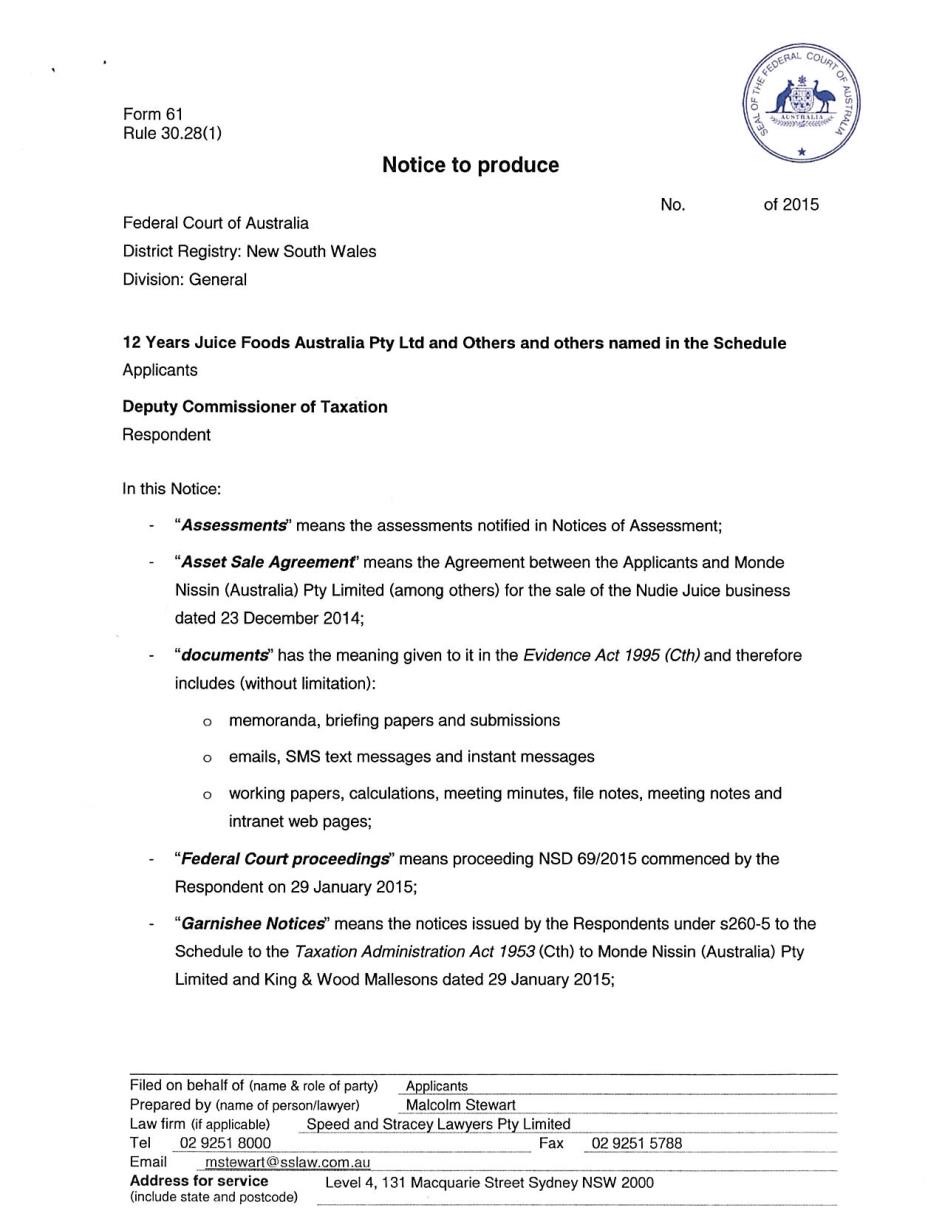
1 On 3 July 2015, I heard an interlocutory application to determine the respondent’s (“Commissioner’s”) claims that documents sought by the applicants under a notice to produce dated 26 March 2015 (“Notice”) contain:
(1) Material which is subject to legal professional privilege; and/or
(2) “Protected information” within Div 355 of Sch 1 to the Taxation Administration Act 1953 (Cth) (“TAA”) subject to the prohibition in s 355-25, without exception.
2 The Commissioner has produced the relevant documents, redacting the material the subject of his claims.
Background
3 Pursuant to an originating application filed on 26 March 2015, the applicants seek relief pursuant to s 39B of the Judiciary Act 1903 (Cth) in respect of the Commissioner’s decision to issue each of the applicants notices of assessment dated 29 January 2015 under s 99A and/or s 168 of the Income Tax Assessment Act 1936 (Cth) (“ITAA 1936”), for the tax period 1 July 2014 to 30 January 2015 (“Assessments”).
4 On the grounds set out in the originating application, the applicants contend that the Assessments were not authorised or were not a bona fide exercise of the Commissioner’s power to assess; that they involved conscious or reckless maladministration of the Commissioner’s assessment functions; that the Assessments were issued for a collateral purpose; and that the Assessments were not assessments to which s 175 of the ITAA 1936 applied.
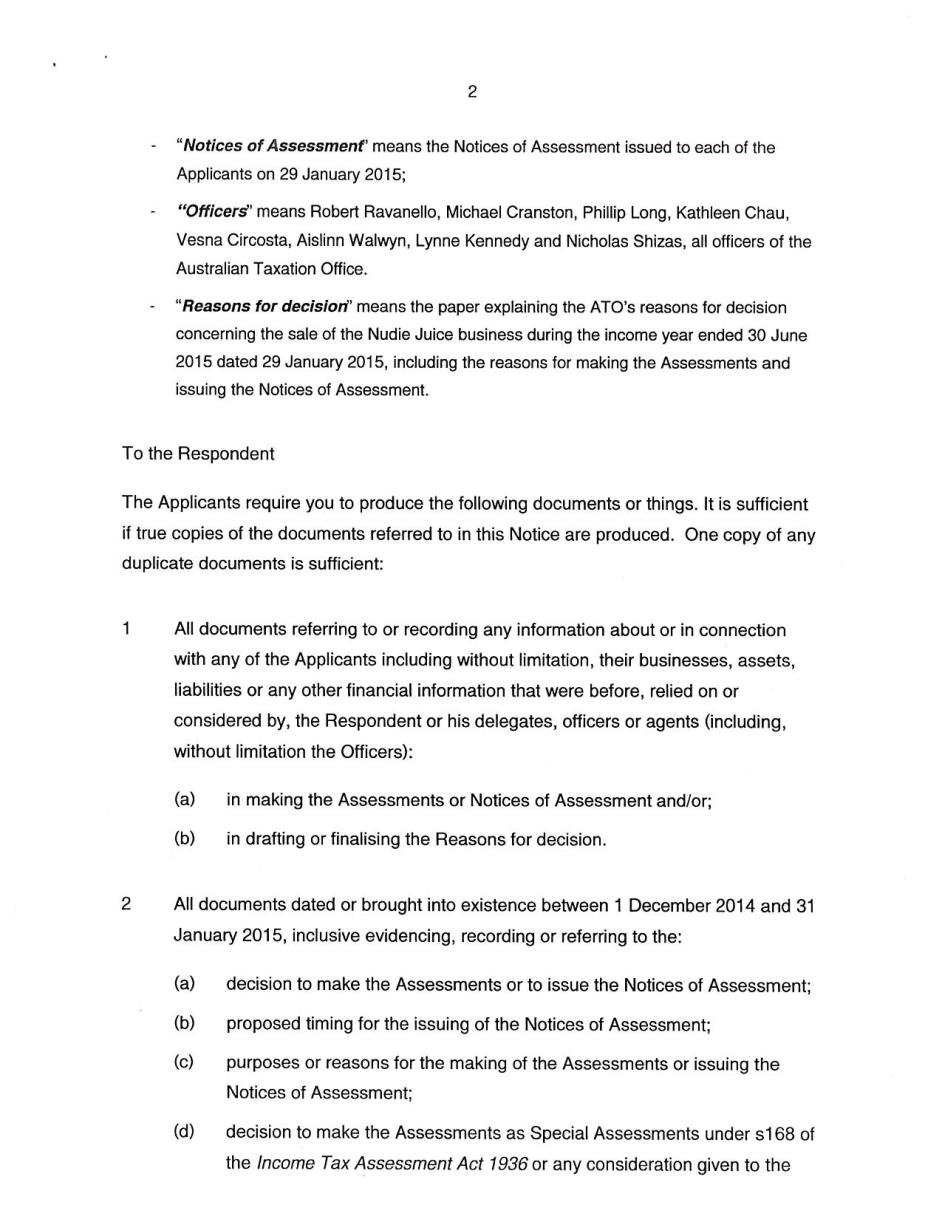
5 The applicants filed and served the Notice on 26 March 2015. A copy of the Notice is annexed as Annexure “A” to these reasons. The six paragraphs of the Notice call for the production of the following categories of documents:
Para 1: All documents that were before, relied on or considered by, the Commissioner or his delegates, officers or agents:
(a) In making the Assessments or notice thereof; and/or
(b) in drafting or finalising the reasons for decision in respect of them (“Reasons”);
Para 2: All documents dated or brought into existence between 1 December 2014 and 31 January 2015 inclusive, evidencing, recording or referring to:
(a) the decision to make the Assessments or to issue the notices thereof;
(b) the proposed timing for the issuing of the notices of assessment;
(c) the purposes or reasons for the making of the Assessments or issuing the notices thereof;
(d) the decision to make the Assessments as Special Assessments under s 168 of the ITAA 1936 or any consideration given to the reasons for, or consequences for any of the applicants or the Commissioner of, that decision; and/or
(e) decision to assess the first, second and third applicants to tax under s 99A of the ITAA 1936 or any consideration given to the reasons for, or consequences for any of the first, second and third applicants of, that decision.
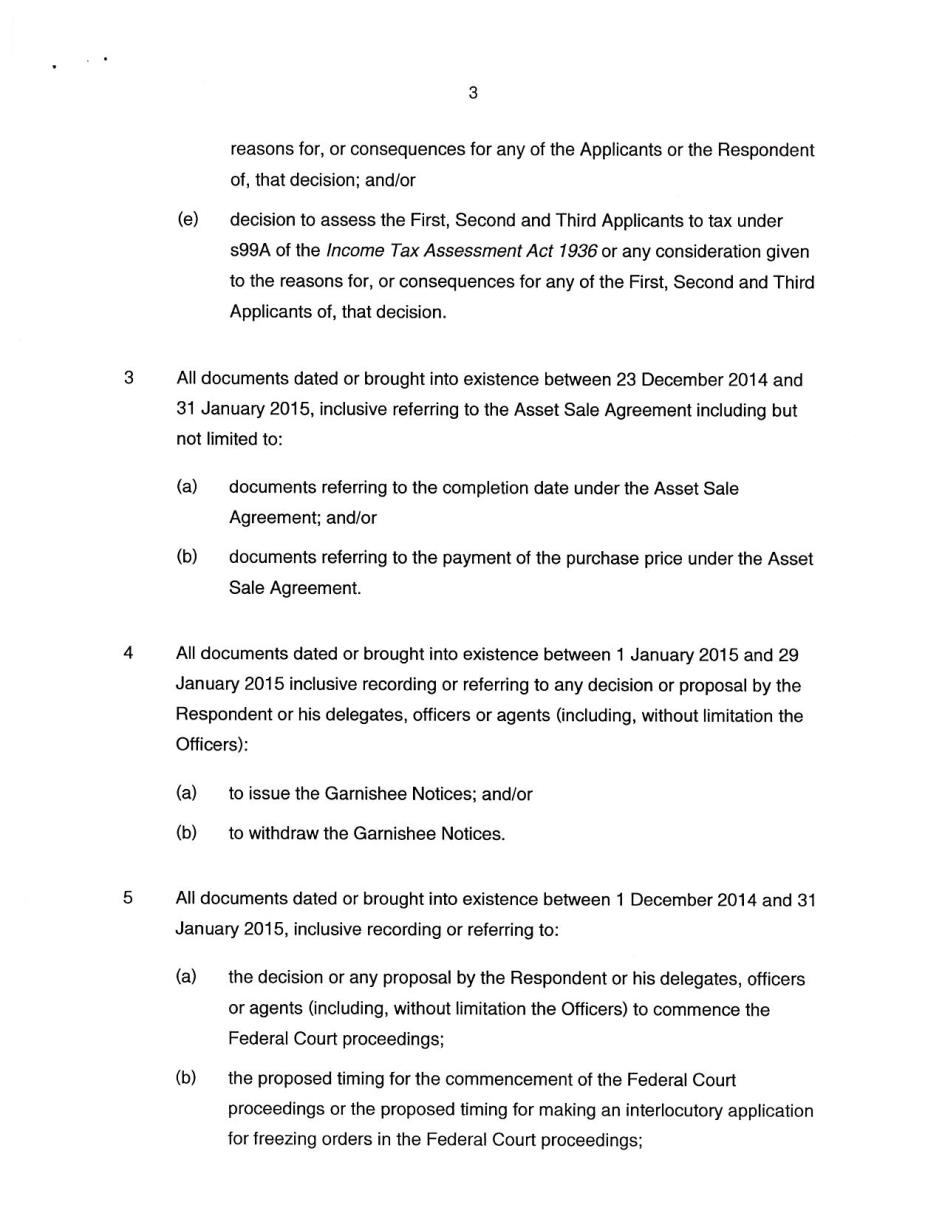
Para 3: All documents dated or brought into existence between 23 December 2014 and 31 January 2015 inclusive, referring to the Asset Sale Agreement.
Para 4: All documents dated or brought into existence between 1 January 2015 and 29 January 2015 inclusive, recording or referring to any decision or proposal by the Commissioner or his delegates, officers or agents:
(a) to issue the Garnishee Notices; and/or
(b) to withdraw the Garnishee Notices.
Para 5: All documents dated or brought into existence between 1 December 2014 and 31 January 2015 inclusive, recording or referring to:
(a) the decision or any proposal by the Commissioner or his delegates, officers or agents to commence the Federal Court proceedings;
(b) the proposed timing for the commencement of the Federal Court proceedings or the proposed timing for making an interlocutory application for freezing orders in the Federal Court proceedings;
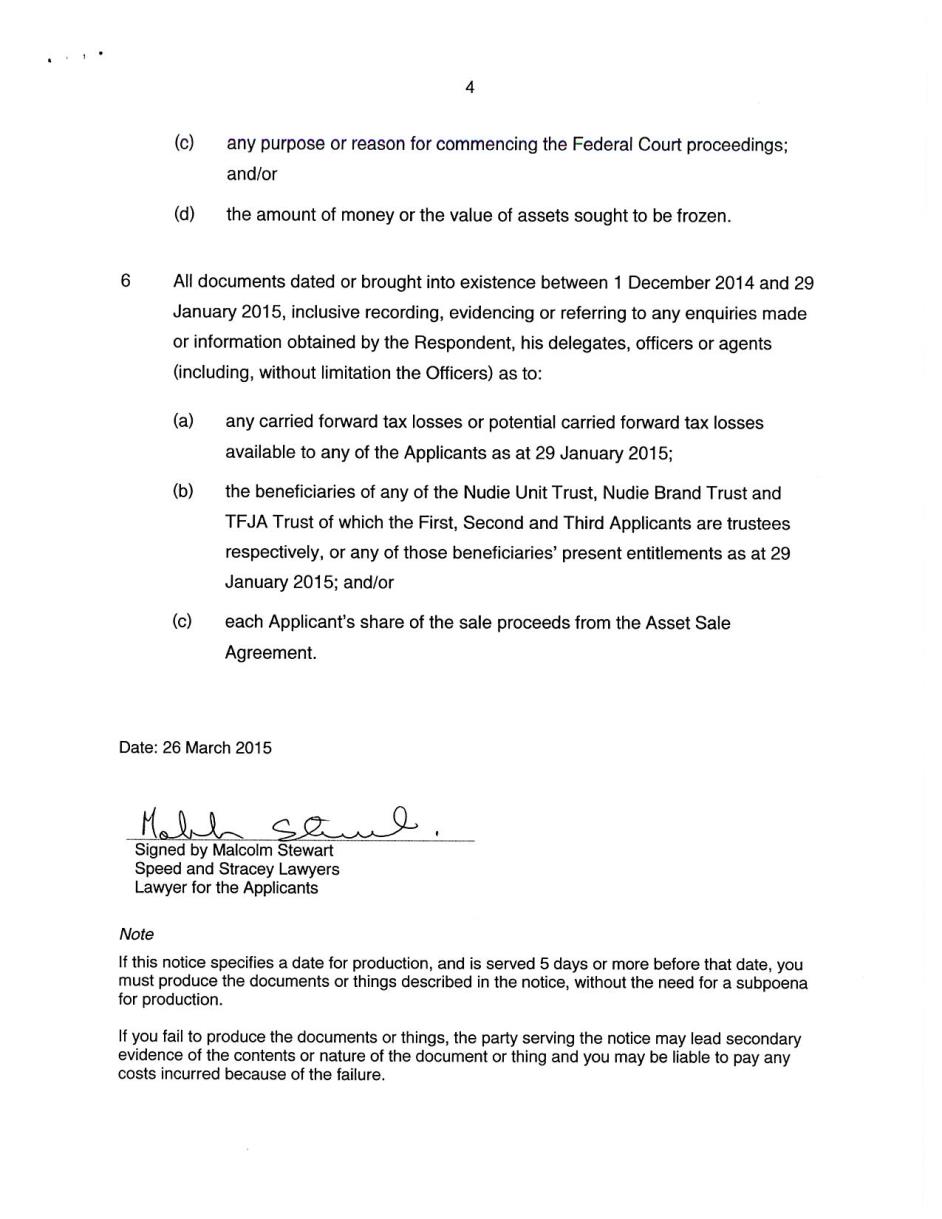
(c) any purpose or reason for commencing the Federal Court proceedings; and/or
(d) the amount of money or the value of assets sought to be frozen.
Para 6: All documents dated or brought into existence between 1 December 2014 and 29 January 2015 inclusive, recording, evidencing or referring to any enquiries made or information obtained by the Commissioner, his delegates, officers or agents as to:
(a) any carried forward tax losses or potential carried forward tax losses available to any of the applicants as at 29 January 2015;
(b) the beneficiaries of any of the Nudie Unit Trust, Nudie Brand Trust and TFJA Trust of which the first, second and third applicants are trustees respectively, or any of those beneficiaries’ present entitlements as at 29 January 2015; and/or
(c) each applicant’s share of the sale proceeds from the Asset Sale Agreement.
6 Over a period of approximately three months prior to the hearing, the number of documents the subject of the Commissioner’s claims and the extent of the redactions pressed by him have been significantly refined by a process of interaction, through communications, between the applicants’ solicitors (“S&S”) and the Commissioner’s solicitors (“AGS”). By the time of the hearing of the interlocutory application, only 16 documents were still claimed to contain material the subject of legal professional privilege, and some of the redactions in these were no longer pressed by the Commissioner or no longer challenged by the applicants; and only 17 documents were claimed to contain “protected information” within Div 355 of Sch 1 to the TAA, although some redactions made to certain of the 16 documents said to contain material the subject of legal professional privilege were made in reliance on Div 355 of Sch 1 to the TAA.
Evidence on the Hearing
7 The applicants relied on an affidavit of Robert Charles Geoffrey Suttie affirmed 1 July 2015 and ex ‘RCGS-2’ to that affidavit (together Ex 1).
8 The Commissioner relied on an affidavit of Stephen Vorrieter sworn 29 June 2015 together with exs ‘SV-1’ to ‘SV-7’ to that affidavit (together Ex A). Exhibit ‘SV-4’ comprised the 16 redacted documents said to contain material the subject of legal professional privilege; ex ‘SV-5’ comprised the 17 redacted documents said to contain “protected information” within Div 355 of Sch 1 to the TAA; ex ‘SV-6’ was the confidential exhibit comprising the unredacted documents in exs ‘SV-4’ and ‘SV-5’, while ex ‘SV-7’ was an index matching the documents in exs ‘SV-4’ and ‘SV-5’ to the documents in ex ‘SV-6’. As noted in [6] above, certain of the documents in ‘SV-4’, those behind tabs 8, 9 and 11, contained some redactions in reliance on Div 355 of Sch 1 to the TAA as well as in reliance on legal professional privilege.
9 The Commissioner also relied on a second affidavit of Stephen Vorrieter sworn 2 July 2015 together with exs ‘SV-8’ to ‘SV-11’ (together Ex B). In Ex B, Mr Vorrieter deposes to some errors that were made in Ex A. Those errors were notified to S&S on 30 June 2015. In particular:
(1) The claims referred to in paras 15.14.10, 15.14.11, 15.15.8 and 15.15.9 of Ex A were not pressed. The information in these redactions was disclosed in the documents behind tab 5 in ex ‘SV-4’;
(2) the claims referred to in paras 15.1.1 and 15.6 of Ex A were not pressed. New copies of the documents behind tabs 1 and 6 in ex ‘SV-4’ are annexed as exs ‘SV-9’ and ‘SV-10’ in Ex B, replacing the documents behind tabs 1 and 6 in ‘SV-4’; and
(3) at para 8 of Ex B a particularised claim in relation to the documents behind tab 10 in ex ‘SV-4’ is set out. A new copy of the documents is annexed at ex ‘SV-11’ in Ex B, replacing the document behind tab 10 in ex ‘SV-4’.
10 By the time the interlocutory application came on for hearing, the parties were in agreement that it would be appropriate for the Court to examine those unredacted documents in ex ‘SV-6’, in respect of which redactions had been made in reliance on privilege to ascertain whether privilege properly attaches to all the redacted material; and to examine those unredacted documents in ex ‘SV-6’ in respect of which redactions had been made in reliance on Div 355 to ascertain whether any of the redacted material is responsive to the notice notwithstanding that the material relates to entities other than the applicants.
The Submissions on Privilege
11 I have set out below the applicants’ written submissions (“AS”) as to the relevant principles that apply in determining whether a communication is privileged because the Commissioner, in his written submissions (“RS”), takes no issue with them other than for the observation in [22] below. Nor do I.
12 The question of whether production of documents the subject of a notice to produce may be resisted on grounds of privilege is governed by the common law, and not by Pt 3.10 of the Evidence Act 1995 (Cth): Esso Australia Resources Limited v Commissioner of Taxation [1999] HCA 67; 201 CLR 49 at 59–63 per Gleeson CJ, Gaudron and Gummow JJ; Adamas v O’Connor [2011] FCA 948; 282 ALR 302 at [7].
13 As to legal advice privilege, the relevant question is whether the document came into existence for the dominant purpose of seeking legal advice or assistance: Esso at 65–66. In Construction, Forestry, Mining and Energy Union v Port Kembla Coal Terminal Ltd [2015] FCA 282, Yates J recently provided the following elaboration of that test, having regard to the relevant authorities (at [18]):
• A dominant purpose is to be understood in the sense of “the ruling, prevailing, paramount or most influential purpose”: Commissioner of Taxation (Cth) v Pratt Holdings Pty Ltd [2005] FCA 1247; (2005) 225 ALR 266 at [30] (Pratt); AWB Limited v Cole [2006] FCA 571; (2006) 152 FCR 382 at [105]; Wingecarribee Shire Council v Lehman Brothers Australia Limited (in liq) (No 5) [2011] FCA 245 at [18].
• If the most that can be said of a communication is that the purposes for which the communication (here, in each case, a document) comes into existence include a purpose of obtaining legal advice or assistance, the privilege will not apply: Esso at [50].
• For example, where two purposes for the creation of the document can be discerned, and they are of equal weight, neither is dominant in the relevant sense: Pratt at [30].
• Similarly, if several purposes can be discerned, and they are of roughly similar weight, it cannot be said that one prevails over the other: AWB at [106]. Accordingly, a document is not privileged from production where one purpose for its creation is to obtain legal advice or assistance, but there are one or more other equally important purposes.
• The relevant time at which a claim for privilege is to be determined is the time when the document comes into existence: Barnes v Commissioner of Taxation (Cth) [2007] FCAFC 88; (2007) 242 ALR 6011 at [5].
• When applying the dominant purpose test, an appropriate starting point is to ask what was the intended use or uses of the document which accounted for it being brought into existence: Pratt Holdings Pty Ltd v Commissioner of Taxation [2004] FCAFC 122; (2004) 136 FCR 357 at [35].
• Where the document is immediately communicated by its author to several other persons, including the author’s legal adviser, such as by a circular email, it is also important to ask what was the dominant purpose of that email communication: AWB at [107].
• Ordinarily, the relevant purpose will be that of the author of the document. However, this will not always be the case. The relevant purpose may be found in the person under whose direction or authority, whether particular or general, the document was brought into existence or communicated: Grant at 677; see also Mitsubishi Electric Australia Pty Ltd v Victorian WorkCover Authority [2002] VSCA 59; (2002) 4 VR 332 at [14].
• The evidence of the author’s intention, or of the person under whose direction or authority the document was brought into existence or communicated, is not necessarily conclusive of that purpose. The dominant purpose must be determined objectively, having regard to the evidence, the nature of the document and the parties’ submissions: Pratt at [30].
• The courts have recognised that legal advisers, in addition to providing legal advice, may also advise on more general or broader issues concerning the financial and commercial dealings of their clients. Although the courts have taken a pragmatic or realistic view where mixed advice is given, the test, nevertheless, remains whether the dominant purpose of the creation of the document was for the provision of legal advice or assistance. If the advice given by a legal adviser is predominantly for a financial, personal or commercial purpose, as opposed to seeking legal advice or assistance, it will not be protected by the privilege: Barnes at [8]. Thus, the fact that a document is provided to solicitors for advice is not determinative of the purpose for which it was created: Pratt at [30].
• The privilege can attach to a copy of a document, if the copy was made for the dominant purpose of obtaining legal advice: Barnes at [10]-[11].
• It is possible that an original document which is not created for the dominant purpose of seeking legal advice or assistance is not privileged, while a copy of the document may be privileged if made for the dominant purpose of obtaining legal advice or assistance. By the same token, an original document might be privileged, while a copy of the same document might not be privileged, such as where the copy is created for the purpose of commercial negotiation: Barnes at [11]. In that latter case, the consequence of the use of the copy may be the waiver of privilege in the original.
• Generally, an intra-company disclosure of legal advice in circumstances where the confidentiality of the advice is maintained will not result in loss of the privilege: GEC Marconi Systems Pty Ltd v BHP Information Technology Pty Ltd [2000] FCA 593 at [9]-[10]; Seven Network Limited v News Limited [2005] FCA 1342 at [26].
• Where a document contains both privileged and non-privileged matter, it may be possible, in an appropriate case, to order disclosure of that part of the document which contains non-privileged matter whilst retaining the confidentiality of the privileged matter: Waterford v The Commonwealth of Australia [1987] HCA 25; (1987) 163 CLR 54 at 66, 87 and 103; GEC Marconi Systems at [11]; Grofam Pty Limited v Australia and New Zealand Banking Group Limited (1993) 43 FCR 408 at 414-417. That said, the presence in the document of matter other than legal advice may raise a question as to the purpose for which the document was brought into existence. This will be a question of fact : Waterford at 66.
14 As to litigation privilege, the relevant test is whether the document sought to be protected was created for the dominant purpose of use in existing or reasonably anticipated proceedings: Esso at 65–66. Whether or not litigation is reasonably contemplated is a question of fact to be determined objectively: Grant v Downs [1976] HCA 63; 135 CLR 674 at 682.
15 In a determination as to whether litigation was reasonably anticipated, the subjective views of the parties may well be relevant, but they are not determinative. The question is to be assessed by reference to all of the surrounding circumstances: Visy Industries Holdings Pty Ltd v Australian Competition and Consumer Commission [2007] FCAFC 147; 161 FCR 122. There must be a real prospect of litigation, as distinct from a mere possibility, but it does not have to be more likely than not: Mitsubishi Electric Australia Pty Ltd v Victorian WorkCover Authority [2002] VSCA 59; 4 VR 332 at [19] per Batt JA, Charles and Callawy JJA agreeing; Ensham Resources Pty Ltd v ALOL Insurance Company Ltd [2012] FCAFC 191; 209 FCR 1 at [57].
16 The authorities have given consideration to whether privilege attaches to summaries or circulations of legal advice within an organisation, being a matter which is important to consider in light of the manner in which the claims to privilege are articulated in the present case. In Komacha v Orange City Council (unreported, Supreme Court of New South Wales, Rath J, 30 August 1979), in a passage which commended itself to Franki J in Brambles Holdings Ltd v Trade Practices Commission (No 3) (1981) 58 FLR 452 at 458–459, Rath J said:
The privilege attaching to a document will be accorded to copies made of it provided confidentiality is maintained. If for example counsel’s advice is circulated among officers of a corporation obtaining the advice, then privilege is preserved, whether the circulation is of the original or of copies. If in such a case an officer of the corporation were to report to another officer setting out portions of the advice, privilege would attach to the report in respect of those portions. The problem arises where the reporting officer makes recommendations that relate to the advice received. The recommendations seem to me to be an activity of the corporation, and not a transmission of the advice from one officer of the corporation to another. This will be especially so where the recommendations are not simply based on the advice received, but are made upon a critical appreciation of the advice received and the situation in which the client finds itself.
I think that a distinction should be drawn between the circulation in a corporation of advice received from legal advisers, and recommendations made by officers of the corporation as to the action to be taken , having regard to that advice. The recommendations arc corporate action, and are not privileged, whether they follow the advice or disregard it. If the recommendations are found in a report which sets out the advice (or part of it) verbatim or in substance then I think that the privilege remains attached to that part of the report so setting out the advice. But if the officer making the recommendations is in substance tendering his own advice, then (if at all events he is not himself a professional legal adviser) his advice is not privileged.
(Emphasis added.)
17 These principles were accepted as correct by Logan J in Sunland Waterfront (BVI) Ltd v Prudential Investments Ply Ltd (No 4) [2010] FCA 863 at [22]–[23].
18 A claim of legal professional privilege must be supported by sufficient evidence and the party claiming privilege has the onus of making good its privilege claims on the basis of that evidence. In Barnes v Federal Commissioner of Taxation [2007] FCAFC 88; 242 ALR 601, the Full Federal Court (Tamberlin, Stone and Siopsis JJ) said:
[18] The authorities emphasise the need for focused and specific evidence in order to ground a claim for legal professional privilege. In Kennedy v Wallace (2004) 142 FCR 185; 213 ALR 108; [2004] FCAFC 337 (Kennedy), Black CJ and Emmett J reiterated the principles that verbal formulae and bare conclusory assertions of purpose are not sufficient to make out a claim for privilege: see also National Crime Authority v S ( 1991) 29 FCR 203 at 211; 100 ALR 151 at 158–160 (per Lockhart J); Grant at CLR 689; ALR 589 (per Stephen, Mason and Murphy JJ). Where possible the court should be assisted by evidence of the thought process behind, or the nature and purpose of advice being sought in respect of, each particular document. The fact that generalised evidence is not challenged in cross-examination does not mean that such evidence must be accepted, particularly when it is as manifestly inadequate as it is in this case. As in Kennedy, mere general assertions of the purpose of creation of the documents are insufficient to discharge this onus. Even though in that case some evidence as to the purpose of particular records was adduced, Allsop J at [168] considered that the onus had not been discharged because the evidence did not permit a conclusion to be drawn as to the dominant purpose of the creation of any particular document or entry in a document. Simply to show that one purpose for creation of the document was to obtain legal advice or assistance is not good enough.
(Emphasis added)
19 In AWB Ltd v Cole (No 5) [2006] FCA 1234; 155 FCR 30, Young J similarly said (at (44]):
(3) The existence of legal professional privilege is not established merely by the use of verbal formula: Grant at CLR 689; ALR 589 per Stephen, Mason and Murphy JJ. Nor is a claim of privilege established by mere assertion that privilege applies to particular communications or that communications are undertaken for the purpose of obtaining or giving “legal advice”: National Crime Authority v S (1991) 29 FCR 203 at 211-12; 100 ALR 151 at 159-60 per Lockhart J; Candacal Pty Ltd v Industry Research & Development Board (2005) 223 ALR 284; [2005] FCA 649 at [70] (Candacal); Seven Network Limited v News Limited [2005] FCA 142 at [6]-[8]. If assertions of that kind are received in evidence in support of the privilege claim, their conclusionary nature can leave unclear what advice was really being sought. There will be cases in which a claim of privilege will not be sustainable in the absence of evidence identifying the circumstances in which the relevant communication took place and the topics to which the instructions or advice were directed: Kennedy v Wallace (2004) 142 FCR 185; 213 ALR 108; [2004] FCAFC 337 (Kennedy) FCAFC)) at [12]-[17] per Black CJ and Emmett J… at [144]-[145] and at [166]-[171] per Allsop J; see also Southern Equities Corporation Ltd (in liq) v Arthur Andersen & Co (No 6) [2001] SASC 398.
20 In a similar vein, in Asahi Holdings (Australia) Pty Ltd v Pacific Equity Partners Pty Ltd (No 4) [2014] FCA 796, Beach J said at [29]:
[T]he applicants bear the onus of establishing the claims, including each factual element necessary to establish the requisite dominant purpose. In that respect, focused and specific evidence is required in respect of each communication, rather than mere generalised assertion let alone opaque and repetitious verbal formulae. There should be sufficient evidence which proves directly or by inference that the dominant purpose for the communication was for the relevant client to be given or to obtain legal advice. The communication also has to be confidential.
21 The above authorities in relation to the sufficiency of evidence required to substantiate privilege claims have been cited with approval on a number of occasions: see, e.g., AusNet Electricity Services Pty Ltd v Liesfield [2014] VSC 474 at [116]–[118]; Construction, Forestry, Mining and Energy Union v Port Kembla Coal Terminal Ltd [2015] FCA 282 at [19]; Australian Competition and Consumer Commission v Yazaki Corporation [2014] FCA 1316 at [37].
22 The only substantive observation the Commissioner sought to make was that while it can be accepted that there is a relevant distinction between the internal communication of externally obtained legal advice on the one hand, and a recommendation of an officer of the client having regard to that advice on the other hand (see [16] and [17] above), caution must be taken in relation to assessing such recommendations. The Commissioner submitted that where a recommendation itself reveals, directly or by implication, the content of the underlying privileged communication, it will itself be privileged – albeit, only to the extent that it reveals the original privileged communication. Again, I do not disagree with this observation. Ultimately, the extent of any legitimate redaction will depend on the extent to which the text of the legal advice is interwoven with the text of the recommendation in the communication. If they are so interwoven that they cannot be separated, then the whole of the text of the advice/recommendation may be privileged; if they are separate, then only the text of the advice will be privileged.
The Commissioner’s Claims on Privilege: Ex ‘SV-4’ in Ex A
23 Having regard to the agreement of the parties outlined in [10] above, I propose to approach the Commissioner’s claims that the redacted material in the documents behind tabs 1–16 inclusive in ex ‘SV-4’ is privileged and rule on those claims solely through the prism of the unredacted documents behind tabs 1–16 inclusive in ex ‘SV-6’ and by reference to the agreed principles set out in [12] to [22] above.
24 Tab 1: The emails behind this tab were replaced by the emails in ‘SV-9’ in Ex B. The text concealed by the first redaction on p 4 is not privileged. The text concealed by the second redaction on p 5 is only privileged after the word “namely” in the third line to the end of the concealed text.
25 Tab 2: The text concealed by this redaction is privileged.
26 Tab 3: The text concealed by the first redaction is no longer challenged by the applicants. The text concealed by the second redaction is the same as the text concealed by the second redaction behind tab 1 (p 5). The answer is the same.
27 Tab 4: The text concealed by this redaction is the same as the text concealed by the second redaction behind tab 1 (p 5) and by the second redaction behind tab 3. The answer is the same.
28 Tab 5: The texts concealed by the following redactions vary in character, as do the answers:
First redaction (p 1) – not privileged
Section redaction (p 1) – privileged
Third redaction (p 2) – privileged
Fourth redaction (p 2) – only the last sentence is privileged
Fifth redaction (p 2) – not privileged
Sixth redaction (p 3) – everything down to the heading “ISSUES” is not privileged; everything after that heading to the end of the concealed text is privileged
Seventh redaction (p 4) – privileged
Eighth redaction (p 4) – not privileged
Ninth redaction (p 5) – privileged
Tenth redaction (p 6) – not privileged
29 Tab 6: The emails behind this tab were replaced by the emails in ‘SV-10’ in Ex B. There are no redactions.
30 Tab 7: Of the text concealed by the first redaction on p 2, only the third paragraph of the concealed text is privileged. The text concealed by the second redaction on p 2 is privileged.
31 Tab 8: Of the text concealed by this redaction on pp 2 and 3, only the following parts of that text are privileged:
(1) The text of the paragraph numbered 6.
(2) The text of the paragraph numbered 10.
The balance of the text concealed by the redaction is not privileged.
32 Tab 9: The text concealed by the first redaction on p 1 is not privileged. The text concealed by the second redaction on p 3 replicates much of the text of the redaction behind tab 8. Only the texts of the paragraphs numbered 6 and 10 are privileged. The balance of the text concealed by the redaction on p 3 is not privileged.
33 Tab 10: The emails behind this tab were replaced by the emails in ‘SV-11’ in Ex B. The text concealed by the first redaction on p 2 is not privileged. Nor is the text concealed by the second redaction on p 7. The text concealed by the third redaction on p 8 is privileged, as is the text concealed by the fourth redaction on pp 9 and 10.
34 Tab 11: None of the text concealed by the redactions to this document is privileged.
35 Tab 12: The text concealed by the redaction on “page 3 of 18” is privileged.
36 Tab 13: The text concealed by this redaction is the same as the text concealed by the redaction to the emails behind tab 2. It is privileged.
37 Tab 14: The texts concealed by the redactions to a number of the emails behind this tab are identical to those behind tab 5 and the answers are the same. I will therefore only refer to additional redactions. The first and second on p 1 are privileged. The third on p 2 is not.
38 Tab 15: The texts concealed by the redactions to the emails behind this tab are identical to those behind tab 5 and the answers are the same.
39 Tab 16: The texts concealed by the redactions to all these emails are privileged.
The Submissions on Div 355 of Sch 1 to the TAA
40 Again, there is a good measure of agreement between the applicants and the Commissioner as to the proper construction of Div 355 of Sch 1 to the TAA (“Division 355” or “Div 355”), in particular what is “protected information” and the circumstances when it may, or may not, be entitled to withhold the production of documents containing such information pursuant to Div 355. As the Commissioner’s counsel put it in her concise and well-reasoned submissions (at RS (20)): “It may be that there is no legal controversy in relation to Divison 355 at all”. I believe not. For that reason, I have again first drawn on the applicants’ submissions, if only because of their comprehensiveness.
41 Division 355 makes it an offence for taxation officers to disclose tax information that identifies an entity, or is reasonably capable of being used to identify an entity, subject to certain exceptions: TAA, Sch 1, s 355-20.
42 The objects of the Division are set out in s 355-10 of Sch 1 to the TAA in the following terms
The objects of this Division are:
(a) to protect the confidentiality of taxpayers’ affairs by imposing strict obligations on *taxation officers (and others who acquire protected tax information), and so encourage taxpayers to provide correct information to the Commissioner; and
(b) to facilitate efficient and effective government administration and law enforcement by allowing disclosures of protected tax information for specific, appropriate purposes.
(Emphasis added):
43 The core offence provision is contained in s 355-25, which provides:
355-25 Offence—disclosure of protected information by taxation officers
(1) An entity commits an offence if:
(a) the entity is or was a *taxation officer; and
(b) the entity:
(i) makes a record of information; or
(ii) discloses information to another entity (other than the entity to whom the information relates or an entity covered by subsection (2)) or to a court or tribunal; and
(c) the information is *protected information; and
(d) the information was acquired by the first-mentioned entity as a taxation officer.
44 The terms “protected information” and “taxation officer” are relevantly defined in s 355-30. The term “protected information” is defined to mean information that:
(a) was disclosed or obtained under or for purposes of a law that was a *taxation law … when the information was disclosed or obtained; and
(b) relates to the affairs of an entity; and
(c) identifies, or is reasonably capable of being used to identify, the entity.
45 The offence created by s 355-25 is subject to a number of exceptions: see, e.g., s 355-45 (disclosure of public available information); s 355-47 (disclosure of periodic aggregate tax information); s 355-50 (disclosure in performing duties). The generality with which each of these exceptions is expressed is not limited by reason of the existence of other exceptions: s 355-40.
46 Most relevant for present purposes is s 355-50, which is in the following terms:
355-50 Exception—disclosure in performing duties
(1) Section 355-25 does not apply if:
(a) the entity is a *taxation officer; and
(b) the record or disclosure is made in performing the entity’s duties as a taxation officer.
Note 1: A defendant bears an evidential burden in relation to the matters in this subsection: see subsection 13.3(3) of the Criminal Code .
Note 2: An example of a duty mentioned in paragraph (b) is the duty to make available information under sections 3C and 3E.
Without limiting subsection (1), records or disclosures made in performing duties as a *taxation officer include those mentioned in the following table:
Records or disclosures in performing duties | ||
Item | The record is made for or the disclosure is to ... | and the record or disclosure ... |
1 | any entity, court or tribunal | is for the purpose of administering any * taxation law. |
2 | any entity, court or tribunal | is for the purpose of the making, or proposed or possible making, of an order under the Proceeds of Crime Act 2002 that is related to a *taxation law. |
3 | any entity, court or tribunal | is for the purpose of criminal, civil or administrative proceedings (including merits review or judicial review) that are related to a *taxation law. |
47 No offence will be committed under s 355-25 where a taxation officer discloses “protected information” to the applicants, their advisors or the Court pursuant to the Notice. Such production is plainly within item 3 of s 355-50, that is, it is for the purpose of the present civil proceedings, being proceedings that are related to a taxation law. In this respect, the proceedings, while brought under s 39B of the Judiciary Act 1903 (Cth), are to set aside assessments made under ss 99A and 168 of the ITAA 1936: cf., Khorramdel v Secretary, Department of Social Services [2013] AATA 848 at [21].
48 That s 355-50 of Sch 1 to the TAA authorises the production, by the Commissioner or his officers, of documents sought under a notice to produce in proceedings under s 39B of the Judiciary Act in respect of a decision made under the ITAA 1936 is clear having regard both to the unambiguous terms in which the provision is expressed and also to the authorities in relation to s 355-50 and its statutory predecessors.
49 In Commissioner of Taxation v Nestle Australia Ltd (1986) 12 FCR 257, the Full Federal Court considered the operation of former s 16(2) of the ITAA 1936, which was repealed in 2010 upon the introduction of Div 355: Tax Laws Amendment (Confidentiality of Taxpayer Information) Act 2010 (Cth), Sch 2, item 32. Section 16(2), as considered in Nestle, was in the following terms:
(2) Subject to this section, an officer shall not either directly or indirectly, except in the performance of any duty as an officer, and either while he is, or after he ceases to be an officer, make a record of, or divulge or communicate to any person any information respecting the affairs of another person acquired by the officer as mentioned in the definition of “officer” in sub-section (1).
(Emphasis added.)
50 The Commissioner had sought to rely on s 16(2) to resist the production of documents pursuant to an order for discovery made in the pre-trial stages of a proceeding brought by the taxpayer under the Administrative Decisions (Judicial Review) Act 1977 (Cth) (“ADJR Act”) to review the Commissioner’s decision to refuse an extension of time for payment of income tax. The Court (Bowen CJ, Lockhart and Shepherd JJ) held that s 16(2) did not render the Commissioner or his officers immune from processes of discovery and inspection: at 262.
51 The Court said at 261, in relation to s 16(2):
The effect of subs (2) is that an officer is prohibited, except in the performance of any duty as an officer, either while he is or after he ceases to be an officer, from making a record of or divulging or communicating to any person any information respecting the affairs of another person acquired by the officer. The expression “except in the performance of any duty as an officer” ought to receive a very wide interpretation. In Canadian Pacific Tobacco Co Ltd v Stapleton (1952) 86 CLR 1 Dixon CJ said at 6 that the word “duty”:
“ ... is not, I think, used in a sense that is confined to a legal obligation, but really would be better represented by the word ‘function’. The exception governs all that is incidental to the carrying out of what is commonly called ‘the duties of an officer’s employment’; that is to say, the functions and proper actions which his employment authorises.
In a case of this description I should think that did include the making of an affidavit in this Court, in a proceeding for the ultimate obtaining of revenue, even if the word ‘divulge’ is used in a sense which includes the giving of evidence.”
(Emphasis added.)
52 The Court in Nestle observed that the “duty” of an officer extends beyond the performance of work of an administrative nature such as processing returns, making assessments, considering and dealing with objections, conducting investigations into the affairs of taxpayers and matters of this nature. It was held that that duty “includes the occasions on which he is required by the judicial process to produce documents or give evidence in courts, by affidavit or viva voce, concerning the affairs of some other person which he has acquired as an ‘officer’, where the proceedings are referable to the imposition, assessment or collection of revenue”: at 262. Such “proceedings” included appeals to courts under the ITAA 1936 (i.e., prior to the introduction of Part IVC of the TAA), proceedings for the obtaining of revenue, applications under the ADJR Act and, relevantly for present purposes, “applications challenging decisions of the Commissioner pursuant to s 39B of the Judiciary Act 1903 (Cth)”.
53 In this respect, the Court said at 262:
Proceedings under the [ADJR] Act (also pursuant to s 39b of the Judiciary Act 1903) involving decisions or conduct relating to the imposition, assessment, collection or recovery of tax are an essential part of the machinery which Parliament has provided to ensure that tax is levied and collected according to law. Compliance by “officers” (within the meaning of that expression in s 16) with orders of the Court for discovery and inspection of documents in proceedings of this kind readily falls within the scope of their duties as such officers for the purposes of s 16(2).
54 A similar conclusion was reached by the New South Wales Court of Criminal Appeal in Yates v R (1991) 102 ALR 673. In that case a taxpayer argued that the secrecy requirements in s 10 of the Sales Tax Assessment Act (No 1) 1930 (Cth) made it unlawful for officers of the Commissioner to give evidence in criminal proceedings against him involving charges of tax evasion. Section 10(2) provided that:
Any officer who acts in the execution of any duty under [the] Act or the regulations … who … makes a record of or divulges any information relating to the affairs of a person except in the performance of any duty under [the] Act shall be guilty of an offence.
55 Priestley JA, with whom Wood and Finlay JJ agreed, referred (at 676–678) to the authority in Canadian Pacific and in Nestle, concluding that the expression “performance of any duty” should be interpreted in a broad fashion, consistently with those authorities. As a result, it was held that the secrecy requirements did not preclude the officers from giving evidence in the proceedings; even though they were not prosecutions under the TAA itself.
56 Section 355-50 of Sch 1 to the TAA was introduced, in its current form, by the Tax Laws Amendment (Confidentiality of Taxpayer Information) Act 2010 (Cth); former s 16 of the TAA was concurrently repealed. The relevant explanatory memorandum stated, in relation to the new s 355-50:
Disclosures in the performance of a taxation officer’s duties
5.12 Disclosure of taxpayer information by a taxation officer is permitted where the disclosure is made in the course of the taxation officer’s duties. Generally, such disclosures facilitate the officer carrying out their responsibilities. For the avoidance of doubt, the new framework provides a non-exhaustive list of disclosures that fall within the scope of such a disclosure. These are further described below [Schedule 1, item 1, section 355-50].
…
Judicial and administrative proceedings related to a taxation law
5.20 It is not an offence for a taxation officer to disclose taxpayer information for the purposes of proceedings related to a taxation law. Disclosures to Courts, external legal advisers and to the Commonwealth Director of Public Prosecutions in relation to proceedings that are directly or indirectly related to a taxation law are therefore allowed. [Schedule 1, item 1, subsection 355-50(2), item 3 in the table]
(Emphasis added.)
57 The effect of these provisions was considered by the Administrative Appeals Tribunal in Pratt Consolidated Holdings Pty Ltd and Federal Commissioner of Taxation [2011] AATA 907; 86 ATR 931. The Tribunal observed, relevantly:
Disclosure in performing duties
136. Section 355-25 does not apply if a taxation officer discloses protected information in performing his or her duties. Examples of situations in which a taxation officer would make such a disclosure are set out in s 355-50(2). …
137. Mr Pizer submitted, and I agree with him, that s 355-50(2) does not set out all of the circumstances in which a taxation officer may disclose information in the course of performing his or her duties. He referred to 3 authorities referring to other circumstances that come within a tax officer’s duties. The first 2 were decided in the context of the secrecy provision formerly found in s 16(2) of the ITAA 1936:
[There is then reference to FCT v Nestle Australia Ltd (1986) 12 FCR 257 at 262 per Bowen CJ, Lockhart and Sheppard JJ and Australian Institute of Marine and Power Engineers v Secretary, Department of Transport (1986) 13 FCR 124 at 136 per Gummow J]
138. The third case to which Mr Pizer referred me was also decided in light of s 16(2). It is a decision of the tribunal in Re Young and Commissioner of Taxation [(2008) 71 ATR 284 per Deputy President Hack and Deputy President McPherson].
…
146. There is no question that the Commissioner (and Pratt Holdings) will be required to give access to documents through the discovery procedures in the Federal Court. Under the procedures set out in Practice Note TAX 1, discovery will be limited to 4 categories of documents unless otherwise ordered by the docket judge. Disclosing protected information in the course of providing that discovery will then be made in the course of a taxation officer’s performing his or her duties. Disclosure will come within s 355-50(1) and so be an exception to the prohibition that would otherwise arise under s 355-25.
…
151. s 355-50 will exclude from the prohibition in s 355-25 any disclosure required in order to comply with any discovery order in the forthcoming appeal. It will be disclosure that is confined to the documents required to be discovered whether it be limited discovery or more general discovery. Compliance will be a duty…
58 In light of the above, it is clear that the Commissioner and his officers will not commit an offence under Div 355 by producing documents sought under a notice to produce issued in Federal Court proceedings challenging an assessment. Rather, the production of documents under such a notice constitutes a disclosure made in performing a person’s duties as a taxation officer for the purposes of s 355-50 of Sch 1 to the TAA.
59 It is clear from the Commissioner’s submissions that he accepted this summary of the law. And it was also common ground that where material relates to entities other than the applicants and does not fall within the scope of the Notice it may be protected information that may be withheld pursuant to Div 355: AS [83]; RS [20]. In the words of the Commissioner’s counsel:
If … the [a]applicants accept that the exception in Item 3 of s 355-50(2) would not apply to material that falls outside the [Notice] … the only dispute is in relation to whether “protected information” which is the subject of the Division 355 claims does in fact respond [to] a category of the [Notice] …
60 In relation to that issue, the Commissioner submitted:
(1) That none of the redactions made to the documents in ‘SV-5’, and to the documents behind tabs 8, 9 and 11 in ‘SV-4’ (see [15.8.1], [15.8.4], [15.8.7], [15.8.8], [15.9.1], [15.11] of Ex A) by reference to Div 355 obscure information that responds to the Notice. In particular, in response to the applicants’ suggestion at AS [84] that there may be material, for example, that was “before, relied on or considered by” the Commissioner in making the assessments (category 1 of the Notice), it should be recalled that the material that responds to category 1 to the Notice was produced earlier and separately to the documents that are presently in dispute (see Ex 1 at paras 7, 10, tabs 3 and 6);
(2) however, if, contrary to the submissions above, any of the redacted information is found to be responsive to the Notice then, consistently with the construction of Div 355 contended for by the Commissioner, the Commissioner accepts that that information would fall within the exception in Item 3 of s 355-50(2) and is required to be produced; and
(3) that it would be appropriate in the circumstances to adopt the course suggested by the applicants at AS [85], namely that the Court should inspect the unredacted documents for the purpose of determining whether any of the redacted material is responsive to the Notice. Again, the confidential exhibit at ‘SV-6’ has been provided for that purpose.
The Commissioner’s Claims in Reliance on Div 355: Tabs 8, 9 and 11 in ‘SV-4’ in Ex A; Ex ‘SV-5’ in Ex A
61 Having regard to the agreement of the parties outlined in [10] above, I propose to approach the Commissioner’s claims that certain of the redacted material in the documents behind tabs 8, 9 and 11 in ‘SV-4’ and the redacted material in the documents behind tabs 1–17 inclusive in ‘SV-5’ are not responsive to any of the categories of documents required to be produced by the Notice, and rule on those claims solely through the prism of the unredacted documents behind tabs 8, 9 11 and 17–33 inclusive in ex ‘SV-6’ and by reference to the agreed principles set out in [41] to [59] inclusive above.
62 Tab 8 of ‘SV-4’: The whole of this redaction can be supported by reliance on Div 355. I have already indicated at [31] above, that paragraphs numbered 6 and 10 are privileged.
63 Tab 9 of ‘SV-4’: Both redactions can be supported by reliance on Div 355. I have already indicated at [32] above, that paragraphs numbered 6 and 10 are privileged.
64 Tab 11 of ‘SV-4’: All these redactions can be supported by reliance on Div 355.
65 Tabs 1–17 of ‘SV-5’: The texts concealed by these redactions are “protected information” and the documents in which that information is contained are not, at least on their face, responsive to any category of documents required to be produced by the Notice. This is not to say that they did not fall within that category of documents required to be produced by para 1 of the Notice, but there is no evidence to suggest that they did fall within that category of documents.
Conclusion
66 This deals with all the documents in controversy between the parties, at least at this stage of the proceeding. I have to say that notwithstanding the undoubted propriety of the policy underlying Div 355, it should not be allowed to operate to shield the disclosure of “protected information” contained in documents required to be produced in a proceeding, where the “protected information” relates to a non-party individual who is the directing mind and will of a corporate party; at least where the non-party individual consents to the disclosure of the “protected information”. An area, perhaps, for future reform.
67 I will make orders to give effect to these reasons for judgment. Costs should be in the cause.
I certify that the preceding sixty-seven (67) numbered paragraph is a true copy of the Reasons for Judgment herein of the Honourable Justice Edmonds. |
Associate:
ANNEXURE ‘A’