

FEDERAL COURT OF AUSTRALIA
Amcom Telecommunications Limited, in the matter of Amcom Telecommunications Limited (No 4) [2015] FCA 720
IN THE FEDERAL COURT OF AUSTRALIA | |
IN THE MATTER OF AMCOM TELECOMMUNICATIONS LIMITED
ACN 062 046 217
AMCOM TELECOMMUNICATIONS LIMITED ACN 062 046 217 Plaintiff |
DATE OF ORDER: | |
WHERE MADE: |
THE COURT ORDERS THAT:
1. Pursuant to section 411(4)(b) of the Corporations Act 2001 (Cth) (Act), that the scheme of arrangement between the Plaintiff and its Shareholders, in the form contained in Annexure A of these orders, be approved.
2. Pursuant to section 411(12) of the Act, that the Plaintiff be exempted from complying with subsection 411(11) of the Act in relation to the scheme of arrangement.
3. The Plaintiff is to lodge an office copy of these orders with the Australian Securities and Investments Commission as soon as practicable.
Note: Entry of orders is dealt with in Rule 39.32 of the Federal Court Rules 2011.
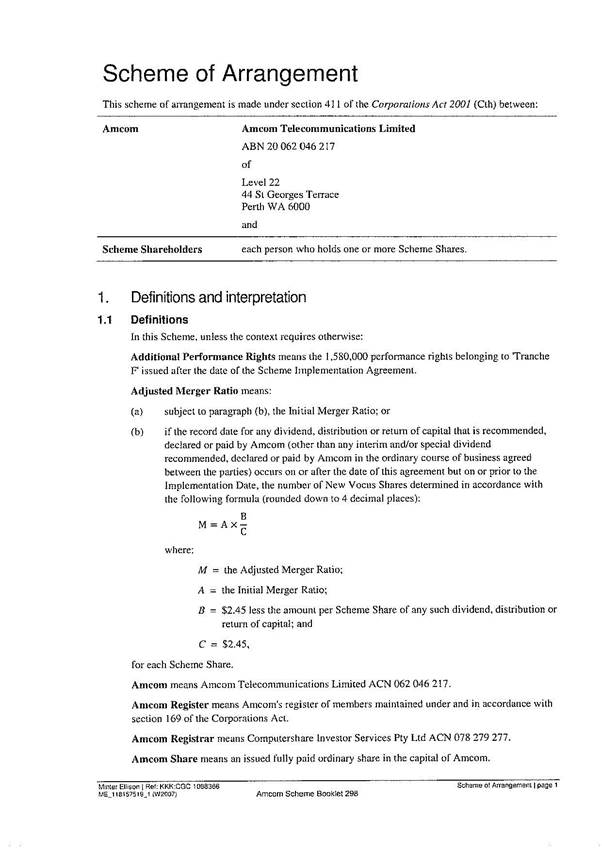
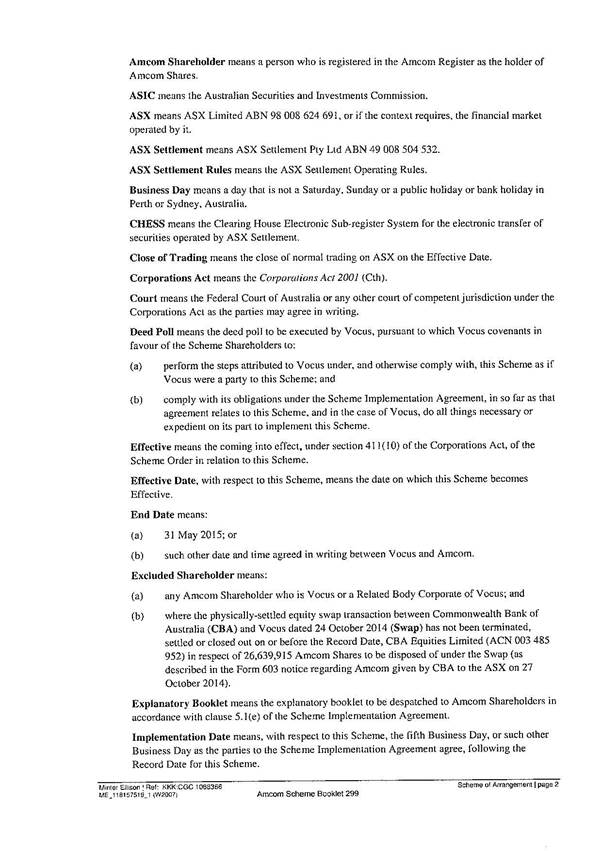
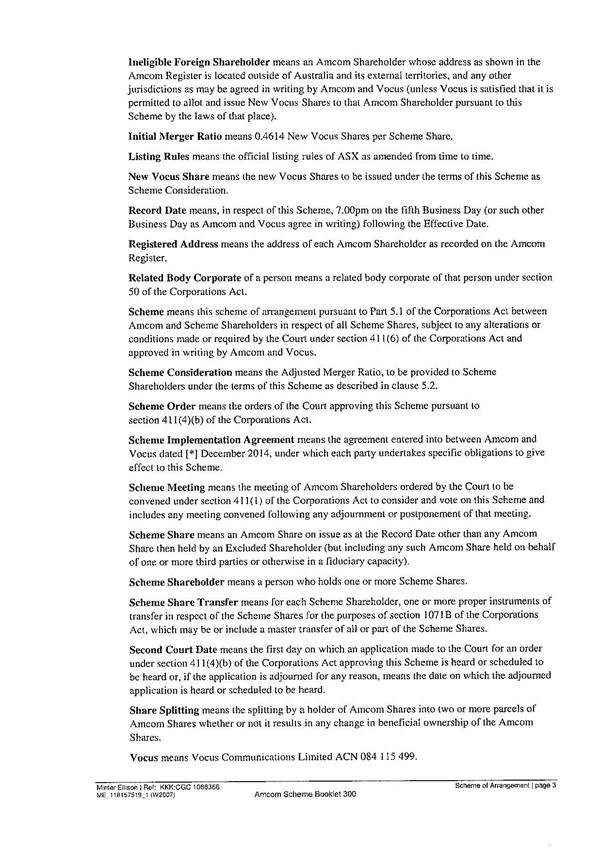
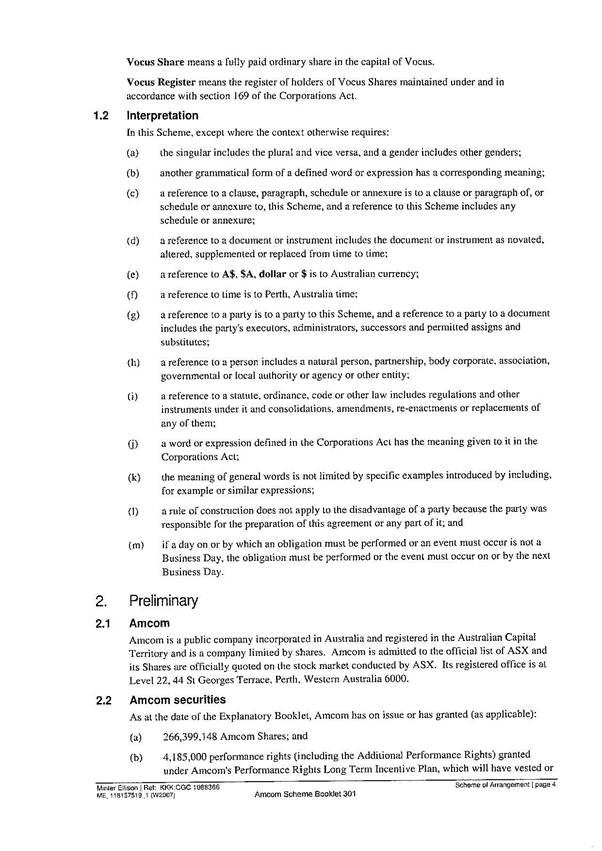
ANNEXURE A SCHEME OF ARRANGEMENT
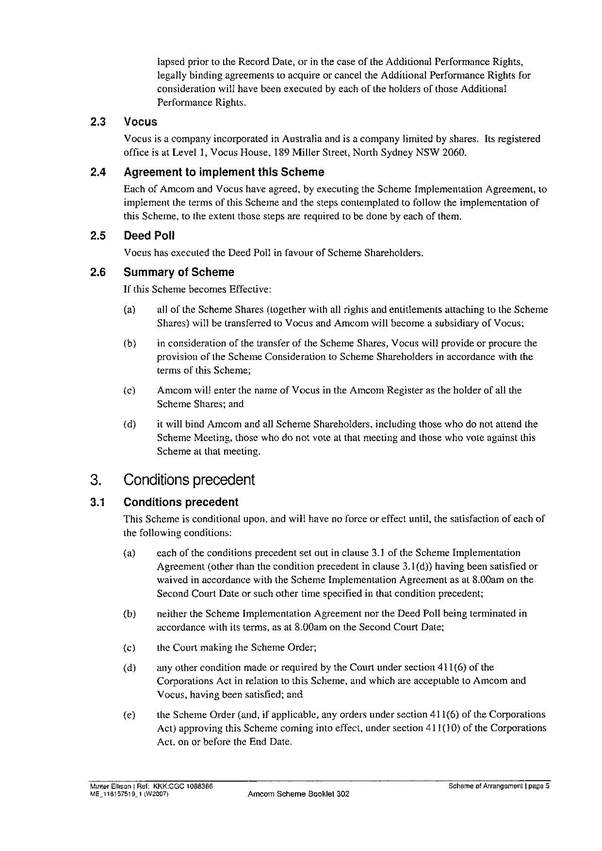
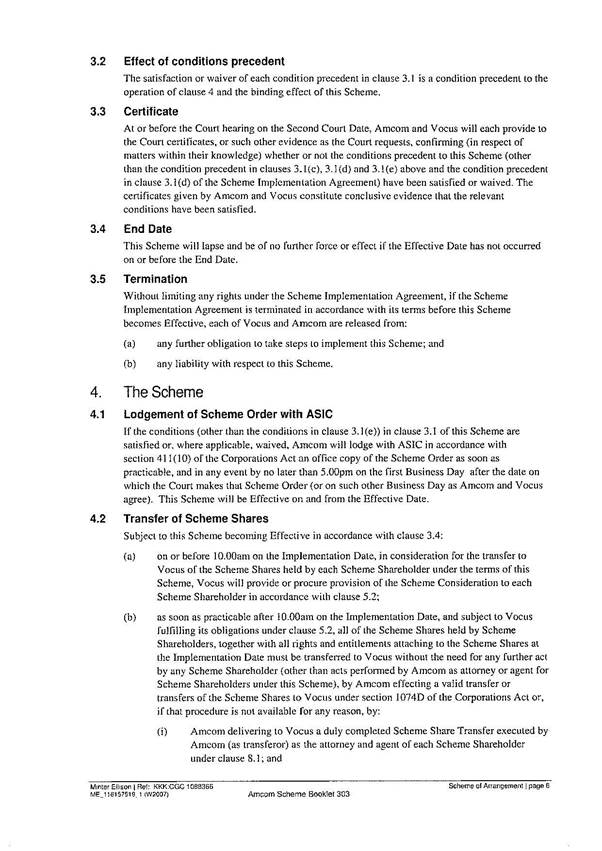
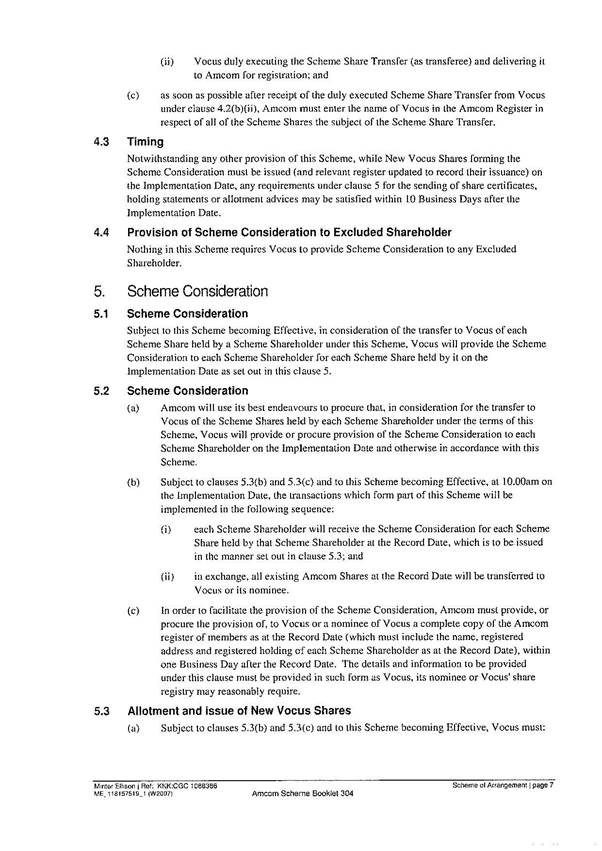
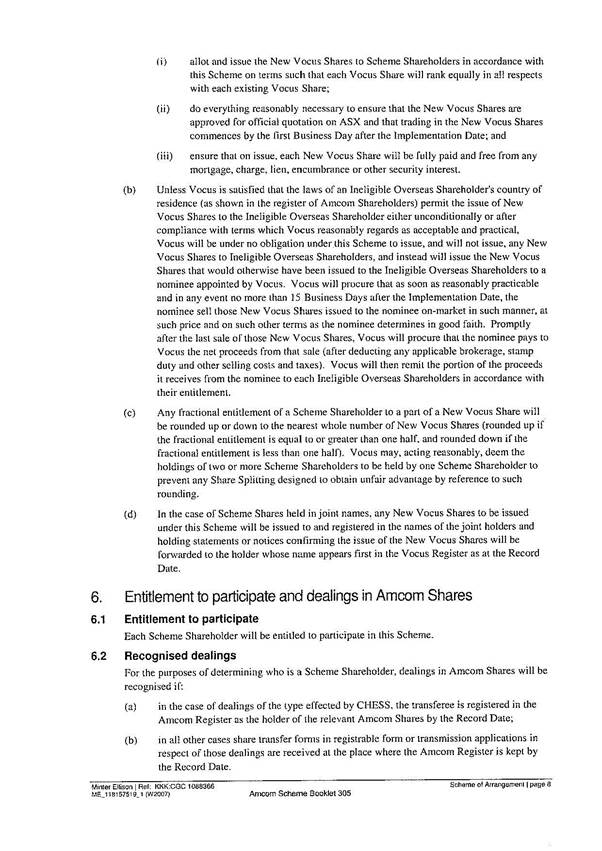

WESTERN AUSTRALIA DISTRICT REGISTRY | |
GENERAL DIVISION | WAD 54 of 2015 |
IN THE MATTER OF AMCOM TELECOMMUNICATIONS LIMITED
ACN 062 046 217
BETWEEN: | AMCOM TELECOMMUNICATIONS LIMITED ACN 062 046 217 Plaintiff |
JUDGE: | MCKERRACHER J |
DATE: | 17 JULY 2015 |
PLACE: | PERTH |
REASONS FOR JUDGMENT
1 On 23 June 2015, final Court approval was given for this somewhat protracted and at times controversial scheme. Although the approval application was ultimately not opposed, several objections to the Scheme had been raised in opposition to the Scheme by Blue Call, a subsidiary of TPG and itself the holder and beneficial owner of shares in Amcom (as defined in Re Amcom Telecommunications Limited (No 3) [2015] FCA 596 (Amcom No 3)). Additionally, certain observations had been made by ASIC in relation to some of those issues. Given that a deal of attention was addressed to those issues by experienced senior counsel and the requirement that the Court also be satisfied that orders should be made, it is appropriate to set out the relevant considerations in relation to those arguments. The notification by Blue Call to the effect that it would not appear at the second Court hearing to oppose the Scheme did not excuse the Court from the role it was required to play in considering the Scheme.
2 Before addressing the substance of the contentious issues, it is necessary to reiterate, at least in part, the recent history.
3 On 15 June 2015, Amcom shareholders voted in favour of a scheme of arrangement between Amcom and the holders of its ordinary shares. Some 88% of Shareholders voted in respect of the Scheme and over 77% voted in favour of the Scheme despite the views of associates of the dissentient shareholder, TPG, which held 19.99% of the vote. Excluding the interests held by TPG, which voted against the resolution, the Scheme received almost unanimous support from Amcom Shareholders. 99.8% of non-TPG associates cast votes in favour of the Scheme, and of the 181.4 million Shares voted at the meeting either in person or by proxy (other than by TPG associates), only 0.3 million voted against the resolution.
4 Amcom seeks orders under s 411(4)(b) of the Corporations Act 2001 (Cth) approving the Scheme and an order pursuant to s 411(12) exempting Amcom from compliance with s 411(11) of the Act. The Court is asked to decide whether approval should be granted for the Scheme to give effect to the acquisition by Vocus of 100% of the Shares.
5 Amcom relies on numerous affidavits in support of its application, including affidavits previously filed in this proceeding which contain details of the Scheme and the disclosures made. Vocus also supported the application with affidavits and submissions. These reasons reflect those submissions.
6 Relevantly, s 411 of the Act provides:
411 Administration of compromises etc.
(1) Where a compromise or arrangement is proposed between a Part 5.1 body and its creditors or any class of them or between a Part 5.1 body and its members or any class of them, the Court may, on the application in a summary way of the body or of any creditor or member of the body, or, in the case of a body being wound up, of the liquidator, order a meeting or meetings of the creditors or class of creditors or of the members of the body or class of members to be convened in such manner, and to be held in such place or places (in this jurisdiction or elsewhere), as the Court directs and, where the Court makes such an order, the Court may approve the explanatory statement required by paragraph 412(1)(a) to accompany notices of the meeting or meetings.
…
(4) A compromise or arrangement is binding on the creditors, or on a class of creditors, or on the members, or on a class of members, as the case may be, of the body and on the body or, if the body is in the course of being wound up, on the liquidator and contributories of the body, if, and only if:
(a) at a meeting convened in accordance with an order of the Court under subsection (1) or (1A):
(i) in the case of a compromise or arrangement between a body and its creditors or a class of creditors—the compromise or arrangement is agreed to by a majority in number of the creditors, or of the creditors included in that class of creditors, present and voting, either in person or by proxy, being a majority whose debts or claims against the company amount in the aggregate to at least 75% of the total amount of the debts and claims of the creditors present and voting in person or by proxy, or of the creditors included in that class present and voting in person or by proxy, as the case may be; and
(ii) in the case of a compromise or arrangement between a body and its members or a class of members—a resolution in favour of the compromise or arrangement is:
(A) unless the Court orders otherwise—passed by a majority in number of the members, or members in that class, present and voting (either in person or by proxy); and
(B) if the body has a share capital—passed by 75% of the votes cast on the resolution; and
(b) it is approved by order of the Court.
…
(11) Subject to subsection (12), a copy of every order of the Court made for the purposes of paragraph (4)(b) must be annexed to every copy of the constitution of the body issued after the order has been made.
(12) The Court may, by order, exempt a body from compliance with subsection (11) or determine the period during which the body must comply with that subsection.
…
(17) The Court must not approve a compromise or arrangement under this section unless:
(a) it is satisfied that the compromise or arrangement has not been proposed for the purpose of enabling any person to avoid the operation of any of the provisions of Chapter 6; or
(b) there is produced to the Court a statement in writing by ASIC stating that ASIC has no objection to the compromise or arrangement;
but the Court need not approve a compromise or arrangement merely because a statement by ASIC stating that ASIC has no objection to the compromise or arrangement has been produced to the Court as mentioned in paragraph (b).
7 The matters the Court must take into account in deciding whether to approve the Scheme include whether:
(a) the orders of the Court convening the scheme meeting were complied with;
(b) the resolution to approve the Scheme was passed by the requisite majority and whether other statutory requirements have been satisfied;
(c) all conditions to which the Scheme is subject (other than Court approval and lodgement of the Court's orders with ASIC) have been met or waived;
(d) the Scheme is fair and reasonable so that an intelligent and honest Shareholder, properly informed and acting alone, might approve it;
(e) there was full and fair disclosure to Shareholders of all information material to the decision whether to vote for or against the Scheme;
(f) Amcom has brought to the attention of the Court all matters that could be considered relevant to the exercise of the Court's discretion; and
(g) the Court is satisfied under s 411(17) of the Act that the Scheme has not been proposed to avoid Ch 6, or that Amcom has a statement from ASIC that it has no objection to the Scheme.
(See Re Seven Network Limited (No 3) (2010) 267 ALR 583 per Jacobson J (at [35]-[39]); Re David Jones Limited (No 3) [2014] FCA 753 per Farrell J (at 5]).)
8 To place the current events in context, it is necessary to describe the history of the Scheme.
9 At the first hearing on 30 March 2015, the Court made orders approving the Scheme Booklet (30 March Orders).
10 On 30 April 2015, TPG, a competitor of Amcom, announced that it had increased its shareholding in Amcom to 18.6% and subsequently to 19.99%.
11 On 6 May 2015 the scheme meeting convened pursuant to the 30 March Orders was adjourned by the chairperson, Mr Grist, exercising the power conferred on him by order 1(d) of the 30 March Orders. The Scheme Meeting was adjourned to allow Shareholders more time to consider the acquisition by TPG. The Scheme Meeting was adjourned to 18 May 2015 at 11.00 am (AWST) at the Perth Convention and Exhibition Centre, 21 Mounts Bay Road, Perth, Western Australia.
12 On 15 May 2015, with Amcom's consent under the Scheme Implementation Agreement (SIA), Vocus announced to the market that it had terminated and settled the equity swap transaction between Vocus and the Commonwealth Bank of Australia dated 24 October 2014, and had disposed of its interest in up to 26,639,915 ordinary shares in Amcom (Vocus Divestment).
13 On 18 May 2015, the Scheme Meeting was adjourned by the chairperson, Mr Stein, exercising the power conferred on him by order 1(d) of the 30 March Orders, to allow Shareholders more time to consider the Vocus Divestment. On 26 May 2015, the Court made orders (26 May Orders), amongst other things, that the Scheme Meeting be reconvened at 11.00 am (AWST) on 8 June 2015 at the Perth Convention and Exhibition Centre, 21 Mounts Bay Road, Perth, Western Australia.
14 The Court made orders on 21 April 2015 for the despatch of a supplementary disclosure statement.
15 The 26 May Orders ordered the despatch of a second supplementary disclosure statement to Shareholders.
16 The evidence discloses that Amcom has complied with the orders made by the Court.
17 On 2 April 2015, the Scheme Booklet was despatched to Shareholders. It included statements to the effect that:
(a) in order to become effective, the Scheme must be approved by an order of the Court;
(b) Amcom intended to apply to the Court on 13 May 2015 for approval of the Scheme; and
(c) Shareholders who wished to oppose the approval of the Scheme could do so by filing with the Court and serving on Amcom a notice of appearance.
18 On 27 May 2015, the Second Supplementary Disclosure Statement was despatched to Shareholders. It included an updated indicative timetable for key dates for the Scheme, including the second court date of 23 June 2015.
19 At the Scheme Meeting on 15 June 2015, the chairman, Mr Grist, announced that Amcom intended to apply to the Court for approval of the Scheme on 23 June 2015 and that Shareholders were entitled to appear at the hearing.
20 On 16 June 2015, a notice of this hearing was published in The Australian newspaper. It gave persons 5 days to file a notice of appearance in opposition to the Scheme. The notice directed persons who wished to oppose the approval of the Scheme to file and serve on Amcom a notice of appearance and affidavit at the address for service given in the advertisement. Mr Cameron Belyea of Clayton Utz was named as the relevant contact.
21 With the exception of a notice of appearance filed by Blue Call on 25 May 2015, no notice of an intention to oppose approval of the Scheme was received.
22 Notice of the 23 June 2015 hearing was served on ASIC.
23 On the evidence, the Shareholders had an intense interest in voting. Although the percentage of eligible shares that were voted (both for and against) has no statutory significance, a low turnout may suggest a flaw in the convening procedure. No flaw is suggested by the evidence in this proceeding. In Re Lion Nathan Ltd (No 2) [2009] FCA 1261, Emmett J (at [6]) noted that 64% of eligible shares had been represented and voted at the scheme meeting. In Re MB Group Plc [1989] BCLC 672, Harman J (at 675) described a turnout of 52% of scheme shares as ‘a high turnout’.
24 As at 12 June 2015, there were 266,399,148 Shares on issue held by 8,468 Shareholders. The evidence is that:
(a) 234,690,447 votes were cast at the Scheme Meeting, being approximately 88.09% of the Shares on issue as at 12 June 2015;
(b) 3,542 Shareholders present and voting (including by proxy) voted in favour of the Scheme and 48 voted against (including the three associates of TPG);
(c) 77.19% of all votes cast were in favour of the Scheme;
(d) 22.81% of all votes cast were against the Scheme, which was represented by the associates of TPG voting its 19.99% consolidated shareholding in Amcom, and 1.23% voted by other Shareholders.
25 Certain Shares were ‘tagged’ in compliance with the orders of the Court, including those of Mr Grist and performance rights holders. Votes cast by TPG and its associates were also tagged. The associates of TPG which held shares in Amcom are Blue Call, Value Added Network Pty Ltd and Bell Potter Nominees Ltd as registered holder for ACN 139 798 404 Pty Ltd. Charts produced in evidence revealed that even if the tagged votes of Mr Grist and Performance Rights Holders were to be excluded in whole, 76.06% of Shareholders still voted in favour of the Scheme, which represents 98.65% of those present and voting (including by proxy).
Jurisdiction to approve the scheme
26 Section 411(4) of the Act relevantly provides that an arrangement is binding on the members of a company and the company itself if, at a meeting convened in accordance with an order of the Court, a resolution in favour of the arrangement is:
(a) passed by a majority in number of the members present and voting, either in person or in proxy: s 411(4)(a)(ii)(A); and
(b) if the body has a share capital - passed by 75% of the votes cast on the resolution; s 411(4)(a)(ii)(B),
and the arrangement is approved by order of the Court: s 411(4)(b).
27 In approving a scheme of arrangement, the role of the Court is supervisory in nature. The Court is required to be satisfied that there has been no oppression and that the arrangement is one which is capable of being accepted: Re NRMA Ltd (2000) 33 ACSR 595 per Santow J (at 607); Central Pacific Minerals NL [2002] FCA 239 per Emmett J (at [12]-[13]). The Court is generally reluctant to intervene with schemes in which the requisite majority has been reached by fully informed members: Re NRMA Ltd (No 2) (2000) 34 ACSR 261 per Santow J (at 271); Central Pacific Minerals per Emmett J (at [13]).
28 In considering the principles which govern the Court's discretion to approve a scheme, Jacobson J in Re Seven Network (at [35]-[40]) refers to the following list of considerations set out by the Corporations and Markets Advisory Committee in its December 2009 report:
(a) whether the members have voted in good faith and not for an improper purpose;
(b) whether the proposal is fair and reasonable so that an intelligent and honest person who was a member of the relevant class, properly informed and acting alone, might approve it. This leading test of fairness was set out by Fry LJ in Re Alabama, New Orleans, Texas and Pacific Junction Railway Co [1891] 1 Ch 213 (at 247);
(c) whether the plaintiff has brought to the attention of the court all matters that could be considered relevant to the exercise of the court's discretion; and
(d) whether there has been full and frank disclosure of all information material to the members' decision.
29 The Court must be satisfied that the meeting to approve the scheme has been completed and that the resolution has been passed in accordance with the statutory requirements and that the scheme is fair and reasonable to members in a general sense: Re Peak Coal Ltd (No 2) [2010] FCA 45 per McKerracher J (at [3]); Re Little World Beverages Ltd (No 2) [2012] FCA 1058 per McKerracher J (at [5]); Re Integra Mining Ltd (No 2) [2013] FCA 220 per McKerracher J (at [4]).
Section 411(17) considerations
30 The Court's ultimate approval of the Scheme is dependent upon fulfilment of one of two alternative conditions set out in s 411(17) of the Act. Production of a ‘no objection letter’ usually brings an end to the issue, but the letter does not affect the Court's general discretion to grant or withhold its approval: Re Macquarie Private Capital A Ltd (2008) ACLC 366 per Barrett J (at [29]). I am satisfied that where, as here, the directors of a target company consider a merger proposal is in the best interests of the members of the target company, the implementation of the merger by a method that provides for the certainty of outcome (100% by the bidder company) through a single process is a commercially rational reason for choosing a scheme of arrangement over a Ch 6 takeover. This reason for preferring a scheme of arrangement to a Ch 6 takeover is not a proscribed purpose: Re ACM Gold Limited (1992) 34 FCR 530 per O’Loughlin J (at 541-543); Re Stockbridge Ltd (1993) 9 ACSR 637 (at 652-653).
CONSIDERATION OF FORESHADOWED OBJECTIONS
31 I now propose to consider some foreshadowed grounds of objection raised by Blue Call, which were argued in the interlocutory hearing on 26 May 2015 and briefly discussed in Amcom No 3. I do so, not because those objections were in the end pursued by Blue Call by way of opposition to the orders made on 23 June 2015, but because, having raised those issues and in light of the fact that ASIC has also commented on the issues, they are matters that require consideration by the Court. Contrary to what may occasionally be thought, the ‘second’ hearing is not merely a rubber stamping or box ticking exercise by the Court. Not all shareholders will have a sophisticated and comprehensive appreciation of the legal and commercial ramifications of the orders which might be made at a hearing of this nature. The role to be played by a court pays regard, to some extent, to that consideration.
Full and fair disclosure to Shareholders
32 Blue Call submitted in its submissions dated 26 May 2015 that the substratum changed when Vocus sold down its 10% acquisition. Blue Call relied on Cleary v Australian Co-operative Foods (No 3) (1999) 32 ACSR 701. As Amcom argues, Cleary may be distinguished for at least two reasons. First, in contrast with the facts of the Cleary case, here there has been no misrepresentation with respect to the Vocus shareholding in Amcom because the Vocus Divestment does not constitute any change to the terms of the Scheme. Secondly, disclosure of the Vocus Divestment was made in the Second Supplementary Disclosure, which was despatched on 26 May 2015. Since that time, Amcom Shareholders have had the opportunity to revoke their proxies or vote in person.
33 It is disclosed in the Scheme Booklet that the Amcom directors have concluded that the Scheme is in the best interests of Amcom Shareholders in the absence of a superior proposal. The Scheme Booklet sets out the reasons why the Amcom directors consider the Scheme to be in the best interests of Amcom Shareholders. While the SIA prevents Amcom from soliciting a competing proposal to the Vocus offer, there is an exception to these exclusivity provisions which allows the Amcom directors to consider a competing proposal where that proposal may reasonably be expected to lead to a superior proposal. This is the usual form of ‘fiduciary carve out’ found in scheme implementation agreements.
34 There has been no material change to the Scheme or scheme consideration. Shareholders retained the same rights and benefits under the Scheme as they always had, and as disclosed in the Scheme Booklet.
35 The Vocus Divestment was announced to the market on 15 May 2015. The Second Supplementary Disclosure letter was despatched to Amcom Shareholders on 28 May 2015. The Scheme Meeting was held on 15 June 2015. Allowing for two business days for receipt of the Second Supplementary Disclosure letter as prescribed by Amcom's constitution, Amcom Shareholders had 13 clear days from receipt of the Second Supplementary Disclosure letter to the date of the Scheme Meeting in which to consider the disclosures. This is more than the 10 day period which ASIC considers an appropriate amount of time for shareholders to consider supplementary information in a scheme of arrangement as per ASIC Regulatory Guide 60.
36 Further, as Amcom submits:
(a) the Amcom board maintained their recommendation to Scheme participants to approve the Scheme;
(b) PwCS maintained its opinion that the Scheme was in the best interests of Amcom Shareholders and did not consider the Vocus Divestment had any material impact on its opinion as set out in the Scheme;
(c) ASIC considered the Scheme Booklet, Supplementary Disclosure Statement and Second Supplementary Disclosure Statement prior to despatch to Shareholders and informed Amcom that ASIC had no comments in relation to the documents; and
(d) there was no amendment to the proposed Scheme as a result of the Vocus Divestment. PwCS remained of the opinion that the Scheme was in the best interests of Shareholders in the absence of a superior proposal and concluded that there was no material change to its evaluation of the scheme consideration.
37 On 26 February 2015, the Amcom board resolved that, pursuant to Corporations Regulations 2001 (Cth) reg 7.11.37, the record date for determining Shareholders who were eligible to vote at the Scheme Meeting would be 11.00 am on 4 May 2015, being 48 hours prior to the Scheme Meeting. At the time of this resolution, the Scheme Meeting had been scheduled for 6 May 2015.
38 The Scheme Meeting was adjourned on two separate occasions: firstly to 18 May 2015 and secondly to 15 June 2015. For the purposes of the second adjournment, the record date was amended to 11.00 am on 13 June 2015 and was announced to the market and notified to Shareholders by way of the Second Supplementary Disclosure letter.
39 These dates were amended by Amcom's Company Secretary, Mr Hinton, acting within his delegated authority in operating the Scheme. This decision was ratified by the Amcom board on 12 June 2015.
40 Computershare conducted reviews of the register approximately twice a week to determine if any new Shareholders acquired shares in Amcom. Where new Shareholders came on to the register between 2 April 2015 and 7 June 2015, Computershare arranged for the relevant Scheme documents to be despatched to those new Shareholders.
41 Where the Shareholder came on to the register between 2 April 2015 and 20 April 2015, Computershare despatched the Scheme Booklet and a Proxy Form to that Shareholder.
42 Where the Shareholder came on the register between 20 April 2015 and 21 May 2015, Computershare despatched the Scheme Booklet, Proxy Form and Supplementary Disclosure Statement to that Shareholder.
43 Where the Shareholder came on the register between 21 May 2015 and 7 June 2015, Computershare despatched the Scheme Booklet, Proxy Form, Supplementary Disclosure letter and Second Supplementary Disclosure letter to that Shareholder.
44 In any event, the Court’s statutory power as to the making of orders for meetings under s 411(1) as supplemented by s 1319 is broad.
45 The Court’s 30 March Orders preserved reg 5.6.13 of the Regulations which provides:
Proof of notice
A statement in writing in accordance with Form 530 by:
(a) the person convening a meeting; or
(b) a person acting on his or her behalf;
that notice of the meeting was sent by prepaid post is, in the absence of evidence to the contrary, sufficient proof of the notice having been sent to a person at the address specified for that person in that notice.
46 On 30 March 2015, the Court directed that the Scheme Booklet be approved for distribution to Shareholders. The Scheme Booklet set the time for determining eligibility to vote at the Scheme Meeting. By an order made on 21 April 2015, pursuant to s 411(1) and s 1319, the Court approved the First Supplementary Disclosure for despatch to Amcom Shareholders. The First Supplementary Disclosure did not change the voting eligibility date. By an order made on 26 May 2015 pursuant to s 411(1) and s 1319, the Court approved the Second Supplementary Disclosure for despatch to Amcom Shareholders. The Second Supplementary Disclosure reset the voting eligibility date to 5.00 pm (WST) on Saturday, 13 June 2015.
47 Those various orders had the effect that at the Scheme Meeting on 15 June 2015, eligibility to vote was determined by the state of the Amcom share register on 13 June 2015.
48 The test for identifying a class in a scheme of arrangement is that set out by Bowen LJ in Sovereign Life Assurance Company v Dodd [1892] 2 QB 573 (at 583):
[i]t seems plain that we must give such meaning to the term "class" as will prevent the section being so worked as to result in confiscation and injustice, and that it must be confined to those persons whose rights are not so dissimilar as to make it impossible for them to consult together with a view to their common interest.
49 The real question is the similarity or dissimilarity of shareholders’ legal rights against the company and the way in which those rights are affected by the scheme: Re Opes Prime Stockbroking Limited (2009) 179 FCR 20 per Finkelstein J (at [64]); Re HIH Casualty and General Insurance Limited (2006) 200 FLR 243 per Barrett J (at [70]).
50 In Re Hills Motorway Ltd (2002) 43 ACSR 101, Barrett J stated (at [12]):
[t]he test is thus not one of identical treatment. It is one of community of interest. The court must ask itself whether the rights and entitlements of the different groups, viewed in the totality of the scheme's context, are so dissimilar as to make it impossible for them to consult together with a view to their common interest. The focus is not on the fact of differentiation but on is effects. The extent and nature of the differentiation must be measured in terms of the effect on the ability to consult together in a common interest or, in other words, the ability to come together in a single meeting and to debate the question of what is good or bad for the constituency as a whole and where the common good lies. Only if the differentiation destroys that ability - the word used by Bowen LJ is "impossible" - does class distinction come to prevail.
51 Further, as schemes of arrangement are propounded in a business context, the Court should adopt a practical businesslike approach to the issue of whether the difference in interests is such as to create separate classes: Re Aston Resources Limited [2012] FCA 229 per Jacobson J (at [34]).
52 Mr Grist's votes were tagged at the Scheme Meeting. Mr Grist voted in favour of the Scheme.
53 The Scheme Booklet provides that the combined group's board will comprise eight directors, including three current Amcom directors and five current Vocus directors. The three Amcom directors who are to be appointed to the board of the combined group are Mr Grist, Mr Brandling and Mr Davies. The letter from the Chairman of Vocus states ‘three Amcom Directors will be appointed to the combined group's board as representatives of existing Amcom Shareholders.’
54 I accept the submission for Amcom that the matter of Mr Grist's appointment to the Vocus board is irrelevant if it is given to him as an executive and not as a shareholder: Gantry Acquisition Corporation v Parker & Parsley Petroleum Australia Pty Ltd (1994) 51 FCR 554; Re Normandy Mining Ltd (No 4) (2002) 40 ACSR 474 (at [37]). It is apparent from the Scheme Booklet that Mr Grist will be appointed to the Vocus board together with two other directors of Amcom. There is nothing to suggest either in the Scheme Booklet or in any evidence before the Court that the principle set out in Gantry Acquisition should not apply to Mr Grist.
55 Accordingly, the benefit to Mr Grist of being appointed to the Vocus board as deputy chairman, is irrelevant and does not require his shareholding to be voted as a separate class: Re Kumarina Resources Ltd [2013] FCA 549 per Gilmour J (at [51]).
56 The fact that Mr Grist will take up an appointment to the Vocus board (together with two other Amcom directors) is irrelevant, given that it is not a benefit offered to him in his capacity as a Shareholder. There is no ‘strong and cogent’ evidence that, by voting in favour of the Scheme, Mr Grist favoured a self-centred, rather than class-promoting, view. In any event, if Mr Grist's votes were discounted or disregarded, the statutory majorities would still have been met at the Scheme Meeting.
57 Mr Grist's votes will not be discounted or disregarded.
The entities to whom Vocus divested its 10% interest
58 Blue Call contended that the shares of the entities to whom Vocus divested its 10% interest in Amcom should be tagged on the basis that Vocus divested its shares in order to allow those shares to be voted on the Scheme and as a result, it may be inferred that Vocus believed the third parties to whom the shares were sold were likely to vote in favour of the Scheme.
59 The Shares in which Vocus held a relevant interest, prior to the Vocus Divestment, were held by SBN Holdings Pty Ltd. On 20 May 2015, SBN sold 26,639,915 Shares which appear to have been acquired by Nimitz Nominees Pty Ltd. On 22 May 2015, it appears that Nimitz sold its 26,639,915 Shares to existing Shareholders.
60 It was not possible to determine from the register which Shareholders acquired those 26,639,915 Shares. It was not possible to identify and ‘tag’ at the Scheme Meeting the votes of those Shareholders who ultimately acquired any of the 26,639,915 Shares in which Vocus previously held a relevant interest.
61 The disposal of the Vocus interest was completed in accordance with precise parameters intended to ensure that Vocus would not constitute an associate (as defined in the Act) of any purchaser. It was conducted with considerable care on arm’s length terms with a willing, but not anxious, purchaser, and no residual rights were exercisable by Vocus. There were no discussions between Vocus and any potential purchasers in relation to how any purchaser would vote. Certainly, there was no agreement, arrangement or understanding with any purchaser to control or influence the composition of Amcom’s board or the conduct of Amcom’s affairs. As found in Perpetual Custodians Ltd (as custodian for Tamoran Pty Ltd as Trustee for Crivelli) v IOOF Investment Management Ltd (2013) 278 FLR 49 the New South Wales Court of Appeal by McColl, Gleeson, Leeming JJA, the relevant parties were not acting in concert because ‘… there was no communication of voting intentions by any of the voting members in advance of their vote being cast’ (at [109]), and ‘there must be conduct aside from the vote itself in order for shareholders to be associates … association cannot be determined after the event by reference to the fact of voting’ (at [112]).
The holders of shares in Amcom and Vocus
62 On 20 February 2015, Vocus declared a special dividend of 5.1 cents, which was conditional on the Scheme becoming effective (Vocus Dividend). The Vocus Dividend is disclosed in the Scheme Booklet.
63 TPG submits that the Shareholders of Amcom who also hold shares in Vocus will receive an additional benefit to Shareholders generally, if the Scheme is approved.
64 In Re David Jones Limited (No 3), Farrell J held (at [13]):
… [n]or is it necessarily inappropriate for there to be differential consideration or collateral benefits subject to how the related questions of fairness and adequacy of disclosure to shareholders who will not participate in a benefit are addressed. The "fairness" issue is usually dealt with in one of two ways: firstly, by deciding whether there are differences which are "class creating" or, second (and arguably more appropriately where the issue is collateral benefits), by enquiring whether processes have been established by the scheme company to "tag" votes of interested shareholders or for interested shareholders to abstain from voting. …
65 Her Honour accepted that the appropriate measure of whether a benefit exists is the ‘net benefits’ test which has been adopted by the Takeovers Panel in Guidance Note 21 (at [15] and [21]). She also rejected the contention that to be relevant the ‘benefit’ must be offered to a shareholder in its capacity as such and rejected the contention it may be more acceptable if the collateral benefit is something related to the scheme company as opposed to a transaction unrelated to the scheme company but nonetheless dependent on the scheme being approved, as approval of the scheme ‘unlocks’ both benefits (at [17]-[18]).
66 In Re Aston Resources Limited, two of the company's directors held shares in the company, a company that the bidder proposed to acquire. The acquisition of the company was conditional upon successful implementation of the scheme. Jacobson J considered whether the effect of the Boardwalk transaction was to confer a collateral benefit on the shareholders of both Aston and Boardwalk. His Honour held (at [32]):
… the common shareholders of Aston and Boardwalk do not represent a separate class. Their different interest is a commercial one flowing from their interest in a separate transaction which is not a condition of the scheme.
67 I accept the Amcom submission that the Scheme is an arrangement between Amcom and its Shareholders, which all Amcom Shareholders have the ability to participate in equally. All Shareholders have the right to receive the scheme consideration. Any benefit offered by Vocus to its shareholders is independent and external to the Scheme itself. On the evidence, during the negotiation stages of this transaction, Amcom indicated to Vocus that it would declare and pay a dividend (and subsequently declared the dividend on 20 February 2015 and paid it on 30 April 2015). The Vocus special dividend is conditional on the Scheme being implemented, because the rationale for paying it would not otherwise exist. The dividend is addressed by the independent expert's report.
68 The common shareholders of Amcom and Vocus do not form a separate class, as their different interest is a commercial one flowing from their interest in a separate transaction which, although conditional on the approval of the Scheme, is not a condition of the Scheme.
69 As Street J said in Re Jax Marine Pty Ltd, it may be appropriate to discount the vote of a member who has such a personal or special interest as to render his view a self-centred view rather than a class-promoting view. The Amcom board, as well as PwCS, the independent expert, concluded that the Scheme was in the best interests of Shareholders. Although the common shareholders will receive the Vocus Dividend, it cannot be said that, by voting in favour of the Scheme, they had such a personal or special interest as to render their view a self-centred, rather than class-promoting, view. In circumstances where the common shareholders were entitled to receive the scheme consideration, the directors and PwCS concluded that the Scheme was in the interests of Shareholders and 77.19% of Shareholders voted in favour of the Scheme, there can be no suggestion that the votes of the common Shareholders were not representative of the interests of the class as a whole.
70 The votes of Shareholders who hold shares in both Amcom and Vocus should not be discounted or disregarded.
Commonwealth Bank of Australia
71 TPG suggested that Commonwealth Bank, as a secured creditor and shareholder of Vocus, stood to receive additional benefits in the form of early repayment of Vocus debt facilities and Amcom's assets being provided as further security for Vocus debt.
72 I accept the Amcom submission that a person should not be included in a separate class merely because they hold shares in the company and are also creditors of the company: Re Crusader Ltd (1995) 17 ACSR 336. In Re Jax Marine Pty Ltd [1967] 1 NSWR 145 (at 149), Street J concluded that the sole shareholder of the company, who was also a creditor of the company, was correctly included in the same class as the other ordinary unsecured creditors.
73 In Re iSOFT Group Limited [2011] FCA 680, a shareholder of iSOFT also held convertible notes issued by the company. An independent expert concluded that the value of the notes would be subject to a discount because of the risk of non-payment of principal. The scheme proposed that the company acquiring all the shares in iSOFT would require that funding be provided to iSOFT to enable the convertible notes to be paid out at their full face value. The holder of the notes was receiving a benefit that was not being provided to the other shareholders. For that reason, Emmett J concluded that there should be separate meetings. That decision can be distinguished, as the repayment of Vocus’ debt is not a condition of the Scheme. The Scheme Booklet states (at 93) that:
If the Scheme is implemented, Vocus expects that there will be material changes to the Combined Group's financing arrangements as new facilities will be established and used to pay down both Vocus' and Amcom's existing facilities … Vocus' committed and to be established syndicated financing facilities will see it complete its acquisition of Amcom, the refinancing of the relevant debt of both Amcom and Vocus and include available capital expenditure and working capital facilities …
Vocus expects that, if the Scheme is implemented, its existing debt facilities with [CBA] will be terminated and replaced with new syndicated facilities. The new syndicated facilities will have increased total facility limits compared to Vocus' existing facilities with [CBA]. …
74 It is apparent from the Scheme Booklet that what is proposed is, in fact, a refinance of both Vocus’ and Amcom’s existing debt facilities.
75 Commonwealth Bank's right, as a Shareholder, is to receive the scheme consideration. The Scheme does not treat Commonwealth Bank's rights any differently by virtue of its position as a secured lender of Vocus. Its interest in receiving the scheme consideration coincides with that of all other Shareholders and its rights are not so dissimilar as to have made it impossible to consult together with other Shareholders.
76 It must be established, by ‘strong and cogent evidence’, that Commonwealth Bank's votes ought to be discounted or disregarded: Re PCCW Ltd [2009] HKCFI 243 (at [163]). There is no such evidence before the Court other than the fact that as part of a refinance of the combined group's debt facilities post-merger the Vocus debt with Commonwealth Bank will be repaid. It is a step too far to suggest that, by reason of the intended repayment of Commonwealth Bank's debt as part of an independent commercial arrangement between the combined group and its financiers post-merger, Commonwealth Bank favoured its own self-centred, rather than class-promoting, view.
77 I accept the Amcom submission that Mr Stein does not have an extraneous interest such that his votes on the Scheme should be disregarded because the payment he is entitled to upon termination of his employment should be netted off against the loss of his employment. The Scheme Booklet discloses the details of Mr Stein’s interest in Amcom and the relevant details of Mr Stein’s employment contract.
78 Where officers of a target company who are also members of the target company are to receive additional payments in connection with a scheme of arrangement this will not, of itself, result in those officers or employees forming a separate class: Re Mosaic Oil NL [2010] FCA 985. The fact that a member's interests are different from those of other members does not mean that its rights are so dissimilar as to create a separate class: see Sovereign Life Assurance Co (at 583); Re Jax Marine Pty Ltd per Street J (at 148); Re Opes Prime Stockbroking Limited per Finkelstein J (at [64]).
79 The Court must be satisfied that votes have been cast at the Scheme Meeting for ‘the purpose of benefiting or promoting the interests of the class as a whole and not merely the interests of individual members’: Re Alabama per Bowen LJ (at 244). In Re Alabama, the Court stated per Bowen LJ (at 244):
in a meeting which is to be held … it is perfectly fair for every man to do that which is best for himself, yet the Court, which has to see what is reasonable and just as regards the interests of the whole class, would certainly be very much influence in its decision, if it turned out that the majority was composed of persons who had not really the interests of that class at stake.
80 The Court may discount or disregard the votes of members of a class with an extraneous commercial interest: Re Chevron (Sydney) Ltd [1963] VR 249; Re Jax Marine Pty Ltd; Re Landmark Corporation Ltd [1968] 1 NSWR 759.
Amcom performance rights holders
81 The votes of performance rights holders were tagged at the Scheme Meeting. The performance rights holders voted in favour of the Scheme. If the performance rights holders had not voted, the statutory majorities would still have been met.
82 It could not be said that the votes of the performance rights holders did not reflect the views of the Shareholders as a whole: Re Chevron (at 255); Re Landmark Corporation (at 767).
83 Vocus obviously supported the Amcom application. While there was some overlap, there were certain topics on which Vocus was better placed to give evidence and make submissions and did so. The evidence and arguments it advanced on three topics supported the integrity of the process.
84 Vocus, with the support of several affidavits, addressed these issues:
(a) whether votes at the Scheme Meeting held on 15 June 2015 by purchasers from Vocus of its 10% relevant interest in Amcom on 14 May 2015 should be disregarded or discounted;
(b) whether votes at the Scheme Meeting by Amcom Shareholders who were at that time also Vocus Shareholders should be disregarded or discounted on grounds relating to the declaration by Vocus on 20 February 2015 of a special dividend of 5.1 cents, conditional on the Scheme becoming effective; and
(c) whether votes by Commonwealth Bank with respect to its holding of shares in Amcom should be disregarded having regard to the Bank's position as a secured creditor and shareholder of Vocus Commonwealth Bank Holding.
85 On the first point Vocus submits, and I have already accepted, that the Court should not disregard or discount any votes that may have been cast by purchasers of the Amcom shares in which Vocus had a 10% relevant interest. Vocus supports that contention with the following reasons.
86 A bidder which disposes of its pre-scheme stake in the target entity does not, ipsofacto, contravene any legal rule or principle. However, the facts relating to the disposal can give rise to collateral problems of a kind that might cause the Court, in the exercise of its discretion, to discount or disregard votes at a scheme meeting. There are principally two kinds of collateral problems that might arise.
87 First, as Vocus submits, one can imagine circumstances in which a bidder might engage in misleading conduct either by representing to target shareholders that it will retain and not dispose of its shares or by misrepresenting the nature of its divestment of its shares. In this instance, there is nothing in the Scheme Booklet or any market releases by Vocus or Amcom in the nature of an express or implied representation that Vocus’ relevant interest in 10% of Amcom's shares would not be dealt with before the Scheme Meeting. Further, as I found in Amcom No 3 (at [79]), there is no evidence to suggest that Vocus has improperly stated the nature of the Vocus Divestment in its Form 605 Notice of Ceasing to be a Substantial Shareholder dated 19 May 2015. There is no evidence of any misleading conduct by, or on behalf of, Vocus.
88 Secondly, if a bidder disposes of its pre-scheme shareholding to a related body corporate or an associate, there may be grounds for the Court to disregard or discount votes by the related body corporate or associate following the reasoning of Street J in Re Landmark Corporation. Re Landmark Corporation concerned a creditors' scheme. The relevant issue for present purposes was whether the Court should discard or discount votes cast in favour of the scheme by creditors of the company who were its wholly-owned subsidiaries. Street J held that the subsidiary creditors were correctly admitted to vote in the class of unsecured creditors, but in the exercise of the Court's discretion his Honour discarded the votes of the subsidiaries. His Honour observed (at 767) that:
… [i]t is difficult to attribute to the management of these associated companies any motive which would differ from the motive of [Landmark] itself. I am of the view that their votes could have little, if any, weight when using the voting at the meeting as having probative force in establishing what is best in the interests of the class of ordinary unsecured creditors... I cannot regard the votes of the associated companies as indicative of the wishes of members of the class of unsecured creditors in respect of what is best to be done in the interests of that class. …
89 In relation to related bodies corporate, it should be noted that ‘any Amcom Shareholder who is Vocus or a related body corporate of Vocus’ falls within the definition of ‘excluded Shareholder’ under the Scheme. In this respect, the definition reflects the reasoning in Re Landmark Corporation. The definition does not include associates of Vocus, but the Court may consider in the exercise of its discretion that the reasoning of Street J in Re Landmark Corporation might properly be extended to votes cast by associates of the bidder.
90 Importantly, there is no evidence and no properly available inference that there has been any arrangement or understanding between Vocus and any purchaser with respect to voting or any other matter.
91 The affidavit evidence shows that:
(a) the Board of Directors of Vocus considered whether to retain or dispose of the company's 10% stake in Amcom at their meetings on 7 May 2015 and 14 May 2015, and at the latter meeting the Board resolved to proceed with the divestment of the 10% stake in accordance with usual market practice and in accordance with the principles outlined in a precise checklist provided by its solicitors, Minter Ellison;
(b) the matters considered by the Board at its meetings of 7 May and 14 May included the following:
(i) the strategic relevance of the 10% stake to Vocus moving forward had been significantly undermined by TPG, a significant competitor, acquiring a substantial stake in Amcom;
(ii) if the Amcom Scheme were not to be approved, it would be likely that Amcom's share price would fall materially and with it, the value of Vocus' 10% interest and its financial exposure under the swap with the Commonwealth Bank;
(iii) the risk that the Court might disregard votes attached to Vocus' 10% stake if it were retained to the Scheme Meeting, in circumstances where the 10% stake could be determinative of the outcome;
(iv) the strong desire of the board not to have capital tied up in a 10% stake in Amcom should the Scheme not be implemented, as in the view of the Board a merger with Amcom was regarded as an all or nothing reposition for Vocus;
(v) the Board's continuing belief that a merger with Amcom would be in the best interests of Vocus;
(c) the Vocus Divestment was carried out by the stockbrokers, Commonwealth Bank Equities Ltd, by way of book build to institutional investors after the close of trading on ASX on 14 May 2015;
(d) the authorised officer of Vocus, Mr Russell, instructed Mr Duncan Adam, head of Client Execution Services at Commonwealth Bank Equities, to sell at a stated floor price with T+3 settlement by book build to arm’s length institutional investors effected by special crossings;
(e) prior to the commencement of the sale process, Mr Russell provided Commonwealth Bank Equities with the Minter Ellison checklist that had been approved by the Board. Mr Adam of Commonwealth Bank Equities acknowledged receipt;
(f) Mr Russell spoke with Mr Adam prior to the commencement of the sale process and they each identified institutional investors who had approached Vocus' financial adviser or Commonwealth Bank Equities expressing an interest in acquiring Amcom shares;
(g) Mr Adam conducted the sale process by book build by telephoning clients whom he viewed were ‘fundamental buyers’ of Amcom and would be interested in purchasing some Amcom shares, including Perpetual Investments, Renaissance Asset Management, Goldman Sachs Asset Management and Colonial First State Investment Management, and was eventually able to obtain firm buying interest from those clients;
(h) Mr Adam complied with instructions set out in the Minter Ellison checklist; and
(i) the Vocus Divestment was effected by way of block special crossings under a book build on the evening of 14 May 2015 in favour of four arm’s length institutional investors and was settled in accordance with ASX requirements on a T+3 basis on 19 May 2015 allowing for the weekend.
92 There is, therefore, no basis for the Court to disregard or discount any votes cast by purchasers on grounds relating to their relationship with Vocus, even if it were possible to identify such votes. Quite apart from the absence of any factual basis for collateral problems of the kind discussed above, there is a practical problem about any discounting or discarding of votes that may have been cast at the Scheme Meeting by purchasers from Vocus. It has not been possible to determine from the register which Amcom Shareholders acquired the Amcom shares that were the subject of the Vocus Divestment, nor to identify and ‘tag’ at the Scheme Meeting the votes of those Amcom Shareholders who ultimately acquired any of the Amcom shares that were the subject of the Vocus Divestment.
93 Vocus supports Amcom’s contention that the Vocus Dividend provides no basis for the Court to disregard or discount any votes cast at the Scheme Meeting.
94 Evidence was also given by Vocus regarding the purpose and effect of the Vocus Dividend relating to:
(a) potential unfairness to shareholders of the combined group who were Vocus shareholders if Amcom paid its dividend to existing Amcom Shareholders but Vocus did not make a corresponding distribution to its existing shareholders;
(b) the reason for making the Vocus Dividend conditional on the Scheme being implemented as if the Scheme did not succeed, the amount of the Vocus Dividend could be reinvested for growth, in accordance with Vocus' growth strategy;
(c) the Vocus Dividend being merely the transfer of value from the Vocus shareholders' equity interest in Vocus shares into a dividend (being a cash payment) and so to the extent that the dividend is not paid, that capital remains for the benefit of the Vocus shareholders, while if the dividend is paid it is likely that the Vocus share price will drop in response and net out the benefit of the cash payment; and
(d) the dividend being accurately classified as an equalising payment which in effect puts Vocus shareholders in the same position as other Amcom shareholders who do not have an interest in Vocus.
95 The Vocus Dividend, understood in that context, did not give Vocus shareholders the kind of ‘net benefit’ described by Farrell J in Re David Jones Ltd (at [15]-[17]). It should have had no effect on the voting decisions at the Scheme Meeting of Amcom Shareholders who were also Vocus shareholders.
96 At the time of the Scheme Meeting, the Commonwealth Bank (or its related bodies corporate) held relevant interests in shares in Amcom, about 3.76%, and relevant interests in shares in Vocus, 6.06%.
97 I accept further submissions for Vocus that:
(a) the evidence provides no basis for an inference that the Commonwealth Bank's relevant interest in the Commonwealth Bank's Amcom Shares gives the bank a beneficial interest in that shareholding to which its interest as a lender might be related;
(b) the evidence did not provide a basis for determining whether voting decisions in respect of the Commonwealth Bank's Amcom Shares would be taken by bank officers or under direction from other interested investors; and
(c) there is some evidence that the Commonwealth Bank has information barriers in place between its lending operations and its securities investments, which would prevent bank officers from having regard to the bank's lending position when making any decisions they are in a position to make regarding the casting of votes as shareholder. I do not need to give great weight to this factor.
98 The interests of the Commonwealth Bank are irrelevant.
99 On the morning of the hearing, ASIC provided a quite detailed ‘no objection letter’. ASIC has had considerable involvement in the debates which have arisen and have been considered above. Its No Objection Letter drew certain matters to the attention of the Court. I intend to address these matters.
100 ASIC drew to the Court's attention matters it took into account in providing the No Objection Letter:
(a) in relation to the tagging of performance rights holders votes, ASIC said that it had reviewed the information relating to those tagged votes and was of the view those votes were not material to the outcome of the Scheme Meeting;
(b) ASIC’s inquiries did not reveal that Vocus deliberately turned its mind to the fact that it was in possession of proxy voting intentions of Amcom Shareholders when it undertook its divestment process, including 8,474,895 shares to two existing Amcom Shareholders, though ASIC was troubled by the fact that Vocus was in possession of voting intentions of those two existing Amcom Shareholders at the time of the Vocus Divestment; and
(c) with regard to the Vocus special dividend, ASIC was satisfied that there was insufficient evidence to form a view that a special dividend was a collateral benefit.
101 On the Vocus Divestment issue and with the benefit of the evidence submitted by Vocus, ASIC submitted, and I accept, that:
(a) as a matter of fact, the arm's length sales process undertaken by Vocus did not allow for a relevant understanding, agreement, conferral of collateral benefit nor any other vitiating feature sufficient to impugn the disposal;
(b) ASIC did not identify any evidence which was suggestive of an intention by Vocus to acquire a stake in Amcom for divestment to increase the vote in favour of the Scheme;
(c) correctly, in my view, ASIC noted that the Vocus Divestment was a reaction to the emergence of a blocking stake acquired by TPG and that because of the overwhelming support for the Scheme, it was unlikely Vocus could find potential purchasers for its stake not otherwise supportive of the Scheme;
(d) as noted above, in Perpetual Custodians Ltd, in the context of a scheme of arrangement the Court considered whether the target company in a scheme of arrangement had formed an ‘association’, within the meaning of s 12 of the Act, with some of its members. The New South Wales Court of Appeal Leeming JA with McColl and Gleeson JJA agreeing) held (at [113]):
… It is necessary for there to be conduct aside from the vote itself in order for shareholders to be associates. That is necessarily so, because association cannot be determined after the event by reference to the fact of voting - in every case there will be a group of voters who agreed with the resolution, as well as groups who disagreed and failed to vote, and those voters who agreed do not merely by the fact of their vote become persons who were acting in concert with the propounder of the resolution.
(e) the Vocus Disposal was completed in accordance with parameters intended to ensure that Vocus would not constitute an associate of any purchaser; there were no residual rights exercisable by Vocus and no discussions between Vocus and any potential purchasers in relation to how the purchaser would vote; and
(f) ASIC has not identified any improper conduct, which, with respect, is an appropriate conclusion in all the circumstances.
102 With regard to the assessment of whether the votes made by Goldman and Colonial should be discounted, ASIC observed that voting the 8,474,895 shares possibly (though this cannot be known from a review of the Amcom share register) acquired by two extant Amcom shareholders after the Vocus divestment made no difference to the ultimate outcome of the Scheme. This is confirmed by the fact that 76.33% of total votes cast on the Scheme would still have been in favour of the Scheme if these 8,474,895 shares were disregarded.
103 Section 411(11) of the Act requires, subject to s 411(12), that a copy of the Court's order approving the scheme be annexed to every copy of the company's constitution issued after the order is made. Section 411(12) allows the Court to exempt a body from compliance with this provision or to determine the period during which it will apply. The purpose of s 411(11) is to ensure that persons dealing with the company post-implementation of the scheme have the opportunity to see the exact rights of shareholders in the company and of its creditors: Re Equinox Ltd (2004) 49 ACSR 692 per Heenan J (at [22]). However, where the Scheme does not amend the constitution or modify the rights of shareholders and creditors, courts have consistently granted exemptions from compliance with s 411(11): for example, see Re Hostworks Group Ltd (No 2) [2008] FCA 248 per Mansfield J (at [36]-[38])).
104 An exemption is appropriate in the circumstances as:
(a) the Scheme does not amend Amcom’s constitution;
(b) the Scheme does not modify the rights of shareholders, creditors or persons dealing with Amcom: Re Equinox Ltd per Heenan J (at [21]-[23]); Re Rocksoft Limited [2006] FCA 1098 per Mansfield J (at [16]); and
(c) post implementation of the Scheme, Amcom will be delisted from the ASX and become a wholly owned subsidiary of Vocus.
105 I am satisfied that the Scheme was made in good faith and is fair and reasonable so that an intelligent and honest person who was a member of the relevant class, properly informed and acting alone, might approve it: Re Alabama per Fry LJ (at 247). Accordingly, I am satisfied that it is appropriate that the Court exercise its jurisdiction to approve the Scheme.
I certify that the preceding one hundred-five (105) numbered paragraphs are a true copy of the Reasons for Judgment herein of the Honourable Justice McKerracher. |
Associate:


