

FEDERAL COURT OF AUSTRALIA
Minister for the Environment v Karstens [2015] FCA 649
IN THE FEDERAL COURT OF AUSTRALIA | |
Applicant | |
AND: | Respondent |
DATE OF ORDER: | |
WHERE MADE: |
1. On 21 July 2013, Mark Steven Karstens (Mr Karstens), contravened section 354(1)(f) of the Environment Protection and Biodiversity Conservation Act 1999 (Cth) (EPBC Act) by conducting commercial handline fishing activities within 500 metres of Pimpernel Rock, the former sanctuary zone, in the Solitary Islands Commonwealth Marine Reserve.
THE COURT ORDERS THAT:
1. Pursuant to section 475 of the EPBC Act, Mr Karstens be restrained for a period of five years from entering the Marine National Park Zone of the Solitary Islands Commonwealth Marine Reserve, the coordinates of which are shown around the green square on annexure A to these orders.
2. Mr Karstens pay to the Commonwealth of Australia a pecuniary penalty pursuant to section 481 of the EPBC Act for the contravention in the sum of $45,000.
3. Mr Karstens pay 50 per cent of the pecuniary penalty by 4 December 2015 and the remaining 50 per cent by 4 June 2016.
4. Mr Karstens pay the applicant’s costs of these proceedings.
5. The costs be paid in a lump sum of $45,000.
6. Mr Karstens pay the applicant’s costs of the proceedings by 31 July 2015.
ANNEXURE A
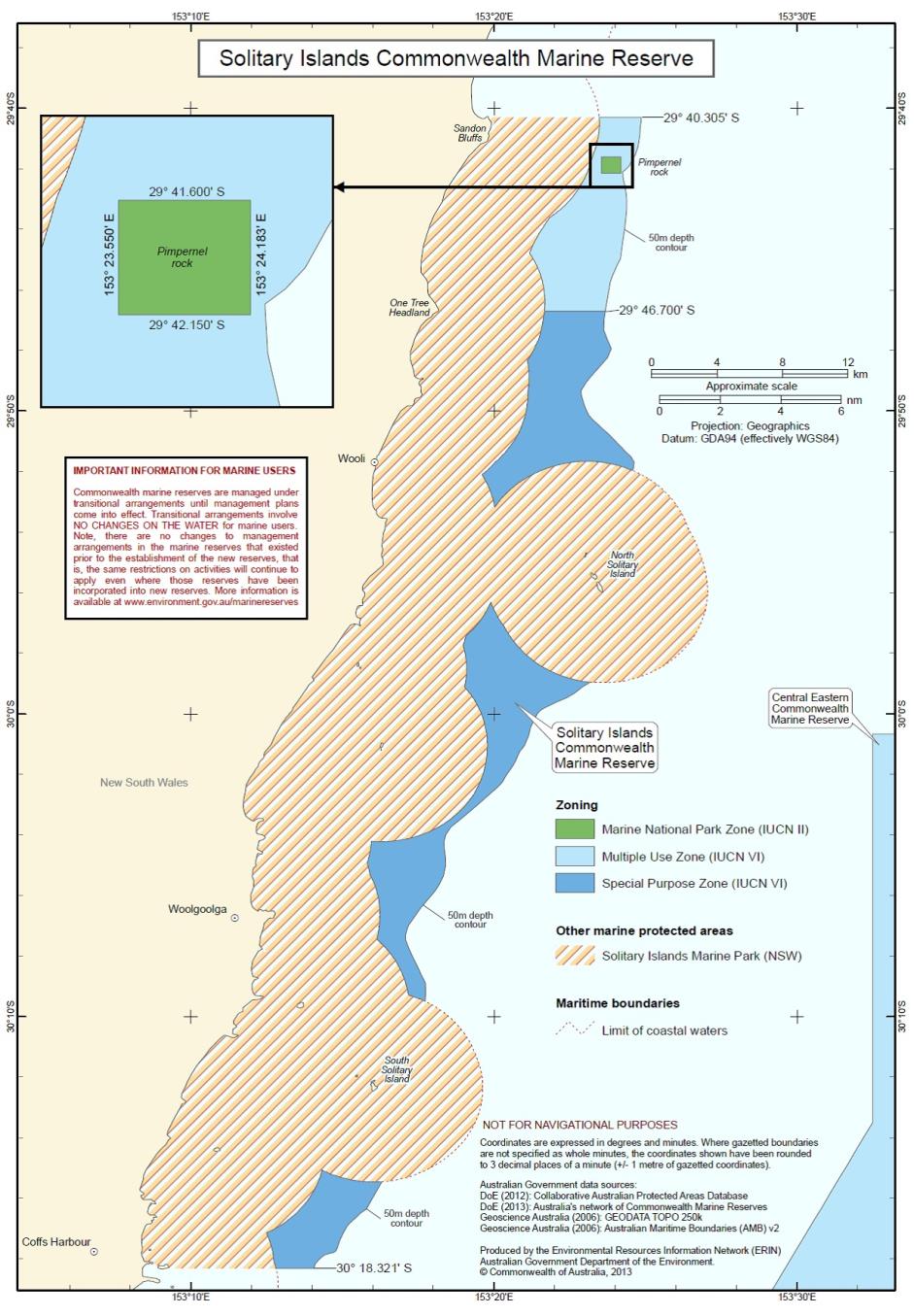
Note: Entry of orders is dealt with in Rule 39.32 of the Federal Court Rules 2011.
AUSTRALIAN CAPITAL TERRITORY DISTRICT REGISTRY | |
GENERAL DIVISION | ACD 106 of 2014 |
BETWEEN: | MINISTER FOR THE ENVIRONMENT Applicant |
AND: | MARK STEVEN KARSTENS Respondent |
JUDGE: | JAGOT J |
DATE: | 29 june 2015 |
PLACE: | CANBERRA |
REASONS FOR JUDGMENT
The issue
1 The issue to be resolved in this matter is the penalty that should be imposed on the respondent by reason of his admitted contravention of s 354(1)(f) of the Environment Protection and Biodiversity Conservation Act 1999 (Cth) (the EPBC Act).
2 Section 354(1)(f) of the EPBC Act provides that:
A person must not do one of the following acts in a Commonwealth reserve except in accordance with a management plan in operation for the reserve:
…
(f) take an action for commercial purposes.
3 Section 354(1) is a civil penalty provision. It provides for maximum penalties as follows:
Civil penalty:
(a) for an individual – 500 penalty units;
(b) for a body corporate – 5,000 penalty units.
4 At the time of the respondent’s contravention s 4AA(1) of the Crimes Act 1914 (Cth) set the value of a penalty unit at $170. Consequently, the maximum penalty for a contravention of s 354(1)(f) by an individual is $85,000.
Agreed facts
5 The parties filed a statement of agreed facts (SAF).
The respondent
6 The respondent, Mr Karstens, is an individual. The SAF set out the following relevant facts regarding the respondent:
2. Mark Steven Karstens is a commercial fisherman with over 15 years experience. Mr Karstens is currently, and was in 2013:
2.1. conducting business as a commercial fisherman;
2.2. the holder of a NSW Commercial Fishing Licence (Licence number 900091) issued under the Fisheries Management Act 1994 (NSW) (FM Act (NSW));
2.3. the owner of a Fishing Boat bearing the distinguishing mark LFB 13534; and
2.4. an owner of Fishing Business FP:1945, registered under the FM Act (NSW).
3. In July 2013, the Fishing Business held 6 commercial fishing endorsements to conduct commercial fishing in different areas by a number of different methods.
4. As holder of the Licence and these endorsements Mr Karstens was authorised to conduct commercial fishing activities, including by the method known as handline fishing, in the New South Wales Ocean Trap and Line Fishery (OTLF) during July 2013. Handline fishing involves the use of single lines with hooks or gangs of hooks lowered into the water by a rod or by hand.
The Solitary Islands Reserve and Pimpernel Rock Sanctuary Zone
7 The present contravention occurred within the Pimpernel Rock Sanctuary Zone. The features of the Zone were described in the SAF as follows:
5. … the Pimpernel Rock Sanctuary Zone … covers an environmentally sensitive marine formation called Pimpernel Rock and the circular area within a 500 m radius of it. The Pimpernel Rock Sanctuary Zone is part of the Solitary Islands Commonwealth Marine Reserve (Solitary Islands Reserve).
…
12. The Solitary Islands Reserve is located in the mid north coast region of New South Wales (NSW), off Coffs Harbour, and covers a total area of approximately 15,200 hectares. …
13. Since 1993 the area of the Solitary Islands Reserve has been protected and managed as a marine reserve (under the legislative provisions and instruments which have applied from time to time). Throughout that period the Pimpernel Rock Sanctuary Zone has been separately identified as an area of special environmental significance within the reserve. In particular:
13.1. it has been managed as a ‘Strict Nature Reserve’ in accordance with International World Conservation Union (IUCN) categories; and
13.2. no fishing of any kind has been permitted.
14. In July 2013, when the present contravention occurred, the Solitary Islands Reserve was a reserve declared under Pt 15 Div 4 of the EPBC Act by a proclamation made under s 344. The proclamation was made on 8 November 2012 and commenced on 17 November 2012.
15. No management plan was in effect in July 2013, with the reserve being managed under approvals given pursuant to s 359B of the EPBC Act. These approvals did not authorise fishing in the area of the Pimpernel Rock Sanctuary Zone and required all fishing gear to be stowed and secured while in that area. A determination made by the Director of National Parks under regulation 12.56 of the EPBC Regulations on 17 November 2012 also prohibited commercial fishing vessels stopping or remaining stationary within the Pimpernel Rock Sanctuary Zone.
8 The Solitary Islands Reserve is of high conservation significance, for the reasons outlined in the SAF as follows:
20. … It is a distinct and species-rich ecosystem with open ocean, reef and soft substrate habitats. Its particular location enables a diverse range of tropical, sub-tropical and temperate communities and species to co-exist. For example, the Solitary Islands Reserve contains the southernmost extensive coral communities in coastal eastern Australia.
21. The area of the Pimpernel Rock Sanctuary Zone is located over a very significant conservation feature, which comprises a submerged pinnacle, Pimpernel Rock, which rises from the seabed, some 45 metres below the surface, to within approximately 10 metres of the surface. It has steep slopes occupied by corals, sponges and algae, which provide habitat for benthic and pelagic communities and species. …
9 The Pimpernel Rock Sanctuary Zone, within the Solitary Islands Reserve, is also a significant site for the grey nurse shark and for black cod, which are critically endangered and vulnerable species respectively. This was highlighted in the SAF as follows:
24. The east population of the grey nurse shark is listed as critically endangered under the EPBC Act, the FM Act (NSW) and internationally under the IUCN Red List.
…
27. The black cod is listed as vulnerable under the EPBC Act and FM Act (NSW). Additionally, the species is classified as ‘Near Threatened’ under the IUCN Red List.
10 Due to the high conservation significance of the Solitary Islands Reserve, warnings and monitoring processes are in place, the details of which were outlined in the SAF as follows:
16. There are 35 comprehensive marine park advisory signs displayed along the coast adjacent to the Solitary Islands Reserve. …
17. Information on the zoning and associated management arrangements of the Solitary Islands Reserve is provided to stakeholders through provision of zoning maps, available online through the websites of the NSW Marine Estate Management Authority and the Department of Environment. …
18. In addition to these warnings and notifications, active compliance monitoring is undertaken. However, the monitoring of commercial fishing activities in the OLTF, including the Solitary Islands Reserve, is difficult and costly. Licence holders are not required to install or activate a Vessel Monitoring System to conduct handline fishing activities. As such, from a practical perspective, the only way for NSW and Commonwealth authorities to monitor compliance in relation to these operators is through physical surveillance (by sea and air).
19. Over the past 3 years, the Department has spent about $500,000 towards the management of the Solitary Islands Reserve, including aerial and vessel surveillance. However, the detection of illegal handline fishing in this way remains difficult given:
19.1. the substantial areas and distances involved;
19.2. the improbability of conducting surveillance at the very moment when illegal handline fishing is underway;
19.3. the inconspicuous nature of handline fishing, including the ease and speed with which it can be commenced and abandoned;
19.4. the fact that, unless it is detected while it is actually occurring, there will rarely be evidence of precisely when and where handline fishing was undertaken; and
19.5. the significant costs and resources associated with such physical surveillance activities.
The contravention
11 The SAF sets out the details of the respondent’s contravention in these terms:
34. Between approximately 4 pm and 6 pm on 21 July 2013, Mr Karstens used the Fishing Boat to undertake a Fishing Trip in the OTLF for commercial purposes. As was his usual practice, Mr Karstens launched the Fishing Boat from the Sandon River boat ramp at the Southern end of Sandon Road within the Yuraygir National Park Camping area.
35. Mr Karstens was skipper of the Fishing Boat during the Fishing Trip and in charge of one crew member, Mr Phillip Casement. Mr Karstens undertook the Fishing Trip in his capacity as an owner of the Fishing Business.
36. During the Fishing Trip, Mr Karstens used the Fishing Boat to enter the Pimpernel Rock Sanctuary Zone. While within the Pimpernel Rock Sanctuary Zone, very close to Pimpernel Rock itself, Mr Karstens, with the assistance of Mr Casement, anchored the Fishing Boat, used the sounder on board the Fishing Boat to locate fish and engaged in commercial handline fishing activities using two rods.
37. At the time, Mr Karstens was aware of the boundaries of the Pimpernel Rock Sanctuary Zone and had a map of the Solitary Islands Reserve on the Fishing Boat. He was also aware that commercial fishing in the Pimpernel Rock Sanctuary Zone was unlawful. Despite this, he chose to fish there because he believed that his chances of catching good fish were high and his risk of being detected was low.
38. At about 5.55pm, while Mr Karstens was fishing, Fisheries Officers were travelling slowly towards Pimpernel Rock and observed a silhouette of the Fishing Boat within the Pimpernel Rock Sanctuary Zone. The Fishing Boat did not have its navigation lights turned on.
39. Mr Karstens and Mr Casement had caught a teraglin at Pimpernel Rock and were continuing their commercial fishing activities when they became aware that Fisheries Officers were approaching in a patrol vessel.
40. As the Fisheries Officers approached the Fishing Boat, Mr Karstens cut one of the fishing lines that was currently in the water, cut the Fishing Boat’s anchor line and then started to drive the Fishing Boat away from Pimpernel Rock at speed. The Fisheries Officer pursued, intercepted and boarded the Fishing Boat. …
41. When they boarded the vessel, the Fisheries Officer took a number of photographs of the Fishing Boat, including the fishing line cut by Mr Karstens, a rod which was rigged with hooks with fresh bait attached and the teraglin in the fish tubs aboard the Fishing Boat, with gills gulping and its tail flicking.
42. The Fisheries Officers conducted an interview with Mr Karstens on the Fishing Boat. He acknowledged that he was familiar with the Pimpernel Rock Sanctuary Zone and that he was aware that fishing was not permitted in the Pimpernel Rock Sanctuary Zone.
Consequences of the contravention
12 It was common ground between the parties that handline fishing poses a significant threat to the conservation values at Pimpernel Rock. The most obvious and direct concern is the potential to injure or kill the critically endangered grey nurse sharks and the vulnerable black cod. Both parties also acknowledged that there a number of indirect harms which may stem from handline fishing, including the creation of disturbances in the food web and fish populations in marine protected areas and damage to the reef habitat by fishing gear.
Other relevant matters
13 It is relevant that the respondent has a previous conviction for an offence under s 354A(5) of the EPBC Act which arose from a contravention of the EPBC Act which is very similar to the contravention at issue in this case. The details of the respondent’s previous contravention were set out in the SAF in these terms:
29. On 13 May 2008, Mr Karstens used the Fishing Boat to enter the Pimpernel Rock Sanctuary Zone for the purposes of conducting commercial handline fishing, using a rod and a handline. The Fishing Boat was anchored when Fisheries Officers from the NSW Department of Primary Industries detected, intercepted and boarded the Fishing Boat in the Pimpernel Rock Sanctuary Zone at approximately 6 pm on that day.
30. When questioned in relation to that incident, Mr Karstens stated that:
30.1. he was generally aware of the existence of the Pimpernel Rock Sanctuary Zone, and that fishing was not permitted in that area
30.2. he had been following a school of fish on his sounder and was not aware that he was within the boundaries of the Pimpernel Rock Sanctuary Zone when he was conducting his commercial fishing activities
30.3. he had been fishing for about one hour prior to the interception by the Fisheries Officers and had caught some fish.
31. On 14 April 2009, Mr Karstens was subjected to summary criminal prosecution and convicted for an offence against s 354A(5) of the EPBC Act for his actions on 13 May 2008. The Maclean Magistrates Court imposed a fine of $500 and court costs of $73. Mr Karstens paid the fine and costs on 11 May 2009.
32. On 4 September 2009, the Department wrote to Mr Karstens to inform him that the incident that led to his conviction was viewed as a very serious matter and the Department was considering varying or revoking his approval to fish in the Solitary Islands Reserve. The letter reminded him of the prohibition on fishing in the Pimpernel Rock Sanctuary Zone, the prohibition on commercial fishing vessels stopping within that zone and the requirement for all fishing gear to be stowed away. … Ultimately, the Department decided not to take any administrative action.
33. As a result of this conviction and correspondence, Mr Karstens was aware that commercial fishing in the Pimpernel Rock Sanctuary Zone was prohibited. Additionally, Mr Karstens was aware of, and regularly passed, the marine park advisory sign installed at the Sandon River boat ramp … while conducting commercial fishing activities in the OTLF.
14 Another relevant factor is that the respondent has expressed contrition for his conduct, as recorded in the SAF:
58. Mr Karstens accepts that he deliberately put his commercial interests ahead of his legal obligations and ahead of the environmental outcomes which were sought to be secured through the EPBC Act. Mr Karstens expresses his contrition for this conduct.
15 Further, it is relevant that the respondent has made significant admissions and was cooperative in the conduct of these proceedings, as recorded in the SAF:
59. Mr Karstens did not admit his wrongdoing to the Fisheries Officers who intercepted him within the Pimpernel Rock Sanctuary Zone and did not assist the Department’s investigations of the alleged breaches of the EPBC Act.
60. However, since the institution of these proceedings Mr Karstens has provided extensive cooperation by:
60.1. filing a defence admitting the Statement of Claim in its entirety;
60.2. jointly presenting evidence by way of agreed facts.
61. If Mr Karstens had not cooperated in these ways and had contested the proceedings, the time and cost involved would have been significantly greater.
Discussion
Relevant principles
16 There was no dispute between the parties regarding the principles to be applied in the assessment of the penalty to be imposed on the respondent.
17 The respondent is liable by operation of s 481(2) of the EPBC Act, which provides that:
If the Court is satisfied that the wrongdoer has contravened a civil penalty provision, the Court may order the wrongdoer to pay to the Commonwealth for each contravention the pecuniary penalty that the Court determines is appropriate (but not more than the relevant amount specified for the provision).
18 The factors that must be considered in setting a penalty are specified in s 481(3) of the EPBC Act, which provides that:
(3) In determining the pecuniary penalty, the Court must have regard to all relevant matters, including:
(a) the nature and extent of the contravention; and
(b) the nature and extent of any loss or damage suffered as a result of the contravention; and
(c) the circumstances in which the contravention took place; and
(d) whether the person has previously been found by the Court in proceedings under this Act to have engaged in any similar conduct.
19 Further, as the Minister submitted, in addition to the specific factors listed in ss 481(3)(a) – (d), that provision also requires the Court to have regard to “all relevant matters”. In considering such “relevant matters” the Court has previously had regard to:
(1) any relevant prior “record” on the part of the contravener;
(2) any relevant matters regarding the circumstances of the contravener;
(3) any contrition or co-operation with authorities which has been shown by the contravener; and
(4) any action taken to remediate damage to the environment.
20 The Court is also required to pay careful attention to the maximum penalty, in this case $85,000. The High Court held in Markarian v The Queen (2005) 228 CLR 357; [2005] HCA 25 (Markarian) that:
[31] …careful attention to maximum penalties will almost always be required, first because the legislature has legislated for them; secondly, because they invite comparison between the worst possible case and the case before the court at the time; and thirdly, because in that regard they do provide, taken and balanced with all of the other relevant factors, a yardstick.
21 As the Minister submitted, these remarks have been held to apply in the context of the civil penalty provisions of the EPBC Act in Minister for Sustainability, Environment, Water, Population and Commmmunities v Woodley (2012) 194 LGERA 290; [2012] FCA 957 (Woodley), Minister for the Environment v Thermal Dell Pty Ltd [2014] FCA 1442 (Thermal Dell) and Minister for the Environment v Lucky S Fishing Pty Ltd [2015] FCA 10 (Lucky S Fishing).
22 Further, the Minister submitted that this Court should have regard to deterrence not merely as “a factor to be considered, but as the primary purpose of imposing a penalty”. I accept this submission.
23 Indeed, the primacy of deterrence in setting an appropriate civil penalty was highlighted by French CJ, Crennan, Bell and Keane JJ in Australian Competition and Consumer Commission v TPG Internet Pty Ltd (2013) 250 CLR 640; [2013] HCA 54 (TPG), who stated at [65] that:
General and specific deterrence must play a primary role in assessing the appropriate penalty in cases of calculated contravention of legislation where commercial profit is the driver of the contravening conduct.
24 The importance of setting a penalty which will have a deterrent effect was also emphasised by the Full Court in Singtel Optus Pty Ltd v Australian Competition and Consumer Commission (2012) 287 ALR 249; [2012] FCAFC 20 where it was stated at [62] – [63] that:
… the punishment must be fixed with a view to ensuring that the penalty is not such as to be regarded by [the] offender or others as an acceptable cost of doing business. … [T]hose engaged in trade and commerce must be deterred from the cynical calculation involved in weighing up the risk of penalty against the profits to be made from contravention.
25 The importance of deterrence in setting pecuniary penalties under the EPBC Act has been recognised in numerous cases and most recently in Lucky S Fishing by Foster J, who stated at [58] that:
The observations made by the plurality in TPG should be taken as reinforcing the importance of deterrence (both specific and general) in the Court’s consideration of the imposition of civil penalties in a case such as the present.
26 The proper approach to be taken to the consideration and assessment of the relevant factors outlined above is the “instinctive synthesis” approach explained by the High Court in Markarian, which has been applied in the context of the civil penalties of the EPBC Act in Woodley, Thermal Dell and Lucky S Fishing. The following general principles apply:
(1) The process requires a weighing together of all relevant factors, rather than starting from some pre-determined figure and making incremental additions or subtractions for each separate factor.
(2) It is critical that the reasoning process involved in “synthesising” the penalty be transparent.
Consideration
27 The Minister submitted that there was a particular need for general deterrence in cases such as the present, as there is a strong temptation for commercial fisherman to fish in marine reserves for the following reasons:
18.1. Illegal handline fishing is very difficult to detect, particularly given that it is inconspicuous and that there is no capacity for monitoring through tracking systems such as VMS.
18.2. Even if possible illegal handline fishing is spotted, wrongdoers can quickly conceal those activities (pulling in and cutting lines, throwing back fish, cutting anchors and the like). They can also move quickly to a different, legal area if detection appears imminent.
18.3. Even if apprehended with a catch on board, it will nearly always be impossible to prove when and where the catch was made. Thus persons fishing in marine reserves will be able to claim, safely, that most or all of the catch came from legal fishing.
18.4. The low risk of detection means that commercial fishers can assume that, for each time they may be caught by chance, they will have been able to engage in numerous instances of illegal fishing which are not detected. Thus the assessment of potential profit as against risk of penalties is likely to involve weighing the profit from numerous trips against the possible penalty from only one.
28 Further, the Minister also submitted that the need for general deterrence in the present case was reinforced by the strong environmental imperative to protect the Pimpernel Rock Sanctuary Zone, particularly considering that it provides a critical habitat for the grey nurse shark and black cod.
29 Finally, the Minister submitted that the following matters also supported the need for general deterrence in the present case:
21.1. The OTLF is a major fishery with 250 active fishing businesses. The outcome in this case is particularly likely to be noticed by those commercial fishing businesses.
21.2. Over the period 2012-2014, the Department has issued over 10 administrative enforcement actions, including infringement notices and warning notices, for contraventions relating to fishing in grey nurse aggregation sites.
21.3. As illegal handline fishing can only be detected through physical surveillance of Commonwealth Marine Reserves, the costs and resources associated with monitoring of this kind of fishing are significant. The reality is that the risk of being detected will generally always be low. Accordingly substantial deterrence will necessarily be more closely tied to the size of the penalty which may be imposed, rather than the probability of detection on any given occasion.
21.4. More generally, despite the numerous prosecutions and civil penalty proceedings which have been brought, fishing businesses continue to conduct unlawful commercial fishing in marine reserves, pointing to a strong ongoing need for deterrence.
30 I accept that these reasons support the need to impose a penalty on the respondent in this case which will have the effect of deterring other commercial fishermen from illegally fishing in marine reserves, particularly the Pimpernel Rock Sanctuary Zone. As Foster J stated in Woodley at [62]:
If those who contravene s 354(1) of the EPBC Act receive relatively small penalties when apprehended, there is every chance that commercial fishermen will conclude that the benefits of fishing in protected areas (given its potential for deriving significant financial rewards) far outweigh the risk of being caught committing a contravention because the risk of detection is low and the financial penalties relatively insignificant. If such conduct is undertaken, the harm to the environment is likely to be significant.
31 Further, the Minister submitted that there was a need for specific deterrence in the present case for the following reasons:
24. First, multiple regulatory interventions prior to the contravention did not deter Mr Karstens from contravening the EPBC Act. Mr Karsten’s contravention of the EPBC Act in the present case for conducting commercial handline fishing in the Pimpernel Rock Sanctuary Zone occurred in the face of:
24.1. his previous criminal conviction and penalty for previously engaging in very similar conduct
24.2. the Department’s written warning that fishing in that area was not permitted and was viewed as a very serious matter
24.3. marine park advisory signs, including a sign conspicuously located at the boat ramp which Mr Karstens frequently uses to launch the Fishing Boat, including on the day of the contravention
24.4. maps of the Solitary Islands Reserve held by Mr Karstens on the Fishing Boat, including on the day of the contravention
24.5. his knowledge that Fisheries Officers conducted patrols of the Solitary Islands Reserve.
25. Secondly, Mr Karstens’ conduct was deliberate, calculated and deceptive. When intercepted by Fisheries Officers, Mr Karstens denied any wrongdoing and maintained that he was merely ‘idling’ over Pimpernel Rock. Mr Karstens did not assist the Department in its investigations and only expressed contrition for his contravention after these proceedings were commenced.
26. Thirdly, as Mr Karstens continues to operate the Fishing Business in the area of the OTLF, the penalty should be such as to firmly convey the message that commercial fishing within marine reserves, including the Pimpernel Rock Sanctuary Zone, will not be profitable.
32 I accept that these reasons support the need for specific deterrence in the present case, particularly considering that the respondent has been charged and convicted previously for offences under the EPBC Act.
33 In terms of the nature and extent of the contravening conduct, the Minister accepted that the contraventions were relatively confined, as the respondent was engaged in handline fishing using two fishing rods where only one teraglin was caught and there was no evidence that fishing had taken place on other occasions.
34 In terms of the loss and damage arising from the conduct, the Minister submitted that this was not possible to precisely quantify, however, the Minister accepted that there was no evidence that the harm had been significant. The Minister also submitted, and I accept, that the respondent’s conduct carried with it the risk of significant harm, especially to the grey nurse sharks and black cod species known to aggregate at the Pimpernel Rock Sanctuary Zone.
35 In terms of the circumstances in which the conduct took place, the Minister submitted that at all times the respondent knew he was within the Pimpernel Rock Sanctuary Zone and that handline fishing was prohibited. Further, the Minister highlighted that the respondent tried to conceal his conduct and flee from detecting authorities. The Minister submitted that the respondent’s conduct was financially motivated, as the respondent sought to increase his profits by fishing in the Pimpernel Rock Sanctuary Zone as he believed his chances of catching good fish in that location were high. For these reasons, I accept the Minister’s submission that the respondent’s contravention was one of deliberate and calculated wrongdoing.
36 It is relevant that the respondent has a previous conviction for an offence under s 354A(5) of the EPBC Act, which makes the respondent the first person to come before the Court for a contravention of s 354 with a previous conviction for the same conduct. The Minister submitted, and I accept, that this is an aggravating factor.
37 In terms of the relevant matters regarding the circumstances of the contravener, the Minister submitted that there was no suggestion that the respondent would not be able to pay a significant penalty and that to the extent that such a penalty would impose some financial hardship on the respondent, this factor should not be given such weight as would undermine the primary objective of securing deterrence. This submission is supported by authority and was conveniently summarised by Edmonds J in Commissioner of Taxation v Arnold (No 2) [2015] FCA 34 (Arnold):
[200] The overarching requirement for a penalty which achieves strong deterrence will frequently limit the weight that can properly be given to a contravener’s financial circumstances. This is particularly so in the present case, where the respondents’ contraventions call for penalties which will operate as a powerful deterrent to others who may likewise be tempted to deliberately and wilfully disregard their legal obligations.
[201] The proper balance between achieving general deterrence and a consideration of financial circumstances was explained in Australian Competition and Consumer Commission v High Adventure Pty Ltd [2006] ATPR 42-091 [[2005] FCAFC 247] where the Full Court relevantly stated (at [11]):
[A]s deterrence (especially general deterrence) is the primary purpose lying behind the penalty regime, there inevitably will be cases where the penalty that must be imposed … may be so high that the offender will become insolvent. That possibility must not prevent the Court from doing its duty for otherwise the important object of general deterrence will be undermined.
[202] The underpinning rationale for this requirement was explained by Merkel J in Australian Competition and Consumer Commission v Leahy Petroleum Pty Ltd (No 2) & Ors (2005) 215 ALR 281 [[2005] FCA 254 (Leahy Petroelum)] relevantly at [9] as follows:
[A] contravening company’s capacity to pay a penalty is of less relevance to the objective of general deterrence because that objective is not concerned with whether the penalties imposed have been paid. Rather, it involves a penalty being fixed that will deter others from engaging in similar contravening conduct in the future. Thus, general deterrence will depend more on the expected quantum of the penalty for the offending conduct, rather than on a past offender’s capacity to pay a previous penalty…
[203] There are many other cases in which the Court has emphasised that the financial circumstances of the contraveners will be a factor of little weight against the need for general deterrence: see, for example, Mornington Inn [Pty Ltd v Jordan (2008) 168 FCR 383; [2008] FCAFC 70] at [69] per Stone and Buchanan JJ and Australian Competition and Consumer Commission v SIP Australia Pty Limited [2003] FCA 336 at [59]. Thus penalties are frequently imposed on contraveners who have no capacity to pay them. …
38 For these reasons I accept that hardship the respondent may suffer if he is to pay a significant penalty is outweighed by the need to set a penalty which will have an appropriate deterrent effect in this case. However, having said this, I also accept that the penalty should not be oppressive, as Edmonds J emphasised in Arnold:
[204] The need for general deterrence must, of course, be balanced by an insistence that the penalty not be “so high as to be oppressive”: see Trade Practices Commission v Stohl Chain Saws (Aust) Pty Ltd [1978] ATPR 17,882 at 17,896; NW Frozen Foods [Pty Ltd v Australian Competition and Consumer Commission (1996) 71 FCR 285; [1996] FCA 1134] per Burchett and Kiefel JJ at 293. However, this principle requires only that the penalty be no higher than what is required to achieve general deterrence. It does not require that the proper amount necessary to achieve general deterrence be mitigated by reference to notions of financial hardship. The result is that “a penalty that is no greater than is necessary to achieve the object of general deterrence, will not be oppressive”: see Leahy Petroleum at [9].
39 In terms of contrition or cooperation with authorities which has been shown by the contravener, the respondent submitted that he had fully cooperated with the Minister following the commencement of these proceedings by filing an admitting defence, joining the Minister in filing a statement of agreed facts, consenting to the declarations and injunction sought and agreeing with the majority of the Minister’s submissions. While the Minister submitted that the respondent had initially provided no cooperation prior to these proceedings, the Minister accepted that the respondent’s cooperation following the commencement of the proceedings had assisted significantly in enabling the contravention to be proven, and had the respondent not cooperated the time and cost involved would have been significantly greater. Consequently, the Minister submitted that the respondent should be given a significant discount for cooperation in the order of a 25% reduction of the penalty which would otherwise be appropriate. I accept the Minister’s submission that a 25% discount is appropriate in this case.
40 Taking into account all the above matters, I am satisfied that the contravention by the respondent and the requirements of general and specific deterrence arising from that contravention require the imposition of a significant penalty on the respondent. I accept that the nature and extent of the contravening conduct was relatively confined and there was no evidence of significant harm arising from the conduct. However, noting the respondent’s previous contravention and his deliberate and calculated action in again contravening s 354 of the EPBC Act, I am satisfied that a penalty in the mid-range of $60,000 would be appropriate. I consider that this penalty would have the appropriate deterrent effect without being oppressive. The significant cooperation by the respondent should result in a 25% reduction in the penalty. Consequently, I consider that the respondent should be subjected to a penalty of $45,000.
41 The declaration sought by the Minister, and consented to by the respondent, should also be made. The declaration clearly discloses the nature of the contravention, which is appropriate.
42 The Minister also sought an injunction under s 475 of the EPBC Act prohibiting the respondent from entering a 1km square area (the prohibited area) around the Pimpernel Rock Sanctuary Zone. The Minister submitted that the injunction was warranted by the following considerations:
59.1. Previous attempts to deter Mr Karstens from engaging in the conduct the subject of these proceedings, through the imposition of penalties and clear warnings, were ineffective.
59.2. The prohibited area is clearly bounded by the geographic coordinates set out in the Originating Application which provides certainty both for Mr Karstens in being readily able to determine the area he is not allowed to enter, and also for the purposes of enforcing the injunction.
59.3. The prohibited area is a very small area in the context of the OTLF and would not significantly impede Mr Karstens in the usual operation of the Fishing Business.
59.4. Handline fishing poses a very serious risk to the protected species which inhabit the Pimpernel Rock Sanctuary Zone.
59.5. Handline fishing is inconspicuous and difficult to detect.
43 The respondent consented to the making of the injunction and I accept that it is appropriate for the injunction to be made in this case.
44 The parties agreed that the respondent would pay the Minister’s costs of the proceedings in a lump sum of $45,000, and I make those orders accordingly.
I certify that the preceding forty-four (44) numbered paragraphs are a true copy of the Reasons for Judgment herein of the Honourable Justice Jagot. |
Associate:


