FEDERAL COURT OF AUSTRALIA
Blueport Nominees Pty Ltd v Sewerage Management Services Pty Ltd [2015] FCA 631
IN THE FEDERAL COURT OF AUSTRALIA | |
BLUEPORT NOMINEES PTY LTD (ACN 091 604 330) Applicant | |
AND: | SEWERAGE MANAGEMENT SERVICES PTY LTD (ACN 107 062 313) First Respondent MR PAUL DAMIAN CHAPPELL Second Respondent |
DATE OF ORDER: | |
WHERE MADE: |
THE COURT ORDERS THAT:
1. The parties file an agreed minute of orders to give effect to the findings in these reasons for decision and further programming orders in the proceeding.
Note: Entry of orders is dealt with in Rule 39.32 of the Federal Court Rules 2011.
WESTERN AUSTRALIA DISTRICT REGISTRY | |
GENERAL DIVISION | WAD 407 of 2012 |
BETWEEN: | BLUEPORT NOMINEES PTY LTD (ACN 091 604 330) Applicant |
AND: | SEWERAGE MANAGEMENT SERVICES PTY LTD (ACN 107 062 313) First Respondent MR PAUL DAMIAN CHAPPELL Second Respondent |
JUDGE: | BARKER J |
DATE: | 24 JUNE 2015 |
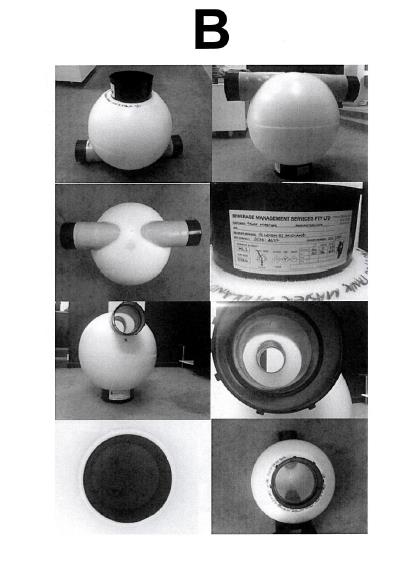
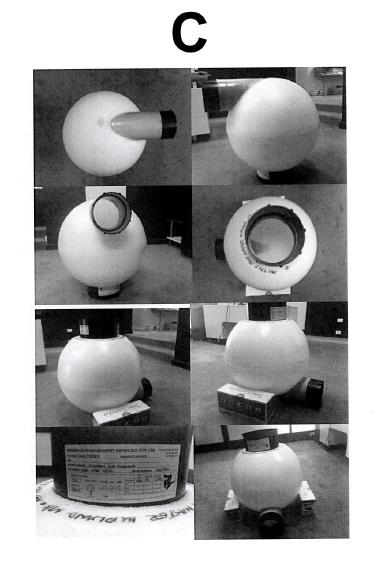
PLACE: | PERTH |
REASONS FOR JUDGMENT
1 Blueport Nominees Pty Ltd alleges that Sewerage Management Services Pty Ltd, or SMS, and Mr Paul Damian Chappell, former director of SMS, have infringed its patent, being Australian Standard Patent number 2001240339 entitled “A Pipe Connector”.
2 The priority date of the patent is 9 March 2000. The patent has been amended on two occasions, on 17 October 2006 (published on 2 November 2006) and on 9 July 2012 (published on 19 July 2012).
3 Between 17 October 2006 and 8 July 2012 (the pre-July 2012 claim period), the invention described in the patent was defined by reference to the claims set out in the patent as it existed following the amendment on 17 October 2006 (pre-July 2012 claims).
4 From 9 July 2012 onwards (the post-July 2012 claim period) the invention described in the patent was defined by reference to the claims set out in the patent as they existed following the amendment on 9 July 2012 (post-July 2012 claims).
5 Section 13 of the Patents Act 1990 (Cth) (the Act) defines the patentee’s monopoly by subs (1) as follows:
Subject to this Act, a patent gives the patentee the exclusive rights, during the term of the patent, to exploit the invention and to authorise another person to exploit the invention.
6 The term “exploit” is defined in the dictionary that forms Sch 1 to the Act, as follows:
exploit, in relation to an invention, includes:
(a) where the invention is a product—make, hire, sell or otherwise dispose of the product, offer to make, sell, hire or otherwise dispose of it, use or import it, or keep it for the purpose of doing any of those things; or
(b) where the invention is a method or process—use the method or process or do any act mentioned in paragraph (a) in respect of a product resulting from such use.
7 SMS and Mr Chappell (respondents) admit that SMS has made, offered to make, and sold and offered to sell “pipe connectors” (as that term has been pleaded at [2(d)] of the statement of claim in the proceeding) and kept one or more pipe connectors for the purposes of doing those acts (admitted conduct).
8 The respondents also admit that SMS has engaged in, and continues to engage in, the admitted conduct without the licence, approval or authorisation of Blueport.
9 Blueport says that, by reason of the admitted conduct alone, SMS’s conduct has infringed the patent because the pipe connectors fall within the scope of one or more of the pre-July 2012 claims and/or post-July 2012 claims.
10 Blueport also alleges that Mr Chappell, as a director of SMS at material times, should be held liable for the act of authorising SMS’s conduct, and as a joint tortfeasor in respect of the infringement complained of.
11 The respondents, while acknowledging the admitted conduct, deny that the admitted conduct infringes the patent.
12 Mr Chappell also denies the authorisation claim made against him or that he should be found to be a joint tortfeasor in the event SMS is found to have infringed the patent.
13 At trial, on the question of liability only in the first instance, Blueport elected not to proceed against the respondents on claims made in the originating application and statement of claim based on contravention of s 52 of the Trade Practices Act 1974 (Cth) and s 18 of the Australian Consumer Law (being Sch 2 to the Competition and Consumer Act 2010 (Cth)) and related provisions.
14 Blueport also chose not to pursue claims of infringement against the respondents pursuant to s 117 of the Act.
15 Accordingly, the issues falling for determination in this proceeding on liability are whether:
(1) during the pre-July 2012 claim period, SMS infringed one or more of the pre-July 2012 claims numbered 10 to 29;
(2) during the post-July 2012 claim period, SMS infringed one or more of the post-July 2012 claims numbered 1 and 3 to 32; and
(3) if SMS is found to have infringed the patent:
(a) Mr Chappell is liable for authorising SMS in that regard; and
(b) Mr Chappell is liable for the infringement as a joint tortfeasor.
Did SMS infringe one or more of the pre-July 2012 claims numbered 10 to 29 during the pre-July 2012 claim period?
16 The alleged infringing products were received into evidence as exhibits B (exhibit 5 on the list of exhibits) and C (exhibit 6 on the list of exhibits), corresponding to the descriptions used in the expert evidence of Mr Gilbert George Alexander, contained in Mr Alexander’s affidavit dated 27 January 2015, read at the hearing (Mr Alexander’s expert report), and the submissions made by the parties.
17 The two sets of photographs also marked respectively “B” and “C”, which are attached to these reasons as annexures 1 and 2, depict the products received into evidence as exhibits B and C. Exhibits B and C were acquired, by purchase, on behalf of Blueport in or about June 2012.
18 The parties accept that the issues each of them identifies as relevant to the proper construction of the claims – which is the main issue for determination by the Court – are the same or effectively the same in either claim period. That is to say, while claims were amended in the post-July 2012 claim period, the terms of the claims that were amended are not materially different from the terms of the amended claims.
Blueport’s submissions
19 Blueport, in Sch 1 to its supplementary written submissions, identified the combination of claims specified in the patent that it alleged had been infringed in the pre-July 2012 claim period.
20 The first claim or combination of claims alleged to be infringed in the pre-July 2012 claims is claim 10, when read in combination with claims 1 and 5. The parties agree that determination of liability by reference to this combination will lead to the resolution of most other combinations. This may be accepted, as claim 1 is common to all combinations.
21 It is appropriate then to note claim 1, first, and then the agreed relevant integer or integers of claims 5 and 10 which are also common to the various combinations, which are as follows:
[claim 1]: A pipe connector including a joining portion having a port for connection of a first pipe thereto, the joining portion also having a wall for connection of a second pipe thereto, the second pipe being able to be connected to the wall by boring a hole through the wall and bonding the second pipe thereto, the wall having a shape such that the pipe may be bonded to the wall at a plurality of angles with respect to the port, whereby, in use, the pipe connector can connect the first pipe to the second pipe at a plurality of angles with respect to each other.
[claim 5]: A pipe connector according to any one of claims 1 to 3, wherein the joining portion is substantially spherical in shape.
[claim 10]: A pipe connector according to any one of claims 1 to 9, wherein the pipe connector is in the form of a maintenance shaft having a riser extending vertically from the joining portion.
22 Blueport submits that the following constructions of the features of the claims are consistent with what a person skilled in the relevant art would have understood the patentee to be using the language of the claim to mean (all of which are consistent with the findings made in Mr Alexander’s expert report):
(1) Claim 1 – “a pipe connector including” – an article suitable for joining one pipe to another. The pipe connector has the elements listed below, but may also include other elements. Where additional elements are present infringement is not avoided (see for example N & E Bowder Pty Ltd v Australian Keg Company Pty Ltd (2014) 108 IPR 1 at [12]; [2014] FCAFC 114).
(2) Claim 1 – “a joining portion having” – a part of the article is for doing the joining.
(3) Claim 1 – “a port for connection of a first pipe thereto” – a port is “an aperture for the passage of steam, water, etc” (Oxford Dictionary). The term “for” means that it is suitable for connection of the first pipe, not necessarily that it has the first pipe connected (see Thurston Catton’s Application (1978) 48 AOJP 3666). It includes both that the first pipe can be but is not connected and that the first pipe is connected (which is necessarily the case if the wall is suitable for such a connection).
(4) Claim 1 – “the joining portion also having a wall for connection of a second pipe thereto” – the wall must be capable of connection to the second pipe. The wall is only required to be part of the joining portion. It does not necessarily include a wall of the article that is not part of the joining portion. Thus, the pipe connector can have another wall. The term “for” means that it is suitable for connection of the second pipe, not necessarily that it has the second pipe connected. It includes both that the second pipe can be but is not connected and that the second pipe is connected (which is necessarily the case if the wall is suitable for such a connection). The terms “first pipe” and “second pipe” are used to distinguish the respective pipes from each other. Neither order nor timing are involved. The presence of another pipe is neither required nor precluded.
(5) Claim 1 – “the second pipe being able to be connected to the wall by boring a hole through the wall and bonding the second pipe thereto” – the wall must be capable of having the hole bored in it and the hole must be suitable for the second pipe to be bonded to it. Bonding the pipe to the wall may include welding or gluing.
(6) Claim 1 – “the wall having a shape such that the pipe may be bonded to the wall at a plurality of angles with respect to the port” – the shape of the wall and its spatial relationship with the port must allow for more than one angle between the second pipe and the port at which the second pipe can be bonded to the wall.
(7) Claim 1 – “whereby, in use, the pipe connector can connect the first pipe to the second pipe at a plurality of angles with respect to each other” – the relationship between the curve of the wall and the position of the hole in the wall, when a hole is made, provides the opportunity to form a connection between the pipes at many angles, because of the many positions available on the wall at which the hole can be made. The angle is determined by the position of the hole on the wall.
(8) Claim 5 – “wherein the joining portion is substantially spherical in shape” – the joining portion must be curved in a not perfectly spherical shape but to a great or significant extent in a spherical shape.
(9) Claim 10 – “wherein the pipe connector is in the form of a maintenance shaft” – the pipe connector allows access to the wastewater system for the maintenance of the wastewater system.
(10) Claim 10 – “having a riser extending vertically from the joining portion” – the joining portion has a pipe extending upwards to the ground elevation.
23 In relation to both the pre and post-July 2012 claims, Blueport says that the pipe connectors of SMS have the following features:
(1) a pipe connector;
(2) joining portion;
(3) outlet coupling;
(4) first pipe;
(5) wall;
(6) second pipe;
(7) hole;
(8) bonding;
(9) spherical shape;
(10) angles;
(11) lower most point;
(12) riser coupling; and
(13) port.
Additionally, Blueport says they have the further features of:
(14) angle between and first and second pipes;
(15) angle between first pipe and another possible pipe;
(16) horizontal angle between first pipe and second pipe; and
(17) vertical angle between first pipe and second pipe.
24 Blueport contends that claim 10 (and claims 11 to 29 of the pre-July 2012 claims and claims 1 and 3 to 32 of the post-July 2012 claims) is (and are) infringed because the features identified are present in exhibits B and C.
25 Blueport says Mr Alexander’s expert report demonstrates that a person skilled in the design, construction and operation of underground sewerage systems, for which these pipe connectors are intended, would conclude that they embody the features of claim 10 of the pre-July 2012 claims and claim 1 of the post-July 2012 claims, and the integers of some of the dependent claims, including, for present purposes, claims 5 and 10 of the pre-July 2012 claim period.
Respondents’ submissions
26 The respondents say that their basic position on the allegations of infringement is that the SMS products fall squarely within the prior art, as described in the specification. SMS’s products are, they say, fundamentally sewer maintenance shafts made in a predefined shape that fix the angle at which the connector joins pipes in use before the connector is supplied to a customer. The point about “pipes in use” being joined to the connector “before the connector is supplied to a customer” is of some significance to the submissions made on behalf of the respondents. On that basis, they allege there is no infringement of the patent.
27 The respondents also say that there are material differences between the products that are in evidence as exhibits B and C respectively, that require each of those “variations” to be considered separately.
28 The respondents contend that the integers of claim 1 should be expressed as follows:
(a) a pipe connector, which includes:
(b) a joining portion having a port for connection of a first pipe thereto;
(c) the joining portion also having a wall for connection of a second pipe thereto;
(d) the second pipe being able to be connected to the wall by boring a hole through the wall and bonding the second pipe thereto;
(e) the wall having a shape such that the pipe may be bonded to the wall at a plurality of angles with respect to the port; and
(f) whereby, in use, the pipe connector can connect the first pipe to the second pipe at a plurality of angles with respect to each other.
29 Having regard to those integers, the respondents concede that exhibits B and C display integers (a) and (b).
30 They contend, however, that both exhibits B and C have “additional ports” for the connection of pipes. In the case of exhibit B, they say there are two such additional ports, one of which takes the form of what they describe as a “pipe stub” and lies opposite the port of integer (b), with the other taking the form of what they describe as a “collar fitting at right angles to the other two ports”.
31 In the case of exhibit C, the respondents say there are two ports in total. The first is the port of integer (b), again taking the form of a “pipe stub”, and the second again takes the form of a “collar fitting at a right angle to the first”.
32 The respondents say the joining portions in both exhibits have a wall, but it cannot be a wall for connection of a second pipe, as in each case there is already a port for connection of a second pipe. Thus, any further connection of a pipe to the wall of the joining portion in the manner claimed will be a “fourth connection”, in the case of exhibit B, or a “third connection”, in the case of exhibit C. For these reasons, the respondents submit that neither exhibit B nor exhibit C displays integers (c), (d) or (e).
33 The respondents anticipate an argument that the presence of a second and third port in exhibit B, and a second port in exhibit C, might be considered immaterial, if the wall of each product is such that a hole may be bored in it and a pipe may be bonded to it as required by integers (d) and (e) – because that might be said to be the second pipe referred to in the claim, not the additional ports referred to by the respondents. The respondents say, however, that any such argument suffers from several flaws:
(1) It seeks impermissibly to extend the scope of the monopoly granted by the patent, contrary to the clear words of the claim, in that it would extend the reach of the claim to any prior art pipe connector, taking the form of a maintenance shaft in which the angles between the inlet and outlet ports are fixed and the joining chamber is moulded from plastic.
(2) In the case of exhibit C, at least, it ignores the need to read the claims in light of the general body of the specification and the explanation of the invention claimed that is found in that part of the specification. It is clear from the body of the specification that the invention claim is an improved pipe connector designed to form part of a network of sewerage pipes that carries wastewater and effluent from one place to another. In order to do that, the connector cannot have open ports. That is, the pipe connector will not perform its function if, having more than one port, one simply bores a hole in the wall and connects a severed second pipe to it. The purpose of the invention is to provide a pipe connector without pre-set angles, so that the user can adapt the connector to the angle formed by the pipes and is not forced to connect the pipes at an angle dictated by the arrangement of ports on the connector. The additional ports cannot simply be ignored.
34 The respondents further say that integer (f) requires that, “in use”, the pipe connector can connect the first pipe to the second pipe at a plurality of angles with respect to each other. If “in use” means in use as part of a functioning sewerage network, the respondents submit it is difficult to see how the SMS products could achieve a plurality of angles between the two pipes. If “in use” means in use in the construction of a sewerage network, so that what the invention is supposed to allow is a choice from a plurality of angles in the process of setting the pipe connector in place, the respondents say the SMS products still do not display this integer. The additional ports on exhibits B and C are, in each case, fixed at set angles to the wall of the joining portion. In the respondents’ submission, this means that “in use” (however the expression is to be understood) the pipe connector cannot connect the first pipe to the second pipe at a plurality of angles with respect to each, as required by integer (f). This is the principal improvement claimed over the prior art in the pre-July 2012 specification and the respondents contend it is entirely absent in both exhibits B and C.
35 It might be observed that the substance of what is put on behalf of the respondents is that, by identifying the riser as a “port”, then however one looks at exhibits B and C, there are already two ports included in the product, and so a second port is never added, that being an essential feature or integer of the invention. Alternatively, if the riser is not treated as a port, then exhibit B, but not exhibit C, already has a second port fixed.
36 The respondents concede that both exhibits B and C display the integer or feature introduced by claim 5, namely the joining portion is substantially spherical in shape.
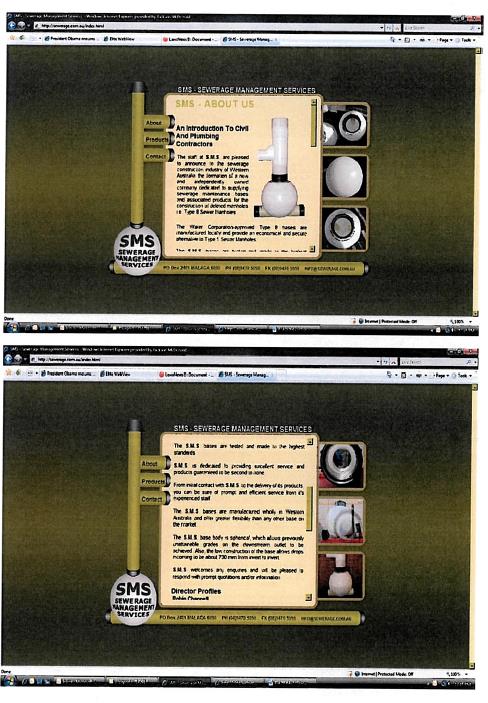
37 They also accept that both exhibits B and C meet the description of the integer or feature introduced by claim 10, namely, that the pipe connector is in the form of a maintenance shaft having a riser extending vertically from the joining portion. They add, however, that in both cases the riser in question (which the respondents also refer to as the “collar coupling”) is also used to join a pipe to the connector that may carry fluid into the body of the connector and from there to the outlet pipe or pipes. The respondents say this is clearly illustrated in the photograph appearing on SMS’s website, which is in evidence and attached in annexure 3, being the top frame.
Consideration
38 The key assertion made on behalf of the respondents in defence of infringement is that the SMS pipe connectors have an “additional port”. They say this is a question of legal construction, regardless of Mr Alexander’s opinion.
39 The first argument put by the respondents may be termed the “additional port for connection of a second pipe” argument, as Blueport characterises it. The respondents argue that the presence of the additional port (or ports in the case of exhibit B) means that a “second pipe” would be connected to one of these ports, rather than to the wall as is specified in the pre and post-July 2012 claim 1.
40 As to the “existence of additional ports”, Blueport says the respondents apparently assert that claim 1 in both the pre and post-July 2012 claims includes a feature limiting the number of ports, since “a port” means a single port. Blueport submits this is not correct as the word “a” is used as an indefinite article to refer to “one, some, any (used when referring to something for the first time in a text or conversation)”, as appears in the Concise Oxford Dictionary (9th ed). Thus, the presence of “additional ports” is irrelevant as to whether the pipe connectors infringe claim 1. I accept Blueport’s construction of the expression “a port” in claim 1.
41 As to the respondents’ construction of the expression “second pipe” to mean a pipe that is connected to the wall “second in time” by virtue of their suggestion that “any further connection of a pipe to the wall … will be a fourth connection” (in exhibit B) or a third connection (in exhibit C), I do not consider this to be correct because the pipes of the claim are not limited by the order of connection. Rather, I accept Blueport’s submission that a plain reading of the specification does not import a temporal element. The term “second pipe” is used to distinguish it from the first pipe; this does not mean that it has to be connected to the wall “second in time”. The presence of another pipe is neither required nor precluded.
42 Accordingly, I accept Blueport’s submission that the existence of additional ports and the timing of connection of pipes are therefore irrelevant. In any event, the argument of the respondents that the presence of additional ports in some way prevents a “second pipe” from being connected to anywhere but to one of those additional ports is wrong with respect to both of the SMS pipe connectors.
43 I also reject the respondents’ submission that the port taking the form of a “collar coupling” present in exhibit C fixes the position for connection of a “second pipe” and therefore the “second pipe” would be connected at that point rather than any other point on the wall.
44 A plain reading of claim 1 discloses that the “second pipe” is not a pipe that connects to a “riser” (or “collar coupling”). Rather, the “second pipe” is one that is “able to be connected to the wall by boring a hole through the wall and bonding the second pipe thereto”. This is the text of claim 1 of both the pre and post-July 2012 specifications. Claim 10 in both periods makes clear that a “riser” is a distinct feature from the “wall”. Therefore the riser cannot be a point for connection of a “second pipe”. The wall is part of the joining portion and the riser extends vertically from the joining portion, as expressed in claim 1.
45 In any event, I accept, as Blueport notes, that the respondents concede that exhibits B and C possess all the features of claim 10.
46 As to exhibit B, the respondents first make the same submission in relation to the “collar coupling” as they do in respect of exhibit C and for the same reasons it should be rejected.
47 Secondly, the respondents contend that the additional port that “takes the form of a pipe stub” also fixes a position for a connection of a “second pipe” and therefore the “second pipe” would be connected either to the “collar coupling” or the “pipe stub”, rather than any other point on the wall.
48 This argument is also refuted, in my view, by the plain words of claim 1. The “second pipe” is not a pipe that connects to a “pipe stub”, but one that is “able to be connected to the wall by boring a hole through the wall and bonding the second pipe thereto”. This wording appears in claim 1 in both the pre and post-July 2012 claim periods.
49 The respondents further contend that, even if one were to bore a hole in the wall and connect “a second pipe” thereto, the presence of the additional port taking the form of a “pipe stub” means that exhibit B would not function, as wastewater would escape through it. This argument suggests that, when exhibit B is installed in a sewerage network, the first pipe would be connected to the port, the second pipe would be connected to the wall (with both pipes then connected to other pipes that are part of the sewerage system) and nothing would be connected to the open “pipe stub”. However, again, in my view, on a plain reading of claim 1, the “pipe stub” is itself capable of being the “second pipe” that is connected to the wall.
50 I accept Blueport’s submission that the labelling of the “pipe stub” as an “additional port” does not detract from the fact that it is a “pipe” that has been connected to the “wall”:
(1) at one of the plurality of angles with respect to the port made possible by the shape of the wall; and
(2) in the manner claimed (that is, by boring a hole in the wall and then bonding the second pipe thereto).
51 There is nothing in claim 1 in both the pre and post-July 2012 claim periods to suggest that:
(1) the “second pipe” has to be of a length greater than that of the “pipe stub”; or
(2) that the “second pipe” is one that can be, but is not, connected to the wall.
52 Rather, Blueport says that figures 5A and 5B included in the patent specification as it existed in both periods show the “second pipe” as connected to the wall and being of a similar length to the “pipe stub” present in exhibit B. The “pipe stub” therefore fits the description of the “second pipe” contemplated by claim 1 once connected to the wall in the manner claimed.
53 Support for this conclusion can also be drawn from the following passage in the respondents’ written submissions:
[SMS’s] products already have a second pipe connected, which acts as an inflow port
54 Thus, any distinction the respondents seek to maintain between the port taking the form of a “pipe stub” and the “second pipe” is lost. The “pipe stub” is the “second pipe” once it has been connected to the wall at one of the many angles with respect to the port made possible by the shape of the wall.
55 As to the respondents’ argument that “the joining portions in both versions have a wall, but it cannot be a wall for connection of a second pipe – in each case there is a port for connection of a second pipe”, I also consider this not to be correct because the word “for”, as it appears in claim 1, means that the wall is “suitable for” connection of the second pipe. The connection of a pipe to the wall does not make the wall in exhibit B unsuitable for connection of a second pipe. The second pipe being connected demonstrates that the wall is suitable for connection of the second pipe. In the case of another pipe, the second pipe is still able to be connected elsewhere on the wall by boring a hole and bonding the second pipe thereto at one of a plurality of angles.
56 Blueport characterises the respondents’ second broad argument in relation to both the pre and post-July 2012 claims as the “fixed angles” argument, namely that the additional ports had the effect of fixing the points for connection of the “second pipe” with the result that the angle between the first pipe and the second pipe is fixed. I accept Blueport’s submission that this conclusion is incorrect as claim 1 in both periods does not fix the angle between the first pipe and the second pipe. After the first pipe is connected to the port and the second pipe is connected to the wall, the angle between the two pipes will be fixed, but up to that point the second pipe is able to be connected at any one of the plurality of available angles made possible by the shape of the wall according to the claimed invention.
57 Blueport contends, in my view correctly, that the respondents thus seek to limit the “second pipe” in claim 1 to a pipe that can be but is not already connected to the wall and again seek to import a limitation that is not present – and that it is not legitimate to narrow the boundaries of the monopoly granted by the patent, as fixed by the words of a claim, by adding to those words glosses drawn from other parts of the specification: see Welch Perrin and Co Pty Ltd v Worrel (1961) 106 CLR 588 at 610; [1961] HCA 91. I accept Blueport’s submission that to limit claim 1 in that way would lead to the absurd result that exhibit C may be found to infringe claim 1, but as soon as a “second pipe” is connected to the wall in the manner claimed (in a sense completing the invention contemplated by claim 1) there is no infringement. A construction that would lead to an absurd result is to be avoided: see Electrical and Musical Industries Ltd v Lissen Ltd (1939) 56 RPC 23 at 39.
58 In relation to the additional port present in exhibit B that takes the form of a “pipe stub” (or as Blueport would have it, the “second pipe”), Blueport refers specifically to the yellow sticker affixed by the respondents to the “collar fitting” on that pipe connector. There is a space provided on that sticker to enter the angle required between the port and the “second pipe”. In the case of exhibit B, this selected angle is 176 degrees. This demonstrates that this particular example of the SMS pipe connectors has been tailor manufactured for a particular job, and could only have been done so once the relevant angle had been determined. Blueport says further evidence of tailor manufacturing of the respondents’ pipe connectors is also available in the photos that are included in annexure ANO-18 to the affidavit of Ms Ariane Natalie Owen, dated 25 September 2014, received into evidence (Ms Owen’s affidavit). Thus, the second pipe was connected to the first pipe by the use of the pipe connector at the determined angle, being one of the plurality of available angles that could have been formed by boring a hole in the wall and bonding the second pipe to the wall.
59 The third of the respondents’ arguments is the “in use” argument, as Blueport calls it, whereby the respondents contend that the words “in use”, as they appear in claim 1, in both the pre and post-July 2012 claim periods, should be construed to mean that the “second pipe” must be connected to the wall by the customer in the field. It follows, on this argument, that because the pipe connectors are manufactured with their “second pipe” already attached (or a position for its attachment already determined), the angle between the first and second pipe is fixed by the time the pipe connector reaches the field. Therefore, the pipe connector cannot connect the first pipe to the second pipe at a plurality of angles with respect to each other “in use”.
60 The relevant phrase used in the pre and post-July 2012 claim 1, however, is “whereby, in use,” not merely “in use”. I accept Blueport’s submission that the person skilled in the art would construe “whereby, in use” to refer to when the pipe connector is used to connect a first pipe to a second pipe. Thus, “whereby, in use,” does not mean as part of a functioning sewerage network and there is no limitation in the claim beyond the use of connecting the first pipe to the second pipe.
61 Exhibit B demonstrates the “after” or “in use” version of exhibit C, when the second pipe has already been connected. The suitability for the wall to have a second pipe connected to it in the manner claimed is thereby demonstrated, rather than refuted, when the second pipe is bonded to the wall.
62 In the case of exhibit C, I accept Blueport’s submission that there is no “second pipe” yet connected to the wall. Regardless, the shape of the wall is “such that the [second] pipe may be bonded to the wall at a plurality of angles with respect to the port”, as the pre-July 2012 claim states. (In passing it should be noted that the wording of claim 1 in the post-July 2012 claim period is the same except that the word “port” is replaced with the words “outlet coupling”.) I accept that it is irrelevant whether the respondents or the customers are the ones that actually use the pipe connector to connect the “second pipe to the wall”, as there is no such limitation in claim 1.
63 While a literal reading of a specification may sometimes be unavoidable, the respondents’ reading goes beyond being literal, to be strained and artificial. Thus, I accept the submissions on construction made by Blueport.
64 I find that SMS did infringe one or more of the pre-July 2012 claims numbered 10 to 29 during the pre-July 2012 claim period.
Did SMS infringe one or more of the post-July 2012 claims numbered 1 and 3 to 32 during the post-July 2012 claim period?
65 Blueport, in Sch 1 to its supplementary written submissions, identify the combination of claims specified in the patent that it alleged had been infringed in the post-July 2012 claim period. While in its main claim it also claimed infringement of claim 42, it did not make any submissions in this regard in its supplementary written submissions and I leave it to one side. In light of my findings below it is unnecessary to deal with claim 42.
66 Claim 1 in the post-July 2012 specification is in the following terms:
A pipe connector including a joining portion having a port comprising an outlet coupling for connection of a first pipe thereto, the joining portion also having a wall for connection of a second pipe thereto, the second pipe being able to be connected to the wall by boring a hole through the wall and bonding the second pipe thereto, the wall having at least a substantially part spherical shape such that the pipe may be bonded to the wall at a plurality of angles with respect to the outlet coupling, whereby, in use, the pipe connector can connect the first pipe to the second pipe at a plurality of angles with respect to each other; wherein the outlet coupling extends from a substantially lowermost point of the joining portion so as to allow, in use, liquid to flow from the joining portion through the outlet coupling under gravity.
67 As noted above, when discussing the terms of claim 1 in the pre-July 2012 claim period, the only material difference is that whereas in its pre-July 2012 form it refers, for example, to the pipe being bonded to the wall at a plurality of angles with respect to the “port”, the post-July 2012 claim 1 refers to the “outlet coupling” and repeats that expression subsequently in lieu of “port”.
68 The parties have agreed that the use of the expression “outlet coupling” does not affect the arguments that each present as to the proper construction of claim 1 and why, on the respondents’ argument, the patent was not infringed.
69 For the reasons given above in relation to the proper construction of the pre-July 2012 claim 1, I am satisfied SMS did infringe one or more of the post-July 2012 claims numbered 1 and 3 to 32 during the post-July 2012 claim period.
Is Mr ChappelL liable for authorising SMS’s infringements?
70 Blueport seeks to hold Mr Chappell liable for the infringement of SMS on two bases: first, for authorising the infringing conduct under s 13(1) of the Act; and secondly as a joint tortfeasor with SMS for the infringing conduct.
71 The authorisation claim relies on s 13(1) of the Act, which is set out above but may usefully be set out again here:
Subject to this Act, a patent gives the patentee the exclusive rights, during the term of the patent, to exploit the invention and to authorise another person to exploit the invention.
72 It will be noted that s 13(1) provides that a patent gives the patentee the “exclusive rights” during the relevant period “to exploit the invention and to authorise another person” to exploit the invention. The term “exploit” is defined in Sch 1 to the Act and is set out above at [6]. As Gummow J observed in Rescare Ltd v Anaesthetic Supplies Pty Ltd (1992) 25 IPR 119 at 153, exploitation and authorisation are distinct concepts. That is to say, there are two “exclusive rights” granted by s 13(1) in those respects.
73 Gummow J then observed, at 155, that as a result of the introduction into Australian patent law of the concept of authorisation by s 13, it is an infringement “not only to exploit the invention but also to authorise another person to exploit it”.
74 His Honour then briefly mentioned the different strands of thought in the authorities as to the meaning of “authorisation”, one being that it means to “sanction approve and countenance”, the other to “grant or purport to grant to a third person the right to do the act complained of”.
75 His Honour further noted that counsel for the respondent in that case did not dispute the width of the expression “authorise another person to exploit the invention” and accepted the continued subsistence of the law in Walker v Alemite Corporation (1933) 49 CLR 643 at 658; [1933] HCA 39, where Dixon J had emphasised the narrow view taken on the authorities as to what constituted a participation in infringement or threatened infringement.
76 Section 120(4) of the Act provides that infringement proceedings must be started within:
(a) three years from the day on which the relevant patent is granted; or
(b) six years from the day on which the infringing act was done;
whichever period ends later.
77 Blueport submits that the “exclusive rights” of a patentee include the right to “exclude” others from exploiting the invention or authorising another person to exploit the invention, referring to Grain Pool of Western Australia v Commonwealth of Australia (2000) 202 CLR 479 at [83]-[85]; [2000] HCA 14.
78 It will be noted that there is no express “right to exclude” in s 13(1) and the word “exclude” does not appear there. What is given are the exclusive rights “to exploit” and “to authorise”. There can be little doubt, however, that in Grain Pool the plurality (Gleeson CJ, Gaudron, McHugh, Gummow, Hayne and Callinan JJ), by reference to authority, accepted a monopoly identified in this way for the purposes of the patent law, referring, among other authorities, to Steers v Rogers [1893] AC 232 at 235, where Lord Herschell LC spoke of the right of a patentee as “the right to exclude others” from manufacturing in a particular way and using a particular invention.
79 Blueport says it therefore has the right to authorise another person to exploit the invention and that right has been infringed. It submits that the relevant question is whether the product being exploited infringes the claimed invention, not whether a person authorising that conduct intends to authorise the infringement or knows that the product will infringe, and that there is no requirement that the person knows that the authorisation is of an infringement of a patent, referring to Inverness Medical Switzerland GmbH v MDS Diagnostics Pty Ltd (2010) 85 IPR 525 at [193]; [2010] FCA 108.
80 Thus, Blueport submits that it is an infringement of the patentee’s exclusive rights under s 13 not only to exploit an invention but also to authorise another person to exploit it. It says the word “authorise” in s 13 has the same meaning as in the comparable context of the Copyright Act 1968 (Cth) as discussed in Inverness at [194], citing Bristol-Myers Squibb Company v FH Faulding & Co Limited (2000) 97 FCR 524 at [97]; [2000] FCA 316 and Rescare at 155.
81 Accordingly, Blueport says authority has now settled the view that a person authorises an infringement if he or she “sanctions, approves or countenances” the infringement. See Inverness at [194]; Cooper v Universal Music Australia Pty Ltd (2006) 156 FCR 380 at [137]-[140]; [2006] FCAFC 187.
82 Blueport accepts that a director of a company does not authorise any act of infringement by the company by reason only of his or her position as a director, and says it is necessary to show actions that demonstrate that the director did sanction, approve or countenance the act of infringement. In this case, it is submitted that Mr Chappell is liable for authorising the infringements if:
(1) he knew that the infringing acts of manufacture and sale of the pipe connectors by SMS would occur; and
(2) he had the power to prevent SMS from committing those acts.
See Inverness at [203].
83 Blueport, as explained in more detail below, contends that Mr Chappell arranged for the necessary testing of the pipe connectors and for other criteria of the Water Corporation of Western Australia to be satisfied in order to have the pipe connectors entered onto the Water Corporation’s approved products list. Once the pipe connectors were entered on that list, it is submitted, he knew their manufacture and sale would occur. That was the sole purpose of seeking the approval of the Water Corporation – to be able to sell the pipe connectors to contractors for their intended use in underground wastewater systems. Blueport contends Mr Chappell then personally participated in the soliciting of sales of pipe connectors to contractors. Finally, it submits he had the power to prevent the manufacture and sale because he was a director of SMS and had the ability to influence and control its operations, given its small size.
84 Blueport, in making these submissions, also refers to Bodkin C, Patent Law in Australia (2nd ed, Thomson Reuters, 2014) at [9290]-[9310] under the subheading of “Infringement by authorisation of an infringing act”. At [9290] Dr Bodkin says:
It was noted in [9110] that not only is it an infringement to exploit an invention the subject of a valid patent claim without authorisation by the patentee to do so, but it follows from the form of s 13(1) that it is also an infringement to authorise the carrying out of an infringing act. It has been observed [footnote omitted] that in s 13(1), the word ‘authorise’ has the same meaning as it has in a comparable context in the Copyright Act 1968. [footnote omitted] An early explanation of the meaning of ‘authorise’ in this context is to be found in the following words of Atkin LJ:
to ‘authorise’ means to grant or purport to grant to a third person the right to do the act complained of, whether the intention is that the grantee shall do the act on his own account, or only on account of the grantor. [Falcon v Famous Players Film Co [1926] 2 KB 474 at 499]
In the same case, Bankes LJ considered that ‘authorise’ had the dictionary meaning of ‘sanction, approve, and countenance’. [footnote omitted] This view has been accepted and applied in the High Court of Australia, [footnote omitted] although Gibbs J considered that it also meant ‘permit’. [University of New South Wales v Moorhouse (1975) 133 CLR 1] It follows that authorisation does not require express permission or approval. [footnote omitted] In relation to copyright, Jacobs J has said, of the meaning of ‘authorisation’:
It is a wide meaning which in cases of permission or invitation is apt to apply both where an express permission or invitation is extended to do the act comprised in the copyright and where such a permission or invitation may be implied. Where a general permission or invitation may be implied it is clearly unnecessary that the authorizing party have knowledge that a particular act comprised in the copyright will be done. [University of New South Wales v Moorhouse (1975) 133 CLR 1]
85 The respondents generally accept that a person may be the subject of a claim made under s 13(1) for authorising exploitation, without approval. They submit, however, that the Court should read and have regard to Bodkin, particularly at [9290], as supporting the respondents’ submission that infringement by authorisation is a species of direct infringement distinct from infringement by exploitation of a patented invention. The respondents submit it follows that Blueport’s cause of action against Mr Chappell accrued when he committed the acts of which Blueport complains. They say, assuming the act of authorisation can be made out, the action against Mr Chappell is barred by s 120(4)(b) of the Act because any authorisation, if it occurred, occurred before 20 December 2006, thus infringement proceedings were not commenced within six years from the day on which “the infringing act” was done.
86 The respondents say the key first sentence of Bodkin at [9290] appears to have been based on the passage in Gummow J’s decision in Rescare at 155, which is the authority cited by the author earlier in [9110]. It is submitted that Gummow J’s obiter dicta should be taken in context of the statement his Honour made at 153, namely, “[e]xploitation and authorisation thus are distinct concepts”.
87 Similarly, it is submitted the Court should also note that Dr Bodkin, following [9310], concludes his discussion of authorisation before turning to the separate topic of “[i]ndirect infringement”.
88 Blueport notes the respondents argue that because infringement by authorisation may be characterised as a form of “direct infringement”, the relevant acts of authorisation must take place during the limitation period for infringement, and so it follows that any authorisation by Mr Chappell of SMS to exploit the patent occurred prior to 20 December 2006 and is barred by operation of s 120(4) of the Act.
89 Blueport does not accept that an act of authorisation that occurs before the relevant period of infringement cannot be infringement itself where that authorisation is of an act to be performed in the future, during the limitation period for infringement. It submits the acts of authorisation by Mr Chappell that occurred before 20 December 2006 were for SMS to exploit the patent after 20 December 2006, therefore even if the only conduct relied upon is conduct before 20 December 2006, the claim is not barred by the operation of s 120(4) of the Act.
90 Further, Blueport submits that, in any event, Mr Chappell was a director of SMS until 1 May 2011, had the power to stop the infringement from occurring and knew or should have known that an infringement was likely to occur. Therefore his authorisation occurred each time SMS exploited the patent, which extended well after 20 December 2006; this satisfies the test set out in University of New South Wales v Moorhouse (1975) 133 CLR 1; [1975] HCA 26, referred to in Bodkin.
91 In my view, having regard to the monopoly identified by s 13(1), in Grain Pool, and the nature of the “exclusive rights” created by s 13(1), to which Gummow J referred to in Rescare, it is an infringement, being a direct infringement, not only to exploit the invention but also to authorise another person to exploit it.
92 Therefore, in my view, s 120(4)(b) of the Act applies to this authorisation claim. In that case, any alleged authorisation that occurred prior to 20 December 2006 is barred by operation of s 120(4) of the Act.
93 That leaves, however, the submission of Blueport that what happened before 20 December 2006 effectively operated at various times after date because it was an authorisation to do things after that date. In my view, the only authorisation given was before the relevant date.
94 The more substantive submission, relying on Moorhouse, is that, because Mr Chappell failed to stop infringement occurring on each occasion SMS exploited the patent after 20 December 2006, he is to be taken to have authorised the exploitation on each such occasion.
95 In Moorhouse, a graduate of the University of New South Wales used a photocopying machine, in breach of copyright, to photocopy portions of a book. The question was whether the university had authorised the doing of the act, being photocopying. Jacobs J, with whom Gibbs J agreed, said at 20 that the word “authorise” in the manner it was used in s 36(1) of the Copyright Act 1968 (Cth), had been given the meaning (referred to above), taken from the Oxford Dictionary, of “sanction, approve, countenance”. His Honour, at 21, considered the word has a wide meaning which in cases of permission or invitation is apt to apply both where an express permission or invitation is extended to do the act comprised in the copyright and where such a permission or invitation may be implied. Where a general permission or invitation may be implied, his Honour held it is clearly unnecessary that the authorising party have knowledge that a particular act comprised in the copyright will be done.
96 Thus, the university could be taken to have authorised the student’s unlawful photocopying.
97 It is argued here that, in fact, each time SMS exploited the patent, it was, by way of analogy, acting under an implied authorisation (the expressions “permission” or “invitation” are not entirely applicable in this particular factual circumstance) to do so.
98 I do not consider the analogy to be particularly apt.
99 There is, in any event, a general question whether on the facts of the case Mr Chappell can be said at any time to have authorised the exploitation distinctly from SMS.
100 If he did not authorise conduct before 20 December 2006 then the contention that his earlier authorisation was, in effect, adopted from time to time after 20 December 2006 must logically fall away.
101 The facts relevant to Mr Chappell’s alleged liability either on the basis of authorising the conduct of infringement or as a joint tortfeasor, discussed below, are set out in his affidavit dated 14 October 2014, read at the hearing (Mr Chappell’s affidavit), and are as follows.
102 Mr Chappell was a director of SMS between 17 November 2003 and 1 May 2011, some seven and a half years. During that period his brothers were also directors, and shareholders.
103 Mr Chappell was also employed by Advanced Concrete Products Pty Ltd (ACP) as operations manager for a period until about July 2003 when he joined Wormall Contracting Pty Ltd as project manager, which position he held until 26 March 2004.
104 In about July 2003, while still employed by ACP, he attended a meeting with Mr Rohan Wallace of the firm of Griffith Hack Lawyers, patent attorneys.
105 He attended that meeting at the direction of Mr Shane Wormall, a manager at ACP, with the instructions:
I want you to go and see Griffith Hack to help them with some product technical queries to do with our patent.
106 Mr Chappell says at that time he did not know what patent Mr Wormall was talking about.
107 At the meeting, Mr Wallace showed him a draft application for a patent in respect of a pipe connector but he did not read through the entire document. He now believes the document was an early version of a draft application for the patent that is the subject of these proceedings.
108 Mr Chappell says that he directed a number of questions to Mr Wallace, because the draft application appeared to him to be “nothing more than a version of a type of pipe connector I had seen previously” and there were a number of products or product ranges he had in mind.
109 In that regard, one such product range was produced by a German company known as “Rehau”. He had seen their products in about 1996 at a trade fair in Munich. He had also, at another trade fair, seen another such product range, by an Israeli company, known as “Hofit”.
110 Another product he had in mind was manufactured in Australia and known as “Polypit”. He had used that product five years before the meeting with Mr Wallace while working as a manager for a company known as Geocrete.
111 After SMS was incorporated and Mr Chappell had left the employ of Wormall following his employment at ACP, he started work on multi-shaft products similar to the Rehau and Hofit products. He provided a set of drawings to attempt to obtain Water Corporation approval for the product. At that point he says SMS abandoned further development of the multi-shaft product and then began to develop the product that is the subject of this proceeding.
112 He says that at SMS his role was liaising with the Water Corporation to gain acceptance by their Criterion Committee of any products that SMS wished to bring to the land development market. The Water Corporation is effectively in a position to regulate the products that can be used in new systems. If approved, then there would be a commercial market for SMS’s product in Western Australia.
113 On or about 12 April 2005, about a year after ceasing employment with ACP and commencing with SMS, Mr Chappell received a letter from Griffith Hack Lawyers, acting for Blueport, Wormall and ACP and reminding him (amongst other things) of their clients’ intellectual property rights in the patent. He was reminded that the manufacture, promotion, offering for sale and sale of pipe connectors with the features described in the claims of the patent, without the authorisation of Blueport, was conduct that would infringe the patent.
114 Mr Chappell says he showed that letter almost immediately to his brothers, the other directors of SMS, who by that stage were all familiar with the ACP pipe connector product.
115 He says they reached the conclusion that if the patent mentioned covered SMS’s product, about which they had doubts, then it was invalid and presented no reason why SMS should not proceed with its product.
116 Mr Chappell identifies annexures ANO-6 to ANO-8, ANO-11 and ANO-15 to ANO-17 to Ms Owen’s affidavit, read in evidence, which he says comprise correspondence between SMS and the Water Corporation concerning SMS’s application to have its product included in their list of approved products and an agreement executed as part of that process. However, he does not think that pages 139 to 142 of Ms Owen’s affidavit and the annexures, being material concerning the Rehau and Wormall products, were enclosed with the letter from Mr Chappell to the Water Corporation forming page 138, as they have no relevance to that subject matter.
117 He notes that ANO-9 is a copy of an email message dated 24 October 2005 from Mr Stewart Buckby, who at that time had recently started a business known as Buckby Contracting and was interested in using SMS’s product, which had only recently been approved on a trial basis. He says the email contained a request for proof of that approval.
118 Mr Chappell identifies ANO-10 as a copy of a chain of email messages between him and Mr Stuart Herrald, who was an engineer working for Engineering Dynamics Consultants Pty Ltd, and was performing finite element analyses for SMS as part of its efforts to get Water Corporation approval.
119 He also notes that his emails to Mr Herrald were sent from the address contracts@muscon.com. He said that at that time he was employed by Musgrave Contracting where he was allowed to use his company email account for other communications. At that time SMS was not in a financial position to pay him a salary or give him full time employment and did not have its own email addresses.
120 The email communications between Mr Chappell and Mr Herrald are dated 30 June 2006, which is the pleaded limitation date in [20A] of the amended defence in the proceeding.
121 It is said, in relation to Mr Chappell’s dealings with Mr Herrald and Engineering Dynamics Consultants Pty Ltd, that he was acting as more than a director of SMS at this point. I should say, at this point, it is not easy to draw from this communication any such conclusion.
122 From that point until he ceased to be a shareholder and director of SMS from 1 May 2011, no other conduct of any consequence is identified by the evidence.
123 In my view, if there was any sanctioning, approval or countenancing of the infringement, for the purposes of “authorising” exploitation under s 13(1) of the Act, the authorisation was given by SMS and not by Mr Chappell. It is accepted that the mere fact that a director participates in the decision-making of a company is not sufficient to draw the conclusion that the director authorised the act. It is necessary to show actions that demonstrate that the director sanctioned, approved or countenanced the act of infringement. In that regard, as noted above, it is suggested that if the director has knowledge that the infringing acts would occur and had the power to prevent the company from committing those acts, but did not take any steps to prevent the acts, then the director may be taken to have authorised the act.
124 In particular, on the facts of this case I do not consider that there is anything more, in all of the acts relied on of Mr Chappell acting on behalf of SMS and in gaining the listing of the SMS product on the Water Corporation’s list of approved products, to justify a finding that he separately authorised the exploitation. In my view, only SMS did so.
125 This is not a case where it can be said that Mr Chappell “made himself a party to the act of infringement” which is conduct that s 13 would embrace: see Kimberly-Clark Australia Pty Ltd v Arico Trading International Pty Ltd (1998) 42 IPR 111 at 129; [1998] FCA 1103.
126 In Inverness, at [203], Bennett J, having stated the test for authorisation as set out above, found that the director (Dr Appanna) sanctioned, approved and countenanced the sale of products that infringed Inverness’ exclusive right to exploit the invention of the first patent and the second patent in question, as he knew the infringing act of the sale of the devices would occur, had the power to prevent those acts and had some duty to interfere. Her Honour said that express or formal permission is not essential and inactivity or indifference may reach a degree from which authorisation or permission may be inferred, referring to her Honour’s decision in Australasian Performing Right Association Ltd v Metro on George Pty Ltd (2004) 61 IPR 575 at [19]; [2004] FCA 1123.
127 The facts and circumstances of that case are different from those of this case. Here Mr Chappell, at material times, with two of his brothers, was one of three shareholders and directors of SMS. Due to his background, he had responsibilities for dealing with the Water Corporation in order to have the SMS product placed on the Water Corporation’s approved list. I do not consider that the dealings that he had, as a director, with the Water Corporation and the steps he took to obtain that approval went beyond work that he as a director was expected to do. It was part and parcel of the business that SMS was to undertake. It is not at all clear that Mr Chappell by himself could necessarily have prevented the infringement complained of, being but one of the three directors in a company whose business it was to pursue that line of activity. Whilst Mr Chappell’s view may have been important, he was not a sole director. In that regard his position seems to me to have been quite different from that of Dr Appanna in Inverness: see Inverness at [190]. Dr Appanna was directly and personally involved in obtaining regulatory clearance of the devices in Australia as managing director of the company. At [192], Bennett J said she was satisfied that Dr Appanna’s position as managing director and his participation in the procurement and distribution of devices in New Zealand and Australia were sufficient to establish that he deliberately, wilfully or knowingly pursued a course of conduct that resulted in the company selling products that infringed the Inverness patents. While that finding was directly concerned with the question of whether Dr Appanna was a joint tortfeasor, characterisation of the conduct in that way, in my view, discloses how it was materially different from the conduct of Mr Chappell here that is said to “authorise” the exploitations.
128 For these various reasons, I find that Mr Chappell did not “authorise” the exploitation of the invention for the purposes of s 13(1) of the Act.
Is Mr chappell liable for SMS’s infringement as a joint tortfeasor?
129 The parties note there are three tests commonly referred to and applied in determining whether a director is liable as a joint tortfeasor for acts committed by the company:
(1) The test stated by Lindgren J in Microsoft Corporation v Auschina Polaris Pty Ltd (1996) 71 FCR 231 at 246, namely whether the director “directed or procured the infringing act” (applying Lord Atkin’s test in Performing Right Society Ltd v Ciryl Theatrical Syndicate Ltd [1924] 1 KB 1 at 15) (the Auschina test).
(2) The test stated by Finkelstein J in Root Quality Pty Ltd v Root Control Technologies Pty Ltd (2000) 49 IPR 225 at [146]; [2000] FCA 980, namely whether the director’s conduct is “such that it can be said of him that he was so personally involved in the commission of the unlawful act that it is just that he should be rendered liable” (the Root Quality test).
(3) The test stated in the Canadian case Mentmore Manufacturing Co v National Merchandise Manufacturing Co (1978) 89 DLR (3d) 195 at [28], namely whether the director made the infringing conduct his own in the sense that the director deliberately, wilfully or knowingly pursued a course of conduct that was likely to constitute infringement or that reflected indifference to the risk of infringement (the Mentmore test).
130 The Full Court has considered these tests but has not found it necessary to determine which test is the correct one; see Allen Manufacturing Co Pty Ltd v McCallum & Co Pty Ltd (2001) 53 IPR 400; [2001] FCA 1838 where both the Auschina and Mentmore tests were satisfied; Cooper where none of the three tests were satisfied.
131 In Allen, the Full Court commented that the difference between the Auschina test and the Mentmore test may be more apparent than real, as there appeared to be no cases in which the Auschina test was met but the Mentmore test was not (at [43]).
132 In Inverness, Bennett J made the following findings on the application of the Auschina test and the Mentmore test:
(1) For patent infringement, there is no necessary mental element. It is not necessary to show that a director, to be liable, knows that the acts which he or she procures or directs constitute patent infringement, as such a condition does not exist for patent infringement generally (at [182]).
(2) The mental element in the Mentmore test of “the deliberate, wilful and knowing pursuit of a course of conduct that was likely to constitute infringement or reflected an indifference to the risk of it” relates to the pursuit of the course of conduct and not to its characterisation as infringing conduct (at [183]).
(3) The question is whether the director knowingly pursued a course of conduct which, judged objectively, led to infringement or was likely to constitute infringement, or reflected indifference to the risk of infringement (at [183]).
133 Blueport contends that Mr Chappell’s liability should be determined by reference to his involvement in the management and operations of SMS concerning the pipe connectors (applying the reasoning of Bennett J in Inverness at [184]).
134 Blueport submit that Mr Chappell’s conduct in the management and operations of SMS satisfies the Auschina test and the Mentmore test for the following reasons, relying on the evidence referred to below:
(1) Mr Chappell was directly and personally involved in the process of designing and testing the pipe connectors to gain the acceptance of the Water Corporation for the pipe connectors to be added to its approved products list. Entering of the pipe connectors onto the approved products list was a necessary step for the pipe connectors to be sold for use in Western Australian underground wastewater systems.
(a) The evidence in Mr Chappell’s affidavit, referred to above, as to his role at SMS and dealings with the Water Corporation.
(b) The evidence in annexure ANO-7 to Ms Owen’s affidavit, being a copy of a letter from the Water Corporation to Mr Chappell dated 21 October 2005, showing that the Water Corporation directed correspondence relating to the installation of the pipe connectors on a trial basis and things required to be done for final approval of the pipe connectors to SMS.
(c) The evidence in annexure ANO-8 to Mr Owen’s affidavit, being a copy of an agreement between the Water Corporation and SMS dated 21 October 2005, showing that Mr Chappell signed that agreement on behalf of SMS.
(d) The evidence in annexure ANO-15 to Ms Owen’s affidavit, being a copy of a letter from Mr Chappell to Ms Vanessa Farrell of the Water Corporation (undated), showing that Mr Chappell provided the Water Corporation with information that it required prior to approving the pipe connectors for inclusion on its approved products list. That information included a finite element analysis of the pipe connectors conducted by an independent consulting engineering company and photographic results of tests conducted on the pipe connectors.
(e) The evidence in annexure ANO-10 to Ms Owen’s affidavit, being a copy of a chain of emails between Mr Chappell and Mr Herrald, showing that Mr Chappell engaged an engineer to perform finite element analyses of the pipe connectors as part of his efforts to obtain the approval of the Water Corporation for the pipe connectors to be entered onto its approved products list.
(f) The evidence in annexure ANO-16 to Ms Owen’s affidavit, being a copy of a second letter from Mr Chappell to Ms Farrell of the Water Corporation (undated) with attachments, showing that Mr Chappell arranged for photographs of the pipe connectors to be taken during tests conducted on the pipe connectors at McRoberts Contracting factory in Welshpool and that he provided these photographs to the Water Corporation. The evidence in that annexure also shows that Mr Chappell was willing to arrange with McRoberts Contracting for the pipe connectors to be tested again if the Water Corporation wished to see the testing. The evidence in that annexure also shows that Mr Chappell was in contact with the Water Corporation in relation to agreeing to a design of the pipe connectors so that he could direct SMS to begin manufacturing the pipe connectors and supplying them on a trial basis.
(g) The evidence in annexure ANO-17 to Ms Owen’s affidavit, being a copy of a letter from Mr Chappell to Mr John Bond of the Water Corporation (undated) with attachments, shows that Mr Chappell took steps to ensure the design and testing of the pipe connectors met the criteria set down by the Water Corporation at a meeting where Mr Bond and Mr Chappell were present. The letter also shows that Mr Chappell provided information to the Water Corporation to support an assertion that the pipe connectors met those criteria. That information included a copy of Wormall’s installation instructions for “Poo Pits”.
(2) Mr Chappell was aware of Blueport’s competing product on the market, but was indifferent as to whether or not that product was protected by a patent (as to which, see the reasoning of Bennett J in Inverness at [189]).
(a) The evidence in Mr Chappell’s affidavit, referred to above, as to he and his brothers’ actions upon receipt of the letter from Griffith Hack Lawyers.
(b) The evidence in annexure ANO-5 to Ms Owen’s affidavit, being a copy of a letter from Griffith Hack Lawyers to Mr Chappell dated 12 April 2005, showing that Mr Chappell had knowledge that Blueport was the owner of the patent and that Wormall was an exclusive licensee.
(c) The evidence in annexure ANO-17 to Ms Owen’s affidavit, specifically the copy of Wormall’s installation instructions for “Poo Pits”, showing that Mr Chappell was aware of Wormall’s product and the instructions for their installation in underground wastewater systems.
(d) The evidence in annexure ANO-13 to Ms Owen’s affidavit, being a copy of a letter from Jackson McDonald to Mr Chappell dated 12 December 2012 with attachments, showing that Mr Chappell did not take any action to remove the pipe connectors from the market notwithstanding his knowledge of the existence of the patent.
(e) The evidence in annexure ANO-14 to Ms Owen’s affidavit, being a copy of a letter from Mr Chappell to Jackson McDonald dated 13 December 2012, showing that Mr Chappell was aware that the patent existed but was indifferent as to whether there had been any infringement of the patent by himself personally or SMS. Mr Chappell’s indifference to the risk of infringing the patent is evidenced by Mr Chappell’s assertion in the letter that he acted under his own belief that the patent was not valid or enforceable.
(3) Mr Chappell was directly and personally involved in the manufacture and sale of the pipe connectors.
(a) The evidence in Mr Chappell’s affidavit referred to above as to Mr Chappell’s emails to Mr Herrald from his Musgrave email address.
(b) The evidence in annexure ANO-9 to Ms Owen’s affidavit, being a copy of an email from Mr Buckby to Mr Chappell dated 24 October 2005, showing that a customer seeking to purchase SMS’s pipe connectors dealt with Mr Chappell directly to arrange that purchase.
(c) The evidence in annexures ANO-7; ANO-8; ANO-11, and ANO-15 to ANO-17 to Ms Owen’s affidavit, showing that Mr Chappell personally developed relationships with key members of the Water Corporation to gain the approval necessary for the pipe connectors to be manufactured and sold for use in Perth’s underground wastewater system.
135 The parties also note that in Keller v LED Technologies Pty Ltd (2010) 185 FCR 449; [2010] FCAFC 55, the Full Court considered the liability of a director as a joint tortfeasor for infringement of a registered design by the company. Emmett J emphasised, at [83], that when considering whether a director is a joint tortfeasor with a company, it is necessary to show that the director was doing something more than acting as a director. At [84] Emmett J reasoned that:
in circumstances where a director can be shown to be making use of a corporation or company as an instrument whereby infringement is perpetrated, such that the director can be seen to be hiding behind the corporate veil, it may be thought that that director is going beyond actions performed merely in the capacity as director. If a company is merely the alter ego of a director, such that there is no real difference between the mind of the officer and the mind of the company, there may well be circumstances where it will be appropriate to conclude that the officer is invading the rights of a victim of the company.
136 Besanko J agreed with the reasoning of Emmett J, adding, at [291], that a director is more likely to be held personally liable where there is a “close personal involvement in the infringing acts”.
137 At [404], Jessup J was of the opinion that a director’s personal liability for a company’s infringement should only arise where “the director is effectively standing apart from the company and directing or procuring it as a separate entity” and “[t]here must be a sense in which the director is using the company as the instrument of his or her own wrong”.
138 Blueport submits Mr Chappell made use of SMS as an instrument whereby infringement was perpetrated, such that Mr Chappell can be seen to have been hiding behind the corporate veil, and as such Mr Chappell was going beyond actions performed merely in his capacity as director of SMS. To support this conclusion, Blueport refers to and relies on the following:
(1) SMS was set up by Mr Chappell and the other founding directors of SMS for the purpose of obtaining Water Corporation approval to manufacture and sell products for use in underground wastewater systems in Western Australia. This is evidenced in Mr Chappell’s affidavit.
(2) Prior to obtaining the approval of the Water Corporation for the pipe connectors, SMS had no products available for sale and no revenue-generating business. This is evidenced in Mr Chappell’s affidavit, specifically where it reads “At that time SMS was not in a financial position to be able to provide me a salary or full time employment, and it did not have its own e-mail addresses” (as in original).
(3) At the same time that Mr Chappell was procuring approval of the Water Corporation for SMS’s pipe connectors, Mr Chappell was employed by Musgrave, and sent emails concerning activities of SMS from his Musgrave email account, evidenced in Mr Chappell’s affidavit. This demonstrates that Mr Chappell was effectively standing apart from SMS and directing or procuring it as a separate entity.
139 Blueport submits that the conduct of Mr Chappell in the management and operations of SMS, referred to above, also satisfies the Root Quality test.
140 The respondents draw attention to Tivo Inc v Vivo International Corporation Pty Ltd [2012] FCA 252 at [534] where Dodds-Streeton J, in a trademark infringement case, found a director who was the sole controller and shareholder of a company was not a joint tortfeasor with his company. Her Honour held that the evidence did not establish that the company was merely the alter ego of the director “which he employed as a shelter or personal instrument of his own wrong by standing apart and directing or procuring it to adopt the Vivo name”. Her Honour held that no dimension of the director’s role appeared as materially separate from that of the company.
141 The respondents note that in REA Group Ltd v Real Estate 1 Ltd (2013) 217 FCR 327; [2013] FCA 559, Bromberg J applied that same approach in finding that a director was not a joint tortfeasor of the company (see 380).
142 For the reasons given above in relation to the nature of the involvement of Mr Chappell in the affairs of the company, I similarly do not consider that on any of the so-called different tests Mr Chappell should be held liable for the infringement by SMS as a joint tortfeasor. I do not consider that Mr Chappell did something more than acting as a director that made him an invader of the victim’s rights. I do not consider that he had that degree of close personal involvement in the infringing acts as a director that is required before he should be held liable. He did not, in my view, stand apart from the affairs of the company so as effectively to adopt its wrong. In no way can it be said that the company was merely the alter ego of Mr Chappell. He was but one of the three shareholders and directors of SMS at material times engaged in the business of the company, albeit in conduct that has been found to infringe s 13(1) of the Act.
143 I find that Mr Chappell is not liable for SMS’s infringing conduct as a joint tortfeasor.
conclusion and orders
144 For the reasons given above, I find that SMS infringed one or more of the pre-July 2012 claims numbered 10 to 29 and infringed one or more of the post-July 2012 claims numbered 1 and 3 to 32.
145 I will hear further from the parties as to the terms of orders that should now be made and in relation to the further disposition of this proceeding.
I certify that the preceding one hundred and forty five (145) numbered paragraphs are a true copy of the Reasons for Judgment herein of the Honourable Justice Barker. |
Annexure 1
annexure 2
annexure 3