

FEDERAL COURT OF AUSTRALIA
Australian Securities and Investments Commission v Mariner Corporation Limited [2015] FCA 589
Table of Corrections | |
2 July 2015 | In paragraph 141, “5 July 2014” has been replaced with “5 July 2012”. |
2 July 2015 | In paragraph 354, “before me” has been inserted after “At no stage”. |
IN THE FEDERAL COURT OF AUSTRALIA | |
IN THE MATTER OF AUSTOCK GROUP LIMITED
and
IN THE MATTER OF MARINER CORPORATION LIMITED
DATE OF ORDER: | |
WHERE MADE: |
THE COURT ORDERS THAT:
1. The plaintiff’s originating application be dismissed.
2. Within 14 days of the date hereof, each party file and serve written submissions on the question of costs (limited to three pages each).
3. Within 14 days of receipt of any submissions referred to in paragraph 2 hereof, each party file and serve written submissions in response (limited to one and a half pages each).
Note: Entry of orders is dealt with in Rule 39.32 of the Federal Court Rules 2011.
VICTORIA DISTRICT REGISTRY | |
GENERAL DIVISION | VID 184 of 2014 |
IN THE MATTER OF AUSTOCK GROUP LIMITED
and
IN THE MATTER OF MARINER CORPORATION LIMITED
BETWEEN: | AUSTRALIAN SECURITIES AND INVESTMENTS COMMISSION Plaintiff |
AND: | MARINER CORPORATION LIMITED (ACN 002 989 782) First Defendant DARREN OLNEY-FRASER Second Defendant DONALD JAMES CHRISTIE Third Defendant MATTHEW JAMES FLETCHER Fourth Defendant |
JUDGE: | BEACH J |
DATE: | 19 June 2015 |
PLACE: | MELBOURNE |
REASONS FOR JUDGMENT
1 This proceeding concerns the lawfulness of the defendants’ conduct relating to the announcement on 25 June 2012 of an off-market takeover bid by Mariner Corporation Limited (Mariner) for all of the issued capital of Austock Group Limited (Austock) at 10.5 cents per share. By way of an originating application filed on 2 April 2014, the Australian Securities and Investments Commissions (ASIC) brought this proceeding against Mariner and its three directors Mr Darren Olney-Fraser (Mr Olney-Fraser), Mr Donald Christie (Mr Christie) and Mr Matthew Fletcher (Mr Fletcher), alleging contraventions of ss 180, 631(2)(b) and 1041H of the Corporations Act 2001 (Cth) (the Act) with respect to that takeover announcement. ASIC has sought declarations against all defendants and pecuniary penalties and disqualification orders against the individual directors. At trial, only the three directors, Mr Olney-Fraser, Mr Christie and Mr Fletcher actively participated in defending the proceeding. Mariner was not represented at trial and filed what it termed to be a “submitting notice”. The trial proceeded on liability only, with questions of relief, penalties and ss 1317S and 1318 issues to be dealt with at a later hearing (if necessary).
2 In summary, ASIC has alleged that:
(a) Mariner failed to comply with s 631(2)(b) of the Act in that on 25 June 2012 it publicly proposed to make a takeover bid for Austock, reckless as to whether it would be able to perform its obligations relating to the takeover bid at 10.5 cents per share if a substantial proportion of the offers under the bid were accepted. ASIC has asserted that as at 25 June 2012 Mariner did not have the financial resources to fund the bid and had not received relevant assurances from and had no agreements with third parties concerning the provision of such funding.
(b) Mariner contravened s 1041H of the Act in that, on 25 June 2012, by making the announcement it engaged in conduct that was misleading or deceptive or likely to mislead or deceive because it was not permitted to make a takeover bid for shares in Austock at a price of less than 11 cents per share (the price representation); reliance was placed on s 621(3). Further, ASIC has alleged that Mariner misled the market as to Mariner’s ability to fund the bid at 10.5 cents per share or at the required 11 cents per share (the funding representation).
(c) Each of the directors breached his duty to act with due care and diligence in contravention of s 180(1) of the Act by making a decision that Mariner would announce a takeover bid for Austock and:
(i) causing Mariner to make a public proposal that contravened s 631(2)(b);
(ii) causing Mariner to make an announcement to the ASX which contravened s 1041H;
(iii) stating that Mariner would make a bid at 10.5 cents per share, which it could not lawfully do (see s 621(3)); and
(iv) failing to take into account regulatory constraints on the ability of Mariner to acquire more than various percentages of shares in Austock.
3 The defendants have denied that Mariner contravened ss 631(2)(b) or 1041H. Further, the directors argue that there is no foundation for any alleged breach of directors’ duties under s 180. Moreover, each director has submitted that they did not act in breach of their duties whether or not Mariner itself so engaged in contravening conduct; ASIC has asserted that the directors contravened s 180 irrespective of whether Mariner contravened ss 631(2)(b) or 1041H.
4 In my view, ASIC has not made out its claims against Mariner or the directors. Accordingly, its originating application will be dismissed.
5 In summary, I have reached the following views:
(a) The test for “reckless” under s 631(2)(b) is a subjective test. Applying that test, Mariner was not “reckless”.
(b) Alternatively, if the test for “reckless” under s 631(2)(b) is an objective test, Mariner was not “reckless”.
(c) Mariner did not engage in any conduct in contravention of s 1041H in relation to the price representation or the funding representation.
(d) Alternatively, if Mariner did engage in any misleading or deceptive conduct concerning the price representation, on no reasonable view would it be entitled to any relief. I express no view on whether relief would go if, alternatively, Mariner engaged in misleading or deceptive conduct concerning the funding representation.
(e) No director contravened s 180, whether or not Mariner contravened s 631(2)(b) or s 1041H.
(f) Alternatively, even if Mr Olney-Fraser contravened s 180, neither Mr Christie nor Mr Fletcher contravened s 180 given their reasonable reliance upon the information provided to them by Mr Olney-Fraser and their ability to invoke s 189.
6 For convenience, the relevant issues have been addressed in the following order:
[7] to [151] | |
II: Market value and funding mechanisms | [152] to [175] |
III: Credibility and other evidentiary issues | [176] to [216] |
(a) Mr Olney-Fraser – general | [176] to [189] |
(b) Mr Olney-Fraser – bridging finance | [190] to [197] |
(c) Mr Christie and Mr Fletcher | [198] to [201] |
(d) The rule in Browne v Dunn | [202] to [213] |
(e) ASIC’s witnesses | [214] to [216] |
IV: CONSTRUCTION OF SECTION 631(2) | [217] to [313] |
(a) Section 631(2) – general | [217] to [229] |
(b) Legislative history | [230] to [247] |
(c) Meaning of “reckless” | [248] to [279] |
(d) Meaning of “substantial proportion” of offers | [280] to [313] |
V: DID MARINER BREACH SECTION 631(2)? | [314] to [418] |
(a) Did Mariner publicly propose to make a takeover bid for Austock? | [315] to [317] |
(b) Was Mariner reckless as to whether it would be able to perform its obligations? | [318] to [387] |
(c) ASIC’s pleaded case | [388] to [392] |
(d) Takeovers Panel’s analysis | [393] to [414] |
(e) ASIC’s Regulatory Guides and Panel’s Guidance Notes | [415] to [418] |
VI: DID MARINER CONTRAVENE SECTION 1041H? | [419] to [438] |
(a) General | [419] to [422] |
(b) The price representation | [423] to [428] |
(c) The funding representation | [429] to [438] |
VII: DUTIES OF CARE AND DILIGENCE – SECTION 180 | [439] to [561] |
(a) Case against Mr Olney-Fraser | [453] to [524] |
(b) Case against Mr Christie | [525] to [551] |
(c) Case against Mr Fletcher | [552] to [561] |
VIII: CONCLUSION | [562] |
7 Mariner was a corporate investment company whose shares were listed for quotation on the Australian Stock Exchange (ASX). Its principal activity was to target and engage in mergers and acquisitions in the small cap sector (e.g. previously, Viento Group Limited, Tasmanian Pure Foods Limited and Capilano Honey Limited). As at July 2012, Mariner made strategic investments in other listed companies. Its strategy was to agitate for change at the board level in companies it took a strategic investment in and to otherwise work with the management of those companies to achieve improved results.
8 Mariner had 3 directors, being Mr Olney-Fraser, Mr Christie and Mr Fletcher. Mr Olney-Fraser and Mr Christie were appointed as directors on 4 November 2010; Mr Fletcher was appointed as a director on 11 April 2011. The directors worked together in a small office.
9 Mr Olney-Fraser was the Chief Executive Officer of Mariner. He had previously been a mergers and acquisitions lawyer, with over 10 years' experience. Mr Olney-Fraser practised as a solicitor with Baker & McKenzie and Blake Dawson, and had also been a partner at Andersen Legal. His commercial and legal experience was extensive.
10 Mr Olney-Fraser had authority from Mariner’s Board to trade (for example, to purchase shares in small cap companies) on behalf of Mariner up to $50,000 without obtaining approval from the other directors.
11 Mr Christie was the Executive Chairman of the Mariner board. He was a former corporate lawyer with significant experience in business and compliance matters. He had been the managing director of Equity Trustees Ltd and a former President of the Australian Trustee Corporations Association. He had held a number of non-executive directorships in unlisted companies. He had also worked in compliance and regulatory roles for predecessor regulators, namely, the Australian Securities Commission and the National Companies and Securities Commission.
12 Mr Fletcher was an investment banker who was experienced in corporate and commercial banking, specialising in structured property finance. He had been the chief executive officer of the “boutique” fund manager, Astrum Funds Management Ltd. He had also held senior management positions with Lloyds Banking Group Ltd, National Australia Bank Ltd and St George Bank Ltd.
13 Three observations should be made at the outset concerning ASIC’s case against the directors. First, the directors had extensive backgrounds and expertise in mergers, acquisitions and finance. Such backgrounds no doubt informed their judgment calls, assessments of risk and the strategies they pursued in relation to the transaction the subject of this proceeding. It is necessary to bear this in mind when assessing the case of a regulator second guessing such judgment calls with the benefit of hindsight, using a largely paper based analysis and viewing the events from a timeframe perspective divorced from the reality of the speed at which the events occurred in real time. Second, in looking at the transaction in question, it is important to adopt an ex ante perspective where one is not just looking at potential risks and downsides but also the potential benefits. That was the directors’ framework at the relevant time. And that is necessarily the framework within which s 180 must be analysed. A retrospective analysis of a transaction which did not proceed has the tendency to overlook that latter dimension. Third, ASIC made no attack on the credibility of the evidence given by Mr Christie or Mr Fletcher. Rightly so. Their evidence was measured, accorded with the probabilities and involved the making of appropriate concessions. I will deal with Mr Olney-Fraser later.
14 On 24 and 27 April 2012, Mr Olney-Fraser in accordance with his authority purchased 460,000 shares in Austock at 11 cents per share on behalf of Mariner (60,000 shares purchased on 24 April 2012 and 400,000 shares purchased on 27 April 2012). On 5 June 2012, Mariner sold 50,000 Austock shares thereby reducing its total holding to 410,000.
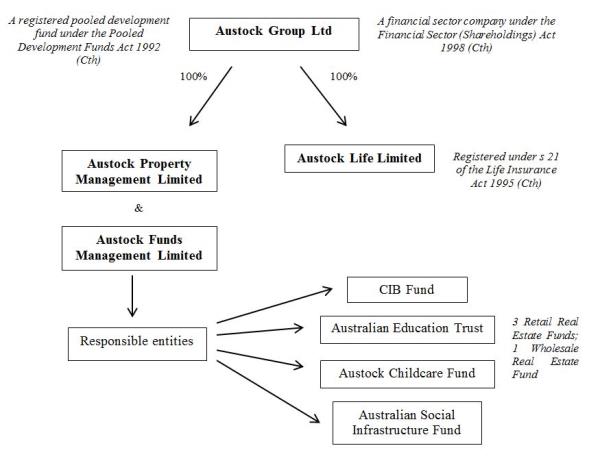
15 It is useful at this point to describe the business and corporate structure of Austock. Austock’s shares were listed for quotation on the ASX and 133,928,412 fully paid ordinary shares were quoted for trading. A wholly owned subsidiary of Austock, Austock Life Limited (Austock Life) was registered under s 21 of the Life Insurance Act 1995 (Cth); by reason of that fact, Austock was a financial sector company within the meaning of the Financial Sector (Shareholdings) Act 1998 (Cth) (FSSA), a characterisation that will become relevant later.
16 The life insurance business of Austock Life was a substantial segment of the operations of Austock and was the source of approximately 40 to 45% of the ongoing revenue of Austock. Austock was also a registered pooled development fund under the Pooled Development Funds Act 1992 (Cth) (PDFA). Wholly owned subsidiaries of Austock, Austock Property Management Limited and Austock Funds Management Limited were the responsible entities for three retail and one wholesale real estate funds, namely:
Australian Education Trust (AET);
Australian Social Infrastructure Fund (ASIF);
Austock Childcare Fund (ACF); and
The CIB Fund (CIBF).
17 Austock’s corporate structure at the relevant time can be simplistically illustrated as follows:
18 At the time of the 25 June 2012 announcement there were 708 non-Mariner shareholders in Austock, with the 10 largest non-Mariner shareholders holding just under 50% of the shares and the 50 largest non-Mariner shareholders holding approximately 87%.
19 Mr Bill Bessemer (Mr Bessemer) was the Chief Executive Officer of Austock and the controller of the largest block of shares. Austock had two key camps of shareholders: the Bessemer camp which held around 26% of the Austock shares; and the Whitelegg camp (associated with Mr Ryan Whitelegg) which held about 10% of the shares.
20 The financial report and accounts for Austock for the half year ending 31 December 2011 disclosed:
(a) that funds under management for the property business were around $555 million; revenue from the sector showed an increase of 14% over the relevant comparable period;
(b) that funds under management for the life business were around $263 million; revenue from that sector showed an increase of 27% over the relevant comparable period;
(c) net assets of $16.366 million;
(d) $9.940 million in cash as at 31 December 2011; and
(e) a net loss before tax and impairments of $3.4 million.
21 This material formed part of the Appendix 4D Report published on 29 February 2012. Further, what was anticipated, which then occurred, was the completion of the sale of Austock’s security business in mid-March 2012, which was to reduce overall employees of Austock from 130 to fewer than 30 staff; the sale to Intersuisse Holdings Pty Ltd had been made on 9 February 2012. This was expected to improve its P&L account position.
22 The published financial material of Austock prior to 25 June 2012 reasonably supported the valuations made by Mariner of Austock and its businesses.
23 The financial report and accounts for the year ending 30 June 2012 (Appendix 4E Report) had some changes, but they are not significant for present purposes. I have referred to the half year report and accounts as these were available to the directors of Mariner at and prior to 25 June 2012. The half year report and accounts were used by Mariner to prepare a Target Summary that I will discuss shortly.
24 The Target Summary also listed the top 10 shareholders of Austock as at 15 August 2011 (taken from the 30 June 2011 report and accounts).
25 For completeness, as at 30 June 2012, there were only 2 significant changes in such shareholdings. The holding of the Austock Employee Share Scheme was still shown as the largest shareholder but the holding had dropped from 24,004,553 shares (17.92%) to 12,861,775 shares (9.603%). Further, the tenth largest shareholder slipped to eleventh place, with M.F. Custodians Ltd taking tenth place at 3,844,721 shares (2.871%). As at 15 August 2011, the top 10 shareholders held 57.27%. As at 30 June 2012, the top 10 shareholders held just under 50%. The top 20 shareholders held about 68%. The largest 100 shareholders held about 94.8%.
(b) Arena’s approach to Mariner
26 As early as January 2012, an investment company, Arena Investment Management Limited (Arena), which was a part of the international real estate arm of Morgan Stanley Inc, had shown interest in acquiring Austock Property Management Limited and Austock Funds Management Limited and the associated property management business. Arena was a wholly owned subsidiary of Morgan Stanley Australia Ltd. Mr James Goodwin (Mr Goodwin), joint managing director of Arena, made an approach to Austock. A written “indicative non-binding” offer dated 28 May 2012 was forwarded to Austock. The written offer stated that Arena valued the Austock property management business in the range of $10 to $12 million in relation to the management rights plus the value of the other net assets associated with that business. It also said that “Arena currently holds more that $20 million in cash and has the ability to immediately fund the acquisition”. The approach was rebuffed by Austock and Arena was told that Austock had signed a confidentiality agreement with another party in relation to the potential sale of the Austock property management business.
27 Arena was one of the 5 largest unlisted fund and syndicate managers in Australia, with over 16,000 investors, 1,500 advisers and 321 dealer groups. Arena had experience in establishing and managing “social infrastructure funds”.
28 On 8 June 2012, Mr Goodwin telephoned Mr Olney-Fraser. This was an unsolicited approach by Arena. Mr Goodwin introduced himself as being from “Morgan Stanley” and said that together with Mr Bryce Mitchelson (Mr Mitchelson) he was the joint managing director of Arena. By that stage, media reports had made Arena aware of both Mariner and Folkestone Limited’s (Folkestone) interest in Austock.
29 The telephone call lasted approximately 10 minutes. Mr Goodwin said that he and Mr Mitchelson were keen for Arena to buy Austock's childcare fund and generally the Austock property management business. Mr Goodwin stated that the motivation for the purchase was to achieve economies of scale and synergies and to grow the Arena book.
30 Mr Goodwin said that Arena wanted to explore whether Mariner would be prepared to get control of Austock’s board. Specifically, Mr Goodwin stated that with Arena’s support, Mariner could buy a strategic stake in Austock, or make a full takeover bid, to get control of Austock and then sell the Austock property funds management business to Arena. Mr Goodwin stated that Morgan Stanley would not want Arena to be seen to be engaged in anything hostile towards Austock. Accordingly, meetings and conversations would need to be kept confidential.
31 Mr Olney-Fraser gave evidence that Mr Goodwin told him that he wanted to explore whether Mariner could be Arena’s “stalking horse” to get control of Austock’s board and make sure that Mariner acquired the business and that with Arena’s support, at least in terms of buying the Austock property management business, Mariner could buy a strategic stake in Austock or make a full takeover bid if necessary to get control of Austock. Mr Goodwin rejected this description of “stalking horse”, which I accept was not used by him. Nevertheless, in my view Mr Olney-Fraser’s account is largely accurate and accords with the probabilities. First, it was Arena that approached Mariner. Second, Arena thereafter continued to have discussions with Mariner representatives. Third, the steps, which Mr Olney-Fraser recounted that Mr Goodwin had said, were commercial and necessary steps if Mariner was to be in a position to control Austock so that it could then sell the Austock property management business to Arena.
32 Mr Olney-Fraser and Mr Goodwin then arranged to meet at Il Solito Posto to explore the details further.
(c) The Il Solito Posto meeting
33 On about 12 June 2012, Messrs Olney-Fraser and Goodwin met for coffee at Il Solito Posto, 113 Collins Street, Melbourne and continued the discussions about Austock. The meeting lasted about 30 to 45 minutes. Mr Mitchelson also attended the coffee meeting to add weight to Arena’s level of interest in buying the Austock property management business. Mr Goodwin told Mr Olney-Fraser about Arena's unsuccessful written offer to Austock to obtain the Austock property management business. Mr Goodwin made it clear to Mr Olney-Fraser during that meeting and subsequent telephone discussions that Arena wanted to acquire the Austock property management business.
34 As Mr Goodwin said in cross-examination, Arena:
[W]anted to make it clear to Mariner that if they got control, that we were very interested in buying in that business. And we - yes. We did hope that he would - that that would help him [Mr Olney-Fraser] to make the decision to proceed.
35 Mr Goodwin stated that Arena had put a valuation of $10 to $12 million on the Austock property funds management business and that it looked unlikely that a deal could be reached with Austock. Mr Goodwin was concerned that Austock might sell its property funds management business to Folkestone.
36 At the time, Mr Olney-Fraser assessed Austock's market capitalisation at approximately $12 million. Arena's assessment was that the break-up value of Austock was around $25 million. Mariner was also of the view that the break-up value of Austock was significantly higher than $12 million. Estimates made around this time revealed a break-up value of $20 million or more, the reasonableness of which were not seriously disputed by ASIC. The significance of that observation will become apparent later.
37 It was Mr Olney-Fraser's evidence that Mr Goodwin said to Mr Olney-Fraser that Arena could give Mariner the financial backing it needed to move forward and could help Mariner with financial assistance to assist Mariner to get over the line in acquiring Austock and to assist Mariner with any timing issues. Mr Goodwin rejected that version in cross-examination. I accept Mr Goodwin’s account for reasons that will become apparent later.
38 Mr Olney-Fraser further suggested that Mr Goodwin told him that Arena itself had considered making a bid for Austock, but that Morgan Stanley would not allow it. In cross-examination, Mr Goodwin said that he could not recall Arena seriously contemplating a bid in its own right. Arena had however discussed with Morgan Stanley whether an uninvited offer for the Austock property business should be made.
39 Mr Goodwin communicated to Mr Olney-Fraser that Morgan Stanley’s policy was to be invited into a deal and not to force itself onto a party and that Morgan Stanley would not approve of Arena becoming involved in a hostile takeover. However, if Mariner gained control of Austock, it would be in a position to invite Arena to make an offer, with the prospect of a mutually beneficial outcome.
40 In cross-examination, Mr Olney-Fraser described the discussions at the Il Solito Posto meeting as involving the exchange of mutual commitments by Arena to assist Mariner (including financially) to acquire control of Austock, by a takeover bid if necessary, and by Mariner causing Austock to sell the Austock property business to Arena when it obtained control, subject to Austock board and shareholder approval at the time. ASIC submitted that this characterisation was never put directly to Mr Goodwin (it was faintly hinted at in his cross-examination) and should not be accepted. As will become apparent later, I reject Mr Olney-Fraser’s evidence to the extent that it suggests that Arena indicated or offered any financing commitment for the takeover.
41 Messrs Christie and Fletcher were informed by Mr Olney-Fraser as to the nature of this discussion shortly after it took place.
(d) Preparation of first Target Summary
42 At or about this time Mr Olney-Fraser was developing his plans in relation to Austock and talking to other parties about them. There is very little evidence of the steps he took at this time and the conversations he had, but the following is revealed in the evidence:
(a) The evidence of Mr Justin Hoy (Mr Hoy), a broker at Macquarie, was that he had begun discussions with Mr Olney-Fraser about Austock in late May or early June. Those discussions related to the possibility of getting a level of control and board influence by acquiring 20 to 25% of Austock by aligning with the group of shareholders in disagreement with Mr Bessemer, the controller of the largest block of shares.
(b) On 13 June 2012, Mr Christie sent a spreadsheet to Mr Olney-Fraser listing the twenty largest shareholders of Austock, a calculation of the value of Austock at various share prices and an estimation that the cash and businesses of Austock might realise $20 million; his estimate was based upon $7 million in cash, $10 million value for the property business and $3 million value for the life business. Mr Christie stated that the “maximum offer looks like about 12-13c”. Mr Olney-Fraser appears to have requested Mr Christie to undertake this exercise.
(c) Mr Hoy said that Mr Olney-Fraser had provided him with a copy of the Austock share register. Mr Hoy had asked his assistant to summarise that register. On 13 June 2012, Mr Olney-Fraser asked Mr Hoy to approach one shareholder (Mr GK Goh of Singapore, who held approximately 8%) with an offer for his shares. Mr Goh ultimately declined that approach.
(d) Mr Olney-Fraser sent an email to a friend on 15 June 2012 in which he said “Getting good traction on an Austock bid next week. Macquarie, Morgan Stanley and Bruce Neill all in.” He agreed that it should be understood from this that he had had communications with these three entities and had some confidence about their involvement.
43 On 19 June 2012, Mr Olney-Fraser asked Mr Hoy to set up a meeting to be held at the offices of Macquarie Private Wealth on 21 June 2012, to be attended by Mr Bruce Neill (Mr Neill) and Mr Anthony Shadforth (Mr Shadforth). Mr Neill was a private investor and IOOF was a company in which he was a shareholder. He was not involved in its management. Mr Shadforth was a stockbroker at Equity Advisers Pty Ltd.
44 In preparation for the meeting, Mr Fletcher circulated an Austock Target Summary dated 19 June 2012 (19 June ATS) to Mr Olney-Fraser and Mr Christie. Mr Fletcher was asked to prepare the 19 June ATS and to contribute to some of its content by Mr Olney-Fraser. After some additions were made, by or on the instructions of Mr Olney-Fraser, this document was emailed by Mr Fletcher to Mr Hoy at Macquarie. Mr Olney-Fraser also emailed a copy to Mr Shadforth. Mr Olney-Fraser envisaged that Mr Shadforth would ultimately provide a copy to Mr Neill.
45 The 19 June ATS set out a 5 point strategy involving the acquisition of 20%, a spill of Austock’s board, the sale of the major assets (the “property funds” to Arena/Morgan Stanley for $10 million and the “life funds” to IOOF for $10 million), a capital return of 20 cents per share and the recapitalisation of the corporate shell with new management. The proposed action was to buy 3 key stakes amounting to 12% and to buy on-market at 12 cents per share about 8% to get to 20%. At this time, an off-market bid for all issued shares of Austock was not under consideration.
46 The 19 June ATS recorded that Mariner’s directors expected support for the board spill to be provided by the “Whitelegg camp” of shareholders, who as I have said held about 10% of Austock’s shares. The perceived opposing camp, the Bessemer camp, held about 26%; the employee share scheme also held at the time about 17.9%. The 19 June ATS referred to the fact that there were 133,928,412 shares on issue and that at 9.8 cents per share, Austock had a market capitalisation of $13.12 million.
47 Consistently with this proposed strategy, on 19 June 2012 Mr Hoy emailed one of the holders of those key stakes (Mr Goh) to initiate discussions about the possible purchase of his holding at 10.5 cents.
48 On Tuesday 19 June 2012, Mr Goodwin made a dinner booking at the then Stokehouse restaurant in St Kilda for 7.30 pm to meet with Mariner’s representatives. As Mr Goodwin said in cross-examination, “the purpose of the meeting was to make our intention that we wanted to buy the business very clear”.
49 The Stokehouse dinner was attended by Mr Olney-Fraser and Mr Fletcher for Mariner, and Mr Goodwin and Mr Mitchelson for Arena. Mr Christie did not attend. Mr Olney-Fraser had not previously met Mr Mitchelson. Mr Fletcher had not previously met either of the Arena joint managing directors.
50 Following an initial discussion about the Lloyds/HBOS debt, attention turned to Austock. Mr Goodwin and Mr Mitchelson conveyed to Mr Olney-Fraser and Mr Fletcher Arena’s position concerning Austock in the following terms. Arena had previously made a formal offer to Austock for its property funds management business on 28 May 2012 (the May Offer); the May Offer was a “full price offer” of between $10 and $12 million. That offer was rejected by Austock. Mr Goodwin subsequently learned that Austock was close to entering into an agreement with Folkestone. Arena was concerned that Austock was arranging a sale of the property funds management business to Folkestone and was seeking a partner who could promptly achieve a controlling interest and sell the property funds management business to Arena before it was sold to other interests.
51 Mr Goodwin handed Mr Olney-Fraser a copy of the May Offer. Mr Goodwin stated that Arena would resubmit the terms of the May Offer if Mariner obtained control of Austock. The parties discussed that time was of the essence in order to cut off any deal between Austock and Folkestone.
52 There was conflicting evidence given regarding the exact conversations that occurred during the Stokehouse meeting.
53 Mr Olney-Fraser's evidence was that during the dinner Messrs Goodwin and Mitchelson said that they:
(a) were resolute in their desire to purchase Austock's property funds management business for $10 to 12 million;
(b) would purchase Austock property funds management business for that amount from Mariner if it gained control of Austock; and
(c) would support Mariner’s attempt to gain control of Austock.
54 In particular, Mr Olney-Fraser asserted that he said that Mariner “did not have a balance sheet of any substance for an exercise like this” and was assured by Mr Goodwin that as joint managing directors he and Mr Mitchelson were able to provide any necessary financial support for Mariner. In cross-examination he went further and asserted that Mr Goodwin and Mr Mitchelson had made it clear to him that the $20 million of cash at their disposal was available to be used for a bridging finance facility to be put in place between the notice of intention to bid and the bid itself. Such a proposition was never put to Mr Goodwin or Mr Mitchelson in cross-examination and was not supported by Mr Fletcher’s account of the dinner. Again, I reject Mr Olney-Fraser’s evidence concerning the suggestion of an indication of financial support at this time, for reasons that I will later explain.
55 Mr Fletcher's evidence was that at the Stokehouse dinner, Arena's representatives said that:
(a) Arena was interested in engaging with Mariner as a “strategic partner” to promptly achieve a controlling interest in Austock and subsequently sell the property funds management business to Arena;
(b) Arena and/or Morgan Stanley was prepared to assist (in some undisclosed way) Mariner to enable Arena to acquire Austock's property funds management business; and
(c) Arena would be willing to acquire Austock's property funds management business from Mariner on the same terms as the written offer made to Austock and handed to Mr Olney-Fraser.
56 Mr Fletcher said that Mr Olney-Fraser explained that Mariner would most likely need to obtain third party funding to achieve an initial stake in Mariner but that Mariner had previously received good support for the right transactions in the past. Mr Olney-Fraser or Mr Fletcher discussed the acquisition of 20% of Austock. Nothing was said regarding an off-market full bid.
57 Mr Fletcher’s evidence of what occurred at the Stokehouse dinner made no reference to bridging finance being requested from or offered by Morgan Stanley. His evidence only made a vague reference to Arena/Morgan Stanley being “prepared to assist Mariner to enable Arena to acquire Austock’s property business”. That could simply have been a reference to taking a firmer position on acquiring the property business if Mariner took control. Mr Fletcher accepted in cross-examination that bridging finance had not been referred to at that dinner. All that Mr Fletcher advanced in his evidence was that it was “implied” that Arena/Morgan Stanley would provide funds. But he does not recall that the words “funds to assist” were used.
58 One must not lose sight of the fact that on 19 June 2012, what was in contemplation by Mariner was only the acquisition of a strategic stake to 20%. The full takeover bid concept evolved on 21 June 2012. That further confirms the view that bridging finance to the level required for a full bid simply was not on anyone’s radar on 19 June 2012, let alone being discussed at the Stokehouse dinner.
59 Mr Fletcher left the meeting thinking that Mariner was “arm in arm with Morgan Stanley and Arena”. To his mind, Arena/Morgan Stanley were “more than a counter-party to an acquisition”. He regarded “Mariner on the one hand and Arena and Morgan Stanley on the other hand as being partners or in a partnership”. He said that Arena/Morgan Stanley would “help [Mariner] achieve” the aim of Arena owning the property funds management business. As a result, Mr Fletcher told Mr Christie before 25 June 2012 that he was “firm in the fact that Morgan Stanley were going to back this deal” or words to that effect. It seems to me, though, that in context this is all referable to Arena/Morgan Stanley’s interest in and indication that they would purchase the Austock property management business after Mariner had completed its takeover of Austock.
60 Mr Goodwin deposed that “between the Stokehouse dinner on 19 June 2012 up to and including 25 June 2012 [he] could not recall Mr Olney-Fraser asking [him] to help Mariner with bridging finance of any kind for the acquisition of shares in Austock”. In cross-examination Mr Goodwin was unable to recall whether Mr Olney-Fraser raised the subject of funding and that Mariner would need some sort of underwriting or bridging finance for the purposes of the bid. But he gave evidence that:
(a) He did discuss with Mr Olney-Fraser at some stage how the bid “was going to be funded” and “funding” but he did not have a recollection of this occurring at the Stokehouse dinner specifically;
(b) Mr Olney-Fraser did raise with him the need for “some sort of underwriting or bridging finance” for the purpose of the bid “at some point”; but he did not recall Mr Olney-Fraser raising that subject prior to the bid announcement on 25 June 2012, but did not deny that this possibly occurred;
(c) He accepted that he never said to Mr Olney-Fraser before 25 June “don't look to Arena for any funding for any part of your proposed acquisition of Austock”; and
(d) He recalled “discussions about funding”, in particular a “bridge facility” “at some point”; but he could not recall whether this was before 25 June 2012.
61 Mr Mitchelson gave evidence that during the Stokehouse dinner:
(a) He and Mr Goodwin told Mr Olney-Fraser and Mr Fletcher that Arena could not be involved in a hostile approach to Austock, but that Arena would be interested in acquiring the Austock property funds business if Mariner obtained control of Austock subject to due diligence; and
(b) He did not tell Mr Olney-Fraser or Mr Fletcher that Arena or Morgan Stanley would provide funds to assist it in a proposed acquisition of Austock (or at any later time), and he did not hear Mr Goodwin do so.
62 In cross-examination it was put to Mr Goodwin that he or Mr Mitchelson told the Mariner directors that if Mariner were to make a bid or to try and acquire a large parcel of Austock shares and needed funding, that Morgan Stanley, or at least Arena, would “be there” for Mariner and assist them with financing. Mr Goodwin rejected this proposition; it was never put to Mr Mitchelson. In summary, neither Mr Goodwin nor Mr Mitchelson gave any indication that Arena/Morgan Stanley would assist in any bridging finance.
63 On Wednesday 20 June 2012, Mr Olney-Fraser and Mr Fletcher spoke to Mr Christie about what had occurred at the Stokehouse dinner. Mr Christie says that he was told of the following matters: Mr Goodwin and Mr Michelson had expressed Arena's keen interest in the Austock property funds management business; Mr Olney-Fraser had been shown the May Offer to buy the Austock property funds management business for $10 to 12 million; Mr Goodwin and Mr Mitchelson had said that Morgan Stanley would “support” Mariner to enable Mariner to take effective control, and that once Mariner could control the Austock Board, Arena would make a similar offer to the May Offer; Arena wanted to move quickly and did not want its involvement to be made public. Mr Christie’s reference to being told of “support” was nebulous and not a specific reference to bridging finance.
64 Mr Christie deposed that at this time he, Mr Olney-Fraser and Mr Fletcher were specifically discussing and focusing on the possibility of acquiring a 15 to 20% stake in Austock on-market, in the belief that if Mariner could acquire a 15 to 20% stake, then it would be able to gain effective control of the business with the support of other shareholders. The Mariner directors were aware (or at least they perceived) that there was an internal Board split within Austock, such that if Mariner could acquire a 15 to 20% stake it would be likely to be able to gain effective control of Austock. Whether such a perception was correct and such a strategy viable is not presently to the point. What is appropriate to note is that the strategy at this point in time was not centred on a full off-market bid requiring funding.
65 A board meeting of Mariner was convened later that day. Mr Olney-Fraser, Mr Christie, Mr Fletcher and Mr Adrian Olney (who was the company secretary of Mariner) were present. Austock was confirmed as a formal target and the Board consented to Mr Olney-Fraser's request to commence capital raising and to immediately seek to build a stake of up to 20% in Austock at a cost of $3 million. Mr Olney-Fraser and Mr Christie referred to the fact that contact had been made or would be made with large existing shareholders to determine their willingness to sell to Mariner. Macquarie, Morgan Stanley and Mr Neill were identified as potential sources of funds. It was noted that the future intention would be to spill the Board and sell the Austock property management business to Morgan Stanley and the life business to IOOF.
66 Later on 20 June 2012, Mr Hoy received a response from Mr Goh to the offer to purchase his shares at 10.5 cents per share. The offer was rejected. At this point, the directors of Mariner were aware that they were not able to purchase Mr Goh’s holding (approximately 8%) at 10.5 cents per share.
67 On Thursday 21 June 2012 at around 3.30 pm, a meeting was conducted at the offices of Macquarie at 101 Collins Street, Melbourne. The purpose of the meeting was to assess the level of support for the on-market acquisition of up to 20% of Austock's shares. The attendees were potential funders and interested parties being Messrs Olney-Fraser and Christie (Mariner), Mr Hoy and Stefan Whiting (brokers from Macquarie), Mr Shadforth and Chris McLoughlin (brokers from Equity Advisers), Mr Neill and Ian Urquhart (an observer). Mr Neill and Mr Shadforth's clients had had previous dealings with Mr Olney-Fraser. Mr Christie left the meeting early and had a limited recollection of what had occurred. Mr Fletcher did not attend the meeting.
68 Mr Hoy, Mr Whiting, Mr Shadforth, Mr McLoughlin, Mr Neill, Mr Olney-Fraser and Mr Christie have all given evidence about the meeting. There were conflicts in their recollections concerning both the commitments sought by Mariner and the commitments non-Mariner attendees gave to Mariner’s proposal. There was also imprecision as to whether an off-market bid had been raised by Mariner:
(a) Mr Hoy’s evidence was that no commitment was given at that meeting, beyond perhaps a commitment to have further discussions. Macquarie was not asked to “put a balance sheet behind any proposal”. Although he was asked for assistance in finding investors for convertible notes, Mr Hoy’s evidence is that he did not say to Mr Olney-Fraser that this was a possibility. His evidence was that this was not a possibility because of Macquarie’s rigorous deal assessment committee. Any proposal that involved new securities (including promissory or convertible notes) was not a possibility; Macquarie “couldn’t have been involved”. Subsequently, when Mr Olney-Fraser later on that day proposed “promissory notes”, Mr Hoy made clear that Macquarie could not assist with this either. Mr Hoy accepted that Mr Shadforth said words to the effect that his clients may be interested in supporting a takeover bid for Austock by Mariner, but would need to see the detail. Mr Hoy said that he recalled Mr Shadforth saying that “we will help you out”. It is likely that this was with respect to acquiring a 20% stake. Mr Hoy also recalled that Mr Neill may have said words to the effect that “he may be interested in purchasing Austock’s insurance business if Mariner obtained control”. Generally, according to Mr Hoy, Macquarie was never asked to put up money itself. But rather Mr Olney-Fraser asked for assistance in finding investors to either buy Austock shares or take convertible notes.
(b) Mr Shadforth said that no commitment was made by any person at the meeting. His evidence was that Mr Olney-Fraser did not ask for any commitment and there was no discussion to this effect. Mr Shadforth could not recall any discussion about whether Macquarie’s clients would be interested in being involved in the deal. Mr Shadforth could not say whether any of his clients would be interested in being involved in any deal because “it was never tested”; he “didn’t ever find out”. His evidence was that “people were going away to consider their positions, whether they were going to commit in one form or another” but that there was “quite a high level of comfort about the deal but it was early days”. Mr Shadforth did not recall any subsequent conversation with Mr Olney-Fraser before 25 June 2012 in which he was asked by Mr Olney-Fraser to “put down $500,000 in connection with the proposal”.
(c) Mr McLoughlin’s evidence was that he paid little attention to the individual attendees because he considered himself to be attending merely as an observer. He did not recall any discussion about how Mariner would fund a takeover bid and he did not recall any request for finance for a proposed takeover or any offer to provide finance. Nor did Mr McLoughlin offer to provide any finance or hear Mr Shadforth do so. Mr Urquhart was a client of Equity Advisers who had met with Mr McLoughlin and Mr Shadforth earlier in the day; Mr Shadforth had invited Mr Urquhart to the Macquarie meeting. Mr McLoughlin’s evidence was not challenged.
(d) Mr Neill had known Mr Shadforth in a personal and professional capacity for many years. Mr Neill was a substantial shareholder in IOOF. He knew the chief executive officer of IOOF, Mr Christopher Kelaher (Mr Kelaher), however he had no role in the management of IOOF and had no authority to act on its behalf. He knew Mr Olney-Fraser by early 2010 and had invested money with Stanfield Funds Management Ltd. The trustee of his family trust, Quality Life Pty Ltd was a substantial shareholder of Stanfield. He accepted that he knew at the time that Austock was an attractive investment at its then depressed share price. Mr Neill did accept that his understanding “from what was said during the meeting was that Morgan Stanley would be involved in partially funding the bid in some way because Morgan Stanley was interested in AET”. Mr Neill also accepted that he would have provided up to $500,000 to support Mariner’s bid “but probably only if Morgan Stanley and Macquarie, or an institution of similar standing, had also agreed”. He may have indicated this at the 21 June 2012 meeting, although he did not recall. Mr Neill recalled that there had been some discussion of a full bid at the 21 June 2012 meeting. According to Mr Neill, Macquarie indicated that they would assist in relation to acquiring a 20% stake by approaching Austock shareholders to sell and then placing such shares with their private clients; such private clients, presumably, may have then supported Mariner’s strategy. In terms of the $500,000 support, Equity Advisers may have taken shares to place and Mr Neill as a client may have taken such shares. Alternatively, he may have contributed by some form of convertible or promissory note, although the detail was unclear. At the meeting, Mr Neill said that he was very keen to be involved and that there was a need to move quickly before any decision on a sale of the property funds management business to another party was announced by Austock. Mr Neill also said that the Austock Life business would be very good buying at around $5 million and that IOOF would be interested at those levels. Mr Neill gave evidence that he had canvassed the Austock opportunity with Mr Kelaher about two or three years before. Mr Neill said that his presence at the 21 June meeting would be “an indicator” that he was there to “understand and support” the takeover bid.
(e) Mr Olney-Fraser said that he and Mr Christie spoke to the 19 June ATS which outlined the “value proposition”. He communicated that Austock was substantially undervalued at around 10 cents per share, and any buying at or around that level would be good value for Mariner, the other participants at the meeting and their investors. He said that the meeting discussed a price of 10.5 cents and that the plan discussed was to try to buy 20% off-market. However, if that could not be achieved by the following Monday, then a full off-market bid would be announced and there would also be purchasing on-market for 20% through Macquarie, Equity Advisers and Morgan Stanley Broking (if they agreed to participate).
(f) Mr Christie had a limited recollection of what had occurred as he had left the meeting early. Mr Christie says that he left with the impression that the participants were prepared to support Mariner financially in acquiring a substantial stake in Austock; again, this impression seemed nebulous and lacked content.
69 It seems that Mariner’s strategy relating to Austock had developed from the Board meeting the day before. It now included a full take-over bid for Austock. Mr Hoy recalls Mr Olney-Fraser saying that “We’re not having any luck in getting Austock shareholders over the line, so let’s just throw a bid [in] and see how we go.” Mr Olney-Fraser said he thought the words were more like “shake the tree”. The reference to not having any luck is likely to be a reference to the rejection by Mr Goh of the offer made for his shares.
70 Generally, it was accepted by the defendants that no conclusions were reached or commitments or assurances given at the meeting on 21 June 2012 by the non-Mariner participants.
71 Late in the afternoon of 21 June 2012, following the meeting at Macquarie, Mr Olney-Fraser returned to Mariner's office and informed Mr Fletcher of the meeting. Mr Olney-Fraser told Mr Fletcher that the meeting had gone well and that Mr Neill had agreed to assist with the takeover as he knew Austock's life insurance business was an attractive acquisition target. Mr Olney-Fraser also advised Mr Fletcher that he had received confirmation from Mr Goodwin that Arena might assist concerning funding.
72 At some time after the meeting and prior to 25 June 2012, Mr Christie was told by Mr Olney-Fraser that:
(a) Mr Hoy had said that Macquarie would have significant support from within their base; and
(b) Mr Shadforth said that he would be able to provide support, through his clients, for $500,000.
73 There is no direct evidence of any attempt on 21 June 2012 by Macquarie or anyone else to buy shares in Austock off-market after the 21 June board meeting. Mr Hoy gave no evidence about it in chief and was not asked about it in cross examination. Mr Olney-Fraser appeared to assume that calls were being made, but did not say how he knew or believed that. He said that Mr Hoy told him at the end of the day that he had had no interest from any of the unaligned top 20 shareholders. Mr Hoy was asked a couple of questions in cross-examination about a telephone call with Mr Olney-Fraser at the end of the day, but it was not suggested to him that it included this topic.
74 On the afternoon of Friday 22 June 2012, Mr-Olney-Fraser and Mr Goodwin exchanged text messages as follows:
(a) Mr Olney-Fraser asked Mr Goodwin at or about 1:51 pm to nominate someone at Morgan Stanley broking to whom he could speak;
(b) Mr Goodwin responded at or about 4:16 pm that he was “working on it”; and
(c) Mr Olney-Fraser then told Mr Goodwin that “Word's obviously out a bit as [Austock] this afternoon trading volume at 10c, not us. We have to move Monday morning first up.”
75 Mr Olney-Fraser and Mr Goodwin agreed that they needed to move quickly. Mr Goodwin told Mr Olney-Fraser that he wanted a public announcement on Monday to cut off Folkestone at the pass. If Folkestone acquired, effectively, the Austock property management business, that would stymie Arena’s own plans.
76 On Friday 22 June 2012, Mr Christie sent to Mr Olney-Fraser, Mr Hoy and Mr Shadforth a draft terms sheet for promissory notes to be issued to investors. This terms sheet was intended to relate only to the potential on-market acquisition of a 20% stake although its actual terms were arguably broader. These terms proposed that finance be provided for a period of 6 months from 1 July 2012 with investors to receive 50% of the profits (and bear all of the losses) from the purchase of shares in Austock. Repayment was proposed to be in cash or Austock shares, at the option of Mariner. I note that the promissory note concept was different from the convertible note concept referred to at the Macquarie meeting on 21 June 2012; the convertible note concept involved shares in Mariner rather than Austock.
77 Mr Hoy says that he took no notice of the draft terms sheet because he knew that the deal assessment committee within Macquarie would not approve it. Mr Shadforth did not respond to Mr Christie’s email and did not approach any of his clients to raise funds for Mariner’s bid through the issue of a promissory note. Mr Christie agreed that he heard no more about it after sending it.
78 A first draft of an ASX announcement was sent by Mr Fletcher to the other directors on the evening of Friday 22 June 2012. The draft included a paragraph in the following terms:
Mariner has spent time leading up to the takeover bid arranging a book build to secure funding support amongst various brokers and investors familiar with the success of Mariner’s recent acquisition activities. Mariner will provide information about funding, and the identity of persons who will provide cash consideration to meet the bid (and details of any underwriting) in our bidder statement.
79 At this point in time, Mr Olney-Fraser considered that the consensus from his discussions with Messrs Hoy and Shadforth included that Mariner would first try to buy up to 20% off-market over the next few days and that if Mariner could not get 20% off-market by Monday, it would (subject to a resolution of the directors) make a full takeover bid and put 20% buying “on the screen” upon the proposed takeover announcement being made. The draft paragraph referred to in the preceding paragraph came from the “Viento” ASX announcement; I will discuss the Viento documents shortly. It was later removed from the draft; it was inapposite in the present context.
80 At this time, Mr Olney-Fraser also said to Mr Christie that he was concerned that word was getting out into the market and that the price of Austock was moving. Accordingly, he said that it was important not to leave the market uninformed and that the possibility of the sale of the property funds management business to a third party meant that Mariner had to move quickly. Mr Christie and Mr Olney-Fraser discussed whether there was adequate funding support to make a takeover announcement at that stage and considered the past legal advice they had received on that issue from Don Clarke of Minter Ellison.
81 Further, in discussions at which Mr Fletcher was present, Mr Olney-Fraser stated that Arena had committed to the acquisition of the property funds management business in the amount of $10 million and to bridging finance and that Mr Neill “being on board” was significant as he had sufficient wealth to fund the entire acquisition. It is quite clear that Mr Olney-Fraser did not accurately state what the position was concerning bridging finance or Mr Neill’s position to either Mr Christie or Mr Fletcher.
82 In terms of Arena’s “commitment” at this point and how this may have impacted upon the mindset of Mariner and its directors, it is to be noted that Mr Goodwin conceded in cross-examination that:
(a) he would have known on 19 June 2012 that Mariner was not in a financial position to fund a large acquisition of Austock shares without some sort of external financing; Mr Goodwin was “fairly sure” he “would have known before the 25th” that Mariner could not “fund the full bid”;
(b) the purpose of the Stokehouse meeting was to “show Mariner how serious [Arena/Morgan Stanley was] about buying this childcare business”;
(c) Mr Goodwin wanted to “try and encourage … the Mariner people to make a bid for or otherwise acquire shares in Austock”;
(d) he could not deny that Mr Olney-Fraser raised the subject of “underwriting or bridging finance” during the Stokehouse dinner; he “definitely” had a discussion with Mr Olney-Fraser about a bridge facility at some point, but his position seemed to be that his “principal discussions” around funding came after the bid;
(e) Mr Olney-Fraser “may well have” raised the issue of underwriting or bridging finance in telephone discussions with Mr Goodwin before 25 June 2012;
(f) Mr Goodwin was trying to “play nice” with Mr Olney-Fraser “to give [Mr Olney-Fraser] the impression that [Arena/Morgan Stanley] were going to try and help ... and be cooperative to the extent [Arena/Morgan Stanley] could”;
(g) Messrs Goodwin and Olney-Fraser were speaking “every second day or thereabouts” in the two week period leading up to the announcement;
(h) Messrs Goodwin and Olney-Fraser definitely talked about “what Arena could do to assist” before the announcement; the issue in the case before me was, of course, the ambit of that “assistance”;
(i) Mr Goodwin “would have tried to make it clear” that he and Mr Mitchelson were “confident” they could get “the deal approved”; Mr Goodwin “would have said early on we were confident that we would be able to [get] the transaction approved”; again, the debate before me concerned the nature of the “deal” or “transaction” being referred to;
(j) Mr Goodwin said that “his memory” is that he offered Mariner $3 to $4 million of bridging finance but that this was an offer made after the announcement; and
(k) Mr Goodwin said that it is possible that he told Mr Olney-Fraser before 25 June 2012 that he “would ask Morgan Stanley for assistance”.
83 It is appropriate to observe that Mr Goodwin’s evidence evolved over the course of the proceeding from a brief account in his affidavit of his dealings with Mariner (and particularly Mr Olney-Fraser) to a more detailed account. Nevertheless, the theme of his evidence was consistent. He did not recall indicating to Mariner at or prior to 25 June 2012 the possibility of providing bridging finance.
84 At 7.56 pm on Friday evening, Mr Christie forwarded to Mr Olney-Fraser (via two emails) material that had been prepared and considered by Mariner concerning the takeover bid for Viento Group Ltd, including:
(a) a board paper dated 28 July 2011;
(b) a detailed schedule of a book build at that time;
(c) an ASX announcement dated 28 July 2011;
(d) a copy of an email dated 28 July 2011 from Mr Olney-Fraser to Mr Christie and Mr Fletcher; and
(e) a draft bidder’s statement used for Viento Group Ltd.
85 This material was circulated on Friday evening to be considered and appropriately modified for the Austock transaction.
86 The Viento board paper contained the following statement concerning s 631(2)(b):
Funding for Takeover Offer
The Corporations Act (s 631(2)(b)) and ASIC Reg Guide 59 impose requirements on an offeror before an intention to make a bid is announced to the market.
The Act says we cannot be “reckless” about whether a proposed bid is in fact made, and we cannot be reckless about whether we can fund a “substantial proportion of bids accepted”. The RG says that we must have “reasonable grounds for believing that we can fulfil the bid if accepted”. Neither the Act nor the RG require that funding is firm or underwritten when a bid is proposed.
Under s 636, the bidder statement (to be issued within 2 months) must set out the details of our funding, so that is the time when funding must be certain. The identity of the person(s) providing the bid cash consideration must be specified in that statement.
I have sought advice from Minter Ellison on this issue. In summary, their advice is that, at the time our announcement of a takeover bid, we should have a high level of confidence that we will be able to fund the bid if everyone accepts, however we do not need to be firm or have it underwritten until the bidder statement. In the bidder statement, we must identify where the funds will come from.
87 Further, Mr Olney-Fraser’s email of 28 July 2011 concerning Viento made reference to speaking with Don Clarke, a partner at Minter Ellison and a reference to his advice in terms:
[W]e need to have a reasonable basis for believing that we can fund the bid (i.e. not be reckless) but we don’t need to be firm or identify our source of funds in our ‘intention to make a bid’ announcement tomorrow; we do need to identify where the cash will come from in our formal bidder statement within 2 months.
88 I note that there was in evidence the unchallenged affidavit of Don Clarke deposing to the verbal legal advice that he had given to Mr Olney-Fraser in 2011 on s 631(2)(b). He confirmed that the advice that he had given was consistent with Mr Olney-Fraser’s recitation thereof in the 28 July 2011 email and the Viento board paper.
89 Clearly, as at late Friday evening and certainly as at the time of the board meeting on Monday morning 25 June 2012, the directors were aware of and had turned their minds to the legal requirements of s 631(2)(b). This is not a case where the directors were oblivious of or indifferent to the legal requirements of s 631(2)(b). I should note at this point, however, that the advice given by Minter Ellison differs from my own interpretation of “reckless”, but that is not material for the moment.
90 Before moving forward in the sequence of events, reference should also be made to the share price movements of Austock in the week ending 22 June 2012. One issue in the case, the relevance of which will become apparent later when discussing the credibility of Mr Olney-Fraser’s evidence, is when the share price started to “run”, if at all.
91 In the week ending 22 June 2012, Austock shares were only traded on 19 and 22 June 2012. On 19 June 2012, two trades occurred at 9.8 cents per share (31,000 shares); this was the same price that Austock shares last traded (14 June 2012). On 22 June 2012, the share price opened at 9 cents per share and closed at 10 cents per share. During the day there were 6 transactions with the total volume traded at 210,655 shares. On any view, during 22 June 2012 there was increased trading activity in Austock shares relative to prior periods. Moreover, on one view of the numbers, on 22 June 2012 the share price increased from 9 cents per share to 10 cents per share, which in terms of a relative change was significant. But ASIC takes a different view of the arithmetic. It says that at the start of the day there was a price fall (9.8 cents per share, the closing price from the previous day, to 9 cents per share) with a “recovery” to 10 cents per share, with a price change for the day of 0.2 cents per share; in other words a minimal change.
92 However you view the arithmetic, in my view there was some reasonable sense in which it could be said that there was unusual trading activity in Austock shares throughout 22 June 2012, but not prior. I will return to this issue later when discussing ASIC’s credit attacks on Mr Olney-Fraser.
93 Nothing of significance occurred on 23 June 2012.
94 On 24 June 2012, some documents were worked on. Late on 24 June 2012, Mr Olney-Fraser circulated to the other directors an amended version of what he described as the “cover” ASX Announcement. An amendment that was made in this version was to delete the paragraph referred to earlier from the draft prepared by Mr Fletcher. The amended version made no reference to the funding of the proposed bid. Mr Olney-Fraser’s email refers to this cover announcement being released with “Don’s document” (this appears to be a reference to Mr Christie) on the following day.
(i) The 25 June 2012 Mariner board meeting
95 Mr Olney-Fraser called a board meeting for 9.30 am on 25 June 2012.
96 At approximately 8.30 am on 25 June 2012, Mr Olney-Fraser says that he received a phone call from Mr Neill where Mr Neill stated that IOOF was still interested in the Austock Life business and would contribute $2 million if Morgan Stanley's broking division also injected $2 million. However, Mr Neill could not recall this phone call occurring or having any discussion with Mr Olney-Fraser about the level of support he was likely to provide prior to the bid on 25 June 2012. Mr Neill did not recall being specifically asked to commit to provide finance for Mariner’s takeover bid, or offering any such assistance to Mariner. He deposed that the maximum amount he would have provided in support would have been $500,000, if there was support from others. Equity Advisers may have taken shares to place and Mr Neill as a client may have taken such shares. I do not accept Mr Olney-Fraser’s evidence on the question of a reference to $2 million, although I am prepared to accept that at some stage Mr Neill indicated that he might support at a level up to $500,000.
97 At 9.14 am, Mr Christie circulated to the other directors a copy of a document titled “Mariner Board Paper” together with a draft fax and letter to the company secretary of Austock and the formal announcement of the proposed bid to the ASX. He had prepared the fax, letter and formal announcement over the weekend and on the Monday morning. In his affidavit, he denied having any role in the preparation of the Board Paper but later accepted that Mr Olney-Fraser’s recollection that it had been done by them jointly on his laptop was possible. I will discuss the Board Paper in more detail later.
98 At 9.16 am, Mr Goodwin sent to Mr Olney-Fraser a text message stating that he was “struggling to get support from M[organ] S[tanley] for anything hostile”. Mr Olney-Fraser did not understand Mr Goodwin’s message to mean that Arena was withdrawing from the proposal to acquire the property funds management business. By this stage Mariner had failed in its attempt to obtain off-market 20% of the shares in Austock. Mr Olney-Fraser said that he did not understand Mr Goodwin to have a problem with Arena being named in any bidder’s statement as the proposed purchaser of the property business. Mr Olney-Fraser replied to Mr Goodwin’s message that he would “discuss with my co-directors. We might do it this morning anyway”.
99 The following documents were prepared for the purposes of the Board meeting:
(a) A draft cover ASX announcement, a first draft of which was emailed by Mr Fletcher to Mr Olney-Fraser and Mr Christie at 6:40 pm on 22 June 2012. The draft cover announcement was subsequently amended by Mr Olney-Fraser.
(b) A more detailed ASX announcement, a draft of which was prepared by Mr Christie based largely on a previous ASX announcement that Mariner had made in relation to its proposed bid for shares in Viento.
(c) A draft letter to Austock – there is no specific evidence as to who prepared this document.
(d) A Board Paper and accompanying two page proposal recommending the proposed takeover offer, a Target Summary and spreadsheet.
100 The board meeting commenced at 9.30 am. At the board meeting the following occurred:
(a) Mr Olney-Fraser referred Mr Christie and Mr Fletcher to the spreadsheet and identified the committed funding parties for the initial $3 million on-market acquisition;
(b) Mr Olney-Fraser referred to the first paragraph under the heading “Funding for Takeover Offer” in the Board Paper and read it out aloud;
(c) The directors discussed the meaning of the term “reckless”. Mr Olney-Fraser explained that Mariner could not proceed with a takeover announcement without a reasonable basis for expecting that it could finance potentially up to 100% of shareholder acceptances even though a considerably lower level of acceptances was expected;
(d) Mr Fletcher asked Olney-Fraser if he had obtained any commitments in writing, and he and Mr Christie were told by Mr Olney-Fraser that:
(i) the first $3 million was committed by parties which had participated in previous Stanfield/Mariner capital raisings;
(ii) Arena remained committed to the acquisition of Austock's funds management business and had provided assurances to Mr Olney-Fraser that written confirmation of their offer would be made available in time for the bidder's statement;
(iii) Arena had also confirmed that Arena/Morgan Stanley would contribute bridging finance to ensure there was no timing issue in respect of the acquisition of Austock shares and subsequent sale of the Austock funds management business to Arena;
(iv) Mr Neill had confirmed that he was prepared to contribute to the funding not covered by Arena on the basis that the Austock Life business could readily be sold to IOOF; and
(v) Australian Unity was the other obvious buyer of the Austock Life business and that Mr Olney-Fraser was convinced that they would be interested.
101 Mr Christie has said that the Board discussed Arena's/Morgan Stanley's intention to buy the property business and the break-up value of Austock and that the Board then formed the view that Mariner would have no difficulty in arranging funding prior to the bidder's statement.
102 Neither Mr Christie nor Mr Fletcher were challenged in cross-examination as to their version of what occurred at the Board meeting. It is well apparent that Mr Olney-Fraser overstated the position concerning bridging finance coming from Arena/Morgan Stanley and also Mr Neill’s position. Their positions were not accurately represented by Mr Olney-Fraser to Mr Christie and Mr Fletcher.
(ii) The 25 June 2012 Mariner Board Paper
103 The issue of finance for the bid was discussed in the Board Paper. The Board Paper outlined a strategy for gaining control of Austock by making a takeover bid for all of the ordinary shares, although it was stated that it was believed that 25% was required to achieve the balance of power between the two factions on the Board. Mr Olney-Fraser’s evidence was that this should have said 20%. It is not material for present purposes whether such a strategy could have worked.
104 The Board Paper was unsigned. Its authorship is an issue in the proceeding. ASIC’s case is that it was written by Mr Olney-Fraser and based substantially on a board paper previously written by him for an earlier takeover attempt by Mariner of Viento. Mr Olney-Fraser’s evidence is that the Board Paper was “written in 10 minutes or so” and that he and Mr Christie “cut and paste[d]” from the board paper that Mr Olney-Fraser had written for an earlier takeover attempt by Mariner of Viento. Mr Olney-Fraser agreed with the proposition that the Board Paper contained errors and he sought to downplay its significance. But it was before the Board and considered by the Board. Moreover, the uncontested and unchallenged evidence of both Mr Christie and Mr Fletcher was that the Board Paper informed and played a role in their decision making process (see [34] and [35] of Mr Christie’s affidavit and [67] to [74] of Mr Fletcher’s affidavit).
105 One difference between the “Viento” board paper and the Board Paper was the absence of detail about funding support in the latter. Mr Olney-Fraser’s evidence was that he would “normally write a paper” with at least as much detail as the Viento board paper, but “that wasn’t done here because we really didn’t have the time. We were focusing on other matters”.
106 The section on funding for the takeover in the Board Paper commenced with reference to s 631. It was suggested that that section required Mariner to have “a reasonable level of confidence” that it would have sufficient funds for the bid. The author stated that:
In order to be in a position for Mariner to fund the takeover offer, I have done a book build today around our key brokers and investors. I attach a spreadsheet showing who I have spoken with, and what feedback and commitments I have secured.
Mr Olney-Fraser’s evidence was that the process that preceded the Viento proposal was an entirely different process. He said that this was an incorrect cut and paste from the Viento board paper. He said that he did not conduct any book build in order for Mariner to be in a position to fund the offer.
107 The spreadsheet attached to the Board Paper was prepared by Mr Olney-Fraser and dated 22 June 2012 (the Friday before). It identified four sources of what was said to be “on-market buying support” of $3 million. This $3 million figure is the funding or support that Mariner perceived that it required for the on-market acquisition of up to 20%. Accordingly, it was not directed to funding for the off-market bid. The spreadsheet then suggested that the realisation of Austock’s assets would produce $22 million, which was said to be “sufficient to fund 100% at 10.5 cents per share”. The use of the words “sufficient to fund” are notable. The spreadsheet in my view reveals the true position and state of mind of Mr Olney-Fraser. The assets of the target and their break-up value were seen as the foundation for obtaining funding. But, of course, the assets of the target could not literally fund the takeover in advance. But how the value of the assets of the target were relevant to funding was explained in the expert evidence that I discuss later.
108 For two of the sources identified for the on market acquisition up to 20%, namely Equity Advisers and Macquarie Bank, the support was to come from their clients. Of the other two named sources, as I have said Mr Neill was a private investor and IOOF was a company in which he was a shareholder, although not involved in its management.
109 Each of the persons named in the spreadsheet gave evidence that they made no commitment to Mariner to assist it with financing the takeover bid. Moreover, Mr Kelaher of IOOF, named as a source for potentially $1 million, never had any dealings with the directors of Mariner.
110 In any event, whatever may have been the position with these four sources, their potential contributions were to amount to $3 million, reflecting an acquisition of around 20%.
111 The second part of the spreadsheet demonstrated that the estimated realisable value of the assets was considerably in excess of Austock’s market capitalisation based upon a figure of 10.5 cents per share.
112 The Target Summary attached to the Board Paper was revised from the 19 June ATS (but undated). The 7 point strategy set out included the statement to “[d]irectly negotiate and acquire 20% from ‘Overhang’ shareholders”. It referred to a “[b]ook build pre formal takeover offer, by offering Mariner promissory notes secured by [Austock] shares to be acquired (limited, pro rata)” and the announcement of a formal takeover offer. The break-up values were set at $10 million for the property funds management business, $5 to 7 million for the life funds business, $5 million for cash held by Austock and $1 million for the shell, adding up to a range of $21 to 23 million.
113 The Board Paper stated that “We also should note that, in reality, we are only likely to require funding for up to 15% who would accept our bid. Nevertheless, we need to be in a position to…”. The narrative part of the paper abruptly stopped at this point. Mr Olney-Fraser’s evidence was that this paragraph “has no relevance and should not be there”.
114 The other possible sources of funding mentioned in the Board Paper were a capital raising by Mariner planned for July, “Stanfield”, “Nottingham” and “James Pearson/Cadence”.
115 No indication was given in the Board Paper as to the amount that might be generated from the proposed capital raising (in fact the share purchase plan was for $250,000). Stanfield Funds Management Ltd was a public company of which Mr Olney-Fraser and Mr Fletcher were directors. Nottingham Funds Management Pty Ltd was Mr Olney-Fraser’s family company. Both Stanfield and Nottingham were shareholders in Mariner.
116 In relation to Stanfield, there was little capacity for it to be a source of substantial funding. It had negative net assets or a deficiency in equity as at 30 June 2011 of $580,578. Moreover, its principal assets consisted of receivables, with the major receivable being a loan to Mariner of $913,786. Quality Life Pty Ltd, an entity associated with Mr Neill, was shown as holding 9.53% of shares in Stanfield as at 30 June 2011.
117 Mr Olney-Fraser gave evidence that this part of the Board Paper had “no relevance to the Austock context at all”. In terms of what was informing the directors as to potential funding sources, the possibility of Mariner obtaining funds from these sources has limited significance in determining whether the proposal made on 25 June 2012 was reckless.
118 The only reference to Morgan Stanley in the Board Paper was in the spreadsheet attachment to the Board Paper, where it was named as one of four prospective purchasers of the Austock Property Funds; there may be little doubt that Mr Olney-Fraser treated Arena and Morgan Stanley as one. It is notable that the reference was only to being a prospective purchaser of Austock’s property management business.
119 Mr Olney-Fraser gave evidence that he believed Arena would provide support for Mariner’s on-market bid that would come from the cash resources that Goodwin and Mitchelson could deploy in their capacity as joint managing directors without “too much up-line approval”. That proposition was not put to Mr Goodwin or Mr Mitchelson. It was not in Mr Olney-Fraser’s affidavit. ASIC submitted that it was contrary to the evidence that none of Morgan Stanley Broking, Morgan Stanley or Arena were included in the first part of the spreadsheet. ASIC submitted that any suggestion of Morgan Stanley or Arena providing support for Mariner’s “on-market” bid was “entirely reconstruction”. I agree with ASIC’s contention.
120 The minutes of the meeting of the directors of Mariner on 25 June 2012 record the formal consideration by the Board and the resolution passed in the following terms:
The Board considered a paper from Mr Olney-Fraser (attached) regarding a proposed take-over offer for Austock Group Limited (ACK)
The Board considered:
• the value of ACK as both an operating business and on a sum of parts valuation;
• the current shareholdings of ACK and the make-up of the Board;
• the company's available financial resources and the support from our network of brokers, funders and HNW supporters.
The Board resolved:
• In view of the information provided, the Board resolved to make an offer for ACK at 10.5 cents per share.
(iii) The 25 June 2012 ASX announcement
121 The release to the ASX occurred shortly after the board meeting at 10.03 am on 25 June 2012. It incorporated Mr Olney-Fraser’s draft from the previous evening, with minor amendments, and the drafts circulated by Mr Christie at 9.14 am that morning, which were unchanged. At 10:25 am, the announcement was published on the ASX Platform and stated inter alia:
Mariner will offer 10.5 cents per share, subject to 50% acceptance… Pending our off-market Bidder's Statement being sent to Austock shareholders, we intend to stand in the market from today to acquire up to 20% of the issued capital on-market at 10.5 cents per share to enable Austock shareholders to sell now, rather than wait for a bidder's statement...
122 The announcement included the text of a letter to Austock, which stated inter alia:
We expect to issue a Bidder’s Statement for shareholders, which will be issued to the Company and ASIC in accordance with the Corporations Act. Our intended offer will be made under Chapter 6 of the Corporations Act…
123 The proposed takeover bid was described as “an off-market offer” for all of the issued ordinary shares in Austock. The intended offer price was 10.5 cents. The intended offer was to be subject to eight conditions. Included among those conditions was a minimum acceptance condition of 50% of the subject shares as at the date the bid closed. Also included was a condition that after the date of the announcement neither Austock nor any subsidiary “sells, offers to sell or agrees to sell one or more companies, businesses or assets (or any interest therein) or makes an announcement in relation to such a disposal, offer or agreement”. No condition relating to the approval of any relevant regulatory authority was included in the announcement.
124 By virtue of the announcement, Mariner’s proposed takeover bid for Austock was “publicly proposed” within the meaning of s 631(2).
125 At around this time, Mr Olney-Fraser emailed Messrs Hoy and Whiting stating “We are ready to go with the ACK offer ... We are making the ASX announcement now .... When the announcement is up, pls bid 500,000 ACK for MCX on market opening”. Mr Hoy forwarded that email to Macquarie compliance staff. I note also that at 9.21 am, Mr Olney-Fraser had emailed Margot Petrie of Equity Advisers asking Equity Advisers to bid for 500,000 Austock shares at market opening. I should note at this point that apart from Mariner’s own broker, on 25 June 2012 Mr Shadforth placed a bid for 500,000 Austock shares at 10.5 cents per share through Etrade. On 26 June 2012, Macquarie placed a bid for 500,000 shares at 10.5 cents per share.
126 Austock made a responsive announcement on the same day. Shareholders were advised to take no action until Austock’s directors reviewed the bidder’s statement and offer documents when provided.
127 Finally, in relation to Mariner’s ASX announcement, ASIC submitted that the development of multiple drafts of the announcement exhibited a conscious decision by Mr Olney-Fraser, with at least the tacit acceptance of the other directors, that the issue of funding of the offers should not be referred to in the announcement. It submitted that it would have been misleading to include the paragraph that Mr Fletcher had previously proposed, as what had occurred on Tuesday 19 June 2012 and Thursday 21 June 2012 could in no way be described as a “book build to secure funding support”. However, the decision to omit that paragraph in my view merely demonstrates a recognition that at that stage, nothing was required to be said about funding; this was not the bidder’s statement.
(k) The 20% program
128 ASIC's case in part proceeded on the basis that Mariner did not have assurances of support from the Macquarie/Neill/Equity Advisers entities that they would provide the approximately $3 million required to fund the 20% pre-bid buying program. But the 20% pre-bid buying program is not the subject of the s 631 proceedings, and does not form part of the case based upon an alleged breach of s 180. Section 631(2)(b) is not enlivened by a company’s decision to purchase up to 20% of the target shares on-market. Whilst the directors were firm in their decision to put up to 20% of the shares “on-screen” (and make some direct approaches), this approach was simply one way of achieving the goal of gaining control of Austock. Moreover, it was not the case that the directors thought that the Macquarie/Neill/Equity Advisers group would be able to fund a full takeover bid. But although support for the on-market acquisition of shares would not have directly paid for the off-market acquisition of shares, it was likely that any shareholders who would have accepted an offer of 10.5 cents per share would have done so on-market. In such circumstances, this would have reduced the number of shares that had to be paid for as part of any off-market bid. More generally, Mariner’s confidence in being able to pay for its takeover bid came principally from the discussions between Mariner and Arena about Arena's eagerness to ensure that the Austock deal took place so that it could purchase the property business and the directors’ takeover experience and knowledge that the arithmetic of the Austock takeover was so favourable that a “drover’s dog” could have funded the bid.
129 Further, and in any event, insofar as the directors had comfort that Macquarie (via its clients), Mr Neill and Mr Shadforth (on behalf of Equity Advisers) would source funding (by investors directly investing in Austock), that comfort was based on:
(a) Mr Neill’s assurances of support for the Austock proposal at the Macquarie meeting on 21 June 2012, his previous involvement with Mariner and Stanfield and possibly his telephone call with Mr Olney-Fraser on the morning of 25 June 2012 , all suggesting that he might commit up to $500,000;
(b) Mr Shadforth's previous involvement with Mariner transactions and his indicative support of the Austock takeover proposal;
(c) Mariner's previous relationship and transactions with Mr Hoy and his enthusiasm for the deal; and
(d) The fact that Mr Olney-Fraser instructed brokers to place bids in the market. In fact some brokers placed those bids. For example, apart from Mariner’s own broker, Mr Shadforth placed a bid through Etrade for 500,000 shares and so too did Macquarie for 500,000 shares, all at 10.5 cents per share.
130 At the time of the announcement Mariner did not itself have the financial resources to pay any more than a small proportion of the amounts that might be required to satisfy its obligations arising under the bid. In its statement of financial position at 30 June 2012 it disclosed cash assets of $10,000, “financial assets” of $1,800,574 and current liabilities of $1,526,883. The financial assets consisted of investments in listed shares of $1,624,318 (market value) and an unlisted property trust of $176,256 (fair value). Some of the listed shares were security for a loan from Optima Funding Pty Ltd, the amount of which was $600,000. As at 30 June 2012, Mariner’s net assets were $193,786; for the financial year, the consolidated net profit was $1,140,051.
131 The amount which Mariner could generate from the sale of all of its existing investments was not more than $1.2 million ($1.8 million less $600,000). A management balance sheet produced by Mariner as at 18 June 2012 showed a similar position to the audited balance sheet as at 30 June 2012 except that some of the values of investments were slightly higher as at 18 June 2012. Mr Christie and Mr Fletcher admitted that Mariner did not have the financial resources to fund the acquisition of all or any substantial proportion of the shares in Austock at a price of 10.5 cents per share. This was not admitted by Mr Olney-Fraser.
132 As at 25 June 2012:
(a) if Mariner increased its shareholding in Austock to 50% of the fully paid ordinary shares in Austock by means of a combination of on-market purchases and acceptances of its bid at 10.5 cents per share, the consideration payable by Mariner for the shares that it acquired would have been $6,988,192;
(b) if Mariner increased its shareholding in Austock to 90% of the fully paid ordinary shares in Austock by means of a combination of on-market purchases and acceptances of its bid at 10.5 cents per share, the consideration payable by Mariner for the shares that it acquired would have been $12,613,185;
(c) if Mariner increased its shareholding in Austock to 100% of the fully paid ordinary shares in Austock by means of a combination of on-market purchases and acceptances of its bid at 10.5 cents per share, the consideration payable by Mariner for the shares that it acquired would have been $14,019,433.
(m) The events after 25 June 2012
133 On 26 June 2012, Mariner sent a letter to all shareholders of Austock containing details of its 25 June announcement.
134 On 28 June 2012, Mariner received a letter from Austock inviting it to withdraw its takeover offer, noting that inter alia:
(a) the minimum bid price rule in s 621(3) which required the bid to be priced at not less than 11 cents per share was breached; and
(b) Mariner did not include the necessary regulatory conditions (required under the FSSA and PDFA) in its bid announcement, and as this was a material condition, Mariner could not proceed with its bid as s 631(1) required terms and conditions of a bid to be the same as or not substantially less favourable than those in the public announcement.
135 On 29 June 2012, Mariner issued a further announcement to the ASX. It stated that Mariner would increase its proposed bid price for Austock shares from 10.5 cents to 11 cents and limit its on-market purchases to 15% due to “regulatory issues”. The statement also said that:
As already announced, Mariner’s bid will be subject to a number of conditions one of those will be the receipt of a number of regulatory approvals.
This was the first reference by Mariner in its announcements to the ASX to a condition of regulatory approvals.
136 On 2 July 2012, Austock issued an announcement to the ASX stating that it had written to Mariner inviting Mariner to withdraw its bid, citing what it saw as several “fundamental flaws”. The flaws related to the failure of Mariner to make its bid conditional on obtaining a number of necessary regulatory approvals and its offer price of 10.5 cents a share breaching the minimum bid price rule (an offer price of 11 cents a share was required by the minimum bid price rule). Austock’s announcement also queried how Mariner would fund a cash bid of over $14 million.
137 The same day, a representative of the Australian Prudential Regulation Authority emailed Mr Olney-Fraser seeking information from Mariner as to how it proposed to address its regulatory obligations.
138 On 3 July 2012, Mariner issued a further announcement to the ASX and sent a letter to Austock’s shareholders stating that it was intending to proceed with its bid, which had been increased to 11 cents per share, and stating that it was also conditional upon regulatory compliance. On the same day, Mariner wrote to Innovation Australia applying for approval for the acquisition of more than 30% of Austock under the PDFA.
139 On 4 July 2012, Mariner made an announcement that it had “commenced the process of obtaining regulatory approvals” in relation to its proposed offer, indicating that approval under the PDFA, the FSSA and the Insurance Acquisitions and Takeovers Act 1991 (Cth) would be sought. The announcement also annexed a revised statement of the conditions of its offer, including a new and detailed condition in relation to the grant of all necessary regulatory approvals or consents. This announcement was drafted with the assistance of Mr Sebastian Greene, a partner at Piper Alderman Lawyers. This is the first time in the process that the involvement of any external lawyers for Mariner can be discerned.
140 However, as I have indicated earlier, some advice was obtained by Mariner in 2011 in relation to s 631(2).
141 On 5 July 2012, ASIC wrote to Piper Alderman outlining its concerns about Mariner's takeover offer announcement and seeking answers to a number of related queries.
142 On 7 July 2012, Mr Goodwin received an email from Mr Tynan, Executive Director of Morgan Stanley Real Estate which stated “as predicted, I got the ‘stay around the hoop’ but must get invited in. … So I’d say keep up the coffees but not likely to authorise a letter, unless we get one from them first asking for a proposal”. Mr Tynan referred to speaking to Mr Hoke (in the US). Arena was seeking approval to make a fresh bid to Austock for the property business. The email confirms the importance of the Morgan Stanley policy (requiring approval from the US).
143 On 9 July 2012, Piper Alderman replied to ASIC. That letter stated that:
At 11c the offer values Austock (134m shares in total) at approximately $14,740,000. At approximately 65% acceptance level, Mariner would be required to fund $9,581,000. Mariner at the time of its Bid Announcement believed (and still believes) that realistically it is unlikely to receive acceptances from the current directors and their nominees and associates. Mariner believes the directors and their nominees and associates currently represent approximately 35% of the shares in the company.
Since early June 2012 Mariner has been negotiating with Morgan Stanley for the provision of up to $10m in respect of the acquisition of Austock. Those negotiations were going well and were expected by my client to be finalized within the next couple of weeks or so while the Bidder's Statement was being finalized. The announcements made last Thursday and today by Austock will obviously raise issues for the proposed financier. My client is still considering its position on the latest developments.
If an acceptance level greater than 65% during the Offer period ever appeared likely (the ASX announcements by Austock since the Bid Announcement make this appear even less likely), our client expected to be able to negotiate an increase in the facility with Morgan Stanley. In addition to the Morgan Stanley facility, my client was also relying on internal resources and supporters and was also prepared to raise funds on-market if need be.
On the above basis, at the time of making the Bid Announcement, our client had a reasonable basis for believing that it would be able to fund its proposed offer and remains of that view.
144 On 9 July 2012, Austock announced that it had entered into an agreement with Folkestone for the sale of Austock's subsidiary Austock Property Funds Management Pty Ltd and related entities in the property funds management business to Folkestone.
145 On 12 July 2012, Mariner filed an application with the Takeovers Panel seeking a declaration of unacceptable circumstances. Mariner submitted that the sale of Austock's principal business to Folkestone gave rise to unacceptable circumstances because the sale was intended to defeat Mariner's takeover bid. Further, Mariner contended that the break fees agreed by Austock were uncommercial and intended to make any alternative commercial proposition costly. The Panel declined to make the declaration sought and instead made a declaration of unacceptable circumstances in respect of Mariner's bid for Austock and inter alia ordered it to pay $35,384 in costs; the Takeovers Panel published its reasons on 27 August 2012 ([2012] ATP 12). I will elaborate on this later.
146 On 12 July 2012, ASIC wrote again to Piper Alderman querying Mariner's funding arrangements. A chain of correspondence ensued. On 16 July 2012, Piper Alderman wrote to ASIC further seeking to explain the involvement of Morgan Stanley. In part, the letter said:
As we stated in our letter of 9 July 2012, negotiations with Morgan Stanley for funding were going well. However, the recent announcements in relation to the sale of Austock's property funds management business to Folkestone Limited (Folkestone) has obviously caused Mariner to revaluate its views on the value of Austock and also Morgan Stanley's view on the terms of the financing.
Mariner is currently considering its options in relation to the bid and is in discussions with Morgan Stanley to determine their position on the financing.
The genesis of the proposed bid was an approach by a representative of Morgan Stanley Property Group to Mariner on or about mid-June 2012…
Based on their due diligence and with Board approval Morgan Stanley had made an indicative cash offer of between $10-12m to Austock for the property trusts but that offer had been rejected…
While Morgan Stanley Property Group was not in a position to make a bid for Austock itself they indicated they were prepared to support a bid from Mariner by making a cash offer (to Mariner) for the Property Management business if Mariner’s bid for Austock resulted in a change of control with such support being an underwriting offer through a third party or the provision of introductions to the appropriate parties within the Morgan Stanley corporate finance and broking network…
Given that Mariner was in talks with Morgan Stanley to arrange a financing facility for the bid when the sale of the property fund platform came to light, it is obvious that Morgan Stanley, as a prudent financier, would also revaluate its position on providing finance for the same reasons as Mariner.
Any support from Morgan Stanley for the proposed bid was obviously contingent on the Austock retaining the Property Trust business…
In the event that Mariner cannot raise the adequate level of funding required for the bid for Austock through Morgan Stanley, Mariner believes that it can raise funds through internal resources and supporters. This view is based on the fact that a number of the large shareholders in Mariner are supportive of the bid for Austock because they too see the value in Austock's shares and the potential for strong returns through a turnaround in Austock as a result of Mariner's control over the running of Austock's business…
The letter clarified the 9 July 2012 reference to Morgan Stanley providing $10 million.
147 On 18 July 2012, Piper Alderman wrote to ASIC stating:
Morgan Stanley is proposing to assist/support Mariner to obtain bridging finance to allow Mariner to meet its obligations under a bid, secured by Morgan Stanley’s ultimate takeout of the property funds management business. Details of this bridging facility will be included in Mariner’s Bidder’s Statement…
148 On 23 July 2012, Piper Alderman again wrote to ASIC referring to bridging finance. On 23 July 2012, ASIC wrote to Piper Alderman stating that it did not consider Mariner to have had a reasonable belief that it would be able to fund its proposed takeover of Austock. ASIC required Mariner to address its concern by noon the next day.
149 On 24 July 2012, Mariner announced that it intended to withdraw its takeover bid for Austock by reason of the Folkestone sale. On the same day, Mariner sold its 410,000 Austock shares.
150 On 30 July 2012, Mr Olney-Fraser made submissions to the Takeovers Panel. There were many inaccuracies. For example, the reference to Morgan Stanley offering to help source bridging finance was wrong, to the extent that it is suggested that Morgan Stanley/Arena so indicated on or before 25 June 2012. Further, the reference to an indicative discussion with IOOF that “quickly established that we could sell the Austock life insurance business to IOOF” was also wrong. Further, the reference to what occurred at the Macquarie meeting on 21 June was also wrong. I need not go on. There were many incorrect statements made by Mr Olney-Fraser. This reflected poorly on him.
151 On 10 August 2012, Mr Olney-Fraser sent an email to Mr Goodwin which set out how he intended to describe Arena’s role in the bid to the press. Mr Olney-Fraser did not refer to any bridging finance or other funding. Mr Olney-Fraser wrote that he had “been very careful to keep you out of the frame, and done everything I could to help pull this takeover off for you, but I don’t think I can stand out in the street without any clothes on for any longer”. ASIC submitted that Mr Olney-Fraser’s explanation as to why, if Arena had offered bridging finance, he would not have referred to it when he was “standing on the street with no clothes on” was not credible. I agree.
II: Market value and funding mechanisms
152 Mr James Falkiner was a financial analyst, investment banker and investment manager engaged by the second and third defendants, Mr Olney-Fraser and Mr Christie, to give an expert opinion inter alia on the value of Austock’s assets and the likelihood that Mariner would be able to arrange funding to purchase the intended Austock shares by the time the bidder’s statement was due. Mr Falkiner prepared a report dated 25 November 2014, which was subsequently revised.
153 There was some contest over the admissibility of Mr Falkiner’s report, in particular with respect to his answer to the question of whether Mariner would be able to arrange funding for the bid (question 3). Question 3 provided as follows:
Having regard to the Assumed Facts and the answer to questions 1 and 2, what was the likelihood that Mariner (MCX) would be able to arrange funding to purchase the shares by the time the bidder’s statement was due to be lodged under the bid, for the acquisition of:
i. $2 million worth of shares in ACK;
ii. $4 million worth of shares in ACK;
iii. $6 million worth of shares in ACK;
iv. $8 million worth of shares in ACK;
v. $10 million worth of shares in ACK;
vi. $12 million worth of shares in ACK;
vii. $14 million worth of shares in ACK.
On 1 December 2014, I ruled Mr Falkiner’s answer to question 3 inadmissible.
154 First, I was not satisfied that the proper factual assumptions contained in Mr Falkiner’s instructions with respect to question 3 had been clearly elucidated. Second, it seemed to me that there were missing facts and a missing chain of reasoning. Mr Falkiner set out, in some detail, the proposition that there was an attractive arbitrage opportunity offered. He set out in his answer to question 4 the potential sources of funding that might have been available to Mariner. His ultimate conclusion (premised on these two steps) was that Mariner was likely to have obtained funding. But, in my view, his chain of reasoning was not transparent.
155 There were various other issues that needed to be looked at. One would need to look at the creditworthiness of Mariner, the perception of the quality of its directors, the balance sheet strength of Mariner, what sort of funding one was talking about, whether it was secured or unsecured, the risk associated with the funding under consideration and the appetite of investors for certain funding instruments including notes or shares. One would also have to look at an investor’s perception as to the capacity of Austock to sell the relevant businesses to third parties. There would also be timing considerations, regulatory approvals and due diligence issues that a potential investor might look at. All of those matters would be relevant to an investor or a person looking to finance the bid vehicle. The ultimate sale of Austock’s assets, and the timing anticipated for that, would be highly relevant as that would be the mechanism, in all likelihood, for the repayment of the debt or the finance provided. It was not at all clear to me how Mr Falkiner’s expertise had been engaged or applied to this chain of reasoning.
156 There were other difficulties with question 3. The question was wrongly framed. It did not ask what the directors ought to have known or perceived as at 25 June 2012, in terms of likely funding, or what Mariner ought to have known or assessed as to the likely sources of funding, assuming an objective test to be relevant. It also seemed to be formulated with an incorrect timeframe; it did not speak to the relevance of the timeframe that applied under s 631(2). Rather, the timeframe was limited to the time that the bidder’s statement was due. It also seemed to me that the timeframe under which the answer was given was open ended.
157 ASIC also contended that the answer to question 4 was inadmissible. Question 4 provided:
Having regard to the Assumed Facts and your answer to the question above, how could that funding be arranged?
158 I ruled that it was admissible after separating the formulation of question 4 from the answer to question 3. In my view, it was well within Mr Falkiner’s expertise to set out the potential theoretical sources and funding mechanisms that might be arranged by a company in the position of Mariner with respect to the type of acquisition in question. Question 4 did not suffer from the type of vices that were inherent in question 3, save for one sentence which I excluded.
159 As I say, Mr Falkiner was a senior financial markets industry executive and analyst, who gave expert evidence concerning the market value of Austock. He was a senior fellow of the Financial Services Institute of Australia. He had worked as a “sell–side analyst” with Hattersley Maxwell Noall Ltd and Potter Warburg Securities. He subsequently became a partner of Potter Warburg Australia and an Executive Director, Industrial Research. He also worked for HSBC Securities as head of its Financial Services Group and then as head of research at ASSIRT Equities Research Pty Ltd. In early 2004 he then established Falkiner Global Investors Ltd, a global equities investment manager. He had extensive experience in:
(a) performing an advisory role as an intermediary between issuers of securities and investors;
(b) providing analysis and research services to institutional and corporate investors, hedge funds and family offices;
(c) undertaking financial statements analysis and valuations; and
(d) identifying appropriate financial products for the implementation of transactions covering equity instruments, debt instruments and hybrids.
160 Further, as he described his experience in mergers and acquisitions (M&A), he had provided corporate financial advice on M&A, including hostile and friendly takeovers. He had been involved, over 28 years, in identifying and targeting opportunities for M&A activities as well as identifying the structure and source of funding by which transactions had been implemented (merger, acquisition and demerger). He had given extensive advice on the same over the course of his career on transactions in both the small cap and the large cap sector.
161 He gave evidence that Austock’s market value at the relevant time was in the range of $18.4 million to $38.8 million. This is to be compared with its market capitalisation of $14.7 million (using 133.93 million shares at 11 cents per share).
162 In this respect he expressed the view that:
(a) the property funds management business had a value in the range of $8.8 million to $16.8 million;
(b) the life business had a value in the range of $5 million to $17.3 million; and
(c) Austock’s other assets had a value of $4.7 million.
163 Accordingly, he held the opinion that the market value of Austock exceeded its market capitalisation by between $3.7 million and $24 million, with the midpoint being $13.9 million.
164 It is to be noted that Mariner’s valuation gave similar orders of magnitude. Mariner’s valuation gave the following values:
(a) the property business was valued at $10 million;
(b) the life business was valued at $10 million; this was later varied to $5 to $7 million;
(c) there was cash of $7 million; and
(d) the listed shell had a value of $1 million.
165 On any view, Mariner’s valuation was well within a realistic range. I also note that, interestingly, there is in evidence an email of 26 June 2012 at 7.02 pm send by Vin Harink of Arena to Mr Mitchelson of Arena stating:
“We know that [Mariner] can sell the property business for $10 to $12 million”.
The value of the life business was “between $13 million and $26 million” and that suggestions that it was only worth $5 million were “naïve”.
166 Contrastingly, I note that Mr Kelaher of IOOF gave evidence that:
(a) IOOF valued the life business at around $5 million;
(b) IOOF would not have paid more for it;
(c) IOOF informally approached Austock in June 2012 raising IOOF’s interest in acquiring the life business, but the matter did not proceed further; and
(d) IOOF did not have any discussions with Mariner on the topic.
167 ASIC cross-examined Mr Falkiner and challenged some of the estimates and assumptions used for the upper range for his market valuation. However, the cross-examination did not demonstrate that the mid-point of Mr Falkiner’s range (around $28 million) was not realistic. It may be noted that the mid-point of Mr Falkiner’s range was slightly above the directors’ assessment (the lower end of which was $22 million if the life business was valued at $5 million). Moreover, Arena had put a value around $25 million according to the internal email of 26 June 2012. Mr Falkiner accepted that there was a difference between theoretical value and what a person might actually pay for a particular asset, but I do not consider that this took ASIC far. It was not shown that there was not a realistic expectation that the assets could be realised for or in the range of the ascribed values. Finally, the point was sought to be made that the market price for the shares should be taken to have reflected the underlying values of the assets such that there was no substantial additional value on break-up. But Mr Falkiner did not accept that proposition. Moreover, the market might undervalue due to lack of information. Further, the market price may be a proxy for a composite of estimates, yet individual estimates may differ within broad ranges, but each still be reasonable. Further, a particular entity might perceive and be able to extract a higher value because of synergies or other benefits flowing from the merged assets post acquisition. In any event ASIC only faintly touched on this point.
168 In summary, Mariner’s valuation placed on the break-up value of Austock at nearly twice Austock’s market capitalisation (based upon 10.5 or 11 cents per share) was reasonable and not the subject of serious challenge by ASIC. The case was conducted by all parties on the basis that Austock was worth much more, on a break-up, than its market capitalisation. All that ASIC contended was that these were theoretical notions. In my view, such a position was not saying much. Of course, until there was a break-up and these valuations were realised, this could all be said to be hypothetical. Nevertheless, these were realistic and commercial estimates by persons best placed to make them.
169 In my view, objectively, the break-up value of Austock was reasonably calculated at just under twice its market capitalisation at the relevant time (using the figure of 10.5 to 11 cents per share). Moreover, the directors so calculated it at the time and proceeded with their proposal on such a belief. If it is necessary to say so, such a belief was reasonable. As I state later, if the test for reckless under s 631(2)(b) is subjective, then it may not even be necessary to show that such a belief was based upon reasonable grounds.
(b) Available options for obtaining finance
170 Mr Falkiner gave opinion evidence (in answer to question 4) concerning the potential sources of funding available to a company in Mariner’s position concerning the takeover of Austock.
171 Apart from an objection to its admissibility, which I overruled, the opinion was not seriously challenged in cross-examination (at T470 and 471).
172 Mr Falkiner expressed the following views:
4. There would be a number of options available to a company in the position of Mariner to arrange funding.
The most important factor in successfully raising funds in such circumstances would be the anticipated rate of return of the investment proposal underlying the bid and the quantum of funds to be raised. In the case of Austock and the bid price of 11 cents per share, there was a very significant implied rate of return on offer. Using a mid-point valuation of 21 cents per share, the return on offer was 48%. The quantum of $14 million would not have been an issue.
Low end valuation | Mid point valuation | High end valuation | |
Rate of Return (%) | 20% | 48% | 62% |
5. Even at the high end valuation the after tax discount rate used to calculate the high end valuation itself was 20%. In other words the rate of return for prospective participants in the Mariner bid for Austock was an initial 62% followed by on ongoing 20% using the high end valuation…
6. A company in Mariner’s position could have worked up an appropriate bid structure that would facilitate a prospective purchaser of all or part of Austock's business effectively participating in the bid itself. This could have been achieved through a “pass through arrangement”. By this, I mean arranging intermediary bid finance with a view to passing on the relevant disassembled assets to a prospective purchaser.
7. Prospective purchasers such as property investment groups typically look at higher risk and return property investments, including mezzanine debt and preferred equity investments into property development, distressed property and special corporate situations. Special situations include opportunities for provision of short term financing or equity participation. When ascertaining the attractiveness of a particular investment proposal or idea these investors will calculate the internal rate of return (IRR) from the forecast cash flows. The IRR is in effect the interest rate that will be received by the investor (bid funder) should the investment proceed and perform as forecast. When setting acquisition or investment policies and priorities, boards and/or management of these firms will use formalised benchmarks (hurdle rates) to guide their consideration of the merits of a particular proposal. The benchmarks are set with reference to the firm's own cost of capital or the target returns agreed with their own investors. IRRs in excess of 20% are typical hurdle rates…
8. Family offices would be another potential source of funding. These also often have an alternative investment capability that covers such situations as the Mariner bid… Family offices are typically the investment management arm of very wealthy families who have formalised the management of investible family assets. These offices behave and are handled by investment banks in much the same way as smaller institutional investors. Typical investible assets exceed $100m and may run into the billions…
9. Other potential sources of funds for Mariner include specialist event and activist funds such as M&A funds…
10. The target Austock was a reasonably simple business to understand and value. It had two significant operating businesses that had logical ultimate owners. In my experience it would have been reasonably simple to monetize the components of the business and raise the funding through the aforementioned sources for Mariner.
11. The actual structure of the funding would have reflected the priorities of the participants… and this would have likely seen a mixture of debt and equity employed with a view to maximising returns. Instruments which are commonly used in the market in these types of transactions include bonds, mezzanine debt, hybrids and straight equity…
12. Bonds being a form of debt/loans to third parties where the lender assumes the role of a bank. Bonds are typically safer than equity as they generally rank higher than equity. Mezzanine debt is typically a type of loan that ranks behind bank loans but in front of bonds and equity. Hybrids are instruments that have some characteristics of both debt and equity and hence rank ahead of pure equity but behind most other debt…
13. The ownership structure of the bid vehicle will reflect the funding choices and responsibilities of the various participants. Bonds, loans from non-bank sources or perhaps mezzanine debt would be likely the only form of debt available. I do not consider that bank debt would have been a likely source of funding.
14. In the event that funding consisted of straight equity alone, this funding could be provided by way of further book-build or an underwritten issue. For example, Mariner itself could announce a non-renounceable rights issue that was underwritten by one or a number of a range of other interested opportunistic participants…
173 These opinions, of course, only reflect theoretical possibilities for potential funding sources or mechanisms. But as possibilities, they demonstrate that funding could potentially be arranged by reason of the attractiveness of the anticipated rate of return. Indeed, and again, this was not the subject of serious challenge by ASIC. ASIC’s limited cross-examination of Mr Falkiner on this aspect took the following form:
Counsel for ASIC: All right. Now, finally, when you come to part 4 of your report, you say that the most important feature of the – most important factor in successfully raising funds is the anticipated rate of return, and then you set out a table which, at the two ends of the valuation and a midpoint would show the rates of return on an investment in shares in ACK. Now, that was the rate of return which Mariner was seeking to obtain, was it not?
Mr Falkiner: That was the rate of return that was available to the participants, whoever they might be… So to the extent that a company is bidding for another company whilst assembling an amount of money to fund the proposed transaction, there would be a price tensioning that went on between the relevant parties. And, you know, depending on who was keen to do what. My view was that if, just for argument’s sake, Mariner had subsequently conducted a Dutch auction or, you know, an open auction for the property business to all comers, then you would have got some terrific price tensioning that would have been – you know, that would have pushed the range up.
Q: The point that I’m driving at, Mr Falkiner, is that – and I thought this was where you were going – these returns are there to be divided between Mariner and the funding people?
A: Correct.
Q: Yes. And how they’re divided will depend on the negotiating strengths and skills and tensions between Mariner and the funding people?
A: Correct.
Q: Yes. And there would be some funders, no doubt, who would say to Mariner, “Well, thanks very much Mariner, and what are you bringing to the table?” Would they not?
A: Yes. I’ve had that experience.
Q: And it might be that they would say to Mariner, “All right. Well, we will pay you a fee for service to run this and otherwise we will keep the profit?”
A: There’s always a risk, once you show the deal around, that that type of behaviour goes on.
174 There was otherwise no challenge to Mr Falkiner’s evidence that I have reproduced above.
175 Further, in terms of capital raising, it is to be noted that Mariner had the capacity to raise further capital to fund its acquisitions. For example, it had the capacity to raise money through a share purchase plan to existing shareholders. One was announced on 25 June 2012 although only to raise a modest amount ($250,000). Another possibility was a non-renounceable pro rata rights issue. One such proposal was announced on 12 September 2012 seeking to raise $2.898 million. That proposal raised $1.292 million. It is accepted that in funding the Austock takeover, Mariner did not have such funding sources in mind. Nevertheless, they were fall back options if necessary. Other possibilities existed including using the shares acquired under the takeover as security. Share mortgages are not unheard of; they may have been a viable option particularly given the logic underpinning the arbitrage calculations; they could have attached at the time the consideration was paid.
III: Credibility and other evidentiary issues
(a) Mr Olney-Fraser – general
176 ASIC has challenged the credibility of Mr Olney-Fraser’s evidence. Contrastingly, it accepts, in large part, that Mr Christie and Mr Fletcher gave credible evidence.
177 My impression of Mr Olney-Fraser was of an individual who was intelligent and commercially astute. On occasion, he took an optimistic view of his capacity to push through deals. Further, he was not an individual who was troubled by the minutiae of details. He took what might be described as a “commercial approach” to his dealings, and the associated formalities.
178 Primarily, ASIC has contended that parts of Mr Olney-Fraser’s evidence were reconstruction; an example was some of the detail given of the Il Solito Posto meeting. I accept this criticism to some extent. But such a vice was also apparent in the evidence given by other witnesses. Further, it is not an uncommon feature of evidence. But such a tendency of Mr Olney-Fraser does not provide a reason to reject wholesale his evidence. Rather, it needs to be considered when dealing with specific matters of conflict.
179 Second, ASIC has contended that Mr Olney-Fraser occasionally sought to “give unnecessary verisimilitude to explain the clarity of a recollection”. One example was an unnecessary reference to walking across Princess Bridge when an alleged telephone call came in on the morning of 25 June 2012 from Mr Neill. This criticism adds little. I did not detect such a tendency to any major extent.
180 Third, ASIC contended that Mr Olney-Fraser made up evidence on the run concerning the supposed offer of financial assistance from Morgan Stanley or Arena. I agree and will deal with the substance of this aspect separately.
181 Fourth, ASIC contended that Mr Olney-Fraser had no credibility when trying to explain why he made no reference to bridging finance in his email to Mr Goodwin dated 10 August 2012. The following exchange is said to show the untruth of his evidence:
The real point was – if it’s true, the real point was and could simply and strongly have been made, “We have Arena standing by with bridging finance for the whole bid if we needed it.” The reason you didn’t [say] something to that effect, I suggest, is because it wasn’t true; you didn’t have such bridging finance?---Maybe the reason I didn’t say this is because I needed a better PR adviser.
ASIC contended that the cross examination on the issue was damaging to his credit. I agree. I must say that I have rejected Mr Olney-Fraser’s evidence on the question of whether Arena/Morgan Stanley had offered or suggested on or prior to 25 June 2012 that bridging finance would be available. I will deal with this shortly.
182 Fifth, ASIC contended that Mr Olney-Fraser’s evidence concerning the issue of the share price running as allegedly reported by Mr Goodwin to Mr Olney-Fraser at about 8.06 am on 22 June 2012 was “another window into the reconstruction and untruth affecting his evidence.” It was said that Mr Olney-Fraser was very specific about when the price was supposedly running – in the few days preceding Friday morning. Mr Olney-Fraser was also very specific about the price movement being 8.5 cents to 10 cents in those few days. ASIC asserts that during the time when the Court was shown various screen shots relating to this question, Mr Olney-Fraser “re-grouped”. His revised version of events was that there was such a trend over a different period, with the call from Mr Goodwin probably occurring on the Sunday 24 June 2012 and that they were talking about the trading on Friday 22 June 2012. But even then, so ASIC contends, the screen shots demonstrated that the share price did not “run” on Friday; this was not quite correct when one looks at the latter part of that Friday. It was said that these “gymnastics” were necessary only to get out of a trap created by Mr Olney-Fraser’s detailed evidence concerning the phone call in his affidavit. I accept ASIC’s contentions that Mr Olney-Fraser’s evidence was inaccurate, but I do not characterise this inaccuracy with the shadowy overtones that ASIC has given to this. Mr Olney-Fraser’s memory was imperfect. Nevertheless, ASIC is correct to contend that this goes to the question of reliability.
183 Sixth, ASIC contended that Mr Olney-Fraser’s affidavit at [45] was incorrect. The emails sent on 19 June 2012 show that Messrs Shadforth and Neill were being invited to the 21 June meeting at Macquarie Bank to discuss “Project Kindergarten” and were locked in by 2.45 pm on 19 June 2012 – before the Target Summary was sent to Mr Shadforth and via him to Mr Neill at 6.00 pm on 19 June 2012. I accept that his evidence was incorrect, but imperfections in the evidence of a witness are not unusual.
184 Seventh, it was said that the purpose of the dinner at the Stokehouse “mutated as the needs of the case changed”. I accept this to some extent, but it does not justify a wholesale rejection of his evidence. Mr Olney-Fraser gave evidence:
Now, I don’t want you to guess at what was in Mr Goodwin’s mind, or Mr Mitchelson’s [at] that point, but in terms of what Mr Goodwin and Mr Mitchelson had to say at the meeting, was a purpose of the meeting from Arena’s side, first of all, for you to meet Mr Mitchelson?---That was the primary purpose of the meeting.
And to build some kind of rapport between your people and their people with a view to going forward?---That’s right.
185 The next day he gave evidence:
And I put it to you that Mr Goodwin and Mr Mitchelson did not make any offer to you, on behalf of Mariner, of bridging finance to be provided before Mariner got control of Austock?---I disagree with that because that was the primary purpose of the Stokehouse dinner, to show me that Mr Goodwin and Mr Mitchelson were at one in the control and had $20 million of cash at their disposal.
186 There is little doubt that Mr Olney-Fraser embellished his evidence on the whole bridging finance question.
187 Eighth, ASIC contended that Mr Olney-Fraser’s evidence about the Board Paper seemed “opportunistic and crafted” (his affidavit at [77]) in response to ASIC’s opening. It is said that the suggestion that there were errors caused by cutting and pasting did not withstand scrutiny. It was said that the unfinished sentence was “deliberately re-written” but not finished but was said to have no relevance and should not have been there. The downplaying of the Board Paper was said to be “incredible”. The minutes confirmed that a paper had been considered by the board. But in my view ASIC’s criticisms of Mr Olney-Fraser’s evidence on the Board Paper were exaggerated. The consideration of the proposed transaction was done over a very short time horizon. It is not surprising that the documents contained errors. I will deal with this later when discussing the case against Mr Olney-Fraser under s 180.
188 Ninth, ASIC has made other criticisms. It was said that Mr Olney-Fraser’s evidence about the feedback he was getting about the stock “being sticky” before the Stokehouse dinner “was made up on the run”. It was said that Mr Olney-Fraser first offered as an explanation for this that it was based on the approach that Mr Hoy had made to Mr Goh. But the relevant emails make it “crystal clear” that Mr Hoy had no feedback from Mr Goh until 7.54 pm on 20 June 2012. Mr Olney-Fraser then changed the source of Mr Hoy’s feedback. It was said by ASIC that Mr Olney-Fraser sought a “safe haven” in discussions with others and made a fairly lengthy speech “to help his Honour”. There were other lesser order criticisms which were made. They had some justification.
189 Generally, ASIC contended that the Court should not accept Mr Olney-Fraser’s evidence where it was in conflict with that of any other witness and that I should be reluctant to act on his evidence unless it was either confirmed by other testimony or the contemporaneous documents or against interest. I do not consider that ASIC has justified such an approach, although I do consider that ASIC’s criticisms justify me being circumspect about some of Mr Olney-Fraser’s evidence. As I will now address, I have rejected Mr Olney-Fraser’s evidence on the bridging finance question.
(b) Mr Olney-Fraser – bridging finance
190 I do not accept Mr Olney-Fraser’s evidence to the effect that prior to 25 June 2012, Arena/Morgan Stanley had somehow indicated that they were prepared to consider or offer bridging finance.
191 First, it is not supported by any contemporaneous documentation. At the least one would have expected to have seen reference to it in the Board Paper considered by the Board on 25 June 2012. Further, and equally tellingly, one would have expected to have seen reference to it in Mr Olney-Fraser’s email of 10 August 2012 at 3.19 pm sent to Mr Goodwin and Mr Mitchelson. Mr Olney-Fraser was dealing with the Panel’s concern as to absence of funding. He sought to set out how he saw Arena/Morgan Stanley’s role. Tellingly, there was no reference to bridging finance. His excuse for the omission to refer to bridging finance was not credible.
192 Second, to the extent that Mr Olney-Fraser sourced that indication to the Stokehouse dinner, that was not credible. On 19 June 2012, Mariner was only looking at the potential of building a stake in Austock to 20%. The idea of a full bid evolved on 21 June 2012 as part of the Macquarie meeting. If Mariner was not looking on 19 June 2012 at the primary objective of a full bid, bridging finance was not on the radar on 19 June 2012 to discuss with Mr Goodwin and Mr Mitchelson. Vague references on 19 June 2012 to “assistance” were focused on the property business acquisition.
193 Third, to the extent that Mr Olney-Fraser sourced this to the Macquarie meeting, this was not supported by the other participants at the meeting. Moreover, given the context of the broader discussions at that meeting, it seems unlikely that it was the occasion for any reference to bridging finance for a full bid. The topics discussed were more diffuse and focused more on the acquisition of a 20% stake, with the possibility of a full bid only being a secondary consideration. However, there were later references to a full bid. But in that context only a reference to convertible notes was made, and as some partial funding mechanism; that proposal went nowhere.
194 Fourth, Mr Goodwin and Mr Mitchelson did not act for Morgan Stanley itself and had no authority to indicate on its behalf that a bridging finance facility could be provided.
195 Fifth, there is nothing in Arena’s own documents discussing this bridging finance question. If it had been raised and discussed with Mr Goodwin and Mr Mitchelson one would have expected to have seen it touched upon in its own internal documents. On the material before the Court, it was not. The email sent by Mr Goodwin to Mr Chris Tynan of Morgan Stanley on 5 July 2012 is consistent with the evidence of Mr Goodwin that bridging finance was not discussed prior to 25 June 2012. True it is that Mr Goodwin did agree that it had been discussed at some stage. But the weight of his evidence is to the effect that it was discussed after the bid had been announced.
196 Sixth, on this latter aspect, it is possible that Mr Olney-Fraser confused the timeline and that he transposed the post announcement discussions into an earlier timeframe. But that does not seem likely. The contemporaneous documents never supported such a transposition. Moreover, when he made the transposition he did so in the weeks after 25 June 2012 when communicating with ASIC (or giving instructions for such communications) and the Panel. At that time he would have well known the true position. In my view, he knew the transposition to be inaccurate.
197 Seventh, to the extent that Piper Alderman’s letters to ASIC of 9 July, 16 July, 18 July and 23 July 2012 and Mr Olney-Fraser’s letter to the Panel of 30 July 2012 contain statements or representations that Arena/Morgan Stanley had indicated prior to the 25 June 2012 announcement that they may have been prepared to provide bridging finance (as distinct from being involved in purchasing the Austock property business post acquisition), those statements were inaccurate. Mr Olney-Fraser was the author of the letter to the Panel and also the ultimate source of information and instructions contained in the Piper Alderman letters.
(c) Mr Christie and Mr Fletcher
198 ASIC accepted that Mr Christie and Mr Fletcher were credible witnesses who had gaps in their memory, to be expected when recalling events more than two years ago. In my view, both Mr Christie and Mr Fletcher were highly credible witnesses. Each of them gave their honest recollections. What was readily apparent from their evidence was that each relied, to a significant extent, on the information being provided to them by Mr Olney-Fraser.
199 Mr Christie’s evidence was enhanced by various and appropriate concessions that he made. For example, he accepted the following:
(a) If it turned out to be better for Mariner not to sell the business to Arena, it did not have to.
(b) He expected that a party like Arena would want to undertake a due diligence investigation before finalising a commitment.
(c) Arena was going to provide introductions to other people within Morgan Stanley, but he had not been told that any contact had been made with those departments, and had not been told that those departments had indicated a willingness to provide funding.
(d) The position on the morning of 25 June 2012 was that Mariner had not specifically arranged funding for the bid.
(e) He was not aware of the terms on which Mariner might obtain any funding.
(f) He was not able to say if there was any agreement for the provision of support by clients of the brokers or Mr Neill as at the end of 22 June 2012.
(g) He did not turn his mind to whether Mariner would require any regulatory approvals to acquire control of Austock; accordingly he did not consider whether such a condition should be included in the proposal.
200 ASIC contended that Mr Fletcher was “conscious” of the issues in the case and that this affected his evidence.
201 I consider Mr Fletcher to have been highly credible. Some of his evidence no doubt was informed by the knowledge of the issues in the case. But such a criticism, if it be one, could be made of the evidence given by many other witnesses, including those called by ASIC.
(d) The rule in Browne v Dunn
202 ASIC contends that the rule in Browne v Dunn (1893) 6 R 67 was not complied with. It was said that such non-compliance impacted adversely on the credibility of Mr Olney-Fraser in particular. The rule in Browne v Dunn applies in civil penalty proceedings (Australian Securities and Investments Commission v Rich (2009) 75 ACSR 1; [2009] NSWSC 1229 (ASIC v Rich) at [490]). Mr Olney-Fraser sought and was granted leave to have Mr Goodwin recalled to put further material to him in cross-examination. But even then, as ASIC contends, the rule was not complied with.
203 I accept that the following matters were not put to ASIC’s witnesses. It is to be noted that ASIC’s witnesses gave their evidence before the directors’ affidavits were put on.
204 First, it was not put to Mr Goodwin or to Mr Mitchelson that Arena (or Morgan Stanley) would have permitted a funding arrangement (or in fact any arrangement) with Arena to be disclosed in Mariner’s bidder’s statement. It was not put to Mr Goodwin or Mr Mitchelson that a bridging finance facility was to be “specified for the bidder statement”. It was not directly put to Mr Mitchelson that he or Arena agreed to provide any bridging finance to Mariner at all, nor was it put to him that he or Arena had the authority to enter into such an arrangement.
205 Second, it was not put to Mr Goodwin that he had proposed that once Mariner made the announcement and started preparing the bidder statement that “lawyers from Mariner and lawyers from Arena needed to actually document them up in a form that’s sufficient for the bidder statement”.
206 Neither Mr Goodwin nor Mr Mitchelson was asked how Arena could be named in a bidder’s statement in the way Mr Olney-Fraser said that it had agreed to, where this would have the consequence of publicly exposing Arena’s involvement in a transaction that was uninvited and hostile. Mr Olney-Fraser could not answer that question because he thought that that was a question “that only Mr Goodwin can answer”. Mr Goodwin was not asked that question.
207 Third, it was not put to Mr Goodwin or Mr Mitchelson that Arena had $20 million of cash at their disposal that would be available to be used for a bridging finance facility, to be put in place between the notice of intention to bid and the bid itself.
208 Fourth, it was not put to Mr Goodwin or Mr Mitchelson that they would provide support for Mariner’s on-market bid, which would come from the cash resources that they could deploy in their capacity as joint managing directors without “too much up-line approval”.
209 Stopping at this point, as I have said earlier, Mr Olney-Fraser’s evidence concerning Arena/Morgan Stanley offering or being prepared to consider providing bridging finance was an embellishment which I have rejected in any event. Accordingly, the Browne v Dunn points made by ASIC on that matter fortify my rejection of the defendants’ case to that extent.
210 Fifth, it was not put to Mr McLoughlin that Equity Advisers had been “put down” for $500,000. It was put to Mr Shadforth, but Mr Shadforth’s evidence was that Mr McLoughlin owned Equity Advisers. Mr McLoughlin’s evidence was that up to and including 25 June 2012, Equity Advisers had not provided any financial support, nor had it made any commitment to Mariner to provide any financial support for a bid.
211 Sixth, it was not put to Mr Neill that he offered to mention the Austock ‘opportunity’ to Mr Kelaher prior to the 21 June meeting, or that he told Mr Olney-Fraser that he had discussed IOOF’s interest in Austock at $5 million with Mr Kelaher. It was not put to Mr Neill that he called Mr Olney-Fraser at about 8.30 am on 25 June 2012 and said that IOOF was “still interested in the Austock life business”. Further, it was not put to Mr Kelaher that he had expressed an interest to anyone in acquiring Austock’s life business from Mariner (if Mariner acquired the business). I am not sure where any of this really goes. Austock’s life business, on the evidence, was worth at least $5 million and the directors rightly perceived that to be the value and believed that, if necessary, it could be disposed of at that or a higher value; moreover, if it is necessary to say so, that belief was based on reasonable grounds.
212 Seventh, it was not put to Mr Hoy that he agreed to make “firm off-market bids” of 10.5 cents to as many top 20 shareholders as possible, or that he told Mr Olney-Fraser that there would be sellers only at around 20 cents per share. It was not put to him that he was getting feedback from Austock shareholders that Mr Bessemer knew “something was afoot”, or that he told Mr Olney-Fraser that he was concerned about increases in the price of Austock shares in the lead up to the announcement. Further, it was not put to Mr Hoy that he had expressed concerns about increases in the share price of Austock in the “last few days” leading up to and including 22 June 2012.
213 I do not consider that ASIC’s Browne v Dunn points go very far, save on the bridging finance question.
(e) ASIC’s witnesses
214 Generally, there was no credit attack on these witnesses by the defendants. I do consider that Mr Goodwin sought to downplay Arena’s encouragement of Mariner, but I accept that Mr Goodwin did not go so far as to suggest or encourage Mariner on or prior to 25 June 2012 that bridging finance may be provided by Arena/Morgan Stanley.
215 It is true that various of ASIC’s witnesses had vague recollections as to what was said on 21 June 2012 at the Macquarie meeting, but they all gave similar evidence which was at odds with what Mr Olney-Fraser was seeking to finesse out of that meeting.
216 Finally, in my view, none of ASIC’s witnesses had any interest in giving anything other than their best recollections.
IV: Construction of section 631(2)
(a) Section 631(2) – general
217 There are a number of general textual and contextual features that should be noted concerning s 631(2)(b). Section 631(2) provides:
Proposals if takeover bid not intended
A person must not publicly propose, either alone or with other persons, to make a takeover bid if:
(a) the person knows the proposed bid will not be made, or is reckless as to whether the proposed bid is made; or
(b) the person is reckless as to whether they will be able to perform their obligations relating to the takeover bid if a substantial proportion of the offers under the bid are accepted.
218 First, it refers to “offers” under the bid. The concept “offers” differs from the concept of “shares” or “securities”.
219 An offer is made under a takeover bid to a shareholder. Such an offer may set out the consideration as being cash, securities or a combination (s 621). An offer, in the context of an off-market bid, must be an offer to buy (s 618(1)):
(a) all the securities in the bid class; or
(b) a specified proportion of such securities.
220 Further, an offer must satisfy the requirements of s 620; I will return to s 620(2) shortly. Offers may also be conditional (see ss 625 to 630). There are also provisions dealing with how long offers are to remain open and the acceptance of offers (ss 624, 653A and 653B).
221 The important point to appreciate is that in the phrase “substantial proportion of the offers”, one is strictly referring to the proportion of the offers, not the proportion of shares. An offer is made to each holder for all their shares or a specified proportion thereof. But a holder may have 10 shares or it may have 1 million shares. But there is still only one offer to that holder. I will return to this question later.
222 Second, there is a temporal dimension to s 631(2)(b). It is forward looking. It is addressing whether the bidder “will be able to perform” its obligations “if a substantial proportion of the offers under the bid are accepted”. When is the earliest time an offer can be accepted? When do the offers become unconditional (if conditions were attached)? When does this time for performance arise? A number of features may be noted:
(a) The first question to consider is the time when offers can first be sent out after a person has publicly proposed to make a takeover bid (assuming, as in the present case, that it is an off-market bid). Before the offer can be sent out, the bidder must prepare a bidder’s statement. A copy of the bidder’s statement and offer document must then be lodged with ASIC. Further, the bidder must send a copy of the bidder’s statement and offer document to the target. This can be done within 21 days of lodgment. The bidder must then send the bidder’s statement and offers to the shareholders no earlier than 14 days and no later than 28 days after the bidder’s statement is sent to the target. See generally s 633(1) and steps 1 to 6 in the table therein. Generally, the offers must be sent within 2 months after the bidder publicly proposes to make a takeover bid (s 631(1)). In the present case, this transposed to 25 August 2012. Accordingly, Mariner had to serve the target with a bidder’s statement no later than 11 August 2012 or some 7 weeks after the announcement.
(b) In terms of the period for acceptance of the offer, the offer must remain open for a period of at least one month and a maximum of 12 months (s 624(1)).
(c) In terms of the time at which the bidder must pay or provide the consideration for the offer, s 620(2) provides as follows:
(2) Each offer must provide that the bidder is to pay or provide the consideration for the offer:
(a) if the bidder is given the necessary transfer documents with the acceptance—by the end of whichever of the following periods ends earlier:
(i) 1 month after the offer is accepted or, if the offer is subject to a defeating condition, within 1 month after the takeover contract becomes unconditional;
(ii) 21 days after the end of the offer period; or
(b) if the bidder is given the necessary transfer documents after the acceptance and before the end of the bid period—within 1 month after the bidder is given the necessary transfer documents; or
(c) if the bidder is given the necessary transfer documents after the acceptance and after the end of the bid period—within 21 days after the bidder is given the necessary transfer documents.
Note: Subsection 630(1) requires an offer that is subject to a defeating condition to specify a date for declaring whether the condition has been fulfilled or not.
So, the consideration generally speaking is payable one month after acceptance (or 21 days after the end of the offer period) and may be around seven weeks to two months from the time the offer was dispatched, assuming that the offer became unconditional. Mariner had stated that its offer was subject to eight conditions, including a “not less than 50%” condition. Given that Mariner’s intention was to replace Austock’s directors, sell its assets, make a capital return to shareholders and recapitalise Austock, it is likely that Mariner would have declared its offer unconditional once it reached the 50% threshold.
223 In summary, there may be a period of four months from the time of the public proposal to make a takeover bid and the time when the bidder is required to perform its obligations and provide the consideration (pay the purchase moneys for the acquisition). It is likely that in the present case, Mariner would have needed to have been in a position to pay the relevant consideration certainly by the end of October 2012 and perhaps slightly earlier.
224 Section 631(2)(b) is looking at an early point in the process, some 4 months before the consideration may have to be paid, and asking whether the person at that earlier time is reckless in the relevant respect. Undoubtedly, looking at the perspective of recklessness at that earlier point is different from looking at the perspective of recklessness, if, say, the consideration had to be paid within 2 weeks of the public announcement (assuming for the moment that that was at all feasible). The closer one was to paying the consideration, the more firmed up one would expect or need to be in terms of having funding in place. The further out one was to paying the consideration, the less firm one would expect or need to be. In other words, the closer one was to having to pay the consideration, the greater the imperative to lessen the risk that funding might not be available. The further out one was, the greater the appetite for risk flowing from the uncertainty of not having the funding firmly in place.
225 Third and relatedly, s 631(2) does not require certain or guaranteed funding being in place when the public proposal is made. It does not require binding commitments or arrangements being in place at this earlier time, let alone arrangements that were unconditional. Further, one should not lose sight of the fact that even when a bidder’s statement is served on the target, there may be no such binding and unconditional arrangements in place.
226 Section 636(1)(f) provides that, assuming the consideration is to be cash, the bidder’s statement must contain the following information:
(f) in relation to the cash consideration (if any) offered under the bid—details of:
(i) the cash amounts (if any) held by the bidder for payment of the consideration; and
(ii) the identity of any other person who is to provide, directly or indirectly, cash consideration from that person’s own funds; and
(iii) any arrangements under which cash will be provided by a person referred to in subparagraph (ii);
227 This is well short of requiring a binding and unconditional funding arrangement. Moreover, even if, implicitly, s 636(1)(f) requires such a binding and unconditional arrangement, this is only required at the time the bidder’s statement is lodged. In other words, there may be considerable fluidity in the source, nature and binding effect of the funding arrangements between the time when the public proposal is made and the time when the bidder’s statement is lodged and served on the target (or indeed the time when the bidder’s statement is dispatched to the target’s shareholders).
228 Putting to one side these broader textual and contextual matters, there are two specific issues that need to be addressed. First, what is meant by “reckless”? Second, what is meant by “substantial proportion of the offers”?
229 It is useful to begin with the history of s 631.
(b) Legislative history
230 ASIC has relied only on s 631(2)(b). It alleges that Mariner was “reckless” as to whether it was able to “perform its obligations” if a “substantial proportion” of the offers under the bid were accepted.
231 Section 631(2) has not been the subject of judicial consideration. But there has been some limited consideration of its predecessor s 746 of the Corporations Law in Australian Securities Commission v Mt Burgess Gold Mining Co NL (1994) 62 FCR 389 (ASIC v Mt Burgess) at 394 to 395.
232 The Second Interim Report of the Company Law Advisory Committee to the Standing Committee of Attorneys-General (the Eggleston Committee) (February 1969) stated at [37] that:
37. ‘Bluffing’ offers: It has been suggested to us that the very existence of the provisions requiring notice of intention to make an offer affords a method by which an unscrupulous person may defeat a take-over offer or run up the price by announcing his intention to make an offer without having any such intention. It has been suggested that some form of security might be required as evidence of good faith. We see practical difficulties in making such provision, but we think it should be an offence to make a take-over offer, or to give notice of intention to do so without having any real intention of doing so, or without having any reasonable or probable grounds of expectation of being able to provide the consideration for the offer or proposed offer. It would often (but not always) be difficult to prove the offence, but the existence of such a provision would, we think, discourage the making of irresponsible announcements which could have the effect of creating a false market. In making this recommendation we are not so much concerned with offerors who may find that as a result of a bluffing statement they have been induced to pay more than their first offer. Presumably they will not pay more than the shares are worth to them. We are, however, concerned that a bluffing statement may be used to defeat a genuine take-over bid, or to create a false market where no take-over bid is in fact contemplated by anyone.
233 There are several observations that can be made concerning this passage. In particular:
(a) its emphasis was to address “bluffing” offers; and
(b) it provides some detail of the purpose behind the predecessor to s 631(2).
234 In partial implementation of the Eggleston Committee recommendation, s 180Q(3) of the Companies Act 1961 (Vic) (inserted in 1971) provided that a “person shall not make a takeover offer…or give notice or publicly announce that he intends to make such an offer if he has no reasonable or probable grounds for believing…(a) that he will be able to perform his obligations if the offer is accepted…”. The heading to s 180Q read “Statements as to proposed take-over offers” (at least to be considered as extrinsic material).
235 The provisions were re-enacted in s 52(4) of the Companies (Acquisition of Shares) (Victoria) Code (CASA) which provided:
A person shall not, whether alone or together with another person or other persons, make take-over offers or cause to be made a take-over announcement, or give notice or publicly announce, whether alone or together with another person or other persons, that he proposes whether alone or together with another person or other persons, to make take-over offers or to cause to be made a take-over announcement, if he has no reasonable or probable grounds for believing that he, or that he and the other person or other persons, will be able to perform his or their obligations (including any obligations that may arise under section 43) if the take-over offers or proposed take-over offers or the offers constituted by the take-over announcement or proposed take-over announcement, as the case may be, are accepted.
236 Section 52 was headed “Statements as to proposed take-over offers or announcements”.
237 In 1985, that section was amended by the Companies and Securities Legislation (Miscellaneous Amendments) Act 1985 (Vic).
238 The Explanatory Memorandum to the Companies and Securities Legislation (Miscellaneous Amendments) Bill 1985 (Vic) stated at [98] and [99]:
98. Proposed amendment It is proposed that cl.24 of the Bill will repeal CASA s.52 and replace it with a new provision. The aim of the proposed amendment is to clarify the intent behind CASA s.52 and to address criticisms made by Wells J. in B.T. Australia v The Bell Group Limited (1981) ACLC 40-719 in relation to the operation of CASA s.52.
99. A person will be prohibited from making a public announcement proposing to make a take-over offer or announcement if he:
(a) knows the announcement is false, or is recklessly indifferent to whether it is true or false; or
(b) has no reasonable grounds for believing that he will be able to fulfil his obligations arising under the take-over bid or CASA if there are a substantial number of acceptances.
[Emphasis added]
239 The amended s 52(1) in the CASA was headed, for the first time, “Statements where take-over offer not intended” and provided relevantly:
A person shall not, whether alone or together with another person or other persons, make a public announcement to the effect that he proposes, or that he and another person, or he and other persons, together propose, to make take over offers or to cause take-over offers to be made, or to cause a take-over announcement to be made, if –
(a) he knows that the announcement is false or is recklessly indifferent to whether it is true of false;
(b) in the case of an announcement that he proposes to make take-over offers, or to cause take-over offers to be made, or to cause a take-over announcement to be made – he has no reasonable grounds for believing that he will be able to perform his obligations arising under the take-over scheme or take-over announcement, or arising under this Act in connection with the take-over scheme or take-over announcement, if a substantial proportion of the take-over offers, or of the offers constituted by the take-over announcement, as the case may be, are accepted; or
…
[Emphasis added]
240 This provision became, without any material differences, s 746 of the Corporations Law.
241 Subsequently, s 631(2) of the Act was then enacted (in its current form) but using the altered heading “Proposals if takeover bid not intended”. The second limb did not contain the express prior objective dimension (“reasonable grounds”). Further, the subjective element in the first limb (“reckless”) was inserted in the second limb. This was the only stipulation for the mental element of the second limb.
242 Until the enactment of s 631(2), the word “reckless” had only been used with respect to announcements which were “false” but had not been used with respect to the second limb state of mind concerning whether the relevant obligations could be performed by the offeror if the bid was successful. There is no explanation in the explanatory memorandum or the second reading speech for the change of wording. Neither ASIC nor the defendants were able to identify any extrinsic material that explained the change.
243 The current form of the prohibition was introduced as part of the Corporate Law Economic Reform Program (CLERP) reforms of 1999. The Explanatory Memorandum to the Corporate Law Economic Reform Program Bill 1998 (Cth) stated under the heading “Takeover procedure” (p 46) at [7.1] that “The draft provisions largely replicate the existing law in relation to the processes that must be followed by parties to a takeover bid, with some minor changes (proposed sections 631 – 635).” This statement was at such a level of generality that it is not useful; in any event it uses the qualified expression “largely replicate”. There is no express reference to the change in the wording of the second limb.
244 The consistent theme in this legislative history is that the legislature intended to prevent the announcement of a takeover where the person had little if any intention of following through with it. The underlying aim has been to ensure the integrity of the market. The emphasis has been on preventing announcements where the person never had any real intention of following through. This is evident from the wording of s 631(2), its predecessor provisions, and the extrinsic material including the heading: “Proposals if takeover bid is not intended” (cf s 13(2) of the Acts Interpretation Act 1901 (Cth) which only refers to headings to a Chapter, Part, Division or Subdivision forming part of the Act).
245 Further, given that a contravention of s 631(2) is a criminal offence (directly or indirectly as I will explain), for which some of the more severe sanctions in the Act are provided, this is a further indication that the legislature intended that the provision would apply only in egregious circumstances, namely where the potential bidder had no genuine intention to follow through (including where it had not turned its mind to its resultant potential obligations) and where, therefore, there was a serious risk of a misinformed market.
246 The current version of s 631(2)(b) does not require a person to have “reasonable grounds for believing” that they will be able to perform their obligations relating to the takeover bid if a substantial proportion of the offers under the bid were to be accepted. The change in the wording from “reasonable grounds for believing” to “reckless as to whether” indicates in my view a change in meaning. ASIC has not advanced any explanation for the change in wording.
247 ASIC makes the point that the “policy” of s 631 is to promote certainty and confidence in the capital markets and that the intent is to allow shareholders to act on take-over announcements with confidence that there will be follow through. Reference has been made to various Takeovers Panel decisions including Re Austock Group Ltd [2012] ATP 12 at [59] and [64] and Re Brisbane Broncos Ltd 03 [2002] ATP 3 at [39] to [41] and also ASIC v Mt Burgess at 395. One can accept, in generality, what ASIC submits. Nevertheless, such policy statements do not greatly assist. I must construe and apply the text.
(c) Meaning of “reckless”
248 There is a debate between ASIC and the defendants concerning whether the concept of “reckless” as used in s 631(2)(b) refers to a subjective test or an objective test. There is a subsidiary debate as to what the content of such a subjective test or objective test is, depending upon that selection.
249 In my opinion, the test for “reckless” is a subjective test as used in s 631(2)(b). There are a number of reasons for this.
250 Given that one is construing a statutory phrase, both the text and context are controlling. There are a number of indications that a subjective concept is being used.
251 First, the heading to the sub-section indicates a subjective state of mind.
252 Second, in s 631(2)(a), the concept of “knows” and the alternate “reckless as to whether…” are coupled, suggesting that “reckless” is used in terms of a subjective state of mind short of knowledge. Again, the heading fortifies that construction. But if it is so used in s 631(2)(a), then it should be given a similar meaning in s 631(2)(b).
253 Third, a contravention of s 631(2) can be a criminal offence, suggesting a subjective state of mind. Section 631(2) does not say so in terms. But this seems to be implied from the prefatory words to s 670F. The other route is through s 1311(1) and Sch 3. It would be an odd result to construe “reckless” as a purely objective test in that light. It would also be odd to give it an objective construction in the civil context, but when one came to consider the fault element in the criminal context to use a concept of “reckless” in tension therewith. Conceptual cohesion ought to be facilitated. Contrastingly, ASIC’s construction tends in the opposite direction.
254 Fourth, by a more direct route, the concept in the Criminal Code Act 1995 (Cth) (the Criminal Code) applies. Section 5.4 of Ch 2 of the Criminal Code provides as follows:
5.4 Recklessness
(1) A person is reckless with respect to a circumstance if:
(a) he or she is aware of a substantial risk that the circumstance exists or will exist; and
(b) having regard to the circumstances known to him or her, it is unjustifiable to take the risk.
(2) A person is reckless with respect to a result if:
(a) he or she is aware of a substantial risk that the result will occur; and
(b) having regard to the circumstances known to him or her, it is unjustifiable to take the risk.
(3) The question whether taking a risk is unjustifiable is one of fact.
(4) If recklessness is a fault element for a physical element of an offence, proof of intention, knowledge or recklessness will satisfy that fault element.
255 Section 1308A of the Act provides that “Chapter 2 of the Criminal Code applies to all offences against this Act”. Section 631(2)(b) creates an offence. Alternatively, by operation of s 1311(1), a contravention of s 631(2) is an “offence”; pursuant to s 1311(3), the relevant penalty is set out in Sch 3. Accordingly, s 1308A operates to make Ch 2 of the Criminal Code applicable. ASIC asserts that the Criminal Code does not apply and refers to Mercedes Holdings Pty Ltd v Waters (No 2) (2010) 186 FCR 450. Mercedes is not of direct assistance.
256 There is a further possible argument which may suggest that the Criminal Code applies. If “reckless” as referred to in s 631(2)(b) was not a fault element for the purposes of the Criminal Code, then there would not be a specified fault element for the offence under s 631(2)(b) or s 1311. But then s 5.6(1) of the Criminal Code would suggest that intention was required; s 5.6(2) would seem to be inapplicable as s 631(2) is dealing with the conduct of making the relevant public proposal, although I accept that the matter is debatable. But, if that is right, then one would have an intention to engage in conduct which was reckless. In my view, the more harmonious operation is that “reckless” in s 631(2)(b) is the fault element and is to be given the meaning set out in s 5.4 of the Criminal Code. Alternatively, if s 5.6(2) applies, then cohesion suggests that “reckless” in s 631(2)(b) should be given the same meaning as in the Criminal Code. In the present case, “reckless” should be given the same meaning even though no criminal proceedings are involved. But of course it only needs to be proved to the civil standard.
257 I should say that even if I was incorrect on the applicability of the Criminal Code definition, I would still hold that “reckless” was being used in a subjective sense and apply a meaning similar to how it has been used in the Criminal Code informed by case law as to the use of “reckless” in relation to criminal and quasi-criminal conduct.
258 In a criminal or quasi-criminal context, for recklessness to be established the risk of a particular result must be subjectively understood by the defendant. Further, there must be a conscious disregard of or indifference to that risk.
259 In Pollard v Commonwealth Director of Public Prosecutions (1992) 28 NSWLR 659 at 669 to 675, Abadee J discussed the ambiguity in the word “reckless” and that it must take its colour from the text and context of the particular statute (see also Giudice v Legal Profession Complaints Committee [2014] WASCA 115 at [42] to [45] per Martin CJ, [81] to [103] per Buss JA and [130] per Edelman J).
260 In Dreezer v Duvnjak (1996) 6 Tas R 294 at 299 to 300, it was observed that:
It is clear that, in the context of the criminal law, the word "reckless" means more than mere carelessness or negligence in the sense in which it is used in the civil law (Pollard v Commonwealth Director of Public Prosecutions (1992) 28 NSWLR 659 at 670-671). The Australian authorities take approaches which have an underlying common feature, namely that recklessness is doing an act whilst contemplating the chance of it having the relevant consequence or quality with indifference to that consequence or quality.
261 The common law analysis of “reckless” in criminal and quasi-criminal contexts is largely consistent with the Criminal Code exposition of the concept (see also Banditt v The Queen (2005) 224 CLR 262 (Banditt v The Queen) at [2] to [7] and [36] to [39] and Gillard v The Queen (2014) 308 ALR 190; [2014] HCA 16 at [26]). At the least, what must be shown is some awareness of the risk and indifference or “not caring” as to the risk or its consequences. Recklessness is an actual advertence to risk but a conscious disregard of or indifference to the risk. Contrastingly, negligence or carelessness is where there may be no advertence to or conscious awareness of the risk at all. Accordingly, it is necessary for ASIC to establish that Mariner was aware of a substantial risk that the result identified by s 631(2)(b) would occur and that, on what was known to Mariner, it was unjustifiable to take that risk or it went ahead in conscious disregard of or indifference to the risk.
262 In addition to analysing the text and context, there are other considerations that support the notion that a subjective test is being used.
263 The history of s 631(2)(b) is instructive in a number of respects.
264 The language of the provision was changed from “no reasonable grounds for believing” to “reckless”. The legislature must be taken to have intended some difference in concept flowing from the difference in the language used.
265 Further, in s 52(1) of the CASA (and s 746 of the Corporations Law), the first limb used both concepts of knowledge and recklessness. The second limb used “no reasonable grounds for believing”. Clearly, recklessness in the first limb was a subjective test; when the legislature wanted to use an objective test in the second limb, they used different language. Subsequently, what occurred when s 631(2) was enacted in its current form was to retain the two subjective tests in the first limb, to delete the objective test in the second limb and to substitute for it the second of the two subjective tests from the first limb.
266 I accept that the extrinsic material does not assist me to confirm one way or the other why the change in language was made. Accordingly, I can only proceed to glean the legislative intent from the change of language used. I should say that the general purpose in s 602(a) is of no assistance to me on this construction question. Such a purpose could be facilitated on either construction.
267 Finally, and more generally, I am fortified in my construction by several other matters. First, this provision is criminal or quasi-criminal in nature. If there is an ambiguity I should construe it narrowly. Contrastingly, ASIC has contended that this is “beneficial” legislation and should be construed broadly. In priority, the former approach prevails. Second, the heading to the sub-section suggests that it was intended to apply to egregious conduct, thereby supporting a subjective approach. It may be said that the heading has a greater resonance with the first limb, but it is not unhelpful to the defendants on the construction of the second limb.
268 ASIC has referred to various authorities to support an objective construction.
269 In Banditt v The Queen at [36], it was said that:
It may well be said that “reckless” is an ordinary term and one the meaning of which is not necessarily controlled by particular legal doctrines. However in its ordinary use, “reckless” may indicate conduct which is negligent or careless, as well as that which is rash or incautious as to consequences: the former has an "objective", the latter a “subjective” hue…
270 In R v Nuri [1990] VR 641 at 643 it was said in relation to “recklessly” that:
…It has for long been employed in statutory offences. Presumably conduct is relevantly reckless if there is foresight on the part of an accused of the probable consequence of his actions and he displays indifference as to whether or not those consequences occur…
(see also Bell Group Ltd (in liq) v Westpac Banking Corp (No 9) (2008) 39 WAR 1 at [928] to [929]).
271 I do not see how these passages really assist ASIC. Banditt v The Queen is to be read in the context of its discussion at [2] to [7]. Further, many of the cases stress the need for it to be shown that there is actual awareness or advertence to the risk, with an indifference thereto or its consequences.
272 ASIC has contended that in some statutory contexts, for example, income tax legislation, the question of recklessness has been held to be objective even where recklessness is regarded as something more than a failure to exercise reasonable care, but less than an intentional disregard (see for example Hart v Commissioner of Taxation (2003) 131 FCR 203 at [44]). In those circumstances, a finding of recklessness may be made without the need for any subjective inquiry. Perhaps that is so, but it does not greatly assist me to construe the concept as applied in the different statutory framework before me.
273 ASIC has contended that recklessness may be established even where a person is not aware of their obligations as a result of complete indifference to those obligations. There was reference to some observations in Wilkinson v Feldworth Financial Services Pty Ltd (1998) 29 ACSR 642 at 702 to 704, where it was said in an entirely different context:
The question which arises is whether the trustees had a consciousness of breach of duty or negligence, or were reckless in the performance of a duty in the sense to which I have referred. I have come to the conclusion that the trustees acted with complete indifference to their obligations. I am satisfied that they were never aware what these full obligations were, that they made no attempt to ascertain what they were, and that they were content to pay over money held in trust without taking any steps to seek to ensure that the contractual documents, which underpinned the trusts, were ever received. … All of these matters indicate to me a complete indifference on the part of PTWA to the performance of its obligations as trustee … I am satisfied that this indifference amounted to recklessness and, accordingly, that there was “wilful default” on its part…
274 Wilkinson is not of much assistance given its different context. But in any event, in my view it cannot be said that Mariner acted with “complete indifference” to its obligations under s 631(2).
275 The subjective test requires awareness or knowledge of the risk. But I do accept that there may be a case where recklessness in a subjective sense may be established where a defendant deliberately chose not to inform himself of the risk.
276 In summary, ASIC contends that the test is objective and that ASIC is only required to establish that Mariner:
(a) ought to have been aware of the risk that it would not be able to perform its obligations relating to the takeover bid if a substantial proportion of the offers under the bid were accepted; and
(b) proceeded with the proposal regardless.
277 I do not accept ASIC’s contention that the text is objective. But in any event, even if the test is as ASIC has formulated it, its claim fails in any event for reasons that I will later explain.
278 In summary, a subjective test for “reckless” applies. That test is either the Criminal Code test for “reckless” or the common law subjective meaning which requires an awareness of the risk and a conscious disregard or indifference to that risk. On either the Criminal Code usage or such common law meaning, Mariner was not “reckless” within the meaning of s 631(2)(b).
279 Finally, ASIC asserted a version of a “subjective test” that looked at whether there was “any basis for a reasonable belief that Mariner would be able to fund a substantial proportion of offers if accepted”. That is not the relevant subjective test for “reckless”. But even if it was, it fails for reasons that I will discuss later.
(d) Meaning of “substantial proportion” of offers
280 Section 631(2)(b) requires consideration as to whether a person is reckless in relation to their ability to perform their obligations “if a substantial proportion of the offers under the bid are accepted”.
281 What is a “substantial proportion” of the offers? This is a tricky issue in the case. The word “substantial” and the phrase “substantial proportion” are not defined.
282 ASIC has been prepared to accept that “substantial proportion” can mean less than 50%. For example, ASIC has referred to 30% as potentially constituting a substantial proportion. Indeed, on one of its calculations it assumes that 14.12% can be a substantial proportion (being 100/708 x 100). But its concession seems to be based on the notion that an offer is made to a shareholder(s) and that a single offer to a shareholder may embrace all its shares. So, acceptance of a modest percentage of offers, if the acceptances were by say the top 10 shareholders, might pick up the vast number of issued shares. So, one might have a very modest percentage as a “substantial proportion”, yet embrace the vast majority of the issued shares.
283 The term “substantial” has various shades of meaning depending on the context in which it is used. It may mean real or of substance as distinct from ephemeral or nominal. Alternatively, it may mean “large or weighty”. The defendants contend for the former construction. ASIC contends for the latter construction. Let me first address the conceptually fluid arguments for each competing view.
(i) Arguments for “real or of substance”
284 First, there is no textual indication in s 631(2) to suggest that substantial proportion means something more than a majority of offers. If the legislature intended that s 631(2) meant more than 50% (or some higher) figure, it could have used a word such as “majority”.
285 Second, the word “substantial” is used in relation to shareholdings in other parts of the Act to mean relatively low figures. The phrase “substantial holding” (s 9) means 5% or more of the total votes attached to voting shares. Sections 602 and 602A refer to a “substantial interest” in a company. The term “substantial interest” is not defined, but an interest not greater than 3% of the voting shares in a company may constitute a “substantial interest” (Brierley Investments Ltd v Australian Securities Commission (1997) 78 FCR 255 at 262). Other usages of “substantial” elsewhere in Ch 6 are said to support the view that “substantial” in s 631(2) is intended to mean real or of substance as distinct from ephemeral or nominal.
286 Third, the policy of s 631(2), namely, to prevent “bluffing bids” or bids where the proponent has no real intention of following through with a bid, is said to be consistent with a reading of substantial proportion that is less than a “majority”. Construing “substantial” for the purposes of s 631(2) as being of a material amount, rather than the majority, is said to give effect to the aim of ensuring that a party with no intention of following through with a bid is prevented from announcing it in the first place.
287 Fourth, to the extent that the phrase “substantial proportion” is ambiguous, the defendants contend that weight should be given to the fact that a contravention of s 631(2) (either directly or through s 1311) is a criminal offence. Accordingly, it should be construed narrowly and therefore relatively lower in ambit.
288 In summary, it is said that “substantial proportion” in s 631(2) means something far less than 50%, perhaps even as low as 5%. Of course, such a construction may not avail the defendants in the sense that acceptances of 5% of the offers, if accepted by the top 10 shareholders, may embrace most of the issued capital.
(ii) Arguments for “large or weighty”
289 ASIC contends that reference to the legislative history supports its position. Section 180Q(3) of the Companies Act 1961 (Vic) required a person announcing an intention to make a take-over offer to have reasonable or probable grounds for believing that he would be able to perform his obligations if the offer was accepted. In essence, those grounds for belief had to exist in relation to every offer to be made under the take-over bid. The revised form of s 52(1)(b) of the CASA required the person announcing a bid to have reasonable grounds for believing that he would be able to perform the obligations that would arise if a substantial proportion of offers were accepted. The revised wording relaxed the required perspective that all acceptances be funded as the baseline for the relevant enquiry. The starting point and then its adjustment suggests that the movement down was to “large or weighty”.
290 Second, the proper construction is not one which means that substantial is anything that is not insubstantial. That construction would entail that a company could carefully arranging funding for a not insubstantial proportion of acceptances and not be reckless even if it knew that it would have a substantial shortfall in its funding.
291 ASIC has advanced the idea that the section does not specify a threshold for determining a substantial proportion of the offers because what is a substantial proportion depends on the share register in question.
292 ASIC has reasoned the following:
(a) Under an off-market takeover bid, an offer is sent to each holder of shares in the target.
(b) In an off-market bid, the number of offers will be equal to the number of holders of bid securities. As there were 708 shareholders in Austock, there would be 708 “offers”.
(c) 100 out of 708 is a “substantial proportion”. The 100 largest shareholders in Austock held 126,979,149 of Austock’s 133,928,412 shares (i.e. 94.8% of the issued shares).
(d) Therefore, the relevant question is whether Mariner was reckless as to whether it could pay for at least those 126,979,149 shares, which would have cost $13,328,810.10.
293 The arithmetic is attractive. But the defendants contend that this reasoning is flawed.
294 First, they say that s 633 (item 6 in the table) of the Act does not establish the proposition in sub-paragraph (a). They assert that the section does not require that a single offer is made to each shareholder. Whatever the debate about construction, in my view proposition (a) is a reasonable assumption to make in the present case. Further, it is said that neither that section nor any other section in the Act (or any other regulatory requirement) requires a bidder to make an offer to each shareholder for all of their shares. Similarly, there is no requirement that a shareholder must accept for all (or none) of its shareholding. Under s 618(1) of the Act, a bidder may offer to acquire:
(a) all of the shares of each shareholder; or
(b) a specified proportion of the shares of each shareholder.
295 While s 618 refers to “all” or a “specified proportion”, the defendants assert that “all” can be “all or any” (Brickworks Ltd 02 [2000] ATP 8 at [65] to [66]). Thus, an offer may be expressed in terms of “all or any lesser number of your shares” so as to permit a shareholder with 1,000 shares to accept for 1 share, or 1,000 shares, or anything in between (knowing that acceptance may not become final and binding if the minimum acceptance condition is not met). It is said that s 631(2) addresses a bid announcement and not a bid itself. As the bid announcement need not identify whether the bid, when made, will permit shareholders to accept in respect of all or a specified proportion of their holding, it cannot be assumed for the purposes of s 631(2) that the bid will necessarily compel acceptance on an “all or nothing” basis. Now ASIC’s analysis rests on this assumption. The defendants assert that this assumption should not be made. But in my view, and for present purposes, ASIC’s assumption is reasonable.
296 Second, the defendants assert that it is not clear why one would look at the 100 largest shareholders to whom offers were made (amounting to 94.8% of the shares, and over $13.3 million), as opposed to the 100 smallest shareholders to whom offers were made. The 100 smallest shareholders in Austock held a total of 42,742 shares (ranging from holdings of 1 share to 460 shares per shareholder) out of Austock's overall 133,928,412 shares. This equates to 0.03% of the issued shares at a total value of $4,487.91 (based on a price of 10.5 cents per share). The defendants contend that the section does not provide any indication as to how one would go about choosing the 100 smallest or 100 largest shareholders (or something in between). The defendants assert that it is illogical to test compliance with s 631(2) by reference to anything greater than the minimum substantial proportion. To do otherwise, it is said, exposes the absurd and unworkable possibility that there is no recklessness with respect to the minimum substantial proportion (and hence no breach of s 631(2) because the minimum substantial proportion is necessarily “a substantial proportion”), but there is recklessness with respect to a greater substantial proportion. Generally, it is said that ASIC’s “100 largest shareholders” approach artificially tests compliance with s 631(2) by reference to a greater proportion than the minimum substantial proportion and should be rejected. I am inclined to agree with the defendants’ contention.
297 Third, in any event there are practical considerations that point against a register focused perspective. The register of members is always subject to change and is likely to change between the date of any announcement of an intention to make a bid, the date of the actual making of a bid and the date of dispatch of offers. Further, a registered holder may be a nominee holder for a number of persons. Under s 653B(1)(b) of the Act, where a nominee holds for other persons, the bidder’s offer is deemed to have been made to each person for whom the nominee holds the shares. There may be a large number of persons “behind” any registered shareholder who are to be treated as individual shareholders. Each such person is deemed under s 653B to have received a separate offer. A bidder is not able to determine the persons who may be standing behind any individual name in a given register of members. Further, a nominee may hold for another nominee and so on. If ASIC’s register based approach were adopted, it would be difficult for a bidder to know the number of shareholders to whom offers were required to be, or deemed to be, sent; it would thus be difficult for a bidder to assess its possible obligations in the event a “substantial proportion” of that unknown number of shareholders accepted the offers.
298 I am not enamoured of ASIC’s approach which depends on the particular share register of the target and variabilities inherent therein. But I am inclined to accept ASIC’s position that “substantial” means “large or weighty”.
(iii) Is the focus really on shares rather than shareholdings?
299 ASIC’s regulatory guidance (Regulatory Guide 59: Announcing and withdrawing takeover bids, which was issued in 1995 but is still applicable) states (at [59.12]):
The Law does not state how many shares are a “substantial proportion” for the purpose of s 746(2)(b) [the predecessor of s 631(2)(b)]. The ASC considers that it means any significant proportion of the shares in the target company…
300 ASIC’s focus in Regulatory Guide 59 is on shares, rather than shareholdings. Such an approach avoids some of the difficulties discussed earlier, subject to working out whether “substantial” means “large or weighty” on the one hand or “real or of substance” on the other hand.
301 In this context, the defendants contend that the more natural and proper construction of s 631(2) treats the offer that may be made to each shareholder for each share as a separate “offer” for the purposes of the section. Accordingly, in the circumstances of this case, the proper question to ask is, “what is a substantial proportion of 133,928,412 shares?”. If substantial proportion means something in the range of, say, 5% to 14.12% of the issued shares, Mariner’s obligations in relation to that substantial proportion of shares would have been in the range of $700,971 (5% of the total shareholding value of $14,019,433 at 10.5 cents per share) to $1,979,543 (14.12% of the total shareholding value of $14,019,433 at 10.5 cents per share).
(iv) Are other contextual issues relevant?
302 The defendants contend that the meaning of “substantial proportion” in a particular case may also take its meaning from the context of the particular proposed bid in issue. The context of the particular bid will include the proposed bid price as compared to the market price before the bid was announced, the likely attitude of the target company and major shareholders, and other relevant features or circumstances. That context will suggest the extent to which the bid may be accepted. It is said that the practical and realistic obligations that the bidder is assuming should be considered, rather than the obligations that the bidder may have as a theoretical matter based on assumptions and scenarios which are not realistic. I disagree with that analysis. Such matters in my view go more to the question of recklessness and the state of mind of the bidder.
303 The defendants also submit that the question of what is a substantial ( a “real or of substance”) proportion of the offers which may be accepted should be considered having regard to the likely general acceptability of the bid as announced; that is, a substantial proportion of the offers which may realistically be accepted. In other words, what s 631(2)(b) requires in its application in the context of a particular bid is that the bidder not be reckless as to whether it can perform its obligations if a substantial proportion of the offers which can reasonably be anticipated to be accepted are accepted. But in my view that rewrites the phrase and I reject that construction. As I say, such issues go to the question of recklessness.
(v) Summary
304 I have decided to adopt the following approach and construction.
305 First, in my view, in context, “substantial proportion” means sizeable or large, rather than merely real or of substance. That is consistent with the text, context and purpose of s 631(2) and as informed by the legislative history. I reject the defendants’ submissions to the contrary.
306 Second, because one is looking at the performance of obligations (“whether they will be able to perform their obligations”) one is looking through ultimately to the number of shares and the consideration to be offered for their purchase. The obligations, and the financial wherewithal to meet them, are dependent ultimately upon an assessment or appraisal of the latter.
307 It is for this reason, no doubt, that the defendants have contended that each offer should be treated as being for each share, so that a person who has say 100 shares receives 100 offers rather than one offer. I do not consider that to be correct for the reasons that I have indicated elsewhere. Generally speaking, one offer is made to a shareholder for all his shares, alternatively a significant proportion thereof. But this may not matter much. If one assumes a reasonable shareholder spread, then a substantial proportion of offers can be informally aligned to a substantial proportion of shares.
308 I reject an optional and subjectively salamied approach which has the consequence that how you divide up the shareholder population, in terms of substantial proportion, leads to widely variable results (a very small number of shares, or a very large number of shares, or anything in between). In my view, s 631(2) does not contemplate such an exercise with such “optionality”, with its attendant forensic difficulties and such a shareholder register focused exercise.
309 Generally, what seems to have been assumed, implicitly, by the legislature is that “a substantial proportion of the offers”, if accepted, would deliver “a substantial proportion of the shares” the subject of the bid. That assumption is good if the shareholder spread has the pattern of each shareholder having the same number of shares. But of course that is not the reality. Why then did the legislature refer to “offers” rather than “shares”? This is unclear, but it may be just a function of the context of s 631 where bids and offers were the functional concepts being dealt with.
310 Let me test the validity of the assumption by looking at the consequences if the assumption was not made. If the assumption (i.e. “a substantial proportion of the offers”, if accepted, would deliver a substantial proportion of the shares) was not made, one would have great uncertainty, variability and forensic difficulties for a bidder seeking to comply with s 631(2)(b) and a regulator seeking to enforce its terms. For any given company and for any given shareholding spread (except in the unreal case where each shareholder had the same number of shares), if the assumption was not made, any selection of “substantial proportion of the offers” could deliver anything along the “number of shares” spectrum from a very small number of shares to a very large number. Who would know which substantial proportion to be used to assess compliance? Such variability and uncertainty draws me back to the implicit assumption that has been made. Moreover, if the assumption was not made, absurd results could follow. For example, 50% of the shareholders might have only 5% of the shares. Is the company able to say that because it knows it has funding to perform its obligations in relation to offers to those shareholders, and it knows that it does not have and will not be able to get funding for the other 50% of shareholders holding 95%, that it can avoid the operation of s 631(2)(b)? That would be a bizarre result. For any given company with a given shareholder spread (and assuming offers were to be made to all), there should be only one answer to the question “substantial proportion of the offers” in terms of what it transposes to in terms of the number of shares, so that the ability “to perform their obligations” can meaningfully be worked out by the bidder. It cannot permit of idiosyncratic choice by the bidder concerned (so that it produces a small number of shares) or the regulator (who, conversely, might make a choice that produces a very large number of shares).
311 Assuming in ASIC’s favour that “substantial” means sizeable or large, and also assuming that the word “offers” is in effect looking through to the shares (so that, say, 50% of the offers informally equates to 50% of the shares), what is “substantial proportion” signifying? What is too low a percentage to constitute “substantial proportion”? What is too high? It is invidious to talk of a quantitative measure. The legislature has not seen fit to use a percentage or to say “majority”. It has left the concept unclear. I am compelled to take a practical approach which is not inconsistent with but embraced by the language of the text.
312 Not without some hesitation, I propose to adopt a “no less than” approach of saying that whatever “substantial proportion” means, it ought not to embrace less than 50% of the shares that are anticipated to be the subject of the offers to be dispatched.
313 In one sense it may not matter in the present case whether one struck this percentage at 25%, 50%, 75% or 100%. The possibilities and prospects that Mariner had in mind to fund the off-market bid did not vary depending upon any variation in such a percentage. If the substantial arbitrage opportunity was the principal factor informing the directors’ consideration of the prospects of funding, then if that justification was good it established the requisite confidence to fund acceptance levels at any of those percentages.
V: Did Mariner breach section 631(2)?
314 It is appropriate to consider the various elements of s 631(2) in turn. There are various issues and sub-issues to consider.
(a) Did Mariner publicly propose to make a takeover bid for Austock?
315 One element of s 631(2) is that the takeover bid be “publicly proposed”. It is not in issue that Mariner’s proposed takeover bid for Austock was publicly proposed by virtue of the 25 June announcement. The making of Mariner’s announcement to the Australian Securities Exchange on 25 June 2012 at 10.03 am was admitted by all defendants. The announcement included the text of a letter to Austock. Austock made a responsive announcement on the same day. The announcement described the takeover bid as “an off-market offer” for all of the issued ordinary shares in Austock. The intended offer price was 10.5 cents. The intended offer was to be subject to 8 conditions. One condition was a minimum acceptance condition of 50% as at the date the bid closed. Another condition was that after the date of the announcement neither Austock nor any subsidiary “sells, offers to sell or agrees to sell one or more companies, businesses or assets (or any interest therein) or makes an announcement in relation to such a disposal, offer or agreement.” No condition relating to the approval of any regulatory authority was included in the announcement.
316 At the time of the announcement there were 133,928,412 shares in Austock on issue. Mariner held 410,000 of those shares. At a price of 10.5 cents per Austock share, Mariner would have required:
(a) $6,988,192 to increase its shareholding to 50%;
(b) $12,613,185 to increase its shareholding to 90%; or
(c) $14,019,433 to increase its shareholding to 100%.
317 Austock had 708 shareholders (other than Mariner). Most of the shares were held by a small proportion of those holders. The ten largest holders held just under 50% of the shares. The fifty largest holders (excluding Mariner) held 87%.
(b) Was Mariner reckless as to whether it would be able to perform its obligations if a substantial proportion of the offers under the bid were accepted?
318 In order to address this question, a number of elements need to be considered including:
(a) what Mariner’s obligations were going to be if a substantial proportion of the offers were accepted;
(b) when those obligations were likely to arise;
(c) what was Mariner’s actual and anticipated ability to meet those obligations at the relevant time;
(d) in elaboration of (c), whether Arena informed Mariner that it would purchase Austock Properties for $10 to $12m, encouraged a bid by Mariner or informed Mariner that it would provide bridging finance;
(e) in elaboration of (c), whether Neill informed Mariner that he would contribute $500,000 and whether Shadforth told Mariner that he could find investors to contribute at least $500,000;
(f) regardless of the sources in (d) and (e), whether Mariner could have obtained or readily been able to obtain sufficient funding for the bid;
(g) generally, whether there was a risk that Mariner would be unable to perform its obligations relating to the takeover bid if a substantial proportion of the offers under the bid were accepted; and
(h) whether Mariner was aware of that risk or ought to have been so aware (if the relevant test is objective as contended for by ASIC).
(i) What were Mariner’s obligations going to be if a substantial proportion of the offers were accepted?
319 Using my conclusion of at least 50% of the shares the subject of the bid as being the relevant “substantial proportion”, one would have been looking at a figure of at least around $7 million.
(ii) When were those obligations likely to arise?
320 As set out earlier, Mariner would have had to have been in a position to fund the acquisition of shares at about the end of October 2012 in terms of when the consideration was likely to be payable.
(iii) What was Mariner’s actual and anticipated ability to meet those obligations at the relevant time?
321 At the time of the announcement, Mariner did not itself have the financial resources to pay any more than a small proportion of the amounts that might be required to satisfy its obligations arising under the bid. I have set out Mariner’s financial position earlier. On any view, Mariner would have had to rely upon external sources to assist it with funding the acquisition of shares. The availability of external sources in turn depended on the attractiveness of the arbitrage opportunity.
(iv) Mariner specifically considered its obligations under s 631(2)(b)
322 As I have said earlier, as part of the Viento bid in 2011, Mr Olney-Fraser sought advice from Mr Don Clarke of Minter Ellison as to the operation and requirements of s 631(2)(b). This advice was referred to by Mr Olney-Fraser in an email to Messrs Christie and Fletcher on 28 July 2011 and then recirculated by Mr Christie to Mr Olney-Fraser and Mr Fletcher on Friday 22 June 2012. Another reference to Mr Clarke’s advice was set out in the Viento board paper. The directors each gave evidence that they turned their minds to Mr Clarke’s advice as to the obligation of Mariner under s 631(2)(b) and that they were satisfied that Mariner’s announcement would be compliant with the provision.
(v) Did Arena inform Mariner that it would purchase Austock Properties for $10- $12m? Did Arena encourage a bid by Mariner?
323 On any view, Arena wanted to buy the property business; the purpose of the Il Solito Posto meeting with Mariner was to make Arena’s intention clear that it wanted to buy that business. However, there was no firm commitment to do so; Arena would need to do due diligence, and obtain whatever approvals were required. But there is little doubt in my mind that Arena gave Mariner strong encouragement that it would buy Austock’s property business post Mariner’s acquisition, and that it would do so for a figure in the range of $10 to $12 million.
(vi) Did Arena inform Mariner that it would provide bridging finance?
324 Arena did not prior to the bid announcement inform Mariner that it or Morgan Stanley would provide bridging finance or consider favourably a request for such finance. I have set out earlier in my reasons the basis for my conclusion.
325 ASIC spent some time pursuing the question of whether Arena/Morgan Stanley were prepared to be named in the bidder’s statement. In my view, this issue is of peripheral significance once one accepts, as I have, that neither Arena nor Morgan Stanley at or prior to 25 June 2012 committed to or indicated that they would provide bridging finance. Accordingly, no occasion arose, in terms of considering on 25 June 2012 what might have been said in a later bidder’s statement, as to whether Arena/Morgan Stanley consented to being named as a funder/financer. Moreover, as to whether the bidder’s statement needed to say something about a possible subsequent sale of the Austock property business (post Mariner’s takeover of Austock) to Arena, the issue goes nowhere. Whether or not such disclosure was necessary and whether, if so, Arena would have later consented to being expressly identified are all debatable issues. But none of that is significant. What is significant is the directors’ state of mind as at 25 June 2012. They reasonably held the view that the property business was worth $10 to $12 million. They reasonably perceived that Arena was a very keen acquirer of Austock’s property business at such a price post Mariner’s takeover of Austock. None of these matters were really disputed. On that foundation, whether or not Arena/Morgan Stanley were later identified in the bidder’s statement is peripheral.
(vii) Did Neill inform Mariner that he would contribute $500,000?
326 Mr Neill’s evidence was that the maximum he would have provided by way of “support” to Mariner would have been $500,000. Further, he said that he would only have provided this if there was “some sort of institutional support to ensure the bid was successful, in terms of having the ability to fund it”. How any such support (up to $500,000) would have been provided was, in fact, “never canvassed”. I accept Mr Neill’s evidence in this respect.
(viii) Did Shadforth tell Mariner that he could find investors to contribute at least $500,000?
327 Mr Shadforth does not have any recollection of any conversation with Mr Olney-Fraser before 25 June 2012 in which he was asked by Mr Olney-Fraser to “put down $500,000 in connection with the proposal”. As to whether Mr Shadforth’s clients would have been interested in being involved, his evidence was that he did not know “because it was never tested”. I accept Mr Shadforth’s evidence in this respect.
(ix) Regardless of the above, could Mariner have readily been able to obtain sufficient funding for the bid?
328 Whether Mariner would have been able to obtain sufficient funding from an external financier to satisfy its obligations would depend upon various factors that would include the credit worthiness of Mariner, its balance sheet, and the perception of the quality of its directors. If the financing was to be repaid from a sale of the property business, the likelihood of funding would also require consideration of issues relating to any proposed sale, including the timing and mechanism of sale, regulatory approvals, due diligence issues, minority shareholder rights, related party dealing issues and possibly shareholder approval and compliance with ASX Listing Rules.
(x) The operation of s 631(2)(b) must be considered in light of the circumstances surrounding the announcement
329 First, the Mariner bid was announced at a price which was not much higher than the then current market price and around half the value for which Mariner considered the assets of Austock could be realised if Austock’s property business and life insurance business were sold at the values assessed by Mariner (the reasonableness of Mariner’s ascribed values not being seriously challenged by ASIC).
330 It was reasonably predictable as at 25 June 2012 that the directors of Austock would have strongly recommended rejection of the Mariner bid. Indeed they did so within a matter of days after Mariner’s announcement on 25 June 2012, stating on 2 July 2014 that “the terms of the Offer undervalue Austock and are wholly unsatisfactory”. Further, one of the announced conditions of the Mariner bid was that it receive acceptances from more than 50% of shareholders. That condition was unlikely to be satisfied without a recommendation by the directors of the target that the bid be accepted.
331 Second, even in the unlikely event of a recommendation from the Austock directors, it was Mr Olney-Fraser’s view that shareholders were unlikely to accept the offer while it remained subject to material conditions. In effect, acceptance where there were outstanding material conditions would have given the bidder a free option.
332 Third, it is also apparent that approximately 35% of the shares in Austock were held by the directors and their associates. They were highly unlikely to accept the bid if (as would be expected) they recommended against acceptance by shareholders generally (see also the Takeovers Panel’s Guidance Note 14 – Funding Arrangements at [8(b)]). Further, Mariner had approached a number of other shareholders before announcing its bid to see if they would be willing to sell at the bid price, and Mariner was rebuffed. It could be inferred that those shareholders would not have altered their positions if Mariner launched a bid at that price.
333 In summary, it can be concluded that as at 25 June 2012 it was reasonably likely that the minimum acceptance condition would not have been satisfied at the then bid price. This would have been known to Mariner. As Mr Olney-Fraser stated in his affidavit at [65], “a low-risk bid at 10.5 cents was to be a toe in the water to put Austock in play”. The bid was intended to “shake the tree”.
(xi) Mariner’s state of mind
334 As I have said, the test under s 631(2)(b) of the Act requires that ASIC prove that:
(a) Mariner, by its directing mind(s), was actually aware of a substantial risk that Mariner would not be able to perform its obligations if a substantial proportion of offers under the bid were accepted; and
(b) having regard to the circumstances known to Mariner, it was unjustifiable to take that risk.
335 The subjective awareness required is not just a risk, but a substantial risk that Mariner would not be able to perform its obligations. Both the risk, its magnitude and Mariner’s awareness thereof must be contextualised and assessed in the light of the matters that I have just described in (i) to (x) above.
336 The defendants contend that ASIC has not made out the element of s 631(2)(b) that requires proof of actual awareness of a substantial risk that Mariner would not be able to perform the relevant obligations. I accept that contention.
337 Moreover, the second aspect of the test of recklessness is that, having regard to the circumstances known to Mariner, it would have been unjustifiable to take that substantial risk or Mariner consciously disregarded or was indifferent to that risk. ASIC has not made out that element either.
338 The common law position with respect to the corporate state of mind utilises the “directing mind and will” concept (see Tesco Supermarkets Ltd v Nattrass [1972] AC 153 at 170 and 171). Members of a board of directors are the directing mind and will of a corporation (AWA Ltd v Daniels (1992) 7 ACSR 759 (AWA v Daniels) at 850). Further, acts which are the subject of a resolution of a board of directors are regarded as the acts of the corporate entity (see Meridian Global Funds Management Asia Ltd v Securities Commission [1995] 2 AC 500 at 506). Further, notwithstanding that one director may have apparent power over other directors, where directors were acting as such, they will be taken to be the directing minds and will of the company (see Beach Petroleum NL v Abbott Tout Russell Kennedy (1999) 48 NSWLR 1 at [468]). More generally, the person who is the directing mind and will of a company may vary depending upon the transaction. Indeed there may be more than one person who is the directing mind and will of the company for a specific transaction (see The Bell Group Ltd (in liq) v Westpac Banking Corporation (No 9) (2008) 39 WAR 1 at [6144]; Entwells Pty Ltd v National and General Insurance Co Ltd (1991) 6 WAR 68 and Krakowski v Eurolynx Properties Ltd (1995) 183 CLR 563).
339 In terms of the content of the subjective test for recklessness, whether one takes the test from the Criminal Code or the common law, the result is the same in the present circumstances.
340 ASIC has not proven recklessness based upon the subjective test. The Briginshaw standard of proof has not been satisfied by ASIC. The Court must take into account the gravity of what is sought to be proved when assessing the evidence (s 140(2) of the Evidence Act 1995 (Cth); Briginshaw v Briginshaw (1938) 60 CLR 336 at 361 to 362; Neat Holdings Pty Ltd v Karajan Holdings Pty Ltd (1992) 67 ALJR 170 at 171).
341 In my view, the following factors influenced the directors' thought processes at the time of the 25 June 2012 announcement.
The break-up value
342 There is little doubt that the directors’ state of mind in considering the question of potential funding was primarily influenced by their consideration of the break-up value of Austock, which was well in excess of the market capitalisation, based upon either 10.5 or 11 cents per share. Moreover, their view was strongly reinforced by:
(a) Arena/Morgan Stanley’s interest in acquiring the property business for $10 million;
(b) Austock’s life business being worth at least $5 million; and
(c) the fact that there was cash on hand of more than $5 million.
343 True it is that prior to the successful completion of the acquisition of at least a 50% interest, the assets of the target could not be directly used by the bidder to fund the acquisition. And true it is that as at 25 June 2012, Mariner had no firm commitments from anyone to provide funding. But there is little doubt that the directors had confidence, in my view bona fide, that such funding could be obtained by reason of the strength of the financial merits of the proposal. It was an attractive proposition, as Arena/Morgan Stanley’s interest in the property assets and overtures to Mariner demonstrates.
344 It is also to be noted that if others similarly found Austock attractive because its break-up value well exceeded its market capitalisation, and accordingly counter-bidded and pushed the price in excess of the 10.5 to 11 cents per share range, then the bid would not have proceeded as announced. In such a circumstance, no financing would have been needed for the bid as announced. In other words, if the bid proceeded at the 10.5 to 11 cents per share range, the value in the break up made the acquisition an attractive funding proposition. But if the bid did not proceed in that range, because there were counter-bidders, then no funding would have been necessary for the bid as announced. On either eventuality, as the directors saw it, there was no real danger that Mariner would be compelled to make a bid, send out offers and then receive acceptances at a level that Mariner at that later time could not then fund. If it was to proceed, it would have proceeded (it is to be assumed on this analysis) at a level that made it a very attractive funding proposition. If the bid did not proceed at 10.5 to 11 cents per share, then no funding would have been necessary for the bid the subject of the public announcement which had invoked s 631(2).
The question of timing
345 The directors’ mindset was clearly influenced by the timing. Only an announcement was made on 25 June 2012. The timing for the making of the bid was weeks away. Indeed, a bid may not have proceeded at 10.5 to 11 cents per share if there was a counter-bid or there was a material alteration in the target’s circumstances (triggering the invocation of one of the conditions). But even when the bidder’s statement and offers were dispatched, no guaranteed funding even then needed to be in place. Finally, the actual amount needed depended upon the level of acceptances received some weeks after that, assuming that the offers became unconditional. Another way of putting the point is that as at 25 June 2012, the risk that the necessary funding would not be in place 4 months later is quite a different risk from the risk profile that such funding would not be in place if one was considering such a risk at the time the offers were dispatched or indeed say a week before the end of the offer period. The more remote in time, the more diffuse the risk. All sorts of contingencies could occur in the longer time frame that could avoid the risk. For example:
(a) The bid may never have been made;
(b) The bid may have been trumped by a higher bid;
(c) The bid may not have become unconditional; or
(d) Only a modest number of acceptances may have been received.
346 Now ASIC says that, on its face, s 631(2)(b) does not entitle one to consider such matters. And true it is that on its face it pre-supposes that a bid is to be made, that it will be successful, that it will become unconditional and that acceptances for a substantial proportion of the shares will be received such that funding is required.
347 But the problem with that contention is that it overlooks the state of mind question and the concept of “reckless”.
348 As I have said earlier, the first question to consider is what awareness the directors had as to the relevant risk. Now the question of risk is a product of two factors. First, what is the probability of its occurrence? Second, what is the magnitude of the consequence? As to the first question, the probability is more uncertain in its calculation the further removed you are from the event; the event in this case is having to provide the funding. As to the second question, the further you are from the event, the more uncertain the calculation. As I say, ultimately a modest number of acceptances may have been received. Now ASIC says that this is not uncertain. It says that the calculation is fixed by answering the “substantial proportion” question. But in my view, the directors’ expectation as to the level of acceptances was relevant to their risk assessment and hence the question of “reckless”.
349 The directors’ mindset was that they did not expect significant acceptances from management associated or controlled shareholders. It was not realistically anticipated that they would accept into any bid.
350 Indeed, as I have indicated earlier, Mariner’s strategy had been to acquire 15% to 20% of the Austock shares and to then align with the group of shareholders in disagreement with the Bessemer camp as a means to achieve effective control. Mariner expected support from the Whitelegg camp who held about 10%. I have put to one side whether that strategy would have worked, namely, that all that was required to get de facto control was about a 20% stake. ASIC challenged whether such a strategy objectively could work, but in my view that is not an issue which is directly relevant to the s 631(2)(b) question. ASIC did not challenge the directors’ bona fide belief in the merits of such a strategy.
351 Moreover, by 25 June 2012, the directors knew that Mr Goh had declined an approach to sell his 8% shareholding.
352 So, as at 25 June 2012 the directors of Mariner had an awareness that about 25% to 33% of the shares were held by entities that were quite unlikely to accept into the bid around the 10.5 to 11 cents per share.
353 Moreover, the directors had a strategy as at 25 June 2012 as I have indicated to purchase 20% on-market. ASIC’s s 631(2)(b) case relates to the takeover announcement for the off-market bid. But in relation to that, the directors expected that acceptances into the off-market bid might be no more than 50%. It was anticipated that 20% would be acquired on-market and a further 25% to 33% was held by interests who were not likely to accept into the bid. Alternatively, they perceived that at most there would only be 65% acceptances (see the post-announcement correspondence with ASIC).
A “bluffing” bid?
354 At no stage before me did ASIC contend that this was a “bluffing” bid or that it was not a genuine bid.
355 Moreover, at no stage did ASIC contend that Mariner or its directing minds wilfully disregarded or did not care whether Mariner could fund the bid. Quite the converse. The directors thought that the economics were such that the bid could easily be funded if and when required.
356 ASIC did not cross-examine any of the directors to the effect that:
(a) they did not believe that they could get funding; or
(b) they did not care whether or not they could get funding.
Bridging finance from Morgan Stanley?
357 As I have said, Mr Olney-Fraser’s evidence on this aspect is an embellishment. The Arena representatives did not offer or suggest that they could provide bridging finance. Arena was not in a position to offer such finance and nor were they representing Morgan Stanley as such. Moreover, there is nothing in the contemporaneous documents on or prior to 25 June 2012 that so suggested.
358 This aspect of Mr Olney-Fraser’s evidence is not only an embellishment before me. It would also appear that he may have embellished the position when communicating with Mr Christie and Mr Fletcher.
359 But accepting ASIC’s case that this issue of bridging finance is an embellishment and that this should be put to one side for the purposes of assessing s 631(2)(b) and the question of “reckless”, nevertheless that does not establish that Mariner and its directing minds were reckless in the required sense. True it is that in assessing the relevant state(s) of mind, I should put to one side the bridging finance embellishment in the sense that it could not provide “positive” evidence of a potential funding source. But for all the other reasons referred to earlier and in what follows, in my view Mariner was not reckless. Further, after the fact embellishment whether to ASIC or myself does not logically entail that Mariner or the directors were reckless at or prior to 25 June 2012 on this funding question if they were not otherwise reckless for the reasons that I have identified.
The individual directors’ states of mind
360 Mr Olney-Fraser gave evidence of his state of mind as to the value and attractiveness of the Austock proposition to Mariner. His view as to the desirability and financing of the transaction was summarised in terms that a “drover’s dog” could have funded it given the arbitrage. Mr Olney-Fraser had experience in takeovers. His satisfaction as to likely funding was based on a number of matters. First, it was based on the obvious arbitrage. Second, Arena/Morgan Stanley had approached him about seeking to obtain control of Austock and Arena/Morgan Stanley had a keen interest in the property funds business. Third, his prior dealings with Mr Shadforth and Mr Neill.
361 In relation to Mr Fletcher’s state of mind, he had been given the following information by Mr Olney-Fraser:
Mr Neill had agreed to assist funding of the takeover as he knew that Austock’s life insurance business was an attractive acquisition target for IOOF and could be sold by Mariner;
Arena may assist with financing;
Arena had committed to the acquisition of the property funds management business (this commitment was the “principal reason” Mr Fletcher supported the takeover bid);
the first $3 million was committed by parties which had already participated in previous Stanfield/Mariner capital raisings; and
Mariner did not need to have its funding commitments in writing but that formal commitments in writing would be required by the time the bidder’s statement was issued.
362 Generally, Mr Fletcher considered that the benefits to Mariner of pursuing control of Austock included:
a “great opportunity” to partner with Arena who “would be Mariner’s most meaningful investment partner, backed by a high calibre multi-national investment bank” with the effect of lifting Mariner’s credentials and business profile;
that from a “credibility point of view” it was a “transaction of significance” and “Mariner stood to get a lot out of it beyond profit”; and
the delivery of “very healthy returns” to Mariner’s stakeholders based on the break-up value of Austock which was assessed as much greater than the existing market-capitalisation; accordingly Mariner’s shareholders “had an opportunity to make a lot of money”.
363 Mr Christie also formed the view that Mariner would have no difficulty in arranging funding prior to Mariner being required to pay for any shares accepted under the proposed bid. This view was based on a number of matters. First, it was based on the value of Austock compared to the bid price. Second, it was based on the information provided to him by Mr Olney-Fraser as to the position of Arena/Morgan Stanley in relation to purchasing the Austock property business if Mariner gained control of Austock. Third, Mr Christie had the belief that it was highly likely that Morgan Stanley or a third party funder would provide support to Mariner in relation to funding to acquire Austock if that were necessary. Further and more generally, Mariner and Mr Olney-Fraser had had a history of successfully raising funds in previous transactions.
364 It would seem that Mr Olney-Fraser overstated to Mr Christie and Mr Fletcher the possibility of obtaining bridging finance from Morgan Stanley/Arena and also the support of Mr Neill. What is the significance of this in terms of making a determination on the question of recklessness? In my view it does not change my finding that Mariner was not reckless. I say this for a number of reasons.
365 First, in any event, the principal factor justifying the bid in the minds of Mr Christie and Mr Fletcher was the significant arbitrage opportunity.
366 Second, Mr Christie and Mr Fletcher knew that, on any view, no detailed or binding commitment had been given by Morgan Stanley/Arena on bridging finance or by Mr Neill. It was all in a vague state. Moreover, their mindset seems to have been that if those potential sources did not support, then others would have anyway.
367 Third, Mr Christie did not give evidence that if what Mr Olney-Fraser had said concerning Morgan Stanley/Arena on bridging finance and concerning Mr Neill had been put to one side, he would not have voted in favour of making the off-market takeover announcement. Mr Fletcher did not give that direct evidence either. Moreover, Mr Christie and Mr Fletcher were not directly cross-examined to that effect. I consider that Mr Fletcher’s answers at T445 lines 23 to 26 do not establish the point.
368 Fourth, the factors that influenced Mr Christie were set out in his affidavit at [34] and [35] and, in my view, justify each of the above propositions.
Was it justifiable to take the risk?
369 In relation to the subjective test for reckless, I should address one other matter.
370 As I have indicated earlier, the starting point is establishing that Mariner had a knowledge of and had adverted to a substantial risk that funding would not be available. In my view, ASIC has not established that foundation.
371 But even if ASIC had established that foundation, that is not sufficient to establish that Mariner was reckless.
372 First, if the concept set out in the Criminal Code applies, ASIC also needed to demonstrate that having regard to the known circumstances it was unjustifiable to take the risk. Now this question of justification involves an evaluative judgment concerning the appropriateness of Mariner proceeding to make the announcement notwithstanding the substantial risk (assuming for the moment this to be the case) (see R v Saengsai-Or (2004) 61 NSWLR 135 at [70] per Bell J). In my view, ASIC has not demonstrated that it was unjustifiable for Mariner to take the risk. First, there were significant benefits to Mariner if it succeeded in the bid. Second and more generally, by reason of all the matters discussed earlier including the timing of payment, the lesser number of acceptances anticipated, the multiple occasions under which Mariner may have been able to withdraw (e.g. a counterbid, a material change in the target’s circumstances, a failure to reach the minimum acceptance condition) and generally the realistic potential for funding given the arbitrage opportunity, taking the risk was justifiable. At the least, ASIC has not demonstrated that taking the risk was not justifiable. Even more generally, if, contrary to my primary conclusion, all of the matters discussed earlier did not establish that there was no substantial risk, then all of those matters discussed earlier in any event support my conclusion that taking such a risk was, in the particular circumstances of this case, justifiable. At the least, ASIC has not shown that it was not justifiable.
373 Second, if the concept set out in the Criminal Code does not apply but a subjective test is still applicable, and assuming that Mariner had knowledge of and had adverted to a substantial risk, ASIC has not shown that Mariner acted in disregard of the risk or that it did not care about the risk. ASIC in my view did not come close to establishing that Mariner or its directors acted in conscious disregard of or indifference to that risk. Indeed it did not cross-examine any of the directors to that direct effect.
374 In summary, if a subjective test for “reckless” applies, as I have expounded it, ASIC’s case fails.
(xii) Reasonable grounds to believe
375 If “recklessness” for the purposes of s 631(2)(b) had an objective component, ASIC still had to prove that Mariner did not have reasonable grounds to believe that it would be able to perform its obligations relating to the takeover bid if a substantial proportion of the offers under the bid were accepted.
376 ASIC’s central thesis was that at the time of making the announcement, Mariner did not hold the funds to pay for the bid or have commitments or assurances from parties committing them to provide financing for the bid. Accordingly, ASIC contended that Mariner did not have reasonable grounds to believe that it would be able to fund the bid.
377 In my view, ASIC has not made out this case even if I were to accept an objective component for recklessness. Not without some hesitation, I am prepared to accept that Mariner had reasonable grounds to believe that it would be able to perform its obligations relating to the takeover bid.
378 ASIC has contended that there was no reasonable grounds for believing as at 25 June that Mariner could fund the acquisition of up to $13 million of shares having regard to:
(a) Mariner’s inability to fund the bid from its own resources;
(b) None of the parties mentioned in the Board Paper had given any commitment or assurance in respect of what was set out in the Board Paper;
(c) The evidence as to Morgan Stanley or Arena providing bridging finance was not credible in the circumstances where they had declined to be involved in anything hostile and none of the contemporaneous documents supported such a proposition; and
(d) The absence of any discussions with financiers or funders, or any developed plan or prospect for raising funds through any other means.
379 In my view, ASIC’s lens is too narrow. Even accepting each such proposition, given the matters that I have set out earlier, Mariner did have such a reasonable belief.
380 First, there was a large arbitrage between Austock’s market capitalisation and the value of the sum of its parts. The proposed investment in Austock was therefore very attractive. The break-up value of Austock was significant higher than its market capitalisation.
381 Second, Arena was very keen to purchase the Austock property business if Mariner obtained control of Austock. It had made that interest known to Mariner, and it had indicated to Mariner that it would make an offer to it if Mariner gained control of Austock. There is little doubting that this would have been in the range of $10 to $12 million.
382 Third, there were other potential interested purchasers of the Austock property business including Folkestone.
383 Fourth, there were potential purchasers for Austock’s life insurance business (i.e. IOOF and Australian Unity). In relation to Austock’s life insurance business, there was evidence to the effect that Mr Neill’s view was that the life business was worth at least $5 million. He said at the Macquarie meeting that he thought the life business was worth about $5 million. Others also had the view that the Austock life business could be worth much more than $5 million. The reasonableness of such a view was not seriously challenged by ASIC.
384 Fifth, based on such matters, it was reasonable to conclude that Mariner in all likelihood would have been able to obtain funding for any bid within the required time period. Such a conclusion is also supported by the evidence of Messrs Olney-Fraser, Christie and Fletcher to the effect that their view was that Mariner would have no difficulty in arranging funding.
385 Sixth, there was expert evidence of James Falkiner that supported that position as I have set out earlier.
386 In summary, Mariner had the requisite reasonable grounds to believe. Alternatively, if ASIC’s objective test is even broader than this, then it fails for similar reasons.
387 My assessment that Mariner has satisfied the objective test (if it applies) in the present case based principally upon the arbitrage opportunity ought not to be taken as a more general precedent that the objective test (if it applies) can be so satisfied in other cases. The present case has a number of important distinguishing features. First, the amount potentially required for funding was a very modest sum when one considers the size of most M&A transactions. Most would take place involving sums of one or two orders of magnitude greater. Second, these directors were very sophisticated and had significant contacts with the investment community. Third, the arbitrage opportunity was, on any view, realistically likely to deliver significant advantages. The potential anticipated benefit was neither marginal nor merely speculative. This was not seriously challenged by ASIC. Moreover, it was significantly fortified by Arena’s interest in Austock’s property business and Arena’s encouragement to Mariner to make the bid.
(c) ASIC’s pleaded case
388 I would dismiss ASIC’s case concerning a contravention of s 631(2)(b) for another reason that is sourced to the form of its pleading.
389 Paragraphs 17 and 18 of its amended statement of claim plead the following:
Mariner’s contravention of section 631(2)
17. In fact, as at 25 June 2012:
(a) Mariner did not have the financial resources to fund the acquisition of all or any substantial proportion of the shares in Austock (other than those it already held) at a price of 10.5 cents per share;
(b) none of the persons or entities named in the Austock Takeover Paper or its attached spreadsheet had given any commitment or assurance that they would finance or arrange the finance for Mariner's purchase of shares in Austock to the extent (if any) indicated in those documents or at all;
(c) Mariner was not a party to any agreement which committed any other person or entity to provide or procure the provision of debt or equity financing for the purposes of a takeover bid for Austock.
18. In the premises, by making the 25 June Announcement, Mariner:
(a) publicly proposed to make a takeover bid for the fully paid ordinary shares in Austock;
(b) was at the time of the 25 June Announcement reckless as to whether it would be able to perform its obligations relating to the takeover bid if a substantial proportion of the offers under the bid were accepted; and
(c) thereby contravened section 631(2) of the Act.
390 One can see that the “reckless” allegation in [18] is sourced back to the matters pleaded in [17]. It does not appear to be based upon [16] as that refers to it being “reasonably foreseeable” that Mariner’s interests might be harmed if various things were not done; [16] is setting up the plea of a breach of s 180 that I will discuss later.
391 In relation to the matters pleaded in [17], even if each allegation was made good on the evidence, that would not be sufficient to satisfy the subjective test of “reckless” under s 631(2)(b). Those matters at most might support an objective test for “reckless”, that is, the “absence of reasonable grounds to believe…”. But even on an objective test there are difficulties for ASIC on its pleading. First, even on an objective test, Mariner did not have to actually have the financial resources as at 25 June 2012 [17(a)]. The question rather, on an objective test, was whether it had reasonable grounds for believing that it would have had them at the time required (some months away). Second, even on an objective test, Mariner did not have to actually have as at 25 June 2012 agreements for debt or equity financing in place [17(c)]. Third, even on an objective test, Mariner did not have to actually have as at 25 June 2012 such commitments or assurances of the type referred to in [17(b)]. Certainly if it had such commitments, it would have had reasonable grounds for believing that it could fund the bid. But their absence did not necessarily establish the converse.
392 Another way to analyse [17] and [18] is to say that in the absence of the matters in [17(a) to (c)], it could be inferred that the objective test of reckless had been made out, that is, an absence of reasonable grounds. I am prepared to accept ASIC’s pleading as being so understood. Strictly though, it should have also alleged that “there were no other reasonable grounds to believe that the funding would be available at the required time”. But I am confident that the defendants so understood ASIC’s pleading and ran their defences accordingly.
(d) Takeovers Panel’s analysis
393 ASIC has relied on the Takeovers Panel decision in the present case. That decision is not particularly useful given its different focus on assessing whether there were “unacceptable circumstances”. Whether there were unacceptable circumstances required a focus on outward effect, rather than on any internal and subjective state of mind of Mariner.
394 It was Mariner that instituted the Panel proceedings by its application dated 12 July 2012. Mariner sought a declaration of unacceptable circumstances arising from Austock’s sale of its principal business, viz, the entry into by Austock of an agreement with Folkestone on 9 July 2012 for the sale of shares in Austock’s subsidiary Austock Property Funds Management Pty Ltd and related entities in the property funds management business. On 24 July 2012, Mariner indicated to the Panel that it wished to withdraw its application because it had announced that it was withdrawing its proposed bid. The Panel, perhaps surprisingly, declined to consent ([2012] ATP 12). It attempted to explain its position in the following terms:
23. We declined to consent because there is a public purpose served in continuing to consider the application, given the proposed shareholder vote and Mariner’s apparent intention possibly to bid again.
24. Although Mariner at first declined to make submissions on the brief, after a second request from the Panel, it did so on 30 July.
25. The Panel issued a brief on 20 July 2012. In it, we focused on the frustrating action issues raised by the application and the funding and conditions of the proposed bid. The latter issues were inherent in the application and had already been ventilated by Austock. Without a bid or a genuine potential bid, there can be no frustrating action.
395 I must say that I found the Panel’s explanation for declining its consent as less than convincing, but I do not need to linger on that aspect.
396 The Panel then went on to deal with ASIC’s submission that Mariner’s proposed bid was not a “genuine potential bid”. On the evidence adduced before me that was neither a fair nor accurate description. Moreover, it is to be appreciated that, on any view, the Panel’s process only rose so high as to be a desk top paper based analysis on only a small fraction of the material and evidence that was placed before me. Moreover, it was not the subject of rigorous forensic scrutiny including cross-examination, a deficiency of such an administrative exercise.
397 The Panel at [42] to [65] dealt with the issue of Mariner’s funding, but its analysis was deficient in key respects.
398 First, the Panel seemed to look at whether there was funding available or in place as at the time of the announcement (for example at [42], [43] and [44]). That was not the correct perspective within which to view s 631(2)(b).
399 Second, and relatedly, the Panel’s focus on funding arrangements in terms of whether they were at the time of the announcement “definite” or “binding” or in writing is misconceived. If there were such arrangements, that may establish compliance with s 631(2). But there absence did not establish the converse. ASIC’s case before me likewise resonated with a similar theme to that propounded by the Panel.
400 Third, the Panel’s focus on “unacceptable circumstances” is looking at objective effect. Section 631(2) has a different lens. As the Panel explained, on one view it could find unacceptable circumstances absent a contravention of s 631(2). So it said at [53]:
In addition, the Panel may declare circumstances unacceptable because of the effect they are likely to have on a proposed acquisition of a substantial interest in a company, whether or not those circumstances contravene Chapter 6. If a bidder were to proceed entirely unaware of a deficiency in its funding arrangements (and so arguably not reckless as to that deficiency) the Panel could nonetheless declare the circumstances unacceptable.
401 Fourth, the Panel then went on to say at [54]:
A bidder should be able to pay for all the shares to which its bid relates, either because it has already made binding arrangements for a sufficient amount when it announces the bid, or because it has a reasonable basis to believe that it will have binding arrangements in place in time to pay for the shares. In the latter case, a detailed terms sheet or commitment letter, at a minimum, should be signed before offers are posted.
402 Now it is difficult to see how this is a useful statement in the context of s 631(2). At the time of the announcement, no binding arrangements needed to be in place. Further, the Panel’s test at the time of the announcement of “a reasonable basis to believe” is not the statutory test of reckless in terms of the requisite subjective test.
403 Fifth, the authorities and material that the Panel then sought to rely upon (see at [55] to [58]) seems to have been misplaced as they were focused on a later time than an announcement, namely at the time a bid was made or offers dispatched.
404 Sixth, there is further conceptual confusion at [59] where it was said that “[a]nnouncing or making an unfunded bid is a serious matter”. Now the language of s 631(2)(b) does not stipulate that at the time of the announcement the bid is required to be funded, in the sense that there is funding in place.
405 Seventh, the Panel’s comparison at [60] between Mariner’s position and other cases was not apposite because the other cases were looking at the funding available at a different time frame of the process.
406 Eighth, the Panel at [61] and [63] said the following:
61. Mariner’s omission to arrange finance for its proposed bid was unacceptable, having regard to the effect that it would have had on the proposed acquisition of a controlling interest in Austock, by bid and on-market purchases. Until and unless that omission was rectified, those acquisitions would have proceeded in a market which was uninformed as to Mariner’s arrangements and ability to pay for the shares, and without Austock shareholders being properly informed as to the merits of the proposal to acquire their shares.
63. Although the finding is a grave one, we are not satisfied that Mariner at any stage had detailed or binding commitments to fund its proposed bid, or any reasonable basis for believing that it could pay for more than a few acceptances.
407 Now what the Panel said in terms of conduct which was “unacceptable” is one thing. But its findings had little to do with what s 631(2)(b) required. For example, at the time of the announcement, Mariner was not obliged to have “arrange[d] finance” ([61]). Further, Mariner was not obliged at that time to have in place “detailed or binding commitments to fund its proposed bid” ([63]). And nor did the language of s 631(2)(b) strictly require the “reasonable basis for believing…” referred to by the Panel ([63]).
408 Ninth, the Panel at [68] said that one of the circumstances which was unacceptable was that:
Mariner did not have a reasonable basis to expect that it would have the funding in place to pay for all acceptances when its proposed bid became unconditional.
409 Of course, such a statement is incompatible with the test set out in s 631(2)(b) in a number of respects. Importantly, the statutory test is “reckless”. Further, the statutory test is not focused on “all acceptances”.
410 Finally, the Panel repeated these themes in its formal declaration at [10] and [12].
411 In my view, the Panel’s decision carries little weight. It had a different focus on “unacceptable circumstances”. It did not utilise or apply the language of s 631(2)(b). Its forensic analysis was limited and incomplete as compared with the material before me.
412 There is a further matter that I need to deal with at this point. ASIC sought to invoke s 658B(1) and to tender various parts of the Panel’s determination and reasons, which were said to constitute findings of fact, as proof of such facts in the absence of evidence to the contrary. I allowed paragraphs 3, 4, 5, 6, 7, 8, 9, 10, 11, 13, 14, 15 and 76 to be so tendered. I have treated such paragraphs accordingly, but they have little value. Detailed evidence was adduced on all matters covered by such findings. The findings had less weight than the detailed evidence.
413 Mr Crutchfield QC, counsel for Mr Olney-Fraser, made the submission that if I were to accept that a finding of fact recorded by the Panel was proof in accordance with the terms of s 658B(1) that nevertheless I could limit its use under s 136 of the Evidence Act 1995 (Cth). Such an argument pushed the envelope. That is a characterisation, not a criticism. If s 658B(1) is enlivened, assuming that there is an “absence of evidence to the contrary”, it goes in and is “proof of the fact”. I cannot invoke s 136 to diminish the consequence stipulated by s 658B(1). Mr Crutchfield also submitted that I could, in the face of s 658B(1), exclude this evidence. I take this to be a reference to s 135. But to use s 135 in such a way would be to contradict s 658B(1); that more ambitious argument has even less allure.
414 ASIC also sought to rely upon the “findings” in [63], [64] (first sentence) and [68(a) and (b)]. I ruled that they were not “findings of fact” within the meaning of s 658B(1). They used the language “we are not satisfied that” ([63]), “it would have appeared” ([64]) and “it appears to us that…”. I accept that [63] begins with “[a]lthough the finding is a grave one”. It seems to me that what was really being asserted was the Panel’s evaluative secondary opinions. In any event, even if these paragraphs had been admitted, they would not have taken ASIC far. The evidence in any event was that Mariner did not have detailed or binding commitments ([63]). Further, [68(a)] is focused on an objective test. Further, and in any event, such an evaluative judgment carries little weight, given the detailed evidence before me and the evaluative judgment that I have to make on the evidence.
(e) ASIC’s Regulatory Guides and Panel’s Guidance Notes
415 ASIC has made reference to the Panel’s Guidance Notes 1 and 14 and ASIC’s Regulatory Guides.
416 The Panel’s Guidance Note 1 – Unacceptable Circumstances in its generality does not assist and can be put to one side. Contrastingly, Guidance Note 14 – Funding Arrangements is of some significance, if only because it was referred to in footnote 22 of the Panel’s reasons in the present case. But Guidance Note 14 (particularly at [10] to [20]) is of limited assistance because of its lens of “unacceptable circumstances” and its emphasis on a test of “a reasonable basis to expect that it will have funding…” [10(a)]. In that context, I should also note that the Panel’s decision in Re Indophil Resources NL [2008] ATP 18 is of little assistance given its blending of Guidance Note 14 with s 631(2) and the Panel’s formulation of a test (see at [11]) which does not follow the statutory language.
417 ASIC also made reference to its Regulatory Guide 37: Takeovers-financing arrangements (now superseded by new Regulatory Guide 9: Takeover Bids, Section F (issued on 21 June 2013)) and Regulatory Guide 59: Announcing and withdrawing takeover bids (apparently this is still “current”). Regulatory Guide 37 was also referred to in footnote 22 of the Panel’s reasons in the present case, but it is of little assistance. It is a Guide dealing with the disclosure required in a bidder’s statement. As I explained earlier, there is a different regime applying to disclosure in a document that may be provided, effectively, 7 weeks after the takeover announcement. But there are some features of the Guide that ought to be noted. First, the disclosure requirements, even at the time of the bidder’s statement, do not require all funding then to be in place. Second, where an offeror does not have such funding in place, there should be disclosure of whether the offeror expects to be able to pay for the relevant shares. Third, an offeror may state that it expects that funds will not be needed to pay for certain shares because acceptances are expected not to be received; but if that is the case, the basis for that expectation should be stated. So, even at the time of the bidder’s statement, funding does not have to be definitively and unconditionally in place, although relevant information must be disclosed as to expected sources (see generally Australian Consolidated Investments Ltd v Rossington Holdings Pty Ltd (No 2) (1992) 35 FCR 226). Further, it may be relevant for directors to consider, in terms of the funding required, whether acceptances may not be received in some cases. Now as to this latter point, I accept that s 631(2)(b) does not provide such an “out” in the phrase “if a substantial proportion of the offers under the bid are accepted”. But in my view, that latter point is not irrelevant to the “reckless” question.
418 In relation to Regulatory Guide 59, this is of limited assistance. It discusses the predecessor s 746 of the Corporations Law that used an objective test. Accordingly, the discussion at [RG 59.3] is not of assistance. It is to be noted, however, that at [RG 59.12], the concept of “substantial proportion” is discussed, which is said to mean “any significant proportion of the shares in the target company” [my emphasis]. That is not inconsistent with the practical approach that I have taken to the construction of the relevant phrase.
VI: Did Mariner contravene section 1041H on 25 June 2012?
(a) General
419 ASIC alleges that Mariner represented that:
(a) on or before 25 August 2012 it would make an offer under Ch 6 of the Act to shareholders in Austock to acquire all of their fully paid ordinary shares at a price of 10.5 cents per share (the price representation); and
(b) it had reasonable grounds to believe that it would be able to pay a consideration of 10.5 cents per share for all of the fully paid ordinary shares in Austock as and when required to do so as a result of acceptances of the proposed offer (the funding representation).
420 Section 1041H(1) provides that a person must not engage in conduct in relation to a financial product or a financial service that is misleading or deceptive or is likely to mislead or deceive. The relevant principles were summarised in Australian Securities and Investments Commission v Maxwell (2006) 59 ACSR 373; [2006] NSWSC 1052 (ASIC v Maxwell) at [81]. They are not contentious.
421 ASIC has alleged that the price representation was “conveyed by” the express words in the “25 June Announcement”. The “25 June Announcement” was defined to consist of:
(a) a 1 page document headed “ASX Announcement 25 June 2012 – Austock Group Limited”;
(b) a copy letter dated 25 June 2012 to the company secretary of Austock; and
(c) a 3 page document headed “ASX Announcement – Mariner Corporation Limited”.
422 ASIC has alleged that the funding representation “was conveyed by the 25 June Announcement as a whole together with the absence from the 25 June Announcement of any reference to a condition of the offer to the effect that it was subject to finance”. I must say that this alleged funding representation is somewhat artificial and apparently designed to provide a fall back case to ASIC if its claims concerning a contravention of s 631(2)(b) failed. I will say more about this shortly.
(b) The price representation
423 The announcement said that:
(a) Mariner “intends to make an offer to all shareholders of Austock to acquire their shares”;
(b) Mariner “will offer 10.5 cents per share, subject to 50% acceptance”;
(c) pending an off-market bidder’s statement Mariner intended to stand in the market to acquire up to 20% of the issued capital at 10.5 cents per share; and
(d) Mariner expected to lodge a bidder’s statement with ASIC and issue it to Austock in accordance with the Act.
424 Now I accept that an announcement made by or concerning a listed company which is published to the ASX is made to a wide range of persons, which will include professional and occasional investors, brokers, analysts and commentators. ASIC asserts that the announcement made by Mariner would be understood by at least that class of recipients as conveying a statement that, as required by the Act, Mariner would make an off-market bid at 10.5 cents per share within 2 months, and lodge its bidder's statement with ASIC within the timeframe prior to the expiry of that two month period required by the Act. Now there are a number of difficulties for ASIC.
425 First, s 631 did not require Mariner to make an off-market bid at 10.5 cents per share within two months. Section 631(1) provides:
631 Proposing or announcing a bid
(1) A person contravenes this subsection if:
(a) either alone or with other persons, the person publicly proposes to make a takeover bid for securities in a company; and
(b) the person does not make offers for the securities under a takeover bid within 2 months after the proposal.
The terms and conditions of the bid must be the same as or not substantially less favourable than those in the public proposal.
The effect of s 631(1) is that Mariner was required to make an off-market bid within 2 months, but it was permitted to make that bid for an amount that exceeded 10.5 cents per share. In my view, the announcement conveyed that an off-market bid would be made at at least 10.5 cents per share.
426 Second, the statement made was a statement of present intention. And if so, Mariner had that intention at the time that the announcement was made. ASIC did not contend that Mariner did not have that intention. Now ASIC has contended that the statement was as to a future matter and, accordingly, that Mariner was required to have reasonable grounds for making the same. I disagree that it should be so characterised. But let this be assumed for present purposes.
427 Mariner had purchased shares in Austock at 11 cents per share on 24 and 27 April 2012. By operation of s 621(3) of the Act, Mariner was not permitted to make a takeover bid at a price less than 11 cents per share unless the date of the bid was on or after 27 August 2012. But having made its announcement on 25 June 2012, Mariner would contravene s 631(1) of the Act if it did not make offers under a takeover bid by 25 August 2012. Thus, the announced bid could not proceed conformably with the requirements of the Act unless the price was increased to 11 cents per share. ASIC contends that the only basis upon which Mariner could believe that it could make a bid at 10.5 cents per share on or before 25 August 2012 was ignorance of the requirements of s 621(3) or at least oversight concerning the fact that the transactions on 24 and 27 April 2012 had occurred at 11 cents per share. It says that there was no reasonable basis for Mariner’s belief. It accordingly relies upon s 769C to establish that the representation was misleading.
428 I do not accept ASIC’s case. If the representation was as to a future matter then it reasonably conveyed the proposition that the bid would be at no less than 10.5 cents. But assume that I am wrong, then strictly ASIC would be correct. But in the circumstances, this would amount to a contravention that had no consequences. There is no damage to third parties or Mariner. There is no need for an injunction. Moreover, I would not grant any declaration even if such a technical contravention was established. There would be no utility at all in doing so. It is to be noted that the failure to pick up the two 11 cents per share transactions was mere inadvertence. ASIC never suggested otherwise. Moreover, it was corrected within days. A further announcement was made on 29 June 2012 increasing the bid to 11 cents per share. ASIC’s case, if it was made out, has no consequence; there would be no reasonable argument to grant any relief.
(c) The funding representation
429 An announcement of a proposed takeover bid is made in the statutory context of s 631(1), by which it is made an offence not to make a takeover bid within two months after having publicly proposed to do so. The bid must be made on the same or no less favourable terms than those announced. ASIC asserts that it can be assumed that when a person announces that they intend to make a takeover bid, the market acts upon the basis that they can and will proceed with the bid as announced, and shares in the target company are traded accordingly. It asserts that the assumption was directly generated by the announcement which it asserts somehow implied the funding representation. It asserts that this was a statement of Mariner’s present state of mind, that is, that as at 25 June 2012 it then held such reasonable grounds.
430 The defendants contend that Mariner did not represent that it had reasonable grounds to believe that it would be able to pay a consideration of 10.5 cents per share for all of the fully paid ordinary shares in Austock as and when required to do so as a result of acceptances of the proposed offer. In my view there are various flaws with ASIC’s analysis.
431 First, ASIC’s allegations have focused on the terms of the announcement, and the absence from the announcement of a “subject to finance” condition. But ASIC has not specifically identified the words or statements in the announcement which were said to convey the implied representation. It is glibly asserted that the 25 June Announcement (as defined by ASIC) “as a whole” gave rise to the funding representation. But as I have said, the 25 June Announcement consists of three documents. The funding representation is not expressed in any of those documents.
432 Second, there is little basis let alone evidence advanced by ASIC to support the inference that the absence of a “subject to finance” condition would convey to a reasonable or ordinary member of the intended audience that Mariner had a particular view as to whether it would be able to pay for all shares in Austock in the future.
433 Third, ASIC has asserted that the representation arose because the announcement “was made in the statutory context of section 631(1)”. But that context provides no basis for finding that an announcement that a party proposes to make a bid conveys a representation that that person has reasonable grounds to believe that it will be able to pay the consideration there referred to for all of the shares in the target company. Even if it was possible to infer that reasonable or ordinary members of the intended audience would read and understand the 25 June announcement against the background or the context of the Act, the finance representation goes beyond the requirements of s 631(2). The funding representation is said to be a representation that Mariner had reasonable grounds to believe that it would be able to pay a consideration of 10.5 cents per share for all of the shares in Austock. But s 631(2) only relates to a substantial proportion of offers under a bid. Further, s 631(2) only requires that a person not be reckless as to whether they will be able to perform their obligations. It says nothing about there being a positive obligation on a person to have reasonable grounds to believe that it would be able to perform its obligations. If there was any representation that was conveyed by the 25 June announcement to be derived from the statutory context, it would not go beyond a representation that the person was not reckless as to whether they would be able to perform their obligations relating to the takeover bid if a substantial proportion of the offers under the bid were accepted.
434 Fourth, the question of whether such a representation was made, or the conduct was misleading or deceptive, is to be assessed by determining what the conduct of Mariner reasonably conveyed to “reasonable” or “ordinary” members of the intended audience. ASIC seeks to characterise the relevant target audience as “the market” consisting of “a wide range of persons, including professional and occasional investors, brokers, analysts and commentators”. For present purposes, I accept such a target audience. ASIC asserts that the target audience included a sub-class of “persons who [were] well informed about the usual practice in relation to takeover bids who [would] also have a working familiarity with the requirements of Chapter 6 of the Act”. It is asserted that a reasonable member of that sub-class would assume from the fact that Mariner announced a proposed bid that Mariner had reasonable grounds to believe that it would have the capacity to carry that bid through to completion. ASIC’s contention in such terms is not sourced directly to the specific terms of the 25 June announcement, but is based on the announcement per se of a proposed bid. I agree with the defendants’ contention that ASIC did not allege that some “usual practice in relation to takeover bids” was relevant to the issue of what representation was conveyed by the 25 June announcement. It did not plead the existence and content of such “usual practice”. More significantly, no evidence has been led to establish “the usual practice in relation to takeover bids” to which ASIC refers. Further, there is no evidence to establish that any member of the intended audience was well informed about this “usual practice”. ASIC’s assertions have intuitive allure, but in the absence of a properly pleaded case with relevant evidence, I do not accept them. Generally, the test to be applied is whether a significant proportion of the target audience, or a not insignificant number of reasonable or ordinary persons in the class, would be misled or deceived (National Exchange Pty Ltd v Australian Securities and Investments Commission (2004) 49 ACSR 369; [2004] FCAFC 90 at [23]; Bodum v DKSH Australia Pty Ltd (2011) 280 ALR 639; [2011] FCAFC 98 at [209]). There is no proper basis to find that a not insignificant number of ordinary persons in the class or sub-class identified would have understood the 25 June announcement to convey the funding representation.
435 Fifth, ASIC has relied on Guidance Note 14, issued by the Takeovers Panel, as “reflect[ing] and reinforc[ing]” the assumption that it asserts was generated by the 25 June announcement. But ASIC only alleged that the funding representation arose by reason of the 25 June announcement as a whole, together with the absence of a “subject to finance” condition. No evidence establishes that the contents of Guidance Note 14 would have been known to reasonable or ordinary members of the intended audience. Further, Guidance Note 14 does not in any event purport to reflect market or “usual” practice. Guidance Note 14 states at [1] that it has been “prepared to assist market participants to understand the Panel’s approach to funding arrangements for the cash component of consideration under a takeover.” The “Panel’s approach” does not necessarily reflect “usual practice” in the market. Moreover, as I have indicated earlier, the Panel’s approach does not reflect my view on the concept of “reckless” under s 631(2)(b) in any event.
436 Sixth, ASIC has led no evidence to show that investors or other members of the business or commercial community, would have understood the 25 June Announcement as conveying the representation alleged. Although evidence of persons actually being misled or deceived is not essential, the omission of ASIC to call such evidence is not insignificant.
437 In summary, the funding representation was not conveyed by statements made by Mariner in the 25 June Announcement.
438 Alternatively, let it be assumed that the funding representation was made. ASIC asserts that the analysis of Mariner’s existing and anticipated financial resources to meet its obligations under the bid indicated that Mariner did not have reasonable grounds for believing that it would be able to pay a consideration of 10.5 cents per share for all of the shares in Austock as and when it was required to do so as a result of acceptances of the proposed offer. I disagree for all of the reasons that I have set out earlier when dealing with whether Mariner was reckless (assuming that an objective test was used).
VII: Duties of care and diligence – section 180
439 In determining whether a director has exercised reasonable care and diligence, there are various matters to be considered.
440 It is not in doubt that the circumstances of the particular company concerned inform the content of the duty. These include the size and type of the company, the size and nature of the business it carries on, the terms of its Constitution, and the composition of the board of directors.
441 It is also not in doubt that in considering the acts or omissions of a particular director, one looks at factors including the director’s position and responsibilities, the director’s experience and skills, the terms and conditions on which he has undertaken to act as a director, how the responsibility for the company’s business has been distributed between the directors and the company’s employees, the informational flows and systems in place and the reporting systems and requirements within the company.
442 Further, one then looks at the relevant acts, omissions and circumstances in the given case.
443 None of these principles are in issue. But an important point of difference between ASIC and the defendants concerns the extent to which a director should be taken to have contravened s 180 by reason of being involved in a contravention by the company of another provision of the Act.
444 The duty owed under s 180 does not impose a wide-ranging obligation on directors to ensure that the affairs of a company are conducted in accordance with law. It is not to be used as a back-door means for visiting accessorial liability on directors. Further, it is not to be used in a contrived way in an attempt to empower the Court to make a disqualification order under s 206C by the artificial invocation of s 180 (a civil penalty provision), when such a route is not otherwise available directly. As observed in ASIC v Maxwell at [104] and [110] by Brereton J:
[104] There are cases in which it will be a contravention of their duties, owed to the company, for directors to authorise or permit the company to commit contraventions of provisions of the Corporations Act. Relevant jeopardy to the interests of the company may be found in the actual or potential exposure of the company to civil penalties or other liability under the Act, and it may no doubt be a breach of a relevant duty for a director to embark on or authorise a course which attracts the risk of that exposure, at least if the risk is clear and the countervailing potential benefits insignificant. But it is a mistake to think that ss 180, 181 and 182 are concerned with any general obligation owed by directors at large to conduct the affairs of the company in accordance with law generally or the Corporations Act in particular; they are not. They are concerned with duties owed to the company…
[110] Generally speaking, therefore, ss 180, 181 and 182 do not provide a backdoor method for visiting, on company directors, accessorial civil liability for contraventions of the Corporations Act in respect of which provision is not otherwise made. This is all the moreso since the Corporations Act makes provision for the circumstances in which there is to be accessorial civil liability. Whether there were in this case breaches of the directors’ duties — and, in particular, of their duty of care and diligence — depends upon an analysis of whether and to what extent the corporation’s interests were jeopardised, and if they were, whether the risks obviously outweighed any potential countervailing benefits, and whether there were reasonable steps which could have been taken to avoid them. [emphasis added]
445 In Australian Securities and Investments Commission v Warrenmang Ltd (2007) 63 ACSR 623; [2007] FCA 973 at [22] to [23] Gordon J observed:
[22] The statutory duties imposed by ss 180, 181 and 182 of the Corporations Act reflect and, to some extent, refine the obligations of the directors at general law: Australian Securities and Investments Commission v Maxwell (2006) 59 ACSR 373; [2006] NSWSC 1052 at [99]. Each is a duty owed by a director to the corporation. However, directors' duties provisions are not concerned with any general obligation owed by directors to conduct the affairs of the company in accordance with the law generally or the Corporations Act. Moreover, the directors' duties provisions do not necessarily make a director liable for a breach by the company of another provision in the Corporations Act. The corollary is that it cannot be said that every breach by a company of the Corporations Act necessarily gives rise to a breach of the directors' duties provisions.
[23] That last proposition or principle (that not every breach by a company of the Corporations Act necessarily gives rise to a breach of the directors' duties provisions) is self evident. It is reinforced by the fact that, under s 180(1) of the Corporations Act, the circumstances of the particular company are relevant to the content of the duty of a director to exercise reasonable care and diligence.
446 Further, as Austin J observed in ASIC v Rich at [7238]:
[Section] 180 does not provide a backdoor method of visiting on company directors a form of accessorial civil liability for contraventions of the Corporations Act for which provision is not otherwise made (ASIC v Maxwell at [110]); the question is whether the directors have breached their statutory duty of care and diligence in exposing their company to contraventions of the law.
447 It is wrong to assert that if a director causes a company to contravene a provision of the Act, then necessarily the director has contravened s 180.
448 No contravention of s 180 would flow from such circumstances unless there was actual damage caused to the company by reason of that other contravention or it was reasonably foreseeable that the relevant conduct might harm the interests of the company, its shareholders and its creditors (if the company was in a precarious financial position) (see ASIC v Maxwell at [99] to [110] and Australian Securities and Investments Commission v Macdonald (No 11) (2009) 256 ALR 199; [2009] NSWSC 287 at [236]).
449 In order for an act or omission of the director to be capable of constituting a contravention of s 180 there must be reasonably foreseeable harm to the interests of the company caused thereby.
450 Further, relevant to the question of breach of duty is the balance between, on the one hand, the foreseeable risk of harm to the company flowing from the contravention and, on the other hand, the potential benefits that could reasonably be expected to have accrued to the company from that conduct.
451 Not only must the Court consider the nature and magnitude of the foreseeable risk of harm and degree of probability of its occurrence, along with the expense, difficulty and inconvenience of taking alleviating action, but the Court must balance the foreseeable risk of harm against the potential benefits that could reasonably be expected to accrue from the conduct in question.
452 After all, one expects management including the directors to take calculated risks. The very nature of commercial activity necessarily involves uncertainty and risk taking. The pursuit of an activity that might entail a foreseeable risk of harm does not of itself establish a contravention of s 180. Moreover, a failed activity pursued by the directors which causes loss to the company does not of itself establish a contravention of s 180.
(a) Case against Mr Olney-Fraser
453 It is alleged that Mr Olney-Fraser failed to exercise the degree of care and diligence that a reasonable person who was a director of Mariner, in Mariner’s circumstances and occupying his position, would have exercised in joining in the Austock takeover resolution and related conduct.
(i) Did the directors make a decision that Mariner would announce a takeover bid for Austock which caused Mariner to make a public proposal that contravened s 631(2)(b) or more generally without properly considering funding?
454 It is asserted that Mr Olney-Fraser made a decision that Mariner would announce a takeover bid for Austock which caused Mariner to make a public proposal that contravened s 631(2)(b). But that allegation fails with its failed foundation.
455 ASIC also sought to maintain a case that even if no actual contravention by Mariner had been established, Mr Olney-Fraser nevertheless still breached s 180(1) in engaging in conduct that might only have put Mariner in contravention. That is a boot straps argument that I reject. It is appropriate to discuss at this point this device used by ASIC that I do not accept.
456 ASIC’s primary case under s 180 involves establishing contraventions of s 631(2) and s 1041H. But ASIC, perhaps anticipating that it might fail in establishing such contraventions, has asserted against each of the directors that they were in breach of s 180 for engaging in conduct that might harm Mariner’s interests because, according to the particulars to [16] of the amended statement of claim, Mariner “might be in contravention” of s 631(2) or s 1041H with other “might be” consequences flowing from the “might be” contraventions. I will deal with actual or “might be” consequences flowing from actual contraventions in a moment. But where the directors by their conduct did not cause Mariner to actually contravene, it is difficult to see how conduct leading only to a “might be in contravention” scenario could amount to a breach of s 180, particularly as in the present case where there were very substantial upsides to Mariner if the bid had been made and was successful. But it is conceivable that such a “might be in contravention” scenario could cause harm to Mariner. As ASIC has alleged that the foreseeable risk of harm in the “might be” context is the same as for the actual contravention scenario it is convenient to look at that latter scenario.
457 As I have said, Mariner did not contravene s 631(2)(b). But even if Mariner contravened s 631(2)(b), ASIC has failed to establish that Mr Olney-Fraser failed to exercise his duties with the degree of care and diligence that a reasonable person in his position would have exercised. Even if one or more of the alleged risks of harm to Mariner were reasonably foreseeable, the actual jeopardy that those risks posed to Mariner’s interests were, in context, minimal. Further, and in any event the potential countervailing benefits to Mariner of pursuing the proposed takeover bid were significant and outweighed such risks.
458 ASIC has alleged the following foreseeable risks of harm flowing from any such contravention:
(a) Mariner would or might be exposed to the costs of proceedings in the Takeovers Panel;
(b) Mariner would or might be exposed to the costs of investigation by ASIC of such contraventions and litigation instituted by ASIC as a result; I note though that s 631(2) is not a civil penalty provision (s 1317E);
(c) There would or might be a loss of confidence in the management of Mariner on the part of investors and other participants in the financial markets, which could lead to greater difficulty and higher costs in obtaining debt and equity capital or executing other financial market transactions; and
(d) Mariner would or might be unable to meet its obligations under the contracts to acquire shares in Austock arising from acceptances of its takeover offer.
459 As the defendants rightly contended, whether a particular risk was reasonably foreseeable must be judged by what the directors knew or ought to have known at the time and not in hindsight. Further, any jeopardy which Mariner was exposed to by the directors’ conduct must be weighed against the potential countervailing benefits.
460 Even accepting that a contravention of s 631(2) was reasonably foreseeable, the likelihood of such a contravention arising, the degree of jeopardy to which such a contravention might expose Mariner, and the countervailing substantial benefits to Mariner of announcing the takeover were such that Mr Olney-Fraser’s support for the 25 June announcement did not place him in breach of duty.
461 I accept that the alleged risks identified by ASIC were a reasonably foreseeable consequence of a failure to take reasonable care and exercise diligence in connection with the Austock takeover resolution. That is to say that these were potential theoretical risks; I, of course, cannot say that they were likely or probable to occur. But any risk of harm from these matters did not give rise to the risk of significant jeopardy to Mariner’s interests. Moreover, the countervailing benefits well outweighed any such risk. It is appropriate to consider each of the alleged risks in turn.
The alleged risk that Mariner would or might be exposed to the costs of proceedings in the Takeovers Panel
462 ASIC has asserted, without specific evidence, that it was reasonably foreseeable that if Mr Olney-Fraser did not take care and exercise reasonable diligence in connection with the Austock takeover resolution that Mariner would or might be exposed to the costs of proceedings in the Takeovers Panel.
463 The actual proceedings in the Takeovers Panel in the present matter were not as a consequence of alleged contraventions of the Act by Mariner, but rather Mariner’s application for a declaration of unacceptable circumstances by Austock. But I do accept (and this is indicated by the Takeovers Panel’s refusal to allow Mariner to withdraw its application) that the Panel may have become interested in Mariner’s funding if Austock had initiated an application.
464 As to the question of costs, there is no evidence of external lawyers being engaged by Mariner in relation to the Takeovers Panel proceeding; in relation to the work performed by Mariner, that work was done by Mr Olney-Fraser. I do note that Mariner was ordered to pay costs of $35,384. But in part that related to its failed application.
465 On the question of costs, Mariner was ordered to pay costs of $22,500 to Austock, $8,500 to Folkestone and $4,384 to ASIC. The basis for the costs order was set out in [78] and [79] of the Panel’s reasons. The basis given was that:
We think that [Mariner’s] application should not have been made in support of a proposed bid which could not be implemented as it stood, because no finance had been arranged…
466 But that was not the test for s 631(2)(b). It was not reasonably foreseeable that a consequence of not complying with s 631(2)(b) would be that Mariner would be subject to a costs order against it on its own application and where the Panel applied a test which was not the s 631(2)(b) test and where Mariner had in fact succeeded on challenging the appropriateness of the break fee that Folkestone had agreed with Austock. The Panel discounted the costs order to reflect the last point, but I am making a slightly different point. I do not consider that the actual costs order made was reasonably foreseeable. But I do accept that it was reasonably foreseeable that Mariner might have been exposed to some costs, if only its own.
467 Generally, it is difficult to see how ex ante such proceedings it could sensibly be said that the risk of incurring a modest amount of costs could outweigh any potential countervailing benefit to Mariner in proceeding with the transaction. In other words, in my view the conduct that produced the risk of such a costs order (or expense to Mariner through its own costs) did not place Mr Olney-Fraser in breach of s 180.
The alleged risk that Mariner would or might be exposed to the costs of investigation by ASIC of such contraventions and litigation instituted by ASIC as a result
468 This argument could be deployed by ASIC with respect to any s 180 proceeding in which ASIC sought to, as the defendants described it, “hang off” an alleged contravention. As the defendants rightly contended, it is circular in one sense. I do accept that this was a foreseeable risk, but I am not convinced as to its magnitude. At all events, the countervailing benefits to Mariner well outweighed its significance.
The alleged risk that there would or might be a loss of confidence in the management of Mariner on the part of investors and other participants in the financial markets which could lead to greater difficulty and higher costs in obtaining debt and equity capital or executing other financial market transactions
469 ASIC’s assertion that it was reasonably foreseeable that if Mr Olney-Fraser did not take care and exercise diligence in connection with the resolution, it would lead to a loss of confidence in management on the part of investors and other participants in the financial markets and accordingly lead to greater difficulty and higher costs in obtaining debt and equity capital or executing other financial market transactions was flimsy. Perhaps in theory it was reasonably foreseeable, but again I doubt its real substance. In any event, the potential countervailing benefits outweigh.
470 ASIC has relied upon intuition and not evidence.
The alleged risk that Mariner would or might be unable to meet its obligations under the contracts to acquire shares in Austock arising from acceptances of its takeover offer
471 It was theoretically reasonably foreseeable that Mariner might be unable to meet its obligations under the contracts to acquire shares in Austock arising from acceptances of its takeover offer. But there was little reality or substance to this asserted risk. Section 636(1)(f) required Mariner’s bidder’s statement (which would precede any offers made to the shareholders in Austock) to provide details of the cash amounts held by Mariner to pay for the consideration offered under the bid, as well as any arrangement under which another person would provide the necessary cash to Mariner. If Mariner did not have well advanced arrangements in relation to funding by the time of its bidder’s statement, it may not have been able to lodge a bidder’s statement or make the proposed offer. Further, it is hardly likely that the directors of Mariner would have caused Mariner to enter into contracts with shareholders in Austock if Mariner did not in fact have funding in place to acquire the shares pursuant to such offers.
472 In these circumstances, it was highly unlikely that a situation could arise whereby Mariner would make offers to acquire shares in Austock in circumstances where it would not be able to meet its obligation to pay for those shares.
473 Generally, and for the reasons that I have set out earlier in discussing ASIC’s s 631(2)(b) case, I disagree with ASIC’s contentions that:
(a) The directors lacked reasonable grounds for believing that Mariner could fund the bid if and when required;
(b) The directors somehow ignored the risk that they might not be able to fund.
474 Further, as I have indicated earlier, I disagree with ASIC’s case to the extent that it ignores:
(a) The potential upside to Mariner of the bid proceeding and being successful.
(b) The fact that if funding had not “firmed up” to some extent at the time of the bidder’s statement, the bid was not likely to proceed, thereby causing no harm to Mariner whatsoever. Austock was only too willing to consent to Mariner “withdrawing” its bid (see its letter of 28 June 2012).
(c) The reality that even if the bid had been made and offers dispatched, there would have been likely to have been a substantial number of non-acceptances at the offer price of 10.5 to 11 cents per share in any event.
General
475 Mr Olney-Fraser voted in favour of the resolution in circumstances where he reasonably believed that Arena had a very keen interest in acquiring the Austock property management business for $10 to $12 million and that it would make an offer to Austock to purchase the business once Mariner could control the Austock board. As Mr Olney-Fraser saw it, the acquisition was commercially “underwritten”. Further, the possibility of the Austock property funds management business being sold to a third party meant that Mariner had to move quickly in making any announcement. It was not unreasonable for Mr Olney-Fraser to proceed on the basis of his understanding that Arena would make an offer to purchase the Austock property business after Mariner acquired control of Austock. Indeed, it was primarily on this basis that Mr Olney-Fraser considered the Austock transaction to be a “no-brainer”.
476 Further, Mr Olney-Fraser was a former corporate lawyer who had practised for more than 15 years with Baker & McKenzie, Blake Dawson and Andersen Legal, and who had mergers and acquisitions experience. There is little doubt that he understood the market and its dynamics.
477 Further, Mr Olney-Fraser had received and considered the legal advice from Minter Ellison as to the requisite level of confidence in relation to funding.
478 Mr Olney-Fraser has sought to rely on s 189 in relation to the advice received from Mr Clarke of Minter Ellison in July 2011 as to the operation of s 631(2)(b). I will deal with the principles applicable to s 189 when I deal with the case against Mr Christie who has sought to invoke s 189 on a broader front.
479 Mr Olney-Fraser gave evidence that he referred to this advice at the time he was considering a takeover bid for Austock. The documentary evidence supports this. Indeed, he was not cross-examined to suggest otherwise. Accordingly, the requirement in subsection (a) of s 189 is fulfilled. Further, there is no basis to suggest that the reliance was made other than in good faith (and no such proposition was put to Mr Olney-Fraser in cross-examination). The requirement to make ‘an independent assessment of the information’ must be assessed having regard to Mr Olney-Fraser’s knowledge of Mariner and the complexity of the structure and operation of the corporation. In my view, Mr Olney-Fraser’s reliance on Minter Ellison’s advice was reasonable.
480 Further, Mr Olney-Fraser had formed the view that Mariner would have no, or little, difficulty in arranging funding of its bid prior to it being required to lodge a bidder’s statement. It was not put to Mr Olney-Fraser that he did not hold such a view or that holding such a view was not reasonable.
481 Further, Mr Olney-Fraser had formed the view that under the proposed takeover bid (if successful) Mariner stood to make a substantial gain. As he said in his affidavit at [26]:
Based on Mariner’s due diligence over this period, I became very comfortable that Austock at its then market capitalisation was very much undervalued and that a strategic stake or full bid at the existing prices would be very easy to fund with Arena’s support and investors which Messrs Hoy and Shadforth could bring into the deal. Austock shares were trading at around 10 cents with approximately 135 million shares on issue. This meant that Austock had a market capitalisation of approximately $13.5 million. I knew at that time that Austock had approximately $7 million in net cash from having reviewed Austock’s recently released half-year financial statements. ... On this basis, we considered that bidding for Austock with Arena’s backing was a ‘no brainer’ - Mariner could readily justify paying $13.5 million for a company with $7 million in cash, immediately sell its childcare fund to Arena for $10-12 million and still have the valuable life insurance business to sell off for about $10 million. A Mariner-controlled Austock could be at least $10 million in front with no need to raise capital to make it happen. I believed this would be a very good deal for Mariner shareholders, which would help get Mariner back into shape.
482 The countervailing benefits to Mariner well exceeded the theoretical risks. The modest financial consequences of these theoretical risks were well outweighed by the benefits that could be achieved by Mariner. The present case is not of a type discussed in Australian Securities and Investments Commission v Cassimatis (2013) 220 FCR 256 at [172] where it was said that to argue that financial benefits could be offset against a possible breach of the law offended public policy. In the present case, the upside benefit was not of a kind where one was profiting from one’s wrongdoing. In summary, ASIC has failed to establish that Mr Olney-Fraser contravened s 180(1) by causing Mariner to contravene s 631(2)(b) or by exposing Mariner to the risk that it may contravene that section. That conclusion is fortified by s 180(2), but it can stand without it.
The business judgment rule
483 Section 180(2) of the Act provides that:
A director or other officer of a corporation who makes a business judgment is taken to meet the requirements of subsection (1), and their equivalent duties at common law and in equity, in respect of the judgment if they:
(a) make the judgment in good faith for a proper purpose; and
(b) do not have a material personal interest in the subject matter of the judgment; and
(c) inform themselves about the subject matter of the judgment to the extent
they reasonably believe to be appropriate; and
(d) rationally believe that the judgment is in the best interests of the corporation.
The director’s or officer’s belief that the judgment is in the best interests of the corporation is a rational one unless the belief is one that no reasonable person in their position would hold.
484 The concept “business judgment” is defined in s 180(3) to mean “any decision to take or not take action in respect of a matter relevant to the business operations of the corporation”.
485 Mr Olney-Fraser bears the onus of proving each element of the rule (Australian Securities and Investments Commission v Fortescue Metals Group Ltd (2011) 190 FCR 364 at [197]).
486 The first requirement of the rule is that there must be a “business judgment”. To be a business judgment there must be a decision to take or not to take action in respect of matters relevant to the business operations of the corporation. In the present context, the relevant ‘business judgment’ was the decision to initiate a takeover bid for Austock, the necessary starting point for which was the making of the 25 June announcement. Having regard to the nature of Mariner’s business and the evidence concerning the potential benefits to Mariner of attaining control of Austock, the decision to commence the takeover and make the 25 June announcement was a business judgment. ASIC’s characterisation of the directors’ decision as a judgment not to comply with the Act and its reliance upon ASIC v Fortescue Metals Group Ltd at [197] to [198] (set aside on other grounds), is a misconceived analysis of the judgment made by Mr Olney-Fraser. No decision was made not to comply with the Act, indeed the converse.
487 Further, Mr Olney-Fraser consciously exercised his judgment to support the takeover bid for Austock and the 25 June announcement. Mr Olney-Fraser also gave evidence that, given the circumstances, a “drover’s dog” could have funded the bid. This evidence is to be viewed in the light of his substantial and relevant experience in these types of deals.
488 The second requirement is that the judgment be made in good faith for a proper purpose. This requirement is satisfied. Mr Olney-Fraser decided to support the takeover and make the 25 June announcement because of the potential for Mariner to make a significant profit, and where he believed that the decision to make the announcement and pursue a takeover bid for Austock was in the best interests of Mariner.
489 As to the third requirement, that there be no material personal interest in the subject matter of the judgment, this was satisfied.
490 As to the fourth requirement, to “inform themselves of the subject matter of the judgment to the extent they reasonably believe to be appropriate”, in ASIC v Rich at [7283] and [7284], Austin J stated:
[7283] The element of the business judgment rule set out in s 180(2)(c) is that the director or officer must inform themselves about the subject matter of the judgment to the extent that they reasonably believe to be appropriate. I agree with ASIC’s submission (APS [2096(e)]) that the reasonableness of the belief should be assessed by reference to:
• the importance of the business judgment to be made;
• the time available for obtaining information;
• the costs related to obtaining information;
• the director or officer’s confidence in those exploring the matter;
• the state of the company’s business at that time and the nature of competing demands on the board’s attention (referring to the ALI Principles at 178); and
• whether or not material information is reasonably available to the director (citing Smith v Van Gorkom 488 A.2d 858 at 872 (Sup Ct Del, 1985)).
[7284] ASIC submitted (APS [2096(f)]) that the requirement that the director or officer inform themselves “to the extent they reasonably believe to be appropriate” reflects the view that regard must be had not only to what the director or officer actually knew, but what he or she should have known (citing People’s Department Store Inc v Wise [2004] 3 SCR 461 at [67]). In my view that submission distorts the statutory language, for it would deny protection unless the director were able to show previous compliance with the duty of care and diligence on another issue, namely to keep informed of material matters affecting the exercise of the powers and the discharge of the duties office. The statutory language relates to the decision-making occasion, rather than the general state of knowledge of the director. It requires the director to become informed about the subject matter of the decision prior to making it, since the business judgment rule should not protect decisions taken in disregard of material information readily available. The qualifying words, “to the extent they reasonably believe to be appropriate”, convey the idea that protection may be available even if the director was not aware of available information material to the decision, if he reasonably believed he had taken appropriate steps on the decision-making occasion to inform himself about the subject matter.
491 Mr Olney-Fraser considered that he had been provided with sufficient information to make an informed judgment to vote by having various meetings and discussions with Arena and others and his knowledge of the level of interest in Austock’s two businesses.
492 In these circumstances, Mr Olney-Fraser informed himself to the extent he believed appropriate and therefore met this fourth requirement.
493 As to the final requirement (that the director rationally believed that the judgment was in the best interests of the corporation), Mr Olney-Fraser held a belief that the takeover bid and 25 June announcement were in the best interests of Mariner. The content of this limb was explained by Austin J in ASIC v Rich in terms:
[7290] On this view, which I favour, subpara (d) is satisfied if the evidence shows that the defendant believed that his or her judgment was in the best interests of the corporation, and that belief was supported by a reasoning process sufficient to warrant describing it as a rational belief, as defined, whether or not the reasoning process is objectively a convincing one…
494 Mr Olney-Fraser held the requisite belief. It was not a belief that no reasonable person in Mr Olney-Fraser’s position would have held. Accordingly, the belief was a rational one. Alternatively, as a matter of substance and in any event, Mr Olney-Fraser’s process of reasoning was rational.
495 In my opinion, Mr Olney-Fraser has satisfied the requisite elements of the business judgment rule and is entitled to its exculpatory operation if he otherwise needs to rely on it.
Did Mr Olney-Fraser contravene s 180 by preparing the Austock takeover paper and submitting it to the board with his recommendation?
496 Mr Olney-Fraser gave evidence that both he and Mr Christie jointly drafted the Board Paper, but he accepted responsibility for its contents. On the evidence, those two pages were prepared on Mr Christie’s computer screen with both he and Mr Olney-Fraser contributing to it in circumstances where there were considerable time pressures but the principal considerations were known to and had been discussed between all Mariner directors. There was little need for an exhaustive board paper on the issue. The incorrect carryover references in the Board Paper from the Viento board paper are explicable by this context.
497 Mr Olney-Fraser in cross-examination compared the Viento board paper and the Austock counterpart and, as in his affidavit at [77], explained that certain of the references from the Viento paper had not been removed in the Board Paper.
498 The sentences “I attach a spreadsheet showing who I have spoken with, and what feedback and commitments I have secured. This shows that we have strong support from brokers and investors, a number of alternatives and back-ups” are identical in each of the Austock and Viento papers. This part was simply left unaltered. ASIC has relied upon this aspect of the Board Paper in its assertions against Mr Olney-Fraser, but it is difficult to see how far this really takes ASIC once the circumstances of the Board Paper and the actual extent of reliance on that paper on 25 June 2012 are taken into account. The directors have not sought to contend that any binding commitments were given by any of the funders/investors/brokers; that was not understood to be the case by any of the directors as at 25 June 2012. Each of the directors has given evidence of what they were told either by the investors/funders/brokers and/or by Mr Olney-Fraser in the lead-up to the 25 June Board meeting and the meeting itself. None has said that he was under any misapprehension that there was a legally binding commitment in place at the time the resolution was unanimously passed.
499 There is no allegation by ASIC that a misrepresentation by Mr Olney-Fraser to his fellow directors is of itself a breach of the s 180 duty. The breach alleged in [24] of the amended statement of claim is tied to the takeover announcement and the alleged risks of damage to Mariner set out in [16] of that pleading.
500 In summary, undoubtedly the Board Paper could have been better prepared. But the context, experience of the directors, and their interactions, establishes to my satisfaction that criticisms concerning its preparation and content border on a counsel of perfection approach. Moreover, given the small number of directors and the intimacy of their interactions, it is not shown at all that any imperfections in the documented considerations had any causal significance at all in terms of each director’s knowledge or the steps taken or decisions made.
(ii) Did the directors make a decision that Mariner would announce a takeover bid for Austock which caused Mariner to make an announcement to the ASX which contravened s 1041H?
501 It is alleged that Mr Olney-Fraser made a decision that Mariner would announce a takeover bid for Austock which caused Mariner to make an announcement to the ASX which contravened s 1041H. The foundation for that case also fails. I have found that Mariner did not contravene s 1041H.
502 ASIC has sought to maintain a case that even if no actual contravention by Mariner was established, Mr Olney-Fraser still breached s 180(1). But again, resort to the refuge of such a position does not avail ASIC as I have discussed earlier.
503 Alternatively, even if I had found that Mariner contravened s 1041H, ASIC has failed to establish that Mr Olney-Fraser failed to exercise his duties with the degree of care and diligence that a reasonable person in his position would have exercised.
504 There are two aspects to the s 1041H breach. The first dimension is the price representation. The second dimension is the funding representation.
505 For the reasons set out in section (iii) below, ASIC has not established that Mr Olney-Fraser breached s 180(1) by causing Mariner to contravene s 1041H by reason of the alleged price representation.
506 Insofar as the funding representation is concerned, this allegation of breach fails for substantially the same reasons as set out in section (i) above.
507 Further, even if one or more of the alleged risks were reasonably foreseeable, the actual jeopardy that those risks posed to Mariner’s interests were minimal and in any event the potential countervailing benefits to Mariner of pursuing the proposed takeover bid well outweighed such risks.
508 In summary, ASIC has failed to establish that Mr Olney-Fraser contravened s 180(1) by causing Mariner to contravene s 1041H of the Act or by exposing Mariner to the risk that it may contravene that section.
(iii) Did the directors make a decision that Mariner would announce a takeover bid for Austock which stated that Mariner would make a bid at 10.5 cents, without proper regard to s 621(3)?
509 It is said that Mr Olney-Fraser made a decision that Mariner would announce a takeover bid for Austock which caused Mariner to state that Mariner would make a bid at 10.5 cents, which it could not lawfully do. ASIC referred to s 621(3).
510 A contravention of s 621(3) was not a reasonably foreseeable consequence of making the 25 June announcement. Section 621(3) is only engaged at the time of a takeover bid and not at the time of announcing the takeover bid. It was not reasonably foreseeable that a breach of s 621(3) would occur. Any mistake in the proposed bid price would have been picked up by the time of the bid, and the bid itself would have been made at 11 cents per share or more. Put differently, ASIC’s case rests on the flawed premise that it was reasonably foreseeable that Mariner would breach s 621(3) in compiling its bidder’s statement 7 weeks later.
511 As to the mistake that was made, Mr Olney-Fraser gave the following evidence with respect to the price offered per share (his affidavit at [84]):
As at 25 June 2012, I was aware of the requirement under the Corporations Act relating to the minimum price which can be offered by a company in an off-market bid. I was surprised to learn from Austock after the 25 June announcement that Mariner had acquired shares at a price greater than 10.5c in the relevant period. This was an inadvertent error which arose in part because Mariner’s company secretary, Adrian Olney, was on leave on 25 June 2012. When the error was brought to my attention I attended to rectifying the price per share offered.
512 In my view, the mistake was not one constituting a failure to exercise due care and diligence.
513 Further, within a few days Mariner had informed the market that the proposed bid price would be raised to 11 cents per share. The mistake was promptly corrected. As Robson J rightly noted in Australian Securities and Investments Commission v Lindberg (2012) 91 ACSR 640; [2012] VSC 332 at [72]: “Section 180(1) does not seek to punish the mere making of mistakes or errors of judgment. Making mistakes does not by itself demonstrate lack of due care and diligence...” (see also Australian Securities and Investments Commission v Healey (2011) 196 FCR 291 at [180] to [181] and ASIC v Rich at [7239] to [7342]). One can only speculate why ASIC would trouble itself to pursue a s 180 case based upon such an inadvertent oversight that was quickly corrected and had no commercial consequences.
(iv) Did the directors make a decision that Mariner would announce a takeover bid for Austock which failed to take into account significant regulatory constraints on the ability of Mariner to acquire more than 15% and 30% of Austock?
514 ASIC alleges that Mr Olney-Fraser made a decision that Mariner would announce a takeover bid for Austock in circumstances where he failed to take into account significant regulatory constraints on the ability of Mariner to acquire more than 15% and 30% of Austock.
515 The apparent harm that it is alleged might have been occasioned to Mariner, and which it is alleged was reasonably foreseeable, is that Mariner would or might have been in breach of the Pooled Development Funds Act 1992 (Cth) (PDFA) or the Financial Sector (Shareholdings) Act 1998 (Cth) (FSSA) if it acquired shares in Austock as a result of acceptances of its takeover offer, with attendant consequences.
516 In relation to the regulatory requirements under the FSSA and the PDFA, I accept that at and prior to 25 June 2012, none of the directors had turned their minds to the relevant regulatory requirements. But where does this go in terms of an asserted breach of s 180 by the directors? Nowhere in my view.
The PDFA
517 Austock was a pooled development fund (PDF) under the PDFA, that is, a company in relation to which a registration declaration was in force at the relevant time. There is no evidence as to the importance to Austock of being a PDF or the nature and extent of any benefits such a PDF status provided. Nevertheless, such a status appears to entitle a company to “more competitive tax treatment” (s 3(2) of the PDFA). There are restrictions (see Pt 4) on the type of investments that can be made. There are also restrictions on borrowings and restrictions on the capital structure of a PDF.
518 Section 31 provides, subject to various exceptions, that unless Innovation Australia (see s 6 of the Industry Research and Development Act 1986 (Cth)) approves, a person must not hold more than 30% of the issued shares in a PDF.
519 One consequence of a contravention of s 31 is that Innovation Australia can give notice directing a person who holds shares in contravention of s 31 to dispose of those shares. Another consequence specified in the PDFA for a contravention of s 31 is that Innovation Australia may revoke a PDF’s registration (s 47 of the PDFA).
520 Against this background the following points should be made. First, Mariner was not under any legal obligation to have sought or obtained any approval from Innovation Australia prior to making the 25 June announcement. Second, making the 25 June announcement did not cause Mariner to contravene any provision in the PDFA. Third, Mariner had up to four months before it had to pay for any share offers accepted and therefore to get any approval from Innovation Australia to acquire more than 30% of the shares in Austock. Fourth, there was no evidence to suggest that if such approval was sought it would be difficult to obtain. Fifth, even if approval was not provided by Innovation Australia, Mariner acquired more than 30% of the shares in Austock, and Innovation Australia’s power to direct disposal of any excess beyond 30% or to revoke Austock’s PDF registration was enlivened, any real harm to Mariner is problematic. Sixth, insofar as ASIC has speculated that Austock could have obtained an injunction restraining a breach of s 31 of the PDFA by Mariner, such a possibility was not pleaded. Moreover, ASIC has adduced no evidence to suggest that such a course of action was possible or likely. Indeed, it is difficult to see how this could have been done pre-completion. Moreover, the current management of Austock would not have been in a position to do it post-completion. Indeed, the existence of Innovation Australia’s power to direct disposal would provide a powerful discretionary reason against the grant of an injunction at the suit of a belligerent target.
521 In my view, Mr Olney-Fraser did not breach s 180(1) of the Act by not specifically turning his mind to the provisions of the PDFA prior to joining in the Austock takeover resolution.
The FSSA
522 Insofar as the FSSA is concerned, if Mariner acquired more than 15% of the issued shares in Austock without obtaining approval from the Treasurer to acquire more than 15%, then an “unacceptable shareholding situation” may have arisen (see ss 10 and 11). Austock was a “financial sector company” (s 3) as it was the holding company of an authorised insurance company.
523 Now the FSSA contained no prohibition on making a takeover announcement. Further, Mariner was not under any legal obligation to have sought or obtained any approval from the Treasurer pursuant to s 13 prior to making its announcement. As at 25 June 2012, Mariner had up to four months before it had to pay for any share offers accepted and therefore to get any approval from the Treasurer to acquire more than 15% of the shares in Austock. Further, there is no evidence to suggest that if such approval was sought it would have been difficult to obtain let alone declined. Further, there is no basis to suggest that Mariner would have proceeded to acquire more than 15% of the shares in Austock if approval was not forthcoming from the Treasurer. Finally, analogous points can be made in this context as I discussed in the PDFA context.
524 In those circumstances, and given that Mariner promptly announced on 4 July 2012 that any bid would be subject to the grant of all necessary approvals and consents, if there was any relevant mistake by the directors, it was promptly addressed. Again, this was a mistake with little if any foreseeable consequences, given that it was always likely to have been picked up and addressed with no real harm to Mariner.
(b) Case against Mr Christie
525 The analysis and conclusions that I have reached in discussing the case against Mr Olney-Fraser apply with equal if not greater force in relation to the case against Mr Christie. But there is an additional dimension.
526 Generally, Mr Christie relied on Mr Olney-Fraser for information as to Arena’s/Morgan Stanley’s and other entities’ positions and as to the support expressed in relation to both the on-market acquisition and off-market take-over bid. Mr Christie had been given the following information by Mr Olney-Fraser, which information insofar as it related to the position of Arena/Morgan Stanley had been reiterated by Mr Fletcher:
(a) Arena had a keen interest in acquiring the Austock property business for $10 to $12 million, and it would make an offer to Austock to purchase the business once Mariner could control the Austock board;
(b) Arena would support Mariner in purchasing a stake in Austock to enable Mariner to take effective control of Austock;
(c) the possibility of the Austock property business being sold to a third party meant that Mariner had to move quickly in making any announcement;
(d) word of Mariner’s potential interest in Austock was starting to get out into the market and it was therefore important to move quickly in making an announcement; and
(e) Mr Olney-Fraser had received some support for the on-market acquisition of up to 20% of Austock’s shares.
527 Mr Christie does not now have a specific recollection of the words used by Mr Olney-Fraser, but they were to the above effect.
528 No basis has been disclosed for suggesting that Mr Christie should not have relied on the matters of which he was informed by his co-directors, particularly Mr Olney-Fraser. Mr Christie has the benefit of a presumption under s 189 of the Act as to the reasonableness of this reliance. Moreover, regardless of any statutory presumption, he was entitled to rely without verification on the information provided by other directors. Such reliance would only be unreasonable where a director knows, or by the exercise of ordinary care should have known, any facts that would deny the reasonableness of such reliance (Australian Securities and Investments Commission v Adler (2002) 168 FLR 253; [2002] NSWSC 171 at [372] and AWA v Daniels at 665 to 666).
529 Section 189 states:
Reliance on information or advice provided by others
If:
(a) a director relies on information, or professional or expert advice, given or prepared by:
(i) an employee of the corporation whom the director believes on reasonable grounds to be reliable and competent in relation to the matters concerned; or
(ii) a professional adviser or expert in relation to matters that the director believes on reasonable grounds to be within the person's professional or expert competence; or
(iii) another director or officer in relation to matters within the director's or officer's authority; or
(iv) a committee of directors on which the director did not serve in relation to matters within the committee's authority; and
(b) the reliance was made:
(i) in good faith; and
(ii) after making an independent assessment of the information or advice, having regard to the director's knowledge of the corporation and the complexity of the structure and operations of the corporation; and
(c) the reasonableness of the director's reliance on the information or advice arises in proceedings brought to determine whether a director has performed a duty under this Part or an equivalent general law duty;
the director's reliance on the information or advice is taken to be reasonable unless the contrary is proved.
530 In Australian Securities and Investments Commission v Hobbs [2012] NSWSC 1276 at [1523] to [1525], Ward J identified various features of s 189 of the Act which were not contentious.
531 Mr Christie was given the said information by the other directors of Mariner (and, in particular, Mr Olney-Fraser). Mr Christie’s evidence was that he relied on this information. He was not cross-examined to suggest otherwise, and there is no basis to suggest that he did not so rely. Accordingly, the requirement in s 189(a) is made out.
532 Second, there is no basis to suggest that the reliance was made other than in good faith. Moreover, no such proposition was put to Mr Christie in cross-examination.
533 Third, the requirement to make “an independent assessment of the information” must be assessed having regard to Mr Christie’s knowledge of Mariner and the complexity of its structure and operation. The structure and operation of Mariner demonstrates that it was Mr Olney-Fraser who typically took the lead with respect to communications with brokers, investors and financiers. In the present case, Mr Olney-Fraser had the relevant dealings with Morgan Stanley/Arena. Mr Christie did not have any contact with Mr Goodwin or Mr Mitchelson. Further, the statutory requirement in respect of the assessment is that it be independent, not that it be comprehensive or conducted from a position of scepticism. Section 189(b)(ii) contemplates an analysis of the information or advice in a way that is unbiased. That analysis was conducted by Mr Christie. He discussed the information with Mr Olney-Fraser and with Mr Fletcher at the Board meeting, and he considered that information in light of his long working relationship with Mr Olney-Fraser. In the circumstances of Mariner and the information given by Mr Olney-Fraser this constituted the requisite independent assessment.
534 Mr Christie’s reliance on the information provided to him by Mr Olney-Fraser is taken to have been reasonable. Moreover, in my view, ASIC did not prove the contrary.
535 But regardless of s 189 it was reasonable for Mr Christie to proceed on the basis of his understanding that Arena would make an offer to purchase the Austock property business after Mariner acquired control of Austock.
536 Mr Christie was told by Mr Olney-Fraser that Mr Olney-Fraser was confident that the level of support that Mariner had was sufficient to move forward consistently with its obligations under the Act. He had had the relevant direct discussions with Arena, and (for the most part) with any parties who may have been interested in providing assistance.
537 In my view, Mr Christie acted reasonably in reliance on the sources of information available to him; further, the fact that he was the executive chairman did not affect that position. Moreover, he acted reasonably in his consideration of the matter and the decision to make the takeover announcement.
538 Mr Christie considered that the benefits to Mariner of pursuing control of Austock included that it would be likely to make a significant profit due to the fact that the value of the various parts of Austock’s business were significantly higher than its market capitalisation and the price Mariner proposed to bid to acquire the shares.
539 Mr Christie agreed that he could not say with any degree of certainty how much money Mariner might make. However, he believed that Mariner would be able to get funding. Mr Christie was prepared to support the resolution to make the 25 June announcement, and he reasonably considered that he had sufficient information to do so, by reason of the following matters:
(a) He considered that he had the required level of confidence that was needed in relation to funding, based on the statements in the Board Paper, and based on the advice previously received from Don Clarke at Minter Ellison;
(b) What he had been told by Mr Olney-Fraser. Mr Olney-Fraser was confident that Mariner would be able to obtain the necessary funding and told Mr Christie that the level of support they had was sufficient to move forward consistently with Mariner’s obligations under the Act;
(c) His understanding that Arena had stated that it would make an offer to purchase the Austock property business after Mariner acquired control of Austock, and his belief that it was highly likely that a funder would provide support to Mariner in relation to funding to acquire Austock if that were necessary;
(d) Mariner had 7 weeks from the date of the 25 June 2012 announcement in which to firm up funding arrangements and complete its bidder’s statement;
(e) He considered that it was unlikely that Mariner would receive acceptances in response to Mariner’s bid in excess of 20%;
(f) The break-up value of Austock was in his view significantly higher than the price that Mariner proposed to pay for it. In these circumstances he considered that it should have been possible to obtain funding;
(g) He had a long working relationship with Mr Olney-Fraser, which included the successful completion of numerous previous transactions with both Mariner and other companies in which Mr Olney- Fraser had been successful in raising funds.
540 Generally, Mr Christie formed the view, in my opinion on reasonable grounds, that Mariner would have no, or little, difficulty arranging funding of its bid prior to it being required to lodge a bidder’s statement.
541 Mr Christie has also sought to rely upon the business judgment rule. As I have said earlier, Mr Christie bears the onus of proving the requisite elements of the rule.
542 In the present case the relevant “business judgment” was the decision to initiate a takeover bid for Austock, the necessary starting point for which was the formation of the intention announced by the 25 June announcement.
543 Mr Christie consciously exercised his judgment to support the takeover bid for Austock and the 25 June announcement.
544 Further, he made the judgment in good faith and for a proper purpose. Mr Christie decided to support the takeover and make the 25 June announcement because of the potential for Mariner to make a significant profit, and where he believed that the decision to make the announcement and pursue a takeover bid for Austock was in the best interests of Mariner.
545 Further, there is no suggestion that Mr Christie had a material personal interest in the proposed bid.
546 Further, Mr Christie considered that he had been provided with sufficient information to make an informed judgment by:
(a) receiving and discussing the Board Paper with his co-directors, and in particular with Mr Olney-Fraser;
(b) discussing the sources of funding available to Mariner with his co-directors;
(c) discussing with Mr Olney-Fraser the level of support that Mariner had in making the bid;
(d) being informed by Mr Olney-Fraser that Arena would support a bid from Mariner and Arena would make a cash offer to Mariner for the Austock property business if Mariner’s bid for Austock resulted in Mariner gaining control of Austock.
547 In these circumstances, Mr Christie informed himself to the extent he believed appropriate and therefore met the requirement in s 180(2)(c).
548 Finally, Mr Christie held a belief that the takeover bid and 25 June announcement were in the best interests of Mariner. Accordingly, it was deemed to be rational. It could not be said that no reasonable person in his position would have held such a belief.
549 In any event, Mr Christie’s process of reasoning as set out above was rational.
550 In my view, Mr Christie has satisfied the elements of the business judgment rule and is entitled to its exculpatory effect, if he needs to rely on it.
551 In summary, no contravention of s 180 is established by ASIC against Mr Christie. Further, in my view that conclusion is made good irrespective of any reliance placed by Mr Christie on s 180(2) or s 189. Moreover, this conclusion applies to each aspect of the case against the directors as set out in sections (i) to (iv) of the discussion above concerning the case against Mr Olney-Fraser.
(c) Case against Mr Fletcher
552 In my view, Mr Fletcher is in a similar position to Mr Christie.
553 Mr Fletcher’s evidence as to what he was told and his thought processes in supporting the 25 June announcement were largely unchallenged. Save for the information Mr Fletcher gathered at the Stokehouse dinner, he was reliant on Mr Olney-Fraser for the provision of accurate and complete information as to funding for the proposed on-market and off-market takeover bid.
554 At the Stokehouse dinner, Arena’s representatives said that Arena was interested in engaging with Mariner, Arena and/or Morgan Stanley was prepared to assist Mariner to enable Arena to acquire Austock’s property funds management business and Arena would be willing to acquire Austock’s property funds management business from Mariner on the same terms as the written offer made to Austock and handed to Mr Olney-Fraser.
555 Mr Fletcher had also been given the following information by Mr Olney-Fraser:
(a) Mr Neill had agreed to assist funding of the takeover as he knew that Austock’s life insurance business was an attractive acquisition target for IOOF and could be sold by Mariner;
(b) Arena could assist with funding;
(c) Arena had committed to the acquisition of the property funds management business; this commitment was the principal reason Mr Fletcher supported the takeover bid; and
(d) Mariner did not then need to have its funding commitments in writing, but formal commitments in writing would be required by the time the bidder’s statement was issued.
556 Further, Mr Fletcher had received and considered the legal advice relayed by Mr Olney-Fraser as to the required level of confidence that was required in relation to funding.
557 Mr Fletcher was entitled to rely upon what he had been told by Mr Olney-Fraser. Further, Mr Fletcher has the benefit of a formal presumption under s 189 as to the reasonableness of this reliance.
558 More generally, Mr Fletcher was prepared to support Mr Olney-Fraser’s recommendations for reasons similar to those addressed by Mr Christie and also, as Mr Fletcher explained, because of the following:
(a) Mr Olney-Fraser was highly experienced in mergers and had significant takeover and legal experience and “was front and centre at all funding discussions”;
(b) Mr Olney-Fraser’s recommendations were fully supported by Mr Christie who Mr Fletcher respected as Mariner’s chairman, being a lawyer with a background in compliance matters and significant corporate experience; and
(c) Mr Olney-Fraser and Mr Christie had identified the s 631 issue for consideration, which issue had been the subject of Board discussion.
559 Further, Mr Fletcher considered that the benefits to Mariner of pursuing control of Austock included the following:
(a) First, it was a “great opportunity” to partner with Arena, which at that stage “would be Mariner’s most meaningful investment partner, backed by a high calibre multi-national investment bank” with the effect of lifting Mariner’s credentials and business profile;
(b) Second, from a “credibility point of view” it was a “transaction of significance” and “Mariner stood to get a lot out of it beyond profit”; and
(c) Third, the transaction potentially delivered “very healthy returns” to Mariner’s stakeholders based on the break-up value of Austock.
560 Further, Mr Fletcher also formed the view that Mariner would have no, or little, difficulty arranging funding of its bid prior to it being required to lodge a bidder’s statement.
561 Generally, in my view ASIC has failed to establish that Mr Fletcher contravened s 180(1). Further, in my view that conclusion is made good irrespective of any reliance placed by Mr Fletcher on s 180(2) or s 189. But for reasons similar to those advanced for Mr Christie, Mr Fletcher is entitled to rely thereon. My conclusion that Mr Fletcher did not contravene s 180(1) applies to each aspect of the case against the directors as set out in sections (i) to (iv) of the discussion above concerning the case against Mr Olney-Fraser.
VIII: Conclusion
562 ASIC’s claims fail. Its proceeding must be dismissed.
I certify that the preceding five hundred and sixty-two (562) numbered paragraphs are a true copy of the Reasons for Judgment herein of the Honourable Justice Beach. |
Associate:


