

FEDERAL COURT OF AUSTRALIA
Doctor on behalf of the Bigambul People v State of Queensland (No 3) [2015] FCA 581
IN THE FEDERAL COURT OF AUSTRALIA | |
RUSSELL DOCTOR AND ORS ON BEHALF OF THE BIGAMBUL PEOPLE Applicant | |
AND: | Respondent |
DATE OF ORDER: | |
WHERE MADE: |
THE COURT ORDERS THAT:
1. Schedule A of the Native Title Determination Application filed 8 May 2014 be amended and stand as amended in accordance with Schedule A of the proposed further amended application annexed to the affidavit of Colin Stanley Hardie filed 24 April 2015.
2. The following group of persons jointly replace the current Applicant:
Russell Doctor, Elaine Georgetown, Rhonda Sandow, and Cyril Logan (replacement Applicant).
3. The replacement Applicant is granted leave to further amend the Native Title Determination Application in accordance with the proposed further amended application annexed to the affidavit of Colin Stanley Hardie filed 24 April 2015 except as follows:
(a) The name Roger Knox be deleted from “Name of Applicant(s)”.
(b) The underlined text in Schedule B be deleted and replaced with the following words:
“The area covered by the amended application is the area described in Attachment B and depicted in the map contained in Attachment C (excluding the hatched areas).”
(c) The text in Attachment B be deleted and replaced with the technical description of the claim area including geospatial co-ordinates in accordance with the map at Attachment C (excluding the hatched areas) provided by the National Native Title Tribunal.
(d) In Attachment R, the draft affidavit of Dr Fiona Powell be replaced with the affidavit of Dr Fiona Powell affirmed on 27 April 2015.
Note: Entry of orders is dealt with in Rule 39.32 of the Federal Court Rules 2011.
QUEENSLAND DISTRICT REGISTRY | |
GENERAL DIVISION | QUD 101 of 2009 |
BETWEEN: | RUSSELL DOCTOR AND ORS ON BEHALF OF THE BIGAMBUL PEOPLE Applicant |
AND: | STATE OF QUEENSLAND AND ORS Respondent |
JUDGE: | REEVES J |
DATE: | 11 June 2015 |
PLACE: | BRISBANE |
REASONS FOR JUDGMENT
Introduction – the latest in a series of similar applications
1 These applications are the latest, and hopefully the last, in a series of interlocutory applications primarily directed to the composition of the Bigambul Native Title Claim Group (the Bigambul claim group). Before these applications, the most recent contested applications were those considered in my decision in Doctor on behalf of the Bigambul People v State of Queensland (No 2) [2013] FCA 746 (Bigambul No 2). The competing applications in that decision arose from four meetings that were held in late 2011 (two meetings on the same date) and early 2013 (two meetings approximately two months apart) involving various members of the Bigambul claim group. In these reasons, I propose to adopt the same nomenclature as I used in that decision.
2 The first iteration of the present interlocutory applications was filed urgently on Friday, 24 April 2015 after Mr Hardie, solicitor for the existing Bigambul Applicant, informed me at a directions hearing on Thursday, 23 April 2015 that the Bigambul claim group had met on 17 April 2015 and had passed a number of resolutions. Those resolutions related to, among other things, the composition of the Bigambul claim group and the authorisation of a new applicant to pursue the Bigambul native title determination application (the Bigambul application) on behalf of a reconstituted Bigambul claim group.
3 It is also important to record that, apart from the meetings mentioned above, during the intervening period between early 2013 and April 2015, another meeting of the Bigambul claim group was held on 16 November 2013. Its convening was one of the outcomes of the mediation process that followed my decision in Bigambul No 2: see at [67]–[68]. That meeting resolved to amend the description of the Bigambul claim group in the Bigambul application. That resolution, in turn, resulted in the amended form of the Bigambul application (filed 8 May 2014) which is currently before the Court.
4 Rangiah J gave leave for that amendment on 14 April 2014.
5 I mention this history in some detail because, as will appear below, it has some bearing on the resolution of the present applications. The urgency of the present applications arose from the fact that, soon after the November 2013 meeting – specifically, on 18 December 2013 – in addition to a number of other orders, I ordered that the Bigambul application (in its then proposed amended form) be set down for trial to commence on Monday, 4 May 2015. That trial was to proceed in stages, with the first four weeks devoted to any connection-related issues.
The three orders sought
6 The present applications sought three orders. As I have already mentioned above, they came before the Court in a number of iterations – an original application followed by two amendments – as follows:
(a) an order to replace the existing Bigambul Applicant with a new Applicant, the membership of which excluded three members of the existing Bigambul Applicant;
(b) an order for leave to further amend the Bigambul application filed 8 May 2014 to exclude certain areas from the claim area; and
(c) an order for leave to further amend the Bigambul application filed 8 May 2014 to change the description of the Bigambul claim group in that application.
7 On 29 April 2015, I informed the parties that I would make these three orders and I vacated the trial dates. At that time, I indicated I would provide written reasons for my decision in due course. Those reasons appear hereunder.
The order of proceedings
8 I will begin with a submission the State made about the order in which I should consider the three orders that were sought by the Bigambul Applicant. It submitted that, taking into account the provisions of the Native Title Act 1993 (Cth) (the NTA) and the procedure that needed to be followed in altering the composition of a native title claim group, and thereafter authorising a new Applicant (see the explanation in Bigambul No 2 at [56]–[57]), the proper order of proceedings should be for the existing Bigambul Applicant to seek the last order ((c) at [6] above) then, assuming that application were to be successful, for the proposed Bigambul Applicant to seek the first order ((a) at [6] above) and, assuming that application were to be successful, for the new Bigambul Applicant to seek the second order ((b) at [6] above).
9 It is unnecessary to consider whether this order of proceedings is the proper order because, for practical reasons which I do not need to outline, I decided to follow it in any event. Moreover, given that the existing Bigambul Applicant and the proposed Bigambul Applicant were both represented by Mr Hardie, there was, in my view, little to be gained, in the present circumstances, by identifying precisely which construct of the Bigambul Applicant was making which application and in what order. That is not to say that this question may not fall to be considered in different circumstances to the present. Finally, because of the urgency associated with the imminent trial, I decided to hear the three applications in sequence in the one sitting. I should add that this order of proceedings was not opposed by any of the parties who sought to be heard on the applications.
10 For convenience, I will adopt the same order of proceedings in the structure of these reasons. Further, unless the context requires otherwise, I will hereafter refer to both the existing and proposed Bigambul Applicant as “the Bigambul Applicant”.
Some relevant procedural history
11 Before proceeding to consider the present applications, it is convenient to record briefly some aspects of the procedural history of the substantive proceeding, namely the Bigambul application, and of these three applications. As to the Bigambul application, I was informed by the parties that, subject to resolving these three applications, they were agreed upon all the outstanding connection-related issues that were to proceed to trial on 4 May 2015 and, subject to them resolving any issues that may emerge in relation to any questions of tenure and extinguishment, the proceeding could proceed to a consent determination of native title in the near future.
12 As to the three orders sought in the present applications (see at [6] above), it should be recorded that, apart from the Bigambul Applicant, three other parties sought to be heard: the State of Queensland, Queensland South Native Title Services and the Commonwealth of Australia.
13 Queensland South Native Title Services (QSNTS) was added as a respondent party in February 2015 in its capacity as a native title representative body. This was done to allow it to assist in the resolution of certain issues in this proceeding; in particular, to make available the anthropological research it had commissioned from Dr Anna Kenny.
The application to amend the description of the Bigambul claim group
14 I turn now to the application to amend the description of the Bigambul claim group. The particular order sought (in its recast form) was as follows:
The Applicant be granted leave to amend the claim group description set out in Schedule A of annexure CSH 1 of the affidavit of Colin Stanley Hardie affirmed 24 April 2015 …
15 At the outset, I should record that none of the parties that sought to be heard on the present applications opposed this particular order being made. Nonetheless, given the tortured history of this issue within the Bigambul claim group, dating back to at least 2011 (see at [1]–[3] above), I consider it is important to provide my reasons as to why I consider it was appropriate to make this order.
16 The schedule mentioned in this proposed order – Schedule A – was a part of the amended Form 1 (see reg 5(1)(a) of the Native Title (Federal Court) Regulations 1998 (Cth)) which constituted the Bigambul application. As I have already mentioned above, the most recent description of the Bigambul claim group dates from an amendment made to the Bigambul application with the leave of Rangiah J in April 2014.
17 In summary, the proposed amendment to the Bigambul application sought to strike out the existing description of the Bigambul claim group and replace it with the following:
The Bigambul People are recognised as the descendants of Nellie Yumbeina, Queen Susan of Welltown, Jack Noble, Sally Murray, Susan mother of Duncan Daniels and Jack and James Armstrong.
18 The existing description of the Bigambul claim group was as follows:
The Bigambul People are the biological descendants of the following people:
1. Queen Susan also known as Granny Susan, also known as Susan of Welltown;
2. “Sally”, mother of Mary Ann Beng;
3. Nellie of Goondiwindi;
4. Nellie Yumbeina;
5. Jack Noble; [and]
6. Sally Murray.
19 By comparing these two descriptions, it can be seen that the effect of the proposed amendment was threefold. First, to remove “‘Sally’, mother of Mary Ann Beng” as an apical ancestor. Secondly, to remove “Nellie of Goondiwindi” as an apical ancestor. And, thirdly, to include “Susan mother of Duncan Daniels and Jack and James Armstrong” as an apical ancestor.
20 Henceforth, I will refer to “‘Sally’, mother of Mary Ann Beng” as “Sally Nerang”, essentially because that was how she was referred to during the Toowoomba meetings which are described in more detail below.
21 The removal of Sally Nerang is a far more vexed issue than the exclusion of “Nellie of Goondiwindi” and the inclusion of “Susan mother of Duncan Daniels and Jack and James Armstrong”. The former issue has been one of those present throughout the disputation about the composition of the Bigambul claim group, mentioned in my brief account of the history of this proceeding above (at [1]–[3]).
The two Toowoomba meetings
22 As I have already mentioned above, the decision to make the above changes to the description of the Bigambul claim group was made at two meetings (the second immediately after the first) that were held in Toowoomba, South East Queensland, on 17 April 2015.
23 The notice for those meetings was in the following form:
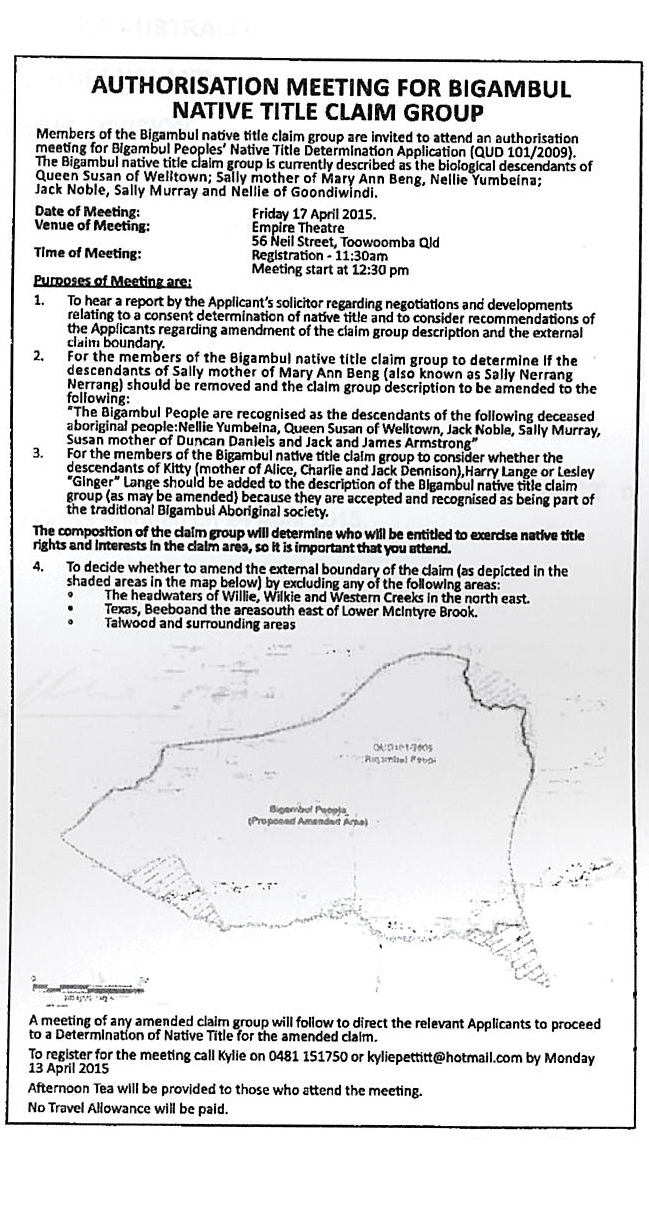
24 According to the affidavit of Ms Rowena Joy Cross, filed on behalf of the Bigambul Applicant, this notice was published in The Courier-Mail newspaper on 1 April 2015 and in the Koori Mail publication on 8 April 2015. Both of these publications are circulated widely in South East Queensland.
25 As well, the notice was attached to a letter that was sent to 298 individual addressees. The list of addressees was compiled from the attendance sheets from the previous Bigambul claim group meetings mentioned above (at [1]–[3]).
26 Mr Trevor Robinson was appointed to chair the Toowoomba meetings. He affirmed an affidavit, filed on behalf of the Bigambul Applicant, to which he attached a summary of the outcomes of the Toowoomba meetings (the Meetings Summary). In his affidavit, Mr Robinson stated that he had read the Meetings Summary and had satisfied himself that it accurately recorded the outcomes of the Toowoomba meetings.
27 According to the Meetings Summary, 242 people attended the first Toowoomba meeting and, of them, 226 people were registered as entitled to participate in that meeting. As is recorded in the Meetings Summary, the first meeting was a meeting of the Bigambul claim group as described in the amended Bigambul application filed 8 May 2014 (see at [3]–[4] above). That meeting resolved, among other things, to remove Sally Nerang as an apical ancestor for the Bigambul claim group.
28 The second meeting was a meeting of the Bigambul claim group as reconstituted by the first meeting, that is, excluding the descendants of Sally Nerang, excluding Nellie of Goondiwindi as an apical ancestor and including the descendants of Susan mother of Duncan Daniels and Jack and James Armstrong. Among other things, the second meeting resolved to amend the boundaries to the Bigambul claim area and to authorise a new applicant to pursue the Bigambul application as so amended.
29 Dr Fiona Powell is the anthropologist who was briefed to advise the Bigambul Applicant in relation to the Bigambul application. Dr Powell attended the Toowoomba meetings and the Bigambul Applicant filed an affidavit affirmed by her, in which she described her role at those meetings and the observations she made as to what occurred during them. In her affidavit, among many other things, Dr Powell described the steps taken to ensure that the descendants of Sally Nerang did not participate in the second meeting above.
30 The critical resolution (resolution number 2) that was passed at the first of the Toowoomba meetings was recorded in the Meetings Summary in the following terms:
“That Sally, mother of Mary Ann Beng is deleted from the existing claim group description which is changed to the following:
The Bigambul People are recognised as the descendants of Nellie Yumbeina, Queen Susan of Welltown, Jack Noble, Sally Murray, Susan mother of Duncan Daniels and Jack and James Armstrong.”
31 The Meetings Summary recorded that this resolution was carried with 136 people voting for the resolution and no one voting against it.
32 Three resolutions were passed at the second meeting (resolutions 2 to 4 inclusive) that are pertinent to the present applications. They were:
Resolution 2
“That the Applicants are authorised to amend the claim boundary by deleting the area around Willie, Wilkie and Western Creeks in the north east of the claim and the area south east of McIntyre Brook around Beebo and Texas (as depicted on the map distributed to the meeting).”
Resolution 3
“That the area around Talwood (as depicted on the map) be removed from the claim but the Applicant be authorised to file another Native Title Determination that includes that area at a later date.”
Resolution 4
“This meeting endorses the decision of the earlier meeting to amend the claim group description and the decisions of this meeting relating to the claim boundary. Those Applicants who remain members of the claim group as amended by resolution passed at the meeting held earlier this day (Resolution 2) are authorised and directed to do all such things as are necessary to obtain a Native Title Determination consistent with those decisions.”
33 The first two of these resolutions were recorded in the Meetings Summary as being carried “on a show of hands with nobody voting against”. The third resolution (Resolution 4) was clearly the most contentious item of business considered at the two meetings. It was recorded in the Meetings Summary as being carried by 87 votes to 47 votes.
34 Mr Hardie, the solicitor for the Bigambul Applicant, also attended the two Toowoomba meetings. He affirmed and filed a number of affidavits in support of these applications, in which he described what occurred prior to, and during, those meetings. The following is an outline of the salient aspects of Mr Hardie’s affidavits, together with some correlated parts of the Meetings Summary.
35 Mr Hardie said that, before all of the above resolutions were passed, he gave a detailed explanation to those present of the subject matter of each resolution and the reason why it was being proposed. He said his explanations relied, in part, on the opinions of the anthropologists advising the parties to this proceeding.
36 The three anthropologists concerned were: Dr Fiona Powell who, as mentioned above, advised the Bigambul Applicant; Mr Dan Leo, who advised the State of Queensland; and Dr Anna Kenny, who advised QSNTS. Their opinions were contained in the reports they had prepared for the purposes of the trial of this proceeding. Importantly, those opinions had been discussed at a conference of experts that was conducted by the Deputy Registrar Native Title in early March 2015 as a part of the preparations for the trial. After that conference, at least two documents were produced. One was a joint report expressing the final positions of the three anthropological experts on the main issues discussed at that conference. The other was an agreed statement of facts relating to the connection issues that were to be considered at the trial.
37 The Meetings Summary recorded that, before the Toowoomba meetings commenced, these two documents were distributed to those present at the meetings. As well, a PowerPoint presentation prepared by QSNTS was distributed. The former fact was also confirmed in one of Mr Hardie’s affidavits, where he stated:
… I had witnessed that a copy of the report of the conference of experts held on 2 and 3 March 2015 (the ‘experts report’) was distributed to each and every person in attendance at the meeting.
38 As to the use he made of that report in his explanation to the meetings, Mr Hardie said:
I told the meeting that all three anthropologist (Dr Leo for the State, Dr Kenny for QSNTS and Dr Powell for the Applicant) agreed that the changes should be made. I read out the relevant parts of the experts report to the meeting.
39 The Meetings Summary also described the explanations Mr Hardie gave to the meetings based upon the experts’ report. On the proposal to remove Sally Nerang as an apical ancestor, it recorded:
Colin Hardie said the anthropologists all agreed that the descendants of Sally Nerang were not Bigambul People and that this was a major obstacle to obtaining a consent determination. Colin Hardie said that based on the evidence it was unlikely that a court would find, in a contested hearing, that the descendants of Sally Nerang should be included in the claim group description. Colin Hardie said that the same thing applied to Kitty (mother of Alice, Charlie and Jack) and Harry and Ginger Lange. Colin Hardie said that as a result the Applicants recommended that the claim group be amended by deleting the descendants of Sally Nerang. Colin Hardie also explained that the anthropologists based, on recent research, had recommended other changes to Apical ancestors referred to in the claim group description. He said these would not change the composition of the claim group as the changes were refinements of the existing ancestors. Colin Hardie said that the only change that would affect the composition of the claim group was the deletion of Sally Nerang. Colin Hardie said that if this change was approved those persons who claimed to be Bigambul people only through being a descendant of Sally Nerang would no longer be members of the claim group, would no longer be able to participate in making decisions on behalf of the claim group and would not get the benefit of a native title determination.
40 With regard to the proposal to remove Nellie of Goondiwindi as an apical ancestor, Mr Hardie stated in one of his affidavits that, prior to the meetings, Dr Powell had told him that:
… she agreed with the findings of Kate Waters in her genealogical reports regarding the descendants of Nellie of Goondiwindi also being the descendants of Jack and James Armstrong and that her independent research confirmed that Nellie of Goondiwindi was in fact the same person as Nellie Yumbeina and that Jack and James Armstrong should be independently specified in the claim group description as there was some doubt as to whether their mother was Nellie Yumbeina. …
41 On this matter, Mr Hardie went on to say that: “I told the meeting of Dr Powell’s opinion and I relayed the substance of what she had told me.”
42 Mr Hardie also said he explained to the meetings why it was proposed to include “Susan mother of Duncan Daniels and Jack and James Armstrong” as an apical ancestor for the Bigambul claim group. In that explanation, he referred to the joint experts’ report mentioned above and said that:
… The report states that the mother of Duncan Daniels was previously presumed to be the same as Susan of Welltown, but who now regarded as a separate person and that Jack and James Armstrong were formerly identifies as the children of Nellie of Goondiwindi, This explain both the deletion of the former ancestor Nellie of Goondiwindi and the inclusion of the mother of Duncan Daniels and Jack and James Armstrong.
(Errors and omissions in original)
43 Finally, Mr Hardie said he explained the overall effect of these changes to the Bigambul claim group in the following terms:
I also told the meeting that I had been advised by Dr Powell that those changes would not lead to a change in the composition of the claim group. I said that I was specifically advised by her that each and every person who was a member of the claim group of the existing Native Title claim would continue to be a member of the claim group, if those changes were made. I told the meeting that Dr Powell was in attendance at the back of the meeting hall and would be available to address the meeting on this question if anybody had any concerns.
44 I infer that these statements were directed to the removal of Nellie of Goondiwindi as an apical ancestor and the inclusion of Susan mother of Duncan Daniels and Jack and James Armstrong, rather than the more vexed question (dealt with separately above) about the removal of Sally Nerang as an apical ancestor. As Mr Hardie explained to the meetings (see at [43]), the latter removal plainly did affect the composition of the Bigambul claim group.
The prerequisites for a fair notice for a meeting of the “whole” of a native title claim group
45 The two meeting, or two step, process that occurred at the Toowoomba meetings accords with the observations I made in Bigambul No 2. There, I observed that this process stemmed from ss 61 and 251B of the NTA, as follows:
56 Turning then to the Brisbane meeting, I consider the defect in Mr Hardie’s approach lies in the two-step process itself. That two-step process appears to have its origins in some observations made by Dowsett J to the effect that, if a native title claim group wishes to alter its composition, the existing claim group needs to meet and determine how the claim group is to be reconstituted and then the new or reconstituted claim group needs to meet and decide to authorise a new applicant to make the claim on behalf of that new claim group: see, for example, Kudjala People v State of Queensland [2006] FCA 1564 at [13]-[15] and Dodd on behalf of the Wulli Wulli People v State of Queensland (No 2) [2009] FCA 1180 (Wulli Wulli) at [14].
57 Section 61 of the Act makes it clear that the authority vested in the authorised applicant comes exclusively from the native title claim group on whose behalf the native title determination application is made. Further, the validity of that authority fundamentally relies upon the native title claim group following the authorisation process set out in s 251B of the Act. It follows that, if an existing claim group wishes to alter its composition, it must first meet as a whole and resolve to do that. If it does, then the new or reconstituted native title claim group must then meet and resolve in accordance with the process set out in s 251B to authorise an applicant to make a claim on its behalf under s 61. For these reasons, I respectfully agree with the observations of Dowsett J above.
(Emphasis added)
46 The need to ensure that there was a properly constituted meeting of the whole of the native title claim group to make these decisions was identified earlier in Bigambul No 2 (at [41]–[42]), by reference to the decision of Rares J in Weribone on behalf of the Mandandanji People v State of Queensland [2013] FCA 255 (Mandandanji) at [36]–[39]. However, the expression “whole” was not intended to mean that each and every member of the claim group had to attend the meeting for it to be a valid and effective meeting of that group, but rather that all the members of the claim group had to be given fair notice of the meeting so that: “the members of the claim group had been given every reasonable opportunity to participate in the decision-making process”, with the result that “[t]he decision-making process … proceed[ed] on the basis of an informed consent or vote by those properly entitled to notice of the meeting of the claim group”: see Mandandanji at [39].
47 As to what constitutes fair notice for such a meeting of a native title claim group, the first thing to note is that the NTA does not prescribe any form of notice. In the absence of any such prescription in the NTA, in Mandandanji, Rares J relied upon “the basic test that the common law has developed for notices calling meetings” (at [40]) and went on to observe that:
The notice must be sufficient to enable the persons to whom it is addressed, namely members or potential members of the native title claim group, to judge for themselves whether to attend the meeting and vote for or against a proposal or whether to leave the matter to be determined by the majority who do attend and vote at the meeting. That test conforms to the substance of what the Full Court of this Court synthesised as the test for a valid notice of meeting identified in a well-known line of authority in corporations cases: Fraser v NRMA Holdings Limited (1995) 55 FCR 452 at 466B-C per Black CJ, von Doussa and Cooper JJ.
48 Earlier in the same paragraph, his Honour made some more general observations about the form and content of such a notice, as follows:
The Court must be mindful that the class of persons to whom such notices will be addressed are not lawyers, but indigenous people from many varied walks of life who have greater and lesser degrees of sophistication and understanding. Ordinarily, it would not serve any purpose to require such notices to set out at great length and detail material of the nature that is sometimes sent to members of a corporation who are asked to consider amending or voting on resolutions put forward by directors.
49 Referring specifically to the native title context, his Honour concluded (at [41]) that:
Where a current applicant, or another person, wishes a meeting of a native title claim group to consider particular business or to proceed along a particular path that that applicant or person has in mind, the proponent must give fair notice of the business to be dealt with at the meeting to all members of the claim group. The notice must be such as will fully inform the persons entitled to attend the meeting, so that they can make an informed decision whether or not to be present.
(Emphasis added)
Fair notice was given that the composition of the Bigambul claim group was an item of business at the Toowoomba meetings
50 Based on the materials and principles outlined above, I am satisfied that leave should be given to the Bigambul Applicant to amend the description of the Bigambul claim group in the Bigambul application.
51 First, I am satisfied that fair notice was given of the business that was to be dealt with at the Toowoomba meetings. While the notice was more detailed and lengthy than the usual form of notice for such a meeting, this was essentially dictated by the complexity and extent of the items of business that had to be determined at the meetings. Nonetheless, the notice served to convey in relatively clear terms that the Toowoomba meetings would be asked to consider, among other things, the composition of the Bigambul claim group, including (but not limited to) the possible removal of the descendants of Sally Nerang from that claim group. From reading the notice, it follows that a member of the Bigambul claim group would have been able to make an informed decision about whether or not he or she wished to attend the meeting and participate in the decision-making process about those items of business.
52 Secondly, I am satisfied that the notice was widely circulated. In the first place, it was published in a newspaper and in a periodical, both of which have a wide circulation in the region where members of the Bigambul claim group were likely to reside. In addition, it was individually posted to approximately 300 people who were known to be members of the Bigambul claim group because they had attended various meetings of that group in the past.
53 The content of the notice and the manner of its circulation therefore served to ensure that any members of the Bigambul claim group who were interested in attending the meetings were likely to have been made aware of when and where the meetings were to be held and what items of business were to be considered at the meetings. The whole of the Bigambul claim group was therefore given a reasonable opportunity to attend and participate in the decision-making process that was to occur at the meetings.
54 The fact that 242 people attended the meetings supports this conclusion. This number is to be compared with the numbers that had attended previous meetings of the Bigambul claim group: 118 at the Carseldine meeting in October 2011 (see Bigambul No 2 at [13]), “at least 150” at the Goondiwindi meeting in October 2011 (see Bigambul No 2 at [17]), 75 at the Cherbourg meeting in February 2013 (see Bigambul No 2 at [26]) and 194 at the Brisbane meeting in March 2013 (see Bigambul No 2 at [32]).
55 Finally, something should be said about the quality of the information that was provided to those present at the Toowoomba meetings. While it was also somewhat complex and quite lengthy, I consider the information provided by Mr Hardie and others was sufficiently comprehensive and detailed that those present at the meetings were likely to have been fully and properly informed about each of the items of business before they were called upon to vote on the various resolutions at the meetings.
56 I am therefore satisfied that the whole of the Bigambul claim group met at the Toowoomba meetings and made a properly informed decision to make the proposed changes to the description of the Bigambul claim group.
Fair notice was given that the authorisation of a new Bigambul Applicant was an item of business at the Toowoomba meetings
57 In its final amended form, the order sought in relation to this aspect of the present applications was that:
The applicant (Russell Doctor, Elaine Georgetown, Veronica Jarrett, Rhonda Sandow, Roger Knox, and Cyril Logan and Gary Woodbridge) be replaced by the following persons: Russell Doctor, Elaine Georgetown, Rhonda Sandow, and Cyril Logan.
58 A comparison of the membership of the existing Bigambul Applicant with the proposed Bigambul Applicant shows that three people were to be excluded. They were: Veronica Jarrett, Gary Woodbridge and Roger Knox.
59 The events leading to this particular application are already detailed above. However, it is convenient to recap and expand on some aspects of those events, as follows.
60 First, the particular part of the notice that is pertinent for present purposes is that appearing under the map of the Bigambul claim area where it is stated: “A meeting of any amended claim group will follow to direct the relevant Applicants to proceed to a Determination of Native Title for the amended claim” (see at [23] above).
61 Secondly, the resolution concerned (Resolution 4) was passed at the second of the Toowoomba meetings, that is, at the meeting of the newly constituted Bigambul claim group as determined by the first meeting. Thus, the resolution was in the following form (see at [32] above):
“This meeting endorses the decision of the earlier meeting to amend the claim group description and the decisions of this meeting relating to the claim boundary. Those Applicants who remain members of the claim group as amended by resolution passed at the meeting held earlier this day (Resolution 2) are authorised and directed to do all such things as are necessary to obtain a Native Title Determination consistent with those decisions.”
62 QSNTS opposed this order being made. It contended that the notice for the Toowoomba meetings was defective, insofar as it related to the proposal to replace the existing Bigambul Applicant with a new Applicant to pursue the Bigambul application. It submitted the notice did not fairly convey the fact that this was one of the items of business to be considered at the Toowoomba meetings. This arose, so QSNTS submitted, from the following features of the notice. First, it claimed the notice only referred to one meeting of the Bigambul claim group, not two. Next, it claimed the notice identified four numbered purposes of the meeting, none of which included the proposal to replace the existing Bigambul Applicant. Further, insofar as the notice may have contained any mention that the meetings may be asked to replace the Bigambul Applicant, that appeared near the end of the notice and, since it was so long and complex, it was likely to have been missed. Further still, it submitted that the use of the word “direct”, rather than the word “authorise” which is used in the NTA, did not accurately convey that one of the items of business at the meetings was to authorise a new applicant for the Bigambul application. Finally, it submitted that the notice did not clearly identify who was to be removed from the membership of the existing Bigambul Applicant when it stated that “the relevant Applicants” were to be directed to proceed with the Bigambul application.
63 I do not consider any of these submissions can be accepted. First, it was clear from the statement in the fourth last paragraph of the notice (see at [23] above) – “[a] meeting of any amended claim group will follow” – that there were to be two meetings – one to consider the proposed amendments to the description of the Bigambul claim group and, if they were adopted, a meeting of the amended claim group to follow. Secondly, while the paragraph of the notice in question was not numbered, it did appear at the end of the section headed “Purposes of Meeting are”. Further, by stating that the purpose of the second meeting was “to direct” the “relevant Applicants” to proceed with the Bigambul application, the notice there identified the particular item of business in similar terms to the four numbered paragraphs that immediately preceded it, that is: “To hear” (paragraph 1), “to determine” (paragraph 2), “to consider” (paragraph 3) and “To decide” (paragraph 4). Since it was in the same section of the notice as the numbered items of business and used similar terminology to those items, I consider a person reading the notice would have concluded it described one of the items of business that was to be considered at the Toowoomba meetings.
64 Thirdly, despite the fact that the notification of the intention to have a second meeting appeared at the end of what was a complex and lengthy notice, I consider an interested member of the Bigambul claim group would have been likely to read the whole of the notice and when they did they would have received sufficient notice of the fact that the authorisation of a new Applicant was to be an item of business to be considered at the Toowoomba meetings.
65 Fourthly, while it may have been preferable to use the statutory terminology of “authorise”, I consider the word “direct” conveyed a similar concept, namely, that a new Bigambul Applicant was to be responsible for pursuing the Bigambul application on behalf of the Bigambul claim group. In this respect, it is also significant that the banner heading to the notice stated: “AUTHORISATION MEETING FOR BIGAMBUL NATIVE TITLE CLAIM GROUP”.
66 Finally, in all the circumstances of this matter, I do not consider the use of the expression “relevant Applicants” was ambiguous. In the first place, until such time as the existing Bigambul claim group had decided at the first meeting how the claim group was to be constituted, it would not be known who amongst the membership of the existing Bigambul Applicant would be eligible to continue as members of the new Bigambul Applicant. This contingency followed, in part, from the two step process described above and the requirements of s 61(1) of the NTA that the persons who are authorised by a native title claim group to be the Applicant must “also [be] included in the native title claim group”. To have nominated in advance of those decisions which members of the existing Bigambul Applicant were to be excluded as members would have therefore pre-empted the earlier decisions. Rather than offend the autonomy of that decision-making process, I consider it was appropriate, in the circumstances, to use the more neutral and open-ended expression “relevant Applicants”.
67 Despite the use of this more anodyne expression, I am satisfied that the two persons who were most likely to be directly affected by the possible outcome described above – Mr Roger Knox and Ms Veronica Jarrett – were well aware of it and, indeed, accepted it. In relation to Mr Knox, the State of Queensland produced affidavit evidence at the hearing of this application to show that, at an early stage of this proceeding, Mr Knox had identified himself as a descendant of Sally Nerang. More significantly, in one of his affidavits, Mr Hardie confirmed that this was so and he said that he told the Toowoomba meetings that he had discussed this issue with Mr Knox and he: “was in favour of making the change to the claim group description even if this meant that he couldn’t claim to be Bigambul through Sally [Nerang]”.
68 The same applied to Ms Jarrett. In one of his affidavits, Mr Hardie deposed to the fact that he had a discussion with Ms Jarrett prior to the Toowoomba meetings during which she told him that she was a descendant of Sally Nerang and that she had signed an attendance record to that effect at a previous meeting of the Bigambul claim group. Mr Hardie said that he had advised Ms Jarrett that the exclusion of the descendants of Sally Nerang from the Bigambul claim group would mean she would no longer be eligible to serve as a member of the Applicant for the Bigambul application. He said she told him that she accepted this consequence. Mr Hardie also said that he informed the Toowoomba meetings of the gist of his discussions with Ms Jarrett.
69 I am also satisfied that most, if not all, of the members of the existing Bigambul claim group were likely to have been well aware, from the history of this issue within the claim group, as to what the expression “relevant Applicants” was meant to convey. That history is outlined at [1]–[3] above. The two step process which I have mentioned above (at [45]–[49]) was a crucial part of that history because it was the primary reason why an earlier authorisation meeting of the Bigambul claim group had failed: see Bigambul No 2 at [56]–[62]. For that reason, I consider the implications of this two step process were likely to be well known within the Bigambul claim group. One of those implications was that the reconstitution of a claim group may result in the ineligibility of some members of the existing claim group to serve as a member of the applicant for the reconstituted claim group.
70 Finally on this issue, it is significant, in my view, that there is no evidence before me that any member of the Bigambul claim group was unaware that this item of business was to be considered at the Toowoomba meetings, nor is there any evidence that any member of the claim group was misled by this aspect of the notice for those meetings. To the contrary, as I have already recorded above (at [54]), those meetings were well attended by comparison to the earlier meetings of the Bigambul claim group that had been called to consider similar aspects of this very issue.
71 Before leaving this issue, I should briefly explain why Mr Woodbridge was excluded as a member of the Bigambul Applicant. He is deceased. Mr Hardie deposed to this fact in one of his affidavits by reference to an affidavit made by Mr Woodridge’s brother, Mr Leslie Woodbridge, where he described the events at his brother’s funeral.
72 Finally, while QSNTS’s opposition to the making of this order only related to the question whether fair notice was given that this was to be an item of business at the Toowoomba meetings, it is apt to record how this item was dealt with at those meetings. The particular resolution concerned was Resolution 4 which was passed at the second of the Toowoomba meetings (see at [32] above). As recorded above (at [33]), that resolution was carried by 87 votes to 47 votes.
73 For these reasons, I consider that fair notice was given to the members of the Bigambul claim group that one of the items of business to be considered at the Toowoomba meetings was the authorisation of a new Bigambul Applicant to pursue the amended Bigambul application on behalf of whatever reconstituted Bigambul claim group emerged from the earlier decisions to be made at those meetings. I am therefore satisfied that the reconstituted Bigambul claim group has properly authorised the new Bigambul Applicant to pursue the amended Bigambul application on their behalf. Because I have reached this conclusion, it is unnecessary to consider whether s 84D of the NTA could be applied to avoid the expense and inconvenience of convening and conducting a further meeting of the Bigambul claim group. I mention this matter because it was the subject of detailed submissions at the hearing of this application.
Amending the Bigambul application to exclude certain areas from the claim area
74 In its original form, this order sought to replace the description of the claim area with that shown in Attachment “B” which appeared within the amended Bigambul application. However, because of the urgency with which this application was made (see at [2] above), the Bigambul Applicant had not been able to obtain a detailed geospatial co-ordinates description of the amended claim area from the National Native Title Tribunal. In the event, the final form of this order sought to ignore the contents of Attachment “B” and to have the description of the claim area amended to the following:
… the technical description of the claim area including geospatial co-ordinates in accordance with the map attachment “C” (excluding the hatched areas) provided by the National Native Title Tribunal.
75 None of the parties who sought to be heard on these applications opposed the making of this order.
76 The particular part of the notice for the Toowoomba meetings that described this item of business was item 4. That item clearly identified the three areas of land to be excluded from the Bigambul claim area by reference to the shaded areas shown on the map that was included as part of the notice (see at [23] above).
77 Two resolutions were passed dealing with these three exclusions (Resolutions 2 and 3: see at [32] above) and both of those resolutions were passed at the meetings “on a show of hands with nobody voting against” (see at [33] above).
78 I am therefore satisfied that fair notice was given to members of the Bigambul claim group that these items of business would be considered at the Toowoomba meetings and I am further satisfied that the members of the reconstituted Bigambul claim group made a properly informed decision to authorise these amendments to the description of the claim area in the Bigambul application.
Conclusion
79 For these reasons, on 29 April 2015, I made the three orders sought by the Bigambul Applicant.
I certify that the preceding seventy-nine (79) numbered paragraphs are a true copy of the Reasons for Judgment herein of the Honourable Justice Reeves. |


