

FEDERAL COURT OF AUSTRALIA
Dua v Dawn Jade Limited [2015] FCA 505
IN THE FEDERAL COURT OF AUSTRALIA | |
Applicant | |
AND: | First Respondent GAO FU HOLDINGS LIMITED Second Respondent |
DATE OF ORDER: | |
WHERE MADE: |
THE COURT ORDERS THAT:
1. The application be dismissed.
2. The time for compliance with the bankruptcy notice issued by the first respondent be extended to 6 May 2015.
3. The time for compliance with the bankruptcy notice issued by the second respondent be extended to 6 May 2015.
4. The applicant pay the respondents' costs.
Note: Entry of orders is dealt with in Rule 39.32 of the Federal Court Rules 2011.
NEW SOUTH WALES DISTRICT REGISTRY | |
GENERAL DIVISION | NSD 289 of 2014 |
BETWEEN: | HIMANSHU GIRDHAR DUA Applicant |
AND: | DAWN JADE LIMITED First Respondent GAO FU HOLDINGS LIMITED Second Respondent |
JUDGE: | RARES J |
DATE: | 22 APRIL 2015 |
PLACE: | SYDNEY |
REASONS FOR JUDGMENT
(REVISED FROM THE TRANSCRIPT)
1 This is an application to set aside two bankruptcy notices issued by an official receiver under s 41(1) of the Bankruptcy Act 1966 (Cth). On 10 July 2012, the High Court of the Hong Kong Special Administrative Region found Himanshu Girdhar Dua (the debtor) liable in damages to the two respondents, Dawn Jade Limited and Gao Fu Holdings Limited (the creditors). That court ordered the debtor to pay: Dawn Jade USD400,000 or the Hong Kong equivalent at the time of payment, Gao Fu USD600,000 or the Hong Kong equivalent at the time of payment, and the costs of the proceedings fixed at HKD10,000. The Court also ordered the debtor to pay with interest on those respective sums at the rate of 8% per annum, being the applicable Hong Kong interest rate from the date of judgment.
2 The creditors subsequently brought proceedings under the Foreign Judgments Act 1991 (Cth) in the Supreme Court of New South Wales to enforce the Hong Kong judgment. On 31 January 2013, the Supreme Court made the following orders in which Dawn Jade was first plaintiff and Gao Fu was second plaintiff :
1. The judgment dated 10 July 2012 of the High Court of the Hong Kong Special Administrative Region (Proceeding No. HCA581/2012) (“the Judgment”) be registered under Part 2 of the Foreign Judgment Act 1991 of the Commonwealth for:
a. the Defendant is to pay the First Plaintiff the sum of USD400,000 or Hong Kong dollar equivalent at the time of payment;
b. The Defendant is to pay the Second Plaintiff the sum of USD600,000 or the Hong Kong dollar equivalent at the time of payment; and
c. The Defendant is to pay the costs of the Proceedings which were fixed at HKD10,000.
2. The Defendant is to pay interest:
a. to the First Plaintiff on the sum of USD400,000 or Hong Kong dollar equivalent at the time of payment;
b. to the Second Plaintiff on the sum of USD600,000 or Hong Kong dollar equivalent at the time of payment; and
c. on the costs of the Proceedings fixed at HKD10,000;
at the rate of 8% per annum, being the applicable Hong Kong interest rate for the Judgment, from 10 July 2012 until the date of judgment in this proceeding.
3. The Defendant is to pay the costs of and incidental to the application for this order and of registration of the judgment to the Plaintiffs.
4. The Defendant may, within 14 days after service upon him of notice of registration, apply to set aside the registration;
5. The judgment may be enforced to the full extent of the terms that are to be registered.
6. The judgment may also be enforced for the interest and costs for which judgment is registered.
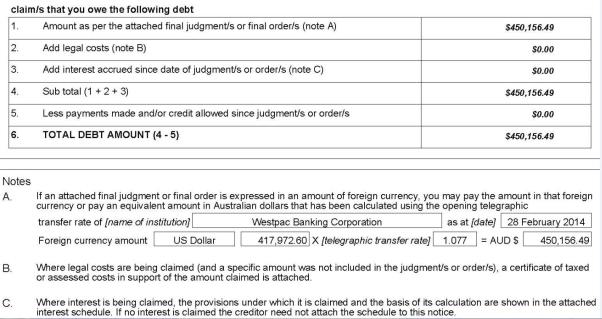
3 The debtor accepted that he had been served with bankruptcy notices by Dawn Jade and Gao Fu on 12 March 2014. Each notice followed the prescribed form of bankruptcy notice under Form 1 in reg 4.02 of the Bankruptcy Regulations 1996 (Cth). The Supreme Court’s judgment was attached to the notices as required. Relevantly, Dawn Jade’s bankruptcy notice asserted:
4 The notice stated on page 2, in accordance with Form 1, that the debtor was required, within 21 days after service, either to pay the creditor the amount of the debt claimed or to make arrangements to the creditor’s satisfaction for settlement of the debt. It also informed the debtor as follows:
5. Applying to set aside the Bankruptcy Notice: You may apply to the Court, within the time stated in paragraph 1 above, for an order that this Bankruptcy Notice be set aside on the grounds that you have a counter-claim, set-off or cross demand, equal to or exceeding the amount claimed in this Bankruptcy Notice, and you could not have set up that counter-claim, set-off or cross demand in the action or proceeding in which the judgment or order in respect of which this Bankruptcy Notice has been issued was obtained.
5 Gao Fu’s notice was in relevantly identical terms, except that the amount claimed in item 1 of the notice was AUD675,234.74, that sum being repeated as the amount for items 4 and 6 as being the total debt. Note A identified that that amount was the equivalent to USD626,958.90, calculated on the same basis as in Dawn Jade’s notice.
6 There is no dispute that the two United States dollar sums included in the bankruptcy notices were the sums of the respective judgment debts in orders 1(a) and 1(b) of the Supreme Court’s orders, together with interest due for the period between 10 July 2012 and 31 January 2013 calculated under orders 2(a) and (b) respectively.
The issue
7 The sole issue now in dispute between the parties flows from the fact that the calculations of the Australian equivalent of the respective United States dollar amounts specified in Note A to each bankruptcy notice did not appear on the face of the Supreme Court judgment and were not the product of any two or more of the amounts that appeared on the face of that judgment.
8 In substance, the debtor contended that each notice was invalid and should be set aside. That was because, he argued, they contained no explanation of how the United States dollar sum claimed had been calculated and that, accordingly, the notices could reasonably have misled a debtor as to what was required to comply with each of them, or alternatively, that each notice failed to meet requirements made essential by the Act, namely, the requirements concerning claims for interest and/or legal costs.
The legislative scheme
9 The relevant provisions of the Act at the time the bankruptcy notices were served were:
40 Acts of bankruptcy
(1) A debtor commits an act of bankruptcy in each of the following cases:
(g) if a creditor who has obtained against the debtor a final judgment or final order, being a judgment or order the execution of which has not been stayed, has served on the debtor in Australia or, by leave of the Court, elsewhere, a bankruptcy notice under this Act and the debtor does not:
(i) where the notice was served in Australia – within the time specified in the notice; or
(ii) where the notice was served elsewhere – within the time fixed for the purpose by the order giving leave to effect the service;
comply with the requirements of the notice or satisfy the Court that he or she has a counter-claim, set-off or cross demand equal to or exceeding the amount of the judgment debt or sum payable under the final order, as the case may be, being a counter-claim, set-off or cross demand that he or she could not have set up in the action or proceeding in which the judgment or order was obtained;
41 Bankruptcy notices
(1) An Official Receiver may issue a bankruptcy notice on the application of a creditor who has obtained against a debtor:
(a) a final judgment or final order that:
(i) is of the kind described in paragraph 40(1)(g); and
(ii) is for an amount of at least $5,000; or
…
(2) The notice must be in accordance with the form prescribed by the regulations.
…
(5) A bankruptcy notice is not invalidated by reason only that the sum specified in the notice as the amount due to the creditor exceeds the amount in fact due, unless the debtor, within the time allowed for payment, gives notice to the creditor that he or she disputes the validity of the notice on the ground of the misstatement.
(6) Where the amount specified in a bankruptcy notice exceeds the amount in fact due and the debtor does not give notice to the creditor in accordance with subsection (5), he or she shall be deemed to have complied with the notice if, within the time allowed for payment, he or she takes such action as would have constituted compliance with the notice if the amount due had been correctly specified in it.
306 Formal defect not to invalidate proceedings
(1) Proceedings under this Act are not invalidated by a formal defect or an irregularity, unless the court before which the objection on that ground is made is of opinion that substantial injustice has been caused by the defect or irregularity and that the injustice cannot be remedied by an order of that court.
10 Regulation 4.01 provided that, subject to sub-reg (2), a person had to lodge an application in the approved form with an official receiver when applying for a bankruptcy notice and, relevantly, a copy of the sealed or certified judgment or order. Regulation 4.02(1) prescribed the form of the bankruptcy notice set out in Form 1 for the purposes of s 41(2) of the Act. A bankruptcy notice had also to follow Form 1 in respect of its format, including bold or italic typeface, underlining and notes (reg 4.02(2)).
The debtor’s submissions
11 The debtor argued that the Act requires great strictness in respect of compliance with its procedures and he relied on James v Federal Commissioner of Taxation (1955) 93 CLR 631. He argued that where a judgment creditor chose to include a claim for interest on a judgment when making a claim in a bankruptcy notice for the payment of a sum due, the judgment creditor had to calculate accurately the amount of interest and specify it in the notice and that, if a notice were issued for less than the sum due and left the balance to be claimed, it was bad. For the latter proposition he relied on what Romer LJ had said in Re HB [1904] 1 KB 94 at 103. He also argued that understatement of the amount actually due to the judgment creditor in a bankruptcy notice could mislead a debtor as to whether the debtor was required to pay the amount in fact due or the amount specified in the notice, so that that failure operated to make the notice a nullity, relying on what Mason CJ, Wilson, Brennan and Gaudron JJ had said in Kleinwort Benson Australia Limited v Crowl (1988) 165 CLR 71 at 80. He argued that a debtor was not required to engage in the task of construing a bankruptcy notice and resolving questions of doubt or ambiguity and that, if the notice were equivocal, ordinarily that equivocation should be resolved in favour of the debtor, relying on what Lockhart J had said in Re Wong; Ex parte Kitson (1979) 27 ALR 405 at 414-415. The debtor also argued that here each notice did not seem to have been calculated on the totality of the judgment due to the respective creditor but on some part of it, and that its methodology was obscure so that it was reasonably capable of misleading the debtor.
12 At the beginning of the hearing today, the debtor sought to raise an argument that the Supreme Court’s judgment did not comply with a requirement of s 6(15)(b) of the Foreign Judgments Act because that judgment did not register any amount in respect of any interest that had become due under the Hong Kong judgment up to the time of registration. The creditors objected to the debtor being able to rely on that matter because it was not within his grounds of opposition and had not been the subject of any notice.
13 I accept the creditor’s argument and will not allow the debtor to rely on that point. The fact is that the Supreme Court judgment is a judgment of a superior court of record. It is valid and binding unless and until it is set aside: Cameron v Cole (1944) 68 CLR 571 at 590 per Rich J; Re Macks; Ex parte Saint (2000) 204 CLR 158.
Consideration
14 Each notice failed to identify expressly the particular order or orders in the Supreme Court judgment on which the respective creditor relied for the purpose of claiming the debt it identified in item 1, namely, “amount as per the attached final judgment/s or final order/s (note A)”. Note A explained that if the attached final judgment or order “is expressed in an amount of foreign currency”, the debtor could pay the amount of foreign currency or an Australian dollar equivalent calculated in a particular way.
15 As is evident, only orders 1(a) and (b) of the Supreme Court judgment expressed an amount of United States dollars, namely, USD400,000 and USD600,000. However, orders 2(a) and (b) provided a manner of calculation for the interest due on the United States dollar sums. There was no claim for post-judgment interest in the notices, that is, interest due on the registered judgment amounts in the Supreme Court judgment.
16 The debtor’s argument essentially is that it is impossible to know whether the United States dollar sums referred to in Note A of each notice were comprised of the Hong Kong judgment debt together with some amount in respect of the costs obligation jointly owed to each of the creditors or simply interest and the United States dollar judgment debt or some unexpressed amount of the HKD10,000 costs order, some interest and the amount of the Hong Kong judgment debts, or various permutations of those possibilities.
17 In my opinion, the debtor’s argument is in the teeth of what Mason CJ, Wilson, Brennan and Gaudron JJ said in Kleinwort 165 CLR at 79-80, namely, that:
The authorities show that a bankruptcy notice is a nullity if it fails to meet a requirement made essential by the Act, or if it could reasonably mislead a debtor as to what is necessary to comply with the notice: James v Federal Commissioner of Taxation [(1955) 93 CLR 631, at 644]; Pillai [v Comptroller of Income Tax] ([1970] AC at 1135). In such cases the notice is a nullity whether or not the debtor in fact is misled: In re A Judgment Debtor, 530 of 1908 (1908] 2 KB 474 at 481).
If the amount specified in a bankruptcy notice is in fact due and payment is claimed in accordance with the judgment, the essential requirements of s. 41(2)(a)(i) – the only requirements presently relevant – are met. Understatement of the amount due, whether it be an understatement of the judgment debt or of interest payable thereon, will thus constitute a defect which is substantive rather than formal only if the understatement is objectively capable of misleading the debtor as to what is necessary for compliance with the notice.
It may be that, in a given case, understatement is capable of misleading the judgment debtor particularly if the notice is capable of producing uncertainty as to whether the debtor is required to pay the amount in fact due or the amount specified in the notice. In such a case uncertainty arises, not merely from the understatement, but from the understatement in the context of the particular bankruptcy notice. No such uncertainty arises if it is clear that payment of the amount specified in the notice will constitute compliance with the notice. (emphasis added)
18 That statement of principle was, of course, made in respect of an earlier version of the Act when s 41(2)(a)(i) provided that a bankruptcy notice had to require payment “in accordance with the judgment”. Their Honours held that a notice specifying payment in accordance with some other arrangement did not satisfy that requirement. The applicable version of the Act does not contain such a requirement. Nonetheless, the requirement of item 1 in Form 1 indicates that the creditor must specify the debt and the basis on which he, she or it seeks to found the bankruptcy notice.
19 More recently, in Adams v Lambert (2006) 228 CLR 409, the High Court returned to considering whether misstatements in a bankruptcy notice amounted to a formal defect or irregularity capable of being cured under s 306(1) of the Act. By then the Act had been amended to, relevantly, the current form of s 41, and Form 1, likewise, was in materially similar terms to that the subject of the two notices in this case. There, Gleeson CJ, Gummow, Kirby, Hayne, Callinan, Heydon and Crennan JJ said (228 CLR at 417 [21]):
If a question had arisen in the present case as to whether, considered as a whole, the bankruptcy notice was claiming pre-judgment or post-judgment interest, the answer would be clear. That is not the precise question that arises. Rather, the question is whether the notice complies with the requirements of the Act. Even so, the consideration that, on the true construction of the notice as a whole, it is clear that the claim is for post-judgment interest, is part of the context in which s 306 is to be applied. (emphasis added)
20 In that case the issue was whether the identification of the section of a statute under which post-judgment interest was claimed had been erroneously inserted in the notice so as to render it a nullity, or whether that error was curable under s 306(1). Their Honours applied what the majority had held in Kleinwort 165 CLR at 79 (228 CLR 418–419 [25]). They said that what was relevant to s 306(1) was whether a debtor was misled as to what was necessary to comply with the notice. If he or she were misled on that subject matter, the error would be outside the concept of a formal defect or irregularity (228 CLR at 419 [27]). They held that (228 CLR at 419 [27], 420-421 [31]):
… the particular purpose of the legislative scheme relating to bankruptcy notices, leads readily to a conclusion that if the error could reasonably mislead a debtor as to what is necessary to comply with the notice it is not merely a formal defect or irregularity. Any error is capable of misleading somebody about something ….
The practical significance of an error or deficiency could vary according to the circumstances of each particular case. Errors or deficiencies in compliance with requirements as to form may involve questions of degree as well as of kind. At the same time, the decision in Kleinwort Benson Australia Ltd v Crowl shows that an error may be covered by s 306 even though it involves a substantial misstatement of an amount of money. It was essential that the bankruptcy notice state the amount claimed. Was it essential that the amount be correct? Section 41(5) made it clear that an overstatement, even a large overstatement, would not necessarily invalidate the notice. This Court concluded that it was not the legislative purpose that a substantial understatement should necessarily invalidate the notice. That is to say, accurately stating the amount of interest owing was not a matter of such importance that error necessarily resulted in invalidity. In the present case, overstatement or understatement of the amount of post-judgment interest owing would not necessarily have invalidated the notice. That is part of the context in which legislative purpose is to be considered in deciding whether the reference to s 83A rather than s 85 was fatal. (emphasis added)
21 Here, the question is whether the debtor could reasonably have been misled as to what was necessary to comply with each of the notices. In terms, the notices made clear that if he paid the Australian, or the United States, dollar sum specified in the calculation in Note A, he would comply with the notice. There is no dispute that the debtor owed the United States dollar sums at the time the notices were issued and served on him.
22 In my opinion, no uncertainty arose. It was clear to any person in the position of the debtor that only payment of the amount specified in the notice would constitute compliance with it. The debtor could have applied to the Court to establish whether or not he had a counter-claim, set-off or cross demand equal to or exceeding the amount claimed in each bankruptcy notice, were that to have been the case, without any difficulty.
23 The debtor was not left in the predicament identified by the majority in Kleinwort 165 CLR at 80. He could not have been left in any doubt whether he was required to pay the amount in fact due or the particular amount specified in the notice. Each notice made pellucid that payment of the amount it claimed was the only action that would constitute compliance with the terms of the notice.
24 I accept the creditors’ contention that what Romer LJ had said in Re HB [1904] 1 KB at 103 is not the law in Australia. His Lordship had said that a bankruptcy notice had to require payment of a sum alleged to be due according to the terms of the judgment and that any understatement of the judgment debt in a notice, that left a balance due to be paid, rendered the notice bad. Mason CJ, Wilson, Brennan and Gaudron JJ expressly rejected that proposition in Kleinwort 165 CLR at 79. Shortly afterwards, a Full Court of this Court followed that decision in Re Farrugia; Ex parte Deputy Commissioner of Taxation (1988) 19 FCR 1 at 4-5, where Sweeney, Lockhart and Burchett JJ said (19 FCR at 5):
Of course, if a debtor complies with the notice the judgment debt which underlies the issue of the notice will be discharged, but this is because the payment operates as a discharge of the debt to the extent of the payment, not because the bankruptcy notice has been complied with.
25 Here, the debtor could have been left in no doubt from the terms of each notice that he would comply with its requirements by paying the United States dollar sums identified in Note A or the calculated Australian dollar equivalent. I am not satisfied that any formal defect or irregularity has arisen in that respect.
26 It may be, however, that the failure of the creditors to identify the particular paragraph or paragraphs of the Supreme Court judgment, on which each respectively relied, in item 1 of the notice was a defect but, if it were, I am of opinion that it was a formal defect within the reasoning of the authorities that I have quoted above and did not invalidate the notice by force of s 306(1) of the Act.
Conclusion
27 In those circumstances, I am of opinion that the application must be dismissed with costs. I will extend the time for compliance with each notice until 6 May 2015.
I certify that the preceding twenty-seven (27) numbered paragraphs are a true copy of the Reasons for Judgment herein of the Honourable Justice Rares. |


