FEDERAL COURT OF AUSTRALIA
Donaldson v Natural Springs Australia Limited [2015] FCA 498
Table of Corrections | |
26 May 2015 | In paragraph 206, “(and in fact)” has been added to the fourth sentence. |
IN THE FEDERAL COURT OF AUSTRALIA | |
Plaintiff | |
AND: | NATURAL SPRINGS AUSTRALIA LIMITED First Defendant JURGEN CHRISTIAN KURT SCHLOTZER Second Defendant WOLFGANG ZINK Third Defendant PETER ROSE Fourth Defendant PRIME LOG BROKERS LTD Fifth Defendant |
DATE OF ORDER: | 22 May 2015 |
WHERE MADE: |
THE COURT ORDERS THAT:
1. The plaintiff’s originating application be dismissed.
2. The plaintiff pay the defendants’ costs of and incidental to the proceeding including any reserved costs.
3. The defendants have liberty to apply for an additional order for costs against David Graer and Hakel Investments Pty Ltd.
Note: Entry of orders is dealt with in Rule 39.32 of the Federal Court Rules 2011.
VICTORIA DISTRICT REGISTRY | |
GENERAL DIVISION | VID 1178 of 2011 |
BETWEEN: | GORDON BRUCE DONALDSON Plaintiff |
AND: | NATURAL SPRINGS AUSTRALIA LIMITED First Defendant JURGEN CHRISTIAN KURT SCHLOTZER Second Defendant WOLFGANG ZINK Third Defendant PETER ROSE Fourth Defendant PRIME LOG BROKERS LTD Fifth Defendant |
JUDGE: | BEACH J |
DATE: | 22 May 2015 |
PLACE: | MELBOURNE |
REASONS FOR JUDGMENT
1 This proceeding concerns claims made by Gordon Bruce Donaldson (Donaldson) against the five defendants for:
(a) breach of contract;
(b) tortious conduct said to amount, in its various dimensions, to an interference with contractual relations; and
(c) oppression under s 232 of the Corporations Act 2001 (Cth) (the Act).
2 Donaldson, previously a director of the first defendant Natural Springs Australia Pty Ltd (Natural Springs), has alleged that each of the defendants intentionally interfered with the transfer of his shares in Natural Springs to a second company Hakel Investments Pty Ltd (Hakel Investments) and the registration thereof, causing him a loss of $300,000. Donaldson seeks damages of $300,000, alternatively an order that the defendants purchase his shares in Natural Springs for that amount.
3 For the reasons that follow, in my view Donaldson’s originating application should be dismissed.
Factual background
4 The background to this matter is protracted.
5 Natural Springs was a company that exported spring water to Asian markets including Singapore. Natural Springs initially operated by sourcing Australian spring water and bulk shipping it to Albatross International Pty Ltd (Albatross) in Singapore, its agent for a time, for bottling.
6 On 21 May 2001, Donaldson acquired the issued capital of Natural Springs (then called “Your Team Pty Ltd” and later “Liquid Bulk Solutions Pty Ltd” until its name change to Natural Springs as part of the 22 March 2005 restructure). Until 22 March 2005, Donaldson was the sole director and shareholder.
7 From 2002, the second defendant Jurgen Schlotzer (Schlotzer) was an employee of Natural Springs. Schlotzer was also a director of Albatross from 1 June 2004.
8 On 22 March 2005, Natural Springs was restructured. Schlotzer and the third defendant Wolfgang Zink (Zink) were appointed as directors, with Donaldson continuing as a director. Schlotzer was also made the manager of finance and logistics; Schlotzer was also an alternate director for Zink. At that time, each of Donaldson, Schlotzer and Zink effectively acquired 11.96 million shares in Natural Springs. Schlotzer's shares were held by the fifth defendant, Prime Log Brokers Pty Ltd (Prime Log), a company of which he was the majority shareholder and managing director. Zink was based in British Columbia, Canada and at all relevant times was absent from Australia. Zink’s shares were held on trust. The fourth defendant Peter Rose (Rose) was an investor who, along with his wife Leisa Rose, acquired a shareholding of 3.12 million shares held on trust for the Rose Family Trust.
9 The 11,959,900 shares issued to Donaldson on 22 March 2005 were issued to him in his capacity as trustee of the Donaldson Family Trust. At that time, Donaldson already personally held 100 shares in Natural Springs, which shareholding pre-dated the restructure. The fact that Donaldson’s shares were held in two different parcels and in two different capacities is relevant to an issue which I will later address concerning the forms of share transfers that he later proffered for registration under cl 51 of Natural Springs’ Constitution.
10 On 19 May 2005, Natural Springs was converted to an unlisted public company and adopted a new Constitution. Relevantly, cll 2, 6, 11(a), 18, 20, 23, 24, 45, 46 and 51 to 53 of the Constitution provided:
Effect as a Contract
2. This Constitution is as a contract between:
(a) the Company and each Member, and
(b) the Company and each Director and each Secretary, and
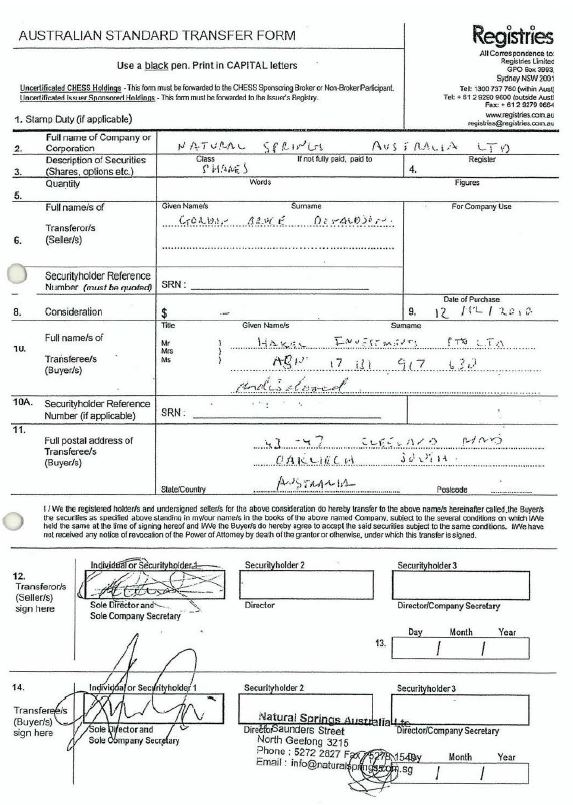
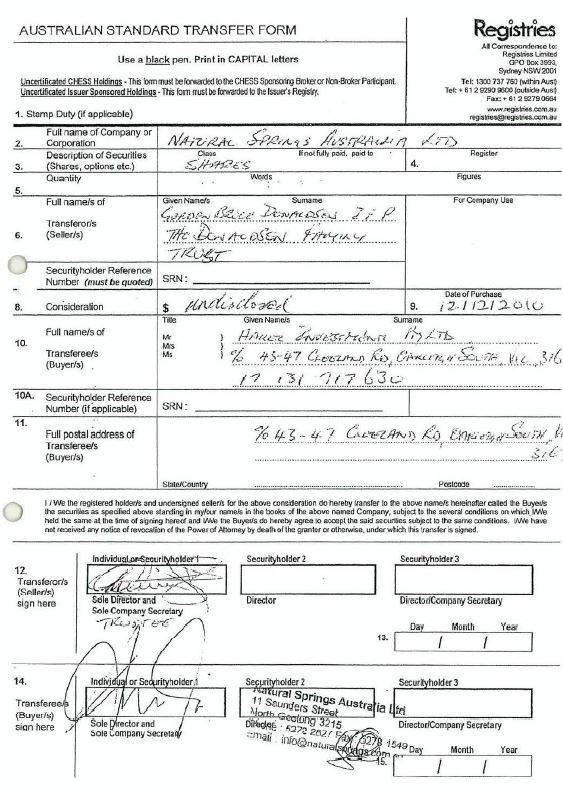
(c) a Member and each other Member; and each person agrees to observe perform and be bound this Constitution.
…
Management of Company
6. The Company is managed by its Directors, who may delegate their powers.
…
Powers & Entitlements
11. The Directors may do anything permitted by law, including each of the following:
(a) exercise all of the powers of the Company which are not required to be exercised by the Members in General Meeting;
…
Calling of Meetings
18. A Director may call a Directors' Meeting at any time, and the Secretary will call a meeting of Directors if asked to do so by a Director.
…
Quorum
20. At least 2 Directors must be present before business can be transacted at a Directors’ Meeting.
…
Voting at Directors’ Meetings
23. A question that arises at a Directors' Meeting will be decided by a vote. The Chairperson of the meeting may not cast a second vote. A decision reached by vote is treated as the decision of all the Directors. In the event of equal votes, the question will be deemed to have been decided in the negative.
Method of Meeting
24. The Directors may hold a meeting in person, or by telephone, video conference or any other means of communication, provided everyone can hear and be heard throughout the meeting. If the meeting is not held in person, each of the following conditions are to be met for the meeting to be valid:
(a) each of the Directors has received notice of the fact that the meeting is to be held; and
(b) each Director who is present must announce, at the beginning of the meeting, that he or she is present.
…
Share Certificates
45. The Company will give each Member, free of charge, a Share Certificate. In the event that Company maintains a Seal, the Directors may determine if it is to be affixed to a certificate issued. If the Company does not maintain a Seal, or if the Directors have not determined that the Seal be affixed, then a Share Certificate will be signed by a Director or Secretary of the Company. If the shares are jointly owned, it is sufficient to give a Share Certificate to one of the joint Members.
Recognition of Interests in Shares
46. Except where required at law, the only interest in shares that the Company recognises is the registered Member's absolute right to the whole of the share.
…
Transfer Of Shares
51. A Member may transfer shares to another person by completing a written transfer document in a common form or a form approved by the Directors, signed by or on behalf of the Member and the purchaser. To have the transfer registered by the Company, the transferor or transferee must give the written transfer document and the relevant share certificates to the Company. The Directors may require additional evidence of the transferee's entitlement to be registered before registering the transfer. The transferee becomes the holder of the shares when the transfer is registered and his or her name is entered in the Register of Members. The Company retains the transfer document.
Suspension Of Registration
52. The Directors may suspend registration of shares at any time for any reason, however the total period of suspension must not exceed 30 days in any year.
No Right To Refuse To Register Transfer
53. Except as permitted by the Act or at law, the Directors may not refuse to register any transfer.
11 Donaldson has asserted that in or about April 2006 the relationship between himself and each of Schlotzer, Zink and Rose broke down. He gave the following examples:
In April 2006 he prepared a discussion paper outlining his concerns in relation to Natural Springs. He was concerned at this time that Schlotzer was “still drawing a salary of $60,000 per annum from Natural Springs… [while] also receiving money via Albatross out of Singapore” whereas Donaldson was receiving around $300 per week for his work. As Donaldson saw it, he was angry that the profits of Natural Springs were effectively being “diverted” to Schlotzer through Albatross’ failure to remit the contract price of various invoices and that Natural Springs was paying for Albatross’ expenses.
Donaldson said that he was under considerable pressure from Schlotzer and the other shareholders/directors who he said effectively “acted as a block” and “ganged up”.
Donaldson emailed his discussion paper to Zink. Donaldson asserted that at a Natural Springs’ board meeting held on 21 April 2006, Schlotzer was angry that Donaldson had communicated with Zink.
Donaldson asserted that Schlotzer told him that if he did not resign, he would be removed as a director and sacked as an employee.
12 Donaldson also had other issues with Schlotzer. Donaldson was unhappy that Schlotzer had travelled to Hong Kong and China to perform work for another company around November 2005, leaving Donaldson to run Natural Springs without assistance and retaining the benefits of being on the payroll. Donaldson also perceived that Schlotzer was not properly contributing to Natural Springs, except for bookkeeping. Further, Donaldson was unhappy that Schlotzer required approval for Donaldson's expenditure but did not seek approval for his own expenditure.
13 There is little doubt that Schlotzer was dissatisfied with Donaldson’s conduct. For example:
In October 2005, Donaldson volunteered to provide technical assistance to Albatross in Singapore, to assist with the installation of a new bottling plant. Apparently Donaldson wanted to assist because, in part, the travel fitted with his interest to do a motorcycle trip from Singapore to Phuket, Thailand with some friends. Donaldson travelled to Singapore but left the Albatross project unfinished to attend to his holiday. Ms Sheila Wee, an employee of Albatross, telephoned Schlotzer to complain about that conduct.
Schlotzer spoke to Donaldson several times in early 2006, after Donaldson returned from his trip, about that conduct and that he was unhappy with Donaldson’s behaviour.
Schlotzer subsequently asked Donaldson to take 3 weeks leave to consider his position in Natural Springs.
At the board meeting on 21 April 2006, there was discussion (in Donaldson’s presence) of his excessive expenditure, his conduct in Singapore and other causes of dissatisfaction with his conduct. Schlotzer accepted that Donaldson was requested to resign.
14 Donaldson himself had some awareness of his level of under-performance. For example, the opening three paragraphs of his “discussion paper” said the following:
Just over three weeks ago, Jurgen has accused me of not doing my job properly, citing that over the past 9 months or so that I have not been putting in a full effort and that he feels he has to oversee my work. In making this accusation he has said that while the issues he speaks of are individually small, the total runs up to be a larger problem to him. He has therefore questioned my role in the company as Managing Director and hence what my future with the company is. Stating that he has Wolf’s proxy on the matter I was to take three weeks off and think about my role and future with the company.
Having taken the request, I have spent this time to consider my past and future in respect to these matters and make the following comments.
Whilst I do not think for a moment that I have lost site [sic] of what is best for the company I will certainly concede that I have been somewhat untidy in my activity, an area in which I intend to concentrate on improving. The fact that I chose to discuss most things with Jurgen rather than just doing it without his involvement, then I am guilty. My desk is a mess as well as the workshop area I use. These areas are problems that I intend to change for the better.
[emphasis added]
15 Rose also gave evidence, not cross-examined on, concerning Donaldson’s work practices. So he said in his affidavit at [10] to [11]:
10. Throughout 2005 I began to observe Mr Donaldson in the workshop more and I began to become personally concerned about how he was performing and going about things. I believed Mr Donaldson's methods were very inefficient, for example he preferred to buy equipment in parts and put it together himself rather than looking to see whether the same equipment could be bought at a lower price off the shelf. I also began to see that Mr Donaldson would spend money for the business regardless of whether there was money in funds to spend.
11. In January 2006 Mr Donaldson went over to Singapore to set up the bottling plant. Mr Schlotzer told me that Mr Donaldson had not finished this job properly and had left to go on a holiday in Thailand, leaving the bottling plant in a mess. I was concerned about this and thought the Mr Donaldson was not showing proper responsibility in what he was doing and was not doing what was best for NSA's interests.
16 On 24 April 2006, Donaldson resigned as a director of Natural Springs and was replaced by Rose. From about that time, Donaldson alleged that he was effectively “shut out” from management of Natural Springs. I will deal with this assertion later.
17 Soon after his resignation, Donaldson attended the offices of Natural Springs with his sons Christopher Donaldson and David Donaldson to collect his belongings. Schlotzer alleged that at this time Donaldson removed his share certificates from the premises; Donaldson denied this.
18 Donaldson remains a shareholder of Natural Springs, holding a total of 11.96 million shares personally (as to 100 shares) and as trustee (as to 11,959,900 shares).
19 On 8 January 2007, Schlotzer resigned as a director of Natural Springs. He had earlier sent a letter dated 12 December 2006 to Natural Springs in the following terms:
I herewith would like to tender my resignation as Managing Director of Natural Springs Australia Ltd at the earliest possible date.
As discussed with Peter and Wolfgang I am looking to take up a leading role in Natural Springs Australia (HK) Ltd and to avoid any conflict I am voluntarily stepping down from my position in NSA.
I am prepared however to continue with the current operation in Geelong for NSA as Chief Executive Officer and my remuneration shall be unchanged. I will report to the board of Directors on a regular basis.
20 Donaldson alleged that following this time, Schlotzer nonetheless continued to act as a director in a de facto sense. Schlotzer has denied this but in my view and given the nature of Schlotzer’s activities, I accept Donaldson’s contentions in this respect. On that day, Schlotzer was appointed as the Chief Executive Officer of Natural Springs, a position he continued to hold until 26 November 2010. Angela De Lucio Huerta (Huerta) was appointed as a director of Natural Springs in Schlotzer’s place. Huerta is the wife of Schlotzer. Since 5 December 2006, Huerta has been the company secretary for Natural Springs. Donaldson alleged, however, that Schlotzer also acted as the de facto company secretary. Huerta was also a shareholder in Prime Log, as well as a director of Albatross (as was Schlotzer and others) and its majority shareholder. As I have said earlier, Schlotzer has acted as an alternate director for Zink. Huerta has also alternated for Zink. After Schlotzer’s resignation as a director, thereafter the directors of Natural Springs at all relevant times were Zink, Rose and Huerta, with Huerta as company secretary.
21 Before proceeding further, I should make several observations. The events in 2006 were remote from the real issues in the case which turned on the events dealing with the share transfers in late 2010 and early 2011 and the alleged sale to Hakel Investments. Donaldson sought to use these historic events as an important foundation to the oppression case and a significant setting for the events 4 to 5 years later. I must say that I found the 2006 events remote and ephemeral to the real issues that I had to decide. True it was that there had been a breakdown of the relationship between Schlotzer and Donaldson leading to Donaldson’s resignation in 2006. No doubt this was in part due to the differing personalities involved. Donaldson had a style which did not put a premium on attention to detail. Schlotzer was highly intelligent and had an exactitude which Donaldson lacked. Such differences also manifested themselves in the way each dealt with the events of 2010 and 2011. Each sought to give their honest recollections in evidence, albeit from their different perspectives of the key events. No doubt their breakdown in 2006 was due to the events that I have recited and each parties’ differing perspective thereon. But so far as I am concerned, I do not need to definitively determine each asserted “right and wrong” associated with the 2006 events. The fact is that in 2006, Donaldson resigned as a director and then remained a largely passive investor in Natural Springs for many years thereafter. There were no acts of “oppression” then or thereafter. Indeed, there is little evidence demonstrating any complaint after 2006 by Donaldson as to how Natural Springs’ affairs were being conducted apart from the conversion of Natural Springs’ status which I refer to at [61]. He remained a passive investor. He continued to receive all notices, reports and financial accounts as a shareholder as he was entitled to do. He was given the opportunity to attend every annual general meeting. Over the intervening period, Schlotzer and Donaldson were not on the best of terms, but had little to do with each other. Donaldson’s “oppression” case in my view is contrived, at least in so far as it sought to be founded on these historic events. They only have relevance in the most general of ways in setting the scene for the 2010/2011 events.
(a) Attempted sale of Donaldson’s shares to Natural Springs
22 In 2006, Paul Madden (Madden) of Advance Business Centres (ABC) Accountants, company accountant for Natural Springs, offered on behalf of Natural Springs to buy back all of Donaldson's shares for $5,000. Donaldson declined on the basis that he believed this to be an undervaluation.
23 On 6 December 2007, an annual general meeting of Natural Springs was held. Donaldson was in attendance. At that meeting a motion was passed by Natural Springs to purchase back 100,000 shares from a shareholder, Mr Gero von Aderkas McFarlane, for the original purchase price of $5,000 (being 5 cents per share). McFarlane had provided a loan to Natural Springs and in return had been issued shares. When the loan was repaid, the shares were repurchased. As Schlotzer explained, the shares were collateral for the loan; the price set was a nominal price and was not intended to represent the true value of shares in the company at the time they were issued; they were not based on a valuation. At that time, Donaldson asked Schlotzer to buy back his shares at this rate of 5 cents per share (which transposes into just under $600,000 altogether). Schlotzer declined and said that Natural Springs would purchase Donaldson’s shares for $100 in total; Donaldson rejected that offer.
24 In early 2008, Madden offered on behalf of Natural Springs to buy back the totality of Donaldson's shares for $10,000. No sale occurred.
25 On 11 June 2008, an annual general meeting of Natural Springs was held. Donaldson, Huerta and Schlotzer attended. Donaldson again offered to sell his shares back to the company at the rate of 5 cents per share. Schlotzer again rejected this offer on behalf of Natural Springs. The option for Donaldson to sell his shares back to Natural Springs was not taken further.
26 There are several further matters of context that should also be noted at this point. Donaldson had little to do with Natural Springs after 2006, apart from such discussions dealing with the transfer of his shares. Moreover, after 2008, the question of the sale of Donaldson’s shares was not raised again until 2010. There was otherwise little interaction between Donaldson and the defendants after 2006 until the end of 2010. However, Donaldson attended several annual general meetings, received copies of various accounts but advanced little opposition as to how the affairs of Natural Springs were being conducted.
(b) Attempted sale of Donaldson’s shares to Hakel Investments
27 In early 2010, Donaldson engaged Advisory Business Solutions Pty Ltd (ABS), a corporate advisory company related to Hakel Investments, to negotiate the sale of his shares. Mr David Graer (Graer) is a partner at ABS. Graer deposed that Donaldson asked him to investigate whether he could find other purchasers, whereby Donaldson and the new purchasers could take over the business of Natural Springs by buying out the other shareholders. However, in cross-examination, Donaldson denied that his intention was to buy out the other shareholders, although his position on this fluctuated and was not entirely clear.
28 Graer subsequently “completed due diligence of the water industry” including approaching a number of people in the “Australian investment industry” who might be interested in so purchasing. Apparently, Graer himself then became interested in purchasing all of the shares in Natural Springs through his own company ABS. Graer telephoned Schlotzer and enquired whether Schlotzer was interested in selling Natural Springs. Schlotzer was apparently initially receptive, but according to Graer became hostile when Graer said that he represented Donaldson. Further, Schlotzer allegedly said that if Donaldson was looking to sell his shares, the other shareholders would not be the buyers.
29 In mid-May 2010, Graer arranged to meet with Schlotzer to have an informal meeting with him in relation to the water business; Graer wanted to discuss the possibility of ABS buying into Natural Springs. Graer and Schlotzer met at a café in the city in Melbourne along with two other persons. This was the first time they had met in person. Schlotzer and Graer also discussed the sale of Donaldson’s shares, but Graer was primarily interested in discussing the purchase of Natural Springs. Allegedly, Schlotzer became angry when Donaldson was mentioned. Schlotzer said that “he and his partners” would not sell their shares and that Natural Springs was an “offset business for other water businesses overseas”. Schlotzer apparently made two offers – of $10,000, and then $5,000, to purchase Donaldson’s shares. Graer apparently offered to purchase the entirety of the shares in Natural Springs for $10,000.
30 A few days after this meeting, Graer apparently had a follow-up telephone conversation with Schlotzer. Schlotzer said that Natural Springs was not for sale to Graer. Schlotzer again offered to purchase Donaldson’s shares for $5,000. Graer offered to purchase the entirety of the shares in Natural Springs for $5,000. Schlotzer apparently rejected this offer.
31 Nothing further was then heard by Schlotzer about Graer’s interest in Natural Springs until late 2010 (see [44] below).
32 On 25 November 2010, a board meeting of Natural Springs was held to discuss the future of the company. Rose, Huerta and Schlotzer were in attendance. Schlotzer acted as an alternate director for Zink on that occasion. The board discussed its concern that Natural Springs’ relationship with Albatross had ended on 1 September 2010 and that as a result Natural Springs had “lost the majority of its income”. It is important to set out the minutes and resolutions made at that meeting as it provides the setting for later events. Moreover, and contrary to what Donaldson now asserts, it shows that Natural Springs and Schlotzer acted quite appropriately in seeking to wind down the affairs of Natural Springs. No evidence was advanced by Donaldson (other than his bare assertions mostly raised after the event) challenging the appropriateness of the steps to be advanced. The minutes recorded:
The directors of the company have met to assess the situation of the company. It has been an ongoing concern that the business relationship with Albatross International Pte Ltd. Singapore had come to an end effectively on 1. September 2010.
For that reason the company has lost the majority of its income. The financial situation is becoming difficult. Therefore it has been decided to close the warehouse and sell off the remaining assets.
It was decided that it will be brought to the shareholders during the next shareholders meeting that the company has ceased operation with effect of 27.11.2010. It will be recommended to the shareholders that the company been [sic] voluntarily closed.
The company has no 3rd party liabilities. It will need to be put to the shareholders that the cost for dissolving the company will have to be raised by the shareholders, as the company has no further assets, because:
1) It was decided that all remaining assets will be taken over by Prime Log Brokers Pty Ltd at book value and that this purchase price shall be reconciled at value against the outstanding liability the company has towards Prime Log Brokers.
2) It was decided to terminate the lease of the company vehicle WAC 190 with effect of 30.11.2010.
3) It was decided the Prime Log Brokers will take over the remaining outstanding from Albatross International in Singapore and will reconcile the proceed [sic] against the outstanding liability the company had towards Prime Log Brokers.
4) Upon dissolving the company Prime Log Brokers has agreed to waive all remaining outstandings which will then put the company in a neutral position – free of any liabilities (other than current tax and accounting fees).
The company will require a further $10,000 for outstanding tax liabilities, accounting and auditing fees. The company is not expecting any income and the directors are requesting the shareholders for additional contribution.
This issue shall be discussed during the next AGM. As an alternative the directors propose to issue shares and offer these to the shareholders for purchase. The directors propose to offer an additional 10,000,000 shares for consideration of $10,000.00.
It was decided that the Annual General Meeting for the financial year 2009/2010 and all the above issues to be held on 21.12.2010 at 11 am at the office 11 Saunders Street, North Geelong. Mr Schlotzer will send the invitation to the members together with the financial statements 2009/2010.
It was decided that Mr. Jurgen Schlotzer will be relieved from his duty as CEO on 26.11.2010. and his last salary payment shall be on 29.11.2010. Notice was given to Mr. Schlotzer already in October 2010. Mr Schlotzer agrees to this decision.
[emphasis added]
33 On 26 November 2010, Schlotzer emailed Donaldson stating that the directors of Natural Springs had resolved to:
(a) relieve Schlotzer from his position as CEO with effect from 26 November 2010;
(b) cease Natural Spring’s operations with effect from 27 November 2010; and
(c) recommend to the members of Natural Springs that the company be voluntarily wound up.
34 It is appropriate to set out its text, which was:
Hello Bruce
I am pleased to advise that we have scheduled our next AGM for Natural Springs Australia Ltd for Tuesday 21. December 2010 at 11 Saunders Street, North Geelong at 10am.
Attached please find the financial report for the year ending 20.06.2010 as well as a directors resolution.
Topics of the AGM are outlined in this resolution.
In particular the following issues will need to be resolved by the shareholders of the company:
1) the closure of Natural Springs Australia Ltd at 31.12.2010
2) call for additional funds to pay for forthcoming company administrative liabilities (tax, accountant, auditor etc.)
Please confirm receipt of this mail and your attendance.
Best regards
for and on behalf of
Natural Springs Australia Ltd
Jurgen Schlotzer
35 The text and attachments (the financial report and the minutes referred to above) demonstrate to my mind appropriate and commercial behaviour on the part of Schlotzer and Natural Springs. There are several observations to make. First, Donaldson was sent the directors’ resolution I have just referred to. At the time, there was no objection by Donaldson to the course proposed. Donaldson now says in his evidence that he didn’t receive this because at the time he was away (T33). But he did not say this in his first affidavit of 29 January 2013 (see at [73]). In any event, he responded to this email on 15 December 2010. He has now also complained that he did not receive notice of that directors’ meeting. But that complaint goes nowhere as he was not a director. Second, the way Schlotzer expressed himself to Donaldson in the invitation did not suggest to me any deep seated animosity on the part of Schlotzer. The communication was in appropriate and informative terms. Third, Donaldson was sent the financial report for the year ending 30 June 2010. That disclosed an excess of liabilities over assets (liabilities totalled $226,265 and assets $144,269 as at 30 June 2010) and a net deficiency of $81,996. For the year ending 30 June 2010, profit before income tax was $60,113. Donaldson at the time took no issue with these figures, this financial position or how Natural Springs had reached this point. And as I say, from 1 September 2010, Natural Springs had lost the majority of its income. A further notable feature is that after this time, on Donaldson’s case, Hakel Investments offered to purchase his 30.66% interest for $300,000, and notwithstanding that Graer made no financial investigation of Natural Springs’ affairs at this time; Graer’s “due diligence”, if it could be so described, pre-dated May 2010. I will deal with this apparent paradox later.
36 On 2 December 2010, Schlotzer sent the following letter to Donaldson:
Hello Bruce,
[S]ince I have not received your confirmation that you have received my e-mail invitation I herewith would like to inform you that we have scheduled our next AGM for Natural Springs Australia Ltd for:
Tuesday 21. December 2010 at
11 Saunders Street, North Geelong
at 10am.
The financial report for the year ending 20.06.2010 [sic] as well as a directors resolution has been sent to you by email on 26.11.2010. If you have not received it kindly advise your new e-mail address.
Topics of the AGM are outlined in the resolution.
Please confirm receipt of e-mail and your attendance.
Best regards
for and on behalf of
Natural Springs Australia Ltd
Jurgen Schlotzer
37 On or about 11 December 2010, Donaldson had a telephone conversation with Graer about the sale of his shares to Hakel Investments. On 12 December 2010, Graer and Donaldson agreed that Donaldson would sell his shares in Natural Springs to Hakel Investments for $300,000. Graer asserted that this agreement was subject to conditions; I will deal with the detail of this later. There was no written agreement.
38 Graer was not a director of Hakel Investments. Rather, Ms Merryn Young (Young), Graer’s wife, was the sole director and sole beneficial shareholder of Hakel Investments. Graer asserted that he “owned” Hakel Investments, but the evidence indicated that Young did. In his second affidavit sworn on 3 March 2014, Graer asserted that he had the power to bind Hakel Investments to legally enforceable agreements, and that at all times after agreeing to purchase the entirety of Donaldson’s shares, Hakel Investments was “ready, willing and able” to pay the agreed purchase price of $300,000 (at [7]).
39 Donaldson alleged that he subsequently acted to give effect to the sale of his shares to Hakel Investments, but due to the actions or omissions of the defendants the share transfer was frustrated or “stonewalled”. I reject Donaldson’s assertions that the defendants frustrated or stonewalled the transaction. Rather, Donaldson neglected to comply with cl 51 of the Constitution, notwithstanding that this was pointed out to him. It is appropriate to elaborate on the relevant chronology of events in this respect.
40 On 12 December 2010, Donaldson attended Graer's office. With the assistance of Alan Munt (apparently previously a lawyer and a consultant to ABS), Donaldson and Graer completed and signed two share transfer forms. Munt was the person who initially introduced Donaldson to Graer. It was asserted that he was present at various critical times, including when the share transfer forms were apparently signed on 12 December 2010. He was not called to give any evidence. Graer apparently found the blank share transfer forms online, and printed them for this use. There were errors and inconsistencies in Graer's evidence. In one of his affidavits, Graer stated on three separate occasions that he prepared the two share transfer forms on 12 December 2010. But during cross examination, Graer stated that he believed his wife or Munt prepared the share transfer forms. Donaldson gave evidence that Munt filled out one form and Donaldson filled out the other (cf Donaldson’s affidavit sworn 11 March 2014 at [46] where he originally said that Graer printed and filled out the forms). Donaldson and Graer then signed them. The detail of these inconsistencies is not material for present purposes. On those forms, the following information was completed: the name of the company, the description of the securities, the names of the transferor and transferee, the date of purchase, the postal address of the transferee and the signatures of the parties. The quantity of shares, consideration, security holder reference number and date of signing fields were left blank. It appears that two forms were used to purportedly effect the transfer of shares held by Donaldson both personally and in his capacity as trustee. Donaldson signed one form in his personal capacity, and one form in his capacity as trustee. Both forms were incomplete in various ways, the detail and significance of which I will return to shortly.
41 Donaldson said that he and Graer agreed that Donaldson would deliver the forms to Natural Springs for the purpose of Natural Springs processing and registering the transfers including entering Hakel Investments’ name in the share register.
42 On the same day, Donaldson posted under cover letter to LBW Accountants (being the appointed auditors of Natural Springs) the share transfer forms executed by himself and Hakel Investments. This was an erroneous step. The transfers should have been sent to Natural Springs’ address or the company secretary. At all events, the transfers were not sent to the correct address. Donaldson in his affidavit of 29 January 2013 at [86] gave an explanation as to why he sent the transfers to the auditors. Whatever the explanation, he did not send them to the correct address. The cover letter, which in the top right hand corner made reference to “The Donaldson Family Trust”, provided inter alia:
Re: Shares held by this trust and those of Gordon Bruce Donaldson…
This is to advise that all shares held by the above are hereby sold to Hakel Investments …
Noting that while documentation exists for 11,959,900 shares, in the name of Bruce Gordon Donaldson (incorrectly stated for order of name in the Minutes of the Annual meeting 06.12.2007) the numbers of shares held by the two parties (The Donaldson Family Trust & Gordon Bruce Donaldson individual) are not distinguished apart.
As contact with the company is hostile, hence this letter serves to clarify my believe [sic] that the split of ownership is possible and there are possibly another 100 or so shares held separately in my name from the original changing of structure to the unlisted company.
The sale of these shares is done in consideration to the payment of funds negotiated.
43 I have set out in a schedule to these reasons the 2 incomplete transfer forms in the form that they were hand delivered by Donaldson to Schlotzer on 5 February 2011 who then stamped a receipt thereon (see at [53]).
44 On 15 December 2010, Donaldson emailed Schlotzer informing him of the sale of all his shares to Hakel Investments. This email responded to Schlotzer’s email of 26 November 2010 which I have referred to at [34] above. This of course demonstrates that Donaldson received the 26 November 2010 email and attachments. This was the first occasion that Natural Springs itself received, albeit informally, notice of the proposed transfer (putting to one side for present purposes the letter and attachments sent to the auditors). Donaldson’s email set out the following:
Good morning Jurgen
Please note that I have sold the shares in Natural Springs Australia Ltd held by the Donaldson Family Trust and myself to Hakel Investments Pty Ltd as such [sic] I will not be attending the AGM.
Regards
Bruce Donaldson
45 Further, on 15 December 2010, Graer also emailed Schlotzer informing him of the purchase by Hakel Investments of the shares held by Donaldson both personally and as trustee. That email provided as follows:
Following our discussions and subsequent meeting, please be informed that Hakel Investments pty ltd has purchased the shares held by The Donaldson Family Trust and Bruce Donaldson in his own right.
Therefore any notices and correspondence should be directed to the attached address.
Further your letter to Mr Donaldson outlines the Financial report and Directors Resolution, could be so kind now to send same to the attached email.
As discussed sometime ago we would like to attend the AGM, the topics from my position will be the value of the shares held and actual value of the operating entity.
This will have to be quantified as the offer for our shares were such that the whole business was worth $17,670.00 [sic], I feel this will have to be a question to the Auditors amongst others.
Please call at any time should you have any queries and look forward to meeting with the shareholders on the 21/12/2010 with my advisors.
46 On 20 December 2010, Schlotzer replied to Graer stating that the procedures for a transfer of shares had not been followed, as Natural Springs had not been provided with any share transfer documentation to date, and accordingly that the transfer had not been effected. That email provided as follows:
[Y]our mail noted.
Following paragraph 51 of the constitution of Natural Springs Australia Ltd certain procedures for a transfer of shares will need to be followed. The company has not been notified and provided with any documentation to date. Accordingly the company records do not reflect any changes in shareholders.
As such the company does not recognise Hakel Investments or its representatives as a member and an invitation to the forthcoming Annual General Meeting is not issued.
47 At this point, it should be noted that the transfer forms were incomplete, the transfer forms were not accompanied by the share certificates, and the incomplete transfer forms had been sent to the auditor’s address, rather than Natural Springs’ registered office address or its company secretary at least. Graer originally stated in his evidence that he did not receive a reply to his email of 15 December 2010. That assertion was inaccurate. Graer conceded in cross-examination that he did receive a reply; this is but one example of the general unreliability of Graer’s evidence; I will deal in more detail later with Graer’s lack of credibility.
48 On 21 December 2010, an annual general meeting of Natural Springs was held. Donaldson attended briefly before the meeting commenced and informed the attendees that he had sold his shares to Hakel Investments and did not intend to attend the 2010 AGM as he was no longer a shareholder. Donaldson alleged that Schlotzer said that he would not accept Hakel Investments as a member of Natural Springs and would not register the transfer. Schlotzer denied this, claiming that he said that Hakel Investments was not welcome at the 2010 AGM as it was not presently a shareholder. Schlotzer gave evidence that he tried to tell Donaldson that Natural Springs could not recognise his sale of shares as the requirements of the Constitution had not been met. I accept Schlotzer’s version. His evidence better fitted the contemporaneous documents. They reveal to my assessment that provided that Donaldson complied with cl 51 of the Constitution, the transfers would have been registered. At the 2010 AGM, the resolutions set out at [33] above were given effect. Schlotzer prepared a contemporaneous note of what occurred at least as he saw it from his perspective. It provided:
Office Memo by Jurgen Schlotzer 21.12.2010 10.30hrs
At 9.50 Mr. Bruce Donaldson appeared at the office in 11 Saunders Street. As the AGM was scheduled to start at 10.00hrs I have offered Mr. Donaldson a seat. He declined and stated that he was here for Mr. David Graer to inform me that he has sold his shares to Hakel Investments and that he did not want to attend the AGM as he was no longer a shareholder.
He interrupted 3 attempts to explain to him that the company cannot recognise this sale/transfer of shares unless the requirements of the company's constitution are met.
He acknowledged however that I said that Hakel Investments or Its representatives are not welcome at the AGM and that I have sent them an e-mail saying so.
He got agitated and left the office at 09.55hrs claiming that he is not attending and that it is about time that they buy me out (or throw me out) – where I am not sure what he meant.
Hence the AGM has started as scheduled at 10.00hrs without Mr. Donaldson.
It needs to be noted that neither Mr. David Graer nor any other representative of Hakel Investments appeared at any time of that day either.
At the time of that incident I was still alone in the office, but Mr. Donaldson's appearance was noticed by Mr. Peter Rose.
I accept in one sense that the preparation of a note such as this may be attended with a certain degree of artificiality. But given Schlotzer’s precise personality and Donaldson’s imprecise behaviour, it is understandable that Schlotzer wanted to create a record of what had occurred. He gave evidence in accordance with this note, which I accept. Schlotzer’s evidence is also confirmed by Rose’s evidence.
49 Minutes of the AGM were also taken by Huerta which provided as follows:
Present:
Jurgen Schlotzer for Wolfgang Zink (11,960,000 shares - 30.66%)
Peter Rose for the Rose Family Trust (3,120,000 shares - 8.02%)
Jurgen Schlotzer for Prime Log Brokers (11,960,000 shares - 30.66%)
Absent:
Bruce Donaldson for the Donaldson Family Trust (11,960,000 shares - 30.66%)
(Mr Donaldson left at 09.55 hrs proclaiming that he will not attend the meeting)
Mr Jurgen Schlotzer took the chair of the meeting. He gave a brief of the company’s activities during the financial year 2009/2010.
It was voted and unanimously resolved that:
- the accounts prepared by Advance Business Centres and audited by LBW to be accepted.
- Advanced Business Centre and LBW (if needed) to be reappointed as accountant/auditor
- the directors resolution dated 25.11.2010 to be executed
…
50 On 27 December 2010, Schlotzer emailed Donaldson the minutes of the 21 December 2010 AGM.
51 On 5 January 2011, Donaldson sent a letter to the auditors in the following terms:
In your capacity as Auditors for Natural Springs Australia Ltd of 11 Saunders Street, North Geelong.
Subject: Minutes of the AGM meeting held Tuesday 21st December 2010 at 10.am - (Copy attached)
I have been sent the minutes, which in my view, have a blatant misrepresentation, which I wish to clarify.
The statement: “Mr Donaldson left at 9.55am proclaim he would not attend the meeting" does not provide an accurate account of what has transpired and hence misrepresents the facts.
I wish to state as a matter of record that:
I arrived at 9.55am that day to advise Mr Schlotzer that I had sold our shares in the company to Hakel Investments Pty Ltd and that he should therefore talk to their representative Mr David Graer. I also added that as I was no longer representing the shares I would not have voting rights, and hence had moved on.
I advised Mr Schlotzer that Mr Graer had requested I attend to provide this confirmation of sale as Mr Schlotzer had spoke to Mr Graer prior and request he not attend as the sale of these shares had not yet been advised to him formally.
Mr Schlotzer stated that he would “not entertain Mr Graer at all”.
Given the shareholding thus represented, surprising the meeting was not adjourned.
On one view, Donaldson’s reference that Schlotzer would “not entertain Mr Graer at all” is a reference simply to the fact that Graer (or Hakel Investments) was not a shareholder and so could not attend or participate in the AGM at any level. And this is the evidence Schlotzer gave, which I accept.
52 Between 10 January and 4 February 2011, emails and correspondence was sent between Donaldson, Schlotzer, Madden and LBW as follows:
(a) On 10 January 2011, Ben Kelly (Kelly) of LBW Accountants emailed Schlotzer copies of two letters from Donaldson to LBW dated 12 December 2010, as well as the incomplete share transfer forms. On the same day, Schlotzer replied stating that this was the first time he had seen the share transfer applications, and that they were invalid because they did not indicate the number of shares to be transferred. He sent 2 emails to Kelly in the following terms:
Hello Ben
[T]hanks for that. I am a bit puzzled by Mr. Donaldson’s approach. We have been contacted by e-mail by Hakel Investments on 15.12. advising us that they have purchased the shares of Mr. Donaldson and those of the Donaldson Family Trust.
I have sent this e-mail to Paul Madden for information and Paul concurred with my opinion that the share transfer has not been executed properly at that stage.
I have replied on 20.12. to Hakel investment that according to paragraph 51 of our constitution certain procedures needed to be followed before the company can/will recognize such a transfer. Nothing further was heard from Hakel Investments to date.
Until today we have not received any share transfer application from neither party other than your e-mail.
Mr. Donaldson appeared on the day of the AGM and verbally advised that he has sold his shares. He did not let me explain that he needs to submit documents to the company before such a transfer can be registered. I have explained though that the company can not entertain Hakel Investment at the AGM - as they are not a registered shareholder.
I have offered to Mr. Donaldson to attend the AGM, but he declined and left at 9.55hrs as stated in the minutes.
Attached please find my office memo about this discussion for your reference.
The remaining members did not see any necessity to adjourn the AGM neither did Mr. Donaldson request any adjournment. The AGM was held as scheduled with the majority of the members present.
The issue with the proper share description on Mr. Donaldson's family trust has not been an issue since the company has been formed. In all our previous AGM the shareholdership was described exactly the same and no objection had ever been raised by him.
The issue of a 'hostile' relationship is only Mr. Donaldson's opinion and I believe it originated when the majority of the members requested his resignation as director and asked him to leave the company in April 2006.
Please also note that Natural Springs Australia Ltd does not wish to entertain such a mediator role of LBW on our account. If Mr. Donaldson is asking for your intervention kindly act on his behalf and charge him accordingly.

Hello Ben
I also just noticed that the transfer documents you have attached do not indicate any number of shares transferred. As such, the document is not complete and has to be considered invalid.
To me this transfer form might represent an intention to sell the shares - but the sale has not been taken place, yet.
(b) On 21 January 2011, Schlotzer sent letters to Donaldson by registered mail stating that the share transfer forms he provided did not comply with the requirements of the Constitution and advising him that Natural Springs was issuing new shares and that he was invited to purchase them. The relevant letter dealing with the share transfers did not contain any refusal to accept Hakel Investments as a shareholder. One letter enclosed extracts of the Constitution being cll 51, 52 and 53. The two letters were in the following terms:
Dear Bruce,
[A]s advised in the Director's Resolution dd 25.11.2010 and discussed during the AGM 21.12.2010 the company will issue 10,000,000 additional unrestricted shares. The Directors have set the purchase price of $ 10,000.00 for these shares.
Article 31 of our constitution requires these shares to be offered to members first.
We herewith offer you the above shares for the sum of $ 10,000.00 in cash to be paid into the company's bank account.
Please state in writing to the company until 14. February 2011 whether you intend to buy these shares. Should you prefer not to reply, we herewith inform you that a non reply will be considered a 'no intention to buy' and the directors will proceed with the sale of these shares as they see fit.
For any further information please do not hesitate to contact me.
Dear Bruce,
[R]eference is made to your information sent to LBW, e-mail exchange with you and Hakel Investments Pty Ltd as well as conversation with you on 21.12.2010 at our office concerning a transfer of your shares.
Attached please find an extract of our constitution for your reference. I kindly ask you to follow these requirements.
Until these requirements are met, the share transfer be approved by the Directors, the transfer be registered with the company secretary and ASIC been notified - you are still considered being the sole owner of these shares.
Therefore you are kindly requested to continue to act as a member of the company until the share transfer has been completed.
(c) On 24 January 2011, Donaldson sent Schlotzer an email acknowledging receipt of his letters dated 21 January 2011 and requesting a copy of Natural Springs’ Constitution, which Schlotzer provided by reply email. Donaldson expressed himself in terms of “Hi Jurgen” and “Cheers Bruce”. Clearly such language does not suggest major antipathy.
(d) On 4 February 2011, Donaldson sent Schlotzer a letter stating that Donaldson had no intention of buying any new shares and foreshadowing an action under s 232 of the Act. The reference to oppression had no substance. Moreover, it was a non-response in relation to what Schlotzer had advised him concerning non-compliance by Donaldson with relevant provisions of the Constitution dealing with the share transfers. The letter was in the following terms:
Thank you for your letter dated 21st January 2011.
I have no intention of buying shares at this stage.
Further, I have no clear value or valuation of this business and have no understanding of the raising capital requirements that you are writing about.
My colleague wants my shares and you have refused to acknowledge same. Therefore we can only take action under the provisions of the Corporations Act 2001 Section 232 and following, not withstanding action as a minority shareholder.
Further you have offered a sales price for my shares that was insulting, however, now set the basis of value of the business.
We shall commence proceedings against the directors and the company forthwith.
(e) Further, on 4 February 2011, Donaldson also emailed Schlotzer to arrange a time to deliver the share transfer forms in person to Huerta or Schlotzer. Schlotzer replied on the same day and a meeting time the following day was organised. This hardly establishes procrastination on the part of Schlotzer. It demonstrates cooperation on the part of Schlotzer. The email chain was in the following terms:
Hello Jurgen
I dropped by your office today but you were not in.
Can you please advise me a date, time and place that I can deliver the share transfer forms to Angela in her capacity as Company Secretary, or to you if she is not available.
Bruce
Hello Bruce,
You must have missed me by a couple of minutes only.
How about tomorrow, Saturday 5.2 at 10am at Saunders Street?
Please advise.
Jurgen
Yes that will be fine, see you then
Bruce
53 Donaldson collected the original share transfer forms (still incomplete) from Kelly of LBW Accountants. On 5 February 2011, Donaldson met with Schlotzer at the Natural Springs’ offices and hand delivered the share transfer forms (still incomplete) to him. Again, no share certificates were delivered with these incomplete forms. Schlotzer stamped a date of receipt on the accompanying letter and transfer forms.
54 Schlotzer subsequently showed the share transfer forms to Rose. They agreed that they were incomplete, although it is apparent that Rose was following Schlotzer’s advice. Donaldson alleged that at this time Schlotzer and Rose refused to give effect to the transfer of Donaldson’s shares to Hakel Investments by refusing to enter Hakel Investments’ name on Natural Spring’s register of members in the place of Donaldson, present the share transfer forms to the other directors, secretary or office of Natural Springs or do any other thing for the purpose of giving effect to the transfer. I will deal with this assertion later.
55 Donaldson also alleged that Zink was also responsible for this refusal, despite being absent from Australia. It was said that Schlotzer and Rose carried out such tasks on behalf of Zink in his absence and were exercising Zink’s delegated powers at the time of the refusal. Donaldson also alleged that Prime Log was responsible for the refusal as Schlotzer was acting as an authorised agent of Prime Log at the time of the refusal. Donaldson alleged that by reason of the participation of Schlotzer, Rose and Zink in the refusal, Natural Springs also was responsible for the decision and the failure to register (see at [33] to [36] of the second amended statement of claim). I will deal in more detail with these allegations later.
56 On 16 February 2011, Schlotzer sent an email to Madden in the following terms:
Hi Paul,
[A]ttached letter from Bruce turning down the offer to purchase additional shares. Hence I think the path is clear to issue additional shares so we can raise the money needed to pay our bills.
Can you please send the necessary form to ASIC for the issuing of 10,000,000 new shares in consideration of $ 10,000.00 paid by Prime Log.
The Original of Bruce' [sic] letter received by registered mail last week.
He also dropped off the share transfer form 2 weeks ago. I am having a problem accepting those as there is no number of shares mentioned. I am tempted to turn the application down.
Bruce does not seem willing to speak to me. However, may be we can convince him to have a joint discussion together with you and me.
I know I can drag this matter for an almost indefinite time, but I would like to close the company down asap.
Please advise. If you agree, then please send Bruce an invitation for a meeting in your office with or without me.
Please advise.
In relation to the reference “drag this matter”, there is some indication here that Schlotzer had an appreciation that he could have dragged the matter out. But the fact is, first, he indicated to Madden that he did not want to and, second, he did not so drag it out. Schlotzer gave evidence that he was trying to speed the process up by getting Madden to speak with Donaldson.
57 On 21 February 2011, Schlotzer emailed Donaldson stating that the transfers still could not be completed as the relevant requirements had not been met insofar as the documents did not stipulate the number of shares being transferred, nor were they dated and Donaldson had not surrendered his share certificates. Schlotzer also sought a declaration of intention from Hakel Investments given that Natural Springs had ceased trading. The full text of the email is as follows:
Hello Bruce,
[T]hanks for your letter 4.2. advising that you do not wish to buy the shares offered. The shares have been taken up by another shareholder now.
As for paragraph 2 of your letter we advise that the complete financial set has been submitted to you together with the invitation to the AGM. This set of documentation has given you a very exact understanding of the value of the shares. The directors resolution (dd 25.11.2010) that was sent to you with the same invitation explained why additional capital is required. It also stated that the company is in the process of closing down and the actions the directors have put in motion.
Contrary to your statement in paragraph 3 of your letter we have never refused any transfer of shares, but objected the method of notification you have chosen.
Our company constitution has set out very simple transfer procedures, which you fail to follow. You mention in the same para that Hakel Investments is your ‘colleague’? Please elaborate so we can understand the relationship between you and Hakel Investments.
Also following your paragraph 4 – can you please advise at what date we have offered an ‘insulting’ price for your shares? As far as I remember, our last offer was 4 years ago and was reasonably reflecting the value of the company.
We also acknowledge the receipt of share transfer documents you have dropped off at the office on 5.2.2011
We have studied the same and need to inform you that the company can still not proceed with a share transfer because:
- the share transfer form does not stipulate the number of shares transferred
- the share transfer form is not dated
- the share certificates have not been surrendered (as required by our constitution)
Furthermore the directors seek a declaration of the intention of Hakel Investment as the company has ceased operation on 27.11.2010.
A sale of your shares to Hakel Investments on 12.12.2010 (2 weeks after the company ceased operation) bares [sic] any commercial foundation and can only be considered a ‘threat’ to the company. As such, the directors might refuse to acknowledge the transfer if no proper explanation is provided.
We have therefore requested Paul Madden of ABC Accountants to contact you so you may seek independent advice.
58 Schlotzer gave evidence that when he made the request seeking a declaration of intention, he and some of the directors (not Rose apparently) felt threatened. They could not understand its commercial foundation, given that Natural Springs had negative net tangible assets and it had, effectively, ceased substantive operations. They wanted to understand what Graer or Hakel Investments intended. In my view, Schlotzer and the directors were entitled to request that information. However, they were not entitled to refuse to register the transfers if such information was not forthcoming. It made good commercial sense for management to request what an incoming shareholder was intending. The request was not answered. In any event, the registration was not refused because of the failure to answer that query. The reference in the email to “might refuse” was just that. The email did not say that the directors would refuse to register Hakel Investments because they were unsure of its intentions or that Hakel Investments was somehow undesirable. Rather, the actual refusal was due to the other three deficiencies mentioned.
59 Nothing further was then heard from Donaldson on the share transfer question until April 2011. On 5 April 2011, Graer called Donaldson to inform him that he did not want to go ahead with the share purchase. Donaldson alleged that this was due to the refusal of Natural Springs to register the transfers to Hakel Investments. Donaldson subsequently emailed Schlotzer stating:
I am informed by Hakel Investments that they have not received the transfer of shares that we had instigated in December 2010.
As such they have withdrawn their purchase agreement with me based on your failure to accept the terms of the sale.
Please therefore return these original documents to me…
60 On the same day, Schlotzer replied to Donaldson stating that Natural Springs was prepared to register the transfer of shares to Hakel Investments as soon as the necessary requirements had been fulfilled. Schlotzer wrote as follows:
[R]eference is made to my mail to you 21.02 in which I have outlined why the shares where not transferred and what you have to do to have them transferred. [sic] Apart from having had the proposed meeting with Paul Madden I have not heard from you nor have you complied with any of the requirements outlined in that mail. Hence, the share transfer did not proceed any further so far.
This hold up has absolutely nothing to do with the company’s failure to accept the terms of sale and your allegation is denied. The company is still prepared to transfer those shares as soon as the necessary requirements are fulfilled…
Donaldson alleged that by this time, however, Hakel Investments did not wish to proceed with the share purchase.
61 On 4 May 2011, a Natural Springs’ board meeting was held and Natural Springs was converted to a proprietary limited company. An amendment to Natural Springs’ name, as named in the originating application, has not been sought by Donaldson. However, I accept that Natural Springs has been a proprietary limited company from 4 May 2011.
62 On 19 May 2011, Prime Log acquired 10 million extra shares in Natural Springs issued pursuant to the directors’ resolution of 25 November 2010. The shares were issued to raise additional capital, being $10,000, to pay for Natural Springs’ outstanding tax liabilities, accounting and auditing fees (see the explanation for the need for this amount in the minutes set out at [32]).
63 Pursuant to a notice to admit, the defendants have admitted that Natural Springs (at the time of trial) had no assets and that Donaldson's shares were presently of nominal value only.
The trial
64 The allegations originally pleaded by Donaldson were wide-ranging and included claims relating to his alleged forced resignation as a director, the refusal by Natural Springs to purchase his shares, the dilution of his shareholding, failure to give proper notice of shareholder resolutions and misleading or deceptive conduct by Schlotzer and Prime Log.
65 Subsequently, the allegations were narrowed. A second amended statement of claim was filed on 26 June 2014. The key oppression allegation persisted with was the failure of Natural Springs to permit or effect the transfer of Donaldson’s shares to Hakel Investments (at [20] to [37] and [40]) causing him a loss of $300,000. Donaldson also claimed that the refusal to register the transfer of shares was a breach of cl 53 of Natural Springs’ Constitution, which provided that the directors were not permitted to refuse to register a share transfer except as permitted by law (at [38] to [39], [41] and [61] to [63]). Donaldson further pleaded that as the Constitution operated as a contract, cll 51 and 53 of the Constitution or its implied terms required Natural Springs upon production of the share transfer forms to give effect to the transfer and this requirement was breached (at [43] to [55]). Donaldson further pleaded tort claims against Schlotzer, Zink, Rose and Prime Log, being that they intentionally interfered, both directly and indirectly, with contractual relations under the Constitution and between himself and Hakel Investments (at [56] to [60]) including, in relation to the indirect interference claim, the use of unlawful means being their breaches of duties of care and good faith and the like (ss 180, 181, 182 of the Act) (at [64] to [68]).
66 The defendants denied that they obstructed the transfer of shares to Hakel Investments or that their conduct was oppressive. They pleaded that the share transfer forms provided by Donaldson did not comply with the Constitution as no date was recorded for the transfer, nor the number of shares to be transferred, and nor the consideration provided. Further, Donaldson had not surrendered his share certificates. Accordingly, they submitted that no obligation was triggered under the Constitution requiring registration.
67 Donaldson admitted that the share transfer forms did not specify on their face the quantity of shares to be transferred or the date of transfer, but said that the defendants knew that he had sold and intended to transfer to Hakel Investments the entirety of his shares (11.96 million), alternatively that this information was available to Natural Springs or could have been calculated by Natural Springs. Further, it was asserted that Natural Springs could have inserted the missing information into the forms. Donaldson also alleged that his share certificates had always been in the possession of Natural Springs and remained on their premises. Donaldson further conceded in evidence that he and Graer omitted the consideration from the transfer forms as they considered such information commercially sensitive and wanted to keep it confidential, particularly from the directors and shareholders of Natural Springs.
68 The trial was heard on 9, 10, 11 and 16 December 2014.
69 Donaldson relied upon his affidavits affirmed on 29 January and 21 February 2013, 11 March (incorrectly dated on first page as 6 March) and 4 September 2014, three affidavits of Graer, an affidavit of Young and affidavits of his sons, David Nicholas Donaldson and Christopher Jeremy Donaldson.
70 The defendants relied on two affidavits of Schlotzer sworn on 6 February and 6 June 2013 and an affidavit of Rose sworn on 6 February 2013.
71 Donaldson, Graer, Schlotzer, Rose and Young were cross-examined at trial.
72 During the cross-examination of Graer on 10 December, it became apparent that there was no probative evidence showing that at the relevant time Hakel Investments had the funds to pay the agreed $300,000 purchase price for Donaldson’s shares. Graer deposed that there were bank statements for a third bank account, the detail of which he conceded was “missing” from his affidavit sworn on 3 March 2014, which he asserted evidenced the ability of Hakel Investments to complete that transaction. Counsel for the defendants called for those bank statements.
73 On 11 December 2014, further bank statements for Hakel Investments were produced, along with bank statements and corporate information for a different company, Brahman Pastoral Pty Ltd. To formalise the admission of this material, which Donaldson’s counsel sought to tender on the call, I directed that Donaldson should file and serve a further affidavit of Graer on the question of Hakel Investments’ means or availability of funds. I adjourned the hearing until 16 December 2014 to allow this to occur.
74 Subsequently, Donaldson filed a third affidavit of Graer, who deposed that his affidavit sworn on 3 March 2014 was inaccurate with respect to Hakel Investments’ ability to finance the purchase directly, and that Mr Kim Jennings of Brahman Pastoral Pty Ltd was an investor willing, through that entity, to provide $300,000 for the purchase of Donaldson’s shares on the advice of Graer. Jennings was never called.
75 On 16 December 2014, the hearing resumed and I accepted the further Graer affidavit into evidence over the defendants’ objection. But some of Graer’s evidence was ruled inadmissible as to form or as being hearsay. No further cross-examination of Graer took place. On that day, Young was cross-examined.
76 I will elaborate on key factual issues shortly. But I must say that I found the evidence concerning Hakel Investments’ asserted capacity to pay the relevant $300,000 and to meet its obligations under any agreement with Donaldson quite unsatisfactory. Despite initial assertion, the evidence evolved in a way which demonstrated that Hakel Investments itself did not have its own resources to meet its purchase obligations under any such agreement. The suggestion that some other person could have been called upon by Graer to put up the funds remained shadowy. Graer’s change of position in terms of Hakel Investments’ resources gave me little confidence in his unsatisfactory evidence on that question, and, as a consequence, more generally on the detail of what he asserted to be the agreement with Donaldson on the share purchase. I will deal with Graer and his evidence later.
77 It is appropriate to focus more closely on the share transfer registration question and Donaldson’s attempts on that aspect and Natural Springs’ and Schlotzer’s response. If the share transfers were deficient and the correct documents were not provided, and otherwise the defendants’ conduct was in accordance with the Constitution, then the key factual foundation for all of Donaldson’s asserted causes of action fails. Of course, causes of action such as the s 232 claim can be viewed more broadly in theory. But the only key event in context put forward by Donaldson (and pleaded as such in [40] and [41] of the second further amended statement of claim) to justify the proposition that there had been “oppressive”, “unfairly prejudicial” or “unfairly discriminatory” against Donaldson within the meaning of s 232(e) of the Act was the circumstances surrounding Natural Springs’ and Schlotzer’s dealings with the share transfers. I do accept, however, that although the oppression case focused around this event rather than a pattern of behaviour over time, nevertheless the powers in s 233 can be triggered by a single act or omission (see s 232(b)).
78 But even if Donaldson’s factual foundation was made good, the question is whether any loss was sustained. In my view, Donaldson suffered no substantive loss. The evidence of Graer and Hakel Investments concerning the agreement, its conditions and Hakel Investments’ ability (or otherwise) to meet its obligations thereunder will be assessed later. But I am not satisfied that the agreement became unconditional and, further, that Hakel Investments could meet its obligations thereunder in any event. In my view, no valuable opportunity was lost. Further, there was no probative evidence adduced, independently of this so called Hakel Investments opportunity, to the effect that these shares had any value at the end of 2010; indeed quite the converse.
Share transfers – key events
79 The key sequence of events relevant to the share transfers that can be distilled from the earlier chronology is the following.
80 On or about 12 December 2010, Donaldson and Graer signed two share transfer forms, which were subsequently sent by post to Natural Springs auditors, LBW Accountants; to be clear, Natural Springs’ registered address and place of business were different; further, Natural Springs had different accountants acting for it (Madden of ABC accountants). Nothing was sent to Natural Springs as such. Copies of these share transfer forms were not received by Natural Springs until 10 January 2011. The originals were not received until 5 February 2011.
81 On 15 December 2010, Donaldson sent an email to Schlotzer:
Please note that I have sold the shares in Natural Springs Australia Ltd held by the Donaldson Family Trust and myself to Hakel Investments Pty Ltd as such I will not be attending the AGM
82 This was the first time that Natural Springs received any notice of the proposed transfer of shares from Donaldson to Hakel Investments. There was no reference to any share transfer forms. This email did not constitute any formal notification which might trigger Natural Springs or its directors to take any steps to facilitate the transfer of shares.
83 On that same day, Graer sent an email to Schlotzer stating that:
Hakel Investments pty ltd has purchased the shares held by The Donaldson Family Trust and Bruce Donaldson in his own right.
84 Schlotzer replied to Graer's email on 20 December 2010:
Following paragraph 51 of the constitution of Natural Springs Australia Ltd certain procedures for a transfer of shares will need to be followed. The company has not been notified and provided with any documentation to date. Accordingly the company records do not reflect any changes in shareholders.
As such the company does not recognize Hakel Investments or its representatives as a member and an invitation to the forthcoming Annual General Meeting is not issued.
85 On 21 December 2010, Donaldson attended the office of Natural Springs, and had a conversation with Schlotzer. But Donaldson did not produce any documentation in relation to the proposed transfer of shares from Donaldson to Hakel Investments. Donaldson's evidence is that during that conversation Schlotzer said that he would not entertain Graer as a shareholder at all, and that he would not transfer the shares. Schlotzer's evidence is that he said he would not entertain Graer attending the meeting as he was not a shareholder at that stage. In my view, Schlotzer's evidence on this issue should be preferred as it is consistent with all prior and subsequent written communications (see an elaboration earlier at [48]). It was not disputed that Donaldson left the office before the commencement of the AGM, notwithstanding that he was specifically invited to remain in attendance.
86 On 10 January 2011, Kelly of LBW Accountants sent an email to Schlotzer and forwarded electronic copies of the share transfer forms. This is the first time that a copy of any written transfer document came into the possession of Natural Springs; in any event they were only copies. One of the share transfer forms listed “Gordon Bruce Donaldson” as the transferor. The other form listed “Gordon Bruce Donaldson IFP The Donaldson Family Trust” as the transferor. The documents were incomplete insofar as they did not specify the number of shares to be transferred, the consideration to be paid and they were not dated. The original share transfer forms were sent under cover of a letter dated 12 December 2010 written by Donaldson which I have set out earlier at [42]. Donaldson's covering letter was ambiguous and confusing. It did not provide any clarity to the question of how many shares were to be transferred pursuant to either of the signed share transfer forms.
87 On 21 January 2011, Schlotzer sent a letter to Donaldson, which I have referred to earlier, stating:
Attached please find an extract of our constitution for your reference. I kindly ask you to follow these requirements.
Until these requirements are met, the share transfer be approved by the Directors, the transfer be registered with the company secretary and ASIC been notified - you are still considered being the sole owner of these shares.
Therefore you are kindly requested to continue to act as a member of the company until the share transfer has been completed.
[emphasis added]
88 Schlotzer's letter did not contain any refusal to register the transfer of shares from Donaldson to Hakel Investments. The letter simply identified the need to comply with the requirements set out in the Constitution. The letter and the request were unremarkable.
89 On 24 January 2011, Donaldson sent an email to Schlotzer, asking for a copy of the Constitution. Donaldson did not otherwise respond to any of the matters raised by Schlotzer in his email of 21 January 2011. Schlotzer provided a copy of the Constitution as requested. Schlotzer’s conduct was quite appropriate and did not manifest any strategy on his part to prevent the transfer.
90 On 4 February 2011, Donaldson sent a letter in reply to Schlotzer which I have set out at [52(d)]. This letter illustrated Donaldson's failure to engage in any meaningful discussion with Natural Springs to progress the proposed transfer of his shares. He said nothing in relation to the requirements set out in the Constitution, nor did he propose what steps he thought that Natural Springs ought take in relation to the share transfer forms to deal with his own omissions (which were still with LBW Accountants at this time).
91 Donaldson retrieved the original signed share transfer forms from LBW Accountants. On 5 February 2011, Donaldson attended the offices of Natural Springs and delivered those original documents to Schlotzer. This is the first time that the original written transfer documents came into the possession of Natural Springs. Significantly, Donaldson did not take this opportunity to specify the number of shares to be transferred or date the transfer forms. No share certificates were delivered.
92 Schlotzer gave evidence that in the absence of any express instructions from Donaldson and/or Graer, he did not consider himself authorised to make any additions or alterations to the original share transfer forms. Schlotzer's view in this regard was completely reasonable and proper in the circumstances. Donaldson's failure to engage in any meaningful dialogue with Schlotzer thus resulted in an impasse with regard to the share transfer forms. This is apparent from the email Schlotzer sent to Madden on 16 February 2011 (see at [56] above).
93 There is no basis for Donaldson to assert that Natural Springs or its directors somehow assumed a duty to initiate a solution to the apparent deficiencies associated with the share transfer forms, beyond the information that they had already provided to Donaldson. Donaldson was repeatedly provided with the relevant information and Natural Springs’ preliminary views about the status of the purported transfers. Yet he did nothing to address the deficiencies.
94 Donaldson asserted that Natural Springs or the company secretary had the option of filling them in and they should have done so (T91, line 40). But no direction or authority was given to that effect, either at the time they were first sent to the auditors or later.
95 On 21 February 2011, Schlotzer sent an email in reply to Donaldson's letter dated 4 February 2011, where he stated:
Contrary to your statement in paragraph 3 of your letter we have never refused any transfer of shares, but objected the method of notification you have chosen.
[...] the company can still not proceed with a share transfer because:
- the share transfer form does not stipulate the number of shares transferred
- the share transfer form is not dated
- the share certificates have not been surrendered (as required by our constitution).
96 Donaldson did not at any time respond to this email. He made no communication with any of the defendants for the following five weeks. On 5 April 2011, Donaldson sent an email to Schlotzer advising that Hakel Investments had “withdrawn their purchase agreement” for Donaldson's shares in Natural Springs.
97 Finally on this aspect, Rose confirmed Schlotzer’s evidence concerning the incomplete transfers (see [17] to [19] of his affidavit). It was in the following terms:
17. Mr Donaldson arrived for the AGM on 21 December 2010 and informed Mr
Schlotzer and I that he had sold his shares to Hakel Investments and that a representative of theirs, Mr Chris [sic] Graer would attend the AGM on their behalf. Mr Schlotzer then informed Mr Donaldson that the shares had not been transferred and that it was too late for them to attend without a proxy. Mr Donaldson then proceeded to leave the premises a short time later.
18. In relation to the share transfer to Hakel Investments. In February 2011 Mr Donaldson again attended the premises of 1 Saunders Street [sic] and dropped off a share transfer agreement, transferring his shares to Hakel Investments. Mr Schlotzer showed me the transfer document. We both agreed that the share transfer document was incomplete and that it needed amendment before the share transfer could be completed. Mr Schlotzer stated that he would speak to Mr Paul Madden, NSA's accountant to try and sort out this issue with Mr Donaldson.
19. There was no intention on my behalf to prevent Mr Donaldson from transferring his shares to Hakel Investments for any reason other than that the paperwork had not been filed [sic] in properly. I was advised by Mr Schlotzer and believed that the share transfer could not be completed without further detail being provided by Mr Donaldson.
98 There was little challenge to Rose’s evidence. Further, there was no intention on the part of Rose at all to block Donaldson’s share transfers. It is fair to say, however, that he relied on Schlotzer’s advice concerning cl 51. He gave the following evidence in cross-examination:
Counsel for the plaintiff: Did you have a view about the prospect of Mr Donaldson selling his shares?
Mr Rose: Yes. None at all. I would have been happy to have sold mine.
Q: Would you have been happy if he sold his?
A: It's of no concern to me.
…
Q: Did you ever express the view that Mr Graer would be a threat to the company?
A: No.
Q: Did you have a view that Mr Donaldson – that it would be – that – if Mr Donaldson sold his shares to anyone, that the company would be under threat?
A: No.
Q: Did you ever feel threatened by the prospect of Mr Graer acquiring or Mr Donaldson selling his shares?
A: Not at all.
…
Q: Is it the case that you just didn’t care about what happened to Mr Donaldson’s sale?
A: No. There was a suggestion at the time to give it to Paul Madden, the accountant, to have a look at to see – to discuss that.
Q: But you didn’t communicate with Mr Donaldson at all about the potential transfer of his shares?
A: No.
Q: You were indifferent to the success or failure of the sale of Mr Donaldson’s shares?
A: Indifferent as far as…
Q: Whether or not the shares were transferred?
A: I still don’t understand that point. I – I was – if they got – if they got sold or they didn’t, from my point of view, I don’t believe it would make a lot of difference. I had no objection for those shares to be sold.
…
His Honour: Did it matter whether it was Hakel Investments, as a shareholder, or Mr Donaldson?
A: No. It made no difference at all as to who was buying the shares or not.
99 The evidence of Rose demonstrates that there was no intention on his part to impede the sale. He did not care who the shareholder was. Rose’s evidence also confirms Schlotzer’s version of events in terms of there being no intention on the part of the directors to impede the transfer.
100 It is appropriate to record at this point that no formal directors’ meeting was ever convened to deal with the form of the transfers and whether they should be registered. Rather, Schlotzer (who I also consider in substance to have been a director at this time) spoke separately to each director. Schlotzer spoke with Rose and separately with Huerta. He also communicated with Zink via telephone. Apparently, although the evidence is less than clear, Schlotzer gave advice to each of them concerning non-compliance with cl 51, which they each accepted. It was by this means that a consensus was reached that because of the deficiencies, the transfers should not be registered until the deficiencies were resolved.
101 Notwithstanding the informality of the process used (see also more generally at [175]), and in the absence of a formal meeting, the directors did consider the registration matter and made a decision not to register. The case was conducted on that basis. No case was advanced by Donaldson that no decision had been made (see [31] and [32] of the second further amended statement of claim). What was in dispute was whether the decision to refuse to register until the deficiencies were rectified complied with the Constitution. Moreover, the case proceeded on the basis that the decision to refuse had been made before Schlotzer’s email of 21 February 2011. The allegations in [31] and [32] of the second further amended statement of claim are expressed in broader terms in terms of the concepts of “Decision” and “Omission”, but the anterior factual questions ought not be confused with the decision that was made (acquiesced to by all directors and the company secretary) in the terms which I have identified.
Deficiencies in process for transfer
102 Let me turn to the specific deficiencies in the process used by Donaldson to achieve registration of the share transfers, as matched up against the requirements of cl 51 of the Constitution. There were various aspects of cl 51 that I will deal with in turn.
(a) A written transfer document in a common form or a form approved by the directors was required to be completed and signed by or on behalf of the transferor and transferee
103 There was no evidence that the directors had approved any particular form. Moreover, there was no evidence expressly directed to what was considered to be a “common form”. The parties were prepared to proceed on the basis that the form(s) used by Donaldson were a “common form” for the purpose of cl 51. It was accepted that the word “may” in the expression “A member may transfer…” was empowering rather than giving the member a discretion to use whatever type of form he liked. I will discuss any legislative requirements later.
104 The form that was used by Donaldson was headed “Australian Standard Transfer Form”. The pro forma seems to have been published by Registries Ltd.
105 First, the form made reference to inserting the full name of the company. This was done.
106 Second, the form made reference to a “[d]escription of securities”. This was properly completed.
107 Third, the form made reference to inserting the quantity of shares to be transferred in words and figures. No detail was inserted of either type in either of the two forms that were executed.
108 One form was executed by Donaldson (as transferor) in his capacity as trustee of the Donaldson Family Trust. The other form was executed by Donaldson (as transferor) in his own right. But both forms were missing the detail of the quantity of shares.
109 Now one may query whether, although there were 2 parcels of shares, one could have used the one transfer form for both parcels because one just had the one holder, albeit in 2 different capacities. If that be the case, then the use of 2 forms was confusing. The reason 2 forms were used was explained by Donaldson at T51, lines 20-29 where he said:
And you did that because you weren't sure whether the shares were held in your name alone or in your name as trustee for your family trust?---I knew that I had trust [shares] for 11 million, nine hundred and- figure, because they were actually- that's - notified on the annual reports, so I knew that. But I had always known that I held a hundred shares originally, and that whether or not they were part of the complete makeup or they were additional to, and that's why I put in the letter that I had- there was potentially some other shares that might have been in my name. And that's why
I clarified and sent the two documents, because they would have been in separate - they… could have been on separate certificates or separate parts of the register.
110 His letter of 12 December 2010 (see at [42]) was vague as to the details of this original parcel.
111 Although Donaldson, in whatever capacity, intended to transfer all shares, apparently it was unclear as to the split between his trustee holding and his personal holding. Hence the details were left blank. In one sense this is understandable. But in another sense, these incomplete transfers did not conform to cl 51. Moreover, who was to complete them? Not the auditors. They had no general authority and were not given any specific authority by Donaldson or Hakel Investments so to complete them. Further, Schlotzer was not given any general authority or specific authority by Donaldson or Hakel investments to so complete them even though he knew that Donaldson intended to transfer all his shares in whatever capacity. Moreover, the forms were not sent to the company secretary with specific authority to complete them based upon Natural Springs' Register. It is all very well for Donaldson to say his intention was clear. But the fact is that the instruments were not for Natural Springs to complete, let alone in the absence of express direction from Donaldson, which he didn’t give. It is correct to say that Schlotzer agreed that he had all information in his possession to complete the transfers, but he had no authority to do so. Equally significantly, Donaldson had cl 51 of the Constitution drawn to his attention in a timely fashion. But he chose to ignore it. Natural Springs and Schlotzer were quite entitled to insist upon compliance with it. After all, a share transfer is a legal instrument having ramifications for not only the transferor and the transferee, but also Natural Springs and other shareholders who were entitled to insist upon proper compliance. Donaldson's "near enough is good enough" philosophy provides no foundation to support his claim. At no stage did Donaldson request any officer to complete the forms. And, indeed, Hakel Investments may have also needed to give such a direction.
112 It is appropriate to refer also to the stipulation in each form which reads as follows:
We the registered holder/s and undersigned seller/s for the above consideration do hereby transfer to the above name/s hereinafter called the Buyer/s the securities as specified above standing in my/our name/s in the books of the above named Company, subject to the several conditions on which I/We held the same at the time of signing hereof and I/We the Buyer/s do hereby agree to accept the said securities subject to the same conditions. I/We have not received any notice of revocation of the Power of Attorney by death of the grantor or otherwise, under which this transfer is signed.
[emphasis added]
113 Fourth, the form used required stipulation of the consideration. This part of the form was filled in as “undisclosed”. Donaldson asserted that this was for confidentiality reasons. Nevertheless, the form was not completed in this respect.
114 Fifth, the form required the insertion of the “[d]ate of purchase”. This was completed as 12 December 2010. Now, of course, the date of purchase is not necessarily the date of completion and corresponding transfer of the shares, although it can be.
115 Sixth, the form required the date of execution by the transferor and also such a date for the execution by the transferee. This date could also be viewed as the date of transfer (as distinct from the date when the sale agreement was entered into). This was not inserted. It is incorrect to say that this was the date of registration, which could only be filled in by Natural Springs or the company secretary. There is a distinction between the date of transfer and the date of registration. On registration, the transferee becomes the holder (see also cl 46). But pre-dating registration, there may be a transfer of equitable ownership (in substance an assignment of the equitable interest in the relevant chose in action). The text of cl 51 also makes good the point by using the concepts of “transferor” and “transferee” pre-registration. Donaldson conceded, as he must, that the transfers did not bear a date, whether of execution or as to the time of transfer (as distinct from the date the sale agreement was entered into). For completeness, when Schlotzer received the transfers on 5 February 2011, a date of receipt was stamped on the accompanying letter and transfers, but that did not cure any omission.
116 Seventh, the form required other details and execution thereof, which were completed.
117 In summary, the forms were not completed in accordance with cl 51. Moreover, Donaldson had not given authority to anyone to complete them on his behalf, and neither had Hakel Investments. Further, such deficiencies were never rectified. In a sense, that finding in and of itself is sufficient to dispose of all of Donaldson's causes of action that are based upon the asserted foundation that he complied with cl 51.
118 Further, reference was made to cl 53. It was accepted by the parties that if cl 51 had been satisfied, then there was no further discretion available to the directors in the present case to refuse to register the transfers.
119 Finally, it cannot be said that Natural Springs or Schlotzer waived this or other deficiencies, which I will shortly discuss, or is otherwise estopped from asserting such deficiencies. Schlotzer made it clear at the earliest possible opportunity that compliance with cl 51 was required, and even sent a copy of cl 51 to Donaldson. Further, I doubt whether such a waiver or estoppel could operate in any event given that third party rights (other shareholders) would be affected by non-compliance (on the assumption that they were “innocent” or not acting in a way that might “bind them”); I discuss the question of agency and the other shareholders later. In any event, any such waiver or estoppel argument was neither pleaded nor run.
(b) The transferor or transferee was required to give the completed written transfer to Natural Springs; Natural Springs would retain the original of such document
120 From the chronological sequence set out earlier, and putting to one side the incompleteness of the executed transfers, the original transfers were only delivered to Natural Springs on 5 February 2011. Prior delivery to the auditors was not sufficient.
(c) The transferor or transferee was required to give the relevant share certificate(s) to Natural Springs
121 This was not done at any stage.
122 Donaldson has alleged that the relevant share certificates remained in the possession of Natural Springs, although there was imprecision as to whether what was being referred to were copies or originals. It should also be recalled that there should have been 2 certificates, one for his personal holding of 100 shares and one for his trustee holding of 11,959,900 shares.
123 Further, the pleaded case was uncertain as to where they were held, referring to both Natural Springs’ office or the office of its accountants as possible locations.
124 In Donaldson’s evidence (his affidavit sworn 29 January 2013), the matter seemed to firm up as Natural Springs’ office, with copies of the certificates being “held in the office filing cabinet” at the Natural Springs office.
125 Schlotzer gave evidence that he recalled that around the time of Donaldson’s resignation, on 27 April 2006 Donaldson attended the factory with his 2 sons and that Donaldson collected his personal belongings including “his share certificate”. Donaldson disputed this version of events. Donaldson also relied upon the evidence of his sons to the effect that they saw no documents being taken. I am unable to reconcile the competing views except by an assessment of the probabilities, the initial vagueness in Donaldson’s position and the absence of this detailed explanation being given by Donaldson after Schlotzer’s email of 21 February 2011. The events in 2006 happened some time ago. Further, his sons’ evidence was too general to be of much assistance. Further, they were purporting to recall inconsequential matters to them that occurred some years ago. I do not accept Donaldson’s evidence that he was somehow prevented from removing his share certificates or that he left them at the premises. Donaldson has not persuaded me that he left the original share certificates in a filing cabinet in Natural Springs’ office. I say this for various reasons.
126 First, such a story is inherently improbable. They were important ownership documents. Once he resigned and had little to do with the management of Natural Springs, the usual expectation is that he would have taken them with him.
127 Second, there are some unsatisfactory aspects of Donaldson’s position. As I say, the pleading had a vagueness as to the precise location, although this firmed up. Further, both the pleading and some of his evidence had a vagueness as to whether one was referring to copies or originals.
128 Further, at the time of the events in question, in late 2010/early 2011, Donaldson never gave the explanation for the location of his certificates that he now gives. When the omission was raised by Schlotzer at the time (see for example Schlotzer’s email to Donaldson dated 21 February 2011), Donaldson did not provide the explanation he now gives. Donaldson said in his affidavit of 21 February 2013:
… I spoke to Mr Schlotzer prior to the meeting of 21 December 2010… During the course of that conversation I told Mr Schlotzer that he had the share certificate numbers and all the detail that he needed to complete the transfers…
That is not, of course, a reference to the original share certificates in terms. The reference to “numbers” could be the quantity of shares or the precise number for each share in Natural Springs’ register i.e. shares numbered from Ni to Nx (for example the share certificate for Rose which was in evidence referred to the Rose holding of 3,120,000 shares with distinctive numbers from 35,880,001 to 39,000,000). On any view it is not a reference to certificates.
129 There was also considerable vagueness, if not confusion, in Donaldson’s evidence between the different concepts of the number of shares held, the distinctive number of each share (see the certificate for the Rose shareholding, although s 1071B indicates that in the present case this may not have been essential), “share certificate number” (a concept that does not appear to have been used for any certificate per se, but rather for each share itself) and “shareholder numbers” (as distinct from share number) (see also T111 to T112).
130 Further, in Donaldson’s letter to LBW dated 12 December 2010 he said “Noting that while documentation exists for 11,959,900 shares… “, which tends to suggest that he may have had some document for his holding as trustee (query whether this was more than references in secondary material). Further, it appears to be a concession that he did not have any document for his original 100 shares (in his own right).
131 Third, Schlotzer gave the following direct evidence, which was challenged by Donaldson, that:
Every member of NSA was handed his share certificate at the time of the share issue in 2005. I have Prime Log’s share certificate at my home. NSA only kept copies of such share certificates, which at the relevant time were kept offsite at the office of Advance Business Centres (NSA’s accountant).
132 In my view, this was a much more likely scenario. When Donaldson referred to the certificates being kept, it is likely that the true position was a reference to copies (see the imprecision described earlier).
133 It is fair to point out that Donaldson gave the following contradictory evidence:
When the share certificates were issued in 2005, Schlotzer and I spoke with each other about where to keep them. We decided that, because they were documents that related to the business of NSA, it was convenient to keep them in NSA's office. It was further convenient to me because I did not maintain an office at home and I did not keep company or business documents at home. As we were friends at the time and I trusted him, I did not see any difficulty in storing them in a place to which Schlotzer had access. The filing cabinet in NSA's office was the ideal storage space. That is where I saw my certificate placed and where I last saw them. I had no need to access it after that until I sold my shares to Hakel in 2010. Unless Schlotzer or somebody else has moved it, my share certificate should still be there.
Even if that was a good explanation originally, one would have expected him to take the certificates with him when he resigned. After all, on Donaldson’s own case, he and Schlotzer were not on good terms. Why would Donaldson leave such important ownership documents in the hands of a protagonist? It makes little sense to me. There is also another problem with Donaldson’s evidence. That explanation, even if accepted, does not deal with the share certificate for his original 100 shares in his own name, which had been issued much earlier than 2005 (i.e. 2001). It will be recalled that in 2005, Donaldson was issued with 11,959,900 shares to be held as trustee. At best, this was an explanation for the second certificate only and not the first. In any event, neither certificate was produced.
134 Doing the best that I can with this conflicting evidence, in my view the scenario advanced by Schlotzer is more probable. One would expect a shareholder to be issued with and to retain the original share certificates. Moreover, once an officer or employee resigned, one would have expected them to take their share certificates with them, particularly if he had departed on less than good terms. Finally, Schlotzer raised the matter on 21 February 2011 of the omission to provide the original share certificates and Donaldson did not respond, let alone give the explanation he now gives.
135 Donaldson has not satisfied me that the original share certificates remained with Natural Springs. At the least, he has not satisfied me that the original certificate for his original 100 shares was held with Natural Springs. And if they were lost, he should have applied for the issue of new ones. Clause 51 of the Constitution was clear. It was for Donaldson to provide the completed transfers with the share certificates for registration. He did neither. Moreover, such omissions were drawn to his attention at the time.
(d) If the directors required additional evidence of the transferee’s entitlement to be registered, such evidence was required to be provided
136 This aspect of cl 51 is of no application in the present case. In the present case, a request was made for information of Hakel Investments’ intentions concerning the business and Natural Springs, but no separate issue arose as to any entitlement to be registered as such, providing the relevant documents referred to earlier had been submitted.
(e) Relevant legislative provisions
137 There are provisions of the Act dealing with share transfers, but they do not take the matter far. Section 1071B contains certain requirements for transfers, but nothing that it contains was argued by the parties to cut across what I have said earlier concerning the form of the transfers used in the present case and their incompleteness. It may be said that the form of transfer used could constitute a “proper instrument of transfer” within the meaning of s 1071B(2), notwithstanding the provisions of s 1071B(4) and the concept of a “sufficient transfer” (see Ku v Song (2007) 63 ACSR 661; [2007] FCA 1189 at [199]). Donaldson made no submission that s 1071B was in any way inconsistent with cl 51. See also s 1073D and Divs 1 and 3 of Pt 7.11 to the Corporations Regulations 2001 (Cth), including regs 7.11.11 and 7.11.14, but note that Form 1 would not assist Donaldson in any event; further, Donaldson did not use it. Equally, the defendants did not argue that ss 1071B(2) and (4) provided an independent basis justifying the refusal to register, although on one view this argument may have been open to them. I have put s 1071B to one side.
138 Section 1072F has been replaced by cl 51 and has no operation in the present case.
139 Section 1070D provides for the issue of a duplicate share certificate if the old one is lost. Donaldson did not avail himself of this provision.
140 It is unclear to me whether each share of Natural Springs needed to be numbered (cf s 1070B). Nevertheless, it would appear that each share may have been numbered (cf Rose’s share certificate).
(f) Nature of power being exercised
141 Let me say something about the nature of the power exercised to refuse registration.
142 The power exercised was under cl 53. In my view, it permitted the directors to refuse to register a transfer if cl 51 was not complied with. Moreover, it should be said that cl 51 did not prescribe optional extras, rather, it was expressed in mandatory terms “… must give…”.
143 Did the directors have a discretion to overlook compliance? In my view they did not. I say this for a number of reasons. First, as I have said, the relevant obligation on the transferor/transferee was in mandatory terms. Second, the text of cl 53 made it clear that there was no general discretion to refuse; s 1072G had been excluded (see also cll 3 and 53 of the Constitution and s 135 of the Act). It also follows that the area of discourse discussed in the authorities of exercising a discretionary power bona fide and for a proper purpose had lesser scope to operate as one was not dealing with a general discretionary power to refuse. But if there was no general discretion to refuse, then consistently therewith in my view there was no general discretionary power to positively register in a context which overlooked cl 51. It seems to me that the whole purport of cll 51 and 53 was to limit if not eliminate any discretionary powers in the directors. If there had been substantial non-compliance, the directors had little choice but to refuse registration. Third, and in such circumstances, the appropriate course, if there had been non-compliance but notwithstanding Donaldson still persisted with seeking registration, would have been for Donaldson to apply for, in essence, a validating order under s 1322(4)(a) (as constrained by s 1322(6)); that was the relevant “release valve”. No such order was applied for. It was not for the directors themselves to, in essence, overlook cl 51 or take a “near enough is good enough” approach. In my view, in summary, the directors’ refusal to register was consistent with the Constitution.
The transfers – contractual questions
144 The Constitution is a contract between:
(a) Natural Springs and each member;
(b) Natural Springs and each director;
(c) a member and each other member.
145 So much is expressly provided for in cl 2 of the Constitution and s 140 of the Act. Moreover, there is little doubt that a member can sue thereon (see also the reinforcement, if necessary, provided by s 247E).
146 The scope of the obligation is that each such person agrees to observe, perform and to be bound by the Constitution (cl 2).
147 It should be noted that the ambit of this obligation not only applied to Natural Springs and the defendants to the extent that they acted in such capacities, but it also applied to Donaldson. If he desired to transfer his shares, he was bound to perform his obligations under and to satisfy the elements of cl 51.
148 There is little doubt (Lion Nathan Australia Pty Ltd v Coopers Brewery Ltd (2006) 156 FCR 1 (Lion Nathan) at [28], [29], [46] to [59], [97] to [102], [122] to [124], [232], [233], [238], [244], [251] to [257] and Oil Basins Ltd v Bass Strait Oil Company (2012) 297 ALR 261; [2012] FCA 1122 at [32]) that:
the Constitution should be read and construed as a whole;
general principles of construction of commercial contracts (see generally Electricity Generation Corporation v Woodside Energy Ltd (2014) 251 CLR 640 at [35]) are applicable to the Constitution; more particularly, the commerciality of a particular construction may tip the balance in its favour where it is implausible that the parties could be taken to have intended otherwise;
the Constitution should not be construed narrowly or pedantically;
words used should usually be given their natural and ordinary meaning;
a construction of a provision which gives a congruent operation of the various applicable provisions of the Constitution should be preferred to another construction which does not; and
extrinsic evidence may be adduced as an aid to construction, subject to a qualification that I will address in a moment, but only in the limited manner envisaged in Pacific Carriers Ltd v BNP Paribas (2004) 218 CLR 451 at [22] and Toll (FGCT) Pty Ltd v Alphapharm Pty Ltd (2004) 219 CLR 165 at [35] to [41].
149 Moreover, a purposive interpretation, rather than a creative interpretation, of the Constitution should be given, so long as it is understood that this is an objective exercise bounded by such principles.
150 Notwithstanding the generality of the principles just expressed, in construing a Constitution “ordinarily primacy must be given to the objective intention discernible from the language in which the [C]onstitution is expressed rather than to other features of the surrounding matrix of fact in which its provisions may have been made” (HNA Irish Nominee Ltd v Kinghorn (2010) 78 ACSR 553; [2010] FCAFC 57 at [42]). This is because the range of surrounding circumstances available as aids to construction is a more unstable (or at least changeable) foundation than that available for construing contracts generally. Constitutions and replaceable rules can be amended at different times and in different circumstances. Further, the members are likely to change. Further, and more generally, a Constitution serves a public purpose; it is not merely an embodiment of a private bargain. Surrounding circumstances can be taken into account in construing the provisions of a Constitution, but restraint needs to be exercised (Lion Nathan at [55], [56], [59], [63], [102], [124], [226], [236], [254], [255] and [259]).
151 Donaldson has contended that the omission of the date of transfer (or execution thereof), the absence of the number of the shares and the absence of the stipulation of the consideration were not fatal. He contended that “[a] reasonable bystander would not regard… [such] deficiencies as fatal”. That is not the question. The question is the proper construction of cl 51. Giving cl 51 and the language used its ordinary meaning and even accepting that it should be read in a commercial context and given a commercial reading, nevertheless Donaldson cannot escape the fact that the transfers were not properly completed in material respects.
152 And even if one could overlook the criterion of the absence of the date(s) and the absence of stipulation of the consideration (as being irrelevant to the decision whether to register the transfer(s)), I do not see how one can put to one side the fact that the number of shares were not inserted; it was not made clear in the transfers what number was to be stipulated for each. It is just not good enough to say that Donaldson’s intentions were clear and that this could have been worked out from extra-textual circumstances. Moreover, neither Donaldson nor Hakel Investments gave anyone authority to complete them. In my view, these transfers were incomplete on their face in material respects.
153 The other equally significant omission is that Donaldson did not provide to Natural Springs the share certificates (see the discussion above at [121] to [135]).
154 In summary, Donaldson did not comply with the express terms of cl 51; there was also no case advanced that somehow Natural Springs either waived compliance with cl 51 or was otherwise estopped from relying on its terms. Accordingly, given that Donaldson did not comply with the conditions thereof, there is no substance to his claim that Natural Springs (or indeed anyone else) failed to comply with cll 51 and 53. This is also sufficient to deal with that part of Donaldson’s claim that somehow Schlotzer or the other defendants (other than Natural Springs) somehow induced Natural Springs to breach its contract (the Constitution) with Donaldson or otherwise interfered with contractual rights under the Constitution. The foundation for that cause of action fails. There was no breach of the Constitution by Natural Springs.
155 Perhaps recognising his difficulty in relying upon any breach of cll 51 and 53, Donaldson also put a case based upon an implied term of the Constitution. It was pleaded in the second further amended statement of claim at [46] in the following terms:
Further or alternatively, it was an implied term of the Constitution being a contract between Donaldson and each other member, that each of Zink, Rose and Prime Log was required not to use their position of influence over NSA’s board of directors or officers to cause or persuade NSA to conduct its affairs in such a way that NSA would be in breach of the Express Terms (Implied Term).
156 This implied term was said to be substantiated by the matters in [47] of the second further amended statement of claim which read:
Read as a whole and by reason of the relevant circumstances, including the composition of the board of NSA in the period from NSA’s registration until about April 2011, the Constitution would be reasonably understood to include the Implied Term, because it is:
(a) reasonable and equitable insofar as it does not impose on the members any additional obligation to act that is not expressly contained in the Constitution, and requires that the members only refrain from acting in a manner contrary to the terms of the Constitution;
(b) necessary to give business efficacy to the Constitution, because without it any member could, without consequence, use his or its position within NSA to cause or persuade NSA to act contrary to its obligations under the Constitution;
(c) so obvious that it goes without saying, because no member would subscribe to a company such as NSA where other members are entitled to cause or persuade the company to act in a way contrary to its obligations under the Constitution;
(d) capable of clear expression …;
…
157 I must say that I found this assertion of an implied term confected.
158 The implication of a term in fact (as distinct from a term implied in law or a term implied from custom or usage) is an exercise in interpretation or construction, although not an orthodox one (Attorney General of Belize v Belize Telecom Ltd [2009] 1 WLR 1988 (Belize) at [18] to [22]; Codelfa Construction Pty Ltd v State Rail Authority of New South Wales (1982) 149 CLR 337 (Codelfa Construction) at 345; Commonwealth Bank of Australia v Barker (2014) 312 ALR 356; [2014] HCA 32 at [22]). Whether one is interpreting the express terms or identifying and then filling any gaps between the express terms, one is seeking through an objective exercise to identify the presumed intention of the parties. After all, one is seeking to give effect to the objectively ascertained meaning or intention of the parties. The output of that exercise may, in one context, result in a particular construction of an express term. In another context, it may result in the implication of a term to fill such a space. Spaces inevitably arise, if only because of Wittgenstein’s “language games” or because of the limitations on human foresight or the drafter’s ingenuity (Hooley R, “Implied Terms after Belize Telecom” (2014) 73 Camb LJ 315 at 327).
159 But to accept this over-arching theme does not greatly assist me. I must apply BP Refinery (Westernport) Pty Ltd v Shire of Hastings (1977) 180 CLR 266 as tailored to the context of construing a particular type of corporate instrument, namely, the Constitution. Indeed, this required multi-conditioned approach (although various “conditions” overlap) to determine whether there should be an implication of a term in fact demonstrates that construction alone, in the sense of determining linguistic meaning, is neither sufficient nor a workable solution to determining the implication of a term in fact (Courtney W and Carter J, “Implied Terms: What is the Role of Construction? (2014) 31 Journal of Contract Law 151 at 166 to 167).
160 It is also necessary to proceed with an additional degree of caution in implying a term into the Constitution of a company (Bratton Seymour Service Co Ltd v Oxborough [1992] BCLC 693; Stanham v National Trust of Australia (1989) 15 ACLR 87 and Lion Nathan at [239] to [243]). It is not merely a contract between the contracting parties negotiated between them prior to inception. Those bound by the Constitution may have only become bound thereafter. Moreover, the model of consensual negotiation of its terms has little, if any, role to play. Further, the Constitution has separate legal significance in terms of a constituent document given statutory recognition under s 140 of the Act. It serves, in one sense, a public purpose transcending merely an instrument containing the rights and obligations of the negotiating parties protecting their own selfish and private interests. The application of each condition of BP Refinery must be seen and applied in that light. No condition of BP Refinery ought not be contextualised to account for the circumstances of an instrument not merely embodying a private bargain.
161 Donaldson referred to Belize. But as Lord Hoffmann observed at [16], one simply does not introduce terms to make the Constitution fairer or more reasonable. Absent rectification, the Court has no power as such to improve upon the instrument which it is called upon to construe.
162 Let it be accepted that Donaldson’s implied term in fact was required to satisfy the five conditions identified in BP Refinery at 283 (see also Codelfa Construction at 346 to 347), viz:
[F]or a term to be implied, the following conditions (which may overlap) must be satisfied: (1) it must be reasonable and equitable; (2) it must be necessary to give business efficacy to the contract, so that no term will be implied if the contract is effective without it; (3) it must be so obvious that “it goes without saying”; (4) it must be capable of clear expression; (5) it must not contradict any express term of the contract.
163 In my view, this implied term did not satisfy the second, third or fourth BP conditions.
164 In terms of the necessity to give business efficacy, as The Moorcock (1889) 14 PD 64 at 68 made clear, one is seeking to identify “an implication from the presumed intention of the parties with the object of giving to the transaction such efficacy as both parties must have intended that at all events it should have”. It must be “clearly necessary” in the context of the terms and circumstances of the particular contract (Heimann v Commonwealth of Australia (1938) 38 SR (NSW) 691 at 695); a broader context of necessity is applied when dealing with terms implied in or by law. Moreover, this “business efficacy” condition overlaps with the “so obvious” condition. As was said in Reigate v Union Manufacturing Co (Ramsbottom) Ltd [1918] 1 KB 592 at 609:
A term can only be implied if it is necessary in the business sense to give efficacy to the contract; that is, if it is such a term that it can confidently be said that if at the time the contract was being negotiated some one had said to the parties, “What will happen in such a case”, they would both have replied, “Of course, so and so will happen; we did not trouble to say that; it is too clear”.
165 The implied term is not necessary. Clauses 51 and 53 can work perfectly well without it. Relatedly, it is not so obvious as to go without saying. Further, it is not capable of clear expression. What does it mean “not to use their position of influence over NSA’s board of directors or officers to cause…”? In my opinion, there was no implied term of the type contended for by Donaldson.
166 But in any event, the alleged implied term or any cause of action based upon a breach thereof takes Donaldson nowhere for another reason. The latter part of the “term” refers to the concept of causing or persuading Natural Springs to “conduct its affairs in such a way that NSA would be in breach of the Express Terms”. But Natural Springs did not breach the “Express Terms” (cll 51 and 53). Even if there was an implied term in fact, it was not breached. Further, there is no evidence that any of Schlotzer, Zink, Rose or Prime Log used their alleged position of influence to cause or persuade Natural Springs to conduct its affairs in such a way that Natural Springs would be in breach of the Constitution.
167 In summary, Donaldson’s case fails on the breach of contract claim. There was no breach of cll 51 and 53 of the Constitution. There was no breach of any implied term of the Constitution (if there was such an implied term, which I do not accept in any event).
Other causes of action – preliminary matters
168 Before dealing with the other causes of action concerning the economic tort of interference with contractual relations and the s 232 claim, there are several preliminary issues to be dealt with being:
(a) the capacity in which Schlotzer acted, in terms of whether he was acting in the capacity of a director or officer of Natural Springs at the relevant time;
(b) whether Schlotzer acted as an agent for Zink, Rose or Prime Log; and
(c) the terms of the sale agreement between Donaldson and Hakel Investments.
(a) Was Schlotzer acting as a director or officer?
169 Donaldson asserted that after 8 January 2007 Schlotzer was a “director” of Natural Springs within the meaning of s 9 of the Act in that:
(a) he acted in the position of a director; or
(b) the directors of Natural Springs were accustomed to act in accordance with his instructions or wishes.
170 Alternatively, it was said that Schlotzer after 8 January 2007 was an “officer” of Natural Springs within the meaning of s 9 of the Act in that he was a person:
(a) who made, or participated in making, decisions that affected the whole or a substantial part, of the business of Natural Springs;
(b) who had the capacity to affect significantly Natural Springs’ financial standing; or
(c) in accordance with whose instructions or wishes the directors of Natural Springs were accustomed to act.
171 Schlotzer was the chief executive officer from approximately 8 January 2007 until 26 November 2010. His resignation as a director made no difference to the work he did. It is plain that he was an “officer” within the meaning of s 9 of the Act. Given that nothing changed in practical terms, he continued to be at least an “officer” if not also a director.
172 Grimaldi v Chameleon Mining NL (No 2) (2012) 200 FCR 296 at [63] to [76] considered what it meant to be a “director” within the meaning of s 9, otherwise than by appointment as a director or alternate director. At [68] it was said:
Whether a person has acted in the position of a director is a question of substance and not simply of how that person has been denominated in, or by, the company… The fact that a person has been designated a “consultant” for the performance of functions for a company will not as of course mean that that person cannot be found to be a director. Whether or not he or she will be a director will turn on the nature and extent of the functions to be performed (both in and beyond the consultancy) and on the constraints imposed thereon. A limited and specific consultancy is unlikely on its own to be caught by the s 9 definition. Not so, a general and unconstrained one which permitted taking an active part in directing the affairs of the company even if not necessarily on a full-time basis…
173 After Schlotzer resigned as a director and became CEO, he continued to do the same work. In his resignation letter, he nominated his own pay, which was to be the same as prior to his resignation.
174 Schlotzer was in control of the board. Zink relied on Schlotzer to look after Zink’s affairs both as a shareholder and as a director. Zink was based in and remained in Canada. Schlotzer would discuss matters with the directors, but they almost always followed his advice. Rose, to my perception, also acted under Schlotzer’s influence. Huerta was, of course, Schlotzer’s wife. Huerta turned to him for information regarding the operations of Natural Springs. Huerta may have had the appearance of a decision-maker but was subject to Schlotzer’s control of the business generally. Formal meetings of the directors took place only very rarely. Indeed, in all of 2010 and early 2011, there was only one such formal meeting. Decisions were otherwise made or brought about by Schlotzer speaking individually with each director.
175 In terms of directors’ “meetings”, there was usually a ring around. Schlotzer would have one-on-one conversations with each of the directors. He would talk with Rose directly as he was in the office. He would telephone Zink. He would telephone or otherwise speak to his wife. Rose gave evidence that Board meetings were not a regular event and that formal meetings were only around the AGM.
176 Rose shared an office with Schlotzer. He did not take part in the day-to-day affairs of the business. He reviewed the financial matters presented to him by Schlotzer from time to time and he discussed some other matters with Schlotzer. But he relied on Schlotzer for advice and guidance.
177 I am satisfied that Schlotzer was the guiding mind of Natural Springs in late 2010 and early 2011 and acted as a director and officer of Natural Springs throughout this time.
(b) Agency?
178 Donaldson has the onus of proving any relationship of agency alleged: Hoare v McCarthy (1916) 22 CLR 296 at 303.
179 Donaldson alleges that Schlotzer and Rose were authorised agents of Zink for the purpose of handling the share transfer forms. There is no direct evidence to support such a finding. There is scant evidence about Zink's role in relation to the share transfer forms. Schlotzer said that he communicated the 15 December 2010 email to Zink (regarding Donaldson’s sale of shares to Hakel Investments) by telephone and that he gave Zink advice about the need for compliance with the Constitution. But that did not make Schlotzer Zink’s agent. Likewise, it is difficult to see how Rose was Zink’s agent.
180 Donaldson alleges that Schlotzer was an authorised agent of Prime Log for the purpose of handling the share transfer forms. There is no evidence that Prime Log as a shareholder of Natural Springs had any role whatsoever in the handling of the share transfer forms even if, separately, Schlotzer was also the guiding mind of Prime Log. This aspect of Donaldson's claim is misconceived. More generally, each claim against Zink, Rose and Prime Log in their capacities as shareholders fails.
(c) What was the content of the Donaldson/Hakel Investments agreement?
181 I have significant doubts as to the precise content of the agreement between Donaldson and Hakel Investments. I say this for various reasons.
182 First, there is no written agreement.
183 Second, there is not even a memorandum or other document recording its terms.
184 Third, there were considerable differences in the evidence as to when it was reached and how. For example, in the second further amended statement of claim at [20], it was said to have been reached at a meeting on 12 December 2010 at Hakel Investments’ offices. This date was confirmed by Donaldson in his first affidavit at [84] but there was vagueness as to how it had been reached on that day. Donaldson in evidence at trial said that an offer was made in a telephone conversation before 12 December 2010. But the date of 12 December 2010 is confirmed by the date inserted into the share transfers. In Donaldson’s third affidavit at [46], he more fully confirmed the pleaded case. In Graer’s first affidavit at [23] there was considerable vagueness. In cross-examination, Graer gave evidence suggesting that the agreement may have been reached earlier in the year. Indeed, Graer suggested that he had put the offer to Donaldson in February 2010 (cf the pleaded case). He also said that he had “struck a deal” with Donaldson in February 2010 (T136, line 31), and that he could not recall speaking with Donaldson on 12 December 2010 (T133, line 45). Graer said that he had got the share transfer forms “some days earlier” (T133, line 40).
185 With some reluctance, and notwithstanding the defendants’ contention, I am prepared to accept that on or by 12 December 2010, there was a verbal agreement by Donaldson to sell his shares to Hakel Investments for the sum of $300,000. However, this was not an unconditional sale. As at 12 December 2010, there were conditions in favour of Hakel Investments that were not satisfied or not waived by Hakel Investments.
186 The conditions and their non-satisfaction are apparent from Graer’s evidence. It must be said that Donaldson did not refer to such conditionality, although his evidence was at a level of generality that at times was less than convincing. But given that the focus of the present analysis is the circumstances under which Hakel Investments would have unconditionally paid over $300,000, Graer’s evidence as to what he considered his obligations to be has the more probative value.
187 One condition Graer referred to was that the agreement was subject to due diligence (T134, line 16).
188 The second condition described by Graer was as to “the bona fides of the directors going forward in exercising a position where I could buy all the shares” (whatever that meant) (T135, line 5). It is to be recalled that the agreement with Donaldson was only to buy his minority stake. Nevertheless, Graer was interested in buying all the issued capital.
189 Graer said that Donaldson agreed to these conditions (T136, line 37). He also gave the following evidence at T136 to 137:
Counsel for the defendants: At the end of the meeting in – with Mr Schlotzer in May 2010, do you say those conditions were satisfied?
Mr Graer: Not completely.
Q: Have they ever been satisfied?
A: No.
Q: Did you make – you didn’t make any subsequent deal with Mr Schlotzer – I’m sorry, with Mr Donaldson to purchase his shares did you?
A: No.
Q: So the deal that you struck to purchase his shares was in February 2010 and everything that occurred after that was further to that arrangement; is that your evidence?
A: Was subsequent to that arrangement, yes.
His Honour: Sorry, I just want to be clear. After May 2010, what conditions were you saying were still up in the air and hadn’t been satisfied?
Mr Graer: I’m not saying that anything else further had to happen. Donaldson had actually contacted me and asked me just to sit on the fence, that he would negotiate and continue to negotiate a deal where he had an exit. I never made any inroads at all to Donaldson that he would be employed, be a shareholder, to be actually at all involved.
Q: So as far as you were concerned, if on 1 June transfers were produced, share certificates and registration could go ahead. As far as you were concerned, you would have done the deal on 1 June and handed over your cheque for $300,000 or
Hakel would have?
A: Yes.
[emphasis added]
190 At this point, Graer’s evidence was inconsistent. Moreover, and contrary to Donaldson’s evidence, he had placed the making of the agreement at or prior to May 2010 (cf Donaldson’s date of 12 December 2010).
191 Graer later gave the following evidence (T141 to 142):
Counsel for the defendants: Did you at any stage tell Mr Donaldson when you were going to transfer the $300,000 to him or did you leave it open?
Mr Graer: I left it open.
His Honour: What was the trigger event? When were you actually going to hand over the cheque? What was the event?
Mr Graer: The trigger simply was that, as I explained before, Donaldson was a former director and that I wanted to meet the director that was in charge or seemed to be in charge of the activities of the business. I had been given certain information about the business. The question of it ever being wound up is – I find a little bit unusual, because the business, in fact, was very strong on balance sheet and going forward... so I was very keen to purchase the business.
Q: Well, now, you’ve signed the transfers on 12 December 2010. At that stage, what further steps had to take place, in your mind, before you actually wrote out the cheque for $300,000?
A: I made it clear to Donaldson that he had to tidy up his relationship with Jurgen, in particular, so that we could actually go forward and get involved. There seemed to be a willingness from Donaldson’s end, but there wasn’t any from the director that I was dealing with to actually concrete any further deal with us – with our group. The concern is that we wanted to make sure, or have a feeling or satisfaction, that we could acquire the other 70 – 69 per cent of the company.
[emphasis added]
192 He then gave the following evidence (T142 to 143):
His Honour: Can I just ask you this question: … let’s hypothetically move forward to, say, 1 January 2011 and Mr Schlotzer and Mr Donaldson are still at loggerheads by that time, but the company registered, or was prepared to register, the transfers. What would you then have done in terms of completing this agreement and paying the $300,000?
Mr Graer: I would’ve had a – have a relook at the business in the financial – I – I only had the financials of the two previous trading years. As I recall, one was close to 200 [sic]. The next year, I think, was close to 50,000. There were some questions about the accounts, but they weren’t for me to ask because we hadn’t even got one step forward on the – on the deal. So we would’ve had to have relook at the position of the business.
Q: But if you had reached an agreement to pay $300,000 for these shares and you had signed the transfers, why wouldn’t you have been obliged to pay the $300,000 as soon as the transfers had been registered by the company?
A: Because one of the conditions was that I met with the board – preferably away from the AGM, but we saw the opportunity to talk at the AGM – to make sure that we could get access to all of the activities of the business.
[emphasis added]
193 Pausing at this point, it would seem that as at 12 December 2010, the agreement was conditional. Further, it would appear that the relevant condition(s) were never satisfied.
194 At T144, Graer gave the following further evidence:
His Honour: Well, can I just – I want to be very clear and give you the opportunity. When you say ‘Hakel remained ready, willing and able to pay the purchase price’ was there anything else that needed to be done?
Mr Graer: No, just - - -
Q: It’s one thing to say I’ve got the ability to pay 300,000. What else needed to be done before that was handed over?
A: What we were looking to do as – as I described before I needed to meet with the director of Natural Springs and understand what movements they were going to take for – for going forward. I conclude that I believed always that I was able to buy the balance of the shares at a huge discount.
[emphasis added]
195 The whole context of these conditions was Graer’s concern, if he went ahead with Hakel Investments’ acquisition of Donaldson’s shareholding, that he could soak up the rest of the shares at a “huge discount”.
196 At T145 and 146, Graer gave the following further evidence:
Counsel for the defendants: Mr Graer, I want to put to you that on 12 December 2010, when you signed the share transfer forms, that you hadn’t, in fact, committed yourself to paying $300,000 to Mr Donaldson; do you agree with that?
Mr Graer: No. I don’t.
His Honour: When you say “committed to pay $300,000”, is that unconditionally or conditionally?
Mr Graer: It was conditionally, but that – that –
Q: And conditionally at that stage on what?
A: It was conditionally from their meeting in February 2010 [sic] that the director, which I’ve previously described at a meeting in May, for him to allow that transfer to happen, one; and two, that we could actually look into purchasing the whole of the business.
Q: And what if that second condition wasn’t satisfied – that second option; that was always off the table?
A: Well, I can’t – it would be foolish for anyone to – to purchase any business without meeting and concluding the second part of a deal with the – with the director.
Q: I will come forward to my hypothetical at 1 January 2011. If you couldn’t meet with Mr Schlotzer, or that just wasn’t a realistic option, that second condition, what would have then been the position about paying the $300,000?
A: Well, it wasn’t realistic, because, as I explained before, there seemed to be such a wide gap and animosity between the director and the former director – of Donaldson and – and Jurgen, that I just couldn’t see how any – any deal could be finalised.
Q: Well, the deal could be finalised in the sense that the transfer could be registered, and you could buy your interest on Mr Donaldson’s shares?
A: Correct. Except I wanted to conclude where we were going with the – with the MD of the company.
Counsel for the defendants: Mr Graer, if – to take up his Honour’s hypothetical, if, let’s say that in early January 2011 the share transfers had been registered – we assume that for the moment – would you have paid $300,000 across to Mr Donaldson, or would you have still waited to satisfy yourself that you could have positive relations with the remainder of the people involved in Natural Springs?
Mr Graer: I would have paid the $300,000 conditional on having a meeting with Jurgen.
Q: Okay. Let’s say if you paid that $300,000, you then had the meeting with Jurgen, and you concluded from that meeting that it was unviable for you to continue to have any meaningful role with Natural Springs; what would have happened after that?
A: If I had paid the $300,000, hypothetically I would have tried to railroad them, I suppose. It would be to try and railroad my way to acquiring the other shares.
Q: Well, you wouldn’t – there’s no manner in which you could have forced them to sell you their shares, is there?
A: Well, you can always be a difficult minority shareholder; I’ve been that before.
[emphasis added]
197 Before re-examination commenced, I raised with counsel for Donaldson the following:
His Honour: Thank you. Now, Mr Wirth, it’s a matter for you as to what you re-examine on, but at the moment this witness’s answers about the conditions to this oral agreement about when the $300,000 was being paid over seems to be pointing in different directions from time to time. I will go back and read the transcript. You can leave it as it is, or you can - - -
Counsel for the plaintiff: Yes. Might I just have five minutes with my client, your Honour?
His Honour: Yes.
198 Later, in re-examination (at T152), the following was adduced:
His Honour: But what has that got to do with finalise the transaction? If the transaction is the sale of shares, you’ve got the transfers, and you’ve said that they’ve – you’ve purchased the shares, so what do you mean? I don’t understand what you’re saying you couldn’t finalise the transaction?
Mr Graer: Well, one of the conditions were – was for us to meet.
Counsel for the plaintiff: And at this meeting that you proposed to have, what did you – what were you aiming to achieve at that meeting? What conclusion was to come out of that meeting?
Mr Graer: To forget about Donaldson and move forward with hopefully purchasing all of the company shares.
[emphasis added]
199 In my view, the following conclusions can be drawn from Graer’s unsatisfactory evidence. First, as at 12 December 2010 and thereafter, the agreement was not unconditional. In essence, the agreement appeared to be conditional on Graer meeting with Schlotzer and reaching some level of comfort that he could buy the remaining shareholding cheaply. That condition was never satisfied and nor was Schlotzer obliged to meet him. Moreover, apart from Prime Log, Schlotzer had no control over the other shareholders’ positions. Second, in the last throes of his cross-examination, Graer said he would have paid over the $300,000 conditionally on meeting Schlotzer, but that if he achieved no satisfaction from Schlotzer he would have sat there and tried to railroad the other shareholders so that he could acquire the other shares. I do not accept any of such evidence. It was contrived and uncommercial. Moreover, this is in a setting where Graer’s evidence was all over the place concerning these conditions. Further, Graer’s evidence in general was also unreliable (see my later discussion concerning whether Hakel Investments had the resources to pay the $300,000 at [274] to [302]).
200 Doing the best that I can with such unsatisfactory (and conflicting) evidence, in my view Graer/Hakel Investments would not have paid over $300,000 unconditionally (and did not agree to pay over $300,000 unconditionally) until such time as he had at least met with Schlotzer and satisfied himself that he could buy out the other interests very cheaply. Such a meeting did not occur and nor was Schlotzer obliged to meet with him.
201 If payment of the $300,000 was conditional upon conditions which were never satisfied (independently of the actual registration of the share transfers) then this has implications for Donaldson’s damages claim (see later).
Tort of interference with contractual relations
202 There are various dimensions to the economic tort of interference with contractual relations. Before considering its application to the various contracts asserted in the present case, it is appropriate to be clear on the categories.
203 The paradigm case of interference concerns the situation of direct interference where such interference amounts to procuring or inducing a breach of contract (Lumley v Gye (1853) 2 El & Bl 216; 118 ER 749 (Lumley v Gye)). But it can extend to the defendant preventing or hindering one party’s contractual performance even though this may not amount to procuring or inducing a breach as such (Torquay Hotel Co Ltd v Cousins [1969] 2 Ch 106 (Torquay Hotel) at 138 to 139).
204 Now, the relevant interference must be deliberate. But it can be direct or indirect.
205 Where the interference is direct, the relevant act of persuasion, inducement or procurement is treated as being unlawful in and of itself. But where the interference is indirect, an independent unlawful act is required. Let me begin with the classic Lumley v Gye type tort.
(a) Inducing breach of contract
206 The various elements of the tort of inducing a breach of contract are not in doubt. First, there must be a contract. Second, the defendant must know that such a contract exists. Third, the defendant must know that if one of the contracting parties does or fails to do a particular act, that conduct would be a breach of the contract. Fourth, the defendant must intend to (and in fact) induce or procure that contracting party to breach the contract by doing or failing to do that particular act. Fifth, the breach must cause loss or damage to the plaintiff. Sixth, no defence of justification should be applicable.
207 As was said in Daebo Shipping Co Ltd v The Ship Go Star (2012) 207 FCR 220 at 89, “[t]he gravamen of the tort is the defendant’s intention to induce or procure the breach in the knowledge that such a breach will interfere with the plaintiff’s contractual rights” (LED Technologies Pty Ltd v Roadvision Pty Ltd (2012) 199 FCR 204 at [40] to [54] and Allstate Life Insurance Co v Australia and New Zealand Banking Group Ltd (1995) 58 FCR 26 at 43). Reckless indifference can constitute knowledge for this purpose. Further, knowledge of the contract may provide a sufficient basis for inferring the necessary intent. In other words, a person’s knowledge that he is by his conduct inducing a breach of contract may be sufficient to establish the required intention (see Allstate Life Insurance at 37). However, a bona fide belief reasonably entertained that so to act would not result in a breach of contract might negate the requisite intent (see Short v City Bank of Sydney (1912) 15 CLR 148 at 160).
208 Further, for the tort of inducing breach of contract, a distinction should be made between “procuring” or “inducing” on the one hand, and “advising” on the other hand. The former may be actionable. The latter is not. To induce a breach is to create a reason for breaking it. To advise a breach is to point out that a reason already exists (Communications, Electrical, Electronic, Energy, Information, Postal, Plumbing and Allied Services Union of Australia v Corke Instrument Engineering (Australia) Pty Ltd (2005) 223 ALR 480; [2005] FCA 799 at [19]).
(b) Interference with contractual relations more generally
209 A direct or indirect interference with contractual relations can establish the tort.
210 As I have said, the classic case of direct interference is the tort of inducing a breach of contract. But direct interference with contractual relations is not confined to the procurement of a breach. If the defendant prevents or hinders a contractual party from performing his contract, even though it is not a breach, the tort may be established.
211 But the tort may also be established by an indirect interference with contractual relations. But if indirect interference is relied upon, then unlawful conduct or means must be established as part of the interference (Torquay Hotel at 138). To appreciate why this is necessary, it is important to be clear about what is meant by indirect as compared with direct interference. Direct interference occurs where the defendant’s act or omission, whether as intervener or persuader, acts on the mind or position of one of the parties to the contract. Indirect interference occurs where the defendant’s act or omission acts on the mind or position of a third party (for example an employee or officer of a contracting party) which causes that third party to take or not take a step which then acts on the mind or position of one of the contracting parties. So expressed, one can appreciate why unlawful means are imposed as a requirement for indirect interference. The direct interference is prima facie unlawful because it directly touches one of the contracting parties and their contractual rights. But the same cannot be said where the defendant’s conduct acts first on a third party who is not a contracting party. Some other element of unlawfulness needs to be added beyond the ultimate intention of the defendant in seeking to interfere with the contract. The question is whether the action of the defendant on the third party involves an unlawful or wrongful act. Has the defendant persuaded or caused the third party to do an unlawful or wrongful act? There is a discussion of such matters in DC Thomson & Co Ltd v Deakin [1952] Ch 646 at 677 and 678.
212 Whether the tort can be established by indirect interference is not beyond controversy. The High Court has not dealt with this directly. The High Court in Zhu v Treasurer of the State of New South Wales (2004) 218 CLR 530 expressed the tort in broader terms than inducing a breach of contract. First, it referred to the tort in terms of an interference with contractual relations, connoting that something short of causing a breach may be sufficient to establish the tort. Second, in the proceedings at first instance, a claim for indirect interference was made. The High Court referred to this indirect interference claim (at [38]) without exception; it was not said that indirect interference could not in appropriate circumstances constitute the tort. Although Zhu principally turned upon the defence of justification, it provides implicit support for a tort of interference with contractual relations, embracing both direct and indirect interference.
213 Lord Hoffmann in OBG Ltd v Allan [2008] 1 AC 1 (OBG) at [6] to [8] distinguished the different genesis of the tort of inducing breach of contract as compared with the tort (English only) of causing loss by unlawful means. Further conceptual divisions were made categorising the former tort as one of accessorial liability and the latter tort as one of primary liability. He rejected a unified tort theory embracing both torts, but he did accept a Venn diagram type description (see at [21]). Now Australian jurisprudence has rejected a more general economic tort of causing loss by unlawful means (the rejection of Beaudesert Shire Council v Smith (1966) 120 CLR 145 by Northern Territory of Australia v Mengel (1995) 185 CLR 307 (Mengel)) and has been lukewarm about a slightly narrower economic tort (in theory) of interference with trade or business interests by unlawful means (Sanders v Snell (1998) 196 CLR 329 (Sanders)). I do not need to trouble myself further at that conceptual level.
214 But there is one aspect of Lord Hoffmann’s discussion concerning direct and indirect interference with contractual relations that needs to be considered. His Lordship expressed doubt as to the tort of indirect interference with contractual relations. Rather, he preferred to put such conduct into the broader category of the tort of causing loss by unlawful means.
215 Lord Hoffmann at [38] said:
In my opinion, therefore, the distinction between direct and indirect interference is unsatisfactory and it is time for the unnatural union between the Lumley v Gye tort and the tort of causing loss by unlawful means to be dissolved. They should be restored to the independence which they enjoyed at the time of Allen v Flood. I shall therefore proceed to discuss separately the essential elements of each.
216 His Lordship addressed what he considered to be an unsatisfactory distinction by making two related moves. First, he took indirect interference and put it into the broader category of the tort of causing loss by unlawful means. That move is not available to me. Second, by doing so, he confined Lumley v Gye to its plain vanilla application. But again, I do not consider that the tort of interference with contractual relations is so restricted.
217 His Lordship suggested that Lumley v Gye “created accessory liability, dependent upon the primary wrongful act of the contracting party” (at [8]), whereas indirect interference, which required unlawful means, was a tort of primary liability. So he considered that blending indirect and direct interference into the one tort was inappropriately blending primary and accessorial liability. Now whether that is so does not affect the approach I am required to take. But this primary and accessorial liability distinction may not be all that clear or clean. Accepting that indirect interference involves a tort of primary liability, so too may be the case with direct interference. Direct interference may involve, in some cases, not inducing a breach as such. It may involve preventing or hindering a contracting party’s performance which does not involve or produce a breach (see earlier at [203]). In such a case, such conduct of the defendant would not amount to accessorial liability, for there would be no “primary wrongful act of the contracting party” [my emphasis]. In such a situation of direct interference the defendant would have primary liability.
218 In my view, the tort of indirect interference with contractual relations is available under Australian law. But both the relevant intention as well as the separate unlawful conduct or means must be established as being involved in the interference.
219 There is an issue as to what “unlawful” entails or embraces. Much depends on the context of the particular economic tort being discussed. To describe it as the “infringement of some right” may be useful, but not sufficient. Sanders at [33] to [36] discussed other concepts. It may embrace an act forbidden by law as distinct from one without power. But it may not embrace a denial of procedural fairness.
220 Further, in terms of intention, the unlawful conduct must “in some real sense be ‘aimed at’ the contract” (Qantas Airways at [445]; Oren v Red Box Toy Factory Ltd [1999] FSR 785 at 799).
221 Before dealing with Donaldson’s specific allegations, there is one further abstraction to be discussed.
222 I am not able to say that the tort of interference with trade or business interests by an unlawful act performed with the requisite intent to harm exists under Australian law. Equally, I am not able to say that such a tort does not exist (see Sanders). I do not need to decide the point. If there is one thing apparent from the jurisprudence that binds me, it is that in the area of economic torts, unifying categories are not helpful. But to eschew an umbrella concept does not entail that there are not specific torts which conceptually could fit under such a broader concept, so long as any such specific tort (putting negligence to one side for present purposes) has as its core element an intentional infliction of harm (cf the Victorian Court of Appeal’s acceptance of the tort of intimidation without deciding whether the broader tort formed part of Australian common law (Construction, Forestry, Mining And Energy Union v Boral Resources (Vic) Pty Ltd [2014] VSCA 348 at [45] and [46])). Economic torts have “largely proceeded on the basis that liability depends on the intentional infliction of harm” (Mengel at 341 and 342).
223 Whatever be the position concerning the broader tort, for present purposes it is sufficient to say that there is an economic tort of interference with contractual relations, where the interference can be either direct or indirect.
224 Finally, I have not overlooked Ansett Transport Industries (Operations) Pty Ltd v Australian Federation of Air Pilots [1991] 1 VR 637 at 666 to 668, but two points. First, that decision pre-dates Sanders. Second, even though Sanders has left the matter open, I am under no duty to apply OBG.
(c) Donaldson’s case on direct interference
225 The pleaded case is in the following terms (see [56] to [60] of the second further amended statement of claim excluding particulars):
Intentional interference with contractual relations by Schlötzer, Zink, Rose and Prime Log
56. Further or alternatively, by no later than 5 February 2011, Schlötzer, Zink, Rose and Prime Log knew of:
(a) the existence of the contracts between:
(i) Donaldson and Hakel, as constituted by the Sale Agreement;
(ii) Donaldson and NSA, as constituted by the Constitution;
(b) Donaldson’s desire to transfer his shares in NSA to Hakel.
57. By making the Decision and committing the Omission, Schlötzer, Zink, Rose and Prime Log knowingly and intentionally, and without justification, interfered with the performance of the contracts between:
(a) Donaldson and Hakel (specifically, the meeting of the condition that Donaldson’s shares in NSA be transferred to Hakel);
(b) Donaldson and NSA (specifically, the performance of the Express Terms);
(together, Interference).
58. Schlötzer, Zink, Rose and Prime Log each knew and intended that by the Interference:
(a) NSA would be prevented from performing its obligations to Donaldson under the Constitution;
(b) Donaldson would be prevented from performing his obligations under the Sale Agreement.
59. Further, each of Schlötzer, Zink, Rose and Prime Log intended by the Interference to cause harm to Donaldson.
60. The Interference was direct interference with both the contractual relations between:
(a) Donaldson and Hakel, arising out of and by reason of the Sale Agreement;
(b) Donaldson and NSA, arising out of and by reason of the Constitution.
226 There are two contracts to be considered, viz:
(a) First, the contract constituted by the Constitution;
(b) Second, the sale agreement between Hakel Investments and Donaldson.
227 In my view the knowledge plea is made out concerning Schlotzer and Rose concerning the sale agreement. They knew, generally, that there was such an agreement, being a sale of shares, although they did not know the precise terms; recall that Donaldson and Hakel Investments did not want to disclose the consideration to be paid for the shares (see at [67] and [113]). The incomplete transfers referred to the price or consideration as “undisclosed”. But for this tort, it is not necessary that the defendants knew the precise terms of the agreement (Qantas Airways Ltd v Transport Workers’ Union of Australia (2011) 211 IR 1 (Qantas Airways) at [441]).
228 For present purposes, I also accept that Zink and Prime Log knew.
229 I also accept, for similar reasons, that the defendants had knowledge of Donaldson’s desire to transfer his shares to Hakel Investments. Indeed, this is admitted by the defendants.
230 Further, it can be taken that each of Schlotzer, Zink, Rose and Prime Log had knowledge of the Constitution and one of its incidences, being a contract between Donaldson and Natural Springs. This has also been admitted by the defendants.
231 The difficulty I have with Donaldson’s case relates to his plea in [57]. First, in terms of the relevant provisions of the Constitution, I do not see how it can sensibly be said that any of the defendants interfered with the performance of the provisions thereof. The provisions of the Constitution were there to be complied with. Donaldson did not comply with them. Accordingly, Natural Springs (and the directors) took the appropriate course, which was to refuse registration. The defendants’ conduct did not interfere with the operation of the Constitution as a contract. Rather, such conduct was conducive to and facilitated compliance therewith. Second, in terms of the agreement between Donaldson and Hakel Investments, again I do not see how there was any direct interference. There are a number of aspects to be looked at:
(a) In terms of the failure to register, this did not put Donaldson in breach. Rather a condition for the payment of $300,000 was not triggered. So, at most, the present case is not one of the defendants inducing Donaldson to breach his agreement with Hakel Investments, but rather preventing or impeding his performance thereof.
(b) But in any event it is difficult to see how the defendants prevented or impeded performance. It was for Donaldson to comply with cl 51 of the Constitution or not. It is Donaldson’s own failure to comply with cl 51 which prevented him from completing his obligations under the agreement with Hakel Investments. Alternatively expressed, if Donaldson failed to comply with cl 51, then Natural Springs’ conduct in failing to register (and any associated defendants’ conduct) did not constitute any separate interference. There is one qualification to this. If the defendants had taken a course which prevented Donaldson from complying with cl 51 then there may be a different analysis. But that is not the present case. Donaldson’s assertions concerning who had the share certificates has not been accepted by me. In any event, one still had the incomplete transfers.
232 Finally, on the question of intention, Donaldson alleges that the defendants intentionally interfered with the contract between him and Hakel Investments and also the contractual rights of Donaldson under the Constitution. It would appear that the defendants had the requisite knowledge of the contractual entitlements. But whether such knowledge was sufficient to ground an intention to interfere with Donaldson's contractual rights is another matter (see Hospitality Group Pty Ltd v Australian Rugby Union Ltd (2001) 110 FCR 157 at [127], as referred to in Qantas Airways at [440]). They did not have knowledge that what they were doing would cause a breach; moreover, they were not wilfully blind or recklessly indifferent to such a consequence. Rather, their mindset was to ensure compliance with the Constitution. If they had an erroneous view of what was required by cl 51 of the Constitution, that cannot be transposed into an intention to interfere, let alone an intention to cause harm to Donaldson (see the pleas in [57] to [59]). Further, in terms of the agreement with Hakel Investments, there was no intention to interfere therewith. Rather, their mindset at all times was to ensure that cl 51 of the Constitution was complied with.
233 In summary, the claim for direct interference with contractual relations in the two separate dimensions pleaded in [60] fails.
(d) Donaldson’s case on indirect interference
234 Donaldson has asserted that the interference was indirect and that unlawful means were employed. There were various dimensions to his assertion as to the unlawful means said to be employed.
235 First, it was said that unlawful means were used by reason of a breach of cll 51 and 53 of the Constitution. But as I have found, in my view there was no such breach.
236 Second, it was said at [64] of the second further amended statement of claim, that unlawful means were constituted by:
Further or alternatively, Schlötzer, Zink and Rose made the Decision and committed the Omission:
(a) in breach of the duty of care owed to NSA by the directors and company secretary of NSA at common law;
(b) in contravention of the duty of care and skill imposed upon the directors and the company secretary of NSA by section 180 of the Act;
in that they caused NSA to breach the Express Terms pursuant to clause 51 of the
Constitution, in consequence of which NSA is liable to compensate Donaldson for any loss suffered.
237 But such a plea depended upon the asserted breaches of cll 51 and 53 of the Constitution. That foundation was not made good. Further, there was no additional content to the assertion of any breach of a duty of care at common law or a duty under s 180 of the Act that was made out in the evidence. There was no substance to that latter assertion.
238 Third, it was said at [65] of the second further amended statement of claim that unlawful means were constituted by:
Further or alternatively, Schlötzer, Zink and Rose made the Decision and committed the Omission in contravention of the obligations imposed upon them by section 181(1) of the Act to exercise their powers and discharge their duties in good faith in the best interests of NSA and for a proper purpose, in that:
(a) there was no lawful reason not to register the transfer of the shares held by
Donaldson to Hakel;
(b) there was no benefit to NSA in refusing to register the transfer to Hakel of the shares held by Donaldson;
(c) the Decision was motivated by a desire on the part of Schlötzer, Zink, Rose and Prime Log to cause harm to Donaldson.
239 That plea fails at a number of levels. First, there was a lawful reason not to register the transfer(s). Donaldson had not complied with the Constitution. Second, the plea “there was no benefit to NSA in refusing to register the transfer…” is misconceived. That was not the issue. The issue was whether the Constitution had been complied with. Third, the assertion that “the Decision was motivated by a desire on the part of Schlotzer, Zink, Rose and Prime Log to cause harm to Donaldson” was not made out on the evidence. The assertion was extravagant and wrong. The detailed chronological sequence that I have set out earlier belies such a suggestion. Schlotzer and Rose insisted upon compliance with the Constitution. Donaldson chose not to. The assertion of an intention to harm Donaldson was baseless. Schlotzer was a highly credible witness, but who at all times insisted upon a level of precision that Donaldson lacked.
240 Fourth, it was said at [67] of the second further amended statement of claim, that unlawful means were constituted by:
Further or alternatively, Schlötzer, Zink and Rose made the Decision and committed the Omission in contravention of the obligation imposed upon them by section 182(1)(b) of the Act not to improperly use their position to cause detriment to NSA, in that they:
(a) made the Decision and committed the Omission;
(b) thereby caused NSA to breach the Express Terms pursuant to clause 51 of the Constitution, in consequence of which NSA is liable to compensate Donaldson for any loss suffered.
241 Again, the foundation was not made out as Natural Springs had not breached cll 51 and 53 of the Constitution.
242 Donaldson has also made various accessorial pleas (see [66] and [68]), but these fail with the primary pleas.
243 Further and more generally, I should raise one point for completeness. Many of the unlawful means asserted in relation to the indirect interference case were said to involve breaches of directors’ duties. Now, of course, such duties were owed to Natural Springs who would have the direct cause of action for any breach thereof, rather than Donaldson (the second further amended statement of claim did not raise any independent cause of action as an exception to the rule in Foss v Harbottle (1843) 67 ER 189 (this is apparent from the pleas in [61] and [66])). This was confirmed by counsel for Donaldson (T101). But I accept, nevertheless, that such breaches could in some circumstances amount to unlawful means if such conduct was targeted at a contract to which Natural Springs was a party (the Constitution). The more difficult case to deal with is conduct targeted at a contract to which Natural Springs was not a party (Donaldson’s agreement with Hakel Investments). I am inclined to the view that breaches of directors’ duties of Natural Springs could constitute unlawful means for the purposes of establishing the tort of indirect interference with a contract to which Natural Springs was not a party, providing that such breaches of directors’ duties was not tangential, but rather involved conduct aimed at such a contract. I do not need to discuss this further. On the facts, the asserted breaches of directors’ duties had no substance.
244 In summary, Donaldson’s claims in relation to the tort of indirect interference with contractual relations fails.
(e) Breach of directors’ duties
245 For completeness, and as I have said, Donaldson alleges that each of Natural Springs' directors breached various duties owed by them to Natural Springs. The rule in Foss v Harbottle denies shareholders standing to sue directors for wrongs done to the company. Donaldson has not sought to commence a derivative proceeding under Pt 2F.1A of the Act.
Oppression
246 Donaldson alleges that the defendants engaged in conduct which was oppressive to, unfairly prejudicial to, or unfairly discriminatory against him in contravention of s 232 of the Act. In order to succeed, Donaldson must establish that the relevant conduct was unfair or oppressive when assessed objectively through the eyes of a commercial bystander (Aqua-Max Pty Ltd v MT Associates Pty Ltd (2001) 3 VR 473 at [54]; Wayde v New South Wales Rugby League Ltd (1985) 180 CLR 459; Morgan v 45 Flers Avenue Pty Ltd (1986) 10 ACLR 692; Endoline Pty Ltd v Drapac [2012] VSC 156 at [272] and Zomojo Pty Ltd v Hurd (No 2) (2012) 299 ALR 621; [2012] FCA 1458 at [508]).
247 The only specific conduct relied upon by Donaldson to found a claim of oppression was the failure to register the transfer(s) of shares (and the antecedent conduct relating to that question). Any conduct on the part of the various defendants in the period prior to December 2010 was little more than contextual background to that specific conduct. In my view, the evidence does not support a finding that any conduct by the defendants relating to the transfer of Donaldson's shares was oppressive to, unfairly prejudicial to, or unfairly discriminatory against Donaldson.
248 Some categories of oppressive conduct will tend to rely on a series of events, and other kinds of conduct will be sufficiently proved on a single act of oppression. An example of the latter type of conduct is the issuing of shares for illegitimate purposes.
249 Section 232 on its proper construction can apply to a single act or omission. So much is made plain from the singular reference in s 232(b) to “an actual or proposed act or omission”. The question is whether such a single act or omission is sufficiently serious to satisfy the stipulation in s 232(e). Something relatively minor is unlikely to satisfy s 232(e). And even if it did, a remedy of the type dealt with in s 233 may not be justified. Further, I accept, as Donaldson has contended, that any act of oppression must be assessed in all the circumstances.
250 Three further general points should be made. First, mismanagement or poor management of itself does not establish s 232(e) (Shirim Pty Ltd v Fesena Pty Ltd (2000) 35 ACSR 221; [2000] NSWSC 878 at [71]; Ananda Marga Pracaraka Samgha Ltd v Tomas (No 6) (2013) 94 ACSR 199; [2013] FCA 284 at [417]). Second, s 232 is not there to regulate or afford a remedy to a “family law” style dispute dressed up in a corporate guise involving fractitious disputants. Section 232 does not afford a remedy for some “no fault divorce” (O’Neill v Phillips [1999] 1 WLR 1092 at 1104). Third, s 232 does not exist as some general back up for a party who cannot otherwise establish a cause of action. If it is to be available, the relevant act or omission must be brought within s 232.
251 It may be accepted that even if Natural Springs has complied with the Constitution that such conduct may satisfy s 232 (see Medical Research & Compensation Foundation v Amaca Pty Ltd (2004) 51 ACSR 587; [2004] NSWSC 1227 at [29] and Grant v John Grant & Sons Pty Ltd (1950) 82 CLR 1 at 20). What needs to be considered is the nature of the power being exercised under the Constitution. If the power is discretionary, then its exercise (or failure to exercise) in a particular way may enliven s 232. But if there is no discretion, then it is difficult to see how Natural Springs or its directors, if they acted in accordance with the Constitution, could be said to have acted in a way that would enliven s 232.
252 In my view, Natural Springs acted in accordance with the Constitution. Further, the power being exercised was not a general discretionary power. For registration to occur, cl 51 had to be satisfied. If not, registration was to be refused. But even if there was some discretion to register notwithstanding non-compliance, alternatively, Natural Springs and the directors had not followed cll 51 and 53, I would not have held that such conduct satisfied s 232(e). In such circumstances, such conduct may have proceeded on an erroneous assumption as to the requirements of cl 51. But I do not accept the malevolent overtones that Donaldson would give to such behaviour. It is clear from the contemporaneous documents that Schlotzer and Natural Springs were taking compliance points. It is also to be recalled that Schlotzer and Natural Springs had sought to engage genuinely with Donaldson, but to no avail. Further, it ought not to be overlooked that it was always open to Donaldson at the time to have sought a mandatory injunction to compel registration if he thought it was being wrongly refused. One perhaps can only speculate as to why he did not. I accept though that this last point goes more to the question of remedy under s 233.
253 Donaldson asserts that the defendants’ conduct was oppressive within the meaning of s 232. It is said that there was a “basic and startling” non-compliance by Natural Springs with cll 51 and 53 of the Constitution. I disagree. It is then said that even if Donaldson had not met the requirements to enliven his rights under the Constitution, they were “so basic and technical that commercial fairness dictate[d] that compliance with those matters ought to have been waived”. In my view, that proposition is untenable for the reasons previously given. The Constitution was there to be complied with. Compliance was fair to Natural Springs and its shareholders including Donaldson.
254 Donaldson has asserted that the defendants’ conduct was borne of a “bitter and spiteful relationship” between Donaldson and Schlotzer. I find that description exaggerated and wrong. Schlotzer and Natural Springs insisted on precision. Donaldson chose to be imprecise and stubbornly, and if I might say so ill-advisedly, persisted with that imprecision when it was pointed out.
255 For the oppression case, Donaldson relied on the following contextual matters being:
(a) the business relationship between Donaldson and Schlotzer;
(b) the breakdown of the relationship between Donaldson on the one hand and Schlotzer, Zink and Rose on the other;
(c) the “unfair” offers made to purchase Donaldson’s shares for $100.00 and later $10,000.00;
(d) the refusal to purchase Donaldson’s shares at 5 cents per share;
(e) Schlotzer’s and Rose’s participation in the refusal to process the transfer;
(f) the liability of Zink for Schlotzer’s and Rose’s actions, whether because Schlotzer was his authorised agent or because he delegated responsibility to Schlotzer (reliance was placed on ss 198D and 190 of the Act); I have accepted Zink’s “participation” for present purposes;
(g) the relationship between Prime Log and Schlotzer;
(h) the prohibition in cl 53 of the Constitution against the directors refusing to register any transfer “except as permitted by law”; and
(i) the “unlawful aspects” of the defendants’ “interference” with the Sale Agreement; these have not been substantiated.
256 Now none of these matters were individually pleaded as acts of oppression. Rather, it was said that they gave context to the pleaded acts of oppression, namely the refusal to give effect to the transfers and the immediate antecedent conduct. I have dealt with most of these matters earlier. As to elements (c) and (d), I have explained the circumstances of the repurchase of McFarlane’s shares (see at [23]). As to the asserted “unfair offers”, there was no obligation on the defendants to make any offer; further, if an offer was made, Donaldson was entitled to refuse it.
257 It was said that Schlotzer’s behaviour towards Donaldson and the transfer of his shares to Hakel Investments was “more than mere pedantry”. It was said that his “petty, seemingly vindictive attitude towards Donaldson” demonstrated that he was “willing to place his predilection for German ordnung ahead of sensible, commercial behaviour and ahead of any respect for Donaldson’s interests”; the complete phrase is ordnung muss sein, which means “everything has to be in order”. I disagree with that characterisation by Donaldson’s counsel. It is not made out. When Schlotzer received notice in December 2010 of the sale, he spoke with each of the directors, individually, to advise them about the requirements of the Constitution. His advice was to the effect that the transfers ought not be registered because of non-compliance. Donaldson has asserted that it was not what a sensible commercial response would be. I disagree. Donaldson has made reference to the evidence of Graer with respect to his observations of Schlotzer’s attitude towards Donaldson and the level of dysfunctionality in their relationship. I did not find Graer’s evidence generally satisfactory. In any event, such an observation adds little to my analysis. It is accepted that Donaldson and Schlotzer were not on the best of terms.
258 Donaldson also made some broad sweeping assertions concerning the conduct of Natural Springs before April 2006. But several matters. First, they were not pleaded. Second, there was no supporting evidence except his assertion. Third, they had little to do with the issues I needed to decide concerning 2010/2011. I did not find Donaldson reliable in relation to such assertions. It seemed to me that on occasion he descended into asserting whatever he thought suited his case.
259 It was said that Schlotzer “presided” over the demise of Natural Springs’ business. In my view, there is no substance to Donaldson’s assertion that Schlotzer caused the demise of Natural Springs or otherwise acted improperly concerning its business. The assertion was baseless. Further, none of this was pleaded.
260 Criticism was made about the fact that Schlotzer tendered his resignation as a director in December 2006, apparently to avoid a conflict between his roles with the Hong Kong company and Natural Springs. It was said that this was “so obviously misconceived that Schlotzer either was being dishonest or was severely misguided”. None of these criticisms are justified. In any event, such submissions are peripheral to and a distraction from the real issues. Further, none of this was pleaded.
261 It was also said by way of criticism that once Natural Springs’ business had failed, it transferred its assets to Prime Log, Schlotzer’s own company, in consideration of Prime Log discharging debts that Natural Springs owed to it. That may be, but so what? No impropriety is established or that this was otherwise inappropriate. There was no evidence querying the validity of the debt or querying that the amount owing to Prime Log exceeded the value of the assets transferred. Further, none of this was pleaded.
262 It was also said that Schlotzer had been able to put Natural Springs into a position where it could be deregistered upon a declaration, among other things, that it had no assets and no liabilities. I do not agree with any malevolent characterisation of Schlotzer’s conduct. Natural Springs had negative net tangible assets on and after 30 June 2010 and the directors and Schlotzer took a perfectly commercial course as a consequence. Further, there was no substance in any assertion that Schlotzer had somehow acted inappropriately in any aspect relating to Natural Springs’ financial position.
263 Further, Rose gave evidence, not challenged in cross-examination, concerning the parlous state of Natural Springs in late 2010. So he said in his affidavit at [15] to [16]:
15. By late 2010 I was beginning to regret investing in NSA. The company had lost its major buyer in Singapore who had been able to source a cheaper supply of water in Australia. I had yet to receive any return from my investment and had been putting hundreds of hours of unpaid work into NSA for no return. Further the administration of NSA as a public company was costing between $3000 to $4000 a year with no obvious benefit.
16. A directors meeting was called on 25 November 2010 to discuss what should be done in relation to NSA. At the meeting it was decided that the business should be closed and a recommendation made to the shareholders that the company be wound up. The decision was formalised at the directors meeting of 25 November 2010 by a resolution of the directors and a shareholders meeting was arranged for 21 December 2010 at the premises of 11 Saunders Street.
264 Indeed he was cross-examined on the basis that Natural Springs in February 2011 had no assets and had stopped trading. There was a misconceived cross-examination concerning the transfer of assets to Prime Log. The uncontested evidence was that the consideration for this transfer was a discharge of a loan.
265 Donaldson also pointed out that between 2006 and 2010, Donaldson had repeatedly resisted the conversion of Natural Springs from a public company to a private company. That point also goes nowhere.
266 Donaldson also criticised Natural Springs’ offer of further shares to him. His counsel said that it would be incongruous to expect that Donaldson would have considered at all the prospect of acquiring more shares. That may be. But the further shares were offered to him and he declined. True it is that Schlotzer then acquired them for himself through Prime Log, thus diluting Donaldson’s interest (and consequently Hakel Investments’ prospective interest) in Natural Springs, which may have had the effect of defeating any resistance from him on any vote concerning the conversion of Natural Springs back to a proprietary company (and perhaps other issues, although by then Natural Springs was in a terminal state). But the legitimate purpose of the capital-raising was to raise money to pay Natural Springs’ outstanding tax liabilities, accounting and auditing fees; in other words, to pay its debts. In any event, no case was pleaded challenging this capital raising.
267 Generally, it was said that with regard to all the circumstances, it was clear that Schlotzer was motivated by selfish priorities and a disdain for Donaldson. It was also said that “this is a clear case of unfairly depriving a minority shareholder from benefiting from the value of his shares.” That latter assertion has not been made good. As to the former assertion, I have dealt with this elsewhere.
268 In summary, on the evidence, Donaldson has not made out a case that the conduct of the defendants satisfied the elements of s 232.
269 Further, even if Donaldson had made out a case under s 232, I would not have granted him any relief under s 233.
270 A remedy given under s 233 is discretionary. The available remedy is designed to bring an end to the oppression and to compensate the person oppressed (Vigliaroni v CPS Investment Holdings Pty Ltd (2009) 74 ACSR 282; [2009] VSC 428 at [59] citing Szencorp Pty Ltd v Clean Energy Council Ltd (2009) 69 ACSR 365; [2009] FCA 40 at [71]).
271 Natural Springs has been divested of its assets and no longer trades. Donaldson asserts that the effect of the oppression is that he has suffered a loss of $300,000.00 following the failure to complete the sale of his shares, and now his shares are worthless. Section 233 does not explicitly enumerate an order for damages or compensation, but such an order is contemplated in s 233(1), which commences “The Court can make any order under this section that it considers appropriate in relation to the company, including…” [emphasis added]. But in my view, at the time of the alleged act(s) of oppression in late 2010/early 2011, Donaldson’s shares had little, if any, value. Further, Donaldson suffered no loss of a valuable opportunity with Hakel Investments not proceeding with the purchase of Donaldson’s shares. Hakel Investments did not have the capacity to pay the $300,000 in any event (as I detail below). In the exercise of my discretion I would decline to give Donaldson the remedies he seeks as it would place him in a better position than he would have been in absent the oppressive conduct (if it had otherwise been made out, which it was not).
Donaldson’s damages claim
272 In my view, Donaldson’s damages claim fails in any event for two reasons:
(a) First, the obligation of Hakel Investments to pay $300,000 never became unconditional for reasons independent of the share transfer registration question;
(b) Second, Hakel Investments did not have the capacity to pay $300,000.
(a) Conditionality of obligation to pay $300,000
273 As I have said earlier, the sale agreement with Hakel Investments was subject to conditions, independent of the registration per se of the transfers, which were never satisfied. Accordingly, the obligation of Hakel Investments to unconditionally pay $300,000 to Donaldson never arose. And at the time Hakel Investments terminated the agreement, those conditions still had not been satisfied. Accordingly, the failure to register the transfers, even if wrongful, was not causative of the loss of $300,000.
(b) Hakel Investments’ incapacity to meet its obligations
274 Graer gave unsatisfactory evidence concerning Hakel Investments’ resources. His first affidavit was silent on this aspect. His second affidavit simply asserted at [7] the following:
At all times after reaching the agreement to purchase Mr Donaldson's shares and until I terminated that agreement in about April 2011, Hakel remained ready, willing and able to pay the purchase price of $300,000.00. Those funds were in two bank accounts held in the name of Hakel Investments. Now produced and shown to me and marked “DAG-5” is a copy of bank account statements from November and December 2010 showing a sufficient balance from which to draw a cheque for $300,000.00 in favour of Mr Donaldson for his (or his trust's) shares.
275 The attached accounts did not demonstrate at all that Hakel Investments had sufficient funds; quite the reverse. The Hakel Investments’ ANZ account bank statement showed a closing balance at 24 December 2010 of $4,346.82. This just seemed to be a current trading account with no credit facility attached. It was one of the ANZ’s “Business Classic” accounts, being a business cheque account. The other bank statement was for Young’s personal account, which I will discuss shortly.
276 Graer in cross-examination made, in my view, a number of erroneous assertions. First, he asserted “we had cash in the bank”. This was not made out in relation to any sum of a similar order of magnitude to $300,000. Second, then he said that Hakel Investments had three accounts. The evidence only disclosed one account which I have just identified. Graer then sought to identify his wife’s account with the concept of a Hakel Investments account, but that did not assist him for reasons that I will come to when discussing Young’s account. But even then, there were only two accounts that had been identified. In his evidence in cross-examination, he conceded that an account was “missing”. This was raised in cross-examination in the following terms:
Counsel for the defendants: The ANZ equity manager account that’s shown on pages 415 and 416 of the court book. So that’s a credit account is it not?
Mr Graer: Yes, it is but we’ve – as I explained to you earlier we’ve got three accounts and we do short term lending over [with a] facility up to $9 million so there is one account missing here.
Q: Do you have a copy of that account?
A: My wife would.
Q: For the relevant period?
A: Absolutely.
Counsel for the defendants: Your Honour, I call on that document. I call on my learned friend to produce that document.
Counsel for the plaintiff: We will see what we can do overnight to produce that.
277 Further evidence was then given in cross-examination as follows:
Counsel for the defendants: Mr Graer, I asked you about your or Hakel’s ability to pay the $300,000 in December 2010 and I took you to the bank statements that are contained in your affidavit. I put to you that at that time, December 2010, you didn’t
have the funds available to complete the transaction with Mr Donaldson for $300,000. What do you say to that?
Mr Graer: We had the funds to complete the transaction.
Q: And you say that based on that third account that you referred to?
A: Correct.
Q: And is there a reason why that wasn’t included in your affidavit material?
A: I don’t know why.
278 Let me pause at this point. First, on any view, Graer’s affidavit material to this point was incomplete and false. Paragraph 7 of his second affidavit was false. Moreover, details of a “third account” were missing.
279 Subsequent events did not improve matters. The defendants’ call for documents to be produced was initially answered by Donaldson’s counsel. This was sought to be done in a manner which in part was not responsive to what had been called for. It became clear to me that the call was purported to be answered by Donaldson’s counsel in a way which did not involve producing documents concerning this so called third Hakel Investments’ account that Graer described in evidence, which had been the subject of the call, but new documents relating to unrelated accounts of a third party.
280 Ultimately, the course taken was that I allowed Donaldson’s counsel to put on yet a third affidavit from Graer explaining these new documents. This was done with Graer making a third affidavit of 11 December 2014.
281 In relation to this third affidavit, a number of comments:
(a) First, I gave leave to Donaldson’s counsel to reopen his case, over the objections of the defendants, to file and rely upon this new evidence;
(b) Second, I ruled several passages inadmissible (one part as hearsay and the other part as to form);
(c) Third, there was no cross-examination on this third affidavit;
(d) Fourth, and more importantly, this third affidavit did not assist Donaldson’s case for reasons that I will now explain; indeed, it casts even more doubt on the credibility of Graer.
282 First, Graer sought to explain in his third affidavit the deficiencies in his earlier affidavits by referring to “rushed circumstances” and counsel being briefed late. None of this was credible. This case had been commenced in 2011 and the earlier docket judge had previously vacated the trial date. Second, this third affidavit contained much detail which had the tendency to obfuscate the fact that there was no third Hakel Investments’ account, as had been asserted by Graer in cross-examination. So, not only was his second affidavit false, but his evidence in cross-examination as to the third Hakel Investments’ account was also false. I do not need to trouble myself with whether this was deliberate or whether Graer, with indifference to the accuracy of what was being asserted, just said whatever he thought might assist the assertion he was making. On any view his evidence was unreliable.
283 There is also an important point of context here that should not be overlooked. Donaldson conceded in cross-examination that Graer had loaned him $30,000 to assist in funding this litigation. Graer gave evidence in cross-examination, in my view reluctantly, that his wife had loaned money to Donaldson. Young gave evidence that Hakel Investments had financed Donaldson to the extent of $27,000 (cf Donaldson’s evidence of $30,000) to fund the present proceeding. She expected that if Donaldson was successful in the present proceeding that this loan would be repaid. Putting to one side the precise details of this loan, such circumstances are hardly conducive to my reaching a favourable view as to the veracity let alone independence of either Graer’s or Young’s evidence on any topic.
284 Second, the third affidavit annexed additional bank statements relating to the 2 earlier accounts identified in the second affidavit. But such additional statements did not change the conclusions referred to at [275] and [297] in relation to such accounts. They did not show any sufficient resources to meet a $300,000 payment.
285 Third, the third affidavit then went on to describe an investor known as Brahman Pastoral Pty Ltd (Brahman). Graer gave evidence of the following matters. He said that he had approximately nine investors who took his advice in making investments. He referred to one of them, namely Jonathan Walmsley (Walmsley), who represented a company called Pearl Finance Pty Ltd. He referred to another investor Kim Jennings (Jennings), who was then the sole director and shareholder of Brahman. He said that Hakel Investments and its investors frequently made investments, whether by way of short-term loans or by acquisitions made either in Hakel Investments’ name or the investor's name.
286 Graer said that he knew Michael Gretton-Watson, who was also a director of Brahman from 18 May 2010 to 8 February 2011. He was a principal accountant of the firm Ingrams & Co, chartered accountants. He was the Jennings’ family accountant until he retired in early 2011.
287 Graer said that his business relationship with Jennings dated back to about mid-2009 and it was a close one. He said he was familiar with all of Brahman's and Jennings’ financial and business affairs. Graer said that he was a trusted adviser, business partner and close friend of Jennings, and Jennings was frequently in his office. He asserted that all investments made by Brahman through Hakel Investments had made positive returns for Brahman. Through separate companies of which he was the sole director, Graer also said that he held two pieces of real estate on trust for Jennings.
288 Graer said that over the period of a couple of months in early 2010, in the context of his “due diligence” investigations into Natural Springs, he had discussions with Walmsley and Jennings about investing in Natural Springs by first purchasing Donaldson's shares. He said that it would be Hakel Investments that would be the investor (as it has done on previous occasions), and it would in this instance acquire shares from Donaldson in Natural Springs.
289 In discussions with Jennings, Graer advised him that there was an investment opportunity, being the possible acquisition of Donaldson’s approximately 31 per cent shareholding in Natural Springs for $300,000.00. Graer expressed his view to him that this was an investment that they should make subject to having an “exit strategy” or, in other words, a strategy by which they could realise a return on the investment. Graer said, and Jennings apparently agreed, that they (being Hakel Investments and Brahman) would share in the return on the proceeds equally.
290 In discussions with Walmsley, Graer developed the longer-term strategy (the necessary exit strategy) whereby he would find other investors to take over the whole of Natural Springs once Hakel Investments was in control of Natural Springs and able to offer the whole shareholding.
291 Graer produced copies of bank statements of Brahman. In statement number 143, $500,000.00 was transferred on 5 August 2010 from that account to a term deposit in Brahman's name from 2 April 2010 to 3 June 2011. In statement number 145, $9.1 million was also transferred on 16 September 2010.
292 Apparently, Graer obtained Brahman’s bank statements from a senior associate at NAB Private Wealth, National Australia Bank. He said he was able to do so because he was a signatory to Brahman's accounts. He did not obtain copies of the term deposit accounts of Brahman. Nevertheless, he said that he was familiar with those term deposit accounts. Graer then said that when he referred in cross-examination to an account with access to $9 million, he was referring to a term deposit of Brahman. He then said that there was at all times more than sufficient money that he was readily able to access for the purpose of meeting Hakel Investments’ obligations (i.e. through being a signatory to Brahman’s accounts).
293 In summary, there was no third Hakel Investments’ account. Further, the suggestion was made that at an early stage, Brahman might have been interested in taking a position as an investor in Natural Springs. But there was no direct evidence of Brahman’s preparedness to do so in December 2010. Further, the affidavit refers to Graer, although he is not a director and shareholder of Brahman, being a signatory to Brahman’s accounts. Graer asserted that Brahman had sufficient money available through term deposits. Graer went on to say that this was one of the accounts (i.e. a Brahman account) that he had referred to in his earlier evidence.
294 I must say that this evidence had a shadowy flavour. Nevertheless, it was not cross-examined on. For present purposes, and taking it at its face value, in my view it does not establish to my satisfaction that Hakel Investments had sufficient resources to pay $300,000 for Donaldson’s shares. Brahman is not Hakel Investments. And Brahman’s early expression of interest is too ephemeral to establish that it would have put Hakel Investments in the necessary funds in December 2010 or thereafter. Further, the fact that Graer was a signatory to Brahman’s accounts did not entitle Graer to treat them as being available to meet Hakel Investments’ obligations. There was no direct evidence that Jennings gave authority for Graer to siphon off $300,000 from a Brahman account at the end of 2010 to meet Hakel Investments’ obligations. There was no evidence that Jennings had committed himself to any investment in Natural Springs at the end of 2010 or into 2011. Jennings was not called.
295 In my view, this third affidavit did not take Donaldson’s case in any positive direction.
296 Further, for completeness, Donaldson’s shares themselves could not realistically have been charged or pledged by Hakel Investments to raise the $300,000. On the uncontested evidence, the shares had little if any value in late 2010/early 2011, and accordingly little value as security.
297 Young, the wife of Graer and the director of Hakel Investments (it is to be recalled that Graer was not a director at the relevant time), also gave evidence on this topic that I found to be of little assistance. Her affidavit sought to confirm the contents of, inter alia, para 7 of Graer’s second affidavit concerning funds that Hakel Investments had to meet its obligations under the sale agreement. It will be recalled that Graer had asserted that “Hakel remained ready, willing and able to pay the purchase price of $300,000” and that “[t]hose funds were in two bank accounts held in the name of” Hakel Investments. That evidence turned out to be false. Young’s verification of Graer’s evidence accordingly was also incorrect. Hakel Investments had no such funds, and certainly not in those accounts, or indeed any other Hakel Investments’ account. Young referred to an account in her name with the ANZ under which money might be available. But that account was a credit facility. The bank statement in evidence for that account had a debit balance of $314,857.75 against a credit limit of $336,000. I asked her about this account in the following terms:
His Honour: Can I just ask you about that account. Now, that has got a credit facility attached to it, and the statements that have been put into evidence seem to show that most of that has been drawn down – is that right – in terms of 2010/2011?
Ms Young: Yes. At that time, it was. Yes.
Q: Yes. So apart from any further capacity to draw down right to the credit limit, that account wouldn’t have been useful for providing 300,000?
A: No. That fluctuates all the time, but at – no. That, as you can see, just had that balance that was left. But yes, that is one of the vehicles that I use for money to go in and out of Hakel Investments.
298 Young accepted that there was no money in accounts of Hakel Investments, her own name or her husband’s name. She then asserted, with little credibility so far as I was concerned, that somehow there was money through Graer’s “investment companies”. These were never identified by her. I asked her about these so-called “investment companies” in the following terms:
His Honour: What do you mean “through his investment companies”? I don’t understand what that means?
Ms Young: Well, he’s a director of some companies, and he had control of bank accounts.
Q: So what? I mean, the money in those bank accounts would be the money of those other companies. He couldn’t, just because he’s a director or signatory, write out cheques for Hakel Investments or his own personal use, could he?
A: Well, he – we do short-term lending, and some of these investors use their funds. And he has access to those.
Q: Well, only to the extent that those investors give him authority to use their funds, presumably?
A: Yes.
Q: Is that right?
A: Yes.
299 It seems to me to have been a bizarre suggestion of Young that somehow Graer could take funds from the account of another entity and treat them as Hakel Investments’ funds for the purposes of discharging Hakel Investments’ obligations under the sale agreement.
300 There is another curious feature of this evidence. In re-examination, counsel for Donaldson sought to establish from Young that somehow short-term loans from investors went into and out of Hakel Investments’ accounts and sometimes in amounts of $800,000 or $1.2 million. When counsel was seeking to adduce this evidence, I sought to clarify what these amounts were, as I perceived that counsel was seeking to adduce evidence that these funds were somehow available for Hakel Investments’ own use. The witness was questioned in the following terms:
His Honour: A loan from whom to whom?
Ms Young: From – well, from the investors to the client. Sometimes we do some just through – Hakel Investments do the loan as well.
Q: Well, sorry. So, we’re not talking about a loan from the investor to Hakel Investments directly?
A: No.
Q: No?
A: They – they use our business to - - -
Q: They use you as a conduit to pass money through these accounts. Is that what you’re saying?
A: Yes.
301 Clearly such funds were not Hakel Investments’ funds or for its own use. I will not linger on this conduit role.
302 There was no other evidence given by Young of any other assets of Hakel Investments that could be used to provide the requested funds.
(c) Donaldson has suffered no loss
303 Donaldson has not satisfied me that he has suffered any loss or damage (putting to one side any nominal damage of $1 if any breach of contract claim had been made out, which it was not), even if I had found for him on liability in relation to one or more of the causes of action discussed earlier.
304 First, the uncontested evidence is that his shares had little, if any, value in late 2010/early 2011 or at any later time (putting to one side for the moment the transaction concerning Hakel Investments). The financial accounts in evidence demonstrated as much, and they were not challenged.
305 Second, of course, if a case had been sought to be made out that one or more of the defendants were somehow responsible for Natural Springs’ demise (as reflected in such financial accounts), then theoretically a claim for damages might be available. But such an assertion was not made by Donaldson in late 2010/early 2011. Further, it was not part of Donaldson’s pleaded case. A faint suggestion was made during the running of the trial to this effect (as some contextual context for the oppression case), but it was not forensically pursued in the evidence with the requisite rigour to make it good. It was not established by the evidence.
306 Third, the obligation of Hakel Investments to pay $300,000 never became unconditional as I have explained above.
307 Fourth, in terms of the agreement with Hakel Investments, as I have indicated earlier, Hakel Investments did not have the funds or assets available to pay the $300,000, whether directly from its own resources or from elsewhere. Even if I had accepted Donaldson’s case concerning the wrongful refusal to register the transfers and even if I accepted the sale agreement in the terms put, in my view no valuable opportunity was lost. I am not satisfied that Hakel Investments was able to complete its obligations thereunder. Donaldson has not made out his claim in damages.
308 I cannot leave this aspect of the case without commenting that I found the evidence of Hakel Investments’ activities and the evidence of both Graer and Young shadowy. First, there was no transparency concerning Hakel Investments’ business activities, although I accept that it had some legitimate activities (see Graer’s first affidavit at [4] to [11] and Graer’s second affidavit at [4] to [6]). Second, there was no transparency concerning Hakel Investments’ accounts and the source of funds coming in and out. Third, Graer’s and Young’s original evidence concerning Hakel Investments’ resources and accounts was false. Fourth, Graer’s and Young’s evidence at the end of the trial concerning resources from third party investors was nebulous. Fifth, no convincing explanation was given as to why Graer/Hakel Investments agreed to pay $300,000. No “due diligence” was done in late 2010. I accept however that Graer did some earlier “due diligence” before 30 June 2010 (and had a perception of a higher value at an earlier stage) and also met Schlotzer in mid-May 2010. But uncontested financial accounts for the year ending 30 June 2010 suggested that the shares had little value (these had been provided to Donaldson). Either Graer/Hakel Investments were unduly generous or the $300,000 figure was not genuine; but as I have said earlier, I am prepared to proceed on the basis that the $300,000 figure was agreed. It may also be speculated that the real reason why Graer/Hakel Investments pulled out of the transaction in April 2011 to pay $300,000 was that it then became clear that the shares had little value and/or it was clear that Graer/Hakel Investments could not then soak up the other shareholdings. It may be speculated that the hold up in the registration of the transfers had little to do with Hakel Investments pulling out. But I accept that counsel for the defendants did not fully pursue this line of cross-examination with Graer. Finally, Graer/Hakel Investments were funding Donaldson’s legal costs in this proceeding, with success for Donaldson no doubt a potential source of repayment for such a loan. My view of the evidence of Graer and Young cannot but be coloured by such a circumstance and generally all such matters.
309 In summary, Donaldson has not made out a claim that he suffered damage, even if he had otherwise established one or more of his causes of action on the liability elements.
Conclusion
310 Donaldson has failed on all claims. His proceeding will be dismissed. Further, there is no good reason why costs should not follow the event.
311 Further, I will give the defendants the opportunity to also apply for a costs order against Hakel Investments and Graer. First, they and/or Young partially funded Donaldson’s proceeding. Second, some time was taken up pursuing an issue concerning Hakel Investments’ capacity to pay, which time and expense appears to me to have been largely caused by the unsatisfactory nature and evolution of Graer’s evidence on this question.
I certify that the preceding three hundred and eleven (311) numbered paragraphs are a true copy of the Reasons for Judgment herein of the Honourable Justice Beach. |
Associate:
Schedule