

FEDERAL COURT OF AUSTRALIA
Reckitt Benckiser Healthcare (UK) Ltd v Glaxosmithkline Australia Pty Ltd (No 5) [2015] FCA 486
IN THE FEDERAL COURT OF AUSTRALIA | |
RECKITT BENCKISER HEALTHCARE (UK) LIMITED First Applicant RECKITT BENCKISER (AUSTRALIA) PTY LIMITED ABN 17 003 2274 655 Second Applicant | |
AND: | GLAXOSMITHKLINE AUSTRALIA PTY LTD ABN 47 100 162 481 Respondent |
DATE OF ORDER: | |
WHERE MADE: |
THE COURT ORDERS THAT:
1. On or before 29 May 2015 the parties confer and prepare draft orders to give effect to these reasons and:
(a) if the form of those orders is:
(i) agreed provide them to the associate to Rares J;
(ii) not agreed provide the respective forms of orders for which each contends together with written submissions limited to one page in support;
(b) deal with the question of costs, if agreed.
2. If on or before 5 June 2015 the parties cannot agree on what order for costs is appropriate, they confer as to a timetable to file and serve any evidence and written submissions limited to five pages in chief and reply so that the question of costs be ready to be heard on 19 June 2015.
Note: Entry of orders is dealt with in Rule 39.32 of the Federal Court Rules 2011.
NEW SOUTH WALES DISTRICT REGISTRY | |
GENERAL DIVISION | NSD 734 of 2013 |
BETWEEN: | RECKITT BENCKISER HEALTHCARE (UK) LIMITED First Applicant RECKITT BENCKISER (AUSTRALIA) PTY LIMITED ABN 17 003 2274 655 Second Applicant |
AND: | GLAXOSMITHKLINE AUSTRALIA PTY LTD ABN 47 100 162 481 Respondent |
JUDGE: | RARES J |
DATE: | 20 MAY 2015 |
PLACE: | SYDNEY |
REASONS FOR JUDGMENT
1 Reckitt Benckiser Healthcare (UK) Ltd (Reckitt UK) is the registered owner of Australian Patent No 2003283537 (the patent). Its Australian related company, Reckitt Benckiser (Australia) Pty Ltd (Reckitt Australia), is the exclusive licensee of the patent. I will refer to both companies collectively as Reckitt. The patent makes claims for a dispensing apparatus that comprises 3 elements, namely a bottle, a bottle neck liner and a flat-nosed syringe. Among other uses, the apparatus is suitable for dispensing liquids, including liquid medicine, either through using a flat-nosed syringe or by pouring it out of a bottle.
2 For some years Reckitt has used the patented apparatus in three of its over the counter paediatric analgesic products, Nurofen for Children Baby 3+ months, Nurofen for Children 1-5 years and Nurofen for Children 5-12 years. The advantages of using the syringe are that, first, one can draw a measured dose out of the bottle using the calibrated scale marked on the syringe, secondly, the tight fit of the syringe at the bottle neck dispensing point prevents leaks and mess and, thirdly, the syringe can be used to squirt the measured dose into a child’s mouth rather than trying to feed the child with a spoon or measuring cup.
3 GlaxoSmithKline Australia Pty Ltd has for some years marketed its competing over the counter paediatric analgesic products, Children’s Panadol® Colourfree Baby Drops for 1 month-2 years, Children’s Panadol® Colourfree Suspension for 1-5 years and Children’s Panadol® Colourfree Suspension for 5-12 years.
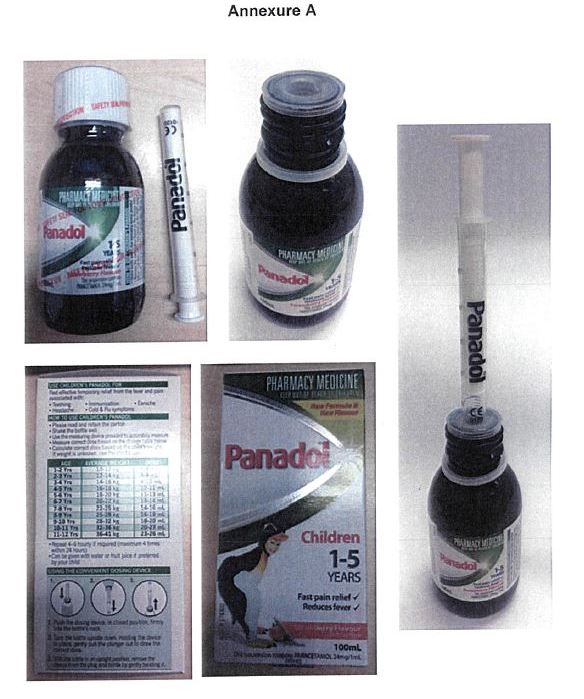
4 In March 2013, Glaxo launched a new version of Children’s Panadol® Colourfree Suspension 1-5 years with a new dosing device that comprised an apparatus using, among other features, a flat-nosed syringe that Reckitt contended infringed the patent (the original syringe). I granted an interlocutory injunction on 28 May 2013, until the determination of these proceedings or further order, that restrained Glaxo from, relevantly, marketing the product Children’s Panadol 1-5 years when incorporating a liquid dispensing apparatus comprising a bottle, bottle neck liner and a flat-nosed syringe (the first product complained of): Reckitt Benckiser Healthcare (UK) Ltd v GlaxoSmithKline (Australia) Pty Ltd (2013) 105 IPR 405. Annexure A to the order depicts the first product complained of, as appears below:
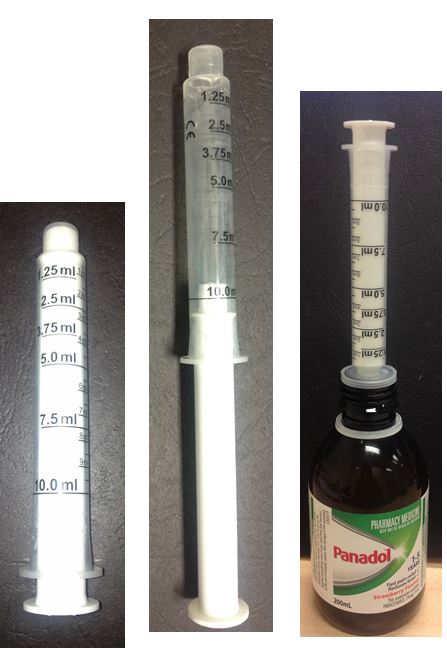
5 Of course, winter is the peak sales period for both parties’ ranges of Nurofen and Panadol products. Glaxo regrouped and found an alternate flat-nosed syringe (the alternate syringe) that had a section that fitted neatly into the bottle neck liner but then expanded in diameter above the area necessary to draw up the medicine (the second product complained of). I granted a further interlocutory injunction restraining Glaxo from using an apparatus that included the alternate syringe on 17 July 2013, as depicted in annexure B to that order: Reckitt Benckiser Healthcare (UK) Ltd v GlaxoSmithKline (Australia) Pty Ltd (No 2) (2013) 103 IPR 472. However, on 2 September 2013, the Full Court discharged that interlocutory injunction because it did not consider that Reckitt had a sufficiently strong prima facie case of infringement of claim 1 of the patent to justify the restraint, and the balance of convenience did not favour it: GlaxoSmithKline (Australia) Pty Ltd v Reckitt Benckiser Healthcare (UK) Ltd (2013) 103 IPR 487; 305 ALR 363 at [83]-[84] per Bennett, Jagot and Griffiths JJ. The depiction of the second product complained of in annexure B to the discharged order appears below:
ANNEXURE B
6 The parties relied on considerably more evidence and arguments at the trial than they had at the interlocutory injunction hearings. In essence, Reckitt sought permanent injunctions restraining Glaxo from using the first and second products complained of and damages for infringement of claims 1-6 and 9 of the patent. Glaxo denied that it was liable for any infringement and sought an order under s 138(3) of the Patents Act 1990 (Cth) that the patent be revoked on 5 bases: namely that, first, the invention claimed was not a method of manufacture, secondly, there was a lack of an inventive step, thirdly, the patent had been obtained by false suggestion or misrepresentation, fourthly, the patentee was not entitled to the patent, and, fifthly, claims 1-6 and 9 were not fairly based on the matter described in the specification.
7 As this summary suggests, the parties were at issue over a wide range of matters, including the construction of claims 1-6 and 9 in the patent, the characteristics of the first and second products complained of and the challenges to validity raised in Glaxo’s cross-claim.
Issues
8 Thus, the following issues arise for decision:
(1) What is the proper construction of claims 1-6 and 9 in the patent (the construction issue)?
(2) Does one or each of the first or second products complained of infringe (the infringement issue)?
(3) Was the invention a manner of manufacture (the manner of manufacture issue)?
(4) Was there a lack of an inventive step (the inventive step issue)?
(5) Was the patent obtained by false suggestion or misrepresentation (the false suggestion issue)?
(6) Was the patentee entitled to the patent (the entitlement issue)?
(7) Was each of claims 1-6 and 9 fairly based (the fair basis issue)?
9 I will describe the relevant provisions in the Act and the material parts of the patent before construing claims 1-6 and 9, and then I will deal with the factual and legal matters necessary to resolve the infringement and other issues.
The legislative scheme
10 After the priority date of 12 November 2002, the Parliament passed the Intellectual Property Laws Amendment (Raising the Bar) Act 2012 (Cth) that inserted ss 22A and 138(4) in relation to the question of entitlement, which the parties agreed applied to the determination of that issue in these proceedings. Relevantly, the Act provided (taking into account the amendments to ss 22A and 138(4)):
7 Novelty and inventive step
Inventive step
…
(2) For the purposes of this Act, an invention is to be taken to involve an inventive step when compared with the prior art base unless the invention would have been obvious to a person skilled in the relevant art in the light of the common general knowledge as it existed in the patent area before the priority date of the relevant claim, whether that knowledge is considered separately or together with the information mentioned in subsection (3).
…
15 Who may be granted a patent?
(1) Subject to this Act, a patent for an invention may only be granted to a person who:
(a) is the inventor; or
(b) would, on the grant of a patent for the invention, be entitled to have the patent assigned to the person; or
(c) derives title to the invention from the inventor or a person mentioned in paragraph (b); or
…
18 Patentable inventions
Patentable inventions for the purposes of a standard patent
(1) Subject to subsection (2), an invention is a patentable invention for the purposes of a standard patent if the invention, so far as claimed in any claim:
(a) is a manner of manufacture within the meaning of section 6 of the Statute of Monopolies; and
(b) when compared with the prior art base as it existed before the priority date of that claim:
(i) is novel; and
(ii) involves an inventive step; and
…
22A Validity not affected by who patent is granted to
A patent is not invalid merely because:
(a) the patent, or a share in the patent, was granted to a person who was not entitled to it; or
(b) the patent, or a share in the patent, was not granted to a person who was entitled to it;
…
40 Specifications
…
(2) A complete specification must:
(a) describe the invention fully, including the best method known to the applicant of performing the invention; and
(b) where it relates to an application for a standard patent – end with a claim or claims defining the invention; and
…
(3) The claim or claims must be clear and succinct and fairly based on the matter described in the specification.
…
138 Revocation of patents in other circumstances
(1) Subject to subsection (1A), the Minister or any other person may apply to a prescribed court for an order revoking a patent.
…
(3) After hearing the application, the court may, by order, revoke the patent, either wholly or so far as it relates to a claim, on one or more of the following grounds, but on no other ground:
(a) that the patentee is not entitled to the patent;
(b) that the invention is not a patentable invention;
(d) that the patent was obtained by fraud, false suggestion or misrepresentation;
(e) that an amendment of the patent request or the complete specification was made or obtained by fraud, false suggestion or misrepresentation;
(f) that the specification does not comply with subsection 40(2) or (3).
(4) A court must not make an order under subsection (3) on the ground that the patentee is not entitled to the patent unless the court is satisfied that, in all the circumstances, it is just and equitable to do so.
11 The Dictionary in Sch 1 of the Act provided that , unless the contrary intention appeared:
invention means any manner of new manufacture the subject of letters patent and grant of privilege within section 6 of the Statute of Monopolies, and includes an alleged invention.
patentable invention means an invention of the kind mentioned in section 18.
12 The Statute of Monopolies 1623 (UK) provided in s 6 that:
Provided alsoe That any Declaracion before mencioned shall not extend to any tres Patents and Graunt of Privilege for the tearme of fowerteene yeares or under, hereafter to be made of the sole working or makinge of any manner of new Manufactures within this Realme, to the true and first Inventor and Inventors of such Manufactures, which others at the tyme of makinge such tres Patents and Graunts shall not use, soe as alsoe they be not contrary to the Lawe nor mischievous to the State, by raisinge prices of Commodities at home, or hurt of Trade, or generallie inconvenient; the said fourteene yeares to be [accomplished] from the date of the first tres Patents or Grant of such priviledge hereafter to be made, but that the same shall be of such force as they should be if this Act had never byn made, and of none other.
The patent
13 The original complete specification was filed on 10 November 2003 and had a priority date of 12 November 2002. It named Anne Dallison and Shaun Harrison as the inventors and, when granted on 20 March 2008, named Reckitt UK as patentee. Reckitt made amendments to the originally filed complete specification in 2006, in circumstances that I will explain later in these reasons. I will refer in these reasons to the complete specification as the amended version that was in the patent as granted.
14 The complete specification began by naming the field of the invention as relating to bottle neck liners, bottles, liquid dispensing apparatus and methods of dispensing liquids (page 1, lines 6-8). The background described the usual desirability of accurately measuring the amount of liquid that is dispensed from many bottles, such as medicine bottles. It referred to the use of terms such as teaspoonfuls, tablespoonfuls, drops or specified millilitres to identify how much a person should pour from a bottle into a measuring receptacle. And, where a precise amount of a medicine for dispensing had to be measured, the complete specification stated that normally one used an accurate subsidiary measuring device, such as a graduated syringe or pipette (page 1, lines 11-22).
15 The complete specification referred to an internationally published patent, that was not in evidence, noting that it described a syringe assembly comprising an elongated tubular barrel with an opening for discharge and an elongated hollow tubular plunger member that had a closed spherical tip. The tip of that assembly would sit in an insert that was fitted into the neck of a container (page 1, lines 24-29).
16 The specification described the way in which a syringe can be inserted freely through the bottle neck and into conventional medicine bottles, and then dipped into the liquid in the bottle. It noted the difficulty in such situations of a user seeing the graduations on the syringe body in order to measure exactly how much liquid had been drawn up into the syringe, with the frequent consequence that the user would have to return the syringe to the bottle to draw out more or return some liquid so as to obtain the desired amount (page 1a, line 1 to page 2, line 7). It stated that coloured glass bottles, including those commonly used to protect photosensitive medicinal contents, also make it harder to see how much liquid has been drawn into a syringe (page 2, lines 12-26). In addition, the specification stated that the insertion of the syringe into the liquid in the bottle could contaminate the medicine with micro-organisms present on the exposed surface of the syringe (page 2, lines 8-11), and could leave some liquid on the surface of the syringe that could drip onto the user or any surface creating mess (page 2, line 27 – page 3, line 2).
17 The complete specification then suggested a number of advantages that might flow from a liquid dispensing apparatus that could allow a syringe to withdraw liquid from a bottle where the graduations on the syringe were visible, there was a minimum surface area in which the syringe could come into contact with the liquid contents of the bottle (thus reducing contamination and dripping or spillage risks) and there was also an opportunity to pour the liquid from the bottle if the user did not want to employ the syringe (page 3, lines 4-22). The specification stated that an aim of the preferred embodiments of the invention was to overcome or mitigate the problems of the prior art, whether or not those problems were expressly disclosed in the patent (page 3, lines 24-26).
18 The summary of the invention set out a consistory clause, describing a first aspect of the invention as comprising an apparatus with the three elements: a bottle, a bottle neck liner and a flat-nosed syringe (page 3 line 30 – page 4 line 21).
19 Conceptually, the clause described the invention as being intended to work as follows. The liner is inserted into the top of the bottle. It is so designed that, like a cork, its outer perpendicular side, or sleeve, fits tightly against the inner side of the bottle neck. The liner has a flange around its top so as to fit against the rim of the bottle’s top as a further means of preventing the liquid contents escaping between the inside of the bottle and the outside of the liner. In addition, the liner has a hollow circular core that is created by an inner second perpendicular sleeve. That sleeve is held in place by a circular web of plastic material at the top that extends inwards, and at the foot by a horizontal “inward step” connected to the lower part of the inner sleeve. The inward step has a hole in it that is the same diameter as the opening at the base of the flat-nosed syringe. The intention of this design is that when the syringe is inserted into the liner it will fit tightly, so that the only way in which liquid can escape from the bottle is when the plunger in the syringe is drawn up and that action draws the liquid into the newly created void in the syringe. Alternatively, if the user does not want to use the syringe, the hole in the inward step allows him or her to pour the liquid into whatever receptacle the user wishes.
20 I have given this broad and untechnical description to convey the general idea of the invention and not as a finding as to what it is. The consistory clause set out what was later reflected in claim 1 together with the following definitions (page 3, line 30 – page 5, line 7):
By “syringe” we mean a syringe comprising a hollow syringe barrel in which is located, or arranged to be located, a reciprocating plunger, the syringe barrel having a dispensing aperture, through which a liquid may be drawn, then discharged.
By “flat-nosed syringe” we mean a syringe whose barrel ends in a generally flat distal end which is perpendicular to the barrel axis, and in which the dispensing aperture is formed. Preferably there is no part of the distal end which extends beyond the bore.
By “sealingly” we mean that under conditions of normal use liquid cannot flow or leak between the respective parts, that is, between the bottle neck and the bottle neck liner, and between the bore and a syringe barrel. (emphasis added)
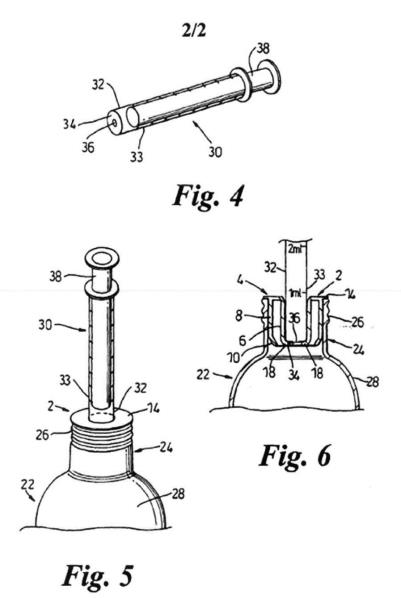
21 Figures 4, 5 and 6 in the patent are reproduced below and depict, respectively, a flat-nosed syringe (item 36 signifying the hole through which liquid is drawn), the syringe inserted into the liner and a cross-sectional view of such an insertion:
22 The specification then discussed over the next eight pages a number of preferred embodiments of the invention. It contemplated that, in the ordinary course, the liner would be formed industrially using injection moulding (e.g. page 5, lines 29-30). The specification said that in some embodiments the through bore in the liner, i.e. the hole into which the syringe fitted, might have a slight taper or be slightly undersized to ensure a tight fit relative to the syringe barrel (page 6, lines 3-5, 10-14). The specification stated (page 6, lines 15-17):
The flared portion provides a lead-in, into the through bore, in order to aid engagement of the syringe barrel into the through bore.
23 The inward step also prevented the syringe penetrating beyond it deeper into the bottle (page 6, lines 31-32) and in that way, the patent taught that the barrel so inserted “is sealingly received within the sleeve and the inward step limits its movement, on insertion” (page 7, lines 1-3).
24 The specification stated that a preferable embodiment of the liner had a taper on its outer surface that would act as a lead in to facilitate fitting of the liner into the bottle neck during manufacture. It also stated that the cylindrical body (i.e. the outer surface of the liner), preferably would be oversized relative to the bottle neck so as to achieve an interference fit, in order to prevent the liner and bottle neck separating when in use. The specification continued (page 8, lines 17-29):
Thus, the force required to withdraw the liner from the bottle neck preferably exceeds the force required to withdraw a syringe barrel from the sleeve into which it is inserted. (emphasis added)
25 Importantly, for the purposes of construing the “omnibus” claim 9, the next section of the complete specification, that extended over five pages, was headed “Brief Description of the Drawings” (page 13, line 23). That section commenced (page 13, lines 25-29):
In order to better understand the various aspects of the invention, and to show embodiments of [scil: how] the same may be put into effect, the invention will now be described by way of example, with reference to the accompanying drawings in which:
Figure 1 illustrates a side elevational view of a preferred embodiment of a bottle neck liner of the first aspect of the invention;
Figure 2 illustrates a side sectional view of the bottle neck liner of Figure 1;
Figure 3 illustrates the bottle neck liner of Figures 1 and 2 inserted into the bottle neck of a bottle;
Figure 4 illustrates a flat-nosed syringe, arranged in use to be inserted into the bottle neck liner of Figures 1 and 2;
Figure 5 illustrates the syringe of Figure 4 inserted into the bottle of Figure 3; and
Figure 6 illustrates a side sectional view of the syringe, bottle neck liner and bottle taken through the line AA of Figure 5.
Figures 1, 2 and 3 were as follows:
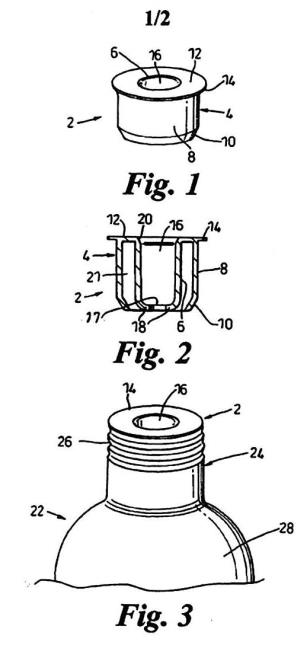
26 The specification described item 10 on figure 1 as an outer taper or chamfer (page 14, line 24), which had the lead in function described above. The specification stated (page 14, line 30 – page 15, line 2):
The sleeve 4 has a circularly cylindrical through bore 16. The sleeve 4 includes at the lower end thereof an inward step 18. This is an annular formation protruding inwardly from the interior surface of the sleeve 4 at its lower end, and terminating in a circular aperture 17. At its upper end the sleeve is inwardly bevelled at 20. (emphasis added)
27 The inventors explained that the liner is a one piece injection moulding from a resilient plastics material (page 15, lines 9-11) and that its outer body should deform inwardly so as to provide “a sealing fit between outer body 8 and the bottle neck 24”, preventing any leakage from between the bottle’s inner surface and the liner’s outer surface (p 15, lines 13-32). And the dimensions of the flange at the top of the liner were intended to be substantially identical to those of the top surface of the bottle and to permit a screw cap to be fitted over both “in order to sealingly close the bottle neck 24, for transportation, sale and storage” (page 16, lines 1-9).
28 Next, the specification continued by explaining figure 4 as illustrating (page 16, lines 11-19):
… a flat-nosed syringe 30 for use in the present invention. The flat-nosed syringe 30 includes a hollow circularly cylindrical syringe barrel 32 having a distal end region 33 to be received in the liner, and terminating in a perpendicular, circular face at its distal end 34, formed with a centrally located dispensing aperture 36. The syringe 30 also includes a plunger 38 arranged to move under reciprocal motion within the syringe barrel 32. (emphasis added)
29 In explaining figure 6, the specification stated (page 16, line 25 – page 17, line 11):
As the distal end region 40 of the barrel is inserted into the bottle neck liner 2, it pushes slightly against the sleeve 4, the cross-section of the bore 16 of the latter being slightly smaller than the cross-section of the barrel. Good sealing against the passage of liquid between the barrel and the sleeve is thereby provided. The insertion continues until the distal end 34 of the syringe barrel 32 abuts the inward step 10 of the sleeve 6 (see Figure 6). In this position, the distal end region of the syringe barrel is a tight sealing fit within the sleeve inside the bottle neck 24, but the rest of the syringe barrel - the larger part – is not; it stands outside the bottle. Thus, graduations on the syringe barrel 32 can still be seen by a user. The seals between the liner 2 and the bottle neck 24, and the syringe barrel 32 and the sleeve 4, prevent leakage of liquid between such parts if the bottle is tilted or inverted. The dispensing aperture 36 of the syringe barrel 32 is located centrally and contiguously with the opening within the inward step 10 of the sleeve 4. (emphasis added)
The claims
30 The claims defining the invention, relevantly, were as follow (page 19, line 3, page 20, line 14, page 21, lines 11-12):
1. A liquid dispensing apparatus comprising a bottle, a bottle neck liner and a flat-nosed syringe having a plunger and a barrel, the barrel terminating at its distal end in a generally flat face having a diameter corresponding to the diameter of the syringe barrel and being perpendicular to the longitudinal axis of the barrel, the bottle having a bottle neck in which is located the bottle neck liner having a cylindrical body sealingly engaged inside the bottle neck such that liquid cannot flow between the bottle neck liner and the bottle neck, the bottle neck liner comprising a sleeve comprising at its lower end an inward step located within the bottle neck, an aperture being defined inwardly of the inward step, wherein the cylindrical body and the sleeve are connected together with a web of material only at the upper end of the cylindrical body and of the sleeve, wherein the sleeve is formed with a flared portion at its upper end into which the distal end of the syringe barrel passes; wherein when the syringe barrel is inserted into the sleeve the inward step prevents the syringe barrel from protruding past the step and liquid cannot flow between the sleeve and the barrel, but can leave the bottle only via the aperture and thence the syringe.
2. A liquid dispensing apparatus as claimed in claim 1, wherein the aperture is pre- formed and permanently open.
3. A liquid dispensing apparatus as claimed in Claim 1 or 2, wherein the sleeve comprises a resilient material.
4. A liquid dispensing apparatus as claimed in any preceding claim, wherein the liner comprises an outwardly protruding flange extending around at least a portion of an end of the liner and abutting the rim of the bottle neck into which the liner is inserted.
5. A liquid dispensing apparatus as claimed in any preceding claim, wherein the bottle contains liquid medicine.
6. A liquid dispensing apparatus as claimed in any preceding claim, wherein the bottle includes a closure member which can be secured over the bottle neck.
….
9. A liquid dispensing apparatus, substantially as described with reference to the drawings and/or examples. (emphasis added)
The background to the invention claimed in the patent
31 Reckitt did not lead any direct evidence from either of the inventors named in the patent as to their involvement in the genesis of the claimed invention. However, each of Ms Dallison and Mr Harrison signed an inventor’s acknowledgment in October 2003 that acknowledged that the invention belonged to their employer, Boots Healthcare International Ltd.
32 On about 1 February 2006, a Reckitt Benckiser group company acquired Boots. On 27 March 2006, Boots entered into an agreement with Reckitt (UK) under which Boots assigned to Reckitt (UK) all its right, title and interest in, among other property, the patent and its international corresponding patents or analogues.
33 The role in the genesis of the patent played by Ms Dallison and Mr Harrison emerged, to some extent, from the evidence of Gareth Pearce. Mr Pearce held the degree of Bachelor of Engineering (Manufacturing Engineering and Product Design). He worked as technical sales executive from 1996 to 2002 for Harding Associates, a firm with exclusive agencies in the United Kingdom for pharmaceutical primary packaging companies, including a Belgian producer of injection moulded syringes and accessories, Hubert De Backer NV (HDB). From October 2002 to May 2008, Mr Pearce worked for HDB in a business development role and was responsible for pharmaceutical and medical device clients. In both roles, Boots was one of the clients for which Mr Pearce provided services.
34 Mr Pearce made three affidavits in these proceedings on which Glaxo relied. Reckitt did not require him for cross-examination. Mr Pearce acknowledged that, as might be expected, while he had some recollection of the events in question, that recollection had been refreshed by the contemporaneous documents to which he had been given access. Glaxo had obtained those documents from HDB and Mr Pearce. Apart from two faxes sent by Mr Pearce in May and June 2000, Reckitt was not able to locate in its records early documents relating to the development of the concept for the apparatus. However, Reckitt did have considerable documentation relating to the patent application.
35 Importantly, HDB had been on notice of these proceedings since at least 13 May 2013, and on 2 May 2014 had received copies of Mr Pearce’s first affidavit and Glaxo’s pleading in its cross-claim that HDB, through Mr Pearce and other employees of HDB, including the senior and junior Jan De Backer or Andre Versteten, were the true investors. Despite this, HDB has not sought to be joined or otherwise to assert any right in respect of the patent, no doubt because, as will appear, it gave up whatever rights it may have had when it resolved a dispute with Boots over the original patent in early 2006.
36 In November 1998, Mr Pearce reported to HDB that he had discussed, with Chris Penfold of Boots, the supply of a paediatric dosing syringe for the French market to compete with a product offered by Boots’ competitor, Wyeth. Mr Pearce recalled that Wyeth’s product had a “flat ended syringe” that was inserted directly into the bottle and that there was no plug or bottle neck liner. Mr Pearce’s written report to HDB identified two possible products already made by HDB as offering solutions for Boots: one was a similar “applicator”, the other a newer HDB product comprising an “applicator and nozzle and plug”, the plug serving to prevent spillage if the bottle were knocked over.
37 Also in 1998, Mr Pearce and HDB were working with another pharmaceutical company, Abbott Laboratories, on a project to develop another paediatric syringe with a nozzle and plug or bottle neck liner. Nothing came of that project other than HDB displaying it at a trade exhibition in Paris in around February 2000, at which Ms Dallison met with Mr Pearce and they began working on the project that resulted in the apparatus claimed in the patent.
38 By 22 March 2000, Ms Dallison had instructed Mr Pearce that Boots disliked having a nozzle on the syringe. He included in his report of that day to HDB a simple drawing of an HDB flat-nosed syringe inserted into a sleeve that would form part of a “plug” or liner. However, HDB appeared subsequently to have continued producing designs for Boots with nozzles on the syringes. On 12 June 2000, Mr Pearce reported to HDB on the Boots project. He wrote that Boots was still looking at the possibility of using “a flat ended, no nozzle, version, used in conjunction with a redesigned plug”, along the lines of his sketch of 22 March 2000 and another sketch of 23 March 2000 that was not in evidence.
39 On 15 June 2000, Mr Pearce wrote a customer visit report of his meeting at Boots the day before. He described Ms Dallison as the project manager and noted that Boots preferred the “flat ended nozzle design”. He reported that Boots was considering having measurements marked on the syringe barrel to avoid overdosing. He noted that Boots wanted to make the product available for a range of ages. He also reported that Boots was considering the feasibility of there being a choice to allow the user to pour directly from the bottle into a measuring cup. He recalled that Ms Dallison had stated that older children had an aversion to taking medicine from a syringe and that it was desirable to be able to pour the medicine directly from the bottle onto a spoon. In his report to HDB, Mr Pearce drew an illustration of a bottle neck liner that had outward tapers towards the top and a flat-nosed syringe inserted. He said that in drawing the pouring feature he had in mind a cap used in a brand of washing up liquid, the configuration of which is not in evidence.
40 Discussions continued and on 27 October 2000, Mr Pearce wrote to Ms Dallison enclosing a drawing by HDB and prototype sample plug. That design had a protruding flange at the top making it difficult to secure a childproof bottle cap over it. Ms Dallison wrote back on 13 November 2000 suggesting a flatter plug, seeking ways to improve its pouring quality and to prevent it being easily removed.
41 On 27 November 2000, Mr Pearce wrote a report to HDB of his visit to Boots on 23 November 2000. He noted that Ms Dallison wanted to proceed along the lines the parties were discussing but with some modifications to the plug. She wanted to remove an inner ribbed feature that had been intended to hold the syringe in place and substitute a firm interference fit to provide that result. She wanted a greater lead in to the plug to aid insertion of the syringe. However, the design still had protruding flanges above the line of the top of the bottle neck. Subsequently, Mr Pearce described Boots’ concept as its “proprietry [sic] plug design” in his letter to Ms Dallison of 19 December 2000. He noted that the design would require HDB to create new moulds.
42 The next version of HDB’s drawing was the first to include a web or solid connecting material at the top of the plug but it also still included a flange that rose above the web of material. Mr Pearce did not recall who suggested that change. I infer that it was Ms Dallison who was concerned about mess associated with pouring and having a firm interference fit for the syringe. On 9 January 2001, she signed an approval on a drawing that noted her discussion with Mr Pearce and had an alteration to the shape of the taper or lead in at the top of the sleeve on the liner, which broadened it. There were no protruding flanges on the drawing.
43 On 26 January 2001, Mr Pearce met with Ms Dallison and Mr Harrison (the other named inventor) to discuss some prototype plugs. His notes of the meeting recorded that, when tested, the plugs had residue at the top surface and the design did not have a well that trapped liquid.
44 On 31 January 2001, Mr Pearce reported to HDB that Ms Dallison was disappointed with the prototype because it did not pour well and the interference fit with the syringe was not tight enough. He noted that Boots anticipated that when it launched this new dosage form, its competitors would display a great deal of interest.
45 HDB’s next drawings kept a raised pouring lip or flange above the top of the plug. Ms Dallison continued to have concerns about that feature and, in his report of 12 February 2001 to HDB, Mr Pearce enquired whether the edge of the plug could be designed without a lip and so that it poured perfectly. He said that Ms Dallison preferred a sketch showing such a design.
46 On 20 February 2001, Mr Pearce took two sample liner prototypes to Boots, one with and one without a protruding flange at the top. He wrote to HDB on 20 February 2001 that the simple design, without a flange, worked best and that Boots wanted to proceed with such a design.
47 On 7 March 2001, Mr Pearce wrote to Ms Dallison noting that Boots had viewed the latest version of the “plug and syringe system” positively and foreshadowing that the “time and effort committed in the development of this ideal solution, by yourself and HDB” would enable it to be brought to market promptly. He attached a revised specification that had a significant outward taper from the sleeve to the web for approval. He noted that this design would achieve, among other matters, the plug fitting securely and remaining in place throughout general use so that there would be a secure and positive interference fit between the barrel and the plug.
48 On 23 March 2001, Mr Pearce wrote to HDB in anticipation of a forthcoming meeting which they all would have with Boots. Under the heading “What now needs to be delivered?” he included, among the commercial topics, “design exclusivity”. On 20 April 2001, HDB wrote to Mr Pearce with a drawing of the liner asking him to seek the customer’s written approval.
49 The documentary material in evidence as to the evolution of the invention claimed in the patent ends at this point. The next stage was that Boots proceeded to patent the new apparatus.
The patent application process
50 The priority date of the patent was 12 November 2002 and the international filing date was 10 November 2003. Boots’ patent attorney, Bob Pidgeon of Appleyard Lees, had the carriage of the patent application in Europe. The original claims were wider than and different from those now in the patent.
51 In April 2005 Mr Pearce, who was by then a employee of HDB, discussed Boots’ patent application with Ms Dallison. He subsequently sent her an email, on 14 April 2005, suggesting that HDB become a co-patentee with Boots. He asserted that the apparatus was a joint development. He referred to an “ethical undertaking” that he said that HDB had given to Boots not to actively promote “the same design of syringe plug incorporating pourability”.
52 Mr Pidgeon acted on Boots’ behalf in negotiating with HDB. On 3 June 2005, Mr Pidgeon emailed Mr Pearce suggesting that Boots would limit its claim to plugs having the “sloping shoulders”, being a taper or bevel at the mouth of the bore on the liner.
53 Mr Pidgeon’s notes of a conversation with Mr Pearce on 17 June 2005 recorded the latter saying that “we developed this style of plug with Boots. Annie [Dallison] asked for exclusivity. We agreed, meaning [we] wouldn’t market to Boots’ competitors”.
54 From then until November 2005, Mr Pidgeon and Boots negotiated the terms of an agreement with HDB that would involve Boots amending the patent to enable HDB to continue to market its existing other plugs (or bottle neck liners) and syringes, including its flat-nosed syringes. On 17 October 2005, Mr Pidgeon emailed Mr Pearce with a draft agreement and his comments on the proposed new claim 1 to be substituted in the patent saying:
It is important that the revised claim reflects the [Boots] input. The pre-existing HDB plug B7530 was “the other way round”: the web which joined the inner and outer parts was at the inner end so at the outer end there was quite a large annular space in which sticky medicine could collect. In the [Boots] proposal the web was put at the outer end. That’s the major feature we propose to write into claim 1. An additional feature which came from [Boots] is that the intro to the sleeve was flared, to give an anti-spill benefit and, I assume, an ease-of-location benefit. This appears to be a lesser feature and we propose to make it the subject of a subsidiary patent claim only. (emphasis added)
55 I infer that the instructions for the references to Boots’ contributions in Mr Pidgeon’s letter came from Ms Dallison. Mr Pearce replied on 19 October 2005 saying that the proposed draft looked acceptable, subject to two questions he had. Notably, he did not dispute Mr Pidgeon’s email’s assertions as to Boots’ input, but added:
A small point, however applicable if you propose to progress the subsidiary patent, where you refer to the entrance of the sleeve being “flared” = widen gradually, this feature was essentially designed as a pouring lip rather than to have any anti-spill functionality. I woud [sic] also be interested as to how you eventually word this, as all injection moulded apparently straight walls have some degree of taper to aid ejection from the mould. (emphasis added)
56 On 21 November 2005, Boots sent HDB signed copies of the final version of the agreement for HDB to execute and return a signed copy to Boots, which was referred to in the agreement by the acronym “BHI”. HDB responded by sending a signed copy to Mr Pidgeon on 24 March 2006 and asked to be kept informed as to the patent amendments. The agreement was dated 22 March 2006 (the Boots agreement) and relevantly recorded:
RECITALS:
(A) [Boots] and HDB worked together to produce a dispensing system for [Boots’] product Nurofen for Children (hereinafter NFC) in oral liquid form.
(B) [Boots] desired the dispensing system to be of the plug and syringe type, in which a flat-nosed syringe co-operates with a plug located in the neck of a bottle in order to withdraw a dose of liquid medicine.
(C) HDB already had a plug design, for use with flat-nosed oral dosing syringes, namely HDB Part No. B7530 (Attachment 1).
(D) [Boots] determined that HDB’s existing plug design was not fully suitable for its purpose and proposed modifications to design the plug which was less prone to the collection of liquid medicine. The modifications were to provide a connecting wall between the upper ends of the outer wall and the inner sleeve of the plug, and to provide the upper region of the inner sleeve with a flared profile. The resulting plug (hereinafter the NFC Plug) is shown as HDB Part No. T1928/1 (Attachment 2).
(E) [Boots] filed a PCT patent application to protect the NFC Plug, and this was published as WO 04/043326 entitled “Improvements in and relating to liquid dispensing”. The National/Regional phase of this application has been entered in Europe (application number EP 03775511.3), the United States of America (application number awaited) and Australia (application number 2003283537). These are hereinafter called the Patent Applications.
(F) HDB supply [Boots] with HDB’s standard flat-ended 5ml oral dosing syringe, Part Nos T1839/1, T1840 (Attachments 3 and 4), and the NFC Plug.
(G) HDB did not realise that the BHI Plug [scil: NFC Plug] was protectable or that [Boots] were seeking patent protection and acting in good faith developed further plugs, different in detailed design from the BHI Plug [scil: NFC Plug] but using similar principles. These plugs are shown as Part Nos. T2010 (Attachment 5) and T2022 (Attachment 6). HDB have developed these specifically for an Austrian company (hereinafter the Austrian Company) and a Spanish company (hereinafter the Spanish Company).
ACCORDINGLY IT IS HEREBY DECLARED AND AGREED AS FOLLOWS:
1. Patent Applications
1.1 [Boots] may progress the Patent Applications provided that the claims thereof are limited to the specific invention made by employees of [Boots].
1.2 [Boots] will revise the claims thereof to cover only embodiments of plug having a connection between the outer wall and the inner sleeve at their upper ends, and with the inner sleeve having a flared upper region. Revised claim 1 will have the wording of Attachment 7, or wording of equivalent meaning, or narrower wording, if required by a Patent Office. No other claim in any of the Patent Applications will have any broader meaning.
1.3 The revised claims will be presented by [Boots] on European patent application 03775511.3 within two months of signing this agreement. On its US and Australian applications the revised claims will be presented by [Boots] at any appropriate time before examination or during examination, having regard to patent practice in those countries.
1.4 HDB may however proceed on the basis that the revised claims have been presented on each of the Patent Applications immediately on conclusion of this agreement.
1.5 HDB will not contest the ownership, validity, inventorship or any other issues relating to the [Boots] Patent Applications or any patents granted therefrom.
2. Product supply
2.1 HDB will not supply the BHI Plug to any other customer for any purpose.
2.2 HDB may sell Part Nos. T2010 and T2022 for any products outside the field of paediatric analgesics.
…
2.5 [Boots] does not extend any further licence to HDB or its customers. (emphasis added)
57 The relevant drawing in Attachment 2 was:
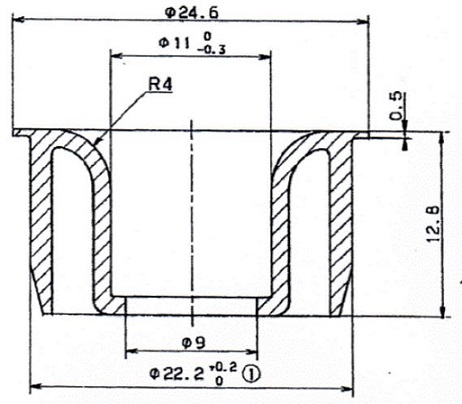
That drawing was very similar, but not identical, to the drawing sent by HDB to Mr Pearce on 20 April 2001 (see [48] above).
58 Attachment 7 was a shorter version of what became the form of claim 1 in the patent but it did not include the wording dealing with the flared portion, namely at page 19 lines 19-21 of the patent:
wherein the sleeve is formed with a flared portion at its upper end into which the distal end of the syringe barrel passes.
59 On 18 April 2006, Mr Pidgeon sent HDB the revised wording of the patent filed with European Patent office that included the words just set out as part of the present version of claim 1. He also advised HDB of Reckitt’s acquisition of Boots. On 10 November 2006, Mr Pidgeon wrote to HDB advising that corresponding amendments would be made to the Australian and United States applications. There is no evidence that HDB expressed any concern about, let alone opposition to, these revisions.
Other background
60 It was common ground that at the priority date, the common general knowledge included:
bottles to store liquids, including medicines in liquid form;
hypodermic syringes and single use and reusable syringes;
the use of measuring devices, including graduated syringes, to obtain an accurate dosage of a prescribed amount of a liquid, including a medicine from a bottle as described in the patent at page 1 lines 12-22;
the trade journals and publications.
61 Both sides called expert evidence. Reckitt called Robert Tiller, who had practised continuously as an industrial design consultant since graduating as a Bachelor of Industrial Design in 1988. Since 2006, Mr Tiller had conducted a specialised consultancy for the design and development of scientific and medical products. He had lectured at the University of New South Wales. Glaxo called William Hunter, a mechanical engineer, who graduated Bachelor of Engineering Science (Mechanical) with first class honours in 1982 and with a Master of Engineering Science (Mechanical) in 1985 from the University of Melbourne. Mr Hunter had been employed by a pharmaceutical manufacturer and in his later years conducted, among others, specialised consultancy work in project management and medical device development.
62 The experts agreed in their joint report that the term “flat-nosed syringe” was not a term of art. They explained that the distal end is the extremity at the most distant point from a user who is operating a device. Thus, when the user holds the syringe to withdraw or dispense liquid, the distal end will be the opposite end from that where he or she will pull or push the plunger. They agreed that a dispensing aperture is an orifice at the distal end of the flat-nosed syringe through which liquid can be drawn or dispensed. They said that a generally flat distal end is essentially a planar face located at the distal end of the syringe barrel. They also said that a barrel axis is the longitudinal axis of the flat-nosed syringe that is the centreline of the barrel along which the plunger operates. They said that the term “bore” meant a hole in an object. They agreed that the expression in the patent, “a generally flat distal end which is perpendicular to the barrel axis”, would be understood by a person skilled in the art as essentially a planar face positioned at the distal end that was at a right angle to the longitudinal axis of the syringe barrel.
63 Mr Hunter had never heard of or encountered a flat-nosed syringe before being asked to give evidence in these proceedings. He said that the patent’s definition of a syringe, that required the barrel to have a dispensing aperture (page 4 lines 25-27), was missing the words “there is the barrel comprising a tip with a dispensing aperture”. Mr Tiller said that he understood the dispensing aperture to be “a hole in the wall section at the distal end at the barrel” and that it was “the final exit point where [the liquid] leaves [and enters] the tip or barrel”.
1. The construction issue – the parties’ submissions
64 The issues of construction relevant for the resolution of the controversy between the parties concerning whether the first or second products complained of infringe claims 1-6 or 9 of the patent are whether:
the barrel of the syringe must have a single or uniform diameter;
the liner must have an outer cylindrical body that engages with the inside surface of the bottle neck so that, under conditions of normal use, the liner remains in place and liquid cannot flow between it and the bottle neck;
the liner must have first, a gradual widening, or transition in shape, at the upper end of its inner sleeve and, secondly, the ability to pour contents from the bottle if the syringe is not used.
65 Reckitt argued that the distal end was the relevant part of a syringe necessary for it to amount to being a flat-nosed syringe, within the meaning of claim 1. It relied on Mr Tiller’s opinion that all that was necessary was for the diameter of the flat nose of the syringe to correspond with that of the barrel at its distal end, regardless of whether the shape or configuration of the barrel above its distal end remained the same or changed. Reckitt submitted that if the length and shape of the plunger complemented or corresponded to those of the barrel in which it operated when fully inserted down to the flat face, then it would satisfy the requirement in claim 1 of being a “reciprocating plunger”. That was because, as Mr Tiller reasoned, when fully inserted, the shape along the whole plunger would reciprocate or correspond with the shape of the whole of the empty space within the barrel, so that there would be no empty space left and all liquid or air in the barrel would be expelled. Reckitt argued that claim 1 did not require that there be no variation in the diameter of the barrel and that, indeed, the experts agreed that ordinarily the barrel of a syringe would widen out at its proximal end to allow for insertion of the plunger.
66 Glaxo accepted that the invention was not confined to the medicinal field albeit that the patent was directed to that area. However, it argued that the skilled addressee of the patent would comprise a team that included persons who had a practical interest in the medicinal product field. Glaxo argued that the common general knowledge in Australia, of which the skilled addressee would have been aware at the time of the application for the patent, included Australian and international regulatory standards or requirements for medical syringes including those for injection moulding of those products.
67 Glaxo said that although the common general knowledge was that of the skilled addressee in Australia, there was no relevant distinction between what that knowledge was here at the priority date and what the state of such knowledge was overseas. That was because, it argued, the field was an international one and such devices could be exploited on an international scale. Glaxo relied on the highly standardised nature of medical devices at an international level, the fact that the same products were frequently distributed across different markets, the small and potentially uneconomic scale of the Australian domestic market and the multinational nature of the major corporations supplying medical devices. It also argued that people in the field attended Australian and international trade exhibitions, read and referred to internationally published trade publications and journals.
68 Glaxo argued that the common general knowledge at the priority date included:
inserts (stoppers, plugs, neck liners, adapters or fitting) inserted into bottle necks;
regulatory requirements for the use of medical devices, including syringes;
various types of syringes, including needleless syringes, syringes with Luer tapers or tips, syringes with tips or nozzles and syringes without tips or nozzles;
Australian and International standards for syringes;
problems that occurred if a syringe was inserted directly into a bottle to withdraw liquid.
69 Glaxo submitted that Mr Hunter’s evidence should be preferred to that of Mr Tiller, as a guide as to how a skilled addressee would read the claims. In particular, Mr Hunter relied on Australian Standard 1094-1981: Single-Use Syringes (Sterile) for General Medical Use (AS1094) as information that a skilled addressee, in the design process, would have regard to in understanding “useful performance requirements for a syringe”, including nomenclature, toxicity risks, guidance on markings, graduations, sealing issues in relation to a plunger and dead space. He drew on the terminology in AS1094 to interpret words in the patent such as “barrel”. Glaxo contended for acceptance of Mr Hunter’s evidence that “barrel” was a term of art when used in relation to a syringe. It argued that the word “cylindrical”, as used in the claims, had the ordinary meaning of referring to a geometrical figure, being a cylinder, and that so understood it affected the reference in claim 1 to the bottle neck liner “having a cylindrical body sealingly engaged inside the bottle neck”. Glaxo submitted that the word “sealingly”, as defined in the complete specification, and the word “engaged” as also used there, conveyed that claim 1 required a construction that the cylindrical body of the liner have a firm interference fit so as to prevent it becoming dislodged when a flat-nosed syringe was withdrawn.
70 Glaxo also contended that the expression “flared portion” in claim 1 conveyed a meaning that there be a portion at the upper end of the sleeve of the bottle neck liner that spreads out or widens gradually as a single geometric feature, such as a chamfer (bevel) or curve. Glaxo accepted that the flared portion described in claim 1 would provide a lead in for the syringe. But, it argued, the mere functionality of there being some change in shape that created a lead in was insufficient to satisfy the requirement of the claim that there be a flared portion of the liner. That was because, Glaxo said, “flared” could not be read as “lead in” in the claim.
71 Next, Glaxo argued that the expression “flat-nosed syringe” in claim 1 referred, first, to all syringes within what it contended was the common general knowledge, and secondly, to a limitation beyond the expression’s definition (at page 4 line 29 to page 5 line 2), namely, that the flat face of the syringe have “a diameter corresponding to the diameter of the syringe barrel” (page 19 lines 6-7). Glaxo submitted that claim 1 consistently used the singular to describe the individual features of the apparatus. It contended that claim 1 required the syringe barrel to be of a uniform diameter along its length and did not claim an invention in which the syringe had more than one barrel or cylindrical portions of different diameters.
72 Glaxo also relied on the original form of the complete specification, prior to its amendment, as an aid to construction pursuant to s 116 of the Act. Glaxo pointed out that the original specification was much broader and lacked a definition of the shape of the bottle neck liner and its sleeve, only requiring that liner to be sealingly “located” and provided that there be a syringe, with a preferable feature that it be flat-nosed. Glaxo contended that the amended, current, specification reflected a progressive and deliberate narrowing of these features of the claims.
The skilled addressee
73 In my opinion, the skilled addressee of the patent is the hypothetical non-inventive maker of mass produced, manufactured plastic moulded products who is skilled in the art. The skilled addressee would have worked or had experience in manufacturing such products for a variety of uses that included, but were not confined to, medicinal uses and would be aware of the common general knowledge at the priority date: cf Lockwood Security Products Pty Ltd v Doric Products Pty Ltd [No 2] (2007) 235 CLR 173 at 197 [56] per Gummow, Hayne, Callinan, Heydon and Crennan JJ. Thus, the skilled addressee, when reading the patent, would be aware of, and capable of turning to account, its utility for dispensing liquid medicines, but would not feel constrained or limited in his or her understanding of it by that field of use.
74 The skilled addressee would have been aware that it was likely that there were Australian and international standards or requirements for products that could be used in the administration of medicine, but would have understood that the patent was addressed to a more general audience. I am not satisfied that the common general knowledge at the priority date that a skilled addressee of this patent would have included AS1094 or the other existing specialised medical syringe regulatory requirements on which Glaxo relied. Glaxo’s attempt to limit the skilled addressee of the patent to a person concerned, or principally concerned, with medical or medicinal uses involves, impermissibly, a reading of the patent and the identification of its skilled addressees with a view to infringement: Glaxo 305 ALR at 379 [60].
75 Of course, the skilled addressee would have appreciated that various shapes, sizes and types of syringes existed and regulatory requirements applicable to medical uses were likely to exist for them. However, the patent was directed to a less common type of syringe – one both without a needle and with a flat-nose. Neither expert suggested that he had been aware of flat-nosed syringes at each of the times of the priority date and when he was first asked to give evidence. There was no evidence that the concept of a flat-nosed syringe, having any particular or necessary characteristics beyond a flat-nose and functionality as a syringe, was part of the common general knowledge in Australia at the priority date.
76 Moreover, another expert witness called by Glaxo, Barry Evers-Buckland, had never heard of the term “flat-nosed syringe” before March 2014. Mr Evers-Buckland was a regulatory affairs consultant. He had been awarded a certificate in Mechanical Engineering by the Royal Melbourne Institute of Technology in 1975 and a Post-graduate Diploma in Health Administration by the then Lincoln Institute of Health Sciences in 1986. He worked for the Commonwealth Department of Health between 1965 and 1986, where his regulatory affairs duties involved assessing, among other products, medical needles and syringes. Between 1986 and 2005 he held positions in senior regulatory affairs, quality and compliance for Becton Dickinson, a multinational medical device company. Between 2000 and 2005, he was Becton Dickinson’s Asia-Pacific regional director for regulatory affairs and compliance. Since 2005, he had worked as a regulatory affairs consultant.
77 Becton Dickinson was a manufacturer of single use and reusable syringes, as well as needles and intravenous catheters. Mr Evers-Buckland acquired a detailed knowledge of that company’s products, including in relation to their design and manufacture. He had been a member of three committees of Standards Australia relating to medical devices. These included the committee for hypodermic and other equipment for general medical use from the early 1970s to the early 1990s, and the committee for insulin equipment, which was responsible for syringes and needles, amongst others.
78 Nonetheless, as claim 5 made clear, the apparatus could be used to dispense medicine and the skilled addressee would be a person who could turn that potential use to account. However, he or she would not gain assistance in understanding what the patent was teaching from AS1094. The patent taught that the flat-nosed syringe forming part of the apparatus had uses and functions quite different from conventional medical syringes, that usually had tapered tips and drew or expelled medicine through a needle. Moreover, AS1094 was a specialised standard that dealt solely with single use medical syringes used to inject medicine with needles (i.e. syringes that were to be used once only and with a needle) and had nothing to do with multi-use flat-nosed syringes that could be used by anyone, not just for administering medicine but also for a wide range of other non-medical purposes. For example, such a flat-nosed device could be used in a workshop, as part of the apparatus, to measure amounts of liquid or in a kitchen to measure quantities of ingredients.
79 Aickin J explained the test for determining what was part of the common general knowledge in Australia (as the version of s 7(2) of the Act applicable here required) in Minnesota Mining and Manufacturing Co v Beiersdorf (Australia) Ltd (1980) 144 CLR 253 at 292-293, with the concurrence of Barwick CJ, Stephen, Mason and Wilson JJ. He said (at 292) that the notion of common general knowledge involved “the use of that which is known or used by those in the relevant trade” and forms the background knowledge and experience available to all in that trade in considering either the making of new products or improvements to old ones.
80 Glaxo sought to argue that despite it calling both Mr Hunter and Mr Evers-Buckland, as persons on whom it relied as skilled in the relevant art, I should infer that flat-nosed syringes formed part of the common general knowledge in Australia. However, neither of those two witnesses, nor Mr Tiller, had ever heard of a flat-nosed syringe before being asked to give evidence in these proceedings, some 11 or more years after the priority date. Glaxo also relied on a statement by Mr Pidgeon in a letter dated 22 October 2004 that he wrote to the European Patent Office on behalf of Boots in which he stated that “the present invention employs an ordinary, commonplace flat-nosed syringe, already manufactured in large quantities”. That letter dealt with matters outside Australia. The absence of any direct evidence of knowledge, or the use, of flat-nosed syringes in Australia at the priority date, and indeed the ignorance of those devices by the two Australian experts called by Glaxo, suggests the need for considerable caution in making a finding that these devices were part of the common general knowledge here in late 2002.
81 It is telling that Glaxo, a well-resourced litigant with substantial involvement in the medicinal products field, did not call an expert to establish directly that flat-nosed syringes were part of the common general knowledge in Australia at the priority date. Accordingly, I am not satisfied that in Australia at the priority date, flat-nosed syringes were known or used by those in the relevant trade (i.e. skilled addressees) so as to form part of the background knowledge and experience available to all in considering the making of new products or improvements to old ones: Minnesota 144 CLR at 292.
82 I reject Glaxo’s argument that the common general knowledge relevant to the construction of the patent included regulatory requirements or standards for the production of syringes for medical use, or the shapes or types of other syringes, such as ones with Luer tapers or tips. Glaxo’s argument, and Mr Hunter’s evidence on which it relied, ignored the patent’s deliberate use of definitions of “syringe” and “flat-nosed syringe” that, first, did not confine the defined apparatus to a narrow field of use, namely in medicinal applications, and, secondly, explained what the inventors intended to convey using ordinary English words.
83 Moreover, the skilled addressee could not use the explanation of the Luer tipped syringe in AS1094 to understand what a flat-nosed syringe was, because, first, the standard prescribed requirements for a sterile, single use syringe for injection of medicine and, secondly, the taper or tip feature prescribed in the standard had nothing to do with the syringe described in the patent. In my opinion, the skilled addressee would find AS1094, and the other elements of the concept of “syringe” that Glaxo asserted formed part of the common general knowledge, to be of no assistance or relevance to gaining an understanding of the flat-nosed syringe, as defined and described in the patent.
Claim 1 – consideration
84 I am of opinion that the skilled addressee would read the word “syringe”, when used in the sense defined in the patent, in its ordinary English meaning. The patent and the definition of “syringe” are not confined to medical uses of the apparatus, although the patent does refer to those uses and, notably, claim 5 asserts a monopoly where the apparatus includes a bottle containing liquid medicine. The skilled addressee would be aware that the apparatus could be used in applications other than dispensing liquid medicines, as the specification envisaged: see, e.g., the identification of the field of the patent at page 1 lines 6-8, at page 3 lines 4-26 and the use of medicine bottles as an example of its application at page 1 lines 12-14. Critically, the claims of the patent, other than claim 5, did not limit the apparatus to use for dispensing liquid medicines.
85 The definitions of “syringe” and “flat-nosed syringe” in the patent are expressed in ordinary English words that convey a meaning that is not limited to a technical sense. Far less do those definitions confine the word “syringe” to uses that are only suitable for medicinal purposes. The ordinary and natural meaning of the patent, read as a whole, showed that the word “syringe” referred to a device that can also be used in other applications than dispensing liquid medicine: Minnesota Mining 144 CLR at 272; Welch Perrin & Co Pty Ltd v Worrell (1961) 106 CLR 588 at 610 per Dixon CJ, Kitto and Windeyer JJ.
86 Although the complete specification contained definitions of “syringe” and “flat-nosed syringe”, claim 1 refined the characteristics of the flat-nosed reflecting syringe that would be within the monopoly described. Those definitions had followed immediately after the consistory clause. Relevantly, the definition of “flat-nosed syringe” (page 4 line 29 – page 5 line 2) prescribed that such a device had to have the following features or integers:
(1) it is a syringe, as defined, i.e. it comprised:
(a) a hollow syringe barrel;
(b) in which is located, or arranged to be located, a reciprocating plunger;
(c) the barrel has a dispensing aperture through which a liquid may be drawn and then discharged;
(2) the barrel ends in a generally flat distal end;
(3) that distal end is perpendicular to the barrel axis;
(4) the dispensing aperture is formed in the distal end.
87 The experts agreed that the reciprocating plunger had to have a seal located at or close to its distal end to enable the creation of a vacuum by which, when the plunger is retracted, the liquid can be drawn up into the hollow barrel and, later, can be pushed out when the liquid is discharged.
88 The additional and restated features and integers of the flat-nosed syringe in claim 1, and its consistory clause, are that:
(5) the flat-nosed syringe has a plunger and a barrel (cf: features (1)(a) and (b) above).
(6) the barrel terminates at its distal end in a generally flat face (cf: feature (2) above) that:
(a) has a diameter corresponding to the diameter of the syringe barrel;
(b) is perpendicular to the longitudinal axis of the barrel;
(7) when the distal end of the syringe barrel is inserted into the sleeve of the bottle neck liner:
(a) the inward step prevents the syringe barrel from protruding past the step;
(b) the liquid cannot flow between the sleeve and the barrel; and
(c) liquid can only leave the bottle via the aperture and thence the syringe (page 19 lines 20-25).
89 Features (6) and (7) of claim 1 describe particular characteristics of the flat-nosed syringe at its distal end and in respect of its interaction with the sleeve in the bottle neck liner. The features in (7)(b) and (c) correspond to the definition of ‘sealingly’, namely that under conditions of normal use liquid cannot flow or leak between the base of the bottle neck liner and the syringe barrel.
90 Claim 1 thus defines the barrel of the syringe by reference to the features necessary for its distal end is to be used to engage “sealingly” with the sleeve in the liner so as to draw up liquid. The plunger must also be reciprocating, as required by feature (1)(b).
91 The first critical question of construction is whether “a barrel” must be of a uniform diameter throughout its length. The experts agreed that, near its proximal end, the barrel ordinarily will flare out to enable the plunger to be inserted and that this flaring does not affect the concept that the thing described is a barrel. However, the experts had diametrically different opinions about whether the distal end could be described as a barrel, within the meaning of claim 1, if it had a tip with a narrower diameter than the cylindrical shape above it, as in Glaxo’s alternate syringe.
92 The ordinary English meaning of “barrel” comprehends a uniformly cylindrical, along its length, and usually hollow, tubular shaped object, such as a gun barrel, a wooden barrel that bulges in its middle, such as is used to store liquids, the trunk of a tree or the belly and loins of a horse or ox (see Oxford English Dictionary, online, senses 1a, 6a, 6b, 8, Macquarie Dictionary online, senses 1, 4, 5). The word is not descriptive of a singular shape or object. It is capable of being used to describe a variety of shapes that conform to an overall generalised concept of an elongated object that has a circular, but not necessarily uniform, shape or diameter along its length.
93 When used to describe a component in a syringe, the word “barrel” conveys an object that will store liquid and has a sufficiently cylindrical shape that it can be used, with a plunger, to draw up and discharge liquid. As used in the patent, the word “barrel” conveys an object that has properties and performs functions attributed to it in the definitions of “syringe” and “flat-nosed syringe” and as refined in claim 1. The barrel must be hollow and must accommodate a reciprocating plunger (as required in the definition of syringe). In a flat-nosed syringe, the barrel must end in a generally flat distal end that is perpendicular to the barrel axis and in which the dispensing aperture is formed (definition of flat-nosed syringe). A barrel for the purpose of claim 1 (and all the dependant claims 2-6) has the additional features that I described as feature (6) above, namely:
(6) the barrel terminates at its distal end in a generally flat face (cf: feature (2) above) that:
(a) has a diameter corresponding to the diameter of the syringe barrel;
(b) is perpendicular to the longitudinal axis of the barrel;
94 I am of opinion that a skilled addressee would understand that the barrel shape that claim 1 specified had a generally uniform diameter along its length, although that addressee would realise that, at its proximal end, the barrel would need to be slightly flared in order to allow the plunger to enter. Such an understanding would be confirmed by the shape of the barrel in the syringe in figure 4 in the patent. The patentee used its own clear language in claim 1 to identify the characteristic of the barrel having a diameter that is both uniform along its length and corresponds to the flat face at the distal end.
95 This construction is consistent with the narrowing of the claims that Reckitt made when it amended the original wording of the patent following the March 2006 settlement of the dispute between its predecessor in title, Boots, with HDB that I described at [56]-[59] above. Suffice to say that the claims in the unamended patent did not incorporate a flat-nosed syringe specifically, rather those claims extended to syringes generally, although the unamended complete specification suggested that a preferable form of the invention included a syringe without a formation or fitment at its distal end (unamended patent p 5 lines 1-3). The unamended patent also did not define the shape of the bottle neck liner, but the unamended claim 1 required only that it be “so dimensioned that it can be sealingly located within a bottle neck, the liner comprising a sleeve defining a bore having an inward step, the sleeve and step being so dimensioned that, in use, the bore can sealingly accommodate the distal end region of a syringe barrel …” (unamended patent, claim 1 p 19 lines 3-8).
96 Accordingly, I reject Reckitt’s construction of the word “barrel” as used in claim 1 as being capable of including portions of varying diameters, other than the functional portion at the proximal end to allow the insertion of the plunger.
97 The features of the bottle neck liner that claim 1 of the patent in suit required were that:
(1) the liner has an outer cylindrical body;
(2) the outer cylindrical body of the liner would sealingly engage with the inside of the bottle neck;
(3) that engagement has to produce the result that liquid cannot flow between the wall of the cylindrical body, contiguous with the inner wall of the bottle neck;
(4) the liner comprises a sleeve that:
(a) is located inside the cylindrical body;
(b) the upper end of the inner sleeve is connected to the outer cylindrical body by a web of material;
(c) the sleeve descends from the web of material to an inward step that has an aperture opening into the sleeve;
(d) the sleeve is formed with a flared portion at its upper (web of material) end into which the distal end of the syringe barrel passes;
(e) when the syringe barrel is inserted into the sleeve the inward step prevents:
(i) the barrel going past the step; and
(ii) liquid flowing between the sleeve and the barrel except through the aperture into the barrel.
98 The definition of “sealingly” in the complete specification identified that the term meant that under conditions of normal use liquid cannot flow or leak between the respective parts. In claim 1, the requirement is that the cylindrical body of the liner is “sealingly engaged inside the bottle neck such that liquid cannot flow between the bottle neck liner and the bottle neck”. Thus, claim 1 specified a result that the degree of engagement between the liner and the bottle neck had to achieve, namely that liquid could not flow between them.
99 The skilled addressee reading the complete specification, including the claims, (as a whole) would have understood that the apparatus claimed had to be capable, in conditions of normal use, of leaving the liner in place sealingly engaged inside the bottle neck in the manner stipulated in claim 1, for at least as many occasions as the user took to dispense all of the liquid contents of the bottle. In other words, the skilled addressee would have understood that there would or could be a number of occasions on which the user would insert a syringe, draw up liquid and then withdraw the syringe, and that, in conditions of normal use, the liner had to continue to remain “engaged” with the bottle neck so as to prevent leakage for, at least, the duration of those occasions of use.
100 Importantly, claim 1 specified that the sealing engagement had the purpose of preventing the escape of liquid as opposed to retaining the liner in place. Ordinarily, the skilled addressee would understand that both results could be achieved by a firm interference fit. However, the skilled addressee would know that there were other means of keeping the liner in place over multiple uses. He or she would realise that claim 1 was directed to making essential the nature of the seal achieved between the liner and the bottle neck, not the mechanism by which the liner could be held in place over multiple uses. The claim required the sealing engagement between the liner and the bottle neck to prevent liquid flowing between the two.
101 Accordingly, I reject Glaxo’s construction that the sealing engagement required by claim 1 had to be a firm interference fit so as to prevent the liner ever being dislodged when the syringe was withdrawn. The requirement in claim 1 of the liner being “sealingly engaged” is distinct from functionality of the preferred embodiment of a firm interference fit, referred to in the specification at page 8 lines 23-29. The function of an interference fit is to keep the liner in place, not simply to prevent leakage that was the defined meaning of “sealingly”.
102 The distal end of the syringe barrel had to pass into the flared portion at the upper end of the sleeve, referred to in claim 1. Thus, the skilled addressee would understand claim 1 contemplated that the flared portion had the function of assisting the lead in of the syringe barrel to the sleeve on its way down to meet the inward step. The skilled addressee would understand that function from the statement in the complete specification (page 6 lines 15-17) that the lead in was in order to aid engagement of the syringe barrel into the sleeve (or through bore).
103 The natural and ordinary meaning of “portion” includes “a part of any whole”: (Oxford English Dictionary online: sense 3a; Macquarie Dictionary online: sense 1). The natural and ordinary meaning of “flare” includes “to spread gradually outwards” (Oxford English Dictionary online: sense 4b; Macquarie Dictionary online: sense 4). It is clear enough that the aperture at the inward step, as prescribed in claim 1, allows liquid to be poured out of the bottle.
104 In my opinion, the skilled addressee would understand that the flared portion at the upper end did not have to be of any particular size, so long as there was a portion that spread gradually outwards towards the bottle neck and provided a lead in function for the syringe barrel into the sleeve. The apparatus in claim 1 had to be adaptable to bottles and bottle necks of various lengths and widths. A flared portion at the top of the sleeve could, and ordinarily would, vary in its size depending on the particular features of the bottle into which the liner had to fit. The skilled addressee could be expected to know, from the teaching of the patent, how to make a flared portion with the functional purpose required in claim 1 that was appropriate for the sizes of the bottle neck and flat-nosed syringe that were to be used in any particular apparatus. The key design feature of the flared portion was its stated function of providing a lead in for the syringe barrel. Item 20 in figure 2 in the patent indicated a very modestly sized flared portion that had an inward bevel, as described on page 15 lines 1-2. That portion creates a gradual transition in the shape of the top of the sleeve.
105 The skilled addressee would consider the complete specification as a whole so as to understand why claim 1 made a connection between the distal end of the syringe barrel passing into the sleeve and the requirement for a flared portion of the sleeve. He or she would realise that the patent was teaching that the flare was to provide a lead in and had no other function.
106 The skilled addressee would not read the expression “flared portion” in the broader way in which Glaxo argued, since such a large portion would not achieve any function that claim 1 was describing or that was contemplated in the patent read as a whole.
Claims 2-6
107 There are no issues as to construction or infringement of claims 2, 3, 4, 5 and 6 because Glaxo accepted that, if Reckitt were able to establish infringement of claim 1, both accused products have the features of the dependent claims 2, 3, 4, 5 and 6.
Claim 9 – consideration
108 The omnibus claim, claim 9, seeks to bring within the patentee’s monopoly any liquid dispensing apparatus “substantially as described with reference to the drawings and/or examples”. This form of claim does not limit the claim to the precise form of the description, the drawings or (where, unlike here, there are some) examples. Depending on its wording, an omnibus claim can be construed, as Starke J said in Radiation Ltd v Galliers & Klaerr Pty Ltd (1938) 60 CLR 36 at 46, as claiming “the kind of apparatus mentioned and the method described in the specifications and illustrated in the drawings” (see too at 41 per Latham CJ and 51-52 per Dixon J). However, the construction of an omnibus claim must be approached with some circumspection as Lee, Moore and Nicholson JJ explained in Lewis v Hall (2005) 68 IPR 89 at 97 [31]-[32]:
… where a concluding claim of a patent purports to incorporate the drawings of a preferred embodiment, or embodiments, of the invention as set out in the body of the specification, the usual purpose thereof is as a fail-safe claim in the event that preceding and broader claims are found to be unclear or to be too broad in which case the patentee will seek to rely upon the clarity, particularity and limitations of a drawn embodiment to define the claim to monopoly. (See T A Blanco White, “Patents for Inventions” (5th ed) (1983) Stevens and Son para 2-113; Raleigh Cycle Co Ltd v H Miller & Co Ltd (1948) 65 RPC 141 (HL) per Lord Morton at 157.)
That is to say the usual effect of setting out the structure and sequence of the claims of a patent in that manner is to narrow progressively the area of monopoly claimed. (See Rehm Pty Ltd v Websters Security Systems (International) Pty Ltd (1988) 81 ALR 79 at 92; 11 IPR 289 at 301 per Gummow J.) In our view, the claims of the Letters Patent followed that course and the sequence of claims appear to reflect a progressive diminution of area of monopoly claimed. (emphasis added)
109 In Raleigh Cycle Co Ltd v H Miller and Co Ltd (1948) 65 RPC 141 at 157, Lord Morton of Henryton, with whom Lords Thankerton and MacDermott agreed on this point (at 146, 164), explained the usual purpose of a concluding claim in a patent that is in the form of the present claim 9. He said that the correct approach to the construction of such a claim was:
The patentee fears that his earlier claims may be held invalid, Because they cover too wide an area or fail sufficiently and clearly to ascertain the scope of the monopoly claimed. He reasons as follows:
If I have made a patentable invention and have described the preferred embodiment of my invention clearly and accurately, and without any insufficiency in the directions given, I must surely be entitled to protection for that preferred embodiment, and that protection may fairly extend to cover anything which is substantially the same as the preferred embodiment. (emphasis added)
Lord Morton also cautioned against giving a wide construction to such a claim, saying that it was not an echo of the broadest, usually first claim, in a patent but rather (65 RPC at 158):
It is surely more likely that the last claim, referring to the drawings, is intended to be a narrow claim, incorporating the drawings as part of the description, and directed to saving the patent from revocation, if all wider claims are held to be bad. (emphasis added)
110 His Lordship explained that a word like “substantially” qualifies the scope to be given to the drawings or examples incorporated into an omnibus claim. “Substantially” in that context merely indicates that the patentee is not limiting the claimed monopoly to the, or any, precise drawing or example but is claiming something “which is in substance the same as the [product] so shown”. He denied that this rendered the claim invalid, saying that while it may be a matter of some difficulty in some cases for the Court to decide whether an alleged infringement is or is not “substantially the same as the [product] shown in the drawings, but the Court does not shrink from such a task”: Raleigh 65 RPC at 159-160. He found (at 160) that the claim there in question incorporated:
… the whole of the features mentioned in the description of “the improved electric generator to be described hereinafter” and shown in the accompanying drawings. In these circumstances, it is surely open to the Appellants to prove, if they can, in the case of any one of these features, that an alleged infringement, which leaves out that particular feature, is “an absolute mechanical equivalent of the article described in the specification” and is only colourably different from that article. (emphasis added)
111 The words that Lord Morton included in quotation marks were findings by the trial judge and are based on the same principle that Dixon J expressed in Radiation 60 CLR at 51-52, namely:
But, on a question of infringement, the issue is not whether the words of the claim can be applied with verbal accuracy or felicity to the article or device alleged to infringe. It is whether the substantial idea disclosed by the specification and made the subject of a definite claim has been taken and embodied in the infringing thing. It is, no doubt, sometimes the case that an inventor explains in his specification steps or methods involving an idea, conception or principle of wider application or of deeper significance than that for which he claims. Sometimes a claim, particularly a claim for a combination, is expressly confined to a particular form of construction or the like, and in such a case it is useless for the patentee to complain that his idea of what he calls his principle has been applied in a different construction or has been expressed by means of a mechanical equivalent of some element which his claims make of the essence of his monopoly. Such cases are well illustrated by the decisions of this court in Walker v Alemite Corporation [(1933) 49 CLR 643] and Shave v H V McKay Massey Harris Pty Ltd [(1935) 52 CLR 701]. But the words of James LJ in Clark v Adie [(1875) 10 Ch App 667 at 675] must not be forgotten: “The patent is for the entire combination, but there is, or may be, an essence or substance of the invention underlying the mere accident of form; and that invention, like every other invention, may be pirated by a theft in a disguised or mutilated form, and it will be in every case a question of fact whether the alleged piracy is the same in substance and effect, or is a substantially new or different combination.” Here I think that the defendant has taken the substance of the invention described by the patentee and stated in the first claim of the specification. (emphasis added)
112 In my opinion, claim 9 in the patent should be given a construction that reflects its use of the word “substantially” in the same way as Lord Morton and Dixon J did in the passages that I have set out above. That is, the claim extends to the substantial idea disclosed by the specification and shown in the drawings, but is not limited to the exact expression or illustration of that idea in the patent.
2. The infringement issue – background
113 There are four issues as to whether the first and second products complained of infringed the patent. The first two issues are common to both products and concern two features of the liner used by Glaxo which remained unchanged, namely whether that liner had, first, a cylindrical body on the sleeve in the lower portion of the centre (as opposed to the innermost) sleeve (i.e. the one contiguous with the inner surface of the bottle neck) and, secondly, a flared portion. The third issue concerns only the second product complained of namely, whether the alternate syringe was a flat-nosed syringe within the meaning of claim 1 of the patent. The fourth issue is whether the first and second products complained of infringe the omnibus claim in claim 9.
114 The experts debated the two issues concerning the liner with the benefit of the two cross-section photographs below that Mr Tiller had labelled to identify the contentious features of Glaxo’s bottle neck liner.
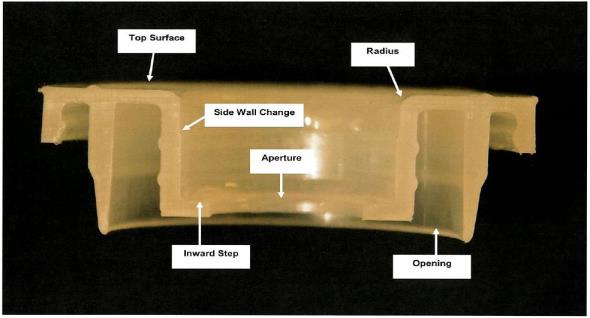
Photo 1
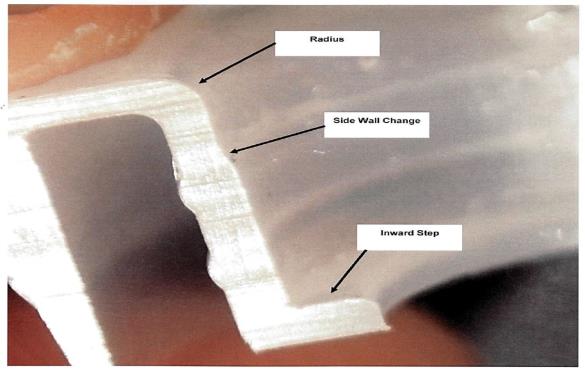
Photo 2
115 The “top surface” in photo 1 referred to the web of material at the upper end. The short, unlabelled outer ring that surrounded the web of material was a snap lock fastening to hold Glaxo’s liner securely on the lip at the bottle’s top. The solid centre sleeve that tapered at its lower part abutted the inner surface of the bottle neck. The experts differed as to whether that centre wall or sleeve was a cylindrical body. The labels “radius” and “side wall change” in both photos identified the experts’ difference of opinion as to whether the portion of Glaxo’s liner between the variations in shape appearing from the region of the radius to the region of the side wall change was a flared portion.
116 The experts debated the third issue, whether the alternate syringe was a flat-nosed syringe within claim 1, with the benefit of the two figures below that clearly set out their substantive difference of opinion:
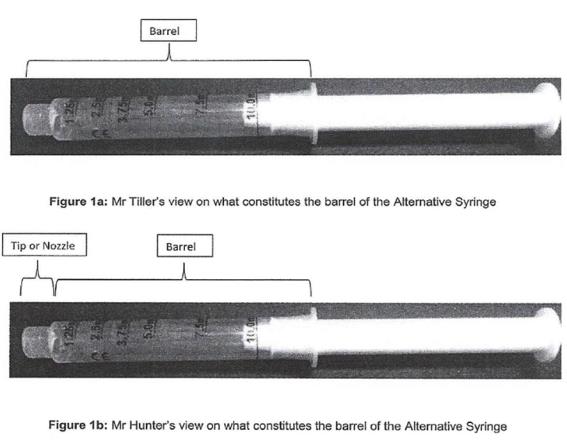
Cylindrical body – evidence
117 Both experts agreed that the portion of the solid centre wall (abutting the bottle neck) above the taper in the liner in photo 1 was a cylindrical body. They disagreed over whether the area of the taper mattered. Mr Tiller said that it did not, whereas Mr Hunter considered that the cylindrical body referred to in claim 1 had to be cylindrical on both its external and internal cylindrical surfaces. Mr Hunter considered that the patentee had allowed for a lead in portion, comprised by a chamfer, or radius, as in figure 2 of the drawings. However, he said that such lead in portions were generally of short length and would not comprise the majority of the length of the body. He considered that the cylindrical body was like a pipe. He also conceived that the words “sealingly engaged” in claim 1 imported a mandatory requirement that there be a firm interference fit between the liner, provided by a slightly oversized cylindrical body and the bottle neck. He said that if the upper part of the centre sleeve in Glaxo’s liner were not a firm interference fit, then it could not be expected to provide sufficient frictional engagement with the bottle neck to prevent the liner coming out when the syringe was removed. For those reasons, he considered that the feature of a cylindrical body was not present in Glaxo’s liner.
118 Neither expert made any physical measurements or tests of functionality of either product complained of. Each based his opinions on visual observations.
119 During the preparation of the joint experts report, Mr Tiller and Mr Hunter examined a cut cross section of the Glaxo liner inserted into a bottle in which the portion of the centre sleeve above the taper was shown to be in contact with the inner wall of the bottle neck. In addition, Mr Tiller had tested these two co-operating parts in the two products complained of for leakage of contents from the bottle into the area where the centre sleeve was contiguous to the inner wall of the bottle neck (i.e. above the taper). He found that no liquid leaked between the touching surfaces.
120 Mr Hunter did not dispute those observations. Indeed, in his concurrent evidence, Mr Hunter said that the portion of the centre sleeve above the taper “is a size for size fit”. Mr Hunter said that the snap lock feature, being the small outer wall of the Glaxo liner that has a ridge or clip in effect locking the liner in place over the outer rim of the top of the bottle neck, provided the sealing engagement. He said that was because the snap lock prevented the liner dislodging from the bottle neck when the syringe was removed.
Flared portion – evidence
121 Both experts agreed that the person skilled in the art would understand that the three parts necessary to assemble the apparatus in the invention would be mass produced by machine manufacturing. That process involved designing metal moulds into which plastic would be injected. They said that the injection moulding process necessitated the use of design features in the parts to assist in, first, reducing wear of the machines and dies doing the moulding at very high speeds and pressures and, secondly, assisting in the extraction of each individual part from the mould once it had been created. The tools have many cavities into which the plastic is injected so as to produce the complex shape that photos 1 and 2 show in a cut cross section. As a result, the design for the mould, and the part to be moulded, must have fillets or subtle radii or chamfers, to enable the moulded part to be removed from the mould without damaging the longevity of the machine tool.
122 Mr Tiller said that the radius and side wall change that he identified in photo 2 constituted a flared portion on the Glaxo liner and provided a lead in to the sleeve for the syringe barrel. He said, while giving concurrent evidence:
… these two features constitute a flared portion; and just to close and reiterate: this is a very small moulding, in the scheme of things, so the size of those components is […] small. I acknowledge that. They’re tiny. But […] the step in wall really sends a clear signal to me that there has been a decision somewhere to […] make that wall step, and then the question asked then in my mind is, Why would you do that? And the patent speaks to the need to have lead in. Using the product shows you need lead in. And I just think it’s a function of […] the nuances of the design process leading to a usable product.
123 Mr Hunter, in contrast, considered that the small bevel marked “radius” on photo 2 was a fillet radius. He said that that feature was included by the designer to reduce machine stress when the two parts forming the injection mould separated, rather than to provide lead in to the sleeve. He said:
So I want to turn to this issue as to whether […] that small radius is a deliberate design feature that’s there to create lead-in or is it just something that we do as engineers and designers to design a part. And my view is it’s more likely to be the latter. Putting a fillet radius like that at the junction of two geometric intersections is just something that we do all the time as designers when we’re moulding plastic parts.
124 He said that the variations in shape between the surface of the web and the inner wall to the point of the “side wall change” marking on photo 2 were not readily perceptible to the naked eye when examining the Glaxo liner, but could be seen in the magnified photos 1 and 2. He said the small ribs, one at the point where the “side wall change” is marked on photo 2 and one below it about half way down towards the inward step, were to provide grip for the tip of the syringe.
125 Mr Tiller disagreed with Mr Hunter’s identification of the location of the fillet radius that had been included for the purpose of assisting the injection moulding machinery. Mr Tiller located that fillet radius on the underside of the liner beneath the radius marked on photo 2, at the edge of the web of material, whereas Mr Hunter located it on the opposite surface at the entrance of the sleeve. The experts illustrated their difference on the whiteboard diagram below:
The alternate syringe
126 Based on my construction of claim 1 above, the alternate syringe does not have a generally uniform diameter along its length. That is because the indented section at the distal end is of a significantly smaller diameter than the major portion of the syringe.
127 Accordingly, the alternate syringe does not have all the features of the flat-nosed syringe in claim 1. It follows that the second product complained of does not infringe claims 1-6 inclusive.
128 However, it is necessary to consider the evidence about the alternate syringe for the purpose of determining whether its inclusion in the second product complained of creates an infringement of claim 9.
The omnibus claim
129 Mr Hunter opined that what he identified as the tip or nozzle on the alternate syringe created a syringe with different functional characteristics to the flat-nosed syringe the described in the patent and the article depicted in figure 4. He identified these as:
the ability to have a larger diameter or shorter barrel to dispense larger volumes of medication for children;
the ability to use the same liner regardless of the volumetric capacity of the syringe;
the exposure of all the measuring gradations outside the sleeve of the liner, allowing the accurate withdrawal of smaller volumes of liquid;
improved tolerance control of the fit between the smaller diameter tip or nozzle and the liner.
130 Both experts agreed in giving concurrent evidence that the alternate syringe had a reciprocating plunger and a dispensing aperture. Mr Hunter acknowledged that the shape of the plunger in the alternate syringe corresponded with that of the barrel because that plunger also had a tip that was the same size as the volume that would otherwise be held in the barrel's tip. In other words, the volume of the tip of the barrel was “dead space” because the alternate syringe’s plunger had a tip that took up all of that volume. As a consequence, the measurement of liquid that would be drawn up into, and dispensed from, the alternate syringe began at the distal base of the larger barrel, above the tips of both the alternate syringe and its reciprocating plunger when inserted. Both experts agreed that the volume of dead space occupied by those two tips was not significant. Both agreed that only the larger section of the barrel of the alternate syringe held the dose of liquid. Of course, the barrel of the flat-nosed syringe, in figure 4 of the patent (and that is the first product complained of), holds the dose.
131 Thus, functionally, the larger section of the barrel of the alternate syringe has exactly the function of the barrel of the flat-nosed syringe described in the patent. That functionality is achieved because the tips in both the barrel and reciprocating plunger of the alternate syringe ensure that, while the whole of the tip in the barrel section will hold liquid, the overall amount of liquid drawn up into the barrel will be reduced by exactly the same amount of space that the plunger tip occupies. In other words, the volume occupied by each tip is the same, so that the total amount of liquid that the whole barrel can contain is the same, as if there were no tips at all. And, the nose, or distal end point of the alternate syringe functions just as the flat-nose of the syringe described in the patent, in that it enables the syringe to draw up sealingly, and dispense liquid through the bore that engages with the bore in the liner.
132 Accordingly, I am satisfied that the liner of the second product complained of has the features of claim 1 and is substantially as described with reference to the drawings as in claim 9, and the alternate syringe also within claim 9. It follows that the second product complained of infringes claim 9.
2. The infringement issue – consideration
Cylindrical body
133 The patent was silent as to the length or proportions of the “cylindrical body sealingly engaged inside the bottle neck”. Instead, claim 1 looked to an essential result that this feature had to produce. That result was that liquid could not flow between the liner and the bottle neck. Both experts agreed in their joint report and in their concurrent evidence that Glaxo’s liner “is sealingly engaged with the inside of the bottle neck”.
134 Based on my construction of this feature, I do not accept Mr Hunter’s opinion that Glaxo’s liner does not have the feature of a cylindrical body that sealingly engages within the meaning of claim 1: cf Martin v Scribal Pty Ltd (1954) 92 CLR 17 at 60 per Dixon CJ. I prefer Mr Tiller’s evidence on this point. Indeed, the complete specification said (page 8 lines 16-21):
Preferably the free edge of the cylindrical body (that is, the part of the cylindrical body which first enters the bottle neck) has a taper on its outer surface, such that it functions as a lead in, to facilitate fitting of the liner into the bottle neck, during manufacture.
135 The sealing engagement is due to the functionality of the part of the cylindrical body of Glaxo’s liner above the taper of the centre sleeve. That part is cylindrical; it is a body and it achieves the result of making the liner sealingly engage with the bottle neck. That is because, as Mr Hunter said, and Mr Tiller agreed, the cylindrical portion is “a size for size fit” with the inside wall of the bottle neck and the bottle neck appeared to have a slightly smaller diameter than that portion.
136 Both experts agreed that the apparent design purpose of the portion of the centre wall (i.e. that contiguous to the neck of the bottle) above the taper of the Glaxo liner was to stop liquid leaking out of the bottle. Indeed, if the snap lock (or outer wall) was sufficient, or even designed, to seal the liquid within Glaxo’s bottle, the extra expense of manufacturing and including the tapered centre wall or sleeve would have been unnecessary. Again, both experts agreed that the design features of such parts, that used more material, added expense and that, ordinarily, the inclusion of such features had a functional purpose.
137 I accept Mr Tiller’s evidence that a designer of a product made by injection moulding from polyethylene, as the Glaxo liner was, would seek to achieve a design that met all the performance requirements for the product at the least or “most effective” cost. Material such as the central sleeve of Glaxo’s liner, with thicker plastic above the taper, would create additional costs in such a mass produced part.
138 I infer that this feature of the Glaxo liner not only had the design purpose that the experts identified but also achieved the actual functionality of that purpose to prevent liquid passing between the higher outer surface of the centre wall and the inner wall of the bottle neck.
139 The whole inner surface (including that portion which is opposite to the outer tapered portion) is cylindrical. The taper has a lead in function. Mr Hunter said that this was the taper’s most likely function and I find that it did have that function. And, Mr Hunter agreed with Mr Tiller that persons skilled in the art of designing plastic moulded parts that had to be machine fitted into other objects, such as a bottle neck, would design the part to have a lead in, as explained in the following evidence:
HIS HONOUR: So both of you feel free to comment on this. I mean, is it really a question of whatever the design specification is to the degree of lead-in and the length of the outer wall that you would, as a designer, decide how you were going to lead, … how much you were going to cut and where it was going to be for providing the lead-in. It was just a question of the design rather than the functionality. Is that ---
MR TILLER: Yes, your Honour. And in my experience, lead-ins are whatever shape and whatever height or length they need to be to meet the need and … when I worked in the appliance space, the lead-in of a kettle onto its kettle base, the entire engagement was angled to get deliberate lead-in. So the notion that its, you know, historically, traditionally a short feature that doesn’t rest well with me either and we’ve discussed this actually. So the idea of its length having some impact on the fact that it’s not lead-in or is lead-in is … not correct, in my opinion.
HIS HONOUR: Did you want to add anything, Mr Hunter?
MR HUNTER: No. I don’t have anything to say on that, your Honour.
(emphasis added)
140 Accordingly, the Glaxo liner has the feature of a cylindrical body within the meaning of claim 1. It engages sealingly so as to prevent liquid flowing between the liner and the bottle neck above the lower taper of the centre sleeve.
Flared portion
141 I prefer Mr Tiller’s evidence as to the existence of a flared portion. In any event, a perceptible gradual change in shape can be seen at the distal end of the Glaxo liner, where the syringe is to be inserted into it. The web falls into the sleeve wall on a gradual descending angle, rather than on a right angle, leaving some space around the syringe when inserted at the top but closing further down the sleeve to a tight fit of the two cylindrical shapes. It is apparent that this feature provides a lead in for the syringe that has the function of the flared portion described in claim 1. That gradual flare can be seen clearly to go from the radius to the point marked “side wall change” in Photo 2, when each of the syringes complained of is inserted into the Glaxo liner. And, as Mr Tiller said, the Glaxo liner is, overall, a very small part.
142 Accordingly, I find that the Glaxo liner has the feature of a flared portion at its upper end into which the distal end of the syringe barrel passes, within the meaning of claim 1. I find also that the Glaxo liner has substantially the features of the cylindrical body described in the specification and illustrated in the drawings of the liner.
143 Thus, the Glaxo liner has all of the features of the bottle neck liner described in claim 1.
The omnibus claim
144 The flat face of the alternate syringe and its tip operate exactly as described in the specification and the drawings in the patent, namely, they fit into the liner and enable the reciprocating plunger to draw up and later dispense a measurable dose of liquid (see figures 4-6). The distal end of the alternate syringe does not extend beyond the bore at the inward step (see the definition of “flat-nosed syringe”).
145 The explanation of the functionality depicted in figures 4, 5 and 6 and described in the complete specification, at page 16 line 11 to page 17 line 23, required the distal end of the barrel to fit sealingly into the liner, the barrel to have graduations of liquid contents visible to the user outside the portion contained inside the bottle neck and that there be a reciprocating plunger inside the barrel.
146 I do not accept that the four characteristics described by Mr Hunter created any functional differences between the flat-nosed syringe and the alternate syringe. They are distinctions without a substantive difference. Mr Hunter’s larger volume argument is illusory. The patent has no volume specifications or other dimensions for the parts of the apparatus. There is no evidence that the apparatus would work any differently if the barrel, bottle neck and liner were of large, small or any particular dimensions. The relevant volume gradations visible on the outside of the barrel can be made more accessible by how the dimensions of the apparatus are specified in its design.
147 There is no suggestion in any of the claims, or in the complete specification read as a whole, that the patentee intended deliberately to exclude from claim 9 a syringe that has a flat-nose at the tip or distal end or forming part of the syringe barrel that can be inserted into the inner sleeve of the liner, so that the inward step prevents it going deeper and allows liquid to be taken up into the barrel while preventing leakage or liquid otherwise flowing between the sleeve and the barrel.
148 I reject Glaxo’s argument that the Full Court in Glaxo 305 ALR at 379 [60] had confined the principle in Radiation 60 CLR 36 so as not to apply to claim 9. Rather, Bennett, Jagot and Griffiths JJ pointed out that that principle did not apply to the construction of a claim expressed as claim 1 is. At that stage of the litigation, the application of claim 9 was not in contention, only claim 1 was then in issue. As they held there:
In a claim such as the one presently under consideration, namely an apparatus consisting of a combination of integers, the question is not of the taking of the “substantial idea” or “substance” of the invention. This is in contrast to Radiation, where the claim itself included the claimed integers “substantially as described”. (emphasis added)
149 The words that their Honours set out in quotation marks in that passage are the same as those in claim 9. The alternate syringe has exactly the same function as that described in the patent and the drawings. The alternate syringe is a flat-nosed syringe that has a distal end that fits into the liner and achieves a good seal with it so that it can draw up liquid without leaking from the bottle or the syringe. The mere fact that there is a corresponding tip on both the barrel and the reciprocating plunger used in the alternate syringe in the second product complained of should not be allowed to disguise that that product has taken the substantial configuration resulting from the patentee’s invention and its character for the dispensing of liquids from bottles without mess using an apparatus with a flat-nosed syringe: Radiation 60 CLR at 52; Raleigh 65 RPC at 160. The alternate syringe, as incorporated into the second product complained of, is not a substantially new or different combination: Clark v Adie (1875) LR 10 Ch App 667 at 675 per James LJ; Minnesota 144 CLR at 286.
150 The alternate syringe takes the substance of the flat-nosed syringe described in the patent and drawings as stated in claim 9.
The infringement issue – conclusion
151 For the reasons I have given the first product complained of infringed claim 1. There is no dispute that, if it infringed claim 1, it also infringed each of claims 2, 3, 4, 5 and 6. It also infringed claim 9.
152 The second product complained of does not infringe any of claims 1, 2, 3, 4, 5 or 6 but it does infringe claim 9.
3. The manner of manufacture issue – Glaxo’s argument
153 This issue concerned whether the apparatus claimed in any of claims 1-6 and 9 was a manner of manufacture within the meaning of s 6 of the Statute of Monopolies 1623 (UK) and s 18(1)(a) of the Act.
154 Glaxo pleaded that, in light of its assertion of the common general knowledge, the invention was not a new manner of manufacture because the specification had disclosed before the priority date knowledge of apparatuses for the dispensation of liquids from bottles that included the use of graduated syringes to obtain accurate measurement of liquid; conventional methods of dipping syringes into bottles to withdraw liquid; difficulties in accurately measuring liquid; the potential for contamination of medicine by introduction of micro-organisms; the potential for dripping of the liquid remaining on the withdrawn syringe to make a mess and the use of a syringe in combination with a bottle neck liner or plug into which the syringe was seated. Glaxo then pleaded that, accordingly:
the alleged invention lacked the quality of inventiveness or was not new;
the patent claimed a mere collocation of known characteristics of liquid dispensing apparatuses or a mere analogous use of them.
155 Glaxo argued that, in the background to the invention section, the complete specification on its face disclosed that the three component parts of the claimed apparatus existed in the earlier patent referred to on page 1 lines 24-29 of the patent. It contended that the skilled addressee would understand from reading the complete specification that, first, the three parts of the apparatus would fit together in such a way that the liquid did not leak out, since, the argument ran, the combination would otherwise be of no practical benefit, and, secondly, liquid in the bottle could be extracted by a method in which the syringe was fitted into the liner, the bottle was inverted, liquid was drawn into the syringe, the bottle was turned back upright, the syringe withdrawn and the liquid expelled by its plunger being pushed downwards. Glaxo contended that all this information was disclosed as background in the complete specification and so the claimed apparatus had no new practical utility and did not add to what was already known or help to solve a known problem.
156 Next, Glaxo submitted, the only possible difference could be the shape or configuration of the constituent parts. It argued that the creation of a seal to prevent leakages was basic common sense in this field. And, it argued, shape and configuration were not of themselves patentable. The way the apparatus worked, so Glaxo contended, was not functionally different to how the known, previously patented assembly referred to at the beginning of the background section of the complete specification worked (p 1 lines 24-29). Glaxo argued that the mere difference in appearance of the previously existing assembly was not a new invention.
3. The manner of manufacture issue – consideration
157 I reject Glaxo’s argument. There was no evidence of, or relating to, the patent referred to in the background section of the complete specification (p 1 lines 24-29) except the bare fact of the reference made to it. That disclosure was simply:
WO 02/085429 describes a syringe assembly comprising an elongated tubular barrel having a discharge opening, and an elongated hollow tubular plunger member having a closed spherical tip. The assembly seats at its tip portion in an insert which fits in the neck of a container. (emphasis added)
158 There was no evidence that the earlier patent was part of the common general knowledge. It was not in evidence. Mr Tiller said that in 2002 he was unaware of assemblies of that kind for oral dispensing although he knew of them in the context of hypodermic syringes with needles. He also had difficulty in understanding from the description in the specification what the function of the closed spherical tip of the plunger was in the earlier patent.
159 The very limited disclosure on page 1 of the patent in suit of the earlier patent did not refer to any property of an assembly that provided a seal to prevent leaking, a flat, or any other, nose in the syringe with a plunger having the spherical tip or how that particular assembly might work to achieve what the present invention claims.
160 In Apotex Pty Ltd v Sanofi-Aventis Australia Pty Ltd (2013) 304 ALR 1 at 62 [235] Crennan and Kiefel JJ said, with the agreement of Gageler J at 77-79 [307]-[315]:
… in Wellcome Foundation Ltd v Commissioner of Patents [(1980) 145 CLR 520] this court determined that novel packaging, containing directions for using a known substance or compound for a hitherto unknown use or purpose, may be a “manner of manufacture”. In so doing, the court elucidated the expansion of the concept of “manner of manufacture” decided in the NRDC case [National Research Development Corporation v Commissioner of Patents (1959) 102 CLR 252], distilled thus [145 CLR at 528]:
This principle [in the NRDC case] extends to a process which does not produce a new substance but results in “a new and useful effect”. If the new result is “an artificially created state of affairs” providing economic utility, it may be considered a “manner of new manufacture” within s 6 of the Statute of Monopolies. (bold emphasis added, italic emphasis is original)
161 The expression “manufacture” in the Statute of Monopolies has for over two centuries extended “to any new results of principles carried into practice … new processes in any art producing effects useful to the public” as Eyre CJ explained in Boulton v Bull (1795) 1 H Bl 463 at 492 [126 ER 651 at 666] in a passage cited with approval by Dixon CJ, Kitto and Windeyer JJ in National Research Development Corporation v Commissioner for Patents (1959) 102 CLR 252 at 270; and see too D’Arcy v Myriad Genetics Inc (2014) 224 FCR 479 at 500 [121] per Allsop CJ, Dowsett, Kenny, Bennett and Middleton JJ.
162 The apparatus claimed in the patent was a product comprising a new and useful combination that had economic utility. As Mr Tiller said:
…in assessing the design concept in the patent and the way the patent is describing a liquid dispensing apparatus, I felt as a designer it’s very clever. It’s very simple, it goes to the heart of a lot of the issues that instantly come to mind around the semantics of use, dispensing, and when you look at where it has come from, which is a long history of syringes with tips and syringes that have the other semantics that I mentioned, it’s a very interesting and clever step change.
163 The concept of using a flat-nosed syringe to dispense measured amounts of the liquid contents of a bottle, including for oral doses of medicine, in a way that also avoided mess and leakage was creative and commercially useful. So was the combination of that feature with a bottle neck liner that permitted the dual functionality of being able to dispense the liquid contents of the bottle through either using the flat-nosed syringe or simply pouring them into a (measuring) container or spoon. Its commercial utility is exemplified by the use that the parties, members of large multinational groups of pharmaceutical companies, wish to make of the apparatus in their commercial products for dispensing liquid medicine to young children.
164 This was a clever way of making three individual products co-operate to produce a novel and useful apparatus. It was inventive and took a long period of time to conceive and bring to a state where it could be used, as the history of the concept’s development that I have set out earlier showed. I will return to that history when considering issue 6, the entitlement issue, below.
165 For these reasons, I am satisfied that the invention claimed was a manner of manufacture.
4. The inventive step issue – Glaxo’s argument and background
166 Glaxo argued that the claims of the patent lacked an inventive step having regard to the common general knowledge in Australia before the priority date for the purposes of ss 18(1)(b)(ii) and 7(2) of the Act. It contended that a skilled addressee, such as Mr Pearce or Mr Evers-Buckland, would be led directly as a matter of course to try a particular experiment or act in the expectation that it might well produce the desired outcome. It contended that the steps to produce the claimed invention, being the apparatus, were routine, including the iterative meetings and communications between Ms Dallison, HDB and Mr Pearce. Glaxo contended that there was no scintilla of inventiveness in using, first, a flat-nosed syringe, it being a product that HDB had manufactured in large quantities for years before, secondly, a flared portion, which Mr Pearce had based on the cap of a commercial washing up liquid and, thirdly, designing the liner with the ability to close the top of the bottle above it and leaving a hole in its base through which the liquid could pass.
167 Glaxo drew attention to Reckitt’s failure to call either of the named inventors to explain what their inventive concept or idea was. It argued that Mr Pearce’s documents did not indicate that either of Ms Dallison or Mr Harrison had made any design contribution until well after the main parameters of the plug, or liner, had already taken what was close to their final form. Glaxo contended that the dearth of any documents from Reckitt was somehow “indicative of a lack of regard for the substance of the quality of the claimed invention”. It submitted that Reckitt had not put forward any secondary evidence of inventiveness.
168 Next, Glaxo argued that because Mr Evers-Buckland performed “the design task” without any knowledge of the patent, there was cogent evidence of obviousness.
Mr Evers-Buckland’s evidence
169 As I noted when setting out his background and experience at [76]-[77] above, Mr Evers-Buckland was a regulatory affairs consultant, a former member of committees for developing Australian standards and, between 1986 and 2005, an employee of Becton Dickinson, a multinational medical device company. His work, over a long career beginning in the late 1960s, had included involvement in considering, assessing, designing and manufacturing syringes.
170 He said that the market for medical devices had been an international one since the late 1960s, albeit that each country had its own regulatory requirements.
171 Mr Evers-Buckland was not cross-examined on his three affidavits. In the first affidavit, affirmed on 21 March 2014, he said that at his initial meeting with Glaxo’s lawyers on 31 January 2014 he was asked to describe what he knew and understood to have been commonly known and accepted by his colleagues about how liquids were dispensed at the priority date, including the use of syringes for such purposes. He was also asked to identify disadvantages of those matters and to identify a sealing system. He explained that low volumes of liquid, of less than 30 mls, for injection into veins or muscles were dispensed and administered almost exclusively using hypodermic syringes. He said that by 2002 these were almost always single use syringes covered by AS1094, which he had helped draft. He said that the liquid was drawn up into the hypodermic syringe from an ampoule, a vial or a bottle containing a bulk supply, and that the top of such a bottle was sealed underneath by a screw cap or similar seal with a stopper usually made of rubber, through which the needle passed to draw up the liquid.
172 Mr Evers-Buckland said that liquid measures, such as measuring cups, spoons and syringes, were used to dispense liquids for oral administration prior to the priority date and that needleless syringes with 6% Luer taper ends were used, and he used them, to dispense and orally administer liquid medicine to children. He said that the Luer end of the syringe was inserted into the medicine bottle in order to withdraw and measure a dose of liquid and this was then placed into a child’s mouth so that the liquid could be dispensed. He noted that it may have been difficult to withdraw small amounts of liquid remaining in a bottle and that some mess could drip from a syringe when withdrawn after having been placed in liquid in a bottle.
173 Mr Evers-Buckland was asked whether, at the priority date, using his then knowledge and experience, he could avoid either of those disadvantages. He offered the view that a sealing system could allow the bottle to be tilted when liquid was drawn into a syringe. That involved inserting the syringe into a stopper to form a seal between the stopper and seal and allow the bottle to be inverted without leaking. That seal did not need to be air or water tight and could just be an open hole into which the syringe could be inserted, so long as there were a bottle top to close the bottle after use. He said that he believed that such a system was used for oral cough medication for children or children’s Panadol. (I note that Glaxo called no evidence of any such medicine or system marketed by it or anyone else in Australia in or before 2002.)
174 Also in his first affidavit he recounted that, at a second meeting with Glaxo’s lawyers on 5 March 2014, he responded to a request and made a drawing of such a sealing system that he identified and, for that purpose, he assumed that it would be used with a 6% Luer taper tipped syringe. The drawing incorporated a stopper or cap with a central bore through it or a valve that was inserted into a bottle into which the syringe would be inserted. The bore would work with a friction fit for the inserted syringe. He also drew, as an alternative, a syringe with a non-tapered, or straight sided, nozzle at its tip. In such a case he said that the entrance to the hole would be rounded, bevelled or chamfered to assist insertion of this straight sided nozzle into the bore. Mr Evers-Buckland recognised that a significant amount of specialised knowledge, outside his expertise, would be involved in designing moulds for commercial production of any such system and regulatory approval would also be required. He said that he expanded some of this account during telephone conversations on 11 and 12 March 2014 with one of Glaxo’s solicitors, before affirming his first affidavit.
175 It is necessary to interpolate at this point what Mr Evers-Buckland said in his third affidavit, affirmed on 10 April 2014. He explained that on 21 March 2014, after affirming his first affidavit, he had been shown, without any identification of their provenance, figure 4 and an extract of the wording of claim 1 at page 19 lines 4-9, describing the flat-nosed syringe’s characteristics. He had not heard of the term “flat-nosed syringe” before, but said that the term suggested to him a syringe without a nozzle. He then responded to a request to draw how a flat-nosed syringe could be incorporated into the sealing system that he had described earlier.
176 Mr Evers-Buckland affirmed his second affidavit on 4 April 2014. He had a conference on that day with Glaxo’s lawyers in which he had been asked to expand on the sealing system that he described in his first affidavit. He gave the following information in response to specific questions. He was asked how the sealing system he had described could be used with a lid. He said that the bottle could be used with a screw cap lid, including a child proof one, and that the stopper could be inserted into the bottle neck during the manufacturing process. He was asked what he would do if he were designing a sealing system using the three elements of a bottle, stopper and syringe. He said that he would consider the intended contents of the bottle and any regulatory issues for such a product. He then responded to a question about the relationship between the syringe and stopper, saying he would start with one or the other and dimension the second of those chosen elements around the first. He said he would then look at what products were already available from third party suppliers. He was asked about the kind of syringe he would use and responded that this was a marketing choice and he would be governed by the available syringe and nozzle types. He then responded to questions requiring him to assume that the marketing choice was to use a syringe without a nozzle, and that such syringes were available from third party suppliers in November 2002. He was asked about two and three piece syringes, and said that he considered that the two piece one was cheaper and was asked to assume that it would be chosen for use.
177 Next, Mr Evers-Buckland was asked how he envisaged the stopper and he said that it could be within a range of rigid to soft but would have a friction fit for its interactions with both the bottle and the syringe. In response to being asked to assume that a rigid stopper would be chosen, he said that in such a case it would be made by injection moulding, and if possible, by an existing supplier. He was then asked, first, to assume that the sealing system would consist of a bottle, a rigid stopper and a syringe without a nozzle and, secondly, to draw how these would fit together. Then, in response to questions as to how the stopper hole worked, he said that it would align with the hole in the end of the syringe barrel and that the stopper could be prevented from going all the way into the bottle by having it either a friction fit or incorporate a flange at the top. He was also asked to describe how the stopper could incorporate a pouring function, and did so. He drew illustrations progressively of his conceptions of what he was asked about.
178 In his third affidavit, to which I have already referred at [175] above, Mr Evers-Buckland said that when preparing and discussing the contents of his second affidavit on 4 April 2014, he did not consider the brief discussion on 21 March 2014 concerning the extract of wording from claim 1, copy of figure 4 or his drawings of the sealing system that he made after seeing those extracts.
179 None of Mr Evers-Buckland’s drawings arrived at all of the characteristics of the apparatus depicted in the six drawings in the patent. And, tellingly, he did not come up with the inventive concept of the apparatus claimed in the patent, or anything like it, immediately. What he initially described did not incorporate either a pouring function into the stopper or a flat-nosed syringe.
4. The inventive step issue - consideration
180 The question under s 7(2) of the Act is whether Glaxo has proved that the invention would have been obvious, that is, “very plain” to a person skilled in the relevant art, in light of the common general knowledge as it existed in Australia before the priority date. That is a question of fact and can involve matters of degree. This question often is by no means easy: Lockwood [No 2] 235 CLR at 195 [51].
181 A scintilla of invention will suffice, but the invention must involve overcoming a difficulty or crossing a barrier beyond doing what a hypothetical non-inventive worker in the field, equipped with the common general knowledge, could devise: Lockwood [No 2] 235 CLR at 195-197 [52]-[55].
182 In the case of a combination patent, such as the present, the essential requirement for the presence of an inventive step is the interaction between the integers of the combination. The party challenging validity on this ground must show that “the selection of the integers out of “perhaps many possibilities” … to be obvious, bearing in mind that the selection of integers in which the invention lies can be expected to be a process necessarily involving rejection of other possible integers”: Aktiebolaget Hässle v Alphapharm Pty Ltd (2002) 212 CLR 411 at 429 [41] per Gleeson CJ, Gaudron, Gummow and Hayne JJ applying Minnesota 144 CLR at 293 per Aickin J. And, as the Court said in Lockwood [No 2] 235 CLR at 201 [65]:
Ingenuity may lie in an idea for overcoming a practical difficulty in circumstances where a difficulty with a product consisting of a known set of integers is common general knowledge [Molnlycke AB v Procter & Gamble Ltd [No 5] [1994] RPC 49]. This is a narrow but critical point if, as here, the circumstances are that no skilled person in the art called to give evidence had thought of a general idea or general method of solving a known difficulty with respect to a known product, as at the priority date. (emphasis added)
183 As Windeyer J put it in Sunbeam Corporation v Morphy-Richards (Aust) Pty Ltd (1961) 180 CLR 98 at 115 in a passage applied by Heerey, Emmett and Dowsett JJ in Minnesota Mining & Manufacturing Co v Tyco Electronics Pty Ltd (2002) 56 IPR 248 at 278:
Approaching the question in this way then, there were, as I have said, before 1953 many forms of electrically heated appliances – some of them, such as kettles, used in cooking; and the use of thermostats to control heat generated by electricity was well known. In one sense, all that was done by Mr. Jepson, the inventor of the patented article, was to heat a frying pan standing on legs by electricity and provide it with a thermostat, and to do so he had only to arrange a number of well-known things – that, it may be said, was a matter of design not of invention. That there was a stage at which the final form of the appliance was evolved by work on the drawing board in the design office of the Sunbeam Corporation was proved. This did not, of itself, impress me as evidence of inventiveness. What was being done at that stage was not so much experimenting to solve a problem as designing to get a commercial product. But in cases of this kind inventiveness consists in conceiving an idea and giving it a practical embodiment. It is not a question simply of the degree of mechanical ingenuity needed to produce an article, but rather of the exercise together of imagination and ingenuity. This is not a case of solving an old problem or satisfying a long felt want. It is rather a case of conceiving that an electric frying pan would be a useful article, envisaging the features that it must have to make it practically useful, and by ingenuity in the combination of known devices producing a new and useful thing, a frying pan having the desired features. (emphasis added)
184 It is not appropriate to analyse whether a claimed invention, at least in the cases of selection or combination patents, involves an inventive step by considering whether the selected answer was “worth a try” or “obvious to try” or resulted from an exercise in trying out various known possibilities until a correct solution emerged: Alphapharm 212 CLR at 441-443 [72]-[76], [78]. Secondary evidence, such as commercial success, the satisfaction of a long felt but unsolved want or need and the failure of others to find a solution to the problem, is also relevant but not necessarily determinative of the question whether the invention is obvious: Lockwood [No 2] 235 CLR at 215-216 [115]-[116], [119].
185 The purpose of considering the prior art base, in assessing whether the invention involves an inventive step, is to look forward to see from it what a skilled addressee “is likely to have done when faced with a similar problem which the patentee claims to have solved with the invention” (235 CLR at 218 [127]). Each claim in a patent must be examined independently of the others in assessing whether an alleged invention involves an inventive step. Also in addressing the “jury” question of whether the claimed invention involves an inventive step, a judge must be very careful to avoid the wisdom of hindsight: Alphapharm 212 CLR at 443 [78].
186 I reject Glaxo’s argument that the claims lacked an inventive step. The inventiveness lay in the imagination and ingenuity in selecting the combination of integers that resulted in the apparatus: Sunbeam 180 CLR at 115. As Mr Tiller said in his evidence quoted at [162] above, this was a very clever step change from what was already known in the art.
187 Glaxo’s reliance on Mr Evers-Buckland was misplaced. First, he was not a person skilled in the art. There was no evidence that he had ever invented or designed anything. Secondly, despite being given the problem, he did not come up with an invention or a drawing reflecting any of the claims in the patent. His initial concept of a stopper was significantly different from the liner in the invention. It had no pouring function and did not interact with the syringe in the same way. Moreover, he was subsequently prompted along the way to his final version by questions about how to achieve what Ms Dallison had actually conceived and pursued herself. I do not suggest that Glaxo’s lawyers acted inappropriately, but Mr Evers-Buckland was given the task of creating what the questioners already knew was the end result. Reading his affidavits suggested that he was being taken along a sequential process on a path that was known by his interrogators. I found his evidence unpersuasive on the issue of obviousness.
188 Here, Mr Pearce’s documents showed that Ms Dallison had the ideas of using and combining a flat-nosed syringe with what became a liner so that the liner had the dual functions of, first, receiving the flat-nosed syringe and enabling it to dispense liquid without leaking and, secondly, of enabling the user to pour the bottle of contents into a receptacle without mess. Mr Pearce and HDB were her amanuensis – they may have drawn the design, but she conceived and directed how it was to be executed. And Mr Pearce recognised that the liner concept and design was Boots’ intellectual creation in his letter to Ms Dallison of 19 December 2000 (see [41] above). Earlier, on 12 June 2000, he recorded that she wanted a flat-ended syringe “used in conjunction with a redesigned plug” (see [38] above).
189 And, Ms Dallison thought of the use of the web at the top of the liner and the need for it to pour well (see [42]-[47] above). Subsequently too, Mr Pearce accepted Mr Pidgeon’s assertions in their October 2005 correspondence as to Boots’, i.e. Ms Dallison’s and Mr Harrison’s, inventive activity. Moreover, Mr Pearce never suggested that he had the ideas that became the invention either contemporaneously or in his three affidavits (see [54]-[55] above).
190 I do not place any weight on Glaxo’s contention that the dearth of documents produced by Reckitt is indicative of a lack of regard for the quality of its invention. That ignores that Boots, not Reckitt, was the company concerned and Boots was taken over by Reckitt in early 2006. In any event, the dispute between Boots and HDB was resolved, with HDB acknowledging in the Boots’ agreement that Boots had the right to claim patent protection for its invention.
191 There was nothing obvious about the choice or selection of the integers and their interaction in the combination of the apparatus. It took several attempts and many months before the final combination was settled on in around March 2001 (see [47]-[48] above). The fact that, with hindsight, it is easy to conceive such an apparatus, is not sufficient to displace the inventiveness of the original conception of a very useful device that, among other uses, is especially well adapted to dispensing liquid medicine to young children.
192 There is no evidence that anyone, let alone large, well resourced, multinational pharmaceutical companies, apart from Boots and its successor in title, Reckitt, thought of, let alone exploited, such an apparatus in a highly competitive local or international market. Any parent or carer of a young sick child knows just how hard it is to get him or her to swallow a measuring cup or spoonful of liquid medicine. If this apparatus were an obvious solution to a very old problem, as the much more recent convert to its commercial benefits and use, Glaxo, argued, it is hard to think why, without hindsight, it was not thought of and exploited by others as at the priority date.
193 The inventors conceived that the combination of the flat-nosed syringe, bespoke liner and a bottle, which, apart from the bespoke nature of the liner, were known devices, and made it into a new and practically useful apparatus. That involved ingenuity and imagination on the part of Ms Dallison, and I infer, Mr Harrison: Sunbeam 180 CLR at 115; Alphapharm 212 CLR at 429 [41]; Lockwood [No 2] 235 CLR at 195-197 [52]-[55], 210 [65], 215-216 [115]-[116], [119].
194 For these reasons, I am of opinion that Glaxo has not proved that any of the claims for the combination were obvious or that the patent lacked an inventive step.
5. The false suggestion issue – background
195 Glaxo contended that, if its obviousness ground failed, the patentee had made a false suggestion as to the identity of the true inventor, whom, it alleged, was either Mr Pearce alone or with others from HDB. It argued that there was no probative evidence to suggest that Ms Dallison or Mr Harrison made any relevant inventive contribution to claims 1 or 9.
5. The false suggestion issue – consideration
196 I reject Glaxo’s argument. As I have already found, the documentary evidence suggests that the idea that conceived of a combination of a flat-nosed syringe co-operating with a bottle neck liner and a bottle in the form of the apparatus had nothing to do with Mr Pearce or HDB and was Ms Dallison’s inspiration. She also had envisaged the features of that combination, being the way in which the flat-nosed syringe would co-operate with the liner, and, with Mr Harrison, the need for the liner to be adapted suitably to pour, without mess, the liquid contents from the bottle (see [42] above). That evidenced inventiveness: Sunbeam 180 CLR at 115.
197 For the reasons I have given in rejecting Glaxo’s argument on the asserted lack of an inventive step, I am not satisfied that it was false to suggest in the patent that Ms Dallison and Mr Harrison were the inventors, in fact, I find that they were.
198 Moreover, when a dispute arose in early 2005 between Boots and HDB over the original claims made in the patent and its European analogue, those parties negotiated a resolution. The Boots agreement recited events leading to the ultimate product claimed, being the apparatus. Clause 1.1 recorded that Boots had the right to progress the patent applications, including for the patent in suit, “provided that the claims thereof are limited to the specific invention made by employees of [Boots]”. HDB was content to allow Boots, and subsequently Reckitt, to proceed to seek patent protection for the specification and claims in their present form: see [55], [59] above.
199 In addition, both Mr Pearce and HDB have been aware of those proceedings and the assertions that Reckitt and Glaxo have made in them in respect of the patentability of the apparatus, yet neither Mr Pearce nor HDB has sought to claim that he or it was the true inventor. Strikingly, Mr Pearce did not say in any of his three affidavits that he had the conceptual ideas for the combination, being the apparatus or any of its integers for which the patent makes claims. I am not satisfied that this was attributable to modesty on his part.
6. The entitlement issue – Glaxo’s argument
200 Glaxo argued that there was no evidence of what, if anything, Ms Dallison and Mr Harrison did. It contended that there was no evidence that Reckitt had derived any title to the invention as claimed by reason of the inventors’ acknowledgments that Ms Dallison and Mr Harrison executed in October 2003, or that the two named inventors had conceived of an invention that had any of the following features:
a syringe that did not have a barrel with a single uniform diameter;
a liner that did not have an outer cylindrical body that engaged with the inside surface of a bottle neck so that under conditions of normal use, the liner stays in the bottle neck and liquid cannot flow between the liner and the bottle neck;
a liner that did not have a gradual widening (i.e. a gradual transition in shape) at the upper end of the inner sleeve and did not provide at least one of the stated advantages of the invention in the patent, namely the ability to pour contents of a bottle when a syringe is not used.
201 Glaxo argued that the only contribution that Ms Dallison and Mr Harrison could have made was the version of the liner in attachment 2 to the Boots agreement (reproduced at [57] above).
202 Glaxo argued that, on its proper construction, the Boots agreement:
did no more than contain an acknowledgment by HDB that Boots had put time and effort into seeking patent protection;
did not contain any assignment by HDB;
expressly confined any entitlement of Boots to the “specific invention made by employers of [Boots]” referred to in recital D and attachment 2.
203 It was common ground that the Boots agreement had the purpose of narrowing the claims and so, Glaxo argued, Reckitt cannot contend here for wider relief.
204 Glaxo accepted that the provisions as to entitlement in ss 22A and 138(4) inserted into the Act by the Raising the Bar Act apply to this proceeding. It contended that it is just and equitable that the patent be revoked because Reckitt had adopted “an avaricious approach” to the scope of the narrow monopoly claimed in the patent. Glaxo also relied on the facts that, first, before commencing the proceedings that Reckitt UK had assigned its beneficial, but not legal, i.e. registered interest, in the patent to other members of the Reckitt Benckiser group and, secondly, with effect from 2 October 2013, Reckitt Australia was appointed by another group member as sole distributor in Australia of group products, including Nurofen for children. Glaxo submitted that Reckitt’s choice of ignoring, without explanation, “obligations imposed by the Act with respect to the registration of particulars of the Patent”, meant that it cannot rely on the fact of its registration to resist an order for revocation.
6. The entitlement issue – consideration
205 Glaxo argued that the principles for determining entitlement were identified in Polwood Pty Ltd v Foxworth Pty Ltd (2008) 165 FCR 527 at 536-541 [33]-[51], despite that being a discussion by Finn, Bennett and Greenwood JJ of principles for determining joint inventorship in foreign jurisdictions, before their Honours explained the principles applicable under the Act at 541-543 [52]-[60]. They concluded that the test in Australia was (165 FCR at 543 [60]):
The invention or inventive concept of a patent or patent application should be discerned from the specification, the whole of the specification including the claims. The body of the specification describes the invention and should explain the inventive concepts involved. While the claims may claim less than the whole of the invention, they represent the patentee’s description of the invention sought to be protected and for which the monopoly is claimed. The claims assist in understanding the invention and the inventive concept or concepts that gave rise to it. There may be only one invention but it may be the subject of more than one inventive concept or inventive contribution. The invention may consist of a combination of elements. It may be that different persons contributed to that combination.
206 That test was adopted by Lindgren, Finn and Bennett JJ in University of Western Australia v Gray (2009) 179 FCR 346 at 402 [261], who added that it is not the law that in every case an invention is complete only when a skilled addressee can perform it. They said that such an approach was incorrect, and confused invention, or inventive concept, with the requirements for a valid patent.
207 Of course, the issue of Reckitt’s alleged lack of entitlement was a matter that Glaxo had alleged and that it had to prove. It was not incumbent on Reckitt to demonstrate positively that it was entitled to the patent: JMVB Enterprises Pty Ltd v Camoflag Pty Ltd (2006) 154 FCR 348 at 358 [57] per Emmett, Stone and Bennett JJ. Unlike a dispute between two parties each of whom claims to be an inventor, here, Glaxo, a stranger to the activity resulting in the application for the patent, is asserting, in substance, that the patentee misrepresented in the application the involvement of the named inventors when, on Glaxo’s argument, they had done nothing to justify them suggesting that they were in fact inventors as asserted in the complete specification. Mr Pearce, the only witness called by Glaxo, did not assert that he invented the apparatus claimed or any element of it, despite making three affidavits.
208 A court should not draw inferences favourable to a party who calls evidence from a witness but does not lead evidence in chief from that person on the very subject matter in respect of which he or she could have given direct evidence. Rather, the evidentiary principle applicable in such a situation is that the Court may infer that the party calling that witness fears to have him or her address the matter by giving direct evidence, this failure can be “some evidence” that had the witness been asked about the matter in chief, he or she would have exposed facts unfavourable to the examining party: Communications, Electrical, Electronic, Energy, Information, Postal, Plumbing and Allied Services Union of Australia v Australian Competition and Consumer Commission (2007) 162 FCR 466 at 525-526 [230] per Weinberg, Bennett and Rares JJ applying Commercial Union Assurance Company of Australia Ltd v Ferrcom Pty Ltd (1991) 22 NSWLR 389 at 418F-G per Handley JA; Braverus Maritime Inc v Port Kembla Coal Terminal Ltd (2005) 148 FCR 68 at 112 [159]-[160] per Tamberlin, Mansfield and Allsop JJ.
209 Each of Ms Dallison and Mr Harrison signed an inventor’s acknowledgment in October 2003 “in respect of the invention entitled Bottle Neck to Receive Syringe and known by the Internal Title Valencia 2: Bottle Neck to Receive Syringe” in which each, first, said that she or he was the inventor of that invention and an employee of Boots at the time of its creation, secondly, acknowledged that the invention belonged to Boots and that it was created in the ordinary course of her or his duties as such an employee, thirdly, acknowledged that the entire beneficial interest in the invention belonged to Boots and it had the right to seek patent protection in respect of it in all countries, and, fourthly agreed to execute any documents reasonably required to enable Boots to apply for, prosecute and obtain patents throughout the world in respect of the invention and to vest such patents in Boots absolutely when they were obtained.
210 These acknowledgments were made in connection with Boots’ original application for the patent in suit and its analogues. The code name “Project Valencia 2” was used in the heading of emails between Ms Dallison and Mr Pearce in March 2001, and Mr Pearce often headed his correspondence to Ms Dallison “Plug & Syringe System”. Subsequently, on 17 October 2005 Mr Pidgeon emailed Mr Pearce enclosing a draft of what became the Boots agreement saying that it related “to the VALENCIA/NFC patent applications”. There was no evidence to suggest that this reference was to any project other than that styled “Valencia 2” in earlier documents.
211 I reject Glaxo’s argument that the subject matter of the acknowledgments was insufficient to vest in Boots all of the inventors’ right, title and interest in the invention, necessary to enable Boots to apply for and hold the patent under s 15(b) and (c) of the Act. The acknowledgments were made by each of the inventors. They were employees of Boots at the time of creation of the apparatus that was to be used in its business. There is no evidence to suggest that the inventors did anything in the acknowledgments that did not reflect their enforceable legal and equitable obligations as employees of Boots to vest in it the legal and beneficial interest in the intellectual property the subject of the patent.
212 The onus was on Glaxo to prove that the acknowledgments did not reflect the true position of each inventor in respect of Boots’ entitlement to apply for the patent. Glaxo failed to discharge that onus of proof. The reference in the heading of the acknowledgments to “Valencia 2: Bottle Neck to Receive Syringe” in the context in which both the inventors and Boots were placed, unmistakeably referred to the invention of the apparatus. That is because the apparatus was claimed in the patent, albeit in wording that was amended in consequence of the Boots agreement. Nonetheless, the acknowledgments were directed both to the original wording and extended to any patent protection that might be obtainable arising out of that invention.
213 The fact that Boots narrowed its claims to patent production did not affect the plenary nature of the inventors’ acknowledgments. Those acknowledgements necessarily comprehended the wide wording of the initial patent applications, as well as a narrowing or refining of the claims, as occurred subsequently. The acknowledgments, in effect, said that whatever rights Ms Dallison and Mr Harrison had to seek patent protection in respect of all the work done by them to develop the apparatus (and whatever else was comprehended in Boots’ Project Valencia 2) was vested in Boots. Each of figures 1-6 is in both the original and amended (current) complete specification. The fact that the acknowledgments did not descend to the detail that Glaxo referred to in its argument is beside the point. The inventors were content for, and gave full authority and entitlement to their employer, Boots, to apply to patent everything that was patentable to which they might otherwise have had rights out of their work in developing the apparatus.
214 Glaxo’s argument sought to place an onus on Reckitt to prove how and when elements or integers of the invention came into existence and who thought of them. This argument misconceived, or sought to elude, the onus of proof on these matters, that Glaxo carried and failed to discharge. Moreover, the fact that the idea for the flat-nosed syringe did not deal expressly with an embodiment such as the alternate syringe is beside the point if, as the authorities establish, the infringer takes the substantial idea of the invention and all integers substantially as described and makes something which is only colourably different but functionally equivalent in all material respects : Radiation 60 CLR at 151-152; Clark LR 10 Ch App at 675; Raleigh 65 RPC at 159-160; Minnesota 144 CLR at 286.
215 I also reject Glaxo’s argument that it has proved that Ms Dallison’s and Mr Harrison’s role in the invention was either non-existent or was in some way less than that asserted as their invention in the patent, for the reasons I have given in respect of issue 5 as to Glaxo’s false suggestion claim [196]-[199] above. Nor is Glaxo’s construction of the Boots’ agreement sustainable. For the reasons I have given, I am not satisfied that HDB or Mr Pearce was an inventor. However, if that conclusion were incorrect, the Boots agreement operated as an accord and satisfaction that resolved the respective rights of Boots and HDB to seek patent protection for whatever rights HDB might have had to make claims in respect of the liner, as set out in attachment 7 (see [58]).
216 Importantly, in 2005 neither HDB nor Mr Pearce was asserting any interest in the overall conception of the apparatus, consisting of the liner in combination with a flat-nosed syringe and bottle. HDB’s concern was as to the liner, or plug, as the Boots agreement described it. That is why the provisions of cll 1, 2.1 and 2.5 dealt with HDB accepting that, first, Boots could apply for patent protection in respect of the liner in an agreed form and, secondly, Boots granted HDB a licence to sell the liner, but only in products outside the field of paediatric analgesics. Mr Pearce was closely involved in the negotiations for the Boots agreement and did not assert any personal interest of his own.
217 As I have explained, Reckitt subsequently varied the proposed new claim 1 in attachment 7 to the Boots agreement. That variation narrowed that new wording of claim 1 further in respect of the liner, by including the feature of the flared portion at the upper end of the sleeve (page 19 lines 19-21) and HDB was content to allow Boots to proceed with the claims that now appear in the patent ([59]).
218 The essence of an accord and satisfaction is the acceptance by one party of something in place of his, her or its cause of action, as Dixon J explained in McDermott v Black (1940) 63 CLR 161 at 183-185, as applied by French CJ, Gummow, Hayne, Heydon and Kiefel JJ in Commissioner of State Taxation of the State of South Australia v Cyril Henschke Pty Ltd (2010) 242 CLR 508 at 515 [19]. Dixon J said (63 CLR at 183-185):
What he takes is a matter depending on his own consent or agreement. It may be a promise or contract or it may be the act or thing promised. But, whatever it is, until it is provided and accepted the cause of action remains alive and unimpaired. The accord is the agreement or consent to accept the satisfaction. Until the satisfaction is given the accord remains executory and cannot bar the claim. … An executory promise or series of promises given in consideration of the abandonment of the claim may be accepted in substitution or satisfaction of the existing liability. Or, on the other hand, promises may be given by the party liable that he will satisfy the claim by doing an act, making over a thing or paying an ascertained sum of money and the other party may agree to accept, not the promise, but the act, thing or money in satisfaction of his claim. If the agreement is to accept the promise in satisfaction, the discharge of the liability is immediate; if the performance, then there is no discharge unless and until the promise is performed. (emphasis added)
219 I am of opinion that the Boots agreement operated as an immediate accord and satisfaction that, as between Boots and HDB, operated, first, to vest in Boots whatever rights HDB may have had to seek a patent in respect of the liner, secondly, recognised that Boots, and not HDB, always had all of the rights to seek patent protection for the combination, being the apparatus, except so far as they had been in dispute over the liner, and, thirdly, Boots granted HDB a limited licence to sell the liner. On entry into the Boots agreement, each of Boots and HDB gave the other a contractual satisfaction in exchange for extinguishment of any pre-existing cause of action that the other may have had.
220 Glaxo’s argument that the Boots agreement did not expressly contain any assignment by HDB fails to have regard to the effect of the accord and satisfaction under which HDB waived or gave up all of its rights, if any, to seek patent protection. If, as HDB promised in cl 1.5, it could “not contest the ownership, validity, inventorship or any other issues” relating to Boots’ patent applications, then as between them, that contractual promise gave to Boots all of those rights that HDB may have had as effectively as if the word “assign” were used. Boots was in the same position as the successful appellant in McDermott 63 CLR at 186, who was found entitled to judgment as a defendant when the respondent sought to bring a fresh action on allegations that he had earlier promised to withdraw as an accord and satisfaction. The promise was a waiver once for all of the promisor’s rights ever to rely on the withdrawn cause of action and an acknowledgment of Boots’ title to those rights.
221 As Dixon J explained, when an accord and satisfaction has been made its purpose is “not that of social amenity but to complete and close a business transaction”. His Honour noted that it would have been futile for the respondent to withdraw allegations that he was at liberty to revive. So too here, the essence of the Boots’ agreement was to ensure that Boots could make a valid patent application that was insusceptible to attack by HDB in exchange for the narrowing of the claims and the grant of a limited licence to HDB.
222 It is necessary to construe the Boots agreement so as to avoid it making commercial nonsense or working commercial inconvenience: Zhu v Treasurer of New South Wales (2004) 218 CLR 530 at 559 [82] per Gleeson CJ, Gummow, Kirby, Callinan and Heydon JJ. The Boots agreement was not concerned with the wider claims to the apparatus except so far as those claims involved the liner. The narrowing of the claims effected by the Boots agreement related solely to the liner component which HDB was keen to sell separately, if it could. Thus, attachment 7 still claimed a combination, being the apparatus, but narrowed its scope relevantly in respect of the features or integers of the liner, and the subsequent amendments to claim 1 in 2006 narrowed these further. Its commercial purpose was to extinguish, once for all, any claim to the liner (in the limited agreed form of attachment 7) that HDB may otherwise have had and to grant HDB a limited licence.
223 Having regard to my findings as to the effect of the Boots agreement and the inventors’ acknowledgments, the only scope for Glaxo’s argument that the inventive concept for the patent, being the combination that Glaxo limited to claim 1, was that Mr Pearce was the, or an, inventor. I have also rejected that argument given Glaxo’s failure to lead that very evidence from him. Moreover, the invention, as claimed, included what was covered by claim 9. Glaxo argued that, when Mr Pearce reported back to HDB in early 2001 with drawings of the liner, he, and not Ms Dallison or Mr Harrison, created the inventive concept that the drawings portrayed.
224 The fundamental problem with Glaxo’s submission is that Mr Pearce did not give that evidence. He did say that he drew a sketch on 20 February 2001 that depicted a flared portion for the liner. He said that to the best of his recollection, the notes in which the sketch appeared recorded an update on the status of the project and he added “While I do not now recall, I believe that it is likely that I spoke to Anne Dallison, probably on the phone”. In fact, he had meetings with her on that day and two days later on 22 February 2001, and took two liner samples to the first meeting, one with, and one without, a protruding flange at the top (see [47] above) and took to the second meeting two liners without a protruding flange. The first set of two different liners had a drawn space between the liner wall, the outer face of which was contiguous with the bottle neck and the centre sleeve. However, for the liner without the protruding flange, there was a solid continuous wall without any space between the bottle neck and the inner sleeve.
225 The drawing on which Glaxo relied appears to have been made at, or after, the first set of two made up samples was tested by Boots and rejected. The shape of the flared portion in this drawing appeared to be closer to the shape of the protruding flange in the design rejected on 20 February 2001 but the drawings of the liners are not exact matches because the undated drawing has a solid portion joining the wall contiguous with the bottle neck and the inner sleeve. What appears to have occurred is that the shape of the protruding flange was retained but it was placed lower in the liner so that the top of the flange merged into, but did not protrude above, the web of material and a space between the outer wall and centre sleeve was included. This led to the version of the liner approved at the meeting on 7 March 2001 that I described at [47] above.
226 Thus, Mr Pearce’s evidence, that he probably spoke to Ms Dallison on the telephone concerning this later design, may be correct but he plainly spoke to her when they were assessing how the sample prototypes had worked and why they had failed to meet Boots’ requirements during the meeting or meetings of 20 and 22 February 2001. What is important for present purposes is that Mr Pearce did not give evidence that Ms Dallison or Mr Harrison were not the inventors of the flared portion concept.
227 Indeed, with this remove of time it would be unlikely that he could recall much, if anything, that was discussed. However, Mr Pearce did not give evidence that he thought of the concept, which, had it occurred, he might be expected to have remembered. No document suggested any unreliability in Ms Dallison’s and Mr Harrison’s inventors’ acknowledgments, which were made in 2003 – much closer to the events in question than Mr Pearce’s honest attempt to reconstruct events that had occurred some 13 years before he gave evidence.
228 Having regard to the provisions of s 140(2) of the Evidence Act 1995 (Cth), I am not satisfied that Glaxo has proved that Ms Dallison and Mr Harrison did not develop the inventive concept or concepts or that they were not, as they asserted, the true inventors of the whole invention claimed in the patent. Nor am I satisfied that Mr Pearce made any relevantly inventive contribution to the subject matter in issue in these proceedings. Indeed, Mr Pearce never suggested that he did.
229 On 27 March 2006, Boots assigned to Reckitt UK its rights in respect of the patent and its analogues, among other property. The Commissioner granted the patent to Reckitt UK as patentee on 20 March 2008. I am of opinion that Glaxo has failed to prove that Reckitt UK is not entitled to the patent.
230 The evidence also showed that, through a series of unregistered intergroup agreements between companies in the Reckitt Benckiser group, Reckitt Australia obtained an exclusive licence to exploit the patent from at least 2 October 2013. That evidence also showed that Reckitt UK formally admitted that, as at the commencement of these proceedings and at all times since, it has not been the beneficial owner of the patent and has had no economic interest in it, but that those interests have been held by other companies in the Reckitt Benckiser group.
231 On 27 March 2006, Reckitt UK transferred the beneficial ownership of the patent to a group company, Reckitt & Colman (Overseas) Ltd and granted the latter an exclusive, transferable royalty free, irrevocable and perpetual worldwide licence to exploit it and to grant sublicenses. It follows that, from that time, Reckitt UK was and remains a bare owner of the legal entitlement, first, to be granted the patent and, secondly, to be registered as patentee.
232 These facts lie behind Glaxo’s last argument on entitlement that somehow, if Reckitt UK were not entitled to the patent, it would be just and equitable to revoke it under s 138(3) of the Act. It is not necessary to decide this meretricious point. It was debunked by Lord Cairns LC in Shropshire Union Railways and Canal Company v The Queen (1875) LR 7 HL 496 at 507-509 whose reasoning was applied by the Privy Council in Abigail v Lapin (1934) 51 CLR 58 at 69, [1934] AC 491 at 505. I rejected a similar argument in Spirit Pharmaceuticals Pty Ltd v Mundipharma Pty Ltd (2013) 216 FCR 344 at 367-368 [85]-[87], 368-369 [89]-[91].
233 Here, s 188 of the Act provides that notice of any kind of trust relating to a patent or licence is not receivable by the Commissioner and cannot be registered. That statutory provision is similar to earlier provisions of the Real Property Act 1900 (NSW) that were considered in Abigail 51 CLR at 64; [1934] AC at 500. The way in which those statutes treated beneficial interests in the property they created or regulated is in contrast to provisions such as s 1072H of the Corporations Act 2001 (Cth), although even it preserves the validity of a transfer made without disclosure of an underlying beneficial interest (see s 1072H(2)).
234 Moreover, s 196(1)(b)(ii) expressly allows proof of documents, particulars of which have not been entered in the Register of Patents under the Act, “to enforce equities in relation to the patent or licence”. It follows that the Act expressly recognises and renders enforceable equitable interests even though they are not on the Register.
235 Of course, such equitable interests may be vulnerable to defeasance by misconduct of the registered legal owner in accordance with the principles of equity. But, that is a far cry from Glaxo’s misconceived argument that the way in which the Reckitt Benckiser group has chosen to arrange beneficial interests in property held in the name of one group member can, or should, be relevant or admissible to destroy the legal right that a registered patentee, whether a bare trustee or limited beneficial owner, has to enforce the rights granted to the registered owner under the Act.
236 To deny Reckitt UK and Reckitt Australia their legal rights to enforce the patent, if valid, merely because they hold such rights as bare trustees or as legal but not beneficial owners, would not be just or equitable or accord with the proper construction of the Act. To accept Glaxo’s argument would undermine well recognised, lawful and proper arrangements that are, and have for centuries been, features of ordinary commercial life. Reckitt is entitled to, and to enforce, the patent, if it be otherwise valid.
237 The ground of revocation under s 138(3)(a) fails.
7. The fair basis issue
238 Glaxo contended that if claim 1 were construed in such a way that an embodiment such as the alternate syringe could be included within the monopoly asserted by the patentee, then that claim could not be fairly based on the matter described in the specification within the meaning of s 40(3) in its form before the 2012 Raising the Bar Amendment Act, being the form that I have set out in [10] above.
239 Senior counsel for Glaxo said in final address that if claim 9 were construed so that it was not a mere narrowing of claim 1, but could comprehend an embodiment such as the alternate syringe, then Glaxo could not succeed on its argument on the fair basis issue.
240 In my opinion, based on the construction that I have given to claim 9, and in particular the word “substantially”, that claim is fairly based on the matter described in the complete specification. I have reached this conclusion for the reasons that I have given as to why the alternate syringe and the second product complained of infringes claim 9.
Conclusion
241 For these reasons, I am satisfied that Reckitt is entitled to some of the relief that it claimed. That relief should be based on my findings that the first product complained of infringed each of claims 1, 2, 3, 4, 5, 6 and 9 and the second product complained of infringed only claim 9.
242 Each side has had some measure of success on the multifarious arguments that parties in patent litigation appear to consider that they are entitled to run. I will ask the parties to bring in short minutes of orders to give effect to these reasons, including as to costs. If those orders cannot be agreed I will hear the parties further on any outstanding issues.
I certify that the preceding two hundred and forty-two (242) numbered paragraphs are a true copy of the Reasons for Judgment herein of the Honourable Justice Rares. |
Associate:


