FEDERAL COURT OF AUSTRALIA
Director of the Fair Work Building Industry Inspectorate v Construction, Forestry, Mining and Energy Union (No 2) [2015] FCA 407
IN THE FEDERAL COURT OF AUSTRALIA | |
DIRECTOR OF THE FAIR WORK BUILDING INDUSTRY INSPECTORATE Applicant | |
AND: | CONSTRUCTION, FORESTRY, MINING AND ENERGY UNION First Respondent GARETH STEPHENSON Second Respondent |
DATE OF ORDER: | |
WHERE MADE: |
THE COURT NOTES THAT:
In these Declarations and Orders, Bald Hills Site means the site at which the construction of the Bald Hills Wind Farm is taking place in Tarwin Lower in the State of Victoria, consisting of:
a) Compound A on Buffalo-Waratah Road;
b) Compound B on Walkerville Road; and
c) Compound C on Walkerville Road.
THE COURT DECLARES THAT:
1. On 19 December 2013, the First Respondent (“the CFMEU”) contravened s 340(1)(a)(iii) of the Fair Work Act 2009 (Cth) (“the Act”) by threatening to take adverse action against Hazell Bros Group Pty Ltd (“Hazell Bros”) because Hazell Bros proposed to exercise a workplace right to make an enterprise agreement with the Australian Workers’ Union (“the AWU”), and proposed not to make an enterprise agreement with the CFMEU, to cover the terms and conditions of employment of Hazell Bros employees on the Bald Hills Wind Farm Project (“the Project”).
2. On 20 January 2014, the CFMEU contravened s 340(1)(a)(iii) of the Act by threatening to take adverse action against Hazell Bros because Hazell Bros proposed to exercise a workplace right to make an enterprise agreement with the AWU, and proposed not to make an enterprise agreement with the CFMEU, to cover the terms and conditions of employment of Hazell Bros employees on the Project.
3. On 18 February 2014, the CFMEU contravened s 340(1)(a)(ii) of the Act by taking adverse action against Hazell Bros because Hazell Bros had exercised a workplace right to make an enterprise agreement with the AWU and not to make an enterprise agreement with the CFMEU, to cover the terms and conditions of employment of Hazell Bros employees on the Project.
4. On 20 March 2014, the CFMEU contravened s 355(a) of the Act by taking action against Senvion Australia Pty Ltd (“Senvion”) and International Cranes Pty Ltd (“International Cranes”) with intent to coerce Senvion or International Cranes to employ Josip Stavlic (“Stavlic”) on the Project.
5. On 21 March 2014, the CFMEU contravened s 355(a) of the Act by taking action against Senvion and International Cranes with intent to coerce Senvion or International Cranes to employ Mr Stavlic on the Project.
6. On 26 March 2014, the CFMEU contravened s 355(a) of the Act by taking action against Senvion and International Cranes with intent to coerce Senvion or International Cranes to employ Mr Stavlic on the Project.
7. On 27 March 2014, the CFMEU contravened s 355(a) of the Act by threatening to take action against Senvion and International Cranes with intent to coerce Senvion or International Cranes to employ Mr Stavlic on the Project.
8. On 15 April 2014, the CFMEU contravened s 355(a) of the Act by taking action against Senvion and International Cranes with intent to coerce Senvion or International Cranes to employ Mr Stavlic on the Project.
9. On 11 February 2014, the Second Respondent contravened s 494 of the Act by entering the Bald Hills Site pursuant to a right of entry under the Occupational Health and Safety Act 2004 (Vic) in circumstances where he did not hold a federal entry permit issued under s 512 of the Act.
10. On 17 March 2014, 20 March 2014, 21 March 2014, 26 March 2014, 27 March 2014 and 15 April 2014, the Second Respondent contravened s 355(a) of the Act by taking action against Senvion and International Cranes with intent to coerce Senvion or International Cranes to employ Mr Stavlic on the Project.
THE COURT ORDERS THAT:
1. Pursuant to s 546(1) of the Act, the CFMEU pay the following pecuniary penalties:
1.1 a penalty of $7,500 for the contravention of s 340(1)(a)(iii) of the Act referred to in Declaration 1 hereof;
1.2 a penalty of $7,500 for the contravention of s 340(1)(a)(iii) of the Act referred to in Declaration 2 hereof;
1.3 a penalty of $15,000 for the contravention of s 340(1)(a)(ii) of the Act referred to in Declaration 3 hereof;
1.4 a penalty of $25,000 for the contravention of s 355(a) of the Act referred to in Declaration 4 hereof;
1.5 a penalty of $20,000 for the contravention of s 355(a) of the Act referred to in Declaration 5 hereof;
1.6 a penalty of $20,000 for the contravention of s 355(a) of the Act referred to in Declaration 6 hereof;
1.7 a penalty of $7,500 for the contravention of s 355(a) of the Act referred to in Declaration 7 hereof.
2. Pursuant to s 546(1) of the Act, the Second Respondent pay the following pecuniary penalties:
2.1 a penalty of $2,000 for the contravention of s 494 of the Act referred to in Declaration 9 hereof;
2.2 a penalty of $5,000 for the contravention of s 355(a) of the Act referred to in Declaration 10 hereof.
3. Pursuant to s 546(3) of the Act, the pecuniary penalties referred to in Orders 1 and 2 hereof be paid to the Commonwealth of Australia within 30 days of the date of these declarations and orders.
4. In default of payment of the penalties imposed pursuant to Orders 1 and 2 the applicant have liberty to apply for direction for enforcement of payment.
5. Pursuant to s 545(1) of the Act, until all work on the Project has been completed or further order, the CFMEU is restrained (whether by itself, its officers, its employees or its agents or howsoever otherwise) from:
5.1 preventing, hindering or interfering with free access to, and free egress from, the Bald Hills Site by any person or vehicle;
5.2 counselling, procuring, encouraging or persuading any person or persons not to enter the Bald Hills Site;
5.3 counselling, procuring, encouraging or persuading any person or persons not to work at the Bald Hills Site;
5.4 placing or leaving any vehicle, trailer, apparatus, equipment or thing within 200 metres of any entrance to the Bald Hills Site;
5.5 threatening, abusing or harassing any person or persons seeking to enter or exit the Bald Hills Site; or
5.6 causing, inducing, procuring, encouraging, persuading or organising any person or persons to do or attempt to do any of the things restrained by sub-paragraphs 5.1 to 5.5 above.
6. The amended originating application dated 1 September 2014 otherwise be dismissed.
7. There be no further order as to costs of this proceeding.
Endorsement pursuant to Rule 41.06
To:
Construction, Forestry, Mining and Energy Union
Gareth Stephenson
You will be liable to imprisonment, sequestration of property or punishment for contempt if:
(a) for an order that requires you to do an act or thing - you neglect or refuse to do the act or thing within the time specified in the order; or
(b) for an order that requires you not to do an act or thing - you disobey the order.
Note: Entry of orders is dealt with in Rule 39.32 of the Federal Court Rules 2011.
VICTORIA DISTRICT REGISTRY | |
FAIR WORK DIVISION | VID 194 of 2014 |
BETWEEN: | DIRECTOR OF THE FAIR WORK BUILDING INDUSTRY INSPECTORATE Applicant |
AND: | CONSTRUCTION, FORESTRY, MINING AND ENERGY UNION First Respondent GARETH STEPHENSON Second Respondent |
JUDGE: | TRACEY J |
DATE: | 1 may 2015 |
PLACE: | MELBOURNE |
REASONS FOR JUDGMENT
1 This application by the Director of the Fair Work Building Industry Inspectorate (“the Director”) arises out of two industrial disputes. The first involved the first respondent (“the CFMEU”) and some companies concerning the employment of a particular worker. The second related to a demand by the CFMEU that an employer enter into an enterprise agreement with the CFMEU. Both disputes arose in the course of the construction of a wind farm in Victoria.
2 In his statement of claim the Director alleged that, in the course of the disputes, the CFMEU and one of its officials, the second respondent, Mr Gareth Stephenson, had committed a large number of contraventions of the Fair Work Act 2009 (Cth) (“the Act”). Mr Stephenson was, at all relevant times, an Organiser employed by the CFMEU and a Management Committee Member of the Victoria-Tasmania Divisional Branch of the CFMEU’s Construction and General Division (“the Branch”).
3 Following discussions between the parties the Director agreed not to press all of the allegations made by him against the respondents.
4 The Director advised the Court that he was proceeding with allegations of three contraventions of s 340(1)(a) and five allegations of contraventions of s 355(a) of the Act against the CFMEU and one contravention of s 355(a) and one contravention of s 494(1) against Mr Stephenson.
5 The respondents advised the Court that they did not dispute that the alleged contraventions, pressed by the Director, had occurred and did not seek to contest the factual basis on which the Director sought to support his allegations.
6 After submissions had been made and judgment had been reserved I handed down my decision on an application, made in the proceeding, by the Director in which he alleged that the CFMEU was guilty of contempt of court by reason of the conduct of some of its officials: see Director of the Fair Work Building Industry Inspectorate v Construction, Forestry, Mining and Energy Union [2015] FCA 226 (“the contempt decision”). Some of that same conduct was relied on by the Director in his present application to support one of his allegations that the CFMEU had contravened s 355(a) of the Act.
7 In these circumstances I invited the Director to confirm whether or not he proposed to proceed with the particular allegation of contravention. I did so having regard to the provisions of ss 552 and 553 of the Act and the decision of the Full Court in Construction, Forestry, Mining and Energy Union v Director of the Fair Work Building Industry Inspectorate (2014) 225 FCR 210 (Buchanan, Gordon and Wigney JJ).
8 Section 552 of the Act prevents the Court from making a pecuniary penalty order for a contravention of provisions (including s 355(a)) “if the [respondent] has been convicted of an offence constituted by conduct that is substantially the same as the conduct constituting the contravention.”
9 Section 553(1) operates to stay proceedings for a pecuniary penalty order if criminal proceedings have been commenced against the respondent “for an offence” and that offence is constituted by conduct which is substantially the same as that for which a pecuniary penalty order is sought and (by subsection (2)) to dismiss the proceedings if a conviction is recorded.
10 The Full Court held that s 553 operated to stay or dismiss proceedings for pecuniary penalty orders where the related application sought conviction and punishment for criminal offences.
11 The Director advised the Court that he did press the relevant allegation because his contempt application did not allege criminal conduct on the part of the CFMEU and the Court had not recorded any conviction against the CFMEU.
12 The CFMEU contended that, despite the absence of a formal conviction it had, nonetheless, been “convicted” for offences of contempt and that s 552 operated to prevent the Court from imposing pecuniary penalty orders against it in respect of the conduct of its officers and members on 15 April 2014 which had given rise to the contempts of court.
13 The Court did not record convictions against the CFMEU for contempt. It made declarations that the CFMEU was guilty of contempt of the Court in that, on 15 April 2014, it prevented free access and free egress from the project site by persons and vehicles and because it caused persons to prevent such free movement. Having made these declarations the Court ordered that the CFMEU be punished by way of fines for the two relevant contempts: see Director of the Fair Work Building Industry Inspectorate v Construction, Forestry, Mining and Energy Union [2015] FCA 226.
14 The Full Court had earlier been called on to consider whether unrelated proceedings for contempt in the Supreme Court of Victoria had the effect of staying an application by the Director, to the extent that it sought the imposition of pecuniary penalties against the CFMEU arising out of the same conduct. The Supreme Court proceedings had been commenced in the civil jurisdiction of that Court. The prosecutor sought to have the CFMEU punished for contempt for failing to obey orders made by the Court. Having heard submissions in relation to penalty the trial judge found that the CFMEU had deliberately defied the Court’s orders and that this contumacious conduct rendered the contempts criminal. The CFMEU was adjudged to have been in criminal contempt of court.
15 The Full Court (at 218-219) reviewed secondary materials relating to the introduction, into the Act, of ss 552 to 555. Their Honours noted that these provisions were directed, in part, to providing “protection against double jeopardy for the same conduct.” The sections were “concerned with ‘a practice, if not a rule of law, that a person should not be twice punished for what is substantially the same act’: R v Hoar (1981) 148 CLR 32 at 38 …”
16 Their Honours (at 219) then referred to the decision of the High Court in Witham v Holloway (1995) 183 CLR 525 at 530-531 in which that Court acknowledged the existence of a distinction between civil and criminal contempt but went on to say (at 534) that:
“The differences upon which the distinction between civil and criminal contempt is based are, in significant respects, illusory. They certainly do not justify the allocation of different standards of proof for civil and criminal contempt. Rather, the illusory nature of those differences and the fact that the usual outcome of successful proceedings is punishment, no matter whether primarily for the vindication of judicial authority or primarily for the purpose of coercing obedience in the interest of the individual, make it clear as Deane J said in [Hinch v Attorney-General (Vic) (1987) 164 CLR 15 at 49], that all proceedings for contempt “must realistically be seen as criminal in nature”. The consequence is that all charges of contempt must be proved beyond reasonable doubt …” (Emphasis added).
17 The Full Court continued (at 219-220):
“39. Consistent with what the High Court said in Witham v Holloway, the CFMEU was charged with contempt in the SCV [Supreme Court of Victoria] … . The Attorney-General was joined as a plaintiff. At least from the time of the joinder of the Attorney-General, the “proceedings [were] in the public interest to vindicate judicial authority or maintain the integrity of the judicial process”: Witham v Holloway at 531. The proceedings were instituted to punish the CFMEU for failing to obey Court orders. The relief sought was that the CFMEU “be punished for contempt”: … Under the Evidence Act 2008, proceedings are civil or criminal. A criminal proceeding is defined in that Act relevantly to mean the prosecution for an offence: Sch 2 to the Evidence Act 2008. In the SCV, the CFMEU was prosecuted for an offence (that of contempt) and the SCV proceedings were conducted to the criminal standard: see [15] above and s 141 of the Evidence Act 2008 (Vic). The CFMEU was convicted of five criminal contempts and was punished for that disobedience by the imposition of fines: … The fact that contempt proceedings are, for reasons explained in the authorities, tried summarily and not before a jury is immaterial. So too is the fact that the proceedings were commenced in the civil jurisdiction of the SCV. The fact that different procedures have been adopted for trying contempt charges does not alter the essential characteristic of the proceedings as criminal proceedings. The Director’s submission that the contempt proceedings were civil proceedings when commenced because the charge did not plead that the conduct of the CFMEU was deliberate or contumacious should also be rejected. The proceedings were criminal because Grocon and the Attorney-General were seeking convictions and punishment for offences.
40. What then was the effect of the contempt proceedings in the SCV on the proceedings before the Federal Court? From the outset, it is at least arguable that the proceedings issued by the Director in the Federal Court were stayed against the CFMEU to the extent that they sought pecuniary penalty orders: s 553(1). The SCV proceedings were criminal proceedings for an offence. Although it is strictly unnecessary to decide that the SCV proceedings were from commencement criminal proceedings for the purposes of s 553 of the FWA, the fact that five criminal convictions have been entered against the CFMEU in relation to substantially the same conduct cannot be ignored. Upon the entry of those convictions in the SCV in relation to substantially the same conduct, the proceedings in this Court against the CFMEU, to the extent that they sought pecuniary penalty orders in relation to that conduct, stood dismissed: s 553(2).” (Emphasis added).
18 It is clear from the Full Court’s decision (at 220) that nothing turns on the procedures adopted by the “prosecutor” in bringing the contempt charges before a court. The Full Court held that contempt proceedings, commenced in the civil jurisdiction of the Supreme Court of Victoria, were to be treated as criminal because the moving parties were seeking to have the CFMEU punished for contempt for failing to obey Court orders. It was enough that the relief sought was that the CFMEU “be punished for contempt”. The Full Court did not consider that the characterisation of the conduct as criminal, made at the end of the contempt hearing, changed what had been civil proceedings into criminal proceedings. It held that the proceedings were to be characterised as criminal, if not from their commencement, certainly from a point well before any conviction was recorded. What was critical, for the purposes of ss 552 and 553 of the Act, was that the prosecutor had sought the imposition of penalties for contempt of court. Such penalties could only be imposed once a “conviction” had occurred. No distinction was drawn between civil and criminal contempts in this context.
19 It is notable that s 552 does not refer to “criminal” offences. Although the word “conviction” is usually used in association with findings of criminal liability, it may, depending on the context, be understood to refer to a finding of liability which is a necessary precursor to the imposition of some form of punishment. To the extent that s 552 is intended to operate as a protection against double jeopardy, the word “conviction” may extend more broadly, at least to cover findings of liability for contempts of court.
20 The Director’s interlocutory application in the present proceeding sought the imposition of penalties on the CFMEU for its contempt constituted by the breaches of the “Undertaking and the Orders” given to and made by the Court. The fact that the Director did not seek a finding that the contempts were criminal in nature at the penalty hearing does not mean that the CFMEU has not been “convicted” of the offences of which it was found guilty within the meaning of s 552 of the Act.
21 The CFMEU’s submission must be accepted. No pecuniary penalty may be imposed on it for its contravention of the Act on 15 April 2014. Lest I be wrong in so finding I will, nonetheless, assess the quantum of an appropriate penalty.
22 The factual foundation for the allegations pressed by the Director is to be found in a summary of evidence filed by him. That summary, in turn, is supported by a series of affidavits which he had filed.
23 The respondents did not require the attendance of any of the deponents of those affidavits for cross-examination. Nor did they raise any evidentiary objections to the contents of those affidavits.
24 The parties had agreed on the terms of declarations and permanent injunctions in relation to the contraventions which they invited the Court to make.
25 There remained an outstanding issue as to whether, and if so, in what amount, pecuniary penalties should be imposed in respect of each of the contraventions. These reasons are principally concerned with this issue.
LEGISLATION
26 Sections 340 and 355 appear in Part 3-1 of Chapter 3 of the Act which deals with “general protections”.
27 Section 340(1) relevantly provides that:
“A person must not take adverse action against another person:
(a) because the other person:
(i) …; or
(ii) has, or has not, exercised a workplace right; or
(iii) proposes or proposes not to, or has at any time proposed or proposed not to, exercise a workplace right; or
(b) …”
28 The term “workplace right” is relevantly defined, in s 341(1)(b) such that a person has a workplace right if the person “is able to initiate, or participate in, a process or proceedings under a workplace law or workplace instrument.” The Act is a workplace law and an enterprise agreement, made under it, is a workplace instrument: see s 12. Section 341(2)(e) provides that “making, varying or terminating an enterprise agreement” is a relevant process or proceeding.
29 “Adverse action” is relevantly defined in ss 342(1) – Item 7 and 342(2) to include a threat by an officer or member of an industrial association to take action that has the effect, directly or indirectly, of prejudicing an independent contractor in relation to a contract for services.
30 Section 355(a) relevantly provides that:
“A person must not organise or take, or threaten to organise or take, any action against another person with intent to coerce the other person, or a third person, to:
(a) employ, or not employ, a particular person;
…”
31 Section 361(1) of the Act deals with the intention of the person alleged to be taking adverse action under s 340 or action under s 355. It provides that:
“If:
(a) in an application in relation to a contravention of this Part, it is alleged that a person took, or is taking, action for a particular reason or with a particular intent; and
(b) taking that action for that reason or with that intent would constitute a contravention of this Part;
it is presumed that the action was, or is being, taken for that reason or with that intent, unless the person proves otherwise.”
32 Section 494(1) provides that an official of a union must not exercise what is described as “a State or Territory OHS right” unless the official holds an entry permit issued by the Fair Work Commission (“the Commission”).
33 The term “State or Territory OHS right” is relevantly defined in s 494(2)(a) as a right to enter premises where those premises are occupied or controlled by a constitutional corporation.
34 Sections 340(1), 355 and 494(1) are all civil remedy provisions for the purposes of the Act. The maximum penalties prescribed for a contravention of each provision is 300 penalty units (for a body corporate) and 60 penalty units (for an individual): see ss 539(2) and 546(2) of the Act. The value of a penalty unit is $170: see s 12 of the Act and Crimes Act 1914 (Cth), s 4AA(1). As a result the maximum pecuniary penalty available for each contravention by the CFMEU is $51,000 and by Mr Stephenson, $10,200. The Court has power to impose pecuniary penalties if satisfied that a respondent has contravened a civil remedy provision: see s 546(1). The Court may order that any pecuniary penalty be paid to the Commonwealth: see s 546(3)(a).
THE FACTUAL BACKGROUND
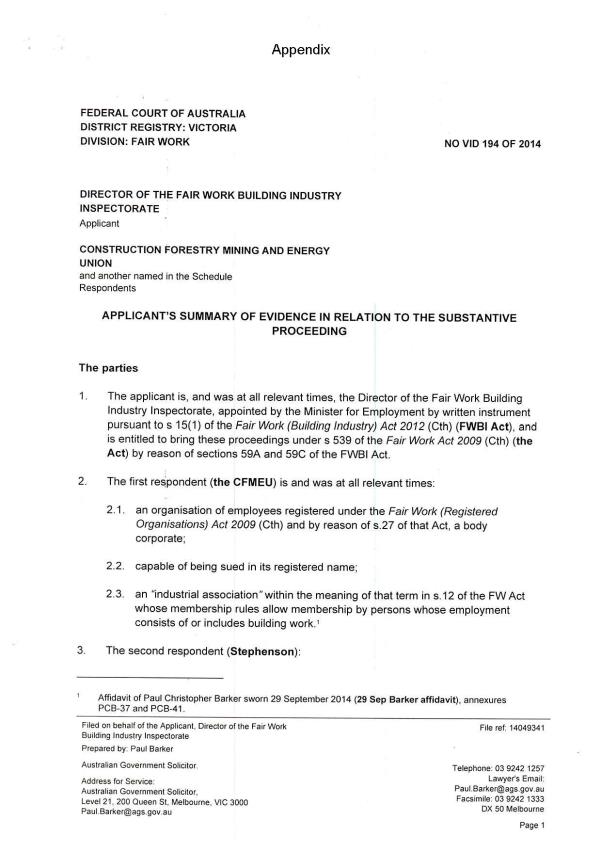
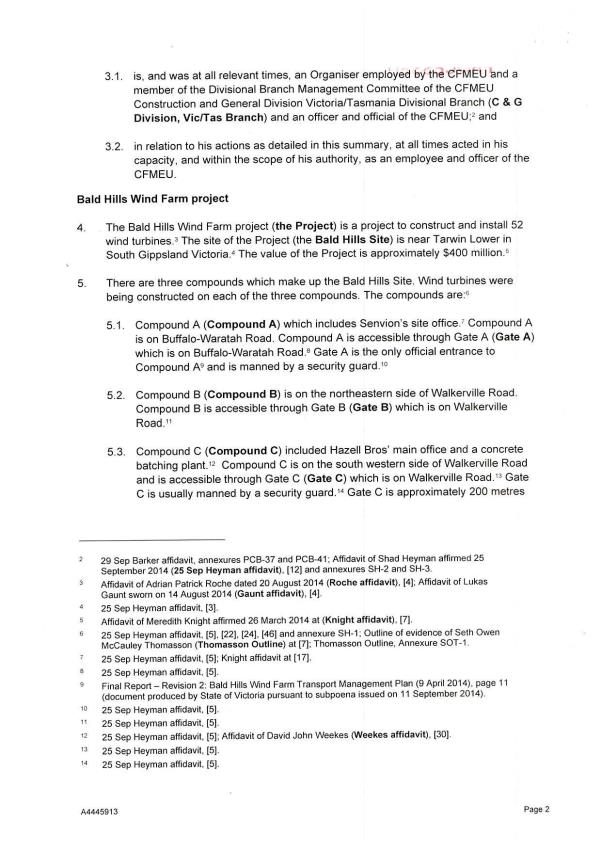
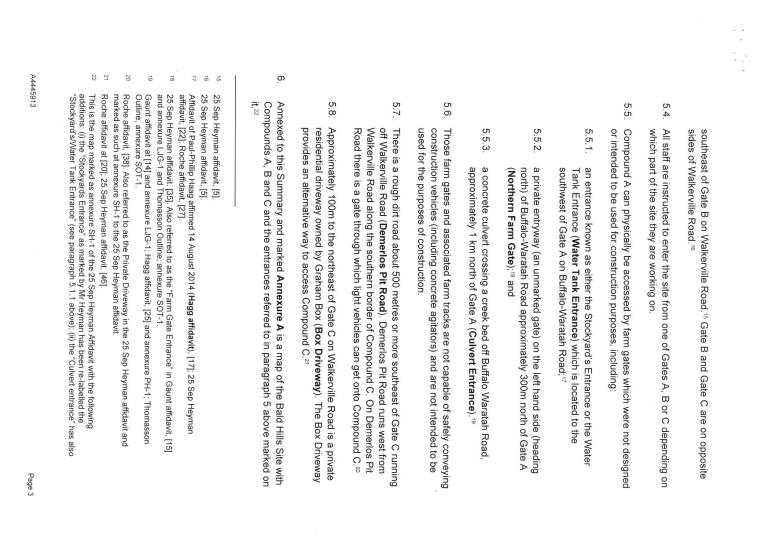
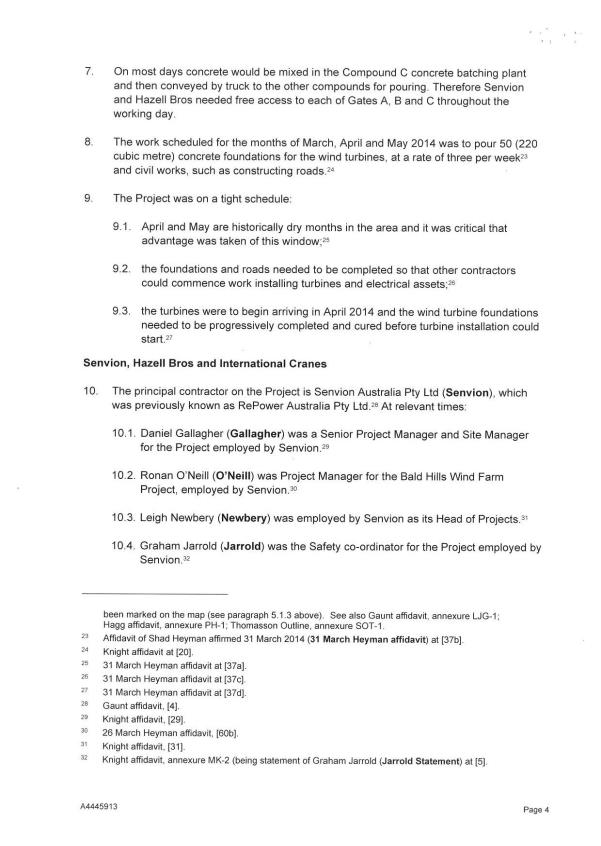
35 The following account is based on the Director’s summary. A copy of the summary (without attachments) appears as an Appendix to these reasons.
36 In 2014 a wind farm was under construction near Tarwin Lower in Victoria. Fifty two wind turbines were to be erected in the course of what was known as the Bald Hills Wind Farm Project (“the Project”). The value of the Project was estimated at about $400 million.
37 The principal contractor on the Project was Senvion Australia Pty Ltd (“Senvion”). Senvion engaged Hazell Bros Group Pty Ltd (“Hazell Bros”) as a sub-contractor to construct the civil component of the turbines. That work involved the construction of the foundation of the towers and of access tracks between the towers. In turn, Hazell Bros sub-contracted International Cranes Pty Ltd (“International Cranes”) to perform the cranage work on the site.
38 Hazell Bros had commenced work on the Project in September 2013. During the latter part of that year representatives of the company had had a series of meetings with officers of the CFMEU with a view to negotiating an enterprise agreement. Those negotiations proved unproductive. Hazell Bros decided to terminate its dealings with the CFMEU and to open negotiations with the Australian Workers’ Union (“the AWU”).
39 In December 2013 Mr Ralph Edwards, the President of the Branch, contacted Hazell Bros’ general manager of construction and intimated that he wished to have a further opportunity of negotiating an enterprise agreement with the company. A meeting was arranged for 19 December 2013. The meeting was attended by Messrs Edwards and Stephenson from the CFMEU, Mr Mark Latham, Hazell Bros’ Regional Manager, and Mr Andrew Kaddis, Hazell Bros’ Operations Manager. Discussions between those present failed to resolve the issues in dispute and the parties were unable to agree on the terms of a mutually acceptable agreement. Once this became apparent Mr Latham asked what the ramifications would be if Hazell Bros did not enter into an enterprise agreement with the CFMEU. Mr Edwards answered that the CFMEU was going to “fuck you over”. Mr Latham advised Messrs Edwards and Stephenson that Hazell Bros would consider its position but advised the CFMEU representatives that the company was on the verge of signing an enterprise agreement with the AWU.
40 The CFMEU did not contest the Director’s contention that the “fuck you over” statement was a threat to Hazell Bros made by one of its officers because Hazell Bros proposed to enter into an enterprise agreement with the AWU rather than with the CFMEU and that, as a result, the CFMEU had contravened s 340(1)(a)(iii) of the Act.
41 Shortly after the meeting the CFMEU sent Hazell Bros a proposed enterprise agreement. This agreement was not acceptable to the company.
42 Hazell Bros resumed its negotiations with the AWU in January 2014 and an agreement was reached on 17 January 2014.
43 On 20 January 2014 Mr Latham told Mr Stephenson that Hazell Bros would not be entering into an enterprise agreement with the CFMEU. Mr Stephenson responded that he felt like he had been “shat on personally”. Mr Latham responded that the company had made a business decision. Mr Stephenson said that he would give Hazell Bros a few weeks to change its mind and if that didn’t happen it was “going to get ugly”.
44 The CFMEU did not seek to contest the Director’s contention that the “going to get ugly” statement constituted a threat, made by one of its officials, to undertake action to disrupt Hazell Bros’ work on the Project because the company was not prepared to enter into an enterprise agreement with the CFMEU and that the CFMEU thereby contravened s 340(1)(a)(iii) of the Act.
45 The enterprise agreement between Hazell Bros and the CFMEU was approved by the Commission on 30 January 2014 and it commenced operation on 6 February 2014.
46 The Project site was divided into three compounds. Compound A was separated from the other two. Compounds B and C had a common border. The closest point of Compound A to Compound B was about 700 metres distant. The closest points of Compound A and Compound C were about 2.5 kilometres apart. Each compound had a main entrance. They are identified as Gates A, B and C. Access to the compounds could also be obtained, in each case, by tracks and smaller gates.
47 On 7 February 2014 Mr Stephenson, who was accompanied by some other CFMEU officials, entered Compound A and left copies of a pamphlet in the crib room in that compound. The pamphlet attacked the agreement between Hazell Bros and the AWU and stated that the CFMEU would not let up until the company and the AWU acknowledged the CFMEU’s right of coverage for construction workers. Whilst there Mr Stephenson told Mr Graham Jarrold, Safety Coordinator, Senvion, that he and other officials proposed to go “down to the South” (a reference to Compounds B and C). Mr Jarrold told Mr Stephenson that they should not do so without right of entry documents and advised them that, even if they had the correct documents, they were still required to comply with health and safety requirements on site. One of the CFMEU officials accompanying Mr Stephenson replied with words to the effect that “we don’t have to comply with the Act. We don’t give notice, we don’t have to give notice.”
48 On 11 February 2014, early in the morning, Mr Stephenson entered Compound A in company with another CFMEU official. Both officials handed notices of suspected contraventions to managers on the site. The notices were purportedly issued under the Occupational Health and Safety Act 2004 (Vic).
49 At this time Mr Stephenson was not the holder of an entry permit issued under s 512 of the Act. Mr Seth Thomasson, industrial relations consultant engaged by Senvion, who was present at the time, knew that Mr Stephenson did not hold such a permit and advised Mr Stephenson that he would not be permitted to enter the compound because he did not hold such a permit. Despite being so advised Mr Stephenson entered the site. He there spoke to a crane operator for about a quarter of an hour. Mr Stephenson did not contest the Director’s allegation that, in so acting, he contravened s 494 of the Act.
50 On 18 February 2014 CFMEU officials parked a number of vehicles, owned by the CFMEU, across Gate A. They prevented access to Compound A through that gate. A number of people congregated near Gate A. Among them were Mr Stephenson, other CFMEU officials and a man wearing CFMEU-branded clothing.
51 Workers who arrived to start work were prevented from entering Compound A.
52 Between 8:00 and 9:00 am some police officers attended and had discussions with CFMEU officials. Following those discussions vehicles blocking access to Gate A were removed. The workers were then able to enter the site.
53 The CFMEU did not contest the Director’s contention that the blockading of Compound A on this day constituted adverse action against Hazell Bros because it had entered into an enterprise agreement with the AWU and that the CFMEU had thereby contravened s 340(1)(a)(iii) of the Act.
54 On 13 March 2014 certain events occurred on the Project site which were to give rise to further disputation between the parties. On that day a Mr Josip Stavlic was purportedly elected as a CFMEU health and safety representative on the Project. Mr Stavlic was a casual employee of International Cranes. On the following day the CFMEU made a complaint to WorkSafe Victoria that Mr Stavlic had been assaulted on the site. The CFMEU asked WorkSafe to investigate the matter. WorkSafe commenced an investigation. So too did Senvion. The WorkSafe investigation was concerned with both the alleged assault and the efficacy of the election for health and safety representatives.
55 International Cranes stood Mr Stavlic down pending the outcome of the investigations.
56 On 17 March 2014 a meeting took place which was attended by representatives of Senvion, International Cranes, the CFMEU and Mr Stavlic. In the course of the meeting the CFMEU representatives (including Mr Stephenson) demanded that Mr Stavlic be reinstated by 24 March 2014 but the company representatives said that they would not make a decision about reinstatement until the outcome of the WorkSafe investigation was known.
57 On 18 March 2014 a further meeting took place which was attended by representatives of International Cranes and the CFMEU. One of the International Cranes’ managers who was present, Mr Adam Leggett, advised the CFMEU representatives that Senvion had a policy under which Mr Stavlic could not be on the site until the WorkSafe investigation had cleared him. The CFMEU’s representatives (including Mr Stephenson) contended that Mr Stavlic should be on site. At about this time one of the CFMEU’s representatives at the meeting, Mr Rob Graauwmans, Branch Council Member Geelong Zone, told an International Cranes manager that, unless Mr Stavlic was reinstated by 24 March 2014, the CFMEU’s organisers had been told to shut down International Cranes.
58 At 5:15 am on 20 March 2014 Mr Leggett arrived at Gate A. Three or four vehicles were parked across the gateway blocking access to the compound. There were about 15 to 20 people gathered around the gate. They were wearing CFMEU branded clothing. One of them was Mr Stephenson. He approached Mr Leggett. He told Mr Leggett that the CFMEU wanted a meeting with Senvion and that it expected that employees of International Cranes would not walk through the picket line to work on the Project on that day.
59 At some time before 6:45 am two vehicles (including one registered to the CFMEU) drove on to Compound A and blocked a gravel road inside Gate A. Thereafter about six men wearing CFMEU branded clothing gathered around these two vehicles. Later Mr Stephenson and two other CFMEU officials walked past the two vehicles and ventured further into Compound A.
60 There was an amenities area inside Compound A. Between 7:00 am and 7:30 am a person wearing CFMEU branded attire approached the amenities area and spoke to some workers gathered in the vicinity. Using a megaphone, he told them that the CFMEU officials were there to improve conditions and that it was unacceptable that Mr Stavlic was not permitted to resume work. The speaker concluded: “We’re here today. We’ll be back tomorrow and we’ll be back every other day.”
61 Police arrived at Gate A at about 9:30 am. One officer spoke to Mr Stephenson. Mr Stephenson told the officer that the CFMEU wanted Mr Stavlic to resume work on the site and that the picketers were not letting any vehicles in or out of Gate A. The gate remained blocked by four or five vehicles.
62 The blockade remained in place until about 2:30 pm. At this time the vehicles were moved and Mr Stephenson advised a police officer that the picketers were done for the day.
63 As a result of the blockade no deliveries were made to Compound A on the day. Some 14 to 18 truckloads of gravel could not be delivered. None of the six International Cranes workers who had attended for work that morning were able to perform any work during the day. The blockade delayed Hazell Bros employees and sub-contractors from commencing work and some of that company’s workforce was prevented from performing any work at all because they could not get their cars and tools into the compound.
64 The CFMEU did not contest the Director’s contention that the conduct outlined above at paragraphs [58]-[62] was taken by it against Senvion and International Cranes with the intent to coerce one of those companies to employ Mr Stavlic and that the CFMEU thereby contravened s 355(a) of the Act.
65 On 21 March 2014 a concrete pour was scheduled on Compound A. The concrete was to be delivered by truck from a batching plant on Compound C. Until about 11:00 am concrete was delivered in accordance with these arrangements. At about this time a number of vehicles, registered to the CFMEU, were parked across Gate C. This prevented other vehicles entering or leaving Compound C through this entrance. A number of CFMEU officials were present, including Mr Stephenson. Mr Stavlic was observed carrying a red CFMEU flag. The blockade continued until shortly after 2:30 pm. During this time a fuel tanker was prevented from entering Compound C and some concrete trucks were prevented from leaving Compound C.
66 Shortly after the blockade commenced some Fair Work Building Industry inspectors attended at Gate C. Mr Stephenson approached them and told them to “fuck off”.
67 In an effort to circumvent the blockade some concrete trucks left the compound using one of the subsidiary roads known as the Box Driveway. When this became known to some of the CFMEU personnel at Gate C one of the CFMEU vehicles was moved from there to a position blocking the entrance to the Box Driveway. The vehicle was parked on private property. A second vehicle, also registered to the CFMEU, arrived shortly afterwards and was also parked in the driveway.
68 At about noon Mr Stephenson told a police officer at the Box Driveway that he [Mr Stephenson] had men at Gate C as well as the Box Driveway and that vehicles were not being allowed in or out of Gate C or the Box Driveway because of the assault on Mr Stavlic and other (unidentified) issues. Following these discussions the CFMEU vehicles, which had been blocking the entrance to the driveway, were moved so that they were no longer impeding traffic movement.
69 During the early afternoon two large gravel trucks were prevented from entering Gate C.
70 At about 1:30 pm some of the vehicles which had been obstructing Gate C were moved to Gate A. The vehicles and some CFMEU officials prevented vehicles entering or leaving through Gate A for about an hour.
71 The CFMEU did not contest the Director’s contention that the conduct which has been summarised above at [65]-[70] was action taken by it against Senvion and International Cranes with the intention to coerce the companies to employ Mr Stavlic and that the CFMEU thereby contravened s 355(a) of the Act.
72 At a meeting on 25 March 2014 between representatives of Senvion and the CFMEU the parties reiterated their positions relating to the employment of Mr Stavlic on the Project. The CFMEU demanded his immediate engagement and the company representatives continued to maintain that a decision should await the outcome of the WorkSafe investigation.
73 On the same day WorkSafe advised International Cranes that the purported election of Mr Stavlic as the site health and safety representative was “null and void”. Later in the day International Cranes told Mr Stavlic by email that his services and his attendance at the Project site were not required.
74 On 26 March 2014 further concrete pours and associated works were scheduled.
75 By 4:45 am that morning the CFMEU had caused about six or seven vehicles to be placed across Gate A, three vehicles and a trailer to be placed across Gate B and two other vehicles to be placed across one of the alternative entrances. Most of these vehicles were registered to the CFMEU. They prevented access to and egress from the two compounds through Gates A and B and the other entrance until about 12:30 pm. A number of CFMEU officials, including Mr Stephenson, were present at Gate A.
76 In the course of the morning a CFMEU official (Mr Beattie) told a Senvion representative that: “We will be here every day until we get what we want. We like it down here.”
77 As a result of these blockades Hazell Bros directed its employees, who numbered about 130, not to attend the Project site. They performed no work on the site on that day.
78 The CFMEU did not contest the Director’s contention that it took the action described above at [75]-[76] against Senvion and International Cranes with the intention of coercing the companies to employ Mr Stavlic and that it thereby contravened s 355(a) of the Act.
79 On 27 March 2014 Mr Daniel Gallagher, a Senior Project Manager and Site Manager for the Project employed by Senvion asked Mr Stephenson, in the course of a telephone conversation, whether the CFMEU was proposing to attend the Project site the following day. Mr Stephenson answered: “I will see you soon”.
80 The CFMEU did not contest the Director’s contention that, in so responding, the CFMEU, acting through Mr Stephenson, had threatened to take action against Senvion and International Cranes with the intention of coercing the companies to employ Mr Stavlic and that it thereby contravened s 355(a) of the Act.
81 On 15 april 2014 CFMEU officials arranged and implemented a further blockade of the Project site. I outlined the relevant events in the contempt decision at [32]-[39]. A more detailed account of these events appears in the Appendix to the contempt decision at [20] - [64]. I found that this conduct constituted a civil contempt of court because it occurred despite undertakings, earlier given to the Court, not to engage in such conduct.
82 The CFMEU did not contest the Director’s contention that the conduct of its officials on this day was taken against Senvion and International Cranes with the intention of coercing the companies to employ Mr Stavlic and that it thereby contravened s 355(a) of the Act.
83 Mr Stephenson did not contest the Director’s contention that his actions, recorded above at [56], [58], [59], [61], [65], [66], [68], [75], [79] and [81], constituted action against Senvion and International Cranes with the intention of coercing the companies to employ Mr Stavlic and that he thereby contravened s 355(a) of the Act.
RELIEF
84 As already noted the Director sought various forms of relief. He sought declarations that the respondents had contravened a number of the provisions of the Act, injunctions and the imposition of pecuniary penalties.
85 The respondents did not oppose the making of declarations or the granting of injunctions. It was left to the Court to determine appropriate pecuniary penalties for the various contraventions.
FIXING PECUNIARY PENALTIES
86 I have recently had occasion to review the principles which are applied by the Court when fixing pecuniary penalties: see Director of the Fair Work Building Industry Inspectorate v Construction, Forestry, Mining and Energy Union [2015] FCA 353 at [65]-[73]. What follows is a restatement of those principles together with some additional observations which have application in the circumstances of the present proceeding.
87 The principles which guide the determination of appropriate pecuniary penalties in cases such as the present are now well settled: see Director of the Fair Work Building Industry Inspectorate v Cartledge [2014] FCA 1047 at [50] (Mansfield J).
88 The task of the Court is to ensure that any penalty which is imposed is proportionate to the gravity of the contravening conduct: Australian Building and Construction Commissioner v Construction, Forestry, Mining and Energy Union (No 2) (2010) 199 IR 373 at 376 (Barker J).
89 The penalty is to be determined by a process of “instinctive synthesis”: Australian Ophthalmic Supplies Pty Ltd v McAlary-Smith (2008) 165 FCR 560 at 567-8 (Gray J), 572 (Graham J). This process involves the Court having regard to all relevant factors before fixing a penalty which brings them all into account.
90 In Kelly v Fitzpatrick (2007) 166 IR 14 at 18-19 I identified a number of potentially relevant and applicable considerations which may be taken into account when the Court is deciding on appropriate penalties for contraventions of the Act. They include:
“● The nature and extent of the conduct which led to the breaches.
• The circumstances in which that conduct took place.
• The nature and extent of any loss or damage sustained as a result of the breaches.
• Whether there had been similar previous conduct by the respondent.
• Whether the breaches were properly distinct or arose out of the one course of conduct.
• The size of the business enterprise involved.
• Whether or not the breaches were deliberate.
• Whether senior management was involved in the breaches.
• Whether the party committing the breach had exhibited contrition.
• Whether the party committing the breach had taken corrective action.
• Whether the party committing the breach had cooperated with the enforcement authorities.
…
• The need for specific and general deterrence.”
91 Each of these considerations has the potential to have both an ameliorative and aggravating impact in the course of the instinctive synthesis process. Depending on the circumstances of a given case a particular factor may have no application or carry little or no weight.
92 As Buchanan J cautioned in Australian Ophthalmic Supplies at 580, lists of this kind are not to be applied rigidly or allowed to subvert the overarching purpose of the penalty fixing process.
93 The Director’s contentions referred to many of these considerations and the respondents dealt with most of them in their submissions.
94 Where, as in the present proceeding, multiple contraventions arise from a series of related events which constitute a course of conduct principles of proportionality and consistency come into play in determining the appropriateness of the penalty: Australian Ophthalmic Supplies at 572.
95 The ultimate penalty “must be proportionate to the offence and in accordance with the prevailing standards of punishment”: Ponzio v B & P Caelli Constructions Pty Ltd (2007) 158 FCR 543 at 559 (Lander J); Australian Ophthalmic Supplies at 572.
96 Consistency requires that “[l]ike cases should be treated in like manner”: Wong v The Queen (2001) 207 CLR 584 at 591 (Gleeson CJ). The consistency principle does not require a detailed factual comparison between past cases and that presently under consideration with a view to fixing a higher or lower penalty depending on the outcome of the comparative analysis: Plancor Pty Ltd v Liquor, Hospitality and Miscellaneous Union (2008) 171 FCR 357 at 376 (Branson and Lander JJ).
97 It is also necessary to ensure that a respondent is not punished twice for the same conduct. The principle was explained by the Full Court in Construction, Forestry, Mining and Energy Union v Cahill (2010) 269 ALR 1 at 12 as follows:
“It [the ‘course of conduct’ principle] is a concept which arises in the criminal context generally and one which may be relevant to the proper exercise of the sentencing discretion. The principle recognises that where there is an inter-relationship between the legal and factual elements of two or more offences for which an offender has been charged, care must be taken to ensure that the offender is not punished twice for what is essentially the same criminality. That requires careful identification of what is ‘the same criminality’ and that is necessarily a factually specific enquiry. Bare identity of motive for commission of separate offences will seldom suffice to establish the same criminality in separate and distinct offending acts or omissions.”
98 This principle is to be applied separately from and anterior to the final check constituted by the application of the totality principle: Mornington Inn Pty Ltd v Jordan (2008) 168 FCR 383 at 396-7 (Stone and Buchanan JJ). It does not necessarily require the application of a single penalty for all of the contravening conduct: Cahill at 13.
99 A penalty for contraventions of Part 3-1 of the Act must be fixed at a level that is sufficiently high to deter repetition by a contravener and by others who might be tempted to follow suit: cf DP World Sydney Limited v Maritime Union of Australia (No 2) [2014] FCA 596 at [18]; Ponzio v B & P Caelli Constructions Pty Ltd (2007) 158 FCR 543 at 559-560 (Lander J). In Grocon Constructors (Victoria) Pty Ltd v Construction, Forestry, Mining and Energy Union (No 2) (2014) 241 IR 288 at 357 Cavanough J observed that: “… few things could be more destructive to the authority of the Court and to the rule of law than the idea that fines or similar punishment are akin to a tax that, once budgeted for, enable the use of unlawful conduct to achieve industrial outcomes.” Put another way (as has been done in the context of contraventions of consumer law) a penalty “must be fixed with a view to ensuring that the penalty is not such as to be regarded by [the] offender or others as an acceptable cost of doing business.”: see Singtel Optus Pty Ltd v Australian Competition and Consumer Commission (2012) 287 ALR 249 at 265.
100 The totality principle falls for consideration at the end of the process. It requires the Court to stand back and decide whether the aggregate of multiple penalties fixed by it is appropriate for the total contravening conduct involved: see Australian Competition and Consumer Commission v Australian Safeway Stores Pty Ltd (1997) 145 ALR 36 at 53 (Goldberg J). The principle is designed to “ensure that the aggregate of penalties imputed is not such as to be oppressive or crushing”: Stuart-Mahoney v Construction, Forestry, Mining and Energy Union (2008) 177 IR 61 at 73 (Tracey J). A consequence of the application of the principle is that the aggregate penalty may be reduced if it is considered to be too great.
PENALTIES – CFMEU
101 The conduct which gave rise to the various contraventions on the part of the CFMEU has been outlined in the course of explaining the events which transpired at the Project site and elsewhere between December 2013 and April 2014. During the early part of this period (December 2013 – February 2014) the CFMEU sought to force Hazell Bros to enter into a workplace agreement with it in preference to the AWU. In the latter part of the period (March – April 2014) the CFMEU contravened the Act in an attempt to force one of the companies working on the Project to employ Mr Stavlic. In each case the CFMEU’s misconduct occurred on separate days. In some instances it involved threats. In others it involved blockades of entrances to the compounds. On some days more entrances were blocked than on others. The length of time during which workers and vehicles were prevented from entering and leaving the compounds on particular days varied. So too did the impact of the misconduct: on some days many workers were prevented from performing any gainful work; on others the affect was less serious in respect of both work time lost and the losses sustained by the contractors.
102 In a broad and general sense two “courses of conduct” might be identified. In the first period the CFMEU was attempting to force Hazell Bros to enter into an enterprise agreement with it and the impugned conduct was directed to this end. In the second period the CFMEU was concerned to secure employment for Mr Stavlic by one of the contractors on site. The means adopted by the CFMEU did, however, vary as did the effects of its misconduct. There was a series of discrete contraventions on particular days and penalties should be imposed for each contravention subject, of course, to the tempering effect of the totality principle.
103 Underlying the various contraventions some consistent themes are apparent. In seeking to achieve its desired outcomes the CFMEU had available to it lawful processes which it could have pursued. It chose, instead, to prosecute its objectives by means which it must have known or, at least, should have known, were unlawful. Not for the first time the CFMEU sought to impose its will by means of threats and coercion against employers. Its approach was one of entitlement: it was free, despite legal constraint, to deploy its considerable resources in order to achieve its industrial objectives. The concept of the rule of law was anathema to it.
104 The Director submitted that the CFMEU had “an egregious record of repeated and wilful contraventions of the provisions of industrial legislation.” This contention was supported by a table, appended to the Director’s submissions. The table contained a list of some 87 cases, involving contraventions of industrial legislation by the CFMEU, since 1999. In most of these cases the CFMEU was found to have sought, by means of threats, coercion or unlawful industrial action, to achieve industrial outcomes. Most of the cases involved multiple contraventions.
105 The Director also provided a collection of judicial observations derived from some of these cases in which members of this Court and the Federal Circuit Court (and the Federal Magistrates Court as it was then) had noted the CFMEU’s propensity to deliberately flout industrial legislation. The most recent of these observations was that of White J in Director of the Fair Work Building Industry Inspectorate v Stephenson [2014] FCA 1432 at [76] and [77] in which his Honour referred to the CFMEU’s record as being “dismal” and indicating “an attitude of indifference … to compliance with the requirements of the legislation …”.
106 The circumstances of these cases were not identical to those in the present case. They, nonetheless, bespeak a deplorable attitude, on the part of the CFMEU, to its legal obligations and the statutory processes which govern relations between unions and employers in this country. This ongoing willingness to engage in contravening conduct must weigh heavily when the need for both specific and general deterrence is brought to account.
107 The CFMEU is not to be punished again for its earlier misconduct. It is, however, to be punished more severely than it would have been had it had no adverse record or been responsible for only a few isolated incidents over a period of many years. Its continued willingness to engage in contravening conduct supports the view that earlier penalties, some of them severe, have not had a deterrent effect: cf Veen v R (No 2) (1988) 164 CLR 465 at 477-8.
108 The conduct which gave rise to many of the contraventions involved the placing of vehicles and other obstacles across entrances to the site. Typically, these blockades commenced early in the morning before workers were due to enter the site. These were not spontaneous actions. They required preparation and planning. CFMEU officials had to travel some 175 kilometres from Melbourne to the site. They brought with them a considerable number of CFMEU vehicles, food, flags and other paraphernalia which they deployed at site entrances. Once there officials arrogated to themselves the right to determine which workers and vehicles would be permitted to enter and leave the compounds.
109 I accept the CFMEU’s submission that no violence or criminal property damage occurred in the course of the blockades. There was occasional abuse and foul language but the evidence does not suggest that these were common occurrences during the blockades.
110 The CFMEU did not seek to submit that it lacked the capacity to pay any penalties which the Court might be minded to impose.
111 The CFMEU is to be given some credit for not contesting the Director’s factual allegations. The evidence which was relied on at the hearing was, however, strongly supportive of the Director’s case.
112 Neither of the respondents expressed any contrition for its or his misconduct or proffered any assurances that practices and procedures would be revised to ensure that such misconduct was not repeated.
113 Having regard to the applicable principles and to the general considerations to which I have just referred, I turn now to the specific contraventions of the Act by the CFMEU which were pressed by the Director. In doing so I will not repeat all of what has already been said about the contravening conduct and its effects. The details of that conduct have already been summarised in these reasons and appear in greater detail in the Appendix.
19 December 2013 – Mr Edwards’ Threat
114 This threat, made by the Branch President, Mr Edwards, was made at a time when the CFMEU was seeking to force Hazell Bros to enter into an enterprise agreement with it. Mr Edwards used language which clearly conveyed the threat that, if Hazell Bros did not comply with the CFMEU’s demand, it would (as eventuated) be subject to unlawful industrial action. Mr Edwards thereby sought to induce the company, against its will, to sign an agreement. As a senior union officer Mr Edwards must have been aware that the making of threats in such circumstances was unlawful.
115 A penalty of $7,500 should be imposed for this contravention of s 340(1)(a)(iii) of the Act.
20 January 2014 – Mr Stephenson’s Threat
116 This threat, made by another Branch official, was made in less colourful language than that utilised by Mr Edwards the previous month but was no less ominous. It was made after Hazell Bros had confirmed that it would not be entering into an enterprise agreement with the CFMEU. It presaged the taking of industrial action against the company in the event that it did not change its decision.
117 A penalty of $7,500 should be imposed for this contravention of s 340(1)(a)(iii) of the Act.
18 February 2014 – Blockade of Gate A
118 This blockade of Gate A persisted for about three hours at the beginning of the working day. It prevented Hazell Bros’ workers from entering Compound A. As a result productive work was delayed.
119 A penalty of $15,000 should be imposed for this contravention of s 340(1)(a)(ii) of the Act.
20 March 2014 – Blockade of Gate A
120 This blockade continued for over nine hours. It involved both the obstruction of Gate A and a gravel road inside the compound. Both vehicles and workers were prevented from entering the compound.
121 Mr Stephenson, who was acting as spokesman for the CFMEU on this occasion, told employees of International Cranes that they were not to cross the picket line. They did not do so and did not perform any work on that day. Hazell Bros’ workers were delayed in entering the site and some were prevented from undertaking any productive work that day.
122 One of the CFMEU representatives present threatened further picketing when he announced that: “We’re here today, we’ll be back tomorrow and we’ll be back every other day.”
123 Delivery of a substantial amount of gravel to the compound was prevented.
124 A penalty of $25,000 should be imposed for this contravention of s 355(a) of the Act.
21 March 2014 – Blockades of Compounds A and C
125 On this day Gate C was blockaded for about three and a half hours and an alternative access point was also obstructed but for a shorter period. Access to Gate A was impeded for about an hour.
126 As a result concrete, which was to be poured on Compound A, could not be transported from the batching plant in Compound C. Deliveries of gravel and fuel to Compound C were also prevented.
127 Mr Stephenson chose to make dismissive and uncouth remarks to Fair Work Building Industry inspectors who were observing events. His comments evidenced an adverse attitude to any intervention by those exercising compliance responsibilities under the Act.
128 A penalty of $20,000 should be imposed for this contravention of s 355(a) of the Act.
26 March 2014 – Blockades of Compounds A and B
129 These blockades continued for almost eight hours. As a result some 130 employees of Hazell Bros were unable to attend and work on the site.
130 A CFMEU official threatened a continuation of such conduct when he advised a Senvion representative that: “We will be here every day until we get what we want.” This is but one of many examples of the CFMEU’s sense of entitlement to pursue its objectives by any means, lawfully or unlawfully.
131 A penalty of $20,000 should be imposed for this contravention of s 355(a) of the Act.
27 March 2014 – Mr Stephenson’s Further Threat
132 When asked by a representative of Senvion whether the CFMEU was proposing to return to the site on the following day Mr Stephenson responded: “I will see you soon”. This response was understood, in context, to be a threat of further industrial action designed to disrupt work at the site.
133 A penalty of $7,500 should be imposed for this contravention of s 355(a) of the Act.
15 April 2014 – Blockades of Compounds A, B and C
134 These blockades were the most serious undertaken by the CFMEU at the site. They occurred simultaneously at the principal gates of the three compounds and at a number of the alternative entrance points. The blockades of the principal gates commenced, in each case, prior to 6:00 am and continued until about 2:00 pm. The blockades of the subsidiary entrances each continued for shorter but substantial periods.
135 As a result of the blockades only about 30 to 40 percent of the workforce engaged on Compound A was able to enter the site. Fifteen quarry trucks carrying about 600 tonnes of bluestone and other aggregate were unable to enter that compound. The material which they were carrying had to be dumped in a turnout bay about four kilometres away. Once the blockade had been lifted Hazell Bros’ workers had to reload the material onto trucks using a front-end loader. This work was not completed until 17 April 2014. Other trucks delivering gravel to Compound A arrived during the morning and could not enter the compound until the blockade had been lifted.
136 In the course of the day CFMEU officials treated Fair Work Building Industry inspectors with disdain. At about noon Mr Derek Christopher, Branch Vice-President, was near one of the subsidiary entrances. He saw two inspectors driving past and made a crude gesture towards them. Not long afterwards Mr Drew McDonald, Branch Council Member Melbourne Metropolitan Zone, saw the same inspectors driving past another entrance. When he saw them he grabbed his crotch and mouthed the words “fuck off” to them.
137 These blockades occurred because the CFMEU wanted to have Mr Stavlic re-employed by one of the contractors on the site. It organised these blockades despite being well aware that WorkSafe had ruled, following an inquiry, that Mr Stavlic’s purported election as the site health and safety representative was null and void.
138 The blockades were enforced despite undertakings to the Court that such conduct would not occur. The breaches of these undertakings gave rise to charges of contempt of court which I dealt with in the contempt decision. A fine of $100,000 was imposed on the CFMEU for this contempt.
139 In Director of the Fair Work Building Industry Inspectorate v Construction, Forestry, Mining and Energy Union [2015] FCA 47 Mortimer J dealt with another case in which there had been contemporaneous contempt of court proceedings and civil penalty proceedings for coercion in contravention of Part 3-1 of the Act arising from the same industrial action. Her Honour held that, were the CFMEU to be convicted of the contempt charges and found to have contravened provisions of Part 3-1, “in no sense would the CFMEU be punished twice for the same conduct … It would be punished for deliberate defiance of the court order on the one hand, and for coercion … on the other”: at [79].
140 The Director conceded that, despite her Honour’s observations, he accepted that the principle which precludes double punishment for the same conduct would mitigate any pecuniary penalty to the extent that the “inherent unlawfulness” of the CFMEU’s conduct was a sentencing factor common to both proceedings. Had I not been precluded, by operation of s 552 of the Act, from imposing a pecuniary penalty on the CFMEU for its conduct on this day I would have been minded to act on this concession without deciding whether or not it was correctly made.
141 Had it been open to me I would have imposed a penalty of $30,000 for this contravention of s 355(a) of the Act. an appropriate declaration will be made.
The Totality Principle
142 Having fixed the various penalties I have taken account of the aggregate sums in respect of the contraventions relating to the enterprise agreement and those relating to the employment of Mr Stavlic, and considered whether any discount was necessary to ensure that the aggregate sums constituted appropriate punishment for the whole of the contravening conduct in each case. I have concluded that they are proportionate to the gravity of the CFMEU’s offending when viewed as a whole. No adjustment is required.
PENALTIES – MR STEPHENSON
143 Mr Stephenson has not sought to challenge the Director’s allegations that he had contravened s 355(a) of the Act on various dates and s 494(1) on 11 February 2014.
144 The Director advised the Court of four cases between 2010 and 2013 in which Mr Stephenson had engaged in conduct which contravened ss 38, 43 and 44 of the Building and Construction Industry Improvement Act 2005 (Cth) (“the BCII Act”). Most of these cases involved blockades of entrances to work sites with a view to coercing employers to engage particular employees on their projects. Two of these cases involved multiple contraventions. Penalties totalling $110,000 had been imposed by this Court and the Federal Magistrates Court for this misconduct. These penalties must be viewed in the context of the BCII Act, which contained higher maximum penalties than are available under the Act.
145 Mr Stephenson has not apologised or otherwise demonstrated contrition for his present misconduct. Nor has he provided any assurance that he will not engage in contravening conduct in future.
146 Deterrence, both specific and general, therefore, weigh heavily in fixing appropriate penalties for Mr Stephenson.
147 Mr Stephenson was the principal actor in many of the events which occurred at the Project site. The general considerations to which I have referred in dealing with the CFMEU also apply to Mr Stephenson. Again, I do not pause to repeat the details of his misconduct which appear earlier in these reasons and in the Appendix.
Coercion – Mr Stephenson
148 The Director proceeded on what he described as a “rolled-up charge” which reflected Mr Stephenson’s participation in multiple actions which occurred on the site and elsewhere. These were identified as:
demanding, on 17 March 2014, that Mr Stavlic be reinstated by 24 March 2014;
participating in blockading Gate A on 20 March 2014;
participating in blockading Gate C on 21 March 2014;
organising the placing of vehicles at Gate C and one of the subsidiary entrances to Compound C on 21 March 2014;
participating in blockading Gate A on 26 March 2014;
making the threat to Mr Gallagher of Senvion on 27 March 2014; and
organising and participating in the blockading of the three gates and one of the subsidiary entrances on 15 April 2014.
These actions were each taken with the intention of coercing Senvion or International Cranes to employ Mr Stavlic in contravention of s 355(a) of the Act.
149 Mr Stephenson’s misconduct varied in its severity. Looked at overall it reflects a determination on his part, acting as an official of the CFMEU, to secure employment for Mr Stavlic regardless of whether or not Mr Stavlic had properly been appointed as a site shop steward. As an experienced official of the CFMEU he would have been well aware that the conduct in which he engaged, and, in particular, his organisation of and his participation in the blockades, was unlawful. He may also reasonably be assumed to have been aware that alternative, lawful, options were open to secure Mr Stavlic’s reengagement were this justified on the merits. There is nothing in the evidence to suggest that he ever countenanced adopting a lawful course of action.
150 A penalty of $5,000 should be imposed for this contravention of s 355(a) of the Act.
11 February – Right of Entry Contravention
151 It was not contested that Mr Stephenson did not hold a relevant permit at the time at which he entered and remained in Compound A. Section 494 of the Act proscribed entry without a permit. Mr Stephenson was warned by a representative of Senvion that he was not permitted to enter the compound. Mr Stephenson chose to ignore this admonition. He walked onto the site and remained there for about 15 minutes. This was a deliberate act and a considered contravention of the Act.
152 The permit system ensures that only appropriately qualified persons enter sites. Mr Stephenson abused his position as a CFMEU official.
153 A penalty of $2,000 should be imposed for this contravention of s 494(1) of the Act.
154 I certify that the preceding one hundred and fifty three (153) numbered paragraphs are a true copy of the Reasons for Judgment herein of the Honourable Justice Tracey. |