

FEDERAL COURT OF AUSTRALIA
Hacker v Weston [2015] FCA 363
IN THE FEDERAL COURT OF AUSTRALIA | |
SUSANNE HACKER AKA SUSANNAH HACKER, SUSIE HACKER, SUSIE SHOSHAMMA GISELA & SUSANNAH SHOSHANNA GISELLA HACKER Applicant | |
AND: | Respondent |
DATE OF ORDER: | |
WHERE MADE: |
THE COURT ORDERS THAT:
1. Any application to re-open to adduce evidence as to the value of any personal property is to be made within 14 days.
2. The parties are otherwise to bring in Short Minutes of Orders to give effect to these reasons within 14 days.
Note: Entry of orders is dealt with in Rule 39.32 of the Federal Court Rules 2011.
NEW SOUTH WALES DISTRICT REGISTRY | |
GENERAL DIVISION | NSD 368 of 2014 |
BETWEEN: | SUSANNE HACKER AKA SUSANNAH HACKER, SUSIE HACKER, SUSIE SHOSHAMMA GISELA & SUSANNAH SHOSHANNA GISELLA HACKER Applicant |
AND: | PAUL GERARD WESTON Respondent |
JUDGE: | FLICK J |
DATE: | 22 APRIL 2015 |
PLACE: | SYDNEY |
REASONS FOR JUDGMENT
1 On 5 December 2008 a sequestration order was made by the then Federal Magistrates Court of Australia against the estate of Ms Susie Hacker. Mr Paul Gerard Weston was appointed the trustee of her estate.
2 As at December 2008, Ms Hacker was the sole registered proprietor of six parcels of real property land, including:
72 Cary Street, Marrickville;
7 Harrow Road, Stanmore;
18 Upper Road, Forest Lodge;
4/26 Kings Cross Road, Potts Point;
18 Wambool Street, Narrabundah; and
55 Carr Crescent, Wanniassa.
The last two properties are in the Australian Capital Territory; the remaining properties are in New South Wales. In addition, she also held an interest as joint tenant in real property land located at:
123/6 Oxford Street, Darlinghurst, New South Wales.
Throughout 2009 these properties were sold, with the exception of the Marrickville property. All secured and unsecured creditors who had lodged proofs of debt had been paid by December 2009. Thereafter remained a surplus of monies in the estate.
3 Difficulties, however, have arisen.
4 Presently before the Court are three proceedings, namely:
an Application filed by the trustee on 6 May 2013 in which he seeks an order pursuant to s 183 of the Bankruptcy Act 1966 (Cth) (the “Bankruptcy Act”) that he be released from the trusteeship of Ms Hacker’s estate;
an Application filed by Ms Hacker on 21 June 2013 in which she seeks an order pursuant to s 153B of the Bankruptcy Act that the sequestration order be annulled; and
a Statement of Claim first filed in the Supreme Court of New South Wales and transferred to this Court in March 2014 – and later amended in July 2014 – in which a variety of relief is sought against the trustee, including damages, equitable compensation or an account or an inquiry pursuant to s 179 of the Bankruptcy Act.
5 Against the necessary backdrop of the legal principles to be applied, the resolution of the various claims made by Ms Hacker focus upon a number of factual matters. She makes a number of complaints as to the manner in which Mr Weston has administered her estate. One of those complaints is that valuable personal property has gone missing from both the Stanmore and Marrickville properties. Another complaint is that unnecessary expense has been incurred in the administration of her estate, especially from 2010 on.
6 Subject to the factual disputes being resolved, there was no real dispute between the parties that the trustee should be released from his duties as a trustee and that the sequestration order ought to be annulled.
7 Each of the legal and factual questions in issue was the subject of submissions. The legal principles need only be addressed briefly. It is concluded that:
an order should be made pursuant to s 153B of the Bankruptcy Act annulling the bankruptcy.
It is the manner in which the factual matters have been resolved which principally leads to the further conclusions that:
the trustee has failed properly to discharge both the duties imposed upon him by s 19 of the Bankruptcy Act and reg 16.03 of the Bankruptcy Regulations 1996 (Cth) (the “Bankruptcy Regulations”) and his fiduciary duty; and
the estate properly administered should have been concluded shortly after November 2010;
and that
some of the personal property has gone missing through the default of the trustee;
an order should be made that the trustee pay to Ms Hacker an amount compensating her for that loss; and
the trustee should not be entitled to any remuneration as from 1 January 2011.
It is also concluded that:
the trustee should be released from his trusteeship pursuant to s 183 of the Bankruptcy Act.
THE LEGAL PRINCIPLES – A BRIEF OVERVIEW
8 The statutory provisions of central relevance to the present proceeding are:
s 183 of the Bankruptcy Act, being that provision providing for the making of an application by the trustee to be released from the trusteeship of a bankrupt estate;
s 19 of the Bankruptcy Act and reg 16.03 of the Bankruptcy Regulations, being those provisions setting forth the duties of a trustee, those provisions not excluding the fiduciary duties owed by a trustee; and
ss 153A and 153B of the Bankruptcy Act, being those provisions relating to the annulment of a bankruptcy.
Other provisions of the Bankruptcy Act which assume some importance include ss 30 and 149.
A release from the trusteeship – s 183
9 Section 183 of the Bankruptcy Act provides as follows:
Release of registered trustee by the Court
(1) A trustee may apply to the Court for an order of release from the trusteeship of an estate.
(2) Where the Court is satisfied that the trustee:
(a) has realized all the property of the bankrupt or so much of it as can be realized without unduly protracting the trusteeship or has distributed a final dividend;
(b) has ceased to act by reason of the approval of a composition or scheme of arrangement under Division 6 of Part IV; or
(c) has resigned or has been removed from office;
the Court may make the order sought.
(3) In hearing the application, the Court must also consider any objection to the order sought that is made by the Inspector-General, the Official Receiver, a creditor or any other interested person.
(4) An order of release under this section:
(a) discharges the trustee from all liability in respect of any act done or default made by him or her in the administration of the estate of the bankrupt; and
(b) if the trustee has not already resigned or been removed from office, operates to remove him or her from office.
(5) An order of release under this section may be revoked by the Court on proof that it was obtained by fraud or by suppression or concealment of a material fact.
(6) Where a trustee has died, the person administering the estate of the trustee may apply to the Court for an order releasing the trustee's estate from any claims arising out of the trustee's administration of an estate of which he or she was trustee and, upon such an application, the Court may make such order as it thinks proper in the circumstances.
(7) This section does not apply in relation to the Official Trustee.
The liability of the trustee – statutory and equitable duties
10 A trustee has a duty to administer the estate of a bankrupt in accordance with law and to exercise such statutory powers as are conferred. In doing so, a trustee is exposed to duties imposed by both the general law and the bankruptcy legislation enacted by the Commonwealth legislature.
11 The fact that a trustee is exposed to both sources of duty cannot be questioned: Adsett v Berlouis (1992) 37 FCR 201 at 208. Northrop, Wilcox and Cooper JJ there summarised the functions of a trustee as follows:
A trustee appointed in relation to a bankrupt becomes trustee of the bankrupt's estate. The trustee is bound to administer that estate in accordance with the Bankruptcy Act and Bankruptcy Rules 1968 (Cth). The trustee has a dual function: first, to administer the estate in the interests of the creditors and the bankrupt; secondly, to exercise, as a public duty and for the public welfare, certain powers given, and duties imposed, under the Act …
Their Honours went on to describe the duties of a trustee, when discharging these functions, as follows:
A trustee in bankruptcy who acts for remuneration is under a duty of care greater than that of a gratuitous trustee … The trustee is required to bring reasonable skill to the performance of his or her duties …
A trustee under the general law must exercise judgment so as to save the estate unnecessary expenditure of money … A trustee in bankruptcy is in no different position. The discharge of a public duty imposed by the Act is to be performed conformably with the requirements of that duty, but also conformably with the trustee's obligation to administer the estate in such a manner as to maximise the return from estate assets, and thereby to maximise satisfaction of the creditors’ claims and any possible surplus for the bankrupt. We adopt, as a correct statement of the duty of a trustee and the proper manner of its performance, the words of Smithers J in Mannigel v Aitken (1983) 77 FLR 406 at 408–9:
“In the case of bankruptcy the trustee is in charge of the assets of the bankrupt and those assets are to be applied for the benefit of the creditors and if there be any surplus for the benefit of the bankrupt. It is clear that the minimum standard required of the trustee is that he shall handle the assets with a view to achieving the maximum return from the assets to satisfy the claims of the creditors and to provide the best surplus possible for the bankrupt. Obviously a great deal of discretion and judgment is required to be exercised by the trustee. It was said by Rogerson J in Re Ladyman (1981) 55 FLR 383 at 394–396 that the standard of conduct required of the trustee will ordinarily be the standard required of a professional man and perhaps higher. The learned judge referred to ‘the high standard of conduct required of trustees’.
In Re Brogden; Billing v Brogden [1888] 38 Ch D 546 Lord Justice Fry said (at 571):
‘A trustee undoubtedly has a discretion as to the mode and manner, and very often as to the time in which or at which, he shall carry his duty into effect. But his discretion is never an absolute one. It is always limited by — the dominant duty — the guiding duty of recovering, securing and duly applying the trust fund; and no trustee can claim any right of discretion which does not agree with that paramount obligation.’
Where an order is sought that the trustee be removed and to make good the losses suffered by the estate, it must be established that the trustee has been guilty of a breach of duty to act ‘diligently and prudently in regard to the business of the Trust’: See Riley J in Re Alafaci; Registrar in Bankruptcy v Hardwick (1976) 9 ALR 262 at 285.
According to Halsbury's Laws of England (3rd ed), Vol 38, p 967, a trustee must take all reasonable and proper measures to obtain possession of the trust property and to get in all debts and funds due to the trust estate, and to preserve it, and to secure it from loss. He must take reasonable precautions to see the property is not stolen or lost by default. The trustee is bound to execute the trust with fidelity and reasonable diligence and ought to conduct its affairs in the same manner as an ordinary prudent man of business would conduct his own affairs. But beyond this he is not bound to adopt further precautions. It was said by their Honours Dixon CJ, McTiernan and Windeyer JJ in Elder's Trustee and Executor Co Ltd v Commissioner of Taxation (Cth) (Higgins’ Case) (1963) 113 CLR 42 that:
‘We are not to judge what the trustee then did or failed to do by the light of later events … The duty of the trustee was to exercise due diligence, care and prudence in the conduct of the business, bearing in mind the need to preserve the capital of the Testator’s estate … The argument that the trustee having, it was said, exercised a discretion, its conduct is now unchallengeable is sufficiently answered by a passage from the judgment of Fry LJ in Re Brogden … Whether or not one calls [the trustee's action] an exercise of discretion, the question remains was it the act of a prudent trustee.’”
A trustee in bankruptcy is governed by the general law relating to trustees save where the position of the trustee is modified by the Bankruptcy Act or Rules: Re Ladyman (1981) 55 FLR 383 at 394-396 … [(1992) 37 FCR at 208 to 209]
A trustee in bankruptcy is thus subject to the duties which govern trustees generally, except to the extent that those duties have been modified by the Bankruptcy Act. See also: Citicorp Australia Ltd v Official Trustee in Bankruptcy (1996) 71 FCR 550 at 560 per Foster, von Doussa and Sundberg JJ; Mills v Sheahan [2007] SASC 365 at [16] to [17], (2007) 99 SASR 357 at 365 per Debelle J; Re Young; In the matter of Macryannis [2011] FCA 1272 at [27], (2011) 124 ALD 28 at 35 per Stone J; Ferella v Official Trustee in Bankruptcy (No 2) [2011] FCA 619 at [26] to [27] per Yates J; Dubow v Official Receiver (NSW) [2013] FCA 709 at [41] per Collier J.
12 The duties imposed upon a trustee in bankruptcy by the Commonwealth legislature may be found relevantly in s 19 of the Bankruptcy Act and reg 16.03 of the Bankruptcy Regulations.
13 Section 19 within Division 1 of Part II of the Bankruptcy Act sets forth the duties of a trustee of a bankrupt estate as follows:
Duties etc. of trustee
(1) The duties of the trustee of the estate of a bankrupt include the following:
(a) notifying the bankrupt's creditors of the bankruptcy;
(b) determining whether the estate includes property that can be realised to pay a dividend to creditors;
(c) reporting to creditors within 3 months of the date of the bankruptcy on the likelihood of creditors receiving a dividend before the end of the bankruptcy;
(d) giving information about the administration of the estate to a creditor who reasonably requests it;
(e) determining whether the bankrupt has made a transfer of property that is void against the trustee;
(f) taking appropriate steps to recover property for the benefit of the estate;
(g) taking whatever action is practicable to try to ensure that the bankrupt discharges all of the bankrupt's duties under this Act;
(h) considering whether the bankrupt has committed an offence against this Act;
(i) referring to the Inspector-General or to relevant law enforcement authorities any evidence of an offence by the bankrupt against this Act;
(j) administering the estate as efficiently as possible by avoiding unnecessary expense;
(k) exercising powers and performing functions in a commercially sound way.
(2) Where a person who became a bankrupt on a creditor's petition is unable to prepare a proper statement of affairs, the trustee may employ, at the expense of the estate, a qualified person to assist in the preparation of the statement.
These duties are not exhaustive – but “inclusive”: Tapp v LawCover Insurance Pty Ltd [2013] FCA 35 per Rares J at [15]. In the present proceeding, Ms Hacker places particular reliance on s 19(1)(f), (j) and (k).
14 Regulation 16.03 of the Bankruptcy Regulations provides as follows:
Inventory by trustee taking possession of, or attaching, property
Where, under the Act, a trustee takes possession of, or attaches, the property of a bankrupt, debtor or deceased person, the trustee must, as soon as is reasonably practicable:
(a) make, sign and date an inventory of the property; and
(b) give a copy of the inventory to any person who has custody of the property or part of the property.
15 In addition to these statutory duties, the trustee in bankruptcy is – of course – a trustee. As such he and other trustees owe a fiduciary duty to “give undivided loyalty to the persons whom they serve”: Breen v Williams (1996) 186 CLR 71 at 108. Gaudron and McHugh JJ there observed:
The law of fiduciary duty rests not so much on morality or conscience as on the acceptance of the implications of the biblical injunction that “[n]o man can serve two masters”. Duty and self-interest, like God and Mammon, make inconsistent calls on the faithful. Equity solves the problem in a practical way by insisting that fiduciaries give undivided loyalty to the persons whom they serve. In Bray v Ford (143), Lord Herschell said:
“It is an inflexible rule of a Court of Equity that a person in a fiduciary position, such as the respondent's, is not, unless otherwise expressly provided, entitled to make a profit; he is not allowed to put himself in a position where his interest and duty conflict. It does not appear to me that this rule is, as has been said, founded upon principles of morality. I regard it rather as based on the consideration that, human nature being what it is, there is danger, in such circumstances, of the person holding a fiduciary position being swayed by interest rather than by duty, and thus prejudicing those whom he was bound to protect. It has, therefore, been deemed expedient to lay down this positive rule.”
Similarly, Gummow J observed at 135 to 136:
… the discussion of the principle by Deane J in Chan v Zacharia [(1984) 154 CLR 178 at 198-199] identifies the fundamental objection by equity to the pursuit by the fiduciary of personal interest in conflict with the interests of those whom the fiduciary is bound to protect. Likewise, the fiduciary is obliged not to enter upon conflicting engagements to several parties. This is because the fiduciary (for example, a solicitor acting for vendor and purchaser) may be unable to discharge adequately the one obligation without conflicting with the requirement for observance of the other obligation.
As indicated earlier in these reasons, one answer to what otherwise would be breach of duty is the presence of informed consent. Further, a court of equity has inherent jurisdiction or power to authorise, at least in some cases, entry into transactions which otherwise would be in breach of duty.
The fiduciary will be brought to account for any benefit or gain which (1) has been obtained or received in circumstances where a conflict or significant possibility of conflict existed between the fiduciary duty and personal interest in the pursuit or possible receipt of the benefit or gain or (2) was obtained or received by use or by reason of the fiduciary position or opportunity or knowledge resulting from it. Where the breach of duty produces not a gain to the fiduciary but a loss to the party to whom the fiduciary duty was owed, then the judgments of Viscount Haldane LC in Nocton v Lord Ashburton (245) and of Sir Owen Dixon in McKenzie v McDonald (246) show that there is an obligation to account for the loss by provision of equitable compensation.
An annulment of the sequestration – ss 153A & 153B
16 Division 5 of Part VII of the Bankruptcy Act provides for the annulment of bankruptcy.
17 Section 153A provides for the annulment of bankruptcy upon the trustee being “satisfied” as to the payment of debts. That section provides as follows:
Annulment on payment of debts
(1) If the trustee is satisfied that all the bankrupt's debts have been paid in full, the bankruptcy is annulled, by force of this subsection, on the date on which the last such payment was made.
(1A) In determining whether there has been full payment of a debt that bears interest, the interest must be reckoned up to and including the date on which the debt (including interest) is paid.
(2) The trustee must, before the end of the period of 2 days beginning on that date, give to the Official Receiver a written certificate setting out the former bankrupt's name and bankruptcy number and the date of the annulment.
Penalty: 5 penalty units.
(3) Subsection (2) is an offence of strict liability.
(4) For the purposes of this section, if a debt has been proved by a creditor but the creditor cannot be found or cannot be identified, the debt may be paid to the Official Receiver and, if so paid, is taken for the purposes of this section to have been paid in full to the creditor.
(4A) Money received by the Official Receiver under subsection (4) is received on behalf of the Commonwealth.
(5) If money is paid to the Official Receiver under subsection (4), the provisions of subsections 254(3) and (4) apply in relation to that money as if it had been paid to the Commonwealth by a trustee under subsection 254(2).
(6) In this section:
bankrupt's debts means all debts that have been proved in the bankruptcy and includes interest payable on such of those debts as bear interest, and the costs, charges and expenses of the administration of the bankruptcy, including the remuneration and expenses of the trustee.
18 Section 153B provides for annulment by an order of the Court. That section provides as follows:
Annulment by Court
(1) If the Court is satisfied that a sequestration order ought not to have been made or, in the case of a debtor's petition, that the petition ought not to have been presented or ought not to have been accepted by the Official Receiver, the Court may make an order annulling the bankruptcy.
(2) In the case of a debtor's petition, the order may be made whether or not the bankrupt was insolvent when the petition was presented.
(3) The trustee must, before the end of the period of 2 days beginning on the day the trustee becomes aware of the order, give to the Official Receiver a written certificate setting out the former bankrupt's name and bankruptcy number and the date of the annulment.
Penalty: 5 penalty units.
(4) Subsection (3) is an offence of strict liability.
As the terms of s 153B make apparent, the power to make an order pursuant to s 153B involves a two stage process – first, the Court is to be satisfied that the sequestration order ought not to have been made; and, second, the exercise of the discretion conferred: Thredgold v Fyfe Pty Ltd [2013] FCA 1363 at [9] per White J. There are “two matters which the Court has to consider”: Re Williams (1968) 13 FLR 10 at 23 per Gibbs J (as his Honour then was); Re Deriu (1970) 16 FLR 420 at 421 per Gibbs J. See also: Hassall, ‘Annulment of Bankruptcy and Review of Sequestration Orders’, (1993) 67 ALJ 761. The presence of the word “may” in s 153B(1) denies any “right” to an annulment and expressly reserves a discretion to the Court.
19 An annulment operates differently to a discharge from bankruptcy: Re Oates; Ex parte Deputy Commissioner of Taxation (1987) 17 FCR 402. In that case the bankrupt had been discharged pursuant to s 149. Over five years later he sought an order annulling his bankruptcy so that he could claim the benefit of tax losses incurred prior to bankruptcy as a set-off against taxable income earned since his discharge. Sheppard J concluded that an order could be made annulling a bankruptcy even after discharge, and explained the different operation of the two provisions at 404 as follows:
I deal first with the question whether the application is competent. The court's power to annul a bankruptcy is contained in a provision which is independent of the sections dealing with discharge. Section 153 provides for the effect of an order of discharge. It operates to release the bankrupt from all debts (including secured debts) in the bankruptcy. However the discharge does not release a bankrupt from certain classes of debt including debts incurred by means of fraud or a fraudulent breach of trust to which he was a party. The discharge does not affect the right of a secured creditor to realise or otherwise deal with his security.
Of relevance also are the provisions of s 58 of the Bankruptcy Act 1966 dealing with the vesting of property upon bankruptcy. The property of the bankrupt, except for after-acquired property, vests forthwith in the Official Trustee. After-acquired property vests in the Official Trustee as soon as it is acquired by or devolves upon the bankrupt. In the event of a bankrupt being discharged the discharge does not affect the Official Trustee's title to property which has already vested in it.
An order annulling a bankruptcy has a very different operation. Subject to the operation of s 154(2), the order places the bankrupt in the same position as he was prior to the making of the sequestration order. Thus property which has vested in the Trustee pursuant to s 58, subject to s 154(2) and (3), revests in the bankrupt. He is not released from any of his debts and, at least in legal theory, he is treated as if he were never bankrupt.
The purpose of the foregoing analysis is to demonstrate that the effects of a discharge and the effects of an order annulling a bankruptcy are not the same. That alone would suggest that the court has power to make an order annulling a bankruptcy notwithstanding that the bankrupt has been discharged.
See also: Bulic v Commonwealth Bank of Australia Ltd [2007] FCA 307 at [12] per Tracey J; Stankovic v Hills Shire Council [2013] FCA 652 at [112] per Foster J. In Quinn v Official Trustee (1996) 63 FCR 136 at 139 Wilcox, Whitlam and Lehane JJ observed that “[t]here are obvious reasons of policy justifying a construction which would enable a discharged bankrupt to apply for an annulment”.
20 In the present proceeding, Ms Hacker relies upon s 153B(1) and maintains that the sequestration order “ought not to have been made…”. She maintains that as at December 2008 she was “completely solvent…”. She also claims that the trustee also failed properly to apply for an annulment pursuant to s 153A.
21 In determining whether a sequestration order “ought to have been made” a Court can consider those facts upon which the sequestration order was made, and also those facts that would have been disclosed had a proper inquiry then been undertaken. Facts that occur subsequently are excluded from consideration. In circumstances where the assets of a bankrupt exceed the debts as at the date the sequestration order is made, it has been said that a bankrupt “ordinarily will be entitled to an annulment of the bankruptcy…”: Stankiewicz v Plata [2000] FCA 1185 at [29]. Drummond, Sackville and Dowsett JJ there summarised the general principles as follows:
THE PRINCIPLES
[19] In Re Williams (1968) 13 FLR 10, Gibbs J explained the approach to be taken to the then equivalent of s153B of the Bankruptcy Act (at 23):
“In determining the question whether the sequestration order ought not to have been made, the Court is entitled to consider not only the case as disclosed at the time the order was made, but as it would have been disclosed had all the true facts been before the Court on the making of the order. If the Court is satisfied that the order ought not to have been made, it is not bound as a matter of course to annul the order, but must consider in the light of all the circumstances of the case whether the order ought to be annulled.” (Citations omitted.)
[20] In Re Ditford; ex parte Deputy Commissioner of Taxation (1988) 19 FCR 347, Gummow J observed (at 350) that the “true facts” which are to be considered include those known at the hearing of the annulment application to have existed at the time the sequestration order was made, but exclude those facts that have occurred since the order was made. See also Re Ginnane; ex parte Ginnane (1994) 60 FCR 429, at 445-446; Re Gollan; ex parte Gollan (1992) 40 FCR 38, at 40-41.
Their Honours later observed:
[29] There are authorities which suggest that a bankrupt whose assets exceed his or her debts at the date of the sequestration order ordinarily will be entitled to an annulment of the bankruptcy, at least if the bankrupt gives undertakings to pay the costs of the petitioning creditor and the trustee's costs of administration: Re Gollan, at 41-42, per Spender J; Re McDonald; ex parte Deputy Commissioner of Taxation (1996) 33 ATR 1 (Spender J). This principle is said to follow from s52(2)(a) of the Bankruptcy Act, which provides that if the Court is satisfied that the debtor “is able to pay his or her debts”, it may dismiss the creditor's petition. In general, a debtor who so satisfies the Court will succeed in having the creditor's petition dismissed: Sarina v Wollondilly Shire Council (1980) 48 FLR 372 (FC), at 376; Re Stubberfield; ex parte Paradise Grove Pty Ltd (1995) 134 ALR 169; cf Trojan v Corporation of Hindmarsh (1987) 16 FCR 37 (FC), at 47. We are content to assume, without deciding, that the authorities to which we have referred correctly state the position.
[30] In order to satisfy the Court that he or she is “able to pay his or her debts”, it is not necessary for the debtor to show that he or she has cash resources immediately available for this purpose. But the debtor must be able to realise assets, sufficient to pay the debt, within a relatively short time. As Barwick CJ said in Sandell v Porter (1966) 115 CLR 666, at 670, the resources to be considered
“extend to moneys which [the debtor] can procure by realization by sale or by mortgage or pledge of his assets within a relatively short time - relative to the nature and amount of the debts and to the circumstances, including the nature of the business, of the debtor. The conclusion of insolvency ought to be clear from a consideration of the debtor's financial position in its entirety and generally speaking ought not to be drawn simply from evidence of a temporary lack of liquidity. It is the debtor's inability, utilizing such cash resources as he has or can command through the use of his assets, to meet his debts as they fall due which indicates insolvency.”
22 In considering both the circumstances in which an order may be made and the manner in which the discretion conferred by s 153B should be exercised, Tracey J in Bulic v Commonwealth Bank of Australia [2007] FCA 307 helpfully summarised the general principles to be applied as follows:
[12] … Section 153B(1) and its predecessors have been considered in many decisions of this and other Courts. These authorities establish a number of relevant propositions. They are:
(1) An order can be made under s 153B(1) of the Act notwithstanding that the applicant has been discharged from bankruptcy …
(2) An applicant who seeks an annulment of his or her bankruptcy “carries a heavy burden”. It is incumbent on an applicant “to place before the Court all relevant material with respect to his or her financial affairs so that the Court may be properly informed and may make a judgment that is based on the actual circumstances of the applicant” ...
(3) In determining whether or not a sequestration order “ought not to have been made” the Court is not confined to a consideration of whether the order should have been made on the facts known to the Court at the time at which it was made. The Court must take account of facts, known at the time at which the sequestration order was made and at which it determines an annulment application, even if those facts were not before the Court at the time at which the sequestration order was made …
(4) A sequestration order “ought not to have been made” if, on the facts known at the time of the annulment application, the Court would have been bound not to make the sequestration order …
(5) The Court will be so satisfied if it is established that the debtor was not, at the time the sequestration order was made, indebted to the petitioning creditor …
(6) If the Court is so satisfied, it is not precluded from annulling the bankruptcy because the bankrupt had not sought to have the default judgment set aside or failed to oppose the creditor’s petition or failed to seek a review of the sequestration order …
(7) The power conferred on the Court by s 153B(1) is discretionary in nature. Even if persuaded that the sequestration order ought not to have been made, the Court can, in appropriate circumstances, decline to annul the bankruptcy …
(8) Considerations which may have a bearing on the exercise of discretion include unexplained delay in the making of the application, whether or not the applicant is solvent, whether or not the applicant has made full disclosure of his or her financial affairs and a failure by the bankrupt to oppose the creditor’s petition and attend the hearing at which the sequestration order was made …
This summary of principles has been endorsed by the Full Court in Francis v Eggleston Mitchell Lawyers Pty Ltd [2014] FCAFC 18 at [16] per Rares, Flick and Bromberg JJ.
23 Section 153B, like its predecessor provision found in s 124 of the Bankruptcy Act 1924 (Cth), confers upon the Court “the fullest power to remedy any injustice”: Cameron v Cole (1944) 68 CLR 571 at 608. Williams J there said of the former s 124:
By s. 124 (1) (a) the Court is given the fullest power to remedy any injustice that the debtor may have suffered through a sequestration order having been improperly obtained. It can annul the order whenever, in the opinion of the Court it ought not to have been made. It can decide, therefore, at a properly constituted hearing whether the order should have been made on the merits in the light not only of the evidence which was available at the date the sequestration order was made, but also of any evidence that has subsequently become available before the date of the application to annul …
There is no reason to construe s 153B as conferring any lesser power to “remedy any injustice”.
THE ADMINISTRATION OF THE ESTATE
24 These are the principal statutory provisions against which the administration of the bankrupt estate of Ms Hacker must be gauged.
25 A review of the facts necessarily starts from the making of the sequestration order on 5 December 2008.
26 Notwithstanding the fact that Ms Hacker had appeared at an earlier hearing of the creditor’s petition in the Federal Magistrates Court in July 2008, she failed to appear on 5 December 2008. The sequestration order was made in her absence. She maintains that she had no knowledge of the making of the sequestration order until she returned to Sydney from Western Australia in March 2009.
27 Following the making of that order and the appointment of Mr Weston as trustee on that date, the administration of Ms Hacker’s estate should have progressed smoothly and quickly.
28 Whenever she became aware of her bankruptcy can presently be left to one side. The administration of her estate should have been comparatively simple. The real estate posed no difficulty in marketing and sale and there were a limited number of secured and unsecured creditors.
29 In the absence of any application to extend a bankruptcy, s 149 of the Bankruptcy Act provides for the “automatic discharge” of a bankrupt three years after the filing by the bankrupt of a statement of affairs. The “general policy” of the Bankruptcy Act is that a bankrupt is to be discharged by operation of law at the expiration of three years: Re Powell; Ex parte Official Trustee in Bankruptcy (unreported, Federal Court of Australia, Northrop J, 13 November 1990). Ms Hacker filed her Statement of Affairs on 8 April 2009. Pursuant to s 149 Ms Hacker was, accordingly, discharged from her bankruptcy on 9 April 2012.
30 But the administration of her estate did not progress smoothly or quickly. Indeed, as at today’s date Ms Hacker has still received neither the certificate of title to an unencumbered parcel of real property nor the balance of monies remaining in her estate.
31 To resolve the disputes between her and her trustee, Ms Hacker relied upon:
two of her own affidavits;
one affidavit from her sister, Ms Johanna Hill; and
one affidavit from her mother, Ms Christine Hacker.
Both Ms Hacker and her sister were cross-examined. Their elderly mother lives in Jindabyne and did not attend for cross-examination. Out of consideration for her ill-health, it was sensibly agreed between Counsel that no submission would be made arising from the absence of cross-examination.
32 The trustee relied upon:
two of his own affidavits;
two affidavits from a licensed real estate agent retained by the trustee, Ms Jayne Edwards;
an affidavit from the person who cleaned two of the Sydney properties of Ms Hacker prior to their being sold at auction, Mr Paul Nietner of AAA Auction Recyclers; and
one affidavit from a former colleague of the trustee, Ms Sandra Fung.
33 Ms Hacker sought to establish as a factual matter that:
the administration of her estate was substantially complete by about December 2009; and that
the trustee had failed properly to secure the real estate properties such that substantial quantities of her personal property had gone missing.
The resolution of these factual matters necessarily focussed upon:
the steps taken by the trustee after the making of the sequestration order of 5 December 2008 to inspect and take possession of the real estate;
an identification of the personal property said to have gone missing; and
the trustee’s Reports to Creditors – those Reports disclosing the process of selling the real estate and paying both secured and unsecured creditors and, most importantly, the trustee’s assessment of the point of time at which he considered an annulment to be “pending”.
Although some of the personal property remained at the Potts Point property, particular attention was given to the personal property which Ms Hacker said had been stored at the Stanmore and Marrickville properties.
34 It is concluded that:
there was considerable delay in the trustee taking possession of the real estate;
there is considerable uncertainty regarding the nature and extent of the personal property found within the Stanmore and Marrickville properties, when those properties were first accessed by or on behalf of the trustee after the making of the sequestration order;
much of the personal property then found on and within the premises at Stanmore and Marrickville was properly characterised as “rubbish” but that nevertheless some personal property was removed – at least some of which was stored in a warehouse for approximately 3 months by Mr Nietner;
some personal property of Ms Hacker’s, which has at least some value, has gone missing; and that
the trustee had substantially completed the administration of Ms Hacker’s estate by December 2009 and that thereafter there remained little to be done.
The personal property claimed to be at the Stanmore and Marrickville premises
35 There can be little doubt that at some point of time Ms Hacker possessed personal property including original paintings, copies of paintings, prints, lithographs, jewellery and antique furniture. There was, for example, evidence that she possessed a painting by an artist from Jindabyne, Alan Grosvenor. That painting appeared in a photograph taken in March 2009 by Ray White Real Estate when the property at Potts Point was being marketed and sold. The value of this painting, however, was not exposed by any evidence. The evidence of Ms Hacker’s mother, Ms Christine Hacker, also provides an account of the mother giving her daughter a number of items, including an antique dining set and a number of statues. The mother had seen the properties at Marrickville and Stanmore and said that “[e]ach of the rooms of the properties were all decorated and furnished richly and fully with items which Susie bought at auctions…”. She also deposed to the fact that her daughter had “an enormous amount of jewellery”. Ms Hacker’s sister, Ms Johanna Hill, also supports a conclusion that at one point of time Ms Hacker had substantial personal property.
36 The dispute between the parties focussed upon the personal property Ms Hacker retained as at 5 December 2008 and, more specifically, the personal property stored within the Stanmore and Marrickville properties.
37 Ms Hacker’s case was that she retained some personal property at:
the garage and Flat 1 at the Stanmore property; and at
Flat 3 at the Marrickville property.
Ms Hacker said that personal property had been moved there in December 2008. The property was stored there, so it was said, prior to Ms Hacker leaving Sydney for Western Australia.
38 The property stored at the garage and Flat 1 at the Stanmore property was said to have included Persian rugs. Ms Hacker took out contents insurance on this property “around January 2009”.
39 The property stored at Flat 3 at the Marrickville property was said to be her “more valuable goods”, including “artwork, jewellery, artefacts, rugs and the like”. Ms Hacker said that she had transferred to the Marrickville Flat “a number of my paintings and other valuable goods”.
40 Her account as to what property was left at either of these two premises was challenged during her cross-examination. But one instance of that cross-examination was the following exchange when Ms Hacker was taken to her list of personal property said to have gone missing from the Stanmore property:
At the foot of the page, do you see … six large Persian rugs; do you see that? Yes.
And I’m putting to you that those Persian rugs were not left in Stanmore Flat 1 on or shortly prior to 12 January 2009? No, they were still in there in December. That’s when I – I put them in there, because that – that place had the largest rooms and the tallest ceilings, so I couldn’t have put them anywhere else, there wasn’t the room.
And you didn’t take them to Marrickville? No. There wasn’t the room, because the ceilings aren’t as high as in Stanmore. Stanmore, the rooms were, like, four by five metres by three metres high.
So, I see, the $20,000 worth of large Persian rugs you leave at Stanmore in an unoccupied flat; that’s your evidence? Yes.
41 It was also suggested to Ms Hacker during her cross-examination that she may herself have returned to the properties and removed some personal property. This suggestion was first broached as follows:
What I’m suggesting to you, Ms Hacker, is that when you came back from Western Australia, you came back to Sydney in the early part of March 2009. Do you agree with that?---No.
The cross-examiner returned to the theme a little later when the following exchange occurred:
What I’m putting to you is that you came back earlier than you state in your affidavit, and that it was you who entered the flat 3 unit and went through your personal possessions for the purpose of removing your personal items?---No. I wasn’t there in March before I went to see Perrots Solicitors, and that was at the end of March. The last time I had been in Sydney before that was 12 January.
No finding is now sought by the trustee, however, that any of the missing personal property was removed by Ms Hacker.
Access to the Stanmore & Marrickville properties – the inspections undertaken
42 Had access to the Stanmore and Marrickville properties been effected by the trustee shortly after the making of the sequestration order, it would have been a relatively simple task to verify what personal property had in fact been stored at those premises.
43 But the trustee did not do so.
44 Following the sequestration order made on 5 December 2008, it was not until “early January 2009” that the trustee retained a real estate agent, Ms Jayne Edwards. The tasks entrusted to her care by Mr Weston were the subject of some debate.
45 For present purposes, however, it is sufficient to note that Ms Edwards was retained to provide an appraisal as to the value of Ms Hacker’s real estate properties in New South Wales.
46 Ms Edwards drove past both the Stanmore and the Marrickville properties during the first week of January 2009. She took photographs of the outside of both properties. Copies of these photographs were e-mailed to the trustee on 27 January 2009. Given the disparity between the dates when the photographs were said to have been taken and the date upon which they had been e-mailed to the trustee, the date upon which the photographs had in fact been taken was challenged during her cross-examination as follows:
And in relation to on or around that time, if you look at the preceding page …that’s dated an email from you to Sandra Fung, F-u-n-g - - -?---Yes.
… on 27 January 2009?---Yes.
So does that assist your recollection that you say - - -?---Doesn’t mean that’s when the photo was taken, that’s just when the email was sent.
But if you attended the property - - -?---Yes.
… at the end of the first week of January, why would you wait two or three weeks to send off some pictures to the agent or draw that to the trustee? Can you explain that or - - -?---It may have been – I may have actually shown her photos. I may have met with her and shown her photos, I don’t know. I can’t answer that.
….
Similarly, on 27 January 2009 at 12.10 pm … you forward the Marrickville façade: is that right?---Yes. But what I'm saying is it may not have been the first time that I've sent that photo in an email to Sandra. Yes, I sent it on that day. That’s shown here but it may not have been the first time that I had showed Sandra the front façade of that property.
The evidence of Ms Edwards as to the photographs having been taken during the first week of January 2009 is accepted. Her account as to when the photographs were taken is consistent with a report provided to the trustee on 8 January 2009. The report disclosed that by that date the Stanmore and Marrickville properties had been inspected, at least from the outside, and reported (inter alia) that:
the Marrickville property was “in a state of disrepair”; and
the Stanmore property was said to be “in a state of disrepair and dilapidation”. The property was said to be “covered in building materials (formwork) scaffolding” and the yard was reported to be “strewn with old trailer, doors, timber, many animal hutches”.
47 But it was not until February 2009 that Ms Edwards gained access to the properties.
48 She inspected the interior of the Stanmore property in “early February 2009”. She stated in her affidavit that she found “a huge amount of mail by the front porch and overflowing near the front door”. She also experienced “a strong pungent stench of rotting food”. Rotting food was found “on tables in the sink”. The freezer “had thawed and exploded, causing the blood from the meat to run down the now open door onto floor boards and along the crevice…”.
49 Ms Edwards maintained in her affidavit that she took photographs of the properties “sometime in March 2009” but could not recall the exact date. These photographs were consistent with the conditions described.
50 It was at this time that the locks to the Stanmore property were changed by a locksmith.
51 Mr Paul Nietner of AAA Auction Recyclers was retained by Ms Edwards to “clean and clear” the properties.
52 There were limited inconsistencies in the accounts given by Ms Edwards and Mr Nietner. It is nevertheless reasonably certain that Ms Edwards and Mr Nietner conducted a “walk through” of the properties in February 2009 and that the cleaning of the properties and the removal of personal property was scheduled to commence on about 25/26 February 2009. The cleaning took approximately two weeks. This time-line is also consistent with the date 26 March 2009 appearing on a tax invoice issued by AAA Auction Recyclers and Mr Nietner’s practice of issuing an invoice shortly after having performed his services.
53 Mr Nietner’s account of the condition of the Marrickville and Stanmore properties supports the description given by Ms Edwards.
54 Both Ms Edwards and Mr Nietner could recall their inspections of the Stanmore and Marrickville properties. The Stanmore property, in particular, was said to be memorable because of the condition in which they found that property and the pervading stench. Any disparity as to whether events took place in February or March 2009 is hardly surprising given the lapse of time between those dates and the date of hearing.
55 Separate from their accounts of the condition in which the Stanmore and Marrickville properties were found was the evidence given by both Ms Edwards and Mr Nietner as to the personal property found within those properties.
56 Ms Edwards maintained in her affidavit that she did not “see any items such as paintings, pictures, jewellery, or any other items of value on any of the properties I inspected”. Such was also her evidence given during the following exchange in her cross-examination:
Do you recall any paintings in either Marrickville or Stanmore?---No. I don’t recall any paintings.
Do you recall any paintings in the ..... properties?---Only from the photos that you’ve shown me. But I don’t have a memory of seeing them on the wall. They’re just pictures to me. But – no. I didn’t see any.
Having seen the photograph today puts in your mind that they were there, but independent [sic] the photograph today you wouldn’t yourself remember whether the photographs or paintings were in that property or not; correct?---I would remember if I saw probably paintings on the wall – that there was something on the wall, but I wouldn’t remember what was on the wall.
Notwithstanding this evidence, one of the photographs taken of the Stanmore property interior some time in March 2009 does reveal a number of picture frames. And her 8 March 2009 report states that “once access was achieved” to the Stanmore property it “was filled with a massive amount of furniture stacked floor to ceiling like a huge furniture warehouse”. The photographs and the report prepared at the time of the inspection, with respect, are a more reliable basis upon which findings can be made than Ms Edwards’ recollection.
57 Mr Nietner in his affidavit also attested to the fact that the Stanmore property “had used furniture … piled up near the stairs. It was unclear whether it was intended to be a flat or just a storage area”. He also stated that the “inside of the Marrickville property contained mainly old furniture…”. The furniture from both properties was removed and stored in his warehouse for about 3 months. It was then “taken to the tip”.
58 In “early March 2009” Ms Edwards again attended at the Marrickville property and “discovered that the property had been ransacked by persons unknown”. In “around about mid-March 2009” Ms Edwards discovered that the “Stanmore property had been broken into”.
59 Although the evidence of both Ms Edwards and Mr Nietner supports a conclusion as to the generally poor state in which the Stanmore and Marrickville properties were found, it is nevertheless further concluded that at least some personal property remained within each of the properties. And some of that property was considered appropriate to take and store in a warehouse for a limited amount of time.
The Reports to Creditors & the intervening claims made
60 Following the sequestration order made on 5 December 2008 and the appointment of Mr Weston as trustee, letters were sent in mid-December 2008 to various addresses seeking to advise Ms Hacker of those orders having been made. Those letters also advised Ms Hacker of the requirement to file a Statement of Affairs pursuant to s 54 of the Bankruptcy Act. Further letters were forwarded in early and late January and again in early February 2009.
61 There was also correspondence in February 2009 between the office of the trustee and those acting for each of the mortgagees of the real estate held by Ms Hacker. All of the mortgagees agreed for the sales to be undertaken by the office of the trustee.
62 Three Reports to Creditors were prepared by the trustee, namely his reports dated:
16 March 2009;
22 November 2010; and
4 November 2011.
Each needs briefly to be examined with a view to exposing the simplicity of the tasks to be undertaken, the time at which secured and unsecured creditors had been paid and (inter alia) the remuneration being charged. Each Report also needs to be considered against the backdrop of the claims being made by Ms Hacker in April/May 2009 as to personal property which she said was stored at the Stanmore and Marrickville properties.
63 The first Report dated 16 March 2009 reported to creditors the realty held by Ms Hacker. The Report also disclosed the secured creditors in respect to these properties and outstanding council rates and land tax. The Report also named a limited number of unsecured creditors having a total claim of $54,419.02.
64 Notwithstanding the terms of s 54 of the Bankruptcy Act, it was not until 1 April 2009 that Ms Hacker provided to the trustee a Statement of Affairs. It was filed on 8 April 2009. On her account, Ms Hacker maintains that upon becoming aware of her bankruptcy in March 2009 a Statement of Affairs was completed with some expedition. On any account, the Statement of Affairs was completed in a matter of days, upon the basis of such information as she then had available to her. A file note of a conversation with the trustee dated 1 April 2009 records that “If SOA not rec’d by COB tomorrow, we will proceed to sell properties…”. Clearly, the trustee was at least encouraging Ms Hacker to file a Statement of Affairs without further delay.
65 On 1 April 2009 the solicitors acting for Ms Hacker wrote to the trustee expressing her concern to retain the Stanmore and Marrickville properties. The letter also stated:
Ms Hacker is greatly concerned to ascertain what has happened to the goods and personal belongings which were stored in the Marrickville property. These goods included a number of valuable paintings.
A further e-mail from the solicitors also inquired of the trustee:
When do you anticipate being able to inform us of the bankrupt’s personal items, which were stored at the Marrickville property?
On 4 May 2009 the solicitors acting for Ms Hacker wrote to an officer of the trustee stating that “we have not received any response from you in respect of Ms Hacker’s personal property which was stored at Marrickville”. That letter was followed up with a telephone call on 11 May and an e-mail on 14 May 2009 from the solicitors repeating the concern of Ms Hacker as to “the whereabouts of her personal property, which was stored at both the Stanmore and the Marrickville properties”.
66 The second Report to Creditors dated 22 November 2010 stated:
The purpose of this report is to advise you of the pending annulment of the bankruptcy and the finalisation of the administration.
Approval was sought for the payment of “my fees for the period from 1 July 2009 to 2 November 2010 in the amount of $30,115.71 (incl. GST)”.
67 The third Report to Creditors dated 4 November 2011 reported that six of the properties held by Ms Hacker had been sold and the mortgages owing to St George Bank Ltd, Challenger and ACT Mortgages had been paid in full. The combined amount owing pursuant to these mortgages totalled approximately $2,442,133. The Cary Street Marrickville property was not required to be sold. It was also reported that the unsecured creditors had been paid. The Report stated that the trustee’s remuneration for the period from 5 December 2008 to 31 October 2011 was $96,009.02. The “Cash at Bank” was disclosed as $199,267.11. It was further stated that pursuant to s 153A(1) of the Bankruptcy Act the bankruptcy “will be annulled … on the date on which the last payment is made from the estate”. The trustee canvassed the prospect of the necessity or prudence of a Deed of Release, and stated in the third Report that:
… considering the lack of cooperation received from the bankrupt and the difficulty in contacting the bankrupt to date, I considered it pertinent to release the property to the bankrupt by way of Deed to prevent any future claims made by the bankrupt.
A Deed of Release was in fact prepared and forwarded to the solicitors for Ms Hacker on 25 October 2011, 7 November 2011, and 2 July 2012. The office of the trustee wrote again to Ms Hacker’s solicitors on 10 August 2012. That letter stated:
Ms Hacker’s property in Marrickville is unencumbered and currently not being leased. Council rates continue to be paid for the property by the trustee.
Please arrange for the Deed of Release to be executed by your client and returned to this office so that the Trustee can finalise the administration of the estate and your client can resume control of the Marrickville property.
The Deed provided in part as follows:
2. Release
2.1 Terms of release
The Releasor releases the Releasee from all Claims in respect of or in relation to the administration of her Estate including the sale of the Releasor’s Properties.
2.2 “Claims”
“Claims” means any claims including actions, suits, demands, orders and judgments either at law or in equity or arising under the provisions of any statutue in respect of the administration of the Releasor’s estate.
2.3 This Deed supreme
Nothing in clause 3.1 affects or releases any right created by this Deed.
2.4 Bar
This Deed may be pleaded as a bar to any proceedings claim complaint or demand brought by the Releasor arising out of or in connection with any matter referred to in this Deed.
68 A further “Summary of Receipts & Payments” for the period from 5 December 2008 to 26 June 2013 recorded the trustee’s remuneration to have been $109,741.02. The amount then said to be “Cash on Hand” was $164,455.12.
ANNULMENT
69 As ss 153A and 153B make apparent, an annulment of a bankruptcy may take place either where the trustee “is satisfied that all the bankrupt’s debts have been paid in full” (s 153A) or upon the order of a Court (s 153B). If s 153A is invoked, “the bankruptcy is annulled, by force of this subsection”: s 153A(1). If s 153B is invoked and if “the Court is satisfied that a sequestration order ought not to have been made”, the Court “may make an order annulling the bankruptcy”: s 153B(1).
70 An order annulling a bankruptcy may be made even after a bankrupt has been discharged pursuant to s 149: Re Oates; Ex parte Deputy Commissioner of Taxation (1987) 17 FCR 402.
71 Section 154 thereafter provides for the “effect of annulment”. Subject to any conditions that may be imposed, the effect of an annulment may generally be expressed as restoring a debtor to his “original situation” prior to the sequestration order having been made: Cameron v Cole (1944) 68 CLR 571 at 583 per Latham CJ.
72 Subject only to consideration being given to discretionary reasons, including:
the failure of Ms Hacker fully to co-operate with her trustee and her delay in making the application for annulment;
the failure of Ms Hacker to file income tax returns; and
the proof of debt belatedly filed by Mr Nandor Daday (the former partner of Ms Hacker)
it is concluded that an order should be made pursuant to s 153B annulling the bankruptcy of Ms Hacker.
73 Had a proper inquiry been made of the assets and liabilities of Ms Hacker as at 5 December 2008, the conclusion would have been reached that the sequestration order “ought not to have been made”. As at that date, Ms Hacker:
had an interest in a number of properties, albeit subject to various mortgages; and
owed unsecured creditors a sum of about $60,000.
Even a cursory examination of her assets and liabilities would have exposed the fact that the assets exceeded the liabilities. The factual basis upon which the sequestration order was made was not placed before this Court for scrutiny. A “bankrupt whose assets exceed his or her debts at the date of the sequestration order ordinarily will be entitled to an annulment of the bankruptcy”: Stankiewicz v Plata [2000] FCA 1185 at [29] per Drummond, Sackville and Dowsett JJ.
74 The conclusion that an order ought to be made pursuant to s 153B is only reinforced when consideration is given to events as they emerged after December 2008. Those later events expose what would have been the “true facts” had a proper inquiry been undertaken in December 2008.
75 By March 2009 the trustee had formed the view that the assets of the bankrupt estate “greatly exceeded the debts”. During cross-examination, the trustee was taken to his first Report and the following exchange occurred:
Sir, in relation to the financial position known as at 16 March 2009, page 68 is your first report?---Yes. I have it.
Do you see that? And this is a report which was obtained after you did all the searches in relation to the real property, and also ascertained indebtedness; correct?---Yes.
And by this time you well knew – this is before you sold any property – that the assets of this estate greatly exceeded the debts?---On the valuations we had, that’s correct.
And you knew also that, in relation to the sequestration order, it was a $15,000 debt?---That’s correct.
76 The trustee’s second Report in November 2010 recorded that “A dividend of 100 cents/dollar was paid to unsecured creditors on 21 December 2009” and that he was in “… the process of paying creditors’ interest claims”. The “purpose” of that Report to Creditors was stated to be “to advise you of the pending annulment of the bankruptcy…”. Upon the payment of those interest claims, there would have been no reason why Ms Hacker’s bankruptcy would not have been annulled pursuant to s 153A.
77 The trustee’s third Report in November 2011 also recorded that the “remaining cash balance after the Trustee’s fees & costs have been drawn, and subject to any incidental costs arising prior to the finalisation of the matter, will be released to the bankrupt”.
78 During the hearing, and notwithstanding the statements made in his Reports to Creditors, Mr Weston maintained that he could not reach the requisite state of “satisfaction” for the purposes of s 153A by reason of:
the fact that Ms Hacker had failed to file income tax returns meant that amounts could become payable; and
it was possible that Ms Hacker’s former partner, Mr Daday, could file a proof of debt. Mr Weston deposed to conversations with Mr Daday in which the latter foreshadowed a claim of “six figures”. No proof of debt had, however, been filed prior to Mr Weston giving evidence. Perhaps coincidentally, a proof of debt was produced – very belatedly. Indeed, Counsel for Mr Weston only made the proof of debt available to Counsel for Ms Hacker after Mr Weston’s cross-examination had concluded and in the “dying moments” of the hearing of the evidence. The form of the proof of debt stated that the debts had been incurred “20002006” but left blank was the box where the “amount claimed” was required to be stated. In the box for declaring the “amount claimed” appeared “28/5/53”. There was, accordingly, even at such a late stage in the proceeding no quantification of the “amount claimed”.
79 But whether or not the trustee ought to have been “satisfied” for the purposes of s 153A some time in 2009, of present concern is whether for the purposes of s 153B the conclusion can be reached that the sequestration “ought not to have been made…”. That question is resolved in favour of Ms Hacker.
80 And neither Ms Hacker’s failure to file income tax returns, nor Mr Daday’s belatedly filed proof of debt, however, provides any discretionary reason to refuse to make an order pursuant to s 153B. All the debts which have been admitted to proof have been paid. The conduct of Ms Hacker, albeit falling well short of co-operation with her trustee, does not provide a sufficient discretionary reason to refuse her an annulment: cf. Bulic v Commonwealth Bank of Australia Ltd [2007] FCA 307 at [12] per Tracey J. Nor does her delay in seeking an annulment.
81 Given the conclusion that the bankruptcy ought to be annulled pursuant to s 153B, it is unnecessary to revisit the trustee’s state of “satisfaction” for the purposes of s 153A.
THE LIABILITY OF THE TRUSTEE
82 No challenge is made by Ms Hacker in respect to the value at which any of the real estate was sold and realised by the trustee.
83 But she nevertheless submitted that the trustee:
breached those duties imposed upon him by ss 19 and 153A of the Bankruptcy Act and reg 16.03 of the Bankruptcy Regulations; and
failed properly to discharge the fiduciary duty imposed upon him as a trustee.
Left to one side is whether s 153A imposes upon the trustee a duty to at least direct his attention, bona fide, to whether “the bankrupt’s debts have been paid in full”. So, too, may be left to one side any question of whether or not a breach of the duty imposed by reg 16.03 would in itself expose the trustee to an order for damages or (alternatively) an order that the trustee make good any loss to the estate. Counsel for Mr Weston accepted that a breach of reg 16.03 would, in turn, constitute a breach of s 19.
84 In very summary form, Counsel for Ms Hacker claimed that Mr Weston has failed in his duty to take “appropriate steps to recover property for the benefit of the estate” (s 19(1)(f)) and his duty properly to administer the estate (s 19(1)(j)) and his duty to exercise his powers and functions “in a commercially sound way” (s 19(1)(k)). Those failures manifested themselves (inter alia) in the failure promptly to take possession of the real estate properties and to secure any personal property that may have been found within. The further failure of the trustee to take an inventory of that personal property as required by reg 16.03 necessarily has the further inevitable consequence that:
the nature and extent of such personal property as may have been within either of the residential properties cannot now be determined with any certainty; and
there can be no objective inquiry into the value of that personal property.
Ms Hacker seeks an order that monies be paid into the estate to make good the loss occasioned by the trustee’s default.
85 A potential breach of the fiduciary duty which the trustee owed to Ms Hacker formed an alternative source of relief. If it were concluded, for example, that the conduct of the trustee did not breach s 19(1)(f), (j) and/or (k) of the Bankruptcy Act, it was submitted on behalf of Ms Hacker that in any event the trustee had from mid-2009:
placed himself in a position of conflict; and
failed properly to discharge his fiduciary duties.
Mr Weston, it was submitted on behalf of Ms Hacker, from that time acted in a manner which fostered his own self-interest, or in a manner which protected his own personal interest, and was not solely for the benefit of Ms Hacker.
86 Although Counsel for the trustee accepted that the trustee owed fiduciary duties to Ms Hacker, the trustee’s case was nevertheless that in the present proceeding the ambit of any duty imposed by s 19 and that of any fiduciary duty were co-extensive.
87 It has been concluded that Ms Hacker has discharged her onus of proof and established on the balance of probabilities that:
the trustee has failed in his duty properly to take possession of her personal property and failed to prepare an inventory as required by reg 16.03.
Despite the resulting uncertainty over the extent of personal property, it is further concluded that Ms Hacker has established on the balance of probabilities that:
some of her personal property has indeed gone missing and that such property has at least some value.
It is concluded that Mr Weston should make good that loss.
88 Presently left to one side is Ms Hacker’s further claim that Mr Weston should be denied the benefit of any remuneration from some date in about mid-2009.
The failure to secure the properties & the resulting loss
89 Upon the making of the sequestration order, Ms Hacker’s personal property vested in her trustee, Mr Weston. Mr Weston then had the responsibility “to preserve it, and to secure it from loss”: Adsett v Berlouis (1992) 37 FCR at 209. It was Mr Weston’s responsibility to “take reasonable precautions to see the property [was] not stolen or lost by default”: ibid. This duty was not “unqualified” – it was a duty to take “reasonable precautions”. In the language of s 19 of the Bankruptcy Act, he was required to take “appropriate steps” (s 19(1)(f)). Whatever be the qualification, his “dominant duty” nevertheless remained the “duty of recovering, securing and duly applying the trust fund…”: Re Brogden; Billing v Brogden [1888] 38 Ch D 546 at 571.
90 This he failed to do.
91 Notwithstanding the fact that the sequestration order was made on 5 December 2008, Ms Edwards did not gain access to the properties until early February 2009. Reasonable steps were not taken during the period between 5 December 2008 and, at the very least, early February 2009 to ensure that property was “not stolen or lost by default”.
92 Notwithstanding the considerable uncertainty regarding dates, it is concluded that any potential removal of goods from either the Stanmore or the Marrickville properties had to have occurred during the period between 12 January 2009 and late February/March 2009.
93 Ms Hacker moved into the Marrickville flat shortly after 12 December 2008 and remained there until 22 December 2008. She returned to the flat on 9 January 2009 and stayed there until 12 January 2009 when she said that she left for Western Australia.
94 The period of time from 12 January 2009 to February/March 2009 was thus the period after Ms Hacker left the Stanmore property and the date upon which the properties had been scheduled for cleaning in preparation for sale. In “early March 2009” the Marrickville property was found to have been “ransacked”; the Stanmore property was found to have been “broken into” by “about the middle of March 2009”. Personal property was removed by Mr Nietner in March 2009 and either taken directly to the tip or warehoused.
95 It is concluded that some personal property of Ms Hacker’s, which has at least some value, has been removed from the Stanmore and Marrickville properties.
96 It matters not whether such personal property was removed by:
the “persons unknown” who broke into or ransacked those premises; or
Mr Nietner, even if he was not conscious of its value.
Whoever may have removed the property, the trustee assumes responsibility for its loss. It is the identification of that personal property and its value which poses greater forensic difficulties for Ms Hacker.
97 By no later than mid-December 2008, or at the very latest early January 2009, each of the properties should have been secured. An inventory of personal property should have been completed by then. Until early February 2009, the trustee had no idea whether the properties contained any personal property of any value.
The failure to prepare an inventory
98 Where a trustee takes possession of a bankrupt estate, reg 16.03 requires him “as soon as is reasonably practicable” to “make, sign and date an inventory of the property”.
99 Had that been done, at least some of the difficulties of proof confronting Ms Hacker could have been avoided.
100 But neither the trustee nor any of his officers prepared an inventory of any personal property. Nor did anyone “make, sign and date” an inventory.
101 The response advanced on behalf of the trustee was that:
he had properly entrusted to Ms Edwards the task of preparing an inventory, although he also readily accepted that compliance with reg 16.03 forever remained his responsibility alone;
and that:
there was no personal property of any “commercial value” found at either the Stanmore or Marrickville properties; and/or
it was not “cost-effective” to attempt to realise any of that personal property found at either the Stanmore or Marrickville properties and later removed to the warehouse of AAA Auction Recyclers.
The responsibility entrusted to Ms Edwards
102 If any requirement to make, sign and date an inventory be presently left to one side and if attention is focussed upon the task entrusted to Ms Edwards, the first bastion of defence sought to be erected by the trustee is to be rejected.
103 In maintaining that he had entrusted this task to Ms Edwards, Mr Weston was taken to reg 16.03, and certain guidelines in place in his office. He gave the following account in his cross-examination:
… I will put it this way: you’re well aware that on and after 5 December 2008, there was an obligation in regulation – and I say 16.03 – for trustee to take possession of property of the bankrupt and must, as soon as reasonable practicable, do one thing: make, sign and date an inventory of property. You were well aware of that, weren’t you?---Yes, sir.
And also, you’re well aware that you’re required to give a copy of the inventory to any person who has custody of the property or part of the property; correct?---Yes, I am.
And in relation to your guidelines, do you say that’s part of your office procedure to adhere to that doctrine and otherwise, in relation to administration of estates, obtain an inventory as soon as possible in relation to the assets of the estate?---As a general principle, that’s correct.
You didn’t do it in this case, did you?---No, I personally did not; nor did my staff.
No one in your office, on behalf of you, did it; correct?---The task of reviewing the items of property at the various locations was directed to the agent that I had instructed for that purpose, Ms [Jayne] Edwards.
Ms [Jayne] Edwards was a – is a real estate agent who was retained by you for the purpose of determining the market value of the real property; correct?---In January of 2009; that’s correct.
She was not retained by you for the purpose of taking the inventory of assets, was she?---That’s not correct.
So do you say that she’s retained by you to take an inventory of the personal property?---Yes, that’s correct.
Where is that retainer?---Can I explain?
No. Where is the retainer? Is it in writing?---I don’t recall having seen one.
The “guidelines” referred to take the form of a “Bankruptcy Checklist” in place in the trustee’s office with respect to the Stanmore property and provided in part as follows:
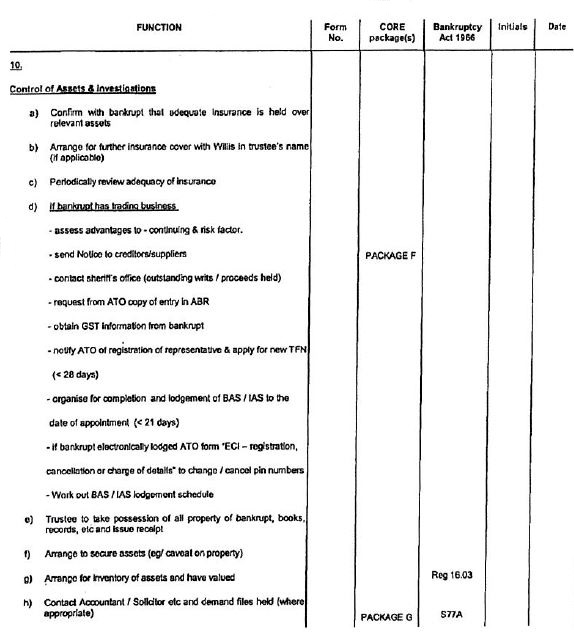
Particular attention was given to “Function 10(g)”. The requirement to prepare an inventory was evidently one well known to Mr Weston.
104 Mr Weston, it is concluded, did not entrust to Ms Edwards – nor did he seek to delegate to Ms Edwards – the responsibility of compliance with reg 16.03. There was certainly no written instruction to that effect provided by Mr Weston to Ms Edwards.
105 Nor did Ms Edwards understand that that was the task entrusted to her. During cross-examination, she explained the “primary” task entrusted to her as follows:
… may I suggest you were there to make an assessment of the [real] property sale achievable, and you weren’t particularly, if at all, interested in any personal effects; is that not correct?---I’m not quite sure what that question is. Sorry.
I will put it again. When you inspected the properties your principal concern was to identify the value of the [real] property and inform the trustee how much that he can get for the land; correct?---I primarily provide the market opinion on the [real] property. And I also provide photos to show what is inside the properties with regard to items such as the – such as the bed or the photos or things that I have. I would provide that to the trustee so that he would have a visual of what I see.
In the discharge of that responsibility she took photographs. She regarded those photographs as an “inventory” but certainly not a “written inventory”. Ms Edwards had previously described this process as follows:
You yourself did not ask Mr Nietner to prepare an inventory of what was there; correct?---I didn’t ask him to prepare an inventory.
You yourself did not prepare an inventory as to what was taken from the property; correct?---I prepare an inventory with my photographs. That is the usual – that is what I do with all properties. I do not prepare a written inventory, because it was in just a mess, and I take photos, and that’s what I use as my inventory, and I take lots of photos, and those photos I have attached to my vendor reports and I have attached and sent to the trustee.
So your answer to the question is: you don’t take inventories, but you take photographs that depict what - - -?---Correct.
106 It is concluded that Mr Weston had not entrusted to Ms Edwards the task of preparing an inventory for the purposes of reg 16.03 and that Ms Edwards certainly did not regard compliance with that requirement as a responsibility which had been entrusted to her. One may have expected that any delegation of responsibility to discharge such an important function as the preparation of an inventory would have been recorded in writing. But there was no document recording the tasks entrusted to Ms Edwards by Mr Weston.
An assessment as to commercial value – what property was in fact removed?
107 Whatever may have been the responsibilities entrusted to Ms Edwards, Mr Weston contended that no inventory had been prepared because there was no requirement to prepare an inventory in circumstances where:
nothing of “commercial value” was found upon any of the premises and, in particular, the Stanmore and Marrickville properties; and/or
whatever personal property may have been located at those premises, such property would not provide a “cost-effective return to creditors”.
108 The constraints upon the need to comply with reg 16.03 by reference to whether personal property had any “commercial value” or by reference to whether it was “cost-effective” to realise any such personal property was said to be derived from – or at least supported by – Schedule 4A to the Bankruptcy Regulations.
109 The immediate relevance of those provisions is not self-evident. Regulation 8.34A provides that for the purposes of s 155H of the Bankruptcy Act, the “standards applicable to the exercise of powers … of registered trustees are set out in Schedule 4A”. Section 155H, in turn, provides for the involuntary termination of a trustee’s registration. Notwithstanding the question as to whether the duties imposed by s 19(1) are to be judged by reference to those same standards, it was nevertheless submitted on behalf of Mr Weston that the items within Schedule 4A nevertheless provided a useful touchstone against which his conduct could be assessed. In particular, within Schedule 4A, item 2.8 provides as follows:
Realising assets
The trustee must realise only those assets:
(a) that will give a cost-effective return to creditors; or
(b) that contribute to the payment of the costs of the administration; or
(c) that may be realised in accordance with a personal insolvency agreement.
And item 4.3 provides as follows:
Protecting certain assets
The trustee must take appropriate steps to protect assets with a commercial value that have vested in him or her, including doing any or all of the following:
(a) ensuring that the assets are adequately insured;
(b) taking possession of the assets;
(c) perfecting legal ownership of the assets.
Reference may also be made to the terms of items 2.6, 2.9 and 2.12 of Schedule 4A.
110 Whether or not an inventory should nevertheless have been prepared recording the fact that any personal property that was found at the Stanmore or Marrickville properties had no apparent “commercial value” may also presently be left to one side. It may also be accepted for present purposes that there was much material located at the Stanmore and Marrickville premises which could accurately be described as “rubbish”. Much material was immediately taken from those premises and simply taken to the local rubbish tip.
111 The difficulty confronting the trustee’s submission, however, is that:
personal property was removed from both the Stanmore and Marrickville properties and stored at the warehouse of Mr Nietner for approximately 3 months;
the report prepared by Ms Edwards and dated 8 March 2009 did record a “massive amount” of furniture at the Stanmore property; and
the photographs taken by Ms Edwards record a limited number of paintings (or prints) stored at Marrickville and possibly a rug at the Stanmore property.
Moreover, assuming that that report and those photographs were in fact considered and reviewed by Mr Weston, there is:
no evidence that the trustee ever directed his mind to whether the property that was removed to the warehouse or the personal property Ms Edwards described in her report or depicted in her photographs ever had any “commercial value”, or whether it could be realised on a “cost-effective” basis.
The fact that Mr Nietner removed the personal property which he had warehoused to the tip after a period of about 3 months may well evidence the fact that he did not consider the personal property to have any realisable value. But it was not his decision to make. It remained for Mr Weston to at least consider – even on the case he advanced – whether any personal property had any “commercial value” or could be realised on a “cost-effective” basis such that it should be included in an inventory. This he failed to do.
112 The fact that premises may be filled with considerable amounts of what may accurately be described as “rubbish”, does not give a trustee licence to fail to prepare an inventory of personal property that potentially may have some value.
113 The failure to prepare an inventory and to comply with reg 16.03 has forever deprived Ms Hacker – and this Court – of the opportunity to review what was left at the Stanmore and Marrickville properties.
The preparation of an inventory – the sounding of warning bells?
114 Irrespective of whether or not Mr Weston had entrusted to Ms Edwards the responsibility of preparing an inventory, there is no doubt that Mr Weston at all times failed to “make, sign and date an inventory”. The failure of either himself or his officers – or anyone – to do so is even more worrying given:
the fact that Ms Edwards reported on 8 March 2009 that there was a “massive amount of furniture stacked floor to ceiling like a huge furniture warehouse” at the Stanmore property; and
the fact that Mr Nietner removed some personal property from the Stanmore property and kept it at his warehouse for a three-month period.
115 There can be no question but that Mr Weston failed to discharge his responsibility in accordance with reg 16.03.
116 The responsibility to prepare an inventory is not a mere formal matter. It is fundamental to the manner in which a trustee discharges his duties. The failure to prepare an inventory severely prejudices the ability of a trustee properly to (inter alia) take “appropriate steps to recover property for the benefit of the estate” as required by s 19(1)(f) of the Bankruptcy Act.
117 The trustee in the present proceeding has failed in his duties to Ms Hacker.
118 His failure properly to discharge his duty has unquestionably led to the “massive amount” of furniture at the Stanmore property not being “recovered” and returned to Ms Hacker. A proper discharge of the responsibility could well have led to this furniture being identified, retained, and returned to Ms Hacker.
119 The failure to prepare an inventory has also potentially led to other personal property not being identified and “recovered”. The failure to take an “inventory” of known property only invites concern as to whether other personal property has similarly not been identified.
120 Although it may possibly have been open to Mr Weston to entrust Ms Edwards with the responsibility of preparing an “inventory” in accordance with reg 16.03, what was not open to him (even as late as March 2009) was:
taking no action after the receipt of the report dated 8 March 2009 to ensure that an inventory was compiled – at least in relation to the “massive” amount of furniture; and
taking no action to ensure that whatever personal property that was recorded in the photographs taken by Ms Edwards was identified and reduced to writing so that an inventory could be made, signed and dated.
121 The reason why Mr Weston took no steps to ensure proper compliance with reg 16.03, either after Ms Edwards had taken her photographs or after the report dated 8 March 2009, perhaps matters not. The fact is that he took no steps. What remains disturbing, however, is the suggestion in cross-examination that Mr Weston focussed from the outset more upon the fact that the sale of the real estate would more than discharge the amounts owing both to secured and unsecured creditors.
122 Separate from any question of the trustee breaching his duty to prepare an inventory is his failure to respond to the queries made on Ms Hacker’s behalf about her personal property. The claim that there was indeed personal property left at the Stanmore and Marrickville properties emerged as early as the letter from her solicitors in April 2009 and the subsequent inquiries made in May 2009. To these inquiries Mr Weston did not respond – he did not respond to the inquiries about the missing personal property with a statement that no such property had been found. His failure meaningfully to respond to the direct inquiries about the missing personal property was not satisfactorily explained. His failure to explain only fuels concern that Mr Weston may indeed have:
improperly focussed his attention upon the ability to pay all secured and unsecured creditors from the sale of the real estate at the expense of giving any real consideration to any personal property, and the duty “to preserve it, and to secure it from loss”; and
recognised his failure to properly discharge his duty as from April/May 2009 and the prospect that he may have to assume personal liability.
The personal property left at Stanmore and Marrickville
123 The failure of the trustee to comply with reg 16.03 renders more difficult the question as to what personal property was in fact left at each of Ms Hacker’s properties and, in particular, those at Stanmore and Marrickville.
124 Ms Hacker maintains, of course, that substantial personal property was left at those properties. The fact that there was some property having at least some commercial value, however, in no way leads to the conclusion that all of the personal property that Ms Hacker claims to have left at the Stanmore and Marrickville properties was in fact there in December 2008.
125 It is relevantly concluded that:
the integrity of the evidence given by Ms Hacker as to what personal property was left at her properties, and the value of that property, is open to such serious reservation that it should not be accepted – except to the extent that it can be verified by some other means;
personal property that has gone missing constituted furniture, paintings and rugs; and
such personal property has some value.
126 Each of these matters should briefly be addressed.
The integrity of the evidence of Ms Hacker – the need for verification
127 The reservation expressed in respect to her evidence, and the need for her claims to be independently verified, arises because Ms Hacker was:
a person who acted manifestly in her own self-interest and with disregard for her legal obligations;
a person who deliberately made herself difficult to contact and who failed to co-operate in the administration of her estate;
an unimpressive witness who evidently would provide an account of events which suited her own self-interest rather than a witness more willing to give a factually accurate account of events;
a witness who either took no steps – or, at best, minimal steps – to verify her account of events; and
a witness whose account of events was otherwise open to question.
Each of these features of the evidence, taken in combination, leads to the comfortable conclusion that her account of the extent of the personal property that she claimed went missing should not be accepted in the absence of independent verification.
128 The fact that Ms Hacker acted to suit her own self-interest is demonstrated by her failure to file any income tax returns for a period of fourteen years. She merely expressed an “intention” to do so on her return from Western Australia in March 2009. And when she did return she made only minimal efforts to rectify her past default. The allegation that she lost financial records did little to address why Ms Hacker did not lodge returns prior to that alleged loss and little to address why returns could not have been lodged upon such limited records or recollection as she retained.
129 She was also a person who was difficult to locate and contact. She was unco-operative. Indeed, the information she provided about how she could be contacted was, on at least one occasion, deliberately incorrect. Thus, for example, during a telephone conversation with a person within the Trustee’s office (Mr Ragu Nith) in December 2012 she provided details for “follow up” purposes, namely:
a postal address;
an e-mail address; and
a phone number.
These details were recorded in a file note. But each of the details were incorrect. Ms Hacker’s explanation was that she had accurately provided the contact details but that Mr Nith had incorrectly transcribed each of them. It undoubtedly would have been difficult to contact Ms Hacker using the means she provided. When taken to the file note, she provided the following explanation:
And at the end of the conversation, you gave Ragu an address to contact you at. Do you see that? Yes.
And the address was xxx xxx, Jindabyne. Do you see that? It’s incorrect but yes. I will say that.
That address doesn’t exist, does it? No.
You gave the trustee an incorrect address to contact you at? No. I didn’t. It should have 2 slash 2, not 212.
And the email xxx, do you see that? Yes. But he has written it incorrectly as well.
He got that wrong too, did he? Yes. It shouldn’t be a 1, it should be an L.
Okay. And what about the phone number, xxx? Is that incorrect as well? No. That – that might have been the phone that we had … but then my partner didn’t need to have the landline because he had a mobile so he disconnected it.
So if the trustee had attempted to contact you at any of those there addresses, he would not have succeeded? Not having written it down incorrectly, no.
I’m suggesting to you that you gave him the incorrect contact details? No. I wouldn’t – I wouldn’t give him the incorrect ones. He has just transcribed it incorrectly. ….
Ms Hacker’s account is rejected. One mistake in transcription may, perhaps, have been explicable. The conclusion is that Ms Hacker was deliberately providing false information to her trustee and deliberately making herself difficult to contact.
130 The difficulties in locating Ms Hacker were also summarised by the trustee in the following exchange during his examination in chief:
… In the period after November 2011, did you or your office make attempts to contact Ms Hacker?---Yes, we did. We had - - -
Can you then tell the court if you did – what they were?---Yes. Up until around that time, we had endeavoured to contact Ms Hacker through the addresses, predominantly the Jindabyne address we had, and also through her lawyers at the time, without success. We then subsequently attempted to serve a deed of release on Ms Hacker through a process server, who was unable to located and serve Ms Hacker. We also endeavoured, after a telephone conversation between Ragu Nith of my staff and Ms Hacker – in or around December 2012, I think it was, when she gave an address. We tried to have her served at that time, as well, or after that conversation, as well. And that attempt by a process server was also unsuccessful.
131 The one person who could have potentially supported Ms Hacker’s account of the property left at the Stanmore property was Ms Nicole (Nikki) Smith. Ms Smith was not called as a witness. Ms Smith had been a tenant at Flat 2 at Stanmore and moved into Flat 1. Ms Hacker had given Ms Smith reduced rent in return for her looking after the personal property said to have been left at Stanmore when she went to Western Australia. But the following evidence of the steps taken to locate Ms Smith to provide evidence to support her claims was, with respect, less than satisfactory:
Have you been in contact with Nikki Smith since about March 2009? No. I think I was in contact with her in March and then in April, and then she refused to have any contact after she lost all her things.
Have you tried to get her to give evidence on your behalf in these proceedings? Yes. And I can’t track her down. But she might have gone back to England, I don’t know.
What steps were in fact taken to “track down” Ms Smith and when they were taken was not further explained.
132 Even less onerous steps to verify the account Ms Hacker gave were not undertaken. Ms Hacker, on her account, went to Western Australia to seek employment at a mining camp. A question arose as to when she returned to Sydney from Western Australia. No wage records of her employer were produced. Reference was made to her receiving electronic pay slips notwithstanding the fact that she claimed to have been paid in cash. Any electronic wage records would have readily established her presence in Western Australia during a period of time when her presence in Sydney was open to question. But such evidence was not forthcoming.
133 Ms Hacker’s account of events was also, in part, inconsistent with other evidence on which she sought to rely. Thus, for example, there was reason to question the time at which Ms Hacker became aware of the fact that a sequestration order had been made. The case Ms Hacker advanced was that she had no knowledge of her bankruptcy until March 2009. It was then, on her account, that Ms Nikki Smith said that she had returned from Victoria to Sydney and could not gain access to the premises. Ms Hacker maintains that she then returned to Sydney from Western Australia and made inquiries of the real estate agent who was handling her properties as well as the office of the trustee in bankruptcy. On her account, she had paid out the original petitioning creditor and had no knowledge that another creditor had been substituted. Contrary to her account, however, her mother gave evidence that “after Susie was made bankrupt” she opened some of her daughter’s mail and said to her: “Susie, have you read the letter that came today? It looked very important. It was something about bankruptcy”. The mother’s account was that her daughter replied: “Yes, mum. I have read it. I don’t know how this has happened”. Ms Hacker denied the conversation. The letter was dated January 2009. Even though her mother was too ill to attend the hearing in Sydney and be cross-examination, the divergence in the accounts nevertheless remains disturbing. The fact that Ms Hacker made herself difficult to contact and maintains that she never received the correspondence forwarded to her by the trustee at a variety of addresses, and failed to see legal notices affixed to the doors of her premises provides a basis for questioning whether, as she claims, she was in fact unaware of her bankruptcy until March 2009.
134 These are but some of the bases upon which it is concluded that the evidence of Ms Hacker should not unquestioningly be accepted.
The independent verification found in the evidence
135 Notwithstanding such reservations in otherwise accepting the evidence of Ms Hacker, there nevertheless unquestionably remains some evidence which independently verifies her account of some personal property being left at her residential properties, including those at Stanmore and Marrickville.
136 That independent evidence may be found in:
the photograph taken by the real estate agent for the purposes of the sale of the Potts Point property, depicting the painting by Alan Grosvenor;
the photograph taken by Ms Edwards in March 2009 of the Stanmore property interior, depicting a box containing a number of picture frames, presumably frames of paintings (or prints);
the photograph taken by Ms Edwards sometime between 5 December 2008 and 27 January 2009 of the Marrickville property, possibly depicting a rug leaning against the wall; and
the 8 March 2009 report of Ms Edwards, together with the evidence of Mr Nietner, that there was a “massive amount” of furniture at the Stanmore property, and Mr Nietner’s removal of some furniture to a warehouse.
137 The ultimate fate of the Grosvenor painting at the Potts Point property was somewhat curious. That painting, of course, was not listed in any inventory of personal property for the simple reason that no inventory was compiled. And the painting was within a property in the sole ownership of Ms Hacker. The Potts Point property was registered in Ms Hacker’s name; the Darlinghurst property was in the joint names of her and Mr Daday. Yet the trustee, apparently, permitted Mr Daday to remove the painting and other personal property from the Potts Point property. The removal of personal property by Mr Daday was pursued in the cross-examination of Mr Weston as follows:
You or your office had dealing with Mr Daday in relation to personalty items, didn’t you?---Yes, I do recall that.
...
Mr Weston went on to explain that he left this issue to Ms Edwards. He continued on to say:
…. I was going to say I’m not sure that that was the terminology used, but to the effect that we – we left those issues to Ms Edwards to sort out. That was – that was part of her – her brief.
Okay. So we all appreciate this issue, you knew that Mr Daday was putting his hand up in respect of a claim for personalty items; correct?---Yes.
And those personalty items pertained to not just the Darlinghurst property. In fact, any or more of the other properties?---I – I’m not aware of which other properties, offhand, but I certainly remember the Darlinghurst property, because he was a – a co-owner.
Yes. But you also mentioned Darlinghurst properties, plural, before, did you not?---I’m sorry, I - - -
I will withdraw that. You said the other nearby property besides the Darlinghurst. Which one are you referring to?---I’m referring to the Kings Cross – Points Point, I think it’s commonly referred to as.
Okay. So you say that you knew that he made a claim for personalty items in respect of the Kings Cross property too. Is that right?---I – I believe so. I believe so.
And in order for you to get involved in this you spoke to either your staff or Ms Edwards in order to have Mr Daday go through the properties to pick out what items he says were of personalty to him; is that right?---In accordance with procedure, my staff brought the issue to my attention. Ms Edwards was handling that issue for us, and the instructions went to Ms Edwards accordingly to deal with that issue.
And you understand that it was dealt with in such a way that Mr Daday went through the properties and selected the personalty items which he said belonged to him; correct?---I am of the understanding that that’s – that’s about right. Yes.
And that’s in relation to the Darlinghurst property; correct?---Specifically the Darlinghurst property, I do recall.
And you also said the Kings Cross property?---I believe that’s correct.
When Ms Edwards was cross-examined on the fate of the Grosvenor painting and personal property that may have been removed by Mr Daday, she said that she had no idea who the artist was, and the following exchange occurred:
And when the property was sold, was the property sold with the artwork or did the artwork get taken out, or you don’t know?---My only memory of this property and the property that was in Oxford Street is of a Mr Daday contacting me with regard the furniture in those properties, and that’s all I can – I just have a vague memory of speaking to him regarding the furniture.
Okay?---But I don’t – I can’t specifically recall what happened. No.
A little later Ms Edwards’ attention was again directed to Mr Daday and there was the following exchange:
And in relation to this property, is it your recollection that he may have come in on your invitation to take all the furniture out?---No, nothing would be on my invitation. I would – I would only seek instructions from my vendor on what to do at the time of selling vacant possession.
Your vendor was the trustee?---My vendor is the trustee.
And is it correct to say that the trustee was content for Mr Daday to come and take all of furniture?---I would have no knowledge of that. I would not – I would not know – I would have to be given instructions, and I don’t have any recollection of the instructions from that – from that time. I just don’t - - -
Okay?--- - - - have any memory of it.
So you just – in relation - - -?---I don’t know.
Such uncertainty regarding both the task entrusted to Ms Edwards and the fate of the Grosvenor painting is unsatisfactory. But no criticism is made of Ms Edwards; the criticism is directed to the trustee. Ms Edwards’ lack of recollection is, of course, entirely consistent with the conclusion that Mr Weston did not entrust her with the task of compiling an inventory of personal property. Nor did he entrust to her the task of dealing with and resolving any claim that Mr Daday may have made. In all likelihood Mr Daday removed the Grosvenor painting and possibly some furniture. The trustee’s officers apparently did not inquire with Ms Hacker before any property was simply handed over to Mr Daday. Other than the Grosvenor painting, the trustee left unexplored the question of what other property was released into Mr Daday’s possession.
138 Other evidence drew attention to a car that was apparently abandoned outside the Stanmore property. Photographs taken by Ms Edwards verified the fact that the car was there at some stage in February 2009. It was no longer there by the time the property had been “cleaned and cleared”. But that matters not. Inquiries the trustee made reveal that the motor vehicle was not registered in Ms Hacker’s name.
139 Although unverified, the prospect remains that jewellery which Ms Hacker said was stored in two strongboxes at the Marrickville property may also have been inadvertently removed. Although the trustee was on notice that Ms Hacker claimed that jewellery was amongst the personal property said to have been stored at Marrickville, and although there is no independent verification of jewellery in fact being at Marrickville, the reservation in respect to Ms Hacker’s evidence is not great enough to prevent a conclusion that there was at least some prospect of her having stored jewellery in the two boxes she described. The absence of larger items which Ms Hacker described, it may be expected, would have come to the attention of either Ms Edwards or Mr Nietner; but smaller items may have escaped their attention – especially given the state in which the Stanmore and Marrickville properties were found. The trustee’s case was that Ms Hacker’s account should be rejected – indeed, there was a suggestion that Ms Hacker herself may have removed the jewellery. The relevant exchange in her cross-examination thus proceeded as follows:
… what I want to suggest to you is that there was no jewellery packed into metal strongboxes at the Marrickville premises Flat 3 in March of 2009?---Yes, there was. It was in two metal strongboxes that you lock with a key.
I want to put it to you that it is unlikely in the extreme that you would leave what you assert to be a substantial amount of jewellery in an unattended flat in Marrickville?---Yes, I would - - -
I want - - -?--- - - - because I never had any problems in the past with anyone trying to break into my premises and it was well hidden.
How was it hidden, Ms Hacker?---Out of plain view.
What I want to put to you is that prior to March of 2009 or in March 2009 at the latest, you removed the jewellery that you assert was packed into these two metal strongboxes at Marrickville?---No. I wasn’t in Sydney.
You – we’ve been through this. You were at the flat in December of 2008, correct?---Yes.
And you had the opportunity to remove goods at that time if you had chosen to do so?---But there was no reason to. That was where I was living. I didn’t have to move anything. I had just moved it all in there.
And you could have moved it out of there at that time if you had chosen to, correct?---I didn’t have to. I was living there.
I’m suggesting to you, Ms Hacker, not to put too blunt a word on it, that your claims against the trustee are a fiction insofar as the jewellery in these two strongboxes are concerned that you assert.
…
No.
On the balance of probabilities, however, it cannot be concluded either that jewellery was in fact stored at the Stanmore or Marrickville properties or that it was removed from either.
The value ascribed to the personal property
140 The difficulty with placing any value upon such property that was removed is obvious – there is no independent verification of its quantity; it is far from certain whether any paintings were originals or merely prints, and there is no evidence of any valuation of such paintings or prints; nor is there evidence of whether the furniture was antique, and, if so, of its value; and no evidence of whether the rug was the only rug stored at the Stanmore property, or of its value.
141 Even if the inquiry sought on behalf of Ms Hacker were to be ordered pursuant to s 179 of the Bankruptcy Act, the evidence before the inquiry would be no more certain than that which is presently before the Court. Furthermore, an adjournment of the present proceeding for the purposes of adducing evidence of value, perhaps in respect to the value of Grosvenor paintings, would be of limited utility.
142 The only evidence of the value of such personal property that was at one or other of the properties is that which Ms Hacker advanced in her Statement of Affairs. That Statement claimed the entire value of the personal property as follows:

It should be noted that there is no reference to rugs and floor coverings.
143 In addition to the generally-expressed reservation about the reliability of Ms Hacker’s evidence, two specific reservations must be expressed in respect to Ms Hacker’s valuation of her personal property, namely:
the fact that Ms Hacker ascribed a total value to the goods, without any attempt to itemise or separately identify any particular goods; and
the value separately ascribed to jewellery, and annexed to the Statement of Claim first filed in the Supreme Court of New South Wales, was itself the subject of limited challenge in cross-examination.
When shown the list of jewellery, the following exchange occurred during Ms Hacker’s cross-examination:
… The first three pages there, Ms Hacker, consist of a price list in landscape format. Would you agree? Under the words Across the Page?---Yes.
Thank you. And that’s all that is, is it not? That is just a price list?---That’s the – that’s part of the jewellery catalogue that I produce for my jewellery parties, and that – that gave me a list of the stock that I had on hand. But there’s one page missing.
A “price list” does not necessarily disclose the value of goods. It may provide some guidance. But any difficulty in ascribing a value to personal property is largely a matter to be placed at the feet of the trustee and to be resolved against him – it was he who failed to prepare an inventory and failed to preserve the property, at least until he could estimate its value, and decide whether to obtain an independent valuation.
144 Short of an arbitrary assessment of value, and seeking to ascribe some value having some rational basis upon the limited material available to the Court, it is proposed that the following values should be fixed in respect to the personal property that has gone missing, namely:
Property | Value |
Furniture | $ 25,000 |
Paintings | $ 15,000 |
Rugs | $ 5,000 |
Whether any value should be ascribed to jewellery attracts different considerations. It has been concluded, on the balance of probabilities, that the jewellery said to have been contained within the two strongboxes was neither present within, nor removed from, the Marrickville property. No value can be ascribed to compensate for property which was never lost or removed. Although it has been established that the trustee acted in breach of his duty, monies cannot be awarded to compensate a loss which has not been made out.
145 There is an element of pragmatism in fixing these values; albeit, hopefully, pragmatism tempered by a rational assessment of the limited evidence available, including the prospect or probability of further personal property being lost, beyond that which can be identified. Should either of the parties seek to lead further evidence of value, liberty should be reserved for such an application to be made. Any such application should include at least a detailed outline of further evidence sought to be adduced.
146 Difficulty in assessing damages, it may be noted, does not relieve a Court from making such assessment as it can: Malec v J C Hutton Pty Ltd (1990) 169 CLR 638 at 643. Deane, Gaudron and McHugh JJ there observed:
If the law is to take account of future or hypothetical events in assessing damages, it can only do so in terms of the degree of probability of those events occurring. The probability may be very high — 99.9 per cent — or very low — 0.1 per cent. But unless the chance is so low as to be regarded as speculative — say less than 1 per cent — or so high as to be practically certain — say over 99 per cent — the court will take that chance into account in assessing the damages. Where proof is necessarily unattainable, it would be unfair to treat as certain a prediction which has a 51 per cent probability of occurring, but to ignore altogether a prediction which has a 49 per cent probability of occurring. Thus, the court assesses the degree of probability that an event would have occurred, or might occur, and adjusts its award of damages to reflect the degree of probability. The adjustment may increase or decrease the amount of damages otherwise to be awarded.
Given the state of the evidence, a “broad brush” has necessarily been applied: cf. Nikolaou v Papasavas, Phillips & Co (1989) 166 CLR 394 at 404 per Wilson, Dawson, Toohey and Gaudron JJ.
The source of the power to order that monies be paid or conditions imposed
147 The potential sources of power to order or otherwise require that monies be paid into the estate of Ms Hacker may potentially be found in:
the power to award damages for a breach of the duty imposed by s 19 of the Bankruptcy Act, the trustee having accepted that there is no relevant distinction between a breach of s 19 and a breach (for example) of reg 16.03;
the power conferred by s 30(1)(b) to “make such orders (including … equitable remedies) as the Court considers necessary for the purposes of carrying out or giving effect to this Act…”;
the power to award equitable compensation for breach of a fiduciary duty which the trustee owed to Ms Hacker; and/or
the power to release Mr Weston from his trusteeship subject to a condition that such monies be paid.
So much was not denied by the trustee. What was denied by the trustee was any power:
derived from s 179(1)(b) of the Bankruptcy Act to “make such order as [the Court] thinks proper”.
Section 179, it was properly contended by the trustee, was not a source of power prior to any inquiry having been ordered. Although an inquiry formed part of the relief Ms Hacker claimed in her Amended Statement of Claim, no inquiry should be ordered. There is little utility in ordering an inquiry given the lack of anything left to inquire into.
148 Section 30(1)(b), in particular, confers a power which it has been said should be “generously construed”: Vale v Sutherland [2009] HCA 26 at [19] per Gummow, Hayne, Heydon, Crennan and Kiefel JJ. Section 30(1), it has been said, “is a facultative provision giving the court full power, within the limits of its jurisdiction to be found elsewhere, to make such orders as it considers should be made in order to carry out and give effect to the Act”: Re Bilen; Ex parte Sistrom (unreported, Federal Court of Australia, Neaves J, 11 April 1985). In Talacko v Talacko [2010] FCAFC 54 at [18] to [19], (2010) 183 FCR 311 at 321 Gray, Mansfield and McKerracher JJ similarly observed that the “words used are not words of limitation but of extension”. See also: Verge, Re Underdown (a bankrupt) v Fazio [2013] FCA 18 at [21] per McKerracher J.
149 It was common ground between the parties, however, that an order for the payment of monies could be made.
150 That being the case, there seems little utility in further pursuing which may be the more appropriate source of power.
THE TRUSTEE’S REMUNERATION?
151 Whether or not the sequestration order ought to have been made, the fact remains that such an order was made on 5 December 2008, as was a further order appointing Mr Weston as trustee.
152 Having consented to act as trustee, Mr Weston assumed the duties and responsibilities of a trustee to administer the bankrupt estate of Ms Hacker. And, subject to any Court order to the contrary, he was entitled to remuneration for his services.
153 Ms Hacker questions his entitlement to retain all the remuneration he has charged to date.
154 Mr Weston has indeed received what – at least initially – appears to be an extremely generous amount for the administration of a comparatively simple estate. A review of the Reports to Creditors reveals remuneration:
up to July 2009 an amount of $58,631.10;
for the period from 1 July 2009 to 2 November 2010 a further amount of $30,115.71;
as at 9 March 2015 a total of $109,741.02.
Whether the hourly rate at which the remuneration was charged was anything other than in accordance with usual practice was not in dispute, and is therefore a matter on which no comment can be made. But what can attract a finding is whether any remuneration at all should have been charged from a particular date.
155 Underlying her submission that Mr Weston should not be entitled to retain all of the remuneration he has charged to date is Ms Hacker’s contention that:
by December 2009 the administration of the bankrupt estate had been substantially completed – remuneration charged for services performed at a point of time thereafter was remuneration charged in respect to work contrary to the duty to administer the estate “as efficiently as possible” (s 19(1)(j)) or in a “commercially sound way” (s 19(1)(k)); and
the trustee had placed himself in a position of conflict whereby he was acting for his own self-interest – that conflict either itself being a breach of the duties imposed by s 19 or contrary to the fiduciary duty he owed to her.
156 It is concluded that Mr Weston should be entitled to retain his remuneration charged up until shortly after November/December 2009 but not thereafter. Such legal expenses subsequently incurred remain payable out of the bankrupt estate.
Remuneration post-December 2009?
157 There is much force in the submission advanced on behalf of Ms Hacker that Mr Weston should not be entitled to any remuneration from a date shortly after November/December 2009.
158 All of the properties that were required to be sold to satisfy the claims of the secured and unsecured creditors had been sold by about June 2009. By December 2009 “[a] dividend of 100 cents/dollar [had been] paid to unsecured creditors”.
159 And after 21 December 2009, the trustee attended to a limited number of matters, namely:
the payment of interest to those creditors who had an interest-bearing claim;
the receipt, adjudication, and payment of a previously unknown creditor, namely Marrickville Council, in respect to a pre-bankruptcy debt;
obtaining and receiving legal advice concerning the payment of post-bankruptcy debts to Sydney Water and Marrickville Council;
payment of legal fees to the solicitors retained by the trustee; and
the preparation of a Deed of Release and the requests made in October and November 2011, and July and August 2012, that it be executed by Ms Hacker.
160 If attention is focused upon events in 2010, nothing much seems to have happened until the second Report to Creditors in November of that year. From July 2009 to November 2010 the trustee claimed remuneration in the sum of $30,115.71.
161 By November 2010 the trustee reported to creditors that the annulment of the bankruptcy was “pending”. But his explanation during cross-examination as to why the bankruptcy was not annulled pursuant to s 153A did not sit comfortably with the contents of his second Report to Creditors. The explanation provided during cross-examination was as follows:
And you, at no time, despite the 100 per cent – 100 cents in the dollar payment plus interest claims to all secured and unsecured creditors, made application to ITSA or otherwise to have a statutory annulment for Ms Hacker under 153A, did you?---That’s correct.
Yes. But in circumstances where you had satisfied yourself that all creditors who made claims on this estate were properly notified of the ability to make a claim had done so, why didn’t you do it?---I was not satisfied that, for a start, that all creditors had been paid. There were outstanding issues in respect of income tax. There were outstanding issues in respect of Mr Daday’s claim. At some stage, there was also the further claim of the – in respect of rates and – and taxes in respect of the Marrickville – the unsold Marrickville property. I’m not 100 per cent sure when we became aware of that, but it was either the end of 2010 or early in 2011. So I wasn’t satisfied that all – all claims had been – had been met.
His stated lack of “satisfaction” that all creditors had been paid does not sit comfortably with the “purpose” of the second Report to Creditors being to report on the “pending” annulment of the bankruptcy.
162 In 2011, again nothing much seems to have happened until the third Report to Creditors on 4 November 2011. After that Report, however, the trustee’s office forwarded an e-mail to Ms Hacker’s solicitors on 7 November 2011. That e-mail stated in part as follows:
I note that you act on behalf of the bankrupt and that you have requested all future correspondence to be forwarded to you. Accordingly, please find attached a copy of the letter dated 25 October 2011 and the Deed of Release which was sent to the bankrupt by Goldrick Farrell Mullan Lawyers, who are acting on behalf of the Trustee in the matter. As discussed, the bankrupt is required to sign the Deed of Release in order for the remaining assets vested in the estate to be released back to her.
The chronology then picks up again in August 2012 with the further letter requesting that the Deed of Release be executed.
163 Given the fact that the properties had been sold by about June 2009 and that by November 2010 the only matter the trustee reported as outstanding was the payment of interest due to creditors, there is no basis upon which the trustee is entitled to any remuneration from a date shortly thereafter. Indeed, even expenses incurred in 2010 remain open to serious question. It is concluded that any expense incurred after 2010 was unquestionably an “unnecessary expense” for the purposes of s 19(1)(j) of the Bankruptcy Act.
164 Subject only to separate consideration of the attempts to secure the Deed of Release, by a date shortly after November 2010 (at the very latest) an efficient administration of the estate should have been well and truly concluded.
165 Although the Court may have declined to give directions (cf. Re Driller (1971) 21 FLR 159 at 173 per Sweeney J), it was always open to Mr Weston throughout 2010 to apply for directions pursuant to s 134(4) of the Bankruptcy Act.
166 By reason of the trustee acting in breach of the duty imposed by s 19(1)(j) and (k) of the Bankruptcy Act, it is concluded that he should not be entitled to any remuneration as from 1 January 2011.
The Deed of Release – self-interest or a prudent step in the administration of the estate?
167 Separate from any determination as to when the administration of the bankrupt estate should have been concluded in an “efficient” manner or in a “commercially sound way” is the question of whether the trustee was acting in breach of his fiduciary duty to Ms Hacker in seeking the execution of the Deed of Release.
168 Although the disputed factual allegations each affected the others, of immediate relevance is the fact that:
Ms Hacker filed her Statement of Affairs on 8 April 2009 and subsequently claimed, throughout 2009, that substantial quantities of her valuable personal property had gone missing;
by April/May 2009 her solicitors had made inquiries of the trustee as to the whereabouts of her jewellery, antiques and artwork;
by December 2009 the trustee had paid all secured and unsecured creditors;
by November 2011 the trustee had reported to creditors that he anticipated that the bankruptcy would be annulled in accordance with s 153A of the Bankruptcy Act; and
in accordance with s 149, the bankruptcy of Ms Hacker would be discharged on 9 April 2012.
The first references to the trustee seeking a Deed of Release emerged in October/November 2011. The Deed of Release was subsequently prepared, and requests made for Ms Hacker to execute it on 25 October 2011, 7 November 2011, and again on 2 July 2012 and 10 August 2012.
169 Rather than seeking the Court’s advice on how to proceed, perhaps shortly after having paid all creditors, or perhaps even as late as 2010, the trustee failed to do so. In the meantime, the administration of the estate continued to incur further fees.
170 Following the payment of secured and unsecured creditors and outstanding interest, one remaining matter to be addressed by the trustee was the manner in which he should respond to the queries first made in April/May 2009 as to the whereabouts of Ms Hacker’s personal property. Although it remains a matter of inference, it is concluded that the trustee became increasingly concerned about this matter. It may perhaps explain why he took no steps during 2010 either to have the bankruptcy annulled pursuant to s 153A or to seek the Court’s direction on how to proceed, or perhaps why he did not apply far earlier to be released from his trusteeship pursuant to s 183. It may also explain the trustee’s failure meaningfully to respond to Ms Hacker’s queries in April/May 2009.
171 It is not certain when the trustee’s concern for the proper administration of the estate became subsumed by an increasing awareness of his potential liability. Nevertheless, and notwithstanding the need to draw inferences, it is concluded that the trustee became conscious that he was acting in his own self-interest, for which among other things he may have been personally liable, from about the beginning of 2011 – if not earlier.
172 By no later than October/November 2011 there is no doubt that the trustee wanted the Deed of Release executed – not for the purpose of protecting the estate for the benefit of Ms Hacker but rather for the purpose of protecting his own self-interest. The fact that the trustee required a Deed of Release to be executed supports – but does not dictate – a conclusion that he perceived a need to protect his personal position. It is concluded that his insistence upon the Deed of Release being executed manifested a state of mind he had previously formed about protecting his own self-interest. The terms of the letter dated 10 August 2012 support the conclusion that the trustee sought improperly to retain the certificate of title to the unencumbered property at Marrickville, and the “Cash at Bank”, in order to ensure that Ms Hacker executed the Deed.
173 His evidence to the contrary is rejected.
174 In so proceeding the trustee breached the fiduciary duty he owed to Ms Hacker: Breen v Williams (1996) 186 CLR 71. In doing so he also failed properly to discharge the duty imposed by s 19(1)(j) and (k) of the Bankruptcy Act.
175 Separate from the time at which an efficient administration of the estate should have been concluded, it is further concluded that from at least the beginning of 2011 the trustee acted contrary to the duty imposed by s 19 and the fiduciary duty he owed to Ms Hacker.
176 Given the conclusion that Mr Weston should not be entitled to any remuneration from 1 January 2011 onwards, this further conclusion only strengthens the reasons to refuse his remuneration from that date.
A RELEASE FROM TRUSTEESHIP
177 Section 183(1) of the Bankruptcy Act provides that a trustee may apply for an order releasing him from the trusteeship of an estate. Upon such an application being made, the Court retains a discretion: s 183(2).
178 It is concluded that an order should be made pursuant to s 183 of the Bankruptcy Act discharging Mr Weston from the trusteeship of Ms Hacker’s estate. For the purposes of s 183, it is concluded that:
all of the property that can or should be realised has been realised; and that
there is no objection to that order being made, other than the objection made by Ms Hacker.
179 An order discharging the trustee is not to negate the effect of such other orders as should be made in favour of Ms Hacker.
180 The discretion conferred by s 183(2), it is respectfully considered, implicitly contemplates that an order releasing a trustee may be made subject to conditions. Counsel for the trustee accepted that a release pursuant to s 183 could be made subject to the conditions envisaged.
181 If there be any question as to whether the Court has power to make an order that Mr Weston pay certain monies into the estate of Ms Hacker prior to his being released pursuant to s 30(1)(b) of the Bankruptcy Act, any order releasing Mr Weston would only be made on the condition that those monies which can be identified must first be paid.
CONCLUSIONS
182 The administration of the bankrupt estate of Ms Hacker has not been undertaken in a manner which has proved easy. To some extent Ms Hacker has brought difficulties upon herself – she has not been an easy person to locate. There is reason to question the time at which she first became aware of the making of the sequestration order and whether a “Statement of Affairs” could have been – and should have been – filed much earlier than April 2009. To some extent, Mr Weston has brought difficulties upon himself by failing properly to discharge the fundamental responsibilities of a trustee – including the duty properly to secure personal property and to make, sign and date an inventory of such property.
183 Despite the difficulties occasioned by Ms Hacker’s conduct, Mr Weston has failed properly to discharge the duties imposed by s 19 of the Bankruptcy Act and reg 16.03 of the Bankruptcy Regulations. He has also breached the fiduciary duty he owed to Ms Hacker.
184 Properly conducted, the administration of the estate should have been concluded shortly after November/December 2010. As the proper administration of the estate wound to a close, the trustee’s concern over his personal liability for the loss of Ms Hacker’s personal property became more pressing. By no later than the beginning of 2011 Mr Weston had placed himself in a position of conflict, whereby he could not properly discharge either the duties imposed by s 19 or the fiduciary duty he owed to Ms Hacker.
185 The manner in which Mr Weston has administered the estate has unquestionably occasioned loss to Ms Hacker which he should make good. Neither the extent of the personal property which has gone missing nor its value can be determined with any greater reliability than an approximation based upon limited evidence. The parties should have liberty to adduce further evidence of its value if they see fit.
186 Moreover, Mr Weston has administered the bankrupt estate in such a manner that he should not be entitled to remuneration from 1 January 2011. Legal expenses incurred, however, remain payable out of the estate.
THE ORDERS OF THE COURT ARE:
1. Any application to re-open to adduce evidence as to the value of any personal property is to be made within 14 days.
2. The parties are otherwise to bring in Short Minutes of Orders to give effect to these reasons within 14 days.
I certify that the preceding one hundred and eighty-six (186) numbered paragraphs are a true copy of the Reasons for Judgment herein of the Honourable Justice Flick. |


