

FEDERAL COURT OF AUSTRALIA
Sayed v Construction, Forestry, Mining and Energy Union [2015] FCA 338
Table of Corrections | |
22 April 2015 | In paragraph 1, “18 January 2013” has been replaced with “18 July 2013”. |
22 April 2015 | In paragraph 19, “should made payable” has been replaced with “should be made payable”. |
IN THE FEDERAL COURT OF AUSTRALIA | |
Applicant | |
AND: | CONSTRUCTION, FORESTRY, MINING AND ENERGY UNION Respondent |
DATE OF ORDER: | |
WHERE MADE: |
THE COURT ORDERS THAT:
1. In respect of the contravention of s 351 of the Fair Work Act 2009 (Cth) by redeploying the applicant, the respondent pay a penalty of $20,000.
2. In respect of the contravention of s 351 of the Fair Work Act 2009 (Cth) by suspending the applicant, the respondent pay a penalty of $10,000.
3. In respect of the contravention of s 351 of the Fair Work Act 2009 (Cth) by dismissing the applicant, the respondent pay a penalty of $15,000.
4. The penalties payable by reason of paragraphs 1 to 3 inclusive of these orders be payable to the Commonwealth, on or before 18 May 2015.
Note: Entry of orders is dealt with in Rule 39.32 of the Federal Court Rules 2011.
VICTORIA DISTRICT REGISTRY | |
GENERAL DIVISION | VID 1072 of 2013 |
BETWEEN: | MUHAMMED ALI SAYED Applicant |
AND: | CONSTRUCTION, FORESTRY, MINING AND ENERGY UNION Respondent |
JUDGE: | MORTIMER J |
DATE: | 13 APRIL 2015 |
PLACE: | MELBOURNE |
REASONS FOR JUDGMENT
INTRODUCTION AND SUMMARY
1 I delivered judgment in this proceeding on the applicant’s claims against the respondent on 30 January 2015: Sayed v Construction, Forestry, Mining and Energy Union [2015] FCA 27. I found the respondent had contravened s 351 of the Fair Work Act 2009 (Cth) by three separate, but sequential acts against the applicant: redeploying him on 18 July 2013 with effect from 22 July 2013; suspending him from his duties on 23 July 2013 and dismissing him on 26 July 2013. I found that the respondent’s reasons for those three acts against the applicant included a prohibited reason, being his political opinion. That political opinion was his membership of and association with the Socialist Alliance. I awarded the applicant $3,000 by way of general compensation pursuant to s 545(2)(b) of the Fair Work Act, and made orders that the parties calculate, by reference to my reasons, the loss of income suffered by the applicant. The parties complied with those orders and I subsequently made orders that the respondent pay the applicant $36,984.16 less applicable taxation. These reasons should be read in conjunction with my reasons given on 30 January 2015.
2 As I noted at [60] of that judgment, Mr Sayed also sought by way of relief orders that the respondent pay pecuniary penalties pursuant to s 546 of the Fair Work Act. The parties agreed this aspect of the proceeding should await the Court’s decision on contravention, Mr Sayed’s claim for reinstatement and his claim for compensation. The parties were given an opportunity to make submissions on appropriate penalties in light of my reasons for judgment. Neither party sought an oral hearing on the issue of penalties and accordingly the matter has been determined on the basis of the parties’ respective written submissions.
3 For the reasons set out below three separate penalties, of varying amounts, will be imposed on the respondent for the contraventions.
LEGISLATIVE FRAMEWORK
4 As I noted, the respondent’s contraventions were under s 351 of the Fair Work Act. That section provides:
351 Discrimination
(1) An employer must not take adverse action against a person who is an employee, or prospective employee, of the employer because of the person’s race, colour, sex, sexual preference, age, physical or mental disability, marital status, family or carer’s responsibilities, pregnancy, religion, political opinion, national extraction or social origin.
Note: This subsection is a civil remedy provision (see Part 4-1).
(2) However, subsection (1) does not apply to action that is:
(a) not unlawful under any anti-discrimination law in force in the place where the action is taken; or
(b) taken because of the inherent requirements of the particular position concerned; or
(c) if the action is taken against a staff member of an institution conducted in accordance with the doctrines, tenets, beliefs or teachings of a particular religion or creed—taken:
(i) in good faith; and
(ii) to avoid injury to the religious susceptibilities of adherents of that religion or creed.
(3) Each of the following is an anti-discrimination law:
(aa) the Age Discrimination Act 2004;
(ab) the Disability Discrimination Act 1992;
(ac) the Racial Discrimination Act 1975;
(ad) the Sex Discrimination Act 1984;
(a) the Anti-Discrimination Act 1977 of New South Wales;
(b) the Equal Opportunity Act 1995 of Victoria;
(c) the Anti-Discrimination Act 1991 of Queensland;
(d) the Equal Opportunity Act 1984 of Western Australia;
(e) the Equal Opportunity Act 1984 of South Australia;
(f) the Anti-Discrimination Act 1998 of Tasmania;
(g) the Discrimination Act 1991 of the Australian Capital Territory;
(h) the Anti-Discrimination Act of the Northern Territory.
5 In relation to the imposition of penalties for contraventions of a civil remedy provision of the Fair Work Act, s 546 of the Act provides:
546 Pecuniary penalty orders
(1) The Federal Court, the Federal Magistrates Court or an eligible State or Territory court may, on application, order a person to pay a pecuniary penalty that the court considers is appropriate if the court is satisfied that the person has contravened a civil remedy provision.
Note: Pecuniary penalty orders cannot be made in relation to conduct that contravenes a term of a modern award, a national minimum wage order or an enterprise agreement only because of the retrospective effect of a determination (see subsections 167(3) and 298(2)).
Determining amount of pecuniary penalty
(2) The pecuniary penalty must not be more than:
(a) if the person is an individual—the maximum number of penalty units referred to in the relevant item in column 4 of the table in subsection 539(2); or
(b) if the person is a body corporate—5 times the maximum number of penalty units referred to in the relevant item in column 4 of the table in subsection 539(2).
Payment of penalty
(3) The court may order that the pecuniary penalty, or a part of the penalty, be paid to:
(a) the Commonwealth; or
(b) a particular organisation; or
(c) a particular person.
Recovery of penalty
(4) The pecuniary penalty may be recovered as a debt due to the person to whom the penalty is payable.
No limitation on orders
(5) To avoid doubt, a court may make a pecuniary penalty order in addition to one or more orders under section 545.
6 The penalties that may be imposed by this Court following a finding that there had been a contravention of s 351 are set out in s 539 of the Fair Work Act. Relevantly, s 539 provides:
539 Applications for orders in relation to contraventions of civil remedy provisions
(1) A provision referred to in column 1 of an item in the table in subsection (2) is a civil remedy provision.
(2) For each civil remedy provision, the persons referred to in column 2 of the item may, subject to sections 540 and 544 and Subdivision B, apply to the courts referred to in column 3 of the item for orders in relation to a contravention or proposed contravention of the provision, including the maximum penalty referred to in column 4 of the item.
Note 1: Civil remedy provisions within a single Part may be grouped together in a single item of the table.
Note 2: Applications cannot be made by an inspector in relation to a contravention of a civil remedy provision by a person in certain cases where an undertaking or compliance notice has been given (see subsections 715(4) and 716(4A)).
Note 3: The regulations may also prescribe persons for the purposes of an item in column 2 of the table (see subsection 540(8)).
7 Section 351(1) is included as a civil remedy provision at item 11 of the table set out in s 539(2). The maximum penalty to be imposed for a contravention of s 351(1) is 60 penalty units. Item 11 of that table provides as follows:
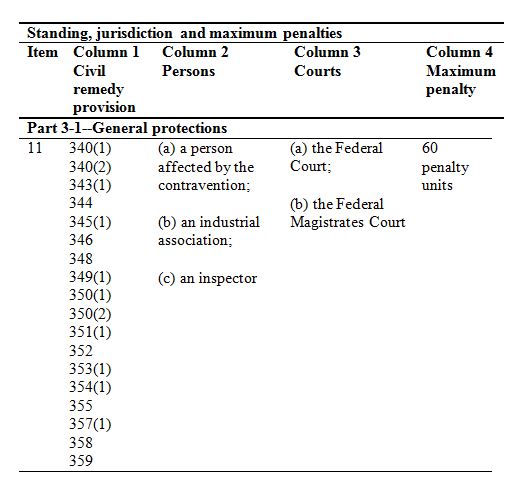
8 The penalty to be imposed on a body corporate, including a trade union, pursuant to s 546(2)(b) of the Fair Work Act is five times the maximum number of penalty units referred to in the relevant item in column 4 of the table in s 539(2).
9 Section 4AA of the Crimes Act 1914 (Cth) determines the rate of a penalty unit, and it is currently fixed at $170.
10 There was no disagreement in the parties’ submissions about the effect of these provisions in the current proceeding. The maximum penalty that may be imposed by the Court for each of the three identified contraventions is 60 penalty units x 5 x $170 which is $51,000.
PARTIES’ SUBMISSIONS ON PENALTY
11 The applicant submits the respondent should be ordered to pay three separate pecuniary penalties, in the “mid-range”, taking into account the maximum penalty would be $51,000, and therefore in excess of $150,000 for the three contraventions. He also submitted the penalties should be “significant”. The applicant does not make any submissions about what this “mid-range” is. He submits any penalties ordered should be payable to him, pursuant to s 546(3)(c) of the Fair Work Act.
12 The applicant relied on the (non-exhaustive) factors identified by Mowbray FM in Mason v Harrington Corporation Pty Ltd [2007] FMCA 7 and accepted by Tracey J in Kelly v Fitzpatrick (2007) 166 IR 14; [2007] FCA 1080 as relevant to determining the penalty to be imposed in a given case. In summary, he submitted the respondent’s conduct, as found by the Court, was “severe” in nature and extent, the applicant was a relatively inexperienced employee and the contraventions were committed by and involved senior members of the CFMEU. The applicant submitted he had still not found further employment, that his prospects of gaining such employment within the union movement were diminished because of the respondent’s conduct, and he had incurred “considerable expense” in relocating first to Queensland and then having to return to Melbourne after his employment was terminated. He relied on statements on the CFMEU website concerning how large the union was. He submitted no contrition had been shown by reason of the respondent’s denial and active contesting of his allegations. He relied on Mr Vickers’ evidence at trial which, he submitted, tried to absolve the CFMEU of wrongdoing. Principles of both general and special deterrence were relied upon.
13 The respondent submitted the Court should not impose any penalty. It advanced four reasons for this submission:
a. although a prohibited reason formed part of its reasons for the adverse action, the respondent had other legitimate and non prohibited reasons for the adverse action;
b. the applicant by his conduct contributed to the adverse action [principally, in relation to his behaviour towards AWU officials, his Facebook post, his complaints about the AWU and therefore his general inability to “fit in”];
c. the respondent, at the time of the adverse action, had formed a genuinely held and reasonable view that the applicant was unsuited to the position for which he was employed; and
d. the respondent endeavoured to act fairly towards the applicant, including by making payment of three months remuneration in lieu of notice on termination of his employment.
14 The respondent accepted that the approach taken in Mason and Kelly identified factors to be taken into account, while noting such a summary imposed no restriction or prescription on the factors which the Court could consider.
15 The respondent also emphasised, and in contrast to the applicant, that although s 557(2) does not in terms apply to s 351, in an appropriate case the Court should take into account that a single course of conduct has resulted in multiple contraventions: see QR Ltd v Communications, Electrical, Electronic, Energy, Information, Postal, Plumbing and Allied Services Union of Australia (2010) 204 IR 142; [2010] FCAFC 150 at [49] per Keane CJ and Marshall J. The respondent also referred to the observations by Middleton and Gordon JJ in Construction, Forestry, Mining and Energy Union v Cahill (2010) 194 IR 461; [2010] FCAFC 39 at [39], to the effect that where there is an “interrelationship between the legal and factual elements of two or more offences” (emphasis in original) care must be taken that an offender is not punished twice for what is essentially the same criminality. In the present circumstances, the respondent submitted that while there were three “distinct” decisions, the events commenced with the meeting on 18 July 2013 and occurred over a short space of time, involving the same person and similar factual issues, with some factual and legal elements of the dismissal and suspension contraventions overlapping. Therefore the respondent submitted that the contraventions should be treated as one course of conduct and (I infer), if a penalty were to be imposed, a single penalty imposed.
16 In submitting there should be no penalty imposed, the respondent points to the payments to the applicant already of $3,000 for general damages and $36,984.16 (less applicable taxation) as compensation for economic loss, as well as the significant legal costs incurred by the respondent and not recoverable under the Fair Work Act for defending the unsuccessful claims in consumer law and in contract.
17 The respondent submits that some of the applicant’s submissions should not be accepted for a number of reasons, including reliance on evidence which has not been adduced, failure to distinguish between the circumstances of the three contraventions, and reliance on authorities with very different facts such as the decision of Jessup J in Murrihy v Betezy.com.au Pty Ltd (No 2) (2013) 221 FCR 118; [2013] FCA 1146. The respondent submitted the applicant incorrectly identified three members of CFMEU management as involved in the contraventions when in fact only Mr Vickers had any role in the suspension and dismissal contraventions, and was the only decision-maker in respect of the redeployment contravention (albeit other senior managers were involved). The respondent submitted the factual circumstances were unusual, unlikely to arise again in other employment contexts and did not call for general deterrence. The respondent’s submissions repeatedly emphasised that the three decisions found to contravene the Fair Work Act were also made for “non prohibited reasons”. Finally, it should be noted that the respondent submitted, in the alternative, that if a penalty were to be imposed, it should be at the “low end of the range”.
18 In reply, the applicant submitted that the only non-prohibited reason identified in the Court’s judgment – the fact the applicant lied to Mr Vickers – was linked to the prohibited reason because of the subject matter of the lie. He submitted the respondent’s position that no penalty should be imposed was also evidence of its lack of contrition, as was its submission that the applicant’s conduct contributed to the adverse actions. He maintained there were three separate contraventions and the “course of conduct” approach should not be adopted. The applicant submitted the Court’s findings that the applicant would not have lasted longer than a further six months were not relevant to penalty, and submitted that finding did not absolve the respondent from the consequences of its unlawful conduct. The applicant generally took issue with most of the respondent’s submissions.
CONSIDERATION
19 There are four principal matters for determination: whether a penalty should be imposed on the respondent at all; if so, is there only one “course of conduct” to be assessed for penalty purposes; what should be the amount of that penalty; and, finally, whether the penalty (if ordered) should be made payable to the applicant.
20 In my opinion penalties should be imposed on the respondent. They should be significant, and imposed separately in respect of each contravention. The penalties should not be payable to the applicant, as this would represent a windfall to him, in light of the conclusions I reached in my reasons on 30 January 2015 about his failure to adduce evidence of loss and damage.
21 No evidence was adduced in respect of penalty by either party. That has some consequences for them both, to which I refer below.
22 In reaching my conclusion, I have not taken into account anything submitted by the applicant at [37] of his submissions. As the respondent correctly pointed out, this paragraph seeks, at the least, to have the Court draw inferences from the conciliation process before the Fair Work Commission. The paragraph will be disregarded. Further, there were aspects of the applicant’s submissions which depended on factual assertions for which no evidence is currently before the Court. For example, at [19] of his written submissions the applicant submitted he is “yet to find alternate employment” (that is, as at the date of the written submissions, namely 13 February 2015) and at [20] he submitted he “incurred considerable expense in relocating to Queensland”. There is no evidence to support these assertions and I have disregarded them.
Penalties should be imposed
23 The respondent’s submission that no penalties should be imposed fails to recognise sufficiently the findings the Court has made. There were clear findings that the applicant was treated as he was because of his political opinion. Making decisions which result in a person losing his employment because of his allegiance and membership of a political party should be the kind of conduct which simply does not occur in the Australian community any more. It should be subject to strong disapproval by the courts. That it should occur within a union which, from the tenor of Mr Vickers’ evidence, places great store in the rights to freedom of speech and freedom of conscience, emphasises why this Court must mark its disapproval of the respondent’s conduct by the imposition of penalties.
24 It is true the Court’s findings reflect the fact that there were a number of reasons Mr Vickers took each of the decisions that he did. As to two of the three contraventions, there was a finding that Mr Vickers acted as he did because the applicant had lied to him, but as the applicant submits, the subject matter of the lie is important. I also found (at [236]) that Mr Vickers’ reasons included the Facebook post by the applicant. In relation to all three contraventions I found (at [237]) that Mr Vickers made the decisions he did because of complaints from the Australian Workers’ Union about the applicant “bagging” its officials and about the applicant’s interpersonal skills. I found these were in part a prohibited reason, and in part not. The presence of other reasons does not excuse, or ameliorate the severity of, the reliance on a prohibited reason. Human conduct is frequently prompted by a variety of reasons. To comply with the Fair Work Act, and with anti-discrimination law generally, employers must ensure that no matter whether lawful reasons also exist, they do not act for an unlawful reason.
25 I found (at [302]-[305]) that absent the prohibited reason, other (less serious) action would likely have been taken against the applicant, involving warnings, and assistance with his workplace manner and performance. At the very least, the AWU complaints would have had to be investigated to see if they had any basis. None of this occurred because Mr Vickers peremptorily acted on the face value of Mr Howes’ complaint, and on the basis of his own deep-rooted suspicions about people associated with the Socialist Alliance who were working in unions. In that sense, it is plain that the applicant would not have lost his job when he did if only the non-prohibited reasons had driven the decision-making. That is why it is also inaccurate for the respondent to characterise its views as “genuinely held and reasonable”. Mr Vickers’ evidence certainly demonstrated a genuine opinion about members of the Socialist Alliance, and a genuine opinion about the applicant’s lies and his Facebook post. The genuineness was no doubt in part the explanation for the peremptory action. There could be however, nothing reasonable – in a legal sense – about the views the applicant was unsuited to the CFMEU position when those views were substantially based on the applicant’s political opinion.
26 Finally, I reject the respondent’s submission that the payment of the applicant’s salary until October 2013 was made out of fairness. Mr Vickers gave no evidence that, on termination of the applicant’s employment, he authorised the payment “in fairness”. It is correct that I found (at [299] of the 30 January 2015 reasons for judgment) the redeployment struck a balance between the view that the applicant should not continue to work for the CFMEU at all and the unfairness of terminating his employment during his fixed-term six-month contract. In other words, there was a recognition by the CFMEU that the applicant had an enforceable fixed-term contract in circumstances where, as at 18 July 2013, there would be no legal justification for the CFMEU summarily dismissing him. However, once the termination was made, there is simply no evidence about why the CFMEU decided to pay the applicant up to October 2013. In this aspect, like the applicant, the respondent seeks through submissions to impose something of a gloss on or an addition to the evidence as it was at trial.
27 Contrary to the respondent’s submissions, there can be no sense in which the Court should refuse to impose a penalty because of some notion of “contribution” by the applicant. Such an approach again seeks to undermine the Court’s findings of contravention. The applicant is not responsible at all for the respondent’s reliance on a prohibited reason. Mr Vickers, and the respondent, bear legal responsibility for that. The applicant’s alleged attitude towards the AWU, the alleged way he conducted himself and the apparent dissatisfaction of some of his AWU colleagues were taken into account in my assessment of the likely longevity of the working relationship between the applicant and the respondent, and my findings that, without the unlawful discrimination and had he been able to continue on in his employment, it is probable that within six months the applicant would have left, or he would have been lawfully dismissed.
“One course of conduct”?
28 Having determined that it is appropriate to impose penalties, the next question is whether there should be three penalties – one for each contravention – or only one, on the basis that the three acts constituted one course of conduct.
29 It is common ground that s 557(1) of the Fair Work Act does not apply in terms to s 351, because it is not referred to in s 557(2). Section 557(1) should nevertheless be set out:
557 Course of conduct
(1) For the purposes of this Part, 2 or more contraventions of a civil remedy provision referred to in subsection (2) are, subject to subsection (3), taken to constitute a single contravention if:
(a) the contraventions are committed by the same person; and
(b) the contraventions arose out of a course of conduct by the person.
30 In my opinion the principles underlying the constraint on judicial discretion imposed by a provision such as s 557(1) should be considered, at least as a matter of discretion, in circumstances where s 557 does not apply on its terms. As Middleton and Gordon JJ said in CFMEU v Cahill, the risk of double punishment should still be recognised. However, the principles which inform the question whether what a person or entity is to be punished for is, in truth, one course of conduct extend beyond the criminal law’s aversion to double punishment. A broader notion of what is a just outcome, based on a characterisation of a person’s conduct, is involved.
31 Consideration in this Court of the concept of a single course of conduct (see, for example, Mornington Inn Pty Ltd v Jordan (2008) 168 FCR 383; [2008] FCAFC 70 at [41]-[42] per Stone and Buchanan JJ; Construction, Forestry, Mining and Energy Union v Williams (2009) 262 ALR 417; [2009] FCAFC 171 at [14]-[19] per Moore, Middleton and Gordon JJ), and in other Courts (see, for example, Johnson v The Queen (2004) 205 ALR 346; [2004] HCA 15 at [4]-[5] per Gleeson CJ; Royer v Western Australia (2009) 197 A Crim R 319; [2009] WASCA 139 at [24] per Owen JA) regularly refers to a passage from the judgment of Wells J in Attorney-General (SA) v Tichy (1982) 30 SASR 84 at 92-93, where his Honour said:
It is both impracticable and undesirable to attempt to lay down comprehensive principles according to which a sentencing judge may determine, in every case, whether sentences should be ordered to be served concurrently or consecutively. According to an inflexible Draconian logic, all sentences should be consecutive, because every offence, as a separate case of criminal liability, would justify the exaction of a separate penalty. But such a logic could never hold. When an accused is on trial it is part of the procedural privilege to which he is entitled that he should be made aware of precisely what charges he is to meet. But the practice and principles of sentencing owe little to such procedure; what is fitting is that a convicted prisoner should be sentenced, not simply and indiscriminately for every act that can be singled out and brought within the compass of a technically identifiable conviction, but for what, viewing the circumstances broadly and reasonably, can be characterised as his criminal conduct. Sometimes, a single act of criminal conduct will comprise two or more technically identified crimes. Sometimes, two or more technically identified crimes will comprise two or more courses of criminal conduct that, reasonably characterized, are really separate invasions of the community’s right to peace and order, notwithstanding that they are historically interdependent; the courses of criminal conduct may coincide with the technical offences or they may not. Sometimes, the process of characterization rests upon an analysis of fact and degree leading to two possible answers, each of which, in the hands of the trial judge, could be made to work justice. The practice of imposing either concurrent or consecutive sentences cannot avoid creating anomalies, or apparent anomalies, from time to time. What must be done is to use the various tools of analysis to mould a just sentence for the conduct of which the prisoner has been guilty. Where there are truly two or more incursions into criminal conduct, consecutive sentences will generally be appropriate. Where, whatever the number of technically identifiable offences committed, the prisoner was truly engaged upon one multi-faceted course of criminal conduct, the judge is likely to find concurrent sentences just and convenient.
32 In Johnson at [5], Gleeson CJ added that:
Ultimately, justice requires due consideration of whether, and to what extent, the appellant “was truly engaged upon one multi-faceted course of criminal conduct”, and whether the sentences imposed properly reflected the outcome of that consideration.
33 In sentencing for breaches of the criminal law, there is recognised tension and conflict between the considerations which sentencing judges must apply. McHugh J described this in AB v The Queen (1999) 198 CLR 111; [1999] HCA 46 at [14] in the following terms:
Many, probably the large bulk of, sentences reflect compromises between conflicting objectives of sentencing. One objective is to impose a sentence that reflects adequate punishment for the culpability of the convicted person, having regard to the community’s view concerning the need for retribution, denunciation, deterrence, community protection and sometimes vindication. Another objective is to impose a sentence, with or without conditions, that will further the public interest by encouraging and not discouraging the convicted person to renounce criminal activity and to re-establish himself or herself as a law-abiding citizen. Still another objective is that the sentence should reflect an allowance for those circumstances, personal to the convicted person, which call for mitigation. These objectives and others have to be achieved within a conceptual framework that requires that there should be parity between sentences, that the sentence should be proportional to the circumstances of the crime and that, where more than one sentence is involved, the total sentence should not exceed what is appropriate for the overall criminality of the convicted person.
34 These compromises and tensions exist less acutely in determinations about the imposition of penalties, but appear nevertheless. In fixing a penalty, just as imposing a sentence, the aim is, as Wells J observed, to “mould a just sentence for the conduct” found to have occurred, and where there are “truly two or more incursions into criminal conduct” to punish these incursions separately.
35 Here, the respondent concedes that each contravention relates to a “distinct decision”, although it submits the factual and legal substratum is the same. That submission takes matters at too broad a level. The starting point is to recognise the importance of the respondent’s concession: there were indeed three entirely separate decisions, taken at different points in time, on the basis of a different set of circumstances and for a different purpose, each decision affecting the applicant adversely in different ways.
36 With the redeployment decision the applicant lost the opportunity he thought he had accepted the interim organiser job in order to pursue – namely, working on the Pilbara alliance. And he had to move back to Queensland. With the suspension decision he lost the right to attend work at all, and suffered the reputational damage and exposure to termination which attended the decision. With the dismissal, he lost his employment altogether. As I have set out above, each decision was taken for more than one reason, but those reasons differed as between the redeployment, and the suspension and dismissal, and each was made in a distinctly different context. I have assumed, for the purpose of this analysis and in the respondent’s favour, that Mr Vickers did seriously consider what the applicant said in his letter in response to the suspension decision, and therefore was making a fresh decision about the applicant’s dismissal. The factors common to all three decisions were the applicant’s political opinion, and the complaints from Mr Howes and the AWU about the applicant. The latter, I have previously found, were also connected to the political opinions the applicant held, and the perceptions of what these political opinions meant for the CFMEU.
37 While it is true that the events occurred over a short space of time, this does not necessarily indicate one course of conduct. Otherwise, the more quickly and hastily employers made decisions, or a series of decisions, the easier it would be for them to seek to characterise their decisions as one course of conduct.
38 In Murrihy (No 2), Jessup J (at [76]) considered that a series of steps taken by the employer in that case (including termination of computer access and cessation of remuneration) were all “manifestations” of the employer’s suspension of the employee. I consider that circumstance to be quite different from the present. In the present case, each of the contraventions is truly separate, and is not a manifestation of one of the other contraventions. Mr Vickers, with the assistance of Mr Weise and Mr Maher, consciously and deliberately took three decisions about what to do with the applicant.
39 At the time of each decision, Mr Vickers had a variety of choices about what he could do. After the 18 July meeting, he could have had the AWU complaints investigated. Or he could have had the applicant counselled and more closely supervised by Mr Weise. Or he could have suggested to the AWU that Mr Kerley be redeployed, thus supporting the interests of the CFMEU’s own organiser. Instead, he chose to remove the applicant from Western Australia, and prevent him starting in the Pilbara position. That choice was substantially actuated by Mr Vickers’ views about the applicant’s political opinion, which also inclined him to accept Mr Howes’ views and the AWU complaints at face value. On 22 July 2013, when Mr Vickers was given further information about the applicant’s involvement with the Socialist Alliance, and about a Facebook post he had made, again Mr Vickers had choices available to him. He could have written a less confrontational letter to the applicant than he did. He could have discounted the Facebook post as a misguided outburst by a new and junior employee in the heat of the moment. He might have sought to understand the sense of betrayal the applicant felt towards Mr Kerley (had the applicant felt uninhibited enough to disclose to Mr Vickers that the comment was directed at Mr Kerley, which he clearly did not). Mr Vickers could have set about trying to understand why the applicant might have lied about the extent of his involvement with the Socialist Alliance and asked himself whether his own emphasis on that issue in his decision-making was appropriate (let alone lawful). On 25 July 2013 (when he sent the “nothing changes from my perspective” email to Mr Weise and Mr Maher) and on 26 July 2013 when he decided to terminate the applicant’s employment, Mr Vickers again had choices, other than the one he made. Yet, at each stage of his decision-making about the applicant’s employment and future with the CFMEU, I have found he acted as he did because the applicant had been a member of the Socialist Alliance and was affiliated with it. In my opinion, it was this reason – the prohibited reason – which influenced Mr Vickers to make the choices which were the most detrimental to the applicant.
40 I consider each of Mr Vickers’ three decisions to be a separate “incursion” into unlawful conduct under s 351 of the Fair Work Act. The question of penalties should in my opinion be approached on the basis there are three contraventions and three penalties should be imposed.
The level of penalty to be imposed
41 I have reviewed other decisions of this Court in relation to the imposition of penalties under s 351, or other similar provisions of the Fair Work Act, or its predecessors. I do so taking into account caution of the kind expressed by Logan J in Fair Work Ombudsman v Australian Shooting Academy Pty Ltd [2011] FCA 1064 at [35]:
The position which obtains is that the discretion as the imposition of penalty must be exercised in the circumstances of individual cases. Particular care must be taken in the absence of guiding authority at an intermediate appellate level as to appropriate penalties in respect of frequently-encountered contraventions so as not to skew the imposition of penalty by reference to other outcomes in the original jurisdiction in respect of quite different facts.
42 Without engaging in any direct comparisons, in my opinion it is helpful to consider in particular some of the language used by other judges at first instance in their consideration of appropriate penalties, measured against the maximum penalties available in the circumstances.
43 The maximum penalties prescribed by Parliament are the legislative choice made about the outer limit of appropriate punishment for a particular contravention. However in a case where there are multiple contraventions to which the “one course of conduct” and totality principles must be applied, the maximum penalty specified for each single contravention may not be especially informative as to what represents a just outcome. At most the maximums set encourage the Court to ask itself whether the contravention as found is of “the worst” kind. In Veen v The Queen (No 2) (1988) 164 CLR 465 at 478, Mason CJ, Brennan, Dawson and Toohey JJ said:
The second subsidiary principle material to this case is that the maximum penalty prescribed for an offence is intended for cases falling within the worst category of cases for which that penalty is prescribed. That does not mean that a lesser penalty must be imposed if it be possible to envisage a worse case; ingenuity can always conjure up a case of greater heinousness. A sentence which imposes the maximum penalty offends this principle only if the case is recognizably outside the worst category.
(Citations omitted.)
44 The process of arriving at an appropriate penalty will remain one affected by what has been described as “instinctive synthesis”: Fair Work Ombudsman v Skilled Offshore (Australia) Pty Ltd [2015] FCA 275 at [19] per Gilmour J, referring to Australian Ophthalmic Supplies Pty Ltd v McAlary-Smith (2008) 165 FCR 560; [2008] FCAFC 8 at [27] per Gray J and [55] per Graham J, who in turn refer respectively to Markarian v The Queen (2005) 228 CLR 357; [2005] HCA 25 at [37] per Gleeson CJ, Gummow, Hayne and Callinan JJ (approving Wong v The Queen (2001) 207 CLR 584; [2001] HCA 64 at [74]-[76] per Gaudron, Gummow and Hayne JJ) and at [84] per McHugh J. However it is described, the aim is, as the authorities to which I have referred at [31] to [34] above suggest, to mould a just and proportionate sentence or, in this case, a just and proportionate penalty.
45 In Skilled Offshore (Australia), Gilmour J fixed penalties for direct contraventions at 65% of the maximum, in relation to breaches by the Maritime Union Australia in enforcing a closed shop at the Western Australian waterfront over almost a year. His Honour described the contraventions (at [65]) in the following terms:
the MUA’s conduct involving, as it did, gross interference with the freedom of association rights of the Loves, depriving them, at a critical time of their lives, of the opportunity to gain well paid employment. These serious consequences for the Loves involved the MUA not only in refusing the Loves membership of the MUA but in the intimidation, by threats of industrial action, of OMS to which that company succumbed, such that OMS, although it wanted to employ the Loves, did not do so. The MUA’s conduct involved its blatant use of illegitimate industrial action power to bully OMS into not employing the Loves.
46 His Honour imposed some penalties concurrently and some cumulatively, having regard to the totality principle.
47 In National Tertiary Education Union v Royal Melbourne Institute of Technology (2013) 234 IR 139; [2013] FCA 451, Gray J fixed penalties for two contraventions at $27,000 for the dismissal (being 82% of the then maximum penalty) and at $17,000 for breaching the enterprise agreement (being 67% of the then maximum penalty), but then reduced the total penalty to $37,000 by applying the totality principle. His Honour found the respondent had made a university professor redundant for reasons including a complaint she made against her supervisor, and had breached the enterprise agreement by failing to offer the option of voluntary redeployment. At [141], His Honour described the contraventions in the following way:
The contravention of s 340(1)(a) of the Fair Work Act must be regarded as very serious. In effect, RMIT made use of its redundancy processes to rid itself of an employee, who was considered to be troublesome, at least partly because she was prepared to exercise her workplace rights by making complaints about the behaviour of her immediate supervisor. The process was conducted unfairly, with an attempt to narrow the focus of consideration to a financial situation which was alleged to exist, but not established by a rigorous process and not in accordance with reality. Attempts to introduce into the redundancy process objective criteria, by reference to which Professor Bessant might have been able to justify retaining her position, were resisted. The contravening reasons for Professor Bessant’s dismissal were kept secret. Even in Court, they were not addressed by Professor Gardner, and others who could have shed light on them were not called to give evidence. Their existence was certainly known to Ms Gough, as is demonstrated by the disclaimer in her letter of 28 October 2011. This contravention was serious also in its effect on Professor Bessant. There was evidence from Linda Gale and Mr Cupido, both from the NTEU, and from Professor Bessant herself, that the dismissal of a professor, even when labelled as a redundancy, would have a very significant effect on the ability of the dismissed professor to obtain another job in a university. Such a dismissal would mean inevitably that a prospective employer would take the view that the dismissed professor must have some undesirable qualities, or must have been guilty of some bad conduct, in order to have been chosen for redundancy. This evidence was not addressed squarely by RMIT in its evidence. The proposition that a dismissal for any reason makes it difficult to obtain another job, especially in a field in which the number of potential employers is quite small and the pool of possible candidates is quite large, is not inherently improbable. Professor Gardner conceded the scarcity of level E jobs in social sciences. I accept that there was serious damage to Professor Bessant’s prospects of re-employment as a result of the redundancy process. That process itself was drawn out and complex, and caused significant distress to Professor Bessant. For all of these reasons, I take the view that the contravention was a very serious one.
48 In Fair Work Ombudsman v W.K.O. Pty Ltd [2012] FCA 1129, a child care centre had breached various provisions including by denying unpaid parental leave and adverse action for reasons including the employee’s pregnancy. Barker J held (at [104]) that there should be a penalty “towards the lower end of the range”, consistently with the penalty agreed between the parties. His Honour described the contraventions (at [104]) as “serious ones”, and stated:
The fact is that the respondents unilaterally and unlawfully decided to reduce the hours of employment of a pregnant employee. This led to the employee being constructively dismissed from her employment when she felt she had no option but to terminate her employment in light of her significantly reduced hours.
49 In W.K.O., it was obviously an important factor in his Honour’s consideration that “in the end the respondents did not contest their liability at a trial and relatively early in the process admitted their contraventions”, a matter which his Honour found to the respondents’ credit: at [105].
50 I have reached the conclusion that the respondent’s conduct in this case calls for significant penalties for the three contraventions, while recognising each contravention had different effects, and a different level of seriousness.
51 The absence of any evidence of previous contraventions by the respondent means, as Jessup J pointed out in Murrihy (No 2), that the respondent’s conduct must be measured in and of itself, without reference to previous conduct. I do not consider this as some kind of positive factor in the respondent’s favour, which seemed to be the implication from the respondent’s submissions. Especially in relation to unlawful discrimination, where the true reasons for conduct are often difficult to uncover, one cannot simply infer, as the respondent seemed to suggest the Court might, that this kind of conduct has not occurred before within the CFMEU. Nor can one infer it has. Rather, the conduct stands to be assessed for what it has been found by the Court to be. In my opinion absence of evidence about prior contraventions that have been litigated and determined simply means there is no evidence of that nature which might otherwise have contributed to an increase in the penalty to be imposed.
52 There are three aspects of the nature and extent of the conduct which I consider most significant in determining the level of penalty to be imposed. I have already addressed them above, but summarise them here.
53 First, each of Mr Vickers’ decisions – redeployment, suspension and dismissal – had considerable consequences for the applicant. He had to move from one state to another. Then he had to face losing his job. Then he lost his job. Although as I noted in the 30 January 2015 reasons for judgment there was little evidence of loss adduced on behalf of the applicant, that fact does not affect my view about the serious nature of each of the contraventions. In particular, to dismiss a person because of his political opinion is especially serious, even accepting by that stage other factors were also at work in Mr Vickers’ decision-making. As I have said more than once in these reasons and in my 30 January 2015 reasons, the applicant’s political opinion was entangled in some of those other reasons as well.
54 Second, there were other choices available to the respondent, through Mr Vickers, when faced with the complaints by the AWU and Mr Howes. The respondent elected to take, in quite a confrontational and hurried way, the choices with the most serious consequences for the applicant. The redeployment was not, in my opinion, chosen out of any sense of kindness or fairness to the applicant, contrary to the way the respondent sought to characterise it. It was chosen because the respondent recognised the applicant had a fixed-term contract and could not be summarily dismissed on the basis of the AWU allegations.
55 Third, for an employer to act adversely to an employee’s legitimate interests on the basis of the employee’s political opinion is conduct to be censured in the strongest terms. In cross-examination, Mr Vickers recognised it would be unlawful, and inappropriate, to ask an employee questions about membership of the ALP, and was quick to insist he would not do so. He accepted, with similar alacrity, that he would not ask a CFMEU employee questions about her or his sexual orientation. When it came, however, to a political organisation that Mr Vickers saw (rightly or wrongly, with or without any basis in fact) as a threat to the way the CFMEU operated and was organised, he had no compunction in doing whatever needed to be done to an employee he perceived supported, or had been aligned with, that organisation. That is, when it really mattered, when something was perceived to be at stake, he would quickly and actively discriminate. That attitude led him to act as he did on the complaints of Mr Howes, which complaints as recorded in the witnesses’ evidence appear similarly discriminatory. Mr Vickers acted irrespective of and without seeking to ascertain whether the applicant had any intentions of engaging in the kind of undermining and infiltration with which Mr Vickers tarred all those associated with the Socialist Alliance. That is, he engaged in stereotyping. He did not care, before he sacked Mr Sayed, whether Mr Sayed would in fact undermine or infiltrate the CFMEU in a way which was harmful. He acted on prejudice.
56 Those three aspects in my opinion make the three contraventions deserving of significant levels of penalties. It cannot be said the contraventions are of the most heinous or serious kind that could be imagined in the context of discriminatory adverse action against an employee. Nor are they trifling, trivial or insignificant.
57 I consider requirements of general deterrence not only support the imposition of penalties in this case, but also affect the amount of that penalty. The remarks of Marshall J in Fair Work Ombudsman v Maclean Bay Pty Ltd (No 2) [2012] FCA 557 at [29] – that rights are a shell unless respected – have some resonance in the present case. The inclusion of anti-discrimination prohibitions in the Fair Work Act was designed to bring a broader range of conduct in the workplace into line with the general requirements of anti-discrimination law. By deeming s 351 to be a civil remedy provision for which penalties may be imposed, Parliament has clearly intended to make principles of general deterrence applicable to discriminatory conduct which contravenes s 351. General deterrence in the area of anti-discrimination has an important role to play, in part because discrimination is often difficult to prove, even when the adverse action or the effect of discrimination is obvious. Therefore, deterrence is important. Anti-discrimination law, and provisions such as s 351, operate on decision-making which has first an internal and then an external aspect. If, by the imposition of penalties, employers see that courts will look carefully and closely at their reasons for decision-making in the workplace, and will punish them if their reasons are prohibited reasons, in my opinion this is capable of contributing to employers, and those who act on their behalf, giving greater pause for thought about whether their reasons are lawful ones in advance of taking decisions.
58 I do not consider that special or specific deterrence in relation to the CFMEU has a large role to play in the fixing of penalties in this proceeding. The penalties must be such that they sound an effect within the union, make clear that what has occurred is unlawful and that the Court disapproves in serious terms. However there was nothing in the evidence of either Mr Vickers or Mr Weise which would make me apprehend the union would fail to learn from this experience. The discrimination was obvious, but did arise in somewhat particular circumstances that may be unlikely to be repeated. More critically, I am satisfied the CFMEU will now better understand its legal responsibilities in relation to the operation of s 351 on its decision-making about its employees.
59 The respondent was not required to compromise at all during the trial of the applicant’s allegations, and was entitled fully to defend itself against them. Having chosen to do that, there is nothing in its conduct prior to or at trial which could be said to be deserving of any particular leniency or “credit”, in contrast to circumstances where a respondent may admit a contravention and save the applicant and the Court the time and resources of a trial on liability. In its penalty submissions there is no apology, nor any acceptance of the unlawfulness the Court has found. The respondent is not required in any sense to demonstrate these features, but their absence removes those possible mitigating factors from the discretionary balancing exercise.
60 I do not consider the evidence of Mr Vickers at trial, and to which I referred at length in my 30 January 2015 reasons, shows anything in the nature of contumacy or malevolence, such as to increase the culpability of the respondent. Mr Vickers was at pains to deny the applicant’s political opinion was a reason for the redeployment, the suspension and the dismissal, but in the context of the respondent’s complete contesting of the allegations, this is unsurprising. I did not make any finding that Mr Vickers was wilfully dishonest. He sought to explain and rationalise his decision-making which is understandable given the spotlight placed on it by this trial. For some reason, he seemed to consider political allegiances and associations with the Socialist Alliance were in a different category from those with the main political parties in Australia. For the purposes of s 351 (and, I might add, any other anti-discrimination statute where political opinion is nominated as a protected attribute), the law makes no such distinction.
61 There was no other evidence of contrition, or attempts to ameliorate the effects of the unlawful conduct. The fact that the compensation ordered has been paid is nothing more than compliance with the Court’s orders. Evidence could have been adduced, but was not, to demonstrate changes of practice within the CFMEU, or some new consciousness about the decision-making process where allegations about political affiliations of employees or officers are made. No such evidence was adduced, and so there is nothing of this kind to weigh in the balance in the respondent’s favour.
The totality principle
62 The totality principle was described by Stone and Buchanan JJ in Mornington Inn (2008) 168 FCR 383; [2008] FCAFC 70 at [42] as:
a final check to be applied to ensure that a final, total or aggregate, penalty is not unjust or out of proportion to the circumstances of the case.
63 Their Honours refer at [43] to the more expansive explanation of the principle given by the High Court in Mill v The Queen (1988) 166 CLR 59 at 62-63, where the Court endorses descriptions of the principle given by a number of commentators, for example, Thomas DA, Principles of Sentencing (2nd ed, Heinemann, 1979), pp 56-57 where the learned author describes the court’s function in applying the principle as “to review the aggregate sentence and consider whether the aggregate is ‘just and appropriate’”. In Mill, the High Court also refers at 63 to the decision of the Full Court of the South Australian Supreme Court in R v Knight (1981) 26 SASR 573 where Walters, Zelling and Williams JJ in a joint judgment at 576 described the task as being to look at the totality of the sentences and to decide whether it could be said that in all the circumstances of the case, “the imposition of a cumulative sentence was incommensurate with the gravity of the whole of his proven criminal conduct” or with the offender’s “due deserts”. In Knight, the Full Court at 576 also referred to the pithy summation of the task by Lord Widgery LCJ in R v Faulkner (1972) 56 Cr App R 594, at 596:
at the end of the day, as one always must, one looks at the totality and asks whether it was too much.
64 Accepting the need for powers to be exercised fairly, reasonably and judicially, this task nevertheless remains highly intuitive. Part of the judicial task, and the reason it is reposed in judges, is to bring to bear a detached sense of what is fair and just, to the community, the victim and the perpetrator, doing the best one can to balance what are inevitably conflicting interests.
Conclusion on the amount which should be fixed as a penalty for each contravention
65 Given there are three contraventions for which I have found penalties should be imposed separately, the theoretical maximum penalty that could be imposed is $51,000 for each contravention, making a total of $153,000. In addition to the features of the respondent’s conduct, through Mr Vickers, that I have set out above, I make the following additional findings.
66 In my opinion, different penalties for each contravention are justified because of the nature and effect of each contravention.
67 For the contravention of s 351 by the redeployment of the applicant I consider a penalty of $20,000 should be imposed. Although it was the contravention with the least permanent effect, the redeployment was the decision which set the scene for the remainder of the conduct against the applicant. It set Mr Vickers on a path from which he scarcely considered deviating. It was at this point that the prohibited reason operated with greatest effect. Mr Vickers was barely persuaded to keep the applicant on at all after the 18 July 2013 meeting. His views of the applicant, informed and actuated by his views about the applicant’s political opinion, were fairly well cast after the redeployment decision. Had Mr Vickers put out of his mind the prohibited reasons and approached the complaints of Mr Howes and the AWU in a different manner, the outcome for the applicant – at least in the medium term – would most likely have been quite different. In my opinion, the redeployment decision was the one with less non-prohibited justifications, on any objective view. It was the one most closely connected with the complaint of Mr Howes that the applicant was “a Trot”.
68 For the contravention of s 351 by the suspension of the applicant, I have imposed a penalty of $10,000. The suspension decision was an immediate reaction to the discovery of the applicant’s lies about his involvement with the Socialist Alliance, and Mr Vickers’ mistaken impression of what was meant in the Facebook post. Its hasty and judgmental nature reflected the playing out of the views Mr Vickers had already formed about the applicant’s allegiances. The suspension lasted for a brief period of time. It did not result in any relocation for the applicant. He was suspended on pay. It certainly made it clear his employment was at risk, and he was subjected to what was no doubt a difficult and confrontational meeting on 26 July 2013 in Sydney. Although serious, its effects were short-term. In the whole context, it is the least serious of the three contraventions.
69 For the contravention of s 351 by the dismissal of the applicant I have imposed a penalty of $15,000. This decision ended the applicant’s employment. It is the ultimate sanction an employer can impose on an employee and cannot be regarded as anything but a serious contravention. The failure of the applicant to adduce what one might have expected to be fairly straightforward evidence of loss means there is little or no evidentiary basis for the Court to assess the impact – immediate or continuing – on him of the contravention. The Court can, I consider, take into account the obvious effect termination of employment has on any person where it is not voluntary. It can take into account the applicant’s bare statement that he remained unemployed at the time of trial and that he had “looked for a lot of jobs” since leaving the CFMEU, although the reasons for his unemployment and the efforts he had made (or not made) to find other employment were not otherwise the subject of any evidence. It is difficult in those circumstances to afford much weight to his statement of unemployment. Notwithstanding the paucity of evidence from the applicant, this penalty must impose tangible punishment for unlawfully depriving the applicant of his entitlement to work at the CFMEU.
70 The total for the three contraventions is therefore $45,000. I consider that total is just, and proportionate to the circumstances of the case. In a society where civil and political rights are greatly respected, in particular by the legislative choices of the Parliament, to require the respondent to pay penalties totalling $45,000 is commensurate in my opinion with the gravity of the respondent’s conduct as I have found it to be. The Court should mark its disapproval of an employer taking adverse action against an employee because of his political opinion. That is especially so where the employer sees the particular political opinion held as a “threat” to the employer, without any inquiry into what the employee has in fact done and based on the stereotyping of persons the employer believes hold similar political opinions.
71 I should add that, even if I had concluded that the three contraventions should be characterised as one course of conduct, then I would consider a penalty of $45,000 in respect of that course of conduct as a whole to be just and appropriate.
Penalties should not be payable to the applicant
72 The applicant has sought orders that the penalties be payable to him, but does not develop that submission in any detail. Somewhat surprisingly, the respondent’s submissions did not address this issue at all.
73 In NTEU v RMIT at [146] Gray J described the effect of s 546(3) as follows:
The scheme under which the enforcing party is the recipient of the penalty is designed to encourage the enforcement of provisions of the Fair Work Act and of agreements and other instruments made under it.
74 Those observations had particular force in a case of the kind with which his Honour was then dealing, where a union had brought proceedings on behalf of one of its members, thus shouldering for itself the burden of the conduct of what was obviously a substantial piece of litigation, in circumstances where that litigation had as one of its aims the securing of individual financial benefits for the union member by way of compensation, but also of marking out, from the perspective of the protection of the rights of all relevant workers, the boundaries of alleged unlawful conduct by RMIT.
75 There is more than a little irony in the fact that the contravener here is a union, in relation to a provision where the circumstances which obtained in NTEU v RMIT are far more commonplace. This case demonstrates that a union is no less accountable for such contraventions than any other employer.
76 I dealt with the authorities about payment of penalties, and the underlying rationales concerning common informers, in Dafallah v Fair Work Commission (2014) 225 FCR 559; [2014] FCA 328 at [139]-[143], and I need not repeat those passages. In those paragraphs, amongst other observations, I respectfully agreed with the remarks of Greenwood J in McIlwain v Ramsey Food Packaging Pty Ltd (No 4) (2006) 158 IR 181; [2006] FCA 1302 at [108] (endorsed by Branson and Lander JJ in Plancor Pty Ltd v Liquor, Hospitality and Miscellaneous Union (2008) 171 FCR 357; [2008] FCAFC 170 at [70]):
the imposition of a penalty under the Act is designed fundamentally to serve the public interest in acting as a deterrent to the particular Respondents and others generally from engaging in conduct of the kind the subject of the findings. In circumstances where an order has been made for compensation for both economic loss and a non-economic component concerning the disturbance, dislocation and loss of secure employment suffered by the individuals, there seems to be no good policy reason why the individuals should additionally have the benefit of an order for the payment to them of the penalty.
77 I consider those remarks applicable and pertinent to this proceeding.
78 Although I acknowledge the rationale behind the “common informer” provisions, described in some detail by Moore J in Schanka v Employment National (Administration) Pty Ltd (No 2) (2001) 114 FCR 379; [2001] FCA 1623 at [77]-[87], the interrelationship between this rationale and the existence of compensation provisions such as s 545 has not been much explored. It may be that these rationales developed in contexts where the person who was the “common informer” was not the person directly affected by the contravention, or if she or he was, had no statutory right to compensation, nor to other remedies such as reinstatement, so that the only recompense or “reward” the person who brought the proceeding and exposed the unlawful behaviour could receive was what the Court ordered to be paid by way of penalty.
79 The existence of these tensions seems to have escaped the drafters of the Explanatory Memorandum to the Fair Work Bill 2008 (Cth) which states:
2157. Subclause 546(3) provides that the court may order pecuniary penalties (or part of a pecuniary penalty) to be paid to the Commonwealth, a particular organisation or a person. Ordinarily, any pecuniary penalty awarded by the court is paid to the applicant or, in the case of proceedings brought by a Commonwealth official such as an inspector, to the Commonwealth (on the basis that the applicant represents the Commonwealth).
2158. Also, it gives the court the flexibility to award the penalty to someone other than the plaintiff or applicant where the plaintiff or applicant requests. For example, where an inspector brings penalty proceedings against the director of a company that has gone into liquidation, the inspector might request the court to pay any penalty to an employee rather than the Commonwealth in circumstances where the employee is out of pocket as a result of the company being liquidated.
…
2160. Subclause 546(5) provides that a court can make a pecuniary penalty order in addition to one or more orders made under clause 545. The effect of this is that a court is not restricted to the making of only one order in respect of any contravention of a particular civil remedy provision.
2161. For example, in a case involving a contravention of a civil remedy provision related to underpayment of minimum wages under a modern award, the court may order that the employee is entitled to compensation for that underpayment and a pecuniary penalty may also be imposed on the employer for the contravention.
80 The proposition that both compensation and penalties might be ordered by the Court is straightforward. The proposition that they might both be ordered to be paid to the same person is more complex. In addition to McIlwain and Plancor, there are two cases which do discuss the complexity, at least by reference to the concept of avoiding “windfalls”.
81 In Seymour v Stawell Timber Industries Pty Ltd (1985) 9 FCR 241; (1985) 13 IR 289 (in the related context of the Conciliation and Arbitration Act 1904 (Cth)), Gray J did advert to the need in imposing penalties to adhere to the legislative scheme as it appears, and his Honour’s approach appears to proceed on the basis that penalties should not be imposed in a way which delivers a windfall contrary to the particular legislative scheme. The proceeding in Seymour was brought by the applicant in his capacity as an inspector under the Conciliation and Arbitration Act, and the contraventions related to failure to pay two apprentices in accordance with the applicable award. Only one of the two apprentices was a member of any relevant union. As such, the Court had no power under s 119 of the Conciliation and Arbitration Act to make any order relating to unpaid wages with respect to the apprentice who was not a union member. The applicant submitted that the Court should order the penalty be paid to the non-union member apprentice in part satisfaction of the unpaid wages. The Court declined to make such an order and instead ordered the whole of the penalty be paid into the Consolidated Revenue Fund.
82 Gray J made the following observation in Seymour at 268:
The legal obligation remains on the respondent to pay wages to Mr Hughes. It is true that the court cannot, under either s 119(3) or s 123 of the Act, order the respondent to make those payments. Nevertheless, I would expect the company to fulfill its legal obligation, once it is made aware of the existence of that obligation by reason of the decision of the court. If the company were to go into liquidation, it may be that the liquidator would have an obligation to pay Mr Hughes’s outstanding wages. If the amount of the penalty were paid to Mr Hughes, and the company discharged its legal obligation by paying him wages, Mr Hughes would have received a windfall benefit. He would have received this benefit by reason of his not having been a member of an organisation. In my view, to confer such a benefit would be a denial of the central role of organisations in the system of conciliation and arbitration set up under the Act, and would run contrary to the objects of the Act. …
(Citations omitted.)
83 Observations to similar effect concerning the need to order penalties in a way which was consistent with the legislative scheme as it stood were made by Northrop J at 246.
84 In CPSU, The Community and Public Sector Union v Telstra Corporation Limited (2001) 108 IR 228; [2001] FCA 1364 at [25]-[28], and after having examined the history of the “common informer” prosecution, Finkelstein J stated
It cannot be doubted that employer and employee organisations play a legitimate and important role in seeing that there is compliance with the provisions of the Workplace Relations Act. For example, an individual employee will rarely have the ability to fund a proceeding for a contravention. If unions do not bring such proceedings, contraventions will go unpunished.
Perhaps the “usual” order is to be explained on the basis that often an industrial organisation brings proceedings for a contravention of the Workplace Relations Act to protect the legitimate interests of its individual members. In such a case it is appropriate for the organisation to receive the penalty, to defray its actual costs and to provide some compensation for the time lost by its staff. In this regard it should be noted that, apart from exceptional cases, a party to a proceeding in a matter arising under the Workplace Relations Act is not entitled to recover costs: see s 347.
However, there is no reason to make “the usual order”, if that will result in a windfall to an organisation. Proceedings for pecuniary penalties are not to be used for profit: cf Municipal Officers Association of Australia v City of Bayswater (1987) 22 IR 45, 51; Seymour v Stawell Timber Industries Pty Ltd (1985) 13 IR 289, 311.
An appropriate order (if there be enough funds) would allow the unions a sufficient sum to meet their costs and expenses, including the expense of staff time. The balance (if any) should be paid into the Consolidated Revenue Fund. …
85 At least part of the explanation for what Gray J describes in Gibbs v The Mayor, Councillors and Citizens of City of Altona (1992) 37 FCR 216 at 223-224 as the “usual” order that penalties be payable to the person who brought the proceeding appears to be the public interest in providing recompense for costs and expenses incurred in bringing the proceeding, so as to encourage (or, at least, not discourage) the exposure of allegations of unlawful conduct. His Honour said:
The usual order, when the proceeding is not brought by an inspector appointed under the Act, is for payment to the person or organisation applying for the penalty. … In the present case, the applicant has brought the proceeding on behalf of the Union, to enforce the Award for the benefit of the Union and its members. Had the applicant brought the proceeding in his personal capacity, and at his own expense, it would have been appropriate to order that the penalties be paid to him. It is unlikely that the applicant has become responsible personally for the costs of the proceeding and more likely that those costs will be met by the Union. In the circumstances, it is appropriate that the Union should be the recipient of the penalties.
86 It is to be noted here that, just as Finkelstein J did in CPSU v Telstra, his Honour appears to refer to expenses and costs in a broader sense than simply legal costs.
87 The current legislative policy manifested in the Fair Work Act by s 570(1) is that parties to proceedings such as the present are, subject to s 570(2), or ss 569 or 569A, to bear their own legal costs. This adds a further tension in the appropriate approach when considering whether to order that penalties be payable to a person in the applicant’s situation.
88 Where the applicant is a union, or other representative organisation, there will be a wide range of resources occupied in bringing a proceeding alleging contraventions of the Fair Work Act, many of which are separate to any fees paid to solicitors and counsel for legal representation and advice in the proceeding. To that extent the rationale remains for ordering a penalty be paid to a union, or other representative organisation, even in the face of the clear legislative policy evinced in s 570 of the Fair Work Act.
89 That rationale has no application in the present case. In the present case, whatever fees for solicitors and counsel the applicant has incurred, Parliament has determined that, unless the circumstances set out in s 570(2), or ss 569 or 569A, exist, he should bear his own costs of this proceeding. Once again, it would in my opinion introduce an inconsistency into the application of the present legislative scheme in the Fair Work Act to order that the respondent pay penalties to the applicant so that he could, in that way, recover his legal costs.
90 The circumstances of the present case provide a good example of the tension between an exercise of the power under s 546(3)(c) and the fact that the Court has already made a final determination, on the basis of the evidence adduced (or not adduced) by the same person, as to the compensation which it is appropriate the respondent pay to the person in relation to the contraventions.
91 In the 30 January 2015 judgment, I observed that there was little or no evidence of damage or harm adduced on behalf of Mr Sayed. To say that is not to say there was no significant general harm caused to Mr Sayed by the respondent’s conduct: rather, that if there was, Mr Sayed did not seek to prove it. It was for that reason that, despite my findings of three serious contraventions of s 351 of the Fair Work Act, resulting in Mr Sayed losing his job, there was a relatively modest award of general compensation. Simply put, there was no evidentiary foundation laid for any more. Nor was there any evidence about ongoing financial loss. The loss of income component of Mr Sayed’s compensation award under s 545 was limited to a large extent by my finding (at [311]) that it was probable it would have taken no longer than six months before the applicant would have, in any event and in the absence of any unlawful discrimination, moved out of the Pilbara position – whether at his own instigation or that of the respondent.
92 In combination, these factors explain why, despite the language I have used in these reasons for judgment about the seriousness of the respondent’s contraventions, what the respondent has to this point been ordered to pay to Mr Sayed has been relatively modest. That is either because there was a forensic decision taken not to adduce any further evidence on behalf of Mr Sayed, or because the damage was of a limited nature, or both.
93 In my opinion, to order that the sums of money imposed by way of penalty on the respondent be paid to the applicant would to be to deliver to him a windfall which would not be appropriate in the circumstances, and would not serve the interests of the administration of justice. He would receive more in real terms through the penalty payment than I determined he was entitled to by way of compensation, yet would receive that $45,000 in addition to receiving payment from the respondent by way of compensation. The inherent requirement in the compensation provisions of the Fair Work Act that a person seeking compensation prove the loss he or she alleges he or she has suffered, and otherwise prove to the satisfaction of the Court the entitlement to the remedy sought (e.g., reinstatement) would be undermined, as would the legislative policy behind s 570(1).
94 There will be orders that the penalties be payable to the Commonwealth, pursuant to s 546(3)(a) of the Fair Work Act. The penalties are payable within 25 working days from the date of the pronouncement of these orders.
I certify that the preceding ninety-four (94) numbered paragraphs are a true copy of the Reasons for Judgment herein of the Honourable Justice Mortimer. |
Associate:


