FEDERAL COURT OF AUSTRALIA
Australian Competition and Consumer Commission v Actrol Parts Pty Ltd [2015] FCA 312
IN THE FEDERAL COURT OF AUSTRALIA | |
AUSTRALIAN COMPETITION AND CONSUMER COMMISSION Applicant | |
AND: | ACTROL PARTS PTY LTD ACN 142 654 564 Respondent |
DATE OF ORDER: | |
WHERE MADE: |
THE COURT DECLARES THAT:
1. Actrol Parts Pty Ltd (“Actrol”) has, in trade or commerce:
1.1 in connection with the supply or possible supply of hydrofluorocarbon (“HFC”) refrigerants, made false or misleading representations with respect to the price of such HFC refrigerants in contravention of section 29(1)(i) of the Australian Consumer Law (“ACL”), consisting of Schedule 2 to the Competition and Consumer Act 2010 (Cth) (“CCA”); and
1.2 engaged in conduct that was misleading or deceptive, or likely to mislead or deceive, in contravention of section 18(1) of the ACL,
by distributing, by email to its customers and placing on Actrol’s website located at the uniform resource locator www.actrol.com.au, a letter to its customers dated 20 June 2012, which represented increases in the list prices for five HFC refrigerants, namely R134a, R410A, R404A, R407C and R507, effective from 1 July 2012, were due to:
1.3 changes in input costs and general market conditions;
1.4 the introduction of an Equivalent Carbon Price Levy under the carbon tax scheme, when:
1.5 the HFC price increases were not solely due to changes in input costs and general market conditions;
1.6 Actrol’s costs of supplying those HFC refrigerants had not increased to the extent of the HFC price increases and were not reasonably expected to increase to the extent of the HFC price increase until about mid-2013;
1.7 by reason of a pricing strategy in relation to HFC refrigerants, Actrol had sought to insulate itself:
1.7.1 from impacts on its costs and changes in the market arising from the introduction of an Equivalent Carbon Levy Price applicable to HFC refrigerants imported into Australia from 1 July 2012 for a period of approximately 6 months; and
1.7.2 following that period and until about mid-2013, from impacts on its HFC refrigerant purchasing costs and changes in the market arising from the introduction of that levy to the extent of 50% of the levy; and
1.8 Actrol implemented the price increases in order to increase its margins on those HFC refrigerants and achieve a benefit to its earnings before interest and tax and take into account changes in Actrol’s costs of supplying the relevant HFCs.
THE COURT ORDERS THAT:
2. Actrol be restrained for a period of 3 years from the date of this order, whether by itself, its servants, agents or however otherwise, in trade or commerce, from making any representation that an increase in its list prices of refrigerants is for a specified reason or reasons when that reason or those reasons have not in fact materially contributed to that increase in price.
3. Actrol pay to the Commonwealth of Australia a pecuniary penalty in the sum of $520,000 within 30 days in respect of the contraventions of section 29(1)(i) of the ACL declared by the Court in paragraph 1 above.
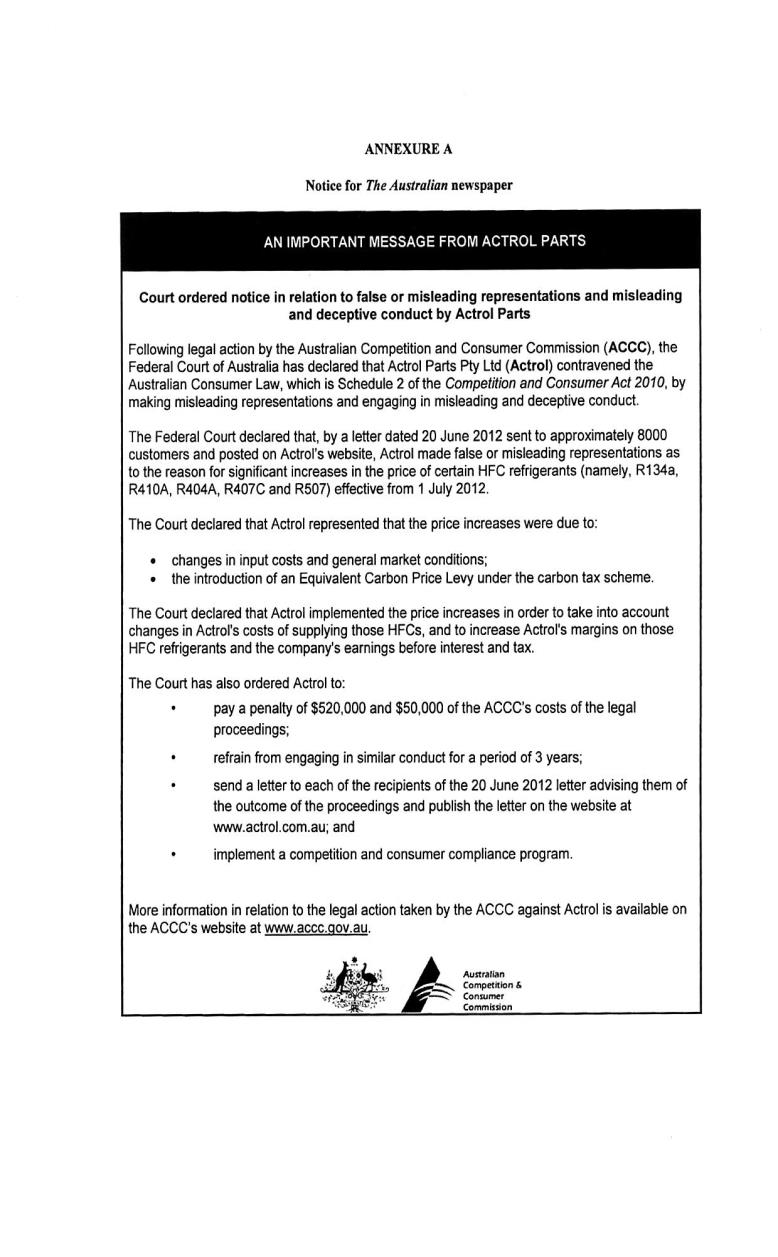
4. Actrol, within 21 days of the date of this order, publish or cause to be published, at its own expense, a notice in a weekday edition of The Australian newspaper which is in the terms and form of Annexure A and complies with the following specifications:
4.1 is placed within the first 10 pages of the newspaper;
4.2 is of a size at least 20 centimetres by 7 columns and/or of a size no less than one half of a page in the newspaper;
4.3 has a banner font of sans serif 12 point, bold;
4.4 has a headline of 12 point, bold;
4.5 contains in the body of text font that is no less than 11 point size; and
4.6 has the Applicant’s (ACCC) and Commonwealth logos of at least 20 millimetres in height and centred.
5. Actrol:
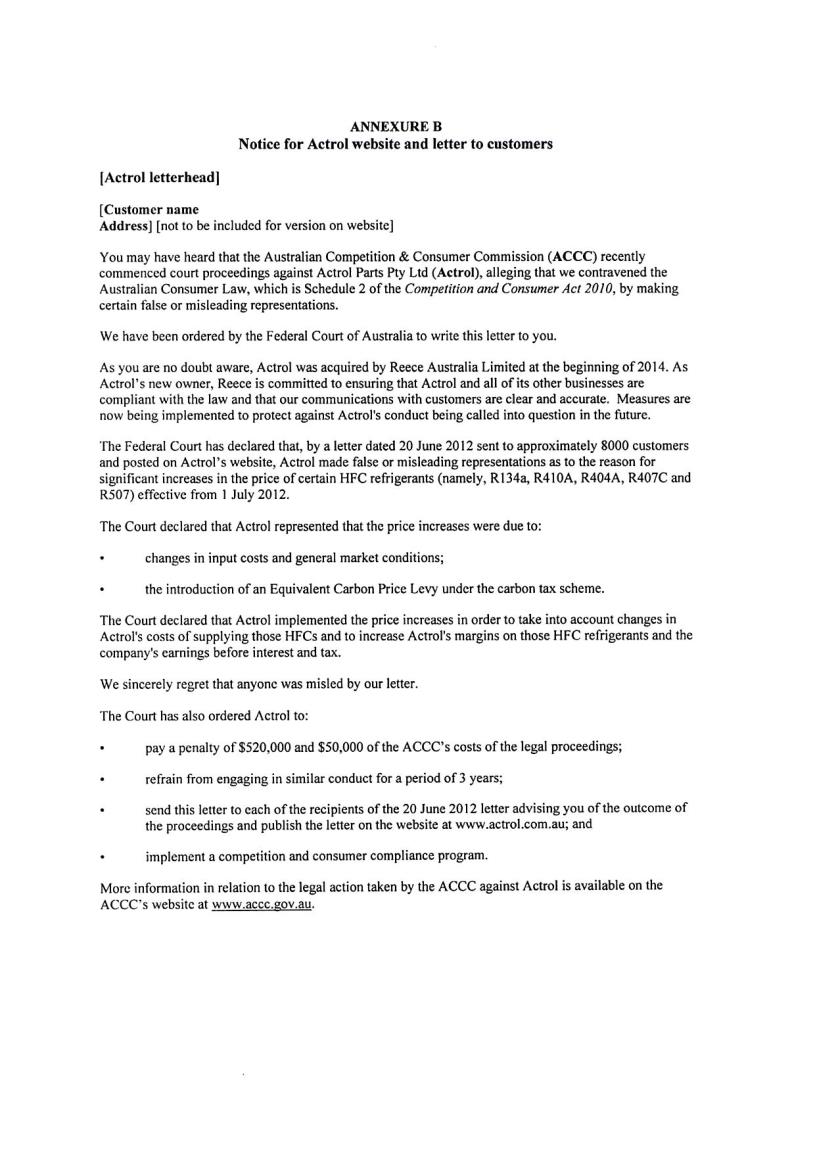
5.1 within 21 days from the date of this order, publish or cause to be published, at its own expense, on the website located at www.actrol.com.au a letter in the terms of Annexure B (“the Notice”) such that:
5.1.1 the Notice shall be viewable by clicking a ‘click-through’ icon located on the homepage of the website (“Actrol Homepage”);
5.1.2 the ‘click-through’ icon referred to in the previous sub-paragraph is located in the top third of the Actrol Homepage and is not obscured, blocked or interfered with by any operation of the website;
5.1.3 the ‘click-through’ icon shall contain the words “False or Misleading Representations by Actrol Parts Pty Ltd - Corrective Notice Ordered by Federal Court of Australia - Click Here”:
(i) in uppercase 14 point, bold, black, sans serif font on a white background, centred and in a bordered box;
(ii) the bordered box and its contents, including the white space, is to operate in the form of a one-click hyperlink to the said Notice; and
(iii) the border will be black;
5.1.4 the Notice shall occupy the entire webpage that is accessed via the ‘click-through’ icon referred to above;
5.1.5 neither the Actrol Homepage, nor any other webpage on the website that are accessed via the ‘click-through’ icon referred to above, shall have in place any mechanism which would preclude search engines from:
(i) indexing the page; or
(ii) scanning the page for links to follow; and
5.1.6 the Notice shall remain on the website for a period of 30 continuous days from the date it is first accessible on the Actrol Homepage.
6. Actrol, within 60 days of the date of this order, at its own expense, cause a letter in the terms of Annexure B to be sent by email to each of its customers to whom Actrol distributed the letter dated 20 June 2012.
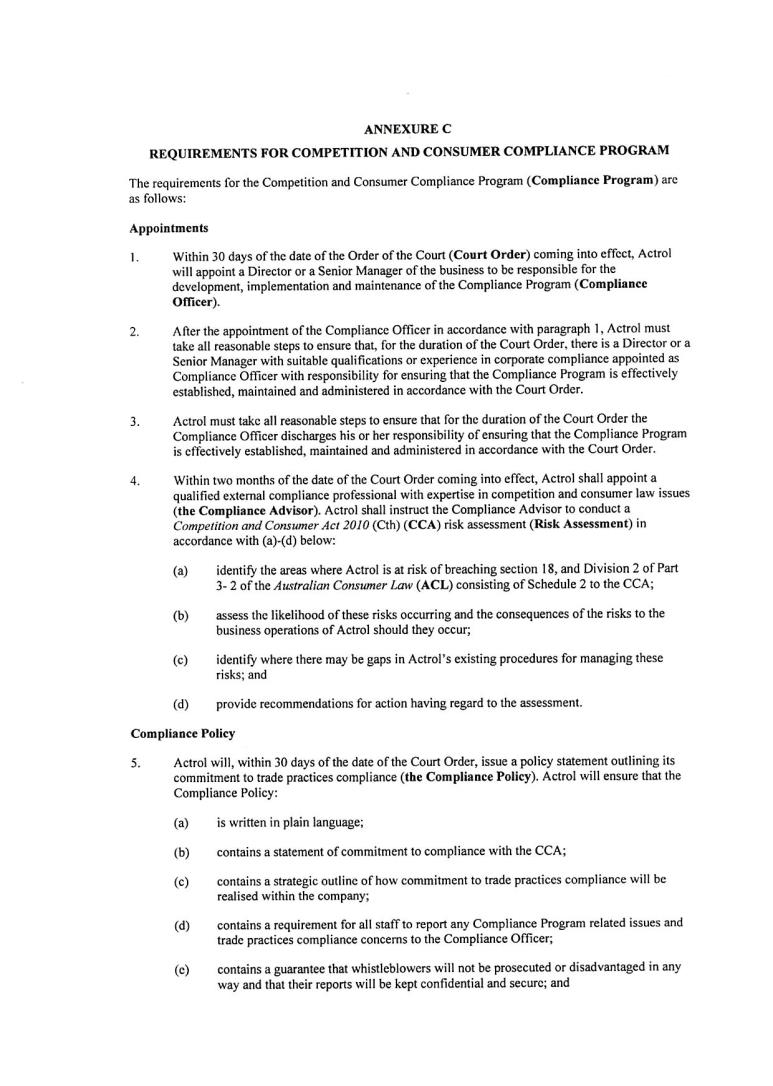
7. Actrol, at its own expense establish, within 90 days, a competition and consumer compliance program which meets the requirements set out in Annexure C and maintain the compliance program for 3 years from the date on which it is established.
8. Actrol, within 90 days, file and serve on the ACCC an affidavit sworn or affirmed by its proper officer verifying that the obligations under paragraphs 4, 5 and 6 above of these orders have been carried out to the extent required as at the date of the affidavit and:
8.1 in respect of paragraphs 4 and 5 above, attaching a copy of the notice Actrol caused to be published in accordance with these orders; and
8.2 in respect of paragraph 6 above, attaching one example of the letter Actrol caused to be distributed in accordance with that order.
9. Actrol pay within 14 days a contribution to the ACCC’s costs of, and incidental to this proceeding in the sum of $50,000.
Note: Entry of orders is dealt with in Rule 39.32 of the Federal Court Rules 2011.
SOUTH AUSTRALIA DISTRICT REGISTRY | |
GENERAL DIVISION | SAD 90 of 2014 |
BETWEEN: | AUSTRALIAN COMPETITION AND CONSUMER COMMISSION Applicant |
AND: | ACTROL PARTS PTY LTD ACN 142 654 564 Respondent |
JUDGE: | BESANKO J |
DATE: | 2 april 2015 |
PLACE: | ADELAIDE |
REASONS FOR JUDGMENT
INTRODUCTION
1 This is a proceeding brought by the Australian Competition and Consumer Commission (“ACCC”) against Actrol Parts Pty Ltd (“Actrol”). The ACCC alleges that Actrol contravened ss 18(1) and 29(1)(i) of the Australian Consumer Law (“ACL”), being Schedule 2 to the Competition and Consumer Act 2010 (Cth) (“CCA”) by making certain representations to its customers regarding the reasons for increasing the prices of the hydrofluorocarbon (“HFC”) refrigerant gas supplied by it. Actrol initially denied the conduct said to constitute the alleged contraventions, but subsequently admitted the conduct, and the contravening nature of the conduct, in a statement of agreed facts. That document was entitled “Statement of Agreed Facts and Admissions Pursuant to Section 191 of the Evidence Act 1995 (Cth)” and it is signed by both parties. The ACCC and Actrol also put proposed consent orders, and joint submissions on relief before this Court. In the proposed consent orders, the ACCC seeks a declaration, an injunction, a pecuniary penalty, publication orders, an order for a verification affidavit and an order providing for the implementation of a compliance program.
THE FACTS
Background
2 Actrol is incorporated under the Corporations Act 2001 (Cth), and is a trading corporation within the meaning of s 4 of the CCA. It is a wholly owned subsidiary of Actrol Parts Holdings Pty Ltd. It conducts a business, amongst other things, as a wholesaler of refrigerant gas, and has approximately 60 branches throughout Australia supplying refrigerant gas including HFCs. HFCs are a type of refrigerant gas that is widely used in Australia and the types include R134a, R410A, R404A, R507 and R407C. Actrol’s customers are primarily contractors, original equipment manufacturers, and large end users that purchase the refrigerant for resale or commercial use.
3 Actrol obtained refrigerant gas for resale by purchasing refrigerant gas from suppliers in Australia, or obtaining the refrigerant from Australian suppliers that sourced HFCs from overseas and arranged for their importation using a controlled substances licence held by Actrol.
4 At all material times, HFCs were not manufactured in Australia and it had to be imported. The importation of the refrigerant gas into Australia was, at the material times, regulated by the Ozone Protection and Synthetic Greenhouse Gas (Import Levy) Act 1995 (Cth) and the Ozone Protection and Synthetic Greenhouse Gas Management Act 1989 (Cth) (“OPSGG Legislation”). The OPSGG Legislation provided that a licence was required to import HFCs in bulk, and, at all material times, Actrol held such a licence. The importation of HFCs was subject to levies, the amount of which was determined by the Department of Sustainability, Environment, Water, Population and Communities. The import levy applicable to HFCs included a cost recovery component.
5 On 8 November 2011, the Ozone Protection and Synthetic Greenhouse Gas (Import Levy) Amendment Act 2011 (Cth) was passed amending the Ozone Protection and Synthetic Greenhouse Gas (Import Levy) Act 1995 (Cth). The effect of this was to introduce an equivalent carbon price levy (“ECPL”) into the import levy applicable to HFCs imported into Australia on or after 1 July 2012.
6 From about April 2012, the fact that the cost of HFCs would increase as a result of the ECPL was well publicised within the refrigerant gas industry. Actrol was of the understanding that the general expectation of its customers, as well as others in the refrigerant gas industry, was that the prices of HFCs would increase as a result of the ECPL from 1 July 2012.
7 The prices of the HFCs supplied by Actrol were listed on its website, accessible only by its customers, on a per kilogram basis. From time to time, Actrol would change its list prices for refrigerant, and it was common practice for it to advise its customers of the change by distributing a letter, posting the letter on its website, and posting the new list prices on the part of its website accessible only by its customers.
The HFC Refrigerants Strategy
8 In around April 2012, Actrol developed a strategy for pricing HFCs (“HFC Refrigerants Strategy”), which comprised the following components:
(1) Actrol would seek to ensure that its bulk storage facilities for HFCs were full prior to the introduction of the ECPL on 1 July 2012, and would thereby seek to acquire additional quantities of HFCs that had been imported prior to 1 July 2012 to which the ECPL did not apply;
(2) as the acquisition of additional quantities of HFCs by some customers of Actrol could result in those customers securing its entire refrigerant cylinder fleet, Actrol would use a cylinder quote management system based on the customers’ historical usage;
(3) acceptance of a proposal from a supplier of HFCs pursuant to which Actrol would be supplied with particular volumes of specified HFCs at a price equal to raw product costs plus half of an amount equivalent to the ECPL (“Supply Proposal”). Actrol was of the understanding that the particular volumes of specified HFCs subject to the Supply Proposal would be imported before 1 July 2012 for supply after that date and it anticipated that the volumes would be the equivalent of six months’ supply of those HFCs; and
(4) Actrol would announce an increase to its list prices for HFCs in June 2012, so that its average selling prices for those HFCs would increase by the ECPL plus 15% or 20%, with such increase to be implemented from 1 July 2012.
The HFC Refrigerants Strategy was considered and accepted by Actrol’s Board of Directors in general terms.
9 Actrol implemented the HFC Refrigerants Strategy from about May 2012 in that it:
(1) attempted to ensure that its bulk storage facilities for HFCs were full prior to 1 July 2012, such that it would not have to purchase any HFCs for about a six month period (from about 1 July 2012 to about 31 December 2012);
(2) used a cylinder quota management system based on customers’ historical usage;
(3) accepted the Supply Proposal; and
(4) announced an increase to its list prices for HFCs in June 2012 for July 2012 implementation.
The representations
10 On or about 20 June 2012, in accordance with common practice when changes to Actrol’s listing prices were made, Actrol distributed a letter via email to approximately 8,000 of its customers (“the letter”), and published the letter on its website. The letter was drafted by the National Sales and Marketing Manager at that time, and approved for distribution by the then Managing Director of Actrol. The letter is important and I will set it out in full:
Dear Customer
Due to changes in input costs and general market conditions, Actrol wishes to advise List pricing for these refrigerants commencing 1st July 2012.
Refrigerant | List Price* |
R134a | $175.93 |
R410A | $232.32 |
R404A | $372.67 |
R507A | $393.36 |
R407C | $216.45 |
R22 | $165.82 |
R409A | $184.63 |
R408A | $282.09 |
R123 | $205.32 |
*$/kg excluding GST. The RRA levy and the industry activity charges remain at $2.30/kg.
Actrol recommends that contractors review business practices in conjunction with these changes. Some suggestions are attached.
Actrol remains committed to assisting its customers through these changes by keeping them informed of changes. For more information please go to www.actrol.com.au or inquire at your local Actrol Branch.
Yours Sincerely
Andrew Leach
National Sales and Marketing Manager
11 The approximate percentage increases in the list prices of R134a, R410A, R404A, R507, and R407C (“specified HFCs”) as advised by Actrol to its customers in the letter are set out in the table below:
Refrigerant | List price on 30 June 2012 ($/kg) | New List Price from 1 July 2012 ($/kg) | Approximate % increase in List Price |
R134a | $64.71 | $175.93 | 172 |
R410A | $99.54 | $232.32 | 133 |
R404A | $95.73 | $372.67 | 289 |
R507 | $110.08 | $393.36 | 257 |
R407C | $97.47 | $216.45 | 122 |
12 It is an agreed fact that the letter contained two representations in relation to the HFC price increases. The first representation was that the price increases were due to changes in input costs and general market conditions (“Changes in Costs Representation”). The second representation was that the price increases were due to the introduction of an ECPL under the carbon tax scheme (“Carbon Tax Representation”).
13 The opening paragraph of the letter expressly contains the Change in Costs Representation. The Changes in Costs Representation was false, misleading or deceptive, or likely to mislead or deceive, because the price increases were not solely due to changes in input costs and general market conditions, and Actrol’s costs of supplying the specified HFCs had not increased to the extent of the price increases, and were not reasonably expected to increase to the extent of the price increases, until about mid-2013. Rather, the price increases were a result of Actrol’s attempt to insulate itself completely from the impact of the ECPL on its costs and charges using the HFC Refrigerant Strategy for a period of six months from about 1 July 2012 to 31 December 2012, and to the extent of 50% of the ECPL for a further period until mid-2013. Further, the price increases were a result of attempts by Actrol to increase its profit margins on the specified HFCs, achieve a benefit to its earnings before interest and tax, and to offset account changes in its costs of supplying the specified HFCs.
14 The Carbon Tax Representation is implied from the entirety of the letter, particularly the statement that “Due to changes in input costs and general market conditions, Actrol wishes to advise List Pricing for those refrigerants commencing 1st July 2012…”, in light of the surrounding circumstances of the price increases. These circumstances include that the price increases took effect from the same day as the introduction of the ECPL, the significant amount of the price increases, the fact that the costs of HFC would increase as a result of the ECPL was well publicised, including within the refrigerant gas industry, and the general expectation of Actrol’s customers and others in the refrigerant gas industry that HFC refrigerant gas prices would increase as a result of the ECPL from 1 July 2012.
15 The Carbon Tax Representation was false, misleading or deceptive, or likely to mislead or deceive, because HFC Price Increases were not solely due to the introduction of an ECPL under the carbon tax scheme. Rather, the HFC Price Increases were due to the combination of factors outlined at [13] above.
16 Actrol admits that, by making the Change in Costs Representation and the Carbon Tax Representation, it engaged in conduct in trade or commerce that was misleading or deceptive, or likely to mislead or deceive in contravention of s 18 of the ACL. It also admits that, in making the Change in Costs Representation and the Carbon Tax Representation, it made false or misleading representations concerning the price of goods in trade or commerce in connection with the supply or possible supply of goods in contravention of s 29(1)(i) of the ACL.
THE CONTRAVENTIONS ARE PROVED
17 Based on the matters set out above, I find that the ACCC has established the alleged contraventions of ss 18(1) and 29(1)(i) of the ACL.
THE RELIEF SOUGHT
18 The ACCC and Actrol submit that the appropriate relief in the circumstances of the case includes a declaration, an injunction, a pecuniary penalty, publication orders, an order for a verification affidavit, and an order providing for the implementation of a compliance program. I shall consider the appropriateness of each of these forms of relief in turn.
Declaration
19 I am asked to make a declaration in the following terms:
1. Actrol Parts Pty Ltd (“Actrol”) has, in trade or commerce:
1.1 in connection with the supply or possible supply of hydrofluorocarbon (“HFC”) refrigerants, made false or misleading representations with respect to the price of such HFC refrigerants in contravention of section 29(1)(i) of the Australian Consumer Law (“ACL”), consisting of Schedule 2 to the Competition and Consumer Act 2010 (Cth) (“CCA”); and
1.2 engaged in conduct that was misleading or deceptive, or likely to mislead or deceive, in contravention of section 18(1) of the ACL,
by distributing, by email to its customers and placing on Actrol’s website located at the uniform resource locator www.actrol.com.au, a letter to its customers dated 20 June 2012, which represented increases in the list prices for five HFC refrigerants, namely R134a, R410A, R404A, R407C and R507, effective from 1 July 2012, were due to:
1.3 changes in input costs and general market conditions;
1.4 the introduction of an Equivalent Carbon Price Levy under the carbon tax scheme, when:
1.5 the HFC price increases were not solely due to changes in input costs and general market conditions;
1.6 Actrol’s costs of supplying those HFC refrigerants had not increased to the extent of the HFC price increases and were not reasonably expected to increase to the extent of the HFC price increase until about mid-2013;
1.7 by reason of a pricing strategy in relation to HFC refrigerants, Actrol had sought to insulate itself:
1.7.1 from impacts on its costs and changes in the market arising from the introduction of an Equivalent Carbon Levy Price applicable to HFC refrigerants imported into Australia from 1 July 2012 for a period of approximately 6 months; and
1.7.2 following that period and until about mid-2013, from impacts on its HFC refrigerant purchasing costs and changes in the market arising from the introduction of that levy to the extent of 50% of the levy; and
1.8 Actrol implemented the price increases in order to increase its margins on those HFC refrigerants and achieve a benefit to its earnings before interest and tax and take into account changes in Actrol’s costs of supplying the relevant HFCs.
20 The Court has the power to make the declaration: Australian Competition and Consumer Commission v Real Estate Institute of Western Australia Inc and Others (1999) 161 ALR 79. Section 21 of the Federal Court of Australia Act 1976 (Cth) expressly empowers the Court to make binding declarations of right.
21 Declarations may be made on the basis of facts agreed by the parties under s 191 of the Evidence Act 1995 (Cth): Australian Competition & Consumer Commission v Skins Compression Garments Pty Ltd [2009] FCA 710; Minister for Environment, Heritage and the Arts v PGP Developments Pty Ltd (2010) 183 FCR 10 at 19-20, [30]-[38] per Stone J; Australian Competition and Consumer Commission v MSY Technology Pty Ltd and Others (No 2) (2011) 279 ALR 609 at 612-616, [11]-[27] per Perram J; Australian Competition and Consumer Commission v Dimmeys Stores Pty Ltd [2011] FCA 372; Australian Competition and Consumer Commission v Sampson [2011] FCA 1165. There is no reason in this case not to accept the agreed facts. The fact that the declaration is not opposed does not mean that the Court does not have power to make it on the ground that there is no proper contradictor. There is a proper contradictor in the sense of a person with an interest in opposing the grant of declaratory relief. Whether they chose to do so is immaterial (Australian Competition and Consumer Commission v MSY Technology Pty Ltd and Others (2012) 201 FCR 378).
22 I am also satisfied that the declaration is appropriate in form. The declaration clearly identifies the contravening conduct and it is in the public interest that the conduct constituting the contraventions be identified.
Injunction
23 The Court's power to grant injunctions is contained in s 232 of the ACL. I am asked to make the following injunction:
Actrol be restrained for a period of 3 years from the date of this order, whether by itself, its servants, agents or however otherwise, in trade or commerce, from making any representation that an increase in its list prices of refrigerants is for a specified reason or reasons when that reason or those reasons have not in fact materially contributed to that increase in price.
24 I am satisfied that the proposed injunction is appropriate, as it will restrain Actrol from repeating the contravening conduct for a period of three years from the date of these orders being made. The terms of the proposed injunction are also sufficiently clear such that the injunction is capable of being obeyed without the continued supervision of this Court.
Pecuniary penalties
25 The Court’s power to order a person to pay a pecuniary penalty for the contravention of s 29(1)(i) of the ACL is contained in s 224 of the ACL. The ACL does not provide for pecuniary penalties in respect of the contravention of s 18 of the Act. The maximum penalty in respect of such contraventions is $1.1 million for a body corporate, and $220,000 for a natural person. The parties propose that a pecuniary penalty of $520,000 be paid by Actrol within 30 days of these orders being made.
26 In fixing the appropriate pecuniary penalty, the approach I should adopt to a submission from the parties as to the appropriate penalty is that laid down in NW Frozen Foods Pty Ltd v Australian Competition and Consumer Commission (1996) 71 FCR 285 (“NW Frozen Foods”) and Minister for Industry, Tourism and Resources v Mobil Oil Australia Pty Ltd (2004) ATPR 41-993 (“Mobil Oil”). I do not think the decision of the High Court in Barbaro v The Queen; Zirilia v The Queen (2014) 88 ALJR 372, [2014] HCA 2 (“Barbaro”) mandates or requires a different approach. I agree with Middleton J’s reasons for reaching that conclusion in Australian Competition and Consumer Commission v Energy Australia Pty Ltd [2014] FCA 336 (Australian Competition and Consumer Commission v Energy Australia) at [113]-[152]. As his Honour said in that case, the Court may consider and take into account the joint submissions of the parties as to an “agreed” penalty, although the overriding principle is that the Court must itself determine the appropriate penalty.
27 I note that in August 2014, the Full Court of this Court reserved its decision in the matter of Fair Work Building Industry Inspectorate v Construction, Forestry, Mining and Energy Union (QUD 257 of 2013), which is expected to determine the issue of whether the decision in Barbaro applies to civil proceedings. Since the decision in Barbaro, there have been a number of single-judge decisions of this Court rejecting the application of the principle in Barbaro to civil penalty proceedings in addition to Middleton J’s decision in Australian Competition and Consumer Commission v Energy Australia. (Australian Competition and Consumer Commission v Mandurvit Pty Ltd [2014] FCA 464 at [38]-[80]; Australian Competition and Consumer Commission v Titan Marketing Pty Ltd [2014] FCA 913 at [15]-[16]). The parties ask that I follow the approach taken in these single-judge decisions, and I think it is appropriate for me to do so.
28 Section 224(2) of the ACL requires the Court to have regard to all relevant matters in determining the appropriate pecuniary penalty, including the nature and extent of the contravening conduct, and of any loss or damage caused by the contravening conduct, the circumstances in which the contravening conduct took place and whether the contravener had previously been found by this Court to have engaged in similar conduct.
29 Through a line of authorities relating to s 76E of the Trade Practices Act 1974 (Cth), which is in substantially similar terms to s 224(2) of the ACL, this Court has established a number of additional matters relevant to the determination of the appropriate pecuniary penalty.
30 In Australian Competition and Consumer Commission v Singtel Optus Pty Ltd (No 4) (2011) 282 ALR 246 (“Singtel”) at [11], Perram J identified, by reference to a number of previous decisions of the Court, the following additional matters:
(1) the size of the contravening company;
(2) the deliberateness of the contravention and the period over which it extended;
(3) whether the contravention arose out of the conduct of senior management or at some lower level;
(4) whether the company has a corporate culture conducive to compliance with the Act, as evidenced by educational programs and disciplinary or other corrective measures in response to an acknowledged contravention;
(5) whether the company has shown a disposition to cooperate with the authorities responsible for the enforcement of the ACL in relation to the contravention;
(6) whether the contravener has engaged in similar conduct in the past;
(7) the financial position of the contravener; and
(8) whether the contravening conduct was systematic, deliberate or covert.
31 The principal object of imposing a pecuniary penalty is deterrence, both general and specific: NW Frozen Foods at 294-295 per Burchett and Kiefel JJ; Trade Practices Commission v CSR Ltd [1991] ATPR 41-076 at 51,154 per French J. The pecuniary penalty should not be so low as to constitute in the eyes of the contravener an acceptable cost of doing business: Singtel at 265, [62].
Application of Principles
32 I turn to the application of the principles to the facts of this case.
33 The nature, extent and duration of conduct, and circumstances in which it took place, are summarised at [10]-[15] above. In particular, I note that the contravening conduct consisted of two representations made in a single letter distributed to approximately 8,000 customers and published on Actrol’s website. There is no evidence that the representations were repeated by Actrol on subsequent occasions, or made through alternate forms of media.
34 As I have said, the parties contend that there were two contraventions of s 29(1)(i) by Actrol, being a contravention involving an express representation and a contravention involving the implied representation. However, as counsel for the applicant acknowledged, there is a substantial overlap between the matters which render each of the representations false. That is a matter I take into account when determining penalty.
35 Actrol Parts Holdings Pty Ltd, the holding company of Actrol, had consolidated revenue of approximately $220 million in the financial year ending 30 June 2012 and approximately $257 million in the financial year ending 30 June 2013. It is therefore apparent that Actrol has the financial capacity to pay the proposed penalty of $520,000. However, the parties submit, and I accept, that the proposed penalty is nonetheless of sufficient magnitude to achieve the objective of deterrence.
36 There is no evidence before the Court as to the number of customers who, had the reasons for the HFC price increases been properly disclosed, would have sought to source the specified refrigerants from elsewhere at a potentially lower price. It is therefore not possible to quantify the amount of any profit gained by Actrol or loss caused to the customers through the contravention.
37 Actrol’s conduct in distributing the letter, which contained the Change in Costs Representation and the Carbon Tax Representation, was deliberate, and, at all material times, Actrol did not have a formal competition and consumer compliance program in place. Indeed, the parties request that I make an order that such a program be established.
38 As to the participation of senior management in the contravening conduct, as I noted above at [8], [9] and [10], the key components of the HFC Refrigerant Strategy were considered and approved by Actrol’s Board of Directors, and the letter was drafted by its National Sales and Marketing Manager, and authorised by its Managing Director. I do not think that there is any doubt that these persons are at a senior level within the respondent’s company.
39 Actrol voluntarily co-operated with the ACCC’s investigation, and, through its legal representatives, participated in constructive discussions with the ACCC that eventuated in the formulation of the statement of agreed facts, the proposed consent orders and these joint submissions. The parties submit, and I accept, that Actrol’s willingness to co-operate with the ACCC, and thereby avoid the burden and expense of a complex trial, is relevant to the mitigation of the pecuniary penalty.
40 Actrol has not previously been found to have contravened the ACL or CCA in any way, and the ACCC has never previously commenced legal proceedings against the respondent. This too is relevant to the determination of the appropriate penalty.
41 Having regard to these matters, I am satisfied that a pecuniary penalty of $520,000 is the appropriate penalty.
Publication orders
42 The Court’s power to make publication orders is contained in s 246(2)(d) of the ACL. The publication orders sought are in the following terms:
1. Actrol, within 21 days of the date of this order, publish or cause to be published, at its own expense, a notice in a weekday edition of The Australian newspaper which is in the terms and form of Annexure A and complies with the following specifications:
1.1 is placed within the first 10 pages of the newspaper;
1.2 is of a size at least 20 centimetres by 7 columns and/or of a size no less than one half of a page in the newspaper;
1.3 has a banner font of sans serif 12 point, bold;
1.4 has a headline of 12 point, bold;
1.5 contains in the body of text font that is no less than 11 point size; and
1.6 has the Applicant’s (ACCC) and Commonwealth logos of at least 20 millimetres in height and centred.
2. Actrol:
2.1 within 21 days from the date of this order, publish or cause to be published, at its own expense, on the website located at www.actrol.com.au a letter in the terms of Annexure B (“the Notice”) such that:
2.1.1 the Notice shall be viewable by clicking a ‘click-through’ icon located on the homepage of the website (“Actrol Homepage”);
2.1.2 the ‘click-through’ icon referred to in the previous sub-paragraph is located in the top third of the Actrol Homepage and is not obscured, blocked or interfered with by any operation of the website;
2.1.3 the ‘click-through’ icon shall contain the words “False or Misleading Representations by Actrol Parts Pty Ltd - Corrective Notice Ordered by Federal Court of Australia - Click Here”:
i. in uppercase 14 point, bold, black, sans serif font on a white background, centred and in a bordered box;
ii. the bordered box and its contents, including the white space, is to operate in the form of a one-click hyperlink to the said Notice; and
iii. the border will be black;
2.1.4 the Notice shall occupy the entire webpage that is accessed via the ‘click-through’ icon referred to above;
2.1.5 neither the Actrol Homepage, nor any other webpage on the website that are accessed via the ‘click-through’ icon referred to above, shall have in place any mechanism which would preclude search engines from:
i. indexing the page; or
ii. scanning the page for links to follow; and
2.1.6 the Notice shall remain on the website for a period of 30 continuous days from the date it is first accessible on the Actrol Homepage.
3. Actrol, within 60 days of the date of this order, at its own expense, cause a letter in the terms of Annexure B to be sent by email to each of its customers to whom Actrol distributed the letter dated 20 June 2012.
43 The publication of the corrective notices and letter will serve the purposes of dispelling false impressions created as a result of Actrol’s conduct, alerting customers to the fact of the contraventions, and preventing the repetition of the contravening conduct by Actrol. I am therefore satisfied that it would be appropriate to make an order for publication to the effect of that proposed by the parties.
Verification affidavit
44 The Court’s power to make an order for a verification affidavit is contained in s 246(2)(c) of the ACL. The parties submit that I should make an order requiring that Actrol, within 90 days of the these orders being made, file and serve on the ACCC an affidavit sworn or affirmed by its proper officer verifying that it has properly complied with the publication orders, and attaching a copy of the Notice in the form of Annexure A, and the Notice and letter in the form of Annexure B, to these reasons. To the extent that making this order would support the publication orders, and minimise the costs of monitoring compliance with the orders, I am satisfied that it is appropriate to make an order for a verification affidavit to the effect of that proposed by the parties.
Compliance program
45 Section 246(2)(b) of the ACL empowers the Court to make an order requiring a person who has contravened various sections of the ACL to establish a compliance program to ensure employees or other persons involved in the person’s business are aware of their responsibilities and obligations under the ACL. The parties submit that it would be appropriate for Actrol to establish a competition and consumer compliance program (“compliance program”) that meets the requirements set out in Annexure C to these reasons, and maintain the compliance program for 3 years from the date on which it is established. The parties submit that this should be done at the own expense of the respondent within 90 days of these orders being made.
46 The requirements of the proposed compliance program are sufficiently clear, and I am satisfied that the establishment of a program that meets these requirements would serve the desired purpose of ensuring employees are aware of their responsibilities and obligations under the ACL, so to prevent the repetition of the contravening conduct by Actrol during the period over which the program is active. I therefore consider it appropriate to make an order that a compliance program be established by Actrol that meets the requirements proposed by the parties.
COSTS
47 Actrol has agreed to pay a contribution of $50,000 towards the ACCC’s costs payable within 14 days of these orders being made. That contribution does not reflect the ACCC’s actual costs in the matter, but the ACCC has indicated that it is prepared not to fully pursue its costs in the interests of an early settlement. I will make an order which reflects that agreement.
I certify that the preceding forty-seven (47) numbered paragraphs are a true copy of the Reasons for Judgment herein of the Honourable Justice Besanko. |
Associate: