

FEDERAL COURT OF AUSTRALIA
Ashworth v Metcash Food & Grocery Pty Ltd [2015] FCA 292
IN THE FEDERAL COURT OF AUSTRALIA | |
Applicant | |
AND: | METCASH FOOD & GROCERY PTY LTD Respondent |
DATE OF ORDER: | |
WHERE MADE: |
THE COURT ORDERS THAT:
1. The application be dismissed with costs.
Note: Entry of orders is dealt with in Rule 39.32 of the Federal Court Rules 2011.
NEW SOUTH WALES DISTRICT REGISTRY | |
GENERAL DIVISION | NSD 22 of 2015 |
BETWEEN: | STEPHEN ASHWORTH Applicant |
AND: | METCASH FOOD & GROCERY PTY LTD Respondent |
JUDGE: | GLEESON J |
DATE: | 31 MARCH 2015 |
PLACE: | SYDNEY |
REASONS FOR JUDGMENT
1 The applicant (“debtor”) applies to have bankruptcy notice BN177198 issued on 4 December 2014 set aside. The notice specifies a total debt amount of $427,752.38 comprising a judgment debt of $426,362.32 and interest accrued since the date of the judgment of $1,390.06.
2 The judgment upon which the notice is founded is a judgment of the District Court of New South Wales made or given on 20 November 2014, and entered on 21 November 2014.
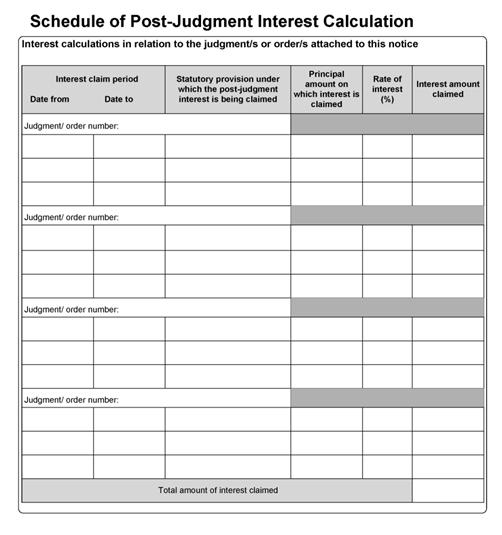
3 Annexed to the notice is a “Schedule of Post-Judgment Interest Calculation” (“Schedule”) which specifies, among other things, the “interest claim period date from” as 21 November 2014 and “interest claim period date to” as 4 December 2014.
4 When filed, the application to set aside the notice was accompanied by an affidavit sworn by the debtor on 7 January 2015 stating that, at the time of service of the bankruptcy notice, he did not receive a copy of the judgment which was required to be attached to the notice.
5 At the hearing on 17 March 2015, the debtor’s solicitor, Darren Bowles of Bowles Lawyers, did not rely on the debtor’s 7 January 2015 affidavit. He read an affidavit which he had sworn that morning, attaching a letter dated 16 March 2015 to the solicitor for the respondent (“creditor”). The letter stated relevantly:
Your client has claimed post judgment interest in the amount of $1,390.06 in the Bankruptcy Notice for the period 21 November 2014 to 04 December 2014 which equates to claiming a daily rate of interest in the amount of $99.29 for 14 days.
During the relevant period your client is only entitled to claim interest for 13 days. As a result the sum specified in the Bankruptcy Notice as the amount due to your client exceeds the amount in fact due. Accordingly our client gives your client notice that he disputes the validity of the Bankruptcy Notice on the ground of misstatement.
Could you please confirm by 9.00am on Tuesday 17 March 2015 that the Bankruptcy Notice is withdrawn.
6 The creditor maintains that the notice is not defective.
Relevant statutory provisions
7 Section 41 of the Bankruptcy Act 1966 (Cth) (“Bankruptcy Act”) provides relevantly:
(1) An Official Receiver may issue a bankruptcy notice on the application of a creditor who has obtained against a debtor:
(a) a final judgment or final order that:
(i) is of the kind described in paragraph 40(1)(g); and
(ii) is for an amount of at least $5,000; or
(b) 2 or more final judgments or final orders that:
(i) are of the kind described in paragraph 40(1)(g); and
(ii) taken together are for an amount of at least $5,000.
(2) The notice must be in accordance with the form prescribed by the regulations.
…
(5) A bankruptcy notice is not invalidated by reason only that the sum specified in the notice as the amount due to the creditor exceeds the amount in fact due, unless the debtor, within the time allowed for payment, gives notice to the creditor that he or she disputes the validity of the notice on the ground of the misstatement.
8 For the purpose of the application, I will assume that the 16 March 2015 letter gave notice to the creditor for the purposes of s 41(5).
9 Regulation 4.02 of the Bankruptcy Regulations 1996 (Cth) provides:
(1) For the purposes of subsection 41(2) of the Act, the form of bankruptcy notice set out in Form 1 is prescribed.
(2) A bankruptcy notice must follow Form 1 in respect of its format (for example, bold or italic typeface, underlining and notes).
(3) Subregulation (2) is not to be taken as expressing an intention contrary to section 25C of the Acts Interpretation Act 1901.
Note: Under section 25C of the Acts Interpretation Act 1901, where an Act prescribes a form, then, unless the contrary intention appears, strict compliance with the form is not required and substantial compliance is sufficient; see also paragraph 46(1)(a) of that Act for the application of that Act to legislative instruments other than Acts.
10 On the first page of Form 1, contained in Schedule 1 to the Bankruptcy Regulations 1996 (Cth), is the following note:
C. Where interest is being claimed, the provisions under which it is claimed and the basis of its calculation are shown in the attached interest schedule. If no interest is claimed the creditor need not attach the schedule to this notice.
11 The schedule to Form 1 is in the following form:
12 Section 101 of the Civil Procedure Act 2005 (NSW) provides, relevantly:
(1) Unless the court orders otherwise, interest is payable on so much of the amount of a judgment (exclusive of any order for costs) as is from time to time unpaid.
(2) Interest under subsection (1) is to be calculated, at the prescribed rate or at such other rate as the court may order, as from:
(a) the date on which the judgment takes effect, or
(b) such later date as the court may order.
13 Rule 36.4 of the Uniform Civil Procedure Rules 2005 (NSW) provides, relevantly:
(1) A judgment or order takes effect:
(a) as of the date on which it is given or made, or
(b) if the court orders that it not take effect until it is entered, as of the date on which it is entered.
14 Section 306(1) of the Bankruptcy Act provides:
Proceedings under this Act are not invalidated by a formal defect or an irregularity, unless the court before which the objection on that ground is made is of opinion that substantial injustice has been caused by the defect or irregularity and that the injustice cannot be remedied by an order of that court.
15 A bankruptcy notice is a proceeding under the Bankruptcy Act: Adams v Lambert [2006] HCA 10; (2006) 228 CLR 409 at [17] (“Adams v Lambert”).
Consideration
16 On the face of the judgment, the judgment took effect as of 20 November 2014.
17 The debtor did not dispute that the creditor was entitled to claim interest for 21 November 2014. However, he argued that, having identified 21 November 2014 in the Schedule as the “date from” which interest was claimed, no interest ought to have been claimed for 21 November 2014.
18 In support of this argument, the debtor relied upon the decision of Burchett J in Re Serafino; Ex parte Classic Manufacturing Pty Ltd (1989) 86 ALR 283 (“Re Serafino”). In that case it was held that, as a matter of interpretation of s 85(2)(a) of the District Court Act 1973 (NSW) (the predecessor to rule 36.4), and particularly the words “as from”, interest claimed in a bankruptcy notice should be calculated on the judgment excluding the date when the judgment came into being.
19 In Re Serafino, judgment was entered by consent on 2 December 1987. The bankruptcy notice claimed post-interest judgment commencing on that date. At the time, the form of the bankruptcy notice was different to the current form. In particular, the form did not provide for the attachment of a “schedule of post-judgment interest calculation”.
20 The following principles are derived from Re Serafino:
(1) Notice having been given under s 41(5), if in fact the bankruptcy notice claims an excessive amount, though by a small margin, its effectiveness is destroyed. See also Walsh v Deputy Commissioner of Taxation [1984] HCA 33; (1984) 156 CLR 337 at 339;
(2) Generally, where time is to be computed from a day, that day is excluded from the computation: Associated Beauty Aids Pty Ltd v Federal Commissioner of Taxation [1965] HCA 20; (1965) 113 CLR 662 at 667-8 (Barwick CJ) (“Associated Beauty Aids”);
(3) However, there is no general rule as to the consequences of the use of the preposition “from”: Associated Beauty Aids at 668 (Barwick CJ), 669 (Windeyer J).
21 Re Serafino is not directly applicable to this case because it concerned the statutory entitlement to claim post-judgment interest, rather than the entitlement to claim interest having regard to the terms of the “schedule of post-interest calculation”. In this case, the debtor does not dispute the creditor’s statutory entitlement to claim post-judgment interest in respect of 21 November 2014. The issue is whether interest may be claimed in respect of that date, having regard to the reference to 21 November 2014 as the “interest rate period date from” in the Schedule to the bankruptcy notice.
22 The creditor also referred to Unicomb v Cairns [2009] FCA 988. In that case, it was argued that there was an understatement of interest in the bankruptcy notice because the creditor did not include interest for the date on which the judgment was handed down. Perram J rejected this argument relying, among other things, upon Re Serafino.
23 In my view, the Schedule requires the inclusion of the first and last dates of the period in respect of which interest is claimed. That interpretation of the form is based on the inclusion of the words “interest claim period” qualifying each of the “date from” and the “date to”. In this case, the creditor was entitled to claim interest for the period 21 November 2014 to 4 December 2014 inclusive. In this case, the words “date from” are apt to refer to the first date in respect of which interest is claimed.
24 On the debtor’s interpretation of the form of the Schedule, the appropriate date to include under the heading “interest claim period date from” is, in this case, date on which the judgment was made or given, that is, 20 November 2014. In my view, the inclusion of that date would tend to be productive of confusion because it would not form part of the “interest claim period”. In contrast, the Schedule as completed correctly identifies the amount of interest to which the creditor is entitled and clearly identifies the first and last dates of the period in respect of which interest is claimed, thereby fulfilling the evident purpose of the schedule which is to assist the debtor to check the claim: Adams v Lambert at [13].
25 Accordingly, I reject the debtor’s contention that the Schedule overstates the interest to which the creditor is entitled because the “interest claim period date from” is 21 November 2014.
26 If I am wrong about the correct interpretation of the form of the Schedule, I would not accept that the inclusion of 21 November 2014 as the “interest claim period date from” required the creditor to claim less interest than the amount to which it was entitled, and which was specified in the bankruptcy notice. Based on a reading of the whole of the bankruptcy notice together with the attached judgment, I would infer that the creditor intended to claim the whole of the interest to which it was entitled (evidenced by the amount of the interest claimed) but incorrectly referred to 21 instead of 20 November 2014. I would consider the incorrect identification of the “interest claim period date from” by one day to be an irregularity in the notice: cf Adams v Lambert at [34]. There is no evidence that substantial injustice has been caused by the irregularity, and accordingly, s 306(1) of the Bankruptcy Act would operate to protect the bankruptcy notice from invalidity.
Conclusion
27 The application must be dismissed with costs.
I certify that the preceding twenty-seven (27) numbered paragraphs are a true copy of the Reasons for Judgment herein of the Honourable Justice Gleeson. |


