

FEDERAL COURT OF AUSTRALIA
Assarapin v Australian Community Pharmacy Authority [2015] FCA 268
FEDERAL COURT OF AUSTRALIA
Assarapin v Australian Community Pharmacy Authority [2015] FCA 268
CORRIGENDUM
1. In paragraph [39], delete “the Tribunal” and in lieu thereof insert “the Authority”.
2. In paragraph [49], delete “the Minister” and in lieu thereof insert “the Secretary”.
I certify that the preceding two (2) numbered paragraphs are a true copy of the Corrigendum to the Reasons for Judgment herein of the Honourable Justice Nicholas. |
Associate:
Dated: 30 March 2015
IN THE FEDERAL COURT OF AUSTRALIA | |
DATE OF ORDER: | |
WHERE MADE: |
THE COURT ORDERS THAT:
1. The application be dismissed.
2. The applicants pay 80% of the second respondent’s costs.
3. There be no other order as to costs.
Note: Entry of orders is dealt with in Rule 39.32 of the Federal Court Rules 2011.
NEW SOUTH WALES DISTRICT REGISTRY | |
GENERAL DIVISION | NSD 2203 of 2013 |
BETWEEN: | JOHN ASSARAPIN First Applicant KATHY BELEGRINOS Second Applicant ROBERT HARRISON Third Applicant JOHN THORNE Fourth Applicant |
AND: | AUSTRALIAN COMMUNITY PHARMACY AUTHORITY First Respondent QUANG LIN Second Respondent SECRETARY DEPARTMENT OF HEALTH AND AGEING Third Respondent |
JUDGE: | NICHOLAS J |
DATE: | 27 march 2015 |
PLACE: | SYDNEY |
REASONS FOR JUDGMENT
Introduction
1 In this proceeding the applicants seek judicial review of a recommendation of the first respondent, Australian Community Pharmacy Authority (the Authority) made on 30 August 2013. The application is made pursuant to s 5 of the Administrative Decisions (Judicial Review) Act 1977 (Cth) (ADJR Act) and s 39B of the Judiciary Act 1903 (Cth) (Judiciary Act). The applicants also seek judicial review of the decision of the third respondent, the Secretary, Department of Health and Ageing (the Secretary) made on 9 September 2013 to accept the Authority’s recommendation.
2 There is an issue between the parties as to whether the applicants are aggrieved by either of the decisions. That issue aside, the crux of the dispute between the parties concerns the proper construction of Item 124 of Sch 1, Part 1 of the National Health (Australian Community Pharmacy Authority Rules) Determination 2011 (the Rules). The Rules is a determination that was made by the Minister for Health and Ageing on 13 September 2011 pursuant to s 99L(1) of the National Health Act 1953 (Cth) (NH Act).
BACKGROUND
3 The evidence includes an agreed statement of facts (Ex A). Except where indicated, the following summary of relevant facts is drawn from the agreed statement.
4 In about May 2008 the second respondent (Mr Lin) purchased a pharmacy business at Shops 2034-2036, Westfield Miranda. He obtained approval pursuant to s 90 of the NH Act to supply pharmaceutical benefits from those premises (Approved Premises). Westfield Miranda was, at all material times, a “facility” within the meaning of the Rules.
5 Mr Lin occupied the Approved Premises under a licence granted by GNA (Miranda) Pty Ltd (GNA). By an agreement made on 1 July 2010, GNA granted Mr Lin a licence of the premises for a further term of six years. In early August, GNA gave Mr Lin notice of its intention to terminate the licence by February/March 2013.
6 By letter dated 26 March 2013, Mr Lin requested permission from the Secretary for his approval in respect of the Approved Premises to be “deactivated” from close of business on 14 April 2013 for a period of six months to allow Mr Lin to relocate his approval.
7 By letter dated 28 March 2013 written on behalf of the Secretary, Mr Lin’s request was granted and his approval was “deactivated” for the period from 14 April 2013 to 14 November 2013 (ie. a period of seven months).
8 On 14 April 2013 Mr Lin closed his business and vacated the Approved Premises. The next day he commenced operating a pharmacy business at Shop 1, Ground Floor, 589 Kingsway, Miranda (New Premises) although at that time he was not approved to supply pharmaceutical benefits at those premises.
9 According to an affidavit of Mr Lin that was before the Authority (reproduced in Ex B) the Approved Premises were located in a building that was demolished in April or May 2013.
10 On 15 April 2013 Mr Lin made an application to the Secretary for approval to supply pharmaceutical benefits at the New Premises. Mr Lin’s application was made under Item 124 of the Rules.
11 Mr Lin’s application was referred by the Secretary to the Authority. On 24 May 2013 the Authority recommended that Mr Lin’s application not be approved.
12 On 22 July 2013 Mr Lin made a further application to the Secretary for approval to supply pharmaceutical benefits at the New Premises. This application was made under Item 124 of the Rules.
13 Mr Lin’s further application was also referred to the Authority. On 30 August 2013 the Authority decided to recommend that Mr Lin’s further application be approved. In reaching that decision the Authority found, inter alia: (i) the Approved Premises had been demolished; and (ii) the Approved Premises were not in a facility.
14 On 9 September 2013 the Secretary granted an approval to Mr Lin to supply pharmaceutical benefits at the New Premises.
15 On 24 September 2013, in response to a request made by the applicants, the Authority provided a statement of reasons pursuant to s 13 of the ADJR Act in respect of its decision of 30 August 2013.
16 Each of the applicants is a pharmacist who supplies pharmaceutical benefits at premises located within 500 metres, by straight line, of Mr Lin’s New Premises.
The National Health Act
17 Part VII of the NH Act establishes a scheme under which the Commonwealth subsidises the cost of certain pharmaceuticals described as “pharmaceutical benefits”. A pharmacist who wishes to dispense pharmaceutical benefits must apply for approval to do so under s 90 of the NH Act.
18 Section 90(1) of the NH Act provides:
(1) Subject to this section, the Secretary may, upon application by a pharmacist for approval to supply pharmaceutical benefits at particular premises, approve that pharmacist for the purpose of supplying pharmaceutical benefits at those premises.
Section 90(3A) provides that subject to some exceptions that are not presently relevant, an application under s 90 must be referred to the Authority.
19 Sections 99K and 99L of the NH Act provide:
(1) The functions of the Authority are:
(a) to consider applications under section 90; and
(b) to make, in respect of an application under section 90:
(i) a recommendation whether or not the applicant should be approved under that section in respect of particular premises; and
(ii) if an approval is recommended – recommendations as to the conditions (if any) to which the approval should be subject; and
(2) In making a recommendation under subsection (1), the Authority must comply with the relevant rules determined by the Minister under section 99L.
(3) All recommendations of the Authority under subsection (1) are to be made to the Secretary.
99L Determination of rules by Minister
(1) The Minister must, by writing, determine the rules subject to which the Authority is to make recommendations under subsection 99K(1).
(2) A determination under subsection (1) is a disallowable instrument for the purposes of section 46A of the Acts Interpretation Act 1901.
20 Section 98 of the NH Act relevantly provides:
98 Cancellation by Secretary of approval of pharmacists etc.
(1) Whenever:
(a) an approved pharmacist requests that his or her approval under section 90 in respect of all or any of the premises in respect of which he or she is approved be cancelled;
…
the Secretary shall cancel that approval.
(2) Where:
(a) an approved pharmacist gives the Secretary notice in writing that the pharmacist has ceased to carry on business as a pharmacist at premises in respect of which the pharmacist is approved; or
…
the Secretary may (at his or her discretion) cancel the approval.
THE RULES
21 Section 6(1) in Part 1 of the Rules provides:
In this Determination, approved premises are premises, other than premises that are redundant under subsection (2):
(a) in relation to which an approval granted under section 90 of the Act is in force; or
(b) in relation to which the Authority has recommended an applicant be approved under section 90 of the Act.
22 Section 6(2) in Part 1 of the Rules is concerned with “redundant premises” and is not relevant for present purposes.
23 Section 10 in Part 2 of the Rules relevantly provides:
The Authority must recommend that an applicant be approved under section 90 of the Act in relation to particular premises if:
(a) for an application that involves the cancellation of an approval (the existing approval) that is in force in relation to approved premises (the existing premises):
(i) the application states that it is one of the kinds mentioned in column 2 of an item in Part 1 of Schedule 1; and
(ii) all the requirements set out in column 3 of that item are met; and
(iii) all the requirements set out in Schedule 2 and Part 1 of Schedule 3 are met; and
(iv) for an application described in column 2 of an item of Part 2 of Schedule 3 – the requirement set out in column 3 of that item is met; and
…
24 Section 11 in Part 2 of the Rules provides:
The Authority must recommend that an applicant not be approved under section 90 of the Act in relation to particular premises if a requirement, under paragraph 10 (a) or (b), that applies in relation to the application is not met.
25 Schedule 1 of the Rules is entitled “Kinds of applications, and requirements in relation to those applications”. Sch 1, Part 1 is entitled “Applications involving cancellation of existing approval”. Relevantly, it includes Item 124, which is in the following terms:
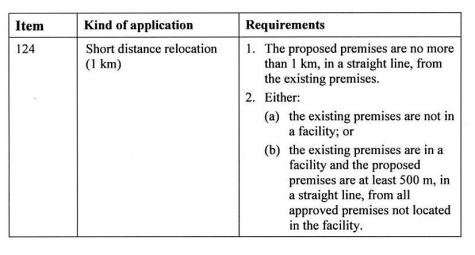
26 Importantly, s 5 of the Rules defines “approved premises” by reference to s 6(1) of the Rules and “existing approval” and “existing premises” by reference to s 10(a) of the Rules. Section 5 of the Rules also defines “facility”. Relevantly, “facility” is defined to mean “a small shopping centre” or “a large shopping centre”. There are separate definitions for each of these. The term “shopping centre” is itself defined to mean “a group of shops and associated facilities that is under single management.” The term “single management” is also defined.
27 Section 8 of Part 1 of the Rules is concerned with the measurement of distance between premises. Section 8(1) provides that a reference in the Rules to the distance between two premises in a straight line is a reference to the distance between the two premises measured in a straight line from the centre, at ground level, of the public entrance of the first premises to the centre, at ground level, of the public entrance of the second premises.
The Authority’s Reasons
28 In its statement of reasons, the Authority refers to Mr Lin’s application seeking approval in accordance with Item 124 of Sch 1, Part 1 of the Rules to supply pharmaceutical benefits at the New Premises. The Authority determined that the Approved Premises were within a walking distance of approximately 270 metres of the New Premises. Hence, the Authority was satisfied that the New Premises were no more than 1 km in a straight line from the Approved Premises: see Item 124(1).
29 With respect to Item 124(2), the Authority found that “the existing premises have been demolished” and were “unavailable for occupation and therefore no longer part of the Westfield Miranda Shopping Centre”. On that basis, the Authority was satisfied that “the existing premises are not in a facility”. At [21]-[32] of its reasons the Authority said:
[21] The Authority considered the Lease between the Lessee and the Lessor, dated 1 July 2010.
[22] The Authority found that the premises being leased are described as shops 2034, 2035, 2036 and 2036B Westfield Miranda.
[23] The Authority considered the Deed of Agreement between the Lessee and the Applicant dated 1 July 2010.
[24] The Authority found that the Lessee assigned a licence to the Applicant with the consent of the Lessor in respect of the existing premises.
[25] The Authority considered the letter from the Practice Manager of the Miranda Medical Centre, including a copy of the “Demolition Notice” from the Lessor to the Lessee dated 15 March 2012.
[26] The Authority found that the Lessor gave the Lessee notice to vacate shops 2034, 2035, 2036 and 2036B and to quit and deliver up possession of the premises to the Lessor within 12 months of the date of the notice.
[27] The Authority considered the letter from the Applicant's agent dated 22 July 2013.
[28] The Authority found that the existing premises have been demolished and are unavailable for occupation and therefore no longer part of the Westfield Miranda Shopping Centre.
[29] The Authority considered the 10 photographs of the existing premises.
[30] The Authority found that the existing premises have been demolished.
[31] The Authority was satisfied that, based on the Lease between the Lessee and the Lessor, the Deed of Agreement between the Lessee and the Applicant, the letter from the Practice Manager of the Miranda Medical Centre, including the ‘Demolition Notice’ from the Lessor, the letter from the Applicant’s agent and the 10 photographs, the existing premises are not in a facility.
[32] As the Authority was satisfied that the existing premises are not in a facility, it did not go on to consider the distance from the proposed premises to the nearest approved premises.
30 The Authority was satisfied that Mr Lin’s application met the requirements of Item 124 of Sch 1, Part 1 and other relevant requirements of Sch 2 and Sch 3 of the Rules, and recommended that Mr Lin be approved under s 90 of the NH Act to supply pharmaceutical benefits at the proposed premises.
31 At para [27] of its reasons the Authority referred to the letter written by Mr Lin’s solicitor dated 22 July 2013. In that letter (reproduced in Ex B) the solicitor submitted on behalf of Mr Lin that “[t]he existing premises are not located within a facility” and that:
…
2. Notwithstanding the description of the former premises as being part of certain shops at “Westfield Miranda”, the proper characterisation of the former premises has always posed difficulty for the Applicant for reasons including:
i. Though the property was, undoubtedly, owned by entities associated with Westfields, it was located adjacent to (rather than in) what would reasonably and generally be described as the Westfield Miranda Shopping Centre.
ii. The enclosed photographs depict the former pharmacy premises outside the Shopping Centre with a shopping strip frontage.
iii. The Shopping Centre contains, and has for many years, three pharmacies within the Shopping Centre itself.
3. Accordingly, the Applicant submits that the former premises were not part of “a group of shops and associated facilities” in the shopping centre but, rather, were adjacent to the group of shops and associated facilities reasonably and generally known as Westfield Miranda Shopping Centre.
4. Having said that, and noting the proper characterisation of the premises may be difficult, the Applicant submits that, irrespective of whether or not the former premises were located in a Shopping Centre, there can be no doubt that, even if they were, the former premises are no longer located in Westfield Miranda Shopping Centre.
The applicants’ Submissions
32 Counsel for the applicants submitted the Authority misinterpreted the Rules by deciding that approved premises ceased to be within a “facility” as defined by the Rules once the approved premises were demolished. She submitted that the consequence of that error was that Mr Lin’s application for a fresh approval under s 90 was evaluated under the wrong provision of the Rules.
33 Counsel for the applicants submitted that at all relevant times there was an approval in place allowing Mr Lin to operate a pharmacy at particular premises at which he could supply pharmaceutical benefits in the Westfield Miranda Shopping Centre, “[s]o that one has, unquestionably, a pharmacy that is located within a large shopping centre, and therefore within a facility.” Counsel also submitted that the destruction of the Approved Premises was not a matter that the Authority should have considered at all.
Consideration
34 In holding that the Approved Premises were not in a “facility” the Authority made a finding on a mixed question of fact and law: see Hope v Bathurst City Council (1980) 144 CLR 1 per Mason J at 7-8 citing the judgment of Kitto J in NSW Associated Blue-Metal Quarries Ltd v Federal Commissioner of Taxation (1955) 94 CLR 509 at 511-512. The resolution of this question was complicated by two matters: first, the Approved Premises were located in a building that was outside the main Westfield Miranda building; secondly, the Approved Premises (and the building in which they were located) had been demolished.
35 I do not understand the Authority to have held that merely because approved premises have been demolished, it necessarily follows that such premises cannot be within a “shopping centre” or (a fortiori) a “facility”. However, the Authority did conclude that, in this case, the Approved Premises had been demolished, were unavailable for occupation, and therefore no longer formed part of the Westfield Miranda shopping centre. The definition of “shopping centre” is reproduced in an attachment to the Authority’s statement of reasons, and there is no reason to infer that it was overlooked by the Authority when it considered this question.
36 The critical finding was that the approved premises no longer formed part of a shopping centre. If the applicants are to succeed in this proceeding it is necessary for them to show that the Authority’s finding on that question was affected by an error of law. I say that because, if it is accepted that the approved premises no longer formed part of a shopping centre, then it must follow that they cannot be within a facility.
37 It is implicit in the applicants’ argument that if approved premises are within a shopping centre at the time the relevant approval is granted, then they must be taken to remain within a shopping centre for the purpose of determining any later application for approval made under Item 124 of the Rules. However, if the Rules were intended to be interpreted in that way, it would have been easy enough to have avoided the use of the present tense (eg. “the existing premises were not in a facility at the time approval was granted”).
38 There is no doubt that, in point of fact, existing premises that were once part of a shopping centre (as defined) might cease to be part of a shopping centre at some future time. Leaving aside demolition, the existing premises might be located in a section of a complex that was once, but is no longer, under “single management” (as defined). So in my opinion it would be wrong to interpret the Rules on the footing that existing premises that are within a facility cannot cease to be within the facility at some time after the relevant approval is granted.
39 In the present case the Authority found that even though the Approved Premises may have been within a facility at the time Mr Lin obtained his first approval under s 90 of the NH Act, they had ceased to be within a facility once the building in which it was located was demolished. That finding was open to the Tribunal. I am not persuaded that the Authority’s decision (or, a fortiori, the Secretary’s decision) involved any error of law.
Person Aggrieved
40 The second respondent filed a notice of objection to competency which asserted that the applicants were not persons aggrieved by the Authority’s decision.
41 The notice included the following particulars of the objection:
(a) The decision under review was in respect of a ‘short distance relocation’ application by the Second Respondent involving the cancellation of an approval for premises known as Shops 2034-2036 Westfield Shoppingtown Miranda (the Former Premises) and the recommendation for approval for premises known as Shop 1, 589 Kingsway Miranda (the Recommended Premises).
(b) The Applicants are pharmacists approved to supply pharmaceutical benefits at three separate premises in Miranda, all of which: are within 500 metres of the Recommended Premises; and were within 500 metres of the Former Premises.
(c) In those circumstance [sic], it does not follow that because ‘the Applicants are pharmacists who hold approvals to supply pharmaceutical benefits at premises located within 500m of Shop 1, Ground Floor, 589 Kingsway, Miranda NSW’ being the Recommended Premises, that they are adversely affected and persons aggrieved by the decision of the First Respondent to recommend that the Second Respondent's application to supply pharmaceutical benefits from the Recommended Premises be approved.
42 I am satisfied that each of the applicants is a person who is aggrieved by the Authority’s decision to recommend that Mr Lin’s application under s 90 of the NH Act be approved. It is by virtue of that decision that Mr Lin became entitled to supply pharmaceutical benefits at premises that are in close proximity to the approved premises at which each of the applicants supplies pharmaceutical benefits.
43 The second respondent’s submissions on this topic assumed that in order to satisfy the standing requirement under the ADJR Act it was necessary for each of the applicants to demonstrate that it is more likely than not that he or she will be financially worse off as a result of Mr Lin being granted approval to supply pharmaceutical benefits at the New Premises. This reflects an inappropriately narrow view of the term “person aggrieved” as it appears in (inter alia) ss 3(4) and 5 of the ADJR Act: cf. Tooheys Ltd v Minister for Business and Consumer Affairs (1981) 54 FLR 421 at 437-438 per Ellicott J and Right to Life Association (NSW) Inc v Secretary, Department of Human Services and Health (1995) 56 FCR 50. In the latter case, Lockhart J said (at 65-66):
The meaning of “a person aggrieved” is not encased in any technical rules; much depends upon the nature of the particular decision and the extent to which the interest of the applicant rises above that of an ordinary member of the public.
The applicant’s interest must not be remote, indirect or fanciful. The interest must be above that of an ordinary member of the public and must not be that of a mere intermeddler or busybody. The ADJR Act has selected in ss 5 and 6 as its criterion for standing the expression “a person aggrieved”. The word “interest” is not used in ss 3 and 5. The term a “person aggrieved” is not a restrictive one; it is of very wide import.
Plainly the applicant need not have a legal, financial or proprietary interest in the subject matter of the proceeding. The applicant must establish that he is a person who has a complaint or grievance which he will suffer as a consequence of the decision beyond that of an ordinary member of the public.
In order that an applicant may show that he is a person “aggrieved”, the element of “grievance” must be special to the applicant. He must suffer more greatly or in a different way than other members of the community. It is to be noted that the definition of “a person aggrieved” by a decision [ie. in s 3(4)] is inclusive of a person whose interests are adversely affected by the decision. It is not exhaustive and the extent of its ambit will depend on the interpretation that the courts place on the expression in the light of the “intention to be gathered from the provision as a whole” …
(citations omitted)
44 In support of its notice of objection the second respondent referred me to the decision of Lindgren J in Big Country Developments Pty Ltd v Australian Community Pharmacy Authority (1995) 60 FCR 85 (Big Country). However, that case involved a factual situation far removed from the present case in which the applicant was the landlord of approved premises seeking judicial review of the Authority’s decision to approve the tenant pharmacist’s application for a new approval permitting the pharmacist to supply pharmaceutical benefits at new premises instead of those leased from the landlord. In Pharmacy Guild of Australia v Australian Community Pharmacy Authority (1996) 70 FCR 462, Branson J distinguished Big Country and held that at least some (the second to fifth) applicants in the case before her Honour had standing. Her Honour held (at 473) that their interests rose above that of ordinary members of the public “in the development and maintenance of ‘an effective, efficient and well-distributed community pharmacy service’”. It is apparent from her Honour’s reasons that this language is drawn from a previous agreement made in 1995 to which the Pharmacy Guild of Australia and the then Minister for Human Services and Health were parties. Nevertheless, it still broadly reflects the objects of the regulatory scheme of which the current Rules form part.
45 In the circumstances I am satisfied that each of the applicants is a “person aggrieved”.
Mr Hack’s Evidence
46 In relation to the issue of standing, the applicants read an affidavit (including an annexed report) of Adrian Hack, a Principal of Hill PDA, Land Economists, Planners and Valuers. Mr Hack’s affidavit was received into evidence subject to a number of objections taken by the second applicant (see MFI-1). The objections were taken to the whole affidavit and, in the alternative, to specific parts of it, on the basis of an alleged failure on Mr Hack’s part to identify how the opinions expressed by him are wholly or substantially based upon his specialised knowledge, and for failing to adequately explain his reasoning process: see Dasreef Pty Ltd v Hawchar (2011) 243 CLR 588 at [32], [37] and [42]. I am not persuaded that Mr Hack’s evidence should be rejected on either of those grounds.
47 My ruling in relation to Mr Hack’s affidavit is that it should be admitted unconditionally. However, my conclusion on the issue of standing does not depend upon Mr Hack’s evidence, but on the agreed facts (see Ex A) which make clear that each of the applicants is a pharmacist who supplies pharmaceutical benefits at premises located within 500 metres of Mr Lin’s New Premises.
Disposition
48 The application for review will be dismissed. In relation to costs, the applicants have failed to obtain any of the relief they sought. However, they have enjoyed some success in relation to the second respondent’s notice of objection to competency. In the circumstances, I propose to order that the applicants pay 80% of the second respondent’s costs.
49 The Authority made a brief submission on the issue of standing but otherwise played no active role in the proceeding. In the circumstances, I do not propose to make any order in respect of the Authority’s or the Minister’s costs.
50 Orders accordingly.
I certify that the preceding fifty (50) numbered paragraphs are a true copy of the Reasons for Judgment herein of the Honourable Justice Nicholas. |
Associate:


