FEDERAL COURT OF AUSTRALIA
Samsung Electronics Australia Pty Limited v LG Electronics Australia Pty Limited [2015] FCA 227
FEDERAL COURT OF AUSTRALIA
Samsung Electronics Australia Pty Limited v
LG Electronics Australia Pty Limited [2015] FCA 227
CORRIGENDUM
1. In paragraph [231], first sentence, delete the word “or”.
2. In paragraph [325], second sentence, delete “LG” and in lieu thereof insert “Samsung”.
3. In paragraph [338], third sentence, delete “this” and in lieu thereof insert “one such”.
4. In paragraph [366], delete “In cross-examination” and in lieu thereof insert “In an affidavit in reply”.
I certify that the preceding four (4) numbered paragraphs are a true copy of the Corrigendum to the Reasons for Judgment herein of the Honourable Justice Nicholas. |
Dated: 31 March 2015
IN THE FEDERAL COURT OF AUSTRALIA | |
SAMSUNG ELECTRONICS AUSTRALIA PTY LIMITED (ACN 002 915 648) Applicant | |
AND: | LG ELECTRONICS AUSTRALIA PTY LIMITED (ACN 064 531 264) Respondent |
DATE OF ORDER: | |
WHERE MADE: |
THE COURT ORDERS THAT:
1. The applicant file and serve by 30 March 2015 a draft minute of any proposed declarations and orders (including as to costs) which it contends should be made in this proceeding together with a written submission (not to exceed 5 pages in length) in support.
2. The respondent file and serve by 13 April 2015 a written submission (not to exceed 5 pages in length) in answer.
3. The applicant is to notify the respondent by 30 March 2015 whether it proposes to maintain its claim for damages in respect of the respondent’s contraventions of ss 18 or 29(1)(a) of the Competition and Consumer Act 2010 (Cth) Sch 2 (Australian Consumer Law).
4. The proceeding be stood over to 9.30am on 20 April 2015 for the making of further orders.
Note: Entry of orders is dealt with in Rule 39.32 of the Federal Court Rules 2011
NEW SOUTH WALES DISTRICT REGISTRY | |
GENERAL DIVISION | NSD 615 of 2011 |
BETWEEN: | SAMSUNG ELECTRONICS AUSTRALIA PTY LIMITED (ACN 002 915 648) Applicant |
AND: | LG ELECTRONICS AUSTRALIA PTY LIMITED (ACN 064 531 264) Respondent |
JUDGE: | NICHOLAS J |
DATE: | 16 march 2015 |
PLACE: | SYDNEY |
REASONS FOR JUDGMENT
Introduction
1 These are my reasons for judgment in a proceeding brought by the applicant (Samsung) against the respondent (LG) in relation to a series of television commercials (TVCs) and related internet, cinema and point of sale advertising undertaken by or on behalf of LG in 2011.
2 Samsung alleges that each of the TVCs and the related advertising material was misleading or deceptive, or likely to mislead or deceive and that, as the person who communicated or authorised the communication of the TVCs and the dissemination of the related advertising and point of sale materials, LG contravened ss 18 and 29(1)(a) of the Competition and Consumer Act 2010 (Cth) Sch 2 (Australian Consumer Law) (ACL). Samsung seeks declaratory and injunctive relief together with damages in respect of these contraventions. Samsung also alleges that LG committed the tort of injurious falsehood in relation to which it also seeks damages and injunctive relief.
3 Questions relating to the quantum of any damages that might be awarded to Samsung in respect of the alleged contraventions of the ACL have been reserved for consideration after determination of questions of liability. The position in relation to injurious falsehood is slightly different. It is necessary for Samsung to establish that it at least suffered some pecuniary loss as a result of what it alleges were false and malicious statements made by LG about Samsung’s goods. If I am satisfied that Samsung has suffered such loss, then it is common ground that further questions pertaining to the quantum of any damages to be awarded in respect of injurious falsehood will also need to be considered at a further hearing.
4 The TVCs and related advertising were part of a substantial campaign (the LG campaign) devised by LG’s Korea-based parent company (LG Korea) to advertise and promote a range of 3D televisions (the LG Cinema 3D TVs) that employs a form of 3D technology known as “film patterned retarder” (FPR) or “passive” technology. It will be necessary to explain this technology and the way in which it differs from the conventional or “active shutter” 3D technology employed by Samsung and other well-known manufacturers of 3D televisions later in these reasons.
5 In the course of the LG campaign, Samsung brought an application for interlocutory relief in relation to the TVCs, which was dismissed on 18 May 2011 subject to LG providing an undertaking in relation to one of these commercials (the Flickering TVC). Samsung’s case was later expanded to include other advertising and promotional material and another TVC (the Modified Flickering TVC) in addition to the five TVCs the subject of the interlocutory application.
6 The following six TVCs are in issue:
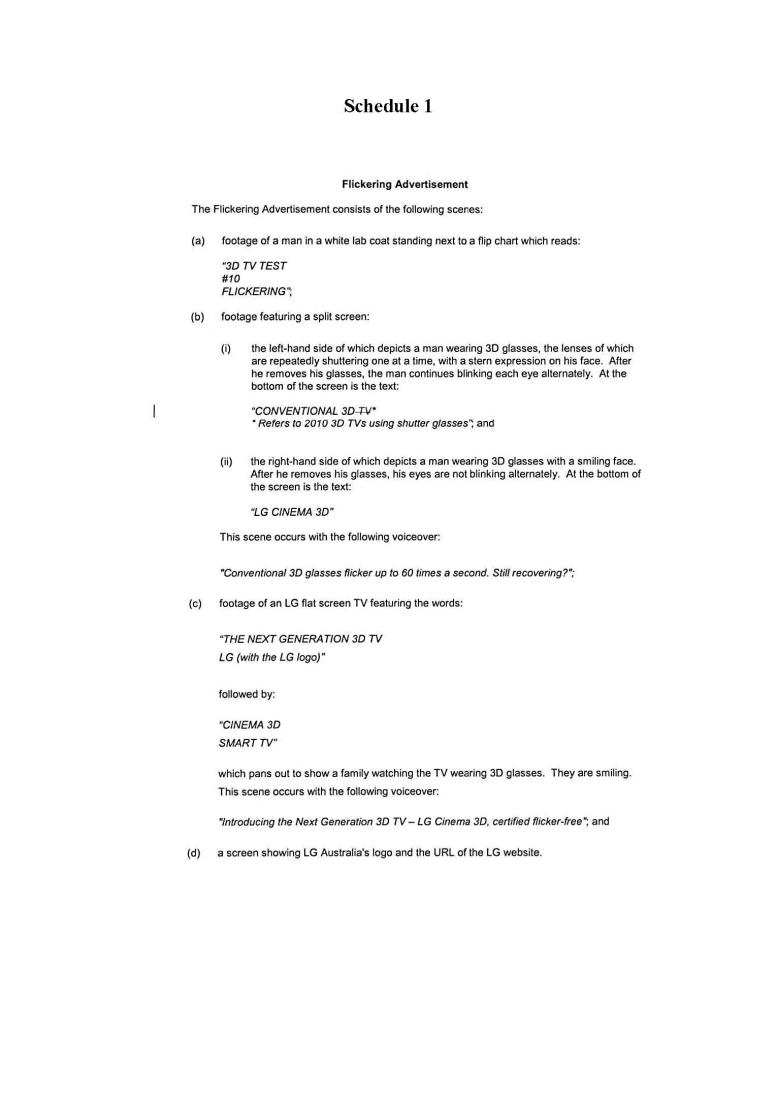
the Flickering TVC (a transcript of which appears in Schedule 1 to these reasons);
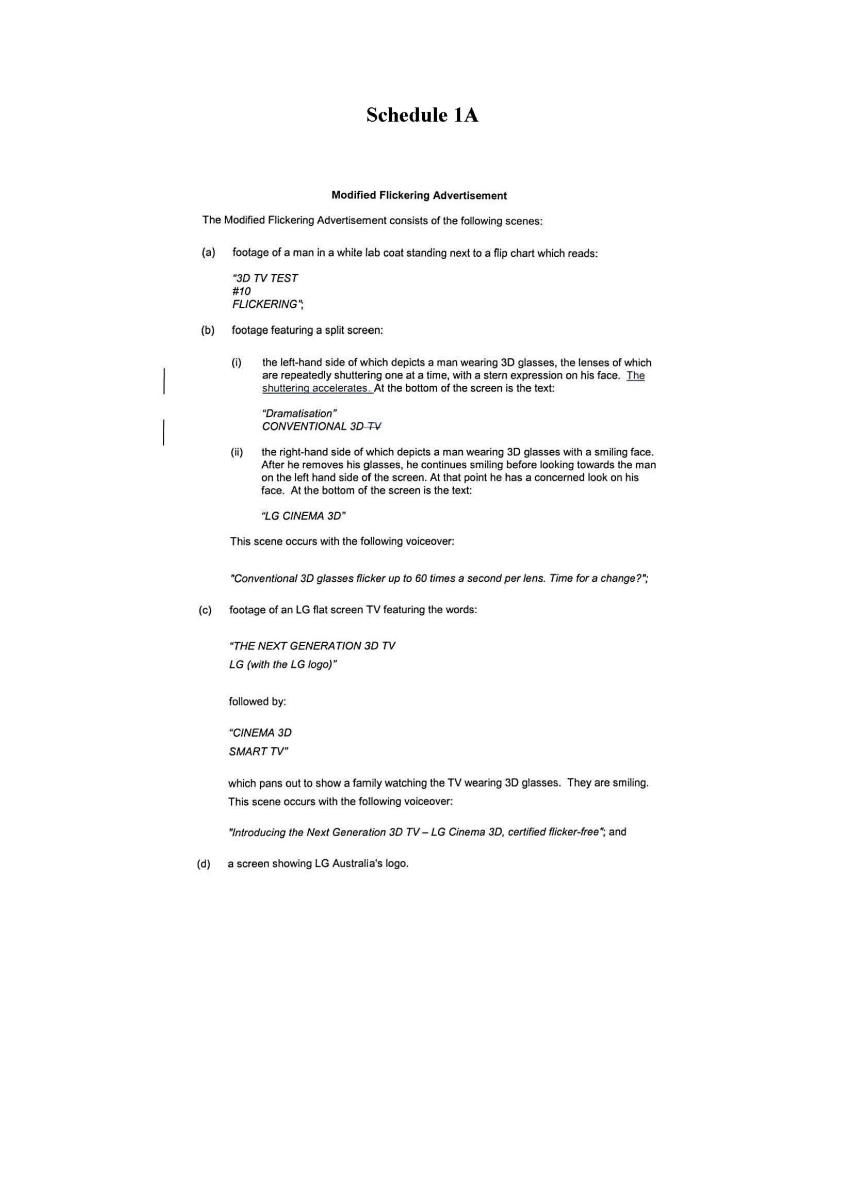
the Modified Flickering TVC (a transcript of which appears in Schedule 1A to these reasons);
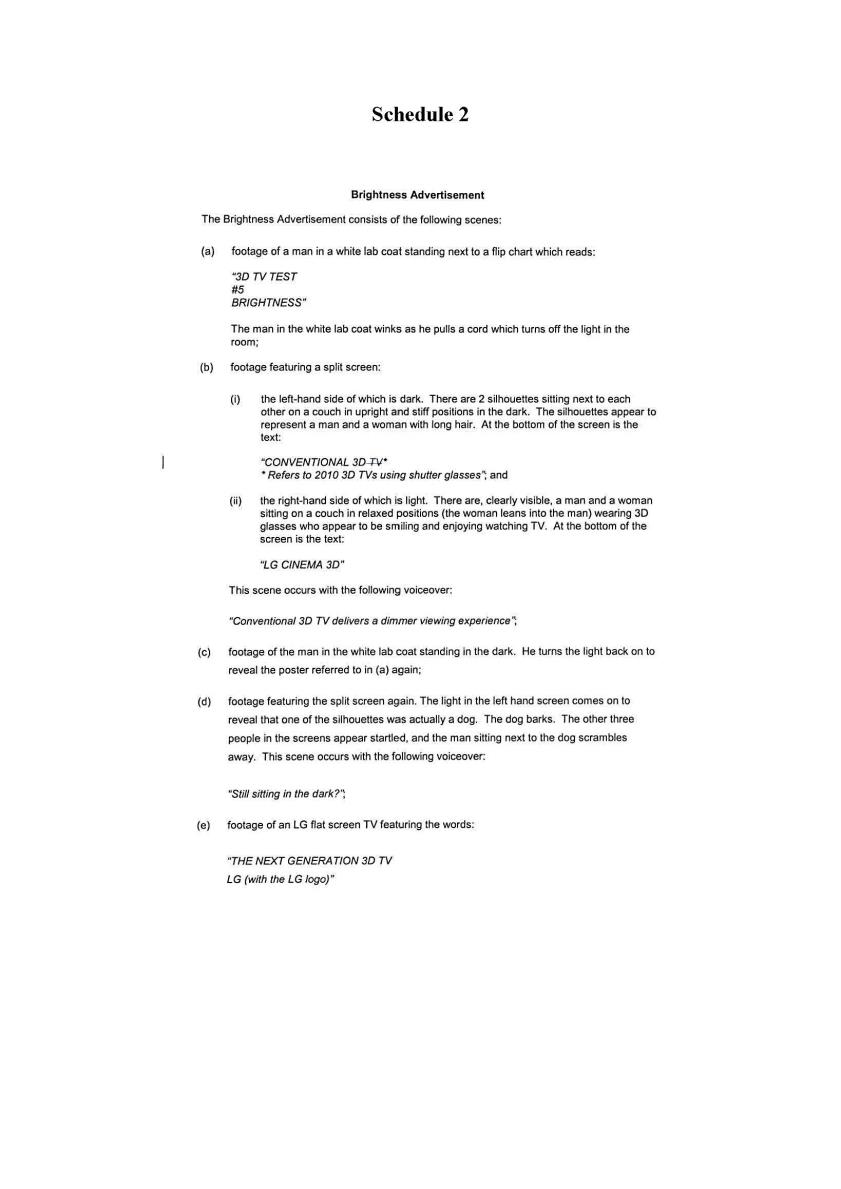
the Brightness TVC (a transcript of which appears in Schedule 2 to these reasons);
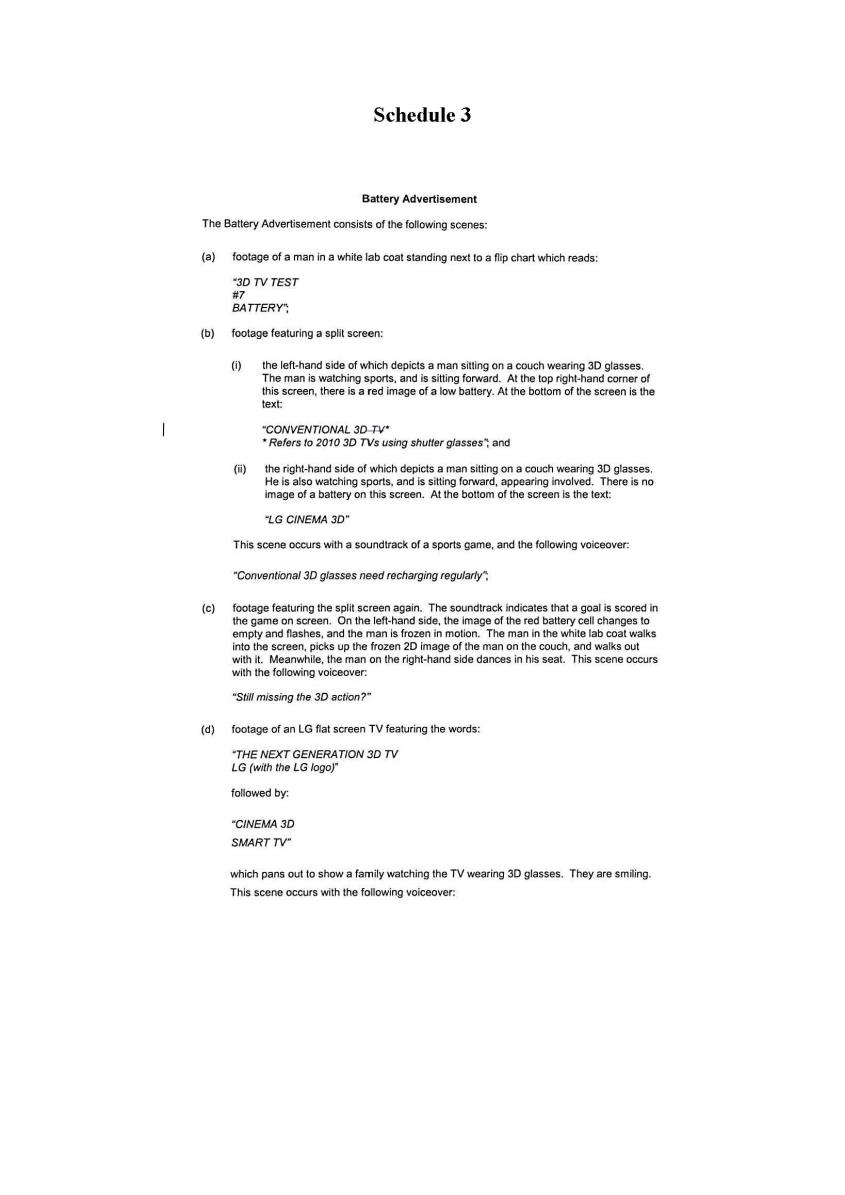
the Battery TVC (a transcript of which appears in Schedule 3 to these reasons);
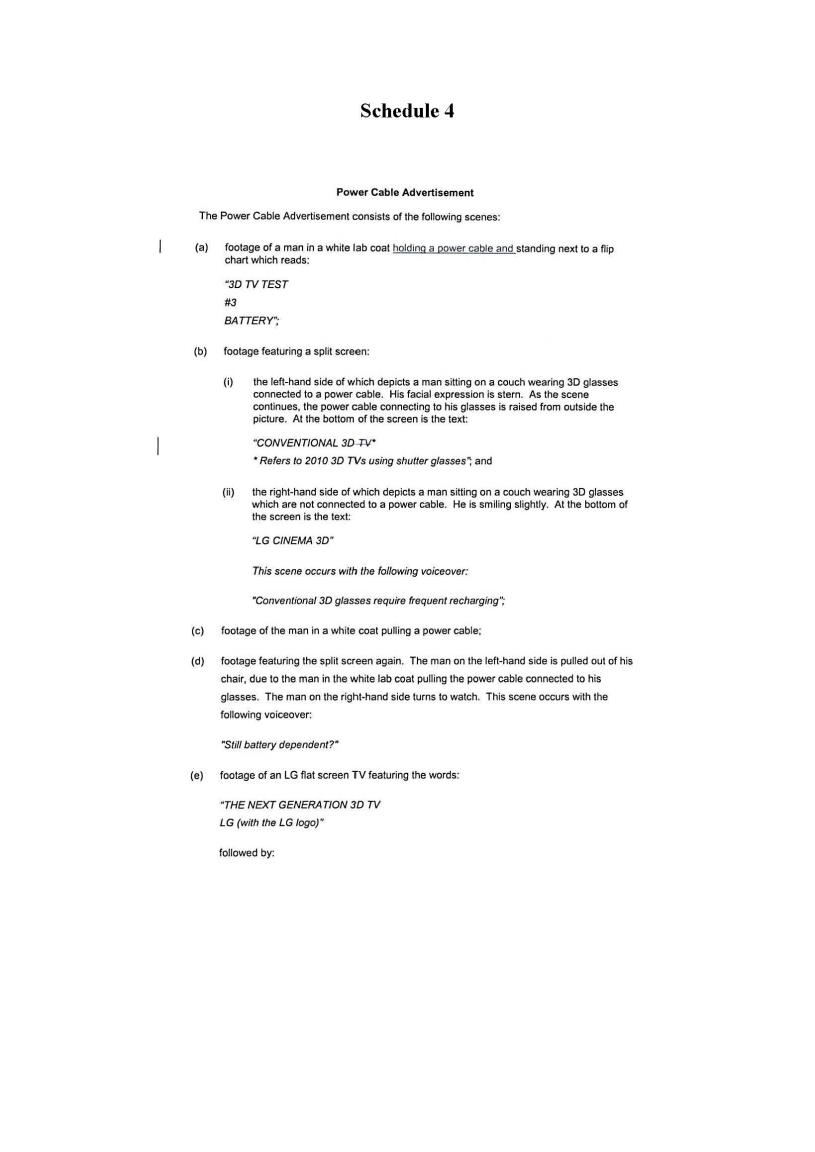
the Power Cable TVC (a transcript of which appears in Schedule 4 to these reasons);
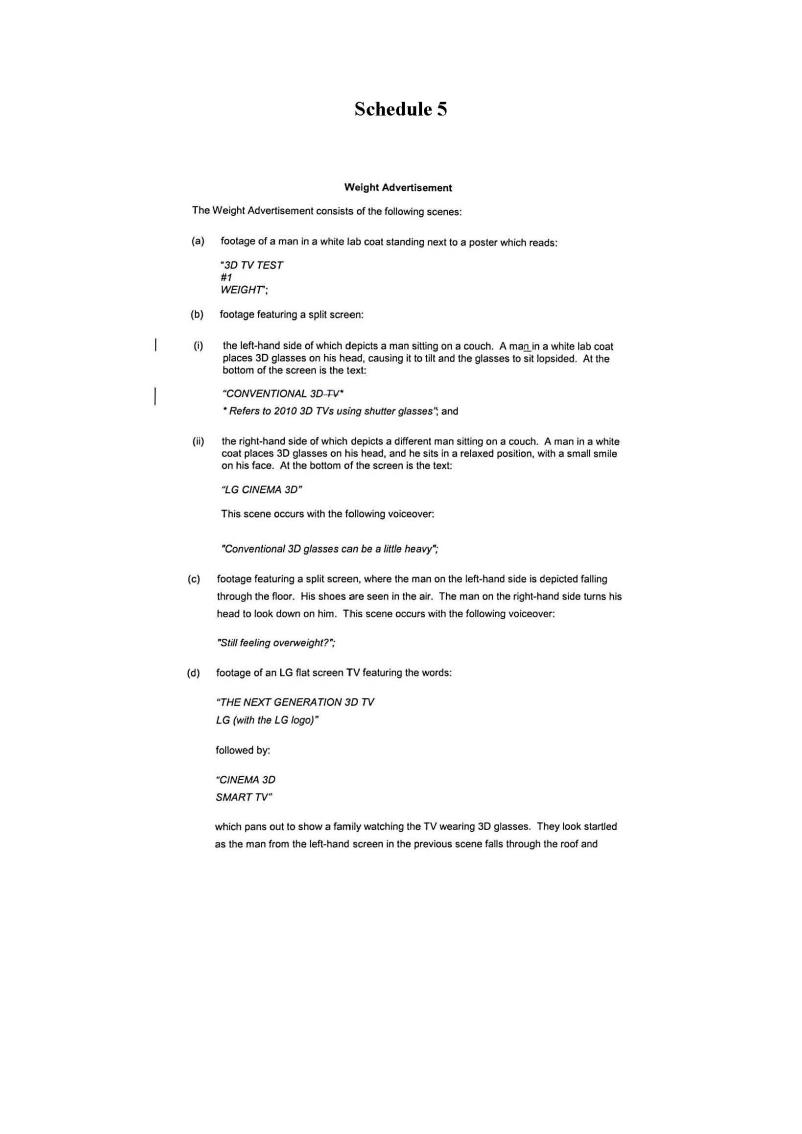
the Weight TVC (a transcript of which appears in Schedule 5 to these reasons).
7 Each of the TVCs runs for 15 seconds and was broadcast in Australia at various times between May 2011 and August 2011. The Flickering TVC was broadcast from 1 May 2011 to 7 May 2011 on 131 occasions and on another eight occasions between 5 June 2011 and 15 June 2011. The evidence establishes (and it is not disputed) that the June 2011 broadcasts of the Flickering TVC (which occurred after LG provided its undertaking to the Court on 18 May 2011) were inadvertent. The Modified Flickering TVC was broadcast for one week in August 2011. The TVCs were also screened in cinemas and uploaded onto YouTube. There were almost 15,000 screenings of the TVCs in cinemas between 12 May 2011 and 9 February 2012. There is no suggestion that the Flickering TVC was screened in cinemas after 18 May 2011. The hearing of the present proceeding occurred long after the LG campaign had ended.
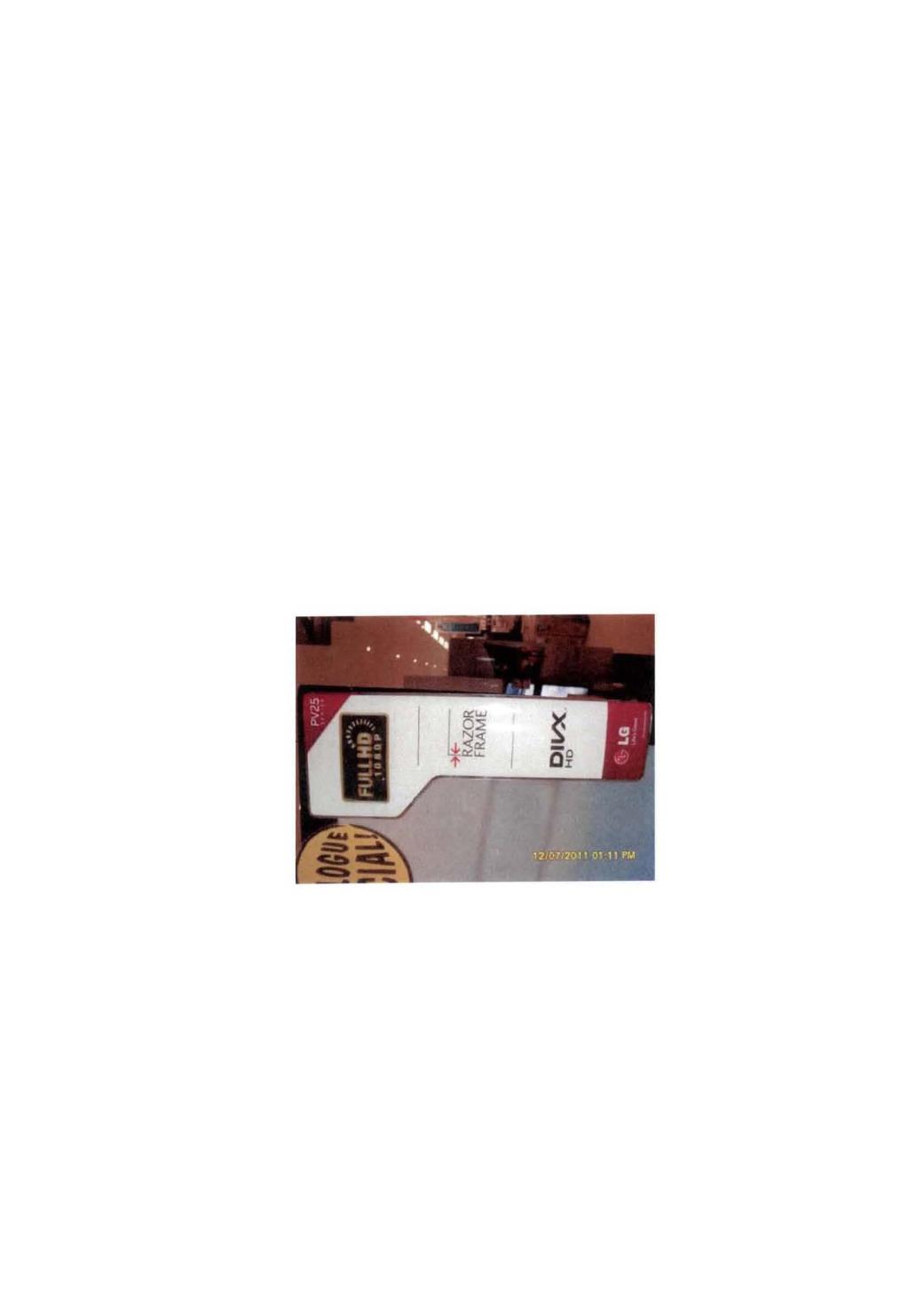
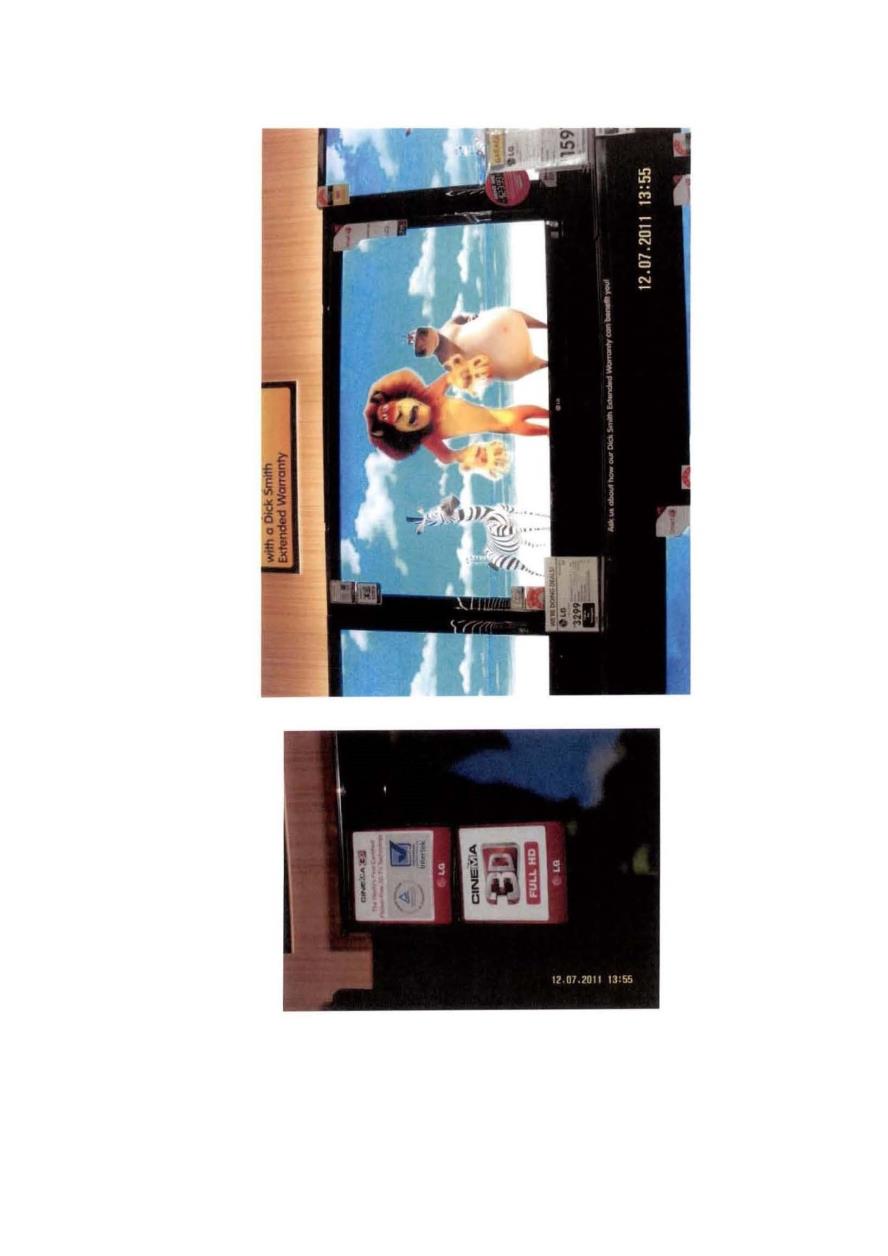
8 One of the key issues that was introduced into the case after the interlocutory application was determined relates to point of sale stickers affixed to LG Cinema 3D TVs upon which the expressions “Full HD” and “1080P” are alleged to have appeared. There is an issue in the proceeding as to what representation is conveyed by the presence of these stickers on LG Cinema 3D TVs and whether such representations as are conveyed are misleading or deceptive when made in relation to the televisions on which they appear. This issue generated a large amount of technical evidence directed to establishing what constitutes “Full HD” and “1080P” television and what those terms mean to consumers particularly when used in relation to 3D television.
9 Photographic reproductions of the Full HD and 1080P stickers and related point of sale material (the Full HD POS) to which I have already referred appear in Schedule 6 to these reasons.
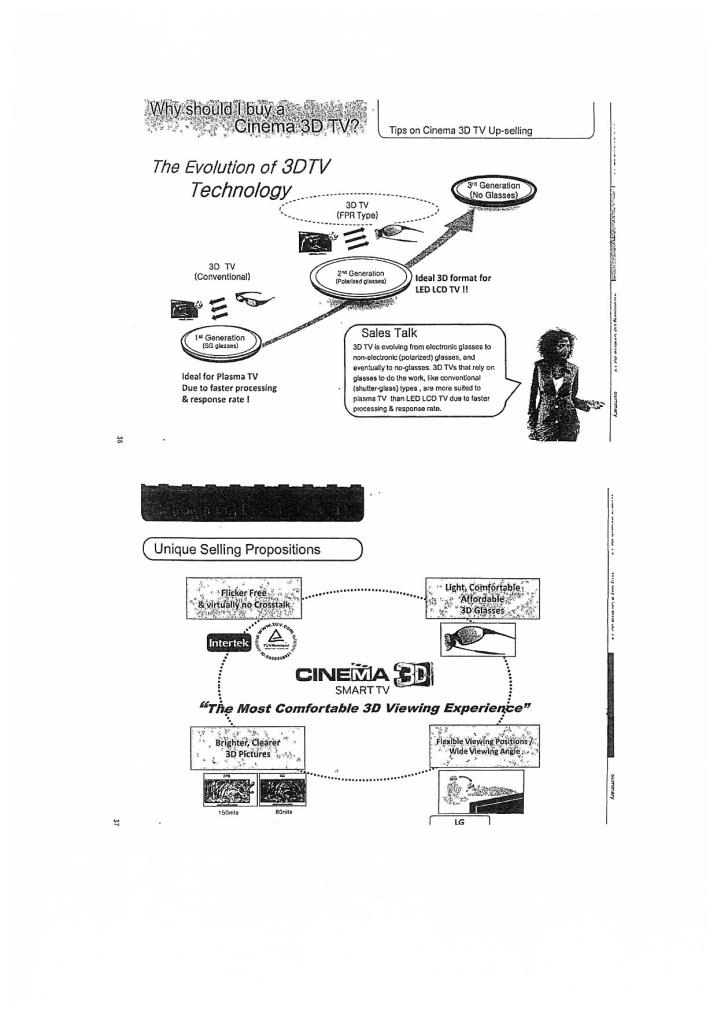
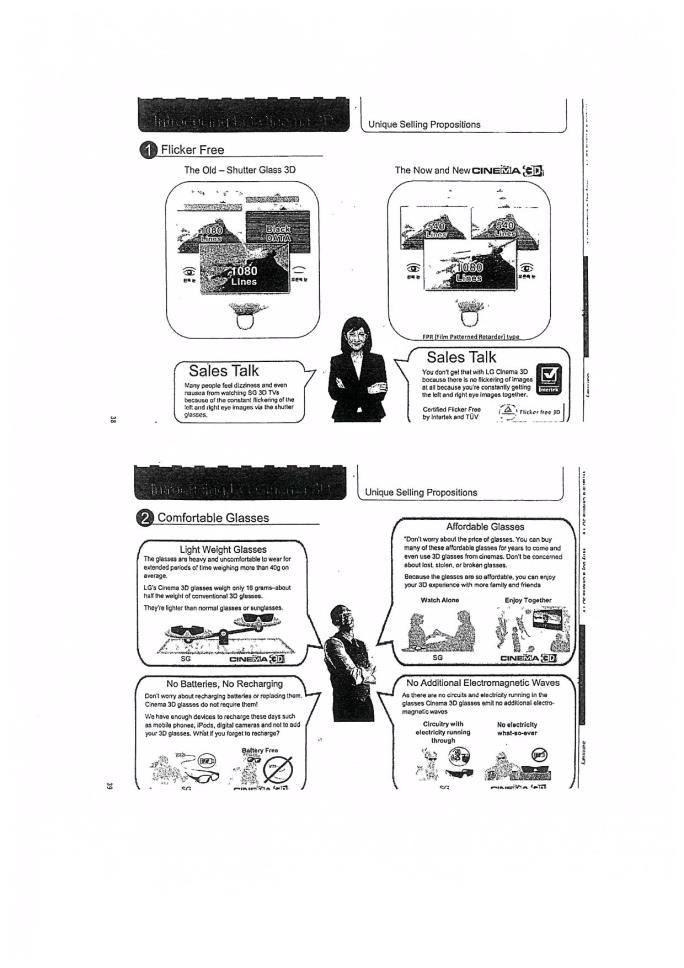
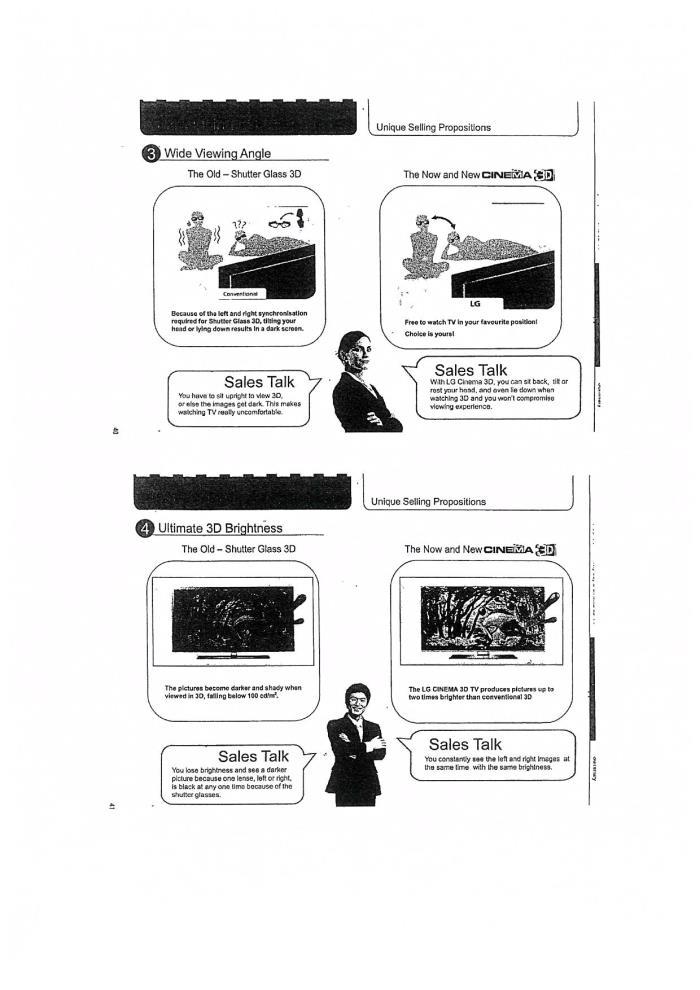
10 Samsung also alleges that LG made misleading or deceptive statements on LG’s website (the Website Representations) and in retailer instructions (the Retailer Instructions) distributed by LG to retailers of its 3D televisions in Australia. A copy of the Retailer Instructions is reproduced in Schedule 7 to these reasons.
Witnesses
11 There were 36 witnesses who gave evidence at the hearing, 31 of whom were cross-examined. The following brief account of the witnesses and the matters to which their evidence relates is given in the same order as they were called to give oral evidence. Witnesses called by Samsung are designated (S) and those called by LG are designated (L). In some cases, I have also recorded some observations concerning the relevance and reliability of their evidence.
Philip Newton (S)
12 Mr Newton is the Director of Samsung’s Audio-Visual Division. He has many years of experience in the consumer electronics industry in Australia relating to the marketing of consumer electronics products. His evidence concerned the Australian television market, including the position of the four major suppliers of televisions in the market. Mr Newton’s evidence also addressed the factors that drive demand for new televisions and the introduction of 3D technology to the home television market. He also gave evidence relevant to the issues of battery life and damages.
Bradley Wright (S)
13 Mr Wright is Samsung’s National Sales and Marketing Manager – Audio Visual. He has nine years of experience in marketing electronic products including six years of experience in marketing TVs and other consumer electrical products. He gave evidence in relation to the launch of 3D TV in Australia in 2010 and the release by Samsung and its competitors of new product ranges in 2011.
Philip Lelyveld (S)
14 Mr Lelyveld is an entertainment technology business development consultant. He prepared an expert report on the history of 3D technologies and the various ways in which 3D images are created for use in cinema and television, the use and application of 3D technology across a range of industries, and other related topics. The relevance of his evidence was slight.
Michael Williams (S)
15 Mr Williams is the solicitor for Samsung. He gave evidence of an exercise he conducted in which he attempted to simulate what was depicted in the Brightness TVC in order to test the amount of reflected light that would appear on a person sitting in front of the screens of each of a Samsung 3D TV and an LG Cinema 3D TV. A video recording of the experiment undertaken by Mr Williams is also in evidence. The relevance of this evidence was also slight.
Gerard Bardsley (S)
16 Mr Bardsley is the Manager of Customised Research (NSW) at Roy Morgan Research Ltd (Roy Morgan) who gave evidence in relation to the Roy Morgan Survey. He has extensive experience in market research and data analysis. He was the market researcher responsible for carrying out the Roy Morgan Survey. He also gave evidence concerning the Galaxy Survey. I did not find Mr Bardsley to be a wholly satisfactory witness. There were criticisms made by him of the Galaxy Survey that lacked substance (in particular, that it should have been an online survey) which suggested to me that his evidence lacked objectivity.
Dr Sergei Dorofeev (S)
17 Dr Dorofeev is the statistician for Roy Morgan International Ltd. He is based in London and is the most senior statistician in the Roy Morgan group of companies. He gave evidence in relation to statistical matters.
Iain Bell (S)
18 Mr Bell is Project Director of Customised Research at Roy Morgan in Sydney. He has extensive experience in the field of market research. He had a minor involvement with the Roy Morgan Survey in the form of brief discussions with Mr Bardsley in relation to the form of the questionnaires used for the purposes of that survey and the coding of responses based upon the Representations Document. He considered the form of questionnaire and the approach to coding adopted by Mr Bardsley to be consistent with standard practice. He made an affidavit in reply (but not in chief) that did little more than rehearse the same arguments made by his colleague, Mr Bardsley, when responding to Mr Briggs’ criticisms of the Roy Morgan Survey.
David Briggs (L)
19 Mr Briggs is the Principal of Galaxy Research in Sydney (Galaxy). He has extensive experience in the field of market research. He gave evidence concerning the Roy Morgan Survey and the Galaxy Survey. He was the market researcher responsible for carrying out the Galaxy Survey.
Dr Stephen Downes (S)
20 Dr Downes holds the position of Principal of QBrand Consulting, a management consulting firm that specialises in marketing, communications and brand strategy. He has worked in these fields since 1988 and has extensive experience as a lecturer and teacher in marketing and advertising at RMIT University in Melbourne. His evidence was directed to various marketing and brand-related topics including comparative advertising and the use of humour in advertising.
Stephen Gater (L)
21 Mr Gater is the CE Consumer Marketing Director for LG Electronics UK Ltd (LG UK). He gave evidence concerning statements published on LG UK’s website in January 2011 concerning the resolution of 3D images viewed through active shutter and passive glasses.
Dr Pierre van Osselaer (L) and David Cobbold (L)
22 Dr Van Osselaer and Mr Cobbold have expertise in the field of advertising and communications including semiotics, which was described by them in their joint expert report as “the science of signs”, including how readers or viewers make sense of signs by interpreting them in context. They undertook an analysis of the TVCs, the comedic devices employed in them, and their likely impact on viewers. Though their joint expert report was engaging, I have given it only slight weight, and then only for the purpose of testing my own impressions of the TVCs.
Dongbae Lee (S)
23 Mr Lee is the Principal Engineer in the Visual Display Business Unit of Samsung Electronics Co Ltd in Korea. Mr Lee has extensive experience in research and development, design, testing and evaluation of televisions and computer monitors. He gave evidence concerning a range of matters including the development of 3D TV technology, and the circumstances in which a viewer of 3D TV using active shutter technology might experience “crosstalk” or other interference affecting the operation of active shutter glasses. Mr Lee also gave evidence concerning the “resolution” of 3D TVs and the differences between Samsung’s active shutter and LG passive 3D TVs including with respect to viewing angles.
Dr Heejae Kim (L)
24 Dr Kim is the Chief Research Engineer in the Picture Quality Team at LG Korea. She gave evidence relating to a number of technical issues including the meaning of the terms 1080p and Full HD. Her evidence on that topic was somewhat inconsistent. At times she suggested that “Full HD” as it relates to 2D televisions implies a display resolution of 1080p whereas she also suggested that “Full HD” was a marketing term the meaning of which was much less precise. She was heavily criticised by Samsung in submissions on a number of counts including her disdainful treatment of Mr Kane’s opinions, her evidence concerning health warnings extracted from user manuals for 3D TVs, and viewing distances. I did not find Dr Kim’s evidence of any particular assistance expect insofar as it related to what was referred to in evidence as “the LG algorithm” which I accept is relevant to the overall picture quality of LG Cinema 3D TVs, and not resolution in any technical sense.
Timothy Barnes (L)
25 From 2010 to 2012 Mr Barnes was LG’s Senior Marketing Manager for Home Entertainment. He gave evidence concerning the TV market in Australia including the market for 3D TVs, the launch of the LG Cinema 3D TV range in April 2011, the LG Campaign, and his understanding of the messages that the TVCs were intended to convey to viewers. He specifically denied that he intended to mislead or deceive Australian consumers about conventional 3D technology by means of the TVCs. I accept that evidence, but note that some of the evidence given by Mr Barnes as to what messages he believed the TVCs to convey (especially the Flickering TVC) is much harder to accept.
Professor Martin Banks (S)
26 Professor Banks is a Professor of Optometry at the University of California, Berkeley who has expertise in vision science, including binocular fusion and depth perception. He gave evidence concerning the human vision system and how it perceives objects and images in 3D. His evidence also explored the impact of different 3D TV technology on the human vision system, and included evidence of experiments he conducted using an LG Cinema 3D TV and a Samsung active shutter 3D TV viewed through 3D glasses at various viewing distances in order to determine what he referred to as the “effective resolution” or “viewable image” of each TV when operating in 3D mode. Although I considered Professor Banks to be an impressive witness, the presentation of the results of his second study raised concerns in my mind about his impartiality.
Joseph Kane Jr (S)
27 Mr Kane Jr is a consultant in electronic imaging, video display standards and video signal display of analogue and digital video signals. He has many years of experience working with video signals, including the design and construction of electronic components to record, carry and process video signals. Mr Kane also has considerable experience in the development of standards for video signal processing, and the testing of video signal processing and display equipment. Mr Kane gave evidence relating to these topics and tests he conducted in relation to the resolution and brightness of LG Cinema 3D TVs and Samsung 3D TVs. He appears to have had a commercial relationship with Samsung extending over many years which raised concerns in my mind as to his impartiality. Mr Kane’s evidence was of limited assistance, and his evidence concerning the capacity of an LG Cinema 3D TV to deliver a “viewable image” of 1080p was of no assistance at all.
James Burge (S)
28 Mr Burge is the Managing Director of a company known as Research Now which was responsible for providing the online panel which was used as the sample frame for the Roy Morgan Survey.
Dr Edward Kelley (L)
29 Dr Kelley has considerable experience in the field of display metrology. However, his evidence was directed to a wide range of topics, some of which went well beyond his field of expertise. I found Dr Kelley’s evidence to be of limited assistance, especially in relation to matters concerned with vision science. Dr Kelley’s evidence concerning his experimental work with what was referred to as his “binocular fusion camera” was of no assistance at all.
Professor Brian Rogers (L)
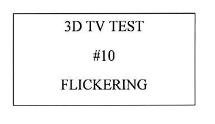
30 Professor Rogers is a Professor of Experimental Psychology in the Department of Experimental Psychology, University of Oxford and a distinguished academic. Most of his research work over the past 30 years has been in the field of 3D vision, with a particular emphasis on binocular stereopsis and motion parallax. He has co-authored (with Professor Howard of York University, Toronto) two major reference works on binocular vision, stereopsis, and 3D vision in general, entitled Binocular Vision and Stereopsis (Oxford University Press 1995) and Seeing in Depth (Iporteus Press 2002). Professor Rogers gave evidence in response to Professor Banks’ evidence, as well as of his own experiments which he conducted using an LG Cinema 3D TV and a Samsung 3D TV at various viewing distances when operating in both 2D and 3D modes. He was an impressive witness.
Dr James Sheedy (L)
31 Dr Sheedy is Professor of Vision Science at Pacific University, Portland, USA. His expertise is in optometry and vision science. His expert report covered a wide range of topics including various studies conducted by him for a variety of purposes which were said by LG to be relevant to the incidence of symptoms associated with 3D viewing (dizziness and nausea), brightness, resolution, crosstalk and viewing angles. Dr Sheedy’s evidence failed to engage with numerous points raised by Professor Banks and Dr Duenas relevant to his evidence and the weight it should be given. I derived little assistance from Dr Sheedy’s evidence.
Dr Michael Duenas (S)
32 Dr Duenas is an expert in optometry and public health, with extensive experience in both those areas. He provided evidence concerning symptoms that may be experienced when watching stereoscopic 3D and their causes. He was an impressive witness.
Keith Jones (L)
33 Mr Jones is Managing Director of Australian Digital Testing, Sydney. His area of expertise is in the field of testing and measuring digital equipment. Mr Jones’ evidence was relevant to the issues of brightness, weight of glasses and the display resolution of the LG Cinema 3D TVs in 2D and 3D mode.
Kyuchan Her (L)
34 Mr Her is the TV Product Manager for LG. He has degrees in economics and business. He worked for LG Korea for at least 15 years before taking up his current position with LG in August 2010. He took up his current position with LG in August 2010. He approved the TVCs and played a key role in overseeing execution of the LG Campaign including point of sale materials such as product stickers. It is apparent from Mr Her’s evidence that he relied heavily on LG Korea to ensure that product claims sourced from its head office were accurate.
Dr Peter Török (S)
35 Dr Török is a Professor of Optical Physics at the Imperial College of Science, Technology and Medicine, London. He has expertise in the field of optical physics. His evidence was responsive to the evidence of Dr Kelley but primarily related to picture “fidelity”. His evidence was of marginal relevance.
Martin Kim (L)
36 Mr Kim holds the position of National Sales Operations Manager for LG. He gave evidence in relation to the Retailer Instructions which he prepared using “sales communication guides” prepared by LG Korea and (according to his oral evidence) after carrying out his own research of product reviews, blogs, online forums and “anything” he could access using Google. Although I formed a poor impression of Mr Kim as a witness, I do not think anything turns on his evidence.
Professor Dominick Maino (S)
37 Professor Maino is a professor of Paediatrics and Binocular Vision at the Illinois College of Optometry, Illinois Eye Institute (IEI) in Chicago, USA. Professor Maino has over 30 years’ experience in optometric medicine, and has extensive academic and professional expertise concerning binocular vision disorders, and the incidence and treatment of vision disorders amongst children. He gave evidence concerning adverse side effects associated with viewing active shutter 3D TV. He also gave evidence about the role of 3D TV, including active shutter glasses, in the diagnosis and treatment of binocular vision disorders. Professor Maino was an impressive witness.
George Karatzis (L)
38 Mr Karatzis holds the position of Executive Engineering Officer for LG, Sydney. His oral evidence (and related documentary evidence) indicated that for some time he doubted whether the LG Cinema 3D TV could be classified as “Full HD” when operating in 3D. Mr Karatzis (who is not a vision scientist) was in no position to determine what the “effective resolution” of any 3D TV operating in 3D mode was and I regard statements made by him in early 2011 suggesting that the vertical resolution of the Cinema 3D TV in 3D was half what it was in 2D as mere conjecture by a person without any expertise in vision science.
Peter Fritz (L)
39 Mr Fritz is the Digital Marketing Manager for LG in Sydney. He gave evidence concerning the LG website. His evidence was said by both Samsung and LG to be relevant to intention. His evidence was of marginal relevance to Samsung’s case based upon the Website Representations.
Toolendrie (Evelyn) Soud (L)
40 Ms Soud is the Legal and Compliance Manager for LG based in Sydney. Her evidence was said by LG to be relevant to the substantiation of claims made in the TVCs, on the LG website, in point of sale materials, and to intention. She was cross-examined at length about what steps she took to substantiate claims made in the TVCs which she approved. In submissions Samsung criticised Ms Soud’s evidence in numerous respects principally on the basis that it should have been obvious to her that the TVCs conveyed representations to the effect of those pleaded by Samsung. Further, a submission was made to the effect that Ms Soud denied that particular messages were conveyed merely in order to justify her failure to ensure that such messages could be substantiated. I do not accept that submission.
Luke Solyom (L)
41 Mr Solyom is employed by LG as Marketing Strategy and Planning Manager in its Sydney office. He gave evidence in relation to sales and market share data for the 3D TV market, and the role that the LG Campaign may have played in Samsung’s loss of market share in the period from May to August 2011.
Mark Powderly (S)
42 Mr Powderly is Samsung’s Marketing Intelligence Manager. He provides market analysis and sales forecasts to divisions of Samsung, including the Audio-Visual division which is responsible for marketing Samsung’s TVs. He gave evidence of sales and market share for the Australian 3D TV market. Mr Powderly was not cross-examined.
Anna Grunseit (S)
43 Ms Grunseit is a lawyer employed by Gilbert + Tobin. She weighed Samsung’s active shutter 3D glasses, Samsung’s competitor’s 3D glasses (both active shutter and passive), and various branded sunglasses and branded spectacles. Ms Grunseit was not cross-examined.
Kane Lloyd (S)
44 Mr Lloyd is employed by the theeyecarecompany (ECC). He is the store manager and head of customer care at ECC’s store located on Pitt Street, Sydney. Mr Lloyd also gave evidence concerning the weight of sunglasses and branded spectacles and consumer preferences. Mr Lloyd was not cross-examined.
Alexander Porter (S)
45 Mr Porter is a Chief Engineer for Programs, Performance and Durability employed by the Commercial and Electrical Division of the company Intertek. Intertek is an international testing laboratory which provides third party testing and evaluation services to customers through a network of laboratories located around the world. Mr Porter gave evidence concerning a test report prepared by Intertek for Samsung Electronics America Inc relating to “observed resolution” and “crosstalk viewing angle” for a Samsung active shutter 3D TV and an LG passive 3D TV. A copy of the Intertek test report was annexed to Mr Porter’s affidavit. In submissions Samsung placed reliance upon the Intertek test report on the issue of “effective” or “visible” resolution. However, the test report indicates that the testing that was undertaken involved viewing distances of less than 1.85m (ie. less than 2.3 times the screen height for a 55" TV). On that basis, and for reasons that will become apparent, I have not given the Intertek test report any weight in relation to that issue.
Charles Rego (S)
46 Mr Rego is the Senior Corporate Counsel employed by Underwriters Laboratories (UL). UL is a global independent safety science company which provides product safety and verification services. UL undertook comparative tests for 3D resolution and crosstalk of a Samsung active shutter 3D TV and an LG passive 3D TV and issued a test report describing the test procedures and results, a copy of which was annexed to Mr Rego’s affidavit. Samsung relied on UL’s test report on the issue of “effective” or “visible” resolution. However, the test methodology adopted involved the use of cameras (which both Professor Banks and Professor Rogers agree is inappropriate) and at viewing distances that are not specified. I have given the UL test report no weight.
Background Facts
47 Samsung and LG are competitors in the market for TVs in Australia including 3D TVs. 3D TV was first introduced into Australia in 2010 and was still a relatively new technology when LG first released its Cinema 3D TVs in about April 2011. Samsung was the first to release a 3D TV, using active shutter technology, in about April 2010. These televisions were known as the C-Series and were available in plasma, LCD and LCD with LED panel types. The Samsung C-Series was sold through a large number of retail stores throughout Australia and was the subject of an extensive media campaign.
48 Televisions have a rectangular array of pixels that are used to display images. A pixel is an addressable single point which contributes to the image displayed on the television screen. “Resolution” is the term which, when used in its technical sense, refers to the number of pixels capable of displaying an image on the screen. “Full HD” generally refers to a television which has an array comprised of a total of 2,073,600 addressable pixels, made up of 1,920 pixels vertically (making up the horizontal resolution) and 1,080 pixels horizontally (making up the vertical resolution) refreshed on a progressive (p) basis. Such displays are often referred to as “1920 x 1080p” or simply “1080” or “1080p” displays and are capable of displaying an input signal with an equivalent resolution. At the time of the LG campaign 1080p was the highest available resolution on the market. There is a dispute between the parties as to what is conveyed by the term “Full HD” (but not the term “1080p”) when used to describe a 2D television. There is also a dispute between the parties as to what “Full HD” and “1080p” convey when used in relation to a 3D television.
49 3D TVs operate in either normal 2D mode or 3D mode. When operated in 3D mode, the TV is viewed by the viewer through 3D glasses. A 3D TV operating in 3D mode is not designed to be viewed without 3D glasses. Not only is the image as perceived by the viewer not 3D, it is distorted and difficult to watch.
50 By the end of 2010, all major TV manufacturers had released active shutter 3D TVs in Australia. These manufacturers included Sony, Panasonic and LG. Stock of Samsung’s C-Series 3D TVs remained in the market until at least July 2011. Sony, Panasonic and LG’s active shutter 3D TVs were also available at that time.
51 On 6 April 2011 Samsung announced the Australian launch of its 2011 range of plasma and LCD with LED TVs known as the D-Series 3D TV range. The D-Series also used active shutter technology and generally operated in the same way as the C-Series except for some additional settings and certain improvements to the shutter glasses. Samsung began distribution of the D-Series 3D TVs in the first week of April 2011. By late May 2011, the full range of the D-Series was available in most of the same retail outlets that had been selling Samsung’s C-Series.
52 On about 14 April 2011 LG launched a new range of LCD/LED 3D TVs called “LG Cinema 3D TV”. From the time of the release of the LG Cinema 3D range there were two types of 3D technology employed in 3D TVs sold in Australia. The first, introduced in 2010, was the active shutter technology; the second, introduced with the release of the LG Cinema 3D range, was the FPR technology which was also referred to in the evidence and submissions as “passive” technology.
53 With active shutter technology, a viewer watches the screen wearing special glasses which are synchronised with different images displayed on the television. In simple terms, a 3D effect is created through the use of a technology that simulates normal binocular vision by sending distinct left eye images (LEI) and right eye images (REI) and prevents the left eye from seeing the REI and preventing the right eye from seeing the LEI. Each image is of the same scene but from a slightly different perspective. The 3D image is created when the viewer’s visual system (essentially the eyes and the brain) combines the LEI and the REI through the process of “binocular fusion” to see a single stereoscopic, or 3D, image.
54 The lenses of the shutter glasses have a liquid crystal layer which becomes dark when voltage is applied. These lenses darken about 60 times per second per lens, thereby blocking the right eye from seeing the LEI and the left eye from seeing the REI. This shuttering of the lenses occurs at a rate that is imperceptible to the ordinary viewer in normal viewing conditions.
55 LG’s passive or FPR technology operates quite differently to active shutter technology. Unlike the latter, which rapidly displays one full image after another, FPR involves displaying two full images on the screen at the same time. It works by polarising the odd and even lines of image information that appear on the screen. One eye receives half of the information on display (all of the odd rows of pixels) and the other eye receives the other half of the information on display (all of the even rows of pixels). If the left eye is seeing the odd rows, then the even rows will be black for the left eye (and vice versa for the right eye). The brain translates the information received by the two eyes into a 3D image. The passive glasses do not shutter, nor do they require a power source.
56 The active shutter 3D TVs sold since 2010 have included televisions that utilise LED/LCD panel technology and TVs which utilise plasma panel technology. All of LG’s FPR 3D TVs utilise LED/LCD panel technology. LG’s range of plasma 3D TVs continues to use active shutter technology, as do all other brands of 3D TVs for both the LED/LCD and plasma panel types.
57 LG entered the Australian market for 3D TVs in May 2010 with a range of TVs employing active shutter technology. Sony did the same in June 2010. Although by December 2010 there were eight competitors in the market, which also included Sharp, Hisense, Voxson and Toshiba, it is clear that the major competitors were Samsung, LG, Sony and Panasonic. As stated by Mr Barnes, the 3D television market in 2011 was essentially “a four horse race”. The evidence also included market data which showed that when the LG campaign commenced in May 2011, 3D television was at a relatively early stage of its product category life cycle. Dr Downes gave evidence that it is likely that fewer than 4% of Australian households would have owned 3D TVs as at May 2011. Mr Barnes also agreed that the TVCs were directed to a consumer market which would not at that time have had much understanding of 3D technology. It was submitted by Samsung that a large proportion of the consumers who saw the TVCs would have had little or no prior knowledge or experience of 3D home televisions. I accept that submission.
Relevant Statutory Provisions
58 Section 18(1) of the ACL provides that a person must not, in trade or commerce, engage in conduct that is misleading or deceptive or is likely to mislead or deceive. Section 29(1)(a) of the ACL relevantly provides:
(1) A person must not, in trade or commerce, in connection with the supply or possible supply of goods or services or in connection with the promotion by any means of the supply or use of goods or services:
(a) make a false or misleading representation that goods are of a particular standard, quality, value, grade, composition, style or model or have had a particular history or particular previous use; or
…
59 Section 4 of the ACL provides:
4 Misleading representations with respect to future matters
(1) If:
(a) a person makes a representation with respect to any future matter (including the doing of, or the refusing to do, any act); and
(b) the person does not have reasonable grounds for making the representation;
the representation is taken, for the purposes of this Schedule, to be misleading.
(2) For the purposes of applying subsection (1) in relation to a proceeding concerning a representation made with respect to a future matter by:
(a) a party to the proceeding; or
(b) any other person;
the party or other person is taken not to have had reasonable grounds for making the representation, unless evidence is adduced to the contrary.
(3) To avoid doubt, subsection (2) does not:
(a) have the effect that, merely because such evidence to the contrary is adduced, the person who made the representation is taken to have had reasonable grounds for making the representation; or
(b) have the effect of placing on any person an onus of proving that the person who made the representation had reasonable grounds for making the representation.
(4) Subsection (1) does not limit by implication the meaning of a reference in this Schedule to:
(a) a misleading representation; or
(b) a representation that is misleading in a material particular; or
(c) conduct that is misleading or is likely or liable to mislead;
and, in particular, does not imply that a representation that a person makes with respect to any future matter is not misleading merely because the person has reasonable grounds for making the representation.
Relevant Principles
60 The principles to be applied in determining whether a person contravenes s 18 of the ACL are relatively well-established and were for the most part settled while s 52 of the Trade Practices Act 1974 (Cth) (TPA) was still in force.
61 The question whether conduct is misleading or deceptive or likely to mislead or deceive is a question of fact that must be determined in light of the relevant surrounding circumstances: Butcher v Lachlan Elder Realty Pty Ltd (2004) 218 CLR 592 at [109] per McHugh J.
62 A person may be found to have contravened s 18(1) even though he or she lacked any intention to mislead or deceive: Hornsby Building Information Centre Pty Ltd v Sydney Building Information Centre Ltd (1978) 140 CLR 216 at 228 per Stephen J.
63 Conduct may be misleading or deceptive if it induces error but it is not sufficient merely to show that it may have led to confusion or caused people to wonder: Parkdale Custom Built Furniture Pty Ltd v Puxu Pty Ltd (1982) 149 CLR 191 at 198 per Gibbs CJ.
64 Evidence that some people may have been misled is not essential but is admissible and may be persuasive: Taco Co of Australia Inc v Taco Bell Pty Ltd (1982) 42 ALR 177 (at 199 per Deane and Fitzgerald JJ). Ultimately, however, the question whether conduct is misleading or deceptive or likely to mislead or deceive is a matter for the Court.
65 It is necessary to distinguish the question whether an advertisement, alleged to be misleading or deceptive, has a tendency to lead a consumer into error, from the question whether the consumer has suffered loss and damage as a result of being led into error. The former question is logically anterior to the latter: Australian Competition and Consumer Commission v TPG Internet Pty Ltd (2013) 250 CLR 640 (TPG) at [49] per French CJ, Crennan, Bell and Keane JJ.
66 The characterisation of conduct alleged to be misleading or deceptive “generally requires consideration of whether the impugned conduct viewed as a whole has a tendency to lead a person into error”: TPG at [49], quoting French CJ in Campbell v Backoffice Investments Pty Ltd (2009) 238 CLR 304 at 319 [25]. As the majority observed in TPG at [50]:
It has long been recognised that a contravention of s 52 of the TPA may occur, not only when a contract has been concluded under the influence of a misleading advertisement, but also at the point where members of the target audience have been enticed into “the marketing web” by an erroneous belief engendered by an advertiser, even if the consumer may come to appreciate the true position before a transaction is concluded. That those consumers who signed up for TPG’s package of services could be expected to understand fully the nature of their obligations to TPG by the time they actually became its customers is no answer to the question whether the advertisements were misleading.
(footnote omitted)
67 In order to establish that conduct is misleading or deceptive or likely to mislead or deceive it is not necessary to show that it conveys a false or misleading representation: Henjo Investments Pty Ltd v Collins Marrickville Pty Ltd (No 1) (1988) 39 FCR 546 at 555 per Lockhart J.
68 However, in the present case the conduct alleged by Samsung to be misleading and deceptive is said to consist of the making of various representations. In these circumstances it will be necessary for Samsung to show that each of the alleged representations was conveyed and that it was misleading or deceptive or likely to mislead or deceive.
69 When the Court is concerned to ascertain the mental impression created by a number of representations conveyed by one communication it is wrong to attempt to analyse the separate effect of each representation: TPG at [52] citing (inter alia) Arnison v Smith (1889) 41 Ch D 348 at 369 (Lord Halsbury LC) and Gould v Vaggelas (1984) 157 CLR 215 at 252 (Brennan J).
70 The meaning and effect of an advertisement must be ascertained from the advertisement as a whole in its context. The dominant message of the advertisement is of crucial importance: Australian Competition and Consumer Commission v Coles Supermarkets Australia Pty Ltd [2014] FCA 634 (Coles) per Allsop CJ at [42] citing TPG at [45].
71 If it is established that a corporation did intend to mislead, a Court may more readily infer that the conduct complained of was misleading: Campomar Sociedad Limitada v Nike International Ltd (2000) 202 CLR 45 (Campomar) at [33].
72 Where there is an issue in proceedings under s 52 of the TPA (or s 18 of the ACL) as to the effect of conduct on a class of persons such as consumers who may range from the gullible to the astute, the Court must consider whether “the ‘ordinary’ or ‘reasonable’ members of that class” would be misled or deceived: Google Inc v Australian Competition and Consumer Commission (2013) 249 CLR 435 at 443 [7] per French CJ, Crennan and Kiefel JJ citing (inter alia) Campomar [102].
73 In Tobacco Institute of Australia Ltd v Australian Federation of Consumer Organisations Inc (1992) 38 FCR 1, Hill J, referring to a newspaper advertisement, observed at 50:
Where, as in the present case, the advertisement is capable of more than one meaning, the question of whether the conduct of placing the advertisement in a newspaper is misleading or deceptive conduct must be tested against each meaning which is reasonably open. This is perhaps but another way of saying that the advertisement will be misleading or likely to mislead or deceive if any reasonable interpretation of it would lead a member of the class, who can be expected to read it, into error …
Half Truths/unfair comparisons
74 A representation may be misleading or deceptive, or likely to mislead or deceive, because it conveys what is sometimes referred to as a “half truth”. A half truth is a statement which, on one view, is literally true, but likely to mislead or deceive unless suitably qualified. Stephen J provided his now well-known example of the unknown opera singer who shares a prima donna’s name in Hornsby Building Information Centre Pty Ltd v Sydney Building Information Centre Ltd (1978) 140 CLR 216 at 227.
75 In Hoover (Australia) Pty Ltd v Email Ltd (1991) 104 ALR 369 at 375 Gummow J noted that a comparison of goods or services may be rendered misleading as a result of the omission of material that would be necessary to render the comparison fair. His Honour referred with approval to the following statement of Burchett J in Duracell Australia Pty Ltd v Union Carbide Australia Ltd (1988) 14 IPR 293 at 299:
In the area of comparison advertising, it has repeatedly been said that particular care is required. An unfair comparison may, quite simply, because it is unfair, be misleading. It may mislead a consumer into thinking there is a basis for a choice where, in truth, there is not; or that a choice may be made on grounds which are not truly valid.
76 This statement will be most applicable where the comparison being presented is put forward in the advertisement as involving a scientific or technical comparison that the ordinary and reasonable viewer might expect was illustrative of what he or she would actually encounter in practice.
Humour
77 An important consideration relevant to the Court’s assessment of the likely impact of the TVCs and, in particular, their propensity to mislead or deceive, is their admittedly humorous style. LG contends that each of the TVCs uses, and would be recognised by viewers in Australia as using, humour and parody to convey information about the features of LG Cinema 3D TVs and conventional 3D TVs, and would not be understood by such viewers as presenting a literal depiction of the experience of actually watching each of the 3D TVs. It is convenient to consider the parties’ submissions on this issue at a general level before examining each of the TVCs in any detail.
78 LG submitted that the humorous style of the TVCs was a contextual matter which had to be born steadfastly in mind when determining whether each of the alleged representations is conveyed. It submitted that many of the representations pleaded against LG by Samsung depended upon the viewer taking the TVCs literally in circumstances where no ordinary or reasonable person would do so. As will be seen, I think there is considerable force in this submission in relation to many of the representations pleaded by Samsung. Nevertheless, I do not think it provides a complete answer to Samsung’s case.
79 Samsung submitted that the LG defence, insofar as it sought to rely upon the humorous style of the TVCs, sets up a false dichotomy between viewers taking the images literally, or “tongue in cheek”. Samsung submitted that a misleading or deceptive message can be humorously conveyed by a TVC without it being understood literally in all respects, and that the humour in each of the TVCs is achieved through exaggeration, which necessarily recognises and asserts some underlying or unexaggerated truth.
80 Samsung also submitted that since the TVCs convey information to the viewer about features of the TVs, such information is apt to be regarded as factual and is likely to be taken seriously (my emphasis), especially by viewers not well informed about the different 3D technologies. There is an obvious difficulty in considering this submission at a general level and without first understanding what information is actually conveyed. But the submission is circular if it is assumed that every statement made, or situation depicted in, the TVCs constitutes a piece of information that a viewer will take seriously. Some of the information conveyed by the TVCs could not possibly be taken seriously but is nevertheless likely to make some contribution to another more serious message conveyed to ordinary and reasonable viewers. The difficulty lies in understanding what serious message will be conveyed by the TVCs in circumstances where the message falls short of what is literally conveyed. This task is informed by the relevant parts of Samsung’s second further amended statement of claim (SOC) in which Samsung identifies the particular representations that it contends are conveyed by the TVCs to ordinary and reasonable viewers and that are likely to lead such viewers into error.
81 As I will explain, many of the representations relied upon by Samsung will only be conveyed to viewers who interpret information conveyed by the TVCs in a highly literalistic or true to life manner. This ignores the fact that ordinary and reasonable viewers will make significant allowance for what is readily discernible as exaggeration and parody aimed at making the TVCs entertaining and engaging.
Future matters
82 Samsung alleged that various representations which it says were conveyed by the TVCs were representations made with respect to a future matter so as to enliven s 4 of the ACL. For example, Samsung submitted that the Brightness TVC, which is alleged to have conveyed a representation that “conventional 3D TVs can only be viewed in the dark” (SOC, para 23(a)), also conveyed a representation that “a person watching conventional 3D TV will have to do so in the dark” (SOC, para 24(a)). Another example relates to the Power Cable TVC, which is said to convey a representation to the effect that “conventional 3D glasses require a power cable during use” (SOC, para 33(a)). Samsung submitted that the Power Cable TVC also conveyed a representation that “a person using conventional 3D glasses will need to connect them to a power cable when using them.” (SOC, para 34(a)). The latter representation was relied upon by Samsung as a representation made with respect to a future matter which enlivened the operation of s 4 of the ACL. The same argument was made in relation to a large number of other representations said to have been made with respect to future matters by means of the TVCs.
83 Most of the representations which Samsung alleges were conveyed by the TVCs consist of representations about the performance characteristics of conventional 3D TVs and LG Cinema 3D TVs. Each of these representations is pleaded as, and in substance is, a statement of fact. Whether or not the TVCs also convey representations with respect to future matters depends upon the proper characterisation of the representations actually conveyed.
84 The expression “future matter” is not defined by the ACL. The same expression as used in s 51A of the TPA, was also not defined. However, when read in context, the expression is not hard to understand. A “representation with respect to any future matter” for the purposes of s 4 of the ACL and, before it, s 51A of the TPA, is a representation which expressly or by implication makes a prediction, forecast or projection, or otherwise conveys something about what may (or may not) happen in the future.
85 It is important to distinguish between the representation actually conveyed by a product advertisement and what conclusions might be drawn from it. A person may reasonably infer from the statement “this is a 3D TV” that he or she will be able to view the TV in 3D at some time in the future. However, this does not change the fundamental character of the representation which is one made with respect to an existing state of affairs. In this case I am satisfied that none of the representations conveyed by the TVCs can be characterised as having been made with respect to a future matter.
86 In its submissions Samsung referred me to Australian Competition and Consumer Commission v Giraffe World Australia Pty Ltd (1999) 95 FCR 302 at [123]-[124] in which Lindgren J held that s 51A of the TPA was engaged in relation to various representations made with respect to an “ion mat” consisting of an electrified mat. The representations made, as found by his Honour, were broadly to the effect that as a result of its emission of negative ions, the mat benefits the health of persons who sleep on it. That decision, and others concerned with the efficacy of therapeutic products that are said to offer health benefits when administered or used as directed, are distinguishable from the present case. In such cases the representation is made with respect to a future matter in that the consumer is told that if he or she uses the product a particular health benefit will be obtained at some time in the future. I do not think it is possible to tease any such representation out of any of the TVCs in issue in this proceeding.
The Television Commercials
Common Elements
87 Each of the TVCs begins with the image of a man in a “lab coat” standing adjacent to a flip chart on a stand on which the words “3D TV TEST” appear together with a number and short description of a feature. For example, the information appearing on the flip board in the Flickering TVC is as follows:
88 The man in the lab coat is obviously dressed up as a scientist or technician. But the man’s physical appearance, especially his facial expression, indicates that the TVC is in the nature of a comical and exaggerated comparison of different types of 3D television technology. He provides the introduction which sets the tone for what follows.
89 It was submitted on behalf of Samsung that the visual elements that make up this common introduction to each of the TVCs would lead viewers to expect that the comparison between the two rival technologies depicted in the TVCs would be “fair and accurate”. I do not accept this submission. On the contrary, these images signal to the viewer at the very outset that what they are about to witness is a parody of a scientific or pseudo-scientific comparison. This is both confirmed and reinforced in the exaggerated and ludicrous scenes that follow.
90 Except for the Modified Flickering TVC, each TVC also includes what was referred to in evidence as a disclaimer or an “elucidator”. The elucidator was in small white print that briefly appeared on the screen (about six seconds) and stated:
Conventional 3D*
*refers to 2010 3D TVs using shutter glasses
In my view, nothing turns on the presence or size of the elucidator.
The Flickering TVC/The Modified Flickering TVC
91 Samsung alleges in SOC, para 18 that LG made the following representations to members of the public in Australia by means of both the Flickering TVC and the Modified Flickering TVC:
(a) that the shutter effect of the lenses of conventional 3D glasses is visible as flickering when conventional 3D glasses are used (18(a));
(b) that the lenses of conventional 3D glasses flicker up to 60 times a second (18(b));
(c) that the shutter effect of the lenses of conventional 3D glasses interferes with the viewing experience (18(c));
(d) that the use of conventional 3D glasses causes discomfort and adverse side effects (18(d));
(e) that users of conventional 3D glasses experience a flickering effect after they cease using the glasses (18(e));
(f) that conventional 3D glasses have side effects from which users need time to recover after using the glasses (18(f)); and
(g) that the demonstration portrayed in each of the Flickering TVC and the Modified Flickering TVC fairly and accurately depicts the relative effect on the viewer of using the relevant 3D glasses with conventional 3D TVs as compared to LG passive 3D TVs (18(g)).
92 Samsung also alleges in SOC, para 19 that the Flickering TVC and the Modified Flickering TVC conveyed a number of representations with respect to future matters. These representations are pleaded as follows:
(a) that a person who uses conventional 3D glasses will see the shutter effect of the lenses of conventional 3D glasses as flickering;
(b) that a person who uses conventional 3D glasses will experience flickering of the lenses up to 60 times a second;
(c) that the viewing experience of a person who uses conventional 3D glasses will be interfered with by the shuttering effect of the lenses of those glasses;
(d) that a person who uses conventional 3D glasses will experience discomfort and adverse side effects;
(e) that a person who uses conventional 3D glasses will experience a flickering effect after they cease using them; and
(f) that a person who uses conventional 3D glasses will need time to recover from the side effects of using them.
93 LG admits that representation 18(b) is conveyed but denies that any of the other representations are conveyed by either the Flickering TVC or the Modified Flickering TVC.
94 It is convenient to first deal with representation 18(g). In my view no such representation is conveyed. Samsung’s case based upon representation 18(g) completely overlooks the fact that each of the Flickering TVC and the Modified Flickering TVC is a parody that presents a comical and exaggerated comparison of the different types of glasses used for 3D viewing. The general public is familiar with the widespread use of parody, exaggeration and other techniques employed to make advertising both amusing and engaging. I do not think even the most naive viewer of either TVC would be led to believe that it fairly and accurately depicted the relative effects on the viewer of the different glasses. The viewer does not need to understand anything about 3D television to recognise that no manufacturer of 3D televisions (including Samsung, Sony and Panasonic) is likely to release a product that performs in the ridiculous manner depicted in each of the TVCs. I am satisfied that the ordinary and reasonable viewer would not think these TVCs were purporting to present an accurate comparison of the different glasses free of exaggeration or hyperbole.
95 It is necessary to distinguish the two different ways in which the term “flicker” or “flickering” may be used. They may convey no more than the words shutter or shuttering do when used to describe the manner in which active shutter glasses operate (ie. the alternating darkening of each lens). It may also be used in the more general sense to describe the quality of light, picture or image as unsteady or unstable. The use of these terms in the Flickering TVCs is ambiguous and the overall impression conveyed is a conflated one. LG contended that “flicker” was used merely as a synonym for the “shutter” action. In my view the terms “flickering” and “flicker” are used in the Flickering TVCs in a manner calculated to convey a message about both the mode of operation of the glasses and its impact on the viewer.
96 It was also submitted by LG that the Flickering TVC does not convey any detailed technical message. I accept that the message conveyed was not detailed, but I do not accept that it was not technical in nature. The Flickering TVC explains, albeit in an exaggerated and comical sense, the difference between the mode of action of the two types of glasses, one which flickers and one which is described (and said to be certified) as “flicker free”.
97 In my view the actual message conveyed by the Flickering TVC is that the conventional 3D technology utilises glasses that shutter and that the shuttering effect causes discomfort and interferes with the viewing experience. The key message conveyed is that flicker and flickering is a feature of conventional 3D technology which produces side effects from which it may take a viewer some time to recover. The most obvious side effect called to mind by the flickering depicted in the Flickering TVCs is dizziness, a condition which is likely to interfere with the viewing experience, and from which a viewer may need some time to recover. The phrase “still recovering?” is central to the message conveyed by the Flickering TVC and gives meaning to the images of the flickering glasses and eyes that would otherwise be absent, by suggesting that dizziness will persist even after the glasses are removed.
98 I am satisfied that the Flickering TVC conveyed representations 18(b), 18(c), 18(d) and 18(f). I am not persuaded that representations 18(a), 18(e) or 18(g) are conveyed. In the Modified Flickering TVC the voiceover is different and, unlike the Flickering TVC, does not use the phrase “still recovering?”. I see this as a significant point of difference. I do not think the Modified Flickering TVC conveys any of the representations pleaded in para 18.
99 I have reached the above conclusion without finding it necessary to draw any inference in relation to LG’s intentions. However, there are a number of observations I would make in relation to that topic.
100 I consider the most persuasive evidence as to LG’s intention with respect to the Flickering TVC to be the document (of which there are multiple iterations) entitled “LG Cinema 3D TV – Sales Communication Guide” (the LG Communication Guide). This was a document prepared in Korea by the Home Entertainment Marketing Strategy Team or HE Marketing Strategy Team (HEMS Team). It refers to a number of “USPs” or “Unique Selling Propositions” (USPs). One of the key USPs referred to in the document is the “Certified Flicker-Free 3D” USP which is said to be as follows:
LG CINEMA 3D TV reduces dizziness by allowing you to enjoy flicker-free 3D images for an extended time comfortably.
101 The document states that with conventional 3D TVs:
Many people feel dizziness and even nausea from watching 3D TVs because of flickering images.
and that LG Cinema 3D TV:
… is certified Flicker-Free, so you can enjoy watching 3D TV comfortably.
102 Mr Barnes agreed that the LG Communication Guide was provided to LG by LG Korea to communicate to LG the key USPs which LG Korea said should be conveyed as part of the marketing campaign for LG Cinema 3D TVs.
103 LG’s internal documents emanating from the HEMS Team also refer to active shutter and FPR respectively as first and second or next generation technologies. Other documents emanating from the HEMS Team speak of leading the 3D TV market by creating a “generation war”. In particular, these documents make clear that the 15 second TVCs that were to be used as part of the worldwide campaign were to focus on the USPs to which I have previously referred. The “Creative Tactic” is described as being to “effectively communicate our Key USPs [by] ‘Side-by Side’ Comparison”. It is clear that the Flickering TVC was produced by or on behalf of LG Korea as part of a proposed global campaign aimed at promoting LG Cinema 3D TVs with FPR technology at the expense of its competitors’ products all of which utilised active shutter technology.
104 It was submitted on behalf of LG that it was not that company’s intention to convey the key messages referred to in the documents emanating from LG Korea to which I have referred. In support of this submission LG referred to evidence from Mr Barnes in relation to his and LG’s local advertising agency’s (George Patterson Y&R) conduct in selecting the five TVCs from 11 prepared by or on behalf of LG Korea, and in making modifications to them. Mr Barnes’ evidence suggested that the TVC campaign, as executed in Australia, was intended to present a positive message around a new technology but not so to denigrate the old technology. I find this evidence unconvincing and I do not accept it. The television campaign as executed in Australia was very much in line with what was required of LG by LG Korea.
105 Mr Barnes also gave evidence suggesting that it was up to LG rather than LG Korea to decide what advertisements would be run in Australia and that marketing material from LG Korea was considered by LG and either rejected or adopted. To the extent Mr Barnes was suggesting that LG considered that it was not required to develop and execute its campaign for the LG Cinema 3D TV in accordance with the global strategy developed by LG in Korea then I would not accept such evidence. That is not to say that LG would broadcast a TVC prepared by LG Korea that LG was advised by its local lawyers could not be legally broadcast in this country. However, short of that, I consider it unlikely that LG would do anything other than act in accordance with direction and guidance provided by LG Korea in relation to a global campaign of the kind that was developed around LG Cinema 3D TVs.
106 I am satisfied that LG intended the Flickering TVC to convey each of the representations which I have found conveyed. These representations reflected a key message which the creators of the global campaign plainly intended the Flickering TVC to convey and I am satisfied that in all relevant respects, LG’s intentions mirrored those of LG Korea.
107 For the reasons previously stated I do not think any of the representations pleaded in SOC para 19 were conveyed by either the Flickering TVC or the Modified Flickering TVC.
Falsity
108 Samsung submitted that representation 18(b) must be false because its glasses shutter not up to 60 times per second, but up to 120 times per second for both lenses together. LG admits that the lenses of the glasses flicker up to “60 times per second, per lens”. It seems to me that representation 18(b) is ambiguous rather than false.
109 Whether flickering occurs at the rate of 60 or 120 times per second is not a matter that would be of any significance to ordinary and reasonable viewers of the Flickering TVCs. The Flickering TVCs makes clear that shuttering occurs at a very high speed. Insofar as it may be said that the Flickering TVCs are in error in asserting that conventional 3D glasses flicker up to 60 times per second, then I think this is an inconsequential misstatement.
110 It seems to me that the various representations conveyed by the Flickering TVC (representations 18(b), 18(c), 18(d) and 18(f)) converge into a central message viz. due to the mode of operation of glasses used in conventional 3D technology, users experience discomfort and side effects which interfere with the viewing experience, and which require recovery time. The question is whether this message is misleading or deceptive or likely to mislead or deceive.
111 LG submitted that there was considerable evidence to show that perceptible flicker is a phenomenon that can sometimes occur under ordinary viewing conditions. In support of this submission LG referred to Dr Kelley’s evidence. The instructions provided to Dr Kelley sought his opinion on various matters including his understanding of the term “flicker” in the context of 3D TV technology, his observations of flicker in relation to Samsung 3D TVs and LG Cinema 3D TVs, and his opinion as to the circumstances in which a viewer of a Samsung 3D TV might perceive flicker.
112 Dr Kelley defined “flicker” as “the large-area flashing that can be seen in our peripheral vision when the refresh rate of the screen is sufficiently slow.” In cross-examination he added that you would get the same effect if the shutter glasses were shuttering too slowly. Dr Kelley’s conclusion, as stated in his report, does not address all the questions asked of him in the letter of instruction, but merely states:
This author, who normally can’t see flicker, can see flicker on the Samsung 3D TV wearing shutter glasses. There is no flicker with FPR technology.
113 Dr Kelley was said by LG to have tested Samsung 3D TVs (2010 and 2011) in accordance with the Vesa Flat Panel Display Measurements Standard Version 2.0 (the VESA standard). This is a standard that related not to television displays, but to colour displays used in the workplace, in laptop computers or the equivalent. The “flicker visibility assessment” referred to in the VESA standard calls for the use of a test pattern such as “a white full screen (or whatever pattern is determined to produce the worst-case flicker) …”.
114 I do not consider Dr Kelley’s test results based on the use of a white full screen test pattern to be of any assistance in determining whether Samsung 3D TVs produce noticeable flicker under normal viewing conditions. To my mind his tests say little (if anything) about the likelihood of a viewer observing flicker under normal viewing conditions. I do not give Dr Kelley’s opinion any weight.
115 I accept Dr Kelley’s evidence that a viewer might experience flicker if he or she was wearing shutter glasses that were shuttering too slowly or if the refresh rate of the screen was too slow. But that is not something that would occur under normal viewing conditions in the absence of a malfunction. In my opinion Dr Kelley’s evidence does not justify an unqualified representation to the effect that the shuttering of the glasses will cause the viewer discomfort or otherwise interfere with the viewing experience.
116 LG also relied upon a number of Samsung’s own statements which appear in the manual for the Samsung Series 7 and on Samsung’s website. The manual for the Samsung Series 7 states:
[W]hen watching 3D images under a fluorescent lamp (50hz–60 hz) or 3 wavelength lamp, you may notice a small amount of screen flickering. If so, dim the light or turn the lamp off.
117 Samsung’s website also states, in answer to the question “what are the best viewing conditions for 3D TV in my home”, that:
[C]ertain conditions in your home may affect the normal operation of your 3D TV and glasses when in 3D mode. Direct sunlight and some devices that emit IR frequencies (eg fluorescent lights) may interfere and cause your glasses to see “flicker”. To alleviate this, Samsung recommends that you block sources of direct sunlight and switch off fluorescent lights in the vicinity of your TV.
118 LG pointed to the evidence of a number of lay witnesses which it said established that they had observed perceptible flicker when watching Samsung active shutter TVs. I shall deal with the evidence of each of these witnesses in turn.
119 Mr Karatzis stated in his affidavit that he had experienced “flicker” and “crosstalk” when watching Samsung 3D televisions. He gave oral evidence that he could perceive flicker when wearing active shutter glasses under fluorescent lighting. There is no reason to doubt the truth of that evidence.
120 However, Mr Karatzis also said in cross-examination that he could perceive flicker even in the absence of such lighting. In this context he referred not to flickering but shuttering in the sense of “the lenses switching” and “a change in brightness … at a rapid rate.” When pressed on this evidence Mr Karatzis referred to a number of factors that he said can interfere with the viewing experience when using active shutter glasses. He mentioned interruption to a signal caused by infrared (IR) interference, the presence of certain lighting conditions and battery failure, though he later accepted that battery failure has nothing to do with flicker.
121 To the extent Mr Karatzis was suggesting that he had experienced flicker in each of the situations involving IR interference or fluorescent lighting then I would not question the correctness of his evidence. But insofar as he was seeking to suggest that either “flicker” or “shuttering” is perceptible by a viewer with normal eyesight in any other situation not involving exposure to IR interference, fluorescent lighting or direct sunlight, then I do not accept it.
122 Ms Soud gave evidence that she had personally observed flicker when watching Samsung 3D TVs in the presence of fluorescent lighting or possibly sunlight. She also referred in cross-examination to a conversation with Mr Karatzis on the topic of flicker. It was not suggested to Ms Soud by Mr Karatzis during that conversation that flicker occurs other than in situations involving fluorescent lighting or in a room “lit with sunlight”.
123 Mr Her gave evidence in cross-examination that he believed active shutter glasses caused flicker, dizziness, nausea and discomfort. He claimed to have personally experienced flicker and dizziness but not nausea. I have strong reservations concerning Mr Her’s evidence. His assertion that active shutter technology causes dizziness seemed to me to have been based on the fact that LG Korea had made an assertion to that effect in a market communication package which was received by LG from LG Korea.
124 LG also relied upon internal documents of Samsung including emails written or received by Mr Brendon Sparks who was a product manager with Samsung at the relevant times. These documents refer to potential problems that may arise as a result of watching 3D TV in the vicinity of direct sunlight or fluorescent lighting. In one such document Mr Sparks identifies the following problems which might affect in-store demonstrations of Samsung 3D TVs:
1. External IR interference – The connection between the 3D glasses and 3D television uses an IR signal to keep the “active shutter” in sync. In certain environments (like in store) other devices create IR interference and can cause problems when demonstrating. The result can be disconnection of the 3D glasses or a ghosting effect on screen. The causes of this interference are typically large Plasma TVs and strong fluorescent lighting.
…
2. External Flicker – Our 3D glasses are active shutter. Very simply, this means that the glasses turn on and off very quickly to create the 3D image. Currently, our 3D glasses turn on and off at a rate of 120 times per second. In Australia, we run 50Hz power and in certain lighting conditions (fluorescent and compact fluorescent) this means that the light cycles based on this power. The end result is that the 3D glasses and lights do not run in time and you see a flickering effect when there is a light in your view.
Another internal document provided to Mr Yoon, the managing director of Samsung at relevant times, indicated that care needed to be taken in relation to the placement and demonstration of 3D products in stores because of the risk of “external flicker”.
125 For the most part, the internal documents relied upon by LG concern the problems arising out of the presence of fluorescent lights in retail stores. There was, however, evidence of a letter of complaint by a person from Tasmania who said that her friend became ill as a result of exposure to a 3D display. I do not give this letter of complaint any weight. In particular, it is not apparent whether the author’s friend suffered from any pre-existing condition that may have pre-disposed her to an adverse reaction of some kind. There was no other evidence of consumers having complained to Samsung or LG (which also marketed active shutter 3D TVs) about the physical effects of watching 3D TV.
126 In its submissions LG relied upon the failure of Samsung to call a number of witnesses who either wrote or received the internal documents to which I have referred including Mr Sparks and Mr Yoon. It was submitted that this failure to call these witnesses permitted the Court more confidently to draw the inference that Samsung knew in 2010 and 2011 that active shutter produced flicker that was perceptible to some viewers in some circumstances.
127 It is not necessary to draw any inference from any failure to call witnesses to conclude that Samsung was aware in 2010 and 2011 that active shutter TVs produced flicker that was perceptible to some viewers in some circumstances. I would draw that inference from the website statements and the statements in the Series 7 manual. But as LG’s own submission recognised, the evidence indicates that when this does occur, it will usually occur in one or the other of the two situations identified in the internal documents.
128 Professor Maino gave evidence of the use of 3D technology in optometric medicine including, in particular, as a tool in the diagnosis of binocular vision disorders that affect viewing of 3D images.
129 Much of Professor Maino’s evidence concerned the potential health effects of viewing 3D TVs. Professor Maino has treated hundreds of patients each year using active shutter technology in a clinical environment and it is clear that he has substantial experience in this field. He is eminently qualified to express his opinions on the potential side effects of watching 3D television. I reject the criticism made of Professor Maino’s evidence in LG’s written submission (para 157) which was founded upon a misrepresentation of his evidence.
130 Professor Maino’s evidence indicated that he had encountered only one patient who reported experiencing flicker in the clinical environment. He said that this patient noted the presence of flicker when using an active shutter display in a room that was illuminated with fluorescent light.
131 It was suggested to Professor Maino in cross-examination that stress associated with watching 3D material may produce a number of symptoms including dizziness and nausea. He accepted that in his own practice dizziness and nausea may be experienced by up to six percent of patients. It was not put to Professor Maino that such symptoms might be attributable to the use of active shutter technology as opposed to other 3D technology.
132 Professor Maino expressed the opinion that individuals who experience symptoms while watching 3D content do so because they have pre-existing vision problems, not because of any problems caused by the particular form of 3D technology involved.
133 I am satisfied that flicker is primarily the result of people watching 3D television using active shutter glasses in the vicinity of fluorescent lighting or in direct sunlight. These are not what I would regard as ordinary viewing conditions. I am also satisfied that viewing 3D television may cause dizziness and nausea under ordinary viewing conditions and that this can occur in a relatively small proportion of the population who are likely to have some pre-existing binocular vision disorder that affects the viewing of 3D images. I am also satisfied that the risk of such people suffering from these symptoms is likely to be the same irrespective of whether they are viewing 3D images using active shutter or passive technology.
134 In my view the representations conveyed by the Flickering TVC were misleading or deceptive and likely to mislead or deceive. While it is true to say that viewers may experience flicker which can interfere with the viewing experience if watching a 3D TV through active shutter glasses in the vicinity of fluorescent lighting or in direct sunlight, the central message conveyed by the Flickering TVC is unqualified, and suggests that viewers experience flicker in ordinary viewing conditions or when the 3D TV is used in accordance with the manufacturer’s recommendations. Further, the Flickering TVC suggests that a person who watches a 3D TV with active shutter technology is more likely to experience dizziness than a person who watches 3D TV with passive technology. I am satisfied that this is not correct.
The Brightness TVC
135 Samsung alleges in SOC, para 23, that LG made the following representations to members of the public in Australia by means of the Brightness TVC:
(a) that conventional 3D TVs can only be viewed in the dark (23(a));
(b) that conventional 3D TVs leave viewers in darkness, as they do not generate ambient light or brightness (23(b));
(c) that conventional 3D TVs generate a dark viewing experience or provide a poor picture quality (23(c));
(d) that LG passive 3D TVs appear substantially brighter than conventional 3D TVs (23(d)); and
(e) that the demonstration in the Brightness TVC fairly and accurately depicts the relative brightness to a viewer of conventional 3D TVs as compared to LG passive 3D TVs (23(e)).
136 In SOC, para 24, Samsung alleges that the Brightness TVC conveyed a number of representations with respect to future matters. The form of the representations pleaded in para 24 is the same as for 23(a), 23(b), 23(c) and 23(d) except that they are expressed in the future tense. For the reasons stated earlier, I do not think the Brightness TVC conveyed any representation with respect to a future matter. None of the representations pleaded in SOC, para 24, is conveyed by the Brightness TVC.
137 Samsung’s submissions focus on both the visual images and the additional voiceover which asks rhetorically: “Still sitting in the dark?”. Reliance was also placed upon the evidence of Dr Downes who concluded that consumers would understand the Brightness TVC as accurately depicting the difference in the amount of light emitted from the two types of TV and that they would therefore be led to believe that viewing of conventional 3D TV takes place in the dark, while the LG Cinema 3D TV emits a greater amount of light from the screen. I do not find Dr Downes’ evidence the least bit persuasive. It attributes too little weight to the exaggerated and comical character of the comparison which ordinary and reasonable viewers would be unlikely to take literally.
138 I do not think that representation 23(a) is conveyed by the Brightness TVC. There is nothing conveyed by the Brightness TVC to suggest that conventional 3D TVs can only be viewed in the dark. Implicit in this representation is the notion that conventional 3D TV can only be watched with the lights turned off. In submissions, Senior Counsel for Samsung, Mr Macaw QC suggested that Samsung did not intend 23(a) to be read that way, and that it was intended to be read as indicating that conventional 3D TVs do not generate ambient light or brightness. If that is how 23(a) is to be interpreted then it adds nothing to 23(b).
139 The central message conveyed by the Brightness TVC is reflected in the voiceover which states that “conventional 3D TV delivers a dimmer viewing experience”. The representation conveyed is that conventional 3D TVs are not as bright as LG Cinema 3D TVs when viewed through 3D glasses. The comical and exaggerated style of the Brightness TVC ensures that this message is presented in an entertaining and engaging manner.
140 Representation 23(b) is not conveyed. As Mr Karatzis stated in cross-examination, you would not be able to see anything on a television that emits no light. This is a matter that would be understood by any ordinary and reasonable viewer. He or she would understand that the images presented were exaggerated and comical and not intended to be taken seriously.
141 Representation 23(c) is not conveyed. The Brightness TVC conveys the message that conventional 3D TVs deliver a dimmer viewing experience than LG Cinema 3D TVs. In essence, it conveys to the viewer that the LG Cinema 3D TV picture is brighter when viewed through 3D glasses. It does not convey any representation that the picture quality of conventional 3D TVs is poor or that conventional 3D TVs “generate a dark viewing experience”. The key message is that one picture is brighter than the other.
142 Representation 23(e) is not conveyed for the reasons previously given in relation to 18(g).
143 The form in which 23(d) is pleaded creates a difficulty through its use of the word “substantially”. Ordinary and reasonable members of the relevant class are unlikely to think in such terms in circumstances where the message conveyed by the Brightness TVC does not employ that word or any other word like it. All that the viewer is told is that conventional 3D TV is dimmer to watch than LG Cinema 3D TV.
144 An LG Cinema 3D TV and two Samsung 3D TVs (2010 and 2011 versions) were the subject of “the Brightness Demonstration”, the first of two demonstrations performed in Court pursuant to s 53 of the Evidence Act 1995 (Cth) (the Evidence Act). All the TVs were operated in 3D mode and were watched by me for a short time using the appropriate 3D glasses. I subsequently informed the parties that it was not apparent to me from the Brightness Demonstration that the LG 3D TV was significantly brighter than either of the Samsung 3D TVs when viewed through the 3D glasses.
145 However, there was a considerable amount of expert evidence called by LG aimed at establishing that LG Cinema 3D TVs are brighter than Samsung 3D TVs when operating in 3D mode and when viewed with 3D glasses.
146 The brightness, or luminance, of a TV operating in 3D mode can be measured in a number of different ways. LG’s experts measured brightness using a camera or a spectroradiometer. The luminance measurements submitted by Dr Kelley (who used a spectroradiometer) and Mr Jones (who used a camera) are consistent with the LG Cinema 3D TV having greater luminance in 3D mode than in the Samsung 3D TVs that were tested.
147 Some of the expert evidence relied upon by LG was criticised by Samsung on the basis that it measured the maximum brightness of the various TVs. That criticism of the test methodology has force. However, I did not understand Samsung to dispute, at least not in its final submissions, that the LG Cinema 3D TV is capable of producing a brighter image than the Samsung 3D TVs. Rather, it was submitted by Samsung that I should conclude from my own evaluation of the TVs used in the demonstration that the LG Cinema 3D TV is not substantially brighter than either of the Samsung 3D TVs. There are two reasons why I am not prepared to accept this submission.
148 First, I am not satisfied that it would be fair to LG to decide the issue on the basis of my own evaluation of relative brightness. There was no evidence to establish to what extent the ability to perceive difference in brightness might vary from person to person. Secondly, the reliability of my own observations suffer from the absence of any objective criteria by which to gauge differences in perceived brightness.
149 Further, for reasons previously explained I am not satisfied that the Brightness TVC conveyed any representation to the effect that the LG 3D TV was substantially brighter than the Samsung 3D TV.
150 In the result, I am not persuaded that any representation conveyed by the Brightness TVC was misleading or deceptive or likely to mislead or deceive ordinary and reasonable members of the relevant class.
The Battery TVC
151 Samsung alleges in SOC, para 28, that LG made the following representations to members of the public in Australia by means of the Battery TVC:
(a) that conventional 3D TVs cannot be viewed after conventional 3D glasses run out of battery power (28(a));
(b) that the battery life in conventional 3D glasses is too short for ordinary viewing, such as viewing sports programs (28(b));
(c) that conventional 3D glasses require frequent charging, interrupting ordinary viewing (28(c));
(d) that the batteries in conventional 3D glasses do not last long, regularly run out or have a short battery life (28(d)); and
(e) that the demonstration portrayed in the Battery TVC fairly and accurately depicts the relative viewing experience using 3D glasses of conventional 3D TVs as compared to LG passive 3D TVs (28(e)).
152 In SOC, para 29, Samsung alleges that the Battery TVC conveys representations with respect to future matters. As with the Flickering TVC and the Brightness TVC, I do not think the Battery TVC conveys any representation with respect to any future matter.
153 In relation to representation 28(a), Samsung submitted that the Battery TVC creates the impression that if the batteries that power active shutter glasses run flat, then the person using them will not be able to continue to watch whatever content he or she is watching. This is said to be misleading or deceptive because the viewer always has the option of watching the content in 2D mode without needing to wear glasses.
154 I do not accept that representation 28(a) is conveyed. In my view the Battery TVC says nothing about the operation of 3D televisions operating in 2D mode. In particular, it does not convey any representation to the effect that conventional 3D TVs cannot be viewed in 2D mode if for some reason (such as the unavailability of suitable content, or flat batteries) the TV cannot be viewed in 3D. Representation 28(a) could only arise in the mind of a person who did not appreciate that 3D TVs can be watched in 2D mode. I do not think that is an assumption that reasonable and ordinary members of the relevant class would make nor do I consider it one that the Battery TVC encourages viewers to make.
155 Samsung again relied upon the opinion evidence of Dr Downes this time in support of the proposition that the Battery TVC would leave many consumers with the impression that the battery life of conventional 3D glasses is short and may not be sufficient to permit a program (such as a football match) to be watched for its full duration. I did not find this evidence convincing. In my view Dr Downes’ opinion is the result of over-analysis that identifies multiple messages (including that the battery life of conventional glasses is “short”) that are not conveyed to ordinary and reasonable viewers.
156 In my view the central message conveyed by the Battery TVC is that, unlike the glasses used to view conventional 3D TVs, the glasses used to view LG Cinema 3D TVs do not require batteries. Of course, in its highly exaggerated and humorous style, the Battery TVC also reminds the viewer that batteries may run down and that this may occur at inconvenient times. But I do not consider that the Battery TVC says anything more than this. In particular, I do not think it conveys more specific representations as to battery life or the frequency with which the batteries may need to be recharged except that they need to be recharged “regularly”. I therefore do not accept that any of representations 28(b), 28(c) and 29(d) is conveyed.
157 The proposition that representation 28(e) is conveyed is in my view fanciful. No reasonable person could possibly think that the demonstration portrayed in the Battery TVC fairly and accurately depicts the relative viewing experience using battery-powered shutter glasses compared to the “battery free” glasses used to watch LG Cinema 3D TVs.
158 There was evidence to indicate that the batteries used to power active shutter glasses require recharging after approximately 30-70 hours of 3D viewing. In particular, the evidence showed that Samsung’s 2011 models used glasses with a battery life of 70 hours. There was also evidence to indicate that a 3D movie could be watched up to 35 times before the battery on Samsung’s 2011 model active shutter glasses ran flat. I accept that evidence. However, in circumstances where I am not satisfied that any of the representations pleaded in SOC, para 28, are conveyed, this evidence is of no moment.
The Power Cable TVC
159 Samsung alleges in SOC, para 33, that LG made the following representations to members of the public in Australia by means of the Power Cable TVC:
(a) that conventional 3D glasses require a power cable during use (33(a));
(b) that conventional 3D glasses cannot be used for ordinary viewing without being connected to a power cable (33(b));
(c) that conventional 3D glasses restrict movement when viewing conventional 3D TVs (33(c)); and
(d) that the demonstration portrayed in the Power Cable TVC fairly and accurately depicts the relative viewing experience using 3D glasses of conventional 3D TVs as compared to LG passive 3D TVs (33(d));
160 In SOC, para 34, there is a series of representations with respect to future matters pleaded. Again, these are in substance no different to the representations pleaded in para 33 except that the representations pleaded in para 34 are all expressed in the future tense. For the reasons previously explained, I am not satisfied that any of the representations conveyed by the Power Cable TVC was made with respect to a future matter.
161 Each of representations 33(a), 33(b) and 33(c) is predicated on the assumption that the glasses used with conventional 3D TVs must be attached to a power cable when in use. There is no dispute that this is not true of conventional 3D glasses whether they be powered by rechargeable or replaceable batteries.
162 I do not accept that the Power Cable TVC conveys the representation that the glasses used to watch conventional 3D TVs are anything other than battery powered. The flip chart for the Power Cable TVC together with the voiceover makes it perfectly clear to the viewer that conventional 3D TVs use rechargeable batteries, and that the power cable seen in the TVC is being used for the purpose of recharging the batteries. In particular, this would be apparent to viewers from the title (“3D TV Test #3 Battery”) appearing on the flip chart and the voiceover which includes the following statements:
# “Conventional 3D glasses require frequent recharging”
# “Still battery dependent?”
# Introducing the next generation 3D TV … “battery free, hassle free”.
163 In support of its submissions Samsung again referred me to the evidence of Dr Downes who said in his affidavit that a substantial group of consumers would likely perceive and understand the Power Cable TVC as:
literally depicting the need for viewers of conventional 3D TVs to wear glasses connected to a large and intrusive power cable during viewing …
and as showing that:
viewing a conventional 3D TV while wearing glasses powered via a power cable imposes restrictions on mobility and/or introduces some kind of safety hazard should the cable be tripped over or pulled on …
164 It was not suggested to Dr Downes in cross-examination that his affidavit did not reflect his actual view. I accept that it does. However, I do not consider his evidence in relation to the Power Cable TVC to be the least bit persuasive. I do not see how one could come to such a view without disregarding each of the references to “recharging”, “battery” and “battery free” to which I have referred and the key message that is conveyed by the TVC viz. conventional 3D TVs use battery powered glasses whereas LG Cinema 3D TV uses glasses that are “battery free”.
165 I am satisfied that none of the representations pleaded in SOC, para 33, was conveyed by the Power Cable TVC.
The Weight TVC
166 In SOC, para 38, Samsung alleges that LG made the following representations to members of the public in Australia by means of the Weight TVC:
(a) that conventional 3D glasses are heavy, too heavy or excessively heavy (38(a));
(b) that conventional 3D glasses are too heavy to wear comfortably (38(b));
(c) that conventional 3D glasses are too heavy to wear while watching conventional 3D TVs (38(c)); and
(d) that the demonstration portrayed in the Weight TVC fairly and accurately depicts the relative weight and comfort to a viewer of 3D glasses used in conjunction with conventional 3D TVs as compared to LG passive 3D TVs (38(d)).
167 The corresponding allegations re-expressed in the future tense and said to have been made with respect to future matters appear in SOC, para 39. I am not satisfied that any representation with respect to any future matter was conveyed by the Weight TVC.
168 In its submissions Samsung contended that each of the representations pleaded in SOC, para 38, was conveyed. There are in fact various permutations pleaded in para 38: “heavy”; “too heavy”; “excessively heavy”; “too heavy to wear comfortably”; “too heavy to wear …” etc.
169 The central message conveyed by the Weight TVC is that the glasses used to watch LG Cinema 3D TV are lighter than the glasses used to watch conventional 3D TV. It is not disputed by Samsung that active shutter glasses are heavier than LG’s passive glasses. The question is whether the Weight TVC would convey any more specific message. I do not think it does.
170 Dr Downes’ evidence in relation to the Weight TVC included the following:
As a consequence of viewing the Weight Advertisement, in my opinion, it is likely that a substantial group of consumers:
(a) will be left confused and uninformed as to the actual difference in the weights of glasses required to view “conventional” 3D TV as compared with the LG Cinema 3D TV, but are likely to form an impression that this difference is substantial and that the “conventional” 3D glasses are uncomfortably heavy;
(b) are likely to conclude that the weight of any and all glasses required to view “conventional” 3D TV is substantially greater than the weight of those required to view the LG 3D TV and is too heavy. This conclusion is likely to be reinforced by the wording of the voice over which appears to use deliberate understatement when saying that “conventional” 3D TV glasses “can be a little heavy”; and
(c) will be left with a strong visual and emotional impression that the viewing experience with the “conventional” 3D glasses is uncomfortable because the weight of the “conventional” 3D glasses is excessive.
171 I do not think the Weight TVC is confusing. Nor do I think it suggests to viewers that the difference in the weight of the LG passive glasses compared to the active shutter glasses is “substantial”. In any event, no such representation is pleaded in SOC, para 38. As to the balance of Dr Downes’ opinion concerning the Weight TVC, I regard it as highly speculative and I give it no weight. As Dr Downes points out, the voiceover states that conventional 3D TV glasses “can be a little heavy”. I agree that this statement is spoken with an ironic tone, but it does not follow that the Weight TVC is suggesting anything more than that the LG passive glasses are lighter than the active shutter glasses and, by implication, that the LG passive glasses are therefore more comfortable to wear. The first of these matters is a statement of fact, while the second is properly viewed as an expression of belief or opinion based upon the statement of fact. It is a reasonable supposition that, all other things being equal, the lighter glasses will be more comfortable to wear than the heavier glasses. The studies conducted by Dr Sheedy show that passive glasses were judged by study participants to be more comfortable to wear than active shutter glasses.
172 Samsung adduced evidence as to the weight of active shutter glasses, passive glasses and sunglasses. The heaviest active shutter glasses are made by Sony and weigh (approx.) 77 grams. Samsung’s 2010 and 2011 standard battery active shutter glasses weigh (approx.) 36 and 35 grams respectively, while LG’s standard passive glasses weigh (approx.) 17 grams. The evidence also shows that the lightest active shutter glasses available weigh (approx.) 26-27 grams. Even this is significantly heavier than LG passive glasses.
173 In the face of this evidence, Samsung submitted that “[w]eight is not a concern of eyewear customers”. Samsung sought to support this submission by reference to the evidence of Mr Lloyd. However, Mr Lloyd’s evidence does not go nearly as far as Samsung’s submissions suggested. He stated in his affidavit that “the precise weight of eyewear is not typically a primary concern of customers” (my emphasis) and that no customer has ever asked him the weight of frames or glasses. The suggestion that consumers are not troubled by weight is also contradicted by evidence given by Ms Soud who referred in cross-examination to consumer complaints about the weight of active shutter glasses. Her evidence on that issue was not challenged.
The Website Representations
174 In SOC, para 53, Samsung alleges that LG published statements on its website comparing the performance of LG passive 3D TVs with the performance of conventional 3D TVs including the Samsung 2010 3D TVs and the Samsung 2011 3D TVs. In SOC, para 54, Samsung alleges that these statements conveyed representations to the following effect:
(a) that conventional 3D glasses are heavy (54(a));
(b) that LG passive 3D TVs have less blur than conventional 3D TVs (54(b));
(c) that LG passive 3D TVs provide more immersive 3D images for dynamic entertainment content than conventional 3D TVs (54(c));
(d) that LG passive 3D TVs deliver a brighter and clearer image than experienced with conventional 3D TVs (54(d));
(e) that LG passive 3D TVs provide a 3D viewing angle that is wide enough to allow bigger audiences and more flexible viewing positions than conventional 3D TVs (54(e)); and
(f) that a viewer of LG passive 3D TVs enjoys consistently clear and bright 3D pictures lying down or leaning back (54(f)).
175 These representations are re-pleaded in SOC, para 55, by Samsung in the usual way, and each is said to have been made with respect to a future matter (eg. “a person using conventional 3D glasses will find them heavy”). I am not satisfied that any of the representations pleaded in SOC, para 55, was conveyed.
176 Samsung expressly abandoned its case based upon representations 54(b), 54(c) and 54(d). It presses its claim based on representations 54(a), 54(e) and 54(f).
177 LG admitted that representation 54(a) was conveyed. The question that arises is whether the representation conveyed was misleading or deceptive or likely to mislead or deceive.
178 I am not satisfied that representation 54(a) is misleading. Samsung’s 3D glasses are heavy compared to LG’s passive glasses. The evidence shows that both the 2010 and 2011 Samsung 3D glasses are approximately twice as heavy as LG’s passive glasses. The evidence also shows that Sony uses active shutter glasses that are over four times heavier than LG’s passive glasses.
179 LG admits that it made representation 54(e) but denies that it drew any comparison with conventional 3D TVs. That is to say, LG denies that it represented that LG Cinema 3D TVs have a viewing angle superior to that of conventional 3D TVs. LG submitted however that if there was a comparison, it was only in relation to 2010 conventional 3D TVs.
180 Representations 54(e) and 54(f) are contained in the following passage of text that appears on the LG website:
Flexible wide 3D TV viewing angle
LG CINEMA 3D TV technology provides a 3D viewing angle that is wide enough to allow bigger audiences and flexible viewing positions. Enjoy consistently clear and bright 3D pictures lying down or leaning back.
181 I do not accept that this passage of text draws any comparison between LG Cinema 3D TVs and conventional 3D TVs. In my view representation 54(e) is not conveyed.
182 Even if representation 54(e) were conveyed, I am not satisfied that it would be false. The only evidence relied upon by Samsung in support of its contention that representation 54e was false is the evidence of Mr Lee. The relevant parts of Mr Lee’s affidavit evidence refer to the problem of crosstalk and state that he personally conducted an analysis of crosstalk caused by watching both Samsung’s active shutter 3D TVs and LG’s Cinema 3D TVs from different viewing angles. He concluded that very low levels of comparable crosstalk can be observed in both types of 3D TVs when viewed from similar horizontal angles.
183 Mr Lee’s affidavit does not specify the horizontal viewing angles he is referring to nor does it say how they were measured. While Mr Lee says that the crosstalk can be observed in both types of 3D TV at similar horizontal viewing angles this evidence does not establish that representation 54(e) is false. In particular, it does not indicate what the maximum possible viewing angles for both types of 3D TV are so as to enable me to determine whether the LG TV has a viewing angle that is or is not wider than that of the Samsung TV.
184 I accept that representation 54(f) is conveyed by the final sentence of the passage of text to which I have referred.
185 Mr Lee gave evidence that any 3D display which relies on stereoscopy to create the 3D effect relies on the horizontal offsetting of two 2D images, and that when a viewer’s eyes are tilted past an angle of 45 degrees to the horizontal plane, the 3D effect disappears. Mr Lee said that this was true of both conventional and passive 3D technologies. While I accept this evidence, it does not follow that representation 54(f) is misleading.
186 What representation 54(f) says is that consistently clear and bright 3D pictures can be watched lying down or leaning back. Mr Lee’s evidence does not establish that the representation is false. What his evidence establishes is that at some point past 45 degrees beyond (and certainly at 90 degrees to) the horizontal viewing plane, the 3D picture will not appear to the viewer to be 3D.
187 Representation 54(f) would only be misleading if it was understood by the reader to hold true in extreme situations where the viewer’s head was more than 45 degrees past the horizontal viewing angle (eg. lying flat on a sofa with no pillow or cushion to raise the head). I am not persuaded that ordinary and reasonable readers would expect to be able to watch 3D TV in such a position and I am not persuaded that they would be led to conclude as such by the statements appearing on the website. In the circumstances, I am not persuaded that representation 54(f) is misleading.
The Retailer Instructions
188 In SOC, para 48, Samsung alleges that the document referred to in evidence as the “Retailer Instructions” conveyed to readers the following representations:
(a) that many people feel dizziness and even nausea from watching conventional 3D TVs because of the constant flickering of the left and right eye images via the conventional 3D glasses (48(a));
(b) that conventional 3D glasses are heavy and uncomfortable to wear for extended periods of time (48(b));
(c) that a viewer of conventional 3D TVs has to sit upright or else the images get dark (48(c));
(d) that a viewer of conventional 3D TVs has to sit upright to view 3D TV, which makes watching TV really uncomfortable (48(d));
(e) that a viewer of LG passive 3D TVs can lie down while watching TV without compromising the viewing experience (48(e));
(f) that a viewer of conventional 3D TVs loses brightness because one of the lenses of conventional 3D glasses is black at any one time (48(f)); and
(g) that LG passive 3D TVs generate a viewable image up to two times brighter than the viewable image generated by conventional 3D TVs (48(g)).
189 Again, in SOC, para 49, there is a series of representations pleaded in subparas (a)-(g) which are in substance the same as those pleaded in subparas (a)-(g) of para 48, except they are formulated in the future tense and said to have been made with respect to future matters. I am not satisfied that any of the representations pleaded in para 49 was conveyed by the Retailer Instructions.
190 LG admits that the Retailer Instructions were distributed by it to certain retailers during March and July 2011 and that representations 48(a), 48(b), 48(c), 48(d) and 48(f) were conveyed. The only question that arises in relation to those representations is whether they were misleading or deceptive, or likely to mislead or deceive.
191 LG submitted that representation 48(e), as worded, was not conveyed by the Retailer Instructions. I do not accept that submission. The Retailer Instructions expressly state that “[w]ith LG Cinema 3D, you can … even lie down when watching 3D and you won’t compromise viewing experience.” I think representation 48(e) was conveyed.
192 In my opinion representation 48(a) is concerned with the consequences of the shuttering action of the glasses used to watch conventional 3D TV. This is clear from the terms of the representation itself and is confirmed by a reading of the Retailer Instructions as a whole. It is said of “[t]he Old - Shutter Glass 3D”:
Many people feel dizziness and even nausea from watching [shutter glass] 3D TVs because of the constant flickering of the left and right eye images via the shutter glasses.
which is juxtaposed with the following description of the LG Cinema 3D TV:
You don’t get that with LG Cinema 3D because there is no flickering of images at all because you’re constantly getting the left and right eye images together.”
193 It is clear that dizziness and nausea are being linked by such statements not to 3D TV technology generally, but to the use of active shutter glasses with conventional 3D TV.
194 I am satisfied that representation 48(a) is misleading. I have already referred to Professor Maino’s evidence which established to my satisfaction that individuals who experience dizziness or nausea do so as the result of pre-existing vision problems and not because of the shuttering of active shutter glasses. I am also satisfied that a person who watches a 3D TV that uses active shutter technology is no more likely to experience side effects such as dizziness and nausea than a person who watches 3D TV using passive technology. I put aside here circumstances where the 3D TV is being used contrary to the manufacturer’s recommendations (eg. in the presence of fluorescent lighting or in direct sunlight).
195 In its submissions LG contended that at the time the Retailer Instructions were first published, “shuttering” was one of a number of possible causes of dizziness and nausea and that Professor Maino’s view that it is not the cause of such symptoms reflects subsequent developments in his and other expert thinking. In support of its submission LG relied upon evidence given in cross-examination by Professor Banks who was said by LG to have pointed to the shuttering action of the active shutter glasses used to view conventional 3D TV as one of the causes of dizziness and nausea in material he published in 2011.
196 I do not think Professor Banks’ evidence went that far. At most Professor Banks accepted that he may have identified “the flicker effect” as a potential cause of discomfort. His evidence demonstrates that the precise cause of dizziness and nausea experienced by some viewers of 3D TVs was not known at the time the Retailer Instructions were first published by LG.
197 In the circumstances I am satisfied that there was no reasonable basis for concluding in 2011 that the shuttering action of the glasses used to view conventional 3D TV was the cause of any dizziness or nausea experienced by people watching 3D TVs.
198 The Retailer Instructions were plainly intended to lead the reader to believe that it is the shutter action of conventional 3D glasses that causes dizziness and nausea and that, since LG Cinema 3D TVs use glasses that do not shutter, they do not cause dizziness or nausea. I am satisfied that representation 48(a) is and was, at the time it was made, false and misleading.
199 Representation 48(b) appears in Section 2 of the Retailer Instructions under the heading “Comfortable Glasses”. The relevant passage states:
Light Weight Glasses
The glasses are heavy and uncomfortable to wear for extended periods of time weighing more than 40g on average.
LG’s Cinema 3D glasses weigh only 16 grams–about half the weight of conventional 3D glasses.
They’re lighter than normal glasses or sunglasses.
200 Given the comparative context in which it appears, I do not accept that representation 48(b) is misleading insofar as it states that conventional 3D glasses are heavy. In comparison to LG’s passive glasses, active shutter glasses are heavy.
201 Representation 48(b) also states that conventional 3D glasses are “uncomfortable to wear for extended periods of time”. In seeking to establish that this representation was misleading Samsung again referred to Mr Lloyd’s evidence, which I have previously considered. However, I do not think the representation has been shown on the evidence to be false or misleading. It does not follow merely because people might be able to wear sunglasses or reading glasses for long periods of time without experiencing discomfort that the same will also be true of active shutter glasses used to watch 3D TVs.
202 I am satisfied that representations 48(c) and 48(d) are misleading. Representations 48(c) and 48(d) are false. It is not necessary for a viewer to sit upright to view a conventional 3D TV. It is true that at some viewing angles the images as seen by the viewer may be dark. However, the representation suggests, in unqualified terms, that the viewer cannot lie back (eg. on a sofa) without the images getting dark. A person can lie flat on a sofa and watch conventional 3D TV while still keeping their head in an appropriate position that does not result in dark images.
203 I am not satisfied that representation 48(e) is misleading. A person can watch LG Cinema 3D TVs while lying down without compromising the viewing experience in the same way as a person may do so when watching conventional 3D TV. Whether or not the viewing experience is compromised depends on the position of their head and eyes relative to the display.
204 It is necessary to consider representations 48(f) and 48(g) together.
205 LG submitted that representation 48(g) is concerned with luminance of the display and that it says nothing about “viewable image”. LG points to evidence which it says shows that conventional 3D TVs on sale in Australia have a brightness, or luminance, of less than 100 cd/m2. This evidence is said to show that representation 48(g) is not misleading as the display of LG Cinema 3D TVs is up to two times brighter than conventional 3D TVs.
206 I do not accept this submission. Representation 48(g) is to be read in the context in which it appears in the Retailer Instructions which makes clear that the representation is concerned with the brightness of the image observed by the viewer through the 3D glasses.
207 LG did not seek to justify representation 48(g) on any other basis. If representation 48g is concerned with viewable image, it is clear that the brightness of the image viewed through passive glasses is significantly diminished as a result of the polarisation of the left and right images whereby each of the left and right eyes sees only half of what appears on the display at any time. I am satisfied that representation 48(g) is misleading.
208 I am not satisfied that representation 48(f) is misleading. I am satisfied that there is a minor reduction in brightness of the viewable image due to the action of the shutter glasses.
Binocular FUSION, STEREOPSIS and 3D TECHNOLOGY
209 Binocular vision is the ability to use two eyes to perceive three dimensions of visual space. Binocular vision requires two views of an object, each seen from a slightly different angle and which combine to form a three-dimensional view of the object. As the eyes are located on either side of the face, this allows the eyes to observe two separate and distinct images from different angles. The brain then combines or fuses the information it receives from the eyes to create a stereoscopic, or three-dimensional, visual image. This process is called binocular fusion.
210 The visual system is able to work out the distance of an object by the amount of lateral displacement (or binocular disparity) between the object’s retinal images in the left and right eyes. The perception of depth in a visual image when something is viewed with both eyes by someone with normal binocular vision is referred to in optometry and vision science as “stereopsis”.
211 3D TVs are designed to achieve an artificial or virtual stereoscopic effect. This effect is created by visual display systems which send distinct images to the left and right eyes, preventing the left eye from seeing the right eye image, and the right eye from seeing the left eye image. In this way, the system simulates normal binocular vision, creating a 3D effect when the brain combines the information received from each eye.
212 Active technology (or temporal interlacing) involves the presentation of two complete images to the viewer’s eyes at separate times. Using active shutter glasses that are synchronised to the 3D television, the shutter to the left eye is open so that the eye receives a complete image while the shutter to the right eye is closed so that eye sees nothing. This configuration is then reversed so that the shutter to the right eye is open so that eye receives a complete (but slightly different) image while the shutter to the left eye is closed. Each eye only sees the complete image intended for it. Samsung active shutter technology normally delivers 60 images per second to each eye for a total of 120 images per second in the two eyes. At this frequency, a viewer with normal binocular vision will not detect the shuttering of the glasses in the image seen.
213 Passive technology (or spatial interlacing) involves the presentation of two separate and distinct images onto the screen at the same time. Each image is projected through a different polarising filter. The odd rows of pixels of the display are polarised in one direction and the even rows in the other direction. A viewer watches the passive technology television through passive polarised glasses. The polarising of one lens allows only the odd-row image to be delivered to one eye, while the polarising on the other lens allows only the even-row image to be delivered to the other eye. The brain binocularly fuses the two images to create the 3D effect.
Full HD/1080P
214 A key question that arises in this proceeding concerns the meaning of the terms “Full HD” and “1080p”. Samsung contended that at all relevant times these terms had both technical and popular meanings. In SOC, para 42A Samsung alleges:
(a) Full HD or 1080p meant and means full high definition resolution containing 1920 x 1080 pixels, refreshed on a progressive basis (Full HD); and
(b) the term “Full HD” was and is commonly understood in the Australian market to mean:
(i) full high definition resolution containing 1920 x 1080 pixels, refreshed on a progressive basis; and/or
(ii) the highest or best available resolution in the market.
215 It is apparent that the first of the popular meaning (42A(b)(i)) simply reflects what Samsung alleges is the technical meaning of the term “Full HD” but that the second of the popular meanings (42A(b)(ii)) is not directly tied back to the technical meaning in any way. However, it was not disputed by LG that at all material times the brightest or best available resolution available in the Australian market was that provided by a screen capable of displaying 1920 x 1080 pixels refreshed on a progressive basis.
216 At SOC, para 43, Samsung alleges:
By causing the Full HD POS and the Retailer Instructions to be distributed and the Full HD website statements to be published, LG Australia has made representations to members of the public in Australia to the following effect (the Full HD Representations):
(a) That LG passive 3D TVs in 3D mode deliver a Full HD 3D viewable image (43(a));
(b) That LG passive 3D TVs in 3D mode deliver a “Full HD” resolution 3D viewable image as that term is commonly understood in the Australian market as referred to in paragraph 42A(b) above (43(b));
(c) That LG passive 3D TVs in 3D mode deliver a 3D viewable image of the same resolution as the 3D viewable image delivered by conventional 3D TVs, described as “Full HD” (43(c)); and
(d) That LG passive 3D TVs in 3D mode deliver an image to each eye of 540 lines of vertical resolution that are combined to create a 3D viewable image equivalent to 1080 lines of vertical resolution (43(d)).
(underlining added)
217 In its written submissions (para 276) LG admitted that it has represented that LG Cinema 3D TVs deliver a Full HD image in 3D mode. However, LG contends that this representation refers to what can be displayed on the screen, and that the screen of an LG Cinema 3D TV is capable of displaying 1920 x 1080 pixels. Put shortly, LG submitted that it has made representations about “screen resolution” not “viewable resolution”.
218 I should make clear that since at least the time Samsung’s case was opened by Mr Macaw QC it is clear that Samsung does not contend that the LG Cinema 3D TVs are not capable of displaying 1080p when operating in 2D mode. Rather, Samsung’s case hinges on what it refers to in the evidence as the “viewable image”, “effective resolution” or “visible resolution” of LG 3D Cinema TVs when operating in 3D mode and when viewed through LG’s passive 3D glasses. Samsung contends that LG Cinema 3D TVs cannot be accurately described as Full HD or 1080p in 3D mode because the “effective resolution” of each of the two images simultaneously perceived through the 3D glasses is limited to 540 horizontal lines of pixels each rather than the full 1080 horizontal lines of pixels.
219 Samsung relied on a number of documents produced by LG and its related entities including LG Korea and LG UK. Perhaps the most important of these was a webpage first made available commencing on or about 17 January 2011 (not removed until a year or more later) at LG UK’s website. It included the following description of the different types of 3D glasses:
3D Glasses
Although 3D is a technological achievement, it’s actually just imitating reality. To see what we mean, close your left eye only, then just your right eye, always leaving the other open. Do this fast and you’ll notice that each eye has a distinct viewing angle. When combined (both eyes open), they create depth--three dimensional depth. 3D content puts the two viewing angles on screen, creating a blurred effect when viewed with the naked eye. When you put on your 3D glasses, images from each angle are sent from the TV to the appropriate lens (left angle is sent to the left lens) at a rate so fast, that your brain combines them into one view, creating the depth effect you experience in real life.
…
Passive 3D Glasses
One type of 3D TV glasses are active 3D TV passive glasses, so-called because the glasses do not have active shutters to send the correct image to each eye. Instead, passive 3D televisions show one image for the left eye and one for the right at the same time. The 3D glasses have filtered lenses that ensure that each eye sees the right image. The downside of passive 3D is that because two images are being shown onscreen at the same time the resolution of the picture is halved so the images are not in full HD.
…
Active 3D Glasses
Active 3D glasses are currently a very popular choice. The individual eye pieces of these glasses incorporate liquid crystals and a polarization filter so that when a voltage is applied, the glass turns dark and prevents light from passing through. The 3D TV Active Glasses left and right eye glass can be shuttered alternatively in this manner and this shuttering effect is synced with the refresh rate of the display. The 3D TV displays a frame for the left and right eye alternatively and the sync with the active shutter glass ensures that each eye only ever views the image it is meant to see.
(emphasis added)
220 This suggests an acceptance on the part of the author that an LG Cinema 3D TV with a 1920 x 1080 pixel display operating in 3D mode is “not in Full HD” because the passive glasses deliver only 540 horizontal rows of pixels to each eye at any one time. Samsung embraced this document. It submits that LG Cinema 3D is not “Full HD” in 3D because the viewer never sees any single image across all 1080 rows of pixel. Rather, he or she sees (simultaneously) a first image across 540 (even numbered) horizontal rows of pixels through one eye, and a second image across another 540 (odd numbered) horizontal rows of pixels through the other eye.
221 Dr Kelley gave evidence, which I accept, that there is no international standard which defines “Full HD”. He said that the term “Full HD” is generally understood by those working in what he referred to as the “display” industry as meaning a display with the capacity to display 1920 x 1080 pixels, and which can handle an input signal of 1080p (the p signifies progressive refreshment not pixels) at that resolution. Dr Kelley’s technical explanation of the term is consistent with other evidence given by Mr Lee, Mr Kane and Mr Newton. Mr Lee said that the term Full HD is consistently used in the consumer electronics industry to refer to display panels that can display an image with a resolution of 1920 x 1080p. He also agreed that the term Full HD is a term that describes the number of pixels that a display panel can display. Mr Barnes understood Full HD to refer to the (then) maximum available level of resolution which he understood to be 1920 x 1080p.
222 During cross-examination Mr Lee was asked about the meaning of “resolution”, which he agreed referred to the capacity of a screen to display a number of pixels. He qualified his evidence by referring not merely to the capacity of a screen to display a particular number of pixels, but to the capacity of a screen to display a particular number of pixels in a “viewable image”. When pressed on this he agreed that the term “Full HD” is a term that describes the number of pixels that a panel can display. His evidence does not support the proposition that the terms “Full HD” or “1080p” have any generally accepted technical meaning based upon the notion of “viewable image”.
223 I think most consumers would be unlikely to understand the term “Full HD” or “1080p” when used in relation to televisions in any technical sense. In particular, most consumers would not think in terms of 1920 x 1080 pixels or 1080p. And very few would understand the term “Full HD” or “1080p” to mean “Full high definition resolution, containing 1920 x 1080 pixels, refreshed on a progressive basis.”
224 It follows, in my opinion, that the understanding pleaded by Samsung in SOC, para 42A(a) would not be widely held. On the other hand, I accept that para 42A(a) reflects an understanding of the generally accepted technical meaning of the term “Full HD” that would be known to, and understood by, those with a technical interest in display resolution and picture quality technology. This relatively small group of consumers would give the terms “Full HD” or “1080p” this meaning and would therefore understand the term to relate to display resolution and, in particular, the capacity of the screen to display an image using 1920 x 1080 pixels refreshed on a progressive basis (1080p).
225 I do not think the position would change in the minds of this group of consumers simply because the TV had 3D capability. To say that a 3D TV is “Full HD” or “1080p” would convey to them that the display was capable of displaying 1920 x 1080 pixels refreshed on a progressive basis. I do not think it would convey anything more in terms of “viewable image” though logically they might infer that when watching a “Full HD” or “1080p” TV it should be possible to see 1920 x 1080 pixels.
226 I accept that the term “Full HD” will convey some meaning to less technically-minded consumers who do not have any particular technical knowledge or interest in display technology. This group does not think in terms of numbers of pixels or mode of refreshment and would instead think in more qualitative terms. To this group the term “Full HD” is likely to imply that the picture is of a high quality or very clear. They would not associate the term “Full HD” with any technical definition except in the most general sense in that they may have an expectation that there is some accepted industry standard or definition which accords the term “Full HD” some more definite or precise technical meaning with which they are not familiar. If this group wished to ascertain the technical meaning of the expression “Full HD” when used in relation to a TV they would be likely to find that it does in fact have a widely accepted technical meaning implying that the display of the TV has a resolution of 1920 x 1080p.
227 It is important to recognise that none of the representations 43(a), 43(b), 43(c) or 43(d) is expressly made by LG, and that the pleaded representations do not reflect the actual language used in the impugned materials. However, I am satisfied that ordinary and reasonable consumers would understand that the TV to which the Full HD POS was affixed was a “Full HD 3D TV”. This leads to the question of what that is likely to mean to ordinary and reasonable consumers.
228 Consumers with a basic understanding of the technology will understand the sticker to indicate that the TV has a 1920 x 1080 resolution when operating in 3D mode. But that really means no more than that, when operating in 3D mode, the display has the same resolution as it has when operating in 2D mode. Consumers lacking the same level of understanding will not think in terms of 1080p but will instead understand that the picture is of high quality, very clear or, perhaps, high resolution. But I do not accept that consumers without a basic understanding of technology will understand the sticker to mean anything more than that.
Falsity
229 It is necessary for me to consider whether Samsung is correct in its contention that it is misleading or deceptive, or likely to mislead or deceive, for LG to represent that its LG 3D TV is “Full HD 3D”. For the reasons that follow, I am not satisfied that it is misleading or deceptive, or likely to mislead or deceive, for LG to make this representation in relation to its LG Cinema 3D TVs.
230 The evidence of the experts most relevant to this aspect of the case is that of Professor Banks, Professor Rogers and Mr Kane, though for reasons I will explain, I did not find Mr Kane’s evidence on this topic of any real assistance.
Professor Banks
231 Professor Banks postulated what he described as a “preliminary hypothesis” as to whether it is possible for LG Cinema 3D TVs to deliver a 1920 x 1080 pixel or “viewable image” equal to Samsung 3D TVs when both TVs were operating in 3D mode and viewed through 3D glasses. His hypothesis was that the active technology utilised in Samsung’s 3D TVs would provide what he referred to as an “effective resolution” that would be Full HD, whereas the effective resolution provided by the LG Cinema 3D TVs would be halved due to the use of passive technology. In order to test this hypothesis Professor Banks designed a study (first study) to measure the “effective resolution” of each of the TVs, which he described as involving a consideration of the fineness of detail of the “viewable image” that can be distinguished by a viewer.
232 In the first study, Professor Banks sought to measure the “effective resolution” of a Samsung 3D TV and an LG 3D TV by taking measurements of six study participants’ visual acuity when viewing the 3D TVs with the appropriate 3D glasses, using a standard letter acuity test (modified Snellen letters). Surprisingly, there was a difference of opinion between Professor Banks and Professor Rogers as to precisely what is meant by “visual acuity”. Professor Banks described it as a measure of the clarity of a subject’s vision to see (or “resolve”) fine detail at high contrast. In Professor Rogers’ opinion, visual acuity is the basic capacity of a subject to see fine changes of luminance over space.
233 Visual acuity is directly related to viewing distance. It was therefore necessary for Professor Banks to carry out his tests at a particular viewing distance. In the panel display context, viewing distance is usually expressed as a function of screen height (eg. “three times screen height” or “3H”). In the first study, Professor Banks’ test subjects were required to view the test stimuli (the modified Snellen letters) from three different viewing heights: 6H, 3H and 1.5H which equates to 408cm, 204cm and 102cm respectively for the TVs tested.
234 Professor Banks analysed his test results using linear interpolation. He presented individualised visual acuity data for each of the six test subjects. Because the data was very similar for each subject, Professor Banks took an average which provided the basis for his key conclusions. He tested his results for statistical significance using the two-tailed t test.
235 Professor Banks found that a larger proportion of smaller letters could be correctly identified with the Samsung TV at the shorter viewing distances (1.5H and 3H) than with the LG TV. He also found that there was no significant difference in his results at the longest viewing distance (6H). Professor Banks said that these results were consistent with the Samsung TV having a significantly higher effective spatial resolution than the LG TV at the short (1.5H) and medium (3H) viewing distances.
236 The absence of any difference at the longest viewing distance tested (6H) was explained by Professor Banks on the basis that, at that distance, the clarity and definition of the TV display cannot be appreciated by a viewer with normal visual acuity because the eyes cannot resolve the fine detail at that distance. Put another way, the inability to discern fine detail at that distance is the result of limitations in the normal viewer’s visual capability (“eye limited”) rather than the TV’s display capability (“display limited”).
237 There was extensive debate between the experts as to whether the viewing distances chosen by Professor Banks were appropriate. Professor Rogers drew attention in his expert report to LG’s manual for the LG TV used in the tests which recommended a viewing distance of at least twice the screen diagonal length when watching 3D videos. This corresponds to a viewing distance of approximately 4.1H or, for the model in question, a viewing distance of at least 280cm. The manuals for the Samsung’s 2010 C Series and 2011 D Series states “[t]he ideal viewing distance should be three times or more the height of the screen” (my emphasis).
238 Professor Rogers also referred to the International Telecommunication Union Recommendation ITU-R BT.2022 (ITU 2022) dated August 2012 relating to general viewing conditions for subjective assessment of quality of SDTV (ie. “standard definition” TV) and HDTV (ie. “high definition” TV) pictures on flat panel displays. It states that:
The design viewing distance … or optimal viewing distance, for a digital system is the distance at which two adjacent pixels subtend an angle of 1 arc-min at the viewer’s eye…
239 An arcminute (arc-min or arcmin) is a unit of angular measurement equal to one-sixtieth (1/60th) of one degree.
240 According to Professor Rogers’ evidence, for a 1920 x 1080 image system, this equates to a design viewing distance (DVD) of 3.2H which, in the case of the LG and Samsung 3D TVs tested, corresponds to a viewing distance of 2.18m. I accept that evidence.
241 It should be noted that ITU 2022 is referred to in the International Telecommunication Union Recommendation ITU-R BT.2021 (ITU 2021) entitled “Subjective methods for the assessment of stereoscopic 3DTV systems”. ITU 2021 provides methodologies for the assessment of stereoscopic 3D TV systems including general test methods, the grading scales and the viewing conditions. It was not promulgated until well after Samsung commenced this proceeding. Annexure 1, clause 3, of ITU 2021 is concerned with general viewing conditions. Relevantly, it states:
The viewing conditions (including screen luminance, contrast, background illumination, viewing distance, etc.) should be consistent with those used for 2D as described in Recommendation ITU-R BT.2022 (Doc. 6/20) - General viewing conditions for subjective assessment of quality of SDTV and HDTV television pictures on flat panel displays. The rationale for such consistency [in] approach is twofold. First, in practice users will watch 3DTV with the same displays and viewing conditions as 2D. Secondly, the progress in performance of 3DTV video technologies will often need to be measured in relation (i.e. “as compared”) to the progress of standard HDTV video technologies.
Recommendation ITU-R BT.2022 (Doc. 6/20) specifies two possible criteria for the selection of the viewing distance. The design viewing distance (DVD) is to be selected. The DVD for a digital system is the distance at which two adjacent pixels subtend an angle of 1 arc-min at the viewer’s eye.
242 Applying Professor Rogers’ calculation, the DVD specified in ITU 2021 is the equivalent of 3.2H.
243 In the face of criticism of the viewing distances selected for use in his first study (which he vigorously defended) Professor Banks conducted a second study (second study) which used different viewing distances. The results of this second study were presented in Professor Banks’ affidavit in reply.
244 The viewing distances chosen by Professor Banks for the purpose of the second study were 1.6H, 3.2H, 4.1H and 6.4H. Of these, the most relevant viewing distances tested were 3.2H (based upon ITU 2022) and 4.1H (based upon LG’s owner manual).
245 In his affidavit in reply Professor Banks identified several changes made to the methodology which was employed in the second study when compared to the first study. These differences in test methodology as reported by Professor Banks do not appear to me to be material for present purposes.
246 However, in his affidavit in reply Professor Banks explained that the data collected in the second study were fitted with cumulative Gaussian functions using a maximum-likelihood criterion, or maximum-likelihood estimation (MLE), which, he said, is a rigorous way to use all of the data collected to estimate performance. Professor Banks accepted that this was different to the approach taken for the purposes of the first study.
247 In his affidavit in reply Professor Banks stated that the results of his second study were quite close to the results obtained from the first study. In particular he said that the results of the second study showed:
a large difference (42.6%) in effective resolution at 1.6H with the Samsung display exhibiting a much higher effective resolution than the LG display;
a smaller but still statistically significant difference (17.2%) in effective resolution at 3.2H with the Samsung display exhibiting the higher resolution;
a small, but not statistically significant difference in effective resolution at 4.1H, with the Samsung display exhibiting the higher resolution; and
no difference in effective resolution at a viewing distance of 6.4H.
There are a number of observations to make concerning Professor Banks’ second study findings.
248 First, the result given for a viewing distance of 6.4H may be put aside because, on Samsung’s own case, “effective resolution” ought not be assessed at this distance. Both Professor Banks and Professor Rogers seem to agree that at this distance the “effective resolution” will be “eye limited” rather than “display limited”.
249 Secondly, the result given for a viewing distance of 1.6H may also be disregarded because neither Samsung nor LG, nor any other well-known TV manufacturer, recommends viewing 3D TVs at such a short distance. Even if it is accepted that the question whether a TV is 3D in HD is to be determined on the basis of what Samsung calls “effective resolution” or “viewable image”, I do not think it reasonable to address this question on the basis of a viewing distance of 1.6H.
250 Thirdly, the result given for the difference in effective resolution at 4.1H was not statistically significant. To be clear, Professor Banks’ second study did not show that there was any statistically significant difference between the effective resolution of the Samsung TV and the LG TV when the latter was viewed at the distance recommended in the LG’s owner manual. Professor Banks put this result down to limitations in the viewer’s visual capability rather than the TV’s display capability, though Professor Rogers did not accept that this was necessarily the case.
251 It is the result obtained by Professor Banks in his second study at a viewing distance of 3.2H that is of most significance. The viewing distance tested is only slightly beyond the 3.0H viewing distance tested in the first study and is equal to that referred to in that part of ITU 2022 to which Professor Rogers drew attention. Although it is still well short of the viewing distance specified in the LG user manual, it does appear to me to be very close to what Professor Banks and Samsung ultimately accepted as the appropriate viewing distance at which to measure what they call “effective resolution”.
252 According to Professor Banks’ account of the results of his second study, the “effective resolution” of the Samsung display at 3.2H was -0.035 log arcmin or 0.92 arcmin. He concluded that this met the criteria for high definition television because it exceeded a resolution of 1 arcmin at the distance prescribed for high definition television. However, Professor Banks concluded that the effective resolution of the LG TV did not meet that criterion at 3.2H. The results achieved by the LG TV in Professor Banks’ second study were +0.034 log arcmin or 1.08 arcmin. Although Professor Banks did not express himself in this way in his affidavit in reply, his results show that the LG display fell short of the standard for 1080p “effective resolution” applied by Professor Banks by 8%.
253 Professor Banks was cross-examined concerning the use of MLE in the second study and why he decided not to adopt the same approach to statistical analysis that was taken in the first study. He accepted that if he had taken the same approach to the statistical analysis of his results in his second study as he had taken in his first study (ie. if he had used linear interpolation) then the LG TV would not have failed his test for effective resolution at 3.2H. In particular, he accepted that it was his use of the alternate method of analysis (ie. MLE) that resulted in the LG TV failing his test by 8%.
254 In cross-examination Professor Banks gave evidence that the use of linear interpolation was “not as good a procedure and not as accepted in my field” compared to MLE. He also added, as I understood him, that MLE was not used in the first study because, as he recalled, “we just ran out of time”.
255 There is nothing in Professor Banks’ first affidavit to suggest that the standard or quality of the statistical analysis undertaken in the first study to conclude (inter alia) that the Samsung TV had a significantly higher spatial resolution than the LG TV at a viewing distance of 3H was inconsistent with good practice. Nor did I understand Professor Banks to suggest that it was. The effect of his evidence was that the statistical analysis used for the purpose of the second study was superior (in the sense of more powerful) than that which he used for the first study.
256 It was submitted by LG that Professor Banks changed his method of statistical analysis because he did not like the result produced using the method employed in the first study. I do not accept this submission. It was never suggested to Professor Banks in cross-examination that this is why he made the change, and his evidence that he “ran out of time” was not challenged by the cross-examiner. Nevertheless, I think it was less than satisfactory for Professor Banks to change the method of performing the statistical analysis without also drawing attention to the differences in the results that would have been obtained had there been no change in method.
257 In para 207 of his affidavit in reply Professor Banks stated:
In my view, the results of my first study showed a clear difference in performance between the LG and Samsung televisions at the nearest 2 viewing distances. The results of my second study confirmed this by showing a clear difference in performance between the LG and Samsung televisions at the two nearest distances. This is a convincing indication to me of a significant difference in effective resolution between the 2 displays that would be noticeable to a viewer.
258 When Professor Banks refers in this paragraph to “significant difference in effective resolution” he is referring to (inter alia) the 17.2% difference (which he reported as statistically significant with a p-value of 0.0015) between the Samsung and LG displays at a viewing distance of 3.2H. Of course, this is not the same as the difference between the “effective resolution” under what Professor Banks took to be the relevant standard for “Full HD in 3D” and the “effective resolution” of the LG Cinema 3D TV when viewed in 3D mode. As he accepted in cross-examination, the latter difference at a viewing distance of 3.2H was 8%. This figure did not appear in his affidavit in reply nor did he provide any p-value to show whether or not the 8% difference was statistically significant. In cross-examination he suggested that it was obvious to him 8% was statistically significant. I do not doubt the truth of that evidence but, once again, I think it unsatisfactory that such highly relevant information was omitted from the affidavit in reply.
259 Leaving aside the issue of statistical significance, Professor Banks’ evidence says nothing about the extent to which an 8% difference in “effective resolution” might have any appreciable impact upon the “effective resolution” or the “viewable image” when watching 3D TV at a viewing distance of 3.2H. Although Professor Banks expressed the view that the difference in effective resolution between the Samsung and LG TVs “would be noticeable to a viewer” he did not express any such view in relation to the 8% margin by which it might now be said the LG TV fails to deliver “effective” 1080p resolution at a viewing distance of 3.2H.
260 To put Professor Banks’ test results at a viewing distance of 3.2H in context, it is worth considering the way in which Samsung’s case has evolved. When opened, the case was put on the basis that the “effective resolution” or the “viewable image” delivered to a viewer of the LG 3D TV would be half 1080p or only slightly better than half. In opening Mr Macaw QC referred to an inherent limitation on “effective resolution” said to arise from the use of FPR (or passive) technology as opposed to active shutter technology. He said:
… [P]olarising glasses allow the odd-row images to be delivered to one eye and the even-row images to the other at the same time. Each eye, therefore, only ever sees half the horizontal rows of pixels. That, your Honour, is critical to the case … [F]ull HD will require that you get the full number of horizontal lines available on the left eye image and the right eye image, not only half of the lines.
And in its written opening Samsung made reference to Mr Kane’s affidavit evidence which was said to show that “LG passive 3D TV produces a viewable image with half resolution in the vertical direction.” I will say more about this evidence shortly.
261 Whatever else may be said of Professor Banks’ evidence, it provides no support for the proposition that the “effective resolution” of the LG TV when viewed in 3D mode is halved, or nearly halved, at a viewing distance of 3.2H. To the extent that his evidence may establish that something less than Full HD is delivered as a “viewable image” at that distance, it does not persuade me that the difference is likely to be anything more than marginal so far as a viewer of 3D TV is concerned. Further, when the difference detected is as small as it is (even if statistically significant) it becomes very difficult to conclude that it is not due to other variables (such as the particular test methodology employed by Professor Banks including the use of modified Snellen letters) as opposed to an inherent limitation associated with the “passive” 3D technology being tested. This is particularly so where there is no prescribed or agreed protocol or standard pursuant to which any such test may be conducted, and where the parties’ experts are given considerable latitude in designing their own test methodologies and vision science experiments which are then used to support the position of the party by whom they were retained.
Professor Rogers
262 Professor Rogers’ understanding is that 1080p represents a standard of display technology such that the pixel resolution of the screen corresponds to 1920 addressable pixels by 1080 addressable pixels. As such, Professor Rogers says that it cannot be a standard of the quality of the image presented on the TV. He makes the point that display screens with precisely the same number of pixels can produce images of different quality, and that the quality of the image also depends on the quality of the image used to create that image.
263 Although Professor Rogers’ evidence was that the terms “Full HD” and “1080p” describe characteristics of the screen display, he did accept that the term “resolution” might be used in different ways either to describe the characteristics of the display or the “visible resolution” (ie. the ability of the viewer to appreciate the fine detail presented on the screen). He did not accept that the terms “Full HD” or “1080p” describe “resolution” in the latter sense.
264 Professor Rogers accepts, as appears from his expert report, that interlaced polarised displays (ie. using passive or FPR technology) use alternate lines of the screen to display the binocular images when operating in 3D mode and that, since LG’s FPR technology delivers 540 lines of image to each eye, this would suggest that from the point of view of the displayed images, spatial resolution in a vertical direction (but not in a horizontal direction) would not be the same as in a non-interlaced image. Nevertheless, Professor Rogers also makes the point that it is an empirical question whether a human observer’s ability to discern fine spatial detail using FRP technology is compromised in comparison to active shutter technology. I accept that evidence. In particular, I do not accept that it is a question that can be answered a priori.
265 In cross-examination Professor Rogers was asked whether the “visible resolution” of the LG TV is equivalent to 1920 x 1080p on the screen. His answer was that it is not possible to answer that question because there is no adequate standard that can be applied in assessing the “viewer’s resolution”. I did not find this evidence the least bit evasive. Professor Rogers’ evidence exposed the difficulties involved in attempting to test the “effective resolution” of a 3D TV in the absence of a recognised standard for addressing what is, as I have found, an empirical question.
266 Professor Rogers’ point is illustrated rather eloquently by the differences of opinion that emerged in expert evidence as to appropriate viewing distances and appropriate measures of acuity. In relation to distance, he pointed to the absence of any accepted standard, and did not accept that the DVD referred to in ITU 2022 was necessarily the “optimal viewing distance” for watching a 3D TV in 3D mode. As to measurements of visual acuity, he did not consider Professor Banks’ use of modified Snellen letters was appropriate due to, amongst other things, the need for Professor Banks to use sub-pixel interpolation techniques which Professor Rogers said, and I accept, can be problematic when attempting to “draw” very small letter characters. In his own testing, Professor Rogers used only images that had whole pixel dimensions so that he did not have to rely on sub-pixel interpolation techniques. Professor Rogers rejected the use of modified Snellen letters for the purposes of his own study in favour of (i) single pixel lines oriented either vertically or horizontally and (ii) a variant of Landolt C figures. (Due to pressures of time, the Landolt C tests were only performed by Professor Rogers at a viewing distance of 3.2H.)
267 Professor Banks contended in his affidavit in reply that neither the single pixel lines nor the modified Landolt C experiments conducted by Professor Rogers could measure effective resolution. In support of his position Professor Banks returned to his preferred definition of visual acuity which is the subject’s ability to see fine detail at high contrast. As I have previously noted, Professor Banks and Professor Rogers define “visual acuity” differently.
268 Professor Rogers rejected the proposition put to him in cross-examination that the test he used did not test the ability of the viewer to detect fine detail down to one pixel level. When pressed on this he said that there are many different ways of measuring visual acuity that give very different answers and that there is no one way that can be taken as definitive. That answer must be read in light of the other evidence given by Professor Rogers to which I have referred and, in particular, to his evidence as to the difficulties involved in measuring “visible resolution” in the absence of any accepted standard specifying how that should be done.
269 There was some attention given in cross-examination to the fact that Professor Rogers used modified Landolt C figures (which he made square rather than circular) and that these were presented to study participants at different luminance levels. In responding to questions on this topic Professor Rogers again made the point that there are many different ways of measuring visual acuity none of which can be considered definitive. He also made the point, as I understood his evidence, that no one had previously attempted to measure the “effective resolution” (or “visible resolution”) of TVs in either 2D or 3D (evidence that was not challenged) and that conventional techniques cannot be used for this purpose. I accept this evidence. It highlights a basic problem with Samsung’s case which seeks to establish that the LG TV is not Full HD in 3D in circumstances where there is no recognised standard by which the accuracy of any claim to that effect may be assessed.
270 Professor Rogers’ study adopted a quite different approach to those conducted by Professor Banks. Professor Rogers’ methodology essentially assumed that both the 55" LG TV and the 55" Samsung TV deliver “visible resolution” equal to 1080p at viewing distances of 3.2H (218cm) and 4.1H (280cm) when operating in 2D mode, although he considered that the visible resolution may not be identical for both TVs in that mode. He then sought to measure the loss of “visible resolution” that occurs when the TVs are viewed in 3D mode. At a viewing distance of 3.2H the averaged results showed that for both the single pixel line test and the modified Landolt C test the observer’s performance in detecting one pixel wide vertical or horizontal lines was always poorer when the Samsung TV and the LG TV were operating in their 3D mode but that there was no statistically significant difference in reduction in performance between the two TVs.
271 Professor Rogers’ conclusions, as set out at paras 97-98 of his report, were as follows:
97. Our experimental results show clearly that in terms of human performance, the decrements in performance switching from a 2-D mode to a 3-D mode were similar for the Samsung and LG TVs at a viewing distance of 218 cm. More contrast was needed for one pixel wide vertical or horizontal lines to be detected and for the one pixel gap in Landolt Cs to be detected when both TVs were operating in their 3-D compared with 2-D modes. However, this decrement in performance was not significantly different between the two TVs at the 218 cm viewing distance.
98. Without further experimental work, we cannot be sure of which factors are responsible for these results. However, we can be confident that spatial acuity, as measured by the particular tests used in this study, is compromised to a similar extent in the LG TV (compared with the Samsung TV) when operating in its 3-D mode compared to operating in its 2-D mode.
272 Professor Banks challenged the validity of these conclusions across a wide front and concluded that Professor Rogers’ study was fundamentally flawed. His main criticisms of Professor Rogers’ study related to Professor Rogers’ use of single pixel lines and the modified Landolt C figures which he said were not appropriate, and used by Professor Rogers to test contrast sensitivity rather than resolution. I have already referred to Professor Rogers’ evidence in cross-examination in which he rejected these criticisms. I am not satisfied Professor Rogers’ test results are to be dismissed on the basis of those criticisms.
273 Professor Banks also contended that Professor Rogers’ test results are not directed to the question whether the LG TV provides “Full HD” resolution in 3D mode. He explained his point at length in his affidavit in reply including at para 191 where he said:
Professor Rogers’ approach of measuring the decrement in detection performance from 2D to 3D on a particular TV, and then comparing the extent of the decrement for each TV, does not directly address the question of whether the spatial-interlacing approach of the LG television provides Full HD resolution in 3D mode. Professor Rogers focuses on the comparison of contrast thresholds in 2D and 3D modes. However, the issue under examination in this proceeding is whether the spatial-interlaced technology used by LG provides Full HD resolution in 3D mode. The most direct way to answer that question is to compare the effective resolutions of the LG television that displays 540 pixel rows to each eye versus the Samsung television that displays all 1080 pixel rows to both eyes. Of course, this must be done at a viewing distance where HD resolution can be appreciated by a viewer with normal visual acuity.
(emphasis added)
There are several things to say about this evidence.
274 First, Professor Rogers sought to measure “visible resolution” not picture quality generally. As Professor Rogers no doubt appreciated, Samsung has never suggested in this proceeding that the picture quality of the Samsung 3D TVs is superior to that of the LG 3D TVs, only that the LG 3D TVs do not provide “1080p” resolution in 3D mode. I am satisfied that Professor Rogers’ tests were designed by him to measure visible resolution, not picture quality generally.
275 Secondly, there is force in Professor Banks’ suggestion that Professor Rogers’ tests do not directly address the question. However, I confess that I find this criticism difficult to accept in circumstances where Professor Banks’ own studies and his reporting of the results obtained focused on the differences in performance between the Samsung TVs and LG TVs in 3D mode. As previously mentioned, the 8% figure which was put to Professor Banks in cross-examination was not mentioned in his affidavit in reply even though this seems to be the figure on which his key conclusion now turns.
276 Thirdly, Professor Rogers’ results confirm that there is no significant difference between the extent of reduction in visible resolution for the LG TV in 3D mode compared to the Samsung TV in 3D mode at a viewing distance of 3.2H. I accept Professor Rogers’ results as refuting the argument which Samsung has sought to maintain in this proceeding that the FPR technology used in the LG 3D TVs reduces effective resolution by half or close to a half, or by any other substantial margin. In this regard, I consider Professor Rogers’ test results for the LG TV at a viewing distance of 3.2H to be broadly consistent with those obtained by Professor Banks.
Mr Kane
277 Mr Kane was retained by Samsung to provide an expert opinion on a number of matters including whether LG Cinema 3D TVs are capable of displaying a Full HD viewable image. In its submissions Samsung sought to rely on the evidence of Mr Kane in support of the proposition that the LG Cinema 3D TVs are incapable of producing a Full HD or 1080p viewable image.
278 For present purposes, Mr Kane’s evidence is relevant only insofar as it concerns the question whether LG Cinema 3D TVs operating in 3D mode and viewed through LG’s polarised glasses are capable of delivering a “viewable image” or “visible resolution” of 1080p. In light of the evidence given by Professor Banks and Professor Rogers I do not think Mr Kane’s evidence is of any real assistance in deciding that question.
279 Mr Kane conducted a number of tests using test patterns that are used to test the display resolution of televisions. He said that there was only one mode (a mode he termed “Gating off”) in which the LG Cinema 3D TV was capable of producing a Full HD or 1080p display image and that when this mode is used in conjunction with the LG polarised glasses, the LG TV is incapable of producing a Full HD or 1080p “viewable image”.
280 Hence, Mr Kane accepts that the LG TV can display a 1080p image but not if the image is viewed through the polarised glasses. According to his evidence, he could detect only 540 (odd) lines of information being displayed to his left eye and 540 (even) lines of information being displayed to his right eye, though it is not at all clear at what viewing distances he purported to have made these observations.
281 In his first affidavit, Mr Kane explained that when he viewed a particular test pattern (what he called the Pixel Phase Test Pattern) on the LG Cinema 3D TV through the LG passive 3D glasses, he observed that half of the lines of resolution were removed from each of the left eye image and the right eye image. This indicated to Mr Kane that the viewable image had lost half of the vertical resolution of the image displayed on the screen. In an affidavit in reply Mr Kane said that he had determined that the LG Cinema 3D TV only displayed 1920 x 540 pixels, not 1920 x 1080 pixels, and he responded to evidence given by Dr Kelley as follows:
… Dr Kelley states, “The LG Cinema 3D TV is certainly not half resolution when viewed from the design viewing distance or farther. The LG Cinema 3D TV provides what a viewer would expect from a Full HD 3D television provided the viewer is sitting at the design viewing distance from the display or farther”. Based on my analysis, the LG Cinema 3D TV is half resolution in the vertical direction (although not in the horizontal direction, in which it is full resolution).
(emphasis added)
282 When Mr Kane refers to “half resolution” he is presumably referring to what other witnesses refer to as half the “effective resolution” or half the “visible resolution”. Again, it is not apparent what viewing distance Mr Kane adopted for the purpose of expressing this opinion. But it is clear from the evidence of Professor Banks’ and Professor Rogers’ test results that any loss in “effective resolution” or “visible resolution” is much less than Mr Kane asserts at the DVD of 3.2H (referred to in ITU 2022) or more. If Mr Kane is referring to viewing distances of 3.2H or greater (as is likely) then I am satisfied that Dr Kelley is right and Mr Kane is wrong.
Black Lines
283 Professor Rogers accepted in cross-examination that if a viewer sees interstitial black lines when viewing an LG Cinema 3D TV in 3D mode through polarised glasses, this provides a “good indication” that he or she may not be able to resolve the fine detail. In its submissions Samsung submitted that the cause of discernible interstitial black lines can be explained by visual science. In support of this submission Samsung referred to the following evidence from Professor Banks:
In order to view a single image, binocular fusion of images received by each eye must occur. As previously indicated, the eyes use visual cues to guide binocular fusion. If the viewer is so far away from the television that the eyes cannot resolve the pixel rows, the eyes will use the frame of the television to guide binocular fusion and align the eyes. However, if a viewer is sitting close enough to the television to be able to resolve the alternate bright and dark pixel rows, then the viewer is likely to make a vertical vergence eye movement (rotating one eye upward or downward by one pixel row relative to the other eye) to align the bright rows in the two eyes (that is, even rows in one eye with odd rows in the other eye), and dark rows in the two eyes (that is, odd rows in one eye with even rows in the other) in order to be able to successfully fuse the pixel rows on the spatially-interlaced television to see a single 3D image. … [T]his would mean that the effective resolution of the binocularly fused image would be less than the vertical resolution of the television (that is, the effective resolution associated with only 540 pixel rows instead of 1080 rows). This is because the eyes and the brain will not align the bright rows in the left eye with the dark rows in the right-eye image to fuse the retinal images.
284 This evidence was said by Samsung in closing submissions to show that the presence of discernible black lines indicated that the effective resolution was less than what might be expected of “Full HD” or “1080p” in 3D. I do not think it does. Moreover, this evidence reflects a hypothesis that was developed by Professor Banks. It does not reflect a scientific conclusion. To be clear, Professor Banks’ hypothesis was that the effective resolution of the binocularly fused image where the viewer is close enough to align the even rows of pixels with the odd rows of pixels will be half the effective resolution of 1080p. As previously discussed, at a viewing distance of 3.2H, Professor Banks’ own empirical research does not support his hypothesis.
285 Dr Kelley, who is not a vision scientist, considered that at distances of less than 3.2H the eye will vertically converge the left and right lines together with the result that the viewer will see interstitial black lines.
286 In his evidence, Professor Rogers stated that the human visual system does not take the bright and dark pixel rows and line them up in the way suggested by Professor Banks. Nor did he think that Professor Banks’ demonstration (using transparencies) accurately portrayed the way in which the visual system worked. During cross-examination, Professor Rogers said (at T 1145):
MR MACAW: And you’ve looked at these transparencies, haven’t you, and seen how the resolution … deteriorates when one manipulates them in the fashion described?---Yes.
Thank you. Now, your response, however, is that that doesn’t necessarily simulate what the visual resolution really is?---Yes.
It’s a good indication, though, isn’t it?---No.
Why is that?---Because it makes – it’s a nice idea of thinking about a visual system that actually lined up the images in that way, and – sorry, I should’ve actually added that Professor Banks provides no evidence of the visual system using the lines to line up the eye. I have done quite a number of experiments recording eye movements, and – would you mind me just carrying on?
HIS HONOUR: No, you go on, if you’re answering the question?---Well, I think it is a very important point, because, again, people have this view that somehow or other the visual system takes two images and lines them up. The fact is that we have vertical vergence eye movements in order to bring the images in the two eyes into registration. If you actually record vertical vergence, or, indeed, horizontal vergence, it’s quite sloppy. If I attempt to focus on – converge on the typical nose, I don’t do it exactly. Sometimes I’m in front; sometimes I’m behind. And likewise in the case of the vertical situation, it is not true that our visual system is so perfect that we completely line up our eyes. Our eyes are always moving around like that. And the visual system has the beautiful ability of not actually being too concerned about that. In other words, the images can be displaced by quite significant amounts, and you can still use the pattern of light from the two eyes to give you a 3D impression. Now, this is particularly important because it means that that particular – sorry, there’s one other point that I think is missed. The interstitial lines, if you’re at a relatively close distance, which you can – which are visible are a very low contrast, and the sorts of things that allow the eyes to line up are not the low contrast fine features. They’re actually rather broad, blurry structures, because that’s – the visual system does that, because it’s a much better guide as to how to line the eyes up. So I have – I reject completely the fact that the visual system actually does line up the eyes in the way that Professor Banks suggests.
MR MACAW: All right. That’s what you - - -?---And it doesn’t – sorry, and it doesn’t need to. That’s the crucial point. Our visual systems have the ability to tolerate, because they’re not lining up images. They’re extracting information. They’re extracting differences in positions from the two eyes.
287 I am satisfied, on the evidence before me, that the manner in which the vision system aligns the right eye and left eye image is more complicated than Professor Banks’ evidence suggests. In particular, I do not accept Professor Banks’ evidence that effective resolution of 1080p cannot be delivered to a viewer of LG Cinema 3D TVs because the visual system cannot align the left eye image and the right eye image to provide an effective resolution of 1080 pixel rows. Whether or not the visual system will make such an alignment will depend on the viewing distance.
288 Mr Karatzis gave evidence of having viewed LG Cinema 3D TVs in 3D mode using the polarised glasses and having seen black lines. Mr Karatzis’ email communications with his colleague, Mr Parker, suggest that Mr Parker may have also observed black lines when watching an LG Cinema 3D TV in 3D mode. Mr Karatzis gave evidence he could notice some black lines in between the active lines when evaluating the screen “close up”.
289 In his communications with another colleague, Mr Karatzis, reflecting on the black lines he observed, asked:
As we deliver 540 lines odd and 540 lines even and [the] brain then interprets both to see 1080p I wonder why we still see black line[s] visible between [the] active lines …
290 There is no doubt that in early 2011 questions were being raised by Mr Karatzis and his colleagues within LG as to whether it would be correct to represent that LG Cinema 3D was Full HD in 3D. To a very considerable extent, this is explained, in my view, by the absence of any accepted standard as to what constitutes Full HD in 3D. The fact that some employees of LG might not have considered LG Cinema 3D TVs to be Full HD in 3D reflects the significant uncertainty as to what that means, and whether it refers to the native resolution of the display or to a different concept based upon “visible” or “effective” resolution.
291 Samsung submitted that Mr Karatzis’ evidence was that he perceived black lines at a viewing distance of about 2m on a 42" screen, and that this was over 3.2H for that display. That may be true (3.2H viewing distance for a 42" screen is 1.62m) but I think Mr Karatzis’ evidence (even though he is an employee of LG) should be approached with some caution. There is no evidence to suggest that his estimates of the viewing distance at which he made these observations were sufficiently precise to allow me to conclude that a viewer watching a 42" LG Cinema 3D TV in 3D mode would see black lines at a viewing distance of 3.2H.
292 Other evidence given by Mr Karatzis suggests that black lines were perceived by him at close distances, and that when he moved away from the screen, the black lines would disappear. In cross-examination Mr Karatzis said:
MR MACAW: How close were you when you saw the black lines on the screen?---Well, I could see the lines – usually when I inspect that TVs that I’m fairly close to it, I’m within a metre of the screen, so - - -
And how far away from the screen were you when you could still see the black lines?---Could still see them? I think the lines would disappear probably – the eyes would probably resolve – the brain would resolve the image after say about two metres, maybe.
293 One of the demonstrations (the Black Lines Demonstration) conducted pursuant to s 53 of the Evidence Act required me to watch a 55" LG Cinema 3D TV operating in 3D mode when viewed through 3D glasses at viewing distances of 2m and 3m. As noted in the transcript the day following the Black Lines Demonstration, I could discern at a viewing distance of 2m at moments when the 3D movie being viewed included large amounts of white coloured area, what might be called fine horizontal lines. These were only faintly or barely discernible at that distance, and were not discernible by me at all at a distance of 3m.
294 I did not obtain any real assistance from the Black Lines Demonstration in determining whether at a viewing distance of 3.2H most viewers are likely to perceive the presence of black lines. What I can say is that, in my own case, black lines (to which my attention was drawn by Senior Counsel for Samsung in the course of the demonstration) were only faintly discernible when closely studying particular parts or fragments of images at a distance of 2m (ie. slightly less than the design viewing distance for a 55" TV) whereas at 3m, the only other distance tested, there were no such black lines to be seen.
295 I am satisfied that at close distances a viewer may be able to see black lines when watching LG Cinema 3D TVs in 3D mode. As previously mentioned, Dr Kelley’s own evidence indicates that they may be perceived by some viewers at a viewing distance of near 3H. But I am not satisfied by the evidence, including that relating to black lines, that the LG Cinema 3D TV is not capable of delivering “effective resolution” equivalent to 1080p at viewing distances of 3.2H or more.
The LG UK website
296 Not surprisingly, Samsung placed considerable reliance upon the statements published on LG UK’s website to which I previously referred. These statements were relied upon by Samsung as an admission by LG that the “effective resolution” of LG Cinema 3D TVs is halved when viewed though the polarised glasses.
297 Evidence was called by LG from Mr Gater to show that the LG UK employees who arranged for this material to be made available on LG UK’s website did so without following LG UK’s established internal procedures, that the website statements were not approved by LG UK, and that they did not accurately reflect LG UK’s corporate position.
298 I am not satisfied that the website statements were endorsed or approved by LG or LG Korea. Nor do I regard the website statements as representing the considered position of the entire LG group of companies (including, in particular, LG Korea and LG) as to whether or not LG Cinema 3D TV may be accurately described as being “Full HD in 3D” when viewed through polarised glasses in 3D mode.
299 In any event, the website statements relied upon by Samsung are inconsistent with the test results obtained by both Professor Banks and Professor Rogers which show that any reduction in “effective resolution” is far less than the author of the website statements envisaged. The weight that I am prepared to give to the website statements is very significantly diminished given that finding.
Injurious Falsehood
300 In Palmer Bruyn & Parker Pty Ltd v Parsons (2001) 208 CLR 388 (Palmer) Gummow J at [52] identified the elements of injurious falsehood as follows:
The elements of the action for injurious falsehood usually are expressed in terms which derive from Bowen LJ’s judgment in Ratcliffe v Evans [1892] 2 QB 524 … Thus, generally, it is said that an action for injurious falsehood has four elements: (1) a false statement of or concerning the plaintiff's goods or business; (2) publication of that statement by the defendant to a third person; (3) malice on the part of the defendant; and (4) proof by the plaintiff of actual damage (which may include a general loss of business) suffered as a result of the statement.
(some footnotes omitted)
See also Gleeson CJ at [1], Kirby J at [114] and Callinan J at [192].
301 Samsung’s claim for injurious falsehood was founded upon the Flickering TVC, the Modified Flickering TVC and the Brightness TVC. Given my previous findings, the Modified Flickering TVC and the Brightness TVC may be put aside on the basis that they did not convey any false statement.
302 LG submitted that any disparaging statement made in the Flickering TVC, even if false, was made about a particular type of 3D technology employed by various manufacturers of 3D TVs (including LG) and not about Samsung’s goods. I do not accept this submission. The fact that Samsung is not named in the Flickering TVC is not decisive of whether it conveyed a false statement about Samsung’s goods. At the time the Flickering TVC was first broadcast, Samsung held a market share of about 50% for 3D LED TVs, and although it may have been “a four horse race”, it is clear that Samsung was a manufacturer with whom many viewers would be likely to have associated the disparaged technology.
303 However, while I am satisfied that the Flickering TVC was misleading, I am not satisfied that it conveyed a false statement. As I have previously noted, the key message conveyed is that a feature of conventional 3D technology is that it causes side effects from which it may take a viewer some time to recover. This is literally true, but was rendered misleading by the absence of any qualification that made clear that viewers are most unlikely to experience such side effects and that, in any event, the possibility of viewers experiencing such side effects is not confined to viewers watching 3D TVs through active shutter glasses.
304 As Callinan J noted in Palmer at [192], what is necessary to establish malice has been the subject of some controversy. In circumstances where I am not satisfied that the Flickering TVC conveyed a false statement, I do not propose to enter upon that controversy. Nor do I think it appropriate to make findings in relation to LG’s or its officers’ or employees’ state of mind in relation to a false statement that I am not satisfied was made.
305 The only other matter that I should mention in relation to the injurious falsehood claim concerns proof of actual damage. Damage is the “gist of the action” for injurious falsehood: see, for example, Palmer at [116] per Kirby J. The fact that a false statement is likely to cause damage is not enough: Gately on Libel and Slander (2008) 11th ed at [21.11]. It must be shown to have caused pecuniary loss. This element of the action for injurious falsehood is the subject of the following discussion in Professor Fleming’s The Law of Torts (2011) 10th ed at [30.250]:
Insistence on special damage has seriously impaired the usefulness of this action, because all too often grave loss caused by the dissemination of falsehoods is beyond the reach of redress owing to the difficulties encountered in proving it strictly as special damage. Thus, the plaintiff must establish either that the property could not be disposed of or that it lowered the price. In some cases however, where it would be practically impossible ever to satisfy the standards of strict proof, a more liberal view eventually prevailed. Thus, where a trader’s goods have been disparaged, a general loss of custom as distinct from the loss of identifiable customers, is now deemed sufficient. More far reaching still has been the legislative modification in England, also adopted in New Zealand, dispensing altogether with proof of special damage, on the familiar pattern of defamation, whenever falsehood is published in permanent form or calculated to cause pecuniary damage to the plaintiff.
In Australia the Australian Consumer Law, s 18 (formerly Trade Practices Act 1974 (Cth), s 52) offers an alternative remedy against “misleading and deceptive conduct” by trade rivals, which unlike injurious falsehood is not dependent on proof of malice and special damage, besides offering procedural advantages. It does not however apply, in the interest of free speech, to disparaging statements unconnected with the supply of goods, such as a TV programme airing consumer complaints.
(footnotes omitted)
Samsung never explained why it considered it necessary to maintain claims for injurious falsehood in circumstances where the statutory remedies referred to by Professor Fleming were plainly available.
306 Samsung accepted that it could only succeed in its action for injurious falsehood if it could show that the false statements which it alleged were published by LG caused Samsung actual damage. It sought to do this by proving that it suffered a loss of market share.
307 In Ratcliffe v Evans [1892] 2 QB 524 Bowen LJ referred to the nature of the evidence that might be admitted to prove actual damage in a case of injurious (or malicious) falsehood. His Lordship said at 532-533:
… the character of the acts themselves which produce the damage, and the circumstances under which these acts are done, must regulate the degree of certainty and particularity with which the damage done ought to be stated and proved. As much certainty and particularity must be insisted on, both in pleading and proof of damage, as is reasonable, having regard to the circumstances and to the nature of the acts themselves by which the damage is done. To insist upon less would be to relax old and intelligible principles. To insist upon more would be the vainest pedantry. The rule to be laid down with regard to malicious falsehoods affecting property or trade is only an instance of the doctrines of good sense applicable to all that branch of actions on the case to which the class under discussion belongs. The nature and circumstances of the publication of the falsehood may accordingly require the admission of evidence of general loss of business as the natural and direct result produced, and perhaps intended to be produced.
308 While evidence of a loss of market share is admissible, Samsung must also show that the false statement caused the loss of market share. That Samsung would have lost market share during the period of the LG campaign is not at all surprising given the launch of the LG Cinema 3D TV and the extensive media campaign that followed. This was a new product that utilised new technology. It undoubtedly possessed some distinct advantages over conventional 3D technology utilising more expensive, heavier, battery powered shutter glasses. In some cases it may be possible to infer that a decline in sales is attributable to the publication of the injurious falsehood or that the publication of the injurious falsehood was at least a substantial factor in bringing about the decline. I am not persuaded that I should draw that inference in the present case.
309 The Flickering TVC was broadcast 131 times between 1 May 2011 and 7 May 2011 and a further eight times in the period 5 June 2011 to 15 June 2011. As previously mentioned, there is no suggestion that the Flickering TVC was screened in cinemas after the undertaking was given on 18 May 2011. Mr Newton’s market share graph indicates that from May to June 2011, Samsung’s market share for 3D LED TVs increased from 50.4% to 52.5%. In the circumstances, even if I had held that the Flickering TVC did convey a false statement as alleged by Samsung, I would have rejected Samsung’s injurious falsehood claim on the basis that there was no evidence from which I would conclude that Samsung suffered any actual damage.
The Roy Morgan Survey
310 Samsung sought to rely upon four related online surveys (the Survey) directed to the issue of whether the TVCs conveyed the pleaded representations to members of the public in Australia. The evidence concerning the Survey was received subject to a number of objections raised by LG. The objections raised by LG were as follows:
the evidence given by Mr Bardsley in relation to the Survey including, in particular, the opinions expressed by him in relation to it was not an expert opinion within s 79(1) of the Evidence Act;
if otherwise admissible, the Survey and Mr Bardsley’s evidence in relation to it should be excluded under s 135 of the Evidence Act;
if admitted into evidence unconditionally the Survey and Mr Bardsley’s evidence in relation to the results should be given no weight.
311 The matter of survey evidence was considered by the Full Court in Arnotts Ltd v Trade Practices Commission (1990) 24 FCR 313 (Arnotts). The Full referred to various authorities concerned with the admissibility of survey or market research evidence including, in particular, the decision of McLelland J in Ritz Hotel Ltd v Charles of the Ritz Ltd (1988) 15 NSWLR 158 (Ritz) in which his Honour had said of such evidence (at 178):
There is a substantial preponderance of authority in support of the proposition that survey evidence, and expert evidence in relation thereto, are admissible to prove the state of mind of the public or a section of the public on some particular matter, when that is an issue. However two distinct bases emerge from the cases in justification of the admissibility of such evidence. The first is that although out-of-court statements by persons interviewed in the course of a survey as to their impressions or opinions are of a hearsay nature, the admission of such statements as evidence of the existence of those impressions or opinions falls within a recognised exception to the hearsay rule. On this approach, the primary evidence is that of the individual responses of those interviewed, interpretative expert evidence being subsidiary. The second basis is that such statements are to be treated not as hearsay, but as original data providing a foundation for expert evidence as to the state of public opinion on the matter in question. On this approach, the primary evidence is that of the expert, and evidence of the individual responses is subsidiary.
312 The first basis (primary evidence) referred to by McLelland J is reflected in the exception to the hearsay rule found in s 66A of the Evidence Act. Section 66A provides:
The hearsay rule does not apply to evidence of a previous representation made by a person if the representation was a contemporaneous representation about the person’s health, feelings, sensations, intention, knowledge or state of mind.
313 The second basis (interpretative expert evidence) is reflected in s 79(1) of the Evidence Act which establishes an exception to the “opinion rule”.
314 The Full Court’s subsequent discussion in Arnotts of Ritz and earlier Australian authorities suggests that it accepted that survey evidence might be received if (at 360) “… the survey was direct evidence of an issue in the case, namely the state of public perception.” However, the Full Court did not find it necessary to express any final view as to whether or not such evidence is admissible because of O 33, r 3 of the then Federal Court Rules. The Full Court said at 360-361:
However, it is not very profitable – at least in this Court – to spend time in determining whether a particular survey is hearsay evidence. Even if it is, ordinarily the Court will have a discretion under O 33, r 3 to permit the evidence to be adduced. To call the persons who responded to the survey will almost always result in appreciable expense and delay. Given the existence of a discretion, it seems more sensible to concentrate attention upon the necessity for, and reliability of, the survey evidence; rather than to worry about its compliance with rules regarding hearsay evidence which were developed before this type of problem arose. This is not a situation, like that encountered in Pearce v Button (1986) 8 FCR 408, where the evidence sought to be adduced is the subject of “a real dispute about matters which go to the heart of the case”: see per Lockhart J (at 422). See also Multi-Modal Ltd v Polakow (1987) 78 ALR 553 at 558.
We say nothing about criminal cases. But, in a civil case in which a market survey may cast light on relevant issues, it is desirable in principle to admit into evidence a report of a professionally conducted survey, upon proof that it has been satisfactorily conducted using relevant and unambiguous questions; and without requiring evidence from each of the participants.
There are two reasons for our view. In the first place, market survey techniques have now been refined to the point where, if undertaken by experienced, professional people, they are capable of providing answers which are highly likely to be accurate, subject only to a small sampling error. It is commonplace for polls to predict the results of elections within a couple of percentage points. Political parties and commercial organisations constantly use market research to ascertain public reactions upon a wide range of matters; and there is no reason to doubt that, by and large, they find the results reliable. As Hill J observed in Sterling Pharmaceuticals at 36,377, “... statistical analysis can confirm that to a specified degree of probability and subject to a specified error rate, the result can be projected to the whole or a defined section of the population”.
315 The Federal Court Rules 2011 (Cth) do not include any rule equivalent to O 33, r 3. However, subss 190(1), (3) and (4) of the Evidence Act may enable the Court to make orders dispensing with certain provisions of the Evidence Act including, relevantly, those found in Part 3.2 – Hearsay.
316 If the Survey is admitted into evidence, it is necessary for the Court to determine what weight it should be given. This will usually call for some consideration of the quality and integrity of any questionnaire used for the purposes of the Survey and the methods of data collection and analysis employed. It may also require consideration of whether the respondents to the Survey are sufficiently representative of the population under investigation.
317 So far as the questionnaire is concerned, relevant considerations in determining what weight should be given to the Survey include the relevance of the answers given, and whether they were elicited, recorded and analysed in an accurate, reliable and unbiased manner. As to representativeness, it may be necessary to consider how the sample of respondents who participated in the Survey was selected and whether adequate steps were taken to ensure that the sample is sufficiently representative of the population being investigated to enable the drawing of reliable inferences.
318 Mr Bardsley’s employer, Roy Morgan Research Pty Ltd (Roy Morgan) was engaged by Samsung’s solicitors in mid-November 2011. The letter of retainer included the following:
We are instructed to retain you to provide independent expert assistance in this matter, including to conduct a survey and to prepare a report or an affidavit concerning that survey that will be read as evidence in the proceedings. You may be required to be available to give evidence at the hearing and be cross-examined.
The purposes of conducting the survey are to ascertain:
(a) what representations or messages are likely to be conveyed to consumers by the Advertisements;
(b) what consumers are likely to understand by the terms ‘Conventional 3D TV’ and ‘Next Generation TV’; and
(c) whether consumers are likely to notice the disclaimers that appear in each of the Advertisements (other than the Modified Flickering Advertisement) and if so, to ascertain what they are likely to have understood those disclaimers to mean.
The survey questions that we propose to ask appear behind Tab 3.
Based on your expertise in market research and based on market research theory and principles, we would be grateful if you could:
(i) consider the appropriate methodology for the conduct of the survey, suggest any relevant controls to be used in undertaking the survey and advise of any other matters that are relevant to the conduct the survey [sic];
(ii) manage the conduct of the survey; and
(iii) once the survey has been conducted, consider and describe the results of the survey in your report or affidavit.
319 A draft survey questionnaire was included with Roy Morgan’s letter of retainer. Who prepared the questionnaire is not clear, although Mr Bardsley accepted that it appeared to have been prepared by “somebody who knew something about surveys.” I think it must have been obvious to him that it had been prepared by or with the assistance of someone who worked in the market research field. In any event, I do not think there is any reason to doubt that he considered it and approved it, and in doing so, drew on his expertise in the field of market research.
320 Mr Bardsley ultimately conducted four online surveys or survey “legs”. The first three of these coupled the Brightness TVC with the Flickering TVC; the Battery TVC with the Weight TVC; and the Power Cable TVC with the Modified Flickering TVC. Each of the respondents in these survey legs viewed the two TVCs about which they were questioned. The fourth leg was directed to the Modified Flickering TVC alone (ie. the fourth leg was “uncoupled”).
321 Each of the four questionnaires included five open-ended questions which the survey respondent was required to answer after viewing each of the two paired TVCs (except in the case of the “uncoupled” Modified Flickering TVC):
(1) What was the ad telling you? Please type a detailed response in the space below (QA2 & QA8)
(2) What was the ad telling you about LG Cinema 3D TV? Please tell us everything the ad was telling you about LG Cinema 3D TV. Please type a detailed response in the space below. (QA3 & QA9)
(3) What was the ad telling you about Conventional 3D TV? Please tell us everything the ad was telling you about Conventional 3D TV. Please type a detailed response in the space below. (QA4 & QA10)
(4) What was the ad telling you about the [feature] of LG Cinema 3D TV [glasses]? Please tell us everything the ad was telling you about the [feature] of LG Cinema 3D TV [glasses]. Please type a detailed response in the space below. (QA5 & QA11)
(5) What was the ad telling you about the [feature] of Conventional 3D TV glasses? Please tell us everything the ad was telling you about the [feature] of Conventional 3D TV [glasses.] Please type a detailed response in the space below. (QA6 & QA12)
322 The questionnaires included the following variations to take account of the particular TVCs shown to the survey respondents:
the feature referred to in the case of the Flickering TVC and the Modified Flickering TVC was “… the flickering of …” the glasses;
the feature referred to in the case of the Brightness TVC was “… the brightness of …” the TV;
the feature referred to in the case of the Battery TVC was “the Battery”;
the feature referred to in the case of the Weight TVC was “… the weight of …” the glasses; and
the feature referred to in the case of the Power Cable TVC was the “… battery of …” the glasses.
323 Mr Briggs was critical of the decision to couple TVCs. His criticism of this approach has considerable force, but it is not a criticism I would give much weight in circumstances where LG’s solicitors appear to have suggested this approach when the proposed survey methodology was first canvassed with them. Nevertheless, I do not accept Mr Bardsley’s evidence (when rejecting Mr Briggs’ criticism) that coupling did not produce responses that would not have been given if the advertisements had not been coupled. When the topline results obtained for the Modified Flickering TVC (coupled) (41%) and the Modified Flickering TVC (uncoupled) (31.2%) are compared, the difference is to my mind considerable (9.8%). Mr Briggs considered the difference significant, however, Mr Bardsley disagreed. I do not think there can be any doubt that the difference is significant. If the difference is not related to coupling then it would suggest that there is some other factor in play that has produced these divergent results.
324 Potential respondents were drawn from the Research Now Australian consumer panel (the Research Now Panel), an online panel consisting of approximately 170,000 members. Survey respondents who completed the Survey were provided with an incentive of $1.00 credited towards a $20.00 voucher they could earn by completing other surveys. The Survey commenced on 13 December 2011 and continued over the Christmas/New Year period. Apart from the Power Cable and Modified Flickering questionnaire, which closed on 24 December 2011, the questionnaires closed on 3 January 2012. A total of approximately 5,000 questionnaires were completed.
325 In order to analyse the detailed responses provided by survey respondents to the open-ended questions, it was necessary for Mr Bardsley to code those responses. Mr Bardsley was provided by the solicitors for LG with a list of representations (the Representations Document) which he used to code the verbatim responses. This list of representations generally corresponds with the representations pleaded in the SOC though there are some significant exceptions. In particular, the Representations Document does not include any representation corresponding to the pleaded “battery representation” 28(d). Further, while the Representations Document includes a representation that “conventional glasses are heavy”, this does not accurately reflect “weight representation” 38(a) that “conventional glasses are heavy, too heavy or excessively heavy.”
326 Mr Bardsley allocated a number to each representation in the Representations Document: eg. representations 23(a), 23(b), 23(c) and 23(d) were coded 1, 2, 3 and 4 respectively, with 8 being used as the code for “other representations” and to signify that, on Mr Bardsley’s interpretation of a verbatim response to an open-ended question, the response did not correspond to any of the representations set out in the Representations Document.
327 Mr Bardsley:
formed a view as to what was meant by each of the coded representations;
read each of the verbatim responses to the open-ended questions and decided whether it conveyed a meaning which corresponded to one of the representations;
entered (in a spreadsheet) the code for a particular representation if he thought the response corresponded to that representation;
subsequently reviewed and checked his spreadsheet results against the verbatim responses to the open-ended questions and made such changes as he considered appropriate.
328 This last step involved reconsidering responses given, and the codes initially assigned to them, in light of other responses provided by the survey respondent. In this way the coding of the responses given to general questions (eg. QA2) has in some cases been re-interpreted and re-coded by Mr Bardsley based upon responses given by the respondent to more specific questions (eg. QA4).
329 It is not apparent from the evidence who prepared the Representations Document which was to become the basis for Mr Bardsley’s coding of the Survey. The choice of language (eg. the use of the word “substantially” in the representation corresponding to 23(d)) and the complexity of some of the representations (eg. the representation corresponding to 23(b)) suggest to me that very little attention was given to the potential problems that could arise using what to my mind is a document that provided wide scope for variability and subjectivity in the evaluation of the verbatim responses. It appears that Mr Bardsley treated “substantially” as a synonymy for “much” with the consequence that “substantially brighter” became “much brighter”. He also agreed that representation 23(b) was complex. Mr Bardsley also acknowledged that each category in the coding frame (which is what the list of representations served as) should be designated in the clearest possible way. I am satisfied that the coding frame used by Mr Bardsley fell well short of this standard.
330 Although Mr Bardsley made some changes to the structure of the questionnaires, the basic form of the open-ended questions was not changed by him (at least not in any way that either he or Mr Briggs considered material) except in one respect which involved removing emphasis given to particular words in these questions. As originally drafted, the word “everything” was printed in bold where it appeared in the contentious open-ended questions viz. what I will call the “follow-up” questions QA3 & QA9, QA4 & QA10, QA5 & QA11 and QA6 & QA12. Although in his affidavit evidence Mr Bardsley described the use of such emphasis as a standard market research technique that did not make or contribute to any of these questions being “leading” questions, he stated that he agreed to this change on the basis that the use of such emphasis “was not essential in order to meet the stated purpose of the survey.”
331 The comments provided by LG’s solicitors on the proposed questionnaire in their letter of 6 December 2011 raised objections to each of the follow-up questions on the basis that they were leading and, in particular, that they led the respondents towards a response that they were told multiple things about LG 3D TV, conventional 3D TV and (using the Flickering TVC as an example) flickering.
332 Mr Bardsley rejected this criticism. His evidence was that if the follow-up questions had not been asked the Survey would not have provided as much information about consumers’ understandings of the TVCs. He also stated that he did not agree that the follow-up questions suggested to the respondents that each TVC conveyed “multiple messages … [or] that respondents would have understood themselves to be obliged to provide multiple responses in answer to a single question.” I think the latter part of that statement misses the point that was being made by LG’s solicitors, which was not that they would feel obligated to provide multiple answers to a single question, but that they would be encouraged to search for meanings or messages that might not have occurred to them had they not been led to do so by the follow-up questions.
333 Mr Bardsley accepted that the follow-up questions were repetitive, but said that when testing the understanding of an advertisement, they were standard practice because people generally will not give a full answer. He said that this was particularly so in the case of an online survey. Mr Briggs’ evidence was that the follow-up questions were “leading” and that their use in this Survey raised considerable doubts about the value of the results. He conceded that, as Mr Bardsley had asserted, probing was a technique frequently used in market research.
334 Mr Briggs was cross-examined extensively on the basis that it would not be accurate to characterise the follow-up questions as leading because they did not suggest any particular answer. However, Mr Briggs’ point was that the questions were leading in the sense that they “probed” the respondents for further information and, by doing so, encouraged them to focus on specific features of the relevant TVC in a way they may not when viewing the TVC in a different, and less artificial, context. I think Mr Briggs is correct.
335 In my view the follow-up questions, especially QA5 & QA6, are highly problematical. It is important to note that the follow-up questions are asked after the respondent has already been instructed to type a detailed response in answer to the first of the open-ended questions: “What was the ad telling you?”. That same instruction is given for each successive follow-up question in which the respondents are told to “tell us everything the ad was telling you about” a specific matter (eg. the weight of conventional 3D glasses). The overall effect, in my view, was to require, or at least encourage, the respondents to provide detailed responses to a succession of questions about a 15 second TVC that may never have triggered any detailed response in the first place.
336 Another criticism raised by LG’s solicitors in their letter of 6 December 2011 concerned the matter of humour. The point was expressed in this way:
[T]he advertisements are intended to be humorous and light-hearted. Yet the survey is very literal and [LG] is concerned that there is no attempt to ascertain whether humour is being conveyed by the television commercials.
337 The point was developed through cross-examination and in submissions. It was submitted by LG that the Survey is flawed because the TVCs can be interpreted in either a highly literal manner or in a less literal manner that makes allowance for the use of exaggeration and comedy, so as to convey to the viewer something less than, or different to, what is conveyed to a person interpreting the TVCs literally.
338 I think the form of the follow up questions was likely to prompt some respondents to provide a literal account of what they saw, even though it could not possibly reflect the actual message conveyed to them. The problem is illustrated by some well-chosen examples referred to in evidence in which some respondents responded that a person wearing conventional 3D glasses could fall though the floor. Mr Bardsley decided to code on the basis that this respondent was indicating that the Weight TVC was telling him or her that the glasses were too heavy. I think it is equally if not more likely that the Weight TVC was telling this respondent that LG 3D glasses were lighter than conventional 3D glasses and/or that conventional 3D glasses were heavier than LG 3D glasses.
339 Another example drawn directly from Mr Bardsley’s affidavit has a respondent saying: “The glasses that one uses for conventional televisions are heavy. They could cause neck damage and make your chair fall through the floor.” Another example quoted by Mr Bardsley has a respondent saying: “[T]he weight of the glasses are [sic] unbearable.” Mr Bardsley interpreted these respondents as indicating that that they were being told by the Weight TVC “that conventional 3D glasses are too heavy to wear comfortably.”
340 I am satisfied that the use of extensive probing, and the related problem of how to interpret and code highly literal responses, considerably undermines the reliability of the Survey. I am also satisfied that Mr Bardsley underestimated the difficulties involved in ascertaining what serious message (ie. one likely to lead ordinary and reasonable viewers into error as opposed to a “non-serious” message such as “you could fall through the floor”) was conveyed to consumers by the TVCs if that is indeed what he (or whomever it was who designed the Survey) was actually seeking to do.
341 In the correspondence exchanged in late 2011 between the parties’ solicitors, the solicitors for LG asked:
whether a pilot survey has been conducted by Samsung (whether using Roy Morgan or another research company) or your firm and if so, [we request] a copy of the questionnaire used in the pilot and the survey results.
The solicitors for Samsung responded that this was not a proper request, but that is clearly wrong. The request was a natural and obvious one to make in circumstances where LG was being asked to agree to a questionnaire that was to form the basis for the market research evidence that Samsung was seeking to adduce. In particular, LG was entitled to know whether the proposed survey instrument had been tested in any pilot survey or trial with a view to ensuring that it was suitable for the purposes stated in Roy Morgan’s letter of retainer.
342 In the course of his evidence Mr Williams was asked whether his firm undertook a pilot survey, or caused a pilot survey to be undertaken, prior to Mr Bardsley conducting the Survey. He declined to answer that question and claimed privilege. Senior Counsel for LG did not contest the privilege claim.
343 The usual practice in the UK is to require a party seeking permission to carry out a survey to provide the Court (and a fortiori the opposite party) with a copy of the results of any pilot survey: Interflora Inc v Marks and Spencer plc [2012] EWCA Civ 1501; [2013] 2 All ER 663 at [151]. This Court’s Practice Note CM13 “Survey Evidence” does not in terms require that this be done. However, at least where the form of the questionnaire is a matter of dispute then it seems to me appropriate that, as in UK, the party wishing to rely on the survey should produce any pilot study that was conducted for the purpose of designing or testing the questionnaire.
344 In the present case there is no direct evidence that there was any pilot study or trial conducted to test the suitability of the questionnaire. The purpose of a pilot study is to ensure that the questionnaire works. The absence of any direct evidence that the questionnaire was tested before it was put into the field is a matter that I have taken into account in deciding what weight to give to the Survey.
345 Whether a party seeking to tender a survey can successfully maintain a claim for privilege over any pilot survey it conducted beforehand and, if it can, what consequences follow in terms of the admissibility of the survey (particularly in light of s 135 of the Evidence Act) are questions for another case.
346 My conclusion is that the Survey results should not be given any weight in deciding which of the pleaded representations were likely to have been conveyed.
347 Other arguments were raised by LG as to the representativeness of the sample frame from which the respondents were drawn. These arguments centred on the “self-selecting” nature of the Research Now Panel and the absence of any cogent evidence (including from Mr Burge) as to its representativeness and, a fortiori, the sample drawn from it. It is not necessary to resolve these arguments.
The Survey Results
348 Although I have determined that the Survey should not be given weight, it is desirable that I refer to the results in a little more detail. I do this for the purpose of making clear that, leaving aside problems with the survey design and methodology, many of the representations pleaded by Samsung derive no support from them, while others derive only slight support. Further, some results also serve to confirm that Mr Bardsley’s interpretations of some responses were questionable and incorrectly coded.
349 The “topline” results were presented by Mr Bardsley as a percentage of those respondents who provided responses that corresponded with one or more of the coded representations. These were as follows:
Topline Results
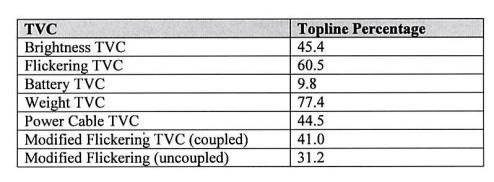
350 There are a number of observations to make concerning these topline results and the related percentage breakdowns provided by Mr Bardsley in his affidavit evidence. The tables reproduced below are based upon that evidence.
Weight TVC – 77.4%
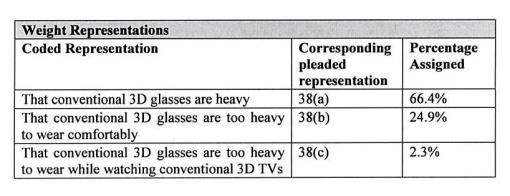
351 The topline result for the Weight TVC (77.4%) seems very high but that is not surprising given that the coded representations include the representation that “the conventional glasses are heavy.” On the assumption that Mr Bardsley’s coding is correct, it appears that 66.4% of the respondents understood the Weight TVC to be saying that conventional glasses are heavy. The proportion of respondents who said that they understood the Weight TVC to say that the glasses were too heavy to wear comfortably is clearly much lower than this.
Battery TVC – 9.8%
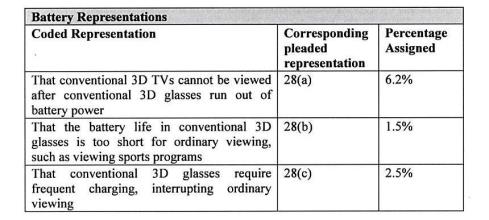
352 The topline result for the Battery TVC (9.8%) does not support Samsung’s case. The vast majority of respondents that make up the 9.8% appear to have understood the Battery TVC simply to be telling them that you cannot watch conventional 3D TVs in 3D after the 3D glasses run out of battery power. That is plainly correct.
Power Cable TVC – 44.5%
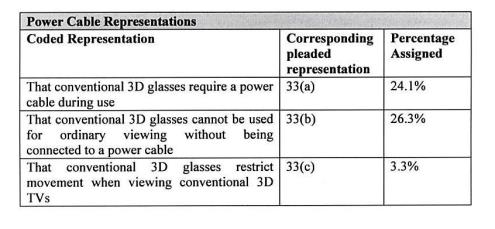
353 The topline result for the Power Cable TVC (44.5%) also seems high. However, there are indications in Mr Bardsley’s own affidavit that some of the responses have been incorrectly coded based upon an incorrect or idiosyncratic interpretation of either the response or the relevant representation. For example, he cites one respondent as having said that “it needs to be recharged often which requires a lead.” Mr Bardsley apparently understood this respondent to be saying that conventional 3D glasses cannot be used for ordinary viewing without being connected to a power cable. I think it is clear that Mr Bardsley has misinterpreted this answer.
Flickering TVC – 60.5% Modified Flickering; 41% (coupled); 31.2% (uncoupled)
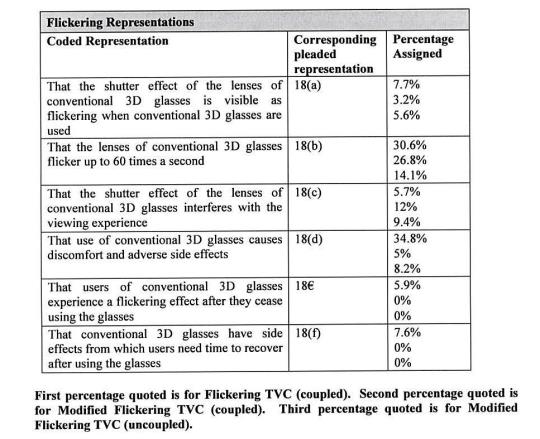
354 The results for the Modified Flickering TVC (coupled) provide no support for pleaded representations 18(e) and 18(f) and little support for all others except perhaps representation 18(b).
Brightness TVC – 45.4%
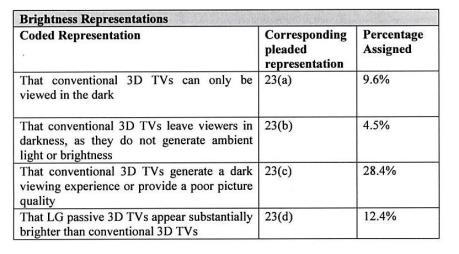
355 The topline result of 45.4% for the Brightness TVC is consistent with the view that most viewers would not understand it to be conveying any of the pleaded representations. One matter of some significance is that only a very small proportion of total respondents thought that the Brightness TVC (12.4%) was telling them that LG Cinema 3D TVs appear substantially brighter than conventional 3D TVs. The figure given for this group is less than half of the figure given for the group who responded that conventional 3D TVs generate a dark viewing experience or provide a poor picture quality. This seems to me to be a significant discrepancy in the results that was not explained by the evidence.
Ruling
356 I admit the Survey (and related materials) that was the subject of LG’s objection into evidence but, for the reasons given, do not give the results any weight. In circumstances where the survey evidence has already been read, considered and weighed by me, no useful purpose would be served by excluding it pursuant to s 135 of the Evidence Act.
The Galaxy Survey
357 This survey (the Galaxy Survey) was relied upon by LG to provide evidence directed to the allegation in SOC, para 42A that the term “Full HD” was commonly understood in the Australian market to mean “full high definition resolution containing 1920 x 1080 pixels refreshed on a progressive basis … and/or the highest or best resolution in the market.”
358 Samsung did not object to the Galaxy Survey so it was admitted into evidence unconditionally. However, Samsung submitted that the results should not be given any weight because the survey was “fundamentally flawed”.
359 Samsung raised many issues relating to the reliability of the Galaxy Survey but in submissions it principally relied upon the following:
the absence of evidence from the company that provided the sample frame (SamplePages) or the company (Q&A Market Research) that conducted the telephone interviews;
the proportion of mobile phone numbers included in the sample frame was too small (8% rather than 18%);
the absence of any evidence from a statistician verifying the statistical reliability of the results;
the inappropriateness of a telephone survey; and
the fact that the Galaxy Survey was part of an omnibus survey.
360 The Galaxy Survey was part of an “omnibus” telephone survey conducted on the weekend of 14 to 16 September 2012 using a sample of 1,057 Australian aged 18 or older randomly drawn from a very large sample frame consisting of 5,600,000 landlines and 600,000 mobiles stratified on the basis of area, age and gender. The sample of 1,057 was made up of respondents from NSW/ACT (316), Victoria/Tasmania (294), Queensland (188), South Australia (126), Western Australia (122) and Northern Territory (11).
361 The respondents were asked the following questions:
“Thinking now about televisions If you were purchasing a television for your household, in terms of deciding which type and brand to buy, would you be the main decision maker, a joint decision maker, have some influence, or have no influence in the purchase decision?” (Question B1);
“In relation to televisions, what do you think the words ’Full HD’ mean?” (Question B2); and
“What do you understand the words ’Full HD’ to mean about a television screen resolution?” (Question B3).
Question B1 was used for the purpose of screening. The number of respondents who went on to respond to Question B2 and B3 was 883.
362 For each of Questions B2 and B3, interviewers were instructed to “probe fully”. Question B3 was included at the request of Samsung.
363 The results were said by Mr Briggs to show that in response to both Questions B2 and B3:
about 1% of Australian consumers (all males) involved in making purchase decisions for televisions understood that Full HD referred to “1920 x 1080”;
about 5% of Australian consumers involved in making purchase decisions for televisions understood that Full HD referred to “1080” or “1080p”;
the highest result was “Better picture / clearer / better quality” comprising 53% of responses to Question B2.
Mr Briggs said in his affidavit evidence that at the 95% confidence level, the maximum error margin for Question B1 would be +/-3% and, for Questions B2 and B3, the maximum error margin would be +/-3.3%. He expressed the opinion that this error margin was within the range of acceptable error, and that the survey provided a reliable and statistically meaningful representation of the Australian population at the 95% confidence level.
364 The summary of coded results for Question B3 in Mr Briggs’ affidavit evidence is more illuminating since it was specifically directed to “television screen resolution”. The results for Question B3 (using Mr Briggs’ coding) are as follows:
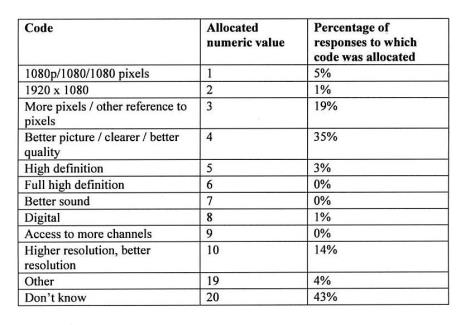
365 Mr Bardsley disputed the accuracy of some of the coding that was carried out as well as Mr Briggs’ weighting and population figures. However, leaving aside the dispute with regard to the weighting and population figures, Mr Bardsley’s evidence indicates that, using some modified coding, the number of respondents who gave at least one answer to either Question B2 or B3 that was the equivalent of “1080p/1080/1080 pixels”, “1920 x 1080” or “highest or best” accounted for 11.3% of respondents.
366 In cross-examination, Mr Bardsley said:
Another significant problem with the Galaxy Survey is that no context was given to the respondents before they were asked about their understanding of the term “Full HD”. I have been informed that this term is used by LG Australia in its advertising and marketing of televisions, including on in-store materials such as stickers affixed to the screens of televisions on display in electronics retail stores and in product descriptions on its website. However, because the Galaxy Survey was a telephone survey, it was not possible to show respondents the words “Full HD” appearing on the stickers or the website.
I do not agree with this criticism. The purpose of the Galaxy Survey was to investigate the correctness of the allegations in SOC, para 42A. It was not necessary to show respondents “in-store materials” or anything else in order to elicit their understanding of the term “Full HD”.
367 I accept that there will be circumstances where an internet survey will be appropriate or even preferable to a telephone survey. However, if the purpose of the survey was to ascertain consumers’ understanding of the term “Full HD”, then I do not think Mr Briggs can be criticised for opting for a telephone survey rather than an internet survey.
368 Mr Bardsley’s evidence also suggested that the sample frame was deficient because it did not include enough mobiles. This evidence does not sit comfortably with his decision to use the Research Now Panel (made up of approximately 170,000 recruits) as the sample frame for the Roy Morgan Survey. In that case, the sample frame could only have included respondents who used the internet and who had chosen to be included in the Research Now Panel. It seems to me that in this case a telephone survey using the SamplePages sample frame was likely to be more representative of the relevant population than an online survey due to problems of coverage (with online panels being limited to internet users) and bias (with online panels being made up of recruits who receive financial benefits in return for their participation).
369 Dr Dorofeev gave evidence that the results of the Galaxy Survey are not statistically reliable. In particular, he said that it was not possible to accurately calculate standard errors and confidence intervals for the Galaxy Survey and he explained why. According to Dr Dorofeev, the problem was that the sampling method involved initially sampling households (identified by telephone numbers) and then undertaking a separate selection process from within the households of individuals to participate in the study. Without knowing how many eligible respondents reside in a household, it was not possible to know the probability of a given respondent being selected to participate in the survey because an individual’s probability of selection is inversely proportionate to the number of eligible people in the household, with an eligible person who lives alone having a greater probability of selection than an eligible person who lives with other eligible people.
370 I accept that Dr Dorofeev’s evidence is correct as a matter of theory. However, I am also mindful that in giving his evidence in relation to the Roy Morgan Survey, he acknowledged that survey sampling is by its nature an imperfect process, and that samples used in commercial, scientific and academic studies will almost always constitute an imperfect representation of the target population. In the case of the Roy Morgan Survey, Dr Dorofeev appears to have assumed (as did Mr Bardsley) that the Research Now Panel was representative of the target population, an assumption that is highly questionable.
371 Nevertheless, Dr Dorofeev’s evidence was not challenged in cross-examination or disputed by Mr Briggs or any other witness who gave evidence. Nor was any argument put to me by LG in closing submissions as to why I should give the Galaxy Survey any weight in circumstances where Dr Dorofeev’s criticism of it was left wholly unanswered. I therefore accept Samsung’s submission that the results of the Galaxy Survey should not carry any weight.
DISPOSITION
372 Samsung has satisfied me that LG contravened ss 18 and 29(1)(a) of the ACL by causing the Flickering TVC to be broadcast in Australia during May and June 2011. Samsung has also satisfied me that LG contravened ss 18 and 29(1)(a) of the ACL by causing the Retailer Instructions to be distributed during March and July 2011.
373 I will give the parties an opportunity to address me in relation to the specific form of relief that should be granted, and on questions of costs. My present view is that it would be appropriate to grant declarations and final injunctions specifically directed to the Flickering TVC and the Retailer Instructions, and that Samsung should be required to pay a considerable proportion of LG’s costs of the proceeding. There will be an order requiring Samsung to notify LG within 14 days whether it proposes to maintain its claim for damages.
I certify that the preceding three hundred and seventy-three (373) numbered paragraphs are a true copy of the Reasons for Judgment herein of the Honourable Justice Nicholas. |
Associate: