FEDERAL COURT OF AUSTRALIA
Director of the Fair Work Building Industry Inspectorate v Construction, Forestry, Mining and Energy Union [2015] FCA 226
IN THE FEDERAL COURT OF AUSTRALIA | |
DIRECTOR OF THE FAIR WORK BUILDING INDUSTRY INSPECTORATE Applicant | |
AND: | CONSTRUCTION, FORESTRY, MINING AND ENERGY UNION First Respondent GARETH STEPHENSON Second Respondent |
DATE OF ORDER: | |
WHERE MADE: |
THE COURT NOTES THAT:
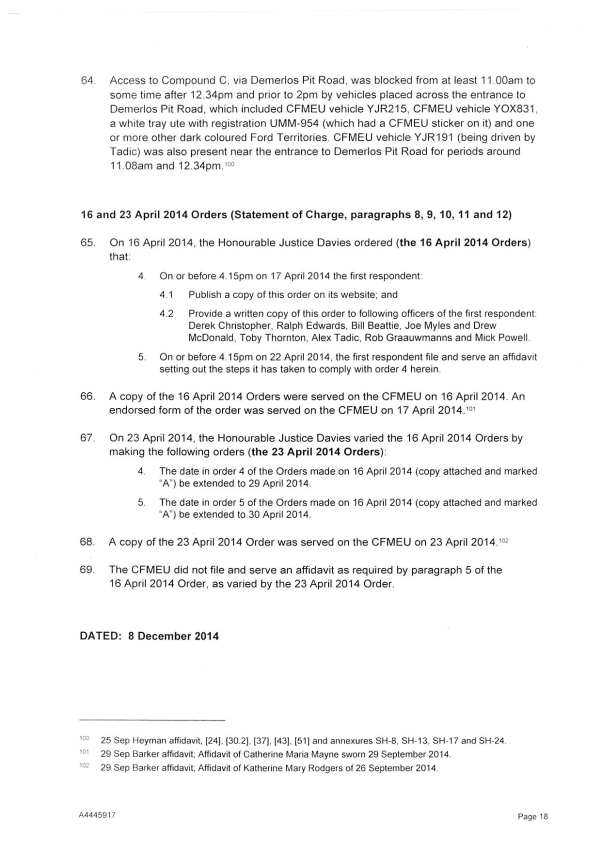
1. In this Order, Bald Hills Site means the site at which the construction of the Bald Hills Wind Farm is taking place in Tarwin Lower in the State of Victoria, consisting of:
1.1 Compound A on Buffalo-Waratah Road;
1.2 Compound B on Walkerville Road; and
1.3 Compound C on Walkerville Road.
THE COURT DECLARES THAT:
2. The first respondent (“the CFMEU”) is guilty of contempt of the Court in that, in breach of paragraph 1.1 of the undertaking given by the CFMEU to the Court on 2 April 2014 (“the Undertaking”), the CFMEU did on 15 April 2014 prevent free access to and free egress from the Bald Hills Site by persons and vehicles.
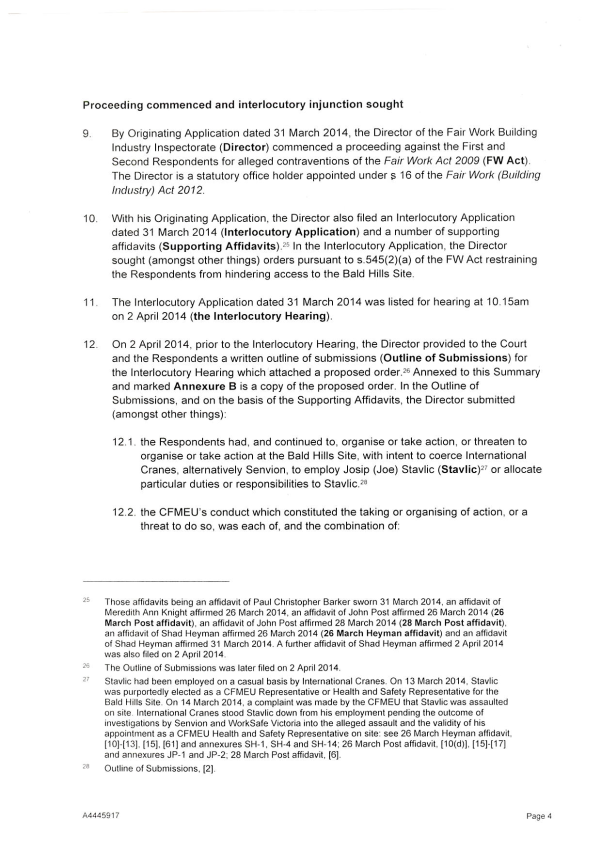
3. The CFMEU is guilty of contempt of the Court in that, in breach of paragraph 1.4 of the Undertaking, the CFMEU did on 15 April 2014 cause persons to prevent free access to and free egress from the Bald Hills Site by persons and vehicles.
4. The CFMEU is guilty of contempt of the Court in that, in breach of paragraph 5 of the Order made by the Honourable Justice Davies on 16 April 2014 as varied by the Order made by her Honour on 23 April 2014 (“the Order”), the CFMEU did not file and serve an affidavit setting out the steps it took to:
4.1 publish on the CFMEU’s website a copy of the Order; and
4.2 provide a written copy of the Order to the following officers of the CFMEU: Derek Christopher, Ralph Edwards, Bill Beattie, Joe Myles, Drew McDonald, Toby Thornton, Alex Tadic, Rob Graauwmans and Mick Powell.
THE COURT ORDERS THAT:
5. The CFMEU be punished by way of a fine of $100,000 for the contempt described in paragraphs 2 and 3 of this Order.
6. The CFMEU be punished by way of a fine of $25,000 for the contempt described in paragraph 4 of this Order.
7. The fines imposed by the Court in paragraphs 5 and 6 of these orders be paid to the Commonwealth within 30 days of the date of these orders.
8. In default of payment of the fines pursuant to orders 5, 6 and 7 the Applicant have liberty to apply for direction for enforcement of payment of the fines.
9. The CFMEU pay the Applicant’s costs of his Interlocutory Application dated 28 May 2014 (“the Contempt Application”) on an indemnity basis.
10. The Contempt Application otherwise be dismissed.
Note: Entry of orders is dealt with in Rule 39.32 of the Federal Court Rules 2011.
VICTORIA DISTRICT REGISTRY | |
FAIR WORK DIVISION | VID 194 of 2014 |
BETWEEN: | DIRECTOR OF THE FAIR WORK BUILDING INDUSTRY INSPECTORATE Applicant |
AND: | CONSTRUCTION, FORESTRY, MINING AND ENERGY UNION First Respondent GARETH STEPHENSON Second Respondent |
JUDGE: | TRACEY J |
DATE: | 17 MARCH 2015 |
PLACE: | MELBOURNE |
REASONS FOR JUDGMENT
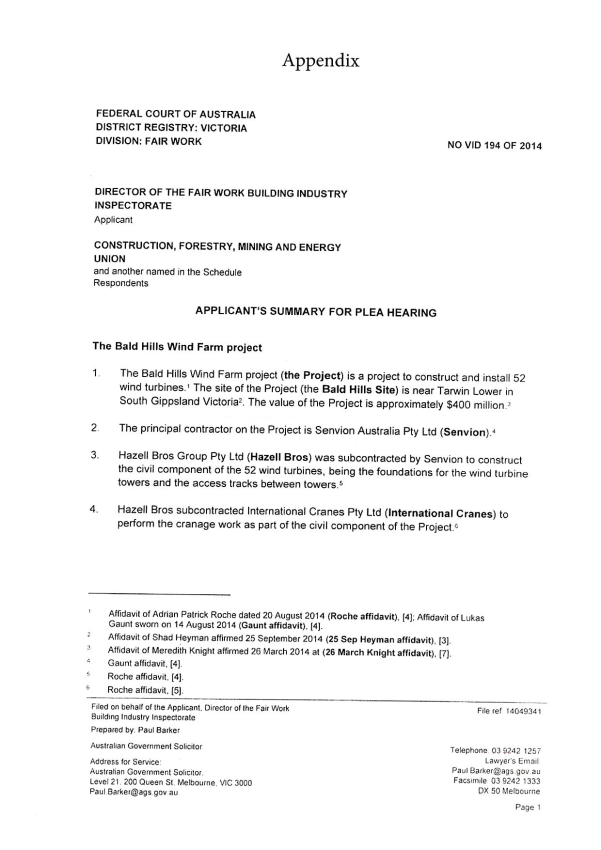
1 During the early part of last year a wind farm was under construction near Tarwin Lower in Victoria. 52 wind turbines were to be erected in the course of what was known as the Bald Hills Wind Farm Project (“the Project”). The value of the Project was approximately $400 million.
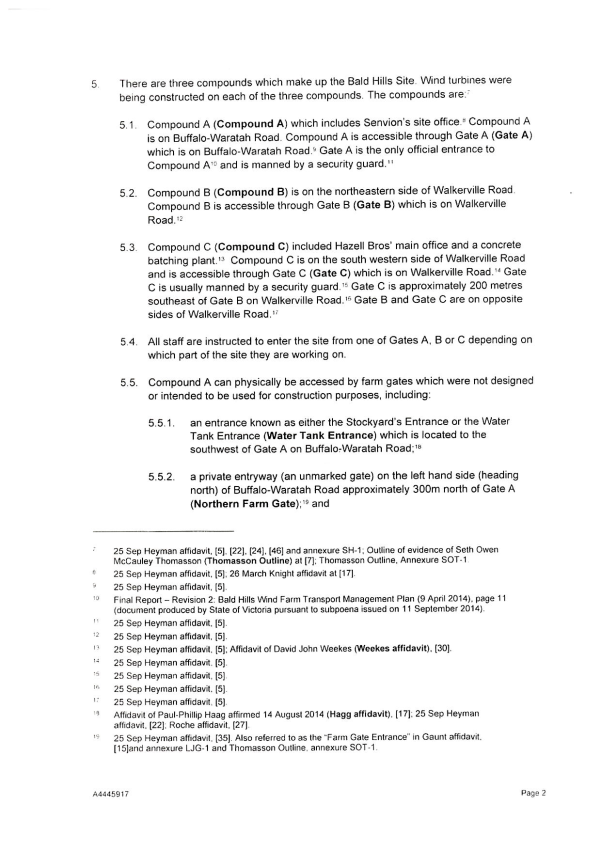
2 The principal contractor on the Project was Senvion Australia Pty Ltd (“Senvion”). Senvion engaged Hazell Bros Group Pty Ltd (“Hazell Bros”) as a sub-contractor to construct the civil component of the turbines. That work involved the construction of the foundations of the towers and of access tracks between the towers. In turn, Hazel Bros sub-contracted International Cranes Pty Ltd (“International Cranes”) to perform the cranage work on the site.
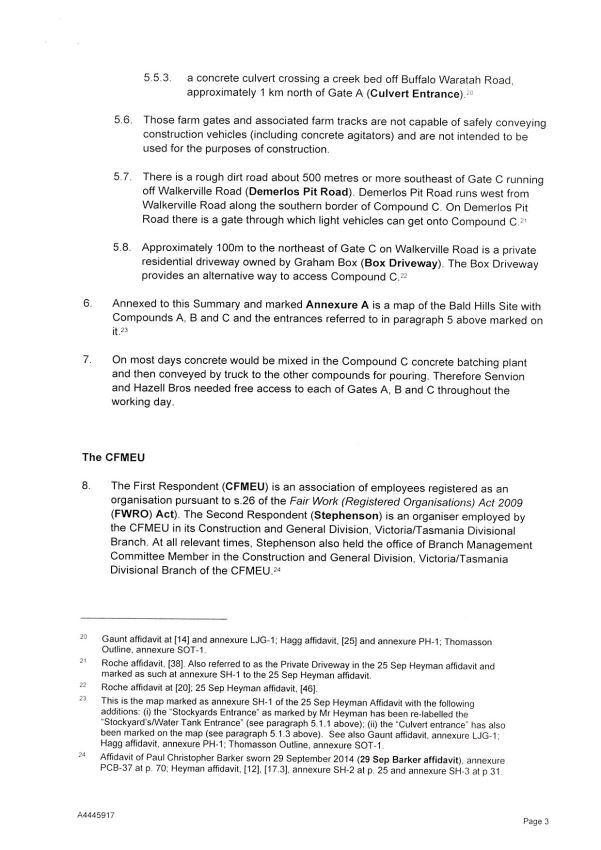
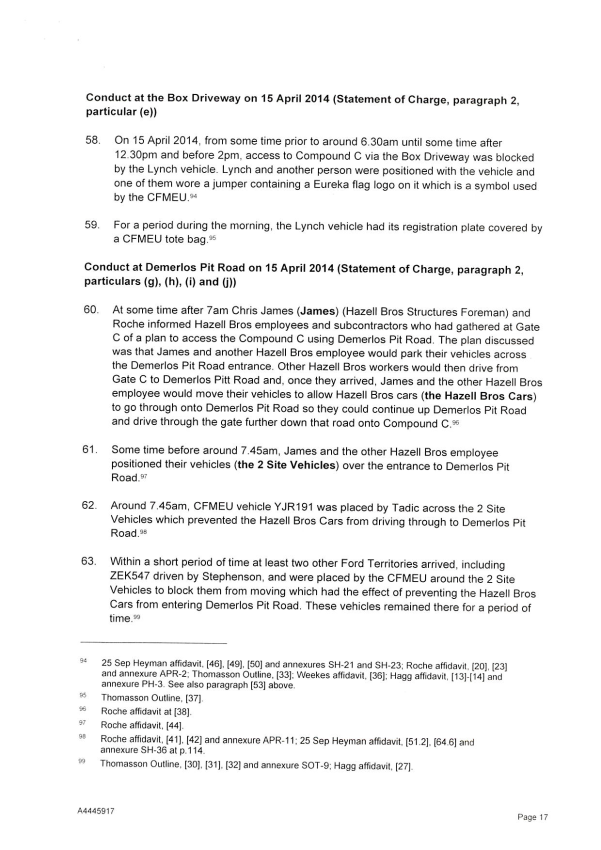
3 During March 2014 the Project was disrupted by blockades of the site entrances which were organised by the first respondent (“the CFMEU”). The second respondent, Mr Gareth Stephenson, was an organiser employed by the CFMEU who participated in the organisation and implementation of the blockade. The blockade was imposed in an attempt by the CFMEU to force International Cranes or, alternatively, Senvion, to employ Mr Joe Stavlic on the site. Mr Stavlic had been employed on a casual basis by International Cranes. On 13 March 2014 he was purportedly elected as a CFMEU representative or as a health and safety representative on the site. On the following day the CFMEU complained that Mr Stavlic had been assaulted on the site. International Cranes stood him down pending the outcome of investigations by Senvion and Worksafe Victoria into the alleged assault and the validity of his appointment as a site health and safety representative.
4 On 31 March 2014 the applicant (“the Director”) commenced a proceeding in this Court against the CFMEU and Mr Stephenson alleging contraventions of the Fair Work Act 2009 (Cth) (“the Act”). The Director also sought an interlocutory order under s 545(2)(a) of the Act restraining the respondents from hindering access to the Bald Hills site.
5 The interlocutory application came on before Davies J on 2 April 2014. At that hearing the CFMEU gave an undertaking to the Court that:
“1. Until the hearing and determination of this proceeding or further order (whether by itself, its employees or agents or howsoever otherwise) it will not:
1.1 prevent, hinder or interfere with free access to, and free egress from, the Bald Hills Site by any person or vehicle;
1.2 counsel, procure, encourage or persuade any person or persons to take unprotected industrial action at the Bald Hills Site;
1.3 threaten any person seeking to enter or exit the Bald Hills Site;
1.4 cause, induce, procure, encourage, persuade or organise any person or persons to do or attempt to do any of the things restrained by sub-paragraphs 1.1 to 1.3 above.
…
3. In the above undertakings, Bald Hills Site means the site at which the construction of the Bald Hills Wind Farm is taking place in Tarwin Lower in the State of Victoria, consisting of:
3.1 Compound A on Buffalo-Waratah Road;
3.2 Compound B on Walkerville Road; and
3.3 Compound C on Walkerville Road.”
6 Mr Stephenson gave an undertaking to the Court that he also would not engage in the conduct which was the subject of the CFMEU undertaking.
7 Despite having given the undertakings the CFMEU, on 15 April 2014, caused vehicles to be placed across gates which facilitated access to the site by persons and vehicles. As a result work on the site was seriously impeded.
8 In the wake of these events the proceeding returned to Court. On the following day Davies J made injunctive orders which restrained the CFMEU and Mr Stephenson from engaging in various forms of conduct including conduct which they had undertaken, on 2 April 2014, not to perform. Order 4 required the CFMEU, on or before 4:15 pm on 17 April 2014, to publish a copy of her Honour’s order on its website and provide written copies to a number of named officers of the Union. Her Honour further ordered (Order 5) that, on or before 4:15 pm on 22 April 2014, the CFMEU file and serve an affidavit setting out the steps which it had taken to comply with Order 4. On 23 April 2014 her Honour varied her earlier orders to extend the time for compliance with Order 4 to 29 April 2014 and the time for compliance with Order 5 to 30 April 2014.
9 No affidavit was filed pursuant to order 5, as varied, either before the stipulated deadline, or prior to the trial.
THE CHARGES
10 By a statement of charge dated 28 May 2014 the Director alleged that the CFMEU had breached paragraphs 1.1 and 1.4 of the undertakings which it had given to the Court on 2 April 2014 and that it had contravened the order made on 16 April 2014 (as amended on 23 April 2014) by failing to file and serve an affidavit setting out the steps it had taken to comply with her Honour’s orders.
11 The statement of charge contained other allegations which the Director did not press at hearing.
THE EVIDENCE AND THE PLEAS
12 The Director filed a considerable number of affidavits, witness statements and documentary evidence in support of the charges.
13 Following discussions between the parties the Court was advised that the CFMEU did not wish to cross-examine any of the Director’s witnesses. Nor did it propose to file any answering affidavits.
14 On 8 December 2014 the Director filed a document entitled “Applicant’s Summary for Plea Hearing”. The Court was advised that, although the CFMEU made no admissions, it did not dispute the accuracy of any of the material in this summary and agreed that the material in the summary supported the Director’s allegations of contempt of court arising from the breaches of paragraphs 1.1 and 1.4 of the undertakings given by it on 2 April 2014 and of the breach of order 5, made by Davies J on 16 April 2014, as amended on 23 April 2014. The CFMEU further accepted that the factual statements contained in the Director’s summary were sufficient to support findings of guilt in respect of each of the three charges beyond reasonable doubt. A copy of the summary (without the attachments) will be published as an Appendix to these reasons.
15 No complaint was made that:
the terms of the undertaking or the order were other than clear, unambiguous and capable of compliance;
the undertaking had been given in the terms alleged and that the order had been served on the CFMEU; or
the CFMEU lacked knowledge of the terms of the undertakings which it had given and the order.
16 Indeed, had there been any doubt about the CFMEU’s understanding of the effect of its undertakings, that doubt would have been resolved by some passages in a pamphlet which was distributed at the site on 10 April 2014. It was entitled “Bald Hills Prison Farm” and was authorised by Mr John Setka, the Secretary of the Victoria – Tasmania Divisional Branch of the CFMEU’s Construction and General Division. Under a heading “Anti-union, anti-worker” it was said that the Director had “helped them get a court order to prevent CFMEU officials from attending the gates of the site …”. The pamphlet was distributed at one of the site gates by Mr Stephenson, Mr Stavlic and another CFMEU official, Mr Alexander Tadic.
17 The Director did not seek to suggest that there was an element of contumeliety in the CFMEU’s offending and contended that the Court should deal with the charges as civil contempts.
18 I have examined the material which was filed by the Director in support of the contempt charges and the Director’s summary which is based on that material. The summary is supported by the underlying evidence which, in my view, establishes each of the allegations levelled against the CFMEU beyond reasonable doubt.
19 The CFMEU formally, by its counsel, pleaded guilty to each of the three charges.
20 As a result a plea hearing was conducted on 12 December 2014.
RELEVANT PRINCIPLES
21 Contempts of court may arise if a person disobeys an injunction or breaches an undertaking given to the Court: see Australian Consolidated Press Limited v Morgan (1965) 112 CLR 483 at 496; Thomson Australian Holdings Pty Ltd v Trade Practices Commission (1981) 148 CLR 150 at 164.
22 Undertakings are often proffered as an alternative to the granting of an injunction. The Court has an inherent power to accept and enforce undertakings given to it in the same way that it enforces injunctive orders: see Thomson at 164.
23 Section 31(1) of the Federal Court of Australia Act 1976 (Cth) identifies the power possessed by this Court to punish contempts:
“Subject to any other Act, the Court has the same power to punish contempts of its power and authority as is possessed by the High Court in respect of contempts of the High Court.”
The power possessed by the High Court to punish contempts is specified in s 24 of the Judiciary Act 1903 (Cth):
“The High Court shall have the same power to punish contempts of its power and authority as is possessed at the commencement of this Act by the Supreme Court of Judicature in England.”
When the Judiciary Act 1903 (Cth) commenced, the Supreme Court of Judicature in England had power to punish for contempt, whether civil or criminal: see Australasian Meat Industry Employees’ Union v Mudginberri Station Pty Ltd (1986) 161 CLR 98 at 105-106. The penalties the Court may impose depend on who is identified as the respondent to the proceeding: see High Court Rules 2004 (Cth) r 11.04.1. In the present case, the only respondent against whom charges were pressed was the CFMEU. Apart from Mr Stephenson none of the individual officers or members involved in the contempts was named as a respondent. Where, as here, the contemnor is a body corporate, r 11.04.1(b) of the High Court Rules 2004 (Cth) provides that the Court may order:
“… that the contemnor pay a fine, that some or all of the property of the contemnor be sequestrated or that both the contemnor pay a fine and some or all of the property of the contemnor be sequestrated.”
There is no upper limit on the amount of a fine which may be ordered pursuant to this power.
24 In determining a penalty the Court will strive to do justice having regard, in particular, to the purpose served by the power to punish for contempt.
25 In Bovis Lend Lease Pty Ltd v Construction, Forestry, Mining and Energy Union (No 2) [2009] FCA 650 at [11] and [12] I outlined the purpose and effect of the Court’s power to punish for contempt. I said that:
“11. The underlying rationale of every exercise of the contempt power is that it is necessary to uphold and protect the effective administration of justice: see Mudginberri Station at 107 (per Gibbs CJ, Mason, Wilson and Deane JJ). The power to punish contempts serves the purpose of disciplining the defendant and vindicating the authority of the court (see Mudginberri Station at 112-113); it is the means by which the law vindicates the public interest in the due administration of justice: see Attorney-General v Times Newspaper Ltd [1974] AC 273 at 315-316; Borrie & Lowe, The Law of Contempt, (3rd ed, Butterworths, 1996) p 1 and is the way in which the Court preserves respect for its role and the rule of law: see Australian Competition and Consumer Commission v Hughes (2001) ATPR 41-807 per Tamberlin J. There are many facets to the administration of justice (Borrie & Lowe, p 1). While the effect of the contempt on the ability to prosecute the principal proceeding may be relevant in assessing the effect of the contempt on the administration of justice: see, for example, Textile Clothing and Footwear Union of Australia v Morrison Country Clothing Australia Pty Ltd (No 2) [2008] FCA 1965, the subject matter of the principal proceeding does not define the scope or the effect of the contempt on the administration of justice. In Attorney-General v Times Newspaper Ltd [1974] AC 273 at 309 Lord Diplock considered the requirements of the due administration of justice:
‘The due administration of justice requires first that all citizens should have unhindered access to the constitutionally established courts of criminal or civil jurisdiction for the determination of disputes as to their legal rights and liabilities; secondly, that they should be able to rely upon obtaining in the courts the arbitrament of a tribunal which is free from bias against any party and whose decision will be based upon those facts only that have been proved in evidence adduced before it in accordance with the procedure adopted in courts of law; and thirdly that, once the dispute has been submitted to a court of law, they should be able to rely upon there being no usurpation by any other person of the function of that court to decide it according to law. Conduct which is calculated to prejudice any of these three requirements or to undermine the public confidence that they will be observed is contempt of court.’
12. The public interest in the administration of justice requires compliance with all orders and undertakings: see Witham v Holloway (1995) 183 CLR 525 at 532-533. In Witham the High Court said (at 533):
‘All orders, whether they be Mareva injunctions, injunctions relating to the subject matter of the suit, or, simply, procedural orders, are made in the interests of justice. Non-compliance necessarily constitutes an interference with the administration of justice even if the position can be remedied as between the parties.’”
26 In Bovis (No 2) I also distilled, from the case law, a series of potentially relevant considerations which bear on the determination of penalties for contempt. A number of them overlap. Those considerations include:
The contemnor’s personal circumstances;
The nature and circumstances of the contempt;
The effect of the contempt on the administration of justice;
The contemnor’s culpability;
The need to deter the contemnor and others from repeating contempt;
The absence or presence of a prior conviction for contempt;
The contemnor’s financial means; and
Whether the contemnor has exhibited general contrition and made a full and ample apology.
27 The parties chose to organise their submissions under these various headings and it will be convenient to adopt a similar structure for the purposes of these reasons.
Circumstances “Personal” to the Contemnor
28 The CFMEU is registered as an organisation pursuant to the Fair Work (Registered Organisations) Act 2009 (Cth). As a registered organisation it is a recognised participant in the national industrial relations system which is governed by the Act. Under the legislation it derives benefits and incurs responsibility.
29 The CFMEU is organised nationally with a series of divisions and those divisions are further divided into State based branches. It is the Union’s Construction and General Division Victoria - Tasmania Divisional Branch which had administrative responsibility for the events which have given rise to these charges.
30 The size and nature of the organisation is a relevant factor in the assessment of an appropriate penalty: see Construction, Forestry, Mining and Energy Union v BHP Steel (AIS) Pty Ltd (2003) 196 ALR 350 at 358. This is because, generally, a failure to comply with an injunction or an undertaking which binds a large and powerful entity will be more likely to have an adverse impact on the public interest in the effective administration of justice than will a similar contravention by an individual engaged in private litigation. Moreover, an organisation which is accorded a favourable status under a legislative regime bears broader responsibility than does a private individual: statutory recognition and advantage carry with them responsibility to other participants in the industrial relations systems and to the wider community. That responsibility requires adherence to the rule of law and to dispute resolution procedures prescribed by legislation and enterprise agreements.
The Nature and Circumstances of the Contempt
31 The CFMEU submitted that the contraventions of paragraphs 1.1 and 1.4 of the undertaking given by it should be treated as a single offence.
32 It sought to explain the relevant circumstances as follows. It said that there was a dispute regarding the employment of Mr Stavlic. It was the CFMEU’s view that Mr Stavlic was unfairly targeted and it wanted “his employment to resume”. To this end the blockade was mounted on 15 April 2014. The CFMEU acknowledged that some of the workers on the Bald Hill site were prevented from working on that day and that a number of delivery trucks were prevented from having free access to the site for a period of just over eight hours. It said that the blockade had not attracted any media attention and that it had taken place in a remote location away from public observation.
33 The CFMEU relied on a number of factors which, it said, mitigated the seriousness of the offending by comparison with some of its earlier contraventions of Court orders. To this end it emphasised that:
There had been no violence, no abuse and no trespassing in the course of the blockade.
No large implements had been placed across driveways which were abandoned there upon completion of the blockade.
30 to 40 percent of the workforce had been able to attend the site on 15 April 2014 by using entrances which were not normally used.
Deliveries had been delayed by matters of hours and, at the most, by two days.
There was no jeering at workers and delivery truck drivers who sought access to the site.
No sophisticated planning was involved.
34 Some, but not all, of these contentions may be accepted. Before dealing with them, however, it is necessary to say something about the unstated assumptions which underpin the CFMEU’s actions. It considered that Mr Stavlic had been badly done by and should be reemployed at the site. When potential employers refused its demands the CFMEU could have pursued a number of lawful options with a view to resolving the disputes about Mr Stavlic’s employment. This would have required it to justify its complaints about the treatment of Mr Stavlic and to justify its view that re-employment was an appropriate remedy. Rather than do this it sought to impose its will on some of the companies engaged at the site by preventing work from proceeding as normal on 15 April 2014. In doing so it opted for a show of industrial force in preference to engagement in lawful dispute settling procedures. The CFMEU has failed to explain why it chose this course of action despite having undertaken to the Court that it would not so act less than a fortnight before these events occurred. The overwhelming inference is that the CFMEU, not for the first time, decided that its wishes should prevail over the interests of the companies and that this end justified the means.
35 The organisation of the blockade required planning and preparation. The wind farm site was located in a remote area of South Gippsland some 175.7 kilometres away from Melbourne. It was divided into three compounds. Compound A was separated from the other two. Compounds B and C had a common border. The closest point of Compound A to Compound B was about 700 metres. The closest points between Compound A and Compound C were about 2.5 kilometres apart. Each compound had a main entrance. They were identified as Gates A, B and C. Access to the compounds could also be obtained, in each case, by tracks and smaller gates. These alternative access points were not normally used but were utilised by some employees to enter the compounds on 15 April 2014.
36 On that morning cars were parked across Gates A, B and C at various times between 5:30 and 5:45 am. The vehicles prevented other vehicles entering the compounds through the gates. Barbeque trailers were also located at two of the gates. The vehicles and trailers remained in place until early afternoon. At least 10 of the vehicles were registered to the CFMEU. In the course of the day food was cooked on the barbeques. Pictures taken at the gates show CFMEU flags attached to vehicles and fences. Other vehicles blocked access to four of the alternative entrance points. At least eight paid officials of the CFMEU were present.
37 A more detailed account of the blockade is to be found in the Director’s Summary. The facts recounted here are sufficient to gainsay the proposition that no sophisticated planning was involved in mounting the blockade. The contrary is plainly true. I readily infer that the officials had travelled from Melbourne in the union owned vehicles and other vehicles in time to block the gates before the usual time for commencement of work at the sites. Food and banners were brought. These arrangements required planning and co-ordination.
38 As a result of the blockade only about 30 to 40 percent of the workforce engaged on Compound A was able to enter the site on 15 April 2014. Fifteen quarry trucks carrying about 600 tonnes of bluestone and other aggregate were unable to enter Compound A. The material which they were carrying had to be dumped in a turnout bay about four kilometres away. Once the blockade had been lifted Hazell Bros workers had to reload the material on to trucks using a front end loader. This work was not completed until 17 April 2014. Other trucks, delivering gravel to Compound A, arrived during the morning and could not enter Compound A until the blockade had been lifted.
39 I accept that a number of the aggravating features which had accompanied earlier action by the CFMEU which constituted contempt of Court and with which comparisons were drawn during submissions were not present during the blockade on 15 April 2014. There was no violence. Workers attempting to enter the site were not abused. When the blockade finished there was no debris left at the site.
40 I turn now to the contravention of the order made by Davies J which required the CFMEU to file and serve an affidavit setting out the steps which it had taken to comply with another order made by her. That other order required the CFMEU to publish a copy of injunctive orders made by her on its website and provide written copies to a number of named officers of the Union. The Union was required to file this affidavit by 22 April 2014 but, on the following day, her Honour extended the time for compliance with the publication order to 29 April 2014 and for the filing of the affidavit to 30 April 2014.
41 As already noted the order requiring the filing and serving of the affidavit had not been complied with at the time of trial. During argument I intimated that I would be minded to defer imposing a sanction on the CFMEU for a short period in order to provide it with the opportunity belatedly to file the affidavit and indicated that, were it to do so, I would regard this as a mitigating consideration. At the time, senior counsel for the Union sought instructions. Having done so he accepted the offer and said that the affidavit would be filed by 19 December 2014.
42 By memorandum, dated 18 December 2014, senior counsel advised the Court that, upon reflection, the CFMEU did not seek to rely upon any such mitigation and did not propose to file any affidavit. Senior counsel noted that, as a result, the Court was “in a position to proceed to impose punishment for the proved civil contempt at its convenience without further material.”
43 The evident purpose of her Honour’s order was to ensure that the CFMEU had drawn her injunctive orders to the attention of officials who might be involved in taking action which contravened the restraining orders made by her. As matters stand the Court is unaware of what, if any, steps the CFMEU took to comply with the requirement that it publish the restraining orders.
44 The failure, by the CFMEU, to file the confirming affidavit constitutes a deliberate and flagrant breach of Davies J’s order. It occurred despite her Honour’s willingness to extend time for compliance and despite the belated opportunity, offered to the Union, and initially accepted by it, to purge its contempt, an offer which was not, ultimately, taken up.
The Effect of the Contempt on the Administration of Justice
45 The CFMEU argued that, in the absence of public involvement and media coverage of the blockade, its misconduct was “a very long way from a ‘serious interference with the administration of justice’”. It further contended that a non-contumacious civil contempt “does not undermine the administration of justice as a criminal contempt may do.”
46 If a person who is bound by a Court order or the terms of an undertaking given to the Court disobeys the order or breaches the undertaking in such a way as to attract publicity or boasts about such misconduct, this will constitute an aggravation of the contempt. Such overt disdain for legal requirements would warrant condign punishment. That is not, however, to say that actions which constitute contempt should not be treated seriously because the contempt is not widely known. As the High Court said in Witham v Holloway (quoted above at [25]) such non-compliance “necessarily constitutes an interference with the administration of justice …”. (Emphasis added). It will be known to the parties and by those directly affected by the conduct. In the present case the CFMEU’s conduct was known to the scores of employees who were unable to enter the compounds and to the truck drivers who had brought material to the site in the expectation of unloading it. The conduct was also known to managerial employees who were overseeing work at the sites. In an industry with a high level of mobility it may reasonably be expected that word of what had occurred would spread within part, at least, of the industry.
47 It is to be borne in mind that the undertakings had been given shortly after the Supreme Court of Victoria had adjudged the CFMEU to have been guilty of criminal contempt. On 31 March 2014 Cavanough J imposed fines totalling $1.15 million on five counts of criminal contempt because of contraventions of orders which were framed in substantially the same terms as were the undertakings presently under consideration: see Grocon Constructors (Victoria) Pty Ltd v Construction, Forestry, Mining and Energy Union (No 2) [2014] VSC 134. It may reasonably be inferred that the CFMEU well knew the likely consequences of a breach of the undertakings but determined to proceed anyway. In doing so it displayed, at best for it, a cavalier attitude which could only serve to undermine respect for Court processes.
48 The order which required the CFMEU to file an affidavit was made in an attempt to monitor its compliance with another order which, in turn, was designed to ensure that officials of the Union were aware of the restrictions imposed on its conduct and that of its agents at the Bald Hills Site. The failure to file the affidavit undermined the administration of justice by denying to the Court information which would have enabled it and the Director to confirm that its publication order had been complied with.
The Contemnors’ Culpability
49 The parties’ submissions disclosed significantly different characterisations of the level of the CFMEU’s culpability for its actions. The CFMEU said that its culpability was “comparatively low”. The Director, on the other hand, branded it as “high”.
50 It is true, as the CFMEU contended, that its culpability had to be assessed by reference to what it actually did. What it did, as has already been seen, was to breach undertakings which it had voluntarily given to the Court less than two weeks before and to fail to comply with an order to file the compliance affidavit.
51 The breaches of the undertakings were not accidental or the result of some over-zealous officials acting outside their authority. Rather, there was a co-ordinated blockade of seven entrances to the compounds at the site. At least eight paid officials (including the Branch Vice President, Mr Derek Christopher) converged on a remote construction site at dawn. They were intent on preventing work proceeding at the site on that day or at least to severely impede the performance of work. They deployed a large number of vehicles and advertised their presence with banners on which were emblazoned the letters CFMEU. The barbeque trailers also prominently displayed the name of the union and its logo.
52 The failure to file the compliance affidavit, at least belatedly, resulted from a considered decision.
53 A high level of culpability must be attributed to the CFMEU for this conduct.
Deterrence
54 The Director submitted that both general and specific deterrence loomed large as influential considerations in determining appropriate penalties for the CFMEU’s contempts.
55 The CFMEU accepted that deterrence, both specific and general, were relevant considerations in fixing penalties. It stressed, however, that any fine imposed must be proportionate to the admitted breaches of the undertakings and the Court order. It also submitted that its exposure to the time and cost involved in defending the proceeding had already operated as a significant deterrent. So too would compliance with the agreed order that the CFMEU should pay the Director’s costs of the application on an indemnity basis.
56 Where a contempt of court has occurred a penalty must be fixed which will serve to deter others from engaging in such conduct and to deter repetition by the contemnor. In Grocon (No 2), Cavanough J observed (at [196]) that: “… few things could be more destructive to the authority of the Court and to the rule of law than the idea that fines or similar punishment are akin to a tax that, once budgeted for, enable the use of unlawful conduct to achieve industrial outcomes.” I respectfully agree. Put another way (as has been done in the context of contraventions of consumer law) a penalty “must be fixed with a view to ensuring that the penalty is not such as to be regarded by [the] offender or others as an acceptable cost of doing business.”: see Singtel Optus Pty Ltd v Australian Competition and Consumer Commission (2012) 287 ALR 249 at 265.
57 If a contemnor has previously been found guilty of contempt of court that fact may have a bearing on the weight which needs to be accorded to specific deterrence following further contempts. The offender is not to be punished again for earlier misconduct. Nonetheless, as the High Court held in Veen v R (No 2) (1988) 164 CLR 465 at 477:
“The antecedent … history is relevant, however, to show whether the instant offence is an uncharacteristic aberration or whether the offender has manifested in his commission of the instant offence a continuing attitude of disobedience of the law. In the latter case, retribution, deterrence and protection of society may all indicate that a more severe penalty is warranted. It is legitimate to take account of the antecedent … history when it illuminates the moral culpability of the offender in the instant case, or shows his dangerous propensity or shows a need to impose condign punishment to deter the offender and other offenders from committing further offences of a like kind.”
58 The Director referred me to five cases since 2001 in which the CFMEU was found guilty of contempt of court and fined substantial sums. Those cases were: BHP Steel (AIS) Pty Ltd v Construction, Forestry, Mining and Energy Union [2001] FCA 336 and on appeal, Construction, Forestry, Mining and Energy Union v BHP Steel (AIS) Pty Ltd (2003) 196 ALR 350; Bovis (No 2); Alfred v Construction, Forestry, Mining and Energy Union (No 2) [2011] FCA 556; Fair Work Building Industry Inspectorate v Construction, Forestry, Mining and Energy Union [2012] FCA 966; and Grocon (No 2).
59 The circumstances of these cases varied. They do, however, expose a propensity, on the part of the CFMEU, to continue to commit contempts notwithstanding the imposition of significant sanctions.
60 Specific deterrence is an important consideration in the present case.
61 In Bovis (No 2) the CFMEU advanced arguments about the mitigating effect of costs awards and whether they ought to moderate the quantum of what might otherwise be regarded as appropriate fines. Similar arguments were relied on in the present case. I dealt with them in Bovis (No 2) (at [39]-[40]) as follows:
“39. The question of what, if any, influence awards of costs should have on the determination of penalties for contempt has been considered by a Full Court. In Construction, Forestry, Mining and Energy Union v BHP Steel (AIS) Pty Ltd (2003) 196 ALR 350 Moore J held (at 354) that it was appropriate to take into account, when determining the penalty, the significant burden likely to have been imposed by the indemnity costs order of the primary judge. Tamberlin and Goldberg JJ agreed, with reservation (at 360):
‘In light of the authorities referred to by his Honour [(at 351 – 353)] we accept that in exercising the wide discretion given as to the amount of any penalty, the consideration that indemnity costs have been awarded is a relevant matter to take into account. Nevertheless, given the underlying principle that disobedience to court orders must be discouraged, in a case such as the present, simply to impose a minimal penalty on the basis that indemnity costs have been ordered may be perceived to downplay the significance of the contempt. The contempt here was public, serious and substantial and the penalty should reflect these matters.’
40. The additional cases relied on by the CFMEU involved contraventions of civil penalty provisions. In those cases it was accepted that the trouble and cost of defending the proceeding served the purpose of personal deterrence. The Full Court in Ponzio v B & P Caeli Constructions Pty Ltd (2007) 158 FCR 543 did not, however, consider that the need for general deterrence would be met unless a monetary penalty was also imposed: see at [97], [164]. In any event and for the reasons earlier articulated, I consider that cases concerning contraventions of civil penalty provisions to be of limited assistance where contempts of court have occurred. In the circumstances of this case deterrence both specific and general is an important consideration. The penalty must be imposed at a meaningful level so as to deter the CFMEU, and others who, save for the risk of a high penalty, may otherwise engage in contravening conduct: see generally Australian Competition and Consumer Commission v Info4PC.Com Pty Ltd (2002) 121 FCR 24 at 54; Australian Competition and Consumer Commission v Hughes (2001) ATPR 41-807 at [24]; Trade Practices Commission v CSR Ltd [1991] ATPR 52,135 (41-076). The fact that a contemnor has incurred legal expenses in defending charges is to be borne in mind when a penalty is determined but this consideration does not weigh heavily in mitigation of penalty.”
I adhere to what I there said.
Prior Convictions
62 Cases in which prior convictions for contempt have been recorded against the CFMEU have already been referred to. Some of them have involved multiple counts.
63 The CFMEU is to be regarded as a recidivist rather than as a first offender.
Financial Means of the CFMEU
64 The CFMEU did not seek to suggest that it lacked the resources to meet any financial penalty which might be imposed by the Court.
Apology or Contrition
65 The CFMEU did not offer any apology for its conduct or express any contrition. Nor did it advise the Court that it had put in place internal administrative arrangements with a view to ensuring that, in future, undertakings or injunctions were complied with. It did, however, plead guilty to the three charges and thereby obviated the need for a lengthy contested hearing. This acknowledgment of liability must weigh in the CFMEU’s favour notwithstanding the strength of the Director’s evidentiary case. The absence of an apology cannot, however, be treated as an aggravating factor: see BHP Steel (AIS) Pty Ltd v Construction, Forestry, Mining and Energy Union [2001] FCA 336 at [10] (Kiefel J).
General sentencing issues
66 The breaches of the two undertakings arose out of substantially the same conduct. The CFMEU is not to be punished twice for the same misconduct. One way in which double punishment might be avoided is the imposition of concurrent penalties. An alternative course, which I consider to be appropriate in the present proceeding, is to impose a single pecuniary penalty for the two contraventions: cf Construction, Forestry, Mining and Energy Union v Cahill (2010) 269 ALR 1 at 12-13. In fixing the penalty the CFMEU is entitled to the benefit of the “totality principle” which requires the Court to consider whether the penalty imposed for multiple contraventions is appropriate having regard to the entirety of the contravening conduct: see Australian Ophthalmic Supplies Pty Ltd v McAlary-Smith (2008) 165 FCR 560 at 575-6; 581-583.
67 The third contravention, relating to the failure of the CFMEU to file the affidavit stands apart from the other two contraventions and requires the imposition of a separate penalty.
68 In the end an “instinctive synthesis” is required. As Gillard J said in Pico Holdings, Inc. v Voss [2002] VSC 319 at ([66]), citing R v Storey [1998] 1 VR 359 at 366:
“Sentencing is not a mechanical process, it requires the exercise of a discretion. There is no single right answer which can be determined by the application of principle. Different minds will attribute different weight to various facts in arriving at the ‘instinctive synthesis’ which takes into account the various purposes for which sentences are imposed; just punishment, deterrence, rehabilitation, denunciation, protection of the community, and which pays due regard to the principles of totality, parity, parsimony and the like.”
DISPOSITION
69 The parties were agreed that declaratory orders should be made identifying the relevant contraventions.
70 The CFMEU did not oppose the Director’s application for the payment of his costs on an indemnity basis.
71 Appropriate declarations and an order for indemnity costs will be made.
72 In all of the circumstances I consider that the following fines should be imposed:
In respect of the contraventions of paragraphs 1.1 and 1.4 of the CFMEU’s undertaking: $100,000.
In respect of the contravention of paragraph 5 of the order made by Davies J on 16 April 2014 (as varied on 23 April 2014): $25,000.
I certify that the preceding seventy-two (72) numbered paragraphs are a true copy of the Reasons for Judgment herein of the Honourable Justice Tracey. |
Associate:
Dated: 17 March 2015