

FEDERAL COURT OF AUSTRALIA
IN THE FEDERAL COURT OF AUSTRALIA | |
| Appellant | |
AND: | Respondent |
DATE OF ORDER: | |
WHERE MADE: |
THE COURT ORDERS THAT:
2. The decision dated 11 August 2014 of the Administrative Appeals Tribunal be set aside.
3. The matter be remitted to the Administrative Appeals Tribunal to be heard and determined according to law.
4. The notice of contention be dismissed.
5. The respondent is to pay the appellant’s costs of and incidental to the appeal and the notice of contention.
Note: Entry of orders is dealt with in Rule 39.32 of the Federal Court Rules 2011.
NEW SOUTH WALES DISTRICT REGISTRY | |
GENERAL DIVISION | NSD 913 of 2014 |
ON APPEAL FROM THE ADMINISTRATIVE APPEALS TRIBUNAL |
BETWEEN: | COMCARE Appellant
|
AND: | PETA MARTIN Respondent
|
JUDGE: | GRIFFITHS J |
DATE: | 8 JANUARY 2015 |
PLACE: | SYDNEY |
REASONS FOR JUDGMENT
1 This is an appeal from a decision dated 11 August 2014 of the Administrative Appeals Tribunal (the Tribunal). The appeal is brought pursuant to s 44 of the Administrative Appeals Tribunal Act 1975 (Cth) (AAT Act), which is confined to an appeal on any decision of the Tribunal on a question of law. The respondent has filed a notice of contention.
Background facts summarised
2 Some relevant background matters should be set out. The respondent, Ms Peta Martin, worked at the Australian Broadcasting Corporation (ABC) from January 2010 – March 2012 as producer of a morning radio program based in Renmark, South Australia. Initially, she worked under the direct supervision of Mr Bruce Mellett, a breakfast presenter. From August 2011, she worked temporarily as a cross-media reporter under the supervision of Ms Carol Raabus, who was based in Hobart.
3 When the position with Ms Raabus was advertised on a full-time basis, Ms Martin applied for the position and was interviewed by a selection panel, which included Mr Mellett. The other panellists were Ms Raabus (convener) and Mr Johnathon Wright, who was a regional content director. Ms Martin was one of four persons who were shortlisted and interviewed from a total of 20 applicants. The shortlisted candidates were assessed by the selection panel according to six selection criteria. The Tribunal noted that there was little difference between the scores each member of the selection panel awarded Ms Martin, as is reflected in the following table:
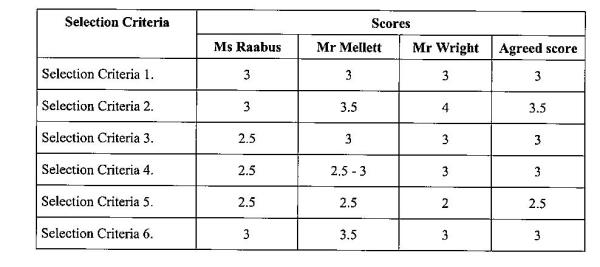

4 The selection panel then made a recommendation to an ABC delegate who made the final decision. The recommendation was that another shortlisted candidate who received the highest score (19) be offered the position, but that if that person did not accept the offer, the position be offered to Ms Martin (who, along with one other shortlisted candidate, scored 18). Ultimately, Ms Martin was unsuccessful in obtaining this position. On receiving this news, Ms Martin broke down and was subsequently diagnosed as having an “adjustment disorder” (with symptoms including mixed anxiety and depressed mood). She attended counselling with an ABC-provided employee assistance program. Ms Martin has been certified as unfit for work since March 2012.
Initial complaints by Ms Martin regarding Mr Mellett
5 Ms Martin alleged that she was bullied and harassed by Mr Mellett on various occasions during the period from October 2010 up until August 2011 when she took up the temporary position of cross-media reporter and, to a lesser extent, by Mr Tom Coull (a cross-media reporter based at Renmark). She claimed that her work environment had become “toxic” and that she had been subjected to “repeated inappropriate behaviour”. Specifically, Ms Martin alleged that Mr Mellett:
(1) failed to intervene in a meeting when Mr Coull shouted at her;
(2) failed to take action on other occasions when Mr Coull complained about her;
(3) confronted her in an “aggressive” manner for watching YouTube videos at work;
(4) swore at her when she asked him a question; and
(5) consistently engaged in “passive aggressive behaviour”, including by not responding to her greetings and by ignoring her, and “staring at [her] from his office”.
6 In a statement prepared by Ms Martin before the Tribunal hearing, she added the following observations:
Being stared at made me feel unable to concentrate at work, I was anxious and at times the cumulative effect was an inability to sleep. I often felt isolated by the behaviour as I felt my colleagues received the message that they should not speak with (sic) me. My greetings and sentences being completely ignored while Bruce Mellett and I were the only ones in the office in January scared me. I felt really threatened by him just walking straight past me as I spoke to him. It made me anxious and unable to sleep.
7 In a statement accompanying her claim for workers’ compensation, Ms Martin explained, in relation to her injury, that:
I experienced a breakdown. I realised that it was unlikely that I would ever be able to leave the ABC’s Renmark office if Bruce Mellett participated in any selection process. I realised I no longer had the resilience to defend myself against the daily onslaught of inappropriate behaviour which I feared would only intensify on my return to my ongoing role of Producer.
8 Mr Mellett prepared a number of notes about Ms Martin while supervising her. The notes only became available to Ms Martin shortly before the Tribunal’s hearing. The notes recorded observations as to Ms Martin’s performance and conduct both while under Mr Mellett’s supervision and in her role as cross-media reporter. It is plain from these notes that Mr Mellett felt frustrated with Ms Martin:
Carol Raabus rings re positions in Renmark. She asks how Peta is going? I tell her OK, but I am worried that with a very limited workload, Peta is working 11-12 hour days. I tell her this is an issue we flagged previously and that it is essentially one of Time Management [sic] and Peta’s inability to manage her time, set priorities and actually achieve tasks within an acceptable timeframe. To be honest I cannot understand why Peta cannot get her work done. Meg has been producer for two months and she is already getting through more than Peta ever did and finishing on time!!
…
10.11.11 … We have an update on the web BUT NO photos and no urgency to actually attend and do live radio crosses!! The supreme irony in all this is that Multiplatform did an Emergency [sic] mock exercise two days ago, and yet when the real thing hits here… Peta just sits in the office and worries about the Open 11.11 project!!!!!!! There’s no sense of urgency, no sense that this is in fact a big story and no sense that people will want to know what the hell is going on. And no sense that she should be there on the ground, reporting ACROSS the MEDIA! I tell her she needs to go to Waikerie – she says it’s a long way and she can be more productive here. I tell her she should go and do a live cross into programs – Peta tells me she needs permission from Carol to do any work for Radio [sic] – I cannot believe this!! I ask her when this was made a rule. She says it’s always been the case and that’s what Carol has said, I tell her she is missing the big yarn of the year for the audience and I am very disappointed in her attitude.
…
16.1.12: Massive factory fire at Glossop. Starts at 5.45 and going strong at 7am. Run it in Brekkie, News and Mornings. Peta comes into my office at 11.30 and says she probably better go and get an updated photo from the fire!!!!!!!!!! I tell her the fire is well and truly out by now and that we’ve missed another big local story. She says she is covering it from here, but I tell her there’s more updated information, photos etc live at the scene [sic].
…
2.3.12 Peta posts a story about no high river for SA, despite heavy rain falling in catchment. The figures she quotes are from SA Water – but they are a week old!! Also a few spelling errors in the copy
“By the end of April in five to six weeks time, which is about the travel time for all of that water in Victoria to get down to South Australia, we’re going to see flows at the border that will go above 40,000 megalitres per day.”
Some of her copy is written like a 9 year old! [sic]
9 An initial internal investigation within the ABC found that “there was no evidence to support [Ms Martin’s] claim that Bruce [Mellett] had behaved inappropriately towards her.”
Proceedings before the Tribunal
10 On 22 June 2012, Ms Martin lodged a claim for workers’ compensation with Comcare in respect of a psychological ailment. Section 5A of the Safety, Rehabilitation and Compensation Act 1988 (Cth) (SRC Act) provided as follows:
5A Definition of injury
(1) In this Act:
“injury” means:
(a) a disease suffered by an employee; or
(b) an injury (other than a disease) suffered by an employee, that is a physical or mental injury arising out of, or in the course of, the employee’s employment; or
(c) an aggravation of a physical or mental injury (other than a disease) suffered by an employee (whether or not that injury arose out of, or in the course of, the employee’s employment), that is an aggravation that arose out, of or in the course of, that employment;
but does not include a disease, injury or aggravation suffered as a result of reasonable administrative action taken in a reasonable manner in respect of the employee’s employment.
(2) For the purposes of subsection (1) and without limiting that subsection, reasonable administrative action is taken to include the following:
(a) a reasonable appraisal of the employee’s performance;
(b) a reasonable counselling action (whether formal or informal) taken in respect of the employee’s employment;
(c) a reasonable suspension action in respect of the employee’s employment;
(d) a reasonable disciplinary action (whether formal or informal) taken in respect of the employee’s employment;
(e) anything reasonable done in connection with an action mentioned in paragraph (a), (b), (c) or (d);
(f) anything reasonable done in connection with the employee’s failure to obtain a promotion, reclassification, transfer or benefit, or to retain a benefit, in connection with his or her employment.
(Emphasis added in s 5A(1)).
11 The emphasised words are at the heart of the appeal.
12 On 15 October 2012, pursuant to s 14 of the SRC Act, Comcare rejected any liability to pay compensation to Ms Martin in respect of her claim. That section relevantly provided:
14 Compensation for injuries
(1) Subject to this Part, Comcare is liable to pay compensation in accordance with this Act in respect of an injury suffered by an employee if the injury results in death, incapacity for work, or impairment.
(2) Compensation is not payable in respect of an injury that is intentionally self-inflicted.
(3) Compensation is not payable in respect of an injury that is caused by the serious and wilful misconduct of the employee but is not intentionally self-inflicted, unless the injury results in death, or serious and permanent impairment.
13 Comcare determined that the ABC’s rejection of Ms Martin for the permanent position of cross-media reporter was a “legitimate human resource management action and [could] be considered as an administrative action”. It noted that Ms Martin had been informed as to the reasons she had been unsuccessful and that there was no evidence that Mr Mellett being on the selection panel was unreasonable given that:
(a) there was no evidence that Ms Martin had previously raised concerns with the department in relation to her “perceptions of Mr Mellett’s behaviour” whilst one of his staff; and
(b) the decision regarding the position of cross-media reporter was made by a selection panel and not just Mr Mellett.
14 On 6 December 2012, Comcare affirmed its October 2012 determination pursuant to s 66 of the SRC Act. On 24 January 2013, Ms Martin sought review of this determination by the Tribunal.
15 On 11 August 2014, the Tribunal set aside Comcare’s decision and declared it liable to pay compensation pursuant to s 14 of the SRC Act.
16 While the parties agreed that Ms Martin suffered from an adjustment disorder and that this condition was contributed to, to a significant degree, by her employment with the ABC, they differed as to whether this condition was “as a result” of the decision not to appoint her to the position of cross-media reporter (see Hart v Comcare [2005] FCAFC 16; (2005) 145 FCR 29 (Hart) and Drenth v Comcare [2012] FCAFC 86; (2012) 128 ALD 1 (Drenth)) and, if so, whether that decision was “a reasonable administrative action taken in a reasonable manner” (on the latter issue see Comcare v Martinez (No 2) [2013] FCA 439; (2013) 212 FCR 272 (Martinez (No 2)) and Keen v Workers Rehabilitation & Compensation Corporation (1998) 71 SASR 42 (Keen)).
17 Ms Martin argued that, in line with the ABC Recruitment and Selection Guidelines (the Guidelines), Mr Mellett should have disqualified himself from participating in the selection panel for the cross-media reporter role or, in the alternative, that he should have disclosed to the other members of the panel the “highly negative” views he held about Ms Martin’s competence and integrity.
18 The Tribunal identified “the real issue” in the case as whether “the recruitment exercise was conducted in conformity with the [ABC stated] policy and, if not, whether the decision was undertaken in a reasonable manner”. It added that this “assessment requires a review [sic] all of the circumstances surrounding the selection decision”. One of the central questions raised by Comcare in its appeal from the Tribunal’s decision is whether the Tribunal did in fact conduct such as assessment.
19 The Tribunal’s key findings included:
(a) Ms Martin’s claim that she sought to remove herself from Mr Mellett’s supervision was not a “recent invention” designed to avoid s 5A of the SRC Act - in fact, there was “powerful evidence” corroborating her claim that her belief that she had been mistreated by Mr Mellett pre-dated the recommendation that she not be appointed to the role of cross-media reporter (at [57]);
(b) the question posed by s 5A(1) is whether the claimed ailment was suffered as a result of the nominated action which, in this case, was the failure to obtain the promotion. It mattered not which of the anticipated consequences of the promotion decision was most likely to have affected Ms Martin. That her reaction to the promotion decision was primarily attributable to her dread of returning to work under Mr Mellett’s supervision and not her disappointment with not being promoted was irrelevant. In her own mind, the former was a direct and foreseeable consequence of that decision (at [61]); and
(c) one of the operative causes of Ms Martin’s adjustment disorder was her failure to obtain the promotion and her condition was “a result of” that action (at [62]).
20 The Tribunal also concluded that the decision not to promote her was administrative action which was not taken in a reasonable manner, thus the exception in s 5A(1) had no application.
21 The Tribunal was not satisfied that Mr Mellett’s views on Ms Martin could be “quarantined” from his deliberations as a member of the selection panel for the cross-media reporter position. It found that a review of Mr Mellett’s notes revealed more than mere “annoyance” with Ms Martin but rather, a “heightened level of annoyance, frustration and incredulity” and that, by the time the selection panel first met, Mr Mellett held Ms Martin “in very low regard”.
22 Paragraphs 103 and 104 of the Tribunal’s reasons for decision encapsulate its core reasoning as to why it was not satisfied that the administrative action was taken in a reasonable manner:
As pointed out by Mr Gollan there is no direct evidence that Mr Mellett's recorded views about Ms Martin infected the decisions he made as a member of the selection panel or those of the other members. Ms Raabus and Mr Wright considered the recruitment process unremarkable notwithstanding each believed Mr Mellett should have disclosed the views he held about Ms Martin. I cannot agree with the proposition that the evidence of Mr Mellett rating Ms Martin slightly higher than other members of the panel “proves” that those views did not influence his actions. Given the strength and duration of those views there was a real and material possibility that they consciously or otherwise influenced Mr Mellett's deliberations. It may be, as claimed by Comcare, that Mr Mellett managed to quarantine his views from his deliberations as a panel member. I could not be positively satisfied that that occurred. More to the point, in my opinion a fair-minded observer acquainted with the notes would probably apprehend that Mr Mellett might not bring an impartial mind to his role.
For these reasons I cannot be satisfied that the decision was undertaken in a reasonable manner.
(Emphasis added).
23 In final submissions before the Tribunal, Comcare raised the contention that Ms Martin’s condition was in fact the result of a performance appraisal in 2011 in which she had apparently been told that her “scripts were terrible, [her] work not up to scratch, [her] research unsatisfactory and that [she] would never get out of [her] current position” and that this also constituted “reasonable administrative action”. Comcare argued that this had emerged from the medical evidence adduced during the hearing before the Tribunal and that the Tribunal was thus not barred from considering it. Moreover, the Comcare delegate who made the decision the subject of the Tribunal’s review nominated the performance appraisal as one of three reasonable administrative actions said to have contributed to Ms Martin’s condition.
24 The Tribunal did not consider this issue. It held that, although its jurisdiction does not rest on how the parties had chosen to define the issues in dispute, to extend the scope of the review to a fresh issue raised only in closing would be contrary to its obligation to ensure that each party is given a reasonable opportunity to present its case.
Proceedings in the Court
25 Comcare identified the following questions of law in its original notice of appeal:
(1) Did the Tribunal misconstrue s 5A of the SRC Act or misapprehend the matters of which it had to be satisfied in reaching a decision?
(2) Was it open to the Tribunal to conclude that the decision not to appoint Ms Martin to the position of cross-media reporter was not taken in a reasonable manner on the basis of the matters referred to in [98]-[103] of its reasons for decision?
(3) Did the Tribunal’s failure to determine whether Ms Martin’s adjustment order was “as a result” of her 2011 performance appraisal, and whether that action constituted “reasonable administrative action taken in a reasonable manner”, constitute a denial of procedural fairness?
26 An amended notice of appeal filed on 17 November 2014 deleted the third question of law referred to in [25] above and instead added two additional questions (questions 4 and 5):
(4) Did the Tribunal give adequate reasons for its decision?
(5) Was it open to the Tribunal to find that the recruitment exercise for the position of cross-media reporter was not conducted in accordance with the ABC Policy on Recruitment (if such a finding was made)?
27 In its amended notice of appeal, Comcare relied upon the following grounds of appeal. First, the Tribunal erred in concluding that the decision not to grant Ms Martin the role of cross-media reporter was not taken in a reasonable manner, on the basis that Mr Mellett held views about Ms Martin that may have influenced his assessment of her suitability for the position. This conclusion failed to take into account the fact that Mr Mellett was a member of a three person selection panel who made a recommendation to the ultimate decision-maker and that he was Ms Martin’s former supervisor and had formed views about her as a result of working with her.
28 Secondly, the Tribunal erred in finding that because a fair-minded observer would “probably apprehend” that Mr Mellett may not have brought an impartial mind to his role, the administrative action was not undertaken in a reasonable manner. This was incorrect “as a matter of law”.
29 Thirdly, the Tribunal erred in concluding that Ms Martin’s consequent adjustment disorder was not excluded by s 5A of the SRC Act, as this conclusion was not reasonably open on the facts.
30 Fourthly, the Tribunal erred in failing to give adequate reasons for its decision, in particular, with respect to:
(a) whether the Tribunal concluded that there had been a failure to comply with the Guidelines and, if so, why;
(b) if the Tribunal concluded that there had been a failure to comply with the Guidelines, why this necessarily meant that the decision was not undertaken in a reasonable manner; and
(c) if the Tribunal did not conclude that there was a failure to comply with the ABC’s Policy on Recruitment, why the matters it referred to in [98]-[103] of its reasons for decision mandated a conclusion that the decision was not undertaken in a reasonable manner.
31 Fifthly, the Tribunal erred by finding that the recruitment exercise for the position of cross-media reporter was not conducted in accordance with the ABC Policy on Recruitment (if such a finding was made) as there was no probative evidence upon which to base such a finding and it was not reasonably open to the Tribunal.
32 On 17 November 2014, Comcare filed an interlocutory application seeking to adduce fresh evidence in the appeal, namely, a document entitled “ABC Conflict of Interest Policy” dated 24 March 2011 (the Policy).
Comcare’s submissions on the appeal summarised
33 Comcare concedes that Mr Mellett and Ms Martin “did not have a good working relationship” and that Mr Mellett formed “a dim view of Ms Martin’s attitude and aptitude”. It adds, however, that it is “important to note that these views were formed as a result of Mr Mellett working with Ms Martin as her supervisor rather than as the result of any personal relationship or dealings.”
34 According to Comcare, the Tribunal approached the question as to whether the decision not to appoint Ms Martin as cross-media reporter was taken in a reasonable manner primarily by reference to the doctrine of apprehended bias in administrative law. This was an error of law, Comcare contends, on the basis that neither the statutory language of the SRC Act, legal principle, nor common sense, supported the Tribunal’s approach.
35 Comcare further submits that the terms of s 5A of the SRC Act are “inconsistent with the notion that administrative action involving someone who has negative views about the employee that affect his assessment of the employee is not undertaken in a reasonable manner”. It submits that s 5A “clearly contemplates” the involvement of colleagues who could hold an employee in “very low regard” and assess the employee accordingly. In other words, s 5A does not extend to administrative action on the part of any person holding a negative opinion of a fellow colleague, which Comcare contends is what Ms Martin’s interpretation of the SRC Act suggests.
36 Comcare submits that there is no general legal principle that someone who “merely investigates or considers and then makes recommendations” to a decision-maker is required to avoid a reasonable apprehension of bias, citing Hot Holdings Pty Ltd v Creasy [2002] HCA 51; (2002) 210 CLR 438 (Hot Holdings) and Preston v Carmody (1993) 44 FCR 1 (Preston). Comcare submits that any impartiality or bias on the part of an advisor should not necessarily be attributed to the ultimate decision-maker.
37 In this instance, Comcare argues, the question which the Tribunal should have asked itself was whether the relevant ABC delegate who made the final decision brought an impartial mind to the selection of the cross-media reporter. By focusing its attention on the makeup of the selection panel, which merely gave advice and passed on a recommendation to the delegate, the Tribunal asked itself the wrong question and hence made an error of law. The principle of apprehended bias simply does not extend that far (citing Preston at 13 per Wilcox J).
38 Comcare also opposes the Tribunal’s findings on the basis of “common sense”. If Mr Mellett’s negative views disqualified him from sitting on the selection panel for the role of cross-media reporter, this would be “an unwarranted and unreasonable imposition on legitimate human resources actions of employees [and one] which would be clearly contrary to Parliament’s intention”. Comcare contends that if Ms Martin’s interpretation of the legislation was accepted, many former supervisors and work colleagues would be prevented from participating in any kind of selection exercise for their employees, “despite the fact that they will often be best placed to assess a candidate’s performance and suitability”.
39 Moreover, Comcare points to the Guidelines as being unsupportive of the Tribunal’s findings. The Guidelines relevantly state that:
If a Selection Panel member (including the convenor) believes their personal relationship with an applicant could affect an applicant’s selection prospects, they should raise this with the convenor, or a People & Learning representative, and withdraw from the Selection Panel. All reasonable steps should be taken to ensure that the Selection Panel does not include persons who could reasonably be perceived to have a conflict of interest in the selection decision (refer to the ABC Conflict of Interest Policy). It is the responsibility of all panel members to raise any concerns they may have regarding a potential conflict of interest of other panel members.
(Emphasis in original).
40 Comcare points out that there was no finding or conclusion by the Tribunal that:
(a) Mr Mellett had any “personal relationship” with Ms Martin; rather, he had worked with her on a strictly professional level as her supervisor;
(b) Mr Mellett had believed he had a personal relationship (or indeed, a relationship of any kind) with Ms Martin that could affect her selection prospects; or
(c) Mr Mellett had a conflict of interest or could reasonably be perceived to have a conflict of interest or could have been concerned as to having such a conflict of interest.
41 Comcare draws attention to the fact that the Policy was not before the Tribunal. Therefore, if the Tribunal concluded that Mr Mellett’s involvement in the selection panel was contrary to the Guidelines because it created a perception of a conflict of interest, it should have considered the Policy before doing so. In the absence of so doing, the Tribunal “could not logically or rationally conclude that Mr Mellett’s involvement in the selection panel was contrary to the ABC’s recruitment policy.” Any such conclusion, Comcare contends, was infected with legal error.
42 On the basis of the matters outlined in [35]-[41] above, Comcare contends that the Tribunal’s decision therefore involved at least one error of law and hence it was not open to the Tribunal to conclude that the decision not to appoint Ms Martin as cross-media reporter was not taken in a reasonable manner, in contravention of the SRC Act.
43 Comcare also submits that the appeal should be upheld on the basis that the Tribunal’s reasons “leave it completely unclear why it… [concluded] that the relevant administrative action was not undertaken in a reasonable manner”. Specifically, Comcare complains that the Tribunal’s reasons do not reveal:
(a) whether it concluded there had been a failure to comply with the Guidelines and, if so, why the Tribunal reached this conclusion; and
(b) if the Tribunal did conclude there had been a failure to comply with the Guidelines, why this necessarily meant that the decision was not undertaken in a reasonable manner.
44 Comcare emphasises that, given the volume of complaints reaching the Tribunal each year, it is “important to be able to ascertain what will and will not constitute administrative action taken in a reasonable manner in the future”, and that it is “incumbent on the Tribunal to clearly explain the basis for concluding that the recruitment process was not undertaken in a reasonable manner”.
Ms Martin’s submissions on the appeal summarised
45 Ms Martin contends that question 1 does not involve a question of law and merely “raises the spectre of an unspecified error made by the Tribunal… and invites the Court to go searching for it without any directions as to where it may be found.”
46 Furthermore, Ms Martin submits that question 2 is unclear in its drafting and does not identify a statutory reason as to why the Tribunal’s conclusion would be precluded as a matter of statutory construction. Even if this were not the case, and the question is defined with sufficient clarity, Ms Martin contends that it was open for the Tribunal to reach the conclusion that it did on the basis that “a fair-minded observer would apprehend that Mr Mellett might not bring an impartial mind to his role on the selection committee”.
47 Ms Martin points to the Guidelines as a prerequisite to ensuring that the selection process would be fair and objective. She contends that the relationship between herself and Mr Mellett was of a personal kind and that if the Tribunal could not be satisfied that Mr Mellett’s views had not influenced the outcome of the process, it had not been reasonably carried out. This, she says, does not raise an appealable question of law.
48 Comcare’s inclusion of questions 4 and 5 on the appeal was opposed by Ms Martin on the basis that they had been raised for the first time three weeks before the hearing. In any event, she contends that the question of whether the Guidelines had been strictly complied with is not the relevant test. The Guidelines are not delegated legislation, but policy. They are relevant to the Tribunal’s decision, but not decisive. It was not essential for the Tribunal to reach a “positive decision” on the Guidelines one way or the other.
49 Question 5, according to Ms Martin, was based on three hypothetical prereqisites which could not be made out, namely:
(a) that the Tribunal actually found that the recruitment exercise for the position of cross-media reporter was not conducted in accordance with the Guidelines;
(b) that it was necessary for the Tribunal to reach such a conclusion; and
(c) that there was no probative evidence upon which the Tribunal could reach that conclusion.
50 Ms Martin submits that the SRC Act should be “construed liberally” (citing Brennan v Comcare (1994) 50 FCR 555 at 559 and Whitaker v Comcare (1998) 86 FCR 532 at 554). The exclusion in s 5A(1) of the SRC Act, upon which Comcare relies, “must be read in a way which is harmonious with the overall purpose of the SRC Act, and not unreasonably destructive of it”.
51 For Ms Martin, if it is accepted that her perception of bullying by Mr Mellett was truthfully reported and genuinely believed, “no reasonable interpretation of the ‘reasonable administrative action’ exclusion in a beneficial piece of legislation like the SRC Act could justify denying her claim for compensation if she decompensated (as the Tribunal found she did) in such a situation”.
Comcare’s submissions in reply on the appeal summarised
52 Comcare submits that the appeal does raise questions of law. It contends that “inelegant drafting of a question of law should not prevent the substantive issues being argued” and redefines its questions in relation to the construction of s 5A as: “Can the doctrine of reasonable apprehension of bias apply to Mr Mellett’s actions in the circumstances of this case and form the basis for the Tribunal’s decision?”
53 Comcare’s main complaint is not that the Tribunal’s conclusion essentially established a finding of apprehended bias in respect of Mr Mellett, but that “the Tribunal used this conclusion as mandating, or at least establishing, that the relevant administrative action was not undertaken in a reasonable manner” and that this was an inappropriate basis for determining that the s 5A exclusion did not apply.
54 Comcare submits that there are indeed limits on the reach of matters which may be relevant in determining whether this exclusion applies, particularly where a Tribunal “impermissibly distracts” itself from the statutory language it is required to apply (citing Martinez (No 2)). Comcare contends that Ms Martin’s outline of submissions effectively (and impermissibly) sought to recast the Tribunal’s reasons such that the selection process was not fair and objective, and Mr Mellett had a conflict of interest in respect of Ms Martin.
55 In respect of the additional questions of law, Comcare submits that they cause no prejudice to Ms Martin and should be ventilated on the appeal. The Tribunal did not rely on the Guidelines as much as Ms Martin contends and did not use them as a sufficient explanation to expose why the decision “went the way it did”. Comcare presses its submission that “such ambiguous and confusing reasons constitute the giving of inadequate reasons for the Tribunal’s decision”.
56 Comcare acknowledges that the SRC Act is intended to be remedial or beneficial in nature, but submits that the purpose of the s 5A exclusion was “clearly to narrow entitlements to compensation by broadening the relevant exclusion” in respect of legitimate management actions. It submits:
On the findings of the Tribunal Ms Martin’s adjustment disorder was inextricably linked to the decision not to appoint her to the position of cross media reporter… Comcare submits it would be artificial in the extreme to attempt to separate out certain indirect or unintended consequences of that decision from the decision itself.
Fresh evidence
57 Comcare sought to adduce as fresh evidence in the appeal a copy of the Policy. In an affidavit in support of the application to adduce fresh evidence, Comcare’s solicitor, Mr Peter Lehmann, explained that the Policy was not adduced below because Comcare did not consider it to be relevant to the issues in dispute, having regard to Ms Martin’s amended statement of facts, issues and contentions dated 3 September 2013. Mr Lehmann also deposed that Comcare wished to adduce a copy of the Policy because it considered that it will be necessary for the Court to refer to the terms of the Policy in order to determine some of its grounds of appeal. These grounds relate to Comcare’s dissatisfaction with the Tribunal’s conclusion that Mr Mellett’s involvement in the selection panel was contrary to the ABC’s recruitment policy (see [31] above).
58 Section 44(8) of the AAT Act permits the Court to receive further evidence for the purpose of making findings of fact in the circumstances specified in s 44(7) of the AAT Act, which imposes a constraint upon the Court making any finding of fact which is inconsistent with a finding of fact made by the Tribunal (other than findings made as a result of an error of law).
59 Under s 27 of the Federal Court of Australia Act 1976 (Cth) and r 33.29 of the Federal Court Rules 2011 (Cth), the Court also has a discretion to admit fresh evidence on an appeal. The general rule guiding the exercise of the Court’s discretion was stated by Dixon CJ in Greater Wollongong City Council v Cowan (1955) 93 CLR 435 at 444:
It must be reasonably clear that if the evidence had been available at the first trial and had been adduced, an opposite result would have been produced or, if it is not reasonably clear that it would have been produced, it must have been so highly likely as to make it unreasonable to suppose the contrary. Again, reasonable diligence must have been exercised to procure the evidence which the defeated party failed to adduce at the first trial.
60 It may be that the Court’s discretion is actually wider than that reflected in the passage above (see Florance v Andrew (1985) 58 ALR 377 at 381 per Lockhart J).
61 In my view, the fresh evidence should not be admitted primarily because, as will emerge below, I do not consider that the Tribunal ultimately found that the Policy was breached. Accordingly, there is no sufficient basis for adducing a copy of the Policy.
Proposed amendments to notice of appeal
62 As noted above, Ms Martin opposed the proposed amendments, substantially on the basis that they were foreshadowed only three weeks before the hearing. As matters transpired, the scheduled hearing of the appeal was deferred for another week. In any event, however, Ms Martin could point to no substantive prejudice and, Mr Grey, who appeared for Ms Martin, candidly acknowledged that he was in a position to deal with the amendments. In my view, leave should be granted to permit Comcare to rely upon the amended notice of appeal.
Consideration of appeal
63 It is convenient to deal with the first two grounds of appeal together because they relate to the question whether the Tribunal committed an appealable error of law for the purposes of s 44 of the AAT Act in relation to that aspect of its decision concerning the question whether or not administrative action was taken in a reasonable manner for the purposes of s 5A(1) of the SRC Act. It should also be noted at this point that these two grounds plainly relate to a question of law which, in my view, is properly raised by the amended notice of appeal as relating to the proper construction of s 5A of the SRC Act.
64 For the reasons which follow, I consider that the Tribunal did fall into appealable error.
65 It is to be noted that, in contrast with the position concerning what constitutes “reasonable administrative action” (which is defined non-exhaustively in s 5A(2) of the SRC Act), there is no comparable provision which attempts to define – exhaustively or non-exhaustively – what amounts to “taken in a reasonable manner” for the purposes of that provision. It is necessary therefore, to construe that phrase having regard to the text considered in its context, consistently with the modern approach to statutory construction (see generally, Alcan (NT) Alumina Pty Ltd v Commissioner of Territory Revenue [2009] HCA 41; (2009) 239 CLR 27 at [47] per Hayne, Heydon, Crennan and Kiefel JJ; Federal Commissioner of Taxation v Consolidated Media Holdings Ltd [2012] HCA 55; (2012) 250 CLR 503 at [39] per French CJ, Hayne, Crennan, Bell and Gageler JJ and Thiess v Collector of Customs [2014] HCA 12; (2014) 250 CLR 664 at [22] per French CJ, Hayne, Kiefel, Gageler and Keane JJ).
66 In Keen, which is a decision of the Full Court of the Supreme Court of South Australia, the comparable statutory provision requiring construction was s 30A of the Workers Rehabilitation and Compensation Act 1986 (SA), which relevantly provided:
30A A disability consisting of an illness or disorder of the mind is compensable if and only if -
(a) the employment was a substantial cause of the disability; and
(b) the disability did not arise wholly or predominantly from -
(i) reasonable action taken in a reasonable manner by the employer to transfer, demote, discipline, counsel, retrench or dismiss the worker; or
(ii) a decision of the employer, based on reasonable grounds, not to award or provide a promotion, transfer, or benefit in connection with the worker's employment; or
(iii) reasonable administrative action taken in a reasonable manner by the employer in connection with the worker's employment; or
(iv) reasonable action taken in a reasonable manner under this Act affecting the worker.
67 In Keen, Lander J made the following observations (at 47-48) regarding whether administrative action is taken in a reasonable manner for the purposes of that provision:
Whether the administrative action was taken in a reasonable manner by the employer will depend upon the administrative action, the facts and circumstances giving rise to the requirement for the administrative action, the way in which the administrative action impacts upon the worker and the circumstances in which the administrative action was implemented and any other matters relevant to determining whether the administration (sic) action was taken in a reasonable manner by the employer.
68 It may be noted that the Tribunal referred to that passage from Lander J’s judgment in [66] of its reasons for decision. It also referred in [67] to the following passage from Bleby J’s judgment in Keen (at 63):
… whether administrative action is taken in a reasonable manner is very much a question of objective fact, and is to be determined against the ordinary standards of reasonable employers in all the circumstances of the case. Whether administrative action is reasonable or is taken in a reasonable manner depends first on the finding of the primary facts as to what occurred in the taking of the administrative action, namely what decision was made, who made it and why it was made, what was done, what was omitted to be done and the factual background against which the decision was made or implemented.
69 The Tribunal noted that the passages from both Lander J’s and Bleby J’s judgments in Keen had been cited approvingly by judges of this Court. It acknowledged in [66] that, in Martinez (No 2), Robertson J had approvingly cited Lander J’s statements and regarded them as relevant to the construction of s 5A of the SRC Act. And the Tribunal further noted in [67] that, in National Australia Bank Ltd v KRDV [2012] FCA 543; (2012) 204 FCR 436 at [51], Cowdroy J approvingly cited the passage from Bleby J’s judgment in Keen as establishing that whether conduct can be classified as reasonable is a question of fact.
70 I respectfully agree that these passages from Keen broadly reflect the proper approach to be taken in construing and applying the phrase “taken in a reasonable manner” for the purposes of s 5A of the SRC Act. The Tribunal appears initially to have taken a similar view but, curiously, when it came to apply the relevant part of s 5A to the circumstances here, the Tribunal appears to have adopted a different approach. As is evident from the summary above of the Tribunal’s reasons for decision, instead of taking into account all the relevant matters as identified in the passages from Keen as set out above, the Tribunal essentially focused on the question whether the recruitment process was tainted by apprehended bias in an administrative law sense by Mr Mellett’s participation on the selection panel.
71 With respect to the Tribunal, that approach was erroneous in law. Not only did it impermissibly equate the doctrine of apprehended bias in administrative law with the question whether or not particular administrative action had been taken in a reasonable manner, but, in any event, the Tribunal did not properly apply the administrative law doctrine of apprehended bias. It is appropriate to expand upon both those matters.
72 As to the first, I see no warrant for treating the reference in s 5A to “taken in a reasonable manner” as being synonymous with the doctrine of apprehended bias in administrative law. It would have been a simple matter for the Parliament to have adopted the familiar language of procedural fairness or natural justice, including the particular limb which deals with bias, if that was intended to be the relevant test. Self-evidently, however, it did not do so. Instead it used the language of whether particular administrative action “had been taken in a reasonable manner”, which requires the decision-maker to determine what is essentially a question of fact. In my view, the Tribunal misconstrued the relevant provision by unduly limiting it to a consideration of whether the administrative action in question had been taken in conformity with that aspect of the doctrine of procedural fairness which relates to apprehended bias. Further, in my view, the correct construction of that statutory phrase is that which was adopted by Robertson J in Martinez (No 2) and is reflected in the judgments of Lander and Bleby JJ in Keen, albeit in reference to a similarly worded provision in South Australia’s workers’ compensation legislation (see [66]-[68] above).
73 There is at least one fundamental difference between the relevant statutory phrase in s 5A and the doctrine of apprehended bias. It relates to the role of the relevant decision-maker. The statutory phrase requires either the primary decision-maker or the Tribunal on a review to decide for himself or herself whether the relevant administrative action was taken in a reasonable manner. In contrast, the doctrine of apprehended bias requires the relevant decision-maker to apply the relevant legal principles through the prism of an informed and fair-minded lay observer (see Ebner v Official Trustee in Bankruptcy [2000] HCA 63; (2000) 205 CLR 337 at [6] per Gleeson CJ, McHugh, Gummow and Hayne JJ). As is evident from [103] and [104] of the Tribunal’s reasons for decision (set out in [22] above), the Tribunal applied a hybrid of the two approaches. Some of its findings are expressed in terms of its own direct appraisal of relevant matters, while its ultimate conclusion (which, significantly, was introduced by a reference by the words ‘more to the point’) was expressed by reference to the appraisal of a fair-minded observer. I reject Mr Grey’s submission that these words ought to be viewed as ‘surplusage’. In my view, these words highlight the fact that the Tribunal saw this sentence as containing its essential reasoning.
74 Nor do I accept Mr Grey’s submission that [103] and [104] of the Tribunal’s reasons for decision ought to be regarded as being directed to the concept of the selection process being ‘fair and objective’ as referred to in the Guidelines. Although there are references in [98] of the Tribunal’s reasons for decision to the “ABC’s stated policy on recruitment”, which appears to refer to the Guidelines, there is nothing in the subsequent paragraphs to suggest that the Tribunal was addressing this particular phrase in the Guidelines. Indeed, even if that were the case, similar issues would arise as to whether the Tribunal would have performed its statutory task under s 5A by reading that phrase as incorporating the administrative law doctrine of apprehended bias.
75 In my view the Tribunal fell into legal error by reasoning as it did.
76 Furthermore, and in any event, the Tribunal appears to have misunderstood or misapplied the doctrine of apprehended bias (whether that doctrine was applied directly or indirectly via the Guidelines). In particular:
(a) the Tribunal appears to have equated a case of pre-judgment (although the Tribunal does not use the language of “pre-judgment”, it appears that it viewed Mr Mellett’s hostility towards Ms Martin as fitting into that category) with one of conflict of interest;
(b) the Tribunal demonstrated an inadequate appreciation of the relevance of the fact that Mr Mellett was only one of three members of the selection panel;
(c) assuming for the moment that the doctrine of apprehended bias in administrative law was relevant in addressing the question posed by s 5A of the SRC Act, the Tribunal appears to have misunderstood that doctrine and, in particular, failed to appreciate that the hypothetical “fair-minded observer” against whom the relevant test is applied must be attributed with knowledge of all relevant facts and not just a selection of those facts; and
(d) the Tribunal failed to engage at all with the relevance of the fact that the selection panel merely made a recommendation and that the ultimate decision-maker was a third person against whom there was no allegation of apprehended bias.
77 As to the first of these matters, as Spigelman CJ observed in McGovern v Ku-ring-gai Council [2008] NSWCA 209; (2008) 72 NSWLR 504 (McGovern), it is necessary to distinguish between a conflict of interest case and a pre-judgment case because there are at least two relevant differences:
(a) a conflict of interest requires a different analysis as to the relationship, as reasonably perceived, between the interest and the decision. Where a relevant conflict of interest is established, reasonable apprehension flows almost as of course, whereas in a pre-judgment case it is necessary to consider the degree of “closure” of the allegedly closed mind (at [26]);
(b) a different approach is also appropriate where the involvement of an allegedly biased decision-maker is not determinative in the sense that, in a conflict of interest case, it is appropriate to conclude without further inquiry that the statutory requirements of a valid decision-making process had not been complied with (which might also be expressed in terms of the likely view of an independent observer) (at [27]). Spigelman CJ’s observations were directed, of course, to the common law doctrine of procedural fairness and not a statutory phrase such as that contained in s 5A of the SRC Act, but they are nevertheless apposite if that doctrine is viewed as having some relevance to that statutory phrase.
78 As to the second matter, there is some uncertainty as to whether the actions of a collegiate body are vitiated if there is a reasonable apprehension of bias in respect of only a minority of its members. For example, different views were expressed on that issue in McGovern. That case involved an allegation that two councillors in a local council were affected by apprehended bias and participated in a decision by a ten member Council in granting consent to a development application. Spigelman CJ observed at [31] that, even if either or both of the councillors had pre-judged the issue and were affected by apprehended bias, “there remains the issue whether that affected the whole of the decision-making process”. His Honour held at [31] that “the rotten apple test is not automatically applied” and he indicated at [33] that some remarks by Gummow J in IW v The City of Perth (1997) 191 CLR 1 at 5, which might suggest that it is sufficient if merely one member of a collegiate decision-making body is biased, were obiter remarks which also were made in a particular statutory context.
79 Chief Justice Spigelman stated the relevant principle as his Honour saw it at [45] as follows:
It is necessary to allow for special cases, for example, when a particular member of a collegial body has, or has had, particular influence on the other members. Except in such cases, a rotten apple test is not, in my opinion, the approach that an independent observer “might” reasonably adopt in the usual pre-judgment case. Rather a “but for” test should generally be applied, that is, the Court should ask whether or not the person(s) reasonably suspected of pre-judgment decided the outcome.
80 In McGovern, Basten JA (with whom Campbell JA agreed) took a different view. After noting that, in a case of reasonable apprehension of bias, the Court does not usually inquire into the existence of bias or otherwise as a matter of fact and also after alluding to the possibility that a distinction might exist between cases where a collegiate body operates in public as opposed to private, Basten JA considered that, in the particular facts of McGovern, if it had been established that there was a reasonable apprehension of bias in respect of the two relevant councillors, and even though their votes were not decisive, their participation in the Council’s deliberations and decision “may have tainted the proceedings and vitiated the decision” (at [84]-[103]).
81 In my respectful view, the Tribunal did not adequately address any of these issues, other than to state at [103] that it was possible that Mr Mellett managed to quarantine his views from his deliberations as a panel member, but the Tribunal could not “be positively satisfied that that occurred”. This not only represents an insufficient attention to the relevance of the fact that the section panel was a collegiate body, but it suggests that the correct test required the Tribunal itself to assess the matter, as opposed to an assessment through the eyes of a reasonable observer.
82 As to the third matter, it is evident from the last sentence of [103] of the Tribunal’s reasons for decision (see [22] above) that, in applying the administrative law doctrine of apprehended bias to Mr Mellett, the Tribunal viewed as decisive its opinion that “a fair-minded observer acquainted with the notes would probably apprehend that Mr Mellett might not bring an impartial mind to his role”. In my respectful view, if that doctrine was at all relevant to the question posed by s 5A of the SRC Act (which I strongly doubt), it was incumbent upon the Tribunal to attribute to the hypothetical observer not just knowledge of those notes, but also other relevant matters, such as the multi-member composition of the panel and the fact that the panel did not have the power to determine the outcome of the selection process but, rather, assessed the various candidates and made the recommendation to the ultimate decision-maker as to who should be selected for the position.
83 As to the fourth matter, as noted above, Comcare relied on Hot Holdings and Preston in support of its submission that there is no general legal principle that a person who merely investigates or considers and then makes a recommendation to a decision-maker is required to avoid a reasonable apprehension of bias. It is notable that in its discussion of the question whether the decision was taken in a reasonable manner, the Tribunal did not address the relevance of the fact that the selection panel was merely advisory and did not itself select the successful candidate. In my opinion this is one of several factors which the Tribunal was required to assess in determining whether the action was taken in a reasonable manner.
84 Hot Holdings involved an allegation of apprehended bias in circumstances where two departmental officers had been separately involved in advising the Minister about granting an exploration licence in circumstances where each of the officers had a pecuniary interest in the outcome of the Minister’s decision. One officer held shares in the company which had entered into an option agreement with the recommended applicant, while the adult son of the other departmental officer who was involved in preparing a recommendation to the Minister that the licence be granted also held shares in the optionee company.
85 By a 6:1 majority, the High Court rejected the judicial review challenge. Key relevant points to emerge from the majority’s judgments may be summarised as follows:
(a) Gleeson CJ described at [20] as a ‘large question” whether or not it was necessary to define comprehensively the circumstances in which an administrative decision may be impugned upon the ground that some person, other than the decision-maker, associated with the process of decision-making, had a personal interest in the outcome of the proceeds and added that the question “may not have a single answer”;
(b) it was not sufficient to address the issue at a high level of generality by reference to “ethical standards of public servants” because, even if a public servant advisor’s conduct may have been improper, this does not necessarily vitiate the Minister’s decision, but might simply expose the advisor to disciplinary action (at [20] per Gleeson CJ);
(c) where apprehended bias is alleged and is said to result from the conduct or circumstances of a person other than the decision-maker, “then the part played by that other person in relation to the decision will be important” (at [22] per Gleeson CJ);
(d) in Baker v Canada (Minister of Citizenship and Immigration) [1999] 2 SCR 817, an administrative decision was set aside by the Supreme Court of Canada partly upon the ground that an officer who made an immigration decision acted on the basis of a recommendation of a subordinate officer, who examined the case, made detailed notes and comments and expressed opinions which were strongly adverse to the applicant;
(e) Gaudron, Gummow and Hayne JJ agreed at [52] that it was “a large question” whether the principles of apprehended bias should apply to the conduct of a person other the decision-maker who is involved in the process of decision-making. Their Honours observed at [50]:
… Those who place information before decision-makers will often have an interest in the outcome and it will not always be the case that the nature or extent of that interest will be fully revealed to the decision-maker. It would be wrong to say, as a general rule, that in every such case the decision must be considered to be legally infirm. Further, the proposition is one which may mask the making of important assumptions about what are the interests which a particular decision-maker may properly take into account in reaching a decision. There may be cases in which a decision-maker, especially a Minister, may properly have regard to a wide range of considerations of which some may be seen as bearing upon such matters as the political fortunes of the government of which the Minister is a member and, thus, affect the Minister's continuance in office. It has been said that “the whole object” of a statutory provision placing a power into the hands of the Minister “is that he may exercise it according to government policy”. It would be wrong to assume that in every case a decision-maker can act only if he or she has the same level of independence and security as a judge and, in that sense, has nothing to gain or lose from the decision made.
(Citations omitted).
(f) the principle of apprehended bias in administrative law posits whether a reasonable observer to whom all reasonable knowledge is attributed might apprehend that the decision-maker might not have brought an impartial mind in making the decision (see [22] per Gleeson CJ and [68] per McHugh J);
(g) McHugh J also observed at [72]:
… A court will not conclude that there was a reasonable apprehension of bias merely because a person with an interest in the decision played a part in advising the decision-maker. The focus must be on the nature of the adviser's interest, the part that person played in the decision-making process and the degree of independence observed by the decision-maker in making the decision. If there is a real and not a remote possibility that a Minister has not brought an independent mind to making his or her decision, the role and interest in the outcome of his or her officers may result in a finding of reasonable apprehension of bias. It would do so in the present case, for example, if either Mr Phillips or Mr Miasi were biased or their circumstances gave rise to an apprehension of bias and either of them had influenced the Minister's decision. Thus, the role played by an adviser is a critical factor in determining whether the interest of an adviser in the outcome of a decision taints the decision with bias or a reasonable apprehension of bias.
86 Preston involved facts which were substantially similar to, but not identical with, the facts here. A public servant was retired from the public service on the grounds of inefficiency. The issue arose whether he had been denied procedural fairness because one member (Ms Cooke) of a three-member advisory committee had earlier disapproved of his work. After carrying out an assessment of the applicant’s work (which required him to write reports on various aspects of Family Court proceedings), the advisory committee recommended to the ultimate decision-maker that the applicant be retired. One member of the committee had previously been involved in the applicant’s case, “at least in a peripheral way” as described by Wilcox J. Justice Wilcox noted that, according to a file note, Ms Cooke had contacted one of the applicant’s counselling supervisors and said that she did not want the applicant’s report on a particular case in the Family Court to leave the office, from which Wilcox J inferred that Ms Cooke had read the applicant’s report and was critical of it.
87 The assessment committee’s recommendation that the applicant be retired from the public service was accepted. The applicant lodged an appeal against that decision to the Retirement and Redeployment Appeals Committee and, for the first time, the applicant complained about Ms Cooke being a member of the assessment committee. The appeals committee affirmed the decision to retire the applicant on the grounds of inefficiency.
88 One of the grounds of judicial review in Preston was that the primary decision to dismiss the applicant was vitiated by Ms Cooke’s membership of the assessment committee because her presence on the committee was said to give rise to a reasonable apprehension of bias in the decision-making process. Justice Wilcox rejected that argument. The primary basis for doing so is reflected in the following passages at 13-14 of his Honour’s judgment:
Mr Gageler [who appeared for the applicant] was unable to cite authority for the proposition that it is a breach of the rules of natural justice for a statutory decision maker to receive advice from a person having an earlier involvement in the issue and who has formed an opinion concerning its merits. Such a proposition would have far-reaching effects. There are many situations in which statutory decision makers receive advice, including recommendations, from individual officers or committees. In most cases the very reason these people give advice is their prior involvement in the matter. They have information and opinions that may assist the decision maker. Inevitably, they will have views about the merits. The decision maker may receive conflicting advice from different people. He/she may choose what advice (if any) to accept.
No doubt it is true, in the generality of cases, that the decision-maker himself/herself must come to the matter with an open mind. So it is desirable, if not essential, for the decision maker to be a person not previously involved. But there is no reason, in point of principle, to extend this principle to people having a merely advisory role.
89 There were also two separate secondary grounds on which the judicial review challenge was rejected. First, the applicant’s failure to challenge Ms Cooke’s role on the assessment committee in circumstances where the applicant was aware of Ms Cooke’s attitude to the release of his report. Secondly, any denial of procedural fairness at the primary decision-making level was cured by the subsequent appeal.
90 In my respectful view, the Tribunal was required to consider the relevance of the fact that the selection panel was merely an advisory body in determining whether or not the exclusion in s 5A of the SRC Act applied, irrespective of whether or not it was appropriate to view that provision as incorporating the administrative law doctrine of apprehended bias. The selection panel’s role as an advisory body was an important matter to be considered in assessing whether or not the relevant administrative action was taken in a reasonable manner for the purposes of s 5A of the SRC Act.
91 The Tribunal’s error in misconstruing s 5A of the SRC Act may be described in language used by Robertson J in Martinez (No 2) at [77] in describing a different situation which also involved appealable error:
The error made by the Tribunal… was to be distracted from what was or was not reasonable administrative action taken in a reasonable manner in respect of the employee’s employment within the meaning of s 5A of the SRC Act by applying a different statement made for a different purpose, which statement in any event the Tribunal took out of context and misunderstood. It was not the mere fact of misunderstanding the guide that constitutes the error of law but the consequent misunderstanding of the meaning of the statutory language in s 5A which it was the Tribunal’s task to apply.
92 That statement was made in circumstances where the Tribunal had proceeded on the erroneous basis that what is “sensible, moderate… tolerable [and] fair” were synonyms for what is administrative action taken in a reasonable manner for the purposes of s 5A(1) of the SRC Act. Although the Tribunal’s particular error in Martinez (No 2) was different from the Tribunal’s error here, the passage above is equally applicable.
93 The appeal should be upheld on this reasoning alone. For completeness, however, I will now proceed to deal with Comcare’s remaining grounds of appeal.
94 The third ground of appeal is that it was not reasonably open to the Tribunal to conclude that Ms Martin’s consequent adjustment disorder was not excluded by s 5A of the SRC Act. In my view, there is no utility in considering and determining this ground of appeal in circumstances where it has been found that the Tribunal has misconstrued s 5A of the SRC Act. In my view, it was that fundamental error of misconstruction which distorted the Tribunal’s analysis. That error of construction requires the Tribunal’s decision to be set aside and the matter remitted to the Tribunal for reconsideration according to law. It is not a matter for the Court to speculate as to what the outcome of that reconsideration will be.
95 The fourth ground of appeal is that the Tribunal failed to give adequate reasons for its decision and focuses upon whether the ABC complied with the Guidelines.
96 As noted above, the Tribunal summarised Ms Martin’s contention that one of the reasons why the decision not to appoint her to the cross-media position constituted administrative action which was not taken in a reasonable manner was that the decision was not taken in conformity with the Guidelines. The Tribunal also summarised relevant parts of those Guidelines, including the reference therein to “merit selection” meaning selecting the best person for a vacancy to the application of a selection process that “is fair and objective”. The Tribunal also set out relevant extracts from the Guidelines dealing with a situation where a selection panel member believes that their “personal relationship with an applicant could affect an applicant’s selection prospects” and the need to ensure that the selection panel does not include persons who could reasonably be perceived to have a conflict of interest in a selection decision (in which context the Guidelines made an express reference to the Policy).
97 Despite these references, however, the Tribunal’s reasons leave distinctly unclear whether its conclusion that the decision was not taken in a reasonable manner was because the process did not comply with the Guidelines or the Policy.
98 As noted above, in [98] of its reasons for decision, the Tribunal described the “real issue” in the appeal as whether the recruitment exercise was conducted in accordance with the Policy and, if not, whether the decision was undertaken in a reasonable manner. It is notable, however, that the subsequent analysis by the Tribunal makes no express reference to either the Guidelines or the Policy. It appears that, despite the Tribunal’s identification of the “real issue”, it arrived at its ultimate conclusion without relying upon any finding by it one way or the other as to whether the process had been conducted in accordance with the Guidelines or the Policy. Accordingly, this ground of appeal should be rejected.
99 It goes without saying, however, that if on the remitter the Tribunal were to rely upon any finding of non-compliance with the Guidelines or the Policy, it would be required to give adequate reasons in respect of those findings, as is required by s 43 of the AAT Act.
100 The fifth ground of appeal is related to the fourth ground of appeal. Comcare argues that, if the Tribunal found that the recruitment process did not conform with the Policy, there was no probative evidence to support any such finding and it was not reasonably open. For the same reasons as those given above in respect of ground 4, this ground should also be rejected. It does not appear that the Tribunal made any such finding.
Notice of Contention and parties’ submissions summarised
101 Ms Martin’s notice of contention sought to have the Tribunal’s decision affirmed on the basis that, on the proper construction of s 5A(1) and certain findings made by the Tribunal, her adjustment disorder did not occur as a result of the decision not to appoint her to the position of cross-media reporter. The Tribunal’s findings upon which she relied are as follows:
(a) “I do not agree…that Ms Martin’s claim that the primary reason she applied for the role of cross-media reporter was to remove herself from the supervision of Mr Mellett, is a recent invention designed to avoid the operation of s 5A of the Act” (at [57]);
(b) “There is powerful evidence to corroborate Ms Martin’s claim that her belief she had been mistreated by Mr Mellett pre-dated the decision not to promote her to the position of cross media reporter” (at [57]);
(c) “I accept Ms Martin’s claim that the cross media reporter position was not her preferred option, and the primary reason she applied for that position was to remove herself from Mr Mellett’s direct supervision” (at [58]); and
(d) “I agree with the experts that what caused her to ‘decompensate’ was the realisation that the decision meant she would be returning to Mr Mellett’s supervision, and her belief that the alleged bullying would continue” (at [58]).
102 Ms Martin also points out that, having made those findings, the Tribunal concluded at [61]:
It matters not which of the anticipated consequences of the offending decision was most likely to have troubled Ms Martin. That her reaction to the offending decision was primarily attributable to her dread of returning to work under Mr Mellett and not her disappointment with lack of career advancement, is irrelevant. In her mind the former was a direct and foreseeable consequence of the decision.
103 Ms Martin contends that this conclusion, in the light of the facts set out above, reveals a misconstruction of s 5A(1) because:
(a) it involves the exclusion in s 5A(1) being read in an unduly expansive way which is not harmonious with the beneficial and remedial nature of the SRC Act; and
(b) the exclusion should not be construed and applied so as to exempt from liability an injury suffered as a result of indirect and unintended consequences of the decision not to promote her, as opposed to the decision itself. In other words, although the exclusion would apply to deny liability because Ms Martin suffered psychological injury arising from any disappointment she felt with respect to the merits of the decision not to promote her, that was different from her injury resulting from her concerns that if she returned to work under Mr Mellett’s supervision the earlier bullying would resume.
104 Comcare’s submissions on the notice of contention may be summarised as follows:
(a) Ms Martin’s construction effectively requires words impermissibly to be read into s 5A(2), such that the effect would be that paragraph (f) thereof would read:
(f) anything reasonable done in connection with the employee’s failure to obtain a promotion… unless that failure led to an indirect and unintended consequence, especially one that might be the result of bullying and passive aggressive conduct by a supervisor, in connection with his or her employment;
(b) such a construction would also produce unacceptable constraints upon the taking of legitimate management action, such as performance appraisals and counselling, because responsible managers would be required to consider whether their conduct might lead to an employee suffering a psychological or other compensable injury;
(c) in any event, the consequences of an employee’s failure to obtain a promotion are necessarily bound up with the substantive decision not to promote the person and, accordingly, should be regarded as falling within the phrase “failure to obtain a promotion” in paragraph (f), citing the Full Court’s following obiter remarks in Hart at [26] (emphasis added):
As to the way the primary judge approached the matter, we are of the view that as a matter of construction of the definition the distinction drawn by the Tribunal was not necessarily inappropriate. The events which surround a promotion process may, conceivably, be such as to cause serious injury, mental or physical. Injury as a result thereof could be quite distinct from any injury suffered as a result of a failure to obtain a promotion. However, equally, distress at or with the process of assessing the candidates for promotion may, as a matter of fact, be suffered as a result of failure to obtain the promotion. It is possible to envisage circumstances where someone who would have had no, or limited, criticism of the events surrounding a promotion process had he or she achieved the promotion, becomes aggrieved by those processes to the extent of suffering psychological harm following a failure to obtain the promotion. In such circumstances, there may be factual issues, including medical issues, as to what was the role of the events in the procedure and of the failure to obtain the promotion. However, we do not think that it can be concluded, as a matter of construction of the definition, that events concerned with the process of evaluation of the promotion application are necessarily bound up with the decision as to the promotion and any failure to obtain the promotion;
(d) on the Tribunal’s findings, Ms Martin’s adjustment disorder was inextricably linked to the decision not to promote her and it would be artificial to seek to separate out indirect or unintended consequences of that decision from the decision itself; and
(e) in any event, the Tribunal did not find that matters relating to the prospect of Ms Martin returning to work under Mr Mellett’s supervision were the only cause of her reaction to the decision. Rather, the Tribunal described this as being merely the ‘primary’ reason for her reaction (see [58], [60] and [61] of the Tribunal’s reasons for decision).
Consideration of notice of contention
105 For the following reasons, I consider that the notice of contention should be dismissed.
106 In my view, the Tribunal’s approach did not involve any misconstruction of s 5A(1) as submitted by Ms Martin. As is evident from [57]-[62] of the Tribunal’s reasons for decision, the Tribunal considered that Ms Martin’s anxiety at the prospect of returning to work under Mr Mellett’s supervision arose from the decision not to promote her to the permanent position of cross-media reporter. Indeed, the Tribunal expressly found at [61] that, in Ms Martin’s mind, the prospect of returning to work under Mr Mellett’s supervision was “a direct and foreseeable consequence” of the promotion decision. That was a finding of fact, which was plainly open to be made on the evidence.
107 In my opinion, such reasoning did not involve any misconstruction of s 5A(1). It may be accepted that, consistently with Hart (at [26]), matters concerned with the process of evaluating a promotion application may themselves contribute to an injury and give rise to liability under s 14 of the SRC Act, as opposed to the promotion decision itself. That is a valid distinction to be drawn under both the SRC Act as in force and applied in Hart, as well as the SRC Act as in force at the time of the Tribunal’s decision here. However, the distinction which was drawn in Hart reflected a different fact situation to that here. In Hart, the Tribunal had found that there were two concurrent causes of the injury: one was the failure to obtain promotion which was excluded under the relevant provision. The other related to events connected with the process of promotion which was not excluded. The Full Court’s remarks in [26] need to be read in that context. But that passage from Hart provides no support for s 5A(1) and the particular relevant exclusion in s 5A(2)(f) being construed and applied so as to deny the exclusion from liability having any operation where Ms Martin’s adjustment disorder was the result of indirect and unintended consequences of the decision not to promote her, as opposed to the promotion decision itself.
108 The text and context of s 5A, including paragraph (2)(f) thereof, do not support such a construction. I accept Comcare’s submission that acceptance of Ms Martin’s contention would require additional words to be read into paragraph (f). In my view, there is no warrant for that approach. The remedial or beneficial nature of the legislation provides an insufficient basis for effectively rewriting the relevant exclusion in the manner sought by Ms Martin. As Mason, Brennan, Deane and Dawson JJ observed in Khoury v Government Insurance Office (NSW) (1984) 165 CLR 622 at 638: ‘the rule that remedial provisions are to be beneficially construed so as to provide the most complete remedy of the situation with which they are intended to deal must, as has been said, be restrained within the confines of “the actual language employed” and what is “fairly open” on the words used’.
109 Furthermore, and importantly by way of emphasis, the distinction which Ms Martin seeks to draw between direct or unintended consequences of the decision not to promote her, and the decision itself, sits uncomfortably with the Tribunal’s findings of fact which indicate that the Tribunal saw these matters as being inextricably linked. The Tribunal considered that there were concurrent operative causes of Ms Martin’s adjustment disorder. The first related to the alleged bullying and harassment, noting that the Tribunal found at [42] of its reasons for decision that “Ms Martin was probably suffering from an adjustment disorder during the period she acted in the role of cross media reporter”. The second related to her reaction at being told the outcome of the promotion decision and the dread she felt at the prospect of returning to work under Mr Mellett. The two matters were regarded by the Tribunal as linked, as is reflected in the express finding in [61] that, in Ms Martin’s mind, the dread of that prospect “was a direct and foreseeable consequence” of the promotion decision. In those circumstances the Tribunal was correct to proceed and consider whether or not the relevant exclusion applied.
Conclusion
110 The appeal should be allowed and the notice of contention dismissed. The Tribunal’s decision dated 11 August 2014 should be set aside. The matter should be remitted to the Tribunal to be heard and determined according to law. Ms Martin should pay Comcare’s costs of and incidental to the appeal and the notice of contention. Orders will be made accordingly.
I certify that the preceding one hundred and ten (110) numbered paragraphs are a true copy of the Reasons for Judgment herein of the Honourable Justice Griffiths. |
Associate:


