FEDERAL COURT OF AUSTRALIA
Tasmanian Aboriginal Centre Inc v Secretary, Department of Primary Industries, Parks, Water and Environment [2014] FCA 1443
IN THE FEDERAL COURT OF AUSTRALIA |
|
TASMANIAN ABORIGINAL CENTRE INC Applicant |
|
AND: |
SECRETARY, DEPARTMENT OF PRIMARY INDUSTRIES, PARKS, WATER AND ENVIRONMENT First Respondent DIRECTOR OF NATIONAL PARKS AND WILDLIFE Second Respondent |
DATE OF ORDER: |
|
WHERE MADE: |
THE COURT NOTES:
The applicant by its counsel undertakes:
(a) to submit to such order (if any) as the Court may consider to be just for the payment of compensation, to be assessed by the Court or as it may direct, to any person, whether or not a party, adversely affected by the operation of the interlocutory order or undertaking or any continuation (with or without variation) thereof; and
(b) to pay the compensation referred to in (a) to the person there referred to.
THE COURT ORDERS THAT:
1. The name of the second respondent is amended to Director of National Parks and Wildlife.
2. Until the hearing and determination of this proceeding, or further order the respondents by themselves servants or agents are restrained from giving permission for vehicular access to the Protected Tracks by the public.
3. For the purpose of Order 2 the Protected Tracks means the following tracks in the Western Tasmania Aboriginal Cultural Landscape:
(a) Track 501 from Johnson’s Head south to Interview River;
(b) Track 503 from Track 501 east to Interview Mine;
(c) Track 601 from Interview River south to Pieman River.
4. There be liberty to apply.
5. Costs be reserved.
Note: Entry of orders is dealt with in Rule 39.32 of the Federal Court Rules 2011.
TASMANIA DISTRICT REGISTRY |
|
GENERAL DIVISION |
TAD 42 of 2014 |
BETWEEN: |
TASMANIAN ABORIGINAL CENTRE INC Applicant |
AND: |
SECRETARY, DEPARTMENT OF PRIMARY INDUSTRIES, PARKS, WATER AND ENVIRONMENT First Respondent DIRECTOR OF NATIONAL PARKS AND WILDLIFE Second Respondent |
JUDGE: |
KERR J |
DATE: |
23 DECEMBER 2014 |
PLACE: |
HOBART |
REASONS FOR JUDGMENT
1 By originating application dated 19 December 2014, the applicant commenced proceedings in the Federal Court of Australia seeking orders, including a declaration pursuant to s 21 of the Federal Court of Australia Act 1976 (Cth), that opening tracks 501, 503 or 601 in the Western Tasmania Aboriginal Cultural Landscape to recreational vehicles by the respondents contravenes s 15B(4) of the Environment Protection and Biodiversity Conservation Act 1999 (Cth) (EPBC Act). The applicant also sought a prohibitory injunction pursuant to s 475(2) of the EPBC Act, restraining the respondents from taking any steps to open tracks 501, 503 or 601 in the Western Tasmania Aboriginal Cultural Landscape unless permitted or authorised under the EPBC Act.
2 The applicant, the Tasmanian Aboriginal Centre Inc, also claimed interlocutory relief, being an interim injunction pursuant to s 475(5) of the EPBC Act, restraining the respondents from taking any or further steps to open tracks 501, 503 or 601 in the Western Tasmania Aboriginal Cultural Landscape to recreational vehicles, including carrying out works on the tracks and in and around Aboriginal cultural heritage sites, until the hearing and determination of the proceeding or further order.
3 Because the materials filed with the application foreshadowed the possible imminent reopening of those tracks for the use of recreational vehicles, the applicant sought an urgent hearing of its application for interlocutory relief. Accordingly, this matter was listed before me on Monday, 22 December 2014. On that morning the applicant was represented by Mr Richard Niall QC and Ms Tiphanie Acreman of counsel, who appeared by video link from Melbourne, and by Ms Wilson, solicitor, who appeared in Hobart. Mr Paul Turner announced his appearance for the respondents but indicated that the second respondent had been misnamed in the originating application.
4 As it is not in dispute that the correct title of the second respondent is Director of National Parks and Wildlife, the Court will order that the name of the second respondent be amended accordingly. The Court was anxious that Mr Turner have adequate opportunity to consider and to be able to respond to the application and foreshadowed an option of adjourning the proceedings to the next day if that was required, but Mr Turner indicated that he had had access to unsealed copies of the relevant material since Friday and was in a position to proceed. Mr Turner also subsequently advised that he was instructed that no bookings had yet been made, no permits had been issued and that none would be issued prior to the determination of the present application for interlocutory relief.
5 The evidence in these proceedings took the form of two affidavits, the first affirmed by Mr Adam Thompson, the second by Ms Heather Sculthorpe, both employees of the Tasmanian Aboriginal Centre Inc. Both Mr Thompson and Ms Sculthorpe were made available for cross-examination and both were cross-examined by Mr Turner. The respondent adduced no evidence. Instead, Mr Turner submitted that as a matter of law, certain of the relief sought by the applicant was not open to the Court to order and in respect of those matters which were open for the Court, the facts as disclosed did not justify my concluding that those actions would have or would be likely to have a significant impact on the indigenous heritage values of a National Heritage place and, secondly, that to the extent I was not persuaded of that proposition, there were weighty discretionary considerations against the grant of an injunction that was sought. I, therefore, turn to the factual and legal matters in issue. These proceedings involve the asserted power of this Court to issue interim injunctions pursuant to ss 475(2) and 475(5) of the EPBC Act. Subsection (2) provides:
If a person has engaged, is engaging or is proposing to engage in conduct constituting an offence or other contravention of this Act or the regulations, the Court may grant an injunction restraining the person from engaging in the conduct.
6 Subsection (5) facilitates the grant of interim injunctions and states that:
Before deciding an application for an injunction under this section, the Court may grant an interim injunction:
(a) restraining a person from engaging in conduct; or
(b) requiring a person to do an act.
7 Mr Turner raised no objections to the applicant’s standing to bring these proceedings pursuant to s 475(7) of the EPBC Act in its capacity as an organisation with interests which would be affected by the proposed conduct of the respondent in undertaking works on the tracks and allowing access to those tracks to vehicles. To the extent a formal finding is required, I make the finding that the applicant has the necessary standing.
8 Nor was it contested that if permitting access to the tracks be an action for the purpose of the EPBC Act, such action would take place in a National Heritage place. What is a National Heritage place is defined by s 324C(3) of the EPBC Act. It is a place included in the National Heritage List. Before a place can be included on that list, the responsible Commonwealth Minister must be satisfied that the place has one or more National Heritage values, that is, that it meets the criteria for inclusion under the regulations made in the case of indigenous National Heritage pursuant to s 324D(3)(b) of the EPBC Act.
9 The evidence before the Court satisfies me that on 7 February 2013, the area designated as the Western Tasmania Aboriginal Cultural Landscape was, in accordance with those provisions, included on the National Heritage List in respect of its indigenous heritage values. The terms of that inclusion and the relevant values for which it was entered are referred to in annexure HS3 to the affidavit affirmed by Ms Heather Sculthorpe. It reads as follows:
Environment Protection and Biodiversity Conservation Act 1999
INCLUSION OF A PLACE IN THE NATIONAL HERITAGE LIST
Western Tasmania Aboriginal Cultural Landscape
I, Tony Burke, Minister for Sustainability, Environment, Water, Population and Communities, having considered in relation to the place described in the Schedule of this instrument:
(a) the Australian Heritage Council’s assessment whether the place meets any of the National Heritage criteria; and
(b) the comments given to the Council under sections 324JG and 324JH of the Environment Protection and Biodiversity Conservation Act 1999; and
being satisfied that the place described in the Schedule has the National Heritage values specified in the Schedule, pursuant to section 324JJ of the Environment Protection and Biodiversity Conservation Act 1999, include the place and its National Heritage value in the National Heritage List.
Dated 7/2/2013
[signed by]
Tony Burke
Minister for Sustainability, Environment,
Water, Population and Communities
10 The value that was expressed and agreed to by the declaration is the following, appearing on the final page of the schedule:
During the late Holocene Aboriginal people on the west coast of Tasmania and southwestern coast of Victoria developed a specialised and more sedentary way of life based on a strikingly low level of coastal fishing and dependence on seals, shellfish and land mammals [references omitted].
This way of life is represented by Aboriginal shell middens which lack the remains of bony fish, but contain ‘hut depressions’ which sometimes form semi-sedentary villages. Nearby some of these villages are circular pits in cobble beaches which the Aboriginal community believes are seal hunting hides [references omitted].
The Western Tasmania Aboriginal Cultural Landscape has the greatest number, diversity and density of Aboriginal hut depressions in Australia. The hut depressions together with seal hunting hides and middens lacking fish bones on the Tarkine coast [references omitted] are a remarkable expression of the specialised and more sedentary Aboriginal way of life.
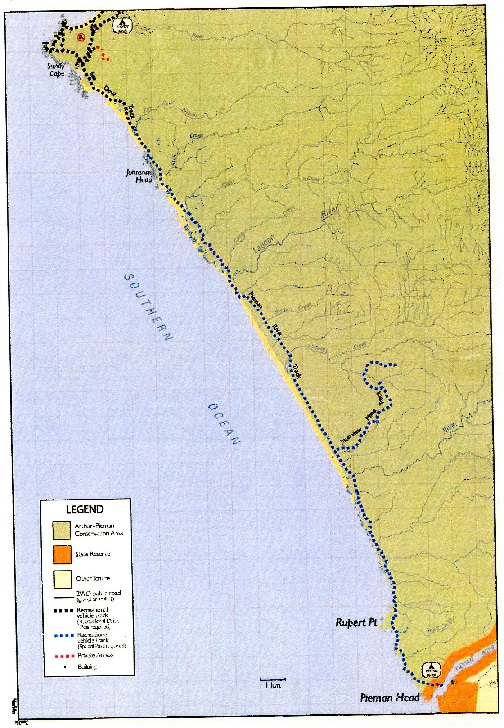
11 So that what was included as the Western Tasmania Aboriginal Cultural Landscape can be better understood, reference also should be had to the map in annexure HS2 to the affidavit of Ms Heather Sculthorpe. In short description, the map discloses that it is effectively a two-kilometre wide strip following the Western Coast of Tasmania with some minor excisions. Section 15B(4) of the EPBC Act provides:
A person must not take an action that has, will have or is likely to have a significant impact on the National Heritage values, to the extent that they are indigenous heritage values, of a National Heritage place.
12 It is not disputed and I find that considerable parts of, if not all of the tracks proposed for reopening and the works in relation thereto known as tracks 501, 503 and 601 are within an area included on the National Heritage List under the name of the Western Tasmania Aboriginal Cultural Landscape. A visual representation of the overlap between the tracks and the Western Tasmania Aboriginal Cultural Landscape can be seen in HS15, a further annexure to the affidavit of Ms Heather Sculthorpe. Nor is it disputed and I find that the relevant values protected are those which are inherently vulnerable and if damaged irreplaceable. I also find that in the past, considerable permanent damage has been done to aspects of that protected heritage or what is now protected heritage, particularly middens by their being driven over.
13 The evidence that I take into account in making that finding is that particularly at annexure HS7, which is titled “An Assessment of Vehicle Tracks between Greenes Creek and the Pieman River and their Impact on Aboriginal Heritage”, a report by Caleb Pedder, Colin Hughes and Jarrod Edwards, particularly pages 6 to 7. I refer in particular to passages at the bottom of page 6, which begins:
South of Johnston’s [sic] Head the Aboriginal heritage is extensive and as seen in the images at the end of this document are being driven over and impacted on a continual basis.
14 That report goes on to indicate that the Aboriginal middens are extensive, in some cases hundreds of metres in length. I also refer to HS6, which is titled “Arthur-Pieman Conservation Area: Sustainable Recreational Vehicle Access Report 2012”. The report has a preface that indicates that the report was prepared with reference to section 6.4 of the Arthur-Pieman Conservation Management Plan. It documents a system for the management of sustainable recreational vehicle access in the future. The passages that I refer to in relation to the past damage of important sites are those particularly at page 3, which sets out that in the area:
Important Aboriginal cultural heritage sites include Aboriginal “village” sites, hut mounds and depressions, ceremonial stone arrangements, rock engravings (petroglyphs), artefact scatters, burial sites and middens. Some middens are hundreds of metres in length[;]
and the passage at page 9, which says:
The majority of Aboriginal sites are located in sandy areas already impacted or vulnerable to vandalism, vehicle use and consequent erosion or compression. Some middens have been used as hardened areas to traverse dunes or as vehicle jumps.
15 It was that report which led to the earlier decision to close tracks 501, 503 and 601 in 2012. At page 35 of the report there are findings in relation to track 501 indicating that on that track a total of eight Aboriginal sites had been identified. “All of these sites are classified as shell midden deposits. In most instances the sites are extensive and comprise dense deposits of midden material. In virtually all instances there is evidence that the sites are stratified.” In relation to track status, the report recommends that the track be closed south of Johnson’s Head. “The cost of site specific recommendations for both natural and cultural heritage values are [sic] prohibitive.”
16 In respect of track 503, the report recommends the track be closed due to track 501 closure as access cannot be reached other than through that track. And in respect of track 601 the report notes a total of 12 Aboriginal heritage sites were identified along track 601. Ten of these sites are classified as shell middens, with the remaining two sites being stone artefact scatters. The report recommends that the track be closed for the reasons that:
Reassessment shows that numerous natural and cultural values are at threat from 4WDs.
Track to be closed due to track 501 closure south of Johnson’s Head.
17 In relation to prior damage, I also refer to the affidavit of Mr Adam Thompson, particularly at [12]-[14], and the photographs annexed, most particularly photograph 9, which, although the evidence is less than entirely certain, I infer was taken in the area of the track which is proposed to be reopened.
18 I turn now to the proposed actions which have generated this litigation. It is perhaps convenient to break the matters into the three parts that Mr Turner indicated. First, the policy issue; second, the effecting and carrying out of the policy design; and third, the issue of preparatory works. The first matter I refer to is the statement contained in annexure HS12. Insofar as it refers to the policy underpinning the specific actions that were in contemplation, I accept it to be a statement authorised on behalf of the Tasmanian government. The second paragraph reads:
By Christmas this year, recreational off-road vehicle drivers will be able to access the full length of the Arthur-Pieman conservation area from the Arthur River in the north to the Pieman River in the south.
Paragraph 4 reads:
The reopening of a 90 kilometre route along the remote, spectacular and wild West Coast will deliver one of the truly great off-road experiences on offer in Australia.
Paragraph 7 refers to an investment:
Our investment of $300,000 will ensure recreational off-road vehicle users will once again be able to enjoy one of Australia’s iconic off-road vehicle experiences, while the unique natural and cultural values in the Arthur-Pieman are appropriately managed and protected.
Paragraph 9 reads:
The funding we are providing will facilitate the re-routing of some tracks to ensure natural and cultural values are protected.
Paragraph 10 reads:
Access to this remote area will be subject to a range of conditions aimed at protecting the environmental and cultural values of the area. Conditions will include obtaining a special permit, adherence to strict rules around driver behaviour, and access only during the non-winter months. For visitor safety and to assist with compliance, GPS vehicle tracking units will be trialled.
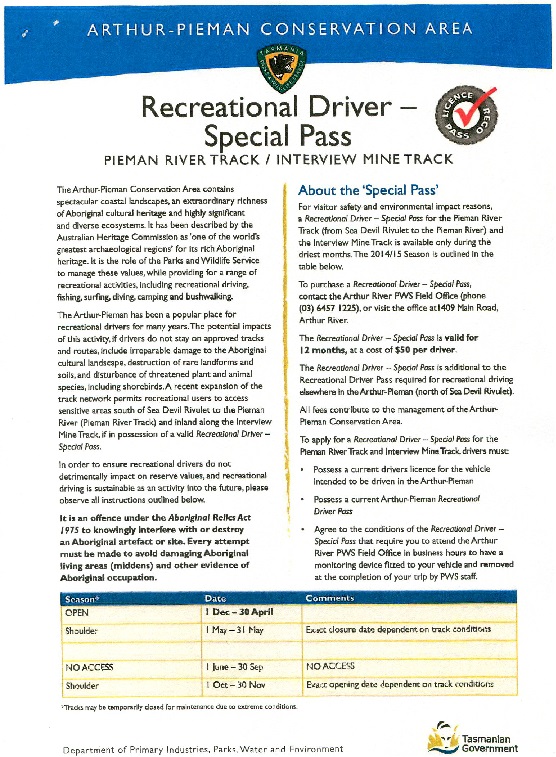
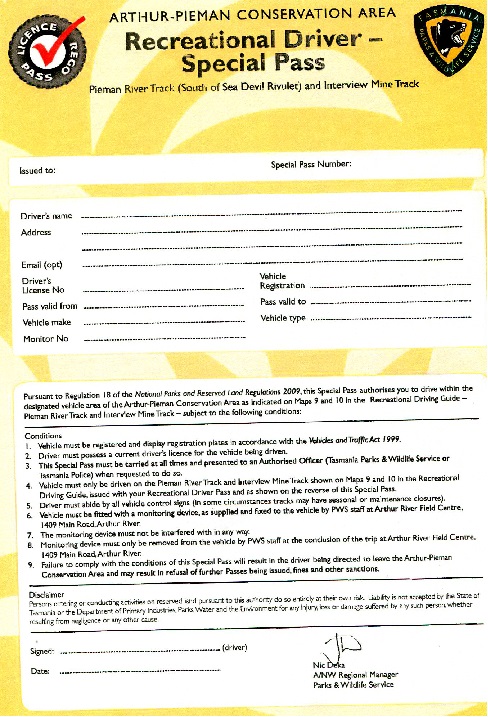
19 Mr Turner I think correctly described the above as the overarching policy decision. The first annexure to the affidavit of Mr Adam Thompson, AT1, sets out the proposed administrative arrangements for the issuing of recreational driver special pass authorisations and the application form for a recreational driver special pass. I annex the four pages of annexure AT1 to this judgment so that its full terms can be appreciated. However in summary it gives effect to the policy announcement of the Tasmanian government for an expansion of the track network to permit recreational users to access sensitive areas south of Sea Devil Rivulet to Pieman River and inland along the Interview Mine track if in possession of a valid recreational driver special pass.
20 The recreational driver special pass is issued by the Parks and Wildlife Service and valid for 12 months at a cost of $50 per driver. To apply for a recreational driver special pass a person must possess a current drivers licence for the vehicle intended to be driven in the Arthur-Pieman, possess a current Arthur-Pieman recreational driver pass, and agree to the conditions of the recreational driver special pass that require the person to attend the Arthur River Parks and Wildlife Service field office in business hours to have a monitoring device fitted to his or her vehicle and removed at the completion of his or her trip by Parks and Wildlife Service staff.
21 The administrative arrangements require that each vehicle travelling south of Sea Devil Rivulet must have a Parks and Wildlife Service monitoring device attached at all times. The device will track vehicle movements, which will demonstrate whether drivers are complying with the conditions of their pass. There are provisions about a bond and failure to return the device. The documentation also provides information about trip numbers. It states:
A precautionary approach is being taken to establish the number of vehicles the Pieman River and Interview Mine tracks can sustainably carry. For this reason the number of vehicles on these two tracks will be limited to 12 per day. This will help ensure visitor safety, and preserve the sense of remoteness, without overcrowding.
The application form repeats much of that information.
22 I turn now briefly to what has been undertaken by way of preparatory works. From the evidence given by Mr Adam Thompson, it appears clear that to date none of the works to reroute the tracks or to provide signage or otherwise ensure the protection of the cultural heritage of the areas traversed by the tracks has yet been undertaken. Paragraph 11 of Mr Thompson’s affidavit indicates that funds have been allocated to the Parks and Wildlife Service but the funding will not be available until the end of the financial year. The affidavit refers to statements of staff advising Mr Thompson that drivers are constantly removing the park signage, creating their own alternative routes going off existing tracks and driving through the dunes, middens and wetlands.
23 Parks staff had been considering methods to mitigate impact on Aboriginal heritage in these areas, including the use of rubber matting to lay over tracks that impact on heritage. They also planned to install posts to block access to areas and to install more signage.
24 Paragraph 13 indicates that staff at Arthur River advised Mr Thompson that they had not done any preparation work in the area proposed for the opening. I am prepared to make findings that insofar as mitigation strategies have been adopted, currently, they are restricted to the requirement that vehicles carry a GPS device and that the number of vehicles be restricted to no more than 12 per day. Any rerouting and signage and other associated works have yet to be undertaken. I note that there are references in Mr Thompson’s affidavit at [12] that GPS devices may be inaccurate but I am not prepared to make a finding that the devices would fail. The documents suggest they are accurate to two metres. To the extent open to me on the materials available, I find that, unless removed, a requirement that a vehicle carry a GPS tracking device, as proposed, will provide at least some significant information on the routes that will be taken by those vehicles.
25 However, there is no evidence to suggest that the resources are available to monitor whether or not the GPS devices have been removed. I also find that approved tracks in the areas are not clearly marked, and where they do currently exist, they occasionally pass over fragile sites of importance for indigenous heritage. I also find that because the approved tracks are not always clearly identified, and there are other vehicle tracks with appearances that they may be approved tracks, it is likely to be very difficult to take any retrospective enforcement action. The maps that the Parks and Wildlife Service proposes to provide to applicants for a recreational driver special pass are on such broad scale as to not specifically identify the precise location of the approved tracks.
26 I also find that while a limit of 12 vehicles per day will restrict potential numbers of recreational vehicles that would potentially damage indigenous landscape values, that restriction will not preclude damage occurring particularly given that neither signage nor rerouting of the tracks has yet to been undertaken. It is against that background that the applicant’s claims for an interlocutory injunction fall to be considered. I should do so in two parts: first, in relation to the intended reopening of the tracks; and, second, with respect to the proposed ameliorative works.
27 I turn first to the road reopening, putting aside the critical objection Mr Turner makes in reliance on s 524(2) of the EPBC Act that the respondents’ authorisation of recreational vehicle drivers to use the three tracks is not an action for the purposes of that Act (a question to which I must return). Subject to that objection I have reached the conclusion urged upon the court by Mr Niall for the applicant that reopening those tracks would be likely to have a significant and adverse impact on the indigenous heritage value of the Western Tasmania Aboriginal Cultural Landscape. The evidence is all in the same direction. The Court need not go so far as to accept the conclusions of the 2012 report that the cost of implementing site specific recommendations for the reopening of track 501 would be so great as to prohibit that occurring. But in the absence of better track marking, rerouting of the track so that it avoids middens and other mitigation measures having been undertaken, the conclusion Mr Niall pressed on behalf of the applicant appears impossible to resist. I note access to track 501 is essential in order to reach the other two tracks.
28 The unchallenged evidence is that even some proposed authorised sections of the track travel over easily damaged middens. The overlay maps, at annexure HS15, show where identified heritage sites and the proposed track overlap significantly. It is true, as Mr Turner submits, that the burden of establishing the likelihood of there being a significant impact rests on the appellant, but when pressed to put submissions that a finding to the contrary was open, and to identify any basis for that, Mr Turner was unable to assist the court further. I therefore find, subject to the legal issue yet to be determined in relation to s 524(2), that the applicant has established a strong prima facie case that an injunction to restrain the respondents from giving permission for vehicular access to the three tracks in issue has been established.
29 I now turn to the issue of works. Here the position appears to me to be quite different. It can be accepted that the evidence establishes that such works, although undertaken for the purpose of protecting the area’s cultural values, themselves, potentially, might have significant adverse impacts on those same indigenous cultural or heritage values. For example, in cross-examination, Mr Thompson, responding to questions from Mr Turner, put with what I understand to be a view of obtaining his assent to the proposition that ameliorative works would be benign, observed that matting over middens would “diminish the aesthetics of the area and it would reduce the Aboriginal community’s ability to, I guess, connect with that place”. Ms Sculthorpe made the point that some mitigation measures “in themselves do destroy parts of what they’re seeking to protect”, while also accepting (as did Mr Thompson) Mr Turner’s larger proposition that if the tracks were to be reopened such measures would be preferable to none.
30 However, while their evidence establishes the possibility that some such works might cause adverse impacts to the cultural values of the Western Tasmania Aboriginal Cultural Landscape it falls significantly short of providing a proper basis for the Court to be satisfied that an injunction should issue to prevent all future preparatory works taking place.
31 Mr Turner properly drew the Court’s attention to the provisions of the Aboriginal Relics Act 1975 (Tas), which Act provides a framework which prohibits the disturbance of any Aboriginal relics without a permit. The Court has no grounds to proceed otherwise than on the basis that the regulatory regime provided for under the Aboriginal Relics Act 1975 (Tas) whereby permits must be obtained for any disturbance of Aboriginal relics will be complied with by the Parks and Wildlife Service and such approvals will be obtained before any works that would disturb such sites are undertaken. In the end, it may be, as the 2012 report suggests it would be, a prohibitively expensive course to ensure adequate protection so as to permit the opening of the tracks for vehicular traffic without that causing significant impacts on the indigenous cultural values of the area. But it is not open to the Court to substitute speculation for evidence that the rerouting of tracks or putting up fences or signage, would be undertaken otherwise than in conformity with the values protected both by the listing of the area on the National Heritage List for its indigenous values and as provided for under the Aboriginal Relics Act 1975 (Tas).
32 The remaining issue, therefore, is whether in light of the findings that I have made that there is a strong prima facie case that the conduct proposed to be undertaken by the respondents, by permitting vehicular access, would have a significant impact on the cultural heritage values, there are any reasons that should stand in the way of this Court restraining access to the track, pending the determination of the action brought by the applicant.
33 The principles that govern the grant or refusal of interlocutory relief are relatively well settled. A recent summary of these principles appears in Cayzer v Minister for Immigration and Border Protection (No 2) [2014] FCA 1283:
[5] In Australian Broadcasting Corporation v O’Neill [2006] HCA 46; (2006) 227 CLR 57 Gummow and Hayne JJ, with whom the Gleeson CJ and Crennan J agreed explained at [71] that the decision of American Cyanamid Co v Ethicon Ltd [1975] UKHL 1; [1975] AC 396 in which Lord Diplock had stated that ‘unless the material available to the court at the hearing of the application for an interlocutory injunction fails to disclose that the plaintiff has any real prospect of succeeding in his claim for a permanent injunction at the trial, the court should go on to consider [the balance of convenience]’ does not accord with Australian doctrine and should not be followed.
[6] Their Honours restated that the relevant principles for Australia are those explained in Beecham Group Ltd v Bristol Laboratories Pty Ltd [1968] HCA 1; (1968) 118 CLR 618:
[65] The relevant principles in Australia are those explained in Beecham Group Ltd v Bristol Laboratories Pty Ltd. This Court (Kitto, Taylor, Menzies and Owen JJ) said that on such applications the court addresses itself to two main inquiries and continued:
“The first is whether the plaintiff has made out a prima facie case, in the sense that if the evidence remains as it is there is a probability that at the trial of the action the plaintiff will be held entitled to relief … The second enquiry is … whether the inconvenience or injury which the plaintiff would be likely to suffer if an injunction were refused outweighs or is outweighed by the injury which the defendant would suffer if an injunction were granted.”
By using the phrase “prima facie case”, their Honours did not mean that the plaintiff must show that it is more probable than not that at trial the plaintiff will succeed; it is sufficient that the plaintiff show a sufficient likelihood of success to justify in the circumstances the preservation of the status quo pending the trial. That this was the sense in which the Court was referring to the notion of a prima facie case is apparent from an observation to that effect made by Kitto J in the course of argument. With reference to the first inquiry, the Court continued, in a statement of central importance for this appeal:
“How strong the probability needs to be depends, no doubt, upon the nature of the rights [the plaintiff] asserts and the practical consequences likely to flow from the order he seeks.” (citations omitted)
[7] Thus ABC v O’Neill explicitly reconfirms what had been said by Kitto J in Beecham to the effect that how strong the probability needs to be depends on the nature of the rights the plaintiff asserts and the practical consequences likely to flow from the order sought. Cases subsequent to Beecham in this Court have therefore proceeded on the basis that a more doubtful claim, which nevertheless raises a serious question to be tried, may still attract interlocutory relief if there is a marked balance of convenience in favour of it: Bullock v Federated Furnishing Trades Society of Australasia (No 1) [1985] FCA 19; (1985) 5 FCR 464 at 472 (Woodward J, Smithers and Sweeney JJ agreeing). Other courts have also approached the exercise of the discretion to issue or not issue an interlocutory injunction upon the same principle.
34 Mr Turner submits that there is no serious issue to be tried because s 524(2) of the EPBC Act specifically excludes from the reach of s 15B(4) any “decision taken by a government body to grant a governmental authorisation (however described) for another person to take an action”. Such decisions are not “actions” for the purposes of the EPBC Act.
35 Mr Turner referred the court to the National Parks and Reserves Management Act 2002 (Tas) which makes provision for regulations in respect of reserve lands and to the regulations made thereunder, including reg 18 of the National Parks and Reserved Land Regulations 2009 (Tas). Regulation 18 provides, inter alia:
(1) The managing authority may designate areas for the driving of vehicles on reserved land in the class of conservation area, regional reserve or nature reservation area.
(2) A person must not a drive a vehicle on any reserved land except –
(a) on a road on that reserved land; or
(b) in a designated vehicle area.
Penalty:
Fine not exceeding 20 penalty units.
36 Mr Turner also referred the court to the provisions in the regulations which provide for various delegations and providing authorisation for the closure of roads, authorisations of actions including that a person who has been granted an authority that authorises an act or omission that would otherwise constitute the alleged offence and was acting in accordance with the authority at the time of the alleged offence is not guilty of an offence: regs 19 and 25.
37 Accordingly Mr Turner submits that the issue of a permit to a driver authorising that driver to drive his or her recreational vehicle on the relevant tracks falls directly within the language of s 524(2). In his submission the grant of such a permit is a decision made by a government body granting a governmental authority to the driver to take an action; that action being to drive on those tracks.
38 Any conduct falling within that description cannot be an action for the purposes of the EPBC Act, including those that are referred to and relied by the applicant in relation to s 15B(4). Mr Turner cited the decision in Save the Ridge Inc v Commonwealth [2005] FCAFC 203; (2005) 147 FCR 97 as clear authority for that proposition.
39 Mr Niall responded (a) that the law was not as clear as Mr Turner suggested, citing the disinclination of Black CJ and Moore J to answer the first question in Save the Ridge; (b) the respondent would be simply permitting drivers to enter on the land such that the authority conferred by a permit was not to be correctly understood as a “governmental authorisation”; and (c) to the extent that interlocutory relief was unavailable directly pursuant to s 475 an injunction could, in any case, issue pursuant to s 23 of the Federal Court of Australia Act 1976 in order to preserve the subject matter of the controversy and to effectively prevent unlawful conduct, as to which Mr Niall referred to s 480 of the EPBC Act as a reason to support that conclusion. That section provides that the powers in s 475 to issue an injunction do not otherwise limit the powers of the Federal Court of Australia.
40 Mr Niall submitted that s 23 of the Federal Court of Australia Act 1976 could be availed of to prevent a party facilitating the unlawful conduct of a third party. In that regard he cited Patrick Stevedores Operations No 2 Pty Ltd v Maritime Union of Australia (1998) 195 CLR 1, particularly at [26] and [35]. Finally, Mr Niall submitted that the court need only be satisfied that the applicant had raised an arguable case. It was not necessary for the court to be satisfied that, at the ultimate hearing of the case, it would be determined in favour of the applicant.
41 In response, Mr Turner submitted with respect to the issues relating to s 23 of the Federal Court of Australia Act 1976 that the issues in Patrick Stevedores Operations No 2 Pty Ltd v Maritime Union of Australia involved a conspiracy rather than a matter explicitly excluded as an action by the very statute which engaged the right to relief.
42 How to resolve the conflicting contentions of counsel regarding the construction of s 524(2) and its application, if relevant, to s 15B(4) lies at the heart of this case. To assist in its resolution, I adopt what was said by the Full Court of the Federal Court of Australia in Samson Maritime Pty Ltd v Aucote [2014] FCAFC 182 at [27] as to the relevant principles of statutory interpretation and by analogy apply their Honours’ reasoning to this case.
43 By reference to that statement, EPBC Act s 524(2):
must be read having regard to the principles of statutory construction explained by McHugh, Gummow, Kirby and Hayne JJ in Project Blue Sky Inc v Australian Broadcasting Authority [1998] HCA 28; (1998) 194 CLR 355 at 381-382 [69]-[71]. Their Honours emphasised that the context of the provision being construed must be examined, and applied what Dixon CJ had said in Commissioner for Railways (NSW) v Agalianos [1955] HCA 27; (1955) 92 CLR 390 at 397, namely that “the context, the general purpose and policy of a provision and its consistency and fairness are surer guides to its meaning than the logic with which it is constructed”. They also explained that a legislative instrument must be construed on the prima facie basis that its provisions are intended to give effect to harmonious goals. They said (198 CLR at 382 [70]-[71]):
Where conflict appears to arise from the language of particular provisions, the conflict must be alleviated, so far as possible, by adjusting the meaning of the competing provisions to achieve that result which will best give effect to the purpose and language of those provisions while maintaining the unity of all the statutory provisions (See Australian Alliance Assurance Co Ltd v Attorney-General (Q) [1916] St R Qd 135 at 161, per Cooper CJ; Minister for Resources v Dover Fisheries Pty Ltd (1993) 43 FCR 565 at 574, per Gummow J). Reconciling conflicting provisions will often require the court “to determine which is the leading provision and which the subordinate provision, and which must give way to the other” (Institute of Patent Agents v Lockwood [1894] AC 347 at 360, per Lord Herschell LC). Only by determining the hierarchy of the provisions will it be possible in many cases to give each provision the meaning which best gives effect to its purpose and language while maintaining the unity of the statutory scheme.
Furthermore, a court construing a statutory provision must strive to give meaning to every word of the provision (The Commonwealth v Baume (1905) 2 CLR 405 at 414, per Griffith CJ; at 419, per O'Connor J; Chu Kheng Lim v Minister for Immigration Local Government & Ethnic Affairs (1992) 176 CLR 1 at 12-13, per Mason CJ). In The Commonwealth v Baume ((1905) 2 CLR 405 at 414) Griffith CJ cited R v Berchet ((1688) 1 Show KB 106 [89 ER 480]) to support the proposition that it was “a known rule in the interpretation of Statutes that such a sense is to be made upon the whole as that no clause, sentence, or word shall prove superfluous, void, or insignificant, if by any other construction they may all be made useful and pertinent”.
44 Contrary to Mr Turner’s submissions, with those principles in mind, I am not persuaded that this Court clearly lacks authority to grant an injunction in the present circumstances. In Forestry Tasmania v Brown [2007] FCAFC 186; (2007) 167 FCR 34, a case subsequent to Save the Ridge, a Full Court of the Federal Court of Australia specifically left open the issue of what might constitute a “governmental authorisation”. At [102] Sundberg, Finkelstein and Dowsett JJ spoke as follows:
The parties and the primary judge appear to have assumed that once it was decided that the appellant was “an agency of a State” within the definition of “government body” in s 524(1), anything it permitted someone else to do was a governmental authorisation. The words of s 524(2) are “a decision by a government body to grant a governmental authorisation” and not “a decision by a government body to grant an authorisation”. It seems therefore that the government body’s authorisation must be of a governmental nature in order to be a governmental authorisation. That is to say, it must be something that only a government can do. It may be that the grant of the right to enter upon Crown land to conduct forestry activities is of a governmental nature. The significance of the word “governmental” was raised by the bench, but the parties did not join issue on it, and accordingly we do not decide the point. Our present concern is to draw attention to what seems to us to be a necessary step before s 524(2) can be relied on, namely that the authorisation granted by a government body be of a governmental nature.
45 The observations of the Full Court in Forestry Tasmania v Brown that a “governmental authorisation” must be something only a government can do, would appear to be consistent with the observations in Project Blue Sky regarding the importance of striving to give each word in s 524(2) meaning. And, reading the statute insofar as is open, in order to effect harmonious goals, it can hardly be disputed that the overarching goals of the EPBC Act are those which are designed to prevent harms coming to areas which are protected by various reservations, including those under the National Heritage List.
46 It seems to me therefore that orthodox principles of statutory interpretation do not foreclose the argument put by Mr Niall, that the authority proposed to be granted by the respondent to a permit holder is not caught by s 524(2) for the reason that it is not something that only a government can do. It would be open to any land owner to permit entry and access to his or her lands. Doing so does not involve any element of “governmental authority”.
47 I do not need to find that such an argument would ultimately be upheld, but in the light of the comments by the Full Court in Forestry Tasmania v Brown I cannot dismiss that contention as frivolous or as other than a serious point entitled to be argued fully at trial.
48 I am less persuaded of the merits of an argument based on an asserted power of the court under s 23 of the Federal Court of Australia Act 1976. For the reasons advanced by Mr Turner, an argument to that effect in my opinion is insufficiently persuasive for it to reach the standard required by the Beecham test for the issue of an interlocutory injunction. However, having reached the conclusion I have in relation to the argument based on governmental authorisation, subject to consideration of the issues of balance of convenience, the circumstances appear to me to justify the issue of an injunction.
49 I turn therefore to consider the balance of convenience. It appears to me the balance of convenience also falls in favour of the grant of an injunction, limited to those issues relating to the entry of vehicles, but not preventing the respondents from proceeding with such works as they may be advised to place the tracks in a condition whereby the objections that have been made against their use could not be further maintained. The reason why I conclude that the balance of convenience falls in favour of the grant of an injunction, is that the status quo is at present that there are no permits and there are no bookings. No ameliorative work has commenced or has been undertaken. The funding for that work has yet to be provided. The respondents will suffer only a small financial loss if the injunction goes. That is, $50 per permit. And in respect of those who would hope to have access to the track, a very small number of vehicles, no more than 12 per day, are likely to be affected before the final determination of the merits of the substantive proceeding.
50 I do not discount the inchoate considerations that Mr Turner referred me to. A decision to grant a interlocutory injunction will undoubtedly impact on those who, in the course of the 2014-15 summer, would have wished to take their recreational vehicles into the area, which is on the National Heritage List, and designated as the Western Tasmania Aboriginal Cultural Landscape. However, as against that consideration, the evidence of substantial impact on the National Heritage values of the site by the tracks’ reopening seems to be clear.
51 Finally, the court was invited to take into account, and give weight to, the policy objectives expressed in annexure HS12 to Ms Sculthorpe’s affidavit. For the reasons I expressed in reply to Mr Turner, when he advanced that proposition during the hearing of this proceeding, I am not persuaded that it is a valid consideration to take into account. Merits of policy are for governments, not the courts.
52 Accordingly even if it might be contended (which I do not accept) that the strength of the argument in relation to governmental action is less than I have thought, it would appear to me to fall within that class of matters where if there is a marked balance of convenience in favour of it, even if it is a more doubtful claim, as was the case in Bullock v Federated Furnishing Trades Society of Australasia (No 1), an injunction may still issue.
53 I will hear counsel with respect to the final form of the injunction to be issued, and in respect of a timetable for the substantive hearing of this application. That hearing will of course be before a judge other than myself.
I certify that the preceding fifty-three (53) numbered paragraphs are a true copy of the Reasons for Judgment herein of the Honourable Justice Kerr. |
Associate:
Dated: 14 January 2015
Annexure AT1