Pacific Enterprises (Aust) Pty Ltd v Bernen Pty Ltd [2014] FCA 1372
IN THE FEDERAL COURT OF AUSTRALIA | |
PACIFIC ENTERPRISES (AUST) PTY LTD First Applicant PACIFIC HOLDINGS (AUST) PTY LTD (ACN 146 091 152) Second Applicant | |
AND: | First Respondent MR QI (ROBERT) LI Second Respondent |
DATE OF ORDER: | 16 December 2014 |
WHERE MADE: |
THE COURT ORDERS THAT:
1. The Applicants have leave to file a Notice of Discontinuance with respect to the claim for infringement of Australian Innovation Patent No 2013100793 (the Chainwinder Patent).
2. Save as previously ordered, each party bear its own costs of the proceedings with respect to the Chainwinder Patent.
3. There be judgment against the Second Respondent for infringement of Australian Innovation Patent No 2013100937 (the Casement Winder Patent).
4. The Respondents pay to the Applicants the sum of $395,487.16 (comprising $355,487.16 by way of compensatory damages for infringement of the Casement Winder Patent and $40,000 by way of additional damages for infringement of the Casement Winder Patent).
5. The Respondents pay the Applicants the costs of and incidental to the proceedings with respect to the Casement Winder Patent to be taxed if not agreed.
6. The Applicants calculate and provide to the Court a note of the interest payable under s 51A(1)(a) of the Federal Court of Australia Act 1976 (Cth) on the amount of compensatory damages referred to in order 4.
Note: Entry of orders is dealt with in Rule 39.32 of the Federal Court Rules 2011.
VICTORIA DISTRICT REGISTRY | |
GENERAL DIVISION | VID 188 of 2014 |
BETWEEN: | PACIFIC ENTERPRISES (AUST) PTY LTD First Applicant PACIFIC HOLDINGS (AUST) PTY LTD (ACN 146 091 152) Second Applicant |
AND: | BERNEN PTY LTD First Respondent MR QI (ROBERT) LI Second Respondent |
JUDGE: | PAGONE J |
DATE: | 16 December 2014 |
PLACE: | MELBOURNE |
REASONS FOR JUDGMENT
1 The applicants (who may collectively be referred to as “Pacific”) seek relief against the respondents for infringement of Australian Innovation Patents numbered 2013100937 (“Pacific’s casement winder patent”) and 2013100793 (“the chainwinder patent”). Pacific has previously obtained judgment against the first respondent (“Bernen”) on the admissions on the pleadings with respect to infringement of the casement winder patent and has elected to discontinue its claim for infringement of the chainwinder patent, but maintains its claim for damages in the proceeding in respect of the casement winder patent from both Bernen and Mr Robert Li, the second respondent, who is the sole director and sole shareholder of Bernen. The other issue remaining in the proceeding is the claim by Pacific that Mr Robert Li was liable for authorising Bernen’s infringement of the casement winder patent.
2 There was no appearance for either Bernen or Mr Robert Li at the trial of the proceeding although both had been represented at earlier directions hearings by Watermark Intellectual Property Lawyers and had filed a joint defence. Watermark filed a notice on 2 October 2014 of ceasing to act as lawyer for Bernen and Mr Robert Li and gave an address for Bernen and Mr Robert Li as their last known residential or business address. The solicitors for Pacific have since served all relevant documents upon the respondents at that address in accordance with the Federal Court Rules 2011 (Cth): see r 10.31(b) and the definition of a “person’s proper address” in Schedule 1 to the Rules.
3 Pacific’s claim against Mr Robert Li of infringement was brought against him both as a joint tortfeasor with Bernen as well as the person who authorised Bernen’s infringement. Counsel for Pacific decided during the hearing not to pursue the claim against Mr Robert Li as a joint tortfeasor but maintained the claim that Mr Robert Li had authorised Bernen’s infringement. Pacific’s case of infringement against Bernen had previously been established from the respondents’ admissions on the pleadings. The respondents have admitted Pacific’s casement winder patent and that Bernen had imported, sold and offered to sell a casement winder (“the Bernen casement winder”) between March 2013 and about 21 February 2014 which had each and every integer of claims 1 to 5 (inclusive) of Pacific’s casement winder patent. The respondents’ pleading in response to Pacific’s allegation of infringement was not a denial of infringement but a pleading that by reason of certain matters referred to in paragraph 6 of the defence they “did not know and therefore [could not] admit the allegations” of infringement. The matters pleaded in paragraph 6 of the defence, however, contained an admission that Pacific’s casement winder patent had been at all times registered in the Register of Patents. Paragraph 6 of the defence went on to say that the respondents did not otherwise know and could not admit that the patent was at all material times valid and subsisting, but the validity and subsistence of Pacific’s casement winder patent was effectively admitted by other admissions in the defence, namely: that the patent had been filed on 9 July 2013 and had been granted on 25 July 2013; that it had been open for public inspection on 8 August 2013 and had been certified on 13 January 2014; and that it had a term of 8 years commencing on 6 October 2006 with that as the priority date in respect of each claim.
4 Mr Robert Li’s liability for authorising Bernen’s infringing conduct can similarly be established from the admissions on the pleadings. One of the exclusive rights given to Pacific by s 13(1) of the Patents Act 1990 (Cth) was to authorise another person to exploit the invention. Bernen’s importation and sale of the Bernen casement winder infringed Pacific’s entitlement and Bernen’s exploitation of Pacific’s invention was unlawfully authorised by Mr Robert Li. In addition to the admissions set out in the previous paragraph, Mr Robert Li admitted that he was at all material times the sole shareholder, and sole director, of Bernen. He admitted that he was at all material times in effective control of Bernen and of its actions. He admitted that he was at all material times solely responsible for or directly involved in the day-to-day management of Bernen including the importation, marketing, promotion and supply of the Bernen casement winders. Mr Robert Li’s admissions on the pleadings were supported by an affidavit which had been filed before the trial and which was relied upon by Pacific. On 15 August 2014 Mr Robert Li affirmed an affidavit in which he stated that from January 2013 to March 2014 Bernen imported 4,900 Bernen casement winders and had sold or supplied to A&L Windows Pty Ltd (“A&L”) that number of Bernen casement winders. The pleadings and evidence before me establishes that Mr Robert Li authorised Bernen’s infringement as the person who “personally directed the acts which constituted the infringement”: see Kimberly-Clark Australia Pty Ltd v Arico Trading International Pty Ltd (1998) 42 IPR 111, 129; see also Inverness Medical Switzerland GmbH v MDS Diagnostics Pty Ltd (2010) 85 IPR 525, [203]. Pacific is, therefore, entitled to judgment against Mr Robert Li for authorising Bernen’s infringement of the casement winder patent.
5 The next matter to consider is Pacific’s claim for damages. Pacific seeks damages against Bernen and Mr Robert Li totalling $355,487.16 under several heads as well as a claim for an additional amount under s 122(1A) of the Patents Act 1990 (Cth). The award of damages should, as far as possible, restore Pacific to the position it would have been in had the infringements not occurred: see Pearce v Paul Kingston Pty Ltd (1992) 25 IPR 591, 592; General Tire & Rubber Co v Firestone Tyre & Rubber Co Ltd [1976] RPC 197, 212. That would generally require the assessment of damages by reference to a common sense causal link between the infringing conduct and the loss suffered: see Bitech Engineering v Garth Living Pty Ltd [2013] FCA 822, [75]; Catnic Components Ltd v Hill & Smith Ltd [1983] FSR 512, 521; Gerber Garment Technology Inc v Lectra Systems Ltd [1997] RPC 443; Ultraframe (UK) Ltd v Eurocell Building Plastics Ltd [2006] EWHC 1344 (Pat), [47].
6 Pacific’s first head of damages is for lost profits of $87,661. That claim is for the sales which Bernen made to A&L and which, therefore, Pacific lost. Pacific had been the exclusive supplier of its casement winders and associated components to A&L. The winders had been developed to suit A&L’s specific casement windows and Pacific had continuously supplied its casement winders and associated components to A&L between July 2007 and April 2013. There had been no industry competitors selling competing non-infringing products to that customer until Bernen started making sales to A&L. Pacific has made no sale of its casement winders to A&L since the infringing sales to that company by Bernen.
7 The lost sales included the loss of sales of components which were typically sold with the patented items such as folding operator handles, single arm operator tracks, sash locks, and sash lock keepers. In Gerber Garment Technology Inc v Lectra Systems Ltd [1997] RPC 443, the Court of Appeal rejected an argument that a patentee was limited in the recovery of profits to the activities for which a patent provides a monopoly. Staughton LJ said at 451:
Mr Hobbs submits that the damages which a patentee can recover from an infringer by way of loss of profits are limited to the profits that would have been earned in activities for which the patent provides a monopoly. In other words, any activities of the infringer that do not in themselves constitute infringements cannot form part of a claim for lost profits. For the purpose of the present case, that submission would disqualify the claim in respect of the CAD systems. They could be sold by the infringers without infringing any right of the patentee; they are not within section 60(2) and (3); at most they are what are called convoyed goods (or “fellow travellers” as I would say), because they are commonly sold together with the patented product. The argument also extends to spare parts, servicing, and the springboard damages which relate to goods sold after the patent has expired.
There is no such limitation to be found in the [UK] Patents Act.
There is similarly no limitation found in the Patents Act 1990 (Cth). At 452 Staugton LJ said:
Infringement of a patent is a statutory tort; and in the ordinary way one would expect the damages recoverable to be governed by the same rules as with many or most other torts. We were referred to Halsbury’s Laws of England (4th edn) vol. 12 para 1128 and following, to establish the elementary rules (1) that the overriding principle is that the victim should be restored to the position he would have been in if no wrong had been done, and (2) that the victim can recover loss which was (i) foreseeable (ii) caused by the wrong, and (iii) not excluded from recovery by public or social policy.
Pacific’s patented product is sold with other components as an entire, or “whole”, unit. The patented product is a casement winder of a type that enables the opening and closing of casement windows with hinges on the side of the window frame which open out to the right or to the left. The casement windows are installed on window sills with a track to fit with the winder which is installed on the window sash. A pivoting arm extends from the winder, and the end of the arm is locked on the track. Winding of the handle on the winder results in the arm pivoting outwards to open the window with the end of the pivot arm sliding in the track as the window opens. The patented winder is lockable using a key cylinder for additional security. Every Pacific casement winder is installed with a key, a handle, a track and at least one sash lock, with each of these components generally being supplied by Pacific as part of the whole units. The evidence tendered for Pacific was also that at least one sash lock was provided on each window to help secure the window higher up on the window frame and that multiple sash locks were often provided for large casement windows.
8 Bernen sold 4,900 “whole” units of infringing items to A&L between January 2013 and March 2014. The reference to “whole” units is a reference to the sale of the patented item together with the accompanying components (that is, the “fellow travellers” referred to by Staughton LJ in Gerber). Pacific, therefore, lost the profits for the whole units which were sold by Bernen to Pacific’s former customer for whom the windows were developed. Pacific’s evidence concerning the quantum of its lost profit from the sale of whole units was of a unit loss of $17.89. That was calculated by first calculating the total unit price of $27.61 for the Pacific casement winder, handle, track, sash lock and sash lock keeper. From that was subtracted the cost of $8.84 to Pacific of the casement winders and associated components as charged by the suppliers (using an average exchange rate of 5.82 during the period from January 2013 to March 2014). An amount of 10% was added to the cost component as the cost of shipping and transport of the product. The resultant cost amount of $9.72 was subtracted from the sale price per unit of $27.61 to produce the unit profit of $17.89. In total, therefore, Pacific’s lost profits represented by the 4,900 whole units sold by Bernen was $87,661 to which they are entitled as damages.
9 The claim for lost profit also included an amount for the loss of sales of whole units for the period between April 2014 and 6 October 2014. The former date is that from which Bernen ceased to import and sell infringing items to A&L and the latter date is the end of the term of the patent. Pacific had exclusive rights in the product by virtue of the patent during that period and could reasonably have expected to have manufactured and sold its units to A&L at least up to the expiry of its patent on 6 October 2014, as it had been doing since July 2007. The evidence for Pacific was that it could expect to sell in the six month period between April 2014 and October 2014 the same average number of units as Bernen had been selling to A&L between January 2013 and March 2014, namely, a total of 4,900 “whole units” being an average of 326.67 whole units per month. It was reasonably foreseeable on the evidence that a number of whole units would have been sold by Pacific to A&L between the period when Bernen ceased its infringing sales and the expiry of the patent on 6 October 2014. The average sales during the preceding period provides a reasonable foundation for estimating the expected sales which Pacific could have had until the patent expired and, accordingly, its lost profits for that period is $35,064.40 calculated by reference to the unit profit of $17.89 as previously explained, to which it is also entitled as damages.
10 The second head of damages claimed by Pacific was for the cost of surplus stock held by Pacific which it was unable to sell because of the infringing conduct. Pacific had sold its patented product, and associated items, only to A&L, and maintained surplus stock to meet expected orders. The products had been produced for Pacific by the Chinese factory Ningbo Eastlake Tourist Resort Pacific Hardware Co (“Ningbo”) in Zhejiang Province in China. Pacific had a supply arrangement with A&L for Pacific to keep stock on hand sufficient to satisfy A&L’s requirements for a minimum period of three months to be delivered on the basis of daily notice. Mr Robert Li had been employed by Pacific as a marketing manager until 14 September 2007. A key part of Mr Robert Li’s role with Pacific involved him in contact with major clients including A&L. It was foreseeable, and may be inferred to have been foreseen by Mr Robert Li (see LJ Fisher & Co Ltd v Fabtile Industries Pty Ltd (1978) 1A IPR 565, 568), that a consequence of the infringement would have been that Pacific was unable to sell its surplus stock to A&L. The cost to Pacific of that surplus stock was $19,351.65, being the cost of $11,292.93 for the surplus casement winders, $3,381 for the handles, $1,251.20 for the tracks, $2,598.75 for the surplus sash locks and $827.77 for the surplus sash lock keepers. Pacific is entitled to those amounts as damages.
11 The third head of damages claimed by Pacific was for the cost of retooling. Pacific had used Ningbo to manufacture its casement winders until Ningbo began to manufacture the infringing items for Bernen. Pacific had designed the tooling for each of its products and had invested in the development of that tooling at the Ningbo factory over several years. The fact that Ningbo thereafter manufactured the infringing items at the request of Pacific’s former employee resulted in Pacific’s total loss of trust in its relationship with Ningbo. A consequence of the infringement, and of the loss of trust, was that Pacific immediately stopped using Ningbo to manufacture any of its products, including the casement winder. The evidence for Pacific was that it was not possible to remove its tooling from Ningbo after the manufacture of the infringing products for Bernen and that Pacific was therefore required to reinvest in extensive tooling with another manufacturer to manufacture the same range of products. Pacific’s evidence was that it incurred costs of $40,613.72 for retooling with respect to the Pacific casement winder and associated components, and a further $99,097.47 for retooling with respect to other Pacific products. The evidence in this case justifies the finding that the whole of those retooling costs were reasonably foreseeable results of the respondents’ conduct and that Pacific is entitled to those costs as damages. It was reasonably foreseeable that Pacific would lose trust in Ningbo as its manufacturer in circumstances where Ningbo had manufactured infringing product for Bernen at Mr Robert Li’s request.
12 The fourth head of damages was for the additional costs Pacific incurred in air freighting products during a period of temporary shortage of stock. This loss was occasioned by Pacific’s decision no longer to use Ningbo for the manufacture of its other products and the consequential necessity to develop new tooling for manufacture of its products by another company. The need to have an alternative manufacturer resulted in a delay to Pacific in obtaining stock until the new manufacturer was able to supply Pacific with stock. Pacific, therefore, ran short on stock of many of its products and suffered loss of sales. Pacific dealt with this delay (which also had the effect of mitigating its losses) by importing products by air freight for a few months at greater cost than it could pass on to its customers and at greater cost than it would have incurred had it been able to import product by sea freight as it had done in the past. The additional cost thus incurred was calculated for Pacific at $73,698.92 and will be included in its damages. This was the difference between its air freight costs for the period between mid-August 2013 to mid-September 2013 less its estimated sea freight costs per month at $2,000 on an average of two containers per month.
13 Pacific also claims additional amounts in the assessment of damages under s 122(1A) of the Patents Act 1990 (Cth). That section provides:
(1A) A court may include an additional amount in an assessment of damages for an infringement of a patent, if the court considers it appropriate to do so having regard to:
(a) the flagrancy of the infringement; and
(b) the need to deter similar infringements of patents; and
(c) the conduct of the party that infringed the patent that occurred:
(i) after the act constituting the infringement; or
(ii) after that party was informed that it had allegedly infringed the patent; and
(d) any benefit shown to have accrued to that party because of the infringement; and
(e) all other relevant matters.
This provision was introduced in 2007 and has received limited judicial consideration. In Zetco Pty Ltd v Austworld Commodities Pty Ltd (No 2) [2011] FCA 848 Bennett J said at [267] that more than copying needs to be shown to enliven the application of s 122(1A):
More than copying is required to enliven the application of s 122(1A). Patent infringement may occur whether or not there is copying. However, deliberate copying may be relevant to a decision whether to award additional damages. As in the application of s 115(4) of the Copyright Act 1968 (Cth), there must be an additional element to the infringing conduct to warrant additional damages (as in Raben Footwear Pty Ltd v Polygram Records Inc (1997) 75 FCR 88 at 93 per Burchett J and 103-104 per Tamberlin J and Sullivan v FNH Investments Pty Ltd (2003) 57 IPR 63 at [91]). Austworld maintains that there is no evidence of flagrancy of infringement or of a calculated disregard of Zetco’s rights to enliven the Court’s discretion to award such damages (MJA Scientifics International Pty Ltd v SC Johnson & Son Pty Ltd (1998) 43 IPR 275 at 281-282).
In this case Pacific contended that an additional amount of about $300,000 should be awarded having regard to the matters listed in the provision. It maintained that the infringement was “an extreme example of flagrant infringement” with the respondents having made “no attempt whatsoever to design around Pacific’s patent rights”. It submitted that the Bernen casement winder was not merely a direct and deliberate copy of Pacific’s product but was essentially the same product, and that examination of the Bernen casement winder showed that “all of its components were identical to the Pacific casement winder, even down to the ‘Aust. Patent Pending’ mark on the base plate”. The flagrancy of the infringement was also said to be in the fact that the infringing items were produced by the same factory as had produced Pacific’s patented items, were sold to the same customer for whom the patented product had been developed, and had been sold to that customer by Mr Robert Li who had been a former employee.
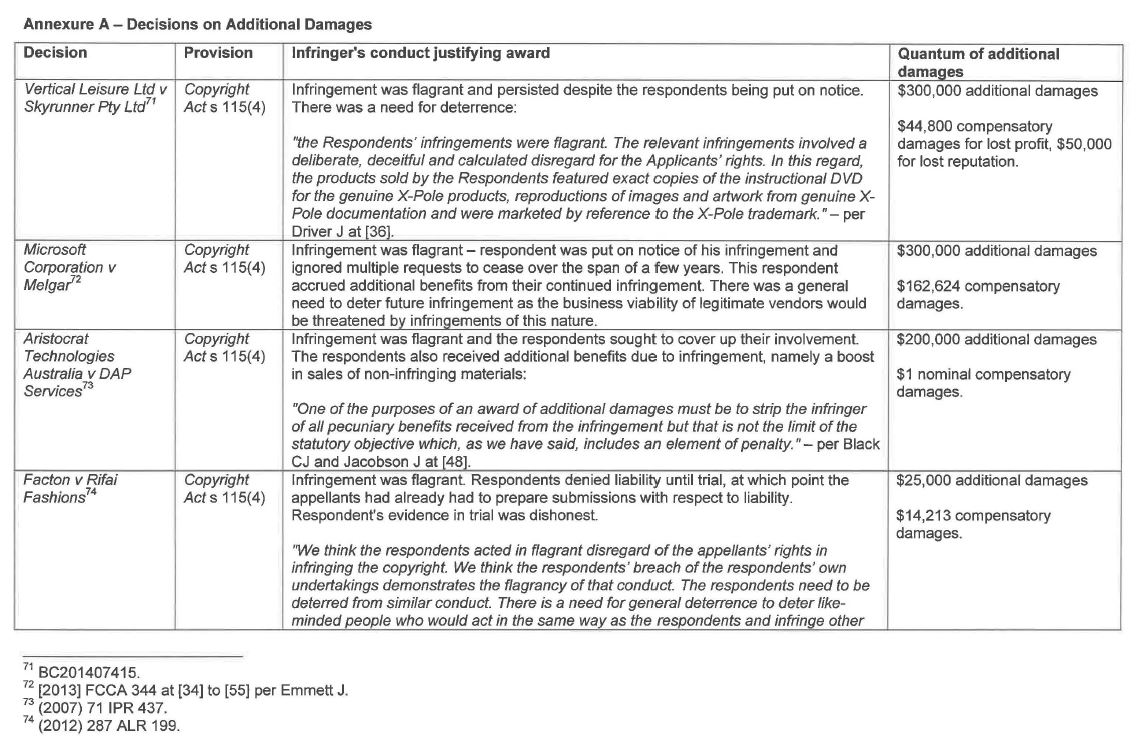
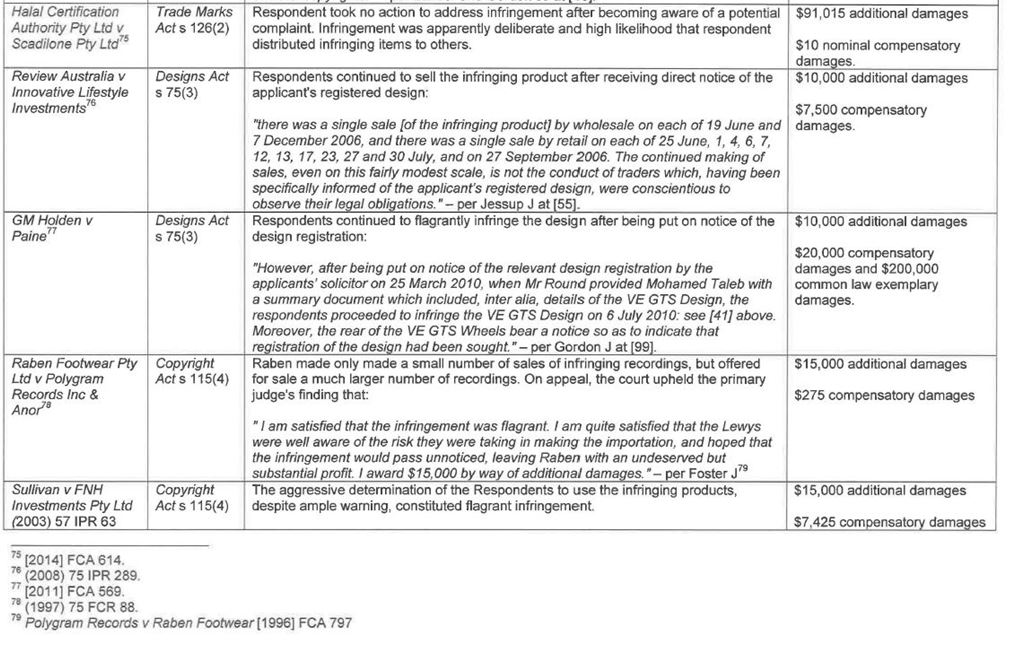
14 The respondents’ infringement was flagrant and warrants the award of some amount under s 122(1A). Pacific provided by way of comparison a table of some decisions in which additional damages had been awarded under provisions analogous to s 122(1A). That table is reproduced as annexure A to these reasons. The table reveals a substantial range of the amounts which have been awarded by way of additional damages which reflects the differences in the facts and circumstances of each case. Many of the cases said to be analogous to the present case, however, have features which were not present in the conduct engaged in by the respondents. The respondents did not, for example, persist with the infringing conduct once they were put on notice; nor did they seek to “cover up” or conceal their involvement, or engage in conduct to defeat Pacific’s entitlements upon commencement of the proceedings.
15 The amount to be awarded under s 122(1A) should be felt as a sanction by the person on whom it is imposed and should also act as a deterrent to others. Those objectives require consideration of the specific circumstances of each case and of each infringer. An amount which may be an effective sanction upon an infringer with limited means may be ineffective as a sanction, or as a deterrent, to a wealthy infringer or potential infringer. The amount awarded as damages may also be relevant when assessing the additional amount to be awarded under s 122(1A). A relatively small amount obtained as damages may, in some cases, be thought insufficient to reflect the sanction appropriate to the flagrancy of the infringement or to deter similar infringements. The amount of damages in this case under the heads claimed by Pacific total $355,487.16. The respondents will also be ordered to pay interest and costs. Their economic gain upon their sale of the 4,900 whole units may be assumed to have been around $80,000 to $90,000 based upon the figure established by Pacific for its lost profits upon those sales. The amounts awarded to Pacific as damages, therefore, effectively strip the respondents of all pecuniary benefits which they may have received from their infringement and which were denied to the patentee. The damages also include amounts beyond the pecuniary benefits likely to have been enjoyed by the respondents but which were suffered by Pacific as losses occasioned by the respondent’s conduct. There is little evidence about the financial position of the respondents except that Bernen is a corporation controlled by Mr Robert Li and that the latter was once an employee of Pacific. The financial circumstances of the respondents are likely to be such that the damages awarded against them will be felt as an economic burden upon their resources. At one point counsel for Pacific suggested from the bar table that the respondents may not be able to meet the judgment. Section 122(1A)(e) also requires the court to consider “all other relevant matters” to determine what amount, if any, should be included as an additional amount in the assessment of damages. One such relevant factor may be the conduct of the respondents in the proceedings. It can be said in favour of the respondents that they did not seek to frustrate Pacific’s attempts to pursue the proceeding and, indeed, gave frank and reliable evidence about sales to A&L which Pacific relied upon. The defence was a responsible pleading with reasonable admissions. The additional amount to be included in the assessment of damages in this case should be calculated by reference to the amount gained by the infringement, namely, the amount of $80,000 to $90,000, bearing in mind that the total amount awarded as damages greatly exceeds that amount. The additional amount to be awarded under s 122(1A) should also take into account the degree of flagrancy of the infringement and the extent, and likely impact upon the respondents, of the orders against them sounding in damages, interest and costs. In this case the additional amount should also reflect the respondents’ conduct of the proceeding which has not been blameworthy. On those facts I add to the total damages of $355,487.16 an additional amount of about half of the respondents’ assumed gain from the infringement, namely an additional $40,000.
16 Accordingly, there will be orders that:
1. The Applicants have leave to file a Notice of Discontinuance with respect to the claim for infringement of Australian Innovation Patent No 2013100793 (the Chainwinder Patent).
2. Save as previously ordered, each party bear its own costs of the proceedings with respect to the Chainwinder Patent.
3. There be judgment against the Second Respondent for infringement of Australian Innovation Patent No 2013100937 (the Casement Winder Patent).
4. The Respondents pay to the Applicants the sum of $395,487.16 (comprising $355,487.16 by way of compensatory damages for infringement of the Casement Winder Patent and $40,000 by way of additional damages for infringement of the Casement Winder Patent).
5. The Respondents pay the Applicants the costs of and incidental to the proceedings with respect to the Casement Winder Patent to be taxed if not agreed.
6. The Applicants calculate and provide to the Court a note of the interest payable under s 51A(1)(a) of the Federal Court of Australia Act 1976 (Cth) on the amount of compensatory damages referred to in order 4.
I certify that the preceding sixteen (16) numbered paragraphs are a true copy of the Reasons for Judgment herein of the Honourable Justice Pagone. |
Associate:
ANNEXURE A