FEDERAL COURT OF AUSTRALIA
Asmar, in the matter of an election for office in the Victoria No 1 Branch of the Health Services Union (No 2) [2014] FCA 1113
| IN THE FEDERAL COURT OF AUSTRALIA | |
IN THE MATTER OF AN ELECTION FOR OFFICE IN THE VICTORIA NO 1 BRANCH OF THE HEALTH SERVICES UNION
| DIANA ASMAR Applicant | |
| DATE OF ORDER: | |
| WHERE MADE: |
THE COURT DECLARES THAT:
1. Pursuant to s 206(4)(a) of the Fair Work (Registered Organisations) Act 2009 (Cth) (FWRO Act), the acceptance by the Returning Officer of the Australian Electoral Commission of the nominations lodged by each of Ms Jayne Govan and Mr Jamie Martorana in the Health Services Union Scheduled Election 2014 Victoria No 1 Branch (Election) is void.
AND THE COURT ORDERS THAT:
2. Paragraph 2 of the orders made by North J on 8 September 2014 be set aside.
3. Pursuant to s 206(4)(c)(i) of the FWRO Act, the General Manager of the Fair Work Commission is to make arrangements for the uncompleted steps in the Election to be taken.
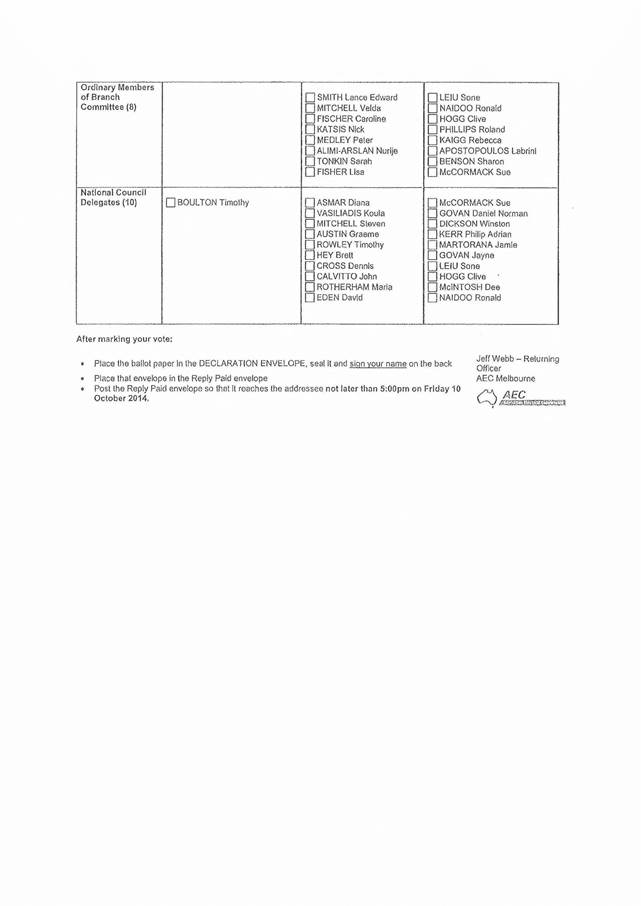
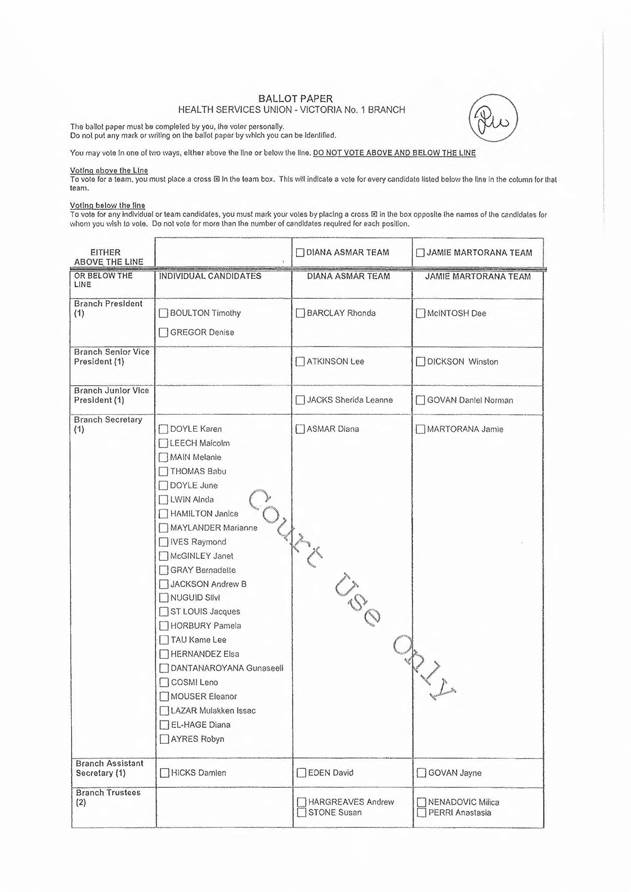
4. Pursuant to ss 206(4)(c)(i) and / or (d) of the FWRO Act, the Returning Officer of the Australian Electoral Commission shall notify the other members listed under the “Jamie Martorana Team” in Annexure A to this Order of the declaration in paragraph 1 and give each of those members the opportunity of remedying the irregularity where practicable within seven days of being notified of that irregularity.
5. Liberty to apply on 48 hours’ written notice to all interested parties.
Note: Entry of orders is dealt with in Rule 39.32 of the Federal Court Rules 2011 (Cth).
ANNEXURE A
| VICTORIA DISTRICT REGISTRY | |
| FAIR WORK DIVISION | VID 522 of 2014 |
IN THE MATTER OF AN ELECTION FOR OFFICE IN THE VICTORIA NO 1 BRANCH OF THE HEALTH SERVICES UNION
| DIANA ASMAR Applicant | |
| JUDGE: | GORDON J |
| DATE: | 21 OCTOBER 2014 |
| PLACE: | MELBOURNE |
REASONS FOR JUDGMENT
INTRODUCTION
1 Pursuant to s 200(1) of the Fair Work (Registered Organisations) Act 2009 (Cth) (FWRO Act), particular people can apply to the Court for an inquiry into a claim that there has been an irregularity in relation to an election for an office in a branch of an organisation registered under the FWRO. On such an inquiry, the Court is to inquire into and determine the question whether an irregularity had happened in relation to that election: s 206(1) of the FWRO Act. The Court is not bound by the rules of evidence: s 205(3)(b) of the FWRO Act.
2 The Applicant, Ms Asmar, made application for an inquiry (the Inquiry) into alleged irregularities in respect of the Health Services Union (HSU) Scheduled Election 2014 Victoria No 1 Branch (Election). Ms Asmar is the current Branch Secretary of the Victoria No 1 Branch of the HSU. The HSU is sometimes referred to as the Health Workers Union.
3 The alleged irregularity was described by Ms Asmar as follows:
The decision of the [Australian Electoral Commission (AEC)] Returning Officer, … determining that:
(a) The nomination of Jamie Martorana [Mr Martorana] to the office of Branch Secretary should be accepted; and
(b) The nomination of Jayne Govan [Ms Govan] to the office of Branch Assistant Secretary should be accepted;
is wrong on the grounds that in respect of:
(c) Mr Martorana on the grounds that he is not eligible to stand as a candidate for the office of Branch Secretary and National Council [D]elegate because he is not eligible for membership of the [HSU] because he is not employed in the industry (within the meaning of rule 3 of the Rules) and not usually employed in the industry; and
(d) Ms Govan on the grounds that she is not entitled to stand as a candidate because she is not a member of the [HSU] and has been struck from the Register of Members on 30 June 2014 having not made her membership contributions since 19 August 2013.
4 On 5 September 2014, when the Originating Application for inquiry relating to the Election was filed, Ms Asmar applied for interim orders under s 204 of the FWRO Act. On 8 September 2014 North J made orders, amongst others, that:
1. The [HSU], the Returning Officer and candidates in the elections referred to in paragraph 2 be notified of the Inquiry by letter from the solicitors for the Applicant
(a) informing them of the time and place fixed;
(b) annexing copies of the Application and this Order;
(c) informing them of affidavit material filed by the applicant available upon request.
2. Until the completion of this proceeding in relation to the elections for the positions of Branch Secretary, Branch Assistant Secretary and National Council Delegate in the Health Services Union Victoria No 1 Branch (the Branch), or until further orders of the Court, the Returning Officer shall not take any further steps in the conduct of the elections for the offices of the Branch President, Branch Secretary, Branch Senior Vice President, Branch Junior Vice President, Branch Assistant Secretary, Branch Trustee, Ordinary Member of the Branch Committee or National Council Delegate in the Branch.
The Inquiry was listed for hearing by North J on a date to be fixed.
5 The Inquiry was subsequently heard on 13 October 2014. At that hearing, each of Ms Asmar, Mr Martorana, Ms Govan, the AEC and the HSU were represented.
6 These reasons will consider the relevant legislative context, the facts and then turn to consider the position of Ms Govan and then Mr Martorana.
LEGISLATIVE CONTEXT
Inquiry
7 As noted earlier, particular people can apply to the Court for an inquiry into a claim that there has been an irregularity in relation to an election for an office in a branch of an organisation registered under the FWRO: s 200(1) of the FWRO Act. On such an inquiry, the Court is to inquire into and determine the question whether an irregularity had happened in relation to that election: s 206(1) of the FWRO Act.
8 “Irregularity” in relation to an election or ballot is defined in s 6(1) of the FWRO Act to include, among other matters, “a breach of the rules of an organisation or branch of an organisation”.
The HSU
9 The HSU is an association of employees and a registered organisation under the FWRO Act. The HSU is comprised of a National Organisation, and eight branches, established under the Rules of the HSU. The Victoria No 1 Branch is one of those branches (the Branch).
Need for rules and their content
10 Pursuant to s 140 of the FWRO Act, the HSU must have rules, including rules which address the matters specified in s 141 of the FWRO Act. One of the matters which the rules must provide for is “the times when, and the terms on which, persons become or cease (otherwise than by resignation) to be members” of the HSU: s 141(1)(b)(vii).
11 Section 142 sets out general requirements for the rules which include that the rules:
(a) must not be contrary to, or fail to make a provision required by this Act, the Fair Work Act, a modern award or an enterprise agreement, or otherwise be contrary to law; and
…
(c) must not impose on applicants for membership, or members, of the organisation, conditions, obligations or restrictions that, having regard to Parliament’s intention in enacting this Act (see section 5) and the objects of this Act and the Fair Work Act, are oppressive, unreasonable or unjust; and
(d) must not discriminate between applicants for membership, or members, of the organisation on the basis of race, colour, sex, sexual orientation, age, physical or mental disability, marital status, family responsibilities, pregnancy, religion, political opinion, national extraction or social origin.
12 Further, the rules of the HSU must provide for election of the holder of each office (s 143 of the FWRO Act) including rules in relation to the manner in which persons may become candidates for election and the conduct of the elections.
13 The HSU’s rules have been amended over time. Two sets of the HSU’s rules are relevant. One set of rules came into force from 1 January 2014 (the Previous Rules). New Rules came into force from 5 June 2014.
14 Some of the relevant events in this Inquiry occurred pursuant to or under the Previous Rules while others occurred pursuant to or under the New Rules.
15 Under the Previous Rules, rules 8(f)(v) and (vi) relevantly provided:
(f) Notwithstanding anything contained elsewhere in these Rules:
…
(v) Where a member’s payment of an instalment has not been received by the Branch by the date on which it was due, the Branch Secretary shall notify that member:-
A. the Branch has not received that member’s instalment payment;
B. of the consequences to the member of the failure to pay that instalment as provided by this Rule; and
C. of the amount of the balance of the member’s annual contribution owing for the year to which that contribution relates.
(vi) A member notified in accordance with paragraph (v) above shall pay the instalment within 21 days from the date of the written notice from the Branch Secretary. A member who fails to pay that instalment within those 21 days shall cease to be entitled to pay the membership contribution by instalment and shall within a further 7 days from those 21 days be liable to pay the balance of that member’s contribution for the relevant year.
The letter Ms Asmar sent to Ms Govan on 1 May 2014 (see [54] below) was sent pursuant to rule 8(f)(v).
16 Rule 10 of the Previous Rules dealt with a member’s financial status, and relevantly stated:
(a) A member owing contributions, fines, fees or levies equivalent to an amount in excess of 13 weeks contributions shall be deemed to be unfinancial.
(b) An unfinancial member shall not be entitled -
(i) to any of the rights and privileges of membership;
(ii) to nominate for or hold any office or in any way participate in any ballot or election in the [HSU] or any branch of the [HSU];
(iii) to attend or speak or vote at any meeting of the [HSU] or branch of the [HSU].
(c) Any member exempted pursuant to Rule 8(e) of these Rules from payment either in whole or in part of any contribution, fee or levy shall, for the purposes of these Rules, retain continuity of membership and be deemed financial but shall not, during the period of exemption, be eligible to nominate for or hold any office in the [HSU] or any branch of the [HSU].
17 The New Rules are relevant to events after 5 June 2014, including the Election. Rule 3, entitled “Conditions of Eligibility for Membership” relevantly provides, for example:
The [HSU] shall consist of an unlimited number of persons -
A. employed or usually employed -
(a) throughout Australia in or about or in connection with the carrying on of all hospitals, benevolent homes, dispensaries, asylums, mental hospitals, sanatoriums, rest homes, convalescent homes, medical schools, laboratories, colleges, industrial and other homes, charitable institutions, ambulance work, all classes of nursing, public or private;
…
B. employed or usually employed -
…
C. such other persons, whether or not employees in the industries of the [HSU] as have been elected or appointed full time National Officers or Branch Officers or organisers of the [HSU] or any Branch thereof and admitted as members of the [HSU]. For the purposes of this Clause C of this Rule, the full-time Officers of the [HSU] and of any Branch thereof shall be the holders of any of the offices of National Officers or Branch Officers where the duties of such office are of a full-time nature; and,
…
(Emphasis added.)
18 Rule 6 entitled “Admission to Membership” includes Rule 6(g)(v) which relevantly provides:
(g) On receipt of the application for membership:
…
(v) where the applicant has previously been a member of the [HSU] and owes a debt to the [HSU], the Branch Secretary shall either accept the application unconditionally, or accept it on the condition that the applicant shall first pay the whole or part of the debt owed, or otherwise refer the matter to the Branch Committee of Management.
19 Rule 10 addresses “Termination of Membership”. The rule relevantly states:
…
Termination because the member ceases to be eligible
(i) Membership terminates automatically when the member ceases to be eligible to be a member of the [HSU] unless the person is a National or Branch life member, in which case the person shall continue to be a National or Branch life member.
(j) A person who is a member of the [HSU] because the person is eligible for membership by virtue of rule 3C… shall, unless otherwise eligible to become or remain a member of the [HSU], automatically cease to be a member of the [HSU] when he or she ceases to hold the office or position referred to in that rule.
Termination as the result of purging the register
…
(l) Each Branch Secretary shall, from time to time, review the register of the Branch’s members and identify the names of members of the Branch who have been unfinancial for more than three months. The Branch Secretary shall write to each such member to his or her last address shown on the register and give the member one month’s written notice of the intention to strike his or her name off the register.
(m) If the member does not become financial within a month of the letter being sent, the member’s name shall be purged from the register of members. The member shall cease to be a member when his or her name is purged from the register.
20 Quite apart from the operation of Rule 10, reference should also be made to s 171A of the FWRO Act which relevantly has the effect that a person’s membership of the HSU automatically ceases when the person is not, or is no longer, an employee or an officer. “Employee” has its “ordinary meaning and includes a person who is usually such an employee”: s 6 of the FWRO Act.
21 Next, Rule 11 addresses “Union Dues”. Rule 11(h) relevantly provides that a member was entitled to pay HSU dues by any one or more of the following methods – payroll deductions, direct debit, charge or credit card, cheque, cash or any other method approved by the Branch Committee of Management. Rule 11(k) addresses non-payment of HSU dues in the following terms:
Where a member’s payment of [HSU] dues has not been received by the Branch within one month of the date on which it is due, the Branch Secretary shall notify the member:
(i) The dues have not been received;
(ii) The amount of the balance of the member’s dues owing;
(iii) That if the member does not pay the dues owing within three months of the due date then member shall be unfinancial. (sic)
22 “Financial and Unfinancial Members” are addressed in Rule 12. It relevantly provides:
(a) Where a member’s payment of [HSU] dues has not been received by the Branch within three months of the date on which it is due, the member shall be unfinancial. …
(b) An unfinancial member shall not be entitled -
(i) to any of the rights and privileges of membership;
(ii) to nominate for or hold any office in the [HSU] or any Branch;
(iii) to participate in any ballot or election in the [HSU] or any Branch;
(iv) to attend, speak at or vote in any meeting of the [HSU] or Branch.
(c) When the Branch Committee of Management has decided to waive a member’s annual contribution or any levy, the member:
(i) shall retain continuity of membership and be deemed financial for the period covered by the waiver;
…
23 “Elections” are addressed in Rule 23. The conduct of Branch elections are addressed in Rule 23A(d). Rule 23A(d)(vii) relevantly provides that when conducting elections and ballots of the HSU:
The Returning Officer shall check all nominations received for compliance with the requirements of these rules and shall reject any that do not so comply; provided that in the event that he or she finds a defect in any nomination, the Returning Officer shall before rejecting the nomination notify the person concerned of the defect, and, where it is practicable to do so, give the person the opportunity of remedying the defect where practicable within seven days of being notified.
24 Qualifications for office are relevantly set out in Rule 23A(e):
(i) Nominations for any position of paid Branch Officer shall have been a continuously financial member of the [HSU] for not less than twelve months immediate (sic) preceding his or her nomination and shall be a financial member of the [HSU] at the date of his or her nomination.
(ii) Nominations for any position other than that of paid Branch Officer shall have been a continuously financial member of the [HSU] for not less than three months immediately preceding his or her nomination and shall be a financial member of the [HSU] at the date of his or her nomination.
25 The positions of Branch Secretary and Branch Assistant Secretary are paid Branch Officer positions and therefore a nominee must have continuously been a financial member of the HSU for not less than 12 months immediately preceding the nomination and must be a financial member of the HSU at the date of the nomination: Rule 23A(e)(i). The position of National Council Delegate is not a paid Branch Officer position and therefore requires continuous financial membership for not less than three months: Rule 23A(e)(ii).
26 Team Nominations are governed by Rule 23A(f) as follows:
Notwithstanding sub rule (d) of this rule, candidates in an election of:
(i) Officers of a Branch;
(ii) Ordinary members of a Branch Committee;
…
(iv) Branch delegates to the National Council:
may, subject to the following conditions, nominate as members of a “team nomination”:-
a. Each candidate being nominated as a member of a team nomination must signify his or her acceptance of such nomination by signing the nomination to the Returning Officer.
b. No member of a team nomination may nominate or be nominated as a member of another “team nomination” or as an individual candidate.
c. A “Team” nomination must nominate a candidate (or the required number of candidates) for each position for which nominations have been called whereupon each candidate will be considered to have nominated for each position concerned.
…
f. The Returning Officer shall ensure that the ballot paper makes provision for the recording of a vote for each member of a team nomination by way of marking one box at the top of the list of names of members of that team (a “team box”). The Returning Officer shall also ensure that the ballot paper contains clear instructions to the effect that a member voting may vote individually for candidates, including members of a team nomination, or, alternatively, vote for each member of a team by marking the team box.
g. Once a candidate has nominated for a team nomination he or she cannot withdraw unless with the consent of all the members of that team. Where there is consent for a candidate to withdraw, the team nomination form may be amended to provide for a replacement nominee.
(Emphasis added.)
FACTS
27 A statement of agreed facts was prepared and signed on behalf of Ms Asmar, Mr Martorana, Ms Govan, the AEC and the HSU for the purposes of s 191 of the Evidence Act 1995 (Cth) as well as a Supplementary Agreed Document Tender (collectively the SOAF). The following summary of facts is primarily extracted from the SOAF. If the fact or facts are not sourced from the SOAF, the reasons identify the source.
HSU Election
28 Rule 23A(d)(ii) of the New Rules provides for the opening of nominations on 1 June and closing on 14 June.
29 Pursuant to s 189(3) of the FWRO Act, by decision of a delegate dated 27 June 2014 and also an amended decision dated 17 July 2014, the General Manager of the Fair Work Commission arranged for the conduct of the Election for offices in the Branch (including with respect to the offices of Branch Secretary, Branch Assistant Secretary and National Council Delegates).
30 As compliance with the particular timetable provided for under the New Rules was not possible, the Returning Officer determined a revised timetable, pursuant to s 193(1)(b)(ii) of the FWRO Act, as follows:
(1) 15 July 2014 – Close of Roll for the Branch;
(2) 22 July 2014 – Nominations open;
(3) 4 August 2014 at 5pm – Nominations close;
(4) 4 August 2014 at 5pm – Candidate withdrawal period ended;
(5) 9 September 2014 – Ballot opens;
(6) 10 October 2014 at 5pm – Ballot closes.
31 On 4 August 2014, the Returning Officer sent a Nominations report to the Branch Secretary and requested that she certify as to the financial status and eligibility of all candidates and nominators.
32 On 8 August 2014, the Returning Officer received the Branch Secretary’s certification report. That report included statements to the effect that Mr Martorana (candidate for Branch Secretary) and Ms Govan (candidate for Branch Assistant Secretary) were not eligible to stand for office.
33 On 8 August 2014, the Returning Officer wrote to Mr Martorana and to Ms Govan, and also to candidates relying on either Mr Martorana or Ms Govan as nominators, notifying them of the defects stated in the Secretary’s report and requesting that they respond by 15 August 2014.
34 On 15 August 2014, the Returning Officer received responses and documents from Mr Martorana and Ms Govan in support of their nominations as candidates as part of the “Martorana Team” nomination. The Returning Officer then accepted the nominations as valid under the New Rules.
35 On 1 September 2014, the Returning Officer conducted a draw for positions on the ballot paper. A ballot paper was prepared by the Returning Officer and would have been distributed to electors but for the interim order made on 8 September 2014. A copy of that ballot paper is attached as Annexure A to these reasons. The ballot paper identifies all of the candidates whose nominations were accepted by the Returning Officer for inclusion in the ballot for election to office in the Branch. The ballot paper takes the form of a table. On the vertical axis, the different offices subject to election are identified. On the horizontal axis, there are three columns. The first column lists the names of candidates who have nominated as individuals. The second column lists the names of persons who have nominated by way of a “team nomination” for the “Asmar Team”. The third column lists the names of persons who have nominated by way of a “team nomination” for the “Martorana Team”.
Ms Govan
36 Between 29 January 2013 and 12 July 2013, Ms Govan was employed as an organiser in the Branch. This was Ms Govan’s second period of employment as a branch organiser.
37 An issue in the inquiry is whether Ms Govan was a member of the HSU when she lodged her nominations.
38 Records of payments of HSU dues by members are maintained in the Branch’s membership database. A relevant extract from the Branch’s membership database was in evidence.
39 On 11 July 2013, the membership database records contain a record as to Ms Govan that “... the amount of $544.68 has now been waived.” Further, Ms Govan provided credit card details so that dues could be taken by the organisation on an ongoing basis.
40 The membership database records that on 22 July 2013, 5 August 2013 and 19 August 2013, fortnightly payments of membership dues each of $21.15 was received from Ms Govan.
41 The membership database also records that on 5 August 2013, the Branch Committee held a meeting where the membership of Ms Govan was discussed. Ms Asmar noted that the process for requesting a membership waiver (being the waiver recorded in paragraph [39] above) had not been followed by Ms Govan. A motion was carried that Ms Asmar write to Ms Govan and explain “that the process for every member is that they must write to request the Secretary to waive membership fees and that the [Branch Committee] will then make a decision; and that therefore the records on [the membership database] in relation to [Ms Govan’s] fees be changed back to what they were before [Ms Govan] went to see the Membership Officer”. For reasons that were not clear, the membership database was only updated to reflect this meeting on 10 September 2013. Ms Asmar gave evidence at the hearing that she wrote to Ms Govan straight after the meeting on 5 August 2013. Ms Govan denied that Ms Asmar wrote to her.
42 The membership database records that on 3 September 2013, a credit card payment of $21.15 was recorded as received from Ms Govan, but on 4 September 2013, the payment was recorded as reversed with the narration “05 - Do Not Honour”. Similarly, payments from Ms Govan of $21.15 made on 17 September, 1 October and 15 October 2013 were recorded as reversed the following day with the narration “05 - Do Not Honour”.
43 On 17 October 2013, the solicitor for Ms Govan, Mr Addison, wrote to the solicitors for the HSU. In part, Mr Addison’s letter reads as follows:
.... In 2012 our client changed banks resulting in a changed credit card number which in turn caused a lack of transfer of funds to the [HSU] resulting in our members’ dues not being paid. As a result Ms Govan spoke to the membership department in August 2012 and reached agreement on a process to regain her financial status.
The process that was agreed did not occur and as a result further discussions were entered into in July 2013 when it became apparent that the agreed outcome had not occurred. At that time the question of her financial status was resolved by agreement with the [HSU]. Ms Govan from that point on made sure that the [HSU] had her correct credit card details and was from that point paying $21.15 per fortnight contributions. Any outstanding dues were by agreement waived by the [HSU].
We are instructed that your client has now unilaterally altered that agreement and in addition is refusing to deduct the union membership fees from Ms Govan’s credit card thus putting our client in the position of being un-financial ....
44 The membership database records that credit card payments from Ms Govan of $21.15 made on 29 October and 12 November 2013 were again reversed the following day with the narration “05 - Do Not Honour”. Ms Antoun, an employee of the HSU who has administrative and membership duties, gave evidence at the hearing that on 14 November 2013 she called Ms Govan and left her a voicemail asking her to return the call. Ms Antoun’s evidence was that she then changed Ms Govan’s membership from a direct debit membership to a membership where statements or tax invoices were sent, as was the practice that would be followed for all members after several payments were declined. Ms Govan denied that Ms Antoun left her a voice message. The membership database records that the first invoice after the change was issued on 1 January 2014. Ms Govan denied receiving that invoice.
45 On 15 January 2014, the Branch’s solicitors responded to Mr Addison’s letter. In part, the letter read:
.... If your client wishes to regain her financial membership of the [HSU], she should either make a payment to the Branch of $339.98 which is the total amount in arrears or make an application in writing to the Branch Committee to have all or part of the arrears waived. To then remain financial Ms Govan will need to pay her next quarterly invoice ...
46 Ms Govan gave evidence at the hearing that she did not become aware of this letter until May 2014.
47 The membership database records that a further invoice was issued on 1 April 2014. At the hearing, Ms Govan denied receiving that invoice.
48 On 3 April 2014, Ms Govan sent an email to the HSU. She requested a statement of outstanding dues.
49 At about 4.28 pm on Thursday afternoon, 10 April 2014, Ms Govan attended at the HSU’s office. Ms McIntosh was with Ms Govan. What transpired at the HSU’s offices is in dispute. Ms McIntosh swore an affidavit in this proceeding but was not required for cross-examination. Evidence was given by Ms Govan, Ms Antoun and Mr Katsis. Mr Katsis was a Lead Organiser at the Branch. According to some of the witnesses, Mr Cameron Granger was part of the discussions with Ms Govan and Ms McIntosh. Mr Granger did not give evidence.
50 The evidence of Ms Antoun was that Ms Govan asked if she could speak to the membership manager because she had issues with her membership. Ms Antoun rang Ms Di Pierro, the membership manager. Ms Di Pierro told her that she was working and she would try to finish and come see Ms Govan. Ms Antoun waited some time and then went upstairs, and Mr Katsis returned with her. Ms Govan, Ms McIntosh and Mr Katsis all had a discussion, but Ms Antoun did not hear it and Mr Katsis did not tell her what it was about.
51 The evidence of Ms McIntosh was that upon entering the building they immediately went to the receptionist who was Ms Antoun. Both Ms Govan and Ms McIntosh advised Ms Antoun that they were there to pay Ms Govan’s fees. Ms Antoun asked them to wait while she called Ms Di Pierro in membership. After several minutes Ms Antoun hung up and told them she could not take Ms Govan’s money. No reason was given. Ms Govan and Ms McIntosh found this to be unacceptable at which point Ms McIntosh asked Ms Antoun to ask someone, who had the authority to take the money, to come downstairs and speak to them. Ms Antoun picked up the phone and spoke to someone and then told Ms Govan and Ms McIntosh to take a seat and someone would be down shortly. Approximately 15-20 minutes later, Mr Katsis and Mr Granger came down to speak to the two women. When Ms Govan asked Mr Katsis about paying her membership, he told her that he would need to discuss it with senior management and would get back to her in the appropriate time. Ms Govan then politely asked for her response to be communicated to her within seven days. Mr Katsis smirked, looked at Mr Granger and then back at Ms Govan and said "I’ll talk with senior management”.
52 Ms Govan’s evidence was that she spoke with Ms Antoun and told her that she was there to get the outstanding amount and pay her membership. Ms Antoun told Ms Govan that she could not do that and would call Ms Di Pierro. Ms Antoun then called Ms Di Pierro. Ms Govan and Ms McIntosh waited in the reception area for 10 to 15 minutes until Mr Katsis came down with Mr Granger. Ms Govan did not recall whether Mr Katsis asked her if she knew how much was outstanding on her membership dues, but she recalled that she wanted to know how much was outstanding and she wanted to pay her fees. Ms Govan said that, in going into the office, she had no purpose other than to pay her fees. Ms Govan told Mr Katsis that she did not know how much was outstanding. Mr Katsis told Ms Govan that he would have to speak to senior officials. The meeting with Mr Katsis ended on the basis that he would pass on her enquiry about her membership. Ms Govan asked for a prompt response, within seven days.
53 Mr Katsis’ evidence was that Ms Govan did not say that she was there to pay the union fees. He accepted that Ms Govan mentioned that she wanted to sort the matter out with regards to her membership, and that as she had been out of work, she had fallen behind. Mr Katsis’ evidence was that he asked Ms Govan how much money was outstanding. He said this was usually the first question that he tended to ask of members. Mr Katsis was cross examined about his statement in his affidavit that he told Ms Govan that there was no one available in the office that could look at the computer system and work out how much was outstanding. His oral evidence was that statement was based on the fact that had told Ms Govan that he would put the question of how much was owing to the hierarchy. He accepted that he did not ask Ms Antoun to look on the computer and tell him how much was outstanding. His explanation for that was he had been asked as a senior to go down to speak to Ms Govan and Ms McIntosh because presumably there was an issue that nobody could rectify. He accepted that he had the capacity to check the database but said that did not have the capacity to determine the exact figure. His evidence was that Ms Di Pierro had not been available because she was attending to some deadlines.
54 On 1 May 2014, Ms Asmar wrote to Ms Govan about her arrears in payment of membership dues. That letter was sent pursuant to rule 8(f)(v) of the Previous Rules: see [15] above. In part, the letter read:
Your total outstanding dues stand at $562.32 as of 30 April 2014
....
To regain financial membership of the [HSU] you are required to:
• [P]ay your outstanding dues;
• Provide details of your employment and your employer;
• Advise whether you wish to alter your membership classification; and
• Advise how you wish to pay your dues, that is, with what frequency.
If you are seeking a reduction in your total outstanding dues, you can ask the Branch Committee to have all or part of the arrears waived; advice you also received in the letter of 15 January.
Furthermore, as you have noted, you have not made a membership payment since 19 August 2013. This equates to a period in excess of thirty-six weeks since you have made a membership payment.
....
Consequently, I hereby provide you notice that unless the matter of your outstanding dues is remedied in full by 31 May 2014 you will be struck from the register of members, and your [HSU] membership terminated.
55 Ms Govan confirmed that she received this letter by post. In May and June 2014, Ms Govan did not respond to the letter dated 1 May 2014. Ms Govan did not pay the arrears notified to her by that letter. Ms Govan gave evidence at the hearing that she did not pay those dues immediately as she was in and out of the Royal Children’s Hospital with her son. She accepted that it would have been open to her to immediately pay her outstanding dues on receipt of this letter. Ms Govan also accepted that she was on notice that her name would be struck from the register of members if she did not pay her outstanding dues by 31 May 2014, and that this letter told her what she needed to do to regain financial membership. Ms Govan gave evidence to the effect that she thought that the HSU already had the details required by the second and third dot points in the letter.
56 On 30 June 2014, Ms Asmar, as the Branch Secretary, purged Ms Govan’s name from the register of members.
57 For reasons that are not clear, the membership database records that a further invoice was issued to Ms Govan on 1 July 2014. By letter dated 14 July 2014, Ms Asmar wrote to Ms Govan that:
I refer you to my previous letter, dated May 1 .... as we are yet to hear from you or yet to receive any payment, I am now obliged under Section 10 of [the HSU] rules to cancel your membership, and hereby give you notice of that cancellation. ....
58 On 4 August 2014, Ms Govan lodged her nominations for Branch Assistant Secretary and National Council Delegate with the Returning Officer.
59 On 14 August 2014, Mr Daniel Govan, Ms Govan’s brother, telephoned the HSU and spoke to Ms Antoun. Mr Govan asked to make a payment of outstanding dues on behalf of Ms Govan. He was informed that no payments could be accepted on behalf of a person who was not a member of the HSU. He was informed that if Ms Govan wished to rejoin the HSU, she could make an application to the Branch Committee of Management.
Mr Martorana
60 Mr Martorana was employed by Western Health as a Security Officer for about 13 years, between June 1992 and June 2005.
61 On 13 June 2005, after a secondment from Western Health, lasting about 3 months, Mr Martorana commenced a period of full time employment with the Branch, as an Area Organiser. The Branch sponsored Mr Martorana to undertake a certificate 4 in Unionism which he completed in 9 months in addition to carrying out his normal work for the Branch.
62 In February 2009, Mr Martorana was subjected to a traumatic experience during the “Black Saturday” bushfires. The Black Saturday bushfires occurred on 7 February 2009.
63 Although Mr Martorana commenced his employment as an Area Organiser, during his employment he served in an elected capacity as a Branch Assistant Secretary.
64 Until on or about 20 October 2010, Mr Martorana remained in the full time employment of the HSU. Effective on or about 20 October 2010, Mr Martorana resigned from his employment. Since 20 October 2010, Mr Martorana has not worked in any of the callings identified in the HSU’s membership rules, or at all.
65 On 4 August 2014, Mr Martorana nominated for election to the office of Branch Secretary of the Branch.
66 On 12 August 2014, Dr Anthony Diamantaras, a general practitioner, issued a medical certificate in the following terms:
I have been treating Mr Martorana for over 5 years for severe depression and anxiety. He has endured multiple severe stressors including losing his home in the Black Saturday fires and facing near certain death in the same fires.
As a result of this and severe work related stressors he resigned from work in October 2010. Immediately following his resignation his mother unexpectedly died. Mr Martorana has not been in pain [sic] employment since. Both I and Mr Martorana have expressed a desire for him to recommence work but to this point in time this has not been possible.
67 Mr Martorana gave evidence and was cross examined at the hearing. Mr Martorana gave evidence that he took two weeks off work immediately following the Black Saturday bushfires, and returned to work for about the next two weeks, and then took two further weeks off. It was his understanding that this time off was taken as sick leave. Mr Martorana also took four days of sick leave from 28 September 2010 to 1 October 2010. Other than those specific time periods, Mr Martorana continued to perform his duties until his resignation.
68 Minutes from meetings of the HSU Council/HSU East Council indicated that at around October 2010 there was a proposed restructure of allocation of areas of responsibility to certain positions within HSU East, and Mr Martorana did not agree with the proposed structure. The minutes recorded that the General Secretary had engaged in “sensible discussions” with Mr Martorana, and “would continue to negotiate” with him. The evidence indicates that the HSU East Branch was a precursor branch which demerged into separate branches including the Victoria No 1 Branch.
69 Mr Martorana gave evidence that he resigned following those negotiations and with the agreement of the HSU. At the time of his resignation, he was Branch Assistant Secretary of the Branch, which is an elected position. He received compensation of $240,000 which was paid in weekly instalments over the course of 2 years under terms set out in a settlement agreement. Mr Martorana gave evidence that he was not happy about leaving the HSU, but he felt that he had no option but to leave.
70 Mr Martorana has not been in paid employment since October 2010. He gave evidence that it was his intention to return to work when possible, but that for most of the time, a return to work has not been possible. It is only relatively recently that he has found himself in a position where he is prepared and able to re-enter the workforce. It is his intention to resume work in the industry either as a health sector employee or as Branch Secretary. He has been focused on getting elected to the HSU position and has not made any other job applications.
71 On 9 October 2014, Dr Diamantaras issued a medical certificate stating “Mr Jamie Martorana is fit to return to full time work. He has capacity to perform any duties for which he is qualified or experienced to do”. Dr Diamantaras also filed an affidavit in these proceedings. He was not cross examined. Dr Diamantaras’ evidence outlined the state of Mr Martorana’s health over the last five years and stated that “the condition is one which is improving and I am of the view that Mr Martorana is now fit to return to work”.
ANALYSIS
Ms Govan
72 Ms Asmar contends that Ms Govan was not a member of the HSU at the time she nominated for office and for that reason her nominations were invalid. Ms Govan had been a member but her name had been purged from the register of members because of her failure to pay membership dues: see [19] and [56] above.
73 The question which arises is whether Ms Govan was unfinancial at the time she lodged her nominations.
74 Ms Govan contends she was not unfinancial. Ms Govan’s contention was founded on an allegation that a deliberate strategy was engaged in by Ms Asmar (and presumably other HSU officials) to ensure that Ms Govan was unfinancial or not a member of the HSU so to prevent her from contesting the election. In support of that contention, Ms Govan relies upon the facts set out at [36]-[59] above and Re Howard; Re Slaters, Tilers & Roofing Industry Union (Vic.) (1983) 4 IR 95; Mcjannett v Bulloch [2012] FCA 1233 at [229] and Re Asmar (No 3) (2012) 207 FCR 476 at [49]-[51].
75 In Re Asmar (No 3) (2012) 207 FCR 476 at [49]-[51], Tracey J stated:
49. … In Re Howard; Re Slaters, Tiling and Roofing Industry Union (Vic.) (1983) 4 IR 95 Keely J dealt with a case in which a person who had sought to maintain his financial status as a member of a Union had failed to do so because the secretary had refused to accept his subscriptions. His Honour held that, in such circumstances, the member was not to be treated as being unfinancial. He declined … to accept a construction of the Rules which resulted “in a member being deemed to be unfinancial where ... he has offered his union dues to the secretary at the union office and the secretary has refused to accept payment.” His Honour so held in a case where the Union Rules did not contain an express obligation on officials to accept contributions tendered by members or potential members.
50. In McJannett v Bulloch [2012] FCA 1233 Barker J also dealt with a case in which an applicant for union membership alleged that union officials had acted to prevent him from becoming financial in order to prevent him from contesting union elections. His Honour (at [228]) accepted that the breach of an implied obligation of a union to accept the contributions of a person entitled to be a member of that union could constitute an irregularity for the purposes of the Act. His Honour continued at [229] that:
“In my view, if it could be established that there was any deliberate strategy undertaken by or on behalf of the Union or an elected officer, such as the Secretary, at all material times, to prevent the applicant being financial ... then there would be evidence that suggests a breach of the Rules of the Union in relation to the payment of contributions.”
51. I would also observe that, in Re Slaters, Keely J said that, were the union’s rules properly to be construed as causing a member who had done all that was required, under the rules, to make contributions to be regarded as being unfinancial because an official had refused to accept payment, the rules would have contravened the then s 140(1)(c) of the Conciliation and Arbitration Act 1904 (Cth), (see now s 142(1)(c) of the [FWRO] Act), because such a rule would impose upon members of the organisation conditions, obligations and restrictions, which, having regard to the objects of the Act, would be oppressive, unreasonable or unjust. This was the case as, if taken literally, such a rule would permit Union officials to prevent members from participating in those aspects of Union affairs which were reserved for financial members by refusing to receive their subscriptions.
(Emphasis added.)
76 The question in the present case concerning Ms Govan may be put in these terms – did one or more of the HSU officials refuse to accept payment of Ms Govan’s union dues, or otherwise act to prevent her from becoming financial, in order to prevent her from contesting union elections even though Ms Govan did all that was required of her under the rules to make contributions of her union dues?
77 Having regard to all the circumstances set out at [36]-[59] above, the answer to that question is “no”. The answer is “no” because although some of the steps taken by the HSU officials may be described as being less than helpful (see, in particular, at [49]-[53] above), it cannot be said that Ms Govan did all that was required of her under the rules to make contributions of her HSU dues or that the HSU acted to prevent her becoming financial.
78 From at least August 2013, Ms Govan and the HSU were in dispute as to the quantum of her outstanding membership dues. By 15 January 2014, the position had crystallised to the point that the Branch’s solicitors informed Ms Govan’s solicitor that:
.... If your client wishes to regain her financial membership of the [HSU], she should either make a payment to the Branch of $339.98 which is the total amount in arrears or make an application in writing to the Branch Committee to have all or part of the arrears waived. To then remain financial Ms Govan will need to pay her next quarterly invoice ...
Ms Govan took neither step. Ms Govan’s evidence was that she did not become aware of the existence of this letter until May 2014: see [46] above. There was no indication that the HSU were responsible in any way for that occurring.
79 Next, on 3 April 2014, Ms Govan sent an email to the HSU requesting a statement of outstanding dues: see [48] above. She received no immediate response. So, at about 4.28 pm on 10 April 2014, Ms Govan attended at the HSU’s office: see [49] above. As I have noted, on that day the actions of the HSU staff, at the very least, were less than helpful.
80 However, by 1 May 2014, Ms Govan had her answer. She was sent a letter by Ms Asmar answering the very question she had asked – the quantum of arrears of her membership dues. The letter informed her that as at 30 April 2014, Ms Govan’s total outstanding membership dues were $562.32: see [54] above. That letter was sent pursuant to rule 8(f)(v) of the Previous Rules: see [15] above. Significantly, the letter contained other important information. It listed the four steps Ms Govan was required to take to regain financial membership of the HSU: see [54] above. Finally, the letter notified Ms Govan that unless the matter of outstanding fees was remedied in full by 31 May 2014, she would be struck from the register of members and her membership terminated.
81 Ms Govan took no step in response to that letter. In May and June 2014, Ms Govan did not respond to the letter. Ms Govan did not pay the arrears notified to her by the letter. Ms Govan’s evidence at the hearing was that she had a son in the Royal Children’s Hospital and that was her priority. That is completely understandable. However, the HSU was not responsible for Ms Govan’s failure to respond to that letter.
82 On 30 June 2014, Ms Asmar (as the Branch Secretary) purged Ms Govan’s name from the register of members. On 14 July 2014, Ms Asmar again wrote to Ms Govan, referred to the letter of 1 May 2014, told Ms Govan that the HSU had not received payment and that under Rule 10 of the New Rules (see [19] above), her membership had been cancelled. Again, Ms Govan took no step in June, July or August 2014 to remedy the position. Indeed, Ms Govan last paid subscription fees on 19 August 2013 when $21.25 was paid by credit card: see [40] above. As a consequence, at 30 June 2014, Ms Govan had been unfinancial for more than three months: New Rule 12 extracted at [22] above. In fact, Ms Govan had been unfinancial since at least January 2014 (the date on which the Previous Rules came into force): see Previous Rule 10 extracted at [16] above; New Rule 12 extracted at [22] above. Ms Govan had not undertaken any of the steps listed in the letter of 1 May 2014 by the time she lodged her nominations on 4 August 2014.
83 In all the circumstances, Ms Govan’s nominations which she lodged on 4 August 2014 should have been rejected. She was not a member of the HSU and, in any event, she was not a member of the HSU with a period of financial continuity sufficient to satisfy the eligibility requirements under rule 23A(e) of the New Rules (see [24] above) to nominate for election to the offices of Branch Assistant Secretary and National Council Delegate. The Court is satisfied that an irregularity occurred in relation to the Election.
84 The Court must not declare any step taken in relation to an election to be void unless the Court is of the opinion that, having regard to the irregularity found, and any circumstances giving rise to a likelihood that similar irregularities may have happened or may happen, the result of the election may be affected, by irregularities: s 206(5) of the FWRO Act. In my view, it is appropriate to declare that the Returning Officer’s acceptance of the nominations lodged by Ms Govan is void: s 206(4)(a) of the FWRO Act. The result of the Election may be affected by an irregularity if the Court did not make that declaration because it would permit Ms Govan to stand for election to the offices of Branch Assistant Secretary and National Council Delegate when she was not entitled to nominate for those offices.
85 What is to now happen in relation to the Election will be addressed later in these reasons.
Mr Martorana
86 Ms Asmar contends that at the time Mr Martorana nominated for election to offices in the HSU he was not a member of the HSU because, at the time he nominated, he was not “employed or usually employed” in one of the callings identified in Rule 3 of the New Rules: see [17] above.
87 Membership is a necessary (but not sufficient) criterion for eligibility to nominate: see [24] above. There is no suggestion that Mr Martorana was employed at the time he nominated: see [64] above. The question is whether, when he nominated, he was usually employed in one of the callings identified in Rule 3 of the New Rules.
88 As noted earlier, “employee” is defined in s 6 of the FWRO Act to have its ordinary meaning “and includes a person who is usually such an employee”. The phrases “usually employed” and the “usual occupation is that of employee,” were considered by North J in Australasian Meat Industry Employees’ Union v Belandra Pty Ltd (2003) 126 IR 165 at [43]-[46]:
43. Whether a person is usually an employer is a question of fact to be determined in the light of all the circumstances in each case. There is no formula appropriate in all cases which can be used to answer the question. As to a past employment relationship, it may be relevant to know how long ago the person ceased to be an actual employer or to understand why the person ceased to be an actual employer. As to future employment, it may be relevant to know when such employment is to commence or resume, and the circumstances of any delay in commencing or resuming employment.
44. The unusual circumstances of the present case demonstrate how difficult it would be to reduce the inquiry to some generally applicable formula. In the present case, the inability of Belandra to conduct operations and to employ people resulted from the occurrence of the fire. The cessation of employment was forced upon Belandra because the fire destroyed the premises in which the work was done. If it had not been for the fire, Belandra would have continued to employ its workforce to operate the slaughter floor at Brooklyn. Significantly, however, immediately after the fire Belandra intended to re-employ the workforce. That was the reason Belandra delayed payment of the severance entitlements, as it was entitled to do. The evidence of Mr Catalfamo was clear. He intended to re-employ the workforce and to that end he took energetic steps to make this possible. …
45. …These steps were taken as part of a plan to restart production with the previous workforce. During this period there is no question that Belandra was usually an employer. On the approach suggested by Mr Parry, Belandra had recently been an employer and, so far as Belandra’s plans were concerned, reemployment was in prospect.
46. Then the situation changed. From September 2001, no longer was re-employment in prospect. The reason was that Belandra had altered its plans and decided not to re-employ the workforce. If Belandra then ceased to be an employer, that result came about as a consequence of its decision not to re-employ the workforce. …
The analysis at [43] of Belandra was referred to and adopted by Tracey J in Re Asmar (No 3) (2012) 207 FCR 476 at [59] and [60] when determining whether a person is to be regarded as usually being an employee.
89 What then is the position here?
90 Mr Martorana was employed by Western Health as a Security Officer for about 13 years, between June 1992 and June 2005: see [60] above. After a secondment from Western Health, lasting about 3 months, Mr Martorana commenced a period of full time employment with the Branch, as an Area Organiser, on 13 June 2005: see [61] above. Mr Martorana undertook a certificate 4 in Unionism: see [61] above.
91 Mr Martorana was subjected to a traumatic experience during the Black Saturday bushfires. Mr Martorana was able to remain in the full time employ of the HSU for approximately a further 21 months. In around October 2010, a confidential agreement was entered into between Mr Martorana and the HSU, and Mr Martorana resigned from his employment. Since October 2010, Mr Martorana has not worked in any of the callings identified in the New Rules or at all: see [64] above.
92 Was Mr Martorana entitled to nominate? The conditions for membership are set out in Rule 3: see [17] above. Rule 3C (also extracted at [17] above) refers to persons as have been elected or appointed full time National Officers or Branch Officers or organisers of the HSU or any one of its branches. A careful reader will notice that Rule 3C is in different terms to Rule 3A and does not extend to persons usually employed or appointed to those offices. At the time of his nominations, Mr Martorana had not been elected or appointed as a full time National Officer or Branch Officer or organiser of the HSU or any one of its branches. Rule 3C does not assist him.
93 In this matter, Rule 3A is the only rule specifying callings in which Mr Martorana was potentially usually employed. Mr Martorana has not worked in any of the callings identified in the New Rules, or at all, since October 2010.
94 At the time he lodged his nominations, was Mr Martorana usually employed in one of the callings in Rule 3A? That is a question of fact: see [88] above. The circumstances concerning Mr Martorana include that:
(1) Mr Martorana has not worked, nor sought to be employed, since he resigned his employment with the HSU in October 2010;
(2) Mr Martorana has not worked in any of the callings set out in Rule 3A for over 9 years (since June 2005);
(3) Mr Martorana has not sought to be employed in any of the callings set out in Rule 3A for over 9 years (since June 2005);
(4) There is evidence from his treating general practitioner of a serious illness which has previously affected his ability to be employed.
95 What then were Mr Martorana’s stated intentions? Mr Martorana stated that from October 2010 (when he resigned) his intention was to return to work when possible, but that for most of the time, a return to work has not been possible. He told the Court that it is only relatively recently that he has found himself in a position where he is prepared and able to re-enter the workforce and that it is his intention to resume work in the industry if he is unsuccessful in the Election. Mr Martorana said he had not made any other job applications recently because he has been focused on getting elected to the position with the HSU.
96 The HSU submitted that Mr Martorana’s asserted medical condition did not prevent him from working for the HSU in a full-time position (for the 21 months after the Black Saturday Bushfires), that there is no direct or properly admissible evidence from a medical practitioner either as to his condition or as to the incapacitating effects of the condition and, further, to the extent that his purported condition does not fully incapacitate him for work there is no evidence of any application by him for any employment.
97 This Inquiry must determine whether an irregularity has happened on the balance of probabilities: s 206(2) of the FWRO Act. The rules of evidence do not apply to this Inquiry: s 205(3)(b) of the FWRO Act.
98 There is no dispute that Mr Martorana suffered from a medical condition. However, despite Mr Martorana and his general practitioner giving sworn evidence, there was a lack of evidence about Mr Martorana’s condition or as to the incapacitating effects of the condition. Further, although Mr Martorana stated that from October 2010 his intention was to return to work when possible and that for most of the time, a return to work had not been possible, the material (or lack of material before the Court) raises questions about those stated intentions.
99 It must be recalled that under the settlement agreement (see [69] above), Mr Martorana received $240,000 payable by way of fortnightly instalments over a two year period. Next, on Mr Martorana’s own evidence, there were periods of time when he was able to return to work. Unfortunately, how long those periods were and whether the work he was able to return to was within any one of the callings in Rule 3A and, no less importantly, what steps he took during those periods to gain employment, was not addressed.
100 In all the circumstances, I am not persuaded that Mr Martorana was, at the time he lodged his nominations in August 2014, “usually employed” in any one of the callings in the New Rules. Section 171A of the FWRO Act has operated to terminate his membership. Mr Martorana was not eligible to stand for the positions of Branch Secretary and National Council Delegate because he was not and is not a member of the HSU.
101 Mr Martorana’s nominations which he lodged on 4 August 2014 should have been rejected. He was not a member of the HSU and does not satisfy the eligibility requirements under Rule 23A(e) of the New Rules (see [24] above) to nominate for election to the offices of Branch Secretary and National Council Delegate. The Court is satisfied that an irregularity has happened in relation to the Election.
102 As noted earlier, the Court must not declare any step taken in relation to an election to be void unless the Court is of the opinion that, having regard to the irregularity found, and any circumstances giving rise to a likelihood that similar irregularities may have happened or may happen, the result of the Election may be affected, by irregularities: s 206(5) of the FWRO Act. In my view, it is appropriate to declare that the Returning Officer’s acceptance of the nominations lodged by Mr Martorana is void: s 206(4)(a) of the FWRO Act. The result of the Election may be affected by an irregularity if the Court did not make that declaration because it would permit Mr Martorana to stand for election to the offices of Branch Secretary and National Council Delegate when he was not entitled to nominate for those offices.
OTHER ISSUES ON DISPOSITION AND ORDERS
103 Ms Govan and Mr Martorana were part of the “Martorana Team”: see [34] above. The nominations by that team are listed as part of Annexure A.
104 A team nomination must nominate a candidate for each position for which nominations have been called: Rule 23A(f)(iv)(c) set out at [26] above. As a result of each declaration made under s 206(4) of the FWRO Act (see [84] and [102] above), the “Martorana Team” nomination fails to comply with the Rules.
105 What then is to happen in relation to the Election? It is appropriate that directions be made under s 206(4)(c)(i) for the uncompleted steps in the Election to be taken. Each irregularity is limited both in its operation and its effect. In these circumstances, it is neither appropriate nor necessary to declare the Election void and to require all steps in relation to the Election to be taken again.
106 It is also appropriate that a further direction be given under ss 206(4)(c)(i) and / or (d), that the Returning Officer shall, before rejecting the nomination of the “Martorana Team”, notify the other members of that team of the irregularities and give each of those members the opportunity of remedying the irregularity where practicable within seven days of being notified of that irregularity. This may include filling the nominations for the positions of Branch Secretary, Branch Assistant Secretary and National Council Delegates left vacant by those declarations.
107 For those reasons, the following declarations, orders and directions will be made:
(1) Pursuant to s 206(4)(a) of the FWRO Act, the Returning Officer’s acceptance of the nominations lodged by each of Ms Govan and Mr Martorana is void;
(2) Paragraph 2 of the orders made by North J on 8 September 2014 be set aside;
(3) Pursuant to s 206(4)(c)(i) of the FWRO Act, the General Manager of the Fair Work Commission is to make arrangements for the uncompleted steps in the Election to be taken;
(4) Pursuant to ss 206(4)(c)(i) and / or (d) of the FWRO Act, the Returning Officer shall notify the other members of the “Martorana Team” of the declaration in paragraph 1 and give each of those members the opportunity of remedying the irregularity where practicable within seven days of being notified of that irregularity;
(5) Liberty to apply on 48 hours’ written notice to all interested parties.
| I certify that the preceding one hundred and seven (107) numbered paragraphs are a true copy of the Reasons for Judgment herein of the Honourable Justice Gordon. |
Associate:
ANNEXURE A