

FEDERAL COURT OF AUSTRALIA
Murphy v Westpac Banking Corporation [2014] FCA 1104
|
IN THE FEDERAL COURT OF AUSTRALIA |
|
|
Applicant | |
|
AND: |
Respondent |
|
IN THE FEDERAL COURT OF AUSTRALIA |
|
|
NEW SOUTH WALES DISTRICT REGISTRY |
|
|
GENERAL DIVISION |
NSD 384 of 2010 |
|
BETWEEN: |
Stuart Moore Applicant |
|
AND: |
WESTPAC BANKING CORPORATION Respondent |
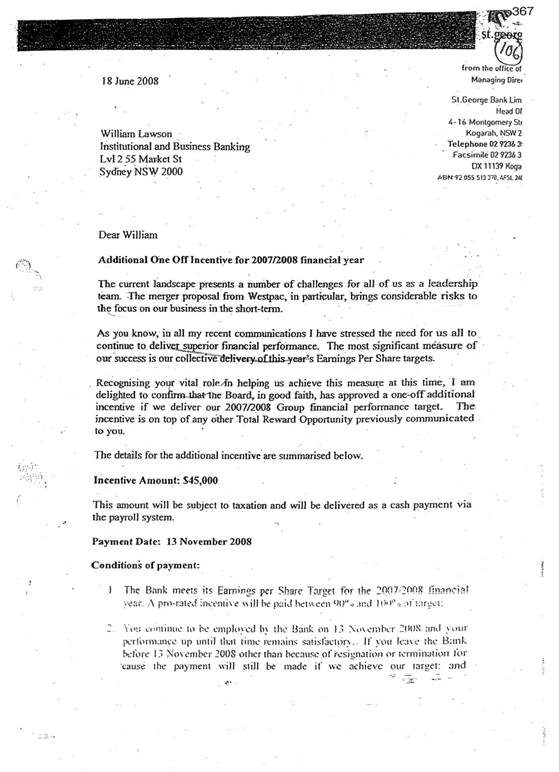
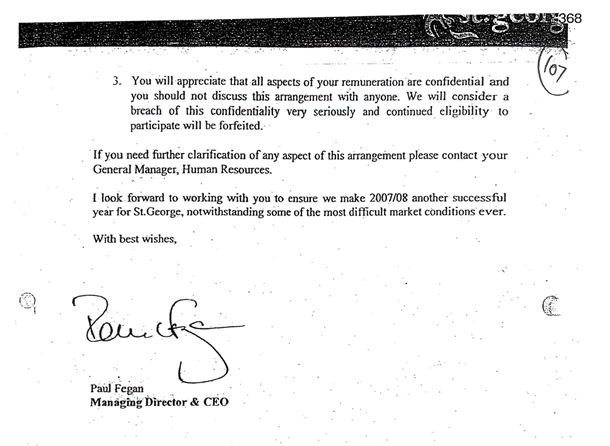
|
IN THE FEDERAL COURT OF AUSTRALIA |
|
|
NEW SOUTH WALES DISTRICT REGISTRY |
|
|
GENERAL DIVISION |
NSD 31 of 2010 |
|
BETWEEN: |
Danielle Lavars Applicant |
|
AND: |
WESTPAC BANKING CORPORATION Respondent |
|
IN THE FEDERAL COURT OF AUSTRALIA |
|
|
NEW SOUTH WALES DISTRICT REGISTRY |
|
|
GENERAL DIVISION |
NSD 90 of 2010 |
|
BETWEEN: |
Corey Wittenberg Applicant |
|
AND: |
WESTPAC BANKING CORPORATION Respondent |
|
IN THE FEDERAL COURT OF AUSTRALIA |
|
|
NEW SOUTH WALES DISTRICT REGISTRY |
|
|
GENERAL DIVISION |
NSD 690 of 2010 |
|
BETWEEN: |
William Lawson Applicant |
|
AND: |
WESTPAC BANKING CORPORATION Respondent |
|
IN THE FEDERAL COURT OF AUSTRALIA |
|
|
NEW SOUTH WALES DISTRICT REGISTRY |
|
|
GENERAL DIVISION |
NSD 1980 of 2011 |
|
BETWEEN: |
Lucky Poulos Applicant |
|
AND: |
WESTPAC BANKING CORPORATION Respondent |
|
IN THE FEDERAL COURT OF AUSTRALIA |
|
|
NEW SOUTH WALES DISTRICT REGISTRY |
|
|
GENERAL DIVISION |
NSD 1839 of 2011 |
|
BETWEEN: |
Paul Smith Applicant |
|
AND: |
WESTPAC BANKING CORPORATION Respondent |
|
DATE OF ORDER: |
|
|
WHERE MADE: |
THE COURT ORDERS THAT:
1. The parties are to seek to agree proposed short minutes of order which give effect to these reasons for judgment and also deal with costs by 11 November 2014.
2. If agreement cannot be reached, the parties should file and serve by 11 November 2014 their respective proposed short minutes of order together with an outline of written submissions in support, which are to be in normal font and format and must not exceed 20 pages.
3. The parties should indicate in their outline of written submissions whether or not they request a further oral hearing before final orders are made.
4. Liberty to apply on the giving of 48 hours' notice.
Note: Entry of orders is dealt with in Rule 39.32 of the Federal Court Rules 2011.
|
NEW SOUTH WALES DISTRICT REGISTRY |
|
|
GENERAL DIVISION |
NSD 1157 of 2009 |
|
BETWEEN: |
LOUISE MURPHY Applicant |
|
AND: |
WESTPAC BANKING CORPORATION Respondent |
|
IN THE FEDERAL COURT OF AUSTRALIA |
|
|
NEW SOUTH WALES DISTRICT REGISTRY |
|
|
GENERAL DIVISION |
NSD 31 of 2010 |
|
IN THE FEDERAL COURT OF AUSTRALIA |
|
|
NEW SOUTH WALES DISTRICT REGISTRY |
|
|
GENERAL DIVISION |
NSD 384 of 2010 |
|
BETWEEN: |
Stuart Moore Applicant |
|
AND: |
WESTPAC BANKING CORPORATION Respondent |
|
BETWEEN: |
Danielle Lavars Applicant |
|
AND: |
WESTPAC BANKING CORPORATION Respondent |
|
IN THE FEDERAL COURT OF AUSTRALIA |
|
|
NEW SOUTH WALES DISTRICT REGISTRY |
|
|
GENERAL DIVISION |
NSD 90 of 2010 |
|
BETWEEN: |
Corey Wittenberg Applicant |
|
AND: |
WESTPAC BANKING CORPORATION Respondent |
|
IN THE FEDERAL COURT OF AUSTRALIA |
|
|
NEW SOUTH WALES DISTRICT REGISTRY |
|
|
GENERAL DIVISION |
NSD 690 of 2010 |
|
BETWEEN: |
William Lawson Applicant |
|
AND: |
WESTPAC BANKING CORPORATION Respondent |
|
IN THE FEDERAL COURT OF AUSTRALIA |
|
|
NEW SOUTH WALES DISTRICT REGISTRY |
|
|
GENERAL DIVISION |
NSD 1980 of 2011 |
|
BETWEEN: |
Lucky Poulos Applicant |
|
AND: |
WESTPAC BANKING CORPORATION Respondent |
|
IN THE FEDERAL COURT OF AUSTRALIA |
|
|
NEW SOUTH WALES DISTRICT REGISTRY |
|
|
GENERAL DIVISION |
NSD 1839 of 2011 |
|
BETWEEN: |
Paul Smith Applicant |
|
AND: |
WESTPAC BANKING CORPORATION Respondent |
|
JUDGE: |
GRIFFITHS J |
|
DATE: |
14 OCTOBER 2014 |
|
PLACE: |
SYDNEY |
REASONS FOR JUDGMENT
1 These proceedings involve claims by seven former employees of St George Bank (SGB) against Westpac Banking Corporation (Westpac), which formally merged with SGB on 1 March 2010. The proposed merger was announced in May 2008. As will emerge below, it set in train a series of events over the ensuing two years which give rise to the applicants' complaints relating to their employment with SGB.
2 Although there are important factual differences between the individual circumstances of each of the applicants, there is a considerable overlap in some of their claims, which are all employment-related. The claims arise under various causes of action, including in contract, the torts of deceit and negligence, as well as misleading or deceptive conduct under the Trade Practices Act 1974 (Cth) (the TPA). The proceedings were all heard together. It is convenient to publish reasons for judgment which cover all seven applications.
3 In broad terms, and putting to one side for the moment the fact that not every applicant makes the same claims, the following primary allegations are made:
(a) Westpac is liable to pay damages, including exemplary damages, because by letters dated 18 June 2008 which were sent to all the applicants (together with other SGB employees who were identified as SGB's most valuable employees), misrepresentations were made concerning the true target for the payment of a retention incentive. It is claimed that the misrepresentations created an inducement for each of the relevant applicants to remain in SGB's employ throughout the merger process, with the result that, when each of their employment relationship with SGB ultimately ceased (for one reason or another), they had missed the opportunity for alternative employment which had earlier been available to them. The relevant applicants rely on causes of action in contract, deceit, negligence and misleading or deceptive conduct in respect of the retention incentive. For convenience, these claims will be referred to as "the retention incentive scheme claims";
(b) SGB breached the individual contracts of employment of some of the applicants by:
(i) failing to pay those applicants bonuses under various SGB bonus schemes which were known as the Treasury Incentive Plan (the TIP), the Medium Term Treasury Incentive Plan (the MTIP), the Divisional Incentive Plan (the DIP) (which applied to Mr Poulos alone) and the Short Term Incentive Annual Opportunity (the STIA) (which applied to Ms Murphy alone);
(ii) not giving some of the applicants reasonable notice of the termination of their contracts of employment with SGB (the wrongful dismissal claim(s)); and
(iii) failing to calculate and pay some of the applicants the correct severance payment to which they were entitled when they were made redundant.
4 With one exception, Westpac defends all these causes of action. The exception relates to the claims in contract concerning non-payment of the retention incentive. Although these claims were initially denied by Westpac in its filed defence, the claims were conceded by it before the hearing started. The Court was informed that Ms Lavars and Messrs Moore and Poulos already have verdicts on their contract claims in the amounts of the sums individually promised to them under the retention incentive scheme, but costs are reserved. Ms Murphy and Messrs Lawson, Smith and Wittenberg seek a verdict to the same amount in respect of their contract claims. All the applicants say that the Bank's belated concession should attract costs consequences and they seek to be heard on that matter. They have foreshadowed that they will seek indemnity costs.
5 The trial was conducted over a period of approximately seven weeks. The parties tendered approximately 1500 pages of documents. Twenty-six lay witnesses gave evidence (and most were cross-examined). Three expert witnesses gave evidence and participated in a concurrent evidence session. The applicants' closing written submissions (including their written reply) totalled 374 pages. Westpac's closing written submissions totalled 489 pages. The parties handed up supplementary notes and/or submissions which totalled almost 200 pages. There were 2,057 pages of transcript.
6 It is convenient to now outline in more detail the lay evidence and claims made by the seven individual applicants, then outline Westpac's lay evidence before summarising the expert evidence. I will then describe the key issues and summarise the parties' respective submissions before setting out my consideration and determination of all relevant matters.
7 Accordingly, these reasons for judgment are structured as follows.
8 Mr Lawson is aged 46, is married and has two young children. He swore four affidavits and also gave lengthy oral evidence in chief after large parts of his affidavits were ruled inadmissible.
9 Mr Lawson began work as a fixed income trader in Melbourne in December 1990, when he was employed by Potter Warburg. In August 1992, he started work with SBC Dominguez Barry trading semi-government bonds. He subsequently worked for the National Australia Bank (NAB) in Melbourne from 1995-1998, after which he took up an appointment in Sydney with Credit Suisse First Boston (Credit Suisse) trading and market making in government bonds. His position was made redundant at Credit Suisse in January 2005 when its trading business was relocated to Hong Kong.
10 Mr Lawson commenced employment with SGB in July 2005 as Executive Manager, Non-Credit Trading. He received a total salary of $175,000 per annum. He joined SGB after being approached in April 2005 by Mr Ian Hamilton (Chief Manager, Financial Markets), whom he had known for approximately 15 years. He was interviewed by two senior SGB executives, Mr Peter Fitzgerald (General Manager, Institutional and Financial Markets) and Mr Hamilton.
11 Mr Lawson's original written contract of employment was set out in a letter dated 22 July 2005. It contained provisions dealing with annual performance reviews and the SGB Employee Reward Share Plan. The letter also dealt with the termination of his employment. That could occur by either Mr Lawson or SGB giving written notice. In particular, the letter stated that:
(a) his employment could be terminated by SGB giving him four weeks' written notice;
(b) at its discretion, SGB could make a payment of the equivalent amount in lieu of notice; and
(c) if Mr Lawson was over 45 years of age and had accumulated two years' continuous service when his employment was terminated, he would be entitled to an additional one weeks' notice.
12 The letter also stated that, by signing it, Mr Lawson agreed "to abide by the policies and procedures of St George as may be amended from time to time". This has important implications for the question whether various policies regarding redundancy and secondment developed by SGB either at or after his work commencement applied to him.
13 Mr Lawson's employment position with SGB subsequently changed. In September/October 2006 he was promoted to the more senior position of Head of Non-Credit Trading and his salary increased. As will be further developed below, his duties and responsibilities expanded with this promotion. Mr Lawson also received an increased base salary and other entitlements in the following Bank financial year, such that his total remuneration had doubled in two years. The nature and extent of these changes is relevant to a significant issue in the proceeding, namely whether his duties and status changed to such an extent that his original contract of employment was varied with the consequence that the original provisions dealing with such matters as notice of termination changed to reflect his new role.
14 Mr Lawson also contends that it was a term of his employment that he would be paid not only an annual or base salary, but also an annual bonus. Mr Lawson gave evidence that he was never provided with any written rules or terms relating to the annual bonus. He claims that this alleged term of his employment was conveyed to him prior to his recruitment by Messrs Fitzgerald and Hamilton. Mr Lawson contends that he was told and understood that the express purpose of the annual bonus was to provide him with a remuneration which, together with his base salary, was commensurate with market rates.
15 Mr Lawson gave evidence that in his performance review in September-October 2006, he was told by Mr Hamilton that he had been promoted to Head of Non-Credit Trading at SGB, for which his base salary increased from $175,000 to $240,000. In October 2007, his salary was further increased to $250,000 and his bonus for the Bank's financial year ending 30 September 2007 was $180,500 under the bonus scheme known as the IP.
16 By a letter dated 17 December 2007, Mr Lawson was invited to participate in another SGB bonus scheme, the MTIP. The MTIP was offered to the more senior executives of SGB and provided them with an opportunity to be allocated SGB shares. In Mr Lawson's case he was offered the opportunity to take up two equal tranches of shares up to a maximum value of $50,000, with the first tranche to be exercisable on or after 30 September 2009 and the second tranche to be exercisable on or after 30 September 2010. The MTIP operated to increase Mr Lawson's annual remuneration in a way which avoided any conflict with SGB's base salary increase restrictions. It was also intended to encourage participants to remain with the Bank. It might be interpolated here that in his written reply submissions, Mr Lawson accepted that he only received 90 per cent of his MTIP opportunity in 2007/2008, which reflected the fact that SGB did not achieve the 10 per cent EPS growth and as such the Group component of 20 per cent was reduced by half.
17 Mr Lawson worked in the Treasury Division of SGB's Institutional and Banking Division. He received annual bonuses under the TIP. The terms of the TIP were apparently not reduced to writing (save in respect of one year which affected Mr Wittenberg). Annual bonuses distributed under the TIP were derived from a bonus pool calculated by reference to Treasury's financial performance. If employment was terminated before a full year had been worked, a pro rata annual bonus would be paid. According to Mr Lawson, the annual bonus and awards under the TIP were both "regular and consistent" and were paid annually irrespective of performance, propositions which Westpac strongly denies. By a letter dated 31 October 2008, which was signed by Mr Bartlett, Mr Lawson was informed that his TIP bonus for the year ending 30 September 2008 was $250,000. He was informed that he would receive a payment of $250,000 under the TIP (payable in two equal tranches on May 2009 and November 2009 as long as he remained at SGB on those dates). He was also given information as to his MTIP entitlements as part of the 2007/2008 annual review and also for 2008/2009. His "MTIP opportunity" was stated to be $50,000. The letter also contained the following information on Mr Lawson's "Total Reward Opportunity":
Your Total Reward Opportunity for 2008/2009 will be as follows pending the outcome of the proposed merger with Westpac:
|
Total Employment Cost (TEC) (includes fixed salary and compulsory superannuation) |
$257,500 |
|
Medium Term Incentive Opportunity |
$50,000 |
|
Total Reward Opportunity (excluding Treasury Incentive plan) |
$307,500 |
You will continue to be eligible to participate in the Treasury Incentive Plan for 2008/2009.
Please be aware that your Total Reward Opportunity is an estimate only and the final amount depends on a number of factors including your individual performance and continued employment with the St. George Group. Your leave and all other entitlements are calculated on the basis of your Total Employment Cost.
18 Finally, Mr Lawson was informed that, because the Bank's EPS outcome was below 90 per cent of the target, the Board had determined that no additional incentive would be paid to anyone at SGB. The letter also dealt with the possibility of pro rata payments being made in the event of certain contingencies. These included the possibility that if, for example, the merger was implemented but Mr Lawson was not appointed to a permanent role with Westpac and left the organisation within six months, Westpac would make an ex-gratia payment calculated as a pro rata percentage of his MTIP target.
The merger announcement and its effect on Mr Lawson
19 As noted above, in May 2008, SGB announced its intention to merge with Westpac. Mr Lawson became very concerned about his job security and he gave evidence that he raised the matter with both Mr Hamilton and with Mr Fitzgerald. He gave evidence that Mr Fitzgerald assured him that a retention incentive scheme would be devised to reward key SGB executives. He said that Mr Fitzgerald told him that key staff were essential to the Bank whether or not the merger was finalised and that he and two other members of his team had been identified as key members for SGB's operations.
20 At around this time, Mr Lawson says that he was approached by senior employees at JPMorgan, who expressed interest in recruiting Mr Lawson and his team (including Mr Paul Smith and Mr Stuart Moore, who are also applicants in the proceedings). Mr Lawson says that he discussed this possibility with representatives of JPMorgan on behalf of himself, as well as his team at SGB. This evidence is relevant to the issue of alternative employment for these three applicants. Mr Lawson said that the JPMorgan representatives with whom he met were Messrs Mark Stephens (Director, Fixed Income Sales), Adrian Janschek (Vice-President of Fixed Income Sales) and David Ioannidis. The discussions took place after Mr Stephens had contacted Mr Lawson to inquire whether he and Messrs Smith and Moore would be interested in opportunities outside SGB given the proposed merger between Westpac and SGB.
21 Mr Lawson said that he attended a lunchtime meeting in early June 2008 with Messrs Stephens and Ioannidis, which was also attended by Mr Moore. At the end of the lunch, Mr Lawson was invited to pursue further discussions with JPMorgan and it was left to him to follow that up. Mr Lawson said that within a week of the luncheon meeting he had a further conversation with Mr Janschek. Mr Lawson said that Mr Janschek told him that he had been approached by Mr Ioannidis and another JPMorgan employee (Mr Jeff Herbert-Smith) to provide a reference check for Mr Lawson. Mr Janschek told Mr Lawson that he had recommended that JPMorgan employ Mr Lawson in its fixed income business. Mr Lawson also gave evidence that around this time he had a separate conversation with Mr Stephens, who informed him that he had given "a glowing reference" for Mr Lawson to Messrs Ioannidis and Herbert-Smith.
Mr Janschek's evidence concerning alternative employment opportunities for Mr Lawson
22 It is convenient at this point to summarise Mr Janschek's evidence, who was called as a witness by Mr Lawson. Mr Janschek said that he and Mr Lawson had worked together at Credit Suisse for four years up to January 2005. He confirmed that JPMorgan had approached Mr Lawson in circumstances where JPMorgan was hiring fixed income traders. He said that he had been approached in mid-June 2008 by Mr Ioannidis and Mr Herbert-Smith (with whom Mr Janschek had also worked), who inquired about Mr Lawson's abilities and suitability. Mr Janschek deposed that, while he did not recall the exact words he used, he had conveyed to them that Mr Lawson had made money at Credit Suisse and that he considered that he would bring significant advantages to JPMorgan's trading team. Mr Janschek also recalled Mr Lawson telling him in late June 2008 that he had decided to stay at SGB and not pursue the opportunity at JPMorgan. I accept this evidence.
23 Mr Janschek gave evidence, which I also accept, that JPMorgan was building up a new business division in the first half of 2008 and that he had been engaged by JPMorgan in May 2008 for that purpose in the position of Vice President, Fixed Income Sales and that other people were recruited by JPMorgan at that time as part of its expansion plans.
24 In cross-examination, Mr Janschek gave evidence that redundancies commenced at JPMorgan in December 2008, which were related to the global financial crisis (GFC). He said that the redundancies were "meaningful" and resulted in 20 per cent of his particular section within JPMorgan being made redundant. The redundancies continued in 2009. Mr Janschek also gave evidence that he played no role in the hiring or firing of employees at JPMorgan in 2008. I accept that evidence.
Mr Lawson is invited to participate in SGB's retention incentive scheme
25 Mr Lawson gave evidence that his interest in possibly taking another job changed in mid-June 2008 when he was advised by SGB in a letter dated 18 June 2008 that he had been selected as a key executive within SGB to whom a retention incentive would apply in order to encourage him to stay with SGB during the implementation of the merger with Westpac. The letter was signed by the Managing Director and Chief Executive Officer of SGB, Mr Paul Fegan. In view of the importance of the letter, not only to Mr Lawson's case, but also to other applicants who received similar letters, it is convenient to set out the full text of the letter:
26 Mr Lawson and some of the other applicants contend that the letter was deliberately misleading and untrue in its references to achievement of SGB's "earnings per share target" insofar as the 2007-2008 financial year is concerned. The EPS growth target which was published to the market and to staff generally was originally said to be 10 per cent, but that was then later revised to a range of 8-10 per cent. Mr Lawson, and the other relevant applicants complain that, unbeknownst to them, the SGB Board had set a different EPS growth rate for the purposes of the retention incentive scheme at a level of 10.1 per cent. They complain that this was never disclosed to them at the relevant time and was known only to the SGB Board (which included Mr Fegan) and to four of the most senior SGB executives.
27 In his affidavit dated 29 October 2010, Mr Lawson deposed that he relied upon the retention incentive letter and the discussion he had with Mr Fitzgerald when the letter was handed to him in deciding to terminate his discussions with JPMorgan on behalf of both himself and his team. He said that if he had known the true position, he would not have remained with SGB during the merger process and rather would have pursued the opportunity with JPMorgan. Mr Lawson said that he accepted the truth of Mr Fitzgerald's statement that he had been identified as a key person for a role in the merged organisation and he added that this fact, together with the financial incentive, persuaded him to cease looking outside SGB for an alternative role. He also said that if he had known that the EPS target was 10.1 per cent and not 8-10 per cent, he would have discounted the incentive as being "effectively worthless". Mr Lawson gave evidence that he only became aware of the 10.1 per cent figure after the proceedings were commenced and he added that, if he had known that the true target was 10.1 per cent, he would have regarded the retention incentive "to be practically unachievable and therefore of no real value". As will shortly emerge, Mr Lawson was closely cross-examined on this and other parts of his evidence.
28 Mr Lawson also deposed that he was approached by senior executives of ING Investment Management around August 2008, who expressed an interest in recruiting him. He said that he did not pursue that opportunity for the same reasons as he gave for terminating his discussions with JPMorgan.
Mr Lawson's secondment to Westpac
29 Around 28 November 2008, Mr Lawson was informed by a letter written on SGB letterhead but signed by Ms Cathy Graycon (Managing Director - People, Westpac Institutional Bank) that he would be seconded to Westpac to occupy the position of Portfolio Manager - Strategic Risk. The letter included the following paragraphs:
In your role of Portfolio Manager - Strategic Risk you will be required to assist with work for the broader Westpac Group. As such, while you remain employed by your current employer, you will be seconded for the portion of the work that you do for the Westpac Group. The secondment arrangement is a requirement of our corporate structure following the merger.
During the secondment the employment policies of your employer would continue to apply to you. Some additional policies may also apply, for example, compliance policies related to the portion of work that you do on secondment. All other terms and conditions of your employment continue to apply, as varied by this letter.
The application of SGB's redundancy policies to Mr Lawson
30 An important issue in Mr Lawson's case is the SGB policies which applied to him. He claims that he was subject to the following policies:
(a) a redundancy policy entitled "St George Bank Limited Redundancy Policy" ("the 2001 Redundancy Policy") which provided that, upon termination through retrenchment, an employee would be paid a special lump sum severance payment in full settlement of all claims calculated as six weeks' salary in lieu of notice, seven weeks' for the first full year of service and three weeks' salary for each subsequent year or part year of continuous service. It further stated that the maximum payment would be 65 weeks' salary;
(b) a further redundancy policy which was published on SGB's intranet website (the HR Express Redundancy Policy) (note that Mr Lawson claims that he had been told by Mr Hamilton that this latter policy did not affect his entitlement to notice under the 2001 Redundancy Policy). Under that document, redundancy payments in respect of staff employed under the SGB Enterprise Agreement were described as comprising six weeks' pay in lieu of notice, seven weeks' pay for the first completed year of service, four weeks' pay for each subsequent year from two to ten completed years of service, three weeks' pay for each subsequent year from 11 to 16 completed years of service and two weeks' pay for each subsequent year to a maximum of 25 completed years of service, including the first year. In addition, such staff would receive one weeks' pay for each year over 45 years of age and pro rata pay for each completed month of work to a maximum of 85 weeks' pay (90 weeks for staff over 45 years old), including the six weeks' notice period; and
(c) a secondment policy (the Secondment Policy), which contained the following statements:
A secondment is a temporary transfer or promotion to another role for a minimum period of 6 weeks and a maximum period of 12 months. No extensions beyond 12 months are possible. Only permanent staff can be seconded to another role.
31 The Secondment Policy further stated that as a term and condition of any secondment, the seconded employee "must return to your original position, salary and conditions when the period of the secondment ends, unless you are appointed to the role to which you were seconded, or you are moved to another role".
32 Mr Lawson contends that it was an express term of the 2001 Redundancy Policy that, if his employment was terminated for redundancy, he would be paid a lump sum severance payment of up to a maximum of 18 months' salary, including a notice period. He says further that SGB's Managing Director and Chief Executive Officer, Mr Fegan, had a discretion to increase that notice period to reflect the applicable period of "reasonable notice", having regard to such matters as age, seniority, length of service and specialisation.
33 Mr Lawson also contends that it was an express term of the HR Express Redundancy Policy that he would receive a severance payment up to a maximum of 90 weeks' "pay", but without affecting his entitlement to reasonable notice under the 2001 Redundancy Policy and/or his common law entitlements to reasonable notice. Mr Lawson places particular emphasis on the use of the term "pay" instead of "salary" in the HR Express Redundancy Policy. He contends that the term "pay" described his total remuneration, which included not only his base salary but also his bonus entitlements.
34 On 1 March 2010 (which was after Mr Lawson's employment with SGB had been terminated by way of redundancy and retrenchment), the terms of the policy relating to retrenchment entitlements for those employees who were employed by SGB prior to the Bank ceasing to exist on 1 March 2010 were varied. The policy was varied so as to define "severance pay" as: "your fixed pay only and does not include any bonuses, incentives, commissions, overtime, superannuation or any other separately identified entitlement". Mr Lawson draws attention to these changes, which he contends did not reflect the earlier position when his employment with SGB was terminated.
35 Mr Lawson's secondment with Westpac commenced on 1 December 2008. He contends that his seconded position was different from his SGB position in that:
(a) his budget at Westpac represented a substantial additional burden to that which he had at SGB (his budget at Westpac was $3.3 million compared with a budget of $1.5 million which had been set for him at SGB around October 2008);
(b) his trading limits and reporting requirements differed;
(c) he no longer had any managerial responsibilities; and
(d) the bonuses were not comparable with those available to him at SGB.
36 Mr Lawson gave evidence of a telephone conversation which he had in early 2009 with Mr Harvey from SGB Human Resources in which he says he told Mr Harvey that he was concerned about his employment arrangements. He explained that that was because although he had been told that he was on secondment, he felt that he was being treated like a Westpac employee, having been allocated a Westpac budget, Westpac trading limits and Westpac reporting requirements. He said that he also told Mr Harvey that he had been advised that he would be remunerated under the Westpac bonus scheme and not the SGB bonus scheme. He said that Mr Harvey told him that he was working on the matter with Westpac. Mr Lawson gave further evidence that Mr Harvey subsequently told him in around April or May 2009 that he was involved in the process of selecting employees who would be employed by Westpac but that he was unable to tell him anything more about the topic.
37 Mr Lawson also gave evidence that from at least February 2009 onwards, he regularly made inquiries with a view to clarifying the employment status at Westpac of both himself and Messrs Moore and Smith. He said that he did not get any response to those inquiries.
38 Mr Lawson gave evidence of bonus payments he received while he was working at Westpac. By a letter dated 3 December 2009, which was written on SGB letterhead and signed by Mr James Land from Westpac, Mr Lawson was told that given the results of his 2009 remuneration review, he would receive a $60,000 bonus for the three months that he had worked at SGB and zero bonus for the period he was seconded to Westpac. Mr Lawson also gave evidence of a discussion he had with Mr Land in late October or early November 2009 regarding his performance review. He said that Mr Land told him that he had been rated as an employee who needed development because he did not meet his Westpac budget. Mr Lawson added that Mr Land was unable to tell him whether that would have any impact to his entitlement under SGB's MTIP.
39 Mr Lawson gave evidence of another conversation he had with Mr Land in early December 2009 in which he was told by Mr Land that he would not be receiving any payment or entitlement under the MTIP because he had been rated as an employee who needed development under the Westpac Performance Review Scheme. Mr Lawson complained to Mr Land that he considered that he was entitled to receive the MTIP because his SGB budget for the year was $1.5 million and that he had achieved that budget for the period that he was working at SGB. He said that Mr Land responded by saying that he would not receive any MTIP, that he had been taken off the MTIP scheme and that he would not be given an equivalent plan at Westpac.
40 Mr Lawson gave further evidence which responded to an affidavit sworn by Mr Doyle on behalf of Westpac. Mr Doyle worked at Westpac. Mr Lawson denied that Mr Doyle ever told him that the percentage based bonus system for the Strategic Risk Group (SRG) at Westpac was "discretionary". He also denied ever being told by Mr Doyle that there was no incentive scheme for the SRG for 2008/2009, or that bonuses for that year would be paid at Westpac's discretion.
41 Mr Lawson contends that the duties relating to his secondment position at Westpac amounted to a substantial and radical change to his terms and conditions of employment. As noted above, this issue bears upon the question whether the terms of his original contract of employment, including the notice period to which he was entitled, were replaced or varied to reflect his changed employment role.
42 On 14 December 2009, Mr Lawson was advised both by letter and orally by Mr Doyle that Westpac would close its SRG and, consequently, that his seconded position was redundant. He was also told that he would start a period of redeployment in which other employment opportunities within Westpac would be explored, taking into account his skills, experience and interests. He was advised that the redeployment period was expected to be six weeks starting on 15 December 2009 and concluding no later than 29 January 2010. By a further letter dated 28 January 2010, Mr Doyle informed Mr Lawson that his redeployment period would be extended by a further week until 5 February 2010, during which time other employment opportunities would be sought for him.
43 Mr Lawson's employment was ultimately terminated by way of retrenchment on 5 February 2010. Mr Lawson received a redundancy payment of $93,903, representing 19 weeks at the rate of his base salary only. He also received a further payment on account of notice of $107,083 (representing five months' notice and, again, calculated only by reference to his base salary and not his annual bonuses).
Cross-examination of Mr Lawson
44 Mr Lawson was subjected to a lengthy cross-examination. One of the prominent issues in that cross-examination was his claim that he had been told that his annual bonuses would be "regular and consistent". I found his evidence on this topic at times to be inconsistent and uncertain. Mr Lawson initially said that he had been told that he would receive 100 per cent of his base salary as an annual bonus. He later modified that to say that he had been told that he would receive "around" 100 per cent. Initially, he created the impression that he had received repeated assurances about his receiving an annual bonus both before and after he took up his employment with SGB. Ultimately, however, when pressed during cross-examination, he accepted that he had only ever been told that in his pre-employment discussions with Mr Hamilton. I accept that evidence.
45 Another topic on which he was closely cross-examined concerned the proposition that the payment of the annual bonus depended upon a range of factors, which included an individual employee's own performance as well as SGB's overall performance. Initially, Mr Lawson seemed reluctant to accept that proposition. He was then taken to [3] of his statement of claim and to the reference there to the "engagement conversations" he had with Mr Hamilton and to the claim there that his remuneration would be made up of a base salary and variable annual bonuses. It was put to him that the use of the word "variable" must mean that his annual bonus could fluctuate according to various performance criteria. Initially, Mr Lawson resisted that obvious proposition. His response was that all he had to do to get his annual bonus was to receive a competency rating, which he explained simply meant achieving a level of base competency. Mr Lawson had some difficulty recollecting the different ratings which were apparently attributed to SGB employees, including himself, as part of the annual performance reviews. He was taken to the review which he had completed in respect of Mr Stuart Moore, who was a member of his team at SGB. Mr Lawson accepted that he had had responsibility for filling out the manager's comments in that review, although Mr Hamilton also had some involvement. Mr Lawson acknowledged that he had rated Mr Moore as exceptional, which was the highest grade. When it was pointed out that Mr Moore had received a 120 per cent bonus that year (against his base salary), Mr Lawson acknowledged that it was because Mr Moore had had a "stupendous" year. This confirmed that which Mr Lawson seemed reluctant to acknowledge, namely that an employee's personal performance had an important bearing on the quantum of any bonus he or she received.
46 Mr Lawson was also asked a series of questions in cross-examination relating to the fact that in his first year at SGB, he had received an annual bonus which represented only 60 per cent of his base salary. He was asked why he did not complain that he had not received around 100 per cent given his earlier evidence to the effect that that is what he had been told. Mr Lawson responded by saying that he did not complain and that he was happy with the bonus he received.
47 Mr Lawson was then asked to comment on the fact that, in the following year, he received an annual bonus which represented only 75 per cent of his base salary. He was asked to comment on the proposition that this indicated the variability of his annual bonus and that he had obviously performed better personally in the second year, thereby receiving an increase of approximately 15 per cent in his annual bonus. Mr Lawson was reluctant to respond directly to that proposition. He simply repeated that he was grateful to receive any bonus and that he was happy with it. I found this part of his evidence to be unconvincing and difficult to reconcile with his central claim concerning the assurances he said he was given about the level of the annual bonus which he could expect to receive. I also consider that the evidence demonstrated that annual bonuses were not guaranteed as claimed by Mr Lawson. In my view, his resistance to the proposition that annual bonuses were tied to individual performance and were variable did not reflect well on his credibility.
48 Other aspects of Mr Lawson's evidence cast further doubts about his credibility. One such area concerns the cross-examination in respect of a letter dated 22 November 2007 which he received from Mr Bartlett at SGB. That letter informed him that he had received an annual bonus of $180,500. It also confirmed that he was invited to participate in the MTIP. A condition of such participation was that he would need to enter into a service agreement, a copy of which would be sent to him shortly. He had no recollection of ever receiving or executing any such service agreement. The letter foreshadowed that Mr Lawson would be entitled to three months' notice under that service agreement, which is a period significantly less than his claim to be entitled to receive a period of notice of at least 15 months. When confronted with that letter, Mr Lawson rather unconvincingly said that he did not pay close attention to the details of the letter and simply focused on the numbers. This arose in the context of Mr Lawson saying that he did not appreciate the qualifications expressed in that letter which explicitly stated that payment of the bonus was subject to achievement of certain conditions, including performance and that there was no guarantee involved. In my view, it is difficult to accept that Mr Lawson would not have shown close interest in the detail of these matters, impacting as they did directly on his personal remuneration, which must have been a matter of particular concern to him.
49 Another topic on which Mr Lawson was closely cross-examined related to the nature of the discussions he had had with representatives of JPMorgan. Mr Lawson confirmed that during the two-hour luncheon in early June 2008, there was no discussion at all of conditions of employment or salary if Mr Lawson left SGB and joined JPMorgan.
50 During further cross-examination, Mr Lawson was asked various questions about how his conduct would have changed if he had been aware at the relevant time that the EPS target for the incentive program was 10.1 per cent. He said had he known that he would have looked for jobs elsewhere. He was asked repeatedly to explain why that was so in circumstances where he never raised any written or oral complaint about the fact that he was told by letter on 31 October 2008 that no additional incentive would be paid to anyone at the Bank. When he was pressed he said that the reason why he would have looked elsewhere was because he would not have had confidence in his future at SGB. I found his answers on this topic to be unconvincing and insufficient by themselves to demonstrate that he would not have remained with SGB save for the retention incentive scheme described in the letter dated 18 June 2008 which he had received.
51 Mr Lawson was also asked a series of questions regarding the Westpac bonus system and whether or not he was told that the previous bonus system at SGB would not apply to his time at Westpac. Mr Lawson's evidence was to the effect that he had been told by various Westpac executives, including Messrs Land, Doyle and Wilson, that his bonus when at Westpac would be 12.5 per cent of revenue up to a figure of $5 million and then 15 per cent above that. He said that he was told by Mr Land that the Group hurdle was $2 million and that those figures would apply. Mr Lawson was then cross-examined on an email he had received from Mr Wilson where he told that there was no contractual arrangement in place concerning bonuses. When shown that document, Mr Lawson agreed that he never challenged that proposition but said that whatever might have been recorded in writing was overtaken by what he had been told orally. It might also be noted that Mr Lawson received another letter, which was to similar effect and indicated that there was no contractual commitment to receive a bonus and that all that was offered was on the basis of "best endeavours".
52 As indicated above, I have some reservations concerning Mr Lawson's credibility. They highlight the need to view his evidence carefully. In the absence of objective corroborating evidence, I am reluctant to accept Mr Lawson's evidence at face value.
53 Ms Lavars swore two affidavits dated 4 November 2010 and 20 February 2012 respectively. She also gave oral evidence in chief after large parts of her affidavits were ruled to be inadmissible. Ms Lavars was cross-examined.
54 Ms Lavars commenced employment with SGB around September 1998, after she was approached by an executive search firm. She was employed in the position as an Account Manager in the margin lending area of SGB and was employed pursuant to a letter of offer dated 10 August 1998. The letter made express reference to her being covered by the policies and procedures of SGB as set out in the Bank's Corporate Manual. Her "total employment cost" (TEC) was stated to be $45,000. She was informed that TECs were generally reviewed annually, with adjustments effective from 1 October each year and with an annual performance review. The letter also stated that Ms Lavars' employment could be terminated on the giving of four weeks' notice (or payment in lieu of notice).
55 Although Ms Lavars was initially appointed to the position of Account Manager, her position changed several times thereafter as follows (noting also that she was never provided with a replacement written contract of employment):
(a) in early 2000, she was promoted to the position of Manager, Institutional Sales in SGB's Treasury Division, and she received a bonus each year in which she was employed within Treasury;
(b) in 2002, she took on the additional position of Cash Dealer;
(c) in 2004 she took on a new position assisting in developing the Financial Institutions Group of SGB, which consisted of establishing relationships with contacts and other banks;
(d) in 2005-2006 she returned to the position as a Senior Manager in the Institutional Sales Section of the Treasury Division, at which time she reported to Mr Hamilton. She also became more active in the marketing of SGB funding programs and was responsible for the day-to-day distribution of relationships for particular programs in which the Bank was a panel member; and
(e) from 2006, she reported to Mr Wittenberg and, while she continued to perform her institutional sales functions, she also assisted Mr Wittenberg in expanding the origination capabilities of the Bank. Her client list was expanded to include financial borrowers.
56 Ms Lavars deposed in her first affidavit that, during the course of her pre-employment interview with Ms Michelle Davies, she was told that at SGB she would receive a base salary and a bonus which would be payable at the end of each year. She recalled receiving a bonus of $2000 to $3000 at the end of her first year with SGB.
57 Ms Lavars also gave evidence of the circumstances surrounding her transfer to the dealing room. She said that she had a meeting with Messrs Fitzgerald and Hamilton about the possibility of her transferring to that area and that, during the course of the meeting, Mr Hamilton told her that she would be remunerated by way of a base salary together with an annual bonus. She said that he explained to her that because Treasury could not match the big base salaries paid by other investment banks and that because there was also a cap on base salary increases, the bonus was used "to ensure that you are kept up to the market for the role that you perform within Treasury".
58 Ms Lavars gave evidence as to what she was told regarding her base salary and annual bonus under the TIP. She said that she attended annual reviews and annual meetings with either Mr Fitzgerald or Mr Hamilton and she was told on these occasions that she would be paid a bonus to keep her position at market remuneration levels and that the amount of the bonus she would receive took into account not only her individual performance but also the performance of the dealing room. She gave evidence that she was told that annual bonuses were allocated from a bonus pool, calculated by reference to the financial performance of the Treasury Division and that the levels of bonuses were determined by Messrs Hamilton and Fitzgerald.
59 Ms Lavars says that her annual bonuses were regular and substantial and that she received an annual bonus each year of her employment.
60 Ms Lavars also gave evidence of a meeting which she had with Mr Fitzgerald on 18 June 2008, during which he handed her a copy of the 18 June 2008 letter offering her the incentive retention scheme. She said that he told her that the Bank was offering incentives to key people to have them stay with the Bank during the merger and due diligence period.
61 Ms Lavars also gave evidence that she was aware from market announcements that the earnings per share growth target for SGB for 2007/2008 was 8-10 per cent. She said that she had to know that figure in order to provide investor updates on SGB's performance. She said that she understood from the terms of the 18 June 2008 letter that the retention incentive would be paid to her if SGB met its earnings per share growth target of 8-10 per cent.
62 Ms Lavars said that she was told by Mr Jim Fingleton on or around 13 November 2008 that she would not receive a retention incentive. It was only after the proceedings were commenced that she learned that the target for the retention incentive scheme was in fact 10.1 per cent.
63 On 31 October 2008, i.e. several months after the proposed merger was announced, Ms Lavars received a letter which informed her that she would continue to be eligible to participate in the TIP for 2008-2009.
64 Ms Lavars also gave evidence of various meetings she had with Mr Fitzgerald from around October 2008 regarding the prospects for SGB employees arising from the proposed merger. She said that he told her that the merged organisation would provide a greater opportunity for her than was currently available at SGB. She said that Mr Fitzgerald also told her that there would be "contestable positions" if an employee's role at SGB was repeated at Westpac and that she would be notified if she was to contest one of those positions. She gave further evidence that Mr Fitzgerald told her in mid-November 2008 that there was a contestable position in the merged organisation in rate sales. She said that she told Mr Fitzgerald that she did not like her chances because she was working in credit sales but that he said that it was the only contestable position available to her.
65 Ms Lavars said that she was unsuccessful in obtaining a position in rate sales.
66 Ms Lavars also gave evidence of a job interview which she had with Mr Simon Ling for a role in the originations area of the Debt Capital Markets section (DCM) of Westpac. Mr Ling held the position of Executive Director, DCM - Debt and Hybrid Securities. Ms Lavars said that she was advised by Mr Ling on 28 November 2008 that her application for the position was successful. Ms Lavars received a letter dated 1 December 2008, written on SGB's letterhead by Ms Graycon (Managing Director, WIB-People) appointing her to the position of Manager, DCM-Debt & Hybrid Securities at Westpac, but stating that she would continue to be employed by SGB. Her secondment letter, which was in similar terms to secondment letters received by other relevant applicants, contained the following paragraphs:
In your role of Manager, DCM-Debt & Hybrid Securities you will be required to assist with work for the broader Westpac Group. As such, while you remain employed by your current employer, you will be seconded for the portion of the work that you do for the Westpac Group. The secondment arrangement is a requirement of our corporate structure following the merger.
During the secondment the employment policies of your employer would continue to apply to you. Some additional policies may also apply, for example, compliance policies related to the portion of work that you do on secondment.
All other terms and conditions of your employment continue to apply, as varied by this letter.
(Emphasis added).
67 Ms Lavars gave evidence, which I accept, that shortly after she received this secondment letter, she reviewed the Secondment Policy which was on the HR Express intranet site. She observed that the maximum period for any secondment was 12 months. The policy also stated that no extensions beyond 12 months were possible.
68 The relevant terms of the Secondment Policy as at this time were as follows.
Secondment
A secondment is a temporary transfer or promotion to another role for a minimum period of 6 weeks and a maximum period of 12 months. No extensions beyond 12 months are possible. Only permanent staff can be seconded to another role.
Secondments can be advertised or negotiated directly with individual staff members.
If you are seconded to another position you must be informed of and agree to the terms and conditions of the secondment in a secondment letter of offer.
Secondment terms and conditions
• You are expected to work the hours and work pattern that apply to the secondment role.
• You are paid the minimum salary (non-package staff) or TEC/TR (package staff) for the grade of the position you are seconded to and are automatically paid the appropriate rate from the start date of the secondment.
• Any additional allowances that apply to the secondment role are paid from the start date of the secondment and any allowances from your original role from the start date of the secondment.
• You must return to your original position, salary and conditions when the period of the secondment ends, unless you are appointed to the role to which you were seconded or you are moved to another role.
• St George can vary secondment end dates within the agreed timeframe for any reason by giving you one week's notice, or by setting a new end date by mutual agreement.
69 It is to be noted that the Secondment Policy refers in its terms only to a secondment for a temporary period - it does not contemplate a secondment for a permanent period. As will emerge below, this issue assumes some importance in Ms Lavars' case because in October 2009 the Secondment Policy was amended by SGB by the addition of the following paragraph immediately before the heading "Secondment terms and conditions":
Clarification of Scopy (sic) of Policy - St George / Westpac merger
This policy does not apply to employees who are employed in a permanent position following the St George/Westpac merger and who, as part of that permanent position, undertake some or all of their duties for another Westpac Group company. This is the case even if the duties which the employee provides for another Westpac Group company have been described as a "secondment". This is because this policy is limited to "secondments" under which an employee is not undertaking duties as part of their permanent work, but rather is seconded to another role on a temporary basis.
70 In her oral evidence in chief, Ms Lavars said that she discussed the secondment letter with Mr Fitzgerald and he told her that, because of the speed of the merger between Westpac and SGB, they were not able to offer her a contract and a secondment was the only way forward, but that she might expect to negotiate a contract later. Ms Lavars recollected Mr Fitzgerald saying that she had a "foot in the door". I accept that evidence.
71 Ms Lavars commenced her secondment with Westpac on 2 December 2008 in her new role. She said that from that point onwards she only performed duties for Westpac and marketed products under the Westpac banner and brand. She said that she was provided with a business card bearing the name and logo of Westpac and that her email signature also indicated Westpac and not SGB. She said that, although her remuneration continued to be paid by SGB, she did not do any work for SGB. As far as she was aware, all wholesale funding operations of the Treasury Division of SGB had ceased to operate from 1 December 2008. From and after 2 December 2008 all her work functions were performed at Westpac's premises in Kent Street, Sydney. She said that her duties at Westpac were exclusively concerned with originations and that she performed none of the sales functions that had been a major part of her work at SGB. Instead of liaising directly with investors, as she had done at SGB, her work in originations involved liaising with issuers, i.e. the other banking institutions who sought to raise money. The bonuses she was to earn were less attractive than at SGB and she says that she would not have accepted the secondment if she had been told about the substantial changes to her bonus entitlements. I accept that evidence.
72 In her oral evidence in chief, Ms Lavars said that while she worked at Westpac she reported to Mr Ling. She gave evidence of a discussion about her remuneration which she had with Mr Ling in November 2009 after he asked her what her pay and bonus had been the previous year at SGB. She told him $250,000 and $150,000 respectively. She said that Mr Ling told her that he did not think that she would be paid those amounts at Westpac. She said that she responded by saying that she was still employed by SGB and not Westpac. I accept that evidence.
73 Ms Lavars also gave oral evidence in chief concerning another conversation she had with Mr Ling a few weeks later relating to her bonus. Her evidence was to the effect that Mr Ling told her that she had got a reasonably high bonus relatively speaking and that he had tried to get her $100,000, but his management capped her bonus at $80,000. Ms Lavars said that she was very disappointed about that because she had performed well at Westpac and she believed that she would have done better under the SGB bonus scheme. Ms Lavars said that she was accepted into the Westpac incentive plan around November 2009. I accept that evidence.
74 Ms Lavars also gave evidence of a conversation she had with Ms Renee Bissett around February 2009. Ms Bissett worked in Human Resources at Westpac. Ms Bissett told Ms Lavars that she had to remain an SGB employee on secondment to Westpac until Westpac was able to give her a new contract, but that could not happen at that stage and had to await the surrender of the SGB banking licence. She also gave evidence that she was given similar information by other Westpac employees at a focus group meeting held on 28 April 2009. She said that at that meeting, Ms Kellie Penridge from Westpac said that Westpac would not be offering full time contracts to SGB staff members before the full merger had gone through and the SGB banking licence had been surrendered. She said that Ms Penridge explained that this situation arose because if Westpac offered contracts of employment to SGB staff at that time, Westpac would have to pay stamp duty on the transfer of the staff as they were classified as assets, and that would cost the Bank a substantial amount of money. I accept that Ms Lavars was told these things.
75 Ms Lavars gave evidence, which I also accept, of several conversations she had with Mr Ling about her dissatisfaction arising from the fact that she remained on secondment and was uncertain about her future because she did not know when she would receive a written contract of employment with Westpac. In an email dated 12 August 2009, Mr Ling told Ms Lavars that, despite her secondment to Westpac "it would seem that you are seconded to Westpac with no time limit although I am sure we will sort that out over time" (emphasis added). He attached another email from Ms Bissett which stated that Ms Lavars was not working with Westpac on a temporary secondment basis. Ms Bissett added in her email that the SGB Secondment Policy had no application to Ms Lavars because Ms Lavars had not been "temporarily moved or promoted to another role, she had been directly appointed to the role of Manager, DCM - Debt & Hybrid Securities" at Westpac.
76 Ms Lavars also gave evidence concerning a letter which she received from Mr Bartlett on or around 31 October 2008 which informed her of her bonus for 2007/2008. The letter was written on SGB's letterhead. She was advised that she would receive a TIP payment of $150,000, payable in two tranches on May 2009 and November 2009, and conditional on her remaining employed by SGB. She was advised that her total employment cost (including fixed salary and superannuation) was $205,000 and that she would continue to be eligible to participate in the TIP for 2008/2009.
77 By a later letter dated 3 December 2009, which was also written on SGB letterhead, Ms Lavars was informed of the results of her 2009 remuneration review. She was told that her total employment cost remained at $205,000. She was further advised that she had been awarded a total amount of $80,000 under the TIP, which amount would be payable in two equal tranches in May and November 2010 respectively. She was told that those payments were subject to her "continuous employment" with the Westpac Group. Finally, it was confirmed that, for the performance year beginning 1 October 2010, "you will move from your current St George variable reward scheme to the WIB Reward framework" and that further information on that framework could be found on the WIB intranet page.
78 Ms Lavars gave evidence that she never agreed to the change in her employment contract which had the effect of removing her from the SGB bonus scheme and that she would not have accepted the position set out in the letter dated 1 December 2008 if it amounted to employment with Westpac but without a written contract setting out the terms and conditions of her employment with Westpac. I accept that evidence.
Ms Lavars' desire to return to SGB after 12 months at Westpac
79 Ms Lavars gave evidence that, in accordance with her understanding of the terms and conditions of the Secondment Policy, she was to return to SGB and to her original position after 12 months on secondment. She said that as she did not wish to continue to work in the DCM Originations position at Westpac, she gave notice to Mr Ling by letter dated 26 November 2009 that she would report to SGB on 2 December 2009, which was the day after the 12 months secondment period ended. In her letter, she also stated that because the Treasury Division within SGB was no longer active, it would be necessary for SGB to provide her with comparable and appropriate alternative employment.
80 By letter dated 27 November 2009, which was written on SGB letterhead, Ms Lavars was advised by Mr Ganesh Chandrasekkar (Acting Managing Director WIB - People), that her employment with SGB was ongoing and that there would be no change as at 1 December 2009 to the role to which she had been appointed by the letter dated 28 November 2008 (sic). (There was no such letter adduced in evidence: the only relevant letter is that dated 1 December 2008). She was further advised that her employment "will continue to be subject to your existing St George terms and conditions of employment" and that she should continue to report to the same office where she had been working for the previous 12 months.
81 Ms Lavars gave evidence that she had a meeting on 27 November 2009 with Ms Amanda Matehaere (who worked in Westpac's Human Resources area), during the course of which she was told by Ms Matehaere that her position was on going, that she was not on secondment and that she was required to continue in the role to which she had been appointed. Ms Lavars said that she pointed out that her letter of appointment had said that she was on secondment and that the terms of her employment at SGB would not change. She also drew attention to the fact that she had been taken off the SGB TIP and moved over to the Westpac incentive bonus scheme, something to which she never agreed and which had resulted in a reduction of $70,000 in her remuneration. She said that Ms Matehaere directed her to attend work in her existing role at Westpac and that, if she declined to do so, Westpac would terminate her employment. I accept that this is what Ms Lavars was told.
82 Ms Lavars also gave evidence, which I accept, of another meeting which she attended with Ms Karen Silk (another Westpac human resources employee) and Ms Bissett on 1 December 2009, during which Ms Silk told her that the Secondment Policy was inapplicable to the position she was performing at Westpac. Ms Silk said that this was a permanent position and that if Ms Lavars did not report to work after 1 December 2009 her employment would be terminated. Ms Lavars said that she responded by saying that that was inconsistent with what was set out in the letter dated 28 November 2008 (sic).
83 Ms Lavars said that on 2 December 2009 she reported for work at the SGB office at 55 Market Street, Sydney, where she had previously worked. She had a conversation with an employee in the SGB Human Resources area and was told that SGB did not want to be involved in a dispute about the nature of her employment and that it was being handled by Westpac. I accept that evidence.
84 Ms Lavars received a letter dated 3 December 2009, which was written on SGB letterhead and signed by Mr Chandrasekkar. The letter rehearsed the history of the matter, including the secondment letter dated 1 December 2008. It noted that Ms Lavars had not attended work the previous day and had provided no valid reason for her absence. She was again directed to report to the Westpac offices at 275 Kent Street and to continue working in the position as Associate Director, DCM-Debt & Hybrid Securities and that if she failed to do so, SGB would regard her non-attendance as providing a basis for summary termination. She was told that if her employment was terminated in this way, she would receive no payment in respect of notice and that she would be ineligible to receive any 2009 variable reward because she would no longer remain employed by SGB. All she would receive was her unpaid salary and accrued leave entitlements.
Termination of Ms Lavars' employment
85 By a letter dated 8 December 2009, also written on SGB letterhead, Mr Chandrasekkar advised Ms Lavars that her employment with SGB had been summarily terminated, effective 10 am on 4 December 2009 and that, in view of "the seriousness" of her conduct, she would not be paid salary in lieu of notice for the termination of her employment, but that all other entitlements would be processed through the usual payroll systems. Ms Lavars gave evidence that she was not paid any redundancy or termination payments by SGB, however, she did receive her annual and long service leave entitlements. I accept that evidence.
Ms Lavars' understanding about SGB bonuses
86 In her further oral evidence in chief, Ms Lavars described her understanding of the pool from which SGB bonuses were paid. She gave evidence of conversations she had had with Mr Fitzgerald and Mr Hamilton on that topic. Ms Lavars could not recall the timing of those conversations but she thought they were in the context of her annual reviews. She said that Mr Fitzgerald told her that the pool was there from year to year and flowed over so as to pay "consistent bonuses".
87 When she was asked to explain her understanding of what she had to do in order to qualify for a bonus, Ms Lavars said she understood that she needed to perform her job to a competency level. She said the source of that information was Messrs Fitzgerald and Hamilton. Ms Lavars said that she had been told by Mr Fitzgerald that the annual bonus was paid to ensure that SGB met market value in terms of overall remuneration. She says that she was told that she had to be competent and also remain employed at SGB in order to get the bonus. Ms Lavars also explained that she understood that the bonus was drawn from the pool but she did not know the ins and outs of its operation. I accept her evidence.
Cross-examination of Ms Lavars
88 In cross-examination, Ms Lavars was asked a series of questions on the topic of whether she was angling to get a redundancy from around mid-2008. She was taken to an email dated 25 June 2008 which she sent to a friend in which she made reference to redundancy. Ms Lavars said that at the time she was ebbing and flowing on whether she wanted redundancy and that it was a volatile time for everyone because of the uncertainty. Ms Lavars also said that she had been at SGB for ten years and ended up getting no redundancy payment.
89 Ms Lavars was taken to a letter dated 10 July 2008 in which she was given a guaranteed bonus for 2007/2008 of $150,000. That was a considerable improvement on her earlier bonuses for previous financial years, which were $85,000 for 2006 and $95,000 for 2007. She received the $150,000 in two tranches, the second payment being in November 2009. Ms Lavars said that she understood that she was an important employee because she was in the funding wing of SGB at a difficult time and was successful in attracting funds to the bank. I understood this to be a reference to a risk that she may have been "poached" by a rival business. She also said that at this time she moved into a "slightly different role" and her salary had increased by $25,000. I accept that evidence.
90 In further cross-examination, Ms Lavars was asked some questions about her understanding of the nature of her employment and whether she was on temporary or permanent secondment. When it was put to Ms Lavars that she understood that Westpac's position was that she had been seconded to Westpac for an indefinite time, she responded by saying that the SGB Secondment Policy had a 12 month cap and she had been informed in the secondment letter that that Policy continued to apply to her. When it was put to Ms Lavars that she continued to work at Westpac on the basis of her understanding that the Bank believed that she had been seconded for an indefinite period, she said she continually asked whether she would be offered a contract of employment. She was told by Mr Ling that that ultimately would happen. It was put to her that the time taken to move to a single ADI prevented that from occurring within her timeframe.
91 Ms Lavars was then taken to an email dated 9 November 2009 which she had sent to her sister and in which she makes a reference to her "trying to angle today for a redundancy". It appears that she sought and obtained legal advice at about this time. It was put to her that Westpac wanted her to stay pending the finalisation of the merger but that she was angling for redundancy. She said that she wanted a contract. She was taken to her statement in the email to being "trapped" and it was put to her that she could have left. She explained that it was not as easy as that because she would have forfeited her bonus because she had to stay in employment in order to obtain it. She said that she wanted to get terms and conditions of employment at Westpac which were similar to those which she enjoyed at SGB. I accept all that evidence.
92 Ms Lavars was then asked in cross-examination about her knowledge of the SGB Secondment Policy as it appeared on the HR Express website towards the end of 2009. She said she was unsure whether she had access to the website at that time.
Broad outline of Ms Lavars' claims
93 In his opening, Mr Neil SC (who appeared for the applicants together with Mr O'Dowd and Mr Shariff) submitted that the issues which arise in respect of Ms Lavars are:
(a) was her position with SGB redundant and, if so, was she entitled to payment in accordance with the applicable redundancy policies;
(b) what are the correct bases for calculating her entitlements, i.e. should the bonus entitlements be included and should her entitlements be calculated against her total remuneration of both base salary and bonuses or only base salary;
(c) is she entitled to a pro rata annual bonus for the part of her final year of service, including her time with Westpac on secondment and, if so, in what amount;
(d) is she entitled to damages for failure to provide a reasonable period of notice;
(e) what are her rights arising from her secondment and what effect did the secondment have on her ongoing employment with SGB;
(f) is she entitled to be compensated for SGB's misleading or deceptive conduct in relation to the 18 June 2008 letter;
(g) alternatively, did SGB repudiate her contract of employment and, if so, what damages is she entitled to; and
(h) is she entitled to exemplary damages?
94 Although it was said in opening that the retention incentive scheme was a "feature" of Ms Lavars' case, it later emerged that in fact Ms Lavars' only claim in respect of that scheme was in contract (which the Bank ultimately conceded) and that she did not press any claim in relation to the scheme under the TPA or in tort.
95 Mr Moore swore three affidavits (dated 9 November 2010, 20 February 2012 and 10 August 2012 respectively) and, with leave, also gave lengthy oral evidence in chief after large parts of his affidavits were ruled inadmissible. He was cross-examined.
96 Mr Moore commenced employment with SGB in August 1994. Mr Moore gave evidence of a meeting he had in August 1994 with Mr Craig Busch (then Head of Foreign Exchange at SGB) regarding him switching to SGB from the ANZ Bank, where he worked in the financial markets area and then, subsequently, in the dealing room as a trader. He was employed by SGB pursuant to a letter of offer dated 1 September 1994. The letter offered Mr Moore a position with SGB as senior foreign exchange dealer and he was told that his employment could be terminated by the giving of four weeks' notice or the payment of salary in lieu thereof. His annual salary was $70,000.
97 Mr Moore also gave evidence that, up until 2002, he participated in performance reviews with Mr Busch at SGB, during which his performance was discussed and his budget and plans for the next financial year were settled. Mr Moore gave evidence that his remuneration over the previous five years was as follows:
|
Base |
Bonus |
MTIP | |
|
2003/2004 |
$220,500 |
$150,000 |
$68,000 |
|
2004/2005 |
$237,737 |
$160,000 |
$68,000 |
|
2005/2006 |
$247,000 |
$180,000 |
$68,000 |
|
2006/2007 |
$256,880 |
$190,000 |
$68,000 |
|
2007/2008 |
$264,586 |
$220,000 |
$68,000 (sic) |
|
2008/2009 (Westpac) |
$264,568 |
$ 53,280 |
Nil |
98 Mr Moore deposed to a conversation he had with Mr Busch during the course of his annual review in October 2001. He was told that, because his base salary was falling behind the market, he would be brought into the MTIP in order to help bring his total remuneration up to market. He was told that he could only receive the MTIP in shares and that there were performance hurdles which were linked to the earnings per share growth targets of SGB. Mr Moore said that he had always received an MTIP of $68,000 and that the last such payment he received was in October 2008. It should be interpolated at this point that Mr Moore subsequently accepted that his MTIP figure in the table above is incorrect for 2007/2008, when he received $61,200 in circumstances where SGB did not achieve the 10 per cent EPS growth and the Group component of 20 per cent was reduced by half.
99 Mr Moore deposed that he began reporting to Mr Fitzgerald rather than to Mr Busch in 2003 and that his annual reviews continued with Mr Fitzgerald. He also said that he sat down each year with Messrs Fitzgerald, Busch or Hamilton to review base salaries and bonuses for Treasury staff from the previous year and what was available for the next year. They discussed what amounts should be paid to individual employees in Mr Lawson's team by way of a bonus to provide a total remuneration which was at market.
100 In 1996, Mr Moore was appointed to the position of Manager of Foreign Exchange Trading and, the following year, he was appointed the head of that area and had four traders reporting to him. In late 2006 or early 2007 he was promoted to the position of Head of the Currency and Option Trading Group, at which time he had only one person reporting directly to him but immediately before that, he said that nine staff were reporting to him.
101 Mr Moore gave evidence that he became concerned about his job security when the merger was announced in May 2008 and he had numerous discussions on that topic with Messrs Fitzgerald and Hamilton. He said that they assured him that there would be opportunities for him in the merged organisation.
102 Mr Moore also gave evidence of a meeting he had with Mr Fitzgerald around 18 June 2008, when he was handed a copy of the 18 June 2008 letter. He said that he was aware at that time that the EPS growth target for 2007/2008 was 8-10 per cent. He also said that it was only after the proceedings were commenced that he became aware that the Board had set a target of 10.1 per cent. He said that he considered that target to be "unachievable" and that there was never a prospect of the one-off payment being paid to him.
Mr Moore's secondment to Westpac
103 Mr Moore also gave evidence relating to the circumstances of him being seconded to Westpac. He said that he was told by Mr Edie of Westpac that there was a position available there as a proprietary trader in the foreign exchange area. In response to a question from Mr Moore, Mr Edie said that there were two options under Westpac's bonus arrangements. An employee could elect to be on a percentage of what they earn or, alternatively, they could be part of a general pool. He said that Mr Edie recommended the latter option because, even if the individual employee did not have a good year, he or she could still participate in the bonus scheme if the trading room did well.
104 By letter dated 28 November 2008, which was written on SGB's letterhead, Ms Graycon wrote to Mr Moore and confirmed his "direct appointment to your new role of Proprietary Trader", but said that he would continue to be employed by SGB. The letter contained substantially similar paragraphs to those set out above in respect of Mr Lawson and Ms Lavars concerning the continuation of their employment with SGB while on secondment to Westpac, as well as the continuing application of SGB's employment policies during the secondment.
105 Mr Moore gave evidence that he accessed a copy of the Secondment Policy on the SGB HR Express intranet site and that he understood that his secondment would be for a maximum period of 12 months in accordance with that Secondment Policy. I accept that evidence.
106 In his further oral evidence in chief, Mr Moore was asked some questions about the 28 November 2008 secondment letter. He said that Mr Fitzgerald handed him the letter, he read it and then said to Mr Fitzgerald that he was only being seconded and it was not a permanent appointment. Mr Moore also said that Mr Fitzgerald told him that Westpac was not able to give permanent positions to SGB employees and could only use secondees, and that the terms and conditions of his employment at SGB continued to apply to him. I accept that evidence.
107 In his first affidavit, Mr Moore described how he commenced employment at Westpac's premises at 275 Kent Street on 1 December 2008 and reported to Mr Edie. He gave evidence of discussions he had with Mr Edie shortly thereafter relating to systems and transitional trading limits. Mr Edie sent him an email which set out his trading limits. Mr Moore also deposed that, shortly thereafter, Mr Edie told him orally that his limits depended on his budget. When Mr Moore told Mr Edie that his budget at SGB was $1.5 million, Mr Edie responded by saying that that was too low for Westpac and that his budget there would be $6 million. Mr Moore said that he responded by saying that this amounted to a 40 per cent increase on his SGB budget. I accept that evidence.
108 Mr Moore also gave evidence, which I also accept, of several conversations he had with Mr Edie concerning what Mr Moore described as his different role at Westpac. He said that he told Mr Edie that 50 per cent of his role at SGB was managerial and that he was assessed each year on his management performance. He also told him that the systems he had at SGB to perform his trading role, budget and support were "completely different" from those at Westpac. He said that Mr Edie told him that nothing would be changed and that the "job is what the job is".
109 Mr Moore annexed a copy of a file note he received from Mr Edie in September 2009. Key relevant points which are noted in that document are as follows:
Mr Edie and Mr Moore had both met on various occasions since December 2008 to discuss how Mr Moore had settled into his role at Westpac;
Mr Moore had indicated that this role was different from the role he performed at SGB, "particularly relating to performance objectives/goals";
Mr Edie explained to Mr Moore that he had been directly appointed to the role of Proprietary Trader at Westpac and that the Bank believed the roles to be comparable;
they had had a discussion on 7 April 2009, where Mr Moore had again raised his concern that the roles were not comparable as well as his "level of comfort with the role generally";
during that discussion, Mr Edie offered to "explore the possibility of assessing whether your role was redundant, given we have previously considered the role comparable";
they had met on 9 June 2009 and Mr Moore had confirmed that he would like to remain in his current role but that he had raised several questions (which were directed to the terms and conditions of his employment at Westpac, to which Mr Edie had responded); and
Mr Moore had "indicated to me [Mr Edie] your preference to remain in your current role and that you do not wish me to explore role comparability".
110 Mr Moore sent Mr Edie a written response to Mr Edie's file note in which he made the following points:
he drew attention to the letter dated 28 November 2008 and to the statements therein that he was to be seconded for that part of his work that he did for the Westpac Group and that he was not sure "at what point my employment with St George was terminated";
he said that at a meeting he had with Mr Edie on 2 June 2009 he had raised the issue of redundancy and said that it was difficult for him to make a decision as he had not been offered a contract by Westpac, thus he did not know what the terms and conditions of his employment there would be if he joined Westpac;
he said that on 9 June 2009 he told Mr Edie that whilst he was interested in the job at Westpac he was not able to give a response until he had clarity in writing about the terms of his employment, at which point Mr Edie said that he would consult with Human Resources;
Mr Edie got back to him and told him orally that he was an employee of SGB and that Westpac could not provide him with anything in writing. Mr Moore said that he also told Mr Edie that because he had nothing in writing he could not say that he was "happy with the new role at Westpac"; and
the note recorded that Mr Moore still believed that the Westpac role was different to the SGB role but that he would "continue to do this role to the best of my abilities".
111 Mr Moore also related another conversation which he had with Mr Edie around 23 September 2009 where he again complained about the difficulties he was experiencing because of the different systems in use at Westpac. He complained that he had received "a massive increase in budget" and that it would impact on his ability to receive his SGB bonus and MTIP. He said that Mr Edie told him that his total remuneration would not change and that consideration was still being given to future arrangements concerning his bonuses.
112 Mr Moore also said that he repeatedly asked various personnel within Westpac's Human Resources area for a Westpac contract of employment and that he was repeatedly told that Westpac could not give him such a contract. I accept that evidence.
113 Mr Moore met with Ms Silvera and Mr Edie on 16 October 2009. Mr Moore annexed to his affidavit an email dated 16 October 2009 from Ms Silvera in which she set out the criteria from the HR Express Policy relating to comparability and she asked him to set out in writing why he thought his role at Westpac was not comparable.
114 On 20 October 2009, Mr Moore sent an email to both Ms Silvera and Mr Edie in which he expressed confusion about what had been said at the meeting on 16 October 2009. He again drew attention to the reference in the letter dated 28 November 2008 to him being "seconded, as St George employees couldn't be appointed to a Westpac role". He added that Ms Silvera had confirmed at the meeting that he was still a SGB employee "but I had been directly appointed to the Westpac role". Mr Moore is recorded as asking in his email whether Ms Silvera was saying that he had been appointed directly to a Westpac role the previous year.
115 It is also convenient to note at this point that Mr Moore met again with Ms Silvera on 6 November 2009 to discuss his email response to the file note of the conversation they had had at the meeting on 16 October 2009. Ms Silvera prepared a file note of that meeting, the relevant features of which may be summarised as follows:
she recorded that they had discussed his email response to the 16 October 2009 meeting and "each of his concerns";
she noted that one of those concerns related to Mr Moore's terms and conditions of his current employment and his request to be provided with a written indication to the effect that he had been appointed to a permanent position within Westpac and written clarification of the meaning of "the ¡®secondment' work that he does for the Westpac group";
she noted that she commented that an explanation had already been provided on these matters twice before but that she would provide a written explanation as requested which would be along the lines of what he had been told verbally; and
her file note records at some length Mr Moore's stated reasons why he did not consider his role at Westpac to be comparable, which related to such matters as the differences in his budgets, him not being able to access trading systems which he had used for the past 15 years with an adverse effect on his trading capacity, a decreased flow of information which he could use in his trading and the management role which he had performed at SGB.
116 It is convenient at this point to also note that Mr Edie prepared a file note of the 16 October 2009 meeting, the key relevant points of which may be summarised as follows:
the letter dated 28 November 2008 indicated that Mr Moore had been directly appointed to the role of Proprietary Trader and that, in effect, it was a directly comparable role;
the "secondment arrangement" was a requirement of Westpac's corporate structure following the merger and that this arrangement "allows employees to work as part of the broader Westpac Group until such time that we move to a single ADI. It does not mean that you are in a temporary position. You have been directly appointed to the role of Proprietary Trader and this is an ongoing role";
it was confirmed that Mr Moore's employment with SGB had not been terminated and that he continued to be employed by SGB and was employed on an ongoing basis; and
after referring to Mr Moore's complaint that he had not been offered a contract by Westpac, the file note recorded him being told that he had been directly appointed to his role at Westpac but that, as he remained an SGB employee with existing terms and conditions, "there is no need to provide you with another employment contract".
117 It is also evident that, around this time in October 2009, Mr Moore asked for a letter which confirmed the status of his employment. He also sought clarification of the meaning of some of the contents of the references in the letter dated 28 November 2008. Ms Silvera responded with a letter dated 18 November 2009 which, after making reference to Mr Moore's request, stated:
As we have previously discussed, you were directly appointed to the role of Proprietary Trader following the merger between Westpac and St George. You continue to be employed by St George Bank Limited on your existing terms and conditions and are employed in an ongoing role.
The letter that you received dated 28 November 2008 states that "you will be seconded for the portion of the work that you do for the Westpac Group". The "secondment" arrangement has been explained to you in the context of a requirement of our corporate structure following the merger. The arrangement allows employees in our merged organisation to work as part of the broader Westpac Group until such time that we move to a Single ADI. It does not suggest that you are working on a temporary basis or in a temporary role.
I feel we have clarified this issue with you on a number of occasions and trust this issue is now resolved.
118 Mr Moore then sent a letter dated 26 November 2009 to Mr Edie, the relevant contents of which are as follows:
As you know I was seconded by St George to Westpac pursuant to a letter dated 28 November 2008 and in accordance with St George's secondment policy.
The letter of 28 November noted that I would continue to be employed by St George and subject to all its employment policies and other terms and conditions of my employment with St George.
The secondment policy expressly limits the duration of any secondment to no more than twelve months.
My secondment commenced on 1 December 2008 and accordingly it must end on 30 November 2009.
I am writing to you for the purpose of notifying St George that I will be reporting to St George at its Treasury Operations for duty on 1 December 2009 at 55 Market Street Sydney, or to such other location as I am directed to before that date.
I note that the Treasury Operation in which I was employed at St George prior to my secondment to Westpac, is no longer active and accordingly it will be necessary for St George to provide me with comparable and appropriate alternative employment having regard to my skills, experience and remuneration.
Please feel free to contact me to discuss these matters prior to 1 December 2009 or at Market Street on 1 December 2009.
119 Mr Moore met again with Ms Silvera around 27 November 2009. It is apparent from Ms Silvera's email to Mr Edie, which was sent later that day and after their meeting, that she and Mr Moore had discussed Mr Moore's "ongoing concerns about his role and specifically the MTIP component of his total reward". Ms Silvera's email contains the following paragraph:
After speaking at length and not getting anywhere, I asked him what his desired outcome is and whether he wants to remain in the role. The short of it is that he wants to seek redundancy and he explicitly asked for this. He advised that he feels that he is not the right person for the role and it would be better for both he and the business to have someone else in the role. I advised Stuart that I was not able to make that decision based on the position that we feel the role is comparable. However, I advised that I would escalate to our People GM as well as to Versch.
120 Mr Moore's letter dated 26 November 2009 elicited a response in a letter dated 30 November 2009 from Mr Chandrasekkar, who wrote on SGB letterhead although, as stated above, he held a position in Human Resources at Westpac. Mr Chandrasekkar confirmed that Mr Moore's employment with SGB was ongoing and that there would be no change as at 1 December 2009 to the role to which Mr Moore was appointed on an ongoing basis by the letter dated 28 November 2008. He also confirmed that Mr Moore's employment continued to be subject to the existing SGB terms and conditions of employment and he was directed to continue to report to Westpac's office in Kent Street.
The exchange of letters dated 24 December 2009
121 As noted above, there was a series of meetings and exchanges of correspondence between Mr Moore and various representatives of the Bank, particularly from about September 2009 onwards, in which Mr Moore made various complaints relating to such matters as his view that he was not performing a comparable role at Westpac, the unreasonable budget which had been set for him, Westpac's refusal to give him a written contract of employment and his concerns regarding his incentives.
122 On 24 December 2009, Mr Moore wrote a letter to Ms Silvera regarding his work at Westpac and his employment status. That letter was relevantly in the following terms:
RE: MY EMPLOYMENT WITH WESTPAC BANKING CORPORATION
I have been an employee of St George Bank ("St George") since 12 September 1994. On or around 28 November 2008, as part of my employment with St George, I was seconded to Westpac Institutional Bank in a "new role" of a proprietary trader. The secondment ended on the anniversary of my appointment to that role in accordance with the St George Secondment Policy.
I have not been returned to the position that I held at St George prior to my secondment to Westpac as the St George Treasury has ceased its operations. Consequently the position I held at St George prior to my secondment no longer exists and has been made redundant.
As my original position has been made redundant I can only be re-deployed in St George to a comparable position. As the St George Treasury no longer exists, I cannot see how I can be redeployed at St George. I have not been offered a comparable position at St George.
Even if the position of Director of FX Derivatives and Risks was a St George position, it is demonstrably not a comparable position as:
(i) The budget for that position is 200% of my old budget; and
(ii) The role is at a different grade; and
(iii) It does not have any managerial responsibilities; and
(iv) It does not have the same trading profile; and
(v) The bonus structure is significantly less which would result in a 40% reduction in my remuneration.
(vi) The loss of MTI has also caused a reduction in my remuneration.
As such under the St George Re-Deployment Policy, I am not required to accept that position.
St George Bank cannot transfer my contract of personal service with St George to Westpac without my consent.
I accept the termination of my employment by St George Bank by way of redundancy and expressly reserve all of my rights and entitlements from the termination of my employment with St George.
I note that you are an employee of Westpac. I note that you have directed me to attend 275 Kent Street Sydney to work as a Director, FX Derivatives and Risk. This role:-
1. is located in the Westpac Building;
2. reports only to Westpac employees;
3. has its trading limits set by Westpac employees;
4. is subject to Westpac trading protocols;
5. has its budget set by Westpac employees pursuant to Westpac protocols and guidelines;
6. is subject to performance management by Westpac employees;
7. is subject to review by Westpac employees; and
8. is subject to the bonus structure of Westpac.
I assume that your direction, on behalf of Westpac, to attend for work at 275 Kent Street, Sydney is to work as a Westpac employee.
As a consequence of the attitude adopted by St George in relation to my termination and redundancy entitlements, I find myself in a position where my financial obligation and family commitments required me to accept the offer of employment as Director FX Derivatives and Risk with Westpac Institutional Bank. I would be pleased to receive a Contract of Employment in due course.
On this basis, that is as an employee of Westpac Institutional Bank, I will be attending 275 Kent Street, Sydney and look forward to working as a valued member of Westpac.
As a matter of courtesy I wish to inform you that I will be commencing proceedings against St George for my redundancy and other entitlements owed to me from the termination of my employment with St George Bank.
123 By letter also dated 24 December 2009, Mr Chandrasekkar wrote a letter on SGB's letterhead in response to Mr Moore's letter bearing the same date. The response was in the following terms:
We refer to your letter dated 24 December 2009 and to our previous communications with you.
We again confirm that your employment with St George is ongoing and that there has been and will be no change to the role to which you were appointed by letter dated 28 November 2008, namely Proprietary Trader. We also confirm that your employment will continue to be subject to your existing St George terms and conditions of employment.
For the avoidance of doubts, we also confirm that:
• your position has not been made redundant and accordingly St George will not be offering you a redundancy;
• as you are still employed by St George, Westpac will not be providing you with a new contract of employment; and
• on your return to work on 11 January 2010, you should attend for work as usual at 275 Kent Street, Sydney.
We look forward to continuing to work with you as part of the St George team.
124 Mr Moore received a copy of Mr Chandrasekhar's letter when he returned from holidays around 10 January 2010. Shortly thereafter, he resumed working at Westpac.
Performance management counselling of Mr Moore from late 2009 onwards
125 Mr Moore also gave evidence relating to his involvement in various discussions concerning his performance at Westpac from late December 2009 onwards, and a performance counselling action plan which was put in place around that time. Mr Edie told Mr Moore that performance management counselling would commence because Mr Moore had not met his Westpac objectives which had been set earlier in 2009. Mr Moore continued to work at Westpac and he gave evidence of the ongoing performance counselling action taken in respect of him from the early part of 2010 onwards. It is unnecessary to provide the details of that action at this stage.
Termination of Mr Moore's employment
126 By a letter dated 10 May 2010, which was again written on Westpac letterhead, Mr Edie advised Mr Moore that consideration was being given to terminating his employment. The letter stated that this was because of his under-performance over the previous seven months in which he had failed to produce an average revenue performance of $330,000 per calendar month and to add additional value to the dealing room as required by the performance action plans dated December 2009 and March 2010 respectively. He was asked to provide a written response by noon the following day.
127 Mr Moore responded the following day and complained about the limited time he was given to respond, which he described as "typical of my treatment by Westpac". He repeated his complaints that Westpac had failed to provide him with appropriate systems to enable him to discharge his duties at Westpac and achieve his budget, which had adversely impacted upon his ability to achieve the financial revenues set by Westpac. He said that the failure to provide him with the requested systems was "a deliberate attempt by the Bank to undermine my performance and lead to my termination as proposed by the Bank". He complained that he had always been treated by Westpac as an "outsider".
128 By letter dated 11 May 2010, written on Westpac's letterhead, Mr Moore was advised by Mr Edie that his employment with Westpac would be terminated, effective that day. He was advised that he would be paid four weeks' salary in lieu of notice and that all other leave entitlements would be processed through the payroll system.
Mr Moore's understanding of SGB's bonus system
129 In common with Messrs Lawson and Smith, Mr Moore gave oral evidence that he considered that it was a term of his contract of employment that he receive an annual bonus, as well as a base salary. He says that this was conveyed to him not only by Messrs Fitzgerald and Hamilton, but also by Mr Busch. In his oral evidence in chief, Mr Moore said that when he first took up employment with SGB in the 1990s he was told by Mr Busch that SGB had a favourable bonus scheme, that it was used to bring employees' salaries up to market and that he could expect that any shortfall would be made up through the bonus scheme. Mr Moore said that discussions on the bonus scheme and salary normally took place in October and November each year, shortly after the performance review. Mr Moore also said that the annual bonus was part of the TIP and that there was no written document recording its terms.
130 Mr Moore gave oral evidence in chief that the level of salary increases to be provided by the Bank were discussed in the context of consideration of salary and bonus assessments. He said that the pool of funds available for these matters was generally around four to five per cent and that the size of the pool would be taken into account in considering what bonuses should be paid to individual employees. Mr Moore said that Mr Busch often commented in these discussions about the Bank ensuring that it was remunerating its staff in line with the market and that this could be achieved by using the bonus pool. Mr Busch left SGB around 2006, at which time Mr Moore began to report to Mr Hamilton. He gave evidence that he had similar discussions with Mr Hamilton about salaries and bonuses as he had had in previous years with Mr Busch.
131 In his further oral evidence in chief, Mr Moore was asked about the considerations he took into account in remunerating salaries and bonuses for his staff. He said they included things like approaches that had been made by other institutions to poach employees. He said that he discussed these matters with Mr Hamilton at the annual performance reviews. He then explained that they were only discussed if there was some contentious aspect, such as that an employee was not performing as well as they were previously. Mr Moore said that Mr Hamilton had told him that as long as an employee had performed their job and done what they had been asked, they were still entitled to receive a bonus. Later in his oral evidence in chief, Mr Moore explained that he took into account the previous year's performance as well as the overall performance of the market.
132 Mr Moore was then asked various questions about the MTIP. He responded by saying that he raised a concern with Mr Hamilton in 2005 or 2006 about his participation in the scheme because the criteria were ones which related to the Bank generally and were outside his control but could impact upon his remuneration. Mr Hamilton told him that senior executives were all involved in the MTIP and that hurdles were set at achievable levels so that they did not miss out on the MTIP.
133 When Mr Moore was asked in his oral evidence in chief whether he had an understanding regarding the relationship between base salary and bonuses, he said that he understood they were "tied together".
134 Mr Moore also said that, upon the announcement of the proposed merger in May 2008, he became concerned about his job security, which he raised with Mr Fitzgerald and/or Mr Hamilton. He said that they assured him that he would have opportunities with Westpac. He said that at about the same time he became aware of JPMorgan's interest in recruiting Mr Lawson and his team.
135 Mr Moore received an 18 June 2008 letter. He said that he relied upon it to terminate his interest in the discussions which Mr Lawson was having with JPMorgan.
136 On 31 October 2008, Mr Moore received a letter from SGB in which he was told that he would continue to be eligible to participate in the TIP for 2008/2009. The letter covered certain contingencies, including finalisation of the merger and the payment of pro rata amounts if he was not appointed to a permanent role with Westpac.
137 Mr Moore was subjected to a probing cross-examination which was designed in part to test the accuracy of his recollection of conversations which he said went back to as early as 1994. On the whole, Mr Moore impressed me as a person who has a very sound memory. He was able to give quite detailed evidence about particular events. I have no reason to doubt the accuracy of his evidence.
138 Mr Moore was asked a series of questions relating to SGB's redundancy policies. He explained that he had obtained a copy of the redundancy policy from SGB's intranet site called "HR Express". He was not sure when he had first seen the copy, but he then added that he recalled looking at it in 2001, when he noted that it contained provisions for periods of notice for senior executives which depended upon length of service. Mr Moore then said that he had occasion to look again at the policy in 2004, when he noticed that the policy on the intranet had changed because there was no longer an express reference to the periods of notice. He said that he then spoke to Mr Tim Fahey. He asked him to explain the change. He said that Mr Fahey told him that the website policy had changed with regards to calculation of retrenchment periods, but that the notice periods had not changed even though they were no longer shown on the intranet. Mr Moore added that he was told by Mr Fahey that Mr Moore's own position was not prejudiced by this change.
139 Mr Moore confirmed that in December 2008, he took up a position at Westpac reporting to Mr Edie. Mr Moore also confirmed that he received a bonus of $53,000 in December 2009 for the two months he had worked in the previous Bank financial year, but he was awarded no bonus for his time at Westpac. He said that he told Mr Edie that he felt that he was entitled to a full year's bonus from SGB, to which Mr Edie responded by saying that Mr Moore had been judged under the Westpac scheme and was not entitled to any bonus for his ten months' work there.
140 Mr Moore said that he had been told by Mr Busch that the bonus system was used at SGB to ensure that staff were remunerated at market levels. Mr Moore said that he could not recall any discussions at SGB about the relevance of an employee's performance to bonuses. He added that, in his view, individual performance was not a "large part" of the bonus scheme, but that this could vary depending upon the role of the person.
141 Mr Moore was then taken to his own performance review for 2005/2006. Mr Moore said that the performance review information was available to the individuals concerned plus other people who needed to have access to it, such as their managers, but not to every staff member. Mr Moore confirmed that he personally made recommendations as to bonuses and that his recommendations were reviewed by Mr Hamilton, then Mr Fitzgerald and ultimately by Mr Bartlett.
142 In response to questions concerning his own management responsibilities, Mr Moore confirmed that in 2007-2008 there were only two people in his group (he and Mr Ian Arthur), whereas in 2005-2006 and 2006-2007 there were nine. In contrast with the evidence given by Mr Hamilton, Mr Moore said that there was no significant reduction in his management responsibilities and that that subject still accounted for 50 per cent of his performance review weightings.
143 Mr Moore was asked a series of questions regarding SGB's redundancy policies. In particular, he was asked several times to repeat what Mr Fahey had told him in 2004 when Mr Moore inquired about the change to the policy and the removal of any reference to reasonable notice periods. Mr Moore's response to these questions was that he was told by Mr Fahey that the notice periods had been taken out for fear that senior executives could take advantage of the attractive notice periods to have their positions made redundant in order to benefit financially. Mr Moore said that he was told that the periods themselves were still available but that the Bank did not want to advertise them for this reason. Mr Moore also said that he was told by Mr Fitzgerald that the notice periods that were available in 2001 still applied to Mr Moore and that, in his case, they would only have increased because of his increasing seniority. It was put to Mr Moore that he was effectively saying that SGB was hiding the policy, to which he responded by saying that that was what he was told. I accept that evidence. I found Mr Moore to be a truthful and responsive witness.
144 Mr Moore was then taken to a letter dated 31 October 2008 and a conversation he had with Mr Edie about his role at Westpac. Mr Moore was taken to [3] of Mr Edie's file note of a conversation he had with Mr Moore, evidently on 9 June 2009. The file note recorded that Mr Moore had raised with Mr Edie his concern that the bonus scheme at SGB was no longer operating because the dealing room no longer existed. When he was shown that letter, and after some hesitation, Mr Moore ultimately accepted that he probably did raise this issue with Mr Edie and he drew attention to his own file note in response in which he corrected some of the errors in Mr Edie's file note. Mr Moore also emphasised the fact that he recorded in his file note that Mr Edie had assured him that "all would be fine". Mr Moore explained that he understood that to be a reference to his concerns about the bonus pool at SGB no longer operating.
145 In re-examination, Mr Moore was taken to Exhibit E and he confirmed that his handwritten comments appeared on the second page and that he was there trying to estimate the amount of money owed to him.
Broad outline of Mr Moore's claims
146 Mr Moore says that his employment at SGB changed significantly during his employment in that:
(a) in 1996 he was promoted to the position of Manager of Foreign Exchange Trading and had two employees reporting to him;
(b) in 1997 he was promoted to the position of Head of Foreign Exchange Trading and had four employees reporting to him; and
(c) at the end of 2006 or early 2007 he was promoted to the position of Head of the Currency and Options Trading Group.
147 Mr Moore claims that the 2001 and HR Express Redundancy Policies both applied to him, together with the Secondment Policy. He makes similar points in respect of the 2001 Redundancy Policy as those made by Mr Lawson, including the Managing Director's discretion to increase the maximum 18 months' notice period. He also makes the same point about the distinction between "pay" and "salary".
148 Mr Moore contends that:
(a) at the expiration of the 12 month secondment period his position with SGB was redundant and he was therefore entitled to redundancy benefits in accordance with the applicable SGB policy;
(b) alternatively, after the 12 month secondment period, SGB repudiated the terms of his contract by failing to return him to employment at SGB and he accepted that repudiatory conduct, hence his contract with SGB was terminated; and
(c) he thereafter worked for Westpac from the end of his 12 month secondment until May 2010 and that his employment with Westpac was wrongfully terminated by providing him with only four weeks' notice, whereas he contends that he had a contractual entitlement to "reasonable notice".
149 In his opening, Mr Neil SC identified the following issues which arise for determination in respect of Mr Moore's case:
(a) was his position with SGB redundant and, if so, was he entitled to payment in accordance with the relevant redundancy policies;
(b) how are his entitlements to be calculated, including his bonus entitlements and total remuneration;
(c) is he entitled to a pro rata annual bonus for that part of his final year of service, including his period of secondment to Westpac and, if so, in what amount. This question applies to both his TIP annual bonus and his MTIP;
(d) is he entitled to damages for failure to provide him with a reasonable period of notice; and
(e) what were his rights arising out of his secondment and the effect of that secondment upon his continuing employment with SGB?
150 Ms Murphy swore five affidavits in the proceeding dated 29 October 2010, 28 February 2011, 15 March 2011, 20 February 2012, and 10 August 2012 respectively. With leave, she also gave oral evidence in chief on many matters after large parts of her affidavits were ruled inadmissible. She was cross-examined at length.
151 In 1993, Ms Murphy and her then partner moved to Australia from Switzerland, where they were then living. She is now a single parent and has two teenage children.
152 Ms Murphy commenced work with Advance Bank in May 1996 as a junior auditor at an annual salary of $40,000. After SGB and the Advance Bank merged in 1998, Ms Murphy was seconded to SGB in the Treasury Audit Division. When that merger was completed, she was paid by SGB. She considered herself to be an SGB employee notwithstanding that she did not receive any written communication from the Bank changing the terms and conditions of her original employment letter with Advance Bank.
153 Ms Murphy described her career advancement within SGB. Within a few months, she took up a position as a Senior Manager -Market Risk. In 2002 she was appointed Chief Manager for half of the risk management and compliance area of SGB's institutional and business bank operations, including Treasury. In or around 2004 she was promoted to the position of General Manager, Risk and Compliance and reported to Mr Bartlett. In that role she addressed the SGB Board Risk Management Committee on a monthly basis.
154 Ms Murphy gave evidence that, after she was included in what she described as "the Treasury bonus scheme", she received a bonus each year that she was at SGB. It should be noted at this point that it only emerged rather late in the hearing that Ms Murphy's references to the "Treasury bonus scheme" were not to the TIP, but rather to the STIA.
155 Ms Murphy gave evidence that she received a bonus in 2002 of $25,000 for the 2001/2002 year and $45,000 for the 2002/2003 year. In October 2003, she was told by Mr Fahey that she was also progressing to a more senior level reward scheme, namely the MTIP. She believed that she remained entitled to participate in the MTIP throughout the rest of her employment with SGB. I accept that evidence.
156 Ms Murphy deposed that she did not have any formal performance reviews with Mr Bartlett other than to meet with him annually and he would say to her that he would let her know if she was not doing a good job. Her salary increased each year and she also consistently received a bonus and an award under the MTIP. She deposed that, in 2008, when she was going through a difficult divorce and was unwell and absent from work for significant periods, she did not receive a bonus for 2007/2008. Ms Murphy estimated that she was absent from work for about 40 per cent of the time in the 2007/2008 year and that she only received approximately 60 per cent of the bonus opportunity for that period. I will return below to describe at greater length that challenging period in Ms Murphy's life to the extent that it is relevant.
157 By letter dated 31 October 2008, Ms Murphy was informed by Mr Bartlett that she would receive $86,940 out of a possible $135,000 under the STIA, and that she would also receive 1430 shares out of a possible 1944 shares under the MTIP. She was advised that her total employment cost for 2008/2009 (including her STIA and MTIP opportunities) was $550,500. The letter stated that this figure was an estimate only "and the final amount depends on a number of factors including your individual performance and continued employment with the St George Group". A reference was also made in the letter to the possibility that Ms Murphy might be appointed to a permanent role in the merged entity, in which case Westpac would review her reward arrangements. The letter also dealt with the possibility that she was not appointed to a role in the merged entity.
158 Ms Murphy described her personal involvement as a senior executive in the process of recommending annual bonuses for her staff. She said that she had never seen a document which set out the terms and conditions of the bonus scheme applicable to her, i.e. the STIA.
159 Ms Murphy described how each year she would be advised by Mr Bartlett as to the amount of the bonus pool which was available to her to divide between her staff. The bonus pool was normally at least the size of the previous year's bonus pool, except for 2007.
160 Ms Murphy described the breakdown of her marriage, which began in September 2007 and the disruption which it created in her personal life. She said that she took significant periods off work throughout 2008 in order to deal with her marriage, her children and the property settlement. Although she was physically absent for three to four months, she said that, because of her role and responsibilities, she was always available and in daily contact with her staff. She was also undergoing medical treatment, including from a psychiatrist.
161 Ms Murphy described how in October 2008, when her Group was being considered for potential roles in the merged entity, she decided that, having regard to her mental and physical health and personal situation, she could not adequately apply herself to any suitable proposed position in the merged entity.
162 Ms Murphy also described how she was asked by Mr Bartlett in May 2008 to assist in assessing which of Mr Fitzgerald's staff should be considered for the purposes of receiving a one-off retention bonus in order to retain key employees during the merger process.
163 Ms Murphy was one of the senior executives who received a copy of the letter dated 18 June 2008 which offered a retention incentive payment. She also deposed that she was not aware that the Bank had altered its earnings for share growth target from the announced revised target of 8-10 per cent.
164 Ms Murphy deposed that she was aware of the 2001 Redundancy Policy, which was available on the Bank's intranet. She said that she was also aware of the HR Express Redundancy Policy. She said that it was her belief that, as a General Manager, she was entitled under the 2001 policy to six months' notice and, at the Managing Director's discretion, to more notice to reflect what amounted to reasonable notice taking into account her age, length of service, seniority and specialisation. She said it was also her understanding that the HR Express Redundancy Policy provided a redundancy payment which was separate from the notice provisions in the 2001 policy.
165 Ms Murphy described how in around August 2008 she received a general email from Mr Fegan which advised that all Level 2 General Managers within SGB would be made redundant and had to leave SGB by 19 December 2008 if they had not found positions in the merged entity. She said that she had a conversation after that time with Mr Bartlett who told her that he did not think that there would be a role for her in the merged entity.
166 Ms Murphy also gave evidence as to conversations which she had with Mr Harvey towards the end of 2008 regarding redundancy and his preparation of a redundancy calculation spreadsheet which set out the redundancy payments which she would receive if her position was made redundant on 31 December 2008. She also deposed that, around this time, Mr Harvey told her that there might be a role for her in the merged entity, to which she said she would need to see a job description to ascertain whether or not it would be of interest to her.
167 Ms Murphy also deposed that she was told in mid-2008 by Mr Omar Ressis that she had been included in a new structure in which she would report to Mr Bartlett, but that the role would be a considerable demotion. She said that when she raised this matter with Mr Harvey, he told her that she could not be forced to accept that position because "it's clearly not an equivalent position".
168 Ms Murphy also gave evidence relating to a meeting which she had with Mr Harvey on 19 December 2008. It was at this meeting that Ms Murphy said she signed a spreadsheet which set out her redundancy entitlements as calculated by Mr Harvey. An issue was identified early in the hearing as to whether there was more than one such calculation, but in the course of the hearing Westpac said that it no longer disputed Ms Murphy's account on this subject.
169 Ms Murphy described the difficult financial situation she was in at around this time, due to her divorce and related expenses.
170 Ms Murphy also described how in early 2009 she had a nervous breakdown and was hospitalised. At the time she swore her first affidavit, she said that she continued to take medication daily. As will emerge below, in her oral evidence in chief, Ms Murphy expanded upon the personal difficulties she was experiencing during this period.
171 Ms Murphy described how in mid-2009 she commenced a business with several other former employees of SGB. The business is known as Risk Consultants Australia. Ms Murphy said that she had invested a substantial amount of her money in the business. In a later affidavit, Ms Murphy described how she had developed with that business a suite of products pertaining to risk and compliance for various corporate and government entities. She estimated that the business would continue to develop and that, although she had been drawing a wage of $50,000 since the business had commenced in April 2009, she hoped that this would increase to between $100,000 to $150,000 a year. She also gave evidence that, after the merger with Westpac was announced in May 2008, she decided more proactively to search for alternative employment but that the retention incentive offered in the 18 June 2008 letter provided her with a level of financial comfort for the next five months at SGB and she refrained from pursuing alternative employment during that period.
172 Ms Murphy also described in greater detail her involvement in recruiting staff and making recommendations to Mr Bartlett. She said that on numerous occasions in 2002, she said to Mr Bartlett that she wanted to hire a particular person and that they would have to pay the person not only an amount by way of base salary, but also an additional amount by way of an annual incentive to attract them to accept the position. She said that Mr Bartlett either approved her recommendations or provided comments in relation to the division of the remuneration between base salary and bonus for senior recruitments. In a later affidavit, Ms Murphy said that she could not recall any occasion when Mr Bartlett questioned any of her recommendations for allocation of bonuses to her staff.
173 Ms Murphy described how in her role from 2004 as General Manager, Risk and Compliance, her responsibilities covered all risk areas and was unique in that respect and required "constant communication" with the Bank's Chief Risk Officer and other group executives.
174 Ms Murphy also gave evidence of various job opportunities outside SGB which she said were available to her during the latter part of 2007. She said that she decided to remain at SGB throughout 2007 and 2008 even though she was being approached by various headhunters in relation to other jobs. In deciding to remain at SGB she said that she relied upon the 18 June 2008 letter, relevant provisions of the 2001 Redundancy Policy, the HR Express Redundancy Policy and representations made to her by Mr Bartlett concerning her remuneration and prospects in the merged entity.
175 In her fourth affidavit, Ms Murphy elaborated upon the nature and extent of the changes to her role while she was employed by SGB. She explained that her early position as a Senior Manager in the Market Risk area was her first position in that field. She said that while she continued to work exclusively in that field, responsibility for compliance and not merely risk management was added to her duties in about 2002, when she became Chief Manager. She explained that compliance involved managing and assuring adherence to internal and external regulatory frameworks. She said that when she was Chief Manager she had a team of approximately 15 employees reporting to her and that her remuneration had increased when she took up that position. She then further explained that when she became General Manager in approximately 2004, she took on new responsibilities for a small technology team, business continuity and a full time training resource. She said that her team increased to about 40 people and that her remuneration increased. She continued to report to Mr Bartlett and also interacted with the Board's Risk Management Committee. She was one of seven members of an executive team who reported to Mr Bartlett who, in turn, reported directly to the Managing Director.
176 Despite these promotions, Ms Murphy was never given a new written employment contract in respect of any of these promotions (which is relevant to the issue of the amount of notice to which she was entitled).
177 Ms Murphy said that she received an annual bonus after she was promoted to the position of Senior Manager - Market Risk. As noted above, it emerged that the bonus scheme which was applicable to Ms Murphy was the STIA. She said that her bonus was calculated by reference to her meeting set targets and objectives. Ms Murphy said that she was told at the beginning of each financial year what her target would be and in October or November of each year she met with her immediate superior to review her performance and to set targets for the next year. She said that after she was appointed General Manager - Risk and Compliance she did not meet formally with Mr Bartlett for performance reviews nor did he set her any targets. Ms Murphy said that her bonus was pre-determined and quantified and was a regular and integral part of her remuneration. Westpac disputes these matters.
178 Ms Murphy was one of the recipients of the 18 June 2008 letter relating to the retention incentive scheme. She gave evidence that, prior to the merger announcement, she was undergoing significant personal difficulties and had been keeping her eye on the employment market, even though she was not actively searching for any new jobs after she had turned down a position at BankWest in November 2007 as Chief Risk Officer. Ms Murphy gave evidence to the effect that that she relied upon SGB's retention incentive offer in determining to stay with the Bank because she inferred that she was regarded as a valued employee. Ms Murphy also said that, by reason of being present at Mr Fegan's market presentation in 2008, she became aware that the Bank had revised its EPS target downwards to a range of 8-10 per cent.
179 In her oral evidence in chief, Ms Murphy was asked to describe her mental condition in late 2008. In response, she became emotional and started to cry before describing this as the darkest and most horrific period in her life. She said that she had been told that she was likely to be retrenched from SGB. She added that, if this occurred, it would cause her considerable financial concerns, taking into account the welfare of her two daughters. Ms Murphy also said that at the time she was undergoing an acrimonious divorce and been subjected to physical and mental abuse. She described her life at the time as "a mess" and that she was depressed and anxious. She said she was very worried about money and that her husband had taken steps to deny her access to all their funds. She said that their finances had been commingled. After the Court issued a certificate under s 128(1)(a) of the Evidence Act 1995 (Cth), Ms Murphy gave evidence to the effect that she was using cocaine in late 2008, a matter to which I will return shortly.
180 Ms Murphy gave some rather confused and confusing evidence of the meeting she had with Mr Harvey on 19 December 2008. The evidence is relevant to her credibility. At one point she claimed that she was handed a copy of the spreadsheet calculations. Ms Murphy then said that she raised with Mr Harvey the $50,000 shortfall from the earlier estimate and she said that Mr Harvey told her that "surely it's not that much". Ms Murphy then gave evidence that she handed the sheet of paper back to Mr Harvey and left it with him for safe keeping because she said she trusted him. Her evidence suggested that someone had added her signature to the document afterwards. That innuendo sits uncomfortably with Ms Murphy's later evidence where she said that Mr Harvey asked her to sign the document during the course of their meeting and she did so because she trusted him. Ms Murphy was then asked a series of questions in her oral evidence in chief about the time when she next saw a copy of the document which contained the spreadsheet calculation. She suggested that it was about a week after the 19 December meeting. Ms Murphy then became rather confused about her meeting with Mr Harvey. She said that she could recall with clarity that it was a Friday and was the last day of her work at SGB and that Mr Bartlett had arranged a farewell party for her. She said she saw Mr Harvey at that party. Ms Murphy added that she had a cup of coffee with him at the Swiss Hotel in the first half of 2009. She then said that her five minute meeting with Mr Harvey may not have been on 19 December 2008 at all. Her evidence relating to her meeting with Mr Harvey on 19 December 2008 was inconsistent and confused and I do not accept it as an accurate version of what occurred. It was evident that Ms Murphy's memory of that meeting and what occurred there were unreliable, as were other aspects of her evidence.
181 In her further oral evidence in chief, Ms Murphy was asked a series of questions about the 18 June 2008 retention incentive letter. Her answers on this subject were often confused. Initially, she thought that the letter was dealing with the MTIP and not with the retention incentive scheme. Ms Murphy became quite upset in the witness box when she realised that her answers had been misdirected. It was apparent that Ms Murphy was in a delicate emotional state when giving her evidence.
182 Ms Murphy then said that she had read the letter and put it in her drawer. She explained that the incentive offered to her in the amount of $35,000 was about 10 per cent of her base salary and therefore not particularly significant, but she said that it was nevertheless useful because it gave her some security and it led her to believe that she was regarded as a valuable or key person with the Bank. Ms Murphy explained that this was important to her at the time because, since the latter part of 2007, her marriage was "on the rocks" and she was in a very difficult financial situation. She explained that she decided that she should "up the anti" at that time to ensure that she was in an employment position which she deserved and fully reflected her role. Ms Murphy explained that she applied for a job in Western Australia (presumably with BankWest), but that meant she would have to move to Perth which was not practicable because of her two daughters. Ms Murphy said that, after reading the 18 June 2008 letter, she stopped looking for jobs outside SGB.
183 In her further oral evidence in chief, Ms Murphy gave evidence regarding the possibility of alternative employment. She said she did not look for jobs in the period June 2008 until November 2008 because of the 18 June 2008 letter. She then explained that there was no point looking for jobs in December, January and February. That was partly because of the Christmas period, but she also explained that December 2008 was a bad time in her life, as also was the period January-February 2009. Ms Murphy said that she did not look for jobs in the period leading up to November 2008 because she believed that there would be a position for her at Westpac. She candidly acknowledged that she did not know what that position would be. She said that in October 2008 she started doing a number of other things by way of "back-up", including working for herself.
184 In her further oral evidence in chief, Ms Murphy said that she thought that the EPS target in the 18 June 2008 letter was in the range 8-10 per cent, based on the half yearly announcement made by Mr Fegan. Ms Murphy said that she did not learn of the true figure of 10.1 per cent until after 13 November 2008, but she was unable to identify the precise date. It was evident during this and other parts of her evidence that Ms Murphy had difficulty recalling dates and other matters of detail.
Cross-examination of Ms Murphy
185 Ms Murphy was shown a document dated 5 December 2008, which was an indicative draft of her proposed payout. Having reviewed that document, Ms Murphy then said that she must have seen Mr Harvey not on 19 December as she originally thought, but rather, on 23 December 2008.
186 Ms Murphy was then asked a series of questions concerning her recollection of her meeting with Mr Harvey. In response, Ms Murphy was adamant that she could recollect the meeting and she asserted that she could recall the exact words which were used to a point of 95 per cent accuracy. This proved to be a gross overstatement. Ms Murphy then gave evidence of her recollections of what was said at the meeting. She added that she had a clear recollection of that meeting from the time when it had occurred until now. Ms Murphy's attention was then drawn to [18] of her originating application to the Federal Court in October 2009, which provided a different account of that meeting. After confirming that the pleading was drafted on her specific instructions, Ms Murphy said that she was required to sign a deed of release as part of her pay-out. At this point, Ms Murphy became emotional and agitated. She said that she had used the wrong term in saying that it was a deed of release. Ms Murphy ultimately accepted that [18] of her originating application was wrong and that she had made a mistake.
187 Ms Murphy denied that she ever signed a deed of release. (Although this was not pressed as an issue in the proceeding, Ms Murphy's evidence goes to her credit). It was put to Ms Murphy that she was given a copy of the deed as well as the spreadsheet by Mr Harvey. She denied that. She was taken to her email in which she requested that copies of the documents relating to her pay-out be forwarded to her. After she was handed a copy of the unexecuted deed of release, it was put to her that she must have taken it to her solicitor and that it provided the basis for her instructions leading up to paragraph 18 of her application. She denied that. Then she said that she may have told her solicitor about the deed of release. It was put to her that paragraph 18 of that application represents the truth whereas her oral evidence did not. She denied that, saying it was a "mistake". She said she could not recall the words she used when she gave instructions to her solicitor but that they were not the words that are now set out in paragraph 18 of her application. She said she has no recollection of ever signing the deed of release. I do not accept her evidence on this matter. Ms Murphy was plainly in a serious mental state in December 2008 when these events occurred.
188 Ms Murphy was then taken to a copy of the 18 June 2008 letter. She accepted that, at that time, she had been working at the Bank for 12 years. She also accepted that, if she had been made redundant at that time, she would have received a very significant payout (Ms Murphy received $380,000 by way of redundancy in December 2008). Ms Murphy was asked what figure she expected to receive for redundancy after she read the 18 June 2008 letter. She did not provide a direct response to that question, but said she was earning about $500,000 and that she also had some heavy financial commitments with mortgages. She added that her marriage was disintegrating.
189 Ms Murphy reiterated that 2008 was an "agonising year" and that she was absent for work for either three or four months. Ms Murphy said that in January 2009, she had a complete mental collapse. She then added that her psychiatrist had subsequently assured her that it was not a total nervous breakdown. Her evidence on this subject bordered on a stream of consciousness and reflected her fragile emotional state. It was then put to her that she was using illicit drugs at the time. She accepted that that was the case. She admitted to using cocaine then.
190 Mr Hutley SC (who, together with Mr Steele, appeared for Westpac) put squarely to Ms Murphy that she was not in a fit state at any time in 2008 to take on another job. At first, Ms Murphy resisted that proposition. She said she had good days and bad days and that she could "rise to the occasion" if she tried. Ms Murphy then said that if she had received a good job offer at any time during the period April to June 2008, she would have taken it because it would have provided her with financial security and would have removed the doubts she had about the merger and her future. She said that this was the bleakest time of her life, but that not all days were bad. I strongly doubt that Ms Murphy would have been able to work at a satisfactory standard in any position relating to compliance risk throughout most of 2008 and the first quarter of 2009.
191 In further cross-examination, Ms Murphy was taken to [47] of her first affidavit, where she expressly stated that she was not fit to work in October 2008 in the proposed positions at Westpac. She said that she had no real idea what those jobs were because there was no job description and that they were all very blurred and hazy. She accepted that she had had a "year of hell" leading up to October 2008. She said that she spent some time in October 2008 with a Westpac consultant about job opportunities at Westpac. She ultimately accepted the proposition that, focusing on October 2008 itself, she was unfit to do any sort of work. But Ms Murphy refused to accept that that was the position leading up to October 2008. She steadfastly rejected the proposition that she was in an unfit state for several months leading up to that time.
192 It was put to her that she was addicted to cocaine at the time and she was exploring other options, including setting up her own business. She denied that she was addicted to cocaine. Ms Murphy said that she used cocaine from late 2007 through to mid-2008, but not on a regular basis. As noted above, I find that Ms Murphy was not fit to undertake employment in the area in which she was engaged (or any similar area) throughout most of 2008 and into 2009.
193 In further cross-examination, Ms Murphy was then taken to hospital notes dated January 2009 where she told the hospital that she had been using cocaine three or four times a week at times but then not at all if things were going well. Ms Murphy said that she told all these things to the hospital psychiatrist when she was admitted. She said she had not been a regular cocaine user throughout 2008, but that was not the case during September and October that year when things in her life had got worse. Ms Murphy said that she was deeply ashamed of that time of her life and that it was a stupid mistake, particularly in circumstances where she was the Risk Manager for SGB.
194 Mr Hutley SC (who, together with Mr Steele, appeared for Westpac) then put to Ms Murphy that if she could simply stop using cocaine at her will, she would have done that well before October 2008. Her response was to say that her husband earned much more than she did and that he had been very abusive towards her in 2008 and that she had been denied access to the matrimonial home. Ms Murphy explained that her use of use of cocaine grew progressively worse throughout 2008. When it was put to her that she was in no fit state to take alternative employment in mid-2008, she rejected that proposition. When it was then put to her that all she wanted was a handsome redundancy payment, Ms Murphy also rejected that proposition. I did not find her evidence on these matters to be persuasive.
195 Ms Murphy was then taken to an email dated 25 September 2008 which she sent to Ms Merron Dawson at PricewaterhouseCoopers in which she discussed her idea about setting up a consultancy. In response, Ms Murphy said that the email ought not to be taken seriously because she was not in a fit state at that particular time.
196 Ms Murphy said she was simply looking at options at this time and that she had incorporated various companies in October 2008 after she had a further lunch with Ms Dawson. Ms Murphy gave evidence to the effect that these matters need to be looked at in the light of her deteriorating mental condition, which culminated in her mental breakdown in January 2009.
197 It was put to Ms Murphy in cross-examination that she was unfit to work in November 2008, either at SGB or anywhere else. In response, Ms Murphy said that if she had started work somewhere else in the period April to July 2008, she would have got things back on track. Ms Murphy explained that she stopped taking cocaine after she had been hospitalised in January 2009. Ms Murphy accepted that she had been taken to the hospital by the police after being reported as being out of control. She accepted that her cocaine habit got worse around October and November 2008 when she was under a lot of pressure.
198 Ms Murphy acknowledged that she was in very poor health in November 2008 and that "it only got worse later". She sought to describe an email dated 7 November 2008 which she had sent to her personal friends as containing many overstatements and exaggerations as to where she was at in terms of her own business plans at that time. She said it was a gross exaggeration to say that she had a business plan then. Ms Murphy added that she was panicking because of the GFC and the uncertainty in her life. It was put directly to Ms Murphy in cross-examination that what she had set out in her email was in fact true and that her current evidence was concocted. In response, Ms Murphy denied that proposition and said that she was naÏve and that her business plan did not develop until April to July 2009. Ms Murphy was then asked in cross-examination whether she was delusional in November 2008, a proposition which she denied but added that she was "overly optimistic" and grasping any opportunity to achieve a better financial future and security for herself and her two children.
199 Ms Murphy was taken to two emails dated 12 and 14 December 2008, which she sent to her sister-in-law. Ms Murphy said that these emails contained exaggerations and that her main concern was to try and reassure her sister-in-law that her family was financially secure. The emails contained several references to her "praying for redundancy" and her need for money. In cross-examination, Ms Murphy accepted that she needed money in December 2008 because she had lost access to the joint account she had with her husband. One of the emails has a reference to "fingers crossed for redundancy". When Ms Murphy was asked in cross-examination whether she told Mr Harvey that her desire was to be made redundant, Ms Murphy initially responded by saying that she had no recollection of saying that. However, when pressed on the matter and after being shown various contemporaneous documents, she accepted that she may have raised the issue of redundancy with Mr Harvey in May 2008. Ms Murphy said that during the period June to August 2008 she was under extreme pressure at her work.
200 Ms Murphy ultimately accepted in cross-examination that she saw redundancy as an option at the time, but she added that there were also other prospects, such as getting a good job at Westpac or with some other employer. Ms Murphy also gave evidence to the effect that, in May to December 2008, she told Mr Harvey that she did not want to be "squeezed into" a Westpac job and that she would prefer redundancy. I found her evidence about possible appropriate jobs at Westpac to be confused and unconvincing. I also find that Ms Murphy was very interested in being made redundant at SGB from at least May 2008.
201 I found Ms Murphy to an unreliable witness. Her memory of events during the period from approximately mid-2008 to mid-2009 was very poor. She found it difficult to recollect matters of detail. As noted several times above, she became quite emotional when giving evidence on relevant events, particularly in relation to matters which occurred during this period, which unquestionably was a very difficult period for her personally. I formed the impression that she had great difficulty in viewing matters objectively. I found many parts of her evidence to be affected by either her fragile emotional state or her unreliable memory. I also formed the impression that she was desperate to maximise the prospect of receiving more money from SGB. I am not prepared to accept her evidence unless it is corroborated by a contemporaneous document or other objective and reliable evidence.
Broad outline of Ms Murphy's claims
202 In his opening, Mr Neil SC identified the following issues to be determined in respect of Ms Murphy:
(a) Ms Murphy's position having been made redundant, what amounts is she entitled to in accordance with the applicable redundancy policies;
(b) what are the correct bases for calculating Ms Murphy's entitlements, including the issues of whether or not bonus entitlements should be included and the correct method of calculating her bonus, and whether her total remuneration (i.e. base salary and bonuses) is to be the basis for calculation;
(c) is Ms Murphy entitled to damages for SGB's failure to provide her with a reasonable period of notice; and
(d) in relation to the retention incentive scheme, is Ms Murphy entitled to receive compensation, including exemplary damages.
203 It later emerged that the following additional issue fell to be determined in respect of Ms Murphy:
(a) What allowance needed to be made for her STIA opportunity in calculating any damages to which she was entitled?
204 Mr Poulos swore two affidavits dated 6 December 2011 and 10 August 2012 respectively. He also gave lengthy oral evidence in chief after large parts of his affidavit were ruled inadmissible. He was cross-examined.
205 Mr Poulos said that in early 1998 he applied for a position as Senior Tax Manager at SGB and was interviewed by Mr Philip Cole, who at the time was Head of Tax at SGB. He started work with SGB as Senior Tax Manager on 14 April 1998 at an annual salary of $95,000. He said that when he commenced employment in that position he did not receive a bonus or incentive as part of his remuneration. His duties in that position included advising SGB on tax related matters and assisting Mr Cole in the management of the Bank's tax risk. He also managed the tax compliance processes of SGB, including review and lodgement of tax returns, payment of tax instalments, review of franking projections and review of tax effective accounting numbers.
206 In July 1999, Mr Poulos was appointed Head of Tax at SGB and reported to the General Manager of Finance, Mr Peter Moloney. As Head of Tax, Mr Poulos had three people reporting to him. In mid-2000, Mr Poulos reported directly to the Chief Financial Officer of the Bank, Mr Steve McKerihan.
207 Mr Poulos deposed that, upon his promotion to Head of Tax, his responsibilities significantly expanded to include the entire management of the tax risk of the St George Group. This included strategic tax advice on mergers and acquisitions, capital raisings, funding, securitisations, structured investments and the sale and leaseback of SGB's assets. He also had primary responsibility for managing relationships with regulators, external advisors and industry bodies. His duties also included defining and communicating the Bank's tax policies. On occasions he was required to make presentations to the Board, which he had not done when he was Senior Tax Manager.
208 Mr Poulos said that in around October 2000 his title changed to Group Tax Manager of SGB and that his role and duties were essentially the same as immediately previously, but that as Group Tax Manager he had up to six people reporting to him.
209 Mr Poulos gave evidence regarding incentive bonuses at SGB. He said that after he was promoted to Head of Tax in mid-1999, Mr Moloney told him that he would be eligible to receive a bonus for his performance for the balance of the year and that targets would need to be set for him. He also told him that if he achieved the targets he would receive the bonus set for him at the beginning of a relevant year. He said that Mr Moloney explained to him that there was a cap on salary increases each year, including the bonus which followed CPI increases annually. He said that Mr Moloney further said that if he attained a competency rating by achieving his targets, he would get the increase. Mr Moloney further explained to him, however, that within the cap for Mr Poulos' group (which was generally a rate between 4-4.5 per cent), it was possible for Mr Poulos to allocate more than 4.5 per cent to an employee to keep that employee at market as long as all the increases for Mr Poulos' employees who reported to him remained within the overall 4.5 per cent cap.
210 The bonus scheme applicable to Mr Poulos had a different title to the bonus schemes applicable to the other applicants. His bonus scheme was known as the Divisional Incentive Plan (DIP).
211 Mr Poulos gave further evidence of the annual performance review meeting he had in December 1999 with Mr McKerihan. He said that he was told by Mr McKerihan that his target incentive for the following year would be $12,000 and that if he achieved the performance targets set for him for the upcoming year, Mr Poulos would be paid the bonus amount set out in a letter dated 14 December 1999, which was handed to him at the meeting. Mr Poulos was awarded a bonus of $5,000 for the past year, which was awarded to him in the form of shares under what was described as the "Executive Performance Share Plan". His total remuneration package was $137,400, assuming he received the $12,000 bonus.
212 It is convenient to set out the following paragraph from the 14 December 1999 letter:
Your target incentive for next year is $12,000 and will be payable in December 2000 provided expectations are met and the Board so approves. This along with your current fixed salary of $125,400 and the annualised value of your long term incentives allows for a Target Total Reward of $137,400 in year (sic). The Corporate Incentive Plan is designed to provided (sic) greater rewards if performance exceeds expectations. The majority of reward adjustments from one year to the next will be delivered in the form of incentive payments rather than fixed salary adjustments in future.
213 In the letter dated 14 December 1999, it was further explained that the actual incentive payment might vary to the extent that the performance of the Group, the Division or Mr Poulos personally exceeded or fell below target. The letter stated that the Group performance measures were determined by the Board and that the Division's performance measures were agreed between the Managing Director and Mr McKerihan. Mr Poulos was informed that his performance indicators would be assessed against target objectives by reference to such matters as financial performance, customer satisfaction, staff satisfaction and strategic projects.
214 Mr Poulos said that if he achieved his personal targets each year he received the full incentive bonus which had been allocated to him. He said that he could recall two instances where he had in fact received an even higher bonus.
215 It is also evident that in some years Mr Poulos was paid his bonus in different ways. For example, in the letter dated 1 December 2000, which he received from Mr McKerihan, he was informed that he would receive a bonus of $14,000 which could be taken as cash, shares or superannuation. This letter, like the previous letter dated 14 December 1999, did not refer in express terms to Mr Poulos being covered by a bonus scheme known as the DIP; rather, it was described as "Short-Term Incentive". The letter dated 1 December 2000 also notified Mr Poulos that SGB was introducing what was described as "a new Long-term Incentive" for the Group's senior management, which was described as the "St George Bank Executive Performance Plan". Mr Poulos was told that he was a member of the Performance Plan and that he would be invited to apply for awards that would deliver a potential annualised value of $33,420 provided the EPS targets associated with the award were met or exceeded.
216 Mr Poulos attached to his first affidavit a copy of the written rules as at 1 October 2002 of what was described as the SGB "Executive Performance Share Plan". He also attached a copy of a document entitled "Medium Term Incentive Plan 2003/2004". That document described the principles underpinning the MTIP for that year. It stated that the MTIP "may change from time to time and its rules and operation are the complete discretion of the Bank". The document also contained information relating to what was described as the "short term incentive" (STI). It stated that all executives in the MTIP would be measured against two weighted components, namely Group (20 per cent) and individual/personal (80 per cent). It further stated that Group performance would be determined and approved by the Managing Director after the results for the year ended 30 September 2004 were known and that individual/personal performance would be assessed against a "Balance Scorecard" and approved by the Group Executive. It said that the percentage of an executive's Target Short Term Incentive to be paid and the percentage of the "Target Staple Medium Term Incentive" to be awarded would be approved by the Managing Director. It further stated that, where an executive was assessed as unacceptable or not fully competent, no MTIP would be paid. Furthermore, it stated that any STI payment would be made following completion of the assessment process described above. The following statement was also included: "At the Bank's discretion and in accordance with its policy, the Short Term Incentive Payment may be delivered as cash or non-cash (super or shares)". The document also provided information relating to pro rata payments of MTIP, as well as redundancy and termination.
217 It appears from the documents attached to Mr Poulos' first affidavit that the first reference to him participating in the DIP is in the letter dated 23 November 2004, in which he was notified of the outcome of his performance review. He was informed that as part of the annual review for 2003/2004, he would now participate in the DIP and that if he became entitled to a short term incentive payment, it would be payable in two tranches. He was provided with a copy of the 2004/2005 DIP Rules. The Rules stated that while they would operate for the Bank Financial Year ending 30 September 2005, they "may be varied, amended, substituted or withdrawn for any subsequent year". The Rules also contained information relating to the assessment process of Group, Divisional and personal performance. It stated that any short term incentive payment would be made following completion of the assessment process and that, at the Bank's discretion and in accordance with the policy, any short term incentive payment could be delivered as either cash or non-cash (superannuation or shares). Information was also provided relating to redundancy and terminations and it was stated that any participant who was retrenched from the Bank prior to 30 September 2005 would have their short term incentive assessed on a pro rata basis.
218 In January 2008, at Mr Poulos' request, the Chief Financial Officer arranged for an external review of his remuneration level. A salary increase was suggested but, because of the merger, he was told that there was a freeze on salary increases until the merger process had been finalised and that the matter would then be revisited. In November 2008, he was told by the Chief Financial Officer that his total remuneration (salary and bonus) for the 2008-2009 financial year would increase from $325,000 to $388,000.
219 Mr Poulos received a copy of the 18 June 2008 retention incentive letter and he gave evidence, the effect of which was that he had the same understanding as the other applicants concerning the EPS target. He does not make any claim under the TPA or in tort in relation to the Retention Incentive Scheme (his claim in contract in relation to that scheme having been conceded, however, he wishes to be heard on costs).
220 Mr Poulos also gave evidence of the impact on him of the announced merger. He said he had a conversation with Mr Michael Cameron (the then Chief Financial Officer of SGB) in May 2008 when Mr Cameron again told him that, as a result of the merger, there was a freeze on increases of salary at SGB but the matter would be looked at again once the merger process had been finalised. Mr Poulos gave evidence that he accepted and relied on Mr Cameron's undertaking that he would review his remuneration once the merger process had been completed. Mr Poulos drew attention to this conversation against a background of his belief that in April 2008 a recommendation had been made for his remuneration to be significantly increased.
221 Mr Poulos also drew attention to a letter dated 3 November 2008 which he received from Mr Cameron. It notified him of his annual performance review outcomes. He was advised that he would receive an incentive payment under the DIP in the amount of $117,000 which would be paid on 13 November 2008 as long as he remained employed at SGB. He was also told that he would continue to participate in that Plan for 2008/2009. His "Total Reward Opportunity" for that year was said to be $388,000, comprising $264,000 as fixed salary and superannuation and his DIP at $124,000. The letter also stated, however, that his "Total Reward Opportunity" was an estimate only and that the final amount depended on a number of factors, "including your individual performance and continued employment with the St George Group". The letter also informed Mr Poulos that as the EPS outcome was below 90 per cent of the target the Board had determined, no additional incentive would be payable to anyone.
222 Mr Poulos gave evidence of a meeting he had at the beginning of November 2008 with Mr Michael Barbour, who was the General Manager Group Tax for Westpac. He said that Mr Barbour told Mr Poulos that he would now report to him as General Manager of Group Tax for Westpac but that he should just keep doing what he had been doing for SGB and that they would later discuss some objectives for his role. Mr Poulos also claimed that Mr Barbour told him to remove from his title the word "Group" because Mr Barbour had the title of General Manager Group Tax. As will emerge below, Mr Barbour denies making that request.
223 Mr Poulos said that in mid-November 2008 he told Mr Barbour that he was not happy in his new situation because he considered that his role had been significantly reduced, and that the term "Group" had been removed from his position. He said that they subsequently met to discuss the matter and that Mr Barbour told him that he did not want to debate the question whether Mr Poulos' role had changed and suggested that Mr Poulos undertake the proposed role on a trial basis for six months at Westpac. Mr Barbour told him that they could decide at the end of that trial whether he wanted to be appointed formally to the role as Head of Tax or find another job at Westpac or take a full redundancy.
224 Mr Poulos deposed that he continued in the role on a trial basis until he had a further discussion with Mr Barbour towards the end of the six month trial period. They agreed at that time to extend the trial until 31 August 2009 in circumstances where Mr Poulos said that he had not had an opportunity of exploring the opportunities for a role outside of group tax within the merged organisation.
225 Mr Poulos also gave evidence as to his understanding relating to redundancy entitlements. He said that he was aware of the 2001 Redundancy Policy and the HR Express Redundancy Policy. He said that it was his belief that any payment due to him under either of those policies would take into account his annual remuneration, comprising his base salary and incentive bonus.
226 Mr Poulos was made redundant at SGB on 11 September 2009. He received a letter dated that day from Mr Bartlett which had attached to it a redundancy calculation spreadsheet. He was paid a pro rata DIP for 2008/2009 of $70,527 (covering a period of 50 weeks during that financial year) and against a background of his DIP target for that year being $124,000. He said that he met all his targets at SGB for 2008/2009. He also said that he received five months' pay in lieu of notice of termination of his employment.
227 In his second affidavit, Mr Poulos responded to various aspects of Mr Barbour's affidavit. He denied Mr Barbour's suggestion that Mr Poulos had voluntarily removed the word "Group" from his title. Mr Poulos insisted that he was directed to do so by Mr Barbour. Mr Poulos also gave evidence of various limited project work he did at Westpac as requested by Mr Barbour. Mr Poulos also said that he was never made aware that the basis of the assessment of his bonus entitlement would change from previous arrangements. Mr Poulos also explained that after he commenced his trial period with Westpac in December 2008 there were no staff reporting to him and that the responsibility for those people was transferred to Mr Barbour.
Cross-examination of Mr Poulos
228 Mr Poulos confirmed that, when he first joined SGB, he did not have any expectation that he would receive a bonus and that this arose only later when he was appointed Head of Tax. He also confirmed that throughout his time with the Bank he participated in an annual performance review, which involved his manager assessing different aspects of his performance by reference to objectives which had been set for him. He also accepted that the weightings in respect of the various performance criteria changed from year to year and were ultimately set by his manager after discussions with him. He also confirmed that his annual performance reviews resulted in his manager rating his performance by reference to various ratings, such as "highly commendable" or "exceptional".
229 Mr Poulos also confirmed that the MTIP was introduced in or around 2002 and that he was told that, for the purposes of his participation in that scheme, his performance would be assessed against a balanced score card, which involved performance objectives and criteria with different weightings and which was generally consistent in this regard with the DIP. He added that one difference between the two schemes was that the MTIP was more "skewed" to the Group. Mr Poulos said that he had no recollection of ever having seen any rules for the MTIP.
230 Mr Poulos also accepted that in 2008, he was advised that a copy of the DIP Rules for 2008/2009 could be accessed via the Bank's HR Express intranet. (No copy of these Rules was adduced in evidence).
231 In re-examination Mr Poulos said that he was never provided with any objectives by SGB at the start of the 2008/2009 financial year.
232 Mr Poulos relies on both the 2001 Redundancy Policy and the HR Express Redundancy Policy. In circumstances where Mr Poulos was never formally seconded to Westpac, the Secondment Policy is inapplicable to his circumstances.
233 When Mr Poulos was made redundant on 11 September 2009, he was paid out on the basis of five months' notice (calculated by reference to base salary only) and retrenchment pay representing 47 weeks (again by reference only to his base salary). He was not given the opportunity to work out what he says was a period of reasonable notice. He maintains that the payment in lieu of five months' notice period was inadequate. Mr Poulos contends that, having regard to his circumstances, he was entitled to at least 12 months' notice.
Broad outline of Mr Poulos' claims
234 In opening, Mr Neil SC identified the following issues as requiring determination in Mr Poulos' case:
(a) having been made redundant at SGB, what severance payment was he entitled to in accordance with the applicable redundancy policy;
(b) what are the correct bases for calculating his entitlements: should they include the DIP bonus and should his calculations have been made by reference to the combination of his base salary and bonuses;
(c) is he entitled to a DIP bonus payment for his final year (2008/2009) of $124,000 as opposed to the figure of $70,000 which he contends was calculated by reference to Westpac's performance criteria;
(d) is he entitled to damages for not having been provided with reasonable notice; and
(e) what are his rights arising out of the trial employment with Westpac and the effect of that employment upon his continuing employment with SGB?
235 Mr Smith swore two affidavits in the proceedings. They are dated 3 February 2012 and 10 August 2012 respectively. Many parts of those affidavits were ruled inadmissible but leave was given for oral evidence to be led in chief on some matters. Mr Smith was cross-examined.
236 Mr Smith is married and has two dependent teenage children. He is a fixed income trader. Mr Smith commenced employment with SGB on 2 December 2007, after having worked with Merrill Lynch in both Australia and overseas. In December 2001 he was promoted to the position of a Managing Director at Merrill Lynch in London and was promoted to the position of Head of European Rates and Desk Head in May 2002. He left Merrill Lynch in March 2003 and worked with the Royal Bank of Scotland (RBS) to develop that bank's European rate trading capacity. In mid-2005 he was approached by former colleagues from Merrill Lynch who persuaded him to leave the RBS and work with Dresdner Bank, working in Frankfurt in the position of Managing Director, European rates. In March 2007, he transferred to Dresdner's office in London where he took on a new position of taking proprietary positions against fixed income currency and commodities. He resigned from Dresdner in September 2007, after accepting a position as Senior Portfolio Manager, Global Rates, Non-Credit Trading at SGB, a position which he took up on 2 December 2007.
237 Mr Smith was employed under a service agreement, which was attached to his letter of offer of employment letter dated 18 October 2007. His total employment cost for the 2007/2008 financial year was stated to be $200,000, which included his fixed salary and superannuation. He was also told that he would be eligible to participate in the TIP.
238 In his first affidavit, Mr Smith gave evidence of a meeting he had with Messrs Lawson and Hamilton at SGB's offices in Sydney while he was in Australia on holidays in mid-2006. He said that he expressed interest in working for SGB if an opportunity arose. He then said that in mid-2007 he received a call from Mr Lawson who informed him that there was an opportunity at SGB working with Mr Lawson and Mr Moore in the non-credit trading area of SGB. Mr Smith also gave evidence of conversations he had with Messrs Fitzgerald and Hamilton prior to him accepting the offer of employment at SGB. I will return to deal with those matters below.
239 Mr Smith deposed that he was never told that his annual bonus at SGB would be impacted by the Group's performance.
240 Mr Smith also drew attention to a letter which he received from Mr Bartlett around October 2008 advising him of his annual performance review outcomes. He was told that he was entitled to a payment under the TIP of $100,000, payable in two tranches in May and November 2009 provided he remained employed by SGB. He was also told that his total employment cost was $208,000, including fixed salary and superannuation, and that he would be eligible to participate in the TIP for 2008/2009.
241 Mr Smith held the position of Senior Portfolio Manager in the Institutional and Financial Markets Division of the Institutional and Business Banking Division (IBB) of SGB. He worked closely with Mr Lawson and Mr Moore.
Mr Smith's oral evidence in chief
242 Mr Smith gave evidence about a telephone conversation he had with Mr Hamilton and Mr Lawson while he was on a family holiday in Tuscany in July 2007 about the possibility of him working for SGB in Australia. He said Mr Hamilton raised the issue of remuneration and he was told that SGB was different from other institutions because it did not pay a bonus purely on performance, but rather provided total compensation. He said that Mr Hamilton also told him that SGB had a lower base salary than Mr Smith was receiving in his current job or in the Sydney market generally, but that the bonus was more or less guaranteed as long as the employee was competent and met low hurdle requirements. Mr Hamilton explained to him that these factors combined to "flatten out" the overall remuneration to a market level.
243 Mr Smith said that he understood from this conversation with Mr Hamilton that he would receive a base salary plus bonus. He added that discussions about his recruitment also took place subsequently between him and Messrs Fitzgerald and Hamilton. He said that his conversation with Mr Fitzgerald on remuneration was along similar lines to the earlier discussions he had had with Mr Hamilton. He said that Mr Fitzgerald told him that SGB salaries were below market level but were boosted by bonuses. He said Mr Fitzgerald also told him that bonuses were "pretty consistent" and based on competency with relatively low hurdles so that they would be achievable and a bonus would be paid. I accept that evidence.
244 Mr Smith also said that he discussed his budget and KPIs with Mr Lawson and that Mr Lawson set his budget. He described his KPIs as requiring him to communicate his knowledge of the market to his team colleagues.
245 Mr Smith gave evidence that he was told that the purpose of the annual bonus was to reward him and generally to align with market rates. It might be interpolated at this point that, later in his cross-examination, Mr Smith accepted that the word "guarantee" was not actually used by either Mr Fitzgerald or Mr Hamilton in his discussions with them but he said, and I accept, that he was told words to the effect that a bonus "was more or less guaranteed". He was also adamant that the word "competency" was used, in the sense of achieving his KPIs. He reiterated that he was told that he could expect a bonus if he achieved his KPIs. His evidence in cross-examination on this topic was that he was told: "if you achieve your targets, if you prove competent in the targets we set, the KPIs that we set then you can expect a bonus". I accept that evidence.
246 Mr Smith said that his annual bonuses were made under the TIP and were determined by his superiors, Messrs Hamilton and Fitzgerald. He said that he was not aware of any written document recording the terms of the TIP (as will be seen below, the only copy of such a document in evidence was one which was an annexure to a letter dated 23 January 2006 to Mr Wittenberg and related to 2005/2006).
247 Mr Smith said that upon the announcement in May 2008 of SGB's intention to merge with Westpac, he was concerned about his job security, particularly since he had only been at SGB for six months. He was concerned that the merger would affect his opportunities of moving into senior management. Mr Smith said that he raised his concerns with both Mr Lawson and Mr Moore, who told him that they would be looking for opportunities outside SGB. They all agreed that they should look for other opportunities both individually and as a team.
248 Independently of Mr Lawson's discussions with JPMorgan, Mr Smith said that he explored alternative employment opportunities with Toronto Dominion Bank and Kapstream Capital (which is a hedge fund). Mr Smith said that Mr Palghat, who worked at Kapstream Capital, told him that his firm was always looking for good people and that if Mr Smith was ever interested in moving he should give him a call.
249 Mr Smith gave evidence that, after the merger was announced in May 2008, he telephoned Mr Palghat and organised to meet with him. He said he told Mr Palghat that because of the uncertainty of his future with the proposed merger, he wanted to explore any opportunities at Kapstream. He said that Mr Palghat responded by saying that Kapstream was all "risk based" and could pay a reasonable base salary and performance bonus based on what you make. Mr Smith said that they later discussed the payment of a reasonable base salary, performance bonuses, budgets, risk profile and trading styles.
250 Mr Smith gave evidence that he was aware that JPMorgan was looking to hire senior people. Mr Smith said that he, together with Mr Lawson and Mr Moore, attended a lunch with JPMorgan representatives. He acknowledged that, although at one time he thought that Mr Janschek was present at the lunch, he now accepted that that was not the case and he recalled they met with Ms Sally Auld and another person from JPMorgan, whose name he could not recall.
251 Around 18 June 2008, Mr Smith was taken to lunch by Messrs Fitzgerald, Hamilton and Lawson and was handed a copy of the 18 June 2008 letter dealing with the retention incentive scheme. The letter was in similar terms to that received by Mr Lawson. Mr Smith gave evidence to the effect that when Mr Fitzgerald passed over a copy of the letter, Mr Fitzgerald told him that SGB was experiencing a difficult environment and needed people like Mr Smith to stay with the Bank. He said that he was also told that there would be opportunities within the merged organisation and SGB did not want staff to leave the Bank mid-way through the financial year and before the merger was completed. He said that Mr Fitzgerald told him that he had been identified as one of the people whom SGB wanted to retain during the merger process. He said that Mr Fitzgerald told him that "we would like you to stay at St George, and I believe there will be opportunities for you at Westpac". I accept that evidence.
252 Mr Smith also gave oral evidence in chief of a discussion he had with Mr Bartlett at the SGB Christmas party in 2007 about how the Bank could attract more people like Mr Smith. He said that he told Mr Bartlett that it was attractive for people like him to have greater certainty about their salary in the market at that time.
253 Mr Smith also gave evidence that upon receipt and reading his 18 June 2008 letter, his only knowledge of the EPS target was that which had been publicly announced by Mr Fegan in May 2008, being the range of 8-10 per cent. He gave evidence that these matters were important in his decision to accept the offer set out in the 18 June 2008 letter. In particular he says that he considered that the offer was a confirmation to him of SGB's intentions of acting in good faith towards him and others in relation to opportunities within Westpac and the merged organisation. He said further that, had he known the true EPS target was 10.1 per cent, he would have sought other employment opportunities, including with JPMorgan because he would have considered that target unachievable and the promised retention payment of no value.
254 Mr Smith also said in his oral evidence in chief that, after his lunch meeting at which he received the letter, he met with Messrs Lawson and Moore and that he told Mr Lawson that it was clear to him that SGB would not have offered them a retention incentive unless the Bank intended to retain them in the merged organisation. Consequently, Mr Smith told Mr Lawson not to continue any further discussions with JPMorgan or any other potential alternative employers on his behalf. He also said that he personally stopped looking for alternative employment opportunities.
255 Mr Smith also gave oral evidence in chief of the first bonus he received in September 2008 which, as noted above, was in the amount of $100,000. He said he was not happy about the amount and he discussed it with Mr Hamilton. But he then said that he thought it was fair for the Bank to take the view that his revenue had been flat even though he had met his KPIs. I understood his evidence to be to the effect that, while he was initially unhappy with the amount of the bonus, he accepted the Bank's reasons for setting it at that rate.
Mr Smith's secondment to Westpac
256 By letter dated 28 November 2008, Mr Smith was advised by Ms Graycon that he had been seconded to Westpac, where he was to hold the new role of Portfolio Manager-Strategic Risk. He was also told that he would continue to be employed by SGB and the letter contained substantially similar paragraphs to those in letters sent to Mr Lawson and Ms Lavars concerning the continuing application of SGB's employment policies and the fact that all other terms and conditions of his employment would continue to apply, unless varied by the letter.
257 Mr Smith said that the letter dated 28 November 2008 had been handed to him by Mr Fitzgerald and that in response to Mr Smith commenting on the fact that he was being seconded to Westpac and not receiving a Westpac contract of employment, Mr Fitzgerald said that Westpac could only offer a position on secondment and that he had been told that Mr Smith would not receive a contract of employment with Westpac in the near future. He said that Mr Fitzgerald explained that Mr Smith would remain on secondment until the two Banks moved to a single ADI and that then he would receive a contract of employment with Westpac.
258 Mr Smith claims that the SGB Secondment Policy applied to him, including its 12 month cap. He commenced his secondment with Westpac on 1 December 2008 in a role which he claims was different from that which he held at SGB, including in that the bonuses were not comparable.
259 Mr Smith also gave evidence that, in early December 2008, he was told by his direct superior at Westpac, Mr James Land, that he would be paid a bonus for 2008/2009 of 12.5 per cent on revenue generated up to $5 million, and then 15 per cent on revenue over that figure. In his affidavit, Mr Smith said that he was told by Messrs Land, Wilson and Doyle that he would receive 12.5 per cent of his earnings for SGB and Westpac in 2008/2009 as a bonus and that he relied upon those statements in deciding to remain with SGB or Westpac rather than seek alternative employment. He also gave oral evidence that, in September 2009, at a luncheon meeting, he was told by another Westpac manager, Mr Scott Wilson, that he would be entitled to a bonus based on 12.5 per cent of the income he generated for Westpac. Instead he received a much smaller bonus of $80,000 from SGB for that year and none from Westpac. He said that he was disappointed with that amount because he had expected a bonus from Westpac based on 12.5 per cent of revenue in accordance with what he had been told earlier. He said further that when he raised the matter with Mr Land he was simply told that there was nothing that could be done about it because that was what had been decided. Mr Land told him that Westpac had decided not to pay him any bonus for his time at Westpac.
260 Mr Smith also gave oral evidence in chief that there were several subsequent discussions about the subject of the bonus system and that at one of the trading team meetings, Mr Wilson had asked if the terms of the scheme could be reduced to writing. He says that Mr Doyle said that they could not do that now, but that he would try. Mr Smith said that the representations made to him about the terms and conditions applicable to his secondment, including in relation to bonuses, were relied upon by him in deciding to remain with SGB instead of pursuing other opportunities.
261 In early December 2009, Mr Smith was told that his employment was to be terminated on the grounds of redundancy. On 14 December 2009, he received a letter bearing that date on St George letterhead from Mr Doyle, which advised him that his role as director, GCM - SRG had been declared redundant following changes within that Group and that he would now start a period of redeployment. He was told that the redeployment period would be for six weeks, starting on 15 December 2009 and concluding no later than 29 January 2010.
262 It appears that Mr Smith's employment was terminated on 5 January 2010 and he received an amount of $69,070 on account of redundancy and notice. Mr Smith complains about these matters and also that he did not receive any pro rata bonus for the 2009/2010 Bank financial year.
263 Mr Smith's second affidavit responded to various matters raised in Mr Doyle's affidavit.
264 Mr Smith was asked a series of questions relating to an email exchange he had with Mr Lawson, which was relied upon in paragraph 7 of his further amended statement of claim. It was put to him that the exchange made clear that there was no commitment by Westpac to pay him any bonus in 2008. Mr Smith responded by saying that that was not his belief. He was then taken to an email dated 16 August 2009 which was sent to all members of his Group in Westpac. Mr Smith acknowledged that he received it and had read it. It is evident that Mr Smith's email sent on 17 August 2009 responded to Mr Wilson's email of the previous day and that it set out Mr Smith's expectation that he would receive a bonus according to the 12.5 per cent formula. His attention was drawn to the material dealing with "bonus expectation" and the express reference to there not being a contractual arrangement in place. Mr Smith promptly responded by saying that the author, Mr Wilson, was referring to the fact that there was no written agreement in place. Mr Smith said that there had been many discussions within his Group at this time and that there was an expectation that some scheme would ultimately be put in place and that there was no prospect of members of the group not receiving any bonus at all. Mr Smith added that he continued to rely on the statements made earlier in the year by Mr Land and also by Mr Wilson. When it was put to Mr Smith that his evidence was "concocted", he rejected that proposition and said that the discussions were all about when the scheme would be put in place, not that there would be no scheme at all or that no payment would be made. As will emerge below, other witnesses gave different accounts on this subject.
265 Mr Smith gave evidence about two discussions he had with Mr Doyle. He said that he had been told by Mr Doyle that the bonus was at Westpac's discretion, but he rejected the proposition that this meant that he had no entitlement to receive a bonus at a formula of 12.5 per cent of revenue. Mr Smith maintained that he had "a verbal understanding" based on what he was told by both Mr Land and Mr Wilson that members of the Group were all in line to receive a bonus at the 12.5 per cent figure.
Broad outline of Mr Smith's claims
266 In opening, Mr Neil SC identified the following issues as arising in Mr Smith's case:
(a) is he entitled to a pro rata bonus for the part of the year which ended on the date of his termination;
(b) is any such bonus to be calculated on the basis of his entitlement to a bonus of 12.5 per cent up to $5 million and 15 per cent after that figure or upon some other basis, such as the amount of his previous year's bonus;
(c) is he entitled to receive damages or compensation for SGB's misleading or deceptive conduct, deceit or negligent misstatement in relation to the retention incentive scheme; and
(d) is he entitled to exemplary damages?
267 Additional issues also arose in the course of the hearing in relation to Mr Smith, which may be summarised as follows:
(b) is he entitled to a verdict in his favour in relation to SGB's concession in June 2012 regarding his claim in contract; and
(c) is he entitled to damages for breach of the alleged implied term of mutual trust and confidence?
268 Mr Wittenberg swore four affidavits dated 29 October 2010, 20 February 2012, 10 August 2012 and 10 September 2012. He also gave, with leave, extensive oral evidence in chief after parts of his affidavits were rejected.
269 Mr Wittenberg is married and has eight children, all of whom are dependent upon him. He was born in the United States. He came to Australia in 1985 and obtained a position with the Advance Bank in September 1985. He worked in the Treasury Division as a dealer and in the Planning and Research Division as an analyst. He then moved to JB Were in 1988 as a fixed income and options dealer. In 1992 he commenced employment at Merrill Lynch as a member of its fixed income sales team. During this time he developed business relationships with representatives of the Queensland Treasury Corporation (QTC). Mr Wittenberg accepted voluntary redundancy at Merrill Lynch in December 2001. At that time he said he was still dealing with various State government corporations and fund managers, including QTC, the Queensland Investments Corporation (QIC) and Suncorp.
270 Very shortly after leaving Merrill Lynch, Mr Wittenberg was approached by Societe Generale, the Commonwealth Bank of Australia (CBA) and UBS about whether he was interested in working with them. He said that he met with all three prospective employers in early 2002 and decided to accept a position with Societe Generale in March 2002. He started work there in May 2002, after the birth of his seventh child.
271 On commencing work at Societe Generale, Mr Wittenberg continued the business relationships which he had developed while he was at Merrill Lynch.
272 Mr Wittenberg also gave evidence of a conversation he had mid-2005 with Mr Hamilton from SGB in which Mr Hamilton raised the possibility of Mr Wittenberg joining SGB to run the new Debt Capital Markets Division in Treasury (DCM). Mr Wittenberg gave evidence to the effect that, while he was happy to listen to any opportunity which SGB might have, he was not really looking for a job at that time. Nevertheless, Mr Wittenberg had further meetings with Messrs Fitzgerald, Hamilton and Kenny over the next few months. Mr Wittenberg said that he had considerable interest in the role as head of DCM at SGB as many of the close business relationships which he had developed could potentially be involved in the types of securities in which DCM would be involved. He said that this meant that he could originate transactions for his clients and SGB would benefit from the fee income generated through primary distribution as well as having access to bonds.
273 Mr Wittenberg said that during one of their meetings in late 2005, Messrs Fitzgerald and Hamilton told him that they wanted to use his relationships and connections to grow SGB's business. Mr Wittenberg pointed to an email dated 19 January 2006 from Mr Fitzgerald to Mr Bartlett which made specific reference to the Bank targeting him because of his "longstanding relationships in our target market" as being the reason why he had been specifically targeted. In that email, Mr Fitzgerald recommended that Mr Wittenberg be paid a salary of $300,000, which would be approximately equivalent to his current salary when taking into account the total employment methodology used by SGB. The email also stated that Mr Wittenberg was due to receive a bonus which was estimated in the range $200-$225,000 in late March. Mr Fitzgerald recommended that, as compensation, Mr Wittenberg should receive "an upfront payment" of $150,000 on joining SGB and a guaranteed $100,000 bonus in December 2006.
274 Mr Wittenberg also gave evidence to the effect that he was told by Mr Kenny in late 2005 in response to a question from Mr Wittenberg about the average bonus paid in the Treasury dealing room, that the average bonus paid was around 70 per cent of base salary. However, with reference to Mr Wittenberg's seniority, Mr Wittenberg said that Mr Kenny told him that he should expect between 80 per cent and 120 per cent of his base salary as a bonus. He said that Mr Kenny explained that while the Bank did not pay large bonuses like investment banks, SGB paid regular bonuses so that over time Mr Wittenberg would be at market with other institutions. I accept that evidence. I will deal below with Mr Wittenberg's oral evidence in chief regarding what he says he was told by other representatives of SGB about the bonus system.
275 By letter dated 23 January 2006 signed by Mr Bartlett, Mr Wittenberg was made an offer of employment as Head of DCM in the Institutional and Business Banking Division of SGB. He was provided with a service agreement. He was told that:
(a) his total employment cost, which included fixed salary and superannuation was $300,000 per year;
(b) he would be paid a sign-on bonus of $150,000 in his first pay after he took up duties with SGB;
(c) as part of the TIP, he would be paid an amount of $100,000 in November 2006 for the 2005/2006 year only and that in all future years the TIP Rules would apply; and
(d) any amount above the $100,000 payment in November 2006 earned under the TIP in 2005/2006 would be determined following the end of the financial year 30 September 2006 and be payable to him in two equal tranches in May and November 2007, provided that he remained an employee.
276 Mr Wittenberg was provided with a copy of the TIP Rules for the 2005/2006 financial year (the Rules are summarised in Part 13, [161]). He accepted that offer on 27 January 2006 and commenced employment at SGB on 27 February 2006.
277 As noted above, before he accepted a job offer at SGB, Mr Wittenberg said he was told that he would receive a regular annual bonus of somewhere between 80-120 per cent of his base salary. Mr Wittenberg said this was an important matter in his decision to join SGB and to leave the secure and permanent employment he had with Societe Generale and that he otherwise was not interested in leaving that position. SGB approached him over a period of six months before he agreed to switch employers.
278 Mr Wittenberg said that one of the reasons for his attractiveness to SGB was the client relationships he had developed with businesses such as QIC and the Rockhampton Building Society. I accept that evidence.
279 Mr Wittenberg gave evidence, the effect of which was broadly similar to the evidence to the other applicants, regarding what he was told by Messrs Fitzgerald and Hamilton concerning the operation of the TIP and annual bonuses. He said that they told him that the annual bonus mechanism operated to bring his total remuneration up to "the market level of capital remuneration for an employee of his experience and calibre". Mr Wittenberg said that the annual bonus was regular and substantial and that the practice was to pay a pro rata element if the person did not work a full 12 months.
280 Mr Wittenberg said that in around October 2007 he was informed by Mr Fitzgerald that he had been added to the MTIP and that he would receive shares that year to the value of $94,000. Mr Wittenberg received that share allocation in respect of his performance for 2006/2007 and also said that his target share allocation for 2007/2008 was $97,500.
281 Mr Wittenberg described how he further developed relationships with representatives of the Rockhampton Building Society in 2006. He said that prior to him joining SGB, SGB did not have a business relationship with the representatives of that business. SGB and the Rockhampton Building Society subsequently formed a business alliance, which was announced in a press release dated 5 December 2006.
282 Mr Wittenberg also described his involvement in developing the relationship between SGB and QIC. He said that, while prior to him joining SGB, QIC funded approximately $200-$250 million of the Bank's balance sheet and it subsequently became one of the largest funding clients of the Bank, supplying on average $2 to $2.5 billion of funding.
283 Mr Wittenberg related the concerns he had about his job security when the merger was announced in May 2008, particularly since he had only been at SGB since February 2006 and that any redundancy entitlements would not be significant because of his short time with SGB. He said that he was also aware that the GFC was having an impact on confidence within the market place for employment.
284 In his first affidavit, Mr Wittenberg said that he had been told by Mr Fitzgerald in late May 2008 that he had been targeted as one of the first key individuals to be included in the retention program.
285 Mr Wittenberg also gave evidence that he received cash bonuses for his performance at SGB in the amounts of $200,000 for 2005/2006; $220,000 for 2006/2007 and $240,000 for 2007/2008. I interpolate at this point that in his written submissions in reply Mr Wittenberg accepted that the TIP payment he received in 2006/2007 was $200,000 and not $220,000.
286 Mr Wittenberg also said in his first affidavit that, when he was first employed as Head of DCM, that role gave him responsibilities for origination and syndication. He said that in early 2007, Mr Fitzgerald asked him to expand his team by taking responsibility for the sales and distribution team, which had previously reported to Mr Jason Goldsmith. He explained that as a result of him taking on responsibility for that other team, he went from having two to nine people reporting to him. He said that this added to his responsibilities. He also said that as a result of taking over responsibility for the sales and distribution team, he became responsible for the team that provided a significant portion of the ongoing daily funding requirements needed by the Bank, a particularly challenging matter having regard to the early stages of the GFC which was affecting interest rate markets in mid-2007. Mr Wittenberg said that he was not provided with a new contract of employment which reflected what he described as the promotion or additional responsibilities which he had undertaken in supervising both the sales and distribution team as well as the syndication and origination teams. He also gave evidence that in late 2007 or early 2008, he became responsible for the securitisation team, which consisted of five employees.
287 In his first affidavit, Mr Wittenberg also gave evidence concerning his interest in working with Westpac. He said that in late July or early August 2008 he met with Mr Curt Zuber, who was the Treasurer at Westpac. He said that Mr Zuber told him that while Mr Wittenberg did not directly fit into Mr Zuber's "treasury funding world", he was happy to sponsor him in the DCM world at Westpac, reporting to Mr Russell Armstrong who, at that time, was Managing Director and Head of Debt Markets at Westpac.
288 Mr Wittenberg described a meeting he had with Mr Armstrong in September 2008 in which Mr Armstrong told Mr Wittenberg that he wanted him to contest for the role of head of credit sales even though his role at SGB was head of DCM. Mr Wittenberg told Mr Armstrong that he wanted to discuss the securitisation role at Westpac and that Mr Armstrong responded by saying that he could only contest the head of credit sales role.
289 Mr Wittenberg also gave evidence that he had numerous conversations with Mr Fitzgerald throughout the period October and November 2008 about the possibility of him obtaining a position at Westpac. He said that Mr Fitzgerald told him in mid-November 2008 that he had to compete for the position of head of credit sales in the new merged organisation, to which Mr Wittenberg responded by saying that he had thought that Westpac would place him in a role. Mr Fitzgerald encouraged him to attend for an interview with Westpac.
290 Mr Wittenberg then described an interview which took place on 25 November 2008 with Messrs Doyle and Pierre Katerdjian in which he said he was mainly asked questions about human resources issues and that he felt that the interviewers were "very hostile" towards him. Mr Wittenberg was told on 25 November 2008 that he had been unsuccessful in obtaining the position of head of credit sales at Westpac.
291 Mr Wittenberg also gave evidence of receiving an unsigned letter dated 28 November 2008 from Mr Harvey advising him that his current role would become redundant on 1 December 2008 and that Mr Wittenberg would start redeployment for four weeks on 19 January 2009. He said that he was never informed by anyone from either SGB or Westpac that a decision had been made to terminate his employment at SGB prior to 23 February 2009.
292 Mr Wittenberg also gave evidence in his first affidavit concerning requests by Westpac representatives that he assist them in transferring his contacts to Westpac, which would then be looked after by the Westpac DCM team. He said that as a result of transferring those business contacts he was not able to perform any of his duties for either SGB or Westpac from at least early December 2008.
293 Mr Wittenberg said that he relied upon the various representations made to him about his prospects with Westpac in deciding not to seek alternative employment from at least May 2008.
294 Mr Wittenberg also gave evidence in his first affidavit regarding the circumstances surrounding the termination of his employment at SGB and how he became extremely upset and distressed in relation to the manner in which he was given notice of his last day at SGB, on 27 February 2009.
295 Mr Wittenberg was provided with a letter dated 5 February 2009, written on SGB letterhead and signed by Mr Bartlett, which formally advised him that his position of Head of DCM had been made redundant as a result of restructuring and that redeployment opportunities had been explored, but no suitable employment had been found. He was told that his employment would be terminated effective from the close of business on 27 February 2009. He was informed that he would receive a deferred TIP bonus in the total amount of $240,000. In respect of the MTIP, he was advised that he would receive a total amount of $16,675, which was pro-rated based on his termination date of 27 February 2009. He was asked to sign an attached redundancy calculation spreadsheet, which he did. Mr Wittenberg complains that he was not paid a pro-rated annual bonus under the TIP, nor did he receive the one-off incentive payment which was referred to in the 18 June 2008 letter.
296 In his second affidavit Mr Wittenberg gave evidence in respect of the assessment of his entitlement to a bonus while he was employed by SGB. He said that he was not aware that he was subject to any performance review against defined criteria for the purpose of assessing whether he should be awarded a bonus under the TIP and its quantum. He said that at the annual reviews which he could recall Mr Fitzgerald would say to him that he was doing a great job and that, as a result, his bonus would be "$X". Mr Wittenberg said that his TIP payments were always paid to him in cash and that he was never required to complete an election form indicating whether he preferred to receive the payment in cash or non-cash.
297 Mr Wittenberg set out in his second affidavit a table which he said summarised the amounts he received while an employee at SGB as base salary, sign-on bonus, TIP bonus and MTIP bonus. The table is as follows:
|
Year |
Base |
TIP |
MTIP |
Other |
Total Reward |
|
(1 Oct-30 Sept |
(incl Super) |
||||
|
2005/06 From February 2006 |
$300,000 |
$100,000 |
$150,000 |
$550,000.00 | |
|
2006/07 |
$313,500 |
$200,000 |
$50,000 |
$563,000.00 | |
|
2007/08 |
$325,000 |
$240,000 |
$94,500 |
$659,500.00 | |
|
2008/09 |
$334,750 |
$97,5000 |
$432,250.00 |
298 As will emerge shortly, Mr Wittenberg was closely cross-examined on this table and it emerged that it contained several errors.
299 In his second affidavit, Mr Wittenberg also elaborated upon his earlier evidence concerning the additional duties and responsibilities he assumed as a result of the various promotions he was given at SGB. He explained that, when he was Head of DCM when he first joined SGB, his main role was to:
(a) manage the origination, syndication and distribution of short term money market and fixed income securities for external clients, which also involved establishing new relationships for SGB to utilise SGB's other resources, including the existing risk and distribution teams which reported to Mr Goldsmith;
(b) manage the distribution of primary credit securities for the trading portfolios;
(c) establish and implement an originations team;
(d) establish and implement a structured credit platform, under which the Bank would try to sell-off existing credit exposure to a borrower through the distribution team so as to generate capacity for the existing client to be able to obtain funding for new projects;
(e) originate and distribute SGB senior, subordinated and securitised debt in Australia and Asia; and
(f) advertise and assist corporate banking clients with potential opportunities in capital markets.
300 Mr Wittenberg reiterated that, when he first joined SGB, he had only two employees reporting to him and he was never provided with any formal overall budget.
301 Mr Wittenberg then explained in greater detail how his responsibilities changed when he assumed responsibility for the sales and distribution team. He explained that the client base and focus in DCM is liability management, funding opportunities and costs of funds. In contrast, he said that the client base and focus in distribution is on asset management and investment of surplus cash. He said that the two roles transact on the opposite side of the balance sheet with a completely different client base.
302 In early 2007, Mr Wittenberg assumed responsibility as Head of Sales Distribution and took on responsibility for the management of Mr Goldsmith's team, which numbered between seven and nine employees. Mr Wittenberg said that, thereafter, rather than focussing solely on sourcing new clients and maintaining existing relationships in order to generate fee paying transactions as he had done as Head of DCM, his central task was to ensure that the Bank had the necessary day to day funding to ensure its solvency and its ability to continue to operate. He said that this involved him raising funds for the Bank in many different ways, including borrowing money from other institutions, selling securities or bank bills or assets, issuing new bank bills or short term money market instruments or issuing new instruments. He described this as being "considerably different" from his original role at SGB.
303 Mr Wittenberg also explained that his new role required him to report more frequently to Mr Fitzgerald and that he also spent more time working at the dealing desk at the Bank, whereas previously he had spent more time outside the Bank cultivating clients and visiting other financial institutions.
304 Mr Wittenberg described the changes in his work when he took on responsibility in late 2007 or early 2008 for the securitisation team. He explained that managing this team involved creating "pools of assets", such as mortgages held by customers like Newcastle Permanent Building Society. He said that an additional six staff members reported to him as a result of this expansion in his role and duties.
305 Mr Wittenberg also gave evidence in his second affidavit relating to the bonus scheme. He said that he was never told by anyone at the Bank that there was a discretion as to whether or not an employee would receive a bonus. To the contrary, he said that he was told by Messrs Fitzgerald and Hamilton on several occasions that he would receive "a regular consistent bonus each year if you get a competency rating". Mr Wittenberg also denied that he had ever been told by anyone at the Bank that the most important factor in determining bonus allocations was whether or not he or another Bank employee had made money and if so, how much money they had made.
306 In his third affidavit, Mr Wittenberg responded to various affidavits filed on behalf of Westpac, including Mr Doyle's affidavit. To the extent that the matters are relevant, they will be dealt with below. Mr Wittenberg also gave evidence of his lack of success as at the date that affidavit was sworn (i.e. 10 August 2012) in finding alternative employment. He said that he was finding it extremely difficult to obtain a position back in the financial markets at the level of seniority and remuneration that he held at SGB, primarily because he had lost contact with his clients. He said he was searching for roles which involved remuneration in the range $150,000 to $200,000 per annum.
307 Mr Wittenberg's fourth affidavit (which was dated May 2011 and was sworn by him on 10 September 2012) described how the securitisation assets and client business conducted by SGB prior to December 2008 was transferred from SGB to Westpac and how, from 1 December 2008, Mr Wittenberg no longer conducted the business for SGB which he had previously conducted because it was being undertaken by Westpac or SGB employees who were seconded to Westpac.
Mr Wittenberg's oral evidence in chief
308 In his oral evidence in chief, Mr Wittenberg further described the pre-employment discussions he had had with Messrs Fitzgerald and Hamilton. He said that in the second conversation he had with Mr Hamilton, he was told that the Bank paid a good salary and not multiple Treasury bonuses, but that it tried to pay a consistent bonus every year as long as the employee was competent. He said he was told that the bonus was "pretty much equal to your annual pay, or the base pay, so that your total compensation year in and year out would be the same as - and growing, as they would only give small increases to annual salary amounts". Mr Wittenberg said that he was told that the Treasury bonus scheme operated to "iron out these good and bad years" for the Bank. He reiterated that he was told by Mr Hamilton that the bonus should make up 80-120 per cent of his base salary as long as he was competent at his job.
309 Mr Wittenberg said that, in a third conversation with Mr Hamilton, he was told that the Bank liked to be in the top 75 per cent quartile for paying remuneration and to achieve that SGB had to pay out "consistent, reasonably good bonuses", which were not variable like other banks and just depended on "being competent at your job".
310 Mr Wittenberg said that, after his first three conversations with Mr Hamilton, he had then met with Mr Fitzgerald and Mr Kenny. He said that he met with them, both together and severally. He said that he met Mr Kenny at a coffee shop and then went to the dealing room with him. He said that both Mr Kenny and Mr Fitzgerald raised the question of remuneration with him and Mr Kenny said that they were looking at a base salary of $300,000 a year and that Mr Wittenberg would get a bonus every year. He said that Mr Kenny told him that the average Treasury bonus was 70 per cent of the person's annual pay, but that a person in Mr Wittenberg's seniority would expect to get between 80-100 per cent of his annual pay every year as a bonus.
311 Mr Wittenberg maintained that these representations were important in his decision to join SGB. That was because it meant that his total remuneration would be in the range $550,000 to $650,000 a year, which he could expect every year. Unlike all the other applicants in the proceedings, Mr Wittenberg was provided with a copy of a written document which described the TIP under which the annual bonus was paid. In its terms, that document was expressed as relating to the financial year 2005-2006.
312 Mr Wittenberg said that during his employment with SGB he received regular and substantial bonus payments under both the TIP and the MTIP. He said that he was told that both those bonus schemes operated to bring his total remuneration up to market levels and he also claimed that the benefits under the annual bonus and the MTIP were paid annually irrespective of performance hurdles. Westpac strongly disputed this evidence.
313 Mr Wittenberg also gave evidence that, upon hearing of the proposed merger, he was concerned about his job security, not the least because he and his wife have eight children. He said that he was especially concerned about his "asset" of the business relationships which he had developed with the businesses referred to above and his capacity to service them.
314 Mr Wittenberg said that he could have left SGB at this time and taken those clients with him but he did not do so for the following two reasons:
(a) first, he was one of the senior employees who received the 18 June 2008 letter, which he understood to say that he would be entitled to a retention payment if the Bank achieved an EPS target of 8-10 per cent, not 10.1 per cent. He said the 18 June 2008 letter was important in his decision to remain at SGB instead of taking his clients to another financial institution; and
(b) secondly, in late July or early August 2008 he received various representations from employees of both SGB and Westpac to the effect that he would be appointed to a position within the merged Westpac entity.
315 Despite these representations, Mr Wittenberg also said that he had learned only recently that a decision to make his position redundant had been made as early as November 2008 and that a decision had also been taken at that time not to offer him any ongoing role in the merged entity. He said that he was not told these things at the time but instead believed that he had a future with Westpac. Meanwhile, his clients were transferred to Westpac for management by its employees, taking the matter outside his control. He said that he did not object to that transfer because he understood that he had a future with Westpac.
316 Mr Wittenberg was then asked questions about the 18 June 2008 letter and his understanding that the EPS target would be 8-10 per cent, which reflected the revised figure which had been published as part of SGB's interim results. He said when he read the letter he was pleased to see that he had been targeted as a key individual who would form part of the merged entity because he had concerns about job security when the merger was announced. He reasoned that if the Bank was offering him additional money to retain him he had prospects under the merged entity. He said that the Bank's actions spoke louder than words and they were being serious about placing him in the merged entity. Mr Wittenberg said that if he had known that the EPS target was 10.1 per cent he would have treated that as "a joke" because such a figure was "unobtainable" when the Bank had just revised its target downwards.
317 Mr Wittenberg gave evidence that he was told by Mr Fitzgerald and Mr Hamilton that there would be a spot for him in Westpac and that they were simply looking to identify which one it would be and that he needed to "wait for the dust to settle".
318 On 23 February 2009 (i.e. well after an internal decision had allegedly been made within SGB to make his position redundant and after it was decided not to give him work at the merged entity), Mr Wittenberg was told by SGB that his SGB position was redundant and that he would not be redeployed. He said that he became very distressed, both physically and mentally and continued to suffer from stress related conditions. He remained unemployed at the time of the hearing.
319 Mr Wittenberg was paid the notice and redundancy payment specified in his service agreement but they were calculated by reference to his base salary only and he received no pro rata bonus for the period he worked from 1 October 2008 to 27 February 2009. Mr Wittenberg complains about these matters.
320 It is to be noted that, unlike some of the other applicants (i.e. Messrs Lawson, Moore, Smith and Ms Lavars), Mr Wittenberg was never seconded to Westpac.
321 In his further oral evidence in chief, Mr Wittenberg was asked about his discussions with people at Westpac concerning the topic of transferring his clients from SGB to Westpac. Mr Wittenberg said that, in the context of discussions that he had with Westpac human resources personnel about transferring his clients, he asked about his own future and he was told that they were finding a job for him. He says that they told him that he was a "targeted individual". Mr Wittenberg said he could not identify the specific people in Westpac who told him this. He added that, in December 2009 - January 2010, he was one of only two people still working from the SGB dealing room even though they were doing no work other than answering the telephone and telling people who called to contact the Westpac dealing room. Mr Wittenberg said he kept asking about his future and that he was told that they were still looking to place him within Westpac. Mr Wittenberg said that he was told this by both Mr Fitzgerald and Mr Harvey.
322 Mr Wittenberg was then asked a series of questions in his oral evidence in chief about performance reviews. He said that he used five categories to rate his employees: competent, highly competent, extraordinary, needs attention and unsatisfactory. Mr Wittenberg said that in carrying out his performance reviews he took into account not only an individual's performance, but also whether they fitted within the team and culture. Mr Wittenberg added that he thought that eligibility to participate in the bonus scheme was not just confined to an individual's performance.
323 Mr Wittenberg repeatedly gave evidence of being told that the bonus program was intended to "smooth out" good and bad years or words to that effect. He also kept emphasising that he was told that as long as he was competent he would get a bonus every year.
Cross-examination of Mr Wittenberg
324 As noted above, Mr Wittenberg underwent a lengthy and probing cross-examination. He was tested as to the level of detail of his recollection of the various conversations he said he had had with Messrs Fitzgerald and Hamilton. This line of questioning was directed to show that, while Mr Wittenberg had a general level of recollection, he was now saying things in a more detailed fashion than had been set out in his original affidavit in October 2010 or in parts of his oral evidence in chief. For example, Mr Wittenberg said in cross-examination that he probably had at least five meetings with Mr Hamilton and three meetings with Mr Fitzgerald prior to him joining SGB.
325 It was put to Mr Wittenberg that his recollection of pre-employment conversations was not sound, particularly having regard to the fact that in his original affidavit dated 29 October 2010 he was unable to break up the conversations he said that he had with Mr Hamilton but instead merged them all together. Mr Wittenberg's response was that he had given his evidence to the best of his knowledge. It was also put to him that there were omissions from his affidavits on things that he was now attempting to give weight to, such as the 75 percentile and his bonus being part of his "pay". It was effectively put to him that he was now saying these things because it advanced his case. Mr Wittenberg was unable to explain why his affidavit did not contain material going to matters such as whether he was told that the bonus was part of his pay. Mr Wittenberg was also asked why he never used the word "competency" in his affidavit. His response was to say that he was told he would get a bonus as long as he did his job and he kept repeating this.
326 It was also put to Mr Wittenberg that various paragraphs in his affidavit were not his own words, but rather were those of his solicitor. Mr Wittenberg ultimately accepted that that was the case. He explained that in some instances he used his own words to the solicitor, but the solicitor then changed the language. Mr Wittenberg's attention was drawn to the fact that four paragraphs in October 2010 affidavit were in identical terms to paragraphs in the affidavits of both Ms Lavars and Mr Lawson. Mr Wittenberg accepted that these paragraphs had been drafted by his solicitor and that they "mostly" reflected the words he used.
327 Mr Wittenberg initially denied in cross-examination that he was told in his pre-employment conversations that his role could expand. He changed that evidence later in his cross-examination (see further below).
328 Despite his intensive cross-examination, Mr Wittenberg was adamant that he was told by Mr Fitzgerald that as long as he got a competency rating he would get a bonus. He agreed with the proposition, however, that if he had an extraordinary performance, he would get an extraordinary bonus. Mr Wittenberg reiterated that performance was not just limited to an individual and it had also to be demonstrated that the individual was a team player so that there were aspects of doing his job well which were taken into account.
329 Mr Wittenberg was reminded that he had negotiated a guaranteed sign-on bonus when he left Societe Generale to join SGB. He appeared to accept that that was because he was being asked to go to SGB early in the year and would therefore forfeit the bonus he was expecting from his existing employer.
330 Mr Wittenberg was taken to his offer of employment letter dated 23 January 2006 and his service agreement. His attention was drawn to the fact that it was expressly stated there that, while he was guaranteed a $100,000 TIP bonus for 2005/2006, there was no guarantee thereafter and the TIP rules would apply. He was also taken to various provisions of his service agreement, including cl 3 which provided that: "The executive will perform the duties of head of debt capital markets of the company or any other position as may be directed by the company". Mr Wittenberg confirmed at this point that Mr Hamilton had also told him that there could be changes in his role. He was also taken to cl 5.2, which defined his total employment cost (defined as meaning "the total annual amount of salary and the company's superannuation contributions"). He was next taken to cl 5.4 where the bonus was explained and how it related to the total employment cost. The effect of these provisions was to exclude from his total employment cost any TIP. Mr Wittenberg's attention was also drawn to cl 8.3, which dealt with redundancy. Mr Wittenberg then volunteered that he had been told verbally that the TIP was "a form of pay - total pay for the year", and that it was not stated as a bonus plan. He said he was told these things by Mr Fitzgerald. It was put to Mr Wittenberg that he had given this evidence in order to overcome the difficulties presented for his case by cl 8.3, a proposition which he denied. In my view there is some force in that proposition. It was not clear that Mr Wittenberg properly understood the meaning of his total employment cost.
331 Mr Wittenberg was then taken to the TIP Rules. This document is headed Treasury Incentive Plan and the introductory paragraph refers to the document setting out the details in relation to the Divisional Incentive Plan framework for 2005/2006. It is evident that the words "Treasury Incentive Plan" and "Divisional Incentive Plan" were used interchangeably in the case of Mr Wittenberg, which is to be contrasted with the way in which Mr Poulos puts his case, which is confined to the DIP.
332 Mr Wittenberg's attention was drawn to the statement in the TIP rules for 2005/2006 that the "Divisional Incentive Plan may change from time to time and its operation is at the complete discretion of the Bank". Mr Wittenberg said that despite what was in the Rules, he understood that he was getting special treatment because of what he had been told by Mr Fitzgerald and Mr Kenny, that he would receive between 80 and 120 per cent of his salary as bonus. He insisted that they had given him an assurance to that effect. I accept that evidence.
333 When it was squarely put to Mr Wittenberg that Mr Kenny had told him that, while he might expect 75-120 per cent as bonus, no promise was ever made, Mr Wittenberg was adamant that he was told that he would get a bonus as long as he was assessed as competent. I accept that evidence.
334 It was put to Mr Wittenberg that his failure to acknowledge the discrepancies between what he says he was told and the contents of his written employment contract had to be looked at in the context of him being a senior bank executive who should appreciate the need to avoid uncertainty about what people were told orally and what is in writing. Mr Wittenberg appeared to accept the need for precision in such matters and that in principle it was vitally important to have any written contract fully reflect the parties' agreement. Mr Hutley SC put to Mr Wittenberg that while he accepted the need for such precision in business matters, he was not applying the same approach to his own personal service agreement.
335 In further cross-examination, Mr Wittenberg was asked a series of questions relating to his 18 June 2008 letter. Focusing on his statement in his earlier oral evidence in chief that the 10.1 per cent EPS target was a "joke" because it could not be achieved, he was asked whether he thought that the Bank might be able to achieve close to 10 per cent. In response, Mr Wittenberg said that his focus was entirely on whether or not the Bank would meet the lower end of the range at 8 per cent, that being the then triggerpoint for the incentive to be paid. Mr Wittenberg was then shown an email of 6 August 2008 in which he made reference to an EPS target of 10.1 per cent and had written that "hopefully we should be on track". Mr Wittenberg said that he could not recall writing the email. It was apparent that Mr Wittenberg was caught by surprise when shown the email and his evidence on this particular topic came across as self-serving and evasive. Mr Wittenberg insisted that he did not believe that the EPS target was more than 10 per cent, but the email is plainly to the contrary. I formed the view that Mr Wittenberg seemed unwilling to accept the reality and implications of the email he had written, which sat uncomfortably with his oral evidence in chief.
336 It was ultimately put to Mr Wittenberg that, having regard to the contents of his email, it was wrong of him to say that if he had known that the EPS target was 10.1 per cent he would have looked around for other jobs. It was squarely put to him that the EPS figure was known to him and that it had no impact at all on his attitude towards remaining with or leaving SGB. Mr Wittenberg's response was to say that it would have made no difference. I do not accept that evidence.
337 Mr Wittenberg was then taken to another email dated 6 August 2008, which was a response to his earlier email on that day. The contents of the latter email suggest that Mr Wittenberg appreciated at that time that the bonus system depended upon the individual view and style of any new manager and that it was in other words discretionary.
338 Mr Wittenberg was also cross-examined on various matters relating to the MTIP. He acknowledged in cross-examination that he had wrongly claimed in his affidavit dated 20 February 2012 that he had received an MTIP aware in 2006-2007, when in fact his first such award was in the following year. He also acknowledged that he had wrongly claimed that his MTIP award for 2007-2008 was $94,500 (in shares), when in fact it was $47,250 worth of shares. He acknowledged that he received only 50 per cent of his potential MTIP award for that year. He also acknowledged that his evidence relating to the size of his MTIP award for 2008-2009 was wrong and that the MTIP rules were available on the HR Express, but he did not recall ever having read them.
339 Mr Wittenberg's cross-examination also dealt with the subject of his redundancy. He was asked when he first thought there was a real risk that he might be made redundant. His answer was that it was not until a few days before 27 February 2009 (when he was ultimately made redundant) that it really dawned on him. Mr Hutley SC challenged that response by taking Mr Wittenberg to a series of emails dating back to 27 November 2008, which strongly suggest that the prospect of redundancy was something which Mr Wittenberg appreciated from at least that time. The evident object of the cross-examination was to get Mr Wittenberg to accept that, at this time, he had initiated enquiries about the possibility of employment elsewhere and that he did not simply rely upon getting a job in the merged entity. In response, Mr Wittenberg was initially adamant that he relied on Mr Fitzgerald's statement that he should "allow the dust to settle" and that ultimately he would be placed in the merged entity because he was regarded as a key employee. Mr Wittenberg denied that he thought there was a chance of redundancy around Christmas time in 2008. Mr Wittenberg said in cross-examination that it was probably not until the end of January or early February 2009 that the chance of redundancy started to dawn on him. It is difficult to reconcile that evidence with the relevant documents which indicate that by at least late November 2008 Mr Wittenberg appreciated that there was a prospect of redundancy.
340 In further cross-examination, it was put to Mr Wittenberg that, in the light of his email dated 27 November 2008, he was effectively asking Mr Fitzgerald whether he should clear out his desk and that he must therefore have realised at that time that he was at risk of redundancy. Mr Wittenberg's response was to deny that proposition and he repeated that Mr Fitzgerald had told him that he was looking for a role for him in the merged entity. Mr Wittenberg then softened his position and said that he knew that there could be no guarantee of that happening and that there was at least a risk of redundancy from around 27 November 2008. Mr Wittenberg then said that he changed his mind thereafter and ceased to believe that he was at risk of redundancy during the period from 27 November 2008 to 27 February 2009, when he was ultimately retrenched. I accept his evidence that after late November 2008 he did not believe he was at risk of redundancy.
341 It was then put to Mr Wittenberg that in early December 2008 he had spoken with NAB about that possibility of joining them. Mr Wittenberg ultimately accepted that he approached NAB and that he had an interview with a Mr Lambert about job opportunities at that bank. Mr Wittenberg then added that he told Mr Lambert that he was still waiting on news about a position at Westpac and that he would come back to him in due course. I accept that Mr Wittenberg had discussions with NAB about job opportunities outside SGB or Westpac, but that he still had hopes of a job at Westpac.
342 Mr Wittenberg was then asked a series of questions about other job enquiries he made after 27 November 2008. Mr Wittenberg's response to this line of questioning was at first to say that he could not remember. I formed the impression that Mr Wittenberg was unwilling to provide direct responses to these questions which he perceived would be unfavourable to his case. It was put to Mr Wittenberg that the vagueness of his recollections on his alternative employment inquiries contrasted with the confidence with which he gave evidence of his pre-employment discussions with SGB senior executives. Mr Wittenberg explained that any differences were due to his depressed state in early 2009.
343 It was put to Mr Wittenberg that he had attended an interview with another bank about another job in March 2009 (i.e. after he was retrenched). Mr Wittenberg said that he was unable to remember the name of the bank. He then said that he was one of three short-listed candidates for a job at the CBA, but he thought that that came up after March 2009. Mr Wittenberg said that he was not performing to his best at such interviews because of his depressed state of mind.
344 Mr Wittenberg gave evidence that he also approached several headhunters in March 2009 and that in those discussions he used as a selling point his contacts at QIC and the Rockhampton Building Society. It was then put to Mr Wittenberg that this evidence was inconsistent with his earlier evidence that he had lost all his clout because he had had to transfer his clients to Westpac. Mr Wittenberg responded rather unconvincingly by drawing a distinction between long term contacts and more immediate business relationships. Mr Wittenberg was asked how many interviews for alternative employment he had in March and April 2009. He said he could not recall and again he pointed to his depressed state.
345 Mr Wittenberg was also questioned about discussions he had with Mr Jeff Mitchell at Westpac about the possibility of employment with Westpac. Mr Wittenberg said that he formed the view that Westpac was just going through the motions and that they were not genuinely looking to appoint him. Mr Wittenberg sent an email to Mr Doug McTaggart at QIC on 16 February 2009 telling him of this. Mr Wittenberg was then taken to a series of emails he sent or received in February 2009 which strongly suggested that he realised at that time that he would be made redundant. Despite these emails, Mr Wittenberg kept insisting in his evidence in cross-examination that he was continuing to rely on Mr Fitzgerald's statements that he was trying to locate him in Westpac. I accept his evidence.
346 It was put to Mr Wittenberg that he was exaggerating the impact he felt on being made redundant on 27 February 2009. It was put to him that he was a "resilient man". Mr Wittenberg's response was: "I used to be". He said that he felt he had been treated harshly by Westpac and also by Mr Fitzgerald. It is difficult to reconcile his evidence on this issue concerning Mr Fitzgerald with an email dated 27 February 2009 which he sent to Mr Fitzgerald in which he suggested that they have lunch together and wrote that he had enjoyed working for him.
347 Mr Wittenberg ultimately accepted the proposition that he knew that Mr Fitzgerald could not guarantee that he would get a job at Westpac. He maintained, however, that Mr Fitzgerald had told him that he had been targeted as a key man and that he would try and get him posted at Westpac. I accept that he believed that that is what Mr Fitzgerald had told him.
348 Mr Wittenberg was shown a copy of his curriculum vitae which he had prepared around March 2009. It was pointed out to him that he made no reference there to the responsibilities he had at SGB for securitisation. It was put to him that that was because it was a minor part of his duties. Mr Wittenberg rejected that proposition and said it must have been an oversight on his part. It was put to him that he kept the title of Head of DCM throughout his time at SGB, which reflected his acceptance of the fact that the extra divisions that were placed under him were nevertheless consistent with that overarching title.
Re-examination of Mr Wittenberg
349 In re-examination, Mr Wittenberg was taken to his employment offer letter and was asked to explain what he meant when he said in cross-examination that the $150,000 figure was part of his sign-on bonus. He explained that this meant that he was told by Mr Fitzgerald that he would get $150,000 when joining SGB and an additional amount at the end of his first year to make up for the loss of his bonus from Societe Generale.
350 When asked what he was told by Mr Fitzgerald about his prospects at Westpac, Mr Wittenberg said that he was told that Mr Fitzgerald was still trying to find a position for him at Westpac. He said that Mr Fitzgerald told him: "I will find a job for you at Westpac", however, Mr Wittenberg later acknowledged that Mr Fitzgerald never gave him any guarantee that he would. I prefer Mr Fitzgerald's evidence on this issue.
351 In further re-examination, Mr Wittenberg was asked to explain what he meant by his reference to having had a "hostile interview" at Westpac. Mr Wittenberg was critical of how Mr Mitchell had conducted his interview and he emphasised that he was not asked any detailed questions about his business relationships nor about the opportunities he could offer to Westpac with his existing clients.
352 Mr Wittenberg was then taken in re-examination to his email dated 6 August 2008, which contains an express reference to the EPS target being 10.1 per cent. His attention was drawn to the heading to the section in which that statement appears. The heading is "Comments from the direct reports meeting". Mr Wittenberg explained that it referred to a meeting between Mr Fitzgerald and all his direct report managers, which included Mr Wittenberg. Mr Wittenberg further explained that all the comments below that heading reflected what was said at that meeting, which he attended.
353 I found Mr Wittenberg generally to be a truthful and responsive witness and, unless indicated otherwise, I accept his evidence.
Broad outline of Mr Wittenberg's claims
354 Mr Neil SC, in opening, identified the following issues as arising from Mr Wittenberg's claims:
(a) was he entitled to reasonable notice;
(b) what are the correct bases for calculating his entitlements (i.e. base salary or total remuneration);
(c) is he entitled to receive pro rata bonus payments;
(d) is he entitled to compensation for SGB's misleading or deceptive conduct in relation to the retention incentive scheme; and
(e) is he entitled to exemplary damages?
355 It emerged that the following additional issues are also relevant to Mr Wittenberg:
(a) is he entitled to damages for breach of the implied term of trust and confidence; and
(b) is he entitled to damages for the torts of deceit and/or negligent misstatement and/or under the TPA in respect of the retention incentive scheme?
PART 9: Applicants' OTHER LAY Witnesses
356 The applicants called Mr Fitzgerald, Mr Hamilton, Mr Scott Wilson (an executive at Westpac), Mr Matthew Barron and Mr Elvio Bechelli. All these witnesses were cross-examined, apart from Mr Barron. It is convenient now to summarise the evidence of all five witnesses.
357 Two outlines of evidence were filed by Mr Fitzgerald, who did not prepare an affidavit. He also gave extensive oral evidence in chief.
358 Mr Fitzgerald was head of Money Markets at Advance Bank in 1995 and, after SGB acquired the Advance Bank in 1998, he became Chief Manager. He reported to Mr Greg Kenny, who was Chief General Manager in the Treasury Division of SGB. Mr Kenny in turn reported to Mr Greg Bartlett, who was the Group Executive. In 2005, Mr Fitzgerald was promoted to General Manager Financial Markets in the Treasury Division, replacing Mr Kenny in that position. Mr Kenny went off for a year to do something else and Mr Fitzgerald then reported directly to Mr Greg Bartlett, the Group Executive Manager of the Treasury Division.
359 Mr Fitzgerald described his employment history at SGB. He said that after the merger in 1998 with Advance Bank there was a period of rapid growth and expansion as SGB attempted to develop as a major banking institution and not merely a building society. He described how SGB started to offer new services, which required external recruiting to attract people of the appropriate calibre to provide the new services. He explained how his role in external recruitment varied during different periods. When he replaced Mr Kenny for a year in 2005, Mr Fitzgerald assumed responsibility for interviewing external candidates along with his own direct reports. He described how he was looking for people with appropriate expertise to help SGB develop and to fit the SGB culture. He said that his knowledge of market remuneration rates turned on his regular contact with various people in the industry, as well as information gleaned during the course of interviews. He said that he also discussed these matters with Mr Kenny (before he went away in 2005), Mr Bartlett and personnel in SGB's Human Resources area.
360 Mr Fitzgerald gave evidence that his "pitch" to external candidates was to say that SGB's targets were challenging but achievable and that the bonus scheme operated in a way which produced bonuses which were "relatively consistent year to year". He described the "pitch" in terms of "… whilst we can't probably match dollar for dollar the opportunity at some of the other banks, it's a good place to work and the total remuneration will be reasonably consistent".
361 Mr Fitzgerald gave evidence of how, during his time as Chief Manager (i.e. up until 2004), recommendations on annual bonuses were made to him by Mr Hamilton. He described how KPIs were set for relevant personnel and how they differed from one person to another depending on the nature of their work. He explained that different criteria applied to traders as opposed to sales personnel. In the case of a trader, a certain proportion of their performance was measured by reference to their profit and loss, but also, in the case of managers, management responsibilities. Mr Fitzgerald described how there were five broad categories which an employee had to meet in order to get a particular rating. He described how he discussed the proposed ratings with his direct reports, then prepared a spreadsheet containing recommendations for the payment of a particular amount of bonus, which was then forwarded to Mr Bartlett for his review and approval. He said that the KPIs for individual employees were set by the relevant direct report managers.
362 When asked whether there were any changes to these arrangements concerning annual bonuses after 2005 (when he became General Manager), Mr Fitzgerald said that at that time the recommendations were made to him and he did not need to discuss them with Mr Kenny, but instead had direct discussions with Mr Bartlett about the amount of bonuses.
363 In his oral evidence in chief, Mr Fitzgerald said that the determination as to whether or not an employee was eligible to receive a bonus was based upon attainment of the person's KPIs and their overall rating. He said as long as they were rated competent they received some amount as a bonus. I accept that evidence.
364 In his further oral evidence in chief, Mr Fitzgerald described the performance reviews conducted in respect of one of the applicants, Ms Lavars, for the financial year 2004/2005. He described the various ratings which were used. When asked how the quantum of the bonus was calculated, Mr Fitzgerald said that there was a range of factors taken into account, including the performance of the employee and the performance review ratings (i.e. "competent", "exceeds" and "highly commendable"); the value of the person to the Bank in terms of key customer relationship or high financial trading performance; the employee's total remuneration; the value of the person to the trading room; and the importance to the Bank of retaining the particular employee. He explained that the total remuneration package was meant to provide relativity to the market and reflect the degree of risk of the employee leaving. In terms of rating employees, Mr Fitzgerald said that various ranges were used. The lowest level or range was for employees who had been with SGB for only a year or two and were not yet of high value to the Bank. The middle range was for employees who were regarded as valuable staff members, but not major contributors or big revenue earners. The top level was the top performers who handled large accounts. Applying these ranges, he said that he generally had in mind a level of bonus for the lowest range of 10-30 per cent of their base salary; 25-75 per cent for the middle range and the top level employees had a range of 50-100 per cent of their base salary. He emphasised that these arrangements were all pre-2005 and that they were arrived at after discussions with Mr Kenny and Mr Bartlett. I accept that evidence.
365 After 2005, Mr Fitzgerald said that his approach to the issues of both eligibility for, and the quantum of, a bonus were materially the same as pre-2005. He further explained that the ranges increased as SGB expanded and that some bonuses might have increased after 2004 to a level of 150 per cent in order to attract and retain the right people. He said that most of his information on bonuses and market salaries and the like came from people who worked in Human Resources, such as Tim Fahey and Paul Harvey, as well as his discussions with other people such as Mr Bartlett. I accept that evidence.
366 Mr Fitzgerald was then asked as to his understanding of where the bonus pool came from. He said that, before 2004, he only had a vague idea but that he then was told by Mr Bartlett around that time that the bonus was generated out of (Treasury) revenue and represented approximately ten per cent of revenue after allowances were made for costs and transfer pricing. I accept that evidence.
367 In his further oral evidence in chief, Mr Fitzgerald described his recollections of pre-employment discussions he had with particular applicants in the proceeding, including Mr Wittenberg, Ms Lavars, Mr Moore and Mr Smith. He said that he did not have a clear recollection of what he said to Ms Lavars concerning remuneration. He could not recall any detail of what he told her about the bonus scheme other than that there was one in place. In the case of Mr Smith, Mr Fitzgerald said that he recalled discussing salaries and the bonus scheme with him in a telephone conversation and that he told Mr Smith that the salary offered by SGB would be a lot less than he was receiving in the United Kingdom, but that he added that there would be targets set which would be achievable and that "we do have a regular consistent bonus scheme that you could rely on". I accept that evidence.
Cross-examination of Mr Fitzgerald
368 In cross-examination, Mr Fitzgerald was asked a series of questions about the time between 1998 and 2004 when he was Chief Manager and had approximately 25 people reporting to him. He was asked various questions about the processes that were followed during that period for performance reviews, including Mr Moore's performance review. Mr Fitzgerald explained that the weightings for particular performance review criteria varied and were set by the relevant employee's direct manager. He said that the weightings could vary from year to year, as was the case with Mr Moore, whose weighting for financials varied from 50 per cent in 2006/2007 to 65 per cent in 2005/2006. Mr Fitzgerald explained that most performance reviews were conducted by the direct manager but that he personally sat in on the reviews of more senior staff.
369 Mr Fitzgerald explained that he discussed the subject of bonuses with Mr Bartlett and that ultimately it was Mr Bartlett's decision as to what amount any particular employee would receive. Mr Fitzgerald later acknowledged that, in his discussion with Mr Bartlett about bonuses, they took into account a range of factors concerning an individual employee, including their importance to SGB, their individual performance over the year, any threat that they might leave SGB, their contribution to the dealing room and their development skills. I accept that evidence. It demonstrates that the bonus scheme was variable and discretionary and not rigid (with the exception of Mr Wittenberg, who was guaranteed a bonus when he was recruited), including in respect of the determination of the quantum of any particular award.
370 Mr Fitzgerald was then taken back to his earlier evidence concerning the three levels or ranges of bonuses. He was reminded that his earlier evidence was to the effect that initially the levels were generally 10-30 per cent bonus for the lowest range, 25-75 per cent for the middle range and up to 50-100 per cent for the senior range. Mr Fitzgerald explained that the three ranges were affected after 2005 when SGB started to move into more sophisticated areas and needed to attract more senior and experienced employees. He explained that, after 2004/005, the senior band increased to 70-150 per cent, while the middle band was 20-100 per cent. Mr Fitzgerald was then taken to various documents which demonstrated that bonuses were sometimes paid outside those ranges. Mr Fitzgerald explained those differences on the basis of the particular circumstances of individual employees. For example, in the case of a Mr Barry Moore, Mr Fitzgerald explained that he was particularly valued by SGB because of his expertise with options and Mr Moore had made a lot of money for SGB, which was then reflected in his bonus because he was "underpaid on base salary". Similarly, Mr Fitzgerald explained that another SGB employee (Mr James Asher) was rewarded with a 129 per cent bonus because he took on other duties during 2006-2007 in addition to his foreign exchange dealing. I accept that evidence.
371 Mr Fitzgerald also explained why particular bonuses had been paid to other individuals which were not within the three general ranges explained above. In the case of an employee called Mr Stephen Nitis, Mr Fitzgerald explained that he was given a bonus of only 32 per cent of his base salary because he was close to retirement age and there was no risk of him leaving to go to another institution.
372 It is evident from Mr Fitzgerald's evidence on these matters, which I accept, that he looked at the individual circumstances of particular employees in arriving at the quantum of their bonuses and that, while he may have had broad ranges in mind (which apparently were never reduced to writing), he took into account the particular circumstances of the individual concerned. Mr Fitzgerald accepted the proposition that the ranges were in effect "no more than broad rules of thumb as to what [he] would recommend all other things being equal". He also said that he did not tell his employees about the ranges. I accept that evidence.
373 Mr Fitzgerald was also cross-examined on his understanding as to the terms of the TIP. He was shown a letter dated 23 January 2006 to Mr Wittenberg and to the attachment thereto which described the TIP. Mr Fitzgerald explained that he asked Mr Fahey to give him a copy of that document when he saw a reference to it in the letter to Mr Wittenberg. He added that he had never seen the document before. Mr Fitzgerald said that he asked Mr Fahey where the document came from and he was simply told that it was ¡®something they had put together". Mr Fitzgerald explained that the TIP was limited to employees in the Treasury Division, and that there was a different bonus scheme for employees in SGB's commercial area. I accept that evidence.
374 Mr Fitzgerald was cross-examined regarding his earlier evidence to the effect that he told potential employees that their bonuses would be consistent. He explained that he "was seeking to say that the bonus scheme was implemented in a way that allowed us to give people a consistent form of total remuneration, and that they would expect - as long as they got a competent rating above - or above they would expect to receive a bonus". I accept that evidence.
375 Mr Fitzgerald was asked a series of questions relating to his role in distributing the 18 June 2008 letters concerning the retention incentive. He said that the letters were handed to him by Mr Harvey, which Mr Fitzgerald then distributed to members of his team. Mr Fitzgerald said that he recalled discussing the letters with those people. He said that the impetus for the retention incentive scheme had been a concern on the part of some of his managers that the merger might produce employee attrition. He said that he raised the matter with Mr Bartlett and that Mr Bartlett then progressed the matter. He said that when he looked at the letters he mainly focused on the quantum of the incentive and the EPS target. He said that he thought that the amounts of the retention incentives were quite small given that SGB was seeking to retain key personnel. Mr Fitzgerald gave no indication that he said anything to any of the recipients of the letters about any future role they would have at Westpac or the merged entity.
376 Mr Fitzgerald ceased his role at SGB in mid-November 2008, when he took on an official role at Westpac as a director in the transformation project, which focused on merging various parts of SGB, including the Treasury Division, into Westpac.
Mr Fitzgerald's involvement in the recruitment of some of the applicants
377 Mr Fitzgerald was cross-examined about his involvement in the recruitment of various of the applicants.
378 As to Mr Lawson, Mr Fitzgerald said that he met him before Mr Lawson was employed by SGB. They met in his office, together with Mr Hamilton.
379 Mr Fitzgerald also gave evidence as to his recollections of Mr Lawson's first performance review. He recalled that Mr Lawson had not had as good a year as might have been expected, but that it was his first year and that he was busy setting up systems, etc.
380 Mr Fitzgerald was also cross-examined about his involvement in Mr Wittenberg's recruitment. Mr Fitzgerald said that Mr Wittenberg was interviewed by himself and Mr Kenny. Mr Fitzgerald explained that Mr Wittenberg was attractive to SGB because of his client relationships and experience. In particular, he said that Mr Wittenberg's contacts with QIC and Rockhampton Building Society were particularly valuable to SGB. QIC was a big investor with whom SGB did not have a good relationship but wanted to attract as a customer. Mr Fitzgerald said that he and Mr Kenny met with Mr Wittenberg at the Swiss Hotel and that they discussed things such as the culture of SGB, Mr Wittenberg's customer base and his current financial arrangements. Mr Wittenberg told them that he received a substantial bonus from his existing employer and that another bonus payment was coming up. He said that Mr Wittenberg told them that the bonuses with his existing employer were large, but were also at risk. Mr Fitzgerald said that Mr Kenny told Mr Wittenberg that one of the attractions of coming to SGB was that it provided a "steady level of remuneration over time". Mr Fitzgerald said that, at the time, he had in mind a base salary for Mr Wittenberg of $275,000-300,000 and that this was substantially less than what Mr Wittenberg was getting at his current job. Mr Fitzgerald added that, at their meeting, Mr Wittenberg told them that he thought it was attractive to have good and consistent bonuses. Mr Fitzgerald said he recalled Mr Kenny telling Mr Wittenberg that the sort of bonus he could expect at SGB would be between 75-125 per cent of base salary. He said that that appealed to Mr Wittenberg because of the consistent remuneration. I accept that evidence.
381 When Mr Fitzgerald was asked what he meant by "consistency" in bonuses, he said that he meant that they were paid every year. Importantly, however, he acknowledged that he never conveyed to his employees the ranges of the bonuses and that when Mr Kenny told Mr Wittenberg that he could expect a range of 75-125 per cent, he considered that this was exceptional. I accept that evidence.
382 Mr Fitzgerald was then taken to the various documents to demonstrate that an individual employee's bonus could fluctuate widely. For example, in the case of Mr Hamilton, he received a bonus in 2003/2004 of $346,000; in 2004/2005 he received $235,000 and in 2005/2006 he received $320,000. Mr Fitzgerald explained how, over time, he attempted to ensure that an individual's remuneration was consistent. He added that the key consideration was the value of any particular employee to SGB and the Bank's desire to retain that employee.
383 Mr Fitzgerald accepted in cross-examination that, in contrast with the general discretion which operated in respect of annual bonuses, in two instances involving Mr Wittenberg and a Mr Fingleton (not an applicant in the proceedings), a guaranteed bonus was offered on recruitment. I accept that evidence. It has implications for Mr Wittenberg's claim.
384 Mr Fitzgerald also gave evidence on changes which occurred to Mr Wittenberg's employment at SGB, as well as his involvement in the possibility of Mr Wittenberg being appointed to a position at Westpac, but no suitable position was found for him.
385 Mr Fitzgerald was also cross-examined on the topic of what he told Mr Wittenberg about his job opportunities at Westpac. The cross-examination centred on a redundancy letter dated 28 November 2008, which Mr Harvey had given to Mr Fitzgerald to pass on to Mr Wittenberg. Instead, Mr Fitzgerald asked that the letter be delayed because he considered that Mr Wittenberg had not been treated fairly in the process which involved ascertaining whether he would be offered a position at Westpac. Mr Fitzgerald said that he was concerned that Mr Wittenberg had been interviewed by two Westpac employees as part of that process and that noone from SGB or his referees had been contacted. Mr Fitzgerald said that he told Mr Wittenberg that he would do his best to see whether he could arrange another opportunity for him to demonstrate his suitability for a position at Westpac. Mr Fitzgerald explained that he spoke to the Human Resources area at Westpac to see what they could do. It was repeatedly put to Mr Fitzgerald in cross-examination that he never told Mr Wittenberg that he was guaranteed of getting a job at Westpac. Mr Fitzgerald acknowledged that that was the case. I accept that evidence but consider that it is not inconsistent with Mr Wittenberg's evidence regarding Mr Fitzgerald's efforts to get him a position at Westpac.
386 Mr Fitzgerald wrote a strongly worded letter to Mr Bartlett about the harsh treatment he thought Mr Wittenberg had received concerning his bonus in 2007/2008. Mr Fitzgerald had recommended a bonus of $245,000 but it was proposed to give Mr Wittenberg only $200,000, largely because Mr Fegan was unhappy about something that Mr Wittenberg had said about the hurdles which had been put in his path in trying to secure some business deal with the Rockhampton Building Society. As a result of Mr Fitzgerald's intervention, Mr Bartlett took up the matter and ultimately the bonus was increased from $200,000 to $240,000.
387 Mr Fitzgerald was unclear as to when he found out that Mr Wittenberg had been informed that he was being retrenched. Mr Fitzgerald went away on an overseas holiday from 16 December 2008 and he did not return to Australia until early February 2009.
388 As to Ms Lavars, Mr Fitzgerald described his involvement in her promotion from another part of SGB to a role in SGB's trading area. Mr Fitzgerald recalled a discussion with Ms Lavars about her base salary and the fact that she would receive a slight increase if she changed positions internally. Mr Fitzgerald frankly admitted that he had no recollection of discussing the bonus scheme with Ms Lavars.
389 As to Mr Moore, Mr Fitzgerald said that he was not involved in his recruitment because it was prior to his time at SGB.
390 As to Mr Smith, Mr Fitzgerald said that he was introduced to him by Mr Hamilton and Mr Lawson while Mr Smith was trading in London. He said that they had a telephone call and that he had spoken with Mr Smith about salary and the bonus scheme. He said that Mr Smith wanted to return to Australia from the United Kingdom and that he expressed interest in obtaining remuneration certainty. Mr Fitzgerald told Mr Smith that his salary would be less with SGB but that the targets would be achievable and that he would have regular and consistent bonuses which he could rely on. I accept his evidence.
Re-examination of Mr Fitzgerald
391 In re-examination, Mr Fitzgerald confirmed that on rare occasions people in the top level only received 20 per cent of their annual salary as a bonus. He explained that this depended on the individual employee's value to SGB and whether there was a need for some adjustment to take into account the need to maintain a level of remuneration.
392 Mr Fitzgerald impressed me as a careful, thoughtful and honest witness. He was responsive to questions. He had a generally good recall of relevant events and did not hesitate to indicate whenever his recollections were poor. He impressed me as a truthful witness, whose evidence could be relied upon. I accept his evidence unreservedly.
393 Mr Hamilton's evidence in chief was all given orally. Before Mr Hamilton joined SGB in 1998, he had worked at HSBC for six years. He started at SGB as a Senior Manager and Head of Debt Markets with an expectation that he would build new business for the Bank. In 2000, he became Acting Chief Manager Financial Markets when Mr Kenny was on secondment for one year to deal with Y2K issues and Mr Fitzgerald replaced Mr Kenny. Mr Hamilton filled Mr Fitzgerald's job during that period. He then returned to his previous position at the end of the period. In 2005, Mr Hamilton was made Chief Manager of Financial Markets, replacing Mr Fitzgerald in that position permanently. Mr Hamilton had responsibility for six business segments within the Treasury Division of SGB. He was made redundant in early 2009.
394 Mr Hamilton gave evidence of his pre-employment discussions with Mr Fitzgerald prior to him joining SGB in 1998. He said that he was told by Mr Fitzgerald that SGB paid a low base salary relative to other market participants but that the Treasury bonus system was controlled by Treasury itself and it provided Mr Fitzgerald with flexibility so that Mr Hamilton could expect to be brought quickly to market with a "regular and consistent bonus". I accept that evidence.
395 Mr Hamilton gave evidence about building SGB's business and the steps he took to attract new employees, while emphasising the difficulties he said existed in competing with the remuneration packages offered by other trading and investment banks. He explained that his strategy was to take advantage of what he said was his market reputation for fairness. He said he familiarised himself with the details of the SGB bonus system and then used that knowledge in recruiting. Mr Hamilton described how he told candidates that if they did their job and the dealing room did well, they were likely to earn their salary again as bonus. He said that he emphasised that it was a Treasury bonus system and that there was a high degree of certainty about its operation based upon the embedded income stream relating to it. He said he emphasised that Treasury controlled the bonus scheme and also controlled its own income stream. He said this was very different to bonuses offered from other institutions, such as American banks which, he said, were akin to "casinos". Mr Hamilton said he learned about the details of the Treasury bonus scheme from various meetings with Mr Fitzgerald shortly after he started work at SGB.
396 Mr Hamilton also described the steps involved in an employee's performance reviews. He said that there was a first six monthly performance review, followed by a performance review in September of each year, which was usually followed about three weeks later by processes to finalise salaries and bonuses. He gave evidence that the first six monthly performance review was not related to salary matters and that such matters only arose at the second review, when both salaries and bonuses were considered.
397 Mr Hamilton gave evidence that Mr Fitzgerald had told him in 1999 that the bonus scheme should be used as a tool to smooth remuneration in a way such that SGB employees were remunerated close to market. I accept that evidence.
398 In his further oral evidence in chief, Mr Hamilton described his role in determining a person's eligibility to participate in the bonus scheme. He said he took into account performance generally and whether the individual person added value to the whole business of SGB. He also acknowledged that KPIs were relevant (although later Mr Hamilton said that KPIs were mainly a human resources matter and did not play a prominent role in determining bonuses). Mr Hamilton insisted that there was no set measure against which to assess a person's performance in terms of their eligibility to get a bonus.
399 Mr Hamilton was then asked a series of questions in chief concerning how bonus amounts were determined. He said that there were several factors, the primary ones being the person's performance against individual budget and the person's salary level. He explained that he took into account a person's service to the Bank and whether or not the person was a new employee or had been with SGB for some time. He said this would reflect upon their value to SGB, bearing in mind that there was a cost to the Bank of training a new employee and the more experience an employee had the more valuable they were to the Bank. Mr Hamilton described his role in the process of determining bonuses was based largely on his "intuition" and his discussions with Mr Fitzgerald. He said that KPIs were sometimes used in rare cases to quantify a bonus where a person's performance was not confident, but he added that it was rare for his staff not to get some bonus even if they were performing below expectation and had an unacceptable rating.
400 Mr Hamilton also gave evidence of the spreadsheets he prepared for the purpose of discussing bonuses with Mr Fitzgerald. He described how he discussed with Mr Fitzgerald the need not to give unreal expectations to staff and to try to have consistency and certainty in remuneration increases.
401 Mr Hamilton was then asked a series of questions concerning his period as Chief Manager after 2005 and his involvement in administering the bonus scheme. He described how, up until 2005, he had 10 or 11 staff to supervise, whereas that number grew to approximately 40 after 2005 and comprised 29 traders and 11 salespersons. He described how he sent recommendations on salary and bonuses to Mr Fitzgerald.
402 Mr Hamilton said that, after 2005, there was more focus in the process relating to bonuses on the profitability and success of the dealing room generally and not just on individual performance. He said that this reflected the dealing room's expansion and growing status and reputation; the dealing room's profit and loss became the primary consideration.
403 Mr Hamilton described how the spreadsheets he used had salary and bonus history information on each employee and that he tried to achieve consistency and avoid big fluctuations in remuneration, particularly in regard to senior staff with many years of experience.
404 When asked to describe the seniority of Messrs Lawson, Smith and Wittenberg and Ms Lavars, Mr Hamilton described Mr Lawson as "very senior" with a significant portfolio. He described Mr Smith as also "very senior", even though he reported to Mr Lawson. He described Mr Moore as the most senior foreign exchange trader in the room. Mr Hamilton described Mr Wittenberg as a very senior employee who was in charge of the whole debt capital markets and sales process. He said that Ms Lavars was also very senior in her sales and DCM roles, as well as in customer relations.
405 Mr Hamilton then gave detailed evidence about his involvement in recruiting Ms Lavars to switch roles within SGB join the dealing room. He said that Mr Fitzgerald told Ms Lavars words to the effect that "if you do well you will earn your salary again or close to it [as bonus]… all things being equal". He also described how Ms Lavars "moved up" and became very valuable to SGB, especially in attracting high quality business. Mr Hamilton described how she developed her skills to deal with a wider range of products and customers. It is evident that Mr Hamilton ceased to have responsibility for Ms Lavars in mid-2006 and, from then, her area came under Mr Wittenberg's supervision.
406 Mr Hamilton also described his involvement in Mr Lawson's recruitment. Mr Hamilton described Mr Lawson as a person with great talent and passion and that he interacted well with others. He suggested that even where Mr Lawson's own personal performance did not shine, he nevertheless inspired others within the dealing room. Mr Hamilton described the three meetings which he had with Mr Lawson leading up to his recruitment with SGB. He described how he told him about the SGB philosophy and how the bonus system was used as a tool. He said that he told Mr Lawson that if the dealing room did well, Mr Lawson was likely to double his salary in the form of a bonus. Mr Hamilton said that he could not recall what Mr Fitzgerald told Mr Lawson about his remuneration.
407 Mr Hamilton was then asked a series of questions in chief concerning his involvement in Mr Lawson's annual reviews. There was some confusion in his answers, possibly because he was unclear about the timing of when particular things happened. Mr Hamilton said that the issue of Mr Lawson's first bonus came up about 12 months after he joined SGB (i.e. September 2006). He said that he recommended that Mr Lawson receive a bonus because of the impact Mr Lawson had had on the dealing room and how he had lifted "energy levels". Mr Hamilton acknowledged that Mr Lawson's individual financial figures were not great, but he considered that his impact on the room was important. Mr Hamilton added that he was mindful of the need to maintain relativities with market remuneration given that he said he had recruited Mr Lawson at a "cheap level". His recollection was that Mr Lawson got a $100,000 bonus and an increase in his salary of $70,000.
408 Mr Hamilton then gave evidence concerning Mr Lawson's second performance review, which he said took place in September 2008. Later in his evidence Mr Hamilton accepted that it must have taken place in September 2007. Mr Hamilton said that Mr Lawson had had a very good year, and that he was "a star employee". He described him as "a unifier of desks" and a "tremendous asset". Mr Hamilton said that although he could not recall the details, he believed that Mr Lawson had made many millions of dollars for the dealing room. He said he wanted to give him a higher bonus and that he had available to him a "tool kit" by which to remunerate employees comprising bonus, salary and the MTIP. I formed the impression that, at times, Mr Hamilton was going out of his way to give evidence which put Mr Lawson's case in its best possible light. I found some of his evidence to be embellished.
409 Mr Hamilton then gave evidence concerning Mr Lawson's last financial year at SGB (i.e. the financial year commencing 1 July 2008 and noting that Mr Lawson was made redundant in early 2009). He drew attention to the fact that during six weeks of trading in that period Mr Lawson's area made $35 million out of an annual budget of $77 million.
410 Mr Hamilton was asked a series of questions in chief about his involvement in Mr Smith's recruitment. Mr Hamilton described his involvement in a conference call (together with Messrs Fitzgerald and Lawson) to Mr Smith in London and he described how he told Mr Smith that the bonus pool was administered by Treasury. He said that he told Mr Smith that although he could only offer a base salary of $200,000 (in circumstances where he believed Mr Smith was earning $US1 million in London), the bonus pool was also available. He said he told him that it was a bonus pool which was administered by Treasury and that the targets that were set were at achievable levels and that the dealing room was set out so that it could achieve its budget each year.
411 Mr Hamilton said that he had a good recollection of his pre-employment discussions with Mr Smith because he recalls that Mr Smith was holidaying in Tuscany at the time. He described how Mr Smith worked with him for approximately one year after his appointment with SGB and that he was highly skilled in the financial markets. Mr Hamilton said that Mr Smith was an important member of the team and that he had an impact on the team's performance.
412 As to Mr Wittenberg, Mr Hamilton said that he had known him for many years and had dealt with him professionally on a weekly basis. He said that he recruited Mr Wittenberg because SGB needed employees with superior skills. He referred to Mr Wittenberg's impressive stable of investment clients such as QIC and the Rockhampton Building Society and commented that Mr Wittenberg had a good relationship with such clients at the highest level. Mr Hamilton also said that, when he approached Mr Wittenberg to ascertain his interest in joining SGB, he did so because he had the impression that Mr Wittenberg was contemplating a move from Societe Generale. Mr Hamilton described the discussions he had with Mr Wittenberg about salary and bonus and SGB's philosophy. Mr Hamilton acknowledged, however, that his discussions with Mr Wittenberg did not go into any detail because that was left to Mr Fitzgerald. Mr Hamilton also described how Mr Wittenberg's group started with Mr Wittenberg and Ms Lavars being the only members, but it later grew. He was, however, unable to go into detail because he explained that Mr Wittenberg reported to Mr Fitzgerald and not to him. Mr Hamilton recalled, however, that the sales group all came under Mr Wittenberg's supervision, which involved a team of four or five people who had cascading levels of seniority but, he said, were nevertheless very important to SGB's business. He said that Mr Wittenberg's work became more "encompassing", which involved Mr Wittenberg having to liaise with customers about different sorts of products, including, for example, foreign exchange.
413 Mr Hamilton described how Mr Wittenberg had responsibility for setting sales targets, providing leadership and looking after client relationships etc. He also described how Mr Wittenberg's responsibilities increased to encompass all Treasury products. He said that, at the beginning of 2007, Mr Wittenberg took responsibility for the securitisation scheme which had previously reported to another person. The securitisation scheme comprised three people and managed what Mr Hamilton described as the "conduit" business, which he said was very complex. It included managing "Crusade bonds", which were issued back in the late 1990s.
414 When asked what responsibility he as Chief Manager had for Mr Wittenberg in 2008, Mr Hamilton said they had a close working relationship and that the trading area relied heavily on the sales team headed by Mr Wittenberg.
415 Mr Hamilton sought to illustrate Mr Wittenberg's value to SGB by reference to a highly successful presentation which SGB conducted with QIC at a senior executive level, which led to QIC investing $200 million of a total of $750 million in a subordinated bond issue by SGB. Mr Hamilton described this as "quite remarkable".
416 As to Mr Moore, Mr Hamilton gave evidence about Mr Moore's employment. Mr Moore was hired by Mr Hamilton in 2005 as Head of Foreign Exchange. He said that, initially, Mr Moore controlled all 15 trades and sales personnel. Mr Hamilton also described how, in the first six months of his new position as Chief Manager, he restructured arrangements so as to allow Mr Moore to concentrate on trading and minimising his managerial responsibilities. This happened at the beginning of 2006. Mr Hamilton described Mr Moore as an "exceptionally good trader". Again, I had the impression that at times Mr Hamilton went out of his way to say things which he hoped would advance the relevant applicant's case, rather than give evidence which was objective and impartial.
Cross-examination of Mr Hamilton
417 Mr Hamilton was subjected to a searching cross-examination. He seemed to have some difficulty in understanding the distinction between recommending base salaries and bonuses and having a power of determination in relation to such matters. He repeatedly asserted that he had the power of determination on such matters, yet when pressed it was clear that his powers were limited to making recommendations. On this and various other topics Mr Hamilton appeared defensive in cross-examination.
418 Mr Hamilton acknowledged that performance reviews were one of the tools used in the remuneration process.
419 Mr Hamilton also acknowledged that he was never told what the actual amount of the bonus pool was in any year and that all he was told was what the incremental difference was between this and the previous year's pool, i.e. as a percentage figure.
420 Mr Hamilton was then asked a series of questions about how his bonus had "bounced around" over many years. Initially, he resisted that proposition. But when the actual figures were put to him, he accepted that the bonuses he received varied from an increase of 170 per cent in some years over base salary, while it was only 80 per cent in others. He said that his own bonus was calculated by reference to the profitability of the dealing room, rather than his own individual performance.
421 Ultimately, Mr Hamilton accepted in cross-examination that the assessment of an SGB employee's remuneration was a multi-factorial exercise which took into account an annual performance review. He also ultimately accepted that Mr Fitzgerald had ultimate discretion, together with Mr Bartlett above him, to determine what amount of bonus would be paid and that it was open to them to evaluate factors differently from Mr Hamilton or, indeed, each other. Mr Hamilton also acknowledged that he was never told whether it was Mr Fitzgerald or Mr Bartlett who ultimately varied any recommendation he made. I accept that evidence.
422 Mr Hamilton also agreed under cross-examination that he conveyed to his employees how the bonus system operated in the fashion that he described above.
423 Mr Hamilton gave evidence regarding the reference to star rankings and ratings in an email dated 2 October 2010. He could not recall the star rankings but accepted that people with three stars tended to get higher bonuses as a percentage of their base salaries than was the case with people with two stars. He said he had no recollection of him having recommended that he himself get 150 per cent bonus. He accepted that there was a strong correlation between the amount of a bonus and a person's performance. He said that that was a "very material factor" although he resisted the suggestion that it was "highly" relevant when it came to bonuses. It was squarely put to him that the bonus scheme was a discretionary bonus scheme. He initially accepted that proposition (but see further below).
424 Mr Hamilton accepted under cross-examination that, when he gave his earlier evidence about the consistency of the bonuses, he was reflecting an overall impression that he had about matters and that he did not have squarely in mind specific details relating to individual employees. He was taken to various changes in the levels of bonuses paid to particular individuals to demonstrate that the bonus could fluctuate considerably from year to year depending upon that person's individual performance. Mr Hamilton also said that a person's previous performance went into the mix in determining the bonus because it was all part of an assessment of the person's value to SGB. Mr Hamilton also reiterated his acceptance that it was a discretionary bonus system (but see further below).
425 In further cross-examination, Mr Hamilton was taken back to his previous evidence to the effect that the bonus scheme was discretionary. Mr Hamilton responded by saying that he had misunderstood the reference to discretion and that what he had in mind when he accepted that it was a discretionary bonus scheme was the discretion enjoyed by himself and Mr Fitzgerald in setting the amounts. Mr Hamilton accepted that personal performance was a relevant factor, but he then added that he would almost "split out" the personal performance element and focus on the broader issues relating to the dealing room generally. Mr Hamilton ultimately accepted that the whole issue of bonuses was based on multiple factors, including personal performance, contribution to the room and development of products etc. Mr Hamilton also acknowledged that he passed on this information to any employees who asked him how the bonus scheme operated.
426 In general, I did not find Mr Hamilton to be an impressive witness. He frequently went out of his way to give evidence which he thought would assist the applicants. He was also prone to talk in terms of generalities and, on occasion, was unable to recall specific relevant details which he ought reasonably to have known. Although I do not question the honesty of his evidence, I consider that it was influenced by his desire to advance the relevant applicants' cases and that generally it should only be acted upon if it is corroborated by other documentary or independent oral evidence.
427 Mr Wilson's evidence in chief was given orally as he had not prepared an affidavit. Mr Wilson is currently a senior trader in proprietary trading at the ANZ Bank. He was cross-examined.
428 Mr Wilson described how he was approached by Mr Land from Westpac when he was working at Deutsche Bank in mid-2007, who enticed him to join Westpac. Mr Wilson described how he had further lengthy discussions with Mr Land in December 2007 about his role and remuneration at Westpac. Mr Land wanted him to join Westpac to strengthen the trading room there. Westpac also wanted to upgrade its dealing room to reflect current market conditions. Mr Wilson gave evidence that he was told of a bonus formula which comprised 12.5 per cent on the first $5 million revenue and 15 per cent above that, less the nominal cost of a trading seat of approximately $500,000.
429 In December 2007, Mr Wilson met with Mr Fisher from Westpac and they discussed Westpac's offer of employment. Mr Wilson rejected Westpac's initial offer and a further offer was made in December 2007. Mr Wilson described how he then met with Mr Doyle of Westpac in January 2008, who told him the same things which Mr Land had described about the goals for the Westpac SRG.
430 Mr Wilson accepted a job with Westpac in early February 2008, but had to give and serve three months' notice with Deutsche Bank. He started with Westpac in May 2008.
431 Mr Wilson strongly denied a claim made by Mr Doyle in his affidavit that Mr Wilson had chaired a meeting with the SRG in December 2008. Mr Wilson said that the meeting was chaired by Mr Land and that Mr Doyle was not present, however, all members of the SRG attended, including Wayne Wright, Mr Lawson and Mr Moore. Mr Wilson gave evidence that Mr Land said at the meeting that Westpac may pay bonuses on the basis of the 12.5 and 15 per cent of revenue figures, but that it might also be as low a figure as six per cent.
432 Mr Wilson also said that there was another meeting in February 2009, which Mr Doyle attended, and at which the issue of bonuses was discussed. He recalled Mr Doyle saying that Westpac was suffering corporate loan losses and that there had been a "rough start". Mr Wilson said that Mr Doyle told the meeting that Westpac would not honour the bonus formula of 12.5 and 15 per cent. Mr Wilson said that he told the meeting that he had been induced to leave Deutsche Bank on the basis that those figures would apply to him. He then said that Mr Doyle said that Westpac would honour its promise to him.
Cross-examination of Mr Wilson
433 Mr Wilson was taken to three documents dated July 2009 concerning his involvement in the preparation of a concept plan. The draft concept plan dated 21 July 2009 identified the SRG's earnings of $38.9 million of which Mr Wilson himself was responsible for 50 per cent in a group of six or seven traders. In the plan, Mr Wilson suggested a remuneration structure based around the figures of 12.5 per cent and 15 per cent, but he accepted in cross-examination that he was simply proposing those amounts and that ultimately they were not adopted. I accept that evidence.
434 Mr Wilson was then taken to some remarks in his concept plan concerning Messrs Moore, Lawson and Smith. Those remarks were to the effect that those three ex-SGB traders could not "cut it" at Westpac in the post-GFC competitive trading environment. In cross-examination, Mr Wilson accepted the proposition that those three traders were "not up to scratch" in this now different and more challenging trading environment. Mr Wilson also accepted that there was no approved contractual arrangement at Westpac for short term incentives in 2008-2009 and that the issue of bonuses was left to Mr Doyle's discretion, subject to Mr Wilson being in a different position because of the basis upon which he had joined Westpac. Mr Wilson confirmed that Mr Doyle made it clear to the affected Westpac employees in February 2009 that there were no guarantees of the proposed formula for bonuses and that Mr Land had said the same thing in December 2008.
435 I accept Mr Wilson's evidence and, in particular, his evidence in cross-examination, which was given responsively and honestly.
436 The applicants were permitted to rely on an unsworn affidavit dated 10 August 2012 by Mr Barron. Mr Barron is currently the Managing Director, Head of Fixed Income Sales, Asia Pacific for Toronto Dominion Securities Inc., a position which he has held since 1 August 2009. Previously he had worked for Merrill Lynch in Australia as a junior trader, during which time he worked with Mr Paul Smith (one of the applicants in the proceedings), another money market trader. He also deposed that, when Mr Smith worked for Merrill Lynch in London, he continued to have a business relationship with him. He continued his friendship with Mr Smith after Mr Barron left Merrill Lynch to join T D Securities in Sydney. He deposed that, when two traders resigned their positions at T D Securities in February and May 2008, he recommended to a senior executive of T D Securities that Mr Smith would be an ideal person to fill the role of senior rates trader. After being asked to approach Mr Smith, Mr Barron deposed that he had a conversation with Mr Smith in early May 2008 and asked him whether he would be interested in a position with T D Securities as a senior rates trader. He said that Mr Smith responded by saying that he had not been at SGB for very long and inquired whether there was scope to broaden the role into interest rate derivatives, which was an area in which Mr Smith was interested. When Mr Barron told him that it was unlikely that the role could be so expanded, Mr Smith had responded by saying that he would think about it. Mr Barron further deposed that about one week later Mr Smith came back to him and said that he had decided to remain at SGB.
437 Mr Barron was then asked a series of questions in his further oral evidence in chief which were directed to employment opportunities, particularly during the calendar years 2008 and 2009. The questions invited answers which would be in the nature of opinion evidence. I upheld Westpac's objections to those questions on the basis that Mr Barron had not been qualified as an expert in the relevant fields.
438 Mr Barron was not cross-examined. His evidence, which should be accepted, had limited relevance to the issues in the proceedings.
439 Mr Bechelli swore an affidavit dated 16 August 2011. He was cross-examined.
440 He gave evidence of his employment at SGB, including his promotion towards the end of 2001 to the position of General Manager, External Reporting and Compliance. On 1 December 2008, he was appointed Chief Financial Officer of SGB. He claimed in his affidavit that he had never been told by Mr Cameron or any other person at SGB that the correct target for the retention incentive scheme was 10.1 per cent.
441 Mr Bechelli was cross-examined on his claim that he had not been told the true target. He was taken to a copy of an email dated 3 October 2008 which he had sent to Mr Ian Parkes and copied to Mr Anthony Wunsch. In the email, Mr Bechelli provided his colleagues with information relating to the incentive payments and it is evident from the terms of the email that Mr Bechelli knew by at least 3 October 2008 that the EPS target was 10.1 per cent. Mr Bechelli ultimately accepted that he must have known as at 3 October 2008 that the target was 10.1 per cent. He then acknowledged that his recollection had been faulty when he prepared his affidavit.
442 Mrs Wittenberg swore an affidavit dated 15 September 2011. She was not required for cross-examination.
443 Mrs Wittenberg described her observations of Mr Wittenberg's reaction to his retrenchment, describing it as having had "a huge and devastating impact on our family". She described her observations of Mr Wittenberg's physical and mental condition during this period.
444 Mr Ling swore an affidavit dated 10 August 2012. He was not required for cross-examination.
445 Mr Ling deposed that he was employed by Westpac in 2008 as the Executive Director, Head of Debt Origination. He also described his involvement in interviewing Ms Lavars for a position at Westpac in November 2008. He said that he decided around January or February 2008 to retain Ms Lavars "because she was very good and I needed her to fill a vacancy that had become available since November 2008". Mr Ling said that he did not have any input into the offer of employment letter which was sent to Ms Lavars. He said that he had numerous conversations with Ms Matehaere where he requested that Ms Lavars should be given a Westpac title but he was told that this was not possible because there were many difficulties regarding transferring SGB people to Westpac contracts. Mr Ling confirmed that he had a conversation with Ms Lavars in mid-June 2009 regarding her employment status. He said he took the matter up with Ms Matehaere, who told him that Westpac could not offer any SGB employee a contract until the two Banks became a single ADI and that she explained that it was apparent that there were "tax and other considerations around the merger", so it was not possible to offer Ms Lavars a contract.
446 Mr Ling also confirmed that, in assessing Ms Lavars' performance for the financial year 2008/2009, he assessed her performance as being one of the two best performances by his team and that she had achieved all of her individual targets set by him. Mr Ling said that he determined Ms Lavars' bonus for that year under the Westpac Financial Markets Rewards Plan and that he was not told by anyone from either SGB or Westpac that he had to assess Ms Lavars under the SGB TIP.
447 Mr Ling said that he left Westpac in December 2010 and started work as Head of DCM at the CBA, where Ms Lavars reports directly to him and was an employee at that bank before he joined.
448 I accept Mr Ling's evidence.
PART 10: Westpac's lay Witnesses
449 Although Westpac filed affidavits from a number of witnesses, it ultimately relied only on the evidence of Ms Sarah Elliott, Ms Susan Gilbert-Davies (nee Hayes), Mr Paul Fegan, Mr Brendon Doyle, Ms Julie Silvera, Mr Graeme Edie, Mr Michael Barbour, Mr Igor Boulaevski, Mr John Eggins, Ms Donna Ward and Ms Alison Burgess. Apart from the last four witnesses, each was cross-examined. I will now summarise their evidence.
450 Ms Elliott swore an affidavit dated 5 October 2011. She is currently employed by Caltex Australia Limited (Caltex) as a Rewards Manager. She described how she commenced employment with Westpac in March 1998 in the Human Resources area. In April 2008, Ms Elliott left Westpac and a few weeks later she joined SGB as General Manager, Remuneration. The proposed merger between SGB and Westpac was announced shortly after she joined SGB. Ms Elliott explained that she was responsible for managing the remuneration aspects of the merger throughout the integration process. She left SGB to take up her current role at Caltex in about October 2009.
451 In her affidavit, Ms Elliott described her involvement in putting in place implementation arrangements for the retention incentive scheme. She deposed that, after the Board approved the incentive scheme on 19 May 2008, it was part of her role to provide some structure for the scheme and to put in place an implementation process. She described how around 13 June 2008 she prepared a template letter for key personnel (known as "Group III participants"), who were nominated by the Chief Executive Officer (Mr Fegan) for participation in the scheme. The other participants were Mr Fegan himself, together with four General Executive Management members (GEMs), who were senior executives and who reported directly to Mr Fegan. Ms Elliott said that although she was aware that the EPS target for the 2007/2008 financial year was 10.1 per cent, she did not include that figure in the letters because she believed that, after discussing the matter with some colleagues in Human Resources, this was "market sensitive information" which was better communicated orally rather than in writing, particularly having regard to the fact that there were 118 Group III participants and there was a risk of leakage. She described how on 13 June 2008 she forwarded a copy of the draft template letter to Mr Fegan for his review and that she received back from him on 17 June 2008 a slightly revised version.
452 On or about 16 June 2008, Ms Elliot drafted an email to be sent to all General Managers - Human Resources which set out the steps involved in implementing the proposed scheme. She did not send her email directly to the General Managers. Instead she sent it to Ms Hayes (now Ms Gilbert-Davies) who was an award analyst and directly reported to Ms Elliott. Ms Elliott asked Ms Gilbert-Davies to forward the email to the General Managers together with the relevant annexures. In view of the importance of this email, it is convenient to set it out in full (emphasis in original).
We have received approval from Paul Fegan and the Board to progress with the 25% additional incentive for NTI participants and other key resources.
The key terms are:
25% of 2007/2008 STI incentive (rounded to the nearest $100) will be awarded to identified resources IF we meet our EPS target. The minimum incentive payable has been rounded up to $10,000. The maximum payable has been rounded down to $80,000. The amount is non-negotiable. The incentive will be funded centrally and no names can be added or removed from the list without Brett's approval.
The purpose of this email is to ask for your assistance with verifying the list of proposed participants and to outline implementation steps as discussed with Paul Fegan for participants below GEM.
Attached you will find a spreadsheet summarising the list of names for your division (for your action), a draft letter and a draft script (both for your information).
The proposed implementation approach is
1. Paul Fegan signs off draft letter (today)
2. GEM member signs off list of participants (by COB Tuesday 17/6)
3. Letters produced and issued by Remuneration (Wednesday 18/6)
4. GEM member has 1:1 discussion with each participant outlining the additional incentive (by end of this week)
5. Paul Fegan reiterates key messages to MGI participant group (TBA)
What we need from you
1. Please discuss the list with you GEM member and ensure that they agree with the list by COB Tuesday, 17/6. If there are any changes, please discuss with Sarah Elliott asap otherwise drop me an email confirming the list is okay.
2. Please ensure your GEM member has time set aside in their diary to speak to impacted employees.
3. Once the scripts and letters are ready I will send them to you via your GEM member. Please arrange to send me a copy of their electronic signature or confirmation if they wish to sign the letters manually as soon as possible.
453 Ms Elliott said that, for the purposes of step 4 in the proposed scheme, she prepared a draft script for use in those discussions, which script included the true target figure of 10.1 per cent. The draft script was in the following terms:
Script for Additional One Off Incentive for 2007/2008 Financial Year
Name:
Amount:
1. Paul Fegan has recently stressed the need for us all to continue to deliver superior financial performance during this challenging time.
2. Your role is key in this and the Board has approved a one-off additional incentive if we deliver our 2007/2008 Group financial performance target.
3. The additional incentive amount is xxxxx and if the EPS target is met the incentive is payable on 13 November 2008.
4. EPS target continues to be 10.1% (i.e. at the top end of the guidance we have given to the market).
5. The incentive is on top of any other Total Reward Opportunity previously communicated to you.
6. There are some conditions to payment outlined in the letter that you should read and understand.
7. If you need further clarification of any aspect of this arrangement please contact [GM HR update to add their name as appropriate].
GM Member:
Note any questions and response from employee.
454 Ms Elliott said that it was her intention that the true EPS target figure would be communicated by the relevant GEMs to each Group III participant in the course of the planned face to face discussions.
455 Ms Elliott deposed that, on the afternoon of 16 June 2008, Ms Gilbert-Davies forwarded a copy of the 16 June 2008 email to each of the General Managers - Human Resources, also annexing the draft script, a draft template offer letter and a list of the proposed Group III participants in the area for which the particular General Manager was responsible.
456 Ms Elliott said that once she had received the personal details of Group III participants from each of the General Managers, she intended that "courier packs" containing the finalised documentation would be sent to each of the GEMs. Ms Elliott also said that on 18 June 2008 she arranged for Ms Gilbert-Davies to print the offer letters for Group III participants and to courier them to the GEMs but she was unaware whether the scripts were also included. Ms Elliott also deposed that she was unaware whether the GEMs had used the scripts in communicating the details of the retention incentive scheme to Group III participants.
457 Ms Elliott deposed that on 30 June 2008 she received an email from Mr Wright (another SGB Human Resources executive) who attached a request from Mr Terry Davis, Chairman of the Board's Nomination and Remuneration Committee, to be provided with a copy of the letter which was sent to the Group III participants.
458 In her affidavit, Ms Elliott also described her involvement in drafting letters to be sent to the four GEMs about their personal participation in the retention incentive scheme. She said that she used a letter which Mr Davis had sent to Mr Fegan about the latter's personal involvement in the scheme as a template for the letters to be sent to each GEM. The letters to GEMs were sent on 31 July 2008 (i.e. well after the letters to Group III participants). The letters to the GEMs inviting them to participate in the scheme included a reference to the true EPS target of 10.1 per cent. Ms Elliott explained in her affidavit that she considered that this identification of the true target "was appropriate since there was only a small number of recipients and they comprised the most senior employees in the Bank".
459 Ms Elliott also described in her affidavit that it was her understanding and intention that all Group III participants would be informed of the correct EPS figure. She also said that if she had been asked what the target was by any such participant, she would have told them the correct figure. She drew attention to the fact that, on 7 July 2008, Mr Marriott forwarded her an email from Mr Bechelli, one of the Group III participants who had received a letter dated 18 June 2008, querying what the EPS target was. Ms Elliott also described how around 17 November 2008, she responded to a request from SGB's Chairman of the Board, Mr John Curtis, to provide him with an example of the 18 June 2008 letters and the script which she had intended to accompany it. By an email dated 17 November 2008, Ms Elliott provided Mr Curtis with a copy of the 18 June 2008 letter and the script. In her covering email Ms Elliott explained to Mr Curtis:
As mentioned we made a decision not to specifically include the budgetary number of 10.1% in the letters, it was felt that the budget number of 10.1% was not public knowledge beyond GEM and that there were risks in including it in the letters to a broader audience. The 10.1% was specifically dealt with in the scripts.
It is evident from the terms of this email that Ms Elliott understood that the GEMs were personally aware that the EPS target was 10.1 per cent.
460 In her affidavit, Ms Elliott also described her understanding of the bonus scheme known as the MTIP, which she said was available to certain senior staff and involved issuing SGB shares based on Group and individual performance over a given year. She denied ever telling Mr Moore (one of the applicants in the proceedings) that the grant of any future awards under either the SGB MTIP or the Westpac Restricted Share Plan would not be subject to individual performance assessments.
461 In some brief additional oral evidence in chief, Ms Elliott was taken to the email dated 7 July 2008 which she received from Mr Marriott arising from Mr Bechelli's query on the same day. Ms Elliott gave evidence that she recollected calling Mr Marriott and then subsequently speaking to Mr Bechelli. She said that she recalled speaking with Mr Bechelli and confirming that the EPS target was 10.1 per cent. She said she also recalled following up with an email to him.
Cross-examination of Ms Elliott
462 Ms Elliott was subjected to a searching cross-examination by Mr Justin Gleeson SC, who also appeared for the applicants. In cross-examination, Ms Elliott confirmed that she had not made a note of the conversation which she said she had had with Mr Bechelli. Ms Elliott acknowledged that Mr Bechelli's email to Mr Marriott showed that there was "uncertainty" as to what the true target was, at least insofar as Mr Bechelli was concerned. She further acknowledged that there was a possibility that Mr Bechelli's GEM may not have told him the true target but she said that she could not recall whether she recognised that was a possibility around 7 June 2008. She later said in cross-examination that it was possible that Mr Cameron had not made the true figure clear to Mr Bechelli. She also said that it had not occurred to her around 7 July 2008 that there was a possibility that Mr Marriott may not have forwarded the scripts to Mr Cameron. I accept all that evidence.
463 Ms Elliott gave evidence that, subject to Mr Wright's supervision, she was the person charged with managing and implementing the retention incentive scheme. Ms Elliott also accepted that the proposal of conveying the true target orally was critically dependent upon the General Managers - Human Resources communicating the scripts to GEMs and also on the GEMs accurately passing that information on to the letter recipients. When she was asked whether it was also critically dependent on there being a system for checking and recording that the process of oral communication had been carried out, Ms Elliott said that that was not a matter in her mind at the time. When she was pressed on that issue, she said that she believed that the passing over of the letters was part of the communication plan and she drew attention to the fact that the closing paragraphs of the letters invited recipients to raise any queries that they might have. She added that she received no queries, apart from that from Mr Bechelli.
464 Ms Elliott was then taken to the letter she drafted which became the letter dated 18 June 2008 (after certain changes were made by Mr Fegan). Ms Elliott accepted that readers of the letter would understand the reference to be to an EPS target of 8-10 per cent, not 10.1 per cent. She accepted that people like Mr Bechelli were seeking clarification on that issue. Ms Elliott also acknowledged in cross-examination that it was possible that, as at 7 July 2008, she appreciated that GEMs had not communicated the scripts to affected employees and informed them orally of the target figure being 10.1 per cent. Ms Elliott confirmed that the original plan was for that information to be given to recipients both by the GEMs and also by Mr Fegan in the proposed meetings he was to have with individual employees. Ms Elliott explained that the plan was that Mr Marriott would pass the information on to Mr Cameron, who would then convey it to the people for whom he was responsible when he met with them to discuss the 18 June 2008 offer. Ms Elliott accepted that she understood at the time that there was a possibility that Mr Cameron had not conveyed the 10.1 per cent figure. She said she did not have it in mind at the time to check whether or not that had occurred.
465 Ms Elliott confirmed that the proposed process of Mr Fegan meeting with each of the recipients of the retention incentive scheme letters never occurred.
466 In further cross-examination, Ms Elliott was closely questioned about the alleged misleading nature of the 18 June 2008 letters. Initially, Ms Elliott responded by saying that the revised market update which reduced the EPS target to 8-10 per cent did not set a target. When it was put to Ms Elliott that readers of the letter would understand that the EPS target was 8-10 per cent, Ms Elliott responded by saying: "That's possible". She then added that she did not think that it was "likely". It was then put to her that she made a deliberate decision not to include the figure of 10.1 per cent in the letter. Ms Elliott said that she had discussed the matter with Mr Darren Stephens, who was a General Manager - Human Resources, and she had then left the figure out. Ms Elliott accepted that it was an important matter to leave the figure out. She explained that she was seeking to focus on certain risks at the time. She further explained that she had only occupied her position at SGB for about one month at the time she drafted the letter. She did not disagree that there was a deliberate decision to leave the figure out, but she could not recall whose actual decision it was to omit any reference to the 10.1 per cent figure. She said Mr Stephens was acting in Mr Wright's position at the time when she discussed it with him. When Ms Elliott was asked directly in cross-examination whether she had told Mr Fegan about that decision, she said that it was possible that she had. As will emerge shortly, in the events that occurred, Ms Gilbert-Davies omitted the scripts from the final materials which were ultimately hand delivered to General Managers with a view to them then being passed onto the GEMs.
467 It was then put directly to Ms Elliott that she must have told Mr Fegan and obtained his approval of her decision to remove any reference to the figure in the letters and instead have it conveyed orally. Ms Elliott said that she could not recall whether or not she did discuss it with Mr Fegan, but it was possible that she did. I accept that evidence.
468 It was then put to Ms Elliott that she must have appreciated that the incentive was being offered to selected employees in the context of a real threat of a mass walkout by senior staff unless an appropriate incentive was given. Ms Elliott paused for some time before answering that retention of key staff was the issue of concern, not a possible mass walkout.
469 When Ms Elliott was asked in cross-examination whether she had previously adopted a practice of leaving out critical information from a document and instead relying on it being communicated orally, she said she had. When she was asked whether she appreciated the risk that that carried, she said that there was a need to balance two variables. She explained those variables as the need to protect market sensitive information and the other as ensuring that people were given correct information. Ms Elliott accepted that there was a risk in striking a balance between those two considerations that misleading information might be conveyed.
470 Ms Elliott was asked again whether she discussed with Mr Fegan the proposed implementation process as described in her 16 June 2008 email. She said that she did and, in particular, they discussed the letter and scripts, as well as the proposed sessions in which Mr Fegan would participate and reiterate to individual employees the key points of the retention incentive scheme. Ms Elliott said that she had no recollection of "honing in" on the issue of the 10.1 per cent figure in any discussion she had with Mr Fegan. Ms Elliott said that she outlined the proposed process to Mr Fegan at a high level. She added that she had no recollection of descending into any "granularity" in the discussions with him. When it was put to her that she must have thought that the 10.1 per cent figure was important and that she needed to tell Mr Fegan, Ms Elliott responded by saying that she could not recall having done so. When she was then asked whether she discussed with Mr Fegan the issue of communicating the 10.1 per cent figure to recipients orally, she said that she had. I have no reason to disbelieve any of this evidence. I found Ms Elliott generally to be a truthful witness who was responsive to questions. In my view, she made a genuine attempt to answer questions truthfully and to the best of her recollection, while acknowledging whenever her recollection failed her.
471 When it was again put to Ms Elliott that she must have discussed with Mr Fegan the fact that the 10.1 per cent figure was not set out in the letter, she said that that was "possible", but she could not recall telling him that a decision had been made deliberately to leave the figure and instead rely upon it being conveyed orally to recipients. I accept that evidence.
472 Ms Elliott accepted that the only piece of information which was included in the proposed script but was then excluded from the related paragraphs of the draft letter was the reference to the 10.1 per cent figure. Ms Elliott repeated that she did not have any recollection of discussing the details of the script with Mr Fegan. She described the purpose of their meeting with him as simply to explain to him the key steps in the process so as to ensure that he understood them and was comfortable with them. I accept that evidence.
473 Ms Elliott was then asked a series of further questions concerning Mr Bechelli's email dated 7 July 2008, in which he had inquired about the EPS target figure. Ms Elliott was asked whether she had deduced from that inquiry that Mr Cameron must have failed to convey the relevant information concerning the EPS target to Mr Bechelli in accordance with the plan she had put in place on 16 June 2008. Ms Elliott's response was as follows:
No, my recollection is that Mr Cameron had one or two individuals reporting to him who were included in the scheme and therefore it did not occur to me that there was a systemic issue arising from just one email from Elvio [Mr Bechelli].
474 Ms Elliott was then asked what action she took after reading Mr Bechelli's email. Ms Elliott responded by saying that she had no recollection of making any enquiries at that time as to whether or not the scripts had in fact been distributed or implemented. She said that she made no enquiries of Mr Marriott even though he was the conduit to Mr Cameron. Ms Elliott also added that she did not even think whether or not the scripts had been read out by other GEMs. She confirmed that, at that time, she asked no questions of anyone as to whether or not the information had been conveyed orally. I accept her evidence.
475 Ms Elliott was then taken to her affidavit and was asked whether she was involved in any discussions in May 2008 with anyone at Westpac about a retention scheme. She said she was party to some discussions but that she could not recollect any specific discussions on this particular retention scheme. She said that she recalled that it was a term of the merger agreement with Westpac that SGB would not enter into any commitments with staff without notifying Westpac. Ms Elliott recalled talking to Westpac closer to the end of her employment at SGB (i.e. closer to October 2008). Ms Elliott recalled having had two such conversations. The first was with a Westpac person and occurred just before she left SGB and it related to documentation concerning a retention scheme. Ms Elliott also said that she had had some earlier discussions with employees, who had raised questions about their understanding of the relevant targets after they had learned that no incentives would be paid. Ms Elliott had no recollections of any discussions she had with Westpac on a retention scheme around June 2008. I accept that evidence.
476 Ms Elliott was asked a series of questions relating to a request she received on or around 17 November 2008 from Westpac's chairman, Mr Curtis, that she provide documentation relating to the issue whether the scripts had been used. She was asked whether she knew at that time that the scripts had not been used. She responded by saying that she did not know that that was the case then. When she was then asked whether she suspected that to be the case as at 17 November 2008, Ms Elliott said she had no recollection one way or the other. I do not doubt that her evidence on these matters was truthfully given.
477 When Ms Elliott was asked whether it was important for her to make appropriate enquiries before responding to the Chairman's request for documentation, she responded by saying "no". She explained that she did not make any "connection" at that time between his request and the possibility that the scripts had not been used. Ms Elliott emphasised that she understood that she was merely being asked to provide copies of the documentation which did not require her to say anything about the process more generally, nor draw to the Chairman's attention to the fact that the scripts had not been used. I accept that evidence.
478 Ms Elliott then added that she recalled having a discussion with Ms Gilbert-Davies just before she left SGB around October 2009 when she asked her to confirm whether the scripts had gone out with the letters or only with the emails. Ms Elliott said that she did not have a full recollection of Ms Gilbert-Davies' response but she thought that she might have been told that the scripts had not gone out with the letters, only with the emails.
479 When Ms Elliott was asked to identify the basis for her knowledge one way or the other as at November 2008 as to whether the scripts had been read by the GEMs, she responded by saying that she simply assumed that the process had been followed. Ms Elliott acknowledged that she did not ask whether the process had in fact occurred.
480 When Ms Elliott confirmed that she had no recollection of making any inquiries as to whether the process had in fact been carried out, it was put to her that her decision to leave the figure out of the letter and not then check to see whether the information had in fact been conveyed orally was a "gross departure from proper practices that would be followed within human resources". Ms Elliott rejected that proposition, but then added that she had underestimated "the desire in St George to follow process". When she was asked to explain what she meant by that answer, Ms Elliott said:
So I was at St George for a short period of time and was using processes that I had used before successfully without the need to follow up and check on people to see what they had done, and I made the same assumption, being a new organisation, that it was the same - that it would be the same, and I understand now that that is not true - that it wasn't the same.
481 When it was put to Ms Elliott that it was difficult to accept that she was seriously suggesting that she expected people would read the final paragraph of the letters and be prompted to enquire what the true target was, Ms Elliott responded:
No, I'm suggesting that if I was the leader of a team and that we were working towards a target - i.e. a GE member of a team leading a team - that I would have been open in my verbal communications with my team around what the target was… and that this process wasn't the only process by which that target would become common knowledge.
482 Ms Elliott confirmed that she did not consider that the communication plan she had put in place was the only means by which people would understand the true target. I understood Ms Elliott's evidence on this matter to be to the effect that she also would have expected that the GEMs, whom she assumed had personal knowledge of the true target being among the top executives in GEMs, would have conveyed that information to the letter recipients in any event. As will emerge below, the applicants were highly critical of this aspect of Ms Elliott's evidence but I do not consider it to be unreasonable or implausible. On the contrary, I accept her explanation.
483 Ms Elliott was then cross-examined on her claim that she prepared the scripts as the mechanism for imparting the true EPS target figure because she was concerned that, if the figure was included in the letters, it would be leaked outside the Bank. She explained that her main concern was that if the figure was in writing and a recipient decided to leave SGB in any event, they would take the letter with them to a prospective new employer and show them the figure with a view to a prospective employer paying compensation for the loss of the value of that incentive. I regard this explanation of Ms Elliott's conduct to be plausible and I accept it.
484 Ms Elliott was questioned about the explanation she gave in her affidavit for not including the actual EPS target figure in the letters because, in her words, it constituted "market sensitive information". Ms Elliott responded by saying that she would now prefer if that expression had not been used because she felt that it was now attracting a legal definition, whereas she had intended the expression to mean information that was confidential in the sense that it was only an internal target.
485 It was then squarely put to Ms Elliott in cross-examination that the "honest, decent and proper thing to do" was "simply lay out in this letter for the employees to read and seek advice on, if necessary, the actual target". Ms Elliott's response was:
At the time, we were focusing, perhaps incorrectly, on the risk that employees would take the letter to other financial institutions and show them our written target.
486 And when Ms Elliott was then asked what degree of attention did she give to the risk that the scripts would not get to the GEMs and would never be communicated to the workers, she responded "Insufficient".
487 Further, when she was asked what attention she gave to that risk, Ms Elliot responded:
It wasn't an apparent and clear risk to me based on my experience in other organisations, and I brought that assumption with me to St George.
488 When it was then put to her that her failure to take any steps to deal with the risk that the process might break down and that this suggested that she was a person who was not bringing a genuine degree of attention to the task, she responded:
I think that I brought as much attention that I could to the task at the time, and, yes, there were other things going on.
She then added:
…but hindsight is a wonderful thing. I did not know that environment, having been there three weeks. The letter was sent to various people, and not at one point did anyone raise with me that my assumptions were misguided.
489 It is also important to note that Ms Elliott confirmed in cross-examination that, to her knowledge, each of Mr Harvey, Mr Marriott and Mr Stephens knew about the true target figure being 10.1 per cent. This is important evidence, which I accept, and which supports Ms Elliott's belief that, while the draft scripts were an important part of the communication process, she also expected that recipients of the 18 June 2008 letters would learn about the true figure from either GEMs or the General Managers - Human Resources.
490 Ms Elliott was taken to the minutes of a meeting of the Remuneration Committee which was held on 27 June 2008. The Committee considered at this meeting whether or not to ratify management's actions in determining the amount potentially payable under the retention incentive scheme. Ms Elliott said that she and other management were caught by surprise because there was a sense of "unhappiness" in the room. The Committee was concerned that management had acted without final authority in sending out the 18 June 2008 letters. Ms Elliott was asked whether in the context of the Committee deciding whether or not to ratify what had happened, she should have disclosed more information about the fact that the 10.1 per cent figure had not been communicated to many people. Ms Elliott responded by saying that she was the most junior person in the room and she did not see it as her role to disclose that information. Again, I have no reason to doubt that evidence and I accept it.
491 When Ms Elliott was asked about her knowledge of the circumstances whereby Mr Fegan did not hold the proposed "love-in" sessions with letter recipients, she said that that was a decision taken by Mr Wright after she had raised it with him and he told her to cancel such sessions.
492 Ms Elliott was asked whether it would have been appropriate in her response to Mr Curtis on 17 November 2008 to have made a full disclosure to him about her awareness that many recipients had not been told the true figure. She said that she did not think she was aware at that time that there were complaints that the letter was misleading. Ms Elliott defended the brief email she sent back to Mr Curtis on 17 November by saying that all she was asked to do was to provide documentation, not to describe the process which had in fact occurred. When it was directly put to Ms Elliott that at the time she said to Mr Curtis in her email that the target was "specifically dealt with in the scripts", she did not know one way or the other whether the scripts had been distributed beyond Human Resources, she responded: "I believed that they had". I accept that evidence truthfully reflecting Ms Elliott's recollection of her state of mind at the earlier time.
493 When Ms Elliott was then asked why she did not tell Mr Curtis that she really did not know whether the scripts had worked and that she had reason to believe that some of them may not have left Human Resources, she responded "it wasn't in my mind at the time".
494 It was then put to Ms Elliott that on the same day, i.e. 17 November 2008, Mr Curtis had given her an ex gratia payment of $75,000 in recognition of all the good work she had done on the merger. Ms Elliott responded by saying that the $75,000 payment was in recognition of a broader range of work that she had done in the course of the merger. Ms Elliott reiterated that it was not in her mind at that time for her to make any further enquiries about what had happened back in June 2008. She said that this only occurred to her when she was specifically asked by Mr Harvey at a much later stage whether or not the scripts had been sent out. She said that he raised this matter with her shortly before she left SGB and that she discussed the matter with Ms Gilbert-Davies. I accept that evidence.
495 It was also put to Ms Elliott that in view of the series of complaints from various SGB employees concerning the scheme about the time of Mr Curtis' inquiry, it must have been "perfectly obvious" from those complaints that the complainants had not participated in the one-on-one meetings which would have provided them with the true target, Ms Elliott responded:
It became obvious that people were not aware of the true target. It was not perfectly obvious to me that they did not have the one-on-one meeting.
496 Later in the cross-examination, Ms Elliott accepted that, as at 17 November 2008, some employees were not aware of the true target. She also accepted the proposition that she must have been of the mind around 17 November 2008 that whatever happened to the scripts back in June 2008, they clearly had not got to the GEMs and done their job in at least some of the cases.
497 When Ms Elliott was asked directly in cross-examination whether she had any knowledge of any decision having been made within the Human Resources area not to adopt the script or to tell recipients about the true EPS figure of 10.1 per cent, she said that she had no such knowledge. I have no reason to doubt the truthfulness of that answer.
498 As noted above, I found Ms Elliott to be a truthful and responsive witness whose evidence I accept.
B. Susan Gilbert-Davies (nee Hayes)
499 Ms Gilbert-Davies swore an affidavit dated 13 August 2012, and was cross-examined. She was employed by SGB on 25 March 2008 as a Remuneration Officer in Human Resources. She reported to Ms Elliott, who was the General Manager of the Remuneration Department from about April 2008. Ms Gilbert-Davies is currently employed by Westpac as an Award Consultant.
500 Ms Gilbert-Davies described in her affidavit that on 16 June 2008 she forwarded by email to each General Manager - Human Resources in the four divisions of SGB a copy of Ms Elliott's email of that date, to which she attached a draft script, a draft template retention incentive offer letter and a list of the proposed recipients of the retention incentive offer. Ms Gilbert-Davies described her own role as ensuring that the correct documents were attached to each email and to send the emails. It is evident that Ms Gilbert-Davies was a relatively junior officer in her work area.
501 Ms Gilbert-Davies also gave evidence as to how, on 18 June 2008, she printed each of the offer letters, which were then taken up to Mr Fegan's office for him to sign. The signed letters were then returned to Ms Gilbert-Davies, who separated them into relevant bundles along with individual envelopes. She said that she did not include with the final letters any version of the scripts which had been attached to her email of 16 June 2008. She added that she was not given any specific instructions or reminders by Ms Elliott to include or not include those scripts. It is evident that the matter simply slipped her mind.
Cross-examination of Ms Gilbert-Davies
502 Ms Gilbert-Davies was subjected to a probing cross-examination in respect of the circumstances surrounding the failure to include the scripts with the letters. Ms Gilbert-Davies accepted that she had drafted an email on 16 June 2008 which foreshadowed that the scripts would be circulated and used by managers when meeting with the relevant employees to whom the retention incentive was to be offered. That was likely to occur on or before Friday 18 June 2008. Ms Gilbert-Davies explained that the scripts were originally distributed by her electronically to various people, including Mr Harvey. She said that she made these arrangements after she had discussed the matter with Ms Elliott (who was responsible for drafting about 90 per cent of the email).
503 Ms Gilbert-Davies said that circumstances then changed when Ms Elliott indicated that the letters would in fact be signed by the Chief Executive Officer, Mr Fegan. She explained that this change in process may have caused her not to include the script in the letters which she prepared for circulation on 18 June 2008. Ms Gilbert-Davies accepted that it was her oversight that caused the scripts not to be included. She added that she had no particular intention one way or the other and that the matter had in effect slipped her mind. Ms Gilbert-Davies explained that she had not gone back to check the terms of her 16 June 2008 email, possibly because the process subsequently changed in the way described above. Ms Gilbert-Davies said that she was not directed one way or the other by anyone as to whether the scripts should be included. I accept that evidence. Ms Gilbert-Davies gave her evidence honestly and confidently and I have no reason to doubt that she was telling the truth.
504 Ms Gilbert-Davies said that she did not give the matter any further thought until sometime later (she was not sure of the precise timing). She had a very brief conversation with Ms Elliott in which Ms Elliott said to her words to the affect: "Do you realise we didn't include the scripts?". Ms Gilbert-Davies said that their conversation was then interrupted and the matter was not taken any further. I accept Ms Gilbert-Davies' evidence in its entirety.
505 Mr Fegan affirmed an affidavit dated 14 September 2011 and was cross-examined at some length. Mr Fegan deposed that he was appointed Chief Executive Officer of SGB on 13 November 2007. From 7 February 2008, he also held the position of Managing Director of SGB. In these positions, Mr Fegan was responsible for managing all aspects of the organisation and for reporting to the Board on operational issues, strategy and financial performance. He resigned from his positions at SGB on 17 November 2008. At the time he affirmed his affidavit he was employed by Telstra Limited as Group Managing Director, Strategy and Corporate Services.
506 In his affidavit, Mr Fegan said that the basis on which all bonuses at SGB were paid was performance, which involved performance of the relevant group and division in which a particular employee worked, as well as the employee's individual performance. Mr Fegan explained that performance was reviewed and measured against a broad range of criteria relating to financials, customer, risk, people and also strategy. He said that "at risk" compensation was the subject of formal review by both management and the Board, with the final decision on the size of bonus pools and payout rates resting with the Board.
507 Mr Fegan said that he was responsible at the management level for signing-off on bonuses for the 2007/2008 Bank financial year, which involved him in reviewing bonus recommendations for Treasury staff, including the applicants. He said that it was no part of his consideration that employees were to be paid "regular and consistent" bonuses and he said that it was never his understanding that the Bank had such a policy. This evidence is inconsistent with that of Mr Fitzgerald, Mr Hamilton and the applicants. Mr Fegan added that the only exception was occasionally when senior people were hired and there was a need to compensate a prospective senior employee who would forfeit their bonus at their existing employer. He said that such offers were always reduced to writing.
508 Mr Fegan also explained how the Bank used the term "Earning Per Share" to express the aggregate earnings of the group on a per share (issue) basis. He said that the EPS result for any given year was usually expressed as a percentage change when compared with the previous financial year. He further explained that the EPS target for any given year was the percentage change in earnings per share that was budgeted to be achieved in the following financial year. He also described the detailed process leading up to the setting of the EPS target. He said the budgeted EPS target for the 2007/2008 financial year was 10 per cent.
509 Mr Fegan explained that, in addition to the internal EPS target, "market guidance" on earnings, which included EPS targets, was also issued by the Bank from time to time in the form of presentations and media releases, as well as ASX announcements. The market guidance was based on the Bank's internal budgets, but they were not necessarily the same.
510 Mr Fegan explained how in around April-May 2008, it became apparent that the market guidance in relation to EPS targets which had been given in October 2007 needed to be reviewed for various reasons, with the consequence that the Board decided to revise the market guidance for the EPS target to a range of 8-10 per cent, which was announced in a media release dated 6 May 2008. Mr Fegan said that the Bank's final results for the 2007/2008 financial year were announced on 29 October 2008 and represented an EPS growth of 8.3 per cent in that financial year.
511 Mr Fegan also gave evidence relating to the one-off retention incentive scheme, which was the subject of the various letters dated 18 June 2008 which were sent to some key SGB employees. He described how, in May 2008, the Board's Nomination and Remuneration Committee recommended to the Board that it should approve a one-off incentive for senior management staff for the 2007-2008 financial year. He annexed to his affidavit a Board paper dated May 2008 in which the Committee recommended that a retention scheme be implemented. The recommendation was in the following terms:
RESOLVED that, in recognition of the importance of having St George management retaining their focus on delivering the Budget Financial Targets (as a minimum), the following amendments to the current financial year STI Plan be agreed:
a) subject to achievement of budget EPS of 10.1%, the identified group (TBC) would receive an additional cash payment equivalent to 25% of their overall target STI for 2008;
b) in the event the Westpac/St George occurring prior to the end of the 2008 financial year, then the performance would be assessed on a year-to-date-basis at the time of the merger; and
c) this accelerated short-term incentive plan shall only apply for 2008 and the 2009 position will be reviewed by the Board later in the year.
…
512 Mr Fegan explained that he was not consulted or involved in the development or structuring of the retention incentive scheme, but he attended the Board meeting on 19 May 2008 when the Committee's recommendation was approved. He explained that this meant that, subject to the Bank achieving an earnings per share result of 10.1 per cent or greater, a selected group of employees would receive an additional cash payment equivalent to 25 per cent of their target short term incentive opportunity for that year. He further explained that payment under the scheme would be made on a curve that depended on the actual EPS result. Hence, no payment would be made for an EPS growth result of less than 90 per cent of the 10.1 per cent target. He also explained how the Committee met on 8 June 2008 to finalise details of the scheme, including identifying the proposed participants, fixing a total maximum cost of $4.1 million and setting a cap for any individual payment of $80,000.
513 Mr Fegan acknowledged that he signed the letters dated 18 June 2008 and that, although he did not draft the letters, he reviewed a draft of the template letter.
514 In respect of the omission of any reference in the letters to the EPS target being 10.1 per cent, Mr Fegan said he was not conscious of the difference in wording between the letters which were sent out and the letter which he personally received which did contain that figure. He said that in approving the draft letters, he did not address his mind to the fact that the target EPS figure was omitted. I accept that evidence.
515 Mr Fegan also described how the Committee met on 27 October 2008 and determined that no payments would be made under the scheme because the 10.1 per cent earrings per share growth hurdle had not been met. The SGB Board subsequently adopted this recommendation at its meeting on 27 August 2008, with the consequence that no SGB employee was paid any incentive under the scheme.
516 In his affidavit, Mr Fegan expressly denied that he had deliberately and/or recklessly misled the applicants as to the EPS target under the scheme. He said that at no time did he intend that any employee should be misled as to that figure and that he did not deliberately withhold that information from any of the scheme participants nor intend that such information be withheld. I accept that evidence.
517 Mr Fegan described the distinction which he drew between the Bank's operating budget (which for 2007/2008 was always 10 per cent), the market guidance which was in the range of 8-10 per cent and the special EPS targets set for the retention incentive scheme at 10.1 per cent. In response to a question as to how he reconciled the statement of the Remuneration Committee that the budget earnings for EPS target was 10.1 per cent with paragraph 19 of his affidavit, which said that the figure was 10 per cent, Mr Fegan said:
I reconciled them because the budget - the operating budget of the bank - was for 10 percent. The 10.1 percent refers to the incentive scheme at which the additional payment would be made, and it was the minimal mathematical hurdle to reach to have achieved the four-year budget with the bank.
518 When Mr Fegan was then further asked to explain the reference in paragraph 19 of his affidavit to the budget figure being 10 per cent and not 10.1 per cent, Mr Fegan said:
The statement in my affidavit refers to the operating budget of the bank established at the beginning of the financial year, and that budget was 10 percent, and it was held at that throughout the whole of the financial year…The second point is that during the year in the second half the earnings guidance to the market - let me just come back - the earnings guidance to the market was revised to arrange between 8 and 10 percent. The tension in the operating budget on the company and its management to deliver was held at the budget. The incentive was devised to ensure achievement at the top end of that range, which was still the operating budget.
519 Later, when Mr Fegan was pressed to say whether he accepted whether the 10.1 per cent figure was higher than both the public position and what he said was the operating budget of the Bank, Mr Fegan responded:
There are three different numbers. One is the budget - let me just clarify one more time. The budget is set at the beginning of the year and guidance is given to the market that the expected outcome of the bank is 10 percent earnings per share and the budgets of the aggregate group equal the 10 percent. During the course of the year, for a variety of reasons, the market is given some range. The tension is still on the management, including myself, to deliver the 10 percent. The incentive that was put in place was to incentivise people on a number of ranges to outperform on that budget at the top end - the 10.1 being the minimum amount by which it could exceed the budget.
520 Mr Fegan was also asked to explain the "curve" which operated in respect of the scheme. When he was asked whether he saw it as important that employees be told what the Board's internal target was in order to receive an incentive payment, he said he had no difficulty with them being told that the figure was 10.1 per cent.
521 Mr Fegan was asked a series of questions about his recollections of the Remuneration Committee meeting held on 19 May 2008. He denied personally proposing any particular incentive scheme.
522 Mr Fegan was also asked various questions relating to the Board minutes dated 19 May 2008. His attention was drawn to a reference therein to "the budget" of 10.1 per cent. Mr Fegan said that he had no recollection of giving any instructions to staff in relation to implementing the Board's resolution regarding the retention incentive scheme. He said he also had no recollection of any other communication process other than the letters dated 18 June 2008 which he signed. He said that he had no knowledge of whether any additional communication was proposed. I have no reason to disbelieve this evidence.
523 When it was directly put to Mr Fegan in cross-examination that he must have accepted at the relevant time and also now that he did not give full and proper attention to ensuring that Bank staff were told the EPS target, he rejected that proposition.
524 Mr Fegan was also challenged on the statement in his affidavit that he personally had received no incentive. It was put to Mr Fegan that, in the interests of candour, he should have disclosed that he received a personal bonus of $1 million by dint of the Board's decision on 26 November 2008. He explained that this bonus was in recognition of all his work relating to the merger and was not part of the retention incentive scheme. Mr Fegan also said that the payment was published to the market. I accept that evidence.
525 I found Mr Fegan to be a truthful and responsive witness and, with one qualification, I accept his evidence. The qualification relates to his evidence concerning the payment of "regular and consistent" bonuses to staff. Even if it is the case that Mr Fegan personally did not take into account that employees were to be paid "regular and consistent" bonuses and even if it be accepted that Mr Fegan did not understand that the Bank had such a policy, I accept the evidence of both Mr Fitzgerald and Mr Hamilton that they told their employees that bonuses would be regular and consistent, as long as the employee was assessed as competent. Their evidence on this topic is also supported by the evidence of the individual relevant applicants. In my view, their evidence is to be preferred to that of Mr Fegan on this issue.
526 Mr Doyle gave evidence by video link from Auckland. He had affirmed an affidavit dated 12 March 2012. Mr Doyle currently works as a banker in New Zealand. He left Westpac's employment on 30 December 2011 after working with the Bank in New Zealand and Australia for the previous nine years. In 2005, he was appointed Head of Global Capital Markets at Westpac's Sydney office, a position which he held until 29 July 2011. In that position he had responsibility for the management and operation of the Bank's global capital markets group, which was part of a division of the entity known as the Westpac Institutional Bank (WIB). He said that the group's function was primarily to facilitate customer transactions and hedging requirements in relation to interest rates and credit, including cash, bonds, derivatives and securities.
527 Mr Doyle described his involvement in the appointment of Messrs Lawson and Smith to work in the SRG at WIB. He described their positions as being "permanent positions within WIB" and he referred to their letters of appointment, which were both dated 28 November 2008. He explained that although the appointment letters described their positions as Portfolio Manager - Strategic Risk, their titles were changed after they joined WIB to reflect WIB's corporate structure. They both held the position of Director, Strategic Risk and, later, Director, Global Capital Markets.
528 Mr Doyle explained that, at the time Messrs Lawson and Smith joined the SRG at the beginning of December 2008, he understood that they would continue to be paid by SGB. He said that he understood that this was for "technical reasons" which were associated with the finalisation of the merger process. He said that he treated them both in exactly the same way as he did all other members of the capital markets team. He viewed their positions as permanent and that their employment with WIB would be ongoing.
529 Mr Doyle also described his involvement in reviewing Mr Lawson's performance and objectives, which occurred in late 2009 or early 2010. He recalled that Mr Lawson queried the performance rating that he had received.
530 Mr Doyle also said that in late 2008 and early 2009 he had several conversations with each of Mr Lawson and Mr Smith in which they questioned him about the bonus scheme within the SRG at Westpac. He said that in response to their questions he described the bonus schemes as they had applied historically. He said that he told them that the bonus schemes had varied from year to year within the SRG, but that in previous years there usually was a performance based bonus scheme where a bonus was only paid if an employee met certain performance requirements. He also said that he told them that approval was being sought for a performance based scheme for the current year but that it was still subject to management approval. Mr Doyle also deposed that he told Messrs Lawson and Smith that the payment of bonuses had always been discretionary. I accept that evidence.
531 Mr Doyle also described how, in around October 2008, he and Mr Land were involved with Westpac's human resources personnel in preparing a submission to management for a draft discretionary short term incentive scheme. He said that the draft scheme proposed a variable reward payment calculated at 12.5 per cent of net revenue generated by the employee up to $5 million and then 15 per cent for net revenue between $5 million and $10 million. Mr Doyle said that no letters regarding bonuses were sent out to employees in 2008/2009 because, before the proposed scheme was considered by Westpac senior management, it emerged that there would be an insufficient level of funds generated by the global capital markets group to finance such a scheme that year. As a result, he said that in about December 2008 he decided to not put any formal incentive scheme in place for 2008/2009. Mr Doyle also described how he organised meetings of the SRG to discuss bonus arrangements and, in particular, to tell his team that the bonus scheme which had been in place in previous years would not be renewed and that any bonuses for the 2008/2009 financial year would be paid at Westpac's discretion and only if sufficient funds were available. I accept that evidence.
532 Mr Doyle denied Mr Lawson's claim that he had been told by Mr Doyle that he would receive a bonus in 2008/2009 which would be calculated on the basis of a percentage of his trading revenue. He also described how at the end of the review process which was conducted in late 2009 in respect of Mr Lawson, Mr Land gave Mr Lawson a performance rating of "Needs Development". Mr Doyle said that he confirmed Mr Land's rating based on his own view that Mr Lawson's performance, relative to other traders in the SRG and the broader rates market business, was poor and that he "failed to meet his Westpac budget while others meet (sic) or substantially exceeded budget". Mr Doyle also added that, in his experience, employees who were rated "Needs Development" generally did not receive a bonus, unless there were exceptional circumstances. He said that Mr Lawson was not awarded a bonus for the financial year ended 30 September 2009 because he failed to meet his Westpac budget and did not perform well in comparison with his peers.
533 Mr Doyle also described how on 21 December 2009 he met with Mr Lawson after Mr Lawson requested an internal review of Mr Land's performance assessment of him. He described how Mr Lawson complained of the unfairness of being assessed on Westpac budgets when he had met his SGB budget and he did not have the same tools at Westpac as he had at SGB. Mr Doyle said that he responded to Mr Lawson by saying that he was awarded a bonus for the period that he had worked at SGB, but there was no basis to recommend that he receive a bonus for the balance of the year as he did not meet the Westpac budget. I accept that evidence.
534 Mr Doyle also said that he never told Mr Smith, Mr Wilson or Mr Land that Mr Smith would receive 12.5 per cent of his earnings for St George or Westpac in 2008-2009. I accept that evidence.
535 Finally, in his affidavit, Mr Doyle described how he participated with Mr Pierre Katerdjian in interviewing Mr Wittenberg for a possible role at Westpac. He disagreed with Mr Wittenberg's claim that the interview was hostile.
536 Mr Doyle was taken to letters dated 28 November 2008 which had been sent by SGB to both Mr Lawson and Mr Smith concerning their secondments to Westpac. Mr Doyle was not sure that he had seen the letters previously but he said that he was familiar with their general contents. When he was asked whether he was aware that Mr Lawson had been told that he would continue to be employed at SGB despite his secondment to Westpac, Mr Doyle initially responded by saying that he thought that Mr Lawson would ultimately be brought into the Westpac Group, but in the meantime he would remain an employee of SGB because of the issues presented by the two ADIs. Mr Doyle said he recalled discussing the matter with Westpac's human resources personnel, possibly Ms Graycon, Ms Matahaere and Ms Bissett. Mr Doyle's attention was then drawn to the particular sentence in the letter to Mr Lawson which said that Mr Lawson continued to be employed at SGB. Mr Doyle repeated that this was due to the problems created by having two ADIs, but he expected that ultimately, appropriate steps would be taken to make staff such as Mr Lawson Westpac employees. Mr Doyle accepted that he had never been told directly by anyone at Westpac that Mr Lawson had been informed that he would remain an employee of SGB.
537 Mr Doyle was then taken to the references in the letters to Messrs Lawson and Smith to them being seconded to Westpac. Mr Doyle repeated that he understood this to be a reference to the "two ADI" issue and that SGB employees would eventually move to Westpac. He said that the Westpac Human Resources area had advised him that there was an end-point when the two ADIs would cease and be replaced by a single ADI. Mr Doyle said that he considered Mr Lawson was a Westpac employee, yet he also said that he was told that the arrangements affecting people such as Mr Lawson and Mr Smith were interim measures to accommodate the two ADIs. I accept that evidence.
538 Mr Doyle was unable to recall whether he was told one way or the other as to whether SGB policies continued to apply to Mr Lawson and Mr Smith while they were seconded to Westpac. Mr Doyle was asked whether he ever looked at the SGB policies. He responded by saying that he thought that he did have access to them and that he had looked at them at some time. Mr Doyle was then taken to the SGB Secondment Policy updated as at 10 April 2008. Mr Doyle said that there was usually a discussion with SGB employees when they moved over to Westpac, including the conditions of their employment at SGB. Mr Doyle added that he had also had discussions on the subject in late 2008 with Westpac's human resources personnel. He explained that they discussed the policy ramifications arising from the interim measures as they impacted on the SRG area of Westpac. He thought that he had probably found out about the Secondment Policy at that time.
539 When he was asked as to which other policies applied to people such as Messrs Lawson and Smith, Mr Doyle said that he understood that Westpac's accreditation and continuous training policies applied even to seconded employees. Mr Doyle was asked about his knowledge of the "additional policies" as referred to in the 28 November 2008 letters. He responded by saying that, given his position, he was mainly interested in issues at a policy level and he left matters of detail to managers who reported to him, such as Mr John Fischer and Mr James Land.
540 Mr Doyle was asked whether any Westpac employee ever told him that Mr Lawson claimed that all the terms and conditions of his employment at SGB continued to apply to him while he was with Westpac unless they were varied by the secondment letter. Mr Doyle responded by saying that all he was told was that the arrangements were interim measures until the ADI issues were sorted out and that, until this occurred, Mr Lawson would continue to be employed by SGB. Mr Doyle added that he understood that Mr Lawson was operating as an SGB employee. He explained that Westpac's human resources personnel had told him that such people would be incorporated into Westpac's SRG, but that there were technical reasons why they had to remain SGB employees for an interim period. Mr Doyle explained that it was his understanding, based on what he was told by human resources, that SGB policies would continue to apply to Mr Lawson.
541 When asked whether he had been told about Mr Lawson's terms and conditions of employment at SGB, Mr Doyle responded by saying that he thought he may have seen an employment letter on the subject. When he was asked whether he was ever told about SGB's TIP, Mr Doyle responded by saying that he was told that there was a separate bonus scheme at SGB and that Westpac's human resources personnel told him that there were several differences between that scheme and Westpac's. Mr Doyle could not recall when he was given this information, but he said that he turned his mind to the differences between the schemes when performance reviews were carried out. I accept that evidence.
542 When asked whether he had any knowledge of the 12 month cap on secondment under the SGB Secondment Policy, Mr Doyle said that he was simply told by Westpac's human resources personnel that it was a temporary situation when people moved over from SGB. Mr Doyle explained that he was told this was the "mechanism" to facilitate the incorporation of SGB into Westpac and that arrangements could not be implemented immediately.
543 Mr Doyle was then taken to a letter dated 31 October 2008 from SGB to Mr Lawson. Mr Doyle acknowledged that he was aware of the contents of the letter and that it may have been brought to his attention when Mr Lawson asked him to carry out his performance review in around October 2009. Mr Doyle was asked to focus on the reference in the letter to Mr Lawson's eligibility to participate in the SGB TIP for 2008/2009 and he was asked whether he applied that policy to Mr Lawson for any part of that year. Mr Doyle's response was to say that he did apply that policy. When he was asked as to the criteria he applied in conducting Mr Lawson's performance review for the period he was at Westpac (i.e. December 2008 onwards), as opposed to the several months he worked at SGB prior to his secondment, Mr Doyle said that the full rating of Mr Lawson for that year would have been conducted by managers, such as Mr Land and not himself. I have no reason to doubt that evidence.
544 Mr Doyle was then asked whether he considered that Mr Lawson was entitled to a bonus under the SGB TIP for 2008/2009, to which he responded "yes". Mr Doyle added that account would have to be taken not only of the work which Mr Lawson had done at SGB during that period but also the work he did at Westpac. When Mr Doyle was asked what steps he took to find out what the terms and conditions of the TIP were, he was unable to provide a direct response. Mr Doyle then said that he applied Westpac's performance criteria in carrying out performance reviews and that he applied those criteria equally to people such as Mr Lawson as well as longstanding Westpac employees who also worked in the dealing room. Mr Doyle accepted that he drew no distinction between those categories of employees and that Westpac performance criteria were applied equally to all employees in the dealing room, including Mr Lawson. Mr Doyle then added that there was a separate bonus pool for the time anyone such as Mr Lawson had worked at SGB.
545 Mr Doyle gave evidence that he made enquiries of Westpac's human resources personnel about the SGB bonus scheme as he needed to know further information for the purposes of performance rating and determining rewards. I accept that evidence.
546 Mr Doyle was asked specifically about Mr Lawson's entitlements under the MTIP. Mr Doyle said that he was aware that Mr Lawson's payments under the MTIP had been deferred.
547 Ultimately, and when pressed in cross-examination, Mr Doyle said that he only had a broad level of understanding of SGB's various incentive plans and that, although he knew that there was a MTIP scheme, he did not know the details. Mr Doyle added that he did not know the details of the allocation of the SGB bonus pool or the considerations which informed the discretionary judgment whether or not to allocate bonuses under the MTIP. He then said that he did not know how SGB set its bonus pool.
548 Mr Doyle was shown minutes of a meeting dated 19 November 2008. He was not recorded as being present at the meeting but the meeting dealt with the arrangements to be put in place to facilitate SGB employees working at Westpac until such time as there was only one ADI. Mr Doyle acknowledged that he was told to send a clear message that such persons would still be working under SGB terms and conditions. Mr Doyle was then asked to explain the difference between "contestable roles" and "secondment" positions, as referred to in the minutes. Mr Doyle accepted that contestable positions were permanent positions, whereas secondment positions were limited to a specific period of time.
549 Mr Doyle was then taken to various materials relating to "People Leader" sessions which were conducted in April 2009. Mr Doyle accepted that he participated in such sessions. He also accepted that at that time it was thought that there was a possibility that the one ADI might be finalised by December 2009, but that it was a "moving target" and could change. Mr Doyle said that the contents of the minutes were generally consistent with what he was told. He agreed that he was told to put off finalising things until there was only one ADI and it was not possible to transfer staff across until that occurred. He said that the plan was to "migrate" employees to Westpac after one there was ADI. I accept that evidence.
550 Mr Doyle's attention was then drawn to the reference in the minutes to all SGB employees remaining on their existing SGB incentive plans for their remuneration for 2008-2009. When asked whether he was told this by Westpac around this time, Mr Doyle said that he needed to distinguish between the performance review judgment and how the plans would apply. When asked directly in cross-examination whether or not he had applied the SGB incentive plans during this period to people such as Mr Lawson who worked at Westpac, Mr Doyle said that he thought that Westpac did do that and that he simply reviewed the work that was done by others.
551 Mr Doyle was taken to a letter dated 3 December 2009 to Mr Lawson in relation to his 2008-2009 remuneration review. The letter was written by Mr Land. Mr Doyle said that he had received Mr Lawson's performance review outcomes in December 2009 and he understood that the SGB TIP applied for the whole of the 2008-2009 year. It is difficult to reconcile this part of his evidence with his earlier evidence concerning the application of the TIP for the 2008-2009 year.
552 Mr Doyle said that he understood that Mr Lawson was included under the Westpac bonus scheme for the time he worked at Westpac and that he applied Westpac performance objectives and ratings in respect of Mr Lawson's time in the Westpac dealing room. Mr Doyle was adamant that Mr Lawson was judged against Westpac's performance objectives and ratings. I understood Mr Doyle to be saying that SGB criteria applied only to the September-October period before Mr Lawson joined Westpac in late November or early December 2008. Mr Doyle said that Mr Lawson's rating against the Westpac criteria produced a zero assessment. He added that the bonus schemes for both banks were discretionary. He said he applied the same discretions to Mr Lawson as he applied to all other regular Westpac employees and that he did not draw any distinction between them. Mr Doyle also confirmed that he had the same attitude with regard to Mr Smith as he did to Mr Lawson. He added that any discretion that Mr Land had under the SGB scheme applied equally to all persons.
553 In giving his evidence Mr Doyle gradually moved to a position whereby he accepted that Mr Lawson's time at Westpac was assessed against the Westpac criteria, whereas his bonus at SGB was determined by a separate process.
554 When it was squarely put to Mr Doyle in cross-examination that he did not have regard to the terms and conditions of SGB's TIP at all in carrying out Mr Lawson's performance review for 2008-2009, Mr Doyle responded by saying that it was different work that Mr Lawson and Mr Smith did at SGB, compared with the work that they did at Westpac.
555 I did not find Mr Doyle's evidence to be uniformly consistent and some aspects of it created uncertainty and confusion. Nevertheless, I understood the burden of his evidence to be to the effect that he applied different bonus schemes for the time Mr Lawson and Mr Smith spent at SGB, as opposed to the time they spent at Westpac. Notwithstanding the terms of the 28 November 2008 letters, it appears that the terms of the SGB TIP were not applied by Mr Doyle to Messrs Smith or Lawson for at least that period in 2008-2009 when they worked in the Westpac dealing room.
556 Mr Doyle was then cross-examined about the operation of the 12.5 per cent formula under the Westpac bonus scheme. Mr Doyle responded by saying that this was merely a proposal and that it was kept to only a few people and had never been publicised. Mr Doyle added that, from about October 2008 consideration was being given to what the proposed scheme might be at Westpac. He agreed that he had discussions with Mr Wilson about the 2008-2009 bonus scheme, but he said that he simply said it was under consideration for that year. Mr Doyle flatly denied that he ever said there would be an entitlement to a 12.5 per cent figure for revenue over $5 million. Rather, he said that the matter was being worked on and those were the figures which were being proposed at that time. Mr Doyle accepted that Mr Wilson knew of the details of the proposed scheme and he described Mr Wilson as an "advocate" within the SRG for that scheme. I accept that evidence.
557 Mr Doyle confirmed that, in October 2008, the proposed bonus scheme was still a draft and under consideration. When he was asked whether he told the traders in or around December 2008 that they would be entitled to a bonus scheme based on a figure of 12.5 per cent for revenue over $5 million, Mr Doyle said that he would not use that language and that his "tone" was to always emphasise that bonuses were at Westpac's ultimate discretion. Mr Doyle emphasised that this was necessary because circumstances could change from when the bonus scheme was finalised. He said that his "tone" would have simply have been to indicate to the affected employees that a letter had gone up to senior management for consideration and that it would be looked at. Mr Doyle added that, at the time the Bank was not performing well and had accumulated many bad corporate debts. He acknowledged, however, that by July 2009 the SRG had generated revenue of about $38 million. Mr Doyle did not disagree that Mr Lawson had generated an income of about $1.5 million and that July 2008 Mr Smith had generated an income of about $1.8 million.
558 Mr Doyle was also cross-examined about his interview with Mr Wittenberg concerning the possibility of him joining Westpac. Mr Doyle said that Mr Wittenberg's referees were not contacted because the policy was only to contact the referees of the preferred candidate and if that did not bear fruit then the referees of other candidates would be contacted. It was evident that Mr Doyle did not have a clear recollection of what was actually said at the interview.
559 Ms Silvera affirmed two affidavits in the proceeding, dated 9 September 2011 and 18 July 2012. She was also subjected to a lengthy cross-examination.
560 Ms Silvera is a human resources consultant in the People and Performance Group of Westpac. From around mid-2008, she worked in the WIB and provided advice on strategic people management. This required her to assist and advise business unit heads on human resources related issues, including hiring and employment, performance evaluation, remuneration review, performance management and termination. She explained that, from around November 2008, it became part of her role to assist with the integration of some SGB employees within Westpac following the closure of the SGB dealing room in late November 2008. She explained that from about March 2009, she became a point of contact for Mr Moore who was working in Westpac's Foreign Exchange and Derivatives and Risk Group.
561 In her first affidavit, Ms Silvera denied ever saying to Mr Moore that Westpac could not give him a contract of employment. She said that during the period 1 December 2008 until Mr Moore's employment was terminated in May 2010, no SGB employees were appointed to positions in Westpac or received Westpac contracts of employment. She said that she told Mr Moore that Westpac would only be able to answer his questions concerning a Westpac contract of employment when the two banks moved to a single ADI.
562 Ms Silvera also gave evidence of her involvement in actions which were taken in mid-2009 to make Mr Moore redundant, including discussions which they had on the topic of the comparability of his role at Westpac to that which he had previously at SGB. She annexed to her affidavit copies of an exchange of emails with Mr Moore on this issue. Ms Silvera also gave evidence of a letter dated 18 November 2009 which she sent to Mr Moore which confirmed that his role as a proprietary trader within Westpac's foreign exchange group was a permanent position and not a temporary role. When Mr Moore enquired on 26 November 2009 whether he should be presenting to work at Westpac on 1 December 2009 because he claimed that his "secondment" had come to an end, Ms Silvera drafted a letter dated 30 November 2009 in response, which directed Mr Moore "to continue to report to the Westpac office at 275 Kent Street, Sydney from 1 December 2009". As noted above, the letter was signed by Mr Chandrasekkar, who was then Acting Managing Director of People at Westpac.
563 Ms Silvera also gave evidence of the discussion she had with Mr Moore in November 2009 to discuss his concerns regarding the bonus which had been awarded to him. Her evidence was to the effect that in response to Mr Moore's questions as to whether he would continue to receive an MTIP award and be paid under the TIP, she said that, based on his performance rating, he had been assessed as not eligible for the MTIP for 2008-2009. In respect of whether Mr Moore would receive an MTIP award for 2009-2010, she said that she told him that it was Westpac's intention to align the SGB award scheme with Westpac's scheme to ensure that employees who were working in the same environment and performing a similar role were judged against the same criteria and that he would be eligible to participate in the Westpac scheme. Ms Silvera also said that at a meeting she had with Mr Moore on 27 November 2009 to discuss his MTIP award, Mr Moore also raised with her his desire to seek redundancy and that she told him that redundancy was not an option given that the roles he performed at SGB and at Westpac had been assessed as comparable.
564 Ms Silvera also gave evidence of a meeting she attended with Mr Moore, as well as Mr Edie, on 17 December 2009 as part of a formal performance management process. She said that, prior to the meeting, she and Mr Edie had completed a rough draft of a "Performance Counselling Action Plan". She also gave evidence relating to the finalisation of that Plan dated 17 December 2009 and also regarding her receipt of a letter dated 24 December 2009 from Mr Moore, in which he set out his views concerning his employment with Westpac. Ms Silvera prepared a draft response to that letter which was signed by Mr Chandrasekkar and was sent to Mr Moore also on 24 December 2009.
565 Ms Silvera also gave evidence concerning her involvement in a series of monthly performance management review meetings with Mr Moore, leading up to a decision to issue Mr Moore with a second warning under the performance management process. That warning was issued at a meeting between the relevant parties on 30 March 2010. Ms Silvera attached to her affidavit handwritten file notes of most of the meetings she attended relating to Mr Moore. She also gave evidence of her involvement in actions leading up to the termination of Mr Moore's employment on 10 May 2010. She said that at a meeting with Mr Moore on that day, at which the letter of termination was handed to him, she told Mr Moore that his performance had been reviewed under the Bank's formal process for seven months and that his performance had consistently fallen short of the objectives agreed upon over that period. She also told him that the Bank did not consider that extending the performance review for an additional month would provide Mr Moore with enough time to improve his performance to the required level. Mr Moore was given a further 24 hours to provide any additional information for the Bank to consider in assessing the possible termination of his employment. She recalled that, at the end of the meeting, Mr Edie handed Mr Moore a letter summarising the Bank's reasons for considering termination. There was a further meeting involving Mr Moore, Mr Edie and Ms Silvera on 11 May 2010, shortly after a response letter had been received from Mr Moore. At the end of this meeting, Mr Edie handed Mr Moore a letter which had been drafted by Ms Silvera which informed him that his employment with Westpac had been terminated.
Cross-examination of Ms Silvera
566 As part of a lengthy cross-examination, Ms Silvera was asked whether Mr Moore had given his consent to the "direct appointment" to Westpac, as referred to in the letter dated 28 November 2008. She responded by saying that he had not and that it was her view that Mr Moore was on secondment to Westpac, but still employed at SGB and that he was working at Westpac as a secondee and as directed by Westpac.
567 Ms Silvera also gave evidence in cross-examination that while she was involved in Mr Moore's performance management counselling in accordance with SGB policies, along with Mr Edie, it was only Mr Edie who was involved in Mr Moore's performance assessment rating and his assessment for any bonuses during 2008-2009.
568 Ms Silvera also stated that she was not in a position to form any views concerning Mr Moore's claims about the lack of comparability in his positions at SGB and Westpac because that was a matter outside her expertise.
569 Ms Silvera was then cross-examined about a letter dated 30 November 2009, which she had drafted and which was written on SGB letterhead for Mr Chandrasekkar from Westpac to sign to be sent to Mr Moore. The letter was relevantly in the following terms:
We refer to your letter dated 26 November 2009 and to previous correspondence with you regarding your employment with St George.
We confirm that your employment with St George is ongoing and that there will be no change as at 1 December 2009 to the role to which you were appointed to on an ongoing basis by letter dated 28 November 2008, namely Proprietary Trader-FX & CCE. We also confirm that your employment will continue to be subject to your existing St George terms and conditions of employment.
You are directed to continue to report to the office at 275 Kent Street, Sydney from 1 December 2009.
We look forward to continuing to work with you.
570 Ms Silvera confirmed that the letter had been written after legal advice had been obtained from Westpac's legal team.
571 Ms Silvera was then asked various questions concerning the meeting she had with Mr Moore on 27 November 2009. She confirmed that she had told Mr Moore at their earlier meeting on 16 October 2009 that he could still participate in the TIP for 2008/2009. Although that issue was not apparently raised at their 27 November 2009 meeting, Ms Silvera later said that she saw no reason to change that view. She confirmed that her position as to Mr Moore's entitlement to continue to participate in SGB's TIP was consistent with what she understood to be Westpac's attitude.
572 Ms Silvera confirmed that, at the 27 November 2009 meeting, Mr Moore raised the issue of his TIP participation. She said that she did not respond to his questions on that topic but instead dealt with his questions regarding his future participation in the MTIP. She said that he was concerned about this because MTIP constituted about 15 per cent of his total remuneration. Ms Silvera further confirmed that her intention then was to transfer Mr Moore over into the MTIP equivalent and not the TIP.
573 Ms Silvera was then asked various questions concerning the letter dated 23 November 2009. She was asked whether the letter contained a reference to the MTI plan at Westpac. She said "no" and that it was referring to the SGB MTIP.
574 Ms Silvera also gave evidence concerning her involvement in Mr Moore's performance management review in 2010. She said that she had not turned her mind to Mr Edie's authority to conduct that exercise. She said that she simply assumed that Westpac could deal with the matter in this way although it is notable that the performance counselling action plan in respect of Mr Moore for December 2009 is on SGB letterhead and not Westpac's. This again highlights the tension between the two banks and their respective roles in his employment. Ms Silvera confirmed that she accessed the SGB intranet to obtain copies of SGB's performance management documentation. When Ms Silvera was asked why she did that, she explained that Mr Moore was still to be regarded as an SGB employee. When she was further asked whether she thought that was required for the purposes of Mr Moore's performance management, she acknowledged that that was her view, and that it was not just confined to his performance review but in respect of all aspects of his employment.
575 Finally, Ms Silvera was asked in cross-examination how she could say to Mr Moore that he would be transferred from SGB into the MTI plan at Westpac if he remained an SGB employee and subject to the terms and conditions of his employment there. Her answer was that she was told to do so by the remuneration team and that this information had apparently come from Ms Graycon.
576 Mr Edie swore two affidavits dated 23 September 2011 and 17 July 2012 and was cross-examined. He is currently the Managing Director, Foreign Exchange Flow Trading at Westpac. He said that he commenced work with Westpac in 1989 as a foreign exchange dealer. He described various positions which he held in the foreign exchange group at Westpac since 2001. He moved into his current position in March 2011, where he manages trading in various domestic and overseas markets.
577 Mr Edie gave evidence in his affidavits concerning Mr Moore. He said that he had interviewed Mr Moore about the possibility of working with Westpac in mid-November 2008, after he was urged to do so by both Mr Fitzgerald at SGB and the Head of Foreign Exchange at Westpac (Mr Verschuer). He gave evidence of the interview he conducted with Mr Moore on 21 November 2008 at which he said he showed Mr Moore a document entitled "Key Role Information", which outlined the key responsibilities and requirements that a proprietary trader would need to meet in the Westpac Foreign Exchange Group. The document also defined the key performance measures for the role. He said that he told Mr Moore that the budget for the position was $6 million and that Mr Moore had explained to him that his current budget at SGB was $1.5 million. Mr Edie said that he then asked Mr Moore whether he understood the requirements of the proposed position at Westpac and whether he thought he could do the job. He said that Mr Moore indicated that he thought he could and he then inquired about the bonus arrangements at Westpac. Mr Edie said that he told Mr Moore that bonuses were discretionary and were determined by the Bank, that they were based on individual performance and the overall performance of the foreign exchange group, as well as the WIB and the Bank generally. He said that he also gave him further details about the bonus system. Mr Edie confirmed that Mr Moore was offered the position in a letter dated 28 November 2008 and that Mr Moore started work with Westpac on 1 December 2008.
578 Mr Edie said that he decided to adjust Mr Moore's budget from an annual budget of $6 million to a monthly budget of $375,000 for his first four months in the new position to allow him to settle into his new role. He said that he made this adjustment in Mr Moore's personal Westpac and SGB performance objectives.
579 Mr Edie also gave evidence of various discussions he had with Mr Moore in which Mr Moore expressed concerns regarding the fact that his trading limits budget and support systems were substantially different at Westpac from those which he had experienced at SGB. He said that he acknowledged to Mr Moore that the systems were "slightly different" but that there was in effect no significant change from what he was doing at SGB.
580 Mr Edie also gave evidence that at a meeting he had with Mr Moore on 18 May 2009, he asked him whether he wanted to still work at Westpac or whether he wanted to have the possibility of redundancy explored. He said that Mr Moore responded by saying that he would think about it. He raised the matter again with Mr Moore in the first week of June 2009 and he indicated that he was still thinking about it. Mr Edie said that he told Mr Moore that the issue was impacting upon his performance and that he needed to make a decision one way or the other and that if he chose to stay "it will be a clean slate".
581 Mr Moore told Mr Edie on 9 June 2009 that he wanted to stay at Westpac and did not want anything more done about the possibility of a redundancy. He said that during this meeting Mr Moore had raised various issues, including whether he could maintain his 15 years of service were he to be given a contract of employment with Westpac, whether his total remuneration would remain as it was at SGB and whether he would participate in the Westpac Foreign Exchange Group bonus pool. In response to the last query, Mr Edie said that he told Mr Moore that he would be making a recommendation to Mr Verschuer and that, in doing so, he would make a distinction between what Mr Moore had generated in revenue through the SGB dealing room and what he generated while at Westpac. He said that Mr Verschuer would then make a recommendation to the Bank as to whether Mr Moore would get a bonus and, if so, in what amount.
582 Mr Edie also gave evidence of various discussions he had with Ms Silvera relating to the matters raised by Mr Moore. Mr Edie acknowledged that Mr Moore had raised with him the question of Mr Moore being given a Westpac contract of employment. Mr Edie said that he told Mr Moore that this was not possible until the two banks had moved to one ADI and that, in the meantime, he had to remain an employee of SGB. He said that he further explained to Mr Moore that this did not mean that Mr Moore was in a temporary position because it was an ongoing role and that he understood that he was just like a Westpac employee and would be treated as such.
583 Mr Edie also gave detailed evidence of his involvement in Mr Moore's performance reviews, which commenced from around mid-2009, leading up to the decision to terminate his employment on 11 May 2010.
584 Mr Edie described his role in recommending Mr Moore's bonus for 2008-2009. He said that he considered Mr Moore's performance in two parts, the first of which was directed to his work at SGB prior to the merger and the second was directed to the period when Mr Moore worked at Westpac after the merger. He explained that the figure of $53,280 was ultimately arrived at as the amount of Mr Moore's bonus for the two months that he had worked at SGB during 2008-2009. As to Mr Moore's entitlement to receive an incentive under the SGB MTIP for the period from 1 October 2008 to 30 September 2009, Mr Edie explained that he relied upon advice provided by Ms Silvera about the MTIP Rules. He also explained that he did not consider recommending that Mr Moore be paid a pro rata bonus for the period 1 October 2009 to 11 November 2010 when he was terminated.
585 Mr Edie was taken to the letter dated 28 November 2008, which was signed by Ms Graycon and which had been sent to Mr Moore concerning his secondment to Westpac. Mr Edie agreed that there was no express mention in the letter of bonuses or incentives or performance management. Mr Edie also accepted that when Mr Moore joined his team at Westpac, he did not make any enquiries to establish what the secondment, redundancy or performance management policies were at SGB. He was asked what knowledge he had of Mr Moore's entitlement to participate in the SGB MTIP or TIP. Mr Edie said that he had no awareness of those matters at the time.
586 Mr Edie was then asked whether he was aware of a letter dated 30 October 2008 to Mr Moore which informed Mr Moore that he was eligible to receive a bonus of $220,000 for the 2008/2009 year. Mr Edie confirmed that he was aware of that matter and he said that he had learned of it from Westpac's Human Resources area, from either Ms Mitchell or Ms Silvera. When Mr Edie was asked when he first became aware of Mr Moore's eligibility to participate in the SGB TIP for 2008/2009, he said that it was some time after Mr Moore had been seconded to Westpac.
587 Mr Edie also stated that he was not aware of any consent given by Mr Moore to changes being made to his eligibility to participate in the SGB TIP or MTIP or to his performance assessments.
588 When Mr Edie was asked various questions as to whether he applied the same criteria in reviewing Westpac employees under his responsibility as he applied to Mr Moore, he said he used the Westpac criteria as a "starting point" to assess Mr Moore, but then went further. Mr Edie also confirmed that he carried out Mr Moore's performance assessment before he knew the terms of SGB's TIP. He further confirmed that he dealt separately with Mr Moore's two months at SGB in 2008 as distinct from the balance of the 2008/2009 year, during which he was on secondment to Westpac. Mr Edie further confirmed that, throughout 2008/2009, he had access to SGB's terms and conditions of employment via the SGB intranet, but that he relied on Westpac's human resources personnel to guide him when rating Mr Moore or determining his bonuses.
589 In response to questions concerning his knowledge of Mr Moore's complaints that his seconded position at Westpac was not comparable with his previous SGB position, Mr Edie acknowledged that he was aware of the complaints but said that he resisted them on their merits.
590 Mr Edie was unable to cast any light on why Westpac personnel, including Mr Chandrasekhar and Ms Silvera wrote to Mr Moore on SGB letterhead.
591 Mr Barbour swore an affidavit dated 16 July 2012 and was cross-examined. He is currently employed by Westpac as General Manager, Group Tax and had been in this role since November 2005. He was Mr Poulos' supervisor at Westpac.
592 Mr Barbour gave evidence that he met with Mr Poulos on 24 November 2008, at which they discussed the possibility of Mr Poulos working with him at Westpac. Mr Poulos said that he did not believe that he asked Mr Poulos to remove the word "Group" from his title on the basis that Mr Barbour held the title "General Manager, Group Tax". Mr Barbour accepted, however, that he may have told Mr Poulos that his title would be "Head of Tax, St George Bank".
593 Mr Barbour also accepted that, at a meeting he had with Mr Poulos around 22 December 2008, they agreed that Mr Poulos would undertake the role of "Head of SGB Tax in the Finance Organisation of Westpac Banking Corporation" on a trial basis, and that the terms of the trial were set out in a letter dated 23 December 2008. He explained that the trial was originally scheduled to finish on 3 July 2009 but that, towards the end of April 2009, they had agreed to extend the trial to 31 August 2009. Mr Barbour said that before sending a letter to Mr Poulos confirming the extension, he consulted with Ms Mardi Walker in the Westpac Human Resources area about the form of the letter, including Mr Poulos' terms and conditions of employment.
594 He said he also obtained advice from Ms Walker relating to Mr Poulos' bonus. He said that, because Mr Poulos was not employed for the entire 2008-2009 Bank financial year, his pro rata bonus was assessed earlier than those of his colleagues who had worked until the end of that financial year. Mr Barbour said he used his judgment to determine a recommended amount to be paid to Mr Poulos and that he opted for an assessment of 75 per cent based upon the ranges set out in an email dated 15 June 2009 which Ms Walker had sent to Mr Barbour. This produced a pro rata bonus for Mr Poulos of $70,527, which was confirmed in a letter dated 11 September 2009 which Mr Bartlett sent to Mr Poulos. Mr Barbour set out in his affidavit the considerations which he had taken into account in assessing Mr Poulos' performance and entitlement to a bonus.
Cross-examination of Mr Barbour
595 In cross-examination, Mr Barbour accepted that he and Mr Poulos had agreed that there should be a trial for Mr Poulos at Westpac. He said that part of the reason for that was to give Mr Barbour an opportunity to further assess Mr Poulos but also to give Mr Poulos an opportunity to look for alternative positions within Westpac and, if none was found for him, to proceed to seek redundancy. Mr Barbour said that he had no difficulty in accepting that he recognised that Mr Poulos would be looking for other suitable jobs at Westpac during his period of secondment. He said he also recognised this to be the case when he agreed to extend the trial period to August 2009.
596 Mr Barbour also gave evidence that he and Mr Poulos had agreed Mr Poulos' employment objectives after he commenced his secondment at Westpac. Mr Barbour said that he was not aware of any objectives set for Mr Poulos while he was at SGB for the period October-December 2008. Mr Barbour then said that, while he could not recall all of the objectives he agreed with Mr Poulos, he agreed that the two main ones were that he finalise SGB tax returns and also be involved in the transitional arrangements between SGB and Westpac. Mr Barbour also accepted that, during the trial period, he expected that Mr Poulos would delegate some of his functions.
597 In response to questions regarding his involvement in assessing Mr Poulos' entitlement to a bonus from SGB, Mr Barbour said that he took into account the objectives which had been agreed between them as described in his affidavit. Mr Barbour added that, in assessing what bonus he would recommend for Mr Poulos, he took into account not only whether he achieved the objectives, but also the extent to which he did so. Mr Barbour added that there was no basis for him to assess Mr Poulos' performance at SGB and he gave no weight to it in determining what bonus he should recommend. He explained that his assessment of Mr Poulos was directed only to the time that Mr Poulos had spent on secondment at Westpac and did not take into account the three months Mr Poulos worked at SGB in fourth quarter of 2008. Mr Barbour further explained that, in calculating what bonus he should recommend for Mr Poulos, he took into account only the 80 per cent element for the purposes of a pro rata amount relating to his individual performance and that no account was taken of the 20 per cent group performance in calculating the pro rata amount.
598 Mr Barbour gave his evidence carefully and with a concern to be precise. I found him to be a truthful and honest witness and I accept his evidence.
599 Ms Burgess swore an affidavit dated 16 July 2012. She was not required for cross-examination.
600 Ms Burgess deposed that she was formally appointed to the role of Remuneration Consultant at SGB on 1 January 2009 and that she worked in that position until September 2011, when she became employed as a Reward Consultant at Westpac.
601 Ms Burgess said that she was familiar with the Finance Risk & Strategy Divisional Incentive Plan Rules for 2008/2009 and she annexed to her affidavit a document which she said she believed to be the formal DIP Rules for 2008/2009 because:
(a) the document contained the highest version number (version 1.3) in the system of any document with that description;
(b) the document was saved on the computer system as a PDF document; and
(c) the form and content of the document was consistent with her recollection of the DIP Rules for that particular year.
602 Although Ms Burgess was not cross-examined, Senior Counsel for Mr Poulos challenged her belief that the document attached to her affidavit was in fact the formal DIP Rules for 2008/2009. As will emerge below, I reject that challenge and I accept Ms Burgess' evidence as establishing that the attached document was in fact the relevant version of the DIP Rules.
603 Mr Boulaevski affirmed an affidavit dated 13 January 2012. As noted above, he was not required for cross-examination.
604 Mr Boulaevski gave evidence that in January 2008 he was employed at SGB as an Analyst Programmer and that, in that role he created human resources related reports. He annexed to his affidavit various spreadsheets which he provided to Ms Ward at SGB in March 2010 which identified the bonus and salary history of SGB employees, including the relevant applicants.
605 Mr Eggins affirmed an affidavit dated 12 March 2012. He was not required for cross-examination.
606 Mr Eggins described how in 2000 he was appointed Senior Manager, Management Accounting - IBB at SGB. He annexed to his affidavit various organisation charts which he provided to Ms Ward at SGB in February 2010.
607 Ms Ward swore an affidavit dated 12 March 2012. She was not required for cross-examination.
608 Ms Ward said that she was appointed a Human Resources Consultant for the IBB at SGB in September 2008 and that, following the merger, she was appointed on 1 December 2008 to the position of HR Consultant for the Corporate and Business Bank at SGB.
609 Ms Ward gave evidence of her involvement in March 2010 in collecting information as part of the Bank's discovery obligations. It is unnecessary to provide the detail of those events.
610 The applicants called two experts to give evidence on the state of the relevant employment market during the relevant periods. Those experts were Mr Richard Fisher and Mr Ian Gaston.
611 Westpac relied on two experts, namely Ms Catherine Andersen and Ms Sharon Mackie.
612 The experts filed a joint report dated 31 August 2012. Mr Gaston also gave oral evidence for the applicants, while Ms Andersen and Ms Mackie gave oral evidence for the Bank.
Challenge to Mr Fisher's qualifications
613 The Bank challenged Mr Fisher's qualifications to give evidence as an expert. I granted leave to the applicants to ask further questions of Mr Fisher, who appeared by video-link from Melbourne, with a view to qualifying him as an expert. Mr Fisher is a co-owner and Managing Director of Talent Resources Group. After hearing argument, I rejected Mr Fisher's evidence on the basis that I was not satisfied that he was adequately qualified. I indicated that I would give my reasons for this ruling in my reasons for judgment.
614 Mr Fisher said that he was working with either the Whitney Group or Korn/Ferry (he was uncertain as to which firm it was) in London during 10 months of the 2008 calendar year. He said that although he was based in London, his work took him beyond the United Kingdom to Europe, North America and Asia. He said the while he was based in London in 2008 his work focused on global financial markets. He said that a large proportion of his work, in terms of client instructions or retainers (known as "mandates"), involved fixed income trading and sales. When he was asked whether or not he had come to Australia in 2008 he said he may have but could not remember for certain. He said that his firm did not have any mandates in the Australian market in 2008, but it had mandates which required the firm to look at the Australian market. He also confirmed that he did not have any mandates in 2008 in the area of risk and compliance. When pressed, Mr Fisher also frankly acknowledged that he could not specifically say whether he could name any bank or other institution for which he performed work in 2008 which that required him to look into the Australian market for fixed income traders.
615 In the light of this evidence, I formed the view that Mr Fisher was not appropriately qualified to give evidence as an expert in the proceedings. It was apparent that he had a very limited exposure to the relevant recruitment market in Australia in or around 2008 or extending into 2009, which are the relevant periods.
616 Accordingly, I rejected Mr Fisher's report and ordered that the joint report of experts, which was tendered in the proceeding, be read as though he had not participated in the proceeding.
617 Mr Gaston prepared a report dated 13 February 2012. He is the Managing Director of Tardis Group Pty Ltd (Tardis). Tardis is a global executive search and recruitment firm which has carried on business since 1989. He described Tardis' business as executing mandates from employer clients to find candidates for particular positions that the clients want to fill and to assist employee clients to find positions. Mr Gaston said that he had been employed by Tardis for 14 years, initially in the United Kingdom and then for the last ten years in Australia. He described Tardis' Australian operations as involving 20 specialist search and recruitment consultants in the fields of banking and finance, information technology, pharmaceutical and health care, and law. He said that during the period since 2008, Tardis held 20 per cent of the executive search market in the field of banking and finance.
618 Mr Gaston's report addressed the market for the services of Messrs Lawson, Smith and Wittenberg. He deposed that he knew Mr Lawson and Mr Smith personally and that he had familiarised himself with Mr Wittenberg's experience and qualifications. He described the recruitment market in 2008 for fixed income traders as small on both the demand and supply sides. He opined that the fixed income market had recovered positively from the GFC by about the middle of the third quarter of 2008. He said that from about the fourth quarter of 2009 the fixed income market was characterised by a pronounced shift in demand for all types of proprietary and derivative traders towards fixed income traders. He said that this meant that there was an expanding demand for fixed income traders in which demand exceeded supply. He gave details of banks and financial institutions in Australia hiring fixed income traders during the period from the third quarter of 2008 until the fourth quarter of 2009, which included recruitment by Bank of America, Merrill Lynch, Barclays Bank, Citigroup, Goldman Sachs Asia, HSBC, Nomura Australia, RBS and Toronto Dominion Asia. He said that during 2010 there was a steep downturn in demand for fixed income traders as a result of fixed income trading budgets not being met. He described the market at that time as being one in which banks and financial institutions would only hire a fixed income trader if they had already lost one.
619 As to recruitment involving sales functions, Mr Gaston said that his firm's records reveal that "almost every bank in Australia, as well as those covering Australia from Asia, made significant hires in Fixed Income Currencies and Commodities Sales and Debt", including Bank of America, Merrill Lynch, Nomura, Deutsche Bank, ANZ and Citigroup.
620 Mr Gaston was then asked a series of questions regarding the employment opportunities of the three relevant applicants during particular periods. These questions and his answers as set out in his report, were as follows:
(i) Had they gone to the employment market and sought alternative employment in the period between May 2008 and (i) in the case of Mr Smith, 14 December 2009 and, (ii) in the case of Mr Lawson, 5 February, 2010, what would have been their prospects having regard to prevailing market conditions of obtaining a similar or better position to the positions that they held at St George as at May 2008?
When assessing someone's prospects of employment, it us [sic] useful to use a scale to the following effect, set out in descending order: certain; excellent; very good; good; fair; poor; very poor; hopeless. The process of assessment does not allow a more precise calibration. Using that scale, my opinion is as follows:
(A) During the period from May 2008 until the commencement of the hiring cycle in the fourth quarter of 2009, Mr Smith and Mr Lawson each had very good to excellent prospects of obtaining a similar or better position to the positions that they held at St George as at May 2008. In making this assessment, I have had regard only to prevailing market conditions and their skill and experience. As for every assessment that I will address in this section of my report, I have excluded any consideration of their personal presentation. This is because, although I know of nothing about either of them (or Mr Wittenberg) in this regard that in my experience would work against them, personal presentation is essentially a subjective consideration that will vary with the person making the assessment. The factors which produce the assessment set out in the first sentence of this subparagraph are: (a) Mr Smith and Mr Lawson each had a strong, and in my opinion then readily marketable, background in fixed income trading; and (b) during these periods, Mr Smith and Mr Lawson would have been in a position to catch the trend of expanding demand for fixed income traders. An important qualification to my assessment relates to the currency of their experience. Their prospects would weaken if their experience lost currency, but, having regard to the length of the period I am addressing in this subparagraph, would probably not drop below very good at any time in that period.
(B) Once Mr Smith and Mr Lawson missed the commencement of the hiring cycle in the fourth quarter of 2009, their prospects of obtaining a similar or better position to the positions that they held at St George as at May 2008 would weaken to be no better than fair. This is because they would then have largely ¡®missed the boat' for the beginning of the last hiring cycle in which demand for fixed income traders was strong, after which they entered a period when demand was flat in 2010, and then sharply contracting in 2011. They might have had an opportunity during this short period to catch the occasional stragglers in the hiring cycle, or those who had lost someone in that hiring cycle and were looking to make a quick replacement.
(ii) Having gone to the employment market and sought alternative employment in the period on and after 14 December 2009 in the case of Mr Smith, and 5 February 2010 in the case of Mr Lawson, what were then their prospects having regard to prevailing market conditions of obtaining a similar or better position to the positions that they held at St George as at May 2008?
By the time Mr Smith and Mr Lawson entered the employment market, they had missed the boat, in the sense that I have described in subparagraph (B) above. For the reasons there set out my assessment is that, at the times when they entered the employment market, their prospects of obtaining a similar or better position to the positions that they held at St George as at May 2008 was no better than fair. The fact that neither of them actually secured employment, notwithstanding that so far as I am aware they made themselves available, is a realistic measure of their prospects. This remains my assessment throughout 2010, when the market was flat. When the market sharply contracted in 2011, their prospects weakened to be not better than poor to fair.
(iii) What range of remuneration was being offered for such positions in the market in the period from May 2008 until now?
Both then and now, base salary levels for someone of Mr Smith and Mr Lawsons' [sic] seniority and experience would be in the range of AUD$300,000 to $420,000. In addition to the base salary, bonus expectations based on performance would be in the range of one to three times base salary, depending upon the particular employer.
(iv) Would the fact that Mr Smith or Mr Lawson have been unemployed from November 2009 and February 2010 respectively have had an effect upon their prospects of securing such a position?
In my experience, this fact will inevitably operate to diminish their prospects of securing alternative employment. This effect will increase the longer the period of unemployment continues. At present, demand in the Fixed Income Market, as in banking and finance generally, is so poor that unemployment does not have the same stigma as it once did. It is widely known that many good people have lost their jobs, and cannot find employment. The problem is instead largely one of an accelerating loss of currency and profile.
(v) Does the fact that both Mr Smith and Mr Lawson have commenced proceedings against his former employer affect their prospects of securing such a position?
In my experience, this fact will operate to diminish their prospects of securing alternative employment, particularly when the employment market is depressed, for the reason that it makes Mr Smith and Mr Lawson a more problematic, and therefore a less attractive, prospect for an employer. Banks and financial institutions are focused on making money, and safeguarding their reputations. They do not look favourably on employees who complain, particularly in so public a way as by starting legal proceedings.
(vi) What are their prospects in the future of obtaining a similar or better position to the positions that they held at St George as at May 2008?
My assessment is that the prospects of Mr Smith and Mr Lawson obtaining a similar or better position to the positions that they held at St George as at May 2008 are now very poor at best, and will soon become hopeless. Market conditions in the Fixed Income Market are likely to remain depressed at least until the European debt crisis is satisfactorily resolved. I do not know when that will happen. However, the one certain factor is that, the longer Mr Smith and Mr Lawson remain out of employment, the more their prospects will weaken. They have already been out of employment for so long that it would take a fortuitous circumstance to overcome their disadvantage.
Mr Wittenberg
…
(i) Had Mr Wittenberg gone to the employment market and sought alternative employment in the period between May 2008 and November 2008, what would have been his prospects having regard to prevailing market conditions of obtaining a similar or better position to the position that he held at St George?
During this period Mr Wittenberg had at least very good, and probably excellent, prospects of obtaining a similar or better position to the positions that they (sic) held at St George as at May 2008. This is because (a) he had a strong background in fixed income sales; (b) during this period, he would have been in a position to catch the trend of expanding demand for fixed income sales; and (c) in my assessment, he was at this time highly marketable, having regard to two attributes that would be highly valuable in the Fixed Income Market, namely (i) a current connection with valuable clients, particularly the Rock and QIC, and (ii) a high profile success sin securing the debt subordination issue referred to in paragraph 42.
(ii) If he had been able to go to the employment market and seek alternative employment in the period of about 12 months on and after 27 February 2009, what were then his prospects having regard to prevailing market conditions of obtaining a similar or better position to the position that he held at St George as at May 2008?
By the start of this period, Mr Wittenberg's prospects of obtaining a similar or better position to the position that he held at St George as at May 2008 would have weakened to be good to very good. This was substantially because (a) his connection with his former clients would be then have lost such a degree of currency that, in the absence of a plausible indication that some of those clients would support him, it would cease to operate in his favour; and (b) interest in the debt subordination would by then have waned.
(iii) What were his prospects after about March 2010 having regard to prevailing market conditions of obtaining a similar or better position to the position that he held at St George as at May 2008?
In this period, the considerations identified in answer to the previous question would continue to operate with greater force as time went on, and their effect would be exacerbated by two further considerations: (a) a loss of currency generally, and (b) the downturn in demand in the Fixed Income market. For these reasons, my assessment is that Mr Wittenberg's prospects in this period were initially no better than fair to good, and thereafter falling to be, at present, only very poor to poor.
(iv) What range of remuneration was being offered for such positions in the market in the period from May 2008 until now?
Both then and now, base salary levels for someone of Mr Wittenberg's seniority and experience would be in the range of AUD$275,000 to $420,000. In addition to the base salary, bonus expectations based on performance would be in the range of one to three times base salary, depending upon the particular employer.
(v) Would the fact that Mr Wittenberg was unemployed from February 2009 affect his prospects of securing such a position?
Yes, for the reasons given in relation to Mr Smith and Mr Lawson.
(vi) Does the fact that Mr Wittenberg has commenced proceedings against his former employer affect his prospects of securing such a position?
Yes, for the reasons given in relation to Mr Smith and Mr Lawson.
(vii) What are his prospects in the future of obtaining a similar or better position to the positions that he held at St George as at May 2008?
Very poor to hopeless, for the reasons given in relation to Mr Smith and Mr Lawson.
621 Ms Andersen prepared a report dated 16 July 2012. Ms Andersen has worked for 18 years as a professional recruitment consultant with a focus on the financial services. She is currently taking a career break. Between January 2009 and June 2012 she was a partner at Johnson, which is an executive search and recruitment firm and which has a division which focuses on financial services. Ms Andersen said that she was based in Johnson's Sydney office and specialised in global banking and markets recruitment. Her clients included CBA, Deutsche Bank, Bank of America Merrill Lynch, Lloyds Corporate Markets, Citigroup and HSBC. Prior to joining to Johnson, Ms Andersen had worked in recruitment with several other leading executive search firms.
622 In describing the employment market in the finance sector generally and in debt markets and the fixed income, currencies and commodities market (FICC market) during the period May 2008 to February 2010, Ms Andersen said it became apparent to her throughout 2008 that many fixed income market participants were becoming increasingly nervous about negative developments in the mortgage-backed securities market. She said that while recruitment still occurred in the first six months of that year, banks became more and more cautious about recruiting in the finance sector generally, particularly debt markets and the FICC Market. She said that the situation in the financial markets reached a crisis point in 2008 when Lehman Brothers filed for Chapter 11 bankruptcy protection in the United States, which heralded the GFC. She said that this led to significant job losses at the world's biggest banks. She added that by the end of September 2008 there was essentially no hiring taking place in Australia. She said that, as a consequence, she estimated that in the last half of 2008 there were thousands of financial services professionals looking for work in Australia. She said that, in her experience, recruiting for staff, including fixed income trading and sales professionals, more or less came to a halt from September 2008 until well into the first quarter of 2009. She described this period as the slowest period for financial services industry recruiting that she had ever experienced. She said that during late 2008 and into early 2009 there continued to be layoffs in the financial services industry in Australia and that they were widespread. She said that she herself was retrenched from the recruitment firm Russell Reynolds in October 2008.
623 Ms Andersen said that during 2009, employment in the fixed income market began to stabilise and then recover as government debt increased.
624 Ms Andersen said that, with one exception, between May 2008 and February 2009 there was no hiring within the debt markets, origination and syndication groups of the major global and domestic banks. The single exception was a position at ANZ Bank. She said that there was little demand for new hiring of fixed income sales professionals from late 2008 to February 2009.
625 Ms Andersen also responded to various parts of Mr Gaston's report, the details of which may be deferred until I deal with the joint report.
626 Ms Andersen opined that it would have been highly unlikely that Mr Wittenberg would have been able to find alternative employment during the period May 2008 to February 2009. In the case of Mr Lawson and Mr Smith, who were proprietary traders, she opined that their prospects of obtaining alternative employment between May 2008 and mid-2009 would have been "poor". She said that, in her view, their employment prospects would have improved to be "reasonable" in the latter half of 2009 and into early 2010 if they had been willing to move away from proprietary trading and assume price making roles. She also noted that neither Mr Lawson or Mr Smith had achieved their trading budgets at Westpac after December 2009 and that this would have impacted adversely on their employability.
627 Ms Mackie prepared a report dated 23 July 2012. She is the Managing Partner and owner of the Collins Consulting Group, which she described as a boutique executive search company which has been operating in the Australian market for 27 years. Ms Mackie said that her firm specialises in providing "strategic talent management and human capital advice" to domestic and international financial services companies. She described Collins' major investment banking clients in 2008/2009 as including Goldman Sachs, JBWere, Morgan Stanley and Deutsche Bank. Ms Mackie said that she had always worked in the Australian market with a focus on recruitment in the financial services industry.
628 Ms Mackie described the hiring cycle within banks and financial institutions. She said that Australian banks were better placed than other banks to make hiring decisions during the year in comparison with global investment banks. She said that the process of interviewing potential candidates usually starts around November or December and can continue into the first quarter of the next year.
629 She said that during late 2007 and early 2008, employers in the financial services industry were increasingly cautious about the outlook for the financial markets and profits and that from around April/May 2008, employers began to slow down or even stop hiring activity across fixed income sales and trading. She said that this meant that from around that time there was a pronounced weakness in hiring by global investment banks for fixed income sales and trading professionals. She said that the position worsened in September 2008 and that there was "a complete paralysis in hiring", including in fixed income roles from late 2008 into the first quarter of 2009. She described this as the quietest period for fixed income and trading that she had experienced up to that time. She linked this to the collapse of Lehman Brothers and the GFC.
630 As to hiring in 2009/2010, Ms Mackie noted that Australian banks generally produced good revenue results and that a number of global investment banks sought to increase or develop their presence in Australia and this led to a marked increase in hiring activity, including in the fixed income market in late 2009 and into the first half of 2010.
631 Ms Mackie made detailed comments on some of Mr Gaston's report, the details of which I will defer to the discussion of the joint report and joint evidence. It might be noted, however, that Ms Mackie disagreed with Mr Gaston's view that the prospects of Mr Lawson and Mr Smith gaining employment during the period May 2008 to the middle of 2009 were "very good to excellent". She emphasised that during that period there was essentially no hiring being undertaken for the roles performed by them.
632 As to Mr Wittenberg, Ms Mackie said that if he had been actively seeking employment from the period May 2008 to mid-2009, his prospects of obtaining alternative employment comparable with his position at SGB would have been "poor", essentially because there was little to no hiring being undertaken for person's performing such roles during that period. Accordingly, she disagreed with Mr Gaston's view that Mr Wittenberg's prospects of obtaining similar employment during the period May to November 2008 would have been "at least very good, and probably excellent". Ms Mackie added, however, that she considered that Mr Wittenberg's prospects would have improved to "reasonable" during late 2009 and the first half of 2010.
633 It is convenient to now focus on the experts' joint report dated 31 August 2012, in which they identified and commented upon the points of agreement and disagreement between them. I will now summarise that material, before outlining the cross-examination of the three experts.
634 The experts were unable to agree on the background of events leading up to 2008/2009 which affected the levels of activity in the fixed income recruitment market in Australia. Ms Andersen said that, while the experts were able to agree on the sequence of events leading up to September 2008 and the GFC, they disagreed on the timing of its adverse effects on fixed income recruitment. Mr Gaston opined that the GFC produced very significant losses within the structured credit derivative world in the United States which had a significant knock-on effect in the equities markets and resulted in global investors and financial institutions suffering large losses. He said that such investors looked for a safe place to park their funds, and that proved to be the global fixed income markets where bonds were underwritten by governments and proved to be the safest place for investor capital. In his view, what he described as a "surge" into the fixed income markets was especially significant in Australia, because Australian Government bonds gave the best returns and that had a knock-on effect in creating job opportunities in the fixed income market for traders and sales professionals.
635 Ms Mackie agreed that there could have been discussions between banks and fixed income traders and sales people during 2008-2009 but, on the basis of her company's assignment register for the second half of 2008 through to the first quarter of 2009, she observed a significant decrease in mandated assignments. She then candidly added that, while there may have been interest in hiring from Asia, she was unable to comment because her firm had no exposure to that market.
636 The next issue on which the experts focused in the joint report was whether the hiring cycle for fixed income traders was as described by Mr Gaston in his report. In Mr Gaston's opinion, strategic hiring generally commenced in the third quarter and continued through the final quarter and first quarter of the following year. He said that in order to complete the hiring process to ensure that recruitments were completed in a suitable timeframe for the financial institutions concerned, the hiring process had to commence sufficiently early, generally by the third quarter. This enabled the recruitment process to be finalised by the first quarter of the following year. He recognised, however, that "knock-on hires" might eventuate.
637 Ms Andersen agreed that most banks turn their minds to strategic hires for the following year in the final quarter of the previous year, which causes an increased hiring trend around that time. She also said that there was a "secondary wave" that occurs as a result of post-bonus departures and other ad hoc recruiting. She did not agree that "missing the time window" would necessarily mean a significant drop in the number of jobs available for the rest of the year. With specific reference to Mr Gaston's opinion that a candidate would necessarily need to be in the market place at the appropriate time to be considered for job opportunities, Ms Andersen responded by saying that it was a function of an executive search exercise that the entire market of potential candidates be considered for any vacancy, whether or not a person is actively seeking alternative employment. Accordingly, she considered that whether or not a candidate is "in the market" is irrelevant. Having regard to her firm's fee revenue as an indicator of hiring cycles, Ms Andersen opined that, in general, January was a low fee generating month with slight peaks in February-April and October-November, while still acknowledging that there was significant fee revenue generated in the other months of the year.
638 Ms Mackie agreed with the proposition that the strategic hiring cycle can commence from September, with the process giving rise to searches and identification of candidates by year end. She said that she was "firmly" of the view that there are also strategic hires with mandates awarded as well as replacement hires from January through to April the following year. She said that most people have to be appointed by April or May in order to start their new employment by July at the latest.
639 The experts were also unable to agree on the volume and timing of the hiring of fixed income traders in 2007/2008 and 2008/2009. Ms Andersen said that her assessment of hiring volume was based on her recollection of the level of search fee revenues for the relevant periods. She said the experts were agreed that 2007 was a high volume year but that her experience was that, while the first quarter of 2008 was a reasonable revenue period, fee revenue was severely down for the balance of the year.
640 Mr Gaston relied on his experience and observations in opining that there was continued hiring throughout 2007 and into 2008 in the FICC market. Ms Mackie did not comment on this issue for 2007/2008.
641 As to the financial year 2008/2009, Ms Andersen said that it was not until mid-2009 that she saw increased activity in recruiting in the FICC market. Mr Gaston said that there was continued hiring throughout 2008 and into 2009 in that market. Ms Mackie said that the experts disagreed on the timing of the market weakening for recruiting but that she was of the view that the market in the second half of 2008 reduced significantly and that the hiring environment remained like that until the last quarter of 2009.
642 The experts were able substantially to agree on the volume and timing of hiring in 2009/2010 in the FICC market. Ms Andersen said that the experts agreed that there was hiring in the market in late 2009 through to early 2010, however she took issue with Mr Gaston's description of there being a "hiring frenzy", which she said overstated the matter. Mr Gaston said that there was continued hiring throughout 2009 and into 2010, based on his experience and observations. Ms Mackie said that there were a number of assignments and interviews taking place with fixed income sales and trading personnel between the fourth quarter of 2009 through to the first six months of 2010.
643 The experts were unable to agree in particular on the timing of demand for fixed income traders. Ms Andersen said that she believed that most fixed income traders were hired towards the end of 2009 and early 2010 and that there was a trend away from proprietary trading to franchise traders or price makers. Mr Gaston said that in his experience, the demand for fixed traders commenced in the third quarter with a view of hiring them for a commencement date in the first six months of the following year (i.e. after bonuses were received from previous employers). Ms Mackie said that the experts disagreed on timing, however, they were agreed that there was a trend away from proprietary traders.
644 The experts were unable to agree on the hiring demand from banks which focused on State Government Treasuries between August 2008 to the fourth quarter in 2009. Ms Andersen said that she was aware of only one person from a State Treasury who moved to a bank during this period and she added that the person was a banker prior to joining the State Treasury. Mr Gaston said that the demand in financial markets, which was not limited to State Government Treasuries, grew with the shift by global investors into the fixed income world, particularly bond markets, and that Australia was the most attractive market for investors at the relevant time. Ms Mackie said that she was only aware of one hire during the relevant time and that if there were others it might only have been one or two appointments.
645 Nor were the experts able to agree on the reasons and timing for increased base salaries in fixed income positions during mid-2008 to early 2010. Ms Andersen said that while the experts were agreed that base salaries had risen, she considered that the rises came from about mid-2009 onwards and resulted from banks trying to maintain a relatively stable total compensation in an era when bonuses were subject to more intensive scrutiny. She added that existing employees were the beneficiaries of such increases.
646 Mr Gaston attributed the increase in base salaries during this time to the following primary factors:
(a) certain banks which had sustained losses within their equities and credit groups globally increased the base salaries in the fixed income markets in order to retain key staff;
(b) with the increase in demand, competition for candidates in those markets also increased, which in turn pushed up their value and inflated their remuneration;
(c) new entrants into the market who were looking to hire had to offer attractive salary packages in order to attract new staff; and
(d) banks which traditionally paid lower base salaries were required to make increases in remuneration in order to retain their staff.
647 Ms Mackie said that, in her view, the overall package for fixed income personnel increased because of demand from the end of 2009 to 2010. She said that base salaries within international banks increased due to global regulatory changes which impacted upon the composition of base salaries and bonuses. She agreed that demand pushed up some of the base salaries in the range 10-15 per cent.
648 The topic of demand and timing for fixed income sales personnel in the period late 2008 to early 2010 was another matter on which the experts were unable to agree. Ms Andersen said that some global banks opportunistically expanded into the Australian market during late 2009 through to 2010 but that, apart from that, she was not aware of any further significant increase in demand for fixed income sales people. Mr Gaston repeated what was set out in his report, namely that from mid-2008 until early 2010, there was an increase in the demand for fixed income trading professionals as a consequence of banks and other financial institutions needing to increase their participation in the area due to heavier demand by investors who were fleeing the volatility of the credit market. He said that this trend continued through the period and produced opportunities for appropriately qualified persons not only to obtain employment but also to do so on favourable terms.
649 Ms Mackie said that the demand for sales people was reasonably strong during this period, particularly by the banks which desired to increase their presence or profile in Australia. She said that the timing mirrored the normal hiring cycle for fixed income traders.
650 The experts were also asked to opine on the prospects of employment and likely remuneration packages of the three relevant applicants. Apart from two issues, they were unable to reach agreement.
651 As to Mr Lawson's prospects of employment in the period May 2008 to February 2010, Ms Andersen opined that, while Mr Lawson had an established reputation in the Australian market, his prospects of employment depended on his reputation, trading track record and his suitability for any available vacancies. She said that because of the problems in the relevant recruitment market during the relevant period, she believed that Mr Lawson's prospects from May 2008 through to June 2009 were poor, but would have improved thereafter.
652 In contrast, Mr Gaston confirmed the views set out in his report to the effect that Mr Lawson's prospects for obtaining employment in the period from May 2008 until the final quarter of 2009 were "very good". He accepted, however, that after the fourth quarter of 2009 and taking into account the exigencies of the hiring cycles, the position weakened and the market then flattened in 2010 and ultimately sharply contracted in 2011.
653 Ms Mackie expressed disagreement with Mr Gaston's evidence on timing. She said that the prospects of Mr Lawson obtaining employment from May 2008 through to the middle of 2009 were poor and that Mr Lawson's prospects would have improved from late 2009 to mid-2010. She did not agree that Mr Lawson had "missed the boat".
654 On the issue of Mr Smith's prospects of employment in the period May 2008 to February 2010, Ms Andersen said that, because Mr Smith had been working overseas for some time prior to him taking up his role at SGB in Australia, his reputation and contacts locally may not have been as strong as those of Mr Lawson. She added, nevertheless, that his prospects of employment depended upon the same sorts of matters which she had identified in respect of Mr Lawson and that his prospects from May 2008 through to June 2009 were poor, but would have improved thereafter.
655 Mr Gaston confirmed his report to the effect that Mr Smith's prospects of obtaining employment in the period from May 2008 until the fourth quarter of 2009 were "very good". He expressed the same views in relation to Mr Smith as he did for Mr Lawson in terms of hiring cycles.
656 Ms Mackie said that the views she expressed in relation to Mr Lawson also applied to Mr Smith.
657 The experts were able to reach agreement on base salary levels during the period May 2008 to February 2010 for people of Mr Lawson's or Mr Smith's experience. Ms Andersen estimated the base salary range for people of their experience as being $280,000 to $350,000 at a director level of a global bank and that that figure would rise to $420,000 if Mr Lawson or Mr Smith had been able to find employment at a level above that. Mr Gaston confirmed his views that, during this period, the base salary range was between $300,000 and $420,000. Ms Mackie was content to express disagreement on timing but she accepted the salary ranges put forward by the other experts.
658 The experts were not able to agree on the levels of bonuses for someone of the experience of Mr Lawson or Mr Smith during the period May 2008 to February 2010. Ms Andersen said that most investment banks approached the issue of compensation in terms of a total of base salary and bonus. She said that based on conversations she had had with banks the overall bonus amounts in 2008 were down by about 30-50 per cent for top performers and many average performers received no bonus at all. She said that 2009 was a relatively strong revenue year in the fixed income markets and that total compensation recovered to about 80 per cent of 2007 levels. She said that any bonus would have been dependent on the trading revenue of Mr Lawson and Mr Smith for the corresponding period.
659 Mr Gaston confirmed what he had said in his report, namely that the multiple of base salary linked to personal experience and performance would have produced a bonus in the range of one to three times of base salary.
660 Ms Mackie said that bonuses could range from one to three times of base salary and that the multiple of three would reflect an outstanding performance which would generally be paid by only one or two firms in the market place and that she preferred to use an average multiple of 1.5.
661 The experts were not able to agree on Mr Wittenberg's prospects of alternative employment in the period May 2008 to February 2009. Ms Andersen acknowledged that Mr Wittenberg had an established reputation in the Australian market and that his prospects of employment would depend on his reputation, quality of client relationships, revenue track record, as well as his "fit" for any available vacancies. Drawing on her experience, she said that job opportunities in Mr Wittenberg's field of expertise would have been "extremely scarce" from May 2008 through to February 2009.
662 Mr Gaston confirmed that which was contained in his report, namely that between May 2008 and February 2009, Mr Wittenberg's prospects of employment between at least May 2008 and November 2009 were "very good and probably excellent", and he referred to the reasons for that view which were expressed in his report (see [620] above).
663 Ms Mackie was content to state that timing was the issue.
664 The experts could not reach agreement on the issue of the currency of Mr Wittenberg's client contacts. Ms Andersen said that comments about the currency of Mr Wittenberg's client contacts were in her view "overstated". She explained that because Mr Wittenberg had developed his relationships over a period of more than 20 years and that he listed his clients as referees on his curriculum vitae, this demonstrated the nature of his relationship with them. She said that she believed that Mr Wittenberg "would have had no issues rekindling client relationships in any new sales role he accepted through to 2010".
665 Mr Gaston described the currency of any sales professional's client contacts as "of the utmost importance". He said that as soon as clients stop being serviced by salespersons and new sales professionals become involved who could service client requirements, "those [client] contacts are considerably diminished". He said that if a salesperson was out of the market for a significant period of time, the currency of their client contacts would be greatly diminished. Directing attention specifically on particular circumstances, Mr Gaston said that an absence of even three months, particularly when Mr Wittenberg had been unwittingly complicit in transferring his client contacts to Westpac, meant that his currency and value "were greatly diminished".
666 Ms Mackie described the Australian market as "quite parochial and relationships run deep". She said that currency can last up to one year.
667 Some level of agreement was reached between the experts on the basic salary expectations during May 2008 to February 2010 for someone of Mr Wittenberg's experience. Ms Andersen said that, as a director-level candidate, she expected Mr Wittenberg would have commanded a base salary in the vicinity of $280,000 to $350,000 and that if he was recruited at the next highest level, he could have expected to receive up to $420,000. Mr Gaston confirmed the figures he expressed in his report, namely a range of $275,000 to $420,000. Again, Ms Mackie agreed with the ranges put forward by the other experts but said that she disagreed on the issue of timing.
668 The experts were not able to agree on the bonus levels for someone of Mr Wittenberg's experience during May 2008 to February 2010. Ms Andersen repeated her earlier views to the effect that banks generally approach compensation in terms of a total of the base salary and bonus. She said that overall totals in 2010 were down by about 30-50 per cent for top performers and that many average performers received no bonus at all in that period. She said that because 2009 was a relatively strong revenue year in the fixed income markets total compensation recovered to about 80 per cent of 2007 levels. She added that any bonus would depend on Mr Wittenberg's personal revenue contribution and, if he was managing a team, the overall revenue contribution for the relevant period.
669 Mr Gaston confirmed the reviews expressed in his report, namely that Mr Wittenberg could expect a bonus of one to three times his base salary, linked to personal performance and experience.
670 Ms Mackie was content to use a multiple of 1.5.
671 The experts were able to achieve substantial agreement on the issue of the hiring environment in Australia, as opposed to global conditions, during the period May 2008 to February 2010. Ms Andersen said that the environment in Australia was more positive than other global financial centres. Mr Gaston described the hiring conditions in Australia as "considerably better" than those in Europe and North America during the equivalent periods. He said that Asia was in an expansion mode in the relevant markets and that that was a key positive for the Australian market. He also said that the Australian market itself was strong because of the strength of its banking system and the Australian government's support.
672 Ms Mackie did not express any opinion on this matter in the joint report.
673 There was also substantial agreement on the issue of the demand in Asia during the period May 2008 to February 2010. Ms Andersen acknowledged that she had a limited focus in Asia but that she agreed that there was increased demand in that region, particularly in the later part of 2009 and 2010. Mr Gaston agreed that there was growth in Asia in the relevant markets during the period and that, as a result, investors shifted into safer fixed income products, as opposed to the credit market. Consequently, demand grew considerably in both Asia and Australia. Ms Mackie did not express any view on this issue.
674 The experts were unable to agree on the potential adverse consequences to potential employment of being out of work and losing currency or client contacts. Ms Andersen said that if a candidate is well regarded in the marketplace, she did not believe that being out of work would have posed a significant threat to obtaining future employment during the period May 2008 to February 2010. She said that there were many people who were made redundant during that time but who had since found alternative employment. Mr Gaston was content to repeat and adopt the evidence he gave in respect of the currency of Mr Wittenberg's client contacts. Ms Mackie said that it all depended on supply and demand but that it was not unusual for someone to take a 12 months' sabbatical leave and then return to the market. She said it was also relevant to take into account the reason why the person had been absent from the workforce.
675 Finally, the experts were able to agree substantially on the potential adverse consequences of a candidate being in current litigation with a previous employer. Ms Andersen explained that this could cause a potential employer to proceed with greater caution. But she did not consider that it would necessarily preclude a candidate from obtaining alternative employment and she gave an example in support of that view. Mr Gaston said that the knowledge that a potential candidate or employee was or had been involved in litigation was not a positive factor in the context of employability and that, correctly or otherwise, the perception of someone as litigious and being prepared to take on a previous employer was a negative factor. Ms Mackie said that potential employers would be wary of hiring a person who was in litigation against their previous employer because of a concern that they might repeat the exercise and that there was also a preference to have such matters concluded before hiring.
676 I was generally impressed with Mr Gaston's evidence. It was common ground between the three experts that he was highly specialised in the area of fixed income trading. Both Westpac's experts accepted that Mr Gaston's specialisation was stronger than their own. They were more generalists in the area.
Cross-examination of the experts
677 Mr Hutley SC sought to challenge Mr Gaston's evidence on two principal grounds. First, on the basis that he was the Managing Director of Tardis and therefore would not have been able to devote all his time to fixed income trading recruitment. However, Mr Gaston demonstrated by his evidence that he was very familiar with all aspects of recruiting fixed income traders. I do not accept that his evidence should be discounted because of his senior executive position with Tardis (noting that as the Managing Partner of her firm, Ms Mackie was in a similar position).
678 The second line of challenge related to Mr Gaston's response to some questions from the Court regarding the degree of activity in the fixed income recruiting market in Australia in the period May 2008 to December 2008. Mr Gaston said that he was aware of at least ten recruitments which occurred during that period and he commenced to identify the institutions involved. An objection was taken to this evidence. The objection was directed to the fact that the document which Mr Gaston was relying upon for this part of his evidence had not been discovered. It was put that Mr Gaston was now relying on new and previously non-disclosed information to support his evidence. I ruled that the evidence would be allowed but that Westpac would be given an opportunity to respond to it.
679 Mr Gaston accepted in further cross-examination that the recruits set out in the document which he had with him in the witness box had no personal involvement with his firm. It was then put to him that this simply demonstrated that the market was "dead" during the period May 2008 to December 2008, apart from things like the occasional internal transfer of employees e.g. with CBA. Mr Gaston explained that he was overseas attending his sister's wedding for some of that period. In circumstances where Mr Gaston claimed that his firm had 20 per cent of the executive search business in Australia in 2008 for fixed income trading recruitment, it is perhaps significant that not one search fee was earned by his firm during that period. But this needs to be weighed against the time cycles in recruitment in this area. While there were some minor differences between the experts on that issue, it was generally agreed that this was an unusual industry and that recruitment on the whole reflected traders' desire to take their full bonuses before shifting employment. In some cases a prospective employer might be prepared to compensate for the loss of any bonus if the employee left prematurely. In other words, given that bonuses etc are calculated and paid around the period September-December, most employment changes start at the beginning of the following year. Naturally, some allowance has to be made for the lead time.
680 It is evident that both Ms Andersen and Ms Mackie did not have as extensive personal experience in fixed trading recruiting when compared with Mr Gaston. It appears that Ms Andersen was only involved in one executive search in fixed income trading in 2008 and it was not clear that Ms Mackie had been involved in any such recruitment because she was a senior executive within her organisation and tended to rely upon others. Both Ms Andersen and Ms Mackie said that, in forming their opinions, they primarily relied upon their own firm's search fees, together with conversations with people in the industry. It was evident that Mr Gaston was more intimately involved with recruiting fixed income traders during the relevant period. In my view, subject to one qualification to which I will come shortly, Mr Gaston's evidence should be given more weight than the other experts' evidence.
681 Mr Gaston's cross-examination resumed after Westpac had an opportunity to review the document which Mr Gaston had relied upon earlier in his evidence concerning recruitments in the period May 2008 to December 2008. The cross-examination focused on the additional names which appeared in that document and which had not previously been identified by Mr Gaston in his filed report. The evident object of the cross-examination was to have Mr Gaston accept that, notwithstanding that Tardis held approximately 20 per cent of the executive search market for fixed income traders and that he headed the fixed income recruitment division, he personally did not earn any executive search fee income for the recruitment for any fixed income traders in the Australian market in the period May 2008 to April 2009. He ultimately accepted that that was the fact but claimed that if he had an opportunity he would be able to find some examples by searching his firm's database. Although I was generally impressed with Mr Gaston's evidence, I consider that some significance must attach to the fact that, despite his leadership in the area, neither he nor his firm gained any recruitment fees in the fixed income trader market during that period. This reinforces the opinions of Ms Mackie and Ms Andersen to the effect that the market for recruitment in the fixed income trading area in Australia during that period was dormant.
682 In further cross-examination, Mr Gaston was asked which matters Tardis was involved in during May 2008 to May 2009 in fixed income trading recruitment. He identified the following matters:
Toronto Dominion in April/May 2008, which resulted in a direct appointment but not through Tardis;
in June 2008, an appointment to Nomura Credit Sales from London;
end of May 2008, he closed off a Hong Kong matter;
in August 2008, Mr Gaston was absent in the United Kingdom for six to eight weeks attending his sister's wedding etc and was thus out of the market; and
his key mandate during the time was for a German bank in Singapore and the candidate there started in February 2009, having returned to Singapore from London.
683 Mr Gaston also said that, in addition to these matters, he was also maintaining contacts with candidates and clients during the relevant period.
684 Mr Gaston was then asked a series of questions in cross-examination to identify the nine month period in which he claimed that Tardis had undertaken executive search assignment for SGB on an ad hoc basis. Mr Gaston said he dealt with Ian Hamilton up until May 2008 when the merger was announced. He then said Mr Hamilton left SGB around December 2008 but that he thought that he had no dealings with him after May 2008. Mr Gaston confirmed that, during the period May 2008 to April 2009, Tardis had no mandate relevant to either Mr Lawson or Mr Smith and he had no record of any activity by Tardis in the sales or trading areas for fixed income trading during May 2008 to April 2009. Mr Gaston said that, in his view, there were opportunities for people who wished to take advantage of the situation. He sought to illustrate that view by referring to what happened in 2012, which he said was the worst market on record for fixed income trading recruitment, but that recruitment was still occurring in respect of top level performers in relation to institutions such as Westpac.
685 In re-examination, Mr Gaston was asked various questions about the focus of the joint experts' conclave. He confirmed that the main area of disagreement related to the period commencing in the second quarter in 2008 and ending in the final quarter of that year. As far as actual hirings in the first quarter of 2009, Mr Gaston said that he was only asked to focus on that in his cross-examination and that it was not raised in the experts' conclave.
Conclusions on the Expert Evidence
686 For reasons which will emerge below, it is unnecessary for me to express any conclusions on the expert evidence because its primary relevance relates to the retention incentive scheme claims, which I reject below.
687 For completeness, however, I can indicate that, in general, I prefer Mr Gaston's evidence and opinions. That is primarily because of his greater specialisation in the area, which the other experts frankly acknowledged.
PART 12: OUTLINE OF THE KEY ISSUES AND THE parties' submissions
688 It is convenient to outline in broad terms the key issues and the parties' respective primary submissions in relation to the applicants' claims. As noted above, while there is some overlap in the claims made by the various applicants, they are not identical. It is, however, more convenient and less repetitive to deal with the claims at this point by reference to their subject matter, rather than deal with each applicant's individual claims. This outline of the parties' submissions does not purport to be an exhaustive description of all their submissions.
689 I will summarise the key issues and the parties' primary submissions by reference to the following headings:
(a) the retention incentive scheme;
(b) the TIP;
(c) the MTIP;
(d) the STIA;
(e) the DIP;
(f) wrongful dismissal and reasonable notice of termination of employment;
(g) the secondment to Westpac of Ms Lavars and Mr Moore; and
(h) the severance claims, including the meaning of "pay" in the HR Express Redundancy Policy.
Summary of key issues and submissions of the applicants
A. The Retention Incentive Scheme
690 On 18 June 2008, each of Messrs Lawson, Smith and Wittenberg and Ms Murphy received letters which informed them that SGB would pay them a one-off additional incentive for 2007/2008 if certain conditions were met. These applicants complain that the letters misrepresented the true target for the payment of the retention incentive, with the consequence that each of them was misled into believing that the target was SGB achieving an EPS growth of 8-10 per cent whereas in truth the target was 10.1 per cent. They further complain that each was induced by the retention incentive scheme to remain in SGB's employment throughout the merger period. Each of them also submits that they assessed the retention incentive scheme to be valuable and meaningful by reference to what they understood to be the true target. But they say that their assessment overvalued the scheme because of the misrepresentation of the true target in the 18 June 2008 letters.
691 They claim that they suffered loss, which they describe in the following two ways. First, during the period after they decided to remain with SGB until they were retrenched (which is the period they say the misrepresentation had its operative effect), each of them says that they had a better chance or opportunity of securing alternative employment elsewhere than they had after that period. They say that they missed or failed to exploit that chance or opportunity because they were operating under the influence of SGB's misrepresentation. Secondly, they submit that after they were retrenched, they no longer had advantages in securing alternative employment which they would have had during the period when they were operating under the influence of the misrepresentation. They contend that this detriment is a product of changes in the employment market, as well as loss or diminution of the advantages of currency and profile.
692 Messrs Lawson, Smith and Wittenberg and Ms Murphy all make claims relating to the retention incentive scheme. These claims involve causes of action for misleading or deceptive conduct under the TPA, as well as the torts of deceit and negligence. Exemplary damages are also sought by them. It might also be noted that these and the other applicants also raised a claim in contract but Westpac ultimately conceded that claim and the only remaining issue is costs, on which the parties seek to be heard. The applicants have foreshadowed an application for indemnity costs.
693 Retention incentive letters were also received by Ms Lavars and Messrs Moore and Poulos. These applicants do not make a claim in relation to the retention incentive scheme under the TPA or the torts of deceit and negligence. As noted above, Westpac ultimately conceded their claim in contract, however, the issue of costs remains to be determined.
694 It is convenient to elaborate upon the contentions of the relevant applicants with respect to the retention incentive scheme. To avoid repetition, it is sufficient to focus at this stage on the contentions which are advanced on behalf of Mr Lawson, which are generally representative.
695 This claim raises issues under ss 52 and 53B of the TPA and relates to alleged misrepresentations arising from the retention incentive letters dated 18 June 2008, which were all in substantially similar terms, and were sent to each of the relevant applicants.
696 As will emerge below, Westpac contends that the case as presented by the relevant applicants relating to this matter is different from their pleaded cases. In order to understand this point, it is convenient to set out the relevant parts of Mr Lawson's further amended statement of claim, which is representative of the other relevant applicants' claims on this matter, and to outline their contentions.
697 Mr Lawson pleaded that SGB made a representation in the profit announcement of 6 May 2008 for the half year ending 31 March 2008 (the Profit Announcement). He further pleaded that:
(a) the Profit Announcement contained a representation that SGB's revised earnings per share (EPS) growth target for the financial year ended 30 September 2008 was in the range 8-10 per cent;
(b) the SGB Board resolved on 19 May 2008 that, for the purpose of employees qualifying for the retention incentive payment, the target EPS for the 2008 financial year was 10.1 per cent, which Mr Lawson described as "the Undisclosed EPS";
(c) SGB never disclosed the Undisclosed EPS to him; and
(d) he relied on the 18 June 2008 letter and, in particular, on the statements therein to the effect that the Board had approved a one-off additional incentive if the Bank delivered its 2007/2008 Group financial performance target and the Bank met "its Earnings Per Share Target for the 2007/2008 financial year".
698 Having regard to these matters, Mr Lawson pleaded at paragraph 67 of his further amended statement of claim that the letter:
(a) represented to the Applicant that the Board had approved a one-off additional incentive to be payable if St George met its Earnings Per Share Target - understood as its Announced EPS being met by St George ("the First Fegan Representation");
(b) did not disclose that the terms of the Board resolution were such that the one-off additional incentive would be payable only if St George met the Undisclosed EPS as opposed to the Announced EPS ("the First Fegan Non-Disclosures").
699 Mr Lawson also pleaded at paragraph 67 of his further amended statement of claim that the First Fegan Representation and/or the First Fegan Non-Disclosures were misleading or deceptive or likely to mislead or deceive him because:
(a) at the time that that representation and those non-disclosures were made, SGB and Mr Fegan knew that the SGB Board had resolved that Mr Lawson would only be paid a retention incentive if the Undisclosed EPS target was met, as opposed to the Announced EPS;
(b) the First Fegan Representation was made in circumstances where SGB and Mr Fegan withheld the existence of the Board's resolution concerning the Undisclosed EPS and the Bank's intention only to pay the retention incentive on the basis of the Undisclosed EPS target;
(c) the withholding of the existence of the Undisclosed EPS and the Board's resolution that it applied a pre-condition to the payment of the retention incentive, in circumstances where the Announced EPS was the only EPS that could be known to Mr Lawson, made the use of the expression "Earnings Per Share Target" misleading or deceptive or likely to mislead or deceive Mr Lawson; and
(d) in the circumstances, Mr Lawson had an expectation that the Bank would disclose the Undisclosed EPS and its relevance to the Board decision and the withholding of the relevant matters from him was deliberate and not accidental.
700 The relevant applicants contend that the letter did not represent the true position. It disclosed that the announced target was 8-10 per cent but that was not SGB's intention nor the true character of the retention incentive scheme. They say that this is confirmed by the fact that SGB refused to pay the retention incentive payments in November 2008, notwithstanding that the minimum target of eight per cent had been reached.
701 The relevant applicants reject the Bank's objection to their pleadings. They say that the substance of their pleading was that the 18 June 2008 letters represented to employees that the target was 8-10 per cent, when this was not the true position. They also draw attention to the fact that the relevant pleadings expressly claim that the 18 June 2008 letters were misleading because they failed to disclose the true target of 10.1 per cent, which is defined as the Undisclosed EPS (as per my [697] above).
702 The claims of misleading or deceptive conduct also focus on the non-disclosure of the true target which the relevant applicants say that the Board had resolved to impose as the criterion for payment.
703 Mr Lawson and the other relevant applicants contend that findings should be made that:
(a) the letters dated 18 June 2008 represented that payment of the retention incentive depended on the Bank achieving EPS growth of 8 to 10 per cent, being the only target that had been announced to them; and
(b) this misrepresented the true position, as the true target for payment of the retention incentive was in fact an undisclosed figure of 10.1 per cent.
704 The relevant applicants also submit that, contrary to Westpac's defence, the conduct complained of is conduct in trade or commerce because Westpac belatedly accepted that the 18 June 2008 letters gave rise to a contract and the relevant misrepresentation arises from the terms, or communication, of the contract itself. They submit that this puts the case into a different category from authorities relied upon by Westpac as standing for the proposition that internal communications do not constitute conduct in trade or in trade and commerce.
705 On the issue of reliance, the relevant applicants also contend that the very purpose of the retention incentive scheme was to induce them and other participants to remain employed with SGB so that it could continue to meet its financial target. They also point to their oral evidence in which each of them said that he or she relied upon the 18 June 2008 letters as an expression of SGB's desire to retain them. They contend that it is unnecessary for them to prove that the relevant representations and/or conduct were the sole inducement for the conduct leading to their claimed loss. They rely on Kenny J's decision in Walker v Citigroup Global Markets Pty Ltd [2005] FCA 1678; (2005) 226 ALR 114 for the proposition that, in assessing damages for such a claim, it is sufficient if the matters complained of played some part in contributing to their conduct.
706 Finally, on the issue of whether they suffered a loss, the relevant applicants contend that they had a substantial and not merely a speculative opportunity to obtain alternative employment. They also say that the operative effect of the claimed misrepresentations was not exhausted by November 2008 when they were told that they would not be paid the retention incentive. This is primarily because SGB did not tell them at that time that the retention incentive scheme was actually worth less than they thought, based on their erroneous understanding of the amount of the true target.
707 The case regarding the tort of deceit and exemplary damages was presented by Mr A J Sullivan QC, who also appeared with Mr O'Dowd for the relevant applicants. At the commencement of closing submissions, the Court was informed that the applicants' case in deceit no longer relied upon an assertion of deliberate fraud, but rather relied on an allegation of recklessness which, it was submitted, was the second and third way in which the tort was expressed in Derry v Peek (1889) 14 App Cas 337 at 374 (Derry v Peek) (and see also Banditt v the Queen [2005] HCA 80; (2005) 224 CLR 262 at [2] (Banditt)).
708 As noted above, the relevant applicants who allege deceit are Messrs Lawson, Smith and Wittenberg, as well as Ms Murphy. They also seek exemplary damages for that tort and other causes of action raised by them.
709 The case in deceit may be summarised as follows.
710 First, the tort of deceit requires fraud to be proved and where the fraud involves a false representation, the fraud may be proved by demonstrating that the false representation had been made knowingly, or without belief in its truth, or recklessly. In particular the relevant applicants relied on the following passage from the joint judgment of Gummow, Hayne and Heydon JJ in Banditt at [2]:
When "reckless" is used in applying the principles of the tort of negligence, the yardstick is objective rather than subjective. On the other hand, to sustain an action in deceit, fraud is proved when it is shown "that a false representation has been made (1) knowingly, or (2) without belief in its truth, or (3) recklessly, careless whether it be true or false. But (3) is but an instance of (2) because, as Lord Herschell put it in Derry v Peek:
[O]ne who makes a statement under such circumstances can have no real belief in the truth of what he states.
This reasoning is akin to that which supports the evidentiary inference explained by Lord Esher MR as being that one who wilfully shuts his eyes to what would result from further inquiry may be found to know of that result. (Footnotes and citations omitted).
711 The relevant applicants submit in their written reply that the applicable principles are summarised by Trindade Cane & Lunney, The Law of Torts in Australia, (4th ed, Oxford University Press) at [274-5] as follows:
The second requirement for the tort of deceit is that the false statement must be made by the defendant knowingly or recklessly. A defendant who does not honestly believe the representation to be true has knowledge that he is making a false representation. An honest belief is not necessarily a reasonable one, although the greater the departure from what is reasonable the stronger the inference that the belief is not, in fact, honestly held.
712 Secondly, the relevant applicants contend that SGB, particularly through Ms Elliott and Mr Fegan, had no real belief that the true target for the retention incentive scheme had been disclosed to the Group III participants. They submit that considering that Ms Elliott was new to her job and was unsure about processes at SGB, yet made a deliberate decision to a whole critical element from the letters, she could not have positively believed that oral correction had occurred. Alternatively, they say that given that Ms Elliott never undertook any reasonable process to ensure that oral correction had actually occurred or that there was a system to check that it had, it should be inferred that she did not care one way or the other whether the correction had been made or not. They contend that in circumstances where Ms Elliott admitted that she was aware of the risk and had paid insufficient attention to it, this conduct amounts to reckless carelessness or reckless indifference. Her indifference persisted when she failed to make appropriate enquiries after being put on notice of Mr Bechelli's inquiry and by complaints from other employees in November 2008.
713 In the case of Mr Fegan, the relevant applicants submit that the Court should not accept that he was aware of the process of oral correction. Alternatively, they submit that if Ms Elliott's evidence as to the conversation she believed she had with Mr Fegan is accepted, Mr Fegan must have been aware that there was to be a process of oral correction, yet he took no steps to determine whether it had occurred, which was reckless of him.
714 They also ask the Court to reject Mr Fegan's evidence regarding the distinction which he said was drawn in the 18 June 2008 letters between, on the one hand, the "EPS targets" as being a reference to 8-10 per cent and on the other hand, the references to "Group financial performance target" and "EPS Target" meaning the different figure of 10.1 per cent. They submit that the Court should find that Mr Fegan could not have genuinely believed that the true position was being disclosed in the letters or, alternatively, he was recklessly indifferent and did not care whether or not the true position was being conveyed to the recipients.
715 The relevant applicants also submit that Westpac made a "scapegoat" of Ms Gilbert-Davies and that it is "fallacious" to single her out as the source of the failure to carry out the proposed communication claim. They say that the breakdown in communication was not a case of a simple administrative oversight and that an adverse inference should be drawn from the fact that Westpac did not call any evidence from the General Managers of Human Resources to explain their knowledge and involvement in the flawed communication process.
716 Thirdly, the relevant applicants rely on the Bank's belated admission in its amended defence to the effect that the letters of 18 June 2008 gave rise to a contract under which the Bank was bound to pay the relevant applicants the retention incentive if the Bank achieved EPS growth in 2007/2008 of 8-10 per cent (i.e. and not 10.1 per cent). They submit that this admission means that, on its proper construction, the 18 June 2008 letters represented that EPS growth target was 8-10 per cent.
717 Fourthly, the relevant applicants describe the Bank's case as "novel" because it turns on a deliberate act to create a falsity in the terms of the 18 June 2008 letters (i.e. that the EPS target was 8-10 per cent, as now admitted by the Bank), with an intention to correct the position subsequently in the face to face meetings. The Bank's position was described as an "honest blundering defence", in the sense in which those words were used in Krakowski v Eurolynx Properties Ltd (1995) 183 CLR 563 at 583 per Brennan, Deane, Gaudron and McHugh JJ.
718 Fifthly, the relevant applicants submit that the failure to implement the oral correction in the proposed face to face meetings gives rise to an inference that there was a complete indifference by the relevant Bank employees to checking whether or not the process had been carried out, which amounted to recklessness on both their and the Bank's part.
719 Sixthly, they rely on 13 factual matters in support of their core contention that the Bank, particularly through Ms Elliott and Mr Fegan, was "completely indifferent as to whether or not the oral correction process would be carried out". These 13 matters are as follows:
(a) there was an awareness of the risk that the recipients of the letters would be misled in respect of a critical or key matter;
(b) there was a preparedness to take that risk because of the balancing exercise between the Bank's interest in preserving confidentiality and interests of the recipients of the letter;
(c) in fact, no instructions were given to Ms Gilbert-Davies to send out the scripts and/or no steps were taken to finalise the draft scripts;
(d) there was a failure to check or ensure that the scripts had been sent out;
(e) the proposed face to face or "love-in" meetings between Mr Fegan and the recipients were cancelled;
(f) the failure to enquire as to whether the steps of the implementation plan had been carried out, such as whether the face to face meetings with GEMs had occurred;
(g) there was a failure to enquire as to whether the oral correction process had been undertaken after Mr Bechelli inquired as to the true target figure;
(h) there was a failure to make enquiries after complaints were made to the Bank in November 2008;
(i) Ms Elliott's response to Mr Curtis' enquiries in November 2008;
(j) Ms Elliott's unreasonable belief that employees who did not know the true target would make enquiries as invited in the last paragraph of the 18 June 2008 letters;
(k) it was unreasonable to believe that the delivery of the 18 June 2008 letters was a reliable way of recording that the true target had been communicated as planned;
(l) Ms Elliott's unreasonable belief that her communication plan would be implemented without any follow-up by her, when she was new to SGB and had little knowledge of the reliability and capability of those to whom she was entrusting the task; and
(m) Ms Elliott's evidence was implausible as to the reasons why she did not follow up to check whether the implementation plan had been followed.
720 The submissions made on behalf of the relevant applicants in support of their claims for exemplary damages may be summarised as follows. First, it was accepted that exemplary damages are not available for a breach of the TPA.
721 Secondly, they submit that it was common ground that exemplary damages are available for the tort of deceit. They also submit that such damages are available in the case of negligent misstatement involving gross negligence which does not amount to deceit, citing Trend Management Limited v Borg (1996) 40 NSWLR 500, Tan v Benkowic [2000] NSWCA 295; (2000) 51 NSWLR 292 and Coloca v BP Australia Ltd (1992) 2 VR 441.
722 Thirdly, they submit that the amount of an award of exemplary damages should take into account both specific and general deterrence considerations, which necessarily involves a concept of punishment.
723 The elements of the relevant applicants' case in negligence may be summarised as follows. First, they allege that both SGB and Mr Fegan owed a duty of care to each of them, including a duty to take reasonable care not to make statements to them that were inaccurate in a material respect. Secondly, they say that Mr Fegan breached his duty by settling the retention incentive letters which they claim were misleading. They contend that the letters represented to the applicants that the Board had approved a one-off additional incentive to be payable if the Bank met its EPS target, which was understood to be the Announced EPS. Thirdly, they contend that SGB breached its duty through the conduct of Mr Fegan and otherwise by failing to prevent or to take reasonable steps to prevent him from making the statements contained in the letters in circumstances where it was known that the relevant representation was untrue. They contend that the decision to withhold a critical element from the letters was in itself a failure to take reasonable care because that decision "did not accord with sound human resources management practice". They add that the failure to take reasonable care was compounded by subsequent events, including omitting the scripts from the final letters, the General Managers - Human Resources not passing on the scripts to the GEMs, cancelling the proposed meetings and not having a process for verifying that the planned oral correction had occurred. Finally, they contend that Westpac has not advanced any submissions in response to these claims and they describe their claims in negligence as "unarguable".
724 The relevant applicants submit that the central issue is whether the applicants who participated in the TIP (i.e. Messrs Lawson, Smith, Wittenberg and Moore and Ms Lavars) were contractually entitled to receive an annual incentive under that bonus scheme if they were assessed as competent in their jobs for SGB. They seek damages in respect of their claims to be entitled to receive TIP payments in 2008/2009 and all but Mr Wittenberg also make claims in respect of the TIP for 2009/2010. The claims concerning the TIP for 2009/2010 are raised in the alternative to the relevant applicants' claims for wrongful dismissal and to cover the contingency that the affected applicants do not recover under that head an amount on account of the TIP for 2009/2010.
725 As is the case with the claims regarding the TIP for 2009/2010, the claims in respect of the MTIP for those years are also brought in the alternative to the claims by Messrs Lawson and Moore for wrongful dismissal.
726 The relevant applicants' contentions in respect of the TIP may be summarised as follows:
SGB has had an annual bonus scheme since the late 1980s. It was originally called the Treasury Bonus Scheme, but was also referred to as the Short Term Incentives Plan and, more recently, as the TIP;
its underlying purpose was to pay talented employees an annual incentive to dissuade them from being attracted by the larger salary packages available from other financial institutions;
the TIP was funded by SGB's Treasury operations and the amount of any individual TIP payment depended upon an employee's individual performance, his or her contribution to the overall portfolio performance and the Treasury Division's general performance;
with one exception (relating to Mr Wittenberg and the Bank financial year 2005/2006), the TIP was not recorded in writing or published, presumably to ensure flexibility in its operation;
the TIP operated in a relevantly uniform manner, with an employee's direct manager setting KPIs at the beginning of the Bank financial year, during the course of each year a bonus pool was allocated to each Division of SGB, an employee's performance was assessed and a recommendation made, which was reviewed and approved at the next senior level of management;
employees were rated as exceed expectations, highly competent, competent, below average and unacceptable, but as long as a competent rating was received the employee was eligible for a bonus;
Mr Fitzgerald's evidence was to the effect that the quantum of an individual bonus fell into various ranges, which were developed over time through discussions he had with Mr Kenny. He said that junior employees generally received a bonus in the range 10-30 per cent; the middle band was up to 70 per cent and for the more senior employees it was initially up to approximately 100 per cent but, as the Bank grew and needed to attract people on higher salaries, senior employees could potentially earn a bonus in a range 70-150 per cent of their base salary; and
the terms of the TIP for 2005/2006, as presented to Mr Wittenberg when he was recruited to SGB, generally reflected the terms of the TIP in its practical operation as described above and, in particular:
the TIP was discretionary and depended on both individual and Divisional performance;
its purpose was to keep employees at market so that they would stay with the Bank;
each employee was assessed annually;
Messrs Fitzgerald and Hamilton used their discretion to manage the payment of bonuses under the TIP in order to achieve a total remuneration concept; and
in the event of termination on the ground of redundancy, the employee was entitled to a pro rata TIP amount in respect of the current financial year (and similar pro rata payments for redundancy were included in other written incentive plans, such as the DIP and the MTIP).
727 In support of their claims that the TIP had contractual force and effect, the relevant applicants emphasise the following main points:
the terms of the TIP had sufficient certainty, as is reflected in the fact that the Bank did not challenge the description of its terms and operations as given by Messrs Fitzgerald and Hamilton; and
while acknowledging that the scheme was discretionary as to the quantum of the payment made, this does not prevent the TIP from having contractual force (citing Re Galaxy Media Pty Ltd [2001] NSWSC 917; (2001) 167 FLR 149 (Galaxy Media); Walker v Andrew [2002] NSWCA 214; (2002) 116 IR 380, Silverbrook Research Pty Ltd v Lindley [2010] NSWCA 357 (Silverbrook) and Horkulak v Cantor Fitzgerald International [2005] ICR 402 (Horkulak).
728 The relevant applicants contend that their evidence relating to the contractual force and effect of the TIP was essentially unchallenged, even though it was open to the SGB to call evidence on the subject from persons such as Messrs Bartlett, Kenny, Fegan and Harvey. They submit that each of them gave evidence that they were promised that they would receive a regular and consistent bonus each year which would bring and maintain the level of their annual remuneration up to "market". They contend that the only requirement for them to receive a TIP payment was that they competently perform their work at SGB. They further contend that their evidence is supported by that of Messrs Fitzgerald and Hamilton, who gave evidence to the effect that the TIP was administered consistently with the promises which each of the relevant applicants say were made to them prior to joining SGB.
729 Messrs Lawson, Smith and Moore and Ms Lavars say further that the contractual effect of the TIP was expressly confirmed in the secondment letters which they each received in late November - early December 2008.
730 They also submit that the Court should find that the TIP had contractual force and effect by any one or more of the following three "mechanisms". First, consistently with cases such as Galaxy Media and Silverbrook, the contractual purpose of such a scheme is inherent and should be fulfilled. Secondly, they rely on the reasoning in Silverbrook as supporting an implied term of good faith, with the consequence that the relevant applicants have a contractual entitlement to participate in the TIP with the contractual opportunity or chance of obtaining a bonus if the relevant requirements of the TIP were satisfied. Thirdly, they submit that there is an implied term of mutual trust and confidence, consistently with cases such as Horkulak and Barker v Commonwealth Bank of Australia [2012] FCA 942; (2012) 229 IR 249 (the decision of Besanko J at first instance) (Barker).
731 It is sufficient at this point to focus on the NSW Court of Appeal's decision in Silverbrook. The relevant applicants submit that it illustrates how a bonus or incentive scheme can be enforced as a contract despite its inherently discretionary character. In Silverbrook, the employee's (i.e. Ms Lindley's) contract of employment contained the following clause:
4. ANNUAL PERFORMANCE BONUS
4.1 Lindley will be eligible to receive the Annual Performance Bonus subject to clause 4.2 and 4.3.
4.2 Silverbrook will assess Lindley's performance against set objectives at the end of each quarter commencing from the date of her employment. Provided her performance satisfies the said objectives and subject to clause 4.3, one quarter of the Annual Performance Bonus will be paid to Lindley within 21 days of the end of each quarter.
4.3 The decision as to whether Lindley should receive the Performance Bonus is entirely within the discretion of Silverbrook. Lindley must be in the employ of Silverbrook at the time bonuses are determined to be eligible to receive the Annual Performance Bonus.
732 Allsop P (as his Honour then was and with whom Beazley JA agreed) acknowledged that there was no contractual obligation upon Silverbrook to pay Ms Lindley a bonus, however, it was held that there was a contractual obligation to set up and undertake a process of assessment of performance which gave rise to a contractual opportunity or chance of obtaining a bonus depending upon the outcome of that assessment and the subject of any discretion under clause 4.3. His Honour observed at [5]-[6]:
The task then is to value that loss of opportunity or chance. This process begins with a proper understanding of the contractual content of the obligations and entitlements arising out of cl 4 and in particular cll 4.2 and 4.3. That the decision as to whether the respondent should receive the bonus was "entirely within the discretion of" the appellant should not be construed so as to permit the appellant to withhold the bonus capriciously or arbitrarily or unreasonably; it should not be construed so as to give the appellant a free choice as to whether to perform or not a contractual obligation. The relevant discretion should be understood against proper scope and content of the contract. This was a bargained for bonus to be assessed against set objectives. Such a clause should receive a reasonable construction and not permit the appellant to choose arbitrarily or capriciously or unreasonably that it need not pay money the set objectives having been satisfied [authorities and citations omitted].
The discretion is to be exercised honestly and conformably with the purposes of the contract. There may be many circumstances in which it would be legitimate and conformable with the purposes of the contract, not to pay the bonus. There may be financial stringency or misbehaviour by the respondent or some other consideration. It is unnecessary to explore the possibilities in detail. What, however, would not be permitted is an unreasoned, unreasonable, arbitrary refusal to pay anything, come what may. This would be a denial of the very clause that had been agreed. If these parties wished to make payment under the clause entirely gratuitous and voluntary such that payment could be withheld capriciously, notwithstanding the compliance with solemnly set objectives they needed to say so clearly.
733 In assessing damages in respect of the TIP, the relevant applicants also contend that the Court's task is to make a balanced assessment of the counterfactual position that would have prevailed had the contract been performed. They rely on the following observations of Burton J in Clark v Nomura International plc [2000] IRLR 766 at [40]:
… if and when the court concludes that the employee was in breach of contract, then it will be necessary to reach a conclusion, on the balance of probabilities, as to what would have occurred had the employer complied with its contractual obligations, or, as Timothy Walker J put it in Clark v BET plc [1997] IRLR 348, assess, without unrealistic assumptions, what position the employee would have been in had the employer performed its obligation. That will involve the court in assessing the employee's bonus, on the basis of the evidence before it, and thus to that extent putting itself in the position of the employer; but it will only do it if it is first satisfied, on the higher test, not that the employer acted unreasonably, but that no reasonable employer would have reached the conclusion it did acting in accordance with its contractual obligations, and the assessment of the bonus then of course is by way of an award of damages.
734 The relevant applicants further contend that the Court's task is to make a balanced assessment of the counterfactual position that would have prevailed had the TIP been performed in accordance with SGB's contractual obligations. In his closing oral address, Mr Neil SC said that the relevant applicants support the approach in Horkulak, which they say indicates that the following matters are relevant:
(a) Mr Hamilton's unchallenged evidence that the starting point for the amount of the annual incentive was, subject only to competency, what the employee received as an incentive the previous years;
(b) for some of the applicants, there is evidence of actual, albeit partial, assessment by SGB under the TIP for the first two months of 2008/2009; and
(c) the evidence of achievement of objectives and budgets set for the relevant applicants by SGB at the commencement of the 2008/2009 year.
735 An additional issue relating to the TIP concerns the question whether it was a term of the TIP that the relevant applicants who participated in that scheme were entitled to a pro rata bonus if they were made redundant before the end of the Bank's financial year. Messrs Lawson, Smith and Wittenberg say that they did not receive any pro rata payment for the TIP for the year 2009/2010, in which they each were made redundant. They contend that it was a term of the TIP that such a payment had to be made. In support of that contention they rely on the following matters:
(a) although the terms of the TIP were not reduced to writing, those of both the DIP and the STIA were and they expressly included such a term; and
(b) the written document setting out the rules for the TIP for 2005/2006, which was provided to Mr Wittenberg at the commencement of his employment with SGB, expressly included an entitlement to a pro rata payment in the event of redundancy.
C. The Medium Term Investment Plan
736 Messrs Lawson, Moore and Wittenberg and Ms Murphy initially contend that they were contractually entitled to participate in the MTIP in 2008/2009 and, in the case of Messrs Lawson and Moore, also in both 2007/2008 and 2009/2010.
737 Messrs Lawson and Moore contend that SGB breached its contractual obligations to them in respect of the MTIP by its failure to vest their MTIP amounts for 2007/2008 by reason of them having been assessed by Westpac as "unsatisfactory" in their performance and also by SGB's failure to pay them any amount under the MTIP for 2008/2009 and 2009/2010. Messrs Lawson and Moore also claim that they have a contractual right under the MTIP for the relevant years to be assessed by a St George manager and by reference to St George criteria and not by a Westpac manager and by reference to Westpac criteria, which is what they say occurred.
738 In late September 2009, Mr Lawson was assessed by Mr Doyle (a Westpac executive), as "unsatisfactory" which resulted in Mr Lawson not receiving any award of shares for his unvested 2007/2008 entitlement, nor any MTIP award at all for the following year. Mr Lawson says that Mr Doyle's assessment was flawed because he was not an SGB manager and he used Westpac criteria and assessed Mr Lawson as though he was a Westpac employee. He further complains that Mr Doyle made no allowance for that part of the MTIP Rules which permitted consideration to be given to the fact that an employee was in a new role. Mr Lawson claims that he should be awarded a full vesting of the unvested shares for 2007/2008, namely 1288 shares, which he says have an equivalent monetary value of $50,000.
739 Similar complaints are made by Mr Moore, who was assessed by Mr Edie to be an unsatisfactory performer, which resulted in Mr Moore not being granted access to his unvested 2007/2008 awards or any award at all for the following year. Mr Moore claims that he should be awarded a full vesting of the unvested shares for 2007/2008, namely 1750 shares. He also says that his damages should reflect the MTIP award for 2008/2009 which ought to have been granted to him on 30 September 2009 and which he says should be valued at $68,000, being his reward opportunity for that year.
740 In support of their claims regarding their unvested shares, both Mr Lawson and Mr Moore point out that the MTIP Rules for both 2007/2008 and 2008/2009 made explicit provision for pro rata payments to be made on termination of employment for redundancy. They say that both those Rules entitle them, as MTIP participants, to receive benefits in accordance with the SGB Restricted Share Plan. The terms of that Plan were set out in the written invitations dated 31 October 2008 they each received to participate in the MTIP. Clause 4 of the Plan provided a pro rata entitlement in the event of retirement, which they say includes redundancy.
741 They also rely upon Ms Elliott's evidence as to how the SGB Restricted Share Plan was replaced by the Westpac Restricted Share Plan when the two banks merged. Ms Elliott described how, upon and after the merger, all unvested awards would be replaced by Westpac shares under the Westpac Restricted Share Plan and that other aspects of the MTIP, which are not directly relevant, were also varied. Messrs Lawson and Moore emphasise that Ms Elliott did not suggest that there was any change to the MTIP Rules in relation to pro rata entitlements or accelerated entitlements in the event of redundancy. Furthermore, they rely on the fact that, under cl 9.3 of the Westpac Restricted Share Plan Rules, unvested shares vested immediately upon the event of redundancy. In light of these matters, they say that they had a contractual entitlement upon retrenchment to have all their unvested shares immediately vest upon the last day of their employment.
742 In contrast with the TIP (apart from 2005/2006 in respect of Mr Wittenberg), the MTIP Rules for 2007/2008 and 2008/2009 were reduced to writing. The relevant applicants contend that key features of the Rules were that:
(a) each MTIP participant was required to have a performance agreement in place;
(b) if a participant was assessed as unacceptable or not fully competent, they lost their MTIP opportunity;
(c) each MTIP participant was given a "Total Reward Opportunity", which comprised their:
(i) Total Employment Cost;
(ii) Short Term Incentive Annual Opportunity;
(iii) where applicable, Short Term Incentive Deferred opportunity (STID); and
(iv) MTIP opportunity.
743 They also emphasise that the MTIP Rules for both those years made explicit provision for pro rata payments to be made on termination of employment for redundancy. Each relevant applicant contends that they had an entitlement upon retrenchment to have all their unvested shares immediately vest upon their last day of employment and that the failure to provide that entitlement amounted to a breach of contract. Messrs Lawson and Moore did not receive full vesting of all their unvested shares for 2007/2008 and received no MTIP payment for the following year. Mr Wittenberg and Ms Murphy received part only of their MTIP 2008/2009 entitlement.
744 In the relevant applicants' written reply, it was confirmed that both Mr Wittenberg and Ms Murphy no longer pressed their claims for pro rata MTIP for 2008/2009, a position which was subsequently confirmed orally by their Senior Counsel in closing address. It might be noted that it was also made clear in the written reply that Mr Wittenberg and Ms Murphy no longer pressed their claims regarding unvested shares under their 2007/2008 MTIP awards.
745 Detailed submissions were made in respect of the circumstances of Mr Lawson and Mr Moore in support of their MTIP claims. They contest the Bank's claims that the discretionary elements of the MTIP deprive the scheme of any contractual effect or, alternatively, make it impossible to assess damages in respect of any breach. In so doing, they repeat their contentions on this issue relating to the TIP which are summarised above. They contend that the combined effect of the terms of the MTIP Rules for both 2007/2008 and 2008/2009, together with the terms of the letters dated 31 October 2008 which they each received and which confirmed that each would continue to participate in the MTIP for 2008/2009, had the effect of making their participation in the MTIP a contractual right.
D. The Short Term Incentive Annual Opportunity
746 The STIA only applies to Ms Murphy. Ms Murphy generally repeats the submissions summarised above in respect of the TIP and says that they are also applicable to the STIA.
E. The Divisional Incentive Plan
747 The DIP applies only to Mr Poulos. He contends that he was contractually entitled to participate in the DIP in 2008/2009. He further contends that this entitlement gave rise to concomitant obligations on SGB's part that it apply the DIP to him conformably with its terms and also with what are said to be SGB's implied contractual obligations of trust and confidence and good faith.
748 Mr Poulos further contends that the DIP Rules allowed for consensual variation and that, in fact, they were so varied by an authorised officer of SGB. He says further that SGB does not dispute that the DIP operated to reward him 100 per cent of his target amount if he achieved his objectives as set by his supervisors. He submits that he achieved all of the objectives which were set for him by both his SGB manager and by Mr Barbour at Westpac to whom he later reported. He further contends that Mr Barbour's assessment of his DIP was not a proper discharge of SGB's obligations to him in respect of that plan. He says that if he had been properly assessed by SGB, he would have received 100 per cent of his relevant DIP, being $124,000.
749 Finally, Mr Poulos contends that the deduction of a 20 per cent group component from his entitlement to the DIP was unauthorised by any term of the DIP Rules. He adds that such a deduction is also inconsistent with the SGB's treatment of Ms Murphy in respect of her STIA and that she correctly received 100 per cent of her target amount for 2008/2009 on a pro rata basis.
F. Wrongful Dismissal and Reasonable Notice of Termination of Employment
750 Each of Messrs Lawson, Moore, Poulos and Wittenberg and Mss Lavars and Murphy contends that they were wrongfully dismissed because they did not receive reasonable notice upon termination of their employment to which they say they were contractually entitled. They contend that the express term in their respective initial letters of offer of employment or service agreement concerning the provision of notice is inapplicable because, by the time their employment was terminated, each of them was undertaking duties and positions for SGB which were profoundly and materially different from those for which they have initially been recruited. They rely on the principles in Quinn v Jack Chia (1991) 1 VR 567 (Quinn) as requiring each of them to be given reasonable notice. They contend that their original contracts of employment had been rescinded and replaced by a new contract which did not contain an express term relating to notice, but that a term should be implied to the effect that they were each entitled to receive reasonable notice. Their alternative argument is that their original contract of employment had been varied because of the fundamental change in their role and duties so as to include a term to the effect that each was to be given reasonable notice for their contracts of employment to be lawfully terminated.
751 They contend that what amounts to reasonable notice depends on the objective circumstances as at the time notice is given, which is a question of fact. Each then sets out relevant facts to their individual circumstances and ultimately submits that the following periods of notice were required:
Mr Lawson - 18 months;
Mr Moore - 18 months
Mr Wittenberg - 18 months;
Mr Poulos - 12 months;
Ms Lavars - 3 months; and
Ms Murphy - 12 months.
(i) Mr Lawson's particular circumstances
752 Mr Lawson relied upon the following matters in support of his claim not to have received reasonable notice:
(a) his employment with the Bank commenced with the letter of offer dated 22 July 2005, under which he was appointed to the position of Executive Manager Non-Credit Trading at a base salary of $175,000 (inclusive of superannuation contributions);
(b) he received a bonus of $100,000 for the 2005/2006 bank financial year;
(c) at this time, Mr Lawson was a proprietary trader with responsibility for his own trading book and without any managerial responsibilities in respect of other employees;
(d) in September-October 2006, he was promoted to the more senior position of Head of Non-Credit Trading, which he says constituted "a profound change" in his role, primarily because he was then required to recruit and manage a team of proprietary traders for the Bank. In addition, his previous budget of $1-1.5 million was increased by reference to the team budget in the amount of $4 million, for which he was responsible. Mr Lawson acquired management responsibilities in respect of Messrs Smith and Moore, who were senior traders in his team. He also contends that his new duties required him to occupy Mr Hamilton's role as Chief Manager, Financial Markets Trading when Mr Hamilton was absent and that performance of this role meant that he periodically managed up to 20 traders;
(e) with his promotion in September-October 2006, Mr Lawson's remuneration increased to a base salary of $250,000 and, as noted above, he was informed by a letter dated 22 November 2007 that his total remuneration would be further increased with his participation in the MTIP (which had the effect of adding a further $50,000 in MTIP to his 2006/2007 TIP bonus of $180,500, on top of his increased base salary);
(f) Mr Lawson's base salary increased again in the Bank financial year (2007/2008) was $250,000, plus an MTIP of $50,000 and an increased TIP of $250,000. In other words, his total remuneration had increased in two years from $275,000 to $550,000; and
(g) Mr Lawson's participation in the MTIP was in recognition of his increased responsibilities, noting that the MTIP rules for 2007/2008 provided that "participation is generally limited to Level 2 positions i.e. direct reports to the Group Executive and is subject to approval by the Managing Director and Group Executive".
753 Mr Lawson also contends that, having regard to the following matters, a period of 18 months was reasonable notice in his case:
(a) he is a married man and was aged 42 when his employment was terminated, with two children aged 9 and 11;
(b) he occupied a very senior role as Head of Non-Credit Trading;
(c) immediately prior to his secondment to Westpac, his remuneration at the Bank was $550,000 (including TIP, MTIP, and his base salary);
(d) having regard to Mr Lawson's personal circumstances, his job mobility was limited; and
(e) despite his "rigorous endeavours", Mr Lawson was unable to obtain employment until July 2012 and therefore was unemployed for two and a half years.
754 Mr Lawson contests the Bank's argument that the HR Express Redundancy Policy had extinguished his contractual right to reasonable notice. He relies on the following principles:
(a) absent an express notice term, as a matter of law a term should be implied in a contract of employment of indefinite duration that it may only be terminated upon giving reasonable notice;
(b) the primary purpose of providing a period of notice is to enable the employee to obtain new employment of a similar nature;
(c) a distinction should be drawn between the period of notice required lawfully to bring an employment contract to an end, as opposed to a severance, redundancy or retrenchment payment which becomes payable in the event of redundancy (citing Fryar v System Services Pty Ltd [1996] IRCA 209 (Fryar); (1996) 137 ALR 321 at 330-1 per von Doussa J, Reynolds v Southcorp Wines Pty Ltd [2001] FCA 712; (2002) 122 FCR 301 (Reynolds) at [44] per Hely J and Buckingham v Pan Laboratories (Australia) Pty Ltd (in liq) [2004] FCA 102; (2004) 136 FCR 102 at [101] per Jacobson J);
(d) on its proper construction, the HR Express Redundancy Policy does nothing more than create an entitlement to the payment of a retrenchment payment, being a liquidated debt, in the event that the employee is retrenched. The Policy does not extinguish or supersede Mr Lawson's entitlement to reasonable notice. Mr Lawson also draws particular attention to the following explicit statement in the HR Express Redundancy Policy (emphasis added):
Except for staff covered under a Service Agreement, if you're retrenched you receive a retrenchment payment, which is calculated as follows:
• 6 weeks pay in lieu of notice
• 7 weeks pay for your first completed year of service;
…
(e) Mr Lawson contends that, having regard to the explicit language of the Policy, the entitlement is to a "retrenchment payment" and no provision is made for any notice to be given. He argues that if the Bank's construction of the Policy is adopted, this would produce the absurd result that an employee with a notice entitlement of greater than six weeks would be necessarily disadvantaged if the person had their employment terminated on the ground of redundancy.
755 Finally, Mr Lawson contends that he was wrongly dismissed in circumstances where he was only paid five months at base salary in lieu of notice and that he is entitled to damages for wrongful dismissal.
756 As to the history and application of the HR Express Redundancy Policy, Mr Lawson makes the following submissions:
the earliest evidence of any SGB policy on redundancy is the document entitled "St George Bank Limited Redundancy Policy", which Mr Moore obtained from the Bank's systems on 9 April 1998. This document dealt explicitly and separately with the subjects of notice and severance payments respectively;
in October 2010, the Bank's Board considered a submission dealing with the issue of "Policy for Retrenchment Notice Periods", which again dealt with the subject of notice and severance payments separately;
a further copy of the Policy was obtained by Mr Moore from the Bank's systems on 14 August 2001 and this version also dealt separately and distinctly with the subject of notice as opposed to severance payments;
Mr Lawson accepts, however, that the only significance that the St George Bank Limited Redundancy Policy has now for his case is to provide historical context against which the HR Express Redundancy Policy should be construed (and the other relevant applicants submit similarly);
the HR Express Redundancy Policy was first promulgated in 2004;
on 19 July 2007, the Bank's Board reviewed a document entitled "Current Practice Regarding Notice Periods and Redundancy". Mr Lawson submits that that review contemplated new arrangements for redundancy which would reflect the historical distinction drawn between notice and severance payments;
by an email dated 27 February 2009, Ms Donna Ward (a Human Resources Consultant), provided a copy of the HR Express Redundancy Policy to relevant officers of Westpac and told them that the only thing which the Policy did not deal with was "Notice Period, except in the case of EA employees. For EA employees it is six weeks, for others it depends on their grade and can range from six and 26 weeks (senior managers)";
when Mr Lawson (as well as Messrs Wittenberg, Smith and Poulos and Ms Murphy) were retrenched, they received a payment on account of notice, and a separately calculated redundancy payment which was expressly calculated to be exclusive of notice. The redundancy payment component was determined by reference to the calculations set out in the HR Express Redundancy Policy, less any amount in lieu of notice. Working notes accompanying the calculations refer to the notice period as generally being six weeks in accordance with the Bank's Enterprise Agreement and refer to the payment being made in lieu of the notice period. Additional reference is made to a further stipulated amount of notice which is described as "a special arrangement we have in place for senior managers and above, and is based on your grade"; and
Mr Lawson also relies on the evidence of Mr Bechelli who, when retrenched on 1 March 2010, was told by a Westpac officer (who was presumably acting on behalf of SGB as Mr Bechelli's employer) that "pursuant to the notice provisions you are entitled to under the St George Bank redundancy policy, based on your current St George grade of level 63, I hereby give you 26 weeks' (six months) notice of retrenchment". Mr Lawson (and the other relevant applicants) submit that these business records give rise to an admission by the Bank that it did not regard the HR Express Redundancy Policy as dealing in any way with a notice period, with the exception of employees who were covered by relevant Enterprise Agreements (which did not include any of the relevant applicants).
(ii) Mr Moore's particular circumstances
757 Mr Moore relies upon the following matters in support of his contention that 18 months is the period of reasonable notice to which he was entitled:
(a) after taking up his original position with SGB as a Senior Foreign Exchange Dealer, Mr Moore's position changed substantially thereafter by:
- his promotion in 1996 to the position of Manager of Foreign Exchange Trading, whereby he managed a team of two employees and had a budget of $1 million personally, as well as a team budget of $3 million;
- at about this time, he also became responsible for institutional sales and had one employee reporting to him;
- in 1997 he was promoted to the position of Head of Foreign Exchange Trading and had four employees reporting to him, which subsequently increased to nine;
- in late 2006 or early 2007 he was promoted to the position of Head of the Currency and Option Trading Group, where he managed one employee and was in the process of recruiting other when the merger was announced;
- Mr Moore's employment with SGB, his salary increased from $55,260 in 1996 to $242,739 in 2009;
- during the same period his TIP bonuses were as follows:
|
2002 |
$170,000 |
|
2003 |
$200,000 |
|
2004 |
$150,000 |
|
2005 |
$160,000 |
|
2006 |
$180,000 |
|
2007 |
$190,000 |
|
2008 |
$220,000 |
(b) after he joined MTIP in 2001/2002 he received $67,200 and, thereafter, received an annual MTIP award of $68,000; and
(c) the invitation for him to participate in the MTIP is itself evidence of his seniority, given the limited number of participants in that bonus scheme.
(iii) Mr Wittenberg's particular circumstances
758 In support of his contention that 18 months was a reasonable period of notice to which he was contractually entitled, Mr Wittenberg relies upon the following matters:
(a) at the time of the hearing Mr Wittenberg was 51 years of age and his eight children were all dependent on him;
(b) he occupied a senior and vital position within SGB as Head of DCM;
(c) after joining SGB in that role, additional duties in areas of management and responsibility were assigned to him, as summarised in Part 8 above;
(d) his level of remuneration reflected the importance and complexities of his roles at SGB, including the fact that in his final year with the Bank, his total remuneration was approximately $630,000, comprising a base salary of $334,750, TIP of $200,000 and MTIP of $97,500;
(e) the circumstances of Mr Wittenberg being induced to come to SGB after working in secure employment at Societe Generale since May 2002 and the important client relationships he had developed with businesses such as QIC and the Rockhampton Building Society, whose currency as his clients diminished after responsibility for dealing with them was transferred from him to Westpac; and
(f) after being made redundant at SGB, Mr Wittenberg obtained a position with FIRG Securities Limited in Brisbane, at a significantly lower level of responsibility and remuneration, paying $250,000 per annum and requiring him to commute from Sydney to Brisbane. He was retrenched in that role in February 2011 as a result of a restructure and, as at the date of the hearing, remained unemployed despite what was said to be "vigorous attempts to secure him employment".
(iv) Mr Poulos' particular circumstances
759 In support of his claim that he is entitled to 12 months' notice (as representing a reasonable period of notice), Mr Poulos relies on the following matters:
(a) he is 42 years of age;
(b) he occupied a very senior role within SGB as Head of Group Tax;
(c) his level of remuneration in his final year at the Bank was $388,000, which included DIP and his base salary; and
(d) he was unemployed for a period of 12 months.
(v) Ms Lavars' particular circumstances
760 In support of her claim that three months (which was reduced during the course of hearing from her initial claim of six months) represents reasonable notice, Ms Lavars relies on the following matters:
(a) Ms Lavars is 38 years of age and single;
(b) she occupied a senior role within SGB as a Senior Manager in Institution Sales;
(c) she had been an SGB employee since 1998, a period of approximately ten years; and
(d) her level of remuneration in her final year at the Bank was approximately $350,000, which included TIP and a base salary of $205,000.
(vi) Ms Murphy's particular circumstances
761 In support of her claim that 12 months is a reasonable period of notice in her particular circumstances, Ms Murphy relies on the following primary matters:
(a) Ms Murphy was 46 years of age at the time of the hearing, a divorcee with two daughters aged 11 and 16 years;
(b) she occupied a very senior role within SGB as General Manager Risk and Compliance;
(c) she had been with SGB since 1996, i.e. a period of approximately 12 years;
(d) the level of remuneration in her final year at SGB was approximately $550,000, which included MTIP, STIA and a base salary of $360,500; and
(e) because of her domestic situation, Ms Murphy's job mobility was described as "limited".
762 In calculating an award of damages for failure to provide reasonable notice, the relevant applicants contend that the amount is to be arrived at by reference to all of the remuneration and other benefits to which the relevant employee would have become entitled to during the period of that reasonable notice. (See Part H below).
763 As to SGB's contention that the reference in the HR Express Redundancy Policy to "6 weeks pay in lieu of notice" constitutes an express provision which limits the contractual period of notice, the relevant applicants say that, on its proper construction, this provision is simply a component in the calculation which the Policy is concerned and does not operate to displace their separate entitlement to reasonable notice if their contracts were lawfully terminated. They rely on cases such as Fryar and Reynolds in support of their contention that there is a fundamental distinction between the giving of a period of notice in terminating an employment contact and making a severance payment. In further support of their suggested construction of the HR Express Redundancy Policy, the relevant applicants also rely on the wording of earlier versions of the policy and other historical matters.
G. Secondment of Ms Lavars and Mr Moore
764 This matter relates only to both Ms Lavars and Mr Moore. The threshold issue is whether either of them was on secondment to Westpac and, if so, whether such secondment was pursuant to SGB's Secondment Policy as in force in late November-early December 2008 when they were seconded to Westpac.
765 Both of them contend that they were seconded to work at Westpac pursuant to the terms of that Policy as in force at that time.
766 Both Ms Lavars and Mr Moore say that the respective letters informing them of their secondments expressly stated that they were on secondment; that the terms of the Secondment Policy applied; that the terms and conditions of their employment with SGB were unchanged; and that the terms of the Policy formed part of the terms of their contracts of employment with SGB. They say, further, that in accordance with the terms of the Policy:
(a) their secondment to Westpac could only be for a maximum period of 12 months and there was no capacity for an extension; and
(b) they were entitled to be returned to their original position, salary and conditions at SGB when the period of secondment ended unless they:
(i) were appointed to the role to which they were seconded at Westpac; or
(ii) would move to another permanent role at SGB.
767 They reject SGB's contention that the roles to which they were appointed at Westpac were permanent. They say that that contention simply reflects the consequences of Westpac's calculated decision not to hire SGB employees to avoid the stamp duty consequences of business assets being transferred before the merged entity became a single ADI. The relevant applicants also describe as "unsupportable" Westpac's submission that the changed wording of the Policy in October 2009 was effective to extinguish their right to be returned to their original employment positions at SGB.
768 In the case of Ms Lavars, she contends that she tried several times to secure a permanent employment with Westpac, but was unsuccessful. She says that she was then summarily dismissed as a consequence of her attempt to exercise her contractual rights to return to her SGB position. She says further that not only was that dismissal wrongful but also that her substantive position with SGB was redundant, with the consequence that she was entitled to be treated as having been retrenched. Accordingly, she says that she was entitled to receive both reasonable notice and severance/redundancy pay under the HR Express Redundancy Policy.
769 In the case of Mr Moore, he contends that he was told that his SGB position no longer existed at the time when he was approaching the end of his secondment period to Westpac and he was directed to continue to attend for work at Westpac. On 24 December 2009, shortly after the maximum 12 month secondment period under the Secondment Policy expired, Mr Moore wrote to Westpac drawing attention to this fact and that his role at SGB no longer existed. He informed Westpac that he was accepting the termination of his employment by way of redundancy. He then agreed to attend for work at Westpac by accepting what he says was an offer of employment with Westpac but on the express basis that this was without prejudice to his rights to pursue his redundancy and other entitlements from SGB. It is contended on his behalf that, like Ms Lavars, Mr Moore's substantive position with SGB was by then redundant and that, accordingly, he was also entitled to receive both reasonable notice and severance/redundancy pay under the HR Express Redundancy Policy.
770 In their reply submissions, it is also contended that if the Secondment Policy was not expressly incorporated into their respective employment contracts by reference (because, for example, those contracts had been impliedly rescinded), a term would be implied to the effect that they as employees would adhere to the policies and procedures of their employer however those materials might be promulgated.
771 Also in reply, it was submitted, at least in the case of Ms Lavars (the position is less clear for Mr Moore), that the sentence in her secondment letter dated 1 December 2008, which stated that during her secondment SGB's employment policies would continue to apply to her, had the effect of limiting such policies to those which existed as at that date.
H. Severance claims, including the meaning of "pay" in the HR Express Redundancy Policy
772 All the applicants (apart from Mr Smith) who were made redundant (including Ms Lavars and Mr Moore) contend that they were entitled under the HR Express Redundancy Policy to have their severance or redundancy payment calculated on the basis of their total remuneration, including their bonuses under the relevant schemes, being the TIP and MTIP for most of the relevant applicants, the STIA in the case of Ms Murphy and the DIP in the case of Mr Poulos. They emphasise that such bonuses made up between 30 per cent and 60 per cent of their total remuneration.
773 The issue turns on the proper construction of the term "pay" when used in the Policy and whether it should be construed to mean the total remuneration, i.e. salary plus bonus/incentives, or is limited to base salary.
774 The HR Express Redundancy Policy was updated on 13 November 2008. The relevant provisions dealing with retrenchment are to be found on page two of that document and are in the following terms:
Retrenchment
If you're a permanent staff member and you're advised that your position is redundant, you are retrenched when you can't be redeployed to another position in the St George Group. Your manager talks to you and gives you a letter setting out your redundancy payment, your last working day and details of the company that you can contact if you want outplacement services.
Retrenchment payment
Except for staff covered under a Service Agreement, if you're retrenched you receive a retrenchment payment which is calculated as follows:
• 6 weeks pay in lieu of notice
• 7 weeks pay for your first completed year of service
• 4 weeks pay for each subsequent year from 2 to 10 completed years of service
• 3 weeks pay for each subsequent year from 11 to 16 completed years of service
• 2 weeks pay for each subsequent year to a maximum of 25 completed years of service including the first year
PLUS
• 1 weeks pay for each year over 45 years of age
PLUS
• Pro rata pay for each completed month of work
To a maximum of 85 weeks (90 weeks for staff over 45 years old) pay including the 6-week notice period.
775 The relevant applicants submit that the ordinary meaning of "pay" is that which an employee is paid for services which are rendered to his or her employer and that the term "pay" has a different meaning from the term "salary", which was used in the previous SGB 2001 Redundancy Policy. They rely on the Oxford Dictionary definition of "pay", which is "Money that is due for work done…".
776 They say that it is also significant that the HR Express Redundancy Policy does not use any special term such as "total employment cost", as appears in other SGB documents (with accompanying definitions). They submit that it is significant that the Bank did not seek to limit the meaning of the terms of that Policy by adopting such an approach.
777 The relevant applicants also draw attention to the fact that the Policy was subsequently amended on 1 March 2010, being the date on which SGB was deregistered and the merged entity became a single ADI. By that amendment, from that date onwards, any bonuses or incentives or other "separately identifiable entitlement" were expressly excluded from the calculation of "pay" in the case of "Heritage St George Employees" who were made redundant.
778 The relevant applicants also repeat the distinction which they say must be drawn between providing notice and making a payment in the event of a redundancy and the different purposes they serve. Notice of termination brings the contract of employment to an end whereas a retrenchment payment is a benefit which is payable upon a contingency, namely being made redundant. They say that if parties agree to calculate a retrenchment payment by reference to weeks of payment, that cannot displace a contractual right to give, or receive, notice of termination. They submit that the Policy did no more than provide a means by which to calculate the entitlement to a redundancy payment and that it did not confer any right or obligation to receive or give notice of termination. They emphasise that the last sentence of the Policy reinforces that it is dealing only with the method of calculation.
779 Finally, they contend that the Policy is to be construed by a reasonable person in the position of the parties and that no reasonable person would construe the Policy as meaning that an employee's right to reasonable notice was to be displaced by the calculation of a retrenchment payment.
780 In reply, the relevant applicants contest the Bank's submission that the HR Express Redundancy Policy is also applicable to Ms Lavars and Messrs Moore and Wittenberg so as to provide for six weeks' pay in lieu of notice and to displace any entitlement which they might otherwise have had to reasonable notice for a period longer than six weeks. They say that their cases for wrongful termination and damages should be assessed by reference to the reasonable notice that the Bank should have provided in order to bring their contracts of employment to an end.
Summary of key issues and submissions of Westpac
A. The Retention Incentive Scheme
781 Westpac's response to the applicants' case relating to the retention incentive scheme may be summarised as follows (putting to one side the claim in contract which is now conceded).
(i) The TPA claim
782 Westpac contends that the following issue arise under this cause of action:
was the sending of the 18 June 2008 letters misleading or deceptive conduct and did it amount to the making of a misrepresentation;
was SGB's conduct in sending out the letters conduct "in trade or commerce" or conduct "in relation to employment that is to be, or may be offered" for the purposes of s 53B of the TPA;
if there was an actionable misrepresentation, did the relevant applicants act in reliance on that conduct; and
if so, did they suffer loss?
783 The Bank's submissions on the misleading or deceptive conduct case may be summarised as follows. First, it emphasises that the pleaded case is to the effect that the letter misrepresented that the Board had "approved" an EPS target for the incentive of 8-10 per cent.
784 Secondly, the Bank contends that it did not misrepresent the "true" target for payment of the incentive, however, the Bank accepts that, despite its intention to the contrary, the legal effect of the letters was that the target was 8 per cent (and it is presumably on this basis that, after the proceedings had been commenced and before the hearing, the Bank conceded the relevant applicants' case in contract in respect of the 18 June 2008 letters).
785 Thirdly, the relevant applicants were not misled into believing that the letters were "an earnest" of the Bank's desire to retain them during the merger. Rather, the Bank contends that it was intended to be and was a signal to those applicants from the Bank that they had been identified as employees who were "key" to the Bank's operations during the merger process.
786 Fourthly, the Bank contends that no finding should be made that the allegedly misleading aspects of the letters as pleaded (focussing on what the Board had "approved") had any material influence on the relevant applicants' conduct in late 2008.
787 Fifthly, to the extent that those applicants were influenced in their behaviour by the understanding that they had been identified as "key" to the Bank's operations during the merger, the Bank contends that that understanding was in fact correct.
788 Sixthly, it says that any effect of the alleged misrepresentation on the relevant applicants' conduct ceased in November 2008, when they were informed by the Bank that the incentive was not being paid.
789 Seventhly, even if the Court were to find that the relevant applicants did not actively seek employment in reliance on a misrepresentation in the letters, the Bank contends that they suffered no loss because:
(a) in order for there to be a loss, the value of any opportunity to obtain long term alternative employment in that period would have to outweigh the value of the opportunity which the relevant applicants would have had to give up to take such employment. That opportunity is described as the continuity of employment with SGB, with the very real prospect of a long term career with SGB if the merger did not proceed or with Westpac if it did; and
(b) the relevant applicants have not established anything more than a speculative opportunity for them to obtain alternative employment during the relevant time, particularly having regard to the effects of the GFC on the relevant employment market from mid-2008 until mid-2009.
790 Finally, the Bank denies that the representation as pleaded was made "in trade or commerce" or "in relation to employment that is to be, or may be, offered" within the terms of the relevant provisions of the TPA. As to the first of those propositions, the Bank relies on a series of cases in support of its submission that a communication by the Chief Executive Officer of a company to selected employees when the Board had approved a one-off bonus is not conduct which is of itself is of a trading or commercial character so as to fall within the rubric of "conduct in trade or commerce", but rather is in the nature of an "internal" communication to staff (citing Martin v Tasmania Development and Resources [1999] FCA 71; (1999) 163 ALR 79 at [77] per Heerey J and the first instance decision of Besanko J in Barker).
791 As to the second issue, which relates to the scope of s 53B of the TPA, the Bank submits that none of the conduct relating to the 18 June 2008 letters which is complained of falls within s 53B because all the letter recipients were already employed by SGB, with the consequence that the letters were not in relation to employment that was to be "offered" to them (see Walker v Salomon Smith Barney Securities Pty Ltd [2003] FCA 1099; (2003) 140 IR 433) at [187].
(ii) The claim in deceit
792 In relation to the claim in deceit, the Bank repeats its response that the representations pleaded had no material influence on the relevant applicants' conduct and that, in any event, no loss was suffered. It says further that, to make good the allegations of deceit, the relevant applicants have to establish that either Ms Elliott or Mr Fegan acted dishonestly and they had "utterly failed" to do so.
793 The primary submissions made by the Bank in rejecting the relevant applicants' claims for damages for deceit based on recklessness or carelessness may be summarised as follows. First, it submits that the essential element of fraud required to establish deceit cannot be met by mere carelessness or even gross carelessness. Rather, recklessness in this context requires the plaintiff to show that the representation is made by a person that he or she believes a fact to be true, not merely "carelessly", but conscious that it may or may not be true and not caring one way or the other (citing the entire passage from Lord Herschell in Derry v Peek at 374, with particular emphasis on his Lordship's final sentence: "To prevent a false statement being fraudulent, there must, I think, always be an honest belief in its truth"; and Commonwealth v Murray (1998) Aust Torts Reports 80-207 per Priestley JA at 68,044). The Bank contends that these passages establish that "carelessness" in this context does not mean "without due care and diligence" or "negligence" but, rather, it needs to be shown that the representation was made by the representor "without caring".
794 Secondly, the Bank contends that deceit cannot be established without actual fraud, which requires dishonesty, with the consequence that if a statement is made with an honest belief as to its truth, no matter how ill-founded or lacking in a reasonable basis, fraud is not made out (citing Nocton v Lord Ashburton [1914] AC 932 at 954 per Viscount Haldane LC). Furthermore, the Bank submits that because dishonesty is an essential element, a claim for deceit based on a representation requires the plaintiff to prove that the representor had no honest belief in the truth of the representation in the sense in which the representor intended it to be understood (citing Krakowski at 578 per Brennan, Deane, Gaudron and McHugh JJ).
795 Finally, the Bank contends that the claims in deceit must fail in circumstances where both Ms Elliottt and Mr Fegan understood and intended that the letters would be accompanied by the script containing the true target EPS figure. Accordingly, it never crossed either of their minds to consider that the letters would be delivered without that accompanying oral information, thus they always believed that the impression conveyed by the letters, together with those scripts, was that the target figure was 10.1 per cent.
796 For the applicants to succeed in deceit, the Bank contends that the relevant applicants have to demonstrate that either or both Ms Elliottt and Mr Fegan proceeded dishonestly, with knowledge that the relevant applicants were going to be told something that was untrue, namely that the target EPS figure was 8-10 per cent. In fact, however, the Bank submits that they both believed that the true figure of 10.1 per cent would be conveyed orally.
797 Westpac repeats the submissions made above in respect of the claims for misleading or deceptive conduct and deceit, namely that the representation as pleaded, which focuses upon what the Board had "approved", had no material influence on the relevant applicants' conduct and that no loss was suffered. It says further that the relevant applicants have failed to make out their pleaded misrepresentation contained in the 18 June 2008 letters.
798 The Bank also emphasises that the pleaded case in negligence focuses exclusively on Mr Fegan's conduct in making the claimed misrepresentation in the letters. It draws attention to the fact that no allegation is pleaded or particularised to the effect that either Ms Elliott or Ms Gilbert-Davies (or anyone else for that matter) failed to take reasonable care.
799 Insofar as the pleaded allegations against Mr Fegan are concerned, the Bank says that:
(a) the Court should accept Ms Elliott's evidence that she discussed with Mr Fegan around 16 June 2008 the key steps in the planned communication process; and
(b) the Court should also find that Ms Elliott told Mr Fegan that there would be a letter and script that would convey the true EPS target figure, as well as face to face meetings with GEMs and, subsequently, Mr Fegan.
800 Accordingly, the Bank submits there is no evidentiary foundation for the submission that Mr Fegan failed to exercise reasonable care in settling and signing the 18 June 2008 letters and allowing them to be distributed. Rather, it submits that the Court should find that Mr Fegan understood that there was a communication plan in place that would ensure that letter recipients would be told the true EPS target figure. The Bank contends that Mr Fegan had no reason to doubt Ms Elliott's competence and diligence in implementing the communication plan and the contrary proposition was not put to him in cross-examination. It says that the root cause of the problem was simply Ms Gilbert-Davies' administrative oversight.
B. Treasury Incentive Plan
801 SGB's response to the relevant applicants' contentions regarding the TIP may be summarised as follows.
802 First, it contends that the case concerning the TIP as orally presented on behalf of the relevant applicants is different from their pleaded case. In particular, the Bank says that, based on a way in which the relevant applicants' TIP case was presented, they no longer press their pleaded claims that they had a contractual right to a bonus to bring them up to a market remuneration level or that the Bank breached its obligations to them by exercising its TIP discretions capriciously, arbitrarily or unreasonably. The Bank complains that the relevant applicant's case as pleaded was that SGB breached its contractual obligation and acted arbitrarily and capriciously by using Westpac managers to conduct the TIP assessment and by using Westpac criteria for those assessments. It contrasts the pleaded case with the way in which the case was ultimately presented, which was to say that SGB never authorised the involvement of either Westpac managers or Westpac criteria. The Bank complains that it was not given notice in the relevant applicants' pleadings or particulars that there was an issue as to the authority of the Westpac managers to act on behalf of SGB in determining bonuses for 2008/2009. The Bank complains that, absent such pleadings, the evidence did not explore issues relating to whether or not the relevant applicants had a contractual right to have their TIP bonus considered by an officer or agent of the SGB or that the Westpac employees who carried out that task were not duly authorised agents of SGB.
803 Secondly, on the issue of whether the relevant applicants have a contractual right to a bonus under the TIP in 2008/2009 or to a pro rata bonus in 2009/2010, the Bank contends that:
(a) none of the relevant applicants has made good the proposition that they were "promised" a bonus under the TIP for 2008/2009. Rather, the Court is asked to find that the effect of their evidence is that they were told there was a bonus system under which, if the dealing room made budget and they did well, they might expect to get a bonus to keep them at market. The Bank contends that the language used by SGB to describe the TIP was descriptive and not promissory so as to create an enforceable contractual right. Furthermore, it contends that different people used different terms in different discussions in describing the TIP, which means that the terms were insufficiently certain to constitute an enforceable contractual right. In further support of this contention, the Bank emphasises that the terms of the TIP were never reduced to writing (apart from 2005/2006 in the case of Mr Wittenberg), which serves to underline its flexible and variable nature which depended on subjective judgments and senior managers' discretion;
(b) by reference to each of the relevant individual applicants, the Bank gave detailed references to the evidence to highlight the highly subjective and variable nature of the TIP, including the evidence of Mr Fitzgerald and Mr Hamilton; and
(c) none of the relevant applicants has made good the contention that they were promised a pro rata bonus in either 2008/2009 or 2009/2010.
804 Thirdly, on the question of whether there is a term implied by law that discretions under the TIP were not to be exercised capriciously, arbitrarily or unreasonably, SGB contends that there is no Australian legal authority supporting the implication as a matter of law of such a term into employment contracts. It contends that Silverbrook is distinguishable on the basis that it turned on the construction of a different and specific contractual provision and the decision does not stand for the proposition that, as a matter of law, every contract of employment has an implied term to the effect that an employer is obliged not to exercise any discretion conferred by a contract of employment arbitrarily, capriciously or unreasonably or, imposes an obligation to exercise such a discretion honestly and conformably with the purposes of the contract.
805 The Bank contends that the matter arose, but was not decided, in Eshuys v St Barbara Ltd [2011] VSC 125; (2011) 205 IR 302. In that case, the plaintiff was entitled under a written agreement to payment of a performance-based amount on termination of his employment up to $1,000,000. The agreement provided that the amount of the payment was to be determined by the Board as a matter of "discretion" based on the extent of compliance by the plaintiff with two stated criteria. It was common ground that the employer would have breached its contractual obligation if it acted capriciously, arbitrarily, or perversely. In applying that agreed test, Kaye J observed at [165] that, in order for the plaintiff to succeed on the issue, it was not sufficient for the Court to conclude that a board acting reasonably, might have reached a different conclusion. His Honour described the requirements of the board to determine the amount payable as essentially involving an evaluative decision by it and that other minds, and boards, might differ in carrying out that evaluation.
806 The Bank further contends that Horkulak, a decision of the Court of Appeal of England and Wales, puts any such implied term no higher than that an employer must not act "irrationally or perversely". The Bank relies on the following statement in Macken, The Law of Employment (7th edition) at [5.340] (references omitted) as accurately reflecting the current state of the law in Australia on this issue:
Another issue for Australian courts is whether to follow the stream of English authority holding that an employer's discretion in determining bonus and other incentive payments during the employment is subject to an implied term that the employer will not act irrationally or perversely. The English courts have held that this is the case even if the contract makes it clear that the employer has an unfettered discretion. The test applied is not whether the employer acted reasonably but rather a test of perversity or irrationality. This is a very difficult hurdle for litigants. The employee must show that no rational employer would have exercised the discretion in the way the employer did…
The English decisions have held that in deciding whether the employer has acted perversely or irrationally, the court is entitled to take into account the employer's commercial and legitimate interests.
807 Fourthly, assuming that the Court finds that there is an implied term under which discretions in the TIP were not to be exercised capriciously, arbitrarily or unreasonably, any such term was not breached by SGB in the manner suggested by the relevant applicants, namely that their 2008/2009 TIP bonuses were assessed arbitrarily or capriciously because they were not assessed on behalf of SGB or by reference to SGB criteria, because:
(a) there were no contractual criteria governing the determination of bonuses under the TIP;
(b) the Court should infer that the Westpac managers in question who carried out the assessments were authorised to determine the bonuses of the relevant applicants as employees at the relevant time of a wholly-owned subsidiary of Westpac; and
(c) the process by which the relevant bonuses were determined was not irrational, perverse, or capricious, let alone unreasonable.
808 Fifthly, assuming that the Court rejects all of SGB's contentions above, it submits that none of the relevant applicants is entitled to an award of damages because:
(a) what they lost, if anything, was the chance to be assessed for a bonus under the TIP in 2008/2009; and
(b) if that assessment had been carried out in the manner contended by the relevant applicants (namely by a Westpac manager who was authorised to do so on behalf of SGB), there is no reason to believe that the outcome would have been any different from that which occurred.
C. The Medium Term Investment Plan
809 The Bank's response to the relevant applicants' contentions relating to the MTIP may be summarised as follows. First, on the threshold issue as to whether the relevant applicants had a contractual right to an award under the MTIP in 2008/2009 or to a pro rata payment in 2009/2010, the Bank makes the following primary contentions:
(a) the MTIP Rules make clear that any payments under the scheme were at the complete discretion of SGB and express provision was made in the Rules for the individual performance of a participant to be assessed by their direct manager against their performance agreement;
(b) Messrs Lawson and Moore did not receive any MTIP payment in 2008/2009 because they were rated as being not fully competent and were therefore ineligible for any payment under the MTIP rules of the plans;
(c) Mr Lawson did not receive any payment under the MTIP for 2009/2010 because he was not eligible to participate in the scheme in that year (and, indeed, the MTIP had by that date ceased to exist);
(d) the same matters apply to Mr Moore's non-entitlement to any payment for 2009/2010 and, in his case, he was not retrenched but was terminated for poor performance; and
(e) in any event, even if the entitlement to a payment had been assessed in the manner contended for by the relevant applicants (namely by a SGB manager and by reference to SGB criteria), there is no reason to believe that the outcome would have been any different.
810 Secondly, as to Messrs Lawson and Moore's claims that they were entitled on retrenchment to a vesting of unvested MTIP awards for 2007/2008, the Bank contends that that claim is not pleaded, nor was it referred to in opening or explored in evidence. In those circumstances, SGB contends that these applicants should not be permitted to raise those claims.
D. The Short Term Incentive Annual Opportunity
811 As noted above, this component of the MTIP relates only to Ms Murphy. The Bank's position, broadly stated, is that:
(a) Ms Murphy made no claim in respect of the STIA opportunity as an aspect of the MTIP but she contends that an amount for the STIA bonus should be included in the calculation of her damages relating to her claims concerning loss of a chance to obtain alternative employment and the failure to give her reasonable notice;
(b) there was no contractual entitlement for Mr Murphy to be paid a STIA bonus every year - rather, Ms Murphy simply had an opportunity to be considered for a discretionary payment which depended on subjective judgments about her own individual performance and that of her Group;
(c) as to Ms Murphy's claim to have a contractual entitlement to a STIA award as part of her damages calculations, the Bank emphasises that the MTIP rules for 2007/2008 expressly stated that the MTIP "may change from time to time and its rules and operation are at the complete discretion of the Bank"; and
(d) the letter sent to Ms Murphy setting out her STIA outcome for 2007/2008 and her STIA opportunity for 2008/2009 included the following statement:
Please be aware that your Total Reward Opportunity is an estimate only and the final amount depends on a number of factors including your individual performance and continued employment with the St George Group. Your leave and all other entitlements are calculated on the basis of your Total Employment Cost.
E. The Divisional Incentive Plan
812 The Bank draws attention to the fact that, upon Mr Poulos' retrenchment on 11 September 2009, he was paid a pro rata DIP of $70,527 less tax. The Bank relies on the following main matters in resisting Mr Poulos' claim concerning the DIP:
(a) the DIP Rules for 2008/2009 are set out in the document which was annexed to Ms Burgess' affidavit and not in the version put forward by Mr Poulos;
(b) as with the STIA component of the MTIP, the DIP operated by an employee being told at the beginning of the financial year what their "target short term incentive opportunity" was and an assessment was then conducted at the end of the bank financial year regarding the Group's performance as well as the individual employee's performance;
(c) the assessment was conducted with a weighting of 20 per cent for Group performance and 80 per cent for individual performance;
(d) contrary to Mr Poulos' claims that payments under the DIP were fixed or guaranteed such that they became part of his "pay", the DIP Rules relevantly stated that the DIP could be varied at the "complete discretion" of SGB, that payments under the DIP were "discretionary and are not guaranteed" and the GEM could defer payment for retention purposes in the exercise of his or her discretion;
(e) Mr Poulos was told in writing that his DIP outcome for 2007/2008 and his target Short Term Incentive Opportunity for the following year were estimates only and that the final amount of his "Total Reward Opportunity" depended on a number of factors, including his individual performance and continuing employment with SGB;
(f) Mr Poulos' bonus arrangement under the DIP were not fixed, but changed from year to year;
(g) Mr Poulos' evidence as to what he was told he might expect under the DIP is not determinative because he ought to have understood that his rights and entitlements to any bonus under the scheme were ultimately dictated by the DIP Rules, with the consequence that he had no contractual entitlements to be paid a bonus under the DIP;
(h) as to Mr Poulos' claims regarding a pro rata DIP bonus for 2008/2009, Mr Barbour assessed Mr Poulos' entitlement to a pro rata DIP payment based on his performance in 2008/2009 up until his retrenchment on 11 September 2009. Mr Barbour acted upon advice from Ms Walker as to how that assessment should be conducted and Mr Barbour determined in his judgment that Mr Poulos should be assessed at the top end of the "competent" band and at the bottom end of the "highly commendable" band, which supported an assessment of 75 per cent; and
(i) Mr Barbour explained the criteria he took into account of his assessment and that, while Mr Poulos had met his basic objectives, he had not exceeded them. Mr Poulos had also been given significant time during the year to explore other job opportunities and, during July and August 2009, Mr Poulos had, by agreement, worked from Kogarah and delegated a significant part of his work to junior members of his work area.
813 The Bank also submits that if Mr Poulos is able to establish a breach of a contractual entitlement to a pro rata DIP payment he has not established a sufficient basis upon which the Court should find that his payment would have been the full $124,000 which represented his "Total Reward Opportunity". On the contrary, the Bank submits that, in the counterfactual, Mr Barbour would have assessed Mr Poulos and there was no reason why he would assess him any differently to the way that he actually did. In any event, the Bank submits that any pro rata DIP payment should be reduced to reflect the days which Mr Poulos actually worked in 2008/2009.
F. Wrongful Dismissal and Reasonable Notice of Termination of Employment
814 SGB's core contentions in respect of these matters may be summarised as follows. First, on the issue of whether the provision for payment in lieu of notice in the HR Express Redundancy Policy to "six weeks pay in lieu of notice" expressly governs the notice position in redundancy and leaves no room for any implication of a term requiring reasonable notice on retrenchment. SGB says further that it is common ground that that Policy formed part of the terms and conditions of employment of the relevant applicants.
815 Secondly, on the question whether the employment contracts of the relevant applicants made express provision for termination of notice, SGB contends that those provisions in the relevant applicants' letters of offer or service agreements (apart from Ms Murphy) had not been implicitly discharged by subsequent events and that the Quinn principles did not apply to produce a different outcome. Furthermore, SGB contends that this is most emphatically the case for both Mr Lawson and Mr Wittenberg, both of whom had recently entered into comprehensive written employment arrangements which governed their entitlement to notice.
816 Thirdly, on the issue whether "reasonable notice" was provided in any event, SGB makes the following submissions:
(a) payment in lieu of notice was offered and accepted by the following relevant applicants:
Mr Lawson - five months;
Ms Murphy - six months;
Mr Poulos - five months; and
Mr Wittenberg - six months;
(b) in all the relevant circumstances applicable to those individuals, these periods of notice were reasonable;
(c) if the Court were to find that Ms Lavars was entitled to "reasonable" notice, this would be in the range of one-three months; and
(d) in the case of Mr Moore, if the Court were to find that he was entitled to "reasonable notice", this would be in the range of three-six months.
G. Secondment of Ms Lavars and Mr Moore
817 The Bank's case in response to the relevant applicants' contentions regarding secondment may be summarised as follows, dealing separately with Ms Lavars and Mr Moore.
818 First, on the question whether the Secondment Policy formed part of Ms Lavars' contract of employment, the Bank contends:
(a) if it be the case that Ms Lavars' employment had been implicitly rescinded as contended by her, it cannot have operated to incorporate the Secondment Policy into her contract of employment;
(b) in any event, the statement relied upon by her would not have operated to incorporate the Secondment Policy into her contract of employment; and
(c) in the alternative, if the statement did have that effect then it would operate to incorporate the Secondment Policy as varied from time to time, including the amendments made in October 2009.
819 Secondly, on the issue whether the Secondment Policy applied to Ms Lavars' appointment at Westpac, the Bank submits that:
(a) in its terms the Secondment Policy only applies to a "temporary transfer" to another role and could not apply to what it describes as Ms Lavars' permanent appointment to her new role at Westpac; and
(b) furthermore, this was made expressly clear by the binding variation made in October 2009 to the Secondment Policy.
820 Thirdly, on the issue whether Ms Lavars accepted that she was not seconded within the meaning of the Secondment Policy, the Bank says that in August 2009 it was made expressly clear to Ms Lavars that her appointment was not temporary, but was permanent and that she would not be returned to her original role. The Bank contends that she accepted that arrangement and continued in her employment without relevant protest, which thereby accepting the Bank's stance regarding her employment status while working at Westpac.
821 Fourthly, on the issue whether Ms Lavars was wrongfully dismissed, the Bank contends that, by refusing to attend work in early December 2009, Ms Lavars repudiated her contract of employment and that repudiation was accepted by the Bank in terminating her employment.
822 Fifthly, the Bank rejects any suggestion that a term should be implied into any employment contract to which Ms Lavars was a party to the effect that she would adhere to the policies and procedures of her employer. It submits that that contention is inconsistent with authorities which establish that the policies of an employer are not as a matter of course implied into every employee's contract of employment for reasons of business efficacy, citing Goldman Sachs JBWere Services Pty Ltd v Nikolich [2007] FCAFC 120; (2007) 163 FCR 62 (Nikolich) and Yousif v Commonwealth Bank of Australia [2010] FCAFC 8; (2010) 193 IR 212 (Yousif).
823 Sixthly, even if her appointment letter dated 1 December 2008 amounted to a variation of Ms Lavars' contract of employment, that does not mean that the employment policies of SGB which continued to apply to her were limited to those which were in existence at that date because, if the policies were incorporated into her contract of employment, it must be those policies which were published from time to time.
824 Seventhly, the Bank contends that, if contrary to all the above, Ms Lavars is entitled to relief, then on the premises of her case, she is to be put in a position she would have been in if the contract had been performed, which simply means that she would have been permanently appointed to her role at Westpac and not retrenched. Accordingly, the Bank contends that Ms Lavars is not entitled to damages in respect of her secondment to Westpac and her summary dismissal.
825 In the case of Mr Moore, SGB makes the following submissions concerning his complaints relating to secondment. First, on the issue whether the Secondment Policy formed part of his contract of employment, SGB says that the statement that is now relied upon by him as giving rise to the alleged contractual obligation is not pleaded as doing so. Moreover, and in any event, it says that the statement relied upon by him did not create a contractual obligation by SGB to apply the Secondment Policy to him. Alternatively, it submits that if the statement had the effect asserted by him then it would operate to incorporate the Secondment Policy as varied from time to time.
826 Secondly, on the issue whether the Secondment Policy applied to Mr Moore's appointment at Westpac, the Bank repeats and adopts the same response to this issue as set out above in respect of Ms Lavars.
827 Thirdly, on the question whether Mr Moore accepted that he was not seconded within the meaning of the Secondment Policy, the Bank contends that it was made expressly clear to Mr Moore on numerous occasions in 2009 that his employment was not temporary but permanent and that he would not be returned to his original role, propositions which he accepted.
828 Fourthly, on the issue of the legal effect of the exchange of letters in late December 2009, the Bank contends that:
(a) if the Bank's conduct in late 2009 amounted to a repudiation of Mr Moore's contract of employment, by his conduct thereafter in continuing to report to work and accepting his salary, Mr Moore elected to affirm the contract and continue in his employment on the basis that his appointment was not temporary but permanent; and
(b) Mr Moore continued in the employment of SGB after 1 December 2009, including up to 1 March 2010 when the single ADI commenced and, thereafter, he became an employee of Westpac by operation of law.
H. Severance claims, including the meaning of "pay" in the HR Express Redundancy Policy
829 The Bank's position on this matter is simply that, on its proper construction, the word "pay" in the Policy means salary.
830 It also contends that the 2008 HR Express Redundancy Policy applies not only to Messrs Lawson and Poulos and Ms Murphy (as admitted in Westpac's defence) but also to Mr Wittenberg on the basis that if the termination provisions of his Service Agreement had been impliedly rescinded and as he was retrenched, that Policy would apply to him as part of his contract of employment. Furthermore, the Bank contends that the Policy also applies to Ms Lavars and Mr Moore because:
(a) their claims are that their contracts of employment were repudiated by the Bank in refusing in December 2009 to accept that their jobs were redundant, which repudiation was accepted by them; and
(b) accordingly, damages are to be assessed by ascertaining what they are entitled to under their contracts of employment if they had been performed, which picks up the Policy.
A. The Retention Incentive Scheme
831 I will now state that my findings and reasoning in relation to the retention incentive scheme claims.
Genesis of the retention incentive scheme
832 In November 2007, SGB announced both to the market and to staff that its EPS growth target for the forthcoming Bank financial year ending 30 September 2008 was 10 per cent. The EPS target was revised in May 2008 to a range of 8-10 per cent, and that revised figure was announced both to the market and to Bank staff. I accept that both Mr Fegan and Ms Elliott were aware in May 2008 that the EPS growth target had been revised to a range of 8-10 per cent.
833 On 13 May 2008, a public announcement was made that key merger terms had been agreed between SGB and Westpac. Some SGB executives were concerned that the proposed merger might distract SGB staff from maintaining their focus on their work and in addition, make some of the staff vulnerable to approaches from other prospective employers. In that context, it was agreed that the SGB needed to take steps to provide key staff with an incentive to focus on doing their jobs well and to remain with SGB during the merger process.
834 These sorts of concerns were discussed in a draft paper which was prepared for the SGB Board in May 2008. Although the draft paper referred to advice provided by UBS Warburg in response to a request from Mr Fegan on proposed employees' retention arrangements, I accept Mr Fegan's evidence that he had not seen the draft Board paper and that he had no recollection of the details of the advice from UBS Warburg. I also accept that the draft Board paper did not progress beyond a draft and was not provided to the Board. I accept Mr Fegan's evidence that "it didn't go anywhere".
835 Ms Elliott gave evidence, which I accept, that she had a role in collating some of the information which went into the draft Board paper and also had a hand in some early versions of it.
836 I also accept Ms Elliott's evidence that it was her belief at the time that there was a heightened risk that senior SGB employees would be approached by competitors who could offer them as good, or perhaps even better, terms of employment. I also accept Mr Fegan's evidence that he believed that there needed to be some incentive to retain key staff at SGB following the announcement of the merger. His view was shared by other senior officers within the Bank, including the Chairman of the Remuneration Committee, Mr Davis, as is reflected in an email he sent on 14 May 2008.
837 The incentive scheme which was ultimately considered and approved by the Remuneration Committee and the Board differed in some respects from that which was discussed in the draft Board paper.
838 I accept the relevant applicants' submission that the subsequent recommendation made by that Committee, and the ultimate approval by the Board of the retention incentive scheme, demonstrated that SGB was aware in May 2008 and thereafter of the need to provide additional incentives to key employees to encourage them to remain with SGB and to maximise the likelihood of achieving the EPS growth target. The purpose of the scheme was to give selected SGB employees an incentive to remain with the Bank notwithstanding the merger and the consequential uncertainty it presented. Employees who participated in the scheme were induced to remain with the SGB to assist with the implementation of the merger, maintain focus on SGB's financial objectives and minimise the risk of them leaving SGB at a commercially sensitive time, which would jeopardise achievement of SGB's financial objectives.
839 I accept the Bank's submission that the final retention incentive scheme, in discouraging staff from leaving during the merger process, placed considerably more weight on the existing retention incentives (such as deferred bonuses, the MTIP and the prospect of receiving a redundancy payment) than on making additional payments. This is reflected in the fact that the value of the retention incentive scheme for individual relevant applicants was relatively modest. In the case of Mr Lawson, he was offered an additional incentive of only $45,000, compared with his base salary of $240,000 per annum and his 2007/2008 TIP bonus of $250,000. Ms Murphy was offered an additional incentive of only $34,000, compared with her base salary of $360,500 and her 2007/2008 TIP of $135,000. Mr Smith was offered an additional incentive of only $42,000, compared with his base salary of $208,000 and his 2007/2008 bonus of $100,000. Mr Wittenberg was offered an additional incentive of only $50,000, compared with his base salary of $325,000 and his 2007/2008 bonus of $240,000.
840 Although I accept that the retention incentive scheme was designed to discourage participants from leaving SGB and also to retain their focus during the merger period, I do not accept the relevant applicants' contention that the retention incentive scheme strongly demonstrated that in the period mid-late 2008 there were real opportunities for alternative employment.
841 In this context, I accept the Bank's submissions that:
(a) the significance of the retention incentive scheme is to be measured not only against a concern to reduce the risk of poaching but also against its other substantial purpose of keeping SGB staff focused on delivering SGB's budgeted financial results for the year despite the distraction presented by the merger process; and
(b) the retention incentive scheme as implemented added only a relatively modest incentive for relevant employees as a component of their overall remuneration package, as is illustrated by the figures given above in respect of the four relevant applicants.
842 On 19 May 2008, the Remuneration Committee recommended to the Board that it approve the payment of a retention incentive to selected participants subject to achievement of the "budget EPS (10.1 per cent)" at 25 per cent of an employee's STI entitlement". It recommended that the retention incentive scheme be offered to Mr Fegan, the GEMs and other staff (i.e. Group III participants) as determined by Mr Fegan. That recommendation was approved by the Board on the same day.
843 Ms Elliott was involved in the process of selecting potential participants in the scheme. She prepared an email on 21 May 2008, which she sent to Messrs Stephens and Harvey for their input, in which she set out a list of potential participants to whom she gave ratings of 1-3 to identify their "criticality" to the business. In her email, Ms Elliott identified relevant considerations in selecting potential participants as including the following criteria:
- criticality of role/person
- time to replace/probability of replacing
- sufficiency of what we already have retaining or motivating the individual
- contagion factor (i.e. if we exclude them is it going to be dangerous/risky if direct reports are included).
844 In Ms Elliott's proposed list of participants, she gave Mr Lawson a rating of "1" and described him as having "Leadership Role Model". Messrs Moore and Murphy were given a rating of "2" and were described as "Performing Specialists". Mr Wittenberg was given a rating of "1" and was described as a "Performing Specialist". Ms Lavars was given a rating of "1" and was described as a "High Performing Professional". Mr Smith was given a rating of "1" and described as a "Rising Performer", while Mr Poulos was identified with "ratings yet to be completed". It is also clear that, by at least 21 May 2008, Ms Elliott was personally aware of the key elements of the approved retention incentive scheme, being that the budget EPS target of 10.1 per cent had to be achieved, in which event a payment would be made to selected personnel up to a maximum of 25 per cent of their overall target short term investment for 2008.
845 There can be no doubt that Ms Elliott appreciated at the time that it was essential to communicate these two key elements accurately to relevant SGB employees. Her appreciation of these matters is reflected in an email which she sent on 25 May 2008 to Messrs Wright, Stephens & Harvey. The documents attached to that email described the key terms of the scheme, including a statement that "100 per cent of loading is achieved when target of EPS of 10.1 per cent is met". Ms Elliott included in these attachments a payout curve to identify the pro rata payments under the scheme. She clearly appreciated that, for there to be any payment under the scheme, SGB had to achieve at least an EPS growth target of 9.19 per cent and that anything else would produce a zero payment.
Preparation and dissemination of the 18 June 2008 letters
846 The following findings focus particularly on the roles played by Mr Fegan, Ms Elliott and Ms Gilbert-Davies in preparing and disseminating the retention incentive letters.
847 Ms Elliott prepared a template letter for the Group III participants around 13 June 2008, at which time she knew that the EPS growth target was 10.1 per cent. She sent the draft to Mr Fegan's personal assistant. The draft letter stated that one of the conditions was that SGB "meets its Earning Per Share Target for 2007/2008 financial year".
848 Mr Fegan did not recall reviewing the draft pro forma letter nor discussing the planned communication process for conveying the true target figure. Mr Fegan gave his evidence honestly and frankly and I have no reason to doubt the genuineness of his inability to recollect his discussions with Ms Elliott. However, I accept Ms Elliott's evidence that she did discuss with Mr Fegan the planned communication process involving the relevant scripts, and also that recipients would meet with their GEMs and later with Mr Fegan in face to face meetings in which they would be told the true target figure. I will return to deal with those matters at greater length further below.
849 I accept Ms Elliott's evidence that she made an informed and deliberate decision not to include the true EPS target of 10.1 per cent in the draft template letters. I also find that Ms Elliott knew that the letters would be understood by their recipients as referring to the publicly announced range of 8-10 per cent unless some other step was taken to convey the true figure. I also find that she knew that there was a risk that a person reading the letter could be misled unless other steps were taken to convey the true position.
850 On 16 June 2008, Ms Elliott drafted an email to be sent to the General Managers - Human Resources, which she forwarded to her more junior colleague, Ms Gilbert-Davies, with a request that she in turn forward the email to the General Managers - Human Resources. Significantly, that email included reference to the proposed implementation steps having been discussed with Mr Fegan. The email outlined the proposed process involving separate face to face meetings with both GEMs and Mr Fegan. A draft script was also attached to the 16 June 2008 email for use in the proposed meetings with GEMs. That script included the following information to be conveyed to Group III participants:
EPS target continues to be 10.1% (i.e. at the top end of the guidance we have given to the market).
851 The 16 June 2008 email was forwarded by Ms Gilbert-Davies to the General Managers - Human Resources. Ms Gilbert-Davies was then notified by the General Managers as to where they requested the 18 June 2008 letters to be sent for distribution by them to the relevant Group III participants. The following day, Ms Elliott sent an email directly to each of the General Managers in which she corrected one aspect of the implementation plan by stating that the letters to Group III participants would be signed off by Mr Fegan and not by the GEMs. Later that day Mr Harvey asked Ms Elliott to send the letters for his Division (the IBB) to his office in Market Street. There was a further exchange of emails later that day between Ms Elliott and Mr Harvey relating to the names of people within the IBB who had been selected to receive a retention incentive offer.
852 Ms Gilbert-Davies failed, however, to include a copy of the script with the letters when she collated the materials for physical delivery. I accept her evidence that this was simply human oversight on her part and that she was not instructed by anyone at SGB to depart from the agreed communication process by not including the script with the letters. Ms Gilbert-Davies explained in her oral evidence that it did not come to her mind to include the scripts when she was assembling the materials and that she failed to refer back to Ms Elliott's email dated 16 June 2008 when she was carrying out the task. As she explained, shortly after 16 June 2008 it was decided to change the method of delivering the materials. Originally it was intended that the letters would be sent by email to the General Managers - Human Resources for forwarding to GEMs. She said that if the delivery method had not changed, she believes that she would probably have included the scripts as originally intended. But the method changed such that the letters were to be distributed not by email but by physical delivery and she failed to review the 16 June 2008 email which might have reminded her of the necessity to include the scripts. I accept that evidence. As noted above, I found Ms Gilbert-Davies to be an honest and truthful witness.
853 I also accept that Ms Gilbert-Davies did not address the question whether the scripts had gone out as planned until much later, when Ms Elliott raised the matter with her (at a time which she could not recall, but it would appear to be some time in late 2009 and shortly before Ms Elliott left SGB).
854 The relevant applicants submit that great significance should attach to Ms Elliott's acknowledgement that she made an informed and deliberate decision not to include any reference in the letters to the 10.1 per cent target, chiefly because she also accepted that the nature of her decision meant that information that was relevant to the recipients of the letter was excluded. But, in my view, that is not the end of the matter because it ignores the other steps which Ms Elliott devised and which she reasonably thought had been implemented with a view to ensuring that the true target was conveyed orally to the recipients of the letters. As will emerge shortly, I find that Ms Elliott had a genuine belief that the implementation steps she devised, which included recipients of the letter being orally informed of the true figure, would be carried out so that the true position would eventually become known to the recipients.
855 Ms Elliott explained why she did not include the specific target figure. She explained that she had only joined SGB from Westpac in April 2008 and was still relatively new to her job. She said that after discussing the matter with a senior colleague in the Human Resources area of SGB (Mr Stephens), she formed the view that SGB's budgeted EPS figure was confidential. She was concerned that if the figure was included in the letter, which was being sent to 118 SGB staff, there was a risk that one of those employees might reveal the confidential figure outside SGB, for example, to a rival institution who was interested in recruiting the SGB employee and would therefore have an interest in knowing the total of their remuneration package.
856 Ms Elliott's explanation is confirmed by Ms Elliott's email dated 17 November 2008, in which she informed Mr Curtis that a decision was made not to include the 10.1 per cent figure in the letters because that figure was not generally known by anyone beyond the level of GEM (of whom there were only four), and that there were risks in telling a broader audience what the true target was. Ms Elliott also explained in her email that the figure of 10.1 per cent "was specifically dealt with in the scripts". Although it later emerged that this had in fact not occurred, I do not doubt the genuineness of Ms Elliott's belief as at 17 November 2008 that the process had generally been implemented and that there had been no systemic breakdown in the process.
857 The relevant applicants are highly critical of Ms Elliott's evidence as to the reasons why she did not include the 10.1 per cent figure in the letters. In particular, they criticise her initial explanation for withholding that figure on the basis that she regarded it to be "market sensitive information" and that, during the course of her cross-examination, she said that she had "overused" that term and that it was more accurate to describe the figure as "confidential", rather than "market sensitive". She further explained that she regarded the figure as confidential because it was an internal target. When Ms Elliott was asked why the true target was not disclosed in the retention incentive letters, she said that, at that time, "we were focussing, perhaps incorrectly, on the risk that employees would take the letter to other financial institutions and show them our written target". I accept that evidence.
858 In response to a question later in cross-examination as to what attention she gave to the risk that the scripts containing the true figure would never be received by the GEMs and therefor not be passed on to the selected employees, Ms Elliott frankly said that her attention was "insufficient". With the benefit of hindsight, that acknowledgment by Ms Elliot should probably be accepted, but I do not consider that any such acceptance means that Ms Elliott was negligent or reckless. In particular, I accept her further explanation that she assumed that the intended process of conveying the true figure orally as contemplated by the plan to distribute and read out the scripts would be faithfully implemented (see further below).
859 Ms Elliott explained that the process of leaving important information out of letters to employees and conveying the information orally was a practice which she had used during her previous employment before joining SGB. I reject the submission that such a practice is "manifestly ridiculous". In my view, such a practice, if fully implemented, was a plausible way of minimising the risk that SGB's confidential information might fall into the hands of its competitors.
860 I accept that adopting such a practice necessitated that genuine focus and careful attention be given to communicating the real target. I am not prepared to find, however, that Ms Elliott (or Mr Fegan) failed to meet those standards. I accept Ms Elliott's evidence that her intention was that Group III participants would be told the true EPS target by their GEM when they were handed the letters. This is reflected in the draft script which she prepared for GEMs to use in their face to face discussions with employees for whom they were responsible. The draft scripts clearly contained the true target of 10.1 per cent. I also accept Ms Elliott's evidence that, in any event, she expected that the GEMs (who knew the true target) would tell their staff when they met to discuss the scheme.
861 I do not accept the submission that Ms Elliott's conduct in not following up to ascertain whether the process or oral correction had faithfully been implemented amounted "to a gross departure from proper practices that would be followed in human resources, or a gross dereliction in her duties". In my opinion, it was reasonable for Ms Elliott to assume that the process would be implemented by Ms Gilbert-Davies and others and would result in the relevant employees learning of the true target. There was nothing to suggest to Ms Elliott that Ms Gilbert-Davies might forget to carry out the relatively simple and mechanical task of enclosing the scripts.
862 I also accept Westpac's submission that, without the benefit of hindsight, Ms Elliott had no reason to doubt at the relevant time that her plan had been implemented. In their written reply submissions, the relevant applicants contend that "it defies common sense and every precept of sound human resources management practice that Ms Elliott did not put in place a system to ensure that oral correction would occur, or had occurred, and to check and verify that it had". I disagree. Ms Elliott plainly devoted considerable attention to setting up a process by which it was expected and intended that the true target would be conveyed to letter recipients orally in their face to face meetings with the relevant senior executives. Those steps are described above. She instructed Ms Gilbert-Davies to distribute the scripts so that the relevant information would be conveyed orally. Through human inadvertence, Ms Gilbert-Davies failed to include the scripts in the materials which were distributed. Ms Elliott was unaware of that oversight. In the circumstances, I do not think that it was unreasonable, careless or reckless of Ms Elliott to proceed on the basis that her instructions had been faithfully implemented by Ms Gilbert-Davies. I do not consider that the inquiry made by Mr Bechelli on 7 July 2008 (see further below) concerning the EPS target was of a nature which should have put Ms Elliott on notice that the true figure had not been disclosed in the manner both contemplated and intended by her as an important part of the implementation steps.
863 Nor do I accept the relevant applicants' separate contention that findings should be made that Ms Elliott did not have a genuine belief that the true target figure had been revealed to the relevant employees and that she was recklessly indifferent as to whether or not it occurred by reference to what occurred at the meeting of the Remuneration Committee held on 27 June 2008. It was at that meeting that Mr Wright decided not to proceed with the original proposal to have Mr Fegan meet with relevant employees. I do not accept that this development has any bearing on Ms Elliott's state of mind or suggests in any way that she was recklessly indifferent as to whether or not recipients of the letters had received the true target. Rather, I find that she was entitled to assume that her instructions to Ms Gilbert-Davies had been implemented in terms of distributing the scripts to have them available to GEMs.
864 The relevant applicants sought to attach significance to the fact that Westpac did not call any of the General Managers - Human Resources at SGB to give evidence. They also submit that there is no evidence that these General Managers undertook the steps for which they were responsible. They further submit that, even though the General Managers received the draft scripts, there was no evidence that they followed up with either Ms Elliott or Ms Gilbert-Davies about the scripts. This submission is predicated on an erroneous premise that the General Managers received the scripts in hard copy form in conjunction with the letters. It is evident from Ms Gilbert-Davies' evidence, which I accept, that she inadvertently failed to enclose the scripts in the materials which were distributed non-electronically to the General Managers.
865 As noted above, Ms Gilbert-Davies impressed me as a truthful witness. She gave her evidence responsively and frankly. Her evidence was also consistent with the contemporaneous documents. For completeness, I should also add that I did not understand the relevant applicants to impugn Ms Gilbert-Davies' credibility. If I am incorrect in this belief, I reiterate that I found her to be an impressive and truthful witness.
866 In all these circumstances, I do not consider that any forensic significance attaches to the fact that the General Managers - Human Resources were not called to give evidence on this issue. The evidence is clear that the scripts were never sent to them physically because of Ms Gilbert-Davies' inadvertence, so it is difficult to see how their absence from the witness box is relevant. Moreover, I reject the submission that, given the absence of any evidence from those General Managers, the Bank is not able to contend that there was a mere administrative error in relation to the failure to implement the process for oral correction.
867 Nor do I accept the submission that Ms Elliott's plan and process were not genuine because she never had a positive belief as to its implementation. In my view, Ms Elliott reasonably believed that the process would be implemented and, furthermore, reasonably believed that it had been implemented. The flaw in implementing the process was the result of Ms Gilbert-Davies' inadvertent failure to distribute the scripts, a matter which was unknown to Ms Elliott at the time. I consider that Ms Elliott reasonably believed that Ms Gilbert-Davies would have carried out the instructions she received from Ms Elliott. I reject the submissions that Ms Elliott neither held a genuine belief as to the truth of the statements contained in the retention incentive letters or that she was recklessly careless.
868 I find that Ms Elliott's decision not to include the true EPS target in the letters was probably discussed with Mr Fegan. It is true that Mr Fegan had no recollection of discussing the matter with her but, in my view, it is more probable than not that such a discussion did occur. Ms Elliott gave evidence to the effect that it was "possible" that they had had that discussion and it accords with common sense for that to have happened given that she discussed the process of implementing the schemes with Mr Fegan. When Ms Elliott was asked further questions relating to whether or not she told Mr Fegan about the planned process of conveying the true figure orally, she said that she recalled discussing with Mr Fegan that he would communicate the true figure in the course of the face to face meetings with letter recipients (noting that, in the events that occurred, these meetings did not eventuate). I accept Ms Elliott's evidence, which accords with common sense and what might be expected to have occurred when she met with Mr Fegan.
869 The email dated 16 June 2008 from Ms Elliott to Ms Gilbert-Davies (which was then forwarded on by Ms Gilbert-Davies to the relevant Human Resources - General Managers), also stated:
The purpose of this email is to ask your assistance with verifying the list of proposed participants and to outline the implementation steps as discussed with Paul Fegan for participants below GEM. (Emphasis added).
870 This statement strongly suggests that Ms Elliott and Mr Fegan had discussed her decision to withhold the true figure from the letters. The balance of the email contained the following relevant statements by Ms Elliott:
The proposed implementation approach is
1. Paul Fegan signs off draft letter (today)
2. GEM member signs off list of participants (by COB Tuesday 17/6)
3. Letters produced and issued by Remuneration (Wednesday 18/6)
4. GEM member has 1:1 discussion with each participant outlining the additional incentive (by end of this week).
5. Paul Fegan reiterates key messages to MTI participant group (TBA)
What we need from you
1. Please discuss the list with your GEM member and ensure that they agree with the list by COB Tuesday 17/6. If there are any changes please discuss with Sarah Elliott asap, otherwise please drop me an email confirming the list is okay.
2. Please ensure your GEM member has time set aside in their diary to speak to impacted employees later this week.
3. Once the scripts and letters are ready I will send them to you for distribution via your GEM member. Please arrange to send me a copy of their electronic signature or confirmation if they wish to sign the letters manually as soon as possible.
871 A draft script was attached to the email dated 16 June 2008. It was in the following terms (noting in particular the unequivocal statement in Item 4 which identified the EPS target as being 10.1 per cent):
Script for Additional One Off Incentive for 2007/2008 financial year
Name:
Amount:
1. Paul Fegan has recently stressed the need for us all to continue to deliver superior financial performance during this challenging time.
2. Your role is key in this and the Board has approved a one-off additional incentive if we deliver our 2007/2008 Group financial performance target.
3. The additional incentive amount is xxxxx and if the EPS target is met the incentive is payable on 13 November 2008.
4. EPS target continues to be 10.1% (i.e. at the top end of the guidance we have given to the market).
5. The incentive is on top of any other Total Reward Opportunity previously communicated to you.
6. There are some conditions to payment outlined in the letter that you should read and understanding.
7. If you need further clarification of any aspect of this arrangement please contact [GM HR update to add their name as appropriate].
GM Member:
Note any questions and response from employee
872 The relevant applicants sought to question Ms Elliott's credibility by pointing to her erroneous statement in Item 4 of the script that the target of 10.1 per cent was at the top end of the guidance which had been given to the market. That statement is erroneous because the market guidance was that the target was 8-10 per cent. The real target was .1 per cent higher than the top end of the market guidance but, in the circumstances, I consider her error to be trivial and inadequate to detract from Ms Elliott's general credibility. As noted above, she impressed me as a truthful witness.
873 I do not understand the following matters to be in dispute. Some of the 18 June 2008 letters were delivered to Mr Harvey, who then passed them on to Mr Fitzgerald who reviewed the letters and then distributed them inter alia to Messrs Lawson, Smith and Wittenberg. Ms Murphy's letter was delivered by Mr Bartlett.
874 On 27 June 2009, there was a meeting of the Remuneration Committee, which was attended inter alia by Messrs Fegan and Wright and Ms Elliott. At that meeting, the Committee noted that, without the approval of either the Board or the Committee, management had allocated $1.8 million in retention incentives for senior executives and also a further $4.1 million for the 118 Group III participants, which produced a total of $5.9 million. The Committee had a concern that authorisation had only been given to pay a maximum of $5 million by way of retention incentives for senior executives and other employees, and that the second component, which totalled $4.1 million, had been allocated without express approval. Both Messrs Fegan and Wright apologised to the Committee for this state of affairs. In circumstance where relevant employees had been notified of the incentive amounts, the Committee ratified and approved the allocations. Ms Elliott gave evidence, which I accept, that she did not consider that she should have informed the Committee at that time there had been a deliberate decision to leave out key information in the letters. In circumstances where I find that Ms Elliott still held a genuine belief as at 27 June 2009 that the scripts had been distributed and read to relevant employees, I see no basis for criticising the passive position she took at the Committee meeting held on 27 June 2009.
875 On 30 June 2008, Mr Davis asked to be shown a copy of the letters that had been sent to the Group III participants so that he could prepare a similar letter to Mr Fegan in respect of the retention incentive scheme's application to him. On 9 July 2008, Mr Curtis sent Mr Fegan his retention incentive letter and, in contrast with the letters sent to Group III participants, Mr Fegan's letter expressly disclosed the EPS target of 10.1 per cent.
876 On 7 July 2008, one of the Group III participants (who is not an applicant in the proceedings), Mr Bechelli, sent an email to Mr Marriott in which he raised various questions about the EPS target for 2007/2008. He specifically asked whether the target was 10 per cent or the 8-10 per cent range and he also queried what amount would be paid if SGB achieved 8 per cent. Mr Marriott forwarded Mr Bechelli's email to Ms Elliott and added the comments: "Interesting - how do you recommend I respond?". Ms Elliott gave evidence, which I accept, that she spoke to Mr Marriott after receiving his email and then spoke to Mr Bechelli. She also said that she followed up her conversation with Mr Bechelli with an email.
877 In her oral evidence in chief on this matter, Ms Elliott said that she recalled that there were two parts of her conversation with Mr Bechelli. The first part confirmed that the EPS target was 10.1 per cent and the second part related to how she could work with Mr Bechelli to collect the necessary data to calculate his final payment. I have no reason to doubt the truthfulness of that evidence and I accept it. The applicants called for a copy of the email which Ms Elliott said she sent to Mr Bechelli. No such document was produced, however, the Bank eventually produced an email recording a reply from Mr Marriott to Mr Bechelli, not Ms Elliott. I do not consider that any adverse inference should be drawn from the fact that Ms Elliott was apparently incorrect in her recollection of having followed-up her conversation with Mr Bechelli by then sending him an email. Mr Marriott's email, which was sent on 9 July 2008, informed Mr Bechelli that if the EPS target was 8 per cent, no incentive payment would be made. It did not disclose the true target of 10.1 per cent. As noted above, however, I accept Ms Elliott's evidence that she conveyed that figure to Mr Bechelli orally.
878 I reject the relevant applicants' submission that, having regard to the terms of Mr Marriott's response dated 9 July 2008, there is a "compelling inference" that Ms Elliott directed him not to divulge the true targe figure to Mr Bechelli. I accept Ms Elliott's evidence that she herself personally told Mr Bechelli the true figure. It is possible that Mr Marriott made no reference to the figure in his email because he may have been aware that Ms Elliott had conveyed that information orally to Mr Bechelli.
879 As noted above, in his affidavit, Mr Bechelli said that he had never been told by anyone at SGB that the correct target for payment of the additional incentive was 10.1 per cent. However, in his cross-examination, Mr Bechelli ultimately acknowledged that he knew as at 3 October 2008 that the target was 10.1 per cent. I accept Westpac's submission that this demonstrates that Mr Bechelli's recollection was faulty. I have no reason to doubt the truthfulness of Ms Elliott's evidence that she told Mr Bechelli the true figure. I reject the submission that there was a deliberate obfuscation of the true target by Mr Marriott, acting on Ms Elliott's instructions. As Westpac also pointed out, that proposition was never put to Ms Elliott.
880 As noted above, Mr Fegan was subjected to a searching cross-examination in respect of the 18 June 2008 letters and his understanding as to how a person reading the letters would understand various expressions relating to the target for payment of the retention incentive. There is no dispute between the parties that on Friday, 13 June 2008, Ms Elliott sent a copy of the draft letter to Mr Fegan's assistant and asked for his feedback over the weekend and access to his letterhead if he approved the draft letter. It is equally clear that Mr Fegan made some minor amendments to the draft letter, which were sent to Ms Elliott on 17 June 2008 by Mr Fegan's assistant. Ms Elliott was asked whether she wanted the assistant to bring the appropriate letterhead with her the following day when she was scheduled to visit Ms Elliott's workplace (in Kogarah). I accept Mr Fegan's evidence that he had no specific recollection of reviewing and settling the draft letter.
881 It is convenient to refer again to Mr Fegan's cross-examination concerning the meaning which he personally attached to various expressions in the letter, as well as his understanding of how a person reading the letter would construe those references (a full copy of the 18 June 2008 letter to Mr Lawson is in [25] above). Mr Fegan said that the reference in the second paragraph of the letter to "this year's Earnings Per Share targets" would convey to a reader that it was referring to the public announcement of the figure of 8-10 per cent. When he was then asked about his understanding of the meaning of the words in the third paragraph (i.e. "… the Board, in good faith, has approved a one-off additional incentive if we deliver our 2007/2008 Group financial performance target"), Mr Fegan said that he understood that this was a reference to a different target from that referred to in the second paragraph. He said that he understood the reference to the performance target to be a reference to the figure of 10.1 per cent. Mr Fegan also said that he understood that the reference later in the letter which described the first condition of payment as SGB meeting "its Earning per Share Target for the 2007/2008 financial year", was another reference to the figure of 10.1 per cent.
882 The relevant applicants challenge Mr Fegan's evidence concerning the meaning of these references in the letter. They say that his explanations "are utterly implausible", particularly because they say the "same words in the one letter could neither mean nor convey different targets". I do not accept that submission. In the first place, it misrepresents the wording of the relevant expressions. The reference in the second paragraph is to "collective delivery of this year's Earnings Per Share targets", being the most significant measure of SGB's success (emphasis added). The reference in the third paragraph is to the delivery of the "2007/2008 group financial performance target" (emphasis added). The reference in the first condition of payment is also to a single target. I do not regard it to be "utterly implausible" for Mr Fegan to attach significance to the fact that the second paragraph refers to "targets", whereas both the third paragraph and the first condition simply refer to a single target.
883 The relevant applicants further challenge Mr Fegan's credibility on the basis that he was unable to provide any credible or plausible explanation as to how he could have thought in good faith that the reference in the second paragraph to "this year's Earning Per Share targets" and the description of the first condition of payment as being that "[T]he bank meets its Earnings per Share Target for the 2007/2008 financial year" could both convey to a reader that the target was 10.1 per cent. They submit that Mr Fegan had no explanation as to how he could have thought that the references in the two relevant paragraphs of the letter and in the description of the first condition of payment could convey different meanings even though the same words were used. The difficulty with that submission lies in the fact that it repeats the same erroneous premise that in fact the same words were used, when that is not the case.
884 It is also important to note that cross-examination of Mr Fegan on this issue focused on his recollection at the relevant time of his understanding of what the relevant phrases and terms would convey to a reader. When Mr Fegan was pressed as to why he believed that the reference to "Group financial performance target" in the third paragraph of the letter would convey the figure of 10.1 per cent to a reader, he readily accepted that there was no reference in the letter to the figure of 10.1 per cent which had been adopted by the Board. When he was asked how he could have come to the view in June 2008 that the reference in the third paragraph and the first condition could be understood by a reader as relating to the Board's 10.1 per cent target, he responded by saying that he had no recollection of how he interpreted any of these terms or how they would be interpreted. He added that he personally knew that the target was 10.1 per cent, as did the GEMs and the Human Resources Managers. He frankly acknowledged that, with the benefit of hindsight, it would have been essential to include an express reference to the 10.1 per cent figure in order to avoid people who were not aware of that internal target being misled.
885 In assessing the implications for Mr Fegan's credibility of his answers to this line of cross-examination, I consider that it is important to bear in mind that Mr Fegan knew that there was both market guidance of 8-10 per cent and that the Board had set the target for the retention incentive scheme at a figure of 10.1 per cent. In those circumstances, I reject the contention that it was "utterly implausible" for Mr Fegan to consider that two different expressions might be understood by a reader of the letter as referring to two different targets, at least in circumstances where the reader had the same knowledge as Mr Fegan about there being two different targets. I accept that the position is different if the hypothetical reader did not share that knowledge. That was the case, of course, with the relevant applicants who were not aware of the true figure at the relevant time.
886 I accept Westpac's submission that Mr Fegan's answers to this line of cross-examination do not warrant a finding that Mr Fegan knew that the letters contained an untrue statement. Nor would I find that Mr Fegan did not hold a genuine belief that he was acting in good faith because he was unable to explain how he could have genuinely reviewed the letter and allowed it to go out without the figure of 10.1 per cent being expressly specified.
887 It is undisputed that the final EPS result achieved by SGB for its financial year ending September 2008 was a revised figure of 8.3 per cent and that that figure was published to the market and to staff.
888 At its meeting on 27 October 2008, the Bank accepted a recommendation by the Remuneration Committee to make no payments to any of the Group III participants under the retention incentive scheme on the basis that the 10.1 per cent target had not been met. At the same time, however, the Board approved other recommendations by the Committee to put in place another reward scheme which ultimately resulted in payments being made to other employees who were selected by Mr Curtis. It is undisputed that under this reward scheme Mr Fegan personally received $1 million as an additional payment for his part in the merger process. The relevant applicants sought to attach significance to the fact that Mr Fegan did not disclose this payment in his affidavit notwithstanding that he alleged that he did not receive a retention incentive payment. I reject that submission. I accept Mr Fegan's evidence that the money he received was in recognition of the work he did during the merger process and was not directly connected with the retention incentive scheme (which otherwise was applicable to him and in respect of which he received no payment).
889 The relevant applicants also submit that significance should attach to other matters relating to the retention incentive scheme. They include an allegation that Mr Harvey continued to obscure the true position when he stated in an email dated 12 November 2008 which he sent to Mr Fitzgerald (in response to a query from Mr Fitzgerald made two days earlier) that the Board had set the target EPS at 10 per cent and added that that figure was not to be mistaken with the market guidance of 8-10 per cent. Mr Harvey's claim that the Board had set the target EPS at 10 per cent is clearly wrong, but I do not consider that any particular significance attaches to that error, nor to the fact that he was not called to give evidence for the Bank. In particular, I do not consider that any adverse inference necessarily flows from the error on the face of his email as would warrant any significance to be attached to the failure to call him as a witness under the principle in Jones v Dunkel (1959) 101 CLR 298.
890 The relevant applicants also sought to have the Court attach significance to a statement made by Ms Elliott in an email dated 17 November 2008 which she sent to Mr Curtis. In that email she explained to Mr Curtis that a decision had been made not to specifically include the budgetary number of 10.1 per cent in the retention incentive letters. She added that: "it was felt that the budget number of 10.1 per cent was not public knowledge beyond GEM and that there were risks including it in the letters to a broader audience. The 10.1 per cent was specifically dealt with within the scripts".
891 The relevant applicants contend that the last sentence of that email is untrue. On one view, it plainly is, in the sense that the scripts were never communicated to the letter recipients. But in my opinion no significance should attach to this fact in circumstances where Ms Elliott said, and I accept, that she did not know or suspect at the time that the scripts had not been communicated as she had intended under the implementation plan. I accept that the statement in her email dated 17 November 2008 to Mr Curtis was made in circumstances of her genuine belief that the process had in fact been implemented. It is true that she had taken no steps either previously or at the time she sent the email to verify whether or not that process had in fact been followed. But I do not consider that it was unreasonable for her to assume that Ms Gilbert-Davies had faithfully carried out her simple instructions relating to distribution of the scripts.
892 Nor do I consider that any particular significance should attach to the fact that, at the time Ms Elliott sent her email to Mr Curtis, she was aware of Mr Bechelli's inquiry. It may well be that, with the benefit of hindsight, that inquiry ought to have triggered in her mind the desirability of checking whether or not the scripts had been used but, again, I consider that the relevant applicants' position on this question is based largely on knowledge obtained by hindsight. It is to be borne in mind that Mr Bechelli's inquiry was made almost three weeks after the 18 June 2008 letters were distributed and Ms Elliott's email to Mr Curtis was sent more than four months after Mr Bechelli had made his inquiries.
893 In challenging Ms Elliott's credibility, the relevant applicants also point to her evidence that, around the time of her email dated 17 November 2008 to Mr Curtis, Ms Elliott became aware that other employees were complaining about the retention incentive scheme. She said that she became aware at that time that people were not aware of the true target but that it was not obvious to her that this was because this had not happened at the face to face meetings. I have no reason to doubt Ms Elliott's evidence that she could not recall the date when she first became aware that some employees were not aware of the true target. She ultimately accepted in cross-examination that she was aware by 17 November 2008 that the scripts had not been received by the GEMs.
894 The relevant applicants also submit that there was some connection between Ms Elliott's failure to tell Mr Curtis in her email dated 17 November 2008 about the scripts not having been distributed and the fact that, on the same day, Mr Curtis promised to pay her a one-off amount of $75,000 as an ex gratia payment. The submission seemed to be to the effect that Ms Elliott was afraid that she would jeopardise that payment if she divulged to Mr Curtis that the scripts had not been distributed. Ms Elliott responded by saying that, at the time, she did not make any connection between the complaints some employees were making and the fact that the scripts had not been distributed. I accept that evidence. I also accept her explanation that the $75,000 she received related to a broader range of activities which she had undertaken to facilitate the merger and that the response she provided to Mr Curtis' email was to a specific factual question relating to the correspondence which had been provided to employees about the retention incentive scheme. As noted above, I found Ms Elliott to be a truthful witness.
895 It is convenient if I now deal with some particular aspects of the relevant applicants' claims concerning the retention incentive scheme and the three separate causes of action upon which they rely. Some repetition is unavoidable.
896 I do not accept Westpac's submission that the TPA case as presented by the relevant applicants is outside their pleadings. Even if there be some force in Westpac's submission that the First Fegan Representation as pleaded (for example, in paragraph 66 of Mr Lawson's further amended statement claim) was in fact a true representation because the Board had in fact approved a one-off additional incentive if SGB met its Earnings Per Share Target, the misleading or deceptive conduct case also focuses upon SGB's failure to disclose that the Board had resolved that the incentive would only be payable if SGB met the undisclosed true target (described later in paragraph 66 of Mr Lawson's further amended statement of claim as the First Fegan Non-Disclosures).
897 Nor do I accept Westpac's submission that the contents of the 18 June 2008 letters did not have any material influence on the conduct of the relevant applicants in late 2008. I accept the evidence of these applicants that they relied upon the contents of the letters in deciding to remain with SGB and not to pursue alternative employment opportunities elsewhere.
898 I accept, however, Westpac's separate submission that any effect of the misrepresentations arising from the letters on the conduct of the relevant applicants ceased in November 2008, when they were informed that the incentive would not be paid.
899 Moreover, I also accept Westpac's submission that the relevant applicants suffered no loss from their reliance on the misrepresentation in the letters. I am not satisfied that the value of the opportunities presented to each of them to obtain alternative employment outweighed the value of the opportunity which each of them would have had to forfeit in order to pursue alternative employment. That opportunity would have to take into account the benefits of continuing employment with SGB and the prospects of an ongoing career with that bank if the merger did not proceed or the possibility of long term employment with the merged entity if the merger was finalised.
900 I do not accept Westpac's separate contention that the relevant applicants had nothing more than a speculative opportunity to obtain alternative employment outside SGB during this period. If it were necessary, I would prefer Mr Gaston's evidence on this subject.
901 There are, however, further reasons why the TPA claims must fail. The representations upon which the TPA claims rely were not representations which were made "in trade or commerce" as required for the purposes of s 52 of the TPA. Nor did s 53B of the TPA have any application.
902 As to s 52, it is reasonably well settled what conduct amounts to conduct "in trade or commerce" for the purpose of that provision. The leading authority remains Concrete Constructions (NSW) Pty Ltd v Nelson (1990) 169 CLR 594 (Concrete Constructions), which stands for the proposition that, despite the breadth of the concept, it does not encompass every field of activity in which corporations engage for the purpose of carrying on some overall trading or commercial enterprise. Rather, conduct is "in trade or commerce" where the conduct is an aspect or element of activities or transactions which, of their nature, bear a trading or commercial character.
903 Representations made to employees by an employer and vice versa are generally to be regarded as internal communications made in the course of their ordinary activities and not as conduct "in trade or commerce". For example, in Martin v Tasmanian Development and Resources Heerey J held that a representation made to an employee in an employment letter as to the reason for his termination was not a representation made in trade or commerce. After referring to Concrete Constructions, his Honour observed at [77]:
The majority in [Concrete Constructions] clearly rejected the wider construct of "in trade or commence", which would extend to virtually any activity of a corporation. It is true that a building company could not earn income unless it had workers who received instructions from foremen. But that was not enough to bring the alleged misrepresentation within the concept of "trade or commerce". Similarly, TDR could not carry out its activities of promoting Tasmanian trade and development (which activities themselves I assume for present purposes to be in trade or commerce) unless it engaged staff. Nevertheless such engagements and the necessary associated incidental negotiations, however necessary, are not in themselves of a trading or commercial nature. They are internal affairs of TDR.
904 As Westpac pointed out, the same approach was taken by Besanko J at first instance in Barker in holding that a manager's statement to a bank employee that an executive appointment would leave his position "unchanged" was not conduct in trade or commerce. Justice Besanko's decision was appealed to the Full Court, but this issue did not arise (see Commonwealth Bank of Australia v Barker [2013] FCAFC 83; (2013) 214 FCR 450. Nor did it arise on the successful appeal to the High Court in Commonwealth Bank of Australia v Barker [2014] HCA 32 (2014) 88 ALJR 814).
905 I accept Westpac's submission that, in the light of these authorities, the conduct complained of by the relevant applicants in respect of the retention incentive scheme is not conduct which is of itself of a trading or commercial character. Instead, it is conduct undertaken in the course of SGB's business and relates to the bank's internal affairs.
906 As to the relevant applicants' reliance on s 53B of the TPA, for conduct to fall within that provision it must be conduct "in relation to employment that is to be, or may be, offered by the corporation or by another person". In circumstances where all of the relevant applicants were already employed by SGB when the conduct complained of occurred, the letters cannot on any view be regarded as conduct in relation to employment that is to be, or may be, offered to the relevant applicants: see Walker v Salomon Smith Barney Securities Pty Ltd at [187] per Kenny J, where her Honour held that the provision is limited to conduct that takes place prior to the commencement of employment. I respectfully agree.
907 The relevant applicants make the following primary submission:
This is a case of conduct which is only consistent with an indifference as to whether or not something which had originally been planned to ensuring that enforcements (sic) weren't given to staff about important matters, that that plan was one which - that the person in charge was indifferent in implementing it. And that, in our respectful submission, amounts to recklessness within the test for deceit… .
908 It is desirable to deal seriatim with the 13 items which the relevant applicants rely on in support of that primary submission (which may involve some duplication, but in view of the emphasis given by Senior Counsel to these items it is appropriate that detailed reasons be given as to why I do not accept the relevant applicants' contentions).
(a) There was an awareness of the risk that the recipients of the letters would be misled in respect of a critical or key matter
909 The relevant applicants place particular emphasis on Ms Elliott's acceptance in cross-examination of the following three matters:
(a) it was her understanding as at 18 June 2008 that the letters, in referring to the EPS target, would be understood by recipients as referring to the public range of 8-10 per cent unless some extra step was taken to tell them about the true figure;
(b) the success of the proposed communication plan depended upon the scripts being circulated to relevant managers; and
(c) when she accepted that there was a risk that if the true figure was not accurately communicated orally, a misleading impression could be conveyed.
910 Other parts of Ms Elliott's evidence are also relied upon in support of the submission that she was aware of the risk that recipients would be misled in respect of that critical matter unless the true information was conveyed orally.
911 Ms Elliott's acknowledgment that she was conscious of the risk that recipients of the retention incentive letters would be misled as to the true EPS target unless the true information was conveyed orally must be accepted. The significance of this matter should not, however, be overstated. Ms Elliott was aware of the risk but reasonably considered that the risk was addressed by the proposed implementation plan, including distribution of the scripts which were to be read out by the GEMs and also by her separate expectation that the GEMs, knowing the true figure independently of the contents of the proposed scripts, would convey that information in the proposed face to face meeting. She had a similar expectation with respect to the proposed "love-in" meetings with Mr Fegan. In the events that occurred these meetings did not take place but, Ms Elliott had no reason to believe that they would be cancelled when she devised the implementation plan.
(b) There was a preparedness to take that risk because of the balancing exercise between SGB's interest in preserving confidentiality and the interests of the recipients of the letter
912 In support of this item, reliance is placed by the relevant applicants on various matters, including the terms of the 18 June 2008 letters themselves and the omission of the true target. They also rely on the importance Ms Elliott placed on the need for confidentiality regarding the retention incentive scheme which, they submit, reflected a primary concern to safeguard SGB's interests, as opposed to striking a balance which ensured that relevant employees would not be misled.
913 Reliance is also placed on the following exchange in cross-examination between Mr Gleeson SC and Ms Elliott:
Mr Gleeson SC: Why wasn't the honest, decent and proper thing to do simply to lay out in this letter for the employees to read and seek advice on, if necessary, the actual target? - - - At that stage we were focusing, perhaps incorrectly, on the risk that the employees would take them to other financial institutions and show them our written target.
914 Further, as dealt with above, when Ms Elliott was asked what degree of attention she gave to the risk that the scripts would never be given to the GEMs and would never be communicated to the relevant staff, she responded by saying "insufficient".
915 In my view, the relevant applicants overstate the significance of this evidence. Ms Elliott was plainly concerned to minimise the risk of leakage of the confidential internal EPS target by not setting out that figure in the body of the 18 June 2008 letters and instead relying on that information being conveyed orally. Putting aside the benefits of hindsight, however, I regard her assessment to be a balanced one. At the risk of repetition, I consider that it was reasonable for her to expect that Ms Gilbert-Davies would carry out a simple administrative instruction regarding a distribution of the scripts.
916 Nor do I consider that the relevant applicants' case in deceit is advanced by Ms Elliott's statement that she gave "insufficient" attention to the risk that the scripts would never be given to the GEMs. Viewed in its proper context, this response plainly reflected Ms Elliott's state of mind and appreciation of events as at the time of her cross-examination. I accept the submission of Mr Hutley SC that "the reaction of individuals to an event which might disclose earlier failures in the system is no, or very dubious probative evidence as to what their state of mind is when the events occurred which produced the failure which is a matter of common experience".
(c) In fact, no instructions were given to Ms Gilbert-Davies to send out the scripts and/or no steps were taken to finalise the draft scripts
917 Another point on which the relevant applicants place particular emphasis is their submission that, in fact, no instructions were given to Ms Gilbert-Davies to send out the scripts. They emphasise that Ms Gilbert-Davies' email dated 16 June 2008 simply informed the General Managers - Human Resources that they would be sent "the letter and the scripts when they are finalised". They also draw attention to Ms Gilbert-Davies' affidavit, which included the following statement:
I did not include any version of the script attached to my email of 16 June 2008 to the GMs HR in the bundles for the GEMs members and I was not given any specific instructions or reminders by Ms Elliott either to include, or to not include, scripts in the bundles. As far as I can recall the draft script attached to my emails to the GMs of 16 June 2008 was the only version of the script that I saw.
918 I do not accept this submission. First, it oversimplifies the evidence. It is important to note that Ms Gilbert-Davies' email dated 16 June 2008 which was sent to Mr Harvey (one of the General Managers - Human Resources) contained the following paragraph:
Once the scripts and letters are ready I will send them to you for distribution via your GEM member… . (Emphasis added).
Plainly, Ms Gilbert-Davies appreciated that it was her task to distribute the scripts, along with the other materials once they were finalised.
919 Secondly, the submission fails to take into account the evidence concerning the change in methodology of communication from email to the provision of hard copies. Ms Gilbert-Davies confirmed that she was never asked or instructed by Ms Elliott to send out the scripts apart from what was in the email dated 16 June 2008, but there is no basis to find that Ms Gilbert-Davies was excused from fulfilling her role in the changed process.
920 It is clear that Ms Gilbert-Davies understood from the terms of the 16 June 2008 email that it was her task to send the scripts by email at the same time that she distributed the letters by email. Ms Gilbert-Davies acknowledged as much in cross-examination. Indeed, this is what occurred when Ms Gilbert-Davies emailed the draft letters and draft scripts together with other material on 16 June 2008 to the General Managers - Human Resources. But the methodology for communicating the relevant information to Group III participants subsequently changed. Although no fresh instruction was given to Ms Gilbert-Davies to include the scripts with the letters for delivery to the General Managers - Human Resources for passing on to the GEMs, the original instruction as per the 16 June 2008 email did not change, nor did Ms Gilbert-Davies understand it to have changed. Ms Gilbert-Davies simply overlooked that instruction when she arranged for the materials to be delivered by courier. Ms Gilbert-Davies recalled that she had a discussion with Ms Elliott about the change in methodology and she said that Ms Elliott said nothing to her about whether the scripts were to be distributed. She said that she was "definite" that they did not discuss the scripts and that their discussion was "purely logistical". I do not accept the submission that this reveals "a gross departure from proper standards' so as to indicate that either Ms Elliott or Ms Gilbert-Davies "just didn't care if the process was followed or not".
921 Nor do I accept that any significance attaches to the fact that the draft scripts which were attached to Ms Elliott's 16 June 2008 email were not "finalised". This topic was not put to Ms Elliott in cross-examination. She was not given an opportunity to say one way or the other whether she intended to revise the draft scripts in any significant way (apart from inserting the relevant personal information relating to individual recipients) which were annexed to her email before they were finally distributed (either electronically or non-electronically). In my view, it may be inferred that Ms Elliott was aware of the last minute change to the method of distributing the material (from electronic to non-electronic), but she still assumed that the scripts which had been attached to her earlier email would be included in the package of material for distribution by courier. I consider that, in the circumstances, this was a reasonable assumption to make. As I have repeatedly stated, the relevant task set for Ms Gilbert-Davies was relatively straightforward and mechanical.
(d) There was a failure to check or ensure that the scripts had been sent out
922 Reliance was placed on the evidence summarised above in which Ms Elliott acknowledged several times that no step was taken by her up until November 2008 to ascertain whether or not the scripts had in fact been sent out. I do not consider that this warrants an adverse finding against Ms Elliott. As noted above, I consider that it was reasonable for her to expect that Ms Gilbert-Davies would implement what was a relatively simple mechanical task.
(e) The proposed face to face or "love-in" meetings between Mr Fegan and the recipients were cancelled
923 The evidence indicated that a decision was taken to cancel the proposed face to face or "love-in" meetings between letter recipients and Mr Fegan after the Remuneration Committee expressed its concern that the letters had been distributed to the 118 employees without final Board approval. The relevant applicants submit that if there truly was a consciousness on the part of the bank of a need to tell recipients what the true target was, SGB would not deliberately remove from the communication process one of the important ways in which it was intended to clarify the true position. The relevant applicants are critical of Ms Elliott's response when she was asked to explain why the Committee's unhappiness had any bearing on the plan to hold the face to face meetings with Mr Fegan, to which Ms Elliott responded by saying: "The matter didn't get the same attention after that occurred".
924 In my view the significance of this matter is greatly overstated by the relevant applicants in circumstances where Ms Elliott still reasonably believed that the scripts had been sent out in accordance with her instructions and would be read out by GEMs. It was not disputed that the decision to cancel the proposed meetings was a decision made not by Ms Elliott (or Mr Fegan), but by Mr Wright (who held a senior position in SGB's Human Resources). I also accept that Ms Elliott genuinely and reasonably believed that, independently of what was in the scripts, GEMs would tell recipients what the true target was because the GEMs were personally aware of that figure.
(f) The failure to enquire as to whether the steps of the implementation plan had been carried out, such as whether the face to face meetings with GEMs had occurred
925 The relevant applicants rely on various parts of Ms Elliott's evidence, which they contend establish that, prior to November 2009 (which seems to be the time when she raised the issue with Ms Gilbert-Davies), she failed to inquire whether the implementation plan had in fact been carried out. Ms Elliott was unable to say one way or the other whether the proposed meetings between the GEMs and relevant employees took place. She also confirmed that she never asked whether those meetings had taken place. She confirmed, however, that she had direct knowledge that the face to face meetings with Mr Fegan never occurred.
926 Again, I consider that it was reasonable for her to assume that Ms Gilbert-Davies had implemented the communication plan as outlined in the 16 June 2008 email, even though the methodology subsequently changed and the materials were sent by courier. Ms Elliott gave evidence that she assumed that the scripts had been sent to GEMs and that they had read them out, but when it was directly put to her that her failure to follow up and inquire whether or not the process of correction had taken place represented "a gross departure from proper practices that would be followed within human resources", Ms Elliott denied that that was the case. She accepted, however, that she "underestimated the desire in St George to follow process". When she was asked to explain that answer, Ms Elliott said:
So I was at St George for a short period of time and was using processes I had used before successfully without the need to follow up and check on people to see what they had done, and I made the same assumption, being in a new organisation, that it was the same - that it would be the same, and I understand now that that is not true - that it wasn't the same.
I accept that this evidence genuinely reflects Ms Elliott's state of mind at the time. I also consider her position to be reasonable, particularly in circumstances where she had successfully employed a similar communication process at Westpac without mishap. It is true that she had only been at SGB for a short time before she determined to use this communications strategy in order to minimise the risk of the information about the true target being leaked. But I do not consider that it was unreasonable of her to assume that Ms Gilbert-Davies would faithfully implement her instruction to distribute the letters and scripts. That was a simple task.
927 Reliance is also placed by the relevant applicants on Ms Elliott's evidence in response to a proposition, which was put to her in cross-examination, and which arose from the following four suggested "planks" in her communication plan:
(a) one of the "planks" in the original communication plan was that relevant personnel would have a face to face meeting with Mr Fegan where he would reveal the true number, but that meeting did not occur;
(b) she took no step to monitor whether the scripts were sent to GEMs and were adequately communicated to the relevant employees;
(c) she expected that, having regard to the last paragraph of the 18 June 2008 letters, any recipient who had questions could raise them (including the true figure); and
(d) in their discretion, GEMs might communicate such relevant information.
928 When confronted with those four matters and asked to comment on the proposition that she could not have thought at the time that she was making a genuine and conscientious effort to discharge her duties, Ms Elliott responded by saying: "I accept that if this was the only thing I was on at the time, that that would be true.".
929 The relevant applicants submit that Ms Elliott's only excuse was that she was too busy with other things. This submission greatly oversimplifies Ms Elliott's evidence. I did not understand her to say that she was simply too busy with other things to properly attend to the communication process. Rather, she asked that her conduct be assessed in a broader practical context of all the tasks with which she was charged at the relevant time. That is not unreasonable, particularly where Ms Elliott was deeply involved in the merger implementation process, as is confirmed by the fact that she subsequently received a generous bonus in recognition of that work.
(g) There was a failure to enquire as to whether the oral correction process had been undertaken after Mr Bechelli inquired as to the true target figure
930 As noted above, by email dated 7 July 2008, Mr Bechelli raised the following questions about the retention incentive scheme:
In regards to the above incentive, the conditions state that the Bank must meet its EPS target for 2007/2008.
Is the target 10% or the 8% to 10% range? If we get 8% how much of the bonus are we likely to receive?
Also with our STI for 2008 what proportion do we lose if we get 8% EPS or less?
931 Mr Marriott forwarded that email the same day to Ms Elliott and commented: "Interesting - how do you recommend I respond?". Mr Marriott replied to Mr Bechelli by email dated 9 July 2008 in which he said: "If the EPS is 8 per cent, none of the one off incentive is payable." The relevant applicants submit that Mr Marriott's choice of the word "interesting" in his email to Ms Elliott is revealing. They ask the Court to infer that Mr Marriott's reply email reflected a recommendation made by Ms Elliott.
932 I do not accept that the word "interesting" has any particular significance or assists the relevant applicants' case. To the extent that it is contended that the word carries an innuendo that is adverse to SGB's interests, I reject that contention. I also accept Ms Elliott's evidence regarding her receipt of the emails from Mr Marriott and Mr Bechelli and, in particular, that she subsequently spoke to Mr Bechelli personally and told him what the true target was. It is true that Ms Elliott also gave evidence that she recalled that she sent an email to Mr Bechelli and SGB was unable to produce any such copy. I do not consider that any particular significance attaches to this matter. I certainly do not consider it as a matter which detracts from Ms Elliott's otherwise sound credit as a witness. She was dealing with events which took place in 2008 and it is hardly surprising that her memory was not perfect on all matters. Overall, however, I found Ms Elliott to be an honest and truthful witness.
(h) There was a failure to make enquiries after complaints were made to the Bank in November 2008
933 The relevant applicants also rely on the evidence of a number of SGB staff who complained in October or November 2008 about why they were not being paid the retention incentive. At that point SGB had published its revised earning per share growth result of 8.3 per cent and some staff complained that, as that fell within the range of 8-10 per cent, they were being short-changed. These complaints caused Mr Curtis to send the email dated 17 November 2008 to Ms Elliott. Ms Elliott was closely cross-examined on her response to Mr Curtis' enquiry (which I will deal with at greater length shortly). Ms Elliott confirmed that it was "obvious" to her by 17 November 2008 that there were some people who were not aware of the true target. She then added that she that she must have appreciated at the time that, for that to occur, the GEMs had not wholly conveyed the information in the scripts in all cases.
934 I do not regard Ms Elliott's evidence on these matters to indicate a reckless or careless state of mind on her part as at 18 June 2008. The anachronism is plain. In any event, I consider that Ms Elliott's evidence suggests that she may have believed as at 17 November 2008 that there had been some idiosyncratic failures to communicate the target to some relevant employees, but that falls far short of finding that there was or should have been a consciousness on her part that there had been a systemic failure in the process. For these reasons (and those which appear immediately below), I am not prepared to make such a finding.
(i) Ms Elliott's response to Mr Curtis' enquiries in November 2008
935 As noted, the relevant applicants are highly critical of Ms Elliott's response to Mr Curtis' email inquiry dated 17 November 2008.
936 Her response was as follows:
Please see attached a copy of the additional incentive letter and script. As mentioned we made a decision not to specifically include the budgetary number of 10.1% in the letters, it was felt that the budget number of 10.1% was not public knowledge beyond the GEMs and that there were risks in including it in the letters to a broader audience. The 10.1% was specifically dealt with in the scripts.
937 The relevant applicants submit that Ms Elliott's response cannot be reconciled with her earlier evidence to the effect that she was aware by this time that some people had not been told the true target. They rely on alleged inconsistencies between her acknowledgment that she was aware of the position at that time with her answers to other questions relating to the matter, in which she said that she either did not know or could not recall whether she knew or suspected that the scripts may not have been communicated. In particular, they submit that the Court should not accept as truthful Ms Elliott's answer when she was asked whether she had a basis one way or the other to know whether the scripts had gone to the GEMs or whether the GEMs had communicated them. She said:
My basis, I think, was based on the assumption that that is what had - that process that had been outlined had been followed.
938 The relevant applicants submit that these matters are "damning of Ms Elliott's credit" and that the Court should find that she was "completely indifferent to whether this process had been carried out or not".
939 I do not consider that the inconsistencies in Ms Elliott's evidence to which attention has been drawn are damning of her credit. In a testing cross-examination, she was asked to recall her state of mind relating to events which had occurred back in mid-2008. It is to be expected that her recollection of such matters is unlikely to be perfect. Nor is it to be particularly unexpected that she might provide different responses to differently worded questions on the same topic, such as her state of mind at the relevant time. In my view, Ms Elliott sought to provide truthful and responsive answers to the questions asked of her. I do not find it unreasonable of her to say that she proceeded on an assumption that the relatively straight forward instructions which she had given to Ms Gilbert-Davies concerning the distribution of the scripts would be carried out. Nor do I consider it to be unreasonable that Ms Elliott did not follow up and directly ask Ms Gilbert-Davies whether her instructions had been implemented.
(j) Ms Elliott's unreasonable belief that employees who did not know the true target would make enquiries as invited in the last paragraph of the 18 June 2008 letters
940 The relevant applicants submit that it was "completely implausible" for Ms Elliott to believe that any recipient of the letters could have inquired about the true target having regard to the invitation in the last paragraphs of the letters to raise any questions. As noted above, during Ms Elliott's cross-examination on this topic, she was asked whether she was seriously suggesting that she expected people would read the letter and think that they could ask a question and find out what the true target was. Her response was:
No. I'm suggesting that if I was a leader of the team and if we were working towards a target, that I would've been open in my verbal communications with my team what the target was.
941 I do not accept the relevant applicants' criticisms of Ms Elliott's evidence on this topic. Her answers have to be understood in a context of her assumption that the scripts had been circulated and had been communicated to the letter recipients. I understood her evidence to be to the effect that if any recipient of the letters was unaware of the true target, there was a specific invitation in the last paragraph of the letters for questions to be asked, thus there was another avenue, apart from the scripts, through which the relevant information could be obtained. It is important in this context to bear in mind that Ms Elliott knew that the GEMs were aware of the true target, a matter which is explicitly confirmed in her email response dated 17 November 2008 to Mr Curtis' inquiry (see [936] above for extracts from her email).
942 In my view, it is also relevant to note that Ms Elliott's second response was directed at a slightly different issue, mainly, her expectation that GEMs would be open in their verbal communications with employees for whom they had responsibility and for whom they were meeting to discuss their participation in the retention incentive scheme. I understood Ms Elliott's answer to be to the effect that, independently of the invitation in the last paragraph of the letters to raise any queries, she expected that GEMs, who knew what the true target was, would convey that information in the face to face meeting with letter recipients. In my view, that is an entirely reasonable approach on Ms Elliott's part. I reject the relevant applicants' submission that Ms Elliott's evidence on these matters revealed a "reckless indifference" on her part.
(k) It was unreasonable to believe that the delivery of the 18 June 2008 letters was a reliable way of recording that the true target had been communicated as planned
943 The relevant applicants submit that it is illogical and irrational for Ms Elliott to say that she thought that the passing over of the 18 June 2008 letters was a reliable way of recording that the true target had been communicated as intended. In support of that submission, they point to the following exchange in Ms Elliott's cross-examination:
But you would accept, as a matter of sound human resources practice, that if you're going to tell people one thing in writing and you're going to leave a critical element for an oral discussion, there ought to be a system to record that the oral communication has occurred? - - - I think the passing over the letter was deemed to be that system.
944 When Ms Elliott was then asked how passing over the letter could create an assurance from SGB's viewpoint that each of the recipients had been told the true target, Ms Elliott said that it was in her mind at the time that the closing paragraph of the letter invited people to raise any queries they might have. She added that she did not receive any queries at the time apart from that which was forwarded to her by Mr Marriott from Mr Bechelli.
945 In my view, Ms Elliott's answers to these questions have to be assessed in the light of all her evidence relating to the communication plan and, as best she could recall, her state of mind at the time. She was not suggesting that she believed that the handing over of the letters was the only part of the process of conveying the true figure. It is important to bear in mind that, at the relevant time, Ms Elliott assumed that the scripts had been distributed and although she says that she must have been aware around November 2008 that some recipients had not been told the true figure, it did not dawn on her that that was because the scripts had not been circulated and read out.
(l) Ms Elliott's unreasonable belief that her communication plan would be implemented without any follow-up by her, when she was new to SGB and had little knowledge of the reliability and capability of those to whom she was entrusting the task
946 The relevant applicants also submit that the Court should find that Ms Elliott held an unreasonable belief that the communication plan would be implemented without any need for her to check whether implementation had occurred. They are critical of Ms Elliott's evidence (which was to the effect that, based on her previous experience at Westpac), she would expect her instructions to be carried out by the relevant personnel in SGB. They contend that this demonstrates the unreasonableness of Ms Elliott's belief because she was only new to SGB and was not in a position to be confident that her instructions would faithfully be carried out. They contrast that evidence with other evidence given by Ms Elliott to the effect that she was in a new job with SGB and that she brought some assumptions about how the organisation worked and that she "was still working to verify those assumptions".
947 I do not see any significant discrepancy in Ms Elliott's evidence on these matters. It is indisputable that she was relatively new to her job at SGB when she was involved in implementing the retention incentive scheme. Ms Elliott also gave evidence, which I accept, that she had previously used a similar communication plan involving written correspondence which omitted confidential information but with an intention to convey that information orally so as to minimise the risk of leakage. The task she delegated to Ms Gilbert-Davies of distributing the draft letters and draft scripts to the General Managers - Human Resources for further forwarding to the GEMs was not particularly difficult or complicated. I consider that she was entitled to assume that the task would be carried out and there was no necessity for her to follow up and check with Ms Gilbert-Davies whether she had carried out her delegated tasks.
(m) Ms Elliott's evidence was implausible as to the reasons why she did not follow-up to check whether the implementation plan had been followed
948 The relevant applicants were also critical of the following answer by Ms Elliott in response to a question as to what other things she was doing at the time she was involved in implementing the scheme:
So for me personally, I was in a new job in a new organisation. I brought some assumptions around how the organisation worked and was still working to verify those assumptions. I myself wasn't going to have a job at the end of it. I was interviewing, later on the in the process, for a job myself, so I - I was working under a great degree of uncertainty in a new environment, and - and there was a - and I was having to deal with learning new things and representing them both internally and to the board and others and also back to Westpac. So there was a lot of - I was - I was dealing with a lot of information constantly.
949 They submit that this constitutes the sole explanation given by Ms Elliott for her "grossly implausible answer" earlier about the reason why she wasn't giving a genuine and conscientious effort to the discharge of her duties.
950 The implausibility of Ms Elliott's evidence as to why she did not follow up and ascertain whether the implementation plan had been carried out was also reflected, it was submitted, in the following matters:
(a) Ms Elliott's awareness of the importance of the true target being conveyed orally to recipients of the letters;
(b) Ms Elliott's failure to follow up as to whether the communication plan had been implemented when she became aware of complaints in or around November 2008;
(c) Ms Elliott was in charge of implementing the retention incentive scheme; and
(d) her evidence as to why she did not follow-up is unconvincing and should not be accepted. In effect, it was submitted, her two main reasons were that there was too much else happening at the time and that she assumed that others would implement the plan without the need for her to check.
951 I reject the submission that Ms Elliott's evidence is implausible. On the contrary, as is evident from my findings above in respect of the other items relied upon in support of the case in deceit, I found Ms Elliott to be a truthful and responsive witness, whose explanation of events I accept.
952 For these reasons, I consider that the relevant applicants have failed to make good their claims in deceit. I reject their contentions that either Mr Fegan or Ms Elliott acted recklessly or dishonestly. The evidence falls far short of satisfying the relevant tests in cases such as Derry v Peek or Banditt.
953 For the following reasons, the relevant applicants have also failed to make good their claims in negligence.
954 First, as the Bank points out, the central focus of the pleaded case in negligence against SGB was on Mr Fegan's actions in making what are described as the "First and Second Fegan Representations". The First Fegan Representation is the representation in the 18 June 2008 letter to the effect that the Board had approved a one-off additional incentive if St George met its EPS target. The Second Fegan Representation is the representation in the 18 June 2008 letter that SGB's 2008 EPS target was the announced revised target of 8 per cent - 10 per cent.
955 The pleaded case made by all the relevant applicants is that SGB had a duty to take reasonable care not to make or permit its superior officers to make misleading or inaccurate statements to them. It is further pleaded that Mr Fegan had a duty to take reasonable care not to make statements to any of the relevant applicants which were inaccurate in a material respect. It is then pleaded that Mr Fegan breached that duty by making the First Fegan Representation and that SGB breached its duty because it failed to prevent or take reasonable steps to prevent Mr Fegan from making the First or Second Fegan Representations. No pleading is made against any SGB officer apart from Mr Fegan.
956 The relevant applicants sought to answer the Bank's challenge to these aspects of their pleadings by pointing to parts of the pleadings which:
(a) indicated that the pleaded case was that both Mr Fegan and SGB owed a duty of care;
(b) SGB's duty was pleaded to include a duty to take reasonable care not to make or permit superior officers to make misleading or inaccurate statements;
(c) it was alleged that both Mr Fegan and SGB had breached their duties; and
(d) it was particularised that SGB took no steps or no reasonable steps to restrain or prevent Mr Fegan from making the pleaded representations.
957 In my view, these matters do not overcome the fact that the relevant applicants' pleaded case in negligence has Mr Fegan's actions at its core. It is no answer to say that the claims in negligence were directed not only at Mr Fegan, but also at SGB itself. That is because the particulars of the alleged breach of duty by the Bank relate solely and exclusively to Mr Fegan's conduct (see, for example, paragraphs 109 and 111 of Mr Lawson's further amended statement of claim, which is representative in this respect). The pleaded cases never rose higher than allegations of negligence which focused on the conduct of Mr Fegan or the bank's conduct through him.
958 Secondly, in my view, the relevant applicants have failed to establish any breach of the duty pleaded against Mr Fegan. As noted above, although Mr Fegan had no specific recollection of having discussed the proposed communication plan with Ms Elliott, having regard to Ms Elliott's evidence, it is probable that they did have such a discussion. Accordingly, it may be inferred that he was aware of the proposed implementation steps to ensure that the true target was communicated to recipients of the 18 June 2008 letters. In my view, he had no reason to believe that the plan would not faithfully be implemented. Nor do I consider that he was obliged to take follow-up steps to inquire whether the plan was in fact implemented. He was entitled to assume that appropriate attention would be given to such matters by subordinate staff. For these reasons, I do not consider that there was any breach of a duty of care on Mr Fegan's part.
959 Given the way in which the relevant applicants pleaded their case in negligence it is unnecessary to determine whether either Ms Elliott or Ms Gilbert-Davies acted negligently. No such case was pleaded. If it were necessary to determine the matter, I can indicate that I am not satisfied that the relevant applicants have established any breach of duty of care owed to them by reference to the conduct of either Ms Elliott or Ms Gilbert-Davies. The root cause of the failure to communicate the scripts was Ms Gilbert-Davies' oversight of the need to include the scripts with the information packages. Her human error does not amount to negligence, nor does Ms Elliott's conduct.
960 Having regard to my finding that Mr Fegan was not negligent (nor was the bank acting through him), it is unnecessary to determine SGB's other defences relating to the terms of the pleaded misrepresentations, causation, reliance and loss.
B. The Treasury Incentive Plan
961 The primary issues which require determination in relation to the TIP are as follows:
(a) have the relevant applicants (i.e. Messrs Lawson, Wittenberg, Smith and Moore and Ms Lavars) adequately pleaded their claims in relation to the TIP;
(b) did the TIP have contractual force and effect;
(c) if so, did the Bank breach any of the express or implied terms of the contract relating to the TIP; and
(d) if a breach is established in respect of any of the relevant applicants, to what damages, if any, are they entitled?
962 I will deal with each of those matters in turn.
(i) Is there substance in the Bank's pleading objection?
963 In my view, for the following reasons, there is no substance in the Bank's pleading objection in respect to the TIP. The point may adequately be illustrated by reference to the relevant pleadings in Mr Lawson's further amended statement of claim (which is representative on this subject).
964 Mr Lawson's relevant pleadings may be summarised as follows:
it was an express term of his contract of employment that his remuneration would include a fixed component and an annual incentive, which was defined by reference to the bonus scheme which was described to Mr Lawson at the time he was recruited to SGB's Treasury Division;
it was an implied term of his contract of employment that SGB would:
not exercise any discretion conferred upon it capriciously, arbitrarily or unreasonably;
not withhold payment of incentives to Mr Lawson capriciously, arbitrarily or unreasonably;
exercise any discretion conferred upon it honestly and conformably with the purpose of Mr Lawson's contract of employment;
it was pleaded that SGB breached these contractual obligations by:
failing to pay Mr Lawson an "Annual Incentive" (defined as meaning the TIP) for the 2008/2009 and 2009/2010 financial years; and
exercising its discretions, or withholding payment, in breach of its implied obligations in relation to the Annual Incentive;
the particulars to the allegations of breach identified several ways in which Mr Lawson alleged that SGB's conduct gave rise to a breach, including a pleading in respect of Mr Lawson (and other seconded employees) that they had not been assessed under the "Treasury Incentive Scheme" (which is synonymous with the TIP); and
furthermore, in the case of Mr Lawson and other relevant applicants who were seconded to Westpac, it was also pleaded that the secondment agreements to which they were parties contained a term to the effect that their terms and conditions of employment, including an entitlement to continue to receive the TIP, would continue during the period of the secondment and that this term was breached.
965 I accept the relevant applicants' submission that, having regard to these pleadings, their contractual entitlement to be paid the TIP for the relevant years was sufficiently raised. In my view, the pleadings also adequately raised their complaints that the assessments carried out in respect of each of them for the purposes of determining their eligibility to receive a TIP award for 2008/2009 and 2009/2010 were in breach of contract. The particulars to paragraph 36A of Mr Lawson's further amended statement of claim included the following particulars relating to the allegation that the Bank's exercise of discretion had been exercised capriciously, arbitrarily, unreasonably or "not honestly or conformably with the purposes of the contract" (noting that, in respect of that last allegation specific reference was made in the pleading to Silverbrook):
(f) the exercise [of discretion] by the respondent:
(i) was made by reference to a Westpac Incentive Plan and criteria within that plan;
(ii) was made by Westpac employees;
(iii) was not made by a St George superior/manager who was aware of the applicant's terms and conditions of employment - including set objectives to be achieved by the applicant;
(iv) was knowingly made by a Westpac employee or employees who either did not inform themselves of the terms of the Treasury Incentive Scheme or did not use any care in confirming what were the terms and conditions of the applicant's employment after 1 December 2008;
(v) was not assessed under the Treasury Incentive Scheme; and/or
(vi) failed to contemplate or determine an award on a pro-rata basis in accordance with the Treasury Incentive Scheme.
966 These particulars were adequate to put the Bank on notice that Mr Lawson and the other relevant adequate applicants alleged that SGB was in breach of their contractual entitlements in respect of the TIP because the assessment in relation to that scheme for both 2008/2009 and 2009/2010 was carried out by Westpac employees and by reference to Westpac's bonus scheme, as opposed to SGB employees and the SGB TIP.
(ii) Did the TIP have contractual force and effect?
967 There was no significant disagreement between the parties as to the relevant legal principles to apply in determining whether or not the TIP had contractual force and effect. As Black CJ observed in Nikolich at [23]:
… It is well established that if a reasonable person in the position of a promisee would conclude that a promisor intended to be contractually bound by a particular statement, then the promisor will be so bound. This objective theory of contract has been repeatedly affirmed as representing Australian law by the High Court. Thus, in Toll (FGCT) Pty Ltd v Alphapharm Pty Ltd (2004) 219 CLR 165, 179, the Court said:
It is not the subjective beliefs or understandings of the parties about their rights and liabilities that govern their contractual relations. What matters is what each party by words and conduct would have led a reasonable person in the position of the other party to believe. References to the common intention of the parties to a contract are to be understood as referring to what a reasonable person would understand by the language in which the parties have expressed their agreement. The meaning of the terms of a contractual document is to be determined by what a reasonable person would have understood them to mean. That, normally, requires consideration not only of the text, but also of the surrounding circumstances known to the parties, and the purpose and object of the transaction.
968 Although Black CJ was dealing there with the question whether some sections of a written document formed part of the terms of a contract of employment (and, indeed, the High Court in Toll was also dealing with a written document), I consider that similar principles apply here where, with the exception of the TIP Rules for 2005/2006 in the case of Mr Wittenberg, the terms and conditions of the TIP were not reduced to writing. The relevant applicants here rely primarily, but not exclusively, on what they were told about the TIP, principally by Mr Fitzgerald and Mr Hamilton in their pre-employment discussions, and how the TIP operated in practice. They emphasise that, in fact, they each received regular and relatively consistent bonuses in the years in which they participated in the TIP, apart from the disputed years.
969 As noted above in Part 12, the relevant applicants rely on a series of cases which deal with the subject of whether bonus schemes have contractual force and effect notwithstanding that all the terms and conditions of the TIP were not reduced to writing (apart from Mr Wittenberg in 2005/2006) and where SGB unquestionably had broad discretions under that incentive plan. It is convenient to say a little more about those decisions.
970 The first is Santow J's decision in Galaxy Media. Receivers and managers sought a review of a liquidator's acceptance of proofs of debt lodged by eight former employees of Galaxy. The central question was whether bonus payments constituted "wages". Each of the eight employees was employed pursuant to a written agreement which contained a clause relating to the payment of a bonus on meeting certain targets. There were differences in the wording of the individual relevant clauses dealing with bonuses, as is reflected in the following extracts from the agreed facts (see [7] of Galaxy Media):
Maguire
The employee will be eligible to receive performance based bonuses. You will be eligible for a performance bonus targeted to earn 50 per cent of your base salary. Your bonus will be based on performance criteria such as number of subscribers achieved and in future years, profitability criteria. The criteria for the bonus will be consistent with those adopted for other senior executives. The performance based bonus amounts will be paid within 90 days of fiscal year end…
Waldo
You will earn a 50 per cent bonus based on goals to be agreed within two months after your commencement of services…
Zuravle
50 per cent bonus potential with 25 per cent of the 50 per cent guaranteed for the first year…
Heyward
A bonus plan will be in place designed to generate a bonus of $15,000 based on achievement of pre-set parameters, which will be agreed between us during the next three months…
Orrick
A bonus plan for 1996/97 will be submitted to the board targeted to pay management on measurable key performance indicators which will be discussed with you…
Pascoe
You will be paid a bonus based on Company performance and consistent with that of other branch managers. Your target bonus level will be a maximum of 30 per cent of your base salary…
Burns
You will be paid a bonus based on Company performance and consistent with that of other branch managers. Your target bonus level is set out in the salary Schedule at the end of this letter [30% of base salary]…
Stephen
You are eligible for a bonus program payable to a maximum 30 per cent of base salary based on performance criteria consistent with other senior managers within the Company, payable within 60 days of the end of the fiscal year…
971 The receivers accepted that there was in each case a binding contract of employment but, they argued that, absent Board approval of the particular criteria or performance objectives, the bonus clauses were no more than an unenforceable agreement to agree, with the consequence that the bonuses were completely discretionary, were not guaranteed and were not contractually binding.
972 In rejecting that argument, Santow J stated that it was significant that bonuses had in fact been paid in 1996/1997 even though the Board had not itself determined a bonus plan, profitability criteria or KPIs (at [51]). His Honour saw this fact as significant because it was evidence of a course of dealing which grounded an implied term in the contracts of employment, citing Deane J's decision in Hawkins v Clayton (1988) 164 CLR 539 at 573. I respectfully agree with his Honour's statement of the relevant legal principles in [59] and [60]:
However, while these propositions have application to the case where an informal contract leaves completely to further agreement a matter of vital importance and is otherwise complete upon its face, there is a distinct category of case described by Deane J in Hawkins v Clayton (1988) 164 CLR 539 at 573. In that case Deane J pointed out that these type of tests are concerned with the question whether a term should be implied in a formal contract complete upon its face. In such a case the insertion of an additional term has the effect of altering what is regarded by the parties as a complete written contract. Deane J contrasts such a case with the situation where the parties have left many of the terms of the agreement to be inferred or implied, as is typically the case with employment contracts. In determining what the terms of such a contract are he observed:
the most that can be said consistently with some degree of flexibility is that, … a court should imply a term by reference to the imputed intention of the parties if, but only if, it can be seen that the implication of the particular term is necessary for the reasonable or effective operation of a contract of that nature in the circumstances of the case. That general statement of principle is subject to the qualification that a term may be implied in the contract by established mercantile usage or professional practice or by a past course of dealing between the parties. …
… considerations of what is ¡®reasonable', ¡®necessary to give business efficacy to the contract' and ¡®so obvious that it goes without saying' may be of assistance in ascertaining the terms which should properly be implied in the contract between the parties. There will not, however, be the need or the justification for the law to refuse to imply an imputed term which does not clearly satisfy all such requirements. [Emphasis added].
Here, there is concededly a series of enforceable employment contracts. They are partly performed though lacking specificity as regards bonuses. I accept that, consistent with principle as articulated by Deane J in such a case, a course of dealing can emerge from that performance which provides the basis for implication of such machinery as is needed to give practical operation to the bonus clause. As was said by Latham CJ in York Air Conditioning and Refrigeration (A'sia) Pty Ltd v The Commonwealth (1949) 80 CLR 11 at 53, "where the parties have shown by their conduct that they understand and can apply the terms of a contract without difficulty [here the bonus clause], a court should be very reluctant indeed to pay no attention to such conduct by holding that the terms of the contract are unintelligible by reason of uncertainty.
973 After reviewing the relevant evidence, which his Honour found established a course of dealing in relation to the operation of the bonus scheme, Santow J held at [91]:
The Plaintiffs have not satisfied the onus upon them to upset the Liquidator's determination that there was a contractual entitlement on the Defendants' part to receive the relevant bonuses. I would myself be satisfied that there was such a contractual entitlement to pay the bonuses on the material before me, and not a mere unenforceable agreement to agree. This is so, based on an implied term of a partly performed effective contract, performed by the employee. That implication derives from the criterion of what was reasonable in setting such bonus, to which content is given derived from the course of dealing between the parties to the contract. The relevant officers of the company were able to carry out that course of dealing on behalf of the Company notwithstanding the receivership and ensuing liquidation and were not thereby incurring a liability. That is because the basis for the contractual liability essentially pre-existed both receivership and liquidation. Moreover, the executive officers of the Company were acting in the domestic sphere of the Company, not its external relations. It would be against conscience to deny specific performance to such a stipulation in an effective contract partly performed, because it would permit the Company to take advantage of its own wrong. In those circumstances unjust enrichment outside contract does not arise, nor notions of commercial morality, even were these otherwise able to be invoked. Cases such as Re Condon Ex parte James (1874) 9 Ch App at 609, said to be applicable to the Liquidator as an officer of the court, are not therefore relevant.
974 An appeal from Santow J's decision was dismissed by the Court of Appeal in Walker v Andrew [2002] NSWCA 214; (2002) 116 IR 380. Brownie AJA (with whom Spigelman CJ and Handley AJA agreed) agreed with Santow J's conclusions. In the case of Mr Maguire, his Honour held at [41] and [42]:
I agree with the conclusion reached by Santow J, that in the case of Mr Maguire, the effect of the deed was that Galaxy was bound to pay him, not just a base salary, but also a sum of money called a "bonus". It is clear that the parties intended to enter into a binding contract, which was actually executed over a period of more than two years, and clear that they intended that Galaxy pay Mr Maguire (subject to satisfactory performance) something by way of "bonus", as a matter of right, and not discretion. A "bonus" of 25% of base salary was guaranteed for the first year, and the language of clause 10 of the deed points generally to the conclusions that (subject to satisfactory performance) a "bonus" would be paid, as of right.
The amount of the bonus was not fixed at the time of the execution of the deed, so that the law imposed an obligation to pay a sum that was reasonable in the circumstances, to be assessed having regard to the evidence showing what value the parties themselves put on Mr Maguire's services: Way v Latilla [1937] 3 All ER 759, Powell v Braun [1954] 1 WLR 401, and Woodhouse v ADA Manufacturing Co Ltd [1954] SASR 263. Thus, in Way , as assessment was made of a reasonable share by way of "participation" in the profits from a mining venture; and in Powell and in Woodhouse, assessments were made of the reasonable shares of the profits from the businesses in question, paid instead of salary or wages.
975 While his Honour then found that there were some differences between Mr Maguire's situation and the other relevant employees, including differences in the wording of the bonus clauses in their respect contracts of employment as well as in their factual circumstances, Brownie AJA concluded that these differences did not provide a sensible basis for distinguishing the other seven employees from Mr Maguire. It is clear that, in arriving at that conclusion, Brownie AJA attached particular weight to the course of dealings between the parties on the subject of bonuses during the relevant period and, in particular, to the fact that the bonus scheme operated in practice during that period notwithstanding that the Board had little or no involvement in its operations.
976 Silverbrook was also relied upon by the relevant applicants in support of their contention that the TIP had contractual force and effect notwithstanding that aspects of it were discretionary. The relevant passages in Silverbrook are discussed in [732] above. I will not repeat that analysis. I respectfully agree, however, with Allsop P's statement of the relevant legal principles and consider that they apply and support the relevant applicants' cases.
977 For the following reasons, I reject the Bank's characterisation of the TIP as being no more than an informal, subjective and completely discretionary scheme which was devoid of any promissory character and which did not create contractual rights and obligations.
978 First, the TIP has a long history, as is evident from the evidence of Mr Fitzgerald who said that there was a bonus incentive scheme from at least 1988. It became more prevalent after SGB merged with Advance Bank as the bank developed and expanded, and senior SGB executives, including Mr Fitzgerald, were aware of the need for the bank to maintain rates of remuneration in order to both attract and retain key employees. As Mr Fitzgerald explained, after discussing the matter with Messrs Kenny, Bartlett, Fahey and Harvey, it was determined to use bonuses for that purpose. I accept Mr Fitzgerald's evidence, which is corroborated by each of the relevant applicants, that the "pitch" to prospective employees was to tell them that SGB had a good bonus scheme and that it was relatively consistent from year to year. Prospective employees were also told that the Treasury bonus scheme had certainty of funding because its source of funds was from the operations of Treasury itself and was not dependent upon the SGB's overall performance.
979 Secondly, although the bonus scheme which became known as the TIP was not recorded in writing (apart from the one exception), the evidence establishes that it operated in a relatively uniform and consistent manner from year to year. Its essential features were that, at the commencement of each bank financial year, an employee's direct manager would establish KPIs for the employee, which was specific to the employee's particular role. Thus, for traders, a certain proportion of their performance was measured by their personal profit and loss trading. Before the conclusion of each bank financial year, a bonus pool was allocated to each Division of SGB, which also produced a sub-bonus pool to sub-groups, such as Treasury. An employee's performance was reviewed and, as long as the employee was assessed as competent, a recommendation was then made by the direct manager as to the quantum of a bonus. That recommendation was then reviewed and approved at a higher level of management. Generally speaking, the managers' recommendations were accepted, although occasionally the recommended bonus amounts were reduced.
980 I accept Mr Fitzgerald's explanation of the ratings which were used in the TIP. They were as follows: "exceeds expectations", "highly competent", "competent", "below average" and "unacceptable". I also accept his explanation of how he determined the quantum of a bonus, which was by reference to the following considerations:
the individual employee's personal performance, as well as their rating;
the value of the employee to the bank;
the employee's contribution to the "room";
the bank's desire to retain key employees;
the employee's total remuneration and SGB's policy of providing bonuses at a sufficient level such that the bank could either attract or retain key personnel; and
the risk of the employee leaving SGB or being poached.
981 I also accept Mr Fitzgerald's evidence that in determining the quantum of bonuses, he did so by reference to a series of ranges for different categories of employees, which varied from between 10-30 per cent in the case of junior level employees, up to 25-75 per cent in the case of middle bank employees and, in the case of top level employees, a range of 50-100 per cent up until 2005 and, thereafter, up to a maximum of 150 per cent.
982 The TIP bonuses which were paid to the relevant applicants during the period 2002-2009 were generally regular and, with the exception of Mr Lawson and Mr Moore, were broadly consistent over the years and had a gradual upwards trajectory. The relevant figures, as put forward by the relevant applicants, are as follows:
(i) William Lawson
|
Year |
TIP Amount |
|
July 2005/ 2006 |
$100,000 |
|
2006/2007 |
$180,500 |
|
2007/2008 |
$250,000 |
|
2008/2009 |
$60,000 |
(ii) Corey Wittenberg
|
Year |
TIP Amount |
|
February 2006/2007 |
$170,000 |
|
October 2006/2007 |
$200,000 |
|
2007/2008 |
$240,000 |
(iii) Stuart Moore
|
Year |
TIP Amount |
|
2000/2001 |
$180,000 |
|
2001/2002 |
$170,000 |
|
2002/2003 |
$200,000 |
|
2203/2004 |
$150,000 |
|
2004/2005 |
$160,000 |
|
2005/2006 |
$180.000 |
|
2006/2007 |
$190,000 |
|
2007/2008 |
$220,000 |
(iv) Danielle Lavars
|
Year |
TIP Amount |
|
2002/2003 |
$60,000 |
|
2003/2004 |
$80,000 |
|
2004/2005 |
$85,000 |
|
2005/2006 |
$85,000 |
|
2006/2007 |
$95,000 |
|
2007/2008 (to 30 June) |
$150,000 |
|
2007/2008 (from 1 July) |
$150,000 |
(v) Paul Smith
|
Year |
TIP Amount |
|
2007/2008 |
$50,000 |
|
2008/2009 |
$80,000 |
983 It is apparent from these figures that all of the relevant applicants received some TIP bonus payment during the relevant annual periods and that the TIP bonuses they received were in the range of 20-120 per cent of their individual base salaries.
984 Thirdly, the Bank emphasised that the terms and conditions of the TIP were too vague and uncertain to be of a contractual nature. I disagree. Having regard to the written terms of the TIP for 2005/2006 (which I accept related only to Mr Wittenberg, but it is significant that they broadly accord with other evidence concerning the terms and operation of the TIP in respect of other relevant applicants, not only for this particular bank financial year but for other relevant years), and the evidence of Mr Fitzgerald, Mr Hamilton and the individual relevant applicants (while noting the qualifications I have expressed above), the terms of the TIP included the following:
(a) the purpose of the TIP was to motivate and reward employees;
(b) it was underpinned by individual performance agreements which were set annually and an annual assessment was conducted of the employee's performance;
(c) if a bonus amount was over $50,000, it was paid in two six monthly tranches;
(d) the TIP was flexible in its operation and, in exceptional circumstances, the bonus amount could be adjusted outside the usual ranges in order to retain a particular employee; and
(e) a participant in the TIP could expect to receive a TIP if they were assessed as competent and that, while the quantum of an award could vary, it was generally regular and consistent and determined by a process of assessment which took into account the employee's individual performance as well as that of the Group.
985 It was open to the Bank to call witnesses to rebut Mr Fitzgerald's description of the operation of the TIP. The Bank is uniquely placed to know the details of that incentive plan, even if it appears that the rules of the TIP were only reduced to writing in respect of 2005/2006 (which were provided to Mr Wittenberg alone). I consider that the relevant applicants' evidence adequately establishes the contractual nature and character of the TIP.
986 It is also notable that Mr Fitzgerald never suggested that the terms and conditions of the TIP and its practical operation varied from one TIP participant to another. His evidence, as well as Mr Hamilton's, was to the effect that the TIP's operation was uniform during the relevant period. That is scarcely surprising because it could reasonably be expected that the bank would adopt a non-discriminatory approach to the operation of such a scheme in respect of all SGB employees who participated in it.
987 Against a background of these legal principles and those general observations, it is now convenient to turn to the individual cases of the five relevant applicants. Of those applicants, only Mr Wittenberg and Mr Smith had written contracts of employment which made express reference to the TIP. It is convenient to consider their position first in the context of the dispute as to whether or not the TIP had contractual force and effect in respect of them. I will then consider the position of the other relevant applicants.
988 In my view, the TIP had contractual force and effect in the case of Mr Wittenberg. That is for the following additional reasons to the more general considerations set out above.
989 Mr Wittenberg's offer of employment letter dated 23 January 2006 stated that, as part of the TIP, Mr Wittenberg "will be paid an amount of $100,000 in November 2006 for the 05/06 year only". It further stated that: "All future years will operate as per the Treasury Incentive Plan Rules". A copy of the Rules for the 2005/2006 year was attached to the letter. I will return to deal with them shortly. (As noted in [273] above, there were particular reasons why Mr Wittenberg was guaranteed a set amount under the TIP for that year, which related to compensating him for forfeiting his expected bonus from his previous employer). It is significant that the TIP Rules are expressly referred to in Mr Wittenberg's offer of employment letter. Moreover, the then current Rules which were attached, when objectively viewed, indicate an intention that they form part of Mr Wittenberg's employment contract. All the more so in circumstances where these matters occurred at the outset of his employment and at a time when the parties are likely to turn their minds to the terms and conditions of that contractual relationship.
990 Mr Wittenberg's service agreement then contained the following provision in cl 5.4:
5.4 Bonus, incentive and share plans
The Executive may, during the term of the Agreement, become eligible to participate in bonus plans, share plans or other incentive plans from time to time. Any payment or other benefits to the Executive as a result of his participation in any of these plans will be governed entirely by the rules of the plans as they exist from time to time. None of the payments or other benefits which the Executive may receive pursuant to any these plans is to be included in the Total Employment Cost for the purpose of calculating the amounts payable pursuant to clauses 8.2 and 8.3 of this Agreement.
The Executive may from time to time receive documentation relating to bonus plans and unless that documentation expressly states otherwise, the payment of any bonus will always be inclusive of the required Superannuation Guarantee (SG) contribution. Compulsory superannuation deductions will be capped by reference to the SG Maximum Earnings Base for the relevant year. (Emphasis added).
991 It is notable that there is an express reference in that clause to incentive plans (presumably including the TIP) "being governed entirely by the rules of the plans as they exist from time to time". Accordingly, it is plain that the TIP rules were not frozen in time as per the written Rules for 2005/2006. Rather, they were ambulatory. That does not mean, however, that they lacked contractual force and effect. It is not unusual to have such a provision which enables an employer to change or vary particular documents which form part of a contract of employment, as is illustrated by the Full Court's decision in Riverwood International Australia Pty Ltd v McCormick [2000] FCA 889 (Riverwood).
992 I consider that it is also significant that the word "governed" is used in cl 5.4. It further underlines the contractual character of the TIP and the rules which governed its operation.
993 It should also be noted that, while cl 5.4 of Mr Wittenberg's service agreement expressly stated that his incentive plans would be governed entirely by the rules of the plans as they exist from time to time, cl 5.4 did not mandate that any future rules had to be reduced to writing.
994 As requested, Mr Wittenberg signed and retained both the letter of offer of employment and the service agreement. Mr Wittenberg was not asked to sign the copy of the Rules which he was given, but no significance attaches to that because he was given the copy at the same time as he received both the letter of offer of employment and the service agreement and his signature on those documents can also be viewed as an acceptance on his part of the Rules. In my view, this provides a further indication that the TIP formed part of his contractual arrangements with SGB.
995 It is convenient to say a little more about the significance of the contents of the TIP Rules for 2005/2006. Those Rules have been outlined above in the course of summarising Mr Wittenberg's cross-examination. Some of their significant features are as follows:
they contained an express provision on page 1 to the effect that the TIP "may be varied, amended, substituted or withdrawn for any subsequent year";
the purpose of the plan was said to be to motivate and reward employees in meeting Group, Division and Individual performance outcomes, as well as behaviours consistent with the Group's values;
it was stated that the plan would be "underpinned by individual Performance Agreements";
it was also explicitly stated that the plan "may change from time to time and its operation is at the complete discretion of the Bank";
it was stated that, prior to determining whether incentives would be paid and in what amounts, the IBB Division "will determine if sufficient funds have been generated for this purpose from its activities" and that in determining incentives to be paid to individuals, "the Division will take into consideration its funding for this purpose, its business priorities and the performance of the bank, the Division and individual employees against their KPIs";
the document also contained various statements regarding the role of GEMs in setting performance agreements and approving participation in the plan, as well as provisions relating to the deferral of payments;
under the heading "Payment", the Rules also stated that any incentive payment "will be made following completion of the assessment process outlined above" and that, at the bank's discretion, any payment could be delivered as either cash or non-cash;
it also expressly stated that, where a participant commences in the plan part way through the bank's financial year, "the incentive will be paid on a pro rata basis";
it was also stated that where an employee was assessed as unacceptable or not fully competent (excluding employees who have been identified as Not Fully Competent, as a result of being new to the role) no payment would be made; and
the Rules also provided information under the headings "Redundancy/Retirement", "Resignation/Terminations" and "Transfers".
996 Because of the significance to Mr Wittenberg's TIP claim, it should be noted that under the heading "Redundancy/ Retirement", the TIP Rules stated:
A Participant who retires or is retrenched from the Bank prior to 30 September 2006 will have his/her Short Term Incentive determined upon the assessment process outlined in this document. Any payment will be paid in cash on a pro rata basis, based on the number of calendar days the Executive was employed by the Bank from 1 October through to the date of retirement or retrenchment…
997 The following information which appeared under the heading "Transfers" should also be noted because of its potential significance to the position of relevant applicants who were seconded to Westpac:
Where a participant transfers to another Business unit/Division, the participant's manager will assess their performance at the time of transfer. Following the full year results, their previous Manager will determine the total amount payable with reference to the Group and Division results. The amount will be paid on a pro rata basis for the period of employment with the Business Unit/Division.
998 As is evident from some of the extracts set out above and also from the remainder of the written Rules, they were expressed in language which is generally promissory and consistent with them having contractual force and effect. The Rules also dealt with the rights and obligations of both SGB and individual participants in the TIP. Another objective indication that the Rules were intended to have contractual force and effect is that they related to a subject matter which is commonly dealt with in contracts of employment, namely the eligibility of the employee to participate in a bonus scheme and the obligations of the employer in respect of such a scheme.
999 I consider that the letter dated 31 October 2008 which Mr Wittenberg received is also relevant to the issue. After confirming that Mr Wittenberg was a participant in the TIP during the bank financial year 2007/2008, he was advised that he was eligible to receive an incentive payment of $200,000, which would be paid in two tranches provided he remained employed by SGB the relevant payment dates. He was also told that he "will continue to be eligible to participate in the TIP for 2008/2009". Again, I consider that this is consistent with the TIP having contractual force and effect.
1000 As summarised in Part 8 above, Mr Wittenberg gave evidence as to what he was told about the TIP, including his pre-employment discussions with Mr Fitzgerald and Mr Hamilton. Mr Fitzgerald confirmed in his evidence that he recalled Mr Kenny telling Mr Wittenberg that he could expect to receive between 75-125 per cent of his base salary at SGB. He said that Mr Kenny also told Mr Wittenberg that he could expect "consistent remuneration", which he explained meant that bonuses would be paid every year. As I have indicated above, despite the fact that the Bank says that Mr Fitzgerald's recollection of events may not be reliable because of the passage of time and the number of other recruitment interviews in which he was involved, I accept his account of what Mr Wittenberg was told by Mr Kenny.
1001 It is also to be noted that the conduct or course of dealings between the parties is consistent with the TIP having contractual force and effect in Mr Wittenberg's case, not only in respect of his first year at SGB (where he was guaranteed a TIP payment), but subsequently. Although the Rules for 2005/2006 did not in their terms apply to those subsequent years, the conduct of the parties in relation to Mr Wittenberg's participation in the TIP conform with those written Rules. In 2006/2007, Mr Wittenberg received an amount of $220,000 in TIP, which produced a total remuneration in that year of $533,500. In the following year he received a TIP of $240,000 which, together with $97,500 he received under the MTIP, brought his total remuneration to $613,750.
1002 Having regard to all these matters, I find that, in the case of Mr Wittenberg, the TIP had contractual force and effect during the relevant periods (not just limited to 2005/2006).
1003 I do not accept the Bank's submission that the broad discretions which SGB enjoyed under the TIP (not only under the written Rules for 2005/2006 but more generally), which included an express provision that the TIP's operation was at "the complete discretion of the Bank", deny the TIP contractual force and effect. I consider that the observations of Allsop P in Silverbrook, which are set out in [732] above, are apposite on the significance of the presence in a contract of employment of an "entire discretion" clause. It might also be noted that there was no evidence that the rules and operation of the TIP, as set out in the written Rules for 2005/2006, changed during the period of Mr Wittenberg's employment with SGB. I consider that the TIP was contractual, but its operation was subject to particular conditions and the exercise of some discretion as part of that contractual arrangement.
1004 Moreover, in my view, SGB's formal power to vary, substitute or withdraw the Rules or to change the plan from time to time (as recorded in the Rules for 2005/2006) does not mean that the bank did not intend to be bound by the Rules in the form which they took (either reduced to writing or not) during the currency of Mr Wittenberg's employment. As Mansfield J observed in Riverwood at [152], the power to vary a contractual document such as the Rules "would be constrained by an implied term that it would act with due regard for the purpose of the contract of employment… so that it could not act capriciously and arguably could not act unfairly towards [the employee]" (and see also Marshall J's observations to similar effect in Nikolich at [122]-[124]). As will emerge below, I consider that there was no breach of contract in circumstances where it may be inferred that SGB determined that the TIP should cease to operate when the Treasury bonus pool was no longer available to fund it because the SGB Treasury Division ceased to exist in late 2008 or early 2009.
1005 For these reasons, I consider that the TIP had contractual force and effect in respect of Mr Wittenberg for the relevant years. Mr Wittenberg had a contractual entitlement to receive a TIP award as long as he was assessed as competent and as long as the TIP scheme operated. Alternatively, I consider that Mr Wittenberg had a contractual right to participate in the scheme while it operated and SGB was contractually obliged to implement a process of assessment to determine whether an award should be granted and, if so, in what amount. The quantum of an award depended upon various evaluative and discretionary factors as part of that process of assessment, as described by Mr Fitzgerald in his evidence.
1006 There are many similarities between Mr Smith and Mr Wittenberg insofar as the initial documentation relating to their employment with SGB is concerned. Both received letters offering them employment and their service agreement which were in substantially similar terms. Both were asked to sign not only their individual letter of offer of employment, but also the enclosed service agreement. Both did so.
1007 One point of difference between them is that Mr Smith was not provided with a copy of any written rules governing the TIP. That is notwithstanding that his letter of offer of employment dated 18 October 2007 made express reference to the fact that he "will be eligible to participate in the Bank's Treasury Incentive Scheme upon commencement at St George". Despite that difference, however, it is to be noted that Mr Smith's service agreement contained a similarly worded cl 5.4 to Mr Wittenberg's. As emphasised above, this clause dealt with bonus and incentive plans and expressly stated that any benefits to be paid to him under these plans "will be governed entirely by the rules of the plans as they exist from time to time".
1008 It might also be noted that Mr Smith's letter of offer of employment was signed by Mr Lawson. Mr Smith gave evidence about what he was told by Mr Fitzgerald and Mr Hamilton about the bonus scheme. That evidence is summarised in Part 7 above and the evidence of Mr Fitzgerald and Mr Hamilton regarding these discussions is summarised in Part 9 above.
1009 I accept that Mr Smith was told in these pre-employment discussions that:
(a) the TIP was more or less guaranteed as long as he was competent and met low hurdle requirements;
(b) the TIP operated to "flatten out" his overall remuneration to a market level; and
(c) the TIP bonuses were "pretty consistent", were based on competency and had relatively low hurdles and that Mr Smith "could expect to get paid those bonuses, provided that [he] met the criteria that they had set".
1010 Although Mr Smith accepted in cross-examination that the word "guarantee" was never used by either Mr Fitzgerald or Mr Hamilton in his pre-employment conversations, I consider that what he was told he could expect under the TIP was sufficiently promissory to have contractual force and effect.
1011 Mr Smith also gave evidence about the discussions he had with Mr Lawson regarding his budget and his KPIs. As noted above, I accept Mr Smith's evidence that he was told that he could expect to receive a bonus if he was assessed as competent in meeting his KPIs.
1012 Mr Smith received an amount of $50,000 for the TIP in 2007/2008 and $80,000 the following year. The course of dealings between Mr Smith and SGB is consistent with the TIP having contractual force and effect.
1013 As also was the case with Mr Wittenberg, the letter dated 31 October 2008 which Mr Smith received confirmed that he was a participant in the TIP for the bank financial year 2007/2008 and that he was eligible to receive an incentive payment of $100,000, payable in two tranches. He was further advised in that letter by Mr Bartlett that he "will continue to be eligible to participate in the Treasury Incentive Plan for 2008/2009".
1014 In my view, having regard to all of these matters, I consider that the TIP did have contractual force and effect in respect of Mr Smith. In my view, the only relevant difference between Mr Smith and Mr Wittenberg is that Mr Smith was not ever provided with a written copy of any TIP rules. However, I do not consider that this difference is particularly significant, primarily because it is evident from the terms of cl 5.4 of his service agreement that there were rules which governed the Bank's bonus and incentive plans (presumably including the TIP), but it may be inferred that, in Mr Smith's case, those rules were not reduced to writing.
1015 According, I reach the same conclusions in respect of Mr Smith as with Mr Wittenberg (see [1005] above).
1016 Mr Smith also makes a claim for breach of contract arising from the fact that he was not paid any TIP bonus for the period 1 October 2009 to his retrenchment on 29 January 2010. Mr Lawson makes a similar claim which I deal with below. For similar reasons to those given below for rejecting Mr Lawson's comparable claim, I also reject Mr Smith's claim to be entitled to a pro rata bonus for 2009/2010.
1017 Unlike Mr Wittenberg and Mr Smith, Mr Lawson did not have a written contract of employment that made express reference to his eligibility to participate in the TIP nor an express provision such as cl 5.4 of their service agreements.
1018 In my view, however, for the following reasons the TIP also had contractual force and effect in his case.
1019 First, despite some reservations concerning the credibility of both Mr Lawson and Mr Hamilton, I consider that the evidence establishes that Mr Lawson was told in his pre-employment discussions with Mr Fitzgerald and Mr Hamilton that, although base salaries at SGB were lower than at market, the shortfall was made up by setting achievable targets under the TIP and paying a regular and consistent bonus which would keep Mr Lawson at market, as long as he was assessed as competent. I do not accept that Mr Lawson was told that he would always receive 100 per cent of his base salary as a TIP award.
1020 Secondly, the course of dealings between Mr Lawson and SGB is consistent with the promises which were made to him before he joined the bank. As noted above, the amounts which Mr Lawson received in respect of the TIP were not as consistent as most of the other relevant applicants. The fact remains, however, that he was paid a TIP bonus each year, the bonus constituted a significant component of his total annual remuneration, and he was paid in circumstances which broadly reflected the manner in which he had been told by Mr Fitzgerald and Mr Hamilton that it would operate.
1021 The Bank points out that Mr Lawson did not receive a TIP bonus for the bank financial year ending 30 September 2005. However, I accept Mr Lawson's submission that this is not inconsistent with his fundamental case, particularly in light of the fact that he had been with SGB in his new role for only a short time. He was recruited to SGB to increase the level of strategic knowledge in the dealing room and he had only worked at SGB for a matter of months before his TIP assessment was carried out in respect of that financial year. More significantly, he received a TIP bonus of $100,000 the following year, together with a $70,000 increase in salary which, as Mr Lawson pointed out, effectively amounted to an increase of almost 100 per cent over his original annual base salary of $170,000.
1022 Thirdly, the contractual force and effect of the TIP in relation to Mr Lawson is further supported by the correspondence which he received concerning his eligibility to participate in the TIP. On 22 November 2007 he received a letter which informed him that "following the assessment process, your incentive under the Treasury Incentive Plan is $180,000 and will be paid in accordance with the plan rules". Accordingly, the letter confirmed that there was an assessment process in relation to the TIP which had been carried out in respect of him and that his TIP award would be paid in accordance with "the plan rules".
1023 Mr Lawson received a similar letter dated 31 October 2008 in respect of the bank financial year for 2007/2008. The letter confirmed that he was a participant in the TIP and that he was "eligible to receive an incentive payment of $250,000 which will be paid as follows, provided you remain employed by St George on the payment date". He was then told about the payment being in two tranches. The letter further informed him that he "will continue to be eligible to participate in the Treasury Incentive Plan for 2008/2009".
1024 As noted above, Mr Lawson also received a letter dated 28 October 2008 relating to his secondment to Westpac. He was told that he would continue to be employed by SGB and not only that "the employment policies of your employer would continue to apply to you", but also that: "All other terms and conditions of your employment continue to apply, as varied by this letter". There is force in the Bank's submission that these statements beg the question whether there was any "term or condition" of Mr Lawson's employment relating to the TIP. At its highest, I consider that the letter is confirmatory of Mr Lawson's right to participate in the TIP.
1025 I do not accept the Bank's submission that the letter dated 31 October 2008 put Mr Lawson on notice that, if the merger went ahead, he could not be assured that the bonus arrangements which had existed at SGB would continue, much less continue in precisely the same way as historically. Mr Lawson was told in the letter that, if the merger was implemented and he was appointed to a permanent role in the merged entity, Westpac would "review and advise of changes, if any, to your reward arrangements, in line with market and Westpac practice". The fact remains, however, that Mr Lawson continued to be employed by SGB and, as the secondment letter dated 28 November 2008 confirmed, the other terms and conditions of his employment with SGB continued to apply, as varied by that letter.
1026 That statement is also consistent with an email dated 1 October 2009 which was sent by Ms Chua at Westpac to Ms Parkinson and other personnel at Westpac. The email described proposed arrangements for SGB employees and their remuneration arrangements for 2009 and 2010. It stated that all SGB employees would remain on their current remuneration scheme for 2009. As to the proposed remuneration scheme for 2010, the email stated:
We will be communicating to both St George people leaders and people leaders of St George employees in the next week, to advise them that all St George employees in WIP will move off their current schemes and be aligned to their appropriate WIB reward scheme for the 2010 remuneration review.
The email then described how the SGB Treasury "Discretionary scheme with its 6 and 12 month deferral" would move to the "WIB Reward Framework". The position as outlined in the email is further confirmed in PowerPoint notes dated 19 October 2009, which were created for the purpose of advising SGB employees of how their "variable reward frameworks" would be aligned in WIB for 2010. The notes confirmed that SGB employees in Westpac Divisions who were currently in either the DIP or "Treasury Scheme" (which is a reference to the TIP) "are being moved to the WIB Reward Framework or the Westpac Group Discretionary Incentive Scheme". It further specified that SGB employees who remained at SGB would stay in the DIP.
1027 For all these reasons I consider that similar conclusions apply to Mr Lawson as to Messrs Wittenberg and Smith regarding the contractual force and effect of the TIP, at least insofar as the 2008/2009 year is concerned (see [1005] above).
1028 Different considerations arise, however, in respect of Mr Lawson's separate claim for a pro rata TIP bonus for 2009/2010. I accept the Bank's submission that there is no basis in the evidence to support Mr Lawson's contention that he was ever promised that he would receive a pro rata TIP bonus if he was retrenched in the course of the bank's financial year. Mr Fitzgerald and Mr Hamilton gave no evidence of any practice or course of dealing to that effect, nor did Mr Lawson claim that he was told that he would be entitled to such a payment.
1029 The case as presented by Mr Lawson in respect of this matter relied upon:
(a) the written terms of the 2005/2006 TIP Rules which were provided to Mr Wittenberg;
(b) that similar provisions were contained in other incentive plans operated by SGB, namely the DIP and the MTIP; and
(c) a submission that, absent a proper explanation from a SGB witness, or any rational basis for discriminating against employees who were working in the SGB Treasury Division, the Court should accept that SGB would operate pro rata bonuses non-discriminatorily.
1030 Even if these submissions were accepted, there is a fundamental difficulty with Mr Lawson's claim that he had a contractual entitlement to receive a pro rata TIP bonus for 2009/2010. It relates to the fact that it was common ground that the TIP was a SGB Treasury reward scheme and that it was exclusively funded by revenue generated by that Division of the Bank. It appears from the evidence that the SGB Treasury ceased to operate in late 2008 or early 2009. Accordingly, it is evident that there was no SGB Treasury revenue or bonus pool in respect of which the TIP could operate after that time.
1031 This presumably explains why consideration was given in 2009 to transferring SGB employees who were working at Westpac to Westpac incentive schemes. Thus, by a letter dated 3 December 2009, Mr Lawson was told that, for 2009/2010, he would participate in a new short term incentive/variable reward scheme which was identified as "WIBA". This information is consistent with the proposed arrangements which were described in the PowerPoint notes dated 19 October 2009 which are referred to above. Under the WIBA, it was stated that, upon an employee being retrenched, the employee might be eligible for a pro rata cash payment, but this was subject to the discretion of the employee's "People Leader" and required the approval of both the General Manager and the manager who was two levels above the employee. If necessary, an inference could be drawn that, in the exercise of its broad discretion under the TIP, SGB determined that there would not be a TIP in 2009/2010 because the SGB Treasury had ceased to exist. I consider that the exercise of the discretion in those circumstances would not be arbitrary, capricious or irrational. It simply reflects the practical reality of the situation and the fact that the source of funding for the TIP had ceased to exist.
1032 For substantially similar reasons to those given above in respect of Mr Lawson, I consider that the TIP had contractual force and effect in respect of Mr Moore.
1033 First, as noted above, I accept Mr Moore's evidence as to what he was told by Mr Busch before he joined SGB in August 1994. This was broadly in line with what Mr Fitzgerald said he told prospective recruits. That evidence was to the effect that SGB used its bonus scheme to bring employees' salaries up to market and that Mr Moore could expect that any shortfall would be made up through the bonus scheme. I also accept Mr Moore's evidence concerning the discussions he had with Mr Fitzgerald and Mr Hamilton each year regarding the operation of the TIP, including his evidence that Mr Hamilton said that as long as employees participating in the TIP "perform their job and they've done what was asked they would still be entitled to receive the bonus". I also accept his evidence that his own recommendations regarding TIP awards to staff for whom he was responsible took into account their overall remuneration from the previous year, their overall performance during that period and what the market had done.
1034 Secondly, I consider that the course of dealings between Mr Moore and SGB are consistent with the TIP having contractual force and effect in respect of him. The TIP bonuses he received are set out in [97] above. They indicate that his annual awards during the period from 2003/2004 to 2007/2008 inclusively were reasonably consistent and followed an upward trajectory, such that the award of $150,000 which he received in the first of those years increased to $220,000 in the last of those years. Mr Moore also received annual letters in respect of the TIP which were in similar terms to those sent to Mr Lawson, notifying him of his award and his eligibility to continue to participate in the TIP. In my view, the fact of, and consistency of, the bonus payments made to Mr Moore under the TIP constitutes conduct on the part of SGB that is confirmatory of the promises which were made to Mr Moore concerning the TIP.
1035 Thirdly, as noted above, it may be assumed that SGB would operate the TIP non-discriminatorily in relation to all its employees who participated in it unless there was some rational basis for acting otherwise, of which none has been suggested.
1036 I do not accept the Bank's submission that Mr Moore's position is adversely affected by the fact that he inquired of Mr Edie as to whether the Westpac bonus scheme applied to him. That is because, as his secondment letter confirmed, the terms and conditions of his employment at SGB continued to apply to him during his time at Westpac.
1037 For these reasons, I reach the same conclusion in respect of this aspect of Mr Moore's claim as with Mr Lawson.
1038 Mr Moore also makes a claim to be entitled to a pro rata TIP award for 2009/2010 on essentially the same basis as that advanced by Mr Lawson. I reject that claim for the same reasons as given above in respect of Mr Lawson's comparable claim.
1039 For substantially similar reasons to those stated above in respect of Mr Lawson's claim to be contractually entitled to receive a TIP award for 2008/2009, I accept Ms Lavars' claim.
1040 First, I accept Ms Lavars' evidence regarding what she was told by Mr Fitzgerald and Mr Hamilton before she agreed to accept employment in SGB's Treasury Division. She was told by Mr Hamilton that she would be remunerated by way of a base salary, together with an annual bonus, and that the bonus system would be used to ensure that she was kept up to market for the role that she would perform within Treasury. I also accept her evidence that she was told that, to be eligible to receive a bonus, she had to be rated as competent and remain employed by SGB.
1041 Mr Fitzgerald's evidence, which I accept, was that he only had a "vague memory" of his discussions with Ms Lavars prior to her joining Treasury, but I do not think that this detracts from Ms Lavars' own evidence of their discussions.
1042 Secondly, I consider that the course of dealings between Ms Lavars and SGB confirms that the TIP had a contractual operation. Ms Lavars received annual letters advising her of her TIP awards and confirming her eligibility to continue to participate in the TIP. Her bonus awards were broadly consistent and followed an upwards trajectory, such that her award for 2002/2003 was $60,000 and in subsequent years she received either increased or the same amounts, culminating in an award of $95,000 for 2006/2007 and $150,000 for 2007/2008 (in circumstances where in the latter year SGB responded to the fact that Ms Lavars had been or might be approached by other potential employers and she was given a guaranteed bonus). Furthermore, I accept Ms Lavars' evidence that during the course of her annual reviews with Mr Fitzgerald or Mr Hamilton after 2000, one or other of them told her that her TIP bonus was paid to keep her at market remuneration levels and that the amount of bonus which she received took into account not only her individual performance, but also the performance of the room. I do not consider that this evidence is irrelevant to the issue merely because the conversations occurred after Ms Lavars had taken up her position in Treasury. The evidence is relevant to the course of dealing between the parties.
1043 Ms Lavars also makes a claim to be contractually entitled to a pro rata award for 2009/2010. I reject that claim for the same reasons as those given above in respect of Mr Lawson's comparable claim.
(c) Did the Bank breach any express or implied terms relating to the TIP?
1044 In his closing oral address, Mr Neil SC said that the relevant applicants contend that their contractual entitlements under the TIP were breached by one or more of the following three "mechanisms" by which the contractual purpose of the TIP was given effect:
(a) reinforcing "the fulfilment of the contractual purpose" of such a bonus scheme, as illustrated by the decisions in Galaxy Media and Walker v Andrew;
(b) an implied term of good faith, which obliges the bank to set up and undertake a process of assessment of performance consistently with a contractual opportunity or chance to be paid a bonus should the results of the assessment process be favourable, citing Silverbrook; and
(c) an implied term of mutual trust and confidence, citing cases such as Barker.
1045 The third "mechanism" may be disposed of immediately. It is fully answered by the High Court's recent decision in Barker, which unambiguously denies the existence under the common law of Australia of an implied term that neither party to an employment contract will, without reasonable excuse, conduct itself in a manner likely to destroy or seriously damage the relationship of mutual trust and confidence between them (see Barker at [15]).
1046 In my view, the other two suggested mechanisms are applicable, however, I would qualify the expression of the second mechanism, as will shortly emerge. As to the first, for reasons I have given above, I consider that the TIP had contractual force and effect in respect of the relevant applicants in respect of 2008/2009 and that they each had a contractual entitlement to receive a TIP award as long as he or she was assessed as competent. And as I indicated in [970]-[975] above, I also accept the relevant applicants' submission that the decisions in Galaxy Media and Walker v Andrew support their case.
1047 Secondly, if I be wrong in concluding that the relevant applicants had a contractual entitlement to be paid a bonus if they were assessed as competent, the alternative finding that I have made (see [1005]) is that they had a contractual right to participate in the TIP and the bank was contractually obliged to implement a process of assessment to determine whether an award should be granted and, if so, in what amount. Furthermore, SGB's discretionary powers should be understood against the proper scope and content of the contract and the bank was not entitled to act arbitrarily or unreasonably by not paying an award even though the relevant criteria had been satisfied (see Silverbrook at [5] and [6]). Although I accept that Silverbrook supports this alternative case, I do not accept the relevant applicants' submission that the principles in Silverbrook depend upon an implied contractual term of good faith. I consider that it is significant that in formulating those principles Allsop P made no express reference to any such implied term. In my view it is unnecessary to determine whether or not any such implied term of good faith operated here (see also the observations of French CJ, Bell and Keane JJ in Barker at [42]).
1048 I will now deal with each of the relevant applicants' individual circumstances:
(i) Corey Wittenberg
1049 Mr Wittenberg contends that SGB breached the TIP aspect of his contract of employment by not paying him a pro rata amount in respect of 2008/2009. As noted above, Mr Wittenberg's employment was terminated on the basis of redundancy on 27 February 2009. Accordingly, his claim in respect of the TIP relates to five months of the bank financial year.
1050 A threshold issue is whether, in Mr Wittenberg's case, there was any contractual entitlement under the TIP to receive a pro rata TIP award in circumstances of being made redundant prior to the end of the bank financial year. Mr Wittenberg points to the fact that, unlike the other relevant applicants, he was given a copy of the TIP Rules for 2005/2006. They contained a clause which was to the effect that Mr Wittenberg was entitled to a pro rata TIP award if he were made redundant prior to 30 September 2006. I accept Mr Wittenberg's submission that, even though this clause referred specifically to the end of the bank financial year for 2005/2006, the TIP scheme operated without change or variation in respect of him in subsequent years, such that the express reference to 30 September 2006 should be understood to be the last day of subsequent bank financial years, including 30 September 2009 in the case of the bank financial year for 2008/2009.
1051 In my view, Mr Wittenberg did have a contractual entitlement to a pro rata TIP payment, at least in relation to the period when he worked at SGB and while the TIP operated. As noted above, the SGB Treasury ceased to operate sometime towards the end of 2008 or early 2009. While it is true that Mr Wittenberg and at least one other colleague continued to be physically located in the SGB Treasury area in January and February 2009 (until he was retrenched on 27 February 2009), it is evident that they did little more than answer the telephone and refer callers to Westpac. There is no evidence to suggest that the SGB Treasury was generating revenue at that time which was available to fund the bonus pool.
1052 As noted above, Mr Wittenberg was retrenched on 27 February 2009. A question arises as to whether, independently of the abolition of the SGB Treasury, the TIP was varied or changed by SGB in the exercise of its discretion such that pro rata TIP bonuses would no longer be paid upon retrenchment. That is the effect of the an email dated 17 March 2009, which was written by Ms Elliott, and which confirmed the Bank's position at that time. Ms Elliott confirmed in that email that there was such an entitlement under the documented rules for both the DIP and the MTIP, and she attached extracts from the relevant scheme rules for those two plans. She stated, however, that the position was different with respect to the TIP:
In accordance with the policy for that scheme, participants in the Treasury Discretionary Incentive Scheme are not eligible to receive a pro-rated bonus upon retrenchment. If the employee has a deferred payment owing from previous performance year outcomes, this will be paid to the employee in full upon retrenchment.
1053 Ms Elliott's email was then forwarded to various senior SGB executives who were responsible for Human Resources and a direction was given to them to ensure that "any bonus payment have, or in the future, will be managed in this way".
1054 As noted above, it is common ground that SGB had a discretion to change or vary the TIP. While I accept that that discretion cannot be exercised arbitrarily or irrationally, I accept the Bank's submission that it was not arbitrary or irrational to change the policy in the way set out in Ms Elliott's email. It was around the time of this email that consideration was actively being given to transferring SGB employees to Westpac reward schemes in the context of the merger being implemented. An important aspect of the TIP's operation, as Mr Fitzgerald's evidence established, was that TIP bonuses were structured and paid by reference to the "strategic value" of SGB employees and whether there was a risk of them being poached by a competitor. Self-evidently, there was no such risk where an employee was made redundant.
1055 However, given the date of Ms Elliott's email (and putting to one side the fact and relevance of whether or not Mr Wittenberg was ever informed of the variation), any change or variation in the TIP as evidenced by Ms Elliott's email can have no application to Mr Wittenberg who was retrenched three weeks before that email was written. There is nothing in the email to suggest that the change or variation had occurred at some earlier date. Nor did the Bank argue that the email had retrospective effect (if it had, there would have been a live issue as to whether such retrospectivity was arbitrary or capricious).
1056 For these reasons, I consider that Mr Wittenberg is entitled to an award of damages in respect of the pro rata element of his TIP award for 2008/2009, which should reflect the three months of that bank financial year when he still worked at SGB. I do not consider that the pro rata payment should extend to the whole five months of that year when he worked at SGB because the TIP scheme effectively terminated in late 2008 or early 2009 when the SGB Treasury ceased to operate and produce revenue to fund the TIP bonus pool.
1057 In my view, Mr Wittenberg is entitled to an amount of damages in respect of this matter which reflects either:
(a) an amount that was reasonable in all the relevant circumstances having regard to the relevant criteria for assessment under the TIP scheme (see Walker v Andrew at 388 per Brownie JA and Horkulak at [89]-[101] per Newman J); or
(b) under the alternative basis set out in [1005] above, the loss of the chance or opportunity he had to receive a TIP amount in respect of that five month period (see Silverbrook).
1058 The amount of damages to which Mr Wittenberg is entitled under these alternatives is dealt with in [1085] below.
(ii) Paul Smith
1059 Mr Smith commenced work in the SRG area of Westpac, working as a proprietary trader, in late November 2008. The part of the Treasury in which Mr Smith had worked at SGB up until that point ceased to exist around this time. For the bank financial year 2008/2009, Mr Smith received a TIP award for the period he had worked at SGB in the amount of $80,000, which constituted 80 per cent of his prior year's bonus. He did not receive any bonus for the work he did at Westpac.
1060 It is evident that Mr Smith's performance was not rated highly in July 2009 when an assessment was carried out by the head of the SRG at Westpac, Mr Wilson. Mr Wilson came to the view that Mr Smith appeared "to be in semi-retirement" and he recommended that he be "moved on".
1061 As the Bank points out, at the relevant time Mr Smith considered that he was entitled to receive a bonus under Westpac's arrangements in respect of the bank financial year 2008/2009, as opposed to the TIP. When Mr Smith was asked in August 2009 by Mr Wilson to say what his bonus expectations were, Mr Smith responded by an email dated 17 August 2009 in which he indicated that his expectation was to receive 12.5 per cent of his profit/loss for his time at both SGB and Westpac. Mr Smith claimed that, on this basis, he expected a bonus of $381,000.
1062 On 13 October 2009, Mr Land (to whom Mr Wilson reported), recommended that Mr Smith be paid $100,000, consistently with the TIP bonus he received the previous year. He added that, insofar as Mr Smith's work at Westpac was concerned, he had been rated as "Needs Development". Mr Land inquired of Ms Bissett (Westpac Human Resources) as to whether it was possible "to pay for [Mr Smith's] WBC performance out of the St George bonus pool?", particularly in circumstances where Mr Smith's revenue generation was double that of either Mr Lawson or Mr Moore.
1063 Ms Bissett responded to Mr Land's query by an email dated 13 October 2009, in which she indicated that she would progress the recommendation, but she added that the SGB bonus pool "is for the entire performance year and is only for SGB employees", thereby implicitly ruling out the possibility that Mr Smith might receive a bonus from the SGB bonus pool for his time at Westpac.
1064 In my view, Mr Smith has not established any breach of the TIP for 2008/2009, nor has he established that he had a contractual entitlement to participate in the Westpac bonus pool for that year. In particular, I reject Mr Smith's submission that Mr Land lacked authority from SGB to assess his 2008/2009 bonus. As the Bank points out, Mr Smith's bonus letter of 3 December 2009, which was signed by Mr Land, was written on SGB letterhead, from which an inference can be drawn that he was authorised to act on SGB's behalf. The letter confirmed that Mr Smith's current short term incentive scheme was "Treasury" and that, from 1 October 2009 onwards, he would "move from [his] current St George variable reward scheme to the WIB Reward framework".
1065 As to Mr Smith's claim to be entitled to receive a Westpac bonus, having regard to the evidence of both Mr Wilson and Mr Doyle, I do not consider that Mr Smith was promised that he would receive 12.5 per cent of his profit/loss while he was working at Westpac in 2008/2009. Mr Wilson gave evidence, which I accept, that all members of the SRG (including Mr Lawson and Mr Smith) had been told that Westpac was making no promises with respect to bonuses for 2008/2009 and that Mr Doyle had said much the same thing in February 2009 (as did Mr Land in December 2008). Mr Doyle also gave evidence, which I accept, that in December 2008 and, having regard to the then current economic environment, Westpac had decided that rather than implement a bonus scheme for 2008/2009, "it has been decided that there will be no formal bonus scheme this financial year" and that, instead, bonuses "will be left to Westpac's general discretion".
1066 For the reasons I have given above in respect of Mr Lawson, I also reject Mr Smith's claims regarding an alleged entitlement to receive a pro rata TIP bonus for 2009/2010.
(iii) William Lawson
1067 As with Mr Smith, Mr Lawson worked for several months at SGB in late 2008 before transferring to the SRG at Westpac (together with Mr Moore and Mr Smith).
1068 Mr Land sent Mr Lawson a letter dated 3 December 2009 which advised him of his 2008/2009 remuneration review. He was advised that he would receive a TIP award of $60,000, payable in two tranches as long as he continued to be employed by the Westpac Group. The $60,000 constituted 24 per cent of his prior year's TIP bonus. As occurred with Mr Smith, Mr Lawson was told that his current short term incentive scheme was "Treasury", but that from 1 October 2010 he would move from that scheme to the "WIB Reward framework".
1069 As also noted above, Mr Lawson failed to meet his budget at Westpac in 2008/2009 and in July 2009 he received an unfavourable performance assessment by his immediate supervisor, Mr Wilson. Mr Wilson recommended that Mr Lawson be "moved on".
1070 Mr Lawson responded to a request from Mr Wilson in mid-August 2009 to indicate what his bonus expectations were. By an email dated 17 August 2009, Mr Lawson said that he expected a bonus of approximately 25 per cent of his previous TIP bonus to reflect the time he had spent at SGB before transferring on secondment to Westpac. He also indicated an expectation of receiving 12 per cent of his profit and loss at Westpac. As the Bank points out, Mr Lawson made no claim at this time to receive a TIP award for his work at Westpac, presumably because the Treasury Division at SGB had been disbanded.
1071 In an email dated 13 October 2009, Mr Land sent an email to Ms Bissett in which he recommended that Mr Lawson receive 25 per cent of his previous year's TIP bonus (which in fact was $250,000 and not $500,000 as asserted by Mr Lawson), which meant a TIP bonus of $62,500. Ultimately, however, Mr Lawson received $60,000. It might also be noted that Mr Lawson had also received a Westpac performance rating of "Needs Development", because he had materially missed his performance target.
1072 I reject Mr Lawson's claims that the Bank breached his contractual entitlements in respect of the TIP for 2008/2009. As is the case with Mr Smith, it is notable that Mr Lawson's letter dated 3 December 2009 was written by Mr Land on SGB letterhead. It can be inferred that Mr Land was authorised by SGB to act on its behalf in this respect. In any event, the Bank's submission that if Mr Land (and Mr Doyle) lacked actual authority from SGB, any unauthorised acts on their part in terms of assessing Mr Lawson's performance was subsequently ratified by SGB when it paid the relevant bonus for 2008/2009 should be accepted.
1073 Accordingly, and in circumstances where I have rejected Mr Lawson's claims in respect of a pro rata TIP bonus for 2009/2010, I do not consider that he is entitled to any amount of damages in respect of the TIP.
(iv) Stuart Moore
1074 Mr Moore received a TIP award for 2008/2009 in the amount of $53,280, which reflected the two months of that bank financial year when he worked at SGB prior to him taking up a position as a proprietary trader at Westpac in December 2008.
1075 Mr Moore makes similar arguments to those of Mr Lawson in claiming that SGB breached his contractual entitlements under the TIP for 2008/2009, as well as claiming a pro rata entitlement to a pro rata payment for 2009/2010.
1076 For similar reasons to those given above in respect to these aspects of Mr Lawson's claims, I reject Mr Moore's claims on both those matters.
1077 One relevant factual difference is that Mr Edie advised Mr Moore of his bonus award for 2008/2009. Mr Moore complains that Mr Edie's performance review was not carried out on behalf of SGB. I disagree. The bonus letter dated 23 November 2009 which Mr Edie sent to Mr Moore was written by Mr Edie on SGB letterhead. An inference should be drawn that Mr Edie was authorised to carry out Mr Moore's performance review. In any event, even if that be wrong, I consider that Mr Edie's conduct was ratified by SGB by the payment of the TIP bonus to Mr Moore on termination of his employment.
1078 For all these reasons, I do not consider that Mr Moore is entitled to an award of damages in respect of the TIP for either 2008/2009 or 2009/2010.
(v) Danielle Lavars
1079 Different considerations arise in respect of Ms Lavars' claim that the Bank breached its contractual obligations in relation to her participation in the TIP for 2008/2009.
1080 The Bank accepted that Ms Lavars had been assessed by Mr Ling in October or November 2009 as being one of the two best performers in his team at Westpac. He allocated Ms Lavars an $80,000 bonus under the Westpac Financial Markets Reward Plan. The Bank submits that, having regard to the relevant criteria under this Westpac Plan, the criteria were substantially similar to those applicable to the TIP. It further submits that, as at 30 September 2009, Ms Lavars had been working for approximately ten months at Westpac in her new role and that the Treasury operations at SGB where she had previously worked had closed down in late 2008, thus there was no bonus pool available for the TIP. The Bank contends that any "reasonable, objective observer of events" would have appreciated that it would have been impractical and nonsensical for Ms Lavars' bonus for 2008/2009 to be assessed on the basis of some "notional" or "hypothetical" continuation of the disbanded Treasury operations at SGB. I accept that submission.
1081 Furthermore, it is to be noted that the bonus which Ms Lavars actually received for 2008/2009 was generally consistent with the historic pattern of her bonuses, putting to one side her receipt of $150,000 the previous year in unusual circumstances as explained in [89] above.
1082 For completeness, I should also state that I do not accept Ms Lavars' argument that Mr Ling lacked authority from SGB to assess her 2008/2009 bonus. As is the case with some of the other relevant applicants, Ms Lavars' bonus letter of 3 December 2009 was written on SGB letterhead. It may be inferred that Mr Ling was in fact authorised by SGB to determine her bonus and, in any event, even if he acted without authority, I consider that his conduct was ratified by SGB when Ms Lavars was paid a bonus in that amount.
1083 For these reasons, I do not consider that Ms Lavars is entitled to any damages in respect of the TIP for 2008/2009 or for a pro rata TIP bonus for 2009/2010. As to 2009/2010, I consider that Mr Lavars has no entitlement to damages for the same reasons as stated in [1030] above.
(iv) Damages for breach of contract
1084 For reasons given above, apart from Mr Wittenberg, none of the relevant applicants is entitled to an award for damages for breach of contract in respect of the TIP for either 2008/2009 or 2009/2010.
1085 Mr Wittenberg's TIP opportunity for 2008/2009 was $240,000. Whichever of the alternative contractual rights identified in [1005] above is applied to Mr Wittenberg, I consider that he should receive an amount which reflects three months of his TIP opportunity, i.e. $60,000, plus interest.
C. The Medium Term Incentive Plan
1086 For similar reasons to those given above in respect of the TIP and below in respect of the DIP, I consider that the MTIP had contractual effect in respect of the relevant years. This is primarily because, in my view, the terms of the Rules themselves created mutual rights and obligations, the Rules were incorporated into the relevant contracts of employment (as is reflected in the conduct of the relevant parties), and each of the letters dated 31 October 2008 was expressed in a way which is consistent with the relevant applicants' participation in the MTIP being contractual in nature.
1087 I do not consider that the broad discretions conferred upon SGB under the MTIP Rules prevent the Rules from having contractual effect, however, their presence is important in the proper construction of those Rules.
1088 Nor do I accept the Bank's submission that the contents of the letters dated 31 October 2008, which confirmed the relevant applicants' participation in the MTIP, are inconsistent with the existence of contractual entitlements in respect of that plan. In particular, merely because those participants were told in those letters that their "Total Reward Opportunity is an estimate only and the final amount depends on a number of factors including your individual performance and continued employment with the St George group", is not inconsistent with the existence of relevant contractual rights and obligations.
1089 For the following reasons, however, I do not consider that the relevant applicants are entitled to any relief in respect of their various claims of breach of their contracts of employment pertaining to the MTIP in the relevant years. (It should be noted that, in closing address, Senior Counsel for Ms Murphy and Mr Wittenberg stated that they had abandoned their claims concerning the calculation of that component of their retrenchment payments which related to the MTIP for 2008/2009).
1090 First, there is a threshold issue raised by the Bank that the complaints raised by Mr Lawson and Mr Moore relating to unvested shares and the MTIP awards for 2007/2008 have not been adequately pleaded. The Bank contends that it was "taken completely by surprise" and it objects to Mr Lawson and Mr Moore departing from their pleaded cases.
1091 Mr Lawson and Mr Moore's response to the Bank's pleading objection is to contend that their claims were in fact pleaded in paragraphs 10, 9 and 37 respectively of their further amended statements of claim. As the following analysis of their pleadings will reveal, that response singularly fails to overcome the Bank's pleading objection.
1092 Paragraph 10 of Mr Lawson's further amended statement of claim is as follows (paragraph 9 of Mr Moore's further amended statement of claim is in similar, but not identical, terms):
10. Further, it was a term of the Employment Contract that, in the event that the applicant's employment with the respondent were to be terminated before 30 September 2010, that he would be paid a pro-rata amount of the Annual Incentive and MTIP (calculated in accordance with paragraphs 5AA to 5AD).
Particulars
The term is in writing and is set out in a letter dated 31 October 2008 from the respondent to the applicant.
In the alternative, the term is implied by a practice and custom.
1093 It is to be noted that paragraphs 5AA to 5AD make no reference to unvested shares nor, indeed, is there any express reference to that subject in any other part of the further amended statements of claim of either Mr Lawson or Mr Moore.
1094 Paragraph 37 of Mr Moore's further amended statement of claim (which is relied upon in support of the argument that the unvested 2007/2008 shares claim was properly pleaded) is in the following terms:
37. In accordance with the term pleaded at paragraph 9 or alternatively the term pleaded at paragraph 20(f), the applicant was entitled for the periods from 1 October 2008 to 30 September 2009 and 1 October 2009 to 11 May 2010 to a payment of MTIP (calculated in accordance with paragraphs 5A to 5C).
1095 It may be noted that this pleading makes no express reference to the unvested shares issue, nor is there any reference to that issue in paragraphs 5A to 5C, which are internally referred to in paragraph 37.
1096 In [238] of the relevant applicant's written reply, it is contended that paragraph 37 of both the further amended statements of claim of Mr Lawson and Mr Moore contain a pleaded allegation that their entitlement to participate in MTIP for that year was not met. For the following reasons, I do not consider that this response provides an adequate answer to the Bank's complaint that the unvested shares issue was not properly pleaded:
(a) in the case of Mr Moore, as is readily apparent from the terms of paragraph 37 which are set out above, that paragraph contains no allegation which specifically refers to the operation of the MTIP in respect of unvested shares and no reasonable person would read it as raising any issue on that topic; and
(b) it is possible that the relevant applicants' submission in reply erroneously referred to paragraph 37 when the intention was to refer to paragraph 38 of Mr Moore's pleading, which is in the following terms:
38. In breach of the terms pleaded at paragraph 9… the respondent has failed to pay to the applicant MTIP (calculated in accordance with paragraphs 5A to 5C) for the periods from 1 October 2008 to 30 September 2009 and 1 October 2009 to 11 May 2010.
But, again, it is notable that there is no express reference in that pleading (nor is there in paragraphs 5A to 5C to which internal reference is made in paragraph 38) to the unvested share issue.
1097 Although it was suggested in argument that paragraph 37 of Mr Lawson's further amended statement of claim also pleads that his entitlement to participate in MTIP for 2008/2009 was not met, in fact that particular paragraph says nothing about his MTIP entitlement not being met. Rather, that paragraph is directed to the cost to SGB of an employee performing the duties which Mr Lawson performed. The pleading plainly does not support the contention made on Mr Lawson's behalf in [238] of the relevant applicant's written reply. For completeness, and noting what is said above about the possibility that the intention was to refer to paragraph 38 of Mr Moore's pleading, it might also be noted that there is no equivalent pleading in Mr Lawson's further amended statement of claim to paragraph 38 of Mr Moore's pleading.
1098 The Court's attention was not drawn to any other paragraph in either Mr Lawson's or Mr Moore's pleadings which adequately pleads the case which they now seek to run in relation to the unvested shares.
1099 I do not consider that the Bank's pleading objection, which in my view has clear substance, is answered by a further submission which was made in reply on behalf of Mr Lawson and Mr Moore. That response was to the effect that the pleading objection is nullified by the claim that both Mr Lawson and Mr Moore gave uncontradicted evidence that their unvested share entitlement did not vest. In the alternative, they contend that the Bank suffered no prejudice as the Bank's witnesses and documents provide the evidence necessary to establish liability to Mr Lawson and Mr Moore under the MTIP for 2007/2008.
1100 In my view, for the following reasons, these matters are also an inadequate response to the pleading objection:
(a) Mr Moore's evidence was limited to saying that he had attended a presentation by Ms Elliott at St George in 2008 and he identified a copy of that presentation, which dealt with many other issues in addition to the unvested shares issue. While it may be accepted that part of Ms Elliott's presentation described what was then a proposal to deal specifically with the issue of vested and unvested awards of shares in SGB if the merger was completed, I accept the Bank's submission that this issue was not explored in the evidence because the relevant applicants made no pleaded claim in relation to their unvested share awards; and
(b) moreover, I consider that there is substance in the Bank's separate submission that there was no evidence as to what occurred in relation to the unvested share awards made to the relevant applicants in 2007/2008 and, in particular, no evidence that either Mr Lawson or Mr Moore was not granted any vesting of their unvested share awards for 2007/2008.
1101 In his closing oral address in reply, Senior Counsel for Mr Lawson and Mr Moore made the following submission:
Now, as to Mr Lawson and Mr Moore, it was suggested that there was no evidence that they hadn't actually received the unvested MTIPs. Can I draw your Honour's attention to Mr Lawson's affidavit of 29 October 2010, paragraphs 86 and 88, and a letter which appears at page 748 of the tender bundle. So far as Mr Moore is concerned could I draw attention to his affidavit of 9 November 2010, paragraph 13, and then at transcript 1049, lines 8 to 29.
1102 In the interests of not unduly lengthening these already lengthy reasons for judgment, I will not set out the material the subject of those references. Having closely reviewed that material, however, it is simply unarguable that those references do not provide any support for the submission that Mr Lawson and Mr Moore gave evidence that they had not received the unvested MTIPs. Indeed, the issue of unvested shares is not even mentioned in any of those references.
1103 I do not consider that the Bank's pleading objection is met by the claim that the Bank's witnesses and documents provide sufficient evidence to establish liability in respect of the unvested shares for 2007/2008. That submission was not supported by any specific reference to any aspect of the Bank's evidence.
1104 For these reasons, I accept the Bank's pleading objection in respect of this aspect of the MTIP claims by Mr Lawson and Mr Moore.
1105 The essence of Mr Lawson's and Mr Moore's complaints in respect of 2008/2009 is that they say that they had a contractual right to be considered for an MTIP award in that year following an assessment of their performance which, they say, had to be conducted by a manager of SGB and by reference to what they describe as "St George criteria". In fact, those assessments were carried out by managers of Westpac, namely, Mr Doyle and Mr Land in the case of Mr Lawson's assessment, and Mr Edie, in the case of Mr Moore's assessment. There are several reasons why their claims must be rejected.
1106 First, although I do not accept the Bank's submission that the pleading is inadequate to raise this issue (see, in particular, the pleadings in paragraph 36A and 38A respectively in Mr Lawson's and Mr Moore's further amended statements of claim), I accept the Bank's separate submission that it should be inferred that the Westpac managers who carried out the relevant performance assessments did so on behalf of SGB. Moreover, it is to be noted that the performance of both Mr Lawson and Mr Moore was assessed as "Needs Development" for 2008/2009. That is a performance rating under the Rules of Westpac's Restricted Share Plan. Those Rules were amended with effect from 9 September 2008 so as to align performance ratings to ensure consistency for all Westpac Group employees. In those Rules, the "Needs Development' rating was expressly aligned with the SGB "Below Required Performance" rating (which is identified in the Rules as one level above the lowest SGB performance rating, namely "Unacceptable"). It might be noted that the "alignment" does not appear to accord with the nomenclature under the SGB MTIP, which relevantly was "Not Fully Competent" (as opposed to "Below Required Performance"), but the Bank placed no reliance on that apparent anomaly. The Bank accepted in its written submissions at [908] that the equivalent of "Needs Development" was "Not Fully Competent". It submits, however, that even allowing for this, neither Mr Lawson or Mr Moore was entitled to their SGB MTIP opportunity for 2008/2009 as they were assessed as "Needs Development". I accept that submission.
1107 Secondly, even if it were assumed that the matters complained of relating to the persons who conducted the assessments and the criteria they used constituted a breach of contract, the relevant issue would then become what would have happened if the contract had been performed. I accept the Bank's further submission that the likelihood is that the relevant Westpac managers would have been authorised by SGB to conduct the assessments and that the outcome of those assessments would have been the same, including under the hypothesis that the assessments were carried out by reference to the criteria in the MTIP Rules for 2008/2009. Furthermore, in circumstances where it was clear to all that Messrs Lawson and Moore were new to their roles at Westpac (indeed, both of them raised this very point many times with their Westpac managers), I consider that the probable outcome under the hypothesis would have been the same as what in fact occurred, hence they suffered no loss.
1108 For these reasons, I reject their claims in relation to the MTIP for 2008/2009.
1109 The reason why Mr Lawson did not receive any MTIP award for 2009/2010 was simply because he was not eligible to participate in the MTIP for that period and, as the Bank points out, the MTIP had ceased to exist by that time. As to Mr Moore, he was not eligible to participate in the MTIP for 2009/2010 not only because the plan had ceased to exist but also because, unlike Mr Lawson, he was not retrenched, but rather was terminated for poor performance. In these circumstances, neither Mr Lawson nor Mr Moore is entitled to any relief in respect of the operation of the MTIP for that year.
D. Ms Murphy's Claims Concerning the STIA
1110 Ms Murphy claims that any award of damages in her favour for wrongful dismissal should include an amount which reflects the STIA opportunity she had under the MTIP for 2008/2009, namely $140,000 (in circumstances where her retrenchment payment included a pro rata amount of only $30,686 in respect of her STIA). Ms Murphy contends that if she had been permitted to work out the period of reasonable notice to which she claims to be entitled (i.e. 12 months) she would have received all of her STIA for 2008/2009, namely $140,000.
1111 For the following reasons, I reject that submission. First, for reasons which are developed below, I consider that the HR Redundancy Policy displaced any entitlement which may otherwise have applied for Ms Murphy to insist upon being given reasonable notice before her employment was terminated.
1112 Secondly, and in any event, I consider that there is considerable force in the Bank's contention that, in determining whether or not Ms Murphy had a contractual right to a STIA award, appropriate account has to be taken of the fact that the MTIP Rules for 2008/2009 made clear that the Rules could change from time to time and that the rules and operation of the MTIP were at the complete discretion of the Bank. It was rational for the Bank to discontinue the MTIP as part of the merger.
1113 Thirdly, having regard to the evidence concerning Ms Murphy's health throughout the bank's financial year for 2008/2009 (which commenced on 1 October 2008), I find that it is more probable than not that she would not have met her performance objectives for that period and, if Ms Murphy received any STIA award at all for that year, I consider that it would not have been higher than the pro rata amount which she in fact received.
1114 For these reasons, I do not accept that any award for damages to Ms Murphy for wrongful dismissal should take into account her alleged entitlement to receive the full STIA amount of $140,000 for the 2008/2009 Bank financial year. (In any event, I reject that Mr Murphy was wrongfully terminated).
E. Mr Poulos' Claims Concerning the DIP
1115 The primary issues requiring determination in respect of Mr Poulos' claim that he was contractually entitled to a pro rata DIP bonus upon his retrenchment on 11 September 2009 are:
(a) which version of the DIP Rules is relevant to these claims and did the DIP have contractual force and effect;
(b) were the DIP Rules for 2008/2009 varied at the discretion of Mr Poulos' superiors (as authorised by the express terms of the Rules) so that he was entitled to 100 per cent of his DIP target if he achieved his performance objectives, consistently with Mr Poulos' evidence as to what he was repeatedly told on this topic by his superiors;
(c) was the assessment by Mr Barbour of Mr Poulos' pro rata DIP entitlement of $75,527 less tax carried out otherwise than in accordance with the DIP Rules so as to constitute a breach of Mr Poulos' contract of employment; and
(d) should damages for any breach of contract be assessed on the basis that, if the assessment had been done in accordance with his contract, Mr Poulos would have received 100 per cent of his DIP target bonus for 2008/2009 i.e. $124,000?
1116 Mr Poulos further contends that his eligibility to participate in the DIP means that his target STIA opportunity should be treated as "pay" for the purposes of the application of the HR Express Redundancy Policy and should also be included in any amount of "reasonable notice" to which he is entitled. This matter will be dealt with separately.
(a) Which version of the DIP Rules applied in 2008/2009 and did the Rules have contractual force and effect?
1117 The parties could not agree as to which document truly recorded the DIP for 2008/2009. The significance of this dispute lies in the fact that a qualitative assessment regime was introduced for the first time in the version of the Rules which the Bank says applied to Mr Poulos. It was this qualitative assessment process which resulted in Mr Poulos being given a rating of 75 per cent, which reduced the amount he received in relation to the DIP for 2008/2009. The qualitative assessment regime included a Payment Table which set out various ratings and their ramifications for determining the amount of any DIP payment (see [1124] below).
1118 The Bank submitted that a four page document entitled "Finance Risk and Strategy Divisional Incentive Plan 2008/2009", which had an identifying footer as "FRS DIP Rules 2008 09 v1.3", set out the rules. Ms Burgess, who was a Remuneration Consultant at SGB, gave unchallenged evidence to that effect, however, Senior Counsel for Mr Poulos submits that her evidence should not be accepted because she was merely stating "a personal belief". He submits that the DIP Rules for 2008/2009 are to be found in a document which is dated 16 November 2007, bears the footer "SGB.901.66" and is entitled "Finance Risk and Strategy Divisional Incentive Plan". It did not contain an equivalent section to the 2008/2009 Rules setting out a qualitative assessment regime or a Payment Table with ratings.
1119 For the following reasons, I accept the Bank's submission that the version of the Rules identified by Ms Burgess ought to be accepted as the relevant document:
(a) Ms Burgess gave evidence that she was familiar with the DIP Rules 2008/2009 in her role as a Remuneration Consultant at SGB;
(b) she located a copy of the Rules upon which the Bank relies by searching SGB's computer system. Furthermore, she deposed that she believed that document to be the DIP Rules for 2008/2009 because:
(i) it has the highest version number (version 1.3) in the system of any document with that description;
(ii) the document was saved on the computer system as a PDF; and
(c) the form and content of the document is consistent with her recollection of the DIP Rules 2008/2009 from that year.
1120 It is difficult to accept that the other version of the Rules on which Mr Poulos' Senior Counsel relies is the correct version in circumstances where:
(a) in its own terms, that document stated that it set out the details of the DIP which operated for the financial year ending 30 September 2008 (DIP 2007/2008); and
(b) the document is dated 16 November 2007.
1121 It is evident that the DIP Rules were published annually and were sometimes varied from year to year. I see no sound basis for finding that the DIP Rules for 2007/2008 ought also to be regarded as the relevant Rules for the following bank financial year, where there is a document which suggests the contrary.
1122 It is convenient now to address the issue whether the DIP Rules had contractual force and effect. In this context, it is appropriate to set out in broad terms some relevant features of the Rules and, in particular instances, to provide relevant extracts from those Rules which bear upon this issue.
1123 According to the DIP Rules for 2008/2009, the stated purpose of the DIP was to motivate and reward staff to meet divisional and individual performance outcomes and to behave in a consistent manner with St George Group values with the aim of delivering superior results for the bank's shareholders. The Rules declared that the DIP was underpinned by individual performance agreements and that performance objectives were set by the division's GEM for their direct reports, in consultation with the Managing Director.
1124 The Rules contained various statements which emphasised the discretionary nature of the DIP. For example:
(a) under the heading "Principles" it was stated that:
The DIP can be varied, amended or substituted and its operation is at the complete discretion of the St George Group. Payments under the DIP are discretionary and are not guaranteed;
(b) under the heading "Performance Rating" it was stated that, at the conclusion of the assessment process, the employee's manager would provide an overall performance rating and that this would be an important input in determining the proportion of the individual component of the employee's DIP target that he or she would receive. The DIP Payment Table contained a number of recommended ranges by reference to different ratings. The relevant information was as follows:
Unacceptable - 0
Below performance/not fully competent - 0
Competent - 50-75%
Highly commendable - 75-100%
Exceptional - 100-125%.
The Rules further stated: "Your manager will use the DIP Payment Table as a guide and retains discretion to apply other inputs in determining your final DIP Payment if applicable"; and
(c) under the heading "Payment", the Rules declared as follows:
• STI amounts are paid at the complete discretion of the St George Group and in line with its policy.
• the division's Group Executive Member can defer STI payments for retention purposes, at their discretion.
1125 The Rules also contained the following information concerning redundancy:
Redundancy/retirement
If you retire or are retrenched from the St George Group before 30 September 2009, you are still eligible to participate in the DIP and will be assessed for a pro-rated STIA payment, based on your performance. Any STIA payment is paid in cash on a proportionate basis, based on the number of days you are employed by the St George Group during the financial year ending 30 September 2009. You will also be entitled to receive any outstanding any STID payments from the 07/08 performance year.
1126 By way of further explanation, the reference to "a STI payment" in the Rules is a reference to what the Rules described as a "Short-Term Incentive Annual Opportunity" (STIA), while the reference to STID is a reference to the "Short-Term Incentive Deferred Opportunity". The Rules explained that the DIP offered participants a short-term incentive which could be deferred for retention purposes at the discretion of the employee's GEM. The Rules stated that an offer to participate in the short-term incentive scheme could include two components, namely the STIA and STID. The Rules further explained that the STIA component payment was paid after the results of the financial year ending 30 September 2009 were known and after the assessment process was completed (stated to be November 2009). It was further stated that the STID component payment was paid in the next pay period after the specified deferral date.
1127 I consider that the DIP Rules for 2008/2009 did have contractual force and effect in respect of the period to which they related. The text of the Rules indicates that they were intended to create mutual rights and obligations on the part of SGB and relevantly, Mr Poulos. Mr Barbour's letter dated 23 December 2008, which confirmed Mr Poulos' role at Westpac on a trial basis, expressly stated that Mr Poulos would continue to be employed by SGB and that all other terms and conditions of his employment with SGB continued to apply, unless varied by that letter. Having regard to the history of Mr Poulos' participation in the DIP, including the application of various DIP Rules since 2003/2004, I consider that those Rules were incorporated into his contract of employment with SGB. Mr Poulos' ongoing employment with SGB, despite his role with Westpac, was further confirmed in a letter dated 7 May 2009 which extended the trial period of his role until 31 August 2009, and also confirmed that all other terms and conditions of his employment as per Mr Barbour's letter of 23 December 2008 remained unchanged. By signing that letter dated 7 May 2009 on 11 May 2009, Mr Poulos expressly accepted the terms and conditions set out therein.
1128 In my view, the fact that the Rules conferred several wide discretions on SGB does not prevent the Rules from having contractual force and effect. Such matters are relevant, however, to a proper understanding of the nature and scope of the terms and conditions of Mr Poulos' contract of employment.
(b) Were the DIP rules for 2008/2009 varied by statements made to Mr Poulos?
1129 Mr Poulos contends that, from 1999 onwards, he was repeatedly told by his superiors at SGB that if he achieved all his relevant annual performance objectives he would receive 100 per cent of his DIP target. He also points to the fact that, prior to 2008/2009, he always received at least 100 per cent of his DIP target bonus. Mr Poulos contends that these statements of his superiors amount to a variation of the DIP Rules for 2008/2009. He relies on the fact that those Rules expressly state that the "DIP can be varied, amended or substituted and its operation is at the complete discretion of the St George Group".
1130 For the following reasons, I do not accept these submissions. First, the oral statements relied on by Mr Poulos all occurred prior to the making of the DIP Rules for 2008/2009. I do not accept that such statements could amount to a variation of Rules which were yet to be made. Mr Poulos does not claim that anyone with authority at SGB or Mr Barbour told him that the formal Rules for 2008/2009 specifically were varied in his case such that he had an entitlement to receive 100 per cent of his DIP target if he met his performance objectives.
1131 Secondly, for what it is worth, Mr Poulos accepted in cross-examination that it was his understanding, at least in respect of the 2003/2004 bank financial year (which was the first year in which there were formal DIP Rules), that the purpose of the DIP Rules was to set out clearly his entitlements to receive a DIP bonus in the applicable year and that whatever discussions he had with his manager about the DIP were ultimately subject to the terms of those Rules. Mr Poulos also said that he had no recollection of seeing anything in the Rules or letters which he received relating to his DIP which was inconsistent with what he was told about the way the DIP operated.
1132 Thirdly, it is significant that Mr Poulos received a letter dated 3 November 2008 which, consistently with similar letters he had received in previous years relating to the DIP, set out his DIP bonus for the immediately preceding year and then described his "Total Reward Opportunity", including his DIP opportunity. This letter specifically drew Mr Poulos' attention to the fact that a copy of the DIP Rules for 2008/2009 could be accessed on the Bank's HR Express intranet site. Mr Poulos said that he could not recall looking at the DIP Rules for 2008/2009 on that site when he was shown a copy of the version of the Rules which I have found above to be the relevant rules. Mr Poulos candidly said:
I can't recall this document, no. But I'm sure I would have been given it or it would have been made available.
Mr Poulos also accepted that the Rules were available on SGB's intranet and that if he wished to check the Rules for 2008/2009 he could access them on that site.
1133 In the light of this evidence, which I accept, I reject the submission that the DIP Rules for 2008/2009 could not affect Mr Poulos' terms and conditions of employment in the absence of proof that he was aware of the changes effected by those Rules and, in particular, the changes relating to the qualitative assessment of his performance and the recommended ranges for the payment of a bonus depending upon that assessment.
(c) Did Mr Barbour's assessment of Mr Poulos comply with the DIP rules?
1134 Mr Poulos claims that if the DIP Rules 2008/2009 were applicable and binding, the assessment of his performance for the purpose of the DIP for that year which was carried out by Mr Barbour did not comply with the Rules. I do not accept those claims for the following reasons.
1135 First, I reject the claim that instead of using SGB criteria for his performance review, Mr Barbour assessed Mr Poulos by using Westpac performance criteria. Mr Barbour was not challenged on his evidence, which was to the effect that he made a judgment about Mr Poulos' performance against the objectives which had been set for him for 2008/2009. Those objectives were set by Mr Barbour in discussion with Mr Poulos. Those objectives were consistent with the process mandated in the DIP Rules for 2008/2009 in the sense that they specified performance objectives by reference to the categories specified in the Rules.
1136 I reject Mr Poulos' claim that there was no specification of his "performance criteria" as required by the Rules. In particular the evidence establishes that:
(a) in December 2008, Mr Barbour and Mr Poulos agreed upon his objectives and targets for the year;
(b) at the date of Mr Poulos' assessment, his manager was Mr Barbour and he carried out that assessment; and
(c) in September 2009, in assessing Mr Poulos' individual performance for the purposes of the DIP, Mr Barbour reviewed Mr Poulos' objectives and targets and then made a judgment as to how he had met them, which resulted in a rating of 75 per cent.
1137 Secondly, I do not accept Mr Poulos' claims relating to Mr Barbour's decision to exclude from the pro rata assessment of Mr Poulos' DIP bonus the 20 per cent component for Group performance. The DIP Rules for 2008/2009 expressly identified the following measurement criteria and their associated weightings:
Group performance 20 per cent, and
Individual performance 80 per cent
On 15 June 2009, Ms Mardi Walker, who was employed in Westpac's Human Resources area, sent an email to Mr Barbour which followed up on discussions they had had regarding SGB's retrenchment practices. Ms Walker informed Mr Barbour that she had discussed with one of her colleagues at SGB what the practice was from an SGB staff perspective for the payment of a pro rata amount on redundancy and that she had been told that the practice was "to only pay any pro rata amount from their individual 80 per cent target" (i.e. to exclude the 20 per cent Group performance component). Ms Walker provided Mr Barbour with a calculation which reflected that approach and she confirmed that the calculation had been done "online via the HR Xpress system".
1138 It is difficult to reconcile Mr Poulos' claims regarding this matter with the fact that the Rules made it expressly clear that the 20 per cent Group component would "be assessed at the end of the financial year" and would be based on the financial performance "of the Group/Division you are part of as at 30 September 2009". These matters indicate that the 20 per cent Group component was relevant only in the circumstances therein specified, which circumstances did not address the situation where an employee (such as Mr Poulos) was retrenched before the end of the Bank's financial year. In any event, even if the position were otherwise, any entitlement by Mr Poulos was subject to the clear and express provisions in the Rules that the DIP was "completely discretionary" and did not provide any guarantees or entitlements to any bonus, let alone a particular level of bonus. I accept the Bank's submission that it was entirely consistent with the DIP Rules for the relevant year that Mr Poulos was not part of any Group or Division as at 30 September 2009, with the consequence that he was not entitled on retrenchment to any Group component in assessing DIP reward.
1139 Thirdly, Mr Poulos relies upon the statement in the DIP Rules for 2008/2009 concerning the merger between Westpac and SGB and argues that the statement supports his complaint in respect of the omission of a 20 per cent Group component. In my view, this submission is not supported by the following express terms of the relevant section of the Rules concerning the merger:
Merger
Based on the current timetable, the proposed merger with Westpac is likely to be implemented by 1 December 2008.
Should the merger be implemented, you will retain as a minimum your 80% individual target. The current performance ratings/definitions will apply (as set out below) and eventual outcome against your individual target will be determined using the recommended ranges referred to in the DIP Payment Table also set out below.
The 20% Group component will be assessed at the end of the financial year by the Managing Director (or the Managing Director of Westpac, if the merger proceeds) and will be based on the financial performance of the Group/Division that you are part of as at 30 September 2009. (Emphasis added).
In fact, the merger, was not formally completed until March 2010, which is well after Mr Poulos was retrenched (on 11 September 2009). In addition, his retrenchment occurred prior to the end of the bank's financial year, which was 30 September 2009. In my view, these factual matters had the effect of rendering those parts of the Rules which dealt with the merger inapplicable to Mr Poulos' circumstances.
1140 Fourthly, Mr Poulos also complains that there was non-compliance with that part of the Rules which dealt with the contingency of an employee, such as himself, changing position to work with another business unit or division. He argues that the Rules stipulate that the employee's original manager must assess the employee's work performance for the proportion of the work performed for the original manager, but this did not occur in his case in respect of that part of the 2008/2009 year in which he did not report to Mr Barbour. Mr Poulos says that Mr Barbour conceded that there was no assessment of his performance for the purpose of calculating his DIP entitlement for the four months of 2008/2009 in which Mr Poulos was working at SGB, when his direct manager was Mr Bechelli, and prior to his transfer to Westpac, where he started to report directly to Mr Barbour at the end of January 2009.
1141 In my view, Mr Poulos' complaints about these matters should be rejected for the following reasons:
(a) in fact, Mr Poulos started reporting to Mr Barbour on 1 December 2008 while he was still working at Kogarah. By a letter dated 23 December 2008, Mr Barbour confirmed that Mr Poulos would take up a role with Westpac on a trial basis, commencing 1 January 2009. The letter also said that Mr Poulos would continue to be employed by St George and that all other terms and conditions of his employment would continue to apply, unless varied by the letter;
(b) as to the complaint that the Rules required Mr Bechelli to assess Mr Poulos' performance for the period in 2008 when he was working at SGB, this submission overlooks the fact that the Rules specifically provided that the DIP could be varied, amended or substituted at the complete discretion of the St George Group. Moreover, insofar as the period October-November 2008 is concerned (when Mr Poulos was reporting to Mr Bechelli), Mr Barbour gave evidence that, although he had no specific recollection, he may have consulted Mr Bechelli about Mr Poulos' performance. However, Mr Barbour accepted in cross-examination that his assessment of Mr Poulos related only to the period that began after Mr Poulos was seconded to Westpac. Accordingly, Mr Poulos' submission that he was not assessed in respect of the period of his work at SGB should be accepted; and
(c) I do not consider, however, that this finding entitles Mr Poulos to an award of damages. That is because, as noted above, SGB was entitled under the Rules to vary or amend them unilaterally at its complete discretion. In my view, the variation here was not irrational or arbitrary. Furthermore, as the Bank points out, it is notable that it was never put to Mr Bechelli (who was called as a witness by the applicants) that he would have rated Mr Poulos any differently from Mr Barbour in respect of his performance during the period when he reported to Mr Bechelli. In those circumstances, I accept the Bank's submission that the Court should not draw an inference on a relevant issue favourable to a party whose counsel refrains from asking crucial questions of a witness who could have answered them (see Commercial Union Assurance Company of Australia Ltd v Ferrcom Pty Ltd (1991) 22 NSWLR 389 at 418-419 per Handley JA, with whom Kirby P agreed).
1142 I accept Mr Barbour's evidence that he assessed Mr Poulos as having met his basic objectives, but having not exceeded them. He took into account that Mr Poulos had been allowed significant time during the year to search for other job opportunities and that, during July and August 2009, by agreement between them, Mr Poulos had worked from Kogarah and had delegated a significant part of his work to junior employees. In my view, it was not arbitrary or capricious of Mr Barbour to have regard to these matters.
1143 For these reasons, I do not consider that Mr Poulos is entitled to an award of damages relating to the DIP for 2008/2009.
(d) Calculation of any damages for breach of contract
1144 Having regard to my findings above, this matter does not arise.
F. Wrongful dismissal and reasonable notice of termination of employment
1145 The issue is whether the relevant applicants were contractually entitled to reasonable notice upon termination of their employment and whether the Bank breached their contractual entitlements. It is convenient to deal with the issue by reference to three distinct categories of employee. The first relates to the relevant applicants who were retrenched (i.e. Mr Lawson, Mr Poulos and Ms Murphy). The second category relates to Mr Wittenberg, who was employed under a service agreement, but was also retrenched. The third category comprises Ms Lavars and Mr Moore. The former was summarily dismissed and the latter was terminated on 11 May 2010 and paid four weeks' salary in lieu of notice. For completeness, it might be noted that Mr Smith did not make any claim in respect of notice of termination of employment.
(i) Mr Lawson, Mr Poulos and Ms Murphy
1146 In respect of these three relevant applicants, the critical issue is whether the express reference in the HR Express Redundancy Policy to a "6 week notice period" displaces any other period of notice to which these relevant applicants were otherwise contractually entitled. If it does, the Quinn issue does not arise in respect of them.
1147 For the following reasons, I consider that the Bank's construction of the relevant phrase in the Policy should be accepted. Accordingly, the Quinn issue does not arise.
1148 It is convenient to set out again the relevant terms of the Redundancy Policy, as it stood on 13 November 2008 (noting that a fuller extract is set out in Part 12 above):
Retrenchment Payment
Except for staff covered under a Service Agreement, if you're retrenched you receive a retrenchment payment, which is calculated as follows:
● 6 weeks pay in lieu of notice
…
To a maximum of 85 weeks (90 weeks for staff over 45 years old) pay including the 6-week notice period.
1149 The relevant applicants do not dispute that the HR Express Redundancy Policy formed part of the terms and conditions of their employment. I consider that the express provision in the Policy concerning payment of six weeks' pay in lieu of notice leaves no room for the principles in Quinn to apply.
1150 In my view, the relevant applicants' construction, which would have the relevant references in the Redundancy Policy read down as applying only to a retrenchment payment and as not displacing any other greater period of notice to which the relevant applicants were entitled (such as under the Quinn principles), ought not to be accepted for the following reasons.
1151 First, it produces significant impracticable consequences which could hardly have been intended, when objectively assessed. A key purpose of a retrenchment payment is to bring to finality the parties' employment contract. Certainty and finality is achieved under the Bank's construction. As is evident from the terms of the Redundancy Policy itself, if a permanent staff member is made redundant, the consequence is that they are retrenched and cannot be redeployed to another position in the Group. The Policy states that, in respect of retrenchment, the employee's "manager talks to you and gives you a letter setting out your redundancy payment, your last working day and details of the company that you can contact if you want outplacement services". Such arrangements are designed to finalise the employment contractual relationship in a timely and certain fashion. The retrenchment payment provision in the Policy is an important element in the process which marks the end of the employment contract. Clear and finite periods are specified in relation to the calculation of a retrenchment payment, including but not limited to the provision for "6 weeks pay in lieu of notice". Such specificity enables the Bank to calculate the required retrenchment payment so that a final payment can be made shortly thereafter and around the time of the employee's last day at work. The employee is also able to check the accuracy of that payment by reference to the expressly stipulated matters.
1152 That is to be contrasted with the relevant applicants' alternative construction, which is to the effect that, in addition to receipt of the stipulated retrenchment payment in the Policy, the retrenched employee is also entitled to receive and serve "reasonable notice" before the contract is terminated. Acceptance of that construction would mean that SGB had no right to bring the employment contract to an end by way of retrenchment payment calculated in accordance with the Policy, but rather also had to give the retrenched employee "reasonable notice" and the opportunity to work out that notice. In the case of some of the relevant applicants, that period of reasonable notice is said to be as long as 18 months. This would produce highly unlikely consequences. It would mean that an employee who is being retrenched and who also says that he or she is entitled to say 18 months' notice is entitled not only to receive a retrenchment payment (which includes a component of six weeks' pay in lieu of notice), but also to serve out the notice period of 18 months before the employment contract comes to an end. (I did not understand the relevant applicants to argue that, under their construction, their entitlement to reasonable notice could be satisfied by a payment in lieu of that notice. Rather, they argue that they were entitled to the period of reasonable notice and, in the event of a breach, damages which reflects their loss concerning that "reasonable notice period").
1153 The relevant applicants' construction should not be accepted. As Mr Hutley SC pointed out in his closing oral address, its acceptance would produce the following improbable outcomes:
We have no right to terminate these individuals. We have to give them -… 18 months is the highest. So this is the concept, that this policy contemplates this: the St George employee comes in and says (sic), "you're retrenched" at this meeting. "Your last day of employment is, well, let's guess, you say we've got to give you 18 months' notice, let's appoint the day 18 months, hence, we've got to give you a payment notice setting out what you're entitled to. Firstly, you get six weeks in lieu of notice", for what possible rational reason if you've got to give them actual notice of 18 months or something is completely left in the air, and then you've got to tell you (sic) what the settlement period - how much you're to be paid for all these things about the service including the service of the prospective period which is, as far as one knows, highly debatable. It renders the operation of contract where there would be any debate about the reasonable notice on redundancy utterly impracticable.
1154 Secondly, as noted above, in their submissions in support of their preferred construction, the relevant applicants emphasise the distinction which has been drawn in various cases, such as Fryar and Reynolds, between the period of notice which is required lawfully to bring an employment contract to an end, as opposed to a severance or redundancy payment. In principle, that distinction should be accepted, but it does not determine the issue of construction here. The relevant terms of the Redundancy Policy are clear. They make plain that, except for staff who are employed under a service agreement, on retrenchment an employee will receive a retrenchment payment which is calculated as specified and includes an amount of six weeks' pay in lieu of notice. There is nothing in the terms of the Redundancy Policy to suggest that the distinction which is drawn in other contexts between a notice period and a redundancy payment was incorporated into the Policy. In my view, the express terms are clear and unambiguous and should be given their ordinary meaning, consistently with the objective theory of contract.
1155 Thirdly, the relevant applicants say that the Bank's construction should be rejected because it imposes a flat six weeks' payment amount in lieu of notice, which may be far less than the period of relevant notice to which an individual employee might be entitled having regard to the principles in Quinn. I do not consider this to be a compelling argument. It is notable that the Policy makes provision not only for the retrenchment payment to include an amount of six weeks' pay in lieu of notice, but there are other relevant components of the Policy which address the circumstances of individual employees, including various cascading amounts of pay according to the number of years the employee has been employed with the Bank. Provision is also made for the retrenchment payment to include a component which reflects each year of employment by an employee who is aged over 45 years. In addition to these matters, there is also scope for more senior employees to be employed under a service agreement, which may contain more generous express terms as to notice compared with those provided for in the Redundancy Policy, as is the case with the service agreements applicable to both Mr Wittenberg and Mr Smith. Presumably, that is why the provisions in the Redundancy Policy relating to retrenchment payments have an express exemption in respect of employees who are employed under a service agreement.
1156 Fourthly, I accept the Bank's submission that the relevant applicants' reliance upon previous redundancy policies and other internal bank documents in construing the Redundancy Policy is not a legitimate process of construction. That is because such documents could only be relevant to that process to the extent that they form part of the factual matrix which was known to all parties (see Toll (FGCT) Pty Ltd v Alphapharm Pty Ltd [2004] HCA 52; (2004) 219 CLR 165 at [40]) (Toll).
1157 For these reasons, I do not consider that Mr Lawson, Mr Poulos or Ms Murphy was entitled to a reasonable period of notice which was longer that the six weeks' pay in lieu of notice they received as stipulated in the Redundancy Policy. In their case, no Quinn issue arises.
(ii) Mr Wittenberg
1158 As noted above, Mr Wittenberg's position is different because he was employed under a service agreement, which expressly provided that on termination (including by reason of redundancy), he was entitled to six months' of his "Total Employment Cost" in lieu of notice. Mr Wittenberg contends that the Quinn principles support his claim that the reasonable period of notice to which he was contractually entitled was 18 months, not six months.
1159 Having regard to the Quinn principles, I consider that the changes to Mr Wittenberg's role and duties at SGB were of a sufficient magnitude to warrant a finding that the express term as to notice in his service agreement was either replaced or varied by a requirement that he be given reasonable notice. The additional duties and other responsibilities which Mr Wittenberg was given after he joined SGB are set out in [300]-[304] above. I will not repeat those details. In my view, however, it is evident that Mr Wittenberg's duties and responsibilities expanded significantly after he joined SGB on 27 February 2006. I also take into account the high level of Mr Wittenberg's position within SGB and the important changes to his duties and responsibilities in 2007 when he assumed responsibility as Head of Sales Distribution and also acquired responsibility for managing Mr Goldsmith's team (numbering between seven and nine employees); his senior role in SGB in sourcing new clients and maintaining existing relationships; his escalating total remuneration package, which amounted to $659,500 in 2007/2008, compared with a total employment cost of $300,000 in his first year (together with a guaranteed sign-on bonus of $150,000 and a guaranteed TIP amount of $100,000).
1160 The next issue is what constitutes "reasonable notice" in Mr Wittenberg's case. In this context, I accept his submission that the purpose of notice of termination of employment is, as von Doussa J observed in Fryar at 331, "to give an employee the opportunity to adjust to the change in circumstances which is to occur and to seek other employment". In contrast, a severance payment "is intended to provide a payment as compensation for the loss of non-transferable credits and entitlements that have built up through length of service such as sick leave and long service leave, and for convenience and hardship created by the termination of employment, such as the disruption to an employee's routine and social contacts".
1161 Having regard to Mr Wittenberg's seniority within the bank, the importance of the position which he occupied, the considerable size of his remuneration package, his high professional standing (which is partly reflected by the rating he was given by Ms Elliott (see [844] above) and his age, as well as the expected period of time it would take him to obtain alternative suitable employment, I consider that a reasonable period of notice in his case is nine months.
1162 In reaching that conclusion, I have taken into account the Bank's reference to the observations of McLure P in Rogangardiner v Woolworths Ltd [2012] WASCA 31; (2012) IR 417 at [4]:
The purpose of the objectively intended contractual requirement of reasonable notice is central to an understanding of what is relevant and why. It is said the length of the notice period is what is reasonable "to enable the employee to obtain new employment of a similar nature"… . I have reservations as to the correctness of that proposition. The formulation is arguably wide enough to encompass all personal characteristics of a particular employee, including those unknown or not in existence at the date of entry into the contract, which would adversely impact on that person's actual future employment prospects. That cannot be correct. It would also bring to account difficulties in obtaining alternative employment due to labour market conditions. It would have the counterintuitive result of requiring longer periods of notice during challenging economic times when unemployment is high. Moreover, the emphasis on new employment of a "similar nature" has had the consequence that very senior well-paid employees are ordinarily entitled to longer periods of notice than lowly paid employees in an unskilled or semi-skilled position. That is to focus on the demand side of the equation (the number of available positions) without proper regard to the supply side (the number of persons qualified to fill the position). However, the disposition of this appeal does not require the determination of these issues of principle. (Citations omitted).
1163 I accept the Bank's further submission that, in the light of her Honour's observations (with which I respectfully agree), the relevant question is what would have been a reasonable period to allow for Mr Wittenberg to adjust his affairs so as to minimise the impact on him of termination and to make alternative arrangements.
1164 However, I do not accept the Bank's submission that the period of reasonable notice should take into account the fact that Mr Wittenberg must have been aware well before February 2009 that he might or would be retrenched. I accept Mr Wittenberg's evidence that, in January and February 2009, he was told by Mr Fitzgerald and Mr Harvey that they were looking to find a position for him at Westpac and that it was not until much later that he learned that a decision had been taken back in November 2008 to make him redundant. True it is that Mr Wittenberg made inquiries of, or held discussions with, other prospective employers towards the end of 2008 and early 2009. That conduct reflects concerns he held at the time regarding his job security at SGB. But I do not consider that much or any weight should attach to that conduct in circumstances where Mr Wittenberg still remained hopeful of remaining with the merged Bank, based on what he was being told by Mr Fitzgerald and Mr Harvey.
1165 Mr Wittenberg accepts that an award of damages in his favour in respect of this matter must take into account the 26 weeks' base salary which he was paid (i.e. $162,500) when he was retrenched. But he contends that his damages should include amounts in respect of both the TIP and the MTIP which he says he would have been entitled to receive if he had been permitted to serve out his nine months' notice period. This issue is not resolved by the question whether the word "pay" in the Redundancy Policy is limited to base salary because, as noted above, that Policy had no application to Mr Wittenberg because he was employed under a service agreement.
1166 In accordance with general principles, I consider that Mr Wittenberg is entitled to an amount of damages which reflects what he would have received if there had been no breach of contract by the Bank and the contract had been performed according to its terms (see Reynolds).
1167 For reasons given above, I consider that Mr Wittenberg is entitled to an award of damages in relation to the Bank's conduct in not giving him a pro rata TIP award for three of the five months he continued to work at SGB in the Bank financial year 2008/2009. That is a separate award of damages to the issue which now arises. Obviously, double-counting should be avoided.
1168 However, different considerations arise in respect of the MTIP. Mr Wittenberg was told in the letter dated 31 October 2008 that he would receive 50 per cent of his MTIP reward for 2007/2008 and that, as his contribution to SGB's performance in 2008/2009 "is key to ensuring we achieve our goals", he would continue to participate in the MTIP scheme for 2008/2009. Although Mr Wittenberg received only half of his MTIP for 2007/2008, I consider that, if he had been able to serve out the nine months' notice which he ought to have been given commencing 27 February 2009, it is probable that he would have received the full amount of his MTIP opportunity for 2008/2009, i.e. $97,500.
1169 Accordingly, Mr Wittenberg's total damages (excluding interest which will need to be calculated) in respect of this breach by SGB are:
9 months' salary $251,012.50
MTIP $ 97,500,00
$348,512.50
Less 26 weeks of base salary paid $162,500.00
Total net damages $185,012.50
1170 It is convenient now to consider the individual cases of Ms Lavars and Mr Moore in relation to the issue of reasonable notice.
1171 The particular facts and circumstances relied upon by Ms Lavars in support of her contention that she was entitled to be given reasonable notice and that, in her case, such notice was a minimum of three months, are set out in [760] above and need not be repeated.
1172 It is evident that Ms Lavars was well regarded during her time at SGB, where she had been employed for a period of approximately ten years. She initially joined the Bank as an Account Manager but was steadily promoted thereafter; first, to Manager, Institutional Sales. Then she took on the additional position of Cash Dealer. In 2004, she assumed responsibility for developing relationships as part of her role in the Financial Institutions Group. In 2005/2006, she returned to her position as Senior Manager within the Institutional Sales Section of Treasury and in 2006 she continued to perform her Institutional Sales role but also assisted Mr Wittenberg in expanding the origination capabilities of SGB. Her steadily increasing seniority and status within SGB is reflected in the fact that her total employment cost when she first joined the Bank was $45,000, which grew to $205,000 in 2008/2009 (noting also that she received a TIP payment in that year in the total amount of $150,000 albeit in particular circumstances).
1173 In my view, the changes in Ms Lavars' role and duties during the ten years she was with SGB were of a sufficient magnitude to satisfy the Quinn principles. I consider that the express term as to notice in Ms Lavars' original contract of employment was either replaced or varied by a contractual requirement that she be given reasonable notice.
1174 Having regard to the moderately senior level of Ms Lavars' appointment, her base salary, the value which SGB generally attached to her work (see [844] above and noting also that Mr Ling was very impressed with her work while she was on secondment to Westpac), her length of service, age and the fact that Ms Lavars was able to obtain alternative employment with the CBA a relatively short time after she was dismissed, I consider that three months' notice is a reasonable period of notice in her case.
1175 In my view, however, the issue of "reasonable notice" is moot in Ms Lavars' case. That is because, as will shortly emerge (see [1192ff]), I consider that she had a contractual entitlement to be made redundant at the end of her 12 months' secondment to Westpac. Her retrenchment payment entitlement is governed by the HR Express Redundancy Policy, including the cap of six weeks pay (at base salary) in lieu of notice. I assume that this component is included in the figure of 47 weeks' pay which is put forward by her Senior Counsel in support of her claim for damages for her wrongful dismissal. For reasons given above, she is not contractually entitled to a separate award of damages which reflects the longer period of reasonable notice to which she would otherwise have been entitled.
1176 Ms Lavars did not claim that the MTIP was relevant to the measure of damages for this breach. The application of the TIP in relation to Ms Lavars is dealt with above. I do not consider that she is entitled to any pro rata payment in respect of the TIP for either 2008/2009 or the hypothetical three months commencing from 8 December 2009 in circumstances where the SGB Treasury had, by that time, been abolished.
1177 Turning now to Mr Moore, the relevant facts and circumstances relied upon him in support of his contention that he was entitled to reasonable notice of 18 months are set out in [757] above.
1178 As noted above, Mr Moore joined SGB on 1 September 1994 as a Senior Foreign Exchange Dealer, for which his initial base salary was $55,260. The letter offering him this position stipulated an entitlement to four weeks' notice. I accept that his role and duties changed appreciably afterwards.
1179 In 1996, he was promoted to Manager of Foreign Exchange Trading, and managed a team of two employees with a team budget of three million dollars and a personal budget of one million dollars. He later became responsible for Institutional Sales, and had one employee reporting to him.
1180 In 1997, he was promoted to the position of Head of Foreign Exchange Trading and often had nine traders reporting to him. This continued until late 2006 or so. He was then promoted to the position of Head of the Currency and Options Trading Group, which was a new position and, although he only had one employee answering to him, he was in the process of recruiting others when the merger was announced. He was advised by letter dated 31 October 2008 that his Total Employment Cost (i.e. fixed salary and compulsory superannuation) was $264,586. When he was terminated on 11 May 2010 by payment of four weeks' pay in lieu of notice, his Total Employment Cost was the same as in the previous year.
1181 Mr Moore's increasing value and seniority within SGB is reflected in the fact that his TIP awards increased from $170,000 in 2002 to $220,000 in 2008. His seniority and value to the Bank is also reflected in the fact that he was invited to participate in the MTIP in late 2001 and, apart from 2007/2008, he received an MTIP award of $68,000 in every year up to and including 2008/2009.
1182 As the Bank points out, it is also relevant in this assessment to take into account Mr Moore's new role as Westpac as Proprietary Trader. His remuneration package did not change, but it is evident that Mr Moore no longer had any management responsibilities in his new role. Indeed, it might be noted that Mr Moore drew attention to the changes in his role at Westpac in his letter dated 24 December 2009 to Ms Silvera. That was in the context of him seeking to demonstrate that his new position was not comparable with that which he occupied at SGB. Mr Moore said that the new role was at a different grade, did not have any managerial responsibilities, did not have the same trading profile and attracted a bonus structure which would result in a 40 per cent reduction in his remuneration. Mr Moore also stated in that letter that the "loss of MTI has also caused a reduction in my remuneration".
1183 Mr Moore's total level of remuneration in his final year at SGB was $552,000, including base salary, TIP and MTIP.
1184 It is evident from Mr Moore's career that his level of managerial responsibility fluctuated. Indeed, when the merger was announced, although he had taken up a new position as Head of the Currency and Options Trading Group, he only had one employee answering to him and, in his earlier positions, the teams for which he was responsible were relatively small. Moreover, he had no management responsibilities in his new role at Westpac.
1185 Taking into account all of the matters above, however, I consider that the Quinn principles are satisfied in Mr Moore's case and that he had a contractual entitlement to be given reasonable notice by SGB.
1186 As to what period constitutes reasonable notice in his case, having regard to all the matters outlined above, as well as Mr Moore's age, his 14 years' service with SGB, the rating he was given by Ms Elliott (see [844] above), the mid-range of his seniority and the fact that he remained unemployed as at the date of the hearing (I will not repeat what I have stated above on this issue in respect of Mr Wittenberg), I consider that a reasonable period of notice in Mr Moore's case is four months.
1187 Mr Moore's claim for damages in respect of SGB's breach relating to reasonable notice is for the value of the remuneration and any other benefits which would have been earned by him from the date his employment was terminated (11 May 2010) to the end of the period of reasonable notice (10 September 2010), less any amount in mitigation. The benefits which he claims he would have earned during that period relate to both the TIP and the MTIP.
1188 For reasons given above, I do not consider that he is entitled to any award in respect of the TIP. I also reject Mr Moore's claim that his measure of damages for this breach should take into account a pro rata MTIP payment for 2009/2010 because:
(a) Mr Moore was not invited to participate in the MTIP for 2009/2010. There is no reference to that matter in the letter dated 23 November 2009 which advised him of his 2009 remuneration review. Moreover, as noted above, Mr Moore acknowledged in his letter dated 24 December 2009 that he had lost his MTIP opportunity; and
(b) in any event, as noted above, Mr Moore's work performance during his time at Westpac in 2009/2010 was found to be unsatisfactory and there is no reason to believe that this would have changed if in fact he had been permitted to work until 10 September 2010.
1189 Accordingly, Mr Moore is entitled to damages in the amount of four months of his annual base salary ($264,586) less the four weeks' salary he received on 11 May 2010 in lieu of notice of the termination of his employment. The parties should seek to agree on the relevant figures, as well as the interest to which Mr Moore is entitled.
G. Secondment of Ms Lavars and Mr Moore to Westpac
1190 It is convenient to first consider Ms Lavars' claims relating to her secondment to Westpac before turning to Mr Moore.
Ms Lavars' Secondment to Westpac
1191 The relevant issues concerning this aspect of Ms Lavars' case appear to be as follows:
(a) was the SGB Secondment Policy incorporated into her contract of employment with SGB either by the terms of her letter of employment dated 10 August 1998 or by her secondment letter dated 1 December 2008;
(b) did the Secondment Policy apply to the position to which Ms Lavars was appointed at Westpac on 1 December 2008;
(c) what is the relevance, if any, to her of the amendment made in October 2009 to the Secondment Policy;
(d) did SGB breach her contract of employment when she was summarily dismissed on 8 December 2009 and SGB refused to end her secondment after she had worked at Westpac for 12 months.. If so, was her contract of employment rescinded and, if so, what are the implications of any such rescission for her claimed entitlements regarding the TIP and redundancy;
(e) is Ms Lavars entitled to damages on the basis that if her contract of employment had been performed by SGB, she would have been entitled to both;
(i) reasonable notice of termination, which I have found is three months; and
(ii) a retrenchment payment under the HR Express Redundancy Policy, which she contends is 47 weeks' pay, which should reflect both her base salary and incentives?
(a) Was the Secondment Policy incorporated into Ms Lavars' contract of employment?
1192 As noted above, Ms Lavars was employed by SGB under a letter of offer of employment dated 10 August 1998. The letter made express reference to Ms Lavars being "covered under the policies and procedures as set out in the St George Corporate Manual". Furthermore, in its express terms, the letter later provided that, by accepting the offer, Ms Lavars expressly agreed to "adhere to the policies and procedures as set out in the Corporate Manual". The Bank submits, quite correctly, that the Corporate Manual was not in evidence. Accordingly, it made a submission, albeit somewhat faintly, that the policies and procedures being referred to are unknown and that it is unclear whether they included a policy on secondment. I reject that submission. The letter of offer of employment records in its own terms that, perhaps not surprisingly, SGB had policies and procedures which affected its staff.
1193 It is reasonable to assume that those policies and procedures dealt with standard matters in an employment contract in the banking sector, including secondment. I consider it is also reasonable to assume that both SGB and Ms Lavars contemplated that the policies and procedures might be varied over time and, indeed, the new policies and procedures might be introduced. It is evident that in 1998 the Bank's policies and procedures were set out in the Corporate Manual. At some unknown time subsequently, such policies and procedures then became available on the SGB intranet. The fate of the Corporate Manual is unknown and was not dealt with in the evidence. It may well be that it was replaced by the intranet or the intranet simply provided an alternative medium by which the relevant materials could be accessed. Ms Lavars gave evidence, which I accept, that after receiving the letter dated 1 December 2008 which confirmed her secondment to Westpac, she had a conversation with Mr Fitzgerald and then immediately reviewed the SGB HR Express intranet site and located the Secondment Policy. It was at this time that she observed that the maximum period for a secondment was 12 months.
1194 Whatever may have been the position as to whether there was a formed SGB policy on secondment in August 1998, it is not disputed that:
(a) there was such a policy in 2008 when Ms Lavars was seconded to Westpac; and
(b) it was available on SGB's intranet.
1195 Nor did the Bank dispute that the version of the Secondment Policy which was in force at that time was the one to which Ms Lavars made reference in her evidence. There is a separate issue, to which I will return below, as to whether Ms Lavars is bound by a subsequent version of that Policy which reflects amendments which were made in October 2009.
1196 The Bank also contends that, independently of the uncertainty of what was contained in the Corporate Manual, the terms of the 10 August 1998 letter were inadequate to incorporate the Secondment Policy into Ms Lavars' contract of employment. It relies on a series of cases in support of that contention, including Riverwood and Yousif. In particular, the Bank emphasises the importance of context in determining the objective intention of the parties as to whether the wording of an employment contract has the effect of incorporating policies or procedures into the contract of employment and that merely because a similar phraseology is used in one context so as to incorporate such policies does not mean that the same result will be arrived at in another context where similar words are used. I accept that submission.
1197 The Bank also submits that the Court should not be satisfied that Ms Lavars' letter of employment dated 10 August 1998 was objectively intended to incorporate the policies and procedures in the unseen Corporate Manual so as to give rise to contractually enforceable obligations against the Bank. For the following reason, I do not accept that submission.
1198 It is to be noted that in Riverwood the Full Court divided on the question whether an employee's agreement to "abide by all Company Policies and Practices currently in place, any alterations made to them, and any new ones introduced" expressly incorporated those policies into the contract of employment. In dissent, Lindgren J held that the sentence did not incorporate into the contract of employment the terms of a redundancy policy. That was because the focus of the relevant sentence was on the employee agreeing to abide by all the specified policies and practices and the purpose of the sentence was generally to acknowledge the employer's right to manage, which left the employee with no scope to object to a company policy or practice. In contrast, the majority (North and Mansfield JJ) held that, as a matter of construction and when the relevant sentence was read in context, it also imposed obligations on the employer (see at [107]-[108] per North J and [146]-[150] per Mansfield J). Accordingly, the majority held that the company's redundancy policy was incorporated into the contract of employment.
1199 Turning to the relevant circumstances and context here, in my view it is significant that the reference in the initial offer of employment letter dated 10 August 1998 to Ms Lavars being "covered under the policy and procedures as set out in the St George Corporate Manual" appears under the heading "Relationship to the Enterprise Agreement". The letter then stated that Ms Lavars was completely exempt from the SGB Enterprise Agreement if she was earning in excess of a particular amount. Further, it stated that if she was earning less than the stipulated amount and would otherwise be covered by, inter alia, the Enterprise Agreement, she was now exempt from a number of Enterprise Agreement provisions, including those dealing with hours of work, leave loading, overtime, higher duties allowance and the "flexible Bank holiday". Those subject matters necessarily involve mutual rights and obligations on the part of both SGB and the employee. In my view, this provides important context and strongly suggests that the policy and procedures as set out in the Corporate Manual were matters which involved mutual rights and obligations, of the sort which might normally be expected to be included in an Enterprise Agreement. Furthermore, it is significant that reference is made to Ms Lavars being "covered" by the policy and procedures in the Corporate Manual. In my view, this implies that both she and the Bank had mutual rights and obligations under these policies and procedures. Finally, although there is a separate reference later in the letter to Ms Lavars agreeing to adhere to the policies and procedures in the Corporate Manual. This statement cannot be read in isolation from other parts of the letter, which suggest that both she and the Bank had mutual rights and obligations under the Bank's policies and procedures. Accordingly, I accept Ms Lavars' submission that the Secondment Policy was incorporated into her contract of employment by the letter dated 10 August 1998.
1200 In any event, I consider that there is an alternative basis upon which it may be concluded that Secondment Policy was incorporated into Ms Lavars' contract of employment. It relates to the wording of the letter of secondment dated 1 December 2008, in which it is expressly stated that, during her secondment, "the employment policies of your employer would continue to apply" to he". In my view, that sentence, when viewed in the context of the letter overall and the fact that its very subject matter was Ms Lavars' secondment to Westpac, would be understood by a reasonable reader to mean that the Secondment Policy was one of the policies which applied to Ms Lavars and which would continue to apply to her. It would be a strange construction of the sentence to read it as not referring to SGB's policy on secondment in circumstances where the very subject matter of the letter was Ms Lavars' secondment to Westpac.
1201 The significance of the letter of secondment is that, first, it confirms that there were SGB employment policies which already applied to Ms Lavars and that these would continue to apply to her during the course of her secondment to Westpac. It is common ground that the Secondment Policy existed at that time. Its further significance is that it confirms that SGB's employment policies continued to apply to Ms Lavars which, for reasons given above, should be construed as including the Secondment Policy.
1202 In his oral submissions in reply, Mr Neil SC stated that it was not suggested by the relevant applicants that the secondment letter itself operated to import the policy. Rather, the secondment letter "gave contractual significance to SGB's "employment policies… as soon as she accepted that offer". I accept that submission.
1203 I also reject the Bank's submission that the Secondment Policy was not incorporated into Ms Lavars' contract of employment at the relevant time because that proposition is inconsistent with Ms Lavars' separate contention that the contract constituted by her letter of employment of 10 August 1998 was rescinded. That separate submission is advanced on behalf of Ms Lavars in support of her argument that, because of the significant changes in her role and duties post-10 August 1998, the express term in that contract relating to the provision of notice was either replaced or varied by a term obliging SGB to provide her with reasonable notice on termination. It is important to note, however, that Ms Lavars' submission on this topic was expressed in the alternative, namely that her original contract of employment had either been rescinded and replaced by a new contract or, alternatively, varied so as to contain terms which were appropriate to her new role and duties. Acceptance of that alternative argument does not result in her original contract of employment being totally rescinded. Furthermore, I consider that provisions which had the effect of incorporating the Secondment Policy would carry over and be incorporated in any new contract, because those provisions satisfy the test of objective appropriateness in Quinn at 576-577.
1204 For completeness, it might also be noted that the Bank did not argue that the Secondment Policy was not incorporated into Ms Lavars' contract of employment because its language was merely aspirational in character and not contractual. That is unsurprising because the text of the Secondment Policy is expressed in language which is consistent with it having contractual effect.
1205 For these reasons, I consider that the Secondment Policy was incorporated into Ms Lavars' contract of employment at the relevant time.
(b) What is the relevance, if any, of the October 2009 amendments to the Secondment Policy?
1206 The Bank's alternative argument is that the revisions to the Secondment Policy in October 2009 took effect so as to form part of the Ms Lavars' contract of employment in its revised form in circumstances where the amendments affected all employees of SGB. The Bank submits that, if Ms Lavars' letter of offer of employment sufficiently incorporated the Bank's policies and procedures into her contract of employment, including its policy on secondment, the relevant policies and procedures are those which were in force from time to time, which includes subsequent amendments such as those made in October 2009.
1207 As noted above, a reasonable person in the position of the parties would have assumed that the policy and procedures as set out in the St George Corporate Manual or as available on the intranet might change over time. I do not accept Ms Lavars' submission that her acceptance of the secondment to Westpac was limited by the terms of the Secondment Policy as at 1 December 2008. I consider that that submission was too broad and requires some refinement.
1208 In Riverwood both North and Mansfield JJ considered that there were implied limitations on an employer's power to change policies from time to time. Justice North said at [111]:
A purported agreement which leaves the content of the agreement entirely at the discretion of one party is not contractual in nature. Any alteration or addition to the company policies and practices could only achieve binding contractual effect if there was separate agreement to such alterations or additions, either by way of variation of the existing agreement or by way of entering into a new agreement.
1209 Justice Mansfield observed at [152] that the employer's power to change policies is:
…constrained by an implied term that it would act with due regard to the purposes of the contract of employment…so that it could not capriciously, and arguably could not act unfairly towards the respondent…it might also be a power which, by implication, must be exercised reasonably having regard to the nature of the contract and the entitlements which exist under it (Citations omitted).
1210 The Bank does not suggest that Ms Lavars explicitly agreed to any variation in her contract of employment by reference to the October 2009 amendments (i.e. independently of any agreement which is implicit in her initial letter of employment dated 10 August 1998). Indeed, there is no evidence that she was even aware of the amendments. Nor did the Bank submit that Ms Lavars was even aware of the October 2009 amendments (this may be contrasted with the way the Bank put its case against Mr Moore, which will emerge shortly).
1211 In considering whether it was lawful for the Bank unilaterally to change the Secondment Policy by the October 2009 amendments, it is important to put the issue in its relevant context. When Ms Lavars was informed by SGB's letter dated 1 December 2008 that she was being seconded to Westpac, the Secondment Policy expressly stated that a secondment was a temporary transfer to another role for a maximum period of 12 months and that no extensions beyond that period were possible. The Bank does not dispute that Ms Lavars was familiar with those provisions when she took up her secondment. Subsequently, she repeatedly asked to be provided with a written contract of employment from Westpac, but she was repeatedly told that this was not possible because of the restraints imposed on the Bank as it moved towards a single ADI. In October 2009, and apparently without consulting any employees who, happened to be on secondment to Westpac (such as Ms Lavars), amendments were made to the Secondment Policy which purported to "clarify" that the Secondment Policy did not apply to employees who were employed to "a permanent position" following the merger, even if the duties performed by such employees had been described as a "secondment".
1212 I consider that there are two important points which arise from these matters of context. First, assuming for the moment that the amendments have a substantive effect and were not merely confirmatory of the position under the pre-amended Secondment Policy, they were plainly intended to apply retrospectively to persons such as Ms Lavars who had taken up positions on secondment with Westpac prior to October 2009. Secondly, despite the heading to the October 2009 amendments, which suggests that they were seen merely to clarify the previous position, I consider that they were intended to have a substantive effect. That is because the amendments sought to carve out from the Secondment Policy employees who had expressly been seconded to Westpac but who were regarded by the Bank as being employed in a permanent position. As I have stated above, the very term "secondment" denotes something which is temporary. In my view, persons such as Ms Lavars who were expressly told that they were being seconded to Westpac were entitled to assume that the Secondment Policy applied in its terms so as to provide a maximum period of such secondment of 12 months. The fact that a position is stated to be a secondment means that it was necessarily a temporary and not a permanent position. Applying the principles stated by North and Mansfield JJ in Riverwood, I consider that the Bank had no power unilaterally to change that state of affairs and to do so retrospectively.
1213 In oral address, Mr Hutley SC submitted that, as a matter of logic and law, because the Bank had unilaterally determined the Secondment Policy when it was introduced and made available on the intranet, it was similarly able unilaterally to amend the policy. I do not accept that submission. The evidence did not clearly establish that the Secondment Policy, when it was first introduced, resulted from a unilateral act by SGB. I consider that there is an insufficient evidentiary basis upon which to make such a finding.
(c) Did the 2008 Secondment Policy apply to the position to which Ms Lavars was appointed at Westpac in December 2008?
1214 The central issue is whether the 2008 Secondment Policy had any application to Ms Lavars during her time at Westpac. The Bank says that it did not because the Secondment Policy applied only to temporary transfers or promotions, whereas Ms Lavars took up a full-time, permanent position with Westpac in early December 2008. It says that, having regard to the following matters, Ms Lavars also understood that she was not being asked to take up a temporary role:
(a) her evidence that she saw the role at Westpac in the Debt Capital Markets group as an "open role" within Westpac which she understood the Bank had been looking to fill externally, matters which Mr Ling confirmed with her at her interview;
(b) in late November Mr Ling told her that she had been successful in obtaining the DCM position;
(c) this was reiterated in the letter dated 1 December 2008, which confirmed her appointment to the position effective 2 December 2008;
(d) on 17 June 2009, Ms Lavars was given the new title of Associate Director, DCM - Debt and Hybrid Securities, which the Bank says is consistent with its contention that her position was an ongoing role within Westpac; and
(e) Ms Lavars was repeatedly told by Westpac representatives, including by Ms Bissett in an email dated 12 August 2009 which was forwarded to her by Mr Ling, that her appointment to Westpac was permanent and not temporary and that the SGB Secondment Policy did not apply to her and she continued to work at Westpac without protest.
1215 The Bank also submits that the Court should find that Ms Lavars was "angling for redundancy" in November 2009 and that it was only in late November 2009 that she asserted for the first time that her move to Westpac was temporary and was governed by the Secondment Policy. It contends further that Ms Lavars repudiated her employment contract by not attending for work at Westpac as directed and that her repudiation was accepted by SGB on 8 December 2009.
1216 For the following reasons, I reject the Bank's case on these matters. In my view, the Secondment Policy applied to Ms Lavars because the position which she took up with Westpac on 2 December 2008 was expressly stated to be a secondment This necessarily meant that it was temporary and, in accordance with the terms of the Secondment Policy, could not be extended beyond 12 months. Her secondment letter is inconsistent with the Bank's contention that her appointment was to a permanent position with the consequence that the Secondment Policy had no application. It is notable that that letter explicitly states that, while Ms Lavars has been appointed to her new position at Westpac:
she continued to be employed by SGB;
while she remained employed with SGB, she was "seconded" for the portion of the work that she did for the Westpac Group;
during the secondment, SGB's secondment policies continued to apply to her; and
all other terms and conditions of her employment with SGB continued to apply, as varied by that letter.
1217 All these matters point strongly to the fact that Ms Lavars' position at Westpac was one involving a secondment, which necessarily implies that it was temporary.
1218 That conclusion is further supported by Ms Lavars' evidence, which I accept unreservedly, that she repeatedly asked Westpac for a written contract of employment and her requests were repeatedly declined. This evidence was not disputed by the Bank.
1219 In my view, there is considerable force in Ms Lavars' contention that the Bank's attempt to categorise her role with Westpac as permanent is explicable by the Bank's attempt to avoid the consequences of its considered decision not to hire SGB employees, such as Ms Lavars, in order evidently to avoid the stamp duty consequences of SGB's business assets being transmitted to the merged entity before it became a single ADI.
1220 Nor do I accept the Bank's submission that Ms Lavars' case is somehow weakened by the fact that she was seeking a redundancy. In my view, in the circumstances in which she found herself, that was her contractual right. Those circumstances include the fact that, by late November 2009, with the 12 months' maximum period for her secondment looming and where Ms Lavars knew that it was a practical impossibility for her to return to her previous job at SGB because it no longer existed, she wrote to Westpac and asserted her rights under the HR Express Redundancy Policy.
1221 Contrary to the Bank's submission, I do not consider that any relevant significance attaches to what Ms Lavars was repeatedly told by Westpac's representatives, such as Ms Bissett, Ms Penridge, Ms Matehaere and Ms Silk, regarding the status of her employment with Westpac. In my view, Ms Lavars was entitled to be sceptical and to reject their characterisation of her position as permanent and as not one covered by the Secondment Policy. All the more so in circumstances where Westpac steadfastly refused to provide her with a written contract of employment, despite her repeated requests.
1222 Nor do I accept the Bank's submission that Ms Lavars accepted the Bank's stated position concerning her employment status, particularly after receiving Ms Bissett's email dated 12 August 2009 via Mr Ling and by her continuing to work in her role at Westpac. Her evidence, which I accept, as to what she did after receiving Ms Bissett's email of 12 August 2009 was as follows:
Now after this email you continue to work at Westpac, did you not?--- Yes.
Right, you continued to work knowing that from Westpac's point of view they considered you to be on an indefinite secondment; correct?--- Yes.
And you were content with that, weren't you?--- No.
What did you do about that matter?--- I continually asked if I would be offered a contract.
Quite?--- And when - and as Simon [Ling] said he was hoping it would sort out over time.
1223 I also accept her affidavit evidence that, after receiving Ms Bissett's email, she spoke with Mr Ling and complained that she needed some certainty about her future because, while Ms Bissett's email said that she was on secondment, it did not state when she would receive a written contract to work at Westpac. I reject the Bank's submission that her conduct after 12 August 2009 did not involve any protest or reservation on her part as to Westpac's claims that she was in a permanent role.
1224 Westpac made two further submissions in response to Ms Lavars' case regarding the Secondment Policy. The first is that if the Secondment Policy did form part of her contract of employment and applied to her secondment employment, the Secondment Policy itself expressly contemplated, as an alternative to Ms Lavars being returned to her original position, that she could be "appointed to the role to which you were seconded". In my view, the Bank had no contractual power to require Ms Lavars against her will to perform the role to which she had been seconded at the end of the secondment period. Her consent was necessary for that to occur. As will shortly emerge, I accept Ms Lavars' evidence that she did not wish to continue working in her role at Westpac (see [1234] below). Accordingly, her consent would not have been given.
1225 The Bank's second submission is that, regardless of the terms of the Secondment Policy, it was always open to SGB to direct Ms Lavars to perform any role of the same general character, consistent with her skills and experience and that in substance is what occurred when Ms Lavars was told in August 2009 that her role was not a temporary one and that the role would be "ongoing". In my view, the Bank's position on this matter is inconsistent with the express terms of both the Secondment Policy and the HR Express Redundancy Policy relating to redeployment and, in particular, the provisions in the latter Policy relating to redeployment to a "directly comparable position" (see further [1239] below). The Bank did not contend that any of the other options in the Redundancy Policy (e.g. relating to redeployment to an indirectly comparable position) had any application to Ms Lavars. For reasons which will shortly emerge, I do not consider that Ms Lavars' role at Westpac was directly comparable with her previous SGB role.
1226 Finally, I consider that the passage in Macken, The Law of Employment, relied on by the Bank does not support its submission. It is true that the passage contains a statement of a "general rule" as to whether an employer is entitled to change the principal duties or the employee's job in the following terms (at [5.860]):
the general rule is that a contract by which a person is employed in a specific character is to be construed as obliging him to render, not indeed all service that may be thought reasonable, but such service only as properly appertains to that character. (Italics in original).
Importantly, however, earlier in the same extract, the learned authors state:
The issue whether the employer is entitled to change the principal duties or the employee's job is essentially concerned with the question what are the express or implied terms of the contract of employment.
1227 Having regard to the express terms of both the Secondment Policy and the HR Express Redundancy Policy, I did not consider that there is any room for the alleged implied term to operate in the particular circumstances here.
(d) Did SGB breach Ms Lavars' contract of employment when it refused to end her secondment after she had worked at Westpac for 12 months?
1228 I accept Ms Lavars' submission that her summary dismissal by SGB was predicated on the correctness of its stance that she had been permanently appointed to her position with Westpac and was therefore not entitled to insist on being returned to her previous position with SGB in accordance with the Secondment Policy. For reasons given above, I have rejected the Bank's fundamental submission that, because inter alia her position at Westpac was said to be permanent, the Secondment Policy had no application to Ms Lavars. In my view, Ms Lavars was entitled to insist that the relevant provisions of the Secondment Policy be observed. It necessarily follows that I reject the Bank's related submission that, by refusing to attend for work at Westpac in early December 2009, Ms Lavars repudiated her employment contract. Rather, I consider that the SGB's actions in summarily dismissing her was wrongful and in breach of the bank's contractual obligations.
(e) Is Ms Lavars entitled to an award of damages and, in what amount?
1229 Ms Lavars contends that she is entitled to an award of damages in respect of both of the following matters:
(a) her wrongful dismissal - she contends that she is entitled to an award of damages that reflects the bank's failure to give her reasonable notice; and
(b) since her previous position with SGB was redundant, she is contractually entitled to a retrenchment payment in accordance with the HR Express Redundancy Policy (Ms Lavars' claims relating to the TIP are dealt with separately).
1230 It is well settled that the measure of damages for breach of contract is what is required to put the applicant in the position he or she would have been in if the contract had been performed (see Commonwealth v Amann Aviation Pty Ltd (1991) 174 CLR 64 at [80], [98], [134] and [148]). In assessing damages, it should also be assumed that the Bank would have given effect to its contractual obligations in the way most beneficial to it (Amann Aviation at [92]).
1231 With those principles in mind, the Bank contends that the contract would have been performed in either of the following ways. First, Ms Lavars would have been appointed to the role at Westpac to which she had been seconded, with the consequence that all she lost as a result of her employment being terminated on 8 December 2009 was seven weeks' wages.
1232 Secondly, the Bank contends that it could have dealt with Ms Lavars on the basis that her previous position at SGB was redundant. In those circumstances, given that SGB was a subsidiary of Westpac, and consistently with the HR Express Redundancy Policy, she could have been offered redeployment to another position in Westpac. Alternatively, it says that because the Bank wanted to retain her in her seconded position, most probably she would have been offered redeployment to that position on the basis that it was directly comparable with her pre-existing position at SGB.
1233 The Bank says that in neither of those scenarios would Ms Lavars have been given notice or a redundancy payment and thus her damage is limited to seven weeks' wages calculated by reference to her base salary.
1234 As to the Bank's submission that Ms Lavars would have been appointed to the role she was performing under secondment, I accept Ms Lavars' evidence that she did not wish to continue working in her role at Westpac. In my view, there was no prospect of her being appointed to that role against her will.
1235 It might be noted that the Bank also made alternative submissions which addressed the possibility that the Court found that Ms Lavars was entitled to a retrenchment payment and/or reasonable notice, matters which are dealt with separately.
1236 For the following reasons, I do not accept the Bank's submission that the two relevant positions were "directly comparable" within the meaning of the HR Express Redundancy Policy.
1237 As noted above, there were four redeployment options identified in that Policy. The only option which the Bank says is relevant is option 1, which deals with a secondee moving to "a directly comparable position" at the end of their secondment. The expression "a directly comparable position" is then defined in the Redundancy Policy by reference to the following criteria:
• is at the same level (i.e. grade) as your current position,
• doesn't change what you currently do in a way that is significant enough to be unreasonable given your skills and abilities, and
• is located where you currently work or within a reasonable commuting distance.
1238 After identifying the relevant criteria, the Redundancy Policy then states:
You're moved immediately to a directly comparable position. If you don't move, your employment is terminated and you aren't entitled to a retrenchment payment. If there are no directly comparable positions available your manager could off an indirectly comparable position.
1239 For the following reasons, and while noting Ms Lavars' candid submission that the evidence as to whether her Westpac role was directly comparable with her previous role at SGB was "scant", I do not regard the positions to be directly comparable. The first point of significant differentiation relates to the different levels of bonus incentive available to Ms Lavars at SGB when compared with Westpac. In particular:
(a) in November 2009, Ms Lavars was informed by Mr Ling that she would receive an annual bonus for her work at Westpac in the amount of $80,000 which she described as very disappointing in circumstances where she had received a bonus of $150,000 at SGB the previous year; and
(b) she had been told that she was to be moving from SGB's TIP to Westpac's incentive plan which, based on what is set out immediately above, was less generous.
1240 It is evident from Ms Lavars' cross-examination that the $150,000 bonus she received for 2007/2008 was in the nature of a one-off payment and was guaranteed. It was higher than the SGB TIP payment which she received in the two previous years ($95,000 for 2006/2007 and $85,000 for 2005/2006). Ms Lavars explained that she understood that she was offered the guaranteed bonus of $150,000 because staff in her area were being approached by other banks regarding potential job opportunities and that she had also "moved into a slightly different role" at SGB. I accept that evidence.
1241 While Ms Lavars was working at SGB, her TIP payments increased consistently from an amount of $40,000 in 2001/2002 to $150,000 in 2007/2008. She received a TIP award of $80,000 in 2003/2004, which is the same amount as that which she received some five years later while working on secondment at Westpac. The significant differences in the bonus amount Ms Lavars received at Westpac compared with her incentive awards at SGB suggest that her position at Westpac was not directly comparable.
1242 Secondly, and perhaps more importantly, I consider that the duties which Ms Lavars performed at Westpac were not directly comparable with those she performed at SGB. As noted above, from 2006, Ms Lavars reported to Mr Wittenberg and worked mainly in relation to originations while continuing to perform her institutional sales functions at SGB. Her role then expanded to include marketing and the origination/distribution capabilities of SGB. That is to be contrasted with the position she occupied at Westpac from December 2008, which focused exclusively on originations in Debt Capital Markets. Indeed, Ms Lavars' performance review at SGB for 2007/2008 reveals that her origination role there comprised 50 per cent of her performance criteria while the other 50 per cent related to customer and strategy and projects criteria. It is difficult to see how, in those circumstances, the two relevant roles can accurately be described as "directly comparable" when 100 per cent of her work at Westpac was in originating debt market transactions. Ms Lavars gave evidence, which I accept, that at Westpac she performed none of the sales functions of:
…my role at St George. My duties at Westpac were exclusively concerned with originations. The sales function involves liaising with investors directly. I no longer undertook this role. Instead, my work in originations involved liaising with the issuers, the other banking institutions who sought to raise money.
1243 Having regard to these matters, and while recognising that Ms Lavars' salary remained the same while she worked at Westpac (apart from incentives), I find that the roles were not "directly comparable" within the meaning of the relevant criteria set out in the HR Express Redundancy Policy.
1244 The Bank also submitted that it was unlikely that Ms Lavars would have refused to be redeployed to the position at Westpac and that, if she did, she would forfeit her entitlement to a retrenchment payment under the terms of the HR Express Redundancy Policy. This submission has at least two fundamental difficulties. First, that provision in the Policy applies only in respect of "a directly comparable position". For reasons given above, I do not consider that Ms Lavars' position at Westpac fitted that description. Secondly, and in any event as found above, I accept Ms Lavars' evidence that she would not have agreed to a permanent role in that position at Westpac.
1245 For these reasons, I reject the Bank's alternative scenarios as to what is likely to have happened if it had performed Ms Lavars' contract. Accordingly, Ms Lavars is entitled to receive a retrenchment payment in accordance with the HR Express Redundancy Policy. She claims an amount totalling $320,865, comprising 47 weeks of her total salary package at $355,000 (made up by her base salary of $205,000 and her TIP at $150,000).
1246 For reasons which are given in section H below, I consider that, for the purposes of the Redundancy Policy, Ms Lavars' "pay" for the purposes of the Policy is limited to her base salary, i.e. $205,000. It might also be noted that the $150,000 figure relied on by her in respect of the TIP reflects a one-off payment and I would not be willing to use it in any event. But that issue does not arise because I consider her TIP entitlements to be irrelevant to this matter. Having succeeded in her claim regarding retrenchment, Ms Lavars is entitled to an amount of damages comprising 47 weeks of her base salary ($205,000), which I believe amounts to $185,288.45, plus interest.
Mr Moore's secondment to Westpac
1247 The relevant issues concerning this aspect of Mr Moore's case appear to be as follows:
(a) was the SGB Secondment Policy incorporated into his contract of employment with SGB;
(b) did the Secondment Policy apply to the position to which Mr Moore was appointed at Westpac pursuant to a letter dated 28 November 2008;
(c) what is the relevance, if any, to him of the amendments made in October 2009 to the Secondment Policy;
(d) did SGB repudiate the terms of his contract by failing to return to him to employment as SGB after he had been seconded to Westpac for 12 months;
(e) did he accept that repudiation, thereby bringing his contract with SGB to an end or did he elect to affirm that contract; and
(f) is Mr Moore entitled to damages on the basis that if his contract of employment had been performed by SGB, he would have been entitled to;
(i) reasonable notice of termination, which he contends is 18 months; and
(ii) a retrenchment payment under the HR Express Redundancy Policy, which he contends is 58 weeks' pay and should also reflect both his base salary and incentives?
(a) Was the Secondment Policy incorporated into Mr Moore's contract of employment?
1248 This issue was dealt with above in respect of Ms Lavars. Although there are some factual differences between her case and that of Mr Moore, I consider that the Secondment Policy was incorporated into both their contracts of employment.
1249 As noted above, Mr Moore commenced employment with SGB in 1994 pursuant to a letter dated 1 September 1994. Unlike the position with Ms Lavars, Mr Moore's letter was silent on the application of policies and procedures. However, the letter dated 28 November 2008, which notified him of his appointment to the new role at Westpac as a Proprietary Trader, expressly stated that during his secondment "the employment policies of your employer would continue to apply to you".
1250 It is convenient to set out relevant extracts from the 28 November 2008 letter from Ms Graycon to Mr Moore, noting the repeated references to him being seconded:
Following the merger between Westpac and St George, I confirm your direct appointment to your new role of Proprietary Trader with the following details:
• Your role will report to Graeme Edie - Executive Director, FX Derivatives & Risk
• Your role will be part of Foreign Exchange & Commodities, Carbon & Energy
• You will continue to be employed by St George.
In your role of Proprietary Trader you will be required to assist with work for the broader Westpac Group. As such, while you remain employed by your current employer, you will be seconded for the portion of the work that you do for the Westpac Group. The secondment arrangement is a requirement of our corporate structure following the merger.
During the secondment the employment policies of your employer would continue to apply to you. Some additional policies may also apply, for example, compliance policies related to the portion of work that you do on secondment. All other terms and conditions of your employment continue to apply, as varied by this letter. (Emphasis added).
…
1251 The reference in the penultimate paragraph of this extract to "the employment policies" of SGB applying during his secondment is important. For similar reasons to those given above in respect of Ms Lavars, I consider that a reasonable person reviewing that sentence in the context of the 28 November 2008 letter overall would conclude that the Secondment Policy was incorporated into Mr Moore's contract of employment. It is undisputed that the Secondment Policy was in existence and was available on the Bank's intranet at this time.
1252 I do not accept the Bank's submission that the relevant statement in the 28 November 2008 letter failed to give rise to a contractual obligation because a reasonable person would not conclude that the statement was so intended (citing Toll at [179]). In circumstances where the relevant statement appears in a letter which had the very purpose of informing Mr Moore that he was being seconded to Westpac, I do not doubt that a reasonable person reading the relevant sentence would conclude that the reference to the employment policies of SGB which continued to apply to Mr Moore included the Secondment Policy.
1253 I accept, however, that, properly construed, the sentence should be read as referring to the employment policies of SGB as those policies were expressed from time to time, which would include lawful variations made thereto (see [1208]-[1209] above).
1254 The Bank emphasises that Mr Moore was repeatedly told that his was an ongoing position at Westpac and that it was not temporary. I accept that Mr Moore was told by Mr Edie several times, including in meetings which they had on both 19 June 2009 and 16 October 2009, that his position at Westpac was ongoing and not temporary. I also accept that the same points was made to him in a letter dated 18 November 2009, which Ms Silvera sent to Mr Moore in response to Mr Moore's request to be provided with a letter confirming the status of his employment and some clarification of the reference to "secondment" in the letter dated 28 November 2008 (see [117] above). Similar points are recorded in the file note prepared by Ms Silvera after her meeting with Mr Moore on 18 November 2009, in which her letter bearing the same date was discussed.
1255 In support of its submission that Mr Moore accepted the Bank's repeated stance regarding the status of his employment, the Bank also relies on the fact that, on 7 October 2009, Mr Moore accessed the SGB intranet website and reviewed the recent amendments to the Secondment Policy. It submits that Mr Moore was aware from that time that the Secondment Policy had been revised to include a specific and explicit clarification to the effect that it did not apply to someone in his position. It adds that Mr Moore nevertheless continued to work at Westpac on that basis and did so without protest or reservation.
1256 The relevant issues appear to be:
(a) viewed objectively, was the position to which Mr Moore was seconded permanent or temporary; and
(b) in any event, did Mr Moore ultimately accept Westpac's position that his role was permanent and did not attract the Secondment Policy?
1257 As to the first matter, I consider that, having regard to the express terms of his letter of secondment, the position to which Mr Moore was seconded at Westpac was temporary because, under the terms of the Secondment Policy, all secondments were temporary in the sense that they were subject to a non-extendable cap of 12 months. I consider that Mr Moore was entitled to read that letter in the way that he did and to proceed on the basis that his seconded position was subject to the Secondment Policy and was temporary, not permanent. In my view, the subjective views of Westpac's representatives cannot alter the objective meaning of that letter.
1258 The second issue is more complex but, for reasons which I will now give, I accept the Bank's submission that Mr Moore's conduct in late 2009 and then in 2010 up until his employment was terminated is consistent with him having elected to affirm his SGB contract and continue with it, rather than accept what he described as SGB's repudiation of the contract and bring about its termination. I consider that Mr Moore's conduct places him in a different position to Ms Lavars.
1259 The Bank relies upon Mr Moore's conduct after receipt of the Bank's letter dated 30 November 2009 up until 24 December 2009, during which he:
continued to turn up for work as before;
did not respond to the Bank's letter of 30 November 2009;
accepted payment from SGB for the work he continued to do;
engaged in discussions as to the basis on which his SGB employment might be terminated by resignation; and
embarked upon performance counselling pursuant to SGB's performance counselling policy.
1260 I accept that each of these matters, apart from the second, supports the Bank's submission. As to the second matter, I consider that it overstates things to say that Mr Moore did not respond to the Bank's letter of 30 November 2009. It is evident that, during this period, Mr Moore was waiting to be told whether or not SGB would grant him redundancy and it was not until mid-December 2009 that he received a without prejudice offer on that subject, which he then rejected. Moreover, it was only shortly thereafter that Mr Moore sent his letter dated 24 December 2009 in which here affirmed his position. The terms of that letter are set out above.
1261 As noted above, Mr Moore and the Bank exchanged letters dated 24 December 2009 in which they formally recorded their respective positions regarding his employment status. Neither side had shifted from its previously stated positon. Mr Moore purported to accept the termination of his employment by SGB by way of redundancy and then stated that he would comply with the direction for him to work at Westpac. He recorded his assumption that this direction was given on behalf of Westpac and was for him to work as a Westpac employee. The Bank immediately responded and emphasised that SGB, he would not be offering him redundancy, he was still employed by SGB and would not receive a new contract of employment from Westpac and that he should attend for work on 11 January 2010 as usual at Westpac's premises.
1262 In further support of its submission that Mr Moore elected to affirm his SGB contract of employment by his conduct post 24 December 2009, the Bank points to the following additional matters:
Mr Moore did not respond to the letter dated 24 December 2009;
rather, he turned up for work at Westpac on and after 11 January 2010 as previously;
he accepted payment of his wages from SGB; and
he continued to participate in performance counselling pursuant to SGB's policy up until his employment was terminated on 11 May 2010.
1263 In my view, by his conduct as described in [1259] above (subject to the qualification in [1260]), in [1261] and also Mr Moore's further conduct after his employment with SGB was terminated (see [1262] above), Mr Moore elected to affirm his SGB contract of employment. All this conduct is inconsistent with the assertion in his 24 December 2009 letter that he accepted the Bank's repudiatory conduct.
1264 I consider that there is also considerable force in the Bank's submission that, in its terms, Mr Moore's letter of 24 December 2009 did not amount to an acceptance of any alleged repudiation of his contract by SGB, but rather purported to accept an alleged offer of termination of his employment contract with SGB by way of redundancy. In any event, the Bank further contends that, by continuing to attend for work after 11 January 2010 and accepting his salary from SGB on the express basis that he was doing so as a SGB employee on his existing terms and conditions of employment with that Bank, Mr Moore accepted the position and cannot now resile from it.
1265 In further support of that submission, the Bank points to the fact that, after 11 January 2010, Mr Moore positively asserted the existence of his employment contract with SGB by:
(a) commencing these proceedings on 12 April 2010 on the pleaded basis that he was employed by SGB, from 12 September 1994 under the terms of a single employment contract; and
(b) subsequently amending his pleadings to sue for damages based on breaches of his employment contract with SGB which were alleged to have occurred after January 2010.
1266 I accept those submissions. In my view Mr Moore cannot succeed in relation to his claims regarding the events which occurred in late 2009 because his conduct is consistent with him having elected to affirm that contract of employment with SGB up until it was terminated on 11 May 2010. It is relevant to note in this context that, after 1 March 2010 when the two banks became a single ADI, Westpac succeeded to SGB's rights and obligations under Mr Moore's contract of employment by operation of law.
(b) What is the relevance, if any, of the October 2009 amendments to the Secondment Policy?
1267 For completeness, having regard to my finding above, this issue does not strictly arise but in case that finding is wrong, I will express my views on it. The Bank submits that Mr Moore never pleaded that the letter of 28 November 2008 gave rise to a contractual obligation on the Bank's part to apply its policies to his employment. It complains that there is therefore no pleading going to the issue of what type of "employment policies" were being referred to in the relevant sentence of the letter dated 28 November 2008. It says that Mr Moore pleaded a different case which was to the effect that the Secondment Policy was incorporated into his contract of employment because it was published on the SGB intranet, Mr Moore accepted that it was intended to be binding on both parties and he continued to perform his duties accordingly.
1268 In my view, the pleading point has no substance. The issue was adequately pleaded in paragraph 3 of Mr Moore's further amended statement of claim, where it is stated that his original contract of employment dated 12 September 1994 was subsequently varied several times, including by the letter dated 28 November 2008 and also by the Secondment Policy. The Bank did not contend that it was caught by surprise or otherwise prejudiced by the way in which this aspect of Mr Moore's case was presented.
(c) Did the 2008 Secondment Policy apply to the position to which Mr Moore was appointed at Westpac in November 2008?
1269 As is apparent from the findings I have made above, this question should be answered affirmatively.
(d) Did SGB breach Mr Moore's contract of employment when it refused to end his secondment after he had worked at Westpac for 12 months?
1270 Having regard to the findings I have made above, I consider that SGB breached the terms of Mr Moore's contact of employment with SGB by failing to carry out the obligations imposed on it under the Secondment Policy. That conduct amounted to a repudiation of its contract of employment. But for reasons given above, I find that Mr Moore did not in fact accept that repudiation, but rather, elected to affirm his SGB contract of employment.
1271 I do not accept the Bank's submission that there was no breach because the Secondment Policy contemplated that Mr Moore could be "appointed to the role to which you were seconded". There is no contest that the Secondment Policy contained such a provision. It is equally plain, however, that the provision was not in fact relied upon by SGB, as is reflected in the terms of the letter dated 24 December 2009 which Mr Chandrasekkar sent to Mr Moore. That letter asserted that Mr Moore was still employed by SGB and, therefore, Westpac would not be providing him with a new contract of employment. That assertion was presumably made because SGB was still insisting upon maintaining its erroneous stance that Mr Moore had not been seconded to Westpac on a temporary basis, but had been appointed to an ongoing and permanent role.
1272 I would also reject the Bank's alternative submission that, regardless of the terms of the Secondment Policy, it was always open to SGB to direct Mr Moore to perform any role of the same general character, consistent with his skills and experience. For similar reasons to those given above in relation to Ms Lavars in respect of a similar contention advanced by the Bank, I do not consider that SGB had any such contractual power. Such a power is inconsistent with the express terms of the Secondment Policy. In any event, I do not consider that the role which Mr Moore performed at Westpac after 30 November 2009 or, indeed, from 11 January 2010 until his employment was terminated in May 2010, was of the same general character as that which he performed previously at SGB.
(e) Is Mr Moore entitled to an award of damages and, if so, in what amount?
1273 In view of my finding above that Mr Moore elected to affirm his SGB contract of employment I do not consider that he is entitled to an award of damages in respect of his secondment to Westpac.
1274 I have dealt separately with Mr Moore's claims for damages in respect of his TIP, MTIP and reasonable notice.
H. Severance Claims, Including the Meaning of "Pay" in the HR Redundancy Policy
1275 It is common ground that the Redundancy Policy was incorporated into the contracts of employment of at least some of the relevant applicants.
1276 For the following reasons, I consider that, properly construed, the reference to "pay" in the Policy is a reference to base salary alone and does not import any consideration of any bonus or incentive which any of the relevant applicants claim they were entitled to receive.
1277 First, in my view, that is the ordinary meaning of the term. The relevant meaning is to be found in the Macquarie Dictionary, (5th ed), and is as follows:
18. wages, salary, or stipend
1278 Secondly, the interchangeable meaning of the terms "pay" and "salary" is further reinforced by other parts of the Policy. It is notable, for example, that in the following section of the Policy "which appears on the final page", those terms are used interchangeably.
What happens to your salary?
If you transfer to a lower-position, your salary is maintained on a slowly decreasing scale over a period of no more than 12 months;
• 3 months @ 100% maintenance
• 3 months @ 75% maintenance
• 3 months @ 50% maintenance
• 3 months @ 25% maintenance
If you transfer to a part-time position, your pay isn't reduced during the trial period, but your working hours are gradually replaced by no more than 2 hours per week six weeks until you reach your new hours. After the trial period your pay is also reduced on the same basis - no more than 2 hours per week every six weeks.
(Emphasis in original).
1279 Thirdly, if the term had the broader meaning as contended by the relevant applicants, it would reasonably be expected that the Policy would have indicated which particular period was relevant in terms of receiving a bonus or incentive in order to calculate the employees' severance payment entitlement. Absent such an indication, there is considerable uncertainty as to which period will be relevant: is it the immediately preceding Bank financial year or the current Bank financial year? What scope, if any, is there for a pro rata arrangement to apply vis-a-vis any relevant bonus or incentive during the appropriate period? In my view, the absence of any provision in the Policy dealing with these matters that supports the conclusion that "pay" does not include any bonus or incentive.
1280 Fourthly, the relevant applicants' preferred construction is incompatible with, and fails to accommodate, important features of the various incentive schemes. As noted above, it is a condition of each of them that the relevant employee continues to be employed with SGB when the incentive payment becomes due in two separate tranches which post-date the determination of the employees' eligibility to receive incentive. The assessment of an employee's severance or retrenchment payment at the time of retrenchment takes place when it will be unknown whether, absent the retrenchment, the employee would have remained in SGB's employment when the incentive payment vested. This is another practical reason why the relevant applicants' preferred construction must be rejected.
1281 Fifthly, while it may be accepted as a matter of principle that there is a distinction between notice and severance, as is reflected in cases such as Fryar and Reynolds, I do not consider that this distinction assists in determining the central issue of construction here. The Policy provides that a retrenchment payment is to be calculated by reference inter alia to an amount of six weeks' pay in lieu of notice. That component applies equally to all SGB employees to whom the Policy is relevant, irrespective of what specific period of notice a particular employee is entitled to receive under his/her contract of employment. The period of notice might be greater or lesser than the six weeks stipulated in the Policy. However, the point is that the Policy is only enlivened when an employee is retrenched, as opposed to terminated by the giving of notice. The Policy simply provides that, in the case of severance or retrenchment, the payment to which an affected employee is entitled includes a component which comprises a monetary amount which is calculated by reference to a fixed period of notice of six weeks.
1282 Sixthly, I attach no significance to the fact that the Policy was subsequently amended on 1 March 2010 so as to make it explicit that bonus or other entitlements are excluded from redundancy payments. That subsequent amendment is simply irrelevant to the task of construction which, the High Court has held, involves (emphasis added):
…the ascertainment of the meaning which the document would convey to a reasonable person having all the background knowledge which would reasonably have been available to the parties in the situation in which they were at the time of the contract.
(Maggbury Pty Ltd v Hafele Australia Pty Ltd [2001] HCA 70; (2001) 210 CLR 181; (2001) 185 ALR 152 at [11] per Gleeson CJ, Gummow and Hayne JJ, citing Investors Compensation Scheme Ltd v West Bromwich Building Society [1998] 1 WLR 896 at 912 (per Lord Hoffmann), and see also Agricultural and Rural Finance Pty Ltd v Gardiner [2008] HCA 67, (2008) 238 CLR 570 at 583 per Gummow, Hayne and Kiefel JJ).
1283 The position might be different if the issue was whether there was a contract at all (see Howard Smith Co Ltd v Varawa (1907) 5 CLR 68 at [78] per Griffith CJ).
1284 Finally, even if (contrary to the above), the subsequent amendments were relevant to the issue of construction, I do not consider that they support the relevant applicants' preferred construction . That is because the amendments can be viewed as doing no more than putting beyond doubt and clarifying what was the ordinary meaning of "pay" in the Policy prior to the amendments. I see no reason why the amendments should necessarily be seen as changing the previous meaning. In other words, I consider the amendments to be neutral on the central issue of construction.
PART 14: SUMMARY OF PRIMARY CONCLUSIONS
1285 It is desirable if I summarise my primary conclusions. First, the retention incentive scheme claims should all be rejected (apart from the claims in contract which have been conceded by the Bank). I am not satisfied that any of the claims under the TPA or the torts of deceit and negligence were made good.
1286 Secondly, I accept that the TIP had contractual force and effect in respect of Messrs Lawson, Wittenberg, Smith and Moore and Ms Lavars and that SGB breached its contractual obligations to them in respect of the TIP, but for reasons which are given above I consider that only Mr Wittenberg is entitled to recover damages in respect of the TIP for only 2008/2009 and on a pro rata basis. None of the relevant applicants (including Mr Wittenberg) is entitled to damages in respect of the TIP for 2009/2010.
1287 Thirdly, I consider that the MTIP also had contractual force and effect. But Mr Lawson and Mr Moore are not entitled to raise any issue regarding unvested shares in the MTIP for 2007/2008 because the issue was not adequately pleaded by them. Nor are they entitled to damages in respect of the MTIP for 2008/2009 because both were assessed as ineligible to receive an MTIP award in that year. Furthermore, they suffered no loss because, even if the persons who carried out their performance assessments for that year lacked authority or applied the wrong criteria, I am not satisfied that a different outcome would have resulted if their performance reviews had been carried out by SGB managers and by reference to the MTIP Rules for 2008/2009. I also reject their claims in respect of the MTIP for 2009/2010 because neither was eligible to participate in the scheme in that year. Indeed, the MTIP had by then ceased to exist.
1288 Fourthly, I do not accept Ms Murphy's claims concerning the STIA and, more particularly, that any award of damages in her favour for wrongful termination should include an amount in respect of that scheme for 2008/2009. The issue does not arise because I do not accept that Ms Murphy was wrongfully terminated when she was made redundant. In accordance with the HR Express Redundancy Policy, as properly construed, she was only entitled to receive six weeks' base salary in lieu of notice. In fact, Ms Murphy received more than that in her retrenchment payment.
1289 Fifthly, while I accept that the DIP had contractual force and effect in respect of Mr Poulos, I am not satisfied that Mr Poulos has established any breach of his contractual entitlements in respect of the DIP for 2008/2009.
1290 Sixthly, apart from Mr Wittenberg and Ms Lavars, I reject the other relevant applicants' claims that they were wrongfully dismissed because they were not given reasonable notice of termination of their employment. I reject their contentions that the HR Express Redundancy Policy, which expressly provided that a retrenchment payment had to include an amount of six weeks' pay in lieu of notice, did not displace any separate entitlement to notice (including under the Quinn principles).
1291 Seventhly, I consider that Mr Wittenberg is in a different position, because he was employed under a service agreement, to which the retrenchment provisions in the HR Redundancy Policy expressly did not apply. I consider that Mr Wittenberg's contract of employment was wrongfully terminated because he was not given reasonable notice to which he was entitled in accordance with the Quinn principles. I have concluded that Mr Wittenberg was entitled to nine months' notice and that he is entitled to an award of damages in respect of the Bank's breach of his contractual entitlement.
1292 Eighthly, as to Ms Lavars, she was not retrenched, but was summarily dismissed. I have found that her summary dismissal was wrongful. At the end of her 12 month secondment period, Ms Lavars had a contractual entitlement to be retrenched. She is entitled to an appropriate award of damages in respect of SGB's breach of her contractual entitlement under the HR Express Redundancy Policy. I also consider that this Policy displaces any entitlement which Ms Lavars might otherwise have had to reasonable notice of termination of her employment.
1293 Ninthly, I do not consider that Mr Moore is entitled to an award of damages in respect of what I have found to be a wrongful termination of his contract of employment, because he elected to affirm SGB's repudiatory conduct. For similar reasons, Mr Moore is not entitled to an award of damages in respect of the bank's conduct which I find was in breach of Mr Moore's contractual entitlements under the Secondment Policy. However, Mr Moore is entitled to an award of damages in respect of SGB's failure to give him reasonable notice on the termination of his employment. The measure of his damages is four months' pay (base salary) less the four weeks' salary which he was paid in lieu of notice, plus interest.
1294 Finally, on the disputed issue as to the proper meaning of the word "pay" in the HR Redundancy Policy, I find that this is a reference to base salary alone and does not import any consideration of any bonus or other incentive to which the relevant applicants claim they were entitled to receive.
1295 It is appropriate if the parties now have an opportunity to consider these reasons for judgment and to propose short minutes of order which give effect to them, including calculating the relevant amounts of damages and interest under s 51A of the Federal Court of Australia Act 1976 (Cth). The parties have sought an opportunity to be heard on costs.
1296 Within the next four weeks, the parties should seek to agree proposed short minutes of order which give effect to these reasons of judgment and which also deal with costs. If they are unable to reach agreement, they should file and serve within that period their respective proposed short minutes of order, together with an outline of supporting written submissions which are not to exceed 20 pages in length and in normal format. It is to be hoped that the proceedings can then be finalised without the need for a further oral hearing but the parties may indicate in their outline of written submissions whether they request an oral hearing.
1297 Orders will be made accordingly.
|
I certify that the preceding one thousand two hundred and ninety-seven (1297) numbered paragraphs are a true copy of the Reasons for Judgment herein of the Honourable Justice Griffiths. |
Associate:


