

FEDERAL COURT OF AUSTRALIA
Australian Competition and Consumer Commission v Zen Telecom Pty Ltd [2014] FCA 1049
|
IN THE FEDERAL COURT OF AUSTRALIA |
|
|
AUSTRALIAN COMPETITION AND CONSUMER COMMISSION Applicant | |
|
AND: |
ZEN TELECOM PTY LTD (ACN 159 057 566) Respondent |
|
DATE OF ORDER: |
|
|
WHERE MADE: |
THE COURT DECLARES THAT:
1. Between September 2012 and August 2013, Zen Telecom Pty Ltd (Zen Telecom), in trade or commerce, and in relation to the supply or possible supply or promotion of telecommunications services by Zen Telecom, by making representations to members of the public that its telemarketing calls offering telecommunications services were calls from someone acting on behalf of Telstra, or a business or company associated with Telstra, when that was not the case:
(a) in contravention of s 18 of the Australian Consumer Law (ACL) (being Sch 2 to the Competition and Consumer Act 2010 (Cth)), engaged in conduct that was misleading, deceptive and likely to mislead and deceive;
(b) in contravention of s 29(1)(g) of the ACL, made false and misleading representations that the services to be provided by Zen Telecom had the sponsorship or approval of Telstra; and
(c) in contravention of s 29(1)(h) of the ACL, made false and misleading representations that Zen Telecom had the sponsorship or approval of or an affiliation with Telstra.
2. Zen Telecom, between about 8 August 2012 and 12 December 2012, in connection with the supply or possible supply of telecommunications services by way of unsolicited consumer agreements negotiated by telephone with five consumers, by failing to give the agreement document evidencing the agreement to those five consumers within five business days after the agreement was made, on each occasion contravened s 78(2) of the ACL.
3. Zen Telecom, between about 24 August 2012 and 14 May 2013, in connection with the supply or possible supply of telecommunications services by way of unsolicited consumer agreements negotiated by telephone with 47 consumers, by reason that the agreement documents Zen Telecom sent to each of those 47 consumers:
(a) did not on their front page include a notice that conspicuously and prominently informed the customer of their right to terminate the agreement, on each occasion contravened s 79(b)(i);
(b) did not on their front page set out the following information:
(i) the text "Important Notice to the Consumer";
(ii) the text "You have a right to cancel this agreement within 10 business days from and including the day after you signed or received this agreement";
(iii) the text "Details about your additional rights to cancel this agreement are set out in the information attached to this agreement";
on each occasion contravened s 79(b)(ii) of the ACL;
(c) were not accompanied by a notice that could be used by the consumer to terminate the agreement, on each occasion contravened s 79(c)(i) of the ACL; and
(d) did not set out Zen Telecom’s business address (not being a post box), on each occasion contravened s 79(d)(iv) of the ACL.
4. Zen Telecom, between about 25 August 2012 and 24 May 2013, in connection with the supply or possible supply of telecommunications services pursuant to unsolicited consumer agreements negotiated by telephone with 33 consumers, by supplying to each of those 33 consumers the services under that consumer’s agreement during the period of 10 business days starting at the start of the first business day after their agreement document relating to their agreement was given to them, in each case contravened s 86(1)(a) of the ACL.
BY CONSENT THE COURT ORDERS THAT:
Injunctions
1. Zen Telecom be restrained for a period of three (3) years from the date of this order, whether by itself or its servants or agents or otherwise howsoever from making a representation, expressly or impliedly, that any telemarketing call from or on behalf of Zen Telecom is a call made on behalf of:
(a) Telstra or a company associated with Telstra; or
(b) any other telecommunications company,
unless Zen Telecom has authority from that company to make telemarketing calls on its behalf.
2. Zen Telecom be restrained, for a period of three (3) years from the date of this order, whether by itself or by its servants or agents or otherwise howsoever, from negotiating by telephone an unsolicited consumer agreement (as defined in the ACL) to supply telecommunications services to a consumer unless it provides to the consumer all agreement documents (within the meaning of s 78(2) of the ACL) within five business days of the making of the agreement or such further time as agreed with the consumer.
3. Zen Telecom be restrained, for a period of three (3) years from the date of this order, whether by itself or by its servants or agents or otherwise howsoever, from entering into an unsolicited consumer agreement (as defined in the ACL) to supply telecommunications services to a consumer unless the agreement document (within the meaning of s 78(2) of the ACL) given to the consumer in relation to the agreement:
(a) on its front page includes a notice that:
(i) conspicuously and prominently informs the consumer of their rights to terminate the agreement;
(ii) conspicuously and prominently sets out the following information:
(A) the text "Important Notice to the Consumer";
(B) the text "You have a right to cancel this agreement within 10 business days from and including the day after you signed or received this agreement";
(C) the text "Details about your additional rights to cancel this agreement are set out in the information attached to this agreement";
(b) is accompanied by a notice that can be used by the consumer to terminate the agreement;
(c) conspicuously and prominently informs the consumer of Zen Telecom’s business address (not being a post box); and
(d) informs the consumer of the prohibition on Zen Telecom supplying telecommunications services under the agreement during the period of 10 business days starting at the start of the first business day after the day on which the agreement document relating to the agreement was given to them.
4. Zen Telecom be restrained, for a period of three (3) years from the date of this order, whether by itself or by its servants or agents or otherwise howsoever, from supplying pursuant to an unsolicited consumer agreement (as defined in the ACL) negotiated by telephone, telecommunications services to consumers within a period of 10 business days starting at the start of the first business day after the day on which the agreement document relating to the agreement was given to them.
Pecuniary Penalties
5. Zen Telecom pay to the Commonwealth of Australia a total pecuniary penalty of $225,000 in respect of the acts or omissions relating to Zen Telecom’s contraventions of ss 29(1)(g) and (h), 78, 79 and 86 of the ACL and the pecuniary penalty be paid in the following twelve instalments:
(a) $18,750 within 1 month of the date of this order;
(b) $18,750 within 2 months of the date of this order;
(c) $18,750 within 3 months of the date of this order;
(d) $18,750 within 4 months of the date of this order;
(e) $18,750 within 5 months of the date of this order;
(f) $18,750 within 6 months of the date of this order;
(g) $18,750 within 7 months of the date of this order;
(h) $18,750 within 8 months of the date of this order;
(i) $18,750 within 9 months of the date of this order;
(j) $18,750 within 10 months of the date of this order;
(k) $18,750 within 11 months of the date of this order; and
(l) $18,750 within one year of the date of this order.
Non-punitive Orders
Compliance Program
6. Zen Telecom will at its own expense:
(a) establish, within three months of the date of this order, a Competition and Consumer Law Compliance Program (Compliance Program) which meets the requirements set out in Annexure A and maintain the Compliance Program for three years from the date on which it is established; or
(b) if it already maintains an existing Compliance Program:
(i) within three months of the date of this order, review the existing Compliance Program and make any amendments necessary to ensure that it meets the requirements set out in Annexure A; and
(ii) maintain this program for at least three years from the date on which the amendments referred to in order (6)(b)(i) are made.
Corrective Advertising
7. Zen Telecom will:
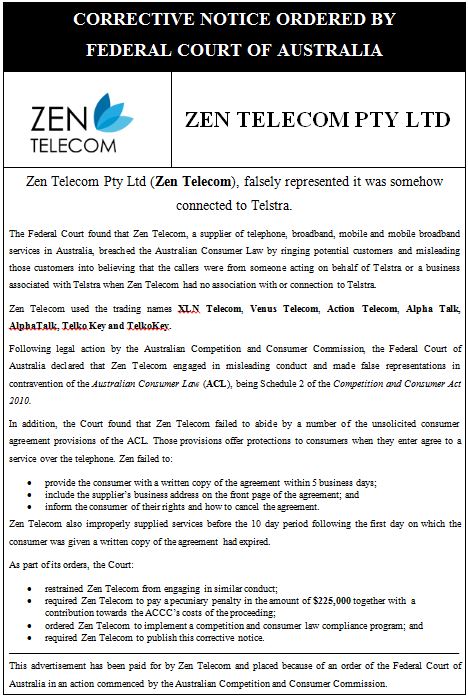
(a) within 28 days of the date of this order, take all reasonable steps to cause to be published, at its own expense, a corrective notice to be published in a weekday edition of each of The Courier Mail (Queensland), Sydney Morning Herald (New South Wales), Herald Sun (Victoria), Mercury (Tasmania), The Advertiser (South Australia), The West Australian (Western Australia) and Northern Territory News (Northern Territory) newspapers, which is in the form and terms of Annexure B to this application, and take all reasonable steps to ensure that the corrective notice:
(i) is placed within the first 10 pages of the newspaper;
(ii) is of the following height and width dimensions for each newspaper:
(A) The Courier Mail – 15.6cm x 12.9cm;
(B) Sydney Morning Herald – 18.6cm x 12.9cm;
(C) Herald Sun – 13.9cm x 12.9cm;
(D) Mercury – 15cm x 9.6cm;
(E) The Advertiser – 15.6cm x 12.9cm;
(F) The West Australian – no less than one quarter of a page; and
(G) Northern Territory News 9 x 17.5;
(iii) has a banner font of sans serif 12 point bold;
(iv) has a headline font of 12 point bold;
(v) has a body text font of no less than 11 point;
(vi) has the applicant’s and Commonwealth logos of at least 25 millimetres in height and centred; and
(vii) has a baseline text of at least 8 point and centred;
(b) within 28 days of the date of this order, publish or cause to be published a corrective notice in the form and terms of Annexure B, on each of its websites, and use all reasonable steps to ensure that the website corrective notice:
(i) is accessible by a prominent one-click link displayed in the top third of the homepage of each Zen Telecom website entitled “Corrective Notice - Breaches of the Australian Consumer Law” and satisfies the following specifications:
(A) the words “CORRECTIVE NOTICE - BREACHES OF THE AUSTRALIAN CONSUMER LAW” are to be in uppercase, 18 point, bold, black, sans serif font on a white background, centred and in a black bordered box;
(B) the words “Click here for further information” are to be 14 point, black, sans serif font on a white background and centred below the words “CORRECTIVE NOTICE - BREACHES OF THE AUSTRALIAN CONSUMER LAW” in the same bordered box;
(C) the bordered box is to be at least 255 pixels wide by 60 pixels high; and
(D) the bordered box and its contents, including white space, is to operate in the form of a one-click hyperlink to the website notice;
(ii) is substantially the same as the notice in Annexure B including font and formatting, and:
(A) has a headline font of no less than 12 point, bold, black, sans serif font on a white background;
(B) has a body text font of no less than 12 point, bold, black, sans serif font on a white background;
(C) is of at least 540 pixels wide by 500 pixels high;
(D) has a black border that is 3 pixels wide;
(E) Zen Telecom’s, applicant’s and Commonwealth logos are to be in colour, centred, and at least 25 millimetres high;
(F) is to be displayed on a stand-alone webpage that is coded in standard “HTML” format;
(G) is not displayed as a “pop-up” or “pop-under” window; and
(H) is maintained for a period of no less than 90 days from the date of this order;
(c) prior to the publication of the corrective notices in accordance with orders (7)(a) and (7)(b):
(i) establish an email address by which consumers who are responding to the corrective notices can contact Zen Telecom;
(ii) establish a 1800 telephone number by which consumers who are responding to the corrective notices can contact Zen Telecom;
(iii) appoint a contact officer to deal with any telephone calls and correspondence received by Zen Telecom in response to the corrective notices; and
(d) maintain the email address, 1800 telephone number and contact officer for a period that is not less than 120 days from the date of this order;
(e) provide to the applicant within 60 days of the date of this order a copy of the corrective notices published in accordance with orders (7)(a) and (7)(b);
(f) provide to the applicant between 120 and 140 days after the date of this order a letter signed by the proper officer of Zen Telecom setting out the following in relation to any consumer who contacted Zen Telecom in response to the corrective notices referred to in this order:
(i) the consumer’s name and address;
(ii) the date upon which the consumer contacted Zen Telecom;
(iii) the reason the consumer gave for contacting Zen Telecom;
(iv) the date of the consumer entering into an agreement with Zen Telecom;
(v) whether the consumer purported to exercise their cooling off rights; and
(vi) the details of Zen Telecom’s actions in response to being contacted by that consumer, including whether or not the agreement was terminated, and if not, the reason why not.
Costs
8. Zen Telecom pay to the applicant a contribution towards its costs of, and incidental to, these proceedings in the amount of $25,000 and the costs be paid in the following twelve instalments:
(a) $2,083.33 within 1 month of the date of this order;
(b) $2,083.33 within 2 months of the date of this order;
(c) $2,083.33 within 3 months of the date of this order;
(d) $2,083.33 within 4 months of the date of this order;
(e) $2,083.33 within 5 months of the date of this order;
(f) $2,083.33 within 6 months of the date of this order;
(g) $2,083.33 within 7 months of the date of this order;
(h) $2,083.33 within 8 months of the date of this order;
(i) $2,083.33 within 9 months of the date of this order;
(j) $2,083.33 within 10 months of the date of this order;
(k) $2,083.33 within 11 months of the date of this order; and
(l) $2,083.33 within one year of the date of this order
Note: Entry of orders is dealt with in Rule 39.32 of the Federal Court Rules 2011.
ANNEXURE A
COMPETITION AND CONSUMER LAW COMPLIANCE PROGRAM
LEVEL 2
Zen Telecom must establish a Competition and Consumer Law Compliance Program (Compliance Program) that complies with each of the following requirements:
1. Appointments
1.1 Within one month of the date of the Order of the Court (the Court orders), Zen Telecom must appoint a Director or a Senior Manager of the business or a contracted person with equivalent authority (each a Suitable Person) to be responsible for the development, implementation and maintenance of the Compliance Program (Compliance Officer) and must within 14 days appoint a replacement Compliance Officer, who is also a Suitable Person, if the current Compliance Officer at any time ceases to be available to perform the role.
2. Compliance Officer Training
2.1 Within three months of the date of the Court orders, Zen Telecom must ensure that the Compliance Officer has attended practical training delivered by a suitably qualified compliance professional or legal practitioner with expertise in competition and consumer law which focuses on sections 18, 29, 78, 79 and 86 of the ACL.
2.2 Within 14 days of completion of training, Zen Telecom must provide the ACCC with a written statement from the compliance professional or legal practitioner who conducts the training which confirms the completion of the training in accordance with paragraph 2.1 above.
3. Staff Training
3.1 Zen Telecom must ensure that all officers, employees, agents, contractors and representatives of Zen Telecom whose duties could result in possible breaches of sections 18, 29, 78, 79 and 86 of the ACL receive regular (at least once a year) practical training administered by the Compliance Officer (once trained) or a qualified compliance professional or legal practitioner with expertise in competition and consumer law that focuses on the ACL, and particularly those sections listed above.
4. Complaints Handling
4.1 Zen Telecom must develop procedures for recording, storing and responding to competition and consumer law complaints, and provide the ACCC with an outline of these procedures, within two months of the date of the Court orders.
4.2 Those procedures must include arrangements for the recording and retention of the recording of all telemarketing calls that conclude in any agreement with consumers for the supply of telecommunications services. Such recordings to be retained for the term of each agreement plus a further 12 months.
5. Reporting to Board/Senior Management
5.1 Zen Telecom must ensure that the Compliance Officer reports to Zen Telecom’s director(s) or governing body every 12 months on the continuing effectiveness of the Compliance Program.
6. Review
6.1 Zen Telecom must, at its own expense, cause annual reviews of the Compliance Program (the Reviews) to be carried out in accordance with each of the following requirements:
6.2 Scope of the Reviews – Zen Telecom must ensure that the Reviews are broad and rigorous enough to:
6.2.1 provide Zen Telecom and the ACCC with a supportable verification that Zen Telecom has in place a Compliance Program that complies with the requirements detailed in paragraphs 1 – 5 above and is suitable for the size and structure of Zen Telecom; and
6.2.2 provide the Review Reports and opinions detailed at paragraph 7 below.
6.3 Independence of Reviewer – Zen Telecom must ensure that the Reviews are carried out by a suitably qualified, independent compliance professional with expertise in competition and consumer law (the Reviewer). The Reviewer will qualify as independent on the basis that he or she:
6.3.1 did not design or implement the Compliance Program;
6.3.2 is not a present or past staff member or director of Zen Telecom;
6.3.3 has not acted and does not act for Zen Telecom in any competition or consumer law related matters;
6.3.4 has not and does not act for or consult to Zen Telecom or provide other services on competition and consumer law related matters other than Compliance Program reviewing; and
6.3.5 has no significant shareholding or other interests in Zen Telecom.
6.4 Evidence - Zen Telecom must use its best endeavours to ensure that the Reviews are conducted on the basis that the Reviewer has access to all relevant sources of information in Zen Telecom’s possession or control, including without limitation:
6.4.1 enquiries of any officers, employees, representatives, agents and stakeholders of Zen Telecom; and
6.4.2 documents created by Zen Telecom’s consultants, legal practitioners and accountants for use in Zen Telecom’s Compliance Program.
6.5 Zen Telecom must ensure that the first Review is completed within one year and one month of the date of the Court orders and that each subsequent Review is completed within one year thereafter.
7. Reporting
7.1 Zen Telecom must use its best endeavours to ensure that the Reviewer sets out the findings of the Review in a Compliance Program Review Report, which will provide specific information regarding the scope of the Review and the effectiveness of the Compliance Program including:
7.1.1 details of the evidence gathered and examined during the Review;
7.1.2 the name and relevant experience of the person appointed as Zen Telecom’s Compliance Officer;
7.1.3 the Reviewer’s opinion on whether Zen Telecom has in place effective staff training and complaints handling programs that comply with the requirements detailed in paragraphs 1 – 6 above; and
7.1.4 actions recommended by the Reviewer to ensure the continuing effectiveness of Zen Telecom’s Compliance Program.
7.2 Zen Telecom must use its best endeavours to ensure that each Compliance Program Review Report is completed and provided to Zen Telecom within one month of completion of each Review.
7.3 Zen Telecom must provide a copy of the Compliance Program Review Report to the ACCC within 14 days of its receipt from the Reviewer.
7.4 Zen Telecom must implement promptly and with due diligence any recommendations made by the Reviewer or required by the ACCC that are reasonably necessary to ensure that Zen Telecom maintains and continues to develop the Compliance Program elements in accordance with the requirements of the Court orders.
8. If requested by the ACCC, Zen Telecom must, at its own expense, provide copies of documents and information in respect of matters which are the subject of the Compliance Program.
9. If the ACCC has sufficient reason to suspect that the Compliance Program is not being implemented effectively, Zen Telecom must, at its own expense and if requested by the ACCC, cause an interim or additional Review to be conducted and provide a copy of the resulting Compliance Program Review Report to the ACCC.
ANNEXURE B
|
WESTERN AUSTRALIA DISTRICT REGISTRY |
|
|
GENERAL DIVISION |
WAD 42 of 2014 |
|
BETWEEN: |
AUSTRALIAN COMPETITION AND CONSUMER COMMISSION Applicant |
|
AND: |
ZEN TELECOM PTY LTD (ACN 159 057 566) Respondent |
|
JUDGE: |
BARKER J |
|
DATE: |
30 SEPTEMBER 2014 |
|
PLACE: |
PERTH |
REASONS FOR JUDGMENT
1 Zen Telecom Pty Ltd is engaged in the business of supplying telecommunications services to customers in Australia. At relevant times, it used telemarketing agents to promote and negotiate the sale of its fixed line services.
2 The Australian Competition and Consumer Commission (ACCC) commenced this proceeding on 28 February 2014, alleging that in the course of promoting and selling its telecommunications services, Zen Telecom made false or misleading representations regarding its association with Telstra Corporation Limited and contravened unsolicited consumer agreement provisions of the Australian Consumer Law (ACL), being Sch 2 of the Competition and Consumer Act 2010 (Cth) (CCA). It sought orders for declaratory relief, injunctions, pecuniary penalties, non-punitive orders and costs.
3 The ACCC and Zen Telecom have made joint submissions and filed a statement of agreed facts and admissions. Zen Telecom admits that it engaged in conduct between 8 August 2012 and 19 August 2013 that:
1. involved representations that were misleading, deceptive and likely to mislead and deceive in contravention of s 18(1) of the ACL;
2. involved representations that were false and misleading in contravention of ss 29(1)(g) and 29(1)(h) of the ACL; and
3. contravened unsolicited consumer agreement provisions of Div 2, Part 3-2 of the ACL, namely ss 78(2), 79(b)(i), 79(b)(ii), 79(c)(i), 79(d)(iv) and 86(1)(a).
4 While recognising that the question of relief remains in the discretion of the Court, the parties have agreed to proposed orders and are content for this matter to be determined on the documents.
5 The ACCC and Zen Telecom propose that the Court:
1. make declarations pursuant to s 21 of the Federal Court of Australia Act 1976 (Cth);
2. order injunctions pursuant to s 232 of the ACL;
3. order payment by Zen Telecom of a pecuniary penalty in the amount of $225,000 pursuant to s 224 of the ACL, to be paid in 12 equal instalments within one year from the date of the order;
4. make a probation order pursuant to s 246 of the ACL providing for a compliance program for Zen Telecom;
5. make publication orders pursuant to s 246 of the ACL; and
6. order payment by Zen Telecom of a contribution to the ACCC’s costs in the amount of $25,000 pursuant to s 43 of the Federal Court of Australia Act, to be paid in 12 equal instalments within one year from the date of the order.
6 In these circumstances, the question is the appropriate relief to be ordered, in light of the agreed facts and admissions, joint submissions and minute of consent orders.
Agreed facts
7 The parties have agreed on the factual basis for the orders sought, which is set out in the statement of agreed facts and admissions, made jointly for the purposes of s 191 of the Evidence Act 1995 (Cth).
8 Zen Telecom is an Australian owned and operated company with one office located in Melbourne and at the time of the proceeding, had approximately 11,100 customers. It traded under various names including Action Telecom, Alpha Talk, AlphaTalk, Telko Key, TelkoKey, Venus Telecom and XLN Telecom.
9 Zen Telecom was contractually entitled to retail, on its own account and in its own name, certain fixed line services provided on a wholesale basis by Telstra using telephone lines and other facilities owned and/or operated by Telstra.
10 Zen Telecom engaged the services of Vibe Solutions Pty Ltd and Marv E Solutions Private Limited to promote its fixed line services using telemarketing calls.
11 At all material times, Vibe Solutions and Marv E and their marketing and sales agents acted on behalf of Zen Telecom, as the agent of Zen Telecom and within the scope of their actual or apparent authority.
12 Zen Telecom used the following method to promote its fixed line services:
1. It purchased general Australian residential and small business telephone calling lists and removed from these lists any numbers listed on the “Do Not Call Register”.
2. It used Vibe Solutions and Marv E to make telemarketing calls to the remaining telephone numbers on the calling lists.
3. It instructed Vibe Solutions and Marv E that telemarketing calls were to be conducted in two stages:
(a) marketing agents would market and promote agreements for the supply of Zen Telecom’s fixed line services (marketing stage);
(b) where a potential customer expressed a willingness to acquire fixed line services, they would be transferred to a sales agent of Vibe Solutions who, on behalf of Zen Telecom, concluded, or sought to conclude, a verbal agreement for the supply of fixed line services (agreement stage).
4. It instructed sales agents to comply with a script for the agreement stage that included a supplier identification process in these terms:
(a) Sales agent to say to potential customer: “Could you please repeat this sentence after me: I understand that [Zen Telecom] is an independent company, and is not a part of Telstra, either Wholesale or Retail, or of any other carrier and I agree to use [Zen Telecom] as my new service provider”.
5. Zen Telecom did not audio record the marketing stage of its telemarketing calls, but did record the agreement stage.
13 In the relevant period, Zen Telecom engaged in the following conduct which it admits involved contraventions of the ACL.
14 On or about 17 September 2012, a marketing agent telephoned the manager of an education business in Victoria. In the course of the marketing stage of the call, the marketing agent said words to the effect “I am from Action Telecom. We look after Telstra’s small business customers”. When asked whether he was from Telstra, the marketing agent said words to the effect “I will answer that in a minute” but did not answer the question.
15 In or about November 2012, a marketing agent called a manager of a restaurant in Queensland. In the course of the marketing stage of the call, the marketing agent did not state which company he was calling from and said words to the effect “We are the new managers for your telephone account”. When asked several times whether he was from Telstra, the marketing agent said words to the effect “Yes, we use the Telstra line”.
16 On or about 12 November 2012, a marketing agent called “RJH” in Queensland on his residential telephone landline. In the course of the marketing stage of the call, the marketing agent did not state which company she was calling from and said words to the effect that the company she represented was connected with Telstra.
17 On or about 18 December 2012, a marketing agent called “JH” in Victoria on her residential telephone landline. In the course of the marketing stage of the call, the marketing agent did not initially state which company he was calling from. When asked whether he was from Telstra, the marketing agent said words to the effect “I am calling from Venus Telecom and we are a subsidiary of Telstra. We are here to help you with your Telstra bill”.
18 In or about April or May 2013, a marketing agent called “GPB” in Western Australia on her residential telephone landline. In the course of the marketing stage of the call, the marketing agent told GPB that she was a loyal Telstra customer and he was calling to offer her a new deal for her telephone service. In the course of the agreement stage of the call, when GPB asked the sales agent why he did not have her contact details on the system, the sales agent said, “We’re calling you from the wholesale department”. When GPB stated “I’m just a bit worried if I’m giving out my details and I would’ve thought, if I’m a Telstra customer, you’d already have all my up to date details since I only signed up with Telstra two weeks ago”, he replied, “Yes, I understand that”.
19 On or about 16 May 2013, a marketing agent called “JAB” in Victoria on his residential telephone landline. In the marketing stage of the call, the marketing agent did not disclose which company he worked for, but said words to the effect “I’m calling from South Melbourne”. The marketing agent said words to the effect “this is a service call to inform you that as a Telstra customer, you are eligible for a discount on your telephone service of $20 - $25 a month”. In the course of the agreement stage of the telephone call, the sales agent said words to the effect “the discounts are available to existing Telstra customers”.
20 On or about 24 May 2013, a marketing agent called “SFP” in New South Wales on his residential telephone landline. In the course of the marketing stage of the call, the marketing agent said words to the effect “I am calling on behalf of Telstra”. In the course of the agreement stage, the sales agent, when asked on a number of occasions what company he worked for, continually responded with words to the effect that he was calling on behalf of Telstra.
21 On or about 30 May 2013, a marketing agent called a director of a bookselling business in Victoria. In the course of the marketing stage of the call, the marketing agent said words to the effect that she was from the wholesale division of Telstra, she had seen the business’ bills and it was paying too much. When asked whether she was from Telstra, the marketing agent did not answer the question.
22 On 12 June 2013, a marketing agent called “DLG” in Victoria on his residential and business telephone landline. In the course of the marketing stage of the call, the marketing agent did not state which company she was calling from, said she was calling regarding the Telstra landline account and DLG should be receiving a further business rate reduction for that line. When DLG said it was good of Telstra to call up and go through this, the marketing agent answered “yes”. In the course of the agreement stage of the call, the sales agent said the discount would apply to “a different bill coming in from our authorised wholesale department” and “it’s run through our wholesale department in Melbourne. So if you ever had any problem, Telstra will always take care of it but your bill would be coming from us, which is Action Telecom, okay?” The sales agent said that if DLG had any problems other than billing inquiries, Telstra would always take care of it. When asked whether she was from Telstra wholesale, the sales agent said “We’re the authorised wholesale department, yes” and stated “We’re the Australian authorised wholesale department on the Telstra network”.
23 On or about 24 June 2013, a marketing agent called “LAH” in Victoria on her residential telephone landline. In the course of the marketing stage of the call, the marketing agent did not state which company she was calling from, but said words to the effect “we work for Telstra”. When asked whether she was from Telstra, the marketing agent initially did not answer the question and eventually stated that her company used the same infrastructure and lines as Telstra.
24 In or about early July 2013, a marketing agent called “JAP” in the Australian Capital Territory on his residential telephone landline. In the course of the marketing stage of the call, the marketing agent did not initially state which company he was calling from, said words to the effect that he was calling to provide a discount service for Telstra, and indicated that he knew the monthly amount being paid on the existing Telstra account. In the course of the agreement stage of the call, the sales agent, when asked why personal details were required if they were calling from Telstra, answered with words to the effect “We are a discount service provider for Telstra”.
25 In or about early July 2013, a marketing agent called “ITEC” in Western Australia on her residential telephone landline. In the course of the marketing stage of the call, the marketing agent said they were from Telstra.
26 In or about July 2013, a marketing agent made two telemarketing calls to “BJB” in Western Australia on his residential telephone landline. In the course of the marketing stage of the first call, the marketing agent said she was from AlphaTalk and AlphaTalk was a part of Telstra. In her second call, the marketing agent insisted that AlphaTalk was a part of Telstra.
27 On or about 26 July 2013, a marketing agent called “SDS” in Western Australia on his residential telephone landline. In the course of the marketing stage of the call, the marketing agent said words to the effect “I am from a discount provider who is offering discounts on all your local and national calls”. When asked which company the call was from, the marketing agent answered it was Alpha Talk and said words to the effect “Alpha Talk works with Telstra to provide discounts”. When asked whether the account would need to be switched, the marketing agent answered with words to the effect “No. You stay with Telstra”. When asked how the discounts were able to be offered, the marketing agent said words to the effect “We work with Telstra. We work through their line and network. You will only receive one bill. You continue to use Telstra” and “Alpha Talk works in conjunction with Telstra”.
28 On or about 19 August 2013, a marketing agent called “GD” in Victoria on her residential telephone landline. When asked whether he was calling from Telstra, the marketing agent said that part of his company was with Telstra.
Contraventions of the ACL
29 Zen Telecom accepts that it represented that its telemarketing calls were from someone acting on behalf of Telstra and/or a business or company associated with Telstra. These representations were made in trade or commerce in connection with the supply or possible supply of fixed line services and in connection with the promotion of the supply or use of such services.
30 Although Zen Telecom was entitled to use certain fixed line services provided on a wholesale basis by Telstra, it accepts that it was not part of Telstra, was not a related body corporate of Telstra, was not authorised to make telemarketing calls on behalf of Telstra and was a competitor of Telstra at the retail level. Zen Telecom was therefore not associated with, working with or otherwise acting in conjunction with Telstra.
31 Between about 24 August 2012 and 14 May 2013, Zen Telecom sent out agreement documents regarding the terms and conditions of its fixed line services to each of the customers identified in schedule A of the statement of agreed facts and admissions.
32 During this period, Zen Telecom was a dealer for the purposes of s 71 of the ACL and the supplier of fixed line services. Consumers had not invited Zen Telecom’s telemarketers to telephone them for the purpose of entering into negotiations for the supply of telecommunications services, and the total price was either not ascertainable at the time of the agreement or if it was ascertainable, was more than $100.
33 As such, each of the agreements was an unsolicited consumer agreement within the meaning of s 69 of the ACL.
Misleading and deceptive conduct – s 18 ACL
34 Zen Telecom admits that by reason of this conduct and the matters above, it engaged in conduct in trade or commerce that was misleading and deceptive and likely to mislead and deceive, in contravention of s 18 of the ACL.
False and misleading representations that services have sponsorship or approval – s 29(1)(g) ACL
35 Zen Telecom admits that by engaging in this conduct and by reason of the matters above, it made false or misleading representations that the fixed line services had the sponsorship or approval of Telstra, in contravention of s 29(1)(g) of the ACL.
False and misleading representations that Zen Telecom has sponsorship, approval or affiliation – s 29(1)(h) ACL
36 Zen Telecom admits that by engaging in this conduct and by reason of the matters above, it made false and misleading representations that it had the sponsorship or approval of or an affiliation with Telstra, in contravention of s 29(1)(h) of the ACL.
Agreement documents given more than five business days after unsolicited consumer agreement was made – s 78(2) ACL
37 Zen Telecom admits that between about 8 August 2012 and 12 December 2012, in relation to each consumer identified in table 1 of schedule A, the agreement document despatch date was more than five business days after the agreement date for the consumer and it did not give the agreement document evidencing the agreement within five business days after the agreement was made.
38 It accepts that it contravened s 78(2) of the ACL on each occasion identified in table 1 of schedule A.
Agreement documents did not meet requirements of unsolicited consumer agreement provisions – ss 79(b)(i), 79(b)(ii), 79(c)(i), 79(d)(iv) ACL
39 Zen Telecom admits that between about 24 August 2012 and 14 May 2013, the agreement documents given to consumers identified in table 2 of schedule A were deficient in that they:
1. did not include a notice on the front page that conspicuously and prominently informed the consumer of their right to terminate the agreement as required by s 79(b)(i) of the ACL;
2. did not have the following information on the front page:
(a) the text “Important Notice to the Consumer”;
(b) the text “You have the right to cancel this agreement within 10 business days from and including the day after you signed or received this agreement”;
(c) the text “Details about your additional rights to cancel this agreement are set out in the information attached to this agreement”,
as required by s 79(b)(ii) of the ACL and reg 85 of the Competition and Consumer Regulations 2010 (Cth);
3. were not accompanied by a notice that could be used by the consumer to terminate the agreement, as required by s 79(c)(i) of the ACL; and
4. did not set out Zen Telecom’s business address (not being a post box), as required by s 79(d)(iv) of the ACL.
40 Zen Telecom accepts that this conduct contravened ss 79(b)(i), 79(b)(ii), 79(c)(i) and 79(d)(iv) of the ACL on each occasion identified in table 2 of schedule A.
Supplying services earlier than permitted under unsolicited consumer agreement provisions – s 86(1)(a) ACL
41 Between about 25 August 2012 and 24 May 2013, Zen Telecom supplied fixed line services to each consumer identified in table 3 of schedule A. In so doing, Zen Telecom admits that it supplied the fixed line services within the 10 business day cooling off period specified in the ACL.
42 Zen Telecom accepts that it thereby contravened s 86(1)(a) of the ACL on each occasion identified in table 3 of schedule A.
General principles regarding orders by consent
43 The parties emphasise that there is an important public interest in the settlement of proceedings under the consumer legislation. Litigation involving alleged contraventions of the ACL can be complex, time consuming and costly, and there is a public interest to conclude such proceedings in the shortest timeframe consistent with justice being done between the parties. See NW Frozen Foods Pty Ltd v Australian Competition and Consumer Commission (1996) 71 FCR 285 at 291; Australian Competition and Consumer Commission v Real Estate Institute of Western Australia Inc [1999] FCA 18; (1999) 161 ALR 79 at [20].
44 The parties refer to the observations of Burchett and Kiefel JJ in NW Frozen Foods at 291:
There is an important public policy involved. When corporations acknowledge contraventions, very lengthy and complex litigation is frequently avoided, freeing the courts to deal with other matters, and investigating officers of the [ACCC] to turn to other areas of the economy that await their attention.
45 In deciding whether to make orders by consent, the Court must be satisfied that it has the power to make the orders proposed and that they are appropriate in the circumstances: Australian Competition and Consumer Commission v Real Estate Institute of Western Australia Inc [1999] FCA 18; (1999) 161 ALR 79 at [3].
46 Provided the Court is satisfied that the terms of the orders are within power and appropriate, there is a general principle of judicial restraint in scrutinising proposed settlements. The Court will be reticent to impede the final settlement of matters, particularly where both parties are legally represented and able to understand and evaluate the desirability of the settlement. See Australian Competition and Consumer Commission v Target Australia Pty Ltd [2001] FCA 1326 at [24]; Australian Competition and Consumer Commission v Real Estate Institute of Western Australia Inc [1999] FCA 18; (1999) 161 ALR 79 at [22].
47 In deciding whether the consent orders conform with legal principle, the parties say that the Court is entitled to treat the consent of Zen Telecom as an admission of all facts necessary or appropriate to the granting of relief. See Thomson Australian Holdings Proprietary Limited v Trade Practices Commission (1981) 148 CLR 150 at 164.
Declarations
48 The Court has a wide discretion to make declarations under s 21 of the Federal Court of Australia Act. See Forster v Jododex [1972] HCA 61; (1972) 127 CLR 421 at 437-8.
49 The parties submit that in the circumstances of this case, it is appropriate for the Court to indicate its disapproval of Zen Telecom’s conduct by making the declarations sought. They say the proposed declarations sufficiently identify how and why the impugned conduct contravenes the ACL. Further, they contend that it is in the public interest for the ACCC to have the declarations made and Zen Telecom is the proper contradictor in this case.
50 As the joint submissions indicate, these declarations serve to record the Court’s disapproval of the contravening conduct, deter other corporations from engaging in such conduct, vindicate the ACCC’s claim that Zen Telecom contravened the ACL, assist the ACCC to carry out its duties, and inform consumers of the dangers arising from the contravening conduct.
51 The parties submit that Zen Telecom has admitted that it contravened important consumer protection provisions and has done so in the field of telecommunications, an area of commerce which has proved especially prone to breaches of consumer protections.
52 The parties draw on Australian Competition and Consumer Commission v Dataline.Net.Au Pty Ltd [2007] FCAFC 146; (2007) 161 FCR 513 at [92] and say that it is open to the Court to make declarations based on admissions, as distinct from evidence, and in any event, the statement of agreed facts and admissions provides such evidence.
Injunctions
53 The parties submit that the Court should order injunctions for three (3) years to restrain Zen Telecom from engaging in certain conduct, namely:
1. making a representation, expressly or impliedly, that any telemarketing call from or on behalf of Zen Telecom is a call made on behalf of Telstra or any other telecommunications company, unless it has authority from that company to make the telemarketing calls on its behalf;
2. negotiating by telephone an unsolicited consumer agreement to supply telecommunications services unless it provides to a consumer all agreement documents within five business days of the making of the agreement;
3. entering into an unsolicited consumer agreement to supply telecommunications services, unless the agreement document given to the consumer includes all relevant information required by the ACL;
4. supplying, pursuant to an unsolicited consumer agreement negotiated by telephone, telecommunications services to consumers within a period of 10 business days starting at the first business day after the agreement documents were given to them.
54 The parties contend that injunctive relief is appropriate in this case, as the admitted contraventions are sufficiently serious, repeated and recent. They say that Zen Telecom continues to supply its telecommunications services to consumers and although its telemarketing activities ceased in March 2014, it intends to resume these activities. In the parties’ submission, the injunctions would be appropriate to minimise the chances of carelessness and complacency occurring again.
55 The parties submit that the terms of the proposed injunctions are framed in accordance with the admitted facts and the term of three years is appropriate to deter repetition of the conduct.
Pecuniary penalties
56 The parties seek orders for pecuniary penalties in the total amount of $225,000, in respect of Zen Telecom’s admitted contraventions of ss 29(1)(g), 29(1)(h), 78(2), 79(b)(i), 79(b)(ii), 79(c)(i), 79(d)(iv) and 86(1)(a) of the ACL.
57 Sub-sections 224(1)(a)(ii) and (1)(a)(iv) of the ACL provide that if the Court is satisfied a person has contravened relevant provisions of the ACL (which include ss 29, 78, 79 and 86), the Court may order such pecuniary penalty in respect of each act or omission as the Court determines appropriate.
58 The maximum penalty for a body corporate for each act or omission relating to Part 3-1 of the ACL is $1.1 million and for each act or omission relating to Div 2, Pt 3-2 of the ACL is $50,000.
59 It is well understood that the principal purpose of imposing civil penalties is to ensure compliance with the consumer legislation by deterring future contraventions. A civil penalty should recognise the seriousness of the contravention and provide both specific and general deterrence. See Trade Practices Commission v CSR Ltd [1991] ATPR 41-076 at [40]-[42]; NW Frozen Foods at 293-5; Dataline.Net.Au at [60].
60 The parties submit that it is necessary for a penalty to be of a sufficient magnitude to deter contraventions of the ACL in sales industries involving unsolicited consumer agreements generally and the telecommunications services industry in particular, which uses telemarketing selling extensively.
61 The parties note that the admitted contraventions are specific acts directed at specific individuals, but took place in the context of a wider course of conduct. They submit that the Court may, if it considers it appropriate in the circumstances, have regard to the one course of conduct principle.
62 As the Full Court explained in Construction, Forestry, Mining and Energy Union v Cahill [2010] FCAFC 39; (2010) 194 IR 461 at [39], where there is an interrelationship between the legal and factual elements of two or more contraventions, care must be taken to ensure that the contravener is not punished twice for what is essentially the same contravening conduct.
63 The Court should also consider the principle of parity, meaning that, all things being equal, similar contraventions should incur similar penalties. See NW Frozen Foods at 295.
64 Further, it is well understood that the totality principle operates as something of a final check to ensure that the sum of the penalties overall is appropriate and does not exceed what is proper for the total contravening conduct. See Australian Competition and Consumer Commission v Australian Safeway Stores Pty Ltd (1997) 145 ALR 36 at 53.
65 In determining the appropriate penalty, s 224(2) of the ACL requires the Court to have regard to all relevant matters, including:
1. the nature and extent of the act or omission and of any loss or damage suffered as a result of the act or omission;
2. the circumstances in which the act or omission took place; and
3. whether the person has previously been found by a court in proceedings under relevant provisions of the ACL to have engaged in any similar conduct.
66 Relevant factors for determining the appropriate penalty have been developed in the course of many decisions of this Court and include:
1. the size of the contravening company;
2. the deliberateness of the contravention and period over which it extended;
3. whether the contravention arose out of the conduct of senior management of the contravener or at a lower level;
4. whether the contravener has a corporate culture conducive to compliance with the CCA, as evidenced by educational programs and disciplinary or other corrective measures in response to an acknowledged contravention;
5. whether the contravener has shown a disposition to cooperate with the authorities responsible for the enforcement of the legislation in relation to the contravention;
6. whether the contravener has engaged in similar conduct in the past;
7. the financial position of the contravener; and
8. whether the contravening conduct was systematic, deliberate or covert.
See CSR Ltd at 52,152-153; NW Frozen Foods at 292-4.
67 In the case of pecuniary penalties sought by consent, the Full Court explained the correct approach in Minister for Industry, Tourism & Resources v Mobil Oil Australia Pty Ltd [2004] FCAFC 72; [2004] ATPR 41-993 at [51] as follows:
The following propositions emerge from the reasoning in NW Frozen Foods:
(i) It is the responsibility of the Court to determine the appropriate penalty to be imposed under [the relevant consumer laws] in respect of a contravention of the … Act.
(ii) Determining the quantum of a penalty is not an exact science. Within a permissible range, the courts have acknowledged that a particular figure cannot necessarily be said to be more appropriate than another.
(iii) There is a public interest in promoting settlement of litigation, particularly where it is likely to be lengthy. Accordingly, when the regulator and contravener have reached agreement, they may present to the Court a statement of facts and opinions as to the effect of those facts, together with joint submissions as to the appropriate penalty to be imposed.
(iv) The view of the regulator, as a specialist body, is a relevant, but not determinative consideration on the question of penalty. In particular, the views of the regulator on matters within its expertise (such as the ACCC’s views as to the deterrent effect of a proposed penalty in a given market) will usually be given greater weight than its views on more ‘subjective’ matters.
(v) In determining whether the proposed penalty is appropriate, the Court examines all the circumstances of the case. Where the parties have put forward an agreed statement of facts, the Court may act on that statement if it is appropriate to do so.
(vi) Where the parties have jointly proposed a penalty, it will not be useful to investigate whether the Court would have arrived at that precise figure in the absence of agreement. The question is whether that figure is, in the Court’s view, appropriate in the circumstances of the case. In answering that question, the Court will not reject the agreed figure simply because it would have been disposed to select some other figure. It will be appropriate if within the permissible range.
68 The Full Court observed in Mobil Oil at [54] that the Court may choose to commence its reasoning with the parties’ proposed penalty and then consider whether that penalty falls within the permissible range, or it may first independently address the appropriate range of penalties and then, having made that judgment, determine whether the proposed penalty falls within the range.
69 It is also appropriate to note the recent decision of the High Court in Barbaro v The Queen; Zirilli v The Queen [2014] HCA 2; (2014) 88 ALJR 372. In the context of criminal sentencing, the plurality made statements that appeared to make impermissible the practice of prosecutors making submissions as to the “available” range of sentences.
70 I agree with what Middleton J recently said in Australian Competition and Consumer Commission v EnergyAustralia Pty Ltd [2014] FCA 336; [2014] ATPR 42-469 that the dicta in Barbaro should not be taken to be relevant to the imposition of civil penalties. Rather, the High Court not having overruled NW Frozen Foods or Mobil Oil, the principles established in those cases remain applicable to the imposition of pecuniary penalties in this Court and indeed this Court is bound to follow those authorities.
71 The approach taken by Middleton J in EnergyAustralia has been subsequently endorsed by McKerracher J in Australian Competition and Consumer Commission v Mandurvit Pty Ltd [2014] FCA 464; [2014] ATPR 42-471 at [37]-[80] and Davies J in Tax Practitioners Board v Dedic [2014] FCA 511 at [3].
Nature and extent of the contravening conduct
72 The parties submit that the contravening conduct in this case involved misleading customers as to Zen Telecom’s relationship with Telstra; failing to advise customers of their rights in respect of unsolicited consumer agreements; and acting inconsistently with customers’ rights under the unsolicited consumer agreement provisions. This conduct occurred across all States and Territories, with the exception of the Northern Territory.
73 In relation to the false and misleading representations, the parties accept that Zen Telecom’s 15 contraventions of ss 29(1)(g) and 29(1)(h) of the ACL are so interrelated and overlapping, occurred over the same time period and through the same medium, that it would be appropriate for the Court to characterise these as a single course of conduct. They say the effect of all the misrepresentations was to lead the consumer to believe that the services promoted by Zen Telecom were somehow associated with Telstra.
74 They observe that the false and misleading representations were serious, as customers should have confidence that they know who they are dealing with in the field of retail telecommunications, particularly in the context of “cold calling” where potential customers may feel pressured to agree to proposals without having an opportunity to review the proposal in a measured way. The parties submit that new businesses such as Zen Telecom should not cause customers to believe they are dealing with an established “blue chip” incumbent such as Telstra, and these representations are likely to have been a decisive factor for some consumers in deciding to enter into an agreement with Zen Telecom.
75 Further, the parties note that from the time that Zen Telecom commenced trading in August 2012 until March 2014, the Telecommunications Industry Ombudsman (TIO), the ACCC and Telstra have received numerous complaints about misleading representations by Zen Telecom, including:
the TIO received 53 complaints in the period August 2012 to August 2013;
the ACCC received 24 complaints in the period September 2012 to March 2014; and
Telstra received 41 complaints in the period November 2012 to July 2013.
76 Zen Telecom was made aware of these complaints. The ACCC also raised concerns about this type of conduct throughout its investigation from May 2013 until after the commencement of this proceeding. Nonetheless, contraventions occurred after this date and the ACCC continued to receive complaints about misrepresentations until March 2014.
77 They say that throughout the ACCC’s investigation until after the commencement of this proceeding, Zen Telecom did not admit any wrongdoing. It has admitted that its contraventions of the ACL were the result of carelessness and complacency in respect of its obligations under the ACL.
78 In relation to the unsolicited consumer agreement contraventions, Zen Telecom admits that it failed to ensure that its agreement documents complied with Div 2, Part 3-2 of the ACL and it contravened the ACL on 85 occasions.
79 The parties submit that these contraventions may be grouped into the following three courses of conduct for the purpose of assessing penalty:
1. Five contraventions of s 78(2) of the ACL, which related to Zen Telecom sending agreement documents more than five business days after the unsolicited consumer agreement was made by telephone;
2. 47 contraventions of each of ss 79(b)(i), 79(b)(ii), 79(c)(i) and 79(d)(iv) of the ACL, which related to Zen Telecom sending agreement documents to consumers which did not meet the requirements of the ACL; and
3. 33 contraventions of s 86(1)(a) of the ACL, which related to Zen Telecom supplying customers with telecommunications services within the 10 day cooling off period.
80 The parties say that the evident purpose of sending agreement documents within the specified five day period is to ensure that customers receive the documentation while the conversation relating to it is still fresh in their mind. Any delay in receiving such documentation makes it harder for a customer to compare the documentation with information provided by telephone, and less likely that a customer will make a free, informed and deliberate choice to accept the goods or services that have been promoted by the unsolicited telephone call.
81 The parties submit that the purpose of the requirements regarding the content of agreement documents is to ensure that consumers who negotiate unsolicited consumer agreements with dealers are provided with agreement documents that fully and fairly inform them of their rights to terminate the agreement and how they may do so. These requirements ensure that a customer’s choice to accept the services is free and deliberate.
82 The parties contend that Zen Telecom supplied many services within the 10 business day cooling off period, which undermines the very purpose of the cooling off period, namely to allow customers the opportunity to consider their purchase with the opportunity to terminate if they so choose.
Amount of loss caused and profit gained
83 The parties accept that it is difficult to quantify the loss and damage caused by the misleading representations, but submit that this may include the delay and inconvenience of reversing an unwanted transfer, loss of discounts or services obtained from Telstra through service bundling, and charges that consumers did not agree to such as termination fees or costs associated with re-connecting with Telstra.
84 In relation to the unsolicited consumer agreement contraventions, the parties say it is impossible to know which of the affected customers may have acted differently and exercised their cooling off rights, had they not been misinformed of their rights and Zen Telecom’s obligations. Likewise, they acknowledge it is impossible to quantify such losses.
85 The parties observe that in Singtel Optus Pty Ltd v Australian Competition and Consumer Commission [2012] FCAFC 20; (2012) 287 ALR 249 at [58]-[59], the Full Court accepted that in specified cases, the absence of evidence of loss or damage will constitute a factor in mitigation of penalty. They submit, however, that the inability to quantify financial loss caused to consumers does not mean that no loss or harm has been suffered. See Australian Competition and Consumer Commission v Global One Mobile Entertainment Limited [2011] FCA 393; [2011] ATPR 42-358 at [135].
86 In relation to the profit gained, the parties contend that given the false and misleading representations were likely to have been a decisive factor for some customers, it is highly likely that Zen Telecom obtained sales it would not otherwise have obtained, although the extent of these sales is unknown.
87 The parties also accept that it is not possible to quantify the full extent of any loss or damage caused to competitors by the contravening conduct, but submit it can be inferred that the contravening conduct may have had a detrimental effect on Zen Telecom’s competitors, as consumers may have been misled into switching to Zen Telecom where they might not otherwise have done so, and some may not have switched back to Telstra due to the inconvenience. They note, however, that Zen Telecom had, at all material times, an extremely small market share.
Whether Zen Telecom has engaged in similar prior conduct
88 The parties accept that Zen Telecom has not previously been found by a court to have engaged in any similar conduct or to have breached the relevant consumer laws.
Size and financial position of Zen Telecom
89 The parties submit that it is relevant to consider the level of penalty necessary to achieve deterrence in relation to a company of a particular size. While a company’s capacity to pay a penalty can be a relevant factor, they say it cannot be relied upon to reduce the level of penalty below the amount necessary to secure general deterrence. See Australian Competition and Consumer Commission v High Adventure Pty Limited [2005] FCAFC 247; [2006] ATPR 42-091 at [11].
90 Zen Telecom is a small proprietary company that has never made a profit. In the 2013 financial year, it made an operating loss before tax of $1,354,590.
91 As at 31 May 2014, Zen Telecom’s assets were valued at $1,239,875 and its liabilities at $2,988,059.
92 Zen Telecom considers that it will remain cash flow negative for the foreseeable future, although its business will remain viable despite the proposed quantum of penalty proposed, as it is able to rely on a commercial funding arrangement with its wholesaler.
Deliberateness of contravening conduct and period over which it extended
93 The parties submit that the false and misleading conduct extended over a period of approximately 11 months. Zen Telecom’s practice was not to audio record the sales stage of the calls, during which most of the false and misleading representations were made.
94 They observe that despite Zen Telecom having a sales compliance training manual, which prohibited telemarketers from stating or implying that Zen Telecom was in any way associated with Telstra, the contravening conduct occurred on numerous occasions and multiple complaints were received. They assert that the fact most of the admitted contraventions occurred after the complaints were brought to Zen Telecom’s attention suggests a careless and complacent attitude towards compliance training.
95 The parties contend that the conduct in respect of the unsolicited consumer agreement provisions extended over a period of almost 10 months and its contravention of these provisions was reckless and complacent.
Involvement of senior employees/management
96 The parties say that during the relevant period, the two most senior managers of Zen Telecom, including its chief executive officer and sole director, were responsible for ensuring that Zen Telecom’s processes and documentation complied with the relevant laws. They submit that these managers were aware of the contravening conduct, but did not ensure that Zen Telecom’s processes and documentation complied with the ACL.
97 The parties submit that Sanjay Bhayani, the sole director, secretary and shareholder, was aware that there was a substantial degree of risk that salespeople would, or would be motivated to, make representations that the services they were promoting were associated with Telstra.
98 In addition, they say that Mr Bhayani responded to a schedule of complaints from Telstra in November 2012, two compulsory investigation notices issued by the ACCC in August 2013 and was made aware of the TIO complaints.
99 They submit that Mr Bhayani also issued instructions to salespeople, approved materials in relation to the telemarketing activities and oversaw compliance training.
100 The parties acknowledge that given Zen Telecom was a small company, it was not possible for it to assign responsibility for the contravening conduct to less senior employees.
Culture of compliance and corrective measures taken
101 The parties submit that Zen Telecom had some compliance procedures in place at the time of the contraventions, however, these were inadequate and were not always followed.
102 In relation to the telemarketing activities, they say that Zen Telecom authored, authorised and instructed its telemarketers to comply with outsourcing agreements with Vibe Solutions and Marv E, a sales compliance training manual, a telemarketing industry standard training video and mandated scripts for the marketing and agreement stages of the calls.
103 The parties submit that despite these compliance materials, Zen Telecom contravened the ACL and the ACCC, TIO and Telstra continued to receive complaints about Zen Telecom.
104 Sales representatives also received monthly compliance training and directions to follow mandated scripts during telemarketing calls.
105 The parties contend that despite the training and mandated scripts, telemarketers did not always follow the scripts, Zen Telecom contravened the ACL, and complaints continued to be received. They say that Zen Telecom, including Mr Bhayani, were made aware of these serious compliance issues, but did not adequately implement more effective compliance mechanisms.
106 The parties assert that the steps taken by Zen Telecom to comply with the ACL were not sufficient to prevent the contraventions. They say the company was careless and complacent with regard to its compliance and the admitted contraventions occurred as a result of that carelessness and complacency.
107 The parties observe that when the ACCC notified Zen Telecom of its investigation in May 2013, Zen Telecom undertook a number of initiatives to seek to address compliance issues, including redesigning documents for the unsolicited customer agreements. Yet despite changes to its processes, they say that agreement documents still did not contain Zen Telecom’s business address on the front page, some customers were still provided a written copy of the agreement more than five days after the making of the agreement and some customers were supplied services within the 10 day cooling off period.
108 Zen Telecom states that it believed in good faith that the supplier identification process was sufficient to mitigate the risk of contraventions of ss 18 and 29(1)(g) and (h) of the ACL, but now acknowledges that there was no basis for that belief.
109 The parties observe that Zen Telecom only ceased using the telemarketing agents in March 2014.
110 Zen Telecom accepts that the breaches occurred after it was made aware that its existing processes and documentation failed to comply with the ACL, but it has indicated a commitment to seeking to ensure that its business complies with the ACL in the future.
Cooperation and contrition
111 The parties accept that following the notification of the ACCC’s investigation, Zen Telecom cooperated with the ACCC by providing all information and documentation sought by the ACCC, although Zen Telecom did not admit any wrongdoing during the investigation.
112 The parties say that following the commencement of the proceeding in the Federal Court, Zen Telecom has cooperated with the ACCC in admitting the contraventions and agreeing to the joint submissions, statement of agreed facts and admissions and seeking to finalise the proceeding by consent.
113 The parties agree that Zen Telecom’s cooperation has avoided the need for a contested hearing in this matter and regard this as a mitigating factor.
114 They observe that Zen Telecom’s cooperation has saved the Court and the ACCC’s time and resources and avoided the need for affected consumers to give evidence and be cross-examined.
115 The parties submit that the proposed penalty includes a significant discount in light of Zen Telecom’s voluntary acknowledgement of liability and cooperation and the ACCC would have sought significantly higher penalties if a contested hearing had been necessary.
Proposed pecuniary penalties
116 In respect of the misleading and deceptive representations course of conduct, the parties submit that a penalty of $150,000 would be of appropriate deterrent value, having regard to the relevant factors discussed above. They say that such a penalty provides a significant mark of disapproval for the associated wrongdoing and also makes appropriate allowance for the mitigating factors in this case.
117 In respect of the unsolicited consumer agreement contraventions, the parties submit that total penalties amounting to $75,000 are appropriate, given the content and circumstances of the contraventions. The following penalties are proposed for each course of conduct:
1. for the first course of conduct (contraventions of s 78(2)), a pecuniary penalty of $15,000;
2. for the second course of conduct (contraventions of ss 79(b)(i), 79(b)(ii), 79(c)(i) and 79(d)(iv)), a pecuniary penalty of $25,000; and
3. for the third course of conduct (contraventions of s 86(1)(a)), a pecuniary penalty of $35,000.
118 Given the $50,000 maximum penalty for a single contravention, the parties submit that these penalties appropriately reflect the seriousness of Zen Telecom’s conduct in failing to send agreement documents within the five business day period, sending documents which did not meet ACL requirements and supplying customers with services within the cooling off period.
119 The parties observe that the unsolicited consumer agreement provisions are relatively new, meaning that the Court does not have the long experience applying the parity principle to these provisions as it does in relation to the false and misleading representation provisions. They note that pecuniary penalties have been ordered for contraventions of these provisions in Australian Competition and Consumer Commission v Neighbourhood Energy Pty Ltd [2012] FCA 1357; [2012] ATPR 42-426 and Australian Competition and Consumer Commission v Startel Communication Co Pty Ltd [2014] FCA 352; [2014] ATPR 42-465.
120 In Neighbourhood Energy, Marshall J ordered penalties of $150,000 against one respondent and $850,000 against the other respondent. The case concerned door knocking, where marketing personnel breached unsolicited consumer agreement provisions by conduct such as failing to leave on request and failing to advise the purpose of the visit.
121 In Startel Communication, Collier J ordered a total penalty of $120,000 in respect of four courses of conduct breaching the unsolicited consumer agreement provisions. Three of the courses of conduct involved contraventions of the same provisions as are engaged in this case, namely sending non-complying agreement documents, sending agreement documents more than five business days after the unsolicited consumer agreement was made and supplying services within the cooling off period. The fourth course of conduct related to accepting payment within the cooling off period.
122 The parties acknowledge that care must be taken to avoid applying similar penalties to dissimilar facts: NW Frozen Foods at 295; Singtel Optus at [60]. They submit, however, that these cases are of assistance to the Court by way of general guidance as to the unsolicited consumer agreement provisions of the ACL.
123 The parties submit that the proposed penalties, together with the other proposed orders, achieve both general and specific deterrence.
124 Further, they submit that their approach to the proposed penalties accommodates the overlap between different instances of wrongdoing and the total amount of $225,000 does not exceed what is proper, having regard to the wrongdoing as a whole. They say there is no need to adjust the penalties on the basis of totality, as the proposed penalties are just and appropriate.
Non-punitive orders
Compliance program
125 Section 246(2)(b)(i) of the ACL provides for the making of orders for the establishment of a compliance program.
126 The parties seek orders requiring Zen Telecom to establish and maintain a compliance program which is designed to minimise the risk of Zen Telecom engaging in conduct which contravenes ss 18, 29 or Div 2, Part 3-2 of the ACL.
127 The parties submit that the proposed orders in relation to a compliance program are appropriate to the circumstances of Zen Telecom and the industry in which it does business.
Publication orders
128 Section 246(2)(d) of the ACL provides for the publication of corrective advertising.
129 The parties seek orders that Zen Telecom publish the notices annexed to the minute of consent orders in the newspapers specified and on each of Zen Telecom’s websites.
130 The parties submit that the proposed notifications serve to educate consumers and the industry as to the requirements of the ACL and consumer rights in relation to telemarketing calls. See Australian Competition and Consumer Commission v Real Estate Institute of Western Australia Inc [1999] FCA 1387; (1999) 95 FCR 114 at [49].
131 They say that corrective advertising will alert customers to the fact of contraventions and the possibility of penalty. See Cassidy v Medical Benefits Fund of Australia (No 2) [2002] FCA 1097; [2002] ATPR 41-892 at [91].
132 The parties contend that the level of notification proposed is appropriate, as Zen Telecom relies on telemarketing to market, promote, negotiate and make agreements for the supply of its telecommunications services.
133 Further, the parties contend that the corrective notices will support the primary orders and prevent repetition: Australian Competition and Consumer Commission v Real Estate Institute of Western Australia Inc [1999] FCA 1387; (1999) 95 FCR 114 at [49].
134 In Australian Competition and Consumer Competition v Singtel Optus Pty Ltd (No 3) [2010] FCA 1272; (2010) 276 ALR 102, the Court ordered online corrective advertising and a letter to customers. The parties submit that it is appropriate in this case to also order the publication of notices in widely circulated newspapers.
Costs
135 Zen Telecom has agreed to pay $25,000 towards the ACCC’s costs of and incidental to the proceeding, to be paid in 12 equal instalments within one year from the date of the Court’s order.
136 The parties submit the Court should make these costs orders in the exercise of its discretion.
CONCLUSION AND ORDERS
137 I accept, on the basis of the joint submissions made by the parties to this proceeding, that the Court has the power to make the declarations and other orders proposed by the parties.
138 I also refer to the recent decision of Flick J in Australian Competition and Consumer Commission v Pirovic Enterprises Pty Ltd (No 2) [2014] FCA 1028.
139 I have given close attention to the substance and terms of the declarations and other orders proposed. I have done this because it is well understood that the Court, in circumstances such as these, does not merely act as a “rubber stamp” in relation to the orders proposed by the parties, and that it is necessary for the Court, having regard to the relevant facts and factors, to be satisfied that the orders made reflect the seriousness of the contraventions admitted by Zen Telecom.
140 I am satisfied that the orders proposed by the parties constitute an appropriate sanction for the contraventions admitted and will ensure the contravener understands that it should not engage in such conduct and will not engage in such conduct in the future, and also ensure that a message is sent by way of general deterrence to the community that such contraventions will be met with penalties that go well beyond the mere cost of doing business.
141 Being satisfied that the declarations and orders proposed respond to the seriousness of the contraventions of the ACL, there will be orders as proposed in the consent minute lodged by the parties with the joint submissions and statement of agreed facts and admissions, as set out above in the orders section of this judgment.
|
I certify that the preceding one hundred and forty-one (141) numbered paragraphs are a true copy of the Reasons for Judgment herein of the Honourable Justice Barker. |
Associate:
30 September 2014


