

FEDERAL COURT OF AUSTRALIA
SPI Electricity Pty Ltd v Australian Energy Regulator [2014] FCA 1012
|
IN THE FEDERAL COURT OF AUSTRALIA |
|
|
SPI ELECTRICITY PTY LTD (ACN 064 651 118) (TRADING AS SP AUSNET) Applicant | |
|
AND: |
Respondent |
|
DATE OF ORDER: |
|
|
WHERE MADE: |
THE COURT ORDERS THAT:
1. The application be dismissed.
2. The applicant pay the respondent’s costs of and incidental to the application.
Note: Entry of orders is dealt with in Rule 39.32 of the Federal Court Rules 2011.
|
VICTORIA DISTRICT REGISTRY |
|
|
GENERAL DIVISION |
VID 177 of 2013 |
|
BETWEEN: |
SPI ELECTRICITY PTY LTD (ACN 064 651 118) (TRADING AS SP AUSNET) Applicant |
|
AND: |
AUSTRALIAN ENERGY REGULATOR Respondent |
|
JUDGE: |
FOSTER J |
|
DATE: |
17 SEPTEMBER 2014 |
|
PLACE: |
SYDNEY |
REASONS FOR JUDGMENT
1 By this proceeding, the applicant, SPI Electricity Pty Ltd (trading as SP AUSNet) (SPI) seeks judicial review of a regulatory decision made by the respondent, the Australian Energy Regulator (AER), on or about 4 February 2013, in respect of the rollout in Victoria of smart meters and the infrastructure to support them. The target premises for the rollout were residential premises and small business premises. The AER’s decision is entitled Final decision – Advanced metering infrastructure review – SPI Electricity Pty Ltd – 2012–15 budget and charges applications – Amendments pursuant to the Australian Competition Tribunal’s Orders (AER’s Amended Budget Determination). That amended determination had been made necessary by the remitter of certain matters arising out of the AER’s original final determination by the Australian Competition Tribunal (Tribunal) to the AER for re-determination (as to which, see Appeal by SPI Electricity Pty Ltd [2012] ACompT 11 (the first Tribunal decision)).
2 SPI seeks an order pursuant to s 16(1)(a) and s 16(1)(d) of the Administrative Decisions (Judicial Review) Act 1977 (Cth) (ADJR Act) quashing or setting aside the AER’s Amended Budget Determination insofar as it relates to certain expenditure to be incurred by SPI and a further order remitting those particular items of expenditure to the AER to be re-determined in accordance with the judgment of the Court.
3 One day after commencing this proceeding, SPI filed a Notice of Appeal in the Tribunal by which it sought to challenge the AER’s Amended Budget Determination pursuant to s 29(2) of the National Electricity (Victoria) Act 2005 (Vic) (NEV Act). Under the relevant statutory provisions, SPI’s appeal pursuant to s 29(2) of the NEV Act must be heard by the Tribunal. That appeal is a limited merits review.
4 In mid-2013, a joint hearing of SPI’s appeal in the Tribunal (constituted by Mr RF Shogren, Professor KT Davis and myself, as the Presiding Member) and of this proceeding took place. By agreement among the parties, both the Tribunal and the Court were entitled to have regard to all the materials provided at that joint hearing. Those materials included detailed written submissions prepared for the appeal in the Tribunal and a second set of detailed submissions prepared specifically for the present proceeding. In this proceeding, SPI filed its written submissions on 27 May 2013 and the AER filed its responsive submissions on the same day.
5 This proceeding was seen by SPI as a “belt and braces” defensive action in the sense that, had SPI substantially succeeded in its appeal in the Tribunal, there would have been no need, or very little need, for it to pursue the relief claimed in the present proceeding.
6 On 1 August 2013 the Tribunal dismissed SPI’s appeal. The Tribunal published its Reasons for Decision on the same day (Appeal by SPI Electricity Pty Ltd [2013] ACompT 7) (the second Tribunal decision). Because the Tribunal dismissed SPI’s appeal, it has become necessary for the Court to determine SPI’s claims for relief in the present proceeding. By these Reasons for Judgment, I determine those claims.
7 In preparing these Reasons for Judgment, I have assumed that readers of these reasons will have already read both the first the second Tribunal decisions. Notwithstanding that assumption, it will be necessary from time to time to refer to passages from both of those decisions and also to cover some ground which has been covered in detail in those decisions.
Background
8 SPI is one of five registered distribution network service providers (DNSPs) in the State of Victoria.
9 Each of those DNSPs has the exclusive right for a specified regulatory period to provide electricity distribution services in its allocated geographical areas. The Tribunal attached to its second decision as Attachment “A” a map of Victoria showing the particular geographical area allocated to each DNSPs. SPI’s allocated area covers a large part of eastern and north-eastern Victoria.
10 The AER’s Amended Budget Determination was made by the AER on remitter from the Tribunal. In broad terms, the AER was required by reason of that remitter to re-assess aspects of the continued funding for the rollout of advanced metering infrastructure (AMI) in Victoria. SPI was and is an AMI distributor.
11 On 28 February 2011 SPI submitted to the AER its Budget Application for the period 2012–2015 (original budget application) in respect of its participation in the program for the rollout of AMI in Victoria. That program was being carried out pursuant to an Order in Council made by the Governor of Victoria in Council under s 15A and s 46D of the Electricity Industry Act 2000 (Vic) on 28 August 2007 (as amended from time to time) (the AMI order).
12 On 31 October 2011, the AER issued its final determination in relation to SPI’s original budget application and also in relation to the budget applications of the other Victorian DNSPs. This final determination is entitled Victorian Advanced Metering Infrastructure Review 2012–15 budget and charges application. I shall refer to this determination as the AER’s original final determination. By this determination, the AER reduced SPI’s claimed budget by $72.2 million.
13 On 30 November 2011, SPI appealed to the Tribunal pursuant to s 29(2) of the NEV Act against certain aspects of the AER’s original final determination.
14 On 26 April 2012, by its first decision, the Tribunal set aside the AER’s original final determination insofar as it related to certain particular aspects of that determination. The Tribunal remitted the AER’s original final determination to the AER to be reconsidered in accordance with the Tribunal’s Reasons for Decision set out in the first Tribunal decision.
15 Thereafter, SPI and the AER engaged in a process which they considered best met the requirements of the remitter from the Tribunal. That process was an iterative process which replicated the “propose/response” process deployed in other areas of electricity regulation. That process began in early May 2012 and was not completed until early 2013 when the AER issued its Amended Budget Determination.
16 Accompanying the AER’s Amended Budget Determination was a further report prepared by Energeia Pty Ltd (Energeia) dated January 2013 entitled Review of Responses to the AER’s Preliminary View on Amendments to its Final Determination (2013 Energeia Report). Energeia was the expert retained by the AER to assist and advise it in relation to the subject matter of the Tribunal’s remitter. It had previously provided assistance and reports to the AER in connection with the AER’s original final determination.
17 In its Amended Budget Determination, the AER maintained its position that the forecast expenditure contained in SPI’s original budget application should be reduced, on this occasion by the amount of $72.2 million previously removed less the amounts which the parties had agreed during the first Tribunal hearing should be added back (viz $17.55 million). SPI was dissatisfied with that outcome.
18 As I have already mentioned, SPI then appealed to the Tribunal in respect of the AER’s Amended Budget Determination and also commenced the present proceeding.
The First Tribunal Decision
19 In order to understand the nature and extent of the remitter ordered by the Tribunal in its first decision, it is necessary to explain the ratio of that decision and the reasons given by the Tribunal for taking the action which it took.
20 At [13]–[40] of its second decision, the Tribunal explained the first decision. The Tribunal said:
[13] This decision [referring to the first Tribunal decision] was given on 26 April 2012 (Re SPI Electricity Pty Ltd [2012] ACompT 11). The precise order made by the Tribunal was:
THE TRIBUNAL ORDERS THAT:
1. The Tribunal sets aside the Final Determination of the Australian Energy Regulator entitled “Victorian Advanced Metering Infrastructure Review 2012-2015 budget and charges applications” dated October 2011 insofar as it relates to the budget application by SPI Electricity Pty Ltd for the period 1 January 2012 to 31 December 2015 for the purposes of the Australian Energy Regulator revising its said Determination by:
(1) allowing the sum agreed between SPI Electricity Pty Ltd and the Australian Energy Regulator to be included in the said Determination in respect of its costs of foreign exchange contracts;
(2) amending the said Determination in such manner as it considers appropriate after considering the claim of SPI Electricity Pty Ltd in relation to meter supply expenditure (addressed in the submissions to the Tribunal and in the reasons for decision of the Tribunal under the heading “WiMAX Communications”) in accordance with the reasons for decision of the Tribunal; and
(3) allowing the sum agreed to be calculated between SPI Electricity Pty Ltd and the Australian Energy Regulator to be included in the said Determination in respect of the assessment of labour costs.
[14] Subparagraphs (1) and (3) of that Order dealt with matters which were agreed before the Tribunal. These are the matters which resulted in an adjustment in SPI’s favour of $17.55 million. The present appeal concerns the subject matter of subpar (2). In its Reasons for Decision (Reasons) published in support of the above order, the Tribunal dealt with WiMAX communications at [45]–[139]. The critical paragraphs of the Tribunal’s Reasons are [126]–[139]. After briefly explaining the context in which the first appeal was brought, the Tribunal described smart meters and the circumstances in which the Victorian government had decided to support the rollout of smart meters in that state. At [4]–[9], the Tribunal said:
4 The appeal concerns a decision made by the AER assessing the continued funding for the roll-out of advanced metering infrastructure (AMI). SP AusNet is an AMI distributor.
5 In July 2004 the Essential Services Commission of Victoria (ESCV) mandated the installation of manually read interval meters. It considered that “replacing the existing stock of basic accumulation meters with meters that can record electricity use in half hour intervals would enable more efficient pricing and would assist Victorians to better manage their energy consumption.” In 2005 a cost/benefit analysis was commissioned to assess adding advanced functionality to the interval meter. The resulting report projected a net benefit and accordingly the Victorian Cabinet approved the AMI in 2006, under which “smart meters” were to be installed in all residential properties and small businesses (that is, customers consuming less than 160MWh per year) over the period 2005-2015.
6 As the name suggests, smart meters have a number of features and functionalities not available on accumulation meters. The information recorded by smart meters includes customers’ use of electricity on a half hourly basis and information regarding the reliability of the electricity supplied. Further, two-way communications between the meter and the electricity supply system allows electricity distributors to access such information in real time, which in turn is provided to retailers. The AMI system has been described by Oakley Greenwood in Benefits and Costs of the Victorian AMI Program, for Department of Primary Industries (Vic), August 2010 at page 10 as follows:
[t]he combination of smart meter and two-way communications and supporting IT systems – and the additional capabilities this provides for electricity distributors, retailers and customers to respond to information on electricity demand levels, price or quality – is what constitutes advanced metering infrastructure. As such, AMI can provide a much better base of information to help the customer understand and control their use of electricity and, therefore, how much they spend on electricity and the impact of that consumption on greenhouse gas emissions.
The introduction of electronic, interval meters for residential and small non-residential customers was first considered by governments to support mechanisms for reducing the growth in daily and seasonal peak demand. When demand increases, additional electricity generation, transmission and distribution infrastructure must be built, which increases the cost customers pay for their electricity.
7 The Distribution Network Service Providers (DNSPs) are responsible for the installation of the smart meters. Consumers ultimately pay the costs of this installation through metering service charges, incorporated into customers’ electricity bills over time.
8 There are five AMI distributors in Victoria: Citi Power Pty Ltd; Powercor Australia Ltd; Jemena Electricity Network; United Energy Distribution and SP AusNet, each responsible for separate geographical areas.
Smart meters
9 The Final Determination was made in the exercise of a power conferred by a regulatory regime established in connection with a program for the roll-out in Victoria of advanced metering infrastructure. In the roll-out, which commenced in 2009 and is due to be completed in 2015, accumulation meters are being replaced with smart meters in around 2.6 million homes and small businesses. In excess of 630,000 smart meters had been installed in Victoria by the end of April 2011.
[15] At [10]–[31], the Tribunal explained the regulatory regime in the following way:
10 It is necessary to put the final determination into its regulatory context. As can be seen, the regulatory regime imposes significant constraints on how the AER performs its role. The AMI rollout is a major project affecting electricity customers in Victoria. A convenient summary of the regulatory context is contained in the Tribunal’s decision in Application by United Energy Distribution Pty Ltd [2009] ACompT 10 (United Energy) at [2] to [11].
11 The specifics of the regulatory structure of the AMI program are identified in certain Orders in Council made by the Victorian Governor in Council under sections 15A and 46D of the Electricity Industry Act 2000 (Vic) (the EI Act). The orders relevant to this matter are:
1) Victoria Government Gazette No. S200 – 28 August 2007 (Original AMI Cost Recovery Order);
2) Victoria Government Gazette No. S286 – 12 November 2007 (AMI Specifications Order);
3) Victoria Government Gazette No. S314 – 25 November 2008 (Amendments to AMI Cost Recovery Order);
12 References in these reasons to the AMI Order are to the Order in Council of 28 August 2007 as amended from time to time.
13 The amendments to the AMI Order revised specifications setting out the minimum functionality and service level specifications for the AMI rollout. Provisions of the AMI Order which are of particular relevance to the current matter are clauses 5C.2, 5C.3, 5C.4, and 5I.8. References to the Commission are to be read as references to the AER: NEV Act ss 23(3) and 27A. A DNSP must hold a licence under the EI Act to distribute or supply electricity. The obligation on the part of DNSPs to install smart meters was created by the imposition of a new licence condition. The charges which may be made by DNSPs for the installation of the smart meters are regulated by the AMI Order.
14 The AMI Order imposed on the AER and on the DNSPs a two-stage process, but with the potential amendment to the decisions of the AER from time to time in the interim period. The role of the AER is critical because the AMI Order effectively provides for the pass through of the costs of a DNSP for regulated services associated with the AMI rollout, once the AER has determined what those costs are. In other words, the function of the AER to provide the safeguard to consumers of electricity from the DNSPs against the pass through of the costs of the AMI rollout program being excessive is significantly constrained by the terms of the AMI Order.
15 Clause 5A of the AMI Order describes the two stages:
5A.1 Applications by a distributor:
(a) A budget application with respect to the initial AMI budget period (‘Initial AMI budget period budget application’) must be made not later than 27 February 2009.
(b) A charges application with respect to setting initial charges for each of the years commencing 1 January 2010 and 2011 (‘2010-11 initial charges’) must be made not later than 1 June 2009.
(c) An application with respect to:
(i) the subsequent AMI budget period (‘subsequent AMI budget period budget application’); and
(ii) setting initial charges for each of the years commencing 1 January 2012, 2013, 2014 and 2015 (‘2012-15 initial charges’),
must be made not later than 28 February 2011.
5A.2 Determinations by the Commission:
(a) The Final Determinations of:
(i) the initial AMI budget period Approved Budget; and
(ii) the 2010-11 initial charges,
must be made no later than 30 October 2009.
(b) The Final Determinations of:
(i) the subsequent AMI budget period Approved Budget; and
(ii) the 2012-15 initial charges,
must be made no alter [sic] than 31 October 2011.
5A.3 If the Commission does not make a determination before the applicable date specified in clause 5A.2, the Commission is taken to have approved the Submitted Budget or charges (as the case may be).
16 SP AusNet (and the other DNSPs for their respective supply areas) have already taken the step contemplated by cl 5A.1(a). The AER in October 2009 made a final determination in respect of the initial AMI budget period and the 2010-11 initial charges for SP AusNet (the earlier final determination).
17 The present matter concerns the AER’s final determination of SP AusNet’s application for the subsequent AMI budget period budget application in 2012-15 initial charges made under cl 5A.1(c) and 5A.2(b) respectively of the AMI Order. In addressing the issues raised on this appeal, it will be necessary to refer back to the earlier final determination of the AER made under cl 5A.2(a).
18 In addition, it should be noted that cl 5B.3 enables a DNSP to revise its initial AMI budget period budget application within a limited time after that application was first made.
19 For the purposes of this decision, it is also useful to set out in detail the relevant provisions in the AMI Order addressing how the final determination was to be made. They demonstrate the starting point for the AER’s consideration and the limit on the discretionary role that is given. Clauses 5C.1 to 5C.4 provides:
5C.1 The Commission shall review the initial AMI budget period budget application or the subsequent AMI budget period budget application (as the case may be) and may determine to approve or reject the Submitted Budget giving reasons.
5C.2 The Commission must approve the Submitted Budget unless the Commission establishes that the expenditure (or part thereof) that makes up the Total Opex and Capex for each year:
(a) is for activities outside scope at the time of commitment to that expenditure and at the time of the determination; or
(b) is not prudent.
5C3. For the purposes of clause 5C.2(b), expenditure is prudent and must be approved:
(a) where that expenditure is a contract cost, unless the Commission establishes that the contract was not let in accordance with a competitive tender process; or
(b) where that expenditure:
(i) is not a contract cost; or
(ii) is a contract cost and the Commission establishes that the contract was not let in accordance with a competitive tender process,
unless the Commission establishes that:
(iii) it is more likely than not that the expenditure will not be incurred; or
(iv) the expenditure will be incurred but incurring the expenditure involves a substantial departure from the commercial standard that a reasonable business would exercise in the circumstances.
5C.4 For the purposes of clause 5C.3(b)(iv), the Commission must take into account and give fundamental weight to the matters referred to in clause 51.8, with all necessary changes being made.
20 As can be seen, the AER was required to review the subsequent AMI budget period application of SP AusNet, and had the power to approve or reject it. However, as with its consideration of the initial AMI budget period application of SP AusNet, the AER had to approve the submitted budget unless it established that the expenditure (or part thereof) that made up the total operational expenditure and capital expenditure for each year was for activities outside scope at the time of commitment to that expenditure and at the time of the determination, or was not prudent.
21 The second of those matters, namely that the AER must approve the submitted budget unless it established that the expenditure was not prudent was the basis of the decision under review.
22 Clause 5C.3 then indicates that there was a further onus required or imposed on the AER on the topic of prudency if it was to disallow the proposed expenditure or part of it. It provides that expenditure is prudent and must be approved if it is a contract cost, unless the AER establishes that the contract was not let in accordance with a competitive tender process: cl 5C.3(a). Even if the expenditure is not a contract cost or the contract was not let in accordance with a competitive tender process, the expenditure will still be prudent unless the AER establishes that it is more likely than not that the expenditure will not be incurred, or the expenditure will be incurred but incurring the expenditure involves a substantial departure from the commercial standard that a reasonable business would exercise in the circumstances: cl 5C.3(b).
23 Moreover, in determining whether expenditure involves a substantial departure from the commercial standard that a reasonable business would exercise in the circumstances, the AER must take into account and give fundamental weight to the matters set out in clause 5I.8 of the AMI Order: cl 5C.4.
24 Clause 5I.8 also applies to the process of decision-making by the AER. It does not do so in its terms but by some incorporation by reference in the AMI Order. For present purposes, cl 5I.8 relevantly provides:
… the [AER] shall take into account and give fundamental weight to:
(a) the circumstances of the distributor;
…
at the time the commitment was made to incur or manage (as the case may be) the expenditure … including:
(d) the information available at that time;
(e) the nature of the provision, installation, maintenance and operation of advanced metering infrastructure and associated services and systems;
(f) the nature of the roll out obligation;
(g) the state of the technology relevant to the provision, installation, maintenance and operation of advanced metering infrastructure and associated services and systems;
(h) the risks inherent in a project of the type involving the provision, maintenance and operation of advanced metering infrastructure and associated services and systems;
(i) the market conditions relevant to the provision, installation, maintenance and operation of advanced metering infrastructure and associated services and systems; and
(j) any metering regulatory obligation or requirement.
25 The purpose of clause 5I.8 is to focus the AER’s attention on the circumstances of the DNSP whose budget application is being considered. It does not make reference to the costs of other DNSPs or to a hypothetical efficient DNSP. As SP AusNet submitted, the AER is to consider a reasonable, hypothetical, business in the circumstances of the particular DNSP in question.
26 These matters include the circumstances of the distributor or the person incurring and managing the expenditure, the information available at the time of the expenditure, the nature of the AMI and associated services, the nature of the rollout obligation, the state of the technology, the risks inherent in the project, the market conditions, and any metering regulatory obligation or requirement: cl 5I.8.
27 The AER has described its role under the AMI Order as follows:
[the AER] must approve expenditures unless they are for activities outside scope or are not prudent … expenditures are prudent by default, and can only be rejected where the regulator establishes that costs arise out of contracts that were not subjected to competitive tendering processes, where expenditure is unlikely to be incurred, or where incurring expenditure would involve a “substantial departure from the commercial standard that a reasonable business would exercise in the circumstances.
28 Metering services, being “Regulated Services”, are regulated under the AMI Order: AMI Order cl 2(1)(g) and 3.1. Metering services include the installation of meters and metering data services.
29 Part 2 of Schedule 2 to the AMI Order defines activities that are within scope for SP AusNet for the purposes of the AMI Order. Clause S2.6 of the AMI Order provides that activities within scope for SP AusNet are those activities reasonably required for the provision of regulated services (as defined) and to comply with a metering regulatory obligation or requirement. Pursuant to the same clause, these activities include the procurement of meters required to provide metering services defined in the definition of regulated services. In addition, foreign exchange hedging is deemed to be part of the provision and operation of certain meters required by the AMI Order to be installed.
30 The relevant process for an appeal from a decision of the AER begins at section 29 of the NEV Act. Subsection 29(1)(d) provides that that section applies if the AER makes a decision or determination under the AMI Order, as is the case in this matter. Pursuant to subsection 29(2), a person who is aggrieved by such a decision or determination may appeal to the Tribunal.
31 Subsection 29(3) of the NEV Act provides that sections 55 and 56 of the Essential Services Commission Act 2001 (Vic) (ESC Act) apply to an appeal under section 29 of the NEV Act subject to some modifications set out in that subsection. Taking into account these modifications, sections 55 and 56 of the ESC Act apply as if this were an appeal under subsection 55(1)(c) of the ESC Act.
[16] For ease of understanding, and in order to be consistent, we will adopt in these Reasons the abbreviations used by the Tribunal at [10]–[31] of the first Tribunal decision.
[17] We pause to note that both SPI and the AER agree that the Tribunal’s exposition of the regulatory framework at [10]–[31] of its Reasons is both accurate and adequate. Both parties endeavoured to supplement the Tribunal’s explanation of that framework in their submissions. We will discuss these additional features as necessary later in these Reasons.
[18] The only bases for challenging the AER’s final determination available to SPI under s 55(2)(c) of the Essential Services Commission Act 2001 (Vic) (the ESC Act) were that the AER’s determination was tainted by bias or the determination was based wholly or partly on an error or errors of fact in a material respect. In SPI’s first appeal, SPI did not allege bias but rather relied solely upon the second ground (error of fact in a material respect).
[19] At [32]–[36] of its Reasons, the Tribunal briefly referred to the AER’s final determination and then set out the subject matter of SPI’s appeal as follows:
32 SP AusNet submitted a budget application to the AER on 28 February 2011 for the 2012 to 2015 period. Pursuant to the AMI Order, on 28 July 2011 the AER made a draft determination in respect of SP AusNet’s budget application (Draft Determination).
33 On 26 August 2011 SP AusNet responded to the Draft Determination by a detailed submission together with amended budget templates. That process is contemplated by cl 5C.5 and cl 5C.6 of the AMI Order. Clause 5C.7 requires the AER, if it decides to reject the amended submitted budget, to determine the Approved Budget.
34 The Final Determination of the AER, acting under Clause 5C.7 of the AMI Order, removed several items of expenditure from SP AusNet’s approved budget. The budget in question related to the rollout of “smart meters”.
35 The items of expenditure that were removed by the AER that SP AusNet complains about are:
(1) expenditure under foreign exchange contracts;
(2) expenditure to be incurred in the roll out of the WiMAX communications system and IT system;
(3) communications infrastructure maintenance and backhaul operating expenditure;
(4) IT operating expenditure; and
(5) Meter unit supply capital expenditure.
(6) Project management operational expenditure;
(7) Customer service operational expenditure; and
(8) Meter maintenance operational expenditure.
36 The meter maintenance operational expenditure ground of appeal was not pursued by SP AusNet and as such is not considered by the Tribunal. The grounds of appeal in (2), (3), (4) and (5) above were addressed together in submissions and are addressed below together under the heading “WiMAX Communications”.
[20] The Tribunal then moved on to describe the grounds of appeal relied upon by SPI in its first appeal. At [35], the Tribunal referred to Application by United Energy Distribution Pty Ltd [2009] ACompT 10 (United Energy) at [32]–[44] where the Tribunal explained why an appellant in the position of SPI is confined to the two grounds of appeal mentioned at [18] above. The Tribunal then said (at [38]) that, in order to make out the error of fact ground under s 55(2)(c) of the ESC Act, it was not sufficient for there to be shown an error of fact which is material. It was necessary for the appellant to establish that the determination under challenge was based wholly or partly upon that material error of fact. The Tribunal continued (at [38]):
… As the discussion in United Energy indicates, an error of fact in a material respect may have that character, that is maybe a matter upon which the determination is based wholly or partly, even though it is not itself the ultimate fact. If a fact is a material one to the ultimate conclusion of the AER that will be a sufficient error to warrant intervention on the part of the Tribunal.
[21] The Tribunal commenced its consideration of WiMAX Communications at [45] of its Reasons.
[22] At [45], the Tribunal noted that the AMI program had been underway since at least 2007. Meter installation had commenced in 2009 and was due for completion in December 2013. As at 23 September 2013, SPI had installed more than 174,000 meters.
[23] At [47]–[51], the Tribunal described the AMI program and the features of WiMAX which allowed it to meet the requirements of that program as follows:
47 There are four main technical components of the AMI program. They comprise the smart meter, the network management system (NMS), the communications system between the meter and an electricity distributor’s NMS, and the interface between the meter and devices and appliances in a consumer’s home. The NMS handles the data and associated processes. The home interface component is not part of the current AMI rollout.
48 There are several possible communications technologies that may be used to connect smart meters to a distributor’s meter management system (MMS), including mesh radio, WiMAX and 3G: Final Determination, page 2. SP AusNet chose to use WiMAX (worldwide interoperability for microwave access) as its primary communications technology. For all distributors, regardless of their primary communications solution, some locations would require use of other methods such as 3G. While that choice principally relates to the communication system component of the program it also has implications for the meter and NMS components.
49 While SP AusNet chose WiMAX as its communications solution for the AMI rollout, all of the other distributors engaged in such a rollout selected mesh radio.
50 WiMAX is an open standard broadband wireless digital communications system designed to provide fixed and mobile internet access and is intended for wireless metropolitan area networks. It can provide broadband wireless access of up to 50 kilometres for fixed stations and 5 to 15 kilometres for mobile stations.
51 The interface between WiMAX and SP AusNet’s NMS is through the MMS. The data derived through that interface then impacts on a number of other business systems of SP AusNet, such as its Meter Data Management System (MDMS), customer information system, enterprise application integration and data warehousing.
[24] At [52]–[63], the Tribunal outlined the relevant parts of the AER’s final determination then under appeal.
[25] In that determination, the AER had concluded that:
(a) The expenditure proposed to be incurred by SPI involved a substantial departure from the commercial standard that a reasonable business would exercise in the circumstances.
(b) The relevant commercial standard required that SPI reconsider the expenditure proposed to be incurred in connection with SPI’s adoption of WiMAX and of the alternatives to WiMAX and SPI had failed to undertake that reconsideration.
(c) SPI had also departed from the relevant commercial standard by continuing to implement a costly communications solution in the context of its budget for maintenance opex.
(d) SPI had failed to reconsider its position when the capability gaps demonstrated that its total AMI solution was not appropriate and/or was not providing value for money.
[26] At [57], the Tribunal observed that, having purported to establish a departure from the requisite commercial standard, the AER:
… moved on to identify the expenditure that would be incurred were the commercial standard exercised by a reasonable business in the circumstances. According to the AER such a commercial standard would reflect certain benchmark costs.
[27] The AER determined and applied benchmark costs to SPI’s budget. The Tribunal described this process at [58]–[63] in the following way:
58 In the case of meter capital expenditure, these benchmark costs comprised “the average of all Victorian DNSPs (excluding SP AusNet’s) meter unit costs”: Final Determination, page 54. The AER determined that the commercial standard would reflect that average because “matters of topography and geography which affect a DNSP’s network and customer size and urban and rural factors are not relevant to an assessment of meter unit costs”: Final Determination, page 54.
59 The AER determined that the benchmark costs for maintenance operational expenditure comprised the “equivalent costs of” another distributor, Powercor. This is because its “network size and its customer base are comparable” with that of SP AusNet: Final Determination, page 74.
60 With respect to IT operational expenditure, the AER determined that the benchmark costs comprised costs based on those applicable to Powercor. This is because “all DNSPs would require similar systems” as they are all “required to provide daily interval data for each meter and provide other AMI services”: Final Determination, pages 38 and 86. While costs would vary “because of customer numbers ... Powercor’s customer numbers are similar to those of SP AusNet’s” and, hence, the AER considered Powercor to be a “comparable DNSP to benchmark SP AusNet against for IT opex”: Final Determination, page 86.
61 Having identified the benchmark costs, the AER then simply adopted the benchmark costs for IT and maintenance operational expenditure and determined that allowing communications infrastructure maintenance expenditure of $19 million and IT operational expenditure of $27 million were consistent with the commercial standard: Final Determination, pages 69 and 81.
62 When it came to consider meter capital expenditure, however, the AER adopted a different process, though it led to the same result. The AER compared the chosen benchmark with SP AusNet’s meter supply costs, a comparison which, according to the AER, showed that “... all SP AusNet’s meter unit costs, except for WiMAX Multiphase CT connected and Multiphase 1 contactor meters, involve a substantial departure from the commercial standard that a reasonable business would exercise in the circumstances”: Final Determination, page 55.
63 The AER considered that “meter supply expenditure of [redacted] is consistent with the commercial standard”, an amount derived by applying an averaging process to the meter unit costs of SP AusNet and the other distributors: Final Determination, pages 41, 54 and 55.
[28] At [64]–[118], the Tribunal summarised the parties’ submissions.
[29] At [119], the Tribunal began to explain the reasoning which underpinned its decision. At [121]–[125], the Tribunal held that the AER did not make any error of fact of the requisite kind:
(a) In attributing to WiMAX increases in costs for the whole AMI program ([121]);
(b) In concluding that the increase in costs that were a result of the capability gaps were due to the choice of WiMAX technology ([122]);
(c) In determining that the choice of WiMAX technology meant that SPI’s AMI rollout was not meeting operational targets and thus in determining that the shortfalls were attributable to the choice of technology ([123]);
(d) In determining that WiMAX does not provide adequate coverage and cannot meet the requisite coverage requirements without resort to other technologies ([124]); and
(e) In determining that there were other technologies, in particular, mesh radio, that were viable alternatives to WiMAX ([125]).
[30] These findings made by the Tribunal at [121]–[125] addressed the submissions made by SPI recorded at [68] of the Tribunal’s Reasons to the effect that the AER had wrongly concluded that the use of WiMAX had to be reconsidered because of the various issues listed at [68] and dealt with by the Tribunal at [121]–[125]. None of these findings is challenged in the present appeal.
[31] At [126]–[139], the Tribunal said:
126 As was mentioned above, clause 5C.4, through clause 5I.8, of the AMI Order mandates consideration of, and the giving of fundamental weight to, the circumstances of SP AusNet. In determining what would constitute expenditure that is prudent for the purposes of determining the Approved Budget, the AER appears to have not had any consideration to the fact that SP AusNet has already installed approximately 178,000 meters with WiMAX technology. The Approved Budget does not contain any allowance for the costs already incurred in installing these meters and other aspects of the WiMAX solution already installed or committed to, nor the costs which would be involved in modifying or replacing meters or other equipment already installed to adopt the alternative technology on which the approved budget is premised.
127 Clause 5C.8 provides that the AER is limited in what expenditure it may remove from the Submitted Budget. That clause provides that:
In making a determination under clause 5C.5(a) or clause 5C.7 (as the case may be), the [AER]’s discretion is limited to stating the new Submitted Budget or determining an Approved Budget (as the case may be) that removes not more than the expenditure it has established under clause 5C.2 as being:
(a) for activities outside scope at the time of commitment to that expenditure and at the time of the determination; or
(b) not prudent.
128 It is clear from this provision that the amount that the AER removed from the budget submitted by SP AusNet constitutes, at least implicitly, the amount that the AER determined to be not prudent. The question then becomes whether the AER made an error of fact in determining that a reasonable business, in the circumstances of SP AusNet, would have incurred no more than the benchmark expenditure.
129 Without determining this matter, for the purposes of this discussion it may be assumed that the benchmarks determined by the AER are reflective of the costs of an AMI roll out using mesh radio, if that technology were chosen from the outset. That is not the circumstances of SP AusNet, however. SP AusNet has embarked on its roll out using WiMAX. It has already installed over 170,000 meters and incurred significant expenditure. The commencement of the roll out using WiMAX technology was undertaken in light of the AER’s earlier determination in which it accepted the higher costs associated with WiMAX as being prudent.
130 The AER has determined, implicitly at least, that on reconsideration, a reasonable business in the circumstances of SP AusNet would have switched to mesh radio. This may or may not be accurate. What is undoubtedly correct, however, is that such a business would have to incur the costs of the complete roll out of mesh radio, as well as the costs already spent in the partial roll out of WiMAX. The AER’s determination does not take account of the costs already incurred by SP AusNet in its WiMAX roll out or other costs associated with SP AusNet switching to a different technology at that stage, whether mesh radio or some other technology. As a result of this failure, the determination by the AER of what costs of SP AusNet are not prudent constitutes an error of fact.
131 As discussed above, the Tribunal is not satisfied that SP AusNet has demonstrated that the AER made a material error of fact in determining that the commercial standard a reasonable business would exercise in the circumstances of SP AusNet included a serious and thorough reconsideration of the use of WiMAX technology and the possibility of using an alternative. Nor is the Tribunal satisfied that the AER had made a material error of fact in determining that SP AusNet had departed from that standard.
132 At this point it bears reiterating that the AER explicitly denies determining that the commercial standard it determined a reasonable business would exercise required the abandonment of the WiMAX technology and the adoption of mesh radio. Nevertheless, at one point in its contentions, it was asserted that the AER had considered the “sunk costs” of making such a change by reference to two experts reports available to it. The Tribunal concludes that the AER did not do so, as was its first position.
133 The proper construction of clause 5C.8 of the AMI Order requires that where expenditure has been determined to be “not prudent”, the proposed expenditure is to be reduced by no more than the amount determined to be “not prudent” under clauses 5C.3 and 5C.4 of the AMI Order.
134 Here, the commercial standard set by the AER did not require SP AusNet to incur any less expenditure than it proposed to. As the AER put it, the commercial standard was one of corporate governance procedures and practice. The corollary of this is that there was no expenditure that was, in and of itself, found to be “not prudent”.
135 This means that the AER in determining that the proposed expenditure should be reduced by $72.2 million made an error of fact in a material respect. The error lies in the finding that the proposed budget should be reduced by $72.2 million. Had the AER determined that the application of the commercial standard would have led to a decision on the part of SP AusNet to switch AMI technologies, then some part of the proposed expenditure may not have been prudent. That amount, however, would not have been calculated solely by reference to the benchmark companies, for whom switching costs were not applicable. As the Tribunal is entitled to assume that the AER correctly understood the regulatory regime, it is necessarily the case that the AER determined that the $72.2 million was the amount of expenditure found to be “not prudent” under clauses 5C.3 and 5C.4. This is clearly an error of fact because, as is discussed above, the AER’s findings under clauses 5C.3 and 5C.4 were behavioural in nature and did not determine that any amount of expenditure was “not prudent”.
136 The decision of the Tribunal in relation to the ground of review addressing WiMAX communications is that the AER erred in fact by adopting the sum of $72.2 million as the appropriate reduction for the proposed expenditure, and that fact was a material fact.
137 There is a need to determine the extent to which incurring the proposed expenditure is not prudent, that is that the proposed expenditure involves a substantial departure from the commercial standard that a reasonable business would exercise in the circumstances. The emphasis is on incurring the proposed expenditure. It is but part of the process to conclude (correctly, as the Tribunal has accepted) that the proposed expenditure with the ongoing commitment to WiMAX communications should have been carefully reconsidered by SP AusNet. The necessary next step is to determine whether, upon such a reconsideration, prudency required that the proposed expenditure not be incurred when measured against the commercial standard that a reasonable business would exercise in the circumstances. Unless that second step were taken, the AER could not establish that incurring that expenditure would involve a substantial departure from the commercial standard prescribed.
138 The reconsideration may have led to a commercial decision to incur that expenditure. It may have led to a commercial decision to go down some other route. That is not a matter for the Tribunal to determine. In addition, unless that second step were taken, the AER could not – for the same reason – establish how much of the proposed expenditure could or should be removed in fixing the Approved Budget, and (as clause 5C.8 requires) no more than that amount. The reconsideration would have had to consider the various options, as the AER says, including the costs already incurred to the date of the new Submitted Budget being reconsidered if an alternative technology was to be adopted, the costs of switching to the new selected technology, as well as the delays involved in retreating from the WiMAX communications technology which the AER had first mandated, before the AER could have been satisfied in terms of clause 5C.3(b) of the AMI Order, and could have made the determination required by clause 5C.8. To proceed as the AER did, in our view, involved it proceeding under the AMI Order on the basis of a mistake or mistakes of fact of a material character.
139 In the circumstances, the Tribunal considers that the matter should be remitted to the AER to further consider the Submitted Budget of SP AusNet on this aspect.
[32] At [128], the Tribunal formulated the critical question as follows: Did the AER make an error of fact in determining that a reasonable business, in the circumstances of SPI, would have included in its budget no more than the benchmark expenditure?
[33] At [129]–[130], the Tribunal explained that, even if it be assumed that the benchmarks determined by the AER are reflective of the costs of an AMI rollout using mesh radio, SPI was not using mesh radio. It had commenced and implemented its rollout using WiMAX. The AER had previously accepted that the higher costs associated with WiMAX were nonetheless prudent. Implicit in the AER’s final determination was the proposition that, upon reconsideration, a reasonable business in the position of SPI would have switched to mesh radio.
[34] The Tribunal held that the hypothetical business in the position of SPI which decided to switch from WiMAX to mesh radio would have to incur the costs of the complete rollout of mesh radio as well as the costs already spent in the partial rollout of WiMAX. The Tribunal found that the final decision made by the AER did not take account of the costs already incurred by SPI in its WiMAX rollout nor did it take account of other costs associated with SPI switching to a different technology. The Tribunal held that the AER’s determination of what costs were not prudent constituted an error of fact.
[35] The Tribunal was not satisfied that SPI had demonstrated that the AER had made a material error of fact when it concluded that, had SPI met the requisite commercial standard, it would have undertaken a serious and thorough reconsideration of the use of WiMAX technology and the possibility of using an alternative (as to which see [131]).
[36] At [135]–[136], the Tribunal held that the error of fact made by the AER was material. The Tribunal also held that the proper determination of the quantum of non-prudent expenditure proposed by SPI would not have been calculated solely by reference to the benchmark companies because those companies would not need to incur switching costs. The AER had determined that $72.2 million was the amount of expenditure found to be “not prudent” under cl 5C.3 and cl 5C.4 of the AMI Order. This was found to be an error of fact because:
… the AER’s findings under clauses 5C.3 and 5C.4 were behavioural in nature and did not determine that any amount of expenditure was “not prudent”.
[37] The Tribunal went on to hold (at [137]) that, in order to determine the extent to which incurring the proposed expenditure in SPI’s budget would not be prudent, it was necessary to quantify the extent to which the proposed expenditure involved a substantial departure from the commercial standard that a reasonable business would have exercised in the circumstances. It was open for the AER to commence its consideration of that matter by concluding (as it did) that the continued deployment of WiMAX should have been carefully reconsidered by SPI. Once that first step is taken, the necessary next step is to determine whether, upon such a reconsideration, prudency required that the proposed expenditure not be incurred when measured against the commercial standard that a reasonable business would exercise in the circumstances. This next step is an essential step in the process because, unless it is taken, the AER would not be able to establish that incurring the expenditure would involve a substantial departure from the commercial standard prescribed.
[38] At [138], the Tribunal held that, in undertaking the reconsideration posited by this analysis, SPI would be obliged to consider various options.
[39] At [139], the Tribunal said that the final decision of the AER would have to be remitted to the AER “… on this aspect”.
[40] The subject matter of the remitter was the need for the AER to take the “next step” or “second step” described in the second part of [137] of its Reasons. That step required the AER to determine as a result of the postulated reconsideration whether prudency dictated that all or some of the proposed expenditure not be incurred and, as a consequence, to determine how much of the expenditure proposed by SPI should be removed from its approved budget, remembering that only so much of that budget as is not prudent should be removed. If the postulated reconsideration involved a change from WiMAX to mesh radio or some other technology or a combination of the two, then some part of the proposed expenditure may not have been prudent.
21 As was the case before the Tribunal, both SPI and the AER agree that the Tribunal’s exposition of the regulatory framework at [10]–[31] of its first decision is both accurate and adequate for present purposes.
22 I agree with and adopt that explanation for the purposes of determining the issues raised in the present proceeding. I also agree and adopt for present purposes the Tribunal’s explanation of the first Tribunal decision.
23 As the Tribunal found in its second decision, the precise nature and extent of the remitter ordered by the Tribunal in its first decision was described by the Tribunal at [137]–[139] of its first decision.
The Task Required to be Performed by the AER on the Remittal
24 At [41]–[54] of its second decision, the Tribunal described the task confronting the AER on the remittal in the following terms:
[41] SPI was required to submit its budget for the 2012–2015 AMI budget period by 28 February 2011. During the iterative process which culminated in the publication of the AER’s Amended Budget Determination on 4 February 2013, the AER nominated 28 February 2011 as the applicable reconsideration date but did so upon the basis that a reasonable business in SPI’s circumstances would have undertaken a full reconsideration of the use of WiMAX prior to submitting its new budget for the 2012–2015 budget period. The AER took the view that a full reconsideration would have occurred prior to 28 February 2011 in line with proper governance procedures and practice. The AER said in its Amended Budget Determination that 28 February 2011 was the latest date by which such a reconsideration should have occurred. During the iterative process undertaken by the parties in 2012, SPI accepted that the hypothetical reconsideration would have taken place over the months preceding 28 February 2011 with a view to ensuring that SPI’s budget application for the 2012–2015 budget period was prepared and submitted upon a basis which reflected its reconsideration decision.
[42] In its initial Reconsideration Submission dated 5 June 2012, SPI conducted a comparison of three options, namely:
(a) Continued rollout of WiMAX;
(b) A hybrid network comprising existing WiMAX infrastructure combined with a second mesh radio network; and
(c) Discontinuation of WiMAX and adoption of mesh radio.
[43] The comparison propounded by SPI was made upon the basis of the costs that would be incurred under each option in the 2012–2015 budget period, along with the qualitative considerations.
[44] In its Preliminary View provided to SPI in mid-August 2012, the AER adopted a different approach, comparing the estimated present value cost (as at February 2011) of an AMI rollout over a period of 15 years using WiMAX and mesh radio respectively and focussing on the cost elements which would be affected by a change in the communications solution. In its Preliminary View, the AER addressed qualitative considerations and found that they also supported a decision to switch to mesh radio and that any qualitative concerns would be outweighed by the significant cost differential between mesh radio and WiMAX.
[45] In its Response Submission dated 14 September 2012, SPI accepted the modelling approach adopted by the AER in its Preliminary View. Thereafter, the AER’s approach was common ground for the purposes of the AER’s Amended Budget Determination.
[46] Given that SPI did not, in fact, engage in any reconsideration of its choice of WiMAX for the purpose of its submitted budget in February 2011, the exercise required to be performed by the AER on the remitter from the Tribunal was hypothetical in nature.
[47] The first step in that exercise was to determine, upon reconsideration, whether a reasonable business in SPI’s circumstances would have decided to switch to mesh radio.
[48] Clause 5C.4 and cl 5I.8(a) and (d) require the AER to take into account and give fundamental weight to the circumstances of the distributor at the time the commitment was made to incur the expenditure including (amongst other things) the information available at that time. When reference is made in those clauses to “the information available at that time”, the AER took the view and submitted to us that the available information is not limited to information actually known or actually available to a particular distributor.
[49] As the AER put the matter in its Amended Budget Determination, in considering whether the expenditure is prudent and therefore must be approved, the AER must have regard to “a reasonable, hypothetical, business in the circumstances of the particular DNSP in question”. The AER took the view, and submitted to the Tribunal, that the information that was permitted to be taken into account was such information as would have been reasonably available to SPI at the time.
[50] In its submissions to the Tribunal in respect of this appeal, the AER submitted that it was therefore appropriate for it to treat the submitted budgets of other DNSPs as a “proxy” for the information that would have been available to SPI in February 2011 had it made reasonable enquiries to acquire that information.
[51] The AER submitted that it was not required to make a fresh budget determination by the remitter from the Tribunal. It submitted that the task it was required to undertake is spelt out at [137]–[138] of the Tribunal’s Reasons. It said that it was required to consider whether it should amend its final determination in light of par (2) of the Tribunal’s order of 26 April 2012. We think that this approach is correct. The AER was required by the Tribunal to take “the next step” in light of the Tribunal’s findings and Reasons contained in the first Tribunal decision having regard to the approach which it took in its final determination of October 2011.
[52] The Tribunal directed that the so-called “next step” should be approached upon the basis that a reconsideration was required in sufficient time for an appropriate decision to be made before the submission of the budget for the 2012–2015 AMI budget period. The AER was then required to determine whether, in the hypothetical world with which it was dealing, prudency required that all or some of the proposed expenditure not be incurred. Once that position was reached, the AER was required to assess whether the appropriate decision was to incur that expenditure or to pursue some other solution such as proceeding with different technologies or some kind of mix between WiMAX and some other technology.
[53] The parties engaged in an iterative process throughout 2012. That process involved the issue of information requests, responses by the AER, responses from SPI, submissions from SPI, statements of view by the AER and ultimately the AER’s Amended Budget Determination itself.
[54] A critical event which occurred during this process was the provision by the AER to SPI of a draft report prepared by Energeia on 18 July 2012. That report was the foundation of the 2013 Energeia Report which accompanied the AER’s Amended Budget Determination. An updated version of the July Energeia Report was submitted to SPI on 13 August 2012. The AER relied heavily on Energeia when making its final decision by means of the Amended Budget Determination.
25 I also agree with and adopt these observations.
26 Before the Tribunal, the AER submitted that it was not required to make a completely fresh budget determination by the remitter from the Tribunal. The AER said that it was required to consider whether it should amend its final determination in light of par (2) of the orders made by the Tribunal on 26 April 2012. In its second decision, the Tribunal held that this approach was correct. I also think that this approach was correct. The AER was required to focus its attention upon “the next step” identified by the Tribunal as required to be undertaken at [137]–[138] of its first decision.
A Brief Synopsis of the Aer’s Amended Budget Determination
27 At [55]–[62] of its second decision, the Tribunal summarised the effect of the AER’s Amended Budget Determination as follows:
[55] The AER’s Amended Budget Determination comprises a summary followed by more detailed consideration of the task with which it was dealing.
[56] On p iv, under the heading Tribunal direction, the AER said:
The Tribunal concluded that the AER, in its October 2011 Final Determination, had not made a material error of fact in determining that SP AusNet had partially departed from the commercial standard. Specifically, the Tribunal found that a reasonable business in SP AusNet’s circumstances would have undertaken a serious and thorough reconsideration of the use of WiMAX technology and the possibility of using an alternative technology. The Tribunal also accepted that the benchmark determined by the AER – based on the costs of other Victorian distribution network service providers (DNSPs) – were reflective of the costs of an AMI rollout using mesh radio if SP AusNet had chosen that technology from the outset.
However, the Tribunal stated that because SP AusNet had already embarked on its AMI rollout using WiMAX as its communications technology, its circumstances were different to the other Victorian DNSPs. The AER therefore made an error of fact in determining that a reasonable business in SP AusNet’s circumstances would incur no more than the benchmark expenditure.
AER approach
In light of the legislative requirements and the Tribunal’s direction, the approach the AER has taken to conduct this limited review is:
(1) compare the expenditure that would be affected by a change from SP AusNet’s WiMAX solution to a mesh radio solution [A switch to mesh radio does not affect all AMI rollout costs. For example, it would seem not to affect costs for meters, meter installation, AMI and IT program management, meter reading, maintenance and data management etc.] including the costs to switch
(2) if the mesh radio solution is more cost effective than WiMAX , determine if any additional expenditure for meter supply capex, maintenance opex and IT opex (insofar as they relate to the communications solution) would be incurred in the 2012-15 budget period
(3) consider whether any qualitative factors would influence a decision to switch from WiMAX to mesh radio
(4) if applicable, make any necessary additions to the October 2011 Final Determination Approved Budget for SP AusNet.
If a reasonable business in SP AusNet’s circumstances would have switched from WiMAX to mesh radio, the AER must add the prudent switching costs to SP AusNet’s 2012-15 Approved Budget as determined by the AER in October 2011. If a reasonable business in SP AusNet’s circumstances would have retained SP AusNet’s WiMAX solution rather than switch to mesh radio, the AER must add back the $72.2 million it removed in its October 2011 Final Determination.
The AER has assessed the costs over 15 years of WiMAX and mesh radio solutions as at 28 February 2011. This is the date that SP AusNet submitted its 2012-15 Budget and Charges application to the AER. It is also the date the Tribunal has directed the AER to use as the point in time that SP AusNet should have reconsidered its commitment to WiMAX technology [Tribunal Reasons, paragraph 138]. Therefore, the AER has had to put itself in the shoes of a reasonable business making a decision about whether or not to switch from WiMAX to mesh radio in the past.
In undertaking this review, the AER has had regard to SP AusNet’s circumstances. However, the nature of the review means that the AER must also hypothesise about what decision a reasonable business in SP AusNet’s circumstances would have made, based on information available or obtainable in February 2011. It is difficult for the AER to make definitive statements about what such a decision might have been. Accordingly, the analysis in this Final Decision presents the AER’s opinion of the decision that a reasonable business in SP AusNet’s circumstances would have made, rather than the decisions SP AusNet actually made.
Outcome of the AER’s analysis
The AER’s view is that a reasonable business in SP AusNet’s circumstances would have switched to mesh radio. The AER estimates that the cost to retain SP AusNet’s WiMAX solution as at 28 February 2011 would be $320.8 million in present value terms [All numbers in this section are discounted values unless stated otherwise.]. This is $129.9 million (59 per cent) more over 15 years than the amount the AER estimates it would cost a reasonable business in SP AusNet’s circumstances to switch to mesh radio ($190.9 million) [Energeia, Review of Responses to the AER 's Preliminary View on Amendments to its Final Determination, January 2013 (January 2013 Report), pp.2-4].
The AER’s view is in contrast to SP AusNet’s view. SP AusNet considered that, without accounting for the costs to switch to mesh radio, the present value cost of retaining WiMAX would be $8.2 million higher over 15 years than mesh radio [KEMA, SP AusNet Assessment of AMI Communication Options- Version 1.1, 1 September 2012 (Assessment of AMI Communication Options), p.4.]. However, accounting for switching costs, SP AusNet considered that switching to mesh radio would be $48.6 million higher than retaining WiMAX [KEMA, Assessment of AMI Communication Options, 14 September 2012, p. 4.].
The AER has formed the view that the costs proposed by SP AusNet are not prudent because incurring them would be a substantial departure from the commercial standard that a reasonable business would exercise in SP AusNet’s circumstances [AMI Order, clause 5C.3(b)(iv)]. Figure 1 compares the total mesh radio and WiMAX estimates of the AER and SP AusNet, including mesh radio switching costs, which account for $19.1 million of the AER’s mesh radio estimate. These switching costs represent the AER’s estimate of the prudent costs for the purposes of the AMI Order [AMI Order, clause 5C.3(b)(iv)].
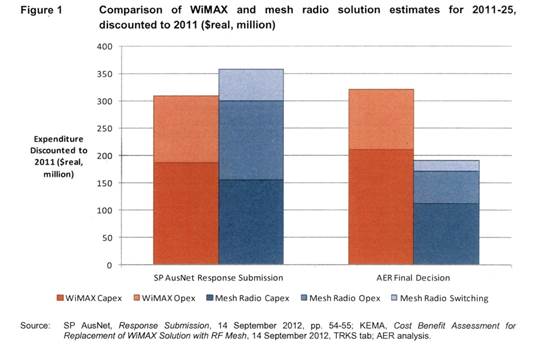
The AER has also had regard to SP AusNet’s qualitative submissions. However, the AER considers the difference in its cost estimates of mesh radio and WiMAX are substantial enough that qualitative factors would not be an impediment to switch. Further, information obtained from SP AusNet suggests SP AusNet knew its WiMAX rollout was facing significant problems in February 2011.
[57] In s 2.2 of the AER’s Amended Budget Determination, the AER expanded upon its understanding of the Tribunal’s remitter. In that section, the AER said that that remitter required the AER to compare the cost of SPI’s proposed WiMAX communications solution with the costs that a reasonable business, having reconsidered its commitment to WiMAX, would incur in the circumstances. It then listed some matters that it considered might be relevant to this comparison. These were:
• The costs already incurred.
• The date of the new submitted budget being reconsidered.
• Alternative technology.
• The costs of switching to the new selected technology.
• The delays involved in retreating from the WiMAX communications technology which the AER had first authorised.
[58] The AER recorded that, in its view, the Tribunal had left open how the AER should consider these matters. We agree. It took the view that the following matters were left to it to decide:
• The time frame to compare the costs of WiMAX with an alternative solution.
• The information relevant to the reconsideration.
• The relevant commercial standard.
[59] The AER made clear in s 2.3 of its Amended Budget Determination that, in its view, the terms of the Tribunal’s remitter made clear that its further review should be quite limited in nature. In particular, the AER said that it was of the opinion that the only amendments which it could make to its final determination were to WiMAX communications related expenditure in the categories maintenance operating expenditure (opex), information technology (IT) operating expenditure (IT opex) and meter unit supply capital expenditure (meter supply capex). We think that these propositions are correct.
[60] The AER commenced its reconsideration of its final determination in accordance with its stated interpretation of the Tribunal’s remitter by concluding that the commercial standard that a reasonable business in SPI’s circumstances would have exercised would have been to fully reconsider its original budget application and, in so doing, would have decided to switch to mesh radio. The AER then set about determining the quantum of the amount to be removed from SPI’s original budget application in order to reflect the fact that SPI had persisted with the WiMAX communications solution contrary to the commercial standard determined by the AER.
[61] The AER then determined that the hypothetical business that would have switched to mesh radio would have incurred MIC antenna and associated retrofit switching costs in 2011 rather than in 2012. For this and other reasons, the AER concluded that it was not necessary to amend SPI’s 2012–2015 approved budget to include 2011 switching costs. The AER took the view that the AMI Order did not allow costs incurred in 2011 to be recovered in the 2012–2015 budget period. Thus, the hypothetical reasonable business, having incurred the costs from 2011, could not have recovered them in the 2012–2015 budget period.
[62] In the end, in its Amended Budget Determination, the AER increased the approved expenditure from $304.1 million in $2011 real to $321.7 million. The increase was entirely due to the fact that the AER brought to account the amounts which had been agreed before the Tribunal during the course of the first appeal and dealt with in subpars (1) and (3) of the Order ultimately made by the Tribunal in the first Tribunal decision.
28 I adopt the Tribunal’s brief explanation of the AER’s Amended Budget Determination for the purposes of these reasons.
SPI’s Grounds of Review
29 In its Originating Application for Judicial Review, SPI sought review of the AER’s Amended Budget Determination:
… insofar as the Amended Budget Determination failed to take into account the costs that would be incurred were a reasonable business in the Applicant’s circumstances to switch the primary communications technology employed by it in the provision of services under the AMI order (Switching Costs) or, alternatively, failed to take into account the commercial standard that would be exercised by a reasonable business in the circumstances resulting in a failure to reinstate within that Approved Budget certain expenditure to be incurred (Excluded Expenditure) with respect to:
(a) Maintenance operating expenditure (Maintenance opex);
(b) Information technology operating expenditure (IT opex);
(c) Meter supply capital expenditure (Meter supply capex);
30 SPI relies upon s 16(1)(a) of the ADJR Act as the source of the Court’s power to quash or set aside part of the AER’s Amended Budget Determination. By attacking only part of that determination, it seeks to have reinstated to its approved budget the amount of $54.65 million being the amount finally excluded from that budget by the AER.
31 The expenditure budgeted by SPI which was excluded by the AER and which is now sought to be reinstated by SPI’s judicial review application as described in that application is precisely the same expenditure which was sought to be reinstated through SPI’s latest appeal which was determined by the Tribunal in its second decision. This much is made clear when consideration is given to [63]–[69] of the second Tribunal decision and Attachment “B” to that decision.
32 In the Tribunal, SPI’s complaint was that the AER’s Amended Budget Determination was based wholly or partly on one or more errors of fact in a material respect. In this proceeding the legal characterisation of SPI’s criticisms of the AER’s decision is different. Here, the alleged errors are related to various grounds of review adumbrated in s 5 and s 6 of the ADJR Act (breach of the rules of natural justice, improper exercise of the power conferred by the enactment in pursuance of which it was purported to have been made, error of law and otherwise contrary to law). But, the outcome intended to be achieved by this proceeding is precisely the same as the outcome intended to be achieved by the appeal to the Tribunal – reinstatement of the excluded forecast expenditure of $54.65 million. The reasons and arguments now brought forward by SPI as justifying that reinstatement are substantially the same as the reasons and arguments which it advanced to the Tribunal in its latest appeal.
33 When SPI came to specify the grounds upon which it claimed it was entitled to relief by way of judicial review in its Originating Application filed in the present proceeding, it set out five “findings” which it said ought to be reviewed. It was argued that the AER had arrived at, and relied upon, those findings in making its Amended Budget Determination.
34 The five erroneous findings referred to in this way are set out in subpars 1(a)-(e) of par A of the Grounds of Review specified by SPI in its Originating Application in the following terms:
(a) the commercial standard that would be exercised by a reasonable business in SP AusNet’s circumstances would entail a decision on 28 February 2011 to switch the primary communications technology it employs in the provision of services under the AMI Order from “WiMAX” to mesh radio (the AER’s commercial standard) (page vi); and
(b) incurring the expenditure proposed by SP AusNet (being the Excluded Expenditure) was not prudent as it involved a substantial departure from the AER’s commercial standard (page vi).
…
(c) a reasonable business in SP AusNet’s circumstances would have incurred all mesh radio Switching Costs (bar $0.3 million) by the end of 2011 (page vii);
(d) the amount of Switching Costs would be $19.1 million (page vii);
(e) that it is neither necessary nor possible to include any Switching Costs in SP AusNet’s 2012-2015 Amended Budget (page vii).
35 The findings described in subpars (c), (d) and (e) of par A.1 are together defined in SPI’s Originating Application for Judicial Review as “the AER switching costs decision”.
36 There is a suggestion in the heading to section A on p 5 of SPI’s Originating Application that SPI might seek to argue that each of the “findings” to which it referred in that section was, by itself, a decision amenable to review. However, when proper regard is had to the description of the decision sought to be reviewed on p 2 of SPI’s Originating Application and also the description of the decision sought to be reviewed in par 2 of section A under the heading entitled “Grounds of application”, I think that it is clear that the decision sought to be reviewed is the AER’s Amended Budget Determination itself, and not antecedent or constituent findings or conclusions forming part of the reasoning process leading to that decision. It is the whole decision that is to be reviewed although only part of the decision is sought to be quashed or set aside.
37 In Sections B, C, D and E at pp 6-16 of its Originating Application, SPI amplifies the grounds of review relied upon by it.
38 In Section B, SPI addresses the commercial standard test and the AER’s decision to remove certain items from SPI’s budgeted expenditure. It contends that:
(a) In arriving at its assessment of the relevant commercial standard, the AER relied upon and adopted the business case cost comparison of WiMAX and mesh radio technology solutions prepared by Energeia.
(b) In developing its mesh radio costing, Energeia relied upon information (being other DNSPs actual and budgeted costs) which was not reasonably available to SPI as at the material date, viz 28 February 2011, and could not have been available as at that date given the substantial differences between the network profile and business arrangements of SPI, on the one hand, and the network profile and business arrangements of the other DNSPs, on the other hand.
(c) The use of such information by Energeia and by the AER involved an error of law within the meaning of s 5(1)(f) and 6(1)(f) of the ADJR Act and was otherwise contrary to law within the meaning of s 5(1)(j) and s 6(1)(j) of that Act because:
(i) In making its determination in light of the remitter, the AER was not permitted to have regard to information which was not reasonably available to SPI as at 28 February 2011;
(ii) By taking into account the other DNSP’s expenditure, the AER failed to give fundamental weight to the matters listed in cl 5I.8 of the AMI order and failed to give proper effect to the remitter;
(iii) The AER misunderstood the Tribunal’s reasons in its first decision as determining that Powercor (one of the other Victorian DNSPs) was a suitable comparator to SPI for the purposes of the reconsideration.
(d) The use of such information was also an improper exercise of power because the AER took into account irrelevant considerations (as to which, see s 5(1)(e) and s 6(1)(e) of the ADJR Act).
(e) In adopting the AER’s commercial standard and in concluding that the Excluded Expenditure constituted a substantial departure from that standard, the AER failed to establish that its commercial standard was the commercial standard that a reasonable business would exercise in all the circumstances giving fundamental weight to the matters referred to in cl 5I.8 of the AMI order. Energeia’s model and costings did not constitute proof of these matters.
(f) The adoption of Energeia’s model and costings involved an error of law and was otherwise contrary to law because, pursuant to cll 5C.4 and 5I.8 of the AMI order, matters to which the AER was required to give fundamental weight were not given significant weight.
39 In Section C, SPI addresses mesh radio switching costs. It contends that:
(a) In reliance of upon the 2013 Energeia Report, the AER erroneously found that a reasonable business in SPI’s circumstances would have incurred all mesh radio Switching Costs (with the exception of $0.3 million) by the end of 2011 in order to meet the AMI’s services target applicable on 1 January 2012 because it failed to give fundamental weight to the mandatory obligation imposed on SPI by the AMI order to use its best endeavours to install meters in accordance with the rollout schedule. This involved an error of law, was conduct which was contrary to law and constituted an improper exercise of power.
(b) The AER erroneously found that it is neither necessary nor possible to include any Switching Costs in SPI’s 2012–2015 Amended Budget in defiance of the finding made by the Tribunal in its first decision to the effect that SPI’s Approved Budget would need to reflect Switching Costs and thus contrary to the basis upon which the remitter was ordered. This finding involved an error of law because it was based upon an erroneous construction of the AMI order and reflected a failure on the part of the AER to give fundamental weight to certain matters (as to which, see cll 5C.4 and 5I.8). It was also an improper exercise of power.
40 In Section D, SPI addresses its natural justice case. It argues in that section that in Energeia developing its mesh radio costing (including Switching Costs) and in the AER relying upon and adopting that costing, information not made available to SPI was relied upon. This information may broadly be described as the other DNSP’s mesh radio costings. This state of affairs was a breach of the rules of natural justice (see s 5(1)(a) and s 6(1)(a) of the ADJR Act).
41 In Section E, SPI deals with its contention that, in making its Amended Budget Determination, the AER failed to take into account the circumstances of SPI as at the time when it made that determination, viz 4 February 2013. In this Section, SPI argues that the AER should have taken into account the fact that SPI had continued to roll out its WiMAX technology between February 2011 and February 2013 and had therefore incurred further such costs in that period which would be unrecoverable. This failure was an error of law.
42 The contentions which I have summarised at [37]–[41] above were developed further in SPI’s written submissions.
Consideration and Decision
Jurisdiction
43 Section 5(1) of the ADJR Act provides that a person who is aggrieved by a decision to which the ADJR Act applies may seek review of that decision in this Court or in the Federal Circuit Court of Australia upon any one or more of the grounds specified in s 5(1)(a) to (i), some of which are further explained by subs (2) and (3) of s 5. The expression “… decision to which this Act applies …” also appears in s 6(1) which deals with reviewable conduct engaged in for the purpose of making such a decision. That expression is defined in s 3(1) of the ADJR Act in the following terms:
decision to which this Act applies means a decision of an administrative character made, proposed to be made, or required to be made (whether in the exercise of a discretion or not and whether before or after the commencement of this definition):
(a) under an enactment referred to in paragraph (a), (b), (c) or (d) of the definition of enactment; or
(b) by a Commonwealth authority or an officer of the Commonwealth under an enactment referred to in paragraph (ca) or (cb) of the definition of enactment;
other than:
(c) a decision by the Governor‑General; or
(d) a decision included in any of the classes of decisions set out in Schedule 1.
Note: Regulations for the purposes of section 19 can declare that decisions that are covered by this definition are not subject to judicial review under this Act.
44 The definition of “enactment” in s 3(1) of the ADJR Act covers the NEV Act and any instrument made under that Act (s 3(a) and subpars (ca) and (cb) of the definition of enactment).
45 Sections 19, 20, 23 and 27A of the NEV Act together operate to confer upon the AER the relevant functions and powers of the Essential Services Commissioner of Victoria under the AMI order. Those functions and powers include assessing, approving or rejecting and determining the approved budget of a DNSP such as SPI.
46 The AER’s Amended Budget Determination is not within the classes of decision specified in Schedule 1 to the ADJR Act as decisions to which the ADJR Act does not apply.
47 For these reasons, because the AER’s original final determination was a decision made under the AMI order, it is amenable to review under the ADJR Act. The AER’s Amended Budget Determination was also such a decision and, for the same reasons, is also amenable to review under the ADJR Act. There is no doubt that SPI is an aggrieved person within the meaning of s 5(1) and s 6(1).
48 Accordingly, this Court has jurisdiction to deal with SPI’s application for review of the AER’s Amended Budget Determination.
Discretionary Refusal of Relief (s 10(2)(b)(ii) of the ADJR Act)
49 Section 10 of the ADJR Act relevantly provides:
10 Rights conferred by this Act to be additional to other rights
(1) The rights conferred by sections 5, 6 and 7 on a person to make an application to the Federal Court or the Federal Circuit Court in respect of a decision, in respect of conduct engaged in for the purpose of making a decision or in respect of a failure to make a decision:
(a) are in addition to, and not in derogation of, any other rights that the person has to seek a review, whether by the court, by another court, or by another tribunal, authority or person, of that decision, conduct or failure; and
(2) Notwithstanding subsection (1):
…
(b) the Federal Court or the Federal Circuit Court may, in its discretion, refuse to grant an application under section 5, 6 or 7 that was made to the court in respect of a decision, in respect of conduct engaged in for the purpose of making a decision, or in respect of a failure to make a decision, for the reason:
(i) that the applicant has sought a review by the court, or by another court, of that decision, conduct or failure otherwise than under this Act; or
(ii) that adequate provision is made by any law other than this Act under which the applicant is entitled to seek a review by the court, by another court, or by another tribunal, authority or person, of that decision, conduct or failure.
(3) In this section, review includes a review by way of reconsideration, re‑hearing, appeal, the grant of an injunction or of a prerogative or statutory writ or the making of a declaratory or other order.
50 In the present case, an appeal under s 29 (2) of the NEV Act falls within the definition of “review” in s 10(3).
51 The next question which arises is: Does the right of appeal given to SPI under s 29(2) of the NEV Act constitute “… adequate provision … under which [SPI] is entitled to such a review by [the Tribunal] …” of the AER’s Amended Budget Determination. If that right of appeal does meet that requirement, then the Court’s discretion under s 10(2)(b) is enlivened.
52 The grounds of appeal available to SPI under the NEV Act are that the AER’s decision was affected by bias or that it was based wholly or partly on an error of fact in a material respect. These grounds are limited. The Tribunal is not authorised to re-determine SPI’s approved budget by way of a hearing de novo. SPI must demonstrate that at least one of the statutory grounds has been made out. Once at least one of these grounds has been established, the Tribunal has broad powers to vary the determination in order to correct error or to set aside the determination and remit the matter to the AER for reconsideration and re-determination. In my judgment, s 29(2) of the NEV Act makes adequate provision for review of the AER’s decision in the present case within the meaning of s 10(2)(b)(ii) of the ADJR Act. The Court’s discretion under s 10(2)(b)(ii) is, therefore, enlivened.
53 The next question is whether the Court should withhold relief under the ADJR Act in circumstances where, not only does SPI have a right of appeal to the Tribunal, but also where it has exercised its right of appeal and has failed to obtain any relief.
54 The AER submitted that the Court should not entertain grounds of review which, in substance, have been rejected by the Tribunal. The AER argued that the Court should only consider matters that were not capable of being raised in the appeal proceeding in the Tribunal.
55 The AER submitted that the Court ought not entertain arguments to the effect that the AER’s Amended Budget Determination was an improper exercise of power (s 5(1)(e) and s 6(1)(e)) because the AER took an irrelevant consideration into account in the exercise of that power or failed to take a relevant consideration into account in the exercise of that power or acted unreasonably in the exercise of that power. These were all lines of attack available to SPI in the appeal under the general ground of material error of fact.
56 I think that the submissions made by the AER which I have endeavoured to summarise at [54] and [55] above are correct. I accept them.
57 As will be apparent from what follows in these reasons, I do not accept that the AER’s Amended Budget Determination was affected by any reviewable error and therefore have concluded that this proceeding must be dismissed. Had I come to a different view, I would have exercised my discretion under s 10(2)(b)(ii) of the ADJR Act to refuse to grant any relief to SPI based upon grounds specified in s 5(1)(e) and s 6(1)(e) (improper exercise of power). SPI abandoned its natural justice ground. Therefore, the only grounds relied upon by SPI that would have remained arguably available to it were error of law or action contrary to law. For reasons which I will explain, none of SPI’s criticisms of the AER can properly be characterised as an error of law or action taken contrary to law.
The AER’s Regulatory Task under the AMI Order
58 The regulatory regime was explained by the Tribunal in its first decision (at [10]–[29]).
59 Under cl 5C.2 of the AMI order, the AER must approve a submitted budget unless it “establishes” that the expenditure (or part hereof) that makes up the total Opex and Capex for each year (inter alia) is not prudent. In the present case, lack of prudency was relied upon by the AER as the sole ground for not approving SPI’s submitted budget. Clause 5C.3 deems expenditure to be prudent unless the AER “establishes” that it is more likely than not that the expenditure will not be incurred or the expenditure will be incurred but incurring the expenditure involves a substantial departure from the commercial standard that a reasonable business would exercise in the circumstances. For the purposes of considering whether such a substantial departure is involved, the AER must take into account and give “fundamental weight” to the matters referred to in cl 5I.8, with all necessary changes being made. Clause 5I.8 requires the AER to give “fundamental weight” to “the circumstances of [the DNSP]” at the time the commitment was made to incur or manage the expenditure. Some specific circumstances are then listed in the clause.
60 The AMI order commits to the AER the decision as to whether or not claimed expenditure is prudent. That decision involves the application of judgment, expertise, experience and skill to facts as determined by the AER.
61 It seems to me that, when used in cl 5C.2 and 5C.3, the word “establishes” means that the AER must be reasonably satisfied of the matters qualified by the word. The AER is required to form a state of satisfaction on the material available to it as to those matters which are required to be “established” under the AMI order after taking into account the circumstances of the particular DNSP.
62 As submitted by the AER, the AER’s satisfaction that a matter has been “established” in the sense described at [61] above is subject to judicial review in accordance with the principles identified by Gibbs J in Buck v Bavone (1976) 135 CLR 110 at 118–119. But, subject to those principles, the Court is not entitled to review the merits of the AER’s level of satisfaction nor does it consider or determine for itself whether it is satisfied of the requisite matters.
63 Here, the only question for the Court is whether the AER properly formed the requisite state of satisfaction that the expenditure was not prudent, not whether, on the material before the AER, the Court would have come to a different view.
64 The expression “fundamental weight” used in cl 5C.4 and 5I.8 appears to have been derived from language of similar import utilised by Mason J in R v Hunt; Ex parte Sean Investments Pty Limited (1979) 180 CLR 322 at 329.
65 In Telstra Corporation Ltd v Australian Competition and Consumer Commission (2009) 176 FCR 153 at 182–183 [110], Rares J discussed the meaning of the expression “fundamental weight” in the context of his Honour’s consideration of certain provisions of the Trade Practices Act 1974 (Cth) concerning telecommunications carriers. His Honour said that the expression meant that the decision-maker was required to treat the consideration of the relevant factors, as opposed to the factors themselves, as a central element in the deliberative process.
66 I am content to adopt his Honour’s exposition of the meaning of the expression for present purposes. In my judgment, however, it remains for the AER to accord such weight as it considers appropriate to the various factors which it considers it might take into account in determining the commercial standard referred to in cl 5C.3(b)(iv) while nonetheless respecting the command in the AMI order that fundamental weight is to be given to the circumstances of the particular DNSP.
67 At pars 9–14 of its submissions, SPI argued that the AER had not established that a reasonable business in SPI’s circumstances would have decided on 28 February 2011 to switch the primary communications technology employed in the provision of services under the AMI order from WiMAX to mesh radio.
68 It argued that the AER had failed to give fundamental weight to a number of matters to which specific reference is made in cl 5I.8(d) to (j). Some of the submissions made by SPI in this section of its submissions directly challenge the underlying merits of the AER’s conclusion that a reasonable business in the circumstances of SPI would have made a decision on 28 February 2011 to switch from WiMAX to mesh radio.
69 Each of the matters relied upon by SPI as the basis upon which it challenges the AER’s articulated commercial standard are matters which clearly fell within the fact-finding province of the AER. They were matters which were subject to the exercise of judgment by the AER. None of them involved an error of law or other ground of review available under the ADJR Act.
70 In sections D to M of its written submissions, SPI makes a number of detailed submissions designed to demonstrate error on the part of the AER.
71 In Attachment 1 to its submissions, SPI makes submissions as to the content and interpretation of the various grounds of review specified under the ADJR Act which are relied upon by it in the present proceeding. For the most part, however, SPI has failed to address specific submissions to the question of whether the alleged errors made by the AER identified by it in sections D–M of its submissions constituted errors of law or were otherwise contrary to law or, for that matter, provided a proper foundation for relief based upon one or more other grounds of review specified in s 5 and s 6 Act.
72 SPI has made lengthy and discursive submissions in support of its fundamental contention that the AER made many errors in arriving at its Amended Budget Determination. Those submissions reveal that, in almost every case, the alleged errors are (if errors at all) errors of fact. In addition, in a great many cases, SPI argued before the Tribunal at the joint hearing which took place in mid-2013 that the errors were errors of fact which had been material to the AER’s Amended Budget Determination.
73 Notwithstanding the shortcomings in SPI’s submissions, the AER answered them. The AER’s submissions are also detailed, although not as lengthy as the submissions made on behalf of SPI.
74 I propose to deal with SPI’s submissions as briefly as possible. I will do so by reference to the section headings adopted by SPI in its submissions.
SPI’s Contentions
SPI’s Circumstances – Technical Requirements Ignored
75 SPI submitted that the fact that mesh radio was unable to satisfy one of the performance requirements in the AMI Functionality Specification was a “material, fundamental factor” to be taken into account in any reconsideration conducted by a reasonable business in SPI’s circumstances.
76 The question of mesh radio’s compliance with the Functionality Specification was directly addressed by the AER at pp 104–106 of its Amended Budget Determination. The AER did not ignore this matter nor did it fail to give it any weight. The AER found that a reasonable business in SPI’s circumstances would accord little weight to mesh radio technology’s apparent inability to comply with one (out of many) requirement of the Functionality Specification, given that all of the other Victorian DNSPs were rolling out mesh radio without penalty and given that WiMAX also failed to comply in several, more serious, respects.
77 It was clearly open to the AER to take into account this issue of non-compliance and to accord it such weight as it considered appropriate. The AER made no error of the kind alleged against it in respect of mesh radio’s non-compliance with the Functionality Specification.
SPI’s Circumstances – Rollout Issues Ignored
78 SPI submitted that, as at 28 February 2011, a reasonable business in SPI’s circumstances would have known that switching to mesh radio in accordance with the AER’s timeframe would result in failure on its part to meet the milestones laid down in the AMI order for the installation of meters. SPI contended that a failure to meet the rollout schedule would constitute a material, fundamental factor to be taken into account in any technology solution reconsideration undertaken by a reasonable business in SPI’s circumstances as at 28 February 2011. SPI went on to submit that the AER failed to attribute any weight or any significant weight to these matters.
79 The AER did not ignore rollout issues. Rather, it specifically addressed them at pp 13, 106 and 107 of its Amended Budget Determination. The AER (correctly) noted that the AMI order required a DNSP to use only its best endeavours to comply with the rollout schedule. It considered that, although relevant, potential non-compliance with some rollout milestones would not have been a strong impediment to switching to mesh radio.
80 No error is revealed in the AER’s consideration of this matter.
No Quantified Departure from the Commercial Standard
81 SPI submitted that the AER failed to address the need to establish that the claimed expenditure by SPI constituted a substantial departure from the commercial standard determined by the AER as the reasonable standard that a reasonable business would exercise in the circumstances. It argued that the removal of the proposed expenditure of $72.2 million from its budget comprising meter supply capex ($54.3 million), maintenance opex ($10.9 million) and IT opex ($7 million) was effected in contravention of cl 5C.8 of the AMI order. It submitted that the AER did not establish that incurring these specific amounts would involve a substantial departure from the requisite commercial standard.
82 The task remitted to the AER by the Tribunal as a result of its first decision required the AER to consider whether it should amend its original final determination in respect of the removal of the proposed expenditure of $72.2 million in the categories which I have mentioned at [81] above.
83 As submitted by the AER, the AER’s Amended Budget Determination needs to be read together with its original final determination. Its Amended Budget Determination gave effect to the “necessary next step” required by the first Tribunal decision.
84 The AER determined that a reasonable business in SPI’s circumstances would have switched to mesh radio by no later than 28 February 2011 and would have incurred all of the switching costs in doing so in the 2011 calendar year. In those circumstances, it decided that no amendment should be made to its original final determination in respect of meter supply capex, maintenance opex or IT opex. In substance, in this way, it determined that an amount of $72.2 million was not prudent. It did not fail to address the extent to which SPI’s claimed expenditure was not prudent. It clearly did so.
Information Not Available and Inconsistent with Available Information
85 SPI submitted that the AER relied upon information which was unavailable to a reasonable business in SPI’s circumstances in February 2011 and inconsistent with that information which was available.
86 This complaint relates to the use by Energeia and the AER of mesh radio costs incurred and to be incurred by Powercor Australia Limited (Powercor), Jemena Electricity Networks (JEN) and other Victorian electricity DNSPs. SPI submitted that these costings were not available to SPI in February 2011 and could not reasonably have been ascertained by SPI at that time.
87 The AER submitted that the use which it made of the other DNSPs’ costings was as a proxy for a reasonable estimate of mesh radio costs as at February 2011. That estimate could have been put together from information which could have been obtained by a reasonable business in the circumstances of SPI at the relevant time by making appropriate enquiries. The 2013 Energeia Report justified the estimate set out in that report by reference to properly sourced material which was available as at 28 February 2011 as well as by reference to other DNSPs’ costs.
88 The AER’s submissions on this point are correct and I accept them. SPI has failed to demonstrate that the information which was ultimately used by the AER could not have been obtained by it as at 28 February 2011 if it had made reasonable enquiries.
Information Relied Upon Did not Reflect Appropriate Benchmarks
89 At pars 53 to 81 of its written submissions, SPI submitted that the use of benchmarks by the AER involved a failure to give fundamental weight to SPI’s circumstances and involved irrelevant considerations.
90 Similar arguments were put to the Tribunal at the joint hearing.
91 At pp 28–30 of its Amended Budget Determination, the AER gave detailed consideration to cost-sharing issues. In particular, the AER concluded that neither SPI nor its consultant, KEMA, had demonstrated to AER’s satisfaction why any difference in economies of scale or cost-sharing ability would be substantial enough to support the adoption of KEMA’s significantly higher cost estimates or warrant any other adjustment to the benchmarks determined by the AER. The AER also took into account the fact that, notwithstanding SPI’s assertions to the contrary, its meter volumes were not significantly lower than the volumes of the other Victorian DNSPs.
92 The AER also recognised that JEN and United Energy shared IT costs. However, it noted that JEN and SPI share a common IT service provider and observed that they too may be able to share IT costs to some extent. The AER also noted (without making too much of it) that SPI and JEN were related companies in that they shared a common parent company. The AER did make adjustments to JEN’s expenditure in order to take account of IT licensing costs in respect of SPI’s greater volume of meters (see Amended Budget Determination at p 32(a)).
93 The AER submitted that benchmarking was not prohibited by the AMI order nor was it frowned upon by the Tribunal in the first Tribunal decision. It accepted that the appropriateness of using benchmarking techniques would always need to be assessed against other ways and means of testing the reasonableness of the submitted expenditures. To a large extent, a DNSP will be able to influence the methodology ultimately selected by the AER. For example, if all costings are supported by firm contractual arrangements which are current and meaningful, there may be little scope for benchmarking. The AER submitted that, in the present case, SPI had not supported its costings in this fashion and that, in all the circumstances, it was both open to and appropriate for the AER to use benchmarking techniques. Entering into arguments about the particular figures selected in that process constitutes nothing more than seeking to elevate one expert opinion over another. This criticism of the AER does not establish any error on its part.
Remitter Ignored Date of Reconsideration
94 SPI submitted that despite the AER having selected 28 February 2011 as the date upon which the reconsideration of WiMAX should have been undertaken, both the AER and Energeia assumed, in certain contexts, that a reasonable business in SPI’s circumstances would already have reconsidered its commitment to proceed with WiMAX in the months preceding this date. This proposition raises the issue of the mesh radio solution implementation timeline.
95 Before the Tribunal, SPI made lengthy and detailed submissions designed to support the proposition that 28 months was required from 28 February 2011 for the implementation of the switch to mesh radio technology.
96 At [160]–[169] of the second Tribunal decision, the Tribunal addressed these arguments and rejected them. In any event, the criticisms made of the AER in this regard are criticisms which involve questions of fact and judgment.
97 The criticisms made of the AER by SPI at pars 82 to 85 of SPI’s submissions are without merit. SPI has failed to demonstrate that the AER committed any reviewable error in its assessment of an appropriate timeline for the implementation of its switch to mesh radio technology.
Basis for Assuming Completion of Switch to Mesh Radio in 2011
98 Once again, these criticisms all involve questions of fact and judgment. In large part, they also engage the reasoning of the Tribunal in dealing with the mesh radio implementation timeline ([160]–[169] of the second Tribunal decision).
99 I think that the Tribunal’s findings and conclusions expressed in those paragraphs of its decision are correct. They provide a complete answer to the submissions made in this section of SPI’s submissions.
100 In any event, the criticisms made do not involve any error of law or action done contrary to law.
Ignored Switching Costs if Incurred in 2011
101 A fundamental integer in SPI’s argument in relation to this matter is the proposition that, in the first Tribunal decision, the Tribunal found that the Approved Budget to be determined by the AER would need to reflect the Switching Costs. In particular, SPI points to [126] and [130] in the first Tribunal decision.
102 In its first decision, the Tribunal required the AER to reconsider the financial consequences that would have resulted had SPI reviewed its choice of WiMAX technology as at 28 February 2011.
103 The AER was required to address the subject matter of Switching Costs and the likely time when such costs would have been incurred had the switch been undertaken as at 28 February 2011. However, the Tribunal did not expressly direct the AER to include in its Amended Budget Determination in respect of SPI any amount in respect of such Switching Costs. All that the Tribunal required the AER to do was to take account of the costs associated with SPI switching to a different technology having regard to the time at which such switch would have been undertaken and completed.
104 In adopting the approach which it did, the AER did not fail to execute the remitter.
105 At pp 92–102 of the AER’s Amended Budget Determination, the AER addressed the issue of Switching Costs. It found that a reasonable business in SPI’s circumstances would incur $19.1 million in Switching Costs if it decided to switch to mesh radio by 28 February 2011. It also found that most of the mesh radio Switching Costs would have been incurred in 2011, that is to say, before the commencement of the 2012–2015 regulatory period. As the AER submitted, if that conclusion is correct, a question arises as to how the AER, in amending its determination of SPI’s Approved Budget for the 2012–2015 budget period, should deal with Switching Costs which, in the hypothetical case with which the AER was dealing, were incurred outside the relevant budget period.
106 The AER took the view that the approach which was more consistent with the requirements of the AMI order was to treat the relevant expenditure as relating to the budget period in which it would have been incurred had the relevant decision to switch been made. This approach was open to it. The AER argued that this approach is more consistent with the terms and structure of the AMI order, including the budget application and charges revision processes, and would still provide mechanisms for a DNSP to recover Switching Costs if it actually incurred them in 2011. The alternative of allowing the expenditure to be added to the Approved Budget in the following budget period does not sit comfortably with the AMI order and would potentially lead to overcompensation of SPI which would not be in the long term interests of consumers in Victoria. Under cl 4.1(o) of the AMI order, a DNSP’s charges for every year are required to be designed so that the net present value of the total costs incurred by the DNSP is equal to the net present value of the total revenue earned by that DNSP in the same regulatory period with reference to actual expenditure to the extent allowable and, if the details of its actual expenditure are not available, by reference to forecast expenditure. This requirement necessitates an annual reconciliation of actual expenditure with the Approved Budget. The inclusion of 2011 Switching Costs in the 2012–2015 Approved Budget would prevent or inhibit the proper reconciliation of actual expenditure against budgeted expenditure for 2012.
107 For reasons which it explained at p 100 of its Amended Budget Determination, the AER submitted that SPI’s Approved Budget for 2009–2011 was already sufficient to cover any mesh radio Switching Costs incurred in 2011 upon the assumptions adopted by the AER.
108 This approach adopted by the AER was not affected by reviewable error.
Alternative Funding Source for Switching Costs Irrelevant
109 As I have noted at [107] above, the AER concluded that revenue derived by SPI under the AMI order in the 2009–2011 regulatory period would have been adequate to compensate a reasonable business in SPI’s circumstances for Switching Costs incurred in 2011 and, in any event, such a business could have made in 2011 a budget revision application under the AMI order to cover Switching Costs incurred in that calendar year.
110 At pars 123–127 of its submissions, SPI challenged the correctness of the AER’s reasoning in this respect. In those paragraphs, SPI addresses a number of matters of fact, both actual and hypothetical.
111 For reasons explained by the AER at pars 79–85 of its submissions, the exercise which it was required to perform on remitter was essentially hypothetical. It was required to reconsider the financial consequences that would have followed from a decision by SPI to switch its IT technology solution from WiMAX to mesh radio as at 28 February 2011. The AER did not commit any error when it conceived and took into account hypothetical steps that might or could have been undertaken by the hypothetical reasonable business to fund relevant hypothetical expenditure.
Opportunity to be Heard
112 In its written submissions, SPI submitted that it had not had any opportunity to be heard in relation to the 2013 Energeia Report nor had it had any opportunity to be heard in relation to much of the information and analysis relied upon and adopted by Energeia in that report. In particular, SPI complained that two propositions relied upon by the AER were first identified in the 2013 Energeia Report and not put to SPI for its response. The first proposition was that the AER’s failure to take into account JEN’s sharing of costs was immaterial as certain benefits were likely to accrue to a reasonable business in SPI’s circumstances which would offset the effect of its inability to share costs. The second proposition was that a reasonable business in SPI’s circumstances could possibly have had a capacity to share IT costs with another DNSP, JEN, because both SPI and JEN use a common IT service provider, EBS, and EBS is wholly owned by the entity which has a majority holding in SPI and is the ultimate owner of JEN.
113 SPI made further submissions designed to demonstrate that these propositions were significant influences upon the AER in dealing with responsive submissions made by SPI in relation to benchmarking generally and cost-sharing.
114 At pars 86 to 111 of its submissions, the AER addressed this allegation in considerable detail.
115 In those paragraphs of its submissions, the AER recounted the history of the dealings between it and SPI after the remitter of late April 2012. Those submissions constitute a comprehensive rebuttal of SPI’s contentions. The AER was not obliged to undertake an infinite number of communications with SPI in order to ensure that every detail or aspect of its deliberations was put to SPI for its consideration.
116 In any event, at the joint hearing (Transcript pp 200–201) Senior Counsel for SPI abandoned SPI’s contentions that it had been denied natural justice or procedural fairness in respect of the matters covered by its submissions at pars 128 to 135.
Some Final Observations
117 In cases such as the present, it is incumbent upon the applicant for review to identify in the decision under challenge the error or errors made by the decision-maker; to demonstrate by reference to the materials presented to the decision-maker for his or her consideration by argument and, sometimes, by other evidence, that errors were in fact made: to demonstrate that, as a result of the errors which have been established in this fashion, one or more grounds of review specified in s 5 and s 6 of the ADJR Act have been made out; and ultimately to persuade the court that the applicant is in entitled to relief in respect of those errors.
118 In the present case, SPI has not undertaken the tasks which I have briefly described at [117] above. All that it has done is to place before the Court a myriad of propositions and contentions designed to demonstrate that the AER made mistakes in arriving at its Amended Budget Determination without making any attempt whatsoever to persuade the Court that the errors upon which it relies constitute reviewable error on one or more of the statutory grounds specified in the ADJR Act. In addition, it has not even tried to come to grips with the difference between the scope of s 5 of the ADJR Act and scope of s 6 of that Act. No specific submission was directed to s 6.
119 As the Tribunal said at [175]–[176] of its second decision:
175. … SPI’s submissions are replete with argumentative assertions and contentions that judgment calls made by the AER were wrong or unsupported. However, our consideration of these contentions must be undertaken in the full knowledge that the entire exercise confronting the AER was hypothetical. The first step in constructing the relevant hypothesis was to determine whether a reasonable business in the position of SPI would continue with the WiMAX communications solution in the 2012–2015 budget period. Once a decision was made on this critical fundamental point, the other steps contemplated by the Tribunal in its first decision needed to be undertaken. Although the hypothesis requires the AER to formulate and cost an appropriate plan of action using, as far as possible, real costings, the exercise is nonetheless hypothetical because, as we know, SPI did not switch to mesh radio technology as the hypothesis says it should have done. The task confronting the AER was to assess SPI’s budget as propounded in fact against the full implications of its hypothesis in order to see whether some of the expenditure claimed by SPI should be removed from its budget in accordance with the regulatory requirements embodied in the critical clauses in the AMI Order.
176. A process such as the one which we have endeavoured to describe at [175] above involves the exercise of significant judgment and will quite often throw up for consideration significant differences of opinion based upon different assumptions made by those called upon to participate in the process and their advisors. Much of the activity is not susceptible to an analysis which allows a party in the position of SPI to identify and make good the proposition that the ultimate determination has been based either wholly or in part upon errors of fact in a material respect.
120 I endorse these remarks and add that the task confronting SPI in this proceeding is no easier. Unless it could establish that the AER misinterpreted the AMI order or the terms of the remitter or made some other error of law or otherwise acted contrary to law, it was bound to find it difficult to establish reviewable error in the circumstances of this case. SPI has been unable to establish any of those things.
Conclusion
121 I am not persuaded that the AER’s Amended Budget Determination is affected by reviewable error. In my judgment, SPI has failed to make out any ground of review of that decision under the ADJR Act. SPI’s application must therefore be dismissed with costs. There will be orders accordingly.
|
I certify that the preceding one hundred and twenty-one (121) numbered paragraphs are a true copy of the Reasons for Judgment herein of the Honourable Justice Foster. |
Associate:


