

FEDERAL COURT OF AUSTRALIA
MDA National Limited v Medical Defence Australia Limited [2014] FCA 954
|
IN THE FEDERAL COURT OF AUSTRALIA |
|
|
DATE OF ORDER: |
|
|
WHERE MADE: |
THE COURT ORDERS THAT:
1. Order pursuant to section 411(1) of the Corporations Act 2001 (Corporations Act) that:
(a) the first plaintiff convene a meeting of its members for the purpose of considering and, if thought fit, agreeing (with or without modification) to a scheme of arrangement proposed between the first plaintiff and its members (the MDAN Scheme Meeting), being the scheme of arrangement substantially in the form at Annexure A (the MDAN Scheme) of the scheme booklet which is Exhibit 1 in the proceeding (the Scheme Booklet).
(b) the MDAN Scheme Meeting be held at 1.30pm (Australian Eastern Daylight Time) on 11 October 2014 at Level 3, 88 Collins Street, West Perth, Western Australia.
(c) the chairperson of the MDAN Scheme Meeting be Julian Lockhart Rait and in his absence Dr Beres Carmel Anne Wenck (the MDAN chairperson).
(d) the MDAN chairperson has the power to adjourn the MDAN Scheme Meeting in his or her absolute discretion.
(e) all voting at the MDAN Scheme Meeting (other than procedural matters) be by poll as declared by the MDAN chairperson.
(f) MDAN members may lodge a proxy form in accordance with the instructions given in the Scheme Booklet at Annexure ‘F’, with any such proxies to be delivered to the Deputy Company Secretary at least 48 hours before the specified time for holding the MDAN Scheme Meeting.
(g) the explanatory statement in the form of the Scheme Booklet be approved for distribution to MDAN members.
1. Direct pursuant to section 1319 of the Corporations Act that:
(h) the Scheme Booklet be dispatched to those MDAN members for whom MDAN maintains a current electronic address by sending an email, including a URL link to www.mdanational.com.au, substantially in the form of Annexure ‘A’ to these Orders to each such member on or before 18 September 2014
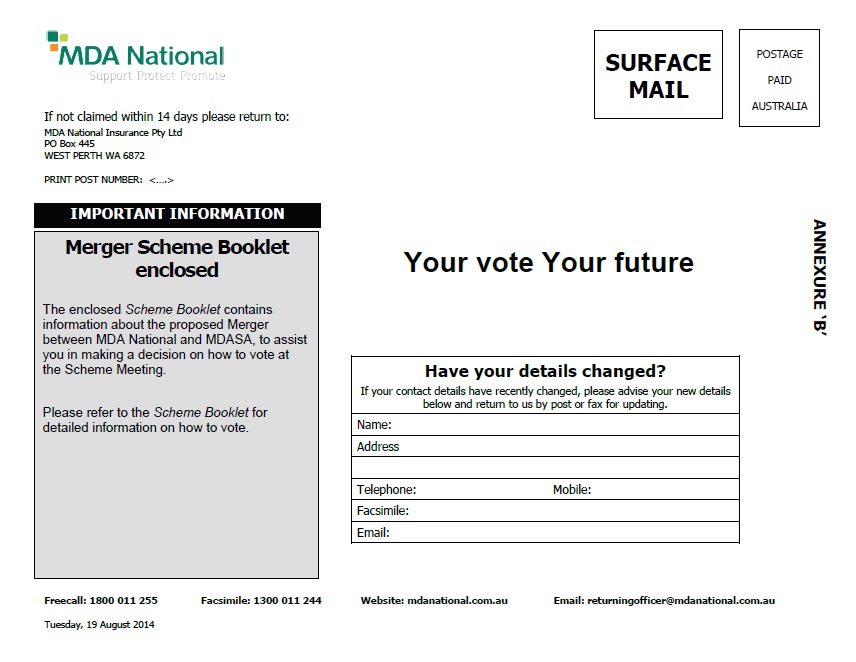
(i) the Scheme Booklet be dispatched by prepaid ordinary post (or in the case of overseas members, by airmail) together with a cover sheet substantially in the form of Annexure ‘B’ to these Orders to the address of those MDAN members for whom MDAN does not maintain a current email address.
(j) it shall not be necessary for the Scheme Booklet to be dispatched by prepaid ordinary post (or in the case of overseas members, by airmail) to the registered address of those MDAN members to whom the Scheme Booklet has been dispatched as contemplated in order 2(a).
MDASA SCHEME
2. Pursuant to section 411(1) of the Corporations Act:
(k) the second plaintiff convene a meeting of its members for the purpose of considering and, if thought fit, agreeing with or without modification to a scheme of arrangement proposed between the second plaintiff and its members (the MDASA Scheme Meeting), being the scheme substantially in the form at Annexure A of the Scheme Booklet (the MDASA Scheme).
(l) the MDASA Scheme Meeting be held at 10:30 am (Australian Eastern Daylight Time) (or as soon thereafter as the General Meeting has concluded or adjourned), on 11 October 2014 at Level 14, 70 Franklin Street, Adelaide, South Australia.
(m) the chairperson of the MDASA Scheme Meeting be Dr John Augustine O’Loughlin and in his absence Martin Frank Altmann (the MDASA chairperson).
(n) the MDASA chairperson has the power to adjourn the MDASA Scheme Meeting in his absolute discretion.
(o) all voting at the MDASA Scheme Meeting (other than procedural matters) be by poll as declared by the MDASA chairperson.
(p) MDASA members may lodge a proxy form in accordance with the instructions given in the Scheme Booklet at Annexure ‘G’, with any such proxies to be delivered to the authorised officer at least 48 hours before the specified time for holding the MDASA Scheme Meeting.
(q) the Scheme Booklet be approved for distribution to MDASA members.
3. Direct pursuant to section 1319 of the Corporations Act that:
(r) the Scheme Booklet be dispatched to those MDASA members who have supplied an electronic address to MDASA for the purpose of MDASA sending notice to the MDASA member of any meeting by sending an email, including a URL link to www.miga.com.au, substantially in the form of Annexure ‘C’ to these Orders to each such member on or before 5.00pm on 18 September 2014
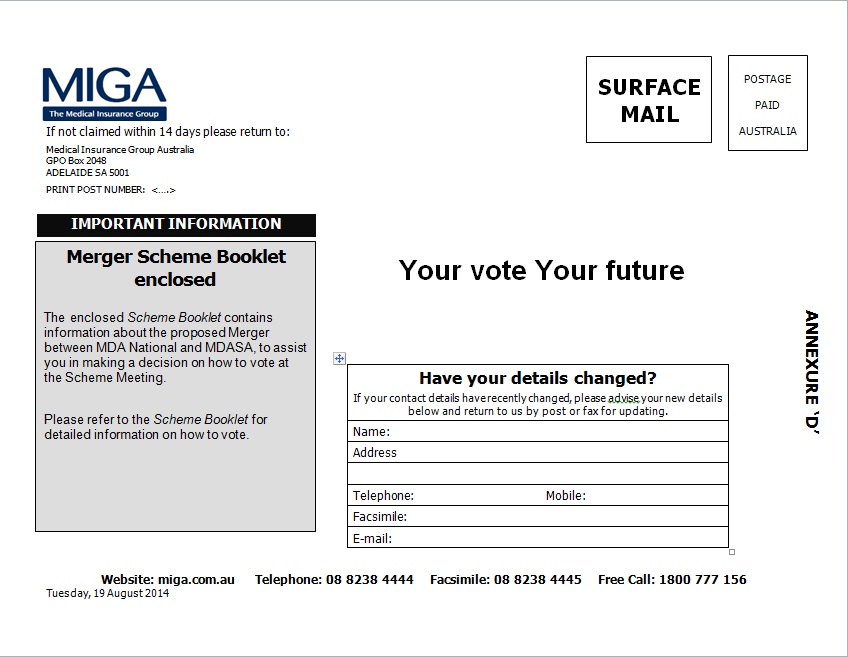
(s) the Scheme Booklet be dispatched by prepaid ordinary post (or in the case of overseas members, by airmail together with a cover sheet substantially in the form of Annexure ‘D’ to these Orders to the address of those MDASA members who have not nominated an electronic address for the purposes of receiving notification of notices of any meeting.
(t) it shall not be necessary for the Scheme Booklet to be dispatched by prepaid ordinary post (or in the case of overseas members, by airmail) to the registered address of those MDASA members to whom the Scheme Booklet has been dispatched as contemplated in order 4(a).
GENERAL
4. Direct pursuant to section 1319 of the Corporations Act that:
(u) the first plaintiff be exempted from compliance with the requirements of rule 2.15 of the Federal Court (Corporations) Rules 2000 (Cth) save that regulation 5.6.13 of the Corporations Regulations 2001 (Cth) shall apply to each of the MDAN Scheme Meeting; and
(v) the second plaintiff be exempted from compliance with the requirements of rule 2.15 of the Federal Court (Corporations) Rules 2000 (Cth) save that regulation 5.6.13 of the Corporations Regulations 2001 (Cth) shall apply to each of the MDASA Scheme Meeting.
5. Order that:
(a) the first plaintiff publish in The Australian newspaper a notice substantially in the form of Annexure ‘E’.
(b) the second plaintiff publish in The Australian newspaper a notice substantially in the form of Annexure ‘F’.
6. Order that evidence in this proceeding be evidence in the matter of MDA National Insurance Pty Limited case number NSD 810/2014 and evidence in matter number NSD 810/2014 be evidence in this proceeding.
7. Order that the proceeding be stood over to 23 October 2014 at 10.15 am, before Justice Yates for the hearing of an application to approve the MDAN Scheme and the MDASA Scheme.
8. Order that there be liberty to restore on 2 days’ notice.
9. Order that these Orders be entered forthwith.
Date that entry is stamped: 20 August 2014
Note: Entry of orders is dealt with in Rule 39.32 of the Federal Court Rules 2011.
Schedule
No: (P)NSD805/2014
Federal Court of Australia
District Registry: New South Wales
Division: General
Second Plaintiff: MEDICAL DEFENCE ASSOCIATION OF SOUTH AUSTRALIA LIMITED ABN 41 007 547 588
ANNEXURE ‘A’
Draft member email – Scheme Booklet delivery – MDAN Version
Email title: Proposed Merger of MDAN and MDASA – Scheme Booklet for Members
Dear < >,
The MDAN Member Scheme Meeting for the Merger will occur on Saturday 11 October 2014 at 10.30 am Western Standard Time (WA), 1.30 pm Eastern Summer Time (NSW and Vic) and 12.30 pm Eastern Standard Time (Qld).
I am pleased to provide you with a link to the Scheme Booklet, which contains information about the proposed Merger and the MDAN Scheme Meeting, to assist you in making a decision on how to vote at the Scheme Meeting. Also included are links to the Notice of Scheme Meeting and Proxy Form. We strongly encourage you to consider the information contained in the Scheme Booklet which can be accessed by clicking the link provided.
We encourage you to complete and return your Proxy Form by 10.30am Western Standard Time Thursday, 9 October 2014 or make arrangements to attend and vote at the Scheme Meeting on Saturday, 11 October 2014.
Please refer to the Scheme Booklet Section 6 for more detailed information on ‘How to Vote’.
Download the
Scheme Booklet
Download the
Notice of Meeting
Download the
Proxy Form
• Should you have any questions or you would like to receive a hard copy of the Scheme Booklet please do not hesitate to contact us on 1800 011 255.
Yours sincerely,
<insert e-signature>
Assoc. Prof. Julian Rait
Chairman
ANNEXURE ‘C’
Draft member email – Scheme Booklet delivery – MDASA Version
Email title: Proposed Merger of MDAN and MDASA – Scheme Booklet for Members
Dear < >,
The MDASA Member Scheme and General Meetings for the Merger will occur on Saturday 11 October 2014 at 10.00 am Central Summer Time (SA), 10.30 am Eastern Summer Time (NSW and Vic) and 9.30 am Eastern Standard Time (Qld).
I am pleased to provide you with a link to the Scheme Booklet, which contains information about the proposed Merger and the MDASA Scheme Meeting and General Meeting, to assist you in making a decision on how to vote at the Meetings. Also included are links to the Notice of Scheme Meeting, the notice of General Meeting and the Proxy Forms. We strongly encourage you to consider the information contained in the Scheme Booklet which can be accessed by clicking the link provided.
We encourage you to complete and return your Proxy Form by 10.00 am Central Summer Time Thursday, 9 October 2014 or make arrangements to attend and vote at the Scheme and General Meetings on Saturday, 11 October 2014.
Please refer to the Scheme Booklet Section 6 for more detailed information on ‘How to Vote’.
Download the
Scheme Booklet
Download the
Notices of each Meeting
Download the
Proxy Forms
• Should you have any questions or you would like to receive a hard copy of the Scheme Booklet please do not hesitate to contact us on 1800 777 156.
Yours sincerely,
<insert e-signature>
Dr John O’Loughlin
Chairman
ANNEXURE ‘E’
Form 6 Notice of hearing to approve Scheme of Arrangement
(rule 3.4)
TO all the members and creditors of MDA National Limited (“MDAN”).
TAKE NOTICE that at 10.15 am on Thursday, the 23 October 2014 at Federal Court of Australia at the Law Courts Building, 184 Phillip Street, Sydney NSW 2000 the Federal Court of Australia will hear an application by MDAN seeking the approval of the Scheme of Arrangement between the above-named company and its members as proposed by a resolution passed by the meeting of the members of the company held on 11 October 2014.
The effect of the Scheme of Arrangement is to provide for:
1. the transfer to Medical Defence Australia Ltd (ACN 600 579 735) (the Transferee Company) of all of the undertaking, property and liabilities of MDAN (other than the certain excluded assets and including all creditors); and
2. the migration of MDAN members to the Transferee Company.
If you wish to oppose the approval of the Scheme of Arrangement, you must file and serve on MDAN a notice of appearance, in the prescribed form, together with any affidavit on which you wish to rely at the hearing. The notice of appearance and affidavit must be served on the MDAN at its address for service at least 1 day before the date fixed for the hearing of the application.
The address for service of MDAN is c/- TressCox Lawyers, level 16, MLC Centre 19 Martin Place Sydney NSW 2000.
Name of person giving notice or of person’s legal practitioner: Derek Raymond Hilliard.
ANNEXURE ‘F’
Form 6 Notice of hearing to approve Scheme of Arrangement
(rule 3.4)
TO all the members and creditors of Medical Defence Association of South Australia Ltd (“MDASA”).
TAKE NOTICE that at 10.15 am on Thursday, the 23 October 2014 at Federal Court of Australia at the Law Courts Building, 184 Phillip Street, Sydney NSW 2000 the Federal Court of Australia will hear an application by MDASA seeking the approval of the Scheme of Arrangement between the above-named company and its members as proposed by a resolution passed by the meeting of the members of the company held on 11 October 2014.
The effect of the Scheme of Arrangement is to provide for:
1. the transfer to Medical Defence Australia Ltd (ACN 600 579 735) (the Transferee Company) of all of the undertaking, property and liabilities of MDASA (other than the certain excluded assets and including all creditors); and
2. the migration of MDASA members to the Transferee Company.
If you wish to oppose the approval of the Scheme of Arrangement, you must file and serve on MDASA a notice of appearance, in the prescribed form, together with any affidavit on which you wish to rely at the hearing. The notice of appearance and affidavit must be served on the MDASA at its address for service at least 1 day before the date fixed for the hearing of the application.
The address for service of MDASA is c/- DibbsBarker Lawyers, level 8, 123 Pitt Street, Sydney NSW 2000.
Name of person giving notice or of person’s legal practitioner: William Mark Addison.
|
NEW SOUTH WALES DISTRICT REGISTRY |
|
|
GENERAL DIVISION |
NSD 805 of 2014 |
|
BETWEEN: |
MDA NATIONAL LIMITED ABN 62 055 801 771 First Plaintiff MEDICAL DEFENCE ASSOCIATION OF SOUTH AUSTRALIA LIMITED ABN 41 007 547 588 Second Plaintiff |
|
AND: |
MEDICAL DEFENCE AUSTRALIA LIMITED ACN 600 579 735 Defendant |
|
JUDGE: |
YATES J |
|
DATE: |
15 september 2014 |
|
PLACE: |
SYDNEY |
REASONS FOR JUDGMENT
1 Each plaintiff is a medical defence organisation which seeks an order under s 411(1) of the Corporations Act 2001 (Cth) (the Act) that a meeting of its members be convened to consider, and if thought fit approve, a scheme of arrangement between the organisation and its members. Each scheme is an essential step in a proposed merger which, if implemented, will result in the members of each plaintiff relinquishing their current memberships and becoming members of the defendant.
The parties
2 The first plaintiff, MDA National Limited (MDAN), is a company limited by guarantee which is registered under the Act in Western Australia. MDAN has the following categories of membership: Practising Members; Student Members; Retired Members; Compounded Life Members; and Honorary Life Members. All members other than Student Members are voting members. As at 31 March 2014, MDAN had 32,201 members.
3 MDA National Insurance Pty Limited (MDANI) is a wholly-owned subsidiary of MDAN. MDANI is an authorised insurer under the Insurance Act 1973 (Cth) (the Insurance Act) and issues professional indemnity policies of insurance to medical practitioners, medical students, health care practitioners and dentists. Its policyholders, other than dentists and medical practice entities, are members of MDAN. I will refer to MDAN and MDANI as the MDAN Group.
4 The second plaintiff, Medical Defence Association of South Australia Limited (MDASA), is a company limited by guarantee which is registered under the Act in South Australia. MDASA has only two categories of membership: Members, who are registered medical practitioners, and Associate Members, who are essentially corporate members registered as medical practitioners. Only Members have the right to vote. At the present time, MDASA has 26,157 members
5 Medical Insurance Australia Pty Limited (MIA) is a wholly-owned subsidiary of MDASA and is an authorised insurer under the Insurance Act. It provides medical and professional indemnity insurance to doctors, health care organisations, privately practising midwives and medical students. I will refer to MDASA and MIA as MIGA (Medical Insurance Group Australia).
6 The defendant, Medical Defence Australia Limited (MDA), is a public company limited by guarantee which is registered under the Act in Western Australia. MDA has the following categories of membership: Practising Members; Honorary Members; Student Members; Retired Members; Compounded Life Members; and Honorary Life Members. Its constitution provides for other categories of membership as may be determined. All members other than Honorary Members and Student Members are voting members. At the present time, MDA has two founding members.
The proposed merger
7 On 27 March 2014, the MDAN Group and MIGA entered into a Merger Implementation Agreement, which records their agreement to merge their respective undertakings, property and liabilities, and sets out the implementation framework and process by which that will be achieved.
8 It is intended that the merger will be achieved by the following steps.
9 First, MDA will become a member of MDAN and a member of MDASA. This step will require the board of MDAN to create, under its constitution, a new class of voting member and to admit MDA as a member of MDAN so that MDA is able to hold a voting interest in MDAN. This step will also require an amendment to MDASA’s constitution to provide voting rights for MDA as a corporate member. It is also proposed that MDASA’s constitution will be amended to permit MDASA to distribute surplus profits to members on a winding up. This is necessary to allow MDASA to become a member of a consolidated group for taxation purposes.
10 The current members of MDAN and MDASA will be admitted as, and be deemed to be, members of MDA in categories of membership equivalent to those they now enjoy. Thereupon, their memberships of MDAN or MDASA will be cancelled, with the result that MDA will be left as the sole member of MDAN and the sole member of MDASA. Thus MDAN and MDANI will be subsidiaries of MDA, as will MDASA and MIA.
11 The change in memberships of current members will be effected by separate schemes of arrangement between MDAN and its members (the MDAN scheme) and MDASA and its members (the MDASA scheme). These schemes are the subject of the present application. The schemes are substantially in the same terms and are interdependent. Their implementation is also conditional on confirmation of the separate insurance scheme referred to below: see [14].
12 MDA will not be a party to the schemes, but the performance of its acts and obligations that are envisaged by the schemes will be secured by covenants in a deed poll that has been executed by MDA in favour of MDAN’s and MDASA’s current and former members. Under the MDAN scheme, MDAN is appointed as the agent and attorney of each MDAN member, and under the MDASA scheme, MDASA is appointed as the agent and attorney of each MDASA member, for the purpose of enforcing the deed poll against MDA.
13 Secondly, under the MDAN scheme, all the assets and liabilities of MDAN (except certain excluded assets, including real property) will be transferred to and assumed by MDA. Similarly, under the MDASA scheme, all the assets and liabilities of MDASA (except certain excluded assets) will be transferred to and assumed by MDA. As each scheme has been proposed for the purposes of, or in connection with, a scheme for the amalgamation of two or more Pt 5.1 bodies, it is envisaged that orders will be sought under s 413 of the Act in relation to these transfers.
14 Thirdly, MDANI will transfer its insurance business to MIA. This will involve a separate scheme for which confirmation by the Court will be sought under s 17F of the Insurance Act. If the scheme is confirmed, MIA will change its name to MDA Insurance Pty Limited.
15 Fourthly, the accrued entitlement of any person to apply for a grant of “discretionary assistance” (as to which, see [17]-[22] below) from either MDAN or MDASA will be assumed by MDA. Clauses 5.1 and 5.2 in MDA’s constitution recognise and preserve these rights as rights enforceable against it. The deed poll executed by MDA will facilitate enforcement.
16 If the MDAN scheme and the MDASA scheme are each agreed to by the relevant members and approved by the Court, and if the insurance scheme is confirmed by the Court, MDAN and MDASA will no longer operate as membership entities. MIA, under the new corporate name MDA Insurance Pty Limited, will become the insurance arm of MDA and insure MDANI’s and MIA’s current policyholders.
Discretionary assistance
17 Under their respective constitutions, MDAN and MDASA may exercise a discretion to grant to any member or former member, or legal representative of a member or former member, assistance and indemnity in respect of matters or proceedings affecting the person’s professional character or interests. MDAN and MDASA have each provided such assistance at various times on, initially, an “incidents-occurring” basis, and then on a “claims-made” basis, while the person has been a member.
18 From 1 July 2003, there was a change in circumstances. The Medical Indemnity (Prudential Supervision and Product Standards) Act 2003 (Cth) (the Medical Indemnity Act) was enacted to ensure that health care professionals have access to medical indemnity insurance of a specified minimum standard provided by regulated insurers: see s 3. From 1 July 2003, it has been an offence under the Medical Indemnity Act to provide medical indemnity cover for a health care professional other than by a contract of insurance issued by a general insurer: see s 10.
19 MDAN continues to provide discretionary assistance in circumstances where such assistance is not prohibited by law. Between 2009 and 2014, there have been seven instances where MDAN has made a grant of discretionary assistance, at a total cost of $184,018. At the present time, there are no outstanding current claims for or grants of discretionary assistance, although one file remains open in that matter because of a pending appeal. Further, the full approved limit of discretionary assistance has not yet been fully drawn.
20 MDAN continues to run-off its discretionary claim liabilities. As at 31 March 2014, the total likely quantum of MDAN’s discretionary assistance claims has been estimated to be $421,000.
21 Similarly, since 1 July 2003, MDASA has continued to honour its obligations to members in relation to discretionary assistance granted prior to 1 July 2003, but has not made any new grant of discretionary assistance or indemnity. As at 31 March 2014, the total likely quantum of MDASA’s discretionary assistance claims has been estimated to be $4,465,000.
22 As I have noted, it is proposed that MDAN’s and MDASA’s respective liabilities will be transferred to and assumed by MDA. This will include the accrued entitlements of persons to have claims for discretionary assistance or indemnity considered.
The position of creditors
23 Although the schemes involve a scheme for the amalgamation of MDAN and MDASA, whereby the assets and liabilities of MDAN and MDASA will be transferred to and assumed by MDA pursuant to orders intended to be made under s 413(1) of the Act, the view has been consistently taken that such schemes should be treated as members’ schemes only, without the need to convene a meeting of the respective creditors of the merging parties: see In the matter of Stork ICM Australia Pty Ltd; Stork ICM Australia Pty Ltd v Stork Food Systems Australasia Pty Ltd [2006] FCA 1849 at [69] and the cases there cited; In the application of United Medical Protection Limited [2007] FCA 631 at [5]-[6]. In the present case, such creditors will likely include persons asserting rights to have claims for discretionary assistance or indemnity considered.
24 The position of all creditors is appropriately addressed at the second court hearing, as a consideration relevant to the discretion whether to approve the scheme to which the members have agreed: Stork at [18].
Classes
25 It is proposed that one scheme meeting for MDAN’s members, and one scheme meeting for MDASA’s members, will be convened. MDAN and MDASA each submit that there are no separate classes of members which require separate scheme meetings.
26 Subject to any contrary contention that might be advanced at a second court hearing, I accept those submissions, notwithstanding that MDAN and MDASA each have different categories of members. I am satisfied that, for each plaintiff, these categories are not class-creating.
27 The test for whether the members should be divided into different classes for separate meetings is whether the rights of the members are so dissimilar as to make it impossible for them to consult together with a view to their common interest: Sovereign Life Assurance Co v Dodd [1892] 2 QB 573 at 583; Re Nine Entertainment Group Limited (No 1) (2012) 211 FCR 439 at [53]. In Re Hills Motorway Limited (No 2) 43 ACSR 101 Barrett J said:
12 The test is thus not one of identical treatment. It is one of community interest. The court must ask itself whether the rights and entitlements of the different groups, viewed in the totality of the scheme's context, are so dissimilar as to make it impossible for them to consult together with a view to their common interest. The focus is not on the fact of differentiation but on its effects. The extent and nature of the differentiation must be measured in terms of the effect on the ability to consult together in a common interest or, in other words, the ability to come together in a single meeting and to debate the question of what is good or bad for the constituency as a whole and where the common good lies. Only if the differentiation destroys that ability — the word used by Bowen LJ is “impossible” — does class distinction come to prevail.
28 There are minor differences in the way that MDAN’s members are treated, based on membership category. However, in the context of the broader merger that is proposed, I am persuaded that all the members of MDAN will be able to consult at the one scheme meeting on the question of whether they should relinquish their membership of MDAN in favour of membership in MDA. Similarly, there are minor differences in the way that MDASA’s members are treated, based on membership category. Once again, I am persuaded that all the members of MDASA will be able to consult at the one scheme meeting on the same question affecting their membership of MDASA.
29 Further, in relation to MDAN, there are sound reasons telling against holding separate meetings for separate categories of members. MDAN has 19,088 Practising Members; 11,810 Student Members; 1,302 Retired Members; 1 Honorary Life Member; and no Compounded Life Members. Thus, MDAN’s membership is to be found primarily in the first two categories. It would be meaningless to convene separate meetings of Honorary Life Members and Compounded Life Members. In any event, it would be undesirable, to say the least, to allow the possibility to arise where the outcome of voting in respect of, say, a meeting of Life Members could act as a veto in relation to the MDAN scheme, assuming that the scheme otherwise commands majority acceptance. The same may also be said of the votes of Retired Members, although, obviously, with less force.
30 In United Medical Protection Finkelstein J (at [15]) observed, in closely similar circumstances, that “while there may be different categories of membership there is but one class”. His Honour also said:
15 … I bear in mind that any overzealous subdivision may give a small group a right of veto that would defeat the basic object of the provisions dealing with schemes of arrangement which is to enable large groups to achieve a compromise or effect an arrangement: Nordic Bank Plc v International Harvester Australia Ltd [1983] 2 VR 298, 301.
31 Those observations apply with equal force in the present case.
Voting at the scheme meetings
32 Although, under their respective constitutions, certain members of MDAN and MDASA do not have voting rights, all members of MDAN will be entitled to vote in relation to the MDAN scheme and all members of MDASA will be entitled to vote in relation to the MDASA scheme. This is because each meeting will have been convened under s 411(1) of the Act. The majorities prescribed in s 411(4) have regard to the votes of all members of the company concerned: In the matter of Professional Golfers Association of Australia Limited [2007] FCA 1571 at [26]-[27]. The entitlement of all members of MDAN to vote in relation to the MDAN scheme and the entitlement of all members of MDASA to vote in relation to the MDASA scheme is made clear in the scheme booklet.
Lock-up clauses
33 The Merger Implementation Agreement contains “no-shop” and “no-talk” clauses. There is evidence that these clauses were agreed between MDAN and MDASA following arm’s length negotiations in which both parties were separately advised by external advisers with extensive experience in transactions of this kind.
34 The “no-shop” clause (clause 13.1) imposes an obligation fixed for a period conditioned on the earliest of three nominated dates. One of those dates is the End Date, which is the date nine months from the date of the agreement (27 March 2014), or such other date as MDAN and MDASA might, in writing, agree. There is no evidence that another date has been agreed. It is possible that there could be an earlier date than the End Date. If I assume that the earliest date will be nine months from 27 March 2014, I am satisfied that the period of the obligation is not disproportionately long having regard to the merger that is sought to be achieved. The existence of the “no-shop” clause provides a degree of mutual assurance to the parties that the considerable costs involved in pursuing the intended merger, measured in terms of time, money and effort, will not be fruitlessly incurred.
35 The “no-talk” clause (clause 13.2) imposes an obligation fixed for the same period as the “no-shop” obligation. The “no-talk” obligation is subject to a fiduciary carve-out in relation to bona fide superior proposals which, if not considered, are likely to constitute or give rise to a breach of the fiduciary or statutory duties of the directors of the receiving party. Once again, I am satisfied that the period of that obligation is not disproportionately long.
36 After the merger was announced, MDASA received an unsolicited, non-binding, indicative expression of interest from Medical Indemnity Protection Society Limited. The expression of interest was considered by MDASA’s directors, who formed the view that it was not superior to the proposed merger with the MDAN Group. Plainly, the “no-talk” clause did not prevent MDASA from considering this expression of interest, at least to the extent necessary to permit MDASA’s directors to reach the view that it was not superior to the proposed merger. The scheme booklet contains a clear disclosure of the receipt and consideration of the expression of interest.
37 No break fee has been offered or requested by either MDAN or MDASA if the merger does not complete.
The recommendation of directors
38 The directors of MDAN and MDASA believe that each scheme is in the best interests of the members of their respective organisations.
39 The directors of MDAN unanimously recommend that MDAN members vote in favour of the MDAN scheme. Each MDAN director, who is entitled to vote, intends to vote in favour of the MDAN scheme.
40 The directors of MDASA unanimously recommend that MDASA members vote in favour of the MDASA scheme. Each MDASA director who is entitled to vote intends to vote in favour of the MDASA scheme. The directors of MDASA also unanimously recommend that MDASA members vote in favour of amending MDASA’s constitution to provide for the changes I have summarised.
The reports of independent experts
41 Lonergan Edwards & Associates Limited has provided an independent expert’s report for MDAN’s members (the Lonergan Edwards report). The authors of that report, Mr Edwards and Mr Coleman, have expressed the opinion that the merger will be in the best interests of MDAN’s members, in the absence of a superior proposal.
42 Mr Edwards and Mr Coleman analysed the net assets per fee paying member of MDAN before and after the merger. They also considered the capitalised value of future cost-savings per fee paying member and proceeded on the basis that, as the merged entity will be a mutual organisation providing services and benefits to its members, it is likely that cost-savings will be passed on to members in the form of lower insurance premiums in the years following the merger. On this analysis, Mr Edwards and Mr Coleman have concluded that the position of MDAN fee paying members will be substantially improved as a result of the merger.
43 The Lonergan Edwards report identifies and discusses the advantages and disadvantages of the merger for MDAN’s members. On balance, Mr Edwards and Mr Coleman have concluded that the advantages of the merger outweigh the disadvantages. They have verified the opinions expressed in the report.
44 Grant Thornton Corporate Finance Pty Limited has provided an independent expert’s report for MDASA’s members (the Grant Thornton report). The author of that report, Mr De Cian, has concluded that the merger will be in the best interests of MDASA’s members.
45 Mr De Cian has described the merger as “a merger of equals”. He has concluded that the net assets and net tangible assets per full fee paying MDASA member after the merger is expected to increase on a like-for-like basis without considering the impact of potential synergies and benefits and costs savings. As to the latter, Mr De Cian has formed the view that a number of synergy benefits and costs savings may arise from the implementation of the merger, including rationalisation of operating expenses and reinsurance costs savings. In assessing whether the merger is in the best interests of MDASA members, Mr De Cian also considered a number of qualitative factors.
46 The Grant Thornton report identifies and discusses the advantages and disadvantages of the merger for MDASA’s members. On balance, Mr De Cian has concluded that the advantages of the merger outweigh the disadvantages. He has verified the opinions expressed in the report.
The scheme booklet
47 The scheme booklet, which will stand as the explanatory statement for each scheme, has been approved by the directors of MDAN, MDASA and MDA. The evidence at this hearing includes the steps in the verification process that were undertaken to ensure that all statements made in the scheme booklet are accurate.
48 The scheme booklet includes, as annexures, the proposed MDAN scheme and MDASA scheme, the reports of the independent experts, a consolidated statement of MDAN’s financial position as at 30 June 2013, a consolidated statement of MDASA’s financial position as at 30 June 2013, notices of the scheme meetings (including proxy forms) and a notice of the general meeting of MDASA (including proxy form) in respect of the proposed amendments to MDASA’s constitution.
49 Subject to any matter that might be brought to my attention at a second court hearing, I am satisfied that the scheme booklet provides proper disclosure of the proposed schemes and, more generally, of the intended merger, and will enable members to vote on an informed basis.
Chairperson of respective meetings
50 I note that Associate Professor Rait, a director of MDAN, has consented to act as chairman of any meeting of MDAN members convened for the purposes of considering the MDAN scheme, and that Dr Wenk has agreed to act as chairperson in the absence of Associate Professor Rait from the meeting.
51 I note that Dr O’Loughlin, a director and chairman of MDASA, has consented to act as chairman of any meeting of MDASA members convened for the purpose of considering the MDASA scheme, and that Mr Altmann, the deputy chairman of MDASA has consented to act as chairman in the absence of Dr O’Loughlin from the meeting.
ASIC
52 Section 411(2)(a) of the Act requires the Australian Securities and Investments Commission (ASIC) to be given at least 14 days’ notice of the hearing of an application under s 411(1), unless ASIC or the Court permits a shorter period. ASIC has confirmed, in relation to each proposed scheme, that this requirement has been satisfied.
53 Section 411(2)(b) of the Act requires the Court to be satisfied that ASIC has also had a reasonable opportunity to examine the terms of a scheme and the draft explanatory statement made in respect thereof, and to make submissions to the Court in relation to the scheme and the draft explanatory statement. ASIC has signified, in relation to each proposed scheme, that it has had this opportunity.
54 ASIC has not sought to appear at the first hearing to make submissions or intervene to oppose the schemes.
The manner in which the proceeding is constituted
55 Both schemes are sought to be dealt with in the one proceeding as opposed to being dealt with in separate proceedings for each scheme. Thus there are two plaintiffs in the one proceeding. Each plaintiff seeks to be represented separately in the one proceeding. The solicitors for the defendant are also the solicitors for the first plaintiff. Is the proceeding properly constituted?
Relevant authorities
56 So far as I can see, there is nothing in the Federal Court Rules 2011 (Cth) (the Federal Court Rules) or the Federal Court (Corporations) Rules 2000 (Cth) (the Corporations Rules) which prevents the proceeding being constituted in this way.
57 There is a general convention, which does not find separate expression in either the Federal Court Rules or the Corporations Rules, that there can only be one solicitor for multiple plaintiffs, unless the court orders otherwise. This convention can be traced to the judgment of Sir John Romilly MR in Wedderburn v Wedderburn (1853) 17 Beav 158 in which his Lordship said, in essence, that co-plaintiffs must appoint the same solicitors and act together, including in respect of the appointment and removal of solicitors.
58 This was referred to as a “rule of practice” in Lewis v Daily Telegraph Ltd (No 2) [1964] 2 QB 601. In that case, Mr Lewis and the company of which he was the managing director and chairman commenced separate proceedings against two newspaper publishers for libel. Thus, four separate proceedings were commenced. Subsequently, Mr Lewis’ and the company’s proceedings against each publisher were consolidated, resulting in two proceedings – one against each publisher in which Mr Lewis and the company were co-plaintiffs. The same solicitors acted for both plaintiffs in each proceeding. Later, because of disputes that had arisen, the solicitors removed themselves from the record. By this time, the company had also gone into liquidation. Mr Lewis instructed new solicitors to act on his behalf in both proceedings. Separately, the liquidator instructed other solicitors to act on his behalf in both proceedings.
59 Subsequently, the publishers sought to have the two proceedings consolidated into one. Mr Lewis, on the other hand, sought to have the two proceedings deconsolidated, so that the original four proceedings would “re-emerge”. The publishers’ consolidation application was granted. On appeal, the Court of Appeal found that the consolidation should continue. However, their Lordships were not prepared to allow the consolidated action to proceed while the plaintiffs were separately represented.
60 After referring to Wedderburn, Pearson LJ (at 620-621) said:
That is the proper rule of practice, and it has plainly been departed from on the plaintiffs’ side in this case. It is quite true that since then the defendants have not sought to take any steps to rectify the position. Lord Gardiner has said that it was not very clear what steps they ought to have taken. It is conceivable that an application to stay the action until the constitution of the action was rectified and put in proper order might have been an appropriate remedy. But I am not seeking to give any firm decision about that. There is also this fact, that the defendants have acquiesced in the position. It may be contended that they have waived any rights which they might have had.
However, that could not be the final answer in the present case, because there is the interest of the court itself in having actions properly constituted, so that regular trials may be had; and here is an irregular situation. I am not saying that it would be impossible ever in any case to have separate representation, wholly or partially, in a consolidated action. It is not very easy to envisage such cases; but they can arise, and an illustration is Healey v. A. Waddington & Sons Ltd. In that case eight actions were consolidated as to the issue of liability but separate representation was allowed as to the issue of damages. That is an interesting case, and it shows the possibility of at any rate partial separate representation in consolidated actions. But is, in my view, not a good guide or a good precedent for the present case, because there the trials were going to be by judge alone and were in respect of an accident, whereas here we are faced with an action or actions for libel to be tried by judge and jury. It would be extremely inconvenient and awkward, so far as one can see, to have any separate representation in a matter of that kind. Many difficult problems would arise. How would the opening speech (or speeches) be made? Would it be right that the plaintiffs should have as against the defendants the advantage of two opening speeches instead of one? Then, in the conduct of the case, if there were two plaintiffs separately represented, would each plaintiff be allowed to cross-examine the other plaintiff’s witnesses and have the advantage of being able (as Lord Gardiner pointed out) to put leading questions to a witness who would be substantially on the same side? Again, when the defendants’ witnesses were called, would it be right that both plaintiffs, separately represented, should be allowed to cross-examine those witnesses? The same problem would arise in respect of the final speeches at the end of the case. Would separately represented plaintiffs be allowed to have two speeches?
61 Later (at 622) Pearson LJ said:
I fail to see how separate representation is workable on the special facts of this case. Moreover, as I have pointed out, it was wrong for the de facto separate representation to be created in this case. When the solicitors, who had been acting for the plaintiff company and the plaintiff Lewis jointly throughout the first trial, found it necessary to withdraw from the record, the two plaintiffs should have concurred in appointing a new firm of solicitors to represent the two of them. That is still, in my view, what ought to be done, and the only satisfactory basis. Until that is done the action is not properly constituted, and if the plaintiffs seek to take the case to trial with this constitutional defect, they will be in very grave difficulty indeed. It is open to the plaintiffs, if so advised, to apply for some special order. Although the consolidation order remains in force, it can have super-imposed upon its practical operation some further order to adapt the consolidation order to the actual requirements of the situation. But I am far from seeking to encourage any application for complete or partial separate representation, because I am unable to see how separate representation could possibly work.
62 Similar observations were made by the other members of the Court of Appeal. At 622-623, Russell LJ said:
I will only add to what has been said a word on the question of representation. Prima facie, co-plaintiffs, whether in one original action or in an action consisting of consolidated actions, must be jointly represented by solicitor and counsel. In a proper case, an order may be made authorising severance in point of representation, but this must be, I think, rare and should only be done to avoid injustice. Here a suggestion is made that a special order should be made for separate representation at the trial of the consolidated actions, either wholly or on the issue of damages. I do not think that it would be right to make an order for complete separate representation; it would impose an unfair burden on the defendants which such differences as there are between the two plaintiffs do not justify. Common representation on liability, followed by separate representation on damages, is not really a practical idea in defamation proceedings. Nor, indeed, quite apart from that, do the facts, in my view, begin to justify separate representation on damages. The case of the plaintiff Lewis for damages due to him and the case of the plaintiff company for damages due to it can be prepared and presented perfectly well by the same solicitors and counsel. At present the plaintiffs have separate solicitors on the record, and appear by separate counsel. No order permitting that has ever been made, though for the purpose of these interlocutory proceedings the court has permitted it. It seems to me that if the plaintiffs turn up at the trial and no solicitor and counsel can say that they appear for both the plaintiffs, and no order permitting separate representation has been made, their case cannot be opened and the two actions will be dismissed. With this thought in mind, they will no doubt put their house in order.
63 At 624, Sellers LJ said:
… I entirely agree with the views which have been expressed – that, as the matter stands, it is so irregular that it is not in a proper state to go for trial and should, I think, without doubt be rectified. It may well be that a method can be found for applying for an order of the court to have separate representation. I do not want to prejudge it. As far as I can see there is no justification for granting it as at present advised. I can see no reason why one firm of solicitors, regularly appointed to act on behalf of both the plaintiffs, should not appear for them, and instruct counsel likewise, to appear and present the case of both of them before the court as each of them desires it presented. That would be regular. There is, as I see it, no conflict, either on liability or on damages. If there were, the situation would be different.
64 It can be seen that none of their Lordships considered the rule of practice they applied to be immutable. Rather, they considered it to be a rule that, for sound practical reasons, should not be departed from in that particular case.
65 In SCI Operations Pty Ltd v Australian Paper Manufacturers Ltd (1983) 51 ALR 365, Woodward J rejected an application for the joint hearing of separately commenced proceedings alleging a contravention of s 50 of the Trade Practices Act 1974 (Cth). In the course of hearing that application, a submission was advanced that, if there was to be a joint hearing, it should be on the condition that joint counsel be briefed for the applicants. His Honour rejected that submission, primarily on the basis that it would be inappropriate for one of the applicants, the Trade Practices Commission, with its independent statutory responsibilities, to be represented by the same counsel as the other applicant in the other proceeding, who had strong commercial interests in the outcome of the proceeding.
66 In the course of considering that submission, Woodward J cited Lewis and another case that had considered Lewis, Goold & Porter Pty Limited v Housing Commission [1974] VR 102. His Honour saw the underlying principle in those cases to be that “a respondent to litigation should not normally have to face two separate sets of applicants’ representatives …”: see at 373.
67 In Johnson Tiles Pty Ltd v Esso Australia Ltd (1999) ATPR 41-679, Merkel J made orders for the consolidation of two representative proceedings brought under Pt IVA of the Federal Court of Australia Act 1976 (Cth) (the Federal Court Act) against the same defendant on behalf of the same represented parties for the same loss: see at [6]. At [70] his Honour said:
70 Senior counsel for the applicants in each proceeding conceded that the main objective sought to be achieved by consolidation was for both solicitors, Slater & Gordon and Maurice Blackburn & Co, to be solicitors on the record in the consolidated proceeding. Although in the usual course the Rules provide for only one solicitor to appear on the record (see O 4 r 4(1)(c), I am satisfied that there is no reason why two solicitors cannot be solicitors on the record in a proceeding if that course is warranted. Whilst separate representation at trial should not be permitted where there are co-plaintiffs (see Lewis v Daily Telegraph Ltd (No 2) (1964) 2 QB 601 at 612) having two solicitors on the record in the present case will not have that result as there is agreement that they are to jointly engage one set of counsel to represent all applicants and group members. In these circumstances, the consequence of both solicitors appearing on the record as a result of consolidation is not a factor which warrants refusing to order consolidation of the two proceedings. If, in the future, a question arises as to separate representation by reason of the fact that there are two solicitors on the record then that question will be able to be resolved by the Court in a manner which avoids injustice or unfairness to Esso or the represented persons. At the present time the fact that such a problem may theoretically arise is not sufficient reason to refuse the application for consolidation.
68 In making the order for consolidation, his Honour also ordered, as foreshadowed, that the two firms of solicitors, as solicitors on the record in the consolidated proceedings, nominate only one address for service and engage one set of counsel to represent the applicants and group members.
69 In Kirby v Centro Properties Ltd (2008) 253 ALR 65, a question arose as to whether three representative actions under Pt IVA of the Federal Court Act against the same respondent should be permitted to proceed. When considering the possibility of consolidation, Finkelstein J noted that there is a special difficulty where multiple plaintiffs seek to have separate representation. His Honour noted (at [10]) that “there is a rule of practice that, without leave, separate representation is not permitted on the [plaintiffs’] side”. At [11] his Honour said:
11 It is true that separate representation is sometimes allowed. For example, it was allowed in Johnson Tiles Pty Ltd v Esso Australia Ltd (1999) ATPR 41-679; [1999] FCA 56, but only on the basis that the solicitors agreed jointly to engage one set of counsel to represent the named plaintiffs. But if there is a falling out between separately represented co-plaintiffs, one would have to be removed as plaintiff and added as a defendant: Holden v Silkstone and Dodworth Coal & Iron Co (1881) 45 LT 531.
70 In Carnie v Esanda Finance Corporation Ltd (1996) 38 NSWLR 465, Young J (as his Honour then was) stated, in relation to the Supreme Court Rules 1970 (NSW) at 470:
It is clear that under the rules of court, all plaintiffs must act by the same solicitor and counsel and that the court will waive this rule only in the most extreme circumstances and that different views of plaintiffs in representative proceedings are not such a circumstance: Goold & Porter Pty Ltd v Housing Commission [1974] VR 102; SCI Operations Pty Ltd v Australian Paper Manufacturers Ltd (1983) 51 ALR 365.
71 Later, in Elphick v Westfield Shopping Centre Management Co Pty Ltd (2011) 216 IR 41, Young JA considered the position of a respondent to an appeal who appeared by different counsel and solicitors in the appeal and in the cross-appeal it had brought. After noting that there were no specific provisions in the Uniform Civil Procedures Rules 2005 (NSW) (UCPR), either permitting this practice or forbidding it, his Honour expressed the view that such representation was “contrary to the proper practice in this court unless the court gives leave for it to occur”: see at [3]. His Honour saw Lewis as standing for the proposition that “plaintiffs must always be represented by the same solicitor”, as noted in Ritchie’s Uniform Civil Procedure 7.25.5.
72 His Honour continued (at [6]):
6 Normally this does not cause a problem though it has occurred as a problem where siblings make application under statutes allowing for the court to make provision for children out of deceased’s estates. They all seek to be plaintiffs in the one action with different counsel and solicitors. That is a situation which is not permitted unless the court gives leave. The court will give leave if it considers that balancing questions of costs and the problems that might arise with a lawyer acting for conflicting interests justice requires one set of lawyers or more than one.
73 In United Medical Protection, Finkelstein J considered the question of multiple plaintiffs seeking separate representation in circumstances closely similar to the present case. His Honour described the background to that proceeding as follows (at [1]):
1 United Medical Protection Ltd (United) and The Medical Defence Assn of Victoria Ltd (MDAV), each a company limited by guarantee whose members for the most part are medical practitioners, were established as medical defence organisations. They provide members with indemnity for claims arising from the members’ medical practices. Through subsidiaries, (Australasian Medical Insurance Ltd (AMIL) and Professional Indemnity Insurance Co Australia Pty Ltd (PIICA) respectively), they have since 2003 provided indemnity to their members under contracts of insurance. It is now proposed that United and MDAV amalgamate (the word they use is “merge”) their respective operations through schemes of arrangement under the Corporations Act 2001 (Cth) and a scheme under the Insurance Act 1973 (Cth). This application is concerned only with the Corporations Act schemes and is for an order for the convening of meetings of the members of United and MDAV to consider the schemes.
74 At [3], his Honour said:
3 The Corporations Act schemes in fact consist of two arrangements, one between each company and its own members. It used to be the practice to require separate applications or petitions to be filed, one for each company, which would then be heard together as a matter of course. This undesirable practice, which apart from adding unnecessarily to the costs ran the risk of an appeal from one order only, has happily fallen by the wayside. If each company wishes to be separately represented, as is the situation here, that can be accommodated as the requirement that there be one legal representative on the plaintiff’s side is simply a rule of practice that can give way to the demands of fairness.
75 Significantly, his Honour did not appear to envisage difficulty with the plaintiffs also being represented by separate counsel. Further, his Honour did not suggest that there should be one address for service.
It is convenient at this point to refer briefly to the joinder of MDA as defendant in the proceeding. As I have noted, it has been foreshadowed that orders will be sought under s 413(1) of the Act. MDA should therefore be joined as a party. In Royal Victorian Institute for the Blind Limited v RBS.RVIB.VAF Ltd (2004) 206 ALR 581 at [17], Finkelstein J noted that it is the presence of the transferee company as a party that gives the Court jurisdiction to make the order. See also the numerous cases cited in Damian T and Rich A, Schemes, Takeovers and Himalayan Peaks (3rd ed, Sydney University Press, 2013) p 455, footnote 58 as well as Equatorial Mining Pty Limited v Antofagasta Investment Company Limited [2013] FCA 1452 at [14].
76 An affidavit has been made by Mr Botha, a director of MDA, in which he deposes that MDA does not wish to be served with court process in relation to the schemes or the amalgamation; that MDA does not wish to appear or be heard in relation to the amalgamation; and that MDA consents to any orders of the Court which are made to effect the amalgamation. MDA does not seek to take, and has not taken, any active role in the proceeding.
Consideration
77 In the present case, I can see no difficulty in the proceeding relating to separate schemes involving separate plaintiffs.
78 MDAN and MDASA have come together to bring about a merger of their organisations and insurance businesses in a way they perceive to be in the interests of their respective members. They have chosen to do so under the supervision of the Court utilising the beneficial procedures of Pt 5.1 of the Act. In the present case, there is no apparent reason why there should be separate proceedings for the separate members’ schemes, although it would have been open to MDAN and MDASA to have proceeded in that way. Had they done so, I have no doubt that, as a matter of case management, the two proceedings would have been heard together. The schemes are interdependent. Necessarily, there would have been common evidence. In light of the orders intended to be sought under s 413(1) of the Act, MDA would have been a party to each such proceeding. The proceeding, as presently constituted with the two plaintiffs, simply reflects the realities of the merger they seek to achieve and thus the commercial context in which the proceeding is brought. It also conveniently brings together, for anticipated approval, the various transactions that are sought to be achieved. If possible, the Court’s process should reflect these realities. Efficiency will be promoted by doing so: see s 37M(1) of the Federal Court Act.
79 It seems to me that the real questions are, first, whether it is appropriate for the plaintiffs to be separately represented, including by separate counsel, and secondly, whether the first plaintiff’s solicitors should also act for the defendant.
80 As to the first question, it is significant, in my view, that the proceeding is essentially non-adversarial in nature. All parties are striving to achieve the same end. To that extent, the proceeding is also consensual in nature.
81 The problems associated with separate representation for separate plaintiffs will not arise in the present proceeding as they do in adversarial proceedings. For one thing, MDA does not propose to take any active role in the proceeding. So far as potential objectors to the schemes are concerned, any uncertainty as to the correct address for giving notice can be avoided by the appropriate orders for advertising clearly specifying the address to which notification of objections to the MDAN scheme must be sent, and the address to which notification of objections to the MDASA scheme must be sent.
82 Moreover, although the proceeding has the characteristics I have described, it is nevertheless understandable that the plaintiffs wish to have the benefit of separate advice and representation. The possibility of conflicting interests remains. One obvious example would be where one plaintiff receives a competing proposal from another organisation, which is adverse to the interests of the other plaintiff.
83 In all the circumstances, I propose to follow the approach that commended itself to Finkelstein J in United Medical Protection.
84 As to the second question, I note that, in this Court, there no longer appears to be a specific “adverse parties” rule: cf O 45 r 2 of the former Federal Court Rules (Cth), which provided that where a solicitor or his partner acts as a solicitor for any party to any proceeding, or is a party to any proceeding, that solicitor shall not, without leave of the Court, act for any other party to the proceedings not in the same interest. Such rules exist, however, in other courts: see, for example, r 7.25 of the UCPR. Such rules also exist as matters of professional conduct: see, for example, rr 11.2-11.3 of the New South Wales Professional Conduct and Practice Rules 2013, made under s 703 of the Legal Profession Act 2004 (NSW).
85 I note, once again, that although MDA’s joinder is appropriate, it does not seek to take an active role in the proceeding. It has also signified its consent to the amalgamation that is sought and to orders that might be made to effect the amalgamation. In light of these matters, it could hardly be said that, at the present time, the first plaintiff and the defendant are parties with adverse interests. I also note that, in other like proceedings, the solicitors acting for the plaintiff have also been the solicitors acting for the defendant.
86 Nevertheless, circumstances might change. For example, the present representation is unlikely to be appropriate should the first plaintiff receive a genuine competing proposal from another organisation. By that fact alone, I doubt that it could be seriously argued that the position of the first plaintiff and the position of the defendant are not then in conflict. Should such a circumstance arise, it may be necessary to review the acceptability of the defendant’s current representation for the purpose of the proceeding.
Electronic delivery of documents
87 MDAN and MDASA seek orders providing for the electronic delivery of documents, specifically the notice of each scheme meeting, the scheme booklet, and a relevant proxy form.
88 Written notice of a meeting of a company’s members must be given individually to each member entitled to vote at the meeting: s 249J(1) of the Act. The notice can be given by a variety of means, including by sending the notice to an electronic address nominated by the member, or by any other means that the company’s constitution permits: s 249J(3)(c) and (d). Where a meeting is convened under s 411(1) of the Act, the explanatory statement must be sent with every notice convening the meeting: s 412(1).
89 In the present case, MDAN seeks to rely upon the power contained in s 249J(3)(d) of the Act. Clause 32.1(b) of its constitution provides that notice may be given to members by electronic transmission to an address supplied by the member.
90 There is evidence that day-to-day written communications between the MDA Group and its members and policyholders are predominantly carried out by email. MDAN has a current email address for approximately 94.59% of its members. Its records in that regard are continuously updated. If an email address appears to be inactive, its employees will attempt to contact the member by telephone with a view to obtaining that member’s current email address. The use of email communications with a member commences at the time that an application for membership is made. MDAN keeps a record of members who have signified that they do not wish to receive email communications.
91 MDAN sends emails by using a bulk email platform which enables one email to be sent to each member automatically and concurrently, by reference to a database that records a valid email address for each member. This avoids the need to manually create and send individually the same email to each of the approximately 30,406 members who have supplied a valid email address for membership communications.
92 Reports of emails so sent can be generated to identify whether the email delivery has been successful; whether there has been a “hard bounce-back” (where the email has been rejected by a recipient because the email address is incorrect or no longer in existence); whether there has been a “soft bounce-back” (where the email has been rejected by a recipient because the recipient’s mailbox is full or the server is down); whether a recipient has read the email; whether a recipient has clicked on a link contained in the email; and the number of emails that might have been marked as spam.
93 In March and April 2014, MDAN sent a number of circular emails to its members to inform them of the proposed merger and the MDAN scheme. MDAN monitored the delivery of these emails. The occurrence of bounce-backs was very low, ranging from 0.8% for Practising Members to 4.5% for Student Members.
94 MDAN has not sought to obtain specific approval from its members to send company notices by email, and has not previously given notice of its general meetings by email. Nevertheless, the power to do so is certainly given to it under its constitution.
95 If, when seeking to effect electronic delivery to those members for whom it has a current email address, MDAN receives a bounce-back message, it proposes to send, by pre-paid post, a copy of the notice convening the scheme meeting, a proxy form and the scheme booklet, together with a coversheet, to the intended recipient. MDAN will similarly send a copy of the notice convening the scheme meeting, a proxy form and the scheme booklet, together with a coversheet, to those members for whom it does not have a valid email address.
96 By using electronic delivery, MDAN hopes to achieve a cost-saving of approximately $461,500 in respect of printing and postage.
97 MDASA seeks to rely upon the power contained in s 249J(3)(c) of the Act. It operates an “opt in” process for electronic communications with its members. This process has been implemented by sending insurance and membership application forms that seek the specific agreement of members to receive membership communications electronically.
98 MDASA has received express consents to electronic communications from 15,444 members, although some of these members (649) appear to have consented to receiving email communications only in respect of insurance matters and not, specifically, membership matters. Excluding these members, the evidence shows that 14,795 members have agreed to receive membership communications by electronic means. These are the members in respect of whom MDASA proposes to send documents by email.
99 MDASA uses a hosted email site to which email databases can be uploaded to send, monitor and track the delivery of large-scale electronic mail-outs. MDASA is able to monitor which members have opened the email; which members have clicked on each URL within the email; and which members have not opened the email. It is also able to monitor which emails have resulted in a bounce-back message being sent.
100 MDASA closely monitors “open”, “click-through” and “bounce-back” rates when using this system. MDASA proposes that if it receives a bounce-back in respect of a member who has been given email notice of the MDASA scheme meeting, it will send a copy of the notice convening the meeting, a proxy form and the scheme booklet to the intended recipient’s last-known postal address held by MDASA. MDASA will similarly send a copy of the notice convening the scheme meeting, a proxy form and the scheme booklet to those members who have not nominated an email address for sending membership communications.
101 By using electronic delivery, MDASA hopes to achieve a cost-saving of approximately $236,700 in respect of printing and postage.
102 There is certainly precedent for using electronic delivery as the means by which notices of meeting and explanatory statements are sent in connection with the holding of scheme meetings: see, for example, Alinta Ltd (No 2) [2007] FCA 1378; Re Consolidated Media Holdings Ltd [2012] FCA 1186; Re Marengo Mining Ltd (No 2) [2012] FCA 1498; Re David Jones Ltd [2014] FCA 530.
103 MDAN and MDASA propose to effect electronic delivery by sending an email that advises on the date and time of the relevant scheme meeting and which contains separate, prominently-displayed links from which, respectively, the scheme booklet, the notice of meeting, and a proxy form can be downloaded.
104 Section 249J(3) speaks of “sending” a notice by electronic means and s 412(1) speaks of “sending” an explanatory statement with the notice of meeting. As MDAN’s and MDASA’s proposals involve the use of links, they do not involve “sending” a notice of meeting or an explanatory statement in the sense of attaching the notice of meeting or the explanatory statement to the electronic communication. Nevertheless, I am satisfied that the sense in which “sending” is used in s 249J(3) and s 412(1) accommodates an electronic communication that contains a link which allows the recipient to download the relevant documents, if the recipient desires to do so. I note, for example, that in Consolidated Media Holdings, Emmett J made orders in a similar context which provided for an email to be sent having such links.
105 I am satisfied that MDAN’s and MDASA’s proposals for electronic delivery are satisfactory and permitted by s 249J(3) and s 412(1) of the Act. I am satisfied that orders sanctioning electronic delivery, as proposed, should be made. No doubt MDAN and MDASA will monitor their communications in this regard, in the various ways I have summarised above. I would expect to receive evidence of that monitoring at a second court hearing. This will be particularly important where, in each case, the scheme can be approved by a bare majority voting in person or by proxy at the scheme meeting: s 411(4)(a)(ii)(A).
Generally
106 I am satisfied that MDAN and MDASA are Part 5.1 bodies and that each scheme is an “arrangement” for the purposes of s 411(1) of the Act: Re Foundation Healthcare Ltd (2002) 42 ACSR 252 at [39]; Re MIA Group Ltd (2004) 50 ACSR 29 at [2]-[9]; Re Sino Gold Mining Ltd (2009) 74 ACSR 647 at [4].
107 I am satisfied that the formal requirements that are preliminary to the Court convening a meeting under s 411(1) of the Act have been satisfied in each case.
108 I am satisfied that the proposed schemes are of such a nature and are cast in such terms that, if each receives the requisite statutory majority, the Court would be likely to approve the schemes on an unopposed application: FT Eastment & Sons Pty Ltd v Metal Roof Decking Supplies Pty Ltd (1977) 3 ACLR 69 at 72; Re Permanent Trustee Co Ltd (2002) 43 ACSR 601 at [8]-[10]; Centrebet International Limited, in the matter of Centrebet International Limited [2011] FCA 870 at [29].
Disposition
109 Orders, as discussed in the course of oral submissions, will be made.
|
I certify that the preceding one hundred and nine (109) numbered paragraphs are a true copy of the Reasons for Judgment herein of the Honourable Justice Yates. |
Associate:


