FEDERAL COURT OF AUSTRALIA
Hazelbane v Northern Territory of Australia [2014] FCA 886
|
IN THE FEDERAL COURT OF AUSTRALIA |
|
|
Town of Batchelor |
|
GABRIEL HAZELBANE & ORS ON BEHALF OF THE WARAI AND KUNGARANKANY GROUPS Applicants | |
|
AND: |
NORTHERN TERRITORY OF AUSTRALIA & ORS Respondents |
|
DATE OF ORDER: |
|
|
WHERE MADE: |
THE COURT ORDERS THAT:
1. The persons presently constituting the representatives of the Finniss River Brinkin Group, joined as respondents to the application on 16 September 2002, be removed as parties to this application.
2. The application be listed for further directions at 9:00 am on 17 September 2014.
Note: Entry of orders is dealt with in Rule 39.32 of the Federal Court Rules 2011.
|
IN THE FEDERAL COURT OF AUSTRALIA |
|
|
NORTHERN TERRITORY DISTRICT REGISTRY |
|
|
GENERAL DIVISION |
NTD 21 of 2005 (Town of Batchelor No 2) |
|
BETWEEN: |
THOMAS EDWARD PETHERICK & ors ON BEHALF OF THE EMU AND BLUE TONGUE LIZARD CLANS Applicants |
|
AND: |
NORTHERN TERRITORY OF AUSTRALIA & ORS Respondents |
|
JUDGE: |
MANSFIELD J |
|
DATE OF ORDER: |
21 AUGUST 2014 |
|
WHERE MADE: |
ADELAIDE (VIA VIDEO LINK TO DARWIN) |
THE COURT ORDERS THAT:
1. The motion of 8 August 2008 by the applicant, as amended, for leave to amend the application in terms of the proposed application annexed to the affidavit of Thomas Edward Petherick of 22 August 2013 be refused.
2. Order 1 made on 7 March 2008 on the motion of 14 November 2006 of the respondent (being the applicant in application NTD 6057 of 2001), namely that this application be struck out, take effect forthwith.
Note: Entry of orders is dealt with in Rule 39.32 of the Federal Court Rules 2011.
|
NORTHERN TERRITORY DISTRICT REGISTRY |
|
|
GENERAL DIVISION |
NTD 6057 of 2001 NTD 21 of 2005 |
|
BETWEEN: |
GABRIEL HAZELBANE & ORS ON BEHALF OF THE WARAI AND KUNGARANKANY GROUPS Applicants |
|
AND: |
NORTHERN TERRITORY OF AUSTRALIA & ORS Respondents |
|
BETWEEN: |
GABRIEL HAZELBANE & ORS ON BEHALF OF THE WARAI AND KUNGARANKANY GROUPS Applicants |
|
AND: |
NORTHERN TERRITORY OF AUSTRALIA & ORS Respondents |
|
JUDGE: |
MANSFIELD J |
|
DATE: |
21 AUGUST 2014 |
|
PLACE: |
ADELAIDE (VIA VIDEO LINK TO DARWIN) |
REASONS FOR JUDGMENT
INTRODUCTION
1 This judgment deals with the status of one of the two outstanding claims for a determination of native title under s 61 of the Native Title Act 1993 (Cth) (the NT Act) over the lands and waters within the Town of Batchelor within the Northern Territory, and with consequential matters. Where I refer in these reasons hereafter to the area of the Town of Batchelor itself, I will refer to it simply as Batchelor.
2 The first claim is application NTD 6057 of 2001 (Town of Batchelor No 1 claim) in which Gabriel Hazelbane and others on behalf of the Warai and Kungarakany Groups have applied for a determination of native title. By notice of 1 July 2002, a group which identifies itself as the Finniss River Brinkin Group (the FRBG) gave notice under s 84 of the NT Act to be joined as respondents to that application, and they were joined as respondents on 16 September 2002.
3 According to the FRBG notice, the FRBG comprises eight clans which belong to three different language or other groups:
Descendants of Wagaitj: Long-neck Turtle Clan; Red Catfish Clan; Kangaroo Clan; Werak Goanna/Pulimi Clan.
Descendants of Larrakia: Marri Clan (Cycad/Glider Possum/Tree).
Descendants of Kungarakan: Emu Clan; King Brown Snake Clan and Blue Tongue Lizard/Echidna Clan.
The notice of the FRBG group also indicated that it is comprised of the patrilineal members of the eight clans referred to.
4 The second claim is application NTD 21 of 2005 (Town of Batchelor No 2 claim) in respect of the same land and waters. That application was initially brought on behalf of three clans who are members of the FRBG. The named applicants at that time were Thomas Edward Petherick, a member of the Emu Clan, May Stevens, a member of the Blue Tongue Lizard Clan, and Michael Anglitchi, a member of the King Brown Snake Clan.
5 Schedule A to that application set out the names of those persons who comprised the native title claim group and on whose behalf the application was made. Those persons, apparently apical ancestors, were as follows:
Emu Clan: Mr Captain Wodidj; Mr Tjalma Tiger Jongman; Madntingi; Thullumbun and Chugulla.
Blue Tongue Lizard Clan: Mr George Stevens.
King Brown Snake Clan: Luccen and Augustine Purtamani.
6 By leave given on 27 March 2006, the Town of Batchelor No 2 application was amended the following day. The named applicants in the amended Town of Batchelor No 2 application are Thomas Edward Petherick, May Stevens and Captain Wodidj (the second applicants), who are said to have been authorised by the Emu and Blue Tongue Lizard Kungarakan group. The native title claim group is said to comprise of members of the Emu and Blue Tongue Lizard native title claim groups, which “constitute local descent groups affiliated with the Kungarakany language area”. The membership of that native title claim group is described as those persons who are descended from the following ancestors:
Emu Clan: Captain Wodidj; Tjalma Tiger Jongman (dc); Madntingi (dc); Thullumbun (dc) and Chugulla (dc).
Blue Tongue Lizard Clan: George Birid Stevens (dc) and Jimmy Jeribid (dc).
7 Consequently, the amendment to the Town of Batchelor No 2 application removed the King Brown Snake Clan as one of the groups or clans comprising the native title claim group. Michael Anglitchi was no longer an authorised applicant. Captain Wodidj had been added as one of the authorised applicants. Both Thomas Edward Petherick and Captain Wodidj are said to be members of the Emu Clan and May Stevens a member of the Blue Tongue Lizard Clan. In addition, Jimmy Jeribid has been included as an apical ancestor of the Blue Tongue Lizard Clan.
8 On 1 November 2005, the Court had ordered that the Town of Batchelor No 1 claim and the Town of Batchelor No 2 claim be heard together.
9 Application No NTD 18 of 2006 (Town of Batchelor No 3 claim), is a third application for a determination of native title in respect of the same land and waters. It was brought on behalf of the Rak Mak Mak Marranunggu People. It is not necessary to refer in detail to that claim. The Court ordered that the question of whether those people in the Town of Batchelor No 3 claim represented a native title claim group who have or may have the native title rights and interests specified in their particulars of claim dated 16 July 2010 in the claim area, subject to any issues of extinguishment, be heard and determined separately from and before other issues in that and the other two applications. The document of 16 July 2010 specified in more detail than previously the basis of the applicant’s claim in the Town of Batchelor No 3 claim. That issue proceeded to hearing between 23 and 27 May 2011, and was then adjourned to enable the person representing the third applicant and one of the persons comprising the third applicant, Kathleen Devereaux, to seek further assistance by legal representation and to adduce in an appropriate form, the proposed expert evidence. When the matter resumed hearing on 17 October 2011, counsel then appearing for that applicant applied for an order giving the third applicant leave to discontinue the Town of Batchelor No 3 claim. That leave was given upon terms.
10 The Town of Batchelor No 3 claim was then discontinued upon terms which included that the persons constituting the applicant, namely Margaret Daiyi, Linda Ford and Kathleen Devereaux ceased to be respondents to the Town of Batchelor No 1 claim, and that neither the native title claim group described in the Town of Batchelor No 3 claim, nor any member of it, should be permitted to institute a further application under s 61 of the NT Act for the determination of native title over the claim area, or to apply to be a party to either the Town of Batchelor No 1 claim or the Town of Batchelor No 2 claim again to assert any native title right or interest in the claim area the subject of those two applications inconsistent with the claims of the first applicant or the second applicant, except by leave of the Court: see Hazelbane on behalf of the Warai and Kungarakany Groups, the Northern Territory of Australia [2011] FCA 1186.
11 That left to the two remaining claims, the Town of Batchelor No 1 claim and the Town of Batchelor No 2 claim, to proceed together as previously ordered.
THE PRESENT ISSUES
12 It is necessary to identify the present issues.
13 The applicant in the Town of Batchelor No 1 claim had applied in the Town of Batchelor No 2 claim by motion of 14 November 2006 for the second claim to be summarily dismissed under s 84C(1) of the NT Act, or alternatively under the then O 20 r 2(1)(a) of the Federal Court Rules [now s 31A of the Federal Court of Australia Act 1976 (Cth) and Part 17 of the Federal Court Rules 2011 (Cth)]. That notice of motion had first been heard and provisionally determined by judgment given on 7 March 2008: Hazelbane v Northern Territory of Australia [2008] FCA 291 (Hazelbane). On that application, the Court ordered that the Town of Batchelor No 2 claim be struck out, but that the order lie in the Registry and not be sealed for a period of days from the date of the order to give the applicant in the second application leave to apply by motion for such further orders as that applicant considered appropriate.
14 As a consequence of that decision, the applicant in the Town of Batchelor No 2 claim applied by motion on 8 August 2008 to further amend the application and to adduce further evidence of authorisation. The application was supported by an affidavit of Mr Petherick of 8 August 2008. The application was resisted by the applicant in the Town of Batchelor No 1 claim. That opposition, if successful, would have meant that the dismissal order in the respect of the Town of Batchelor No 2 claim would come into force so that the Town of Batchelor No 2 claim would be dismissed.
15 The making of Town of Batchelor No 3 claim and dealing with it as described above diverted the resolution of the issues referred to in the preceding paragraph. No decision has yet been made on that application as it was overtaken firstly by the third claim and the need to address it, and secondly by the parties seeking time to explore the prospect of settlement.
16 The notice of motion of 8 August 2008 of the applicant in the Town of Batchelor No 2 claim has now been amended. It now seeks leave to amend the native title application in accordance with a further proposed amended application as annexed to the affidavit of Mr Petherick sworn on 22 August 2013, and to adduce further evidence in support of that application.
17 Consequently, there are in effect competing applications: the strike out application of the Town of Batchelor No 2 claim in respect of the Town of Batchelor No 2 claim, and the application of the applicant in the Town of Batchelor No 2 claim for leave to further amend that application in terms of the document annexed to the affidavit of Mr Petherick of 22 August 2013, and then to sustain it in the face of the strike out application. From this point, I will consider that proposed amended application as the relevant one.
THE PREVIOUS JUDGMENT
18 Before turning to the present amendment application, it is convenient to identify what it was about the Town of Batchelor No 2 claim which led to it being struck out, subject to the condition referred to above, by orders made on 7 March 2008, by the judgment in Hazelbane.
19 There were three principal contentions advanced by the Town of Batchelor No 1 applicant in support of the strike out motion. They were:
(1) that Thomas Petherick, May Stevens and Captain Wodidj have not been authorised by all members of the native title claim group as described to bring the Town of Batchelor No 2 application as amended;
(2) that the members of the Emu Clan and the Blue Tongue Lizard Clan are not a native title claim group, so that those persons are not the persons who, according to their traditional laws and customs, hold the common or group rights and interests comprising the particular native title claim, but are only part of the claim group; and
(3) that the Town of Batchelor No 2 applicant has not complied with the requirements to provide affidavits and other information as required by ss 61 and 62 of the NT Act, in particular that, contrary to s 62(1)(a) of the Act, the Town of Batchelor No 2 application as amended was not accompanied by affidavits of the applicants deposing to the matters referred to in s 62(1)(a)(i)-(v).
20 The Town of Batchelor No 2 claim was dismissed (provisionally) because it was clear that the nominated apical ancestors of the Emu Clan in the amended application (that is, as amended by leave of 27 March 2006) to a significant degree did not claim to be members of the native title claim group, that is the FRBG or any native title claim group which has native title rights and interests in the claim area. In particular, Captain Wodidj and Tjalma Tiger Jongman (dc) and the evidence of or about the other named apical ancestors now deceased, namely Madntinji and Thullumbun, showed they were associated with areas remote from the present claim area. Consequently, s 61(1) of the NT Act was not satisfied because each of the named and authorised applicants to the Town of Batchelor No 2 claim were in fact not persons who claimed, or authorised the making of this claim, the particular claim area on their behalf and as members of the relevant native title claim group.
21 In Hazelbane it was said at [31]:
The thrust of the material presented through Mr Petherick is that the FRBG is a separate claim group, made up of a number of clans, who claim native title rights and interests within the Batchelor area and surrounding areas. The FRBG does not claim native title rights and interests in the Palampa area in which Captain Wodidj says that his native title rights and interests exist, and which Mr Petherick acknowledges is the area in which ultimately his native title rights and interests exist, even if they are tied together by the Emu Dreaming. On the material, there is simply a contest as to whether the Emu Dreaming of Palampa is the same as such Emu Dreaming as exists in the Batchelor claim area. But I do not think that matters. Even if the Emu Dreaming is the same dreaming, it is not really disputed that the native title claim group for the Town of Batchelor No 2 claim, whether it comprises all of the FRBG clans or only the two clans (namely the Emu Clan and the Blue Tongue Lizard Clan) does not claim native title rights and interests extending beyond the Batchelor area as remotely as Palampa country or Maringar country where the Ma Muthirr estate group exists.
22 It was also remarked at [32] that there was quite strong evidence that the apical ancestors for the Emu Clan within the Town of Batchelor No 2 claim group were not identified reliably because the named apical ancestors were not apical ancestors or in respect of a claim group which might relate to the claim area. That issue was not finally determined.
23 It was also noted at Hazelbane [33] that there was quite strong evidence that there had been no appropriate decision-making process by which Mr Petherick came to be authorised in accordance with s 251B of the NT Act to bring the claim in the terms in which he did, although again it was not ultimately necessary to make that decision.
24 The claim was also struck out because there was no evidence that Mr Petherick himself was authorised either by traditional meeting of the members of the identified native title claim group (either the Emu Clan or the Blue Tongue Lizard Clan separately) to bring the application on their behalf: see the Hazelbane at [34].
25 There was a further reason given why the necessary authorisation was not adequate. That is that the native title claim group as expressed was confined to members of the Emu Clan and the Blue Tongue Lizard Clan, but the material presented by Mr Petherick indicated that he had made enquiries generally on behalf of the FRBG, comprising eight clans referred to above: see Hazelbane at [35]-[36].
26 It is now contended on behalf of the present applicant in the Town of Batchelor No 2 claim that those defects have been accommodated so that, if the application as now proposed to be pursued meets the requirements of s 61, leave to amend should be given and the strike out application dismissed.
THE PROPOSED AMENDED TOWN OF BATCHELOR NO 2 APPLICATION
27 The proposed amended application describes the native title claim group in the following terms, confined to members of the Emu Clan and the Blue Tongue Lizard Clan:
The Native Title Claim Group consists of members of the Emu Clan and the Blue Tongue Lizard Clan who according to traditional customs and knowledge identify themselves as members. The persons listed are able to demonstrate;
i) their descent from ancestors originating from the region including the area covered by the Application and described in Schedule B;
ii) their physical, traditional, cultural and spiritual connection to the area covered by the Application and described in Schedule B;
iii) their occupation and resource based connection with the region including the area covered by the Application and described in Schedule B.
According to the tradition laws and customs of the Native Title Claim Group, descent from either the father or mother or any of one’s four grandparents is a principle for membership of the Native Title Claim Group.
EMU CLAN
Thullumbun (dec) was an Aboriginal male person whose children with Raram (dec) included Dididi, (sometimes spelt Diridi or Thididi), Thudian, Thadacadji and Kokman.
Dididi (dec) was an Aboriginal female person whose children with Meering (dec) included Rosie Nangalaku Petherick (dec), born 1925.
Rosie Nangalaku Petherick was an Aboriginal female person whose children with Edward Raymond Petherick, born 13 January 1927, are listed below along with their children and grandchildren.
A diagrammatic presentation of all members ancestral lineage is at “Attachment A”
Margaret On
Thomas Edward Petherick
Joan Ann Growden
Raymond John Petherick
Edith Rose Narjic
Susan Marjorie Whitnall
Kieth Albert Petherick
A list of the Grandchildren, Great Grandchildren and Great Great Grandchildren of Rosie Nangalaku Petherick is at “Attachment A”
BLUE TONGUE LIZARD CLAN
Mr George Stevens (dec) was an Aboriginal person whose children with Topsy Djidiwin (dec) include
Helen Stevens Natgali (dec)
Biddy Stevens Pudjerlin (dec)
Gypsy Stevens Morwinthem (dec)
Margaret Stevens, Galangain (dec)
Tony Stevens (dec)
May Stevens
Jack Stevens (dec)
Harold Stevens (dec)
Willie Stevens (dec)
May Stevens is an Aboriginal person who had a child Tanya Stevens who had a child Stephanie Stevens
Helen Stevens Natgali (dec) had children
Rosemary Wesley (dec)
Isabelle Wesley
James Wesley
Thelma Wesley
Jane Wesley
Biddy Stevens Pudjerlin (dec) had children
Maisy Amital
Peter Amital
Patrick Amital
John Amital
James Amital
Gypsy Stevens Morwinthem (dec) had children
Louie Bangun
Julie Bangun
Raymond Bangun
Sammy Bangun (dec)
Samantha Bangun
Margaret Stevens Galangain (dec) had a child Marlene Dargie
28 The proposed amended application asserts that those two clans are traditional owners with existing rights to and acknowledged dreamings and mythology directly related to their respective clan groups within the claim area, and that they continue to enjoy those rights and interests. It is proposed to be said that the dreamings and mythologies are graphically recorded in rock art and ceremonial grounds “contingent to, and included in” the claim area. It is said the traditional connection was inherited from their ancestors, as evidenced by archaeological evidence of both pre-contact and post-contact Aboriginal habitation, including artefacts, rock art and traditional occupancy sites.
29 The proposed amended application also includes a lengthy section (some two pages) describing the factual basis of the claimed association with the Batchelor township that the predecessors of the identified native title claim group enjoyed. It will be necessary to refer to that information in more detail. It is also supported by two further pages of data, much of which overlaps together with the attachments referred to.
30 Mr Petherick asserts that he is entitled to make the proposed amended application as a member of the native title claim group having been authorised by all persons belonging to the Emu Clan in accordance with traditional decision making process of the Emu Clan, and by all persons belonging to the Blue Tongue Lizard Clan, in accordance with the processes of decision making agreed to and adopted by persons in the claim group authorising that sort of application. The evidence for that is supported by Mr Petherick’s affidavit and an accompanying affidavit of Ms May Stevens as an attachment to the application.
31 Mr Petherick’s affidavit of 22 August 2013 attached to the proposed amended application is largely assertive. He says he is the Traditional Elder for the Emu Clan, and is part of the native title claim group generally. He says he is authorised by all persons belonging to the Emu Clan to deal with matters arising in relation to the claim in accordance with a process of decision making that, under their traditional laws and customs, must be complied with. He also says that as a result of the claim group (the two clans) he is authorised by both clans to be the applicant and to make the amended application and to maintain and conduct the Town of Batchelor No 2 claim on their behalf. That authorisation comes, he says:
… because I have supreme and absolute authority for the Emu Clan as the traditional elder under their traditional laws and customs
and after having completed extensive discussion and consultation with members of the Emu Clan. He says he has always remained on and around the claim area and is authorised under the traditional laws and customs of the Emu Clan also as custodian of the land, sacred sites, rock art and ceremonial grounds. He says that status derives from being a direct descendant and the eldest surviving great great grandson of Thullumbun.
32 As to the authorisation through the Blue Tongue Lizard Clan, he refers to the affidavit of May Stevens.
33 The affidavit of May Stevens of the same date says that she is the Traditional Elder for the Blue Tongue Lizard Clan and asserts that proper authorisation has been given to Mr Petherick to make the application because she is authorised by all persons belonging to the Blue Tongue Lizard Clan to authorise and deal with Mr Petherick in relation to it. That authorisation was given to her in accordance with a process of decision making agreed to and adopted by the persons in that clan, and under that process Mr Petherick was authorised to make the application and to deal with matters arising in relation to it.
34 She describes the process as involving lengthy and detailed discussions amongst the whole of the Blue Tongue Lizard Clan about the details of the application and the rights and interests to be claimed over the claim area, and that:
[W]e have all decided unanimously to authorise the Applicant in the making of the application and to deal with the matter, or in relation to doing things of that kind.
She re-affirmed that Mr Petherick is authorised by members of the Emu Clan to bring the claim on their behalf as “he has supreme and absolute authority over Emu business” as the custodian of our land, sacred sites, rock art and ceremonial grounds.
35 She refers also to the affidavit of authorisation of 15 July 2008 which supported the initial amended Town of Batchelor No 2 claim. That affidavit is annexed to her affidavit. That affidavit is a brief one. It describes the group as the FRBG, and that she is a member of the Blue Tongue Lizard Clan. She says she is one of the eight clan representatives of FRBG and the senior representative of her clan. On that basis, she authorised Mr Petherick to represent her clan and the group in respect of the Town of Batchelor No 2 claim. She says that the traditional manner in which decisions of such kind are made is by having discussions with other family relatives over a long period of time, and within her group by having a meeting with all the eight clan representatives which, she says, took place on 5 July 2008 at Wadeye. To that affidavit is in turn attached a further affidavit of Ms Stevens apparently made about the same time, although it is not itself dated.
36 That affidavit says that the eight members of the FRBG clan leaders held a meeting at Wadeye on 5 July 2008 (listing the eight persons) apparently following the 2008 decision.
37 It then refers to the discussion at that meeting in the following terms:
All members at the meeting agreed that Thomas Edward Petherick was following his mother’s mother. Dididi of the Emu Clan who was also half Marri Clan of the central Finniss River area who has had a continuous association with the Batchelor and Finniss River region.
All members of the FRBG at the meeting agreed that the Stevens family, the Emu Clan and the King Brown Snake members had the Native Title rights to forage over the vacant crown land in the NTD 21/2006 Town of Batchelor without asking permission from any other Applicant.
All members at the meeting agreed that the Long-neck Turtle, the Catfish, the Kangaroo, the Werak Goanna and the Marri Clans have the Native Title Rights to travel from their sacred sites in western and northern Tabletop Range to NTD 21/2005 to hold meetings with the Stevens, Emu and King Brown Snake groups.
Myself and other members of the Stevens family have been born and spent their early lives in the area surrounding the Town of Batchelor and have the right to forage in this area.
38 The primary affidavit of Mr Petherick to which that application is annexed, that is his affidavit of 22 August 2013, was otherwise relatively brief. Relevantly, he says that Michael Anglitchi, the traditional elder for the King Brown Snake Clan has passed away on 1 January 2007 and he could no longer find a member of that clan so that it is appropriate that that Clan be removed as part of the native title claim group.
THE HEARING
39 It was common ground that the two motions, that is the strike out motion in relation to the Town of Batchelor No 2 claim and the amended motion of the present applicant in the Town of Batchelor No 2 claim relating to the proposed further amended application should be heard together.
40 It was also common ground that it was sensible to address the amendment issue first. Depending on its outcome, the strike out motion should then be addressed in relation to the Town of Batchelor No 2 application in its final form (whichever that may be) following the decision in Hazelbane.
41 At the hearing, the Town of Batchelor No 1 applicant was represented by Mr T Keely and Ms T Cole and the Town of Batchelor No 2 applicant was represented by Mr A Wrenn. The Northern Territory was represented by Ms S Brownhill.
42 The material relied on by the Town of Batchelor No 1 applicant was usefully assembled from the filed material and other material in four volumes (completed by the addition or substitution of certain materials to those volumes at the commencement of the hearing). It was duly received as evidence, subject to the anthropologist Jeffrey Stead being available for cross-examination on his report of 14 August 2013.
43 The material relied on by the Town of Batchelor No 2 applicant comprised:
• affidavits of Mr Petherick of 22 August 2013, and annexures;
• affidavit of Christian Adams of 5 September 2013, annexing his anthropological report of that date, and related materials; and
• Affidavits of Mr Petherick of 26 July 2005, 13 December 2006, 23 April 2007, 25 March 2008, 30 June 2008; 15 July 2008, 16 June 2009, 9 May 2011, 1 March 2013, 10 April 2013, 25 June 2013 and 28 June 2013 and their annexures (many of these were in the four volumes of material referred to); and
• affidavit of Edward Petherick of 10 March 2006.
44 The Northern Territory adduced no additional evidence, and took a neutral role in the hearing, assisting the Court with relevant references to material and testing some of the propositions put forward.
45 Each of Mr Petherick, Mr Adams and Mr Stead were cross-examined.
THE CLAIM AREA AND ITS SURROUNDS
46 The claim area for both the claims is, in essence, Batchelor. It is an area a little to the west of the Stuart Highway, and north and a little west of the Township of Adelaide River.
47 The rivers in its vicinity are the Finniss River and south of it the Reynolds River, both running west or north west to the coast, and further south the Daly River (fed in part by the Douglas River and the Fish River) also flows north west to the coast. In addition, the Adelaide River runs from south of and through the Township of Adelaide River roughly north and then north east to the coast.
48 Annexure to the currently proposed Town of Batchelor No 2 application (Annexure F13) is a map entitled “Main Areas of Clan Totemic Motives” (Motifs). As it appears elsewhere in other materials and was variously referred to in evidence, I shall hereafter call it the Clan Totems Map. It is described by Mr Petherick in that proposed application as a map demonstrating the distribution of Clans by their unique and regionally specific totemic sites.
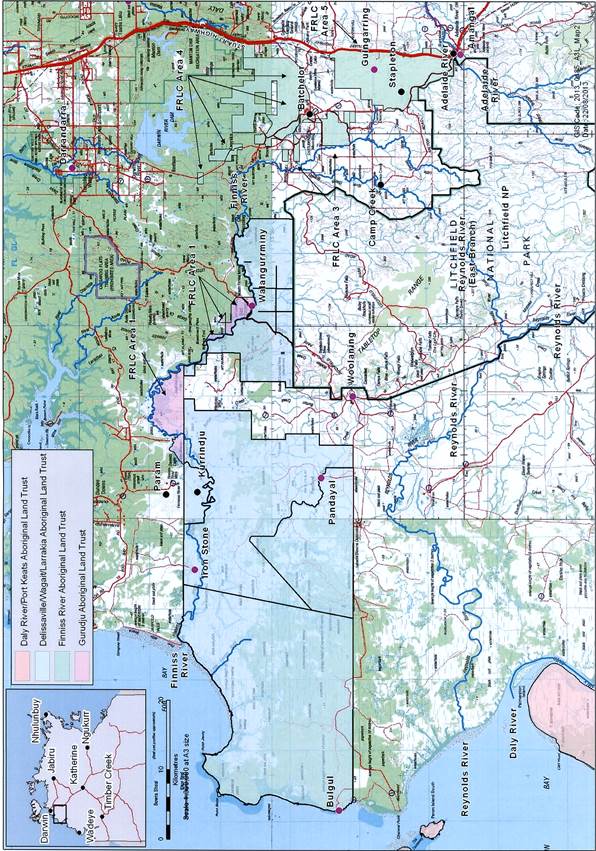
49 The Clan Totems Map partly shows the boundaries of the Southern Litchfield National Park (LNP) to the west of the Stuart Highway. Relevantly for present purposes, it extends well south of the Township of Adelaide River (which is on the Stuart Highway) and it extends north west of Batchelor (which is a little to the west of the Stuart Highway). It incorporates the Tabletop Range, including the various marked Clan sites, other than the Echidna Clan site south of the Township of Adelaide River. To better understand these reasons, and the evidence to which they refer, I append to these reasons a map showing those two townships and the rivers flowing from or across LNP and surrounding lands. It also shows Woolaning, the “Big Wagait” and the “Little Wagait” (on its northern boundary is Walangurrminy) and the various parts of the Finniss River Aboriginal Land Trust, and a copy of the Clans Totem Map.
50 The Clans Totem Map is on a much smaller scale. The hatched areas in its upper right section are parts of the Finniss River Aboriginal Land Trust area. The hatched area in the upper centre is part of the Little Wagait, and the hatched area in the upper left section is part of the eastern section of the Big Wagait.
51 Batchelor is between the three hatched sections of the Finniss River Aboriginal Land Trust. As the legend shows the North West Tabletop, the North East Tabletop, and the Southern Tabletop areas (all parts of the Tabletop Range) are well to the west or south west of Batchelor. The survey area marked with a circle on the Tabletop Range is about 40 km direct from Batchelor, and about 80 km by road from Batchelor according to Mr Petherick.
52 As can clearly be seen the Emu Clan Totem, the Blue Tongue Lizard Totem and the King Brown Snake Totem are all shown in the area of the Southern Tabletop, a considerable distance from Batchelor. The other clans referred to by Mr Petherick (including the others which together with those three comprise the FRBG) are all in the area of the Tabletop Range also (other than one area of the Echidna Clan Totem which is south of Adelaide River Township, and of course then even further south of Batchelor).
53 Around Batchelor (not completely enclosing it) are the sections of land held by the Finniss River Aboriginal Land Trust, pursuant to a grant made under the Aboriginal Land Rights (Northern Territory) Act 1976 (Cth) (the ALR Act). The grant was made on the basis of recommendations made by the Aboriginal Land Commissioner (Justice Toohey) in the Finniss River Land Claim Report of 22 May 1981 (Report 39). The land addressed in the Finniss River Land Claim (FRLC) was a broad sweep of land from the north of the Finniss River running roughly south east to the Township of Adelaide River and the Stuart Highway. As a result of its recommendations, grants were made to four separate Aboriginal Land Trusts along the Finniss River, the most easterly of which were the several separate areas granted to the Finniss River Aboriginal Land Trust.
54 In addition, as a result of the Report on the FRLC, there were two areas scheduled under the ALR Act to the Delissaville/Wagait/Larrakia Aboriginal Land Trust. The larger section took in a large section of the coast south from the north of the Finniss River to Bulgul and easterly past Kurrindji and Pandayal in a roughly rectangular area. Woolaning is a little east of its south-east corner. It is called the Big Wagait. Adjacent to its north-eastern corner is one of the two areas scheduled to the Gurudju Aboriginal Land Trust. A little further to the east is another smaller area, also roughly rectangular, save that its northern boundary follows the course of the Finniss River. Its south-western corner is a little north of Woolaning. It is called the Little Wagait. Its south-eastern corner is slightly north of Batchelor and is some 15 km west of Batchelor. Its southern boundary is part of the northern boundary of the LNP, so the Tabletop Range and the majority of the Clan totems on the Clan Totems Map are in an area south of its southern boundary.
55 The FRLC was heard by Toohey J as Aboriginal Land Commissioner in 1980 and 1981. As noted, it recommended the grant of five areas of land to the Finniss River Aboriginal Land Trust, three of which largely surrounded the Town of Batchelor. The five areas are as follows:
(a) Area 1, which is located to the south of the Finniss River, adjoins the north-eastern corner of the Big Wagait area and is well to the north west of Batchelor;
(b) Area 2 is located to the north of the Finniss River, across the river from the Little Wagait area and, like Area 1 is located to the north-west of Batchelor;
(c) Areas 3, 4 and 5 are proximate to and largely surround the Town of Batchelor, Area 3 on the western side, Area 4 on the northern and north-eastern side and Area 5 on the southern and south-eastern side.
56 In the FRLC, there were two groups of claimants who were in competition in relation to parts of the land under inquiry. They were:
(a) the Kungarakany and Warai claimants, who, subject to births and deaths, are in substance co-extensive with the members of the Warai and Kungarakany native title claim group, and
(b) the Marranunggu claimants, who included many of the same people who comprised the Mak Mak Marraanunggu native title claim group. Moreover, in the FRLC, no claim was made by the persons who comprise the Emu, Blue Tongue Lizard and King Brown Snake Clans as a native title claim group. Moreover, in the FRLC, there was no competition between the two competing groups in respect of Areas, 3, 4 and 5..
57 Toohey J found the members of the Kungarakany and Warai group to be the “traditional Aboriginal owners” of part of Area 3 (being the eastern part and, in particular, the country around the sites Miniling and Yitpiliny) and the whole of Areas 4 and 5. He also found that the Maranunggu claimants were the “traditional Aboriginal owners” of Area 1 and that part of Area 2 claimed by them.
58 Toohey J noted in his report that a provisional list of some 48 persons who, it was said, would benefit from a grant of land had been tendered. This included some Brinkin and Werat people, as well as others from numerous other language or tribal groups.
59 In 1994, in order to determine the competing claims of traditional Aboriginal ownership under the ALRA of the Big Wagait and the Little Wagait areas, the Northern Land Council (NLC) established a committee that became known as the Wagait Committee. This committee comprised Aboriginal people from other parts of the Northern Territory.
60 According to Dr McWilliam’s primary report prepared for the Committee:
Werat claimants also acknowledge close and continuing kinship ties to Maranunggu claimants of the Wagait Trust area and related Brinken groups. They argue, however, that the Maranunggu and Brinken were immigrant groups from south of the Daly River, which during the twentieth century, formed close ties to the resident Werat descent groups in the area. … President Werat claimants are also intermarried with Brinken families (Maringar, Marathiel) and maintain close ties with the wider Finniss River Brinken community.
The collective position taken by the Werat claimants to the eastern Wagait is that the tribal group referred to in the literature as Djerait or Dak Cherach, is identical to the Werat.
According to present claimants there were formerly some eight Werat descent group estates established on or near the present Wagait Land Trust. Each estate was associated with a particular named totemic dreaming.
61 At the time of the Wagait Committee hearings, Daisy Majar was married to Mr Petherick. Mr Petherick, his father, Ray Petherick, and his son Glen Petherick were prominent witnesses in support of the Werat claim.
62 Mr Petherick’s father, Ray, is a European man. Ray told the Committee that he went to Finniss River country in 1948 and that he had stayed there ever since. He married his wife, Rosie Nangkalaku, in 1948 and she was “goanna clan Maringal from Moyle River”.
63 Mr Petherick at one stage said that his mother’s father was Marranunggu, though he also said:
Well, everybody in the [Wagait Reserve] area was classed as Marranunggu, and in turn everybody was classed – Marranunggu is what they are today – as Brinkens.
Well, sometimes the Brinkens are called the Marranunguu too – and in turn the Brinkens are called Marranunguu.
64 Mr Petherick also told the Wagait Committee that he was born at Woolaning and had lived all his life in the Wagait area. He also gave the following evidence to the Wagait Committee:
If there’s a land claim they’re always coming in from Batchelor, the Marranunggu or the Kungarakans – come in from town off the streets – or the Hazelbanes – the Warrai. They come from that way every time there’s a meeting here. When youse gone there’s no-one in this country, only the Werats, and all depends what the Brinkens are doing.
My mother is Marindja from the Moyle plain.
Well, me and my family are not claiming any land anywhere, not even my mother country on the Moyle or my stepfather’s on the Moyle, and I’m not even claiming in the Wagait reserve. We felt that we didn’t want to make the same mistake as the other claimants did, like, and the other thing is that Daisy’s father left that country to his sisters and grandchildren.
And as far as you’re aware, the Brinken have been on the Wagait as long as the Marranunggu people? … … Some reports go back 1913, but my mother drifted up here just before the war.
65 The Wagait Committee reported its findings in a report dated July 1995. The findings of the Committee were adopted by the NLC.
MR PETHERICK’S EVIDENCE
66 Mr Petherick’s father came to the Northern Territory from Victoria in about 1948. In the early 1950s, he established the McCallum Creek Sawmill, nearby to the Woolaning Community where Mr Petherick was born and where he still lives. Apart from schooling in Darwin, and brief breaks, he has lived at Woolaning (between the Finniss River and the Reynolds River, and some 40 kms west of the Township of Batchelor) or at Burkine and Woolmin on Wagait Aboriginal Land Trust land (also part of the FRLC area and west and north of Woolaning). He described being in the “Finniss River Swamp” area for sixty years. He said he had also lived in the Batchelor district for some time, or “off and on”. His evidence suggested he had been in Batchelor only for brief periods, as the major township for that part of the Northern Territory, and since about 1968 had lived mainly in the “Big Wagait”, the area running south from the mouth of the Finniss River along the sought and then eastwards to a point about 10 km west of Woolaning.
67 As noted, when issues arose as to the persons rightly interested in the Wagait Aboriginal Land Trust area, in 1994, Mr Petherick gave evidence to the Wagait Committee Inquiry conducted to address those issues. He accepted that he had then said he made no claims in an aboriginal way to any country. Nor, on the evidence, had he made any claims under the ALR Act to be the traditional owner, or one of the traditional owners, of any unalienated Crown land in the Northern Territory. At the time of the Wagait Committee Inquiry he did not suggest that he had any aboriginal interests in any Emu estate, or in the Batchelor area.
68 However, he now says he has and has always known that he has aboriginal interests in an extensive area of land more or less extending from Batchelor and areas south of Batchelor and westwards and between the Finniss River and the Reynolds River to the coast. That includes the Big Wagait and the Little Wagait areas. He says all of that land is Emu land, which he got through his ancestor Thulumbun.
69 He identified a large area bordered on the east by the Stuart Highway and extending north above Batchelor and well to the south to near Adelaide River, and then extending westwards as the country of the Emu Clan, the Blue Tongue Lizard Clan, the Echidna Clan and the King Brown Snake Clan. He also said that country belonged to the eight clans comprising the FRBG, and that it included Batchelor. It extended to the west to include the Tabletop Range (running north south) and to its west the swamp areas between the Finniss River and the Reynolds River.
70 Mr Petherick was firmly of the view that, in particular, the people of the King Brown Snake Clan could not be left out. Despite his affidavit of 22 August 2013 referred to above, he accepted there are still living members of the King Brown Snake Clan including some named persons.
71 Ultimately, his evidence was that the Township of Batchelor was within the area of traditional ownership of those belonging to the Emu Clan, the Blue Tongue Lizard Clan and the King Brown Snake Clan. He tended to treat the Echidna Clan as part of the Blue Tongue Lizard Clan. He also accepted that the other four clans also comprising the FRBG have the same interests in the Township of Batchelor and the larger areas described. He said “if we won the claim, we would include everybody” but that further investigation was required.
72 The clear picture is that, on Mr Petherick’s evidence, the Emu Clan and the Blue Tongue Lizard Clan are not a society of aboriginal persons who may hold native title rights and interests over Batchelor. On his own evidence, they are part of a wider group comprising at least the King Brown Snake Clan, and (unless on the anthropological evidence they are part of the Blue Tongue Lizard Clan) the Echidna Clan. In addition, on his evidence, those persons also include the members of the four other clans also constituting the FRBG.
73 Indeed, at one point in his evidence when discussing the geographical extent of traditional interests in land of the Emu Clan, he also included a number of other clans (as expressed in his affidavit of 25 June 2013) including the Fresh Water Crocodile, Barramundi, Kangaroo, Long Neck Turtle, Catfish, Cycad/Glider Possum, Water Snake, Goose, Goanna/White Breasted Sea Eagle, Darter Bird, Water Rat, Fire, Green Turtle, Stingray, Dugong, Snapping Turtle and Tree/Saltwater Turtle Clans as part of the claim group for the Town of Batchelor (as well as the four clans named above). He said in evidence they have their own separate areas and a “social affiliation” to Batchelor, but he said “we can’t leave them out, believe me”. The FRBG is described at [3] above. It treats the Cycad/Glider Possum/Tree Clan as one Marri Clan. I assume the Red Catfish Clan is the same as the Catfish Clan referred to in [3] above, and that the Tree Clan is the same as the Tree/Saltwater Turtle Clan and the Werak Goanna/Pulimi Clan is the same as the Goanna/White Breasted Sea Eagle Clan both referred to above. The evidence did not explore those assumptions or those name differences. There are, on those assumptions, a further 11 clans referred to above not part of the FRBG.
74 Thus, the oral evidence of Mr Petherick presents the picture that:
1. the Emu Clan and the Blue Tongue Lizard Clan are not said to be a society of aboriginal persons who are entitled to be recognised as the group holding native title rights and interests over Batchelor, because in any event they are part of a larger group who may hold those rights, and
2. the larger group comprises those two clans plus either:
(i) the King Brown Snake Clan (and possibly the Echidna Clan if it is not part of the Blue Tongue Lizard/Echidna clan; or
(ii) the eight clans comprising the FRBG; or
(iii) the numerous clans referred to in the preceding paragraph.
75 It is of course necessary to consider his affidavits as well. I shall address those affidavits in chronological sequence.
76 As noted at [4] above, the Town of Batchelor No 2 claim comprised three clans of the FRBG. The amendment to that claim on 27 March 2006 reduced the claim group to the Emu Clan and the Blue Tongue Lizard Clan. It was the status of the claim group as then described which was the subject of the decision in Hazelbane.
77 The affidavits of 27 July 2005 and 5 December 2006 do not expressly address that issue, but they referred to several of the other clans now listed in [73] above. A map prepared by the Aboriginal Areas Protection Authority for the area between Batchelor and the Daly River Crossing (which is the same map exhibited to Mr Petherick’s affidavit of 5 June 2013 and is the Clan Totems Map) shows the main areas of clan totemic motifs in the area over which Mr Petherick claims native title rights with a range of clans in the general area.
78 The Preliminary Statement of Facts Issues and Contentions of 2 February 2007 says that the Emu Clan and the Blue Tongue Lizard Clan have such rights on a non-exclusive basis, with neighbouring clan groups that “form a united ceremonial group centred around the Tabletop Range between Batchelor and the Paperbark Country of the Finniss and Reynolds areas”.
79 Mr Petherick’s affidavit of 23 April 2007 says that, by making the Town of Batchelor No 2 claim, he expected there would be anthropological assistance made available to protect “our interests in the Batchelor, LNP (Southern Litchfield National Park), Woolaning areas being pastoral land” and thus not able to be claimed under the ALR Act. He speaks of the FRBG as the collective group he is endeavouring to protect, rather than only either or both of the Emu Clan and the Blue Tongue Lizard Clan, and of providing information on 11 clans in the Batchelor and LNP areas, and of aiming to protect the interests of the FRBG.
80 The same theme, that is that Mr Petherick is looking after the FRBG, is maintained in his affidavit of 25 March 2008. It there refers by name to the eight clans comprising the FRBG, and it does not assert that only the Emu Clan and/or the Blue Tongue Lizard Clan have native title rights and interest in Batchelor itself.
81 His next affidavit of 30 June 2008, following the Hazelbane decision, indicates that he is planning to hold meetings of the FRBG on 12 July 2008 at Port Keats, Knuckeys Lagoon and at Woolaning to cure the defects in his authorisation to bring the Town of Batchelor No 2 claim.
82 The next affidavit, of 15 July 2008, is to support the then proposed amendment to the Town of Batchelor No 2 application. It refers to a meeting at Wadeye on 5 July 2008 “to meet with various of the clans” that make up the FRBG. There were most of those eight clans represented.
83 I will separately refer to that material on the topic of authorisation. For the purpose of identifying the relevant group holding native title rights and interests over Batchelor, he says that all members of the FRBG agreed that “the Stevens family, the Emu clan and the King Brown Snake members” had those rights over Batchelor, and that the other five clans have rights to travel from their sacred sites in the western and northern Tabletop Range to Batchelor to hold meetings with the three clans.
84 The next step is the motion of 8 August 2008 for leave to amend the application itself; see [16] above. The proposed amendment, said Mr Petherick, had been authorised by the “FRBG as the Native Title Group” to make the application and lists the eight clans of the FRBG as the native title claim group. The determination of that motion was deferred for the reasons set out above. Mr Petherick’s affidavit of 16 June 2009 similarly says that he is attending to the interests of the FRBG.
85 The next affidavit of Mr Petherick of 9 May 2011, consistently with that proposed amended application, referred to him being the applicant, “with others”, for the FRBG. It comments on some material then relied upon by the Town of Batchelor No 3 claimants.
86 So, too, is his affidavit of 1 March 2013 consistent with that proposed amended application. He says it is his duty to:
protect all aboriginal clans in the area of Knucky’s Lagoon, Bynoe Wagait Land Trust, Litchfield Station, the Reynolds River, on the coast at Anson Bay, Fog Bay, Litchfield National Park and my family. There is no suggestion that only the Emu Clan and/or the Blue Tongue Lizard Clan hold the native title rights and interests in Batchelor itself.
87 On 10 April 2013 he also maintained that position as Mr Petherick has used in the title that he is acting for the FRBG.
88 His affidavits of 25 and 28 June 2013 expand the scope of those whose interests he represents to some 20 clans, which he deposes to having connection to Batchelor “with ancestral genealogies and strong patrilineal links”, as well as “social affiliation to Batchelor and strong spiritual affiliation to and continued occupation of their country close by”. At one part of that affidavit he asserts that he claims Batchelor for the “Emu Totem Clan in conjunction with the Blue Tongue/Echidna/Ghost Clan of the Stephens family”.
89 The proposed further amended Town of Batchelor No 2 applications and the affidavit of 22 August 2013 are referred to above at [27]-[38].
90 I have recorded quite extensively the evidence of Mr Petherick both orally and through his affidavits about whether there was a native title claim group capable of being recognised as the holders of native title rights and interests in Batchelor comprising the members of the Emu Clan and the Blue Tongue Lizard Clan (or the Blue Tongue Lizard/Echidna Clan).
91 In my view, on that material, the answer to that question is clearly that there is not. The relevant holders of such rights and interests, on his own evidence, are either the FRBG or are a much broader group of clans.
92 Of course, that is not to decide who are the holders of native title rights and interests over Batchelor itself. It is simply to say that, on the evidence presented by Mr Petherick himself, the Emu Clan and the Blue Tongue Lizard Clan are not a group comprising only those persons identified in the proposed amended application, as annexed to his affidavit of 22 August 2013, capable of holding native title rights and interests in Batchelor.
93 The re-examination of Mr Petherick did not change that picture. He said he wants the NLC to undertake further anthropological study of the area, because he does not accept the views of Mr Stead, and that the identification of the right people for Batchelor depends on the anthropology.
94 He said the eight clans of the FRBG should be included and that they could not be left out. He spoke of a ceremonial area, and stories related to it, and its location a considerable distance from Batchelor and at a location on the Clan Areas Map. He identified other features of the country on that map and of areas on that map where stories occurred; they too were remote from Batchelor itself. Mr Petherick’s proposition tying Batchelor to the Emu Clan is a sophisticated one. It was developed by his father and himself from about 1990. Mr Stead described it as saying that the dominant art motifs recorded as an art site or occupation are reflect the totem of a particular Aboriginal clan, and from that stacking point the major totem recorded at a particular rock shelter or art site depicts the major totem of the clan whose country it is. The location and orientation of art motifs in the area between the Finniss River and the Reynolds River and in the LNP areas are then said to correspond with the clan totems of individuals associated with those areas. The research they conducted, they say, reveals concentrations of eight sets of motifs which represent the eight FRBG members.
95 The next step in the claim is that, because the Emu Clan motifs are in the closest proximity to Batchelor (albeit, as the Clans Totem Map shows, a considerable distance from Batchelor) and their orientation is towards Batchelor, Batchelor itself is within the Emu Clan area. He said in his affidavit of 25 June 2013:
The Emu clan is the closest site to Batchelor Township and in the area claimed, from the Tabletop Range down along the camp creek, flat plain low hill country to the Junction at East/South Finniss and along the ridge including the whole of the Batchelor Townsip (sic). As well as along the range to the Stapleston siding and over the hill in an arc to the large Rock Art Complex near the Daly River road. Back from this Rock Art site with the Emu Motif of Emu tracks and back to an Emu motif painted at Tableland Creek area. The large Emu Track Painting is faced towards the Peyi Emu. Starting up place is the area the Emu claim to land respectively.
96 The next step in Mr Petherick’s process of establishing his claim is that he is a member of the Emu Clan because his mother’s mother’s father Thulumbun had the Emu as his totem, and Mr Petherick has therefore by descent acquired that totem and the primary spiritual responsibility for the country of that totem.
97 As to authorisation, Mr Petherick’s evidence is that the proposed amended Town of Batchelor No 2 application to authorise him bringing that claim was a small meeting on 16 or 22 June 2013, but in reality on behalf of the Emu Clan he was empowered to bring it by seeking people over a long period of time, a continuous process, and on behalf of the Blue Tongue Lizard Clan by May Stevens authorising him and she in turn had a lengthy period of consultation informally. Over the consultation period, he was recognised as the last of the male descendants of Thulumbun, one of the two ancestral predecessors of the Emu Clan. The other line has Chugulla as it ancestral male.
THE OTHER EVIDENCE
98 It is, however, necessary to consider the balance of the evidence to see whether that material might support the claim group as the proposed amended application defines it.
99 I consider that the conclusion is about where Mr Petherick’s evidence points are not diluted by the anthropological evidence.
100 There were two anthropologists who gave evidence. Mr Stead and Mr Adams.
101 Mr Adams had only been engaged a few days before the hearing, so he had no opportunity for any field work. He had interviewed only Mr Petherick and his sister. He had had no previous experience in researching the area in question. He acknowledged that, if he had had the opportunity to undertake the investigations which he would have preferred to have done, he may not have answered the questions he addressed in the same way as his report indicates.
102 Mr Adams was asked to address a series of questions. It is necessary to note only those where he expressed disagreement with Mr Stead.
103 He said the grouping of the Emu Clan and the Blue Tongue Lizard Clan is likely to be a pre-sovereignty societal phenomenon which has persisted to the current day, continuing to practice its traditional laws and customs. However, when tested, that conclusion was based on him accepting the existence of those two clans as a present-day societal grouping capable of holding native title rights and interests in Batchelor. That was the facts as presented to him by Mr Petherick, and Mr Adams really assumed that current status and worked back by inference to pre-sovereignty times. Hence, he did not really form any independent professional judgment on the starting point for his view. That reflects that he had done no independent research necessary for him providing an opinion as an expert anthropologist on that question. Indeed, when parts of Mr Petherick’s evidence were put to him explaining that a significant number of clans had lived in the area within and around the LNP, between the Finniss River and the Reynolds River, and extending westwards to the coast and that they had intermarried, shared ceremonies, lived together and foraged together, he urged that that larger group would constitute the community of Aboriginal persons occupying that larger area under a sophisticated system of laws and customs. He said that that picture (which is the picture which emerges from an overall review of Mr Petherick’s evidence) would include a broader community of Aboriginal people occupying that area in accordance with a cognatic system of laws and customs. The individual clans may have particular responsibility for particular areas within that social group’s area. The lines between the clan groups would reinforce the concept of that wider group holding rights and interests in the wider area under their laws and customs. Hence, he did not express any considered view that the Emu Clan and the Blue Tongue Lizard Clan together are a society of Aboriginal persons holding native title rights and interests in Batchelor.
104 It is convenient to note one further element of Mr Adams’ evidence at this point. He also acknowledged that he had no anthropological basis (other than what Mr Petherick said) to identify a customary law which, given (for example) the Emu Clan with significant totemic sites 30 or 40 km from Batchelor, could support the claimed native title rights in Batchelor to the exclusion of other clans. Indeed, I think it is a feature of his written report that he has taken Mr Petherick’s material about geographical features and rock art locations as indications of a general entitlement to country between the two Rivers, without a sufficient focus on the particular claim area under consideration, namely Batchelor itself, and secondly he has not sought to refine the identity of the holders of the native title rights and interests over the wider area so as to exclude either widely, or in relation to Batchelor, clans other than the Emu Clan and the Blue Tongue Lizard Clan.
105 Overall, I do not regard Mr Adams’ evidence as being of any real support to the present claim of Mr Petherick (as expressed in the proposed amended Town of Batchelor No 2 application appended to Mr Petherick’s affidavit of 22 August 2008).
106 Mr Stead’s evidence was, in a practical sense, not really disputed by any considered contrary anthropological evidence. He is an experienced anthropologist who has done considerable work in the broader area under consideration.
107 There is little doubt that Mr Petherick and others have a very considerable knowledge of the country between the Finniss River and the Reynolds River, west of the Stuart Highway and extending to the coast, including in the LNP. He has identified a number of areas of art motifs and clan totems and was involved in the research process to formally identify them. The material suggests that Mr Petherick followed in the footsteps of his father Ray Petherick (who is a non-Aboriginal man) in that research process. In reaching the views I have reached, I do not intend to convey that Mr Petherick does not have that knowledge. He clearly does. He also clearly wishes to preserve it and pass it on. I also do not intend to convey that he does not see the present claim as a means of doing so, or that he is not genuine in presenting it.
108 However, as Mr Stead said in his report, there is minimal support in the literature or recorded evidence of Aboriginal informants that support the theory (as put forward by Mr Petherick) that the position and orientation of rock art motifs, especially well remote from Batchelor, provide the location of clan estates, or that the predominant motifs recorded rock art/occupation sites reflect the major totem of a particular clan or estate. The evidence from the FRLC was that the foundation of land owning in the area is from Dreamtime Ancestral Being activity and not rock or cave art motifs and their direction and orientation.
109 He said that the Aboriginal communities who traditionally held land between the Finniss River and the Reynolds River were the Kungarakan People and then from a line extending roughly diagonally across the northern part of the Tabletop Ridge southwards and eastwards the Warai People but not in a westerly direction to the coast. Those two groups were socially and genealogically connected. Batchelor itself is about where the diagonal intersecting line runs to the east, and so there are “shared native title rights and interests” between those groups.
110 Consequently, he said neither the FRBG, nor any of its constituent clans, hold such interests in Batchelor. The FRBG or Brinken group is associated with country further south, predominantly along the coast between the Daly and Moyle Rivers.
111 He also said that Mr Petherick, through his mother, either proximately or through her forebears, had not shown any basis for asserting native title rights and interests over Batchelor or its surrounding region. Mr Petherick had previously said his mother was a Maringar woman from the Moyle River area, south of the Daly River, who moved into the Finniss River area before World War II.
112 The material referred to by Mr Stead in support of his own conclusions is extensive and persuasive, including on his view that at sovereignty in this general area the relevant Aboriginal societies which then occupied the area and exercised native title rights and interests with respect to it were the Kungarakan People and the Warai People. That material covers the period of recorded European observation.
113 It should also be noted that Mr Stead has described the at-sovereignty land tenure system in the Darwin area, extending to include the area under consideration. His evidence that it is an estate based model (using Professor Stanner’s terminology) reflects the views of other anthropologists including Professor Sutton, and was found to be the applicable system in the FRLC by Aboriginal Land Commissioner Toohey. Mr Stead’s view about the current land tenure system, as being a language based model with the change precipitated by changes caused by European settlement, also reflects their views and the views of other anthropologists.
114 Mr Stead concludes, after his lengthy analysis, at [5.36] of his report as follows:
In conclusion, there is no currently available data other than the assertions of the Second Applicants which indicates that any of the eight clans that constitute the FRBG and Second Applicants jointly or individually hold land or have any rights and interests in the Town of Batchelor. On the basis of the analysis in Sections Three and Four and McWilliam (1993), it is likely that the members of those clans have primary native title rights and interests in land located south of the Daly River, in the Maringar and Marathiel language areas of the Moyle River Valley. These rights would be obtained through patrilineal descent or other means if the genitor was non-Aboriginal.
115 In addition to that conclusion, Mr Stead considers the possibility that Mr Petherick as an individual may have, or may belong to a group that has, native title rights and interests in Batchelor. Mr Petherick eschewed any suggestion that he is a member of either the Kungarakan People or the Warai People. Nevertheless, Mr Stead refers to, and excludes, the possibility that his mother’s country includes Batchelor or that Mr Petherick had any such connection through his mother’s father or his mother’s mother (Thididi) or his mother’s mother’s mother or his mother’s mother’s father (Thulumbun). I refer only to the final one of those possibilities as Mr Petherick referred to Thulumbun in his evidence and in the Town of Batchelor No 2 proposed further amended application. After reviewing the available data, Mr Stead said that it was not possible not provide a conclusive location of Thididi’s and Thulumbun’s interests in land, but there is no support for Mr Petherick’s assertion of an Emu Dreaming track running from Batchelor to Palumpa, so there is no basis to think that in any event there is a connection between an Ancestral Being who visited sites in and around Batchelor, so the basis of Mr Petherick’s assertion in that regard is not made out. Mr Adams did not dispute that conclusion.
116 In a formal sense, it is not necessary finally to determine if those views are correct for reasons which appear below. However, Mr Stead’s views were not directly confronted to any real extent in his cross-examination. Nor was his methodology, nor his analysis of earlier anthropological research, challenged. He referred to the anthropological evidence given to the FRLC, and later anthropological rejection of the thesis for Mr Petherick’s claimed connection to Batchelor largely based on information given by other senior Aboriginal people. So far as is apparent to me, the evidence in Hazelbane from Captain Wodidj and others to which reference is there made also tends to contradict – and certainly does not support – the basis upon which Mr Petherick has pursued the Town of Batchelor No 2 claim, through the various forms of the application or as it has been proposed to be amended. Mr Adams’ evidence did not in any persuasive way contradict Mr Stead, and he agreed with Mr Stead to a substantial degree.
consideration
117 For the reasons which follow, I do not propose to allow the application in the Town of Batchelor No 2 claim to be amended as proposed in Mr Petherick’s affidavit of 22 August 2013. It will follow that the order dismissing the Town of Batchelor No 2 claim, made on 7 March 2008 will be enlivened and that proceeding dismissed.
118 There will then remain the Town of Batchelor No 1 claim. Having regard to s 84(8) of the NT Act, and the extensive material put before the Court, I will also order that the persons who are respondents to that claim as representing the FRBG should also be removed as parties to that proceeding.
119 The starting point is to identify the test applied in reaching those conclusions.
120 The motion of the applicant in the Town of Batchelor No 1 claim to dismiss the Town of Batchelor No 2 claim was brought on 14 November 2006 under s 84C of the NT Act and O 20 r 2(1)(a) and (c) of the Federal Court Rules as they stood prior to the Federal Court Rules 2011 (Cth). I discussed the applicable principles in Hazelbane at [11]-[15]. I will not repeat that. I apply those principles in considering the present issues. I have not therefore relied upon s 31A of the Federal Court of Australia Act 1976 (Cth) because it came into effect on 1 December 2005 and applies only to proceedings commenced after that date (Items 7 and 44, Sch 1, Migration Litigation Reform Act 2005 (Cth)) after the institution of the Town of Batchelor No 2 application was first made.
121 I also propose to apply the test prescribed by the former O 20 r 2(1) rather than r 26.01(1) of the Federal Court Rules 2011 (Cth), that is to consider whether no reasonable cause of action is disclosed to rule on the proposed amendment, rather than to consider whether there is no reasonable prospect of successfully prosecuting the claim as proposed to be amended. I accordingly order under r 1.04 of the Federal Court Rules 2011 that the Federal Court Rules in force immediately before 1 August 2011 apply to the determination of both the motions before the Court. It would otherwise require an artificially convoluted process of reasoning to apply different tests under different Rules to the issues arising on the strike-out motions and the amendment motion, and to address whether the amendment motion (as now amended) is a different step in the proceeding from the amendment motion of 8 August 2008.
122 The Town of Batchelor No 2 claim should not be allowed to be amended as sought because the claim as then amended would be bound to fail.
123 There is considerable authority that a claim for native title rights and interests by a subset of the putative native title holding group is contrary to s 61 of the NT Act and cannot succeed: Ward v Western Australia (1998) 159 ALR 483 at 542; Risk v National Native Title Tribunal [2000] FCA 1589 at [60]; Tilmouth v Northern Territory (2001) 109 FCR 240 at 241-242; Dieri People v South Australia (2003) 127 FCR 364 at [55]; Landers v South Australia (2003) 128 FCR 495 at 504; Harrington-Smith v Western (No 9) (2007) 238 ALR 1 at [1209]-[1217].
124 The first reason that the claim as proposed to be amended cannot succeed is that it is clear, even on Mr Petherick’s own evidence that the relevant native title holding group is a wider group than the Emu Clan and the Blue Tongue Lizard Clan members. I have referred to that evidence in detail above. His evidence points to the group as including at least the King Brown Snake and Echidna Clan members, almost certainly also the other members of the FRBG clans, and again probably a much wider group of members of some 20 or so clans: cf Landers v South Australia (2003) 128 FCR 495 at [33]; Dieri People v South Australia (2003) 127 FCR 364 at [55]; Harrington-Smith v Western Australia (No 9) (2007) 238 ALR 1 at [1216].
125 The second reason that the clan as proposed to be amended cannot succeed is because, on the material, I do not consider that there is a reasonable foundation for Mr Petherick showing that he has been authorised as required by s 251B to act as the applicant on behalf of the FRBG, or even on behalf of the Emu Clan and the Blue Tongue Lizard Clan (including the Echidna Clan).
126 It does not show authorisation on behalf of the King Brown Snake Clan, which Mr Petherick said should be included. He says in his affidavit of 22 August 2013 the reason why there is no authorisation extending to that clan, but his oral evidence indicated that, despite the death of Mr Angelchi, there are other living senior members of that clan who he knows and who could have authorised the claim.
127 The problem about authorisation is more extensive than that. Mr Petherick gave evidence of a Wadeye meeting at the Pavilion at Port Keats on 5 July 2008. That proposed amendment was to be made by the FRBG and the authorisation asserted was on behalf of that group, as explained in Attachment R4 to the then proposed application. It was not an authorisation for the proposed amended application supported by the affidavit of Mr Petherick of 22 August 2013.
128 Then, in relation to the Emu Clan and the Blue Tongue Lizard Clans alone, Mr Petherick’s evidence is that he has had a series of relatively recent meetings with other Emu clan persons, sometimes with only one or a few other persons, to seek their approval to pursue the proposed amended claim. There has been no conventional meeting of all members (or all eligible members) of the Emu Clan. There is no anthropological evidence to support Mr Petherick’s claim that the traditional laws and customs of the Emu Clan enable him to act in effect unilaterally on behalf of its members to bring such a claim. The form of authorisation which he says he procured for the Town of Batchelor No 2 claim when first instituted, and when first amended, does not support such a proposition.
129 Similar problems apply to the authorisation of Ms Stevens to bring the proposed amended claim on behalf of the Blue Tongue Lizard Clan, and (as Mr Petherick said) then acting as an individual to allow him to make decisions about the claim without reference to any other person.
130 In short, there is no cogent evidence that either by a traditional system of laws and customs, or by any conventional system, there has been an authorisation under s 251B of the NT Act for Mr Petherick to bring the proposed amended claim.
131 Even in the event that the proposed amendment was to pursue a claim over Batchelor by the FRBG, in my view on the material there is no reasonable prospect of such a claim having been authorised so that Mr Petherick can pursue it.
132 The only possible authorisation secured by Mr Petherick from the FRBG, or some members of the FRBG, is at the meeting at Wadeye on 5 July 2008. The evidence of that meeting would not be sufficient to establish authorisation by the FRBG in any event. There was no notice given of that meeting. There were only 11 male persons present, and Mr Petherick in his oral evidence acknowledged that there were many other members of the FRBG clans who should have been present in matters concerning their land. The evidence does not show even that the 11 persons present were able to, or did, authorise a claim on behalf of the FRBG. They were mainly then to go away and consult other members of their clans. The very brief pro forma affidavits in support of that then proposed amendment application from seven persons, in the light of that evidence, does not carry any real weight to establish authorisation in the overall circumstances.
133 I have not overlooked s 84D(4) of the NT Act. This is not a case where the balancing required could or would justify the exercise of that discretion. The history of the conduct of the Town of Batchelor No 2 claim, with the uncertainty as to the identity of the relevant claim group, the inability to clearly identify it and to obtain a clear authorisation from any group or combination of persons said from time to time to constitute the group, and the existence of a competing claim group and the existence of the determinations made by the FRLC hearing, would not and could not warrant the exercise of that discretion.
134 There is a third reason why the proposed amended application should not be allowed. It relates more generally to the claims made by Mr Petherick on behalf of the various clan members who he has said, from time to time, constitute the relevant claim group for the Town of Batchelor No 2 claim.
135 I have referred above to Mr Petherick’s evidence about the process by which he claims on behalf of members of the Emu Clan (and others) native title rights over Batchelor.
136 There are clear and demonstrable changes in the way the land-holding group which Mr Petherick says he represents over time. There is no anthropological evidence to support the claims he has made, either at a theoretical level or in relation to the particular area in issue, namely Batchelor. There is clear and consistent anthropological evidence that neither Mr Petherick as a member of the Emu Clan nor as a member of the FRBG nor as a member of the wider group of clans he identified has native title rights and interests over Batchelor, or indeed in the nearby vicinity. The claim he makes is inconsistent with the findings made in the FRLC, or in the later Wagait Committee Inquiry.
137 Mr Petherick at the time of those inquiries made no claim to hold interests in the areas then under consideration, or the adjoining areas including Batchelor.
138 As I have noted, I have no doubt that Mr Petherick is genuine in his claims and that he has a very extensive knowledge of the rock art and other geographical features of the wider area including Batchelor. The monograph “Aboriginal Rock Art Motifs of Litchfield National Park” under the name of his father represents many years work of both his father and himself and others. The other material he has introduced through his affidavits clearly confirm that in the wider region there have been clear records of its Aboriginal occupation and use. It is from that document that the Clan Totems Map was taken; there are also a number of individual maps showing the distribution of particular motifs through the LNP. Mr Petherick said that it was a feature of some of the totemic rock paintings that they reflected a local rock formation or other geographical feature in the near vicinity. Where that exists, he says it supports the subtitle of the work: The Prehistoric Record of Clan Distribution. It is the case that, on some locations of rock art, there are several, and on a few occasions up to 10, motifs. Mr Petherick said, and I accept, that demonstrates (with other material) evidence of Aboriginal occupation, but I do not think Mr Petherick explained effectively how such sites enabled the appropriation of that location to a particular clan group. Indeed, as shared sites, it may well be material antithetical to his basic propositions. Mr Petherick was pressed to explain how the country of a particular clan was identifiable from the existence of that clan’s totemic painting sites in the wider area, particularly where a shape loosely drawn around those sites included in a number of instances other clan totemic paintings. He did not really come to grips with that issue; he was diverted in his answers to explaining how some totemic painting sites reflect local natural features.
139 As noted, his thesis for the Emu Clan having the rights to Batchelor, a distance in excess of 30 km from the main Emu Clan painting site, is that they are closer to Batchelor than other clan sites and that there is evidence of Aboriginal occupation of the LNP and surrounds, including in and around Batchelor. The evidence of occupation was not clan specific. The Blue Tongue Lizard Clan, the Echidna Clan and the King Brown Snake Clan are also clans where their motifs are about the same distance from Batchelor. Hence, according to Mr Petherick, their inclusion in the group who have Aboriginal interests in Batchelor.
140 There is no anthropological evidence to support those theses, and there is positive evidence from Mr Stead that they are not consistent with any anthropological literature or analysis either in this particular area, or the wider Darwin area.
141 Mr Petherick was also asked about his claim to have the Emu Clan interests in the area through matrilineal descent. He accepted that descent rights in the area are patrilineal, but qualified it by saying that where there is (as in his case) a non-Aboriginal father then the descent rights pass through or from the mother’s father, or through an Aboriginal husband of the mother. During the Wagait Committee Inquiry, Mr Petherick said clearly:
So me and my family are not claiming any land anywhere, not even my mother country on the Moyle [River], or my stepfather’s on the Moyle.
142 The Moyle River is further south, and south of the Daly River. As noted, he did not assert any Aboriginal rights to the country which was the subject of the FRLC at the time that was heard or later during the Wagait Committee Inquiry. It appears he has had a change of heart, perhaps prompted by the research into the LNP sites and surrounding sites. It was not suggested that there is any relevant difference in terms of Aboriginal rights to that land, or to Batchelor and its surrounds. The only difference is that the FRLC was confined to non-alienated Crown land.
143 Consistently with that, Mr Petherick acknowledged that his mother was born in the Moyle River area, and moved north only in the years before World War I. He insisted she “came back to her country” in the Finniss River area, but there was no real explanation for that assertion and the languages she spoke were all languages related to areas south of the Daly River. Mr Petherick did not really explain how, in those circumstances, he could maintain that his mother’s country was in the Finniss River region. He could not fit his thesis in with the earlier observations of field anthropologists for the area of the FRLC, including Tindale, Stanner and Basedow which identified the Finniss River area as Kungarakany and Warai Peoples country. That identification was adopted by Mr Stead and not disputed by Mr Adams.
144 Mr Petherick also accepted that in the Wagait Committee he described himself as a Marranunggu person. Again, his explanations for doing so, and then more recently identifying himself as a member of the FRBG of the Emu Clan was not, in my view, convincing in the sense of persuasively showing that he is, and at all material times, has claimed to be a member of the FRBG (or a Brinken) person of the Emu Clan and that the country of the FRBG includes Batchelor. He said that, despite the language identification as Marranunggu at the time, more properly his identification should have been a totemic one. That explanation does not fit with the data obtained by anthropologists about how ownership of country exists.
145 In the hearing of the Town of Batchelor No 3 claim, Mr Petherick gave evidence. He then identified the Emu country of Thulumbun (his mother’s mother’s father). It is different from the areas over which he now says that the Emu Clan and the Blue Tongue Lizard Clan have native title rights, although both areas incorporate Bachelor. The area he identified during that evidence is a much smaller roughly triangular area, with its apex above Batchelor and its base between Camp Creek and Stapleton, incorporating parts of four of the five areas granted to the Finniss River Aboriginal Land Trust, but to the east of the Tabletop Range and to the east of those areas on the Clans Totem Map which contain identified totemic motifs for the various clans.
146 Finally, Mr Petherick was referred to a report by an anthropologist Kim Barber of May 1999 addressing a claim Mr Petherick, his father and others of his siblings and Claude Narjic to be the traditional owners of section of the sea bed in the vicinity of Fog Bay and eastwards into the hinterland to parts of the Big Wagait area. The context was the Wagait Committee Inquiry, and the Petherick’s family’s potential participation in it as members of a group called the Wonggamaitj (Wangamatj) or Djerait, group. Mr Barber was instructed by the NLC to investigate that claim. He found there was no persuasive evidence to support it, or that a group called the Wonggamaitj have traditional ownership rights in the Finniss River area. Like Mr Stead, he also said there is no evidence to support the hypothesis that the position and orientation of rock art indicates the location of past clan groups recognised as having traditional interests in land.
147 In my view, that material shows to the requisite degree of confidence that the claims Mr Petherick has expressed to have native title rights and interests in Batchelor have no realistic prospect of succeeding.
148 I respect his personal genuine belief that they should succeed, and I respect his very strong efforts to present coherent material to support those beliefs. But the material confronting him is very clearly inconsistent with his beliefs and indeed inconsistent with what he has previously said. He has previously identified in different ways. He has also previously identified his mother’s country as remote from the Batchelor area. Members of his family, including his mother and his brother Raymond and his sister Edith have identified themselves as claiming interests in quite different country, as recorded in the Anson Bay Native Title Claim Report of Mr Barber of May 1999. There is clear evidence that the country of the Brinkin People is elsewhere. There is no material to suggest that Thulumbun was associated with the Batchelor area; that asserted connection depends on Mr Petherick’s thesis referred to above, and which is not consistent with well-established anthropological data about how country is acquired in the Batchelor and wider Darwin area.
149 The conclusion on the third of the three reasons for making the proposed orders referred to above does involve some qualitative assessment of the available evidence. That is not a reason of itself why the orders proposed should not be made: General Steel Industries Inc v Cmr for Railways (NSW) (1964) 112 CLR 125; Ogle v Strickland (1986) 11 FCR 462; Orison Pty Ltd v Strategic Minerals Corp NL (1988) 81 ALR 183; Faessler v Neale (1994) 29 IPR 1. I have explained why, exercising the appropriate level of caution, I am nevertheless satisfied that there is no real prospect of the claim succeeding.
An Additional Order in the Town of Batchelor No 1 Claim
150 There was some debate in the course of submissions as to whether the FRBG through Mr Petherick are still parties to the Town of Batchelor No 1 claim.
151 They assumed that status on 25 October 2006, in accordance with s 84(3) and (5) of the NT Act. The available material records that Claude Narijic, then one of the persons representing the FRBG, sought to withdraw as a party to the Town of Batchelor No 1 claim on 8 August 2008.
152 In the light of my conclusion on the third of the grounds upon which I have refused the applicant leave to further amend the Town of Batchelor No 2 claim, in my view there is no ongoing basis on which the FRBG can have a proper interest in the Town of Batchelor No 1 claim.
153 I accordingly order under s 84(8) of the NT Act that the persons previously joined as parties to the Town of Batchelor No 1 claim as representatives of the FRBG cease to be parties to that proceeding.
|
I certify that the preceding one hundred and fifty-three (153) numbered paragraphs are a true copy of the Reasons for Judgment herein of the Honourable Justice Mansfield. |
Associate:
ANNEXURE – CLANS TOTEM MAP
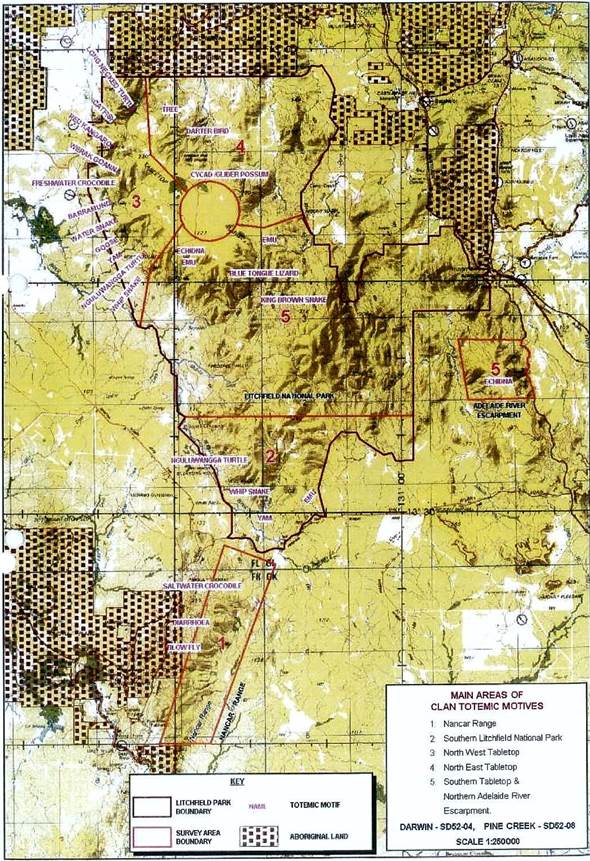
ANNEXURE – MAP OF AREA