FEDERAL COURT OF AUSTRALIA
Rivercity Motorway Finance Pty Ltd (Administrators Appointed) (Receivers and Managers Appointed) v AECOM Australia Pty Ltd (No 2) [2014] FCA 713
FEDERAL COURT OF AUSTRALIA
Rivercity Motorway Finance Pty Limited (Administrators Appointed) (Receivers and Managers Appointed) v AECOM Australia Pty Ltd (No 2) [2014] FCA 713
CORRIGENDUM
1. In paragraph [7], line 8, delete “cross-respondents” and in lieu thereof insert “representatives of the group members”. At the end of that sentence insert “for the purposes of the cross-claim.”
2. In paragraph [66], delete from final quote “Two cases may be mentioned in this connection.”
3. In paragraph [86], line 12, delete “plaintiff’s” and in lieu thereof insert “defendants’”.
4. In paragraph [87], line 1, delete “plaintiff’s” and in lieu thereof insert “defendants’”.
5. In paragraph [98], line 8, delete “possibly” and in lieu thereof insert “possibility”.
| I certify that the preceding five (5) numbered paragraphs are a true copy of the Corrigendum to the Reasons for Judgment herein of the Honourable Justice Nicholas. |
Associate:
Dated: 22 July 2014
| IN THE FEDERAL COURT OF AUSTRALIA | |
| DATE OF ORDER: | |
| WHERE MADE: |
THE COURT DIRECTS THAT:
1. The applicants are to file and serve a proposed minute of orders (incorporating a note of the relevant undertakings to be given by them) within 7 days.
2. The respondent is to serve a copy of its proposed re-pleaded first cross-claim within 7 days.
Note: Entry of orders is dealt with in Rule 39.32 of the Federal Court Rules 2011.
| IN THE FEDERAL COURT OF AUSTRALIA | |
| NEW SOUTH WALES DISTRICT REGISTRY | |
| GENERAL DIVISION | NSD 697 of 2012 |
| BETWEEN: | PORTIGON AG Applicant |
| AND: | AECOM AUSTRALIA PTY LTD ACN 093 846 925 Respondent |
| AND BETWEEN: | AECOM AUSTRALIA PTY LTD ACN 093 846 925 Cross-Claimant |
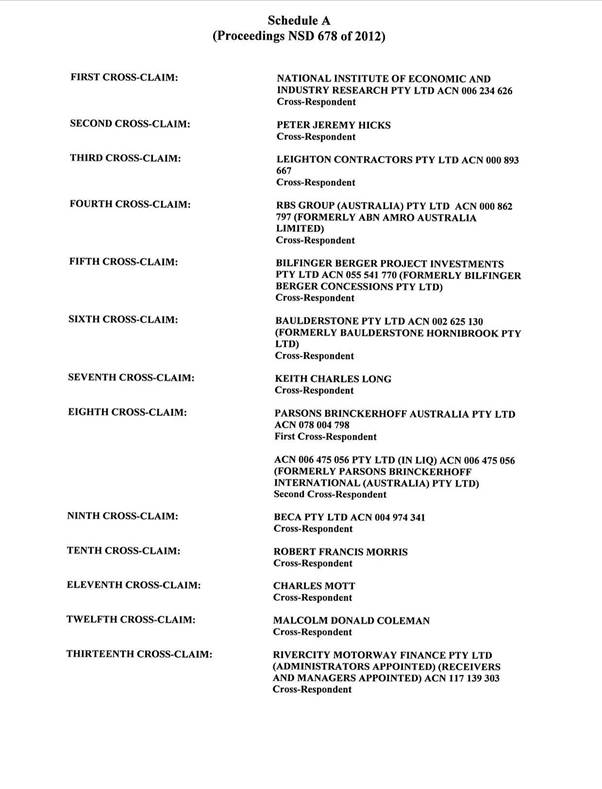
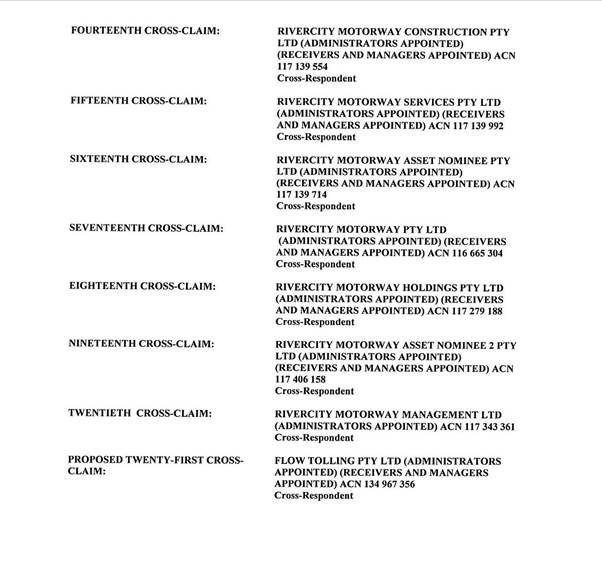
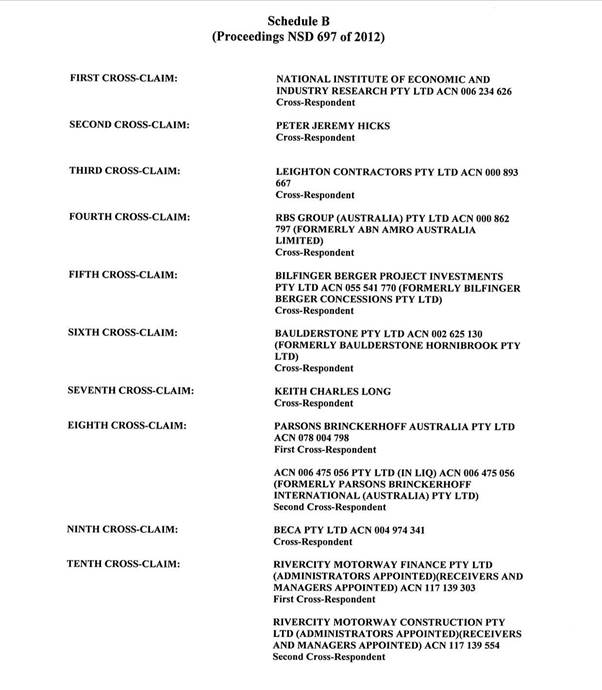
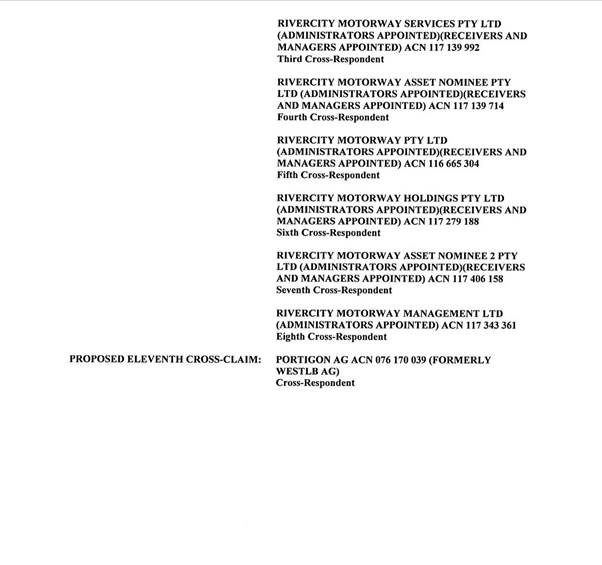
| AND: | PARTIES IN ATTACHED SCHEDULE B Cross-Respondents |
| JUDGE: | NICHOLAS J |
| DATE OF ORDER: | 18 July 2014 |
| WHERE MADE: | SYDNEY |
THE COURT DIRECTS THAT:
1. The applicant is to file and serve a proposed minute of order (incorporating a note of the relevant undertakings to be given by it) within 7 days.
2. The respondent is to serve a copy of its proposed re-pleaded first cross-claim within 7 days.
Note: Entry of orders is dealt with in Rule 39.32 of the Federal Court Rules 2011.
| IN THE FEDERAL COURT OF AUSTRALIA | |
| NEW SOUTH WALES DISTRICT REGISTRY | |
| GENERAL DIVISION | NSD 757 of 2012 |
| BETWEEN: | STEPHEN HOPKINS AS TRUSTEE FOR THE HOPKINS SUPERANNUATION FUND First Applicant KIM DENISE HOPKINS AS TRUSTEE FOR THE HOPKINS SUPERANNUATION FUND Second Applicant |
| AND: | AECOM AUSTRALIA PTY LTD ACN 093 846 925 First Respondent RIVERCITY MOTORWAY MANAGEMENT LTD (ADMINISTRATORS APPOINTED) ACN 117 343 361 Second Respondent RIVERCITY MOTORWAY SERVICES PTY LTD (ADMINISTRATORS APPOINTED) (RECEIVERS AND MANAGERS APPOINTED) ACN 117 139 992 Third Respondent |
| AND BETWEEN: | AECOM AUSTRALIA PTY LTD ACN 093 846 925 Cross-Claimant |
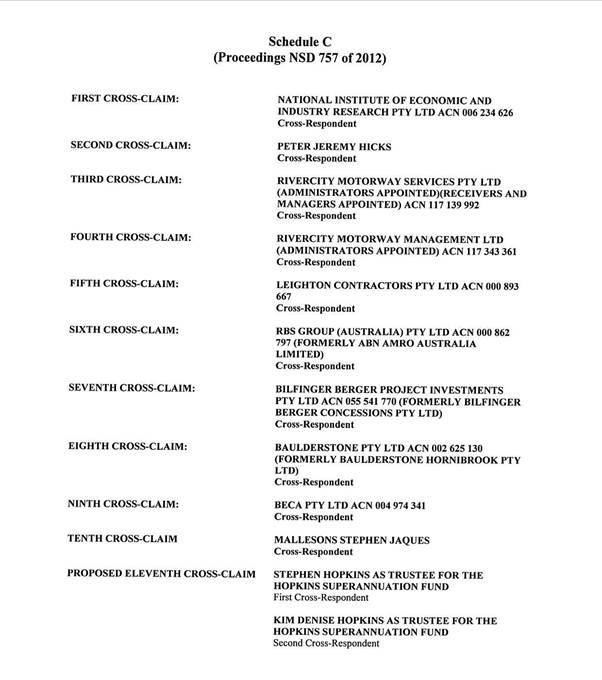
| AND: | PARTIES IN ATTACHED SCHEDULE C Cross-Respondents |
| JUDGE: | NICHOLAS J |
| DATE OF ORDER: | 18 July 2014 |
| WHERE MADE: | SYDNEY |
THE COURT DIRECTS THAT:
1. The applicants are to file and serve a proposed minute of order within 7 days.
Note: Entry of orders is dealt with in Rule 39.32 of the Federal Court Rules 2011.
| NEW SOUTH WALES DISTRICT REGISTRY | |
| GENERAL DIVISION | NSD 678 of 2012 |
| BETWEEN: | RIVERCITY MOTORWAY FINANCE PTY LTD (ADMINISTRATORS APPOINTED) (RECEIVERS AND MANAGERS APPOINTED) ACN 117 139 303 First Applicant RIVERCITY MOTORWAY CONSTRUCTION PTY LTD (ADMINISTRATORS APPOINTED) (RECEIVERS AND MANAGERS APPOINTED) ACN 117 139 554 Second Applicant RIVERCITY MOTORWAY SERVICES PTY LTD (ADMINISTRATORS APPOINTED) (RECEIVERS AND MANAGERS APPOINTED) ACN 117 139 992 Third Applicant RIVERCITY MOTORWAY ASSET NOMINEE PTY LTD (ADMINISTRATORS APPOINTED) (RECEIVERS AND MANAGERS APPOINTED) ACN 117 139 714 Fourth Applicant RIVERCITY MOTORWAY PTY LTD (ADMINISTRATORS APPOINTED)(RECEIVERS AND MANAGERS APPOINTED) ACN 116 665 304 Fifth Applicant RIVERCITY MOTORWAY HOLDINGS PTY LTD (ADMINISTRATORS APPOINTED) (RECEIVERS AND MANAGERS APPOINTED) ACN 117 279 188 Sixth Applicant RIVERCITY MOTORWAY ASSET NOMINEE 2 PTY LTD (ADMINISTRATORS APPOINTED) (RECEIVERS AND MANAGERS APPOINTED) ACN 117 406 158 Seventh Applicant FLOW TOLLING PTY LTD (ADMINISTRATORS APPOINTED) (RECEIVERS AND MANAGERS APPOINTED) ACN 134 967 356 Eighth Applicant |
| AND: | AECOM AUSTRALIA PTY LTD Respondent |
| AND BETWEEN: | AECOM AUSTRALIA PTY LTD Cross-Claimant |
| AND: | PARTIES IN ATTACHED SCHEDULE A Cross-Respondents |
| IN THE FEDERAL COURT OF AUSTRALIA | |
| NEW SOUTH WALES DISTRICT REGISTRY | |
| GENERAL DIVISION | NSD 697 of 2012 |
| BETWEEN: | PORTIGON AG Applicant |
| AND: | AECOM AUSTRALIA PTY LTD Respondent |
| AND BETWEEN: | AECOM AUSTRALIA PTY LTD Cross-Claimant |
| AND: | PARTIES IN ATTACHED SCHEDULE B Cross-Respondents |
| IN THE FEDERAL COURT OF AUSTRALIA | |
| NEW SOUTH WALES DISTRICT REGISTRY | |
| GENERAL DIVISION | NSD 757 of 2012 |
| BETWEEN: | STEPHEN HOPKINS AS TRUSTEE FOR THE HOPKINS SUPERANNUATION FUND First Applicant KIM DENISE HOPKINS AS TRUSTEE FOR THE HOPKINS SUPERANNUATION FUND Second Applicant |
| AND: | AECOM AUSTRALIA PTY LTD ACN 093 846 925 (FORMERLY KNOWN AS MAUNSELL AUSTRALIA PTY LTD) First Respondent RIVERCITY MOTORWAY MANAGEMENT LTD (ADMINISTRATORS APPOINTED) ACN 117 343 361 Second Respondent RIVERCITY MOTORWAY SERVICES PTY LTD (ADMINISTRATORS APPOINTED)(RECEIVERS AND MANAGERS APPOINTED) ACN 117 139 992 Third Respondent |
| AND BETWEEN: | AECOM AUSTRALIA PTY LTD Cross-Claimant |
| AND: | PARTIES IN ATTACHED SCHEDULE C Cross-Respondents |
| JUDGE: | NICHOLAS J |
| DATE: | 18 JULY 2014 |
| PLACE: | SYDNEY |
REASONS FOR JUDGMENT
INTRODUCTION
1 AECOM Australia Pty Ltd (AECOM) is the subject of claims brought against it by the former owners and operators of the CLEM 7 tunnel (the RCM Proceedings), one of the joint lead arrangers of the finance for the CLEM 7 project (the Portigon Proceedings) and a class of investors in stapled units issued in relation to the CLEM 7 tunnel (the Class Action) (together, the CLEM 7 Proceedings).
2 AECOM prepared various traffic forecasts in relation to the then proposed tunnel which the applicants in the CLEM 7 Proceedings allege they relied upon. It is alleged that the volume of traffic using the CLEM 7 tunnel once it became operational was significantly below what was forecast.
3 The applicants in both the RCM Proceedings and the Portigon Proceedings seek damages from AECOM, pursuant to ss 82 and/or 87 of the Trade Practices Act 1974 (Cth) (the TPA) (as it then was) arising from an alleged contravention of s 52 of the TPA. Central to that case is the allegation that AECOM did not have reasonable grounds for making its traffic forecasts. In both cases the applicants also allege negligence on the part of AECOM.
4 In the Class Action, the applicants allege that AECOM is liable under s 1022B of the Corporations Act 2001 (Cth) (the Corporations Act) for a contravention of s 1021L of the Act (consenting to material for inclusions in a Product Disclosure Statement (PDS) that it is alleged was misleading or contained material omissions). The Class Action applicants similarly allege negligence on the part of AECOM.
5 The combined damages sought in the CLEM 7 Proceedings are very substantial. AECOM is the sole respondent to each of the RCM Proceedings and the Portigon Proceedings. In the RCM Proceedings and the Portigon Proceedings, the RCM applicants and Portigon have made clear in their submissions that they have no intention of applying to join any of the cross-respondents against whom AECOM has filed cross-claims as respondents in either of those proceedings.
6 The RCM applicants’ and Portigon’s claims against AECOM are for pure economic loss which is alleged to have been caused by conduct in contravention of s 52 of the TPA and by AECOM’s breach of a common law duty of care which AECOM is alleged to have owed to the RCM applicants and Portigon. In respect of the s 52 allegations, the applicants claim damages under s 82 and/or s 87 of the TPA. Common law damages are also sought in respect of the negligence claims. AECOM has pleaded proportionate liability defences in answer to both the s 82 claims and the negligence claims relying upon Pt VIA of the TPA in respect of the s 82 claims and Pt 4 of the Civil Liability Act 2002 (NSW) (the NSW Act) and Pt 2, ss 28-33 of the Civil Liability Act 2003 (Qld) (the Qld Act) in respect of the negligence claims.
7 There are various interlocutory applications dealt with in these reasons. In both the RCM Proceedings and the Portigon Proceedings there are applications by AECOM to file amended (or proposed) cross-claims against a total of 23 named cross-respondents and applications by AECOM to join various cross-respondents as respondents to each proceeding. In the Class Action there is an application by AECOM for leave to file a cross-claim seeking declaratory relief in that proceeding against the applicants, Mr and Mrs Hopkins (the Hopkins applicants), and the group members. AECOM also seeks an order appointing the Hopkins applicants as cross-respondents pursuant to r 9.21(2) of the Federal Court Rules 2011 (Cth) (the Federal Court Rules).
8 The cross-respondents in the RCM Proceedings and the Portigon Proceedings are already parties in that there are existing cross-claims filed by AECOM against each of them with the exception of Flow Tolling Pty Ltd (Administrators Appointed) (Receivers & Managers Appointed) (Flow Tolling) and Portigon AG (Portigon) both of which are applicants in the RCM Proceedings and the Portigon Proceedings respectively.
9 The form of the existing cross-claims has been the subject of much complaint by the cross-respondents which has prompted AECOM to revise and re-plead them. I was informed by Senior Counsel for AECOM, Dr Bell SC, that AECOM has also provided extensive particulars in response to requests received from the cross-respondents. AECOM now applies for leave to file its proposed amended cross-claims (the RCM/Portigon cross-claims).
10 The applications for leave to file the RCM/Portigon cross-claims are opposed on substantive grounds. The principal issues are whether leave to amend the cross-claims should be refused on the ground that AECOM has no reasonable prospects of obtaining the relief it seeks or whether there is some other discretionary reason for refusing such leave. A further issue is whether it is either necessary or desirable to join the cross-respondents who are not already applicants (or at least some of them) as respondents to the RCM Proceedings or the Portigon Proceedings.
BACKGROUND TO THE RCM/PORTIGON CROSS-CLAIMS
11 Each of the RCM/Portigon cross-claims seeks a declaration that the relevant cross-respondent is a concurrent wrongdoer, and also claims equitable and statutory contribution. In the RCM Proceedings, the cross-claims brought against Leighton Contractors Pty Ltd, RBS Group (Australia) Pty Ltd, Baulderstone Pty Ltd and Bilfinger Berger Project Investments Pty Ltd (the Sponsor Clients) seek a declaration pertaining to a contract (the AECOM contract) upon which AECOM relies in its defence to the RCM Proceedings but upon which the Sponsor Clients are not themselves sued. The contract declaration is also sought against Rivercity Motorway Management Limited (Administrators Appointed) (RCMML). In essence, AECOM alleges that it was retained by the Sponsor Clients not only on their own behalf, but also for and on behalf of the RCM applicants and RCMML who were at that time yet to be incorporated. The AECOM contract is said to be significant because it includes provisions that may effectively exclude or limit AECOM’s liability to the RCM applicants in relation to the traffic forecasting work which it undertook.
12 The principal relief claimed by AECOM against each of the RCM applicants in the proposed amended cross-claims is as follows:
1. Declarations that:
(a) AECOM Australia’s Contract, as defined at paragraph 15 of the Further Amended Defence, was a pre-registration contract, within the meaning of section 131 of the Corporations Act 2001 (Cth), that was entered into by the Sponsor Clients, both on their own behalf and acting for each of the RCM SPVs which became the RCM Group and Flow Tolling;
(b) each member of the RCM Group and Flow Tolling, after its respective registration and by its conduct as alleged at paragraph 68 of the Further Amended Defence, ratified and thereby became bound by, AECOM Australia's Contract;
(c) it would be unconscionable, by reason of the matters alleged at paragraph 114 of the Further Amended Defence, for any one or more of the Applicants:
(i) to depart from the condition and express basis upon which AECOM Australia provided the December 2005 Traffic Reports to it or them (the provision of which to Flow Tolling is not admitted), being the December 2005 Traffic Report External Events Release as defined at paragraph 114(a)(v); and
(ii) to seek to hold AECOM Australia responsible for the Applicants’ or any of their, reliance upon the December 2005 Traffic Report;
(d) it would be unconscionable, by reason of the matters alleged at paragraph 117 of the Further Amended Defence, for any one or more of the Applicants:
(i) to depart from the condition and express basis upon which AECOM Australia provided the April 2006 NSBT Traffic Supplement to it or them (the provision of which to Flow Tolling is not admitted), being the April 2006 NSBT Traffic Supplement External Events Release as defined at paragraph 117(g); and
(ii) to seek to hold AECOM Australia responsible for the Applicants’ or any of their, reliance upon the April 2006 NSBT Traffic Supplement;
(e) it would be unconscionable, by reason of the matters alleged at paragraph 120 of the Further Amended Defence, for any one or more of the Applicants:
(i) to depart from the condition and express basis upon which AECOM Australia provided the May 2006 Traffic Report to it or them (the provision of which to Flow Tolling is not admitted), being the May 2006 Traffic Report External Events Release as defined at paragraphs 120(a)(v); and
(ii) to seek to hold AECOM Australia responsible for the Applicants’ or any of their, reliance upon the May 2006 Traffic Report;
(f) by reason of the matters alleged at paragraph 148 of the Further Amended Defence, the Claims Discharge, as defined at paragraph 13(j) of the Further Amended Defence, discharged AECOM Australia from any liability in respect of the TPA Claims, as defined at paragraph 146 of the Further Amended Defence, by no later than 16 March 2012, being a date prior to the commencement of this proceeding;
(g) by reason of the matters alleged at paragraph 149 of the Further Amended Defence, the Claims Discharge, as defined at paragraph 13(j) of the Further Amended Defence, discharged AECOM Australia from any liability in respect of the Negligence Claims, as defined at paragraph 147 of the Further Amended Defence, by no later than 16 March 2012, being a date prior to the commencement of this proceeding;
(h) each Applicant is required, by reason of the matters alleged at paragraph 150 of the Further Amended Defence, to accept full responsibility for and to hold AECOM Australia harmless from, the Applicant’s Claims, as defined in paragraph 150, so as to effect a full release of the Applicant’s Claims;
(i) by reason of the matters alleged at paragraph 151 of the Further Amended Defence, AECOM Australia and each Applicant became parties to the December 2005 External Change Events Contract, the April 2006 NSBT Traffic Supplement External Events Change Contract and the May 2006 External Change Events Contract, with the consequence that AECOM Australia is entitled to set off its Proceedings Damages, as defined at paragraph 151 (f)(ii), and any Recovery Damages, as defined at paragraph 151(f)(iii), in full against any Applicant’s Claims Recovery, as defined at paragraph 151(f)(iii);
(j) by reason of the matters alleged at paragraphs 13(g) and (h), 68 and 137(d) of the Further Amended Defence, AECOM Australia's maximum liability to the Applicants or, in the alternative, any Applicant, in respect of the TPA Claims, as defined at paragraph 146 of the Further Amended Defence, is:
(i) limited by reason of the Indirect Loss Exclusion, as defined at paragraph 13(g) of the Further Amended Defence, to loss or damage directly caused by any negligent act, error or omission by AECOM Australia; and
(ii) then further limited, by reason of the Liability Cap, as defined at paragraph 13(h) of the Further Amended Defence, to $5 million;
(k) by reason of the matters alleged at paragraphs 13(g) and (h), 68 and 144(b) of the Further Amended Defence, AECOM Australia's maximum liability to the Applicants or, in the alternative, any Applicant, in respect of the Negligence Claims, as defined at paragraph 147 of the Further Amended Defence, is:
(i) limited by reason of the Indirect Loss Exclusion, as defined at paragraph 13(g) of the Further Amended Defence, to loss or damage caused by any negligent act, error or omission by AECOM Australia; and
(ii) then further limited, by reason of the Liability Cap, defined at paragraph 13(h) of the Further Amended Defence, to $5 million;
(l) the Cross-respondent is a concurrent wrongdoer;
(m) the Cross-respondent independently caused the loss, either in whole or in part, the subject of the claim made by the [other] Applicants in these proceedings;
(n) the Cross-respondent is liable in whole or in part for that loss; and
(o) the liability of the Cross-claimant (if any) is limited to an amount reflecting that proportion of the damage or loss claimed that the Court considers just having regard to the extent of the Cross-respondent's responsibility for the damage or loss, pursuant to:
(i) Part VIA of the Trade Practices Act 1974 (Cth); and
(ii) Part 4 of the Civil Liability Act 2002 (NSW); or, in the alternative:
(iii) Part 2, sections 28 to 33 of the Civil Liability Act 2003 (Qld).
2. Contribution in equity.
3. Contribution under statute.
13 The principal relief claimed by AECOM in the proposed amended cross-claims against each of the Sponsor Clients in the RCM Proceedings is as follows:
1. Declarations that:
(a) AECOM Australia’s Contract, as defined at paragraph 15 of the Further Amended Defence, was a pre-registration contract, within the meaning of section 131 of the Corporations Act 2001 (Cth), that was entered into by the Sponsor Clients, both on their own behalf and acting for each of the RCM SPVs which became the RCM Group and Flow Tolling;
(b) the Cross-respondent is a concurrent wrongdoer;
(c) the Cross-respondent independently caused the loss, either in whole or in part, the subject of the claim made by the Applicants in these proceedings;
(d) the Cross-respondent is liable in whole or in part for that loss; and
(e) the liability of the Cross-claimant (if any) is limited to an amount reflecting that proportion of the damage or loss claimed that the Court considers just having regard to the extent of the Cross-respondent's responsibility for the damage or loss, pursuant to:
(i) Part VIA of the Trade Practices Act 1974 (Cth); and
(ii) Part 4 of the Civil Liability Act 2002 (NSW); or, in the alternative:
(iii) Part 2, sections 28 to 33 of the Civil Liability Act 2003 (Qld).
2. Contribution in equity.
3. Contribution under statute.
14 The contract declaration is sought only against each of the Sponsor Clients, RCMML and the RCM applicants. Otherwise, the same relief is sought against most other cross-respondents. National Institute of Economic and Industry Research Pty Ltd (NIEIR), one of the existing cross-respondents, is an exception because there is a claim for damages made against it by AECOM for (inter alia) an alleged breach of a duty of care which is alleged to have been owed by NIEIR to AECOM.
AECOM’S ARGUMENTS IN FAVOUR OF THE CONTRIBUTION CLAIMS
15 The first question is whether or not it is open to AECOM to seek contribution by way of cross-claim in the RCM Proceedings and the Portigon Proceedings. AECOM advances three arguments as to why it should be permitted to file and maintain cross-claims seeking contribution against each of the cross-respondents in the RCM Proceedings and the Portigon Proceedings. In summary, AECOM submitted as follows:
(a) The proportionate liability defence relied upon by AECOM, assuming it otherwise applies, may be limited in its operation to the claim for damages made against AECOM under s 82 of the TPA. The applicants in the RCM Proceedings and the Portigon Proceedings also bring claims against AECOM for damages under s 87 of the TPA in addition, or in the alternative, to the claims for damages under s 82.
(b) On the proper construction of s 87CD(l) of the TPA, an award of damages under s 82 may, but is arguably not required to be, in direct proportion to AECOM’s assessed share of proportionate responsibility for the loss claimed, and may exceed that share. If it exceeds that assessed share, which will not and cannot be known until the conclusion of the hearing, AECOM should be entitled to seek contribution from other concurrent wrongdoers, at least to the extent that any damages AECOM is ordered to pay exceed its assessed share of responsibility for the RCM applicants’ or Portigon’s loss.
(c) The Court cannot determine whether or not cross-claims for contribution will be otiose, and thus liable to be struck out as lacking utility, until the Court has determined that AECOM is a “concurrent wrongdoer”. Any liability of AECOM will only attract the operation of s 87CD(l) if it is held to be a concurrent wrongdoer. The weight of authority supports the view that the issue of whether or not particular parties are concurrent wrongdoers should not be determined until judgment.
SUMMARY DISMISSAL
16 The application to file the RCM/Portigon cross-claims is resisted by the cross-respondents on the ground that they have no reasonable prospects of success and would be amenable to summary dismissal pursuant to s 31A of the Federal Court of Australia Act 1976 (Cth) (the FCA Act).
17 Section 31A of the FCA Act was considered by the High Court in Spencer v The Commonwealth of Australia (2010) 241 CLR 118. All members of the High Court who addressed the meaning and effect of s 31A recognised that the power to summarily terminate a proceeding is not to be exercised lightly and must be exercised with caution (see French CJ and Gummow J at [24], Hayne, Crennan, Kiefel and Bell JJ at [60]). Of course, the power may only be exercised if the Court is satisfied that the proceeding as a whole, or some relevant part of it, has no reasonable prospect of success.
18 Hayne, Crennan, Kiefel and Bell JJ emphasised (at [56]-[59]) the use of the phrase “no reasonable prospect” in s 31A and the undesirability of judicial glossing of those words. Their Honours also emphasised that various epithets used prior to the enactment of s 31A to describe the degree of confidence which a Court should possess with respect to the prospects of a proceeding succeeding before the Court might properly exercise its power to summarily dismiss (eg. “clearly untenable” or “manifestly frivolous”) may no longer be sufficient for that purpose. French CJ and Gummow J said (at [25]) that subs 31A(2) “requires a practical judgment by the Federal Court as to whether the applicant has more than a ‘fanciful’ prospect of success” and that summary judgment should not be awarded to a respondent merely because the Court is of the view that the applicant is unlikely to succeed on some relevant factual issue.
19 Also relevant is r 16.21(1) of the Federal Court Rules which permits a party to apply to the Court for an order that all or part of a pleading be struck out on the ground that the pleading (inter alia) is likely to cause prejudice, embarrassment or delay in the proceedings (subpara (d)), fails to disclose a reasonable cause of action or defence or other case appropriate to the nature of the pleading (subpara (e)) or is otherwise an abuse of the process of the Court (subpara (f)). Rule 16.21(1) is a “civil practice and procedure provision” for the purposes of s 37M of the FCA Act (see [99] below) and must be interpreted and applied in light of the “overarching purpose” referred to in that section and the obligation imposed by s 37M(3). There are many different situations in which r 16.21(1) might be engaged. For present purposes it is sufficient to say that it can be engaged to strike out a pleading which seeks declaratory relief that lacks any utility.
PART VI OF THE TPA
20 The relevant provisions of the TPA (as it stood at the relevant times) provide as follows. Section 82(1) relevantly provides that a person who suffers loss or damage by conduct of another person that was done in contravention of a provision of Part V may recover the amount of the loss or damage by action against that other person or against any person involved in the contravention. Section 82(2) provides that an action under s 82(1) must be commenced within 6 years after the day on which the cause of action that relates to the conduct accrued.
21 Section 82(1B) is concerned with the reduction of damages recoverable under s 82(1) on account of the applicant’s share of responsibility for the loss or damage which he or she has suffered. Section 82(1B) provides:
Despite subsection (1), if:
(a) a person (the claimant) makes a claim under subsection (1) in relation to:
(i) economic loss; or
(ii) damage to property;
caused by conduct of another person (the defendant) that was done in contravention of section 52; and
(b) the claimant suffered the loss or damage:
(i) as a result partly of the claimant’s failure to take reasonable care; and
(ii) as a result partly of the conduct referred to in paragraph (a); and
(c) the defendant:
(i) did not intend to cause the loss or damage; and
(ii) did not fraudulently cause the loss or damage;
the damages that the claimant may recover in relation to the loss or damage are to be reduced to the extent to which the court thinks just and equitable having regard to the claimant’s share in the responsibility for the loss or damage.
22 Section 87(1) relevantly provides that, in a proceeding instituted under Part VI (which includes s 82), where the Court finds that a person who is a party to the proceeding has suffered, or is likely to suffer, loss or damage by conduct of another person that was engaged in in the contravention of (inter alia) s 52, the Court may make such order or orders as it thinks appropriate against the person who engaged in such contravention if the Court considers that such order or orders will compensate the person who has suffered, or is likely to suffer, such loss or damage in whole or in part or will prevent or reduce such loss or damage.
23 Section 87(1A) relevantly provides that the Court may, on the application of a person who has suffered, or is likely to suffer, loss or damage by conduct of another person that was engaged in in contravention of (inter alia) Part V of the TPA, make such order or orders as the Court thinks appropriate against the person who engaged in the conduct if the Court considers that the order or orders concerned will compensate the person who made the application in whole or in part for the loss or damage suffered or prevent or reduce the loss or damage suffered, or likely to be suffered, by such a person.
24 Section 87(1CA) provides that an application under s 87(1A) may be made at any time within 6 years after the day on which the cause of action that relates to the contravening conduct accrued. Section 87(2) identifies various orders that may be made under s 87(1) or (1A). These include (in sub-para (d)) an order directing the person who engaged in the contravening conduct to pay to the person who suffered the loss or damage, the amount of that loss or damage.
PART VIA OF THE TPA
25 Part VIA of the TPA is headed “Proportionate liability for misleading and deceptive conduct”. It relevantly includes ss 87CB – 87CD and ss 87CF – 87CH which provide as follows:
(1) This Part applies to a claim (an apportionable claim) if the claim is a claim for damages made under section 82 for:
(a) economic loss; or
(b) damage to property;
caused by conduct that was done in a contravention of section 52.
(2) For the purposes of this Part, there is a single apportionable claim in proceedings in respect of the same loss or damage even if the claim for the loss or damage is based on more than one cause of action (whether or not of the same or a different kind).
(3) In this Part, a concurrent wrongdoer, in relation to a claim, is a person who is one of 2 or more persons whose acts or omissions (or act or omission) caused, independently of each other or jointly, the damage or loss that is the subject of the claim.
(4) For the purposes of this Part, apportionable claims are limited to those claims specified in subsection (1).
(5) For the purposes of this Part, it does not matter that a concurrent wrongdoer is insolvent, is being wound up or has ceased to exist or died.
87CC Certain concurrent wrongdoers not to have benefit of apportionment
(1) Nothing in this Part operates to exclude the liability of a concurrent wrongdoer (an excluded concurrent wrongdoer) in proceedings involving an apportionable claim if:
(a) the concurrent wrongdoer intended to cause the economic loss or damage to property that is the subject of the claim; or
(b) the concurrent wrongdoer fraudulently caused the economic loss or damage to property that is the subject of the claim.
(2) The liability of an excluded concurrent wrongdoer is to be determined in accordance with the legal rules (if any) that (apart from this Part) are relevant.
(3) The liability of any other concurrent wrongdoer who is not an excluded concurrent wrongdoer is to be determined in accordance with the provisions of this Part.
87CD Proportionate liability for apportionable claims
(1) In any proceedings involving an apportionable claim:
(a) the liability of a defendant who is a concurrent wrongdoer in relation to that claim is limited to an amount reflecting that proportion of the damage or loss claimed that the court considers just having regard to the extent of the defendant’s responsibility for the damage or loss; and
(b) the court may give judgment against the defendant for not more than that amount.
(2) If the proceedings involve both an apportionable claim and a claim that is not an apportionable claim:
(a) liability for the apportionable claim is to be determined in accordance with the provisions of this Part; and
(b) liability for the other claim is to be determined in accordance with the legal rules, if any, that (apart from this Part) are relevant.
(3) In apportioning responsibility between defendants in the proceedings:
(a) the court is to exclude that proportion of the damage or loss in relation to which the plaintiff is contributorily negligent under any relevant law; and
(b) the court may have regard to the comparative responsibility of any concurrent wrongdoer who is not a party to the proceedings.
(4) This section applies in proceedings involving an apportionable claim whether or not all concurrent wrongdoers are parties to the proceedings.
(5) A reference in this Part to a defendant in proceedings includes any person joined as a defendant or other party in the proceedings (except as a plaintiff) whether joined under this Part, under rules of court or otherwise.
…
87CF Contribution not recoverable from defendant
A defendant against whom judgment is given under this Part as a concurrent wrongdoer in relation to an apportionable claim:
(a) cannot be required to contribute to any damages or contribution recovered from another concurrent wrongdoer in respect of the apportionable claim (whether or not the damages or contribution are recovered in the same proceedings in which judgment is given against the defendant); and
(b) cannot be required to indemnify any such wrongdoer.
87CG Subsequent actions
(1) In relation to an apportionable claim, nothing in this Part or any other law prevents a plaintiff who has previously recovered judgment against a concurrent wrongdoer for an apportionable part of any damage or loss from bringing another action against any other concurrent wrongdoer for that damage or loss.
(2) However, in any proceedings in respect of any such action, the plaintiff cannot recover an amount of damages that, having regard to any damages previously recovered by the plaintiff in respect of the damage or loss, would result in the plaintiff receiving compensation for damage or loss that is greater than the damage or loss actually sustained by the plaintiff.
87CH Joining non-party concurrent wrongdoer in the action
(1) The court may give leave for any one or more persons to be joined as defendants in proceedings involving an apportionable claim.
(2) The court is not to give leave for the joinder of any person who was a party to any previously concluded proceedings in respect of the apportionable claim.
THE SECTION 87 ARGUMENT
26 AECOM submitted that the most obvious reason why cross-claims for contribution are appropriate is that, to the extent that the RCM applicants seek an award of damages pursuant to s 87 of the TPA, the proportionate liability regime does not apply, and it would be open to the Court to order AECOM to meet the entirety of the RCM applicants’ loss, even though it may take the view that other companies or individuals also contributed to that loss in a causative way. AECOM also referred to differences in the operation of s 82 and s 87 which, it was said, might produce significantly different outcomes in the circumstances of this case. In particular, it submitted that there may be a difference between outcomes because, unlike the RCM applicants’ claims under s 82, their claims under s 87 might not be reduced to take account of any findings of contributory negligence which would result in a reduction of any amount recoverable by the RCM applicants under s 82. Accordingly, AECOM submitted that it should be permitted to cross-claim for contribution from the RCM applicants and other cross-respondents against the possibility that the RCM applicants might recover damages under s 87 free of any deduction for proven contributory negligence or concurrent wrongdoing that would have to be made if damages are or were also assessed under s 82.
27 It was also submitted by AECOM that the RCM applicants’ claims against it under s 82 might be time barred and yet the RCM applicants might still recover under s 87. On this basis, AECOM submitted that it should be permitted to seek contribution from the RCM applicants against the possibility that the RCM applicants might not recover under s 82 but still obtain an award of damages under s 87.
28 In support of its submission that a claim under s 87 might not be an apportionable claim AECOM relied upon two decisions of this Court. The first is the decision of Finkelstein J in BHPB Freight Pty Ltd v Cosco Oceania Chartering Pty Ltd (No 2) [2008] FCA 1656 (BHPB Freight). The matter to which his Honour’s judgment relates concerned a proposed cross-claim for damages under s 82 or s 87 for an alleged contravention of s 52, and damages for negligent misstatement and breach of warranty of authority. In its defence to the applicant’s claim against it, the respondent (Cosco) relied upon s 87CD of the TPA and s 24AI of the Wrongs Act 1958 (Vic). His Honour refused to permit Cosco to seek by way of cross-claim an order that its liability be limited pursuant to s 87CD of the TPA. His Honour said at [9] that the only claim brought against Cosco under the TPA that was an apportionable claim under Pt VIA was the claim for damages pursuant to s 82 for a contravention of s 52. His Honour said that the claim under s 87 did not fall within the scope of Pt VIA as it was not a claim for damages under s 82. His Honour concluded, at [13], that he could see no reason why a claim for contribution in respect of the s 87 claim should not be permitted to be made.
29 BHPB Freight involved an application for leave to issue a cross-claim for contribution to any amount of compensation under s 87 which was resisted on the basis that it was not arguable. Finkelstein J’s reasons make clear that he was not willing to reject such a claim on that basis. The matter appears to have been heard on the papers and, as best one can tell from his Honour’s reasons, no contrary argument based upon the meaning and effect of s 87CB(2) was considered. Further, it does not appear to have been argued that, even if the claim under s 87 was not an “apportionable claim”, claims for contribution would be bound to fail because under s 87 the applicant could not recover from the respondent seeking contribution any amount of damages or compensation greater than that which would be recoverable by the applicant under s 82.
30 The other decision upon which AECOM placed reliance was the decision of Reeves J in Bennett v Elysium Noosa Pty Ltd (in liq) (2012) 202 FCR 72 (Bennett). Reeves J said at [274]-[276]:
[274] The background history to the introduction of Pt VIA outlined by Finkelstein J in BHPB demonstrates that it was introduced for a particular purpose, viz professional indemnity claims where the proportionate culpability of the professionals concerned was relatively small, but their capacity to pay was relatively large. Consistent with this purpose, the language used in s 87CB is very specifically confined to particular claims for damages for particular contravening conduct. Whether or not the legislature has hit its intended target with this language is a matter that I do not need to determine in this case.
[275] However, for present purposes, I consider it is plain that s 87CB does not apply to claims for damages made under s 87(1A), or to claims where the damages are caused by false or misleading representations in contravention of s 53A(1) of the TPA. If the legislature had intended that s 87CB was to apply to all claims for loss or damage under the TPA, it could very easily have done that by omitting the words “made under s 82” from that section. It has not chosen to do so. Similarly, if the legislature had intended s 87CB to apply to any claim for conduct in contravention of any of the provisions of Pt V of the TPA, it could very easily have done that by referring to that Part, rather than specifically referring to “a contravention of s 52”. Again, it has not chosen to do so.
[276] Taking into account these aspects of the purpose, context and language of s 87CB, I do not therefore consider it applies in this case, insofar as it involves claims under s 87(1A) for a contravention of s 53A. In other words, neither of those components of the claims in this case is an apportionable claim under s 87CB(1) of the TPA.
It is apparent from [275] of his Honour’s reasons that he was of the view that a claim for damages or compensation under s 87(1A) for economic loss caused by conduct in contravention of s 52 was not an apportionable claim.
31 Subsequent to the hearing of these applications, on 30 May 2014, a Full Court handed down judgment in Wealthsure Pty Ltd v Selig [2014] FCAFC 64 (Wealthsure) and, on 6 June 2014, a different Full Court handed down judgment in ABN AMRO Bank NV v Bathurst Regional Council [2014] FCAFC 65 (ABN AMRO).
32 In ABN AMRO, the Full Court (Jacobson, Gilmour and Gordon JJ) disagreed with the majority decision in Wealthsure (Mansfield and Besanko JJ, White J dissenting). Both Full Court decisions concerned the operation of the proportionate liability provisions of the Corporations Act and the Australian Securities and Investments Commission Act 2001 (Cth) (ASIC Act). Both cases focused on the meaning and effect of Part 7.10 Div 2A (ss 1041L – 1041S) of the Corporations Act entitled “Proportionate liability for misleading and deceptive conduct”.
33 Section 1041L(1) of the Corporations Act provides:
This Division applies to a claim (an apportionable claim) if the claim is a claim for damages made under section 1041I for:
(a) economic loss; or
(b) damage to property;
caused by conduct that was done in a contravention of section 1041H.
Each of subss (2)-(5) of s 1041L is in identical, or near identical, terms to subss 87CB(2)-(5) of the TPA.
34 In ABN AMRO the Full Court held that only those claims made by the applicants under s 1041I for economic loss caused by conduct in contravention of s 1041H were apportionable. Other causes of action arising under (inter alia) s 1041E, upon which the applicants also relied, were not apportionable.
35 In their written submissions, the RCM applicants and Portigon did not dispute that a claim under s 87 cannot be an apportionable claim. However, in oral submissions, Mr Bannon SC supported the submissions advanced by other cross-respondents including, in particular, those made by Mr Smith SC for Mr Hicks and Leighton Contractors Pty Ltd, to the effect that the RCM applicants’ and Portigon’s claims against AECOM for damages or compensation under s 87 were apportionable claims.
36 The crux of Mr Smith’s argument was that s 87CB(2) can pick up both apportionable and non-apportionable claims for the same loss and damage. This is the same argument that was advanced in relation to s 1041L(2) of the Corporations Act in ABN AMRO and Wealthsure. It was accepted by the majority in Wealthsure but rejected by the Full Court in ABN AMRO.
37 In Wealthsure, Mansfield J referred to s 1041L(2) and (3) of the Corporations Act and said at [10]-[11]:
[10] In my view, those provisions tend to indicate that the appropriate focus is upon whether the claim or claims made in a particular matter, in this case the claims of the Seligs, are in respect of the same loss or damage. The focus is upon the nature of the loss or damage for which relief is sought, rather than upon the nature of the cause of action or causes of action which give rise to the entitlement to that loss or damage. That is fortified by the parenthesised words in s 1041L(2) which contemplates that the causes of action giving rise to the same loss or damage need not be of the same kind. Section 1041L(3) then defines a ‘concurrent wrongdoer’ in relation to a claim as one or more of the persons whose acts or omissions caused the loss or damage which is the subject of the apportionable claim. The combination of those two subsections, in my view, indicates a legislative intention that an apportionable claim is one where a claim for damages for economic loss caused by a contravention of s 1041H succeeds. Provided that there is a separate cause or other causes of action against the person or persons who have contravened s 1041H, if that other or those other causes of action have caused the same damage, the claim maintains its character as an apportionable claim. Provided there is another cause or other causes of action against that person or other persons, that person or other persons will be a concurrent wrongdoer if that person’s acts or omissions caused the same loss or damage. Indeed, for the purposes of this appeal, it is not necessary to go quite so far. That is because each of Mr Norton and Mr Townley (as well as Wealthsure and Mr Bertram) were found to have contravened s 1041H as well as other provisions, and by their respective contraventions of s 1041H to have caused or contributed to causing the same loss and damage.
[11] Consequently, in my view, even though the primary judge found (and it has been maintained on appeal) that both Wealthsure and Mr Bertram contravened s 728, and that the contraventions of ss 945A and 945B amounted to conduct in relation to a disclosure document or statement within the meaning of s 953A, their conduct amounting to those contraventions does not preclude the operation of s 1041N because their claim involved an apportionable claim because it included a claim under s 1041H(1) in respect of the same loss or damage. The primary judge made the point in his reasons that the Seligs claim for loss and damage was the same in relation to the various causes of action against both Wealthsure and Mr Bertram, and indeed against the other groups of defendants.
Besanko J reached a similar conclusion at [84].
38 In ABN AMRO the Full Court expressed a preference (at [1573]) for the view of s 1041L(2) taken by White J in Wealthsure (at [346]-[347]) that the words “the claim for the loss and damage is based on more than one cause of action (whether or not of the same or a different kind)” refer only to causes of action that are themselves apportionable claims.
39 Of particular relevance for present purposes is the Full Court’s approval in ABN AMRO of the decision of Finkelstein J in BHPB Freight. The Full Court said at [1586]:
Finkelstein J, correctly in our view, when considering the proportionate liability scheme under Pt VIA of the then TPA in BHPB Freight Pty Ltd v Cosco Oceania Chartering Pty Ltd (No 2) [2008] FCA 1656, accepted that an “apportionable claim” was limited to one brought for damages pursuant to s 82 TPA for a contravention of s 52. This reflects the confined language of s 87CB(1) of the TPA in the same vein as s 1041L of the Corporations Act limits an apportionable claim to one made under s 1041I for conduct in contravention of s 1041H.
40 It does seem odd that a claim for damages for conduct in contravention of s 52 brought under s 82 might be an apportionable claim, but that a claim that relies upon precisely the same contravention of s 52, and giving rise to precisely the same loss and damage, would not also be an apportionable claim if brought under s 87. If that is the effect of the relevant provisions then the mischief which Pt VIA was intended to avoid as discussed in BHPB Freight, Bennett and ABN AMRO, will not be avoided except in so far as the discretion to award damages or compensation conferred on the Court by s 87 is exercised in accordance with the same considerations that inform the assessment of damages under s 82(1) by reason of s 82(1B) and Pt VIA of the TPA.
41 Be that as it may, the Full Court in ABN AMRO has clearly approved Finkelstein J’s reasoning in BHPB Freight. In the circumstances, and even if the Full Court’s observations in relation to the relevant provisions of the TPA were not necessary to the decision in that case, I consider that I must proceed on the basis the views of Finkelstein J and Reeves J in relation to the operation of s 87CB are correct. This necessarily entails rejecting the submission put by Mr Smith SC and other counsel on behalf of the cross-respondents to the effect that the RCM applicants’ and Portigon’s claims against AECOM for damages under s 87 are apportionable claims.
42 However, it does not follow that the cross-claims for contribution should be allowed to proceed. The RCM applicants and Portigon submitted that, even if their claims under s 87 are not apportionable claims, the claims for contribution lack utility and have no prospects of success. In particular, they submitted that there is no prospect of AECOM being ordered to pay damages under s 87 in an amount greater than that which each of the RCM applicants and Portigon could recover under s 82 having regard to their own responsibility for their loss and damage (s 82(1B)) or the responsibility for such loss and damage of any other cross-respondent (Part VIA).
43 AECOM’s submissions assume that it would be open to a judge, in the proper exercise of his or her discretion, to award damages or compensation in favour of the RCM applicants and Portigon pursuant to s 87 without making any allowance for the responsibility of any of the alleged concurrent wrongdoers to the loss and damage suffered. AECOM emphasised in its submissions the broad discretion available to the Court under s 87(1) of the TPA and relied, in particular, on the reasons of Mason P in Akron Securities Ltd v Iliffe (1997) 41 NSWLR 353 at 364-367.
44 It is useful to begin a consideration of this argument in light of the reasons that AECOM advanced for having filed its cross-claims seeking contribution from the various cross-respondents. AECOM submitted as follows:
[17] It is not difficult to envisage why the Applicants have brought an alternative claim under s 87 of the TPA, especially in circumstances where they have chosen to sue, in effect, a sole respondent. It may be that they would ultimately seek to confine their claim to one under s 87 if, for example, as the trial progressed, it appeared likely that any liability of AECOM Australia under s 82 would be significantly reduced by reason of the contribution of the Applicants, cross-respondents and/or others to the loss. In making this submission, AECOM Australia does not concede that it would be open to the Applicants to abandon their claim for damages under s 82. AECOM Australia also does not concede that it would not be open to the Court, in considering a claim for s 87 damages, to take into account the proportionate liability regime in the exercise of any discretion it had in the awarding of damages pursuant to s 87 of the Act.
[18] For the above reasons, and whilst the Applicants maintain their claims for damages under s 87 of the TPA, there is no inconsistency or technical “embarrassment” in AECOM Australia seeking contribution by way of cross-claim against the possibility that it is fixed with a liability for 100% of the Applicants' damages pursuant to s 87, in circumstances where other parties bear a share of responsibility for that loss and damage. If, for example, it was the fact that one of the cross-respondents bore 50% of responsibility for the loss in respect of damages awarded pursuant to s 87, it would be a manifest injustice if AECOM Australia was not permitted to seek contribution from that party in these proceedings.
(footnotes omitted)
45 AECOM’s position is that it would be unjust to order AECOM to pay any excess of its proper share of the loss suffered by the RCM applicants and Portigon as a consequence of AECOM’s contravention of s 52 unless AECOM is permitted to seek contribution from the cross-respondents for any such excess. However, whatever else might be said as to the likelihood of the Court making such an order, AECOM’s submission assumes that the RCM applicants and Portigon would seek to recover damages or compensation under s 87 in an amount that exceeds that which would be available by way of damages awarded pursuant to s 82.
46 The forensic strategy which AECOM suggests the cross-claims are intended to outflank, has been expressly disclaimed by both the RCM applicants and Portigon. They have stated that they have no intention of seeking to require AECOM to pay any more than AECOM’s proper share of the loss suffered by them after making due allowance for proven concurrent wrongdoing. The RCM applicants and Portigon have sought to make that clear in submissions and correspondence, and by means of an undertaking which they have proffered which would confine the measure of their recovery under s 87 to that which would be recoverable under s 82 after all necessary allowances are made for any proven contribution which the various cross-respondents may have made to the RCM applicants’ and Portigon’s loss and damage.
47 The RCM applicants’ stated position (the RCM Applicants’ Position) as defined for the purposes of the undertaking which they have proffered to the Court, and the undertaking itself (the Undertaking), are in the following terms:
1. The RCM Applicants’ Position is that, where an applicant establishes a contravention of s 52 of the Trade Practices Act 1974 (Cth) (TPA) by a respondent, and in respect of that contravention:
(a) makes a claim for damages pursuant to s 82 of the TPA; and
(b) in addition or in the alternative, seeks an order for compensation pursuant to s 87 of the TPA,
then, in the exercise of the discretion to make orders pursuant to s 87 to compensate an applicant “in whole or in part for the loss or damage” suffered, the Court would take into account any reduction applicable to an award of s 82 damages pursuant to the proportionate liability regime for misleading and deceptive conduct provided by Part VIA of the TPA.
2. The RCM Applicants undertake to the Court that:
(a) they will adopt and not argue to the contrary of the RCM Applicants’ Position in this proceeding;
(b) if the Court determines that there:
(i) should be a percentage reduction to any award of s 82 damages against AECOM Australia Pty Ltd (AECOM) pursuant to the proportionate liability regime for misleading and deceptive conduct provided by Part VIA of the TPA; or
(ii) if s 82 damages were to be awarded to [sic] AECOM, there would be a percentage reduction to an award of s 82 damages against AECOM pursuant to the proportionate liability regime for misleading and deceptive conduct provided by Part VIA of the TPA
(the Reduction), they will:
(c) not oppose the Court applying the Reduction to any s 87 award of monetary compensation in their favour; and
(d) if the Court does not or cannot apply the Reduction to any s 87 award of monetary compensation in their favour, not seek to recover from AECOM any award of monetary compensation in their favour pursuant to s 87 of the TPA in excess of the total amount awarded pursuant to that section, less the Reduction.
Portigon also offered to give an undertaking to the Court to the same effect in the Portigon Proceedings.
48 The RCM applicants and Portigon have also offered to make amendments to their originating applications which are intended to make it clear that the damages sought pursuant to s 87 are for an amount not exceeding that which each of them would receive if their claims for damages under s 87 were apportionable claims. Referring to the claim for damages under s 82 and/or s 87 of the TPA in prayer 1 of their originating applications, the RCM applicants and Portigon propose to include an additional paragraph 5 in each of the originating applications in the following terms:
In relation to the relief sought under prayer 1 above, and to the extent Part VIA of the TPA does not apply to an award of compensation under section 87 of the TPA, or is not taken into account in the exercise of the Court’s discretion pursuant to section 87 of the TPA, the Applicant seeks damages and/or compensation pursuant to section 87 of the TPA in an amount not exceeding that which it would receive were Part VIA of the TPA to apply to the making of a compensation award under section 87.
49 It is apparent from what I have already said that the RCM applicants and Portigon have gone to some lengths in terms of the undertakings and amendments to which they are willing to submit to avoid a situation in which the proceedings commenced by them are enlarged or complicated by the joinder of additional parties whose presence might not be justified were it not for the existence of what are arguably non-apportionable claims for damages or compensation under s 87. It is true that the whole issue of apportionment in the context of the s 87 claims could have been avoided by the RCM applicants and Portigon simply abandoning their claims for damages or compensation under that section. However, as Mr Bannon SC pointed out, his clients cannot be compelled to adopt that course.
50 In one sense the question is whether the RCM applicants and Portigon can have it both ways ie., should they be permitted to pursue what is, or at least may be, a non-apportionable claim and at the same time resist the filing of the RCM/Portigon cross-claims on the basis that there will never be any occasion for the Court to make orders for contribution. It is desirable at this point to explain the RCM applicants’ and Portigon’s reasons, as stated by Mr Bannon SC, for wanting to maintain their claims under s 87.
51 The first reason is that there are limitation defences that have been pleaded in answer to the s 82 claims. The RCM applicants and Portigon may wish to contend that if the limitation defences relied upon by AECOM for the purposes of s 82 are successful, then they are still able to recover damages or compensation under s 87. This contention was not developed in argument. In particular, it was not suggested how, for the purposes of a claim under s 87(1), the Full Court decision in Mayne Nickless Ltd v Multigroup Distribution Services Pty Ltd (2001) 114 FCR 108 could be overcome (noting, unlike that case, there is here no claim for relief under s 80 of the TPA), or how, for the purposes of s 87(1A), the effect of s 87(1CA) could be avoided.
52 The second reason why the RCM applicants and Portigon rely on s 87, according to Mr Bannon SC, is that it might permit the making of an order for the making of payments to third parties (eg. the Hopkins applicants and/or group members in the Class Action) as part of a wider resolution of all the claims made against AECOM. This may have some attraction in circumstances where the RCM applicants are in receivership, presumably insolvent, and indebted to secured creditors for very substantial amounts.
53 The third reason referred to by Mr Bannon SC concerns a number of statements suggesting that there may be some circumstances in which a party might be unable to recover all or any of its loss and damage under s 82 but still be able to recover some part of such loss and damage under s 87: see Elna Australia Pty Ltd v International Computers (Aust) Pty Ltd (No 2) (1987) 16 FCR 410 at 419 (Elna) per Gummow J. The relevant passage in Elna was extracted and considered by Callinan J in I & L Securities Pty Limited v HTW Valuers (Brisbane) Pty Limited (2002) 210 CLR 109 (I & L Securities). After referring to Henville v Walker (2001) 206 CLR 459 (Henville) Callinan J said at [216]:
Whilst the respondent accepted that that case holds, indeed reiterates, that the contravening deceptive conduct need not be the sole cause of loss for the claimant to recover, it argued that if there has been another quite independent cause for which the claimant itself is responsible, it becomes appropriate to inquire what is the amount of loss or damage resulting directly from the contravention. The respondent referred in particular to what was said by Gaudron J in Henville [(2001) 206 CLR 459 at 483 [70]-[72]], that such an inquiry can sometimes be answered by establishing that the plaintiff 's conduct actually produced particular, that is to say, severable, components of the loss. The respondent argued that a similar approach should, by analogy, be adopted in a case of this kind, by attributing a proportion or percentage of the loss only to the contravening conduct, and that in substance this is what the trial judge properly set out to do. The argument is attractive. Its acceptance would produce a fair and just result. It cannot, in my opinion however, be accepted. The types of situations to which Gaudron J was referring, and to which McHugh J (with whom Gummow J agreed) also referred in Henville [(2001) 206 CLR 459 at 506-507 [145]-[148]], were quite different from this one. Their Honours’ observations were directed to cases in which discrete amounts, or indeed discrete types of loss, were caused by, and could readily be attributed to, discrete acts or omissions by or on the part of the parties. More than a hint of such an approach had been given by Gummow J in an earlier case, Elna Australia Pty Ltd v International Computers (Aust) Pty Ltd [No 2] [(1987) 16 FCR 410 at 419] in which his Honour said:
“It is clear that the conduct in contravention of a provision of Pt IV or Pt V of [the Act] need not be the only cause of the ‘loss or damage’ (within the meaning of s 82(1)) which may be recovered: Milner v Delita Pty Ltd [(1985) 61 ALR 557 at 572]. The presence of other operative causes thus is not necessarily fatal to the applicant’s claim. However, it may be that, whilst the facts constituting the contravention of a provision of Pt IV or Pt V of [the Act] are, with other causes, necessary preconditions of the ‘loss or damage’, in the circumstances of the particular case it is those other causes which are properly to be treated as the real, essential, substantial, direct, or effective cause of the loss or damage [cf Stapley v Gypsum Mines Ltd [1953] AC 663 at 681-682, 687-688]. Such a case might arise for consideration where those other causes involved acts or omissions on the part of the applicant, which were in breach of a legal, equitable or other statutory duty owed by the applicant to the respondent or to third parties. In such a case the court might treat those other causes as the essential or effective cause of the loss or damage and hold there was no right to damages under s 82. A question might then arise as to whether some more limited relief under some other provision of Pt VI was appropriate.”
Callinan J went on to observe at [217] that the appellant’s lack of care in I & L Securities could not be “… treated as the essential or effective cause of the loss or damage or a discrete part of it such as to disqualify the appellant from recovering, or recovering its damages in full.” See also McHugh J in I & L Securities at [98].
54 As the Full Court in Khoury v Sidhu [2011] FCAFC 71 (Stone, Jacobson and Collier JJ) observed, Henville and I & L Securities were both decided before s 82(1B) and Pt VIA were inserted into the TPA. At that time the Courts were grappling with the problem of how a plaintiff’s own contribution to his or her loss or damage, or the contribution of concurrent wrongdoers, should be reflected, if at all, in an award of damages pursuant to s 82 of the Act.
55 It is not possible for me to say whether the RCM applicants or Portigon might be permitted to rely on s 87 to recover some part of their loss and damage not recoverable under s 82 as foreshadowed, at least as an arguable possibility, by Gummow J in Elna. Nor is it possible for me to say how the total loss and damage claimed for the purposes of s 82 might be disentangled into particular components, some of which may be recoverable under s 87 but not s 82. These matters were not explored in submissions.
56 Dr Bell SC submitted on behalf of AECOM that the purpose of the undertakings that have been proffered is to “accommodate” the fact that the s 87 claims are not, or at least may not be, apportionable claims. That is plainly correct, but it does not answer the proposition that the cross-claims are otiose in circumstances where the claims for relief under s 87 are to be limited in the way proposed. In my opinion there is no reason why an applicant for relief under s 82 in relation to what is accepted to be an apportionable claim might not confine any additional or alternative claim for damages or compensation under s 87 in this way. And if the RCM applicants’ and Portigon’s claims under s 87 are confined in this way, it is impossible to see how there could be any occasion for making orders for contribution.
57 Of course AECOM will submit at the trial that the Court is bound to make due allowance for proven concurrent wrongdoing in the proper exercise of its discretion under s 87. The prospect that the Court would not accept and give effect to that submission in light of the RCM applicants’ and Portigon’s proffered undertakings, and their proposed amendments to the originating applications, is in my view fanciful.
58 There is one final matter arising out of the proposed undertakings and amendments that I should raise. The argument before me proceeded on the footing that each of the RCM applicants and Portigon accept, as I understand to be the case, that its claim for damages under s 82 is an apportionable claim to which s 87CC does not apply. In my view the proposed undertaking should make each applicant’s acceptance of this proposition clear.
“JUST” APPORTIONMENT
59 AECOM also submitted that the cross-claims for contribution do not lack utility because, even in the case of an apportionable claim, the proportionate liability regime arguably does not require the Court to award damages in “strict or linear proportion” to a respondent’s assessed share of responsibility. This submission focuses on the language of s 87CD(1)(a) and, in particular, the words “that the court considers just having regard to the extent of the defendant’s responsibility for the damage or loss…”.
60 AECOM’s submission was developed in its written submissions as follows:
[27] At the very least, it is an open question, yet to be authoritatively determined, whether or not s 87CD(1) and its analogues require the Court to award, as damages, an amount that is calculated solely or exclusively by reference to the assessed proportionate share of responsibility a defendant bears for the plaintiff’s loss or whether the Court is only required to “have regard to” this responsibility when assessing what is “just”. It is because of this possibility, not foreclosed by authority, that the cross-claims for contribution are also justified.
[28] On the latter approach referred to in the previous paragraph, the language of s 87CD(1) is amenable to permitting the Court, in certain circumstances, to award an amount of damages against a defendant that exceeds the defendant’s assessed proportionate responsibility for the plaintiff’s overall loss, in circumstances in which the Court considers that justice, as between the plaintiff and the defendant, requires that result.
61 Part 4 of the NSW Act entitled “Proportionate liability” includes s 35(1) which provides as follows:
In any proceedings involving an apportionable claim:
(a) the liability of a defendant who is a concurrent wrongdoer in relation to that claim is limited to an amount reflecting that proportion of the damage or loss claimed that the court considers just having regard to the extent of the defendant’s responsibility for the damage or loss, and
(b) the court may give judgment against the defendant for not more than that amount.
Section 35(1) is in identical terms to s 87CD(1). Section 35(2)-(5) of the NSW Act are also in identical terms to s 87CD(2)-(5) of the TPA.
62 The meaning and effect of provision s 35(1) of the NSW Act was considered by Barrett J (as his Honour then was) in Reinhold v New South Wales Lotteries Corporation (No 2) (2008) 82 NSWLR 762 (Reinhold). AECOM cited this decision for the purpose of distinguishing it or, alternatively, to mount an argument that it was arguably (my emphasis) wrongly decided.
63 The significance of Barrett J’s judgment in Reinhold is that, if correct, it forecloses, at least in so far as it might also apply to s 87CD, any argument that AECOM might suffer judgment under s 82 for an amount in excess of that which reflects AECOM’s responsibility for the loss and damage suffered by the RCM applicants and Portigon relative to that of other concurrent wrongdoers. As his Honour explained at [38]:
… The section is, in terms, concerned to fix the amount of the liability of each wrongdoer, as distinct from splitting the whole of the entitlement of the plaintiff into parts that together equal that whole and allocating the parts to the wrongdoers. But absent contributory negligence of the plaintiff (dealt with in s 35(3)), I must say that I cannot envisage a situation in which the amounts separately determined under s 35(1) in respect of the several wrongdoers (whether or not actually parties: see s 35(4)) will not together equal the plaintiff’s established entitlement. I say this because the “just” criterion on which s 35 is based, being a criterion having regard to respective degrees of “responsibility” of the wrongdoers, would not be met if the plaintiff were not given that entitlement in full. The wrongdoers must be taken to bear, among them, full “responsibility”. There is accordingly no room to determine in relation to any of them an amount which, when added to the amounts determined in relation to the others, does not provide the whole of the plaintiff’s established entitlement.
64 His Honour referred to s 9 of the Law Reform (Miscellaneous Provisions) Act 1965 (NSW) (apportionment of liability in cases of contributory negligence) which provides for reduction of damages “to such extent as the court thinks just and equitable having regard to the claimant’s share in the responsibility for the damage”. As his Honour noted, s 5(2) of the Law Reform (Miscellaneous Provisions) Act 1946 (NSW) (proceedings against and contribution between joint and several tort-feasors) uses like language. It provides that:
“In any proceedings for contribution under this section the amount of the contribution recoverable from any person shall be such as may be found by the court to be just and equitable having regard to the extent of that person’s responsibility for the damage; and the court shall have power to exempt any person from liability to make contribution, or to direct that the contribution to be recovered from any person shall amount to a complete indemnity.”
65 Barrett J considered various English authorities concerning the Civil Liabilities (Contribution) Act 1978 (UK) including the decisions of the English Court of Appeal in Re-Source America International Ltd v Platt Site Services Ltd [2004] EWCA Civ 665 at [51], Brian Warwicker Partnership v Hok International Ltd [2005] EWCA Civ 962 at [38] and the House of Lords in Dubai Aluminium Co Ltd v Salaam [2002] UKHL 48; [2003] 2 AC 366 at [52]-[53].
66 Barrett J then turned to the Australian authorities concerning the process of apportionment in respect of contributory negligence and concurrent wrongdoing. His Honour said at [49]–[50]:
[49] In Australia, principles similar to those developed by the United Kingdom courts have been applied to a certain extent only. It has been held that the approaches to apportionment under contributory negligence statutes are also generally applicable to apportionment among wrongdoers: see, for example, the recent observations in Metron Medical Australia Pty Ltd v Windahl [2007] VSCA 40 at [111], which are consistent with those of Clarke JA in Macquarie Pathology Services Pty Ltd v Sullivan (Court of Appeal, 28 March 1995, unreported). In the last-mentioned case (a case of joint tortfeasors), his Honour said that observations made in contributory negligence cases “apply equally” to a claim for contribution under s 5 of the Law Reform (Miscellaneous Provisions) Act 1946.
[50] Blameworthiness and causative potency are recognised in Australia as determinants of responsibility. In Podrebersek v Australian Iron and Steel Pty Ltd (1985) 59 ALJR 492 at 494, a case involving apportionment for contributory negligence, the High Court (Gibbs CJ, Mason, Wilson, Brennan and Deane JJ) said:
“The making of an apportionment as between a plaintiff and a defendant of their respective shares in the responsibility for the damage involves a comparison both of culpability, i.e. of the degree of departure from the standard of care of the reasonable man (Pennington v Norris (1956) 96 CLR 10 at 16) and of the relative importance of the acts of the parties in causing the damage: Stapley v Gypsum Mines Ltd [1953] AC 663 at 682; Smith v McIntyre [1958] TasSR 36 at 42–49 and Broadhurst v Millman [1976] VR 208 at 219, and cases there cited. It is the whole conduct of each negligent party in relation to the circumstances of the accident which must be subjected to comparative examination. The significance of the various elements involved in such an examination will vary from case to case; for example, the circumstances of some cases may be such that a comparison of the relative importance of the acts of the parties in causing the damage will be of little, if any, importance.”
His Honour described this last statement by the High Court as the authoritative statement of the law in Australia which has been frequently and consistently applied in cases involving contributory negligence and contribution for concurrent wrongdoing. Later, in a passage in Barrett J’s reasons which AECOM submitted is “arguably” incorrect, his Honour said at [53]:
There is not in the Australian case law any indication that factors beyond the relevant person’s “responsibility for the damage” in question may be taken into account in the determination of what is “just” or “just and equitable”; or that the benefit of profits or burden of losses is relevant to the question of such “responsibility”. The “having regard to” specification delimits the field of inquiry. Two cases may be mentioned in this connection.
67 In support of its submission that Barrett J’s construction of s 35(1) of the NSW Act may be incorrect, AECOM argued that various High Court decisions suggest that, in assessing what is just, by having regard to the extent of the defendant’s responsibility for the loss and damage, the Court must give weight to this matter as a fundamental element in making its decision, but without excluding proper consideration of other matters. AECOM relied, in particular, upon Rathborne v Abel (1964) 38 ALJR 293 at 295 (Barwick CJ) and 301 (Kitto J), and R v Hunt; Ex parte Sean Investment Pty Ltd (1979) 180 CLR 322 at 329 (Mason J). However, each of those decisions was concerned with the interpretation of a statutory provision the subject matter and context of which is far removed from s 35(1). Barrett J’s decision in Reinhold takes account of important matters of context in light of which each of s 35(1) and s 87CD(1) must be construed including the judicial and legislative development of the statutory schemes of which they form part and which AECOM’s argument ignores.
68 In Hunt & Hunt Lawyers v Mitchell Morgan Nominees Pty Ltd (2013) 247 CLR 613 (Hunt & Hunt) the High Court considered Pt 4 of the NSW Act. Both the majority (French CJ, Hayne and Kiefel JJ) and the minority (Bell and Gaegler JJ), made extensive reference to the legislative history of Pt 4 including the recommendations of Professor Davis in his report entitled “Inquiry into the Law of Joint and Several Liability: Report of Stage Two” (January 1995) (the Davis Report).
69 The Davis Report addressed how the introduction of proportionate liability would affect the availability of contribution among concurrent wrongdoers. Professor Davis said at p 9:
If parties are regarded as proportionately liable, the liability of each is in all circumstances limited to the extent to which that party is considered to be responsible for the loss. There is no right of contribution between various defendants, since none of them would, as a general rule, be liable to pay to the plaintiff any more than the proper share owing by each defendant.
In 1996, the Standing Committee of Attorneys-General issued Draft Model Provisions to Implement the Recommendations of the Inquiry into the Law of Joint and Several Liability which stated that (at p 2) “[o]n the basis that liability is apportioned to reflect differing degrees of fault, rights of contribution among tortfeasors are excluded by the proposed legislation.”
70 The majority in Hunt & Hunt explained the purpose of Pt 4 of the NSW Act at [16]-[17] in these terms:
[16] The evident purpose of Pt 4 is to give effect to a legislative policy that, in respect of certain claims such as those for economic loss or property damage, a defendant should be liable only to the extent of his or her responsibility. The court has the task of apportioning that responsibility where the defendant can show that he or she is a “concurrent wrongdoer”, which is to say that there are others whose acts or omissions can be said to have caused the damage the plaintiff claims, whether jointly with the defendant’s acts or independently of them. If there are other wrongdoers they, together with the defendant, are all concurrent wrongdoers.
[17] The purpose of Pt 4 is achieved by the limitation on a defendant’s liability, effected by s 35(1)(b), which requires that the court award a plaintiff only the sum which represents the defendant’s proportionate liability as determined by the court. For that purpose, it is not necessary that orders are able to be made against the other wrongdoers in the proceedings. Section 34(4) provides that it does not matter, for the purposes of Pt 4, that a concurrent wrongdoer is insolvent, is being wound up, has ceased to exist or has died. Thus under Pt 4 the risk of a failure to recover the whole of the claim is shifted to the plaintiff.
(footnotes omitted)
The proposition that the liability of a concurrent wrongdoer (with the exception of an “excluded concurrent wrongdoer”) who is found to be proportionately liable to the plaintiff under s 35(1) is limited to the extent to which he or she is considered to be responsible for the loss is fundamental to the statutory scheme established by Pt 4 of the NSW Act. In the result, I am not satisfied that there is any reason to doubt the correctness of Barrett J’s decision.
71 In ABN AMRO the Full Court drew attention at [1575] to significant differences between relevant provisions of the Corporations Act and the NSW Act. There are, for example, significant differences between s 1041L(1) of the Corporations Act and s 34(1) of the NSW Act. There are also significant differences between s 87CB(1) of the TPA and s 34(1) of the NSW Act. However, none of these differences provide any sound basis for distinguishing Reinhold when it comes to determining the amount for which judgment may be given against the defendant in accordance with s 87CD(1) of the TPA.
THE COURT SHOULD NOT DETERMINE WHETHER AECOM IS A “CONCURRENT WRONGDOER” UNTIL FINAL JUDGMENT
72 As previously mentioned, it was submitted by AECOM that the Court cannot determine whether or not cross-claims for contribution will be otiose, and thus liable to be struck out as lacking utility, until the Court has determined that AECOM is a concurrent wrongdoer. In support of this submission AECOM relied on the decisions of Barrett J in Reinhold at [19]-[30] and Middleton J in Dartberg Pty Ltd v Wealthcare Financial Planning Pty Ltd (2007) 164 FCR 450 at [31].
73 AECOM also relied on the decision of the Court of Appeal in Perpetual Trustee Company Ltd v CTC Group Pty Ltd (No 2) [2013] NSWCA 58. In that case the Court of Appeal considered the question whether the proportionate liability regime applied to a claim brought by the appellant (Perpetual) against the defendant (CTC) on a contractual indemnity, holding that the proportionate liability regime did not apply to that claim due to the operation of s 3A(2) of the NSW Act. AECOM relied on the following passage in the judgment of MacFarlan JA (Meagher JA and Barrett JA agreeing) at [15]:
CTC also submitted that Perpetual was precluded from relying upon s 3A(2) because Perpetual had not contended at first instance that Part 4 was inapplicable and that, if it had, CTC would have claimed contribution, by way of cross-claim, from some or all of the alleged concurrent wrongdoers. This submission should be rejected as Perpetual did contend at first instance that the apportionment provisions were inapplicable … In my view, CTC was on notice that the Court, at the instance of Perpetual, might hold that the apportionment provisions were inapplicable, with the result that the occasion for CTC to seek contribution from the other alleged wrongdoers might arise. CTC could have, but did not, issue cross-claims to guard against this possibility.
(AECOM’s emphasis added)
In the present case neither the RCM applicants nor Portigon rely upon any cause of action in contract. And it is not suggested that the relevant proportionate liability regimes do not apply to their claims under s 82 of the TPA or for common law negligence.
74 Of course, whether or not AECOM is a concurrent wrongdoer is not a matter that it is appropriate to determine until judgment. Nor has any party invited me to make such a determination at this stage. However, in the circumstances (including in light of the undertakings and amendments previously referred to) it is not necessary for me to determine whether AECOM is a concurrent wrongdoer in order to conclude that the cross-claims for contribution are otiose. Irrespective of whether or not AECOM is ultimately held to be a concurrent wrongdoer, there is no reasonable prospect of AECOM obtaining the relief it seeks by way of orders for contribution because, if it is found to be liable to the RCM applicants or Portigon under s 82 for contravention of s 52, and if it is also found to be a concurrent wrongdoer, its liability in respect of that claim will be limited in accordance with s 87CD(1).
DECLARATORY RELIEF
Categories of declaratory relief
75 The declaratory relief sought in the proposed amended cross-claims falls into four categories. They are conveniently summarised in a table handed up by Dr Bell SC during the hearing. Adopting the classifications referred to in the table, the declarations claimed in the amended cross-claims which AECOM proposes to file in the RCM Proceedings fall into the following categories:
(i) Pre-registration Contract Declaration;
(ii) Contract Ratification Declaration;
(iii) Unconscionability, Release, Loss Exclusion and Capped Liability Declarations;
(iv) Apportionment Declarations.
Apportionment Declarations
76 The declaratory relief sought against the second, and seventh to twelfth cross-respondents (ie. Mr Hicks, Mr Long, Parsons Brinkerhoff, Beca, Mr Morris, Mr Mott and Mr Coleman) is related purely to the proposed contribution claims sought to be brought against each of them and to AECOM’s apportionment defences. If it is appropriate to disallow the contribution claims then I think the claim for declaratory relief that is also brought against them, in so far as it might relate to the contribution claims, should be dealt with in the same way. To the extent that the declaratory relief might relate to the apportionment defences, then to borrow Finkelstein J’s description of a similar claim which the cross-claimant sought to raise in BHPB, the declaratory relief sought relates to “a dispute without any legal significance”: see BHPB at [12].
77 Of course there is a broad discretion to grant declaratory relief to resolve a real (as opposed to a theoretical or hypothetical) question on the application of a person who has a real interest in obtaining it. Even so, there must be some call for making a declaration beyond the mere fact that the plaintiff seeks it: see Forster v Jododex Australia Pty Ltd (1972) 127 CLR 421 at 437-438 per Gibbs J citing Lord Radcliffe in Ibeneweka v Egbuna [1964] 1 WLR 225. In the present case, no useful purpose can be served in making any of the Apportionment Declarations. This is true of the particular cross-respondents who I have just mentioned as well as the other cross-respondents against whom AECOM seeks such relief in both the RCM Proceedings and the Portigon Proceedings.
Pre-registration Contract Declaration
78 The original cross-claims filed by AECOM against the Sponsor Clients and RCMML in July 2013 do not include any claim for any Pre-registration Contract Declaration as now found in the proposed amended cross-claims. In the circumstances, it is for AECOM to satisfy me that it is appropriate that it be given leave to amend in order that it may seek these declarations as against the Sponsor Clients and RCMML.
79 In substance, AECOM wishes to obtain a declaration against each of the RCM applicants, RCMML and the Sponsor Clients that AECOM entered into a “pre-registration contract” within the meaning of s 131 of the Corporations Act with the Sponsor Clients, both on their own behalf and on behalf of the RCM applicants and RCMML.
80 Specific provisions of the contract are relied upon by AECOM in its defence in the RCM Proceedings. However, apart from the contribution claims, the Apportionment Declarations, and the Pre-registration Contract Declaration, no other substantive relief is sought by AECOM against any of the Sponsor Clients or RCMML in the RCM Proceedings. Not only is there no claim for relief in respect of any previous or threatened breach of contract by the Sponsor Clients or RCMML, there is also no suggestion raised in the proposed amended cross-claims, or the evidence relied upon in support of the application for leave to make the relevant amendments, that there is any existing or prospective dispute as between AECOM and the Sponsor Clients or RCMML which might provide some call for making the Pre-registration Contract Declaration as between AECOM and any of the Sponsor Clients or RCMML.
81 The Pre-registration Contract Declaration that AECOM seeks in its proposed cross-claims against the RCM applicants relates to a matter that is raised in AECOM’s defence and that will need to be determined in that context. Whether there is any utility in granting the Pre-registration Contract Declaration as between the RCM applicants and AECOM given that the issue arises for determination regardless of whether any such declaratory relief is sought or awarded is highly doubtful. The question that will need to be determined and the subject of findings is whether the RCM applicants are bound by the AECOM contract and, if so, what implications that has for their claims against AECOM. The remedy of declaration should not be granted merely to record in summary form particular findings that may be made in the course of accepting or rejecting a claim for damages brought under s 82, s 87 or the common law: Warramunda Village Inc v Pryde (2001) 105 FCR 437 at [8].
Other declaratory relief
82 The other declaratory relief sought by AECOM against the RCM applicants also lacks utility because it too merely reflects factual or legal findings which the Court will be invited by AECOM to make in furtherance of its defence to the damages claims brought under s 82, s 87 and common law. The Court’s acceptance or rejection of each of the matters referred to in the proposed declarations will, if relevant, be the subject of findings in reasons for judgment that explain why the applicants are or are not entitled to the monetary judgments they seek. The claim for declaratory relief introduces an additional procedural complexity into the proceedings that does not serve any useful purpose.
JOINDER
83 Section 87CH(1) of the TPA, s 38(1) of the NSW Act and s 32C(1) of the Qld Act provide that the Court may give leave for any one or more persons to be joined as defendants in proceedings involving an apportionable claim (the Joinder Provisions). AECOM has applied for leave under the Joinder Provisions to join each of the existing and proposed cross-respondents (except for the RCM applicants in the RCM Proceedings and Portigon in the Portigon Proceedings, who are, of course, already parties) as respondents in both the RCM Proceedings and the Portigon Proceedings.
84 In the RCM Proceedings, AECOM has sought leave to join the following entities and persons pursuant to the Joinder Provisions:
- Mr Peter Jeremy Hicks (cross-respondent to the second cross-claim);
- Leighton Contractors Pty Ltd (cross-respondent to the third cross-claim);
- RBS Group (Australia) Pty Ltd (formerly ABN AMRO Australia Limited) (cross-respondent to the fourth cross-claim);
- Bilfinger Berger Project Investments Pty Ltd (formerly Bilfinger Berger Concessions Pty Ltd) (cross-respondent to the fifth cross-claim);
- Baulderstone Pty Ltd (formerly Baulderstone Hornibrook Pty Ltd) (cross-respondent to the sixth cross-claim);
- Mr Keith Charles Long (cross-respondent to the seventh cross-claim);
- Parsons Binkerhoff Australia Pty Ltd and ACN 006 475 056 Pty Ltd (formerly Parsons Brinckerhoff International (Australia) Pty Ltd) (first and second cross-respondents to the eighth cross-claim);
- Beca Pty Ltd (cross-respondent to the ninth cross-claim);
- Mr Robert Francis Morris (cross-respondent to the tenth cross-claim);
- Mr Charles Mott (cross-respondent to the eleventh cross-claim);
- Mr Malcolm Donald Coleman (cross-respondent to the twelfth cross-claim); and
- RCMML (cross-respondent to the twentieth cross-claim).
The list of entities and persons who AECOM seeks to join in the Portigon Proceedings is as follows:
- Mr Peter Jeremy Hicks (cross-respondent to the second cross-claim);
- Leighton Contractors Pty Ltd (cross-respondent to the third cross-claim);
- RBS Group (Australia) Pty Ltd (formerly ABN AMRO Australia Limited) (cross-respondent to the fourth cross-claim);
- Bilfinger Berger Project Investments Pty Ltd (formerly Bilfinger Berger Concessions Pty Ltd) (cross-respondent to the fifth cross-claim);
- Baulderstone Pty Ltd (formerly Baulderstone Hornibrook Pty Ltd) (cross-respondent to the sixth cross-claim);
- Mr Keith Charles Long (cross-respondent to the seventh cross-claim);
- Parsons Binkerhoff Australia Pty Ltd and ACN 006 475 056 Pty Ltd (formerly Parsons Brinckerhoff International (Australia) Pty Ltd) (first and second cross-respondents to the eighth cross-claim);
- Beca Pty Ltd (cross-respondent to the ninth cross-claim); and
- RCMML (the eighth cross-respondent to the tenth cross-claim).
AECOM does not seek to join Messrs Morris, Mott or Coleman to the Portigon Proceedings.
85 Each of the proposed and existing cross-respondents has made submissions on the question of joinder. Without exception, each has indicated that he or it does not wish to be joined as a respondent to either the RCM Proceedings or the Portigon Proceedings.
86 In support of its application for leave under the Joinder Provisions, AECOM relied upon the decision of Kenneth Martin J in Fudlovski v JGC Accounting & Financial Services Pty Ltd [No 3] [2013] WASC 476 (Fudlovski No 3). It is necessary, in order to place Fudlovski No 3 in context, to refer to the earlier decision, also of Kenneth Martin J, in Fudlovski v JGC Accounting & Financial Services Pty Ltd [No 2] [2013] WASC 301 (Fudlovski No 2). His Honour concluded at [38] that the defendants held no statutory cause of action against a third party (Mr Hart) for contribution or indemnity arising out of s 7 of the Law Reform (Contributory Negligence and Tortfeasors’ Contribution) Act 1947 (WA). His Honour’s conclusion was based upon the operation of Part 1F of the Civil Liability Act 2002 (WA) (the WA Act) which he considered to be to the same general effect as ss 34-38 of the NSW Act. His Honour dismissed the third party proceedings but without prejudice to the plaintiff’s right to apply to have the third party joined as a defendant pursuant to s 5AN(1) of the WA Act. The latter provision is to the same effect as the Joinder Provisions.
87 The decision in Fudlovski No 3 concerned the plaintiff’s subsequent application to join the third party as a cross-defendant to a counter-claim pursuant to s 5AN(1) of the WA Act and s 87CH(1) of the TPA. The proposed counter-claim sought against the plaintiffs and the third party (see his Honour’s reasons at [6]) declaratory relief apportioning responsibility for any economic damage found in favour of the plaintiffs between themselves and the defendants to the counter-claim. His Honour said at [19]-[20]:
[19] At the end of the day, it seems to me that there is a little bit of forensic fencing going on. The addition of Mr Hart as an extra defendant to make him a party to the counterclaim, simply affords him an opportunity to participate in the proceedings as a party. There is no obligation upon him to actively do so. He might, for instance, simply file a submitting appearance. If he did that his ultimate costs exposure from an adverse result in the trial would be relatively protected. Whether he does so actively or not is a matter entirely for him. At the end of the day, it is a matter upon which Mr Hart can take his own advice.
[20] I will grant leave pursuant to s 5AN(1) of the Act and s 87CH of the TPA for the defendants to add Mr Hart as an additional party (defendant) to their foreshadowed counterclaim …
Thus, his Honour permitted the defendants to seek by way of counter-claim declaratory relief of the kind that Finkelstein J refused to permit the respondent to seek in BHPH and which I have also rejected as otiose.
88 The circumstances which motivated Kenneth Martin J to give the defendants leave to file counter-claims seem to me to be the very kind of considerations that the Court may take into account in exercising its discretion pursuant to the Joinder Provisions. That discretion must not be exercised contrary to subs (2) of the Joinder Provisions. Otherwise, the discretion is conferred in general terms; the considerations relevant to its exercise, apart from that arising from subs (2) of the Joinder Provisions, are not specified, and must be ascertained by reference to the purpose of the proportionate liability regimes and the broader statutory context in which the Joinder Provisions operate.
89 There are two considerations that are of obvious relevance to the discretion arising under the Joinder Provisions. First, s 87CG of the TPA (and its equivalents in the NSW Act and the Qld Act) expressly contemplates the possibility that a plaintiff who has previously obtained judgment against one concurrent wrongdoer might bring subsequent proceedings against one or more other concurrent wrongdoers. If other concurrent wrongdoers are not joined, they will not be bound by any findings made in the first proceeding in any such subsequent proceedings including whether they are concurrent wrongdoers and, if they are, the extent of their proportionate liability. Secondly, a non-party who the defendant alleges by way of defence to an apportionable claim is a concurrent wrongdoer may have an interest in defending such an allegation even though no claim is made against him or her in the proceeding.
90 It is necessary to say something also about the forensic considerations referred to by Kenneth Martin J in Fudlovski No 2 at [41]-[43] which his Honour suggested might point to the desirability of making orders for the joinder of concurrent wrongdoers. His Honour’s observations on this topic were adopted by Griffiths J in Lion-Diary & Drinks Pty Limited v Sinclair Knight Merz Pty Limited [2014] FCA 386. In that case Griffiths J also granted leave to the respondent to file a cross-claim seeking a declaration relating to apportionment between concurrent wrongdoers and their individual liability for the applicants’ loss and damage.
91 The first consideration referred to by Kenneth Martin J was the desirability of giving a person alleged to be a concurrent wrongdoer an opportunity to participate in the proceeding in which that allegation is made in order to defend his or her position or reputation. I accept that this may be an important consideration in some cases. But this is not a consideration to which I give any weight in this case where each of the entities and persons who it is sought to join have indicated, in unequivocal terms, that they oppose AECOM’s application for joinder.
92 The second consideration relates to what his Honour perceived to be the burden that may be imposed upon the plaintiff forced (at [41]) “… to resist the attempted tactical allocation of responsibility to the person who is absent, by seeking, in effect, to defend that absentee person’s exposure position.” Again, I do not think this consideration should be given any weight in this case in circumstances where the RCM applicants and Portigon oppose AECOM’s application for joinder.
93 That brings me back to the possibility of subsequent proceedings by the applicant against any one or more of the relevant entities and persons. The RCM applicants and Portigon answered AECOM’s reliance upon this possibility by asserting, in substance, that the postulated subsequent proceedings would never eventuate. In its written submissions the RCM applicants and Portigon argued:
6. The RCM Applicants have stated in unqualified terms that they do not seek relief or damages from the cross-respondents to the proceeding. There is nothing preliminary about the position the RCM Applicants have taken. They have served a comprehensive expert report detailing the many deficiencies in AECOM’s conduct the subject of their claim. They have had the benefit of discovery from AECOM, and also provided discovery. The RCM Applicants maintain a claim against AECOM, and AECOM alone. The RCM Applicants should not have additional respondents forced upon them.
7. Nor is this a case where joinder might be appropriate to avoid a multiplicity of proceedings, or inconsistency of outcome, concerning the same matters the subject of AECOM’s apportionment defence. That course is precluded by the RCM Applicants’ express statement referred to above. Even in the absence of that express statement, were the RCM Applicants to adopt that course, they would confront both statutory time bars and Anshun estoppel points.
(footnotes omitted)
94 AECOM’s pleaded case is that the relevant limitation period as between it and the RCM applicants and Portigon expired before the proceedings against it were commenced. However, in support of its joinder application it submitted that it might still be open to the RCM applicants and Portigon to commence separate proceedings against the relevant entities and persons up to on or about 16 March 2016, approximately six years after the tunnel first opened.
95 This submission assumes that each of the RCM applicants and Portigon might not have suffered any loss or damage as a result of the alleged negligent conduct of the alleged concurrent wrongdoers until, on the RCM applicants’ and Portigon’s pleaded cases, some 10 years after they took the various steps identified in their respective pleadings in reliance upon AECOM’s forecasts, including, in the RCM applicants’ case, submitting a bid for the relevant concession, entering into various agreements, and incurring expenditure and financial commitments with a view to undertaking the construction of the tunnel and, in Portigon’s case, entering into various subscription and financing agreements.
96 In any event, as it is the RCM applicants’ and Portigon’s submission that any other claims they may have against the relevant entities and persons are statute barred and that proceedings to enforce such claims would also be precluded by Anshun estoppels, this is a situation, in my opinion, where it would be appropriate to refuse AECOM’s application for joinder on terms which require each of the RCM applicants and Portigon to undertake not to commence any further proceeding against any one or more of the relevant entities or persons in relation to any of the alleged breaches of duty referred to in AECOM’s Further Amended Defence.
97 One consideration that AECOM submitted is relevant to the exercise of the discretion is the fact that at least some of the entities and persons who AECOM seeks to join in the RCM Proceedings and the Portigon Proceedings are already parties to the Class Action. Those who are already parties to the Class Action are:
- Mr Hicks (cross-respondent to the second cross-claim);
- Rivercity Motorway Services Pty Ltd (Administrators Appointed) (Receivers and Managers Appointed) (RCMS) (cross-respondent to the third cross-claim);
- RCMML (cross-respondent to the fourth cross-claim);
- Leighton Contractors Pty Ltd (cross-respondent to the fifth cross-claim);
- RBS Group (Australia) Pty Ltd (formerly ABN AMRO Australia Limited) (cross-respondent to the sixth cross-claim);
- Bilfinger Berger Project Investments Pty Ltd (formerly Bilfinger Berger Concessions Pty Ltd) (cross-respondent to the seventh cross-claim);
- Baulderstone Pty Ltd (formerly Baulderstone Hornibrook Pty Ltd) (cross-respondent to the eighth cross-claim); and
- Beca Pty Ltd (cross-respondent to the ninth cross-claim).
Necessarily, this consideration does not apply in the case of any of the individuals apart from Mr Hicks (ie. Messrs Long, Morris, Mott and Coleman) who are not the subject of cross-claims in the Class Action.
98 The position of the individuals who are not already the subject of cross-claims in the Class Action is in my view relatively straightforward. I do not see any good reason to join any of them as respondents in the RCM Proceedings or, in relation to Mr Long, the Portigon Proceedings. As already mentioned, they oppose their joinder. Further, I do not consider that there is any prospect, if the additional undertaking to which I have referred at [96] is given, of the RCM applicants or Portigon commencing subsequent proceedings which might give rise to the possibility of inconsistent findings related to apportionment. In any event, whilst that possibly may be a relevant consideration from the Court’s perspective, it is not one that could be of any concern to AECOM because the RCM applicants’ and Portigon’s claims will have already been determined and, therefore, res judicata in circumstances where, if AECOM is found liable, it will be protected by s 87CF of the TPA and its equivalents in the NSW Act and the Qld Act.
99 There are other considerations that are relevant to the exercise of the discretion under the Joinder Provisions. Of particular relevance in this context are the provisions of Part VB of the the FCA Act including s 37M which provides:
(1) The overarching purpose of the civil practice and procedure provisions is to facilitate the just resolution of disputes:
(a) according to law; and
(b) as quickly, inexpensively and efficiently as possible.
(2) Without limiting the generality of subsection (1), the overarching purpose includes the following objectives:
(a) the just determination of all proceedings before the Court;
(b) the efficient use of the judicial and administrative resources available for the purposes of the Court;
(c) the efficient disposal of the Court’s overall caseload;
(d) the disposal of all proceedings in a timely manner;
(e) the resolution of disputes at a cost that is proportionate to the importance and complexity of the matters in dispute.
(3) The civil practice and procedure provisions must be interpreted and applied, and any power conferred or duty imposed by them (including the power to make Rules of Court) must be exercised or carried out, in the way that best promotes the overarching purpose.
(4) The civil practice and procedure provisions are the following, so far as they apply in relation to civil proceedings:
(a) the Rules of Court made under this Act;
(b) any other provision made by or under this Act or any other Act with respect to the practice and procedure of the Court.
Section 87CH of the TPA is, in my view, a civil practice and procedure provision for the purposes of s 37M of the FCA Act. Accordingly, s 87CH should be administered having regard to the overarching purpose of such provisions.
100 Similar provisions found in the Civil Procedure Act 2005 (NSW) (CPA) were considered by the High Court in Expense Reduction Analysts Group Pty Ltd v Armstrong Strategic Management and Marketing Pty Ltd (2013) 303 ALR 199 at [51]-[57]. Although that case concerned a dispute in relation to the inadvertent discovery of privileged material, there are observations made in the joint judgment which are of direct relevance to the matters of practice and procedure in civil litigation generally. Referring to the broad power conferred by s 61 of the CPA (which, like s 37P of the FCA Act, confers a general power on the Court to give directions about practice and procedure), the High Court said at [56]-[57]:
[56] The evident intention and the expectation of the CPA is that the court use these broad powers to facilitate the overriding purpose. Parties continue to have the right to bring, pursue and defend proceedings in the court, but the conduct of those proceedings is firmly in the hands of the court. It is the duty of the parties and their lawyers to assist the court in furthering the overriding purpose.
[57] That purpose may require a more robust and proactive approach on the part of the courts. Unduly technical and costly disputes about non-essential issues are clearly to be avoided. However, the powers of the court are not at large and are not to be exercised according to a judge’s individualistic idea of what is fair in a given circumstance. Rather, the dictates of justice referred to in s 58 require that in determining what directions or orders to make in the conduct of the proceedings, regard is to be had in the first place to how the overriding purpose of the CPA can be furthered, together with other relevant matters, including those referred to in s 58(2). The focus is upon facilitating a just, quick and cheap resolution of the real issues in the proceedings, although not at all costs. The terms of the CPA assume that its purpose, to a large extent, will coincide with the dictates of justice.
101 Even allowing for the fact that some of the relevant entities, together with Mr Hicks, are already parties to cross-claims filed in the Class Action, I still do not consider their joinder would be conducive to the just, efficient or economical resolution of the real issues in the RCM Proceedings or the Portigon Proceedings. It seems to me that the joinder of the additional parties will only add a further element of procedural complexity to the proceedings which is not only unnecessary but also highly undesirable from a case management perspective.
102 AECOM also submitted that the Sponsor Clients were necessary parties to the claims for the Pre-registration Contract Declaration sought against the RCM applicants because, as I understood its submission, the Pre-registration Contract Declaration would, if made, directly affect each of the Sponsor Clients. In this context, reference was made to the decision of the High Court in John Alexander’s Clubs Pty Limited v White City Tennis Club Limited (2010) 241 CLR 1 (John Alexander). In John Alexander the High Court found that an order declaring the existence of a constructive trust over real property and a related order for transfer of the real property directly affected the interests of a non-party that claimed to have an unregistered mortgage over the land. The High Court held that the declaration and related order should not have been made in circumstances were the non-party had not been joined.
103 I do not accept the submission that the Pre-registration Contract Declaration sought by AECOM as between AECOM and the RCM applicants directly affects the Sponsor Clients. It would be open to the Court to make the relevant declarations as between the RCM applicants and AECOM if otherwise persuaded that there was some utility in doing so even if the Sponsor Clients were not joined. Of course, if the Pre-registration Contract Declaration was made against the Sponsor Clients they would be affected by it in the sense that they would be bound by it. But that merely brings one back to the question whether there is any justification shown for allowing AECOM to file a cross-claim seeking such relief against the Sponsor Clients in the first place in circumstances where there is nothing pointing to either the necessity or the desirability of involving the Sponsor Clients in the RCM Proceedings as parties, either as cross-respondents or otherwise, so as to ensure that they might be bound by a declaration that, if it has any utility at all, will only have utility in so far as it binds the RCM applicants to the terms of the AECOM contract.
DISPOSITION OF THE RCM/PORTIGON CROSS-CLAIMS AND THE JOINDER APPLICATIONS
104 Subject to the RCM applicants and Portigon giving to the Court the undertakings previously referred to in these reasons for judgment:
(a) AECOM’s applications seeking leave to file amended cross-claims in the RCM Proceedings and the Portigon Proceedings will be refused;
(b) AECOM’s application to file a cross-claim against the proposed cross-respondent (Flow Tolling) to the proposed twenty-first cross-claim in the RCM Proceedings will be refused;
(c) AECOM’s application to file a cross-claim against Portigon in the Portigon Proceedings will be refused;
(d) the existing cross-claims filed by AECOM in the RCM Proceedings and the Portigon Proceedings will be struck-out;
(e) AECOM’s applications to join parties pursuant to the Joinder Provisions will be refused;
(f) AECOM will be granted leave to re-plead its proposed amended cross-claim against NIEIR in the RCM Proceedings and the Portigon Proceedings to take account of these reasons for judgment.
I propose to give AECOM leave to re-plead as against NIEIR because, as previously mentioned, it is subject to a direct claim for damages based upon a breach of a duty of care alleged to have been owed by NIEIR to AECOM.
THE PROPOSED ELEVENTH CROSS-CLAIM IN THE CLASS ACTION
105 AECOM has sought leave to file a proposed eleventh cross-claim in the Class Action. The only relief claimed are three declarations. To understand the effect of the declarations sought it is necessary to refer to para 171 of AECOM’s Third Further Amended Defence to the Second Further Amended Statement of Claim (TFAD) filed in the Class Action which states:
171. Further, and in answer to the whole of the SFASOC, if, which is denied, any Class Member is otherwise entitled to recover loss or damage from AECOM Australia pursuant to section 1022B(2) of the Corporations Act, (a Corporations Act Claim) or pursuant to the AECOM Australia Negligence Claim, then AECOM Australia says that:
(a) that Class Member is a person who relied upon information contained in the Summary Letter within the meaning of the External Change Events Release;
(b) AECOM Australia and that Class Member thereby became contractually bound to an agreement, by course of conduct, which requires that Class Member accept full responsibility, and hold AECOM Australia harmless, for the impacts on the Forecasts or the earnings of the NSBT of External Change Events (the External Change Events Contract);
(c) the Subsequent Adverse Factors were External Change Events;
(d) by reason thereof, the Class Member has released AECOM Australia from any Corporations Act Claim and any AECOM Australia Negligence Claim (together, the Class Member’s Claims) to which it might otherwise be entitled;
(e) further, or in the alternative, to sub-paragraph (d) above, the Class Member is required by the External Change Events Contract to indemnify AECOM Australia in respect of any liability AECOM Australia might otherwise have to the Class Member in respect of, or arising out of, the Class Member’s Claims; and
(f) further, or in the alternative, to sub-paragraph (e) above:
(i) the Class Member’s actions in seeking loss or damage from AECOM Australia in respect of the Class Member’s Claims and in commencing and pursuing these proceedings breach the External Change Events Contract;
(ii) AECOM Australia has suffered, and will continue to suffer loss or damage; by reason of those breaches, which AECOM Australia is entitled to recover from the Class Member (Proceedings Damages);
(iii) any recovery by the Class Member against AECOM Australia on account of the Class Member’s Claims (a Class Member’s Claims Recovery) would amount to a further breach of the External Change Events Contract which would entitle AECOM Australia to recover the equivalent amount from that Class Member (Recovery Damages); and
(iv) AECOM Australia is entitled to set-off its Proceedings Damages, and will be entitled to set-off its Recovery Damages, in full, against any Class Member’s Claims Recovery.
[The bold and the italics indicate that the words used constitute defined terms.]
106 The declarations sought in the proposed eleventh cross-claim are as follows:
(a) it would be unconscionable, by reason of the matters alleged at paragraphs 171(a) - (d) of the [TFAD], for any Class Member to depart from the condition and express basis upon which AECOM Australia permitted the information contained in the Summary Letter to be made available to the Class Members, being the External Change Events Contract (as defined in paragraph 171(b) of the [TFAD]) and to seek to hold AECOM Australia responsible for any reliance by the Class Members on the information contained in the Summary Letter (reliance upon which is not admitted);
(b) the Class Members are required, by reason of the matters alleged at paragraphs 171(a) - (d) of the [TFAD], to accept full responsibility for, and to hold AECOM Australia harmless from, the Class Member’s Claims (as defined in paragraph 171(d) of the [TFAD]), so as to effect a full release of the Class Member’s Claims; and
(c) by reason of the matters alleged at paragraph 171(f) of the [TFAD], AECOM Australia and the Class Members became parties to the External Change Events Contract (as defined in paragraph 171(b) of the [TFAD]), with the consequence that AECOM Australia is entitled to set off its Proceedings Damages (as defined at paragraph 171(f)(ii) of the [TFAD]), and any Class Member’s Claims Recovery (as defined at paragraph 171(f)(iii) of the [TFAD]), in full against any Recovery Damages (as defined at paragraph 171(f)(iii) of the [TFAD]).
107 The PDS that is the subject of the Hopkins applicants’ claims in the Class Action (Ex A1) includes a copy of a letter (at pp 91-98) (the Summary Letter) from AECOM (then known as Maunsell Australia Pty Ltd) to the Directors of RCMML dated 13 June 2006 which is said to summarise “[t]he methodology and assumptions adopted for Maunsell’s traffic modelling for the ‘base’ scenario”, the “[q]ualifications and the limitations of the forecasting methodology” and the relevant traffic forecasts.
108 The relevant part of the Summary Letter to which para 171 of the TFAD is directed states (at p 96):
Traffic modelling and forecasting is not a precise science. It relies on complex sets of data inputs and assumptions, and in a large and rapidly developing city such as Brisbane there are inevitably uncertainties about future traffic volumes. Traffic projections are only a prediction of what might happen in the future and may not be achieved.
Traffic volumes in the North-South Bypass Tunnel will be affected, directly and indirectly, by numerous factors, many of them external and unable to be controlled or predicted by the traffic forecaster. Examples include the capacity of the tunnel and its feeder roads, additional roadway alternatives not anticipated or expected at the time the Report [is] prepared, the pace, nature and locations of population, employment and economic growth (or decline) in Brisbane, general traffic levels in the area and on routes to and from the tunnel, the quality and proximity of alternative roads and other transport infrastructure, toll rates and fuel prices.
Maunsell has applied normal and generally accepted professional efforts and standards to the analysis of available data and to the information provided to it by others. Its traffic forecasts assume, among other matters, that the design of the facility will deliver the capacity required to carry the forecast flows (the assumptions of tunnel capacity used by Maunsell have been independently reviewed by Beca).
Maunsell’s full traffic Report to RCM, North-South Bypass Tunnel Traffic Forecasts, was prepared under cover of the following disclaimer:
Maunsell undertakes no duty to nor accepts any responsibility to any other party who may rely on this document
Maunsell has devoted normal professional efforts compatible with the time and budget available for this assignment for RCM.
Maunsell's findings represent its best judgements within the time and budget context of its commission, using the information available to Maunsell at the time.
Anyone relying on information contained in this document shall accept full responsibility and hold Maunsell harmless for the impacts on the traffic forecasts or the earnings from the North South Bypass Tunnel arising from changes in external factors such as changes in government policy or the pricing of fuels, road pricing generally, alternate modes of transport, the construction of other means of transport, the behaviour of competitors or changes in the owner’s policy affecting the operation of the project.
All rights associated with this report are reserved. No section or element of this document may be removed from this document, reproduced, electronically stored or transmitted in any form by parties other than those for whom the document has been prepared, without Maunsell’s written permission.
This summary letter is also subject to those disclaimers.
109 It is necessary to distinguish the position of the Hopkins applicants from the group members when considering whether AECOM should be granted leave to file the proposed eleventh cross-claim.
110 As Mr Pesman SC, who appeared for the Hopkins applicants, pointed out, the definition of Class Member in the TFAD seems to refer to a group member, and not the Hopkins applicants. According to Dr Bell SC, the term Class Member, at least as used in the proposed eleventh cross-claim, is intended to refer to both the Hopkins applicants and the group members. This might be a small point of difference, at least in the sense that it could be easily corrected, but it does highlight the difficulty that the TFAD may present to even highly experienced lawyers working their way through such a lengthy and complex pleading with its myriad of defined terms. For present purposes I shall proceed on the basis that the relevant paragraphs of AECOM’s pleadings use the term Class Member to refer to each of the Hopkins applicants as well as each of the group members. I shall first consider the position of the Hopkins applicants.
111 The first of the declarations sought is that it would be “unconscionable” for any Class Member to depart from “the condition and express basis upon which [AECOM] permitted the information contained in the Summary Letter to be made available …”. This allegation, if relevant, should be pleaded by way of defence. Whether this matter, alone or in combination with other matters, can constitute a defence to the Hopkins applicants’ claims against AECOM is not something that needs to be explored at this stage. What is relevant for present purposes is that the declaration is wholly lacking in utility.
112 The second and third declarations assert, in substance, that each Class Member is bound to hold AECOM harmless against, or release AECOM from, all liability in respect of the Class Member’s Claims (another defined term which is itself linked to other defined terms). These are exactly the same matters pleaded by way of defence in the TFAD. Again, these declarations appear to me to be wholly lacking in utility.
113 On the question of lack of utility, it was argued by Dr Bell SC for AECOM that views differ as to whether the matters raised in the second and third declarations should be included in a cross-claim or merely raised by way of defence. In my view, the matters having been raised in the TFAD, there is no need for them to be also raised against the Hopkins applicants by way of cross-claim. From a case management perspective and having regard to the overarching purpose referred to in s 37M, it is highly undesirable that AECOM be permitted to file the proposed eleventh cross-claim as against the Hopkins applicants for no better reason than that which was advanced in the argument.
114 It is now necessary to consider the proposed eleventh cross-claim in so far as it seeks to claim declaratory relief against the group members. I was informed that there are approximately 650 group members.
115 AECOM accepted in its submissions that the group members are not parties to the Class Action. During the course of the argument, a number of arguments and applications were developed on behalf of AECOM aimed at overcoming the difficulty stemming from the fact that AECOM wished to obtain declaratory relief against group members notwithstanding that they are not, and it is not proposed to make them, parties to the Class Action.
116 The first such argument was, in substance, that an order granting leave to file the proposed eleventh cross-claim against group members should be made in light of the power of the Court to make orders pursuant to s 33Z(1)(g) of the FCA Act. Section 33Z relevantly provides:
33Z Judgment–powers of the Court
(1) The Court may, in determining a matter in a representative proceeding, do any one or more of the following:
(a) determine an issue of law;
(b) determine an issue of fact;
(c) make a declaration of liability;
(d) grant any equitable relief;
(e) make an award of damages for group members, sub-group members or individual group members, being damages consisting of specified amounts or amounts worked out in such manner as the Court specifies;
(f) award damages in an aggregate amount without specifying amounts awarded in respect of individual group members;
(g) make such other order as the Court thinks just.
…
Dr Bell SC submitted that s 33Z(1)(g) provided a source of power which would permit the Court to make declarations against the group members notwithstanding the fact that they are not parties. However, Mr Pesman SC submitted that s 33Z, including s 33Z(1)(g), is concerned with the power of the Court to grant final relief in a properly constituted representative proceeding commenced under s 33C of the FCA Act and would not authorise the bringing of a cross-claim for declaratory relief against a group member who is not made a party to the proceeding.
117 There is no doubt s 33Z is concerned with final relief, but it arguably extends to the making of other orders short of final relief at least where they are ancillary to final relief. But even if s 33Z(1)(g) would permit me to make an order allowing AECOM to cross-claim for declaratory relief against each of the 650 or so entities and individuals who are group members (which I think is most doubtful), I am not persuaded that it would be in the interests of justice for me to do so. It is apparent from a reading of the proposed eleventh cross-claim and the declarations contained in it that the question whether it would be appropriate to grant such relief may vary from group member to group member. In particular, some group members might wish to raise equitable defences to AECOM’s claim that they are bound to indemnify AECOM as it alleges or invoke other statutory provisions and remedies with a view to being relieved of the obligations which AECOM says that the so-called “External Change Events Contract” imposed. The possibility that individual group members may wish to raise their own individual defences in response to AECOM’s proposed cross-claim indicates to me that AECOM should not be permitted to file its cross-claim seeking declaratory relief against the group members in the representative proceeding even if s 33Z(1)(g) were to provide a sufficient source of power to grant such relief against group members.
118 AECOM also applied (orally and without notice) for an order that the Hopkins applicants be appointed pursuant to r 9.21(2) of the Federal Court Rules to represent the group members against whom the proposed eleventh cross-claim is to be brought. There was no evidence as to whether either the Hopkins applicants or any one or more of the group members consented to the making of such an order or were even aware that it was to be applied for. In fact the only evidence relied upon in support of the application was the PDS. In any event, for the same reason given in relation to the application based upon s 33Z(1)(g), I do not think it appropriate to make an order pursuant to r 9.21(2).
119 AECOM’s application for an order under r 9.21(2) will be refused. The application for leave to file the proposed eleventh cross-claim will also be refused.
LEAVE TO PROCEED
120 AECOM has applied for leave to proceed in the RCM Proceedings and in the Portigon Proceedings against each of the RCM applicants pursuant to s 440D of the Corporations Act. Subject to the RCM applicants and Portigon giving to the Court the undertakings to which I have referred, leave to proceed will be refused on the grounds that the cross-claims lack utility and are to be struck-out. AECOM also sought leave to proceed against RCMML pursuant to s 440D in the RCM Proceedings and the Portigon Proceedings. That application will be refused on the same basis.
121 AECOM sought leave to proceed against RCMML and RCMS in the Class Action. Such leave was previously given to the Hopkins applicants in the Class Action (see Hopkins v AECOM Australia Pty Ltd (2012) 91 ACSR 391).
122 At the recent directions hearing I was informed by Mr Pesman SC, who appeared for the Hopkins applicants, that RCMML would most likely to be placed into liquidation in the very near future necessitating further applications for leave to proceed pursuant to s 500(2) of the Corporations Act. In those circumstances, I do not propose to rule on AECOM’s application for leave to proceed against RCMML at this stage. The parties can provide me with an update in relation to RCMML at the next directions hearing.
123 Mr Bannon SC, who appeared for RCMS, did not oppose AECOM’s application for leave to proceed against it in the Class Action. I propose to grant leave to AECOM to proceed against RCMS in the Class Action on the same terms as I granted leave to the Hopkins applicants to proceed against RCMS as recorded in my previous judgment.
ORDERS
124 I will direct the RCM applicants and Portigon to file and serve proposed minutes of order (incorporating a note of the relevant undertakings to be given by them) in the RCM Proceedings and the Portigon Proceedings within 7 days. I will direct the Hopkins applicants to file and serve a proposed minute of order in the Class Action within 7 days. I will also direct AECOM to serve a copy of its proposed re-pleaded cross-claims against NIEIR in the RCM Proceedings and the Portigon Proceedings within 7 days. Other orders giving effect to these reasons for judgment will be made when the matter is next before the Court on 29 July 2014. I will also hear the parties in relation to costs at that time.
| I certify that the preceding one hundred and twenty-four (124) numbered paragraphs are a true copy of the Reasons for Judgment herein of the Honourable Justice Nicholas. |
Associate: