

FEDERAL COURT OF AUSTRALIA
Mosby on behalf of the Kulkalgal People v State of Queensland
[2014] FCA 628
|
IN THE FEDERAL COURT OF AUSTRALIA |
|
|
DAN MURRAY MOSBY ON BEHALF OF THE KULKALGAL PEOPLE Applicant | |
|
AND: |
First Respondent TORRES SHIRE COUNCIL Second Respondent |
|
DATE OF ORDER: |
|
|
WHERE MADE: |
THURSDAY ISLAND |
BEING SATISFIED that an order in the terms set out below is within the power of the Court, and it appearing appropriate to the Court to do so, pursuant to s 87 of the Native Title Act 1993 (Cth),
BY CONSENT THE COURT ORDERS THAT:
1. There be a determination of native title in the terms set out below (“the determination”).
2. Each party to the proceedings is to bear its own costs.
BY CONSENT THE COURT DETERMINES THAT:
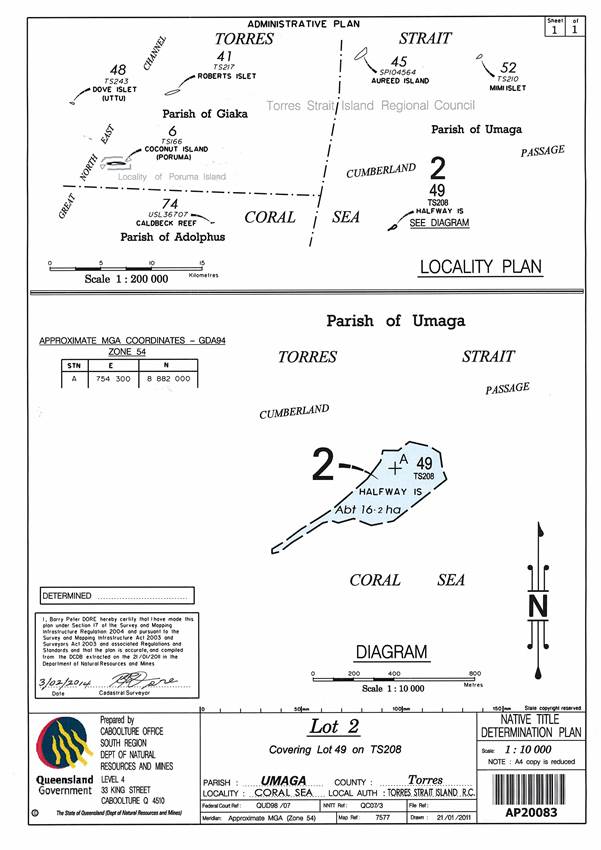
1. The Determination Area is the land and waters described in Sch 1 and depicted in the plan attached to Sch 1.
2. Native title exists in relation to the Determination Area.
3. The native title is held by the persons described in Sch 2 (the “native title holders”).
4. Subject to paras 5 and 6 the nature and extent of the native title rights and interests in relation to the Determination Area is the right to possession, occupation, use and enjoyment of the area to the exclusion of all others.
5. Subject to para 6 the nature and extent of the native title rights and interests in relation to Water in the Determination Area are limited to the non-exclusive right to take and use the Water for personal, domestic and non-commercial communal purposes.
6. The native title rights and interests are subject to and exercisable in accordance with:
(a) the Laws of the State and the Commonwealth; and
(b) the traditional laws acknowledged and traditional customs observed by the Native Title Holders.
7. There are no native title rights in or in relation to minerals as defined by the Mineral Resources Act 1989 (Qld) and petroleum as defined by the Petroleum Act 1923 (Qld) and the Petroleum and Gas (Production and Safety) Act 2004 (Qld).
8. The nature and extent of any other interests in relation to the Determination Area (or respective parts thereof) are set out in Sch 3 (the “Other Interests”).
9. The relationship between the native title rights and interests described in paras 4 and 5 and the other interests set out in Sch 3 is that:
(a) the Other Interests co-exist with the native title rights and interests;
(b) the determination does not affect the validity of those Other Interests; and
(c) to the extent of any inconsistency, the native title rights and interests yield to the other interests referred to in Sch 3.
10. The native title is held in trust.
11. The Kulkalgal (Torres Strait Islanders) Corporation RNTBC (ICN 3915), incorporated under the Corporations (Aboriginal and Torres Strait Islander) Act 2006 (Cth), is to:
(a) be the prescribed body corporate for the purpose of s 56(1) of the Native Title Act 1993 (Cth); and
(b) perform the functions mentioned in s 57(1) of the Native Title Act 1993 (Cth) after becoming the registered native title body corporate.
12. In this determination, unless the contrary intention appears:
“High Water Mark” means the ordinary high-water mark at spring tides;
“Land” and “Waters”, respectively, have the same meanings as in the Native Title Act 1993 (Cth);
“Laws of the State and the Commonwealth” means the common law and the laws of the State of Queensland and Commonwealth of Australia and includes legislation, regulations, statutory instruments, local planning instruments and local laws;
“Water” means:
(a) water which flows, whether permanently or intermittently, within a river, creek or stream;
(b) any natural collection of water, whether permanent or intermittent;
“Treaty” means the Treaty between Australia and the Independent State of Papua New Guinea concerning Sovereignty and Maritime Boundaries in the area between the two Countries, including the area known as Torres Strait, and Related Matters signed at Sydney on 18 December 1978.
Other words and expressions used in this determination have the same meanings as they have in Pt 15 of the Native Title Act 1993 (Cth).
SCHEDULE 1 - DETERMINATION AREA
The Determination Area comprises all of the land and waters on the landward side of the High Water Mark of Lot 49 on Crown Plan TS208 known as Zuizin Island (also referred to as Halfway Island) in the County of Torres in the State of Queensland depicted as follows:
Plan of the Determination Area
 SCHEDULE 2 - NATIVE TITLE HOLDERS
The native title holders are members of the Warraberalgal, Porumalgal and Masigalgal sub-groups of the Kulkalgal People, being collectively:
(a) the descendants of one or more of the following apical ancestors: Gagabe, Wawa, Mapoo, Baki, Laieh, Gauid, Kalai, Gaibiri, Aklan, Alau Messiah, Apelu, Asaia Messiah, Auara, Gewe Jack, Kudin, Maudar, Sidmu, Seregay, Tabu, Wabu, Largud, Panipani, Garibu, Ikasa; or
(b) Torres Strait Islanders who have been adopted by one or more of the descendants of the above listed apical ancestors referred to in para (a) in accordance with the traditional laws acknowledged and traditional customs observed by those persons.
SCHEDULE 3 - OTHER INTERESTS
The nature and extent of the other interests in relation to the Determination Area are the following so far as they exist as at the date of this determination:
(a) the rights and interests of the State of Queensland in Reserve 65 (Reserve for the Use of the Aboriginal Inhabitants of the State), the interests of any persons in whom it is vested and the interests of the persons entitled to access and use the reserve for the purpose for which it is reserved;
(b) the rights and interests of the Torres Shire Council as the local government for the Determination Area, including the rights of its employees, agents and contractors to enter upon the Determination Area for the purpose of performing Council’s powers and responsibilities under the Local Government Act 2009 (Qld);
(c) Subject to the laws of Australia, a customary right, if any, that:
(i) is held by a person or persons who: live in the Protected Zone or the adjacent coastal area of Papua New Guinea (as each is defined in the Treaty); is a citizen, or are citizens, of Papua New Guinea; and maintain traditional customary associations with areas or features in or in the vicinity of the Protected Zone in relation to their subsistence or livelihood or social, cultural or religious activities;
(ii) applies within the determination area;
(iii) is recognised by the law of Australia;
(iv) does not purport to authorise the control of access to or conduct in the determination area by any person; and
(v) involves free movement or the performance of lawful traditional activities within the Determination Area.
(d) any other rights and interests held by the State or the Commonwealth, or by reason of the force or operation of the Laws of the State and the Commonwealth.
Note: Entry of orders is dealt with in Rule 39.32 of the Federal Court Rules 2011.
|
QUEENSLAND DISTRICT REGISTRY |
|
|
GENERAL DIVISION |
QUD 98 of 2007 |
|
BETWEEN: |
DAN MURRAY MOSBY ON BEHALF OF THE KULKALGAL PEOPLE Applicant |
|
AND: |
THE STATE OF QUEENSLAND First Respondent TORRES SHIRE COUNCIL Second Respondent |
|
JUDGE: |
GREENWOOD J |
|
DATE: |
19 JUNE 2014 |
|
PLACE: |
THURSDAY ISLAND |
REASONS FOR JUDGMENT
1 The Federal Court of Australia convenes here today to make, and explain the reasons for making, orders under s 87 of the Native Title Act 1993 (Cth) (the “Act”) that take effect as a determination of the traditional native title rights and interests of the native title claim group described as the Kulkalgal People and, in particular, the Warraberlgal, Porumalgal and Masiglgal sub-groups of the Kulkalgal People, over an island called Zuizin Island (and known as Half Way Island) in the Torres Strait.
2 In these reasons I will describe the island as either “Zuizin Island” or “Zuizin”. Zuizin Island is located in the Central Torres Strait group of islands, 70 nautical miles north-east of Thursday Island. It is 15 nautical miles east-south-east of Poruma, 30 nautical miles east-north-east of Warraber and 22 nautical miles south of Masig.
3 The Determination Area comprises all of the land and waters on the landward side of the high water mark of Zuizin Island. The land area of Zuizin Island is approximately 16.2 hectares.
4 A plan of the Determination Area is attached to the orders published today as Sch 1.
5 The application for a determination of native title under s 13(1) and s 61(1) of the Act by the applicant on his own behalf and on behalf of the Kulkalgal People was filed on 29 March 2007. The application was duly registered on the Register of Native Title Claims and the notification period for the purposes of s 66 of the Act closed on 9 January 2008.
6 The application is brought by Dan Murray Mosby on behalf of the Kulkalgal People.
7 The State of Queensland and the Torres Shire Council are the only respondents to the application.
8 As a result of a number of directions hearings, case management hearings and a successful mediation process, the parties to the application reached in-principle agreement that native title rights and interests exist in the Determination Area. The parties have also agreed upon the content of those native title rights and interests in the Determination Area. The agreement under s 87 of the Act dated 23 May 2014 annexing proposed draft orders was filed in the Court on 23 May 2014.
9 Section 87 of the Act provides that the section applies if, at any stage of the proceedings (after the expiration of the period specified in the notice given under s 66 of the Act), an agreement is reached between the parties on the terms of an order the Federal Court might make in the proceedings; and, the terms of the agreement in writing signed by, or on behalf of, the parties are filed with the Court; and, the Court is satisfied that an order in, or consistent with, those terms would be within the power of the Court. Once those preconditions are satisfied, the Court may, if it appears to the Court appropriate to do so, make an order in, or consistent with, the terms of the agreement without holding a hearing of questions of fact and law in relation to the application: s 87(1)(a), (b) and (c); s 87(1A); and s 87(2).
10 In determining whether it is appropriate for the Court to make the proposed orders, emphasis is placed upon whether the agreement has been genuinely and freely made on an informed basis by all parties represented by legal advisers. Having regard to the history of the State’s engagement in the analysis of native title rights and interests in relation to land and waters throughout Queensland and the resources and expertise available to the State in determining the legal status of particular land and waters, the State’s legal advisers are in an advantageous position to examine the precise content of an applicant’s determination application under the Act. Although, in my view, it is not necessary for the claimant group to file a substantial body of evidence of the kind that would otherwise be required in the determination of the merits of a claim at trial, it is, in my view, necessary for the Court to be satisfied that the terms of the s 87 Agreement are, as Chief Justice French has observed, “rooted in reality”: Native Title – A Constitutional Shift?, University of Melbourne Law School, JD Lecture Series, French CJ, 24 March 2009; Kerindun v Queensland (2009) 258 ALR 306 at [16]; Kuuku Ya’u People v State of Queensland [2009] FCA 679 at [12] – [15].
11 The question of whether the terms of the agreement are rooted in reality simply requires some material to be before the Court upon which it can act in reaching the statutory state of satisfaction as to the appropriateness of making the orders.
12 In this case, the parties have been represented by experienced lawyers in reaching the terms of the agreement for the purposes of s 87 of the Act.
13 Section 94A of the Act requires that an order for determination of native title must set out details of the matters mentioned in s 225 of the Act which must be read together with s 223 of the Act. These sections give meaning to the terms “determination of native title” and “native title” and “native title rights and interests”. In Members of the Yorta Yorta Aboriginal Community v Victoria (2002) 214 CLR 422 at [76], Gleeson CJ, Gummow and Hayne JJ treated the statutory elements contained in s 223 as central. The mandatory requirements for a determination of native title are these. The native title rights and interests must be communal, group or individual rights and interests. They must be rights and interests in relation to land or waters. They must be possessed under the traditional laws acknowledged, and the traditional customs observed, by Aboriginal peoples or Torres Strait Islanders. Aboriginal peoples or Torres Strait Islanders by their law and customs must have a connection with the land or waters, and the rights and interests must be recognised by the common law of Australia.
14 Orders under s 87 of the Act take effect not only inter-parties in the resolution of claims made in the proceedings but represent an independent judicial determination, in the exercise of the judicial power of the Commonwealth, that may be asserted, as a matter of law, against anyone.
15 A determination of native title expresses the recognition and protection of those rights and interests, in relation to land and waters defined and described in s 223 of the Act, which find their origin in traditional laws and customs acknowledged and observed by aboriginal peoples: Members of the Yorta Yorta Aboriginal Community v Victoria at [75] and [76], Gleeson CJ, Gummow and Hayne JJ.
16 A determination of native title requires the Court to determine who are the persons or group of persons who hold the common or group rights comprising the native title; the nature and extent of those rights and interests in the Determination Area; the nature and extent of any other interests; and the relationship between the native title rights and interests and those other interests, in the Determination Area (s 225 of the Act).
17 In determining these matters in relation to the claim on behalf of the Kulkalgal People I have had regard to the following material: an anthropological report by Dr Garrick Hitchcock entitled Native Title Claim QUD98/2007, Dan Murray Mosby on behalf of the Kulkalgal People #2, Zuizin, AP Ailan, January 2010, described generally as a “Connection report”; a supplementary report by Dr Hitchcock dated 19 May 2014 described generally as a “Supplementary Connection report”; an anthropological report by Dr Julie Lahn entitled Connection Report, Aureed (Yaywad) Island dated July 2000; and an affidavit by Dan Murray Mosby sworn 20 May 2014 and the material read into the record today by Mr Krebs.
18 The anthropological reports and related material establish the following matters.
19 The Native Title Claim Group is a sub-group of the Kulkalgal People for whom Zuizin Island is a part of their traditional estate. The three Torres Strait Island sub-group communities of the Kulkalgal People are described in the following way by Dr Hitchcock in his report dated January 2010 (at handwritten (“hw”) page number 25 of the Hitchcock material filed 19 May 2014):
1. The people of Poruma, known as the Porumalgal, being those persons who are members of cognatic descent groups (i.e. families) descended from one or more of the following apical ancestors, who were alive at or prior to the assertion of British sovereignty: Laieh, Gauid, Kalai, Mapoo and Wawa. The patronymic families of Poruma are: Fauid, Bob, Larry, Billy, Pearson, Mosby and Bowie (Lahn 1999: 6).
2. The people of Warraber, known as the Warraberlgal, being those persons who are members of cognatic descent groups descended from one or more of the following apical ancestors, who were alive at or prior to the assertion of British sovereignty: Gagabe, Wawa and Mapoo, Ullud and Baki. The patronymic families of Warraber are: Tamu, Mari, Bob, Mauga, Harry, Billy, Pearson, Larry and Bowie (Lahn 1999: 6).
3. The people of Masig, known as the Masiglgal, being those persons who are members of cognatic descent groups descended from one or more of the following apical ancestors, who were alive at or prior to the assertion of British sovereignty: Aklan, Alau Messiah, Apelu, Asiah Messiah, Auara, Gewe Jack, Kudin, Ikasa, Maudar, Sidmu, Seregay, Tabu and Wabu. The patronymic families of Masig are: Aklan, Alau, Alfred, Asai, Billy, Johnson, Lowatta, Mene, Morris, Mosby, Nai, Warria and Williams (Ogge 1999: 8).
[emphasis added]
20 Dr Hitchcock observes that recruitment to the above communities occurs primarily by birth or by traditional Torres Strait Islander adoption. Whether natural born or adopted, all such children automatically acquire a community identity which in turn confers native title rights and interests in the community’s traditional estate, in them.
21 Dr Hitchcock is also of the opinion based on the anthropological research that the claimant sub-groups, Porumalgal, Warraberlgal and Masiglgal of the Kulkalgal, have always regarded Zuizin as a part of their “traditional territory”. These sub-groups of the Kulkalgal assert communal exclusive rights and interests in Zuizin and Dr Hitchcock holds the opinion that these rights and interests derive from a “shared acknowledgement and observance”, as Kulkalgal People, of a “normative system of laws and customs they have inherited from their forebears” (Hitchcock, hw 26). In Dr Hitchcock’s view, the claimants, together with the Magani Lagaugal (known as the “Iama People”), form part of a wider regional grouping known as the Kulkalgal, or Central Torres Strait Islanders. Dr Hitchcock accepts as correct, the view expressed in the research (“Fuary 2005a: 5”) that the wider Kulkalgal regional group are “united at a broad level of analysis through culture, including shared traditions, customs, languages, subsistence strategies, rituals and kinship” (Hitchcock, hw 26).
22 Dr Hitchcock also considers that the people of Poruma, Warraber and Masig “continue to have close links on the basis of their shared traditions, customs, history, kinship and language, as evidenced by continuing intermarriage, social visiting, trading and exchange, and cooperation in ceremony and festivals” (Hitchcock, hw 26).
23 In terms of historical engagement, it is possible that Zuizin was one of the islands visited by the Portuguese explorer Torres during his voyage through Torres Strait in 1606. However, the first European, documented as “discovering” Zuizin, was Captain Matthew Flinders who visited the island in the Investigator on 30 October 1802. Dr Hitchcock observes that in 1872, all islands located within 60 miles of the mainland coast were annexed to the State of Queensland by the Crown. This annexation incorporated many, but not all, of the Torres Strait Islands. The majority of the remaining islands in Torres Strait including Zuizin were subsequently annexed to Queensland in 1879. Dr Hitchcock sets out some further history of engagement by Europeans with Zuizin Island from 1879.
24 It is not necessary to identify any further aspects of that engagement in these reasons.
25 Dr Hitchcock observes, based on his research and an assessment of the anthropological record, that the members of the claim group identify themselves as claim members “at a number of levels, including communities, dialect or cluster group”. They “identify as the traditional owners of Zuizin – just as they identify (and are recognised by others) as the traditional owners of nearby Aureed” (Hitchcock, hw 27). Dr Hitchcock notes the observations of Harold Pearson of Warraber that “Zuizin is part of Kulkalgal territory, it has always been part of Kulkalgal territory”.
26 Similar observations are expressed by Glorianna Mosby of Masig and Nelson Billy of Warraber.
27 Dr Hitchcock has conducted a review of the genealogical data in determining the apical ancestors of the claim group and the composition of the claim group. During 2006 and 2009, Dr Hitchcock conducted interviews with various members of the claim group and, in particular, elders of the claim group. Dr Hitchcock observes that these individuals “explained that for as long as anyone could remember, [Zuizin] has formed part of the traditional estate of Porumalgal-Warraberlgal-Masiglgal, i.e., from time immemorial” (Hitchcock, hw 29). Dr Hitchcock also makes these observations (Hitchcock, hw 29):
Since 1879, there has been a determination by these peoples [that is, the identified sub-group of the Kulkalgal] to maintain and visit the claim area, even in the face of environmental and economic difficulties, including the disruptive impacts of colonialism.
28 Dr Hitchcock expresses the opinion that the people of Poruma, Warraber and Masig making up the sub-group peoples “were able to regularly visit [the claim area] as part of their work in maritime industries in the nineteenth and twentieth centuries … ensuring their connection to Zuizin after annexation”. Dr Hitchcock also observes that in more recent decades, many Torres Strait Islander families have moved away from their home islands to elsewhere in the Torres Strait such as Thursday Island or to the Australian mainland. However, in Dr Hitchcock’s view, “their knowledge of their rights in land has been retained and is actively asserted and defended, and is activated when they return to their community island”.
29 Dr Hitchcock also observes that members of the claim group “continue to assert their ownership [of] Zuizin and the resources therein, and visit the island today for subsistence and commercial purposes” (Hitchcock, hw 29). Dr Hitchcock sets out observations in relation to continuing visitation to Zuizin Island by ancestors of the claim group since the assertion of British sovereignty.
30 Dr Hitchcock also notes:
[Zuizin Island] is not known to have ever supported a permanent population of Torres Strait Islanders. Indeed, its biogeography – a small island lacking fresh water – means this would be impossible. As Nelson Billy of Warraber states, “nogat water, not a place you stop” [which Dr Hitchcock understands to mean that since Zuizin Island does not have fresh water, “you cannot live there”].
31 Nevertheless, Dr Hitchcock believes that the research supports the position that members of the claim group and their ancestors continued to visit Zuizin periodically since the assertion of sovereignty until the present day and that the ethnographic evidence relating to “contemporary usage” suggests that visits to Zuizin Island have occurred “seasonally”, especially during kuki, which is the north-west monsoon season (from November to April), “for the purpose of turtle hunting and fishing in its waters, and for the collection of turtles, turtle eggs, and other food resources from the island” (Hitchcock, hw 30).
32 Dr Hitchcock also examines the period of visitations to the island by ancestors of the claim group as “expert seafarers” and observes that physical connection with the island “was enabled by the seafaring technologies, knowledge and traditions” of these islander peoples. It is not necessary to recount the extensive detail of these seafaring practices.
33 Dr Hitchcock further observes (Hitchcock, hw 32) as follows:
Further evidence of continuity of physical connection was furnished during interviews with elders from each community. These men and women were able to accurately describe the island, noting such things as the location of pandanus groves and suitable anchorages. In addition to specific information about their experiences visiting the island, they were able to provide details of the flora and fauna present on the island in their own languages, including food resources such as waru (green turtle …) and unawa (hawksbill turtle …), urab (coconuts …); and meke (Indian or sea almond …).
34 As to spiritual connection, Dr Hitchcock says this (Hitchcock, hw 33):
The vast majority of Torres Strait Islanders today identify as Christian, although their belief systems are in many cases a syncretic mix of the old and the new. Belief in ghosts (markai), “devil-women” (dogai), sorcery (maid) and the power of certain sites of significance are strongly held by many Torres Strait Islanders.
It is clear from interviews with members of the claimant group that Zuizin has a spiritual dimension, with acknowledgement that the sandbank on the island’s northwest side is a sacred or special place. Such beliefs continue to have salience for the claimant group today, and are evidenced by their continued adherence to traditional observances that are conducted upon visiting the island.
[citations omitted]
35 In Part III of his January 2010 report, Dr Hitchcock describes in greater detail these “ceremonies, rituals, songs, designs, observances, knowledge [and] stories” which the claimant group continue to observe. It is not necessary to repeat in these reasons the content of that material supporting the conclusions Dr Hitchcock has reached in that regard.
36 As to the content of the normative system of group rights and interests possessed under the traditional laws acknowledged and the traditional customs observed by the ancestors of, and members of, the claim group, Dr Hitchcock sets out an analysis of those matters in considerable detail. It is not necessary in these reasons to set out the elements of that analysis or the particular foundation for those matters.
37 It is sufficient for present purposes to observe that Dr Hitchcock accepts that the native title rights and interests which owe their origin to traditional laws acknowledged and traditional customs observed by the claim group in relation to the Determination Area are properly described as the right to possession, occupation, use and enjoyment of the area to the exclusion of all others, and the native title rights and interests in relation to Water (in the sense defined in Order 12 of the orders published today) are properly described as the non-exclusive right to take and use water for personal, domestic and non-commercial communal purposes.
38 On the basis of the reports, I accept Dr Hitchcock’s opinion as to these matters.
39 The native title rights and interests so identified are subject to and exercisable in accordance with the laws of the State of Queensland and the Commonwealth of Australia and traditional laws acknowledged and traditional customs observed by the native title holders.
40 Order 7 of the orders identifies further matters relevant to the native title rights and interests.
41 Order 9 sets out the relationship between the native title rights and interests so determined and “other interests” set out in Sch 3 to the orders. It is not necessary to describe in these reasons the content of the other interests set out in Sch 3. However, Order 9 describes the elements of the relationship between the native title rights and interests and these other interests.
42 The native title so determined is to be held in trust.
43 Order 11 of the proposed orders provides that the Kulkalgal Registered Native Title Body Corporate is to be the prescribed body corporate for the purposes of s 56 of the Act. A written nomination to this effect, consistent with s 56(2)(a)(i) of the Act has been filed in the Court.
44 A written consent of the Kulkalgal Registered Native Title Body Corporate ICN 3915 in accordance with the requirements of s 56(2)(a)(ii) of the Act has also been filed in the Court.
45 The applicant has filed a written consent of the common law holders in accordance with the requirements of s 59A(3) of the Act. The Kulkalgal Registered Native Title Body Corporate satisfies the requirements of s 4 of the Native Title (Prescribed Bodies Corporate) Regulation 1999 (Cth) on the footing that its list of members and rules of membership provide that all members of the corporation are persons who are included or are proposed to be included, in the contemplated native title determination as native title holders; and the objects of the corporation provide that one of its purposes is to become a registered native title body corporate, such that Kulkalgal Registered Native Title Body Corporate is a prescribed body corporate for the purposes of s 56 of the Act.
46 On the basis of all the matters described in these reasons and in reliance upon the material described at [17] of these reasons, I am satisfied that the Court has power to make the determination in the terms proposed and that it is appropriate to do so in all the circumstances.
47 The orders made today give recognition within the Australian legal system to the native title rights and interests of the claim group as sub-groups of the Kulkalgal People in relation to the Determination Area, borne out of traditions honoured and customs practised by the ancestors of the claimants and observed and practised by their descendants and those persons who form part of the claim group by reason of adoption as described in Sch 2 to these orders, continuously over time as described in, particularly, the reports of Dr Hitchcock, having regard to the detailed anthropological record of engagement by the Kulkalgal People with the Determination Area.
48 The Court now publishes the orders comprising the determination of native title.
|
I certify that the preceding forty-eight (48) numbered paragraphs are a true copy of the Reasons for Judgment herein of the Honourable Justice Greenwood. |
Associate:


