FEDERAL COURT OF AUSTRALIA
Dempsey on behalf of the Bularnu, Waluwarra and Wangkayujuru People v State of Queensland (No 2) [2014] FCA 528
| IN THE FEDERAL COURT OF AUSTRALIA | |
| First Applicant MARLENE SPEECHLEY Second Applicant CHARLES PAGE Third Applicant DAVID RILEY Fourth Applicant MAVIS SAMARDIN Fifth Applicant THELMA PARKER Sixth Applicant |
| AND: | First Respondent MOUNT ISA CITY COUNCIL Second Respondent BOULIA SHIRE COUNCIL Third Respondent CLONCURRY SHIRE COUNCIL Fourth Respondent SOUTHERN CROSS FERTILISERS FORMERLY WMC FERTILISERS PTY LTD Fifth Respondent AUSTRALIAN AGRICULTURAL COMPANY PTY LTD Sixth Respondent AA COMPANY PTY LTD Seventh Respondent FRANK STIRLING BLACKET Eight Respondent RAHDA BLACKET Ninth Respondent GAMBAMORA INDUSTRIES PTY LTD ACN 009 941 173 Tenth Respondent GEORGE BURTON HACON Eleventh Respondent CATHERINE LOUISE MCLOUGHLIN Twelfth Respondent JOHN KENNEDY MCLOUGHLIN Thirteenth Respondent MDH PTY LTD ACN 010 114 468 Fourteenth Respondent VENLOCK PTY LTD Fifteenth Respondent LORNA ELIZABETH BOGDANEK Sixteenth Respondent HACON HOLDINGS PTY LTD Seventeenth Respondent ROBERT JOHN MCCONACHY T/AS ASHOVER PASTORAL COMPANY Eighteenth Respondent MOUNT ISA MINES LTD Nineteenth Respondent |
| DATE OF ORDER: | |
| WHERE MADE: |
THE COURT DECLARES THAT:
The persons who constitute the “claim group” as that term is defined in paragraph 1 of the statement of claim dated 18 February 2013 and filed in this proceeding are entitled to a determination of native title in accordance with the terms of the proposed determination annexed to the statement of claim.
THE COURT DIRECTS THAT:
1. On or before 12.00pm on 26 May 2014, the applicant is to prepare and file a proposed final form of native title determination that is consistent with the Court’s reasons for judgment.
2. No later than 4.00pm on 2 June 2014, the applicant is to file and serve any proposed further orders in relation to the documents subject to the Court’s orders made on 20 December 2013, as extended to the two reports of Mr Southon by order made on 27 February 2014, together with any submissions in support of those proposed orders, limited to 5 pages.
3. No later than 4.00pm on 10 June 2014, the State and Mrs Bogdanek are to file and serve any submissions they wish to make in relation to any proposed further orders filed in accordance with paragraph 2 of these directions, limited to 5 pages.
Note: Entry of orders is dealt with in Rule 39.32 of the Federal Court Rules 2011.
| IN THE FEDERAL COURT OF AUSTRALIA | |
| QUEENSLAND DISTRICT REGISTRY | |
| GENERAL DIVISION | QUD 6115 of 1998 |
| BETWEEN: | BULARNU WALUWARRA & WANGKAYUJURU PEOPLE Applicant |
| AND: | STATE OF QUEENSLAND Respondent |
| JUDGE: | MORTIMER J |
| DATE: | 23 may 2014 |
| PLACE: | BRISBANE |
REASONS FOR JUDGMENT
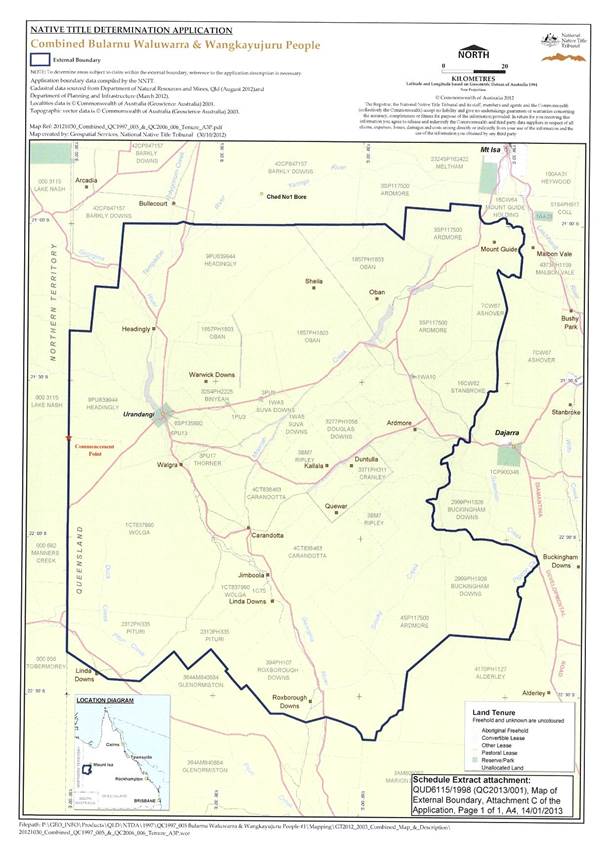
1 The applicant, on behalf of a claimant group comprising descendants of named ancestors who identify as members of the Bularnu, Waluwarra and Wangkayujuru People, has applied for a native title determination pursuant to the Native Title Act 1993 (Cth) (NTA) over land and waters in the central-western region of Queensland, between Lake Nash and Dajarra, adjacent to the border with the Northern Territory and south-west of the town of Mount Isa. A map showing the claim area is Appendix A to these reasons for judgment. The applicant, for the purposes of s 61(2) of the NTA, comprises Elizabeth Dempsey, Marlene Speechley, Charles Page, David Riley, Mavis Sarmardin and Thelma Parker.
2 The application and the terms of the native title determination sought in this proceeding recognise the extinguishment of native title in whole or in part over a large proportion of the claim area, as well as recognising the spectrum of rights and interests in land that now exists within the claim area. The areas of land over which a determination of native title is sought, to the exclusion of all others, are small. There are portions of the claim area for which a determination in respect of non-exclusive use is sought, and there are very substantial parts of the claim area (mostly those parts occupied by permanent improvements and pursuant to pastoral leases) where the proposed determination recognises that native title does not exist and has been extinguished.
3 All interested parties consented to a determination of native title in the form sought, save for a group of people who were — in fact if not in law — represented by Lorna Bogdanek. Mrs Bogdanek’s extended family group are descendants of a Scottish pastoralist called James Craigie and an indigenous woman known as “Bunny”, sometimes called “Bunny Craigie”. James Craigie owned and operated Roxborough Station, which is in the south of the claim area. Mrs Bogdanek was joined to this proceeding as a respondent in September 2011 and has been an active contradictor to the applicant’s application, insofar as it concerns what is identified in the claim as Wangkayujuru country in the south of the claim area, and insofar as it is said by the applicant that the descendants of James Craigie and Bunny are not entitled to be part of the claim group. Mrs Bogdanek did not seek in her defence to contradict the applicant’s claims to Bularnu and Waluwarra country in the centre and north of the claim area.
4 While, as I have observed, Mrs Bogdanek has not sought directly to contest the application for a determination of native title by Bularnu and Waluwarra people over those parts of the claim area they identify as their country, the malleable nature of her contentions, and the way in which her contentions responded to information she either discovered or was presented with during the course of the proceeding, meant that inevitably her challenges widened.
5 It remains the case, however, as the applicant has pointed out in their final submissions, that there are considerable parts of the applicant’s statement of claim, and evidence, which were not contested by either the State or Mrs Bogdanek in their respective defences. Nor were those parts contested in evidence or submissions.
6 Nevertheless, with an unrepresented litigant, evolving evidence and a proceeding of this nature and extent, it is inappropriate to rely too heavily on parties’ pleadings to determine the scope of the matters which should be the subject of findings and addressed in reasons for judgment.
7 I have decided to take a broader approach. First, I have attempted to deal with the matters I consider relevant to the determination of native title as sought in the application, without too heavy a reliance on admissions by the State and Mrs Bogdanek in their pleadings. Second, I have attempted to identify the contentious issues raised by Mrs Bogdanek which are capable of bearing on the making of any such determination. There were other contentious matters, to which I have referred briefly at [891] at the end of these reasons. Although important to Mrs Bogdanek and her family, these matters were not capable of bearing on the determination of native title and I have explained there why I have not addressed them in detail.
8 For the reasons set out in this judgment, I have concluded that there should be a determination of native title over the whole of the claim area in the form sought. I have accordingly concluded that Mrs Bogdanek’s arguments about Wangkayujuru country, and about her family’s membership of the claim group, do not preclude a determination of native title in that form. Nor do any of the other issues she sought to raise as the proceeding progressed.
9 This judgment is divided into five parts. Part 1 deals with necessary background, including the progress of this application, and the active parties. Part 2 sets out the evidence and my findings in relation to aspects of it. Part 3 then deals with the matters necessary for a determination of native title. Part 4 deals with contentions made by Mrs Bogdanek which are capable of affecting any determination of native title I have otherwise concluded should be made, and her contentions which are not so capable. Part 5 consists of my reasons for making orders in the form I have made.
A note on spellings, words and descriptions used
10 Choices need to be made about how to spell many words used in the evidence, how to refer to places, and how to refer to people.
11 As to people, I have adopted the practice of referring to all witnesses by their full name, and from time to time depending on context will also refer to them by “Mr” and “Mrs” and their surnames, which I was informed during the hearing was an appropriate form of address. For people who are referred to frequently in the evidence but were not witnesses, especially people from previous generations, I have used the person’s first and second name on each occasion. For example, Ida Toby, Derby Daylight. Where relevant, I have referred to any other ways in which these people were known, such as “Walgra George”.
12 There were spelling discrepancies in respect of particular individuals. Henry Katchinda’s surname was spelt “Catchinda” in some of the material, including by Dr Palmer. However his witness statement bears a “K” so that is what I have used. The surname of other members of his family was also inconsistently spelt in the material and I have adopted a “K” instead of a “C”. The names of the two rainmakers, Belia and Deemera, were variously spelt. I have adopted the forms which in my opinion were most regularly used by the witnesses.
13 There was little or no uniformity in the spellings of “Bularnu” (sometimes with an “h”) and “Wangkayujuru” (several spellings), although “Waluwarra” did seem to be spelt consistently. I have taken choices for spellings of the groups principally from the applicant’s material, although even throughout that material there were inconsistencies. I have adopted the spelling of Bularnu, Waluwarra and Wangkayujuru.
14 Similarly, there was no uniformity in the way that the names of many ancestors were spelt. Names of Dreamings, or creatures in Dreamings, also often had different spellings. For example, the Kunmurti — the serpent which lives in the Georgina River — is also spelt “Kunmuddi”, “Gunmuddi”, “Kunmudee” or “Kanmari”. The first spelling seems to be the most predominant and I have adopted that.
15 Place names were given a reasonably uniform spelling, especially where those places are now mapped. I have adopted the spellings from the maps in evidence. Lake Nash is also known as Alpurrurulam, the latter being a smaller area of aboriginal land excised from the Lake Nash Station. Most witnesses and most of the evidence referred to Lake Nash even when it was clear they meant Alpurrurulam, so I have adopted that reference.
16 It was common amongst most witnesses, when speaking of places they were born, grew up or lived on, to do so by reference to the names of the pastoral stations covering much of the this area of south-west Queensland and relevant parts of the Northern Territory. Most of those stations were established in the 1870s, and there were maps in evidence showing the stations as at 1882 and 1895. Where in these reasons I recount the evidence referring to “Roxborough” or “Carandotta” or “Headingly” or “Lake Nash” and the like, these are all references to the areas of land on which pastoral stations bearing those names were situated. The evidence showed that the location of a station called “Glenormiston” may have changed during the late 19th century.
17 There was a variety of spellings for other language and group names from areas adjacent to the claim area, or sufficiently connected to require mention. In those cases, I have generally adopted the spelling used in the particular evidence to which I refer. For example, the people to the south and west of the claim area are called by Dr Palmer “Andegerebinha”. Most of the indigenous witnesses referred to those people as “Antekerrepenh”, which Dr Palmer recognised as an alternative spelling. I have used the latter.
18 I have adopted the spelling of Wangkamadla and Wangkamanha for the two groups to the south of the claim area, of which Mrs Bogdanek has claimed membership. I take this from the documentary and expert evidence, and it also seems to be the spelling adopted on behalf of the applicant. Mrs Bogdanek did not use consistent spelling across her evidence, but I did not understand her to make any particular submission based on the different spellings available for these groups.
19 The matter commenced as an application by the Waluwarra/Georgina River People, lodged with the National Native Title Tribunal on 6 February 1997. By virtue of amendments made to the NTA, on 30 September 1998 the matter became a proceeding of this Court numbered QUD6115 of 1998. Respondent parties then included the State of Queensland and the Tjilpatha Aboriginal Corporation. A second application was filed on 12 March 2002 (QUD6006 of 2002), and, on 29 July 2009, both applications were amended to change the name of the claimant group to Bularnu, Waluwarra and Wangkayujuru Peoples, and to amend the boundaries of the claims, in response to requests made to the applicant’s solicitors on behalf of the Wangkamadla/Wangkamanha Peoples.
20 On the application made for the purposes of s 61(1) of the NTA, the change in names was explained thus:
The claim group members prefer to name the claim as being on behalf of the Bularnu, Waluwarra and Wangkayujuru peoples rather than the former generic reference to them as the Waluwarra/Georgina River Peoples.
21 More will need to be said in these reasons about the way the group identifies, and what contentions have been made about this issue.
22 On 28 May 2010, for the purposes of entering into substantive mediation of both applications, the State accepted that the Bularnu, Waluwarra and Wangkayujuru claimant group have a connection with the land and waters over which the claim is made (in the sense required by s 223(1)(b) of the NTA). In light of this acceptance, on 12 July 2010 Dowsett J made orders requiring the parties to take all reasonable steps to facilitate a consent determination in early October 2011. On 7 March 2011, the Tjilpatha Aboriginal Corporation ceased to be a party to both proceedings.
23 On 15 June 2011, the Court was notified that the applicant had become aware that the Wangkamadla/Wangkamanha group were asserting rights over the southern part of the area subject to the first Bularnu, Waluwarra and Wangkayujuru claim. To this end, on 13 July 2011 Mrs Avelina Tarrago and Mrs Isabel Tarrago, who claimed to be members of the Wangkamadla group, were joined as respondents to the first Bularnu, Waluwarra and Wangkayujuru application.
24 On 26 September 2011, Mrs Lorna Bogdanek and Mrs Berniece Brandon were joined as respondents to both Bularnu, Waluwarra and Wangkayujuru proceedings. Mrs Bogdanek and Mrs Brandon made claims as Wangkamadla women, asserting interests in parts of the land covered by the claim — to the south, south-east and south-west of the waterways that run into Mangala Waterhole.
25 On 26 April 2012, on the basis of notices of wishing to cease to be a party filed on 17 April 2012, Dowsett J made orders that Mrs Avelina Tarrago and Mrs Isabel Tarrago cease to be parties to the first Bularnu, Waluwarra and Wangkayujuru proceeding. On 24 April 2012, the applicant filed an interlocutory application seeking to have Mrs Bogdanek and Mrs Brandon removed as parties. On 14 July 2012, agreement was reached with Mrs Brandon that she would withdraw as a party and, on 24 July 2012, Mrs Brandon filed a notice of wishing to cease to be a party to both proceedings.
26 On 26 November 2012, leave was granted to the applicant to withdraw the interlocutory application seeking to remove Mrs Bogdanek from the proceedings. On 21 December 2012, Dowsett J made orders combining the two Bularnu, Waluwarra and Wangkayujuru proceedings (QUD6115/1998 and QUD6006/2002) and an amended application was filed by the applicant on 14 January 2013. It is this application that forms the basis of the proceeding currently before the Court.
27 What has occurred in this proceeding since the intervention of Mrs Isabel Tarrago and Mrs Avelina Tarrago, as well as Mrs Bogdanek, is important in understanding the course this proceeding has taken. These interveners all made essentially the same kind of claim: that they were Wangkamadla/Wangkamanha people, and that they held rights to country which extended into the southern part of the claim area. The evidence which they adduced to support their applications to become parties formed the basis of subsequent steps, many taken by agreement with those parties, for further anthropological investigations to be undertaken. These steps included the preparation by Mr Michael Southon of two reports, and — critically — the preparation by Dr Palmer of a joint report with Mr Southon in April 2012, and a further report by Dr Palmer in 2013, designed to address these issues.
28 After the production of that report, Mrs Avelina Tarrago and Mrs Isabel Tarrago filed notices wishing to cease to be parties. Mrs Bogdanek however has continued to press her contentions.
29 The area which is the subject of the claim is identified in the map which is Appendix A to these reasons for judgment.
30 Simplifying the matter somewhat, but in my opinion consistently with the evidence, the area to the north of Toby Creek is associated with Bularnu people, the area between Toby Creek and Mangala Waterhole (and the river course which runs north-east from Mangala), is identified with Waluwarra people, and the area to the south of Mangala Waterhole, extending beyond the claim area down to Cottonbush Creek, is identified with Wangkayujuru people.
31 Artificial boundaries are drawn at the Northern Territory border. To the east and the south-east, the borders of the claim are marked by the Pitta Pitta native title determination, and to the north, the Kalkadoon and Indjalandji-Dhidhanu native title determinations.
The importance of the Georgina River
32 The Georgina River and its tributaries runs right through the claim area. It flows into the claim area from the west, originating on the Barkly Tableland north of Camooweal. It then flows through the north-western part of the Northern Territory, through the Lake Nash area and across the border into Queensland. The Georgina River is a central feature, in every sense, of the lives, connections, customs and traditions of the indigenous people in this area. The river features in almost all aspects of the evidence in this proceeding, and in these reasons for judgment. The river is the home of Kunmurti, the water snake and a central Dreaming figure for the claimant group. The river is where newborns are bathed to introduce them to country, where spirits are greeted and asked to help in good catches of fish. It is the source of food and sustenance in all respects of the people of the claim area.
33 One of the applicant’s witnesses in this proceeding, David Riley, described the Georgina in the following way:
The Georgina River, it’s channel country - lots of channels going into the main river, like Templeton Creek into the Georgina. When we move around that country people mostly follow the river, go hunting along the river. …
The dreaming are mainly along the river. Some of them are in the channels like Templeton Creek.
34 Another one of the applicant’s witnesses, Stuart Rusty, described his early life around the Georgina River in this way:
The Georgina River is a permanent water source. When we were children we would often go down there fishing and swimming. There are also a couple of soaks down there, where you can dig down and get clean water. There is one down a bit further at the Pig Yard. The old people would always wet their heads and wash their arms before going in to the water. My old Aunty Eileen Belia would always say something to the River when we went fishing and then they would always catch fish all the time.
When we were kids we used to collect water from the soaks and carry it back to Marmanya. We’d carry the water back in a billy can with a yoke on our shoulders.
35 There were striking aspects of the evidence about the way witnesses felt about the Georgina. For example, another of the applicant’s witnesses, Joseph Dempsey, described his affiliation with the river in this way: “I feel more comfortable along the Georgina River than in my own house.”
36 The application identifies six apical ancestors, who are said to be the persons from each of the three groups who held, at the time of sovereignty, native title interests in the area. Those people, identified in Sch A to the further amended application and Sch 3 to the proposed determination attached to the applicant’s statement of claim, are: Charlie Toby and Jinny; Jack Wilde; Nellie Lynch; George (Snr) Katchinda; Derby Daylight and Pipalkarinya.
37 The native title rights and interests claimed, as set out in the further amended application are:
1. Over areas where a claim to exclusive possession can be recognised (such as areas where there has been no prior extinguishment of native title or where s.238 and/or ss.47, 47A and 47B apply), the Bularnu, Waluwarra and Wangkayujuru Peoples claim the right to possess, occupy, use and enjoy the lands and waters of the application area as against the whole world, pursuant to the traditional laws and customs of the claim group.
2. Over areas where a claim to exclusive possession cannot be recognised, the following rights and interests are claimed:
(a) the right to access the application area
(b) the right to camp on the application area
(c) the right to erect shelters on the application area
(d) the right to live on the application area
(e) the right to move about the application area
(f) the right to hold meetings on the application area
(g) the right to hunt on the application area
(h) the right to fish on the application area
(i) the right to cook on the application area
(j) the right to have access to and use the natural water resources of the application area
(k) the right to gather and use the natural products of the application area (including food, medicinal plants, timber, stone, ochre and resin) according to traditional laws and customs
(l) the right to conduct ceremonies on the application area
(m) the right to participate in cultural activities on the application area
(n) the right to maintain and protect places of importance under traditional laws, customs and practices in the application area
(o) the right to conduct burials on the application area
(p) the right to speak authoritatively about the application area among other Aboriginal People in accordance with traditional laws and customs
(q) the right to make decisions about the use and enjoyment of the area by Aboriginal people who recognise themselves to be governed by the traditional laws and customs acknowledged and observed by the native title holders
(r) the right to transmit the cultural heritage of the native title claim group including knowledge of particular sites;
(s) the right to take and use, share and exchange the traditional resources of the application area.
3. The native title rights are subject to:
(a) the valid laws of the State of Queensland and the Commonwealth of Australia
(b) the rights (past or present) conferred upon persons pursuant to the laws of the Commonwealth and the laws of the State of Queensland.
38 In the further amended application, the association with the area by the claim group is described in the following terms:
The traditional territory of the claim group was wholly occupied by them in 1788 and up until the mid 1860s when permanent settlers including pastoralists began to arrive.
The members of the claim group have maintained continuity of occupation, connection and association with the area covered by the application from pre-contact times to the present day.
39 The traditional laws and customs are then described:
Families in the native title claim group have traditional links to the land and waters covered by pastoral stations within the claim area under the traditional laws and customs observed by them. Each of the descent groups have been able to maintain their traditional laws and customs despite white settlement in the area by remaining on their traditional country through working on the stations since the stations were first established in the late nineteenth century.
During the late 19th and throughout the 20th century most members of each family group worked in the pastoral industry. By being able to remain on their traditional country as pastoral workers they maintained and passed on to succeeding generations traditional knowledge and skills concerning their country. The traditional laws acknowledged by, and traditional customs observed by the claim group govern their conduct on their country and in relation to each other and their neighbours and give rise to the claimed native title rights and interests.
40 The continued connection with the land subject to the claim in accordance with those laws and customs is said to be as follows:
A major residential location for claimants within the claim boundary is Urandangie. Other major residential centres are just outside the present claim boundaries being Dajarra near the south eastern edge of the claim area, Lake Nash (Alpurrurulam) in the northwest, Mount Isa in the north east. This continuing proximity to the claim area means ongoing observation of laws, customs, practices and activities that connect members of the claim group to the claim area are easily part of the lives of claim group members. Those laws and customs continue to be observed as members of the claim group continue to undertake activities in the claim area which are governed by the traditional laws and customs by which they are bound to the land.
Those activities include camping, hunting, fishing, gathering bush foods and other
resources, protection and management of cultural sites and cultural heritage work including surveys and cultural heritage education. Meetings and other traditional activities involved in passing on traditional knowledge about the claim area, continue amongst members of the claim group.
Attendance at ceremonies on their land and fulfilling reciprocal duties at the ceremonies of their neighbours contributes to the continuity of the traditional laws and customs of the claim group.
41 For the purposes of s 61 of the NTA, there was no dispute in the present application that the applicant had been authorised in accordance with s 251B of the NTA to make the application for determination of native title. Nor was there any challenge to this Court’s jurisdiction to make such a determination pursuant to s 81 of the NTA.
42 The contentious area within the claim boundary was never precisely defined by Mrs Bogdanek, in terms of where she said Wangkamadla/Wangkamanha country started and finished. What was clear was that she asserted it included the area around Roxborough Station.
43 Similarly, the applicant’s evidence was reasonably general about where the country of each group started and finished. Some boundaries were stated consistently — such as Moonah Creek marking the boundary between Waluwarra and Wangkayujuru. However, Sally Maher’s evidence in other respects makes the situation less clear. Having identified Moonah Creek as a boundary, she goes on to state:
So everybody on the north side is Waluwarra too. Little bit on the other side is Waluwarra but my great grandmother (Granny Queen’s mother Jinny) said that was her mother’s country. You go north of Duck Bore not that far. South of that line goes right back down to Roxborough - Granny said she claimed this as Waluwarra country. Herbert Downs where her mother was born is a bit further this way.
It has Cotton Bush and you go right into Herbert Downs. Herbert Downs is not a station anymore. It used to be a station in Marion Downs. Here my Granny Queen’s mother arrived back to Dajarra to Moonah Creek- you follow the ridge from Dajarra and go north to Mt Isa and that’s where our claim comes. My grandmother said “we’ll let my brothers have them- that Urandangi”. Her brother George, he lived all his life there. This is Wayne Age’s grandfather. That was for him to speak for and she had responsibility for the bottom half.
44 Two matters should be observed about this evidence. First, it explains the cartographical evidence showing Waluwarra country at the eastern side of the claim area, as well as to the north and west of Wangkayujuru country. In other words, the evidence appears to suggest that Waluwarra country occupies by far the largest part of the claim area, and running north-east to south-west through the lower third is a “slice” of country, bounded by Moonah Creek to the north, which the applicant’s witnesses all accept is Wangkayujuru country.
45 Second, Mrs Maher identifies country outside the claim area to the south as the country of her great-grandmother Jinny: Herbert Downs, or Cottonbush, where Mrs Maher’s evidence is Jinny was born, is some way to the south of the southern claim boundary. Like the current location of Glenormiston, which is to the north-west of Herbert Downs, it is on the Georgina River. That, it would seem, is consistent with evidence suggesting that Wangkayujuru country may include areas to the south of the claim area.
46 In oral evidence, Mrs Maher was able to give a persuasive account, without reference to maps, of the boundaries of Wangkayujuru country, saying “I know my country like the back of my hand”. She said:
From Moonah Creek runs down to Georgina and the ridges that going back to Dajarra. It curves in and go back to Cottonbush and go past Kelly’s Creek and hit the Territory, go right back up to Duck and there’s - from where Moonah Creek go in this side of Mangala, just go in angle that hits near Duck along the northern - south side of Dock.
47 When Mrs Maher spoke of her country “curving back” to Cottonbush, she expanded on this in later evidence by saying that what she meant was that when Moonah Creek (which is the northern boundary) hits the Georgina River, her country then turns westwards, towards the Northern Territory, until Duck Creek and Duck Hole are reached close to the Northern Territory border. Mrs Maher’s evidence is her country then runs south down to Pituri Creek, and then back along Pituri Creek, now travelling in a south-easterly direction, back to Cottonbush Creek, which is on Herbert Downs Station. The maps in evidence show that Pituri Creek runs south-easterly and crosses outside the southern boundary of the claim area, continuing south-easterly until it runs into the Georgina River, and then continues in a more easterly direction across to Cottonbush Creek, which is to the south-east of the southern boundary of the claim area — as Mrs Maher said, near Herbert Downs.
48 Thus, it seems clear on the evidence that Wangkayujuru country goes some way south of the claim boundary. It would seem from other aspects of Mrs Maher’s evidence, which I accept, that the area around Glenormiston which is to the south of those parts Mrs Maher identified as Wangkayujuru, is Yurinya country. That appears from some questions asked of Mrs Maher by counsel for the State:
MS BOWSKILL: That place Glenormiston which is down the south - - -
SALLY MAHER: Yes.
MS BOWSKILL: - - - who looks after that country?
SALLY MAHER: Charlie Trottman.
MS BOWSKILL: And Charlie Trottman - - -
SALLY MAHER: That’s – that’s Yurinya country.
MS BOWSKILL: Yurinya?
SALLY MAHER: Yes.
MS BOWSKILL: Yurinya. And in paragraph 130 of your outline - this is on page 226 - you say there:
After Headingly I left to go to Glenormiston. There were a lot of our old people there. They weren’t from our mob but they were always with us in Glenormiston Station.
I wanted to ask you, what do you mean there when you say a lot of your old people but they weren’t from your mob?
SALLY MAHER: Well, they were good friends and they shared. If Granny Queen went down in their country, she was made welcome, and if they ever come up to our country, they were made welcome.
MS BOWSKILL: So Granny Queen would go down there to Glenormiston?
SALLY MAHER: Yes, went down to Glenormiston a hell of a lot, yes.
MS BOWSKILL: And Charlie Trottman, he would come back up?
SALLY MAHER: Charlie Trottman, his wife used to live at Glenormiston when we were kids.
MS BOWSKILL: And so that Glenormiston, if that's Yurinya, where does Wangkamahna come in, your dad’s country?
SALLY MAHER: Wangkamahna is next door to Yurinya country.
MS BOWSKILL: Next door as in east or - - -
SALLY MAHER: On the - - -
MS BOWSKILL: - - - west?
SALLY MAHER: - - - southern side.
MS BOWSKILL: On the southern side.
SALLY MAHER: Yes.
MS BOWSKILL: So as you go down the south you go to Yurinya around Glenormiston.
SALLY MAHER: And Wangkamahna, yes.
MS BOWSKILL: And then Wangkamahna further south.
SALLY MAHER: Yes, that’s my dad's country.
49 It can be seen that Mrs Maher’s evidence places Wangkamanha (and perhaps Wangkamadla) country further to the south, in the area of the Simpson Desert. Her evidence is consistent with the evidence of her brother, Henry Page, and other witnesses to the Simpson Desert Land Claim Tribunal, and to the findings in that report.
50 This account is confirmed by the evidence of Henry Page in this proceeding:
People like Charlie Trottman was related to Granny too. He didn’t have any family and he called me ‘my brother’ through the law. He lived on Glen Ormiston - on Wangkayujuru country down to Toko Ranges on Glen Ormiston Station.
51 Mrs Bogdanek’s contentions about the areas in dispute in the south of the claim area generally were couched in several different ways. It was either contended that these areas were not Wangkayujuru, or were the country of her family, or were Wangkamadla and Wangkamanha country. As I understood both her submissions and her evidence, Mrs Bogdanek explained the need to put the contentions in these different ways because her family had not had the assistance of any anthropologists to help them work out where their country was, and how, if it all, it overlapped with other claims and the country of other groups.
52 Mrs Bogdanek was cross-examined about where, in geographical terms, she contended her country was. She replied: “From Roxborough right down to Bedourie, from Mangala Waterhole actually right down to Bedourie.” This describes an area of land in predominantly a north–south direction. Although she began her answer by reference to Roxborough (which has been her consistent reference point for her country through Bunny Craigie), in this answer it can be seen she expanded the claim north up to Mangala Waterhole, which is near the junction of Moonah Creek and the Georgina River, close to Carandotta Station.
53 It seems to me, on a review of the evidence, that the genesis of many of Mrs Bogdanek’s contentions about the part of the claim area identified as Wangkayujuru country can be traced to a presentation given to members of the Craigie family, amongst others, in Mount Isa in December 2009. I deal with the contents of that presentation in more detail below, when I discuss the various ways in which Mrs Bogdanek has articulated her contentions.
54 How that presentation came about, and why it did not result in a native title application which included the Craigie family, were not matters the subject of evidence before me, nor would they have been relevant to the issues the Court must determine in this proceeding. The fact of the presentation, and its content, does however go some way to explaining how Mrs Bogdanek came to articulate her arguments in the way she has, and why there is a degree of change in the identity names she has used. It also goes some way to explaining the sense of unfairness she has about the way her family has been treated in relation to their quest to be members of a native title application.
Areas outside the claim boundaries: Lake Nash
55 It is necessary to say something about the Lake Nash area, which recurs as an important area in the evidence. Lake Nash is across the Northern Territory border but in fact only approximately 30 kilometres or so from the north-western boundary of the claim area. Quite a few of the applicant’s witnesses live at Lake Nash. David Riley, the senior Bularnu person who gave evidence, lives at Lake Nash. He described its importance for members of the claim group in this way:
This Northern Territory/Queensland border has been a real thing for people because in the Northern Territory they’ve been allowed to practice law and all that. And in the Queensland side the government have been really hard on people. So a lot of people, when they wanted to do law business they have to come across the border to Lake Nash. People on the Territory side have been really strong in giving us the opportunity to put young fellas through the law.
Before any government had that line, that border, people could practice their law anywhere.
56 There seems little doubt on the evidence that many Bularnu people have strong connections with country over the Queensland border, including Lake Nash. This fact assumes some importance in understanding the evidence about continuation of rituals which were previously conducted on country within the claim area, as well as understanding some of the evidence about Bularnu apical ancestors.
THE ACTIVE PARTIES BY THE TIME OF HEARING AND THE COURSE OF THE HEARING
57 The respondents to this proceeding, other than the State and Mrs Bogdanek, include various shire councils, pastoralist and agricultural groups, Mount Isa Mines Ltd and Southern Cross Fertilisers Pty Ltd. These respondents have written to the Court indicating their intention to not participate actively in the proceeding.
58 This has left the applicant, the State and Mrs Bogdanek as the active parties in this proceeding.
59 On 23 November 2012, the State had notified the Court that it would not agree to a draft consent determination provided by the applicant until such time as the dispute with Mrs Bogdanek was finalised. On 21 December 2012, Dowsett J made orders for filing of pleadings. Accordingly, the applicant’s statement of claim was filed on 18 February 2013, and Mrs Bogdanek’s defence (entitled “Respondent’s Statement of Claim”) was filed on 15 March 2013.
60 On 27 March 2013, the State filed its defence. It was then apparent there was little by way of dispute between the State and the applicant. Accordingly, the parties agreed the final hearing should focus on those issues raised by Mrs Bogdanek, but that the matter would proceed to trial on the whole of the application, albeit that substantial parts were not contentious as between the active parties.
61 The issues raised by Mrs Bogdanek concerned only that part of the claim area said to constitute the country in which native title rights are claimed by persons who identify as Wangkayujuru.
62 Mrs Bogdanek has not been legally represented throughout the proceeding, and has conducted her case on her own behalf, with some assistance from Berniece Brandon and Trevina Rogers, whom she also called as witnesses. At times during the proceedings in Mount Isa, counsel for the State also assisted Mrs Bogdanek in dealing with the consequences of objections to evidence, or the need to lead oral evidence from her witnesses. The Court is grateful to the State and its counsel for that assistance.
63 The substantive hearing of the application was heard in two tranches. The first occurred in Mount Isa between 21 October 2013 and 29 October 2013. All the lay evidence was heard and tendered during this hearing.
64 Expert evidence provided by an anthropologist, Dr Kingsley Palmer, has been filed on behalf of the applicant in the form of three expert reports: his original report, dated May 2009; a joint report (co-authored with Mr Michael Southon) dated April 2012; and a supplementary report, filed on 5 August 2013. Dr Palmer was present for the hearing of the lay evidence in Mount Isa during October 2013, and took that evidence into account when giving his evidence at the hearing in Brisbane.
65 It became clear during the hearing in Mount Isa that neither Mrs Bogdanek, nor the State, nor the Court, had access to a number of reports and other sources which were used by Dr Palmer in the formation of those parts of his opinions relevant to Mrs Bogdanek’s arguments. Indeed, it appeared that some of these sources, on their face critical to the issues in this proceeding and objectively important to the contentions that Wangkayujuru are properly seen as part of a society with Bularnu and Waluwarra rather than as part of a society with Wangkamadla and Wangkamanha, had not been made available to Dr Palmer when he prepared his principal report in 2009. More will need to be said about this matter later in these reasons.
66 Those materials consist of a 2002 report by a linguist Dr Gavan Breen about Wangkayujuru language speakers, and two reports by Professor Paul Memmott and Associate Professor Lee Sackett in 2005, about the Wangkamanha people and the Waluwarra people, together with some genealogy work on the Craigie family (of which Mrs Bogdanek is a member), as well as a 2012 report by Dr Kevin Mayo on Wangkamadla/Wangkamanha genealogies. These documents were supplied to Mrs Bogdanek and the State after the hearing in Mount Isa. They were tendered in evidence during the hearing in Brisbane.
67 There was also an opportunity for the Court to inspect some of the areas identified by the applicant’s expert Dr Palmer, in his first report, as sites of significance to the claimant group. This inspection occurred on 30 October 2013, in the company of some members of the claim group, their legal representatives, the State and its legal representatives and Dr Palmer. Mrs Bogdanek was also invited, but informed the Court her personal commitments meant she needed to return to Townsville. This inspection was not by reason of an application by any party, and did not constitute a view for the purposes of s 53 of the Evidence Act 1995 (Cth). Rather, its purpose was for the Court to see and identify some of the critical places about which evidence had been given, and to which multiple references had been made on maps which were tendered in evidence by the applicant, a process contemplated by r 34.127 of the Federal Court Rules 2011 (Cth), read with r 1.40.
68 On 14 February 2014, Mr James Hill and Mr Travis Harbour applied to be joined as respondents to the proceeding. Their application was based on their view that a further apical ancestor should be identified for the purposes of the application and any determination of native title: namely, a Waluwarra gentleman called Jimmy or Ringa Major. Since the application concerned Waluwarra issues, I took the view it did not involve any interests claimed by Mrs Bogdanek and she did not assert to the contrary. The application was opposed by both the applicant and the State. I dismissed this application on 24 February 2014: Dempsey on behalf of the Bularnu, Waluwarra and Wangkayujuru People v Queensland [2014] FCA 140. An application for an extension of time in which to seek leave to appeal from my decision was refused by Rangiah J on 21 May 2014.
69 Expert evidence from Dr Palmer was heard in Brisbane on 24 and 25 February 2014. Dr Palmer prepared and the applicant tendered an addendum to his 2013 report at the hearing in Brisbane. Dr Palmer also gave oral evidence in Brisbane based on the lay evidence he had heard in Mount Isa, by way of supplement to his reports.
70 The Court heard final submissions in Brisbane on 27 and 28 February 2014.
CONTENTIOUS MATTERS TO BE DETERMINED
71 Although this application came close to becoming a consent determination, that is not the path it ultimately followed. Therefore, the Court must be satisfied the applicant have proven the matters they need to prove for the purposes of a determination of native title in their favour under the NTA. Many of those matters have not been contested by any party, including the State and Mrs Bogdanek.
The way Mrs Bogdanek put her claims to group membership, and to country, in her own evidence
72 It seems to me important to try and capture the somewhat varied ways in which Mrs Bogdanek articulated her claims to group membership and to her country, in her own evidence. As counsel for the applicant correctly submitted, Mrs Bogdanek is not a party to this proceeding in any representative capacity. Although she clearly perceives herself to have that capacity as a matter of fact, in terms of the law, she is an individual respondent who articulates either a right to be part of the claim group, or a claim to country which could be seen as negating the native title claim made by the applicant. She cannot through this proceeding obtain a determination of native title herself. In reality, of course, any findings in her favour may have substantial implications for rights over the claim area and potentially outside it.
73 In oral evidence, when asked why she identified as a traditional owner for the country being claimed by the claim group, she stated:
my history is already around my traditional history, my connections and everything is all around that country, through my grandfather, Peter Craigie and his ancestors.
74 Towards the end of the trial the applicant tendered, without objection from Mrs Bogdanek, an earlier statement she had made while she had some legal representation. The cover note to it indicates it was prepared (in April 2012) for the purposes of review by Mr Southon.
75 In that statement she says:
I am a Wangkamahdla woman. If I was asked to explain why I say I am a Wangkamahdla woman I would say it is because I grew up knowing that my family are Wangkamahdla from the Roxborough Downs Station area…I was told by my mother and her father’s brother, Joe Craigie. This was back when Aboriginal people were too scared to openly teach lingo and traditional ways because the police or the Aboriginal Protector would threaten to send them away to Palm Island if they did. That did not stop Mum and old Joe Craigie telling me I was Wangkamahdla. I would say I grew up in Dajarra, near Roxborough, visiting places on my country and hearing about those places.
76 She also identifies her grandfather, Peter Craigie, as a Wangkamadla man, stating that he told her he was. She states that her mother told her that her great-grandmother, Bunny, was “a Wangkamadla woman from Roxborough”.
77 In this statement she describes Wangkamadla country as including Roxborough and Sandringham Stations and Boulia. She states that it
runs south, southeast and south west of the waterways that run into the Mangala waterhole because this is what I learnt as a child through Pop Craigie and Mum. The traditional boundary between Wangkamahdla and the Waluwarra to the north is Waverley Creek, which then runs into Moonah Creek and then turns into the Georgina River at Mangala waterhole.
78 She goes on to say:
When they [I take that to be reference to Pop Craigie, her mother and other older people] talked about our country they said it went right down to the Mulligan River and Georgina and northerly they talked about Mangala Waterhole being the boundary. I have known that for years.
79 Further on in the same document, she includes Ethabuka, Kalawagari Waterhole near Bedourie and Glenormiston Station amongst others in her list of places she states are Wangkamadla country.
80 By reference to a map she stated formed part of the current application for native title, she also identified Carandotta, Linda Downs, Roxborough Downs and Jimberella Station as places within the claim area which she asserted were Wangkamadla country.
81 Mrs Bogdanek’s own evidence was consistent in identifying the land in the southern part of the claim area, and to the south of the claim area, as the country with which she had connections. She said in her evidence and submissions that Glenormiston Station was important because her ancestors were born there, or connected to that country. As I have noted elsewhere in these reasons, Glenormiston Station occupied a number of locations between about 1882 and well into the 20th century, at times closer to the Northern Territory border, but always with part of the station being located immediately to the south of the claim area, adjacent to Roxborough Downs, as well as occupying land to the south east of Roxborough Downs. Parts of Glenormiston Station at most times appear to be within what Mrs Maher has identified as Wangkayujuru country outside the claim area (that is, down to the border of Pituri Creek).
82 She made it clear that, when she was growing up, her family was not taken up to Waluwarra country: they were taken south. She insisted her interactions, and those of her family, with people from Urandangi were of a different nature and quality to those with people from around Boulia. Of the latter set of interactions, she said in her evidence they were “part of our family related to us”.
83 To give some sense of the geographical spread of these claims, I note that the Mulligan River is south of the Toko Ranges near the Northern Territory border. Bedourie is quite some way further south again. Linda Downs and Carandotta are towards the centre of the claim area, on the Georgina River.
84 In both this statement and her outline of evidence she also admitted that the Craigie family had sought to claim Pitta Pitta group membership, and to be part of the claimant group for the Pitta Pitta native title claim, but were rejected.
85 In oral evidence, Mrs Bogdanek made a number of different, and in some ways contradictory, assertions. In cross-examination she stated:
I claim as part of the Wangkajutjuru people from around Roxborough to be part of the full Wangkamahdla group.
86 Further on, she stated:
Well, I categorise myself from – yes, as being from the Roxborough Wangkajutjuru people where my ancestors and their ancestors all come from, well, around Roxborough Station and that area and the Wangkajutjuru area and I believe we are part of the Wangkamahdla claim.
87 She was then asked about the rights and interests she said she possessed by virtue of traditional law and custom, in terms of where her rights extend to by virtue of her being a descendant of Bunny Craigie?
88 Her answer to this was “[a]ll of the Wangkajutjuru country because we’re Roxborough people and that’s Wangkajutjuru country.” Building on this she was asked about whether this included Wangkamanha and replied to the effect that if the anthropologists put Wangkamanha and Wangkamadla under the same umbrella, then yes. One of the themes in Mrs Bogdanek’s evidence at this point, and elsewhere, was that she clearly felt that white anthropologists had categorised people in ways which did not always reflect the way those people categorised themselves and, further, that only those groups who had secured funding for anthropological reports and assistance were in a position to know with any certainty where their country was.
89 She was, however, adamant that her country went at least from Roxborough down to Bedourie, and when questioned about why she referred to her grandfather’s brother, Pop Craigie (the son of Bunny Craigie), telling her that was where his country went. When asked, especially in terms of language whether she would place Wangkamadla in the south of that area (ie nearer Bedourie) and Wangkayujuru in the north of that area (nearer Roxborough), she replied that she would.
90 At another point in cross-examination she gave the following answer:
I think of myself as from the Roxborough area, the Wangkajutjuru area and coming under the Wangkamahdla umbrella.
91 When pressed about that answer, she expanded on it to accept that she had not always used the word “Wangkajutjuru” because, like a lot of other indigenous people in the area (she asserted) that term was a new one to her, after “the anthropologists” began classifying people in that way. She said she had always known her country was around Roxborough and that is how she grew up knowing where her country was, rather than by the term “Wangkajutjuru”.
92 When asked if she thought of herself as a Wangkamadla person, her answer was:
that the anthropologist of the day put the people from Roxborough and the Craigie family under the Wangkamahdla umbrella. I don’t know what evidence they had to do that, but that’s what happened.
93 I take this to be a reference to the work of Dr Mayo, now that Mrs Bogdanek has seen his 2012 report where, while conceding there is no “absolute certainty”, Dr Mayo places Bunny Craigie as one of the three Wangkamadla sisters, and links her to stations around Boulia and particularly Roxborough Downs.
94 Not unreasonably in my opinion, Mrs Bogdanek sought to place some considerable reliance on an event entitled “Wangkamanha Information Session”, organised by Queensland South Native Title Services (QSNTS) in Mount Isa on 5 December 2009 This was based primarily on the work of Professor Memmott and Associate Professor Sackett. In the slide presentation given at that information session, the following appeared (adopting the spellings from the document itself):
Key Question: Is there an identifiable claim area supported by the evidence?
Answer: Yes, the evidence (historical and ethnographic records) supports a claim over specific areas.
Issue: Some Wangkamanha country appears to fall within the Pitta Pitta, Warluwarra and Wangkanguru-Yarluyandi claim areas.
95 An extract from the Memmott and Sackett 2005 Wangkamanha report was reproduced, stating:
Memmott and Sackett 2005
Based on knowledge of sacred sites and supporting ethnographic literature, Wangkamanha country is described in terms of areas of connection relating to the Wangka Yujuru language group and the Wangkamanha language group [two dialects of the one language 2005:48)].
96 It is apparent that one implication from this quotation is, as Mrs Bogdanek has contended in this proceeding, that the Wangkayujuru language group is connected with the Wangkamanha language group and they share the same country.
97 The presentation then presents the conclusions, reached by that stage to a level which I infer QSNTS felt comfortable presenting to potential claim group members, as to where Wangkayujuru and Wangkamanha country was located.
98 As to the former:
Memmott and Sackett: the Wangka Yujuru language area
• South of Mangala waterhole (near junction of Georgina and Moonah Ck) going down the Georgina to its junction with Pituri Ck (Glenormiston) and west to Pituri and Duck Creeks is Wangka Yujuru country.
• Going east of the Georgina the picture is not precise as to where Wangka Yujuru territory may transit into or Warluwarra country on the north and Pitta Pitta country on the south-east.
• Preliminary analysis indicates that Split Creek and the creeks to the immediate south including St Ronans, Four Mile, Fifteen Mile, Seventeen Mile, Smoky and Mindyalla Creeks lie in the Wanka Yujuru territory.
99 As to the latter:
Memmott and Sackett: Wangkamanha language area
• From and on Pituri Creek, west across the N.T. border and south down the Toko Ranges and the Mulligan to Kalijiwarri waterhole where there is said to be aboundary with Wangkanguru-Yarluyandi.
• From Glenormiston south to the Mulligan River and around the vicinity of Carlo (and includes a site named Mithaka).
• Takes in the west side of the Georgina River and the braided channels from Roxborough to Herbert Downs.
100 Broadly, the former area is consistent with the descriptions of Wangkayujuru country given by Mrs Sally Maher in this proceeding. The latter area includes country identified as Wangkamadla country in earlier reports such as that of the Simpson Desert Land Claim Tribunal.
101 The presentation then named the following as “core descent groups” for what it termed (adopting the spellings from the presentation) “Wangkamanha/Wangka Yujuru Traditional Owners”: the Rose Descent Group, the Dimerre and Biilye Descent Groups, the Joe Craigie Descent Group, the Papa Descent Group and the Ida Toby Descent Group. A statement was made to the effect that there “is sufficient evidence to identify some apical ancestors for the Wangkamanha claim”.
102 It is little wonder that, at least from December 2009, Mrs Bogdanek thought that Wangkayujuru and Wangkamanha people and country were connected (and distinct from Waluwarra), that the descendants of Ida Toby and Joe Craigie had shared connections and, perhaps most importantly, that country now said to be within the current claim area was country to which the Craigie family were seen to have connections.
103 It can be seen Mrs Bogdanek’s claims about where her country is, and what group she belongs to, have varied over time. It is also fair to say that representations from those who have studied aboriginal people and their connections to country over this area of south-west Queensland have also expressed a variety of views, including a variety of nomenclatures for different groups and a variety of opinions about the country with which those groups have connections.
104 The breadth of both group membership she has claimed at various times, and the geographical spread of areas to which she has asserted a connection and rights to country, lead me to doubt that she had, as a younger person, a clear idea at all of these matters. I find that her more recent statements are substantially informed by her reading of various materials in other claims, her discussion with anthropologists and family historians, and her determined searching of archival material, in attempts to piece together her family connections. That development of the details of her identity may be something she has in common with many other aboriginal people, including some members of the claimant group.
105 Notwithstanding that finding, Mrs Bogdanek has some justification for giving answers that varied depending on the question, and she has some justification for feeling — as it is clear she does — that she is being held to a higher or different standard in how she must identify herself than the applicant’s witnesses. There is no doubt the evidence reveals people in the claim area have identified in a number of different ways, and sometimes in respect of the same person the identification has changed over time. It is a fair inference that some of the changes may have been due to what people had learned from anthropologists, or chosen as a consequence of information from anthropologists. Or, at the very least, the strengthening of identity which comes with a process of a claim of native title, where people are asked as part of that process to identify their country, and their connection to that country in more forensic and perhaps particular ways than they have ever had to do in their general lives.
106 It is also quite reasonable, in my opinion, for Mrs Bogdanek to have placed some reliance on information she has been given, for example, in the presentation by QSNTS in December 2009, and for her to have used that information as a basis for trying to understand whether there is some objective basis for the Craigie family’s claims to rights and interests in country in the area now subject to this claim. Her sense of frustration and disappointment in the way characterisations have shifted so as to exclude her family to this point in the native title application process is entirely understandable, in my opinion.
107 Taking all those matters into consideration, in my opinion the better and fairer approach to Mrs Bogdanek’s evidence and her claims is to reduce them to their essentials which have remained consistent throughout all her accounts of her understanding of her identity:
First, she is a descendant of Bunny Craigie;
Second, she has always understood and been told that Bunny’s country was around Roxborough.
108 It is from these basic propositions that Mrs Bogdanek, for example, reasons that if Roxborough is now classified as Wangkayujuru country, that means Bunny and her descendants must be Wangkayujuru. Her way of identifying the group she understood Bunny to be part of (and therefore her family through Peter Craigie to be part of) was first to use the label “Wangkamanha”, which may be a result of the Memmott and Sackett research. Subsequently, she has used the label “Wangkamadla”, which now appears to draw some support from the work of Dr Mayo, read with the Simpson Desert Land Claim Tribunal report.
109 Once the country she considered Wangkamanha or Wangkamadla was identified by various anthropologists, and people such as the applicant’s witnesses, as Wangkayujuru country, she began to adopt that description. For a layperson, that is not an irrational approach, although the uncertainty it reveals distinguishes her manner of self-identification from that of most of the applicant’s witnesses.
110 Her assertions and evidence, that she had always understood that her great-grandmother’s country went south from Roxborough as far as Bedourie, is not totally inconsistent with the “Wangkayujuru” hypothesis, in the sense that even Mrs Maher’s clear evidence is that Wangkayujuru country extends well south of the claim area, although not as far as Bedourie. Her assertions and evidence also bear considerable consistency with the anthropological material in existence outside Dr Palmer’s report. Dr Palmer’s opinions on these matters were not fully formed, in large part because he was not instructed to consider them in a primary investigative sense, as he made clear in his reports.
111 It is necessary to say in this section something about the obvious disconformities between the evidence of the applicant’s witnesses and that of Mrs Bogdanek’s witnesses in terms of their perspectives about where the Craigie family sat in community life within the claim area, and in areas inextricably linked to it, like Dajarra.
112 Much of the evidence I have referred to in these reasons discloses a sense of separation between the Craigie family and the families of the applicant’s witnesses. There may be a host of reasons for that sense, which have not been revealed in the evidence. What is striking and to my mind relevant for the issues to be determined in this proceeding is the fact of that separation, and the fact that both sides felt it. There is an internal tension in Mrs Bogdanek’s claims to have rights to the country in the claim area when her family have, for several generations, seen themselves — and been seen by others — as outsiders.
113 I give an example from the evidence of Sally Maher. I have chosen this example because Joe Rose is a man about whom Mrs Bogdanek made many arguments, including that he should be seen as a man with rights to the country in the claim area, and in that way, a man whose family had been excluded, just as the Craigies had. Mrs Maher here recounts what occurred at the time Joe Rose died.
I remember when Joe Rose died. They brought him up to where we were at West End because he was very ill and feeble. Billy Newman, with Pee Wee and her daughter Topsy (the youngest) brought old Joe into our camp. He died overnight. The men had to arrange his funeral. The policeman Des Fox who was based at Dajarra and other men from our camp at West End including Billy Jenkin, Tony Costello and old Tom de Satge were part of it. Tony Costello dug the grave at the cemetery in Dajarra all day from morning till sundown. They had Joe Rose's body in a coffin at the junction in the shade. The burial was held the day after he died in Dajarra.
No Craigies helped dig the grave or came to his funeral. Pop Craigie was there in Dajarra at the time but he never left his camp to mix with the blackfellas down at the West End camp. Women and kids weren’t allowed to go to the actual burial. We stayed with Pee Wee and Topsy at West End. Pee Wee ripped all her clothes off and she was crying for that old man she lost. She started during the night as he died. Dot Webster (nee Major), my sister Jean (“Peaky”) and Lena Dempsey (nee Bismark) grabbed a dress for her and wrapped her up in a blanket.
Conclusion: how Mrs Bogdanek’s claims should be approached
114 In one way, that is why some of the hypotheses put forward in the various anthropological reports about Bunny Craigie and her descendants having rights and interests in country well to the south of the claim area may be more consistent with the exclusion the Craigie family have experienced from the areas in which they have lived. The resolution of those matters must await a different forum to the current proceeding. In this proceeding, while attempting to understand the context in which Mrs Bogdanek’s claims are made and fall to be assessed, the Court’s task is only to examine how, if at all, her contentions are capable of affecting the determination of native title as sought by the applicants.
115 As I have observed, taken at that level there is a consistency between both her claims as to identity, and the matters capable of affecting the determination of native title, as sought by the applicants. Two issues are raised:
Is the applicant wrong in their contention that the observance by Wangkayujuru people of their traditional laws and customs unites them as part of the same society as Bularnu and Waluwarra people, so that it can be said they hold communal rights and interests in the land covered by the application?
Is the applicant wrong to have failed to identify Bunny Craigie as an apical ancestor for Wangkayujuru country covered by this claim?
116 During the course of Dr Palmer’s evidence in Brisbane, some further issues emerged. These issues largely were identified by Mrs Bogdanek because of her access to the source material and reports referred to at [66] above, and questions she asked of Dr Palmer as a consequence. They were issues which may otherwise not have been drawn to the Court’s attention. Those issues are:
Whether Nellie Lynch should be identified as an apical ancestor in this claim;
Whether there are people who have been identified by anthropologists as Wangkayujuru who have been left out of this claim, such as Mr Tommy Ferguson, and two gentlemen known as Belia and Deemera; and
Whether there is a difficulty with two brothers, Ted and Artie Major, being included in the claim group.
117 Both the applicant and the State made submissions to the effect that these three matters were not raised on the pleadings between the parties. So much may be accepted. If Mrs Bogdanek were legally represented, there may have been an application to amend the pleadings. However, in my opinion, the fact these issues are not raised on the pleadings is not conclusive, even without taking into account the fact Mrs Bogdanek had no legal representation. The Court must be satisfied, for itself, it is appropriate to make those orders. This is not a determination which has, in the end, proceeded by consent. This Court is asked by the applicants to make a determination of native title, including specifically identifying in a schedule to that determination the apical ancestors who have been established to hold rights through traditional law and custom to the land in the claim area.
118 Where there is an agreement as to an appropriate determination which is submitted to the Court by consent for approval under s 87 of the NTA, the situation may be different. This Court has recognised the particular complexity of issues that arise in native title cases, and the challenges if the Court were in each case to try and satisfy itself, on the balance of probabilities, that it is appropriate for consent orders to be made. In King (on behalf of the Eringa Native Title Claim Group) v South Australia (2011) 285 ALR 454; [2011] FCA 1386 at [19]-[23], Keane CJ (as his Honour then was) said:
More recently, the court has been prepared to rely upon the processes of the relevant state or territory about the requirements of s 223 being met to be satisfied that the making of the agreed orders is appropriate. That is because each state and territory has developed a protocol or procedure by which it determines whether native title (as defined in s 223) has been established. It acts in the public interest and as the public guardian in doing so. It has access to anthropological, and where appropriate, archaeological, historical and linguistic expertise. It has a legal team to manage and supervise the testing as to the existence of native title in the claimant group. Although the court must, of course, preserve to itself the question whether it is satisfied that the proposed orders are appropriate in the circumstances of each particular application, generally the court reaches the required satisfaction by reliance upon those processes. They are commonly explained in the joint submissions of the parties in support of the orders agreed. That is the case in this instance.
Hence, in Lovett (on behalf of the Gunditjmara People) v Victoria [2007] FCA 474, North J stated at [36]-[37] that:
[36] … The Act [Native Title Act] is designed to encourage parties to take responsibility for resolving proceeding without the need for litigation. Section 87 must be construed in this context. The power must be exercised flexibly and with regard to the purpose for which the section is designed.
[37] In this context, when the court is examining the appropriateness of an agreement, it is not required to examine whether the agreement is grounded on a factual basis which would satisfy the Court at a hearing of the application. The primary consideration of the Court is to determine whether there is an agreement and whether it was freely entered into on an informed basis: Nangkiriny v State of Western Australia (2002) 117 FCR 6; [2002] FCA 660; Ward v Western Australia [2006] FCA 1848. Insofar as this latter consideration applies to a State party, it will require the Court to be satisfied that the State party has taken steps to satisfy itself that there is a credible basis for an application: Munn v Queensland (2001) 115 FCR 109 ; [2001] FCA 1229.
The court does not therefore routinely embark on its own inquiry of the merits of the claim made in the application to be satisfied that the orders sought are supportable and in accordance with the law: Cox on behalf of the Yungngora People v Western Australia [2007] FCA 588 at [3] per French J. However, it might consider that evidence for the limited purpose of being satisfied that the state is acting in good faith and rationally: Munn at [29]-[30] per Emmett J. See also Smith v Western Australia (2000) 104 FCR 494 ; [2000] FCA 1249 at [38] per Madgwick J:
[38] … State governments are necessarily obliged to subject claims for native title over lands and waters owned and occupied by the State and State agencies, to scrutiny just as careful as the community would expect in relation to claims by non-Aborigines as to significant rights over such land.
That approach has been adopted in a number of recent decisions: Jungarrayi on behalf of the Mirtartu, Warupunju, Arrawajin and Tijampara Landholding Groups v Northern Territory [2011] FCA 766; Kngwarraye on behalf of the members of the Arnerre, Wake-Akwerlpe, Errene and Ileyarne Landholding Groups v Northern Territory [2011] FCA 765; Campbell v Northern Territory [2011] FCA 580; King v Northern Territory [2011] FCA 582; Wavehill v Northern Territory [2011] FCA 581; Wavehill v Northern Territory [2011] FCA 584; Young v Northern Territory [2011] FCA 585; Young v Northern Territory [2011] FCA 583; Jones v Northern Territory [2011] FCA 573; Carlton v Northern Territory [2011] FCA 576; Paddy v Northern Territory [2011] FCA 574; Simon v Northern Territory [2011] FCA 575; Long v Northern Territory [2011] FCA 571; Rosewood v Northern Territory [2011] FCA 572; Barunga v Western Australia [2011] FCA 518; Goonack v Western Australia [2011] FCA 516; Kngwarrey on behalf of the members of the Irrkwal, Irrmarn, Ntewerrek, Aharreng, Arrty/Amatyerr and Areyn Landholding Groups v Northern Territory [2011] FCA 428; and Nelson v Northern Territory (2010) 190 FCR 344 ; [2010] FCA 1343 (Nelson).
See also Akiba v Queensland (2010) 204 FCR 1; [2010] FCA 643 at [153]-[159] per Finn J.
119 To the extent that much of the evidence to which I refer below has not been challenged, it may be more readily accepted. However, since this is not a matter which has been pursued to its conclusion pursuant to the provisions in s 87 of the NTA, the Court must itself make the necessary findings of fact, and apply the law, to determine whether native title exists under s 225 of the NTA.
120 Some of these factual matters and findings will also become important in considering the arguments put by Ms Bogdanek and referred to at [107] above.
APPLICABLE PRINCIPLES GOVERNING THE CLAIM
121 It is as well to set out the two key statutory concepts which inform the application for determination in this proceeding.
122 Section 223(1) of the NTA sets out the meaning of native title, and native title rights and interests, for the purpose of the NTA:
223 Native title
Common law rights and interests
(1) The expression native title or native title rights and interests means the communal, group or individual rights and interests of Aboriginal peoples or Torres Strait Islanders in relation to land or waters, where:
(a) the rights and interests are possessed under the traditional laws acknowledged, and the traditional customs observed, by the Aboriginal peoples or Torres Strait Islanders; and
(b) the Aboriginal peoples or Torres Strait Islanders, by those laws and customs, have a connection with the land or waters; and
(c) the rights and interests are recognised by the common law of Australia.
Hunting, gathering and fishing covered
(2) Without limiting subsection (1), rights and interests in that subsection includes hunting, gathering, or fishing, rights and interests.
Statutory rights and interests
(3) Subject to subsections (3A) and (4), if native title rights and interests as defined by subsection (1) are, or have been at any time in the past, compulsorily converted into, or replaced by, statutory rights and interests in relation to the same land or waters that are held by or on behalf of Aboriginal peoples or Torres Strait Islanders, those statutory rights and interests are also covered by the expression native title or native title rights and interests.
Note: Subsection (3) cannot have any operation resulting from a future act that purports to convert or replace native title rights and interests unless the act is a valid future act.
Subsection (3) does not apply to statutory access rights
(3A) Subsection (3) does not apply to rights and interests conferred by Subdivision Q of Division 3 of Part 2 of this Act (which deals with statutory access rights for native title claimants).
Case not covered by subsection (3)
(4) To avoid any doubt, subsection (3) does not apply to rights and interests created by a reservation or condition (and which are not native title rights and interests):
(a) in a pastoral lease granted before 1 January 1994; or
(b) in legislation made before 1 July 1993, where the reservation or condition applies because of the grant of a pastoral lease before 1 January 1994.
123 Section 225 of the NTA prescribes what must be found for there to be a determination of native title. It provides:
225 Determination of native title
A determination of native title is a determination whether or not native title exists in relation to a particular area (the determination area) of land or waters and, if it does exist, a determination of:
(a) who the persons, or each group of persons, holding the common or group rights comprising the native title are; and
(b) the nature and extent of the native title rights and interests in relation to the determination area; and
(c) the nature and extent of any other interests in relation to the determination area; and
(d) the relationship between the rights and interests in paragraphs (b) and (c) (taking into account the effect of this Act); and
(e) to the extent that the land or waters in the determination area are not covered by a non‑exclusive agricultural lease or a non‑exclusive pastoral lease—whether the native title rights and interests confer possession, occupation, use and enjoyment of that land or waters on the native title holders to the exclusion of all others.
Note: The determination may deal with the matters in paragraphs (c) and (d) by referring to a particular kind or particular kinds of non‑native title interests.
124 The matters referred to in s 223(1)(a) present questions of fact for the Court to determine on the evidence before it: Western Australia v Ward (2002) 213 CLR 1; [2002] HCA 28 at [18] per Gleeson CJ, Gaudron, Gummow and Hayne JJ. There must also be, as a matter of fact, a connection between those rights and interests possessed under traditional law and custom and the land and waters which are the subject of the native title claim. They are, as the High Court observed in Ward 213 CLR 1; [2002] HCA 28 at [18], the two inquiries required by the statutory definition.
125 The importance of the concept of “connection” in the recognition of native title as defined in the NTA is emphasised in many authorities in this Court. As those authorities recognise, the analysis of Brennan J in Mabo v Queensland (No 2) (1992) 175 CLR 1 at 58-60 is the source for the identification of connection as a key element in the recognition of native title. Relevantly, his Honour said (at 59-60):
Of course, since European settlement of Australia, many clans or groups of indigenous people have been physically separated from their traditional land and have lost their connexion with it. But that is not the universal position. It is clearly not the position of the Meriam people. Where a clan or group has continued to acknowledge the laws and (so far as practicable) to observe the customs based on the traditions of that clan or group, whereby their traditional connexion with the land has been substantially maintained, the traditional community title of that clan or group can be said to remain in existence. The common law can, by reference to the traditional laws and customs of an indigenous people, identify and protect the native rights and interests to which they give rise. However, when the tide of history has washed away any real acknowledgment of traditional law and any real observance of traditional customs, the foundation of native title has disappeared. A native title which has ceased with the abandoning of laws and customs based on tradition cannot be revived for contemporary recognition. Australian law can protect the interests of members of an indigenous clan or group, whether communally or individually, only in conformity with the traditional laws and customs of the people to whom the clan or group belongs and only where members of the clan or group acknowledge those laws and observe those customs (so far as it is practicable to do so). Once traditional native title expires, the Crown's radical title expands to a full beneficial title, for then there is no other proprietor than the Crown.
126 In Northern Territory of Australia v Alyawarr, Kaytetye, Warumungu, Wakaya Native Title Claim Group (2005) 145 FCR 442; [2005] FCAFC 135 at [88], the Full Court explained the role of “connection” in the following way:
From the preceding it can be seen that “connection” is descriptive of the relationship to the land and waters which is, in effect, declared or asserted by the acknowledgment of laws and observance of customs which concern the land and waters in various ways. To observe laws and acknowledge customs which tell the stories of the land and define the rules for its protection and use in ways spiritual and material is to keep the relevant connection to the land. There is inescapably an element of continuity involved which derives from the necessary character of the relevant laws and customs as “traditional”. The acknowledgment and observance, and thereby the connection, is not transient but continuing.
127 The Court also observed (at [92]) that continuity of observance of traditional customs and laws can be important as a manifestation of connection.
128 The inquiry as a matter of fact into whether the laws and customs identified by the applicant in respect of the claim area are “traditional” laws and customs is an inquiry about the existence of a body of laws and customs acknowledged and observed by the ancestors of the claimants at the time of sovereignty: Members of the Yorta Yorta Aboriginal Community v Victoria (2002) 214 CLR 422; [2002] HCA 58 at [86] per Gleeson CJ, Gummow and Hayne JJ. It is necessary that those same laws and customs be the ones which have continued to the time of the claim, and the High Court in Yorta Yorta 214 CLR 422; [2002] HCA 58 at [87] explained why this is so:
That would be so because they would not have been transmitted from generation to generation of the society for which they constituted a normative system giving rise to rights and interests in land as the body of laws and customs which, for each of those generations of that society, was the body of laws and customs which in fact regulated and defined the rights and interests which those peoples had and could exercise in relation to the land or waters concerned.
129 Some evidence of change or adaptation of traditional laws and customs is not necessarily fatal to a claim of native title. In Yorta Yorta 214 CLR 422; [2002] HCA 58 at [83] Gleeson CJ, Gummow and Hayne JJ said the relevant question was whether, if there has been some change or adaptation, the law and custom can still be said to be traditional law and custom. Again, the reason for this, and the allowance for change and adaptation, is explained by Gleeson CJ, Gummow and Hayne JJ at [88]-[89] in Yorta Yorta 214 CLR 422; [2002] HCA 58:
To return to a jurisprudential analysis, continuity in acknowledgment and observance of the normative rules in which the claimed rights and interests are said to find their foundations before sovereignty is essential because it is the normative quality of those rules which rendered the Crown’s radical title acquired at sovereignty subject to the rights and interests then existing and which now are identified as native title.
In the proposition that acknowledgment and observance must have continued substantially uninterrupted, the qualification “substantially” is not unimportant. It is a qualification that must be made in order to recognise that proof of continuous acknowledgment and observance, over the many years that have elapsed since sovereignty, of traditions that are oral traditions is very difficult. It is a qualification that must be made to recognise that European settlement has had the most profound effects on Aboriginal societies and that it is, therefore, inevitable that the structures and practices of those societies, and their members, will have undergone great change since European settlement. Nonetheless, because what must be identified is possession of rights and interests under traditional laws and customs, it is necessary to demonstrate that the normative system out of which the claimed rights and interests arise is the normative system of the society which came under a new sovereign order when the British Crown asserted sovereignty, not a normative system rooted in some other, different, society. To that end it must be shown that the society, under whose laws and customs the native title rights and interests are said to be possessed, has continued to exist throughout that period as a body united by its acknowledgment and observance of the laws and customs.
130 The identification and characterisation of the “society” in which this normative system exists is one of the contentious matters for determination in this proceeding, and I return to a discussion of the principles to be applied in identifying and characterising the society at [720] to [727] below.
131 In the factual inquiry about the land and waters with which the claim group are connected by traditional laws and customs, it is important to acknowledge the reality of how that connection will be expressed by indigenous people, and the inappropriateness of expecting that connection to be expressed by reference to boundaries corresponding to lines in maps. Of necessity, the NTA contemplates precise boundaries for a claim area in mappable form: see, for example, ss 62(1)(b), (2). Those boundaries will not necessarily be reflected in indigenous descriptions of connection, but nor do they need to be. Indigenous claimants may describe their country by reference to geographical and topographical features, to seasonal changes in the land or to shared boundaries with other groups spread across a swathe of land which cannot be identified in the way non-indigenous people might identify a fence line. That reality of descriptions of connections was recognised by the Full Court in Western Australia v Graham (on behalf of the Ngadju People) (2013) 305 ALR 452; [2013] FCAFC 143 at [56], [58] where the Court rejected any suggestion that evidence of connection to an area needed to be “defined by fine lines or a point on a map”.
132 The process of making findings about the existence and content of traditional laws and customs and the need for the existence of a body of laws and customs acknowledged and observed by the ancestors of the claimants at the time of sovereignty will necessarily produce forensic problems for a trial heard in the 21st century. Even with efforts at obtaining preservation evidence, the knowledge of the old people of any claimant group can only reach back so far. There will be a gap in time, which must be filled — if it can be filled — by the drawing of inferences. In Gumana v Northern Territory (2005) 141 FCR 457; [2005] FCA 50, Selway J expressed the view that this forensic problem could be addressed by adopting the approach taken by the common law to proof of custom, which his Honour illustrated (at [198]) by reference to the judgment of Jessell MR in Hammerton v Honey (1876) 24 WR 603 at 604:
It is impossible to prove the actual usage in all time by living testimony. The usual course taken is this: Persons of middle or old age are called, who state that, in their time, usually at least half a century, the usage has always prevailed. That is considered, in the absence of countervailing evidence, to show that usage has prevailed from all time.
133 His Honour went on to find (at [201]):
There is no obvious reason why the same evidentiary inference is not applicable for the purpose of proving the existence of Aboriginal custom and Aboriginal tradition at the date of settlement and, indeed, the existence of rights and interests arising under that tradition or custom: see Lester G, Aboriginal Land Rights: the territorial rights of the Inuit of the Canadian Northwest Territories; a legal argument (Repub 1985), Vol 2, pp 884-906. Although no such inference would seem to have been relied upon in Millirrpum (see at 184 and 197-198) Australian cases thereafter would seem to have relied upon such inferences, although without expressly acknowledging the common law authorities which plainly supported doing so: see, eg Mason v Tritton (1994) 34 NSWLR 572 at 588; Yarmirr (FC) at [66]; De Rose at [259]; Lardil at [116] ff. This does not mean that mere assertion is sufficient to establish the continuity of the tradition back to the date of settlement: contrast Yorta. However, in my view where there is a clear claim of the continuous existence of a custom or tradition that has existed at least since settlement supported by creditable evidence from persons who have observed that custom or tradition and evidence of a general reputation that the custom or tradition had “always” been observed then, in the absence of evidence to the contrary, there is an inference that the tradition or custom has existed at least since the date of settlement. That was not the case in Yorta. It is the case here.
134 I respectfully agree with his Honour’s observations.
135 Even taking into account such available inferences about the existence of customs and laws, it must be recalled that the two steps of the inquiry required by ss 223(1)(a) and (b) do not involve, necessarily, a search for proof of continued use of the land and waters in question: Ward 213 CLR 1; [2002] HCA 28 at [63] per Gleeson CJ, Gaudron, Gummow and Hayne JJ. In Ward 213 CLR 1; [2002] HCA 28 at [64] the High Court explained why continued use was not the inquiry under s 223(1)(b):
In its terms, s 223(1)(b) is not directed to how Aboriginal peoples use or occupy land or waters. Section 223(1)(b) requires consideration of whether, by the traditional laws acknowledged and the traditional customs observed by the peoples concerned, they have a “connection” with the land or waters. That is, it requires first an identification of the content of traditional laws and customs and, secondly, the characterisation of the effect of those laws and customs as constituting a "connection" of the peoples with the land or waters in question. No doubt there may be cases where the way in which land or waters are used will reveal something about the kind of connection that exists under traditional law or custom between Aboriginal peoples and the land or waters concerned. But the absence of evidence of some recent use of the land or waters does not, of itself, require the conclusion that there can be no relevant connection. Whether there is a relevant connection depends, in the first instance, upon the content of traditional law and custom and, in the second, upon what is meant by “connection” by those laws and customs. This latter question was not the subject of submissions in the present matters, the relevant contention being advanced in the absolute terms we have identified and without examination of the particular aspects of the relationship found below to have been sufficient. We, therefore, need express no view, in these matters, on what is the nature of the “connection” that must be shown to exist. In particular, we need express no view on when a “spiritual connection” with the land (an expression often used in the Western Australian submissions and apparently intended as meaning any form of asserted connection without evidence of continuing use or physical presence) will suffice.
136 While continued use is not the inquiry, evidence of actual exercise of native title rights or interests may be probative of both the existence of those rights and of their content: Yorta Yorta 214 CLR 422; [2002] HCA 58 at [84] per Gleeson CJ, Gummow and Hayne JJ.
137 Having identified the rights and interests said to constitute native title for the purposes of s 223, and the area of land or waters in respect of which such native title exists, s 225 requires the identification of the person, or group of persons, holding the communal, group or individual rights comprising the native title. There is not necessarily one method by which this must be done. In Ngadju 305 ALR 452; [2013] FCAFC 143, the Full Court recognised (at [91]) that, in some cases, identification by reference to a language group might be appropriate. However the Court went on to emphasise that, in circumstances where genealogical issues are raised, and there is debate about the identification of apical ancestors, it will be part of the Court’s functions under s 225 to identify the apical ancestors that the Court finds, on the evidence, hold the native title: see Ngadju 305 ALR 452; [2013] FCAFC 143 at [92]. The present proceeding is such a case. The identification of the apical ancestors from whom those who hold native title over this area are descended is a matter of controversy. Principally, the controversy concerns whether another apical ancestor should be identified: namely, Mrs Bogdanek’s great-grandmother, Bunny. Mrs Bogdanek has also raised whether, in light of Dr Palmer’s opinions in his report, Nellie Lynch should be recognised as a Bularnu apical ancestor.
138 Another aspect of the identification of the people who hold native title, which the Full Court dealt with in Ngadju 305 ALR 452; [2013] FCAFC 143 and which is of some relevance here, is the position in relation to indigenous people from outside the claim area who had special status, or roles in traditional law and customs with the claim group, and on the land the subject of the claim. In this case, there is evidence about rainmakers, who took part in ceremonies for bringing the flood to the Georgina River, but who were said to be from country to the south, west or north of the claim area. I deal with this evidence at [868] to [885] below. The principle to be applied in considering the place of such people harks back to what was said in Yorta Yorta 214 CLR 422; [2002] HCA 58, about the people whose laws and customs connect them with the land and waters in the claim area being the people who are capable of holding native title rights over that country. The emphasis then, is on the connection between the rights held or enjoyed and the country. As the Full Court pointed out in Ngadju 305 ALR 452; [2013] FCAFC 143, when analysed on the evidence, the “rights” said to be held by these people may be rights to be invited onto country, to advise on particular issues (perhaps in relation to decisions about land or waters, perhaps not) but without actual decision-making authority: see Ngadju 305 ALR 452; [2013] FCAFC 143 at [119]. The Full Court referred (at [125]) to similar characterisations of these rights as personal, and status or relationship-based, by Finn J in Akiba 204 FCR 1; [2010] FCA 643 at [507]-[509]:
For my own part I am satisfied that there are, under Islander laws and customs, status-based relationships, for example, of an affine or thubud with a person having occupation based rights, which give rise to rights and obligations that are reciprocal in character in the sense that they will be enjoyed and discharged by one or other of the parties as the situation requires. What each party properly can expect of the other depends “on the closeness of the relationship of the people involved”: cf Scott, 2008, at [223]-[224]. The relationships and the rights and obligations that arise in them are personal in that the discharge of the performance obligation is the responsibility, for example, of the Islander host (in the case of a tebud relationship) or relative and not of the island community and this is mutually understood by the parties to the relationship and is acknowledged by the members of the Island community. The relationship can be passed down generations. And a partner in reciprocity “can be denied” for reasons which “are valid and legitimate”: Scott. As Kris Billy noted: “Thubud are like family; you can’t say no to them, unless you have a very good reason.”
In short, the parties to such status-based relationships have what properly are to be described as rights and obligations that are recognised and are expected to be honoured or discharged under Islander laws and customs. They are not privileges, interests, etc. So to describe them confuses the benefit or burden imposed with the possible forms or manner in which the rights may in a given circumstance be satisfied or the obligations discharged. I agree with Professor Scott, save only that the rights in question are not rights in relation to land or waters. They are rights in relation to persons. The corresponding obligations are likewise social and personal and can be quite intense in character. This emerges clearly in the Islander evidence, the predominant emphases being on helping, sharing, being hospitable. To suggest that because, in a tebud relationship, the rights provide a “passport” to the host, partner’s island and, with permission, will allow fishing in the community waters of the host, simply diverts attention from the personal nature and the relationship-sustaining purpose of the rights themselves. I would add that merely because rights are to be satisfied in the host’s island’s areas does not mean that the rights themselves are ones in relation to those areas. I do not accept “a relation to” land or waters conceptualisation of reciprocity based rights as such. Neither does it resonate in the Islanders’ evidence.
Accordingly, as the “real relationship, or connection” is between the right and a person (Ward HC at [577]), I find that reciprocity based rights as such are not native title rights for the purposes of s 223(1) of the NT Act. This conclusion does not deny such rights their character as rights under the Islanders’ traditional laws and customs.
139 His Honour’s characterisations were upheld on appeal in the High Court: Akiba v Commonwealth (2013) 300 ALR 1; [2013] HCA 33 at [45] per French CJ and Crennan J.
140 In its opening statement in this proceeding, the State identified as a potential issue the question whether the members of the claim group were contending that the native title rights they held were held independently, by members of each of the Bularnu, Waluwarra or Wangkayujuru groups, or communally with some intramural allocation of responsibilities and rights. The State referred to the decision of the Full Court in Bodney v Bennell (2008) 167 FCR 84; [2008] FCAFC 63 at [144]-[159], as an articulation of the relevant principles, and the legal and evidentiary issues involved.
141 In Bodney 167 FCR 84; [2008] FCAFC 63 at [147] the Full Court summarised the factors which bear on the characterisation of rights and interests as communal, for the purposes of s 223(1)of the NTA:
A variety of factors appear to bear on how these questions have been approached. They encompass, at least:
(i) the so-called “fundamental principle” that native title rights and interests are ordinarily communal in character: see eg Sampi [2005] FCA 777 at [955]; Alyawarr FC 145 FCR 442 at [71];
(ii) communal native title holders do not necessarily possess, or need to possess, rights and interests uniformly over the entire native title determination area: Ward FC 99 FCR 316 at [239];
(iii) if communal native title is established, the intramural (or intracommunal) allocation of special rights to particular areas is a matter for the community itself to determine in accordance with its traditional laws and customs: Ward FC 99 FCR 316 at [202]; Alyawarr FC 145 FCR 442 at [79];
(iv) relatedly, in a communal native title claim the level of intersection both at which common law recognition of native title rights and interests is to occur (if at all) and at which the s 225 determination is to be made, is at that of communal rights and interests: Ward FC 99 FCR 316 at [205]-[206]; cf De Rose FC (No 2) 145 FCR 290 at [45]-[47]; see eg Neowarra [2003] FCA 1402 at [384]ff;
(v) group and individual rights and interests are dependent upon, and are “carved out of”, the communal native title; Mabo (No 2) 175 CLR at 62.
142 At [154], the Full Court emphasised that the characterisation of rights and interests in a claim area as communal does not suggest those rights and interests are held uniformly throughout the claim area:
A determination of communal title does not necessarily result in the communal rights and interests themselves being held in common by themembers of the community: see Ward FC 99 FCR 316 at [234] and [239];
Wongatha 238 ALR 1 at [1144] (in relation to group members). It has been accepted that communal rights, interests and responsibilities themselves can be enjoyed (or distributed) differentially. As the Full Court observed in Ward FC 99 FCR 316 at [202]: “[t]he enjoyment of the communal rights or some of them is a matter which is left for the common law holders to determine among themselves in accordance with the traditional laws and customs as currently acknowledged and observed.”
143 The applicant’s submissions did not deal expressly with this issue. In its final submissions, the State accepted this issue had not emerged as a controversial one on the evidence during the trial. Nevertheless, as the final submissions of the State recognised, the Court must engage in the characterisation exercise discussed in Bodney 167 FCR 84; [2008] FCAFC 63 for the purposes of applying the definition of native title in s 223(1) of the NTA.
144 The State submitted that the evidence of the applicant’s witnesses conveyed a strong sense that, amongst members of the claim group, different people held stories and responsibilities for particular parts of the claim area, and different people were entitled to “speak for” different parts of the claim area. The State also submitted the evidence demonstrated that, notwithstanding these kinds of intramural allocations, there was no evidence that rights were claimed and exercised, or knowledge held, by members of one group completely independently of the other groups.
145 The evidence I have extracted throughout Part 2 of this judgment supports both of the propositions put by the State. I agree with its submissions.
146 In the claim area, while descendants of Bularnu people hold particular knowledge, and have been given particular rights and responsibilities for country identified as Bularnu country, and while the same situation exists for Waluwarra and Wangkayujuru people, the shared traditional laws and customs I have identified, and their shared observance, provides the structure and context within which the more particular rights and responsibilities for different parts of the claim area are allocated. The applicant’s witnesses were clear in their understanding of an underlying unity about the traditional laws and customs which connected people within the claim area to the land. Given the centrality of the Georgina River in the spiritual, physical, practical and traditional lives of the members of the claim group and their ancestors, that sense of unity is not unexpected.
147 Accordingly, I find that the native title rights and interests in the claim area are held by the members of the claim group communally, although rights and responsibilities to speak for, make decisions about, and hold or transmit knowledge about particular parts of the claim area are distributed differently as between Bularnu, Waluwarra and Wangkayujuru people. Within each of those three groups, those rights and responsibilities are also differentially distributed.
THE EVIDENCE AND THE WITNESSES
148 The evidence in this matter fell into the following categories:
Affidavit evidence from members of the claimant group, supplemented by some evidence about how the affidavits and outlines of evidence were taken;
Supplementary oral evidence from some of the members of that group;
Oral evidence in substitution for affidavit evidence (the reason for which I explain at [151] below);
Written statements by witnesses called by Mrs Bogdanek, some of whom gave supplementary oral evidence;
Oral evidence in substitution for evidence by witness statement from some of Mrs Bogdanek’s witnesses (the reasons for which I explain at [152] below);
Documentary evidence attached to various affidavits and witness statements of both the applicant’s and Mrs Bogdanek’s witnesses;
“Standalone” documentary evidence on behalf of both the applicant and Mrs Bogdanek, including recordings, official records such as marriage certificates, and historical newspaper articles;
Previous reports by various anthropologists, linguists and historians who were not called to give evidence, but whose reports were used by Dr Palmer or were reports dealing with subject matter in issue in this proceeding and to which Mrs Bogdanek in particular referred;
Expert evidence, constituted by one expert report, one supplementary report and one addendum to the supplementary report, from Dr Palmer; and
Expert evidence, constituted by a joint report of Dr Palmer and Mr Michael Southon.
149 It is well established that, in a native title claim, evidence of the indigenous witnesses about their traditional laws and customs and their rights, interests and responsibilities with respect to land and waters is of the highest importance with all else being second order evidence: Sampi (on behalf of the Bardi and Jawi People) v Western Australia [2005] FCA 777 at [48] per French J; De Rose v South Australia [2002] FCA 1342. I have taken that approach in this matter, especially in relation to the contentious issues.
150 In this part of my reasons I give a summary of the evidence, some explanations of the groups with whom the witnesses identified, and any particular subject matter or focus the witnesses had. I also set out any specific impressions or findings about particular witnesses which are relevant to my fact finding in this matter. Evidence on which I rely for particular findings is set out in those parts of the judgment to which the findings relate.
151 The lay evidence was, as I have described, adduced in both written and oral form. Directions were made by consent, prior to the hearing, which provided for each active party to specify which parts of the lay evidence of other parties should be given orally. Generally, the subject matter of the oral evidence went either to aspects of the traditional laws and customs of the claimant group, or to the contentious issues between the parties.
152 In the case of some witnesses, it became clear that they had literacy difficulties. Evidence was adduced on behalf of the applicant to prove how the written statements of those witnesses were taken and, subject to that evidence being satisfactory, their evidence was admitted. For some other witnesses, it became necessary for their entire evidence to be given orally. This occurred in respect of Mr Jack Daley, Mr Alfred Nathan and Mr William Marshall.
The applicant’s witnesses: a summary and some specific findings
The older people who had passed away by the time of trial
153 As is often but sadly the case, several older members of the claimant group had passed away by the time this matter came on for hearing. Some of those people were important and principal sources of information for Dr Palmer in his 2009 report, in circumstances where he had conversations with those people as early as 2005. Witness statements from these people were tendered without objection. The witnesses were Eileen Belia, Eileen Jard, Enid Hill, Henry Katchinda, Henry Page and Roy Belia. Their written evidence, and what they told Dr Palmer, was important, and was given considerable weight by me, in the proof of the matters necessary to establish native title. Although I did not hear or see them, there is no doubt from other evidence (both of the applicant’s witnesses and Dr Palmer) that these were people with significant knowledge of aspects of rights in country covered by the claim area. They were regarded by their respective families and communities as people with knowledge. They came from a generation closer to those ancestors who occupied the claim area prior to first sustained contact and in that sense their accounts relied less on multiple transmissions.
154 In this part of these reasons for judgment, it is appropriate that I recount something of where each of these people fit in terms of their relationships with the claim group.
155 Eileen Belia (nee Age) was the daughter of Dinah Katchinda and George Age (Walgra George). She is the sister of Johnny Age.
156 Mrs Belia was a senior Waluwarra woman who had been through the Law, at a women’s ground, and had marks on her arms, made with mussel shells, to show that fact. She lived at Lake Nash, and her evidence is that Ruby Tracker, a senior Alyawarr woman, helped grow her up there. She spoke both Alyawarr and Waluwarra growing up. Her mother was Bularnu but Mrs Belia’s evidence was that she did not speak Bularnu because her mother had become part of the Waluwarra people and so her children, like Mrs Belia, did not need Bularnu. She described the extent of her family’s travels up and down the Georgina River in this way:
We used to travel up and down the Georgina River with other Waluwarra people and we would all camp and at certain times of year have ceremonies and corroborees. Dad was a ringer and a stockman and we would travel with him – riding horses and walking along the river. We used to go from Headingly to Lake Nash and down to Urandangi for the race meetings and for ceremonies.
… I didn’t go to school. I spent my childhood growing up on the River and learning from my Mum and aunties what I needed to know. What they taught me was necessary for me to go through the law. We weren’t nervous about going through the law – I had a couple of friends who went through with me.
157 Mrs Belia married Johnny Belia, a ringer at Carandotta Station, and together they had eight children. She moved with the children into Dajarra so they could go to school, but used to take the family and travel along the river over school holidays. Her evidence about law and custom is reproduced elsewhere in this judgment. Mrs Belia died in 2008.
158 Mrs Eileen Jard (nee Age) was a Waluwarra woman, who was born on Oban Station, in the north-eastern part of the claim area, in about 1944 or 1945. Her mother was Dora Lynch, one of the “Lynch sisters” who were the daughters of Nellie Lynch. Her father was Fred Age, the son of Charlie Toby and Jinny. Thus, as she states in her evidence, she had Bularnu through her mother Dora, and Waluwarra through her father. However, her evidence was very clear that she did not adopt a Bularnu identity, and her mother insisted that she not do so:
Mum didn’t teach us her stories – she didn’t lose them, its just she didn’t want to speak about it to us – would chase us away. We weren’t living in her country or with her people, Bulanhu – we lived in Waluwarra – we were Waluwarra. Dad taught us the stories for the country that we were part of.
159 Mrs Jard’s father, Fred Age, was the brother of Ida Toby, and Mrs Jard’s evidence was that as a child she spent a lot of time with Ida Toby, whom she called “Granny Queenie”. She described her father’s position as a Waluwarra man, and her own position, in the following terms:
My father inherited his knowledge from his father. My father was a lawman for the area after his father who was the main lawman for the Georgina. I was told that Charlie Toby, my grandfather, was offered a breast plate to get him to keep the peace with the other tribes in the area who were fighting.
I am a custodian of the stories for our country that my father gave me. I am the last one of my brothers and sisters still here. The country that I keep is the country for the stories of which I am the custodian.
160 Her family lived on stations throughout the claim area, following her father’s work, until her father was sent to Palm Island, and Mrs Jard, her mother and three siblings were sent as well. They were able to return two-and-a-half years later and, when they did return, the family was based in Dajarra. Her evidence is significant on many aspects of the traditional laws and customs of the Waluwarra people, and I refer to it elsewhere in these reasons. Mrs Jard died in October 2012.
161 Enid Hill (nee Major) was the daughter of one of the Lynch sisters, Ida Lynch. I note here most of the evidence refers to four sisters, although Mrs Hill says there were five. Her father was Ted Major. Mrs Hill was, in her own words, “the last baby” of her parents, having nine older brothers and sisters. Her grandmother was therefore Nellie Lynch, and Mrs Hill describes them as “Bulanhu women”. She describes her father, Ted Major, in the following way:
Ted Major, my father was a Waluwarra man. He worked on the stations in Waluwarra country – mainly on Kallalla.
162 Kallalla Station is, according to the evidence, east of Moonah Creek and north-east of Carandotta Station. Mrs Hill grew up with her family around Dajarra, mostly in Snake Gully and West End. She left school at 13, and went to work on Kallalla Station, while her father was working there. She worked also at Glenormiston Station and, after she married, lived in Boulia. Like the other older women witnesses, she gave some important evidence about camps and ceremonies on the Georgina, and about bush tucker. Mrs Hill died in 2003.
163 Mr Henry Page was the son of Jubilee Page and Vera Wilde, and Sally Maher’s brother. He explains in his evidence that although Jack Wilde, a Bularnu man, was his grandfather, he was not told Bularnu stories. Ida Toby was his grandmother, and she played an important role in teaching him Wangkayujuru Dreamings and stories when he was young. He describes her as follows:
Ida Toby was the boss of both – the Waluwarra and Wangkayujuru. She was living on her mother’s country. When she passed on everybody cried a lot. My Grandmother spoke Waluwarra. She was a great singer.
164 Mr Page’s evidence is that, as his mother died young, his grandmother taught him the Dreamings and stories for her country:
The dreamings she was boss for were for the Wangkayujurru land - the hills and creeks and the blue bush swamps. There are names for the birds and animals for those dreamtime stories and the way they fit into that land. There is dreaming there and sacred sites.
165 Mr Page went to school in Dajarra, and during school holidays worked with his father on Ardmore Station, which is in the east of the claim area. During his working life, he mustered cattle at Lake Nash, Jimberella, Roxborough, Carandotta and Ardmore. In 1968 he moved to Mount Isa so that his children could attend school. He worked with Mount Isa City Council and the Queensland railway until his late wife, May “Jackie” Ah-One, became ill in 1987 and he resigned.
166 Mr Page was a principal informant for Dr Palmer in his research and gave important evidence in this proceeding, on the traditional laws and customs of the Wangkayujuru people and, in particular, the Dreamings and stories for Wangkayujuru country. He died in October 2010.
167 The final witness who had passed away by the time of trial was Henry Katchinda. Mr Katchinda was an important informant for Dr Palmer’s 2009 report, Dr Palmer having spoken to Mr Katchinda between 2005 and 2006. At the time of making his written statement in 2005, which was tendered in evidence, Mr Katchinda was 80 years old, having been born in approximately 1925, at Headingly.
168 Mr Katchinda stated that Headingly was called “Boonthawally”. Of that area he stated:
I know many of the stories for that country. I am a business (traditional law) man for that country and Eileen Belia is a business (traditional law) woman for that country.
169 He was frank in his evidence about his difficulties with English literacy, and stated that he had never been to school. Rather, as soon as he was old enough he went droving, mostly to and from Dajarra. He worked on stations such as May Downs, which is north of the claim area. He went to Palm Island for some time, as his father was removed there, and while Mr Katchinda was there he married, and had children, then the whole family returned to Mount Isa, where Mr Katchinda found work, both at the mine for a time and with the local council.
170 His father was Smalli Katchinda, and his mother was Zoe (also Sowi) Delany Daley. His father was the brother of Dinah Katchinda, and their father was George (Snr) Katchinda. He stated, that in terms of his identity:
I go back both ways – Headingly with Bularnu through my grandfather and through Sandover on the Alywarre side through my mother.
171 In terms of his relationships to other claimants, his evidence was:
All the Majors and Marshalls are related to me. I have 24 children and they have different mothers. I grew up lots of those kids, 9 are my own and the other mob I claim because I grew them up from different mothers but I put them all in one group – you have a love for them and their mothers and you don’t leave the children. The law is pretty strict about that.
172 Mr Katchinda described in detail in his evidence the process of going through the law, including the ceremonies and rituals he experienced, the marks he had on his arms and chest and how they were made, and the six months he spent in the bush after the ceremonies and rituals were competed. His was the most complete and direct account of these ceremonies and rituals in evidence before the Court. Mr Katchinda died in early 2008.
The applicant’s other witnesses who did not give oral evidence
173 There were three witnesses who did not give oral evidence. Mrs Thelma Parker, who is the daughter of Mrs Betty Parker, was not required for cross-examination and her statement was tendered without objection.
174 Mrs Betty Parker, who is the sister of Mrs Sally Maher, a key Wangkayujuru witness for the applicants, was in ill health and was not required for cross-examination. However it is appropriate that I say a little about Mrs Parker because her evidence was important.
175 Mrs Parker was born in approximately 1941. Mrs Parker’s father was Jubilee Page, who Mrs Parker describes as “a Wangkamunna person of the Simpson Desert who was born in 1897. Jubilee Page was born and bred on Glen Guile in the Simpson Desert straight out from Bedourie”. He married Mrs Parker’s mother, Vera Wilde, whose mother was Ida Toby, and whose father was Jack Wilde.
176 Mrs Parker grew up on and around Carandotta Station, where her father was working as an overseer. Carandotta Station is in the mid to southern part of the claim area, and is located near Moonah Creek, not far from where it joins the Georgina River. Mrs Parker’s mother died when she was about 10 years old and Mrs Parker and her brothers and sisters were looked after by Ida Toby. Like Mr Henry Page and Mrs Maher, Mrs Parker gave evidence about Ida Toby driving a buggy up and down along the Georgina River, with her kangaroo dogs, hunting kangaroo for food. Mrs Parker stayed at and around Carandotta until about 10 years after her marriage, when she, her husband and her children moved into Mount Isa so that her children could go to school. She has remained in Mount Isa ever since.
177 The final witness who was not required for cross-examination was Jeffrey Graham Harris, the cartographer who produced the numerous, and helpful, maps which were tendered during the proceeding, in relation to various features of the claim area and its surrounds.
The applicant’s witnesses in Mount Isa
178 With one exception, the applicant called witnesses who identified as Bularnu, Waluwarra or Wangkayujuru. I will describe those witnesses briefly in this part of my reasons, although I refer to their evidence in other places when describing the evidence about rights to country.
179 It is fair to say there was a considerable range of knowledge between the witnesses, depending on factors such as age, their access to elders, and their perceived or actual place within the group with whom they identify. There were also issues of presentation which required sensitive and careful consideration: some of the witnesses were not at all comfortable in a courtroom setting, especially one which was full of people, as the Court was in Mount Isa. Some had difficulties with English. Some had literacy difficulties. Some had both. None of those matters affected the reliability of their evidence although it must be said my firm impression was that there were quite a few witnesses whose evidence would have been more fulsome had they been able to give evidence through an interpreter. My overall impression was that all the applicant’s witnesses gave their evidence honestly, with respect for what they perceived to be their place in terms of what they could say and what they could not, and with a desire to share the connection to country with which they obviously felt great affinity.
180 I turn to deal first with a witness who was from outside the claim group, but whose evidence was important in a number of respects. Colin Saltmere, an Indjalandji-Dhidhanu man from Camooweal, gave evidence supporting the claim, especially in relation to the northern part of the claim area, which is identified with Bularnu people. He also gave evidence about a number of the people mentioned frequently in the evidence in this proceeding, their status and identity, the country over which they asserted rights and their role in respect of that country.
181 Mr Saltmere gave considered and measured evidence and was an impressive witness. I accept his evidence and found it highly reliable.
182 Mr Saltmere’s mother is Ruby Saltmere, and in turn her mother is Ivy Monkhouse. Ivy Monkhouse was a senior law woman along the Georgina River. Mr Saltmere’s evidence was that she knew many of the stories, songs and ceremonies for particularly the upper Georgina River and she could join in with senior Alyawarr, Bularnu, Waluwarra and Wangkayujuru women in their ceremonies. He described his grandmother’s close relationship as a senior law woman with Ida Toby, a senior law woman for the Wangkayujuru people, including their shared involvement in traditional rituals such as corroborees on the claim area.
183 He describes his people as “neighbours” with the Bularnu, Waluwarra and Wangkayujuru, and stated that “there are times when we call upon each other to do some law business together and to make decisions about important matters for both our countries and for stories and Dreamings that travel through both our countries”.
184 Mr Saltmere also gave some evidence about his knowledge, through his father, of who had rights to the country in the north of the claim area. He said
My father knew the boss for that country - old George (Snr) Katchinda and after him Walgra George and Fred Age. He would always be respectful for those old men because he was in their country.
185 Mr Saltmere’s evidence was also important because of one of the orders sought on the determination. The applicant seeks an order in the following terms:
Subject to paragraphs 10, 11 and 12 below the nature and extent of the native title rights and interests in relation to the land and waters described in Part 2 of Schedule 1 are the non-exclusive rights to:
…
(l) be accompanied on to the determination area by the Indjalandji-Dhidanu law men who, though not native title holders, are people required by traditional law and custom for the performance of ceremonies related to the Story on the determination area.
186 Mr Saltmere’s evidence explains the basis for that order, and the presence of a mirror order in the determination over his country:
In July 2011 we had a meeting up here at Dugalunji Camp, just outside Camooweal, with the senior Bularnu Waluwarra Wangkayujuru people to sort out business to do with the bushfire dreaming. That is a men's dreaming that travels between particularly Waluwarra and Bularnu country and Indjalandji country. It crosses from Headingly into Barkly Downs.
I cannot say anything about that dreaming here but in order to make sure the native title claims didn't cause trouble for our responsibilities for that dreaming we had a law meeting to sort it out.
The right people for our country and the right people for Bularnu Waluwarra Wangkayujuru people attended over several days so that we could make decisions for our groups and to keep that dreaming going.
The senior Lake Nash men and senior Lake Nash women like Ruby Tracker came here and senior people from the Bularnu Waluwarra and Wangkayujuru came. It was important that Wayne Age and David were here. Sally Maher and her family were here too. Because it is a man’s story and ceremony the men met separately and the women discussed things separately. The men told the women their decision and the women approved our decision. This was the proper way for the two groups to make sure this dreaming was properly protected.
In our Indjalandji native title determination one of the orders made allows for the responsibilities of both groups for that dreaming and it was my understanding that the Bularnu Waluwarra Wangkayujuru people were going to seek the same order in their determination.
187 I accept that evidence. It was not contested by any party. It is appropriate in my opinion to include such an order in the determination.
188 The only witness who gave evidence at the hearing and who identified as Bularnu was David Riley. Mr Saltmere gave evidence that Mr Riley is the person who is currently recognised as having the right to speak for Bularnu country.
189 Mr Riley was born at Camooweal, north of the claim area, and is in his late fifties. His Bularnu identity comes through his mother, Rosie Katchinda, who is the daughter of George Katchinda (Snr). She was born at Headingly; her mother was Jessie Albury. Mr Riley’s mother currently lives in Mount Isa. Most of his mother’s generation, he deposes, have passed on.
190 He lives at the aboriginal community at Lake Nash, Alpurrurulam. Alpurrurulam is an excision out of the Lake Nash Station — just a few kilometres down the road from the main Lake Nash Station, and a couple of kilometres up from the Georgina River. In his evidence he said that Lake Nash is in Bularnu country. Bularnu people also live at Mount Isa, Camooweal and Urandangi. Lake Nash is approximately 30 kilometres or so from the north-western boundary of the claim area. Mr Riley has been a drover most of his life and has lived at Lake Nash since he started droving. He is married to Laney Tracker, an Alyawarr woman who is the daughter of Ruby Tracker. Alyawarr country is, Mr Riley states, way “back in the Territory, Sandover and all them areas”. His wife’s family “came in”, meaning they walked, from Sandover to Lake Nash and settled there. Of Ruby Tracker, Mr Riley states:
Ruby was an important old law woman at Lake Nash. She could dance and sing in the women’s ceremonies. She has only recently passed away but I know she would join in with the songs and the dancing with other women from the Georgina. Laws and customs about country.
191 Mr Riley’s connection to this area is through his mother and his mother’s father, who he called “old George (Snr) Catchinda”. His “Big Grandfather”, as he called him, is buried on Headingly Station. The place where he is buried at Headingly is marked with a pile of rocks. Mr Riley states that Eileen Belia decided he should be buried there on the plains because it was above where the river floods to. Mr Riley did not know his Big Grandfather personally, as he died before he was born. This is how he described what he knew of his grandfather’s role in ritual around the Georgina, in initiations and the relationship of “those old men” to the country they occupied:
I heard stories about him and where he roamed around. He used to do ceremonies and corroborees and things like that. He used to come up and down to Lake Nash, Headingly, Urandangi back to Lake Nash. They used to do rain dreaming - you know they paint themselves up and do ceremony for the rain, for the country. They did it for men and women, just to make the country, for rain- to make rain to flood the Georgina. He would meet up with Pipalkarinya who was the boss for making boys into men- there was a big corroboree ground at Lake Nash Station where they would dance but the Station has closed it down and put horses there.
My Big Grandfather passed those things onto Henry Catchinda and to Wayne Age’s father- Johnny Age. Both of them passed on too quick.
Only just old people would do that rain dancing and then they used to teach the young fellas. They go down there to the River, paint themselves, dance, put on a big ceremony. The ceremonies that still get passed on today are about making boys into men - this is the most important one that keeps going but the rainmaking ceremony doesn’t happen along the Georgina on the Queensland side. It happens over at Sandover way - but that is a different ceremony.
I knew Waluwarra old people, those Ages, like Walgra George, Fred Age, all them old fellas … they’d travel down the Georgina River and knew all them old places. They all came in as one group, as one line and family. One old fella might call that other old fella ‘brother’. Walgra George was brother in law to my Catchinda uncles. They know like that in their tribal way you know, paint, dancing, all that, and the business things. The old Catchinda uncles and Walgra George and Fred Age - they would do the law business together.
192 Mr Riley described the way he came to speak for Bularnu country as follows:
Ever since my cousin brother, that’s Henry, Henry Catchinda, passed away, he handed everything over to me for Bularnu. His kids didn’t stay around this area so he handed on his responsibility look after Bularnu country onto me.
193 Mr Wayne Age was an important witness for the Waluwarra people. Mr Saltmere described Mr Age as the “boss” of Waluwarra country and expanded on that description in the following terms:
Wayne Age lives in Urandangi at Marmanya. We say Wayne “sits down” on that country and that makes a big difference. He stays there and takes care of it. He has been through the law so that is important. It is like the difference between a proper legal marriage and a de facto marriage. When you have been through the law then you can do things the proper way.
194 Mr Age was born in Mount Isa and lives at Marmanya, near Urandangi. His evidence is that he identifies primarily as a Waluwarra person through his father Johnny Age and his father’s father “Walgra” George Age. Walgra George was the oldest son of Charlie Toby and Jinny. He states that he is also connected to the Bularnu country through his father’s mother, Dinah Katchinda. Dinah Katchinda was a sister to Rosie Katchinda, Mr Riley’s mother. Their father was George (Snr) Katchinda. His mother is an Arrernte woman from Hermannsburg in the Northern Territory. In his evidence he stated that, when he is with other aboriginal people, especially around Urandangi and Lake Nash, they mostly speak the Alyawarr language. He gave some evidence of how his children refer to their older relatives by the use of Alyawarr names. Although not relied on for this purpose, this small piece of evidence illustrates the phenomenon of which Dr Palmer speaks in his expert evidence: namely that language speaking is not necessarily a reliable indicator of rights to country, but may be for other social and cultural reasons.
195 He is one of eight brothers and sisters, and has eight children himself. He had some primary schooling, but not a great deal. He described that and the next period of his life in these terms:
They didn’t have a high school at Lake Nash. When I was about fourteen or fifteen I stopped schooling and went back and lived at Urandangi with my mother and father. We lived down at the river in a camp.
Every now and then our camp would get washed away in a big flood. During these times we would camp on the ridge where the Marmanya community is now located.
196 He began working on stations when he was about 16. He was initiated in his early twenties, after becoming concerned that his father was getting sick and, unless he was initiated he would not be able to “run my father’s country”. In evidence he stated the initiation process took about three weeks and occurred at Amaroo in the Northern Territory, which is in Alyawarr country. Mr Age explained that “[i]t is part of our law that we are connected through our dreaming up the Georgina River and then following dreaming lines into the Northern Territory. This is why it is OK for me to be initiated in the Northern Territory”. Two of his sons have also been initiated, also at Amaroo.
197 Mr Age is, and is recognised by all witnesses who gave evidence before me as, the senior lawman for Waluwarra country. The responsibilities for this country were passed down from his father’s father to his father, and from his father to him.
198 Mrs Susan Dean also identifies as Waluwarra. This is how she describes her Waluwarra identity:
I have always known I was Waluwarra. Since I was fourteen on I could really understand which one my tribe was. My Mum told me, even though she was Eastern Arrunda, her children with George Age were all Waluwarra, grown up on that country - not on hers. She could speak the Waluwarra language when my Dad was alive. He taught her how to speak it. My Mum’s twin Biddy still knows that language. She married Danny Daley from Camooweal.
199 Mrs Dean’s father is George Age (“Walgra George”), and it is through him she has her Waluwarra identity. Her mother is from around Tobermorey and, as she put it, “in the same mob as Lindsey Bookie”. Mrs Dean stated that her mother always identified with her country and didn’t consider herself Waluwarra, and spoke her own language. Her father had three previous marriages before his relationship with her mother, with children from each. Mrs Dean was born on Headingly Station, but spent her early years at Urandangi, and from about the age of seven, lived in Dajarra.
200 Only four of her siblings are still living. Her evidence is that Wayne Age is “boss” of Waluwarra country, but “would still come and discuss any issues with me and ask my opinion due to my lineage”.
201 Mr Stuart Rusty is another person who gave some key evidence as a Waluwarra person. His mother was Biddy Age, the daughter of George Age, also called Walgra George. His mother’s mother was Dinah Katchinda, daughter of George (Snr) Katchinda and a Bularnu woman. His father, Roy Rusty, is an Alyawarr man., who lives at Lake Nash. Stuart Rusty stated that he is an “important Law Man for Lake Nash”, and “put some boys through the Law”.
202 Mr Rusty gave evidence about his grandfather, Walgra George, in the following terms:
Walgra George was my grandfather. He was an important Law Man for Marmanya and Urandangi. He would help old George Catchinda out with Law business for Headingly. Those old people would help one another. Walgra George could put boys through the law and they would do corroboree camps around Marmanya and Headingly.
203 Mr Rusty has six brothers and sisters, one of whom, Una Rusty, also gave evidence in this proceeding. Two others have passed away. He and his wife had seven children, brought up at Lake Nash. His wife’s grandmother is Ruby Tracker, an important law woman at Lake Nash. Mr Rusty himself was born on Roxborough Station, but moved to Dajarra when he was very young and then to Lake Nash when he was about 10. He didn’t have much schooling, and when he was about 14 his family moved to Urandangi and lived in a tent by the river. Other people, such as Johnny Age, Wayne Age’s father, were also living there. Like most young men of his generation, he spent much of his working life on stations in the area. He went through the law at Lake Nash when he was 16, and his five sons have also been put through it, at Amaroo.
204 Despite being born on Roxborough Station, Mr Rusty disclaimed any rights over country in that part of the claim area. He said:
I was born at Roxborough but I can’t put a claim on for that area. Roxborough is not my country but I can help people out for that country. Henry Page was the person to speak for that country. He said to me that I could speak for it too because I was born there and we are family. Charlie Page and all them are my family. But I don’t want to take over that place. I would leave it up to them. If they need me to help I can step in, but it’s not my place. I was just born there. The main places I talk for are my father's country and my mother's country.
205 He explained in his evidence that he takes his country from both his father’s side and his mother’s side. He has rights to Lake Nash in the Northern Territory from his father (Alyawarr), but he also has the right to go back to Urandangi, on his mother’s side. He gave evidence that “Lake Nash is also Bularnu country too” and “David Riley should speak up for Lake Nash too”, although there has been a determination of native title over that area in favour of a group including Bularnu people.
206 Like Mr Riley, Mr Rusty speaks mostly Alyawarr, which he learnt through his father. His evidence was that around Alpurrurulam/Lake Nash, people mostly speak the Alyawarr language. He stated that “Auntie Eileen Belia could speak that Waluwarra language”, but he would speak with her mostly in Alyawarr. His evidence was that the languages are close to each other, but a bit different.
I am a native title holder for Lake Nash on my father’s side. They gave me a certificate to recognise me. It is my responsibility to look after things at Lake Nash.
207 As I observed already, Mrs Una Rusty is the sister of Stuart Rusty. Mrs Rusty lives at Lake Nash/Alpurrurulam. She made the point, as did several other witnesses, that many of the community members at Lake Nash speak to each other using the Alyawarr language. Her father, Roy Rusty, was an Alyawarr man and her grandmother was Ruby Tracker. She identifies as Waluwarra, like her brother Stuart, through her mother Biddy and in turn through her grandfather George Age (Walgra George). Although she is the youngest in chronological years of the three girls in her family (one of whom has passed away) her evidence was that she is senior to them because she has been through the law. She spoke in her evidence of her role in dancing for the “young fellas” when they are initiated, now mostly conducted, she said, in the Northern Territory at Amaroo.
208 Mrs Marlene Speechley identifies as a Waluwarra woman and indeed has been active in recent years in an organisation called the Waluwarra Corporation. I refer to this body at [274] below in discussing the evidence of Mr Joseph Rogers. I also refer there to the role Mrs Speechley played in identifying Mr Rogers as a Waluwarra man, when he was not.
209 Mrs Speechley’s evidence is that she identifies primarily as a Waluwarra person through her great-grandfather Charlie Toby, but she is also a Bularnu person through her ancestor Nellie Lynch. Her father, Jack Logan, was an Alyawarr/Eastern Arrernte man, however Mrs Speechley was clear in her evidence that she did not identify with her father’s people. Her father was born at Dinah Creek, west of Tobermorey, but spent most of his life around Lake Nash and could speak many languages, including Waluwarra. Mrs Speechley recounts the difficulties her father had in being accepted by Waluwarra because he was from “outside”. Her mother’s mother was Dora Lynch (Granny Dora) and, in turn, Dora Lynch’s mother was Nellie Lynch. Mrs Speechley identifies Nellie Lynch as a Bularnu person. Her mother’s father was Fred Age (whom she called Grandad Fred), who was a Waluwarra man. Grandad Fred had two sisters, Lily Clayton (Grandma Lily) and Ida Toby (Granny Queen), and a brother, Walgra George (Grandad George). His father, Charlie Toby, was also a Waluwarra man.
210 Mrs Speechley was born in Dajarra and went to school there, although her parents were away working on stations and she lived in Dajarra with her grandparents, Grandad Fred and Granny Dora. Ida Toby (Granny Queen) lived “right next door” to Mrs Speechley’s grandparents. As a child, her evidence was that she spent a lot of time out on country, but when she was 18 she moved with her parents to Boulia, where she met her husband.
211 The final Waluwarra witness who gave oral evidence was Joseph Dempsey. His evidence was that he identified primarily as a Waluwarra person through his mother, Elsie Age. Her father was Fred Age (Grandad Fred). It was Grandad Fred who first told Mr Dempsey he was a Waluwarra person. Grandad Fred’s parents were the apical ancestors Charlie Toby and Jinny. His mother’s mother was Dora Lynch. Dora Lynch’s mother was the apical ancestor Nellie Lynch.
212 Mr Dempsey has 10 brothers and sisters, one of whom is Elizabeth Dempsey, who is one of the individuals nominated as the applicant in this proceeding. His family were brought up in Dajarra, where he went to school, although, as with many witnesses, he left school in his mid-teens to work on the stations. Mr Dempsey’s evidence is that he worked “all up and down the Georgina River”.
213 There were three witnesses who identified as Wangkayujuru. One of them, Mrs Thelma Parker, was not required for cross-examination. Mrs Parker is the daughter of Betty Parker, who also gave evidence through a written statement in this proceeding. Mrs Betty Parker and Mrs Sally Maher, whose evidence I discuss below at [220], are sisters. Their mother’s grandmother was Ida Toby. Mrs Thelma Parker gave some evidence about the custody and importance of some metre-long sticks used in womens’ dances, which Mrs Parker called punima, as an alternative word for corroboree. The custody and significance of the punima sticks, and the passing of that custody to Mrs Thelma Parker from her mother, is a matter addressed by Mrs Bogdanek and I discuss it at [702].
214 Mr Stewart Major was the second witness who identified as Wangkayujuru.
215 Mr Major’s evidence is that he identifies as Wangkayujuru primarily through his mother Jean Major, who was formerly Jean Page. Jean Major was the eldest daughter of Vera Wilde and Jubilee Page; Vera Wilde in turn was the only daughter of Ida Toby. Thus, Mr Major’s mother, Jean Major, Mrs Sally Maher and Betty Parker are sisters.
216 Mr Major’s maternal grandfather, Jubilee Page, is acknowledged as a Wangkamadla/Wangkamanha man from country south of the claim area, around Birdsville. This is how Mr Major describes him, and how the Tribunal in the Simpson Desert Land Claim Tribunal report (to which I refer extensively later in these reasons) also described his country. Evidence such as that from Mr Major about his understanding of where his grandfather’s country is confirms the opinion I have formed that such evidence as there is supports the proposition that Wangkamadla/Wangkamanha country is likely to be well to the south of the claim area.
217 His evidence is that he also has Waluwarra descent through Ida Toby’s father Charlie Toby, and Bularnu through Vera Wilde’s father, Jack Wilde.
218 Mr Major is an important witness not only because of the perspectives this combination of the three group identities in issue in this proceeding might bring, but also because, in terms of genealogies, his father is Richard Major. Richard Major is the son of Artie Major. As I discuss at [855], the issue whether the brothers Ted and Artie Major have rights to the country which is the subject of the claim is a matter which needs to be determined, especially in light of Dr Palmer’s evidence that any rights they might have do not arise through descent.
219 Stewart Major grew up mostly in Dajarra, with some time spent in Cloncurry. He has seven brothers and sisters. His evidence was that Ida Toby lived with his family in a humpy at West End in Dajarra and that, as he was growing up, he heard the name “Wangkayujuru” from Ida Toby, from his mother and from his aunt Sally Maher. Although he was sent away to boarding school, Mr Major left school aged about 15 or 16 and went droving in and south of the claim area.
220 The final witness for the applicant, speaking mostly for Wangkayujuru people, was Mrs Sally Maher. Mrs Maher’s written and oral evidence was some of the most detailed evidence adduced on behalf of the applicant. It was apparent to me during the conduct of the proceedings that she is held in high regard by many people within the claim group. Mrs Maher herself was a clear, dignified and impressive witness and I have given her evidence considerable weight.
221 In her affidavit filed in this proceeding, Mrs Maher gave detailed evidence in response to evidence adduced by Mr Bogdanek. Where necessary, I refer to this evidence when I am dealing with Mrs Bogdanek’s evidence, and with the contentious issues.
222 Mrs Maher identified as a Wangkayujuru person through her mother’s mother, Ida Toby, and her mother, Jinny. She also identifies (but, it seemed to me on the basis of her evidence, with a less central role) as a Waluwarra person (through her great-grandfather Charlie Toby — Jinny’s husband), and a Bularnu person (through her mother’s father, Jack Wilde). In that sense, like Mr Major, Mrs Maher’s family heritage and identity is a living example of how the three groups form the “society” on which the applicant relies.
223 One of Ida Toby’s partners was Jack Wilde, the father of Mrs Sally Maher’s mother. Although he was a Bularnu man, this is how Mrs Maher described the situation with her grandmother:
My mother’s father was Jack Wilde. He was a Bularnu man from up above Headingly. He was much younger than Granny Queen. That was tribal law - they weren’t married. Granny Queen and Jack Wilde both worked on Carandotta Station - he used to do fencing. They lived on different parts of the station.
224 Mrs Maher was one of six children born to Vera Wilde and Jubilee Page, one of whom died at 11 months old and is buried on the Carandotta Station cemetery.
225 Mrs Maher’s evidence about her father’s identity, and his country, is instructive in the consideration of one of the contentious issues, namely the location of the country of people who identify as Wangkamadla/Wangkamanha. It will be recalled that one of Mrs Bogdanek’s arguments is that Wangkamadla/Wangkamanha country includes country which is in the southern part of the claim area. Mrs Maher’s evidence about the country of her father was to the following effect:
My father was Jubilee Page. He was a Wangkamahna man from Dubbo Downs on Glengyle Station. He used to train horses and he was a very good jockey too. When I was born my father was working on Carandotta Station mostly at Coona which was a sheep outstation for Carandotta with a sheep shearing shed there. My father’s father was an Englishman named James Louis Page, from Blackpool in England my father used to say. My father’s mother, Lizzie Green was a Wangkamahna woman and was born on Dubbo Downs. Her parents were Peter and Polly. They were both also Wangkamahna and born on Dubbo Downs.
226 I note from the evidence that Dubbo Downs is considerably to the south of the claim area, south of Bedourie.
227 Mrs Maher’s mother, Vera Wilde, died when Mrs Maher was about five years old, and Mrs Maher was reared by Ida Toby, her grandmother. It was clear from Mrs Maher’s oral evidence that this fact explains to some extent Mrs Maher’s extensive knowledge about her country. In her written evidence she described her childhood with Ida Toby on country in the following way:
We would go up and down the River in the buggy with those two old men and Granny Queen - from Urandangi down to Walgra, cross to Thorner, Binyeah then to Carandotta and to Mangala right down to Roxborough and all the way back again. There were no fences then and it was easy to go down the west side.
…
We travelled a lot with Granny in her buggy - often at night when it was cooler. My Granny owned the buggy but Belia owned the horses. She used to sing to us in Waluwarra language. She also sang with some Wangkayujuru words too. She would sing the wind or rain or whatever was coming up. She had love songs too. I do not remember how the songs went now. If there was lightning bad she would sing the lightning to make it go away. If there was a big whirlwind coming she would also get up and sing to make it go away - and it would. She would often sing in the morning.
228 Like many other witnesses, Mrs Maher spent quite a bit of time in Dajarra, especially during her school aged years, again living with her grandmother Ida Toby or with her Aunty Ivy “Mutchie” Major. She described how, during holidays, or whenever they could, the families would leave Dajarra and return to the areas around the Georgina River. Again, like many other witnesses, Mrs Maher left school early and went to work on the stations, first at Carandotta Station doing housework. After that she also worked on Headingly and Glenormiston Stations. The latter was to the south of the claim area, although the precise location as shown on the historical maps of 1882 and 1895 varied. Mrs Maher’s evidence about her time there included evidence about numerous old people who were living and working on the station, who were “very traditional people” in Mrs Maher’s eyes, and who identified as Yurinya, and identified the country on which Glenormiston Station was then located (south of the claim area) as Yurinya country.
Mrs Bogdanek’s witnesses: a summary and some specific findings
229 In this part of my reasons, I set out something about each of the witnesses called on behalf of Mrs Bogdanek, any particular findings I make about their evidence, as well as some general findings about the evidence given by those witnesses.
230 Mrs Bogdanek had filed witness statements for the witnesses she proposed to call, and some of those statements were tendered in evidence in whole or in part, while some of her witnesses gave oral evidence. Several gave evidence, without objection from the other parties, by telephone.
231 The written statements by quite a number of Mrs Bogdanek’s witnesses had such similar format and content to each other, and to Mrs Bogdanek’s own statement, that an inference of material being lifted from one and placed in another is inevitable. Indeed, Mrs Bogdanek conceded as much, in terms of her method. She insisted, and I accept, that each witness read over the statements and agreed with them and in this sense adopted them. The method by which they were prepared does not, certainly in terms of many of her witnesses, affect my view of them as giving honest and frank accounts of what they know. The argumentativeness in their statements is really Mrs Bogdanek’s work, with which they no doubt agree. I have treated those aspects of all such witness statements as expressions by each witness that they agree with the arguments being put by Mrs Bogdanek. This finding extends to Betty Page, Beverley Marshall, Joseph Rogers and Frances Melville. I deal with Alfred Nathan’s evidence separately.
232 As a general finding, I do not doubt the sincerity of Mrs Bogdanek’s witnesses, nor the sincerity of their connections to their families and their sense of affiliation with the areas in which they grew up, especially areas such as Dajarra and parts of the Georgina River. Their evidence revealed the difficult and tough living conditions which they had experienced, their reliance on bush tucker, and the sharing of bush tucker amongst extended family and friends. Those aspects of Mrs Bogdanek’s witnesses’ accounts can be accepted as those witnesses’ best efforts to recall the circumstances of their respective childhoods and adult lives in the area.
233 To a large extent, the accounts of genealogies put forward by those witnesses did not differ from those adduced in evidence on behalf of the applicant, nor from those constructed by Dr Palmer: for example, the position of Joe (Pop) Craigie and Peter Craigie (Mrs Bogdanek’s grandfather) as two of the three sons of Bunny and James Craigie. I also accept that, as Mrs Bogdanek’s witnesses suggested, Joe (Pop) Craigie is likely to have been born on Roxborough Station. I accept it is therefore also likely that when speaking to his descendants, as a number of witnesses recounted, he may well have indicated that he was “from” Roxborough and the country around there, in the sense of having been born there.
234 Some witnesses’ accounts went slightly further than this, and it was those further aspects which were contentious, and which I deal with below when I address the question of where Bunny Craigie’s country is likely to have been (see at [770]). For example, Mrs Brandon gave evidence that Joe (Pop) Craigie told her “his country” was from Roxborough, Sandringham, Mangala Waterhole and down to Bedourie.
235 Some witnesses, such as Betty Page, gave accounts of corroborees. However, there was little detail regarding what the ceremonies were for or about. Berniece Brandon’s evidence provides a typical example of the kind of evidence provided:
Gran use to always visit other aboriginal families in Dajarra and take us girls with her, We would visit with Jack & May Wildes and their kids, Emily & Rory Marshall and their family they lived in houses in the town in the same street as the school then down West End and see Auntie Janey and uncle Tom De Stage, the Age Family the Pages, Majors and would always go and see grannie Queen when she was there as we were told they was our relations especially grannie Queens son Paddy Belia,We were also taken to see Coroborees at different times I can vaguely remember attending these especially down around where the Twins Maude & Juna lived and at other times we would visit with Grannie Linda Craigie, she was married to Pops other brother James Craigie and their daughter Nora was married to uncle Bryon Nathan…
236 Such evidence is insufficient to find these ceremonies or rituals were carried out in accordance with traditional law and custom. In that sense, “corroboree” could be used colloquially by these witnesses, although it is not possible to make any findings about that, since these matters were not explored with these witnesses. What links, if any, were suggested to exist between those who participated in the ceremonies, the country on which they were performed and their purpose, remains unexpressed.
237 Witnesses such as Berniece Brandon gave vivid pictures of the way extended families operated to grow up children when biological parents were not able to care for them, about moving around seasonally according to where the station work was, about spending time in Dajarra in West End, sometimes living in no more than humpies near the river in Dajarra, made from whatever could be found, with large family groups. Mrs Brandon said:
I can remember that whilst I was living with grannie Brady we moved around a lot to different Properties but once I became old enough to attend school we were mainly based at Buckingham Downs Station near Boulia and I done Correspondence with the Managers Mr & Mrs Ogilvie's children Anne & Janet then during the off season we would go and spend some time in Dajarra with my parents and my dad's family most of the time when we went to Dajarra we lived at West End at my Uncle Tom and auntie Janie De Stages(nee Lynch) place because uncle Tom was granny Dolly's brother and they had a very big place there that uncle Tom had built that was made of Corrugated iron & was up on wooden blocks they also had a big Goat Yard not far from the house as a matter the Goat yard was between the De Stages place and the Age Family's Camp and the place was sometime called Goat Hill I can remember this clearly as my cousin David Craigie and I use to have to milk the goats before going to school every morning whenever I stayed there
…
In 1955 my grandmother Dolly passed away and I had to return to my parents who lived in Dajarra with Dads parents Joseph & Mary Craigie, (all the grandchildren called Joseph Craigie Pop) When I first returned to them they all lived in an old Corrugated Tin house in the town behind Wrights Store we was only there for a couple of years then we moved north of the town on the River which was known as Red Bank , we didn't have a house we lived in humpies made of what I always thought was water tanks cut in halves for the roof and canvas or hessian bags to close in the sides we did have a little tin humpy that we used for a kitchen this was mainly only used when it rained at other times we cooked on an open fire that had a windbreak around it.
…
During the years of growing up with Pop and Gran Craigie times were hard there was never enough money to buy clothing or food we use to get food on Credit from Wrights Store and when the Grandparents got their Pension the money would go to paying the Bill most of those years that I can remember we only ever had two outfits one for wearing to school that had to be washed every day and one that we wore around the Camp we didn't celebrate Christmas or birthdays as there just no money and most of the time we hunted and ate Bush Tucker as a matter of fact most of the kids growing up in Dajarra around my age lived on Bush Tucker even the white kids would hunt with us.
238 Such evidence can be accepted, and while not seeking to diminish its importance to the witnesses who gave this kind of evidence, it is of marginal relevance to the contentious matters in this proceeding. It describes how these families lived, in harsh conditions, in and around Dajarra, but this proceeding is not about Dajarra.
239 There were some brief references by some witnesses to their ancestors having described themselves as a particular kind of people. For example, Betty Page gave evidence that her grandfather told her he came from the Simpson Desert, and that his people were Wangkamadla people. Her grandfather was Ted Major, who also told her he was Wangkamadla from the Simpson Desert.
240 In evidence such as that from Mrs Page, there are consistencies with the evidence and findings of the Simpson Desert Land Claim Tribunal, placing the Wangkamadla people well south of the claim area and into the Simpson Desert.
241 It is also important to acknowledge that many of Mrs Bogdanek’s witnesses were frank and honest about the limits of their own knowledge. Some of them hinted in their evidence at explanations for those limits. For example, Mrs Beverley Marshall gave evidence that she recalled her grandfather Joe (Pop) Craigie telling her that once he was “exempted” under the Aboriginals Protection and Restriction of the Sale of Opium Act 1897 (Qld), he couldn’t associate with traditional aboriginal people any more, although he did try to keep seeing them. Berniece Brandon gave similar evidence:
Most of the Aboriginal Families that lived in Dajarra when I was growing up didn’t openly speak their language because they would be threatened with either Jail or being sent to Palm Island if they were caught and especially Pop as a condition of his exemption from the Act that just about every aboriginal person was under, Was that he not have any dealings with other aboriginals, I believe that his first wife was a pure breed aboriginal lady but he had to leave her to get his exemption this was told to me by my uncle Lenny Craigie.(deceased)
242 There was a sense from this kind of evidence of some considerable levels of estrangement from other indigenous people in the area, and from traditional law and custom. Although, as will be seen later in these reasons, the fact of exemption was not seen by the applicant’s witnesses as having prevented their family members from maintaining their traditional laws and customs, and a connection to country.
243 Notably absent is any evidence about speaking for country, descriptions of rights and interests in country by reference to geographical features, any detail about rituals, kinship, skins (see, for example, in oral evidence many of Mrs Bogdanek’s witnesses frankly conceded they didn’t know anything about skins). Also absent is any linking of older people to particular country or stories, aside from general assertions such as Roxborough being Pop Craigie’s country. Again, without more, it is not possible to find this is meant in a way which could be seen as arising from, or consistent with, traditional law and custom.
244 There were also some disconformities between the way some of Mrs Bogdanek’s witnesses spoke about what they said was their country, and the way the applicant’s witnesses did so. In my opinion these disconformities were revealing. The way Mrs Bogdanek’s witnesses spoke tended to demonstrate an approach to sites and knowledge which did not sit comfortably with the remainder of the evidence. In my opinion, it was not a traditional approach.
245 I give one example. During cross-examination I asked Mrs Bogdanek what she was told about who was allowed to know about the significant sites she had referred to in her evidence. She replied she was told by her Uncle Bruce, Pop Craigie, and Aunty Molly “just not to tell anyone about them because we didn’t want to get them round”. Elsie Mylrea gave similar evidence.
246 In response, Stuart Rusty said:
At paragraph [7] Elsie Mylrea talks about hiding knowledge of that soak water along Moonah Creek. That is not how Aboriginal people from our country behave with each other. We need to tell people where the soaks are so that they know where to get water and how to take care of that place.
For me growing up between Dajarra, Urandangi and Lake Nash, when you travelled with the old people they would show us where the soaks are so that we can pass on that knowledge. Our country can be very dry. Knowing where the water is, is the most important knowledge so we share that information to keep people safe.
Where Lorna Bogdanek says at paragraph [39] that they were told never to tell anyone about sites and that other people would ruin them, that is not how we were grown up and taught about sites. Our old people would tell us about sites and the right spots so that we would know it was there and take care of it.
If you tell a stranger about where a site is, it is so they can respect it and know what the rules are for that place. There can be rules about places only men can go and only women can go but you need to tell people about them so they don't do the wrong thing. 1 have never experienced traditional Aboriginal people talking the way Lorna describes at (39] of her Statement.
247 Trevina Rogers did give more detailed evidence than many of Mrs Bogdanek’s other witnesses. She explained her ability to do this because she said she had been brought up by her grandmother, Molly McDonald (nee Craigie) and she has lived in Dajarra all her life and has not moved away. Molly McDonald was one of the daughters of Joe (Pop) Craigie. Mrs Rogers also clearly has a deep and genuine interest in her own culture. She gave evidence that she has, in particular, interests in and knowledge about bush tucker and medicines. That, however, is not the same thing as establishing continuing connection through traditional laws and customs to the claim area. She gave some evidence comparing her knowledge with a lack of knowledge she says she saw demonstrated by Marlene Speechley on an occasion at Lake Moondarra dam, near Mount Isa. Even if I were to accept that Mrs Rogers knows more about traditional bush medicine than Mrs Speechley (and I need not make a finding on that matter), where rights to country arise through descent such a difference is of little consequence. While some aspects of her evidence were relevant and I have relied on them, Mrs Speechley was not one of the witnesses whose evidence I found the most informative in terms of the existence and continuity of rights to country though traditional laws and customs.
248 It is clear Mrs Rogers spends considerable time herself out in the country the subject of the claim, that she takes her extended family with her, including her children, and that she hunts and cooks bush tucker and is intent on passing on and preserving her knowledge about this. All that is just as consistent with a person who is passionate about her culture and has set about learning as much as she can as it is with someone who, through descent, has rights to that country. Again, she does not assert she, or any of her family, has any right to speak for the country she describes. She did not do so in Court — no doubt that would have provoked a somewhat hostile reaction amongst the applicant’s witnesses but it seems to me it is important that she did not assert it.
249 Mrs Rogers described in detail being taken out by her grandmother as a young child (at around 10 years old) onto and around the Georgina River, looking for bush tucker:
As an elder she would take me to places around Dajarra and the Georgina River back to country to show me where her mother and father taught her how to find bush tucker how to prepare it, cooking a roo or a goanna in the coals and how to prepare bush medicine chest rubs. Lemon grass for colds and medicine tree for sores and the uses for animal’s fats. I learnt about the bush tucker bushes and trees and how we use them in a different ways. like pituri it uses for tobacco ball (nuntie) is what we call it and how it can help the old body as a child I used to collect pituri around Roxbourgh, Glenormiston and Linda Downs. I remember we would collect pituri with my Grandmother, I was around 8 to 10 years of age they would dig a hole in the ground and put the pituri in there and place the iron over it and let it dry out. As a child I was brought up along the Georgina River for most of my young life. I still keep that connection I visit four to five times a year, I still collect bush medicine and prepare it today like my Grandmother does.
250 She was able to give evidence about routes through the claim area that her grandmother recounted to her being taken by her great-grandfather and great-grandmother. She gave some evidence about the Kunmurti in the Georgina River, and the Dreaming she said was associated with it. I found the way in which she expressed this to be, so to speak, more of a story in the way Europeans might understand a story or parable. I did not get a sense when she was giving her evidence that she saw the Dreaming of Kunmurti as explaining how the Georgina River was created, as regulating what could and could not be done around the river and as existing as a touchstone of her relationship with the land.
251 She gave some evidence about a gathering of ibis over her house in Dajarra in the following terms:
This happened to me I believe that my ancestors guide me and look after me. I had hundreds of ibis flying in a circle above my place in a clock wise direction for well over 30min as this carried on more and more birds came this was just amazing, I showed my kids I rang my grandma she said it was the old women your ancestors they are speaking to you they are telling you there is going to be big rain coming for our country and the Georgina ran and Lake Eyre started to fill weeks later it was just amazing to me this is a part of our dreaming of my ancestors rain makers to this country the rain maker at the head of the Waverley Creek.
252 The difficulty with this evidence is that it discloses no connection to country. It discloses a level of spirituality in Mrs Rogers which I immediately accept as genuine. It is expressed at a level of generality such that this event could have occurred in any number of locations, and the spiritual sense Mrs Rogers sought to convey would in my opinion have been the same. Further, Dr Palmer’s evidence does not support any proposition that there are Dreamings in this area associated with ibis.
253 Mrs Rogers gave a lot of other evidence about various Dreamings and stories, and referred to her paintings of them. Although there was considerable detail, and although I do not doubt that some of the stories had their origins with her grandmother, my impression is that Mrs Rogers has taught herself a lot in her own lifetime about her culture. As a result, there is no doubt she has quite extensive knowledge about stories which she believes are associated with the claim area. Not all appear to be consistent with the principal Dreamings identified by Dr Palmer.
254 For example, Mrs Rogers refers in her written evidence to the “Crane Dreaming”, which she says
starts in the Territory and how he took the babies and dropped them on the Georgina River on a ridge where they turn to stone you can still see them today.
255 In his 2013 supplementary report, Dr Palmer observes that he
did not collect a narrative of crane Dreaming … but I do not consider that my collection of field data relating to narratives was exhaustive.
256 Dr Palmer does, however, observe that the Dreaming narratives identified by Mrs Bogdanek (and Mrs Rogers) are not (with the possible exception of the “mythic dogs Dreaming”), confined to Wangkayujuru Country. He then explains his view that the Dreaming narratives identified by Bularnu, Waluwarra and Wangkayujuru members of the claimant group form part of their law and custom. I deal with this in more detail at [450]-[451] below.
257 In summary, evidence such as that from Mrs Rogers discloses deep and genuine respect for and interest in her culture and in the country where she has grown up. Those attributes are to be admired, but they do not necessarily reveal a continuing connection through traditional law and custom to the claim area, which is based on descent from persons who themselves had rights and interests in the claim area through traditional law and custom at or prior to first sustained contact. Rather, in my opinion they reflect the time and effort Mrs Rogers has put in to learning about her culture and the country where she has grown up. Her evidence disclosed no connection, or sense of connection, with other Wangkayujuru people, let alone with Bularnu and Waluwarra people. It disclosed no transmission of knowledge to her from people who the evidence revealed were authorised to transmit knowledge. She did not describe transmission of knowledge by means which could in any sense be characterised as traditional, in contrast to the applicant’s witnesses.
258 Mrs Bogdanek called Alfred Nathan as a witness. Mr Nathan is an elderly man, giving his age as in his eighties.
259 Mr Nathan was an informant to Mr Southon for a connection report for Carpentaria Land Council in 2005. Material collected by Mr Southon was relied upon in Dr Palmer’s 2013 report. Mrs Bogdanek filed a witness statement by Mr Nathan, which was not tendered, and Mr Nathan gave all his evidence orally.
260 Originally, Dr Palmer presented Mr Nathan’s information in his report as no less reliable than any of the other informants and, I infer, Dr Palmer appeared to give some weight to what Mr Nathan had to say in part because of his age and his length of experiences in the matters Dr Palmer was researching.
261 However, Mr Nathan’s oral evidence in this proceeding has cast some doubt on the reliability of what he recounted to Mr Southon and, indeed, the reliability of his recollections generally. By saying this I mean no disrespect to Mr Nathan: he is clearly held in affectionate and important regard by many people inside and outside the claim area and is a Pitta Pitta elder. However, his evidence was somewhat confused and contradictory.
262 This much can be said with some certainty. Mr Nathan was born on Smokey Creek, which is within the claim area, and is the son of Nora Nathan (nee Craigie) and Byron Nathan. He described Smokey Creek in his oral evidence as being near Dajarra, but that does not appear to be the case when the maps in evidence are consulted, although later in his evidence he says that Smokey Creek is “only a few miles from the Georgina”. His mother Nora was the daughter of James Roxborough Craigie and Linda Craigie. Mr Nathan said James Roxborough Craigie was the son of a woman Mr Nathan identified as Bonny. He identified her as the sister of Bunny and Polly. In other words, he identifies his great-grandmother as one of the three Wangkamadla sisters referred to in the Simpson Desert Land Claim Tribunal report, and elsewhere. Yet he also gave evidence that his grandfather was a brother of Joe (Pop) Craigie: in other words, that Mr Nathan’s grandfather James Roxborough Craigie was also a son of Bunny Craigie, rather than her sister Topsy (or Bonny). Other evidence makes it clear that the question of who James Roxborough Craigie’s birth mother was remains uncertain.
263 In his oral evidence, Mr Nathan was adamant that Waluwarra people were quite separate from Wangkayujuru. In his oral evidence he identified himself as a Pitta Pitta man, and gave evidence about having learned Pitta Pitta before English growing up as a child. At times he asserted that Wangkamadla and Pitta Pitta were the same.
264 He gave evidence that a woman called Ivy Major, married to Billy Major who was Belia’s daughter, was known before her marriage as Ivy Craigie. In oral evidence he asserted that this Ivy Craigie/Major was a biological daughter of Granny Queen, Ida Toby, presumably with her father as Belia. The significance of this assertion, Mrs Bogdanek submits, is that Ivy Craigie/Major demonstrates the connections she contends exists between the Belias, the Craigies, the Roses and the Majors, and that they are, as she describes them, “one mob” with a connection to the country around Roxborough. If this were correct, it would also mean that descendants of Ivy Major would be included in the claim, tracing their ancestors back to Ida Toby, if she was Ivy Major’s biological mother.
265 In cross-examination, Mr Nathan’s evidence became somewhat contradictory of earlier positions he is reported to have taken. For example, he maintained that Daisy Craigie (nee Cusack, and Mrs Bogdanek’s grandmother) was a Pitta Pitta, although this is inconsistent with the findings and determination of the Pitta Pitta native title claim, where most of the Craigie family were excluded.
266 He denied having told Mr Southon that Bunny was from Birdsville. In his oral evidence in this proceeding he maintained the only place she came from was Limestone Creek, near Alderley, to the south-east of the claim area, and that her children were all born on Roxborough. In other words, in his oral evidence he sought to give support to the hypothesis Mrs Bogdanek was advancing about Bunny’s country. He was insistent that Wangkamadla and Pitta Pitta people were “more or less” one language, and one people, and that Wangkamadla country reached down to Bedourie, well south of the claim area. He also insisted that the country around Glenormiston, which is outside of the claim area, was “all Wangkayajuru and Pitta Pitta”, that the two peoples fought over food and women, up and around the Georgina, sometimes calling themselves Ringa Ringa. On his oral evidence, it was difficult to understand where he was suggesting Wangkamadla country began, and where Wangkayujuru country ended, as well as it being difficult to understand his concept of Pitta Pitta country, which did not seem consistent with the native title determination.
267 Mr Nathan, as an elderly man born and brought up in this area, has clearly lived through many events which have been the subject of evidence in this proceeding, and has known many of the people who have now passed away but who have been important figures in various genealogies and accounts of the region. However, I find his recollections have been, or have become, somewhat inconsistent, especially as between some of the information he gave to Dr Palmer prior to his 2009 report, as compared with some of the evidence he gave in this proceeding. Dr Palmer himself recognised in his own oral evidence that some caution needed to be attached to aspects of the information Mr Nathan had provided, because it did seem inconsistent. Dr Palmer said that he “would now be reluctant to draw a firm conclusion about anything based on something he said unless I was to work very closely with him over a long period of time out to sort out some of these things”. On balance, I do not place great weight on his evidence.
268 Another witness whose evidence must be dealt with individually is Joseph “Gubby” Rogers. Mr Rogers’ grandmother was Daisy Craigie and his grandfather was Peter Craigie. In anglicised terms, he is a cousin to Mrs Bogdanek. His evidence was that his grandmother told him the family was Pitta Pitta, but his grandfather told him the family was Wangkamanha, although Wangkayujuru was the language of the Wangkamanha people. His grandfather also said the family was from Kuthawarra, which was “blackfella” (Mr Rogers’ word) for Roxborough. He was adamant that Granny Queen, Ida Toby, used to say “we was all one mob”, “all family”.
269 In his witness statement, Mr Rogers had given some evidence about looking after and caring for places of significance around Dajarra. He said, speaking of his uncle Bruce Craigie who he said was the person who taught him the most about such things:
Uncle Bruce showed me many traditional Significant Sites over the years, and told me the Dreaming Stories connected with these Sites. I have photos of my Family taken at some of theses sites dating back to the Sixties.
When my uncles and Pop Craigie showed me Sites, we were told not to tell any of the other aboriginals in Dajarra, as they would probably desecrate them. (At present there is a well used road into them, and you can see bus tracks driving over the rocks, going right up to the Sites) I never did tell any of those people until the Waluwarra people started getting information for their Land Claim. Marlene Speechley, Henry Page and Betty Parker knew that the Craigie Family was from Roxborough Station, and they told me that my Family was included in their claim. I believed this because at the time they called themselves The Waluwarra/Georgina Tribe. I took them on many occasions and showed them a lot of Sites that they had never seen before, this I know.
270 In cross-examination, he identified these sites as around Black Mountain Tank and up at the head of the Waverley River, both of which are near Dajarra, and outside the claim area.
271 Waverley Creek flows into Moonah Creek, which is an important landmark within the claim area.
272 Mr Rogers gave his evidence confidently, but my impression is that he is speaking about matters he has learned more recently in his adulthood, and as part of his no doubt genuine interest in his culture. I do not accept he had the amount of matters explained to him by the old people which he asserts — the language and descriptions he used seemed too incongruous for that. For example, he spoke of land being “riddled with black fella stuff” which in my opinion and based on the evidence I have heard from other witnesses and from Dr Palmer is simply too disrespectful and colloquial to resonate as a way in which a person with rights to country would speak about his country.
273 I do accept that he wished very much to be part of a claim group, but the evidence shows his allegiances have shifted over time, sometimes in my opinion opportunistically. I do not accept his evidence about rights to country, or grouping of people, as accurate. There was no rational discrimination evident in the way he identified himself, his people or his country. For example, when asked whether he identified as Waluwarra, he said:
Yes, I am. Really I do, yes. I’m from the same mob, but I’m Pitta Pitta and Wangkamanha.
274 After some cross-examination, he conceded that, despite everything he had asserted about being made a member of the Waluwarra Corporation, and despite the certificates and boards he wished to present in evidence, he was not in fact claiming to be Waluwarra. He also admitted in cross-examination that he does not have a Waluwarra ancestor but he would have liked to be part of the claim, and “they” (I took this to be a reference principally to Mrs Speechley) had said he could be part of it. He took the certificate issued under Mrs Speechley’s signature and the Waluwarra Corporation letterhead as a “pat on the back” for showing Waluwarra people the significant sites he knew about, and they did not.
275 Mr Rogers produced a number of documents to substantiate his claim to have been recognised by the Waluwarra people. The admission of these documents was contested and I ruled them admissible for certain limited purposes. I qualified my ruling by not finally expressing a view about their relevance, but at that stage I was not satisfied they were irrelevant to the issues raised by Mrs Bogdanek. Having now considered all the evidence, in the context of the contested issues as identified in final submissions, in my opinion the documents produced by Mr Rogers have little relevance to any contested issues. What they show is the product of the events about which Mr Rogers gave evidence — namely, that he had taken it upon himself to do what he considered to be “caring for country” over places he had been shown, and then to inform others, such as Mrs Speechley, about what he knew. None of that is relevant to the questions I must decide of first, whether Bunny Craigie had rights to country within the claim area and, second, whether Wangkayujuru people form part of a society with Waluwarra and Bularnu people for the purposes of a determination of native title over the claim area.
276 That said, it is understandable from a lay perspective why Mrs Bogdanek sought to have this evidence admitted. It does appear to show some inappropriate flexibility by those involved with the Waluwarra Corporation about whom they might include in a native title claim. It could appear like the bestowing of favours which were not theirs to bestow. It should be said that the document which purports to certify, under the signature of Mrs Speechley, that Mr Rogers has rights to the country which is the subject of this claim, was unwise, and misguided to say the least.
277 Rhonda Pagura is a granddaughter of Joe (Pop) Craigie. Her parents were Reginald and Patricia Craigie. She recalled Pop Craigie and his wife Mary “living at Red banks Dajarra it was a tin shed made of corrugated iron & timber with a dirt floor, there was a wood stove inside but a lot of the cooking was done outside on an open fire.” She described the clearly harsh conditions in which her grandparents lived, and how they used to gather, and rely on, bush tucker as food for themselves and their family. She described how she learned a lot of family history from her uncles, Uncle Lenny Craigie and Uncle Henry Craigie. It was from them, she stated in her evidence, that she was told that “our mob are the Wangkamadla mob” and were from “Roxborough downs station”.
278 Mrs Pagura was one of Mrs Bogdanek’s witnesses whose terminology and descriptions for those whom she was seeking to identify with was, to say the least, perplexing. In her written statement for example, she stated:
While on Roxborough we used to have the travelling full bloods stopping in for food (only at night) if we were outside we had to go inside so they could come and take flour, tea ,sugar and meat, I don't think we were allowed to see them”
279 In my opinion, this way of speaking about people who, at least on one version of the contentions made by Mrs Bogdanek, may be part of the society of which she asserts to be a member, does not reflect any real connection or identification with those people or their society. It is, rather, the language of an outsider.
280 Mrs Pagura’s sister, Lenore Mailman, also gave evidence. She gave evidence about having lived on stations “along the Georgina” and having lived with her grandparents Pop and Mary Craigie in Dajarra.
281 Mrs Mailman gave what I consider to be similarly disconnected evidence about other indigenous people with whom, in effect, she wished to assert she formed a society:
While on Roxborough the travelling blackfellows used to visit our camp, we would have to leave tucker out for them to take.
282 Mrs Mailman also described her grandparents “talking in lingo” that she could not understand, and her grandfather identifying the area around Roxborough Station, and down as far as Bedourie, as his country.
283 Mr Jack Daley also gave evidence. His mother, Mabel Daley, was a Waanyi woman from Lawn Hills. His father, Paddy Daley, was an Andegeribin man. Mr Daley worked on a number of cattle stations in the area throughout his working life, including working on Glenormiston Station with Mrs Bogdanek. The substance of his evidence was that, so far as he observed, apart from at Christmas in Urandangi, he never saw or participated in any corroborees in the area on the Georgina River, nor saw his Aunt, Ivy Monkhouse, participating in any corroborees in that area.
284 Mr William Marshall’s evidence was that his parents were Rowie Marshall and Emily Major. He lived in Dajarra, but stated in evidence that he had never seen any corroborees in Dajarra, although he attended a corroboree down at Jimberella.
285 Mrs Beverley Marshall is the eldest daughter of Eileen Simmons and George Simmons, and is Mrs Bogdanek’s sister. Mrs Marshall grew up and lived in Dajarra until just after she was married, when she moved to Mount Isa. She gave evidence about cattle mustering as a child with the other Craigie children, and hunting and gathering for bush tucker with Mary Craigie, Joe (Pop) Craigie’s wife.
286 Jacqualin Bedourie did not give evidence as a person who asserted any claim to country through descent. Rather, she gave evidence as someone whose family had known the Craigie family in Dajarra very well, and as a person who had married into the Craigie family when she married Bruce Bedourie, whose great-grandmother was also Bunny Craigie. Like many of Mrs Bogdanek’s witnesses, her evidence was that the Craigie family were known as the “Roxborough mob”.
287 Mrs Frances Melville’s evidence was that her parents were Nancy Lyons and Jack Melville and she is a granddaughter of Jubilee Page, although she states in her evidence that her family did not really know Jubilee Page and his family. Like Mrs Bedourie, Mrs Frances Melville does not, through her evidence, assert any claim in this proceeding. She states in her evidence that she is a Pitta Pitta elder, from lands to the south of the claim area, over which a determination has been made.
288 Mrs Melville states in her evidence that she visited Dajarra regularly when she was young, to visit her great-grandmother, Nora Lyons. She gives evidence as someone who claims to have known Mrs Bogdanek all her life, and who has maintained a friendship with her, and who can attest to Mrs Bogdanek’s continued participation in traditional law and custom. She states:
Like me, Lorna is a traditional person, she likes to go hunting, she likes to go back to Country and take her Grandchildren, which she does quite often.
We always talk about Country and what is happening, we talk about our Dreamtime Stories, and language.
289 Finally, there were two statutory declarations tendered by Mrs Bogdanek from witnesses who did not give any oral evidence. They were tendered without objection from the other parties. The statutory declarations are made by Mr Desmond Fox, who was the policeman at Dajarra from 1961 to 1966. His principal evidence was that the Craigie family was well known to him in Dajarra, as they had children at the local school. He also stated that during his time at Dajarra “I did not hear of any corroborees or persons going on walk-a-bout.”
290 Mr Gordon James also gave evidence. He was a teacher who was posted to Dajarra for two years between 1960 and 1961. Like Mr Fox, he stated he nether saw nor heard any evidence about corroborees during the time he lived at Dajarra, or any other traditional rituals. He states he did know the Craigies, and saw them collecting bush tucker.
291 It is necessary to say something of the manner in which Mrs Bogdanek gave her evidence, since she was self-represented. Although she was not experienced in court processes, Mrs Bogdanek made conscientious efforts to follow directions she was given about how to present her case, and did so clearly and with determination. There were particular difficulties associated with her giving her own evidence, as the procedure agreed involved identified aspects of her written statement being adduced orally, as had been the case with other witnesses. The Court was greatly assisted by counsel for the State leading Mrs Bogdanek through her oral evidence to overcome this difficulty.
292 Mrs Bogdanek is the daughter of Eileen Simmons (nee Craigie) and George Simmons. Her father was a white man. Her mother was born on Glenormiston Station, the daughter of Peter Craigie and Daisy Craigie (nee Cusack). Mrs Bogdanek gave evidence that she did not know her father’s family, but grew up in Dajarra with her mother’s extended family, until she was 14 when she went to work on Kallalla Station, and then moved to Brisbane, although she returned to live in Dajarra when her mother fell ill, and stayed in the area for another 10 years or more, before moving to Sydney in 1977 and then to Townsville in 1997. As I understood her evidence, since 1977 she has not resided permanently in Dajarra or in areas on or close to the claim area, although she visits frequently. Some of her siblings remained in Dajarra, as did her father after her mother died.
293 The first paragraph of Mrs Bogdanek’s written evidence gives in my opinion an accurate impression of much of the underlying difficulties she has with the current native title application and with others in adjoining parts of the country in which she grew up:
My Grandmother Daisy Craigie nee Kerr was Pitta Pitta through her mother Alice and my Grandfather was Wangajutjuru through his mother Bunny Roxborough Craigie. The Craigie Family have not been recognized as either regardless of the struggle we have had trying to get recognition. Pitta Pitta has already got determination on their Land and the Craigie Family were excluded, even though Daisy Craigie’s cousin brother Pilot Jack was listed as an apical ancestor and despite Anthropologist Kevin Mayer stating that the Craigie Family had connections through granny Alice, we were not accepted by QSNTS and their Applicants.
294 Mrs Bogdanek’s evidence, which I accept, was that, while she was growing up in Dajarra, living conditions were as tough for her family as they were for other families, and to a large extent all the children growing up in Dajarra mixed with each other, and lived alongside each other. There was some debate in both the written and oral evidence about the extent of intermingling, and I find that there does seem to have been some conscious separation between the families of the applicant’s witnesses and the Craigies. The bitterness and divisions between the families which appears to have subsequently occurred makes it in my opinion impossible to make findings about the nature and extent of any separation during the years Mrs Bogdanek was growing up in Dajarra, as the memories of all witnesses are now tainted by their present-day animosity.
295 I also accept Mrs Bogdanek’s evidence, which is consistent with that of many of her witnesses, that, like other families living in Dajarra, her family was reliant on bush tucker as a regular part of their diet. In her written evidence for example, Mrs Bogdanek stated:
Aunty Mary showed us how to make Thulty from the Kangarro Gut and intestines of the Kangaroo. We got Mussels from Reeds Hole, Dajarra, wild Fruit, mungaroos, wild oranges, Conkaberries, split Jacks, Snotty Gobbles, wild Potato, Pig weed, Bush Honey, Chillaroos, Gidgee Gum, was our Lolly and so on.
296 However, as I observe elsewhere in these reasons, the activities described by Mrs Bogdanek appear disconnected from any particular country. She describes, for example, gathering bush tucker around Dajarra, which is where she grew up. Yet her country is said to be Roxborough, and her evidence does not reveal how, if at all, she undertook these kinds of traditional activities on the land she identified as her country.
297 Mrs Bogdanek has attempted in her evidence, with great diligence, to piece together historical information to show that her family had connections with the country of the claim area. She has used a variety of sources, some in my opinion likely to be more reliable than others. Overall, the difficulty with much of Mrs Bogdanek’s evidence was not that it was unreliable, but that it was not legally relevant to the contentious matters in this proceeding.
298 Care must always be taken when relying upon historical records in native title cases. In Anglo-Australian culture, greater value has traditionally been placed on written material than on oral accounts: Commonwealth v Yarmirr (2000) 101 FCR 171; [1999] FCA 1668 at [348] per Merkel J. Certainly, oral accounts may fill the “silences” in the historical records (see Daniel v Western Australia [2003] FCA 666 at [149] per RD Nicholson J), but they may do more than that. It may be oral accounts which provide the only continuous narrative. Oral accounts may explain or give context to any historical records and, in some cases, may qualify or rebut them.
299 Courts must also consider whether “the historical record or account of observers at the time, whether trained or untrained, is not invalidated by a particular preconception, bias or prejudice of the author”: Yarmirr 101 FCR 171; [1999] FCA 1668 at [351]. For example, a former judge of this Court, writing extra-judicially, has observed that certain types of genealogical records may be unreliable, such as those kept by missionaries whose observations are framed by their own individual morality. He goes on to warn that:
Courts must be wary of “text positivism”, the notion that, if a written record is constructed as accurately as possible, the author’s role dissolves into that of an honest broker, passing on the substance of things with only the most trivial of transaction costs.
(Gray, Peter R A, “Saying It Like It Is: Oral Traditions, Legal Systems and Records” (1998) 26 Archives and Manuscripts 248 at 259.)
300 Particular difficulties arise where historical documents are relied upon to counter oral histories. In Shaw v Wolf (1998) 83 FCR 113 at 130-131, Merkel J noted that
the general historical record, particularly when relied upon to discount descent in a particular case, is not complete or reliable in all instances. Consequently, the Court is to exercise caution in acting on any general historical record or account as evidence disproving a version of history or ancestry of a particular respondent based on oral history, particularly if it has some contemporaneous corroboration.
301 Both the applicant and Mrs Bogdanek relied on a range of historical records and sources in support of their arguments. Included in Mrs Bogdanek’s evidence were articles from regional newspapers in New South Wales and Queensland, dating from the 1890s, 1900s, 1910s and 1930s. Mrs Bogdanek sought to rely on this material, as I understand it, to provide some geographical context to the claim area for that period, including, for example, the location of Glenormiston Station, which appeared to be the subject of some dispute between the parties. Mrs Bogdanek also relied upon other records directly relevant to or making mention of members of the Craigie family, including birth certificates, marriage certificates, employer’s group certificates, correspondence between the Protectors of Aboriginals at Cloncurry, Boulia, and Urandangi and the Director of Native Affairs, photographs and ID Cards. With this evidence, Mrs Bogdanek sought to demonstrate the strength of connection she contends exists between the Craigie family, the descendants of the apical ancestors relied upon by the applicant and other significant individuals who lived within the claim area such as Deemera, Belia and Joe Rose.
302 The applicant seeks to rely on similar types of documents in support of their claim, including birth certificates, correspondence between the Protectors and Director of Native Affairs, ID cards and photographs. These materials are drawn upon by the applicant to support assertions made in written statements from witnesses about the location and activities of the proposed apical ancestors and their descendants.
303 Most of this evidence did not become critical to the determination of any contested factual issues in this proceeding, aside from the birth certificate of Keith Major, which showed his mother identified as Ivy Craigie, and provided the foundation for an argument by Mrs Bogdanek that there was another descent line which should be traced back to Ida Toby and therefore included in this claim. I deal with that issue at [896] below. As it happens, my findings about this birth certificate illustrates the need for caution in relation to European historical records recording information about indigenous people.
Earlier reports referring to matters to be determined in this proceeding
304 By the end of the trial, it was clear that there was a great deal of material, written by persons who were not called as witnesses in this proceeding, which could have a bearing on the contentious issues in this proceeding.
305 That fact has made the task of determining the contentious issues more difficult. While in outward respects the trial proceeded in an adversarial way, as is appropriate within this Court’s jurisdiction, in reality the disparity in resources and knowledge between Mrs Bogdanek on the one hand, and the State and the applicant on the other, meant the potential relevance of much of this documentary material was apparent only quite late in the proceedings. It is clear Mrs Bogdanek did not appreciate its relevance, nor did she understand her entitlement to secure access to it at an earlier stage.
306 It emerged during the trial that Mrs Bogdanek had not been provided with any of the underlying source material on which Dr Palmer based his opinions in his report, nor the source material on which Mr Southon relied in his joint report with Dr Palmer. If Mrs Bogdanek had been represented, and had the funds to retain her own anthropological expert, that material would have been sought and provided and used, to test Dr Palmer’s and Mr Southon’s conclusions, and no doubt to advance contrary opinions.
307 It was obvious once this issue was raised that some of that source material contained information which could be relevant to the matters to be determined in this proceeding. That is because the material concerned other groups whose membership and rights to country formed part of the matters to be determined here in respect of the southern part of the Bularnu, Waluwarra and Wangkayujuru claim area: groups such as the Wangkamadla, and the Wangkamanha. That material also concerned genealogical issues which were closely related to the controversy in this proceeding over whether the native title application correctly identified all the apical ancestors who had native title rights and interests over the claim area. It contained information (whether obtained by way of interview or evidence) about genealogies, about what witnesses in this proceeding (either for the applicant or for Mrs Bogdanek) had told others about genealogies. The material also contained information (whether obtained by way of interview or evidence) about what people whose family connections and relationships had been discussed in this proceeding had said about their ancestral and family connections, and connections to country. The material also contained conclusions by the authors of the material about which accounts of genealogies and connections to country should be accepted and why.
308 It emerged, although with little clarity, that QSNTS have, over the last few years, been involved in assisting potential claimants (including Mrs Bogdanek and members of her extended Craigie family) to ascertain whether there is a basis for a native title application in respect of the land immediately to the south of the claim area in this proceeding. It is that potential claim which has led to the production of several of the reports Dr Palmer had relied upon. The existence of those reports surfaced at various stages in this proceeding. There were claims made by QSNTS about the confidentiality which attached to some of these reports, and orders were made by consent to protect the asserted confidentiality. The making of those orders by consent meant that there was no contested hearing about the strength of those confidentiality claims.
309 The use to which this material could be, and was, put in this proceeding varied. Sometimes Mrs Bogdanek sought to rely directly on aspects of this material to support her arguments. Sometimes Dr Palmer used aspects of the material to support or inform his opinions. Dr Palmer’s status as an expert witness for the applicant of course relieved the applicant from the kind of forensic difficulties faced by Mrs Bogdanek, because Dr Palmer could have resort to the material and then express his own expert opinion in relation to it. Indeed, the addendum to his 2013 report prepared by Dr Palmer, without notice, on the eve of giving evidence, used selectively some of these existing sources, as well as some new ones. Further, some of the source material was relied on by Dr Palmer in a way that it was not possible to understand his opinions without first considering the source material. This was particularly the case in relation to the joint report with Mr Southon, where Dr Palmer expressed agreement with parts of Mr Southon’s own report, by cross-references, but Mr Southon’s report was not in evidence.
310 Therefore, it is necessary to identify the source material concerned, and to make some observations and findings about its significance for the matters in contention in this proceeding. I identify the material in chronological order, and then set out its contents in sufficient detail to explain why, later in these reasons, parts of the material are important to the conclusions I have reached on the contentious matters.
311 In the early 1990s, a group of people made a claim under the Aboriginal Land Act 1991 (Qld) to the area of land known as the Simpson Desert National Park. That claim was the subject of a report in December 1994 by the Land Tribunal. Ultimately, at my request, the whole of the report and its annexures was tendered in evidence. It is significant because some of the people who made claims included persons referred to in this proceeding, and also because of the two groups identified as the claimants, namely people of Wangkayujuru and Wangkamadla descent. In her evidence in these proceedings, one of the ways Mrs Bogdanek identified herself was as a Wangkamadla woman. The report also deals in places with Wangkamanha identity groups, which is the other identity to which Mrs Bogdanek referred. The report is relied on by Dr Palmer, and other anthropologists whom I mention below.
312 Dr Gavan Breen, a linguist who worked extensively with indigenous people in western Queensland, wrote a manuscript entitled “The Wangka-Yujurru Report”. The publication date of this manuscript is unknown. This was one of Dr Breen’s many documents on which Dr Palmer relied for the preparation of his 2009 report. However, the “Wangka-Yujurru Report” in particular assumed some significance for the issues in contention because of what it said about the Wangkamanha language and what it said about the genealogies of several people whose genealogies were important in identifying apical ancestors in the current proceeding.
313 In 2005, and as part of the investigations for what became this native title application, Professor Paul Memmott and Associate Professor Lee Sackett, along with other assistant researchers, produced a report entitled “Warluwarra Report (incuding the Gapula and Barnkarra)” for the Carpentaria Land Council, the body then responsible for representing the area covered by the application prior to QSNTS. As the introduction to this report made clear, Professor Memmott had been working on aspects of native title claims for peoples associated with the Georgina River since the late 1990s.
314 As part of this same series of investigations, Professor Memmott and Associate Professor Sackett also produced a report entitled “Wangkamanha Group Report”, which acknowledged a linguistic contribution from Dr Breen. The report acknowledges that “Wangkamanha” is a dialect of a language of far-west Queensland, the other dialect being “Wangka Yujuru”. It is common ground that the latter language name equates to the name of the third group in this proceeding, the Wangkayujuru. The report attempts to identify land tenure for the Wangkamanha group, while acknowledging by reference to past ethnographic and linguistic studies that “the idea of a single homogenous social group, the ‘Wangkamanha’, making a traditional claim is just as erroneous now as it was then”. Notwithstanding that gloomy prediction, the report sets about trying to identify such land tenure, focusing on the two Wangkamanha descent groups — the “Belia” group and the “Rose/Craigie” group.
315 In 2012, Dr Kevin Mayo produced for QSNTS a report entitled “Genealogical Report: Stage 1 Genealogical Report for Wangkamahdla/Wangkamanha”. Its purpose was stated to be “to review the genealogical material relating to the Descent Group of Bunny/Bonny”, who is the woman identified by Mrs Bogdanek as the person who should be included as another apical ancestor on any native title determination in this proceeding. It was accepted that Dr Mayo had, amongst other sources, access to the source material from the Simpson Desert Land Claim Tribunal report to which I have referred above.
316 Also in 2012, Mr Southon (the author with Dr Palmer of the joint report tendered in this proceeding) prepared a document entitled “Wangkamadla/Wangkamanha Connection to Country (Stage 2)”. This report was stated expressly to contain preliminary opinions and findings by Mr Southon “subject to confirmation by further research”. It appears there are a number of versions of this report in existence. When the report was first tendered in evidence, it became apparent that the page references used by Dr Palmer when referring to this report were not consistent with the tendered version. A second version of the report was tendered. While the applicant submitted this version is not the same as the one relied on by Dr Palmer (which could not be located for tender), it is said to be the version closest to that relied upon by Dr Palmer. Tendered with the report was a table of comparative paragraph and page references.
317 The report prepared by Mr Southon addresses an issue to which I referred earlier in these reasons — namely, the claims initially by Mrs Isabel Tarrago that she is Wangkamadla/Wangkamanha and has native title rights and interests over the southern part of the Bularnu, Waluwarra and Wangkayujuru claim area, as Mrs Bogdanek claims she also does. The report records a series of interviews with a large number of people, many of whom were also witnesses in this proceeding. It then reaches some preliminary conclusions about where Wangkamadla country is, and whether there is any overlap with the land claimed in the present native title application. Mr Southon concluded there is no overlap.
318 Having briefly described the documents, it is necessary to return to each of them in more detail, and to summarise the parts of them with relevance to the issues to be determined in this proceeding. Finally, it is also necessary to make some findings about what use these documents can and cannot be put to in this proceeding.
Simpson Desert Land Claim Tribunal report
319 The Queensland Aboriginal Land Tribunal was originally established pursuant to s 8.01(1) of the Aboriginal Land Act 1991 (Qld) as then in force. Introduced concurrently with the Torres Strait Islander Land Bill 1991 (Qld), the Aboriginal Land Act was intended to “provide a scheme under which Aboriginal people can obtain secure title to certain categories of land and exercise control over the use and management of those lands”. The preamble to the Act sets out the Queensland Parliament’s recognition that, prior to European settlement, land in Queensland had been “occupied, used and enjoyed since time immemorial” by Aboriginal people. It acknowledges the importance of land to Aboriginal people, that many Aboriginal people were dispossessed of their land after settlement, and that some Aboriginal people had maintained their ancestors’ traditional affiliation with the land. It expresses the intention of Parliament to make provision, through the Aboriginal Land Act, for “adequate and appropriate recognition of the interests and responsibilities of Aboriginal people in relation to land and thereby to foster the capacity for self-development, and the self-reliance and cultural integrity, of the Aboriginal people of Queensland”.
320 The claim was required to be over “claimable land” which relevantly restricted a claim to “available Crown land”, being land in which no other persons but the Crown has an interest, but including national parks. This explains why, although the claimants’ evidence extended to assertions of claims to areas beyond the Simpson Desert National Park (and at least as far north as Birdsville), the claim under the Act was restricted to this area. It should be noted that this matter was dealt with after the High Court’s decision in Mabo (No 2) 175 CLR 1, and the claimants expressly reserved their claims under common law to native title in the area. There was, at the time of the claim, legislation in Queensland entitled the Native Title (Queensland) Act 1993 (Qld), operative provisions of which were not then in force. The Land Tribunal heard evidence in a variety of locations in far-west Queensland in December 1993, with several sessions in Birdsville. Rain prevented the Tribunal travelling to some of the places it had intended to take evidence. Written submissions were called for and received through the first half of 1994.
321 The Land Tribunal’s function was to inquire whether the criteria for a land claim were met, and then to make recommendations to the relevant Minister concerning, for example, whether the land should be granted in fee simple to the claimant group. The Land Tribunal also had a function of advising the Minister on matters such as the nature and extent of the benefit and detriment caused by any grant of land. During the course of the hearing of expert evidence in Brisbane on 25 February 2014, submissions were made to the Court by Mr Tim Wishart of QSNTS that this report was at some stage presented to the relevant Minister, but that the recommendations of the report were never implemented, and the transfer of the relevant land was never made. The ultimate fate of this report remains entirely unclear.
322 The Land Tribunal had to be satisfied the claim was made by a “group” of Aboriginal people, which was defined to include a community. It then had to consider whether the claim could be made out on one or more of the following grounds: “traditional affiliation”, “historical association” or “economic or cultural viability” (although the latter was excluded in relation to national parks). The Simpson Desert land claim thus fell to be considered on the alternative grounds of historical association and traditional affiliation. The information relied on by the Land Tribunal on each of these grounds is relevant to contentious issues in this proceeding. Its findings are also relevant. For present purposes, the detail of how those criteria were to be interpreted and applied by the Land Tribunal is not material.
323 The claim group was ultimately identified as “descendants of Wangkangurru and Wangkamadla ancestors”. Although the name of the first of these two groups has some superficial similarity to the Wangkayujuru, it is a different group. Ultimately, this group secured its own determination of native title: see Eringa, Eringa No 2, Wangkangurru/Yarluyandi and Irrwanyere Mt Dare Native Title Claim Groups v South Australia [2008] FCA 1370; King on behalf of the Eringa Native Title Claim Group and the Eringa No 2 Native Title Claim Group v South Australia [2011] FCA 1387. The Wangkamadla group was identified by all parties in this proceeding to be the same name as that used by Mrs Bogdanek in her contentions in this proceeding, and the same as that referred to in various anthropological material also in evidence in this proceeding. As I set out below, the evidence before the Land Tribunal essentially relied on the same apical ancestors Mrs Bogdanek relied upon. In the Simpson Desert land claim, the Tribunal recorded the groups as submitting that, although each name related to a language group, people affiliated with the two languages had always been regarded as “together”, and had links based on ceremonies and shared histories of work in the cattle industry in the region, where they often worked on cattle stations covering country with which they had connections.
324 The report spends some time examining the evidence and submissions about who should and should not be considered members of the claimant group. The evidence included the preparation of detailed genealogies. The Tribunal stated:
The Wangkamadla genealogies are traced back to three Wangkamadla sisters. It was submitted that the Wangkamadla are not as well recorded by ethnographers and early European explorers as the Wangkangurru, and have been more displaced by the post-European contact.
325 The Tribunal’s report went through a large volume of evidence, ranging across archaeological, linguistic, anthropological and historical evidence. Most critically, it included detailed and extensive evidence from members of the claimant groups. In terms of linguistic evidence, it is important to note that two linguists whose work was relied on by Dr Palmer also feature in this report: Dr Gavan Breen and Professor Luise Hercus.
326 These linguists identified connections between the Wangkamadla language and the Wangkajutjuru language to the north of the Simpson Desert claim area. The latter is, on my understanding of the evidence before me, a reference to the Wangkayujuru language of the Wangkayujuru people in the current proceeding. The Land Tribunal stated:
JG Breen: In a map published in 1971, JG Breen, located aboriginal languages of Western Queensland as at the time of the first white settlement by reference to boundaries between languages. “Wangganguru” is located in South Australia to the south west of the claim area. The language for most of the claimed land is marked as “Lanima (Talimana)” with “Wankajutjuru” in the northern part. The languages to the east and south of the claim area are shown to be Kunkalanja, Mitaka, Jelujendi, Karanguru, Ngamani and Dieri.
It seems that JG Breen has classified Wangkamadla (or Wangkamana) as an alternative term for Lanima (or Talimana) which, in turn, has been identified as the language referred to by WE Roth, Curr, WG Field and RH Mathews (1899) as Ulaolinya, Ulla-la-linya and Yoolanlanya respectively. That has been confirmed by Dr L Hercus through analysis of information gained from Aboriginal informants, particularly Wangkamadla verses that form part of the Wapiya or Fire History. Hercus and Breen agree that, on the basis of Wangkamadla’s apparent equivalence to the Lanima language, Wangkamadla belongs in the Palku sub-group of the Karnic language group. Wangkajutjuru is a northern dialect of that language. Speaking about the boundary which the map shows between the Wangkangurru and Wangkamadla, Mr Jones could only offer that “sources have been precious few” and that “it’s been a leap in the dark by any linguist or other researcher to put a line… on the map at any point in this particular region”.
327 The Tribunal considered at length the impact of drought on the movement of indigenous people out of the Simpson Desert, essentially not to return. It also considered the impact of white settlement and the establishment of cattle stations in the area. It noted:
The establishment of the pastoral industry on land surrounding the claim area had a detrimental influence on ancestors of the claimants. From the turn of the century until the 1960s, however, most Simpson Desert people and their descendants worked alongside Europeans in the cattle industry which had been established by the 1870s and 1880s on land on the fringes of the Desert. Younger men and women worked with stock, older women worked as station domestics or cooks, and older men worked around the homesteads. With a detailed knowledge of waterholes, wells, vegetation, animal behaviour, topography, warning signs of drought, flood or other conditions, they contributed to the successes of the industry and earned the respect of others. Aboriginal stockmen tended to work on stations with which they had kinship alignments. Such work provided continuity with earlier times and provided Aboriginal people with the opportunity to retain links with the country of their forbears. Aboriginal people working on cattle stations have had an opportunity to traverse or be near their forebears’ traditional country and so maintain links with the land. Consequently, the level of knowledge about sites around Birdsville has been maintained, to some degree, by the involvement of Aboriginal people in that industry. In some instances, kinship links were also established between Aboriginal and European families with consequent bonds of friendship and reciprocal obligations.
328 Critically, in my opinion, for some of the contentions in the current proceeding, the Land Tribunal then made the following findings about the impact on the Wangkamadla people in particular:
It was less easy for the Wangkamadla people to retain their distinct identity once they had left the Desert. The cattle stations at Kalidjuwarry then Annandale and Sandringham met the need until World War I. Although Glengyle Station provided something of a haven for people originating in the Simpson Desert and the claim area, the drift of most Wangkamadla people to Bedourie and Boulia, Dajarra and Mount Isa placed their identity at greater risk than those Wangkangurru people who remained together as a social unit for longer periods.
The history of the movement of people away from the Simpson Desert supports the conclusion that Wangkangurru and Wangkamadla people lived on and used the claim area for substantial periods up to the end of the nineteenth century. It is not clear whether, or to what extent, any other groups of Aboriginal people used or occupied any parts of the claim area during that era. Accordingly, our finding of fact is confined to being satisfied that Wangkangurru and Wangkarnadla people used and occupied the claim area. The remaining issue is whether those Wangkangurru and Wangkamadla people were the ancestors of the claimants.
329 On that question, the Tribunal then made the following findings about individuals who appear in the evidence and genealogies in this proceeding:
The Wangkamadla claimants also live some distance from the claim area. Mr Henry Page worked as a stockman along the Georgina River and now lives in Mount Isa. Mr Henry Craigie was born at Bedourie at a place on the Georgina River and has been droving in the area since the age of 10. His siblings were born at Birdsville, Glengyle station and at Bedourie. Ms Jean Jacks, who is related to the Pages and the Craigies, was born at Boulia and was living there at the time of the hearing. Mr Herbie Doyle had worked on a number of stations in the region was living at Boulia at the time of the hearing. Mr Lindsay Bookie Penangke (who is related to the Pages, Craigies and Jean Jacks) lives at Aknyorrenpe on the Sandover River in the Northern Territory.
330 I note that the charts reproduced in the Land Tribunal report of the places of birth and residence of Wangkamadla people show high numbers for both birth and residence in Mount Isa, Boulia and Dajarra. This reinforces the findings of the Tribunal about the movement of Wangkamadla people.
331 On the genealogical connection, returning to its initial observation about the Wangkamadla descent being from three sisters, the Land Tribunal made the following findings:
The Wangkamadla Families: The Wangkamadla group as presented in the genealogies is descended from three Wangkamadla sisters.
The oldest of these Wangkamadla sisters had a non-Aboriginal spouse. Turukalanima, their daughter, married a Pitta Pitta man, Jacob Cameron Tulikamali. They had three children: Nora Jacks Mijapulu, Ivy Nardoo and Monty Cameron. Both Nora Jacks and Ivy Nardoo were Wangkamadla informants for the linguists G Breen and B Blake in the 1970s. Nora Jacks stated to Blake that Wangkamanha is “our mother’s and mother’s mother’s talk”. The descendants of Nora Jacks and Ivy Nardoo are claimants.
Turukalanima died on Glengyle station when Nora Jacks and Ivy Nardoo were children. They were subsequently raised by another Wangkamadla woman, Lizzie Wiriwaltu, who had a son, Jubilee Page. Both mother and son appear on the “List of Aborigines at Annandale in 1908”. The descendants of Lizzie Wiriwaltu identify Jubilee Page as their Wangkamadla ancestor.
The second ancestral Wangkamadla sister had two spouses. Her first spouse was probably Wangkamadla or Pitta Pitta. Their one son did not have any children. Her second spouse was the Scottish pastoralist James Craigie, with who she had one child James (Jim) Craigie. Jim Craigie married Linda Allen, the sister of Jacob Cameron Tulikamali. Their descendants are claimants.
The third ancestral Wangkamadla sister was known as Bunny or Bonny. She had two spouses, one of whom was also James Craigie. They had four children, the oldest of whom was Joe Craigie. Joe Craigie's spouse, Mary Pinthi Kerr, was born at Wikamunna Bore on Sandringham station. They had eight children, the eldest of whom had one child with no offspring. Jack Craigie is Joe Craigie’s second child. He and his descendants are claimants. The third child was Reg Craigie and his descendants are claimants. Their other children are Violet Hart, Molly Craigie, Grace Norway, Henry Craigie and Len Craigie who, with their descendants, are claimants.
Bonny’s second child was Peter Craigie. His spouse was Daisy Cussack Muruwali, who had the same mother as Mary Pinthi and was also born on Sandringham station. They had ten children, the eldest of whom is Easter Timms. Other children (Eileen Symonds, Olive Timms, Norma Rogers, Bruce Timms, Horace Craigie and Terry Craigie) and their descendants are claimants.
Bonny’s third child was Jack Craigie. The majority of his descendants live in Moree, New South Wales. Dora was Bonny's last child. Many of her descendants live in Winton, Queensland.
Bonny’s second spouse was an Aboriginal man. They had one child, Donald Craigie. His spouse was Kitty, a Wangkamadla woman who appears on “The List of Aborigines at Annandale in 1908”. The eldest of their four children was Bessie. Bessie's spouse, Spoop Doyle, also appears on “The List of Aborigines at Annandale in 1908”. Jessie Bedourie is the second child. The third child did not have any children. Donald Dee is the youngest child. Those of the children who are still living, and their descendants, are claimants.
332 The woman Eileen Symonds, referred to in the third last paragraph of this extract, is Mrs Bogdanek’s mother.The account of this genealogy is almost identical to the one provided by Dr Palmer in the addendum to his supplementary report, and which was taken from the 2005 Memmott and Sackett Wangkamanha report. I deal with this in more detail at [823] below. As I understand the evidence it also substantially reflects Mrs Bogdanek’s genealogical account of her family.
333 It should also be noted that the references to another Wangkamadla woman, Lizzie Wiriwaltu who had a son called Jubilee Page is, as I understand the evidence, a reference to a woman also known as “Lizzie Green”. She is the grandmother of Henry Page and Sally Maher. More will be said about Lizzie Green a little later in these reasons.
334 It will be seen that the Tribunal refers to the third sister as “Bunny or Bonny”. This interchange of names was repeated in some of Dr Palmer’s later evidence. Mrs Bogdanek strenuously objected to any suggestion that her great-grandmother was called anything other than “Bunny”. The interchange in various records or accounts could be ascribed to a number of causes, including issues as small as accents or spelling mistakes. Whilst Mrs Bogdanek’s sensitivity on this issue is understandable, it remains the fact that different people recorded her great-grandmother’s name differently. Indeed the marriage certificate tendered by Mrs Bogdanek of one of Bunny’s sons, Joseph, records her name as “Bonny”. It does not alter the fundamental and important fact that this woman was one and the same woman, which was, I understand, also Mrs Bogdanek’s major contention.
335 The Land Tribunal had no doubt these three sisters were Wangkamadla people. It found:
the claimants identified as Wangkangurru or Wangkamadla in lists provided to the Land Tribunal, together with other Aboriginal people identified as Wangkangurru or Wangkamadla in the genealogical material and other documents provided to the Land Tribunal, are descended from Wangkangurru and Wangkamadla people who lived on or used the claim area for substantial periods.
…
We are satisfied that the land comprising the Simpson Desert National Park was lived on and used, for a substantial period, by Wangkangurru and Wangkamadla people who were the ancestors of the claimants. Accordingly, we are satisfied that the claim made on the ground of historical association has been established.
336 The Land Tribunal’s report then considered in great detail the claims for traditional affiliation and ultimately found them not to be made out, for reasons which are not material to the issues in the present proceeding. The Land Tribunal recommended that Henry Craigie, who is the son of Joe and Mary (Topsy) Craigie, and a grandson of Bunny and Joe Craigie, be one of the grantees of the land as trustee, on the basis of historical but not traditional affiliation.
337 In his 2009 report, Dr Palmer describes Dr Gavan Breen and his work in this as making “without doubt … the greatest contribution to our knowledge and understanding of the languages of western Queensland (and many other areas as well)”. He went on in his report to state:
His published work spans more than thirty years. Primarily he was interested in recording language from informants and spent much time working in the region, tape recording languages, and working with individuals, many of whom he clearly came to know well and respect (c.f. ‘Toby, I.’ in Horton (ed.) 1994, 1081-2). Breen’s linguistic data are important sources for ethnographic materials since he gained insights into social and cultural aspects of the societies he studied. His writings include materials on life histories, genealogical connections, places of significance in the country and the naming of groups and languages. However, Breen’s primary focus has mostly been the study of languages, so these useful ethnographic materials are incidental to his principal purpose, and not always easy to access.
338 Dr Palmer notes in his 2009 report that Dr Breen’s principal advantage over most other linguists was that he undertook field work in the Georgina River region and attempted to record the languages he found and thus tried to make sense of regional groupings. Thus, he attempted to understand the social groupings as well as the linguistic ones.
339 Throughout his reports, and in his oral evidence, Dr Palmer insisted that caution needed to be exercised in drawing too strong a parallel between language names and society or group names. For example he states:
Australian linguists have long been interested in the recording, cataloguing, classifying and documenting of languages. To some extent this has provided for a convenient and sometimes artificial means of identifying groups of people who recognise commonalities in the use of the same language. The history of linguistic research in Australia is typified by the construction of bounded language groups that have then been mapped for convenience (see, for example, Breen 1970a, map following p. 1). These linguistic groups easily and conveniently become ‘tribes’ rather than representing areas where the linguists have found (or have been told) speakers of one, rather than another, language may be found.
340 This aspect of Dr Palmer’s evidence assumes some significance in the evaluation of some of Mrs Bogdanek’s contentions. Dr Breen’s report describes what he can identify, based on his informants, as language boundaries. These will not necessarily correlate to rights and interests in land.
341 The “Wangka-Yujurru Report” was one of Dr Breen’s reports relied on by Dr Palmer. However, it was also important in Mrs Bogdanek’s contentions. Mrs Bogdanek tendered in evidence several tapes of Dr Breen speaking with Ida Toby about Wangkayujuru and Waluwarra language. She also tendered a copy of a tape of her grandfather’s brother, Joe (Pop) Craigie (one of Bunny’s sons) speaking Wangkayujuru. The points she sought to make from that evidence are set out at [806] to [807] in these reasons.
342 This is how Dr Breen describes Ida Toby in his report:
Ida Toby (Queen) was Wangka-Yujurru through her mother and Warluwarra through her father. She is responsible for the bulk of our knowledge of both languages. We speculate (in Blake and Breen 1971:10, footnote) that she is a descendant of the James Craigie who supplied a wordlist in Runga-Rungawah published in Curr (1886-7, Vol. 2: 356-7). She was born about 1899 at Walgra (or perhaps at Carandotta; the information is not completely clear). Her subsection was Bilarrindji (in Warluwarra) and her Dreaming was Emu; she had a black birthmark on her elbow shaped like the head and body of a legless emu. Her father was a Warluwarra man and her mother a Rangwa woman from Herbert Downs. She had two children, Paddy Benara (son of Deamrah) and Vera Wilde (daughter of Jack Wilde). She was recorded in Wangka-Yujurru several times in the late 60s and early to mid 70s. She died in February 1976.
343 Mrs Bogdanek pointed to the first emphasised passage as suggesting Ida Toby was the child of the Scottish pastoralist James Craigie. The second sentence on its face contradicts the first sentence, which is problematic for Mrs Bogdanek’s reliance on this extract. Since no other information supported the proposition that Ida Toby was descended from James Craigie, I have not placed any weight on this sentence. The rest of this passage, and the thrust of the report, is instead that Ida Toby was a Wangkayujuru woman and language speaker and thus an important informant for Dr Breen. In terms of information in this report which aligns with other evidence in this proceeding about where the boundary might be between Waluwarra and Wangkayujuru country, the important paragraph is this one:
Ida Toby locates the Warluwarra/Wangka-Yujurru boundary at Mangala Waterhole, on Carandotta Station. There is a Mungala Yards at 118250 on the Glenormiston 1:250,000 map — clearly an anglicised spelling of the same name, which is spelt with a instead of u in the Wangka-Yujurru orthography.
344 This is, of course, only information about where the language boundary might lie. In this case, however, it is consistent with other evidence in the proceeding about where the boundaries in terms of rights to country are also drawn. I discuss this in more detail at [463] to [477] below.
Memmott and Sackett Waluwarra report
345 In his 2009 report, Dr Palmer also traces the history of Professor Memmott’s long association with the Georgina River region and its people. He notes that much of Professor Memmott’s early work was based on literature analysis only and, accordingly, Dr Palmer used that early work as one of the means for him to identify early ethnographic work relating to the claim area.
346 There are no references to the 2005 work of Professor Memmott and Associate Professor Sackett (that is, in both their Waluwarra report and Wangkamanha report) in Dr Palmer’s 2009 report. His omission to identify and consider this material was highlighted by Mrs Bogdanek. She appeared to consider either it showed some partiality on his part, or it showed a deliberate failure to consider material which was helpful to her contentions in this proceeding. There is an insufficient basis to make any such finding. The omission was never satisfactorily explained by Dr Palmer, or by any other evidence on behalf of the applicant. Dr Palmer simply said he was not provided with them. The omission was corrected through his 2013 report and his joint report with Mr Southon, which refer principally to the Wangkamanha report.
347 In some respects, the Waluwarra report covers the same issues and information as Dr Palmer’s 2009 report. The report is labelled as a draft report. There was no evidence to suggest a final report was ever completed. Professor Memmott and Associate Professor Sackett were not called as witnesses in this proceeding and, accordingly, any opinions expressed by them in these reports have not been tested. Dr Palmer has expressed the view that, generally, their conclusions align with his.
348 One of the aspects of the Waluwarra report which is not dealt with by Dr Palmer in any of his reports, nor by the joint report, is the settlement at Dajarra. This was an important feature of Mrs Bogdanek’s evidence, and of her questioning of many of the witnesses in this proceeding. The Waluwarra report considers in some detail how Dajarra was settled and discusses the different camps of indigenous people who settled there. It provides support in general terms for the descriptions given by Mrs Bogdanek and her witnesses, and by the applicant’s witnesses. It is also consistent with the references in the Simpson Desert Land Claim Tribunal report to the migration of Wangkamadla people north to places such as Dajarra. The manner in which Professor Memmott and Associate Professor Sackett identify the Craigie family and their group associations is of some significance. That is because this work was done well before Mrs Bogdanek sought to be joined as a respondent in this native title application.
349 Once the train line was extended from Cloncurry in the 1920s, Dajarra was, the report recorded, to become one of the largest cattle trucking centres in the word. The way Dajarra was used by indigenous people working in the cattle industry was described in the report in the following way:
For many, the West End was also a base camp at which they stayed for short periods between work on local cattle stations. All movement and employment was constantly organised and controlled by the Police as agents of the Aboriginal Protector (or Director). Under the Aboriginal Welfare Act, the Police were in charge of Aboriginal people’s lives and their bank accounts. Those under the Act only received meagre payments in the form of food and clothes vouchers at local stores. People had to ‘book down’ for water at the Police Station. The charge (to their bank accounts) was ten shillings for filling a 44 gallon drum. The residents were not allowed to have rifles, nor could they afford them. Nevertheless they still lived off bush tucker using kangaroo dogs; such foods as porcupine, goanna, ‘wild jack’, ‘split jack, yams, ‘sugarbag’, emus. They also used a lot of bush medicine. Goats were kept by some Town Campers for milk. People built their own ‘thunderbox’ toilets and makeshift showers. Clothes washing was done in soakages dug in the bed of the Carbine Creek.
350 The report makes the following statement about the Craigie family:
The Craigie Descent Group (Wangkamanha/Northern Pitta Pitta) and a family from the Lynch Descent Group (D’Satge, an historical Warluwarra Descent Group) seem to have been the first Aboriginal families to live in Dajarra in the 1920s/1930s. The Nathan family (Northern Pitta Pitta) also came in the 1930s, as did a family of the Major Descent Group (Warluwarra). In the mid 1940s, families were moved in from Urandangie, including members of the Toby/Age Descent Group (Warluwarra) and Biilye-Dimerre Descent Group (Wangkamanha).
351 It then describes the different areas of Dajarra in which people settled:
The territorial dichotomy between Town Camp and Town proper also reflected two distinct Aboriginal social groupings who immigrated to Dajarra at different times. The first migration came from the border town of Urandangie both before and after World War II, but culminated when the Police Station closed (c1950s), together with the departure of the Policeman who was the agent of the State’s Aboriginal Welfare legislation. This group of immigrants comprised the Georgina River tribespeople, Warluwarra, Pankarra, Wakaya, and Indjiladji. Initially they lived in the West End. They eventually became the town dwellers, some in the Old Town cottages but many in a row of rented concrete block houses constructed by the DAIA during 1966-67. The second migration comprised Wangkamanha/Eastern Arrernte people who came from the Northern Territory via Urandangie and took over the ‘West End’ where they achieved a degree of social privacy from the town Georgina Aborigines and the town’s minority of white people alike. This last migration may have been partly catalysed by the Equal Wages ruling for Aboriginal stockmen which resulted in the sacking of many workers and the eviction of their families from the Cattle Station Camps which they had occupied for upwards of a century. But it was also a result of at least one death of a prominent male.
352 The other relevant aspect of this report is Professor Memmott’s clear identification of the “Toby/Age descent group” (including Ida Toby) as one of the two core Waluwarra claimant groups. Again, Mrs Bogdanek submits this is further evidence that Ida Toby should not be considered to be Wangkayujuru, nor considered able to speak for country south of Mangala Waterhole. The applicant submits that the identification of Ida Toby with both Waluwarra and Wangkayujuru simply illustrates the intramural nature of the connections between the groups and provides support for the characterisation of Waluwarra and Wangkayujuru as one society.
Memmott and Sackett Wangkamanha report
353 Like the Waluwarra report, this report is referred to by Dr Palmer only in the 2012 joint report with Mr Southon and in his own 2013 report.
354 Given its subject matter, it is relevant to the issues in contention in this proceeding. The report starts by noting the following:
A key methodological problem for the claimants and the current authors is the lack of available authorative, anthropological research in this region. There is much anecdotal material available but it tends to present what appears to be a maze of contradictions and anomalies. Dr Walter Roth (1897) is the earliest qualified anthropological researcher but he did not give land tenure or site recording any but a superficial treatment. (Nevertheless his recording of a broad range of customs and traditions is useful for Native Title research.) Professor Tindale’s tribal map is a benchmark but not necessarily a reliable one as he never did fieldwork in the region.
355 The report notes the importance of the work of Dr Breen, but also notes the fact that linguists “are not preoccupied with land tenure”.
356 The report quotes from Dr Breen’s work about the relationship of the Wangkayujuru and Wangkamanha languages:
Wangkamanha is a dialect of a language of far west Queensland; the other dialect of this language is Wangka Yujuru. The language is closely related to Pitta-Pitta and other dialects of that group, spoken to its east. The other language most closely related to these two is Arabana-Wangkangurru. It is not as closely related to them as they are to one another. According to maps, Wangkangurru country is contiguous with Wangka-manha country, but the area where they have a common boundary (or seem to have one) is in an area of the Simpson Desert which would be uninhabitable except in extraordinary seasons, and it is questionable whether there was much contact between them. (Breen 2004B.)
Wangka Yujuru means ‘language-straight’ and Wangkamanha (or Wangka-Manha) means ‘language-bad’, and so, since the former is more complimentary, I prefer to use it as a name for the language as a whole. Another name commonly used is Wangkamala, which is derived from Wangkamadla, the Wangkangurru equivalent of Wangkamanha. Another version is Tharlimunha, literally ‘tongue-bad’, which I heard from the late Bill Gorringe, a partial speaker of the neighbouring language Ngulupulu and of Mithaka.
These names were probably not used by the people themselves but, like many names that are used for Aboriginal languages, would have been used by neighbours. The people themselves may not have had a name for their own language — this again was a very common thing. (This carries over into English too; you may hear a person talking about “speaking language” without naming the language.) (Breen 2004B.)
357 A focus of this report was the meeting held at Urandangi racecourse in May 2003. There was evidence before me about this meeting. Mrs Bogdanek was not invited to attend this meeting, nor were other members of the Craigie family, although many of members of the applicant group did attend, as well as people such as Colin Saltmere, representing the Indjalandji-Dhidhanu people.
358 The report contains some statements which are contentious from the point of view of the applicant. For example, when speaking of the Page siblings, Professor Memmott states:
The Page siblings likewise identify as Wangkamanha. As they see it, their father, Jubilee Page, and father's mother, Queen Lizzie Green, were Wangkamanha, from Dubbo Downs — a Glengyle outstation. However when the research commenced they seemed unaware that their mother’s mother, Queen Ida Toby was Wangka Yujuru and a key informant of Breen's. It was through this grandmother that the Page sibs' connection to Wangkamanha area is clearly founded in terms of visitation with her and site knowledge transmitted by her to them.
359 The “Page siblings” can be understood to include Henry Page, Betty Parker and Sally Maher, all witnesses for the applicant in this proceeding and all identifying as Wangkayujuru. Statements like the one extracted are submitted by Mrs Bogdanek to support her contentions first that Wangkamadla/Wangkamanha form part of the same society with Wangkayujuru, and second that many family members who are now included in the claim group as Wangkayujuru first identified as Wangkamanha. The contention Mrs Bogdanek makes then is that these people only claimed Wangkayujuru identity to fit within this native title application.
360 Mrs Maher, who gave evidence in this proceeding, disputed that extract. She maintained she always knew of Queen Ida Toby’s identity as Wangkayujuru, and knew of the work she did with Dr Breen. I accept Mrs Maher’s evidence on this issue — as the applicant submits, an individual may in any event identify with different groups, to different extents, through each of her or his parents. There would be no necessary inconsistency in a person identifying as Wangkamanha through her father and Wangkayujuru through her mother, but nevertheless holding knowledge and a stronger connection to country through one of these identifications than another. Many witnesses in this proceeding gave similar evidence.
361 This report contained a second contentious statement about another apical ancestor listed on the current application — Nellie Lynch. Drawing on statements by Dr Breen, Professor Memmott records that “Dora Age said her mother was Antekerrepenh”. Dora Age’s mother is identified by Dr Palmer (and accepted as I understand it by all parties) to be Nellie Lynch. Dr Palmer stated in his evidence that Antekerrepenh is a language group. Drawing on Dr Breen’s work, the Wangkamanha report had earlier identified it as a dialect of Upper Arrernte. Professor Memmott’s own rather tentative conclusion was that the limited information about these language groups (including Antekerrepenh) was confusing. He said:
Given the extensive trade on the Georgina River in the pre-contact and early contact period it is to be expected that East Arrerntic groups (Antekerrepenh included) regularly travelled east to the river to participate in same. Due to east-west linking Dreaming travel routes it is also conceivable that some such Arrerntic individuals gained some ceremonial rights at specific sites on the Georgina. These are possible explanations as to why some early ethnographic observers (eg Roth) noted the Antekerrepenh to be on the Georgina River. Despite these territorial assumptions, Arrerntic influences nevertheless persist in pervading the data collected for this claim.
362 Mrs Bogdanek relied on these statements as indicating that Nellie Lynch was Antekerrepenh and her country was outside the claim area. I deal with the issue of Nellie Lynch, and Dr Palmer’s equivocal conclusion in his own report about whether she is properly considered to be an apical ancestor, at [510] to [529] below.
363 The Wangkamanha report deals in some detail with the “Bunny/Topsy/Craigie descent group” and the claims made, amongst others, by Mrs Bogdanek to Professor Memmott. There is a heading in the report entitled “The confused tribal identity of some members of the Craigie descent group” and under this heading Professor Memmott identifies Mrs Bogdanek as one of the family members exhibiting that confusion.
364 About Mrs Bogdanek, the report states:
Lorna Bogdanic (the D.D. of Peter Craigie) said her M was Wangkamanha, but she then conceded that Uncle Joe Craigie spoke Wangka Yujuru (9/7/03). However on the 29th July 2003, Lorna Bogdanic phoned Carly Talbot (Carpentaria Land Council anthropologist) and said that she and her immediate family wanted to make an application for a determination of Native Title for Pitta Pitta country to take in Dajarra. Carly asked “aren't you a member of the Wangkamanha/Wangkamadla group?” She said that they no longer wanted to go under that group and that they had now found evidence to support their claim as Pitta Pitta. … She said that the Sommers did the Connection Report for the Pitta Pitta group which said that the Craigies were not Pitta Pitta. (P.c. from Carly Talbot.)
However Henry Craigie has defended the inclusion of Peter Craigie and his offspring in the Wangkamanha claim. He said Uncle Peter spoke the same language as his F, Joe. Peter should be there on the same site with Joe Craigie. (10/7/03.)
365 The report also refers to Joseph Rogers, who was a witness in this proceeding. It states:
Joe Rogers has demonstrated persistent confusion and vascillation about his tribal identity. In the late 1990s he was being promoted as a Warluwarra claimant. In 2003 he said “All we want is Pitta Pitta [Native Title] and if we get Wangkamala … ok. We lived our life in Dajarra. It doesn’t mean we come from there but I hope we do. We’re hoping you can connect us there” (Joe Rogers to P.M. 16/7/03). On another occasion Joe (Gubby) Rogers said that Henry Craigie claimed Dajarra was in Kalkadoon country, but Gubby refuted this and said it was either Pitta Pitta or it belonged to all the tribes (10/7/03).
366 Professor Memmott’s report reaches the following conclusions:
Core Claimant Descent Groups and their laws and customs
The five Core Descent Groups who can clearly be included as Wangkamanha/Wangka Yujuru Traditional Owners are the Rose Descent Group, the Dimerre and Biilye Descent Groups, the Joe Craigie Descent Group, the Papa Descent Group,and the Ida Toby Descent Group. Knowledge of traditional sites and their properties, providing a basis for connection, and knowledge of laws and customs is held by all of these Descent Groups. They each have a knowledge of a set of sacred sites, sacred histories, travel lines, and totemic identities although the distribution of knowledge is neither even nor mutually inclusive. Whereas their areas of connection are overlapping, they are by no means identical.
There is ample evidence of laws and customs specific to the Wangkamanha and Wangka Yujuru territories and held by the oldest claimants (and formerly by their deceased parents), in the Rose, Hanson, and Biilye-Dimerre, Papa and Ida Toby Descent Groups, and including the following:-
• knowledge of traditional bush foods and resources, and some ongoing consumption of same;
• knowledge of traditional songs, songlincs, Dreamings and sacred sites (also see later);
• memory knowledge of corroborees and ceremonies;
• knowledge of the Aboriginal names of plants, animals, sites, artefacts and other lexical categories.
In addition, members of the Rose and Biilye-Dimerre Descent Groups are active in male initiation ceremonies and associated classification of people, sites and Dreamings using the section (skin) system. However there is negligible fluency in Aboriginal languages except amongst the Rose D.G.
367 In an important passage, Professor Memmott then describes what he finds to be the “area of demonstrated connection” which I find correlates very closely to the areas identified by Mrs Maher in her evidence and by Dr Palmer in his expert reports:
Area of demonstrated connection
The area of connection of this group, as expressed through their knowledge of sacred sites and with a reasonable level of support from the ethnographic literature, can be defined as follows. We shall consider what we have analysed as the Wangka Yujuru language area first. South of Mangala W.H. (near junction of Georgina and Moonah Ck) going down the Georgina to its junction with Pituri Ck (Glenormiston) and west to Pituri and Duck Creeks is a Wangka Yujuru area for which the Page family have knowledge. The Biilye and Rose Descent Groups have knowledge of the same area but the Roses attribute the Biilyes as the traditional owners of this area. From here going east of the Georgina, knowledge is held by the Pages and Biilyes (and little by the Roses) but the knowledge is sparser than on the western side, and the picture is not precise as to where Wangka Yujuru territory may transit into or abut Warluwarra country on the north and Pitta Pitta country on the south. Our preliminary site analysis indicates that Split Creek and the creeks to the immediate south including St Ronans, Four Mile, Fifteen Mile, Seventeen Mile, Smoky and Mindyalla Creeks lie in the Wangka Yujuru territory.
368 Professor Memmott reaches an adverse conclusion about the Craigie family, other than descendants of Joe Craigie (which is not Mrs Bogdanek’s descent line). He states:
Whereas the link purported by the Rose DG of Joe Craigie into their group can be supported on traditional principles (strong connection to a site), the inclusion of Joe Craigie’s sibs and their descendants as Wangkamanha in the Toko Ranges is tenuous since they do not share the connection to the site and they probably should not be included as members of the Wangkamanha dialect group at least from an anthropological perspective. Most of them identify most strongly as Pitta Pitta. However, along with the Nathans they seem best characterized as Northern Pitta Pitta, as distinct from the Pitta Pitta families focused around Boulia.
369 His final conclusion is expressed thus:
Two existing Native Titles overlap with what we believe are areas within the Wangkamanha/Wangka Yujuru territory:-
(i) That part of the Pitta Pitta N.T. Claim within the Marion Downs Pastoral-lease-and ‘dog legging’ over the Mulligan River. The Mulligan River basin lies within the Wangkamanha territory according to our research.
(ii) That part of the Warluwarra N.T. Claim that extends downstream on the Georgina past Mangala W.H.; plus that part which is to the west of the Georgina on the drainage basin of Pituri Creek; and that part which is to the east of the Georgina on the drainage basins of Split Creek, St Ronans Creek, Four Mile Creek, 15 Mile Creek, 17 Mile Creek, Smoky Creek, and Mindyalla Creek.
370 Although the overlap between the groups is evident from Professor Memmott’s conclusion, what is more important for the determination of native title in the current proceeding is that (ii) of these conclusions is broadly consistent with Dr Palmer’s approach.
371 The Wangkamanha report formed the basis for a presentation by QSNTS in 2009 to a group of people, including members of the Craigie family and Mrs Bogdanek. The content of that presentation seems to me to have been the catalyst for Mrs Bogdanek’s claims in this proceeding, and for her sense of the Craigies having been treated unfairly, which has been a strong theme of her submissions before me. I deal with that presentation at [94] to [106] above.
372 The Mayo 2012 report also forms part of the source material currently under consideration in respect of whether there is sufficient evidence to support a separate native title application for the Wangkamadla/Wangkamanha people, and whether those descended from “Bunny” are correctly considered a descent group in any such application.
373 The focus of this report is genealogy. Dr Mayo notes Bunny is widely regarded as one of the three Wangkamadla sisters, and refers back to the Simpson Desert Land Claim Tribunal report, although he notes the probable source of this information to be a number of old women resident in Boulia in 1993, but who had passed away by 2000.
374 By reference to the birth of her first child (derived from an entry on a marriage certificate) he puts Bunny’s date of birth at about 1860. That date is before first sustained contact between indigenous people and white settlers, which Dr Palmer puts at 1870-1880. Dr Mayo offers no source material or conclusions about where Bunny was herself born.
375 Dr Mayo details the relationships that the pastoralist James Craigie had with two or possibly three of these Wangkamadla sisters. He discusses whether the “Bunny” he refers to is a different person from other references to “Bunny/Bonny”, but concludes they are the same woman. He concludes, for example, that the marriage and death certificates which give Peter Craigie’s mother as “Bunny” and those which give his brother Joseph Craigie’s mother as “Bonny” are referring to the same person.
376 Dr Mayo disputes the identification of a woman called Mabel or Mavis Turkilanima Craigie as one of the three Wangkamadla sisters because, on his calculations, there is a major discrepancy in terms of when she was born, as compared to the other two sisters (1860 for Bunny and 1855 for Topsy). Based on her daughters’ ages and dates of birth, Mavis could not have been born much before 1900, unless she had her children very late, but this would still place her birth in the 1880s. Rather, Dr Mayo concludes, Mavis is more likely to be a daughter of the third Wangkamadla sister to Bunny and Topsy.
377 Dr Mayo’s conclusion is as follows:
The identity of Bunny/Bonny and the details of her life history and relationships cannot be provided with absolute certainty. On the basis of available materials I would propose that Bunny/Bonny was one sister in a set of Wangkamahdla/Wangkamanha siblings. She became associated with Boulia and surrounding stations, particulary Roxborough Downs Station, through relationships with James Alfred Craigie, King Bob Wheelpoolie, and Lion. Her children to James Alfred Craigie were Joseph Craigie, Peter Craigie and Dora Craigie. Her daughter to King Bob Wheelpoolie was Dinah Aplin nee Craigie. Her son to Lyon was Donald Craigie aka Donald Bedourie.
378 These documents are relevant because they form the basis for many of the opinions expressed and conclusions reached by Dr Palmer and Mr Southon in their joint report of April 2012. At my request they were tendered in this proceeding so that I could understand the joint report, where that report records Dr Palmer’s agreement with conclusions reached by Mr Southon, but with only a cross-reference to Mr Southon’s conclusions or reasons. There are two versions of Mr Southon’s report in evidence: one dated March 2012 and one dated April 2012. The former was the one provided to Mrs Bogdanek, however the second one was said to be “closer” to the one used by Dr Palmer in preparing the joint report, although it apparently is not identical. The applicant provided a list of cross-references between the April 2012 version and the joint report.
379 What follows are references to the April 2012 report. There are no material differences between these parts and the March 2012 version.
380 For present purposes the conclusions reached by Mr Southon which are material are first, his placement of Wangkamadla country as identified by Lindsay Bookie as the area referred to in the Simpson Desert Land Claim Tribunal report, well to the south of the claim area in the present proceeding, and, second, his general conclusions about Wangkamadla country. The latter is sufficiently important to the contentious issues in this proceeding to justify extracting those parts of Mr Southon’s report:
I further conclude that on the balance of the available evidence it is more likely than not that Wangkamahdla/Wangkamanha country extends no further north than the upper reaches of the Mulligan River and does not overlap any of the BWW claims at any point.
I base this opinion on the following facts:
(a) Howitt, Siebert, Elkin, Davidson, Blake, Breen, Tindale and Hercus all place Wangkamahdla no further north than the upper reaches of the Mulligan River.
(b) Luise Hercus, who arguably has more experience working with Aboriginal people in this SW corner of Queensland than anyone else, places Wangkamahdla in the extreme SW corner of Queensland, no further north than Bedourie.
(c) The only scholar who places Wangkamahdla as far north as Roxborough is Horton but it is clear from his map that his ‘Wangkamanha’ includes the territory of the Wangkanjutjuru, who, as we have already seen, cannot be grouped with Wangkamahdla because of differences in social organization.
In summary, in my opinion none of the people claiming connection on the basis of their Wangkamahdla ancestry would be able to sustain a claim to country lying within the BWW claims since the available evidence shows that Wangkamahdla country does not extend further north than the upper reaches of the Mulligan River. The claim to parts of BWW claim areas that are made on the basis of descent from Joe Rose in my opinion cannot be sustainted since Joe Rose’s country, Ilarta, lies approximately 75 kilometres south of the southernmost point of the BWW claims. The claims to parts of BWW claim areas that are made on the basis of descent from Annie Topsy Hansen’s country cannot be sustained as Annie Topsy Hansen’s country is located between Lake Wonditti and Mithaka waterhole and lies approximately 5 kilometres south of the southernmost point of the BWW claims.
Dr Palmer’s evidence generally
381 I set out here the main aspects of Dr Palmer’s evidence, as derived from his 2009 report, his 2013 supplementary report, and the addendum to his report in February 2014. Interspersed with that needs to be the joint report he prepared with Mr Michael Southon in 2012.
382 Before doing that, it is appropriate to recall some observations about the use of anthropological evidence in native title cases.
383 In a variety of native title cases, observations have been made by judges about the role of anthropological evidence. There is some contentiousness about its role and this proceeding is not the occasion to resolve large questions of that kind. Nevertheless, the question of the role of Dr Palmer’s evidence in the context of this proceeding does merit some attention, as does the role played by other anthropologists who have worked with Bularnu, Waluwarra and Wangkayujuru people, but were not called to give evidence. Mrs Bogdanek’s complaints about lack of access to anthropologists, and some of the witnesses’ evidence about the manner in which anthropological opinions affected the identification of indigenous people with particular groups, is also a matter on which something must be said. All these matters inform the determination of the contentious matters in this proceeding.
384 In Gumana 141 FCR 457; [2005] FCA 50, Selway J referred to concerns expressed in previous authorities, and to some extent shared by his Honour, about the content and characteristics of anthropological evidence. After discussing the different characteristics of evidence given by anthropologists, and noting that much of the evidence may not be opinion evidence at all, his Honour continued (at [160]-[164]):
It follows that much of the evidence (or at least some of it) given by anthropologists, if based upon long term field work with a claimant group, may not be opinion evidence at all. Rather, it may be evidence of their observations of “reputation” or custom or, at least, it may include such evidence. To that extent, it is direct evidence of facts and is admissible on that basis.
In the ordinary course it might be expected that greater weight as to what the relevant customs or traditions are, how long they have persisted and what rights and interests are enjoyed under them would be accorded to the evidence of the Aboriginal persons who are subject to the customs or traditions, rather than to the evidence of an observer who has observed (and been told) about them. On the other hand, it may be that some of the observations of anthropologists will have significant weight by reason of their training on how to observe human societies and what significance should be attached to what they observe.
The fact that some of the evidence of anthropologists may not be opinion evidence does not mean that all of it is not. Evidence relating to the anthropological literature and of what conclusions can be drawn from it is clearly opinion evidence requiring relevant expertise. So too are expressions of opinion as to how the relevant facts (whether based upon the anthropologist’s observations or independently proven) can be viewed within the broader framework of Aboriginal custom and tradition, or the customs and traditions applicable to a particular area. The basic principle that evidence of an opinion is not admissible to prove the existence of a fact, is expressed in s 76 of the Evidence Act. That basic principle is also subject to exceptions, most particularly the admissibility of expert evidence: see s 79 of the Evidence Act.
Notwithstanding that anthropological evidence may be admissible either as direct evidence of observations (including as to tradition and custom), or as opinion evidence, concerns have been expressed in a number of cases about evidence given by anthropologists. There are at least two specific problems which seem to recur with such evidence in litigation concerning aboriginal rights. The first is the perceived problem of partiality. To paraphrase Mahoney J of the Canadian Federal Court in Hamlet of Baker Lake v Minister of Indian Affairs and Northern Development (1979) 107 DLR (3d) 513 at 538 on occasions “the evidence [has] more the ring of a convinced advocate than a dispassionate professional. There [is] a lot of prognosis.” There is an obvious risk that the involvement of the “expert” in the preparation of a case will at least affect the weight to be accorded by the court to the evidence given: see, for example, the submissions referred to in Lardil at [89]-[90]. It may even affect its admissibility: see, for example, the “pleading” referred to in AG (NT) v Maurice [1986] HCA 80; (1986) 161 CLR 475; see also Heydon JA in Makita (Australia) Pty Ltd v Sprowles [2001] NSWCA 305; (2001) 52 NSWLR 705 at 737-739 and see Yarmirr HC at 62, although that will depend upon whether it is ultimately “evidence” rather than argument. Evidence of opinion is not inadmissible merely because the person giving the evidence is not “independent”.
…
On the other hand, issues of evidence are not to be treated as if they were directed to giving all parties a “sporting chance” of success. In this case, for example, the Commonwealth submitted that the evidence of the Dr Morphy should be discounted given that no other anthropologist had the opportunity to have the same extensive access to the claimants as he had had. The Commonwealth submitted that as his evidence could not be adequately tested, reliance should be placed instead on the evidence of the Aboriginal witnesses. As discussed below, this would not have assisted the Commonwealth case even if it had been appropriate to adopt that course. More fundamentally, however, those submissions seem to me to misunderstand the role of the court in determining facts. Whether or not the respondents were in a position to “test” Dr Morphy’s evidence is not to the point. If the respondents are not in a position to challenge the evidence, then it may be appropriate for them to consider whether they can properly dispute the claims based on that evidence. But the fact that they cannot dispute it does not mean and does not even suggest that it is not admissible or that it should not be relied upon.
385 I emphasise that his Honour’s final comment was directed at the failure by the Commonwealth in the case before him to call any competing anthropological evidence, when it clearly had the resources to do so. I do not suggest Mrs Bogdanek was in the same position. Much of her questioning of Dr Palmer hinged on the unfairness she asserted existed between the fact he was called to give evidence in support of the applicant’s claims and the fact that the Craigie family had no similar assistance. She criticised Dr Palmer for, in substance, supporting the applicant, and drew attention to the long period of time over which he had worked with the applicant in preparing reports to support the claim. In her own way, she challenged his evidence for its one-sidedness or partiality.
386 The length of time required to prepare anthropological reports, the secondary sources which need to be examined, the process of gaining the trust and confidence of indigenous informants so as to extract the best information on which to base analysis and opinion, and the need for access to perhaps many different areas of country with those informants all mean that it is inevitable an anthropologist will develop relationships with claimant groups and individuals within those groups. If that does not occur, the anthropologist is unlikely to receive the fulsome and reliable information necessary for any expert report and, in turn, the Court would be deprived of the best evidence.
387 Paul Burke, in his book Law’s Anthropology: From Ethnography to Expert Testimony in Native Title (ANU EPress, Canberra, 2011), referring to the criticisms of an anthropologist by Sackville J in Jango v Northern Territory (2006) 152 FCR 150; [2006] FCA 318, observes (at p 250):
This attitude was perhaps the most dispiriting for all applied anthropologists involved in native title work. What the judge described perjoratively was also the exact and inevitable circumstance in which most anthropological research for native title claims takes place. The expert anthropologists who research a claim for the group among whom they had conducted long-term fieldwork prior to native title are the exception, not the rule.
388 Selway J’s observations in Gumana 141 FCR 457; [2005] FCA 50 highlight the proposition that, even if the only anthropological evidence adduced is from an applicant’s side and from an anthropologist with a long association with the members of the claim group, it may still be probative and reliable. Mr Burke’s observations appropriately remind courts of the context in which anthropologists work when preparing expert evidence in native title proceedings.
389 With one exception to which I refer in more detail below, I found Dr Palmer’s evidence to be careful, thorough, insightful and reliable. It is clear he had developed strong working relationships with many members of the claimant group, and it is equally clear the quality of the information he received was a result of his patient and close involvement in getting to know his informants and their country. I have placed considerable reliance both on the information adduced through his reports and on his opinions.
390 Despite it having been prepared without access to some of the sources I have identified at [304] to [318], this report remains the anchor of the opinions he expressed in this proceeding. It remains the foundation document in relation to his opinions of the claimant groups’ connection to country in the claim area, and to the identification of apical ancestors with native title rights and interests in this country. Dr Palmer was very clear in his evidence that no material he subsequently examined caused him to alter the opinions he expressed in his 2009 report. I accept that evidence. What did occur however, especially in relation to genealogical issues, was that he looked at new material and expressed supplementary opinions on matters not covered by his 2009 report.
391 In the introduction to his 2009 report, Dr Palmer states that he has not undertaken research in western Queensland before this work. He accepted in his oral evidence that, in terms of the claim boundary, he was presented with the boundaries as exhibited on the claim map which is Appendix A to these reasons, and his report proceeded on that assumption. In other words, he did not himself start a fresh inquiry based on his expertise about the boundaries of land in which the claimants have native title rights and interests. Fieldwork for his report was undertaken in December 2005, and April to May 2006, plus three additional visits in 2006 and 2007. He engaged in activities such as camping out, fishing and visits to particular places of spiritual importance within the application area. Information was gathered by interview, discussion and observation. It appears from his joint report with Mr Southon that what in fact occurred was that he prepared a “connection report” for Carpentaria Land Council by July 2006, and then some three years later this report became the basis for a report complying with this Court’s Practice Direction, which is what I have called his “2009 report”.
392 An important part of the 2009 report was the preparation by Dr Palmer of claimant genealogies. The genealogies have assumed some significance in this proceeding. Dr Palmer notes that the accounts of ancestral connections and family relationships are often provided by people whose family are the subject of the genealogy. He describes the effect of this:
Anthropologists understand a genealogy to be an account of ancestral connection and family relationships. This is often provided by a person who is themselves a member of that family which is the subject of the genealogy. In an oral tradition, the nature of relationships in the third and higher ascending generation level is often imprecise or not remembered. Sometimes, in relation to higher generations, people’s views as to the verity of an asserted relationship in the past will be founded upon what they believe they have been told to be true. Additionally, some relationships in lower generation levels may not be accurately recalled, particularly in the case of an extended family with numerous affinal relationships and many children.
393 These observations about the characteristics of genealogies are important in the context of the present proceeding. They reflect the difficulties encountered by all witnesses — expert and non-expert — in describing contested issues of ancestry, especially when the contest concerns people at or above the third ascending generation level. That is why it is important to look for consistencies between accounts by different witnesses, between the accounts of witnesses and earlier informants’ accounts, and between accounts by witnesses and other secondary sources.
394 Another issue of some importance in this proceeding, which Dr Palmer deals with, is the issue of names to be ascribed to groups of people who are assumed to share common territorial boundaries, or to occupy adjoining or close territories. Noting the tendency in early Australian anthropological work for authors to assume that each group of indigenous people found to be occupying a particular area could be given a single name and called a “tribe”, in his opinion those early identifications, while not necessarily wrong, “cannot be relied upon as indicators of fixed social groups having a corporate structure, internal cohesion and common proprietorial rights to a defined country which have so conveniently and erroneously been understood to constitute ‘tribes’”.
395 Referring to the work of Dr Ian Keen in 2004, Dr Palmer agrees with his opinion that the relationship between language, social identity and community was complex. People tended to be multilingual (or to speak several dialects), and they married those from other language or dialect groups. The formation of an identity involved references to more than language — also locality, and sometimes relative appellations such as “northerner” or “coastal dweller”. Dr Palmer goes on to note that people might acquire an attribution of identity which is not necessarily absolute, but rather dependent on circumstances, so identity names may not be exclusive, and this is what can be productive of confusion in trying to understand early accounts, whether anthropological or historical. In this way, identity names may or may not be directly related to rights to country.
396 I accept Dr Palmer’s evidence on these matters and I consider it critical to understanding why there may be no satisfactory resolution to some of the contested issues in this proceeding. In my opinion, the confusion to which he refers is just as likely to spill over to early historical “official” records, such as birth and marriage certificates, or correspondence between Aboriginal Protectors.
397 I also accept his evidence, to which I refer in several places in these reasons, about the caution needed in relying on language speaking as an indicator of rights and interests in land where the language is spoken, or with which that language might be associated. I accept his evidence that linguists were not principally concerned with the relationship between the language-speaking groups and the occupation, use and assertion of rights to country. I accept his opinion that maps made by linguists “tell us about where people spoke a particular language” but “do not inform us as to social and customary institutions that governed how those speakers used the land, what rights they asserted to it and what rights they shared with others”.
398 On the basis of the material he surveyed, and taking into account the opinions to which I referred, Dr Palmer concludes that a possible reconstruction of the distribution of language-speaking groups at or about the time of first sustained contact with white settlers in the Upper Georgina River region would be as follows:
First there was a group of people who were called the Waluwarra (or variations of this name) because this was the language they mostly spoke. There is no reason to doubt that Breen located three (or four) sub-groups of Waluwarra-speakers, attested by the presence of dialect diversity (paragraph 155). The Waluwarra were generally associated with the central and southern areas of the application area, identified as what is now Carandotta and its homestead, south, including Pituri Creek, north and east (paragraphs 125, 137-138, 141, 148). The Waluwarra speakers were also associated with country east and north up Moonah Creek (paragraphs 137, 141). Edge (see paragraph 137) considers that they were associated with areas as far east as Rochdale (east of Oban Station between Yappo Creek and Woolshed Bore; Long 2005, 802). This then possibly marks the north eastern extent of the country associated with this group. Presumably they were also then associated with the extensive inter-river plains country of this region — but this is not stated by Edge.
Roth does not support this view, however, since he places the Upper Georgina District on or adjacent to the river (paragraphs 124-125). Breen, however, follows Edge and Tindale, and his map of language distribution (Breen 1970a, following p.1) departs from Roth but is evidently based on his own field studies.
To the north of the Waluwara, also associated with the Georgina River, were a group who spoke the Bularnu language. These were closely related to the Waluwarra in terms of their language, and being riverine neighbours, in all probability were closely related in other respects as well (paragraphs 149 and 151).
To the south of the Waluwarra were the speakers of a language called Wangkayujuru. It is likely that a northern group who spoke this language were known as the Rangaranga (paragraphs, 142, 149, 154). The extent of the range of these people, particularly to the east and north east from Roxborough, is unclear from the early account (paragraph 123).
399 The State submitted, and I accept, that the best that can be done is a reconstruction of land associated with these language speakers. I accept Dr Palmer’s opinion expressed above as the most likely and accurate reconstruction on the basis of available material.
400 The 2009 report then traces the early historical, ethnographic and anthropological material containing accounts of how local indigenous groups were organised, social organisation including kinship, totemism, governance, spiritual beliefs and practices, including rituals, and the use of food and natural resources. Dr Palmer’s conclusions from that material, in terms of what it reveals about the circumstances of indigenous people in the claim area at the time of first sustained contact is:
The following threads can be drawn from the foregoing examination of the early literature, as it relates to the application area. First, there appear to have been numerous linguistic groups represented by loose amalgamations of persons who together shared commonalities. Together their members formed a community in that they shared some mutually intelligible language-varieties since they were probably multi-lingual and had laws and customs in common. Their members also ranged across common areas of country.
The accounts considered here undoubtedly provide for a confusion of named constituent groups and this has affected our ability to understand the situation as it relates to the application area. There may also have been named sub-groups of constituent groups, identified by local dialect differences. For the present application area, these linguistic groups probably included those identifying with the Wangkayujuru, Waluwarra, Jaroinga and Bularnu languages. It is reasonable to conclude that they constituted a community, in the sense set out in the preceding paragraph.
Rights to named areas of country, more or less bounded, were held by small sets of consanguineal kin who could trace common ancestry. Rights related to the use of the country and its resources, along with an ability to exclude others from the country who did not enjoy legitimate rights to it. However, the range of the members of the country groups, manifest as residential groups, was wider than the country of any single constituent member. It is likely that some rights to country were gained by reference to principles of patrilineal descent. However, other non-agnatic means were also likely to have been in evidence and brought to play in any negotiations over the legitimacy of rights to country. Relationships to country were also probably underpinned by totemic referents.
The system whereby groups held rights to land, the means by which these were sustained and perpetuated was sustained by rules constituting a normative system that could be enforced by argument, fear or force of arms.
401 Dr Palmer then turns to his opinions about the contemporary circumstances of the claimants: whether they can be considered a society for the purposes of the NTA, rights to country and land owning, religious beliefs and practices, social organisation including kinship, descent from apical ancestors and continuity of connection.
402 I deal with Dr Palmer’s opinions on the society question at [728] to [769] below because that is one of the contentious issues in this proceeding. I also deal with those aspects of descent from apical ancestors which are contentious, in terms of whether Nellie Lynch is properly identified as an apical ancestor, at [510] to [529], and whether “Bunny” Craigie should be considered an apical ancestor, at [770] to [854] below.
403 As to the gaining and maintenance of rights to country, Dr Palmer records some of the claimants using the term mira or mura to identify country with which they had a particular affinity and which was understood by them to be like a “home place”. The places referred to by claimants in this way included areas between Toby Creek and Walgra Station, on the river north of Urandangi, and Headingly, sometimes by reference to land associated with a creature (such as the bush rat, the hairy caterpillar, or a spirit grub) to which the person had a special attachment. Noting (as I have set out elsewhere — see at [483]) that rights to country pass by descent for this claimant group, Dr Palmer states that evidence of jurisdiction over land-based narratives and other spiritual matters was a feature of his field work with the claimants. He gives a vivid example from Sally Maher, which also illustrates the point Dr Palmer later makes about how land-based narratives can be divided between family members, sometimes by gender:
Sally Maher told me that having the right to tell a story for an area was like putting your ‘stamp’ on the country.
That place is just like a stamp. That your stamp on that. You talk for that country and if you — like me now — if my sister not there, I got to ask her before we go out. ‘Could I tell the story about that?’ And she got to give me yes or no. If she said no, I wouldn't be able to tell the story. Yes, and this is always on. Like she’ll start the story off and if I'm there, she’ll come on, ‘you come on and help me, my tongue getting tired now’. And then Henry, he’ll be there for all the rough hills and all that. He can go through that, see? And then, when it go back to the water, then the woman got to talk. For them sisters, them dogs.
404 Dr Palmer describes how these narratives are used to establish boundaries to country, which are not necessarily contiguous with the claim boundary in the sense that rights to country were asserted by some claimants to areas extending outside the claim boundary. Dr Palmer gives the example of a narrative involving mythical dogs who travelled to a certain place where they hear the sound of Kalkadoon people talking and dancing and ventured no further, so the area where the Kalkadoon were camped marks a boundary. Dr Palmer’s opinion is that this narrative seems to have established the eastern boundary of the claim, west of Dajarra. Henry Page identified to Dr Palmer the northern boundaries of the Wangkayujuru country by reference to the mythological porcupine, who was associated with Duck Creek and other tributaries that flow into Pituri Creek. The watershed of this drainage system marks the northern boundary of Wangkayujuru country, and further to the east Racecourse Creek and its tributaries do the same — these being, on Mr Page’s narrative, the paths the porcupine took when he travelled about, thus marking out Wangkayujuru country. Mr Page placed the paths of these Dreamings, and therefore the extent of Wangkayujuru country, as extending further west than the claim boundary, across the Northern Territory border.
405 Of note in respect of some of the contentious issues in this proceeding is the information Dr Palmer collected about the south-western portions of the claim area, and connections with the Rose family. Although Dr Palmer noted much of the information was too general to be of much assistance, he did note that Henry Page and other senior people suggested links with areas around the Toko Ranges, and that there were close ritual links between some members of the Rose family and the claim area through rainmaking rituals, but the family were “from” Tobermorey in the Northern Territory. This, in my opinion, is an example of the phenomenon referred to in Akiba 204 FCR 1; [2010] FCA 643 and other authorities about relationships of a personal or family nature, based on invitation, but not necessarily with a direct connection to the country on which the rituals were performed.
406 Dr Palmer concludes:
The process whereby rights to country are realised and thus exercised in practice, is then one which is based upon a principled system that relies on normative referents for its execution. The geographic extent of those rights is determined by reference to the narratives and the physical locations their protagonists visited. The telling of a narrative and the rights to do so then signals both the teller’s rights to country and the geographic extent of those rights. In my view this constitutes an important aspect of how the claimants assert their rights to country, and how these are perpetuated over successive generations.
407 Although rights to “home country” or mura are possessed by an individual, Dr Palmer notes they are always exercised in conjunction with other members, and according to normative principles. Dr Palmer identifies the frequency with which claimants spoke of rights to “speak” or “talk” for country, which indicated an ability to make authoritative statements about that country, to make decisions affecting activities on it, including granting permissions in relation to it. He notes that these phrases cover a range of rights without further articulation being needed as between members of the group, or members of interacting groups.
408 Dr Palmer also gives examples of claimants describing who had rights to resources on particular areas of land, who could enter with or without permission, who had duties to look after particular areas, the need to respect spirit beings present in certain places, to greet the country and the spirits — sometimes to let them know you were coming, sometimes to ask permission. Claimants described rituals of greeting practiced along the Georgina River — calling out to spirits, throwing water into the air, washing armpits, spitting water into the river while speaking to the mythological water snake.
409 The relative strictness of requirements to seek permission to enter country is well illustrated by two accounts reported by Dr Palmer. He records:
I asked Henry Catchinda whether people had to ask him if they wanted to enter Headingly country. The ensuing discussion went as follows.
HC They got to ask, … Well we want to get some food, or fish or kangaroo or something, camp weekend, they got to ask.
KP They got to ask you?
HC Yes
KP What happens if they don't ask?
HC They get killed
KP What, nowadays?
HC Yes. Still, do the Murray way [you] know what this one? Spear ’em they kill him right there and no one can’t say nothing. And I say I put him there too. That’s the law, pretty strict law, pretty strict. You can't go to … like me, I go to Lake Nash ’cause that’s my tribe on that side on my grandmother’s side. That's my mother’s mother. And when I go there I got to ask. Or hunt porcupine or something or [?] might be good country. I got to ask. I can’t go in there. Because I don’t want to get trouble, I not supposed to be there. That’s the story there.
Henry also stated that it was expected that if a person did access resources that were not his or her own, then some sort of recompense would need to be made to the person who had customary rights to that country. He stated:
HC. When you get a lot of tucker, sugarbag, porcupine, kangaroo, you got to give, you take some and give to them lot, that’s the payment. Because you in his country … just like you go and buy a thing off the shop. You got to pay back.
The expectation that permission must be sought by those who are not members of the claimant community is also a part of the claimants’ history. Ida Toby, a significant ancestor of many claimants, is said to have been visited by many when she lived at Dajarra, who sought her out to seek her permission before entering her country. These visitors included ‘all the white drovers’ as well as ‘all the Aboriginal people’.
410 Ritual inductions for people visiting country, and for newborn children, were also recorded. That may involve dipping a child in the Georgina River, or a smoking ceremony using branches whose leaves have totemic significance. He concludes:
Given the extensive nature of the field data reviewed here I conclude that the system of gaining and perpetuating rights to land constitutes a substantial part of the claimants’ culture. It is sustained by reference to normative rules and ideals which prescribe both how rights can be acquired and how they may be executed. These would appear to be deeply entrenched within the claimants’ culture.
411 Taking into account his opinion that the early historical accounts in respect of the claim area were incomplete, Dr Palmer’s opinion is that, based on the material from the early writers, the claimants’ system of local organisation as he encountered it at the time of his report derives from normative principles that can be supposed to have been found in the claim area at or about the time of sovereignty.
412 In terms of religious beliefs and practices connected to the land, Dr Palmer identifies four ways in which the claimants use the concept of “dreaming”. First, to refer to spiritual beings who roamed the landscape performing actions which modified the physical world and set out the normative system which founds all existence. He gives an example from Roy Belia who told him “the story of the country is what made it. It’s that Kunmurti [Water Snake]”. Later in his report, Dr Palmer observes that the mythological water snake believed to inhabit the Georgina River is ubiquitous and knowledge of it was common to all claimants. This concept of the Dreaming is well represented in the information supplied to Dr Palmer by the claimants, and in their own evidence before the Court. I describe some of that evidence at [557] to [588] below. What all the narratives have in common is a relationship between the mythical being and the landscape within the claim area: as the beings travel, they stop, perform actions or rituals and in this way either alter the landscape or imbue it with certain qualities or significance. The path or tracks taken by these spiritual beings was identified and shown to Dr Palmer by the claimants, and the physical consequences pointed out to him. For example, the fat which resulted when the rain bird Kupanguru died near Headingly Station homestead (in the north of the claim area) can be seen in the yellow or orange rocks lying around on the site, which must not be touched.
413 Second, a Dreaming can refer to a spiritual principle, believed to reside at a place, such as a “Dreaming for stone axes” which referred to a place where axes were made in the Dreaming and extraordinary acts of ordination took place. Third, some spiritual beings themselves are referred to as Dreamings. Fourth, the term can be used to express a relationship between an individual and the natural world through an animal or other natural species. This, Dr Palmer observes, is similar to what anthropologists might describe as totemism. Claimants explained to Dr Palmer that their “Dreaming” was an emu, or wild potato or bush rat.
414 There is, Dr Palmer states, a clear relationship between what the claimants mean by the concept of “the law” and the Dreaming. He states:
Law is the enactment or execution of Dreaming Principles, usually understood in terms of sets of relationships both between individuals and between individuals and the natural or supernatural world.
415 The law, in the sense of the rules by which people must live, has been ordained in the Dreaming and they form the basis for the claimants’ understanding of what is right and wrong. These rules might relate to the skin system, to issues such as remarriage after death, or requirements of sharing.
416 The conduct of rituals is the way the law is taught, or revealed, to those who are entitled to receive it. Senior practitioners of law were described as “law men” or “law women”, or sometimes by terms such as “big law woman”. Dr Palmer did not witness any rituals and his opinion is that they have not been held on the claim area for some years. The same can be said, in Dr Palmer’s opinion, of corroborees, which in his opinion are no longer part of the claimants’ oral tradition, although the places where they were held are remembered and were identified to Dr Palmer and provide, in his opinion, significant spiritual links for current claimants. Communities in the Northern Territory, and especially Lake Nash, appear to provide the venue for such rituals in more recent times, and claimants recounted to Dr Palmer how Waluwarra and Bularnu boys would be sent there for initiation. Wayne Age told Dr Palmer he went through initiation rituals at Ameroo, in the Northern Territory.
417 Rainmaking rituals were still recalled by several of the older claimants, some of whom have now passed away. Dr Palmer recorded that, understandably, he was given little information about the ritual life of women.
418 Dr Palmer concludes that, although some ritual activity is no longer performed on the claim area, the claimants continue to practice a customary religion and to hold concordant beliefs, which are based on, or derived from, those likely to have been held and practiced in the claim area at or about first sustained contact.
419 Two aspects of Dr Palmer’s report about social organisation should be noted. First, he observes that, although there was an evident kinship system and some evidence of customary behaviour, other social categorisations such as skins had a smaller knowledge base. Knowledge of skins was greater, Dr Palmer found, at communities such as Lake Nash, where they continue to be part of social interaction. However the skin system to some extent remains part of the claimants’ culture, not only through senior claimants, but also through people such as Wayne Age, a younger claimant who provided Dr Palmer with considerable information about the skin system.
420 Second, the existence of authority structures within the claimant’s society is, in Dr Palmer’s opinion, still evident. As I outlined above, Dr Palmer’s opinion is that knowledge of culture, ritual, and spiritual matters and Dreaming narratives delivered palpably higher levels of authority to particular individuals. Dr Palmer singles out Ida Toby, also often called Granny Queen. Mrs Toby was also singled out time and again in the evidence of the claimants before me, and by Mrs Bogdanek’s witnesses. Her singular place in the society of the claimant group, particularly for Wangkayujuru people cannot be doubted. Younger claimants such as Wayne Age provided Dr Palmer with accounts which demonstrated how this authority system operated. He told Dr Palmer that he would not have put himself forward in front of Roy Rusty or Nugget Smith, because he saw both of them as more senior ritual leaders living at Lake Nash.
421 Finally, Dr Palmer deals with continuity of connection to country. He makes the point made in the Simpson Desert land claim (albeit about a different area) that when the area was taken over by pastoral leases, local indigenous people often worked on the stations, and thus were able to retain connections with their country, its resources and its Dreamings. By the late 1960s or early 1970s, when there was less work available on stations (Dr Palmer identifies the introduction of award wages as one factor), Dr Palmer’s informants told him it was still generally possible for indigenous people to gain access to the stations to visit country and learn about it, and this enabled younger members of the group to maintain connections.
422 Given the change in tenure and use of most of the country within the claim area, it is unsurprising that the kinds of activities Dr Palmer reports the claimants as having described to him centre on the use of food and plant resources. He sets out what the claimants told him about catching fish and freshwater shrimps in the Georgina River, and taking mussels from its banks, as well as hunting for goanna (luwajara and atililga) and kangaroo (akura and ngarlingarli), and collecting witchety grubs. The gum of the acacia tree is called “Giji gum” and is mixed with sugar and water to make a sweet drink. Conkerberrys ripen at Christmas time and are collected and eaten raw. There are also wild oranges (kartu), other orange-sized fruit called puntanmuning and jirtinuka, kangroo apple, putarra (a ground plant with small grape-like fruit) and small onions known as Mungaru. Dr Palmer was given numerous other examples, as well as being told about traditional food preservation methods. Claimants such as Sally Maher and Henry Katchinda explained to him the uses of many plants found in the claim area for medicinal purposes. Dr Palmer noted that younger claimants such as Stewart Major also described these matters, and told him that, when they had the opportunity to go and collect bush fruits, they did so.
423 Dr Palmer concluded that, although it was clear, from a comparison with early ethnographic sources such as Roth, that much knowledge had been lost, nevertheless
I have, like Breen, been able to collect quite easily a large amount of material relating to the claimants use of and knowledge of the natural world …
Fish … are prized and represent one of the economic reasons for a visit to the Georgina.
… this knowledge has clearly sustained the passing of several generations since Roth’s time, when the traditional subsistence economy must have been more or less a thing of the past. My view is then that this knowledge has continued outside of the economy. It constitutes part of the claimants’ knowledge of their culture and is valued by them for its intrinsic cultural worth, rather than for any economic benefit.
…it is a continuing part of the culture that is sustained by the claimants because it is held by them to be of value.
424 Dr Palmer concludes his 2009 report with the following opinions:
It is axiomatic that a human society changes through time. The claimants’ society has changed with some velocity over the last one hundred and twenty five years or so. This cannot be a matter for serious debate. The period has seen a fundamental economic shift from a hunting and gathering society, first to one based upon a European pastoral economy and state welfare. More latterly there has been an increasing incorporation into the mainstream labour market or community service benefits provided by the state. Gone then is a hunting and gathering economy with its extensive material culture and a total reliance on the natural resources of the countryside. It is likely that some of the extensive knowledge that was required to sustain this way of life has also been lost. Gone too is a permanent presence on the country.
…
The claimants themselves are acutely aware of the changes wrought on their lives and those of their forebears as a result of the settlement of their lands by European Australians. This most probably saw some atrocities committed which remain a part of the claimants’ oral account, and which I have passed over in this report. The claimants are also mindful of the effect that the successive state government legislative provisions had upon their lives, including their ability to follow freely their customary practices and beliefs. All these forces have contributed to the velocity of the change the claimants and their forebears have experienced.
The claimants’ society that I have described in this report cannot then be considered to be an unchanging one. This is, in my view, an undeniable conclusion. Change does not necessarily imply fundamental alteration. It has been one of the principal concerns of this report to subject my field data to analyses. The purpose of these analyses has been to show whether it could reasonably be concluded that the changes that are in evidence are fundamental or whether they demonstrate a clear continuity with the past. Such continuity would mean, in my view that the changes need to be shown to be based upon or rooted in systems, beliefs and cultural norms that were, in all probability, in evidence at the time of effective sovereignty and therefore, by implication, at the time of legal sovereignty. I have termed a society that is so derived, radicular, in that it is based upon or rooted in past practice and belief.
It has been my consistent conclusion in this report, that many aspects of the claimants’ society are indeed radicular. …
The account that I have provided of the claimants’ society contains a single thread common to the various aspects of it that I have described. This thread is the claimants’ concept of the various dimensions of their country. So, for example, one of the principal means whereby the claimants’ consider themselves to be members in common of an identifiable society is in relation to the country of its component groups. Rights to that country are identified by reference to common principles whereby rights are understood to be legitimately derived and subsequently sustained. Religious belief and practices are land-based. A social relationship between two people is also understood to articulate relationships between the country of those two people. Authority is derived, in part, from knowledge and experience of country. Apical ancestors are identified with respect to the country in which they are believed to have exercised rights. The use of the resources of the country is directly related to knowledge of the country.
I have shown that the claimants’ culture can be characterised as radicular. The centrality of the concept of country can be similarly characterised. In practical dealings, the relationship between a person and country is articulated by the assertion of a right to that country, expressed in its most simple form as, ‘This is my country’. It follows then that the assertion of rights to country is a fundamental and customary aspect of the claimants’ culture. This is born out by the claimants’ own view that their rights to country perdure, despite their apparent alienation by European settlers.
425 I accept Dr Palmer’s opinions as I have set them out in this part of my reasons. In my opinion they are consistent with the evidence the claimants themselves have given to this Court. Although the Court did not, due to the passage of time, have the benefit of hearing directly from important people such as Henry Katchinda, Nuggett Smith and Henry Page, it did have the benefit of hearing from people such as Sally Maher, Stuart Rusty and David Riley who were also principal informants to Dr Palmer. My impression of the continuity and nature of the connections with country which arises from the claimants’ evidence is consistent with the view of Dr Palmer.
The joint Palmer/Southon report
426 As I have described elsewhere in this judgment, before the matter could proceed to consent determination it became apparent that there was disagreement from some indigenous people about land said to be Wangkayujuru country, about who had rights and interests in that country and about whether Wangkayujuru were accurately characterised as being one society with Bularnu and Waluwarra. Accordingly, in 2011 QSNTS commissioned a separate report from Dr Palmer in relation to the Wangkamadla/Wangkamanha group claims over the application area. A report was given to QSNTS but was not tendered in evidence in this Court. Meanwhile, Mr Southon had been working independently on research into those claiming to be Wangkamadla/Wangkamanha people. Dr Palmer was asked to consider Mr Southon’s report (a version of which was eventually tendered in evidence in this proceeding at my request) and the two men were briefed to provide a joint report. That joint report was tendered in evidence. Mr Southon was not called as a witness by the applicant.
427 The joint report essentially considers three issues: first, what country might be said to be the ancestral country of Wangkamadla/Wangkamanha claimants through descent from identified people; second, whether rights to country covered by the current claim could have been acquired other than by descent; and third, whether it could be said there were Wangkamadla customary rights over the claim area or part of it.
428 As premises to their consideration of these issues, Dr Palmer and Mr Southon agreed that Wangkayujuru and Wangkamadla/Wangkamanha were two dialects of the same language and were linguistically very close, but that this fact alone did not mean the groups could be conflated so as to assert both had claims over the same country. This reflects the opinions I have already noted by Dr Palmer that language identification is not necessarily a conclusive indicator of rights and interests in country.
429 The joint report then clearly states its authors’ joint opinion about the country formerly occupied by speakers of Wangkamadla/Wangkamanha language group:
We agree that that [sic] on the balance of available ethnographic materials it is more likely than not that country formerly occupied by members of the Wangkamadla/Wangkamanha language group extended no further north than the upper reaches of the Mulligan River and did not overlap any of the BWW claims at any point. Mr Southon sets down his reasons for reaching this conclusion in his report (Southon 2012, 343-344). Dr Palmer broadly agrees with his interpretation of the mapping and linguistic data he analysed. It is reflective of his own conclusions in his independent analysis of some earlier writers he judged relevant to the question (Palmer 2011, 146). In our view any claim to native title rights and interests north of the upper reaches of the Mulligan River on the basis of a Wangkamadla/Wangkamanha identity would be hard to sustain in terms of our understanding of the early ethnographic literature.
430 I note that the Mulligan River is located in the Toko Ranges, some considerable distance to the south of the southern boundary of the claim area.
431 Based on Mr Southon’s research and work with Wangkamadla/Wangkamanha claimants, three different family or kinship groups were identified, who claimed to trace their rights in country by descent back to three sets of apical ancestors:
Bunny Craigie and her sons Joseph and Peter Craigie (this is Mrs Bogdanek’s descent group);
Joe Rose, Beelya, Dimera and Papa; and
Jack Hansen and his mother Polly or Dolly.
432 The joint report concludes that Bunny Craigie’s country of affiliation is uncertain, but on balance was likely to be country to the south of the claim area. I deal with the opinion in the joint report on this issue in more detail at [770] to [854] where I set out my reasoning on whether Bunny Craigie should be, as Mrs Bogdanek submits, included as an apical ancestor for the current native title application.
433 In relation to Joe Rose, Belia, Deemera and Papa, in summary the joint report concludes the country of these individuals is likely to lie to the south of the claim area. Lindsay Bookie was one of Mr Southon’s informants. He claimed to be the grandson of Joe Rose, through his mother Jundu. The joint report concludes Joe Rose’s country is likely to be around Ilarte, in the catchment of the Field River and Large Creek, an area covered by the Simpson Desert Land Claim Tribunal report. Indeed, Lindsay Bookie is recorded as a claimant in that report.
434 The joint report reaches some conclusions on the relevance, or rather the lack of relevance, of the fact that Belia was given what was called a “King Plate” in about 1948 by the Director of Native Affairs and the Protector of Aboriginals at Cloncurry. This issue assumes some prominence in the submissions of Mrs Bogdanek, because Belia was for some time the husband of Ida Toby, and Mrs Bogdanek submitted that recognition of Belia in this way indicated that he had rights to the same country as Ida Toby.
435 Other aspects of the joint report need not be further considered here — for example, they relate to the claims of Isabel Tarrago, and those matters are no longer issues in this proceeding.
436 One final aspect of the joint report is of some significance, and that is the authors’ conclusion about the involvement of Belia and Deemera in the country subject to the claim. Again, Mrs Bogdanek relied heavily on the fact that Belia and Deemera were well known to Georgina River people to be rainmakers, who participated in rituals up and down the Georgina River, and therefore on country which is subject to the present claim. She submitted (and I deal with this at [868] to [885]) that this indicated they were recognised as having rights over the country.
437 However, both Dr Palmer and Mr Southon in the joint report disagree with Mrs Bogdanek’s contention. They accept that Belia and Deemera were regarded as rainmakers, who did have ritual presence and roles along the Georgina River, and therefore on country the subject of this claim. However, both authors characterise the rights of Belia and Deemera as contingent rights, gained from their command of rainmaking rituals. Mr Southon notes that a key difference between contingent and core rights in respect of country is that the latter are transmitted involuntarily, there is no deliberate decision involved. Contingent rights on the other hand are bestowed and, though the right to bestow contingent rights may be transmissible (that is, from the giver), the right bestowed (that is, on the receiver) is not usually transmissible. Mr Southon also notes a contingent right is, as its name suggests, dependent on continued acknowledgement from the core rights-holder(s).
438 I accept this evidence. It is consistent with the description of personal rights referred to in Akiba 204 FCR 1; [2010] FCA 643, and which I have discussed at [138] above. It is also consistent with the evidence I heard that there are no rainmaking rituals occurring in the present or recent past in the claim area. This indicates perhaps two matters. First, there has been no transmission of those contingent rights to subsequent generations and, second, there is no ongoing recognition by the claim group of any entitlement in living persons to conduct those rainmaking rituals on the Georgina River.
439 Rather, as Dr Palmer pointed out in his oral evidence, the descendants of the rainmakers Belia and Deemera will have rights by descent to country in Belia and Deemera’s own country, which is outside the claim area, and probably west into the Northern Territory.
440 In early 2013, Dr Palmer was requested by QSNTS to provide this further report in order to deal with materials and arguments raised by Mrs Bogdanek, who was by that time a party to this proceeding. Three specific questions were raised for Dr Palmer’s consideration. They were:
Are the Craigie ancestors Wangkayujuru people?
Do the descendants of the Craigie ancestors possess rights under traditional laws and customs in the south eastern part of the claim area?
Are Wangkayujuru people part of a society that includes Bularnu and Waluwarra people, or part of a society that includes Wangkamadla and Pitta Pitta people, but not Bularnu and Waluwarra people?
441 On the first question, Dr Palmer makes some important observations about nomenclature, in terms of how the phrase “Wangkayujuru people” should be understood. He refers back to his 2009 report and his conclusion that the term “Wangkayujuru” is an identity name derived from the name of a language or dialect, and is generally associated with the descendants of Jinny, the mother of Ida Toby, even if those people no longer speak that language or dialect.
442 Dr Palmer then also draws the following conclusion from his interpretation of the field data he has gathered:
I draw a second conclusion from the materials considered so far. Based on my interpretation of field data, country associated with the members of the Wangkayujuru language group extends further south than the BWW application area (see paragraph 18). Senior claimant Henry Page (now deceased) told me that, ‘southern boundaries of Wangkayujuru … extend beyond Herbert Downs Station (and therefore south of the application area) by reference to his ancestor’s birth and her association with that country’ (Palmer 2009, 370. See also ibid., 521). The BWW claim is not then made to the whole of the country that might be identified with the Wangkayujuru language group. Consequently there may be others who identify as Wangkayujuru whose country lies outside of the BWW claim area. Consequently and in my view, the legal term ‘Wangkayujuru people’ found in the Applicant’s propositions would be those who were ‘associated’ with the south eastern part of the claim area. Based on my understanding of the anthropology I am of the view that members of the Wangkayujuru language group, who might commonly be referred to as ‘the Wangkayujuru’ had association with south eastern parts of the claim area as well as with areas further to the south which lie outside of the BWW application area.
443 Having then discussed the information available to him from a variety of sources, including the Simpson Desert Land Claim Tribunal report, Memmott and Sackett’s work in 2005 and Mrs Bogdanek’s evidence in this proceeding, Dr Palmer then turns to the issue of whether the Craigie ancestors (especially Bunny, the wife of James Craigie, the Scottish pastoralist) were members of the Wangkayujuru language group. He concludes that none of the data identifies the language identity of Bunny and such ethnographic detail may be “beyond memory and was never recorded”. On balance, in his opinion it is likely Bunny identified as a member of the Wangkamadla/Wangkamanha language group, and he bases this especially on the earlier research and on the findings made in the Simpson Desert land claim. This conclusion on Dr Palmer’s view is likely to place Bunny’s country to the south of the claim area, and therefore any claims by the Craigie family through descent would also be to land south of the present claim area.
444 In response to the second question, Dr Palmer begins with the accepted proposition that the principal means of recruitment to country group is by descent, and therefore since the Craigie family traces its ancestry back to Bunny, the critical issue is over what land did Bunny and members of her country group exercise rights?
445 Dr Palmer then relies on some extracts from the joint report, which in turn refers in detail to information provided by Alfred Nathan. Mr Nathan was a witness in this proceeding and I have found his evidence to be insufficiently reliable to be given any real weight. Since in oral evidence Mr Nathan also disavowed some of the statements previously attributed to him, I am inclined not to rely on what he reported to Mr Southon and any conclusions Dr Palmer drew from what Mr Nathan told Mr Southon. That is, I understand, the position Dr Palmer also reached at the end of this evidence in this proceeding.
446 Relying in part on language group identification, he expresses a “qualified view” that Bunny may have identified as a member of the Wangkamadla/Wangkamanha language group, and then because of this places her country to the south of the claim area.
447 The findings of the Simpson Desert Land Claim Tribunal, which were based on a thorough examination of these issues, do suggest that Bunny was one of the three Wangkamadla sisters, and that people who identified as Wangkamadla had rights and interests in country well to the south of the claim area. This does not deal with the question of how Bunny, in a great deal of material, is seen to have such a strong association with Roxborough, and I deal with this elsewhere these reasons at [770] to [854].
448 Dr Palmer concludes that his “qualified view”:
is challenged by the variety of language group identities which appear to have been advanced by the family over the last decade. Consequently, it is not possible to state with any degree of certainty whether the Craigie ancestors possessed rights to the south east portion of the claim area. The evidence is lacking that would permit a reliable expert anthropological view to be developed in this regard.
449 In answer to the third question, about the make up of the society identified for the purposes of the native title application, Dr Palmer notes his views in his 2009 report that, based on his field data, Wangkayujuru people do form one society with Bularnu and Waluwarra. After discussing material and information which contributes to this view, he does recognise that Wangkayujuru belongs to a different language grouping from Bularnu and Waluwarra. That fact could, he accepts, provide some basis to believe those who had that language identity had different laws and customs from Bularnu and Waluwarra. However, he repeats his opinion, shared with Roth, that social commonality may occur through shared ritual and spiritual beliefs, inter-marriage and trade — in other words, matters aside from language. He refers to previous native title cases where evidence of distinct languages co-existing within one society was accepted by the Court, such as Sampi 266 ALR 537; [2010] FCAFC 26; Akiba 204 FCR 1; [2010] FCA 643 and Daniel [2003] FCA 666.
450 Dr Palmer then deals with six Dreamings (putting rainmaking to one side) that Mrs Bogdanek has nominated as being Dreamings that are said to be Wangkayujuru myths which are different to those told by Bularnu and Waluwarra. These are: Kunmurti (water snake), Goanna (Smokey Creek area); Emu; Goanna (Jimbarella area); Crane Dreaming and Two Dog Dreaming. Dr Palmer’s view is that all of these, except perhaps the Two Dog Dreaming (and the Crane Dreaming about which he collected no narratives), are Dreamings which move through the landscape of Wangkayujuru and Waluwarra country, and he relies for this opinion on informants such as Henry Page who told him that the Kunmurti “goes everywhere, in Wangkayujuru and Waluwarra”.
451 He expressed his opinion in the following way:
These narratives, like others of which I am aware based on my extensive knowledge of such across Aboriginal Australia, typically traverse the country of a number of language groups and the property in their narration is often subject to normative rules governing their reproduction (Palmer 2009, 360-364). The claimants’ concept of the Dreaming and its exemplification through the narration of myth is in my view a law and custom of the claimants together, founded upon normative referents. This system of belief, customary practice and rule governed behaviour is the commonality of the BWW claimants’ shared culture. While component parts relate to different locales and are the responsibility of individual families, together they comprise a whole. I noted in my expert report that Roy Belia explained this articulation of shared beliefs and customs by reference to the mythic caterpillar often associated with the Urandangi area, ‘Everyone had their story and a part to play in the totality, but each segment was different. You could not have a caterpillar without all the parts and you could not take one piece out. He drew this in the sand where we sat.’ (Palmer 2009, 364).
452 In respect of Mrs Bogdanek’s contention that Wangkayujuru form a society with Pitta Pitta and Wangkamadla, Dr Palmer declines to express any confirmed opinion on this because he has undertaken no field or archival research in relation to the Pitta Pitta or Wangkamadla language groups. His conclusions are somewhat tentative, but expressed in the following way:
Given that Pitta Pitta, Wangkayujuru and Wangkamanha appear to have occupied contiguous country and so would have been neighbours, I think it likely that they would also have shared cultural commonalities. Given my lack of research data I can only venture the view that I would not find it surprising if members of the three groups were shown to have laws and customs in common.
Consequently and with respect to the second part of proposition C I consider it possible that ‘Wangkayujuru people are part of a society that includes Wangkamadla and Pitta Pitta people’. However, I feel I am not qualified to state this with certainty.
Given my response to the first part of proposition C and my qualified positive response to its second part, I am taking the view that membership of a native title society is neither exclusive nor limited. Thus I hold it possible that those who identified as Wangkayujuru and who recognised commonalities with those who lived to their north (the Waluwarra and Bularnu) may also have recognised commonalities with others who lived to their south. In short a recognition of being united in and by acknowledgement and observance of a body of laws and customs may on the evidence provided mean that the members of a particular group recognises commonalities with more than one other group or groups.
…
I have rejected the argument that mythic narratives are different between the Wangkayujuru for the one part and the Bularnu and Waluwarra on the other since I have shown there to be a commonality of shared mythic narratives between the parties. This is underpinned by a commonality of laws, customs and beliefs that relate to the concept of the Dreaming, the nature of mythic narratives and their use and reproduction. It is this form and structure rather than the local content of narratives that affirms a shared culture, custom and belief (paragraphs 90 to 94 above).
…
Finally, I have rejected the proposition that there was a structural or normative difference in the manner whereby social categories were utilised and understood between the groups discussed here. I am of the view that the ethnography is patchy and unreliable. However, I conclude that the system that is likely to have been in place throughout the region (including areas associated with the Bularnu, Waluwarra, Wangkayujuru, Pitta Pitta and Wangkamanha groups, was probably structured along the same or very similar lines. While named categories may have varied between language groups they were readily interchangeable. Such variation does not then amount to a difference in laws and customs but to a shared system of social organisation, mutually recognisable and interchangeable between groups.
453 Drawing Dr Palmer’s opinions together, he appears to be suggesting, in my opinion, that a society might have been identified that was larger than the one defined for the purposes of this claim. That is, the contiguous nature of the different groups is likely to mean there was a level of commonality of laws and customs, Dreaming narratives and beliefs. However, Dr Palmer might, it seems, have placed Bularnu, Waluwarra, Wangkayujuru, Wangkamanha and Wangkamadla all in this one society, whereas Mrs Bogdanek seeks to split them.
454 As the applicant submitted, the potential existence of a larger society, extending beyond the boundaries of the claim, is not necessarily inconsistent with the existence of the society as contended for with the boundaries of the claim. I return to this issue in my findings below.
FINDINGS ON MATTERS NECESSARY FOR A DETERMINATION
455 As I observed above, and as both the applicant and the State submitted, Mrs Bogdanek’s challenges to the making of a determination of native title in this proceeding were limited in important respects.
456 She did not challenege a determination of native title in respect of country identified as Bularnu and Waluwarra country. Her challenges to the evidence of Bularnu and Waluwarra witnesses (or to witnesses such as Colin Saltmere) were directed at trying to establish the positive contentions she was putting about her membership of the group claiming rights to country as Wangkayujuru people, alternatively her right to that country (whether identified as Wangkamadla or Wangkayujuru) as a descendant of Bunny Craigie or her claim that Wangkayujuru people do not form a society with Bularnu and Waluwarra people.
457 However, the nature and extent of the matters she did place in contention, as well as some of the matters which arose during the proceeding, mean that it is not appropriate to treat the agreement of all parties other than Mrs Bogdanek as leading to something akin to a consent determination. The Court must itself be satisfied that the applicant has adduced evidence to establish on the balance of probabilities all of the matters necessary for the existence of native title over the claim area, and has adduced sufficient evidence to support a determination in the form sought .
458 Like much of rural Queensland, the history of the claim area and its surrounds is heavily influenced by the movement and activities of pastoralists in the region. Northwest Queensland was one of the last regions of Queensland to experience pastoral occupation. After some failed attempts during the 1860s to develop pastoral holdings along the Georgina River, which were subsequently abandoned, pastoral occupation and the establishment of grants in the area occurred in earnest in the 1870s. Dr Stephen Long, on whose research Dr Palmer relied heavily in his reports, dates the establishment of Headingly Station at 1877, and Carandotta Station at 1879. Roxborough Station is said to have been established at some stage during the 1870s, as was Glenormiston Station, which is located south of the claim area, but features regularly in the evidence.
459 Key townships grew following the pastoral occupation of the region surrounding the Georgina River. Urandangi is said to have grown from a store that was set up in 1885. Similarly, Camooweal, a township north of the claim area on Indjalandji-Dhidhanu land, began life as a hawker store around 1882. Dajarra, to the east of the claim area, was established in the early 20th century. It began as a railway construction camp for the Great Western Railway, and soon established strategic importance as a significant cattle-trucking centre, and the western-most point of the rail system in Queensland.
Sovereignty and first sustained contact in the claim area
460 The date of legal acquisition of sovereignty was 1788, when the area became the subject of settlement by the British Crown. However, there is a distinction to be made between the date of legal acquisition of sovereignty by the British Crown, and the point at which there first was contact of significance between the Aboriginal people and the European settlers. Dr Palmer gave evidence that generally:
it is reasonable to assume that traditional indigenous life-styles would have continued uninterrupted well into the nineteenth century and, in places, up until the latter decades of that century.
461 As Barker J accepted in Banjima People v Western Australia (2013) 305 ALR 1; [2013] FCA 868 at [82], if the claim group can be shown to have occupied the claim area at around the time of first contact with European settlers, it may be inferred that the claim group occupied the claim area at the time British sovereignty was asserted over it.
462 For the claim area in particular, it is Dr Palmer’s opinion, which I accept, that it is likely the first sustained contact between the European settlers and Aboriginal inhabitants occurred around 1870. Traditional cultural practices would have continued largely uninterrupted up until that date. I have, therefore, referred to the date of first sustained contact throughout these reasons.
THE ENVIRONMENT OF THE CLAIM AREA
463 The harshness of the climate, and of the landscape, throughout the claim area is a significant feature. So too is the presence of the Georgina River, in terms of the abundance it brings when in flow, the resource it remains even when dry, and the physical boundary and marker it places in the landscape. A great deal of evidence referred to the prominence and centrality of the river to the people within the claim area. The seasonal changes as manifested through the Georgina River affected traditional activities on the claim area. The river was a source of food, of shelter on its banks, of spiritual significance, of ritual and a feature which drew Bularnu, Waluwarra and Wangkayujuru people together.
464 Mr Saltmere, an Indjilandji-Dhidanu man, gave evidence about how the Georgina River acts as an important connecting force for the people who live along it:
Indjalandji Dhidhanu country is immediately to the north of Bularnu country and Waluwarra Wangkayujuru country. Water flows into the Georgina River from our country into theirs. We are neighbours and have shared many things concerning the Georgina River and its stories. I grew up, and was a jackaroo, along the Georgina River with many Bularnu and Waluwarra people.
Susan Dean, a Waluwarra woman, describes the role the river plays in her understanding of her country:
Personally, I associate with the area between Urandangi and Jimberella as this was where I spent most of my time. As I grew up and travelled around the Georgina I always knew that this land was my country. I grew up hearing stories about it, I travelled it, I camped on it and I lived on it. It is for these reasons that I consider it my country. I was never told directly that this was my country as it is something I always knew and felt.
465 Joseph Dempsey, a Waluwarra man, explains in his evidence how the Georgina River features in his life and that of his family:
Even when I lived in Mount Isa I would go to the Georgina River at least every second weekend. We went as far north as to Lake Nash and all the way south along the river to Bedourie. I always go back to the Georgina River because that is where I feel at home. I like to go pig hunting and sometimes I take some mates out there just to get out of town. We go fishing and sometimes we take the guitars down there and play the guitar. Some of the blokes I go hunting and fishing with are white fellas who I invite onto the land but I also often go with Wayne Age. I take my kids down too. They have all spent time on the Georgina River.
466 David Riley, a Bularnu man, sets out in his evidence the impact of the river, on the landscape and for his people:
The Georgina River, it’s channel country - lots of channels going into the main river, like Templeton Creek into the Georgina. When we move around that country people mostly follow the river, go hunting along the river.
When you get out away from the river it’s just all dry- barren. Only when it’s raining, a bit of rain makes it green, with puddles of water.
When it’s raining you can walk around on feet but it’s no good for cars. It’s boggy. The roads are all flooded and cut off so people are just foot walking and it doesn’t matter if it’s raining or dry, people still go hunting. Outside the river, it’s flat land, flat country. The road goes through the middle. It’s a dirt road you can’t use when it rains. When it’s dry there’s bores for the cattle and horses.
The dreaming are mainly along the river. Some of them are in the channels like Templeton Creek.
…
From Lake Nash, Bularnu country follows Templeton Creek up to Indjalandji country. It meets up with Indjalandji country up there. Bularnu country goes up the Templeton Creek for some way before it becomes Indjalandji. On the western side of the Georgina River Bularnu country follows Gordon Creek to the Georgina just above Urandangi. That’s as far as it goes. On the other side of the River that’s Waluwarra. There is a grub dreaming over there at Marmanya. It is a caterpillar dreaming that comes all the way from Alice Springs. That is a Waluwarra dreaming. Wayne Age is the boss for that dreaming now.
After Bularnu country as you go down the Georgina to Urandangi there’s Marion Lake and Moonah Creek, Walgra, all them places that’s the next group, Waluwarra. They’re the Waluwarra family line, Waluwarra people like the Ages and Belias at Urandangi. All that family line through Walgra George and Fred Age - they’re Waluwarra.
We all meet up. They come up to us every time and we go up and down the River to them too. They do the same things as Bularnu - with ceremonies, they come and dance. They all do the same things as us and with us but they have separate stories for their country.
467 From this evidence it is clear, and I find, that the Georgina River, its tributaries, and other significant waterways on the claim area are a central feature of the spiritual beliefs and practices of the claimant groups. They operate as meeting places and have been key venues for the conduct of ritual. They are often sites for important Dreamings and stories. The waterways of the claim area not only act as physical landmarks, delineating the boundaries of the different groups within the claim area, but they also serve to link the Bularnu, Waluwarra and Wangkayujuru people, both physically and socially.
468 The creeks and tributaries running off the Georgina served as navigation routes, and as boundaries between country. Moonah Creek was one such boundary, and much referred to in the evidence. Moonah Creek runs from Mount Guide, in the north-eastern part of the claim area and near Mount Isa, in a south-westerly direction through the claim area until it runs into the Georgina River near Mangala Waterhole. It was consistently acknowledged by witnesses as the boundary between Waluwarra and Wangkayujuru country.
469 I mention here some of the other geographical features which recurred in the evidence of the applicant’s witnesses. Mangala Waterhole was a place where there were several sites of significance, as well as serving as a boundary between Waluwarra and Wangkayujuru country. Mrs Maher’s description of Mangala was:
Mangala is a Waluwarra place and always was. Moonah Creek joins up with the Georgina close to Mangala. Moonah Creek starts up at Mount Guide. My old Grandmother used to call Moonah Creek Penengurri and it is the boundary for Waluwarra and Wangkayujuru - the boundary for her from her mother’s country to her father's country.
Mangala was an important place. There was what my brother used to call a “gazetted” mail change on the ridge above Mangala where the bloodwood tree was. They would change horses there before going on to deliver the mail further up the River. We used to find a lot of old horse shoes there. They would wash the wool in Mangala waterhole. There are the ruins of old shearing sheds there with an old steam engine rusting away there now.
470 Roy Belia described in his evidence an important Dreaming associated with Mangala:
The story of Mungala
At Mungala it has a story about how come there were those 3 old rain makers, two on this side of the River and one who stayed on the other side. The reason there were 2 on this side is they swam that River in the dreamtime. When they came back to the River to return to where they came from it was in flood and they wondered what to do because they thought they could not stop on this side, it was not their country.
Them two old fellas, they had to swim back across the River. But when they started to swim it the big water snake, Gunmuddi caught them in the River. Because the banks were so far apart and they were swimming so hard they rested on what they thought was an island in the River. But it was the back of the water snake and they didn’t know. They sat there for a while and rested but one thought they should keep going. They thought the water was coming up fast but the Gunmuddi was going down and when they started swimming again that water snake swallowed them up.
They were inside his guts and one brother was saying to the other ‘how are we going to get out?’ One had a stone knife in his hair belt so he got it out and started to cut the guts of the Gunmuddi open. They got out of the Gunmuddi and they reached the bank and they ran. As they ran they could see that thing and it was kicking all around. Those two fellas ran until they couldn’t run anymore and they changed into brolgas and flew and tried to fly back over the River. They found themselves at Mungala and changed into two trees and that is why those two trees are there today.
One of them was a right hander and the other was a left hander and when you look at those trees you can see the strong right hand and the strong left hand in the branches.
That is why there are two fellas on this side not the other side. The other one left behind was back out in the dessert. The Gunmuddi got cut and that is why we are alive today because they lived by escaping from the water snake.
471 A number of the applicant’s witnesses made reference to a site called “Hangman’s Bend”, on Waukoby waterhole near Jimberella, which was a site of what Memmott and Sackett describe in their Waluwarra report as indiscriminate killing of aboriginal people. The witnesses explained that the site has since taken on particular significance. As Sally Maher explained:
There used to be big corroborees on the Georgina River near Jimberella. They used to be at a place we called Hangman’s Bend where a lot of Aboriginal people had been killed in the 1800’s. There was a big bloodwood tree that still at that stage had wire hanging from it. Before the corroboree Granny Queen would go down there and sing. She would say that she was singing to calm her spirit from that country around there.
…
My brother Henry went to Stockholm in Sweden to bring back the remains of one of our people whose bones had been taken to a museum there. We were told she was only an 18 year old girl. He and Stuart Rusty brought that head back with them and they buried it down at Jimberella at Hangman’s Bend because it is a place where many of our people have died so it was the right place to put those remains. It is fenced off there now.
472 Susan Dean explains in her evidence how the claim group members show respect to the people who lost their lives there:
I know we are not allowed to go to Hangman’s Bend as they used to hang our people there. We don’t visit this place as a sign of respect to the people who died. I think it is necessary to leave them in peace.
473 Marlene Speechley gave similar evidence:
There is a significant place at a waterhole below Black Gate on Jimberella. We call it Hangman’s Bend. Directly opposite the watering hole on the western side of the Georgina River there was a hangman’s tree and a cement drain where white people killed all of our people and let the blood run down into the river. We weren’t allowed to go across the other side of the river. Grandad Fred and Uncle Percy -told us that if you were there at night and listened closely you could hear all our old people crying.
474 Even though it is not located within the claim area, the applicant’s and Mrs Bogdanek’s witnesses made reference in their evidence to Black Mountain Tank, as the location of some rock etchings that have particular spiritual significance for aboriginal people in the area. Sally Maher describes it in her evidence as follows:
While we were in Dajarra, Janey De Satge and her husband would take us out to Black Mountain Tank which is north from Dajarra. It is outside of our claim boundary, but my grandmother told me that was her country. There are lots of old etchings in the rocks there. That’s where they would take us and read it all to us.
Granny Queen and Granny Lily would show us the jibadja which are at Black Mountain and Dajarra back to Moonah Creek. To get there you go up in a car but then you have to get out and walk. You go past Blacks Bore where Tom kept horses. You go to the hill which has a big waterfall when it rains. We could look at the etchings in the rock like a high gallery. There were some above a ledge which you couldn’t just see from the ground. Granny knew they were there. We weren’t allowed to climb on the hill which stretches like a great arm around the bore because you weren’t allowed to touch or interfere. It is a long way into the hills and very rough country. When Granny was a kid they would go along there and she knew those etchings were there. They would go to Jayah Rockhole and leave the horses on the bank of the creek and go up into those hills where the dreaming is.
People have been there since and climbed on everything and ruined some of it.
475 Susan Dean also referred to Black Mountain in her evidence:
The etchings are on big rocks with all these carvings. As kids we sort of took it for granted but when you are older you know how special they are. I knew they were there from quite a young age.
476 Joseph Dempsey describes how information was shared with him about the etchings:
Further up from there towards the hills there are paintings and things that old people long ago have done in the rocks. I had been told about them as I was growing up. Once I started asking a lot of questions- say in my teens- when I would go out chasing pigs, I would ask some of the old people about the things I saw out in the bush. I heard from so many different people about those paintings.
477 The claim area incorporates a number of pastoral stations, including Carandotta, Headingly, Ardmore and Roxborough Downs. These stations, and those located adjacent to the claim area, have played a significant role in the lives of the members of the claim group. As I explain in more detail at [882]-[884] below, the Court had in evidence maps setting out the locations of the various stations in 1882 and 1895. Those maps show Glenormiston Station in a variety of locations, all to the south of the claim area. The 1895 map reveals that Carandotta Station, a significant location for many of the applicant’s witnesses and their ancestors, was much larger than it is today and covered much of the claim area. Roxborough Downs, a station that features in both the applicant’s and Mrs Bogdanek’s evidence, has remained in the same location, within the claim area.
478 The most prominent person referred to in the evidence is Ida Toby, or “Granny Queen”. Her identity, and status, is relevant to many aspects of the claim itself, as well as to all aspects of the contentious issues in the proceeding.
479 David Riley describes Ida Toby in the following terms. I start with his description because he is a Bularnu man, and without any direct interest in how she is characterised. His account is also, I find, consistent with the historical sources, the anthropological evidence, and with the evidence of the Wangkayujuru witnesses, to which I shall also refer. It also illustrates the close relationship between Waluwarra and Wangkayujuru, as Mr Riley identifies Ida Toby as Waluwarra.
Ida Toby, old Granny Queen, she was Walgra George and Fred Age’s sister. She was an important law woman for Waluwarra and for the country after Waluwarra which is Wangkayujuru. I do not know that country. It belongs to other people and I do not have a say for down there.
Ida Toby was a big old law woman. She was law woman for women’s business for Waluwarra and could join in for Bularnu - she knew the whole lot. She could talk about those things like ceremonies and ladies business. She could do ceremonies and corroborees. She did that with the other women who would come together at camps along the Georgina.
480 Stewart Major described Ida Toby in the following way:
Granny Queen and her brothers and sister were important people for our country and in our family. They knew stories, dreamings and where the water was. They would take us kids hunting and show us what we could and could not eat. They told us the stories for our country and how everyone fitted together.
481 Mrs Maher’s evidence about her grandmother included the following:
Ida Toby’s Aboriginal name was Thungullabah which means “green grass after rain”. I was told those things by Granny Queen and other old people when I was growing up. …
Granny looked after their [ie hers and her sister Lily’s] mother’s country from Moonah Creek down to Roxborough, across to Dajarra. Their brothers [Walgra George and Fred Age] looked after their father’s country north of Moonah to up around Urandangi and Headingly.
482 Mrs Bogdanek did not seriously contest the important place Ida Toby occupied in holding knowledge of traditional laws and customs associated with the claim area, nor the way she was recognised as speaking for country within the claim area, principally land identified as Wangkayujuru country. Indeed the centrality of Ida Toby was accepted by the way Mrs Bogdanek’s contentions sought to link her family with Ida Toby’s family.
CLAIM GROUP IDENTIFICATION AND MEMBERSHIP
The basis of a claim for right to country is generally by descent
483 All the parties (including Mrs Bogdanek) appeared to accept that, under the traditional laws and customs applicable to the claim area, rights or interests in land and water are possessed, and transmitted, by people who are descended from those who held rights and interests in the land.
484 In his 2009 report, Dr Palmer records his experience based on his fieldwork was that “the claimants cite genealogical links as a means to assert their rights to language group and country group membership”. His report records Henry Page telling him that the “rule” for Wangkayujuru and Waluwarra was that you “must get country through blood. The blood is equal on either side, mother or father”. Other claimants identified some differences between patrilineal and matrilineal rights. Nugget Smith told Dr Palmer that his father’s country was of greater importance than that derived from his mother. Dr Palmer records Roy Belia as telling him that people could claim rights to country through either their father or their mother: “if they can talk, then it’s OK. … It’s up to me to choose, do I want to go my mother way or my father way?”
485 Sally Maher explained the rule about rights to country through descent by reference to the fact that some extended family had been “reared” up by Ida Toby, but were not considered Waluwarra or Wangkayujuru:
In our law if you reared a child up from a different tribe you would not take their identity away, so even though they grew up in the camp with us it did not make them Waluwarra or Wangkayujuru. I was told this by Granny Queen, that even though Aunty Mutchie and Johnny Belia were reared up with us they did not get to teach us our law or our dreaming but they participated with us. What I learnt about our law or our dreaming I learnt from my Grandmother. Aunty Mutchie and Johnny Belia took part in ceremonies like rainmaking and corroborees - their kids were part of our group and we called each other “brother” and “sister” and “cousin”. Their kids got their rights to be Waluwarra through their Waluwarra parents. We all grew up on Carandotta and Kallala together and would go all along the River together all the way down to Roxborough.
486 Following on from having identified descent as the means by which rights to claim country are passed down, Dr Palmer’s conclusion was that whether rights to country are then exercisable by any given individual will depend on whether the individual has the requisite ritual or spiritual knowledge.
487 In his report, Dr Palmer records Roy Belia telling him that
Well, they can give you, in proper Law. If you go through the Law you got the right because you got the Law. You got to have a ticket — like going into a club. You got to be signed in. But you have to have gone through the Law.
Mr Belia went on to say that when he goes out on his country he cannot speak, ‘too much’ because he lacks the necessary spiritual knowledge.
488 Una Rusty gave similar evidence:
These days we often do the ceremonies over in the Territory at places like Ammaroo but if people from Mt Isa want their young fellas to go through initiation they will bring them to us. Valerie’s brother Roy Belia did not go through initiation when he was young but he brought his son to Lake Nash to go through initiation. That meant his son was senior to him in the law.
489 Being born on country is not generally sufficient. Mrs Maher explains it in these terms:
You do not own country just because you were born there. You have to get it through your parents. You have to be from the tribe of that country. My grandmother gained country through her mother and father. My kids were all born in Mount Isa. That doesn’t mean they are Kalkadoon people. They know where they belong. They are Waluwarra/Wangkayujuru people. …
Being born on country does not give a person rights to country. You have got to be from a tribe of that country. You get to be from a tribe by having a parent or grandparent from that tribe.
490 David Riley gave similar evidence:
Just being born in an area isn’t enough to give you rights to an area. A person’s got to come from where his family comes from. His family can’t come down and say “he’s from there”. He doesn’t have that connection through his ancestors.
He can’t just wander off, he might run into people and they’d say “where you come from” and “what you doing – you’re not a man to come here, on this side”. They might growl at him. They’ll say “who are your parents? What’s the name of your family? Who’s your mother and your father?”
Just being born somewhere wouldn’t give someone any right to be there.
491 Finally, Stuart Rusty’s evidence was to the same effect:
I was born at Roxborough but I can’t put a claim on for that area. Roxborough is not my country but I can help people out for that country. Henry Page was the person to speak for that country. He said to me that I could speak for it too because I was born there and we are family. Charlie Page and all them are my family. But I don’t want to take over that place. I would leave it up to them. If they need me to help I can step in, but it’s not my place. I was just born there. The main places I talk for are my father’s country and my mother’s country.
492 Dr Palmer’s opinion on this issue was qualified. He recorded some claimants as telling him that being born on an area of country, even though through descent a person may have an attachment elsewhere, does mean that there are some rights of ownership in respect of the area in which a person is born. He referred for example to an interview with Margaret Ah One, conducted in 2006. He recorded Marlene Speechley as saying that birth could produce a spiritual connection to country. Nugget Smith told Dr Palmer about the links between a person’s spirit and the country in which a person was born. He told Dr Palmer that his father “found” Nugget’s spirit, or wununga, in the country on which Mr Smith was born. Mr Smith told Dr Palmer that it was the wununga that owned that country: “Wununga is the owner of that country and you can’t leave it”. For Mr Smith, this country — where he was born and where his spirit is — was understood to belong to Bularnu Lake Nash country, and Mr Smith was able to exercise rights there.
493 The conclusion reached by Dr Palmer, attempting to draw this evidence together, is that
birth on country may confer rights provided it is underpinned by a belief in a spiritual equivalence between the person and the country, typically expressed through some form of totemic attachment.
494 Reference should also be made to adoption under traditional law and custom. The application in this matter expressly includes claimants who are said to derive their rights and interests from descent, although they have different birth parents (or a different birth parent) than the persons through whom they claim native title rights and interests. The applicant submits that, so long as adoption has been carried out in accordance with traditional law and custom, the adopted child is seen as having the same rights and interests in country as a birth child. I accept that submission. Acquisition of rights to country by adoption is relevant to the position of Ted and Artie Major and their descendants, which I discuss at [855].
495 In Ngadju 305 ALR 452; [2013] FCAFC 143, a Full Court of this Court held that, in circumstances where the qualifications of a named ancestor are in issue, it is the Court’s role to determine whether the connection asserted was made out on the evidence. Their Honours observed (at [91]-[92]):
We accept that, in many circumstances, it will be appropriate, in the judgment of the court, for the determination of native title made under s 225 of the NTA to identify the group who hold native title by a language group description, as his Honour did in this case. We also accept, however, that if the ancestry of a particular claimed apical ancestor is brought into question at the hearing of a claimant application the issue will usually need to be resolved by the court for the purposes of the determination.
In circumstances where, under s 225, the responsibility of the court is to make a determination that includes, by para (a), who the persons, or each group of persons, holding the common or group rights comprising the native title area, it is incumbent on the Court, where a genealogical issue such as that relating to Hettie Dimer is raised, to consider whether the ancestor either is one of the persons who hold the common or group rights comprising the native title or is included in the group of persons holding the native title for the purposes of the determination. It is not an intramural question for a claim group to determine later, but an element going to the proof of native title that must be resolved by the court, if in issue.
496 This passage from the Full Court’s reasons accords with the comments of Barker J in Banjima 305 ALR 1; [2013] FCA 868 at [534], where his Honour said:
in a case such as the present where issues of ancestry have been directly raised, it is … appropriate that the court should determine whether particular claimed apical ancestors are made out on the evidence.
497 The apical ancestors identified by the applicant are set out in the native title application in this matter. They are: Charlie Toby and Jinny, Jack Wilde, Nellie Lynch, George (Snr) Katchinda, Derby Daylight and Pipalkarinya. In this part of my reasons, I deal generally with each of these apical ancestors, and then at [510] to [529] below I deal in more detail with Nellie Lynch, because of issues raised by Mrs Bogdanek about her place as an apical ancestor. I also deal with Bunny Craigie, as a further person Mrs Bogdanek submits should be identified as an apical ancestor, at [770].
498 Charlie Toby was born at Carandotta (in the claim area) and is identified as a Waluwarra man. Jinny was born on either Herbert Downs or Cottonbush (to the south of the claim area) and is identified as a Wangkayujuru woman. They are the parents of Ida Toby. Her living descendants comprise members of the Maher, Major, Page, Rusty, Age, Dempsey and Parker families.
499 As well as Ida Toby, Charlie Toby and Jinny’s children were Lily Clayton and George Age. Lily Clayton did not have any children, but George Age had 16 children by four partners and Ida Toby had two children by two partners. Even without accounting for the children of Fred Age (as to which, see below), it can be seen there are many claimants who trace their connection with the claim area through Charlie Toby and Jinny. Of those claimants, some identify through Charlie as Waluwarra and some through Jinny as Wangkayujuru.
500 Dr Palmer reports some debate between some of the claimants about whether Fred Age was the child of Charlie Toby and Jinny. Dr Palmer examined historical records, such as identification cards for Lily Clayton (nee Age, said to be one of Fred’s sisters) and Fred Age. He also examined Fred Age’s personal file, held by the Queensland government and compiled by the Department of Communities and Community and Personal History Unit at the request of Eileen Jard. The personal file contains a letter apparently written on behalf of Ida Toby requesting that Fred be allowed to return from Palm Island to Carandotta, and identifying herself as Fred’s sister. On the basis of all the material, Dr Palmer concludes Fred Age was the son of Charlie Toby and Jinny. I accept that opinion. As he notes, it is also consistent with another historical source — namely some genealogical materials prepared by Ms K Frankland in the Queensland Department of Communities in 2006. I mention this because Ms Frankland’s work was also relied on by Mrs Bogdanek and in that sense has been treated as a reliable source by all parties.
501 Thus, it is common ground that Jinny was born outside the claim area, and to the south — which is where Herbert Downs and Cottonbush are located. However, there is also ample evidence to suggest that this area immediately to the south of the claim boundary is also considered Wangkayujuru country. This was Mrs Maher’s clear evidence, as well as Stewart Major’s. Mr Major gave evidence that when he was working with cattle he went all the way along the Georgina River, getting on at Jimberella and going all the way down to Herbert Downs. He said: “I never felt like there was a problem going that far”, and referred to Jinny having been born on Herbert Downs.
502 Jack Wilde was married to Ida Toby. They had a daughter, Vera Toby. He is identified by the claimants and recorded by Dr Palmer as a Bularnu man. Dr Palmer concludes it is likely he was identified with the Bularnu language through his mother, who is likely to have been from areas adjacent to or within the northern part of the claim area. Dr Palmer appears to prefer Ms Frankland’s research which identifies him as having an indigenous mother and a white father, who was born on Roachdale Station (then in the northern part of the claim area) and reared by the station owners.
503 It appears, relevantly, members of the claimant group who claim this descent line are also claiming descent through Ida Toby and consist of the Maher, Parker, Major and Page families.
504 Jack also married May Major and had eight children with her. May’s father was Ted Major, the son of Jimmy Major who is also nominated as an apical ancestor for the claim group.
505 Dr Palmer’s principal informant for this genealogy appears to have been Henry Katchinda, a grandson of George (Snr) Katchinda, who was at the time of Dr Palmer’s 2009 report claiming to be 86 years old. He was the son of Smallie Katchinda, one of George (Snr) Katchinda’s sons with a woman called Jessie Albury. Both Henry Katchinda, and other claimants, all identified George (Snr) Katchinda with country around Headingly and some described him as a “boss for Bularnu” or (together with the descendants of Smallie’s siblings, especially Dinah Katchinda) as spokesperson for “Bularnu country”. Dr Palmer also notes information provided to him about the links of the Katchinda family with Lake Nash.
506 Again relying on Ms Frankland’s research, Dr Palmer puts Derby Daylight’s year of birth at 1902, and her place of birth as somewhere near Lake Nash (although one of her granddaughters (Mavis Samardin) placed her birth around Old Headingly Station. Although Dr Palmer recorded his informants as indicating her parents may have had rights to Bularnu country, her recognised connection with Bularnu country comes through her Dreaming. Dr Palmer accepted as reliable the information given to him by Derby’s husband’s sister Ruby Tracker, a senior and highly respected Alyawarr woman. I infer she was already an elderly woman at the time she spoke to Dr Palmer and her knowledge of these matters was closer than some of his younger informants. She told Dr Palmer that Derby’s Dreaming was a tree near where the Lake Nash to Mount Isa Road crosses the Georgina River, although the tree has since been washed away. Ruby Tracker told Dr Palmer that “tree bin give that baby”, and that the spirit of the baby Derby Daylight came from that tree. This, the Lake Nash resident claimants in this proceeding told Dr Palmer, means that she and her descendants are considered to have customary rights over that country, which is Bularnu country. Sally Maher’s evidence supported not only Derby Daylight’s rights to Bularnu country but those of Derby’s father, “Old Derby”. Mrs Maher said Ida Toby used to call “Old Derby” “bounji”, which means brother-in-law. Mrs Maher’s evidence was that “[a]fter Pipalkarinya, Old Derby Daylight was the boss of Bularnu”. Derby Daylight’s descendants are principally the Samardin family, through Derby’s daughter Violet Coop.
507 Nugget Smith, a senior law man from Lake Nash and a Bularnu man, was Dr Palmer’s principal informant about Pipalkarinya. Nugget Smith’s Dreaming is the nyumala, or Bush Rat Dreaming, which runs through the north-western part of the claim area. He was born in about 1923. Pipalkarinya had his Dreaming in a reach of the Georgina River, called Alpurrurulam. This, Dr Palmer notes, is also the “official” name for the Lake Nash community and the name for the area of land around Lake Nash Station. Pipalkarinya is buried on the east side of the Georgina River, not far from Lake Nash Station.
508 Dr Palmer accepts, based on the information he collected, that Pipalkarinya had no biological children of his own. However, he had an adoptive and spiritual daughter in Ruby, who was Nugget Smith’s mother. Dr Palmer’s opinion, based on the information given to him, is that the correct explanation for how this relationship came about is that Pipalkarinya dreamed Ruby’s spirit before she was born and “found” her in the Northern Territory, with her mother Maudie (at Bankabanka Station) and brought mother and daughter back to Lake Nash. Nugget Smith was very clear to Dr Palmer that, by reason of this adoptive and spiritual relationship, Pipalkarinya was his grandfather. That, Dr Palmer found and I accept, has been recognised by Bularnu people in the way Nugget Smith took over as ritual leader after Pipalkarinya’s death, including having custody of restricted objects which are believed to embody powerful spirituality of Bularnu land.
509 Dr Palmer’s report also records information to the effect that Pipalkarinya may have had a relationship with Derby Daylight, but it is not suggested there were any children from this relationship. Some connection with George (Snr) Katchinda is also recorded (Pipalkarinya described as an “uncle” to George (Snr) Katchinda), but it is unclear to me that Dr Palmer suggests there are any additional descendants because of this relationship.
510 Dr Palmer notes many of the claimant group who trace descent through Nellie Lynch can also trace descent through Fred Age, a Waluwarra man. I find that for those claim members for whom this is the case, any difficulties with the identification of Nellie Lynch as an apical ancestor are not material to their entitlement to be members of the claimant group.
511 With that qualification, the forensic difficulty identified by Dr Palmer in relation to Nellie Lynch is, first, Dr Palmer had little independent information about her and information he could employ was limited to the recollections of family members. An informant Dr Palmer has elsewhere in his report clearly regarded as reliable, Eileen Jard, told Dr Palmer that her grandmother was Nellie Lynch, and that her mother Dora Lynch was a “southern Aranda” woman from Alice Springs, or a Yuwarra woman who may have come from Alice Springs. Other claimants were recorded by Dr Palmer as confirming this link between Dora Lynch and the Aranda, and Alice Springs. In her witness statement in this proceeding, Mrs Jard’s evidence also hints at an explanation for the movement across from the Northern Territory to Queensland of the Lynch family (certainly the sisters and perhaps their mother as well):
My mother Dora was Bulanhu tribe – from Headingly and her family was from back in the country towards Alice Springs. My mother was fairly fair skinned because her father was a white fella. At that time in the Territory the government would come and take away the lighter skinned children so my mother escaped to Queensland with all her sisters, Ruby de Satge and the others. They were young girls then. They traveled at night time and walked from Undoola Mission community camp on the river, all the way to Queensland where there were other Bulanhu people. Because my mother was lighter skinned than her sisters her own mother used to rub ash into her skin to try to make her look darker when they could see the police coming near the camp. They would try to hide the girls in the windbreaks or dig holes under there and throw something over them so the police couldn’t see them.
512 Some claimants also told Dr Palmer they thought Nellie Lynch was from Aranda country.
513 Based on some calculations about the likely age of Dora Lynch, Dr Palmer’s opinion is that Nellie Lynch was probably born around 1879, that is, about the time of first sustained contact. It seems possible, and Dr Palmer speculated, that subsequent generations to Dora Lynch were living and born in and around Urandangi or Headingly, and may have acquired a Bularnu or Waluwarra idenitity by residence or affiliation. However, as Dr Palmer notes and the applicants strongly submitted) rights to country pass through descent, not place of birth or residence or affiliation of other kinds (short of adoption in accordance with traditional law and custom). This is critical because the applicants used this strict adherence to descent as a plank of their arguments against the identification of Bunny as an apical ancestor even if (as seems at least possible on the evidence before the Court) she was born at Roxborough Station and lived all her life in and around that area.
514 If the principle of the passing of native title rights and interests by descent is as strict as the applicants submit, then that strictness must be evenly and consistently applied by the Court to evidence relating to other apical ancestors.
515 Dr Palmer’s conclusion, in my view, fairly and correctly given the absence of material suggesting otherwise, was:
Based on these data I conclude that it is not possible to state with any certainty what were the socio-linguistic origins of Nellie Lynch. On balance the evidence (such as it is) would appear to point to her as coming from outside of the application area. Speculatively, I am of the view that subsequent generations acquired a Waluwarra or Bularnu identity by reference to other forebears, as discussed above (see paragraph 538). This may have been consolidated through residence and acquisition of Bulamu language skills.
516 In the course of the proceeding, it appears that Dr Palmer’s conclusions about the doubt attending Nellie Lynch’s status as an apical ancestor were either not recognised by the applicant, or their significance not appreciated. That situation changed when Mrs Bogdanek was given access to the Memmott and Sackett Wangkamanha 2005 report. Correctly, Mrs Bogdanek pointed out that, in the part of the report which discusses the identification of individuals who might be said to form part of the Wangkamanha group, there is a section dealing with the way Dr Gavan Breen had identified various individuals. It will be recalled that Dr Breen’s work was afforded the highest respect by Dr Palmer, and no submissions were made to this Court to suggest otherwise.
517 Dr Breen is reported to have recorded the following: “Dora Age said her mother was Antekerrepenh”. This was made in his Antekerrepenh report which, according to the bibliography in the Memmott and Sackett Wangkamanha report, was produced for Paul Memmott and Associates in 2004.
518 Mrs Bogdanek’s submission, which, despite protestations on behalf of the applicant, I take to be one fairly open to be made, is that when one reads that together with Dr Palmer’s report, especially the paragraph I have extracted above at [515], there is no real basis for the identification of Nellie Lynch as an apical ancestor. In cross-examination by Mrs Bogdanek, Dr Palmer conceded that in his opinion Nellie Lynch was from outside the claim area.
When I was researching the descendants of Nellie Lynch, there was an indication given to me that Nellie Lynch’s country lay outside of the claim area. And someone described her – it’s in the text here – as southern Arrernte. Okay? Which would be consistent with Antekerrepenh designation. So when I was looking at this and giving my expert view, which is the job I’m paid to do, as an expert, I wrote in that conclusion what I – what I deduced from this information that was available to me, excluding the Sackett material, which wasn’t available to me at the time.
And I said that I couldn't – I didn’t think there was enough information for me to state with any certainty – I don’t – it’s a bit like Bunny; there’s a lot of uncertainty. But there’s some indication, at least, that, on balance, I say, that she came from outside of the claim area.
519 In re-examination, Dr Palmer accepted the artificality of state and territory borders in any discussion about rights to country. He also accepted that, based on his research, Bularnu country clearly extended to the west and north-west beyond the claim boundary. With the assistance of some leading questions, he stated that Nellie Lynch could be Bularnu and from this Bularnu area outside the claim boundary.
520 My difficulty with this evidence, aside from the leading way in which it was extracted, is that there is otherwise little in the material to suggest that Nellie Lynch had rights and interests in Bularnu country. There was some evidence from Stewart Major supporting the position of Nellie Lynch as an apical ancestor.
521 Mr Major was adopted in a traditional way, or “grown up” by Richard Major and considers Richard Major his father. His birth father was Sealy de Satge, who was the son of one of the Lynch sisters, Janey Lynch (who became Janey de Satge). Richard Major is the son of one of the other Lynch sisters, Daisy Major (nee Lynch).
522 These Lynch sisters are the daughters of Nellie Lynch. Mr Major called them in his evidence “those old Lynch girls” and his “Lynch grannies” and stated that he “grew up thinking [they] were Waluwarra” because they “had their children with Waluwarra men and raised them in our country”.
523 Mr Major’s clear evidence is that Nellie Lynch “came from the Bularnu country that is over past Lake Nash”. Explaining the different labels which have been attached to the country which is immediately over the Northern Territory border to the west of the claim boundary (including the Lake Nash area), Mr Major states:
On this side of the Queensland Territory border some Aboriginal people tend to call all that country over the border Arunda even if the people there call themselves by other names, like Walpiri, or Tobermorey mob, or in Nellie’s case, Bularnu. Arrente people (pronounced Arunda) come from Alice Springs and east of there are Eastern Arrente people.
…
I know that Bularnu country starts at the Templeton and then goes over the Territory Queensland border near Lake Nash. I don’t know about that country even though my great grand father Jack Wilde was Bularnu.
524 There is also evidence from Eileen Jard, who was the daughter of Dora Lynch, one of the Lynch sisters who were all Nellie Lynch’s daughters, that:
My mother Dora was Bulanhu tribe - from Headingly and her family was from back in the country towards Alice Springs.
525 Enid Hill’s evidence was to the same effect, at least in terms of her certainty about Nellie Lynch’s affiliations:
Their mother, my grandmother, was Nellie Lynch and they were Bulanhu women.
526 The extent of Bularnu country, and the fact it extended across the border with the Northern Territory, was described by David Riley, now a senior Bularnu man:
Bularnu can have different spellings. The Queensland Northern Territory border cuts through Bularnu country. Some of the Bularnu people over on the Territory side spell it ‘Pwelany’. The spelling ‘Bularnu’ is closer to how it is pronounced.
527 As part of his evidence, Mr Major produced documentary records from the Queensland Department of Communities, which his father Richard Major had obtained. These documents show, and I accept, that Nellie Lynch passed away at the “Aboriginal camp” in Dajarra in 1946, aged about 80 years old. They also show her as residing around Urandangi with her husband “Bushranger Jimmy” and collecting rations from the Urandangi store. There is in that sense no doubt Nellie Lynch was living on country the subject of this claim. However, consistently with both the applicant’s case and Dr Palmer’s unequivocal opinion, living on country the subject of this claim is, in accordance with the traditional customs and laws of the Bularnu, Waluwarra and Wangkayujuru peoples, insufficient to establish rights to that country. Descent from those who have rights in country must be established.
528 Therefore, the real question is whether the applicants have provided a sufficient evidentiary foundation for me to find that first, Bularnu country extended west across the Northern Territory border and, second, that, although Nellie Lynch came from that part of Bularnu territory, she was nevertheless a Bularnu woman with rights over Bularnu country within the claim area, irrespective of the artificial boundary imposed after white settlement between Queensland and the Northern Territory.
529 In my opinion there is sufficient evidence. It is clear from the evidence that, notwithstanding the artificial boundary erected by the division between the Northern Territory and Queensland, that Bularnu country extended across that boundary and into the area now known as Lake Nash. That being my finding, the fact that the evidence shows Nellie Lynch was born outside the claim area does not detract from her identity as a Bularnu woman. She was born on Bularnu country, however it is country outside the claim boundary and in the Northern Territory. In my opinion, the evidence is sufficient to find that she was considered to have rights and interests in Bularnu country, including within the claim area, and the boundaries introduced with white settlement did not change this.
Dr Palmer’s conclusions on possession of country by apical ancestors
530 Dr Palmer reaches the following conclusions, which I accept, about the possession by the identified apical ancestors of their country at or about the time of first sustained contact. He concludes Charlie Toby and Jinny were in possession of their country prior to first sustained contact, and that George (Snr) Katchinda could also have been in possession prior to first sustained contact but otherwise at about the time of first sustained contact. Pipalkarinya, and Derby Daylight’s father, Old Derby, were in possession of Bularnu country at about the time of first sustained contact. Dr Palmer places Nellie Lynch in possession of Bularnu country at about the same time. Jack Wilde was in possession of his country in about 1897 (his estimated date of birth), which is at least 17 years after the earliest estimated first sustained contact in the area. However, Dr Palmer’s opinion, which I accept, is that Jack Wilde’s mother (who was identified with Bularnu) is likely to have come from areas adjacent to or within the north-eastern part of the claim area. On that basis, I am prepared to find that Jack Wilde’s mother was in possession of her country, within the claim area, before the time of first sustained contact. In any event, Jack Wilde married Ida Toby and had a daughter Vera, so all his descendants through Vera claim rights by descent through Ida Toby.
531 Dr Palmer’s conclusions about Nellie Lynch were appropriately cautious on the information he had received. Based on the evidence before me, I am satisfied on the balance of probabilities that she was a Bularnu woman with rights and interests in Bularnu country, including country within the claim area, even though she was born on Bularnu country outside the claim area and in the Northern Territory.
532 Based on the matters set out above, I am satisfied on the balance of probabilities that each of the persons named an apical ancestor in the application for a determination of native title should be so identified. I am satisfied each of them was a person who, at the time of first sustained contact (and therefore effective sovereignty) held native title rights and interests in the land which is the subject of this application. Their descendants, including those adopted in accordance with traditional law and custom, are entitled to be members of the native title claim group for the purposes of this application.
TRADITIONAL LAWS AND CUSTOMS OF THE CLAIM GROUP IN RELATION TO THE CLAIM AREA
533 In Akiba 204 FCR 1; [2010] FCA 643 at [171]-[174], Finn J reflected, in the particular circumstances of the evidence in the matter before him concerning Torres Strait Islander customs and laws, on what is meant in the NTA by “laws and customs”. In my opinion, it is worth repeating some of the authorities relied on by his Honour, and his own observations, for the purposes of the issues presented in this case. In part that is because of the kind of evidence led by Mrs Bogdanek, and her contentions that the evidence led by her was evidence of laws and customs of the Wangkamadla people, whom she claimed occupied the country said to be occupied by Wangkayujuru, as well as occupying a great deal more land to the south of the claim area.
534 Finn J first referred (at [171]) to two authorities, in particular to emphasise, it seems to me, the need for the laws and customs to have a normative character and content:
The plurality judgment in Yorta Yorta HC touched on this subject helpfully, but not conclusively: at [41]-[42]. Having noted the jurisprudential debates the “laws and customs” terminology might provoke, but also the lack of any need to distinguish between what is a matter of traditional law and what is a matter of traditional custom, the judges indicated (at [42]):
… the rules which together constitute the traditional laws acknowledged and traditional customs observed, and under which the rights or interests are said to be possessed, must be rules having normative content. Without that quality, there may be observable patterns of behaviour but not rights or interests in relation to land or waters.
In Harrington-Smith v Western Australia (No 9) (2007) 238 ALR 1 (“Harrington-Smith (No 9)”) at [996], Lindgren J enlarged upon this by reference to the following comments of Professor HLA Hart, in The Concept of Law (OUP New York, 1994) in relation to “rules” (at p 57):
What is necessary is that there should be a critical reflective attitude to certain patterns of behaviour as a common standard, and that this should display itself in criticism (including self-criticism), demands for conformity, and in acknowledgements that such criticism and demands are justified, all of which find their characteristic expression in the normative terminology of “ought”, “must”, and “should”, “right” and “wrong”.
535 After noting that in the case of Torres Strait Islanders, the evidence showed less emphasis on laws and customs on matters spiritual, and more on matters which might seem utilitarian or prosaic and, after noting that normative beliefs can be held about “ordinary behaviour”, his Honour recorded (at [173]) a “working definition” which he concluded was applicable to the case before him, namely:
“customs” are accepted and expected norms of behaviour, the departure from which attracts social sanction (often disapproval especially by elders). I would note that reference to the sanction of public disapproval for deviant behaviour recurs in the evidence. I would also note in this regard Haddon’s comment (1908, 250; also to like effect, 1935, 130 and 288-289):
Rules of conduct were sufficiently defined and as far as possible enforced not by a special judiciary or executive body but by public opinion.
536 I refer to these passages not to suggest that Finn J’s “working definition” can or should be applied in this proceeding, but rather to illustrate that it will be the evidence in any given proceeding which determines what, as a matter of fact, can be identified as the “traditional laws and customs” of the group claiming native title. There are no arbitrary limits to the contents of those laws and customs, but there is a clear requirement that their content and character be normative.
A normative rule about entitlement to rights and interests in the claim area
537 There was clear evidence that rights and interests to land in the claim area are possessed by people who are descended from a person who possessed such rights and interests in the land within the claim area. Descent means biological descent, or adoption in accordance with custom and tradition. As to adoption, several witnesses, when speaking of themselves or other family members, described a person being the person who “grew them up”. This was generally in circumstances where one or both biological parents were not in a position to raise the child, or had died.
538 The evidence revealed the existence of rules concerning who could receive information, and therefore rights to country. Witnesses spoke of knowledge being passed “at the right time”, or to the “right” people, or only to “certain” people. They did so in circumstances where I am satisfied that even if the explanations about who was “right” were not necessarily articulated, they understood those decisions were to be made according to a set of rules or practices which had a normative aspect.
539 The evidence about rights and interests being passed by descent included the following evidence from Sally Maher:
When Granny Queen was getting old she often said to me “this is your country too.” Meaning from Moonah Creek down. She said “I want you around here that long and what I am giving you, you take that in your heart and you tell your children exactly the same as what I am telling you.” My grandmother gave me the story for that country. That’s how I know it’s my country now.
I like to go with my Gran’s map that she did with Gavan Breen (at p 16 of SM 1) because she did that in 1964 and I’ll say to the day I die that’s her country. It is not her country because of where she was born; it is her country because of her parents. Being born on country does not give a person rights to country. You have got to be from a tribe of that country. You get to be from a tribe by having a parent or grandparent from that tribe. All these things were taught to me by Granny Queen, my father and other old people whom I have lived amongst from when I was born. I was not only taught by word of mouth, but I have seen people living out their lives this way.
540 David Riley’s evidence described not only the way in which rights to country were passed down, but also how he secured his own rights as the current “boss” of Bularnu country:
I knew Walgra George. He was boss for Urandangi - that was his country. He handed on that country to his son Johnny Age and Johnny handed it on to his son Wayne Age. All that country around Urandangi and that caterpillar dreaming that goes as far as Alice Springs, Walgra George knew all that dreaming for that country and he knew about the sacred sites for all around there. He was the lawman number one for songs that he could sing on his own or with some of my old fellas who have passed on. When Walgra George passed away it went to Johnny Age - that then got all passed onto Wayne Age. Wayne knows what is there and in the ground. They can’t touch it because Wayne has to have a say for that country that was his grandfather’s. He is the boss now for Urandangi and Marmanya because he is Walgra George’s grandson.
…
My rights and responsibilities are for Bularnu country. They have been passed onto me through my ancestors - through my mother from her father and from my uncles and my cousin Henry through his grandfather - his father’s father- same as mine. I keep the stories for that country that have been handed onto me from family members like Henry Catchinda and Albert Nemo and all my old uncles and aunties. lt is my responsibility to keep those stories and to pass them on too when the time is right.
In Bularnu country I can hunt and fish like I have done since I was a child. I can tell stories for those places and tell about the old people for those places. I know where I can do that and I don’t have to ask anyone permission. If someone comes into Bularnu country and goes fishing then they should bring some of their catch to me and my family to say thank you.
I can go down around Urandangi fishing or hunting, cut sugarbag or get witchetty grubs. I don’t have to ask there- they already know us who we are and how we fit in. They know our skin. Same when they come up to us at Lake Nash - they don’t have to ask me up there because that’s our family- might be my sister or my uncle or my brother or my aunty.
If I go down past Bularnu and Waluwarra country - down below Carandotta and to Linda Downs, then I would let people for down there know I was going and they would tell me the right places to go where I could catch fish. If I could I would give them some or when I saw them again later I would let them know how I went and say thank you to them.
541 There is no sense from this kind of evidence that rights to country flow from acceptance of outsiders into a group, or from being bestowed in the absence of a descent or adoption relationship.
542 Stuart Rusty’s evidence, which I have extracted at [491] above, distinguishes between where a person might be born, and where a person has rights by descent. I emphasise this issue because the factual debate in the present case, especially about Bunny Craigie but also some other key people, often moved into a debate about where the person was born. Of course, sometimes (and perhaps the further back before first contact one goes, the more likely this is) a place of birth may be indicative of the location of a person’s country. Wayne Age’s evidence emphasised the different ways men and women could pass down rights to country by descent, as well as the manner in which responsibilities for country were taken over by the next generation:
After I went through the law, I was entitled to take over my father’s country. My father’s country follows the witchetty grub dreaming and goes from Walgra up to Toby Creek. My father took that country from his father. If my older brother Roy was alive he would have been entitled to take over from my father. Because I was the next oldest son I was allowed to take over those responsibilities. Now because I have been through the law and I have these responsibilities, it is my responsibility to live on my country and try and stay and work around this country so that I can run this country and look after it. In the same way that I am a caretaker for the Urandangi School I am also like a caretaker for the country around here.
…
Now this law business is mine and eventually one day I will hand it down to my sons. It is not something that I can hand down to my daughters. My daughters can learn through the woman’s side of my family, like through my sister Roseanne or my gouldloungk Marjorie.
543 The acquisition of rights (and responsibilities) by descent does not seem to flow strictly in a matrilineal or patrilineal way. There were many witnesses in this proceeding whose connection to country came either way. The important fact seemed to be descent, with less emphasis on whether it was from mother or father, or even grandmother or grandfather. Dr Palmer’s opinion was that descent was cognatic, perhaps with more of the people he worked with showing a preference for the father’s country, although Dr Palmer intepreted this as reflecting individual circumstances rather than any rule. For example, Marlene Speechley’s evidence was:
From what I learned from my old people about our customs, having fathers who come from somewhere else does not mean you cannot be Bularnu, Waluwarra or Wangkayujuru, as long as you have one parent who belongs to our country - like me, my mother got her rights from her father, Fred Age, for Waluwarra. I get my rights through him too.
…
I consider my home country to be all the places I grew up and travelled around with the old people like Grandad Fred and Granny Queen. Places like Marion Lake and Urandangi are home country because big groups of fifty or sixty Waluwarra people would congregate there regularly. Other places include Urandangi, Walgra and up around Jayah Waterhole. I have a connection to that country because of stories that were handed down to me from my mum, my aunties and from my grandad.
544 A further example of the cognatic nature of the descent of rights and interests came from Eileen Jard’s evidence. Although her knowledge, rights and interests came through her father and grandfather, she was very clear that it would be her responsibility to pass that on. The fact she was female did not appear to be problematic to this occurring. She stated:
My identity as Waluwarra comes to me through my father. My Waluwarra knowledge was given to me by my father who would teach me about my country and its stories from when I was very young. My father inherited his knowledge from his father. My father was a lawman for the area after his father who was the main lawman for the Georgina. I was told that Charlie Toby, my grandfather, was offered a breast plate to get him to keep the peace with the other tribes in the area who were fighting.
I am a custodian of the stories for our country that my father gave me. I am the last one of my brothers and sisters still here. The country that I keep is the country for the stories of which I am the custodian.
The place special to me is the Georgina River. I feel at home anywhere on the Georgina because of my father’s dreaming. It starts at Jayah.
545 Even within a system of rights to country by descent, the question of who was “boss” amongst siblings or other extended family also needed to be understood. It was the “boss” who had the knowledge, and exercised authority. Joseph Dempsey gave evidence about this, in respect of the relationship between himself and his father, and himself and his Uncle Percy (his father’s brother):
I worked with Uncle Percy. We worked all up and down the Georgina River. We worked on different stations including Glenormiston, Herbert Downs and Marion Downs. My father was the head stockman. The head stockman is in charge of all the ringers. Uncle Percy worked as a ringer for my old man as well and he had to answer to my dad when he was at work. There would have been 10 or 11 ringers that worked under my father. My cousins and I had to answer to Uncle Percy. …
I travelled up around the Georgina River a lot with my father and Uncle Percy as well as my cousins and nephews. I have taken cattle from Glenormiston Station up north along the river to Roxborough Station and up to Headingly Station. I know the country very well. I have travelled up and down the Georgina River my whole life.
Uncle Percy would take my cousins Rodney McNamara and Lionel Dunn as well
as Daniel Daley and me to important places on country. …
When I was growing up I couldn’t understand why my cousins and I had to answer to Uncle Percy and not my father. If we ever had to split up when mustering then my father would always tell me I had to go with Uncle Percy. I asked my mother about it once. I told her that when we were at a stock camp or camping out in the bush, Uncle Percy was the one who told us what to do. My father was the boss in the white fella way but it seemed that on country Uncle Percy was the real boss. My mother explained that it was the traditional way for my father to answer to Uncle Percy. My mother told me that my father knew Uncle Percy was the traditional elder so he had to answer to him.
I respected all my uncles but when it came to the land my other uncles would tell me I had to ask Uncle Percy any questions. Uncle Les would often tell me to ask Uncle Percy things rather than answering my questions himself.
546 Within the descent based system, allowances were made for the sudden passing of people, and this (together with exigencies such as grandparents looking after grandchildren while parents were away working) account for a number of witnesses having learnt customs and traditions from a grandparent. The descent link remains, but the practicality of who passes on knowledge alters to fit the circumstances. This, it seems to me, has its own normative effect. One such example is Henry Page, here speaking of his grandmother Ida Toby:
The dreamings she was boss for were for the Wangkayujurru land - the hills and creeks and the blue bush swamps. There are names for the birds and animals for those dreamtime stories and the way they fit into that land. There is dreaming there and sacred sites.
I am willing to hand on my knowledge at the right time to the right people. But I don’t just give it out if it is not to the right people.
We were around when my Grandmother handed her knowledge to my Mum but she died young and her knowledge died with her so my Granny took us and told us those stories.
I am only entitled to pass it to certain people.
Even though I am descended from a Bularnu grandfather (Jack Wilde) I was not told Bularnu stories by my Grandmother - she told us Waluwarra/Wangkayujurru stories.
I don’t go over to where Eileen Belia or the Ages talk for. I don’t mention that.
Moonah Creek is my boundary - the boundary before I was born. On the south side of Moonah Creek I can speak very strongly for that country. I keep loads of dreamtime stories for that area that has been handed down from my Grannie’s mum to my Granny to my mother. My grandmother filled that in for us when our mother died.
547 This evidence is supported by the information given to Dr Palmer, and the opinions he formed based on that information, which I have set out at [403] above.
Control over country, speaking for country
548 Control over country takes several forms. It may take the form of exercising control over access by strangers, and neighbours, to land. It may also involve obligations to “look after” particular areas, or sites of significance. It may also involve being entitled to “speak for” particular areas with which part of the society identifies.
549 Sally Maher gave evidence about what she observed and what she was told as to how Granny Queen (Ida Toby) identified control over her country, and exercised it.
When I went to school in Dajarra, I was living with Aunty Mutchie but I was being reared up by my oldest sister Jean. Granny was often up on Binyeah, an out station of Carandotta up Moonah Creek on the north side. This is Waluwarra country. Granny would say her country was on the south side of Moonah Creek and her brothers’ country on the north side. The brothers spoke for their father’s country and the sisters spoke for their mothers’ country. That is why she didn’t have much to say for Urandangi and Marmanya. She would go to Headingly and Urandangi for ceremonies to take part but her brothers were the bosses up there.
…
Granny Queen was the boss for her country from Dajarra right back to Moonah Creek and south down to Roxborough.
550 Susan Dean’s evidence was:
Robert, George, Connie and I are the only children of George still living. We are the next in line. The person who has the right to speak and make decisions for country is Wayne Age. This is because he is the eldest son of Johnny Age. Wayne, Phillip, Trevor and Justin and their sisters Roseanne and Leanne also still fish, hunt and live on the country which is why they are appropriate people to speak and make decisions for country. They would still come and discuss any issues with me and ask my opinion due to my lineage. Wayne’s uncle, Robert, would even look to Wayne for authority as well. This is because Wayne has been through law but Robert hasn’t. He lives in Boulia.
551 David Riley’s evidence was:
I am one of the senior people who speak for Bularnu country. Another Bularnu elder is Mavis Sarmardin. She is a descendant of Pipalkarinya - he was a boss for Bularnu country. He is buried down across the Georgina River down near the Lake Nash Station.
…
There are old people for Lake Nash and Bularnu country like Mavis Sarmardin’s grandfather old Pipalkarinya, who is buried down across the Georgina River on Lake Nash Station. He’s a boss for the area. When they got Alpurrurulam and the people came there, some of them old people they all walked there. The old fella that’s buried there (that’s Mavis Sarmardin’s old grandfather) - well before he died he gave this area onto the other old fellas so they could look after this land. Gave it to them to care for it. Well that’s going to be me one day passing on my responsibilities to the ones who come next.
Pipalkarinya passed on being the boss for Bularnu to old Nugget Smith and Pompey Turner, Danny Butcher and Harry Campbell before he died. He knew his time was coming and he passed it on to them. He handed over that country to them to be in charge of the whole area, the River, the dreamings, the fishing and hunting places. He passed on those rules for Bularnu country and for Bularnu people.
The men who were bosses for me, they have recently passed on. Men like Nugget Smith, Danny Butcher and Henry Catchinda who was my full cousin brother, were senior Bularnu men to me and other Bularnu people.
Nugget Smith was a muri for me - like a law father. After Pipalkarinya handed over to him he was the senior man at Lake Nash. He had the flying fox and the rat dreaming nyumala. When he was younger he worked at Argadargada (Alyawarr country) and Lake Nash Station (Bularnu country).
552 Stuart Rusty’s evidence was:
Old Fred Age was a boss man for Walgra and the big camp at Ardmore. … Those old fellas would take me hunting. They been telling me things for that country and they let me know things I needed to know for becoming a man. Fred Age and Old Clayton they were senior men for me and other Waluwarra people and boys and men especially.
All those old fellas could put it altogether for the River. From Pipalkarinya and Nugget Smith at Lake Nash, down to George (Snr) Catchinda for Headingly, Walgra George for Marmanya and Urandangi. Fred Age comes in for Marion Lake and down near Dajarra. Old Belia Toby would come in below that because he and his brothers came over from Tobermorey.
…
Nugget Smith was the main boss man for me. He has passed away now. Nugget used to run the Alpurrurulam community and was the boss for CDEP but also the boss in a traditional way. Nugget was a Bularnu man through his grandfather Pipalkarinya. He was also an Alyawarr man. Nugget put me through the Law when I was about sixteen years old. There is a ceremony ground just outside of Lake Nash Station.
553 Wayne Age’s evidence was:
I look after them when they visit and they respect me as the boss for around Marmanya, but Marjorie [Rusty] is an important woman for Marmanya through her mother’s side.
…
Billy Tommy is an old man, but he is not the boss for this area. He tells me that I am now the boss for this area. His brother, Muscly Tommy from Cammooweal, also says the same thing, that I am the boss for this area.
Waluwarra goes up the Georgina River through Headingly Station to around the border of Lake Nash Station. There is a creek there called Toby’s Creek. After that is Bularnu country. David Riley is now the main boss for Bularnu country. Going south along the Georgina, we go through Walgra Station down to Mangala waterhole.
554 Colin Saltmere’s evidence, as a person outside the claim group, was evidence I found important. His is a different perspective on contemporary rights to speak for country which is the subject of this application.
The way you can tell what is your country and what is someone else’s country is through your skin.
The boss now for Bularnu country is David Riley. Wayne Age is the boss for Waluwarra country.
The way it works through men and women is that if you are a son you can fight for your mother’s country and speak for it but you can be the boss for your father’s country. You can be the boss if you are married the skin way and you and your children have been bred according to the right lines, skin lines.
…
Johnny Age was the boss for Urandangi. Granny Queen was the boss for the women’s side and for her son Paddy, who was the manager of her country.
…
A manager for country can rouse a boss for country if the boss is not taking care of things properly. The manager can kick people off and sort things out.
So you can be boss for country through your father and look after country as sort of its manager, if it is your mother’s.
I understand from growing up along the River and from things my mother and Grandmother have told me - and also those old men who have taught me things, that when Granny Queen’s brothers needed her, those people sit down together and let Queen take it on. She knew all the business for the River and its sites and stories. They sit down all together and sort it out.
555 Stewart Major’s evidence was:
All countries have a boss. When I was growing up I had a feeling that my great-grandmother, Ida Toby, was boss. I remember people would bring cattle in from the Northern Territory, and there was a lot of Aboriginal drovers. If they wanted to stay there in Dajarra for a few days, the policeman Des Fox would come and ask my great-grandmother if it was ok if people stayed there. She would get them up and talk language to them. If she didn’t want them, the police would take them away. I was only about 6 or 7 years old but I remember it happening a few times.
556 The applicant’s evidence about how the claim group members exercise control over country reflects that given to Dr Palmer, and the opinions he formed based on that information.
557 The evidence covered a range of Dreamings or stories associated with country within the claim area. Not only do some of the Dreamings run through Bularnu, Waluwarra and Wangkayujuru land, some of them run from far to the west of the claim area, emphasising some of the links between the people for this area and those to the west. I set out here some examples of the Dreamings which various witnesses related. These are sufficient to establish in my opinion a connection to country through these traditional customs, and there is not need to provide an exhaustive account.
558 Roy Belia described another Dreaming which explains the shape of two gorges on the Georgina River:
The two sisters
This story comes from over the river - it came across the river to my mother’s tribe. That story should be told by my grandfather but as it is my mother’s father’s country I can tell that story too.
There were two dogs who came across the Georgina River up to Smokey Creek. They traveled across from the Territory side and onto Roxborough Station where there is a mountain they call Blue Mountain. They were down on the other side of the River near Roxborough but they couldn’t cross there because the banks of the River are too steep. So they went up the River further and then crossed it at Linda Downs.
When they crossed there they came out on a plain and they made marks that came out to be Sandy Creek. They came up onto a ridge and there they heard people talking a different language so they knew they were too far off course. They sat down together and said ‘we can’t go back and better not go further or they might kill us’. So they sat down and changed into the mountains known to us as ‘The two sisters’.
They come upon Smokey Creek then they went across to Ardmore where they ended up and that is why they are still there today. They couldn’t go back because they weren’t allowed to come in the first place - they became outcast. They didn’t come the proper way and that broke the circle so they were cast out.
On the map you can see the gorges and how they run which shows the way that they came. There is almost a straight line from Blue Mountain to the Two Sisters across the River which shows the way they came. (see the map attached)
559 Witnesses such as Sally Maher gave accounts in considerable detail about the Dreamings which ran through the claim area, and described their general nature in the following way:
There was always a creator for everything. There has to be a creator like beginning the animal world I don’t know but law is set down for aboriginal people to tell. Wuguna is the name Granny used for these kinds of stories.
560 Many of the Dreamings are associated with particular land features. Mrs Maher told in her evidence the story of the Porcupine Dreaming, which is associated with Duck Bore on Linda Downs Station. The porcupine is also called Inaaba. She described it thus:
There is a big woman’s dreaming there. In the dreaming, two sisters went into the cave and walked around a spiral downwards into the ground. They found an Inaaba. Later on, one sister got up and ate the Inaaba while the other sister was asleep. Her sister said, “You shouldn’t do that, we have to share things.” So they had a fight and the other sister killed the greedy one.
My grandmother told me this story. There is a sign there that is a sharing sign. The sign is etched into a rock. You can also see the sign etched into rocks from Dajarra back to Black Mountain. The sign is a spiral which ends in a dot. The dot signifies the Inaaba going into the ground. All of the grandchildren have this story. The story shows why Aboriginal people are supposed to share.
…
This story is a women’s story. Men can hear it and go to this location however only women can tell this story. Children are also allowed to hear it.
561 Mrs Maher described another story, associated with an area some way east of Carandotta Station, called Quita Creek. It is called the Star Dreaming. Mrs Maher said:
This dreaming is located on Quita Creek (pronounced QT). This star came all the way from near Camooweal and landed here at Quita. lt made all the ground get real hot right back to here. That’s how the place Kutchalinga got its name. Kutchalinga means hot dirt. There’s a big dent in the ground there. There are wild orange trees and little onions that grow there. We used go and get a big tin full. I learnt this from Granny Queen and her old sister. Granny Queen and Lily would sing this story together with Ivy Monkhouse if she was visiting from Camooweal
562 Another example was given by Eileen Jard:
There is a fish dreaming for Marion Lake where three men camped on the river and caught a bag full of fish (guppi) and after a full meal they dozed off. A little boy saw the bag of fish and ran away with them. He was being greedy and took all the fish. That is why there is hardly any fish left in Marion Lakes the Gunmudi (dreaming serpent) took them away down to Jimberella. He swallowed all the water and took it away down south. There is a big cave under ground between Carandotta and Jimberella which is his home and is a very sacred place. In winter time he can come out. Part of the job of the rain makers in our ceremonies was to bring back the water and the fish to restore the land again.
563 Roy Belia’s evidence contained a vivid example of a Dreaming story which explained the shape of particular features of his country. It is the story of the goanna:
This story is about how my grandfather’s dreamtime story formed our boundary and how we was part of that Waluwarra tribe. As you follow the line of the story you are following the marks on the ground and where the two meet together there is a rock hole. The story happened in between where the rivers meet and where the river runs away.
There were 2 rivers running away from each other. Two men were there. They were friends. They were ordinary men with no marks on them and they wanted to paint each other up and one fella said to the other ‘you paint me up first and I’ll paint you after’. The first fella put marks - dots and dashes - pretty marks all over his friend down his stomach and the front of him. It was good painting up. So when it was the next fella’ s turn the first one all painted just got lumps of mud out of the water where they were sitting by the water hole, big ugly dull mud marks that he made on his friend. He could see them from his reflection in the water at the water hole. When this fella saw how pretty he made the other fella and how ugly the other fella made him he got up and chased his friend, he chased him because he had given him only ugly marks. He chased the other fella out towards the plain. The plain goanna is faster and has prettier marks than the prenty. The prenty chased him across the plain. The plain goanna went underground where the trees stopped. Then the trees start again so he came up.
The prenty was looking for him everywhere on the plain but he couldn’t see him when he was underground. He saw him then pop up again but when the plain goanna saw the prenty coming he would duck down again. As the prenty was going across the plain looking for the other fella he was marking the country with his tail. They went chasing all over. There are trees there today with marks or signs on them that show where those fellas were chasing each other.
Because the prenty was bigger he got knocked up with all the chasing. When he knocked himself up gave up and turned around but he didn’t want to go back to his tribe because he was shamed of his marks. So he dragged himself across the plain and went back up into the mountain. When he went back up there from the plains he was dragging his tail which left a mark as he dragged it along and it dug into the ground and made the gully that is there today. You can follow it up to where they started on the mountain on Split Creek - that is the creek that he made by dragging his tail along. The creek doesn’t go straight it comes all the way back to Jayah. You can see the big formation from the mountain at Jayah. (see the map attached) That is why the plain goanna is the pretty fella and the other goanna is the prenty - the big old fella without the beautiful marks.
When you are there sunrise you can see that big old prenty lying on his side as those mountains. The shadow he castes as the sunrises shows us he iscstill there in those mountains. Those plain goannas and the prenty still don’t get on to this day. You will never see them together and the prenty is still out there looking for the plain goanna. If you get one today you will notice that if he is a plain goanna he has the pretty marks on his stomach. You know it is a prenty if he has those big ugly spots.
564 Other Dreamings went to explaining not only the shape of the land or certain features, but also explaining natural phenomena. The Pelican Dreaming told by Mrs Maher is one such example. This Dreaming is just outside Dajarra at Sulieman Creek.
This old pelican used to say to the other water birds, “Look, when I am coming to land make a place for me. I can’t land in the dirt all the time.” He was the boss - he thought he was the boss of this area even though everybody else watered there too. The other birds didn’t take any notice of the old pelican. So he put a curse on them. He made the ground swell up and that’s why you never see that lake full. The pelican put a curse on that lake and when it rains it never gets full because of the old pelican’s curse which made the dirt rise. Liganum grows in the swampy area.
565 Other stories were associated with food, and where certain food could be found on country. An example is the Wild Potato Dreaming. Mrs Maher explained:
The Wild potato or lutja dreaming is at Seventeen Mile Bore on Carandotta Station. You can dig up wild potato there. The first one you see is the one that goes into the ground you don’t pick the first one but you can go and get all the other ones below that. You leave one there so it will grow again. Lutja is a life saver because when you had nothing else to eat you could find it and if you left the top one when you dug down it would always grow again. You cook it just like a potato - put it in the hot ashes. lt tastes similar to a potato but with a stronger flavour. Whenever we used to pass that Seventeen Mile Bore or Seventeen Mile Creek, Granny Queen would sing the song for that dreaming. She would sing it the whole way along as we passed that that country.
566 Still others explain how animals found in the claim area came to have some of the features they do. Mrs Maher told the Wankarda/Blue Tongue Dreaming:
Where Split Creek runs into Moonah Creek there is a dreaming that belongs to my brother Henry and he used to share it with William Major. It goes right down to Carandotta. It is the wankarda dreaming. A wankarda is a little blue tongue lizard. The dreaming runs back up Split Creek to Carandotta where there is a bore there. At that place he ran out of water and all he could eat was pig weed. Split Creek comes to a certain point here and turns into a swamp and then the Creek is only a little trickle. Then it turns into another creek and goes past Carandotta. So the wankarda followed it down and there was no water there and he started crying. He tried to wipe his eyes and that’s how the wankarda got those markings near his eyes. And he cried that much he didn’t have anything to eat but pig weed. If you go there after a big rain and all the water starts drying up the pig weed goes red - that’s the tears that turned to blood. Carandotta is called “Wungarramba” in our language. The name - that means “more rocks”. If you ever go to Carandotta you see plenty of rocks there.
567 Eileen Jard told a not dissimilar story about the frill-necked lizard:
Rain Karnie lizard (frill necked lizard - kupoola, mula)
The karnie looked up at the big rain clouds going away. He rubbed his little sad eyes until he made his black markings across his eyes from crying for the rain to come back. Karnie then sat upon a rock and was very sad because the rain did not come back. Then karnie cried and was very upset and cried and wiped his eyes until karnie started to change his colour differently to black, orange and cream and pink.
Karnie was so proud of his pretty colour then. He forgot about the rain. He would sit upon the rocks looking beautiful. When it doesn’t rain his colour changes back again and he hides himself. That’s when Karnie fell asleep dreaming of the rain. This is a story from Carrandotta Station.
568 There were stories designed to serve as warnings, or to keep people from going to certain places. In Susan Dean’s evidence there was an example of one such story:
I know the story about the two Dingoes. This is located around Split Creek Bore near Ardmore where there are two white hills. The dogs perished at these two hills. The dogs travelled from around Urandangi to Split Creek. I know that if you go to those hills you will go blind so our mob avoids that area.
569 David Riley spoke of the custody of certain Dreamings, which served to explain boundaries between different country. He said:
As I grew older I knew that my cousin brother Henry Catchinda was an important person for Bularnu country - he was playing a role in the native title claim for Bularnu people. When he passed away, well he “signed” everything he was looking after over to me to look after, like all his places, like dreamings for things like sugarbag and mosquito. Those dreamings are for where the boundary is, the Headingly and Lake Nash boundary. He passed on all that knowledge to me.
570 The applicant’s witnesses also spoke about personal Dreaming stories, which correlated with what Dr Palmer had identified as totems. They tended to relate to animals or birds which inhabit the country in the claim area, and the stories often provide guidance on behaviour, or what to eat or not eat. For example, David Riley said:
My mother talked about the dreaming tree on Headingly and places and to my sisters and aunties. She told me about it when she was real old, she’s an old timer now. There is a hawk dreaming there, a dreaming waterhole with a tree near where the fence line runs through the creek. That’s only my mother’s dreaming - ahrtint. It is the site where the bird makes its nest. She had some special connection to that dreaming through my old grandfather and where he is buried. The site for that hawk dreaming is where the road to Camooweal separates from the road to Lake Nash and Urandangi near the River as well and the fence line that runs down to the creek.
The story about the dreaming tree - that hawk dreaming. That’s women’s business - that’s straight down from where that River is … that’s where all the ladies sat down. They have a meeting and they talk. I cannot be there or hear what they talk about and my mother only told me about it when she got old.
571 Stuart Rusty described his Dreamings in his evidence, and the way they interact with features of the landscape on his country:
My dreaming is the Nguring-ait (witchetty grub) on my mother’s side and the Printi (goanna) on my father’s side. Wayne Age also has the witchetty grub dreaming. The nguring-ait dreaming goes from Marmanya at Urandangi along Gordon Creek out until Irrmarne (little Marmanya) in the Northern Territory. The printi dreaming goes from Irrmarne all the way to Uluru.
572 Wayne Age’s Dreamings not only connect him to his country, but to others on adjoining country:
My dreaming is the witchetty grub. It starts on the Georgina River at Walgra and goes up to the junction with Toby Creek near Headingly. Toby Creek represents the boundary between Bularnu and Waluwarra. After Toby Creek the witchetty grub dreaming goes underground and goes past Lake Nash and then doesn’t come up again until Irrmarne in the Northern Territory which is a place we call “Little Marmanya”. The dreaming then travels through Soapy Bore toward Alice Springs. The people responsible for the witchetty grub dreaming at Soapy Bore are the Jones’ family who are Alyawarre people. They are related to my brothers and I by skin. The word for witchetty grub is nguring-ait. There is a song that travels with that dreaming. I used to hear my father and mother singing that song. I taught my kids how to sing that song and sometimes now they sing it for me.
…
My younger brothers Trevor, Justin and Philip have all been through the law. They all have the witchetty grub dreaming same as me, but I am the one with the responsibility to talk for country.
573 David Riley also described Dreamings which again identify physical features of the land, but as meeting places for Dreamings, and therefore serving also to mark boundaries between the country of different groups. These were the sugarbag and mosquito Dreamings:
There is another dreaming tree in a place called Boundary Gully that is about Headingly and Lake Nash - that’s where the sugarbag dreaming and the mosquito dreaming meet up. That’s still there today. It’s an old tree. Both those dreamings come in together there from their countries.
It’s a big tree. Where it is there’s like a line. There’s mosquitoes in Lake Nash but no mosquito in Headingly - just sugarbag - until these meet up at Boundary Gully. They must have had a fight or something or they turned back. That sugarbag, he turned back - went back to Headingly and that Mosquito from that boundary, he keeps coming to Lake Nash, that’s why they get a lot of mosquitos there, you know.
From Boundary Gully that sugarbag dreaming that also Indjalandji country up to Beauchamps Bore. From near where the Queensland border area is, there is a grid across the Lake Nash Road near Boundary Gully - it is right near there. So Bularnu people look after that tree. Lake Nash people are from the mosquito side.
That tree just stands there till the river gets flooded when it rains. That’s how it gets some water from the river, when it rains, from the gully. During the rain, you know, the gully - it drowns.
574 This Dreaming also provides an example of how there is maintenance and continuity for these stories, and their significance for particular parts of the country:
Those stories were looked after by Nugget Smith and they are still there today. I am helping look after those stories so they can be there all the time. I look after them by making sure they get passed on and making sure that nothing happens to that tree. It is near the road in the gully so we have to make sure the Council doesn’t grade the road the wrong way to harm the tree. The tree just marks the place for those stories. When that tree dies the stories will still be there and so will the stump of the tree and you get new shoots coming out from where the roots go and where the stump is so a new tree will grow in that place
575 Some Dreamings, as recounted by witnesses, had a personal but not necessarily favourable aspect. For example, Joseph Dempsey described his need to ensure he does not eat emu:
Uncle Percy told me the emu dreaming is from over near Dajarra near Black Mountain Tank and he travels back towards the Georgina through Split Creek and through Jayah Rockhole. It also goes down to Carandotta.
I won’t eat emus and I won’t eat their eggs. I am not supposed to touch them. This is because the emu is the dreaming for my family. I have got the eggs for mates and drilled them out but I won’t eat them.
576 Eileen Jard described the Dreaming about emu eggs in more detail in her evidence:
Bappu is the emu egg. It starts from Walgra Station on Serpentine main camp place at Walgra, a sacred place where the old people’s spirit goes back to when they pass on. After midnight we can take the children back and the spirits get up and you can hear the sticks being clapped together for ceremony, dogs yapping and laughter, singing and corroboree of the Queen Ida Toby and her mum and granny. Her father and his mum are all there having a corroboree. That is where it starts.
The story then moves up to Jayah and it was taken up there by my father and the Waluwarra tribe. It was buried in this big cave – the one from which the spring flows and the gold specks seep into it through the cave. It is a sacred thing. After they carve it into the shape of the emu egg they carry it up with two sticks and put it in the cave. Carry it up from Walgra and put it in the cave plastering it in with mud from the ant bed - sealing it in and thanking god for taking care of it for them. Male emus look after their eggs. Our men looked after the sacred emu eggs that they put in the cave.
The ceremonies and dances that we held in that place would celebrate the eggs and keep them safe. Women and children were not allowed to see that. We had to stay behind and hide in the bush. There was then an emu dance that the big boss
Waluwarra man would do -the yoke-ka dance.
When it was the turn of our brother Percy to do the Yoke-ka dance one of my sisters did not even know it was him. He looked so wonderful with the big feathered hat on. The hat was long and pointed at the top decorated with birds’ feathers mainly, yellow and red, cockatoo and gallah feathers. There were gum leaves and bushes tied around the men’s legs and arms. They made a noise as the men danced. We were allowed to see him dance as long as we stayed quiet and hidden - it was the only time that I saw the full dance.
577 The way certain witnesses described the stories also made clear the demarcation between groups, revealing who was speaking for which part of the claim area. David Riley said, of the bushfire Dreaming:
The bushfire dreaming is associated with the blue tongue lizard dreaming – he got burnt – that’s why he is crying that blue tongue with the stumpy tail. They also go up into Indjalandji country up to Beauchamps bore and then come down to Waluwarra country as far as Headingly. But that is a Waluwarra story. I can support the telling of that story but it is not for me to tell. That is Wayne Age’s business because it goes down past Bularnu country into Waluwarra.
578 The link between animals and country is made in Dreamings not only to explain certain animals but also to both explain seasonal changes in which those animals or birds may be involved, and to explain how people are thought to be able to influence — for good or for ill — those seasonal changes:
There’s a storm bird – Koopinmooroo. He flies up and down the River. Just the Georgina. Even up to Lake Nash. He flies and he knows when the rain season will start. He whistles when the rain is coming. The old people say “don’t whistle back ‘cause it will rain and never stop”. So you don’t whistle you’ll make rain more, make it flood. I learnt that from Henry, my cousin told me. That bird just roamed up the river and camped in the tree and then goes up and down the river and then he comes back up. He is associated with that whole river. He just knows when it floods and tells us when the rain comes.
You can’t eat him – you’ve got to leave him. That’s real bad- if someone killed him that would mean big rain – it would rain for a long time.
579 Henry Katchinda gave a similar description of what he called the “rain bird” and its effect on the presence of water on his country:
Headingly is the rain story with the rain bird. Boondthawalley has the rain bird which is called a mullingyah. He suspends himself above the land and hovers with his wings trembling and flapping at the ends really fast. He goes down and comes up again hovering over the land. He brings the rain. The story of the old people and the mullingyah is that they throw a boomerang at him and he falls down and gets up again and dances again. With his wings hovering suspended over the land he can make the rain again. Waluwarra and Alywarre can be the same on these stories. Bularnu goes from down at Headingly up to Camooweal where the Indjilandjis are.
Kunmudee is also involved in the creation of the Georgina River. He goes up and down the river and travels underneath the ground. There are things you are not allowed to do on the River because of the Kunmudee.
The rain bird, the fire and the sun are stories for Headingly. The fire story is part of the sun and the rain. That old fella that told those stories to me is a guddidja - he was my great grandfather who is buried up in Headingly.
580 Connections between different parts of country were also made through Dreamings, usually following physical features of the land. Some of these connections also linked different groups across large areas. Stuart Rusty described one such Dreaming which belonged to his father:
My father has also got a place a bit further out at Argadargada and Ooratipra. We have an outstation there where we run cattle. There is a little place out there called Irrmarne and we call it ‘little Marmanya’. It is connected to Marmanya at Urandangi and follows Gordon Creek back to Argadargada. It’s called ‘little Marmanya’ because it’s connected to that same Dreaming. It then goes right back to Alice Springs somewhere, I think to Toby’s Bore. I go back there to Irrmarne or ‘little Marmanya’ now and then. We have to look after that country.
There used to be ceremonies associated with Irrmarne I used to go there for a corroboree. Then people used to come from Amaroo and would come down Gordon Creek. Those old fellas from Sandover are also connected this dreaming
581 The Dreaming of the Kunmurti, or rainbow serpent, who lives in the Georgina River, featured in both the evidence of Mrs Bogdanek and her witnesses and those of the applicant. Sometimes it is spelled “Kunmuddi” or “Kunmudee”: the linguistic differences of the spellings were not the subject of particular explanation in the evidence and in my opinion are not material. This spelling also featured in the evidence of Mrs Bogdanek’s witnesses.
582 Mr Riley described it in the following terms:
The Kunmurti that’s the rainbow serpent. It has the same name but it’s spelt differently in the different languages. He lives there around Headingly. He lives in the middle of the creek. He’s got a well he lives underneath. He rolls around - he stays there and then he gets up then he travels with the rain and the cloud.
I don’t know what he’s like if they go fishing there then he’s going to make noise under the water like thunder. He growls. He can smell people, you know, anyone who goes there. He’ll be happy with Bularnu people because they know their mud. They go there and they’re swimming - he knows them - he knows the people - but if strangers go there, like someone who isn’t Bularnu or Waluwarra- well he gets up and he throws a big wave. A big wave come and just sucks them in and drowns them.
If Bularnu people will go there they put mud on themselves or smoke the bush or something so that he knows them. That’s the proper way. I have seen the place he lives but I’m not too sure to go there myself. I can put the mud on but his hole, it’s too full, you can’t get in. There’s too much mud and weeds and trees and shoots growing at that Headingly place.
There’s some other places he goes like out at Marmanya, Urandangi, Marian Lake - that’s another big waterhole.
He moves away when the water dries up. He knows when there’s going to be a storm. Just travels on the river. Gets up and goes. He falls in where it’s full.
583 Henry Page’s evidence described how the Kunmurti shaped what is now the Georgina River:
The kundmuddi dreaming tells how the gunmuddi created the rivers and Moonah Creek, Split Creek all the rivers on this side that he made. He come from the Territory - a python. He came down to Glenormiston. He accidentally ate the pituri down there. The pituri was in flowers and he was trying to get the butterflies on the pituri tree flowers. He accidentally swallowed the pituri leaves and he was rolling around and that is what made the Georgina River and all those creeks that flow into it. He also made Wonditta Lake. He came down through Wal-eyre which has another star dreaming there too. He was drugged up on the Pituri.
So my Granny taught me about that Gunmuddi and the River - you don’t just jump in the River because he might pull you under. When you are at the River you talk to it and mention my Grannie’s name and tell the spirits of that place who you are and then get your water.
You do the same when you are fishing. While you unravel your fishing line you talk to the water and talk to the fish. Call their names after you have called your Grannie’s name. The vibration of your voice goes through the water and then they know who you are.
584 The presence of the Kunmurti affects not only everyday behaviour of members of the claimant group around the Georgina, but also their perception of consequences in their own lives for “right” or “wrong” behaviour. Stewart Major said:
When I go down the Georgina to fish or to swim, I have a wash in it and say “hi” to my old great-grandmother to look after us. I get some water on my arm, and put some on my face and I have a wash. I just talk to my old great-grandmother. She used to do the same thing; she’d talk to people down there, so I just do the same thing that she did. I just sing out to her, “watch out for us, keep us safe”.
When we talk to the River we are talking to kunmurti too. Every Aboriginal tale always has a rainbow serpent, but it has a different name in different places. He is supposed to create order. He made the rivers and the hills. If you do anything wrong you have to get out of the River. As long as you do the right thing you’re right. If you are the right people doing the right thing he won’t hurt you.
585 Marlene Speechley recounted in her evidence the way she understood the Kunmurti story:
My Aunty Eileen possessed the story about the Kunmurti or rainbow serpent. She would have told it better than I could. The Kunmurti protects the river. The Kunmurti travels around from Wakapi Waterhole and he shows himself at McKellar’s hut. There are water breaks that people use to cross the river. There is one at Roxborough and one at Hangman’s bend and the next main one is at Wakapi waterhole. The Kunmurti made these places and he travels through them and lives in them. In the middle of the river at Jimberella Station it is quite deep and if you are a person who is permitted to swim across that river then the Kunmurti will show up and help you. He will let you stand on him to help you across. An example is a man named Viv Nathan who I knew. His grandfather was Byron Nathan and he owned a lease at Jimberella and he was married to a Waluwarra woman named Violet Samardin. Viv was not a healthy person and he swam across the river and stood up in the middle. Later on people swam across and there was nothing there. There was another incident further down where Linda Downs Station is located where a young white girl was in a boat in the river and she hit something in the water and she drowned. Her name was Kimberley. If someone were to take a boat using a net and try and catch more fish than they would be entitled to take, the kunmurti would be likely to make their boat capsize.
586 Henry Katchinda emphasised the way the presence of the Kunmurti dictated where people could and could not go:
Kunmudee is also involved in the creation of the Georgina River. He goes up and down the river and travels underneath the ground. There are things you are not allowed to do on the River because of the Kunmudee.
587 The normative effect of Dreamings, and their place in indigenous society, is illustrated by an event which occurred north of the claim area in 2011. Colin Saltmere describes this is his evidence:
There is a bushfire dreaming that starts at Ringka in the Northern Territory. Bushfire dreaming goes through the Bularnu Waluwarra Wangkayujuru claim area and crosses into Indjalandji-Dhidhanu country where Lignum Creek (Polygonum Creek) crosses the Barkly and Headingly pastoral lease boundary. It goes north to a place called Tabletop in Indjalandji-Dhidhanu country.
…
In July 2011 we had a meeting up here at Dugalunji Camp, just outside Camooweal, with the senior Bularnu Waluwarra Wangkayujuru people to sort out business to do with the bushfire dreaming. That is a men’s dreaming that travels between particularly Waluwarra and Bularnu country and Indjalandji country. It crosses from Headingly into Barkly Downs.
I cannot say anything about that dreaming here but in order to make sure the native title claims didn’t cause trouble for our responsibilities for that dreaming we had a law meeting to sort it out.
The right people for our country and the right people for Bularnu Waluwarra Wangkayujuru people attended over several days so that we could make decisions for our groups and to keep that dreaming going.
The senior Lake Nash men and senior Lake Nash women like Ruby Tracker came here and senior people from the Bularnu Waluwarra and Wangkayujuru came. It was important that Wayne Age and David Riley were here. Sally Maher and her family were here too. Because it is a man’s story and ceremony the men met separately and the women discussed things separately. The men told the women their decision and the women approved our decision. This was the proper way for the two groups to make sure this dreaming was properly protected.
588 This evidence of the claim group members’ continued belief in the Dreaming, and the importance of this belief for their connection to country, correlates with the information Dr Palmer records in his reports, and the conclusions he draws on that material, to which I refer at [412]-[415] above.
Transmission of knowledge and any restrictions on transmission
589 It will be apparent from much of the evidence to which I have already referred that the applicant’s witnesses gave detailed evidence about rules associated with transmission of knowledge. Transmission occurs by reference to the descent relationship between the holder of the knowledge and the prospective recipient, but is also dependent on other factors. Those other factors may be: presence or absence on the country with which the knowledge is concerned; connection to particular knowledge which may have been demonstrated by where the prospective recipient has lived or with whom he or she has lived; interest of the prospective recipient; whether the holder of the knowledge has “reared up” the prospective recipient; the position in a set of siblings of the prospective recipient. It is clear that considerable control by the holder of the knowledge is exercised over the choice of any recipient.
590 In my opinion this aspect of the evidence illustrates one of the distinctions between the evidence of Mrs Bogdanek and her witnesses, and the evidence of the claimants. Although Mrs Bogdanek and many of her witnesses also described being told stories by their elders (especially by Uncle Joe (Pop) Craigie and Uncle Lenny Craigie), notably absent from those accounts was any discrimination by the asserted holder of the knowledge in terms of who was told and under what circumstances. In short, there was no pattern or rule discernible from the evidence in how prospective recipients were given knowledge. In my opinion this is significant: it means that they were, no doubt, “stories” but they were treated neither by those who told them, nor those who received them, as knowledge of traditional laws and customs which were accompanied by a normative system of who could hold the knowledge, who could tell the stories, and who could pass them on.
591 The evidence about the importance of information being passed on accurately, and to the “right” people, emerges from the evidence of several witnesses. Sally Maher described how Ida Toby explained this to her:
When Granny Queen was getting old she often said to me “this is your country too.” Meaning from Moonah Creek down. She said “I want you around here that long and what I am giving you, you take that in your heart and you tell your children exactly the same as what I am telling you.” My grandmother gave me the story for that country. That’s how I know it’s my country now.
…
Having these responsibilities comes from Granny Queen and from the time when she used to take the lot of us around the place in the buggy. She would say things like “this will be your country and some of these dreamings are yours and some of these are your brothers and you fellas talk about this dreaming and that dreaming”. This was her way of allocating responsibility for different parts of the country and different dreamings to us kids.
592 Colin Saltmere’s evidence also identified the need for transmission to occur in the right way, and linked the “right” way with the way the old people knew the law required knowledge to be passed on:
Some of the old men and women from Lake Nash were important law men and women for all of us - for Indjalandji-Dhidhanu and for Bularnu, Waluwarra, Wangkayujuru people. We respected those old men and women and they kept important stories for the Georgina that they have now passed on.
…
If the old people hand something onto you then it is done “straight way” that means according to our law - so it is good and proper.
593 Eileen Belia described the importance of transmission occurring in the “right way” and to the “right” people:
I keep the stories passed to me by my father. People know that I have these stories so I have kept them for the right time. But I don’t tell them to people who are not ready for them or who should not have them. If someone is not respecting Waluwarra custom they cannot be given the stories. My children know the stories but they are not yet the keepers of the stories. I will let them know if I can no longer keep the stories and they need to become their custodians. Until then I am the person who has the right to keep these stories and teach them to others who are keeping Waluwarra law and traditions.
…
Carrying these stories and bearing this responsibility links me to my father and his fathers before him. It links me to the children and grandchildren to come.
594 Another aspect of transmission of knowledge was the restriction around which person could tell a story and which could only hear. Sometimes a person might be able to tell a story but not transmit it. The operation of the rules will accommodate exigencies of illness and infirmity, ensuring knowledge is passed on despite those exigencies, but still according to limits imposed by the giver of the knowledge. Mrs Maher described these rules in respect of the position of her sister Betty Parker:
My sister Betty (Thelma Parker’s mum) used to talk for the dreaming up at Ardmore. She would give me right of way to tell the story because it is very long dreaming and it goes right back to Roxborough. Betty can tell the story of a spotted dog djimppi djimppi meaning “spotted” and Wullahwullaer means dog. It is not my dreaming but I have heard the story. I was there when my grandmother passed the story on to Betty. I can tell the story because Betty told me I could tell it because she can’t think the whole story. That was about ten years ago. She is now very sick and so if the story needs to be told I can tell it for her. Thelma is someone now who is able to carry on Betty’s responsibility because Betty is not able to.
595 The fact of infirmity which requires a departure from the usual process of transmission does not preclude the knowledge returning to those who by descent should hold it. Again, an example from Mrs Maher and her sister Betty:
My grandmother told me this story. There is a sign there that is a sharing sign. The sign is etched into a rock. You can also see the sign etched into rocks from Dajarra back to Black Mountain. The sign is a spiral which ends in a dot. The dot signifies the Inaaba going into the ground. All of the grandchildren have this story. The story shows why Aboriginal people are supposed to share.
…
This dreaming belongs to my sister Betty - she can talk for it as the main one. She has responsibility for it. Granny Queen said we can all listen to the story. Now that Betty is really sick I can pass that story on for her to her daughter Thelma and her children they can take care of it.
596 Betty Parker herself described how she was the recipient of information in circumstances of some exigency, because of the early passing of her mother:
When we got old enough my Dad said to us, you girls have to be the boss of some of this knowledge now that your mum’s gone. He told us what our responsibilities were and the stories we should look after. Our knowledge has come through our Dad and through our grannies from Waluwarra and Wangkamunna country. With our Mum gone they had to teach us what we needed to know. When someone gets old enough they would hand on responsibility for a story and you would keep it then until you hand it on.
597 One aspect of transmission was that general, rather than restricted, knowledge was passed on and accepted by the recipient sometimes without question. In that sense, the recipient recognised there was a “rule” that needed to be obeyed when performing particular activities on country, without questioning why the rule existed, or the circumstances in which it applied. An example comes from Susan Dean’s evidence:
My eldest sister Eileen used to tell me what words to use when fishing. We would get this plant, rub it in our fishing lines and then smoke it in the fire. I can’t name the plant but I would know where it was if I went there. When we threw out the line we would say ‘Nume’ ‘Nume’ ‘Nume’. I don’t know what this means as I never questioned this custom. It is just what she told me to do. If I went back now I would still do the same thing as I haven’t forgotten this custom.
598 Many witnesses, when describing the transmission of knowledge, emphasised that transmission occurred “when the time was right”. Sometimes, that time was not necessarily convenient for the recipient, as Betty Parker’s evidence about when she was required to learn dances for punima, or corroboree, reveals:
When I took part in the punima I had one kid swinging off my hip as I corroboree-d away. We had no choice we had to it. On the afternoon before I did it I had to learn how to do it properly from my granny. My baby did not want to be away from me so I had to do it with her. I practiced what I had to do and put my baby on my shoulders. All the ladies had to go and sit down around me while I performed the ceremony.
599 Often the identification of that time seemed to be a matter for the holder of the knowledge, and seemed to be unspoken. This, in my opinion, seemed to be a central aspect of the authority of the holder of the knowledge — the choice as to when “the time is right” to pass on the knowledge. The holder of the knowledge was also able to place limits around what a prospective recipient was shown, depending on the status of that recipient. David Riley’s evidence is but one example:
My rights and responsibilities are for Bularnu country. They have been passed onto me through my ancestors - through my mother from her father and from my uncles and my cousin Henry through his grandfather - his father’s father – same as mine. I keep the stories for that country that have been handed onto me from family members like Henry Catchinda and Albert Nemo and all my old uncles and aunties. It is my responsibility to keep those stories and to pass them on too when the time is right.
…
Pipalkarinya passed on being the boss for Bularnu to old Nugget Smith and Pompey Turner, Danny Butcher and Harry Campbell before he died. He knew his time was coming and he passed it on to them. He handed over that country to them to be in charge of the whole area, the River, the dreamings, the fishing and hunting places. He passed on those rules for Bularnu country and for Bularnu people.
…
I learnt about those old things from some of those old people. But especially from Henry and his father, Smalli Catchinda, my old Uncle and other old fellas. They told my mother and her sisters when they were young girls they weren’t allowed to go to the men’s meetings. They would have to stay back.
…
My older cousin brother, Albert Nemo, was old enough to remember many of the stories that had been passed onto him. He passed on particular places and dreamings as we worked together up and down the Georgina. He used to tell me about Carandotta. A big camp used to be there for the Waluwarra people. He told me old people there used to grow dances and corroborees there at the camp on Carandotta. It keeps going down the River to Linda Downs. That’s another sacred place. He would point them out and teach me where they were but when I was there with him he told me you can’t go there you know because it’s a sacred site. I couldn’t go there because I was not old enough and I had not been through the law.
That was because of ceremony business things. If you had not been through the law then you can’t go on it. For me, then, those places were only for the old people, the senior men. Young fellas who have not been through the law, they can’t go on it. I still remember where those places are he told me about. Even though I haven’t been there for a long time, since I was young, they are still places that I know about.
But I was learning all the things I would need to know when I was a young fella. Men like Albert Nemo and my uncles they were making sure that I learnt about the country and its stories as I was growing up. I went down the River, right down there before I went through the law. I did not go through the law until I was about 19 or 20.
600 The act of transmission, and the fact that it depends on words, emerged in this aspect of Eileen Belia’s evidence:
Now I am getting old – the only thing I will leave with her are the words. Proper way to learn Waluwarra knowledge is through Aborigine law - some can only go to that person and no-one else through the law.
601 Wayne Age gave a further example in his evidence about restrictions being placed on people to whom knowledge was given — in this case, knowing information but then being precluded from visiting a certain place which is the subject of that information:
One of those men’s sites that I am now allowed to go to is near 10 mile plain and just off the Urandangi Road heading north from Urandangi toward Headingly. It’s about 10 or 15km north of Urandangi. They call it Dangallo. After I went through the law some old fellas: Sunny Mick, an Alyawarre man from Amaroo but who has lived most of his life in Urandangi; Roy Rusty; and Nip Kelly from Amaroo, told me that a sacred object from my grandfather’s law business is buried out there.
602 The process of passing on knowledge, not necessarily restricted knowledge, is ongoing. Joseph Dempsey described how he was ensuring his son knew his country:
My son Luke is 17 now and I often take him up and down the Georgina River. He is still learning and asking questions. I show him a lot of the places I know. I show him a lot of the waterholes and where some of the sacred sites such as the Marked Tree and some of the main waterholes. When I take him back to visit the places a second time he will remember that I have taken him there before. Some people take a bit of time to pick it up.
603 The applicant’s evidence on transmission of knowledge of laws and customs, and the rules around any restrictions on who transmits or receives that knowledge, is concordant with research conducted by Dr Palmer and his conclusions on that research to which I refer at [420] above.
Death and rites associated with death
604 Laws and customs about the end of life may be apt to reveal much about connection to country. Sally Maher described how the death of a family member was treated:
When people died the old people used to get together and cry. It was like a really strong wailing. If they went to the main relative after, they would have another little cry. If there was a wife and her husband died, they would burn all the old clothes and blankets. People would then give them new blankets and clothes. They would even burn the shed or tent the person lived in as Aboriginal people believe you should not be living in somebody else’s place. It is usually some family like an uncle or relative who do this. If the spouse is from a different tribe, they would get a member of that tribe to help them. When people died it was usually men that went to the funeral, no women or children. If someone died in a house we would never go back there, nowadays eventually someone would move back in. The responsibility for the burial would be a close relative but nowadays everyone will attend the funeral.
605 The evidence revealed that, if at all possible, the practice of Bularnu, Waluwarra and Wangkayujuru people was to bury a family member on her or his country, their “homeland”. David Riley explained this, with a practical acknowledgement of the difficulties facing the continuation of such practices with the tenure that now exists in much of the claim area, and without recognition of any native title rights:
Bularnu country is my country just through my ancestors, through Henry Catchinda, my cousin and through my grandfather - Henry’s father’s father and my mother’s father. He’s buried on the land that’s right on the station. When he died you would just bury them on their home land.
When my mother passes on … well - I don’t think I can take her back to bury her near her father just at the station. It’s the proper way to do it but you can’t just go in there now in a sentimental way just put them - they’d (the station owners) would probably go “What’s he doing there?”
…
The old fellas, they organize it, where they want to put them. In the old days if they wanted to put them near a certain dreaming tree or something then they would just put them down and bury them there. But you can’t do that today. So when my Mum dies we will probably take her up to Camooweal to bury her with my father and my oldest brother and sister who are buried there. It will be up to us who are the oldest in the family to make those decisions.
606 Mr Riley also emphasised the authority given to the deceased person’s own family in terms of funeral and burial arrangements, above others:
Say if my mother in law passes away it’s up to family to do it. I can’t do it. You’re not allowed. It’s up to her family, her brothers. It’s a rule. I can fix my own mother but not my wife’s mother. My mother in law she was from the Territory side - they got big law. If it’s your mother in law that died you can’t do anything, just go to the funeral.
607 A variety of other practices were referred to in the evidence, such as keeping a dead person’s clothes. Stewart Major said:
When somebody dies you keep their clothes and share them out. I think my Aunty Betty might have kept some of Granny Queen’s clothes. Granny Queen used to stay with my Mum or my aunties Sally, or Betty. We still do that now. Clothes are part of the family. When my son died we kept his clothes. We get them out every now and again.
608 Failure to follow correct practices incurs criticism and may be said to bring consequences, as Marlene Speechley’s evidence recounts:
We had a funeral for my Uncle Percy Age here in Mount Isa. Ronald, who is Percy Age’s son, went and found emu feathers. He was given a blessing by Aunty Eileen Jard who is Percy’s sister. When we buried Uncle Percy everyone wore a bouquet of an emu feather and threw the feathers into the grave. Uncle Percy always wanted that to be a practice. This was in the 1980’s. We got into trouble from Aunty Eileen Belia for using emu feathers. I was summoned to Enid Hill’s house to talk to Aunty Eileen Belia and Enid Hill. Enid Hill is Ida Lynch’s daughter and she is Bularnu. They said I was wrong to use the emu feathers. I told them to go see Ronald because he is a law man and it was his father and he had decided to do that. They got angry with me. My mother and my Aunty Elsie had recently died and they said it was my fault they had died for not following proper traditional practices.
Aunty Eileen and Enid Hill also became angry with me because they believed I had not done the proper “finishing up” business for my mother or my Aunty Elsie. There is a practice that when someone dies you must get all their belongings including their shoes and clothes and give all of their possessions back to their family. I was meant to give all of my mother’s clothes back to my mother’s living siblings. Once the belongings are returned to the family they do finishing up business by smoking the possessions and they sing and talk to the clothes and this finalises the death. When they talk to the clothes they talk in language about good things, bad things and memories.
My mother only had one living sibling who was Eileen Jard and Eileen was present at the house that day so I put it back on her for not doing the “finishing up” business. My mother died of cancer but according to customary ways her death had to be caused by another person. When you “finish up” business it ensures there are no repercussions from the death.
…
When someone dies our tradition is that it is always someone’s fault and they should be punished. I remember when my cousin brother, Johnny Age’s eldest son, died of kidney disease all the Lake Nash and Urandangi people punished Uncle Johnny and I was also punished. This was in about 1976. It is custom for the family to be punished as retribution for their relative’s death because there is no such thing as white man disease.
I was involved in preparations for the funeral of Johnny Age’s eldest son. …We had to take the body out to Urandangi for the funeral. We drove the company vehicle which was a Ford Falcon station wagon from Mount Isa to Urandangi with the body of Johnny Age’s son in the back. When we pulled up at the Urandangi Hall, we reversed the car up to the hall and all the relatives surrounded us. Uncle Johnny Age and his wife Jessie had broken arms and the hair had been ripped out of their heads. They had ashes all over their head. You must bring blood on any family member who you think may be guilty of the death. They called me out for punishment which means you must draw blood or have an arm or leg broken. They came to get me and my Aunty Jessie (nee Mahoney) came across towards me. Jessie was married to Johnny Age but she is also my father’s youngest sister. Aunty Jessie took me away from the old people threatening to bash me and she had a little nulla nulla and she hit me on the head until my head bled and that was enough. I was happy for her to do that. My Aunty showed every one the blood by putting her hand in my hair and holding it up to show the blood.
Someone is always at fault. Relatives of the dead person will keep going until someone is punished because otherwise more people will die. I should have shaved my head and covered it in ashes to make it easier to bring blood and also to signal that I was mourning.
If someone dies we don’t use their first names anymore. We might call them by their relationship name, for example mimi for a grandfather. We would say mimi murantjai, which would mean “that Grandfather who has died”.
609 In his 2009 report, Dr Palmer concedes that this was an area on which he had only limited data, as it was not a principle focus of his inquiry. Nonetheless, the evidence provided by the claimant group above is consistent with information gleaned incidentally by Dr Palmer during discussions with his informants of other issues.
Giving of respect to senior members of the group
610 In this category, the evidence reveals several aspects. There are rules about vertical relationships, but also rules about more horizontal relationships: that is, between senior and respected persons.
611 An example of the latter comes from Sally Maher’s evidence. She describes how Ida Toby related to her own brothers and would “go around” them:
When we were kids Granny used to tell us to ask Kunyi Fred something or he would tell us to ask Granny something because they had to “go around”. He would borrow moonti from Granny Queen, if she had some, that way. Kunyi George and Fred could not come face to face with Ida or Lily. When they got really older they could come a bit closer together. She never ever went to her brother Fred’s camp but when he was old he would come to the windbreak for hers to talk to her - but never face to face – sort of looking away but talking so she could hear him. He would ask how she was and how the other old sister was.
Before they got that old, when she was in the camp, Granny would ask who was around and if Fred or George was around she would not go there. She always said “I do not go near my brother”. I always knew this because she was always asking who was sitting over there and talking over there. If old men were sitting around, the women couldn’t go over there to look and see where they were but the kids were allowed to, so we would go for the old ladies to make sure there was no one there who they had to “go around”. If the man she wanted to talk to was “straight to her” (a man she can marry) it would be OK for her to go over there where he was, but otherwise she could not just go and talk to any men who were not straight for her.
612 The evidence disclosed how the rules relating to respect for senior people were also used to forge links between generations, so that the younger people could learn from the older people in appropriate ways. Younger people sharing food with older and senior people was a practice referred to by many witnesses.
613 Susan Dean described the changes from when she was younger to her more senior position as a Waluwarra woman now:
When I was younger, it was important to share your food with the elders. It is also important for young people to treat the elders with respect and look after them. Nowadays, I am often treated very well because I am considered an elder.
614 David Riley gave similar evidence:
You have to respect the people who are above you - like your uncles. You have got to go out and get a kangaroo for them or a goanna - that’s the best way to respect your old people. That makes them happy and they cook whatever you bring them. If you kept it all to yourself there would be trouble there - you have to share. Old people come first.
615 Even between people of the same age, bringing food for a senior person when one is entering their country, or passing through their country, is a practice still observed, at least by some members of the claim group. Joseph Dempsey said:
If I go through Urandangi now I will always stop and see Wayne Age if I can. If I am going that way I will try and call him to see if he would like me to bring anything.
616 Una Rusty described the obligation of younger people to share food they had caught and its attached learning experiences for them:
When my grandchildren and children go out and catch fish, or meat or goanna they will bring it back to share it with me. That is the right thing for them to do - to share what they have caught with the elders of their family. Then I can show them what to do with it and how to cook it the proper way. That’s what my elders taught me and that’s what I’m teaching my grandchildren.
617 Modes of address are another example of rules designed to entrench the position of senior people. Thelma Parker said:
I was present, and so was my sister Brenda and others, at a ceremony held by three senior traditional Law Women to present the Putama sticks to my mother for safekeeping. I do not know the names of the three elders as I called them all “Granny”. I was too young to call them by any other name - it would have been disrespectful.
618 Marlene Speechley described the words which would be used in substitution for names, when addressing older and more senior people:
As a sign of respect we do not call elders by their first names. We call them by their family connection such as Mimi (Granny) or Mulkana (Aunty). I always use the word Mukana for my aunts and my mother always used that word when talking to Granny Queen.
619 This evidence of the respect accorded to senior members within the claim group is supported by similar information given to Dr Palmer.
Existence and use of skin system
620 I have referred at [420] above to Dr Palmer’s account and analysis of the source material as to the skin systems which existed at the time of first contact. It will be recalled that his concluding opinion is that there is some lack of clarity about the skin system operating at the time of first contact in the Upper Georgina River area, possibly because of regional variations and levels of mixing and interchangeability. He also concluded that, in the present day, knowledge about social categories and skin systems is greater in places such as Lake Nash, where social categories continue to be part of social interaction. However Dr Palmer found more senior members of the claim group, such as Wayne Age, still had a command of the skin system and that it remained important particularly for the issue of marriage.
621 I find that is a fair reflection of the evidence as it was given. The applicant’s witnesses’ evidence about the skin system was uneven and, while all acknowledged there were such systems, and that they had been important in the past, most witnesses’ evidence disclosed that kinship relationships were less adhered to for purposes of marriage choices than was once the case. That said, most witnesses recognised and accepted that a person’s skin was an important aspect of their self-identification.
622 Sally Maher said:
In those days people knew if you went to someone else’s place you respected their law. If I was a stranger and went to Granny’s country she would ask where I came from and my skin and how long I was staying there and the purpose for the country.
…
One time there was a big corroboree where people came from all around. … Everyone was welcome but if someone was not known by the elders then they would ask them their skin and talk to them.
…
People would come to see Granny in our camp, like the drovers, and she would ask “what skin you?” They would sing out from a long way and say who they were. They would come closer singing out and then they would sit down and talk about skin, sometimes for a couple of days. When she knew who they were and what skin group, they could then stay around.
623 Henry Page gave similar evidence about the way Ida Toby required people to identify themselves if they came into her camp:
… we knew our Granny could talk to everybody there in their own lingo. She knew about 6 dialects. People would come to see her in our camp and she would say “what skin you”. They would sing out from a long way and say who they were.
624 Eileen Belia gave a personal account of the “proper way” of identifying by skin and letting others know who you are:
When I go to meetings with other people who are from the Territory I have to give my name out in the Waluwarra way - I must say who I am and where I am from in my way - Waluwarra way. Then I can talk in Alywarre or English. If someone is there who does not know their skin - who is not able to properly describe who they are and where they are from, then they have to sit over there under a tree and they can’t take part in the meeting because they cannot say properly who they are. They have not been through the law so should not speak in company like that.
625 As can be seen from the context of this evidence, these rules are seen to continue to apply to the conduct of meetings in non-indigenous circumstances.
626 I note also that this is an aspect of self-identification which did not feature in the evidence of the witnesses called by Mrs Bogdanek.
627 All of the applicant’s witnesses who were senior people gave reasonably clear evidence about their skins and their relationship to others through their skins. In the older witnesses, especially the ones who have passed away, their skins and those of their family were given by them as much prominence, if not more, than their names and other non-indigenous forms of identification.
628 In terms of how skins were said to be important, and how the applicant’s witnesses described their skin, the following evidence provides examples. Sally Maher stated:
My brothers and sisters and I knew our skin was Bilarrindji from when we were kids. My grandmother was the same skin. You are supposed to do the right thing when it comes to marrying the right skin. I have talked about skins to my children. They wanted to know their skin and their dreaming and what applied to their close relatives. They have married people from outside our area even though they know their skin - they can tell their own kids but I don’t know if some of their husbands and wives have brought something in from their country.
629 Susan Dean’s evidence reflected her own confidence about her kinship relationships, while also disclosing the aspects of kinship which could no longer be practised:
We go by our grandmother’s skin name. I am a Warri because my grandmother was Warri. My children are Kamara. The skins are Pijara, Kamara, Warri and Pulla. I know that there were right way marriages in the past according to the skin system. There also used to be promised children. Younger women were promised to men when they were born. Fathers were promised women (by the woman’s mother) when their sons went through initiations. My grandmother was married to an older man who was about thirty when she was eleven years old. This is not allowed by white man law now even though it is part of our traditional law and custom.
630 Similarly, David Riley described in some detail the kinship lines within his family:
We know through the skin line and blood line who we are and where the boundaries are. Eileen, Biddy and I are both Wardia skin. We got our skin through our mothers and through the Catchinda uncles. Pula was Henry Catchinda’s skin which he got through his father Smalli who was Kamara. Smalli and Left Hand Dan, his brother both got their skin through my grandmother Jessie Albury because she was Wardia. My mother’s skin was Kamara. Rosie’s brothers and sisters were all my full aunties and uncles and I knew their skin and they knew mine. I know the skin for their children and their children’s children too as well. Skin goes back to the grandmothers.
…
Talking about skin - I am a Wardia man and I am married to a Pula women. That means my son and my daughters are Pijara. And that’s the way Bularnu people do things - that’s the rule. If you’re Wardia you have to marry Pula, and if you marry Pula then your kid is going to be Pijara. So those kids are going to be Pijara from when they are born. And when a boy has got that skin and he goes through law … the old men tell them “that’s what you got to do, you’ve got marry the right way”.
…
That skin system, that Pijara, Kamara, Pula, Wardia, that’s still pretty strong, it’s all down here.
…
They do not have to ask me what skin - they know already that I am Wardia, Wayne is pijara, Henry Catchinda was Pula. My uncles were Kamara.
631 The persistence of the desire to adhere to the skin system, in the face of hostility to kinship practices by anglo-Australian authorities, was described by David Riley:
These days in Queensland we still want to do all our culture - the rain dance and paint themselves as a pelican or anything. But, because in the old days the government wouldn’t let people do law in Queensland so in the old days people still came from the Queensland part of Georgina River country. They still had their law in their heads and in their hearts but they had to go to Lake Nash. They had to join with these mob here and go over to the Territory side - so that’s when they meet up - They got families now see … They make men - young man that means they’ll sit down now and be all family now. They might get young fella or young girl married because they know how to go through their skin type and all that.
632 Mr Riley also described the links between knowledge of the skin system and other traditional customs such as initiation:
I will know when the time is right for my grandsons. I know their skins but they will learn about that when they go through the law. I will decide when the time is right for those boys. They will stay out with me while they go through it, but the other senior men will do it for my grandsons.
Two of my nephews have been through the law. People are respectful of this - they know our skin name. This helps us know if we are related to each other. This is part of what makes me the right person to speak for Bularnu. It is part of the respect for our family and me when I speak for Bularnu country. It is because I have been through the law and I look after our boys to make sure they go through when the time is right.
633 Colin Saltmere’s evidence also linked male initiation and knowledge about the skin system:
The women are very important for teaching the skin law to children - to the boys and the girls. But when the boys are big enough the senior men will take them away to turn them into men. The women know some of what has to happen. They have gotta know because they have to dance for the boys for that time. The children learn to know the man’s side about country and the skin side through the mother and father. They learn the skin side of relationships and who you can marry according to which skin you are.
634 The breaking of rules associated with the skin system was recognised by the applicant’s witnesses. Stuart Rusty said:
My wife Unis was from around here at Lake Nash. Her skin was Pijara. My mother’s skin name was Kamara and my father’s skin is Pula. My parents were not married the right way so I ended up with two skins which is confusing. When I got married the old people did not say too much about it. My kids try to marry the right way.
635 Wayne Age gave similar evidence:
When my wife and I were together I got into some trouble under aboriginal law because she had the wrong skin for me. I am not allowed to talk about that. We were not supposed to get married or have children together. I have a Pijara skin and my wife is Pula. I should have been with a Kamara woman and our children would have been Warri. It is a little bit more complicated because my wife has two skins- she is kamara and pula because her father parent’s must have been married wrong. After I got in trouble things could get sorted out so that when my sons went through the law they went through Warri.
636 Una Rusty, who as I have noted above is a Waluwarra woman living at Lake Nash, and from my impression one of the more traditional women in the applicant’s witnesses, gave evidence which supported a continuation of the skin system at a rule-based level within her own family:
We relate to each other through what skin we are. I am Kamara and so are all my sisters and cousin sisters like Valerie. My mother was Warri - on the Lake Nash side we say that more as ngwardi. My father was Pula. My kids are Warri after my mother.
My brother Stuart is Kamara but his kids will be Pula like our father.
Warri skin must marry Pula. Kamara skin must marry Pijara. If you marry the wrong skin there will be big trouble.
All my children married the right way. These days some people don’t marry the right way but they know what the right way is. We teach our kids what skin they are and which skin is right for them.
637 Stewart Major’s evidence demonstrated similar concern to ensure the rules of the skin system were not broken by his own marriage:
When I got married to my wife I just asked my Mum if she was all right, if she was the right skin. I’m bilarrindji. My Mum said it was an ok marriage.
638 Eileen Jard gave evidence about what she understood, and what she was told, were the consequences of her ignoring skin rules in her choice of who to marry:
Aunty Ida (Mookana) would tell people who they could and could not marry. I married someone she did not choose for me. When my marriage failed after 3 years she told me it would happen because I did not marry the right way. Skin groups still exist - people know by looking at you who you are. Mookana Ida Toby knew which skin group everybody was. When I was younger I did not understand some of what she told me but as I grew older it started to make sense to me and I understood it. Which skin group you are governs who you can marry. Some of our older women keep this knowledge going strong and if you are not sure you can check with them and they will explain it to you.
…
In my case I wouldn’t listen and I broke the law and my marriage did not last because it was against the law.
639 Although I accept Dr Palmer’s opinion that there was some lack of clarity around the skin systems used in the claim area, and that knowledge of the skin systems was uneven, I am satisfied on the balance of probabilities that the skin system is a continuing part of the customs and laws of the claim group. At least to some extent it remains one of the means by which individuals self-identify, and identify themselves to others, including in relation to seeking and receiving permission to come onto areas of land.
640 There were rituals which on the evidence belonged to men in the sense of only being performed by and for men. Initiation rituals are an example of this. There were others which have a broader significance but are only performed, and sometimes can only be witnessed, by men. Rainmaking rituals are an example of this.
641 All of the male witnesses who had been through the law gave accounts of not only their own initiations, but of past and present practices. Some accounts were more detailed than others — not, I infer, because of a lack of information by those who volunteered less, but more likely because of personal decision-making about the appropriateness of what they wished to reveal in public evidence in a legal proceeding.
642 Henry Katchinda’s evidence gave the most detailed account and therefore I reproduce a larger portion of it, omitting the parts which related directly to the initiation:
I have been through the bush law. I have the marks on my arms and chest. In me I have the Alywarre (pron yowarra) side and Bularnu (pron Bularny). Muahrrah (or Morey) Joe (his English name was Joe Patterson) put me through the law on Lake Nash Station. He was Alywarre. Lake Nash is mixed with Alywarre, Bularnu, Waluwarra and Wakaya. Going through the law at Lake Nash gave me a say. I became a Bularnu man through the law and follow my grandfather and where I was born on Headingly.
When I went through the business I was about 12 or 13. I was living near Mt Isa and working at May Downs. My grandmother said I was ready to go through the law. They took me away from Mt Isa to Camooweal and we were there for a week or more and were camping out away from Camooweal. I was a bit fidgety, I knew something was on and I knew what might happen so I thought I would just go. Old Muarah Joe he was up there too. Old Left Hand Dan Katchinda, my uncle and Sam Toby they then took me down to Lake Nash and I was at the single boys house. The women had to camp separately from the men. We stayed at Lake Nash one night and I heard people say what ‘you reckon’ so they thought they would round up the boy while everything was being prepared.
At Lake Nash those old fellas said ‘catch that young boy and take him out in the bush and get him to hunt and catch some of those witchetty grubs’. I went with all the children away from that place in the morning and I came back in the middle of the day. I walked towards the men and one of them was coaching me to go over to them. Then I came back and they were sitting around and I saw this fella getting wood and making a wind break and he said they were going to have a bit of a corroboree. They were preparing the ground. They did a bit of corroboree with shake a leg and butterfly dance and others. I got up and did a bit of dance myself being part of the corroboree.
[Mr Katchinda then gave a detailed account of three days or so which were central to the initiation.]
I was six months in the bush camp when I was finished going through the law.
…
Being in the bush after the business is a recovery time and you stay on your own - no kids near you and no woman. Only that old fella who bring you some dinner. I then came back to Mt Isa and talked to my family. I was now a man and when the women talked to you now they would put their little finger in their mouth and kind of bite on it while they talked and you would not face them but have your back to them.
You do the ceremony in cold weather time and you use bush medicine. They teach me these things before I go to bush camp, while I am growing up to get me ready. They tell you what medicine to use for your sores and you stay out in the bush until you are better.
I have been part of a few ceremonies in Camooweal in Indjilandji country but more in Lake Nash for our law. My marks on my arms and my chest are Bularnu, Waluwarra and Alywarre. They are part of different ceremonies. You can’t do it all at once because you would be dead. So the marks on my arms and chest were done with a stone knife too. These ones were old Muarrah Joe too. They will paint you up and do the marks. Boondthawalley (Headingly) side is the rain. Red bugeerah - is the red band around the head that they wear in the Territory.
Because I have been through the law and I am now a senior man in my country I can put our boys through the law. I have done 8. They were my nephews. Some even came from Cherbourg to go through the law. Dick Horbrey, he was a brother through the old grandfather George Katchinda who took my grandmother Jessie Katchinda. I went to Cherbourg and got the boys from them. My aunty Lorna she let me bring the boys up and we went to Tennant Creek - Wommbayah is that country. With a bloke named Raymond Johnny I stood up for them and put them through. I had to bring food and cook for them while they did it. It costs a lot of money to do it now. In the Territory they use a red head band to show men who have been through the law but we don’t wear it here in Queensland.
643 Women were and are involved in the early stages of the ritual, as the account by David Riley revealed:
When I went through the law when I was about 19 or 20 the women cooked a feed for us and the men would bring it out to us. Women could not come near the young men going through the law. It took about 3 months for all the business.
In the early part when everyone can be there, my cousin sister Eileen Belia and her sisters would join in and other women from the camp at Urandangi. They would come together with the women from Lake Nash. Women would do the singing for part of the ceremony when they were making boys into men. Ruby could lead that singing for the early part of the ceremony but then the women have to go away. They have to look after the food then so the ceremony can continue.
644 Colin Saltmere emphasised the role played by women in men’s initiation:
Women take part in ceremonies. They dance for the young boys being made into men. And for the girls being made into women. This is how a lot of work is done. The people all get together and sort out their problems. They sing together and carry out certain ceremonies. You need enough people to be able to do it. That is why Granny Queen would come up to my Grandmother’s camp and stay and take part and why my Grandmother would go down to Granny Queen’s camp and help her out. Ruby Tracker from Lake Nash would come over too. They would take part in some of the rain dreaming ceremonies and the singing they had to do when they were putting the boys through law. You need a whole lot of people to do that.
645 Una Rusty described women’s participation from her own knowledge:
I am a law woman because I have been to dance for my son when he was initiated. I danced for him because he was going through the law. I danced for my sisters children too, if my sister could not be there I would be a mother to her children then. I dance for the sons of my sisters and family like Valerie Belia. I danced for Valerie and Michelle Belia’s sons too. They are like my sisters because we all have the same grand parents. Valerie and her sisters are the daughters of my mother’s sister Eileen Belia. That means they are my sisters because aunties are like mothers for each other’s children.
Some of our daughters can dance for their brothers as well when the young fellas are going through initiation. My niece has shown me some of the dancing. When I do the dance I paint up like the old people did.
When I dance for those young fellas then I become their mother. I dance for them because some of their mothers can’t do the dances. Those mothers, like Valerie Belia, who don’t dance will help get all the food ready for the people at the ceremony.
A lot of fellas come to those ceremonies. The ceremony goes for a month until all the young fellas have been through initiation. They all have different skin names and the old fellas divide the young fellas into different groups according to what skin they are and where their father is from. The dances will go on all through the nights. The women will cook up dampers and big buckets of stew. We cook up kangaroo, emu, turkey, everything. Before the ceremony the young fellas will go out hunting to bring
in the food to feed everybody who comes.
People come from many places for those ceremonies. They come from Urandangi and Lake Nash and other parts of the Territory, like the Sandover Highway. Sometimes we have to go into Urandangi or Mt Isa to get the young fellas who are going through the law, round them up. The elders will let us know when the time is right. You will know who should come and which skin they are. The old fellas bring in the young fellas who are the right skin to them.
646 In more recent times, the applicant’s evidence acknowledged some of the difficulties in continuing initiation rituals. However, it is clear from the evidence that such rituals have continued, and the fact that men do not necessarily go through those rituals at the same age as young men in the past might have done is no barrier to the continuation of traditional law being given to those men. Betty Parker’s evidence was:
Making the boys into men was the big, big business. The boys who were there, were there to be made into young men. If some did not want to, they were not forced. They still brought the law up to the young fellas. By 1959 our old men were getting old and they did not force anyone but offered the law to those who wanted to receive it. The stories told in the songs were to make young men. That was the first lot of song.
It is still possible for our men to go through the law. Some of our older men who did not go through the law when they were younger because they were afraid or they were working and could not come to the ceremony, can go to the lawmen to make sure they have been through the law. It is not too late just because they have grown up. They can go to the law men and get done by the law people from the country around here. They can go to the right places and sing the right songs. As a woman I can’t ask questions about when or how but I know that it will happen.
647 Stuart Rusty’s evidence linked initiation with the country whose law formed the basis of a person’s initiation, irrespective of where the ritual itself is conducted:
Nugget was there to put me through the Law for Marmanya. When they put you through the law you can then take over for your country. If you were the right man for Marmanya you are told that when you go through law. Nugget Smith and Sandy Morton grabbed me and they told me the song for my country. I can’t sing it too good now, but some of the old people would still sing it. It is the song for Marmanya. That song goes up the river and is the same as it travels up. They told me about my father’s country as well and put me through the law for both sides.
They take the boys out to the bush and do the business and then they bring them back. There is no dancing but there is some singing.
…
When the boys go through the Law they put them through for the country they are from. Sometimes they do it out around Amaroo, but they are still talking about Lake Nash, Urandangi, Headingly or wherever they are from. They talk to them about how the country and how the Law runs. Some of the country runs from the Northern Territory back to Queensland. They tell them where their grandfather comes in. There are men’s stories that come from the Territory that come over to the Georgina in Queensland. I can’t talk about those stories.
648 However, from evidence such as that given by Wayne Age, there is in any event a connection through Dreaming stories between the country on which the ritual is performed and the law of the country into which the men are initiated:
I was initiated into Waluwarra law around 1992 or 1993…
Before I was initiated I was getting worried that my father was becoming sick. I had heard from senior law men that I couldn’t run my father’s country if I hadn’t been through the law. I agreed that I would go through the law.
This happened at Amaroo in the Northern Territory. Amaroo is in Alyawarre country. I can’t talk about this process. If I talk about this I can get in trouble. It is part of our law that we are connected through our dreaming up the Georgina River and then following dreaming lines into the Northern Territory. This is why it is OK for me to be initiated in the Northern Territory.
This process took about three weeks.
My sons Warren and Grant have also been initiated into Waluwarra law. They were initiated at Amaroo. Warren went through when he was about 19. Grant went through a couple of years after that.
649 Marlene Speechley described how the fact of places having being used in the past for male rituals meant they were “out of bounds” for women. The location of such rituals was known, even if women in Marlene’s position were not permitted to attend:
A site I can’t go to is the big lagoon near Carbine Creek just north of Dajarra. Straight down from there was a small lagoon that we would go to do all our washing. We weren’t allowed to go past this area because my Grandfather told us that the old men were doing ceremonies down there and it was men’s business. This was enough to keep us away. We were not allowed to go.
We weren’t allowed to see the men’s ceremonies but I know some of the places where they held them. There was a place that they called The Rainbow Dreaming and it was the men’s one which I couldn’t go to. There was a big camp at Marion Lake between Walgra Station and Urandangi. …
They used to do men’s ceremonies at other places besides Marion Lake. They would go to ceremony grounds from sundown to sun up. I didn’t know what they were doing, I only knew it was men’s business because that is what I would be told if I asked where the men were going.
650 Betty Parker gave detailed evidence about men’s ceremonies which were not necessarily initiation rituals. She described them in the following way:
Men had their own business. Men had to walk into the corroboree camp rattling their boomerangs together so the ladies would hear it. Around the corroboree ground there were two big gidjea fires and little humpies all around. One fire for the men, one fire for the ladies. Men had to go to the men’s place and they knew what they had to do and the women on their place and no word spoken - they knew what to do. Some older kids went to the ceremonies and some grannies had to stay home and take care of all the kids. They weren’t allowed to make noise - that was business then.
…
Women sang women’s songs beside the camps. The boss man would start and my old grandmother would sing sweetly underneath and they would slap inside their legs to make a big noise. Instruments were the boomerangs and the clapping of the women.
The men would sit separately and the women would bring them their damper and would sing and sing their way to the men with the food and back again.
[Mrs Parker then describes the initiation aspect of the ceremony which I have extracted at [646] above.]
Giving the boys and girls away was the second song and the rain was the last song. You had to sing the ground and make that cured - allowing us to use it was sacred business. When the men came back from their ceremony we weren’t allowed to look at them. They would come back with the boys who were made into men we couldn’t ask questions because that was men’s business.
When you know that is a secret site you don’t go back there unless you are looking after it and checking it is all right. You would not go back there just for a camp to have a feed but only to see if it is alright.
After the ceremonies we ate mussels and fish that was grilled on the gidgea coals. The women who were looking after the kids and the wives of the singers would take their tucker to them. They would have prepared the food for all the singers and dancers and everybody had a big feed.
651 Henry Page gave evidence about rainmaking rituals he had witnessed, and their restrictions to men:
This is the way rain making has happened on the River from generation to generation. When me and my sisters were younger we went to the rain making camp below Jimberella below Byron Nathan’s farm, at Walkerby water hole. There was a big rain making camp - that was the first one I ever went to. These old rain making men had a bow shed like a tepee with all the boughs pointing up together. They would sing all day for a couple of hours have a break and then start again. Late in the afternoon all their wives and kids would come up to the rain making site. They weren’t allowed to go to the camp during the day.
The women weren’t allowed to go and see the men but they had to get food ready for them and then bring it up to them. That camp would last for a fortnight. This was just for rain making and it used to be held a little bit after Christmas. The station managers would let everybody go at that time - it was the Christmas break but it had been the traditional time for rain making to break the drought. The rain used to come after the ceremony.
The old women would stand around singing waiting for the blokes to come back from the rain making camp. The men would paint themselves up with ochre and the white one which they call dhardah.
There is rain making right along the Georgina at Headingly and at Urandangi but the Ages talk for that. Today you have to go to the place and sit down and go through these stories. To approach that place it should be smoked to smoke the spirits away and then smoke it when you leave.
652 Betty Parker also gave evidence about rainmaking rituals:
… People learnt ceremony was going to be on by the race men saying at the races at Urandangi, Boulia and Dajarra that rain making, making young men, all business would be done. The station managers would take people down or people had pack horses to get there. If they killed a bullock they would take the leg bones - didn’t get much but it was a feed.
I had my second daughter by the time they had the last rain making. At these big meetings and ceremonies the grannies told the kids “that’s your straight boss that’s your husband”. They didn’t put them onto them, but asked them. That was business, they were dealing with then. The old people still knew who was straight to marry whom. By true black law we are straight marrying fair and square.
The big rain making camp was when that business would come out. You wouldn’t see the men for two weeks and then the rain came and we had to get up on high ground. Station managers had to come down and get the men to go back to work and didn’t want the men to get stuck. They would bring some food and salt and tea. They were proud of them some of those white managers.
653 The applicant’s evidence with respect to the continued belief in the importance of rituals to the claim group, and the continued observance of some forms of ritual — initiation ceremonies in particular — is consistent with the summary of information provided to Dr Palmer and the conclusions he draws on the role of rituals in his 2009 report.
654 The existence and use of at least three languages — Bularnu, Waluwarra and Wangkayujuru — in the claim area is well recognised in both the expert evidence and the evidence from the applicant’s witnesses.
655 Dr Palmer gives a detailed account of the early ethnographic and linguistic studies, to which I have referred at [423]. His opinions, drawn from that material, is that all three languages — Waluwarra, Bularnu and Wangkayujuru — were spoken within the claim area at the time of first contact. Broadly, Bularnu was spoken in the north of the claim area, Waluwarra in the central and southern areas, and Wangkayujuru further to the south again, although the range of these people to the east and north-east of Roxborough is unclear. He identifies a closer relationship between Bularnu and Waluwarra speakers at the time of first contact than between those two groups and Wangkayujuru. Dr Palmer‘s opinion is that the historical material also supports the proposition that the Antekerrepenh language speakers were associated with land to the west and south of the claim area.
656 I accept Dr Palmer’s opinion that these distributions of language speakers tells us nothing directly about the nature of their rights to country, how language was related to country, nor the commonality or otherwise of their laws and customs in relation to other groups.
657 I also accept his opinion, expressed in his 2013 report, that the name “Wangkayujuru” is a name which refers principally to a language-speaking group, and has been adopted by those who spoke that language and by their descendants, as their means of self-identification, including in terms of identifying with particular country. As Dr Palmer points out, and I accept, there may be people who identify as Wangkayujuru in the same way, but the country with which they associate is further to the south and outside the claim area.
658 The extent of relationships between language and language speakers may, however, provide some evidence to be considered in assessing whether the three groups should be characterised as one “society” for the purposes of the NTA, and also in resolving the contention by Mrs Bogdanek that Wangkayujuru are part of a different society with groups to the south of the claim area, principally Wangkamadla. The existence and use of different languages is however no barrier to such a determination: see Akiba v Queensland (No 3) (2010) 204 FCR 1; [2010] FCA 64 at [381]-[389] per Finn J, and the cases there referred to.
659 Mrs Bogdanek contends and the evidence establishes that Wangkayujuru and Wangkamanha are likely to be dialects of one language. This opinion is expressed by Dr Breen in extracts from his studies which are in evidence in this proceeding. Dr Breen is a linguist whose qualifications and experience have been recognised by all who have encountered and relied on his work. His conclusions on this issue were not doubted by Dr Palmer and Mr Southon in any event in their joint report. Dr Palmer also expresses the view that these two dialects are closely related to the Pitta Pitta language. All of these matters provide some support for Mrs Bogdanek’s contentions on the society issue, which I deal with in these reasons at [728] to [769].
660 None of that evidence detracts in my opinion from the proposition that a commonality of social and cultural activities connected to land, a commonality of beliefs related to land and a commonality of recognition and observance of laws and customs related to land can exist notwithstanding the existence of several language speaking groups within a claim area. If there is also commonality in terms of language — how people understand each other, whether people understand and speak more than one language, whether different language speakers are joined by marriage or other relationships, the fact of several languages being spoken will not in my opinion detract and may indeed enhance the connections apparent across the whole group with their country.
661 In my opinion, the evidence shows that kind of commonality existed in the past, and continues to exist, amongst members of the claim group.
662 The evidence demonstrated that speakers of Bularnu, Waluwarra and Wangkayujuru could generally understand each other, and many of the senior people spoke more than one language. Sally Maher stated:
In the camps and on the stations everyone used other people’s languages to communicate. Granny Queen could speak many languages and she would talk to the people who came into our camp in their own language. It did not mean she was part of their tribe but there were lots of languages from our area. Sometimes I knew what they wanted in their languages but I was not fluent in languages like Pitta Pitta - my sister Peaky was good in it - she was the oldest and she picked it up from when we lived down in Boulia.
…
The Waluwarra and Wangkayujuru languages are similar. Granny Queen sort of mixed them together. When we were in Dajarra we knew our Granny could talk to everybody there in their own lingo. She could speak about 8 different dialects such as Arrente, Wangkayujuru, Pitta Pitta, Wangkamahna, Kalkadoon, Indjilandji, Bularnu and Wakaya (language from around Alexandria Station and Brunette Downs).
663 Speaking different language did not keep people apart, but speaking the same language would not make people part of a group which they were otherwise not recognised to be part of, because of their descent lines. These propositions are illustrated by the evidence of Stewart Major and Marlene Speechley respectively:
My mother knew Granny Linda Craigie well. Granny Linda was James Roxborough Craigie’s wife. They were grandparents for Alf Nathan. Granny Linda had a camp that was sundown side from Snake Gully. Granny Linda was Pitta Pitta and when she got older she was a friend to Granny Queen. Granny Linda spoke Pitta Pitta and Granny Queen could talk with her in her language. Different languages didn’t keep people apart. Granny Linda and her family were not part of our mob. They were not part of the same mob with the Roses.
My father was Jack Logan (Dad) and my mother was Grace Age (Mum). They were married by the manager of Carandotta Station. Dad was born on Arrente country at Dinah Creek (west of Tobermorey Station) but grew up around Lake Nash. Dad could speak many languages. He worked on many different stations, including Tobermorey Station, when I was young. He knew the Bookie family very well. They were from around Tobermorey and Urlampe. My father was an Alyawarr/Eastern Arrente man. We did not identify with my father's side.
My Dad and his cousin-brother, George Dunn (Uncle Cungy), were ostracised by the Waluwarra people because they were from the Northern Territory and married into our family. Uncle Cungy married my mother’s sister Lena Dunn nee Age (Aunty Lena). My Dad and my Uncle Cungy had to fight to be accepted by the Waluwarra clan group. Even though they were outsiders, they could speak the Waluwarra language.
664 Eileen Jard explained the similarities between some words in Bularnu and Waluwarra, and the plurality of languages spoken by some of the older people:
I remember my Mum and her sister Aunty Janey talking to each other in Bulanhu. I could not really understand what they were saying to each other. It was a slightly different language and I couldn't understand them properly. I could understand words for food which were the same or similar to Waluwarra words.
…
[on the station camps] We used to talk with each other in Waluwarra language. In the camps people used our language to each other.
…
There were seven languages that my father was able to use to speak back to them in their lingo. But mostly people talked to each other in Waluwarra. Most of the families on the stations were Waluwarra although I remember some Waanyi people also working on the stations and having their families with them. We had to talk with them in broken English because we did not speak their language and I did not know English very well. I felt tongue tied when I had to try to use it. Mum or Dad made me bite a lizard called djiprani (small yellow goanna) to help stop me being tongue tied when I was about 7 years old. It worked.
665 The practicalities of relationships between groups with adjoining country, and the need for communication between such groups or when people were living on country not their own, comes through in the evidence of Henry Katchinda:
Territory side, Tobermorey, I am kumarah. Isa side I am a djungullah brother - sister is nungallama. If I am in Waanyi country I use their language. Then if there is business they can come and get us and we can make them stop if they are doing the wrong thing because we have Aborigine law here.
I also know some of the stories for the country I now live in. I have been taught them by Kalkadoon people as part of being in this country with respect for its people and for it. The story is here with the yukah, the Kalkadoon word for the black cockatoo. That big rock there in Mt Isa that is his mess.
…
Emu is part of the Mt Isa mine story. Nungahgully is the rock wallaby that lives in the hills and bounces around and he is part of the story of the Mt Isa mine. It is like a big playground there. The emu was noongalleemah in Kalkadoon language. Doogooh was the wild dog, the dingo also part of the Mt Isa mine story.
666 This last piece of evidence is an illustration of the point made by Dr Palmer — that speaking language may arise from any number of practical or pragmatic considerations (such as trade or regional relationships) which says nothing about connection to country, but rather illustrates the need for means of communication between groups with rights to different country.
667 In that sense, the fact (which I accept) that a person such as Joe (Pop) Craigie spoke Wangkayujuru is not of the level of assistance to Mrs Bogdanek’s contentions as she suggested. The evidence is very clear, and persuasive (especially that sourced to Dr Breen) that Joe (Pop) Craigie could speak Wangkayujuru and was a person Dr Breen used in the study of that language. Use of language was also relied on by Mrs Bogdanek to support her submission that there were likely to be more Wangkayujuru people within the claim area than those who could trace their apical ancestor to Ida Toby, the Craigie family being an example, because of Joe (Pop) Craigie’s ability to speak Wangkayujuru providing evidence of, she submitted, membership of that group.
668 Without more, evidence such as that relied on by Mrs Bogdanek about Joe (Pop) Craigie could not sustain a finding that he, or his mother, was Wangkayujuru and had rights to country within the claim area. In my opinion, the only finding which could be made is that, for a variety of reasons not revealed by the evidence with any level of specificity, Joe (Pop) Craigie had become familiar with that language.
Nature of the laws and customs relied on
669 There was ample evidence from the applicant’s witnesses that the matters identified at [533] to [668] above had normative force within their society.
670 Sally Maher described several circumstances where rules or law were broken, and the consequences which followed:
I know that my great grandmother Jinny was buried out on country the other side of Moonah Creek because when we were up that way, my old Granny would tell us “See that line of trees? That is where my mother is buried. Don’t go there”. She told my old brother Henry exactly where her mother was buried so he could keep away. She told him because he was working on those stations and Granny wanted him to know where her mother was so he wouldn’t accidentally go there. Old Charlie, Jinny’s husband and father of Granny Queen and her brothers and sister, is also buried at Marian Lake which is further up the river between Walgra and Urandangi. Granny Queen would never go there either.
Someone put a sort of statue up there at Tommy’s Hole. Tommy’s Hole is on the Georgina River, north of Hangman’s Bend and Jimberella, but south of Mangala Waterhole. Henry went and saw it and he went back with a truck and pulled it all out because it shouldn’t have been there without his permission. If they would have asked his permission he would have come and told us what was going on and then all of us would say whether this was right or wrong. That is the traditional way to do it. If you are the boss you don’t just say yes off your head, you have to talk to others about it.
671 David Riley described the way that knowledge of who speaks for which parts of the country informs not only where people feel comfortable to go, but who they have to speak to if they are travelling into country where someone else is “boss”:
In Bularnu country I can hunt and fish like I have done since I was a child. I can tell stories for those places and tell about the old people for those places. I know where I can do that and I don’t have to ask anyone permission. If someone comes into Bularnu country and goes fishing then they should bring some of their catch to me and my family to say thank you.
I can go down around Urandangi fishing or hunting, cut sugarbag or get witchetty grubs. I don’t have to ask there - they already know us who we are and how we fit in. They know our skin. Same when they come up to us at Lake Nash - they don’t have to ask me up there because that’s our family - might be my sister or my uncle or my brother or my aunty.
If I go down past Bularnu and Waluwarra country - down below Carandotta and to Linda Downs, then I would let people for down there know I was going and they would tell me the right places to go where I could catch fish. If I could I would give them some or when I saw them again later I would let them know how I went and say thank you to them.
672 Joseph Dempsey’s evidence was to similar effect:
If I have a stranger with me when I am out on country hunting or pigging down at the waterhole I always welcome them there. Sometimes I just do it in my mind but I usually get water and rub it under my arms and on my face. This is like introducing yourself to the water. I tell the water who I am and who my grandparents are. I tell them what I am doing and who is with me and that we don’t mean any harm. I was told I had to do this by my mother and father and Uncle Percy and my Dad. We call the water ‘qwadja’.
My son Luke comes with me all the time down to the Georgina River. My nephew Kelvin often comes as well. I still explain to them and tell them about what they should do at the river if they take anyone else down. Even if I am going to the Carpentaria Gulf and I pull up on the side of the road because I am too tired to drive then it is a habit that I ask for permission. I ask for permission, even though I am not talking to anyone. I think it is our custom just to ask the spirits. I have mates from up that way around Doomadgee and Normanton. We talk about the same thing. Sometimes they invite me to come up to their traditional country. I won’t go up there unless I’m invited up and feel comfortable.
This evidence is consistent with the information collected by, and the findings of, Dr Palmer. In his 2009 report, he states:
In my view the claimants hold that those who are not members of the claimant society require permission before they enter upon or take any action with respect to the application area. Failure to do so is regarded as a trespass. Sanctions that might be invoked in such circumstances are now probably limited to opprobrium or argument, although, as I will show below, not all hold this view. Moreover, the spirituality of the country, which is understood to be at times both unpredictable and ambiguous, is believed to provide a disincentive to trespass, since injury may be the result for the ignorant and uninvited.
THE EFFECT OF THE LAW AND CUSTOMS IN GIVING A CONNECTION TO THE LAND IN THE CLAIM AREA
673 In Alyawarr 145 FCR 442; [2005] FCAFC 135 at [89], the Full Court explained, by reference to the High Court’s decision in Ward 213 CLR 1; [2002] HCA 28, the two-stage process of establishing that there are native title rights and interests within the meaning of s 223(1)(b) of the NTA:
The joint judgment of the majority in Ward HC at [64] observed that s 223(1)(b) requires consideration of whether, by the traditional laws acknowledged and the traditional customs observed by the peoples concerned, they had a “connection” with the land or waters:
That is, it requires first an identification of the content of the traditional laws and customs and, secondly, the characterisation of the effect of those laws and customs as constituting a ‘connection’ of the people with the land or waters in question.
While evidence of uses might say something about connection, “absence of evidence of some recent use … does not, of itself require the conclusion that there can be no relevant connection”. The question of what is meant by “connection” by traditional laws and customs was not the subject of submissions in Ward HC. The majority therefore expressed no view on the nature of connection and in particular whether a spiritual connection would suffice.
674 Having identified what the evidence discloses to be the rights and interests revealed by the laws and customs of the claimant group, and having found them to be normative in character, I turn to the second stage: namely, the identification of how those rights and interests as expressed in law and custom have a connection with the land covered by the native title claim. In my opinion the applicant’s evidence amply demonstrated such a connection.
675 Most of those connections are self-evident. For example, the Dreamings which explain the creation of features in the landscape, or the Dreamings which identify an individual’s relationship to either parts of the country, or to animals or birds living within the country. In turn those Dreamings (such as the Emu Egg Dreaming) prescribe rules of behaviour in terms of where individuals may go, and what they may eat.
676 Evidence of laws and custom about transmission of knowledge also self-evidently display a connection with the land, because much of the knowledge transmitted is about country — its features, how various parts can be accessed and by whom, where food can be found, where water can be found, who has the right to speak about what happens to parts of country. Demonstrating a similarly high level of connection is the evidence about rituals, which was closely linked to the manner in which knowledge was transmitted. Laws and customs concerning death had an obvious connection to country, including not just rules about where a person should be buried, but also where funeral ceremonies should be carried out.
677 In a reverse way, there was evidence about the connection between law and customs of speaking for country and physical proximity, and ongoing contact with the country for which a person may be entitled by descent to speak. Sally Maher highlighted this in her evidence about the different role she has to her elder sister, who has moved away from the claim area:
My siblings and I take our country through Granny so we are the main ones now to talk for that Wangkayujurru country. My eldest sister Peaky (Jean) doesn’t speak for that country even though she is older than me — she has lived away from it for so long that she has left responsibility for it with us because we are close to it and visit it and tell its stories.
678 Other connections were obvious between rituals or customs and the need to seek permission from spirits or creatures who inhabited the land which was being entered. Sally Maher gave this description of such rituals in relation to the Georgina River:
We have a law for going into water, before you can go fishing or swimming or anything like that. When we used to go down to the river with Granny Queen, she would sing out her mother’s name to introduce us to the water. She would tell the water what we were doing, maybe that we wanted to catch some fish, just a few to eat. And then everybody would have to get the water from the river and put it under their armpits and wash your face to give the river your smell, so that the river knew who you were. I would sing out as well. I would sing out my mother’s name who had died. Once Granny had sung out, everybody could go fishing or swimming or whatever they wanted to do. Sometimes people from other tribes were with us and that was OK too, as long as Granny had sung out for them.
Now when I go down to the Georgina River to go fishing, maybe with my kids or grandkids I sing out to the river. I sing my Granny’s name. You are introducing yourself to the river and telling it who you are related to.
679 Some categories of laws and customs had less direct connection to the land, and more direct connection to social structures and social organisation, such as the evidence about the skin system and giving respect to senior people. The evidence about language also has less direct connection to country, including for the reasons Dr Palmer has given and to which I have referred at [654]-[661].
680 Nevertheless, the connections between these categories of laws and customs and the land and waters within the claim area were ample: for example, the evidence about how identification of one’s skin was an integral part of seeking and receiving permission to enter certain parts of country, or taking part in meetings or gatherings held on country, or held about country. In that sense, identification through the skin system is seen as a component (along with descent) of establishing rights to speak for country, or relationships to particular areas of country. Much of the evidence about respect for senior people dealt with the giving and sharing of food which had been caught or gathered on country, and in my opinion the evidence revealed the importance of the relationship that is forged between use of resources on country, the giving and sharing of those resources in a manner which reinforces appropriate, well-established and enforced social structures.
681 Evidence from older witnesses who had passed away at the time of trial was particularly important in demonstrating the strength of connection between the claim group’s laws and customs and their country, sometimes in circumstances of considerable adversity. For example, Eileen Jard described the efforts her parents made when most of the family was compulsorily removed to Palm Island:
We had to use English all the time on Palm and had to stop using Waluwarra. We weren’t allowed to use our language and we even had to use English at home. We never lost our culture because Mum and Dad still taught us knowledge about the bush and sacred dances for the Waluwarra country and the Georgina River.
682 Further, there was consistent evidence about how laws and customs operated to create a clear and well understood consistent geographical demarcation concerning control over country, and rights to enter country, between Bularnu, Waluwarra and Wangkayujuru.
683 For example, in relation to Wangkayujuru country, Mrs Betty Parker and Mrs Sally Maher gave evidence on which I place considerable weight because of their seniority and extent of traditional knowledge. Mrs Parker said:
As we moved around Waluwarra country we did not go beyond Urandangi because that was not so much our country there. Our Uncle George and all his wives they lived more around there but for us Urandangi was a kind of border. Uncle George was the brother of Grannie Queen, Ida Toby. We would go to Urandangi for the race meeting but we would stick more to the Georgina and Carandotta and Kallalla — that was more our home. After Urandangi it is now Eileen Belia’s gifted country. She is our uncle, Walgra George’s daughter and with her brother Johnny Age she knows that is her country and is still out there taking care of it.
684 Mrs Maher gave similar evidence:
When my siblings and I were children we used to hunt, fish and collect bush food on our country. I would not go onto another person’s country and hunt or fish. I would only go on my country which is Wangkayujuru. In the plain country, just past Carandotta, we used to gather seed and Granny would send it down and sometimes take it down to Yurinya country to Charlie Trottman and his wife Mary because they didn’t have those seeds which were good for johnny cake (a kind of damper).
…
All my life on my country I have collected bush tucker. …
All along the river from Mangala right down to Roxborough. That’s where we used to fish. Where Moonah Creek went in right down to Roxborough. We never went further than that for fishing because after there it wasn’t Granny’s country.
685 In my opinion, the connection between the normative laws and customs to which I have referred in detail above, and the country of the claim area, has been amply established.
MAINTENANCE OF CONNECTION/CONTINUITY
686 The requirement of continuity of connection is at the centre of the recognition of native title under the NTA. That is because it is the continuity of connection, through traditional laws and customs, which enables recognition by Australian law at the time a determination is sought. There will be insuperable difficulty, as the High Court pointed out in Yorta Yorta 214 CLR 422; [2002] HCA 58 at [53], if a society has been so changed, dissipated or destroyed that the connection between its traditional laws and customs and the country over which a claim has made has also been fundamentally changed, destroyed or dissipated.
687 Continuity requires, as the word suggests, a continuum of connection, across time. It is more than a comparative exercise between “then” (ie first contact) and “now” (ie when a determination is sought). The Full Court in Risk v Northern Territory (2007) 240 ALR 75; [2007] FCAFC 46 at [82], made that point using the metaphor of bookends:
In order to carry out this inquiry it will be necessary, insofar as the evidence allows it, to examine the course of the claimant group’s observance of traditional customs and acknowledgment of traditional laws from sovereignty to the present, in order to determine if they are the same laws and customs at both times. It will be insufficient merely to examine the laws and customs of the present day and compare them with those that existed at sovereignty. Such a “book-end” approach has two significant dangers. First, it may lead to a conclusion that native title has continued throughout the period, when in fact the claimant group’s customs and laws have been discontinued and later revived. Second, and more importantly for this appeal, if the laws and customs of the present day are not the same as at sovereignty, the book-end approach fails to ask the critical question whether the traditional laws and customs have ceased or whether they have merely been adapted. An assumption in favour of the former is not justified.
688 Australian law recognises and accommodates the reality of changes imposed on aboriginal people after European settlement, both in terms of their access to their country, and their ability to continue to practice and adhere to laws and customs connected to their country. Changes in that sense are far from fatal, as the Court acknowledged in Yorta Yorta 214 CLR 422; [2002] HCA 58 at [83].
689 The Full Court in Alyawarr 145 FCR 442; [2005] FCAFC 135 at [92] acknowledged that changes after European settlement may mean there has been some loss of physical connection with country, but nevertheless continuity of connection can still be established:
It may be that not enough emphasis has been placed on the idea of continuity of observance as a manifestation of connection. The usage in Mabo (No 2) can constitute extrinsic material to aid in the construction of the statute. The use of “connection” as emphasising a requirement to show continuity of association with the land by observance and acknowledgment of traditional law and custom relating to it gives proper recognition to its origins in the Mabo judgment. It involves the continuing assertion by the group of its traditional relationship to the country defined by its laws and customs. This relationship may be evidenced by its physical presence there but also in other ways involving the maintenance of the stories and allocation of responsibilities and rights in relation to it.
690 In the present proceeding, there has been considerable dislocation of aboriginal people from their country, principally by reason of the establishment of large pastoral leases. Conversely, the opportunity to work on those stations, which the evidence demonstrates was taken up in a widespread fashion by people within and outside the claim area, means that physical presence and the strong connections which arise from it, were not lost. The evidence in this proceeding is replete with accounts of how working on stations, and droving, provided Bularnu, Waluwarra and Wangkayujuru people with opportunities to visit and care for their country, to continue to practise traditional rituals, to transmit knowledge and to observe rules about relating to critical physical aspects of the landscape such as the Georgina River.
691 Henry Page’s account imparts the breadth of work on country which was undertaken:
By the time we were living at Dajarra, in school holidays I used to go out to my father at Ardmore Station where he was working. I would go boundary riding checking each paddock and the bores with him. If sheep had fallen in a trough you would clear it out. During the six weeks with my Dad sometimes we would go up Moonah Creek up to Quartermile on the old Ardmore Station. After the holidays I would go back to school. I did it for about 3 years. They were good times out there with my Dad. In 1957 I went out with my father on Walgra Station on the Georgina and for 5 years worked there ringing, riding horses and mustering cattle. That was my Granny’s country that we were in.
I then went mustering on Lake Nash in the Territory, mustering for 3 months so I got to know that country as well. … I was there for 3 months and then brought the cattle back to Walgra. At the end of that year we all got paid off and I went to Jimberella on my own on the Georgina – old Byron Nathan’s Jimberella farm. After a while the manager came from Roxborough and said did I want to work for him. He picked me up at Jimberella and I went to work for him. I stayed there for about 12 months and then went back to Byron Nathan’s farm when old Albert Hooker, working on Carandotta, saw me and asked me to come to work on Carandotta. Dad had gone on to Glen Ormiston.
At Carandotta I spent 5 years at Coona – all the same country I had covered as a child. I knew where to go on that place. I knew the names of the bores and everything because I was born here. By 1964 my partner, my wife was May or ‘Jackie’ Ah-One who was working as a cook in the sheep stock camp on Carandotta. Our first daughter Peggy was born end of 1964. They came out to live at Coona with me. I spent about 3 more years there, then went to Ardmore in 1967. I mustered all through the top end of Waverley and top end of Moonah Creek, Jayah and Split Creeks. These were all the places I had travelled through with my Granny when I was a small child.
Dibbles Elbow is on Split Creek. That was a men’s site which I learnt about from the men’s side of my family. Belia Toby and Charlie Demera taught me some of this business down on the Georgina. It was involved with rain making which was men’s business.
In 1967 on Ardmore they sent away all the sheep to bring in the cattle. After that job was finished I went back to Carandotta. In 1968 I left the bush to come into Mt Isa and started work for the Mt Isa City Council, so that my kids could go to school.
692 Mr Page’s account, and those of many other witnesses, revealed the changes which occurred in the late 1960s and early 1970s when, as a result of the requirement to pay full wages to aboriginal people, work on stations began to disappear. With that, Bularnu, Waluwarra and Wangkayujuru people were forced to make trips to country in their non-working time. The evidence is, again, replete with examples of how often that occurred, and continued to occur, especially in relation to trips to areas around the Georgina River. David Riley’s evidence provides a typical example, including an example of how, as a Bularnu man, he feels comfortable in Waluwarra country:
My rights and responsibilities are for Bularnu country. They have been passed onto me through my ancestors … I keep the stories for that country that have been handed onto me from family members like Henry Catchinda and Albert Nemo and all my old uncles and aunties. It is my responsibility to keep those stories and to pass them on too when the time is right.
In Bularnu country I can hunt and fish like I have done since I was a child. I can tell stories for those places and tell about the old people for those places. I know where I can do that and I don’t have to ask anyone permission. If someone comes into Bularnu country and goes fishing then they should bring some of their catch to me and my family to say thank you.
I can go down around Urandangi fishing or hunting, cut sugarbag or get witchetty grubs. I don’t have to ask there – they already know us who we are and how we fit in. They know our skin. Same when they come up to us at Lake Nash – they don’t have to ask me up there because that’s our family – might be my sister or my uncle or my brother or my aunty.
My wife and I used to come down the Georgina for hunting, fishing, anything like that. We would go down around Urandangi fishing, or hunting. We would cut sugarbag or collect witchetty grubs.
We didn’t have to ask anybody to go down into those areas. They already know us. Same if they was down there and come up to Lake Nash. They don’t have to ask me to come up to Lake Nash and I don’t have to ask them to go down to Urandangi and Headingly cause that’s our family.
693 Another example of change and adaption without loss of connection is the evidence from the applicant’s witnesses about the disruption caused in Queensland to the performance of rituals of male initiation, and the modifications necessary — by moving the location at which those rituals took place. The evidence shows clearly that young men from all three claim groups are still initiated, although the initiations now generally take place over the Northern Territory border at Amaroo, and previously at Lake Nash itself. David Riley described what had occurred and the changes made:
When I went through the law when I was about 19 or 20 the women cooked a feed for us and the men would bring it out to us. Women could not come near the young men going through the law. It took about 3 months for all the business.
…
These days in Queensland we still want to do all our culture - the rain dance and paint themselves as a pelican or anything. But, because in the old days the government wouldn’t let people do law in Queensland so in the old days people still came from the Queensland part of Georgina River country. They still had their law in their heads and in their hearts but they had to go to Lake Nash. They had to join with these mob here and go over to the Territory side – so that’s when they meet up - They got families now see….They make men – young man that means they’ll sit down now and be all family now. …
So for our boys, for men’s business, they want to come and do young men’s ceremony they come up, across the border and do it.
694 Further evidence about the continuation of male initiation rituals is described at [640] to [650] of these reasons. This evidence demonstrates changes in the locality at which the rituals are performed, but a significant aspect of the evidence was the insistence of relevant witnesses that, wherever the ritual is performed, the initiation —if in respect of country within the claim area — and the knowledge transmitted, relates to country within the claim area, not country on which the ritual is performed. This, in my opinion, is a clear example of the adaptation of traditional law and custom, while still maintaining connection to the country in respect of which the law and custom exists.
695 Corroborees were practiced at times during the lives of several witnesses who gave oral evidence, and more regularly during the lives of all witnesses from whom the Court had written evidence. Mr Stewart Major gave evidence that he could “vividly remember” the first corroboree he saw at Dajarra, which he places in the early to mid-1960s. The decade before that, Mr Major’s mother had told him there were frequent corroborees around Dajarra. That during the 1950s there were more frequent corroborees is confirmed by witnesses such as Mrs Betty Parker. In her evidence she describes Ida Toby and her paternal grandmother, Lizzie Green, whom she calls “those 2 old girls”, as “handling” the corroboree, or punima. Mrs Parker described the corroborees in significant detail. She then stated:
They would organise one big corroboree at Christmas time. The last big rain dreaming we had on the Georgina was in 1959. One grandma had it in Roxborough or Kootoowarru – meaning white water. That is where all the young mums get in and make their milk come. Then we come back up the river to a place called Jimberella – Hang Man’s Bend where people got hung in the past.
At these ceremonies they would sing for rain. There were men’s ceremonies and women’s ceremonies.
696 The holding of corroborees at Christmas time, but also the holding of them at other times, certainly still in the late 1950s, was confirmed by the evidence of Mrs Eileen Jard, who stated, talking at first about how her brother took over as “boss” after her father Fred Age died:
My brother Percy Age became the boss after him (Jennifer Age’s father). He was a law man. He did the dance of the Yokka man with the big long tall feathery hat – I saw him do the dance soon after we came back from Palm Island on the MacAlister part of the river where the hanging tree was, a sacred place. Down beside Jimberalla was the main big corroboree place every Christmas.
It was a men’s corroboree – very traditional. We had to sit quiet and hide because my brother Percy was doing the Yoke-ka dance. He had to be initiated to do that dance.
697 Jimberella is a place mentioned by many witnesses as a place where traditional rituals occurred, including corroborees. It is located on the Georgina River, not far from Mangala Waterhole and south of Carandotta Station. Sally Maher also gave evidence about going to Jimberella each Christmas, and recalled a big corroboree there one year, which she watched.
698 Sally Maher’s evidence also was that corroborees continued to be held in Dajarra and the surrounding areas as she was growing up:
At Dajarra there were lots of corroborees. People would paint up. Sergeant Des Fox used to ask people to do corroborees and he would take photos. Ivy Monkhouse would come from Camooweal (Ruby Saltmere’s mother) every year to sing the star dreaming with my Granny. That dreaming was about a star that landed at QT waterhole which we called goudgilly meaning “hot dirt”.
699 Mrs Bogdanek challenged the applicant’s evidence about whether there were corroborees in the 1950s and 1960s at or around Dajarra. She did so mostly on the basis that, if there had been such ceremonies, she and her family would have known about them, and they did not. I accept the evidence of the applicant’s witnesses that, at least until the late 1950s, corroborees were occurring within the claim area, and in areas outside outside the claim area considered to be country over which the members of the claim group had rights and interests, probably including areas around Dajarra. In my opinion, the perception of the Craigie family which has emerged in the evidence, as a family group who did not “belong” to country the subject of this claim in the way other family groups did, may well explain why Mrs Bogdanek, and some the witnesses she called, were not aware of such ceremonies occurring.
700 The evidence shows clearly that young men from all three claim groups are still initiated, although the initiations now take place over the Northern Territory border at Amaroo. There was evidence from several witnesses, for example, David Riley, that the attitudes of the Queensland government towards indigenous people continuing with rituals such as initiation had led to communities moving initiation across the border into the Northern Territory, where there were no impediments of the same kind to those rituals taking place. For the reasons I set out in more detail at [673] to [685], I am satisfied that the manner in which these rituals are currently conducted includes transmission of knowledge about country within the claim area.
701 Looked at across the whole of the claim group, the evidence establishes that the laws and customs identified at [533] to [668] above have continued to be recognised, respected and practised by members of the group. The nature and extent of how some of them have practised has, of necessity, changed over time. There are some traditional customs which appear to have not occurred for many decades, such as corroborees. In my opinion, however, continuity even in respect of those rituals is established in the sense that the applicant’s witnesses are able to recall reliably their own participation in such ceremonies and that, in my opinion, is sufficient continuity. Although Dr Palmer’s opinions might suggest that corroborees will not be performed again in accordance with traditional law and custom, because the necessary knowledge has been lost, I am not satisfied even that fact was conclusively established on the evidence. It may be that, all too soon, that fact comes to pass and the loss, if that were the case, would be considerable.
702 One topic raised in evidence by both Mrs Bogdanek and by the applicant’s witnesses which has not yet been discussed, but which demonstrates the continuity of traditional laws and customs in connection with land, is the custody of some sticks, known as punima or putama sticks. They are currently held by Thelma Parker. Sally Maher described these sticks and their function:
They had a big corroboree at Tommy's Hole up from Blackgate. It was in a different year to the one that was held at Hangman’s Bend. We moved down from Tommy’s Hole to Hangman's Bend for the putama ceremony. At the putama ceremony my Granny danced all the time. About two weeks they corroboree’d those old people. They would do the dancing all at night. At the corroboree there were men and women. The putama ceremony meant the women would crawl through the dirt to pick up the sticks that had been planted in the middle. The men would be painted up and the women would then dance around them. Betty danced at that putama ceremony.
There was a head dress as well called dungullah. It was made with a long galah feather tied with hair to a piece of string with about 48 strands of string sewed on so you could wrap it around your head. I wish I had kept one.
My sister Betty took care of those putama sticks used at that ceremony with my Grandmother. Those sticks are sacred and they have been passed on to her to look after. 1 cannot touch those sticks. Now that Betty is in care her daughter Thelma has become the keeper of the sticks. I know that Betty made a statement before she got sick, all about that ceremony and those sticks.
703 Mrs Bogdanek appeared to challenge this account of the custody of the punima sticks, but the basis for her challenge remained unclear.
704 Thelma Parker explained in her written evidence that Lizzie Green had given Thelma’s great-grandmother Ida Toby the sticks down at Kuthawarra (Katherine Lake) which is on the Georgina River at Roxborough Downs, when Lizzie Green was getting too old to keep the ceremony with which they are associated going. Lizzie Green was the paternal grandmother of Thelma Parker’s mother. In that sense, Thelma Parker is descended from both Lizzie Green and Ida Toby. Lizzie Green was identified, as I have observed earlier in these reasons, as a Wangkamadla woman. Mrs Parker’s mother told her how Kuthawarra was like a gate between Lizzie Green’s ceremony and her great-grandmother’s ceremony.
705 As Betty Parker’s own evidence in this proceeding demonstrated, she danced at ceremonies where the punima sticks were used.
706 Thelma Parker then describes how custody of the sticks was passed on from Ida Toby:
After Granny Queen died other elders looked after those sticks and then later my mother was told to present herself to the elders.
I was present, and so was my sister Brenda and others, at a ceremony held by three senior traditional Law Women to present the Putama sticks to my mother for safekeeping. I do not know the names of the three elders as I called them all “Granny”. I was too young to call them by any other name - it would have been disrespectful.
The ceremony to hand over the Putama sticks took place at the Kalkadoon Grounds during rodeo time when lots of Aboriginal people from different clan groups were in Mt Isa. Many other Aboriginal people were there for the ceremony presenting the sticks to my mother. It was a solemn and serious ceremony.
At the ceremony my mother was crying and so were the elders as they handed the Putama sticks to my mother.
Later we came back to Mum’s home in Banks Crescent and Aunty Sally, Uncle Henry and Uncle Charlie came over. I was there as my mother talked with them about the responsibility of taking care of the sticks. She described how she received those sticks and I remember Mum was crying. I was in Year 7 at school and I remember these events very clearly.
I know my mother felt it was a big responsibility to look after those sticks and she told me and others how they should be decorated with white and brown birds feathers for the ceremony. She told me how when she was little she used to go and collect the feathers that were needed for the ceremony.
As she became older and more infirm her longing to return with those sticks, in the company of other women, to Granny Lizzie’s country was very strong.
My mother believed that the sticks showed how the people along the Georgina River fit together and how knowledge is properly passed from one group to another along the River and the proper way to share.
707 There is no reason to doubt the reliability of the account given by Thelma Parker, and supported by Betty Parker and Sally Maher, of the custody of the punima sticks, and of their significance, including that the use of the sticks in the ceremonies in a manner directly connected to the land. The accounts of the custody of the sticks over recent years in my opinion provide a recent example of the maintenance of connection to country by members of the claim group. Ironcially, the role of Lizzie Green may mean it also provides some support for Mrs Bogdanek’s contention that Wangkamadla and Wangkayujuru form part of one society. Even if that were the case, the conclusion I reach at [754] below is that the (different) society for which the applicant contends has been established on the evidence.
SUMMARY OF FINDINGS ON MATTERS NECESSARY FOR A DETERMINATION
708 In this part of my reasons, I set out in summary form the matters about which I am satisfied on the balance of probabilities for the purposes of s 223 and s 225 of the NTA. These findings occur, as I have set out at the start of these reasons, in a context where the proposed determination of native title recognises that native title no longer exists over large portions of the claim area.
709 At sovereignty, Bularnu, Waluwarra and Wangkayujuru people possessed rights and interests in the country which is the subject of the application, in accordance with traditional laws and customs. Generally, Bularnu people were associated with the north-western part of the claim area, Waluwarra people with the middle part of the claim area and Wangkayujuru people with the southern and south-eastern part of the claim area. Well understood rules and conventions existed in terms of the entitlement of members of each group to access areas with which they were associated, and areas with which one of the other two groups were associated. Boundaries between areas generally relied on geographical features, and often waterways.
710 Based principally on evidence from the claimant group, but also on the opinions expressed by Dr Palmer, together with those findings or opinions he adopted or agreed with from other reliable sources, I am satisfied that the nature and content of the rights and interests in the claim area, in accordance with the laws and customs of the Bularnu, Waluwarra and Wangkayujuru people, has been maintained and has continued without substantial interruption since sovereignty.
711 The nature and content of those rights and interests includes rights to refuse or regulate access to country, to impose conditions on access to country, to prohibit or restrict access to particular sites depending on gender, age, ritual knowledge or authority. Amongst Bularnu, Waluwarra and Wangkayujuru people themselves, access to places, sites and areas was also restricted on the basis of age, gender, ritual knowledge or authority. Access to some places or sites within the claim area is regulated by rules of behaviour involving certain rituals, or warnings to spirits or creatures who inhabit those areas.
712 Decision-making and authority to speak for country is determined by association with particular areas, by age, gender, seniority within family groups, ritual knowledge and choices by those holding authority. Those with authority to “speak” for country are subject to responsibilities to care for and look after that country.
713 At sovereignty, members of each group also lived on country in accordance with laws and customs as to rituals associated with death and burial, seasonal events and initiation. Transmission of knowledge about country (in terms of timing, recipients and content) occurred through practices so well understood and established that in the way many witnesses described them they seemed intuitive. The belief system of Bularnu, Waluwarra and Wangkayujuru included Dreamings which explained the physical formation of the landscape on their country and surrounding it, seasonal changes, the presence and purposes of particular wildlife and plants, and the manner in which resources from country could and could not be used and harvested. Members of each group lived in accordance with a kinship system, rules and conventions about respect for senior people and use of language, all of which regulated their relationships with each other, and in turn with the land on which they lived.
714 To the extent possible, taking into account the changes in tenure and the considerable consequences of European settlement in the claim area, I am satisfied recognition and observance of these laws and customs has been maintained and continued, especially through the working lives of the generations of members of the claim group on stations situated in the claim area. Living and working on their country, even if without recognition of ownership by European law, meant that Bularnu, Waluwarra and Wangkayujuru people could maintain the substantial parts of their traditional laws and customs, and continue to exercise rights over and interests in their country in a meaningful way. Once work on stations became less available, connection with country was maintained by visits, performance of ritual (whether on country or outside it), collection and use of animal and plant resources in accordance with traditional law and custom, maintenance of ritual behaviour about approaching and using the Georgina River, maintenance of traditional conventions and rules about who speaks for and has responsibilities in relation to country. Transmission of knowledge about country in accordance with traditional law and custom has continued.
715 The laws and customs to which I have referred have been shown on the evidence to be normative in character. Members of the claim group were not only self-aware of the need for compliance with these laws and customs, but could articulate a variety of sanctions and consequences, ranging in seriousness, if contraventions occurred. The evidence demonstrated the continued importance of respect for senior people and the continued exercise of their authority about matters concerning country.
716 With some exceptions as to language, Bularnu, Waluwarra and Wangkayujuru people recognise these customs and traditions as having the same content across the whole of the claim area, and observe these customs and traditions in the same way, including recognising at an intramural level the differing rights and responsibilities for areas of country. The extent to which there is commonality in content, recognition and observance means it is appropriate to see Bularnu, Waluwarra and Wangkayujuru as united in a single society.
717 The rights and interests to which I have referred are passed by cognatic descent, including adoption in accordance with traditional law and custom. The Bularnu, Waluwarra and Wangkayujuru people who, on the evidence, can be identified as possessing those rights and interests at sovereignty, and therefore capable of passing them on, are each of Charlie Toby and Jinny, Jack Wilde, Nellie Lynch, George (Snr) Katchinda, Derby Daylight and Pipalkarinya. Their descendants (including those adopted in accordance with traditional law and custom) are entitled to a determination of native title to the extent sought in the application.
718 I turn now to explain why, in my opinion, none of the contentious matters which I have outlined in summary at [114]-[120] above preclude the making of a determination of native title in the terms sought.
PART 4:
FINDINGS ON CONTENTIOUS MATTERS CAPPABLE OF AFFECTING ANY DETERMINATION
719 In this part of my reasons I determine the matters which I have outlined at [114] to [120] above, being those matters which were directly or indirectly placed in contention by Mrs Bogdanek, and which are relevant to, or capable of affecting, the determination of native title sought by the applicant.
IDENTIFICATION OF SOCIETY: LEGAL PRINCIPLES
720 As the applicant and the State submitted, the High Court in Yorta Yorta 214 CLR 422; [2002] HCA 58 said (at [49]) that “society” was to be understood as “a body of persons united in and by its acknowledgment and observance of a body of laws and customs”. The traditional laws and customs of a society live or die with that society: at [53].
721 Not being a statutory concept, applying the description of “society” to people claiming native title over an area of land is a conceptual tool, but it has its dangers. Those dangers were identified by the Full Court in Alyawarr 145 FCR 442; [2005] FCAFC 135 at [78], as the potential to introduce into the NTA classifications of a technical, social scientific or jurisprudential kind foreign to the language of the NTA. In Akiba 204 FCR 1; [2010] FCA 643, Finn J found (at [162]) that the dangers had been realised in the prominence given in native title litigation to the concept of society, even though it is not a concept found in the NTA. That is because identification of society has come to be synonymous with identification of the source of the normative laws and customs which, because they must be normative, of their nature must be found in a group or community of some kind. In Alyawarr 145 FCR 442; [2005] FCAFC 135, the Full Court noted (at [79]-[80]) that the nature of the society said to be the repository of traditional law and custom may be such that a determination of native title rights and interests should be communal, alternatively it may be in favour of individuals or small groups who hold rights under traditional laws and customs within one society of which they are a part. The Full Court referred to many examples of decided cases in which, by reason of the evidence in each case, these different and equally legitimate approaches were taken. For present purposes it is sufficient to refer to only one of those examples. At [81], the Full Court referred to Ward (on behalf of the Miriuwung and Gajerrong People) v Western Australia (1998) 159 ALR 483 at first instance:
In Ward, Lee J found the Miriuwung and Gajerrong groups, which were territorially adjacent and shared economic and social links, could be regarded as a composite community with shared interests. There was “an ancestral connection” with the Aboriginal community or communities which occupied the claim area at sovereignty. The historical “societal” analysis described in Yorta Yorta was not expressly adverted to. There may be a question whether ancestral connection with a presovereignty community would be sufficient to establish the continuity of traditional law and custom required under the NT Act as interpreted in Yorta Yorta although in context it may amount to a finding of societal continuity. The Full Court rejected a contention on appeal that the evidence before the trial judge did not show that the Miriuwung and Gajerrong people were a single community. Although there were witnesses whose full array of rights only existed in particular estate areas, this did not preclude the existence of “a Miriuwung and Gajerrong community which acknowledges and observes traditional laws and customs under which different members of the community employ differing arrays of rights within and outside their particular family or estate country” – Ward FC 1 at [239]. What this says, relevant to the present case, is that a composite community of estate holding groups may comprise a community which enjoys communal ownership of the native title rights and interests albeit there may be intramural allocations between particular family or clan groups or other sub-sets of the community.
(Emphasis added.)
722 In the present proceeding, the applicant relied on the observations of Finn J in Akiba 204 FCR 1; [2010] FCA 643 at [169] that the question is not whether there is a body of laws and customs which united people across a claim area, rather it is whether the society is united by its acknowledgement and observance of a body of laws and customs. The applicant submitted that, for Mrs Bogdanek’s argument to succeed, the bodies of law and custom as between Bularnu and Waluwarra on the one hand and Wangkayujuru and Wangkamadla/Wangkamanha on the other hand would have to be “so different that in their acknowledgement and observance two peoples are divided rather than united”.
723 I am not persuaded that is the approach the authorities require, or the question they pose, in the sense that it posits a need to find laws and customs which divide people. The difference may be small, but in my opinion the appropriate approach is to assess what it is that is said by the claimant group unites them as a group: if it is traditional laws and customs, with the requisite normative effect, then the native title in the area may be held between them as one society.
724 In Sampi 266 ALR 537; [2010] FCAFC 26 at [71], the Full Court discussed a number of authorities in this Court where there were differences in language and territory but nevertheless a finding of shared customs and laws sufficient to recognise native title over an area which included several “sub-groups”. The Full Court stated by way of summary (at [71]):
Whilst it is not possible to push the comparisons too far, it is noteworthy that the court has found in a number of cases that a native title claim group which adhered to an overarching set of fundamental beliefs constituted a society notwithstanding that the group was composed of people from different language groups or groups linked to specific areas within the larger territory which was the subject of the application.
725 The Full Court went on to find on the appeal before it (at [75]) that the trial judge had erred in finding the Bardi and Jawi people were not a single society at sovereignty, notwithstanding the evidence about differences between the two peoples in terms of language, distinct territories and self-reference by witnesses to themselves as either Bardi or Jawi.
726 There is one further aspect of the approach taken by the Full Court in Sampi 266 ALR 537; [2010] FCAFC 26 which should be noted, relevantly, for the present proceeding. The Court rejected an argument by the Bardi and Jawi about the width of matters taken into account by the trial judge in finding, adversely to them at trial, that they were not a single society at sovereignty. In a passage which emphasises the relevance of both direct and indirect evidence about how groups of indigenous people may unite in their observance of traditional laws and customs, the Court said (at [77]):
While the ultimate fact to be proved by native title claimants is that they have been continuously united in their acknowledgement of laws and observance of customs, there are many subsidiary facts from which an inference may be drawn about that ultimate fact. It is too narrow to exclude from consideration factors which may bear on the existence of a normative system whilst not being direct evidence of the existence of that system. Indeed in the present case the array of factors relied upon by the Bardi and Jawi people themselves to demonstrate the existence of a single society at sovereignty highlights the point. They have not restricted themselves to factors which directly prove the existence of a normative system. For instance, the proof of the existence of songs about the sea is capable of showing that there were rules about the use of the sea even though the proof of the songs themselves is not proof of the law or custom. A particular point over which this debate was conducted in this proceeding concerned the question whether it was open to the primary judge to take account of the emic view. The Bardi and Jawi people said that the primary judge could not take the internal view into account whilst the Commonwealth, the state, and WAFIC argued that he should. The emic view is relevant to the determination whether the Bardi and Jawi people constituted a single society at sovereignty. However, contrary to the argument of the Commonwealth, the state, and WAFIC, the emic view in this matter does not show that the Bardi and Jawi people constituted two societies at sovereignty. As we have shown, the internal view of the Bardi and Jawi people was that they were united in the acknowledgement of one law. The internal view accepted that there were differences between the Bardi and Jawi people also. But, as we have explained, those differences did not mean that the Bardi and Jawi people failed to fulfil the requirements set out in Yorta Yorta for a people to constitute a single society.
727 In approaching the evidence in the present application, I have therefore looked for what the evidence reveals Bularnu, Waluwarra and Wangkayujuru people say unites them as one group: is it their acknowledgement and observance of traditional laws and customs? I answer that question affirmatively. I then also consider whether Mrs Bogdanek’s contentions that the laws and customs as articulated in the evidence by the applicant’s witnesses, and by her and her witnesses, do not have that effect, is correct. How Bularnu, Waluwarra and Wangkayujuru think about their world, their custom and traditions and their country — the “emic view” — is, as the Full Court observed, relevant. As the Full Court also recognised, the fact that in that emic view differences between groups are identified and acknowledged does not necessarily mean the groups do not constitute a single society.
ARE THE WANGKAYUJURU PEOPLE PART OF THE SAME SOCIETY AS BULARNU AND WALUWARRA?
728 The applicant’s case, in part responsive to the contentions put by Mrs Bogdanek, and in part reliant on its own case, is that Bularnu and Waluwarra people form part of a society with Wangkayujuru people, whether or not Wangkayujuru are also part of a broader society that might include people and areas to the south of the claim area.
729 The applicant submits there is no factual or legal impediment to one group of people being part of more than one society, for the purposes of identifying and recognising native title over particular areas of land. In other words, the applicant submits that in law and in fact it may be the case that Wangkayujuru people also form a society with Wangkamadla, Wangkamanha and/or Pitta Pitta people in respect of areas of land outside the claim area.
730 Counsel for the applicant submitted that it would not be sufficient for Mrs Bogdanek to demonstrate that Wangkayujuru people form a society with other groups, such as Wangkamadla or Pitta Pitta. Instead, the applicant submitted, the onus is on Mrs Bogdanek to prove that, on the balance of probabilities, Wangkayujuru is not part of a society with Waluwarra and Bularnu.
731 Mrs Bogdanek did in fact make that submission. Her primary contention is that Wangkayujuru people are part of a society with Wangkamadla and Wangkamanha people, and their country includes the south of the claim area and land further to the south, outside the southern boundary of the claim area. She has not, however, been able to satisfy me on the balance of probabilities that her contention is correct.
Mrs Bogdanek’s arguments in summary
732 Mrs Bogdanek makes the point, not without some substance, that, although Charlie Toby and Jinny are identified as the apical ancestors for Wangkayujuru people, in reality all members of the Wangkayujuru part of the claimant group claim rights through Ida Toby: that is, through one family member. She also made the point, again not without substance at a rational level, that, given the evidence of there being more than 50 aboriginal women living in the Roxborough area at the time Bunny Craigie was living there, how was it that there was only one apical ancestor for that area, namely Jinny. Third, in a similar vein, she pointed to the evidence showing Jinny herself had been born outside the claim area, to the south at either Herbert Downs or Cottonbush Creek, which are in reasonable proximity to one another.
733 As an example of her submission that there are Wangkayujuru people who have not been included in this claim, Mrs Bogdanek relies on a gentleman called Tommy Ferguson, who she submits was born on Roxborough in 1900. His parents were, Mrs Bogdanek submits “Jenny a full blood aboriginal and father George Coleman an American”. She asks, rhetorically, why “Jenny” was not put up as a Wangkayujuru apical ancestor by Dr Palmer.
734 The fact, based on the opinion of Dr Breen and accepted on the evidence by Dr Palmer in this proceeding, that Wangkayujuru and Wangkamanha are two dialects of one language supports, Mrs Bogdanek submits, her society contention. Dr Breen stated that Wangkayujuru is the “northern” of the two dialects, which Mrs Bogdanek submits fits her hypothesis of where Wangkayujuru country is located, as well as its connection to Wangkamanha (and, she contends, Wangkamadla). She is able to, and does, rely on Dr Palmer’s concession in oral evidence that people who speak dialects of one language are also likely to share laws and customs.
735 Reliance is then placed by Mrs Bogdanek on the opinions expressed by Professor Memmott and Associate Professor Sackett in their 2005 Wangkamanha report, that expressly placed Wangkayujuru and Wangkamanha together as a group. The conclusions expressed in their report are expressed in those terms. For example the authors state:
There is ample evidence of laws and customs specific to the Wangkamanha and Wangka Yujuru territories and held by the oldest claimants (and formerly by their deceased parents) in the Rose, Hanson, and Biilye-Dimerre, Papa and Ida Toby Descent groups, and including the following:
• knowledge of traditional bush foods and resources, and some ongoing consumption of same;
• knowledge of traditional songs, songlines, Dreamings and sacred sites (also see later);
• memory knowledge of corroborees and ceremonies;
• knowledge of the Aboriginal names of plants, animals, sites, artefacts and other lexical categories.
736 The areas which the authors then identify as the “area of connection” for this group largely correlates with Mrs Maher’s account of Wangkayujuru country. Notably, it does not extend any further south, for example towards Bedourie, or the Mulligan River, or to the Simpson Desert. The authors then note an overlap between this “area of connection” and both the Pitta Pitta claim, and what they call the “Waluwarra Claim”, which is the application in this proceeding. The authors also note a potential, but lesser, overlap with claims made in respect of the Simpson Desert to the Simpson Desert Land Claim Tribunal.
737 The next contention concerns the possession of different laws and customs by Wangkayujuru, from those held by Bularnu and Waluwarra. In her final submissions, having been pressed particularly by the applicant to identify what the differences were, Mrs Bogdanek made a submission, based on a table she compiled from the evidence. Her table seems to form the basis for a submission consisting of two points. First, in relation to many Dreamings, the Wangkayujuru witnesses (Sally Maher, Stewart Major and Henry Page) gave no Wangkayujuru word for the Dreaming. Amongst the examples give in Mrs Bogdanek’s table are the Blue Tongue Dreaming at Kallala Station, and the Pelican Dreaming at Sulieman Creek. Second, in relation to other Dreamings, Mrs Bogdanek’s table identifies that the Dreaming has a quite distinct word in Waluwarra. I infer from this she submits that there is no possible connection or relationship between the Dreamings themselves.
738 One of the arguments made by Mrs Bogdanek is that Wangkayujuru (certainly as part of any society with Bularnu and Waluwarra) is, in substance, a recent invention by anthropologists, then adopted by the Page family in general. She submits that, prior to the Memmott and Sackett Wangkamanha report in 2005, the Page family identified as Wangkamadla through their father’s mother, Lizzie Green. In substance, she then alleges that Sally Maher in particular has invented much of her evidence in terms of being told from a young age by Ida Toby that she was Wangkayujuru, and indeed knowing her identity as that. She also relies on evidence such as the statement from Betty Page (Mrs Maher’s older sister) in her outline of evidence, that she is a Waluwarra woman. Mrs Page’s evidence was filed in 2003.
739 Related to the recent invention contention is a submission from Mrs Bogdanek based on remarks made by Ida Toby to Dr Breen when he interviewed her. She submits that, when Ida Toby was explaining Wangkayujuru skins to Dr Breen, she named them as Bilarrindji, and that her mother was Wuthuru and her father Parrkarda. Mrs Bogdanek submits that none of the Wangkayujuru applicants gave evidence that they have those skins.
740 The applicant points out that there is “considerable variation” in and “uncertainty about” the society Mrs Bogdanek claims that she and her Wangkayujuru people are part of. This, the applicant submits, increases the difficulty for her in proving that there is a different society in the claim area from the one identified by the applicant.
741 The applicant points to Mrs Bogdanek’s contentions in her defence, which essentially take issue with each of the traditional laws and customs relied on by the applicant and assert that Wangkayujuru laws and customs are different from those for Bularnu and Waluwarra. Inverted reasoning is involved, submits the applicant: the laws and customs must be different because the society is different.
742 Relying on dicta from Finn J in Akiba 204 FCR 1; [2010] FCA 643 at [169] and Yorta Yorta 214 CLR 422; [2002] HCA 58 at [49], the applicant submits Mrs Bogdanek must establish the laws and customs of Wangkayujuru are so different from Bularnu and Waluwarra that their observance divides the groups rather than unites them.
743 The applicant then seeks to undermine Mrs Bogdanek’s submission altogether by a further submission. It says that, by reason of her admission that she does not observe laws and customs of Bularnu or Waluwarra, but her assertion that she and her people grew up interacting with those who had the same laws and customs as Pitta Pitta and Wangkangurru (that is, the people to the south west of the claim area) she and her ancestors did not claim to be and were not recognised as Wangkayujuru at all. In that sense, I infer, the applicant submits she has no basis on which to make a submission about which society Wangkayujuru belong to, because on any view she is not Wangkayujuru.
744 The applicant also emphasised that Dr Palmer’s concluded opinion was that the society for which it contends exists. The fact that Dr Palmer also gave an indication that Wangkayujuru people might form part of another society as well did not preclude, the applicant submitted, the finding for which it contended.
745 The applicant made detailed submissions on the evidence adduced by Mrs Bogdanek in support of her society argument. It noted that many of the witnesses she called did not identify as Wangkayujuru: rather they identified themselves or at least their ancestors (or both) as Pitta Pitta, (Mrs Melville and Mr Nathan), Wangkamadla (Mrs Marshall, Mrs Pagura and Mrs Rogers), Waanyi and Antekerrepenh (Mr Daley), Wangkamanha (Mrs Mailman), Kalkadoon (Mrs Brandon), Wangkamanha and Pitta Pitta (Mr Rogers), or no identification at all (Elsie Mylrea and Jacqualin Bedourie). Two witnesses (William Marshall and Betty Page) are in fact members of the current claim group, descended from Nellie Lynch, and thus with Bularnu ancestry. The applicant also pointed out Mrs Bogdanek’s differing self-identifications over time.
746 As well as seeking to establish that none of Mrs Bogdanek’s witnesses were speaking about laws and customs observed by Wangkayujuru from the perspective of identifying with that group themselves, the applicant also made detailed submissions in respect of the evidence they did give about various customs and laws, in substance submitting that it was at a level of generality which could not prove any distinguishing features, or it was evidence which supported the proposition that the laws and customs observed by Wangkayujuru united them with Bularnu and Waluwarra because, for example, they shared the same Dreaming stories.
747 The State supported many of the submissions put on behalf of the applicant. In relation to Mrs Bogdanek’s witnesses, the State submitted in summary:
The witnesses who gave evidence in support of Ms Bogdanek’s case either gave no evidence about law and custom; gave evidence of laws consistent with those pleaded in the Bularnu, Waluwarra and Wangkayujuru case (for example, that in order to acquire rights in country you need to be descended from an ancestor who had such rights); said there was very little difference between the laws and customs; or simply acknowledged that they did not know anything about the law and customs of the Waluwarra, Bularnu or Wankayujuru people, and therefore could not say whether they were different or not.
748 The State also supported the submission that Dr Palmer’s concession about the potential for another society to the south including Wangkayujuru neither weakened nor eroded the applicant’s case that a normative system of law and custom, acknowledged as between Bularnu, Waluwarra and Wangkayujuru, existed.
749 The reason for a society analysis is, as the Court pointed out in Yorta Yorta 214 CLR 422; [2002] HCA 58 at [49], to underscore the need for there to be a normative system of laws and customs which can be proven to be observed by those who claim native title rights and interests over specified land and waters. That is why, as Finn J emphasised in Akiba 204 FCR 1; [2010] FCA 643, it is the observance of the laws and customs which is the unifying feature.
750 If it is the observance of law and custom which must be shared, then it is apparent why there need not be commonalities of territory, language or self-identification. Those three matters can delineate where the laws and customs are observed, in what language they are observed and how people observing them refer to themselves, without necessarily indicating anything substantive about the content of those laws and customs.
751 Rather, where there are differences of territory, language and self-reference, the inquiry about the normative system looks to the content of law and custom, and to commonalities in content.
752 Those commonalities in content exist in the present proceeding in my opinion between Bularnu, Waluwarra and Wangkayujuru people. There are differences in the language which may be spoken while some of those customs are observed (for example, during initiations). There may be differences in where those laws are implemented (for example, the transmission of knowledge about sites on the north of Toby Creek is for Bularnu people, to the south of Toby Creek for Waluwarra). And members of the claimant group will self-refer as Bularnu or Waluwarra or Wangkayujuru.
753 None of those matters touch the fundamental content of the laws or customs. All the applicant’s witnesses understood the importance of the Kunmurti Dreaming for the Georgina River. All could describe, with recurring similarity, rules around which foods from the claim area an individual could or could not eat, depending on matters such as that person’s totem within the claim area. All could describe, with recurring similarity, how rights to country passed through descent and how people could and did identify with one descent line more than another because of the areas in which they lived and travelled, and the people with whom they had been brought up. Witnesses from each territorial group were able to explain how permission needed to be sought to enter upon country belonging to another group, or could explain the circumstances in which permission was not necessary, but there were limits around who could speak, and when people gathered together.
754 There is in my opinion no doubt that Bularnu, Waluwarra and Wangkayujuru people share the observance of laws and customs which are fundamental to their connections to their country: they may do so using different language, and with their “home” or “mura” in different parts of the claim area, but it is the content of the laws and customs and the way that content connects them to their country which is shared, and which unites them. Their evidence was consistent about their sense of freedom to move through, use and occupy the whole of the claim area, while (again consistently) recognising at an intramural level the rights and responsibilities of various members of the claim group to grant or refuse permission to enter certain parts of the claim area, and to make decisions for and transmit knowledge about certain parts of the claim area.
755 I accept the submission of the applicant and of the State that the evidence adduced by Mrs Bogdanek did not establish any material differences in content and, if anything, tended to support the existence of shared content of traditional laws and customs. I accept their submissions that most of her witnesses could not be said to speak from a position of any real or personal knowledge about Wangkayujuru law and customs, in the sense of asserting that knowledge has been transmitted to them in accordance with traditional law and custom by persons who themselves were, and were recognised as, entitled to hold and pass on that knowledge.
756 Nor, in my opinion, could Mrs Bogdanek herself give evidence of this kind. That is because, as I explain in more detail below by reference to the issues about Bunny Craigie, I do not believe Mrs Bogdanek really identifies as a Wangkayujuru person at all herself. She has felt constrained to adopt that description of her identity because of the evidence, and anthropological opinion, about the name of the group who is alleged to have native title rights and interests to country around Roxborough, which she considers to be her country. At most points in both her evidence and her submissions, however, she substantively disclaimed even the existence of Wangkayujuru as a group of people enjoying rights to the country around Roxborough. By suggesting the use of the identity “Wangkayujuru” was, in effect, a recent invention, it seems to me it is not possible for Mrs Bogdanek to establish that she genuinely identifies as a Wangkayujuru woman.
757 Witnesses such as Mr Stewart Major, whose ancestors span all three groups within this claim, gave what I consider to be persuasive evidence about the links between Wangkayujuru and Waluwarra. Mr Major said:
There is no difference between Waluwarra and Wangkayujuru, it is the same thing in my own heart. But, some areas were especially for my mum and my aunties Sally and Betty and my uncles Henry and Charlie. They were more from the Wangkayujuru side. That’s where the heart is, my heart goes with them.
I feel that Fred Age’s children and grandchildren were all Waluwarra people. He would go on the Waluwarra side.
When I was growing up Granny Queen, Sally and Henry told me that Wangkayujuru country is from Duck Bore on the other side of Georgina and then it comes back somewhere around Cottonbush Creek. Waluwarra country is north of Wangkayujuru but I think Sandy Creek is the boundary. Templeton River is also a boundary river for Waluwarra and Bularnu.
I grew up knowing that Fred Age and George Age had the same country. People would say Fred and George were my great-grandmother’s brothers.
758 He also described the links between the groups in a way which contrasted to his understanding, as he was growing up, of links between these groups and Pitta Pitta. He stated:
What I understood growing up and from what my mother has told me, Wangkayujuru was part of the same society that included Waluwarra and Bularnu people. These people married each other and had children together. They shared stories, dreamings and ceremonies. When other people from outside our country came to our camps along the Georgina they knew who the bosses for our country were and they would ask permission to stay at our camp – even the Dajarra policeman Des Fox asked if outsiders could stay in our camp.
We were friends with Pitta Pitta and mixed together – there was no conflict. But we did not share stories, dreamings and ceremonies with Pitta Pitta. They are our neighbours but they are part of a different society. This is why Alf Nathan cannot know anything about our group. He is Pitta Pitta.
759 In making these findings I have not ignored evidence such as that of Betty Parker, pointed out by Mrs Bogdanek, where she has identified herself as Waluwarra, rather than Wangkayujuru. Her statement read as follows:
I am a member of the Waluwarra/Georgina river native title claim group. I am the grand daughter of Ida Toby, an apical ancestor of the Waluwarra People.
…
Jubilee Page married Vera Wilde whose mother was Ida Toby an important woman for the Waluwarra People and the Georgina River. …
She [Ida Toby] was a big woman and was known as Granny Queenie or Aunty Queen to all the Waluwarra People.
760 Without Mrs Parker being cross-examined, it is not possible to exclude any number of reasons that her evidence is expressed in these terms. For example, when she made this statement in 2003, the claim in this proceeding was still known as the Waluwarra/Georgina River claim.
761 Further, Mrs Parker’s statement is accurate on the evidence, in the sense that she was clearly able to identify as a Waluwarra woman through George Age. Dr Palmer’s opinion, which I accept, is that, where rights to country pass by cognatic descent there is an ability, to a varying degree, for a person to take the mother or the father’s identity and connection to country. As I have found above in Part 3, how that occurs may depend on a variety of factors personal to each individual. Third, and more importantly, the country she describes in her affidavit, and the laws and customs which connect her to it, is the country over which the claim is made, and which is now identified by a great deal of evidence as Wangkayujuru country. That identification may indeed be a product of a process which included the identification, by linguists and ethnographers, of a language spoken by the people who also held rights in that country., although there will not always be that coalescence between language and rights to country in which the language speaker lives. As Dr Palmer has observed:
To some extent, and more latterly, linguists alleviated this situation because they were clear about that which they named — language-speaking groups. However, the relationship between language speaking groups and the occupation, use and assertion of right to country, is not their principal concern. Consequently, language-speaking groups mapped onto country tell us about where people spoke a particular language. Such maps do not inform us as to social and customary institutions that governed how those speakers used the land, what rights they asserted to it and what rights they shared with others. While such issues may develop from a consideration of the possible location of language-speaking communities, they are not systemically determined by them.
762 Whatever the explanation for the way Mrs Parker’s witness statement is expressed, and I make no finding on that, I am firmly of the opinion that there is no merit to Mrs Bogdanek’s allegations, made expressly against Mrs Sally Maher, that she has recently invented her Wangkayujuru identity for the purposes of this native title claim, after being advised of it by “anthropologists”.
763 I note this allegation, made clearly in Mrs Bogdanek’s final written submissions, is at odds with her concession in oral evidence that she accepts Ida Toby was a Wangkayujuru woman.
764 First, there is clear evidence of Dr Breen, in the 1970s, having identified Ida Toby as a Wangkayujuru woman (although admittedly also identifying her in other ways) and, in the same report, having observed that the boundary of Waluwarra/Wangkayujuru country is at the Mangala Waterhole. That is also where Mrs Maher places it. The Simpson Desert Land Claim Tribunal report also describes Wangkayujuru language as existing in the northern part of Wangkamadla country, which is immediately to the south of the current claim area and, again, in what Mrs Maher also describes as Wangkayujuru country.
765 Second, and more critically, Mrs Maher spent the longest time of any witness in the witness box and I had the opportunity to observe her carefully. She also gave the most detailed written evidence. I have no doubt that she spoke from her heart and her memory about her country, and her identity as a Wangkayujuru woman, through being the granddaughter of Ida Toby. She had no need of maps. There was no sense whatsoever that she was relying on secondary sources to describe her country, and the laws and customs which connected her to it. It was as if she could see her country, its geographical and topographical features, in her mind’s eye as she was giving evidence.
766 Finally, there is no basis in the evidence, or in principle, for the rejection of Dr Palmer’s opinion that one group — such as Wangkayujuru here — could form part of more than one society. The task which the NTA, as construed by the authorities, requires is an investigation of laws and customs for commonalities in content and observance, as those laws and customs connect to country. The analysis will likely be limited to the area covered by the claim. Thus it may be possible to assess and determine that no such commonality exists, but it is unlikely to be possible to assess and determine whether there is great commonality with groups outside the claim area for the simple reasons that the evidence, and (as here) the necessary anthropological investigations, may not exist.
767 Indeed, the premise in Dr Palmer’s tentative opinion may not even be correct: that there could be two societies, with Wangkayujuru people common to both. It may be that there is one, larger society, but the evidence simply has not been adduced to permit that analysis, one way or the other.
768 It is the case, then, that the part of Mrs Bogdanek’s hypothesis which is of most concern to her remains undetermined. She has not succeeded in persuading me that Wangkayujuru people have traditional laws and customs concerning their country which are in their content so different from those of Bularnu and Waluwarra people that they cannot be said to unite in their observance.
769 That does not mean she has failed to establish there is a society, of which her family may well be members, that includes Wangkayujuru and other groups (such as Wangkamadla and Wangkamanha) who share traditional laws and customs in a way which unites them in connection to country, so as to enable a finding of native title to be made. That analysis must await a different proceeding, where evidence of fact, and anthropological opinion, is adduced in respect of the country to the south of the current claim area, at least part of which, on the evidence before me, I have found to be country in which Wangkayujuru people claim rights and interests.
IS THERE ANOTHER APICAL ANCESTOR?
770 One of the two central aspects of Mrs Bogdanek’s contentions is that Bunny Craigie, who lived on Roxborough Station and was married to the white pastoralist named James Craigie, should be identified as an apical ancestor in this claim, on the basis that Bunny had rights to country within the claim area. Bunny Craigie is Mrs Bogdanek’s great-grandmother.
771 Mrs Bogdanek submitted, and I accept, that Bunny Craigie was relevantly to be seen as in the same generation as Charlie Toby and Jinny: that is, as a woman living in the area at or before first sustained contact, and to that extent appropriate (in a generational sense) to identify as an apical ancestor.
772 Another important aspect of Mrs Bogdanek’s reliance on Bunny Craigie as an apical ancestor is that she submits that Bunny’s sisters, including Polly, have the same kind of connection as Bunny does. This is why, in her submissions, there was a focus on Joe Rose and his place in terms of entitlement to rights and interests over the claim area. Mrs Bogdanek submits that Joe Rose was the son of Polly, so that the Rose family has, like the Craigie family, rights and interests according to traditional laws and customs in the land around Roxborough. This, as I have observed, was certainly the way the anthropological material was presented to Mrs Bogdanek and others by QSNTS in December 2009.
773 Mrs Bogdanek’s contentions about Bunny did change somewhat over time. To begin with, Mrs Bogdanek appeared to contend that Bunny was properly seen as a Wangkamadla/Wangkamanha person, and that Wangkamadla/Wangkamanha country included areas within the southern portion of the claim area.
774 By final submissions, Mrs Bogdanek couched her submissions in terms of Bunny being a Wangkayujuru woman, with rights and interests in Wangkayujuru country, comprising the southern part of the clam area. As I understood it, this was because Mrs Bogdanek may have formed the view by the completion of the evidence that the better argument on the evidence is that the country around Roxborough is Wangkayujuru country. I say that not as a criticism of her at all. Those are the kinds of forensic judgments which are made by legal representatives during the conduct of a proceeding, and there is no reason to suppose that Mrs Bogdanek did not also appreciate the emphasis in the evidence by the end of the trial showing the area around Roxborough as Wangkayujuru country.
775 The substance of the contention by Mrs Bogdanek about Bunny did not change, just as the substance of her contention about her own rights to country did not change. On both counts, she contended the area around Roxborough was Bunny’s country, and was her country.
776 The applicant submitted that Bunny was not a person who was, under traditional law and custom, capable of transmitting rights in Wangkayujuru country.
777 The applicant relies on Dr Palmer’s opinions for this submission. Those opinions appear in the joint report with Mr Southon, in his 2013 report, and in his further supplementary report prepared shortly before he gave oral evidence.
778 In the joint report, Dr Palmer and Mr Southon express the opinion that “Bunny Craigie’s country of affiliation is uncertain”. They go on to state that “[w]hat little evidence there is” (referring to the 2005 Wangkamanha report of Professor Memmott and Associate Professor Sackett) may point to her having been born in the vicinity of Glenormiston Station. However the joint report goes on to examine evidence (said to come from Alfred Nathan) that she was from Ethabuka, which is some way further south, and west, of Boulia — a considerable distance from the claim area. In oral evidence in this proceeding Mr Nathan denied having told Professor Memmott any such thing, and asserted that Bunny was born on Roxborough. He also denied telling Mr Southon that Bunny came from Birdsville.
779 Dr Palmer, in his 2013 report and having referred to the opinions in the joint report, returns to a point he has made elsewhere that, in any event, birth on particular country is not “an unambiguous means of gaining rights to country”. That is a reference to the opinion he expressed in his 2009 report that birth on country may confer rights provided it is underpinned by a belief in a spiritual equivalence between the person and the country, typically expressed through some form of totemic attachment.
780 In his oral evidence, Dr Palmer adhered to the opinion that he could not give a categorical or definitive view on where Bunny’s country lay. On an examination of all the evidence he still adhered to the opinion that it “seems more likely” her country lay further south than Roxborough. I refer to his oral evidence in more detail below, when I make my findings about Mrs Bogdanek’s contentions concerning Bunny Craigie.
781 The State submitted that the applicant’s case was that, under traditional laws and customs applicable to the claim area, rights and interests in relation to land and waters in the claim area are possessed by those descended from a person who possessed such rights and interests.
782 The State pointed out that recognition by other members of the claim group was not pleaded to be a requirement under traditional law and custom. The consequence is, the State submitted, that the Court’s findings and decision about whether Bunny was a person who traditionally held rights and interests in the claim area will be the operative decision, contrasting this to the situation face in Aplin on behalf of the Waanyi Peoples v Queensland [2010] FCA 625, where recognition and acceptance by the broader group was said to be an essential element of possession of rights and interests under traditional law and custom.
783 I accept that submission and the distinction the State makes. It was clear during this proceeding that there is a degree of hostility between members of the claimant group and the Craigie family, and perhaps Mrs Bogdanek in particular. It is clear there is no recognition of any right or interest in Mrs Bogdanek, or her extended family, to country within the claim area, nor indeed to country characterised as Wangkayujuru country outside the claim area. As the State’s submission implies, this makes the Court’s findings and decision critical.
784 The State summarised some relevant aspects of the chronology in the evidence concerning Bunny in this way. Dr Palmer’s opinion is that effective sovereignty in the area is 1870-1890. Dr Mayo established that Bunny was born in approximately 1860. Evidence from Mr Harris, the cartographer, is that Roxborough Station was established in about 1882.
785 The State submitted, and I accept, that there is little or no ethnographic evidence about Bunny. It submitted, and I accept, that there were three external sources containing oral histories: the Simpson Desert Land Claim Tribunal report (where Henry and Lenny Craigie, two of Bunny’s grandsons, gave evidence); the Memmott and Sackett 2005 Wangkamanha report (Lenny and Henry Craigie again being informants) and Dr Mayo’s study in 2012 where Dr Mayo also concluded that Bunny was likely to be one of the three Wangkamadla sisters.
786 The State submitted that the evidence does not support a finding on the balance of probabilities that Bunny’s traditional country was within the claim area. It submitted the evidence given by Lenny and Henry Craigie to the Land Tribunal should be preferred because it was given well before this native title application and also before the contentions by Mrs Bogdanek were raised, as well as the fact that Henry and Lenny were a generation closer to Bunny and, it could be inferred, their recollections may be more reliable. There was more reliable evidence that Bunny had come with James Craigie from further south, and that they had a “committed” relationship rather than the suggestion that James Craigie had simply found Bunny on Roxborough Station and taken advantage of her there. Further, the connection with Roxborough Station is more explicable by reference to the fact James Craigie owned the station and Joe (Pop) Craigie was born and brought up there.
787 The State also pointed to the absence in the claimant’s evidence of their oral history to Bunny having any significance in terms of the country covered by the claim area (for example as the “boss” of part of that country), in contrast to the evidence some (such as Sally Maher) gave about Jinny, as well as the general absence of any evidence by the claimants about Bunny’s connection to the claim area.
788 The State also relied on Dr Palmer’s opinions, and the varying identification by Mrs Bogdanek and many of her witnesses as Wangkamadla or Wangkamanha.
FINDINGS
789 The paucity of evidence about Bunny, her origins and her country, is unfortunate and makes the determination of this issue all the more difficult. This Court is not in a position to adjudicate on the explanation for that paucity. Mrs Bogdanek’s hypothesis is that her family has been sidelined and ignored. The history of opportunities she and her family have had, and to which I refer at [886] to [890], would not necessarily support that hypothesis. What is more apparent, on the evidence, is that there is really very little reliable and objective information about any of the apical ancestors.
790 With some reluctance, I have concluded that I cannot be satisfied on the balance of probabilities that Bunny had rights and interests under traditional law and custom to country around Roxborough, and within the claim area. I explain below why I have some reluctance in reaching that conclusion.
791 There are three categories of evidence I propose to address in making these findings. First, documentary and historical evidence. Second, evidence by witnesses in this proceeding. Third, Dr Palmer’s opinion. For reasons I will develop, in reaching the conclusion I have, I have placed most reliance on the first category.
792 Mrs Bogdanek tendered the marriage certificate of Joseph Craigie, one of Bunny and James Craigie’s sons. This document does not, in my opinion, take the contentions either way about Bunny much further. It notes that Joseph was born on Roxborough. As the State submits, that fact is probably not contentious. However it also records that the marriage occurred at Birdsville and that the couple’s usual place of residence was Bedourie, both places considerably to the south of the claim area. It is difficult to see what can be made of the certificate in terms of where Joseph Craigie’s mother had rights to country.
793 Other documentary and historical evidence is, however, of much greater weight and relevance. I consider the report of the Simpson Desert Land Claim Tribunal to be an accurate, reliable and independent source of information about Bunny, and where her country might be considered to be. I do not propose to make any definitive or positive findings on that matter in this proceeding; it is not appropriate for me to do so. In the course of explaining why I make a negative finding that I cannot be satisfied on the balance of probabilities she is a person with rights and interests over land and waters within the claim area, however, it is appropriate I explain — only for the purposes of that negative finding — where it seems to me her country may have been.
794 I have referred at [319] to [336] above to the key findings of the Simpson Desert Land Claim Tribunal. It had, as the State submitted, evidence from Bunny’s two grandsons, Henry and Lenny Craigie. Henry Craigie was named as a grantee of the land the Tribunal found should be granted to the claimants on that application, but never was. Witnesses in this proceeding such as Berniece Brandon and Rhonda Pagura gave evidence about the extensive knowledge of “Uncle Henry” and “Uncle Lenny”.
795 The State submits that the Court cannot, through the operation of s 86(1)(c) of the NTA, adopt the findings of the Land Tribunal. It makes that submission on the basis of a construction of s 86(1)(c) which sees the reception of a transcript from other proceedings under s 86(1)(a) as a precondition to any adoption of a report or findings under subs (c). I need not determine that aspect of the construction of s 86, as I do not intend to “adopt” any finding from the Land Tribunal report. In my opinion the word “adopt” as used in s 86 means to treat as the Court’s own. As some of the authorities about that provision indicate, it was intended to lead to savings in resources and time in the way native title proceedings are conducted: see Wilson v Minister for Land and Water Conservation (NSW) (2003) 126 FCR 500; [2003] FCA 307 at [11] ff per Hely J.
796 Rather, I have considered and relied on the Land Tribunal report, as well as all the other evidence before me, not to make any definitive findings of my own about Bunny’s rights to country, or even a definitive finding as to what group Bunny was identified with. Rather, I have used the findings of the Land Tribunal, and its recitation of the evidence before it, to determine whether I can be satisfied on the balance of probabilities of the proposition put by Mrs Bogdanek about Bunny Craigie: namely that she had rights to country within the claim area, specifically in and around Roxborough Station. Forming a view whether that proposition has been proven does not involve a finding about where her country was, or the group with which she identified. The evidence raises many hypotheses about those matters, some stronger than others, but that is how I have treated them — as hypotheses only.
797 The Land Tribunal undertook an extensive and thorough inquiry into whether those people identifying as Wangkangurru and Wangkamadla people had both historical and traditional affiliations with the Simpson Desert area. The witnesses it heard from were closer, generationally, to those indigenous people who were in the area prior to sovereignty, and were not elderly men at the time they gave that evidence. Further, this report was produced at a time and for a purpose far removed from this native title application and, in that sense, it cannot be said there is even a possibility of evidence and findings being affected by the fact of the current claim.
798 There was clearly also a communal recognition amongst the claimants that those claiming had entitlement to rights and interests in the Simpson Desert area: that is how the evidence in the report is presented, and there is no indication from the Tribunal’s finding of any dissidence or lack of recognition as between the claim members. Its findings, and its careful reasoning by reference to the evidence before it, are in my opinion reliable. I am fortified in my assessment of the report by the findings of Dr Mayo, made expressly in the context of Mrs Bogdanek’s claims in this proceeding, that he agrees with the conclusion of the Land Tribunal that Bunny Craigie was one of the three Wangkamadla sisters, whose country lay to the south of the claim area, and included the Simpson Desert.
799 I note also that the conclusion that Bunny was one of the three Wangkamadla sisters was one of the hypotheses considered by Memmott and Sackett in their 2005 Wangkamanha report, although no firm conclusions were reached by them on this.
800 There are some qualifications which need to be noted about these conclusions. First, the Land Tribunal also made it clear that, certainly at a language level, there was considerable connection between what it identified as Wangkamadla language and “Wangkajutjuru”, which there seems to be little doubt is the same language, differently spelt, as Wangkayujuru. The Land Tribunal also placed the speakers of the latter language further to the north. Second, and importantly in terms of Mrs Bogdanek’s submissions, the Land Tribunal identified Lizzie Green as a Wangkamadla woman. This no doubt provided a source for Mrs Bogdanek’s submissions that the Page family (including, notably, Henry Page and Sally Maher) were also, like her, really Wangkamadla people and the Wangkayujuru identity was recently invented. I do not regard the Land Tribunal’s references to Lizzie Green as a Wangkamadla woman as establishing or supporting any hypothesis of recent invention by the Page family of their Wangkayujuru identity. Rather, as the applicant submitted, this evidence does reveal that one person, and one family, may have more than one identity in terms of ancestral connection. Here the Page family have Wangkamadla ancestral connections through Lizzie Green on one side and Wangkayujuru ancestral connections through Ida Toby on another. Other evidence establishes clearly that their connection, and their rights under traditional law and custom, come from the Wangkayujuru ancestral connection. Neither Sally Maher nor Henry Page gave any evidence of identifying with, or having any connection in terms of rights and interests with, country outside what they considered to be Wangkayujuru country, despite Wangkamadla ancestry.
801 In my opinion, the description given by the Land Tribunal about how Wangkamadla people were more seriously displaced than Wangkangurru, how they moved north, their association with cattle stations and then with towns like Dajarra, provides a rational basis to explain in general terms how it was that families such as the Craigies came to live where they did. Of course there are tremendous gaps in the evidence and I do not purport to say that is an entire explanation, nor do I mean to diminish the importance to the Craigie family of having a thorough investigation of their family’s origins and connections. Rather, those aspects of the Land Tribunal report provide affirmation in a general sense for the hypothesis which, in my opinion, is the stronger one on the evidence: namely, that Bunny was one of the three Wangkamadla sisters, from country which included the Simpson Desert national park.
802 As to the second category, the evidence of witnesses in this proceeding, evidence about Bunny was given at a reasonably general level, although it must be said that is true of each nominated apical ancestor at her generation level.
803 Almost all of Mrs Bogdanek’s witnesses described their family histories, in terms of what they had been told, as placing Bunny at Roxborough, and this was usually a description given in conjunction with her relationship with the Scottish pastoralist James Craigie. There were isolated references to Peter Craigie (Mrs Bogdanek’s grandfather and one of Bunny’s sons) being from Wangkamadla (or Wangkayujuru) country (for example, Beverley Marshall) but the witnesses gave no more information than that.
804 At least one piece of Mrs Bogdanek’s evidence may support placing Bunny’s country south of the claim area. Mrs Bogdanek gave evidence that Bunny was buried in the “traditional burial ground” at Boulia. Boulia is to the south of the claim area. It was not identified by Mrs Maher as Wangkayujuru country, even though her evidence did identify country south of the claim area as Wangkayujuru land. On her evidence, Wangkayujuru land stopped at about Cottonbush, which is still some considerable way west of Boulia. This evidence is more consistent with a hypothesis that Bunny’s country was well south of the claim area, and not on what Mrs Maher identified as Wangkayujuru country.
805 The only witness to give evidence about Bunny having two sisters (and therefore perhaps being identified in the way she was in the Land Tribunal report) was Alfred Nathan. He described them as being born on Glenormiston (which is south of the claim area) and having come to Roxborough. He did however also assert Bunny was born at Limestone Creek on Alderley Station, which is near Boulia and is just to the south-east of the claim area. He called Bunny and her sister a “breakaway” group from Pitta Pitta, but also called them Ringa Ringa. Mr Nathan is an elderly man and his oral evidence seemed confused. It is difficult to escape the conclusion his memory has failed him in a way which makes his evidence insufficiently reliable.
806 There was evidence, both in written form through the transcripts of Dr Breen’s tapes, and through oral evidence, that Joe (Pop) Craigie spoke Wangkayujuru, and did so sufficiently for Dr Breen to consider him as an informant and person whom he should record as part of his linguistic studies. However, the State submits that Ida Toby was Dr Breen’s principal informant in relation to the Wangkayujuru language, and I accept that to be the case.
807 There is simply insufficient evidence for me to form any conclusion about the reason Joe Craigie could speak Wangkayujuru. For this evidence to assist Mrs Bogdanek, I would need to infer that Joe Craigie could speak Wangkayujuru because it was the language spoken on his country, and his country was around Roxborough. It could also be the case that, because he was born around Roxborough, he came to speak Wangkayujuru even though he had no connection through traditional law and custom to that part of the land. Or it could be because he was taught by someone close to him, or because he needed that language for his work. There is simply insufficient evidence to clearly point to one reason over another. To make a finding to the effect Mrs Bogdanek contends for would not be drawing an inference from the evidence it would be engaging in speculation. As Spigelman CJ noted in Seltsam Pty Ltd v McGuiness (2000) 49 NSWLR 262 at [84], it is often difficult to distinguish between permissible inference and speculation, but the distinction exists. His Honour quotes the following passage from Caswell v Powell Duffryn Associated Collieries Ltd [1940] AC 152 at 169-170:
Inference must be carefully distinguished from conjecture or speculation. There can be no inference unless there are objective facts from which to infer the other facts which it is sought to establish. In some case the other facts can be inferred with as much practical certainty as if they had been actually observed. In other cases the inference does not go beyond reasonable probability. But if there are no positive proved facts from which the inference can be made, the method of inference fails and what is left is mere speculation or conjecture.
808 The fact (relied on by Mrs Bogdanek) that Bunny had, prior to James Craigie, a relationship with “King Bob”, whom Mrs Bogdanek contends came from Dajarra and was Pitta Pitta, would not assist Mrs Bogdanek’s claim directly as she is not descended from King Bob. Dinah Aplin appears to be the child of Bunny and King Bob. It could not assist Mrs Bogdanek’s claim indirectly because it simply introduces a further complicating factor of a relationship between Bunny and a man from another group in the region, other than Wangkayujuru. I note King Bob is named as an apical ancestor in the determination of native title in respect of the Pitta Pitta people: see Aplin on behalf of the Pitta Pitta People v Queensland [2012] FCA 883.
809 As to the third category, Dr Palmer’s evidence, I am prepared to rely on only parts of his evidence, and his opinions only to the extent they are consistent with what is in the documentary evidence to which I have earlier referred, and principally the Simpson Desert Land Claim Tribunal report.
810 In his oral evidence, having reiterated his opinion that Bunny’s country was more likely to be south of the claim area, he accepted that she “spent a lot of time” at Roxborough during her life. He accepted this in part on the basis of the evidence produced by Mrs Bogdanek as to where Bunny’s children were born. Despite considerable questioning from Mrs Bogdanek and myself, Dr Palmer did not give a clear answer to the question about where he considered Bunny was likely to have been born. Perhaps the closest he came was to rely on the findings in the Simpson Desert Land Claim Tribunal report about Bunny being one of the three Wangkamadla sisters and, if that is correct, he speculated that she may have been born in Wangkamadla country.
811 I was troubled by Dr Palmer’s reluctance to accept that Bunny may have been born on Roxborough. As Mrs Bogdanek pointed out, it appeared that she was there with her two sisters, one of whom also had children fathered by James Craigie. Mrs Bogdanek and several of her witnesses had given evidence that they had been told she was born on Roxborough. While aspects of their evidence might not be capable of proving some of the matters Mrs Bogdanek seeks to prove, there was no suggestion made to any witness that she or he was inventing evidence. There was no suggestion put that they were not credible.
812 Dr Palmer relied on a great deal of oral history evidence in the production of his report on behalf of the applicant. He took every witness at their word in terms of oral history, including for example Mr Nathan, whose evidence in this hearing has proven to be very confused, and who recanted on much of what he had told Dr Palmer. The information Dr Palmer took from Mr Nathan and relied on, was evidence which was unhelpful to Mrs Bogdanek.
813 For example, to ascertain where Charlie Toby was born (which some evidence suggested was on Carandotta, possibly at Marion Lake on Carandotta Station) Dr Palmer’s report indicates he relied on information given in an interview by Henry Page and Sally Maher. He relied on the same informants, in an interview, for the statement that Jinny was born on Herbert Downs south of the claim area. He appears to have relied on both Mr Page and Mrs Maher asserting that Charlie Toby was a Waluwarra man and Jinny Toby was a Wangkayujuru woman, without any corroborating or supporting information to support those assertions.
814 Similarly, in relation to Jack Wilde, Dr Palmer’s source for the statement that he was “from” Camooweal or Lake Nash is said to be Henry Page, Charlie Page and Sally Maher. Dr Palmer notes the “official” account is that he was born at Roachdale Station. One of the maps in evidence (produced through Mr Harris) places “Rochdale Station” in the northern central part of the claim area as at 1882. Dr Palmer’s reasoning that Jack Wilde, having been born in about 1897, had a mother who was associated with areas adjacent to or within the north-east portion of the claim area, seems to largely have been based in my opinion on information about where Mr Wilde was born.
815 As to Nellie Lynch, Dr Palmer in his 2009 report stated that his information about where she is “from” is limited to recollections of family members, such as Eileen Jard and Billy Wilde. In relation to George (Snr) Katchinda, Dr Palmer relied on the recollections of Henry Katchinda as to where George (Snr) was born, which was said to be Headingly. Dr Palmer records in his report statements about where George (Snr)’s children were born — namely Headingly. Relying on Ms Frankland’s records to ascertain a date of birth for him, Dr Palmer states that “it is likely that George Catchinda was living on Bularnu country, probably in the vicinity of the current site of Headingly Station, prior to or about the date of first sustained contact across the region”. Similarly for Derby Daylight, Dr Palmer relied on oral information given to him by Mavis Sarmardin, about her being born on Old Headingly Station and “probably” speaking Bularnu language. In relation to Pipalkarinya, Dr Palmer relied on oral information about where his Dreaming was (from David Riley “and others”, which includes Ms Frankland from the Queensland Department of Community Services), where he was buried (from David Riley “and others”) and on his relationship to George (Snr) Katchinda, which was explained to him by Henry Katchinda.
816 My point in rehearsing those parts of Dr Palmer’s report is not to suggest I do not accept the opinion he has formed based on the information he was given. Rather, it is to illustrate that all the information upon which he relied was in substance of the same nature and quality as that proffered by Mrs Bogdanek about Bunny. And, as Mrs Bogdanek pointed out, Bunny’s date of birth would, like these other apical ancestors, place her in the region at or just prior to first sustained contact.
817 If such information — where a person alive at or before first sustained contact was born — was relevant to establish the identified apical ancestors, so as to establish links to country, or to postulate identification with a particular group, then I struggle to see why Dr Palmer was so resistant to undertaking the same process in relation to Bunny, and in relation to what Mrs Bogdanek and her witnesses had to say about what they had been told.
818 Accepting that Bunny was born on Roxborough is not necessarily inconsistent, in my opinion, with the hypotheses from other anthropological and documentary sources that she was a Wangkamadla woman, with rights to country south of the claim area.
819 There may have been some sense in which Dr Palmer was simply not inclined to believe Mrs Bogdanek or her witnesses. If that was the case, he did not directly articulate such an opinion. He did make some remarks in oral evidence about the “depth of knowledge of an oral tradition” and the way people may come to have an historical tie to an area that is not based on ancestral connection. His evidence then continued:
It is not uncommon for people to have understood that this was their original home country, and particularly in a situation where the station was managed or owned by, in a European sense, by a white pastoralist, it would not be unusual for people to say, “Well, that’s our country” because indeed it was their father’s country in a European sense, which is a further complicating matter which I haven’t written about, but it occurs to me that that is significant.
So, assessing the data as best I can in relation to these disciplinary notions which flow from my understanding of how the world works as an anthropologist, I then have to look around me at the surrounding noise, if you like, that’s been generated about the Craigie family over the years. And there’s no doubt that within the evidence, or the data which has been presented, there are points of variation about the origin of – of the ancestor including from the family itself who has strongly in the past espoused a Wangkamadhla language identity …
820 If by this Dr Palmer meant to imply that because Mrs Bogdanek and members of the Craigie family had articulated a Wangkamadla identity, they should be held to a higher standard before being believed about where their family understood Bunny was born, I would not accept such an opinion. I find his reluctance to accept the clear evidence from a number of witnesses that Bunny was born at Roxborough difficult to explain other than by some kind of unstated preference for information sourced to the applicant’s witnesses being inherently more reliable, for some similarly unstated reason. Without any further explanation, I see no foundation for such an approach.
821 His inexplicable reluctance on this issue, coupled with an absence of any explanation as to why he would not accept the oral histories from Mrs Bogdanek and her witnesses, in my opinion undermines the weight I am prepared to give to his opinion about where Bunny may have been “from”, or, indeed, where she may have been born. I give more weight to other sources.
822 My approach to Dr Palmer’s opinions on this issue were confirmed by the contents of an addendum to his supplementary report, provided just days before he commenced his oral evidence in in Brisbane in February 2014.
Dr Palmer’s addendum to his supplementary report
823 The applicant, shortly before final submissions and Dr Palmer’s evidence, also sought to rely on a further report by Dr Palmer to support its contentions about Bunny Craigie.
824 The night before he was scheduled to give oral evidence on 24 February 2014, the applicant emailed a further addendum to his 2013 supplementary report from Dr Palmer. Mrs Bogdanek also did not receive a copy of this report until the Sunday evening before the resumed hearing on Monday 24 February 2014. The applicant sought leave to file the report in Court. Mrs Bogdanek did not object, although she did, rightly, complain about its lateness. The report was admitted as part of Dr Palmer’s evidence.
825 I do not propose to place any significant weight on this document, and I turn to explain why.
826 First, the process by which the addendum came to be created at such a late stage in the proceeding was inadequately explained and put both Mrs Bogdanek and the Court at a disadvantage, which means I have less confidence in relying on its contents than other parts of Dr Palmer’s evidence.
827 In a contested hearing where parties were represented I doubt such conduct would have been tolerated by any persons representing someone in Mrs Bogdanek’s position. It does not reflect well on either the applicant, their legal representatives or Dr Palmer that evidence on such a critical issue should be filed so late. Nor does it reflect well that the rigour one would expect to see in a supplementary expert report from a witness of the calibre of Dr Palmer is absent. The relaxed attitude taken in the report to full disclosure of how material was obtained may reflect knowledge there would be no cross-examination, and no pursuit of missing details, by a legal representative on behalf of opposing interests to those on whose behalf Dr Palmer was called. Nevertheless, as I have observed, Mrs Bogdanek did not object to its admission and dealt with it as best she could in the circumstances.
828 As will be seen from a discussion of the material below, none of the material in the report was recently created. It has all been available for a very long time, and indeed some of the sources relied on are so authoritative and established in the area — such as Professor Hercus — it is surprising that no direct evidence from such sources was presented. Clearly Dr Palmer was able to contact Professor Hercus about the issues his addendum dealt with. Instead, by some process of selection, and perhaps some discussion with Professor Hercus about which there is no evidence, Dr Palmer produced isolated items of information, to piece together an argument that supported the position the applicant was putting to the Court.
829 It is difficult not to see Dr Palmer’s role in this aspect of his evidence to the Court as a last minute attempt to shore up an aspect of the case that perhaps the applicant felt was vulnerable, Mrs Bogdanek having made some persuasive points about the potential origins of her ancestor Bunny.
830 All those are matters of some speculation. Again, if Mrs Bogdanek had legal representation, I have no doubt there would have been vigorous cross-examination of Dr Palmer on the timing and manner of production of this report, including his obviously selective use of sources. Not only Mrs Bogdanek, but the Court, was at a significant disadvantage because no such cross-examination could occur.
831 There are limits on how a judge can intervene in a situation like that, while retaining the necessary impartiality, and appearance of impartiality, which is critical to the discharge of the judicial function: see McWhinney v Melbourne Health (2011) 31 VR 285; [2011] VSCA 22 at [24]-[25]; Tomasevic v Travaglini (2007) 17 VR 100; [2007] VSC 337 at [141]-[142] per Bell J. It was a most unsatisfactory situation, and the absence of a detailed explanation about how the addendum came to be produced being volunteered by Dr Palmer only adds to the hesitation I have in relying on it.
832 Second, the sources relied upon are insufficiently identified, and the information appears incomplete and somewhat contradictory. I include in this the way in which Dr Palmer has used genealogies produced by the respected ethnographer, NB Tindale, and the way he has used material produced by Professor Hercus. In relation to the Tindale genealogies, no evidence is given about the provenance of the particular document relied upon by Dr Palmer. He states it was produced in 25 July 1938, entitled the “Tindale Boggabilla Genealogical Sheet”, but no further details are given. In his 2009 report he stated that Tindale did not collect any genealogies for the application area. He also stated that “Tindale’s summary inventories” were unsatisfactory, that it was impossible to know from whence the material is derived or what reliability to ascribe to it. He then notes that the entry for Jack Craigie is annotated “N277” which is a reference to a card or other record that Tindale made of Jack Craigie. In oral evidence, Dr Palmer admitted that he had not checked that card. Yet, he speculated about the interpretation of the entries on the genealogical sheet about Jack Craigie, without being able to inform the Court whether those ambiguities might have been cured by recourse to the genealogical card for Jack Craigie.
833 Further, there is an annotation next to Jack Craigie’s name of “1/4”, which is not explained in the evidence or in the genealogy itself.
834 There is then Dr Palmer’s reliance on the work of Professor Hercus. Professor Hercus’ expertise as a linguist, and her considerable work over a long period of time with indigenous people of south-west Queensland and in other parts of Australia comes through strongly in the secondary sources to which Dr Palmer referred, as well as in the Simpson Desert Land Claim Tribunal report.
835 In the addendum, Dr Palmer describes his approach to Professor Hercus in the following terms:
As a part of my further research inquiries undertaken in preparation for providing expert evidence to the Federal Court I made contact with Professor Luise Hercus of the Australian National University. Professor Hercus is a distinguished linguist and scholar who has undertaken extensive research work in many areas of remote Australia, including the Birdsville region. I asked Professor Hercus whether she had any notes or genealogical information on Bunny Craigie or other members of that family. Professor Hercus advised me that she had a note that a woman called Kitty had married Donald Craigie. In her note it was stated that Donald Craigie was the son of Leon and Annie Bonny (see Appendix A5).
836 What if any discussions Dr Palmer had with Professor Hercus were not disclosed. It is clear there must have been some contextual discussions, if for no other reason than to apprise Professor Hercus of who it was Dr Palmer wished to investigate further, and why. Whether he looked at any other material than the single note he refers to, was not disclosed. It is not clear whether the notes which appear at Appendix A5 are in the form provided by Professor Hercus, or have been compiled by Dr Palmer. They are not complete, in the sense that the notes have footnote notations, but there are no footnotes reproduced, which makes them difficult to understand, to say the least. The same can be said of the notes at Appendix A6. The two appendices are noted by Dr Palmer to have been provided on two different dates but there is no evidence about how each was supplied, and what discussion took place between Dr Palmer and Professor Hercus on each date.
837 Appendix A6, which appears to be but part of a genealogy, is simply identified by Dr Palmer as Professor Hercus’ “notes”, with no indication of the provenance of those notes, whether there was more to them than what is reproduced, and the context in which they were prepared. It is unclear, for example, whether this was part of the material provided to the Simpson Desert Land Claim Tribunal, or whether these particular notes existed at the time Professor Hercus was providing information to that Tribunal.
838 The notes could be read as referring to the three “Wangkamadla sisters” discussed in the Land Tribunal report, and to which I have referred at [319] to [336]. There are three females listed as descendants of a person simply identified as “Apical Wangkamadla b: Wangkamadla Tribe d: Black Eagle”. What this entry means is not explained by Professor Hercus in the notes. Dr Palmer in his oral evidence speculated it referred to a place name. Two of the three daughters of this person (it is unclear whether the apical ancestor is male or female) are in turn only identified as “Female Wangkamadla b: Wangkamadla; d: Black Eagle” and “Female Wangkamadla b: Wangkamadla Tribe”. One of these two appears to be identified as married at some stage to James Craigie against whose name the words “b: Scotland” appear. There is then a third entry “Annie ‘Bunny’ Bonny” with the words “b. Mithaka Tribe” underneath. This is the entry Dr Palmer speculates may refer to Bunny Craigie. Why the three apparent sisters are recorded as born (if that is what “b” stands for) against different tribal names is not explained. This genealogy appears to suggest only aboriginal ancestry for these three sisters. How this information sits with Tindale’s recoding of the person Dr Palmer seeks to identify as Annie and the same person as having a white father is also not explained.
839 Third, there are inconsistencies between some of the material relied on by Dr Palmer in this addendum and other material before the Court. For example, the Tindale genealogy relied on by Dr Palmer for the person he calls “Annie” shows “Annie”, as the mother of Jack Craigie (and, on Dr Palmer’s argument, the wife of James Craigie Snr and the woman identified by Mrs Bogdanek as “Bunny”) as a woman with a European father and an aboriginal mother. This is the first and only time as far as I have been able to ascertain in the material that it has been suggested Bunny had a European father. Indeed, that suggestion produces an internal inconsistency with the Tindale genealogy, which has a notation indicating that James Craigie was white and “Annie” was a “FB”, which Palmer deposes means “full blood” in the Tindale genealogies. As I have observed above, it also seems to be inconsistent with Appendix 6, the notes provided by Professor Hercus to Dr Palmer, which has no notations suggesting that the three sisters referred to are of mixed European and indigenous parentage.
840 Appendix A5 contains, as Mrs Bogdanek pointed out, some incongruities whether internally or when compared with other material, even at face value accepting all the untested and unstated assumptions inherent in the material itself. The dates given concerning “Kitty”, who is said to have married Donald Craigie, the son of “Bonny” (or, “Annie”, on Dr Palmer’s hypothesis) and Leon, do not seem rational. She is stated to have been born “Abt. 1863”. She is said to be on the “List of Aborigines at Annandale in 1908”, because there is a Kitty on that list aged 45-50. If it is the same person, she would have been approximately 45 in 1908. Yet the children of Kitty and Donald are said by the notes to be “Bessie Craigie” who married Cyril Spoof Doyle in 1934. Assuming Kitty was not childbearing after the age of 40 (ie in 1903), that would mean Bessie did not marry Cyril until she was 31. Bessie is also listed as the “oldest child”, which suggests Kitty had other children after her, which in turn means Bessie must have been born well before 1903, which in turn makes Bessie even older when married and casts doubt on the recorded age and/or date of birth of Kitty.
841 Mrs Bogdanek asked Dr Palmer some questions which also sought to highlight some logical problems with this information. She suggested that if the records in Appendix A5 were correct, especially its placing of Kitty with a date of birth at 1863, she would have been about 57 when she was having children. Mrs Bogdanek made this assertion by reference to the dates of birth she believed the children of Kitty and Donald Craigie had, which she placed in the 1920s. She accepted she had not tendered specific evidence about the dates of birth of the children of Kitty and Donald Craigie. Given the manner in which the applicant and Dr Palmer raised this issue, no criticism can be levelled at Mrs Bogdanek about this — it simply highlights another unfairness of such evidence being produced so late, and illustrates the unreliability of such late information from the Court’s perspective, when such details cannot be checked. However as a matter of logic, there is likely to be something in what Mrs Bogdanek says. If Appendix A1 to Dr Palmer’s addendum is examined, which is the Memmott and Sackett genealogy and has “Kitty” married to Donald Craigie, but also lists all the other Craigie children, it can be seen that the children of “Kitty” and Donald Craigie fit generationally at the same level as Reg (Reginald), Henry and Lenny Craigie. There is evidence about at least some of the siblings’ dates of marriage and when they had children (for example the evidence of Lenore Mailman) and it is clear from that evidence that the siblings were born around the 1920s.
842 Mrs Bodganek suggested to Dr Palmer the two women were different “Kittys”, a proposition he squarely rejected. I do not share his confidence. Mrs Bogdanek may be correct, or the birth date entry on Professor Hercus’ notes may be wrong: it is not possible to reach any conclusion on such isolated pieces of information, loading speculation on speculation.
843 Other weaknesses and gaps could be identified, but the matters I have recounted above are more than sufficient to satisfy me that no weight should be placed on Dr Palmer’s conclusion in this addendum, nor on his oral evidence where he dealt with these opinions.
844 Putting Dr Palmer’s addendum to one side, I am not satisfied on the balance of probabilities that Bunny Craigie had rights and interests acquired through traditional law and custom in the land around Roxborough within the claim area.
845 Whether or not she may have been born on Roxborough Station (and this in my opinion remains a possibility, but I make no findings about it) could not in and of itself be sufficient to justify a finding about Roxborough being her country. If she was born in about 1860, as the evidence suggests, the likelihood of her having been born on country in which she had rights under traditional law and custom may be increased significantly. However, to go further would be speculation on the Court’s part, rather than inference: see at [807].
846 Although I have identified a similar lack of source material about the place of birth of other apical ancestors and the heavy reliance by Dr Palmer in his report on oral histories from the applicant’s witnesses, the situation in terms of the evidentiary basis for this Court is different. As a matter of forensic reality Dr Palmer has, after a thorough process over a long period of time (cf his addendum) formed the opinion that those histories from those particular individuals were reliable and he has based the opinions in his report on them. That provides the Court with probative material on which it can, and does, rely in relation to those six apical ancestors.
847 Mrs Bogdanek’s claims have not enjoyed the benefit of an expert anthropologist witness giving evidence to support them and there is no doubt that has been a particular disadvantage to her, and to the presentation of her claims in this proceeding. The Court is in no position to make any judgment about why that is so, or the fairness or unfairness of that being the case.
848 The most likely hypothesis on the evidence as it is before the Court is in my opinion that Bunny Craigie was a Wangkamadla woman, whose country is well to the south of the claim area. How she came to live on Roxborough Station may be an account which is lost to history: whether she was born there, came voluntarily to be with James Craigie, or was working on the station, or was brought there, cannot be determined on the evidence before me.
849 The hypothesis I have referred to at [848] above is drawn principally from the material and findings in the Simpson Desert Land Claim Tribunal report about the three Wangkamadla sisters , Dr Mayo’s confirmation of that in his 2012 report, and the acceptance of this as a possible hypothesis in the joint report of Dr Palmer and Mr Southon.
850 Those families descended from Bunny, including the extended Craigie family, no doubt spent their lives in areas within the claim area and just outside it, and on the evidence very clearly lived and worked with members of the claimant groups, especially in and around Dajarra. There are accounts of the dispersal of the Wangkamadla people in the Simpson Desert Land Claim Tribunal report which might explain this movement, but again it is not an explanation I find to be the case on the balance of probabilities.
851 However the evidence is overwhelming that the Craigie family were not regarded by any of the witnesses who gave written or oral evidence as having rights to country in the claim area, or as being part of the groups which make up the claim group. While acceptance or recognition may not be determinative of rights to country, because the evidence demonstrates those rights are passed by descent, in my opinion the lack of recognition of the Craigies is consistent with the proposition that the indigenous Craigie ancestors came from outside the claim area, and to the south.
852 This evidence suggests in my opinion a disconnect between the living circumstances of the extended Craigie family and the country over which they had rights under traditional law and custom. This disconnect may not have stopped them looking for bush tucker, or spending time on the land and around the Georgina, or telling and listening to stories about the country around the Georgina. The evidence suggests, in my opinion, it did prevent them being united with other family groups in the region by observance of traditional law and customs.
853 Stewart Major’s evidence about Joe (Pop) Craigie provides an example:
When the old people got too old to work on the properties or stay out there on the River they moved into Dajarra. They were quite traditional people and they lived over at West End with us in tents and humpies and bough sheds. They didn’t mix with the Craigies. Joe Craigie was exempt under the Act (the Aborigines Protection and Sale of Opium Act 1897) and Lorna is right when she says at paragraph [40] of her statement that he didn’t mix with the traditional old people but she says it was because he was exempt and couldn’t.
Lots of our old people became exempt but that didn’t stop them mixing with each other or keeping their language, dances, songs, ceremonies and customs going. For example a number of people based in our camp were exempt. My Grandfather Jubilee Page was exempt, Jack Wilde (my grandmother’s father), Jack Logan (Grace Age’s husband) and George (“Kungy”) Dunn (Lena Age’s husband) were exempt. Even Aboriginal people from other tribes who were in our camp from places like Cherbourg like George South, who were exempt, they would still mix in. Harold Webster (Dorothy Major’s husband) was exempt and Rowie Marshall (Emily Major’s husband) but they lived and mixed with all the people who weren’t exempt.
Even old Demera and Belia got exempt so they could get a pension and my Dad helped look after them when they got really old and were living in our camp. But being exempt didn’t take your culture away.
854 The genesis of that disconnect may well have been that, even several generations earlier, the children of Bunny and James Craigie, her other children and perhaps the children of any sisters she had, were all seen as people from further south. Once again I emphasise I make no finding about their origins, all I can do is articulate one relatively consistent hypothesis revealed from the evidence. The actual finding I make is that set out in [790] above.
855 There is inconsistent evidence about whether these two men are properly considered to be Waluwarra, and therefore whether their descendants should form part of the claim group.
Jimmy Major and his sons Ted and Artie
856 Jimmy Major was also known as Ringa Major. Dr Palmer expressed an opinion in his report that the term “Ringaringa” in some early ethnographic sources referred to an identifiable group, located in the Boulia district, possibly between the Hamilton and Bourke Rivers. Dr Palmer records claimants as believing he came from south of the claim area, or around Roxborough or Glenormiston Station, but moved north to Walgra Station when his sons were young.
857 He married a woman called Jinny or Jenny and, with some degree of speculation, Dr Palmer’s opinion is that she may have originated from Waluwarra country. Jimmy Major’s sons were Ted and Artie Major. Ted and Artie were initiated into Waluwarra society and their descendants were unequivocal in reporting to Dr Palmer that the consequence of this was that the two boys, and later their families, became part of Waluwarra society.
858 Ted Major had nine children, including May Major who married Jack Wilde. Dr Palmer’s research leads him to conclude Artie Major married Daisy Lynch and they had at least seven children who survived into adulthood. Thus, the descendants from Jimmy Major are numerically significant.
859 However, it is important to note Dr Palmer’s ultimate conclusion about the descendants of Jimmy Major. It is this:
The historical association of the Majors with Walgra Station is not contested. Billy Wilde confirmed that Ted (his MF) came from Walgra. As I noted above, correspondence from the Office of the Chief Protector of Aboriginals dated 1937 notes that Major and his wife had lived in the Carandotta district ‘for some considerable time’. I have also noted above that there is a view that the Major family are identified as Waluwarra (see paragraph 321). In my view, the initiation of Ted and Artie according to Waluwarra ritual would not, of itself, confer rights to Waluwarra country since the principles of recruitment to the country group that I have set out above (see paragraphs 352-358) are lacking. It is possible that some descendants of Jimmy Major could assert rights in the application area through birth, but this would have to be underpinned by a belief in a spiritual equivalence between the person and the country (see paragraph 358). I have insufficient field data to express a view as to whether this might be the case or not.
860 Neither Ted and Artie Major, nor on the evidence Jimmy Major, are descended in a biological sense from any of the nominated apical ancestors. Dr Palmer’s opinion is that Ted and Artie Major, despite being initiated into Waluwarra, may not be considered Waluwarra in accordance with law and custom.
861 Yet, for other Waluwarra people such as Susan Dean, they were Waluwarra men:
I know deep down that my uncles Ted Major, Artie Major and Tom Ferguson were Waluwarra men. They were Fred and George's brothers. As I was growing up people told me that they were Waluwarra men. I also know that the 'Old Girls', were Waluwarra. They are Dotty Webster and Emily Marshal!. They even spoke the Waluwarra language.
862 Enid Hill, who is Ted Major’s daughter, stated :
We called Fred Age uncle – he was married to my auntie Dora and we called his sister, Ida Toby, Mookana which means auntie. When my grandfather, Jimmy Major died at Walgra, my Dad and uncle were small and Waluwarra people took them in and they become brothers with Fred Age and George Age through the law. My Dad and uncle Artie went through the same ceremonies as Fred Age and Walgra George to turn from boys to men – that made them brothers. Eileen Belia has told me my father had a dreaming. Different old people from the different tribes have told me that I should live on my country – Waluwarra and I have learnt that my father had his dreaming from his grandfather. His dreaming runs up from near Mungala along the river towards Walgra. I now know that story and keep it to pass on when the time is right. Even though my Dad died before I was the right age to accept that story it was kept for me until the right time by others who then gave it to me.
863 Mrs Hill’s evidence was that Eileen Belia (the daughter of George Age and a senior Waluwarra woman) was her “cousin”, and was very important to her. She and Mrs Belia were, Mrs Hill stated, the same skin group as each other. Mrs Hill gave evidence about spending a lot of time with Mrs Belia as she grew older, to learn the stories and “share them with others when the time is right”.
864 In my opinion, although Dr Palmer does not seem to have considered it, and the applicant made no express submission to this effect, the description by Enid Hill may well be capable of being characterised as an adoption of Ted and Artie in accordance with traditional Waluwarra laws and customs. Dr Palmer recognised in a qualified way that adoption into the claim group in fact occurred, and those who were adopted in accordance with the law and custom of the claim group were accepted as having rights to country. In general terms, this qualification related to an adoptive relationship needing to be based on spiritual principle, the example he gave being Ruby’s adoption by Pipalkarinya. Dr Palmer did, however, report and accept the description given by Roy Belia of the acquisition of rights to country through the acquisition of ritual and spiritual knowledge, to which I refer at [487].
865 In their 2005 Waluwarra report, Professor Memmott and Associate Professor Sackett had no difficulty including in the “Toby/Age Descent Group” the children of Ida’s second husband Belia Toby, Johnny Belia and Ivy Belia, who were brought up by Ida Toby when their biological mother died. Memmott and Sackett described this as an adoptive relationship. In my opinion, the position of these two children is similar to that of Ted and Artie Major.
866 Putting together the evidence from Enid Hill, which I accept, that Ted and Artie Major were brought up by Waluwarra people, and the evidence from several sources that both were initiated in accordance with Waluwarra law and custom, I am satisfied it is appropriate to treat them as having been adopted in accordance with traditional law and custom. I also take into account and rely on the tentative view expressed by Dr Palmer in his 2009 report that Jinny Major (the wife of Jimmy Major and the mother of Ted and Artie) originated from Waluwarra country.
867 This would entitle Ted and Artie Major to rights and interests in country as Waluwarra people. I am satisfied this consequence is consistent with the evidence of the applicant’s witnesses. The evidence of Mrs Hill about her strong connections, in terms of Waluwarra knowledge, with Eileen Belia, suggests to me that senior Waluwarra people also regarded Ted and Artie as having been adopted into the Waluwarra group. Susan Dean — a younger generation Waluwarra woman — gives evidence which reinforces this conclusion.
Belia Toby, Deemera and Joe Rose
868 It was part of Mrs Bogdanek’s arguments that these three men were brothers, and also rainmakers along the Georgina River. She contended each of them, and therefore their descendants, had rights to country within the claim area. She made this claim although she herself was not descended from them. As I understood her contentions about these men, it was designed to show that the Wangkayujuru group had been, essentially, hijacked by the descendants of Ida Toby claiming she was the only apical ancestor. Some considerable part of Mrs Bogdanek’s case was directed at rebutting this suggestion. She submitted for example, evidence that there were more than 50 aboriginal women on Roxborough at the time Bunny Craigie was there and asked, rhetorically, where had they all gone so that there was only one apical ancestor left for that area and it was Ida Toby?
869 I deal with Joe Rose first, and then with Belia and Deemera.
870 There is insufficient evidence for me to find that Joe Rose was a brother to Belia and Deemera. Such evidence as there is describes Belia and Deemera as brothers, and I am prepared to accept that evidence. For example, Mrs Maher, who grew up very close to these two men, gives that evidence very clearly. In relation to Joe Rose’s affiliations with country, in response to questions from Mrs Bogdanek, she replied very firmly “I don’t care where [he was] born, [he’s] still Arrernte people”. What I place weight on from this evidence is not that Joe Rose should definitively be found to be an Arrernte man, but rather that, from the perspective of a senior Wangkayujuru woman, he had no rights to the country within the claim area, no matter where he was born.
871 Mrs Bogdanek’s contention is that Joe Rose was the son of Polly, who was the sister of Bunny Craigie. In that sense, Mrs Bogdanek contends, the descendants of Joe Rose have as much right to country around Roxborough, or to Wangkayujuru country, as she does. Ms Kathy Frankland, from the Queensland Department of Community and Personal Histories (an historical researcher whose information both parties and Dr Palmer have relied upon) informed Mrs Bogdanek by letter that Joe Rose’s mother was not known. Some of the applicant’s witnesses (such as Joseph Dempsey) placed the Rose family around Glenormiston Station and then back towards the Northern Territory and the Toko Ranges, which are on the border between Queensland and the Northern Territory, southwest of the claim area.
872 This identification of Joe Rose’s country is consistent with the tentative views formed by Dr Palmer and Mr Southon in the joint report where, after noting the variety of accounts they received from different informants about Joe Rose’s parentage and his country, they concluded that his country is likely to be what is referred to in the Simpson Desert Land Claim Tribunal report as Ilarte, which is well to the south of the current claim area. I note Mr Southon does not exclude the possibility that Joe Rose had Wangkamadla interests, although Mr Southon emphasised more research would be needed to reach a firm conclusion on this.
873 Accordingly, even if I were satisfied that Mrs Bogdanek was able, in this proceeding, to contend for the inclusion of people other than her own descent line as members of the claimant group (and I make no positive finding to that effect), I make two findings. First, there is insufficient evidence before me to establish that Joe Rose was a brother to Belia and Deemera. Second, such evidence as there is suggests Joe Rose’s country is outside, and to the south, of the claim area.
874 Belia and Deemera (and possibly Joe Rose) have been identified as “rainmakers” who performed ceremonies along the Georgina River, including in areas covered by this claim. Mrs Bogdanek contends they should be considered as men who had rights to this country, and therefore their descendants should be included in this claim. The applicant accepts they had some important ritual roles over some of the country covered by this claim, especially around the Georgina River, but, relying on the distinctions between rights to country and invitational rights I have discussed at [405], submit that they should not be seen as men who had, by traditional law and custom, rights to the country in the claim area.
875 Applying the same reservation to whether Mrs Bogdanek can, in any event, raise the inclusion of these men as members of the claimant group when she is not descended from them, I would in any event accept the applicant’s submission on the substantive issue, so that even if Mrs Bogdanek was entitled to make this contention I find on the evidence it cannot be sustained.
876 Some of the evidence upon which I have relied for this finding includes evidence about the following issues: where these men identified their country to be; what roles the evidence showed they performed within the claim area, and why non-aboriginal recognition of Belia Toby is not relevant.
877 Mr Colin Saltmere gave evidence that, when he was a jackaroo in the 1970s around Dajarra, he
knew Johnny Belia then (Eileen Belia’s husband and Belia Toby’s son). He was telling me his country was down around Tobermorey - he was telling me properly. It was the country for his father Belia Toby and his father’s brother Charlie Demera. Those two old brothers moved up to Urandangi and got mixed up with the people there. Belia Toby was made a ‘King’ but he was not from there.
878 He went on to say:
For Ida Toby’s two husbands [I find this to be a reference to Belia and Deemera] , those old fellas were involved in men’s law and could teach it. They could hold it for those people whose country it was - even if it was not their country. There were old fellas there whose country it was - Old Walgra George and Fred Age. But having extra law men there was good. lt kind of gives you the right ‘cast’ for doing law business. It gives you enough people to do the ceremony business - the singing and dancing and teaching the young men.
I have learnt from our old men that Belia Toby was the boss for Tobermorey. His business went on there.
879 Stuart Rusty characterised Belia’s role on the claim area in this way:
Belia Toby was from Tobermorey and he was a rainmaker. He was given a breast plate by the white fellas. That breast plate didn’t make him boss of the River instead of those old Law Men I describe above. He could help out with dancing and ceremony business.
880 I have also relied on Sally Maher’s evidence about Belia and Deemera. Her evidence is important and in my opinion reliable because she grew up with her grandmother Ida Toby, and therefore also spent a lot of time in the company of these two men as a child, often travelling all around the Georgina River in Ida Toby’s buggy. Mrs Maher described the two men generally in the following way:
Belia Toby and his brother Charlie Demera were always together. Wherever Demera went, Belia would follow him. Demera had a riding horse and a pack horse and old Belia had a buggy drawn by 3 horses. Belia Toby was a dingo scalper and he helped rear us up. They had kangaroo dogs, Nipper, Wombra and Lootja. Never had to fire a shot to catch a kangaroo - those dogs would bring them down.
881 She described how Belia was a “nice old man who never drank or smoked” and said that people liked him, and she speculated that perhaps that was why he was given the king plate. In contrast, she described Deemera as a “grumpy old thing” and that as children she and her brother and sisters could not go to his camp. She had a clear recollection, which I accept as accurate, that both brothers identified themselves as Arrernte men. Deemera told her he was born at Tobermorey. She recalled Belia’s description of his country in the following way:
He would say ‘I was born at Glenormiston Station’. He means the old Glenormiston station right next to the Queensland/Northern Territory border. When he said this we would ask where his country was. He had a name in his own language for his country sort of meaning ‘sundown’ side because it was west of the country we lived on. He was a big rainmaker and lived with us but he knew he was not living on his country.
882 The Court had in evidence maps showing the cattle stations in the area as at 1882 and 1895. These were produced by Mr Harris, the cartographer who constructed the maps tendered on behalf of the applicant in the proceeding, and to which there was no challenge. The historical locations of the stations are important in understanding the evidence of many of the witnesses, and particularly important in relation to the evidence from Mrs Maher about Belia and Deemera, to which I have just referred.
883 Mr Harris deposed that in the course of his research he sourced two 19th century maps of pastoral holdings in the claim area. The maps he discovered were entitled “Sketch Map of the Gregory North District Queensland 1882” and “Outline Map of the Gregory North District Illustrating the Pastoral Holdings 1895”. Using Geographic System Software, he then geo-referenced these historical maps, thus fixing them to its location on the earth’s surface, and superimposed the external boundary from the native title application map over the top of the 1882 and 1895 maps. The external boundary coordinates were sourced from the National Native Title Tribunal’s map as used in the amended application .
884 These maps clearly show Glenormiston Station in a variety of locations, to the south of the claim area, to the south-east and to the south-west of the claim area, adjacent to the border with the Northern Territory.
885 In my opinion, there is sufficient evidence to find that, although Belia and Deemera lived much of their lives within the claim area, although Belia was a partner to Ida Toby and had children with her, and although Deemera may also have had a relationship with Ida Toby, neither the men themselves nor Bularnu, Waluwarra and Wangkayujuru people regarded them as having rights to the country in the claim area. There is no evidence of descent-based rights in any event. More importantly, the available evidence suggests, and I find, that Belia and Deemera’s country, on their own account, was to the south and to the west of the claim area. I find they identified as Arrernte men.
How Mrs Bogdanek’s contentions have been treated over the years
886 Contrary to Mrs Bogdanek’s contentions, there have been many steps taken over many years to address the claims she and her family have made about who holds rights in the country in the southern part of this claim.
887 The evidence demonstrates that members of the Craigie family have taken opportunities to provide information to anthropologists since Joe (Pop) Craigie interacted with Dr Breen in the early 1970s. Lenny and Henry Craigie, each of whom were sons of Joe (Pop) Craigie, both gave evidence to the Simpson Desert Land Claim Tribunal, and the Tribunal’s report makes reference to their evidence.
888 The Memmott and Sackett Wangkamanha report cites Mrs Bogdanek, along with Lenny and Henry Craigie, as their principal informants for the Craigie family.
889 Further, during cross-examination, Mrs Bogdanek conceded that, when she first sought to be joined as a respondent to this proceeding, she signed an agreement about further research to be undertaken by Dr Palmer and Mr Southon which, I infer, resulted in their 2012 joint report. Mrs Bogdanek accepted that she had provided to Dr Palmer and Mr Southon all the information she could, that was available to her at the time, in the course of that research being undertaken, and that she also, at that time, had the benefit of legal representation.
890 Although I accept Mrs Bogdanek feels a genuine sense of unfairness about the way her family has been treated, and about the fact that until this point they have not been successful in becoming recognised members of any native title application in relation to the areas where they grew up and where they understood they belonged, it is the case that Mrs Bogdanek has had a series of opportunities to put her contentions, and her material, to qualified experts in order to try and secure a positive outcome. That no such outcome has been forthcoming is no doubt difficult for her to accept, but I find that the lack of success to this point is not, in fact, for want of access to anthropological research and assessment.
Contentions made by Mrs Bogdanek which are not addressed in these reasons
891 Mrs Bogdanek has made an admirable, determined and, insofar as her resources permitted, detailed effort to amass the material she wished the Court to consider in determining her contentions. She has presented that material, and her contentions based on it, in a careful manner.
892 The applicant and the State took a patient and fair approach in allowing Mrs Bogdanek to put her contentions and the material she wished to rely on, without unnecessary objections as to relevance. Inevitably however, in a proceeding of this complexity at both factual and legal levels, a person without legal training will struggle at times to appreciate what material is legally relevant and what is not.
893 There were a number of contentions put by Mrs Bogdanek which I do not consider to have been relevant to the matters the Court must determine in this proceeding. Accordingly, I have not dealt with them in these reasons, nor with the evidence upon which she relied to make them.
894 The first is her contention about Tommy Ferguson. There is nothing more than an occasional reference in the applicant’s evidence and the anthropological evidence to Mr Ferguson. Mrs Bogdanek is not descended from him. The applicants do not rely on him. There is no basis for his position to be considered further.
895 The second matter is Mrs Bogdanek’s contention about Belia being “chosen as King of Wangkajutjuru country”, as she puts it in her final submissions. A copy of a letter from the Protector of Aboriginals in Cloncurry to the Director of Native Affairs in Brisbane was tendered by Mrs Bogdanek and quite a lot of time was spent by her in questioning various witnesses about this letter and the “king plate”. I have referred to this matter briefly in my findings about Belia set out above. Any purported recognition by Europeans of Belia in 1948 as “King of Carandotta” by giving him a breastplate does not, and should not, in my opinion carry any weight in the context of the NTA. The motives within the Office of the Protector of Aborigines at that time for such an act are entirely unknown and may have had nothing to do with recognition of rights to country in accordance with traditional law and custom. The identity of the “natives on the Georgina river” to whom the Protector refers is unknown so that, even if contrary to my opinion such a source should be examined, the evidence is insufficiently probative to be given any further consideration.
896 The third issue is what Mrs Bogdanek sought to make of the reference in a birth certificate to a woman usually known as “Ivy Major” as “Ivy Craigie”. I rely for the following findings principally on the evidence of Roy Belia, who is the grandson of Belia Toby and the son of Johnny Belia. The woman usually called Ivy Major (or Ivy Belia, before she married) in the evidence in this proceeding was the biological daughter of Belia Toby. She had a brother, Johnny Belia who was also the biological son of Belia Toby. Ivy and Johnny’s biological mother died giving birth to Johnny. Belia Toby took Ivy and Johnny to live with him, his brother Deemera and Ida Toby. The two children were brought up by Ida Toby. They are another example of an adoptive relationship in accordance with traditional law and custom. Henry Page, Betty Parker and Sally Maher all confirmed in their evidence that Ivy Major (Belia) was the daughter of Belia Toby and that Ida Toby raised her and her brother Johnny after their mother died. Under questioning from Mrs Bogdanek, both Mrs Maher and Stuart Major stated that they believed the use of the surname “Craigie” on the birth certificate for Keith Major (the son of Ivy Major) was a mistake.
897 There is certainly no rational explanation to be found in the rest of the evidence as to why Ivy Major (Belia) would have had the surname “Craigie” put on her son’s birth certificate. Mrs Bogdanek used the birth certificate to assist her contention that the Craigie family were “all one mob” with the Toby family. In circumstances where rights to country flow through descent (biological or adoptive), even if there were some association with the Craigie family to be established, it could not assist Mrs Bogdanek since she is not descended from Ivy Major. Further, the evidence is sufficient in my opinion to establish on the balance of probabilities that Ivy Major was the adoptive daughter of Ida Toby, and the biological daughter of Belia Toby, so that there is no apparent relationship at all with the Craigie family.
898 Fourth, Mrs Bogdanek spent some time in her evidence and in her submissions describing various meetings which have occurred over the last decade or more in relation to this native title application, and other potential applications in the area. Sometime she sought to challenge evidence given about these meetings by the applicant’s witnesses. Sometimes she sought to explain why she, or members of the Craigie family, did not or could not attend. At other times she sought to use the fact of these meetings as evidence of what she saw as the unfairness in the way the Craigie family had been treated. The evidence about these meetings is not relevant to the matters the Court must determine on this application, save for what I have said at [357] above about the importance of the meeting at Urandangi in 2003 in demonstrating first, who amongst the claimant group was recognised as speaking for parts of the country within the claim area and, second, the agreement reached with the Indjalandji-Dhidhanu people.
899 Fifth, Mrs Bogdanek spent quite some time at Mt Isa tendering and leading evidence about a board produced by Joseph “Gubby” Rogers concerning his identification as a Waluwarra person. The applicant in turn spent quite some time cross-examining Mrs Bogdanek and Mr Rogers about these events. It appeared the applicants were seeking to establish some kind of concoction by Mr Rogers of the board, which had a document bearing the signatures of various of the applicant’s witness, including Marlene Speechley and Sally Maher. As I set out at [274] above, the entire process by which Mr Rogers was for some time informally and to some extent formally identified as a Waluwarra person when he clearly is not was most unfortunate in several respects. The sequence of events, while not reflecting well on any participant, is not relevant to the matters the Court must determine on this application.
900 Sixth, there was much discussion during the hearing about the historical location of Glenormiston Station, particularly during the late 19th century. As I have explained above, there were two historical maps in evidence, dated 1882 and 1895, showing the locations of the pastoral landholdings as at those dates. The 1882 map shows Glenormiston Station to be located directly to the south of the claim area, south of Roxborough. The 1895 map shows Glenormiston Station with holdings both to the south-west of the claim area, adjacent to the Northern Territory border, and to the south-east of the claim area, east of Roxborough.
901 Mrs Bogdanek submits that the location of Glenormiston Station is relevant to the proceeding, as some of the ancestors relied upon by the claim group are said to have been born there. Given the findings I have made above that rights to country are passed down by descent, or adoption, the precise location of Glenormiston Station at the time of first sustained contact is of limited relevance in this proceeding, and I make no specific findings about it. It appears that Glenormiston Station was never located within the claim area. Any person born on, or having rights to possess country on which Glenormiston Station was established is not, by reason of that fact alone, entitled to rights to country within the claim area. It is true that the historical locations of Glenormiston Station are within what Sally Maher describes as Wangkayujuru country, outside of the claim area. What these matters may lead to is the proposition advanced tentatively by Dr Palmer: namely that there are people who identify as Wangkayujuru who may be able to assert rights to country located to the south of the claim area. That is not a matter for the Court in this proceeding.
902 In Ward 213 CLR 1; [2002] HCA 28 at [51]-[52], the High Court emphasised the importance in the text of a native title determination of ensuring that the nature and extent of the native title right is reflected in the language of the determination, where the extent of the right does not amount to a right, as against the whole world, to possession, occupation, use and enjoyment of land or waters. The determination should express the rights by reference to the activities that may be conducted, as of right, on or in relation to the land or waters.
903 I am satisfied that the determination proposed in the application is in accordance with those principles. However, in the State’s written submissions there was a reference to the need for some minor amendments to be made to the form of determination attached to the statement of claim. For that reason, and so the parties have an opportunity generally to consider the final form of the determination in conjunction with these reasons, I propose to make orders reflecting the conclusions I have reached and direct the parties to file an agreed form of final determination. It is not my expectation that Mrs Bogdanek must participate in this process but as she is a respondent, she is entitled to do so.
SUPPRESSION AND NON-PUBLICATION ORDERS
904 In December 2013, after I gave a direction that identified source material on which Dr Palmer had relied was to be provided to Mrs Bogdanek for the purposes of her preparing to cross-examine Dr Palmer, and for the purposes of her making submissions in this proceeding, an application was made by QSNTS, separately from those lawyers from QSNTS who were acting on behalf of the applicant, for orders imposing restrictions on access to and publication of those documents. Neither Mrs Bogdanek nor the State opposed the making of the orders, and after hearing submissions from Mr Wishart on behalf of QSNTS I made the orders as sought.
905 In February 2014, during the hearing in Brisbane, there was an application to extend the orders to the two versions of the connection report prepared by Mr Southon and used as a basis for his joint report with Dr Palmer. The orders were extended to include those documents. The orders are expressed to continue until further order, although paragraph 4 of those orders contemplates that all documents covered by the orders will be returned to QSNTS at the conclusion of the proceeding.
906 It seems to me that it will be appropriate for the Court to reconsider whether those orders should continue, and in what form. The terms of Div 2 of Part VAA of the Federal Court of Australia Act 1976 (Cth) must be considered, and in particular the emphasis in those provisions on the principle of open justice and on such orders being limited in duration to the period reasonably necessary to achieve the purpose for which the order was made: see ss 37AE, 37AJ. It is also appropriate for the terms of paragraph 4 of the orders to be revisited now that the Court is in a position to make final orders.
907 I propose to give the parties an opportunity to file and serve proposed orders in relation to those documents, together with any submissions they wish to make, limited to five pages. I will then deal with the making of these orders on the papers.
| I certify that the preceding nine hundred and seven (907) numbered paragraphs are a true copy of the Reasons for Judgment herein of the Honourable Justice Mortimer. |
Associate: