

FEDERAL COURT OF AUSTRALIA
Japalyi v Northern Territory of Australia [2014] FCA 421
|
IN THE FEDERAL COURT OF AUSTRALIA |
|
|
DATE OF ORDER: |
|
|
WHERE MADE: |
THE COURT NOTES THAT:
A. The Applicants in this proceeding NTD 6013 of 2000 have made an application for the determination of native title in respect of an area of land and waters identified in the application.
B. The Applicants and the Northern Territory of Australia (“the parties”) have reached agreement as to the terms of a determination to be made in relation to an area of land and waters included in the area covered by the application (“the determination”).
C. Pursuant to section 87A of the Native Title Act 1993 (Cth) (“the Act”), the parties have filed in this Court the terms of the proposed determination.
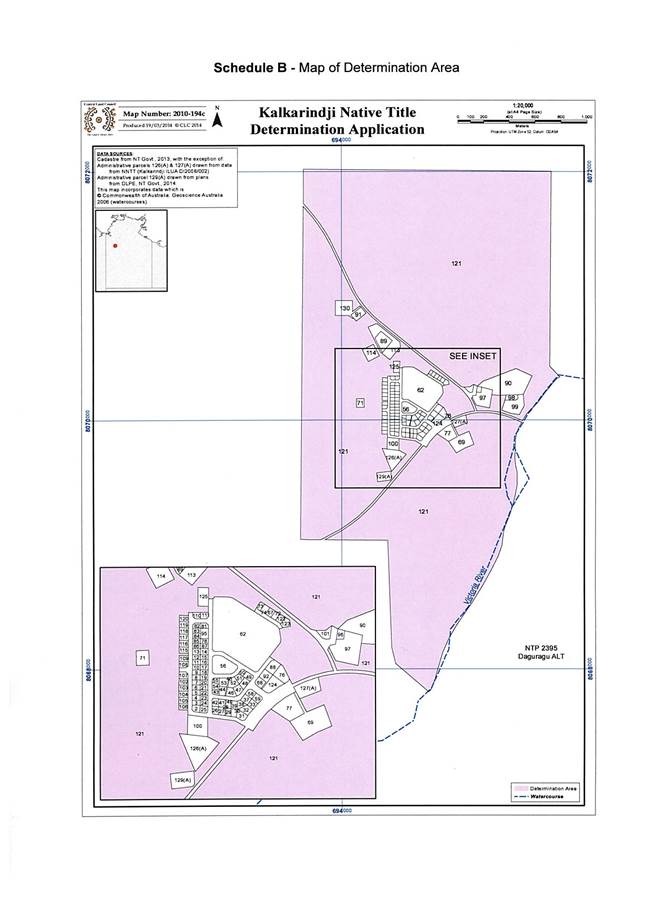
D. The terms of the parties’ agreement involve the Court making, by consent, a determination that native title exists in the area identified in the determination (“the determination area”). The external boundaries of the determination area are described in Schedule A and depicted on the map at Schedule B of the determination.
E. The parties have acknowledged that the effect of the making of the determination will be that the members of the native title claim group, in accordance with the traditional laws acknowledged and the traditional customs observed by them, are recognised as the native title holders for the determination area.
F. The parties have requested that the Court determine this proceeding in accordance with their agreement.
BEING SATISFIED that a determination of native title in the terms set out in the determination in respect of this proceeding would be within power of the Court and, it appearing to the Court appropriate to do so, pursuant to section 87A of the Act and by the consent of the parties:
THE COURT ORDERS THAT:
1. There be a determination of native title in terms of the determination set out below.
2. The native title is not to be held on trust.
3. Gurindji Aboriginal Corporation is:
(a) to be the prescribed body corporate for the purposes of section 57(2) of the Act;
(b) to perform the functions outlined in section 57(3) of the Act after becoming a registered native title body corporate.
4. The parties have liberty to apply to establish the precise location and boundaries of any public works and adjacent land and waters identified or otherwise referred to in Schedule C of the determination.
5. The proceedings in application number NTD 6013 of 2000 be otherwise dismissed.
6. There be no order as to costs.
THE COURT DETERMINES THAT:
The determination area
1. The determination area is the land and waters in the Town of Kalkarindji described in Schedule A and depicted on the map comprising Schedule B.
2. Exclusive native title rights and interests exist in the determination area – section 47B applies.
3. Native title does not exist in those parts of the determination area described in Schedule C.
The native title holders
4. The determination area comprises four estates areas associated with the Karu (Children), Yiparrartu (Emu), Warrpawurru (Flying-fox) and Nyirri (Cicada) estate groups.
5. The persons who hold the common or group rights comprising the native title are the Aboriginal persons who are members of one or more of the estate groups by reason of descent (including adoption) through father’s father, mother’s father, father’s mother or mother’s mother.
Native title rights and interests
6. The native title rights and interests confer possession, occupation, use and enjoyment of the land and waters on the native title holders to the exclusion of all others, provided however, that the rights and interests in the waters of the Victoria River are non-exclusive.
7. The native title rights and interests are subject to and exercisable in accordance with:
(a) the valid laws of the Northern Territory of Australia and the Commonwealth of Australia;
(b) the traditional laws acknowledged and traditional customs observed by the native title holders.
Other rights and interests
8. The nature and extent of the other interests in the determination area are:
(a) the interests of the parties under the Kalkarindji Indigenous Land Use Agreement executed on 7 May 2014;
(b) the rights and interests of Telstra Corporation Limited:
(i) as the owner or operator of telecommunications facilities within the determination area;
(ii) created pursuant to the Post and Telegraph Act 1901 (Cth), the Telecommunications Act 1975 (Cth), the Australian Telecommunications Corporation Act 1989 (Cth), the Telecommunications Act 1991 (Cth) and under Schedule 3 to the Telecommunications Act 1997 (Cth), including rights:
A. to inspect land;
B. to install and operate telecommunication facilities; and
C. to alter, remove, replace, maintain, repair and ensure the proper functioning of its telecommunication facilities; and
(iii) for its employees, agents or contractors to access its telecommunications facilities in and in the vicinity of the determination area in the performance of their duties; and
(iv) under any lease, licence or easement relating to its telecommunications facilities in the determination area;
(c) the rights of Aboriginal persons (whether or not native title holders) by virtue of the Northern Territory Aboriginal Sacred Sites Act 1989 (NT);
(d) rights of access by an employee, servant, agent or instrumentality of the Northern Territory, Commonwealth or other statutory authority as required in the performance of his or her statutory duties;
(e) the interests of persons to whom valid or validated rights and interests have been:
(i) granted by the Crown pursuant to statute or otherwise in the exercise of its executive power; or
(ii) conferred by statute.
Relationship between rights and interests
9. To the extent that the continued existence, enjoyment or exercise of the native title rights and interests referred to in paragraph 6 is inconsistent with the existence, enjoyment or exercise of the other rights and interests referred to in paragraph 8, the other rights and interests and the doing of any activity required or permitted to be done by or under the other interests, prevail over, but do not extinguish, the native title rights and interests.
Other matters
10. There are no native title rights and interests in:
(a) minerals (as defined in s 2 of the Minerals (Acquisition) Act 1953 (NT));
(b) petroleum (as defined in s 5 of the Petroleum Act 1984 (NT));
(c) prescribed substances (as defined in s 5 of the Atomic Energy Act 1953 (Cth) and s 3 of the Atomic Energy (Control of Materials) Act 1946 (Cth)).
11. Unless the contrary intention appears, a word or expression used in the Act has the same meaning in this determination as it has in the Act.
Note: Entry of orders is dealt with in Rule 39.32 of the Federal Court Rules 2011.
SCHEDULE A
1. The determination area comprises Lot 121 within the Town of Kalkarindji, excluding Administrative Lots 126(A), 127(A) and 129(A).
Note:
(i) The boundary of Lot 121 extends to the centreline of the Victoria River. The determination area includes so much of the bed and banks of the river as are within Lot 121;
(ii) Lots 126(A) and 127(A) are part of Lot 121 and are subject to the Kalkarindji ILUA DI2008/002 which was entered on the Register of Indigenous Land Use Agreements on 3 November 2008. Lot 129(A) is a public work being the Town of Kalkarindji sewerage ponds.
2. The following areas within the Town of Kalkarindji are not included in the determination area:
(a) Lots 2, 3, 4, 5, 6, 7, 8, 9, 10, 11, 12, 13, 14, 15, 16, 17, 18, 19, 20, 21, 22, 23, 24, 25, 26, 27, 28, 29, 30, 31, 33, 37 38, 39, 40, 41, 42, 43, 44, 45, 46, 47, 48, 49, 50, 51, 52, 53, 54, 55, 56, 58, 59, 62, 67, 68, 69, 71, 72, 73, 74, 76, 77, 78, 81, 82, 83, 84, 85, 86, 87, 88, 89, 90, 91, 92, 95, 96, 97, 98, 99, 100, 101, 102, 103, 104, 105, 106, 107, 108, 109, 110, 111, 113, 114, 115, 116, 117, 118, 119, 120, 122, 123, 124, 125, 126(A), 127(A), 129(A) and 130;
(b) any additional areas listed in Schedule C.
SCHEDULE C
Areas where native title does not exist
Native title rights and interests have been wholly extinguished in the following areas of land and waters:
Public works
1. Those parts of the determination area being covered by public works as defined in section 253 of Native Title Act 1993 (Cth) (“the Act”) that were constructed or established before 23 December 1996 or commenced to be constructed or established on or before that date (including land and waters within the meaning of section 251D of the Act) including:
(a) public roads, namely, rural public roads (50m either side of the centre line), rural arterial roads and national highways;
(b) gravel and fill pits established to maintain the roads referred to in (a) above;
(c) government bores and associated works;
(d) transmission water pipes (adjacent area 5m either side of the centre line);
(e) distribution water pipes measuring 150mm diameter or less (adjacent area of 1.5m either side of the centre line) and/or greater than 150mm diameter (adjacent area 5m either side of the centre line);
(f) sewer pipes measuring 150mm diameter or less (adjacent area 1.5m either side of the centre line) and/or greater than 150mm (adjacent area 5m either side of the centre line);
(g) bores, sewer pump stations, and overhead power lines.
2. In addition to the areas referred to in paragraph 1 above native title has been wholly extinguished over the areas covered by the following public works (including land and waters within the meaning of section 251D of the Act):
(a) Lot 121 Dagaragu access road, Janama Street, Libanangu Street, Japalyi Street, Whitlam Street and Kalkarindji internal road;
(b) Lot 121 the Buntine Highway;
(c) Lot 121 river level gauges.
|
NORTHERN TERRITORY DISTRICT REGISTRY |
|
|
GENERAL DIVISION |
NTD 6013 of 2000 |
|
BETWEEN: |
BERNARD PONTIARI JAPALYI and IDA MALYIKA NAMPIYIN ON BEHALF OF THE JIYILIJURRUNG AND YILYILIMAWU GURINDJI PEOPLE WHO ARE MEMBERS OF FOUR ESTATE GROUPS ASSOCIATED WITH THE KARU (CHILDREN), YIPARRARTU (EMU), WARRPAWURRU (FLYING-FOX) AND NYIRRI (CICADA) DREAMINGS RESPECTIVELY Applicants |
|
AND: |
NORTHERN TERRITORY OF AUSTRALIA Respondent |
|
JUDGE: |
WHITE J |
|
DATE: |
7 MAY 2014 |
|
PLACE: |
KALKARINDJI |
REASONS FOR JUDGMENT
1 In the year 2000, the first applicant filed an application for the determination of native title in respect of the area within the boundaries of the Town of Kalkarindji. The second applicant was joined to the proceedings in January 2011.
2 The applicants and the Northern Territory of Australia, the sole remaining respondent, have reached agreement on the application and join in asking the Court to make a determination by consent.
3 The area which is the subject of the proposed determination comprises approximately 5.7 km2 and is the area within the outer boundaries of Lot 121 in the Town of Kalkarindji. However, it does not include the smaller individual lots located within those outer boundaries.
4 Section 87A of the Native Title Act 1993 (Cth) (NTA) permits the Court to make a determination by consent without holding a formal hearing if it is satisfied of a number of matters:
(a) There is agreement by all parties to the proceedings at the time the agreement is made on a proposed determination of native title in respect of a claim area (subs (1)(b)-(c));
(b) The period specified in the Registrar’s notice under s 66 has ended (subs (1)(b));
(c) The terms of the proposed determination are in writing and have been signed by, or on behalf of, each of the parties (subs (1)(d)) and a copy has been filed with the Court (subs (2));
(d) The Registrar has given notice to the other parties to the proceedings of the filing of the proposed determination (subs (3));
(e) An order in, or consistent with, the terms of the proposed determination is within the Court’s power (subs (4)(a)); and
(f) It is appropriate to make the determination (subs (4)(b)).
5 The first four of these are of a procedural kind. They have been satisfied in this case.
6 Although there have at times been other parties to the proceedings, the sole remaining parties are the two applicants and the Northern Territory of Australia.
Approach to the application of s 87A
7 The NTA evidences a policy, well-recognised in decisions of this Court, of encouraging parties to reach agreements with respect to claims of native title so as to avoid the necessity for determinations following formal Court hearings. Sections 87 and 87A reflect that policy by permitting the Court to give effect to the parties’ agreement without itself hearing and determining the evidence supporting the claim.
8 However, a determination that native title exists is different in some respects from conventional litigation between two parties. Such a determination binds not only the parties to the proceedings in which it is made, but everyone else in the community as well. Because of this, the Court must be satisfied that the proposed determination is within its power and that it is otherwise appropriate. This involves considering, amongst other things, that the proposed determination is supportable and is in accordance with the law: Cox on behalf of the Yungngora People v State of Western Australia [2007] FCA 588 at [3].
9 In considering applications for consent determinations, the Court places particular reliance on the State and Territory parties. Madgwick J referred to the responsibilities of the States in assessing claims for native title in Smith v State of Western Australia [2000] FCA 1249 at [38]; (2000) 104 FCR 494 at 501-2:
… State governments are necessarily obliged to subject claims for native title over lands and waters owned and occupied by the State and State agencies, to scrutiny just as carefully as the community would expect in relation to claims by non-Aborigines to significant rights over such land. The State is faced with a good many such claims. A deal of proper caution is to be expected. …
Those remarks are just as apposite in the case of Territories.
10 More recently, in King v State of South Australia [2011] FCA 1386 at [19]; (2011) 285 ALR 454 at 458, Keane CJ spoke of the role of the States and Territories as follows:
More recently, the court has been prepared to rely upon the processes of the relevant state or territory about the requirements of s 223 being met to be satisfied that the making of the agreed orders is appropriate. That is because each state and territory has developed a protocol or procedure by which it determines whether native title (as defined in s 223) has been established. It acts in the public interest and as the public guardian in doing so. It has access to anthropological, and where appropriate, archaeological, historical and linguistic expertise. It has a legal team to manage and supervise the testing as to the existence of native title in the claimant group. Although the court must, of course, preserve to itself the question whether it is satisfied that the proposed orders are appropriate in the circumstances of each particular application, generally the court reaches the required satisfaction by reliance upon those processes. They are commonly explained in the joint submissions of the parties in support of the orders agreed. …
11 The approach of the Court in giving effect to the agreement of parties has also been described in a number of cases. In Lovett on behalf of the Gunditjmara People v State of Victoria [2007] FCA 474, North J said:
35 In the present case the Court has heard some evidence, but not a comprehensive case sufficient to establish the facts which would support a determination. Section 87(1) obviously contemplates that the Court can make orders in such circumstances because it applies when there is no hearing or no full hearing of the case.
36 The focus of the section is on the making of an agreement by the parties. This reflects the importance placed by the Act on mediation as the primary means of resolving native title applications. Indeed, Parliament has established the National Native Title Tribunal with the function of conducting mediations in such cases. The Act is designed to encourage parties to take responsibility for resolving proceedings without the need for litigation. Section 87 must be construed in this context. The power must be exercised flexibly and with regard to the purpose for which the section is designed.
37 In this context, when the Court is examining the appropriateness of an agreement, it is not required to examine whether the agreement is grounded on a factual basis which would satisfy the Court at a hearing of the application. The primary consideration of the Court is to determine whether there is an agreement and whether it was freely entered into on an informed basis. Insofar as this latter consideration applies to a State party, it will require the Court to be satisfied that the State party has taken steps to satisfy itself that there is a credible basis for an application. There is a question as to how far a State party is required to investigate in order to satisfy itself of a credible basis for an application. One reason for the often inordinate time taken to resolve some of these cases is the overly demanding nature of the investigation conducted by State parties. The scope of these investigations demanded by some States is reflected in the complex connection guidelines published by some States.
38 The power conferred by the Act on the Court to approve agreements is given in order to avoid lengthy hearings before the Court. The Act does not intend to substitute a trial, in effect, conducted by State parties for a trial before the Court. Thus, something significantly less than the material necessary to justify a judicial determination is sufficient to satisfy a State party of a credible basis for an application. The Act contemplates a more flexible process than is often undertaken in some cases. …
(Citations omitted)
12 These passages have been quoted and applied in numerous decisions of this Court. I consider that the approach set out is appropriate in the present case.
Consideration
13 In considering the application, I have had regard to the amended application filed in this Court on 27 January 2011, the applicants’ points of claim and the respondent’s points of response filed in September and October 2013 respectively, and the statement of agreed facts and joint submissions provided by the parties.
14 The first applicant provided the Northern Territory with a report of Dr Patrick McConvell dated 27 July 2010 concerning the connection of the applicant group with the claimed area. Dr McConvell has a BA (Hons) in Anthropology and Linguistics, and a PhD in Linguistics. He has undertaken research and field work in the Victoria River region of the Northern Territory since the mid-1970s.
15 The report of Dr McConvell indicated that it was only those of the Jiyilijurrung and Yilyilimawu Gurindji Peoples who are members of the four estate groups associated with the Karu (Children), Yiparrartu (Emu), Warrpawurru (Flying-fox) and Nyirri (Cicada) Dreamings who hold native title interests in the area, rather than all of the Jiyilijurrung and Yilyilimawu Gurindji Peoples. The Northern Territory referred Dr McConvell’s report to Emeritus Professor Basil Sansom, a Consultant Anthropologist. He confirmed Dr McConvell’s expertise and the conclusions expressed in his report.
16 By its points of defence, the Northern Territory acknowledged that Aboriginal people have been present on and have inhabited the claim area since before sovereignty was asserted in 1825; that the Aboriginal people who were then present on and inhabiting the claim area held rights and interests in the area by reason of their presence on, and connection with, the area; that there is and has at all material times been a distinct language known as the Gurindji language; and that the first non-Aboriginal settlement of the claim region occurred in or about 1883 following the issue of a pastoral lease for Wave Hill Station in 1881.
17 Three of the estate groups (Yiparrartu (Emu), Warrpawurru (Flying-Fox) and Nyirri (Cicada)) were accepted as satisfying the elements of “traditional Aboriginal owners” under the Aboriginal Land Rights (Northern Territory) Act 1976 (Cth) in the Gurindji Land Claim to Dargaragu Station. It was because of its proclamation as a town that Kalkarindji was not available for claim under the Aboriginal Land Rights (Northern Territory) Act 1976 (Cth).
18 The proposed determination is within the Court’s jurisdiction under s 61 of the NTA.
19 Section 94A of the NTA requires that an order of this Court determining a native title claim set out details of the matters mentioned in s 225. Section 225 provides:
A determination of native title is a determination whether or not native title exists in relation to a particular area (the determination area) of land or waters and, if it does exist, a determination of:
(a) who the persons, or each group of persons, holding the common or group rights comprising the native title are; and
(b) the nature and extent of the native title rights and interests in relation to the determination area; and
(c) the nature and extent of any other interests in relation to the determination area; and
(d) the relationship between the rights and interests in paragraphs (b) and (c) (taking into account the effect of this Act); and
(e) to the extent that the land or waters in the determination area are not covered by a non-exclusive agricultural lease or a non-exclusive pastoral lease—whether the native title rights and interests confer possession, occupation, use and enjoyment of that land or waters on the native title holders to the exclusion of all others.
20 As can be seen, s 225(b) refers to “native title rights and interests”. That expression is defined in s 223(1) of the NTA as follows:
(1) The expression native title or native title rights and interests means the communal, group or individual rights and interests of Aboriginal peoples or Torres Strait Islanders in relation to land or waters, where:
(a) the rights and interests are possessed under the traditional laws acknowledged, and the traditional customs observed, by the Aboriginal peoples or Torres Strait Islanders; and
(b) the Aboriginal peoples or Torres Strait Islanders, by those laws and customs, have a connection with the land or waters; and
(c) the rights and interests are recognised by the common law of Australia.
21 The requirements of s 223(1) were considered by the High Court in Members of the Yorta Yorta Aboriginal Community v State of Victoria [2002] HCA 58; (2002) 214 CLR 422 and reviewed by Mansfield J in Risk v Northern Territory of Australia [2006] FCA 404. It is necessary that there be a recognisable group or society which presently recognises and observes traditional lands and customs in the area of the proposed determination. The following matters are pertinent to the identification of that group or society:
(a) That they are a society united in and by their acknowledgement and observance of a body of accepted laws and customs;
(b) That the present day body of accepted laws and customs of the society is in essence the same body of laws and customs acknowledged and observed by the ancestors of members of the society adapted to modern circumstances; and
(c) That the acknowledgement and observance of those laws and customs has continued substantially uninterrupted by each generation since sovereignty, and that the society has continued to exist throughout that period as a body united in and by its acknowledgement and observance of those laws and customs.
22 The affidavits of the respective applicants filed with the amended application and the assessment in Dr McConvell’s report indicate that the members of the Jiyilijurrung and Yilyilimawu Gurindji people who are members of the four estate groups satisfy these requirements and that there has been substantially uninterrupted observance of the traditional lands and customs in the proposed determination area since sovereignty. The assessment of Dr McConvell in this respect is supported by the conclusion of Emeritus Professor Sansom.
23 Accordingly, I am satisfied that the proposed determination satisfies the elements of s 225 as required by s 94A of the NTA.
24 Paragraphs 1 and 3, and Schedules A, B and C of the proposed determination set out with appropriate particularity the area in respect of which there is to be a declaration of native title.
25 Paragraphs 4 and 5 of the proposed determination define the group of native title holders and the criteria by which group membership is determined.
26 Paragraphs 6 and 7 of the proposed determination set out the nature and extent of the native title rights and interests in the determination area.
27 Paragraph 8 of the proposed determination sets out in an appropriate way the nature and extent of other interests in the determination area. I note in this respect that there has been ample opportunity for other interest-holders to identify themselves and to join as parties to the claim.
28 Paragraph 10 of the proposed determination sets out the resources in respect of which native title does not exist.
29 Paragraph 9 of the proposed determination describes, as required by s 225(d), the relationship between the native title rights referred to in paragraph 6 and the other rights listed in paragraph 8.
30 In relation to s 225(e), the proposed determination will provide in paragraph 2 that exclusive native title rights and interests exist in the determination area.
31 By ss 55 and 56 of the NTA, the Court must determine whether the native title is to be held in trust and, if so, by whom. Proposed order no. 2 provides expressly that the native title is not to be held on trust.
Conclusion
32 As already indicated, the Court is entitled to attach significant weight to the parties’ agreement and to the consent of the Northern Territory of Australia. Having regard to those matters, and to the matters referred to in these reasons, I am satisfied that the proposed determination is appropriate and should be made.
33 I will make orders in the terms proposed by the parties.
|
I certify that the preceding thirty-three (33) numbered paragraphs are a true copy of the Reasons for Judgment herein of the Honourable Justice White. |
Associate:


