

FEDERAL COURT OF AUSTRALIA
Animals’ Angels e.V. v Secretary, Department of Agriculture [2014] FCA 398
| IN THE FEDERAL COURT OF AUSTRALIA | |
| Applicant |
| AND: | SECRETARY, DEPARTMENT OF AGRICULTURE Respondent |
| DATE OF ORDER: | |
| WHERE MADE: |
THE COURT ORDERS THAT:
1. The respondent’s notice of objection to competency filed 27 July 2012 is upheld.
2. The applicant’s interlocutory application filed 6 July 2012 is dismissed.
3. The applicant’s interlocutory application dated 24 October 2013 is dismissed.
4. The applicant’s originating application dated 5 July 2012 is dismissed.
5. The applicant pay the respondent’s costs, subject to the discount referred to in [127] of the reasons for judgment, as agreed or taxed.
Note: Entry of orders is dealt with in Rule 39.32 of the Federal Court Rules 2011.
| NEW SOUTH WALES DISTRICT REGISTRY | ||
| GENERAL DIVISION | NSD 952 of 2012 | |
| BETWEEN: | ANIMALS’ ANGELS e.V. Applicant |
| AND: | SECRETARY, DEPARTMENT OF AGRICULTURE Respondent |
| JUDGE: | EDMONDS J |
| DATE: | 24 APRIL 2014 |
| PLACE: | SYDNEY |
REASONS FOR JUDGMENT
1 The event giving rise to this proceeding was an export of live-stock (goats, sheep and cattle) from Fremantle to Singapore and then to Malaysia in November and December 2008 (“Voyage”). The live-stock was transported on a vessel called the MV Hereford Express (“Vessel”). The exporter was International Livestock Export Pty Ltd (“ILE”). The Vessel departed Fremantle on 27 November 2008 and arrived in Singapore on 5 December 2008 where it discharged part of its cargo. It then proceeded to Malaysia to discharge its final cargo, which it did on 7 December 2008.
2 By its originating application dated 5 July 2012, the applicant invokes the jurisdiction of this Court under s 5 of the Administrative Decisions (Judicial Review) Act 1977 (Cth) (“ADJR Act”) and s 39B of the Judiciary Act 1903 (Cth) to review two decisions of the respondent:
(1) The first, on or about 3 December 2008, giving approval to ILE, the holder of an export licence to export live-stock, to direct the Australian Quarantine and Inspection Service (“AQIS”) Appointed Veterinarian (“AAV”) to leave the Vessel in Singapore on about 5 December 2008 and not accompany the live-stock on the Vessel from Singapore to Malaysia, such decision purportedly being made under the Export Control Act 1982 (Cth) (“EC Act”), the Export Control (Orders) Regulations 1982 (Cth) (“EC(O) Regs”) or the Export Control (Animals) Order 2004 (“EC(A) Order”), (“first decision”); and
(2) The second, dated 5 June 2012 and furnished to the applicant on 9 June 2012, not to issue a notice pursuant to s 23 of the Australian Meat and Live-stock Industry Act 1997 (Cth) (“AMLI Act”) to ILE to show cause why its export licence to export live-stock should not be cancelled, not renewed or suspended or ILE not be reprimanded (“second decision”).
3 By interlocutory application filed 6 July 2012, the applicant sought an order for extension of time under r 31.02 of the Federal Court Rules 2011 (“Rules”) to lodge an application for an order for review under the ADJR Act in relation to the first decision on the grounds set out in Ex 2. On the first day of the hearing I indicated that I would deal with this interlocutory application at the time and as part of publishing these reasons for judgment and further indicated that I would not be disposed to grant the extension of time sought unless I thought it was utile. Both parties accepted this as a convenient course.
4 On the first day of the hearing I also gave the applicant leave to file in Court an interlocutory application dated 24 October 2013 seeking leave to amend its originating application so as to review, in addition to the first and second decisions:
[T]he failure by the [r]espondent on and from 5 January 2009 to exercise his duty to consider whether to issue a notice pursuant to s 23 of the AMLI Act to ILE to show cause why its export licence to export live-stock should not be cancelled, not renewed or suspended or ILE not be reprimanded by reason of the conduct of ILE during the voyage of the MV Hereford Express from 27 November 2008 to 7 December 2008 from Fremantle to Singapore and Malaysia (“Voyage”).
5 This interlocutory application was said to be made on the grounds set out in Ex 8 as well as an affidavit of Malcolm Patrick Caulfield affirmed 23 October 2013 to which the latest draft of an amended originating application (including new ground 3A relating to the second decision and new ground 8 relating to the alleged failure to consider now sought to be reviewed) was annexed as “MPC 1”. It is difficult to identify any supporting grounds in either Ex 8 or Mr Caulfield’s subsequent affidavit, but I indicated on the first day of the hearing that I would also deal with this interlocutory application at the time and as part of publishing these reasons for judgment and further indicated that I would not be disposed to grant the leave sought unless I thought it was utile. Again, both parties accepted this as a convenient course.
6 By notice of objection to competency filed 27 July 2012, the respondent objected to the competency of the application on the ground that the applicant is not a person aggrieved within the meaning of s 5 of the ADJR Act and on the further ground that the applicant does not have standing under s 39B of the Judiciary Act to challenge the decision.
7 The applicant is said to be a registered corporate non-profit charitable entity established in Germany, able to sue in its own name. Its status and capacity in this regard was not put in issue by the respondent.
8 The respondent is the Secretary of the Department of Agriculture (formerly Department of Agriculture, Fisheries and Forestry) (“DAFF”). At all times from 2008 until around 30 June 2009, the AQIS was a business unit within DAFF with responsibilities relating to the AMLI Act and the EC Act. From around 30 June 2009, the functions performed by AQIS were incorporated into the Biosecurity Services Group which is part of DAFF.
9 A great deal of documentary material was tendered by the applicant and taken into evidence. Much of this dealt with facts which, while falling within the rubric of the “Course of Events” as detailed in the applicant’s written submissions (“AWS”) at AWS [61]–[140], have little or nothing to do with the two decisions or the alleged failure to consider sought to be reviewed in this proceeding. The material facts in respect of each decision sought to be reviewed, as well as the alleged failure to consider, can be confined to a much narrower context. The same can be said of the relevant legislative context compared to the “Legislative Framework” canvassed in the AWS at [15]–[60]. The legislative context can be confined to those legislative powers the applicant says were exercised unlawfully or were unlawfully not exercised.
10 On 4 December 2008, Ben Stanton, an Export Manager at ILE, sent an email to Jonathon Adams at AQIS which stated:
I left a voice message for you about the onboard vet on the Hereford Express.
Dr Lloyd Reeve Johnson will be disembarking the vessel in Singapore once all sheeps and goats have been discharged.
I will discharge the final cargo in Malaysia as the stockman and will be present for the discharge in Singapore.
Please let me know if there are any queries as soon as you can as I am flying to Singapore this afternoon.
11 Later that day, Jonathan Adams emailed Ben Stanton and stated:
As discussed, AQIS does not have any issues with this arrangement. Please ensure that the appropriate end of voyage reports are completed as required under the ASEL.
The reference to ASEL was a reference to the Australian Standards for the Export of Livestock, then operative pursuant to the Australian Meat and Live-stock Industry (Standards) Order 2005 (Cth).
12 It is not in dispute that the AAV left the ship in Singapore and, accordingly, did not accompany the livestock on the Malaysian leg of the Voyage.
13 Sections 2.47 to 2.49 of the EC(A) Order then provided:
2.47 Approved export programs for live-stock
(1) An approved export program for live-stock may include requirements about any 1 or more of the following matters:
(a) Pre-export quarantine or isolation, treatment and testing of the live-stock, as required by the importing country requirements and the Australian Standards for the Export of Live-stock;
(b) obligations on an accredited veterinarian to report on the program, keep records and make declarations in relation to compliance with the program.
(2) The Secretary may approve an export program for an export of live-stock based on the information contained in the relevant [notice of intention to export] and [consignment risk management plan] and any other information that the Secretary has regarding the importing country requirements and the Australian Standards for the Export of Live-stock.
(3) The Secretary must give a copy of the approved export program to the exporter concerned and may give a copy to the accredited veterinarian nominated by the exporter.
(4) The exporter must give a copy of the approved export program to the accredited veterinarian nominated by the exporter.
2.48 When live-stock to be accompanied by accredited veterinarian
(1) The Secretary may require, as a condition of the approval of an export program, that live-stock the subject of the export program are to be accompanied on their export voyage by an accredited veterinarian.
Note Failure to comply with such a requirement is an offence — see the Act, section 9J.
(2) For the purpose of deciding whether or not to impose a requirement under subsection (1), the Secretary may take into account any relevant matter including:
(a) the relevant importing country requirements; and
(b) the exporter’s record as an exporter of live-stock; and
(c) the condition of the vessel on which the live-stock are to travel; and
(d) the weather and time of year; and
(e) the kind of live-stock being exported; and
(f) market considerations.
2.49 Variation of approved export programs for live-stock
(1) The Secretary may vary an approved export program if:
(a) the importing country requirements relevantly change; or
(b) the standards of the Australian Standards for the Export of Live-stock relevantly change; or
(c) any other relevant circumstance changes; or
(d) the Secretary is of the opinion that the variation is necessary to maintain the health or welfare of the relevant live-stock; or
(e) the exporter or accredited veterinarian concerned so requests.
(2) In considering whether to approve a variation requested by an exporter or accredited veterinarian, the Secretary must have regard to:
(a) the importing country requirements; and
(b) the relevant standards of the Australian Standards for the Export of Live-stock; and
(c) the health and welfare of the live-stock concerned; and
(d) any other relevant circumstance.
(3) If the Secretary varies an approved export program, he or she must give a copy of the approved export program, as so varied, to the exporter concerned, and may give a copy to the accredited veterinarian nominated by the exporter.
(4) The exporter must give a copy of the approved export program, as so varied, to the accredited veterinarian nominated by the exporter.
14 The applicant sought review of the first decision in reliance on s 5(1)(d) of the ADJR Act and the general law on the basis the first decision was not authorised by the EC Act, the EC(O) Regs or the EC(A) Order.
15 The ground was particularised as follows:
(a) On about 24 November 2008, the Secretary issued an Approved Export Program (“AEP”) to the ILE as the exporter of live-stock on a voyage by sea from Fremantle to Singapore and then Malaysia from 27 November 2008 to 8 December 2008 (“Voyage”).
(b) The AEP was issued pursuant to s.2.47 of the Export Control (Animals) Order 2004, an instrument made under cl.3 of the Export Control (Orders) Regulations 1982 (Cth).
(c) The AEP required the presence of the AAV on the vessel to accompany the live-stock for the entirety of the Voyage until the last animal had disembarked. This was a requirement made under s.2.48 of the Export Control (Animals) Order 2004.
(d) The Respondent admitted by letter dated 5 June 2012 that the Respondent had not amended the AEP pursuant to s.2.49 of the Export Control (Animals) Order 2004 to waive the requirement that the AAV be present on the vessel to accompany the live-stock for the entirety of the Voyage.
(e) The Respondent was not otherwise empowered to waive a requirement that he imposed under the AEP under [the] Export Control Act 1982 (Cth), the Export Control (Orders) Regulations 1982 (Cth) or the Export Control (Animals) Order 2004.
16 The applicant seeks relief in the form of a declaration that the first decision was not authorised by the EC Act, the EC(O) Regs or the EC(A) Order or, alternatively, was not authorised by law.
17 The applicant submitted that s 2.49 of the EC(A) Order makes detailed provision for the way in which an AEP may be amended and that this is the only way in which an Approved Export Program (“AEP”) can be amended. Section 2.49 empowers the Secretary to amend the AEP but only if one of the conditions specified in s 2.49(1) is found to exist and only if the Secretary has regard to the matters specified in s 2.49(2), which include the standards of the ASEL and the health and welfare of the live-stock concerned.
18 The applicant conceded that the evidence established that the condition imposed in the AEP requiring the AAV to remain on board for the duration of the Voyage was waived by Jonathon Adams, an AQIS Veterinary Officer, but says there is no evidence that he was a delegate of the respondent. Even if he was, the applicant submitted that there is nothing in the documents produced by the respondent to indicate that he satisfied himself that one of the conditions in s 2.49(1) existed or that he had considered each of the matters specified in s 2.49(2). According to the applicant, the respondent admitted in its 5 June 2012 letter that there was no variation under s 2.49.
19 Finally, says the applicant, there is no other source of statutory power to approve the waiver of a condition imposed by the AEP. Accordingly, the purported “approval” of the AEP is not authorised by law.
20 The respondent submits that the applicant should not now be allowed to raise any question as to whether Mr Adams was a delegate. Any contention that Mr Adams was not a delegate should have been particularised. Neither the originating application nor the draft amended originating application do so.
21 The respondent says that the applicant mischaracterises the 5 June 2012 letter when it says that the Secretary admitted that there had been no valid variation of the AEP. The 5 June 2012 letter asserts that the variation had been approved. It accepts that there had been non-compliance with s 2.49(3) of the EC(A) Order, which requires the Secretary to give a varied AEP to the licensee. According to the respondent, the applicant does not claim – and could not succeed in claiming – that a purpose of s 2.49(3) was that failure to comply with s 2.49(3) would invalidate the prior variation.
22 Even if there were a question as to the validity of the variation of the AEP, the respondent submitted that the Court ought not to resolve that question absent joinder of ILE. ILE’s interests would be directly affected by the relief sought – which would declare that the purported variation to the AEP was invalid. If the variation to the AEP were invalid, that could expose ILE to criminal liability under ss 8(3)(a) or 9J(1) of the EC Act. Even if Mr Adams could not or did not properly authorise an amendment to the AEP, his email or any decision underlying his email could conceivably give rise to some defence or discretionary factor on which ILE could rely in enforcement proceedings against it.
23 In circumstances where ILE’s equity or interest in that defence or discretionary factor could be directly affected by any determination as to the effect of Mr Adam’s email, the respondent submitted that the Court ought not to make Order 1 in its absence.
24 In my view, the matters raised by the respondent in [20]–[23] above, underscore why this is not the proper proceeding to ventilate those issues. The appropriate forum for determining the validity of the variation to the AEP would be enforcement proceedings against ILE for failure to conform to the AEP. In such proceedings, ILE could raise the purported variation for whatever it was worth; and the Court could determine its validity in proceedings between two parties who have a real interest in its determination. Further, the applicant adduces no evidence of foreseeable practical consequences which would arise if Order 1 were made. This is not simply a matter of discretion. It is not a proper exercise of judicial power to make the declaration sought by the applicant where such a declaration is likely to have no effect on the legal rights and obligations of the parties to the present dispute: Truth About Motorways Pty Ltd v Macquarie Infrastructure Investment Management Ltd (2000) 200 CLR 591, 613 [52] (Gaudron J); Gardner v Dairy Industry Authority of New South Wales (1978) 52 ALJR 180, 188–189 (Aickin J).
25 Even if the applicant has standing, a matter I address below, the inappropriateness of this proceeding to ventilate the validity of the first decision coupled with the significant lapse of time since the first decision furnish discretionary grounds for declining to make Order 1.
26 For these reasons, I do not think it would be utile to accede to the applicant’s interlocutory application filed 6 July 2012 to extend time to lodge an application for review under the ADJR Act in relation to the first decision, and I decline the relief sought in Order 1 in reliance on s 39B of the Judiciary Act insofar as such reliance is not out of time.
27 The second decision was the real impetus to, and focus of, the applicant bringing this proceeding. All the grounds of review of this decision have, in one way or another, been infected by the underlying assumption that the legislative power conferred on the Secretary by s 23 of the AMLI Act is a power coupled with a duty, with no residual discretion in the Secretary not to exercise the power, if one or more of the events enabling the exercise of the power has, to the knowledge of the Secretary, occurred. In my view, this underlying assumption is flawed but, out of deference to the applicant’s arguments, I consider and analyse the nature and character of the legislative power conferred by s 23 of the AMLI Act at [34] to [43] below.
Material Facts
28 On 11 May 2012 the applicant, through its solicitor by letter to the respondent, demanded that the respondent take immediate action to suspend the export licence of ILE and the export licences of companies which shared directors with that company; and demanded that the respondent immediately issue a notice to those companies requiring them to show cause why their export licences should not be cancelled.
29 The letter read:
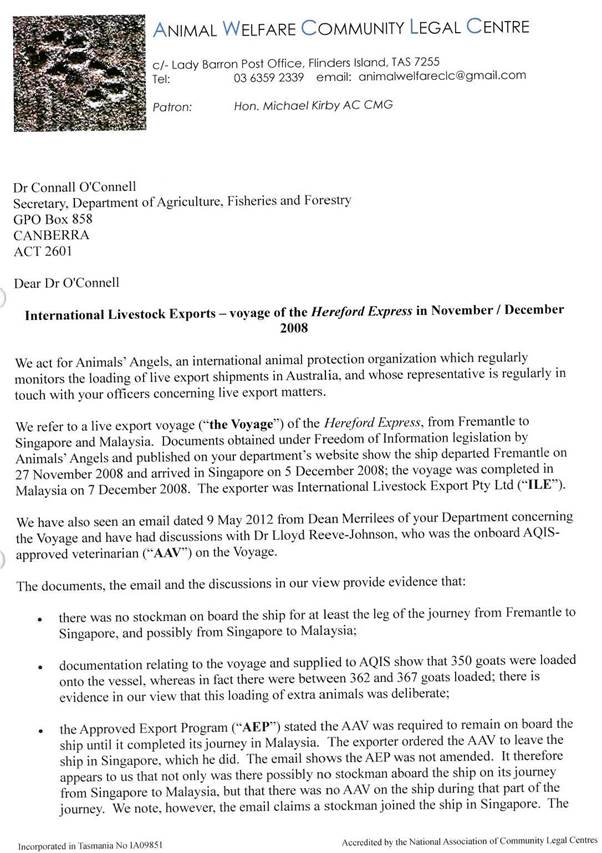
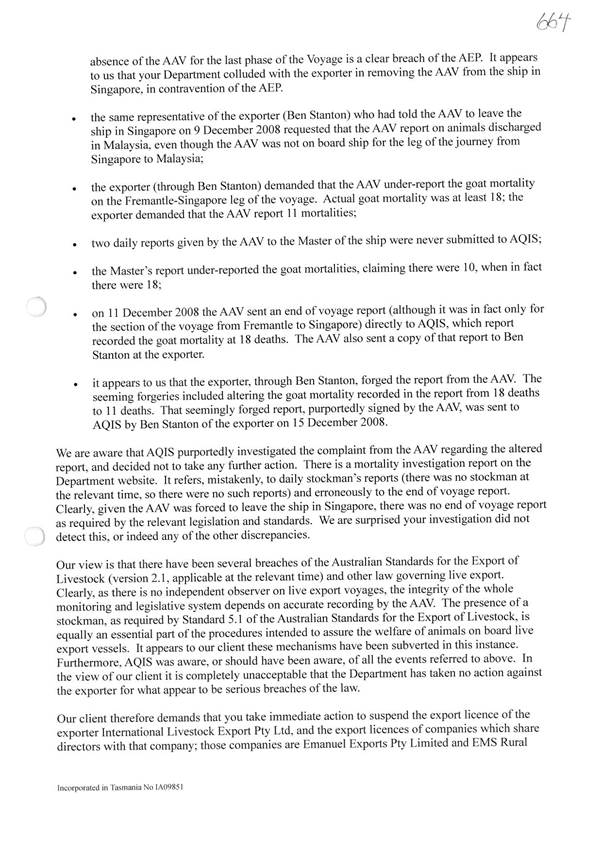
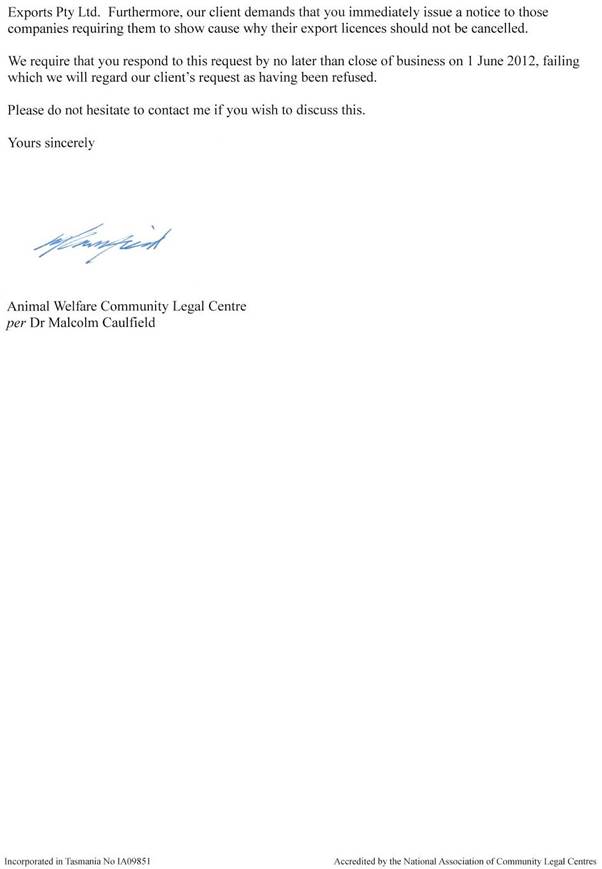
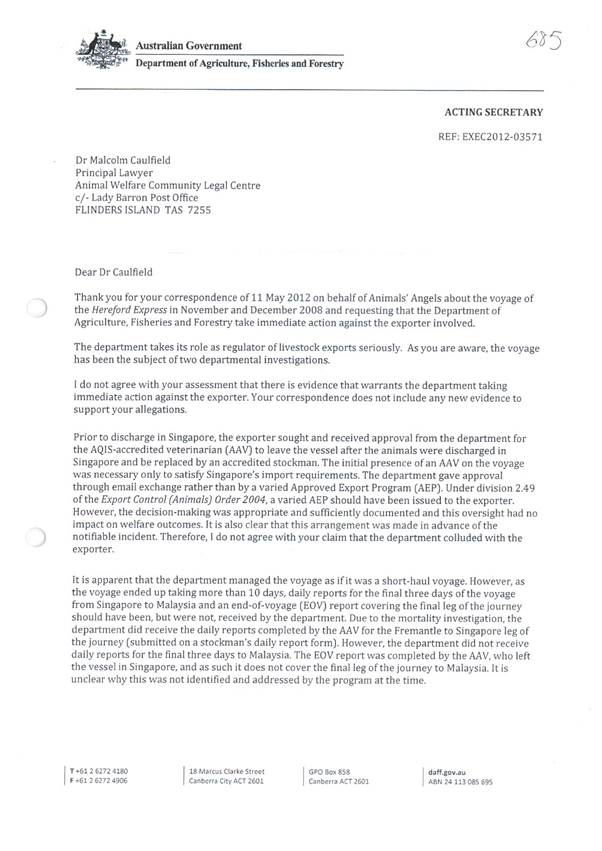
30 The Acting Secretary, Phillip Glyde, responded to these demands by letter dated 5 June 2012. The letter read:
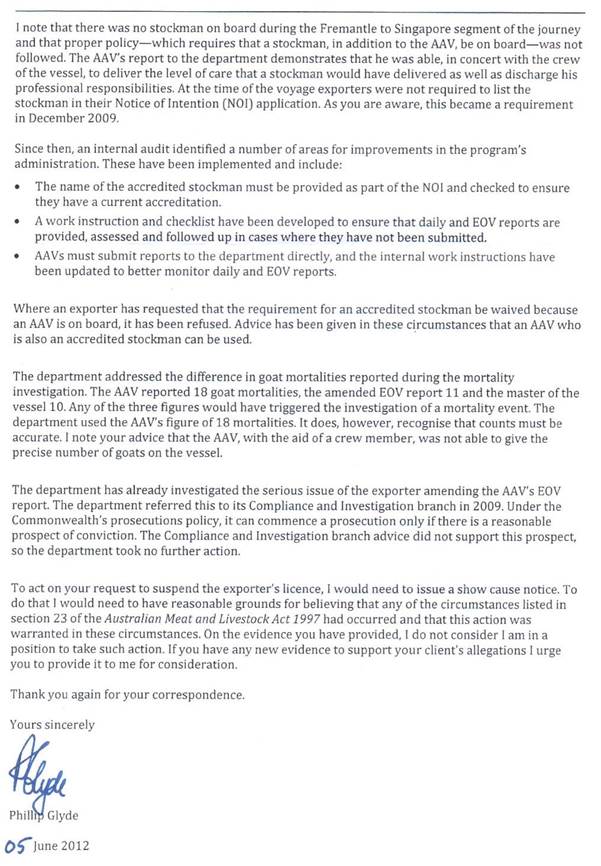
Legislative Context
31 Sections 23 and 24 of the AMLI Act provided:
23 Notice to licence holder to show cause
(1) If the Secretary has reasonable grounds for believing, in relation to an export licence, that:
(a) if the licence is held by an individual, the holder of the licence has ceased to be:
(i) a person of integrity; or
(ii) competent to hold the licence; or
(iii) a person of sound financial standing; or
(b) if the licence is held by a body corporate, the holder of the licence has ceased to be:
(i) a body corporate of integrity; or
(ii) competent to hold the licence; or
(iii) a body corporate of sound financial standing; or
(c) a person who has begun to participate in the management or control of the meat or live-stock export business of the holder of the licence is not a person of integrity; or
(d) a person who participates in the management or control of the meat or live-stock export business of the holder of the licence has ceased to be a person of integrity; or
(e) information or a document given to the Secretary in connection with the application for the licence was false or misleading and, if the information or document has not been false or misleading, the licence would not have been granted; or
(ea) if the licence is a licence to export live-stock and the holder was required to make a declaration of a kind mentioned in subsection 7(3B) of the Export Control Act 1982 as a condition subject to which a licence or permission to export under that Act was granted—the holder made any such declaration falsely; or
(f) the holder of the licence failed to comply with subsection 11(3) in relation to the application for the licence and, if the failure had not occurred, the licence would not have been granted; or
(g) the holder of the licence has contravened a condition of the licence;
the Secretary may give a written notice under this section to the holder of the licence.
(1A) Without limiting subsection (2), for the purpose of determining whether a circumstance mentioned in subsection (1) has occurred in relation to a live-stock export licence, the Secretary may have regard to the extent to which the holder has complied with any requirements of or under the Export Control Act 1982, including any conditions or restrictions:
(a) to which a licence or permission under that Act, to export prescribed goods that are live-stock, was subject; or
(b) that otherwise relate to the export of prescribed goods that are live-stock.
(2) The regulations may prescribe the matters to which the Secretary is to have regard in determining whether a circumstance referred to in paragraph (1)(a), (b), (c) or (d) has occurred.
(2A) If paragraph 25A(2)(b) applies, the Secretary may give a written notice to the holder of the licence mentioned in that paragraph.
(3) A show cause notice must:
(a) if subsection (1) applies—state the grounds on which the Secretary formed the belief because of which the notice is given; and
(aa) if subsection (2A) applies—state the grounds on which the Secretary gives the notice; and
(b) include a statement to the effect that the holder of the relevant licence may, within 14 days after the day on which the notice is given to the holder, give the Secretary a written statement showing cause why the licence should not be dealt with under subsection 24(1).
(4) A show cause notice to the holder of an export licence may state that the licence is suspended, if it appears to the Secretary to be necessary or desirable in the interests of the industry to suspend the licence under this section.
(5) If a show cause notice to the holder of an export licence states that the licence is suspended, the licence is suspended from the time the notice is given to the holder of the licence.
(6) If an export licence is suspended under this section, the licence period is taken to include the period of the suspension.
(7) If an export licence is suspended under this section:
(a) the Secretary may at any time revoke the suspension; and
(b) if the licence has not been dealt with under subsection 24(1) within 60 days after the day on which the licence is suspended—the suspension lapses at the end of that period.
(8) Application may be made to the Administrative Appeals Tribunal for review of a decision of the Secretary to suspend an export licence under this section.
(9) In this section:
licence period, in relation to an export licence, means the period during which the licence is to remain in force.
24 Powers of the Secretary in relation to licence
(1) If the Secretary:
(a) has given a show cause notice to the holder of an export licence; and
(b) after considering any written statement by the holder of the licence given within the period mentioned in paragraph 23(3)(b), is satisfied:
(i) if subsection 23(1) applies—of any of the matters mentioned in subsection 23(1); or
(ii) if subsection 23(2A) applies—that he or she should take action in relation to the licence under any of paragraphs (c) to (g) of this subsection;
the Secretary may, by written notice given to the holder of the licence:
(c) cancel the licence; or
(d) if the licence is about to expire—determine that the licence not be renewed; or
(e) if the licence is not already suspended—suspend the licence for the period specified in the notice; or
(f) if the licence is already suspended—further suspend the licence for the period specified in the notice; or
(g) reprimand the holder of the licence.
(2) If the Secretary:
(a) has given a show cause notice to the holder of an export licence; and
(b) decides not to take any further action in the matter;
the Secretary must, by written notice given to the holder, tell the holder of the decision and, if the licence is suspended under section 23, revoke the suspension.
(3) The Secretary may suspend or further suspend an export licence under subsection (1) for a period ending after the day on which the licence, if not renewed, would expire.
(4) Application may be made to the Administrative Appeals Tribunal for review of a decision of the Secretary under subsection (1).
32 The applicant sought review of the second decision on six grounds – grounds 2 to 7 of its originating application. In its draft amended originating application, which it sought leave to rely on (see [5] above), the applicant also relied on additional ground 3A.
33 The applicant seeks relief in the form of a declaration (Order 2) that the second decision was not authorised by law because the respondent’s delegate took into account an irrelevant consideration or, alternatively, failed to take into account relevant considerations or, alternatively, the decision was so unreasonable that no reasonable person could have come to that decision. In its draft amended originating application, which the applicant sought leave to rely on (see [5] above), it also sought an order (Order 2AA) in the nature of mandamus directing the respondent to issue a notice to ILE under s 23(1) of the AMLI Act.
General Consideration and Analysis of Power Conferred by Section 23 of the AMLI Act
34 Before dealing with the specific grounds (grounds 2 to 7 and ground 3A of the draft amended originating application) upon which the applicant seeks review of the second decision, it is instructive to make the following observations concerning the power conferred on the respondent by s 23 of the AMLI Act, by reference to both context and purpose: the context being, but not limited to, the AMLI Act; and the objectively discerned purpose of s 23 within the AMLI Act itself: CIC Insurance Ltd v Bankstown Football Club Ltd (1995–1997) 187 CLR 384 at 408.
35 Section 23(1) provides that “[i]f the Secretary has reasonable grounds for believing, in relation to an export licence”, that any of the matters in s 23(1)(a)–(g) obtain, “the Secretary may give a written notice under this section to the holder of the licence”. In summary, the matters in s 23(1)(a)–(g) address the competence and integrity of the licensee, the integrity of the licensee’s application for a licence, and the licensee’s ongoing compliance with the licence conditions.
36 Section 23 must be understood in the context of the balance of the AMLI Act. The immediate practical consequence of the Secretary issuing a show cause notice is that the recipient may then give the Secretary a written statement showing cause why the licence should not be dealt with under s 24(1): s 23(3)(b). Section 24 then permits the Secretary, after considering any written statement, to sanction the licensee, by cancelling or suspending the licence or reprimanding the licensee.
37 It can be accepted that a purpose of ss 23 and 24 is to facilitate the Commonwealth’s policing of the integrity of licensees and of the observance of licence conditions. However, the regime established by those two provisions is not the only mechanism established by the AMLI Act for doing so. Section 17 of the AMLI Act confers broad powers on the Secretary to make orders and give directions to licensees relating to, amongst other things, “the carriage, handling and storage of meat and live-stock”: s 17(2)(d). The directions, for example, become conditions of the licence: s 17(5). It is an offence punishable by five years’ imprisonment for a licensee recklessly or intentionally to contravene a licence condition: s 54(3).
38 Nor is the AMLI Act the only statutory regime facilitating the Commonwealth’s policing of the integrity of licensees and of the observance of licence conditions. The respondent supervises individual voyages through its powers under the EC(A) Order. The EC(A) Order is made under reg 3 of the EC(O) Regs, which, in turn, is made under s 25(1) of the EC Act.
39 The effect of s 2.02 of the EC(A) Order is that the export of livestock by sea is prohibited unless, relevantly:
(1) The exporter has provided certain kinds of voyage information to the respondent, including a “Notice of Intention to Export” (“NOI”) and a “Consignment Risk Management Plan” (“CRMP”);
(2) that information has been approved under EC(A) Order ss 2.41–2.43; and
(3) the respondent has given an approval for the individual export program in the form of an AEP under EC(A) Order s 2.47(2).
40 Contravention of that prohibition is an offence against s 8(1) of the EC Act. Part 5 of the EC(A) Order establishes a scheme for auditing exporters to assess compliance, including a licensee’s compliance with NOIs, CRMPs and AEPs.
41 Further, policing the integrity of licensees and the observance of licence conditions cannot be understood to be the exclusive purpose of the AMLI Act. Development of the Australian live-stock industry is another purpose, evidenced by the statutory direction that the Secretary must when exercising any power under Divs 2 and 3 in relation to the export of meat from Australia, have regard to certain kinds of “broad policies ... formulated jointly by prescribed industry bodies”: s 9. Section 23(4) provides that a show cause notice may state that the licence is suspended “if it appears to the Secretary to be necessary or desirable in the interests of the industry to suspend the licence under this section”; see also ss 12(1)(e), 18(2).
42 A power expressed in permissive form may, properly construed, carry a duty to exercise that power in certain situations. However, there are a number of reasons why the Secretary’s power in s 23(1) of the AMLI Act should not be construed in that way.
(1) The Secretary’s power is expressed in permissive terms: the Secretary may give a written notice. “May” is presumptively permissive, and it is “for those who contend” otherwise “to make good their contention”: Metropolitan Coal Co of Sydney Ltd v Australian Coal and Shale Employees’ Federation (1917) 24 CLR 85 at 97 (Isaacs and Rich JJ). This follows both from the ordinary meaning of “may” and the applicable interpretive direction in s 33(2A) of the Acts Interpretation Act 1901 (Cth), that where an Act provides that a person may “do a particular act or thing, and the word may is used, the act or thing may be done at the discretion of the person”.
(2) The use of “may” in s 23 can be contrasted with the obligatory language used in surrounding provisions (e.g., s 24(2): “the Secretary must ...”; s 23(3): “a show cause notice must ...”).
(3) The permissive language in s 23(1) is unsurprising. The provision does not confer rights or entitlements (cf., Finance Facilities Pty Ltd v Federal Commissioner of Taxation (1970–1971) 127 CLR 106). Rather, it establishes a public power in the exercise of which it would be expected that the Secretary would have regard to broad policy and public interest considerations. The Secretary is expressly directed to have regard to certain kinds of broad policy considerations by s 9 (insofar as export of meat is concerned); and the applicant accepts that a purpose of the AMLI Act is helping to protect animal welfare and health (AWS [59](b)). A public power conditioned on such broad considerations is unlikely to be mandatory: Halliday v Gallagher Bassett Services Pty Ltd [2013] SASCFC 90 at [18] (Kourakis CJ) (David J agreeing at [32]). The very point of such powers is to leave it to the repository of power to decide when it should be exercised.
(4) There is no textual warrant for distinguishing between any of the matters in s 23(1)(a)–(g) such that if one of those matters obtains a duty could arise, but if another obtains the power to issue a show cause notice is wholly permissive. The conferral of power – “may give a written notice” – qualifies each of the matters in (1)(a)–(g) equally. But it should not be supposed that Parliament intended that a show cause notice should necessarily issue should any of those matters obtain. Taking s 23(1)(g) as an example, which applies where there are reasonable grounds to believe that the licensee has contravened a condition of the licence, using Gleeson CJ and McHugh’s language in Samad v District Court of New South Wales (2002) 209 CLR 140 at 153 [37] a contravention of a licence condition could “occur in circumstances that are technical, or trivial, or accidental, or readily excusable. What legislative purpose would be served by depriving [the Secretary] of the capacity to excuse such a contravention or failure, or to seek to deal with it by some means short of” issuing a show cause notice?
(5) It is in this context that the alternative means by which the Commonwealth can police licensee integrity and observance of licence conditions is of significance. Why should the Secretary be required to follow the s 23(1) procedure when he or she might consider alternative means (such as issuing a s 17 direction, or pursuing remedies under the EC Act) more appropriate in the circumstances?
43 For these reasons, s 23(1) of the AMLI Act is to be understood to disclose a power:
(1) Requiring, as a condition of its exercise, that the Secretary have reasonable grounds for believing that a s 23(1)(a)–(g) matter obtains; and
(2) if that condition exists, conferring a residual non-obligatory power on the Secretary to issue a show cause notice.
That residual power is of course not absolutely unconfined: but it is “unconfined except in so far as it is affected by limitations to be derived from the context and scope and purpose” of the AMLI Act: R v Australian Broadcasting Tribunal; Ex parte 2HD Pty Ltd (1979) 144 CLR 45 at 50 (Stephen, Mason, Murphy, Aickin and Wilson JJ). It will be necessary to return to the scope of this residual power below, but for present purposes it is to be noted that nothing in s 23(1) expressly identifies considerations to which the Secretary must or must not have regard in exercising the power.
44 The respondent submits that there are two difficulties which are common to all specific grounds upon which the applicant relies in seeking review of the second decision.
(1) First, the applicant has not sought formal reasons for decision; accordingly, the applicant’s allegations as to what the delegate did and how he did it are based on speculation. The 5 June 2012 letter can in this respect rise no higher than what it is: departmental correspondence. Even if a Jones v Dunkel-style inference can be drawn as the applicant asks the Court to draw from the absence in evidence of formal reasons for decision, or affidavits from the Acting Secretary or members of the Department who advised him, this does not change the basic principle identified by Gummow J in Minister for Immigration and Citizenship v SZGUR (2011) 241 CLR 594 (at [67]) (with whom Heydon J (at [91]) and Crennan J (at [92]) agreed) that the onus of establishing error is on the applicant.
(2) Secondly, much of the applicant’s reasoning is infected by the error comprised in saying: “There must be error, else the delegate would have made a different decision”. Alternatively, much of its reasoning is infected by the error comprised in saying: “The delegate gave too much weight to some factors and not enough to others”. According to the respondent, both statements impermissibly call for merits review.
Grounds 2 and 3: Regard to irrelevant considerations
45 Under these grounds, it was alleged that the second decision was an improper exercise of the power conferred by s 23 of the AMLI Act, since it involved:
(1) The taking of irrelevant considerations into account within the meaning of s 5(2)(a) of the ADJR Act; and
(2) the exercise of a discretionary power in accordance with a rule or policy without regard to the merits of the particular case within the meaning of s 5(2)(f) of the ADJR Act.
46 Ground 2 was particularised by reference to an alleged belief on the part of the Acting Secretary that he needed “new evidence” before he could issue a show cause notice and that was an irrelevant consideration. Ground 3 was particularised on the basis that there was new evidence and to the extent that the delegate had regard to an absence of “new evidence”, that consideration was wrong and therefore irrelevant, as well as being a fetter on his discretion that prevented him from considering the merits of the case and whether it was appropriate to issue a show cause notice.
Consideration
47 The 5 June 2012 letter states that the applicant’s solicitor’s letter did not include “any new evidence to support [its] allegations”. The applicant takes issue with this statement on the basis that it was false, known to be false and/or irrelevant to the question posed by s 23(1): AWS [136], [190]–[196]. The respondent makes three points in respect of this.
(1) First, the respondent rejects the allegation that the statement was false. The best interpretation of the statement that there was no “new evidence” is that it means what it says: the material in the applicant’s letter did not improve upon what was already in the Department’s possession. The applicant’s solicitor’s letter identified the source of its allegations as being the Department’s own documents together with discussions with Dr Reeve-Johnson; there is nothing to suggest that any of the allegations raised in the applicant’s solicitor’s letter were based on material garnered from Dr Reeve-Johnson which had not already been communicated to the Department.
The applicant also alleges that the statement that there was no “new evidence” was inconsistent with the statement in a draft minute prepared by Dean Merrilees that some issues “were not picked up due to administrative oversights at the time” and that the absence of a stockman on board during the Voyage had not been identified by the Department during the mortality investigation (AWS [137]–[138]). The obvious explanation for this asserted inconsistency is that, while the Department had not identified some irregularities at the time of their occurrence or shortly after, the Department had identified those irregularities subsequently but before the applicant’s solicitor’s letter.
(2) Secondly, the respondent rejects any allegation that the statement was false to the knowledge of two members of the Secretary’s Department; that allegation is unpleaded and irrelevant. For the reasons given above, it is, in any event, incorrect: the statement was not false.
(3) Thirdly, and most importantly, the 5 June 2012 letter does not expressly connect the statement that the applicant’s solicitor’s letter introduces no new evidence to the key paragraph, the final paragraph, in which the Acting Secretary asked and answered the question of whether he ought to exercise the s 23(1) power.
Analysis
48 I am unable to accept the applicant’s allegation that the delegate believed he needed new evidence in order to exercise the s 23(1) power. It assumes that the 5 June 2012 letter identifies the universe of the delegate’s reasoning process when it is only an item of correspondence. Further, and in any event, the Acting Secretary did not state that the absence of new evidence was determinative. When the Acting Secretary came to asking the question posed by s 23(1), in the last paragraph of the 5 June 2012 letter, he did not refer to the absence of evidence.
49 For the reasons given in [47] above, any claim that there was no new evidence was accurate in the face of the material on which the allegations were based.
50 So far as the applicant’s allegation is that the absence of new evidence was an irrelevant consideration, it is difficult to discern any parliamentary intention that the decision-maker be prohibited from having regard to whether new evidence had been adduced before deciding whether to issue a show cause notice. To the contrary, Parliament could be expected to intend that decision-makers be permitted to consider the existence of fresh evidence – indeed, so much seems to be implicit in the applicant’s argument that the Secretary has a continuing duty to consider whether to exercise the power.
Proposed Ground 3A: Belief, based on reasonable knowledge, of contraventions of licence conditions
51 Under this proposed ground it was alleged that at the time of making the second decision the respondent did have a belief based upon reasonable grounds that ILE had contravened a condition of the licence within s 23(1)(g) of the AMLI Act, but contrary to s 7 of the ADJR Act and to general law, failed to exercise the duty imposed by s 23(1) of the AMLI Act to issue a notice to ILE under s 23.
52 This proposed ground was particularised by reference to the matters set out in paras (a)(i), (ii), (iv) and (v) and (f) of the particulars to ground 4 (see [56] below).
53 This proposed ground is fundamentally flawed for the reason referred to in [27] above, namely, that for the reasons canvassed in [34] to [43] above, the power conferred by s 23(1) of the AMLI Act is not a power coupled with a duty.
54 In my view, there would be no utility in granting the applicant leave to amend its originating application to rely on ground 3A in reviewing the second decision and, for that reason, leave to amend the originating application to allow reliance on ground 3A must be refused.
Grounds 4 and 6: Failed to have regard to relevant conditions
55 Under these grounds, it was alleged that the second decision was an improper exercise of the power conferred by s 23 of the AMLI Act since it involved a failure to take into account relevant considerations within the meaning of s 5(2)(b) the ADJR Act.
56 These grounds were particularised as follows:
In making the Second Decision, the Respondent failed to take into account the following considerations, each of which was known to him at the time of making the decision:
(a) In relation to the Voyage, ILE breached the following standards of the Australian Standards for the Export of Livestock (Version 2.1, November 2006) (“ASEL”) issued under cl.3 of the Australian Meat and Live-stock Industry (Standards) Order 2005, and thereby breached conditions of its export licence for the export of live-stock imposed by s.17(5) of the AMLI:
(i) firstly, contrary to standard 4.5 of the ASEL, ILE did not appoint an accredited stock person for the duration of the Voyage;
(ii) secondly, contrary to standard 5.1 of the ASEL, ILE did not have an accredited stock person on board for the Fremantle to Singapore leg of the Voyage;
(iii) thirdly, contrary to standard 5.1 of the ASEL, ILE did not have an AAV on board for the Singapore to Malaysia leg of the Voyage;
(iv) fourthly, contrary to standard 5.12, ILE did not cause a daily report on the health and welfare of the livestock to be provided to DAFF each day of the Voyage since only 9 daily reports were submitted for the 12 day journey. Further, none of the reports identified a stockman;
(v) fifthly, contrary to standard 5.13, ILE did not cause an end-of-voyage report to be provided to DAFF at the end of the Malaysian leg of the journey. Only an end-of-voyage report (prepared by the AAV before he was ejected from the vessel and then altered by ILE without his knowledge) was submitted, although it appears that ILE altered the AAV’s original version of this report;
(b) there was a real possibility that the above breaches were intentional or reckless breaches of the export licence conditions by ILE and thereby constituted offences under s.54(3) of the AMLI Act;
(c) the conduct particularised in sub-paragraph (a)(ii) to (v) above also constituted breaches by ILE of the Approved Export Program (“AEP”) granted by the Secretary on about 24 November 2008 pursuant to the Export Control (Animals) Order 2004 in respect of the Voyage;
(d) in failing to permit the AAV to accompany the live-stock on the Voyage until the last animal had disembarked in Malaysia, ILE committed an offence under s.9J of the Export Control Act 1982 (Cth) since that requirement had been imposed by the AEP issued by the Secretary on or about 24 November 2008 and had never been validly withdrawn;
(e) the failure by ILE to have an accredited stockman on board for the Fremantle to Singapore leg of the Voyage and the failure by ILE to have an AAV on board for the Singapore to Malaysia leg of the Voyage showed a serious disregard by ILE of the health and welfare of the live-stock on the Voyage;
(f) on 26 November 2008, ILE made a declaration for the purpose of obtaining an export permit that it had complied with all conditions of the export licence for the export of live-stock issued under the AMLI Act, when in fact it had not complied with a condition imposed under s.17(5) of that Act, being that it appoint [an] accredited stockman pursuant to s.4.5 of the ASEL;
(g) ILE had sought to mislead DAFF about the Voyage in the following respects in around December 2008:
(i) first, a representative of ILE, Ben Stanton, requested the AAV to under-report the rate of goat mortality, requesting that he report only 11 mortalities when there had in fact been 18;
(ii) secondly, Ben Stanton requested the AAV to submit an end-of-voyage report on animals discharged in Malaysia even though the AAV was not on board for the Malaysian leg of the voyage;
(iii) thirdly, the Master submitted a false report that asserted there were only 10 goat fatalities;
(iv) fourthly, on 15 December 2008, Ben Stanton sent AQIS a forged end-of-voyage report purportedly signed by the AAV (in fact the AAV had sent his own end-of-voyage report directly to AQIS on 11 December 2008);
(v) fifthly, ILE under-stated the number of live-stock on board the vessel in the Notice of Intention (“NOI”) submitted to the Secretary prior to the Voyage, which represented that only 350 goats would be exported. In fact, at least 362 to 367 goats were on the vessel on the second day of the voyage.
(h) It was a real possibility that the instances of misleading conduct referred to in sub-paragraph (g)(iii) to (v) above were done by ILE either knowing or being reckless to their falsity and this was an offence under s.55(2) of the AMLI Act;
(i) The Secretary’s approval on the NOI was an approval to export 350 goats and no more. To the extent that ILE exported more than 350 goats, the export was prohibited by s.2.02 of the Export Control (Animals) Order 2004 and thus was prima facie an offence under s.8 of the Export Control Act 1982 (Cth).
Consideration
57 The applicant made detailed submissions on the respondent’s alleged “knowledge” at different times: see particularly AWS [141]–[147]. The respondent accepted that his state of mind at the time of making the second decision may bear on the lawfulness of that decision but that aside, submitted that any inquiry into state of mind was, for the following reasons, irrelevant:
(1) The respondent had no general duty to consider whether to issue a show cause notice.
(2) If he did, it was not enlivened by his awareness of any prima facie case of contravention by a licensee or other complaint.
58 Further, according to the respondent, to the extent state of mind was relevant, it was that of the Secretary or the Secretary’s delegate, not that of others in the Secretary’s Department – at least unless it is possible to identify some legal norm requiring or permitting the state of mind of others to be imputed to the Secretary or his delegate.
Analysis
59 In essence, the applicant’s allegation is that the Acting Secretary failed to have regard to the multiple ways in which a ground in s 21(1)(a)–(g) might be enlivened. It assumes that the 5 June 2012 letter was intended to expose the entirety of the delegate’s thought processes in circumstances when the delegate of course had no duty to undertake that task in the letter. It is at least equally open that the 5 June 2012 letter was intended to set out the considerations to which the delegate had had regard and which he considered to be of weight. Absent contrary statutory indication, the weight to accord various pieces of information was clearly for the delegate to decide and not for a court to review: Abebe v Commonwealth (1999) 197 CLR 510 at 580 [197] (Gummow and Hayne JJ).
60 In any event, there is nothing in s 21 to support the contention that the Secretary must have regard to all the possible applicable factors in s 23(1)(a)–(g) before deciding whether to issue a show cause notice.
Ground 5: Illogicality and irrationality
61 The allegation under this ground was that the decision was illogical or irrational because the Acting Secretary had reasonable grounds for believing that ILE had breached export licence conditions and there were integrity concerns surrounding its managers and controllers. This allegation fails to account for the residual discretion in s 23(1), which would empower the delegate not to issue a show cause notice despite the existence of licence condition contraventions and/or integrity concerns.
Ground 5 and 7: Unreasonableness
62 The applicant’s allegation is that the Acting Secretary’s decision was unreasonable because:
(1) There was evidence of multiple licence condition contraventions and possible criminal contraventions;
(2) the delegate allegedly considered that the Compliance Investigation had “resolved the matter” of whether ILE had deliberately attempted not to report goat mortalities;
(3) the delegate allegedly failed to consider the purpose of the AMLI Act; and
(4) the delegate allegedly imposed a requirement that “new evidence” be unearthed – an allegation considered and refuted in [48] above.
63 The existence of multiple contraventions – civil or criminal – may of course be an occasion for the exercise of the s 23(1) power, but it does not occasion a duty to exercise it. That would be inconsistent with the residual discretion in s 23(1) and with the fact that licence condition contraventions trigger alternative regulatory tools which might be considered more appropriate, to which reference has been made above. Ultimately, the weight to be given to those contraventions was for the Acting Secretary.
64 The allegation that the Acting Secretary thought that the Compliance Investigation had “resolved the matter” of any potential criminality by ILE is misguided. There is no statement to that effect in the 5 June 2012 letter, which instead states (accurately) that the amendment of the end-of-voyage report had been referred to the Compliance and Investigation Branch which, after taking advice from the Commonwealth Director of Public Prosecutions, had decided not to pursue a prosecution. In any event, the applicant does not explain how this allegation bears on the overall contention of unreasonableness.
65 The allegation that the Acting Secretary failed to consider the purpose of the AMLI Act is vague and finds no positive warrant in the evidence. To the contrary, the 5 June 2012 letter manifests the identification of prior omissions and steps implemented to rectify weaknesses in procedures. Further, the question asked and answered by the delegate in the final main paragraph of the 5 June 2012 letter accurately states the question posed by s 23(1).
66 As indicated in [4] above, the applicant seeks leave to amend its originating application so as to review:
(3) [T]he failure by the [r]espondent on and from 5 January 2009 to exercise his duty to consider whether to issue a notice pursuant to s 23 of the AMLI Act to ILE to show cause why its export licence to export live-stock should not be cancelled, not renewed or suspended or ILE not be reprimanded by reason of the conduct of ILE during the voyage of the MV Hereford Express from 27 November 2008 to 7 December 2008 from Fremantle to Singapore and Malaysia (“Voyage”).
Grounds of Review
67 The applicant also seeks leave to amend its originating application to rely on a new ground (ground 8) articulated in near identical terms to the subject of review. However, it was particularised as follows:
(a) A duty to consider whether to issue a notice to show cause under s.23 of the AMLI Act arises from ss.12, 16, 17, 22, 23 and 24 of the AMLI Act.
(b) By reason of telephone calls and email exchanges between the AAV on the Voyage, Dr Lloyd Reeve-Johnson, and representatives of DAFF being Garry Cullen, Hayden Roeger and Dr Kate Makin from around 5 January 2009 and the investigation conducted by Philip Oldfield from June 2009 to March 2010 into the allegation that ILE had falsified an end of voyage report prepared by the AAV in respect of the Voyage, the Respondent and his agents became aware, or alternatively, should have become aware of the matters referred to in paragraphs (a) to (i) of the particulars to paragraph 4 above.
(c) Despite knowledge of those matters, the Secretary renewed the export licence of ILE on about 1 November 2009, 1 November 2010 and 1 November 2011 respectively and did not consider whether to issue to ILE a notice under s.23 of the AMLI Act to show cause why its export licence to export live-stock should not be cancelled, not renewed or suspended or ILE not be reprimanded by reason of the conduct of ILE during the Voyage.
68 If leave is granted, the applicant seeks relief in the form of a declaration (Order 2A) that in the period from around 5 January 2009 to the present the respondent failed to exercise his duty to consider whether to issue ILE with a notice pursuant to s 23 of the AMLI Act to show cause why its export licence to export live-stock should not be cancelled, not renewed or suspended or ILE not be reprimanded by reason of the conduct of ILE during the Voyage. Alternatively to Order 2A, an order (Order 3) directing the respondent to consider whether to issue a notice to ILE under s 23 of the AMLI Act according to law.
Consideration
69 Just as a power expressed in permissive form may carry a duty to exercise that power in certain situations so also are some powers coupled with a duty to consider whether they should be exercised. However, there is no general rule or presumption that powers carry such a duty. Whether the statute imposes a duty depends upon ordinary principles of statutory construction.
70 Section 23(1) is not to be construed as carrying a duty to consider its exercise. The reasoning in SZGUR supports that view. In that case four members of the High Court held that there could be no duty to consider whether to exercise a power if there were no duty to exercise the power: at 603 [22] (French CJ and Kiefel J), 623 [91] (Heydon J), 623 [92] (Crennan J). For the reasons outlined in [42] above, s 23(1) is wholly permissive. It would be surprising if a duty emanated, derivatively and by implication, from a power, such as the power to issue a show cause notice, when that power is expressed in wholly permissive terms. The reasoning underlying SZGUR is that it should not be contemplated that a mere implication, derived from an express, wholly-permissive power, should be more constrained than the express power itself.
71 Section 23(1) does not in terms impose an express duty to “consider” or “have regard to” whether the power ought to be exercised. The section does not refer to the power to consider whether to issue a show cause notice at all. If an express power is unconfined except in so far as limitations can be discerned from the context, scope and purpose of the statute, that is a fortiori in respect of an implied power.
72 Further, s 23(1) confers a power on the Secretary to be exercised after evaluating matters of policy. Neither the section nor the AMLI Act more generally identify any particular person or class of persons with a standing or entitlement to make an application for the exercise of the power and do not prescribe a procedure for doing so. These factors have been considered to militate against the implication of a duty to consider: Halliday at [18] (Kourakis CJ) (David J agreeing at [32]). They militate in particular against any suggestion that the Secretary must consider whether to exercise the s 23(1) power if requested by a body like the applicant. If that were Parliament’s intention it would be expected that the AMLI Act would prescribe a regime by which members of the public or other interested parties could make submissions and the mechanism for considering such submissions.
73 Finally, absent express language Parliament should not be taken to have intended to impose a continuing duty to consider on the Secretary. An ongoing duty of that nature could “impose an impossible burden” on the Secretary (cf., West Australian Field and Game Association v Minister for Conservation and Land Management and the Environment (1992) 8 WAR 64 at 86 (Malcolm CJ) (Ipp J agreeing at 95)), who would be obliged to consider afresh on a continuing basis whether to issue a show cause notice. A sense of the burden this would impose on the Secretary can be gleaned from the breadth of Order 2A of the draft originating application, in which the applicant seeks a declaration that the respondent committed an ongoing breach of his duty to consider “in the period from around 5 January 2009 to the present”.
74 The applicant seeks to mitigate the onerousness of the duty by confining it either to circumstances where the Secretary or Department becomes aware of material which prima facie suggests, or gives rise to a prima facie case, the existence of a s 23(1)(a)–(g) matter (AWS [154], [164]), or to circumstances where an on-board vet provides information raising a question as to breach of a licence condition and an express request is made to exercise the power (AWS [164]). Both of these asserted conditions travel far from the statutory text, suggesting a weighty burden on a party proposing them. As the High Court has said, “paraphrases do not, and cannot, stand in the place of the words used in the statute”: Baini v The Queen (2012) 246 CLR 469 at 476 [14] (French CJ, Hayne, Crennan, Kiefel and Bell JJ).
75 The position that a duty to consider is enlivened once information comes to the attention of the Department, underscores the onerousness of the duty: the power to issue a show cause notice is conferred on the Secretary, but the Secretary could be in breach of a duty to consider if information came into the hands of an officer in the Department, wherever the officer might be located. Parliament should not be taken to have intended that the existence and scope of a duty imposed on a Secretary should depend on the subjective state of mind of members of the Department, with the consequence that judicial review proceedings become general, roving inquiries into the state of mind of members of the public service.
76 The authorities upon which the applicant relies (AWS [158]–[163]) are distinguishable .
(1) In R v Secretary of State for the Home Department; Ex parte Fire Brigades Union [1995] 2 AC 513, Lord Browne-Wilkinson (at 550–551) and Lord Nicholls (at 575) held that the Secretary of State was under a duty to keep under review whether to appoint a commencement date for legislation. When Parliament enacts a law subject to the appointment of a commencement date by a Minister it can readily be inferred that Parliament intends the Minister to at least consider whether to appoint a commencement day, otherwise the whole Act would be inutile. This is materially different from a scheme like the AMLI Act where there are multiple mechanisms aside from show cause notices for ensuring the Act’s purposes are fulfilled.
(2) In Padfield v Minister of Agriculture, Fisheries and Food [1968] AC 997, Lord Pearce held (at 1052–1053) that a Minister had a duty to consider whether to refer a complaint to a committee of investigation established by a statute where the Act established a system for making complaints to the Minister, and empowered the Minister to pass on those complaints to the committee. Again, this is materially different from the AMLI Act which does not establish a scheme for making and considering submissions by the public on whether the Secretary should issue a show cause notice.
77 To say that the power in s 23(1) is not coupled with a duty to consider its exercise does not entail that there is no power to consider whether it ought to be exercised. Neither does it entail that, if there is a power to consider, that power is not constrained by law, such that an error in the exercise of the power to consider cannot be corrected. So much follows from Plaintiff M61/2010E v The Commonwealth (2010) 243 CLR 319. What is critical is that properly construed, s 23(1) does not impose a duty to consider the exercise of the power it confers.
Analysis
78 For the reasons given in [69]–[77] above, the Secretary did not have a duty – absolute or conditional – to consider whether to exercise the s 23(1) power. Two immediate consequences follow:
(1) The applicant cannot obtain Order 2A in the draft amended originating application for that order is premised on the existence of a duty in the respondent.
(2) The applicant cannot obtain Order 3 in the originating application – for the Court cannot require the respondent to engage in conduct which the respondent does not have a duty to engage in: Plaintiff M61/2010E at 358 [99] (French CJ, Gummow, Hayne, Heydon, Crennan, Kiefel and Bell JJ); Minister for Immigration and Citizenship v SZQRB (2013) 210 FCR 505 at 550 [233]–[234] (Lander and Gordon JJ).
79 If a duty to consider were enlivened prior to the applicant’s solicitor’s 11 May 2012 letter, and it was a condition of that duty that it be performed within a time prior to 5 June 2012, the respondent makes three submissions.
(1) First, the applicant has not discharged its onus of showing that the respondent did not consider whether to exercise the power at a time when that duty had arisen. The applicant relies on the respondent not producing documents in response to discovery category 14, to suggest that because the respondent produced no documents referring to or evidencing consideration then it must be inferred that no consideration occurred (AWS [168]). This reliance wrongly assumes that the respondent had some duty to, or generated an expectation that he would, commit his internal thought processes to writing;
(2) secondly, the respondent submits that Order 2A is overbroad as framed in applying indiscriminately to the period “from around 5 January 2009” without regard to when any time for performance of any duty might have expired, and in applying to the period after 5 June 2012 when (as submitted in [80] below) the respondent discharged any such duty; and
(3) thirdly, the respondent relies on the submissions in [90] below that the applicant has no standing to seek a declaration in the form of Order 2A.
80 If a duty to consider were enlivened upon the receipt of the applicant’s solicitor’s 11 May 2012 letter, the respondent’s submission is that that duty was discharged. The kind of consideration s 23(1) requires depends on the construction of the section. Statements as to what might be required by a particular statute before relevant factors will have been properly considered (as in Anderson v Director-General of the Department of Environmental and Climate Change (2008) 251 ALR 633 at 651 [58] (Tobias JA) are not directly relevant to that question (cf., AWS [169]). The answer will be bespoke to the particular provisions. If the applicant is correct that the Secretary had some continuing duty to consider whether to exercise the s 23(1) power, it would be reasonable to assume that Parliament would not require thorough consideration such that it would interfere with other departmental responsibilities of the Secretary or the Secretary’s delegate.
81 Further, the kind of consideration which a statutory duty to consider requires will invariably be “affected by context”: Australian and International Pilots Association v Fair Work Australia (2012) 202 FCR 200 at 240–241 (Perram J). In the present case, that context must include that the second decision was made after the receipt of, and in connection with, the applicant ‘s solicitor’s 11 May 2012 letter.
82 In the 5 June 2012 letter, the Acting Secretary stated: “I do not consider I am in a position to take” action under s 23(1). This statement should be taken on its face: the Acting Secretary considered whether to exercise the power, but declined to do so. The applicant seeks to avoid the inference that arises from the ordinary meaning of the 5 June 2012 letter in several ways.
83 First, the applicant effectively says “the delegate must not have considered whether to exercise the power else he would have made further inquiries as to whether one of the s 23(1)(a)–(g) factors obtain” (AWS [171]–[179]). This submission runs into two difficulties:
(1) This reasoning assumes that the s 23(1)(a)–(g) factors were the only relevant factors in the Secretary’s decision. As outlined in [42] and [43] above, s 23(1) contains a residual discretion to be exercised in accordance with the purpose and scheme of the AMLI Act. The Secretary might justifiably have formed the view that a show cause notice ought not issue because it was not warranted for discretionary reasons – including that a s 17 direction might be more appropriate; that the matter was now long past; that there were preferable mechanisms for policing compliance; or that there had been limited harm to animal welfare. These inferences are at least as open as that which the applicant seeks to draw. Of course, the applicant’s allegation must be assessed against the absence of a request for formal reasons for the Secretary’s decision and its attempt to build its case on inferences it says arise from departmental correspondence.
(2) Further, this reasoning attempts to introduce a “back-door” duty to inquire into s 23(1). It can be accepted that sometimes, albeit in limited circumstances, it would be unreasonable for a decision-maker not to make further inquiries upon receiving information. However, it would subvert the ordinary approach to judicial review to reason that, absent any alleged duty to inquire, a mere failure to inquire shows error. The respondent’s duty, if he had a duty, was to consider whether to exercise the power. It was not, when considering whether to exercise the power, to make all reasonable inquiries.
84 Secondly, the applicant alleges that the Department had a closed mind and a “defensive” posture” (AWS [170], [172]). I am unable to accept this characterisation in light of the contents of the 5 June 2012 letter, which showed a willingness to compromise and an openness to new information. The asserted positive evidence on which the applicant relies for the defensive posture, set out in the 23 May 2012 file note (AWS [170]), does not tend to the contrary. Far from showing defensiveness, the file note expresses the unobjectionable position that the Department should “accept the acceptable [and] rebut the unacceptable”.
85 In any event, the applicant’s positive evidence that there was a closed mind is evidence of the activities of the Acting Secretary’s officers who prepared the 5 June 2012 letter and 23 May 2012 file note, and not the Secretary’s delegate (AWS (170]).
86 If a separate duty to consider were enlivened after the 5 June 2012 letter by reason of ILE’s admission that there was no stockman on board (AWS [182]), the respondent contends that there is insufficient evidence from which the Court could infer that this duty was not discharged.
87 On 31 July 2012, after learning of the admission, a delegate of the Secretary ordered ILE under s 17(3)(b)(iii) of the AMLI Act to provide various items of information. It can be inferred that the delegate considered the admission and considered whether she should exercise a power under the AMLI Act. Absent a request for reasons there was no obligation on the Acting Secretary to record subjective thought processes. The applicant cannot discharge its onus of showing that the Acting Secretary did not consider whether to exercise the s 23(1) power. Again, a Jones v Dunkel inference cannot fill the gap in the applicant’s case.
Conclusion
88 For these reasons, I do not think it would be utile to accede to the applicant’s interlocutory application filed in Court on the first day of the hearing to amend its originating application so as to review the respondent’s alleged failure to consider outlined in [66] above and to rely on new ground 8 as particularised in [67] above.
89 As noted in [6] above, the respondent objected to the competency of the application on the ground that the applicant is not a person aggrieved within the meaning of s 5 of the ADJR Act and on the further ground that the applicant does not have standing under s 39B of the Judiciary Act to challenge the decision.
90 The respondent made comprehensive submissions in support of its objection to competency which I detail below. In summary, the respondent submitted:
(1) The applicant is neither a “person who is aggrieved” under s 5 of the ADJR Act nor a person with a “special interest” in the subject matter of the action or the relief sought. The terms “person ... aggrieved” and “special interest” can be understood to identify essentially the same criterion: Aronson M and Groves M, Judicial Review of Administrative Action (5th ed, Thomson Reuters, 2013) at 765–766. The applicant does not assert, and could not maintain, that it has a private right to enforce the public right to the proper exercise of s 23(1) of the AMLI Act or s 2.49 of the EC(A) Order. Nor does the applicant assert, in any of its grounds, a mere right to challenge whether the decisionmaker afforded it a proper hearing on its 11 May 2012 letter; its relief is not contoured to any such right.
(2) The applicant instead seeks to bring itself within the exception to the general principle that the Attorney-General is the proper person to enforce public rights – an exception which operates only where the suitor has some special interest in the subject matter of the action or the relief sought. The existence of the exception, coupled with its confinement to persons with a special interest, balances conflicting policies of the law. On the one hand, the law should be properly enforced. On the other hand, “the processes of the law” should protect defendants against the “very great cost and inconvenience in defending the legality” of their actions at suit of inappropriate defendants: Onus v Alcoa of Australia Limited (1981) 149 CLR 27 at 35 (Gibbs CJ). In addition, courts “decide only a real controversy between parties each of whom has a direct stake in the outcome of the proceedings”: Onus at 35 (Gibbs CJ).
(3) The applicant lacks standing for three, inter-related reasons:
(i) The applicant has no special interest, recognised in law, in the subject matter of the proceedings;
(ii) the applicant is an inappropriate party to move this suit, in light of the multi factorial approach which a number of courts below the High Court have applied when determining standing; and
(iii) the applicant has no special interest in the relief it seeks.
91 The respondent dealt with each of these in turn.
No special interest in subject matter
92 In none of its originating application, draft amended originating application or submissions does the applicant articulate the interest or interests which it is seeking to vindicate in these proceedings. That interest or interests can, however, be discerned from the affidavit of Michael Ludwig Blanke, the applicant’s chairman, sworn on 1 August 2012 (Ex 4). Mr Blanke accepts that the applicant has no “financial or other private interest in the outcome” of the case: at 8 [35]. He asserts that the “purpose of Animals’ Angels in commencing this proceeding is to encourage the enforcement of [licence] conditions by the Respondent and to raise public awareness regarding the present lack of enforcement”: at 7 [32].
93 In so far as the applicant’s asserted interest is simply encouraging the enforcement of licence conditions, the respondent submitted that this is not a “special interest”. A person does not have a special interest merely because the person has a “belief, however strongly felt, that the law generally, or a particular law, should be observed”: Australian Conservation Foundation Inc v The Commonwealth (1978–1980) 146 CLR 493 at 530 (Gibbs J), 548 (Mason J); Onus at 53 (Aickin J). Axiomatically, “[a]n allegation of non-compliance” with the law “is not enough of itself to confer standing”: North Coast Environment Council Inc v Minister for Resources (1994) 55 FCR 492 at 512 (Sackville J).
94 In so far as the applicant’s asserted interest is in publicising the lack of enforcement, the respondent submitted that is not a “special interest” either. So much was accepted by Lockhart J in Right to Life Association (NSW) Inc v Secretary, Department of Human Services and Health (1995) 56 FCR 50 at 67–69 (Lockhart J) (see particularly at 69: “The most that it can achieve is the satisfaction of ... winning a contest which may improve its position in persuading the public and politicians of the correctness of its cause”). His Honour’s conclusion is unsurprising: aside from questions of standing, the commencement of proceedings for a predominantly political purpose may constitute an abuse of process: Ashby v Commonwealth No 4 (2012) 209 FCR 65 at 120–121 [196]–[199] (Rares J). As these proceedings might be thought to demonstrate, where courts are used to pursue political interests, there is a real risk that there will be a disconnection between the allegations made and the relief sought.
95 In so far as the applicant might assert a merely emotional or intellectual interest in the protection of animals, the respondent submitted that this should also not be considered to be a special interest. As Hamilton J said of such an interest in Animal Liberation Ltd v Department of Environment & Conservation [2007] NSWSC 221 at [7], “however worthy the sentiment or principle ... it does not constitute a special interest within the meaning of this branch of the law”.
96 According to the respondent, it cannot be maintained that the applicant has an interest similar to that of the appellants in Onus. There, the appellants were, by Aboriginal law and custom, custodians of the relics of their ancestors which were the subject matter of the dispute. This was essential to the reasoning which allowed the High Court to distinguish the case from Australian Conservation Foundation: Onus at 36–37 (Gibbs CJ), 41 (Stephen J), 43 (Mason J), 45 (Murphy J), 62 (Wilson J), 77 (Brennan J). There is nothing in evidence to suggest a similar interest – of quasi-legal custodianship or of familial tie – on the part of the applicant in this dispute.
97 The respondent accepted that there may have been some liberalisation of the principles of standing since the decisions in Australian Conservation Foundation and Onus: see, e.g., Nth Qld Conservation Council Inc v Executive Director, Qld Parks & Wildlife Service [2000] QSC 172 at [15] (Chesterman J). But no case has discarded the basic requirement that an applicant have a “special interest”, distinct from that of the general public and over and above a mere desire to enforce the law.
98 Secondly, in a line of cases, courts below the High Court have adopted a multi-factorial approach to determining whether representative organisations have standing to vindicate public rights in the organisation’s area of focus. On this approach, the respondent submitted that the applicant does not have standing:
(1) It can be accepted that, like the plaintiff in North Coast, the applicant has conducted or co-ordinated projects on matters of animal welfare concern and the executive governments of the Commonwealth and various States have invited it to participate in official decision-making processes: see North Coast at 513 (Sackville J); Affidavit of Dawn Elizabeth Lowe affirmed on 31 August 2012 (Ex 3) at 5–12 [17]–[50].
(2) The fact that the applicant wrote a letter to the Commonwealth in connection with the second decision does not give the applicant standing to challenge that decision: North Coast at 512 (Sackville J); United States Tobacco Co v Minister for Consumer Affairs (1988) 20 FCR 520 at 530 (Davies, Wilcox and Gummow JJ). If that were enough, any person could leverage themselves into standing merely by communicating with government. It is important to reiterate in this context that the applicant does not seek relief in respect of some alleged failure to afford it a proper hearing on the applicant’s 5 June 2012 letter – it seeks to range much further afield.
(3) The fact that the applicant may have spent money on the cause of animal welfare in Australia is also not enough to give it standing: a party cannot create his own standing simply by spending money in support of the cause being or intended to be promoted in the litigation”: Central Queensland Speleological Society Incorporated v Central Queensland Cement Pty Ltd (No 1) [1989] 2 Qd R 512 at 531 (Derrington J).
(4) The mere fact that the objects of the applicant, as an organisation, are consistent with the interests it pursues in this litigation are insufficient to give it standing: Australian Conservation Foundation at 531 (Gibbs J), 539 (Stephen J); North Coast at 512 (Sackville J). As Gibbs J said in Australian Conservation Foundation at 531, “[a] natural person does not acquire standing simply by reason of the fact that he holds certain beliefs and wishes to translate them into action, and a body corporate formed to advance the same beliefs is in no stronger position”.
(5) There is no evidence that the applicant has received financial assistance from the Commonwealth, State or Territory governments: cf., North Coast at 513–514 (Sackville J); Nth Qld Conservation Council at [31] (Chesterman J). The applicant admits as much in Ex 4 at 4 [16].
(6) Irrespective of whether a body corporate is “imputed” with the interests of its members (e.g., Australian Conservation Foundation at 531 where Gibbs J held that a corporation does not have its members’ interests), there is nothing in evidence to show that any member of the applicant, let alone a material portion of the membership, has a special interest in the subject matter of this dispute. The applicant has no Australian members: Ex 4 at 3 [12]. Nothing in evidence suggests that the applicant has any members in Singapore or Malaysia – the two destinations of the MV Hereford Express. Nor is there evidence to support an inference that the applicant’s members have some sustained distinct interest in the voyage of the MV Hereford Express or the Australian live export trade, rather than some general concern for animal welfare across the world, not unique to Australia. The applicant’s “Goals and tasks” are generalised, not specific to Australia or a distinct species: Annexure DEL 1 to Ex 3 at 14 § 4.
(7) There is evidence that, after reviewing the documents the applicant obtained from the respondent under Freedom of Information, the applicant’s Board developed a concern that the respondent did not take steps to issue a show cause notice: Ex 4 at 6–7 [31]–[32]. Arguably, this goes no further than showing a post hoc, opportunistic interest in enforcing the law.
(8) There is nothing in evidence to suggest that the applicant is a registered body corporate under Pt 5B.2, Div 2 of the Corporations Act 2001 (Cth). There does not appear to be any case in which a body corporate has been held to have standing to invoke the judicial power of the Commonwealth when the body is foreign-registered and has no Australian members. The absence of interest can be put in two ways. How can the applicant assert a special interest in the subject matter of an Australian dispute absent a local membership? And how can the applicant lay claim to representing a section of the Australian public in pursuing the public interest in enforcing the asserted public right?
(9) It might be thought that the fact that the applicant has an Australian “representative” (Ex 3 at 3 [1]), Ms Lowe, might afford it standing at least where that representative has shown some interest in the subject matter of the dispute. There is insufficient evidence before the Court from which it could infer that Ms Lowe’s status as a “representative” suffices to allow any interest she has to be imputed to the applicant. Indeed, if the jurisprudence holds that the interests of members are not imputed to a body corporate, it is unlikely that the interests of mere “representatives” would be so imputed.
(10) The Court cannot infer from the material in evidence that the applicant is or is considered to be “the peak” representative organisation in respect of the subject matter of the action: cf., North Coast at 512–513 (Sackville J); Access For All Alliance (Hervey Bay) Inc v Hervey Bay City Council (2007) 162 FCR 313 at 333 [63] (Collier J). There is evidence of Ms Lowe’s belief that the applicant is “the only non-government organisation in Australia apart from the States and Territories Royal Society for the Prevention of Cruelty to Animals (“RSPCA”) that actively and routinely monitors the farmed animal industry ... for compliance with animal welfare legislation”: Ex 3 at 4 [10]. There is no evidence from which it could be inferred that the applicant is better placed than the RSPCA Australia to litigate this dispute. To the contrary, the applicant has no Australian members (Ex 4 at 3 [12]) and it can be inferred that Ms Lowe is the only representative of the applicant in Australia (Ex 3 at 3 [1], referring to the deponent being “the” representative).
(11) The applicant’s opinion is that it could not meet a costs order of more than 100,000 Euros “without reducing its asset reserves below the amount” which it considers “necessary to cover its contingent debts”: Ex 4 at 5 [19]. The applicant’s financial position and unwillingness or inability to commit significant resources to Australian litigation supports an inference that a larger, more local, organisation, such as an RSCPA, may be a more appropriate moving party.
(12) The list of non-government organisations consulted with by the “Independent Review of Australia’s Livestock Export Trade” – the “Farmer Review” – listed at page 643 of the applicant’s Tender Bundle discloses, on its face, a number of other organisations which might be inferred to be as or more appropriate persons to bring actions of this kind. At best for the applicant, the Court ought not to infer that the applicant is the peak organisation, distinguishing this case from North Coast. At worst, the Court should infer that the applicant is not the peak organisation and is less well-placed than organisations such as the RSCPA Australia to bring suits of this kind.
(13) The statutory schemes which are the source of any public rights at issue in these proceedings do not create a scheme for bodies like the applicant to participate in decision-making : cf., Alliance to Save Hinchinbrook Inc v Cook [2007] 1 Qd R 102 at 105 [16]–[17] (Jones J); Alphapharm Pty Ltd v Smithkline Beecham (Australia) Pty Ltd (1994) 49 FCR 250 at 266 (Burchett J). This underscores the arbitrariness of the “chance” by which this applicant has come to litigate these proceedings. The applicant was not a body within the scope of some statutory duty to communicate information regarding s 23(1) decisions. It is not a body “with the benefit of” the AMLI Act or the EC(A) Order. There is no statutory or regulatory nexus or proximity between the applicant and the AMLI Act or EC(A) Order. The absence of such a nexus is important for, as Brennan J said in Onus at 76, “[t]he starting point is the statute, which defines the public duty said to rest upon the defendant, and thus the nature of the interest which the plaintiffs may have in enforcing its performance”.
99 Thirdly, aside from the points made above, the respondent submitted that the applicant lacks a special interest in Orders 1, 2A and 3.
100 A plaintiff’s interest must be “related to” and “such as to warrant the grant of the relief claimed”: Australian Conservation Foundation at 511 (Aickin J), quoted in Bateman’s Bay Local Aboriginal Land Council v Aboriginal Community Benefit Fund Pty Ltd (1998) 194 CLR 247 at 266 [47] (Gaudron, Gummow and Kirby JJ). This is because in many respects, standing “is a metaphor to describe the interest required, apart from a cause of action as understood at common law, to obtain various common law, equitable and constitutional remedies’: Allan v Transurban City Link Ltd (2001) 208 CLR 167 at 174 [15] (Gleeson CJ, Gaudron, Gummow, Hayne and Callinan JJ).
101 It might be thought that the fact that the second decision was made in connection with the applicant’s 11 May 2012 letter might afford the applicant standing in respect of the second decision. If that were so – which is disputed and contrary to the cases (see [98(2)]) above – this ought not to mean that the applicant has standing to obtain Orders 1, 2A and 3.
102 Order 1 concerns conduct wholly unrelated to the applicant’s 11 May 2012 letter. It relates to an alleged public wrong engaged in some three and a half years prior to that letter. Order 2A relates to an ongoing period from 5 January 2009. Putting aside the discrete period from 11 May 2012 until 5 June 2012, it concerns an asserted public wrong remote from the applicant’s 11 May 2012 letter.
103 Order 3, so far as it assumes that the respondent has a public duty which arose independently of the applicant’s 11 May 2012 letter, is equally remote from the applicant’s conduct. Sending a letter to a government department does not install one as a general public ombudsman to supervise departmental conduct over a half decade. The respondent submitted that even if the applicant has standing to challenge the second decision, it ought not to be able to “roam at large” over the respondent’s conduct citing Real Estate Institute of NSW v Blair (1946) 73 CLR 213 at 227 where Starke J cautioned against affording a plaintiff standing to challenge distinct provisions of a statute merely because the plaintiff has standing to challenge one provision.
104 The AWS in chief were at best general and at worst unpersuasive. Exclusive reference was made to Exs 3 and 4.
105 The general nature of the submission is exemplified by the following, all of which were supported in Exs 3 and 4:
226. The Applicant is a large international animal rights organisation with a core focus on the live animal export trade in Australia. As noted in the Keniry Report, Australia has the largest live animal export trade in the world, a point also made by Michael Blanke. There is widespread community concern about the Australian live-export trade. The Applicant has a special interest in this matter. There is also a public interest in permitting a litigant with a special interest to take steps to obtain court orders directed towards compelling a regulatory to exercise its regulatory function in a case of clear regulatory failure. The Applicant regards this as a case of clear regulatory failure. This is an instance where the Parliament has designed a system of licence conditions to enshrine animal welfare but where the regulator is taking no steps to enforce those conditions and accordingly the animal welfare standards they are designed to protect.
227. The Applicant conducts investigations into live-exports in Australia and documents animal welfare concerns, which are then reported to appropriate enforcement authorities, including DAFF. The applicant is an invited participant at a number of overseas government forums on welfare on animals in the live export trade. For the purposes of the recent Farmer Review (ie the Independent Livestock Export Review), Mr Bill Farmer AO specifically requested to meet with the Applicant’s representatives and make a submission to the review.
228. Aside from the RSPCA, the applicant is the only non-government organisation in Australia that actively and routinely monitors the farmed animal industry for compliance with animal welfare legislation. On a number of occasions, the applicant has been requested by Australian government agencies to participate in meetings, presentations and consultation groups regarding animal welfare in Australia, with a particular focus on the live export trade. The Applicant has been invited to be a member of the Livestock Production Animals Working Group, which is part of DAFF. … The Applicant has long been involved in advocacy to enforce animal welfare standards in Australia in the live-export trade. In the past, the Applicant’s investigations have prompted government agencies to take action to enforce animal welfare standards. The Applicant was invited to participate in the National Animal Welfare Workshop hosted by DAFF in December 2007 and has also been invited to consultations with DAFF about animal welfare issues in the live export trade. In the past, DAFF has requested the Applicant to bring incidents of animal cruelty to its attention, and in the past, DAFF has investigated matters as a result of having its attention brought to them by the Applicant. In other words, the Applicant, because of its specialised knowledge and investigative skills, has played an important role in assisting DAFF exercise its regulatory functions. This is exemplified by a 8 August 2012 letter that DAFF wrote to the Applicant regarding a forthcoming review of the ASEL. The letter relevantly stated:
[A]s a stakeholder with a significant interest in the live export trade, your organisation’s view on a range of issues raised in the Terms of Reference for these reviews would be welcomed.
106 The applicant submitted that its case, on the issue of standing, was more in line with the High Court’s decision in Onus than the Australian Conservation Foundation case where a large environmental advocacy organisation was found not to have standing. The applicant attempted to distinguish Gibbs J’s comment in Australian Conservation Foundation at 530 that:
[A]n interest … does not mean a mere intellectual or emotional concern. A person is not interested within the meaning of the rule unless he is likely to gain some advantage other than the satisfaction of righting a wrong, upholding a principle or winning a contest, if his action [succeeds] or to suffer some disadvantage, other than a sense of grievance or a debt for costs, if his action fails. A belief, however strongly felt, that the law generally, or a particular law, should be observed, or that conduct of a particular like should be prevented, does not suffice to give its possessor locus standi.
107 But the applicant does not say why its case is more in line with Onus. It submitted that the High Court took a more flexible approach in Onus to whether an organisation had a “special interest” in the matter and that subsequently, numerous cases in this Court took a more expansive approach to standing at common law. By way of example, it referred to North Coast at 512–513 where Sackville J found that a local environmental organisation did have standing to challenge a decision affecting an area in which the organisation actively campaigned. In so holding, Sackville J took into account that it was the peak environmental organisation for that particular area of New South Wales; it was recognised by the Commonwealth as a responsible environmental organisation (such recognition taking the form of funding grants); the New South Wales government had recognised the organisation by appointing it to various advisory committees; the organisation co-ordinated and ran campaigns on matters of environmental concern; and it made submissions of forestry management issues. The applicant says that all of these criteria are satisfied in the present case, however, in my view, they are too fact-specific to apply any “rule of thumb, capable of mechanical application”, to use the words of Stephen J in Onus at 42.
108 The applicant further submitted that the test of standing under the ADJR Act is, on the terms of the statute, more expansive than at general law. It is well-accepted that a person can be aggrieved in situations other than where their property or legal rights are concerned. In Attorney-General of the Gambia v N’Jie [1961] AC 617 at 634, it was said:
The words “person aggrieved” are of wide import and should not be subjected to a restrictive interpretation. They do not include, of course, a mere busybody who is interfering in things which do not concern him: but they do include a person who has a genuine grievance because an order has been made which prejudicially affects his interests.
As the ADJR Act is beneficial (i.e. rights-conferring) legislation, the expression “person who is aggrieved” should be given a wide interpretation, that is, an interpretation with all the generality that the words will permit.
109 In summary, the applicant submitted that there are a series of analogous Federal Court decisions where organisations of a similar kind to the applicant have been found to have the requisite standing to pursue litigation of the same kind now being pursued by the applicant.
110 This line of argument was continued in the AWS in reply. The applicant submitted that it stood in an analogous position to various environmental organisations that have been granted standing in recent years. Thus in Nth Qld Conservation Council at [33], the North Queensland Conservation Council Inc was found to have standing in an application seeking review of a decision to grant a development consent on Magnetic Island. In Save Bell Park Group v Kennedy [2002] QSC 174, it was held that a local community group had standing to challenge a development application. In Save The Ridge Incorporated v Australian Capital Territory (2004) 182 FLR 155 at 162 [22], it was held that a local community group had standing to seek an injunction for a threatened breach of s 225 of the Land (Planning and Environment) Act 1991 (ACT) through the carrying on of certain work.
111 The applicant submitted that Hamilton J’s short ex tempore decision in Animal Liberation should not be followed. His Honour did not refer to North Coast or any of the cases that thereafter followed it. Nor did his Honour consider in any detail the High Court’s decision in Bateman’s Bay Local Aboriginal Land Council, which subsequent authorities have treated as confirming a liberalised approach to the question of standing.
112 The applicant submitted that the respondent fails to grapple with the public interest in this litigation but, apart from saying that the evidence establishes a high and enduring public interest in animal health and welfare in the context of the export of live animals by ship, does not point to any evidence of public interest in the case.
113 The applicant submitted the fact that the respondent wrote the 5 June 2012 letter in response to the applicant’s 11 May 2012 “request” is a relevant and, indeed, important consideration. According to the applicant, it shows that the respondent does regard the applicant as having a special interest in enforcing the animal health and welfare standards enshrined under the legislation. I cannot agree that such a conclusion can or should be drawn. The response is equally explicable as: (1) a matter of courtesy to any correspondent writing to the respondent in the terms that the applicant did; and (2) a matter of concern at the serious nature of the allegations made in the applicant’s 11 May 2012 “request”.
114 Secondly, the applicant submitted that there is no basis for the proposition that the lack of registration as a body corporate under the Corporations Act has the result that the applicant does not otherwise have standing (see [98(8)] above); nor that the lack of membership by Australian citizens in the applicant undermines the proposition that the applicant has a special interest in the matter or that the Australian community does not have a public interest in the issue championed by the applicant. According to the applicant, what is relevant is that the applicant is active in Australia, advocates on an issue of high public interest to the Australian community and represents the view of a particular segment of the Australian community which is concerned with animal welfare in live export. The evidence also indicates that Australia is the largest live animal exporter in the world. Moreover, it is stating the obvious to note that live export means that animals are exported to other nations. These facts attract international attention. The fact that this is also an inherently international issue does not mean that it cannot also be a concern of the Australian public.
115 Thirdly, the applicant submitted that the respondent’s suggestion that the applicant is not a peak body and that the RSPCA may be the peak body is nothing more than speculation, unsupported by any evidence. According to the applicant, the correct position is that there is no evidence before the Court from which it could infer that (a) the RSPCA is better placed than the applicant to prosecute this application, or (b) any other organisation is better placed than the applicant to prosecute this application. Further and alternatively, it is not necessary to establish that there is but one peak body with respect to any particular issue. There may be two or three organisations that advocate in the area and represent the public interest. Reference was made to North Coast and the fact that the existence of the Australian Conservation Foundation was not a reason for denying North Coast Environment Council Inc standing.
116 Finally, the applicant submitted that the respondent’s notice of objection to competency was filed out of time; there is no provision to extend the time for filing of that document; nor has the respondent made any application supported by evidence to extend the time for filing. The respondent’s notice of objection to competency was filed on 27 July 2012, in other words, seven days outside the time prescribed by the Rules, and the applicant has not suggested, nor could it, that it has been in any way prejudiced by such lateness in dealing with the matter by way of submission, both in writing and orally, at the hearing some 15 months later. I therefore propose to grant the respondent leave to rely on the notice of objection to competency notwithstanding, under the Rules, it was filed seven days late.
117 On the last day of the hearing, the applicant handed up further written submissions on standing and shortly addressed them. In particular, the applicant submitted that the accepted way of determining standing is to apply a multifactorial approach. Relevant considerations on this approach have included that the organisation seeking standing:
(1) Has as its objects the interests it seeks to vindicate in challenging the decision: Tasmanian Conservation Trust Inc v Minister for Resources (1995) 55 FCR 516 at 529;
(2) is represented on government committees, advisory groups and task forces: Tasmanian Conservation Trust Inc at 529, 552; Save The Ridge v Australian Capital Territory (2004) 182 FLR 155 at 161 [20];
(3) engages in activities such as research, advice, lobbying and consultations in relation to the issues relevant to the impugned decision: North Coast at 513; Tasmanian Conservation Trust Inc at 552–553; Save Bell Park Group v Kennedy [2002] QSC 174 at [11]; Save The Ridge at 161 [20]. On this point, in Australian Conservation Foundation v Minister for Resources (1989) 19 ALD 70 at 74 Davies J spoke of Australian Conservation Foundation playing a “leading role” in raising the debate on sustainable forestry. In Right to Life Association Beaumont J at 82, in denying the organisation standing, took into account that there was no evidence of its activities;
(4) is recognised by government as a significant and responsible organisation in respect of the particular cause (e.g. environment): North Coast at 513, 514; Tasmanian Conservation Trust Inc at 552; Save Bell Park Group at [11]. In Right to Life Association at 67, Lockhart J found it significant in denying standing that the Australian government did not recognise the organisation as representing a particular public interest in the subject matter of the decision; and
(5) has engaged in activities which demonstrate its commitment to its particular values (e.g. conservation values): Tasmanian Conservation Trust Inc at 553; and
(6) has expended its money on its cause: Save Bell Park Group at [11].
118 According to the applicant, Exs 3 and 4 demonstrate the applicant satisfies each of the above criteria. Neither witness was required for cross-examination and the respondent led no evidence to contradict their claims.
119 While the question of whether the organisation receives government grants can be a relevant consideration (Australian Conservation Foundation at 73; Tasmanian Conservation Trust Inc at 530), according to the applicant, it is not determinative. As Murray J said in Bridgetown/Greenbushes Friends of the Forest Inc v Executive Director of the Department of Conservation and Land Management (1997) 18 WAR 126 at 134, there are difficulties in making public funding a test of standing. What is determinative is that the government has acted in such a way as to recognise the special interest of the organisation in the matter. The making of a financial grant is but one way of evidencing this recognition.
120 According to the applicant, the issue of its standing must also be assessed in the context of the legislative scheme governing live export, in particular the AMLI Act and the EC Act. The applicant submitted that it is evident that its activities in Australia have repeatedly served to bring to the attention of DAFF numerous potential breaches of the law relating to live export concerning animal welfare. The evidence shows that the applicant has regularly surveyed the welfare status of animals in the live export industry. The evidence shows that the applicant’s activities have been conducted in a way as to forge a co-operative working relationship with enforcement agencies, most notably DAFF. The evidence shows that the applicant has on many occasions prompted DAFF to take action in response to complaints and intelligence received from the applicant. The evidence also shows that DAFF, as well as a range of State government and industry groups have recognised the applicant as having a significant interest and role in the promotion of animal welfare in the live export trade. Commonwealth and State agencies, as well as industry groups, have repeatedly invited the applicant to participate in live export animal welfare-related activities.
121 According to the applicant, the conclusion is that the applicant’s activities are entirely in line with the objects of the statutory scheme regarding protection of animal welfare in live export, and its knowledge and reporting activities have been repeatedly recognised by the responsible government body, which has on many occasions actively involved the applicant in its deliberations.
Consideration and Analysis
122 In the face of my conclusions at [26] and [88] above, it is only necessary to consider the issue of the applicant’s standing in relation to the second decision, and then only in the context of the declaratory relief sought in Order 2 of the originating application.
123 I have come to the view that the applicant lacks standing to review the second decision of the respondent in the context of the declaratory relief sought, either as a “person who is aggrieved” under s 5 of the ADJR Act or a person with a “special interest” in the subject matter of the action or the relief sought, for the following reasons:
(1) The applicant accepts that it has no “financial or other private interest in the outcome of the case: Ex 4 at 8 [35]. The applicant’s asserted interest in encouraging the enforcement of licence conditions is not a “special interest”. See Gibbs J (as his Honour then was) in Australian Conservation Foundation at 530–531, and Mason J at 548:
In this difficult field there is one proposition which may be stated with certainty. It is that a mere belief or concern, however genuine, does not in itself constitute a sufficient locus standi in a case of the kind now under consideration. I entirely agree with Gibbs J. when he says that “A belief, however strongly felt, that the law generally, or a particular law, should be observed, or that conduct of a particular kind should be prevented, does not suffice to give its possessor locus standi”.
See too Aickin J in Onus at 53.
(2) The applicant’s argument that its case is more in line with the High Court’s decision in Onus is, as noted in [107] above, not supported by reasons. Moreover, it is difficult to see any merit in this argument. In Onus, Mason J said at 43:
As other members of the Court have shown, this case is clearly distinguishable from Australian Conservation Foundation Inc. v. The Commonwealth. The relics here have great cultural and spiritual significance for the Gournditch-jmara community. The members of that community are the guardians of the relics according to their laws and customs and they use the relics. I agree with Gibbs C.J. in thinking that in these circumstances the appellants have a special interest in the preservation of the relics, sufficient to support locus standi.
At 42, Stephen J said:
[T]he distinction between this case and … [Australian Conservation Foundation] case is not to be found in any ready rule of thumb, capable of mechanical application; the criterion of “special interest” supplies no such rule. As the law now stands it seems rather to involve in each case a curial assessment of the importance of the concern which a plaintiff has with particular subject matter and of the closeness of that plaintiff’s relationship to that subject matter. The present appellants are members of a small community of aboriginal people very long associated with the Portland area; the endangered relics are relics of their ancestors’ occupation of that area and possess for their community great cultural and spiritual significance. While Europeans may have cultural difficulty in fully comprehending that significance, the importance of the relics to the appellants and their intimate relationship to the relics readily finds curial acceptance. It is to be distinguished, I think, and will be perceived by courts as different in degree, both in terms of weight and, in particular, in terms of proximity, from that concern which a body of conservationists, however sincere, feels for the environment and its protection. Courts necessarily reflect community values and beliefs, according greater weight to, and perceiving a closer proximity to a plaintiff in the case of, some subject matters than others. The outcome of doing so, however rationalized, will, when no tangible proprietary or possessory rights are in question, tend to be determinative of whether or not such a special interest exists as will be found standing to sue.
(3) As noted by Sackville J in North Coast at 505, the observations of Stephen J in Onus have proved influential in later cases. In discerning the principles to be derived from Australian Conservation Foundation, Sackville J commented at 511–512:
[A]lthough cases interpreting the phrase “person aggrieved” in the ADJR Act have used broad language, it has never been held that the principles governing the award of declarations and injunctions under the general law have been superseded by different and broader conceptions under the ADJR Act.
His Honour proceeded to his view of the principles relevant to the case before him that had been established by Australian Conservation Foundation, in the following terms (at 512):
• First, North Coast must demonstrate a “special interest” in the subject matter of the action (at 530, 547-548). A “mere intellectual or emotional concern” for the preservation of the environment is not enough to constitute such an interest (at 530). The asserted interest must go beyond that of members of the public in upholding the law (at 526) and must involve more than genuinely held convictions (at 539). See Yates Security Services Pty Ltd v Keating [(1990) 25 FCR 1] (at 9, 19).
• Secondly, a person may be able to demonstrate a “special interest” in the preservation of a particular environment (at 530). For this purpose, as Onus v Alcoa (at 41) allows, an intellectual or emotional concern is no disqualification from standing to sue.
• Thirdly, to the extent (if any) that [N]orth [C]oast relies on possible non- compliance with the Administrative Procedures, neither the Environment Protection Act (with the possible exception of s 10) nor the Administrative Procedures themselves confer any private rights enforceable by individuals (at 524-525, 542, 547). An allegation of non-compliance with the Environment Protection Act or Administrative Procedures is not enough of itself to confer standing on North Coast.
• Fourthly, the fact that a person makes comments on an EIS produced pursuant to directions given under the Administrative Procedures does not of itself confer standing on that person to challenge or complain of a decision resulting from the environmental assessment process (at 531, 540-542). Thus, North Coast’s role as a commentator on Sawmillers’ draft EIS does not, without more, confer standing to challenge the decision to grant Sawmillers an export licence or, presumably, to require reasons for such a decision.
• Fifthly, an organisation does not demonstrate a special interest in the environment sufficient to establish standing simply by formulating objects that demonstrate an interest in and commitment to the preservation of the physical environment. Otherwise, it is likely that the ACF would have had standing to complain of the decision to approve the exchange control transaction relating to the development at Farnborough.
(4) Sackville J concluded (at 512–513):
It follows that, in order to show a special interest in the subject matter of the litigation, North Coast cannot rely solely on its objects, its role as commentator in Sawmillers’ EIS or any complaint made by it about possible non-compliance with the statutory procedures. North Coast’s case is not, however, confined to these matters. It points to other factors demonstrating (in the language of Stephen J in Onus v Alcoa) the importance of its concern with the subject matter of the decision and the closeness of its relationship to that subject matter.
In my opinion, the most significant of these facts are the following:
• First, North Coast is the peak environmental organisation in the north coast region of New South Wales, having 44 environmental groups as members. Its activities relate to the areas affected by the operations generating the woodchips that are the subject of the export licence granted to Sawmillers.
• Secondly, North Coast has been recognised by the Commonwealth since 1977 as a significant and responsible environmental organisation. This recognition has taken the form of regular financial grants for the general purposes of the organisation. While the grants have been modest, they have been recurrent and reflect acceptance by the Commonwealth of the significance of the role played by North Coast in advocating environmental values.
• Thirdly, North Coast has been recognised by the Government of New South Wales as a body that should represent environmental concerns on advisory committees. The most important form of recognition for present purposes has been membership of North Coast’s nominees on the Forestry Policy Advisory Committee, the role of which is to advise the State Minister on forestry matters, including the management of State forests. This and other forms of participation in official decision-making processes show that the State government has accepted North Coast as a representative of environmental interests.
• Fourthly, North Coast has conducted or co-ordinated projects and conferences on matters of environmental concern, for which it has received significant Commonwealth funding. While these have not specifically concerned forest management or woodchipping, they reflect North Coast’s standing as a respected and responsible environmental body.
• Fifthly, independently of North Coast’s long involvement with successive licences granted to Sawmillers, it has made submissions on forestry management issues to the Resource Assessment Commission and has funded a study on old growth forests, focusing upon the Wild Cattle Creek State Forest.
(5) I have referred to Sackville J’s reasons in North Coast at some length because they are heavily relied on by the applicant in the present case for its claim of standing (see [107] above). However, as I there said, the context in which Sackville J listed these factors was what was said by Stephen J in Onus at 42, reproduced in (2) above, in particular that the criterion of “special interest” supplies no “rule of thumb, capable of mechanical application”. The factors listed by his Honour in North Coast at 512–513 are, in my view, too fact-specific, to give the applicant any “leg-up” in this case. The particular subject matter in that case – the grant of a licence to export woodchips from an area on the north coast of New South Wales – and the closeness of the applicant’s relationship in that case to that subject matter – the peak environmental organisation on the north coast of New South Wales with its activities relating to the areas affected by the operations generating the woodchips that are the subject of the export licences – have no correlation to the particular subject matter in this case – the decision not to issue a notice pursuant to s 23 of the AMLI Act to ILE to show cause in response to a written “request” by the applicant grounded in events occurring several years before the “request” – and the absence of proximity of the applicant’s relationship in this case to this subject matter – a foreign animal welfare organisation with no Australian members and only a representative presence in Australia through one person; and with its activities – its general concern for animal welfare – being spread globally, and not unique to Australia.
(6) Both parties embraced a multi-factorial approach to the issue of standing (as to the applicant, see [117] above; as to the respondent, see [98] above), however, consistent with Stephen J’s rejection in Onus of any “rule of thumb, mechanically applied” approach, it is not just the nature of the factors to be considered, but the weight to be attached to each, individually and together; some will carry great weight; at the other end of the spectrum, some will be negative, while others will be neutral.
(7) The applicant pointed to the following factors as supporting its claim to standing (see [117] above); that it had as its objects the interests it seeks to vindicate in challenging the decision; that it is represented on government committees, advisory groups and task forces; that it engages in activities such as research, advice, lobbying and consultation in relation to the issues relevant to the impugned decision; that it is recognised by government as a significant and responsible organisation in respect of the particular cause; that it has engaged in activities which demonstrate its commitment to particular values; and that it has expended money on its cause. According to the applicant, while the question of whether the organisation receives government grants can be a relevant consideration, it is not determinative. According to the applicant, what is determinative is that the government has acted in such a way as to recognise the special interest of the organisation in the matter; the making of a financial grant is but one way of evidencing this recognition (see [119] above). The applicant also pointed to the context of the legislative scheme governing live export, in particular the AMLI Act and the EC Act, as supporting its claim to standing: it is evidence that its activities in Australia have repeatedly served to bring to the attention of DAFF numerous potential breaches of the law relating to live export concerning animal welfare (see [120] above).
(8) The respondent accepted that, like the plaintiff in North Coast, the applicant has conducted or co-ordinated projects on matters of animal welfare concern and the executive governments of the Commonwealth and various States have invited it to participate in official decision-making processes. However, the respondent pointed to a number of other factors which, in my view, fall into what I called the “negative” or “neutral” categories that outweigh the factors on which the applicant relies for its claim to standing. These are listed and dealt with in [98] above and they do not gain greater weight by replicating their import as part of this analysis.
(9) In summary, I am of the view that the applicant lacks standing to apply for review of the applicant’s second decision – not to issue a notice pursuant to s 23 of the AMLI Act to ILE to show cause in terms of its originating application – or in the relief sought – a declaration that the second decision was not authorised by law for reasons relied on in its originating application (Order 2), for the following reasons:
(i) Its lack of presence in Australia, either through establishment, organisation, registration or membership; in the latter case, either through individuals who are residents of Australia or other groups or associations organised in Australia concerned with animal welfare, in particular in the export of live-stock from Australia: cf., North Coast at 512–513;
(ii) its limited recognition in Australia by the governments of the Commonwealth and the States; limited in the sense of not extending to financial grants or assistance, even on modest terms: cf., North Coast at 513;
(iii) the lack of any evidence as to its commitment of financial resources to animal welfare in Australia, in particular to the export of live-stock from Australia, and the resources, not only financial, but those directed to community engagement by way of advocacy, lobbying and other means, which will be wasted or put at risk in the absence of standing;
(iv) the lack of any evidence as to its status or standing with respect to, or its co-ordination or co-operation with, other bodies organised or established in Australia concerned with animal welfare, e.g., the RSPCA;
(v) the broad and global nature of its objects or purposes in relation to animal welfare, compared to the limited purposes of the legislative scheme governing the export of live-stock from Australia, in particular the AMLI Act and the EC Act. The fact that the applicant has interacted with government instrumentalities such as DAFF and brought to their attention non-compliance activities for action does not overcome the lack of intersection in this regard; and
(vi) the nature of the decision ought to be reviewed, its lack of contemporaneity with the events upon which it is grounded, and the nature of the relief sought, in particular its lack of utility.
124 For the foregoing reasons, the respondent’s objection to competency must be upheld, and the applicant’s application to review the second decision must be dismissed.
125 It follows from my reasons at [34] to [65] above that, even if I were of the contrary view as to the applicant’s standing to review the second decision, the application must be dismissed.
126 Costs would normally follow the event, however, the applicant contends that the usual rule should be departed from because:
(1) This is “public interest litigation”;
(2) the respondent’s claim for public interest immunity was “spurious”; and
(3) the applicant expended additional costs because of the respondent’s approach to discovery.
127 I reject the first two. On the other hand, the respondent concedes that its procedure for giving discovery was imperfect: discovery was not given in one tranche, but in several tranches over a period of months. The respondent accepts that this may reasonably have imposed some additional expenses on the applicant. The respondent is willing for any costs order in its favour to be discounted to exclude expenses occasioned by the imperfections in its giving discovery. This allowance should, however, be limited only to costs occasioned by those imperfections; that is, to costs above and beyond those ordinarily incurred by a party obtaining discovery. The applicant’s claim for costs of reviewing discovered documents is not such a cost: the cause of those costs was the discovery order obtained by the applicant, not any conduct of the respondent.
| I certify that the preceding one hundred and twenty-seven (127) numbered paragraphs are a true copy of the Reasons for Judgment herein of the Honourable Justice Edmonds. |
Associate:


