

FEDERAL COURT OF AUSTRALIA
Australian Competition and Consumer Commission v Startel Communication Co Pty Ltd [2014] FCA 352
|
IN THE FEDERAL COURT OF AUSTRALIA |
|
|
AUSTRALIAN COMPETITION AND CONSUMER COMMISSION Applicant | |
|
AND: |
STARTEL COMMUNICATION CO PTY LTD (ACN 123 941 337) Respondent |
|
DATE OF ORDER: |
|
|
WHERE MADE: |
THE COURT MAKES THE FOLLOWING ORDERS:
DECLARATIONS
1. A declaration that the respondent (“Startel”), between about 3 January 2011 and 10 December 2012, in trade or commerce and in connection with the supply of mobile telephone handsets and mobile telecommunications network access (“bundled mobile services”) by way of unsolicited consumer agreements (as defined in section 69 of the Australian Consumer Law (“ACL”), which is Schedule 2 to the Competition and Consumer Act 2010 (Cth) (“the Act”)) negotiated by telephone with the 2133 consumers identified in Table 1 in Schedule A to the statement of claim:
1.1 by including or purporting to include in the agreements a provision to the effect that:
1.1.1 the consumers only means of exercising his or her right to terminate the agreement within 10 business days of receipt of the agreement documents was by written notice;
1.1.2 if the consumer exercised his or her said termination right, he or she must return the mobile telephone handset to the supplier; and
1.1.3 if the consumer exercised his or her said termination right and did not return the mobile telephone handset, supplied pursuant to his or her agreement, in original condition, he or she would necessarily be liable for the replacement costs of the mobile telephone handset;
when in fact:
1.2 each consumer had a statutory right pursuant to section 82 of the ACL to terminate the agreement within the prescribed period (the statutory cooling-off period), by oral notice to the supplier;
1.3 each consumer who exercised his or her right to terminate the agreement during the statutory cooling-off period had a statutory right, pursuant to section 85 of the ACL, to elect whether to return any goods received from the supplier under the agreement or notify the supplier of the place where the supplier may collect the goods; and
1.4 each consumer who exercised his or her right to terminate the agreement during the statutory cooling-off period would not necessarily be liable for the replacement costs if the mobile telephone handset supplied pursuant to the agreement was not returned in original condition;
in the case of each agreement:
1.5 in trade or commerce and in connection with the supply or possible supply of goods or services, made a false or misleading representation concerning the existence, exclusion or effect of rights and obligations applying under Part 3-2, Division 2 of the ACL, in contravention of section 29(1)(m) of the ACL; and
1.6 by including or purporting to include a provision that had or purported to have the effect of modifying the effect or operation of Part 3-2, Division 2 of the ACL, contravened section 89(2) of the ACL.
2. A declaration that Startel, between about 3 January 2011 and 10 December 2012, in trade or commerce and in connection with the supply of bundled mobile services or mobile telecommunications network access (“mobile services”) by way of unsolicited consumer agreements negotiated by telephone with the 2588 consumers identified in Tables 1 and 2 in Schedule A to the statement of claim:
2.1 by including or purporting to include a provision in the agreements to the effect that the consumer did not have a right to at least a 10 business day cooling off period commencing at the start of the first business day after the day on which the consumer was given their agreement document;
2.2 when in fact each consumer who acquired goods or services pursuant to an unsolicited consumer agreement had, pursuant to section 82(3) of the ACL, a right to at least a 10 business day cooling off period commencing at the start of the first business day after the day on which the consumer was given their agreement document;
in the case of each agreement:
2.3 in trade or commerce and in connection with the supply or possible supply of goods or services, made a false or misleading representation concerning the existence, exclusion or effect of the rights and obligations applying under Part 3-2, Division 2 of the ACL, in contravention of section 29(1)(m) of the ACL; and
2.4 by including or purporting to include a provision that had or purported to have the effect of modifying the effect or operation of Part 3-2, Division 2 of the ACL, contravened section 89(2) of the ACL.
3. A declaration that Startel, between about 3 January 2011 and 10 December 2012, in connection with the supply of bundled mobile services or mobiles services by way of unsolicited consumer agreements negotiated by telephone with consumers, by reason that the agreement documents Startel sent to each of the 2588 consumers identified in Tables 1 and 2 in Schedule A to the statement of claim:
3.1 did not inform the consumer that the ways in which the consumer may exercise their right to terminate the agreement included by giving oral notice to Startel of their intention to terminate, on each occasion contravened section 76(c) of the ACL;
3.2 did not inform the consumer of any prohibitions on Startel supplying goods or services under the agreement or accepting or requiring payment or any other consideration in connection with those goods or services during a period of 10 business days commencing at the start of the first business day after the day on which the consumer was given their agreement document, on each occasion contravened section 76(c) of the ACL;
3.3 did not include a notice that conspicuously and prominently informed the consumer of their rights to terminate the agreement, on each occasion contravened section 79(b)(i) of the ACL;
3.4 did not set out the following information:
3.4.1 the text “Important Notice to the Consumer”;
3.4.2 the text “You have a right to cancel this agreement within 10 business days from and including the day after you signed or received this agreement”; and
3.4.3 the text “Details about your additional rights to cancel this agreement are set out in the information attached to this agreement”;
on each occasion contravened section 79(b)(ii) of the ACL;
3.5 were not accompanied by a notice that could be used by the consumer to terminate the agreement, on each occasion contravened section 79(c)(i) of the ACL; and
3.6 did not conspicuously and prominently set out in full Startel’s business address (not being a post box), on each occasion contravened section 79(d)(iv) of the ACL.
4. A declaration that Startel, between about 13 January 2011 and 6 December 2012, in connection with the supply of bundled mobile services or mobile services by way of unsolicited consumer agreements negotiated by telephone with the 186 consumers identified in Table 3 of Schedule A to the statement of claim, by despatching to each consumer an agreement document more than five business days after the agreement date, and without the consent of the consumer to provide the agreement document more than five days after the agreement date, on each occasion contravened section 78(2) of the ACL.
5. A declaration that Startel, between about 10 January 2011 and 23 November 2012, in connection with the supply of bundled mobile services or mobile services pursuant to unsolicited consumer agreements negotiated by telephone with the 983 consumers, by supplying to each consumer identified in Table 4 of Schedule A to the joint submissions, the services under that consumer’s agreement during the period of 10 business days starting from the first business day after their agreement document was given to them, in each case contravened section 86(1)(a) of the ACL.
6. A declaration that Startel, between about 7 January 2011 and 20 November 2012, in connection with the supply of bundled mobile services or mobile services by way of unsolicited consumer agreements negotiated by telephone with the 1331 consumers identified in Table 5 of Schedule A to the joint submissions, by taking payment in connection with the supply of those goods and services during the period of 10 business days starting from the first business day after their agreement document was given to them, in each case contravened section 86(1)(b) of the ACL.
INJUNCTIONS
7. An order that Startel be restrained, for a period of five years from the date of this order, whether by itself or by its servants or agents or otherwise howsoever, in the course of negotiating or making an unsolicited consumer agreement (as defined in the ACL) for the supply of any bundled mobile services or mobile services, from making a representation, expressly or impliedly, that:
7.1 a consumer’s rights in relation to the cooling off period in which they may cancel the agreement:
7.1.1 must be exercised in writing; or
7.1.2 where it was negotiated by telephone, did not include a right to at least a 10 business day cooling off period commencing at the start of the first business day after the day on which the consumer was given the agreement document relating to the agreement;
7.2 a consumer who exercised his or her right to terminate an agreement during the statutory cooling off period was obliged to return to the supplier goods supplied pursuant to the agreement when the consumer had a statutory right to elect whether to return the goods or to notify the supplier of the place where the supplier may collect the goods;
7.3 a consumer who exercised his or her right to terminate an agreement during the statutory cooling off period and did not return the supplier goods in original condition was necessarily liable for the replacement costs of the goods.
8. An order that Startel be restrained, for a period of five years from the date of this order, whether by itself or by its servants or agents or otherwise howsoever, from negotiating by telephone an unsolicited consumer agreement (as defined in the ACL) to supply bundled mobile services or mobile services to a consumer unless it provides to the consumer all agreement documents within five business days of the making of the agreement or such further time as agreed with the consumer.
9. An order that Startel be restrained, for a period of five years from the date of this order, whether by itself or by its servants or agents or otherwise howsoever, from entering into an unsolicited consumer agreement (as defined in the ACL) to supply bundled mobile services or mobile services to a consumer unless the agreement documents given to the consumer in relation to the agreement:
9.1 conspicuously and prominently informs the consumer of Startel’s business address (not being a post box);
9.2 includes a notice that conspicuously and prominently informs the consumer of their rights to terminate the agreement;
9.3 is accompanied by information that informs the consumer of the prohibition on Startel from supplying bundled mobile services or mobile services under the agreement or accepting or requiring payment or any other consideration in connection with those bundled mobile services or mobile services during the period of 10 business days commencing at the start of the first business day after the day on which the consumer was given their agreement document; and
9.4 includes a notice that can be used by the consumer to cancel the agreement.
10. An order that Startel be restrained, for a period of five years from the date of this order, whether by itself or by its servants or agents or otherwise howsoever, from:
10.1 supplying pursuant to an unsolicited consumer agreement (as defined in the ACL) negotiated by telephone, mobile services or bundled mobile services to consumers within a period of 10 business days commencing at the start of the first business day after the day on which the consumer was given the agreement documents in relation to the agreement; or
10.2 requiring or accepting any payment or any other consideration in connection with the supply of mobile services or bundled mobile services where negotiations were by telephone, within a period of 10 business days commencing at the start of the first business day after the day on which the consumer was given the agreement documents in relation to the agreement.
OTHER ORDERS
11. An order pursuant to section 246 of the ACL that Startel will:
11.1 within 60 days of this order:
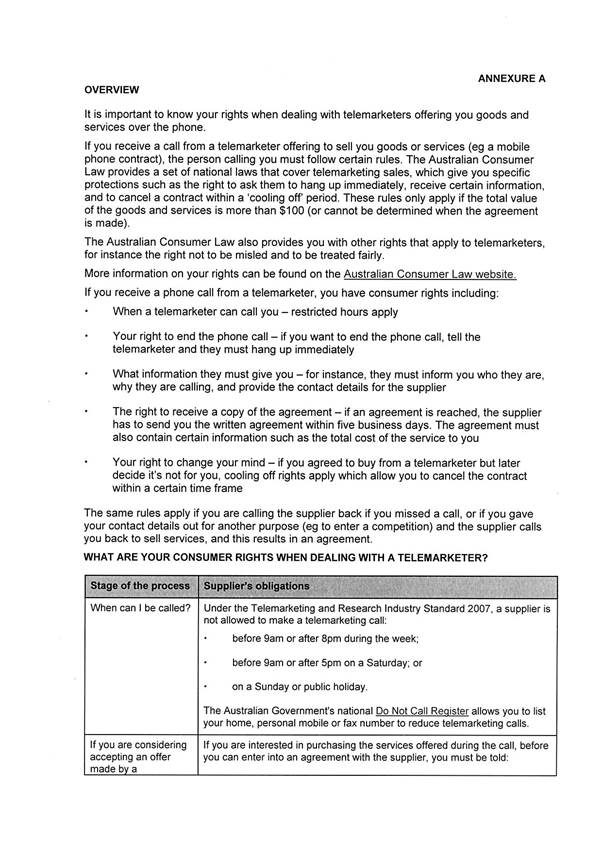
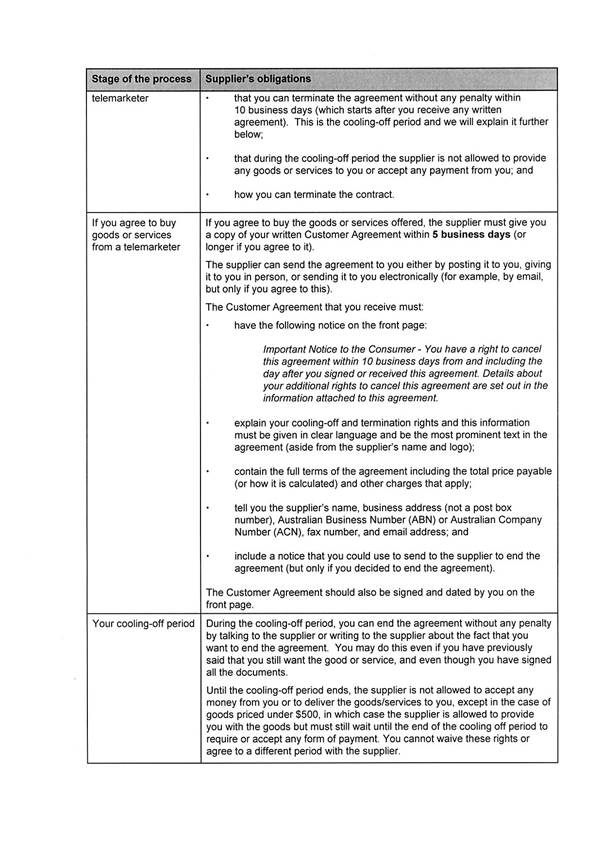
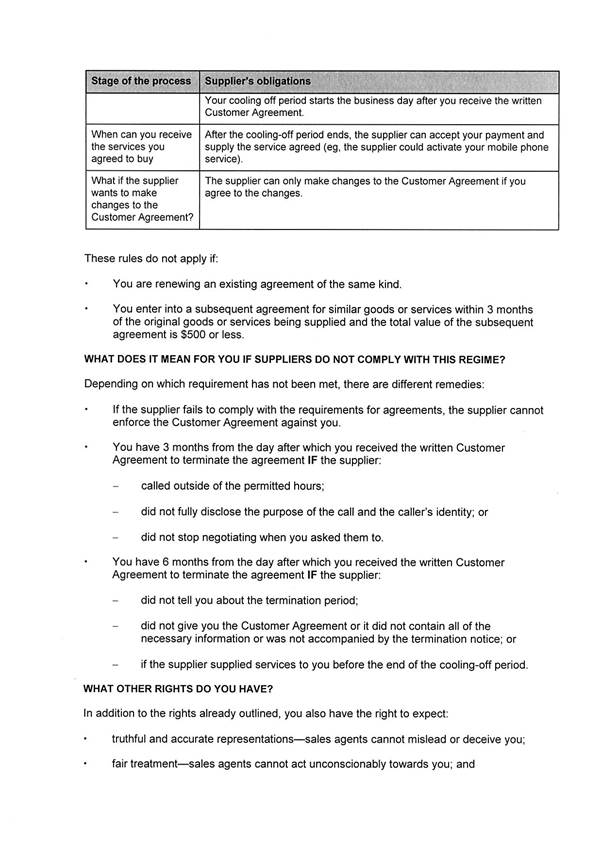
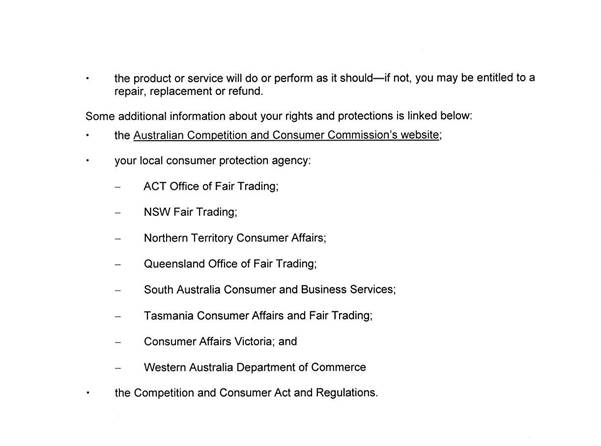
11.1.1 publish an online educational web-page based on the content in Annexure A hereto, which includes information about consumers’ rights in relation to Unsolicited Consumer Agreements, for the purpose of educating consumers in relation to the Unsolicited Consumer Agreement provisions of the ACL as those provisions relate to telemarketing (“the web-page”) to be displayed for at least six months;
11.1.2 implement an online advertising campaign for three months utilising banner advertisements promoting the web-page across the News Australia Sales Network (or an alternative provider agreed with the ACCC), involving national coverage and exposure across the provider’s network (“the banner ads”), comprising at least 1,000,000 ad impressions; and
11.1.3 provide the ACCC with a copy of the final banner ads and web-page;
11.2 spend not less than $25,000 on implementing orders 11.1.1 and 11.1.2;
11.3 within seven days of the web-page becoming available online, notify the Director of the ACCC’s Northern Territory office of this in writing; and
11.4 within one month of the web-page ceasing to be available, provide to the Director of the ACCC’s Northern Territory office a certificate of compliance, signed by a responsible officer within Startel, outlining the steps taken to comply with Order 11.
12. An order that Startel, within 30 days of this order:
12.1 conduct a review that identifies all of its agreements entered into between 1 January 2011 and 10 December 2012 with Australian consumers for the supply of bundled mobile service and mobile services that were made as a result of a negotiation by telephone;
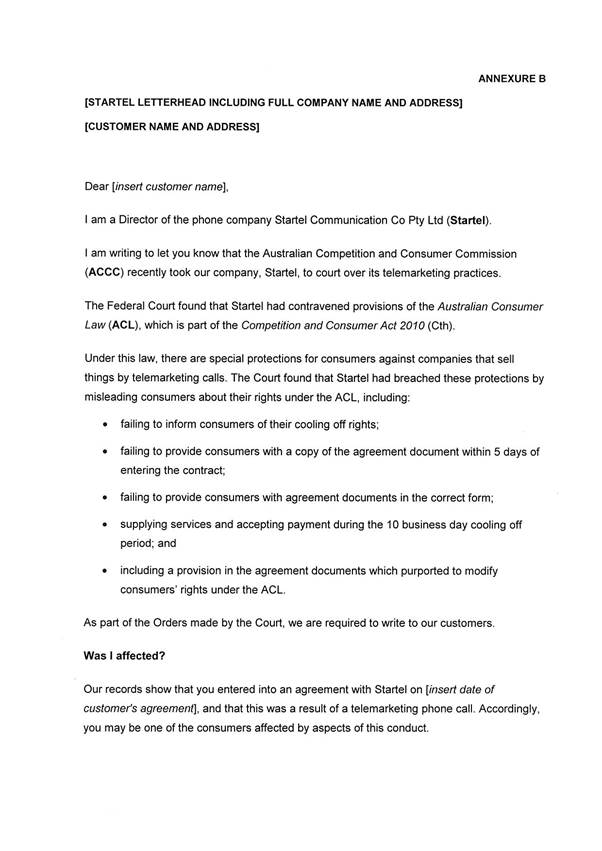
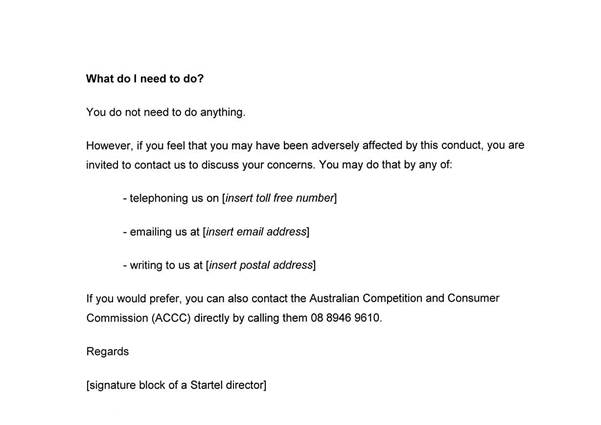
12.2 send by mail to each said consumer a letter in the form of Annexure B hereto;
12.3 list all said consumers, together with their address and contact telephone number; and
12.4 provide to the applicant:
12.5 the list of all the said consumers; and
12.6 an affidavit from a director of Startel attesting as to whether, in his or her opinion, this Order has been complied with in all respects.
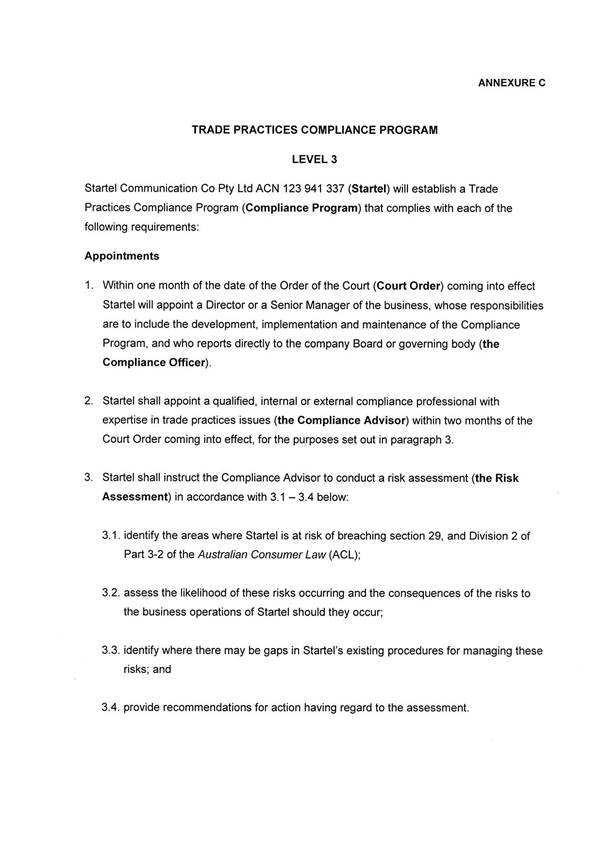
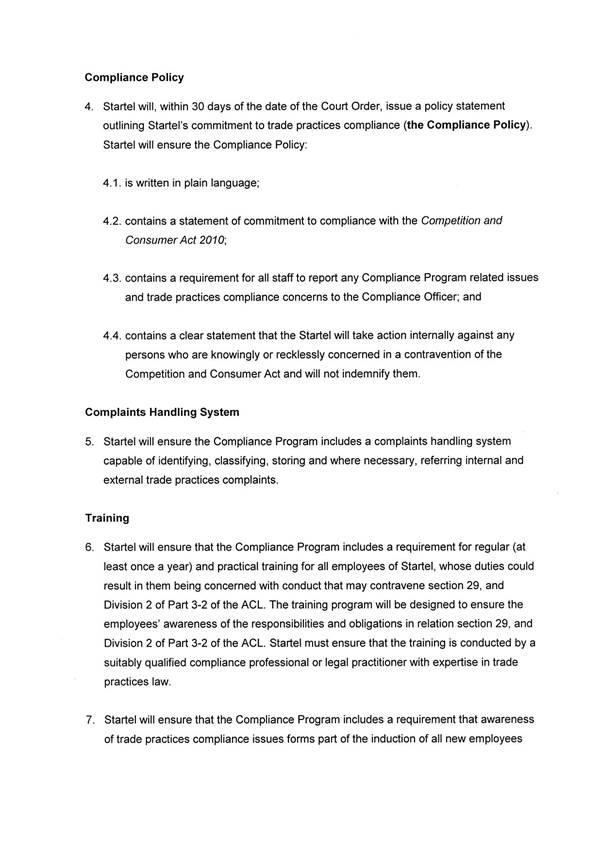
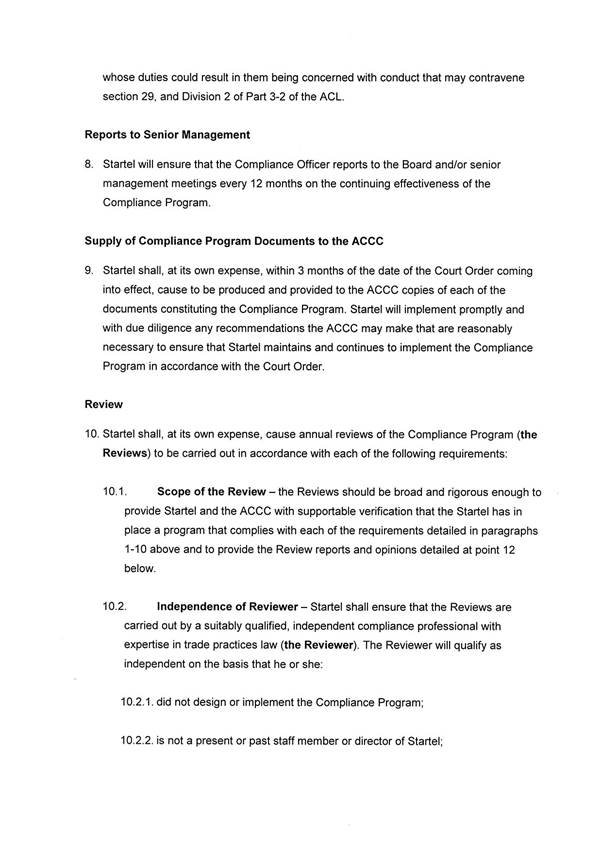
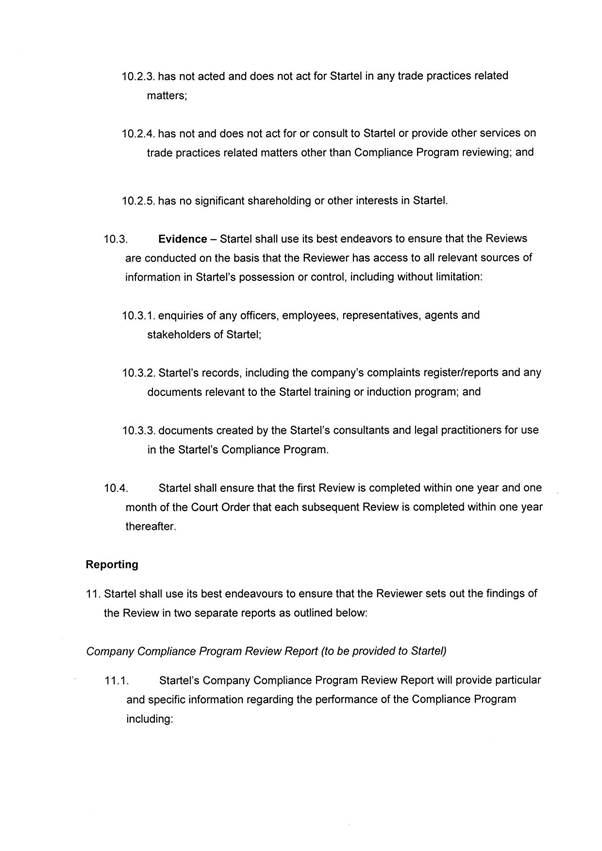
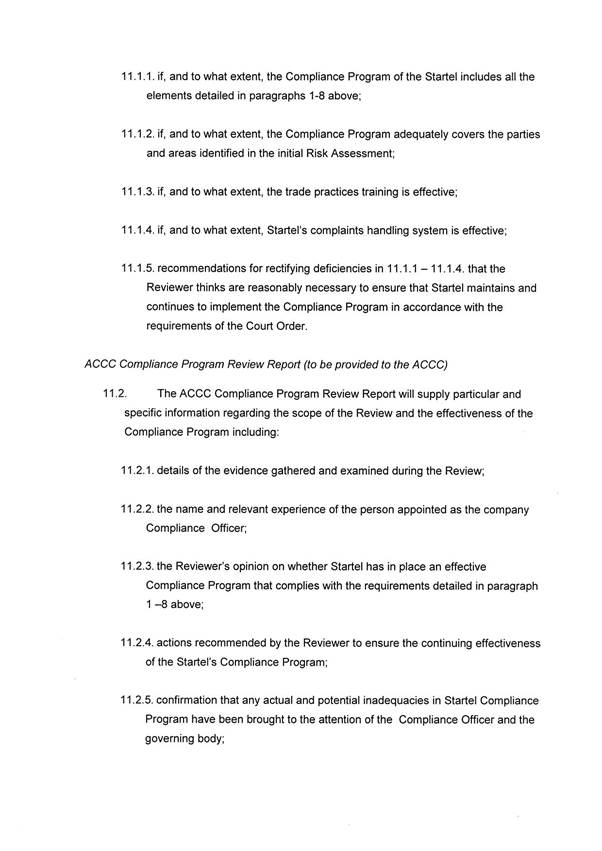
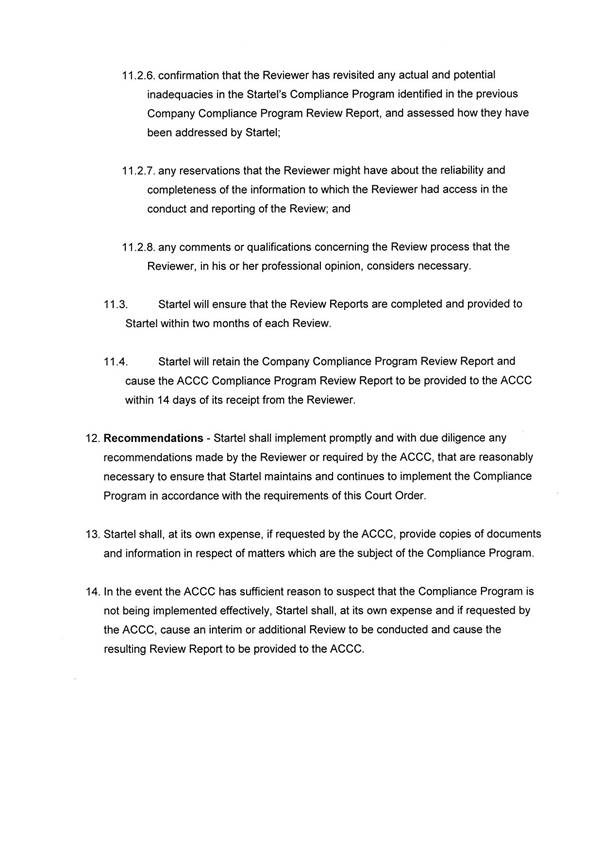
13. An order that Startel establish and maintain for a period of three years a compliance program in terms of Annexure C hereto.
THE COURT ORDERS THAT:
14. Startel pay to the Commonwealth of Australia, within 30 days of this order, in respect of the contraventions of the ACL referred to in paragraphs 1 to 6 above, pecuniary penalties totalling $320,000.
15. Startel pay to the applicant, within 30 days of this order, a contribution toward its costs of $45,000.
Note: Entry of orders is dealt with in Rule 39.32 of the Federal Court Rules 2011.
|
QUEENSLAND DISTRICT REGISTRY |
|
|
GENERAL DIVISION |
QUD 458 of 2013 |
|
BETWEEN: |
AUSTRALIAN COMPETITION AND CONSUMER COMMISSION Applicant |
|
AND: |
STARTEL COMMUNICATION CO PTY LTD (ACN 123 941 337) Respondent |
|
JUDGE: |
COLLIER J |
|
DATE: |
8 APRIL 2014 |
|
PLACE: |
BRISBANE |
REASONS FOR JUDGMENT
1 On 18 July 2013 the Australian Competition and Consumer Commission (“ACCC”) filed an originating application and a statement of claim against Startel Communication Co Pty Ltd (“Startel”). The ACCC alleged contraventions by Startel of ss 29(1)(m), 76(c), 78(2), 79(b)(i) and (ii), 79(c)(i), 79(d)(iv), 86(1)(a), 86(1)(b) and 89(2) of the Australian Consumer Law (“ACL”) (Sch 2 to the Competition and Consumer Act 2010 (Cth)), in respect of conduct occurring between January 2011 and November 2012. The ACCC has sought pecuniary penalties, injunctions, declarations and other orders pursuant to ss 224, 232 and 246 of the ACL and s 21 of the Federal Court of Australia Act 1976 (Cth) (“the Federal Court Act”).
2 Startel has admitted to the contraventions of the ACL alleged by the ACCC.
3 The ACCC and Startel have filed Joint Submissions and a Statement of Agreed Facts and Admissions pursuant to s 191(3)(a) of the Evidence Act 1995 (Cth). In that document the parties note the admissions of Startel, and have agreed on the terms of relief to be sought from the Court to resolve the proceedings.
4 Properly, the parties acknowledge that the terms of relief (if any) to be granted by the Court remain at the discretion of the Court.
BACKGROUND
5 It is appropriate to consider the background to these proceedings before turning to the orders sought by the parties. Material facts as agreed by the parties and set out in the Agreed Statement of Facts and Admissions are as follows.
6 Startel, trading as Startel Communications, is a company incorporated in Australia which carries on the business, in trade or commerce, of supplying persons in Australia with mobile services and bundled mobile services.
7 The conduct the subject of this proceeding relates to unsolicited consumer agreements (UCAs) entered into by Startel with customers for the supply of access to a mobile telecommunications network (mobile services) and, for some customers, mobile services together with a mobile telephone handset (bundled mobile services).
8 Four groups of customers were identified in the Statement of Claim. Conduct relevant to those customers can be summarised as follows:
from at least 1 January 2011, Startel engaged the services of telemarketing companies (telemarketers) to act on its behalf to market, promote and negotiate with potential customers for the supply of mobile services and bundled mobile services, by telephone.
between approximately 1 January 2011 and 13 November 2012 telemarketers, as agents for Startel, telephoned customers and entered into UCAs with the first group of customers identified in Table 1 and Table 2 in Schedule A to the Statement of Claim.
between approximately 3 January 2011 and 10 December 2012 Startel misled the first group of customers in relation to their rights under the ACL, and modified or purported to modify the statutory rights of those customers. The agreement documents provided by Startel to those customers after the formation of the UCA did not comply with requirements of the ACL.
between approximately 13 January 2011 and 6 December 2012 Startel sent the agreement documents in relation to the mobile services or bundled mobile services, more than five days after the agreement date to the second group of customers identified in Table 3 in Schedule A.
between approximately 10 January 2011 and 23 November 2012 Startel supplied the mobile services or bundled mobile services within the 10 day termination period (referred to as the “cooling off period”) to the third group of customers identified in Table 4 of Schedule A.
between approximately 7 January 2011 and about 20 November 2012 Startel took payment within the 10 day cooling off period from the fourth group of customers identified in Table 5 of Schedule A.
9 Startel offered the relevant mobile services or bundled mobile services under post-paid arrangements on the telecommunications network operated by Singtel Optus Pty Ltd and which involved supply to the customers for a minimum 24 month period.
10 The ACCC raised concerns in relation to the conduct the subject of the proceedings with Startel in November 2012. The conduct identified in the Statement of Claim relates to customers and conduct identified by Startel in its responses to compulsory notices and voluntary information requests. In that regard, Startel has cooperated with each of the requests for information made by the ACCC.
Approaching customers
11 Between January 2011 and November 2012, telemarketers, as agents for Startel, made unsolicited telephone calls to potential customers for the purposes of negotiating with them in relation to the supply by Startel of mobile services and bundled mobile services. Startel supplied telemarketers with guidelines as to the statements that it wished the telemarketers to convey to potential customers. If as a result of the call by the telemarketer, a potential customer agreed to purchase the mobile services or bundled mobile services, and reached an oral agreement with telemarketers on behalf of Startel over the telephone.
12 After UCAs with customers were orally agreed by telephone, Startel sent agreement documents to the customers setting out the terms and conditions of their agreements and information concerning tariffs. The agreement documents comprised the following documents:
a two-sided document, titled “Quick reference guide” on one side and “Important things you need to know about your Startel service” on the other side. The document also included the following statement:
All 24 month connections will be subject to a 5 Day cooling off period starting from the time of receipt of the handset and/or SIM. The 5 Day cooling off period will not apply to any service without a minimum monthly commitment.
a document titled “Tax Invoice” … which relevantly stated:
Fair Trading Legislation provides you with the right to cancel this transaction, if you so desire, without any penalty or obligation at any time within 10 business days of receipt…If you desire to cancel this transaction, you may do so by notifying [sic] dealer above by mail sent by midnight within 10 days of receipt, or by any other form of written notice delivered to the below address no later than midnight within 10 days of receipt. The goods must be returned to Startel in original condition. In the event they are not, you will be liable for the cost to replace such goods.
a document titled “Applicable fees and charges”.
CLAIMED CONTRAVENTIONS
Contraventions of section 29(1)(m) and section 89(2) of the ACL
13 Claimed contraventions by Startel of s 29(1)(m) and s 89(2) of the ACL can be grouped into two categories. The first category involved Startel misleading customers as to the length of a “cooling off” period, within which customers were entitled to cancel the agreement. The second category involved Startel making misrepresentations to consumers regarding their termination rights and purported obligations to return mobile handsets in the event of termination.
14 In relation to the first category the parties submitted, in summary, that:
under the ACL customers entering a UCA have a statutory right pursuant to s 82(3) of the ACL to at least a 10 business day cooling-off period commencing on the first business day after the day on which the customer was given their agreement document.
in a statement the agreement documents sent to each of the customers listed in Table 1 and Table 2 in Schedule A, Startel represented to 2588 customers that they did not have a right to a cooling off period of at least 10 business days commencing at the start of the first business day after the day on which the customer was given their agreement document.
the relevant statement had or purported to have the effect of modifying the effect or operation of s 82(3) of the ACL.
15 In relation to the second category the parties submitted, in summary, that:
when purchasing a bundled mobile service after an unsolicited telephone call, Startel’s customers had statutory rights pursuant to s 82 and s 85(1) of the ACL to terminate relevant agreements; and
customers would not necessarily be liable for the replacement costs if they terminated the agreement during that period if the mobile handset supplied to them was not returned in its original condition.
Startel misrepresented to 2133 customers that:
o the customer’s only means of exercising his or her right to terminate the agreement within 10 business days of receipt of the agreement documents was by written notice;
o if the customer exercised his or her termination rights, he or she must return the mobile telephone handset to Startel; and
o if the customer exercised his or her termination right and did not return the mobile telephone handset, supplied to that customer pursuant to their agreement, in original condition, he or she would necessarily be liable for replacement costs of the mobile telephone handset.
misrepresentations by Startel purported to have the effect of modifying the effect or operation of customers’ statutory rights in s 82(1) and s 85(1) to (5) of the ACL.
Deficient agreement documents - contraventions of sections 79(b)(i), 76(c), 79(b)(ii), 79(c), 79(d)(iv) of the ACL
16 Startel admitted contraventions of ss 76(c), 79(b)(i), 79(b)(ii), 79(c), 79(d)(iv) of the ACL in respect of deficient documents sent to 2588 customers, in that the documents:
did not include a notice that conspicuously and prominently informed the customer of their rights under s 82 of the ACL to terminate the agreement (which notice was required on the front page of the agreement document by s 79(b)(i) of the ACL).
did not inform the customer that the ways in which the customer may exercise their right to terminate the agreement included by giving oral notice to Startel of their intention to terminate under s 82 of the ACL (required by s 76(c) of the ACL).
did not inform the customer of any prohibitions in s 86(1) of the ACL on Startel supplying goods or services under the agreement or accepting or requiring payment or any other consideration in connection with those goods or services during the period of 10 business days commencing at the start of the first business day after the day on which the consumer was given their agreement document (notice of the prohibition is required in writing by s 76(c) of the ACL and reg 83 of the Competition and Consumer Regulations 2010 (Cth) (“the Regulations”)).
did not set out the following information (required on the front page of the agreement document by reg 85 of the Regulations and s 79(b)(ii) of the ACL):
o the text “Important Notice to Consumer”;
o the text “You have a right to cancel this agreement within 10 business days from and including the day after you signed or received this agreement”;
o the text “Details about your additional rights to cancel this agreement are set out in the information attached to this agreement”.
were not accompanied by a notice that could be used by the consumer to terminate the agreement (required by s 79(c) of the ACL and reg 87 of the Regulations).
did not conspicuously and prominently set out in full Startel’s business address (not being a post box) (required by s 79(d)(iv) of the ACL).
Failure to provide agreement documents within five business days – contraventions of section 78(2) of the ACL
17 In respect of contraventions of s 78(2) of the ACL the parties agreed, in summary, as follows:
Startel was required when it negotiated a UCA by telephone to, within five business days after the agreement was made or such longer period as agreed between the parties, give the customer a document evidencing the agreement under s 78(2) of the ACL.
Despite that requirement, Startel, following the practices that had been in place prior to the commencement of the ACL, despatched documents to 186 customers (in Table 3 in Schedule A to the Statement of Claim) more than five business days after agreement was reached over the telephone. In each case, Startel did not have an agreement with the customer to delay sending the agreement document.
Supplying goods and services and accepting payment within the statutory cooling off period – contraventions of section 86(1)(a) and (b) of the ACL
18 In respect of contraventions of s 86(1)(a) and (b) of the ACL the parties agreed, in summary, that Startel supplied 983 customers either mobile services or bundled mobile services within the period of 10 business days after the day on which the customers were given the agreement documents. However s 86(1)(a) of the ACL provides that the supplier in a UCA must not supply to the customer under the agreement the goods or services during that timeframe.
Acceptance of payment within the cooling off period of 10 business days – contraventions of section 86(1)(b) of the ACL
19 In respect of these contraventions the parties agreed, in summary, that Startel took direct debit payments from 1331 customers within the period of 10 business days after the day on which the customers were given their agreement documents, when s 86(1)(b) of the ACL prohibits a supplier under a UCA from accepting any payment in connection with those goods or services within that timeframe.
CONSIDERATION
20 The parties have agreed on appropriate remedies in this case, in the form of declarations, injunctions, non-punitive orders pursuant to s 246 of the ACL and pecuniary penalties. An agreed form of orders has been provided to the Court. There is no doubt that the Court is empowered to make the orders sought, in particular by s 21 of the Federal Court Act in respect of declarations, by s 232 of the ACL in respect of injunctions, by s 246 of the ACL in respect of non-punitive orders, by s 224 of the ACL in respect of pecuniary penalties, and by s 43 of the Federal Court Act in respect of the agreed monetary contribution by Startel to the ACCC’s costs.
21 Buchanan J recently observed in Australian Competition and Consumer Commission v Hewlett-Packard Australia Pty Ltd [2013] FCA 653 at [4]:
It is well established by authority in this Court that, although the terms of orders made by the Court are within the discretion of the Court, and not the parties, the Court may pay regard to an agreed position about the orders which are appropriate to be made following admission of a civil contravention of a statutory standard. That principle extends to an agreement about the amount of a pecuniary penalty to be imposed (see in particular NW Frozen Foods Pty Ltd v Australian Competition and Consumer Commission [(1996) 71 FCR 285] and Minister for Industry, Tourism and Resources v Mobil Oil Australia Pty Ltd [(2004) ATPR 41-993 at [56])]. The principles stated in those cases have recently been criticised by the Victorian Court of Appeal in ASIC v Ingleby [2013] VSCA 49 (“Ingleby”) but they are principles which bind me and I propose to apply them.
22 In my view his Honour’s observations apply equally to the case before me. Accordingly, in considering proper orders in the circumstances currently before the Court, it is appropriate for me to have regard to the agreed position of the parties.
Declarations
23 The parties have agreed on extensive declarations in this proceeding. In summary, the parties have agreed to declarations that:
Between about 3 January 2011 and 10 December 2012 Startel – unsolicited – negotiated by telephone with 2133 consumers by including or purporting to include in UCAs certain restrictive provisions (namely time limitations on termination, return of handset and liability for replacement costs of the handset), when in fact Startel had made false or misleading representations because those consumers had statutory rights to, inter alia, cooling off periods and termination of those agreements.
Between about 3 January 2011 and 10 December 2012 Startel – unsolicited – negotiated by telephone with 2588 consumers by including or purporting to include restrictive provisions (including no right to cooling off periods) into UCAs when in fact Startel had made false or misleading representations because those UCAs have statutory cooling off periods.
In relation to the 2588 consumers, Startel did not inform the consumers of important information and required notices relating to the right to terminate UCAs and prohibitions on Startel supplying goods or services.
Between about 13 January 2011 and 6 December 2012 Startel despatched agreement documents to 186 consumers more than five business days after the agreement date in contravention of s 78(2) of the ACL.
Between about 10 January 2011 and 23 November 2012 Startel supplied services to 983 consumers in contravention of s 86(1)(a) of the ACL.
Between about 7 January 2011 and 20 November 2012 Startel took payment from 1331 consumers in connection with the supply of bundled mobile services or mobile services by way of unsolicited consumer agreements in contravention of s 86(1)(b) of the ACL.
24 Courts have a broad discretion in respect of making declarations. As Gibbs J observed however in Forster v Jododex Australia Pty Ltd (1972) 127 CLR 421 at 437-438:
The question must be a real and not a theoretical question; the person raising it must have a real interest to raise it; he must be able to secure a proper contradictor, that is to say, someone presently existing who has a true interest to oppose the declaration sought.
(cf Ainsworth v Criminal Justice Commission (1992) 175 CLR 564 at 581-582; Oil Basins Ltd v Commonwealth (1993) 178 CLR 643 at 648-649; Edwards v Santos Ltd (2011) 242 CLR 421 at 435.)
25 In this case the parties have submitted that:
The proposed declarations relate to conduct that contravenes the ACL, and the matters in issue have been identified and particularised by the parties with precision.
It is in the public interest for the ACCC to seek to have the declarations made and for the declarations to be made.
The ACCC, as a public regulator under the ACL, has a genuine interest in seeking the declaratory relief sought.
Startel is a proper contradictor because it is a company which has contravened the ACL and is the subject of the declarations.
26 In my view these submissions of the parties accurately summarise the position before the Court. The content of the declarations sought by the ACCC is not disputed by Startel, which is a proper contradictor (being the entity which has contravened the ACL).
27 I consider that it is in the public interest for the Court to make the declarations agreed by the parties, by way of being a public recognition of the contraventions of the ACL by Startel and a record of the Court’s disapproval of Startel’s conduct.
Injunctions
28 Similarly, the parties have agreed on extensive injunctions restraining conduct of Startel. In summary, the parties have agreed that Startel be restrained for a period of five years from the date of this order from:
Making a representation, in the course of negotiating or making a UCA for the supply of any bundled mobile services or mobile services, that:
o a consumer’s right in relation to the cooling off period to cancel the agreement must be exercised in writing or did not include at least a 10 business day cooling off period where negotiated by telephone;
o a consumer who had exercised the right to terminate an agreement was obliged to return to the supplier goods supplied pursuant to the agreement when in fact the consumer could elect to either return the goods or notify the supplier to collect the goods;
o a consumer who had exercised the right to terminate an agreement and did not return the goods was necessarily liable for the replacement costs of the goods.
Negotiating by telephone a UCA to supply bundled mobile services or mobile services to a consumer unless it provides all agreement documents within five business days of making the agreement or as is otherwise agreed.
Entering into a UCA to supply bundled mobile services or mobile services to a consumer unless the agreement documents given to the consumer:
o inform the consumer of Startel’s business address;
o include a notice informing the consumer of rights to terminate the agreement;
o is accompanied by information that informs the consumer of prohibitions on Startel;
o includes a notice that can be used by the consumer to cancel the agreement.
Supplying pursuant to a UCA negotiated by telephone, mobile services or bundled mobile services to consumers within a period of 10 business days commencing at the start of the first business day after the day on which the consumer was given the agreement documents in relation to the agreement.
Requiring or accepting any consideration in connection with the supply of mobile services or bundled mobile services where negotiations were by telephone, within a period of 10 business days commencing at the start of the first business day after the consumer was given agreement documents in relation to the agreement.
29 Section 232 of the ACL permits a court to grant an injunction, in such terms as the court considers appropriate, if the court is satisfied that a person has engaged, or is proposing to engage, in conduct that constitutes or would constitute a contravention of a provision of Chs 2, 3 or 4 of the ACL. In this case it is not in dispute that Startel’s conduct has relevantly contravened the ACL.
30 The terms of the injunctions agreed by the parties are clear, and specifically address Startel’s conduct. In my view the Court ought make the injunctions agreed between the parties, in circumstances where Startel continues to supply its services to consumers, and the contraventions admitted by Startel are clearly sufficiently serious, repeated and recent to warrant injunctive relief.
31 Further, while five years is a relatively long period of time, I consider that it is an appropriate period of time to act as a deterrent.
Non-punitive orders – compliance program
32 The parties have agreed on orders requiring Startel to develop and implement a compliance program. The Court is empowered to make such orders by s 246 of the ACL, and in particular s 246(1)(b)(ii) which authorises the Court to make orders directing a person:
to establish an education and training program for employees or other persons involved in the person’s business, being a program designed to ensure their awareness of the responsibilities and obligations in relation to such conduct.
33 The compliance program is detailed and requires Startel to, inter alia:
establish a Trade Practices Compliance Program;
appoint a Director or Senior Manager of the business whose responsibilities include development, implementation and maintenance of the compliance program;
appoint a Compliance Advisor to conduct a risk assessment;
issue a policy statement outlining Startel’s commitment to trade practices compliance;
establish a complaints handling system capable of identifying, classifying, storing and referring internal and external trade practices complaints;
require regular and practical training for all Startel employees whose conduct could result in contravention of s 29 and Div 2 of Pt 3-2 of the ACL;
ensure annual reports by the Compliance Officer to the Board and/or senior management;
provide copies of documents constituting the Compliance Program to the ACCC within three months of the date of the court order;
annually review the Compliance Program.
34 The parties submit that the proposed order in relation to a compliance program is appropriate to the circumstances of Startel and the industry in which it does business.
35 It is not uncommon for the Court to order a contravening party to implement a compliance program as part of its redress for conduct contravening the ACL. This is particularly so where there is a risk of future systemic conduct at an institutional level which could breach legislation, and could place consumers at risk.
36 In the absence of evidence to the contrary, in the circumstances of this case I am prepared to accept the submissions of the parties and order that Startel implement the compliance program agreed.
Non-punitive orders – community service order
37 Further, the parties have agreed on a community service order requiring Startel to publish an internet page providing educational information about consumers’ rights under the ACL in relation to unsolicited consumer agreements provisions, and further requiring Startel to publish internet advertisements regarding that internet page.
38 In relation to the proposed internet page submitted by the parties, I note that the page sets out in substantially tabular form the rights of consumers in circumstances where offered goods and services by telemarketers.
39 The Court is empowered to make community service orders of this type by s 246(2)(a) of the ACL which contemplates orders:
directing the person to perform a service that is specified in the order, and that relates to the conduct, for the benefit of the community or a section of the community.
40 In Australian Competition & Consumer Commission v Econovite Pty Ltd (2003) ATPR 41-959; [2003] FCA 964 French J observed that there is a threshold question whether the proposed service relates to the contravening conduct and is therefore within the scope of the authority conferred by the legislation. Further, it is clear that the Court should only make the relevant community service orders if they are appropriate in the circumstances of the case.
41 In this case the orders require Startel to publish an internet page based on content agreed by the parties, advertise the existence of the page, and maintain that page for six months. It is clear that the proposed internet page relates specifically to conduct of Startel which contravened the ACL. The contents of the internet page have been agreed with the ACCC, which is the consumer protection regulator in this aspect of the telecommunications industry. In my view it is appropriate to make the orders sought.
Penalties
42 The parties agree that the Court should make orders imposing pecuniary penalties, pursuant to s 224 of the ACL, in the total amount of $320,000 in respect of contraventions admitted by Startel of ss 29(1)(m), 76(c), 78(2), 79(b)(i), 79(b)(ii), 79(c)(i), 79(d)(iv), 86(1)(a), 86(1)(b) and 89(2) of the ACL.
Relevant principles
43 In considering whether the Court ought order penalties payable by Startel in this amount, I take into account the following principles.
44 First, in circumstances of calculated contravention, the primary purpose of assessing and imposing civil penalties pursuant to s 224 of the ACL is to deter future contraventions of the ACL, by both the entity the subject of this proceeding and third parties (cf Australian Competition and Consumer Commission v TPG Internet Pty Ltd (2013) 304 ALR 186; [2013] HCA 54 at [65]).
45 Second, s 224(2) of the ACL provides that, in determining an appropriate pecuniary penalty the court must have regard to all relevant matters including:
(a) the nature and extent of the act or omission and of any loss or damage suffered as a result of the act or omission; and
(b) the circumstances in which the act or omission took place; and
(c) whether the person has previously been found by a court in proceedings under Chapter 4 or this Part to have engaged in any similar conduct.
46 Third, as a general proposition relevant matters other than those specifically set out in s 224(2) may include:
the size of the contravening company;
the degree of market power of the contravener;
the deliberateness of the contravention and the period over which it extended;
whether the contravention arose out of the conduct of senior management of the contravener or at a lower level;
whether the contravener has a corporate culture conducive to compliance with the relevant legislation;
whether the contravener has shown a disposition to cooperate with the regulatory authorities;
whether the contravener has engaged in similar conduct in the past;
the effect on the functioning of the market and other economic effects of the contravening conduct;
the financial position of the contravener;
whether the contravening conduct was systematic, deliberate or covert.
(Trade Practices Commission v CSR Limited (1991) ATPR 41-076 at 52,152 to 52,153; NW Frozen Foods Pty Ltd v Australian Competition and Consumer Commission (1996) 71 FCR 285; J McPhee & Son (Aust) Pty Ltd v Australian Competition and Consumer Commission (2000) 172 ALR 532; [2004] FCAFC 72; Global One Mobile Entertainment Pty Ltd v Australian Competition and Consumer Commission [2012] FCAFC 134 at [120].)
47 Fourth, in appropriate circumstances there is a public benefit in imposing pecuniary penalties agreed by the parties, in order to encourage negotiated settlement by those parties and to facilitate speedy conclusion of investigations by the relevant regulator (cf NW Frozen Foods at 291; Minister for Industry, Tourism and Resources v Mobil Oil Australia Pty Ltd (2004) ATPR 41-993; [2004] FCAFC 72 at [53]-[58]).
Appropriate conclusions to be drawn in this case
48 In light of these principles, I consider it appropriate to draw the following conclusions in respect of an appropriate pecuniary penalty, and specifically in relation to the penalty agreed and advanced by the parties.
49 First, the provisions of the ACL breached by Startel concerned many instances where Startel mislead consumers as to their rights, or failed to advise them of their rights, or acted inconsistently with their rights, or imposed unlawful conditions. Conduct involving misleading agreement documentation being sent by Startel to consumers occurred on 2588 occasions; conduct involving Startel misleading consumers as to their rights of termination occurred on 2133 occasions. I do not consider that the contraventions identified by the ACCC and conceded by Startel were in any way trivial, or mere technical breaches of the ACL. The relevant provisions of the ACL seek to ensure that consumers negotiating agreements with dealers in such circumstances are provided with agreements which fully and fairly inform them of their rights to terminate the agreements. In the circumstances of this case the contraventions of the ACL by Startel were serious, numerous, and occurred over a relatively lengthy period of time.
50 Second, the parties agree that Startel’s contravening conduct took place in an environment where Startel had acquired its business in late 2009, where that business had established practices and procedures which were not examined by Startel, and where Startel did not put in place processes to identify and comply with changes in the law.
51 Third, the parties agree that it is not possible to know who of the thousands of affected customers over nearly two years of conduct might have acted differently and exercised their cooling off rights to terminate their agreements had they been properly informed of their rights.
52 Fourth, there is no evidence that Startel had previously engaged in contravening conduct of this nature.
53 Fifth, it is not in dispute that Startel is a small company, with ten employees and one office in Mansfield, Queensland. Such evidence as is before the Court also indicates that Startel has a very small share of the mobile reselling market in Australia, and that it has been operating at a loss for a number of years.
54 Sixth, while it is clear that the contravening conduct in this case was deliberate, and constituted unambiguous failures to comply with the requirements of the ACL, the ACCC accepts that much of the conduct of Startel resulted from a failure by Startel to review and update its marketing materials, customer agreement and procedures in light of the introduction of the ACL, and not from any intention on the part of Startel to contravene the ACL.
55 Seventh, at all material times as Startel was a small regional telecommunications reseller with few staff, it is appropriate for the Court to infer that senior employees or management were complicit in the failure of Startel to ensure its processes complied with the ACL, and were likely aware of the processes and documentation the subject of these proceedings.
56 Eighth, it is not in dispute that prior to the ACCC investigation Startel did not have a specific ACL compliance program in place. It is also clear, however, that since notification of that investigation Startel has undertaken a number of initiatives to seek to ensure compliance of its agreements and processes with the ACL.
57 Ninth, it is also not in dispute that Startel has cooperated with the ACCC throughout the investigation, and has worked with the ACCC to facilitate the quick resolution of these proceedings. I accept that this is a mitigating factor in favour of Startel.
Quantum of penalty
58 In light of these conclusions I now turn to the quantum of penalty in this case.
59 The parties submit that it would be appropriate to group Startel’s contraventions of s 29(1)(m) of the ACL into two courses of conduct.
60 Specifically, the parties submit that the two relevant courses of conduct relate to:
contravention of s 29(1)(m) of the ACL relating to misleading customers of bundled mobile services and mobile services as to their statutory rights in that they did not have at least a 10 business day cooling off period; and
contravention of s 29(1)(m) of the ACL relating to misleading customers of bundled mobile services as to their statutory rights about the way in which, and the terms upon which, they could exercise their termination rights under a UCA.
61 The parties submit further that a penalty of $100,000 for each of these two courses of conduct would be one of appropriate value, and take into account the mitigating circumstances.
62 The parties also submit that Startel should not be liable for a pecuniary penalty pursuant to s 89(2) of the ACL, because the contraventions of both s 29(1)(m) and s 89(2) arose out of the same conduct. Accordingly the ACCC has not sought orders imposing penalties on Startel for contraventions of s 89(2) of the ACL.
63 The basis of these submissions is that the grouping of contraventions recognises the very substantial overlap in the wrongdoing, that s 224(4)(b) specifically provides that a person shall not be liable to more than one pecuniary penalty in respect of the same conduct where that conduct constitutes a contravention of two or more provisions; and recognises further that both of those documents gave rise to different contravening representations such that a separate penalty should attach to each.
64 The statutory maximum penalty for each separate contravention is $1.1 million. In the circumstances of this case, including the seriousness of the conduct and the manifold instances of contravention, and the mitigating factors I have listed, I consider the penalties submitted by the parties to be appropriate.
65 Further, in respect of breaches of Div 2 of Pt 3-2 of the ACL the parties submit that these contraventions may be grouped into the following four courses of conduct for the purposes of assessing penalty:
contraventions of ss 76(c), 79(b)(i), 79(b)(ii), 79(c) and 79(d)(iv), relating to instances where Startel sent agreement documents to customers where those documents did not meet the requirements of the ACL. The parties submit that a penalty of $35,000 should be imposed;
contraventions of s 78(2), relating to instances where Startel sent agreement documents more than five business days after the unsolicited consumer agreements negotiated by telephone were made. The parties submit that a penalty of $15,000 should be imposed;
contraventions of s 86(1)(a), relating to instances where Startel supplied customers within the cooling off period of 10 business days. The parties submit that a penalty of $35,000 should be imposed;
contraventions of s 86(1)(b), relating to instances where Startel accepted payment within the cooling off period of 10 business days. The parties submit that a penalty of $35,000 should be imposed.
66 The statutory maximum penalty for each of these contraventions is $50,000. In light of the circumstances I have outlined, including the mitigating factors, I consider the penalties agreed by the parties to be appropriate.
COSTS
67 Within 30 days of the Court’s order, Startel has agreed to pay the amount of $45,000 towards the costs of the ACCC of and incidental to the proceedings. It is appropriate to make an order to this effect.
|
I certify that the preceding sixty-seven (67) numbered paragraphs are a true copy of the Reasons for Judgment herein of the Honourable Justice Collier. |
Associate:


