FEDERAL COURT OF AUSTRALIA
Australian Competition and Consumer Commission v EnergyAustralia Pty Ltd [2014] FCA 336
| IN THE FEDERAL COURT OF AUSTRALIA | |
| DATE OF ORDER: | |
| WHERE MADE: |
THE COURT DECLARES THAT:
Conduct relating to George Stajsic
1 On 14 August 2012, Aegis Direct, by conduct of a sales representative, called on Mr Stajsic at his residential premises for the purpose of negotiating an unsolicited consumer agreement for EnergyAustralia to supply retail electricity to Mr Stajsic and did not as soon as practicable or before starting to negotiate:
(a) advise Mr Stajsic, clearly or at all, that the sales representative’s purpose was to seek Mr Stajsic’s agreement to the supply of retail electricity by EnergyAustralia;
(b) advise Mr Stajsic, clearly or at all, that the sales representative was obliged to leave Mr Stajsic’s premises immediately on request; or
(c) provide Mr Stajsic with:
(i) Aegis Direct’s name; or
(ii) the name and address of EnergyAustralia,
being information that is prescribed by sections 82(a) and (c) of the Competition and Consumer Regulations 2010 (‘the Regulations’),
and thereby contravened sections 74(a), 74(b) and 74(c) of the Australian Consumer Law (‘ACL’) respectively.
2 On 14 August 2012, EnergyAustralia, as the supplier of the retail electricity to which the negotiations referred to in paragraph 1 above related, has by reason of section 77 of the ACL also contravened sections 74(a), 74(b) and 74(c) of the ACL.
3 On 14 August 2012, Aegis Direct, in trade or commerce, by conduct of a sales representative, represented to Mr Stajsic that:
(a) there was a single electricity wholesaler that operated in the area in which Mr Stajsic resided;
(b) Aegis Direct’s sales representative had a sponsorship with, approval of, or affiliation with, the single electricity wholesaler that operated in the area in which Mr Stajsic resided;
(c) the rate or tariff that Aegis Direct offered had a sponsorship with or approval of the single electricity wholesaler that operated in the area in which Mr Stajsic resided that the rate or tariff being charged by Mr Stajsic’s then supplier of retail electricity did not have;
(d) there was a mandated electricity rate or tariff that retail electricity consumers in the area in which Mr Stajsic resided were required to be charged by their electricity retailers;
(e) Mr Stajsic was being charged a higher rate or tariff by his electricity retailer than the mandated electricity rate or tariff that retail electricity consumers in the area in which Mr Stajsic resided were required to be charged by their electricity retailers; and
(f) Aegis Direct was attending Mr Stajsic’s premises for the purpose of switching Mr Stajsic to the mandated electricity rate or tariff that retail electricity consumers in the area in which Mr Stajsic resided were required to be charged by their electricity retailers,
when this was not the case, and thereby:
(g) engaged in conduct which was misleading or deceptive or likely to mislead or deceive in contravention of section 18(1) of the ACL;
(h) in respect of the representation made in connection with the supply or possible supply of goods or services set out in paragraph 3(b) above, made a false and misleading representation that Aegis Direct had a sponsorship, approval or affiliation in contravention of section 29(1)(h) of the ACL;
(i) in respect of the representation made in connection with the supply or possible supply of goods or services set out in paragraph 3(c) above, made a false and misleading representation that the goods or services had a sponsorship or approval in contravention of section 29(1)(g) of the ACL; and
(j) in respect of the representation made in connection with the supply or possible supply of goods or services set out in paragraph 3(e) above, made a false and misleading representation with respect to the price of goods or services in contravention of section 29(1)(i) of the ACL.
4 On 14 August 2012, by the conduct referred to in paragraph 3 above of Aegis Direct through the sales representative, EnergyAustralia:
(a) engaged in conduct which was misleading or deceptive or likely to mislead or deceive in contravention of section 18(1) of the ACL; and
(b) made representations which were false and misleading in connection with the supply or possible supply of goods or services in contravention of sections 29(1)(h), 29(1)(g) and 29(1)(i) of the ACL.
Conduct relating to Melinda Brennan
5 On 19 March 2012, ASAP, by conduct of sales representatives, called on Ms Brennan at her residential premises for the purpose of negotiating an unsolicited consumer agreement for EnergyAustralia to supply retail electricity to Ms Brennan and did not as soon as practicable or before starting to negotiate:
(a) advise Ms Brennan, clearly or at all, that the sales representatives’ purpose was to seek Ms Brennan’s agreement to the supply of retail electricity by EnergyAustralia;
(b) advise Ms Brennan, clearly or at all, that the sales representatives were obliged to leave Ms Brennan’s premises immediately on request; or
(c) provide Ms Brennan with:
(i) ASAP’s name; or
(ii) the name and address of EnergyAustralia,
being information that is prescribed by sections 82(a) and (c) of the Regulations,
and thereby contravened sections 74(a), 74(b) and 74(c) of the ACL respectively.
6 On 19 March 2012, EnergyAustralia, as the supplier of the retail electricity to which the negotiations in paragraph 5 above related, has by reason of section 77 of the ACL contravened paragraphs 74(a), 74(b) and 74(c) of the ACL.
7 On 19 March 2012, ASAP, in trade or commerce, by conduct of sales representatives, represented to Ms Brennan that:
(a) ASAP’s sales representatives had a sponsorship with, approval of, or affiliation with, the government;
(b) there was a mandated electricity rate or tariff that retail electricity consumers in the area in which Ms Brennan resided were required to be charged by their electricity retailers;
(c) it was possible that Ms Brennan was being charged a higher rate or tariff by her electricity retailer than the mandated electricity rate or tariff that retail electricity consumers in the area in which Ms Brennan resided were required to be charged by their electricity retailers;
(d) ASAP’s sales representatives were attending Ms Brennan’s premises for the purpose of switching Ms Brennan to the mandated electricity rate or tariff that retail electricity consumers in the area in which Ms Brennan resided were required to be charged by their electricity retailers, in the event that Ms Brennan was being charged a higher rate or tariff; and
(e) the TRUenergy rate or tariff had a sponsorship with or approval of the government that the rate or tariff being charged by Ms Brennan’s then supplier of retail electricity may not have had,
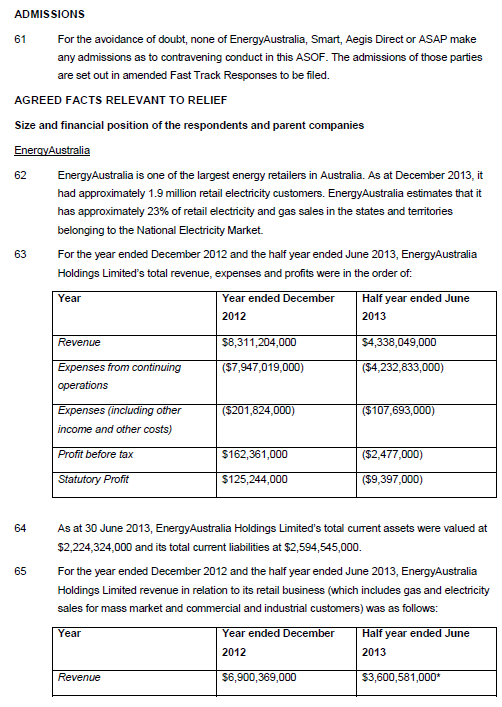
when this was not the case and thereby:
(f) engaged in conduct which was misleading or deceptive or likely to mislead or deceive in contravention of section 18(1) of the ACL;
(g) in respect of the representation made in connection with the supply or possible supply of goods or services set out in paragraph 7(a) above, made a false and misleading representation that ASAP had a sponsorship, approval or affiliation in contravention of section 29(1)(h) of the ACL;
(h) in respect of the representation made in connection with the supply or possible supply of goods or services set out in paragraph 7(e) above, made a false and misleading representation that the goods or services had a sponsorship or approval in contravention of section 29(1)(g) of the ACL; and
(i) in respect of the representation made in connection with the supply or possible supply of goods or services set out in paragraph 7(c) above, made a false and misleading representation with respect to the price of goods or services in contravention of section 29(1)(i) of the ACL.
8 On 19 March 2012, by the conduct referred to in paragraph 7 above of ASAP through the sales representatives, EnergyAustralia:
(a) engaged in conduct which was misleading or deceptive or likely to mislead or deceive in contravention of section 18(1) of the ACL; and
(b) made representations which were false and misleading in connection with the supply or possible supply of goods or services in contravention of sections 29(1)(h), 29(1)(g) and 29(1)(i) of the ACL.
Conduct relating to Leanne Scott
9 On 18 February 2012, Aegis Direct, by conduct of a sales representative, called on Ms Scott at her residential premises for the purpose of negotiating an unsolicited consumer agreement for EnergyAustralia to supply retail electricity to Ms Scott and did not as soon as practicable or before starting to negotiate:
(a) advise Ms Scott, clearly or at all, that the sales representative’s purpose was to seek Ms Scott’s agreement to the supply of retail electricity by EnergyAustralia;
(b) advise Ms Scott, clearly or at all, that the sales representative was obliged to leave Ms Scott’s premises immediately on request; or
(c) provide Ms Scott with:
(i) Aegis Direct’s name; or
(ii) the name and address of EnergyAustralia,
being information that is prescribed by sections 82(a) and (c) of the Regulations,
and thereby contravened sections 74(a), 74(b) and 74(c) of the ACL respectively.
10 On 18 February 2012, EnergyAustralia, as the supplier of the retail electricity to which the negotiations referred to in paragraph 9 above related, has by reason of section 77 of the ACL also contravened sections 74(a), 74(b) and 74(c) of the ACL.
11 On 18 February 2012, Aegis Direct, by conduct of a sales representative, called on Ms Scott for the purpose of negotiating an unsolicited consumer agreement for EnergyAustralia to supply retail electricity to Ms Scott and:
(a) despite the presence of a notice prominently displayed on a glass panel next to the front door of the house on Ms Scott’s premises that contained the words: “DO NOT KNOCK – SALES PEOPLE PLEASE NOTE – UNSOLICITED DOOR KNOCKING HERE IS UNLAWFUL”, remained on Ms Scott’s premises and knocked on the front door of the house of Ms Scott’s premises;
(b) when Ms Scott came to the front door and looked at the sales representative through the glass panel next to the front door and said words to the effect: “Are you trying to sell me something, because you can see here I have a do not knock sign?”, remained on Ms Scott’s premises and entered into negotiations with Ms Scott with a view to making an agreement for the supply of retail electricity by EnergyAustralia to Ms Scott;
(c) when Ms Scott opened the door and said words to the effect: “It is illegal to knock on my door if you’re trying to sell me something”, remained on Ms Scott’s premises and continued to negotiate with Ms Scott with a view to making an agreement for the supply of retail electricity by EnergyAustralia to Ms Scott,
and thereby did not leave the premises immediately on the request of the occupier of the premises and thereby contravened section 75(1)(a) of the ACL.
12 On 18 February 2012, EnergyAustralia, as the supplier of the retail electricity to which the negotiations referred to in paragraph 11 above related, has by reason of section 77 of the ACL also contravened section 75(1)(a) of the ACL.
13 On 18 February 2012, Aegis Direct, in trade or commerce, by conduct of a sales representative, represented to Ms Scott that:
(a) Aegis Direct’s sales representative had a sponsorship with, approval of, or affiliation with, the government;
(b) there was a mandated electricity rate or tariff that retail electricity consumers in the area in which Ms Scott resided were required to be charged by their electricity retailers;
(c) Ms Scott would be entitled to a government rebate if she was being charged a higher rate or tariff by her then current electricity retailer than the mandated electricity rate or tariff that retail electricity consumers in the area in which Ms Scott resided were required to be charged by their electricity retailers;
(d) Ms Scott was being charged a higher rate or tariff by her electricity retailer than the mandated electricity rate or tariff that retail electricity consumers in the area in which Ms Scott resided were required to be charged by their electricity retailers;
(e) if Ms Scott transferred from her then current electricity retailer to EnergyAustralia she would be charged the mandated electricity rate or tariff;
(f) the EnergyAustralia rate or tariff had a sponsorship with or approval of the government that the service rate or tariff being charged by Ms Scott’s then supplier of retail electricity may not have had; and
(g) Aegis Direct was attending Ms Scott’s premises for the purpose of a government initiative to make sure energy companies were charging the correct rate or tariff,
when this was not the case, and thereby:
(h) engaged in conduct which was misleading or deceptive or likely to mislead or deceive in contravention of section 18(1) of the ACL;
(i) in respect of the representation made in connection with the supply or possible supply of goods or services set out in paragraph 13(a) above, made a false and misleading representation that Aegis Direct had a sponsorship, approval or affiliation in contravention of section 29(1)(h) of the ACL;
(j) in respect of the representation made in connection with the supply or possible supply of goods or services set out in paragraph 13(d) above, made a false and misleading representation with respect to the price of goods or services in contravention of section 29(1)(i) of the ACL; and
(k) in respect of the representation made in connection with the supply or possible supply of goods or services set out in paragraph 13(f) above, made a false and misleading representation that the goods or services had a sponsorship or approval in contravention of section 29(1)(g) of the ACL.
14 On 18 February 2012, by the conduct referred to in paragraph 13 above of Aegis Direct through the sales representative, EnergyAustralia:
(a) engaged in conduct which was misleading or deceptive or likely to mislead or deceive in contravention of section 18(1) of the ACL; and
(b) made representations which were false and misleading in connection with the supply or possible supply of goods or services in contravention of sections 29(1)(h), 29(1)(i) and 29(1)(g) of the ACL.
Conduct relating to Andrew Linden
15 On 17 July 2012, Aegis Direct, by conduct of a sales representative, called on Mr Linden at his residential premises for the purpose of negotiating an unsolicited consumer agreement for EnergyAustralia to supply retail electricity to Mr Linden and did not as soon as practicable or before starting to negotiate:
(a) advise Mr Linden, clearly or at all, that the sales representative’s purpose was to seek Mr Linden’s agreement to the supply of retail electricity by EnergyAustralia;
(b) advise Mr Linden, clearly or at all, that the sales representative was obliged to leave Mr Linden’s premises immediately on request; or
(c) provide Mr Linden with:
(i) Aegis Direct’s name; or
(ii) the name and address of EnergyAustralia,
being information that is prescribed by sections 82(a) and (c) of the Regulations,
and thereby contravened sections 74(a), 74(b) and 74(c) of the ACL respectively.
16 On 17 July 2012, EnergyAustralia, as the supplier of the retail electricity to which the negotiations referred to in paragraph 15 above related, has by reason of section 77 of the ACL also contravened sections 74(a), 74(b) and 74(c) of the ACL.
17 On 17 July 2012, Aegis Direct, in trade or commerce, by conduct of a sales representative, represented to Mr Linden that Mr Linden’s electricity prices would increase by 16% due to the introduction of the carbon tax when this was not the case, and thereby:
(a) engaged in conduct which was misleading or deceptive or likely to mislead or deceive in contravention of section 18(1) of the ACL; and
(b) made a false and misleading representation with respect to the price of goods or services in contravention of section 29(1)(i) of the ACL.
18 On 17 July 2012, by the conduct referred to in paragraph 17 above of Aegis Direct through the sales representative, EnergyAustralia:
(a) engaged in conduct which was misleading or deceptive or likely to mislead or deceive in contravention of section 18(1) of the ACL; and
(b) made representations which were false and misleading in connection with the supply or possible supply of goods or services in contravention of section 29(1)(i) of the ACL.
Conduct relating to Michelle Chia
19 On 15 May 2012, Aegis Direct, by conduct of a sales representative, called on Ms Chia at her residential premises for the purpose of negotiating an unsolicited consumer agreement for EnergyAustralia to supply retail electricity to Ms Chia and did not as soon as practicable or before starting to negotiate:
(a) advise Ms Chia, clearly or at all, that the sales representative’s purpose was to seek Ms Chia’s agreement to the supply of retail electricity by EnergyAustralia;
(b) advise Ms Chia, clearly or at all, that the sales representative was obliged to leave Ms Chia’s premises immediately on request; or
(c) provide Ms Chia with:
(i) Aegis Direct’s name; or
(ii) the name and address of EnergyAustralia,
being information that is prescribed by sections 82(a) and (c) of the Regulations,
and thereby contravened sections 74(a), 74(b) and 74(c) of the ACL respectively.
20 On 15 May 2012, EnergyAustralia, as the supplier of the retail electricity to which the negotiations referred to in paragraph 19 above related, has by reason of section 77 of the ACL also contravened sections 74(a), 74(b) and 74(c) of the ACL.
21 On 15 May 2012, Aegis Direct, in trade or commerce, by conduct of a sales representative, represented to Ms Chia that:
(a) the purpose of the sales representative’s attendance at Ms Chia’s premises was to check whether Ms Chia had been charged an incorrect amount for her electricity as a result of the occurrence of an incident affecting gas and electricity;
(b) Ms Chia had been charged an incorrect amount for her electricity as a result of the occurrence of an incident affecting gas and electricity; and
(c) Ms Chia was entitled to have her electricity rate or tariff reduced because she had been charged an incorrect amount for her electricity as a result of the occurrence of an incident affecting gas and electricity,
when this was not the case, and thereby:
(d) engaged in conduct which was misleading or deceptive or likely to mislead or deceive in contravention of section 18(1) of the ACL; and
(e) in respect of the contravention made in connection with the supply or possible supply of goods or services set out in paragraph 21(c) above, made a false and misleading representation with respect to the price of goods or services in contravention of section 29(1)(i) of the ACL.
22 On 15 May 2012, by the conduct referred to in paragraph 21 above of Aegis Direct through the sales representative, EnergyAustralia:
(a) engaged in conduct which was misleading or deceptive or likely to mislead or deceive in contravention of section 18(1) of the ACL; and
(b) made representations which were false and misleading in connection with the supply or possible supply of goods or services in contravention of section 29(1)(i) of the ACL.
Conduct relating to Margaret Parry
23 On 26 July 2011, Smart, in trade or commerce, by conduct of sales representatives, represented to Mrs Parry that:
(a) Smart’s sales representatives had a sponsorship with, approval of, or affiliation with, the government;
(b) Mrs Parry would become eligible for additional government entitlements that would reduce her electricity bills if she changed from her then current retail electricity supplier to EnergyAustralia; and
(c) the purpose of the sales representatives’ attendance at Mrs Parry’s premises was to check whether Mrs Parry was receiving all appropriate discounts and other government entitlements in relation to her supply of retail electricity,
when this was not the case, and thereby:
(d) engaged in conduct which was misleading or deceptive or likely to mislead or deceive in contravention of section 18(1) of the ACL;
(e) in respect of the representation made in connection with the supply or possible supply of goods or services set out in paragraph 23(a) above, made a false and misleading representation that Smart had a sponsorship, approval or affiliation in contravention of section 29(1)(h) of the ACL; and
(f) in respect of the representation made in connection with the supply or possible supply of goods or services set out in paragraph 23(b) above, made a false and misleading representation with respect to the price of goods or services in contravention of section 29(1)(i) of the ACL.
24 On 26 July 2011, by the conduct referred to in paragraph 23 above of Smart through the sales representatives, EnergyAustralia:
(a) engaged in conduct which was misleading or deceptive or likely to mislead or deceive in contravention of section 18(1) of the ACL; and
(b) made representations which were false and misleading in connection with the supply or possible supply of goods or services in contravention of sections 29(1)(h) and 29(1)(i) of the ACL.
THE COURT ORDERS THAT:
Involvement of Aegis Services
25 Aegis Services be removed as a party to the proceeding.
26 All references to Aegis Services in the Fast Track Statement and Fast Track Application (and any amended versions of those documents) be substituted with “Aegis Direct”.
Pecuniary Penalties
27 EnergyAustralia pay to the Commonwealth of Australia a pecuniary penalty in the amount of $1,200,000, within 30 days of the making of this order by the Court, in respect of the acts or omissions relating to EnergyAustralia’s contraventions of sections 29, 74 and 75 of the ACL described in paragraphs 2, 4(b), 6, 8(b) , 10, 12, 14(b), 16, 18(b), 20, 22(b) and 24(b) above.
28 Smart pay to the Commonwealth of Australia a pecuniary penalty in the amount of $40,000 in respect of the acts or omissions relating to Smart’s contraventions of section 29 of the ACL described in paragraphs 23(e) and 23(f) above, such payment to be made in three instalments as follows:
(a) the sum of $10,000 four months from the date of this Order;
(b) the sum of $15,000 eight months from the date of this Order; and
(c) the sum of $15,000 12 months from the date of this Order.
29 Aegis Direct pay to the Commonwealth of Australia a pecuniary penalty in the amount of $200,000, within 30 days of the making of this order by the Court, in respect of the acts or omissions relating to Aegis Direct’s contraventions of sections 29, 74 and 75 of the ACL described in paragraphs 1, 3(h) to 3(j), 9, 11, 13(i) to 13(k),15,17(b),19 and 21(e) above.
30 ASAP pay to the Commonwealth of Australia a pecuniary penalty in the amount of $50,000, within 30 days of the making of this order by the Court, in respect of the acts or omissions relating to ASAP’s contraventions of sections 29 and 74 of the ACL described in paragraphs 5 and 7(g) to 7(i) above.
Non-punitive Orders
Compliance Program
31 EnergyAustralia at its own expense:
(a) establish, within three months of the date of the order, a trade practices compliance program which meets the requirements set out in Annexure A to this Order and maintain the compliance program for three years from the date on which it is established; or
(b) if it already maintains an existing trade practices compliance program:
(i) within three months of the date of this Order, review the existing compliance program and make any amendments necessary to ensure that it meets the requirements set out in Annexure A to this Order; and
(ii) maintain this compliance program for at least three years from the date on which the amendments referred to in paragraph 31(b)(i) are made.
(a) establish, within three months of the date of the order, a trade practices compliance program which meets the requirements set out in Annexure B(1) to this Order and maintain the compliance program for three years from the date on which it is established; or
(b) if it already maintains an existing trade practices compliance program:
(i) within three months of the date of this Order, review the existing compliance program and make any amendments necessary to ensure that it meets the requirements set out in Annexure B(1) to this Order: and
(ii) maintain this compliance program for at least three years from the date on which the amendments referred to in paragraph 32(b)(i) are made.
33 Each of Aegis Direct and ASAP at their own expense:
(a) establish, within three months of the date of this Order, a trade practices compliance program which meets the requirements set out in Annexure B(2) to this Order and maintain the compliance program for three years from the date on which it is established; or
(b) if it already maintains an existing trade practices compliance program:
(i) within three months of the date of this Order, review the existing compliance program and make any amendments necessary to ensure that it meets the requirements set out in Annexure B(2) to this Order: and
(ii) maintain this compliance program for at least three years from the date on which the amendments referred to in paragraph 33(b)(i) are made.
Publication Orders
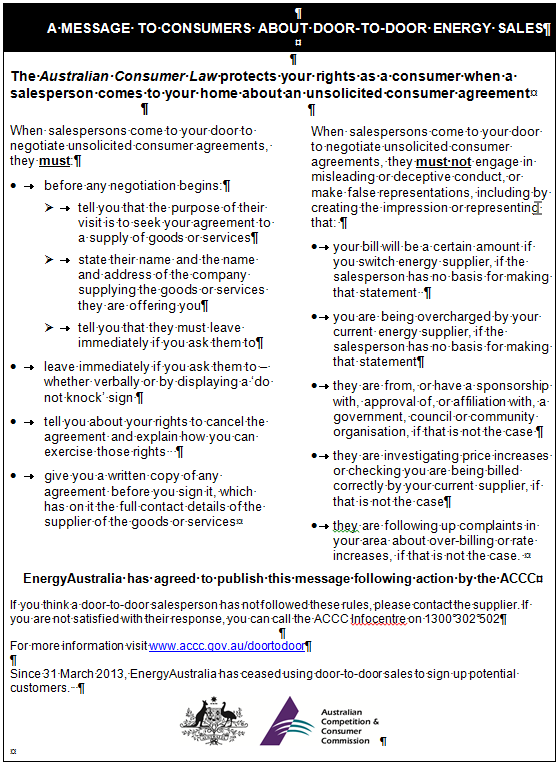
34 EnergyAustralia at its own expense, within 14 days of the date of this Order, take all reasonable steps to cause a notice to be published in a weekday edition of each of The Herald Sun, The Daily Telegraph and the Courier Mail newspapers which is in the terms and form of Annexure C and complies with the following specifications:
(a) be placed within the first ten pages of the newspaper;
(b) be at least 28 centimetres by five columns in size or a size of no less than one third of a page in the newspaper;
(c) have a banner font of san serif 12 point, bold;
(d) have a headline font of 12 point, bold;
(e) contain, in the body of the text, font that is no less than 11 point; and
(f) have ACCC and Commonwealth logos of at least 20 millimetres in height and centred.
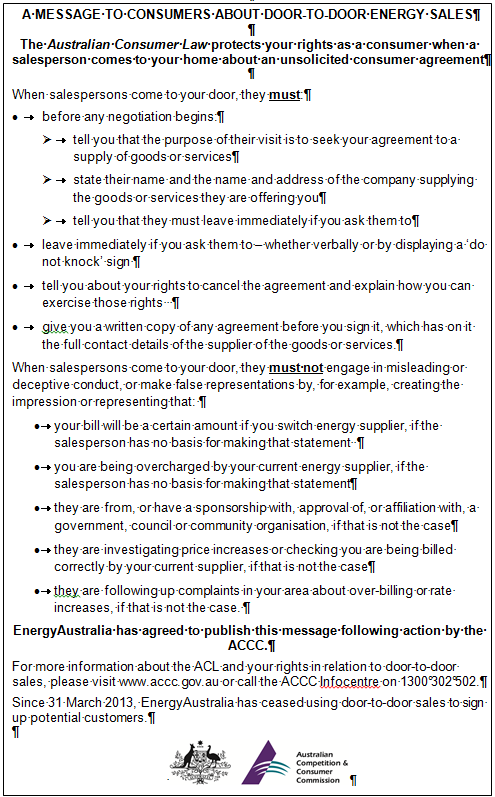
35 EnergyAustralia at its own expense, within 14 days of the date of this Order, publish or cause to be published, on the internet homepage located at www.energyaustralia.com.au (‘EnergyAustralia website’), a notice in the terms and form (including font and formatting) of Annexure D (‘the EA notice’) and ensure that the EA notice complies with the following specifications (as amended by agreement in relation to a mobile version of the website):
(a) the EA notice is to be accessible through a prominent on-click link displayed in the top third of the home page of the EnergyAustralia website with the following specifications:
(i) the words “A NOTICE ORDERED BY THE FEDERAL COURT OF AUSTRALIA” are to be in uppercase 18 point, bold and black sans serif font, on a white background, centred in a bordered box;
(ii) the words “Click here for further information” are to be in 14 point, black sans serif font, on a white background, centred below the words “A NOTICE ORDERED BY THE FEDERAL COURT OF AUSTRALIA” in the same bordered box;
(iii) the bordered box and its contents, including the white space, is to operate such that it is a one-click hyper-link to the notice; and
(iv) the border must be black;
(b) the heading of the EA notice is to be in font that is no less than 12 point, bold and black sans serif font, on white background;
(c) the body of text of the EA notice is to be in font that is no less than 12 point, black sans serif font, on a white background;
(d) the border and text of the EA notice will be black;
(e) the EA notice will be displayed on a stand-alone web page that is coded in standard ‘HTML’ format;
(f) the EA notice will not be displayed as a “pop-up” or “pop-under” window;
(g) the EA notice will have ACCC and Commonwealth logos of at least 20 millimetres in height and centred; and
(h) the EA notice will remain on the EnergyAustralia website for a continuous period of 90 days.
Other Orders
36 EnergyAustralia file and serve on the ACCC, within three months of the date of this Order, an affidavit of its proper officer verifying that it has carried out its obligations under the orders of the Court sought under paragraphs 34 and 35 above, detailing what it has done, including:
(a) in respect of paragraph 34 above, by providing a copy of the corrective advertisement as published in the newspapers;
(b) in respect of paragraph 35 above, by providing a copy of:
(i) a date stamped screen capture of the EnergyAustralia website showing the click-through link; and
(ii) a date stamped screen capture of the stand-alone web page containing the notice.
37 Smart file and serve on the ACCC, within three months of the date of this Order, an affidavit of its proper officer verifying that it has carried out its obligations under the orders of the Court sought under paragraph 32 above.
38 Aegis Direct file and serve on the ACCC, three months of the date of this Order, an affidavit of its proper officer verifying that it has carried out its obligations under the orders of the Court sought under paragraph 33 above.
39 ASAP file and serve on the ACCC, within three months of the date of this Order, an affidavit of its proper officer verifying that it has carried out its obligations under the orders of the Court sought under paragraph 33 above.
The ACCC’s costs
40 The respondents pay the ACCC’s costs of, and incidental to, this proceeding by payment of the following amounts:
(a) EnergyAustralia, $25,000, within 30 days of the making of this order by the Court;
(b) Smart, $5,000, on the date of the payment described in paragraph 28(a) above;
(c) Aegis Direct, $10,000, within 30 days of the making of this order by the Court;
(d) ASAP, $5,000, within 30 days of the making of this order by the Court.
Note: Entry of orders is dealt with in Rule 39.32 of the Federal Court Rules 2011.
ANNEXURE A
TRADE PRACTICES COMPLIANCE PROGRAM
EnergyAustralia will establish a Trade Practices Compliance Program (Compliance Program) that complies with each of the following requirements:
Appointments
1. Within 30 days of the date of the Order of the Court (Court Order) coming into effect EnergyAustralia will appoint a Director or a Senior Manager with suitable qualifications or experience in corporate compliance as Compliance Officer with responsibility for ensuring the Compliance Program is effectively designed, implemented and maintained.
2. Within 2 months of the date of the Court Order coming into effect EnergyAustralia shall appoint a qualified, internal or external, compliance professional with expertise in trade practices issues (the Compliance Advisor). EnergyAustralia shall instruct the Compliance Advisor to conduct a Competition and Consumer Act risk assessment (Risk Assessment) in accordance with 2.1 – 2.4 below:
2.1. identify the areas where EnergyAustralia is at risk of breaching:
2.1.1. section 18 of Part 2-1 (Misleading or deceptive conduct);
2.1.2. section 29 of Part 3-1, Division 1 (False or misleading representations etc.); or
2.1.3. Part 3-2, Division 2 (Unsolicited consumer agreements),
of the Australian Consumer Law at Schedule 2 to the Competition and Consumer Act 2010 (the Act) (the ACL);
2.2. assess the likelihood of these risks occurring and the consequences of the risks to the business operations of EnergyAustralia should they occur;
2.3. identify where there may be gaps in EnergyAustralia’s existing procedures for managing these risks; and
2.4. provide recommendations for action having regard to the assessment.
Compliance Policy
3. EnergyAustralia will, within 30 days of the Court Order coming into effect, issue a policy statement outlining EnergyAustralia’s commitment to trade practices compliance (the Compliance Policy). EnergyAustralia will ensure that the Compliance Policy:
3.1. is written in plain language;
3.2. contains a statement of commitment to compliance with the Act (including the ACL);
3.3. contains a strategic outline of how commitment to trade practices compliance will be realised within EnergyAustralia;
3.4. contains a requirement for all staff to report any Compliance Program related issues and trade practices compliance concerns to the Compliance Officer;
3.5. contains a guarantee that whistleblowers will not be prosecuted or disadvantaged in any way for making a genuine report and that their reports will be kept confidential and secure; and
3.6. contains a clear statement that EnergyAustralia will take action internally against any persons who are knowingly or recklessly concerned in a contravention of the Act (including the ACL) and will not indemnify them.
Complaints Handling System
4. EnergyAustralia will ensure that the Compliance Program includes a trade practices complaints handling system. EnergyAustralia shall use its best endeavours to ensure this system is consistent with AS/ISO 10002:2006 Customer satisfaction - Guidelines for complaints handling in organizations, though tailored to EnergyAustralia’s circumstances. EnergyAustralia will ensure that staff and customers are made aware of the complaints handling system.
5. EnergyAustralia will ensure that the Compliance Program includes whistleblower protection mechanisms to protect those coming forward with trade practices complaints. EnergyAustralia shall use its best endeavours to ensure that these mechanisms are consistent with Australian Standard 8004:2003 Whistleblower protection programs for entities, though tailored to EnergyAustralia’s circumstances.
Reports to Board/Senior Management
6. EnergyAustralia will ensure that the Compliance Officer reports to the Board and/or senior management meetings every 12 months on the continuing effectiveness of the Compliance Program.
Training
7. EnergyAustralia will ensure that the Compliance Program provides for regular (at least once a year) and practical training for all directors, officers, employees, representatives and agents of EnergyAustralia, whose duties could result in them being concerned with conduct that may contravene:
7.1. section 18 of Part 2-1 (Misleading or deceptive conduct);
7.2. section 29 of Part 3-1, Division 1 (False or misleading representations etc.); or
7.3. Part 3-2, Division 2 (Unsolicited consumer agreements),
of the ACL.
8. EnergyAustralia must ensure that the training is conducted by a suitably qualified compliance professional or legal practitioner with expertise in trade practices law.
9. EnergyAustralia will ensure that the Compliance Program includes a requirement that awareness of trade practices compliance issues forms part of the induction of all new directors, officers, employees, representatives and agents, whose duties could result in them being concerned with conduct that may contravene:
9.1. section 18 of Part 2-1(Misleading or deceptive conduct);
9.2. section 29 of Part 3-1, Division 1 (False or misleading representations etc.); and / or
9.3. Part 3-2, Division 2 (Unsolicited consumer agreements),
of the ACL.
Supply of Compliance Program Documents to the ACCC
10. EnergyAustralia shall, at its own expense, within 3 months of the date of the Court Order coming into effect, cause to be produced and provided to the ACCC copies of each of the documents constituting the Compliance Program and implement promptly and with due diligence any recommendations that the ACCC may make that are reasonably necessary to ensure that EnergyAustralia maintains and continues to implement the Compliance Program in accordance with the requirements of the Court Order.
Recommendations
11. EnergyAustralia shall implement promptly and with due diligence any recommendations made in the report referred to in paragraph 6 above.
ANNEXURE B(1)
TRADE PRACTICES COMPLIANCE PROGRAM
LEVEL 3
Smart will establish a Trade Practices Compliance Program (Compliance Program) that complies with each of the following requirements:
Appointments
1. Within one month of the date of the Order of the Court (Court Order) coming into effect Smart will appoint a Director or a Senior Manager of the business, whose responsibilities are to include the development, implementation and maintenance of the Compliance Program, and who reports directly to the company Board or governing body (the Compliance Officer).
2. Smart shall appoint a qualified, internal or external compliance professional with expertise in trade practices issues (the Compliance Advisor) within 3 months of the Court Order coming into effect, for the purposes set out in paragraph 3.
3. Smart shall instruct the Compliance Advisor to conduct a risk assessment (the Risk Assessment) in accordance with 3.1 – 3.4 below:
3.1. identify the areas where Smart is at risk of breaching:
3.1.1. Part 2-1 (Misleading or deceptive conduct); and
3.1.2. Part 3-1, Division 1 (False or misleading representations etc.),
of the Australian Consumer Law at Schedule 2 to the Competition and Consumer Act 2010 (the Act) (the ACL);
3.2. assess the likelihood of these risks occurring and the consequences of the risks to the business operations of Smart should they occur;
3.3. identify where there may be gaps in Smart’s existing procedures for managing these risks; and
3.4. provide recommendations for action having regard to the assessment.
Compliance Policy
4. Smart will, issue a policy statement outlining Smart’s commitment to trade practices compliance (the Compliance Policy). Smart will ensure the Compliance Policy:
4.1. is written in plain language;
4.2. contains a statement of commitment to compliance with the Act (including the ACL);
4.3. contains a requirement for all staff to report any Compliance Program related issues and trade practices compliance concerns to the Compliance Officer; and
4.4. contains a clear statement that Smart will take action internally against any persons who are knowingly or recklessly concerned in a contravention of the Act (including the ACL) and will not indemnify them.
Complaints Handling System
5. Smart will ensure the Compliance Program includes a complaints handling system capable of identifying, classifying, storing and where necessary, referring internal and external trade practices complaints.
Training
6. Smart will ensure that the Compliance Program includes a requirement for regular (at least once a year) and practical training for all employees of Smart, whose duties could result in them being concerned with conduct that may contravene:
6.1. Part 2-1 (Misleading or deceptive conduct); and / or
6.2. Part 3-1, Division 1 (False or misleading representations etc.),
of the ACL.
7. The training program will be designed to ensure the employees’ awareness of the responsibilities and obligations in relation to:
7.1. Part 2-1 (Misleading or deceptive conduct); and / or
7.2. Part 3-1, Division 1 (False or misleading representations etc.),
of the ACL.
8. Smart must ensure that the training is conducted by a suitably qualified compliance professional or legal practitioner with expertise in trade practices law.
9. Smart will ensure that the Compliance Program includes a requirement that awareness of trade practices compliance issues forms part of the induction of all new employees whose duties could result in them being concerned with conduct that may contravene:
9.1. Part 2-1 (Misleading or deceptive conduct); and / or
9.2. Part 3-1, Division 1 (False or misleading representations etc.),
of the ACL.
Reports to Senior Management
10. Smart will ensure that the Compliance Officer reports to the Board and/or senior management meetings every 3 months on the continuing effectiveness of the Compliance Program.
Supply of Compliance Program Documents to the ACCC
11. Smart shall, at its own expense, within 3 months of the date of this Undertaking coming into effect, cause to be produced and provided to the ACCC copies of each of the documents constituting the Compliance Program. Smart will implement promptly and with due diligence any recommendations the ACCC may make that are reasonably necessary to ensure that Smart maintains and continues to implement the Compliance Program in accordance with the Undertaking.
Review
12. Smart shall, at its own expense, cause annual reviews of the Compliance Program (the Reviews) to be carried out in accordance with each of the following requirements:
12.1. Scope of the Review – the Reviews should be broad and rigorous enough to provide Smart and the ACCC with supportable verification that Smart has in place a program that complies with each of the requirements detailed in paragraphs 1 to 11 above and to provide the Review reports and opinions detailed at point 13 below.
12.2. Independence of Reviewer – Smart shall ensure that the Reviews are carried out by a suitably qualified, independent compliance professional with expertise in trade practices law (the Reviewer). The Reviewer will qualify as independent on the basis that he or she:
12.2.1. did not design or implement the Compliance Program;
12.2.2. is not a present or past staff member or director of Smart;
12.2.3. has not acted and does not act for Smart in any trade practices related matters;
12.2.4. has not and does not act for or consult to Smart or provide other services on trade practices related matters other than Compliance Program reviewing; and
12.2.5. has no significant shareholding or other interests in Smart.
12.3. Evidence – Smart shall use its best endeavors to ensure that the Reviews are conducted on the basis that the Reviewer has access to all relevant sources of information in Smart’s possession or control, including without limitation:
12.3.1. enquiries of any officers, employees, representatives, agents and stakeholders of Smart;
12.3.2. Smart’s records, including the company’s complaints register/reports and any documents relevant to Smart’s training or induction program; and
12.3.3. documents created by Smart’s consultants and legal practitioners for use in Smart’s Compliance Program.
12.4. Smart shall ensure that the first Review is completed within one year and one month of this Undertaking coming into effect and that each subsequent Review is completed within one year thereafter.
Reporting
13. Smart shall use its best endeavours to ensure that the Reviewer sets out the findings of the Review in two separate reports as outlined below:
Company Compliance Program Review Report (to be provided to Smart)
13.1. Smart’s Company Compliance Program Review Report will provide particular and specific information regarding the performance of the Compliance Program including:
13.1.1. if, and to what extent, the Compliance Program of Smart includes all the elements detailed in paragraphs 1 to 12 above;
13.1.2. if, and to what extent, the Compliance Program adequately covers the parties and areas identified in the initial Risk Assessment;
13.1.3. if, and to what extent, the trade practices training is effective;
13.1.4. if, and to what extent, Smart’s complaints handling system is effective;
13.1.5. recommendations for rectifying deficiencies in 13.1.1 to 13.1.4. that the Reviewer thinks are reasonably necessary to ensure that Smart maintains and continues to implement the Compliance Program in accordance with the requirements of the Undertaking.
ACCC Compliance Program Review Report (to be provided to the ACCC)
13.2. The ACCC Compliance Program Review Report will supply particular and specific information regarding the scope of the Review and the effectiveness of the Compliance Program including:
13.2.1. details of the evidence gathered and examined during the Review;
13.2.2. the name and relevant experience of the person appointed as the company Compliance Officer;
13.2.3. the Reviewer’s opinion on whether Smart has in place an effective Compliance Program that complies with the requirements detailed in paragraph 1 to 12 above;
13.2.4. actions recommended by the Reviewer to ensure the continuing effectiveness of Smart’s Compliance Program;
13.2.5. confirmation that any actual and potential inadequacies in Smart’s Compliance Program have been brought to the attention of the Compliance Officer and the governing body;
13.2.6. confirmation that the Reviewer has revisited any actual and potential inadequacies in Smart’s Compliance Program identified in the previous Company Compliance Program Review Report, and assessed how they have been addressed by Smart;
13.2.7. any reservations that the Reviewer might have about the reliability and completeness of the information to which the Reviewer had access in the conduct and reporting of the Review; and
13.2.8. any comments or qualifications concerning the Review process that the Reviewer, in his or her professional opinion, considers necessary.
13.3. Smart will ensure that the Review Reports are completed and provided to Smart within two months of each Review.
13.4. Smart will retain the Company Compliance Program Review Report and cause the ACCC Compliance Program Review Report to be provided to the ACCC within 14 days of its receipt from the Reviewer.
14. Recommendations - Smart shall implement promptly and with due diligence any recommendations made by the Reviewer or required by the ACCC, that are reasonably necessary to ensure that Smart maintains and continues to implement the Compliance Program in accordance with the requirements of this Undertaking.
15. Smart shall, at its own expense, if requested by the ACCC, provide copies of documents and information in respect of matters which are the subject of the Compliance Program.
16. In the event the ACCC has sufficient reason to suspect that the Compliance Program is not being implemented effectively, Smart shall, at its own expense and if requested by the ACCC, cause an interim or additional Review to be conducted and cause the resulting Review Report to be provided to the ACCC.
ANNEXURE B(2)
TRADE PRACTICES COMPLIANCE PROGRAM
LEVEL 3
Each of Aegis Direct and ASAP will establish a Trade Practices Compliance Program (Compliance Program) that complies with each of the following requirements.
For the purpose of the following, the words “Aegis Direct” should also be read as “ASAP” such that the obligations imposed on Aegis Direct are also imposed on ASAP in relation to the Compliance Program to be established by ASAP.
Appointments
1. Within one month of the date of the Order of the Court (Court Order) coming into effect Aegis Direct will appoint a Director or a Senior Manager of the business, whose responsibilities are to include the development, implementation and maintenance of the Compliance Program, and who reports directly to the company Board or governing body (the Compliance Officer).
2. Aegis Direct shall appoint a qualified, internal or external compliance professional with expertise in trade practices issues (the Compliance Advisor) within 3 months of the Court Order coming into effect, for the purposes set out in paragraph 3.
3. Aegis Direct shall instruct the Compliance Advisor to conduct a risk assessment (the Risk Assessment) in accordance with 3.1 – 3.4 below:
3.1. identify the areas where Aegis Direct is at risk of breaching:
3.1.1. Part 2-1 (Misleading or deceptive conduct);
3.1.2. Part 3-1, Division 1 (False or misleading representations etc.); and
3.1.3. Part 3-2, Division 2 (Unsolicited consumer agreements),
of the Australian Consumer Law at Schedule 2 to the Competition and Consumer Act 2010 (the Act) (the ACL);
3.2. assess the likelihood of these risks occurring and the consequences of the risks to the business operations of Aegis Direct should they occur;
3.3. identify where there may be gaps in Aegis Direct’s existing procedures for managing these risks; and
3.4. provide recommendations for action having regard to the assessment.
Compliance Policy
4. Aegis Direct will, issue a policy statement outlining Aegis Direct’s commitment to trade practices compliance (the Compliance Policy). Aegis Direct will ensure the Compliance Policy:
4.1. is written in plain language;
4.2. contains a statement of commitment to compliance with the Act (including the ACL);
4.3. contains a requirement for all staff to report any Compliance Program related issues and trade practices compliance concerns to the Compliance Officer; and
4.4. contains a clear statement that Aegis Direct will take action internally against any persons who are knowingly or recklessly concerned in a contravention of the Act (including the ACL) and will not indemnify them.
Complaints Handling System
5. Aegis Direct will ensure the Compliance Program includes a complaints handling system capable of identifying, classifying, storing and where necessary, referring internal and external trade practices complaints.
Training
6. Aegis Direct will ensure that the Compliance Program includes a requirement for regular (at least once a year) and practical training for all employees of Aegis Direct, whose duties could result in them being concerned with conduct that may contravene:
6.1. Part 2-1 (Misleading or deceptive conduct);
6.2. Part 3-1, Division 1 (False or misleading representations etc.); and / or
6.3. Part 3-2, Division 2 (Unsolicited consumer agreements),
of the ACL.
7. The training program will be designed to ensure the employees’ awareness of the responsibilities and obligations in relation to:
7.1. Part 2-1 (Misleading or deceptive conduct);
7.2. Part 3-1, Division 1 (False or misleading representations etc.); and / or
7.3. Part 3-2, Division 2 (Unsolicited consumer agreements),
of the ACL.
8. Aegis Direct must ensure that the training is conducted by a suitably qualified compliance professional or legal practitioner with expertise in trade practices law.
9. Aegis Direct will ensure that the Compliance Program includes a requirement that awareness of trade practices compliance issues forms part of the induction of all new employees whose duties could result in them being concerned with conduct that may contravene:
9.1. Part 2-1 (Misleading or deceptive conduct);
9.2. Part 3-1, Division 1 (False or misleading representations etc.); and / or
9.3. Part 3-2, Division 2 (Unsolicited consumer agreements),
of the ACL.
Reports to Senior Management
10. Aegis Direct will ensure that the Compliance Officer reports to the Board and/or senior management meetings every 3 months on the continuing effectiveness of the Compliance Program.
Supply of Compliance Program Documents to the ACCC
11. Aegis Direct shall, at its own expense, within 3 months of the date of this Undertaking coming into effect, cause to be produced and provided to the ACCC copies of each of the documents constituting the Compliance Program. Aegis Direct will implement promptly and with due diligence any recommendations the ACCC may make that are reasonably necessary to ensure that Aegis Direct maintains and continues to implement the Compliance Program in accordance with the Undertaking.
Review
12. Aegis Direct shall, at its own expense, cause annual reviews of the Compliance Program (the Reviews) to be carried out in accordance with each of the following requirements:
12.1. Scope of the Review – the Reviews should be broad and rigorous enough to provide Aegis Direct and the ACCC with supportable verification that Aegis Direct has in place a program that complies with each of the requirements detailed in paragraphs 1 to 11 above and to provide the Review reports and opinions detailed at point 13 below.
12.2. Independence of Reviewer – Aegis Direct shall ensure that the Reviews are carried out by a suitably qualified, independent compliance professional with expertise in trade practices law (the Reviewer). The Reviewer will qualify as independent on the basis that he or she:
12.2.1. did not design or implement the Compliance Program;
12.2.2. is not a present or past staff member or director of Aegis Direct;
12.2.3. has not acted and does not act for Aegis Direct in any trade practices related matters;
12.2.4. has not and does not act for or consult to Aegis Direct or provide other services on trade practices related matters other than Compliance Program reviewing; and
12.2.5. has no significant shareholding or other interests in Aegis Direct.
12.3. Evidence – Aegis Direct shall use its best endeavors to ensure that the Reviews are conducted on the basis that the Reviewer has access to all relevant sources of information in Aegis Direct’s possession or control, including without limitation:
12.3.1. enquiries of any officers, employees, representatives, agents and stakeholders of Aegis Direct;
12.3.2. Aegis Direct’s records, including the company’s complaints register/reports and any documents relevant to Aegis Direct training or induction program; and
12.3.3. documents created by Aegis Direct’s consultants and legal practitioners for use in Aegis Direct’s Compliance Program.
12.4. Aegis Direct shall ensure that the first Review is completed within one year and one month of this Undertaking coming into effect and that each subsequent Review is completed within one year thereafter.
Reporting
13. Aegis Direct shall use its best endeavours to ensure that the Reviewer sets out the findings of the Review in two separate reports as outlined below:
Company Compliance Program Review Report (to be provided to Aegis Direct)
13.1. Aegis Direct’s Company Compliance Program Review Report will provide particular and specific information regarding the performance of the Compliance Program including:
13.1.1. if, and to what extent, the Compliance Program of Aegis Direct includes all the elements detailed in paragraphs 1 to 12 above;
13.1.2. if, and to what extent, the Compliance Program adequately covers the parties and areas identified in the initial Risk Assessment;
13.1.3. if, and to what extent, the trade practices training is effective;
13.1.4. if, and to what extent, Aegis Direct’s complaints handling system is effective;
13.1.5. recommendations for rectifying deficiencies in 13.1.1 to 13.1.4. that the Reviewer thinks are reasonably necessary to ensure that Aegis Direct maintains and continues to implement the Compliance Program in accordance with the requirements of the Undertaking.
ACCC Compliance Program Review Report (to be provided to the ACCC)
13.2. The ACCC Compliance Program Review Report will supply particular and specific information regarding the scope of the Review and the effectiveness of the Compliance Program including:
13.2.1. details of the evidence gathered and examined during the Review;
13.2.2. the name and relevant experience of the person appointed as the company Compliance Officer;
13.2.3. the Reviewer’s opinion on whether Aegis Direct has in place an effective Compliance Program that complies with the requirements detailed in paragraph 1 to 12 above;
13.2.4. actions recommended by the Reviewer to ensure the continuing effectiveness of Aegis Direct’s Compliance Program;
13.2.5. confirmation that any actual and potential inadequacies in Aegis Direct Compliance Program have been brought to the attention of the Compliance Officer and the governing body;
13.2.6. confirmation that the Reviewer has revisited any actual and potential inadequacies in Aegis Direct’s Compliance Program identified in the previous Company Compliance Program Review Report, and assessed how they have been addressed by Aegis Direct;
13.2.7. any reservations that the Reviewer might have about the reliability and completeness of the information to which the Reviewer had access in the conduct and reporting of the Review; and
13.2.8. any comments or qualifications concerning the Review process that the Reviewer, in his or her professional opinion, considers necessary.
13.3. Aegis Direct will ensure that the Review Reports are completed and provided to Aegis Direct within two months of each Review.
13.4. Aegis Direct will retain the Company Compliance Program Review Report and cause the ACCC Compliance Program Review Report to be provided to the ACCC within 14 days of its receipt from the Reviewer.
14. Recommendations - Aegis Direct shall implement promptly and with due diligence any recommendations made by the Reviewer or required by the ACCC, that are reasonably necessary to ensure that Aegis Direct maintains and continues to implement the Compliance Program in accordance with the requirements of this Undertaking.
15. Aegis Direct shall, at its own expense, if requested by the ACCC, provide copies of documents and information in respect of matters which are the subject of the Compliance Program.
16. In the event the ACCC has sufficient reason to suspect that the Compliance Program is not being implemented effectively, Aegis Direct shall, at its own expense and if requested by the ACCC, cause an interim or additional Review to be conducted and cause the resulting Review Report to be provided to the ACCC.
ANNEXURE C
ANNEXURE D
| VICTORIA DISTRICT REGISTRY | |
| GENERAL DIVISION | VID 169 of 2013 |
| BETWEEN: | AUSTRALIAN COMPETITION AND CONSUMER COMMISSION Applicant |
| AND: | ENERGY AUSTRALIA PTY LTD (ACN 086 014 968) First Respondent SALES MARKETING AND REAL TECHNOLOGIES - SMART PTY LTD (ACN 094 805 295) Second Respondent MULTIPLE STORIES PTY LTD (ACN 098 390 777), TRADING AS AEGIS DIRECT Third Respondent AEGIS SERVICES AUSTRALIA PTY LTD (ACN 070 034 598) Fourth Respondent AUSTRALIAN SALES AND PROMOTIONS PTY LTD (ACN 104 339 273) Fifth Respondent |
| JUDGE: | MIDDLETON J |
| DATE: | 4 APRIL 2014 |
| PLACE: | MELBOURNE |
REASONS FOR JUDGMENT
INTRODUCTION
1 The Applicant (‘ACCC’) seeks pecuniary penalties, declaratory relief and other relief against the First Respondent (‘EnergyAustralia’) the Second Respondent (‘Smart’), the Third Respondent (‘Aegis Direct’), and the Fifth Respondent (‘ASAP’) for contraventions of the Australian Consumer Law (‘ACL’) being Sch 2 of the Competition and Consumer Act 2010 (Cth) (‘CCA’).
2 The contraventions of the ACL relate to the conduct of door-to-door sales representatives who were engaged to negotiate with consumers to enter into an agreement for the supply of retail energy by EnergyAustralia.
3 Admissions are made by the relevant respondents as follows:
(a) EnergyAustralia admits that, by the conduct of sales representatives, it engaged in conduct that amounts to contraventions of ss 18, 29, 74 and 75 of the ACL, when calling on six consumers;
(b) Smart admits that, by the conduct of sales representatives, it engaged in conduct that amounts to contraventions of ss 18 and 29 of the ACL when calling on one consumer;
(c) Aegis Direct admits that, by the conduct of sales representatives, it engaged in conduct that amounts to contraventions of ss 18, 29, 74 and 75 of the ACL when calling on four consumers; and
(d) ASAP admits that, by the conduct of sales representatives, it engaged in conduct that amounts to contraventions of ss 18, 29 and 74 of the ACL when calling on one consumer.
4 The ACCC does not seek any declarations or orders against the Fourth Respondent (‘Aegis Services’), because Aegis Services was not a party to any of the contravening conduct.
5 The conduct complained of, and the circumstances in which it occurred, is set out in the Statement of Agreed Facts (‘Agreed Facts’), which I attach to the judgment marked “Annexure A”.
6 The parties have agreed that the appropriate orders are as follows:
(1) The ACCC and EnergyAustralia ask that the Court:
(a) make declarations pursuant to the power in s 21 of the Federal Court of Australia Act 1976 (Cth) (‘Federal Court Act’);
(b) order payment of pecuniary penalties by EnergyAustralia in the amount of $1.2 million pursuant to s 224 of the ACL;
(c) make orders pursuant to s 246 of the ACL providing for the preparation or modification of a compliance program by EnergyAustralia;
(d) make publication orders against EnergyAustralia pursuant to s 246 of the ACL; and
(e) order the payment of costs in the amount of $25,000 by EnergyAustralia pursuant to s 43 of the Federal Court Act.
(2) The ACCC and Smart ask that the Court:
(a) make declarations pursuant to the power in s 21 of the Federal Court Act;
(b) order payment of pecuniary penalties in the amount of $40,000 by Smart pursuant to s 224 of the ACL;
(c) make orders pursuant to s 246 of the ACL providing for the preparation or modification of a compliance program by Smart; and
(d) order the payment of costs in the amount of $5,000 by Smart pursuant to s 43 of the Federal Court Act.
(3) The ACCC and Aegis Direct ask that the Court:
(a) make declarations pursuant to the power in s 21 of the Federal Court Act;
(b) order payment of pecuniary penalties in the amount of $200,000 by Aegis Direct pursuant to s 224 of the ACL;
(c) make orders pursuant to s 246 of the ACL providing for the preparation or modification of a compliance program by Aegis Direct; and
(d) order the payment of costs pursuant to s 43 of the Federal Court Act in the amount of $10,000 by Aegis Direct.
(4) The ACCC and ASAP ask that the Court:
(a) make declarations pursuant to the power in s 21 of the Federal Court Act;
(b) order payment of pecuniary penalties in the amount of $50,000 by ASAP pursuant to s 224 of the ACL;
(c) make orders pursuant to s 246 of the ACL providing for the preparation or modification of a compliance program by ASAP; and
(d) order the payment of costs in the amount of $5,000 by ASAP pursuant to s 43 of the Federal Court Act.
PRINCIPLES TO APPLY
7 I have recently heard and determined a number of civil penalty matters, like the present one (for example ACCC v AGL Sales [2013] FCA 1030 (‘AGL Sales’); ACCC v Moonah Superstore [2013] FCA 1314; ACCC v Launceston Superstore [2013] FCA 1315; ACCC v Salecomp [2013] FCA 1316 and ACCC v HP Superstore [2013] FCA 1317). In those matters I discussed the role of the Court and the principles to be applied where the parties have agreed facts and an agreed form of orders. I will not repeat the general applicable principles, save to say there is a clear public benefit when costly and complex civil litigation can be avoided. However, the overriding principle is that the Court must itself determine the appropriate penalty.
8 I should also stress that a principal object of imposing a pecuniary penalty is deterrence.
9 Deterrence has two aspects: specific deterrence in respect of the actual contravener and general deterrence of others who may be disposed to engage in prohibited conduct of a similar kind.
THE IMPOSITION OF AGREED PECUNIARY PENALTIES
10 As I have already indicated, each of the relevant respondents submits jointly with the ACCC that the Court should make orders imposing a pecuniary penalty pursuant to s 224 of the ACL on:
(a) EnergyAustralia, in the amount of $1.2 million;
(b) Smart, in the amount of $40,000;
(c) Aegis Direct, in the amount of $200,000; and
(d) ASAP, in the amount of $50,000.
11 Section 224 of the ACL applies to contraventions that took place on and from 1 January 2011. All of the conduct the subject of this proceeding occurred after that date.
12 Sections 224(1)(a)(ii) and (iv) of the ACL empower the Court, in respect of contraventions of provisions of Pt 3-1 of the ACL (which includes s 29) and provisions of Div 2 of Pt 3-2 of the ACL (which includes ss 74 and 75) to order the contravener to pay such pecuniary penalty in respect of “each act or omission” as the Court determines to be appropriate. The ACCC has standing to seek pecuniary penalties under those sections.
13 No penalties are provided for in the ACL for contraventions of s 18(1).
PENALTIES
14 I am satisfied in this case that the Agreed Facts, and admissions made, sufficiently and appropriately provide the facts and admissions for me to assess the appropriate penalty.
Application of the Facts
15 I now turn to the application of the facts to the applicable legal principles.
16 However, before doing so I make one other introductory comment.
17 When it was enacted, the ACL introduced a national law dealing with unsolicited sales practices, including door-to-door selling.
18 Following the introduction of provisions in the ACL regulating unsolicited consumer agreements, the ACCC undertook an education campaign alerting industry participants and consumers that the provisions were coming into force. In a joint ACCC-Australian Energy Regulator letter dated 26 July 2011, EnergyAustralia was specifically alerted to its obligations under the ACL in relation to door-to-door marketing and the consequences of contraventions.
19 I have expressly recognised in AGL Sales at [17] that, at least in relation to s 75 of the ACL, a contravention is serious in nature because of the location and context in which it occurs, being a private residence to which companies are not invited. Such contraventions subvert both the consumer’s desire not to be disturbed or interrupted by sales representatives and the very protections provided to the consumer by the legislation.
Overview of conduct
20 The contravening conduct arises from door-to-door sales activities undertaken by Smart, Aegis Direct and ASAP through sales representatives on behalf of EnergyAustralia.
21 There is no allegation in this proceeding of repeated contraventions by the same sales representatives over an extended period.
EnergyAustralia
22 As noted above, EnergyAustralia’s conduct relates to door-to-door sales activities undertaken by sales representatives employed or otherwise engaged by:
(a) Smart, in relation one consumer (Ms Parry);
(b) Aegis Direct, in relation to four consumers (Mr Stajsic, Ms Chia, Mr Linden and Ms Scott);
(c) ASAP, in relation to one consumer (Ms Brennan).
23 Further detail on this conduct is outlined below.
Smart and EnergyAustralia
24 The conduct attributable to Smart and EnergyAustralia consists of misrepresentations contrary to ss 18 and 29 of the ACL made by one of the two sales representatives who attended the home of Ms Parry of Caloundra, Queensland on 26 July 2011. No contraventions of ss 74 or 75 of the ACL are alleged in respect of the call on Ms Parry.
25 It is agreed for the purposes of the proceeding that the representative spoke words reasonably understood as being to the effect that:
(a) they represented the government and were there to check that Ms Parry was receiving all her entitlements;
(b) they needed to see a bill to make sure Ms Parry was receiving all her discounts, and could do her a better deal; and
(c) she would receive full entitlements if Ms Parry signed the relevant forms.
26 These were misrepresentations.
Aegis Direct and EnergyAustralia
27 The conduct attributable to Aegis Direct and EnergyAustralia consists of omissions by sales representatives to provide mandated information contrary to s 74 of the ACL, a contravention of s 75 of the ACL, and misrepresentations by sales representatives contrary to ss 18 and 29 of the ACL. The conduct occurred during visits to the following four consumers’ homes:
(a) the home of Mr Stajsic in Coburg, Victoria on 14 August 2012;
(b) the home of Ms Scott in Tarneit, Victoria on 18 February 2012;
(c) the home of Mr Linden in Newport, Victoria on 17 July 2012; and
(d) the home of Ms Sue-Lin Chia in Fitzroy, North Victoria on 15 May 2012.
28 Each of these visits involved a failure to provide mandated information contrary to s 74 of the ACL.
29 One instance of the conduct, constituting a contravention of s 75, involved a sales representative calling on Ms Scott in Tarneit Victoria on 18 February 2012, in spite of the “Do not knock” sign at that premises, and remaining on the premises despite further requests to leave.
30 Each of these visits involved misrepresentations that amounted to a false or misleading pretext for the visit.
31 In summary, with respect EnergyAustralia and Aegis Direct:
(a) The contravening conduct involved failures by the sales representatives to advise consumers, as soon as practicable and in any event before starting to negotiate:
(i) the purpose of the call on the consumers’ residences;
(ii) that the sales representatives were obliged to leave on request; and
(iii) the dealer’s name, and the name and address of the supplier,
as required by s 74 of the ACL.
(b) This conduct occurred at private residences to which EnergyAustralia and Aegis Direct were not invited. Having not been invited to the various premises, the relevant respondents were obliged to comply with the doorknocking provisions of the ACL. Section 74 of the ACL regulates what a dealer must say when calling on a person, and the prescribed things were not said.
(c) In the visit to Ms Scott in Tarneit Victoria, the contravening conduct included (through the sales representative) failing to leave the premises upon request, where there was a “Do not knock” sticker, and various oral and physical references to the sticker thereafter.
(d) Again, this conduct occurred at a private residence to which EnergyAustralia and Aegis Direct were not invited. Section 75 of the ACL imposes an obligation on sales representatives to leave on request, and in this case the sales representative, refused to do so and persisted with its call on a consumer.
(e) The sales representatives made statements that were incorrect, and therefore misleading or deceptive and false. Based on the matters set out in the Agreed Facts, the statements fall within the following categories:
(i) statements about the purpose of the sales representatives’ call on a consumer’s residence;
(ii) statements that the representative, the services being marketed, and the rate or tariff being offered had a sponsorship, approval or affiliation they did not have;
(iii) statements that there was such a notion of a mandated or correct rate or tariff (and that the consumer was not being charged that rate), when this was not the case; and
(iv) other statements concerning government rebates or entitlements, incorrect prices, the electricity market or the carbon price.
ASAP and EnergyAustralia
32 The conduct attributable to ASAP and EnergyAustralia consists of omissions by sales representatives to provide mandated information contrary to s 74 of the ACL, and misrepresentations by sales representatives contrary to ss 18 and 29 of the ACL. The conduct occurred during a visit to the premises of Ms Brennan.
33 The contravening conduct involved failures by the sales representatives to advise a consumer, as soon as practicable and in any event before starting to negotiate:
(a) the purpose of the call on the consumer’s residence;
(b) that the sales representatives were obliged to leave on request; and
(c) the dealer’s name, and the name and address of the supplier;
as required by s 74 of the ACL.
34 This conduct occurred at a private residence to which EnergyAustralia and ASAP was not invited. Having not been invited to the consumer’s premises, EnergyAustralia and ASAP were obliged to comply with the doorknocking provisions of the ACL. Section 74 of the ACL regulates what a dealer must say when calling on a person, and the prescribed things were not said.
35 The sales representatives also made statements that were incorrect, and therefore false or misleading. The statements fall within the following categories:
(a) statements about the purpose of the sales representatives’ call on Ms Brennan’s residence;
(b) statements that the representatives and the rate or tariff being offered had a sponsorship, approval or affiliation they did not have; and
(c) statements that there was such a notion of a mandated or correct rate or tariff (and that the consumer was not being charged that rate), when this was not the case.
The amount of loss or damage caused
36 Section 74 of the ACL protects consumers by imposing mandatory standards of conduct for persons engaged in door-to-door selling. The provisions will be contravened where conduct falls short of what is required by those mandatory standards. The standards are intended to limit consumers’ exposure to inconvenience, invasion of privacy and the risk of loss or damage when they make a decision to purchase goods or services on their doorstep without being advised clearly and upfront that the salesperson is there to sell them something. They can ask the salesperson to leave if they are not interested.
37 The prohibitions in ss 18 and 29 protect consumers in their home against salespeople from making misrepresentations in relation to the nature of their visit.
38 Six consumers were called upon in their homes and subjected to interactions with salespeople that commenced, and were conducted, on a false, misleading, or deceptive basis. Moreover,
(a) for five of the six consumers, the sales person failed to do the things required by s 74 of the ACL; and
(b) for one of the six consumers, the sales person failed to leave as required by s 75 of the ACL.
39 Only one of the relevant consumers entered into an agreement with EnergyAustralia for the supply of retail electricity (Ms Parry). However, that agreement was terminated during the cooling-off period in the day following the call.
40 Accordingly, none of the six consumers were in a worse financial position as a result of the call on their premises.
41 The loss or damage to be considered in determining the appropriate penalty is not restricted to financial loss or damage. The consequence of contraventions of this nature will, in some cases, be inconvenience, intrusion and invasion of privacy.
42 However, it is a mitigating factor that in the present case there is no quantifiable loss or damage.
Whether similar prior conduct
43 None of the relevant respondents has been found previously by a court to have contravened any provision of the ACL or to have engaged in similar conduct the subject of this proceeding.
44 In addition, none of the relevant respondents has previously provided an undertaking to the ACCC regarding similar conduct. This is a mitigating factor when considering the appropriate penalty.
The size of the contravener and its financial position
45 Section 224 does not include a provision such as that incorporated into s 76(1A) of the CCA which measures maximum penalty by reference to 10 per cent of the annual turnover of the company as an alternative to assessing the pecuniary benefit to the company flowing from the contravention. However, capacity to pay is a relevant factor.
46 The size of a parent company is relevant to a subsidiary’s capacity to meet a pecuniary penalty, and while the punishment is not imposed on the parent, the size of the parent cannot be ignored when assessing the penalty that should be imposed on its subsidiary.
EnergyAustralia
47 EnergyAustralia is one of the largest energy retailers in Australia. As at December 2013, it had approximately 1.9 million retail electricity customers. EnergyAustralia estimates that it has approximately 23 per cent of retail electricity and gas sales in the states and territories belonging to the so-called National Electricity Market.
48 For the year ended December 2012, and the half year ended June 2013, EnergyAustralia Holdings Limited’s total revenue, expenses and profits were approximately:
| Year | Year ended December 2012 | Half year ended June 2013 |
| Revenue | $8,311,204,000 | $4,338,049,000 |
| Expenses from continuing operations | ($7,947,019,000) | ($4,232,833,000) |
| Expenses (including other income and other costs) | ($201,824,000) | ($107,693,000) |
| Profit before tax | $162,361,000 | ($2,477,000) |
| Statutory Profit | $125,244,000 | ($9,397,000) |
49 As at 30 June 2013, EnergyAustralia Holdings Limited’s total current assets were valued at $2,224,324,000 and its total current liabilities at $2,594,545,000.
50 For the year ended December 2012, and the half year ended June 2013, EnergyAustralia Holdings Limited estimates its revenue in relation to its retail business (which includes gas and electricity sales for mass market and commercial and industrial customers) was as follows:
| Year | Year ended December 2012 | Half year ended June 2013 |
| Revenue | $6,900,369,000 | $3,600,581,000* |
51 In relation to the revenue for the half year ending June 2013, EnergyAustralia does not report revenue by segment in its half year accounts. Accordingly, this is an estimated figure calculated by applying the percentage of total revenue derived from retail sales for year ended December 2012 to the total revenue for half year ended June 2013.
Smart, Aegis Direct and ASAP
52 Evidence about the size and financial position of Smart, Aegis Direct and ASAP is set out in confidential evidence. I have considered that evidence, particularly relevant to parity and the capacity to pay any penalty.
The deliberateness of the contravening conduct
53 The nature of the misleading statements made (and not made) in the calls on the six consumers suggests that the contracted sales representatives were deliberately attempting to disguise their purpose in calling on consumers to ‘get a foot in the door’.
54 It cannot be said that the conduct of sales representatives and the representations made by them was inadvertent. However, it equally cannot be said that there was any deliberate element in the contraventions on the part of EnergyAustralia, Smart, Aegis Direct or ASAP.
Non involvement of senior employees or management
55 Senior management of EnergyAustralia was not directly involved in the contravening conduct. The conduct the subject of this proceeding related to conduct of sales representatives who were external to EnergyAustralia. There is no suggestion that the nature of the statements to be made, or approach to be adopted by the external sales representatives were authorised or known to EnergyAustralia prior to the contravening conduct occurring.
56 However, senior management of EnergyAustralia was aware of the potential ACL risks associated with door-to-door selling. As discussed below, EnergyAustralia did provide training materials to Smart, Aegis Direct and ASAP covering the provisions of the ACL the subject of this proceeding. It also had a compliance program in place. The conduct the subject of this proceeding was contrary to those materials and that program.
57 In the case of the allegations involving Smart, the contravening conduct was committed by sales representatives. Smart’s senior management did not engage in the contravening conduct, nor were they involved in the commission of the conduct. However, Smart’s senior management were aware that there were potential ACL risks associated with door-to-door selling, which senior management sought to address by implementing a training and compliance program for its sales representatives.
58 The conduct which gave rise to the contraventions was contrary to the compliance program which was in place.
59 In the case of the allegations involving Aegis Direct, the contravening conduct was committed by sales representatives. Aegis Direct’s senior management did not engage in the contravening conduct, nor were they involved in the commission of the conduct. However, Aegis Direct’s senior management were aware that there were potential ACL risks associated with door-to-door selling, which senior management sought to address by implementing a training and compliance program for its sales representatives.
60 The conduct which gave rise to the contraventions was contrary to the compliance program which was in place.
61 In the case of the allegations involving ASAP, the contravening conduct was committed by sales representatives. ASAP’s senior management did not engage in the contravening conduct, nor were they involved in the commission of the conduct. However, ASAP’s senior management were aware that there were potential ACL risks associated with door-to-door selling, which senior management sought to address by implementing a training and compliance program for its sales representatives.
62 The conduct which gave rise to the contraventions was contrary to the compliance program which was in place.
Culture of compliance and corrective measures in response to contravention
63 The compliance practices of, and the corrective measures undertaken by, the relevant respondents are described in the Agreed Facts.
Compliance
64 At all material times, EnergyAustralia provided training materials to Smart, Aegis Direct and ASAP. The training provided by EnergyAustralia covered in some detail the provisions of the ACL the subject of this proceeding. However, this training failed to prevent the contravening conduct from occurring.
65 EnergyAustralia made key changes to staffing and reporting in or around June 2012 to improve compliance. This included the creation of a Regulatory Manager (Compliance) role, and a team of seven staff dedicated to compliance.
66 EnergyAustralia continues to work on improving to its compliance measures. EnergyAustralia has agreed to amend its compliance program in accordance with the Agreed Facts.
67 In the case of Smart, it had in place an ACL compliance and training program which all sales representatives had to complete in prior to commencing door-to-door sales. The conduct of the sales representatives on behalf of Smart that is the subject of this proceeding contravened that compliance and training program. Over time, that training program has been improved.
68 In the case of Aegis Direct, it had in place an ACL compliance and training program which all sales representatives had to complete in prior to commencing door-to-door sales. The conduct of the sales representatives engaged on behalf of Aegis Direct that is the subject of this proceeding contravened of that compliance and training program. Over time, that training program has been improved.
69 In the case of ASAP, it had in place an ACL compliance and training program which all sales representatives had to complete, and be assessed against, prior to commencing door-to-door sales. The conduct of the sales representatives on behalf of ASAP that is the subject of this proceeding contravened that compliance and training program. Over time, that training program has been improved.
Corrective measures
70 On 25 February 2013, prior to the commencement of this proceeding, EnergyAustralia announced that from 31 March 2013, it was ceasing door-to-door sales.
71 EnergyAustralia was the industry leader in making the decision to cease door-to-door sales.
72 AGL Energy Limited and Origin Energy Limited have followed EnergyAustralia’s lead, and have now also ceased using door-to-door sales.
73 In the case of Smart, upon this proceeding being commenced by the ACCC, and the senior management of Smart becoming aware of the full details of the allegations involving its sales representatives, Smart engaged its solicitors to undertake a review of its current ACL compliance and training program. Smart intends to implement a number of improvements to its program, in addition to conducting the compliance program set out in the Orders.
74 In the case of Aegis Direct, upon this proceeding being commenced by the ACCC, and the senior management of Aegis Direct becoming aware of the full details of the allegations involving its sales representatives, Aegis Direct engaged its solicitors to undertake a review of its current ACL compliance and training program. Aegis Direct intends to implement a number of improvements to its program, in addition to conducting the compliance program set out in the Orders.
75 In the case of ASAP, upon this proceeding being commenced by the ACCC and the senior management of ASAP becoming aware of the allegations involving its sales representatives, ASAP engaged Ernst & Young to undertake an audit of its current ACL compliance and training program. ASAP has implemented the recommendations from that review. ASAP has conducted a further internal review of its ACL compliance and training program together with its largest current customer, and is now contractually bound to comply with the recommendations of that further review.
Cooperation and contrition discount
76 Prior to the commencement of this proceeding by the ACCC, at the ACCC’s request, EnergyAustralia and Aegis Direct cooperated by providing the ACCC with the requested information and documentation on a voluntary basis.
77 EnergyAustralia also met informally with the ACCC on four occasions prior to commencement of this proceeding to seek to resolve the issues in this proceeding.
78 EnergyAustralia has made prompt admissions, and has attempted to bring this proceeding to a close from an early stage.
79 Smart cooperated with the ACCC in the conduct of the proceeding by making some prompt admissions.
80 It is a mitigating factor that the relevant respondents are admitting liability for the contraventions without a contested hearing.
81 Because of the cooperation of the relevant respondents, a more complex trial has been avoided. A fully contested trial would have required more days in hearing and, with the potential for appeals, consumed large amounts of the Court’s and the ACCC’s time and resources. It is also significant that affected consumers have not had to attend Court from interstate to give evidence and submit to cross-examination.
82 The parties have not sought to state a specified percentage discount for the relevant respondents’ cooperation and acknowledgment of liability. It is not necessary to have a specified percentage discount in every case. In the present case, the proposed penalties factor in a significant discount for voluntary acknowledgment of liability and cooperation.
83 Had the relevant respondents not cooperated and had liability been established following a contested trial, significantly higher penalties would have been imposed.
Deterrence
84 It is necessary for the penalty to be of a sufficient magnitude for general deterrence in both the door-to-door sales industry generally, and the retail energy industry specifically, which has used door-to-door selling extensively.
85 As to specific deterrence:
(a) the penalties for each of the relevant respondents need to be set sufficiently high to deter repetition;
(b) EnergyAustralia has ceased door-to-door activities, and this is a relevant matter to be taken into account. From July 2012, it also made changes to its compliance management framework;
(c) the penalties imposed on Smart, Aegis Direct and ASAP are of a significant magnitude, particularly having regard to their size and financial position.
86 The parties submitted that the proposed penalties, together with the orders, sufficiently deter recidivism.
Parity principle
87 The ‘parity principle’ requires that when penalties are imposed, “there should not be such an inequality as would suggest that the treatment meted out has not been even-handed” (see NW Foods at 295).
88 Having said that, the parties acknowledge that the facts of one case should not be compared with the facts of another case in order to derive the appropriate penalty amount. The actual penalties imposed in one case are rarely of assistance in later cases, unless the situations are more or less comparable. Consistency in the application of the legal principles is the important consideration.
89 The question to be addressed by the Court when considering parity between the relevant respondents is whether the proposed penalties reasonably differentiate (or fail to differentiate) between the relevant respondents in light of their relevant similarities and differences.
90 Looking to the relevant respondents, the reasons for the differential in the penalties proposed are:
(a) the difference in size, financial position and capacity to pay as between EnergyAustralia, Aegis Direct, Smart and ASAP; and
(b) the difference in responsibility to be attributed to the energy retailer, being the business who ultimately benefits from successful sales to consumers, and the need for deterrence, both specific and general, on firms that become an ultimate party to an unsolicited consumer agreement.
91 Looking then to what has been done in other cases, the proposed penalty of $1.2 million imposed on EnergyAustralia compares to:
(a) $1.55 million imposed on AGL and AGL SA in AGL Sales:
AGL and AGL SA were alleged to have, by its sales representatives, contravened s 29 five times and s 74 eight times in respect of calls on four consumers.
(b) $1.1 million imposed on APG in ACCC v Australian Power and Gas (File number QUD621/2013):
APG was alleged to have, by its sales representatives, contravened s 29 nineteen times, s 74 thirty-six times and s 75 twice in respect of calls on fifteen consumers. APG also contravened ss 21 and 76 of the ACL.
(c) $850,000 imposed on the Neighbourhood Energy in ACCC v Neighbourhood Energy [2012] FCA 1357 (‘Neighbourhood Energy’):
Neighbourhood Energy was alleged to have, by its sales representatives, contravened s 74 three hundred and forty-five times in respect of over one hundred instances of doorknocking. (I should note that in that matter there was a dispute as to the total number of contraventions: see [40]).
92 The proposed penalties of $40,000, $200,000 and $50,000 imposed on Smart, Aegis Direct and ASAP respectively compare to:
(a) $200,000 imposed on CPM in AGL Sales:
CPM was alleged to have contravened s 29 five times and s 74 eight times in respect of calls on four consumers.
(b) $150,000 imposed on Australian Green Credits in Neighbourhood Energy:
AGC was alleged to have been involved in 345 contraventions of s 74 based on one hundred instances of doorknocking. (Again, noting the dispute as to the total number of contraventions).
93 The proposed penalties are broadly in accordance with the penalties imposed in other similar cases, taking into account the nature of the conduct (in particular the number of calls on consumers), the size and financial position of the relevant respondents, and the cooperation provided by the relevant respondents.
Number of contraventions and maximum penalties
94 The maximum penalty for a body corporate for each act or omission that relates to a provision of Pt 3-1 of the ACL, which Part includes s 29, is $1.1 million.
95 The maximum penalty for a body corporate for each act or omission that relates to a provision of Div 2 of Pt 3-2 of the ACL, which Division includes ss 74 and 75, is $50,000.
96 In considering the maximum penalties, it is to be noted that EnergyAustralia, Smart, Aegis Direct and ASAP are not liable for more than one pecuniary penalty in respect of the same conduct: s 224(4)(b) of the ACL.
97 The parties agree that this proceeding concerns the following number of contraventions:
(a) in respect of EnergyAustralia -
(i) Thirteen contraventions of s 29 –
(A) three in relation to the call upon each of Mr Stajsic, Ms Brennan and Ms Scott;
(B) two in relation to the call upon Mrs Parry;
(C) one in relation to the calls upon Mr Linden and Ms Chia;
(ii) five contraventions of s 74(a) – one each in relation to the calls upon Mr Stajsic, Ms Brennan, Ms Scott, Mr Linden and Ms Chia;
(iii) five contraventions of s 74(b) – one each in relation to calls upon Mr Stajsic, Ms Brennan, Ms Scott, Mr Linden and Ms Chia;
(iv) five contraventions of s 74(c) – one each in relation to calls upon Mr Stajsic, Ms Brennan, Ms Scott, Mr Linden and Ms Chia;
(v) one contravention of s 75 in relation to the call upon Ms Scott;
(b) in respect of Smart, two contraventions of s 29 in relation to the call upon Mrs Parry;
(c) in respect of Aegis Direct –
(i) eight contraventions of s 29 –
(A) three in relation to the call upon each of Mr Stajsic and Ms Scott;
(B) one in relation to the call upon each of Mr Linden and Ms Chia;
(ii) four contraventions of s 74(a) – one each in relation to calls upon Mr Stajsic, Ms Brennan, Ms Scott, Mr Linden and Ms Chia;
(iii) four contraventions of s 74(b) – one each in relation to calls upon Mr Stajsic, Ms Brennan, Ms Scott, Mr Linden and Ms Chia;
(iv) four contraventions of s 74(c) – one each in relation to calls upon Mr Stajsic, Ms Brennan, Ms Scott, Mr Linden and Ms Chia;
(v) one contravention of s 75 in relation to the call upon Ms Scott.
(d) in respect of ASAP –
(i) three contraventions of s 29 in relation to the call upon Ms Brennan;
(ii) one contravention of each of s 74(a), (b) and (c) in relation to the call upon Ms Brennan.
98 The ACCC and the relevant respondents have adopted different approaches to the question of maximum penalty in respect of the contraventions. The ACCC considers that the maximum penalty available against:
(a) EnergyAustralia is $15.1 million for thirteen contraventions s 29, one of s 75 and five of each of ss 74(a),(b) and (c);
(b) Smart is $2.2 million for two contraventions of s 29;
(c) Aegis Direct is $9.4 million for eight contraventions of s 29, one of s 75 and four of each of ss 74(a), (b) and (c); and
(d) ASAP is $3.45 million for three contraventions of s 29 and contraventions of each of ss 74(a),(b) and (c).
99 The relevant respondents have taken a different view contending that, the contraventions arose out of a single conversation with that consumer and, in light of the same conduct principle the maximum penalty should be less. Consequently, EnergyAustralia considers the maximum penalty properly available against it is $6.6 million; Smart considers that the maximum penalty available against it is $1.1 million; Aegis Direct considers that the maximum penalty available against it is between $4.4 million and $4.65 million; and ASAP contends that the maximum penalty properly available against it is $1.1 million.
100 I do not consider I need to determine this issue. Having regard to the totality principle (to which I will now refer), the overall contravening conduct is properly reflected in the total penalties I propose to impose.
Totality principle
101 Finally, in determining the appropriate penalty, it is also relevant to take into account the “totality principle”.
102 I explained the totality principle in AGL Sales at [62] – [63] as follows:
With respect to the totality principle, it is trite law that the total penalty for related offences should not exceed what is proper for the entire contravening conduct involved (see TPC v TNT Australia Pty Ltd [1995] ATPR ¶41-375, ¶40,169; adopted by the Court in ACCC v Australian Safeway Stores Pty Limited (1997) 145 ALR 36 (‘Safeway Stores’); ACCC v Rural Press [2001] ATPR 41-833, at [19]; and ACCC v Baxter [2010] FCA 929, at [22] and Singtel Optus Pty Ltd v ACCC (2012) 287 ALR 249 at [54]). Put another way, the totality principle involves a final consideration of the sum of the penalties determined. Goldberg J, in Safeway Stores (at 53) noted that the Court:
must, as an initial step, impose a penalty appropriate for each contravention and then as a check, at the end of the process, consider whether the aggregate is appropriate for the total contravening conduct involved.
CONCLUSION ON APPROPRIATE PENALTY
103 It has often been said that determining the quantum of a penalty is not an exact science.
104 The parties submit that the following pecuniary penalties pursuant to s 224 of the ACL are appropriate (and within the permissible range) for the contraventions admitted:
(a) for EnergyAustralia, $1.2 million;
(b) for Smart, $40,000;
(c) for Aegis Direct, $200,000;
(d) for ASAP, $50,000.
105 I have reviewed the Agreed Facts, admissions and the Joint Submissions on Penalties in light of my comments above. I have considered the maximum penalties available, and the factors referred to above. The differential in the penalties properly reflects the differing financial positions of the relevant respondents, the difference in responsibilities, and the different number of contraventions. Furthermore, I am content that the penalties act as both a deterrent and are appropriate for the entire contravening conduct. It follows that I am satisfied that the penalties suggested are within the permissible range of penalties for breaches of the kind made by the relevant respondents, and independently are the appropriate penalties in respect of each relevant respondent.
PUBLICATION AND OTHER ORDERS
106 The ACCC and EnergyAustralia submit that EnergyAustralia should publish public notices.
107 The proposed newspaper notice is to be published in The Herald Sun, The Daily Telegraph and the Courier Mail (being the newspapers operating in the jurisdiction in which the contravening conduct occurred).
108 A website notice is proposed to be published on the EnergyAustralia website.
109 The proposed notifications serve to alert affected consumers to the contravening conduct and to educate consumers and the industry as to the requirements of the ACL and consumer rights when called on at their homes by contracted sales representatives. They will alert consumers to the fact of contraventions and the possibility of remedy.
110 This level of notification is appropriate because of the use of doorknocking in the industry for the sale of retail gas and electricity (noting that EnergyAustralia has ceased this practice).
111 The notices will raise public awareness of conduct that breaches the ACL.
112 As to the other orders, it seems to me appropriate to make such other orders and declarations agreed by the parties.
BARBARO V THE QUEEN
113 As is apparent from the above reasons, I have approached the question of appropriate penalty in accordance with my approach in AGL Sales, consistent with many other decisions in this Court. This involved considering and taking into account the joint submissions of the parties as to ‘agreed’ penalty.
114 However, it is appropriate that I make mention of the recent decision of the High Court of Australia in Barbaro v The Queen; Zirilli v the Queen (2014) 88 ALJR 372; [2014] HCA 2 (‘Barbaro’), having the benefit of submissions from the ACCC on the impact of that decision, and having reached my own conclusions on its application to civil penalty proceedings of the type now before me. I appreciate that there is no contradictor.
115 On a broad reading of the majority reasoning in Barbaro, and taking in isolation some of the comments made, it might be thought that the Court should not take into account the submissions of the parties as to the ‘agreed’ penalty amount in civil penalty proceedings. However, I do not consider the decision goes that far or that it implicitly overrules Full Court authority applied on numerous occasions in this Court.
116 It is important to consider the context of the argument presented in Barbaro. All judicial statements must be read having regard to the circumstances of the proceeding before the court, the issue or issues before the court, and consistently with the authorities considered by the court in arriving at its ultimate conclusion.
117 The arguments presented the High Court were summarised by the majority (French CJ, Hayne, Kiefel and Bell JJ) at [3] – [5] as follows:
3 The applicants submitted that the sentencing hearing was unfair because the sentencing judge (King J) said at the outset that she did not seek, and would not receive, any submission from the prosecution about what range of sentences she could impose upon each applicant. The applicants further submitted that the sentencing judge thereby precluded herself from taking account of a consideration relevant to sentencing.
4 The applications to this Court were argued on the basis that the sentencing judge made no factual or legal error in fixing either the separate sentences imposed for the offences admitted or the total effective sentences imposed. In particular, the applications proceeded from the premise that the sentences imposed were not manifestly excessive. Yet each applicant argued that the prosecution should have been permitted (or even required) to submit to the sentencing judge that the sentences should be fixed within ranges the upper limits of which were less than the head sentences which were imposed on each applicant and less than the non parole period fixed in Mr Barbaro’s case.
5 The prosecution, it was argued, should have been permitted (or required) to do this for two reasons. First, plea agreements had been made and the matters had been “settled” on the basis of what the prosecution had said to be its views of the available sentencing range for each applicant. Second, the applicants could have used these views to their advantage in the course of the sentencing hearing had the prosecution been permitted to put them forward.
118 The “two flawed premises” immediately identified by the majority at [6] and [7] were:
6 … The first is that the prosecution is permitted (or required) to submit to a sentencing judge its view of what are the bounds of the range of sentences which may be imposed on an offender. That premise, in turn, depends on the premise that such a submission is a submission of law. For the reasons which follow, each premise is wrong.
7 The prosecution’s statement of what are the bounds of the available range of sentences is a statement of opinion. Its expression advances no proposition of law or fact which a sentencing judge may properly take into account in finding the relevant facts, deciding the applicable principles of law or applying those principles to the facts to yield the sentence to be imposed. That being so, the prosecution is not required, and should not be permitted, to make such a statement of bounds to a sentencing judge.
119 In elaborating upon its conclusion, and this was the main focus of the High Court, the High Court considered a practice developed in Victoria as a result of statements made by the Victorian Court of Appeal in R v MacNeill-Brown (2008) 20 VR 677 (‘MacNeill-Brown’). In MacNeill-Brown the majority had held that it formed part of the duty owed by the Crown to courts in Victoria to make submissions on the available range of sentences. That decision, in turn, must be understood by reference to a long history of judicial development and academic debate regarding the proper role of a prosecutor in the sentencing process, discussed in MacNeill-Brown itself.
120 It was the particular practice described in MacNeill-Brown, specific to prosecutors in the criminal sentencing context, which the majority in Barbaro said should cease. The majority in Barbaro rejected the central reasoning in MacNeill-Brown and said that it should no longer be followed.
121 One basis of the argument in Barbaro proceeded from the proposition that natural justice had been denied, even though every opportunity had been given to the applicants before the High Court to put their case and make submissions before the trial judge. The applicants did not contend that there was any factual or legal error in the sentences imposed or that they were manifestly excessive. Their argument was in essence that the trial judge’s refusal to follow the practice in MacNeill-Brown denied them procedural fairness. Accordingly, the High Court was asked to consider that practice in a context in which a failure to apply it rendered no unfairness to an accused and no inconvenience to the trial judge
122 Barbaro was not concerned with a case where the trial judge actually took into account a suggested range of penalty, upon the receipt by the Court of an agreed statement of facts and legal submissions in support thereof, and this was contended to be in error. The High Court was only concerned with the refusal of the trial judge to receive a statement from the prosecution about the range of sentences thought by the prosecutor to be appropriate. The argument of the applicants was effectively that the trial judge was under a requirement in exercising her discretion in sentencing to take into account a prosecution submission as to the range of appropriate sentences, characterised by the majority of the High Court as the mere expression of opinion.
123 One of the matters discussed by the High Court was the “sentencing task”. A difficulty with a party making a submission to the sentencing judge in a criminal case about the range of sentences was identified as follows:
36 If a party makes a submission to a sentencing judge about the bounds of an available range of sentences, the conclusions or assumptions which underpin that range can be based only upon predictions about what facts will be found by the sentencing judge. In some cases, there may be little controversy about the facts. But that will not always be so. In the present cases, for example, counsel for Mr Zirilli told the sentencing judge that the prosecution accepted that Mr Zirilli’s guilty plea indicated his remorse. Presumably the range of sentences which the prosecution indicated in correspondence with Mr Zirilli’s lawyers reflected this view of the matter. But the sentencing judge did not accept that Mr Zirilli was remorseful. Necessarily, then, the range of sentences proffered by the prosecution was fixed on a false basis.
37 This serves to demonstrate that bare statement of a range tells a sentencing judge nothing of the conclusions or assumptions upon which the range depends. And if, as will often be the case, counsel who appears for the prosecution on a sentencing hearing was not responsible for deciding what range would be proffered, the judge will have little or no assistance towards understanding why the range was fixed as it was.
38 If a sentencing judge is properly informed about the parties’ submissions about what facts should be found, the relevant sentencing principles and comparable sentences, the judge will have all the information which is necessary to decide what sentence should be passed without any need for the prosecution to proffer its view about available range. If the judge is not sufficiently informed about what facts may or should be found, about the relevant principles or about comparable sentences, the prosecution’s proffering a range may help the sentencing judge avoid imposing a sentence which the prosecution can later say was manifestly inadequate. But it will not do anything to help the judge avoid specific error; it will not necessarily help the judge avoid imposing a sentence which the offender will later allege to be manifestly excessive. Most importantly, it will not assist the judge in carrying out the sentencing task in accordance with proper principle .
124 Also, as the majority of the High Court indicated, merely stating the bounds of the available range of sentences states no proposition of law, but is a statement of opinion (see [42] ff).
125 I do not consider the ratio or any seriously considered dicta in Barbaro require that I depart in this civil penalty proceeding from the approach previously taken in this Court as to the receipt and taking into account of submissions made by the regulator (or for that matter another party) as to the appropriate penalty.
126 Barbaro was a case about criminal custodial sentencing, not about the imposition of civil penalties. Necessarily, the proceedings before the trial judge in Barbaro required her Honour to apply the provisions of Pt 1B of the Crimes Act 1914 which govern the sentencing of federal offenders. As the High Court observed, Pt 1B provides the fundamental starting point for the sentencing of offenders for federal offences. This is not the relevant starting point in the current proceedings.
127 As I have indicated, the High Court in Barbaro was considering a particular practice occurring in criminal trials in Victoria which had developed as a result of the majority decision in MacNeill-Brown.
128 The High Court made no statements about whether or how the approach dictated by Barbaro in criminal proceedings might apply in the civil penalty context, nor on how it may impact upon the practice adopted over many years relating to the receipt and consideration of joint submissions by the parties on penalty and agreed statement of facts in civil penalty proceedings.
129 I appreciate that “sentencing principles” applicable to criminal proceedings have been referred to by analogy in undertaking the task of determining the appropriate penalty in civil penalty proceedings: see eg ACCC v Liquorland (Australia) [2005] ATPR ¶42-070 at [68] in the context of s 76 of the Trade Practices Act 1974 (Cth); and TPG Internet Pty Ltd v ACCC (2012) 210 FCR 277 at [145] – [146] and ACCC v Marksun Australia Pty Ltd [2011] FCA 695 at [90] – [91] in the context of s 224 of the ACL. However, the reference to such sentencing principles merely directs a court to consider just that, sentencing principles. In sentencing in a criminal context, a court is to weigh all the relevant factors, arrive at a single result taking account of them all, and adopt an “instinctive synthesis”: see eg Wong v The Queen (2001) 207 CLR 584 per Gaudron, Gummow and Hayne JJ at [74] – [76]. These basic principles can readily be seen to apply in determining an appropriate civil penalty. Nevertheless, all sentencing principles must be applied in context. That is, sentencing principles must be applied to give effect to the purpose of the legislation which gives rise to the relevant contraventions found by the court, whether it be for example, in an industrial law, consumer law, taxation law, or corporations law context. Of course, a sentencing judge must take into account any specific matters referred to by the Legislature.
130 Then, it is to be recalled in the situation confronting me, I have not just been provided with a “bare” statement of range of penalties, or specific penalty, which tells the judge nothing of the conclusions or assumptions upon which the proposed penalty depends (a problem referred to in Barbaro). I have the advantage of submissions of law and an agreed statement of facts (which I regard as sufficient for my task), which go beyond the mere bare expression of opinion by a prosecutor.
131 Further, there is still binding Full Court authority in the civil penalty context which supports the practice of civil regulators making submissions as to penalty amount, based upon agreed statement of facts and joint legal submissions from the parties indicating an ‘agreed’ penalty.
132 In NW Frozen Foods Burchett and Kiefel JJ surveyed authorities on agreed penalties and concluded that a regulator and respondent could jointly propose specific penalty amounts to the Court. Their Honours emphasised that (provided the Court was satisfied that the proposed amount was appropriate) there was a strong public interest in imposing that penalty, even if the Court may otherwise have selected a different figure for itself.
133 The effect of NW Frozen Foods was given further consideration by the Full Court in Mobil Oil, where Branson, Sackville & Gyles JJ surveyed the relevant authorities, including several which had criticised the reasoning in NW Frozen Foods. Their Honours went on to uphold the approach outlined in NW Frozen Foods and to explain and support the reasons for that approach.
134 The principles in NW Frozen Foods and Mobil Oil have been followed and applied in subsequent civil penalty cases in the Federal Court.
135 As I discussed in AGL, the Victorian Court of Appeal in ASIC v Ingleby (2013) 275 FLR 171 has recently departed from the approach taken in in NW Frozen Foods and Mobil Oil (although not on the question of whether a submission could be made as to an appropriate penalty amount). That decision has not been followed in the Federal Court, where NW Frozen Foods and Mobil Oil continue to be regarded as binding authority: see for example AGL Sales at [12]-[44]; ACCC v Luv-a-Duck Pty Ltd [2013] FCA 1136 at [13]; ACCC v Hewlett-Packard Australia Pty Ltd [2013] FCA 653 at [13]; ACCC v HP Superstore Pty Ltd [2013] FCA 1317 at [18]; ACCC v Avitalb Pty Ltd [2014] FCA 222 at [18] ff; Tax Practitioners Board v Shanahan [2013] FCA 764 at [17]; ACCC v P & N Pty Ltd [2014] FCA 6 at [3]; ACCC v Koyo Australia Pty Ltd [2013] FCA 1051 at [5].
136 I observe that at least two decisions of the judges of this Court have indicated that there seems to be very little difference (if any) between the approach as identified in Ingleby and that set out in NW Frozen Foods, as explained in Mobil Oil: see ACCC v Artorios Ink Co Pty Ltd (No 2) [2013] FCA 1292 at [87] per Mortimer J and Director of the Fair Work Building Industry Inspectorate v Construction, Forestry, Mining and Energy Union [2013] FCA 1014 at [32] and [33] per Gordon J.
137 I consider also that there are important differences between the criminal sentencing context and the civil penalty context, and the position of the crown prosecutors and regulators.
138 Undoubtedly, some processes or practices adopted in the criminal jurisdiction could be applied in the civil jurisdiction: see generally Australian Securities and Investments Commission v Hellicar (2012) 247 CLR 345 and ACCC v Flight Centre Limited (No 3) [2014] FCA 292 (‘Flight Centre’). However, there are differences between a criminal prosecution and a civil penalty proceeding brought by a civil regulator which need to be considered, and which necessarily impact upon the appropriate processes and practices to adopt in each respective jurisdiction.
139 Crown prosecutors have a distinctive function and obligations deriving from the character of a prosecution. They have a duty to present the case for the Crown independently of the interests of any person or agency. It is not their function to seek a particular outcome. They therefore proceed in a fashion which is quite different from that of a party to a civil proceeding with a particular interest in the outcome.
140 A regulator bringing a civil penalty proceeding stands in a different position than that of a prosecutor in a criminal proceeding. By its very establishment and functions, such a regulator does not have, and is not expected to have, the independent role and characteristics of the prosecutor. Unlike the prosecutor, the regulator will generally have conducted the investigation which led to the proceedings, dealt with the respondent in relation to those investigations, and instructed its own lawyers and counsel to represent it in the proceedings. The regulator typically has responsibility for all aspects of the regulatory sphere including administering its statutory regime, investigating breaches, enforcing breaches through non-judicial processes (such as enforceable undertakings) and through judicial processes such as obtaining penalties, injunctions, and remediation orders.
141 The separate and distinct role of a prosecutor is clearly illustrated when a regulatory agency refers a brief for criminal prosecution to the Director of Public Prosecutions. It is then that the special independence, role and functions of the prosecutor become engaged.
142 It is the very nature of a civil regulatory proceeding that the regulator contends for a particular outcome (often not confined to civil penalties but including injunctions, disqualification orders, and compensation orders). The very purpose of the proceedings brought by the regulator is to secure a particular regulatory outcome. Accordingly, the very process undertaken by a civil regulator makes it a party with a different interest and different functions from a criminal prosecutor.
143 In fact, the specialist role of a regulator is one of the reasons why the Full Court has supported the practice of submissions being made as to the appropriate penalty amount: see NW Frozen Foods at 298F and Mobile Oil at [51].
144 As I have already alluded to, there may also be different purposes in imposing a criminal sentence and civil penalty in the context of a particular legislative scheme, particularly in relation to deterrence.
145 A principal object of imposing a pecuniary penalty is deterrence. Broader considerations apply in imposing a criminal custodial sentence.
146 This primary purpose for imposing civil penalties is one of the key reasons why the Full Court of the Federal Court has adopted the approach of encouraging submissions as to agreed penalty amounts.
147 Of course, deterrence is not the only purpose to be served by the imposition of a civil penalty, but it is a primary purpose.
148 As the High Court recently observed in ACCC v TPG Internet Pty Ltd (2013) 88 ALJR 176 per French CJ, Crennan, Bell and Keane JJ at [65]:
General and specific deterrence must play a primary role in assessing the appropriate penalty in cases of calculated contravention of legislation where commercial profit is the driver of the contravening conduct.
149 The acceptance of agreed penalty amounts (providing always that the Court undertakes its duty to fix the appropriate penalty) increases the certainty of outcome for regulators and wrongdoers. This increases the predictability of outcomes for regulators and respondents and makes it more likely that proceedings will be resolved by agreement in an appropriate way and under the supervision of the Court. This in turn improves deterrence by encouraging the implementation of corrective measures and freeing up the resources of the regulator.
150 In light of the above observations, I do not consider that the High Court intended to exclude, in a civil context, the making of submissions (joint or otherwise) by the parties as to appropriate orders to make (not just as to penalty, but also as to injunctions and disqualification orders). Without specific mention and consideration, I do not conclude that the High Court implicitly overruled the earlier Full Court decisions of NW Frozen Foods and Mobil Oil.
151 The ACCC brought to my attention two recent decisions which have applied Barbaro. In Flight Centre at [56], Logan J (without the benefit of argument) purported to apply Barbaro, and did not take into account the ranges of penalty referred by the parties in civil penalty proceedings. His Honour, with respect, seemed to assume the correctness of the application (by analogy) of Barbaro to the civil penalty proceeding before him. In these circumstances, I do not consider I need follow the approach taken by Logan J, having reached a different view after receiving submissions on the matter (albeit without a contradictor) and coming to my own conclusion: see the principles enunciated in CSR Ltd v Eddy (2005) 226 CLR 1 at [13].
152 The other recent decision was that of Grocon v Construction, Forestry, Mining and Energy Union (No 2) [2014] VSC 134 (‘Grocon’). On 31 March 2014, Cavanough J held that he was bound to follow Barbaro in the course of imposing penalties for contempt. The proceedings before his Honour involved mainly a series of criminal contempts. The parties had made submissions as to the appropriate penalties to be imposed for a number of findings of contempt. The parties were subsequently invited to make submissions about the effect of Barbaro. The parties agreed with the trial judge’s provisional conclusion that Barbaro required him to completely disregard all submissions that suggested particular figures or ranges. Accordingly, Cavanough J did not need to consider the matter further. As that decision reveals, the imposition of penalties for contempt (in the main criminal contempt), was treated as closely comparable with (if not equivalent to) criminal sentencing. I do not regard the decision in Grocon as relevantly touching upon the correct approach to undertake in this proceeding. In any event, I am bound by the principles propounded by the Full Court in NW Frozen Foods and Mobil Oil, which I do not regard as having been overruled by the High Court in Barbaro.
COSTS
153 Finally, as to costs, the respondents have agreed to pay costs in the following amounts to the ACCC:
(a) EnergyAustralia to pay $25,000;
(b) Smart to pay $5,000;
(c) Aegis Direct to pay $10,000;
(d) ASAP to pay $5,000.
CONCLUSION
154 For the reasons above, I make the orders substantially as proposed by the parties and filed with the Court.
| I certify that the preceding one hundred and fifty-four (154) numbered paragraphs are a true copy of the Reasons for Judgment herein of the Honourable Justice Middleton. |
Associate:
ANNEXURE ‘A’