

FEDERAL COURT OF AUSTRALIA
Minister for Sustainability, Environment, Water, Population and Communities v Fairglen Pty Ltd (trading as Liberty Braybrook) [2014] FCA 273
|
IN THE FEDERAL COURT OF AUSTRALIA |
|
|
MINISTER FOR SUSTAINABILITY, ENVIRONMENT, WATER POPULATION AND COMMUNITIES Applicant | |
|
AND: |
FAIRGLEN PTY LTD (TRADING AS LIBERTY BRAYBROOK) ACN 007 356 434 Respondent |
|
DATE OF ORDER: |
|
|
WHERE MADE: |
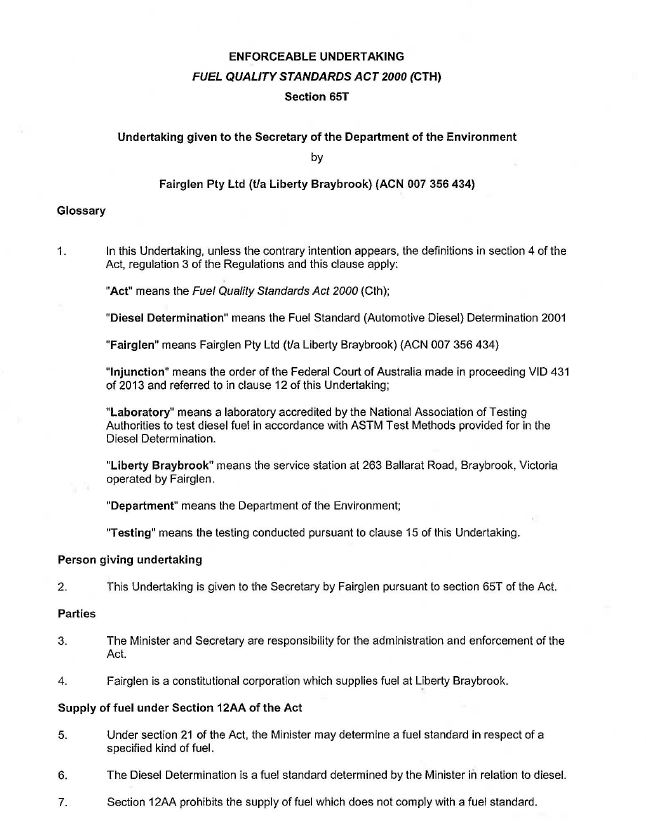
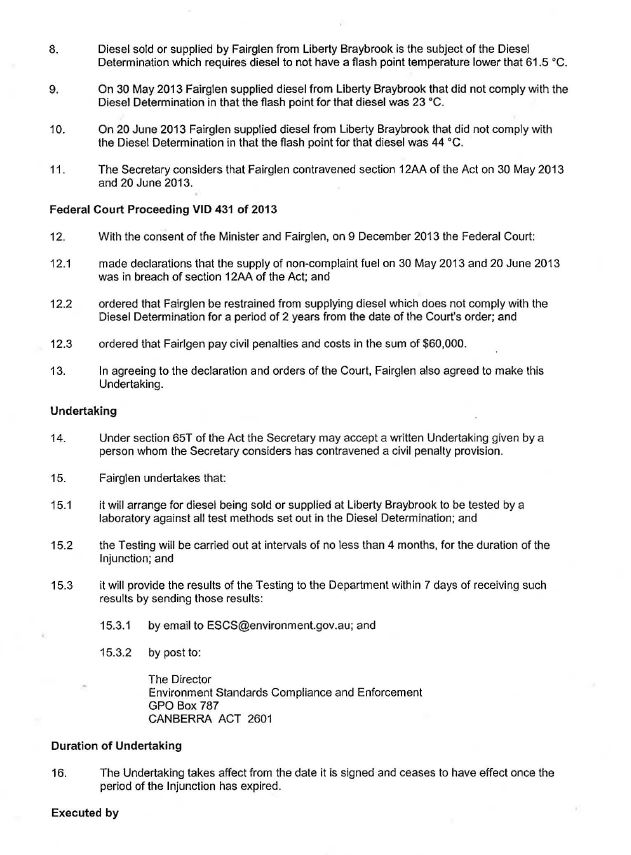
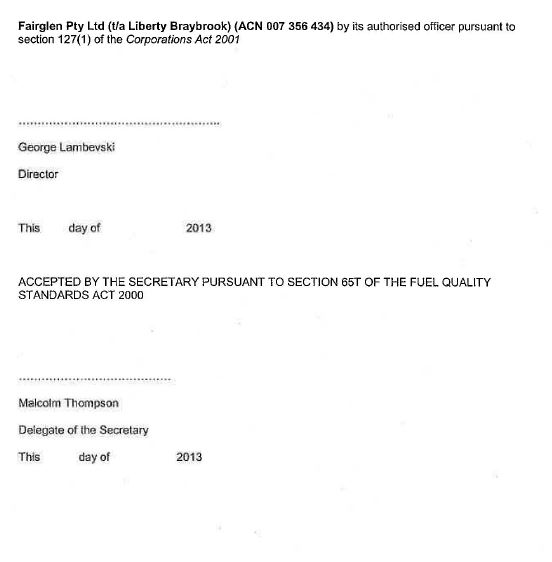
The Court was informed that the parties had agreed to enter into an enforceable undertaking in the form attached at Annexure A.
THE COURT ORDERS THAT:
1. That the Applicant’s name be changed to the Minister for the Department of the Environment.
2. A declaration under s 21 of the Federal Court of Australia Act 1976 (Cth) that the Respondent, by supplying diesel on 30 May 2013 and 20 June 2013 from its premises at Liberty Braybrook, 236 Ballart Road, Braybrook, VIC that did not comply with the Fuel Standard (Automotive Diesel) Determination 2001, engaged in conduct that was in contravention of s 12AA of the Fuel Quality Standards Act 2000 (Cth).
3. An injunction pursuant to s 65(1) of the Fuel Quality Standards Act 2000, or s 39B(1A)(c) of the Judiciary Act 1903 (Cth) and s 23 of the Federal Court of Australia Act 1976 (Cth) restraining the respondent, whether by itself, its employees or agents or any of them or otherwise howsoever from supplying diesel in Australia that does not comply with the Fuel Standard (Automotive Diesel) Determination 2001 for a period of 2 years from the date that this order is made.
4. That the Respondent pay civil penalties as follows:
(a) in relation to the contravention of s 12AA of the Fuel Quality Standards Act 2000 on 30 May 2013, $28,000
(b) in relation to the contravention of s 12AA of the Fuel Quality Standards Act 2000 on 20 June 2013, $5,000.
5. That the Respondent pay the Applicant’s costs in the sum of $27,000.
6. That the civil penalties and costs ordered in orders 3 and 4 above, be paid on or before 30 May 2014.
Note: Entry of orders is dealt with in Rule 39.32 of the Federal Court Rules 2011.
ANNEXURE A
|
VICTORIA DISTRICT REGISTRY |
|
|
GENERAL DIVISION |
VID 431 of 203 |
|
BETWEEN: |
MINISTER FOR SUSTAINABILITY, ENVIRONMENT, WATER POPULATION AND COMMUNITIES Applicant |
|
AND: |
FAIRGLEN PTY LTD (TRADING AS LIBERTY BRAYBROOK) ACN 007 356 434 Respondent |
|
JUDGE: |
DODDS-STREETON J |
|
DATE: |
25 MARCH 2014 |
|
PLACE: |
MELBOURNE |
REASONS FOR JUDGMENT
Introduction
1 On 9 December 2013, I made the orders set out above for the reasons that follow.
2 By an amended originating application dated 21 June 2013, the applicant, who, since 18 September 2013, is named the Minister of the Department of the Environment (“the Minister”) sought, inter alia, an injunction pursuant to s 65(1) of the Fuel Quality Standards Act 2000 (Cth) (“the Fuel Act”) or s 39B(1A)(c) of the Judiciary Act 1903 (Cth) and s 23 of the Federal Court Act 1976 (Cth) and a declaration that the respondent, Fairglen Pty Ltd, trading as Liberty Braybrook (“Fairglen”), contravened s 12 of the Fuel Act by selling, on 30 May 2013 and 20 June 2013, diesel fuel that did not comply with the Fuel Standard (Automotive Diesel) Determination 2001 (Cth) (“the Diesel Determination”) from its business premises at Liberty Braybrook, 263 Ballarat Road, Braybrook, Victoria.
3 The parties agreed on the relevant facts, which are set out below.
4 The parties also agreed on proposed orders which include a declaration, injunction, civil penalty and costs orders. The basis upon which the parties reached agreement is also set out below.
The Parties
5 The Minister is responsible for the administration and enforcement of the Fuel Act, the objects of which are set out in s 3 as follows:
3 Objects of Act
The objects of this Act are to:
(a) regulate the quality of fuel supplied in Australia in order to:
(i) reduce the level of pollutants and emissions arising from the use of fuel that may cause environmental and health problems; and
(ii) facilitate the adoption of better engine technology and emission control technology; and
(iii) allow the more effective operation of engines; and
(b) ensure that, where appropriate, information about fuel is provided when the fuel is supplied.
6 The Minister conducts inspections of service stations and takes samples of fuel being supplied or sold to the public which are tested against the relevant fuel standards to ensure compliance. Where non-compliance is detected, the supplier is asked to cease fuel sales and is given the opportunity to rectify the non-compliance. In the absence of a satisfactory response, the Minister, in his or her discretion, takes enforcement action pursuant to the powers given in the Fuel Act.
7 The respondent, Fairglen, is a corporation incorporated under the Corporations Act 2001 (Cth) which operates a service station at 263 Ballarat Road, Braybrook VIC 3019 (“the Service Station”) where fuel is sold or supplied to the public.
8 Fairglen is a trustee for the Lambeski Family Trust.
9 The directors of Fairglen for the period from 10 May 2013 to 20 June 2013 were George Lambeski and Zivko Lambeski. George Lambeski operates the Service Station on a full time basis, assisted from time to time by his brother Zoran Lambeski and his father Zivko Lambeski.
Agreed Facts
10 Fairglen has no history of criminal or civil contraventions. Prior to the incidents which gave rise to the proceeding, Fairglen had not been the subject of regulatory action.
11 The Lambeski family has operated the service station since 1991. Initially, it was a “FoodPlus” service station. In December 2004, Fairglen entered a supply agreement with Liberty Oil Corporation Pty Ltd (“Liberty”) which, in essence, allowed Fairglen to trade using Liberty’s branding, and restricted Fairglen to purchasing fuel from Liberty. The service station thereafter operated under the Liberty brand.
12 Since executing the supply agreement, Fairglen purchased fuel only from Liberty, which conducted regular checks to ensure that Fairglen was not using or selling fuel purchased from any other source. Liberty carried out a regular “reconciliation” in which it calculated the quantity of fuel purchased by Fairglen from Liberty in a given period, subtracted the quantity of fuel sold over the same period, and reconciled the remainder with the quantity left in the tank.
13 Under the supply agreement, Fairglen ordered fuel from Liberty on 24 hours’ notice at a price determined by Liberty in accordance with the supply agreement. Liberty then arranged for its driver to deliver the fuel to the Service Station, where the driver would offload the fuel into a tank.
14 There are three tanks at the Service Station, one of which is used for diesel. There are six pumps. Four are for petrol, one is for LPG and one is for diesel. Pump 11 is the diesel pump, and is the only pump connected to the diesel tank.
15 When delivering fuel to Fairglen, and offloading it into Fairglen’s tanks, the Liberty driver always provided Fairglen with a document containing a bill of lading which, inter alia, stated the quantity and source of each fuel product.
16 The document always contained a signed guarantee that the fuel contained in the tanker complied with the requirements of the Fuel Act.
17 Until the events of May 2013, the Lambeskis assumed that all the fuel they sold complied with the Fuel Act, as they only purchased fuel from Liberty and the Liberty driver invariably provided a document guaranteeing that it complied with the Fuel Act.
The First Inspection – 10 May 2013 and 29 May 2013
18 On 10 May 2013, two fuel inspectors (“the First Inspectors”) from the Department of Environment (“the Department”) visited the Service Station on a random site inspection in the area.
19 On observing that diesel was being sold and supplied by Fairglen to members of the public from Pump 11, the First Inspectors entered the Service Station and spoke to George Lambeski. They presented him with their identity cards and informed him that they were on site to take a sample of diesel under s 41 of the Fuel Act and gave further information about their inspection processes. The full details of the site visit by the First Inspectors were set out in the affidavit of Robert Scott Sinclair Robertson sworn on 13 June 2013.
20 The First Inspectors took and paid for a sample of two litres of diesel from pump 11. They assigned the sample the number 15415.
21 On 10 May 2013, the diesel from pump 11 was subject to the Diesel Determination, which is a fuel standard determined under s 21 of the Fuel Act.
22 Section 5(2) of the Diesel Determination states that diesel must not have a flash point temperature lower than 61.5°C.
23 The flash point temperature of the diesel fuel sample taken from Pump 11 on 10 May 2013 was 34.5°C. The test result was received by the Department on 29 May 2013.
24 On 29 May 2013, Clare Watson from the Department telephoned George Lambeski and informed him:
(a) that a diesel sample taken from the Service Station on 10 May 2013 did not comply with the Diesel Determination, as the flash point temperature was 34.5°C;
(b) the flash point was the temperature at which diesel vapour would combust with an ignition source, and a low flash point temperature was a public safety hazard;
(c) Fairglen was required to immediately cease supply of diesel that did not comply with the Diesel Determination; and
(d) she would forward him a warning letter which contained important information about the non-compliant diesel sample, including a copy of the laboratory report.
25 George Lambeski told Ms Watson that any problem with the diesel must be the fault of his supplier, Liberty, which he would contact and inform of the problem with the diesel. Ms Watson advised George Lambeski that regardless of why the diesel was non-compliant, the Fuel Act prohibited him from selling non-compliant diesel. Ms Watson requested an email address so that she could send him a warning letter explaining what she had just told him. George Lambeski provided his email address: fairglenptyltd@bigpond.com.
26 Following the telephone conversation, Ms Watson forwarded a copy of the warning letter to the email address provided by George Lambeski.
27 The 29 May 2013 warning letter:
(a) advised that a sample of diesel collected at an inspection of the Service Station on 10 May 2013 did not comply with the Diesel Determination, in that the flash point temperature was 34.5°C, while the Diesel Determination gave for a minimum flash point temperature of 61.5°C;
(b) set out that the supply of diesel that does not comply with the Diesel Determination is a breach of s 12 of the Fuel Act and a contravention of s 12AA of the Act, and detailed the penalties that may apply;
(c) enclosed a copy of the Diesel Determination;
(d) enclosed a copy of the laboratory report;
(e) advised that a low flash point is a public safety issue and can lead to fire or explosion; and
(f) directed George Lambeski to “immediately stop the supply of non-compliant fuel and take all steps necessary to ensure that you do not further supply non-compliant fuel”.
28 The Department, on the Minister’s behalf, also sent the same letter to George Lambeski at Fairglen’s registered office.
The Second Inspection – 30 May 2013
29 The Department subsequently arranged for its inspectors to return to the service station on the following day, to determine whether non-complaint diesel was being sold.
30 On 30 May 2013, two fuel inspectors (“the Second Inspectors”) from the Department visited the Service Station. They observed that diesel was being sold and supplied by Fairglen to members of the public from pump 11.
31 The Second Inspectors entered the service station and spoke to George Lambeski. They presented him with their Identity Cards and informed him that they were on site to take a sample of diesel under s 41 of the Fuel Act. They asked George Lambeski whether he had been contacted about the diesel test results and asked not to supply diesel. Initially, George Lambeski denied that he had been contacted. He later conceded that he had spoken to a lady, but asserted that she did not tell him to stop selling diesel. The Second Inspectors asked to see George Lambeski’s emails and located the email sent by Ms Watson from the Department. After further discussion and review of the email, George Lambeski conceded that the letter stated that diesel sales must cease immediately. The Second Inspectors confirmed that George Lambeski must cease diesel sales. George Lambeski then put an “out of order” sign on pump 11 and removed the diesel price from the street advertising.
32 The Second Inspectors took and paid for a sample of two litres of diesel from pump 11. They assigned the sample the number 15505. The full details of the site visit to the Service Station on 30 May 2013 were set out in the affidavit of Robert Scott Sinclair Robertson sworn on 13 June 2013.
33 On 30 May 2013, the diesel supplied from pump 11 was subject to the Diesel Determination.
34 The flash point temperature of the diesel sample taken from pump 11 on 30 May 2013 was 23.0°C.
Interim injunction obtained – 31 May 2013 and 4 June 2013
35 Given Fairglen’s failure to cease diesel sales and the very low flash point temperature of the diesel sample taken on 30 May 2013, the Minister sought an urgent injunction to restrain Fairglen from continuing to supply non-compliant fuel.
36 On Friday 31 May 2013, I granted an interim injunction pursuant to s 65(5) of the Fuel Act restraining Fairglen from supplying diesel that did not comply with the Diesel Determination and that had a flash point lower than 61.5°C, pending the hearing and determination of the originating application. The matter was listed to return to the Court on 4 June 2013 to allow Fairglen to participate in the hearing of the application.
37 A copy of the orders and other material filed with the Court were emailed to Fairglen and served at the company’s registered office and at the Service Station that afternoon. The covering letter to the material served advised Fairglen to obtain legal advice and to attend the hearing on 4 June 2013.
38 At the return of the proceeding, on 4 June 2013, Fairglen (which did not contact the applicant or its solicitors) did not attend court. I gave leave to amend the originating application to allow the Minister to apply for a civil penalty and to file and serve further materials.
39 The Minister’s solicitors arranged for service of the orders made on 4 June 2013 and other material on the registered office of Fairglen and at the Service Station, with a covering letter requesting Fairglen to contact the Minister’s solicitors by 12 June 2013, in order to:
(a) advise of its intention to participate in the proceeding;
(b) confirm that it was no longer supplying non-complaint fuel; and
(c) advise of any steps taken to ensure future compliance with the Diesel Determination.
Fairglen’s action in response to the Second Inspection
40 George Lambeski, having put the “out of order” sign on pump 11 on 30 May 2013, took steps to determine the cause of the low flashpoint and rectify it.
41 On 31 May 2013, George Lambeski telephoned Steve Boyson, the State Manager of Liberty, and told him what had happened.
42 The following day, Mr Boyson visited the service station. George and Zoran Lambeski asked Mr Boyson for instructions on how to rectify the problem.
43 Mr Boyson conducted a fuel reconciliation to check that the fuel in tank 11 had been purchased from Liberty. He concluded that the low flashpoint was not due to adding another supplier’s fuel. The Lambeskis and Mr Boyson agreed that Liberty would remove the diesel product remaining in the tank and replace it with fresh diesel.
44 On 3 June 2013, a tanker driver from Just Fuel Petroleum Services Pty Ltd arrived and removed 5110 litres of diesel from Fairglen’s diesel tank, leaving 290 litres in the tank. The driver then offloaded a fresh load of diesel of about 6000 litres.
45 Mr Boyson was present during the replacement process. When it was completed, he took a sample of the diesel from tank 11. He told the Lambeskis that he would send the sample to be tested by Intertek Testing Services (Australia) Pty Ltd (“Intertek”), which also conducted the tests the Department used in this proceeding.
46 On 12 or 13 June 2013, Mr Boyson telephoned George Lambeski and advised him that Intertek’s analysis showed that the diesel “has passed”.
47 Mr Boyson then sent an email to Fairglen and George Lambeski stating (among other things):
Sample results taken on Monday night 3rd June 2013 (collected by Mauro ‘technician’)
Result: contaminated diesel- failed
Replaced diesel - passed (62 degree flash point)
Please contact the govenmnet [sic] this morning
48 The email attached a test report by Intertek addressed to Liberty, showing that sample 53173-2 had a flashpoint result of 62.0.
49 At that point, Fairglen had not sold diesel since the Second Inspection.
Diesel Fuel Sales Resumed – 13 June 2013 to 20 June 2013
50 On 13 June 2013, George Lambeski telephoned the Department and the Minister’s solicitors. He advised that Fairglen had not sold or supplied diesel since the Second Inspection. Mr Lambeski stated that the non-compliant diesel had been supplied by Liberty and that his tanks had been checked and were not the cause of the non-compliant diesel. He stated that Liberty had arranged for the removal and replacement of the noncompliant diesel. He further advised that he had a test result showing that the replacement fuel was compliant. Mr Lambeski advised that he intended to recommence fuel sales.
51 Subsequently, Mr Lambeski sent the Minister’s solicitors copies of fuel records showing that no diesel fuel had been sold since 30 May 2013. He also provided the test results of the replacement fuel.
The Third Inspection – 20 June 2013
52 On 20 June 2013, two fuel inspectors (“the Third Inspectors”) from the Department visited the Service Station to monitor Fairglen’s compliance with the Fuel Act. The Third Inspectors observed that diesel was being sold and supplied by Fairglen to members of the public from pump 11.
53 They presented Mr Lambeski with their identity cards and informed him that they were on site to take a sample of diesel under s 41 of the Fuel Act.
54 The third inspectors took, and paid for, a sample of two litres of diesel from pump 11 and assigned the sample the number 15577.
55 On 20 June 2013, the diesel supplied from pump 11 was subject to the Diesel Determination.
56 The flash point temperature of the diesel sample taken from Pump 11 on 20 June 2013 had a flash point temperature of 44.0°C.
57 On 20 June 2013, Timothy Francis from the Department telephoned George Lambeski and informed him:
(a) the diesel sample taken that day did not comply with the Diesel Determination, in that the flash point temperature was 44.0°C;
(b) flash point is the temperature at which diesel vapour will combust with an ignition source, and a low flash point temperature is a public safety hazard; and
(c) Fairglen must immediately cease supply of diesel that does not comply with the Diesel Determination.
58 It was not disputed that Mr Lambeski had assumed, based on the test results provided by Liberty, that the diesel fuel met the standards. He stated that he would stop selling diesel and would contact Liberty again to try to find out why the diesel was non-compliant.
59 On 20 June 2013, Mr Francis forwarded a copy of a warning letter to the email address: fairglenptyltd@bigpond.com. The warning letter:
(a) advised that a sample of diesel collected at an inspection of the Service Station on 20 June 2013 did not comply with the Diesel Determination, in that the flash point temperature was 44.0°C, when the Diesel Determination allows for a minimum of 61.5°C;
(b) advised that the supply of diesel that does not comply with the Diesel Determination is a breach of s 12 of the Act and a contravention of s 12AA of the Act, and gave details of the penalties that may apply;
(c) stated that “the alleged supply of non-compliant fuel may also be in breach of the injunction ordered by the Federal Court and further action may be taken against you for that breach”; and
(d) directed Mr George Lambeski to “immediately stop the supply of non-compliant fuel and take all steps necessary to ensure that you do not further supply non-compliant fuel”.
60 Following the delivery of the warning letter by email on 20 June 2013, Fairglen ceased selling and supplying diesel fuel.
Fairglen’s actions since 20 June 2013
61 Fairglen did not sell diesel after 20 June 2013.
62 On 25 June 2013, Zoran Lambeski telephoned the Minister’s solicitors and advised that he had arranged for the diesel fuel tank to be tested by Jim Wilde from Fleetwood Petroleum Installations, who would produce a report which would confirm that Liberty was responsible for the non-compliant fuel and that the diesel fuel pump at the Service Station was not at fault. On 26 June 2013, Zoran and George Lambeski sent the department a copy of a letter from Mr Wilde dated 24 June 2013 and claimed that the report cleared Fairglen of any wrongdoing.
63 Mr Wilde’s letter stated his belief that the tank had been installed on an angle which would not allow for the complete removal of any originally contaminated fuel from the tank. Mr Wilde also observed that there was a large build-up of sediment in the base of the tank and suggested that the tank be cleaned.
64 After 20 June 2013, Fairglen took a number of steps and incurred various expenses and losses in attempting to rectify the problem. They were as follows:
(a) 3000 litres of non-compliant diesel fuel was removed from the diesel tank. The cost of fuel lost was $4,500.00 and the cost of fuel removal was $500.00;
(b) Leighton O’Brien was engaged to clean out the diesel fuel tank at a cost of $4,958.25;
(c) Intertek was engaged to conduct on-going fuel testing at a total cost of $768.63;
(d) The on-going loss of profit from diesel fuel sales since 20 June 2013 was estimated to be $320.00 per month;
(e) On 7 October 2013 Fairglen arranged for DJ Petroleum Pty Ltd to carry out further rectification works to the diesel tank at a cost of $2,915.00.
65 The agreed statement of facts stated:
70. Fairglen continues to seek to identify the cause of non-compliance. They intend to investigate fully and ensure that the problem is fixed, before selling diesel again.
71. As a result of this proceeding, and the very significant sum it has and will cost them in penalties and costs, the Lambeskis are now keenly aware of their obligations under the Fuel Act, and the consequences of breaching them.
72. They recognise the potential risk to the public caused by them holding, and selling, non-compliant diesel, and are sorry to have played a part in the existence of that risk.
73. For these reasons, the Lambeskis have no intention of breaching the Fuel Act again. However, given Fairglen’s past non-compliance, the Lambeskis recognise that the Department and the Court may want more than a simple assurance. For that reason, they have agreed to consent to an injunction for two years, which reinforces the requirements of the Fuel Act with respect to the sale of diesel. Furthermore, they have agreed to enter in to an enforceable undertaking, in the form of Annexure B, to ensure that The Department is able to test at regular intervals any diesel it sells or supplies.
The impact on Falrglen of the agreed penalty and costs order
66 Fairglen is a small family owned and run company. George Lambeski operates the service station on a full time basis and his brother, Zoran Lambeski, and father, Zivko Lambeski, help out from time to time. Fairglen employs one casual assistant. Zoran Lambeski has his own job and income and receives no income from Fairglen. Zivko Lambeski has a pension and receives no income from Fairglen. George Lambeski receives income from Fairglen. In 2011, his taxable income was $30,163. In 2012 it was $29,682. Those amounts reflect the profit of Fairglen in the 2011 and 2012 financial years. Fairglen has no significant assets apart from the freehold of the premises at 263 Ballarat Road, Braybrook, from which the service station operates.
Fairglen did not hold any approvals
67 It was not disputed that Fairglen held no approval to vary the Diesel Determination, in respect of the supply of diesel from the Service Station, between 10 May 2013 and 20 June 2013, or at any time thereafter.
68 No other person held an approval to vary the Diesel Determination, in respect of the supply of diesel from the Service Station, between 10 May 2013 and 20 June 2013, or at any time thereafter.
69 Nor was Fairglen required to comply with a direction or order under an emergency law, including a direction of the Liquid Fuels Security and Policy Section of the Department of Resources, Energy and Tourism between 10 May 2013 and 20 June 2013, or at any time thereafter.
Relief sought
Declaration and Injunction
70 The originating application, as amended on 21 June 2013, sought a declaration that Fairglen, by supplying diesel on 30 May 2013 and 20 June 2013 that did not comply with the Diesel Determination, engaged in conduct that was in contravention of s 12AA of the Act.
71 Fairglen consented to the making of the declaration.
72 The originating application also sought an injunction restraining the Fairglen, whether by itself, its employees or agents or any of them or otherwise howsoever from supplying diesel in Australia that does not comply with the Diesel Determination; and from supply diesel in Australia that has a flash point lower than 61.5°C.
73 The Minister and Fairglen agreed to the injunction for a term of two years from the date of the Court’s determination.
74 Subject to the Court making to the proposed orders, Fairglen also agreed to enter into an enforceable undertaking pursuant to s 65T of the Fuel Act. The undertaking would require Fairglen to test diesel fuel at four month intervals during the period of the injunction and provide those test results to the Department. The enforceable undertaking is attached to the orders made as Annexure A.
Civil Penalty
75 The Minister also sought orders that a civil penalty be paid pursuant to s 12AA of the Fuel Act in relation to two breaches of s 12AA of the Fuel Act on 30 May 2013 and 20 June 2013 respectively.
76 Subject to the Court’s overriding discretion, the parties reached agreement on the civil penalty that should be awarded by the Court for each breach. In Secretary, Department of Health & Ageing v Pagasa Australia Pty Ltd [2008] FCA 1545, Flick J considered the factors relevant to determining an appropriate penalty, including the parties’ agreement on the civil penalty and its appropriateness.
77 His Honour observed at [38]:
Agreement between the parties as to both those facts relevant to a conclusion as to contravention of a civil penalty provision, and the quantification of any penalty to be imposed, is a course which has long been embraced (and encouraged) by this Court in respect to other statutory regimes.
78 Flick J nevertheless stated at [42]:
The requirement for the Court itself to be satisfied as to the appropriateness of a penalty is a responsibility which ultimately derives from s 71 of the Commonwealth of Australia Constitution Act and is not a responsibility which can be circumscribed by private agreement.
79 In the present case, the parties invited the Court to make the agreed orders, on the basis that they have been arrived at after extended discussions, and were reasonably open on the basis of the agreed facts.
80 In Minister for Sustainability, Environment, Water, Population and Communities v De Bono [2012] FCA 643 at [15], North J observed:
Where parties have come to an agreement over civil pecuniary penalties and other orders the court will accept the agreement provided that the outcome is within the range of outcomes reasonably open on the material before the court. It is not the role of the court to determine whether it would have come to the same conclusions as the parties. This approach, with its in built flexibility, is designed to encourage parties to negotiate reasonable solutions and avoid complex and protracted litigation. There is a consequent benefit to the public in conserving the time and resources of the courts and regulatory bodies that are charged with investigating suspected contraventions. The agreement of the parties in this case is therefore examined with this approach in mind.
81 The parties jointly submitted that the following factors were relevant in this case:
(a) In relation to the 30 May 2013 breach:
(i) the maximum penalty that can be ordered is 2,500 penalty units, or $425,000;
(ii) the flash point of the diesel that was sold on 30 May 2013 was 23°C which was significantly below the required flash point of 61.5°C and gave rise to a potentially significant safety risk to the public and the environment;
(iii) there was no actual known loss or damage caused by the breach;
(iv) Mr George Lambeski had been requested to stop supplying the non-compliant diesel both verbally and in writing on the evening of 29 May but Fairglen continued to sell diesel on 30 May, and Mr Lambeski claimed that the non-complaint diesel was the responsibility of his supplier, Liberty;
(v) when approached by the inspector on 30 May, Mr Lambeski claimed not to have received the email from the Department and not to have understood that diesel sales were to cease. Mr Lameski was then asked to show his emails which revealed that the email from the Department had been received and that the warning to cease supplying non-compliant diesel was stated clearly;
(vi) after the inspector’s visit on 30 May, the Respondent stopped supplying the non-compliant diesel and took steps to have the diesel removed and replaced by Liberty;
(vii) Liberty arranged for testing of the diesel which, by test results provided by Intertek to Liberty on 12 June 2013, and by Liberty to Fairglen on 13 June 2013, showed that the sample taken following the replacement of diesel in tank 11 had a compliant flashpoint of 62.0;
(viii) Liberty encouraged Fairglen to contact the Department in relation to these test results;
(ix) Fairglen contacted the Department, on 13 June 2013, to inform it of the test results and of Fairglen’s intention, on the basis of those results, to recommence supply of diesel, and advised the steps it had taken to dispose of the non-compliant diesel. It also cooperated with the request to provide the results of the testing of the replacement diesel and sale records for the period between 30 May and 13 June;
(x) the Respondent acted incorrectly on the assumption that the quality of fuel delivered had been the cause of the non-compliant diesel. It did not have the tank tested or proactively monitor ongoing compliance between 13 June, when it received the Intertek test result from Liberty, and 20 June when the Third Inspectors returned to the Service Station;
(xi) the Respondent’s actions proved to be inadequate, in that non-compliant diesel was again detected on 20 June 2013.
(b) In relation to the 20 June 2013 breach:
(i) the maximum civil penalty that can be ordered is 2,500 penalty units, or $425,000;
(ii) the flash point of the diesel being sold was 44°C which gives rise to a significant safety risk to the public;
(iii) there was no actual loss or damage caused by the breach;
(iv) the breach was also a breach of the interim injunction that was in place (although no charge has been made seeking a penalty for the breach of the injunction);
(v) the Respondent had innocently relied on the test result it had obtained on 13 June 2013 showing that the replacement diesel was compliant and acted on the belief that the diesel it was selling after that date complied with the flashpoint requirement in the Diesel Determination;
(vi) the respondent took no steps between 13 June and 20 June 2013 to monitor its own compliance and had the Department not returned to the site, would have continued to sell non-compliant diesel;
(vii) having been told about the further non-compliant test result, the Respondent initially continued to maintain that the non-compliance was not its fault. It provided a “report” dated 24 June described as a “document to clear Fairglen from any wrong doing” demonstrating that the Respondent still had not accepted responsibility for the breaches.
(viii) However, since obtaining legal representation, and in the course of discussing an appropriate outcome, Fairglen (through the Lambeskis) now appreciates that the Fuel Act effectively requires a seller or supplier of fuel to independently to ensure that the fuel complies with the standards made under the Fuel Act, and may not simply rely on assumptions based on supply of fuel.
(c) In relation to both breaches:
(i) Although the respondent did not attend the Court on 4 June 2013, it has since obtaining legal advice has [sic] been cooperative and willing to reach agreement on all matters before the Court;
(ii) Given the size and financial position of Fairglen, the penalties, and costs, order [sic] by the Court will have a significant impact on it.
82 The parties agreed that the following civil penalties, to be made on or before 30 May 2014, were appropriate:
(a) in relation to the 30 May 2013 breach, $28,000; and
(b) in relation to the 20 June 2013 breach, $5,000.
83 The respondent consented to an order that it pay the Minister’s costs, limited to the sum of $27,000.
Consideration
84 In Minister for Sustainability, Environment, Water, Population and Communities v Gas Point Guildford West Pty Ltd [2013] FCA 621 (“Gas Point”), Rares J imposed a combined pecuniary penalty of $22,500 in respect of a breach of standards made under the Fuel Act. Rares J also ordered costs (of approximately $80,000) in favour of the Department. Rares J considered the combined total of penalty and costs in making his decision.
85 In Gas Point, the Department advised the respondent on 15 February 2013 that diesel it had tested earlier that day was non-compliant as it contained excessive sulphur.
86 Rares J accepted that respondent’s director intended to take steps to replace and not sell the non-compliant diesel, but he did not require confirmation from the supplier of the replacement fuel that it was compliant. Further, due to the director’s misapprehension about tank connections, the new fuel did not effectively replace the old fuel.
87 Rares J rejected the respondent’s submission that no pecuniary penalty should be imposed given its good record, poor financial position, the fact that no loss or damage was suffered by any other person and in this regard no customers complained, and appropriate response to being notified of the non-compliance and the merely accidental nature of its further non-compliant supply.
88 His Honour considered the purpose of the standard (made under the Fuel Act) and the likely familiarity of service station operators with the regime under the Fuel Act. He observed that the respondent provided no evidence of the provenance of the non-compliant fuel and did not take adequate steps to satisfy itself that each delivery of fuel complied with the Fuel Act and standards. Moreover, the respondent’s steps to remedy the position, although real, betrayed carelessness.
89 Accordingly, his Honour made declarations of the contraventions and ordered that the respondent pay a pecuniary penalty and be restrained from supplying diesel in Australia for two years that did not comply with the relevant standard and pay the applicant’s costs.
90 In Minister for the Environment v Shri Ganesh Associates Pty Ltd [2013] FCA 1118 (“Shri Ganesh”), the Minister sought declarations and injunctions in relation to the respondent’s contravention in selling and supplying diesel with a flash point temperature lower than that prescribed on two occasions. Although the Minister initially sought the imposition of a civil penalty under s 12AA of the Fuel Act, it did not press for, and the Court did not impose, such an order.
91 In Shri Ganesh, the respondent immediately and voluntarily took appropriate steps and effective steps to rectify the problem and ceased to sell or supply the diesel.
92 In the present case, Fairglen did not respond immediately, diligently and appropriately to being notified that the diesel was non-compliant but initially continued to supply and sell it. The sale or supply of the non-complying fuel posed a significant risk to public safety.
93 Despite its unsatisfactory initial reaction, Fairglen, within a very short space of time, cooperated with the Department and took genuine steps to rectify the problem. At the time of the hearing, the cause of the non-compliance remained unknown.
94 I accepted that Fairglen’s second supply or sale of non-compliant diesel was unintended and that the respondent was not, on that occasion, without grounds for its incorrect assumption that the diesel fuel complied. Nevertheless, Fairglen at that point still failed to appreciate and acknowledge the nature and extent of its responsibility under the Fuel Act. Fairglen was, however, ultimately fully cooperative, took all necessary steps in an attempt to rectify the problem, appropriately acknowledged its responsibilities under the Fuel Act and incurred expenses, which were very significant relative to the modest scale of its assets and business.
95 I was satisfied that, as the parties submitted, the sum of $33,000 sought by way of penalties in this case was broadly consonant with the approach in Gas Point and other comparable cases. Further, the sum was reasonable, particularly taken together with the injunction and the enforceable undertaking.
|
I certify that the preceding ninety-five (95) numbered paragraphs are a true copy of the Reasons for Judgment herein of the Honourable Justice Dodds-Streeton. |
Associate:


