FEDERAL COURT OF AUSTRALIA
Shea v TRUenergy Services Pty Ltd (No 6) [2014] FCA 271
| IN THE FEDERAL COURT OF AUSTRALIA | |
| Applicant | |
| AND: | ENERGYAUSTRALIA SERVICES PTY LTD Respondent |
| DATE OF ORDER: | |
| WHERE MADE: |
THE COURT ORDERS THAT:
1. The application be dismissed.
2. The respondent is to notify the applicant and the Court, by 4.00 pm on 31 March 2014, whether it intends to seek any order as to costs of the proceeding.
If the respondent does so:
3. The respondent will file and serve an outline of submissions and any supporting affidavits by 4:00 pm on 15 April 2014.
4. The applicant will file and serve an outline of submissions and any supporting affidavits by 4.00 pm on 1 May 2014.
5. The matter be listed for hearing, at a time convenient to the Court and the parties on or after 2 May 2014.
Note: Entry of orders is dealt with in Rule 39.32 of the Federal Court Rules 2011.
| VICTORIA DISTRICT REGISTRY | |
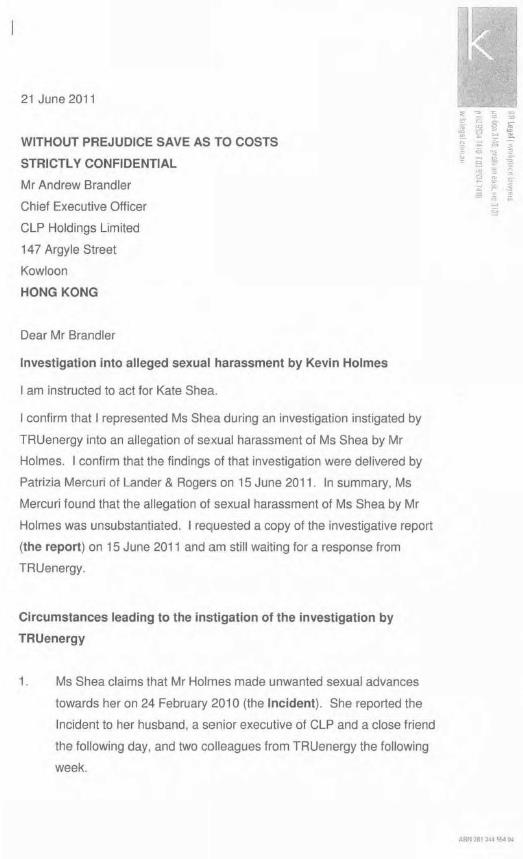
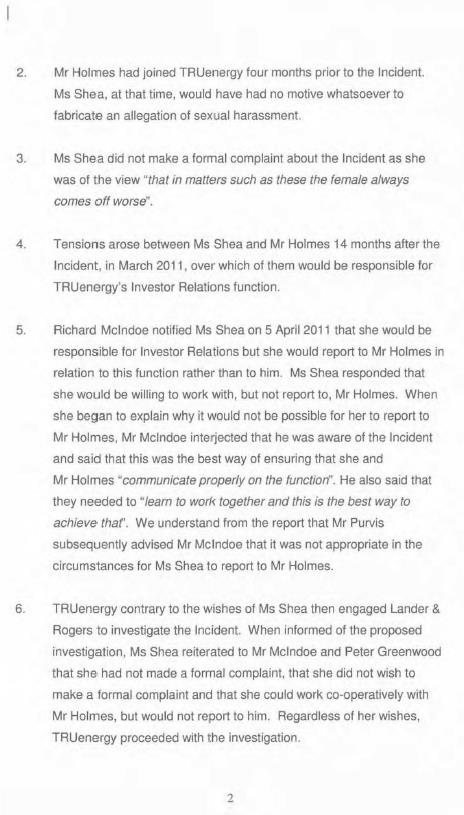
| GENERAL DIVISION | VID 289 of 2012 |
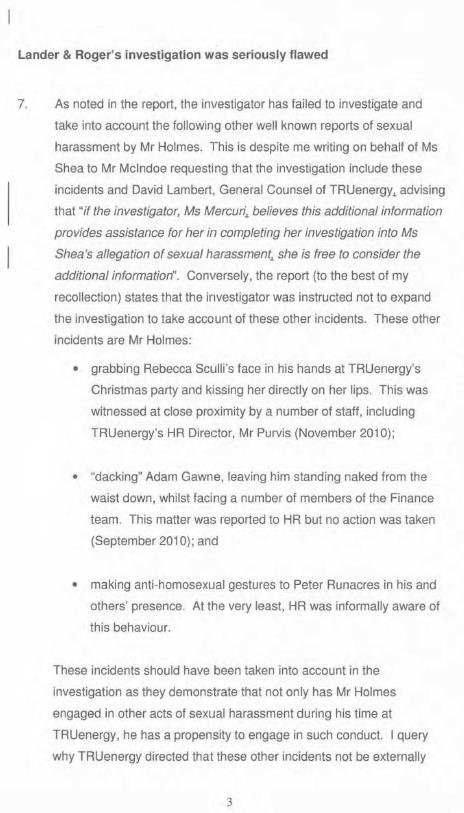
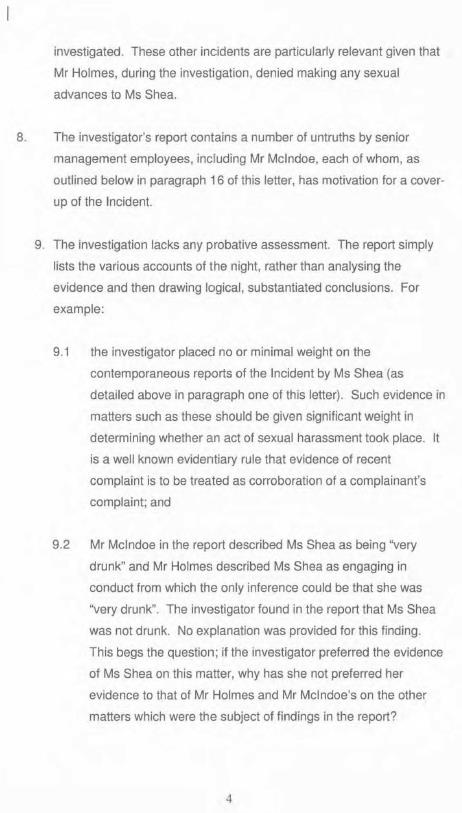
| BETWEEN: | KATE SHEA Applicant |
| AND: | ENERGYAUSTRALIA SERVICES PTY LTD Respondent |
| JUDGE: | DODDS-STREETON J |
| DATE: | 25 MARCH 2014 |
| PLACE: | MELBOURNE |
REASONS FOR JUDGMENT
1 By an originating application under the Fair Work Act 2009 (Cth) (“the Act”) and a statement of claim dated 4 April 2012, the applicant, Kate Shea, alleged that her employer, the respondent, EnergyAustralia Services Pty Ltd (formerly TRUenergy Services Pty Ltd), contravened s 340(1) of the Act when, on 6 February 2012, it dismissed her from her employment as its Director of Corporate & Government Affairs on the stated ground that her position had become redundant.
2 The applicant alleged that the redundancy was not genuine but a mere pretext for her dismissal, which constituted adverse action within the terms of s 342 of the Act and, in fact, she was dismissed for the reason, or reasons including the reason, that she had exercised a workplace right by making each of five successive complaints (on 24 February 2010, 5 April 2011, May or June 2011, 21 June 2011, and 4 October 2011 respectively) that she was, within the meaning of s 341(1)(c)(ii) of the Act, able to make in relation to her employment.
3 The applicant sought relief including reinstatement, compensation for loss and damage and, alternatively to reinstatement, compensation for future loss and damage.
4 The Act relevantly provides:
Division 3—Workplace rights
340 Protection
(1) A person must not take adverse action against another person:
(a) because the other person:
(i) has a workplace right; or
(ii) has, or has not, exercised a workplace right; or
(iii) proposes or proposes not to, or has at any time proposed or proposed not to, exercise a workplace right; or
(b) to prevent the exercise of a workplace right by the other person.
Note: This subsection is a civil remedy provision (see Part 4-1).
(2) A person must not take adverse action against another person (the second person) because a third person has exercised, or proposes or has at any time proposed to exercise, a workplace right for the second person’s benefit, or for the benefit of a class of persons to which the second person belongs.
Note: This subsection is a civil remedy provision (see Part 4-1).
341 Meaning of workplace right
Meaning of workplace right
(1) A person has a workplace right if the person:
(a) is entitled to the benefit of, or has a role or responsibility under, a workplace law, workplace instrument or order made by an industrial body; or
(b) is able to initiate, or participate in, a process or proceedings under a workplace law or workplace instrument; or
(c) is able to make a complaint or inquiry:
(i) to a person or body having the capacity under a workplace law to seek compliance with that law or a workplace instrument; or
(ii) if the person is an employee—in relation to his or her employment.
Meaning of process or proceedings under a workplace law or workplace instrument
(2) Each of the following is a process or proceedings under a workplace law or workplace instrument:
(a) a conference conducted or hearing held by the FWC;
(b) court proceedings under a workplace law or workplace instrument;
(c) protected industrial action;
(d) a protected action ballot;
(e) making, varying or terminating an enterprise agreement;
(f) appointing, or terminating the appointment of, a bargaining representative;
(g) making or terminating an individual flexibility arrangement under a modern award or enterprise agreement;
(h) agreeing to cash out paid annual leave or paid personal/carer’s leave;
(i) making a request under Division 4 of Part 2-2 (which deals with requests for flexible working arrangements);
(j) dispute settlement for which provision is made by, or under, a workplace law or workplace instrument;
(k) any other process or proceedings under a workplace law or workplace instrument.
…
342 Meaning of adverse action
(1) The following table sets out circumstances in which a person takes adverse action against another person.
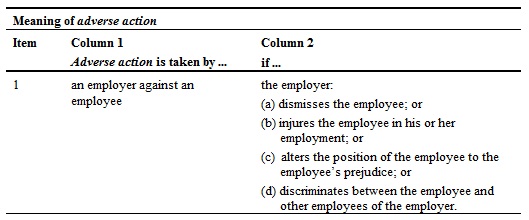
…
Division 7—Ancillary rules
360 Multiple reasons for action
For the purposes of this Part, a person takes action for a particular reason if the reasons for the action include that reason.
361 Reason for action to be presumed unless proved otherwise
(1) If:
(a) in an application in relation to a contravention of this Part, it is alleged that a person took, or is taking, action for a particular reason or with a particular intent; and
(b) taking that action for that reason or with that intent would constitute a contravention of this Part;
it is presumed, in proceedings arising from the application, that the action was, or is being, taken for that reason or with that intent, unless the person proves otherwise.
(2) Subsection (1) does not apply in relation to orders for an interim injunction.
5 The Explanatory Memorandum to the Fair Work Bill 2008 (Cth) states at [1370]:
Subparagraph 341(1)(c)(ii) specifically protects an employee who makes any inquiry or complaint in relation to his or her employment. Unlike existing paragraph 659(2)(e) of the [Workplace Relations Act 1996 (Cth)], it is not a pre-requisite for the protection to apply that the employee has “recourse to a competent administrative authority”. It would include situations where an employee makes an inquiry or complaint to his or her employer.
6 The Explanatory Memorandum sets out the following example at [1370]:
Rachel is employed in a night fill position. The ladder that she uses at work to stock the shelves is missing a rung which makes it dangerous for her to climb. Rachel raises this issue with her employer. Under subparagraph 341(1)(c)(ii) Rachel has a workplace right because she has made a complaint/inquiry to her employer in relation to her safety concerns regarding the ladder.
7 The statement of claim alleged five separate complaints made by the applicant in relation to her employment between February 2010 and October 2011.
8 The first complaint was pleaded as follows:
The Applicant made a complaint that on 24 February 2010 she had been sexually harassed by, Kevin Holmes, the Chief Financial Officer of the Respondent after a work function in Hong Kong … on or about 24 February 2010 to David Purvis, the Human Resources Director of the respondent (the First Complaint) …
PARTICULARS
The complaint was oral and was to the effect alleged.
9 The second complaint was pleaded as follows:
The Applicant made a complaint that on 24 February 2010 she had been sexually harassed by, Kevin Holmes, the Chief Financial Officer of the Respondent after a work function in Hong Kong … on or about 5 April 2011 to Richard McIndoe, the Chief Executive Officer of the Respondent (the Second Complaint).
PARTICULARS
The complaint was oral and was to the effect alleged.
10 The third complaint was pleaded as follows:
In the course of the investigation into the Second Complaint, the Applicant made further complaints about the conduct of employees of the Respondent, being Kevin Holmes, Richard McIndoe, David Purvis and Linda Robertson (the Third Complaint).
PARTICULARS
The complaints were made orally to Ms Mercuri in the course of her investigations.
11 The fourth complaint was pleaded as follows:
On or about 21 June 2011, the Applicant made a complaint to the Respondent about the manner in which her concerns of sexual harassment were dealt with by the Company and deficiencies in the investigation report (the Fourth Complaint).
PARTICULARS
The Fourth Complaint was in writing and forwarded by the Applicant to Mr McIndoe, on behalf of the Respondent, by e-mail on 21 June 2011, a copy of which is available for inspection at the offices of the solicitors for the Applicant by appointment.
12 The fifth complaint was pleaded as follows:
On 4 October 2011, the Respondent purported to terminate the Applicant’s employment, with such termination being withdrawn by the Respondent after the Applicant made a complaint about the Respondent’s actions (the Fifth Complaint).
PARTICULARS
The Fifth Complaint was made orally, after Mr McIndoe, on behalf of the Respondent, handed a letter to the Applicant entitled “termination of employment” or words to similar effect. The letter is in the possession of the Respondent. The Applicant refused to accept the letter, and said to Mr McIndoe “You can't do this – it is unlawful” or words to similar effect. Mr McIndoe withdrew the purported termination.
13 Broadly speaking, the first and second alleged complaints are the applicant’s assertion to the respondent’s Human Resources Director, David Purvis, in February 2010, and subsequently to the respondent’s managing director, Richard McIndoe, in April 2011, that she had been sexually harassed in February 2010 by the respondent’s Chief Financial Officer, Kevin Holmes, in a Hong Kong bar after they had attended a work-related dinner.
14 The third alleged complaint is the applicant’s assertions of further misconduct by Mr Holmes and by several other colleagues (including Mr McIndoe) made to Patrizia Mercuri, a partner at the law firm Lander & Rogers, who was retained by the respondent to conduct an independent investigation of the applicant’s claim that Mr Holmes had sexually harassed her in Hong Kong (“the Mercuri investigation”) and who produced a report dated 14 June 2011 setting out her findings (“the Mercuri report”).
15 The fourth, most significant, alleged complaint is more difficult precisely to describe, as it is pleaded as a complaint about the way in which the respondent dealt with the applicant’s concerns of sexual harassment and deficiencies in the Mercuri report, and is identified in the particulars by reference to an email and an attachment forwarded to Mr McIndoe by the applicant on 21 June 2011.
16 The email attached a letter of the applicant’s lawyer dated 21 June 2011 marked “without prejudice save as to costs” and “strictly confidential” (“the 21 June letter”) addressed to the chief executive officer of the respondent’s parent company in Hong Kong, who had, effectively, power to dismiss Mr McIndoe. The applicant’s covering email to Mr McIndoe indicated that the 21 June letter (which contained, inter alia, allegations of serious misconduct by Mr McIndoe himself) would not be sent to its addressee if Mr McIndoe made a firm commitment to meet a number of the applicant’s demands or conditions set out in the letter.
17 The applicant sent the email and the 21 June letter to Mr McIndoe about a week after the release of the Mercuri report on the investigation into the applicant’s allegation that Mr Holmes sexually harassed her in Hong Kong. The report found that the allegation was not substantiated. The 21 June letter was a lengthy and complicated document set out in full as Annexure A to these reasons. Broadly speaking, the 21 June letter alleged that the Mercuri investigation and the associated Mercuri report were flawed, due, inter alia, to false evidence and collusion by Messrs Holmes, McIndoe and Purvis and a failure to include in the investigation additional allegations of further misconduct by Mr Holmes towards employees other than the applicant. The 21 June letter asserted that the investigation was a cover up in which Mr McIndoe was motivated to collude because he also participated in sexual misconduct (of which two specific instances were alleged) and fostered a workplace culture in which sexual harassment was prevalent and condoned.
18 The fifth alleged complaint was the applicant’s assertion at a meeting on 4 October 2011 (in response to Mr McIndoe’s alleged attempt to terminate her employment) that Mr McIndoe could not do so because it would be unlawful.
The parties’ principal submissions
19 The applicant primarily submitted that a complaint which an employee is able to make within the meaning of s 341(1)(c)(ii) of the Act should be broadly construed and requires no instrumental, statutory or contractual source. Alternatively, she submitted that there were, in any event, statutory and/or contractual bases for her ability to make the relevant complaints. Further, the applicant submitted that the requirement that the complaint be in relation to the person’s employment was equally broad and was satisfied in this case.
20 The applicant further submitted that she made each of the pleaded complaints in the terms alleged and that each was a complaint that she was able to make in relation to her employment. The applicant submitted that the respondent, by its managing director, Mr McIndoe, who was the sole decision-maker, dismissed her because of, or for reasons including, the making of some or all of the complaints. At trial, the applicant acknowledged that the fourth complaint (in which she accused Mr McIndoe himself of sexual misconduct (albeit towards other persons), collusion and giving false evidence) was the crucial complaint, to which the other alleged complaints were merely subsidiary. The applicant submitted that there was no express or implicit statutory requirement that a complaint (including her accusations in relation to Mr McIndoe in the 21 June letter) express a bona fide grievance, be capable of proof or substantiation or be made in good faith.
21 The applicant alternatively submitted that if a complaint must be a genuinely held grievance made in good faith, each of the complaints she made in this case satisfied such requirements. To that end, the applicant at trial reiterated the allegations of sexual misconduct by Mr McIndoe made in the 21 June letter. She also alleged a considerable number of additional instances of Mr McIndoe’s sexual misconduct or improprieties towards other employees, as evidence that she held a genuine belief in the validity of the allegations in the 21 June letter. The applicant testified that she made each of the pleaded complaints in good faith, believing each of them to be true, because she wanted the respondent to do something about the complaints.
22 The applicant also reiterated at trial her allegations in the 21 June letter of sexual misconduct by Mr Holmes, including his alleged sexual harassment of the applicant herself in Hong Kong and a number of additional alleged instances of misconduct directed at other employees.
23 The applicant submitted that even if the allegations she made against Mr McIndoe in the 21 June letter could not be substantiated, he was, as he conceded, outraged by her conduct in making them, and his resentment contributed significantly to his decision to terminate her employment. The applicant submitted that the confected nature of her redundancy was demonstrated by the short interval of time between her return to work in October 2011 (after settlement of the disputes arising from the 21 June letter) and her dismissal in February 2012. Further, Mr McIndoe failed to obtain any third party’s written recommendation to implement the restructure which led to her redundancy and did not implement a review of the restructure as required by the “TRUenergy Group Company Management Authority Manual”.
24 The applicant submitted that it was implausible that a genuine restructure would result in the redundancies of only herself and her executive assistant, as occurred in this case. The applicant submitted that the appointment, shortly after her redundancy, of a new employee, Clare Savage, whose responsibilities ultimately mirrored her own, demonstrated that the redundancy was contrived.
25 The respondent denied any contravention of the Act. While acknowledging that dismissing the applicant from her employment would constitute adverse action, the respondent denied, on various bases, that some of the alleged complaints were made in the terms pleaded and denied that any of the five alleged complaints was a complaint that the applicant was able to make in relation to her employment. The respondent submitted that the fourth, most significant, complaint, in particular, was not a valid complaint that the applicant made in good faith in relation to her employment but rather, consisted of grave accusations of serious misconduct by other employees which were largely based only on rumour or gossip and were intended illegitimately to pressure Mr McIndoe to accede to the applicant’s excessive demands.
26 More fundamentally, the respondent submitted that it had discharged the onus cast upon an employer by s 361 of the Act where complaints within the meaning of s 341(1)(c)(ii) of the Act were made, as the evidence established that none of the alleged complaints in this case (even if, contrary to the respondent’s submission, they were complaints within the meaning of the provision) played any relevant role in the decision to make the applicant’s position redundant. The decision was, the respondent submitted, a bona fide response to real and urgent commercial imperatives and was not influenced by the making of the complaints.
27 The respondent submitted that the first, second, third and fifth complaints were clearly immaterial to the applicant’s dismissal. Further, although Mr McIndoe was angered by the allegations of serious misconduct made against him in the 21 June letter (the fourth complaint), he engaged in lengthy negotiations to resolve the dispute, ultimately accepted the applicant’s personal apology, “wiped the slate clean” and orchestrated a formal settlement with the applicant, with whom, after her return to work, he maintained a courteous and appropriate professional relationship.
28 The respondent submitted that Mr McIndoe’s testimony that he acted for legitimate management reasons rather than smouldering resentment of the applicant’s accusations was supported by evidence of the urgent business problems addressed by the restructure which led to the applicant’s redundancy. Further, Mr McIndoe did not require a written recommendation for the restructure. His power to implement it was not subject to obtaining a review. Nor was Ms Savage effectively a replacement who, in substance, performed the applicant’s former role.
29 I concluded, for reasons set out below, that in the context of s 341(1)(c)(ii) of the Act:
(a) a complaint is a communication which, whether expressly or implicitly, as a matter of substance, irrespective of the words used, conveys a grievance, a finding of fault or accusation;
(b) the grievance, finding of fault or accusation must be genuinely held or considered valid by the complainant;
(c) the grievance, finding of fault or accusation need not be substantiated, proved or ultimately established, but the exercise of the workplace right constituted by the making of the complaint must be in good faith and for a proper purpose;
(d) the proper purpose of making a complaint is giving notification of the grievance, accusation or finding of fault so that it may be, at least, received and, where appropriate, investigated or redressed. If a grievance or accusation is communicated in order to achieve some extraneous purpose unrelated to its notification, investigation or redress, it is not a complaint made in good faith for a proper purpose and is not within the ambit of s 341(1)(c)(ii);
(e) a complaint may be made not only to an external authority or party with the power to enforce or require compliance or redress, but may be made to persons including an employer, or to an investigator appointed by the employer;
(f) a complaint that an employee is able to make in relation to his or her employment is not at large, but must be founded on a source of entitlement, whether instrumental or otherwise; and
(g) a complaint is limited to a grievance, finding of fault or accusation that satisfies the criteria in s 341(1)(c)(ii) and does not extend to other grievances merely because they are communicated contemporaneously or in association with the complaint. Nor does a complaint comprehend contemporaneous or associated conduct which is beyond what is reasonable for the communication of the grievance or accusation.
30 For the reasons discussed in more detail below, I have found that the first, second and third complaints were not made in the terms alleged and that the fifth complaint was not, viewed in context, a complaint, but an observation or assertion. Further, although the most significant fourth complaint was made as alleged, it was not a complaint that the applicant was able to make in relation to her employment. I have found, in that context, that there was, on the evidence, no reasonable basis for:
(a) the applicant’s specific allegations made in the 21 June letter of misconduct by Messrs McIndoe and Purvis, her additional specific allegations of misconduct by Mr Holmes towards other employees and her general allegations of a corporate culture in which sexual harassment was condoned;
(b) the applicant’s additional allegations at trial of misconduct by Mr McIndoe;
(c) the applicant’s allegation of misconduct by Mr Merrick made in the course of the litigation; and
(d) the applicant’s allegations that the misconduct of Messrs McIndoe, Holmes and Purvis motivated them to give false evidence to the Mercuri investigation and to collude to subvert the outcome of the investigation.
31 I have also concluded that there was no reasonable basis for the applicant’s allegation, in the 21 June letter, essentially based on the above allegations, that the Mercuri investigation was flawed because it accepted false evidence, failed to investigate further allegations of misconduct by Mr Holmes or was inadequately reasoned. I was not satisfied that the applicant genuinely held those stated grievances or, in all the circumstances, that she communicated them in good faith for a proper purpose. Accordingly, while I have found that the applicant was able to make, in relation to her employment, a bona fide complaint that the investigation of and report on her allegation of sexual harassment in Hong Kong were flawed on the grounds stated, the fourth complaint was not such a complaint.
32 While, as discussed below, I have found that the applicant made a complaint that she was able to make which was a variant of the pleaded second complaint, I have found that neither that complaint nor any of the alleged complaints (even had they been made in the terms pleaded) were a substantial and operative or immediate reason for Mr McIndoe’s subsequent decision to make the applicant’s position redundant.
33 The first, second, third and fifth complaints (even if they were made as pleaded and were complaints within the meaning of s 341(1)(c)(ii)) and the varied second complaint, did not, in my opinion, constitute a reason or a part of the reason, for Mr McIndoe’s decision to make the applicant’s position redundant. Moreover, save for the fifth complaint, each of the above complaints had little independent reach as it was in substance repeated in or subsumed by the fourth complaint.
34 Although the fourth complaint was made in the terms pleaded, even if it were (contrary to my finding) a complaint that the applicant was able to make within the meaning of s 341(1)(c)(ii), I was not persuaded that Mr McIndoe was actuated by continuing resentment of its content, including the accusations against him and others made in the 21 June letter or by the applicant’s related conduct in making the fourth complaint, when (after lengthy negotiations, a settlement and the applicant’s return to work during which the disputed issues did not re-emerge) he subsequently decided to make the applicant’s position redundant.
35 As Messrs Purvis and McIndoe acknowledged, they did not resume their former intimate personal friendship with the applicant when she returned to work after accusing them of misconduct. I was persuaded, however, that the interpersonal conflict between Mr McIndoe and the applicant and the workplace disputes centred on the 21 June letter were settled in October 2011 and appropriately civil, professional relationships continued upon the applicant’s return to work.
36 As the applicant acknowledged, following her return to work, the respondent’s business faced an aggravation of continuing problems and resultant pressure from relevant regulatory authorities which required urgent organisational change. I accepted Mr McIndoe’s testimony, supported by that of Messrs Purvis and Merrick and a number of facts established on the evidence, that the responsive changes he decided upon, which resulted in the applicant’s redundancy, were made for the reasons to which he testified and were not actuated wholly or in part by personal resentment of, or as retribution for, any of the pleaded complaints made by the applicant.
37 Accordingly, I concluded that no contravention of the Act was established.
38 The following witnesses gave evidence on behalf of the applicant:
(a) Kate Shea, the applicant;
(b) Marc Carden, the applicant’s husband;
(c) Siobhan Sharkey, who was formerly employed as the applicant’s executive assistant and who was dismissed by the respondent at the same time as the applicant; and
(d) William (Bill) Patullo of Oppeus International Pty Ltd, who prepared expert reports dated 14 December 2012, 28 May 2013 and an outline of evidence dated 27 June 2013 which was, by agreement, tendered as a further expert witness report in reply.
39 The following witnesses gave evidence on behalf of the respondent:
(a) Richard McIndoe, the respondent’s managing director;
(b) Kevin Holmes, a former director and Chief Financial Officer of the respondent, whom the applicant accused of sexual harassment in Hong Kong in February 2010, and who, after entering a separation agreement with the respondent in July 2011, ceased to work for it in March 2012;
(c) David Purvis, the respondent’s former Director of Human Resources, who was previously a close personal friend of the applicant and whose employment with the respondent ceased on his resignation in March 2012;
(d) Adrian Merrick, who commenced employment as Director of the respondent’s Retail unit in May 2011; and
(e) Guy Farrow of Heidrick & Struggles, who prepared expert reports dated 3 April 2013 and 14 August 2013 on behalf of the respondent.
40 The respondent also filed outlines of evidence of its employees, Linda Robertson, David Lambert, Lisa D’Angelo, Byron Tidswell and James Chisholm, on behalf of Ms Mercuri, and an expert report of Mike Hogan of Ernst & Young dated 24 April 2013. The above were not called to give evidence and their outlines of evidence and Mr Hogan’s expert report were not tendered. I was not, however, persuaded that, as the applicant submitted, an adverse inference should be drawn against the respondent due to its failure to call those persons, or officers of its parent company CLP Holdings Ltd, in circumstances where Mr McIndoe was the sole decision-maker, the other potential witnesses were peripheral and the trial was otherwise likely to exceed its allocated time.
41 Ms Shea, the principal witness on her own behalf, was not, in my opinion, an impressive, persuasive or reliable witness. Even allowing for the considerable personal strain clearly associated with the litigation, she was not candid, forthcoming or responsive. She frequently professed an inability to recall, which appeared selective, as she could not remember many significant details of a particular event whilst clearly recalling a particular detail which appeared to serve her case. Ms Shea was frequently unresponsive in cross-examination and failed to answer the questions put to her. Her testimony tended to be argumentative and defensive. She was rarely prepared freely to make apparently appropriate concessions. In one instance, for example, when confronted with written evidence that appeared to refute her oral evidence, Ms Shea responded with unpersuasive distinctions designed to avoid a concession. Ms Shea’s evidence at some points was inconsistent with evidence she gave at other points of the trial or with statements she had previously made to other witnesses and during the Mercuri investigation.
42 Mr Carden gave evidence for a short time during which he appeared unwell. He was frankly supportive of the applicant’s case and at points his testimony appeared somewhat studied.
43 Ms Sharkey presented as a measured and truthful witness. She did not deny that her employment was terminated at the same time as that of Ms Shea, her close relationship with Ms Shea or her legal action against the respondent in relation to her own dismissal.
44 Mr Patullo was a measured, sensible and conscientious expert witness who made appropriate concessions.
45 Mr McIndoe was an impressive, conscientious and credible witness. He was candid, forthcoming, dignified and fully responsive in the course of lengthy and rigorous cross-examination on very personal subject-matter which clearly imposed great strain. His responses were deliberate, frank and straightforward. His evidence was generally consistent with contemporaneous documents. He frequently made appropriate concessions and was not defensive or argumentative.
46 Mr Holmes was a credible and dignified witness. He was clear, direct and detailed in his responses under sustained cross-examination, the subject matter of which was deeply personal and potentially humiliating. His evidence was generally consistent both during the trial and with his previous statements to other witnesses.
47 Mr Purvis was an impressive witness. He was firm, clear and direct in his responses. He had a good recall of the relevant events and provided a comprehensive and consistent account, together with specific details.
48 Mr Merrick was a credible and honest witness. Although his responses tended to be discursive, they were frequently responsive to open ended questions.
49 Mr Farrow gave expert evidence in relation to steps that could be taken and the probable time required to find a position comparable to the applicant’s position with the respondent and the likelihood of finding such a position. He also gave evidence in relation to the impact of termination for redundancy and litigation against a former employer on an individual’s reputation and ability to find such a position. While his evidence was of assistance, Mr Farrow failed to disclose in his expert reports that he prepared the reports without charge, paid for his own travel and attendance at Court and had undertaken work for the respondent in the past year or two. The omission of matters relevant to his independence may reflect on Mr Farrow’s judgment or candour and went to weight. Independence is not a necessary qualification for an expert witness: Ananda Marga Pracaraka Samgha Ltd v Tomar (No 4) [2012] FCA 385.
50 The applicant, Ms Shea, who at the time of trial was aged 47, has post-graduate degrees in arts and marketing and a diploma from the Australian Institute of Company Directors. Prior to her employment with the respondent, she was employed by a number of different organisations as a consultant in or manager of public affairs, public relations and corporate and investor relations, including in senior level positions in prominent companies. Ms Shea was employed by the respondent for a total of about five years, initially pursuant to a contract dated 8 December 2006. She commenced her employment in January 2007 and was dismissed on 6 February 2012.
51 The respondent is the employer entity within an Australian corporate group (“EnergyAustralia”) which is a large producer and retailer of energy engaged in the business of power generation. For convenience, in these reasons, unless otherwise indicated, reference to the respondent includes the EnergyAustralia group. The group’s ultimate parent company, CLP Holdings Ltd (“CLP”), is listed on the Hong Kong stock exchange. The respondent has operations in at least four Australian states and employs approximately 2,500 people in its Australian operations. It has approximately 2.8 million Australian customers. The respondent holds significant power generation assets. Its total asset value in Australia is about $9 billion and its net assets total about $4.4 billion.
52 At all material times, the respondent’s managing director was Mr McIndoe. Mr McIndoe, who was aged 48 at the time of trial, commenced his employment with the respondent in 2006. Prior to joining the respondent, Mr McIndoe ran CLP’s international business from 2002 to 2006. Prior to that, he was employed by various organisations including an investment bank and a power development company in Hong Kong.
53 At all material times, the respondent’s relatively flat management structure consisted of, at the apex, a managing director with wide management powers to whom seven or eight senior executives, each heading a separate business unit, reported directly. Together, the managing director and senior executives (referred to as “Directors”), comprised the executive management team. While there was some change in the names and scope of the functions of the respondent’s business units over time, broadly speaking, between 2008 and February 2012, they were as follows:
(a) the Finance unit, headed by the Chief Financial Officer, who, from October 2009, was Kevin Holmes. Mr Holmes’ employment with the respondent commenced in October 2009. After entering a separation agreement in July 2011, he ceased to work for the respondent in March 2012.
(b) the General Counsel and Company Secretary unit, headed by the General Counsel and Company Secretary, who, from about mid-2010, was, and at the time of trial remained, David Lambert;
(c) the Operations and Construction unit, headed by its Director, Michael Hutchinson (who maintained that position at the time of trial);
(d) the Energy Markets unit, headed by its Director, Mark Collette (who maintained that position at the time of trial);
(e) the Retail unit, headed by its Director, who, from May 2011, was, and at the time of trial remained, Adrian Merrick;
(f) the Corporate Risk (which became Information Services) unit, headed by its Director, Gary Martin, whose position was made redundant in 2013;
(g) the Corporate and Government Affairs unit, headed by its Director, Kate Shea; and
(h) the Human Resources unit, headed by its Director, David Purvis, who was employed from February 2008 until his resignation in March 2012.
54 An audit manager, Tony Duff, held a senior appointment but did not belong to the executive management team. Mr Duff reported to the “Head CLP Group Internal Audit” and, on a “dotted line”, to the managing director.
55 The respondent’s business units consisted of an average of around eight or nine persons reporting directly to the Director of that business unit. Only three of the units (Energy Markets, Retail and Operations and Construction) generated revenue and profits. The remainder of the units supported the company’s revenue generating activities.
56 The respondent’s board of directors at all times comprised Mr McIndoe and various other persons. During the period relevant to this proceeding, the board comprised, in addition to Mr McIndoe, Mr Martin (from August 2008 to April 2011) and Mr Holmes (from March 2010 to February 2012). As at the date of the trial the board comprised Messrs McIndoe, Hutchison and Merrick.
57 The “TRUenergy Group Company Management Authority Manual” (“Manual”) approved on 15 August 2011 by the board of TRUenergy Holdings Pty Ltd (“Holdings”) stated, inter alia, that the board of Holdings had approved the Manual for the operation and management of the TRUenergy group of companies (“TRUenergy Group”) and to document certain activities. The Manual provided that the board of Holdings had:
delegated general authority to the Managing Director of the TRUenergy Group to manage, control and direct the business of the TRUenergy Group, while reserving authority in respect of certain matters which are required under this [Manual] to be approved by the Board [of Holdings], other boards or committees or nominated officers of [the CLP Group]”:
58 The Manual stated:
This [Manual] is subject to the following principles:
(a) The Managing Director of the TRUenergy Group is responsible for the overall administration of the TRUenergy Group, and must ensure that decisions of the Board [of Holdings] and the relevant committees are executed and that the requirements of this [Manual] are met.
…
(e) In all its activities, the TRUenergy Group must comply with its policies and procedures and also with the CLP Group polices and procedures, as issued from time to time.
59 The Manual provided that the managing director should ensure that all necessary reviews and endorsements were completed and documented. Questions relating to the interpretation of the Manual were to be referred to the managing director, who would determine whether further clarification should be sought. The Manual set out a number of authorities in relation to organisation and human resources, including:
(a) For the restructure of the respondent’s organisation at senior executive level, the respondent’s Director of Human Resources and CLP’s Director of Group Human Resources were to review, and the respondent’s managing director was to approve.
(b) For the employment, termination, secondment and summary dismissal at senior executive level, the respondent’s Director of Human Resources and CLP’s Director of Group Human Resources were to review, and the respondent’s managing director was to approve.
60 The Manual provided that all reviews and approvals must be in writing.
61 James Chisholm was the respondent’s head of Risk and Compliance (which sat within the Finance unit) and was, at the time of the trial, the respondent’s General Manager of Financial Operations. Byron Tidswell, the manager of Enterprise Risk, reported to Mr Chisholm.
The applicant’s role in the respondent’s business
62 Ms Shea was employed by the respondent as the Director of Corporate Affairs pursuant to a contract of employment dated 8 December 2006. Ms Shea (who was then working for Orica Ltd in Sydney) was introduced to Mr McIndoe by her close friend, Amanda Barnett (who was then the respondent’s general counsel). Ms Shea was employed after being interviewed by Mr McIndoe at his invitation.
63 For a time (from June 2006 to August 2007, when she left the respondent) Ms Barnett was also a director of the respondent. It was common ground that Ms Barnett, was, at the time (from 2005 to 2008), involved in an intimate personal relationship with Mr McIndoe, who, although married, lived in Australia until January 2007 without his wife and children who resided in Hong Kong. Ms Barnett and Mr McIndoe both confided in Ms Shea, with whom they discussed their relationship. According to Ms Shea, the relationship lasted until 2008 or perhaps 2009 and was widely known within the company although “they tried to keep it concealed”.
64 When she commenced her employment, and at all times thereafter, Ms Shea reported directly to Mr McIndoe.
65 Although there was no position description for her role when she commenced her employment, at some time prior to the expansion of her role in mid-2008, Ms Shea wrote a description of her position as “Director Corporate Affairs” reporting to the managing director, with the following purpose:
To enhance and protect TRUenergy’s reputation through the strategic management of media relations, employee communications, brand strategy and community partnerships and sponsorships.
This includes providing expert advice to the Leadership Group on communication and reputation issues and providing strategic input to projects and strategic interventions.
66 Ms Shea’s duties in that capacity included managing communications, which were made both at a personal level and through media releases, with government regulators, employees and other stakeholders. As a member of the executive management team, she headed a unit of, at its peak, approximately 10 persons, assisted, from 5 May 2008, by an executive assistant, Siobhan Sharkey. Ms Shea was, at all times prior to her dismissal, the most senior woman employed by the respondent and the only female member of the executive management team.
67 Ms Shea testified that her corporate affairs role principally involved dealing with the media, employees and sponsorship. She was mainly concerned with protecting and enhancing the respondent’s corporate reputation and managing associated risks. Communications with “external and internal stakeholders” were central to her job.
68 Ms Shea was paid a fixed annual sum which was reviewed in April annually and also received a bonus (an annual incentive payment).
69 Ms Shea’s contract, made on 8 December 2006, relevantly provided:
6. Remuneration
Your Fixed Annual Remuneration (FAR) is set out in the attached Schedule. You acknowledge that your remuneration generally is paid to you in satisfaction of any entitlement to allowances, overtime payments or other penalty rates that you may have arising from any industrial instrument that may be applicable to you.
The Base Salary component of your Fixed Annual Remuneration will be payable in arrears.
Fixed Annual Remuneration is reviewed annually in accordance with Company policy. Any increases in your Fixed Annual Remuneration (FAR) will be primarily dependent on your overall performance in the opinion of the Managing Director and/or relevant Manager in fulfilling role requirements and performance objectives. Adjustments will also take into consideration relevant salary market movement, organisational effectiveness and capacity to pay.
…
8. Reward
You will be eligible to be considered for and participate in the Company’s Annual Incentive Plan (AIP) in accordance with Company Policy at the nominated target % detailed in the attached Schedule. Incentives are pro rated from date of eligibility/entry during a Plan cycle and targets are set in consultation with you and your manager at the start of a Plan year.
70 The Annual Incentive Plan – 2007 (excluding Retail), scheduled to Ms Shea’s contract, provided that her incentive plan would be determined when the respondent’s financial results were released and approved. The amount was calculated, usually in April, on the basis of Ms Shea’s fixed annual remuneration as at 31 December and was referable to the preceding plan year of 1 January to 31 December. A pro rata adjustment would be made if Ms Shea’s target value changed during a plan year.
71 On or about 1 April 2007, Mr McIndoe wrote to Ms Shea confirming that her current level of remuneration and all other terms of employment would remain unchanged. He confirmed her total annual reward of $312,686. The letter attached a remuneration statement that set out Ms Shea’s remuneration, effective on 1 April 2007, as an annual base salary of $250,000 and employer superannuation contribution of $12,686 (totalling a fixed annual remuneration of $262,686) and an annual incentive plan, at a target of 20% of base salary, of $50,000.
72 On or about 1 April 2008, Mr McIndoe confirmed that Ms Shea’s 2007 annual incentive payment (referable to the calendar year 1 January to 31 December 2007) would total $75,000 to be paid on 15 April 2008. The letter also provided details of the annual incentive plan for 2008, increased Ms Shea’s annual incentive plan entitlement at target to 25% effective on 1 April 2008 and confirmed that her fixed annual remuneration would increase to $275,000 per annum effective on 1 April 2008. The letter enclosed a total annual reward schedule, which set out Ms Shea’s remuneration effective on 1 April 2008 as an annual base salary of $275,000 and employer superannuation contribution (at 10%) of $25,000 (a total fixed annual remuneration of $275,000) and an annual incentive plan, at a target 25% of base salary, of $62,500, giving Ms Shea a total annual reward (fixed annual remuneration plus her annual incentive plan at target) of $337,500.
73 Ms Shea testified that when she commenced her employment, she told Mr McIndoe of her eagerness to assume the role of investor relations after the respondent’s intended public listing or “float”, which she believed would occur in September 2007. (In fact, the public listing did not occur then and had not occurred at the time of trial.) Ms Shea stated that Mr McIndoe told her that there was no reason why she should not have the investor relations role if she performed well as the Director of Corporate Affairs, which she construed as a promise to confer the role.
74 Ms Shea’s second contract of employment with the respondent was executed in 2008 and provided that, from 1 July 2008, she would be the Director of Corporate & Government Affairs.
75 As the change in her title indicated, from May 2008, Ms Shea assumed an expanded role covering government and retail regulatory functions. In particular, Ms Shea testified that the expanded role included dealing with the Federal government, largely in relation to carbon policy. Ms Shea stated that “at the time, the Carbon Pollution Reduction Scheme was being hotly debated in Canberra” and, as the respondent had a brown coal power station, it was “a critical piece of legislation for [the respondent]”. Ms Shea testified that government relations involved communication with government Ministers and their chiefs of staff, advisers and bureaucrats about proposed and existing policy legislation and regulation.
76 Ms Shea testified that from 2008, her role also involved an element of investor relations (chiefly with the Hong Kong parent company’s investor relations team) and dealing with investment analysts who were interested in the respondent as a comparator to its listed competitors, AGL and Origin.
77 Ms Shea’s new employment contract substantially replicated the remuneration and annual employee incentive plan of her previous contract. Schedule 3 to the contract set out Ms Shea’s remuneration and benefits package effective 1 April 2008 as an annual base salary of $250,000 and employee superannuation contributions of $25,000 (a total fixed annual remuneration, excluding incentive, of $275,000), and an annual incentive plan, at a target of 35% of base salary, of $87,500, giving Ms Shea a total annual reward (fixed annual remuneration plus annual incentive at 35%) of $362,500.
78 On 1 April 2009, Mr McIndoe confirmed approval of Ms Shea’s guaranteed bonus payment for the period 1 January to 31 March 2008 based on an organisational performance score of 100% and an individual performance score of 200%. He confirmed Ms Shea’s gross annual incentive payment of $98,076 referable to the period 1 April to 31 December 2008, to be paid on 3 April 2009. Mr McIndoe advised that Ms Shea’s fixed annual remuneration would increase to $280,500 per annum effective on 1 April 2009.
79 On 1 April 2010, Mr McIndoe advised Ms Shea that her total inclusive gross annual incentive payment was $139,096 for the 2009 calendar year and her fixed annual remuneration was increased to $291,720 per annum effective 1 April 2010, both to be paid on 1 April 2010.
80 By September 2010, Ms Shea’s unit was structured as follows: '
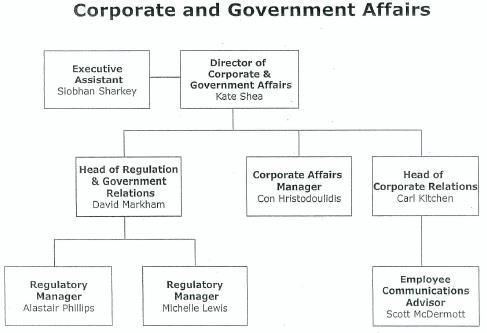
81 On 1 April 2011, Mr McIndoe advised Ms Shea that her gross annual incentive plan payment was $165,962 and her fixed annual remuneration was increased to $330,050 per annum effective 1 April 2011 (which remained her rate of remuneration up to the termination of her employment), both to be paid in the first week of April 2011.
The relationship between Ms Shea and Mr McIndoe
82 It was common ground that Ms Shea and Mr McIndoe enjoyed a friendly, professional and personal relationship throughout her employment, until about mid-2011. In 2011, Mr McIndoe praised her as “the glue of the management team”. Ms Shea’s performance reviews were extremely positive and she was consistently awarded a substantial annual bonus.
83 Ms Shea testified that prior to about April 2011, she and Mr McIndoe got on well as good workplace friends who also discussed personal matters. Ms Shea testified that at work Mr McIndoe visited her office on “most days”. Ms Shea stated that through their discussion of personal matters, she was aware of some of his “indiscretions” and found that he made a lot of inappropriate comments about women. Until April 2011, Ms Shea considered that her relationship with Mr McIndoe was good.
84 At trial, Ms Shea at one point testified that her friendship with Mr McIndoe was confined to the workplace and they did not see each other socially. Ms Shea acknowledged that she occasionally had dinner with Ms Barnett but denied that Mr McIndoe was present.
85 In contrast, Mr McIndoe testified that his relationship with Ms Shea extended to social occasions, as they had lunch together each month and met for drinks after work at several favourite venues. He and Ms Barnett as a couple also socialised with Ms Shea at lunch and after work. They had dinner with Ms Shea and her husband at Ms Barnett’s house, and on one occasion, the couples stayed together overnight at Ms Barnett’s holiday house at Portsea.
86 Mr McIndoe testified that when he met Ms Shea socially, including for lunch or drinks, they discussed extremely personal matters, including intimate medical problems and Mr McIndoe’s relationship with Ms Barnett, to which Ms Shea was quite sympathetic. Mr McIndoe also occasionally sent friendly greeting cards to Ms Shea and her family members, and presented her new baby with a gift.
87 Despite her initial denials, Ms Shea ultimately conceded that she discussed very personal matters with Mr McIndoe during lunch or drinks after work and acknowledged that they had stayed together at Ms Barnett’s holiday house.
88 While Ms Shea (ultimately) acknowledged that she enjoyed a friendly working relationship with Mr McIndoe, she testified that occasionally he spoke about women, including their appearance, in sexist or inappropriate terms which made her uncomfortable, although she said nothing at the time. Ms Shea nevertheless conceded that her relationship was such that she could speak freely to Mr McIndoe and it was also part of her role to monitor and protect his public image and reputation. She acknowledged that she voluntarily spent time in his company and expressed her satisfaction in working with him.
89 Mr McIndoe denied that he made improper or obscene comments as alleged. This is discussed in detail below.
90 Although Ms Shea attempted to minimise the confidential and voluntary social aspects of her relationship with Mr McIndoe, I am satisfied that prior to mid-2011, they enjoyed a strong professional relationship which extended to friendship at a social and personal level. Ms Shea and Mr McIndoe shared, in Ms Barnett, a confidential “best friend” and intimate partner respectively. They voluntarily met socially outside the workplace on numerous occasions and their relationship involved considerably greater personal intimacy, familiarity, social contact and confidential exchanges than would be typical of a merely cordial working relationship between a managing director and a senior executive.
91 In February 2010, Ms Shea and Messrs Holmes and McIndoe were in Hong Kong to attend business functions involving the respondent’s parent company, CLP.
92 It is common ground that all three persons attended a dinner organised and hosted by Mr McIndoe for CLP personnel at the China Club in Hong Kong. The dinner was preceded by drinks commencing around 6.30 pm. After dinner concluded at about 11 pm, a number of people, including Messrs McIndoe and Holmes and Ms Shea, proceeded to the “Mes Amis” night club with CLP personnel in a large private car. At some time after 12.30 am, all of the party departed, save for Mr Holmes and Ms Shea, who walked together to another bar, where they engaged in conversation. In the course of the conversation, Mr Holmes touched Ms Shea physically. The nature of the physical contact and Mr Holmes’ related conduct is disputed. Ms Shea contends that Mr Holmes stroked her hair, neck and thighs in what was, in effect, an unwelcome sexual advance. Mr Holmes contends that he put his arm around or touched Ms Shea’s back or neck in a consoling manner after Ms Shea confided to him details of her husband’s serious illness. The disputed accounts of the incident (“the Hong Kong incident”) are discussed in detail below.
93 After spending time in the second bar, at (according to Ms Shea’s testimony) about 3 am, Mr Holmes and Ms Shea returned together in a taxi to the hotel where both were staying. Ms Shea then awoke her husband, who was also staying at the hotel, and informed him of the incident.
94 On or about the following day, Ms Shea informed Peter Greenwood, an officer of CLP, with whom she was friendly, of the Hong Kong incident. Ms Shea did not give evidence of the terms in which she informed Mr Greenwood, who was not called as a witness in the proceeding.
95 Shortly after returning to Melbourne from Hong Kong, Ms Shea informed Mr Purvis, the respondent’s Human Resources Director, of the Hong Kong incident. Mr Purvis also happened to be Ms Shea’s close personal friend, whom she had known since their university days. According to Ms Shea, their friendship went back “a long time” and they had once shared a house together. Mr Purvis agreed that he was a longstanding and “extremely close friend” of Ms Shea, whom he had known for around 25 years. Mr Purvis and Ms Shea gave conflicting accounts of the terms in which Ms Shea described to Mr Purvis the Hong Kong incident and her subsequent exchange about it with her husband.
96 Ms Shea testified that she told Mr Purvis that “Kevin Holmes had made inappropriate advances towards me” or words to that effect, to which Mr Purvis responded that Mr Holmes was “a sleaze”. Ms Shea said that she told Mr Purvis both in his capacity as the Director of Human Resources and as an intimate friend. She testified that she “felt more comfortable talking to [Mr Purvis] because he was a close friend but I probably would have mentioned it to any HR director”.
97 Mr Purvis testified that Ms Shea first told him of the Hong Kong incident about a couple of weeks after her return from Hong Kong. He had previously seen her a number of times in the office. According to Mr Purvis, Ms Shea came to his office, closed the door and indicated that “Mr Holmes had propositioned her”.
98 In cross-examination, Mr Purvis added that Ms Shea stated that Mr Holmes “had touched her hair and her shoulder”. Mr Purvis’ failure to add that detail in examination-in-chief (for which he was criticised by senior counsel for the applicant) did not, in my view, reflect on his candour or suggest an attempt to withhold the information. His answer to a question on what Ms Shea said to him in their meeting was overtaken by a question about his response to her initial remark.
99 Mr Purvis testified that he was concerned by Ms Shea’s revelation and asked whether she were upset and wanted the matter to be investigated. He also asked about her husband’s reaction. According to Mr Purvis, Ms Shea stated that she did not wish to complain, to have the matter investigated or to have other action taken. She told Mr Purvis that when she woke her husband and told him of the incident, he rolled over and went back to sleep. She told Mr Purvis that her husband was “fine with [it]”. Ms Shea also said that she had informed Mr Greenwood of the incident.
100 Mr Purvis denied that he had ever held the opinion or stated that Mr Holmes was “a sleaze”.
101 At an early stage, Ms Shea also told Ms Barnett, who was no longer employed by the respondent, of the Hong Kong incident. Ms Shea testified that she telephoned Ms Barnett in Melbourne the day after the incident occurred. Ms Shea did not give evidence of the precise terms in which she informed Ms Barnett of the incident. Ms Barnett was not a witness in the proceeding.
102 Ms Shea also told David Markham, who was a member of her team and reported directly to her, at some point in time during the week after she returned from Hong Kong. Ms Shea did not give evidence of the precise terms in which she informed Mr Markham of the Hong Kong incident. Mr Markham was not a witness in the proceeding.
103 In cross-examination, it was put to Ms Shea that she told Ms Barnett and Messrs Carden and Purvis that Mr Holmes had “hit on” her or “made a pass” at her. Ms Shea agreed that, while she may not have used exactly the same words, she would have told Ms Barnett and Messrs Carden, Purvis, Greenwood and Markham the same thing in relation to what had occurred. It was put to Ms Shea that she did not tell Ms Barnett that she had been sexually assaulted or harassed, but rather that she had been “hit on”, to which Ms Shea responded “I don’t see what the difference is”. When asked whether she had used the phrase “hit on”, Ms Shea testified that she could not recall the words she had used. Ms Shea was taken to Ms Barnett’s email to Mr McIndoe, dated 17 March 2011, where Ms Barnett stated: “He hit on her”. Ms Shea observed that it is “a common expression”. It was clear from the email that Ms Barnett was referring to Mr Holmes and Ms Shea.
104 Ms Shea did not mention the Hong Kong incident to Mr Holmes at all until about 14 months later, in about April 2011. She continued to work together with Mr Holmes, attended workplace social functions at which he was present and on one occasion left an event walking with Mr Holmes. There was no evidence that Ms Shea avoided being in Mr Holmes’ company. Mr Holmes testified, and I accept, that in July or August 2010, they attended an evening farewell function for Carlo Botto, the director of portfolio management, left the function together and walked from Flinders Lane to the corner of Bourke and Elizabeth Streets after which they continued talking for about five minutes. Ms Shea was unable to recall any details of the evening and while certain that she would not have left the function with Mr Holmes, accepted that he may have “caught up” with her as she was walking.
105 Other than for Mr Greenwood of CLP and Mr Purvis and Ms Barnett, who were both personal friends, and her close colleague Mr Markham, Ms Shea did not raise the Hong Kong incident with any person employed by or associated with the respondent until around April 2011.
Workplace developments after the Hong Kong incident
106 When Ms Shea commenced her employment with the respondent, its investor relations work was quite limited, as its only investor was its sole corporate shareholder within the CLP group. Investor relations work would, however, greatly expand if, as it was contemplated, the company were listed on the Australian stock exchange in future. From the outset, Ms Shea was keen to assume the management of investor relations after the respondent’s public listing. Mr Holmes, however, took the view that after the listing he, as Chief Financial Officer, should manage the investor relations role within the Finance unit.
107 In consequence, as at 2011, Ms Shea and Mr Holmes were competing to secure the investor finance function after the public listing of the respondent, which was then anticipated to take place in November 2012.
108 Ms Shea made clear to Mr McIndoe that she wanted the investor relations position. She testified that Mr McIndoe told her “[i]f you perform well in the corporate affairs function, I can see no reason why I wouldn’t give you the investor relations role”. Ms Shea initially testified that she viewed Mr McIndoe’s statement as a promise (albeit conditional on her performance in the corporate affairs role) but ultimately described it as “a commitment”.
109 Mr McIndoe denied that, from the outset, he promised Ms Shea the investor relations function in the event that the company were listed. He agreed that Ms Shea had flagged her interest in investor relations but stated, “we were not a listed company at the time, so it was not a relevant area of the business”.
110 Mr McIndoe acknowledged that he thought well of Ms Shea and regarded her as very accomplished in media and communications. He considered that she had handled the introduction of the carbon tax better than other media units.
111 It is nevertheless clear that even on Ms Shea’s own account of her relevant exchanges with Mr McIndoe, he made no promise, commitment (or statement that could reasonably be construed as such) to allocate the investor relations function to her after the anticipated public offer.
112 In February 2011, CLP requested Mr McIndoe to make a presentation to investors in Hong Kong in March 2011. Mr McIndoe asked Ms Shea and Mr Holmes to put together the presentation, assuming that each would contribute to a single work. Contrary to Mr McIndoe’s expectations, Ms Shea and Mr Holmes each provided Mr McIndoe with a separate presentation.
113 On 9 March 2011, Ms Shea sent an email to Mr Markham (the most senior person in her unit after Ms Shea herself) which stated: “Getting between me and investor relations is going to be like ‘getting between Christine Milne and a tv camera’”.
114 Also on 9 March 2011, Ms Shea responded to an email from Mr Markham attaching an image with the subject line “Re: Thought you’d like a picture of these two (Tim and Julia, not those other two!)” and stated:
Urrrggggghhhhhhhhhhh yuck!
By the way, the JBF look is not possible. She’s just too much of a dog.
115 While the photograph to which the email referred was not in evidence, the respondent alleged, and Ms Shea agreed, that the subject line “Tim and Julia” referred to the then Prime Minister, Julia Gillard, and her partner. The respondent alleged that “JBF” was an acronym for an obscene phrase. Ms Shea, although the author of the email, testified, implausibly in my view, that she did not recall the meaning of “JBF”. While I am unable to reach a conclusion on the meaning of “JBF”, Ms Shea’s description in her email to Mr Markham of the then Prime Minister as a dog was, in my opinion, insulting and misogynist. (This finding is relevant to Ms Shea’s contention that Mr McIndoe used sexist, demeaning language about women which made her uncomfortable and to whether relief in the form of reinstatement would be an appropriate remedy in this case.)
116 On 15 March 2011, having received two different investor relations presentations rather than the expected single presentation, Mr McIndoe told Ms Shea that he was frustrated because she and Mr Holmes had not worked together.
117 On 17 March 2011, Ms Barnett, who remained a close friend of Ms Shea after leaving the respondent, sent the following email to Mr McIndoe:
RM
There’s some background that’s gone on, and continuing to go on, that’s pretty significant – for Kate as well as for your own and TRUenergy’s perspective. Kate’s not willing to share these things with you as she’s determined to be judged on merit and she refuses to engage in a grubby smear campaign.
In terms of the background ...
It’s highly likely that Kevin is being driven by a personal vendetta against Kate ... He hit on her when you were all up in HK last year - She was wedged in a booth at Wanchai (with no easy escape route), and she told me at the time how shocked, trapped and repulsed she was. She obviously rejected the advances by leaving, but expressed her concerns to me about how the encounter might affect their working relationship going forward. She reported the matter informally, but as far as I’m aware, hasn’t mentioned it to others within the company.
I am also aware that Kevin made a clear, unwelcome and public advance on a female at last year’s Christmas party. From my own perspective, he leered at me, looking me up and down, when Kate, Purvis and I bumped into you guys in the foyer a few weeks ago. It was so obvious, and truly made my skin crawl.
In terms of what’s going on now ...
• Kate is aware that Kevin is making a concerted and widespread effort to discredit her around the company.
• Someone rifled through papers in Kate’s office 2 nights ago.
Kate is 100% loyal and dedicated - to CLP/TRUenergy and to you in particular. Part of her current role is to manage your reputation, and she’s determined to continue to deliver in the investor relations role. On the flipside, Brett is laughing behind Kevin’s back that “Kevin can’t even read a balance sheet”, and I was chatting to a highly respected guy from an infrastructure fund late last year - when I told him I’d worked at TRUenergy, one comment he made was how unimpressed he was that “they’re just not across the figures”.
So, I am writing because a personal and very grubby vendetta may result in someone who wishes to be judged on merit being detrimentally affected as well as your and TRUenergy’s credibility in the market being adversely affected.
PLEASE DO NOT LET ON TO KATE THAT I HAVE SHARED THE ABOVE WITH YOU ... She’d be furious and upset with me if she knew.
A
118 Mr McIndoe testified that Ms Barnett’s email alerted him for the first time to an alleged sexual advance by Mr Holmes to Ms Shea. He was surprised by the email as the incident had not been brought to his attention previously despite occurring over a year ago.
119 Ms Shea denied any role in or knowledge of the sending of Ms Barnett’s email. She could not recall providing information or allegations for Ms Barnett to pass on to Mr McIndoe. Ms Shea’s testimony about her involvement in the sending of Ms Barnett’s email was, in my opinion, very evasive. While Ms Shea may not have had advance knowledge of the sending of the email, I am satisfied that she provided Ms Barnett with detailed information about the Hong Kong incident, her workplace conflicts and the negative views of Mr Holmes, being aware that Ms Barnett would convey them to Mr McIndoe in some way. Ms Shea was aware, by June 2011 at the latest, that Ms Barnett had sent the email.
120 Ms Shea denied that by March 2011, she was determined to obtain the investor relations role and saw Mr Holmes as a rival. I am nevertheless satisfied that Ms Shea badly wanted, and was determined to obtain the investor relations role, for which she viewed Mr Holmes as her rival.
121 After receiving Ms Barnett’s email, on the same day Mr McIndoe spoke to Ms Shea. While Ms Shea had not previously mentioned the Hong Kong incident to him, Mr McIndoe asked her if she had a problem about working with Mr Holmes. He did not mention Ms Barnett’s email, as she had expressly requested him not to disclose it to Ms Shea. Ms Shea replied that although she had no problem in working with Mr Holmes, his Finance unit was “playing games” in relation to the two presentations.
122 Mr McIndoe responded that he was disappointed that he received two reports, rather than a single presentation, and that he expected the Finance unit and Ms Shea’s unit to work together.
123 On 17 March, following his meeting with Ms Shea, Mr McIndoe sent her an email, which stated:
Kate
I’m not sure you took away the key purpose of the discussion we just had and that troubles me. I know I was not as articulate as I should have been, so I’m going to try again and maybe I can do better by e mail:
• I don’t think you and your team are playing games. I am disappointed we ended up with 2 presentations, but this is a lesson to me to be clearer in what I am looking for. Probably a good reason to be “straight talking” in the future. I don’t think there is any lasting damage though.
• The presentation you did was very good and far more appropriate for equity investors. I have given my comments to Carl and I look forward to the final version. It will be a great basis for further presentations over the next few months.
• As regards the long term IR function, I frankly need some more time to think about this one. I also need to be better educated as to what the function needs to achieve and what skill sets are required. I will also talk to others outside the organisation. Given this is THE public face of the business and that we will be under such intense scrutiny in the first couple of years (Bernie Brookes of Myers told me this), I need to be very much on top of this at all times. Put another way, I will cut my cloth to suit the circumstances we are in, as opposed to being governed by preconceptions about how this is done elsewhere.
• I fully recognise that this is what you have done in the past and where your keen interest lies. We don’t need a formal equity IR group today, but I will continue to see you as responsible for my interaction with third parties, whether potential investors, public presentations etc. With the exception of the financial institutions, I do not expect finance to be giving separate presentations. Even in these circumstances, we need to have consistent messaging from the business so you will need to coordinate with Kevin’s group accordingly.
I hope this is clearer.
While the situation has frustrated me, I am much more concerned that you should understand that I value enormously your personal and professional advice. The fact that this has upset you, as it clearly has, is a huge worry to me so please let’s not allow this to have any detrimental effect on the way we work together.
R (x)
124 Mr McIndoe testified that as the meeting with Ms Shea had been “fraught” he concluded the email with a conciliatory “kiss”.
125 On 17 March 2011, Ms Shea sent a responsive email, as follows:
Thank you for the lovely email.
I really enjoy working with you and TRUenergy, and am looking forward to being part of an exciting future. I also really value your friendship.
K (x!)
126 On 24 March 2011, while in Hong Kong with Messrs McIndoe and Holmes, Ms Shea sent Ms Barnett an email which stated:
Subject: Am in my element!!
Haven’t been this excited about work since I left HWE five years ago. All going really well. Richard and Kevin have done a great job together and I think we would make a really great team. See you a bit later. Kx
127 In cross-examination, Ms Shea agreed that she was referring to Messrs McIndoe and Holmes in the email. She testified:
I was a bit carried away with the moment, … I wrote it and I felt very excited at the time, but I’ve had lots of exciting points between then and HWE … I was pleased with how things had gone in the presentation.
…
Richard is a very good presenter. There is no doubt about that. Kevin less so, but I was feeling magnanimous because I was over in Hong Kong and was pleased with the way the presentation had done.
128 She testified that by “I think we would make a really great team” she had meant working with, not for, Mr Holmes and that she had written the email before she found out about many of the “other incidents”.
129 Ms Shea acknowledged that she sent the email to Ms Barnett in circumstances where she had previously informed Ms Barnett of the Hong Kong incident which occurred the year before.
130 In late March, while in Hong Kong, Mr McIndoe discussed with Mr Greenwood the investor relations role and the difficulties between Ms Shea and Mr Holmes. Mr McIndoe suggested that Ms Shea should have “a dotted line” reporting to Mr Holmes. Mr Greenwood, who regarded it as a sensible outcome, stated that Ms Shea had informed him that Mr Holmes had made a pass at her in Hong Kong.
131 In April 2011, there was considerable concern within the respondent over the increasingly high level of media attention on its persistent problems in billing its customers in an accurate and timely manner.
132 In an email dated 20 April 2011 to Messrs Holmes, Hutchinson, Lambert, Martin, McIndoe and Purvis and Nancy Sequeira (Mr McIndoe’s executive assistant), and copied to Mr Collette, with the subject line “Increased media focus on billing errors” Ms Shea outlined a proposed approach to the respondent’s communications with the media and stakeholders about its errors in sending incorrect bills or failing to send any bills at all. Ms Shea noted that the number of requests from various media was increasing to approximately one every day. The Minister for Energy’s chief of staff was also seeking information on the extent of and proposed solutions for the problem. Ms Shea proposed a candid disclosure, including, inter alia, that about 100,000 to 150,000 customers were affected.
133 Later that night on 20 April 2011, Mr McIndoe emailed Nick Stone, an employee working in the Retail unit, stating:
[W]e are now about to face a real shit storm in the media owing to inaccurate and late billing. While you say “no silver bullet”, there must be something we can do.
…
We are about to get whacked really hard and really publicly. Where are the problems, who is accountable for them and how can they be fixed?
134 On 21 April 2011, Mr Stone sent an email to Mr McIndoe stating that he had had “a good chat with Kate”.
135 Later that day, Mr Stone, in an email to Mr McIndoe and Ms Shea suggested (to assist Ms Shea in drafting a media response), that only a small number of customers were affected, that numbers should not be quoted to the media, and that the size of “the issue” varied to between 0.6% and 2.3% gross.
136 Later again that day, Mr Markham, in an email to Mr McIndoe and Ms Shea (copied to Con Hristodoulidis, who reported to Ms Shea and to Mr Stone) advocated a frank approach, stating that “3% of our customers not billed on time is lots” and urging the respondent to “acknowledge [the] negatives”.
137 Later that day, Mr McIndoe emailed that he would like to “sign off” on any media release. Mr Hristodoulidis responded that he had informed a Herald Sun journalist that “[w]e estimate at this stage that up to 100K customer accounts may be affected, mostly in Victoria”. Mr Hristodoulidis anticipated that the Herald Sun would run a story the following day, when its readership was lower than usual as it was Easter.
138 By an email in response dated 21 April 2011, Mr McIndoe sought an explanation for the “source of the 100,000 number”. Mr Hristodoulidis responded that there was “no single source of truth”, and the number was an extrapolation, albeit queried by Mr Stone.
139 An article which appeared in the Herald Sun on 22 April 2011 under a headline “Nearly 100,000 Victorians hit by TRUenergy billing bungle” referred to Mr Hristodoulidis’ report that up to 100,000 of the respondent’s household and business customers nationwide were experiencing overcharging, undercharging or delays in billing.
140 Mr Stone of the Retail unit continued to assert that the figures included in the newspaper article were inaccurate and significantly over-stated the problem. In his email to Mr McIndoe dated 27 April 2011 (and copied to Mr Collette), Mr Stone stated, inter alia, “[o]nly a handful of customers that we are aware of have been overcharged or have had billing errors – ie not 100,000”. Mr Stone asserted that according to relevant data, only 28,510 customers, rather than the 100,000 reported, were affected by long delayed bills.
141 On 28 April 2011, George Company emailed various persons including Mr Hristodoulidis, attaching an advertisement of a competitor which referred to the respondent’s acknowledged billing problems. Mr Stone forwarded the advertisements to Mr McIndoe.
142 Later that day, Chris Fidler sent an email to many colleagues including Ms Shea and Messrs Hristodoulidis, Stone and Collette, stating that the respondent’s call centre had received a record number of 8,390 calls in a single day, largely driven by public exposure of the billing issues.
143 Later again that day, Mr McIndoe emailed Ms Shea, stating, inter alia:
Just following on from on [sic] conversation yesterday.
In addition to the huge call volumes in the CIC, we have had PWC and Standard and Poors wanting an explanation for the 150,000 billing issues and questioning whether we should be taking a provision for the financial impact.
I was not questioning anyone’s loyalty or commitment, nor whether we should be up front with the government. However, in retrospect it would have been better to advise retail and finance ahead of the media statement.
144 By an email in response (on 28 April 2011), Ms Shea stated “I completely fail to understand why you are targeting me in all of this” as she had outlined her proposed approach in an email the previous week, but no-one, including Messrs McIndoe and Holmes, had responded. Ms Shea did not acknowledge that she had mistaken numbers and made clear that she considered that her approach was justified.
145 Throughout this period, Ms Shea kept Ms Barnett informed of developments, although the latter had left the company. On 28 April 2011, Ms Shea forwarded the above email chain about the media response to Ms Barnett under the comment “[t]oday’s fun and games!”. At trial, she conceded that she kept Ms Barnett “in the loop”. Neither party made any submission about the propriety or otherwise of Ms Barnett’s continued involvement in the respondent’s affairs.
146 I am satisfied that there was a significant and unresolved difference of opinion between Ms Shea’s unit and the Retail unit over how to handle the billing problem, the number of customers affected and the number that should be publicly disclosed. The candid approach advocated by Ms Shea was, on one view, unsuccessful. On any view, by April 2011, tension and poor communication between the two units were evident.
147 Ms Shea’s poor opinion of the calibre of the Retail unit’s personnel was reflected in her email sent on 2 March 2011, in response to an email from Mr Markham referring to Fiona Savage, a staff member in the Retail unit. Ms Shea stated:
She sounds like a royal pain in the arse!! Is she the chick from the night club? Sounds like someone needs to tell her how to behave in an office!!
148 While Ms Shea denied that the above description of an employee in the Retail unit had an adverse impact, it was, in my view, even when confined to her close associate Mr Markham, inappropriate, and demonstrated a lack of co-operation and mutual respect between the units.
149 I am satisfied that in the light of the above, by April 2011, Mr McIndoe was, as he testified, justifiably concerned about the relationship between Ms Shea’s unit and the Retail unit. He was also concerned that Ms Shea’s media response to the billing problems (in suggesting that 100,000 customers were at risk) had resulted in bad or even disastrous publicity, an overwhelming number of telephone calls to the respondent’s call centre, concern to its auditors and irritation in the Retail unit. Mr McIndoe considered that the media release had a significant adverse impact on the business.
The allocation of the investor relations role
150 Mr McIndoe decided to allocate Ms Shea the coveted investor relations role, on the basis that she report by “dotted line” to Mr Holmes. Mr McIndoe testified that under “dotted line” reporting, Mr Holmes would not determine, or have input into, Ms Shea’s appraisals, promotion and remuneration, which would remain Mr McIndoe’s responsibility.
151 On 5 April 2011, Mr McIndoe informed Ms Shea of his decision.
152 According to Ms Shea, Mr McIndoe stated that this would give her an opportunity to show how she performed up to and after the anticipated public listing of the respondent. It would also force Mr Holmes and Ms Shea to work together. Ms Shea denied that Mr McIndoe told her that she would report to Mr Holmes only by “dotted line”.
153 Ms Shea testified:
I was happy to work with [Mr Holmes] side by side, but if I were working for him, that would mean he would be responsible for determining my pay rises, my KPIs, my bonuses and that I would have to travel with him on overseas trips as a subordinate, and I didn’t want to do that … Because I thought he would do it again.
154 Ms Shea then informed Mr McIndoe that she could not report to Mr Holmes. She told Mr McIndoe “what had happened” in Hong Kong between her and Mr Holmes. She could not recall whether she had used the words “he made a pass at me” or “he hit on me” but did not deny that she said that Mr Holmes made a pass at her or hit on her. Ms Shea agreed that the phrase “hit on” meant making sexual advances, but suggested that it also involved a physical aspect. She said “I could have said he made unwanted advances towards me, I could have said he propositioned me, I could have said a number of things. I don’t recall.” She said that she “didn’t feel comfortable telling anyone what happened, because I found it quite humiliating”. Ms Shea denied that she told Mr McIndoe “I don’t want to make a complaint”.
155 Mr McIndoe, in contrast to Ms Shea, had a clear and specific recollection of their conversation. He testified that Ms Shea told him that “she didn’t want to report to Mr Holmes because Mr Holmes had made a pass at her”. Mr McIndoe said “[s]he told me that it had occurred in Hong Kong on the date of the spring dinner celebration”. Mr McIndoe testified that “I asked her what had happened and she said that he had made a pass at her after they left the Mes Amis bar”.
156 Mr McIndoe testified that when he asked Ms Shea whether she wanted to make a complaint, she replied that she did not. He denied saying that he wanted to force Ms Shea and Mr Holmes to work together.
157 To the extent of any conflict in their testimony, I prefer that of Mr McIndoe. Mr McIndoe was, in my view, generally a more reliable witness and Ms Shea acknowledged her inability to recall aspects of their conversation. Moreover, Mr McIndoe, although not obliged to do so, had just allocated Ms Shea the investor relations role. His previous emails to Ms Shea adopted a conciliatory and pleasant, rather than a confrontational tone, and it is not, in my view, plausible that he would use terms such as “force” or fail to explain to the “dotted line” nature of the required reporting.
158 Shortly after the meeting with Ms Shea, Mr McIndoe spoke to Mr Holmes, who denied making a pass at Ms Shea.
159 Ms Shea testified that after learning that she would be required to report to Mr Holmes in her investor relations role, she told Ms Robertson (an employee relations manager working in the Human Resources unit who reported to Mr Purvis) that she could not do so because Mr Holmes had sexually harassed her. Ms Shea testified that she told Ms Robertson that she would prefer her not to divulge their discussion to anyone, as she did not want to be seen to be garnering female support for her cause. She did not give Ms Robertson permission to talk to Mr McIndoe about the Hong Kong incident.
160 In late April 2011, Mr Purvis and Ms Shea discussed the investor relations role while returning from lunch together. Ms Shea testified that she told Mr Purvis that she did not want to report to Mr Holmes and did not want him to determine her remuneration. Mr Purvis testified that Ms Shea told him that during the Hong Kong incident, Mr Holmes had his hands “all over her” and it was disgusting. Mr Purvis testified that he thought that Ms Shea was exaggerating due to her rivalry with Mr Holmes.
161 After 5 April 2011, Ms Shea began to inform a few colleagues around the office of the Hong Kong incident.
162 Ms Shea did not see Mr McIndoe between 5 April and 6 May 2011 due to his commitments, although they conversed and exchanged emails.
163 On 28 April 2011, Ms Shea had a telephone conversation with Mr Purvis’ wife, with whom she was friendly, about various personal matters. Mr Purvis, who had been on holidays, was present. He took the telephone and asked Ms Shea whether the investor relations problem was now resolved. She replied that she had spoken to Mr McIndoe, but nothing was resolved.
164 Between 27 and 30 April 2011, Mr Purvis telephoned Mr McIndoe in Bangkok and informed him that Ms Shea was talking to other personnel about the Hong Kong incident, using the term “sexually harassed”.
165 In May 2011, Adrian Merrick, who had previously worked for a large UK company, took up the position of head of the Retail unit at the respondent. As discussed in detail below, Mr Merrick from the outset considered that certain functions performed by Ms Shea’s unit should be transferred to the Retail unit and he continued consistently to advocate that course to Mr McIndoe. Mr Merrick was familiar with “single point responsibility” which applied in his previous company and various competitors of the respondent. It required all factors influencing a “business” to be under the control of one person. The Retail unit did not have single point responsibility for its operations and Mr Merrick considered that it should be introduced. Mr Merrick testified that as he was immediately of the view that changes needed to be made to the respondent’s corporate structure, he repeatedly proposed to Mr McIndoe that both retail regulation (which then resided in Ms Shea’s unit) and retail compliance (which then resided in the Finance unit) be moved into the Retail unit under his direction.
166 I accept that Mr Merrick, in a number of discussions with Mr McIndoe (who knew that some competitors had “end to end” responsibility in their retail units) advocated combining the retail regulatory and compliance functions within the Retail unit because it had the ultimate accountability for profit and loss in the retail business.
167 Ms Shea conceded that from May 2011, when Mr Merrick started as head of Retail, he continually urged the correction of problems and she may have discussed a possible restructure with him.
168 In early May, on his return from Bangkok, Mr McIndoe discussed Ms Shea’s allegation against Mr Holmes with Mr Purvis, Ms Robertson and a friend outside the company. He decided that, as sexual harassment was alleged, an independent investigation of the Hong Kong incident was necessary.
169 On 6 May 2011, Ms Shea and Mr McIndoe had a meeting at which Mr McIndoe told Ms Shea that the Hong Kong incident would be investigated. Mr McIndoe testified that Ms Shea was distressed and said “I might as well resign”, to which he responded “don’t resign”.
170 Ms Shea agreed that when Mr McIndoe told her that an independent investigation of the Hong Kong incident would proceed, she may have told Mr McIndoe that she had “not made a (formal) complaint”. Although she did not recall her exact words, Ms Shea testified that she stated that “I don’t want an investigation. I should just resign”. Ms Shea agreed that Mr McIndoe urged her not to resign and again asked her to tell him what occurred in Hong Kong.
171 Mr McIndoe testified that at that point, Ms Shea stated that Mr Holmes had stroked her thighs. She then said “it was horrible, he had hands all over me, all over my thighs, it was disgusting”. According to Mr McIndoe, this was the first time he heard the allegation that Mr Holmes had stroked Ms Shea’s thighs.
172 Ms Shea agreed that she had never previously discussed the details of the Hong Kong incident with Mr McIndoe and when he asked what had happened, she told him for the first time on 6 May 2011 that Mr Holmes stroked her hair and her back and put his hand down her shirt and over her thighs.
173 On 10 May 2011, Mr McIndoe sent an email to Andrew Brandler of CLP. It stated:
Andrew
I understand you are now aware of a difficult sexual harassment allegation which has come about over the past couple of weeks. We obviously need to talk about this but I thought you should have some background.
• Earlier this year Kate Shea had been pitching strongly for the investor relations role at TRU. Clearly this is somewhat premature from an IPO perspective – I actually do not want to formally appoint an IR person for now – she was putting forward her claim on the position
• I told her the position should really report to the CFO. She said she wanted the role, felt she deserved it and that it should report to the CEO. I told her (as in previous PDP reviews) that while she was strong on strategy, her financial knowledge and analysis was weak and she needed to be across the numbers better in this role.
• Ahead of the CLP roadshow in HK end of March I had asked her and Kevin to prepare an investor presentation. They produced 2 separate presentations, having failed to interact with each other at all. I was extremely angry and told them this was not the kind of management behaviour I expected. I subsequently rewrote the presentations myself.
• Following the HK presentation I spoke to Greenwood about this issue. I told him I proposed to have IR report to me with a “dotted” line to KH and would be prepared to let Kate have a go at the role on this basis but I couldn’t trust her to liaise with Kevin unless there was the reporting line. She would continue to report to me in other aspects of her role. He felt this was a sensible solution but told me that Kate had told him that Kevin had “made a pass’ at her some 14 months ago when they were in HK together. Kate had never raised this issue with me.
• I told Kate of my decision when I returned. She said she couldn’t report to Kevin because he had made a pass at her in the past. She said, however, that she had not told anyone and was not making a complaint. There was no indication of what “making a pass” meant.
• I told her that this in this role I would be fully responsible for her pay and performance but given recent experience I needed to ensure there was some liaison between IR and Finance.
• She said she would consider the role.
Some 2 weeks ago I was advised by David Purvis that Kate had been telling some people in HR that Kevin had made sexual approaches to her in HK. The incident happened after a CLP dinner at the China Club. A group (including Stefan and myself) went on to Wanchai to Mes Amis bar. I left, as did Stefan, and Kate and Kevin went on to another bar. I can fill you in on the details of what is claimed by phone.
Kate has also claimed that this was not an isolated incident. However, there have been no other complaint issues from others reported formally or informally. As well as HR staff (3 of them), I am aware that she has also made the allegations about Kevin’s conduct to Mark Collette and David Lambert. In both cases unsolicited.
Following my receipt of this information:
• DP has discussed with Kate the fact that spreading such rumours and allegations about a colleague is untenable. However, he has invited her to make a formal complaint if she wishes. She has declined, however she has advised Linda Robertson (also HR) that she has been in discussion with Harmers law firm (who represented the woman in the recent David Jones case). We have to assume that she may decide to take action and assess the risks (below)
• DP has also advised Kevin that these allegations have been made by Kate. Kevin is extremely upset and angry. He claims nothing happened in HK. He considers the allegations slanderous.
• Having discussed with HR and legal counsel, we have decided that the interests of the company are best served by having a swift external investigation of the allegations. This will involve interviews with Kate, Kevin, possibly myself and possibly Stefan who was there at the time.
• Kate has subsequently told Linda that she does not want an investigation.
• Kate appears to have also spoken to PWG about this matter. I tried to contact Peter at the weekend, but we have been swapping calls.
What are the risks?
• From CLP or TRU perspective we cannot do nothing. Leaving aside what is morally “the right thing” to do, the company would be at risk if this were just swept under the carpet. The risk could be from Kate – “you knew this and did nothing?” or if there were a further complaint against Kevin which was substantiated etc.
• Kevin has also requested that this be investigated. It’s important to note that this is presently an unsubstantiated rumour and his reputation is being undermined.
• Apparently PWG was told by Kate the day after the alleged incident happened, although I don’t know in what detail. Kate also told Purvis some weeks later. Purvis asked whether she wanted to make a formal complaint, to which Kate said no.
• The prior knowledge of PWG and Purvis may work against us, in that senior executives knew something but didn’t act. This is one of the reasons we should go forward with the investigation so as not to compound the issue.
It appears that Kate has subsequently spoken further to PWG, although I do not know what has been said. Obviously now there are more people “in the know” in HK, while here in TRU it has been relatively contained.
My belief is that the current round of rumour spreading by Kate is designed to attempt to maximise any payout should she resign.
Please give me a call
Richard
The investigation by Patrizia Mercuri
174 On or about 11 May 2011, the respondent engaged Patrizia Mercuri, a partner of the law firm Lander & Rogers, to investigate the Hong Kong incident and to produce a report containing her findings at a cost of $50,000. The company paid the legal expenses incurred by Ms Shea and Mr Holmes in relation to the investigation.
175 On 16 May 2011, Ms Mercuri conducted her first interview with Ms Shea. Ms Shea’s lawyer, Katrina Raymond and Daniel Proietto, a solicitor with Ms Mercuri’s firm who took notes, were in attendance. Ms Mercuri subsequently provided the written record of interview to Ms Shea for her review.
176 By a letter to Mr McIndoe dated 18 May 2011, Ms Raymond stated that it was “common knowledge” amongst a number of the respondent’s employees that Mr Holmes had engaged in other instances of sexual harassment of employees and/or conduct which breached the company’s equal opportunity policy. The letter attached a schedule of Mr Holmes’ additional alleged misconduct.
177 The letter stated:
Given that TRUenergy has initiated an investigation of the alleged incident involving Ms Shea, despite Ms Shea not having made a formal complaint regarding this matter, we consider that TRUenergy has a legal obligation to also investigate the allegations in the schedule as well as any other issues which have been raised with respect to inappropriate behaviour by Mr Holmes.
Having raised these matters with Patrizia Mercuri of Lander & Rodgers in Ms Shea’s interview on Monday, she indicated that these incidents were outside the scope of her investigation. We therefore write to request that the scope of the investigation by Lander & Rogers be extended to include the allegations in the schedule.
178 Ms Raymond requested Mr McIndoe to expand its scope to include the additional allegations, which were as follows:
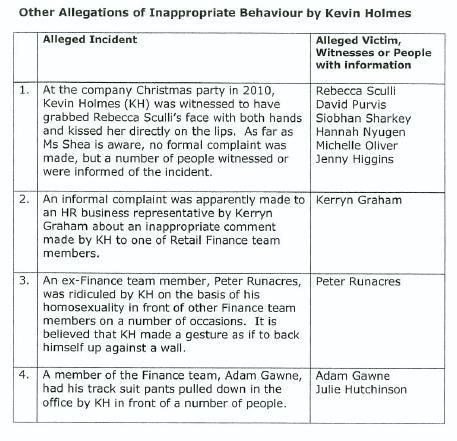
179 By a letter to Ms Mercuri dated 23 May 2011, Ms Raymond returned Ms Mercuri’s record of her interview with Ms Shea, which had been sent to Ms Shea for review. Ms Raymond’s letter provided contact details for Messrs Greenwood, Purvis and Markham and Ms Barnett, who were witnesses referred to by Ms Shea in the interview.
180 By a letter dated 24 May 2011 emailed to Ms Raymond, Mr Lambert (the respondent’s general counsel) stated that Mr McIndoe had forwarded the 18 May 2011 letter to him. Mr Lambert further stated:
As Ms Shea is aware, the Company has commissioned an independent expert to confidentially investigate the allegation that Mr Holmes engaged in sexual harassment toward Ms Shea.
You have provided a table of what you allege are additional allegations involving Mr Holmes but not involving Ms Shea. If the investigator Ms Mercuri believes this additional information provides assistance for her in completing her investigation into Ms Shea’s allegation of sexual harassment she is free to consider the additional information.
181 On 6 June 2011, Ms Mercuri conducted a second interview with Ms Shea, in which she put to her evidence given by Messrs Holmes and McIndoe, including that during the course of the Hong Kong incident, Ms Shea had tripped over at the first bar, displayed “high spirits” and made crass remarks about sex. Ms Mercuri subsequently provided the written record of the interview to Ms Shea for her review.
182 By an email to Ms Mercuri dated 10 June 2011, Ms Raymond attached the record of Ms Shea’s second interview reviewed by Ms Shea. Ms Raymond referred to Ms Shea’s concern that Messrs McIndoe and Holmes had “to some extent” colluded in their version of events to make the matter “go away”. Ms Raymond’s email listed a number of assertions, complaints and allegations Ms Shea now made against Messrs McIndoe and Purvis individually and about collusion by Messrs McIndoe and Holmes before their interviews with Ms Mercuri in some “discrepancies” from Ms Shea’s story. The letter advised that Ms Shea was also concerned that there was a “cover up” indicated by Mr McIndoe’s cajoling her to stay and work with Mr Holmes and Mr Purvis’ accusation that she had failed to co-operate with Mr Holmes and the Finance unit.
183 On 14 June 2011, Ms Mercuri completed her written report. The Mercuri report dated 14 June 2011 was a lengthy document. The essential findings were as follows:
239. I am satisfied on the balance of probabilities that Ms Shea and Mr Holmes ordered a further drink at the Second Bar and were seated at a table/booth. I am also satisfied that they discussed a range of matters with the main thread of the conversation being Ms Shea’s husband’s illness. I also find on the balance of probabilities that in the course of that discussion, Mr Holmes placed his hand on Ms Shea’s shoulder and on her hand or her wrist. I am not satisfied on the balance of probabilities that Mr Holmes placed his hand down her top or on her thigh. It is possible, that Mr Holmes’ hand touched Ms Shea's hair while his hand was on her shoulder.
…
244. I accept Ms Shea’s evidence that she felt uncomfortable once Mr Holmes touched her on the hand and the shoulder. I also accept that she perceived this contact at the time as being an advance to her. This is consistent with her description to four separate individuals shortly after the incident occurred.
245. However, Mr Holmes has put forward an alternative and equally plausible explanation of the interaction between himself and Ms Shea on 24 February 2010, namely that his contact with her was a reflection of the empathy that he felt and sought to display in the context of a ‘fairly heartfelt conversation’. In light of these two competing interpretations of the interaction between Mr Holmes and Ms Shea I find on the balance of probabilities that Mr Holmes’ contact (namely touching her hand and her shoulder) was not a sexual advance.
…
261. Moreover, in my view the [TRUenergy Equal Opportunity] Policy needs to be read in conjunction with the terms of the [Equal Opportunity Act 1995 (Vic)] and the [Sex Discrimination Act 1984 (Cth)] in determining whether conduct constitutes sexual harassment in breach of the [TRUenergy Equal Opportunity] Policy.
262. For conduct to constitute sexual harassment under the [Equal Opportunity Act 1995 (Vic)] and the [Sex Discrimination Act 1984 (Cth)], it must satisfy a number of elements:
(a) it must be unwelcome; and
(b) it must be a sexual advance or request for a sexual favour or it must be conduct otherwise of a sexual nature; and
(c) it must occur in circumstances in which a reasonable person having regard to all the circumstances would have anticipated that the other person would be offended, humiliated or intimidated.
263. I have found that Mr Holmes touched Ms Shea’s hand and her shoulder.
264. I have also found that Ms Shea was uncomfortable when Mr Holmes did this. I therefore am satisfied that the conduct was unwelcome. That however, is not the end of the matter.
265. The placing of one’s hand on another’s shoulder and on their hand of itself is not sexual. It may be if it is done in a suggestive way or if it is accompanied by suggestive words or other conduct. On the basis of all of the evidence before me, I do not find on the balance of probabilities that Mr Holmes’ conduct constitutes a sexual advance or a request for a sexual favour. To fall within the definition of sexual harassment therefore the conduct must otherwise be of a sexual nature.
…
268. In conclusion therefore I am not satisfied on the balance of probabilities that Mr Holmes’ conduct on 24 February 2010 (as found by me) constitutes a breach of any applicable law or policy.
184 On 15 June 2011, the Mercuri report was provided to the affected parties (including Ms Shea) although they were not permitted to retain a copy after reading it. The report acknowledged that Ms Shea raised during her first interview with Ms Mercuri “a number of other allegations about inappropriate conduct allegedly engaged in by Mr Holmes during his time at [the respondent]” and that Ms Mercuri had seen a copy of a subsequent letter from Ms Shea’s legal adviser (dated 18 May 2011) to the respondent regarding those additional matters. The report did not consider the additional allegations raised by Ms Shea and her solicitor on Ms Shea’s behalf because, as Ms Mercuri stated:
I formed the view that whilst it may well be appropriate for the company to investigate those matters separately, it would not assist me in reaching any conclusions in relation to the Hong Kong Incident to have regard to those matters. I advised the company accordingly and a response reflecting that view was provided to Ms Shea’s legal adviser.
185 Ms Shea was distressed by the outcome of the investigation and the findings of the Mercuri report. She immediately took personal leave (sick leave) and, as discussed below, did not return to the workplace until mid-October 2011.
186 Ms Shea’s lawyer, Ms Raymond, prepared the 21 June letter which was addressed to Andrew Brandler. Mr Brandler was CLP’s chief executive officer and in essence, although not formally, Mr McIndoe’s “boss”, who ultimately had the power to “sack” him. The 21 June letter, among other things, expressed Ms Shea’s criticisms of the Mercuri report. The letter was marked “WITHOUT PREJUDICE SAVE AS TO COSTS” and “STRICTLY CONFIDENTIAL”.
187 Ms Shea attached the 21 June letter (with the file name “[d]raft letter to CLP”) to an email dated 21 June 2011, which she sent to Mr McIndoe, who was then, as she knew, on a family holiday overseas. The email stated:
Against all advice, I am providing you with an advance copy of a letter which my lawyer is intending to send to Andrew Brandler next Monday. If you are willing to provide firm commitments in writing to each of the conditions set out on page 6, please respond to my lawyer at the above email address by 5pm Friday 24 June 2011 (Melbourne time).
188 The 21 June letter of Ms Raymond to Mr Brandler referred to the Mercuri investigation and the Mercuri report’s finding that Ms Shea’s allegation of sexual harassment by Mr Holmes was not substantiated.
189 The letter set out the circumstances leading to the Mercuri investigation. It stated, inter alia, that:
3. Ms Shea did not make a formal complaint about the Incident as she was of the view “that in matters such as these the female always comes off worse”.
…
6. TRUenergy contrary to the wishes of Ms Shea then engaged Lander & Rogers to investigate the Incident. When informed of the proposed investigation, Ms Shea reiterated to Mr McIndoe and Peter Greenwood that she had not made a formal complaint, that she did not wish to make a formal complaint and that she could work co-operatively with Mr Holmes, but would not report to him. Regardless of her wishes, TRUenergy proceeded with the investigation.
190 Under the heading “Lander & Roger’s [sic] investigation was seriously flawed”, the letter complained (inaccurately) that the Mercuri report stated that the investigator was instructed not to take into account the additional “well known reports of sexual harassment by Mr Holmes” (of which three specific examples were given) that should have been taken into account, as they demonstrated Mr Holmes’ propensity to engage in such conduct.
191 The letter asserted that the Mercuri report contained a number of “untruths” told by the senior employees, Messrs Purvis, McIndoe and Holmes, in order to ensure that Ms Shea’s allegation was found to be unsubstantiated, as was apparent from, for example:
10.1 comments made by Mr McIndoe and Mr Purvis during their interview with the investigator that indicate that they have colluded in their versions of events as to what happened during the evening of the Incident.
10.2 prior to being interviewed by the investigator Mr McIndoe and Mr Holmes were overhead discussing and agreeing upon an account of what happened on the evening of the Incident;
10.3 Mr McIndoe made several comments to Ms Shea about her and Mr Holmes “moving on and working together again” once the investigation was over; and
10.4 the individual motivations of Mr McIndoe, Mr Purvis and Mr Holmes outlined in paragraph 16 below of this letter.
192 The letter asserted that the Mercuri report lacked “any probative assessment” as it simply listed various accounts of the Hong Kong incident, rather than analysing the evidence and drawing logical substantiated conclusions.
193 The letter stated:
11. The manner in which TRUenergy has handled the Incident, the Investigation and other reported and substantiated incidents of sexual harassment by Mr Holmes highlights a number of material failings in TRUenergy’s internal controls and processes as well as CLP’s corporate governance. Most concerningly, the investigation highlights that there is a culture at TRUenergy where sexual harassment is condoned.
194 The letter reiterated that both Messrs McIndoe and Purvis told a number of untruths to influence the report’s findings. The only example it specified was that Mr McIndoe untruthfully told the investigator that he first became aware of the allegation of sexual harassment in Hong Kong in a discussion with Mr Greenwood, although he was in fact made aware of it, by an earlier email on 17 March 2011 advising him of “the sexual assault of Ms Shea by Mr Holmes”.
195 The letter alleged that the motivations of Messrs Holmes, McIndoe and Purvis to “cover up” the Hong Kong incident by telling untruths were as follows:
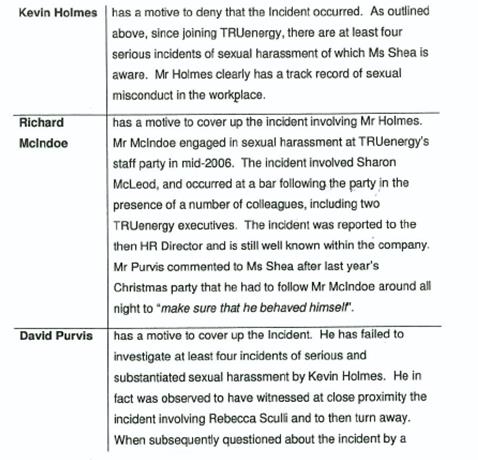
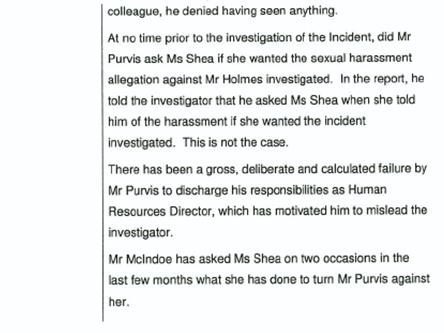
196 The letter then asserted that it would be easier for Ms Shea to “walk away” from the respondent and pursue a financial settlement as despite her “deep sense of loyalty” and the satisfaction she derived from her role, her “hurt and disillusionment … [made] her question whether she [could] continue her role”. Nevertheless, the letter stated that Ms Shea would remain with the company if it addressed the “failings that have been borne out by this matter”.
197 The letter required the following conditions to be met:
23.1 An independent, external, legal review of all four substantiated incidents involving Mr Holmes and TRUenergy employees be conducted by a member of the Victorian Bar (who is agreed to by Ms Shea). The current report is highly flawed in its assessment of the Incident and it also needs to be corrected through this same process. This review process is to have clear terms of reference and take a forensic approach to the investigation rather than listing the various accounts of the night and taking a view that is unsupported by any analysis.
23.2 A full external investigation by a member of the Victorian Bar into the failure of the HR function to investigate any of the reported incidents of sexual harassment by Mr Holmes at the time they were reported/observed.
23.3 An independent external audit of TRUenergy’s HR policies and procedures with respect to dealing with discrimination, harassment and bullying with a view to bringing them in line with best practice standards. I am instructed that at present there is no sexual harassment policy at TRUenergy.
23.4 A financial settlement with Ms Shea (formulated on the basis that Ms Shea will leave the employ of TRUenergy) which will remain open to be accepted by Ms Shea on resignation for one year if she continues working for TRUenergy.
23.5 Appropriate measures be put in place to address the findings of each of the three independent, external reviews outlined above.
23.6 Payment of all legal costs incurred by Ms Shea in respect of this matter.
198 The letter stated that “this proposal is open to be accepted until 5pm Friday 1 July 2011 (Melbourne time)”.
199 Mr McIndoe testified that he received Ms Shea’s email attaching the 21 June 2011 letter in England where he was on holiday with his family. He immediately telephoned Ms Shea who advised him that she was going to send the letter to Mr Brandler but against all advice had first sent it to Mr McIndoe to see what he would do. Mr McIndoe asked Ms Shea to hold off sending the letter to Mr Brandler. He then forwarded a copy of the letter to Ms Robertson of the Human Resources unit. Soon thereafter, either Mr McIndoe or Ms Robertson, at his behest, forwarded the 21 June letter to Mr Brandler.
200 By an email dated 24 June 2011, Katrina Raymond advised Mr McIndoe that Ms Shea would grant an extension until 5.00 pm on 27 June 2011, after which she was now considering sending the letter to the entire board of CLP as well as Mr Brandler.
Cross-examination of Ms Shea on the 21 June letter
201 In cross-examination, Ms Shea acknowledged that the 21 June letter reflected her position. She knew that its addressee, Mr Brandler, was the sole person with the power to dismiss Mr McIndoe, but stated at one point that she knew that that would not happen. At another point, she stated that she had not considered the matter. Ms Shea conceded that the contents of the 21 June letter were explosive and damaging to Mr McIndoe’s reputation but stated that she did not believe that the allegations would become public. She asserted that she sent the letter to Mr McIndoe first to give him the opportunity to resolve the matter, in recognition of their friendship. Ms Shea stated that she refrained from including various other allegations against Mr McIndoe (which she subsequently raised at trial). Ms Shea conceded that she was angry when she sent the email and letter, because in her view, the Mercuri report found that she had fabricated the allegation about the Hong Kong incident.
202 Ms Shea acknowledged the seriousness of her allegation that Mr McIndoe and other senior managers had lied to the investigator to “cover up” due to their misconduct. She denied that she had no foundation for the incidents alleged as motivations Messrs McIndoe and Purvis to lie. Ms Shea also denied that the letter exaggerated and escalated the allegations in order to pressure the company by an implicit threat of bad publicity.
203 Ms Shea conceded that the sole specific example in the letter of Mr McIndoe’s alleged lying to the investigator was his assertion that he first became aware of an incident of “sexual assault” after a discussion with Mr Greenwood. (That assertion apparently assumed that Mr McIndoe had received Ms Barnett’s email of 17 March 2011, which did not, in terms, refer to sexual assault, prior to his discussion with Mr Greenwood.)
204 As stated above, in earlier testimony Ms Shea denied any knowledge of, or involvement in, sending Ms Barnett’s email on 17 March 2011. There was no evidence as to how she became aware of it, as she clearly was, by 21 June 2011.
205 Ms Shea agreed that she made the serious accusations of Mr McIndoe despite her hitherto close personal and professional relationship with him, sound knowledge of his character and her enjoyment in working with him.
206 Similarly, she agreed that she accused Mr Purvis of lying and participation in a “cover up” although he was her longstanding old friend and her child’s godfather whom she had previously considered to be of the highest integrity.
207 Ms Shea acknowledged that Mr Purvis was not involved in the Hong Kong incident. When questioned about the basis on which she alleged that he had deliberately lied to Ms Mercuri if he had merely followed her instructions to take no action, she responded “I don’t know what his obligations under the law are”.
208 Ms Shea’s testimony was defensive and unresponsive. She repeatedly failed to answer when asked whether she recognised the gravity of alleging that Mr Purvis misled the investigator because he was guilty of a gross deliberate and calculated failure. She stated:
[W]hat was behind [the allegation] was that he had taken a stance … that I had fabricated the incident … prior to the actual commencement of the investigation. And he almost said, well, said to my face that I had effectively made it up.
209 Nevertheless, Ms Shea in previous testimony asserted that Mr Purvis had apparently accepted her account of the Hong Kong incident and described Mr Holmes as “a sleaze”. Ultimately, the nature of Mr Purvis’ alleged lies to the investigator was not clear from the 21 June letter or Ms Shea’s evidence at trial. The nexus, if any, between Mr Purvis’ alleged belief that Ms Shea had made up the Hong Kong incident and his motivation to mislead the investigator because he had failed in his duty was also unclear.
210 Ms Shea acknowledged that although the 21 June letter referred to “independent witnesses” able to substantiate the allegations against Messrs McIndoe, Purvis and Holmes, none had been called to give evidence at trial.
211 Ms Shea accepted that, contrary to the assertion in the 21 June letter, Mr McIndoe did not give evidence to the investigator that she was “very drunk” in Hong Kong, but rather, stated that she was “pretty drunk”. She did not acknowledge that Mr McIndoe could have held an honest belief that she was drunk at the time of the Hong Kong incident.
212 Ms Shea conceded that by her email to Mr McIndoe she effectively required a financial settlement within six days. She asserted that, against the advice of her lawyers, she sent the 21 June letter directly to Mr McIndoe to give him an opportunity to keep the matter from Mr Brandler. She did not view her conduct as a form of blackmail and asserted that it would have been more explosive to send the letter directly to Mr Brandler.
213 On 22 June 2011, Ms Shea received a letter from Roy Massey, the Director of Group Human Resources at CLP, dated 21 June 2011. Mr Massey thanked Ms Shea for her participation in the Mercuri investigation and stated that as the matter was concluded, the respondent would no longer pay her legal fees. Mr Massey also advised Ms Shea that the report, investigation and the outcome were strictly confidential. He acknowledged that it would have taken courage to raise her concerns and encouraged her to raise any future concerns as soon as possible.
The 29 June 2011 meeting and subsequent events
214 Following Mr McIndoe’s receipt of Ms Shea’s email, a mediation was scheduled for 29 June 2011 to attempt to settle the dispute. By an email dated 24 June 2011 to Messrs Massey and McIndoe, Mr Brandler stated:
[L]et’s see what comes out of the meeting. If they have raised the issue of exit, I suggest we pursue …. I know that the financial cost may also be high but let’s try to resolve all this swiftly, even if we have to throw some money at it ….
215 On 29 June 2011, Ms Shea and her lawyer, Michael Butler of HR+WorkLaw, attended a meeting at Freehills with Mr Massey and Kate Jenkins of Freehills, representing the respondent and CLP.
216 A memorandum of the meeting from Ms Jenkins and Mr Massey to Messrs Brandler and McIndoe (copied to Ms Robertson) stated that Mr Butler, at the outset of the meeting, displayed numerous newspaper articles. Ms Shea acknowledged at trial that the articles were about sexual harassment claims, but she could not recall whether Mr Butler then stated “[t]his is the potential damage to the company if this gets into the media”. Ms Shea first read a position statement which, at trial, she agreed largely repeated the claims already made against Messrs Holmes and McIndoe. Ms Shea’s settlement proposal included the following conditions:
(a) Ms Shea was to be paid one year’s total annual reward.
(b) Ms Shea’s bonus was to be protected and increased.
(c) Ms Shea was to be appointed the company’s sexual harassment officer.
(d) Ms Shea was to have the investor relations role, reporting directly to Mr McIndoe.
(e) If Ms Shea chose to leave her employment within a year of returning to work, she was to be paid $2.5 million (equivalent to five years’ salary) and to receive a reference written by Ms Shea and signed by Mr McIndoe, executive outplacement and financial counselling, a car, telephone and computer and payout of her entitlements (including untaken sick leave, pro rata long service leave and 20 days parental leave).
(f) Ms Shea’s legal fees were to be paid.
217 In contrast to her clear recollection of many other details, Ms Shea was unable to recall stating, at the meeting, that she would go to the media if her demands were not met. When asked whether she read a statement which she described as a “media statement”, Ms Shea acknowledged: “Possibly. I may have said that”.
218 In July 2011, Mr Holmes entered into a separation agreement with the respondent, but remained a consultant until March 2012.
219 The letter of Freehills to Mr Butler dated 6 July 2011 proposed the following arrangements for Ms Shea’s return to work:
Return to work arrangements
In outlining arrangements for Kate’s return to work, TRUenergy has taken into account Kate Shea’s concern to ensure she is able to return to work without victimisation following the recent investigation. It is confident this return to work can be successful with Kate’s co-operation.
• Kate will continue in her role as Director, Corporate and Government Affairs, reporting to Richard Mr McIndoe
• In addition, as previously discussed with Richard, if and when CLP confirms its intention to proceed with an IPO of TRUenergy, Kate will assume the duties of investor relations.
• To assist Kate succeed in the future with the investor relations duties, TRUenergy will consult with Kate about additional training she may need to support the investor relations function (which may include financial reporting training)
• Kate will not be required to report to Kevin Holmes directly or functionally (dotted line).
• If Kate feels it would assist her performance of her duties. TRUenergy will engage a professional coach to support Kate
• Richard McIndoe will provide a confidential letter to Kate confirming that nothing in the investigation report indicates that Kate lied or fabricated her allegation and that TRUenergy appreciates the courage Kate demonstrated in raising her concerns and participating in the investigation
• TRUenergy will not retain a copy of the report within its records. No reference to the investigation or report will be contained on Kate’s personnel file.
• TRUenergy will pay Kate’s reasonable legal fees related to the investigation and return to work upon production of invoices to an agreed date or an agreed amount
• TRUenergy will consider payment of any reasonable medical expenses for Kate, for an agreed period (in addition to her ongoing right to use the Employee Assistance Program as part of her employment benefits).
These arrangements provide Kate with her requested arrangements for the investor relations role as well as providing support to assist with her other concerns. TRUenergy is fully committed to ensure Kate suffers no victimisation going forward.
TRUenergy believes Kate can return and continue her successful career with TRUenergy following these events and looks forward to supporting Kate to enable her to do that.
220 Ms Shea was not prepared to accept the above terms. In a lengthy letter to Ms Jenkins of Freehills dated 13 July 2011, Ms Raymond, Ms Shea’s solicitor, outlined her dissatisfaction with the respondent’s proposal.
221 Ms Raymond advised that Ms Shea required the respondent to commit to cultural change by instituting sexual harassment training and a review of its policies, procedures and response to unacceptable instances. Ms Raymond’s letter demanded that Ms Shea be appointed the respondent’s sexual harassment contact officer. The letter asserted that Mr Holmes had been rewarded, as he was leaving the respondent with “a generous amount of money” whilst Ms Shea, who had suffered hardship, was expected to return to work with “nothing on the table”. The letter complained that the respondent’s offer of coaching and additional training for Ms Shea implied that she had inadequacies and highlighted the different treatment proposed for her.
222 The letter complained that the respondent had not acknowledged that requiring Ms Shea to report to Mr Holmes was “what started this whole matter”. In cross-examination, Ms Shea nevertheless denied that her allegations against Messrs McIndoe and Purvis began because she was required to report to Mr Holmes, asserting that “[i]t’s broader than that”.
223 The letter demanded that the respondent produce a letter with wording approved by Ms Shea acknowledging that there had been other incidents of unacceptable behaviour by Mr Holmes for which the respondent had sought his resignation.
224 The letter also reiterated the demand for the financial compensation Ms Shea had sought in the “without prejudice” meeting.
225 The letter concluded:
My client would like to make it clear … that this is not about whether or not she returns to work … It’s about whether she returns to work or takes other external measures …
226 In cross-examination, Ms Shea asserted that the “other external measures” referred to legal action rather than media threats. She did not recall that the “external option” was recourse to the media. When asked whether she considered the threat of bad publicity her “trump card”, Ms Shea stated “I didn’t do it. Words are one thing. Actions are another”. She thus appeared implicitly to acknowledge that the threat was made, as opposed to carried out.
227 Ms Shea testified that she possibly demanded one years’ pay at the meeting on 22 July 2011 but was unable to recall whether she also demanded a payment of $2.5 million with “add ons” if she elected to leave work within a year of her return.
228 I conclude that at the meeting on 29 June 2011, Ms Shea read a proposed media statement and threatened to take her claim to the media if her demands were not met. I was also persuaded that, contrary to her initial denial, the “other external measures” in the letter dated 13 July 2011 which would be taken if her conditions were not met included the media disclosure to which she had previously referred.
229 After the dispute was not resolved at the mediation on 29 June 2011, a protracted period of negotiation ensued.
The 22 July 2011 meeting and subsequent events
230 On 22 July 2011, Ms Shea and Mr McIndoe met at Ms Shea’s solicitor’s office to try to negotiate her return to work. At that meeting, according to Mr McIndoe, he said that he wanted the situation resolved and wished Ms Shea to retract her allegation that he had sexually harassed Sharon McLeod at a staff party in 2006.
231 Mr McIndoe testified that Ms Shea then apologised for the allegation, stating that she had been very angry at the time, wanted to get back at him and was advised to make it by Ms Barnett. Mr McIndoe testified that after discussing what had happened on the night of the 2006 party, they then discussed the payment to Ms Shea of $100,000 to $150,000, including her legal expenses, in final settlement of the dispute.
232 At trial, Ms Shea initially denied that at the meeting on 22 July 2011, she and Mr McIndoe discussed the allegation that he sexually harassed a woman at the staff party in 2006. Ms Shea asserted that the allegation did not become an issue until much later. She then conceded that it was possible that Mr McIndoe complained of the allegation and challenged her basis for making it, although she could not recall many details. Ms Shea then stated “I don’t recall”. While professing little recollection of the conversation, Ms Shea firmly denied telling Mr McIndoe that she made the allegation because she was angry with him and had been advised to do so by Ms Barnett.
233 Ms Shea also denied that she apologised to Mr McIndoe for making the allegation or told him that she made it because she was angry. She nevertheless conceded that she was very angry with him, which was “one of the drivers” for making the allegation. She stated that she “was of the view that he had not told the truth” during the Mercuri investigation. Ms Shea then stated that if she apologised to Mr McIndoe, it was for making the allegation that upset him, and not for making the allegation to get some resolution. Ultimately, as discussed below, when taken to her email dated 26 September 2011 in which she acknowledged apologising to Mr McIndoe at the meeting on 22 July 2011, Ms Shea retracted some of her earlier testimony.
234 Ms Shea agreed that she and Mr McIndoe discussed her demands, including a payment, which he viewed as not unreasonable, although CLP would have to endorse any agreement.
235 Ms Shea agreed that Mr McIndoe stated that “we can work together” and assured her that he did not hold grudges. Ms Shea testified that she accepted that Mr McIndoe did not hold grudges and also thought that they could work together again.
236 The meeting concluded with an agreement in principle that Ms Shea would to return to work and Ms Shea and Mr McIndoe then had lunch together. Mr McIndoe said that he was pleased and was looking forward to Ms Shea’s return to work.
237 On 24 July 2011, Mr McIndoe telephoned Ms Shea and advised that everyone, including Mr Greenwood, was pleased at the prospect of her return to work and he had organised a deed of settlement.
238 By an email dated 25 July 2011 to Messrs Brandler, Massey and Lambert and Ms Robertson and Ms Jenkins (copied to Mr Greenwood), Mr McIndoe reported on his 22 July 2011 meeting with Ms Shea. He stated that it was very clear that Ms Shea wished to return to work rather than negotiate a severance. The letter stated:
I had a lengthy meeting with Kate on Friday to discuss way [sic] forward and her return to work. It was very clear that she wishes to return to work and this is not a negotiation for severance.
She presented her list of issues for discussion – based on the last meeting (in her words):
• Review of investigation
• Review of HR function wrt [sic] the 4 incidents and learnings about how they can be handled properly in the future
• Review of TRU policies and procedures
• Sexual harassment training for EMT
• Sexual harassment contact officer
• Confirm investor relations role
• Compensation
• Settlement for next 12 months
• Report to be kept in CLP HK offices
• Legal fees
• Reservation of rights
I pointed out that if we were to attempt to work together going forward, it would only be possible to do so if we had a clean slate. Hence any reopening of the investigation, holding over of compensation for 12 months or reservation of rights would undermine trust between myself and her. If this was the case we should just accept that it would be unworkable.
Kate agreed to drop the requirement for a review of the Investigation as well as the 12 months deferred settlement.
We agreed that she is would [sic] enter a release on the following basis:
• we conduct a best practice review of policies and procedures around sexual harassment and bullying (I’ve added the bullying as it makes sense and doesn’t directly link the review to this case)
• sexual harassment and bullying training for EMT
• policy review would address clear process for dealing with complaints, including identified officer within the company. Kate agreed she would not be that person.
• HR function – Kate expressed concern over the apparent number of leaks within HR and the overall confidentiality. This is a bit ironic of course, but I don’t see a problem in looking at how we can review and improve this. I am aware completely separately of concerns that there have been situations where appropriate confidentiality levels haven’t been maintained.
• Confirmation of IR role (although formal appointment and public announcement would need to wait until CLP was comfortable)
• Legal fees – agreed
• Report only in RM’s office in CLP – agreed
• Compensation – we didn’t agree an amount. It won’t be 12 months. Kate Jenkins reckons 6 months would be the norm and is looking at the best way to structure something from a tax perspective. I suggest an amount of $100-l50k
Obviously, given some of her actions, any return to work will be challenging for all concerned, not least myself. However, I am prepared to make the genuine effort to allow this to work as the ongoing diversion of management time and the potential (and genuine) downside risk of Kate continuing to pursue this is not appealing.
I am sure you each have your own views on this which I am happy to discuss with you individually. However, should we complete this resolution process and Kate returns to work I am sure you will all join me in attempting to make the situation work effectively.
Timing wise I have asked Kate J to prepare a release, which she has done and will be circulated separately. I think it would be good for Kate S to return to the office over the next week. The message to those close and in the know would be that there were some issues to discuss and she has done so with me following her return and everything is sorted out.
KH has yet to announce his own resignation. I think this makes sense over the next couple of weeks. I have told him that he could couch it in terms of other opportunities in the sector, especially given his background in renewables, and that I had asked him to stay on through interims and Projects Jewel and Mary.
Richard
239 On 26 July 2011, Mr Brandler sent an email to Mr McIndoe stating that he was opposed to paying Ms Shea compensation. He stated:
Richard ,
My personal view is that our position to Kate on her return is that it is unconditional ( apart from confidentiality as to the report and payment of legal fees and reconfirmation of the previously agreed IR job and reporting arrangements )
I have no problem in saying that we are reviewing harassment policies , including reporting mechanisms, etc , but no formal acknowledgement of that in the deed
On payments , I am absolutely against any “ compensation”. That would be a terrible precedent given the facts. Finesse something in other ways, as Peter has suggested, but no payments for this behavior, including the egregious threats to breach her fiduciary responsibilities
I still feel that some “ daylight” before a return, and some agreed “ story” around her absence in the meantime , would be sensible for everyone but I am not close enough to the dynamics of all this , in particular the reactions of those in the know, to make a judgement
I really feel that the message to Kate is that we will all make every effort to welcome her back but she should be under no illusions that it can simply be “ business as usual” – on the surface too much trust from too many close colleagues has been lost . It would take time and a period of calm quiet to regain that trust , and that would be up to her . We can wipe the slate clean as of now , and we will, but any more of this sort of behaviour , and certainly any more threats , and we will be ready and willing to take on and defend any “ victimization” lawsuit.
Regards
Andrew
240 Mr McIndoe testified that he persuaded Mr Brandler that it was best for the company to pay some compensation to Ms Shea.
241 By an email dated 29 July 2011, Mr McIndoe updated Ms Shea on events at work and added a friendly personal comment. Ms Shea testified that she did not receive that email until sometime in October or November 2011, long after the date on which it was sent.
The 5 September 2011 mediation and subsequent events
242 On 5 September 2011, as no agreement had been reached, another mediation occurred at the office of Zeitz Workplace Lawyers facilitated by Susan Zeitz. It was common ground that the principal sticking point at the mediation was Ms Shea’s refusal to retract the allegation that Mr McIndoe sexually harassed an employee, Ms McLeod, at a staff party in 2006.
243 Ms Shea did not recall her lawyer threatening to “go to media” at the meeting on 5 September.
244 On 26 September 2011, Ms Shea emailed Mr McIndoe conceding that she was not working at the company in 2006 when he allegedly sexual harassed Ms McLeod at a staff party. She reiterated that she was sorry for including the allegation, which was never intended to be central to her claim. She stated that she had done so because she was angry. Ms Shea stated that she would not retract the allegation, as it would be asking her to lie and might expose her to legal action. The email stated:
Dear Richard
We seem to have reached a stalemate in our negotiations which to me is unfortunate as I believe we are close to agreement on the Deed of Release.
As was first raised at the mediation on 5 September, you are seeking a retraction of the allegation that there was an incident between you and another member of staff at a TRUenergy function in June 2006. Whilst I was not at the organisation at that time, I have heard it mentioned on numerous occasions during my time at TRUenergy. However, that is not the point of my email. The point I would like to make is that I have never sought to make this allegation a central issue in this matter. As I said to you at our first meeting in late July, I included that point in my letter because I was angry at the position I have been put in, which you said you understood. I told you at that meeting that I was sorry I had included it and that remains my position. However, requesting a retraction of that allegation is, in effect, asking me to lie. It would also place me in a position where I would be exposed to potential legal action. I simpy [sic] cannot do it for those two very good reasons.
That said, I have not discussed it with anyone else and do not intend to do so. If we were to agree a Deed of Release perhaps that could be covered by the same confidentiality clause. I hope you will reconsider your request.
With respect to my return to TRUenergy, I have never waivered from my position that I intend to return to work. We were both happy to wipe the slate clean when we met in July and I’m quite puzzled as to what has changed between us since that meeting. You described yourself as someone who does not hold grudges and I believe that, as we agreed at our meeting, we can both work well together again.
So ... I suggest that you and I meet one more time to see if we can advance from the position we are currently at in relation to the Deed of Release. I hope you will consider my offer as I really have no other suggestions beyond this.
I hope you are well.
Regards
Kate
245 When cross-examined about the above email, Ms Shea conceded that, contrary to her earlier testimony, it appeared that she had apologised at the meeting on 22 July 2011 for making the allegation. She asserted, however, that she was in fact only sorry for the upset it had caused Mr McIndoe, “whether that is reflected in the email or not”. Ms Shea also conceded that she admitted at the meeting on 22 July 2011 that she had raised the allegation because she was angry, but then qualified the admission by stating that she “[p]artially raised” the allegation and was “[p]artially angry”.
246 Ultimately, however, when asked whether as at 26 September 2011 she was sorry that she included in the 21 June letter the allegation that Mr McIndoe had engaged in sexual harassment in 2006, Ms Shea replied “Yes”. She sought to clarify that answer, and after reflection, explained that she was “treading carefully” in the email because “I was desperate to go back to work”. She nevertheless denied that the email was inaccurate.
247 Ms Shea testified that she believed at the time that retracting an allegation of which one had no direct proof would be tantamount to lying although she did not currently hold that view.
248 Ms Shea’s evidence in relation to her statements in the above email and at the meeting on 22 July 2011 was inconsistent, equivocal and, in my view, unpersuasive.
249 I was satisfied that, as Mr McIndoe testified, and as reflected in her email, Ms Shea apologised to him in July 2011 and again in September 2011 for making the allegation of sexual harassment at the 2006 party and explained that she made it because she was angry and on the advice of Ms Barnett. The distinction Ms Shea sought to draw at trial between being sorry that Mr McIndoe was upset and being sorry for making the allegation was unconvincing. It is also, in my view, implausible that in 2011 Ms Shea, a sophisticated professional communicator, regarded the retraction of an allegation made without direct evidence as equivalent to lying. Ms Shea’s reluctance squarely to retract the allegation was, in my view, more related to the potential for defamation suits by Messrs Holmes and McIndoe of which, as she acknowledged in the email and at trial, she was well aware.
250 On 28 September 2011, Mr McIndoe responded to Ms Shea’s email dated 26 September as follows:
Dear Kate
Thank-you for your email on Monday. I’m afraid I don’t believe we are only a little way apart, as your email suggests. As you would be aware, you have been absent from work on sick leave since 15 June 2011, following an investigation into allegations you made regarding sexual harassment and other unlawful conduct.
These allegations were thoroughly and promptly investigated. An independent investigation ultimately found that, on the balance of probabilities, there had been no breach of applicable law or policy.
I am aware that you are unhappy with the process, findings and outcome of the investigation. You have also provided us with a medical certificate which states that you are medically unfit for your normal duties until further notice.
Since that time, we have attempted to assist you with your return to work. TRUenergy has been willing to make the following commitments:
… You will continue your role as Director, Corporate and Government Affairs and will report to me and TRUenergy has endeavoured to fully accommodate your interest in the senior Investor Relations role;
… TRUenergy will conduct sexual harassment, bullying and complaint management training for the executive leadership team;
… TRUenergy will conduct a formal review with respect to the handling of sexual harassment complaints by TRUenergy to identify any areas for improvement and implement practical steps to achieve this; and
… TRUenergy will store the Lander and Rogers Investigation Report dated 15 June 2011 confidentially in Hong Kong and will not retain copies in the Melbourne office.
However, despite this, you have not returned to work nor given an indication of your prognosis, or when you are likely to be fit to return to work.
Further, during this time you have made offensive allegations against me, which I know to be untrue. This seriously undermines the trust necessary for a chief executive officer and a direct report and, therefore, our ability to work together moving forward. As you know, your extended absence has also come at a time of other change and disruption within the executive with Kevin's pending departure.
Given the damage to our professional relationship, and your failure to withdraw the letter with these allegations, I am at a loss as to how this situation may be resolved. Therefore, I now seek your view as to how you see this situation being resolved.
I would be grateful for your response to this letter by COB Thursday the 29th September 2011.
Richard
251 Mr McIndoe testified around this time and prior to the next meeting on 4 October 2011, he felt very frustrated by the continuing distraction posed by the dispute with Ms Shea. Ms Shea’s team had had no Director for some time. He believed that unless the matter were resolved, business would be untenable. He was outraged by the allegations made against him personally which, while unresolved, were very damaging to him.
The draft memorandum of Messrs Tidswell and Chisholm
252 The respondent’s longstanding problems with managing regulatory compliance continued. In September 2011, Mr McIndoe requested Messrs Chisholm and Tidswell, both in the Risk team within the Finance unit, to prepare a short paper proposing an operating model for better managing retail regulatory compliance throughout the company.
253 Mr McIndoe described the three intersecting functions relevant to regulatory compliance as follows:
(1) the operational delivery of the retail business, including sending bills to retail customers accurately and on time, which sat in the Retail unit under Mr Merrick’s direction;
(2) the compliance function, which sat in the Risk team (under the direction of Mr Chisholm) within the Finance unit (under the Chief Financial Officer) was responsible for monitoring the company’s internal compliance with applicable regulations and its undertakings to the regulator; and
(3) the regulatory function, which sat in the Corporate and Government Affairs business unit under Ms Shea’s direction, had an external focus and was responsible for interactions with the regulators.
254 On 26 September 2011, Mr Tidswell emailed Mr Merrick (copying in Mr Chisholm) a draft memorandum entitled “Enterprise Risk Memo on Compliance Organisation – FINAL FOR COMMENT” (“Tidswell and Chisholm memorandum”).
255 Mr Tidswell noted that the Operations and Construction and Energy Markets units managed their regulatory compliance obligations differently from the way in which retail regulatory compliance was managed.
256 In his email, Mr Tidswell stated:
Our proposal is in line with the conversations we have had with you on this topic- placing more compliance effort [at] the forefront, through establishing some Regulatory and Compliance Capabilities within Retail, with Risk playing more of a governance and assurance role, providing advice and guidance on the gaps and how effective breach management and regulatory change have been managed.
257 Mr Tidswell acknowledged differences with Mr Markham of Ms Shea’s unit about where the government and retail regulatory functions should be managed. He stated:
Its [sic] fair to say there is some differences in opinion over where the Government and Regulatory Affairs effort sits and perhaps defining the role of that function and we are now in a position where some decisions will need to be made at the Executive Level.
258 The memorandum set out three options. The first option was to do nothing and accept the risks. In support of this option, the memorandum noted that it would be costly and time-consuming to implement reform and that it was unlikely that the respondent would lose its licences in the event that it did nothing.
259 The second option was to embed regulatory and compliance capabilities into the Retail unit, although the Risk team would maintain oversight and governance. The memorandum stated:
This option centres on establishing an embedded Regulatory and Compliance team into the Retail Business Unit to become a single source of Regulatory communication and lobbying and embed regulatory change into key business processes, systems and major projects and programs. This will ensure the Retail's commercial interest are well understood when representing the business unit at Regulator Forums and removes the “organisational layers” when communicating regulatory change, managing breaches internally and reporting to Regulators on issues and challenges.
260 The third option was to centralise all regulatory and compliance management functions currently shared by the Corporate and Government Affairs unit, the Risk team (within the Finance unit) and the Retail unit into a central team.
261 The memorandum recommended that the second option be implemented by 31 December 2011. It proposed that a small “Regulatory and Compliance Team”, reporting to Mr Merrick, be created within the Retail unit to manage “day-to-day compliance activities, including lobbying, regulatory change implementation, breach management, government concessions and reporting”.
262 The memorandum proposed moving at least one full time employee from the Corporate and Government Affairs unit into the new Regulatory and Compliance Team, to take responsibility for “the submission of regulatory reporting and lobbying, coordinating regulatory change and being the conduit between [the] Retail [unit] and the Regulators”.
263 The memorandum also proposed moving one full time employee from the Risk team into the Regulatory and Compliance Team.
264 Mr Merrick testified that he thought that the recommendation in the Tidswell and Chisholm memorandum was a step in the right direction but did not go far enough to remedy the fragmentation of various parts of the business, which should be managed together. He also thought that if more work were transferred into his Retail unit, the proposed two additional employees would not be enough to deal with it.
265 On 3 October 2011, Mr Tidswell sent his memorandum (in draft form) to Mr McIndoe. The accompanying email stated:
In summary, we are proposing to align Retail’s compliance capabilities with those of Energy Markets and Operations and Construction. This means creating a small regulatory and compliance team to embed regulation and legislative compliance into Retail’s business processes and projects, more effectively lobby Regulators on regulatory change.
…
From a Government and Corporate Affairs perspective, we are recommending at one [sic] Regulatory Manager be redeployed into the newly created team for Retail, with one FTE [full time employee] from Risk also redeploying.
This proposal is supported by Adrian [Merrick] and Kevin [Holmes], and discussed with David Markham however he is less favourable of the proposal to embed a Regulatory Manager from his team into Retail.
266 The reference in the email to “at one”, is, in my view, a typographical error and should be read as “at least one”.
267 Mr McIndoe never saw a final version of the memorandum which to his knowledge remained in draft form. It was the only written report he received relating to the restructure implemented in early 2012. Mr McIndoe agreed that the draft memorandum recommended the creation of a small team within the Retail unit and did not recommend the elimination of the Corporate and Government Affairs unit.
268 On 4 October 2011, Ms Shea and Mr McIndoe had a “one on one” meeting at Zeitz Workplace Lawyers in a further attempt to resolve the dispute. According to Mr McIndoe, he told Ms Shea that “this situation can’t go on” as she had not been at work for three months, which had caused disruption to the business. He testified that he told Ms Shea “[w]e have to have some resolution of this and you clearly don’t want to come back to work”. He testified that he took two letters to the meeting and told Ms Shea that either he could give her a letter of termination or she could resign and enter into a deed of separation.
269 According to Mr McIndoe, Ms Shea replied: “I’m not going to be terminated. You can’t get rid of me. I’m going back to work now.” She then started to leave. Mr McIndoe then responded that he did not want her to return to work without resolving the existing dispute, after which they discussed the terms for an agreement.
270 Mr McIndoe testified that during the course of their subsequent lengthy discussions, Ms Shea said “You can’t terminate me. It’s unlawful”. Ms Shea denied saying that it was unlawful to terminate her employment while she was on sick leave. Mr McIndoe’s record of the meeting stated: “FWA context for termination – is it legal? CHECK”.
271 In the course of discussing why they had not been able to reach an agreement, Mr McIndoe reiterated his request that Ms Shea retract her allegation that he sexually harassed Ms McLeod at the 2006 staff party. Mr McIndoe testified that Ms Shea reiterated that she could not retract it because she would be exposed from a legal point of view. She again stated that she was sorry, she had been angry when she made the allegation and that Amanda Barnett had advised her to make it so that CLP would fire Mr McIndoe. In his notes of the meeting, Mr McIndoe recorded: “Accusation in letter – advised to put in by AB. – will force CLP to fire me”.
272 When Mr McIndoe observed that Ms Shea had been absent from work for months with only a one line note from her doctor, Ms Shea told him that she was having medical tests for a suspected serious illness.
273 Mr McIndoe testified that although Ms Shea would not in terms retract the allegation that he was guilty of sexual harassment in 2006, given the context of trying to resolve the dispute, he was ultimately satisfied by her apology for making it and her admission that she had no direct knowledge of the incident.
274 Mr McIndoe testified that Ms Shea also asked him “why take the risk of highly publicised trial during the IPO”. His notes state:
Prepared to go to court, media, pre IPO
Why take that risk
275 Ms Shea gave a somewhat different account of the meeting at Zeitz Lawyers.
276 Ms Shea testified that when she arrived at the meeting, which she saw as an attempt to negotiate her return to work, Mr McIndoe stated “Given that you won’t come back to work, I’m terminating your employment” and then pushed a letter headed “Termination” across the table toward her. She said that she glanced at the letter very briefly. She then pushed it back to Mr McIndoe and said: “You can’t do that. It’s unlawful.”
277 Ms Shea testified that Mr McIndoe then told her that there were other options, to which she replied: “There’s one option. I’m coming back to my job. I’ve done nothing wrong. I’m coming back with or without a [settlement] deed, but I’m coming back to my job.” Ms Shea testified that Mr McIndoe then pushed another letter across the table, headed “Resignation”, and offered her $500,000 to resign. Ms Shea testified that she pushed the letter back and said: “I’m not resigning. I’ve done nothing wrong.”
278 Ms Shea testified that she did not sign any documents that day and was not asked to do so.
279 She testified that she did not recall Mr McIndoe saying that it appeared that she was not prepared to return to work with or without an agreement. She recalled that she said “I am coming back to work with or without a deed”. She did not recall discussing the Hong Kong incident. She stated that she did not recall discussing the matters set out in the letter of termination in relation to Mr McIndoe’s loss of confidence in her, but recalled that Mr McIndoe told her that he had lost confidence in her because she refused to retract the allegations made against him in the 21 June letter and, in particular, the allegation of sexual harassment at the 2006 staff party.
280 Ms Shea denied that she intimated that she would go to court just before the anticipated public offer. Ms Shea agreed that such action would pose a business risk which might cause the public offer to fail and cause enormous losses.
281 Ms Shea denied that she intended to use her allegations to cause CLP to fire Mr McIndoe. She agreed that such conduct would not be in good faith.
282 In cross-examination Ms Shea testified that she could not recall discussing at the meeting the allegations she had made against Mr McIndoe. She said it was “improbable” that she apologised to Mr McIndoe for the allegation but would not retract it due to the risk of being sued for defamation. She did not recall Mr McIndoe indicating to her that he was prepared to accept her apology face to face. Ms Shea denied that she told Mr McIndoe that she knew they could work together or that he was a forgiving person.
283 Ms Shea denied that she told Mr McIndoe that she might not be back at work for a long period of time because of her medical situation, although she agreed that she told him she was having medical tests.
284 Ms Shea denied that the meeting ended with an agreement as to the terms of her return to work. She testified that Mr McIndoe told her he would think about it.
285 Mr McIndoe testified that he and Ms Shea had reached an in-principle agreement, including that Ms Shea would return to work as soon as possible with “a clean slate” and would receive the sum of $133,000 in full and final settlement of her concerns.
286 To the extent of any conflict in the accounts of the 4 October 2011 meeting, I prefer the testimony of Mr McIndoe which is largely supported by his contemporaneous notes and his detailed recollection. Ms Shea was unable to recall many aspects of the meeting and her denials were unpersuasive.
287 Mr McIndoe sent a text message to Ms Shea after the meeting on 4 October 2011 as follows:
Kate. Hope the tests were ok. My fingers are crossed. Let’s meet up, sign a Settlement Agreement and have you return to work on Monday. I will look at the 2 versions tonite but don’t intend to compromise the intent of any review of processes, which is where I think the changes were. In order to ensure the smooth transition of the re branding I want Adrian to manage the project with CGA input on the corporate side. This is working well with David/Con currently. It will also help your reintegration with the management team and retail, where you haven’t yet had the opportunity to build up a good working relationship. Adrian is a good operator. You need to trust me on this. I will also speak to other team members to ensure we move forward and don’t dwell on the past. That won’t work and everyone will be aware this is my decision. It may not be easy but I will ensure there is full support to make this work. R
288 The deed of settlement, which Ms Shea signed on 10 October 2011 (the day she returned to work), relevantly stated:
1 Company actions
The Company will;
1.1 pay Kate an ex-gratia payment of $133,000 (without deduction of any tax) within 21 days of the date the Company's lawyers receive an original of this deed properly executed by Kate;
1.2 ensure the Managing Director of the Company conducts a formal third party review with respect to the handling of sexual harassment complaints by the Company that have occurred over the last two years to identify any areas for improvement and implement practical steps to achieve this (formal review), within 6 months of the date the Company's lawyers receive an original of this deed properly executed by Kate;
1.3 conduct training for the Company’s executive team on sexual harassment, bullying and complaint management by 1 July 2012 and include bullying and harassment awareness training in company orientation and ongoing compliance training for all employees;
1.4 rrange for the Lander and Rogers Investigative Report dated 15 June 2011 (the report) to be stored confidentially in the office of the CLP Director, Group Human Resources in Hong Kong. The Company undertakes that copies of the report will not be retained within the Company's Australian offices;
1.5 undertake that the payment of compensation in clause 1.1 of this deed will not be set off or taken into account by the Company in deciding the amount of bonus that will be payable to Kate for the 2011 financial year pursuant to the Company's AlP guidelines. No pro-rated reduction of any AlP awarded to Kate will be made in relation to the period of her sick leave from 15 June 2011 until 10 October 2011.
(collectively referred to as the Settlement)
289 By the deed of settlement, the applicant acknowledged the settlement of the relevant claim and all other claims she may have against the respondent, which did not admit liability. The applicant released the respondent and both parties undertook not to disparage each other.
290 Prior to Ms Shea’s return to work, Mr McIndoe addressed the executive management team, whom he exhorted to put the conflict behind them and work together with Ms Shea.
291 Ms Shea returned to work on 10 October 2011.
292 On the first day of her return, Mr McIndoe addressed Ms Shea’s team. He stated that he was pleased that Ms Shea had returned and would not discuss the reasons for her absence.
293 From the time of Ms Shea’s return to work until the termination of her employment, her unit, Corporate and Government Affairs, contained the following persons and roles:
(a) Ms Shea, as the Director of Corporate and Government Affairs, was the head of the unit (assisted by her executive assistant, Ms Sharkey).
(b) Reporting to the Director were four persons:
(i) the Head of Regulation and Government Relations, Mr Markham;
(ii) the Brand Manager, Mr Hristodoulidis (who had, however, already been seconded to the Retail unit);
(iii) the Corporate Affairs Manager, Sarah Stent; and
(iv) the Head of Corporate Relations, Carl Kitchen.
(c) Reporting to the Head of Regulation and Government Relations, Mr Markham, were four persons:
(i) Regulatory Manager, Alastair Phillips;
(ii) Regulatory Manager / Complaints, Michelle Lewis;
(iii) Regulatory Manager, Ross Evans; and
(iv) Regulatory Pricing Manager, Andrew Dillon.
(d) Reporting to the Head of Corporate Relations, Mr Kitchen, were two persons:
(i) Employee Communications Adviser, Scott McDermott; and
(ii) Communications Adviser, Sarah Neville.
294 In total there were 12 people in the Corporate and Government Affairs unit, including the Director (Ms Shea) and her executive assistant.
295 It was common ground that when Ms Shea returned to work, her previous personal friendships with Messrs McIndoe and Purvis did not resume.
296 In cross-examination, when asked whether she took any steps to rekindle the friendship with Mr McIndoe, Ms Shea’s response was initially unclear. She ultimately stated “it’s not a yes or a no answer”. She stated that Mr McIndoe did not wish, and she did not expect, the friendship to continue.
297 Ms Shea testified:
Whereas [Mr McIndoe] had been in my office almost every day in the past, he would walk past the two glass walls of my office with his head down, not even looking into my office and not come in. I think he came in once in the almost four months that I was back and that was to berate me for one of my team members having set up meetings for him in Canberra at certain times that didn’t suit him, despite there being available time in his diary for those to happen. And there was no friendship left, as the respondent has said, but there wasn’t even any semblance of a working relationship left. He would go direct to my team members out in the open area and assign work to them without my knowing what they were doing.
298 Further, according to Ms Shea, Mr McIndoe ostracised her and failed to treat her professionally. Mr McIndoe denied that allegation.
299 Ms Shea conceded that fortnightly executive meetings, at which Mr McIndoe treated her professionally, continued after she returned.
300 Mr McIndoe also sent Ms Shea a series of appointment requests for “one on one” meetings which he routinely held with members of the executive management team. Written requests for routine meetings with Mr McIndoe for 28 October, 2 November, 8 December 2011 and 18 January, 30 January and 1 February 2012 were in evidence. Mr McIndoe was away from 16 December 2011 to 16 January 2012. Although Ms Shea asserted that “very few” of the scheduled meetings in fact occurred, her testimony on that issue was argumentative, evasive and unconvincing.
301 Ms Shea conceded that the executive team had an “open door” policy. Her office was situated close to that of Mr McIndoe. She acknowledged that she dropped in on Mr McIndoe from time to time but asserted that he called in on her only twice in the four months of her return.
302 Ms Shea testified that Mr McIndoe also by-passed her by dealing directly with subordinates in her executive team, which was very different from his previous approach.
303 Ms Sharkey testified that, prior to Ms Shea’s personal leave, Mr McIndoe and Ms Shea had a “very good” relationship, “spoke a lot” and were in contact “nearly daily”. Ms Sharkey stated that Mr McIndoe “would often come past [Ms Shea’s] office and duck his head in and ask her opinion on things or have a chat”.
304 Ms Sharkey considered that Ms Shea’s relationship with Mr McIndoe changed after her return to work in October 2011. She testified that “[t]here was definitely a difference … when she came back”.
305 Ms Sharkey testified:
Richard pretty much avoided Kate as much as he could, I would say. There wasn’t a lot of contact at all between the two.
…
He would often just go straight to Kate’s team members or staff members and it was pretty much up to them to then go to Kate and say “okay, Richard has come to me with this” and keep her informed of what was going on.
306 Ms Sharkey testified that prior to in June 2011, Mr McIndoe dealt directly with Ms Shea, but agreed that he occasionally dealt with Messrs Markham and Kitchen.
307 Ms Sharkey recalled that between October 2011 and February 2012 the executive meetings took place, but could not recall catch-up meetings between Mr McIndoe and Ms Shea. She denied that Mr McIndoe’s office was forwarding invitations to Ms Shea for catch-ups during this period.
308 Ms Sharkey agreed that members of the management team on the same floor would visit one another without appointment although she understood that Mr McIndoe did not welcome unscheduled visits. Ms Sharkey acknowledged that Ms Shea possibly called in on Mr McIndoe during this period but recalled that Mr McIndoe dropped in on Ms Shea only once.
309 Ms Sharkey, who presented as a credible witness, clearly perceived a difference in the interactions between Mr McIndoe and Ms Shea after October 2011.
310 While it is plain that the personal friendship between Ms Shea and Mr McIndoe had ended and their previous informal contacts diminished, I was not persuaded that Ms Shea was ostracised or treated unprofessionally.
311 Ms Shea’s self-assessment in a performance review dated 30 January 2012 rated her performance for 2011 as exceptional and successful, which, she conceded, would not be possible if she had failed to maintain a satisfactory level of communication with Mr McIndoe, whose reputation as managing director was one of her key professional concerns.
312 Although Ms Shea did not concede it, the high ratings she assigned to her performance would, in my opinion, require a reasonable professional relationship with Mr McIndoe as managing director and were incompatible with the ostracism and unprofessional exclusion she alleged. Further, as discussed below, she conceded that Mr McIndoe continued to consult her about significant problems in, and his concerns about, the business.
313 Despite her claim that Mr McIndoe ostracized her, Ms Shea testified that in around mid-November, he asked her to devise some ideas to resolve the persistent problems with regulators which were becoming more urgent. Ms Shea stated that Mr McIndoe indicated that he had “had enough” and he was annoyed about the quality of the Tidswell and Chisholm memorandum. According to Ms Shea, Mr McIndoe suggested that she devise a structure in which all the functions would come into her unit.
314 Mr McIndoe testified that, in mid-November 2011, he asked Ms Shea’s opinion on how to fix the retail regulation and compliance problems of which she was well aware. He denied, however, that he asked Ms Shea to devise a restructure or to take retail compliance into her business unit.
315 In November and December 2011, Ms Shea and Mr Markham prepared a restructure proposal which referred to “the worsening trend” in the intersection of the three retail functions. The proposal was ultimately provided to Mr McIndoe in January 2012 after he returned from leave.
316 Following Ms Shea’s return to work, the continuing problems in the relationship of retail operations, retail regulation and retail compliance worsened.
The November 2011 decision to move the retail compliance function into the Retail unit
317 In November 2011, the respondent was facing difficulties with various State regulators due to problems with its billing. Mr McIndoe gave evidence that a number of customers were receiving inaccurate and/or late bills. According to Mr McIndoe, the company had been “over promising” rectification of the problems to the regulators and “under delivering” on results, which resulted in complaints from, and a difficult relationship with, the regulators.
318 According to Mr McIndoe, at this time the respondent’s business was under “enormous pressure” to resolve the problems. He believed that if the problems continued, the respondent risked having one or more of its four retail licenses suspended, which would have had a devastating impact on its revenue.
319 In November 2011, the Essential Services Commission of Victoria required Mr Merrick to attend in order to address it about billing problems. Mr Merrick had difficulty in obtaining information to satisfy the Commission. The Independent Pricing and Regulatory Tribunal in New South Wales expressed dissatisfaction with the respondent’s systems. The South Australian Essential Services Commission was also concerned about the respondent’s billing problems in South Australia.
320 In November 2011, Mr McIndoe, to resolve the billing problems, set up a “program management office function”, a device used to address major business problems by using persons outside the structures involved. The establishment of the program management office was, Ms Shea acknowledged, a signal that the existing structures were not working.
321 Tensions between the Retail unit and Ms Shea’s unit apparently continued. On 30 November 2011, Ms Shea sent an email to five members of her team (Messrs Dillon, Kitchen, McDermott, Markham and Hristodoulidis) forwarding an email chain between herself, Mr McIndoe and a member of the Retail unit, and stating:
That slimy Pom was trying to take the credit for Scott [McDermott]’s work. Creep!
…
PPS stay on top of the slime ball and make sure he gets away with nothing!
322 On 2 December 2011 Ms Shea sent an email to Mr Hristodoulidis referring to “the slimeball”.
323 Mr McIndoe testified that in mid-November 2011, he decided to move the retail compliance function out of the Risk team within the Finance unit and into the Retail unit.
324 Mr McIndoe testified that he formed the view that Mr Merrick, as head of the Retail unit, should have complete responsibility and accountability for that unit’s performance. He also thought that the relationship between the Retail and Corporate and Government Affairs units was poor and lacked mutual respect. Nevertheless, in November 2011, he felt reluctant to make any changes to the Corporate and Government Affairs unit because Ms Shea had only just returned to work and he did not want to create any further problems.
325 In an email to Kerryn Graham dated 14 November 2012, Mr Merrick stated:
This proposal [the proposal contained in the Tidswell and Chisholm draft memorandum] was on hold pending a decision from Richard. I understand he doesn’t want to change anything in Corp & Government Affairs but is happy for Retail compliance activities to be moved to retail.
326 Mr Merrick testified that he regarded moving the retail compliance function into the Retail unit as “a step in the right direction” but it did not address his “fundamental concern”, that retail operations, retail compliance and retail regulation should be dealt with together under the control of the person responsible for the profit and loss of the retail business. Accordingly, in his view, the failure to move retail regulation out of Ms Shea’s Retail unit left a “void” and was “suboptimal organisation”.
Events between November 2011 and the restructure on 6 February 2012
327 On 17 November 2011, Michelle Lewis (a retail regulatory manager within Ms Shea’s unit) sent an email to a large number of colleagues, including Messrs Merrick and Markham, advising that the director of the Queensland Competition Authority (“QCA”) was “extremely annoyed and in disbelief” that the respondent’s billing problems were not resolved. Further, the QCA was not satisfied with the respondent’s proposed timeline.
328 Ms Lewis advised that the QCA required a detailed response by 22 November 2011 and, depending on the information it received, could take action under s 120Q of the Electricity Act 1994 (Qld), including serving a warning notice, going “straight to court and [requesting] up to half a million dollars per breach” or treating the conduct as a breach of the respondent’s licence.
329 Mr Tidswell responded by seeking a list of the obligations breached by the respondent and proposing that a more streamlined process be devised to better prepare for regulator visits.
330 On 17 November 2011, Mr Tidswell emailed Mr Merrick, copying in Mr Chisholm, stating:
If you’re ok with that, Compliance Reporting and Breach/Regulatory Change Management are the other two areas which need to be agreed, however, I think more importantly agreeing a process with Government/Regulatory Affairs regarding regulatory change management is probably more critical, considering the issues we are currently facing with Regulators.
…
Once again, we are relying on Government /Regulatory Affairs to communicate TRU’s position to the AER [Australian Energy Regulator] and negotiate relevant extensions etc where required.
331 On 17 November 2011, Don Anderson (the respondent’s General Manager of Customer Services) emailed Mr Tidswell and others regarding a meeting with the QCA. The email attached a draft response to the QCA which stated that the respondent was considering, amongst other things:
[C]entralising all Regulatory and Compliance Management processes and functions as [sic] to improve end to end accountability and responsibility for managing compliance.
332 Later that same day, Mr Kitchen emailed Mr Merrick and others (copying in Ms Shea) to advise that a television program would feature a segment on the respondent’s billing problems.
333 Later that night, Mr Merrick emailed Ms Shea about the meeting with the QCA, stating:
Kate – I’ve just read today’s emails on this subject with interest. I sense a few things are falling between the cracks, in particular with the interactions with compliance. I was wondering whether you, me and James Chisholm should get together to agree where responsibilities sit and then get a consistent message to our respective teams – the current process seems inefficient both internally and externally.
334 Mr Merrick testified that the respondent had a frustrating exchange with the QCA over the respondent’s many problems, which were disproportionate to the number of its Queensland customers. Mr Merrick was concerned about the interchange with the QCA, particularly because business areas outside the Retail unit were having an impact on its profit and loss.
335 As Ms Shea acknowledged, Mr Merrick’s email reflected his concern that the Retail, Corporate and Government Affairs and Finance units were not working effectively together in relation to retail regulation and compliance. Ms Shea did not dispute that internal and external inefficiencies had arisen from the existing handling of retail regulation and compliance or that Mr Merrick had consistently advocated bringing the retail compliance and retail regulation functions into his Retail unit.
336 On 20 November 2011, Ms Shea flew to Canberra with Messrs Markham and McIndoe and Damian Power, a lobbyist from Brisbane, to meet the then shadow minister for Climate Action, Environment and Heritage, Greg Hunt. Mr McIndoe testified that he was disturbed when Mr Hunt did not recognise Ms Shea and observed that she was new. Mr McIndoe expected that Ms Shea would be personally known to the Federal Shadow Minister in a portfolio so central to her professional responsibilities and position.
337 In cross-examination, Ms Shea repeatedly professed that she was unable to recall details of the meeting with Mr Hunt. Ms Shea did not concede that she had not previously met Mr Hunt, but agreed that she did not recall meeting him prior to 20 November 2011. Her testimony was extremely evasive. While she did not recall, she conceded that it was possible that Mr Hunt said “I don’t know you. Are you new?” Ms Shea conceded that carbon pricing was a major issue for the respondent but maintained that as regulation was mainly State based and Mr Hunt was a Federal politician (who was, moreover, in opposition) it was unnecessary that she be personally known to him. Ms Shea conceded that it was important for the respondent to talk to opposition.
338 Ms Shea agreed that as at November 2011, the respondent had billing problems in Queensland, Victoria, New South Wales and South Australia (all four States where it had a market presence).
339 On 22 November 2011, Mr Merrick sent an email to Don Anderson and Frossina Daskalakis, referring to a meeting with Ms Shea as follows:
Subject: Customer service issues & media
Don/Frossina,
I’ve just met with Kate Shea and a couple of her corporate affairs team. They don’t have a single view of all our customer service issues at the moment. Michelle Lewis does have a lot of this but I think she’s collated much of it herself.
Kate & team are after 3 things:
1. A breakdown of each of the major issues we’re working on, including:
a. Scale
b. What we’re doing about it
c. Our target dates for resolving (or for reaching a certain level)
1. The same as point 1 but broken down by State
2. For billing errors, some data about both the total customer population and the Vic ones we’re in the process of fixing:
a. Average amount rates will increase by where they’re going up
b. Average amount rates will decrease by where they're going down
c. The average amount we've been under or over billing
d. Ditto but for the first 80% of customers (ie excluding the outliers)
l know you [sic] summaries of point (1) above exist including some of the slides in the pack you sent me today for the employee briefings, so I’m hoping this will be the quickest to provide to Kate (tomorrow?).
Point 2 will need to follow soon after and I’d appreciate your view on how long it will take to get the data for point 3.
Kate and team are expecting quite a bit of adverse stakeholder and media reaction and need the above data to (a) decide how proactive we should be in our response and (b) to have some data to try to put a scale to the impact on customers.
Can you please let me and Kate know ETAs for this data and copy me in when you send it over to her.
Thanks,
Adrian
340 That same day, Ms Shea forwarded an email chain, including Mr Merrick’s email set out above, to Messrs Markham and Kitchen, stating: “FYI. Sounds like we’re all going to be redundant soon!”
341 At trial, Ms Shea maintained that her comment was a joke. She denied that she foresaw that the loss of the retail regulatory function would render her unit redundant, asserting that only four people (at the most) in her team of 12 performed the retail regulatory work, while the rest did media and government relations. Further, she and Mr Markham were, at that time, preparing their own proposed restructure, under which the Corporate and Government Affairs unit would acquire the retail compliance function.
342 Ms Shea testified that Mr McIndoe told her that her team was the best in the industry on numerous occasions over the years, including in her performance reviews. She then conceded that he described the team as “leading in the industry” only in the carbon pollution reduction scheme (“CPRS”) debate in performance reviews, but stated that if she had “got that wrong”, Mr McIndoe frequently praised the team verbally.
343 In December 2011, the QCA advised the respondent that it intended to issue a warning notice under s 120S of the Electricity Act 1994 (Qld). Ms Shea stated that as at end of 2011, there had been pressure on the business for a long time and the respondent had not resolved the problems. Ms Shea did not dispute that the problems confronting the respondent required a change to the current business structure or to the individuals involved. She asserted that even a change of the structure leaving the same individuals in place was “probably not going to work”.
344 In December 2011, the Essential Services Commission of Victoria required the respondent to take action by a deadline of mid-January 2012. The Australian Competition and Consumer Commission served notices, including under s 52 of the Trade Practices Act 1974 (Cth) and s 155 of the Australian Competition Law, on the respondent.
345 Mr McIndoe testified that, in early December 2011, he asked Mr Purvis and/or Mr Lambert to develop a proposal for a new structure, incorporating Mr Merrick’s proposal that retail compliance and regulation be brought within the Retail unit.
346 On 2 December, Ms Shea sent an email to Bronwyn Colman, a personal friend, enclosing an airplane ticket for a trip to Sydney on 14 December 2011, stating: “Here you go Blondie. Looking forward to our day in Sydney!”. Ms Shea paid for Ms Colman’s airfare and her own.
347 On 8 December 2011, Ms Robertson emailed Ms D’Angelo requesting her to provide information for Mr McIndoe on the following day in relation to the future structure of the business and potential impacts on Ms Shea, Ms Sharkey and Messrs Markham and Kitchen.
348 On 9 December 2011, Michelle Oliver emailed Ms Robertson and others attaching an amended organisational chart concerning the potential restructure of the Corporate and Government Affairs unit. Mr McIndoe gave evidence that he did not see those documents until he returned from leave in January 2012.
349 On 14 December, Ms Shea travelled to Sydney in the morning with Ms Colman and after spending the day there, returned in the afternoon. Ms Shea testified that she travelled to Sydney to see her husband’s treating doctor, who had particular expertise.
350 Although Ms Shea’s trip to Sydney was in issue, the fact that she was accompanied by Ms Colman emerged for the first time in cross-examination. Ms Colman was not called to give evidence.
351 Later in the afternoon of 14 December 2011, while in security at Sydney airport, Mr McIndoe, who had attended the opening of a plant with a government Minister that day, bumped into Ms Shea accompanied by Ms Colman (whom he did not know). Like Mr McIndoe, they were returning to Melbourne. According to Mr McIndoe, he remarked that had he known that Ms Shea was in Sydney, she could have accompanied him to the opening of the plant with the Minister. Ms Shea responded that she had had a meeting with a journalist from the Australian Financial Review. Mr McIndoe found her demeanour a little agitated and noted that she swiftly disappeared.
352 According to Mr McIndoe, members of the executive management team would let him know if they were working from home. Further, the respondent paid travel expenses for interstate working trips. Mr Purvis also testified that an executive director working from home would inform Mr McIndoe or his executive assistance as a courtesy.
353 On his return to work, Mr McIndoe asked his executive assistant whether Ms Shea had made a travel request for her trip to Sydney. He learnt that she had neither requested travel expenses nor made an application for annual leave that day.
354 Mr McIndoe’s diary for 14 December 2011 noted that Ms Shea was in Sydney but that a“[t]ravel request not provided”.
355 Mr McIndoe testified that he was disturbed that Ms Shea had apparently taken a day off for personal reasons without taking leave. In his view, if her visit to Sydney was not a business trip, it should have been taken as leave.
356 Ms Shea testified that on 14 December 2011, she worked the entire day, including on the plane on the way to Sydney, while waiting at the hospital, during the afternoon, at the airport and on the return plane journey. She testified that she first planned to take the day off as maternity leave, but decided not to do so once she realised how much work she had done. She could not remember going to a restaurant for lunch, but nevertheless remembered that she had lunch, which took about an hour, with her friend.
357 Ms Shea denied telling Mr McIndoe that she went to Sydney to see a journalist from the Australian Financial Review. She conceded that she and Ms Colman stayed together throughout the day. She testified that Ms Colman spent the day reading.
358 Ms Shea testified that Mr McIndoe never to her face raised the 14 December incident. She reluctantly conceded that he raised it in an email.
359 Ms Shea acknowledged that although she worked long hours and weekends, it was proper to apply for carer’s leave where appropriate. While in an email dated 12 April 2010 Ms Shea informed her executive assistant that she would be working at home the following day and had “let [Mr McIndoe] know today”, Ms Shea stated that she did not always tell Mr McIndoe that she would be away for the day.
360 Ms Shea’s testimony about her trip to Sydney was evasive and self-serving. The late emergence of Ms Colman’s role bespoke a want of candour. While Ms Shea did send and receive some work-related emails, I was not persuaded that she was fully committed to work duties, as opposed to personal activities with her friend, or that it was an office norm to travel interstate at her own expense without informing Mr McIndoe or applying for leave. Mr McIndoe’s response, and the diminution in confidence to which he testified were, in my view, unsurprising.
361 Between late December 2011 and January 2012, Mr McIndoe decided to create a new, corporate strategy, position within the Energy Markets unit, which is responsible for wholesale electricity generation, the sale of output, hedging and futures.
362 On 16 December 2011, Mr McIndoe went on leave and did not return to work until 16 January 2012. He planned to take the issue of Ms Shea’s day in Sydney up with her when he returned.
363 On 28 December 2011, Ms Shea and Mr Markham showed Mr Merrick their proposed restructure chart in which compliance, regulation and industry development were moved into the Corporate and Government Affairs unit. Although Ms Shea agreed that she spoke to Mr Merrick about a possible restructure, her evidence was vague as she could not recall the details. She initially denied that Mr Merrick said that it made sense to combine the retail regulation and retail compliance functions. When taken to her outline of evidence in which she stated that Mr Merrick had said it made sense to combine the retail compliance and retail regulation functions, she agreed that Mr Merrick had expressed that view during their meeting. She then stated she could not recall. Ms Shea acknowledged that she agreed with Mr Merrick that retail regulation and compliance should sit within the same business unit.
364 Ms Shea could not recall Mr Merrick informing her that he did not want industry development (a term she could not remember) to be removed from the Retail unit.
365 Ms Shea conceded, however, that she knew that the Retail unit wanted the compliance function. She denied that she was anticipating a “turf war”. Mr Markham’s email to Ms Shea (and Mr Kitchen) dated 29 December 2011 stated:
[T]his whole business function of compliance and compliance reporting is boring but important. I would anticipated a turf war, and whilst it could sit in its total form in the Retail business, that business is neither mature nor well organised, and with the exception of my four months hasn’t been for ten years. This naÏvetÉ leads to attempts to control the message (is don’t tell anyone), or marketing spin (they can’t help that!) which has consequences, such as the ones we have now. As I note on the attached, no external shareholder is going to be impressed or remotely reassured by us telling them we have sorted all this out by a new structure and appointments of wiz kids within our Retail business; in fact they’d probably have an aneurism at that suggestion.
366 Ms Shea agreed that areas of the Retail business were not mature or well organised. She denied that there was talk around the office about restructuring but conceded there may have been “the odd email”. She denied that people were worried about being made redundant.
367 On 31 December 2011, Ms Shea emailed Messrs Markham and Kitchen stating:
I know you’re both concerned about the future of the business unit given the information circulating over the last couple of weeks about a restructure and break up. … I cannot for the life of me think of a reason why Richard would want to dismantle us …
You might recall that I told you earlier this year when Richard said to me that we were the best team in the industry so that must count for something!!
368 Although Ms Shea had previously denied any recollection that people were worried about being made redundant, she stated that she had heard that Mr Purvis and Ms Robertson were consulting lawyers about getting rid of her and her subordinates were worried that if Ms Shea’s employment were terminated, their own jobs might be threatened.
369 Accordingly, it is clear that to Ms Shea’s knowledge, rumours of a restructure were circulating and Ms Shea and members of her unit were aware that the current structures required change.
370 On 30 December 2012, Mr McIndoe emailed Ms Shea asking her to submit either a leave or business travel request for her trip to Sydney. He testified that he sent the email while on leave as he was concerned and wanted to give her the opportunity to claim it as one or the other. Mr McIndoe also asked Ms Shea to use up the remainder of her maternity leave by the end of January.
371 Ms Shea responded querying why her maternity leave “has suddenly become an issue when it was not a problem in the past” and stating “[t]he other issues that you raise I will discuss with you when I return”. Ms D’Angelo then emailed Ms Shea confirming the balance of her remaining maternity leave. On 6 January 2012, Mr McIndoe emailed Ms Shea stating that he would prefer her to take her remaining maternity leave by the end of January as it “was never intended to be an ongoing balance to supplement your annual leave”.
372 While Ms Shea asserted that on her return, Mr McIndoe was unprecedentedly petty about her outstanding maternity leave, the relevant written exchanges did not, in my opinion, bespeak pettiness or hostility on the part of Mr McIndoe towards Ms Shea.
373 On 15 January 2012, Mr Merrick emailed Mr McIndoe in relation to a number of problems. Under the heading “CGA/Compliance” he stated:
If other changes don’t happen then it’s likely that you’ll need to intervene in this one. I’m having conversations with both CGA and Compliance but there’s still a crack between the areas and an apparent lack of resource.
374 In mid to late January 2012 Ms Shea and Mr Markham put their proposal for a restructure to Mr McIndoe. They proposed that the retail regulation function remain in Ms Shea’s unit, that the retail compliance function (which had been recently moved from the Finance unit into the Retail unit) and the industry development function (then in the Retail unit) be moved into Ms Shea’s unit and that a number of new roles should be created for her unit.
375 The restructure document prepared by Ms Shea and Mr Markham proposed a restructure by which the Corporate and Government Affairs unit would acquire six newly created roles and eight transferred roles. Following the restructure, Ms Shea, with Mr Markham as her second in command, would have a total of 20 people reporting to them either directly or indirectly, as follows:
(a) Seven people would report directly to Mr Markham as the Head of Regulation and Government Affairs, as follows:
(i) Regulatory Manager (Economic Regulation) (Andrew Dillon);
(ii) Regulatory Manager (Energy Markets) (Alastair Phillips);
(iii) Regulatory Manager (Consumer Markets) (Vic, SA & QLD) (Michelle Lewis);
(iv) Regulatory Manager (Consumer Markets) (NSW & ACT) (advertised position);
(v) Regulatory Manager (Technical Policy) (Ross Evans);
(vi) Manager, Industry and Development;
(vii) Manager, Operational Compliance (vacant)
(b) Four people responsible for industry development of electricity, gas, technical and analyst would report to the Manager of Industry Development. Those roles were currently either within Information Services (as stated in Ms Shea’s proposal) or, as Mr McIndoe testified, in the Retail unit.
(c) A Team Leader for Compliance Reporting (a new position) and four compliance reporting people (currently in the Risk team under Mr Chisholm in the Finance unit) would report to the two Regulatory Managers responsible for Consumer Markets (Ms Lewis and an advertised position).
(d) Four compliance analysts would report to the Manager for Operational Compliance. The proposal described these roles as new but queried whether they had been lost in “IBM / IS / Retail”.
376 Ms Shea and Mr Markham’s restructure proposal stated that the “[n]ew structure and reporting lines give confidence to external and internal stakeholders”. The document expressly noted that six new roles would be created under the proposed restructure (in addition to the roles that were to be transferred from other units).
377 Ms Shea denied that she was advocating any particular restructure and denied that she wanted the new function of Industry Development (at that time situated in the Retail unit).
378 In cross-examination, Ms Shea acknowledged that there were real business imperatives to restructure in order to fix the problems faced by the company as at January 2012. Her proposed restructure involved a significant increase in resources under her direction and transferred nothing to any other unit.
379 Mr McIndoe testified that although Ms Shea’s proposed restructure brought the functions of retail regulation and retail compliance together in one business unit, it did not address the fundamental problem that the functions would not report to Mr Merrick, who was responsible for the operational side of the retail business. Thus, Ms Shea’s proposed restructure did not provide the retail business with a single point of responsibility.
380 Mr McIndoe testified that he consulted Mr Merrick, who agreed that the regulatory and compliance functions should be combined in his Retail unit, to give him end-to-end responsibility for the retail business and its profit and loss.
381 Mr McIndoe testified that as at January 2011, he saw three options for addressing the acknowledged problems faced by the business, namely, to implement Mr Merrick’s proposal, to implement Ms Shea’s proposal or to do nothing. Mr McIndoe saw doing nothing as inconceivable because of the very real commercial and operational risks that the company faced due to its problems with all the regulators over the previous six months.
382 Mr McIndoe recognised that, consistently with Mr Merrick’s view, there was a strong business case to bring the functions of retail regulation and retail compliance together within the unit that had to deliver on the obligations and was responsible for retail operations. At trial, Ms Shea also agreed that there was a strong case for that course.
The decision to implement the 6 February 2012 restructure
383 Ms Shea testified that, just prior to her dismissal, the following persons comprised the executive management structure team: Mr McIndoe (as managing director), and, reporting directly to the managing director, Messrs Holmes, Lambert, Hutchinson, Collette, Merrick, Martin and Purvis and Ms Shea. Mr McIndoe agreed, but noted that Mr Holmes was about to leave the company.
384 Around January 2012, an officer of the respondent prepared a bundle of documents entitled the “restructure pack”, which set out the proposed restructure under which Ms Shea’s Corporate and Government Affairs unit was dismantled.
385 The restructure pack set out the following rationale for the restructure:
(a) From 2005 until 2007, the function of “CGA” (corporate government affairs) was limited to media management and the government, retail regulation and branding functions were in the Retail unit.
(b) From 2007 until 2011, those functions became more important due to the likelihood that the Federal government would implement a carbon pricing scheme. Accordingly, they were moved to the Corporate and Government Affairs unit (under the direction of Ms Shea). By 2012, the carbon pricing scheme had been implemented.
(c) In 2011, the director of the above functions, Ms Shea, had been absent for five months with “nil impact upon [the] organisation”.
(d) As at January 2012, the branding function (performed by Mr Hristodoulidis, who was a member of Ms Shea’s unit), was already in the Retail unit on secondment.
(e) The respondent’s anticipated public offer would require the General Counsel and Company Secretary unit to oversee all external communications and the investor relations function had been allocated to the Finance unit. After those reallocations, only a minor corporate affairs and media function remained.
(f) The regulation function, which had originally been in the Retail unit, would be transferred back to that unit as “its logical home”.
(g) The functions of sustainability, strategy and energy policy would be allocated to the Energy Markets unit.
386 Mr McIndoe testified that in January 2012 he, as sole-decision-maker, determined to implement a restructure based on Mr Merrick’s proposal rather than that of Ms Shea. He preferred Mr Merrick’s proposal because it made sense to have “a single point responsibility” for retail compliance and retail regulation, which most appropriately belonged in the Retail unit, given their potential to affect its profit and loss. Further, Mr McIndoe testified that he had confidence in Mr Merrick to perform the head supervisory role required.
387 Mr McIndoe testified that the difficult relationship of Ms Shea and Mr Markham with the Retail unit and his loss of trust in Ms Shea due to her conduct on 14 December 2011 were relevant background matters to his preference for Mr Merrick’s proposal.
388 Mr Merrick’s proposal to move both the retail compliance and retail regulation functions into the Retail unit did not, in itself, require the transfer of all staff in Ms Shea’s unit to the Retail unit. Only five persons in Ms Shea’s unit (Messrs Markham, Phillips, Evans and Dillon and Ms Lewis) worked on the retail regulation function. A sixth person, the brand manager (Mr Hristodoulidis, who had previously been in Ms Shea’s unit), had already been moved to the Retail unit on secondment. The retail compliance function had already been transferred from the Risk team within the Finance unit to the Retail unit.
389 Mr McIndoe testified that, as a result of the removal of the retail regulatory function and brand manager from her team (six members of staff) Ms Shea was left with one full-time “direct report” (Mr Kitchen) and one part-time direct report (Ms Stent), which did not justify a separate director, given that most members of the executive had eight or nine direct reports. Accordingly, Mr Kitchen and Ms Stent were moved into the General Counsel and Company Secretary unit under Mr Lambert. Mr McIndoe also noted that Mr McDermott, who reported to Mr Kitchen, was moved with Mr Kitchen.
390 Mr Merrick also testified that the transfer of the retail regulatory function (five persons from Ms Shea’s unit) to the Retail unit left Ms Shea without a role. Mr Merrick testified that he had eight direct reports and that the average number was just over six.
391 Ms Shea and Mr McIndoe disputed the proportion of resources devoted to the regulatory function in the Corporate and Government Affairs unit. Ms Shea testified that three or four (at most) of her staff worked in the regulatory function while she, personally, spent approximately only 5-10% of her time on it. In contrast, Mr McIndoe testified that the retail regulation function constituted 50% of the work of Ms Shea’s unit.
392 On the evidence, five of the ten people in the Corporate and Government Affairs unit reporting to Ms Shea (excluding her executive assistant) worked in the retail regulatory function (although, one person, Mr Markham, was also responsible for the government relations function). By the restructure, those five people were all transferred to the Retail unit.
393 While Mr McIndoe testified that the removal of the retail regulation function and branding function from Ms Shea’s unit left her with one and a half direct “reports”, in my view, on the evidence, three and a half direct reports remained. They were Mr Kitchen (Head of Corporate Relations), Ms Stent (Corporate Affairs Manager, who worked part time and accounts for the half report), Mr McDermott (Employee Communications Adviser) and Ms Neville (Communications Advisers). Mr Kitchen, Mr McDermott, Ms Stent and Ms Neville were transferred to the General Counsel and Company Secretary unit. Mr McIndoe appeared to overlook Mr McDermott and Ms Neville in calculating the number of persons remaining in Ms Shea’s unit after the removal of the retail regulation and branding functions.
394 Mr McIndoe testified that as a result of the restructure, there was no longer a need for the position of Director of Corporate and Government Affairs.
395 Mr McIndoe also gave evidence that there was no other suitable role for Ms Shea. He did not consider it appropriate to offer her Mr Markham’s new and expanded role (with responsibility for government relations at the State level, retail regulation and compliance, and reporting to Mr Merrick) as it would have been a demotion for Ms Shea and Mr Markham had more familiarity and hands-on experience in the area. In that context, Mr McIndoe stated that his confidence in Ms Shea’s work in government relations diminished because she was unknown to Mr Hunt.
396 Mr McIndoe testified that, accordingly, Ms Shea’s employment was terminated by reason of redundancy on 6 February 2012.
397 Ms Shea was escorted from the respondent’s premises by security officers, in contrast to the departure of various other employees. Mr McIndoe testified, and I accept, that while the use of security guards was not standard practice, it had been adopted previously in the case of employees dealing with confidential information.
398 As at the date of the termination of Ms Shea’s employment, Ms Shea’s salary was $330,050 per annum and her last gross annual incentive plan payment (paid in April 2011 in reference to the 2010 calendar year) was $165,962.
399 Mr Merrick testified that the ultimate restructure accorded with his recommendations. Although he had never recommended the abolition of the Corporate and Government Affairs unit, he considered that the removal of the retail regulation and branding functions rendered the ultimate outcome obvious. He was not concerned with the disposition of the remainder of Ms Shea’s unit.
400 Following the restructure, the Retail unit was structured as follows:
(a) Mr Merrick headed the unit as Director.
(b) The retail compliance and retail regulation functions came together under the control of Mr Markham, as the Head of Regulation and Compliance, who reported to Mr Merrick.
(i) Four regulatory managers reported to Mr Markham. They were responsible for interactions with the State regulators. Two managers came from the Corporate and Government Affairs unit and the consumer markets role was split into two roles to provide a stronger focus on dealing with regulators in each State. The roles were as follows:
1. Regulatory Manager (Energy Markets), a role filled by Alastair Phillips (previously a member of Corporate and Government Affairs), to whom a hardship coordinator reported;
2. Regulatory Manager (Consumer Markets) (Vic, SA & QLD); and
3. Regulatory Manager (Consumer Markets) (NSW & ACT);
4. Regulatory Manager (Technical Policy), a role filled by Ross Evans (previously a member of Corporate and Government Affairs).
(ii) In addition there was a fifth Regulatory Manager (Economic Regulation) (Andrew Dillon, previously a member of the Corporate and Government Affairs unit) whose role combined both retail and wholesale functions, and who reported to Mr Markham in relation to half his responsibilities.
(iii) The compliance team was led by Michelle Lewis (previously a member of the Corporate and Government Affairs unit) as the Regulatory Manager of Compliance. This was a new role for Ms Lewis, to whom eight people reported. They were compliance analysts or compliance learning and development specialists. The eight persons were either existing staff members or new appointments.
401 Mr Merrick testified that the restructure had achieved improvements in the business. The retail regulatory managers and retail operations managers now met and worked as a single team. The respondent detected more breaches, as staff were more now aware of their obligations and responsibilities. Mr Merrick testified that the operation of the respondent’s business had fundamentally improved after the restructure, as established by a vast amount of internal and external feedback, including from stakeholders and regulators around the country.
402 Mr McIndoe also testified that the business was performing much better since the restructure.
403 Mr McIndoe testified that the respondent’s current executive team (as at the date of the trial) comprised the following roles and persons:
(a) The managing director, Mr McIndoe, was the head of the executive management team (assisted by his executive assistant, Nancy Sequeira).
(b) Reporting directly to the managing director were the heads of seven units, namely:
(i) Group Executive Manager Energy Markets, Mark Collette;
(ii) Group Executive Manager Retail, Adrian Merrick;
(iii) Group Executive Manager Operations and Construction, Michael Hutchinson;
(iv) Chief Financial Officer, James Spence;
(v) General Counsel and Company Secretary, David Lambert;
(vi) Group Executive Manager Strategy and Corporate Affairs, Clare Savage;
(vii) Group Executive Manager People and Culture, Tom Brown.
404 Mr McIndoe testified that Mr Martin, previously Director of the Information Services unit, was made redundant in 2013 and that half of the Information Services unit was moved into the Retail unit and half into the Energy Markets unit. Mr McIndoe testified that Mr Purvis left the respondent in 2012 and Mr Holmes left the respondent in late 2011, although he remained a consultant until March 2012. He testified that Ms Savage joined the executive management team in early 2013.
The employment of Clare Savage
405 On 29 February 2012, the respondent advertised the newly created position of General Manager, Policy, Strategy and Sustainability.
406 The role description was as follows:
The General Manager, Policy, Strategy and Sustainability exists to lead the development of TRUenergy’s corporate strategy and industry policy positions. … The role is the key external advocates to governments and regulators on industry policy and wholesale issues. While the role provides thought leadership within TRUenergy and the industry on strategy and policy, these skills are blended with the communication and influence skills needed to ensure thought leadership is translated into tangible business outcomes over the medium term.
407 The role description stated the following objectives:
• Maintaining and developing TRUenergy’s corporate strategy for annual approval by the Executive Leadership Team and the Board, taking account of the current environment and all potential industry changes
• Planning for and facilitating annual Board and Management strategy sessions, with updates through the year as required
• Developing TRUenergy’s policy position on key industry issues
• Advocating with governments, regulators and industry for TRUenergy’s desired policy positions, collaborating with members of the Executive Leadership Team and more broadly as required to best drive towards a policy outcome
• Leading TRUenergy’s government relations
• Developing effective mechanisms for providing industry thought leadership and engaging key stakeholders in industry policy debates
• Managing regulatory submissions and processes for wholesale matters (such as transmission policy or proposed market design changes)
• Leading the development of TRUenergy’s Sustainability Strategy and of the annual Sustainability report
• Reporting monthly on strategic events, competitor activities and policy decisions that could affect TRUenergy’s strategic position
408 Mr McIndoe testified that in March 2012 Mr Collette, the Director of the Energy Markets unit, advocated the appointment of Ms Savage as the corporate strategist. Although another candidate was also interviewed, Ms Savage was the preferred candidate.
409 Mr McIndoe testified that Ms Savage was an ideal candidate due to her employment history with the Energy Supply Association and Treasury, and her background in wholesale electricity policy and government negotiation. In cross-examination, he stated that he regarded Ms Savage as a very competent candidate and became aware that she had left her job with a relevant industry association. He noted that she had academic qualifications and expertise in the electricity industry, in particular in the wholesale electricity market, technical economics, finance and wholesale energy regulation.
410 On 15 March 2012, Ms Savage was offered the position and thereafter commenced work as the respondent’s General Manager Strategy, Policy and Sustainability.
411 Ms Savage at first reported to Mr Collete in the Energy Markets unit and was, in broad terms, responsible for corporate strategy, wholesale regulation, government and industry relations in respect of wholesale electricity, sustainability strategy and associated reporting obligations.
412 At the end of 2012, the corporate affairs function was transferred to Ms Savage’s team. Mr McIndoe testified that after Mr Kitchen left the respondent’s employment, given the immense workload in the General Counsel and Company Secretary unit as a result of preparation for the anticipated public listing, he decided to move the function of corporate affairs out of that unit to report, instead, to Ms Savage.
413 In 2013, Ms Savage acquired the business development function which, according to Mr McIndoe and Mr Merrick, constituted more than a minor part of her current role.
414 In early 2013, Ms Savage became a member of the executive management team as the Group Executive Manager (the new term for Directors) of the Strategy & Corporate Affairs unit. From that time, Ms Savage reported directly to Mr McIndoe.
415 Mr McIndoe testified that Ms Savage was, at the time of the trial, responsible for corporate strategy, business development (in terms of the construction of power stations and mergers and acquisitions), corporate affairs, wholesale regulation, wholesale government relations, sustainability and policy advocacy. Ms Savage’s role was limited to wholesale matters, while the retail aspects (including, for example, government affairs in relation to the retail business) remained in the Retail unit under the direction of Mr Merrick.
The allegations made by the applicant
416 Although it was not an element of her pleaded case, the applicant alleged, both in the 21 June letter (the fourth complaint) and at trial, on overlapping but not identical bases, that a lewd culture prevailed in the respondent’s workplace, in which denigration of women and sexual harassment (the significant perpetrators of which were the directors, Messrs McIndoe and Holmes) was pervasive and condoned. The applicant, in the 21 June letter also made three particular allegations (reiterated at trial) against Mr Holmes involving other victims (in addition to the allegation about the Hong Kong incident of which she was the victim) and two particular allegations of sexual misconduct against Mr McIndoe. The 21 June letter also alleged that Messrs McIndoe, Purvis and Holmes colluded and gave false evidence to mislead the investigator.
417 Ms Shea’s allegations of sexual harassment by Mr Holmes and all the other allegations in the 21 June letter were the subject of the deed of settlement. In the present case, the applicant did not seek remedies in relation to those claims. Rather, she sought remedies for dismissal from her employment in contravention of s 340 of the Act because she made complaints that she was able to make in relation to her employment. Most of the alleged complaints were of, or involved, alleged sexual misconduct by Messrs Holmes or McIndoe directed in one instance towards Ms Shea herself and in all other instances towards other employees.
418 At trial, Ms Shea reiterated many of the allegations in the 21 June letter (including that senior management lied to the investigator as they were motivated to cover up the Hong Kong incident), and the two allegations of sexual misconduct by Mr McIndoe. She also reiterated the allegations made in her solicitor’s letter dated 18 May 2011 (which contained one allegation against Mr Holmes not included in the 21 June letter). Ms Shea also made a number of new allegations of sexual misconduct against Mr McIndoe in addition to the two specific allegations and the general allegation made against him in the 21 June letter. Ms Shea did not at trial in terms repeat her allegation that Messrs McIndoe and Holmes colluded in the course of the Mercuri investigation.
419 Ms Shea also alleged in her supplementary outline of evidence in reply that another senior executive, Mr Merrick, had a personal relationship with a subordinate employee who had been subsequently promoted without an interview or any advertising for the role. While she gave no evidence of those allegations in examination-in-chief, in cross-examination, Ms Shea conceded that she made it to support her allegation that Mr Merrick also condoned a culture of sexual harassment or predation.
420 The applicant contended that her allegations of a lewd corporate culture and the associated alleged instances of misconduct by Messrs McIndoe, Holmes and others were relevant (and hence that evidence thereof was admissible in the proceeding) on two bases:
(a) First, evidence of the lewd corporate culture and sexual misconduct in the workplace would tend to establish the applicant’s reasonable belief and hence her bona fides in making complaints related to those matters if, contrary to the applicant’s submission, a good faith requirement applied.
(b) Secondly, the evidence of the lewd corporate culture and sexual misconduct by Mr McIndoe in particular was relevant to, and supported, the allegation that Mr McIndoe was actuated by the applicant’s complaints about those matters, rather than by genuine management reasons, when he decided to make her redundant.
421 It was common ground that the statutory prohibition on taking adverse action against a person for exercising a workplace right would apply in the present case if the respondent’s reason or reasons for taking such adverse action were, or included, the making of any of the alleged complaints that were complaints that the applicant was able to make in relation to her employment.
422 It was also common ground that the truth or validity of a complaint that a person is able to make in relation to his or her employment need not be proved.
423 Ultimately, as I understood the applicant’s case, she asserted that Mr McIndoe was actuated, at least in part, to dismiss her because she made the fourth complaint, whether the accusations of sexual misconduct by him were true or not. If the accusations were true, their exposure in the fourth complaint would impede the continuance of, and perhaps entail sanctions for, the misconduct and associated lewd culture in which Mr McIndoe participated; or, in any event, even if the accusations were unfounded, Mr McIndoe was outraged and decided to make the applicant redundant for reasons including hostility and retribution.
424 The applicant’s allegations of misconduct made in the 21 June letter, at trial or both, were as follows:
(a) The maintenance of a generally lewd workplace culture in which sexual harassment was prevalent and condoned.
(b) Mr McIndoe used obscene language or language demeaning to women in the workplace and engaged in sexually predatory conduct towards subordinate female employees, in that he:
(i) referred to a visiting female consultant as “a little blonde”;
(ii) referred to a female ministerial chief of staff as “hot” and sexually attractive;
(iii) laughed and made obscene jokes after viewing pornography found on an employee’s computer;
(iv) referred to a female employee’s breasts;
(v) received a telephone complaint from the irate husband of a female employee whom he had sexually pursued;
(vi) presented a book on oral sex to Ms Barnett in the workplace and discussed and displayed the book in the workplace; and
(vii) stated that he had enrolled in a university course on historical deviance and pornography in Victorian England in order to gain access for himself and his friends to the “vast” restricted library holdings of pornography.
(c) Mr McIndoe was guilty of a number of instances of lewd or overt sexual conduct or conversation in the workplace in relation to women’s clothing, weight and general appearance.
(d) Mr McIndoe sexually harassed a female employee, Ms McLeod, at a staff party in 2006.
(e) Mr McIndoe attempted to engage in sexual misconduct, or evinced a propensity to do so, at a staff Christmas party in 2010.
(f) Mr Holmes sexually harassed Ms Shea in Hong Kong in February 2010 (the Hong Kong incident).
(g) Mr Holmes engaged in misconduct by pulling down the trousers of a male employee.
(h) Mr Holmes sexually harassed a female employee by inappropriately kissing her at a staff party.
(i) Mr Holmes misconducted himself by making an “anti-homosexual gesture” to a male employee.
(j) Mr Holmes made an inappropriate comment to one of the respondent’s female employee.
(k) Mr Merrick conducted a personal relationship with a subordinate employee in the Retail unit, who was subsequently given a promotion without advertisement or interview.
(l) The respondent failed to respond to complaints or requests for investigations or redress made by victims or witnesses of incidents allegedly involving workplace sexual harassment.
425 It is necessary to consider each of the above allegations.
The Hong Kong incident
426 Ms Shea and Mr Holmes gave differing evidence of the Hong Kong incident. Mr McIndoe testified to his observations prior to the incident. Messrs McIndoe, Carden and Purvis testified to the circumstances and terms in which Ms Shea described the incident to them.
427 Ms Shea testified that she arrived at the pre-dinner drinks at around 7.30-7.45 pm at the China Club but drank only a “limited amount” of alcohol at dinner.
428 After dinner she travelled by car with Messrs Holmes and McIndoe and a number of other persons to a bar, the name of which she could not remember. Ms Shea denied that (as Messrs Holmes and McIndoe alleged) she made a sexual remark while travelling in the car.
429 Ms Shea testified that she had only one drink at the bar and denied that she had had quite a bit to drink.
430 Ms Shea testified that she was unable to recall whether she fell over at the bar as Messrs Holmes and McIndoe asserted, but acknowledged a vague recollection that she may have slipped on some ice. While Ms Shea had difficulty recollecting her fall, she professed a firm recollection that she had had only one drink at that bar. In the second record of Ms Shea’s interview with Ms Mercuri, Ms Shea denied falling over, but several days later conceded to Ms Mercuri that she may have slipped on ice, although she had no clear recollection.
431 Ms Shea denied that Mr McIndoe invited her to leave the first bar and return to the hotel with him and testified that Mr Holmes proposed that they have another drink, upon which she agreed to have “just one more”. She denied that she suggested having another drink.
432 Ms Shea also denied linking arms with Mr Holmes while walking to the second bar because she was affected by alcohol.
433 Ms Shea testified that at the second bar Mr Holmes asked her about her husband’s medical condition and they discussed her husband’s illness.
434 She described her demeanour as “serious” when discussing her husband’s medical condition but denied that she was crying. She denied that Mr Holmes put his arm around her in order to comfort her.
435 Ms Shea testified:
My husband suffers from a long-term illness and [Mr Holmes] began asking me about my husband’s health, and as he did that and as I was explaining what happens, he started to rub my – his hand up and down my back and underneath my hair at the nape of my neck. That was his left hand, and with his right – he was sitting on my right and with his right hand, he had his hand on my thigh.
436 Ms Shea testified that the physical contact was not invited and that she did not give her consent.
437 Ms Shea testified that she was “absolutely horrified” and “humiliated”, but realising that she must continue to work with Mr Holmes in the future she “wanted to pretend that it hadn’t happened”.
438 Ms Shea denied that it was Mr Holmes who proposed returning to the hotel. She testified that they returned by taxi to the hotel at around 3 am. While she could not recall “exactly” whether she spoke to Mr Holmes in the taxi, Ms Shea stated that “[i]f there was any conversation, it was scant”. In her first interview with Ms Mercuri, Ms Shea stated that they did not say much, while in her second interview, she stated that there was no conversation.
439 Ms Shea testified that she could not recall whether she waited while Mr Holmes paid for the taxi or whether they used the same lift. She testified that she was upset and did not want to make a fuss.
440 Ms Shea testified that, upon her return to her hotel room, she woke her husband, Mr Carden, and told him “what happened”. In cross-examination it was put to Ms Shea that she told her husband that Mr Holmes had made a pass at her or hit on her. Ms Shea said she “told him more than that” but when asked whether she used the words “hit on” or “he hit on me”, she said she could not recall whether she used those words.
441 Ms Shea denied that Mr Carden said “it was cool” and rolled over in bed, stating “[t]hat’s not my memory of it”.
442 Ms Shea first agreed that she had spoken to Mr Holmes the following day and then stated she could not remember for certain. She denied that Mr Holmes asked her how she was feeling or that she told him she felt “seedy”.
443 Ms Shea testified that she told Mr Greenwood the following day that something had occurred between her and Mr Holmes. She also telephoned her friend, Ms Barnett, and told her what had happened. Once back in Melbourne, she told Messrs Purvis and Markham about the incident.
444 Mr Holmes testified that he arrived at the pre-dinner drinks at the China Club at around 6.30 pm or 7 pm. After dinner, at around 11 pm, he, Ms Shea, and others travelled to the bar known as Mes Amis, in a large car belonging to and driven by a CLP executive.
445 Mr Holmes testified that on the way to the bar Ms Shea made a sexual remark that caught his attention. He said:
Well, we were all talking in the – in the car and I think everybody stopped talking when Ms Shea said something – everybody heard the word “sex” and everybody just stopped and wondered what that conversation must have been about.
446 Mr Holmes testified that after they arrived at Mes Amis, Ms Shea fell to the floor and a glass broke. He said that Ms Shea got up and said she was okay and soon after, everybody save for Ms Shea and himself left the bar.
447 Mr Holmes testified that although he would have preferred to return to his hotel because he had a board presentation the following day, “Ms Shea said to me that she didn’t come to Hong Kong to spend the night in the hotel and was quite keen to have another drink.”
448 Mr Holmes testified that accordingly, he and Ms Shea walked to another bar and as Ms Shea was shaky, “very wobbly on her legs”, and indeed “drunk” he linked arms with her “to ensure that she was okay”.
449 Mr Holmes testified that when he asked Ms Shea why her husband had not joined them, they discussed her husband’s illness and “some of the difficulties that they have … living with that illness”.
450 Mr Holmes testified that he was genuinely moved by what Ms Shea said and placed his hand on her shoulder in an attempt to console her. He testified:
Towards the end [of the conversation] – at the very end, I genuinely felt quite moved about, you know, what she was telling me and, as a gesture of empathy and, perhaps, closure to – seeing that it was probably time to go home – I put my left hand on her shoulder and said to her at the time, you know, that it can’t be easy and that, you know, she’s obviously a good, solid support to that relationship.
451 In his written record of his meeting with Mr McIndoe on 6 May 2011, made on 9 May 2011, Mr Holmes recorded telling Ms McIndoe that “[g]iven the conversation, there may have been one or two occasions when physical contact was made (on the hand or back) as part of the reassurance and recognition of her situation.” In cross-examination, he stated that his record would be correct.
452 Mr Holmes stated:
The gesture was – it was on the shoulder, whether it’s the back – you know, she was – she was somewhat slumped forward. Whether it was the shoulder or the back, I don’t think really is consequential and it was fleeting as a gesture to bring closure and show empathy. Whether it was the shoulder or the back, it was – it was the top of the back –
453 He stated that he touched Ms Shea’s “shoulder and top of her back fleetingly” and that there “was no rubbing up and down”.
454 Mr Holmes agreed that he was “not specifically” invited to touch Ms Shea but said that it “seemed a natural gesture in the context of the conversation there we were having”. Later he denied that the gesture was “uninvited”, stating that it was “just a way of showing some empathy or recognition of what – what she was telling me”.
455 Mr Holmes testified that when he made contact with Ms Shea he was not attempting to make a sexual advance. He denied that he put his hand up the back of Ms Shea’s dress or rubbed his hands down her thighs.
456 Mr Holmes testified that when, at his suggestion, they returned to the hotel, the atmosphere in the taxi was “perfectly normal” and that they “carried on talking in the cab … until we got back”. Mr Holmes testified that at the hotel Ms Shea waited while he paid the taxi and that they then used the same lift to return to their rooms.
457 Mr Holmes testified that when he saw Ms Shea at around 4.00 pm on the following day and asked how she was feeling, she responded to the effect that “I’ve felt better” or “somewhat seedy”.
458 Mr McIndoe, who attended the dinner in Hong Kong and afterwards accompanied Ms Shea, Mr Holmes and others to the Mes Amis bar, testified that, in the car, Ms Shea who was “quite merry and in good – in high spirits” crouched in the middle of the back seat and made comments “in quite a suggestive manner”.
459 Mr McIndoe testified that when they arrived at the Mes Amis bar at around 11.30 pm, Ms Shea fell over, creating “a bit of commotion and she fell over on her back and there was some glasses or a glass was smashed”
460 Mr McIndoe testified that when he left the Mes Amis bar at around 12.30 am he asked the party, including Ms Shea, if they wanted a lift back to the hotel but they all declined. Mr McIndoe testified that Ms Shea told him that she and Mr Holmes were going dancing.
461 Mr McIndoe testified that he had seen Ms Shea “drinking quite a bit that evening”. He observed her drink throughout the dinner and subsequently bought her two or three glasses of wine at the Mes Amis bar . He was not present at the pre-dinner drinks but testified that his impression was that “she was in high spirits and pretty drunk”.
462 Mr Carden testified that, on the evening of the Hong Kong incident, Ms Shea woke him on her return to the hotel. He was not sure of the exact time which he thought was around 1.30 am. In cross-examination, Mr Carden said he thought Ms Shea had returned earlier than 3.00 am.
463 Mr Carden testified:
She was obviously very distressed. Her face was pale. Her hands were shaking. Her voice was breaking. She told me that Kevin Holmes had just put his hands all over her. He had put her – put his hands on her thigh, on the back of her neck, he played with her hair and made, I mean, obviously some very full on or intense contact with her.
464 Mr Carden testified that when he asked Ms Shea if she wanted him to do anything she said no, because she still had to work with Mr Holmes. He said that they spoke about the incident for a while, after which Ms Shea came to bed, but was still “very, very distressed”.
465 Mr Carden testified that Ms Shea was “absolutely coherent” and that “[t]he only difference from her normal voice was that it was breaking because she was distressed”. Mr Carden denied that Ms Shea was drunk.
466 In cross-examination, Mr Carden denied that Ms Shea used the phrase “made a pass at me”. Mr Carden denied that he said “it was cool”, rolled over in bed and went back to sleep.
Consideration of the Hong Kong incident
467 Mr Holmes’ account of the evening was candid, measured, reasonably detailed and plausible. Save for some details of exactly where he touched Ms Shea, his account at trial was generally consistent with his earlier accounts in evidence and, to the extent relevant, with the evidence of Mr McIndoe.
468 Ms Shea’s testimony about the evening and the Hong Kong incident was inconsistent with earlier accounts and evasive. It tended to be self-serving and selective, in that while professing an inability to recall many details, she professed a clear and unshakable memory of some features supportive of her case.
469 I was not persuaded that Mr Holmes touched Ms Shea’s thigh and while, as he acknowledged, he probably touched her on the hand, her shoulder and/or back, his testimony that he intended consolatory gesture was convincing.
470 I nevertheless consider it likely that Ms Shea construed the contact as a sexual advance which she found unwelcome.
471 I am not, however, satisfied that prior to April or May 2011 she complained that Mr Holmes touched her thighs. Save for the testimony of Mr Carden, which was not entirely consistent with that of Ms Shea, it appears, including from her own evidence at trial, that Ms Shea herself initially described the incident as a sexual advance or proposition, as opposed to harassment or assault. Ms Shea did not testify that she told Mr Carden that Mr Holmes had stroked her thighs (in fact she did not describe in any detail the terms in which she informed Mr Carden of the incident). Mr Carden’s evidence, as stated above, was somewhat scripted and I did not find that Ms Shea told Mr Carden that Mr Holmes had stroked her thighs. As stated above, I consider that she described the incident to Mr Purvis, a longstanding close friend, as a proposition or similar, and did not assert that Mr Holmes stroked her thighs. She conveyed to Mr Purvis that her husband was not perturbed by the incident. For a long time after the incident, Ms Shea did not raise it with Mr McIndoe, although she testified that she had an easy and frank relationship with him. Nor did she raise the incident with Mr Holmes, although she had broadly equivalent seniority and had shown herself to be a forceful person who was not reluctant to speak up.
472 Further, for over a year after the incident, Ms Shea did not, it would appear, avoid Mr Holmes or decline to be alone with him, which seemed inconsistent with her professed fears of a repetition.
473 Accordingly, on the evidence before the Court, the allegation that Mr Holmes sexually propositioned, sexually harassed or sexually assaulted Ms Shea is not established. I conclude, however, that Ms Shea interpreted the incident as a sexual advance or proposition which although unwelcome did not, at least initially, represent a continuing threat.
The additional allegations against Mr Holmes
The 2010 staff party allegation
474 The applicant alleged in the 21 June letter and at trial that Mr Holmes had engaged in the following conduct at a staff Christmas party in 2010:
[G]rabbing Rebecca Sculli’s face in his hands at TRUenergy’s Christmas party and kissing her directly on her lips. This was witnessed at close proximity by a number of staff, including TRUenergy’s HR Director, Mr Purvis (November 2010)
475 The applicant’s lawyer expressed the allegation in her letter dated 18 May 2011 as follows:
At the company Christmas party in 2010, Kevin Holmes (KH) was witnessed to have grabbed Rebecca Sculli’s face with both hands and kissed her directly on the lips. As far as Ms Shea is aware, no formal complaint was made, but a number of people witnessed or were informed of the incident.
476 Ms Shea was not present at the 2010 staff Christmas party. Her executive assistant, Ms Sharkey, informed her of the incident. Ms Sharkey, who attended the Christmas party, did not witness Mr Holmes kissing Ms Sculli, but testified that she saw Ms Sculli assume a startled and distressed facial expression and heard her explain that it was because Mr Holmes had kissed her on the lips. Ms Sharkey testified that Ms Sculli also explained that she (Ms Sculli) had seen Mr Purvis, who was also present, witnessing the kiss.
477 Mr Holmes denied that he had grabbed and kissed Ms Sculli on the lips in an inappropriate manner at the Christmas party. He could not recall if he had kissed Ms Sculli but acknowledged that he may have done, so as he had greeted a number of women (who may have included Ms Sculli) at the party with a kiss.
478 Mr Purvis testified that he saw Mr Holmes giving Ms Sculli “a peck on the cheek” on the dance floor, after which he moved on. To Mr Purvis, Ms Sculli appeared surprised but not shocked. Mr Purvis testified that Ms Sculli did not complain about the incident, which, as far as he could see, was a kiss on the cheek which involved nothing untoward, as a form of greeting. He did not see it as “uninvited”.
479 Although he did not recollect kissing Ms Sculli, Mr Holmes acknowledged that on hearing the allegation in mid-2011, he told her that if he had done so and given offence, he was sorry. Mr Holmes nevertheless reiterated that he greeted people at the party with a platonic kiss, which was “a natural thing to do”.
480 As Mr Holmes could not recall, but did not deny, kissing Ms Sculli and Ms Sharkey did not see him doing so, at trial, the only witness of the kiss was Mr Purvis, who described it as a peck on the cheek. There was no evidence that the alleged victim ever made a complaint or gave an account of the matter to Ms Shea or to any person other than Ms Sharkey.
481 Accordingly, the allegation that Mr Holmes improperly kissed Ms Sculli at the party is not established. Moreover, the evidence at trial did not establish that Ms Shea had ever heard anything other than the account of Ms Sharkey, who was not herself a direct witness. There is no evidence that Ms Shea spoke to the putative victim or anyone (including Mr Purvis) who witnessed the kiss, or that she had any basis other than Ms Sharkey’s account on which to apprehend that improper conduct had occurred.
482 Accordingly, the applicant did not establish that she had, as at 21 June 2011 or at trial, a reasonable basis for believing that the incident involved misconduct on the part of Mr Holmes.
The incident of Mr Gawne’s trousers
483 In the 21 June letter and at trial, the applicant alleged that another instance of misconduct by Mr Holmes was:
Mr Holmes … “dacking” Adam Gawne, leaving him standing naked from the waist down, whilst facing a number of members of the Finance team. This matter was reported to HR but no action was taken (September 2010).
484 The applicant’s lawyer expressed the allegation in her letter dated 18 May 2011, as follows:
A member of the Finance team, Adam Gawne, had his track suit pants pulled down in the office by KH in front of a number of people.
485 Ms Shea did not witness the incident herself but testified that she was told about it by “a very credible person [who] was quite senior and ... had witnessed” it.
486 Mr Holmes testified that the incident occurred when he playfully tweaked the tracksuit pants of a junior colleague who was showing a number of persons a bruise that he had sustained. According to Mr Holmes, he did not intend to pull his colleague’s trousers down and was shocked when they fell. Mr Holmes apologised for the incident and acknowledged that his conduct, although a joke gone wrong, was inappropriate.
487 In cross-examination, Mr Purvis stated that he became aware, in broad terms, of an incident involving Mr Gawne’s trousers in late 2010, when a Human Resources colleague described it to him as a prank about which there was no complaint warranting an investigation. Mr Purvis instructed the colleague to ask the putative victim whether he wished to complain. Mr Purvis was not aware of the details of the incident and received no indication that Mr Gawne wished to complain. Mr Purvis nevertheless told Mr Holmes at a Christmas function in December 2010 that his conduct, albeit a joke, gave wrong signals and was inappropriate.
488 I accepted Mr Holmes’ account of the incident, which was supported by the email of Mr Gawne to Ms Robertson (of the Human Resources unit) dated 28 June 2011. The email stated:
Having discussed this matter yesterday I feel it appropriate to get something to you in writing where I can further express some views that I feel are important.
Concerning the incident involving Kevin and I, I have ascertained that everybody present did not have a problem with what happened, were not offended, and also did not report the matter in any way shape or form. Therefore I can only assume that the matter became known to HR through rumour/office gossip whereby people have their own agendas on reporting what happens.
Yes I have spoken to Kevin about the matter but in no way has he pressured/told me to speak to HR or anyone on his behalf. I am writing this because I feel it is greatly unfair that his professionalism is being questioned for what is one minor error.
I have found Kevin to be a fantastic leader and the thing I find the most engaging is his ability to connect with all levels of staff and enjoy a joke when appropriate. The incident in question actually sounds a lot worse ‘on paper’ than what actually happened.
I have no knowledge as to why I was contacted whilst on annual leave and though I don’t have any problem with this personally I have had a little bit more time to think about the matter. I believe it would be grossly unfair for someone who has obviously worked very hard to get where he is in life to have to have [sic] his career questioned for something as minor as this whereby the only person that perhaps should take offence, myself, bears none.
I would be happy to speak on his behalf and or to rely this message to any other members of the staff that wish to seek further clarification.
489 Accordingly, in my opinion, the evidence did not establish that Mr Holmes deliberately pulled down Mr Gawne’s trousers or engaged in misconduct. The incident was a mishap resulting from horseplay. While, as Mr Holmes acknowledged, it was inappropriate and undignified, the outcome was unintended.
490 It is clear that Ms Shea was not a victim or a witness of the incident. There is and was no evidence that at the time of the 21 June letter she had spoken with the supposed victim or had been requested by him or any witnesses to pursue the matter on their behalf.
491 While Ms Shea stated that a witness had informed her of the incident, she did not identify that person or provide any details of what she had been told. Accordingly, the applicant did not establish that she had, as at 21 June 2011 or thereafter, a reasonable basis to believe that the incident involved misconduct by Mr Holmes.
The alleged “anti-homosexual gesture”
492 In the 21 June letter, the applicant alleged, and reiterated at trial, that another instance of misconduct by Mr Holmes was “making anti-homosexual gestures to Peter Runacres in his and others’ presence” and that “[a]t the very least, HR was informally aware of this behaviour”.
493 The allegation was expressed in the letter of the applicant’s lawyer dated 18 May 2011 as follows:
An ex-Finance team member, Peter Runacres, was ridiculed by KH on the basis of his homosexuality in front of other Finance team members on a number of occasions. It is believed that KH made a gesture as if to back himself up against a wall.
494 At trial, Ms Shea testified that she had heard this allegation and that she knew Mr Runacres, who was in his early 30s. She gave no evidence of when, how or from whom she learnt of the allegation.
495 Mr Holmes gave evidence, with an accompanying physical demonstration, that he had exited a restroom in a particular manner while answering his mobile telephone by swiping his back pocket against a swipe card reader, when the alleged victim of ridicule, Mr Runacres walked past. Mr Holmes denied that he had intended to make a gesture directed at Mr Runacres. Mr Holmes was not cross-examined in relation to this allegation.
496 The only particular conduct alleged does not, without more, bespeak an offensive gesture. There was no evidence of the sexual orientation of the putative victim and no evidence that he considered Mr Holmes’ conduct untoward or offensive on any basis or that he or any witness ever complained of Mr Holmes’ behaviour. Nor was I persuaded that Mr Holmes intended to insult or belittle anyone by the way in which he left the rest room.
497 Accordingly, in my opinion, the allegation of misconduct by Mr Holmes in relation to Mr Runacres is not established.
498 There was no evidence that Ms Shea witnessed the gesture (or any other instances of ridicule) or heard the alleged victim or any witnesses complain of it; nor that the alleged victim or any witness at any stage authorised her to make a complaint on their behalf. In my opinion, the applicant did not establish that she had any reasonable basis to believe that Mr Holmes had made an improper or offensive gesture to Mr Runacres or had ridiculed him on various occasions.
The alleged inappropriate comment
499 The allegation that Mr Holmes had made an “inappropriate comment” to a woman was extremely vague. At trial, Ms Shea testified that Ms Robertson had informed her that an informal complaint had been made to that effect.
500 In my opinion, the evidence did not establish that Mr Holmes made an inappropriate comment to a woman. Further, the applicant did not establish that she had a reasonable basis to believe that Mr Holmes had done so.
The allegations made against Mr McIndoe in the 21 June letter
501 The 21 June letter alleged that Mr McIndoe was motivated to cover up the Hong Kong incident by “telling untruths when interviewed” by Ms Mercuri. The letter alleged that Mr McIndoe had a motive to cover up the Hong Kong incident for two reasons, the first being:
Mr McIndoe engaged in sexual harassment at TRUenergy’s staff party in mid-2006. The incident involved Sharon McLeod, and occurred at a bar following the party in the presence of a number of colleagues, including two TRUenergy executives. The incident was reported to the then HR Director and is still well known within the company.
502 The applicant alleged that Mr McIndoe had placed his hand up the back of Ms McLeod’s shirt while talking to and dancing with her.
503 Ms Shea did not work for the respondent in 2006 and was not present at the party.
504 In cross-examination, Ms Shea maintained that she had a proper foundation for the allegation that Mr McIndoe sexually harassed Ms McLeod after an office party in 2006 as she was informed of the incident by Ms Barnett, who was her close friend at the time. Ms Shea testified that she had seen a letter from Mr McIndoe to Ms Barnett (which was not in evidence) in which he apologised for the incident. Ms Shea stated that Ms Barnett showed her personal messages sent by Mr McIndoe, but denied that she was aware that their relationship was strained at the time of the 2006 partly due to conflict over whether Mr McIndoe would leave his wife.
505 There was no evidence that, as the 21 June letter asserted, the alleged incident was reported to the Human Resources unit or was well known within the respondent. At trial, Ms Shea stated that “I was told there was [a report] … and I believed it” but could not recall who had told her.
506 Mr McIndoe testified that in 2006 he attended an office party near Crown Casino, after which around 15 to 20 people went to Crown Casino where he socialised and danced with Ms McLeod, a manager in the Human Resources unit, in the presence of Ms Barnett. He was due to leave for a family holiday in Europe the following morning and his relationship with Ms Barnett was under considerable strain, as he had not decided to end his marriage. Mr McIndoe testified that Ms McLeod was wearing a top that left her midriff exposed and he unintentionally touched her back while leading her to the dance floor. He denied that he made sexual advances to Ms McLeod.
507 Mr McIndoe testified that in a taxi returning home from the party, he and Ms Barnett had an argument and parted unhappily. Mr McIndoe immediately wrote Ms Barnett a letter which stated, inter alia:
4.08 am
…
I fear we have arrived at that tipping point towards which we were forever, inextricably drawn. I really do not want to dwell on circumstances, about which we will always have different views, I suspect.
508 The letter did not include any acknowledgement of fault or misconduct at the party, although in the balance of the letter Mr McIndoe was apologetic and solicitous about turmoil and tensions in the relationship.
509 Neither the alleged victim nor any witness (other than Mr McIndoe) of the alleged 2006 incident gave evidence at trial. In cross-examination, Mr McIndoe stated that in the taxi, he and Ms Barnett argued about the events of the evening and their relationship in general. Mr McIndoe denied that he had misconducted himself as alleged, and there was no admissible evidence to contradict his account, which I considered credible.
510 Nor do I accept that Ms Shea saw a subsequent letter (which was not in evidence and which Ms Shea referred to for the first time in the course of cross-examination) in which Mr McIndoe apologised for the incident.
511 Accordingly, the allegation that Mr McIndoe sexually harassed Ms McLeod at a staff party in 2006 was not established.
512 Ms Shea relied solely on the account of the incident given by Ms Barnett, who, given the circumstances of her relationship with Mr McIndoe, of which Ms Shea must have been broadly aware, was not a disinterested witness.
513 In the circumstances, I was not persuaded that Ms Shea had a reasonable basis to believe that Mr McIndoe had sexually harassed an employee at the staff party in 2006 or had shown propensities that posed a current threat or problem to anyone in the workplace. While it is possible that a person could hold a genuine belief in an accusation without any reasonable basis, in this case, I was not persuaded that Ms Shea entertained a genuine belief that Mr McIndoe sexually harassed Ms McLeod in 2006. Ms Shea testified that she would consider it intolerable to report directly to or befriend a person who condoned, much less promoted, a culture of sexual harassment. Although well aware of Ms Barnett’s claims about the alleged incident, she readily commenced employment at the respondent although it entailed working closely with Mr McIndoe, the alleged offender. Ms Shea explained that she did so because she did not know that Mr McIndoe was “a serial offender” and believed that he had apologised for the incident. The evidence indicates that, for some years, Ms Shea enjoyed working and socialising with Mr McIndoe. She never raised the 2006 party incident with Mr McIndoe or advised him that his conduct was inappropriate, although her responsibilities included safeguarding his reputation. There is no evidence that the alleged victim or any witness of the alleged incident other than Ms Barnett was offended by or complained about the 2006 party incident. There was no evidence that Ms Shea consulted the alleged victim or any witness save for Ms Barnett, or that any such person requested her to complain on his or her behalf. Moreover, on any view, by 2011, the incident was in the past and had no current impact on the respondent’s workplace, employees generally or on Ms Shea’s conditions of employment in particular.
514 Ms Shea’s apologies to Mr McIndoe on at least three occasions for including the allegation in the 21 June letter, and her concession to Mr McIndoe that she was not employed when the incident occurred but was motivated to accuse him due to anger and the advice of Ms Barnett, fortify the conclusion that she did not hold a genuine belief in its validity.
The 2010 Christmas party allegation
515 The 21 letter alleged that Mr McIndoe had another motive to cover up the Hong Kong incident because:
Mr Purvis commented to Ms Shea after last year’s Christmas party that he had to follow Mr McIndoe around all night to “make sure that he behaved himself”.
516 The above allegation is oblique, as it does not, in terms, assert that Mr McIndoe was guilty of any misbehaviour, does not specify any particular type of misconduct and may, at the highest, suggest a propensity to unspecified misconduct which Mr Purvis acted to avert. Ms Shea agreed, however, that she made the allegation “to develop the allegation that Mr McIndoe was motivated to cover up [the Hong Kong incident]”.
517 Ms Shea was not present at the 2010 party and accordingly did not witness Mr McIndoe’s conduct. In so far as the allegation implicitly suggests sexual misconduct, Mr McIndoe denied that he misconducted himself at the 2010 party. The evidence established that he had been discharged from hospital only a few days before, after undergoing extensive surgery to his neck for cancer. On the day of the party, he had not resumed his regular duties and was experiencing weakness and considerable pain.
518 Ms Shea testified that in making the allegation she relied on Mr Purvis’ statement about Mr McIndoe’s conduct. There was no evidence that she consulted, or relied upon, the account of any other person. She conceded that about two weeks before the party, Mr McIndoe had undergone major surgery for a malignant cancer in his neck and that she had visited him in hospital several days before.
519 She agreed that Mr McIndoe spent several weeks recovering and was heavily bandaged.
520 In cross-examination, the following exchange occurred:
But you are suggesting here [Mr McIndoe] had to be kept an eye on because he may engage in some type of sexual misconduct? --- David Purvis was the one that made that statement.
Right. But you know he would have been, even if he was wanting to, simply not in the condition to start thinking about engaging in sexual misconduct? --- I don’t know what he was thinking.
…
And what you are suggesting here – that was to ensure that he did not engage in sexual harassment at the Christmas party in 2010? --- That’s what David Purvis told me.
And you would have known that, even if someone was interested in engaging in sexual harassment, they won’t do it one week after a major operation, removing a cancer at the neck. You would have known that from your own personal experience. Correct? --- I haven’t had a cancer removed from my neck.
…
Did you think about the probabilities that what Mr Purvis said was correct – would, in fact, be correct - - -?---It’s possible.
- - - given the state of Mr McIndoe’s health?---It’s possible.
…
Yes. But given your knowledge of his state of health, you would agree it would be highly improbable he would engage in sexual misconduct at that function a week later?---No, I wouldn’t.
521 Mr Purvis strongly denied making the statement attributed to him. He observed that he had recently visited Mr McIndoe in hospital and was aware that he was quite unwell. While at the staff Christmas party, Mr Purvis observed that Mr McIndoe (whose neck, as evidenced by a tendered photograph, was bandaged due to a large wound with multiple stitches) appeared delicate and stayed for only a short time. Mr Purvis testified that he did not follow Mr McIndoe around and was frequently in another part of the room.
522 I accept the account of Mr Purvis and Mr McIndoe’s denial of misconduct at the 2010 party.
523 In my opinion, the allegation that Mr McIndoe misconducted himself or evinced a propensity to do so at the 2010 party was not established. There was no admissible evidence at trial to support it and much credible evidence to the contrary.
524 Further, I was not persuaded that Mr Purvis made the statement on which Ms Shea claimed to rely in making the allegation in the 21 June letter. Ms Shea’s testimony was, in my view, evasive and unconvincing. I did not accept her evidence that Mr Purvis made the relevant statement or her denial that she knew that it was highly improbable that Mr McIndoe would engage in sexual misconduct at the function in the circumstances, of which she was well aware. It was highly unlikely either that Mr McIndoe, given his recent serious surgery, would attempt to engage in sexual misconduct at the 2010 party even if (which I do not find) he had a propensity to do so, or that Mr Purvis would state that Mr McIndoe had made such an attempt.
525 In my opinion, the evidence did not establish that the applicant had a reasonable basis for believing to be true the allegation of actual or attempted misconduct by Mr McIndoe at the 2010 party. Nor was I persuaded that the applicant had a genuine belief in the validity of the allegation.
The new allegations made against Mr McIndoe during the course of the litigation
526 The applicant made new allegations of misconduct by Mr McIndoe in the course of this litigation. She gave no evidence as to precisely when, or by what means, she became aware of the relevant matters.
527 Ms Shea testified that Mr McIndoe described a female presenter, Linda Lundgren of Interbrand (an external consultant to the respondent) as “the little blonde”, which caused Ms Shea to believe that Mr McIndoe was attracted to Ms Lundgren and wished her to “present to him more often”.
528 Mr McIndoe, in cross-examination denied that he called any particular woman a little blonde but conceded that he stated that Interbrand could not expect to get the respondent’s business if “they just turn up with a little blonde”. He conceded that the comment was gratuitous and was made because he was frustrated by a poor presentation.
529 Mr McIndoe’s reference, even if indirect, to a visiting female consultant as a little blonde was patronising, sexist and out of place. It was, however, an unguarded chance remark which was not obscene and did not denote sexual predation or misconduct. It did not evidence, or constitute a foundation for belief in, a lewd workplace culture or sexual misconduct by Mr McIndoe. Ms Shea conceded that although it was her duty to alert Mr McIndoe of potential damage to his reputation, she did not raise this or other instances of Mr McIndoe’s language (of which she complained at trial) with him prior to June 2011 because they were not of sufficient concern in terms of reputational damage. Particularly given Ms Shea’s descriptions in workplace emails of various women as “a dog”, “the chick from the nightclub” and “a royal pain in the arse”, or to a male employee as a “slime ball”, I was not persuaded that Ms Shea would be affronted, offended or made to feel uncomfortable by the description. Accordingly, Mr McIndoe’s use of the term “little blonde” was, while inappropriate, not a basis for Ms Shea’s reasonable or bona fide belief in her allegations of a lewd workplace or sexual misconduct by Mr McIndoe.
530 Ms Shea testified that Mr McIndoe stated that he found Susanne Legena, the chief of staff for Peter Batchelor, the Victorian Minister for Energy and Resources, “hot”, “very attractive” and “very sexy” so that if he were not married he would try his luck with her. While Ms Shea testified that Mr McIndoe made that comment both when they were alone and when other persons were present, no other person gave evidence of the remark.
531 Mr McIndoe acknowledged that he referred to Ms Legena as “intelligent, articulate, smart and attractive” and “engaging, smart, bright and a person who people want to deal with” but denied that he described her as “very sexy”, “very attractive” or “hot”, remarks which he viewed as potentially very damaging and inappropriate.
532 I considered Mr McIndoe’s testimony credible. I was not persuaded that he made a comment in the terms alleged. Accordingly, it could not support the applicant’s reasonable or genuine belief in sexual impropriety by Mr McIndoe or a lewd workplace culture.
533 Ms Shea testified that in about 2008 or 2009, after Samantha Bray, a human resources manager at the respondent, was dismissed for misconduct when pornography was discovered on her work computer, Messrs McIndoe and Purvis laughed and joked to Ms Shea about the contents of Ms Bray’s computer, discussed bestiality and gave graphic descriptions of the photographs they had seen. Ms Shea did not attribute any particular comment to Mr McIndoe, but said that his tone was “very jocular”. She could not recall if any other employees were present.
534 Mr Purvis testified that Ms Bray, who reported to him, was dismissed when pornography was found on her computer. He denied that he saw the pornography, which was investigated by the respondent’s internal auditor. He denied that he joked with Mr McIndoe about the pornographic material.
535 Mr McIndoe also denied that he ever saw pornography on Ms Bray’s computer or discussed or joked about it in the office.
536 Joking about pornography is inappropriate in the workplace and, depending on the extent, nature and context of the comments, could constitute sexual harassment.
537 There was a direct conflict of evidence in relation to the above incident. Ms Shea’s testimony was vague and failed to identify the alleged comments with sufficient precision to permit an evaluation of their character. As stated above, I considered Messrs McIndoe and Purvis to be reliable witnesses and preferred their testimony.
538 In my opinion, the allegation that Messrs McIndoe and Purvis joked about and described pornography detected on a workplace computer was not established. Accordingly, it cannot support a reasonable or bona fide belief in sexual misconduct by Messrs McIndoe or Purvis or in a lewd workplace culture. Moreover, after the alleged incident, Ms Shea maintained her friendship with Messrs Purvis and McIndoe until May or June 2011. As stated above, she also continued voluntarily to socialise with Mr McIndoe, professed to enjoy his company and failed to alert him of the potential damage to his reputation. Her conduct is thus not consistent with a genuine belief that Mr McIndoe was guilty of sexual misconduct.
539 Ms Shea testified that she heard “indirectly” that Phoebe Reid, a human resources manager who took maternity leave from the respondent in 2007, did not wish to return to work and sought redundancy. Ms Shea stated that Mr McIndoe told her that Ms Reid’s husband telephoned him to demand a large payout. She testified that she heard “indirectly, via the rumour mill” sometime in late 2006 or 2007 that, contrary to Mr McIndoe’s account, Ms Reid’s husband told him to stay away from his wife, to whom he had been making “unwanted advances”.
540 Ms Shea was unable to recall who had informed her that Ms Reid’s husband had accused Mr McIndoe, in the course of a telephone call, of making advances to his wife, stating: “It was a long time ago. No. I can’t recall. It was at the time. … Five years ago”. In cross-examination Ms Shea stated that she “heard two different versions” of the telephone call, one “from Richard” and “a very different version from someone else”. She testified that she was “just recounting what [she had] heard”. In contrast to her assertion in examination in chief that she heard the report at the time (that is, in about 2007), in cross-examination Ms Shea, when challenged as to why she did not take up with Mr McIndoe the potential risk the rumour posed to his reputation, responded “I heard about it after I had been terminated”. At another point in cross-examination, Ms Shea again reiterated that she heard the allegation on the rumour mill in 2007.
541 Mr McIndoe, in cross-examination, firmly denied either that he made unwanted sexual advances to Ms Reid or that her husband telephoned him to warn him off. He testified that, in around 2008, he had received a telephone call from Ms Reid’s husband who was angry that Ms Reid had been made redundant so soon after returning to work after a period of maternity leave.
542 Ms Shea was not party to the relevant telephone conversation and did not identify when, or a particular person from whom, she heard the alternative version of its subject matter. Indeed, it is unclear how anyone other than Mr McIndoe or Ms Reid’s husband could, behaving properly, have heard their conversation. Ultimately, Ms Shea’s allegation was supported only by her testimony that she heard two conflicting versions of the conversation. She stated no basis for preferring the unsourced “rumour mill” version to the account of the conversation given to her by Mr McIndoe.
543 In such circumstances, not only is there no admissible evidence that Mr McIndoe was accused of sexual predation in a telephone conversation (which would not, in any event, establish its truth); there is nothing to suggest that Ms Shea had a reasonable basis for believing that Ms Reid’s husband made the accusation or that it was true. She initially stated that the telephone call allegedly occurred in about 2007, but thereafter, Ms Shea continued to maintain a close, friendly relationship with Mr McIndoe for some years and did not advise or caution him about reputational damage from his alleged conduct. When challenged, Ms Shea explained the apparent inconsistency between her belief in Mr McIndoe’s tendencies and her continued cordial relationship and voluntary social contact with him by testifying that she became aware of many of the allegations only in June 2011. That response appeared opportunistic and reflected poorly on her credit. I was not persuaded that Ms Shea held a reasonably based or genuine belief that Mr McIndoe had misconducted himself in relation to Ms Reid and had been reprimanded by Ms Reid’s husband in a telephone call. Accordingly, the allegation cannot support a reasonable or genuine belief in misconduct by Mr McIndoe or in a lewd workplace culture, particularly as at June 2011, if, as Ms Shea at one point testified, she learnt of the allegation only after she left the respondent’s employment.
544 Ms Shea further testified that Mr McIndoe talked to her in the workplace about the general appearance of women, including their weight, appearance, breasts, clothes or hair colour. The only specific comment (aside from those alleged about Ms Lundgren and Ms Legena, discussed above) related to Samantha Bray.
545 Ms Shea alleged that:
On the first employee briefing – at the first employee briefing that I attended, Richard said to me afterwards, “I was completely off my game today because I couldn’t stop staring at Sam Bray’s breasts. Do you think she has had a breast enlargement?”
546 Ms Shea testified that Mr McIndoe made the remark when she was the only person present, some time in January or February 2007.
547 Mr McIndoe denied that he sought Ms Shea’s opinion on whether Ms Bray had a breast enlargement. He testified that he observed that Ms Bray dressed inappropriately for the office in a very low cut shirt, which made people uncomfortable. He denied making comments about Ms Bray’s physique. Mr McIndoe also denied that he generally made lewd comments, comments about women’s weight or women’s appearances. He testified that he did not comment on people’s appearance unless it was inappropriate for the office.
548 In cross-examination, Ms Shea asserted that she could not recall whether Ms Bray wore revealing clothes.
549 As stated above, prior to June 2011, Ms Shea never raised any concern about the way Mr McIndoe spoke about women or suggested that he encouraged or condoned an inappropriate culture. Further, Ms Shea claimed to have an easy and friendly relationship with Mr McIndoe which enabled her to speak freely. She acknowledged that:
We had a relationship where we did have conversations about what was appropriate and what was not appropriate. There were occasions where [Mr McIndoe] would [make a proposal] and I would say, ‘Richard, you can’t do that’. I had a relationship with him where I could make those off the cuff comments … in general about anything.
550 That testimony is not consistent with Ms Shea’s assertion, made at another point, that she felt hesitant to caution or correct him, although her role included managing his reputation.
551 I was not persuaded that Mr McIndoe made the alleged comments and accordingly, they cannot support a reasonable or bona fide belief in sexual misconduct by Mr McIndoe or a lewd workplace culture.
The allegation regarding the book on oral sex
552 The applicant alleged that Mr McIndoe presented to Ms Barnett, in the office, a book on how to give better oral sex, as a birthday present.
553 Ms Shea was asked whether she observed the incident herself. She testified that:
I observed that myself. She came down to my office afterwards and showed me the book. And then later that afternoon, there were a number of people in her office including Richard and he was laughing and joking about the contents of the book.
554 When I requested Ms Shea to clarify her evidence, she conceded that she did not observe Mr McIndoe presenting the book to Ms Barnett, stating “[n]o, but I was told about it by her and I saw the book”.
555 Ms Shea subsequently testified that she witnessed Mr McIndoe in Ms Barnett’s office displaying the book to Ms Barnett, herself and two or three others who were present. Ms Shea conceded that Mr Purvis (who denied seeing or discussing the book at work) was not present at the alleged discussion of the book in Ms Barnett’s office.
556 Ms Shea testified that she attended a dinner party at Mr Purvis’ home (with Mr Purvis, his wife, Ms Barnett, Mr Carden and other persons not employed by the respondent) at which Mr Purvis’ wife produced the book, which she had borrowed from Ms Barnett. According to Ms Shea, the book was then discussed “[a]t one end of the dinner table”.
557 Mr Purvis denied that he saw the book in the workplace but agreed that he saw it at the dinner party at his home. Mr Carden, however, could not recall being present at a dinner when a book on oral sex was produced or seeing such a book.
558 Mr McIndoe acknowledged that he had given the book, which he intended as an amusing birthday gift, to Ms Barnett. He testified that he presented it discreetly and privately, not publicly, although he could not recall the exact circumstances. Mr McIndoe never observed the book being shown in the office but subsequently became aware that Ms Shea saw it at Mr Purvis’ dinner party. He denied discussing it in the office with other staff, which he conceded would be inappropriate.
559 The presence and discussion in the workplace of a book on oral sex would, in the usual course, be inappropriate and could constitute sexual harassment. I was not persuaded, however, that the book was displayed or circulated in the workplace. I accept that Mr McIndoe presented the book as a private gift to Ms Barnett and did not intend, encourage or authorise its production or discussion in the workplace. The propriety of the gift was accordingly a matter for the personal tastes and standards of the parties to the relationship.
560 The evidence relating to the presentation and discussion of the book did not support the allegation that a lewd corporate culture prevailed in the respondent’s workplace or a reasonable or genuine belief in such an allegation.
The thesis on pornography allegation
561 Ms Shea testified that:
[Mr McIndoe] was from the UK and he had been to university at Cambridge, and he used to tell me very proudly that he had completed his undergraduate thesis on a topic something along the lines of pornography, sexual deviancy and debauchery in Victorian England. And he told me the reason he did that was so that he could get him and – himself and all his friends into the closed – the vast closed pornographic files at Cambridge Library.
562 Ms Shea affirmed in cross-examination that Mr McIndoe stated to her and her husband that he undertook a thesis in order to “access vast pornography files”.
563 Mr Carden testified that:
We had dinner at Amanda’s family’s holiday home in Portsea on one occasion, and we spoke about our backgrounds and I think Richard and I both had an interest in history so I think we spoke about those things. Richard spoke about – well, Richard spoke about his thesis and joked about getting the rugby team up to the library with him to look at the closed files and I distinctly remember him at that stage saying – it was like, “Look at this, boys. Wow, look at this. Come up and check it out with me.”
564 When asked how Mr McIndoe described his thesis, Mr Carden responded:
It was words to the effect of depravity and debauchery in Victorian England and he did that so that he could get access to the closed section of Cambridge Library pornography files because the library there he … claims was one of the few libraries in the world that will have – that takes a copy of every registered publication.
565 Mr McIndoe acknowledged that he had undertaken a university course in modern history at Cambridge. His course included a study of Regency and Victorian crime, sex and deviance. It entailed examination of historical cartoons held by the Cambridge University library. Mr McIndoe, contrary to the testimony of Ms Shea and Mr Carden, denied that he wrote a thesis but acknowledged that he told Ms Shea about his essay on “police and prisons, prostitution and pornography”. He denied stating that he undertook the study to gain access to the pornography collection. He agreed that he played rugby but denied telling Ms Shea or her husband that he invited rugby players to view the pornography. He agreed that boasting about viewing pornography would be inappropriate conduct.
566 While it is clear that Mr McIndoe informed people of his study in some terms, Mr Carden stated that he spoke jokingly. I was not persuaded either that Mr McIndoe undertook the course in order to gratify an appetite for historical pornography or to gain access to it for fellow rugby players. It is, in my opinion, very implausible that Mr McIndoe boasted to, or seriously informed Ms Shea or other employees that he had an appetite for pornography and pursued a university course or undertook a thesis in order to satisfy it.
567 Accordingly, the evidence on this matter did not support an allegation of, or provide a basis for, the applicant’s reasonable or genuine belief in the existence of sexual misconduct by Mr McIndoe or in a lewd workplace culture.
The allegation against Mr Merrick
568 The applicant’s supplementary outline of evidence in reply contained an allegation that Mr Merrick conducted a relationship with a subordinate employee in the Retail unit, who was subsequently given a promotion without advertisement or interview, which she did not press at trial. She was, however, cross-examined about the allegation which, she agreed, was raised as evidence that Mr Merrick too condoned a culture of sexual harassment.
569 Ms Shea stated that she believed that Mr Merrick’s relationship with a woman in the workplace started some ten months after she had left the respondent, although she was not sure of the dates. Ms Shea testified that she had pieced the allegation together from “[c]redible sources”. She conceded that she became aware of the allegation only after she left the respondent’s employment.
570 Mr Merrick testified that he engaged in a consensual personal relationship with a woman in the workplace around the end of 2012. As the woman reported to a person who reported directly to Mr Merrick, she was allocated an equivalent role in a different unit, which had been advertised internally. Prior to the hearing, the woman was temporarily allocated a position while its usual incumbent was on maternity leave.
571 Mr McIndoe testified that Mr Merrick “has been in a relationship with a lady at work”. He testified that:
The lady in question worked in the retail department. She was actually the executive assistant for the – an individual who reported to Mr Merrick. And given that I felt this would make that individual, who reported to Mr Merrick, feel uncomfortable, I arranged for her to be moved and transferred to another department at an equivalent level job.
572 I was not persuaded that there was anything unlawful or improper about Mr Merrick’s personal relationship with a fellow employee or that it, or the respondent’s related arrangements, suggested the existence of a lewd workplace where sexual harassment or predation was prevalent or condoned. The allegation, of which Ms Shea became aware in 2012, did not support the existence of her reasonable or genuine belief in a lewd or predatory workplace culture as at June 2011 or at any time thereafter.
The allegation that the respondent failed to respond to complaints of sexual harassment
573 As stated above, there was no evidence that other than for Ms Shea’s complaint that she was sexually harassed by Mr Holmes in Hong Kong (which the respondent referred to an external investigator) any victim or any witness ever made any complaint or request for investigation or redress of any incident allegedly involving sexual harassment in the respondent’s workplace.
574 Accordingly, the allegation that the respondent failed to respond to any such complaint or request is not established. Nor does the allegation support the applicant’s reasonable or genuine belief in a workplace culture in which sexual harassment was condoned.
The scope of a complaint that an employee is able to make in relation to his or her employment
575 The applicant bore the onus of establishing that she exercised a workplace right in that:
(a) she made each of the five alleged complaints;
(b) each complaint was a complaint that she was able to make; and
(c) each complaint was in relation to her employment.
576 The Act does not provide a definition of “complaint”.
577 Some guidance on the meaning of complaint is provided by Zhang v Royal Australian Chemical Institute Inc (2005) 144 FCR 347; [2005] FCAFC 99 (“Zhang”). In Zhang, Lander J (with whom Spender and Kenny JJ agreed) considered the meaning of the phrase “filing of a complaint” in the context of discussing the operation of s 170CK(2)(e) of the Workplace Relations Act 1996 (Cth). Lander J referred to the following email of an employee at [36]-[37]:
I need an urgent help. I was forced by my director to work more than a full time hours but paid three days per week. It caused me on 3rd stage urgency of right leg operation. I have just recovered since I stopped work overnights, per my director’s agreement, my director is now giving me more works than before. If I can not complete on time, the company will dismiss me.
I was also forced do not keep $1.4m share investment record for the company and I am not allowed to provide proper reports on the shares. I am also forced to input more than $122k wrong amounts to accounting record. I told the Board I can not do it therefore, the Board Chair called me frequently by using awful telephone manners and I am facing termination. I have many written documents to proof my case.
Please help me, thank you very much!
578 His Honour concluded at [37]:
That email was not a complaint of the kind contemplated in s 170CK(2)(e). It was a document in which the appellant sought assistance.
579 In Hill v Compass Ten Pty Ltd (2012) 205 FCR 94; [2012] FCA 761 (“Hill v Compass”) Cowdroy J applied the distinction drawn in Zhang between a grievance and a request for assistance. In Hill v Compass, the applicant alleged that his employer, the operator of a disability care centre, dismissed him in contravention of s 340(1) and s 772(1)(e) of the Act, because he had made inquiries of the relevant government department expressing concern about staffing levels. He had also discussed with a building inspector his concerns about the adequacy of the respondent’s building works.
580 Cowdroy J found that the applicant’s emails (seeking support from the relevant government departments and officers about employing residents or staffing guidelines) did not constitute a complaint. His Honour noted that the applicant made “oblique reference to tension between his perceived responsibilities to residents and responsibilities to the director”, but did not mention “any particular issue with which he has a grievance” (at [48]).
581 Cowdroy J stated at [48]:
A complaint must state a particular grievance or finding of fault. A complaint should be distinguished from a mere request for assistance: see Zhang v Royal Australian Chemical Institute Inc (2005) 144 FCR 347 at [36]-[37].
582 In Ratnayake v Greenwood Manor Pty Ltd [2012] FMCA 350 (“Ratnayake”), Riley FM held, correctly in my view, that “an implicit but clear complaint is sufficient for the purposes of s 341(1)(c)(ii) of the Act” (at [117]). In Ratnayake, the applicant alleged that the respondent employer, which conducted an aged care facility, dismissed him because he exercised a workplace right by making a complaint about the reduction of his working hours. The respondent contended that, to the contrary, the applicant was dismissed because he engaged in serious misconduct, including bullying other staff, falsifying documents, aggressive behaviour and calling his manager a racist and a liar.
583 Riley FM found that the applicant, when informed that his working hours would be reduced, called the manager a racist and a liar. Although the evidence did not establish the validity of the accusation, Riley FM accepted that the applicant genuinely believed it. Further, the applicant’s language, although insulting, was confined to a single occasion and did not warrant his instant dismissal. Nor was his other misbehaviour sufficiently serious to justify summary dismissal.
584 Riley FM found that although the applicant did not expressly state that he complained about, or objected to, the reduction in his working hours, by his words and conduct he implicitly but clearly made the complaint. His subsequent written acceptance of the reduced hours “under strong protest” also amounted to an implicit complaint.
585 As Jessup J observed in Murrihy v Betezy.com.au Pty Ltd [2013] FCA 908 (“Murrihy”), the previous provisions analogous to s 341(1)(c)(ii) excluded complaints made to an employer itself, as they required a complaint, or participation in a proceeding, against an employer, or recourse to a body, authority or person with the capacity to seek compliance with laws or rights (at [141]).
586 In Murrihy, the applicant alleged, inter alia, that her employer took adverse action against her (by threatening to terminate her employment, discontinuing her computer access and salary and suspending her employment) because she exercised a workplace right. In essence, the applicant alleged that she advised the employer that she would obtain legal advice about its failure to pay her various commissions she believed to be due, and was threatened with being fired if she did so. The applicant left work suffering from anxiety and distress and subsequently retained solicitors who sent the employer a letter of demand.
587 Jessup J accepted the applicant’s account of her exchange with the employer. His Honour found that the threat to fire the applicant amounted to adverse action and was made because she had proposed to seek legal advice about her entitlements.
588 Murrihy thus concerned an employee’s inquiry to a legal practitioner about her rights against an employer, rather than a complaint made to an employer. Nevertheless, Jessup J, in dicta reasoned, persuasively in my view, that there was no reason to restrict the literal breadth of the present provision, which encompassed making a complaint or inquiry to the employer. As his Honour observed, the Explanatory Memorandum supported that construction. His Honour stated at [141]:
Read literally, s 341(1)(c)(ii) would cover the making of a complaint or inquiry to the relevant employer. On one view, that would be a wide reading of the provision, but there seems to be little doubt but that the provision was intended to mean what it says. By s 15AB(1)(a) of the Acts Interpretation Act 1901 (Cth), in the construction of a provision of an Act, recourse may be had to the relevant Explanatory Memorandum for the purpose of confirming that the meaning of the provision is the “ordinary meaning conveyed by the text of the provision taking into account its context in the Act and the purpose or object underlying the Act”. In the case of s 341(1)(c)(ii), the ordinary meaning is the wide one to which I have referred. The relevant Explanatory Memorandum noted the wider terms of the new provision by comparison with the previous s 659(2)(e), and observed that the new provision would “include situations where an employee makes an inquiry or complaint to his or her employer”. One of the illustrative examples, that of “Rachel”, seems apt to cover the meaning for which the applicant contends.
589 The approach of Jessup J in Murrihy may be contrasted with that of Burnett FM, who, in Harrison v In Control Pty Ltd [2013] FMCA 149 (“Harrison”), read sub-paragraphs (c)(i) and (c)(ii) of s 341(1) cumulatively and concluded that the “complaint” in s 341(1)(c)(ii) must therefore be made to a person or body, rather than the employer. Burnett FM considered it implicit, given the object of the relevant Part, that in order for the complaint or inquiry to enliven rights, it must be of the kind that would invite the intervention of bodies with the capacity to enforce compliance (at [72]).
590 In Jones v Queensland Tertiary Admissions Centre Ltd (No 2) (2010) 186 FCR 22; [2010] FCA 399, Collier J considered that the words “to be able to” in s 341(1)(b) referred to a right to (emphasis added). Her Honour stated at [52]:
However … while I consider that a person being “able to participate” equates with their “right to participate”, I do not consider “right” in this context means a right arising from the Act as submitted by QTAC. I consider that an ability or “right” to participate can arise from, for example, an authorisation given by an employer such as QTAC to an employee such as Ms Jones to be its spokesperson in enterprise agreement negotiations. Accordingly I consider that such an employee is “able to participate” in those negotiations within the meaning of s 341(1)(b).
591 In Harrison, Burnett FM also considered that the words “is able to make a complaint or inquiry in relation to his or her employment” in s 341(1)(c)(ii) of the Act contemplated that the complaint or inquiry could only be made by an employee who had the capability, capacity, authority or right conferred by a statute or instrument, such as an enterprise agreement or contract of employment. It did not indicate that the complaint or inquiry could be made simply because the complainant was an employee of the employer.
592 In Murrihy Jessup J stated at [142]-[143]:
In the present case, it was not the employer to whom the applicant proposed to make a complaint or inquiry: it was her solicitor. .... The question, therefore, is whether the seeking of legal advice falls within the connotation of a complaint or inquiry within the meaning of s 341(1)(c)(ii). A significant innovation introduced by the FW Act was the imposition of an obligation upon a “national system employer” (such as each of the respondents was) to pay its employees amounts payable to them in relation to the performance of work in full at least monthly: s 323(1) of the FW Act. Thus the legislation picks up, amongst other things, entitlements arising under contracts of employment and gives statutory consequences to an employer’s failure to make good on them. In this respect, s 323(1) is a civil remedy provision. There is – and there would have been at the time of the introduction of this provision – no reason to assume that the employees for whose benefit s 323(1) was enacted would be confined to those in unionised sectors and occupations. Perhaps more than ever before, it must realistically be accepted that individual employees, without the benefit of union representation, will often need to seek their own advice and representation in relation to rights arising under federal industrial legislation.
Against the wide terms of s 341(1)(c)(ii), I can think of no reason to assume that the legislature did not regard the protection of an unrepresented employee, who had rights under his or her contract of employment or other agreement with his or her employer, as within the range of protections provided by the provision. That such an employee should be able to have recourse to his or her solicitor, without the fear of repercussions in the nature of “adverse action” taken by the employer, would be well within the purposes of the section as they may be perceived in the legislative context to which I have referred. Further, to regard the seeking of legal advice as an “inquiry” within the meaning of para (c) is, in my view, a natural reading of the provision. I take the view, therefore, that the applicant’s proposal, conveyed to Mr Kay on 20 September 2011, that she would seek legal advice was a proposal by her to make an inquiry in relation to her employment within the meaning of s 341(1)(c)(ii) of the FW Act.
593 In Murrihy, Jessup J thus accepted that in contrast to the position under analogous earlier legislation, s 340(1)(c)(ii) does not exclude an employer from the class of persons to whom an employee is relevantly “able to complain”. His Honour also held that an “inquiry” that the employee was able to make in relation to her employment included seeking the advice of a legal practitioner about her rights under a contract of employment or other agreement with the employer.
594 In my view, it does not follow from Jessup J’s reasoning that s 340(1)(c)(ii) would cover a complaint or inquiry made to any person at all in relation to employment. Nor, contrary to the applicant’s submission, did his Honour hold that the ability to make a complaint required no instrumental source of entitlement. To the contrary, his Honour’s reasoning appeared to assume the existence of an entitlement or right under an instrument, such as the contract of employment or relevant legislation.
595 In Construction, Forestry, Mining and Energy Union (CFMEU) v Pilbara Iron Co (Services) Pty Ltd (No 3) [2012] FCA 697 (“CFMEU v Pilbara”) Katzmann J considered whether an employee’s complaints were “in relation to” his employment within the meaning of s 341(1)(c).
596 Her Honour stated at [61]-[64]:
A relationship connotes a connection or association between two things. Phrases like “related to”, “relating to” or “in relation to” are prima facie, at least, extremely wide. That much is common ground.
McHugh J said in O’Grady v Northern Queensland Company Ltd (1990) 169 CLR 356 at 376 (followed by the Full Court of the Federal Court in Harris v Commissioner of Taxation (2002) 125 FCR 46 at [68]):
The prepositional phrase “in relation to” is indefinite. But, subject to any contrary indication derived from its context or drafting history, it requires no more than a relationship, whether direct or indirect, between two subject matters.
See also Joye v Beach Petroleum NL (1996) 67 FCR 275 at 285 per Beaumont and Lehane JJ, Spender J agreeing.
The closeness of the relationship in any particular case is to be determined having regard to the nature and purpose of the section and the context in which it appears: PMT Partners Pty Ltd (in liq) v Australian National Parks and Wildlife Service (1995) 184 CLR 301 at 313 per Brennan CJ, Gaudron and McHugh JJ. Cf. Toohey and Gummow JJ at 331.
In my view, in s 341(1)(c)(ii) the requisite relationship between the complaint or inquiry with the employee’s employment may be direct or indirect. No contrary indication may be gleaned from the context of the words or the drafting history. Mr Fernon SC, who appeared for the respondent, conceded that the words should be interpreted broadly, though he submitted they were not without limits. That qualification may be accepted but the limits are to be found in the nature and purpose of the legislation, which includes the protection of workplace rights.
597 The applicant in CFMEU v Pilbara complained, among other things, about the classification of and investigation into a vehicle collision that occurred in the workplace, in which he was not directly involved. He also complained about a shorter work break on behalf and at the request of a fellow worker.
598 Katzmann J held that the nexus with the applicant’s employment was satisfied. Her Honour reasoned that as the collision occurred at the applicant’s workplace, the assessment of safety risks would have potential implications for all employees (at [69]). Similarly, although the applicant’s own work break was not shortened, a reduced break was imposed on a fellow worker on the same panel, who performed the same work with the same conditions of employment. Accordingly, Katzmann J held that the applicant’s complaint was in relation to his own employment conditions (at [70]).
599 Section 341(1)(c)(ii) has not yet been the subject of extensive judicial consideration. The relatively few decided cases, discussed above, leave unaddressed many significant aspects of the meaning of a complaint that an employee is able to make in relation to his or her employment.
600 In this case, there was only a modest measure of common ground on the proper construction of s 341(1)(c)(ii). It was not disputed that, as recognised in Zhang, a complaint must express a particular grievance or finding of fault. The parties accepted, consistently with Jessup J’s approach in Murrihy, that in contrast to the previous analogous legislation, the provision is not restricted to complaints made to an external authority or a person with the capacity to seek compliance with an obligation or law, but extends to complaints about an employer made to the employer itself in relation to the person’s employment. It was also common ground that an expression of grievance or accusation need not be factually correct, substantiated or ultimately made out in order to constitute a complaint within the meaning of s 341(1)(c)(ii) of the Act.
601 Both parties accepted that the words “in relation to” were of wide import and extended to both a direct and indirect nexus with the employee’s employment.
602 There was otherwise significant disagreement over the scope of s 341(1)(c)(ii). Unsurprisingly, the applicant advocated a very broad literal construction, submitting that a requirement of good faith or proper purpose, which was not literally expressed, would impose an unwarranted gloss. The respondent, in contrast, contended that a number of limitations were necessary, consistent with the language, context and maintenance of the provision’s legitimate goals.
603 The applicant submitted that s 341(1)(c)(ii) should be literally construed to include any expression of grievance or accusation of fault made by an employee to persons (including the relevant employer) in relation to his or her employment. It was unnecessary, the applicant submitted, that the complaint or accusation be factually correct, reasonably based, or ultimately proved or capable of substantiation. Similarly, it was unnecessary that the complaint be bona fide. Nor were complaints made for an ulterior or collateral purpose excluded from the protection of the provision.
604 The applicant also submitted that the legislation did not specify, nor did Jessup J in Murrihy contemplate, an instrumental source of entitlement, such as contract of employment or relevant legislation, in order to be “able to make” a complaint in the relevant sense.
605 As I understood the applicant’s submission, she contended that in order to be able to make a complaint it was necessary only that:
(a) the complainant be an employee;
(b) there be no identifiable prohibition on making the relevant complaint;
(c) the complaint be in relation to the person’s employment;
(d) the complaint was not a deliberate fabrication, although it need not be made in good faith and could be made for an ulterior purpose.
606 The applicant submitted that a complaint would be “made” even if the employee communicating a grievance or accusation stated that he or she did not intend to complain or did not expect or require any redress or action.
607 The applicant submitted, implicitly, at least, that conduct associated with communicating the complaint, and all related content, were comprehended in the complaint and shared the statutory protection against adverse action.
608 Finally, the applicant submitted that her complaints in this case were “in relation to” her employment because, during the Hong Kong incident, she was essentially at a work-related function when she was allegedly harassed and her complaints related either to the Hong Kong incident itself or its investigation and redress.
609 The respondent submitted that a number of limitations applied to a complaint that an employee is able to make in relation to his or her employment. In particular, the respondent submitted that the underlying object of the relevant Part of the Act (protecting workplace rights) required the complaint to be made in good faith. The statutory goal would be threatened if protection were extended to complaints that were not bona fide or were made for an ulterior purpose in order to achieve an extraneous goal.
610 The respondent also submitted that it would do violence to the statutory scheme if the making of a complaint included the manner in which it was made and all matters communicated together with the complaint.
611 Further, the respondent contended that, contrary to the applicant’s submission, the ability to make a complaint must be grounded in an instrumental source, such as a contract of employment or legislation.
612 The respondent submitted that if an employee expressed a grievance but expressly made clear that he or she did not intend to complain and did not expect any action or redress, he or she would not make a complaint in the relevant sense.
613 The respondent accepted that, consistently with Jessup J’s approach in Murrihy, a complaint could validly be made to an employer. Nor did the respondent dispute that a complaint could also be made to an investigator appointed by the employer, such as Ms Mercuri. It was thus unnecessary in this case to determine whether any limit applies to the categories of person to whom a complaint may validly be made. The question whether a complaint can be made to a person who lacks any connection to the employment and has no power or authority to investigate or take action, did not arise in this case.
614 Further, the respondent submitted, that whilst not determinative, the decision of the High Court in Comcare v PVYW (2013) 136 ALD 1; [2013] HCA 41 (“Comcare v PVYW”) supported its contention that complaints about the Hong Kong incident were not in relation to the applicant’s employment because the respondent did not encourage or induce her visit to the second bar.
The meaning of a complaint that the employee is able to make
615 The apparent object of s 340 is to protect persons from, by prohibiting, adverse action (which, by s 342(1), includes dismissal) because the person has, or has exercised, failed to exercise or proposes either to exercise or not exercise, a workplace right; or in order to prevent a person from exercising a workplace right.
616 By s 360, any one of multiple reasons for the adverse action will constitute a reason for that action and, by s 361, if an applicant alleges that the respondent took adverse action for a prohibited reason, it will be so presumed unless the respondent proves otherwise.
617 The workplace right which is protected by the statutory prohibition on adverse action at issue in this case is a complaint which an employee is able to make in relation to his or her employment. The legislation does not define or describe any particular way in which a workplace right must be exercised in order to come within the prohibition. An obvious, and indeed, the only readily apparent means of exercising a workplace right constituted by being able to make a complaint, is to make the complaint, which, of necessity, requires the complaint to be communicated. The alleged exercise of the workplace rights in this case is the making of the five complaints by communicating them to the employer in the persons of its senior officers, Messrs Purvis and McIndoe, and to the investigator, Ms Mercuri.
618 In my view, as was common ground, there is no requirement that, in order to constitute a complaint that a person is able to make, a grievance must be justified or an accusation of fault must be true, or capable of ultimate proof or substantiation.
619 The relevant object of the provision is to protect employees from retribution in the form of adverse action because they have exercised a workplace right by making a complaint in relation to their employment, rather than to protect employees who have proved, or are able to prove, that the grievance or accusation is justified or meritorious. Were it otherwise, the protection afforded by the provision would be largely illusory, as persons would be vulnerable to retribution for making a complaint unless, and perhaps until, their case could subsequently, by some unspecified means, be proved or found valid.
620 It does not follow, however, that the making of false, baseless, unreasonable or contrived accusations of grave misconduct against fellow employees constitutes the making of a complaint that an employee is able to make in relation to his or her employment, and thus invokes the statutory prohibition on adverse action.
621 While the factual basis of a complaint need not be “true” or capable of ultimate substantiation, in my view, the grievance must at least be genuinely held and, where it takes the form of an accusation of fault, the complainant must believe it to be valid. There would otherwise be no real, but merely a spurious, grievance. The exercise of the workplace right constituted by the making of a complaint is not within the scope of statutory protection if it is made without good faith or for an ulterior purpose, extraneous to that for which the statutory protection was conferred.
622 The protection conferred by the provision is directed at workplace rights. When the relevant workplace right is the employee’s ability to make a complaint in relation to his or her employment, to make a complaint not in order to communicate the stated grievance or accusation so that it may be appropriately considered and redressed, but to achieve some collateral advantage or objective, would not, in my opinion, invoke the statutory protection. No legitimate statutory objective would be achieved.
623 Accordingly, in my view, the complainant must hold a genuine belief in the truth of the matters communicated as a grievance or accusation. In the absence of such a belief (which may be difficult, albeit not impossible, to establish in the absence of some reasonable basis) the complaint would not be a genuine grievance or finding of fault.
624 Further, the grievance or accusation must be communicated for a proper statutory purpose, which would, at least, entail giving the employer notice of the relevant matters or securing information, protection, redress or some other appropriate response.
625 In my opinion, the requirement that the complaint be one that the employee “is able to make” in relation to his or her employment suggests that there are complaints which the employee is not able to make in relation to his or her employment. The ability to make a complaint does not arise simply because the complainant is an employee of the employer. Rather, it must be underpinned by an entitlement or right. The source of such entitlement would include, even if it is not limited to, an instrument, such as a contract of employment, award or legislation.
626 As held in Ratnayake, it is, in my view, unnecessary that the employee, in making a complaint that he or she is able to make, expressly identifies the communication as a complaint or grievance, or uses any particular form of words. It is necessary only that relevant communication, whatever its precise form, would be reasonably understood in context as an expression of grievance or a finding of fault which seeks, whether expressly or implicitly, that the employer or other relevant party at least take notice of and consider the complaint.
627 Whether an employee has made a complaint is a matter of substance, not form, which should be determined in the light of all the relevant circumstances. It does not depend solely on the words used. An employee’s communication of a grievance or accusation could amount to making a complaint within the meaning of s 341(1)(c)(ii) despite an express disavowal of any intention to complain if a reasonable observer would conclude from the employee’s words and conduct in the circumstances (including the nature and gravity of the grievance or accusation) that he or she intended to bring the grievance to the employee’s attention for consideration or other appropriate action.
628 In my opinion, a complaint which an employee is able to make is limited to the relevant grievance or accusation which he or she is able, on some identifiable basis, to communicate as a complaint in relation to his or her employment. Once it be accepted that such entitlement is necessary, it governs the definition and extent of the complaint that the employee is able to make. Communications, grievances or accusations which are not themselves complaints that the employee is able to make would not, in my view, assume that character and invoke the statutory protection merely by virtue of being included in, or expressed contemporaneously with, a complaint within the meaning of s 341(1)(c)(ii).
629 Similarly, the statutory protection would not extend to extraneous matters or conduct associated with, but not reasonably incidental to, the communication of the grievance. It will be a question to be determined in all the circumstances of the particular case whether the content of a communication is a complaint that an employee is able to make, or part thereof, or merely extraneous matter expressed at the same time. Whether relevant conduct falls within the scope of “making” a particular complaint will depend on whether it is required for or reasonably incidental to its communication.
630 To hold that all conduct and communications come under the aegis of a valid complaint with which they are contemporaneous or associated would effectively prohibit the employer from taking adverse action against an employee for misconduct because it was coupled with a complaint or inquiry that the employee was able to make. An employee could, for example, make mischievous, baseless and damaging accusations of misconduct in the workplace against other employees in an abusive or threatening manner, yet the employer would be prohibited from taking adverse action to discipline or restrain the complainant, even where it was necessary to do so in order to protect other employees. A provision aimed at the protection of workplace rights should not operate to secure immunity from the consequences of misconduct.
631 The requirement that the complaint be in relation to the person’s employment includes both a direct and indirect nexus. Accordingly, a sufficient connection may exist between misconduct in the workplace and the employment of a person who is not a direct victim. For example, the employee may witness misconduct visited on a fellow employee or be exposed to its consequences, the threat of like mistreatment or related adversities in the working environment. Nevertheless, there can be no sufficient nexus between a complainant’s employment and mere rumours or baseless accusations of misconduct towards other persons in the workplace, which have come to the complainant’s attention.
The source of the applicant’s ability to make a complaint
632 While the applicant denied that any source of an employee’s ability to make a complaint was necessary, she submitted that there were a number of legislative and contractual bases for the complaints in this case.
633 The statutory bases on which the applicant relied, but ultimately did not press strongly, were the Sex Discrimination Act 1984 (Cth), the Occupational Health and Safety Act 2004 (Vic) and the Equal Opportunity Act 1995 (Vic).
634 The Sex Discrimination Act 1984 (Cth), the operation of which is limited to Australia by virtue of s 9(2) (see Brannigan v Commonwealth of Australia (2000) 110 FCR 566; [2000] FCA 1591 at [16]), does not provide a basis for the ability to make a complaint about the Hong Kong incident and, as it contemplates complaints to the Australian Human Rights Commission, would not be a basis for the subsequent complaints. The operation of the Occupational Health and Safety Act 2004 (Vic) is limited to Victoria, pursuant to s 48(b) of the Interpretation of Legislation Act 1984 (Vic), and complaints made thereunder are to be made to Victorian WorkCover Authority. The Equal Opportunity Act 1995 (Vic), on which the applicant initially relied, was repealed with effect from 1 August 2011 and was replaced by the Equal Opportunity Act 2010 (Vic), on which the applicant relied in closing submissions. As the respondent submitted, the legislation is limited to Victoria and envisages a complaint made to the Victorian Equal Opportunity and Human Rights Commission.
635 It was not, however, disputed that, at all material times the respondent maintained a number of policies, including in relation to grievances and equal employment opportunity, which were incorporated by reference into the applicant’s contracts of employment. While the policies in evidence were current as at particular dates, it was not contended that they were the subject of any material change at any relevant time.
636 The “TRUenergy Grievance Policy” stated, inter alia:
1. Introduction
This policy applies to any person who is currently employed or engaged at TRUenergy in any capacity, including those employed by non-TRUenergy companies (eg contractors and/or temporary employees working via an agency.)
…
2. Policy
TRUenergy is committed to fostering an environment which is both harmonious and fair. The aim of this policy is to:
• Provide employees with a mechanism to address grievances in a timely manner;
• Provide a fair and impartial approach to addressing grievances; and
• Utilise principles of natural justice and procedural fairness.
Grievances are problems, concerns or complaints that are triggered by an act, omission, situation or decision that you think is unfair, discriminatory or unjustified.
TRUenergy encourages employees to identify and resolve any work-related issues directly with the relevant person where possible. However TRUenergy will enter into a formal grievance process where issues cannot be resolved. This process is the formal Grievance Procedure.
3. Procedure
3.1.Tier 1
Managers should take all reasonable steps to prevent and resolve grievances in their business units together with the assistance of HR. Managers and business unit HR representatives are encouraged to take. early, sensitive and positive steps to prevent and resolve grievances where possible. All parties involved in the grievance are required to participate in the resolution process in good faith.
3.2.Tier 2
Where a formal grievance or a serious matter is raised, HR will investigate in an appropriate and timely manner. During this investigation, complainants will be given the opportunity to discuss their concerns with either a Manager or Human Resources in a private forum. Respondents will be given the same opportunity to respond to allegations against them. As part of the investigation process, relevant documentation of events may be requested and notes taken may be filed on the employee’s personal file. No assumptions will be made and no definitive action will be taken until the investigation process had been completed.
Where an investigation process is conducted, Human Resources is committed to:
• Maintaining confidentiality where possible;
• Treating all persons and issues connected with the allegations sensitively and encouraging those involved to do the same;
• Limiting the number of employees involved in any investigation to those necessary;
• Treating all parties impartially until the investigation process is completed;
• Encouraging all parties involved in an investigation to participate in good faith;
• Keeping the Investigation free from any repercussions or victimisation and not taking action against anyone making a complaint or helping someone to make a complaint, unless a complaint has been made fraudulently or dishonestly against another person/s; and
• After the investigation has concluded, inform all relevant parties of the outcome.
4. Principles of Justice
TRUenergy observes the principles of natural justice and procedural fairness.
4.1. People who make a complaint (Complainants), will;
• Be taken seriously;
• Be advised of the process that will be undertaken;
• Have resolution options explained;
• Be kept informed throughout the process;
• Be given an opportunity to respond to the version of events put by the respondent;
• Be entitled to bring a support person with them to particular meetings; and
• Receive advice and support from an independent support person of their choice; and
• Have their complaint assessed via an unbiased investigation and decision making process.
4.2. People about whom a complaint is made (Respondents), will;
• Be presumed innocent until determined otherwise;
• Be advised of the process and kept informed during that process;
• Receive details of all the allegations made against them, including the name of the person who has made them;
• Be given the opportunity to respond to the allegations;
• Be entitled to bring a support person with them to particular meetings;
• Receive advice and support from an independent support person of their choice; and
• Have the allegations against them heard in an independent and unbiased investigation and decision making process.
4.3. Managers will;
• Proactively promote a workplace that is free of circumstances which may amount to a grievance;
• Address all grievances raised; and
• Take early, sensitive and positive steps to prevent and resolve grievances and involve HR as the preferred approach.
637 The “TRUenergy Equal Employment Opportunity Policy” (“EEO Policy”) stated that:
1. Introduction
TRUenergy is committed to providing an equitable work environment for all employees that is safe, flexible, fair, culturally appropriate and professional.
…
2. Application
This policy applies to all TRUenergy employees including:
• Non-permanent employees who are working as contractors or temporary staff;
• Employees who are employed under awards or workplace agreements to the extent that it is consistent with the relevant award or workplace agreement;
…
TRUenergy’s EEO Policy extends to all TRUenergy workplaces and includes any work related events held outside TRUenergy workplace.
3. Policy
Equal Employment Opportunity (EEO), means the absence of discrimination or less favourable treatment in employment based on the following attributes which apply under Federal and State laws;
• Sex
• Marital status
• Pregnancy or potential pregnancy
• Race, colour, nationality, ethnic or national origin
• Impairment/disability (past, present or future)
• Parental status
• Lawful religious belief or activity
• Lawful political belief or activity
• Age
• Industrial activity
• Lawful sexual activity
• Physical features
• Carer status
• Breastfeeding
• Gender identity
• Sexual orientation
• Personal association with person identified by reference to one of the above attributes
638 The EEO Policy defined discrimination, vilification, bullying, harassment and victimisation. Harassment was discussed as follows:
6. Types of Harassment?
Unlawful harassment can be based on any of the prohibited grounds of discrimination. Harassment is any form of unwelcome behaviour or language of a sexual or other nature that has the effect of offending, intimidating or humiliating a person.
Harassment will usually be repeated behaviour, but can also consist of a single act. Harassment makes the work environment unpleasant, sometimes hostile and may affect work performance.
Harassment can often be the result of behaviour that is not intended to offend or harm, such as jokes or unwanted attention. However, the fact that it is unintentional does not mean that it is not unlawful.
There are many types of harassment. These can range from direct forms, such as abuse, threats, name calling and sexual advances; to less direct forms such as where a hostile work environment is created but no direct attacks are made on an individual.
6.1 Workplace harassment
Harassment takes many forms, and usually constitutes frequent unwelcome and unreciprocated acts or remarks, which make the workplace unpleasant or humiliating for the targeted person.
Some examples of harassment behaviour include:
• Campaigns of hate and silence
• Crude jokes, derogatory comments, offensive messages or phone calls
• Displays of offensive posters, pictures or graffiti
• Leering, patting, pinching, touching
• Name calling, physical threats and offensive gestures
• Persistent demands for sexual favours
• Practical jokes; and/or
• Swearing
639 The EEO Policy stated:
8. Outcomes of such conduct
Any form of discrimination, harassment or bullying or victimisation will not be tolerated. There will be disciplinary consequences for employees who engage in this conduct in the workplace. This may include termination of employment.
9. EO Complaints Process
Complaints of discrimination, harassment, bullying or victimisation are sensitive issues. TRUenergy will carry out an investigation of a complaint as quickly as possible in the circumstances.
Employees who believe they have been subjected to discrimination/harassment/bullying/victimisation, or have observed behaviour that may amount to discrimination/harassment/bullying/victimisation, the employee should report it to one of the following people:
• The Employee’s line manager
• HR Representative
• Employee Relations Manager
• HR Director
TRUenergy will ensure that all complaints are treated seriously and sensitively, and that appropriate action is taken.
Please refer to the Grievance Policy for further information.
Outcomes from investigations will vary depending on the nature of the complaint. Outcomes which require disciplinary actions will be managed in accordance with the Discipline Policy and Procedures and may include termination of employment.
10. Roles & Responsibilities
Employee
It is the employees responsibility to:
• Adhere to the Policy;
• Report acts of harassment, discrimination, bullying or victimisation as soon as practicable;
• Take an active role in supporting TRUenergy's commitment to provide a working environment that respects and values individual differences and where the highest standards of behaviour are expected;
• Tell the person to stop, that their behaviour is unacceptable and that they must not do it again. It is important to say these things as the discriminator/harasser/victimizer/bully may interpret silence as tacit consent. If the behaviour does not cease, inform your manager or HR representative;
• Treat all issues related to the matter sensitively if you are involved in the investigation of a complaint.
...
Human Resources
It is the responsibility of the Human Resources Representative to:
• Promote and model appropriate behaviour;
• Provide tools for education and training so that employees are aware of their rights and responsibilities;
• Investigate complaints in a fair and sensitive manner;
• Issue appropriate warnings or take disciplinary action where discrimination/harassment/bullying/victimisation is found to have occurred.
640 The relevant policies apply without territorial limitation. In my opinion, Ms Shea’s contracts of employment, which incorporated by reference the relevant policies, constituted an instrumental basis for the ability to make a complaint about her alleged sexual harassment by another employee in the workplace or at a work related event, including by crude jokes, leering, patting, pinching, touching, practical jokes, persistent demands for sexual favours and unwelcome behaviour of a sexual nature. A sexual advance, sexual proposition or “pass” made in circumstances where, according to reasonable apprehension, it would not be unwelcome or offensive, does not, in my opinion, constitute sexual harassment within the meaning of the EEO Policy construed in context. The contract incorporating the policies enabled and indeed obliged Ms Shea, to report behaviour that he or she had observed which might amount to harassment and perhaps, to make an inquiry about such conduct of which he or she had heard but had not observed (emphasis added). Nevertheless, the policies do not, in my view, contemplate that an employee could make a complaint about conduct of which he or she had merely heard rumours, gossip or indirect reports.
641 Further, the contract incorporating the policies, including the Grievance Policy, enabled the applicant, if she had made a complaint about sexual harassment, to complain about its investigation on the basis that it was not appropriate, fair, or impartial or because the “decision making process” was biased.
642 It is necessary to determine whether each of the pleaded complaints were complaints that the applicant was able to make in relation to her employment and did in fact make as alleged.
643 The first alleged complaint concerned the Hong Kong incident.
644 The applicant pleaded that:
The Applicant made a complaint that on 24 February 2010 she had been sexually harassed by, Kevin Holmes, the Chief Financial Officer of the Respondent after a work function in Hong Kong … on or about 24 February 2010 to David Purvis, the Human Resources Director of the respondent (the First Complaint) …
PARTICULARS
The complaint was oral and was to the effect alleged.
645 The respondent, by amended defence dated 11 October 2012, pleaded that:
(a) In a face to face conversation a number of weeks after 24 February 2010, Ms Shea told Mr Purvis that:
(i) when at a bar in Hong Kong, Mr Holmes “propositioned her”;
(ii) Mr Holmes touched her shoulder and her hair, but at no stage assaulted her; and
(iii) She had dealt with the issue and she did not want the issue investigated.
646 The respondent otherwise denied the allegations made in relation to the first alleged complaint:
647 The applicant pleaded that the first alleged complaint constituted a complaint in relation to her employment and the exercise of a workplace right, within the meaning of s 341(1)(c)(ii) of the Act.
648 The respondent pleaded that the first alleged complaint was not a complaint for the purposes of s 341(1)(c)(ii) of the Act. Further, or alternatively, that it was not a complaint in relation to the applicant’s employment and/or it was not a complaint that the applicant was able to make for the purpose of s 341(1)(c)(ii).
649 The respondent further pleaded that Ms Shea was not sexually harassed by Mr Holmes, Ms Shea did not make a complaint that she was sexually harassed by Mr Holmes and that if she did, it was not in good faith.
650 The evidence relevant to the first complaint is discussed at paragraphs 91 to 105 and 426 to 473 above.
651 In my opinion, a complaint about sexual harassment by a fellow senior executive after a work function as alleged was a complaint that the applicant was able to make in relation to her employment.
652 The source of the ability to make such a complaint was the applicant’s contract of employment, into which the EEO Policy was incorporated by reference. No geographical limitation applied to the relevant policies.
653 The evidence established that attendance at the first bar after the work-related dinner was, if not compulsory, encouraged, facilitated and orchestrated by the employer. Accordingly, it was, in essence, an extension of the work-related function.
654 The respondent submitted that the relationship with work was lost when Mr Holmes and Ms Shea proceeded to the second bar without their colleagues. The respondent submitted that, in contrast to attendance at the first bar, they were not transported in a group, their boss had departed and Ms Shea and Mr Holmes exercised a personal choice to extend the evening.
655 In Comcare v PVYW the High Court considered the meaning of the phrase “in the course of … employment” under the Safety, Rehabilitation and Compensation Act 1988 (Cth). In the present case, the respondent submitted that the High Court’s construction in Comcare v PVYW informed the interpretation of the phrase “in relation to his or her employment” under s 341(1)(c)(ii) of the Act. In Comcare v PVYW the employee contended that her injury, suffered during voluntary sexual activity whilst she was staying at a hotel on a work trip, had occurred “in the course of [her] employment”. The High Court rejected that submission.
656 The majority (French CJ, Hayne, Crennan and Kiefel JJ) found that where “the employer has induced or encouraged an employee to spend [an] interval at a particular place or in a particular way” then, “absent gross misconduct, injury occurring in such an interval will invariably result in a finding that it occurred in the course of employment” (at [30]). Their Honours observed that at [60]:
[F]or an injury occurring in an interval in a period of work to be in the course of employment, the circumstance in which an employee is injured must be connected to the inducement or encouragement of the employer. …
657 At [61] their Honours found that liability may arise where:
1. an injury is suffered by an employee while engaged in an activity in which the employer had induced or encouraged the employee to engage. 2. An injury was suffered at and by reference to a place where the employer induced or encouraged the employee to be.
658 Their Honours observed that Hatzimanolis v ANI Corporation Ltd (1992) 173 CLR 473 explained the required connection “by reference to the fact that the employer induced or encouraged the employee to do something or be somewhere in particular and the fact that the employee did so and was injured”.
659 In this case, Ms Shea was required or encouraged by her employer to be present at the dinner at the China Club and was apparently expected or encouraged to extend the event by visiting the first bar, Mes Amis, to socialise with her work contacts and colleagues. Although the other attendees “fell away” and did not accompany Ms Shea and Mr Holmes to the second bar, which was within walking distance from the first bar, there was, in my view, no sufficiently clear dichotomy between the attendance or activity at the first and second bars. While it is a fine point, I consider that the visit to the second bar was comprehended in the work-related event which commenced with the dinner.
660 Therefore, a complaint of sexual harassment by her colleague, Mr Holmes, while socialising at the second bar, would be a complaint that the applicant was able to make in relation to her employment.
661 In my opinion, however, the applicant did not, in February 2010, complain to Mr Purvis of sexual harassment as pleaded.
662 As stated above, I considered Mr Purvis to be a convincing witness whose detailed and consistent evidence of the first complaint I preferred, in the case of a conflict, to that of Ms Shea.
663 Ms Shea’s recollection was, in any event, quite poor and she did not, in terms, contradict Mr Purvis’ account of how she described Mr Holmes’ conduct. Ms Shea could not recall the precise terms in which she expressed the first complaint. She testified that she stated that Mr Holmes made inappropriate advances or words to that effect. Such terms could, but would not necessarily, indicate sexual harassment, which would not be involved in every kind of “inappropriate” advance. Moreover, Mr Purvis testified that Ms Shea merely stated that Mr Holmes propositioned her and touched her shoulders and hair without indicating that the proposition was offensive or disturbing. There was no suggestion that Ms Shea told Mr Purvis that Mr Holmes had stroked her thighs. According to Mr Purvis, Ms Shea, consistently with stating that she was “propositioned”, indicated that her husband was untroubled when the incident was described to him. Ms Shea’s undisputed statement that she was not making a formal complaint and did not want an investigation or any other action to be taken, although not decisive, is also consistent with, and fortifies, the conclusion that she did not communicate to Mr Purvis, either expressly or in substance, that she had been sexually harassed by Mr Holmes.
664 Accordingly, the evidence did not establish that the applicant made the first complaint in the terms alleged. Rather, it established that the applicant informed Mr Purvis that Mr Holmes had propositioned her and touched her shoulders and hair; communicated the impression that the incident had not significantly perturbed her or her husband; and indicated that she was not making a complaint and did not wish any action to be taken.
665 Reporting prohibited conduct such as sexual harassment by a fellow employee to the employer’s human resources officer would, in my view, indicate an intention to notify the employer of a grievance or accusation, even if accompanied by express disavowal of an intention to complain. The notification of the employer, together with the nature of the conduct, would “speak for themselves”. Further, even if conduct were merely described as a sexual advance, the act of formally reporting it would ordinarily suggest that the advance was in fact unwelcome or disturbing.
666 In this case, the evidence did not establish that Ms Shea referred to sexual harassment but rather to something equivalent to “making a pass”. Moreover, Mr Purvis was not only the respondent’s Human Resources Director, but was also a close personal friend of Ms Shea.
667 While Ms Shea testified that she probably would have informed any Human Resources officer, given the terms in which I have found she described the incident, including her statement that she did not wish to make a formal complaint or to have an investigation or action implemented, and her indication that she and her husband were not materially troubled, I concluded that she did not intend to make a complaint which would be received and considered by her employer, but was informing Mr Purvis personally of the incident.
668 Accordingly, I was not persuaded that the applicant made a complaint, whether in the terms alleged or at all, that she was able to make in relation to her employment.
669 If, contrary to the above conclusion, Ms Shea’s statement to Mr Purvis was a complaint that she was able to make in relation to her employment, the making of it had no independent causal operation or influence whatsoever in the decision, which was made by Mr McIndoe alone, to make her position redundant. Mr Purvis did not inform Mr McIndoe of Ms Shea’s alleged “first complaint” until Mr McIndoe himself had been informed of the Hong Kong incident in considerably more serious terms than those which were, on any view, expressed to Mr Purvis. Any effect of the first complaint was overtaken by and subsumed in the second, third and fourth complaints, which are discussed below.
670 The second alleged complaint also related to the Hong Kong incident.
671 The second alleged complaint was pleaded as follows:
The Applicant made a complaint that on 24 February 2010 she had been sexually harassed by, Kevin Holmes, the Chief Financial Officer of the Respondent after a work function in Hong Kong … on or about 5 April 2011 to Richard McIndoe, the Chief Executive Officer of the Respondent (the Second Complaint).
PARTICULARS
The complaint was oral and was to the effect alleged.
672 The respondent pleaded that:
In the course of a discussion between Ms Shea and Mr McIndoe on 5 April 2011, about whether Ms Shea was prepared to take on the additional responsibility of performing the investor relations role for TRU which would report to Mr Holmes, Ms Shea told Mr McIndoe that:
(i) she was prepared to take on the investor relations role;
(ii) she was not prepared to report to Mr Holmes in relation to the investor relations role;
(iii) at a bar in Hong Kong about a year or so earlier, Mr Holmes “hit on” her or “made a pass” at her after Mr McIndoe had left; and
(iv) Mr McIndoe should not do anything further about the matter alleged in sub-paragraph (iii) above.
673 The respondent otherwise denied the allegations made in relation to the second alleged complaint.
674 The applicant pleaded that the second alleged complaint constituted a complaint in relation to her employment and the exercise of a workplace right, within the meaning of s 341(1)(c)(ii) of the Act.
675 The respondent pleaded that the second alleged complaint was not a complaint for the purposes of s 341(1)(c)(ii) of the Act. Further, or alternatively, the respondent pleaded that it was not a complaint in relation to the applicant’s employment and/or it was not a complaint that the applicant was able to make for the purpose of s 341(1)(c)(ii). The respondent further pleaded that Ms Shea was not sexually harassed by Mr Holmes, Ms Shea did not make a complaint that she was sexually harassed by Mr Holmes and that if she did, it was not in good faith.
676 The evidence relevant to the second complaint is discussed in paragraphs 150 to 157 above.
677 While the second complaint in the terms alleged was a complaint which Ms Shea was able to make in relation to her employment, in my opinion, the evidence did not establish that on 5 April 2011, Ms Shea complained to Mr McIndoe that Mr Holmes sexually harassed her.
678 Rather, she told Mr McIndoe that Mr Holmes made a pass at her, hit on her, propositioned her, or words to that effect. It was common ground that all those terms were synonyms indicating a sexual advance which, in my view, would not necessarily constitute sexual harassment pursuant to the relevant policy construed in context. Although Ms Shea later told Mr McIndoe details of the alleged conduct, including that Mr Holmes stroked her thighs, she did not provide such details on 5 April 2011.
679 While the second complaint as pleaded was not established, the evidence at trial established that Ms Shea on 5 April 2011 made a variant of the second complaint when she told Mr McIndoe that she did not wish to report to Mr Holmes because he had made a pass at her.
680 In my opinion, although it was not pleaded, a grievance based on being required to report to a person who had made a sexual advance, even if it did not amount to sexual harassment, may be reasonably founded on a reluctance to be subject to the power or authority of a person who had demonstrated an interest in a sexual relationship. As such, it would be, consistently with the fundamental principles of the relevant policy, a complaint that the applicant was able to make. Although not pleaded in those terms, the parties joined issue on the evidence as it emerged at trial (see Miller v Cameron (1936) 54 CLR 572 at 576-577 per Latham CJ, 580 per Starke J, 582 per Dixon J with whom Evatt and McTiernan JJ agreed).
681 Although Ms Shea expressly told Mr McIndoe that she did not want to make a formal complaint, in all the circumstances, it was clear that Ms Shea wished to notify the employer of a grievance (her anticipated subjection to the authority of someone who had allegedly made a sexual advance) and also sought a remedy. That is, to be exempt from reporting in any sense to Mr Holmes, who allegedly made the sexual advance.
682 While I was persuaded that Ms Shea’s rivalry with Mr Holmes over the investor relations role significantly influenced her to make the relevant complaint, I accepted that she perceived the Hong Kong incident as a sexual advance by Mr Holmes which was unwelcome, even if it did not, in itself, significantly perturb her. Although the matter had not hitherto impeded Ms Shea’s ability to work with Mr Holmes, I was satisfied, on the balance of probabilities, that the new requirement to report to him gave rise to a genuinely held grievance in relation to her employment.
683 I was satisfied, however, that neither the second complaint (even if made as pleaded) nor the varied complaint played any role in Mr McIndoe’s decision to make her position redundant. While Mr McIndoe was concerned by reports that Ms Shea was informally making allegations against Mr Holmes to other staff members, the evidence did not establish that the making of the second complaint would have been, or the varied complaint was, a substantial and operative factor in motivating him to terminate her employment. Rather, after the making of the second complaint whether as pleaded or as varied, when it became clear that Ms Shea alleged that Mr Holmes had sexually harassed her, Mr McIndoe implemented, contrary to Ms Shea’s wishes, an investigation of her allegations.
684 If, as the applicant contended (and contrary to my findings above), Mr McIndoe were himself guilty of sexual harassment of other employees, at the date of the second complaint the applicant had made no complaint against Mr McIndoe himself. The evidence did not establish that Mr McIndoe resented and desired to eliminate Ms Shea because she made an allegation that Mr Holmes had propositioned or sexually harassed her, or that he sought to shield Mr Holmes from a genuine investigation. The applicant’s case, however, was that Mr McIndoe did not intend the Mercuri investigation to make findings against Mr Holmes but instead planned a “white wash” to which he would give false evidence to vindicate Mr Holmes. In either case, the making of the second complaint did not pose a material problem for Mr McIndoe, as he was either content to institute an impartial investigation and abide the outcome, or alternatively, intended to “bury” the complaint. If, however, the second complaint as pleaded or as varied induced any animus towards Ms Shea, it was overtaken by and subsumed in the effect of the fourth complaint which included grave accusations against Mr McIndoe himself.
685 The third alleged complaint concerned issues raised by Ms Shea during the Mercuri investigation into the Hong Kong incident.
686 The third alleged complaint was pleaded as follows:
In the course of the investigation into the Second Complaint, the Applicant made further complaints about the conduct of employees of the Respondent, being Kevin Holmes, Richard McIndoe, David Purvis and Linda Robertson (the Third Complaint).
PARTICULARS
The complaints were made orally to Ms Mercuri in the course of her investigations.
687 In further and better particulars of paragraph 9 of the statement of claim (the third complaint), the applicant referred to the complaints recorded in recital B in the Settlement Deed dated 10 October 2011, which stated:
[Ms Shea] has alleged that she and others were subject to sexual harassment and other unlawful conduct caused by Kevin Holmes, Richard McIndoe, David Purvis and Linda Robertson … during the Employment, and that her concerns of sexual harassment were mishandled by the Company.
688 The further and better particulars also identified the following complaints made to Ms Mercuri, as recorded the first and second records of interview between Ms Shea and Ms Mercuri and Ms Raymond’s email dated 10 June 2011 to Ms Mercuri:
Complaints concerning Kevin Holmes
7 Complaints were made to Ms Mercuri concerning:
(a) inappropriate questions of a personal nature made in the course of an offsite strategy meeting at Sorrento in January 2010 [First Record of Interview, page 3, para 3];
(b) a sexual advance by Mr Holmes in Hong Kong on 24 February 2010 [First Record of Interview, page 3, para 6];
(c) there being other instances of sexual harassment by Mr Holmes which the company had not investigated [First Record of Interview, page 10, para 2]; and
(d) collusion between Mr McIndoe and Mr Holmes regarding what had happened in Hong Kong [Second Record of Interview, page 1, para 8; page 2 para 1; Raymond e-mail, dot point 3].
Complaints concerning Richard McIndoe
8 Complaints were made to Ms Mercuri concerning:
(a) the making of an unsound business decision by Mr McIndoe concerning Ms Shea needing to report to Mr Holmes concerning investor relations [First Record of Interview, page 7, para 6];
(b) Mr McIndoe knowing about the sexual harassment of the Applicant by Mr Holmes, yet requiring the Applicant to report to Mr Holmes to “force us to work together” [First Record of Interview, page 7, paras 6 and 7; page 8, paras 1 to 3];
(c) Mr McIndoe making unsubstantiated allegations of fault against the Applicant concerning the circumstances in which the sexual harassment incident in Hong Kong occurred [First Record of Interview, page 9, para 5];
(d) collusion between Mr McIndoe and Mr Holmes regarding what had happened in Hong Kong [Second Record of Interview, page I, para 8; page 2, para 1; Raymond e-mail dot point 3];
(e) Mr McIndoe lying concerning the account he gave of the evening of the incident in Hong Kong [Second Record of Interview, page 2, para 9];
(f) Mr McIndoe being “hell bent on getting the box ticking done and returning to the way things were” [Second Record of Interview, page 12, para 5]; and
(g) Mr McIndoe seeking to cajole the Applicant into working with Mr Holmes [Second Record of Interview, page 12, para 2; Raymond e-mail, dot point 1].
Complaints concerning David Purvis
9 Complaints were made to Ms Mercuri concerning:
(a) Mr Purvis having been told about the sexual harassment in Hong Kong by Mr Holmes, with no action being taken [First Record of Interview, page 4, paras 8 and 10];
(b) Mr Purvis being aware of other incidents of sexual harassment by Mr Holmes but taking no action [First Record of Interview, page 12, para 9];
(c) the fact that Mr Purvis would be involved in the investigation of the sexual harassment complaint, and there may be a push from senior management to find the complaints unsubstantiated given the poor HR practice in failing to investigate the matter at the time it was brought to his attention [Second Record of Interview, page 12, para 6 – raised by Ms Raymond on behalf of the Applicant];
(d) Mr Purvis, as Director of HR, was aware that he should have performed his role differently and would be keen to cover up as much as possible [Second Record of Interview, page 13, para 11]; and
(e) Mr Purvis calling the Applicant late at night while be was on annual leave accusing her of a lack of co-operation with Mr Holmes and the Finance Team, and a continual undermining of Mr Holmes, because he was concerned that he may be accused of being derelict in not addressing concerns raised by staff concerning Mr Holmes [Raymond email, dot point 2].
Complaints concerning Linda Robertson
10 Complaints were made to Ms Mercuri concerning:
(a) a discussion with Ms Robertson which Ms Shea thought to be confidential [First Record of Interview, page 8, para 8]; and
(b) Ms Robertson seeking to pass on the details of the discussion to Mr McIndoe [First Record of Interview, page 9, para 1].
689 In relation to the third alleged complaint, the respondent pleaded:
(a) CLP appointed Ms Mercuri to conduct an investigation into the alleged Hong Kong incident.
…
(b) On 18 May 2011, the solicitors for Ms Shea wrote to TRU :
(i) confirming that Ms Shea had not made a “formal complaint regarding this matter”;
(ii) informing it that, in the course of her interview with Ms Mercuri the previous Monday (16 May 2011), Ms Shea drew Ms Mercuri’s attention to further allegations relating to Mr Holmes (concerning employees other than Ms Shea).
(c) By letter dated 21 May 2011, on behalf of TRU, Mr David Lambert, General Counsel and Company Secretary, advised the solicitors for Ms Shea that if Ms Mercuri believed that the additional information provided in the letter of 18 May 2011 provided assistance to her in completing her investigation, Ms Mercuri was free to consider that additional information.
(d) It otherwise denies the allegations.
690 The applicant pleaded that the third alleged complaint constituted a complaint in relation to her employment and the exercise of a workplace right, within the meaning of s 341(1)(c)(ii) of the Act.
691 The respondent pleaded that the third alleged complaint was not a complaint for the purposes of s 341(1)(c)(ii) of the Act. Further, or alternatively, the respondent pleaded that it was not a complaint in relation to the applicant’s employment but concerned employees other than the applicant and/or it was not a complaint that the applicant was able to make for the purpose of s 341(1)(c)(ii). The respondent further pleaded that Ms Shea was not sexually harassed by Mr Holmes, Ms Shea did not make a complaint that she was sexually harassed by Mr Holmes and, if she did, it was not in good faith.
692 The third complaint as pleaded is alleged to have been made orally by Ms Shea to Ms Mercuri in the course of her investigation of the Hong Kong incident, as particularised in recital B to the Settlement Deed, the first and second records of interview prepared by Ms Mercuri and an email dated 10 June 2011 from the applicant’s solicitor to Ms Mercuri.
693 It is apparent that there is a substantial overlap between, on the one hand, many of the alleged individual complaints collectively characterised as the third complaint, and, on the other hand, the first, second and fourth complaint.
694 Thus, the Hong Kong incident, the additional alleged instance of sexual harassment by Mr Holmes, collusion by Messrs McIndoe and Holmes as to what happened at Hong Kong, Mr McIndoe lying to the investigator and general accusations of motivations to cover up (which are included in the third complaint) are also included in the one or more of the first, second and fourth complaints, which are discussed elsewhere. The distinguishing hallmark of the third complaint is not its content but that it was allegedly made to Ms Mercuri.
695 Various other individual alleged complaints included in the compendious third complaint (such as the assertion that Mr McIndoe stated that Ms Shea’s reporting to Mr Holmes would force them to work together) were treated at trial as background matters or circumstances relevant to other alleged complaints. The applicant did not characterise those issues as independent complaints that she was able to make in relation to her employment or make submissions on that basis.
696 Irrespective of whether the individual complaints alleged under the umbrella of the third complaint were repeated in or overlapped with other alleged complaints or could properly constitute complaints within the meaning of s 341(1)(c)(ii) of the Act, in order to establish that she made the third complaint, it was necessary for the applicant to prove that she made the alleged individual complaints to Ms Mercuri.
697 Ms Shea gave no evidence of what she told Ms Mercuri as constituting the third complaint and there was no evidence on that question from Ms Mercuri, who was not called as a witness.
698 Ms Shea was not taken to the records of interview or Ms Raymond’s email of 10 June 2011 and did not confirm their accuracy. (In cross-examination, she conceded that although she denied slipping during the Hong Kong incident at the interview with Ms Mercuri, she subsequently qualified the denial in a telephone call.)
699 As the respondent submitted, the records of interview and Ms Raymond’s email dated 10 June 2011 to Ms Mercuri, which were alleged to record the various individual complaints, were not tendered during the course of the trial, but only at its conclusion in an agreed list of tendered documents. Nor did the applicant put the third complaint to Mr McIndoe.
700 Recital B of the Settlement Deed, alleged to particularise the third complaint, was extremely general, referring to “sexual harassment and other unlawful conduct caused by Kevin Holmes, Richard McIndoe, David Purvis and Linda Robertson” and mishandling of the applicant’s concerns of sexual harassment by the company.
701 The allegation of sexual harassment and its mishandling by the company are included in one or more of the other complaints and the general allegation of unspecified unlawful conduct does not identify any particular grievance.
702 The only allegation of any substance included in the third complaint that is not repeated in any other complaint is that against Ms Robertson. No complaint was made against Ms Robertson in the 21 June letter. The complaint about Ms Robertson included in the third complaint was that Ms Shea had a discussion with Ms Robertson which Ms Shea thought to be confidential but Ms Robertson “sought to pass the details to Mr McIndoe”. The relevant record of interview states only that Ms Shea told Ms Mercuri that Ms Robertson stated that she felt compromised by not being able to speak to Mr McIndoe. At trial, Ms Shea testified that she spoke to Ms Robertson about the Hong Kong incident, requested her not to divulge the conversation to anyone, including Mr McIndoe, and did not subsequently withdraw that request. Ms Shea did not, however, testify that Ms Robertson disregarded her request or breached her confidence and she gave no evidence that she complained to Ms Mercuri of Ms Robertson on that or any other basis.
703 Although the further and better particulars did not refer to Ms Raymond’s letter to the respondent dated 18 May 2011, that letter listed four allegations of misconduct against Mr Holmes and noted that they were raised with Ms Mercuri in Ms Shea’s first interview. Ms Shea testified that she made the complaints in the 18 May 2011 letter during the course of the Mercuri investigation, but to the respondent, rather than Ms Mercuri. The Mercuri report recorded that the letter of 18 May 2011 addressed to the respondent was shown to Ms Mercuri, but Ms Shea did not give evidence that she made the complaints set out in the 18 May 2011 letter to Ms Mercuri.
704 The complaints against Mr Holmes made in the 18 May 2011 letter were (save for a vague complaint about an inappropriate comment made to a woman) repeated in the 21 June letter.
705 In my view, the applicant did not establish that she made the compendious third complaint to Ms Mercuri as alleged. As the significant individual complaints alleged were (save for the complaint against Ms Robertson, discussed above) substantially reiterated, comprehended by and subsumed in the first, second, or, most importantly, the fourth complaint, the third complaint had, in any event, minimal independent relevance, consistently with the applicant’s reliance principally on the fourth complaint.
706 If, contrary to my conclusion, the third complaint was made as alleged and constituted a complaint that the applicant was able to make in relation to her employment, the making of the third complaint to Ms Mercuri was not a substantial and operative factor in the decision to make Ms Shea’s position redundant.
707 Many of the individual complaints included in the third complaint were made against Messrs Holmes and Purvis and Ms Robertson. In contrast to Mr McIndoe, those persons played no part in the decision to make Ms Shea’s position redundant. I was not persuaded that Ms Shea’s allegations of misconduct by other employees made to and dealt with Ms Mercuri would motivate or contribute to motivating Mr McIndoe to decide to dismiss Ms Shea.
708 The respondent dealt with the request to include the additional allegations of misconduct by Mr Holmes in the 18 May 2011 letter in the investigation by referring it to the discretion of Ms Mercuri, who declined to enlarge the investigation for the reasons stated in her report.
709 To the extent that the individual complaints comprehended by the third complaint were complaints of misconduct by Mr McIndoe himself or of misconduct by others but involved or potentially reflected upon Mr McIndoe (such as collusion or a corporate failure to respond appropriately to the applicant’s allegation of sexual harassment), they were repeated in and subsumed by the 21 June letter. Any impact of such complaints made to Ms Mercuri on Mr McIndoe’s decision to dismiss Ms Shea was overtaken by their reiteration in the 21 June letter addressed to Mr Brandler. The previous ventilation of the same complaints to Ms Mercuri (who either declined to deal with or did not uphold them) could have, in my view, no independent influence on Mr McIndoe’s motivations or decision-making.
710 The applicant acknowledged she relied on the fourth alleged complaint as the principal matter actuating Mr McIndoe, or contributing to his decision, to dismiss her.
711 The fourth complaint was pleaded as follows:
On or about 21 June 2011, the Applicant made a complaint to the Respondent about the manner in which her concerns of sexual harassment were dealt with by the Company and deficiencies in the investigation report (the Fourth Complaint).
PARTICULARS
The Fourth Complaint was in writing and forwarded by the Applicant to Mr McIndoe, on behalf of the Respondent, by e-mail on 21 June 2011, a copy of which is available for inspection at the offices of the solicitors for the Applicant by appointment.
712 The applicant pleaded that the fourth alleged complaint constituted a complaint in relation to her employment and the exercise of a workplace right, within the meaning of s 341(1)(c)(ii) of the Act.
713 In relation to the fourth alleged complaint, the respondent pleaded:
(a) On the evening of 21 June 2011, Ms Shea sent an email to Mr McIndoe which attached an “advance copy” of a letter from her solicitor addressed to Mr Andrew Brandler, the Chief Executive Officer of CLP (Proposed Letter of Demand);
(b) The Proposed Letter of Demand:
(i) was marked “WITHOUT PREJUDICE SAVE AS TO COSTS”; and
(ii) had a “DRAFT” watermark on each page.
(c) As a result of the matters alleged in sub-paragraph 12(b)(i) above:
(i) the Proposed Letter of Demand is the subject of privilege;
(ii) paragraph 12 of the Statement of Claim ought to be struck out as it:
A discloses no reasonable cause of action; and
B has a tendency to cause prejudice, embarrassment or delay in the proceeding.
(d) Alternatively, under cover of the above objection:
(i) by reason of one or other or both of the matters alleged in subparagraph (b) above, neither of the email to Mr McIndoe or the Proposed Letter of Demand constituted a complaint as alleged or at all;
(ii) it otherwise denies the allegations.
714 The respondent sought unsuccessfully to strike out paragraph 12 of the statement of claim (which concerned the fourth complaint).
715 The respondent pleaded that a letter in the form proposed was sent to Mr McIndoe and was never sent on the applicant’s behalf to CLP.
716 The respondent pleaded that the fourth alleged complaint was not a complaint for the purposes of s 341(1)(c)(ii) of the Act. Further, it pleaded that, in all the circumstances, the content of the email and attached letter did not constitute a complaint for the purposes of s 341(1)(c)(ii) in that: “it was not a complaint made in good faith; it was a threat or demand, rather than a complaint; and/or it was directed to Mr McIndoe rather than [the respondent]”. The respondent further pleaded that in making the fourth complaint Ms Shea sought to maintain the allegation that she was sexually harassed by Mr Holmes and in doing so, it was not a complaint made in good faith. Further, or in the alternative, the respondent alleged that if the fourth complaint were a complaint for the purposes of s 341(1)(c)(ii), it was not a complaint that the applicant was able to make for the purposes of s 341(1)(c)(ii) of the Act.
717 The fourth, most significant complaint is pleaded as a complaint about the manner in which the respondent dealt with her complaints about sexual harassment and deficiencies in the Mercuri report. The particulars state that the fourth complaint was made by the email forwarded to Mr McIndoe, which attached the 21 June letter. While the 21 June letter was addressed to Mr Brandler, described as a “draft” and marked “without prejudice save as to costs” and “strictly confidential”, it was brought to Mr McIndoe’s attention, as he was invited to read and respond to the matters therein. In such circumstances, the complaint was “made” because it was communicated to the respondent through its managing director. Nor was I persuaded that it was not a communication of grievance, and hence a complaint, merely because it was in draft or made demands.
718 In the present context, it is necessary to identify with precision the complaint that the employee is able to make because the scope of protection from adverse action depends on the ambit of the complaint within the meaning of s 341(1)(c)(ii).
719 In my opinion, on a fair reading of the 21 June letter, the principal grievance expressed is that the investigation of the applicant’s allegation of sexual harassment in Hong Kong was flawed, on the grounds that:
(a) it received, and was influenced by, false evidence (lies told by Messrs McIndoe, Holmes and Purvis to the investigator to ensure a finding that Ms Shea’s allegation about the Hong Kong incident was not substantiated and to ensure a “cover up” of the incident);
(b) failed to take into account other alleged instances of misconduct by Mr Holmes; and
(c) disclosed inadequate reasoning.
720 The fourth complaint may be characterised narrowly as a complaint about the deficiencies of the Mercuri investigation. It is, however, difficult to distinguish between that complaint and the supporting grounds advanced in the discursive and lengthy 21 June letter.
721 The letter asserted that there was a general culture in the respondent’s workplace where sexual harassment was condoned. That assertion was supported by specific examples of misconduct alleged by Messrs Holmes and McIndoe and a reference to manner in which the respondent handled the Hong Kong incident and other reports of sexual harassment by Mr Holmes. The letter also stated that the respondent had failed to investigate other reports of sexual harassment by Mr Holmes but described only one such incident (involving Mr Gawne) as having been reported.
722 The specific alleged misconduct of Messrs Holmes, McIndoe and Purvis, and the alleged general culture where such misconduct was condoned, were not, in my view, advanced as independent grievances but primarily in support of the allegation that Messrs McIndoe, Holmes and Purvis had lied to the investigator and the allegation that the investigation had failed to take into account relevant matters (alleged further misconduct by Mr Holmes).
723 Accordingly, on the better view, the fourth complaint did not include an independent complaint about the existence of a lewd or predatory workplace culture or independent complaints of further sexual misconduct by Mr Holmes and sexual misconduct by Mr McIndoe.
724 The letter asserted, incorrectly, that the Mercuri report stated that the respondent had instructed the investigator not to take account of the additional alleged incidents said to involve Mr Holmes. In fact, the report noted that Ms Shea had raised additional allegations against Mr Holmes but the investigator concluded that their inclusion would not assist her to determine what happened during the Hong Kong incident.
725 The letter listed the three particular instances of alleged misconduct by Mr Holmes that Ms Mercuri allegedly should have taken into account (the incidents involving Ms Sculli, Mr Gawne and Mr Runacres, respectively, which are discussed in detail at paragraphs 474 to 498).
726 The letter asserted that Ms Shea could identify a number of independent witnesses of the alleged incidents, but no witnesses were identified. Despite the letter’s reference to witnesses, other than for the applicant herself, no victim or other witness of any of the alleged specific incidents or the alleged lewd culture gave evidence at trial. At trial, Ms Shea conceded that she was neither a direct victim nor a witness of the three additional incidents of misconduct alleged against Mr Holmes or the two specific incidents of sexual misconduct alleged against Mr McIndoe. As discussed above, there was no evidence that Ms Shea made investigations or inquiries which provided a reasonable basis for the allegations. Nor was there evidence that the alleged victims or witnesses had a grievance in relation to the incidents or that they, or any other employee, wished Ms Shea to complain on their behalf.
727 Further, as discussed above at paragraphs 474 to 500, the evidence did not establish that Ms Shea had reasonable grounds to believe or allege that the additional incidents involving Mr Holmes amounted to misconduct on his part. At most, her state of knowledge would have justified the making of further inquiries.
728 The Grievance Policy did not require an investigation that was independent of the company, but merely an investigation that was appropriate, unbiased and impartial. The Mercuri investigation was external to the company but in the sense that the company retained her, Ms Mercuri was not independent of it. The 21 June letter did not complain that the Mercuri investigation was biased or not independent. At trial, the applicant, while not alleging actual or apprehended bias, contended that the Mercuri investigation was not independent because after the investigation the respondent briefed the solicitor assisting Ms Mercuri in a Fair Work Australia matter. Whether the Mercuri investigation was independent in any particular sense was not, however, relevant to the issues in dispute.
729 The respondent’s Grievance Policy does not, in terms, confer a right of appeal or review. The provision that grievances will be impartially and fairly investigated, nevertheless implicitly entitles an employee to be able to make a complaint that an investigation of a complaint that he or she was entitled to make was not conducted impartially or fairly, or was flawed, on grounds including reliance on false evidence, failure to consider relevant evidence or inadequate reasoning.
730 Accordingly, in my opinion, the applicant was able to make a complaint about a flawed investigation of her primary allegation of sexual harassment. The primary allegation had a sufficient nexus with her employment and a grievance about its flawed investigation was also “in relation to [her] employment”. Nevertheless, while it is unnecessary that the matters alleged in a complaint can be substantiated, as stated above, a complainant must, in my view, communicate a genuine grievance in good faith for a proper purpose. Good faith is both an implicit a requirement under s 341(1)(c) and an express requirement of the respondent’s Grievance Policy.
731 I was not persuaded that the fourth complaint, construed as a complaint that the investigation was flawed on the stated grounds, was a genuinely held grievance made in good faith.
732 In alleging that the investigation was flawed, the 21 June letter emphasised a number of serious accusations of fellow employees, including the respondent’s managing director, as the foundation of a false evidence and collusion claim.
733 In contrast to the many detailed allegations of misconduct said to have motivated the untruths, as stated above, few alleged untruths were particularised in the 21 June letter. First, it was alleged that Mr McIndoe lied about the date when he learnt of the “incident”, because he stated that he learnt of it from Mr Greenwood but in fact learnt of “the sexual assault on Ms Shea” from an email dated 17 March 2011. At trial, Mr McIndoe stated that the Hong Kong incident was first raised in Ms Barnett’s email of 17 March 2011 which did not describe it as a sexual assault. Mr McIndoe stated that he did not act on the email as it was from a person outside the company who was a close friend of Ms Shea.
734 Secondly, the 21 June letter asserted that Messrs McIndoe and Holmes colluded and lied to the investigator by giving evidence that she was very drunk. The 21 June letter itself nevertheless made clear that the investigator in fact found that Ms Shea was not drunk. Accordingly, the allegation of untruths by Messrs McIndoe and Homes in the 21 June letter was based on two identified untruths being an equivocal instance of an alleged untruth told by Mr McIndoe and an alleged collusive untruth by Messrs McIndoe and Holmes which the investigator did not accept. The 21 June letter also indicated that Mr Purvis lied to the investigator in asserting that he asked Ms Shea if she wanted her allegation of sexual harassment investigated. Mr Purvis testified, and I accepted, that he did ask that question. At trial, Ms Shea did not give a credible basis for her accusation that Mr Purvis lied to the investigator. I have found that when she informed Mr Purvis of the Hong Kong incident, Ms Shea told him that she did not wish to make a formal complaint or to have any action taken. Mr Purvis’ compliance with her wishes was, however, alleged in the 21 June letter to be a dereliction of duty which motivated his collusion in a cover up.
735 Similarly, the basis for Ms Shea’s assertion that Messrs Holmes and McIndoe told untruths and colluded to subvert the investigation was undeveloped and unclear. The letter asserted that prior to being interviewed, Messrs Holmes and McIndoe were overheard discussing and agreeing on an account of what happened, but the witness was not identified and no details were provided. At trial, there was no evidence on that issue.
736 I have found that the evidence disclosed no reasonable basis for the applicant’s allegations, whether made in the 21 June letter or at trial, of misconduct by Mr McIndoe (as discussed at paragraphs 501 to 525 above). The applicant’s testimony at trial did not establish incidents of sexual misconduct by Mr McIndoe or that she had a reasonable or genuine belief in the validity of the allegations. I was not satisfied that the applicant, when making the fourth complaint in June 2011, held a genuine belief that Mr McIndoe was guilty of misconduct which contributed to a lewd corporate culture and would cause him to lie to the investigator.
737 The new allegations against Mr Holmes in the 21 June letter were relevant to Ms Shea’s fourth complaint that the investigation of her allegation that he sexually harassed her was flawed. First, the allegations supported the claim that there was a lewd culture where sexual harassment was condoned. Secondly, the failure to investigate the other allegations was an alleged defect because, if proved, they might establish Mr Holmes’ tendency to engage in sexual misconduct and thus support Ms Shea’s allegation in relation to the Hong Kong incident. Thirdly, the additional allegations against Mr Holmes were said to be relevant to establishing the applicant’s good faith in making the fourth complaint, in the sense that Mr Holmes’ conduct was an alleged motivation for false evidence and collusion. As stated above (at paragraphs 474 to 498), there was no admissible or cogent evidence to establish the additional allegations against Mr Holmes or the applicant’s reasonable belief in their validity. Although a complainant might in some circumstances genuinely believe allegations that are not reasonably based, I was not persuaded that the applicant held a genuine grievance based on the failure to incorporate the new allegations into the Mercuri investigation or the Mercuri investigation’s acceptance of false evidence motivated at least in part by the additional misconduct alleged, albeit not proved, against Mr Holmes.
738 While Ms Shea was entitled under the relevant policies to a fair investigation of her own primary allegation, she was not, under any relevant policy, agreement or law, able to dictate the form of the investigation or to require it to include and examine rumours or hearsay accounts of other misconduct. Accordingly, a complaint that the investigation failed to include such matters was not a complaint that she was able to make in relation to her employment.
739 The assertion that the Mercuri report was not adequately reasoned was subordinate to the dominant issues in the 21 June letter and was not developed or pursued at trial.
740 The assertion in the 21 June letter of a general corporate culture where sexual harassment was condoned was specifically based on the alleged misconduct of Messrs McIndoe and Holmes. As discussed above, those specific allegations were not reasonably based. Nor did Ms Shea’s testimony at trial support the existence of a lewd corporate culture or her belief in the validity of that assertion.
741 Accordingly, in my opinion, Ms Shea did not hold a genuine grievance about the flaws in the investigation alleged in the 21 June letter. It is clear that as at 21 June 2011, the applicant was aggrieved about the Hong Kong incident and did not accept the Mercuri report’s conclusion that it did not constitute a breach of any applicable law or policy. (At trial, the applicant testified that, in her view, the Mercuri Report found that she had fabricated the allegations against Mr Holmes.) The applicant was also aggrieved that she had been required to report to Mr Holmes. While the applicant may have genuinely disagreed with the findings of the Mercuri report, an allegation that the investigation and report were flawed on grounds which were not reasonable or genuine did not, however, constitute a complaint that the applicant was able to make in relation to her employment.
742 There are other aspects of the communication on 21 June 2011 which appear inconsistent with, or extend beyond, the expression of grievances or accusations in good faith.
743 While the applicant’s central complaint was the alleged deficiencies of the investigation, and the remedies she sought included a fresh investigation on specified terms, she also sought other significant remedies, including substantial financial claims, which presupposed that her Hong Kong incident allegation had already been substantiated and that the assertions in the 21 June letter were made out. Mr McIndoe was required to agree to those conditions within a matter of days, irrespective of the outcome of the fresh investigation, failing which the applicant would send the 21 June letter, replete with accusations of grave personal misconduct against Mr McIndoe, to Mr Brandler, who had the power to sack him. The applicant acknowledged that she knew that the 21 June letter was “explosive”, albeit as stated above, the accusations of Mr McIndoe and the other employees were not based on cogent evidence.
744 The applicant’s email and attached 21 June letter sent to Mr McIndoe were, in the circumstances, coercive and threatening. They effectively required her various allegations, which were either untested or found to be unsubstantiated in the Mercuri Report, to be treated as substantiated. In my opinion, the communication was designed to place pressure on Mr McIndoe to accede forthwith to the applicant’s demands in order to protect his personal interests by forestalling the disclosure of grave allegations of his misconduct to his “boss”, Mr Brandler. That circumstance fortifies my conclusion that the fourth complaint, whether it be viewed narrowly as relating to deficiencies in the Mercuri investigation or as encompassing the many allegations of misconduct advanced as supportive grounds, was not a genuine grievance communicated in good faith and was not a complaint which the applicant was able to make in relation to her employment.
745 As the fourth complaint is the principal complaint, I discuss in detail below whether (if the above conclusion be wrong) the respondent discharged the burden of establishing that the making of the fourth complaint was not an operative or immediate reason for the decision to make the applicant’s position redundant.
746 The fifth alleged complaint related to an incident that took place during a meeting between the applicant and Mr McIndoe on 4 October 2011.
747 The fifth alleged complaint was pleaded as follows:
On 4 October 2011, the Respondent purported to terminate the Applicant’s employment, with such termination being withdrawn by the Respondent after the Applicant made a complaint about the Respondent’s actions (the Fifth Complaint).
PARTICULARS
The Fifth Complaint was made orally, after Mr McIndoe, on behalf of the Respondent, handed a letter to the Applicant entitled “termination of employment” or words to similar effect. The letter is in the possession of the Respondent. The Applicant refused to accept the letter, and said to Mr McIndoe “You can’t do this – it is unlawful” or words to similar effect. Mr McIndoe withdrew the purported termination.
748 The applicant pleaded that the fifth alleged complaint constituted a complaint in relation to her employment and the exercise of a workplace right, within the meaning of s 341(1)(c)(ii) of the Act.
749 In relation to the fifth complaint, the respondent pleaded:
(a) On 4 October 2011, Mr McIndoe and Ms Shea met at the offices of Zeitz Workplace Lawyers.
(b) At the meeting alleged in sub-paragraph 13(a) above, Mr McIndoe told Ms Shea that:
(i) he had formed the view that Ms Shea was not prepared to return to work on the terms proposed by [EnergyAustralia];
(ii) if that was correct, it left [EnergyAustralia] with little option but to terminate Ms Shea’s employment;
(iii) he had with him a letter of termination;
(iv) however, it was in Ms Shea’s interests to enter into an agreement regarding separation from [EnergyAustralia], in which case he had a deed of separation with him for her to consider.
(c) At the meeting alleged in sub-paragraph 13(a) above, Ms Shea told Mr McIndoe that:
(i) she was “corning back to work with or without a deed”;
(ii) she had no intention to enter a separation agreement and would not take the letter of termination; and
(iii) it would be unlawful for [EnergyAustralia] to terminate her employment because she was on sick leave.
(d) Mr McIndoe and Ms Shea reached agreement in principle on the terms upon which Ms Shea was to return to work, which terms were to be finalised in a deed of settlement.
(e) At no stage did Mr McIndoe:
(i) purport to terminate Ms Shea’s employment; or
(ii) hand over to Ms Shea the letter or the separation deed.
(f) It otherwise denies the allegations.
750 The respondent pleaded that the fifth alleged complaint was not a complaint for the purposes of s 341(1)(c)(ii) of the Act. Further, or alternatively, the respondent pleaded that it was not a complaint that the applicant was able to make for the purpose of s 341(1)(c)(ii).
751 The fifth complaint related to an exchange between Mr McIndoe and Ms Shea at a meeting on 4 October 2011. The relevant facts are set out at paragraphs 268 to 286.
752 There was disagreement between Ms Shea and Mr McIndoe as to the sequence and content of their discussions at the 4 October 2011 meeting. Ms Shea was unable to recall many other aspects of the discussions that took place during the meeting. Mr McIndoe, however, gave detailed evidence of the discussions that accorded with his contemporaneous notes.
753 It was nevertheless common ground that Mr McIndoe took with him to the meeting, as he told Ms Shea, both an unsigned letter of termination and an unsigned letter of resignation which he briefly showed Ms Shea during the meeting.
754 It was also common ground that Mr McIndoe told Ms Shea that in his view, she would not, or did not want to, return to work, prior to showing her the letter of termination or informing her of its existence. Both parties testified that, once the possibility of termination had been raised (early in the meeting), Ms Shea informed Mr McIndoe that she would be returning to work. It was common ground that, during their discussions, Ms Shea said words to the effect of “You can’t terminate me. It’s unlawful.”
755 I was satisfied that the purpose of the meeting was to resolve the impasse between Ms Shea and the respondent, in circumstances where Ms Shea had been on sick leave for over three months. In my opinion, the termination and resignation letters were predicated on Mr McIndoe’s expressed assumption that Ms Shea did not want or intend to return to work. Once it was clear that Ms Shea did intend to return to work, Mr McIndoe did not raise the prospect of termination or the letters again.
756 Accordingly, Ms Shea’s statement that it would be unlawful to terminate her employment was not in response to an attempt to terminate her employment. It was an observation that did not amount to an expression of grievance and was not a complaint under s 341(1)(c)(ii) of the Act.
757 If, contrary to the above, the fifth complaint was a complaint that the applicant was able to and did make, I was not persuaded that it played any causal role in Mr McIndoe’s subsequent decision to dismiss her. Any potential relevance of the fifth complaint was subsumed by the fourth complaint.
Were any or all of the alleged complaints a reason or part of the reasons for the adverse action?
758 The applicant failed to establish that she made the first, second and third pleaded complaints. The fifth complaint, as pleaded, was not a complaint within the meaning of s 341(1)(c)(ii). While she made the fourth complaint in the terms pleaded, it was not a complaint that she was able to make in relation to her employment for the reasons given above. Nevertheless, I have found that Ms Shea made a complaint (a variant of the second complaint) that she was able to make in relation to her employment as discussed in paragraphs 670 to 684. If, contrary to my conclusion, Ms Shea made any of the first, second, third or fifth pleaded complaints and they were complaints within the meaning of s 341(1)(c)(ii) of the Act, in my opinion, as discussed above, the making of the first, second, third and fifth pleaded complaints and the variant of the second complaint was not a substantial and operative factor in the decision to dismiss Ms Shea.
759 As the fourth complaint is the complaint on which the applicant principally relied as motivating her dismissal, it warrants more detailed consideration. I have found that although the applicant was able to make a complaint in good faith that the investigation of her allegation of sexual harassment was flawed, the grievance expressed in the fourth complaint was neither genuinely held nor communicated for a proper purpose. If that conclusion be correct, it is unnecessary to consider whether the making of the fourth complaint was a reason, or one of the reasons, for Mr McIndoe’s decision to dismiss the applicant. Nevertheless, in case my conclusion be wrong, I consider whether the making of the fourth complaint was a substantial and operative reason for the applicant’s dismissal.
760 It is necessary, in that context, to consider the relevant legal principles and the evidence of the events following the making of the complaints, leading up to Mr McIndoe’s decision to make the applicant’s position redundant.
The presumption in s 361 of the Act
761 The evidentiary presumption in s 361 of the Act assists an applicant who has made a “complaint” that she was, for the purposes of s 341(1)(c)(ii), “able to make in relation to her employment”.
762 The evidentiary presumption in s 361 recognises that the reason why adverse action is taken is “a matter peculiarly within the knowledge of” the employer: General Motors Holden Pty Ltd v Bowling (1976) 51 ALJR 235; (1976) 12 ALR 605 (“Bowling”) at 617 per Mason J, with whom Stephens and Jacobs JJ agreed. Accordingly, the evidentiary presumption facilitates proof of the connection between the adverse action and the proscribed reason in order to “remedy the ease with which the employer might avoid liability”: Board of Bendigo Regional Institute of Technical and Further Education v Barclay (2012) 290 ALR 647; [2012] HCA 32 (“Board of Bendigo v Barclay”) at [49] per French CJ and Crennan J.
763 Section 551 of the Act provides that the rules of evidence and procedure for civil matters apply to proceedings relating to a contravention of a civil remedy provision, which, by section 140(1) of the Evidence Act 1995 (Cth), imports the standard of proof in civil proceedings on the “balance of probabilities”.
764 In Board of Bendigo v Barclay, the High Court recently considered the statutory presumption in s 361 in relation to s 346 of the Act.
765 In Board of Bendigo v Barclay, the applicant, a senior teacher at the Bendigo Regional Institute of TAFE and union officer, was suspended from his employment by a supervisor, whose stated reasons for suspending the applicant (the relevant adverse action), included the applicant sending an email to fellow workers with complaints that should have been raised with senior management and using language that would distress members of staff. The supervisor denied that she suspended the applicant because he was a member of the union and/or engaged in industrial activity.
766 The primary Judge (Tracey J) held that there had been no contravention of s 346 of the Act: Barclay v Board of Bendigo Regional Institute of Technical and Further Education (2010) 193 IR 251; [2010] FCA 284. A majority of the Full Court, however, in Barclay v Board of Bendigo Regional Institute of Technical and Further Education (2011) 191 FCR 212; [2011] FCAFC 14, held otherwise.
767 The High Court allowed the employer’s appeal. French CJ and Crennan J, in their joint judgment, emphasised that why action has been taken against an employee is a question of fact, “which must be answered in the light of all the facts established in the proceeding” (at [45]). Their Honours recognised that it would be “extremely difficult” to displace the statutory presumption in the absence of direct testimony by the decision-maker acting on behalf of the employer (at [45]). Their Honours noted various bases on which such testimony might be considered unreliable, but concluded that “direct testimony from the decision-maker which is accepted as reliable is capable of discharging the burden upon an employer…” (at [45]). Further, French CJ and Crennan J rejected the notion that only an objective inquiry into the defendant employer’s reason was necessary. They reiterated that “naturally and ordinarily … direct evidence of a decision-maker as to state of mind, intent or purpose will bear upon the question of why adverse action was taken…” (at [44]).
768 Gummow and Hayne JJ, in their joint judgment, and Heydon J, also accepted that direct evidence from the decision-maker which is accepted as reliable is capable of discharging the burden on the employer: Board of Bendigo v Barclay at [128]-[132] per Gummow and Hayne JJ and at [141] per Heydon J.
769 French CJ and Crennan J discussed authorities on the legislative antecedents of s 361. They endorsed the approach of majority in Bowling (at 616-617 per Mason J with whom Stephen and Jacobs JJ and at 612 per Gibbs J), who rejected the view of Isaacs J in Pearce v WD Peacock & Company Limited (1917) 23 CLR 199 at 205 (“Pearce”) that in the context of a prior provision analogous to s 361, the proscribed reason “must not enter in any way into the reason of the defendant, if he desires exculpation” (Pearce at 205).
770 In Bowling, Mason J (with whom Stephen and Jacobs JJ agreed) considered Isaacs J’s interpretation in Pearce “extreme”. Mason J thought that if the proscribed factor entered into the reasons for dismissal, but fell short of being “a substantial and operative factor” therein, the employer could discharge the onus (at 616). Gibbs J agreed that the employer bore the onus of proving that the prohibited reason was “not a substantial and operative factor” for the employee’s dismissal (at 612).
771 In Board of Bendigo v Barclay, French CJ and Crennan J observed that the applicant’s status as an officer of an industrial association who was engaged in lawful industrial activity at the time of the adverse action did not mean that his union status and activities were “inextricably entwined” with the adverse action, thus rendering him immune from any adverse action (at [60]). So to hold would, their Honours said, “destroy the balance between employers and employees central to the operation of s 361” (at [60]).
772 French CJ and Crennan J further observed that an employee’s union position and activity should not be treated as something that could never be dissociated from the adverse action. To require complete dissociation from the employee’s union status and activities would effectively restore the position of Isaacs J in Pearce, which was rejected in Bowling (at [62]).
773 Gummow and Hayne JJ concluded that Mason J’s approach in Bowling was to be applied to s 346. Their Honours stated that the phrase “operative or immediate reason” used in the Explanatory Memorandum to the Fair Work Bill 2008 (at [1458]) in relation to the provision that became s 346 of the Act was “relevantly indistinguishable” from the phrase “a substantial and operative factor” used by Mason J in Bowling (at [103]). They continued at [104]:
An employer contravenes s 346 if it can be said that engagement by the employee in an industrial activity comprised “a substantial and operative” reason, or reasons including the reason, for the employer’s action and that this action constitutes an “adverse action” within the meaning of s 342.
774 In BHP Coal Pty Ltd v Construction, Forestry, Mining and Energy Union [2013] FCAFC 132, the Full Court recently discussed ss 360 and 361. Flick J (with whom Dowsett J agreed) stated at [95]:
Contrary to the approach of Isaacs J in Pearce, a factor that may “enter … into the reason[ing]” process of an employer does not constitute a “reason” for the purposes of s 360 if that factor does not amount to “a substantial and operative reason” for the taking of adverse action. The fact-finding task imposed by s 346 is to filter out those factors that may have passed through the mind of an employer and to determine what was the “substantial and operative” reason or reasons for taking adverse action. If any one of those “substantial and operative” reasons was a proscribed reason, s 360 operates to confirm that the taking of action for that reason is prohibited.
775 The strength of the evidence necessary to establish a fact or facts on the “balance of probabilities” may vary according to the nature of the claims, including whether they are in the nature of civil penalty proceedings (see Neat Holdings Pty Ltd v Karajan Holdings Pty Ltd (1992) 110 ALR 449 at 449-450 per Mason CJ, Brennan, Deane and Gaudron JJ).
776 The phrases “operative or immediate” or “substantial and operative” may serve to distinguish between the immediate reason and the proximate cause which precedes (but might inform) the immediate reason: Maritime Union of Australia v CSL Australia Pty Ltd [2002] FCA 513 (“Maritime Union”) at [54]-[55] per Branson J; Greater Dandenong City Council v Australian Municipal, Administrative, Clerical and Services Union (2001) 112 FCR 232; [2001] FCA 349 (“Greater Dandenong City Council”) at [164] per Merkel J and [209] per Finkelstein J. As the respondent submitted, it may be unnecessary entirely to divorce the proscribed reason from the adverse action: Board of Bendigo v Barclay at [62] per French CJ and Crennan J.
777 Mere awareness or consideration of the existence of the proscribed reason will not elevate it to an operative reason for the adverse action: Greater Dandenong City Council at [167] per Merkel J, cited in Maritime Union at [48] per Branson J. The decision-maker may consider the prescribed reason in order to discount it: Construction, Forestry, Mining and Energy Union (CFMEU) v BHP Coal Pty Ltd (No 3) [2012] FCA 1218 at [80] per Jessup J.
778 As Jessup J, writing extra-judicially in “The Onus of Proof in Proceedings Under Part XA of the Workplace Relations Act 1996” (2002) 15 AJLL 198 at 206-207, observed, the onus provision (now s 361 of the Act) does not require a curial predisposition to suspect the respondent’s motive or a natural inclination to treat any circumstantial evidence as contrary to the respondent’s position.
The restructure and Ms Shea’s dismissal for redundancy
779 The evidence established that by the second half of 2011, there was a worsening trend in pre-existing problems arising from, or associated with, the relationship between three business functions, each of which were managed in, and accountable to, the heads of, three separate business units.
780 The Retail unit headed by Mr Merrick was an operational unit which delivered energy products to consumers in accordance with applicable codes, regulations and commitments. Its operations accounted for half of the respondent’s revenue.
781 The respondent had retail licences in Victoria, South Australia, New South Wales and Queensland. The relevant regulators in each State administered regulations which dealt, inter alia, with billing and imposed a maximum time after consumption for sending bills. After the expiration of the maximum time, consumers could not be billed.
782 The function of retail regulation which, from mid-2008, resided in Ms Shea’s unit, involved advocating to and liaising with the relevant regulators in each State about the regulations and how compliance would be achieved.
783 The function of retail compliance, which resided in the Risk team under Mr Chisholm, in the Finance unit, internally monitored and tracked the respondent’s compliance with the regulations.
784 According to the evidence of Messrs McIndoe and Merrick, (which was not, in essence, disputed by Ms Shea) the Retail unit, while responsible for performance and achievement of compliance with regulatory requirements, was consistently unable to deliver on the respondent’s promises. It was not disputed that the relationships of and communications and cooperation between the three functions or units were relatively poor, as evidenced by the incident in April 2011 when Ms Shea’s team devised media releases about billing failures which, in the opinion of the Retail team, exaggerated the extent of the failures.
785 Mr Merrick saw the separation of the functions of internal monitoring of compliance and liaison with the regulators from that of operational delivery as an impediment to solving the problem. He came to the respondent from a business environment where the functions were combined under a single manager. From the time of his arrival in May 2011, he consistently advocated the transfer of compliance and retail regulation functions to his own Retail unit in order to achieve “single point responsibility” for the respondent’s retail business.
786 The respondent’s problems were coming to a head in the second half of 2011, as a number of the regulators had expressed their dissatisfaction or given warnings which could lead to the suspension of its licences with potentially devastating consequences to its business. While the relevant problems were not new, they had grown in degree and extent, or, as Ms Shea opined, the regulators were “starting to lose patience”.
787 The resolution of the problems was also essential to the success of any anticipated public offer and desired by all the respondent’s senior officers. Accordingly, in mid-November, a program management office was established.
788 In a context where long-standing problems potentially devastating to the financial status and development of the company’s business had become urgent, the business case for taking action was overwhelming. Ms Shea herself recognised that a restructure was necessary and proposed one which would almost have doubled the personnel in her unit. The case for addressing the problems by combining the three functions under a single manager, as advocated by Mr Merrick, was very strong. I accepted that Mr Merrick repeatedly urged Mr McIndoe to restructure the respondent’s business to provide Mr Merrick with a single point of responsibility for the retail business. I was persuaded that, as Mr McIndoe testified, he began considering changes to the respondent’s corporate structure from the time Mr Merrick joined the company. I am satisfied that Mr McIndoe was, as he testified, ultimately persuaded that all three functions should be combined under Mr Merrick’s direction in the Retail unit.
789 The transfer of staff involved in retail regulation, coupled with the preceding secondment of the branding function, left, in my estimation, only three full-time employees and one part-time employee in Ms Shea’s unit. While Mr McIndoe in his testimony calculated that only “one and a half” direct reports remained, irrespective of whether there were one and a half or three and a half, I accept that as he testified, Mr McIndoe considered that the remaining employees were too few to justify retention of an independent unit and that they should be redeployed, principally to the General Counsel and Company Secretary unit given that the public offer was then anticipated.
790 There is no doubt that significant action was required and the case to transfer retail regulation (which amounted to five people (one of whom, Mr Markham, also performed the government affairs function), not three or four (at the most) as the applicant testified) rendered logical the subsequent disposition of the relatively small number of persons remaining in Ms Shea’s unit.
791 I considered that Mr McIndoe’s testimony about the development of his reasoning and decision making in the established factual context was convincing. A formal written plan or recommendation reflecting the precise form for the restructure ultimately assumed was not, in my opinion, essential to the evolution of the thought processes of Mr McIndoe, the sole decision-maker. The only written analysis relating to a restructure (other than that of Ms Shea and Mr Markham) was that of Messrs Tidswell and Chisholm, which, while it did not recommend that the elimination of Ms Shea’s unit, also failed to resolve the lack of single point responsibility. As Ms Shea testified, Mr McIndoe was not satisfied with the quality of the Tidswell and Chisholm memorandum. While the applicant emphasised the absence of a written review as contemplated by the respondent’s manual, Mr McIndoe’s wide management powers extended to the implementation of the decision, and any failure to comply with protocols or requirements would not negate that authority. I was not persuaded that Mr McIndoe avoided implementing a written review because it would or might impede the restructure.
792 Moreover, if Mr McIndoe did breach any corporate rule or requirement in implementing the restructure, it would not negate his professed reasons for his decision.
793 Nor was I satisfied that Ms Savage, within a year of Ms Shea’s dismissal, assumed a complete or very substantial proportion of Ms Shea’s former functions, thus suggesting that the restructure was manufactured solely to eliminate Ms Shea.
794 The applicant contended that it was suspicious that only Ms Shea and Ms Sharkey were made redundant. In my view, that circumstance did not demonstrate contrivance. It is explained by the nature of the principal objective of the restructure, namely the transfer of significant staff to combine with related functions under another head, rather than the elimination of their functions altogether. The transfer in turn left too few people (whose functions could also be readily and even preferably transferred) to justify the retention of an independent unit. Only Ms Shea and her executive assistant were made redundant because Ms Shea was the head of the unit staffed by persons who either must or could be redeployed.
795 The fourth complaint concerned flaws in the Mercuri investigation, but the applicant emphasised the accusations of personal misconduct by Mr McIndoe (which were not advanced as independent complaints) as causing or influencing the decision to dismiss her because they exposed his misconduct and a lewd corporate culture or, even if untrue, outraged him.
796 On the applicant’s case, Mr McIndoe must have determined to rid the company of Ms Shea before she returned to work in October 2011, either at the time of the 21 June letter or at some time during the course of their negotiations.
797 As stated above, the evidence did not establish that a lewd corporate culture prevailed within the respondent’s workplace or that Mr McIndoe was guilty of any of the serious misconduct of which he was accused either at trial or in the 21 June letter. Therefore, a desire on the part of Mr McIndoe to preserve a lewd workplace culture or to persist in sexual misconduct without impediment is not a credible reason, or one of the reasons, for his decision to dismiss Ms Shea.
798 Although there is no evidence that Mr McIndoe was guilty of maintaining a lewd workplace culture or of the two instances of misconduct alleged in the 21 June letter, he acknowledged that he was angry or outraged by the allegations. Accusations that a superior is guilty of sexual misconduct and has lied to an investigator to cover it up (whether true or false) could engender hostility and resentment in the accused, motivating him to dismiss the accuser. I have found that the accusations were not advanced as independent complaints and were not complaints that the applicant was able to make; but if they were, I am not satisfied that the making of the accusations was an operative or immediate reason for Mr McIndoe’s decision to make Ms Shea’s position redundant. Although Mr McIndoe was angered by the accusations, particularly that of sexual harassment at the 2006 party, he continued for months to engage in negotiations to resolve the disputes with Ms Shea and facilitate her return to work. He obtained Ms Shea’s apology for the accusation which most troubled him and compromised on his initial requirement for a formal retraction. Mr McIndoe stated that despite what had happened, he could work with Ms Shea again and that he did not hold grudges. Ms Shea accepted that he did not hold grudges, believed that they could work together and returned to work.
799 The existence of serious interpersonal conflict shortly prior to the dismissal of one protagonist by the other may, but does not inevitably, mean that the previous conflict was a material cause of the dismissal. Even where, as in this case, the pre-existing personal friendship of colleagues is lost, it does not follow that a professional relationship cannot be maintained or that a subsequent dismissal is for other than valid management reasons.
800 All the disputes and allegations in the 21 June letter were the subject of a formal legal settlement and an inter-personal resolution between Mr McIndoe and Ms Shea. Ms Shea never repeated the allegations after her return to work. Mr Holmes had resigned in mid-2011 (although he did not cease to work for the respondent until March 2012) and the previous conflicts did not recur. The terms of the settlement assured Mr McIndoe that the allegations against him would not be re-ventilated while the status quo was maintained.
801 Mr McIndoe testified that none of the pleaded complaints (including any incorporated individual complaints) was a reason or the reason for his decision to terminate Ms Shea’s employment.
802 Having heard the evidence, and particularly Mr McIndoe’s testimony, given over the course of several days, including under sustained and rigorous cross-examination about extremely personal matters, I have concluded that the making of the complaints as defined, including the most significant fourth complaint, was not an operative or immediate reason for his decision to implement the restructure and to terminate Ms Shea.
803 Mr McIndoe had, at the commencement of the dispute, a close personal and professional relationship with Ms Shea. He regarded her highly, dissuaded her from resigning in May 2011 when she offered to do so and allocated her the investor relations role (albeit with dotted line reporting to Mr Holmes) when there was no obligation to do so.
804 While he was angered by the fourth complaint, Mr McIndoe went to elaborate and long drawn out efforts to resolve the impasse on the basis of Ms Shea’s return to work. The settlement ultimately concluded was not a complete victory for Ms Shea, as it did not satisfy many of her principal demands. It also contained mutual non-disparagement obligations which would prevent the reventilation of the personal accusations damaging to Mr McIndoe. The settlement was acceptable from Mr McIndoe’s perspective and he had received Ms Shea’s apology for the accusation that most perturbed him. While unsurprisingly, the intimate friendship previously subsisting between Mr McIndoe and Ms Shea was not revived. I was satisfied that Mr McIndoe did not demonstrate hostility to Ms Shea but behaved civilly and professionally. His reaction to Ms Shea’s failure to take leave on 14 December 2011 did not suggest a personal vendetta but appeared to accord with conventional management practices.
805 If Mr McIndoe intended to dismiss Ms Shea because of the allegations made against him in the 21 June letter, it is implausible that he would conceal that objective for months whilst he engaged in protracted negotiations to resolve the disputes to permit her return. Nor, if Mr McIndoe elaborately dissembled in his apparent professional accommodation with Ms Shea, did he act his part perfectly, as he did not disguise the loss of personal friendship. The applicant did not elaborate on why, if determined to dismiss Ms Shea before her return to work had been agreed, Mr McIndoe would implement a convoluted, elaborate and long-drawn out deception leading to a settlement acceptable from his perspective and to Ms Shea’s return. In final submissions, senior counsel for the applicant suggested that Mr McIndoe would be motivated to engage in a long-term plan of deception in order to dismiss Ms Shea to avoid the legal action which would probably have occurred had her employment been terminated before a settlement had been achieved. This was not put to Mr McIndoe, but it was not, in my view, convincing that Mr McIndoe would conclude that a manufactured redundancy would diminish the risk of, or avoid, a legal challenge. I do not accept that he engaged in an elaborate charade based on such reasoning.
Ms Shea’s role in substance performed by Ms Savage
806 The corporate structure prior to the termination of Ms Shea’s employment is set out at paragraphs 53. The respondent’s current corporate structure is set out at paragraph 403. Since the termination of Ms Shea’s employment and the disbandment of her Corporate and Government Affairs unit, the respondent’s corporate structure has undergone a number of changes, including the creation of a new unit, Strategy and Corporate Affairs, headed by Ms Savage.
807 The applicant alleged that approximately 85 to 90% of Ms Savage’s functions were those previously performed by her Corporate and Government Affairs unit. The full assumption of Ms Shea’s essential role by another person with a year or so of her dismissal, if established, although not decisive, might fortify a conclusion that Ms Shea’s earlier redundancy was contrived. In my opinion, however, the evidence did not establish that Ms Savage either, at the time of her recruitment or currently essentially performed Ms Shea’s former role. The evidence relating to Ms Savage’s employment is set out at paragraphs 405 to 415. Ms Shea conceded that Ms Savage’s skill set and employment history were profoundly different from her own, although she asserted that there was some overlap between their skills. Ms Shea agreed that her essential training and experience was in the area of communications. Mr McIndoe testified that Ms Savage’s skills, unlike Ms Shea’s skills, were primarily economic and financial and related to the wholesale side of the business.
808 Messrs McIndoe and Merrick denied that Ms Savage now performed Ms Shea’s former role. They testified that the overlap between Ms Savage’s current role and Ms Shea’s former role was largely limited to sustainability and corporate affairs (meaning communications) although Mr Merrick also acknowledged some overlap in the area of government relations.
809 Messrs McIndoe and Merrick testified that Ms Shea did not perform the corporate strategy function. Mr McIndoe testified that prior to Ms Savage’s appointment, the corporate strategy function was undertaken by Mr Collette, the director of the Energy Markets unit, and focused on the long term planning for the business and strategies relating to the company’s assets and possible sales and acquisitions.
810 Although corporate strategy was not included in Ms Shea’s position description, Ms Shea testified that she performed the corporate strategy role in 2008 and 2009 to the extent that the role existed, including by planning and facilitating strategy off-site meetings She conceded, however, that corporate strategy entailed the development of a path forward or blueprint for business acquisitions and divestments. Ultimately, she acknowledged that Mr Collette was principally responsible for corporate strategy for the wholesale energy markets, that corporate strategy was not a major part of her former role and that her that skill set did not qualify her to perform it.
811 While Ms Shea testified that Ms Savage had assumed the government relations function which sat within her former unit, Mr McIndoe testified that Ms Savage had assumed the government relations function only in relation to the respondent’s wholesale business, which was previously in Energy Markets. Mr McIndoe testified that the function of government affairs relating to the retail business remained in the Retail unit under the direction of Mr Merrick.
812 Ms Shea testified that her unit, together with the Energy Markets unit (under Mr Collette) developed the respondent’s policy position on key industry issues. She testified that advocating to government, regulators and industry about the respondent’s policy positions was a “big” part of her role within her former unit. She testified that the function of developing effective mechanisms for providing industry thought, leadership and engaging key stakeholders in industry policy debates also sat largely within her former unit.
813 Mr McIndoe testified that Ms Shea did not deal with wholesale regulators or oversee the wholesale regulation function. Ms Shea conceded in cross-examination that Mr Collette was responsible for developing policies for the wholesale side of the business as part of his corporate strategy function and that the development of industry policies and corporate strategy for the wholesale business were not part of her former role. Mr Merrick acknowledged that while there might be some overlap between the government relations function performed by Ms Shea and the policy function performed by Ms Savage, in his view the policy function was significantly broader than the government relations function and went hand in hand with the corporate strategy function.
814 Ms Shea acknowledged that policy and strategy functions relating to the Energy Markets unit (the wholesale electricity market) were not part of her former role.
815 Ms Shea testified that the sustainability function resided in her former unit. She testified that she had undertaken some work on sustainability when she returned to work in October 2011, but conceded that she hired an external consultant to perform it.
816 Mr McIndoe conceded that there was some overlap between Ms Shea’s former role and that of Ms Savage in relation to sustainability strategy, but described it as modest, as the sustainability function was created after Ms Shea’s return to work in October 2011, amounted to about 10% or less of Ms Shea’s role and was undertaken by an external contractor.
817 Ms Shea testified and Mr McIndoe conceded that Ms Savage now oversaw the corporate affairs function, which was formerly part of Ms Shea’s business unit. Mr McIndoe testified that the change came about because Mr Kitchen, who was responsible for corporate affairs (and had previously reported to Ms Shea in the Corporate and Government Affairs unit and then to Mr Lambert in the General Counsel and Company Secretary unit) left the company at the end of 2012. The company then retained George Svigos and moved the corporate affairs function from the General Counsel and Company Secretary unit to Ms Savage’s unit to reduce Mr Lambert’s then considerable workload.
818 Messrs Merrick and McIndoe testified that Ms Savage had recently acquired the business development function, which was more than a minor part of her role (with approximately 15 persons in that area) and had never been part of Ms Shea’s former role.
819 I concluded that while there were some areas of overlap between Ms Shea’s position and the current position of Ms Savage, including, principally, in corporate affairs and sustainability, the positions were not substantially identical. Corporate strategy, government relations and policy in the wholesale electricity industry, wholesale regulation functions and reporting functions comprised substantial elements of Ms Savage’s role, but were not formerly undertaken by Ms Shea. Sustainability was not a major component of Ms Shea’s responsibilities and the function of corporate affairs was reallocated to Ms Savage following a staff change about a year after Ms Shea’s dismissal. Accordingly, the functions undertaken by Ms Savage did not support the contention that Ms Shea’s redundancy was manufactured.
Conclusion
820 In my opinion, assuming that (contrary to my conclusion above) the applicant made any of the alleged complaints that was a complaint that she was able to make in relation to her employment within the meaning of s 341(1)(c)(ii) of the Act, the respondent discharged the burden of proving that none of the alleged complaints (or any variant thereof) was a substantial and operative factor in, or an operative or immediate reason for, the decision to take adverse action against the applicant by making her position redundant.
The relief sought by the applicant
821 Given the finding that there was no contravention of the Act, it is unnecessary to consider the question of relief. Moreover, it is, in many respects, impossible to divorce a consideration of relief from the factual findings that I have made. While the consideration of relief is consequently speculative and somewhat artificial, for completeness, in broad terms only, I consider the parties’ evidence and submissions on that issue.
The applicant’s submissions
822 The applicant alleged that, by reason of the respondent’s contravention, she suffered loss and damage as follows:
(a) Lost opportunity to work for the Respondent up to and after November 2012 when it is anticipated the Respondent will publicly list on the Australian Stock Exchange;
(b) Lost remuneration and benefits, including shares/options, which would otherwise have been received, or were likely to be received, if her employment had continued until or after the public listing referred to in paragraph (a);
(c) Damage to reputation and career prospects; and
(d) Damage by way of distress, anxiety and disappointment.
823 The applicant primarily sought reinstatement to her former position under s 545(2)(c) of the Act, together with compensation for loss and damage suffered from the date of the termination of her employment (6 February 2012) until the date of her reinstatement under s 245(2)(b) of the Act.
824 Alternatively, the applicant sought compensation for loss and damage suffered from 6 February 2012 until the end of the proceeding, compensation for future loss and damage for a period of five years, compensation for damage to her reputation and the imposition of the maximum penalty against the respondent payable to the applicant (under sub-s 546(1) and (3)(c) of the Act). The applicant made no submissions in relation to damages for distress, anxiety and disappointment.
825 The calculations of the total quantum of damages claimed were set out in the amended further particulars of paragraph 21 of the statement of claim dated 26 July 2013 (“amended further particulars of loss and damage”).
826 The amended further particulars of loss and damage sought damages in a total sum of $962,230 if the appellant were reinstated on 7 September 2013, made up as follows:
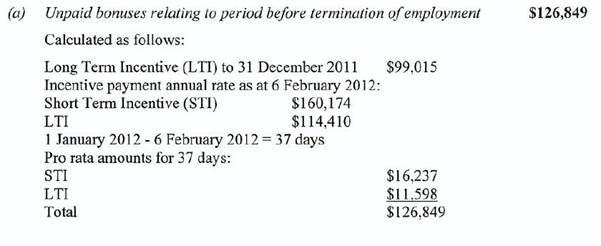
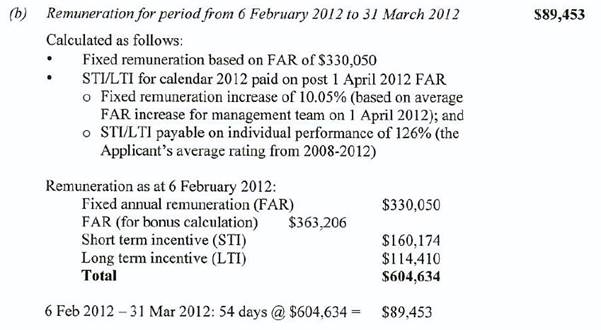
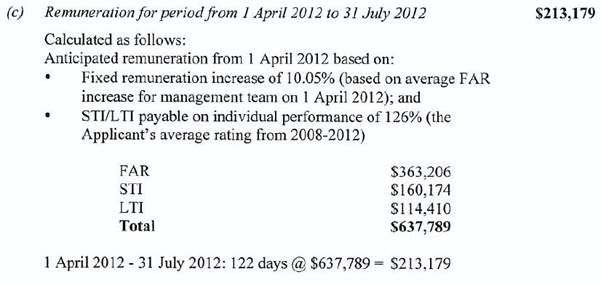
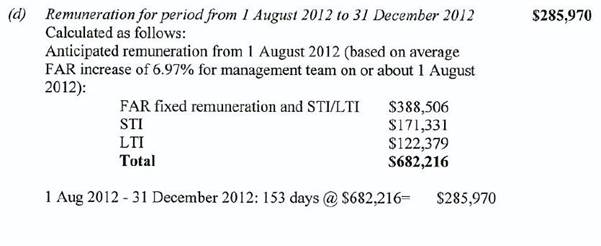
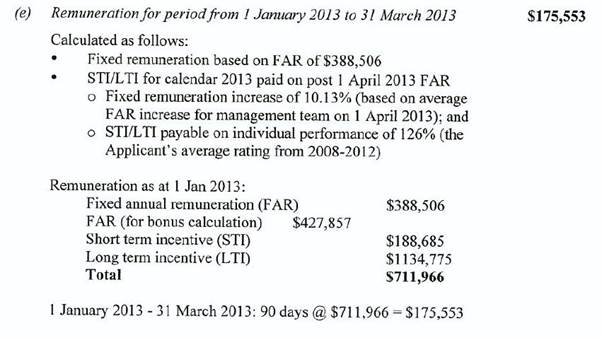
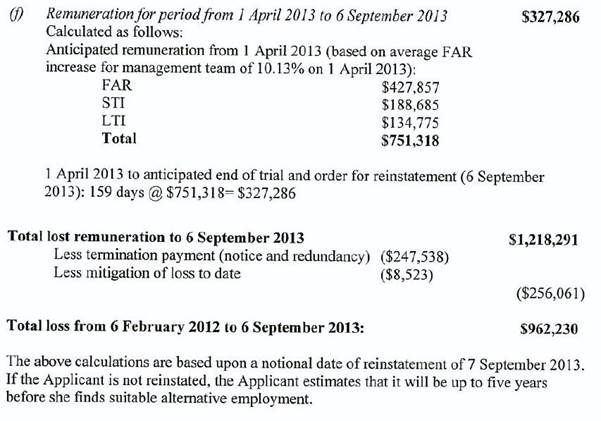
827 The applicant’s calculations were set out in more detail in a spreadsheet entitled “Particulars of Loss” (the “applicant’s spreadsheet”) where:
1. “FAR” stands for “fixed annual remuneration” or salary;
2. “LTI” stands for “long-term incentive” payment;
3. “STI” stands for “short-term incentive” payment and “AIP” was the former term for “short-term incentive” payment.
828 The applicant’s spreadsheet provided as follows:
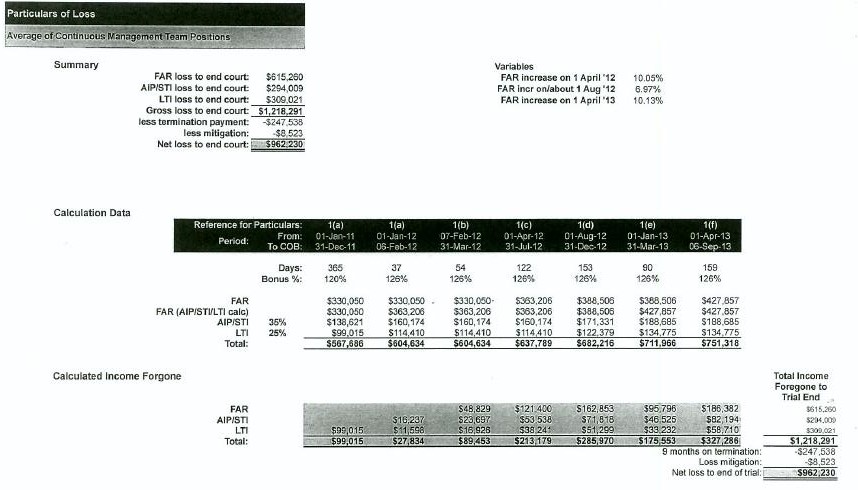
829 The applicant claimed a total net loss from 6 February 2012 to 6 September 2013 (then the projected end date of the trial) of $962,230 (which included a set-off of the termination payment of three months’ salary in lieu of notice, the redundancy payment of six months’ salary ($247,538) and took account of her mitigation ($8,523)).
830 The applicant submitted that if she were not reinstated, her loss would continue at the rate of $751,318 per annum (plus CPI increases) or, in the event of a public listing, $1,386,000 per annum (plus CPI increases) for five years or until she obtained suitable alternative employment. The applicant also claimed a one-off retention bonus of $308,000 if the respondent were listed.
831 The applicant calculated her future loss at $1,119,265 (7 September 2013 to 25 February 2015) plus $5,522,072 (25 February 2015 to 6 September 2018) (plus CPI increases) based on loss of remuneration for five years, three of which were at a rate of remuneration based on the respondent’s public listing. The calculations were as follows:
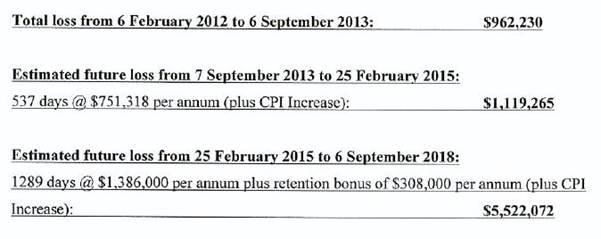
832 The applicant submitted that as the historical reluctance to order reinstatement of contracts involving personal service had been abrogated by s 545(2)(c) of the Act, there was no insurmountable obstacle of reinstatement in this case, particularly as Ms Shea testified that she was on good terms with two of the three directors on the respondent’s board, namely Messrs Merrick and Hutchison.
833 Further, the applicant submitted that unless she were reinstated, Mr McIndoe would “achieve his illegitimate and prohibited purpose”. Moreover, it could not be assumed that he would act in “spite or personal self-interest against the applicant … despite a court order, in the event she is reinstated”.
The respondent’s submissions
834 The respondent opposed the applicant’s reinstatement, contending that it was “entirely impracticable and unsustainable”, for the following reasons:
(a) the need for the CEO, Mr McIndoe to have complete confidence in Ms Shea;
(b) Mr McIndoe’s loss of confidence in Ms Shea;
(c) Ms Shea’s implicit concession that Mr McIndoe is no longer a person with whom she could work;
(d) Ms Shea’s attack on Mr McIndoe and other senior managers in the course of this litigation, in particular;
(i) the putting of very serious allegations to Mr McIndoe, despite the absence of any direct evidence of them being brought as part of her case;
(ii) the attack on the character of Mr Merrick in her supplementary outline of evidence;
(iii) her asserted reasons for Mr Purvis not taking any steps when she told him of the events in Hong Kong;
(e) the consequent interference with the ability of EnergyAustralia to have in place the structure its management regards as most appropriate going forward in the event of a listing on the stock exchange;
(f) the sound management justification for the decision to terminate Ms Shea’s employment …; and
(g) Ms Shea’s lack of appreciation of the seriousness of her conduct in sending the “JBF” email and other emails undermining members of the Executive Team and other senior managers at EnergyAustralia.
835 The respondent also submitted that there was no currently available position for the applicant within the company.
836 The respondent submitted that the applicant’s calculation of compensation was too high, as it included an additional increase in August 2012 and a yearly maximum short-term and long-term incentive payment, which were unwarranted. Further, the applicant’s calculation of future loss and damage was too high because it wrongly assumed that the company would be publicly listed by 2015 and assumed a period of five years’ unemployment, which was much too long.
837 The respondent submitted that any compensation should be calculated on the basis of the applicant’s remuneration package and adjusted to take account of any likely variations, to be assessed by reference to the remuneration for other senior executives set out in its “Direct Reports to Managing Director salary reviews conducted in conjunction with CLP” (the “respondent’s salary review document”).
838 The respondent’s salary review document provided:
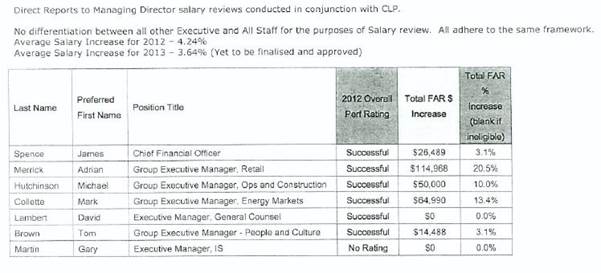
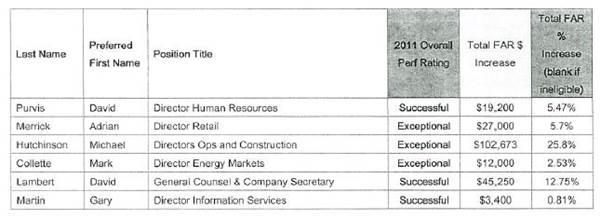
839 The respondent submitted that the percentage increases used in the applicant’s spreadsheet could not be reconciled with its tables.
840 The respondent submitted that the Court must take into account the likelihood that Ms Shea would secure alternative employment. It relied on Mr Farrow’s opinion that Ms Shea should have found alternative employment within about twelve months of her dismissal. The respondent submitted that as the payment Ms Shea received on termination covered a twelve month period, no compensation for future loss should be awarded.
841 The respondent submitted, based on Mr Farrow’s evidence, that Ms Shea had failed to take reasonable steps to mitigate, and any order should be adjusted appropriately.
842 The respondent also claimed set-off of Ms Shea’s severance payment upon termination against any award of compensation. It noted that Ms Shea’s statutory accrued leave entitlements, which were paid out upon her termination, would not have been paid had her employment not terminated on that date.
843 The respondent submitted that no compensation should be awarded for damage to the applicant’s reputation and damage by way of distress, anxiety and disappointment, as there was no evidence of Ms Shea’s reputation, reputational damage or medical evidence to support such claims.
844 Finally, the respondent submitted that the Court should exercise its discretion and consider the manner in which Ms Shea conducted her case, including “her conduct in securing the mobile phone and arranging for the report from Mr Caldwell to be prepared, and the baseless allegations against Mr McIndoe, Mr Purvis and Mr Merrick”.
845 The parties agreed that submissions as to penalty should await the publication of these reasons.
The legislation
846 Section 545 of the Act relevantly provides:
Federal Court and Federal Circuit Court
(1) The Federal Court or the Federal Circuit Court may make any order the court considers appropriate if the court is satisfied that a person has contravened, or proposes to contravene, a civil remedy provision.
…
(2) Without limiting subsection (1), orders the Federal Court or Federal Circuit Court may make include the following:
(a) an order granting an injunction, or interim injunction, to prevent, stop or remedy the effects of a contravention;
(b) an order awarding compensation for loss that a person has suffered because of the contravention;
(c) an order for reinstatement of a person.
847 Section 546 of the Act relevantly provides:
(1) The Federal Court, the Federal Circuit Court or an eligible State or Territory court may, on application, order a person to pay a pecuniary penalty that the court considers is appropriate if the court is satisfied that the person has contravened a civil remedy provision.
…
Determining the amount of the penalty
(2) The pecuniary penalty must not be more than:
…
(b) if the person is a body corporate – 5 times the maximum number of penalty units referred to in the relevant item in column 4 of the table in subsection 539(2).
Payment of the penalty
(3) The court may order that the pecuniary penalty, or a part of the penalty, be paid to:
(a) the Commonwealth; or
(b) a particular organisation; or
(c) a particular person.
848 Section 539(2) provides that the maximum penalty for the civil penalty provision s 340(1) is 60 penalty units.
849 Subsection 340(1) of the Act provides that the subsection is a civil remedy provision.
Reinstatement
850 As stated above, the applicant primarily sought reinstatement to her former position within the respondent.
851 Mr McIndoe testified that he found it “inconceivable that Ms Shea could come back to a role in EnergyAustralia” in light of the two year dispute, including the events leading up to Ms Shea’s return to work in October 2011 and, in particular, the litigation.
852 Mr McIndoe claimed that Ms Shea’s “claims and untruths” about him personally over the past two years had had an “extremely detrimental impact” on him and a “devastating impact” on his reputation.
853 Mr McIndoe testified that emails sent by Ms Shea while employed at the respondent referred to in paragraphs 114 to 115, 147 and 321 to 322 would have made him concerned and angry had he been aware of them at the time. Some emails showed “a complete disrespect for other people in the organisation and an attempt to undermine their authority”. They would have resulted in a dismissal had the conduct persisted.
854 Mr McIndoe testified that the email to Mr Markham dated 9 March 2011 in which Ms Shea referred to former Prime Minister Gillard as “a dog” was “appalling”, and had it become public, he “would have had no option but to terminate Ms Shea”.
The applicable principles and authorities
855 In Quinn v Overland (2010) 199 IR 40; [2010] FCA 799 (“Quinn”) at [97]–[98], Bromberg J observed that the historical reluctance to order specific performance of employment contracts had been modified by recognition of the realities of modern employment relations. His Honour stated at [98] that under modern statutory unfair dismissal regimes:
Dismissed employees are regularly reinstated into their former employments without apparent consequent difficulties. The long-standing nature of this remedy, and its acceptance as part of the industrial furniture, is a testament to the fact that as a matter of practice, a breakdown in confidence is not necessarily irreconcilable.
856 It is well established that reinstatement requires an employee to be restored to his or her former position with the same terms, conditions, benefits and work as were previously enjoyed: Blackadder v Ramsey Butchering Services Pty Ltd (2005) 221 CLR 539 at [14] per McHugh J, [33] per Kirby J, [43]–[44] per Hayne J and [75] per Callinan and Heydon JJ; Australian Postal Corporation v Stephens [2011] FCA 947 at [12] per Rares J.
857 In Perkins v Grace Worldwide (Aust) Pty Ltd (1997) IR 186 (“Perkins”) at 191, the Full Federal Court (Wilcox, Marshall and North JJ) observed that a loss of trust and confidence, if “soundly and rationally based”, is relevant to determining whether reinstatement is appropriate.
858 A breakdown in confidence between an employer and employee is not necessarily fatal to reinstatement if sufficient trust and confidence for the particular employment relationship can be restored: Australian Postal Corporation v Stephens [2011] FCA 947 at [13] per Rares J; Quinn at [97]–[98] per Bromberg J; Perkins at 191 per Wilcox CJ, Marshall and North JJ.
859 In National Tertiary Education Union v Royal Melbourne Institute of Technology [2013] FCA 451, Gray J ordered the respondent, RMIT, to reinstate the applicant, Professor Bessant, to her former academic position under s 545(2)(c) of the Act. His Honour found that RMIT had used its redundancy processes to rid itself of Professor Bessant, who was considered “troublesome”, in part at least because she exercised her workplace rights by making complaints about the behaviour of her immediate supervisor, Professor Hayward (at [141]).
860 Gray J observed that despite some difficulty in reinstating Professor Bessant, trust and confidence were not incapable of restoration. Professor Bessant’s performance was not criticised and her ultimate superior could still talk with her, although her relationship with her supervisor was unsustainable.
861 Gray J stated at [150]:
As I see the situation, it is necessary to choose between putting Professor Bessant back into a situation in which, if she should have dealings with Professor Hayward, those dealings are likely to be unworkable, and forcing RMIT to pay out a very large sum of money to compensate Professor Bessant for the likely consequences of her dismissal. In the circumstances, it seems to me that the first of these courses is the preferable one. Ordering that Professor Bessant be reinstated to the position she held immediately prior to her dismissal taking effect would mean that she would return to her research position in a building in which she was separated from Professor Hayward’s physical presence, and in which she would be insulated from any direct reporting to Professor Hayward by being able to report to Professor Siracusa. She would be able to engage in productive research, which would benefit both her and RMIT. Assuming that she were to remain in employment at RMIT for the next decade, the money spent by RMIT in employing her would be money that would produce a benefit to RMIT, in having Professor Bessant’s services, rather than money simply paid out to compensate her. Reinstatement appears to me to offer a more positive outcome for Professor Bessant and RMIT. If Professor Bessant decides to seek employment elsewhere, at least she will have the benefit of doing so while she is holding the position of a professor at RMIT, rather than being unemployed after dismissal.
Consideration
862 In my opinion, the trust and confidence necessary to the employment relationship between Ms Shea and the respondent has broken down and could not be sufficiently restored to permit her reinstatement.
863 Reinstatement would require the applicant to work in a comparable position to a member of the executive team, which would require her to work closely with the managing director, Mr McIndoe (who considered her return “inconceivable”) and other members of the executive team, including Mr Merrick.
864 This is not a case where, as in Perkins, an employer has accused an employee of misconduct which has not been upheld at trial. Rather, on my findings, the applicant has made many allegations of grave personal misconduct against the managing director and other members of the executive team, and staff namely Messrs Holmes, Purvis and Merrick and Ms Robertson. The applicant also alleged that the respondent’s culture was lewd, that it condoned serious sexual improprieties and that a number of its most senior executives colluded to subvert an investigation of her allegations. The allegations exposed the private concerns of a number of other employees or former employees. While Messrs Holmes and Purvis have left the respondent, the applicant’s accusations which, on the basis of evidence at trial, were not substantiated, would, in my view, render unsustainable her return to the workplace as a person in whom trust and confidence could be reposed. That conclusion is fortified by the evidence of a number of emails sent by Ms Shea, at least one of which, Mr McIndoe plausibly testified would have necessitated her dismissal had it become public.
865 I was also persuaded that Mr McIndoe justifiably lost a degree of confidence in Ms Shea as a result of her approach to her day spent in Sydney on 14 December 2011, which was not transparent, and due to the revelation that she was unknown to the shadow minister in a portfolio highly relevant to her job. Moreover, on the evidence, there is currently no appropriate comparable position available for Ms Shea.
866 Accordingly, in my view, reinstatement would be inappropriate.
Compensation for loss and damage
867 Ms Shea was unable to explain many of the calculations in the spreadsheet which Mr Carden principally prepared with her assistance.
868 Both parties relied on respondent’s salary review document, (extracted above at paragraph 838) but reached different conclusions.
869 The respondent’s salary review document set out the total fixed annual remuneration increase in dollars and in percentage for each of Mr McIndoe’s seven “direct reports” in 2012 and 2013. It stated that the “Average Salary Increase” was, in 2012, 4.24% and, in 2013, 3.64% (although the 2013 increases were yet to be finalised and approved). It did not state whether the average was for increases for the executives listed in the table or the entire company.
The fixed annual remuneration
870 The applicant’s spreadsheet set out her fixed annual remuneration for the period from 1 January 2011 to 6 September 2013 and the annual remuneration forgone. It concluded that Ms Shea’s total fixed annual remuneration forgone from the date of termination until the then-projected conclusion of the trial was $615,260.
871 Ms Shea initially testified that salary reviews occurred twice yearly but ultimately agreed that there was an annual pay increase, sometimes with other pay increases made on an ad hoc basis.
872 Mr McIndoe testified that increases in fixed annual remuneration occurred in April of each year for the succeeding 12 month period.
873 In her spreadsheet, Ms Shea allocated a 17% increase in 2012 (made up of two fixed annual remuneration increases) although the average increase shown in the respondent’s salary review document was only about 4%. She did not recall how she had arrived at the 17% figure.
874 Ms Shea allocated herself a 10% increase in 2013, while the average increase shown in the respondent’s salary review document was only 3.6%. She could not explain how she arrived at the figure, stating that it was an issue of “recollection” as opposed to “comprehension”.
875 In my opinion, the evidence did not establish a 17% average salary increase for 2012 or a 10% average salary increase for 2013 for executives comparable to Ms Shea. Any compensation for lost remuneration for those years should be calculated on the basis of the average increase for executives. While the averages shown in the respondent’s document are 4.24% and 3.64%, the more accurate calculation of averages for executives appears to be 7.2% and 8.8% respectively.
The short-term incentive payment
876 The applicant included a 35% short-term bonus (“AIP/STI”) for a calendar year based on her fixed annual remuneration arrived at on 1 April of that calendar year, adjusted for “the award that was given to [Ms Shea] for her own individual effort”.
877 Mr Carden calculated Ms Shea’s individual bonuses for the year in the first column of the table (1A) at 120%, as that was the amount she received upon termination. The applicant used the figure of 126% to calculate her projected short-term incentive payment, as the average of all the bonus payments she had received while at the company.
878 Mr McIndoe testified that annual bonuses were not paid at the increased rate of fixed annual remuneration but were paid in April and fixed in the previous month (and referable to the rate of fixed annual remuneration prior to any increase on 1 April). Mr McIndoe’s evidence was consistent with the terms of the respondent’s annual incentive plans, which were in evidence.
879 Mr McIndoe agreed that the short-term incentive for each of the executives in 2012 and 2013 was 35%.
880 Accordingly, 35% is an appropriate rate for the applicant’s short term incentive bonus for the years 2012 and 2013, which would be paid in April but calculated using the previous rate of the fixed annual remuneration.
The long-term incentive payment
881 The applicant claimed a long-term incentive payment (“LTI”) of 25%.
882 Mr Carden testified that he calculated the long term incentive figure based on a long-term incentive rate of 25% and a short term incentive rate of 120-126% and then multiplied 25% of the fixed annual remuneration by 120-126%.
883 He assumed, in the absence of any indication to the contrary, that short term and long term incentive payments were calculated in the same way.
884 The respondent tendered the company’s confidential “Rules of the 2012 EnergyAustralia Long-Term Incentive Plan” dated 8 October 2012 (and approved on 18 October 2012) and the “EnergyAustralia Long Term Incentive Plan for Group Executive Managers” dated March 2013 (and approved on 28 March 2013). Mr McIndoe agreed that the long-term incentive for each of the executives in 2012 and 2013 was 25%. Accordingly, I accept that a long term incentive payment of 25% would be appropriate for the years 2012 and 2013.
Compensation for future loss and damage for lost remuneration
885 The amounts claimed under this heading are set out at paragraph 831 above.
Compensation in the event of a public listing
886 The applicant calculated the sums applicable upon a public listing based on Mr Patullo’s expert reports dated 14 December 2012 and 28 May 2013 and his outline of evidence dated 27 June 2013.
887 The applicant submitted that the public listing of the respondent, originally scheduled for November 2012, was now scheduled for February 2015 at the latest.
888 In my opinion, as the respondent submitted, Mr Patullo’s evidence was of limited relevance as it was based on the assumption of the respondent’s public listing and a considerably higher net worth than the evidence established. Mr McIndoe testified that that he could not envisage a public listing taking place “in the near future [and] certainly not before 2015 or beyond”. The respondent submitted that the prospect of Ms Shea continuing her employment up to and beyond the public listing would be “so low as to be regarded as speculative” in reliance on Guthrie v News Limited (2010) 27 VR 196 at [167]-[168] and Lennon v State of South Australia [2010] SASC 272 at [689] per Layton J.
889 The respondent also submitted that it was unlikely that Ms Shea would have obtained the investor relations role and resultant greater remuneration, as the role was only necessary in the event of a public listing.
890 In my opinion, the evidence did not establish that the public listing of the respondent would probably occur by February 2015. Nor could it be assumed that the applicant would have remained in her position until a public listing with the consequent increase in remuneration or that she would have received higher remuneration for investor relations work. Accordingly, any compensation for future loss for lost remuneration should be calculated without reference to those circumstances.
Period of compensation for future loss and damage
891 The applicant contended that five years was “a reasonable and modest estimate of the likely time it would take her to obtain similar employment. In my opinion, five years is an unduly long period for the applicant, if taking appropriate steps, to remain without similar employment. On the other hand, taking into account the relatively limited number of similar positions and the impact of the proceeding, one year seemed unrealistic, even if the applicant had taken the steps advocated by Mr Farrow. Accordingly, in my view, a period in the order of two years would be appropriate.
Set-off
892 The respondent submitted, and I accept, that it would be entitled to set-off the payment to Ms Shea on termination of her employment of $455,549.58, which included:
(a) her salary ($1,154.01) and bonus payment ($134,448.00);
(b) her statutory leave entitlements ($69,347.74); and
(c) three months’ pay in lieu of notice ($82,512.50) and six months’ redundancy pay ($165,025.00), the total of which was $247,537.50 (Severance Payment).
893 The respondent noted that Ms Shea was paid her statutory accrued leave entitlements only because her employment was terminated, so the payment should be off-set against any award of compensation made by the Court. The respondent relied on Quinn v Jack Chia (Australia) Ltd [1992] 1 VR 567 at [40] and Macauslane v Fisher and Paykel Finance Pty Ltd [2003] 1 Qd R 503 at [31] (“Macauslane”), which indicate that where an employee has not received the required notice prior to termination, accrued leave entitlements will be included in the damages rather than a separate, additional, entitlement and, accordingly, any lump sum payment for accrued leave made upon termination would be set-off against the award of damages. Holmes J (with whom McMurdo P and White J agreed) observed that leave entitlements in that case “should not be regarded as constituting an additional benefit lost” because the employer “would have been within its rights to require the [employee] to exhaust his leave entitlements as part of the [requisite] period of notice” (Macauslane at [31]).
894 Whether accrued leave would to be incorporated within the period of time for which compensatory damages were awarded to Ms Shea (if any such damages were awarded) would depend upon the contractual arrangements between Ms Shea and the respondent and other matters not in evidence.
Mitigation
895 The respondent submitted that Ms Shea had failed to take reasonable steps to mitigate, as she had not approached the major recruitment agencies, or (save for Santos) the top ASX 100 companies. It submitted that Ms Shea was waiting for the litigation to end before finding alternative employment.
896 Ms Shea testified that she has made “enormous effort to find a job”. Her document entitled the “Applicant’s efforts to find employment” stated:
I have made every effort to restore my earnings level through a range of activities including:
• meeting with recruitment agents and others in my network
• checking the advertisements in Friday’s Australian Financial Review
• establishing a business and seeking work advising the corporate sector in Melbourne, Sydney and Brisbane.
897 The document set out in a table the meetings and work she had undertaken.
898 Ms Shea testified that the document set out all her efforts to find employment since 6 February 2012. She testified that she established her own consulting company, Avvisi Proprietary Limited, dealing with corporate affairs and government relations soon after her employment was terminated. Ms Shea stated that she chose consultancy work because she was “concerned about the impact of this legal action on [her] career and [she] wanted to have as [sic] many options to find other employment”.
899 The applicant’s consultancy business rendered total invoices of only about $8,000. While that sum apparently represented about two to three days’ work, she explained that it was also necessary to quote for projects and to underestimate the time required, in order to obtain the work and prove her worth.
900 In cross-examination, Ms Shea conceded that “largely” all her direct contact with corporations, as listed in the table, related to her consultancy business and that 90% of the table related to consultancy work.
901 Ms Shea testified that she had made direct approaches to 17 mining companies which were not top 100 companies largely for consultancy work, with the view to obtaining employment. She stated that she was advised to do consultancy work and mitigate her losses in the interim because it would be difficult for her to obtain employment until the litigation was over. Ms Shea testified that she was approached by a head-hunter in relation to a role at Santos in South Australia, but the company took the negotiations no further after her case received publicity. Accordingly, Ms Shea approached very few large corporations and had only made one direct approach to an ASX top 100 or 150 company (namely Bluescope).
902 Ms Shea did not take up the respondent’s offer of assistance in finding employment from Mr Farrow’s firm, Heidrick & Struggles. She testified that she did not believe it would act in her best interests, as it had placed the respondent’s board and Mr Holmes, and Mr Farrow was a close associate of Mr McIndoe.
903 In his expert report dated 3 April 2013, Mr Farrow opined:
On average, our executive search process takes approximately 90 days to complete from start to finish.
If Ms Shea had registered her interest with the five major global executive search firms and with any relevant boutique firms, she should have been actively engaged as a highly considered candidate with regards to several comparable employment opportunities within 3-6 months.
Allowing 90 days to conclude a search process and considering the time between the acceptance of an offer and commencing employment, this should have resulted in an appointment within 12 months.
904 Mr Farrow stated that he would expect someone in Ms Shea’s position to take the following steps to secure comparable employment:
1. Contact each of the 5 major Executive search firms in Australia – including, but not limited to Heidrick & Struggles, Korn Ferry, Spencer Stuart, Egon Zehnder and Russell Reynolds, and register Ms Shea’s candidacy as an active job seeker.
2. Contact local and/ or specialist boutique search firms, dictated by geographic presence (eg Cordner King in Melbourne) or industry function and formally submit an application as an active job seeker.
3. Map out companies and target specific organisations Ms Shea would be interested working for and then identify key people within these organisations. Demonstrate genuine interest and personally make contact with the relevant people within these organisations (via phone, email or letter), seeking out potential job vacancies and building her own brand.
4. Utilise any outsourcing services provided by EnergyAustralia to help position herself in the market and tailor her CV accordingly.
5. Make use of any resources Ms Shea’s former employer’s offer, for example reaching out to former colleagues at John Connolly & Partners (Public & Corporate Affairs Consultancy) and/ or Orica.
6. Build an online profile via tools such as LinkedIn to help build Ms Shea’s professional network, ensuring her profile is up to date and accurate.
905 Mr Farrow thought that litigation had its principal impact on a participant’s employability during the hearing of the case and would be less important during the 18 months to two years leading up to the trial.
906 Many of the measures identified by Mr Farrow were reasonable and readily achievable steps which Ms Shea failed to take. Moreover, rather than actively seeking alternative employment, she focussed on setting up her own home-based consultancy business, which earned only about $8,000. While the pendency of the litigation was, in my view, a greater impediment than Mr Farrow allowed, I was not persuaded that the consultancy endeavour was equivalent to a committed search for alternative employment.
907 Accordingly, any order for compensation should be adjusted in order to reflect Ms Shea’s failure properly to mitigate her loss.
Conclusion
908 In my opinion, the application should be dismissed.
| I certify that the preceding nine hundred and eight (908) numbered paragraphs are a true copy of the Reasons for Judgment herein of the Honourable Justice Dodds-Streeton. |
Associate:
ANNEXURE A