FEDERAL COURT OF AUSTRALIA
Griffiths v Northern Territory of Australia [2014] FCA 256
|
IN THE FEDERAL COURT OF AUSTRALIA |
|
|
ALAN GRIFFITHS AND LORRAINE JONES ON BEHALF OF THE NGALIWURRI AND NUNGALI PEOPLES Applicant | |
|
AND: |
NORTHERN TERRITORY OF AUSTRALIA Respondent |
|
DATE OF ORDER: |
|
|
WHERE MADE: |
THE COURT ORDERS THAT:
1. The parties to within 21 days bring in minutes of order to give effect to these reasons for judgment.
Note: Entry of orders is dealt with in Rule 39.32 of the Federal Court Rules 2011.
|
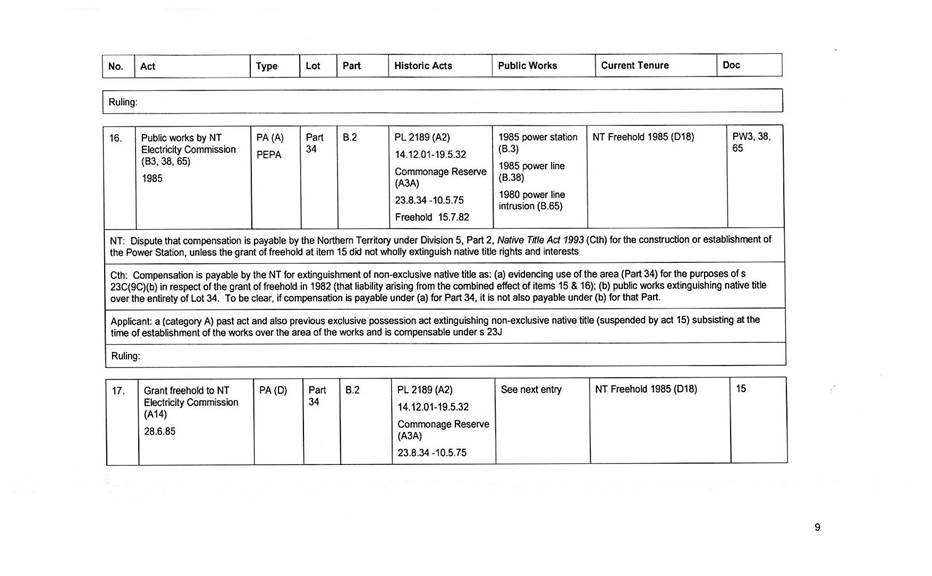
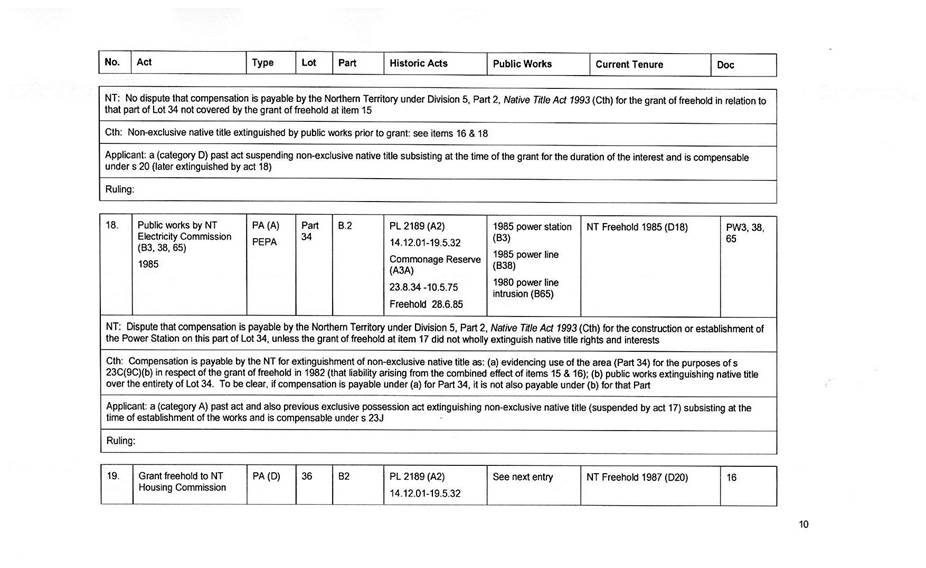
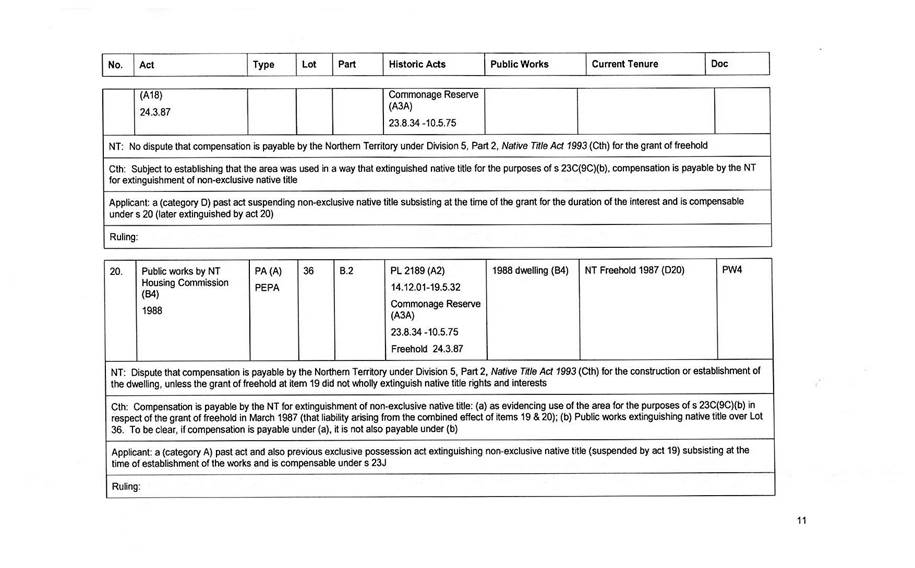
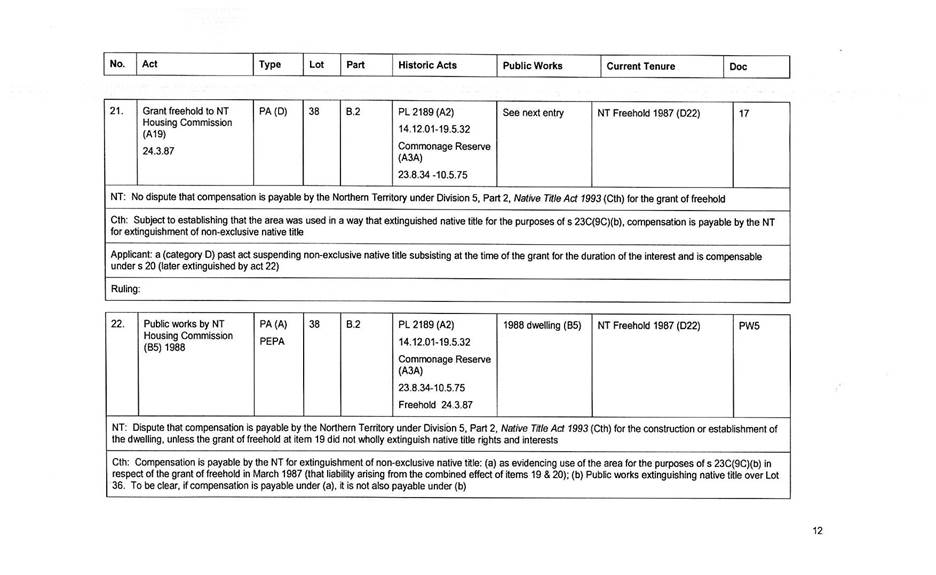
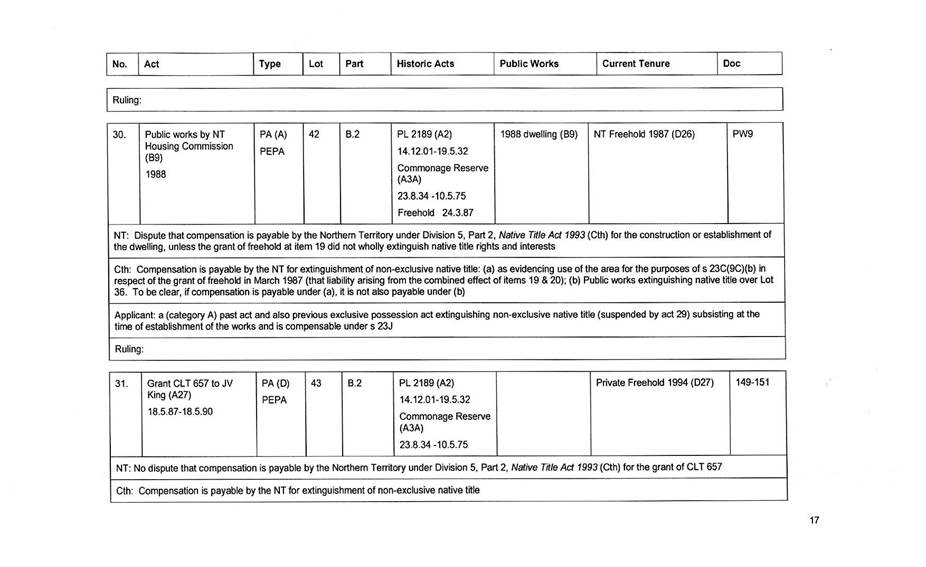
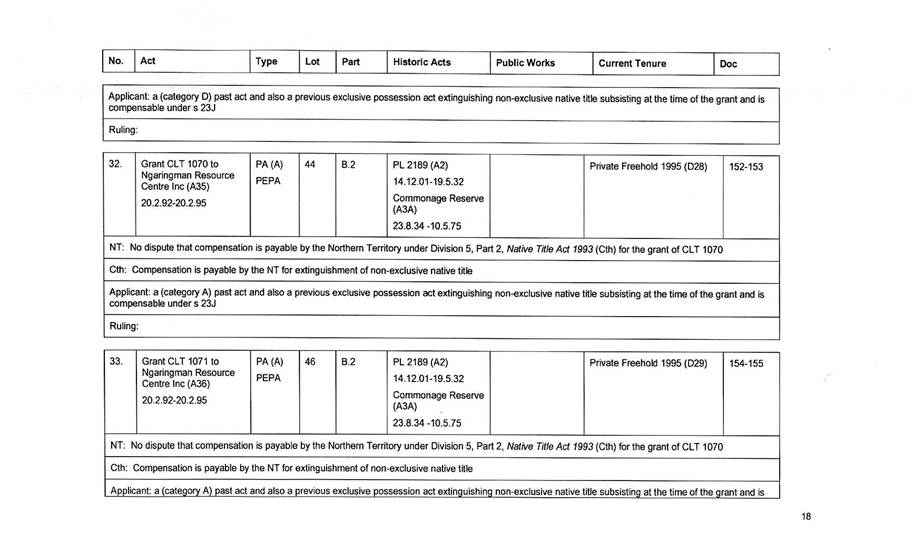
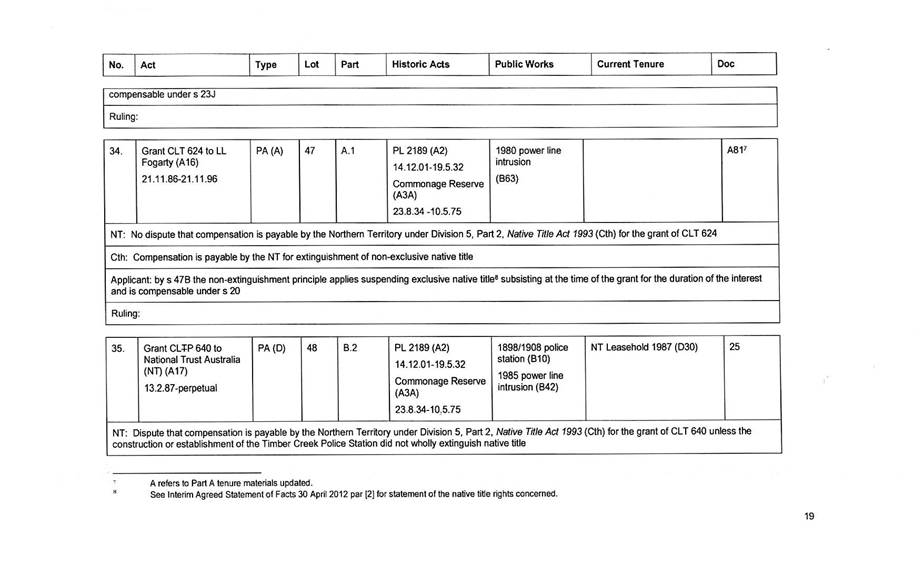
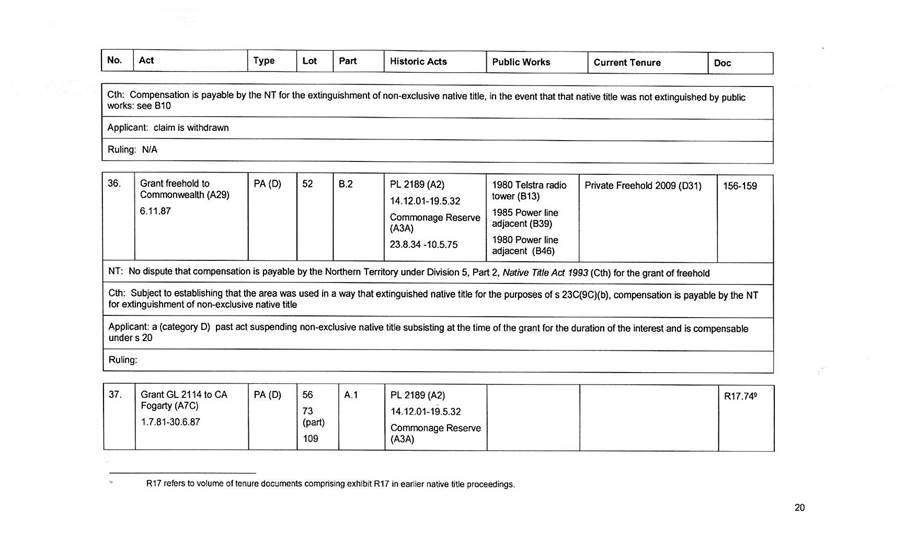
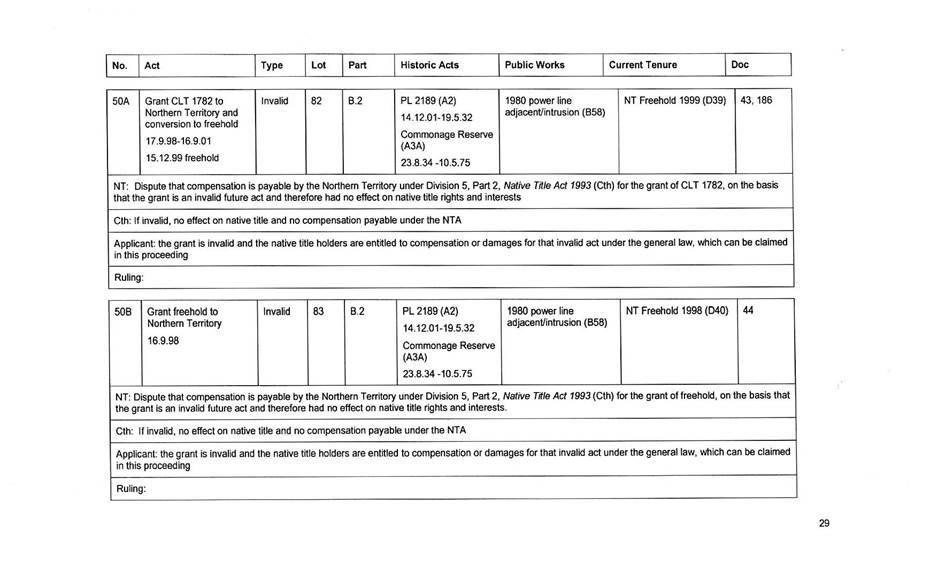
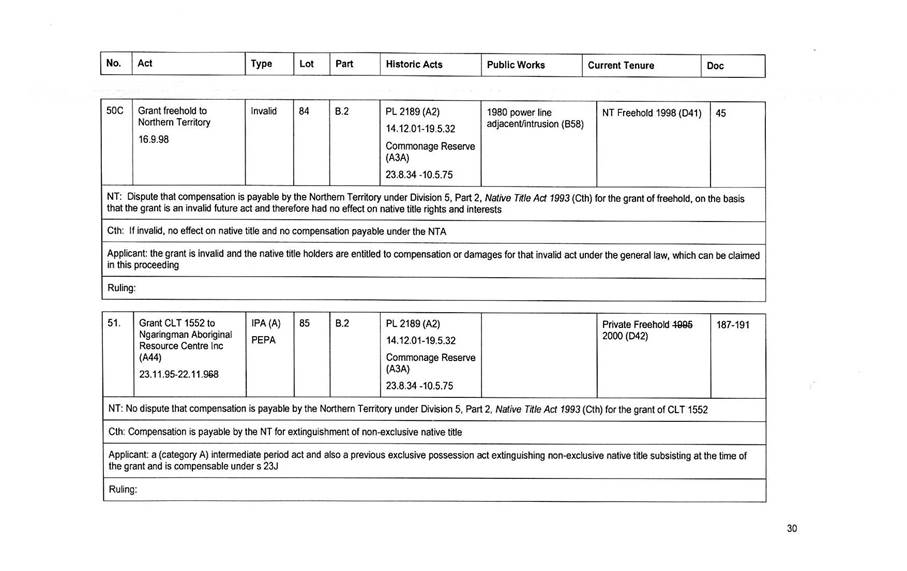
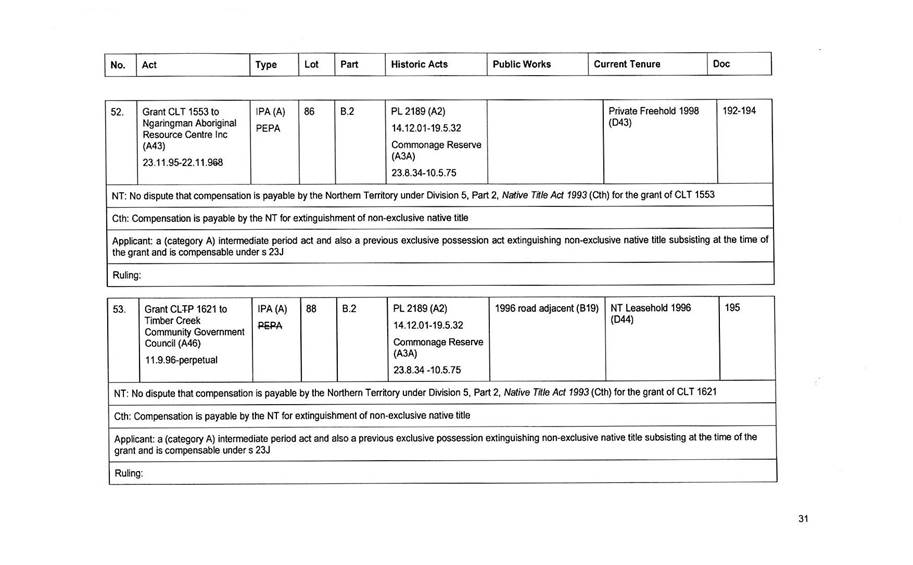
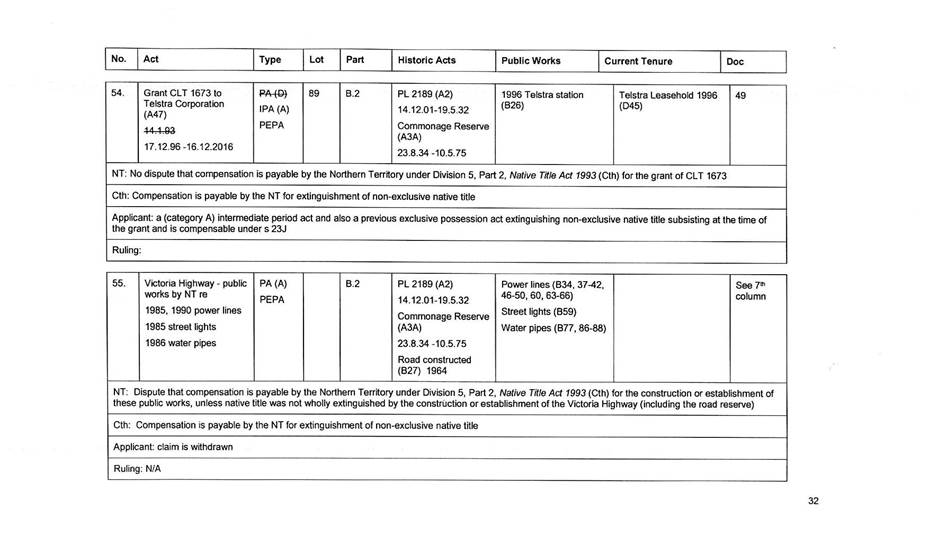
NORTHERN TERRITORY DISTRICT REGISTRY |
|
|
GENERAL DIVISION |
NTD 18 of 2011 |
|
BETWEEN: |
ALAN GRIFFITHS AND LORRAINE JONES ON BEHALF OF THE NGALIWURRI AND NUNGALI PEOPLES Applicant |
|
AND: |
NORTHERN TERRITORY OF AUSTRALIA First Respondent |
|
JUDGE: |
MANSFIELD J |
|
DATE: |
19 MARCH 2014 |
|
PLACE: |
ADELAIDE (VIA VIDEO LINK TO DARWIN) |
REASONS FOR JUDGMENT
INTRODUCTION
1 Timber Creek is a small township in the north-western section of the Northern Territory. It is on the south bank of the Victoria Highway, about half-way between Katherine and Kunanurra.
2 On 17 July 2006, a judge of the Court gave judgment on three claims for the recognition of native title over parts of Timber Creek on claims by Alan Griffiths or by Mr Griffiths and William Gulwin on behalf of the Ngaliwurru and Nungali Peoples: Griffiths v Northern Territory (2007) 165 FCR 300 (Griffiths SJ). The three applications were heard together. The three applications concerned Lot 47, Lots 97-100, and Lot 109, and secondly Lot 114, and thirdly a number of other lots in the township together with the waterway of Timber Creek running to the south of the Victoria River including its beds and banks and land covered by Special Purpose Lease 00494 to the Conservation Land Corporation.
3 The Court found that the Ngaliwurru and Nungali Peoples had established that they had native title rights and interests in the claim areas, but that those rights and interests did not include exclusive rights to possession, occupation use and enjoyment of the land.
4 On 26 August 2006, orders were made to give effect to the judgment. The Determination thereby recognised that native title rights and interests first over Lots 1-9, 33, 35, 37, 47, 56, 57, 65-74, 80, 87 and 97-114 and secondly over Timber Creek including its beds and banks as it flows through the township. It also determined that Lots 16, 22 and 49 are the subject of a previous exclusive possession act under s 23B of the Native Title Act 1993 (Cth) (the NT Act) and as such acts were expressly excluded from the area covered by the application itself, they were not part of the determination area.
5 There was an appeal from that decision by the applicants, asserting that the rights recognised were exclusive rights. There was also a cross-appeal by the present respondent, the Northern Territory challenging the finding that the rights found were traditional and contending that no favourable determination should have been made. The Territory also contended that the finding that s 47B of the NT Act applied to land within the Timber Creek township so that prior extinguishing acts affecting that land could be disregarded was erroneous. The Full Court (French, Branson and Sundberg JJ) gave judgment on 22 November 2007: Griffiths v Northern Territory (2007) 165 FCR 391 (Griffiths FC). The appeal was successful. The Full Court decided that the applicants (then the appellants) had possession, occupation, use and enjoyment of the lots in the first part of the determination area (that is, other than the Timber Creek itself and its beds and banks) to the exclusion of all others. The determination with respect to Timber Creek and its beds and banks was not altered. The cross-appeal was dismissed.
6 This application follows from the determination of native title rights and interests made in Griffiths SJ and as varied in Griffiths FC (the Griffiths orders). It is an application for compensation within s 61(1) made pursuant to s 50(2) of the NT Act.
7 Section 50 of the NT Act empowers the Court, on an application under s 61 by persons authorised by the claim group, to determine the compensation payable in the particular circumstances. Section 51 specifies the criteria for determining compensation, provided the entitlement to compensation exists. What is in issue, at present is whether there is an entitlement to compensation in respect of the areas the subject of this application.
8 The entitlement to compensation may arise under any one of Divisions 2, 2A, 2B, 3 or 4 of Part 2 of the NT Act read together with the Validation (Native Title) Act (NT) (the VNT Act). Division 2 of the NT Act provides for validation of past acts as defined in s 228 that took place before 1 January 1994 and which would otherwise be invalid because of native title. If the past act is attributable to the Commonwealth, s 17 provides the entitlement to compensation. If the past Act is attributable to a State or Territory, relevantly the Territory, s 20 provides the entitlement to compensation. Division 2A provides for validation of intermediate period acts as defined in s 232A, which took place between 1 January 1994 and 23 December 1996. If the intermediate act is attributable to the Commonwealth, s 22D provides the entitlement to compensation, and if it is attributable to a State or Territory, s 22G makes that provision. Division 2B provides for the confirmation of past extinguishment of native title by certain valid or validated acts on or before 23 December 1996, either by previous exclusive possession acts defined in s 23B or by previous non-exclusive possession acts defined in s 23F. They may be acts of the Commonwealth, or of a State or Territory which has passed parallel legislation: s 23I. The entitlement to compensation is provided for in s 23J.
9 Division 3 deals with future acts defined in s 233.
10 Division 4 refers to “Other provisions relating to native title”. Relevantly for present purposes, s 45 provides that if the Racial Discrimination Act 1975 (Cth) (the RDA) has the effect that compensation is payable to native title holders in respect of an act that validly affects native title to any extent, the compensation, insofar as it relates to the effect on native title, is to be determined in accordance with s 50 as if the entitlement arose under the NT Act.
11 The Compensation Application concerns an area wider than the Determination.
12 The Compensation Application covers firstly the areas where native title was found to exist and to be exclusive of other interests because s 47B applies to those areas (Part A.1) and separately to the other areas where native title was found to exist but because s 47B did not apply those areas were not held exclusively of other interests (Part A.2). Secondly, the Compensation Application covers the other specified areas within the township of Timber Creek where there has been no determination that native title exists.
13 The lots numbered 16, 22 and 49 recorded in the Griffiths Determination as being the subject of previous exclusive possession acts under s 23B of the NT Act which were expressly excluded from the area covered by the Determination are called the Part B.1 area.
14 All other land and waters within the boundaries of the Town of Timber Creek as notified in Northern Territory Government Gazette No 24 dated 20 June 1975 are called the Part B.2 area.
15 In broad terms, compensation is claimed for acts attributable to the Territory occurring after the commencement of the RDA on 31 October 1975 that have extinguished native title in the Part B area, where native title no longer exists, and for acts that have impaired or suspended native title in the Part A areas where native title still exists.
THE AGREED STARTING POINT
16 As a starting point, for the purposes of this application, the parties agree that native title existed in relation to the application area at the time of the act or acts for which compensation is claimed, and that where the native title had not been wholly or partially extinguished by an earlier act, those existing native title rights and interests were held to the exclusion of all others. There is also agreement, where there had been partial extinguishment of native title rights and interests by an earlier act or acts, as to the nature of the non-exclusive native title rights which existed to the time of the relevant extinguishing act or acts said to give rise to the compensatable extinguishment. There is also agreement as to who are the persons who held the native title rights said to have been extinguished.
17 The parties also reached some agreement about the acts which have or may have affected or extinguished native title, the extent to which those acts may have affected or extinguished native title, and the date on which those acts affected native title. That is recorded in a Schedule A of the Compensation Application dealing with acts that affected native title other than Public Works, and separately in a Schedule B dealing with the Public Works that affected native title, identify both the extent of agreement and – in respect of disputed matters – the respective positions of the parties. Separate Schedules C and D respectively record the Territory’s position on the status of the areas in issue for the purposes of ss 47A and 47B of the NT Act and the applicant’s response, and on the nature and extent of non-native title rights and interests and the applicant’s response. Those materials were amended and refined to some degree over time, and supplemented by comments from the Commonwealth. Those materials, and the primary documents underlying them, are extensive.
18 Ultimately, the documents identifying the disputed issues were found in:
(1) the applicant’s Amended Particulars of Acts that Affected Native Title for which Compensation is Claimed, filed on 17 October 2012 and the Table which was attached (which also referred back to the documents referred to in the preceding paragraph);
(2) the Territory’s Further Amended Notice in Response to the Amended Particulars referred to in (1) above, by comments made on the Table A;
(3) the Interim Statement of Agreed Facts of 30 April 2012; and
(4) the Second Statement of Agreed Facts of 7 August 2012, and is Schedules A, B, C and D.
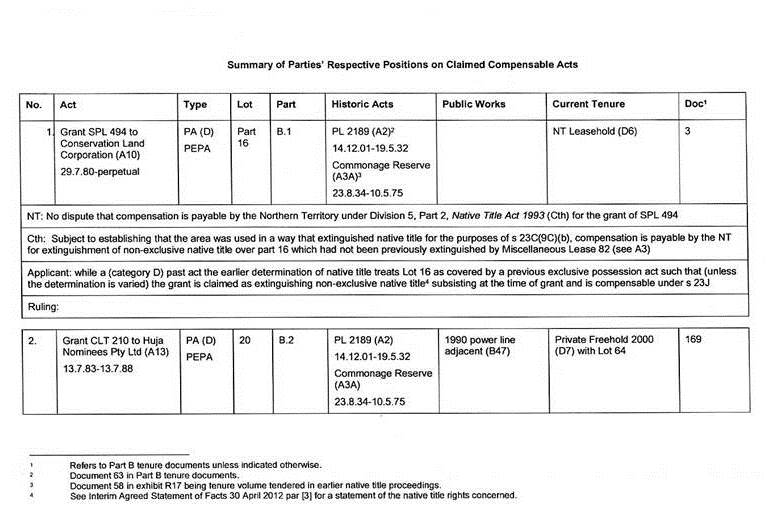
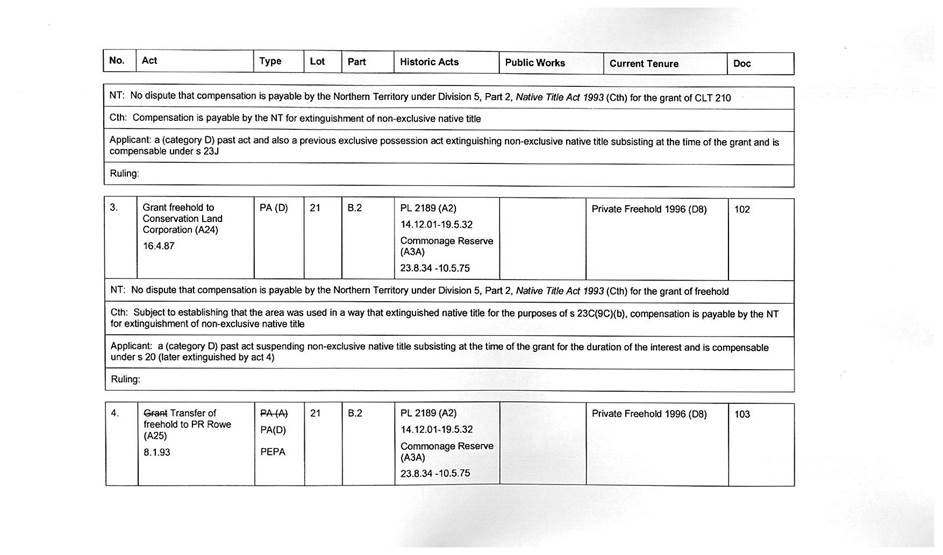
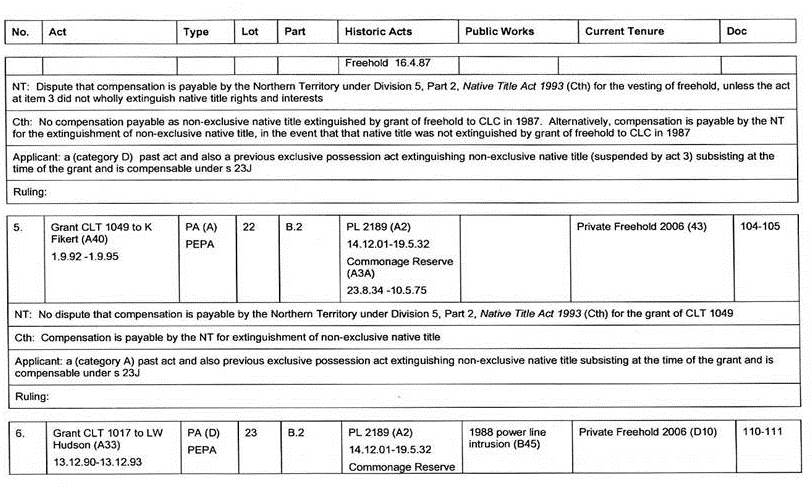
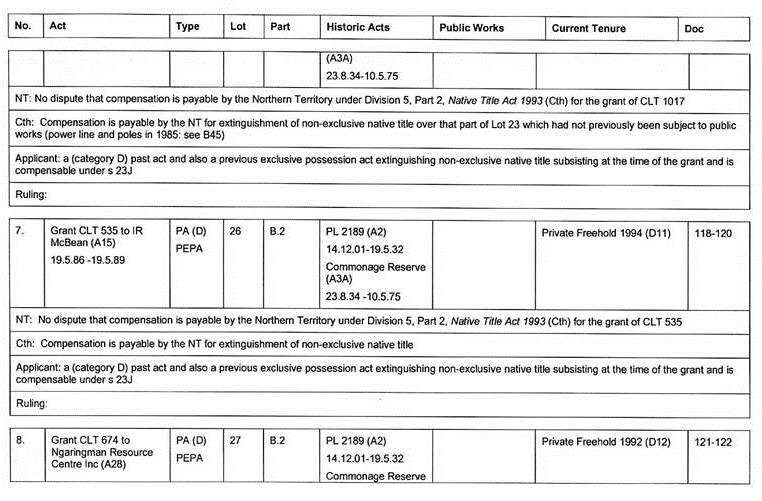
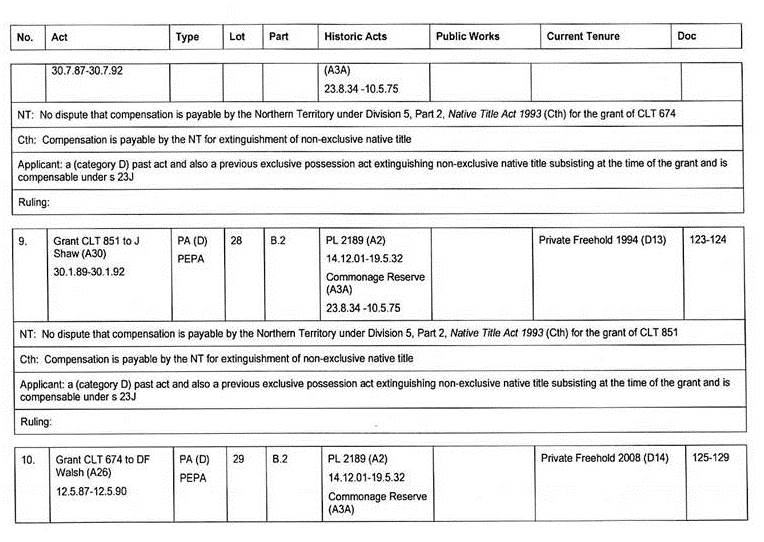
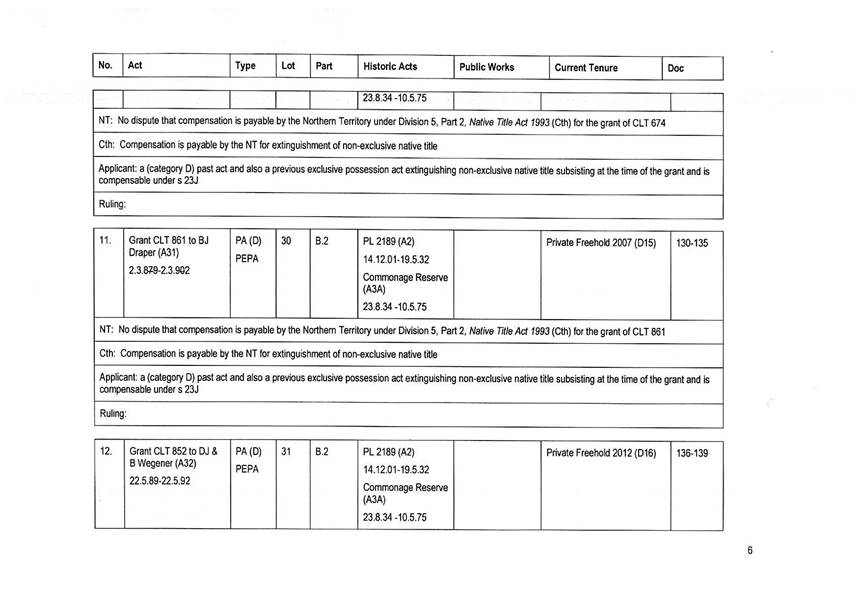
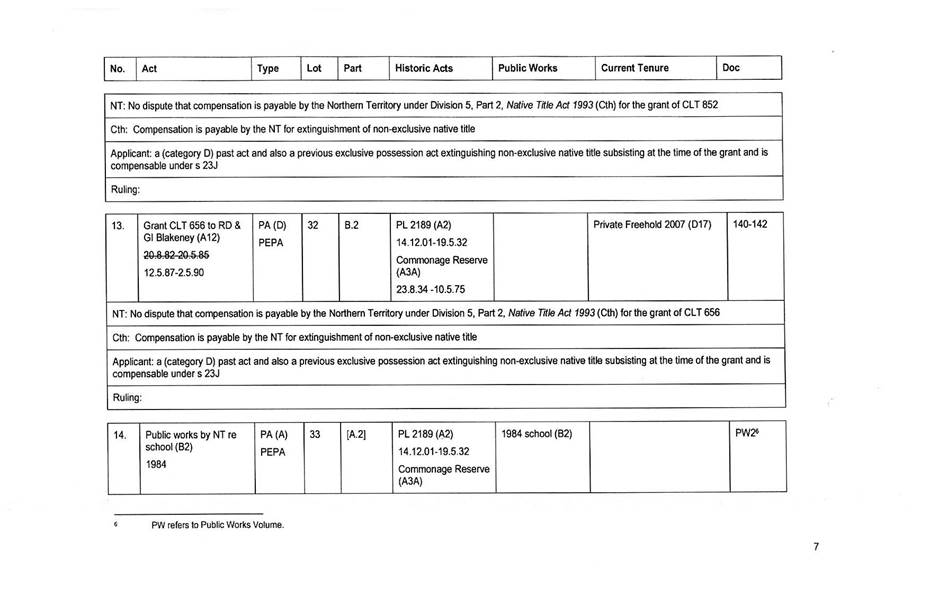
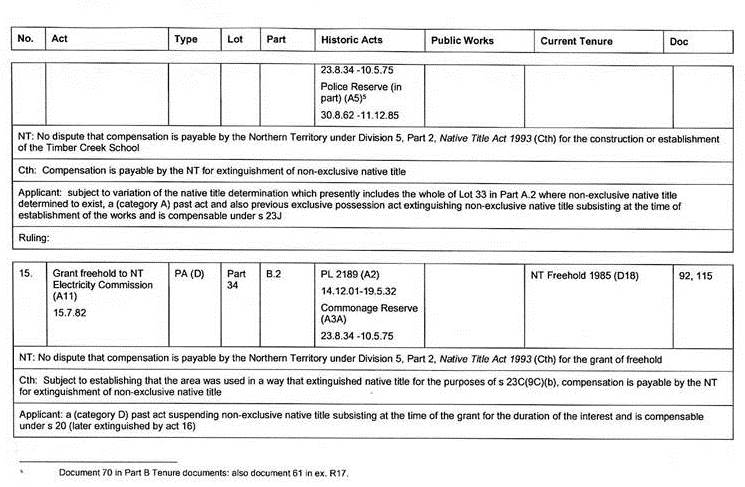
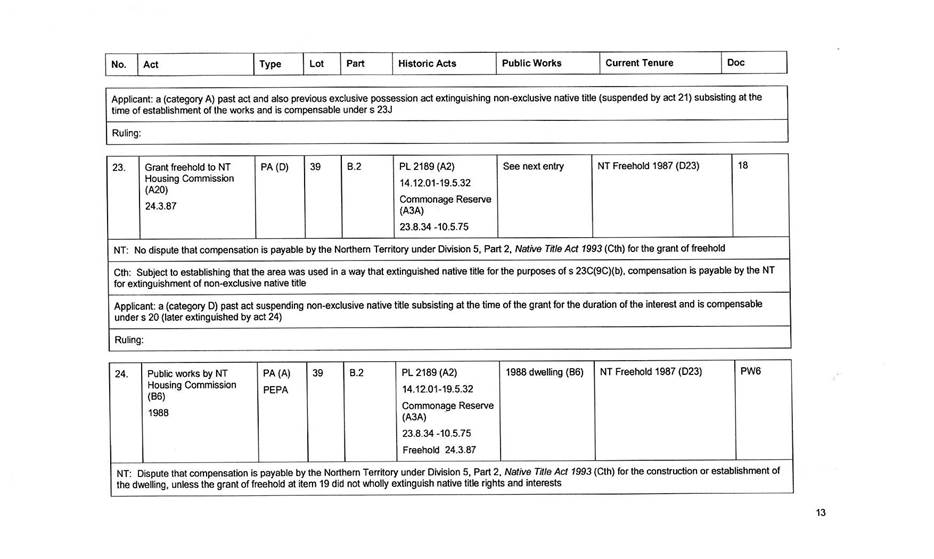
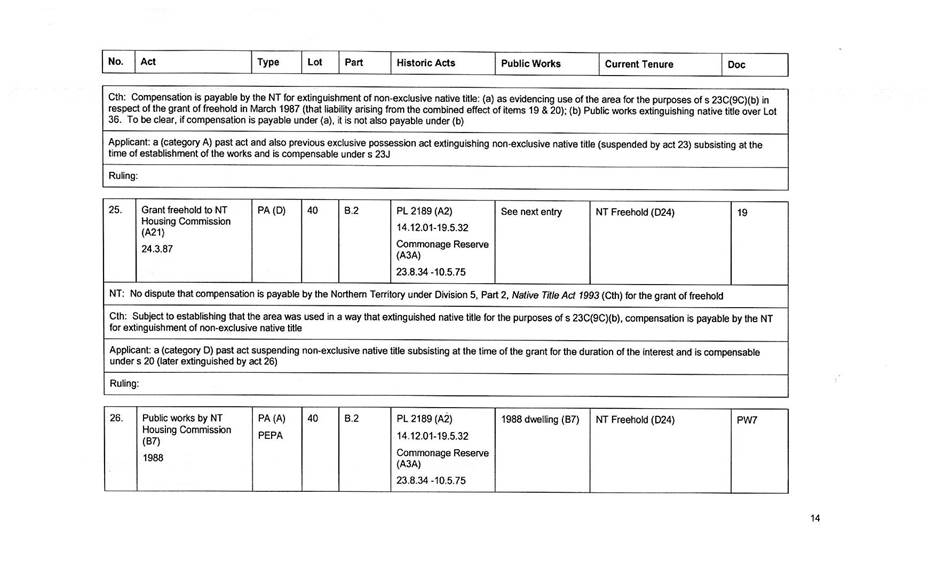
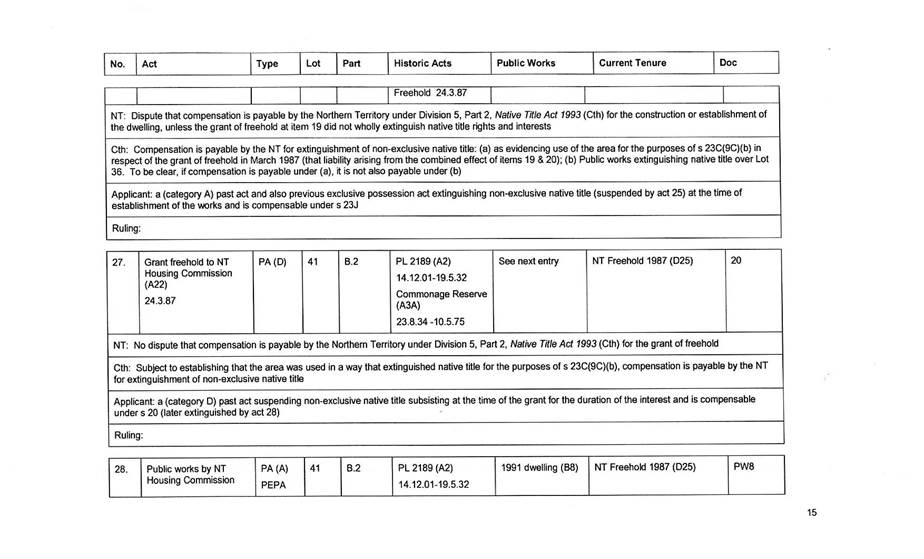
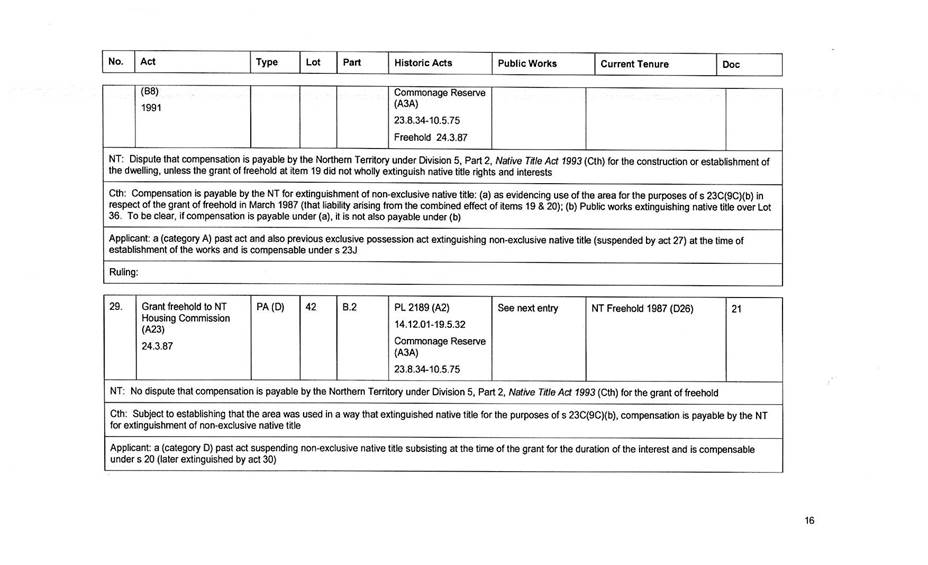
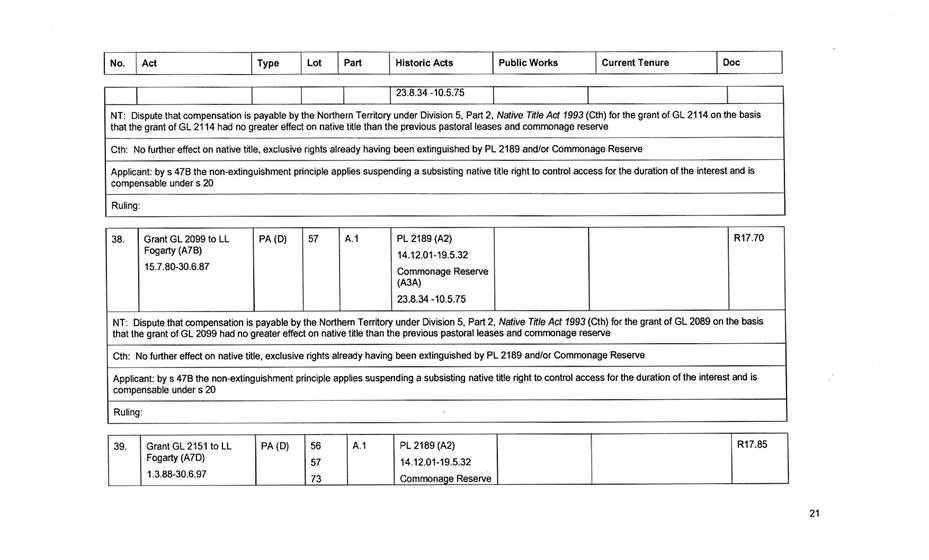
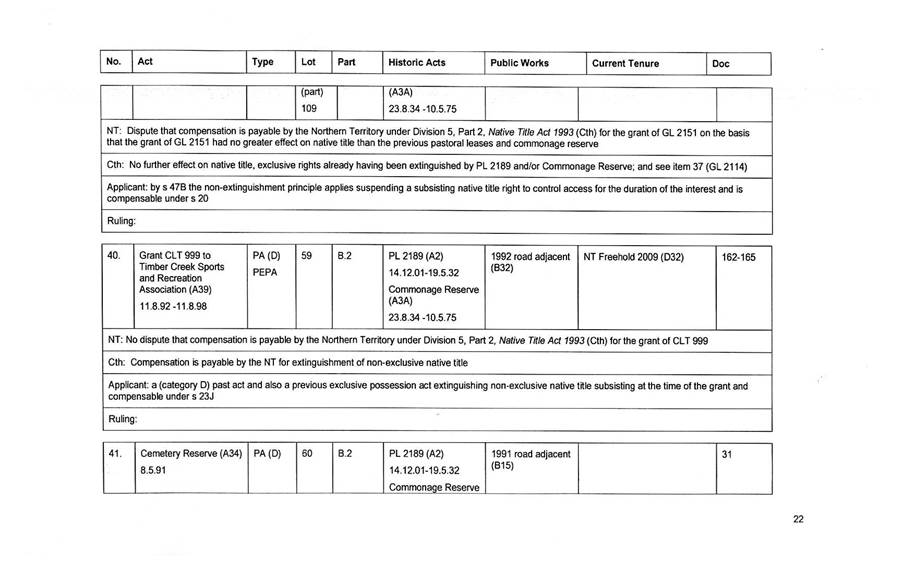
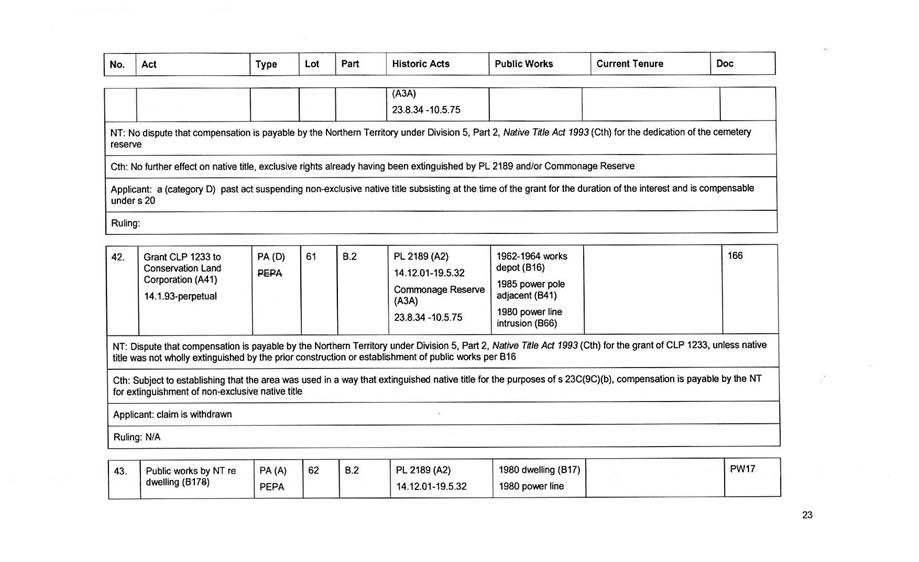
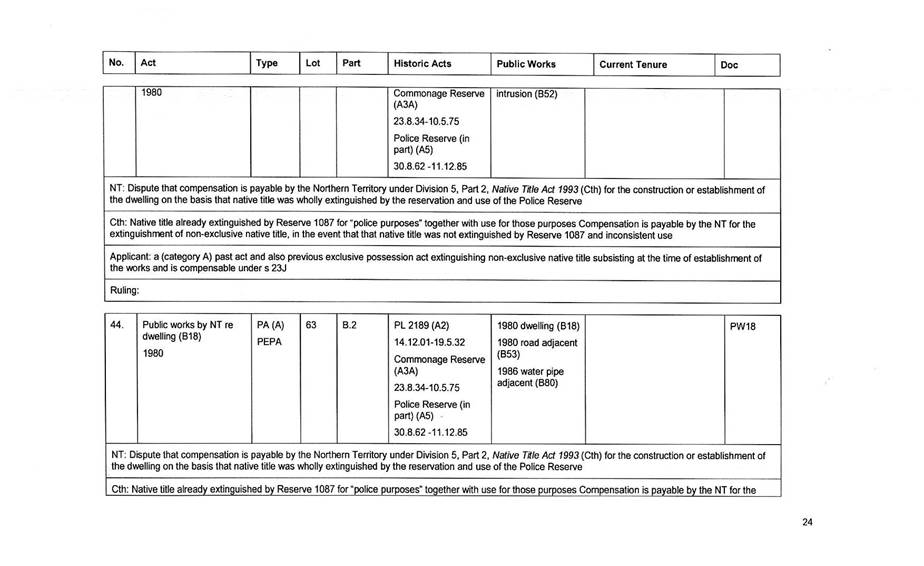
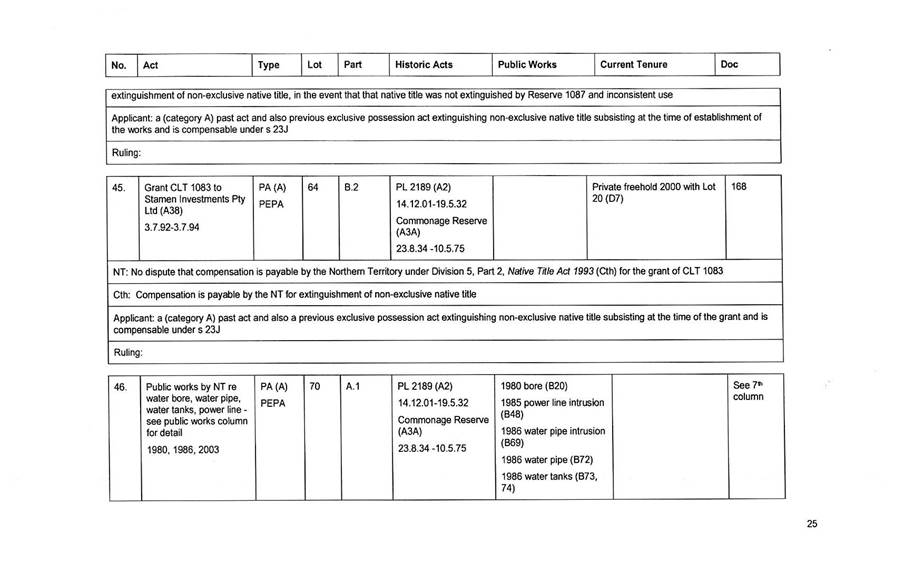
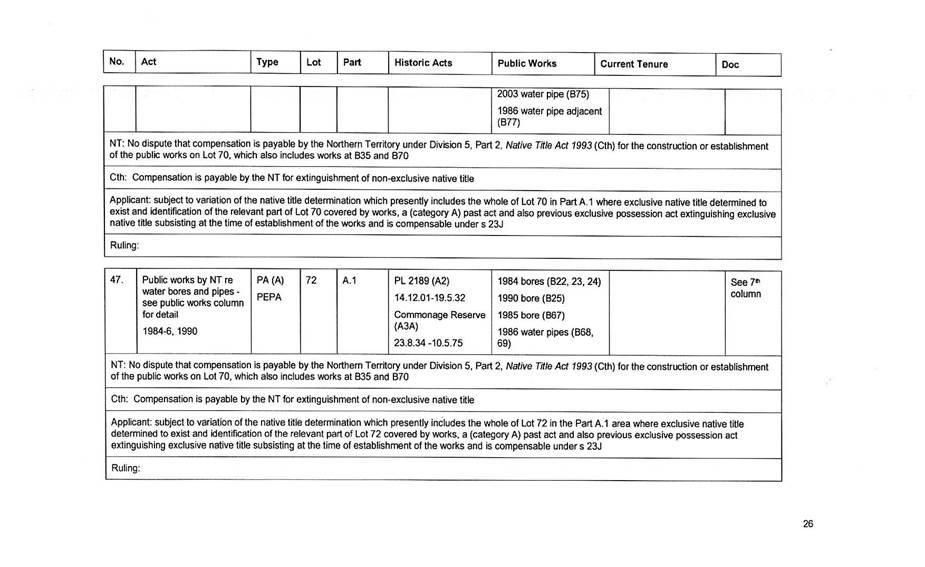
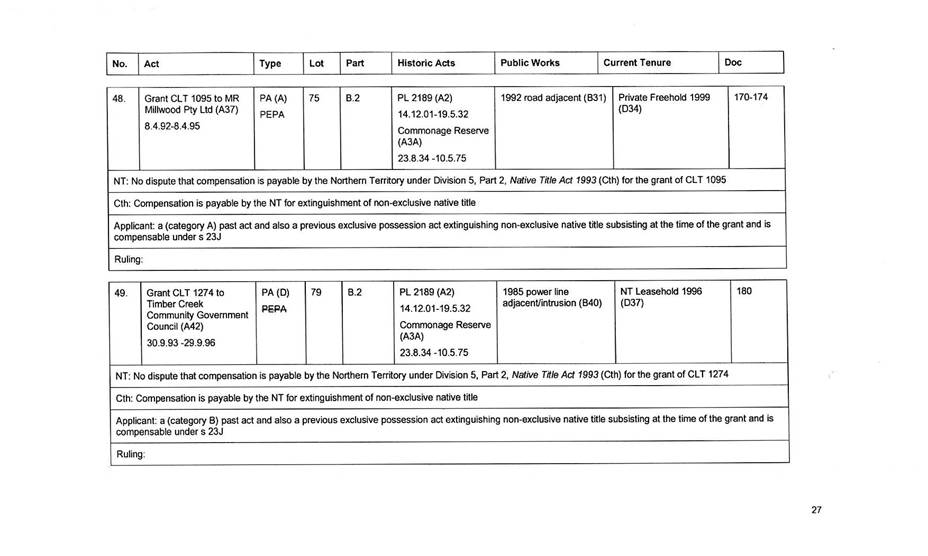
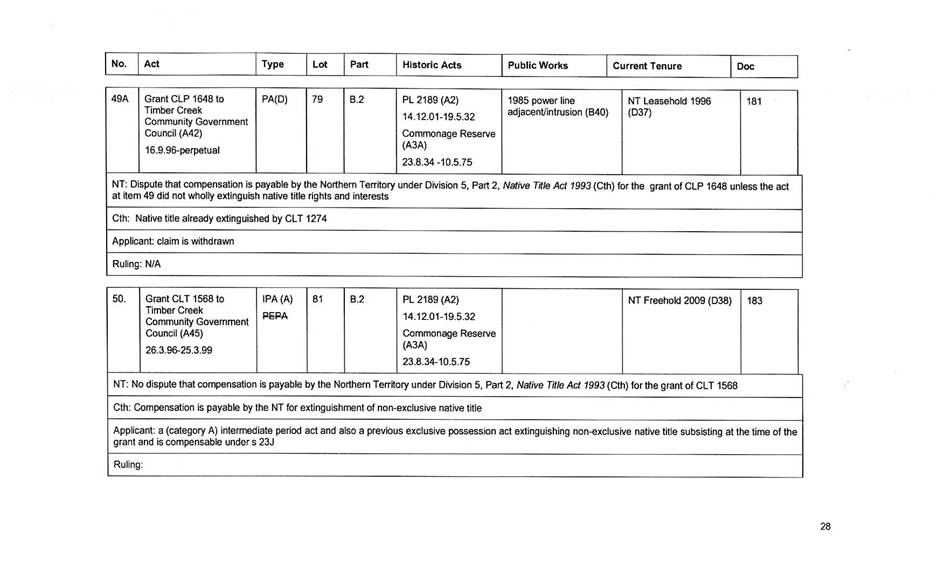
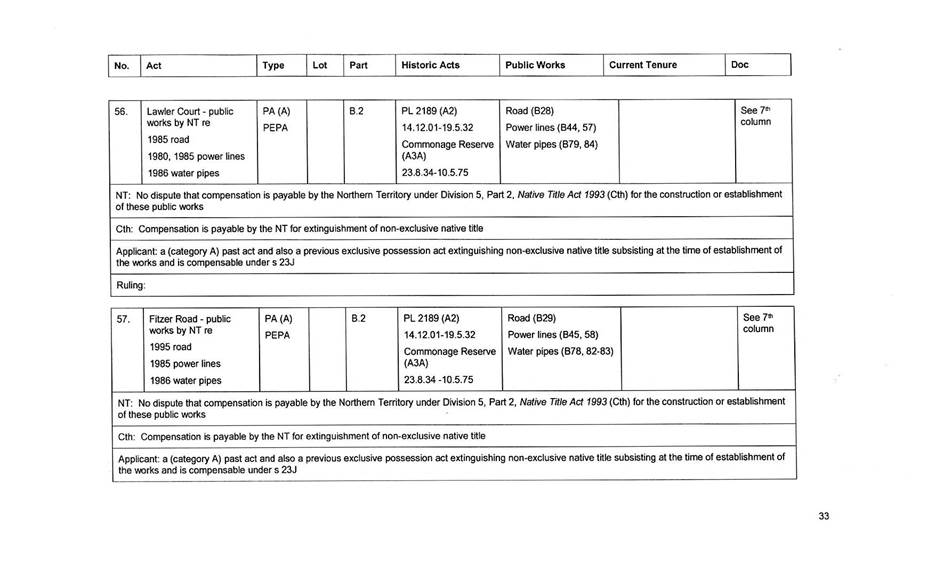
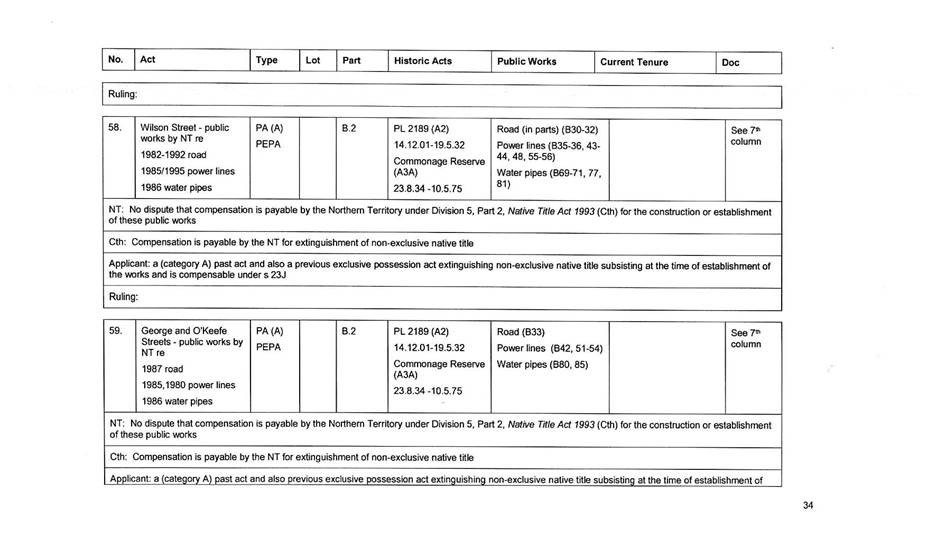
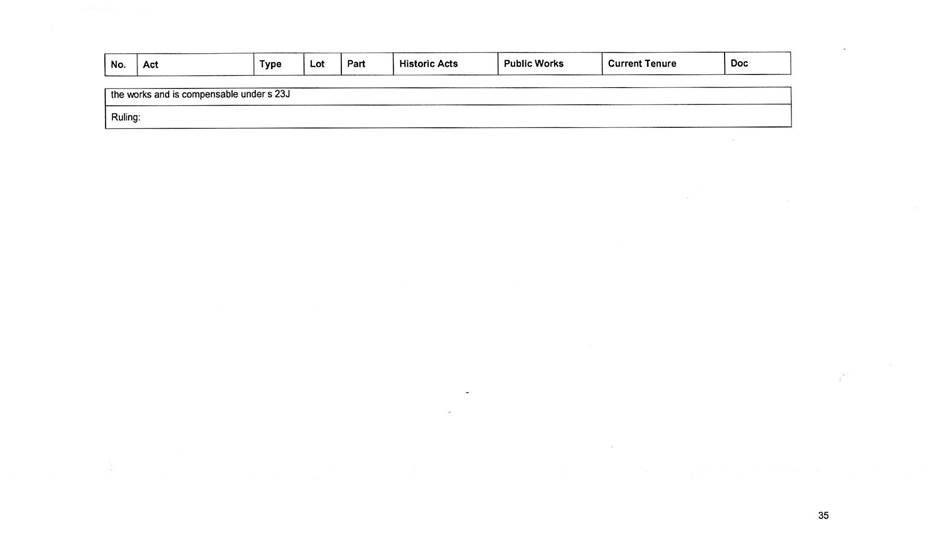
19 The exchange of those materials between the parties reduced the areas of dispute. The Table listed 63 acts which were said to affect native title and in respect of which compensation is claimed. The Territory’s response acknowledged that there was no longer a dispute about the entitlement to compensation arising from 43 of the acts specified by the applicant leaving 20 in issue. For the sake of convenience and better understanding of these reasons for judgment, I append a copy of the “Summary of Parties’ Respective Positions on Claimed Compensable Acts”, as the Table attached to the Applicant’s final written submissions. It identifies the acts which are said to be relevant.
20 The Commonwealth intervened at the hearing. Its position largely but not entirely accorded with that of the applicant, although in some respects its pathway to saying that there was an entitlement to compensation for particular acts was a little different from that taken by the applicant. In two cases (acts 17 and 41), it is said there was no entitlement to compensation even though the Territory accepted that there was. The Commonwealth agreed with the Territory on 5 of the 20 acts, namely that they did not give rise to an entitlement to compensation. In 4 cases (acts 49A, 50A, 50B and 50C), its responsive schedule to Table A did not make comment, presumably because they were added to Table A only after the Commonwealth received its version of that document.
THE MATTERS IN ISSUE
21 During the hearing, the Solicitor-General for the Territory provided an Aide Memoire categorising the items listed in Table A where liability is disputed. The categories are as follows:
A. Whether the act had no effect on native title because of the effect of previous acts:
(1) grazing licences on land subject to the previous grant of a pastoral lease - Items 37, 38 and 39 (grazing licences);
(2) acts on land subject to previous extinguishment at common law - Items 43 and 44 (construction on land subject to police reserve);
(3) acts on land subject to previous extinguishment by the construction of public works - items 35 (transfer following the construction of the police station), 42 (grant following the construction of works depot), 55 (works following establishment of Victoria Highway), and Items 46 and 47 (various public works); [I note that it was indicated in the course of submissions that the status of the acts in Items 35, 42 and 55 no longer required consideration.]
(4) acts on land subject to previous Crown to Crown grants - Items 16, 18, 20, 22, 24, 26, 28 and 30 (public works) and Item 4 (transfer of freehold following previous grant to the Conservation Land Council).
B. Whether the Timber Creek Community Government Council is a “statutory authority” - Item 49A (did the grant of the CLT at item 49 wholly extinguish native title?) [It was accepted at that hearing that it did have that effect.] and Items 49, 49A, 50 and 53 (does the exception in s 23B(9C) apply?)
C. Whether invalid future acts had any effect on native title so as to attract an entitlement to compensation - Items 50A (grant of CLR and conversion to freehold), 50B (grant of freehold) and 50C (grant of freehold).
22 To put those issues into context, it is convenient first to recap on the potential basis upon which the NT may be liable to pay compensation.
23 The first category is compensation for the effects of past acts under s 20 of the NT Act read with ss 5-8 of the Validation (Native Title) Act (NT) (VNT Act), namely:
(a) compensation for the extinguishment of native title effected by category A past acts and category B past acts (s 17(1), NT Act); and
(b) compensation for category C past acts and category D past acts in certain circumstances (s 17(2), NT Act) including, so far as may be relevant for the purposes of this application:
(i) if the native title affected by the act is in relation to an onshore place (as applies in this case) and the act could not have been validly done on the assumption that the native title holders instead held ordinary title to any land concerned and the land adjoining or surrounding any waters concerned (s 17(2)(a), NT Act); or
(ii) if the native title affected by the act relates either to land or to waters and the similar compensable interest test is satisfied in relation to the act (s 17(2)(c), NT Act).
24 Each of the terms Category A, B, C and D past acts are defined in ss 219-232 of the NT Act respectively. It will not be necessary to refer to those definitions in detail in these reasons.
25 The second category is compensation for the effects of intermediate period acts: see s 232A, under s 22G of the NT Act, read with s 22B of the NT Act and ss 9B-9E of the VNT Act, namely:
(a) compensation for the extinguishment of native title effected by Category A intermediate period acts: see s 232B, and Category B intermediate period acts: see s 232C (ss 22G(1) and 22B(a), (b), (c) of the NT Act); and
(b) compensation for the operation of the non-extinguishment principle: see s 238, on Category C intermediate period acts: see s 232D, and Category D intermediate period acts: see s 232E, in certain circumstances (ss 22G(1) and 22B(d) of the NT Act).
26 The third category is compensation for the extinguishment of native title under s 23J of the NT Act, read with ss 23E and 231 of the NT Act and ss 9H-9JB of the VNT Act, by: previous exclusive possession acts: see s 23B (s 23C(1), (2)); and previous non-exclusive possession acts: see s 23F (s 23G(1)).
27 Where a particular act is either a past act or an intermediate period act, and also a previous exclusive possession act, any extinguishment of native title by that act is effected by the previous exclusive possession act provisions and not by the past act or intermediate act provisions (s 23C(3), NT Act and s 9G, VNT Act).
28 Where a particular act is either a past act or an intermediate period act, and also a previous non-exclusive possession act, any extinguishment of native title by that act is effected by the previous non-exclusive possession act provisions and not by the past act or intermediate act provisions (s 23G(3), NT Act) and s 9K(1), VNT Act), except where the act is a pastoral lease: see s 249B, or an agricultural lease: see s 247, which is a Category A past Act (that is, a past act granted before 1 January 1994 and still in existence on that date: s 229(a), (c)(i), NT Act): (s 23G(2), NT Act and s 9K(2), VNT Act).
29 Finally, at this level of generality, it is clear that the NT will only bear a liability to pay for compensation for acts attributable to it.
30 An act attributable to the Territory if the act is done by the Crown in right of the Territory, the Legislative Assembly of the Territory or any person under a law of the Territory: s 239. This would capture acts done by the Territory after its establishment as a body politic on 1 July 1978 by the Northern Territory (Self-Government Act) 1978 (Cth). In addition, a previous exclusive possession act and a previous non-exclusive possession act will be attributable to the Territory if they took place before the establishment of the Northern Territory (as a territory of the Commonwealth) and affected land now within the Northern Territory: s 23JA. This would capture acts done by the State of South Australia before the establishment of the Northern Territory as a territory of the Commonwealth on 1 January 1911 by the Northern Territory Acceptance Act 1910 (Cth) and the Northern Territory (Administration) Act 1910 (Cth).
31 The acts must involve the extinguishment of native title by acts which are previous exclusive possession acts or previous non-exclusive possession acts, but only to the extent, if any, that the native title rights and interests were not extinguished at common law rather than by operation of the NT Act (s 23J(1)); and secondly, the extinguishment of or other prescribed effect on native title by acts which are past acts or intermediate period acts, being acts which were invalid because of the existence of native title. Conversely, the Territory will bear no liability for compensation for acts which validly extinguished native title at common law (ie without reliance upon the NT Act or the VNT Act for the validation: see Wilson v Anderson (2002) 213 CLR 401 at [51]. Hence, acts which extinguished native title prior to the enactment of the RDA are not compensable: Western Australia v Ward (2002) 213 CLR 1 at [114]. In the present circumstances, none of the acts for which compensation is claimed occurred prior to 31 October 1975.
CONSIDERATION
32 The starting issue in respect of most of the areas in question is whether there were acts which had an extinguishing effect at common law on the native title rights and interests in the application area before the acts for which compensation is claimed occurred. There are two broad categories identified by the parties:
(a) extinguishment by historic tenure in the form of various grants and reservations; and
(b) extinguishment by public works.
33 Much of the understanding of the operation of the NT Act regarding compensation is common ground. At common law, native title is liable to be extinguished by the legislature or by an act of the executive in exercise of powers conferred upon it; without giving rise to a claim for compensation: see Mabo v Queensland (No 2) (1992) 175 CLR 1 (Mabo No 2) per Mason CJ and McHugh at 15.
34 The RDA applies to acts committed after 31 October 1975, restricting interference with native title rights on the basis of race. The RDA provides a guarantee of “equality before the law” with respect to rights protected by the International Convention on the Elimination of All Forms of Racial Discrimination. Those rights include “the right to own property” which itself includes the right not to be arbitrarily deprived of property. Equality before the law requires payment of compensation for the extinguishment or impairment of native title.
35 Compensation for the impairment of native title rights is provided for in the NT Act, read together (in the context of the current claim) with the provisions of the VNT Act. Part 2 of the VNT Act validates past acts and intermediate period acts attributable to the Territory and s 3 and Pt 3A deals with the effect of the validation. Beneficial reservations contained in past and intermediate period acts are preserved by Pt 5 of the VNT Act. The effect of previous exclusive and non-exclusive possession acts are dealt with in Pts 3B and 3C.
36 A determination for compensation cannot be made unless there is also a determination of native title in relation to the land or waters, including a determination that native title has been extinguished: Jango v Northern Territory (2006) 152 FCR 150 at [41] per Sackville J.
The application of s 47B to compensation applications
37 As summarised above, the Territory contends that the items referred to in Part A of its Aide Memoire are not compensable as a result of native title having previously been extinguished over that land, so that the items referred to have no further effect on native title.
38 The first sub-issue identified concerns items 37, 38 and 39, which are the grants of grazing licences on 1 July 1981, 15 July 1980 and 1 March 1988 respectively.
39 There are a series of historic grants of tenure which, the Territory says, extinguished native title over all or parts of the areas presently relevant.
40 The parties have prepared a helpful schedule recording the allotments over which native title is said to have been extinguished by historical tenure grants. Some grants affect more than one allotment. There are only three relevant grants:
Pastoral Lease 366
41 On 20 June 1882, Pastoral Lease 366 (PL 366) was granted under the Northern Territory Land Act 1872 (SA) to the Musgrave Range and Northern Territory Pastoral Land Co Ltd over almost the entire application area. PL 366 was cancelled on 16 July 1891 for non-payment of rent.
42 The northern boundary of the grant area is described by reference to the “Victoria River”. Where land is described in a Crown grant as bounded by waters that are non-tidal the grant is presumed to extend beyond that boundary to the middle line of the waters: Butt, Land Law, Third Edition (Law Book Company, 1996), pp 41-44 [242]-[246]. Although ultimately not material to the resolution of the compensation claim, on the application of that principle PL 366 extended to the centreline of the Victoria River and so covered the entire application area, as the Town of Timber Creek is bordered on its northern side by the middle line of the Victoria River.
43 The grant of PL 366 was a previous non-exclusive possession act within s 23F of the NT Act. It was effective at common law to partially extinguish native title, leaving the non-exclusive native title rights and interests. Subject to accepting that PL 366 was granted, that is a common position between the parties. In my view, the available material is sufficient to prove that PL 366 was granted in the terms referred to above.
Pastoral Lease 2189
44 On 14 December 1901, Pastoral Lease 2189 (PL 2189) was granted under the Northern Territory Land Act 1899 (SA) to Connor Doherty and Durack Limited. PL 2189 was determined on 19 May 1932. The Plan annexed to the Lease and signed by the Surveyor-General establishes that when the Lease was granted, there was no Reserve excluded from the grant, although such a Reserve is shown in the other Plan annexed to the Lease.
45 As discussed in the context of PL 366 concerning the middle line boundary, I also consider from the wording of the Lease that it extended to the middle line of the Victoria River, despite the plan which might suggest that it extended northwards only to the southern bank of the River. Consequently, this Lease also relevantly covers all the allotments in issue.
46 The grant of PL 2189 was a previous non-exclusive possession act within s 23F of the NT Act. If the grant of PL 366 had no effect on native title, the grant of PL 2189 was effective at common law to partially extinguish native title, leaving the non-exclusive native title rights and interests.
Reserve 1087
47 On 30 August 1962, Reserve 1087 was proclaimed under s 103 of the Crown Lands Ordinance 1931-1961 “for police purpose” over an area of 32 acres, 20 perches. The area the subject of Reserve 1087 now comprises Lots 49, 50, 62 and 63 and parts of Lots 33 and 68. Lots 62 and 63 are the areas over which the acts 43 and 44 respectively in Table A were done. The other allotments do not concern acts which are contentious in the present dispute. The reserved land was used for the purposes for which it was reserved. It contained, in 1962, a police station residence, and in 1977 the Timber Creek Police Station Complex was built on the reserved land.
48 Reserve 1087 was revoked on 11 December 1985
49 It is the contention of the Territory that this reservation of land for a public purpose wholly extinguished native title rights and interests at common law as the rights asserted by the Crown by virtue of the reservation are wholly inconsistent with the continued enjoyment of native title: Western Australia v Ward (2002) 213 CLR 1 at [213]-[219]. The extent of the rights asserted by the Crown in relation to Reserve 1087, and their inconsistency with any subsisting native title rights, are said to be demonstrated by the construction upon the reserved land of buildings and other infrastructure, and the use of the reserved land as a police station. The issue is whether the reservation as wholly inconsistent with native title rights and interests.
50 There were other tenures granted over parts of the application area prior to 31 October 1975 which extinguished native title rights and interests, but none in respect of the land or waters covered by any of the acts for which compensation is sought.
51 There are also a series of public works relied on by the Territory
Police Station
52 In around 1898, the Timber Creek Police Station was first constructed or established on an area of 3 ha, 6,600m2 which now comprises lot 48. That is not an allotment over which a presently contentious subsequent act by the Territory took place. The second Police Station was constructed in 1908. The third Police Station was constructed in 1932. The Police Station included the station building, a residence and horse yards.
53 Other infrastructure for the provision of services such as water and sewerage, and the amenity of the residences such as vegetable gardens, are likely to have formed part of the police station complex. Two of the buildings remain on Lot 48 today.
Works Depot
54 In around 1962, a government Works Depot was constructed or established on an area of 2 ha, 3,400m2, which now comprises Lot 61. The Depot grew over the 1970s and 1980s to include many buildings, driveways, parking, bores and other infrastructure. The Depot continues to be used today.
Victoria Highway
55 In about December 1964, the Victoria Highway was constructed or established through the application area, and it was formally named in November 1966. In 1988, a road reserve of 100m wide (50m either side of the centre line) was formally adopted for the length of the Victoria Highway through the Town of Timber Creek. The necessity for a road reserve of at least that width arises for road safety and road maintenance reasons pursuant to the NT government road reserve policy: see the discussion of the policy in King v Northern Territory [2007] FCA 944 at [109]-[194] and [213] per Moore J.
Extinguishing effect of public works
56 The Timber Creek Police Station on Lot 48, the Works Depot on Lot 61 and the Victoria Highway which runs through the entire application area were public works and thus previous exclusive possession acts within s 23B(7) of the NT Act. Their construction or establishment extinguished native title in relation to the land on which the public works were situated, and the extinguishment is taken to have happened when the construction or establishment began (s 23C(2), NT Act).
57 The only relevant public work now is the Victoria Highway itself. As noted, the Timber Creek Police Station and the Works Depot on Lot 61 do not affect any area to which the acts now requiring consideration are relevant.
58 For the purposes of determining the significance of the historic tenure or the public works, it is also necessary to consider whether, as the applicant contends, s 47B of the NT Act applies.
59 It is necessary to consider that in the context of the particular allotments affected by the acts in issue.
60 For that purpose, it is convenient to adopt the categories proposed by the Territory, as set out in [21] above.
Acts 37, 38 and 39
61 Acts 37, 38 and 39 are the grants of grazing licences on 1 July 1981, 15 July 1980 and 1 March 1988 as set out in the schedule and Table 1.
62 The relevant allotments are Lots 56, 57, 73 (part) and 109 which are mostly to the eastern side of Timber Creek itself. Timber Creek runs roughly north-south from the southern side of the Victoria River. The eastern boundary of Lot 57 is also part of the eastern boundary of the Town of Timber Creek.
63 The criteria for s 47B of the NT Act to apply are that there be:
(a) A claimant application in relation to an area;
(b) When the application is made, the area is, effectively, vacant Crown land; and
(c) When the application is made, one or more members of the native title claim group occupy the area (s 47B(1)).
64 Where s 47B applies, s 47B(2) provides generally that “[f]or all purposes under this Act in relation to the application” any extinguishment of the native title rights and interests in relation to the area that are claimed in the application by the creation of any prior interest in relation to the area must be disregarded.
65 Section 47B(3) provides that if the determination on the application is that the native title claim group holds the native title rights and interests claimed:
(a) The determination does not affect the validity of the creation of any prior interest, or any interest in the Crown or any statutory authority in any public works on the land or waters concerned; and
(b) The non-extinguishment principle as defined in s 238 applies to the creation of any prior interest in relation to the area.
66 The dispute between the parties is whether s 47B can operate in relation to a compensation application, as distinct from an application for the determination of native title itself.
67 In my view, s 47B does not apply to an application for the determination of compensation for the extinguishment, whether partial or title, of native title rights and interests. I consider that follows from the text of s 47B itself, as well as its context.
68 The term “claimant application” used in s 47B(1) is defined in s 253 of the NT Act to mean a native title determination application that a native title claim group has authorised to be made and includes such an application that has been amended. The meaning and scope of “a determination application” takes its substance from s 13(1) in Div 1 of Pt 2 of the NT Act dealing with the recognition and protection of native title. Section 13(1) provides for an application to the Court under Pt 3 for “a determination of native title in relation to an area” or to revoke or vary an approved determination. By contrast, s 13(2) provides that if the Court is making “a determination of compensation” in accordance with Division 5 of Pt 3 where there has not previously been made an approved determination of native title in relation to the area, there must be at the same time a determination of native title in relation to that area. In this matter, as noted above, the existence of native title but for any prior extinguishment is not in dispute, although the Court would ultimately nevertheless have to make such a determination before determining compensation over the Part B land. There is a distinction there drawn between an application to determine native title, and an application to determine an entitlement to compensation. Division 5 provides for an application to the Court to determine compensation. Division 1 provides for an application to the Court to determine native title, and Div 2 to 4 provide how particular potentially extinguishing events may be addressed in determining the existence of native title, including ss 47, 47A and 47B in Division 4.
69 That distinction is preserved in s 61, prescribing how an application to the Court may be made: the table of applications in s 61(1) separately addresses a native title determination application and a compensation application. So too does 61(2).
70 Similarly, s 61A(1) prohibits a native title determination application in relation to an area for which there is already a determination of native title. If a “claimant applicant” in s 47B(1) includes a compensation application, despite the wording of the definition, as the applicant presently contends, it would not be competent to make such an application in respect of the Part A land. There is no indication that a compensation application could not be available in respect of an area of land where native title has been only partially extinguished, so that there could be a compensation application only where there had either been no determination of native title, or a determination that native title had been wholly extinguished. There is no apparent reason why such a contrived eligibility for compensation should exist.
71 Section 62 also preserves the distinction.
72 Within s 47B itself, certain textual features point to the same conclusion. Section 47B(3) refers to the outcome of the determination, that is that native title exists in the claim group as claimed, and its affect upon earlier interests. It is not expressed in terms which would accommodate a compensation determination.
73 At a broader level, it is fair to say that the contrary construction contended for by the applicant may produce apparently idiosyncratic outcomes. It is unlikely, for example, that it is intended by s 47B that native title holders should be able to obtain both an approved determination of native title rights and interests in respect of vacant Crown land unaffected by any extinguishment by prior interests through the operation of ss 47B(2) and (3)(b), and a determination of compensation for the effects of acts upon those native title rights and interests also unaffected by any extinguishment by prior interests through the operation of ss 47B(2) and (3)(b). Such an outcome would result in the claim group recovering twice for the one loss, albeit there is scope to adjust the level of compensation.
74 For those reasons, in my view s 47B permits claims for a determination of native title by claimants in occupation of vacant Crown land to proceed despite past extinguishment of their native title rights and interests in the specified circumstances, but limited to obtaining a determination of native title. That accords with the introductory words of s 47B(2): “[f]or all purposes under this Act in relation to the application”, and with the focus in s 47B(3) upon “the determination on the application” that the claim group hold the rights and interests claimed. The application of the non-extinguishment principle by s 47B(3)(b) therefore is for the purpose of permitting a determination of native title rights and interests where there otherwise could not be one.
75 It is consistent with that conclusion that s 47, by way of contrast, applies more generally where the application is made under s 61 (which encompasses both a native title determination application and a compensation application): see 2 47(1)(a). Section 47 was in the NT Act as first enacted, and ss 47A and 47B were introduced by the Native Title Amendment Act 1998 (Cth). The choice of different qualifying wording for the application of those sections would not be accidental. The Explanatory Memorandum to the Native Title Amendment Bill 1997 (Cth) confirms the deliberate and narrower scope of ss 47A and 47B: see paras [5.45] and [5.56] of that Memorandum. That is a difference in wording which was remarked upon in Gumana v Northern Territory (2007) 158 FCR 349 at [111].
76 It is also consistent with that conclusion that ss 47A and 47B are intended to make available for the determination of native title areas where otherwise native title may have been extinguished by previous exclusive possession acts under s 23C or by previous non-exclusive possession acts under s 23G of the NT Act. The entitlement to compensation does not draw that distinction, but allows for compensation to be awarded for past acts or intermediate period acts extinguishing native title, provided that native title had not previously been extinguished at common law (that is acts validly extinguishing native title which do not rely for their effect on the validating provisions of the NT Act or the NTV Act).
77 It follows that I do not accept that the remarks in Jango v Northern Territory (2007) 159 FCR 531 at [83] and in Western Australia v Ward (2000) 99 FCR 316 at [190] support the conclusion for which the applicant contends, so that somehow the qualifying words in s 47B(1)(a) should be read down. The view that I have taken is that those qualifying words were carefully selected and confine the application of ss 47A and 47B. Whilst they may create rights by the application of their terms once the statutory pre-conditions are met (as Selway J said in Gumana v Northern Territory (2005) 141 FCR 457 at [268]), the statutory pre-conditions are not met where the application is for compensation as distinct from an application for the determination of native title. The application of s 47B in Griffiths SJ and in Griffiths FC meant that native title was found to exist where, but for that section, it would not have existed. But it does not follow that, on a subsequent compensation application, that section may apply to further extend its scope to the eligibility for compensation.
78 The Territory further submitted that ss 47B(2) and (3)(b) have no operation in relation to extinguishment effected by the construction or establishment of public works.
79 In Erubam Le (Darnley Islanders) v Queensland (2003) 134 FCR 155 (Erubam), the Full Court held, in relation to s 47A(2)(b) (which is relevantly in identical terms), that the statutory extinguishment effected by the operation of the provisions of the NT Act directed specifically to public works is not the “creation of [a] prior interest” within the meaning of that provision: see at [87]-[91].
80 In my view, s 47B(2) should be accorded the same meaning as it is in the same terms and identical outcomes (albeit in relation to different types of land) are intended by ss 47A and 47B.
81 Whilst the applicant did not urge the Court not to follow the decision in Erubam, it did not accept its correctness. In my view, that decision dictates the view I have reached on this point.
The extinguishing effect of reserves
82 With respect to items 43 and 44, the Territory argued that the acts are not compensable as a result of prior extinguishment, namely by the creation of Reserve 1087 on 30 August 1962 over Lots 49, 50, 62 and 63, and parts of Lots 33 and 68.
83 The reserve was proclaimed under s 103 of the Crown Lands Ordinance 1931-1961 “for police purposes” over an area of 32 acres, 20 perches (approximately 13 hectares). The Territory submits that there is no liability for compensation for the subsequent construction of public works on part of that reserve, on the basis that native title was wholly extinguished by the inclusion of that land within the reserve.
84 There is no dispute that the test to be applied is whether the rights created are inconsistent with continued non-exclusive native title rights: see Western Australia v Ward (2002) 213 CLR 1 at [78], [82], [21]-[215], [234]. Use of the land may demonstrate that such rights have been created or asserted, but the basic inquiry is about inconsistency of rights not inconsistency of use: Western Australia v Ward (2002) 213 CLR 1 at [215]; Western Australia v Brown [2014] HCA 8.
85 There is some dispute about what was constructed on the reserve land. By the Northern Territory’s account, in around 1898, the Timber Creek Police Station was first constructed or established on an area of 3 ha (6,600m2) over what is now Lot 48. A second police station was constructed in 1908, and a third police station in 1932. Those buildings included the station building, a residence and horse yards. Other infrastructure for the provision of services such as water and sewerage, and the amenity of the residences, such as vegetable gardens, are likely to have formed part of the police station complex. Two of the buildings remain on Lot 48 today.
86 The applicant submits that the police station building was established on Lot 49 which is about 1 hectare in size. No compensation claim is made in relation to that land. The applicant submits that there is no evidence to suggest use of the wider reserved area. Reserve 1087 was revoked on 11 December 1985.
87 The focus must be on the rights created by the relevant instrument. The applicant submits that the designation of land for a specified purpose does not, without more, create any rights inconsistent with the continued existence of native title rights to use the land. A reservation under s 103(1)(c) of the Crown Land Ordinance 1931 (NT) under which Reserve 1087 was proclaimed, was to reserve land from sale by taking the land outside the definition of “Crown lands” (s 5). Reserved lands could not be granted in fee simple or leased, but various kinds of licences could be granted over reserved lands: see Crown Land Ordinance 1931 (NT) ss 6, 107, 109, 109A. The prospect of such licences does not of itself demonstrate inconsistency of rights with native title rights. The power of revocation ensured that government retained the authority to decide how the land might be used, and the Ordinance did not prevent the government from using the land for a purpose other than the reserved purpose.
88 I accept the applicant’s contention that the exercise of the statutory authority over the land, if valid, extinguished any native title right to decide how the land could be used, but it does affect only that native title right, leaving other native title rights to use the land unaffected.
89 In my view, the rights asserted by the grant of Reserve 1087 are not wholly inconsistent with the continued enjoyment of native title over the whole of the reserved lands, so as to extinguish native title.
90 Once that step is taken, and it is accepted (as I understand it is) that items 43 and 44 which are the immediate subject of consideration concern Lots 62 and 63 over which no particular use or construction is shown prior to 1975, in my view these acts in items 43 and 44 remain acts in respect of which the compensation claim may be maintained.
Public works
91 With respect to the third issue identified above, the applicant no longer presses its claim for compensation concerning items 35, 42 and 55, and the Territory accepts that compensation is payable for the extinguishment of native title for items 46 and 47. The parties agree that a variation of the native title determination is required, as currently the works are not identified as existing in Lots 70 and 72 where exclusive native title works are not identified as existing in Lots 70 and 72 where exclusive native title was determined to exist. A variation of the native title determination may also be required for item 14, which is included in the area for non-exclusive native title. It is accepted by the applicant that native title was extinguished on the building of the Timber Creek School: see Item 14 in the Table.
92 The Territory accepts that it is liable to pay compensation for public works constructed after 1975 except where the public work is built on the same spot as a previous public work. The example given in oral submissions was the construction of Wilson Street over a previously laid water pipe, on Lot 72. Wilson Street was constructed on the same arc as a 100 millimetre water transmission pipe.
93 As noted above, the only remaining issue concerns items 46 and 47, the possible application of s 47B to the previous water transmission park, arising out of [5] of the Amended Particulars of Acts that Affected Native Title for which Compensation is Claimed. By that document, and as confirmed in their submissions, the applicant formally reserves its position on the correctness of Erubam insofar as it refers to public works and the creation of prior interests under s 47A, but as I have said, the reasoning of the Full Court in Erubam in respect to s 47A is similarly applicable in the consideration of public works under s 47B.
Crown to Crown grants
94 The fourth subparagraph in Part A of the Territory’s Aide Memoire concerns acts 4, 16, 18, 20, 22, 24, 26, 28 and 30 and whether previous Crown to Crown grants are not previous exclusive possession act under sub 23B(9C). The default position, by sub 23B(2) is that a grant of freehold land is a previous exclusive possession act unless such grant is denied that characterisation because of sub 23B(9C). If the previous grant is an exclusive possession act, that would cause the items above to have no additional compensable effect on native title.
95 Subsection 23B(9C) provides that Crown to Crown grants are not a previous exclusive possession act:
(a) unless, apart from the NT Act, the grant or vesting extinguishes native title in relation to the land or waters; or
(b) if the grant or vesting does not, apart from the NT Act, extinguish native title in relation to the land or waters – unless and until the land or waters are (whether before or after 23 December 1996) used to any extent in a way that, apart from this Act, extinguishes native title in relation to the land or waters.
96 The grants in question were made to the Northern Territory Electricity Commission, the Northern Territory Housing Commission, the Conservation Land Corporation and the Commonwealth of Australia. The parties accept that each grantee is for the purposes of s 23B(9C) a statutory authority and that at the time of the grant there existed non-exclusive native title. If the previous grant is an exclusive possession act, that would cause the acts above to have no additional compensable effect on native title.
97 The applicant submits that the previous grants were Crown to Crown grants which were non-exclusive possession acts, and as a result, the subsequent acts identified in items 4, 16, 18, 20, 22, 24, 26, 28 and 30 had a compensable effect on native title. The Territory submits that either of the exclusions in sub 23(9C)(a) or 23(9C)(b) apply, so that the grant is properly understood as an exclusive possession act, and that subsequent acts had no effect on native title. The Commonwealth similarly submits that the grants are exclusive possession acts, but limits its contention to sub 23(9C)(b). The point is argued by all parties on the construction of sub 23(9C) and in particular the use of the phrase “apart from this Act”.
98 By the applicant’s construction, the Crown to Crown grant is not a previous exclusive possession act unless it extinguishes native title without requiring the validation of the NT Act. The expression “apart from this act”, then, refers to the NT Act alone and presumes the continued operation of the RDA. This would include, for example, non-discriminatory grants made after the commencement of the RDA, but would not include discriminatory acts, which would require the validation of the NT Act. By extension, the current acts would not fall under sub 23(9C)(a) as the Crown to Crown grant requires validation under the NT Act, and accordingly, the grant would not be considered a previous exclusive possession act. The applicant says this is consistent with the findings in Ward HC: at [421]-[425].
99 The applicant submits that the same construction of “apart from this act” applies with respect to sub 23(9C)(b). The alternative provided in (b), it says, reflects the uncertainty at the time of drafting as to whether by use of the land native title could also be extinguished. That point was subsequently settled in Ward HC, which confirmed that the relevant inquiry as to extinguishment is that of inconsistency of rights, not inconsistency of use: at [78], [82], [215], [234]. In regards specifically to sub 23(9C)(b) the plurality in Ward HC said:
The operation of par (b) of sub-s (9C) presents some difficulty because, at first sight, it appears to proceed from the premise that use of land, as distinct from the creation or assertion of rights or powers in respect of land, may extinguish native title.
100 Further, insofar as the Territory and the Commonwealth submit that the creation of public works “converts” a non-extinguishing grant to an extinguishing previous exclusive possession act, that construction overlooks the clear distinction in s 23B between acts that consist of a grant or vesting (as per subs (2), (9), (9A) and (9C), and acts that consist of the construction or establishment of any public work (sub (7)). The applicant submits that the structure of ss 23B and 23C supports that construction that any acts that consist of the establishment of any public work engages sub 23B(7) and confirms extinguishment, and that that extinguishment is taken to have happened when construction began.
101 The Territory submits that sub 29(9C) operates such that a Crown to Crown grant is not a previous exclusive possession act: (a) unless at common law the vesting extinguishes native title; or (b) if at common law the vesting did not extinguish native title, unless and until the land or waters are used to any extent in a way that, at common law, extinguishes native title. By that construction, the words “apart from this Act” do not operate so as to exclude the validation effected by the NT Act.
102 The Territory says that such a construction fits with the intention of parliament, as expressed in the Supplementary Explanatory Memorandum to Government Amendments moved in July 1998 to the Native Title Act Amendment Bill (No 2) 1997 (Cth). Under the heading “Crown to Crown grants” the Memorandum provides:
The amendment also excludes from the definition of previous exclusive possession act an act that is the grant or vesting of an interest to or in the Crown or a statutory authority unless:
• at common law the grant or vesting extinguishes native title; or
• if at common law the grant or vesting did not extinguish native title, the land or waters are used in a way that, at common law, extinguishes native title.
In relation to the latter, the act only becomes a previous exclusive possession act when the land or waters are used in a way that at common law extinguishes native title. The use may take place before or after the date of the Wik decision, or before or after the provision commences operation.
The Government believes that the grant of a freehold or exclusive possession leasehold to another body politic or to a statutory authority does extinguish native title. Such grants should be treated in the same way as grants to a private person. They are more than the reservation of land for a future public purpose. However, this amendment leaves this issue to be finally determined by the common law. If at common law a Crown to Crown grant extinguished native title, the Bill confirms the extinguishment. If at common law, it is the use of the land granted or vested, and not the grant or vesting itself, that extinguishes native title, the Bill confirms that the native title is extinguished when the land is used.
Paragraph 23B(9C)(b) only deals with uses that result in the extinguishment of native title. Uses that are consistent with the continued existence of native title are not covered by the confirmation of extinguishment provisions but may be valid under Subdivision J (which deals with acts done pursuant to certain reservations and leases).
103 Accordingly, the Territory submits that the grant of freehold extinguished native title, irrespective of the fact that it was a Crown to Crown grant.
104 In Bodney v Westralia Airports Corporation Pty Ltd (2000) 109 FCR 178 at [23] Lehane J held:
I am bound to conclude that… a grant of a fee simple estate to the Crown (or the acquisition by the Crown of such an estate) extinguishes native title to the same extent, and for the same reasons, as a similar grant to a private purpose does. In each case, the rights acquired by the holder of the estate in fee simple are equally inconsistent with the continued enjoyment of rights associated with native title.
In that case, a freehold grant to a local government body was held to extinguish any native title in relation to the area covered by the grant, notwithstanding that the grant was made on trust.
105 In the alternative, the Territory submits that the grants fall under sub 23B(9C)(b). Its construction of the subparagraph again calls into play a common law test, namely, where the grant does not extinguish native title at common law, it will nevertheless qualify as a previous exclusive possession act upon the land or water being used “to any extent” in a way that would extinguish native title at common law. Such use, they submit, does not require the use to be pursuant, or even related, to the grant. Despite the apparent conflict with the rights based assessment of inconsistency, the Territory submits that sub 23B(9C)(b) expressly demands an inquiry as to the extinguishing effect of use of land at common law; but that such an assessment in turn will prompt an examination of the rights or power pursuant to which the land is used, as land is used in assertion of rights and powers over it.
106 Accordingly, the Territory contends, as the uses of the land granted are wholly inconsistent with the continued exercise of native title rights, such uses must be pursuant to rights which would extinguish native title at common law, with the effect that the proviso in sub 23(9C)(b) is engaged. Thus, the construction of the Timber Creek power station and residential dwellings had no further or additional effect on native title, notwithstanding that they comprised the construction or establishment of public works within the meaning of sub 23B(7).
107 The Commonwealth supported the submissions of the applicant with respect to subs 23B(9C)(a), noting that that had been the subject of judicial consideration, and that on each occasion, the Court has proceeded on the basis that the words “apart from this Act” in s 23B(9C)(a) mean that the RDA must not have operated to invalidate the grant or vesting, such that native title would have been extinguished at common law: Ward HC [253]-[254] and [259]-[260], Wandarang People v Northern Territory (2000) 104 FCR 380 at [106] (Wandarang), Neowarra [2003] FCA 1402 [652].
108 The Commonwealth’s submissions regarding sub 23B(9C)(b) on the other hand differ from both those of the applicant and the Northern Territory. As a starting point, the Commonwealth submits that the acts referred to the subclause (b) must be consequent upon the grant. They say this because (a) it is the grant itself that is converted as a result of the acts; (b) because the interests in relation to the land in sub 23B(9C) are grants of freehold or leases, and so the authority to use that land would usually derive from the grant itself; and (c) unless the authority for use of the land derives from a pre-23 December 1996 grant, an alternative reading would be to authorise the doing of future acts contrary to s 24AA(2) of the NT Act.
109 The next step in the Commonwealth’s reasoning is that, if the validating effect of the NT Act is to be disregarded, then sub 23B(9C)(b) becomes redundant. To paraphrase: what act, stemming from a grant, could be valid where the grant itself is invalid. Given that subparagraph (b) is only enlivened when (a) is not met, such a construction does not appear to satisfy the intention of parliament. The construction it puts forward, as an alternative, is whether the use of the land is of a kind that would extinguish native title at common law.
110 It submits that this construction is supported by s 23DA which provides:
23DA Confirmation of validity of use of certain land held by Crown etc.
To avoid doubt, if the act is a previous exclusive possession act because of paragraph 23B(9C)(b) (which deals with grants to the Crown etc.), the use of the land or waters concerned as mentioned in that paragraph is valid.
If “apart from this act” referred only to acts which were non-discriminatory under the RDA, then arguably, such clarification would not be required. The Commonwealth also highlights that such a provision was not enacted with regards to sub 23(9C)(a).
111 I turn to consider those respective submissions.
112 Subsection 23B(9C) provides that a Crown to Crown grant is not a previous exclusive possession act unless the conditions of sub 23B(9C)(a) or (b) are met.
113 I accept the applicant’s submissions that the conditions of sub 23B(9C)(a) are not met in this case.
114 The meaning of sub 23B(9C)(a) was considered in Ward HC at [259]-[260] by the plurality as follows:
In the case of other reserves vested before 23 December 1996, reference must also be made to sub-s (9C) of s 23B. It provides:
If an act is the grant or vesting of an interest in relation to land or waters to or in the Crown in any capacity or a statutory authority, the act is not a previous exclusive possession act:
(a) unless, apart from this Act, the grant or vesting extinguishes native title in relation to the land or waters; or
(b) if the grant or vesting does not, apart from this Act, extinguish native title in relation to the land or waters unless and until the land or waters are (whether before or after
23 December 1996) used to any extent in a way that, apart from this Act, extinguishes native title in relation to the land or waters.
The expression “statutory authority”' (s 253) in relation to the Crown in right of the Commonwealth, a State or a Territory, means any authority or body (including a corporation sole) established by a law of the Commonwealth, the State or Territory other than a general law allowing incorporation as a company or body corporate. It follows that vesting a reserve in the Crown, or in a statutory authority, after the RDA commenced operation and before 23 December 1996, will, by par (a) of sub-s (9C), be a previous exclusive possession act only if the vesting would, apart from the NTA, extinguish native title and, for the reasons already given, vesting a reserve under the Land Act 1933 was valid and effective to extinguish native title.
(Emphasis added, references omitted).
115 This is further explained by Olney J in Wandarang People v Northern Territory (2000) 104 FCR 380 at [106]-[107]:
One of the elements of the definition of previous exclusive possession act is that the act must be valid (s 238(2)(a). Acts which took place before 1 January 1994 that were invalid because of native title have been validated, in the case of acts attributable to the Northern Territory, by s 4 of the Validation Act. However, for a grant to a statutory authority which would otherwise be a previous exclusive possession act to escape the effect of s 238(9c), it is necessary that apart from the Native Title Act, the grant would have extinguished native title. An act which but for the Act would be invalid because of native title does not fit this description; nor does the grant of a non-exclusive possession lease, albeit a lease which is a scheduled interest.
As CLP 346 was granted subsequent to the passing of the Racial Discrimination Act 1975 (Cth), but for the validating provisions of the Native Title Act and the Validation Act, it would not be valid. Further, it not being an exclusive possession lease, it would not, apart from any statutory provision, have the effect of extinguishing native title. The effect of s 238(9c) is to deny CLP 346 the status of a previous exclusive possession act. Accordingly s 23c has no application to CLP 346.
See also: Neowarra at [652].
116 The question whether s 23B(9C)(a) operates depends on whether, independently of the validating effect of the NT Act, the grant or vesting extinguished native title.
117 As both the applicant and the Commonwealth said, those authorities mean, in the present context, that because the RDA operated to invalidate each of those grants or vestings, they would not have extinguished native title. They may have been valid grants or vestings, because of the validating provisions of the NT Act or the NTV Act but they did not extinguish native title at common law.
118 The consequence is that s 23B(9C)(a) does not catch the grants and vestings, and so is not a subclause which prevents s 23B(9C) operating to prevent these acts from being previous exclusive possession acts.
119 It is also necessary to determine whether s 23(9C)(b) catches these acts so as to have that operation.
120 I also consider that the conditions prescribed in sub 23B(9C)(b) are not met. The operation of sub 23B(9C)(b) as noted by the plurality in Ward HC is troublesome as it refers to the potential extinguishment of native title “apart from this Act” by use, rather than right. Native title is extinguished by inconsistency of right or power, and not by use: see Ward HC at [78]. The Supplementary Explanatory Memorandum makes it clear that the drafters recognised that there was uncertainty as to whether Crown to Crown grants extinguish native title, and whether such extinguishment comes as a result of inconsistency of right or of use. It relevantly explains:
If at common law a Crown to Crown grant extinguished native title, the Bill confirms the extinguishment. If at common law, it is the use of the land granted or vested, and not the grant or vesting itself, that extinguishes native title, the Bill confirms that the native title is extinguished when the land is used.
That point has now been clarified in Ward HC and in Brown HC. Native title is not extinguished by inconsistency of use. This has the effect of rendering par (b) as inoperative, a finding consistent with the dicta in Ward HC quoted above, as well as the intention of parliament expressed through the Supplementary Explanatory Memorandum.
121 Accordingly, the Crown to Crown grants do not fall under the exceptions noted in subs (a) and (b) and are to be considered non-exclusive possession acts by virtue of s 23B(9C). Each grant was wholly inconsistent with the continued existence, enjoyment or exercise of native title, and under the non-extinguishment principle, the native title continued to exist in its entirety but the native title rights had no effect in relation to the grant (s 238(3)) and each therefore is compensable under ss 17(2) and 20. The later construction of public works on land covered by such a grant was a category A past act that suspended native title (ss 15(1)(b) and 229(4)) and a previous exclusive possession act in respect of which extinguishment has been confirmed (ss 23B(7) and 23C(2)) and is compensable under s 23J.
Federal Court jurisdiction – invalid future acts
122 I am not persuaded that the Court has no jurisdiction to determine whether compensation is payable under the NT Act for invalid future acts. Subsection 213(2) provides that the Court has jurisdiction in relation to matters arising under this Act. However, as there may be further facts material to this question, rather than addressing it without a full appreciation (or finding) of all the material facts, I do not propose to make a final ruling on the issue.
123 I acknowledge the Territory’s submission to the effect that there is simply no compensation entitlement under the Act and therefore, there is no matter arising under the NT Act. I am hesitant to make such a decision on the basis of the materials currently before the Court. All parties should be given an opportunity to refine the factual context and then to make submissions on that point.
124 The second question is whether the applicant should be granted leave to amend the application to incorporate the claim for compensation over the invalid future acts. Both the Territory and Commonwealth indicated that they were unable to agree to the joining of these items to the compensation application on the basis that insufficient information had been given as to the basis for that claim. Their concern was not expressed in terms of prejudice but in terms of whether the claim for compensation had any substantive basis. I consider that the most efficient way of dealing with this claim, arising as it does out of similar facts and over the same portions of land, is for leave to amend the application to be granted and for the proper exchange of submissions.
CONCLUSION
125 As is apparent, the issues addressed above are complex and require particular application to the various contentious acts in the Table appended to these reasons.
126 I will give leave to the applicant in the first place to propose the form of orders which should follow this judgment. If the appropriate form of orders is not agreed, I will give leave to the Territory and the Commonwealth within a further period to be specified to file and serve their respective form of proposed orders. Each party and the intervener may support their respective proposed orders by written submissions.
127 I will hear the parties as to an appropriate timetable.
|
I certify that the preceding one hundred and twenty-seven (127) numbered paragraphs are a true copy of the Reasons for Judgment herein of the Honourable Justice Mansfield. |
Associate: