

FEDERAL COURT OF AUSTRALIA
MPEG LA, L.L.C. v Regency Media Pty Ltd [2014] FCA 180
| IN THE FEDERAL COURT OF AUSTRALIA | |
| Applicant | |
| AND: | REGENCY MEDIA PTY LTD (ACN 006 495 414) Respondent |
| DATE OF ORDER: | |
| WHERE MADE: |
THE COURT ORDERS THAT:
1. The parties are to bring in Short Minutes of Orders to give effect to these reasons within fourteen days.
2. The proceeding is stood over to 9.30 am on 20 March 2014 with a view to then making orders to dispose of the proceeding.
Note: Entry of orders is dealt with in Rule 39.32 of the Federal Court Rules 2011.
| NEW SOUTH WALES DISTRICT REGISTRY | |
| GENERAL DIVISION | NSD 733 of 2013 |
| BETWEEN: | MPEG LA, L.L.C. Applicant |
| AND: | REGENCY MEDIA PTY LTD (ACN 006 495 414) Respondent |
| JUDGE: | FLICK J |
| DATE: | 6 MARCH 2014 |
| PLACE: | SYDNEY |
REASONS FOR JUDGMENT
1 On 1 May 2013 the Applicant, MPEG LA, L.L.C. (“MPEG”), filed an Originating Application and a Statement of Claim in this Court. An Amended Originating Application and an Amended Statement of Claim were thereafter filed on 3 October 2013.
2 The Respondent to the proceeding is Regency Media Pty Ltd (“Regency Media”).
3 On 28 July 2009 MPEG and Regency Media (then called Regency Recordings Pty Ltd) entered into a Patent Portfolio License Agreement and that Agreement was amended on 16 October 2009 (the “PPL Agreement”). The principal issue dividing the parties is whether Regency Media lawfully terminated the PPL Agreement by way of a letter dated 5 July 2012. If the PPL Agreement was lawfully terminated, it is common ground that the termination would take effect on 5 October 2012. Even if the PPL Agreement was not then terminated, Regency Media further contends that it is entitled to terminate the PPL Agreement with effect from 25 March 2014.
4 The entitlement to terminate the PPL Agreement invoked by Regency Media is exclusively to be found within the terms of s 145 of the Patents Act 1990 (Cth) (the “Patents Act”). No express or implied term of the PPL Agreement, and no common law right, is separately invoked by Regency Media as conferring any separate entitlement to terminate. Nor is any claim made by Regency Media that the PPL Agreement was terminated in part only.
5 The facts relevant to the issues to be resolved, and the relief to be granted, have all been helpfully set forth in a Statement of Agreed Facts and Issues. That Statement, together with other documents that may have assumed relevance, all formed part of a joint tender bundle.
6 It is concluded that s 145 conferred no right of termination as sought to be invoked in the July 2012 letter and that no notice of termination can be given pursuant to s 145 until all of the patents in respect to the “patented inventions” identified in the PPL Agreement have ceased to be in force. These conclusions primarily follow from:
the interpretation of the statutory phrase “a patented invention” as employed by s 145; and
the correct characterisation or identification of what constituted the “patented inventions” set forth in the PPL Agreement.
The PPL Agreement and the patent pool
7 The PPL Agreement as executed on 28 July 2009 recites (inter alia) “an international standard relating to video data compression and data transport”. That standard is thereafter referred to as the “MPEG-2 Standard”. The PPL Agreement by way of recital also identifies a number of corporations having their principal places of business at various places throughout the world and further recites that:
… each own and have the right to license, or have the right to sublicense one or more patents, utility models and/or allowed patent or utility model applications published for opposition which claim apparatus and/or methods necessary for compliance with the MPEG-2 Standard (hereinafter referred to as “MPEG-2 Essential Patent(s)”);
The term “MPEG-2 Essential Patents” is defined in cl 1.13 as follows:
MPEG-2 Essential Patent – shall mean a Patent which is necessarily infringed in connection with the use or implementation of the MPEG-2 Standard under the laws of the country which issued or published the Patent.
A further recital sets forth the purpose sought to be achieved by the PPL Agreement as follows:
WHEREAS, the Licensors desire to make available through the Licensing Administrator license rights under their and their Affiliates’ respective MPEG-2 Essential Patents in a single sublicense for the convenience of any individual, company or other entity desirous of acquiring such rights, thereby avoiding the need of such individual, company or other entity to obtain a separate license from each of the Licensors under its MPEG-2 Essential Patent(s) …
8 To achieve that purpose, clauses 2.1, 2.2 and 2.3 grant rights in respect to “MPEG-2 Decoding Products”, “MPEG-2 Encoding Products” and “MPEG-2 Packaged Medium” respectively. Clause 2.1, by way of example, provides as follows:
MPEG-2 Decoding Products. Upon the Licensee’s payment of applicable royalties due under Article 3 and subject to other terms and conditions of this Agreement, the Licensing Administrator hereby grants to Licensee a royalty-bearing worldwide, nonexclusive, non-transferable sublicense under all MPEG-2 Patent Portfolio Patents to make, have made, use, and Sell or offer for Sale MPEG-2 Decoding Products (i) that bear the brand name that Licensee owns or otherwise has the right to use at Licensee’s discretion or (ii) Sold without a brand-name if the decision to do so is at the discretion of Licensee. NO LICENSE IS GRANTED UNDER THIS SECTION 2.1 UNLESS AND UNTIL ROYALTIES APPLICABLE UNDER ARTICLE 3 OF THIS AGREEMENT ARE PAID BY LICENSEE.
9 Each of the terms “MPEG-2 Decoding Products”, “MPEG-2 Encoding Products” and “MPEG-2 Packaged Medium (Media)” is defined. The term “MPEG-2 Decoding Product” is thus defined in cl 1.11 as follows:
MPEG-2 Decoding Product – shall mean any instrumentality or combination of instrumentalities, including by way of example and without limitation: a DVD player or Blue-ray Disc player; decoding software; a digital television receiver; cable broadcast, terrestrial broadcast, satellite broadcast or IPTV television “set top box” or receiving equipment; a computer, a computer accelerator card or a computer tuner card; a digital camcorder; video telecommunications equipment; video packaged media playback equipment; and video game equipment; which is capable of or primarily designed in whole or in part for decoding video information in accordance with the MPEG-2 Standard, and which is Sold to an End User.
The term “Patent(s)” as used in the PPL Agreement is defined in cl 1.21 as follows:
Patent(s) – shall mean any issued patent (including reexaminations, reissues, continuations, divisions and continuations-in-part), enforceable invention certificates, or issued utility model of any country, or any enforceable allowed patent application or enforceable allowed utility model application, published for opposition in any country.
10 A series of clauses to the PPL Agreement also address what are expressed to be the “convenience” or “benefits” of the PPL Agreement. Thus, for example, cl 4.4 states in part as follows:
Licensee represents and warrants that (a) Licensee is entering into this Agreement for its own convenience in acquiring patent rights necessary for compliance with the MPEG-2 Standard from multiple licensors in a single transaction rather than electing its option to negotiate separate license agreements with individual Licensors, …
Clause 4.6 further provides:
Licensee represents that it understands it is not required by this Agreement to use all MPEG-2 Patent Portfolio Patents licensed herein, and that the respective royalty rates specified in this Agreement represent the value to Licensee of making, selling and/or offering for Sale an MPEG-2 Royalty Product that is licensed under this Agreement and not the value of using any particular MPEG-2 Patent Portfolio Patent or package of MPEG-2 Patent Portfolio Patents. Licensee further represents that in using the MPEG-2 Standard in any product it is using one or more PMEG-2 Essential Patent(s).
Clause 6.4 provides that Regency Media may “not terminate this Agreement prior to December 31, 2015”.
11 The October 2009 amendment to the PPL Agreement further address the “MPEG-2 Packaged Medium” and provides for royalty rates, those rates decreasing over specified periods of time in recognition of the ever approaching end to each of the patents.
12 The effect of the PPL Agreement, accordingly, is to facilitate the manner in which a variety of products may be made available – not through an individual licensee approaching each of the product owners – but by means of the individual licensees approaching the “Licensing Administrator”, MPEG, with a view to a licensee acquiring an entitlement to use the patents in the “patent pool” being administered.
Section 145 – the potential for exploitation and the need for judicial scrutiny
13 Section 145, appearing as it does in Chapter 14 of the Patents Act, provides as follows:
Termination of contract after patent ceases to be in force
(1) A contract relating to the lease of, or a licence to exploit, a patented invention may be terminated by either party, on giving 3 months' notice in writing to the other party, at any time after the patent, or all the patents, by which the invention was protected at the time the contract was made, have ceased to be in force.
(2) Subsection (1) applies despite anything to the contrary in that contract or in any other contract.
The only other statutory provision in Chapter 14 (s 144) makes void anti-competitive provisions in a contract relating to the exploitation of a patented invention. Section 145 as set forth in the Patents Act 1990 (Cth) had, as its counterpart, comparable provisions in the Patents Act 1909 (Cth) (s 87B(2)) and in the Patents Act 1952 (Cth) (s 112(4)). Section 145 is also in comparable terms to s 58 of the Patents Act 1949 (UK) and thereafter in s 45 of the Patents Act 1977 (UK). Section 45 of the Patents Act 1977 (UK) was repealed by the Competition Act 1998 (UK) and there is now no equivalent provision in the current version of the Patents Act 1977 (UK).
14 Provisions such as s 145 and its counterparts have received little judicial consideration. If attention is confined to the terms of s 145, the section confers a statutory entitlement to terminate a “contract relating to the lease of, or licence to exploit, a patented invention…” upon the giving of notice “at any time after the patent, or all the patents, by which the invention was protected at the time the contract was made, have ceased to be in force”.
15 Notwithstanding the limited judicial consideration of provisions such as s 145, the object and purpose of such provisions is relatively clear. That object and purpose, at least in part, is to prevent the holder of a patent from taking potentially unfair advantage of the statutory monopoly conferred by a patent after it has expired. Like s 144, s 145 is aimed at anti-competitive conduct. A licensee wishing to use a patent may have no commercial option other than to enter into an agreement with a patent holder to pay royalties whilst the patent remained in force and for a period of time thereafter. But s 145 is not a provision designed to deny to the holder of a patent contractual rights prior to a patent ceasing to be in force. Whilst the patent remains in force, the rights conferred by a contract – upon both the patent holder and the licensee – remain governed by the terms of the contract.
16 So much, it is considered, may be discerned from the terms in which s 145 is expressed, the manner in which provisions such as s 145 have been construed and by reference to the statutory evolution of s 145.
17 With reference to the broadly comparable terms in which s 58 of the Patents Act 1949 (UK) was expressed, Lord Denning MR in Hansen v The Magnavox Electronics Co Ltd [1977] RPC 301 at 308 observed:
That section has appeared in the various Patent Acts since 1907. It can readily be understood when applied to a contract relating to English patents only. It means that an inventor can stipulate for royalties to be paid to him during the lifetime of the English patent: but, if the contract contains a clause for payment after the English patent has expired, this clause enables either party to determine the contract by three months' notice.
Ormrod LJ similarly observed that s 58 was:
… part of an Act setting out U.K. municipal patent law and, obviously, directed to preventing patentees under UK patents from continuing to enjoy the benefit of their patents after they have expired, by requiring a licensee to bind himself, contractually, to pay royalties for a period longer than the life of the patent.: [1977] RPC at 310.
Section 145 of the current Australian Patents Act, according to its terms, serves the same object and purpose.
18 The attempt to address anti-competitive conduct is evident from the legislative attention given to the predecessor provision to s 145, namely s 112(4) of the Patents Act 1952 (Cth). Section 112 was the provision previously directed to what was labelled “Avoidance of certain conditions attached to sale etc. of patented articles”. Section 112(4) provided as follows:
A contract relating to the lease of, or licence to use or work, a patented article or patented process may at any time after the patent, or all the patents, by which the article or process was protected at the time of the making of the contract has, or have, ceased to be in force, and notwithstanding anything in the same or in any other contract to the contrary, be determined by either party on giving 3 months’ notice in writing to the other party.
With reference to that provision, the recommendation of the Industrial Property and Advisory Committee in August 1984 was as follows:
WE RECOMMEND, subject to implementation of our recommendations in relation to the Trade Practices Act, that section 112 of the Patents Act, which proscribes certain anti-competitive conditions if attached to the sale, lease or licensing of patented articles and processes, be repealed, leaving those matters to be regulated by the Trade Practices Act.; (Patents, Innovation and Competition in Australia (1984) Pt B, cl 3.4 [4])
The recommendation, however, was not accepted. The response of the Government was reported as follows:
Recommendations 2 to 4: Not accepted.
It is recognised that the law should desirably enable an appropriate balance to be struck, in general and in any particular case, in seeking both to avoid anti-competitive conduct and, by granting exclusive patent rights, to promote innovation. This must involve reconciling the principles of the Trade Practices Act 1974 (TPA) and the Patents Act 1952. IPAC’s Report has not, however, provided evidence of any substantial problems in practice with the present provisions of the two Acts and has not established a case for the policy change suggested.; (Government response to the report of the Industrial Property Advisory Committee: “Patents, Innovation and Competition in Australia” (1986) 56 (47) Official Journal of Patents, Trade Marks and Designs at 1468)
19 The legislative objective of seeking to prevent a patentee from exploiting a licensee and holding the licensee to an agreement to continue paying royalties after it has expired may readily be understood. But provisions such as s 145, unless confined to the true area or scope of their intended operation, have the potential to work commercial unfairness – to both the patentee and a licensee.
20 The application of s 58 of the Patents Act 1949 (UK) to the facts in Hansen, supra, provides an example. That case was complicated by reason of relevant patents being held in both the United Kingdom and elsewhere. Mr Hansen was the inventor of an automatic record charger. In 1956 he entered into an agreement with Magnavox Electronics whereby he granted Magnavox rights to use both the United Kingdom patents and others. It was an agreement which both parties thought conferred benefits upon them at the time it was executed. Upon the last of the English patents coming to an end in 1972, Magnavox Electronics had reassessed its commercial benefits and sometime in 1974 gave three months’ notice of termination. The last of the patents held in other countries, otherwise covered by the agreement, came to an end in 1982. One issue was whether s 58 could be invoked and whether the United Kingdom provisions were severable from the foreign elements of the agreement. The difficulties that could be confronted if s 58 could be invoked to bring the entire agreement to an end were identified by Lord Denning MR as follows:
In this case, seeing that the royalties are payable on a global basis (without division between the various countries) I think the provisions relating to the English patent are inseparably mixed up with the U.S.A. patent. So section 58 cannot be applied. Test it this way: We know that the English patents expired in 1972 but the U.S.A. patents continue until 1982. By the very terms of the agreement the company is licensed to manufacture and sell in the U.S.A. until 1982. Suppose that in 1974 the inventor were to give three months' notice to determine the agreement, relying on section 58, can it be supposed that the whole agreement comes to an end at that time? If this were so, it would mean that the company had no licence at all to manufacture and sell in the U.S.A. from 1974 to 1982 and could be prevented from doing so—despite the express terms of the agreement. That would be utterly unreasonable—so unreasonable that the courts should not interpret section 58 so as to produce that result.: [1977] RPC at 308.
Ormrod LJ expressed a similar reservation as to the ability of Magnavox Electronics to invoke s 58 as follows:
Any argument which leads to a result such as this must expect a sceptical reception and very careful scrutiny of every step in it…: [1977] RPC at 310.
Lord Denning MR and Bridge LJ concluded that the foreign elements to the agreement were not severable. Ormrod LJ concluded that the parties had effectively severed the provisions relating to the United Kingdom patents from the remainder of the agreement.
21 “Utterly unreasonable” conduct may be pursued by both a patent holder and a licensee – but, perhaps in practice, more often by the patent holder. But “careful scrutiny” needs to be exercised whenever provisions such as s 145 are sought to be invoked. It is a right to terminate which is conferred, according to its terms, “by either party …”. A licensee who wrongfully purports to terminate before all the patents by which an invention is protected have expired, may deny to the patentee an entitlement to continue to receive royalty payments; a patentee who wrongfully seeks to terminate may thereby deny to the licensee the continuing rights conferred by an agreement to use the patent or patents.
A patented invention – s 145
22 The phrase employed in s 145 which has given rise to the greatest division between the parties to the present proceeding, namely a “patented invention”, is not a phrase defined by the Patents Act. It is a “contract relating to the lease of, or a licence to exploit a patented invention…” to which s 145 refers.
23 The terms which are defined are “invention” and “patentable invention”. The phrase “patented invention”, however, is a phrase employed elsewhere throughout the Patents Act: e.g., ss 118, 119, 133, 134, 135, 144 and 169. There is of course, a “presumption” that “the same words which occur in different parts of a statute have the same meaning” but the presumption “is one which ‘must yield to the requirements of the context’…”: McGraw-Hinds (Aust) Pty Ltd v Smith (1979) 144 CLR 633 at 643 per Gibbs J. See also: Murphy v Farmer (1988) 165 CLR 19 at 27 per Deane, Dawson and Gaudron JJ.
24 Schedule 1 to the Patents Act, however, defines the term “invention” as meaning “any manner of new manufacturer the subject of letters patent and grant of privilege within section 6 of the Statute of Monopolies, and includes an alleged invention”.
25 Schedule 1 also defines a “patentable invention” as meaning “an invention of the kind mentioned in section 18”. Section 18(1) provides as follows:
Subject to subsection (2), an invention is a patentable invention for the purposes of a standard patent if the invention, so far as claimed in any claim:
(a) is a manner of manufacture within the meaning of section 6 of the Statute of Monopolies; and
(b) when compared with the prior art base as it existed before the priority date of that claim:
(i) is novel; and
(ii) involves an inventive step; and
(c) is useful; and
(d) was not secretly used in the patent area before the priority date of that claim by, or on behalf of, or with the authority of, the patentee or nominated person or the patentee's or nominated person's predecessor in title to the invention.
Section 18(1) thus sought to define an “invention” not by a direct explanation of that term, but rather by reference to the 1623 Statute of Monopolies. Section 6 of the Statute of Monopolies, in turn, provided as follows:
That any Declaration before-mentioned shall not extend to any Letters Patents and Grants of Privilege for the Term of fourteen Years or under, hereafter to be made, of the sole Working or Making of any manner of new Manufactures within this Realm, to the true and first Inventor and Inventors of such Manufactures, which others at the Time of Making such Letters Patents and Grants shall not use, so as also they be not contrary to the Law, nor mischievous to the State, by raising Prices of Commodities at home, or Hurt of Trade, or generally inconvenient.
26 Of present relevance is the fact that the taking advantage of a previously unknown property of a known material so as to serve a new purpose may constitute an “invention”: National Research Development Corporation v Commissioner of Patents (1959) 102 CLR 252. The Deputy Commissioner of Patents had there directed that three claims be deleted in respect to an application made for a patent by the Corporation. The herbicidal composition there in issue was effective as against a number of common weeds but did not harm crops. The composition would kill the weeds but would allow the crops to flourish. One argument relied upon by the Deputy Commissioner was that the composition was but a new use of a known substance. Dixon CJ, Kitto and Windeyer JJ concluded that the Deputy Commissioner had erred in regarding the claims as merely claims for a new use of old substances and had erred in directing their deletion from the specification. In so concluding, the Court stated:
No-one reading the specification in the present case can fail to see that what it claims is a new process for ridding crop areas of certain kinds of weeds, not by applying chemicals the properties of which were formerly well understood so that the idea of using them for this purpose involved no inventive step, but by applying chemicals which formerly were supposed not to be useful for this kind of purpose at all. There is a clear assertion of a discovery that a useful result can be attained by doing something which the applicant's research has shown for the first time to be capable of producing that result. This is not a claim which can be put aside as a claim for a new use of an old substance, true though it be that the chemicals themselves were known to science before the applicant's investigations began.…: (1959) 102 CLR at 264-265.
The Court continued:
The central question in the case remains. It is whether the process that is claimed falls within the category of inventions to which, by definition, the application of the Patents Act is confined. The definition, it will be remembered, is exclusive: invention means any manner of new manufacture the subject of letters patent and grant of privilege within s 6 of the Statute of Monopolies: (1959) 102 CLR at 268.
Their Honours reviewed the authorities, including the decision in Re GEC’s Application (1942) 60 RPC 1. In respect to that decision, Dixon CJ, Kitto and Windeyer J observed:
In a case which has been much cited in recent times, Re GEC's Application, Morton J, as he then was, while disclaiming the intention of laying down any hard and fast rule applicable to all cases, put forward a proposition which, if literally applied, would have a narrowing effect on the law and indeed has already been found to stand as much in need as the statute itself of a generous interpretation. The proposition was that “a method or process is a manner of manufacture if it (a) results in the production of some vendible product or (b) improves or restores to its former condition a vendible product or (c) has the effect of preserving from deterioration some vendible product to which it is applied” [(1942) 60 RPC, at p 4]. Any criticism to which this is open, as Lord Jenkins remarked in Samuel Reitzman v Grahame-Chapman and Derustit Ltd (1950) 68 RPC 25, at p 32, is certainly not on the score of its being too wide. It is valuable for its insistence that in patent law at the present day a process may be within the concept of “manufacture” notwithstanding that it merely improves, restores, or preserves some antecedently existing thing; but in so far as it may appear to restrict the concept by its use of the expression “vendible product”, it must be considered now as substantially qualified by the comments made upon it by Evershed J (as he then was) in Re Cementation Co Ltd's Application [(1945) 62 RPC 151] and in Re Rantzen's Application [(1946) 64 RPC 63, at p 65], and by Lloyd-Jacob J in Re Elton and Leda Chemicals Ltd's Application [(1957) RPC 267]: (1959) 102 CLR at 271-272.
Their Honours ultimately concluded:
Notwithstanding the tendency of these decisions, the view which we think is correct in the present case is that the method the subject of the relevant claims has as its end result an artificial effect falling squarely within the true concept of what must be produced by a process if it is to be held patentable. This view is, we think, required by a sound understanding of the lines along which patent law has developed and necessarily must develop in a modern society. The effect produced by the appellant's method exhibits the two essential qualities upon which “product” and “vendible” seem designed to insist. It is a “product” because it consists in an artificially created state of affairs, discernible by observing over a period the growth of weeds and crops respectively on sown land on which the method has been put into practice. And the significance of the product is economic; for it provides a remarkable advantage, indeed to the lay mind a sensational advantage, for one of the most elemental activities by which man has served his material needs, the cultivation of the soil for the production of its fruits. Recognition that the relevance of the process is to this economic activity old as it is, need not be inhibited by any fear of inconsistency with the claim to novelty which the specification plainly makes. The method cannot be classed as a variant of ancient procedures. It is additional to the cultivation. It achieves a separate result, and the result possesses its own economic utility consisting in an important improvement in the conditions in which the crop is to grow, whereby it is afforded a better opportunity to flourish and yield a good harvest.: (1959) 102 CLR at 277.
27 The conclusion that a “manner of manufacture” may result in “an artificially created state of affairs of utility in the field of economic endeavour” and be the subject of a patent was also recognised in CCOM Pty Ltd v Jiejing Pty Ltd (1994) 51 FCR 260. There in issue was a patent for an invention known as “Symbol Definition Apparatus”. The invention concerned a character word processor for the storage and retrieval of Chinese language characters. The Chinese language, as explained by the Court, is symbolic or ideographic rather than alphabetic. A commonly used Chinese-English dictionary listed some 6,000 Chinese characters. In concluding that the invention did involve a “manner of manufacture” for the purposes of s 18(1)(a) of the Patents Act, Spender, Gummow and Heerey JJ referred to the decision in National Research Development Corporation and concluded:
Once full weight is given to the reasoning in the NRDC case and to other decisions, including those of the Patents Appeal Tribunal in England before the commencement of the 1977 Act, it follows that the petty patent should not have been held invalid on the footing that the claim was not for a manner of manufacture within the meaning of s 18(1)(a) of the 1990 Act.
The NRDC case at 275–7 requires a mode or manner of achieving an end result which is an artificially created state of affairs of utility in the field of economic endeavour. In the present case, a relevant field of economic endeavour is the use of word processing to assemble text in Chinese language characters. The end result achieved is the retrieval of graphic representations of desired characters, for assembly of text. The mode or manner of obtaining this, which provides particular utility in achieving the end result, is the storage of data as to Chinese characters analysed by stroke-type categories, for search including ``flagging'’ (and ``unflagging'’) and selection by reference thereto.: (1994) 51 FCR at 295.
See also: International Business Machines Corporation v Commissioner of Patents (1991) 33 FCR 218 at 223 – 226 per Burchett J; Welcome Real-Time SA v Catuity Inc [2001] FCA 445 at [110] to [126], 113 FCR 110 at 133 – 137 per Heerey J.
28 One construction of the phrase, a “patented invention”, as employed in s 145, is that an “invention” is “patented” once the application for the grant of a patent is accepted. Provisions such as s 18 thus contemplate a manner of application for the grant of a single patent in respect to the invention the subject of the application. Upon such an approach, there would be a single patent in respect to each “patented invention”. But s 145 contemplates that there may be more than one patent which protects the “patented invention” to which the contract relates. So much follows from the fact that s 145 refers “any time after the patent, or all the patents, by which the invention was protected at the time the contract was made, have ceased to be in force”.
Had all the patents protecting a patented invention ceased to be in force?
29 The difficulty in the present proceeding lies not in identifying the object and purpose of provisions such as s 145; the difficulty lies in determining whether s 145 can be invoked by Regency Media on the facts.
30 In the present proceeding it was common ground that the PPL Agreement was a “contract relating to … a patented invention…”.
31 When s 145 was sought to be applied to the PPL Agreement, the issue that ultimately divided the parties was the identification of the “patented invention(s)”.
32 In seeking to invoke s 145 as the source of its entitlement to terminate the PPL Agreement, Regency Media contended that each of the patents the subject of the PPL Agreement constituted a separate “patented invention” and that the PPL Agreement could be terminated once any one of those patents have ceased to be in force.
33 With reference to the letter of termination dated 5 July 2012, the Statement of Agreed Facts and Issues set forth agreement between the parties that:
some of the Australian patents had expired prior to that date; and
some of the Australian patents expired after that date, being dates between July 2012 and October 2013.
It is also common ground that:
a further patent expired on 17 January 2014; and
other patents will expire between March 2014 and January 2015.
The Australian patents that expired prior to 5 July 2012 were identified in the Statement of Agreed Facts and Issues, together with each of their expiry dates, as follows:
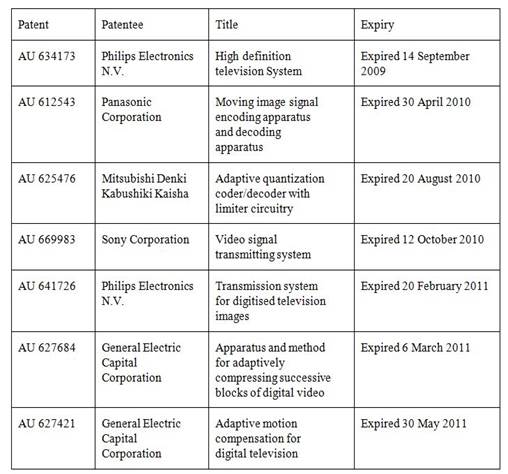
The “title” to each of the respective patents is, in fact, the “specification” set forth in each patent. Each of these patents, Regency Media contended, constituted a “patented invention”. On this approach, Regency Media contends that s 145 could have been invoked (for example) when patent AU 634173 first expired on 14 September 2009. The expiration of any one or other of these seven patents, on its approach, provided an entitlement to invoke s 145 and an entitlement to terminate the PPL Agreement in its entirety.
34 Contrary to the approach of Regency Media, MPEG contended that there were three “patented invention[s]”, namely the three matters the subject of the grant of rights identified in clauses 2.1, 2.2 and 2.3 of the PPL Agreement being:
the MPEG-2 Decoding Products;
the MPEG-2 Encoding Products; and
the MPEG-2 Packaged Medium.
If each of these three matters constituted a “patented invention”, on the approach of MPEG, s 145 could only be invoked when all of the patents have expired. So much followed, on the approach of MPEG, because the licence granted by each of clauses 2.1, 2.2 and 2.3 extended to “all MPEG-2 Patent Portfolio Patents…”.
35 Other than submitting that each of the individual patents was the “patented invention” for the purposes of s 145, no submission was advanced on behalf of Regency Media that the manner in which each of those individual patents had been aggregated to constitute (for example) the MPEG-2 Decoding Products could not also constitute an “invention”.
36 Each of the competing approaches, with respect, has considerable merit. Each approach finds support in the statutory language employed in the Patents Act and the objects and purposes sought to be achieved by provisions such as s 145.
37 If Regency Media be correct in its contention, it would necessarily follow that:
the rights otherwise conferred upon Regency Media to exploit the products covered by those patents that have not expired will also be terminated; and that
the owners of such patents will be denied the benefit of receiving the royalties otherwise agreed to be paid pursuant to the PPL Agreement whilst those patents remain current.
To deny to Regency Media the right to terminate the PPL Agreement, so it contends:
would be to enable the patent holders, whose patents have expired, the right to continue to “exploit” their monopoly.
MPEG maintains on the facts of the present case that its approach to the application of s 145 would be to hold Regency Media:
to the terms of an agreement which it recognised at the time of contracting was an agreement which conferred upon it considerable benefits; and
to an agreement to pay royalties in respect to patents, some of which had expired, but at a decreasing monetary value.
No “commercial unfairness”, so MPEG contends, is visited by Regency Media upon its approach.
38 It is concluded that the approach of MPEG to the construction and application of s 145 is to be preferred, albeit not for all the reasons relied upon by MPEG.
39 Whatever may be the correct application of provisions found elsewhere in the Patents Act also employing the phrase a “patented invention”, s 145 makes clear that the “patented invention” to which it refers may be one that is protected by more than one patent. The meaning of the phrase as used in s 145 is considered to be clear.
40 Accepted is the submission of MPEG that each of the three matters identified in clauses 2.1, 2.2 and 2.3 of the PPL Agreement constitutes an “invention”. Each of these three matters is a “manner of new manufacture” for the purposes of the definition of an “invention” in Schedule 1 of the Patents Act. The definition is directed to the subject matter of the “invention” and not to the number of patents which may protect the “invention”. And a “manner of new manufacture” includes an “artificially created state of affairs” and new processes: National Research Development Corporation (1959) 102 CLR at 277. The term “patented” as used in s 145 thus describes the “invention” to which it refers.
41 Rejected is the submission of Regency Media that the phrase “patented invention” refers to each “invention” embraced by a single patent. Also rejected is the attempt on the part of Regency Media to explain the reference in s 145 to “all the patents” as a reference to the so-called “combination patent”, namely those patents which may include as part of the patented invention an integer or element which itself is patented. Regency Media, by way of example, instanced a patented invention X which involved a number of integers (A + B + C) and where C was itself the subject of a patent. The patent involved in Aktiebolaget Hassle v Alphapharm Pty Ltd [2002] HCA 59, (2002) 212 CLR 411 was said to provide an example. But the example provides no assistance to Regency Media. There is considered to be no satisfactory reason for construing s 145 in a manner which would carve out from the otherwise general terms of s 145 an exception for a “combination patent”. The prospect that a patent may itself include a further patented product provides no reason to construe the phrase “patented invention” in a confined manner and in a manner which would not also embrace an “invention” protected by one or more patents. Nor would such a construction of s 145 operate in practice in a manner which would permit the giving of a notice seeking to terminate a contract at any earlier point of time. Even on this approach, the single integer patent would expire no later than the combination patent.
42 The conclusion, it is further considered, does no disservice to the object and purpose of s 145. It may well be queried whether provisions such as s 145 were drafted at a time when a host of patents may be pooled and thereafter administered by a “Licensing Administrator”. If so, it may be prudent for consideration to be given to amending s 145 to expressly address what may be a comparatively more recent manner in which a pool of patents may be jointly administered. But whether that is so or not, s 145 must be applied to the facts of the present case. And, where a construction of that provision is available, which:
gives effect to the commercial agreement between the parties;
deprives a licensee of exploiting a change in commercial circumstances so as to permit the termination of an agreement which was otherwise seen at the outset to be of commercial utility to it for the term of the agreement; and
continues to preserve the royalty payments to subsisting patents
the Court should prefer that construction.
43 A court, should be slow to prefer a construction which would permit the termination of an agreement in respect to patents which have not ceased to be in force and which would deny to a patent holder the benefit of the payment of royalties in amounts that have been the subject of agreement. Section 145 manifestly does not permit a contract to be terminated where “all of the patents, by which the invention [is] protected” have not ceased to be in force.
44 Where such a process of construction is not available, a Court should equally not engage in a process of artificial interpretation in order to reach a conclusion which it considers achieves commercial fairness or “reasonableness” in the circumstances of a particular case. The potential for commercial unfairness, irrespective of the terms of any particular agreement, may be considered by a court as a means of testing a process of construction. It is thus appropriate to test the present construction of s 145 by reference to the prospect that a licensee who seeks to invoke s 145 prior to the expiration of all the patents protecting a patented invention would deprive the patent holder of royalties in respect to current patents. It is also appropriate to test the construction of s 145 by reference to the prospect that the holder of a patent may seek to invoke s 145 prior to the expiration of all the patents protecting a patented invention and thereby deprive a licensee of a right to continue to exploit a licenced patent subject to the terms of an agreement. But considerable reservation is expressed if recourse is had to the terms of a particular agreement in support of a proposition that to invoke s 145 in such circumstances would operate no commercial unfairness. Such reliance as was placed by Senior Counsel for MPEG upon the asserted “reasonableness” of the PPL Agreement should be approached with considerable caution. The facts, for example, that Regency Media acknowledged in the PPL Agreement that it was entering into the PPL Agreement “for its own convenience” (cl 4.4) and was not required to use “all MPEG-2 Patent Portfolio Patents” (cl 4.6) and that it was to pay a decreasing rate of royalties as the PPL Agreement progressed in point of time, could not be a reason for construing s 145 in a manner contrary to its proper construction.
45 The conclusion that s 145 could not be invoked by Regency Media until all the patents referable to one or other of the three “patent inventions” identified by MPEG would have followed, for example, even had the rates of royalty payments been constant. Nor should any relevant adverse inference be drawn from the fact that Regency Media, upon its approach, was entitled to terminate the PPL Agreement upon the expiration of the first Australian patent on 14 September 2009 and did not do so until 2012. The fact that a party to an agreement may seek to invoke s 145 well after the time when it could first have done so may, in an appropriate case, permit an inference that it was invoking s 145 – not to avoid further exploitation by a patentee – but rather seeking to terminate its agreement for some ulterior commercial purpose and in circumstances where it was hitherto totally unaware of the rights conferred by s 145. But such commercial motivations may be totally irrelevant to the application of s 145 to the facts of a particular case.
46 Section 145 identifies with certainty when a party to a contract may terminate upon the giving of notice; the section, not surprisingly, confers no broad ranging discretionary power upon a Court to permit the termination of an agreement where it is considered – in the opinion of the Court – to be desirable or fair or reasonable to do so.
Conclusions
47 Section 145 conferred no right upon Regency Media to terminate the PPL Agreement as at 5 July 2012. Section 145 should be construed as only permitting a party to the PPL Agreement to terminate it where all of the patents in respect to each of the three “patented inventions” identified in clauses 2.1, 2.2 and 2.3 have ceased to be in force.
48 The parties should bring in Short Minutes of Orders to give effect to these reasons, including an order that Regency Media should pay the costs of MPEG.
THE ORDERs OF THE COURT ARE
1. The parties are to bring in Short Minutes of Orders to give effect to these reasons within fourteen days.
2. The proceeding is stood over to 9.30 am on 20 March 2014 with a view to then making orders to dispose of the proceeding.
| I certify that the preceding forty-eight (48) numbered paragraphs are a true copy of the Reasons for Judgment herein of the Honourable Justice Flick. |
Associate:


