

O’Keefe v Northern Territory of Australia [2014] FCA 154
| IN THE FEDERAL COURT OF AUSTRALIA | |
| RANGIAH J | |
| DATE OF ORDER: | 6 MARCH 2014 |
| WHERE MADE: | TINGKKARLI/LAKE MARY ANN |
THE COURT NOTES THAT:
A. On 8 September 2011 the Applicant made a native title determination application over the land and waters within the bounds of the Brunette Downs Pastoral Lease (Perpetual Pastoral Lease No. 925) (Application).
B. The Applicant and the Respondents to this proceeding (Parties) have reached agreement as to the terms of a proposed determination of native title in relation to the land and waters covered by the Application.
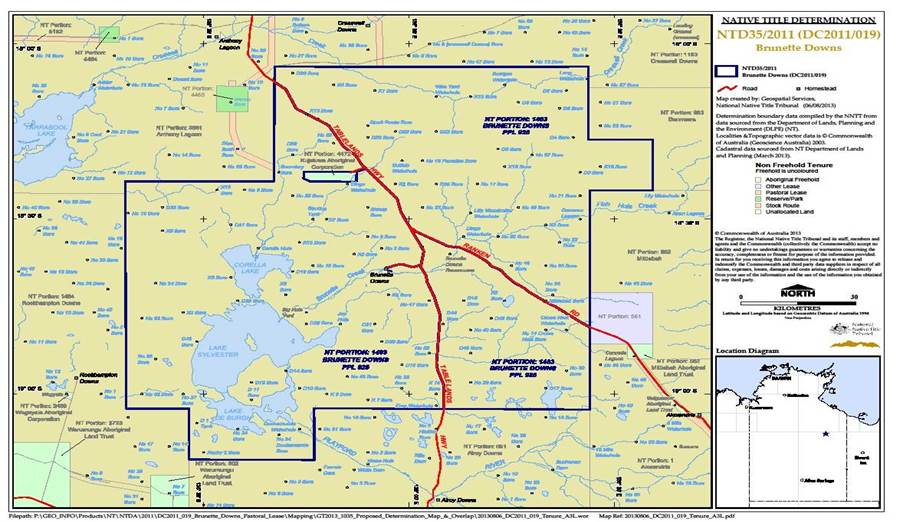
C. Pursuant to ss 87(1)(a)(i) and 87(1)(b) of the Native Title Act 1993 (Cth) (the NT Act) the Parties hereby file with this Court their agreement in writing (Determination). The external boundaries of the area subject to the Determination are described in Schedule A of the Determination and depicted on the map comprising Schedule B of the Determination (Determination Area).
D. Pursuant to ss 87 and 94A of the Act the terms of the Parties’ agreement involve the making of consent orders for a determination that native title exists in relation to the Determination Area as provided by the Determination.
E. The Parties acknowledge that the effect of making the Determination is that the members of the native title claim group, in accordance with the traditional laws acknowledged and the traditional customs observed by them, be recognised as the native title holders for the Determination Area as provided by the Determination.
F. The Parties request that the Court hear and determine this proceeding in accordance with their agreement.
BEING SATISFIED THAT a determination of native title in the terms of the Determination in respect of the proceeding would be within the power of the Court and, it appearing to the Court appropriate to do so, pursuant to s 87 of the NT Act and by the consent of the parties:
THE COURT ORDERS THAT:
1. There be a determination of native title in terms of the Determination set out below.
2. The native title is not to be held on trust.
3. An Aboriginal corporation whose name is to be provided within 12 months, or such further time as the Court may allow, is:
(a) to be the prescribed body corporate for the purposes of s 57(2) of the NT Act;
(b) to perform the functions outlined in s 57(3) of the NT Act after becoming a registered native title body corporate.
4. There be no order as to costs.
5. The parties have liberty to apply for the following purposes:
(a) to establish the precise location and boundaries of the public works and adjacent land and waters identified in relation to any part or parts of the Determination Area referred to in Schedule D of this determination;
(b) to establish the precise location of the boundaries of land on which the pastoral improvements referred to in Schedule D of this Determination have been constructed and any adjacent land or waters the exclusive use of which is necessary for the enjoyment of the improvements; and
(c) to establish whether any of the pastoral improvements referred to at Schedule D of this Determination have been constructed unlawfully.
THE COURT DETERMINES THAT:
The Determination Area
1. The Determination Area is the land and waters described in Schedule A hereto and depicted on the map comprising Schedule B.
2. Native title exists in those parts of the Determination Area identified in Schedule C.
3. Native title does not exist in those parts of the Determination Area identified in Schedule D.
4. In the event of any inconsistency between a description of an area in a schedule and the depiction of that area on the map in Schedule B, the written description will prevail.
The native title holders
5. The land and waters of the Determination Area comprise the whole or part of three estates, which are held respectively by the members of the following estate groups:
(a) the Karrkarrkuwaja (Kalkalkuwaja) estate group;
(b) the Mangurinji estate group;
(c) the Kujuluwa estate group.
These persons, together with the Aboriginal people referred to in clause 7 hereof, are collectively referred to as “the native title holders”.
6. Each of the estate groups referred to in clause 5 hereof includes persons who are members of the group by reason of:
(a) patrilineal descent;
(b) his or her mother, father’s mother or mother’s mother being or having been a member of the group by reason of patrilineal descent;
(c) having been adopted or incorporated into the descent relationships referred to in (a) or (b) hereof.
These persons are collectively referred to as “the estate group members”.
7. In accordance with traditional laws and customs, other Aboriginal people have rights and interests in respect of the Determination Area, subject to the rights and interests of the estate group members, such people being:
(a) members of estate groups from neighbouring estates;
(b) spouses of the estate group members.
8. Each of the estate groups referred to in clause 7(a) hereof includes persons who are members of the group by reason of:
(a) patrilineal descent;
(b) his or her mother, father’s mother or mother’s mother being or having been a member of the group by reason of patrilineal descent;
(c) having been adopted or incorporated into the descent relationships referred to in (a) or (b) hereof.
The native title rights and interests
9. The native title rights and interests of the estate group members that are possessed under their traditional laws and customs are, subject to the traditional laws and customs that govern the exercise of the native title rights and interests by the native title holders, non-exclusive rights to use and enjoy those parts of the Determination Area identified in Schedule C being:
(a) the right to travel over, to move about and to have access to those areas;
(b) the right to hunt and to fish on the land and waters of those areas;
(c) the right to gather and to use the natural resources of those areas such as food, medicinal plants, wild tobacco, timber, stone and resin;
(d) the right to take and to use the natural water on those areas, and for the sake of clarity and the avoidance of doubt this right does not include the right to take or use water captured by the holders of Perpetual Pastoral Lease No. 925;
(e) the right to live, to camp and for that purpose to erect shelters and other structures on those areas;
(f) the right to light fires on those areas for domestic purposes, but not for the clearance of vegetation;
(g) the right to conduct and to participate in the following activities on those areas:
(i) cultural activities;
(ii) cultural practices relating to birth and death, including burial rites;
(iii) ceremonies;
(iv) meetings;
(v) teaching the physical and spiritual attributes of sites and places on those areas that are of significance under their traditional laws and customs;
(h) the right to maintain and to protect sites and places on those areas that are of significance under their traditional laws and customs;
(i) the right to share or exchange subsistence and other traditional resources obtained on or from those areas;
(j) the right to be accompanied on to those areas by persons who, though not native title holders, are:
(i) people required by traditional law and custom for the performance of ceremonies or cultural activities on the areas;
(ii) people who have rights in relation to the areas according to the traditional laws and customs acknowledged by the estate group members;
(iii) people required by the estate group members to assist in, observe, or record traditional activities on the areas;
(k) the right to conduct activities necessary to give effect to the rights referred to in (a) to (j) hereof.
These native title rights and interests do not confer on the estate group members possession, occupation, use and enjoyment of the Determination Area, to the exclusion of all others.
10. The native title rights and interests of the native title holders referred to in clause 7 hereof that are possessed under their traditional laws and customs are, subject to the traditional laws and customs that govern the exercise of the native title rights and interests by the native title holders, non-exclusive rights to use and enjoy those parts of the Determination Area identified in Schedule C being:
(a) the right to travel over, to move about and to have access to those areas;
(b) the right to hunt and to fish on the land and waters of those areas;
(c) the right to gather and to use the natural resources of those areas such as food, medicinal plants, wild tobacco, timber, stone and resin;
(d) the right to take and to use the natural water on those areas, and for the sake of clarify and the avoidance of doubt this right does not include the right to take or use water captured by the holders of Perpetual Pastoral Lease No. 925;
(e) the right to camp on those areas;
(f) the right to light fires on those areas for domestic purposes, but not for the clearance of vegetation;
(g) the right to conduct activities necessary to give effect to the rights referred to in (a) to (f) hereof.
These native title rights and interests do not confer on the native title holders referred to in clause 7 hereof possession, occupation, use and enjoyment of the Determination Area, to the exclusion of all others.
Other interests in the Determination Area
11. The nature and extent of other interests in relation to the Determination Area are the interests, created by the Crown or otherwise, as follows:
(a) in relation to NT portions 1483, 1367 and 926, the interests of Austcattle Holdings Pty Ltd under Perpetual Pastoral Lease No. 925;
(b) the rights and interests of Telstra Corporation Limited:
(i) as the owner or operator of telecommunications facilities within the Determination Area;
(ii) created pursuant to the Post and Telegraph Act 1901 (Cth), the Telecommunications Act 1975 (Cth), the Australian Telecommunications Corporation Act 1989 (Cth), the Telecommunications Act 1991 (Cth) and the Telecommunications Act 1997 (Cth), including rights:
(A) to inspect land;
(B) to install and operate telecommunications facilities;
(C) to alter, remove, replace, maintain, repair and ensure the proper functioning of its telecommunications facilities; and
(iii) for its employees, agents or contractors to access its telecommunications facilities in, and in the vicinity of, the Determination Area in performance of their duties; and
(iv) under any lease, licence, access agreement or easement relating to its telecommunications facilities in the Determination Area;
(c) in relation to NT portions 1483, 1367 and 926, the rights of Aboriginal persons (whether or not native title holders) pursuant to the reservation in favour of Aboriginal peoples contained in the pastoral lease, identified in ss 38(2) – (6) of the Pastoral Land Act 1992 (NT);
(d) the rights of Aboriginal persons (whether or not native title holders) by virtue of the Northern Territory Aboriginal Sacred Sites Act 1989 (NT);
(e) rights of access by an employee, servant, agent or instrumentality of the Northern Territory or Commonwealth, or other statutory authority as required in the performance of statutory duties;
(f) the interests of persons to whom valid and validated rights and interests have been:
(i) granted by the Crown pursuant to statute or otherwise in the exercise of executive power; or
(ii) otherwise conferred by statute.
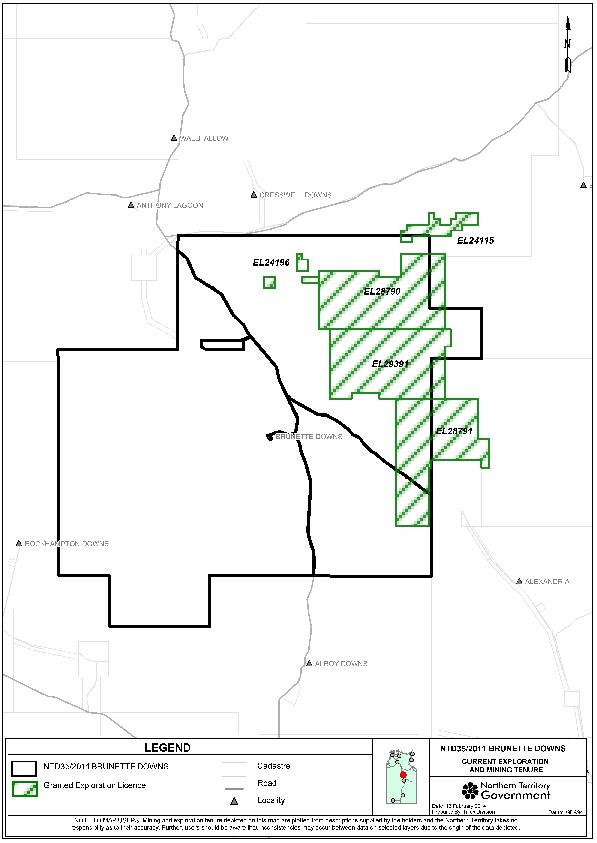
(g) the following interests granted under the Mineral Titles Act (NT), depicted in Schedule E:
(i) Exploration Licence Title No. 28791 granted on 21 December 2011;
(ii) Exploration Licence Title No. 28790 granted on 2 April 2012;
(iii) Exploration Licence Title No. 29391 granted on 2 April 2012;
(iv) Exploration Licence Title No. 24115 granted on 13 October 2004;
(v) Exploration Licence Title No. 24196 granted on 5 March 2013.
12. To the extent, if at all, that the exercise of the native title rights and interests referred to in clauses 9 and 10 conflicts with the exercise of the rights and interests of the persons referred to in clause 11, the rights and interests of the persons referred to in clause 11 prevail over, but do not extinguish, the native title rights referred to in clauses 9 and 10.
Other matters
13. There are no native title rights and interests in:
(a) minerals (as defined in s 2 of the Minerals (Acquisition) Act (NT));
(b) petroleum (as defined in s 5 of the Petroleum Act (NT));
(c) prescribed substances (as defined in s 3 of the Atomic Energy (Control of Materials) Act 1946 (Cth) and/or s 5(1) of the Atomic Energy Act 1953 (Cth)),
in the Determination area.
14. The native title rights and interests are subject to and exercisable in accordance with the valid laws of the Northern Territory of Australia and the Commonwealth of Australia.
15. The native title rights and interests are for the personal or communal needs of the native title holders which are of a domestic or subsistence nature and not for any commercial or business purpose.
Schedule A
Description of Determination Area
The Determination Area comprises the following areas of land:
1. NT portions 1483, 1367 and 926 being land the subject of Perpetual Pastoral Lease 925.
Schedule B
Map of Determination Area
Schedule C
Areas where native title exists
The areas of land and waters in respect of which the native title rights and interests in clauses 9 and 10 apply are:
1. NT portions 1483, 1367 and 926, being land the subject of Perpetual Pastoral Lease 925, except those parts thereof referred to in Schedule D;
Schedule D
Areas where native title does not exist
Native title rights and interests have been wholly extinguished in the following areas of land and waters:
1. Those parts of the Determination Area covered by public works (including adjacent land or waters as defined in s 251D of the NT Act) which were constructed, established or situated prior to 23 December 1996 or commenced to be constructed or established on or before that date, including but not limited to:
(a) public roads, whether rural roads, arterial roads or national highways;
(b) community and pastoral access roads which are not otherwise public roads;
(c) gravel pits adjacent to the roads referred to at paragraphs (a) and (b) hereof used to maintain those roads;
(d) access roads or tracks to the public works referred to in this clause;
(e) Government bores and associated infrastructure including bores used for
the establishment, operation or maintenance of public and other roads;
(f) river and rain gauges;
(g) transmission and distribution water pipes and associated infrastructure;
(h) sewer pipes, sewer pump stations and associated infrastructure;
(i) bores, squatters tanks, constructed stock watering points and associated infrastructure within stock routes; and
(j) electricity transmission lines, towers, poles and associated infrastructure.
2. In relation to NT portions 1483, 1367 and 926, those parts of the Determination Area covered by pastoral improvements including but not limited to:
(a) a homestead, house, sheds and buildings;
(b) bores;
(c) turkey nests;
(d) squatters tanks;
(e) constructed dams and/or other constructed stock watering points;
(f) stockyards and trapyards; and
(g) homestead and highway airstrips.
The areas described by 2(a) – (g) comprise land on which the improvements have been constructed prior to the date of this determination, and any adjacent land or waters the exclusive use of which is necessary for the enjoyment of the improvements.
Schedule E
Map of interests granted under the Mineral Titles Act (NT)
Note: Entry of orders is dealt with in Rule 39.32 of the Federal Court Rules 2011.
| NORTHERN TERRITORY DISTRICT REGISTRY | |
| GENERAL DIVISION | NTD 34 of 2011 |
| BETWEEN: | SHIRLEY O’KEEFE ON BEHALF OF THE KARRKARRKUWAJA (KALKALKUWAJA) GROUP, THE MANGURINJI GROUP AND THE KUJULUWA GROUP) Applicant |
| AND: | NORTHERN TERRITORY OF AUSTRALIA First Respondent AUSTCATTLE HOLDINGS PTY LTD Second Respondent TELSTRA CORPORATION LIMITED Third Respondent |
| JUDGE: | RANGIAH J |
| DATE: | 6 MARCH 2014 |
| PLACE: | TingKKARLI/LAKE MARY ANN |
REASONS FOR JUDGMENT
1 On 8 September 2011, Shirley O’Keefe on behalf of the Karrkarrkuwaja (Kalkalkuwaja) Group, the Mangurinji Group and the Kujuluwa Group filed in the Federal Court of Australia a native title determination application over the land and waters within the bounds of the Brunette Downs Pastoral Lease (Perpetual Pastoral Lease No. 925) (the Application).
2 It is one of seven applications being heard together, because they are geographically proximate. It is also one of seven applications which are being dealt with as a group, at the request of the relevant pastoralists and with the consent of the Northern Territory and of the applicants in the other claim in the group, because of a wider geographical proximity.
3 The Brunette Downs Pastoral Lease, the area over which the proposed determination will be granted, is an area of some 12,260 square kilometres. The other applications which will be the subject of a determination at the same time are:
(a) Claudette Albert on behalf of the Jalajirrpa Group, the Walanyja Group and the Karrkarrkuwaja (Kalkalkuwaja) Group over the area of the Eva Downs Pastoral Lease covering an area of some 2820 square kilometres (Application NTD 33 of 2011);
(b) Tony Willy on behalf of the Gulunurru (Anderson) Group and the Purrukwarra Group over the area of the Alroy Downs Pastoral Lease covering an area of some 4390 square kilometres (Application NTD 34 of 2011);
(c) Harry Morrison on behalf of the Kurtinja Group, the Kunakiji/Lukkurnu Group, the Kunapa Group, the Jalajirrpa Group and the Pirrtangu Group over the area of the Brunchilly Pastoral Lease covering an area of some 3340 square kilometres (Application NTD 36 of 2011);
(d) Peppi Simpson on behalf of the Kunakiji (Snake) and Lukkurnu (Star) Group, the Kurtinja (Turkey) Group and the Jampijinpa/Jangala-Kunapa Group over the area of the Rockhampton Downs Pastoral Lease covering an area of some 4900 square kilometres (Application NTD 51 of 2011);
(e) Tony Cutta on behalf of the Karrkarrkuwaja (Kalkalkuwaja) Group, the Jukutayi Palyarinji Group, the Walanyja Group and the Kurtinja Group over the area of the Anthony Lagoon Pastoral Lease covering an area of some 6483 square kilometres (Application NTD 7 of 2013);
(f) Harry Bates, Heather Wilson and William Kingston on behalf of the [Y]ijiparta, Gurungu/Kulumintini and Warranangku Estate Groups over the area of the Tandyidgee Pastoral Lease covering an area of some 2807 square kilometres (Application NTD 8 of 2013).
4 The Native Title Act 1993 (Cth) (the NT Act) was enacted for the purpose of recognising and protecting native title and to establish ways in which future dealings in relation to native title should proceed and set standards for those dealings, and to establish a mechanism for determining claims for native title.
5 One of the objectives of the NT Act is the resolution of claims for the recognition of native title by agreement. That has been facilitated by the amendments to s 87 by the Native Title Amendment Act 2009 (Cth). It is very appropriate, therefore, that this application and the related applications have resulted in the parties agreeing to the terms of orders to be made by consent pursuant to s 87 of the NT Act.
6 The preamble to the NT Act recognised, on behalf of all people of Australia, that the Aboriginal peoples of Australia inhabited this country for many many years prior to European settlement, and that the Aboriginal peoples had been progressively dispossessed of their lands. It recorded that, by the overwhelming vote of the people of Australia, the Constitution was amended to enable laws such as the NT Act to be passed, to facilitate the recognition by our shared legal system of the native title rights and interests in their land. This is an occasion when the Court is to make orders declaring that the groups of Aboriginal persons in the current applications were and are the traditional owners of that land. By the Court’s orders, the Australian community collectively recognises that status. It is important to emphasise that the Court’s orders do not grant that status. The Court is declaring that it exists and has always existed at least since European settlement.
7 Various parts of the Brunette Downs Pastoral Lease were the subject of a number of former native title determination applications including NTD 6030 of 2001 (Dalmore Downs), NTD 6039 of 2001 (Cresswell/Benmara), NTD 6001 of 2003 (Rockhampton Downs) and NTD 6018 of 2009 (Brunette Downs). Those applications have since been amended or withdrawn so as to remove any claims which overlap the Determination Area.
8 The holder of the native title rights and interests are first the primary native title holders comprising the members of the following estate groups:
(a) the Karrkarrkuwaja (Kalkalkuwaja) estate group;
(b) the Mangurinji estate group;
(c) the Kujuluwa estate group.
Each of those estate groups includes persons who are members of the group by reason of:
(a) patrilineal descent;
(b) his or her mother, father's mother or mother's mother being or having been a member of the group by reason of patrilineal descent;
(c) having been adopted or incorporated into the descent relationships referred to in this paragraph.
These persons are collectively referred to as “the estate group members”.
9 In addition, the proposed Determination recognises that, in accordance with traditional laws and customs, there are other Aboriginal people who have rights and interests in respect of the Determination Area, subject to the rights and interests of the estate group members, such people being:
(a) members of estate groups from neighbouring estates;
(b) spouses of the estate group members.
Each of those estate groups includes persons who are members of the group by reason of:
(a) patrilineal descent;
(b) his or her mother, father's mother or mother's mother being or having been a member of the group by reason of patrilineal descent;
(c) having been adopted or incorporated into the descent relationships referred to in (a) or (b) of this paragraph.
10 The native title rights and interests of the estate group members that are claimed to be possessed under their traditional laws and customs are, subject to the traditional laws and customs that govern the exercise of the native title rights and interests by the native title holders, non-exclusive rights to use and enjoy those parts of the Determination Area being:
(a) the right to travel over, to move about and to have access to those areas;
(b) the right to hunt and to fish on the land and waters of those areas;
(c) the right to gather and to use the natural resources of those areas such as food, medicinal plants, wild tobacco, timber, stone and resin;
(d) the right to take and to use the natural water on those areas, and for the sake of clarity and the avoidance of doubt this right does not include the right to take or use water captured by the holders of Perpetual Pastoral Lease No. 925;
(e) the right to live, to camp and for that purpose to erect shelters and other structures on those areas;
(f) the right to light fires on those areas for domestic purposes, but not for the clearance of vegetation;
(g) the right to conduct and to participate in the following activities on those areas:
(i) cultural activities;
(ii) cultural practices relating to birth and death, including burial rites;
(iii) ceremonies;
(iv) meetings;
(v) teaching the physical and spiritual attributes of sites and places on those areas that are of significance under their traditional laws and customs;
(h) the right to maintain and to protect sites and places on those areas that are of significance under their traditional laws and customs;
(i) the right to share or exchange subsistence and other traditional resources obtained on or from those areas;
(j) the right to be accompanied on to those areas by persons who, though not native title holders, are:
(i) people required by traditional law and custom for the performance of ceremonies or cultural activities on the areas;
(ii) people who have rights in relation to the areas according to the traditional laws and customs acknowledged by the estate group members;
(iii) people required by the estate group members to assist in, observe, or record traditional activities on the areas;
(k) the right to conduct activities necessary to give effect to the rights referred to in (a) to (j) hereof.
These native title rights and interests do not confer on the estate group members possession, occupation, use and enjoyment of the Determination Area, to the exclusion of all others.
11 The native title rights and interests of the native title holders referred to in [9] above that are claimed to be possessed under their traditional laws and customs are, subject to the traditional laws and customs that govern the exercise of the native title rights and interests by the native title holders, non-exclusive rights to use and enjoy those parts of the Determination being:
(a) the right to travel over, to move about and to have access to those areas;
(b) the right to hunt and to fish on the land and waters of those areas;
(c) the right to gather and to use the natural resources of those areas such as food, medicinal plants, wild tobacco, timber, stone and resin;
(d) the right to take and to use the natural water on those areas, and for the sake of clarity and the avoidance of doubt this right does not include the right to take or use water captured by the holders of Perpetual Pastoral Lease No. 925;
(e) the right to camp on those areas;
(f) the right to light fires on those areas for domestic purposes, but not for the clearance of vegetation;
(g) the right to conduct activities necessary to give effect to the rights referred to in (a) to (f) hereof.
These native title rights and interests do not confer on the native title holders referred to in [10] hereof possession, occupation, use and enjoyment of the Determination Area, to the exclusion of all others.
12 The determination of native title rights and interests are important to the Applicant and to the Aboriginal estate groups because they are a recognition by the Court on behalf of the Australian community that their ancestors inhabited this country prior to European settlement. The orders that the Court is about to make today are a recognition that they enjoyed such rights as the traditional owners of the land, and have done so since that time.
13 The application before the Court is not an application seeking the Court grant the applicant the native title rights, but an application that the Court make declarations that such native title rights exist.
14 The parties have approached the Court asking the Court to act under s 87 of the NT Act and make orders in accordance with the agreed terms between the parties.
15 In support of this application, the parties have filed the following documents:
(a) Minute of proposed orders and determination of native title by consent.
(b) Statement of Joint Agreed Facts by the applicant and the first respondent.
(c) Joint submissions of the applicant and the first respondent.
16 Section 87 of the NT Act empowers a court at any stage of proceedings after the end of the period specified in any notice given under s 66 of the NT Act if it appears to be appropriate to do so, to make an order consistent with the terms of an agreement between the parties to the proceeding without holding a hearing in relation to the application.
17 The conditions under which s 87 enables the Court to make such a determination without a hearing are:
(a) the period specified in the notice given under s 66 of the NT Act has ended and there is an agreement between all of the parties on the terms of a proposed order of the Court in relation to the proceedings: s 87(1)(a);
(b) the terms of the proposed determination agreement are in writing and are signed by or on behalf of the parties and filed with the Court: s 87(1)(b);
(c) the Court is satisfied that an order in, or consistent with, those terms would be within its power: s 87(1)(c); and
(d) the Court considers that it would be appropriate to make the orders sought: s 87(1A) and (2).
18 In addition to those matters, the Court must have regard to the following before making determinations of native title by consent:
(a) whether all parties likely to be affected by an order have had independent and competent legal representation;
(b) whether the rights and interests that are to be declared in the determination are recognisable by the law of Australia or the state in which the land is situated;
(c) whether all of the requirements of the NT Act have been complied with.
19 The NT Act is designed to encourage parties to an application to take responsibility for resolving proceedings without the need for the Court’s intervention by way of a hearing.
20 For that reason, when the Court is examining the appropriateness of an agreement reached between the parties, the focus of the Court in considering whether the orders sought are appropriate under ss 87(1) and (2) is on the making of the agreement by the parties. In Lovett on behalf of the Gunditjmara People v State of Victoria [2007] FCA 474 North J stated at [36] to [37] that:
The Act is designed to encourage parties to take responsibility for resolving proceedings without the need for litigation. Section 87 must be construed in this context. The power must be exercised flexibly and with regard to the purpose for which the section is designed.
In this context, when the Court is examining the appropriateness of an agreement, it is not required to examine whether the agreement is grounded on a factual basis which would satisfy the Court at a hearing of the application. The primary consideration of the Court is to determine whether there is an agreement and whether it was freely entered into on an informed basis: Nangkiriny v State of Western Australia (2002) 117 FCR 6; [2002] FCA 660, Ward v State of Western Australia [2006] FCA 1848. Insofar as this latter consideration applies to a State party, it will require the Court to be satisfied that the State party has taken steps to satisfy itself that there is a credible basis for an application: Munn v Queensland (2001) 115 FCR 109; [2001] FCA 1229.
21 The Court is not required to embark upon an inquiry as to the merits of the claim to be itself satisfied that the orders are supported and in accordance with law: Cox on behalf of the Yungngora People v State of Western Australia [2007] FCA 588 at [3] per French J. However, the Court will consider evidence for the limited purpose of determining whether the State has made a rational decision and is acting in good faith: Munn for and on behalf of the Gunggari People v State of Queensland (2001) 115 FCR 109 at [29]-[30] per Emmett J.
22 The Court accepts that State and Territory governments have scrutinised the application for native title in a manner consistent with the scrutiny that you expect those governments to give in relation to claims by non-Aborigines asserting significant rights over such land: Smith v State of Western Australia (2000) 104 FCR 494 at [38] per Madgwick J. Generally, State and Territory governments have the responsibility of ensuring that the community’s interests are protected by involving themselves in a process which can assess the underlying evidence as to the existence of native title.
23 In this case, the Northern Territory is satisfied that the group to be recognised as the holders of native title rights and interests is an appropriate one, that it is appropriate to recognise the native title rights and interests proposed, and that in other respects it would be appropriate for the Northern Territory to enter into the proposed Determination.
24 On 4 April 2013, the Applicant provided a report of an anthropologist, Mr Jeffery Stead (the Anthropological Report), who had been retained by the Applicant to identify the Aboriginal groups, who under traditional law, were acknowledged in the Determination Area to possess primary and secondary rights in the Determination Area; the nature and extent of the native title rights and interests claimed in relation to the Determination Area; the connection of a senior member of each primary estate group to the Determination Area by provision of a representative biography of that person; and the sites and dreaming tracks in the Determination Area. The Anthropological Report complied with Federal Court Practice Note CM7, including as to the completeness of the enquiries made in relation to the preparation of the Anthropological Report.
25 The Anthropological Report was considered by the First and Second Respondents. In addition, upon receipt of the Anthropological Report, legal officers for the First Respondent assessed the report against criteria agreed by the parties as satisfying the requirements of s 223 of the NT Act. The First Respondent also referred the Anthropological Report to a consultant anthropologist for comment.
26 After that consideration, by letter dated 12 April 2013 the First Respondent raised various issues about the Anthropological Report with the Applicant. The Applicant and the First Respondent subsequently met and/or exchanged correspondence in relation to the First Respondent’s issues about the Anthropological Report.
27 Ultimately, the Applicant and the First Respondent reached agreement that the native title claim group described in Schedule A of the proposed Determination and in the Anthropological Report is comprised of persons who hold the claimed native title rights and interests within the meaning of sub-section 223(1) of the NT Act in the Determination Area. The Second Respondent does not dispute any of those matters.
28 The NT Act refers to the rights and interests as defined in s 223 as being in relation to land, which is the subject matter of the application. The characteristics of the native title rights and interests are:
(1) the rights and interests that are possessed under the traditional laws acknowledged and the traditional customs observed by the peoples concerned;
(2) those traditional laws and customs must have a connection with the land or waters the subject of the application; and
(3) the rights and interests must be recognised by the common law of Australia.
29 Section 225(a) prescribes one criterion for the Determination, namely that it sets out who are the persons, in each group of persons, holding the common or group rights comprising the native title area. I accept the submission of the parties that, by the detail referred to in [8]-[13] above and in the proposed Determination, that prescription is satisfied.
30 I am also satisfied that the proposed Determination identifies the nature and extent of the native title rights and interests in relation to the Determination Area, as required by s 223(b).
31 It is also necessary, by reason of s 223(c) and (d), to ensure that the proposed Determination identifies the nature and extent of any other interests in relation to the Determination Area and the relationships between the native title rights and interests and those other interests. It clearly does so.
32 It is to be observed that the parties have agreed to the recognition of non-exclusive native title rights and interests in areas covered by stock routes and stock reserves.
33 They have also agreed to:
(a) a list of commonly occurring government constructed infrastructure or public works which were constructed, established or situated prior to 23 December 1996 or commenced to be constructed or established on or before that date; and
(b) a list of pastoral improvements constructed prior to 6 March 2014, consistent with the determination in King v Northern Territory of Australia (2007) 162 FCR 89
that wholly extinguish native title (including adjacent land or waters as defined in s 251D of the Act) without evidence of the construction or establishment of the relevant public works and improvements being exchanged. Those lists are included in paragraphs 1 and 2 of Schedule D of the proposed Determination.
34 The material shows that those matters have also followed from a careful process. It has involved consideration of the respective positions of the Applicant, the Northern Territory, and others including Telstra Corporation Ltd, over a period of time. Ultimately agreement was reached on those issues.
35 That process included on 20 November 2012 the First Respondent filing “Tenure Extinguishing Act Submissions” which contained an analysis of the extinguishment of native title in the Determination Area based upon the grant of tenure. On 24 December 2012, the Third Respondent provided the Applicant and the First and Second Respondents with “Contentions in Response to Northern Territory Extinguishment Contentions in Respect of Group 6 (Banka Banka) Matters”. On 24 December 2012, the Applicant provided the Respondents with a “Report on Extinguishment”. On 12 March 2013, the Applicant provided the Third Respondent with a response to its submissions on public works. On 30 January 2013, the First Respondent provided the Applicant with the “First Respondent’s Reply to the Applicants' Report on Tenure Extinguishment”.
36 Thereafter, the Applicant, the First Respondent and the Third Respondent subsequently met and/or exchanged correspondence in relation to their contentions on extinguishment before their agreement was reached. It is appropriate in those circumstances to be satisfied as to the correctness of what has been agreed.
37 As noted, the Second Respondent does not dispute any of the matters I have referred to.
38 As to the more formal matters, I am satisfied that s 87 of the Act has been satisfied in relation to this application. In particular, I note that:
(1) the period specified in the notice given under s 66 ended on 24 April 2012 (s 87(1));
(2) the parties have reached an agreement as to the terms of a determination of native title (s 87(1)(a)(i));
(3) the parties have recorded their agreement in the Minute presented to the Court (s 87(1)(b)); and
(4) an order in terms of or consistent with the Minute would be within the Court’s power because:
(a) the application is valid and was made in accordance with s 61 of the Act;
(b) the application is for a determination of native title in relation to an area for which there was no approved determination of native title (s 13(1)(a));
(c) the Minute agreed to by the parties complies with ss 94A and 225 of the Native Title Act (s 87(1)(c)).
39 In my opinion, it is also appropriate that the Court make the orders sought because:
(1) the parties are legally represented;
(2) the Northern Territory obtained searches of land tenure and mining and other relevant interests to determine the extent of “other interests” within the proposed Determination Area and provided copies of those searches to all parties;
(3) the parties have agreed the nature and extent of interests in relation to the Determination Area and those interests are described more particularly above and in Schedules C, D and E of the proposed orders;
(4) there are no other proceedings before the Court relating to native title determination applications to cover any part of the area the subject of the application which would otherwise require orders to be made under s 67(1) of the NT Act (s 87(1) and (2));
(5) the Northern Territory has played an active role in the negotiation of the proposed Determination and, in doing so, the Northern Territory acting on behalf of the community generally, is satisfied that the determination is justified in all the circumstances.
40 Section 55 of the Act requires the Court, either at the time of the Determination or as soon as practicable after it, to make such determinations as are required by ss 56 and 57 of the NT Act. They respectively relate to holding native title on trust and to the non-trust functions of prescribed bodies corporate. The proposed determination provides that the native title is not to be held on trust. It provides for an Aboriginal corporation to be nominated to the Court within 12 months or such further time as the Court may allow to be the prescribed body corporate for the purposes of s 57(2) and to perform the functions outlined in s 57(3) of the NT Act after becoming a registered native title body corporate. The Court, of course, must act in accordance with s 55, so it anticipates that those steps will be taken following the Determination in a timely manner and certainly within the 12 month period specified.
41 For all of those reasons, I make the orders agreed upon by the parties.
| I certify that the preceding forty-one (41) numbered paragraphs are a true copy of the Reasons for Judgment herein of the |
Associate:
Dated: 6 March 2014


