FEDERAL COURT OF AUSTRALIA
Kelly v Willmott Forests Ltd (in liquidation) (No 3) [2014] FCA 78
|
Citation: |
Kelly v Willmott Forests Ltd (in liquidation) (No 3) [2014] FCA 78 |
|
Parties: |
DAVID KELLY and MARGARET KELLY (NEE ILACQUA) v WILLMOTT FORESTS LTD (IN LIQUIDATION) (ACN 063 263 650), JONATHAN DAVID MADGWICK, MARCUS DERHAM, JAMES WILLIAM ANTONY HIGGINS, HUGH THOMAS DAVIES, RAYMOND MAXWELL SMITH and BIOFOREST LIMITED (IN LIQUIDATION) (ACN 096 335 876) |
|
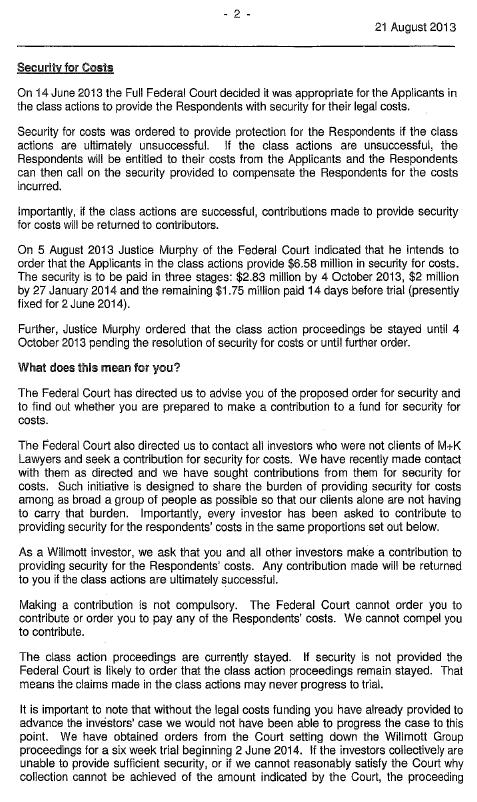
File number: |
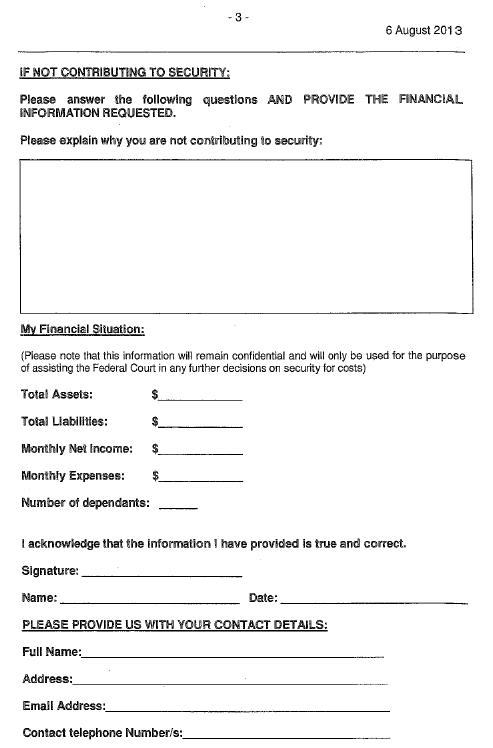
|
|
Parties: |
DAVID KELLY and MARGARET KELLY (NEE ILACQUA) v MIS FUNDING NO 1 PTY LTD |
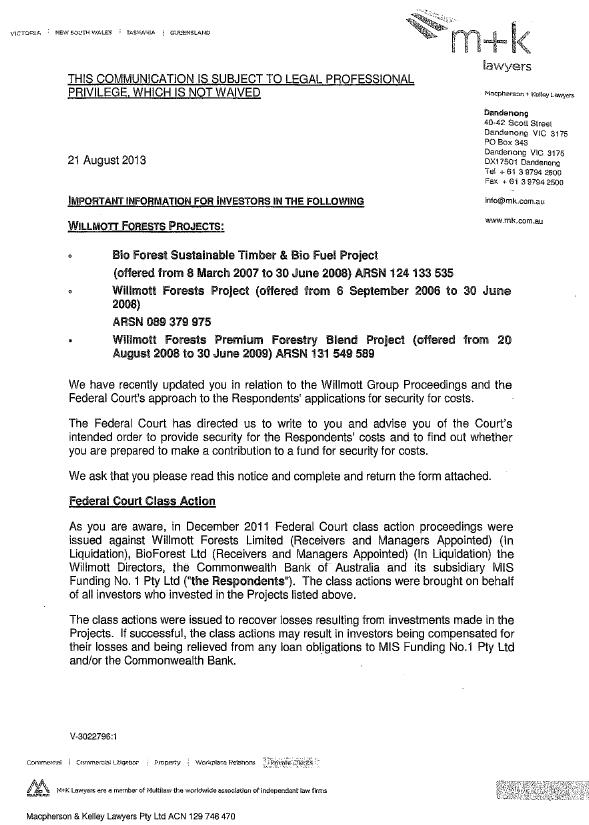
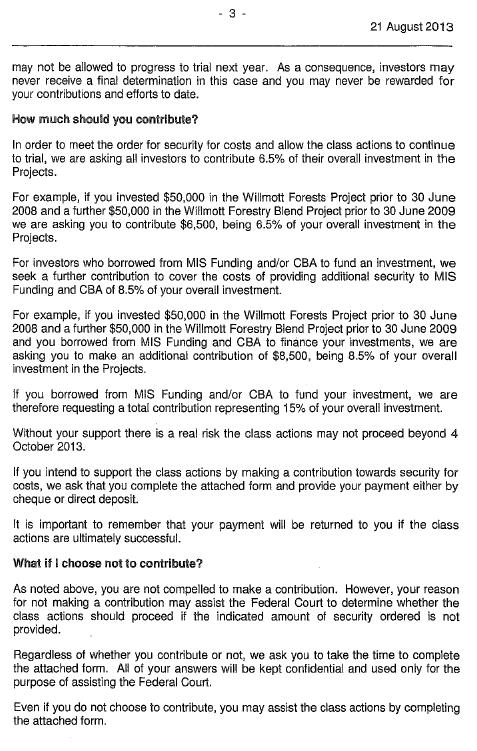
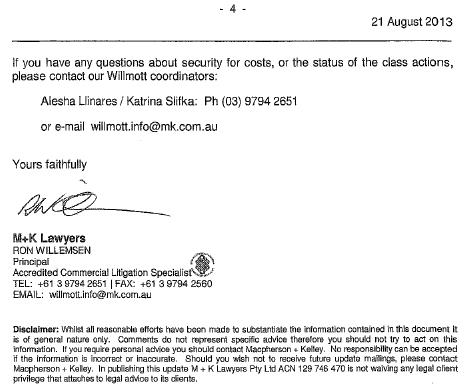
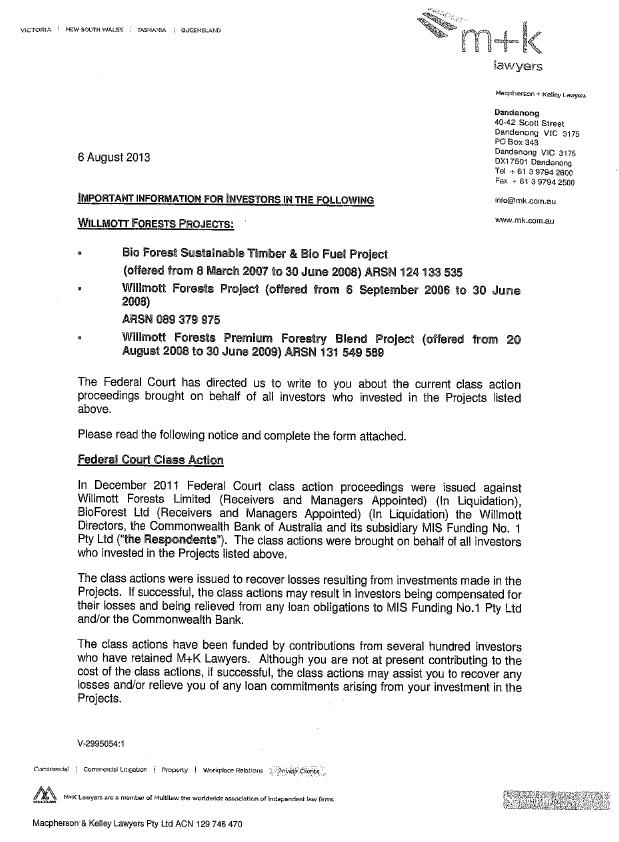
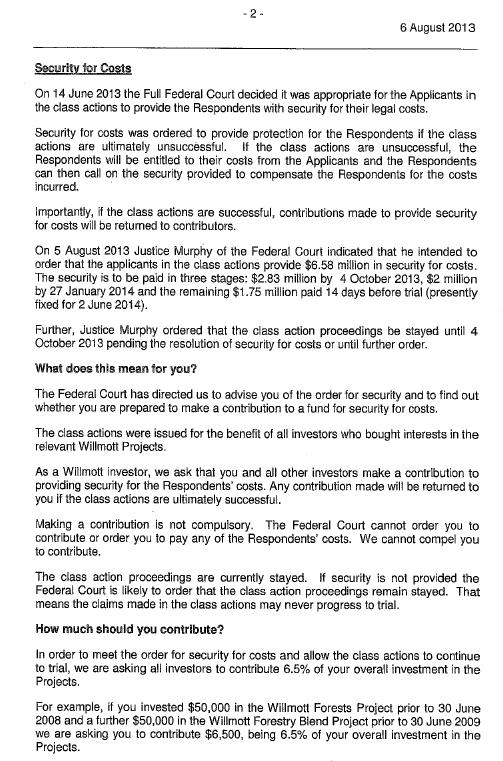
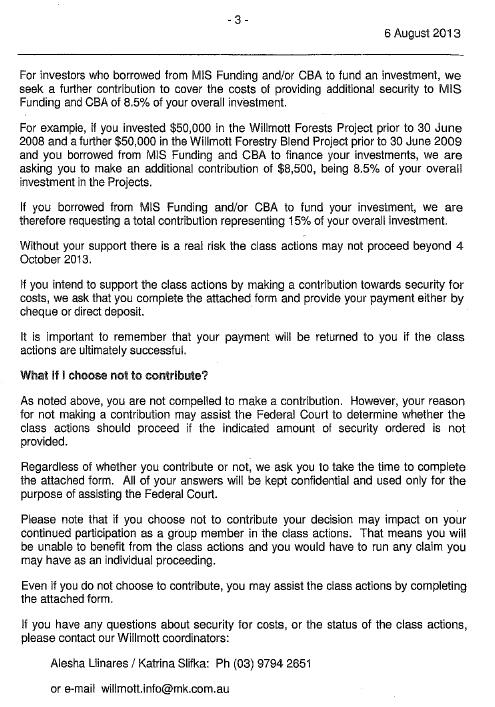
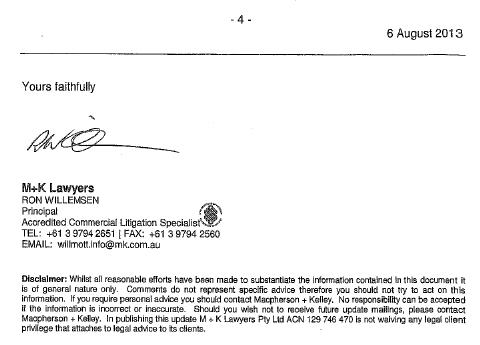
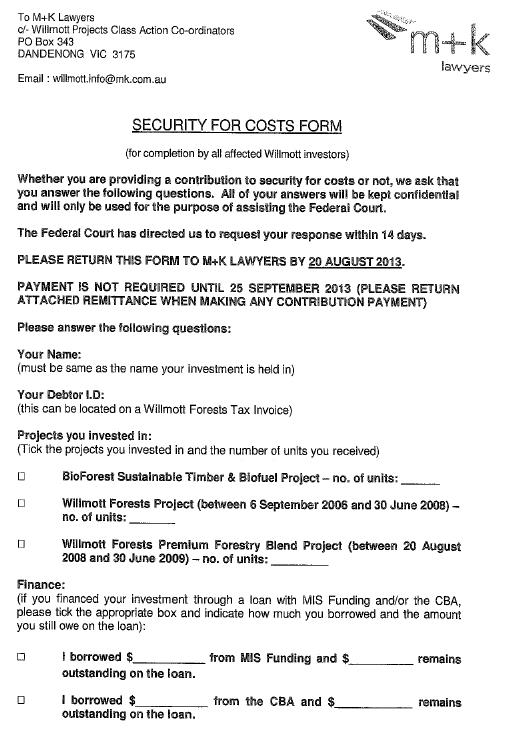
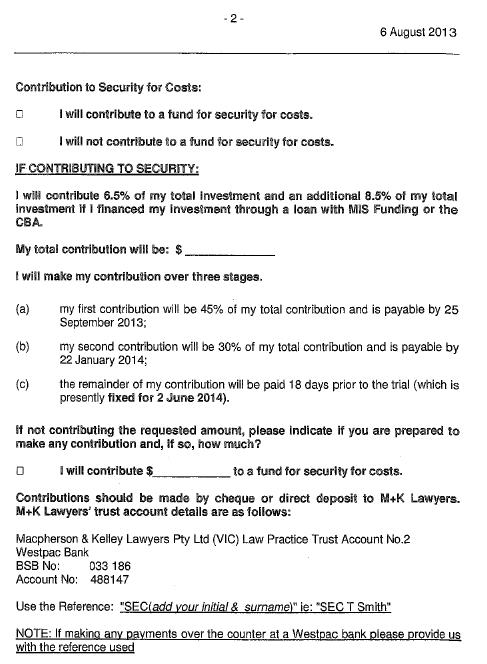
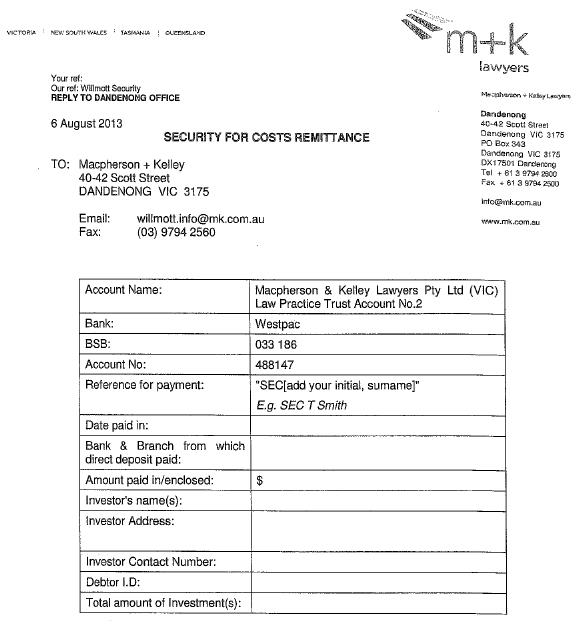
|
File number: |
VID 1483 of 2011 |
|
Parties: |
AARON GRANT v COMMONWEALTH BANK OF AUSTRALIA |
|
File number: |
VID 1484 of 2011 |
|
Place: |
Melbourne |
|
Division: |
GENERAL DIVISION |
|
Category: |
Catchwords |
|
Number of paragraphs: |
|
|
Solicitor for the Applicants: |
Macpherson and Kelley Solicitors |
|
Counsel for the First and Seventh Respondents in VID 1485 of 2011: |
Mr R Pintos-Lopez |
|
Solicitor for the First and Seventh Respondents in VID 1485 of 2011: |
Arnold Bloch Leibler |
|
Counsel for the Second, Third, Fourth, Fifth and Sixth Respondents in VID 1485 of 2011: |
Mr J Delany SC and Ms C van Proctor |
|
Solicitor for the Second, Third, Fourth, Fifth and Sixth Respondents in VID 1485 of 2011: |
Brian Ward & Partners |
|
Counsel for the Respondents in VID 1483 of 2011 and VID 1484 of 2011: |
Mr B F Quinn SC and Mr A Di Pasquale |
|
Solicitor for the Respondents in VID 1483 of 2011 and VID 1484 of 2011: |
Herbert Smith Freehills |
FEDERAL COURT OF AUSTRALIA
Kelly v Willmott Forests Ltd (in liquidation) (No 3) [2014] FCA 78
CORRIGENDUM
1. The whole of paragraph 101 which contains the words “I will revisit the adequacy of the security after opt out and class closure, and after the further steps to increase the security to be provided have been made” should be deleted.
|
I certify that the preceding one (1) numbered paragraph is a true copy of the Corrigendum to the Reasons for Judgment herein of the Honourable Justice Murphy. |
Associate:
Dated: 19 February 2014
|
IN THE FEDERAL COURT OF AUSTRALIA |
|
|
VICTORIA DISTRICT REGISTRY |
|
|
GENERAL DIVISION |
VID 1483 of 2011 |
|
BETWEEN: |
DAVID KELLY First Applicant MARGARET KELLY (NEE ILACQUA) Second Applicant |
|
AND: |
MIS FUNDING NO 1 PTY LTD (ACN 119 268 905) Respondent |
|
IN THE FEDERAL COURT OF AUSTRALIA |
|
|
VICTORIA DISTRICT REGISTRY |
|
|
GENERAL DIVISION |
VID 1484 of 2011 |
|
BETWEEN: |
AARON GRANT Applicant |
|
AND: |
COMMONWEALTH BANK OF AUSTRALIA Respondent |
|
IN THE FEDERAL COURT OF AUSTRALIA |
|
|
VICTORIA DISTRICT REGISTRY |
|
|
GENERAL DIVISION |
VID 1485 of 2011 |
|
BETWEEN: |
DAVID KELLY First Applicant MARGARET KELLY (NEE ILACQUA) Second Applicant |
|
AND: |
WILLMOTT FORESTS LTD (IN LIQUIDATION) (ACN 063 263 650) First Respondent JONATHAN DAVID MADGWICK Second Respondent MARCUS DERHAM Third Respondent JAMES WILLIAM ANTONY HIGGINS Fourth Respondent HUGH THOMAS DAVIES Fifth Respondent RAYMOND MAXWELL SMITH Sixth Respondent BIOFOREST LIMITED (IN LIQUIDATION) (ACN 096 335 876) Seventh Respondent |
|
DATE OF ORDER: |
|
|
WHERE MADE: |
THE COURT ORDERS THAT:
1. Within 28 days the Applicants provide security for costs in a form agreed between the parties, and if not agreed to be set by the Court, in the sum of $1,730,379. The proceedings be stayed without further order unless and until the security is provided.
2. The further hearing of the application for security be adjourned to a date following opt out and class closure.
3. Within 14 days the Applicants file and serve an application pursuant to s 33J of the Federal Court of Australia Act 1976 (Cth) together with a draft opt out notice.
4. Within seven days the parties confer in relation to class closure, and within 14 days the applicants file and serve, an application to close the class together with a draft class closure notice (which may be separate to or combined with the opt out notice).
5. Within 14 days the Applicants file and serve a draft letter to seek contributions, or further contributions, to security from group members with large investments in the schemes.
6. A directions hearing be fixed for 9.30 am on 7 March 2014.
7. The costs of this application be costs in the cause.
8. The parties have liberty to apply.
Note: Entry of orders is dealt with in Rule 39.32 of the Federal Court Rules 2011.
|
VICTORIA DISTRICT REGISTRY |
|
|
GENERAL DIVISION |
VID 1483 of 2011 |
|
BETWEEN: |
DAVID KELLY First Applicant MARGARET KELLY (NEE ILACQUA) Second Applicant |
|
AND: |
MIS FUNDING NO 1 PTY LTD (ACN 119 268 905) Respondent |
|
IN THE FEDERAL COURT OF AUSTRALIA |
|
|
VICTORIA DISTRICT REGISTRY |
|
|
GENERAL DIVISION |
VID 1484 of 2011 |
|
BETWEEN: |
AARON GRANT Applicant |
|
AND: |
COMMONWEALTH BANK OF AUSTRALIA Respondent |
|
IN THE FEDERAL COURT OF AUSTRALIA |
|
|
VICTORIA DISTRICT REGISTRY |
|
|
GENERAL DIVISION |
VID 1485 of 2011 |
|
BETWEEN: |
DAVID KELLY First Applicant MARGARET KELLY (NEE ILACQUA) Second Applicant |
|
AND: |
WILLMOTT FORESTS LTD (IN LIQUIDATION) (ACN 063 263 650) First Respondent JONATHAN DAVID MADGWICK Second Respondent MARCUS DERHAM Third Respondent JAMES WILLIAM ANTONY HIGGINS Fourth Respondent HUGH THOMAS DAVIES Fifth Respondent RAYMOND MAXWELL SMITH Sixth Respondent BIOFOREST LIMITED (IN LIQUIDATION) (ACN 096 335 876) Seventh Respondent |
|
JUDGE: |
MURPHY J |
|
DATE: |
14 FEBRUARY 2014 |
|
PLACE: |
MELBOURNE |
REASONS FOR JUDGMENT
introduction
1 This is an application for security for costs by the three sets of respondents (the Directors, the Lenders and the Willmott Respondents, as previously defined) in three related class actions arising out of a number of failed managed investment schemes (“the schemes”).
2 For the reasons I have set out I have decided to allow the applicants to adduce further evidence, and I have fixed security at $1.73 million for the present. I will revisit the adequacy of security after the opt out process and class closure has occurred, and after group members with large investments in the schemes have been requested to make a contribution, or a further contribution.
Procedural history
3 This is the fourth judgment in this protracted dispute, and it is therefore necessary to set out the procedural history.
The decision at first instance
4 In the decision on the initial application I set out the relevant principles in relation to security for costs in class actions, and sought to apply those principles to the facts of the present case. I refused to order security for costs holding, amongst other things, that the security sought was likely to stultify the litigation: see Kelly v Willmott Forests Ltd (in liquidation) [2012] FCA 1446 (“Kelly v Willmott”).
The Full Court decision
5 On appeal the Full Court took a different view and held that an order for some security was appropriate given the nature of the underlying claims and the proved ability of at least a not insignificant number of group members to contribute to a fund for such a purpose: see Madgwick v Kelly [2013] FCAFC 61 (“Madgwick”) at [99] per Allsop CJ and Middleton J. Jessup J also considered that an order for security was appropriate but on different reasoning to the majority.
6 In summary, Allsop CJ and Middleton J held at [99]-[100] that:
(a) it was fair that the group members standing to benefit from the proceedings made a real, but not oppressive, contribution to a pool of funds for security;
(b) the most obviously fair and appropriate approach would be to calculate each group member’s contribution rateably by reference to their investment in the schemes;
(c) there was a need in setting the amount of security not to risk stifling the proceedings; and
(d) it was preferable that the docket judge formulate a view as to the amount of security that was fair in all the circumstances, noting too that the amount or staging may be affected by case management considerations.
7 The application for security was remitted to me as the docket judge with orders requiring that I fix the amount of security and the manner and terms of its provision.
The decision in Kelly v Willmott No 2
8 I heard the remitted application and handed down a further decision: see Kelly v Willmott Forests Ltd (in liquidation) (No 2) [2013] FCA 732 (“Kelly v Willmott No 2”).
9 The respondents sought orders that security for costs be fixed in the sum of $6.58 million and that the proceedings be stayed pending payment of that sum. I declined to make such orders and instead made orders that provided for the solicitors for the applicants, Macpherson and Kelley (“M and K”), to write to each group member informing them that the Court intended to fix the amount of security for costs in the sum of $6.58 million, and that it was likely that the Court would stay the proceedings if the security was not paid (“the circular”).
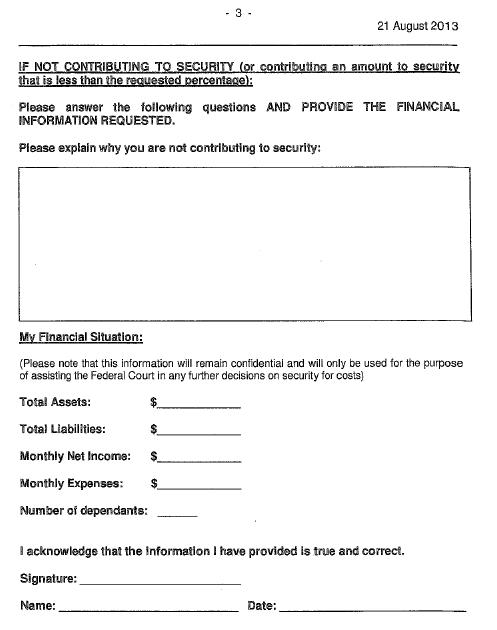
10 I ordered that the circular request that each group member inform M and K whether he or she was prepared to make a rateable contribution to a fund for security, and if not prepared to make such a rateable contribution, to advise the reason for their refusal. If any refusal was based on an asserted financial incapacity to make the contribution, the group member was requested to provide information as to that inability.
11 To this end I ordered that the Willmott Respondents provide M and K with the unit registers containing the names and addresses of the unidentified group members. I directed that the application for security be listed for directions before me 14 days after receipt and collation of the responses from both the known and the unidentified group members.
12 Without seeking to summarise my reasons, in making these orders in part I was informed by the fact that the Full Court required security to be set by reference to group members in circumstances where the applicants did not know the identity of the vast majority of group members, had no control over them and could not compel them to make a contribution to security. The orders were aimed at requiring contributions to security from those group members who had the financial capacity and were willing to do so.
13 Further, there remained a quite incomplete picture of the ability and/or willingness of the group members to make a contribution to security, particularly the unidentified group members. In part I was informed by the fact that when the group members’ responses were received the Court would be better placed to balance the risk of injustice to the respondents in having no real capacity to recover their costs, against the risk or likelihood of stultification of the proceedings because of the security ordered.
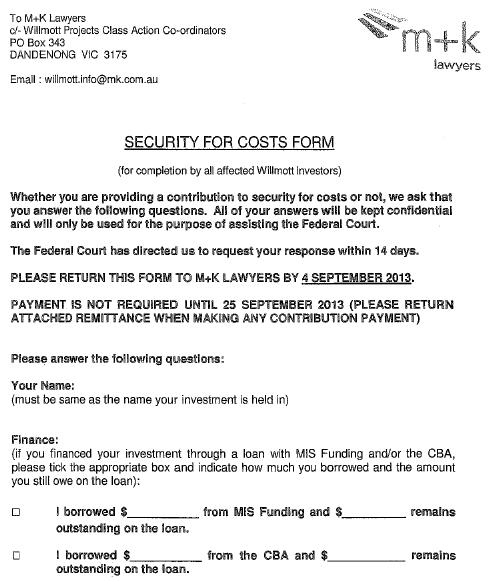
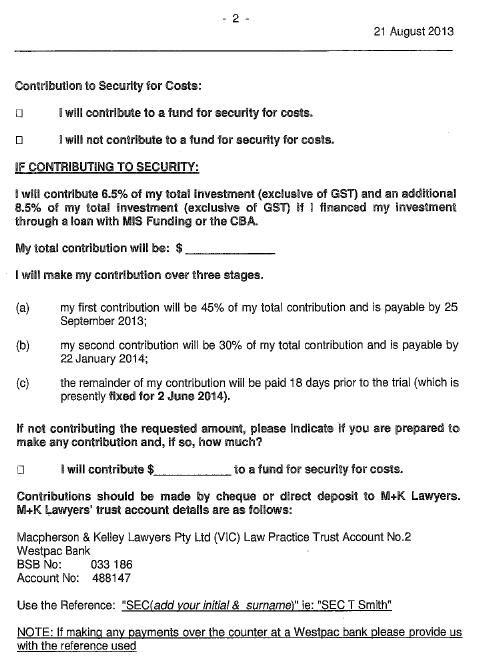
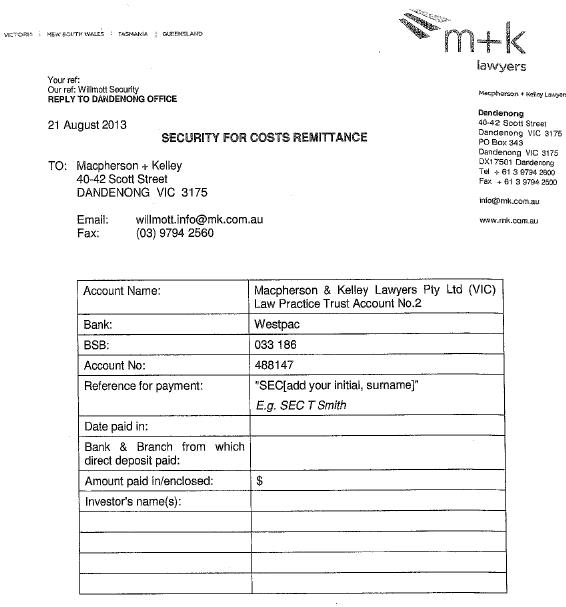
14 The applicants drafted circulars which sought a rateable contribution towards security from each group member. Pro forma copies of the circulars sent to the known and unknown group members respectively are Attachments A and B to these reasons.
The unknown group members
15 Upon provision of the unit registers to M and K, the applicants had the names and addresses of all previously unidentified group members so it is no longer accurate to call them “unidentified”. I will instead refer to them as “unknown group members”:
(a) to differentiate them from the group members who are clients of M and K;
(b) because it remains unknown whether he or she claims to have entered the schemes because of the respondents’ conduct. If the investor does not make such a claim then he or she is not a group member; and
(c) because even if a group member claims to have entered the schemes because of the respondents’ conduct, it remains unknown whether he or she intends to participate in the proceedings by seeking recovery of the loss suffered. To date these group members have not instructed lawyers to represent them even though they may have suffered significant losses. This is likely to be because, amongst other things, of concerns related to legal costs, exposure to adverse costs and the inconvenience of legal proceedings. Their participation in the proceedings cannot be assumed, particularly given that opt out is yet to occur.
In my view it is likely that a significant proportion of the unknown group members will never participate in the proceedings.
The application to reopen to adduce further evidence
16 The applicants apply to reopen their case to adduce further evidence of Ronald Willemsen, the M and K partner with the conduct of the proceedings on behalf of the applicants. The proposed further evidence relates to the circulars sent to group members, the failure of many to respond, the agreement of some to provide security, the refusal of others to provide security, and their reasons for refusal.
17 The application is opposed by the respondents. They rely on Smith v NSW Bar Association (1992) 176 CLR 256 (“Smith”) at 266-267 as authority for the proposition that an application to reopen a case on the basis of further evidence demands an inquiry as to why that evidence was not called at the hearing. They argue that, on an application of those principles, the application must be refused. They contend, amongst other things, that Mr Willemsen’s evidence as to the unavailability of litigation funding and adverse costs insurance, and his detailed evidence as to the willingness and capacity of the group members to contribute to a fund for security, was available at the time of the initial security for costs hearing in June 2012.
18 If leave is granted to reopen the applicants’ case, the respondents seek to cross-examine Mr Willemsen. I received Mr Willemsen’s affidavits and allowed cross-examination on the basis that I would later decide whether to allow the applicants’ case to be reopened to admit this evidence.
19 I consider that Mr Willemsen’s evidence assists in dealing with the difficult questions that arise. I deal with the evidence in detail later, and for the present it suffices to note that it demonstrates that the limits of group members’ contributions to security have been tested, and it provides much more information than previously adduced as to the ability or willingness of group members to contribute to a fund for security. It also indicates the disinterest of the bulk of the unknown group members in the proceedings.
20 I indicated my preliminary views on the question of reopening in Kelly v Willmott No 2 at [55]-[58], and in large part these remain my views. Although I failed to make it clear then, I accept that the principles enunciated in Smith are relevant to the exercise of my discretion to allow reopening. In applying those principles, and having regard to case management considerations and s 37M of the Federal Court of Australia Act 1976 (Cth) (“the FCA”), the applicants should be allowed to adduce the fresh evidence.
21 In my view there is a risk of substantial injustice if in setting security I do not consider the new evidence about the capacity and willingness of group members to pay security, about the unavailability of litigation funding and adverse costs insurance, and about the lack of interest of most unknown group members.
22 No doubt some of this new evidence is adverse to the respondents in the sense that it runs contrary to the position they advance, but I do not accept that it is “embarrassing” or “prejudicial” in the specific sense that these terms are used by the majority in Smith at 267. The respondents did not contend otherwise.
23 Nor do I accept that the applicants made a deliberate choice not to adduce the relevant evidence in June 2012. I infer that at that time Mr Willemsen had not turned his mind to the requirement to adduce detailed evidence as to the capacity and willingness of the group members to provide security. His failure to do so is unsurprising given that until the decision in Madgwick there was no reported decision providing any guidance as to the evidence that should be adduced in relation to security for costs from group members. As I said in Kelly v Willmott No 2 at [36], the lawyers for the applicants were in uncharted waters.
24 In relation to the unknown group members, the fact that the applicants did not make a deliberate choice is plain. In June 2012 the applicants did not even know who the unknown group members were. They could not know what their capacity or willingness to pay security was, or whether or not they were interested in participating in the proceedings, and could not adduce any such evidence. The Willmott Respondents held the unit registers that would have helped the applicants to address this gap, but would not provide M and K with the information.
25 In relation to the known group members, at that time M and K did not hold the detailed information they now seek to adduce as to their capacity and willingness to make a contribution to security for costs. While it would have been possible to gather that information at the time this was only if Mr Willemsen turned his mind to obtaining it and embarked upon a lengthy and time consuming process to do so.
26 The situation is similar in relation to the applicants’ June 2012 failure to adduce sufficient evidence about the unavailability of litigation funding or litigation costs insurance to cover adverse costs. Again, until Madgwick the authorities did not make clear the importance of this consideration. Further, as was elicited in the cross-examination of Mr Willemsen:
(a) the rejection of M and K’s application for litigation costs insurance in the proceedings did not occur until after the hearing in June 2012;
(b) the application was renewed in or about June 2013 shortly after M and K had success with an application for litigation costs insurance in a related proceeding (“the 2010 proceeding”). The evidence of the successful application in the 2010 proceeding and the continued rejection of the renewed application in the present cases was not available in June 2012; and
(c) whether litigation insurance would be available is fluid and the evidence can change over time as developments occur in the proceedings.
27 If the rules relating to evidence in an appeal were applied to the present case, it may well be that the fresh evidence of Mr Willemsen would be rejected. However that is not the circumstance before me. I am not dealing with an appeal but with a matter remitted to me as the docket judge to decide, having regard to amongst other things, case management considerations. While noting that the applicants had ample opportunity to present evidence, the majority in Madgwick emphasised at [100] that it is a matter for me whether I accede to any application to reopen.
28 As the majority accepted at [96], security for costs is not necessarily a once only question. The new evidence shows that there has been a detailed process of information gathering, the applicants and some group members have now agreed to provide $1.73 million in security, some group members have withdrawn from the proceedings as a result of the request for security, some group members have failed to honour their pledges in relation to security, and some group members have revealed they have little interest in the proceedings. That is, the evidence relevant to security for costs can, and has, changed over time.
29 If an order for security is made without the detailed evidence sought to be adduced through Mr Willemsen there is a real risk that an application would be made to vary the security ordered to address the fact of stultification. The applicants indicated that an application to vary was likely, and the respondents accepted that such an application was open. Such an application would necessarily rely on the same evidence. I am disinclined to refuse to admit the new evidence when it may well be receivable in any event: see Saint-Gobain RF Pty Ltd v Maax Spa Carpenter Pty Ltd [2004] VSC 335 at [48] per Habersberger J. I see this approach as contrary to the overarching purpose in s 37M of the FCA.
The evidence
Efforts to obtain litigation funding or litigation costs insurance
30 In an affidavit made on 27 September 2013, Mr Willemsen deposes to M and K’s unsuccessful efforts to obtain third party litigation funding for the proceedings from:
(a) IMF Australia Ltd; and
(b) Quantum Litigation Funding.
The evidence indicates that M and K made appropriate efforts in this regard which were unsuccessful. I do not accept the Directors’ attempts to portray them as insufficient in cross-examination of Mr Willemsen. I infer that third party litigation funding is unlikely to be provided to the applicants and group members.
31 Mr Willemsen also deposes that M and K unsuccessfully sought litigation costs insurance to cover the applicants’ exposure to adverse costs through UK based companies named The Judge and AmTrust Europe Ltd. The reasons for AmTrust’s rejection are set out in an email dated 10 July 2012 from The Judge and they essentially turn on the insurer’s view as to prospects of success, its likely expenditure and its likely return.
32 Mr Willemsen’s evidence is that M and K obtained litigation costs insurance from AmTrust to cover adverse costs in the 2010 proceeding, which was approved in about July 2012 and which commenced in March 2013. It appears that AmTrust is providing $2.2 million in security in that case.
33 Mr Willemsen says, and I accept, that shortly after successfully obtaining litigation costs insurance in the 2010 proceeding M and K made another approach in the present proceedings but was again refused. I infer from the evidence, and from their success in the 2010 proceeding, that M and K made serious efforts to obtain litigation costs insurance in these proceedings which were unsuccessful. I do not accept the Directors’ attempts to portray these efforts as insufficient. I infer that litigation costs insurance is unlikely to be available for the proceedings.
34 I note in passing that by adducing this further evidence the applicants have belatedly addressed some of the Full Court’s concerns: see Madgwick per Allsop CJ and Middleton J at [76]-[78] and Jessup J at [150].
How the rateable contribution was set
35 In an earlier affidavit made 1 August 2013 Mr Willemsen deposes to the process behind the setting of the rateable contribution.
36 He deposes that the 441 known group members (at that time) had invested a total of almost $49 million ($48,901,677) in the schemes. He calculates that in order to meet the $3.18 million of security sought by the Directors and the Willmott Respondents each known group members’ contribution would need to be set at 6.5% of their investments. He also deposes that 324 of the known group members borrowed from the Lenders to make their investment. Those group members had invested almost $41 million ($40,950,277) of the $49 million total. He calculates that in order to pay the $3.4 million of security sought by the Lenders the contribution of each known group member that borrowed from the Lenders should be set at 8.5% of those investments.
37 The applicants contend that, given a real risk that most of the unknown group members would be either unwilling or unable to contribute to a fund for security, it was appropriate to set the rateable contribution at:
(a) 6.5% of the investment of each group member who made a claim against only the Willmott Respondents and the Directors; plus
(b) 8.5% of the investment of each group member who also brought a claim against the Lenders.
This meant that the rateable contribution for those group members who made a claim against all respondents was 15% of his or her investment. At the time I considered this a sensible approach.
The responses to the circulars
38 In his 27 September 2013 affidavit Mr Willemsen deposes that M and K wrote to each of the known and unknown group members, received their responses and collated them. He says that in relation to the unknown group members:
(a) M and K sent a circular in the form of Attachment A to 3,319 unknown group members. Of these circulars 193 were returned marked “return to sender”.
(b) By the due date, of the balance of 3126 unknown group members:
(i) 2970 had not responded to the circular;
(ii) 33 agreed to make the rateable contribution sought to a fund for security, which, if made, would total $61,490;
(iii) 23 agreed to make a contribution to security in an amount less than the rateable contribution sought, which if made, would total $36,724; and
(iv) 112 advised that they were not prepared to make a contribution to security.
Although this tabulation appears to be slightly inaccurate any error is not material.
39 In relation to the known group members Mr Willemsen deposes that:
(a) M and K sent a circular in the form of Attachment B to its 446 clients;
(b) 83 did not respond to the circular despite at least one follow-up telephone call;
(c) by the due date, of the balance, being 363 known group members;
(i) 62 agreed to make the rateable contribution sought to security, which, if made, would total $503,883;
(ii) 86 agreed to make a contribution to security in an amount less than the rateable contribution which if made would total $396,484; and
(iii) 217 advised that they were not prepared to make a contribution to security.
This tabulation also appears to be a little inaccurate but any error is not material.
The level of response by group members
40 Viewed globally the overall level of response by group members was low. The evidence shows that 3053 group members out of the 3572 who must be taken to have received a circular did not respond. That is, 85% of group members (representing 79% of the overall amount invested in the schemes) did not respond. 2970 of the 3319 unknown group members, being 89%, did not do so. For ease of reference I will call these group members “the non-responding group members”.
41 In my view a low response rate could be expected when the great majority of group members had taken no active step to instruct solicitors or participate in the proceedings, and had not yet had the opportunity to opt out. I infer from the low level of response by unknown group members that a significant proportion of them do not see themselves as group members or do not intend to participate in the proceedings.
42 It is significant that, of the known group members only 83 out of 446 (at that time) did not respond. That is, 82% of the known group members responded.
The proportion of group members that agreed to contribute
43 Viewed globally, the proportion of group members who agreed to make a contribution to security for costs is low. The evidence shows that only 5.5% of the group members who received a circular, being 204 of 3572, agreed to make any contribution. Again, this low rate of contribution is largely because the vast bulk of unknown group members did not respond at all.
44 Only 56 of the 3319 unknown group members, being 1.7%, agreed to make a contribution, with a little over half of that number agreeing to make the rateable contribution sought and the balance agreeing to make a lesser contribution.
45 The picture is different for the known group members where 33%, being 148 out of 446, agreed to make a contribution to security. Of these known group members:
(a) 62 agreed to make the rateable contribution sought; and
(b) 86 agreed to make a lesser contribution.
For ease of reference I shall call those who agreed to make a contribution to security “the willing contributors”.
Refusal to contribute by group members
46 The reasons for the refusal to contribute of the great majority of group members cannot be known as they did not respond to the circular.
47 There were though 329 group members who responded to the circular and indicated their refusal to make a contribution, made up of 112 unknown group members and 221 known group members. I shall call these responses “the refusals to contribute”.
48 The group members usually set out their net asset position and their monthly cash flow, as requested in the form, although a small number failed or refused to do so. The reasons and financial information they provided covered a broad spectrum.
The security for costs proffered
49 Mr Willemsen initially deposed that, subject to all group members paying the pledged amounts, the applicants would proffer security in the sum of $1,798,582, made up of:
(a) $1,700,367 from known group members (which includes $800,000 to be released from the adverse costs fund); and
(b) $98,214 from unknown group members.
He proposed that the sum be payable in three tranches, namely $1,476,319 in October 2013, $172,439 in January 2014 and $149,824 14 days prior to trial.
50 In a follow-up affidavit made on 3 October 2013 Mr Willemsen deposes that the contributions made by known group members had fallen short of the pledged amounts. He says that the applicants anticipated providing security in the sum of $1,730,379, made up of:
(a) $1,643,765 from known group members (which includes $800,000 to be released from the adverse costs fund; and
(b) $86,613 from unknown group members.
He proposes that the sum be payable in three tranches, namely $1,095,422 by 7 October 2013, $272,430 by 31 October 2013, $217,128 by 27 January 2014, and $145,398 14 days prior to trial.
51 In an affidavit made 12 February 2014 Mr Willemsen deposes that only 58% of the pledged amounts had been received, even though M and K had sent an email following them up. Mr Willemsen deposes that he believes that once a judgment on security has been handed down the group members will more readily provide the pledged amounts. He deposes that he has no other basis to believe that the pledges now due, and due prior to trial, will not be paid.
52 In short, the applicants proffer security of $1,730,379.
Consideration
53 The respondents reject the security proffered as inadequate. They seek that security of $6.58 million be ordered and that the proceedings be stayed unless or until it is provided.
The starting point
54 In Kelly v Willmott No 2 at [26] I said that my starting point is that an order for security of $6.58 million should be made. The applicants argue that this approach is incorrect. They point out that the majority in Madgwick required only that the group members make some contribution to a fund for security which is real but not oppressive: per Allsop CJ and Middleton J at [99]-[100].
55 The applicants’ contention is based in a misunderstanding of my use of the phrase “starting point”. In my view the sum of $6.58 million is the appropriate starting point because the unchallenged evidence is that this is the total costs the respondents are likely to incur in defending the proceedings. My starting point is that to provide security that the respondents will recover their costs, the applicants must advance that amount. But I accept that I should not do so if such an order risks stultifying the proceedings. If an order risks or is likely to stultify the proceedings then a lower amount should be set, such that the contribution sought is real but not oppressive.
The onus
56 The primary question to be dealt with is whether there is a real risk that the proceedings may be stultified if an order for security is made for $6.58 million, or in some other amount greater than the $1.73 million proffered by the applicants.
57 The onus of establishing that an order for security risks stultifying a claimant’s ability to pursue the proceeding rests on the party asserting it: see Green (as liquidator of Arimco Mining Pty Ltd) v CGU Insurance Ltd (2008) 67 ACSR 105 at [48] per Hodgson J, with whom Campbell JA agreed.
58 As the majority in Madgwick observed at [83], while stultification may be proved by evidence of incapacity to pay, “unwillingness in itself is not determinative, and the question of the reasonableness of any unwillingness to contribute must be considered”.
59 It is for the applicants to adduce evidence not only of the group members’ incapacity or unwillingness to contribute to security but also, where unwillingness is relied on, that the unwillingness is reasonable.
The willing contributors
60 Without descending into the minutiae of each of the contributions made, and with a few exceptions, I accept that the contributions made by each willing contributor constitutes a real but not oppressive contribution to security by that group member. I have considered each contribution but I take a broad approach. While I can accept that some group members that contributed less than the rateable amount may be able to provide a greater contribution, I do not address the responses through a group member by group member analysis. Having considered the many responses, I am broadly satisfied as to the adequacy of their contributions.
The non-responding group members
61 The respondents point to the fact that of 3319 unknown group members, 89% did not respond at all to the circular. They argue that the Court cannot be satisfied that those group members are unable or reasonably unwilling to make the contribution sought. I accept this, and this is important to the approach that I have taken.
The group members that provided responses and refused to contribute
62 The applicants submit that of the 221 known group members that refused to contribute, 168 provided information to indicate that they were unable to contribute the requested amount, 46 indicated that it was reasonable for them not to contribute, and five provided no or no sufficient information about why they were unwilling to contribute.
63 On the applicants’ contentions 69% of the responses by the known group members were to the effect that the group member could not afford to pay either the requested rateable contribution or any amount. They broadly categorise the reasons for refusal as because of:
(a) the legal costs plus the contribution sought for security were disproportionate to the amount invested and/or borrowed;
(b) adverse credit listing for failure to repay the contested loan to the Lenders which meant the group member could not borrow further funds to make a contribution;
(c) uncertainty about the prospects of the case and a lack of confidence in a just outcome;
(d) concern as to their relative contribution by group members that did not borrow to invest compared to disproportionate claims made by the borrowers;
(e) unemployment or insecurity as to continued employment;
(f) health and medical expenses;
(g) financial circumstances and the cost burden of other obligations, including the interest payable on the loans with Lenders; and
(h) financial circumstances in general and the extent of any partial contribution to security.
64 The respondents argue that some of the group members who refused to provide security provided insufficient information to enable the Court to decide that the refusal was reasonable having regard to their financial position. For example, the Willmott Respondents give examples of about 62 unknown group members and 111 known group members in this category. The applicants accept this in a small number of instances.
65 The respondents also argue that the refusal of many group members to contribute is incorrectly categorised by the applicants as being due to financial inability, when in fact their response indicates a commercial or risk-benefit analysis. They contend that while this approach may be understandable from a commercial perspective such responses should not be treated as evidence of reasonable unwillingness to pay security. They argue that those responses are better characterised as reflecting the group member’s view as to poor prospects of success in the proceedings, or at least a lack of information as to the prospects. For example, the Lenders point to four unknown group members and six known group members in this category. I accept that the ten group members to which the Lenders refer have not provided evidence of reasonable unwillingness.
66 I accept the respondents’ contentions that some of the refusals to contribute do not evidence financial inability or reasonable unwillingness. But in my view the argument as to the proper characterisation of the group members’ responses in this regard is at the edges.
67 I have perused each of the refusals to contribute. In my view a minority of them are insufficient to establish inability to pay or reasonable unwillingness, but the significant majority are. I do not accept that the task of setting security requires that I rule on each individual group member’s response. In my view, and as the majority accepted in Madgwick at [98], a broad evaluation is necessary.
68 Having said this, there are some group members who the parties seem to agree have not established inability, or reasonable unwillingness, to contribute. There are also the ten group members to which I refer at [65]. I do not treat these group members as having established inability or reasonable unwillingness to contribute. Apart from those, taking a broad view of the responses received, the evidence shows that a significant majority of the known and unknown group members that refused to contribute to security did so because they were financially unable, or reasonably unwilling, to contribute.
Other alleged deficiencies in the evidence as to stultification
69 The respondents also contend that there were errors in the circulars and the surrounding process which have led to deficiencies in the evidence as to stultification.
70 Firstly, the Lenders argue that the rateable contribution should have been calculated by reference to the investments made by all group members, rather than on the investments of only the known group members. They contend that as the amount borrowed from the Lenders was approximately $141 million, a rateable contribution of 15% from all group members making claims against the Lenders meant that they were being asked to contribute $21.15 million rather than the $6.58 million that was necessary. They argue that it was only necessary for such group members to contribute 3.14% of their investment amount for $6.58 million to be raised.
71 The Lenders contend that this must be taken to have caused many group members to express the view that they were unable or unwilling to provide security sought. I do not agree. In my view the applicants’ approach was sensible, recognising as it did that there were low prospects of the unknown group members making a substantial contribution to a fund for security. The common sense of the applicants’ approach has been borne out by the low level of contributions in fact made by unknown group members.
72 The problem with the Lenders’ contention is that it gives insufficient recognition to the fact that a significant number of the unknown group members were likely to have little interest in the proceedings. As I have said, I infer from the fact that the vast majority of these group members have taken no active step to instruct solicitors or participate in the proceedings, have not had the opportunity of opting out, and did not respond to the circular, that it is likely that a significant proportion of them do not see themselves as group members or have no intention of participating. It is likely that many of them will opt out when given the opportunity.
73 As the applicants contend, if they set a lower rate of contribution based on unknown group members making substantial contributions, and the unknown group members did not do so, M and K would then have been forced to revisit and increase the contributions requested through another round of circulars. A second process was not contemplated by the orders and I have no doubt would have been strongly resisted by the respondents who complain about the length of time the security process has taken. I also accept that asking for increased contributions would be likely to frighten off some group members from contributing.
74 Secondly, the Lenders complain that the circular sought the relevant rateable contribution but that a group member may not have understood that a lesser contribution was possible unless he or she perused the attached form. I do not accept this criticism. I infer that a group member that was interested in the proceedings would read the whole circular including the attached form.
75 Thirdly, the Directors criticise the efforts of M and K in ascertaining whether group members were prepared to make a contribution to security. They note that the circular did not include advice as to the prospects of success of the proceedings or an invitation to seek such advice from M and K. It must be the case that a group member’s knowledge as to the prospects of success in the proceedings is likely to be an important consideration in any decision as to whether to put up security. The Directors effectively contend that M and K has failed to properly inform group members, which could explain their refusal to contribute, rather than any inability to afford to do so.
76 I do not accept this in relation to the known group members. The 446 known group members that instructed M and K must have reached a view as to prospects of success in the proceedings before they signed the retainer and paid legal fees, and I infer some advice as to prospects of recovery was provided by M and K. I accept Mr Willemsen’s evidence that further advice awaits provision of discovery. He states, and I accept, that the known group members received circulars from M and K, and if they sought legal advice as to the prospects of success in the proceedings it was provided to them.
77 But, in relation to the unknown group members, to provide confidential legal advice to the 3319 unknown group members would in my view involve a real risk that the advice would come into the hands of the respondents. This unfortunate reality must be recognised as there have been instances in other class actions where non-client group members have provided confidential information to the respondents. Nor, as Mr Willemsen said, are M and K under any obligation to provide such legal advice to persons who are not their clients. I note too the significant burden on M and K’s resources of providing such advice by telephone or in conference for a class of 3319 group members when there are no fee arrangements in place.
78 Fourthly, the Lenders criticise the form of the circular in not requesting each group member to pay the maximum amount that they were prepared to contribute, instead (in line with the Full Court’s suggestion) requesting a rateable contribution. They argue therefore that there is no evidence that the $1.73 million proffered is the maximum amount that the willing contributors to security are prepared and able to pay. There is some merit in this, and my orders seek to address this in part.
79 There is also some merit in the Directors’ contention that a targeted approach could have been taken in relation to the low number of group members with large investments in the schemes. Such group members could have been more directly approached by M and K.
80 It should though be remembered that the respondents had the opportunity to raise these concerns about the circular when its form was before the Court. However the respondents said nothing at that time. At least insofar as the Lenders are concerned, this choice was in pursuit of a forensic advantage.
The class
81 In part the dispute regarding security turns on the membership of the class. The respondents argue that 93% of the class did not respond at all and that it is therefore impossible for the Court to be satisfied that the proceedings may be stultified.
82 Against this, the applicants contend that I should consider only the responses of the known group members. They point to the observations of the majority in Madgwick (at [99]) that some security should be granted because of “the proved ability of at least a not insignificant number of group members to contribute” which they contend must be a reference to the known group members.
83 While this observation by the majority is likely a reference to known group members, there was also evidence before the Full Court regarding the net asset position of unknown group members. Bray v F Hoffman-La Roche (2003) 130 FCR 317 (“Bray”) is authority for the principle that the characteristics of the group members should be taken into account in an application for security in a class action. The decision in Bray was made in an open class action in which the vast majority of group members were unknown. Carr and Finkelstein JJ did not limit the required consideration to only the characteristics of known group members. The applicants, in responding to the appeal in Madgwick did not contend that Bray was wrongly decided. The relevant class is not limited to M and K’s clients.
84 I have previously expressed my views as to the difficulties with the approach in Bray (see Kelly v Willmott at [77]-[87]) but I am bound to follow it. I have approached the question of security on the basis that the characteristics of all group members are to be taken into account. The circulars that I ordered were to seek contributions from all group members to security and information as to their capacity and willingness to contribute.
The risk of stultification
85 As I have said, taking a broad view, I am satisfied on the evidence that:
(a) the 204 willing contributors to security have made a real but not oppressive contribution; and
(b) the majority of the 329 group members who asserted that they were unable or unwilling to pay security are financially unable or reasonably unwilling to do so.
In my view if the applicants are ordered to put on security of $6.58 million it is highly likely that the proceedings will be stultified.
86 While I have ordered some further steps to be taken, I doubt that substantial further contributions will be made by the group members, and M and K has not presently received all of the $1.73 million pledged. Leaving aside the fruits of the further steps I have ordered, I consider it likely that if security of more than $1.73 million is ordered then the applicants will be unable to provide it. The claims of the applicants and in the order of 500 group members will stultify even though they have made a real contribution to security, or were financially unable or reasonably unwilling to do so.
87 In my view a real injustice will be done to those applicants and group members who:
(a) have contributed to security; or
(b) (taking a broad view) are financially unable or reasonably unwilling to do so;
if I were to presently order security greater than $1.73 million.
88 If the respondents’ approach is correct the disinterest of the bulk of the unknown group members will operate to curtail the rights of the other group members. It is common in class actions that the applicants and many group members are interested in pursuing the claim, and that other group members have little interest in doing so. The disinterested group members are under no obligation to take any step in the proceedings, and many may be expected to remain silent when requested to provide security.
89 Two early Australian class actions indicate the large numbers of disinterested group members that often exist within a class. By way of example:
(a) Bray related to a class action known as the Vitamins Cartel Class Action, brought against three groups of corporations involved in the manufacture and sale of vitamins in Australia. As amended the proceeding was brought in relation to alleged price fixing conduct on behalf of all Australians who paid at least $2000 in the period 5 March 1992 to 31 December 1999, for vitamins or pre-mix or other animal health or nutrition products containing vitamins. Given that cattle, pigs, horses, sheep, poultry, fish and other forms of livestock were fed such vitamins in animal feed by farmers around Australia, sold to them by feed suppliers around Australia, such a class likely numbered tens of thousands of people. However only 142 group members registered with the applicants’ solicitors at the time of settlement, and only 211 participated in the settlement. The identity and financial characteristics of the many thousands of other group members remained unknown. Notwithstanding an extensive public campaign to notify group members of the settlement they did not participate in the case: Darwalla Milling Co Pty Ltd & Ors v F Hoffman–La Roche Ltd & Ors (No 2) [2006] FCA 1388 at [5], [20].
(b) The GIO Class Action was brought in relation to alleged misleading conduct by that company, on behalf of a class of about 67,000 shareholders. Following opt out and a questionnaire administered to group members the class was reduced to about 45,000 shareholders. The known group members were only 22,051 former shareholders, and the identity and financial characteristics of the 23,000 other group members were unknown. Moore J, writing extra judicially, has explained that only about 2000 of the unidentified group members ultimately participated in the case by registering to make a claim. That is, 21,000 group members did not participate in the proceedings: The Hon. M Moore, Ten years since King v GIO (2009)32(3) UNSWLJ 883, at 889, 893.
90 If security for costs must be assessed by reference to the failure of unidentified group members to respond, then it will be very difficult, perhaps impossible, for an applicant to avoid the action being stayed. As the applicants contend, such an approach sets the bar too high. It is important to remember that these disinterested group members are not parties and are not required to take any step, and cannot be ordered to provide security except in special circumstances: see Mobil Oil Australia Pty Ltd v Victoria (2002) 211 CLR 1 at [6], [50] and [192]; s 43(1A) of the FCA.
91 This problem is new in Australian class action jurisprudence, following as it does from the decision in Madgwick. This is the first occasion upon which security has been ordered from group members in an open class action. Senior Counsel for the Lenders describes the absence of any response from the bulk of unknown group members as “the applicants’ cross to bear”. He accepted that there might be practical difficulties that might require an evolution of the law or reconsideration of principle, but submitted that “as the law stands at the moment it is an uncomfortable position for the applicants to be in but that is where they are”. I do not accept this contention.
92 I consider that to balance the respondents’ legitimate concern to obtain some security for costs against the risk of stultifying the proceedings, the better approach is to winnow the class down.
93 First, the class should be reduced through the opt out process to those who are interested in participating. Next, while I have concerns as to the effect of this upon access to justice, if security is to be ordered having regard to the financial circumstances of group members as Bray and Madgwick require, it seems to follow that the class should be reduced to remove:
(a) those group members who refuse even to respond to requests for security and information in that regard; and
(b) those group members who, taking a broad view, have not made a real but not oppressive contribution to security or have not shown an inability, or reasonable unwillingness, to contribute to security.
94 As a first step the group members should be provided the opportunity to opt out of the proceedings. While this will reduce the class it must be remembered that opt out requires a positive step by a group member and therefore any group member who ignores the notice remains in the class.
95 As a next step (or at the same time as the opt out process is undertaken) a class closure process should be undertaken. Without now setting this process, it is likely to include a requirement that each group member interested in making a claim register his or her interest in doing so, and only those who register will remain group members. One requirement for registration is likely to be that, where a group member has not already provided this information, the group member properly respond to a request for security and for information (as sought in the circular).
96 But I do not wish to set the requirements of class closure now. The applicants indicated that they are content to make a class closure application, and subject to some conditions the Lenders tentatively agreed. No application for class closure has been made as yet and I have not heard any submissions on the issue. Before setting the terms of any class closure I will hear the parties.
Further steps to be taken by the applicants
97 Although the applicants proffer security of $1.73 million as a final amount, and I have real doubts that much more will be obtainable, I will not treat that amount as final as yet. The rateable contributions sought were calculated on the basis of contributions from each of the known group members but not all group members responded, and two thirds of known group members have not contributed.
98 I have not ordered a further round of circulars seeking that every group member that made a contribution be asked to make a higher rateable contribution. The process could become endless, and no party contended for that course. I have though ordered further security to be sought from those group members who have made large investments in the schemes as the Directors contend is appropriate. M and K must send:
(a) a letter to willing contributors with large investments in the schemes seeking the maximum contribution to security which they are financially able or willing to make, and requesting their reasons if they assert that they can make no further contribution; and
(b) a letter to group members with large investments in the schemes who refused to contribute to security, or who did not respond to the circular. This letter should offer to provide legal advice as to the prospects of success in the proceedings subject to strict confidentiality terms. This may lead to contributions by those group members who refused to provide security because they did not understand the prospects of success.
99 I will revisit the adequacy of the security after opt out and class closure, and after these efforts to increase the security have been made.
Conclusion
100 Accordingly, I have ordered:
(a) within 28 days the applicants provide security for costs in the sum of $1,730,379, in a form agreed between the parties, and if not agreed to be set by the Court. The proceedings be stayed without further order unless and until the security is provided;
(b) the further hearing of the application for security be adjourned to a date following opt out and class closure;
(c) within 14 days the applicants to file and serve an application pursuant to s 33J of the FCA together with a draft opt out notice;
(d) within seven days the parties confer in relation to class closure, and within 14 days the applicants file and serve, an application to close the class together with a draft class closure notice (which may be separate to or combined with the opt out notice);
(e) within 14 days the applicants to file and serve a draft letter to seek contributions, or further contributions, to security from group members with large investments in the schemes; and
(f) a directions hearing be fixed for 9.30 am on 7 March 2014 which will deal with, amongst other things, opt out, class closure, and the further letters to group members with large investments.
101 I have made no order at present as to the priority of payment of the security between the respondents. That can be dealt with if and when the security is to be called on.
|
I certify that the preceding one hundred and one (101) numbered paragraphs are a true copy of the Reasons for Judgment herein of the Honourable Justice Murphy. |
Associate:
Attachment A
Attachment B