

FEDERAL COURT OF AUSTRALIA
Australian Consumer and Competition Commission v Camavit Pty Ltd
[2013] FCA 1397
|
IN THE FEDERAL COURT OF AUSTRALIA |
|
|
AUSTRALIAN CONSUMER AND COMPETITION COMMISSION Applicant | |
|
AND: |
CAMAVIT PTY LTD (ACN 142 548 945) Respondent |
|
DATE OF ORDER: |
|
|
WHERE MADE: |
1. In the course of discussions about problems with televisions supplied by the Respondent and the consumer’s attempts to obtain a refund or remedy, the Respondent, in making the following oral statements to a consumer between March and June 2012:
(a) “You will need to contact Toshiba”;
(b) (In response to the consumer’s statement that he was entitled to a refund) “No you’re not. We will replace your TV…”; and
(c) “I can’t give you your money back. All I can offer is an exchange or credit. If I give you a credit, you will have to use it before the end of the financial year” and “We cannot give you a store credit for a month. We have to have all credits finalised before the end of the financial year”;
Has, in trade or commerce:
(d) made representations in connection with the supply or possible supply of goods or services that were false or misleading and concerned the existence, exclusion or effect of any guarantee, right or remedy available under the consumer guarantee provisions in Division I of Part 3-2 of the Australian Consumer Law (“ACL”) being Schedule 2 of the Competition and Consumer Act 2010 (Cth), and/or other remedies relating to those guarantees in Part 5-4 of the ACL in contravention of section 29(1)(m) of the ACL; and
(e) in doing so, engaged in conduct that was misleading or deceptive or likely to mislead or deceive in contravention of section 18 of the ACL.
THE COURT ORDERS THAT:
2. Pursuant to section 232 of the ACL, for a period of three years from the date of these orders the Respondent be restrained (whether by itself, its servants, agents or otherwise) from making representations (whether oral or written) to any customer to the effect that the Respondent:
(a) does not have an obligation to provide any remedy in relation to goods supplied by it regardless of the circumstances and the consumer guarantee provisions in Division 1 Part 3-2 and/or the remedies relating to those guarantees in Part 5-4 of the ACL;
(b) does not have an obligation to provide any remedy in relation to goods supplied by it on the basis that only the manufacturer has an obligation to provide such remedies;
(c) does not have an obligation to provide a refund in relation to goods supplied by it regardless of the circumstances and the consumer guarantee provisions in Division 1 Part 3-2 and/or the remedies relating to those guarantees in Part 5-4 of the ACL; and
(d) does not have any obligation to provide a remedy in relation to goods supplied by it other than the remedy of exchange or credit, which would in turn have to be finalised within an effective time limit of a few weeks.
3. Pursuant to sections 224(1)(a)(ii) and 228 of the ACL, within 28 days of the date of these orders, the Respondent pay to the Commonwealth a pecuniary penalty in respect of the contravention of section 29(1)(m) of the ACL in the amount of $32,000.
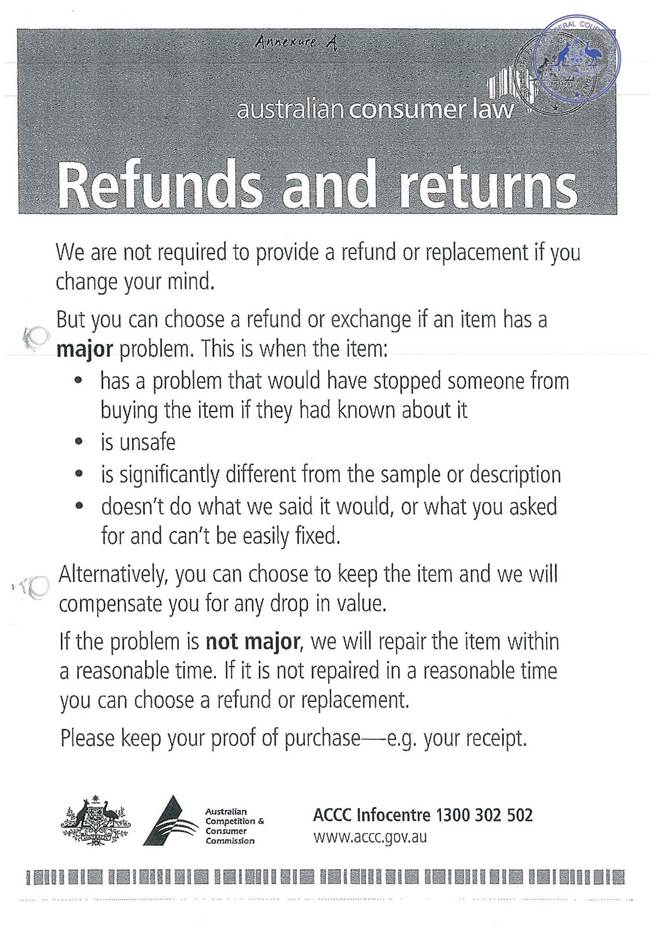
4. Pursuant to section 246(2) of the ACL the Respondent, within 28 days of the date of these orders, prominently display at the point of sale of every product supplied by the Respondent during the operation of a retail sales service undertaken under the name Harvey Norman a copy of the summary of consumer rights under the ACL annexed to these orders for a period of three years.
5. Pursuant to section 246 of the ACL:
(a) by 28 February 2014 (“the Commencement Date”) the Respondent ,:
(i) for a period of one year following the Commencement Date, implement its own compliance program to be undertaken by each employee of the Respondent with respect to the rights available to consumers under the ACL including the consumer guarantees in Division 1 of Part 3-2 of the ACL and the remedies relating to those guarantees in Part 5-4 of the ACL (Consumer Law Compliance Program). The Consumer Law Compliance Program must conform to the compliance standards set out in the Australian Standards on Compliance Programs (AS 3806-2006);
(ii) for a period of two years thereafter, participate in a consumer law compliance program to be recommended by subsidiaries of Harvey Norman Holdings Limited to all franchisees trading under the “Harvey Norman ®” name in Australia and made available for the participation of their employees;
(b) no later than 14 days after the Commencement Date, the respondent serve on the ACCC an affidavit verifying that, in conformity with these orders, it has displayed the notice referred to in order 4 above and it has implemented the Consumer Law Compliance Program.
6. Each party pay its own costs.
Note: Entry of orders is dealt with in Rule 39.32 of the Federal Court Rules 2011.
|
NEW SOUTH WALES DISTRICT REGISTRY |
|
|
GENERAL DIVISION |
NSD 1011 of 2013 |
|
BETWEEN: |
AUSTRALIAN CONSUMER AND COMPETITION COMMISSION Applicant |
|
AND: |
CAMAVIT PTY LTD (ACN 142 548 945) Respondent |
|
JUDGE: |
KATZMANN J |
|
DATE: |
13 DECEMBER 2013 |
|
PLACE: |
SYDNEY |
REASONS FOR JUDGMENT
1 Camavit Pty Ltd (“Camavit”) has a Harvey Norman franchise in Campbelltown, an outer western suburb of Sydney. It operates a retail outlet known as the Harvey Norman AV/IT Superstore Campbelltown from which it sells electronic goods. In November 2011 Camavit sold a Toshiba television set to a customer of the store. The customer was David Mouat. About four months later Mr Mouat reported a problem with the television to the store manager, who told him he would have to contact Toshiba. Subsequently, however, Camavit replaced the television. Mr Mouat was dissatisfied with the replacement and raised the matter with a sales representative. Mr Mouat said he was entitled to a refund but the sales representative insisted he was not and said the store would replace the television. Consequently, Mr Mouat received a third television. About a month later Mr Mouat’s wife, Anne, attended the store and asked for a refund but her request was denied. She was told she could only have a replacement or a store credit and when she requested a store credit for a month the request was refused. Camavit admits that in each case the statements of Camavit’s representatives contravened ss 18 and 29(1)(m) of the Australian Consumer Law (“ACL”), which can be found in Sch 2 of the Competition and Consumer Act 2010 (Cth) (“CCA”) (formerly the Trade Practices Act 1974 (Cth)). These statements amounted to representations “concerning the existence, exclusion or effect of [a] warranty, guarantee, right or remedy” and the representations were false or misleading.
2 The regulator, the Australian Competition and Consumer Commission (“ACCC”), seeks declaratory and injunctive relief, pecuniary penalties and other orders. This case is one of a series of cases in which the ACCC has successfully obtained orders of a similar kind against Harvey Norman franchisees. Earlier this month in Melbourne Middleton J made orders against four franchisees, two operating in Victoria and two in Tasmania: Australian Competition and Consumer Commission v HP Superstore Pty Ltd [2013] FCA 1317 (“HP Superstore”); Australian Competition and Consumer Commission v Salecomp Pty Ltd [2013] FCA 1316 (“Salecomp”); Australian Competition and Consumer Commission v Launceston Superstore Pty Ltd [2013] FCA 1315; Australian Competition and Consumer Commission v Moonah Superstore Pty Ltd [2013] FCA 1314.
3 The parties have agreed upon the facts and the orders and made joint submissions. The agreed facts are annexed to these reasons and marked “A”. Still, the court is obliged to determine whether the facts are to be accepted as true and to determine what weight should be given to them: Minister for the Environment, Heritage and the Arts v PGP Developments Pty Ltd [2010] 183 FCR 10 at [35]. I accept the facts as true. They are inherently credible and the narrative is coherent. The facts establish the agreed contraventions. The agreed orders were also reduced to writing. Nevertheless, the Court must be independently satisfied that it has the power to make the orders and that the orders are appropriate: See NW Frozen Foods Pty Ltd v Australian Competition and Consumer Commission (1996) 71 FCR 285; Minister for Industry, Tourism & Resources v Mobil Oil Australia Pty Ltd (2004) ATPR 41-993 at [51]. See, too, Australian Competition and Consumer Commission v Real Estate Institute of Western Australia Inc. (1999) 161 ALR 79 at [18] per French J. For the following reasons I am so satisfied and will make orders in terms of the draft short minutes prepared by the parties.
4 Section 18(1) of the ACL provides:
A person must not, in trade or commerce, engage in conduct that is misleading or deceptive or is likely to mislead or deceive.
5 Section 29(1)(m) states:
A person must not, in trade or commerce, in connection with the supply or possible supply of goods or services or in connection with the promotion by any means of the supply or use of goods or services:
…
(m) make a false or misleading representation concerning the existence, exclusion or effect of any condition, warranty, guarantee, right or remedy (including a guarantee under Division 1 of Part 3-2).
6 This case is concerned with the guarantees under Div 1 of Part 3-2 of the ACL, which are statutory guarantees relating to the supply of goods to consumers. They include the guarantee offered by s 54 that goods supplied in trade or commerce to a consumer otherwise than by way of sale by auction are “of acceptable quality”. Subsection 54(2) provides that goods are of acceptable quality if they are as:
(a) fit for all the purposes for which goods of that kind are commonly supplied; and
(b) acceptable in appearance and finish; and
(c) free from defects; and
(d) safe; and
(e) durable;
as a reasonable consumer fully acquainted with the state and condition of the goods (including any hidden defects of the goods), would regard as acceptable having regard to the matters in subsection (3).
7 The matters listed in subsection (3) for the purposes of subsection (2) are:
(a) the nature of the goods; and
(b) the price of the goods (if relevant); and
(c) any statements made about the goods on any packaging or label on the goods; and
(d) any representation made about the goods by the supplier or manufacturer of the goods; and
(e) any other relevant circumstances relating to the supply of the goods.
8 In these proceedings the television set and each of the two replacements were new. That circumstance raised a question about whether in each case the appliance was supplied in breach of the above guarantee. It was possible, too, that the problems Mr Mouat encountered with the televisions were “major failures” within the meaning of s 260 of the ACL. Had that been the case, Mr Mouat having rejected the appliances, Camavit would have been obliged to comply with his request for a refund. Section 263(4) relevantly states:
The supplier must, in accordance with an election made by the consumer;
(a) refund:
(i) any money paid by the consumer for the goods; and
(ii) an amount that is equal to the value of any other consideration provided by the consumer for the goods; or
(b) replace the rejected goods with goods of the same type and of similar value, if such goods are reasonably available to the supplier.
9 Regardless of whether the defects of which Mr Mouat complained were “major failures”, if the Mouats had suffered a loss, the loss was reasonably foreseeable and was caused by one or more of the contraventions, Camavit would have been liable to compensate them. Section 259 of the ACL gives a consumer a right to damages in these circumstances.
10 In the present case there is no evidence that any of the products sold or supplied to Mr Mouat were not of acceptable quality. Indeed, there is no evidence that there was in fact a defect with any of the television sets. Nor is there evidence that any consumer suffered loss or damage as a result of one or more of the contraventions. The agreed facts, however, establish that an employee or agent of Camavit made representations to both Mr and Mrs Mouat about their consumer rights which were false or misleading or likely to mislead or deceive them about their rights to legal remedies. Section 139B(2) of the CCA relevantly provides that any conduct engaged in on or on behalf of a body corporate by an employee or agent of the body corporate within the scope of his or her actual or apparent authority is taken for the purposes of the ACL to have been engaged in by the body corporate as well.
11 I now turn to the relief sought.
12 First, the claim for declaratory relief. Section 21 of the Federal Court of Australia Act 1976 (Cth) gives the Court the power to make declarations of right. The discretion is a broad one. While “[i]t is neither possible nor desirable to fetter [the Court’s discretion] by laying down rules as to the manner of its exercise” (Forster v Jododex Australia Pty Ltd (1972) 127 CLR 421 at 437 per Gibbs J), the discretion “is confined by the considerations which mark out the boundaries of judicial power” (Ainsworth v Criminal Justice Commission (1992) 175 CLR 564 at 582). Consequently,
(a) the declaration must be directed to the resolution of a legal controversy and not to the determination of an abstract or hypothetical question;
(b) the applicant must have “a real interest”;
(c) the declaration must produce foreseeable consequences for the parties; and
(d) there must be a proper contradictor.
13 I accept the parties’ submissions that these conditions are satisfied in this case. The proposed declaration relates to conduct that contravenes the ACL. It is directed to the resolution of a legal controversy rather than to an abstract or hypothetical question. As the public regulator under the ACL the ACCC has a genuine interest in seeking the relief and there is a public interest in making the declaration. Camavit’s conduct is the subject of the declaration and is therefore a proper contradictor (having made admissions that it has contravened the ACL). The declaration is appropriate because it serves to record the Court’s disapproval of the contravening conduct, to vindicate the ACCC’s claim that Camavit has contravened the ACL, and to inform consumers of the perils arising from Camavit’s contravening conduct. It will assist the ACCC to carry out the duties conferred upon it by the CCA and deter other corporations from contravening the ACL. In its terms, the declarations provide sufficient indication of the manner in which and the reasons why the conduct complained of is unlawful.
14 Next, the parties are agreed upon an injunction. There is no doubt that the Court has power to make such an order. The terms of the injunction are neither vague nor imprecise and the continuing supervision of the Court is not required. The injunction is appropriate to deter a repetition of the conduct.
15 The ACL also confers on the Court the power to make orders in the nature of compliance training for the purpose of ensuring that a person who has engaged in contravening conduct of this kind does not engage in that or similar or related conduct during a maximum three year period. See s 246(2)(b). The agreed orders incorporate such an order. The order proposed is a proper one. The agreed orders also provide for a notice to be prominently displayed at points of sale summarising the consumer’s rights under the ACL. That order, too, is both proper and desirable. The order is limited to a three year period but it is, in my opinion, highly desirable that Camavit continue to display the notice indefinitely.
16 Finally, there is the question of pecuniary penalties.
17 A contravention of s 18 of the ACL does not attract a pecuniary penalty. But a contravention of Pt 3-1 (including s 29) does. Section 224 of the ACL relevantly confers power on the Court to order that a person whom the Court is satisfied has contravened s 29 pay to the Commonwealth “such pecuniary penalty, in respect of each act or omission by the person … as the court determines to be appropriate”. In the case of a body corporate the maximum penalty for each act or omission is $1.1 million: s 224(3), item 2.
18 Section 224(2), provides that in determining the appropriate pecuniary penalty the Court must have regard to all relevant matters, including:
(a) the nature and extent of the act or omission and of any loss or damage suffered as a result of the act or omission; and
(b) the circumstances in which the act or omission took place; and
(c) whether the person has previously been found by a court in proceedings under Ch 4 or Pt 5–2 to have engaged in any similar conduct.
19 As the parties submitted, the main object of the penalty under s 224 is deterrence, both general and specific. Consequently, the Court must fix a penalty which is sufficiently high so as not to be treated by the contravener or others who might otherwise be tempted to follow suit “as an acceptable cost of doing business” (SingTel Optus Pty Ltd v Australian Competition and Consumer Commission (2012) 287 ALR 249; [2012] FCAFC 20 at [62]) and at a level which will be seen as eliminating any prospect of gain (Australian Competition and Consumer Commission v ABB Transmission and Distribution Limited (2001) ATPR 41-815 at [13] (Finkelstein J)).
20 Other relevant considerations include whether or not a contravention was deliberate, systematic and/or covert; whether or not the contravention arose out of the conduct of senior management; the period over which the contravening conduct took place; whether the contravener has engaged in similar conduct in the past; the size and financial position of the contravener; whether the contravener has a corporate culture conducive to compliance with the legislation; and whether the contravener has shown the disposition to cooperate with the authorities responsible for the enforcement of the legislation. See Australian Competition and Consumer Commission v AGL Sales Pty Ltd [2013] FCA 1030 at [51]-[52] (Middleton J) and the authorities referred to therein.
21 In this case, the conduct consisted of four oral statements made by three sales representatives and a store manager on three separate occasions over a three month period. The statements related to a potentially faulty television set and two replacement sets. There is no evidence that the statements were made with an intention to mislead or deceive consumers or to misrepresent the existence, exclusion or effect of any warranty, guarantee, right or remedy. It is common ground, indeed I believe I can take judicial notice of the fact that every day in this country a large number of electrical appliances are purchased by consumers from retailers like Camavit. It is not unusual for consumers to return electrical appliances to retailers because, or because they believe that, the goods are faulty or were otherwise of unacceptable quality at the time of purchase.
22 As I indicated earlier, there is no evidence in this case of loss or damage to a consumer arising from the contravening conduct. Camavit has not previously been found by a court to have contravened any provision of the ACL or to have engaged in conduct similar to the contravening conduct. With the single exception of the statements made in response to Mr Mouat’s enquiries in March 2012, there is no evidence of senior employee or managerial involvement. But the penalty imposed should be sufficient to encourage senior employees and management, not only of Camavit, but of other retailers to take appropriate steps to prevent contraventions of the ACL.
23 Camavit has provided some compliance training in relation to the consumer law provisions of the CCA of the kind described in general terms in the final paragraph of Annexure A. The circumstances of this case, however, demonstrate that that training was inadequate.
24 Camavit has agreed to put in place additional compliance measures. Indeed I was today informed that these measures had already started to be deployed. It has cooperated with the ACCC by admitting liability and by agreeing on both the facts and the orders. By doing so at a relatively early stage of the proceedings the company has ensured that costs have been kept to a minimum. The affected consumers have been spared the need to attend court and undergo cross-examination and precious court resources have been saved. These considerations entitle Camavit to a substantial discount.
25 Camavit is not a large enterprise. It has only been in business since about March 2010. It operates a single retail store. As at 18 November 2013 it had 25 employees engaged full-time, 8 part-time and 18 engaged on a casual basis. In the last two financial years its net annual profit averaged about $312,000. The proposed penalty represents, then, about 10% of the company’s net annual profit. I do not regard the amount as oppressive and it is well within the range of penalties for this class of contravention. I note that in the other cases involving Harvey Norman franchisees to which I referred earlier in these reasons the penalties ranged from $28,000 to $32,000 and the circumstances in those cases were similar to those here.
26 I accept the joint submissions that it is appropriate to view the contraventions as a course of conduct, rather than as individual acts or omissions amounting to separate contraventions. The various representations were made over a period of about 12 weeks in 2012. The representations were made to one consumer and his wife. They were made in relation to one appliance and its replacements. Middleton J took a similar approach in HP Superstore, where the facts were similar. In that case, sales staff made four statements of the same kind on separate occasions to two consumers who had jointly purchased one laptop computer. In Salecomp seven oral statements over a period of eight or nine months to the one consumer, arising out of problems he had with a laptop computer, were treated as a single course of conduct.
27 I note that the parties have agreed to bear their own costs.
28 I therefore make the following declarations and orders:
The Court declares that:
1. In the course of discussions about problems with televisions supplied by the Respondent and the consumer’s attempts to obtain a refund or remedy, the Respondent, in making the following oral statements to a consumer between March and June 2012:
(a) “You will need to contact Toshiba”;
(b) (In response to the consumer’s statement that he was entitled to a refund) “No you’re not. We will replace your TV…”; and
(c) “I can’t give you your money back. All I can offer is an exchange or credit. If I give you a credit, you will have to use it before the end of the financial year” and “We cannot give you a store credit for a month. We have to have all credits finalised before the end of the financial year”;
Has, in trade or commerce:
(d) made representations in connection with the supply or possible supply of goods or services that were false or misleading and concerned the existence, exclusion or effect of any guarantee, right or remedy available under the consumer guarantee provisions in Division I of Part 3-2 of the Australian Consumer Law (“ACL”) being Schedule 2 of the Competition and Consumer Act 2010 (Cth), and/or other remedies relating to those guarantees in Part 5-4 of the ACL in contravention of section 29(1)(m) of the ACL; and
(e) in doing so, engaged in conduct that was misleading or deceptive or likely to mislead or deceive in contravention of section 18 of the ACL.
THE COURT ORDERS THAT:
2. Pursuant to section 232 of the ACL, for a period of three years from the date of these orders the Respondent be restrained (whether by itself, its servants, agents or otherwise) from making representations (whether oral or written) to any customer to the effect that the Respondent:
(a) does not have an obligation to provide any remedy in relation to goods supplied by it regardless of the circumstances and the consumer guarantee provisions in Division 1 Part 3-2 and/or the remedies relating to those guarantees in Part 5-4 of the ACL;
(b) does not have an obligation to provide any remedy in relation to goods supplied by it on the basis that only the manufacturer has an obligation to provide such remedies;
(c) does not have an obligation to provide a refund in relation to goods supplied by it regardless of the circumstances and the consumer guarantee provisions in Division 1 Part 3-2 and/or the remedies relating to those guarantees in Part 5-4 of the ACL; and
(d) does not have any obligation to provide a remedy in relation to goods supplied by it other than the remedy of exchange or credit, which would in turn have to be finalised within an effective time limit of a few weeks.
3. Pursuant to sections 224(1)(a)(ii) and 228 of the ACL, within 28 days of the date of these orders, the Respondent pay to the Commonwealth a pecuniary penalty in respect of the contravention of section 29(1)(m) of the ACL in the amount of $32,000.
4. Pursuant to section 246(2) of the ACL the Respondent, within 28 days of the date of these orders, prominently display at the point of sale of every product supplied by the Respondent during the operation of a retail sales service undertaken under the name Harvey Norman a copy of the summary of consumer rights under the ACL annexed to these orders for a period of three years.
5. Pursuant to section 246 of the ACL:
(a) by 28 February 2014 (“the Commencement Date”) the Respondent ,:
(i) for a period of one year following the Commencement Date, implement its own compliance program to be undertaken by each employee of the Respondent with respect to the rights available to consumers under the ACL including the consumer guarantees in Division 1 of Part 3-2 of the ACL and the remedies relating to those guarantees in Part 5-4 of the ACL (Consumer Law Compliance Program). The Consumer Law Compliance Program must conform to the compliance standards set out in the Australian Standards on Compliance Programs (AS 3806-2006);
(ii) for a period of two years thereafter, participate in a consumer law compliance program to be recommended by subsidiaries of Harvey Norman Holdings Limited to all franchisees trading under the “Harvey Norman ®” name in Australia and made available for the participation of their employees;
(b) no later than 14 days after the Commencement Date, the respondent serve on the ACCC an affidavit verifying that, in conformity with these orders, it has displayed the notice referred to in order 4 above and it has implemented the Consumer Law Compliance Program.
6. Each party pay its own costs.
|
I certify that the preceding twenty eight (28) numbered paragraphs are a true copy of the Reasons for Judgment herein of the Honourable Justice Katzmann. |
Associate:
ANNEXURE A
No. NSD1011 of 2013
Federal Court of Australia
District Registry: New South Wales
Division: General Division
|
Australian Competition and Consumer Commission |
|
|
Applicant |
|
|
Camavit Pty Ltd (ACN 142 548 945) |
|
|
Respondent |
STATEMENT OF AGREED FACTS
INTRODUCTION
1 This Statement of Agreed Facts (Statement) is made jointly by the Applicant (ACCC) and the Respondent, Camavit Pty Ltd (ACN 142 548 945) (Respondent or Camavit) for the purposes of s191 of the Evidence Act 1995 (Cth).
2 The ACCC commenced proceedings NSD1011 of 2013 on 11 June 2013 (Proceedings). In its Application filed on that date, the ACCC sought a declaration that the Respondent, by making certain oral statements to a consumer between March to June 2012 (Oral Statements), had contravened ss 18 and 29(1)(m) of the Australian Consumer Law (ACL), which is Schedule 2 to the Competition and Consumer Act 2010 (Cth) (the Act). The ACCC also sought other consequential orders.
3 The Oral Statements, which are listed in sub-paragraphs 1(a) to (d) of the Application, are included in this Statement of Agreed Facts and, where they appear below, are cross-referenced to the Application.
4 For the purpose of the Proceedings only, the parties agree as follows.
THE PARTIES
5 The ACCC is a body corporate established by section 6A of the Act and is entitled to sue in its corporate name.
6 Camavit, trading as Harvey Norman AV/IT Superstore Campbelltown, is and was at all material times:
(a) a body corporate duly incorporated pursuant to the Corporations Act 2001 (Cth);
(b) a trading corporation within the definition of “corporation” in section 4 of the Act;
(c) capable of being sued in its corporate name;
(d) engaged in trade or commerce within the meaning of ss 18 and 29(1)(m) of the ACL;
(e) a franchisee of a subsidiary of Harvey Norman Holdings Ltd; and
(f) operating as a single retail outlet or store at 22A Blaxland Rd, Campbelltown in the State of New South Wales under the name of ‘Harvey Norman AV/IT Superstore Campbelltown’, selling electronic products (Store).
THE ORAL STATEMENTS AND THEIR CIRCUMSTANCES
7 On about 13 November 2011, the Respondent supplied to David Mouat a Toshiba 46 inch 3D IDTV IPTV (the First Television) for $1501.
8 In about March 2012, Mr Mouat telephoned the Store and spoke to the Store Manager, who, in response to Mr Mouat's enquiries concerning a problem in respect of the First Television, made an oral statement to the effect of “You will need to contact Toshiba”. (First Oral Statement) [Application, para. 1(a)]
8A The problem referred to in the above paragraph 8, which Mr Mouat described to the Store Manager, was that Mr Mouat observed lines running across the screen.
9 In about April 2012, the Respondent supplied Mr Mouat with a replacement for the First Television (the Second Television).
10 On about 19 May 2012, Mr Mouat visited the Store and spoke to a sales representative who, in response to Mr Mouat's statement that he was entitled to a refund, made an oral statement to the effect of "No you're not. We will replace your TV…". (Second Oral Statement) [Application, para. 1(b)]
10A When, as stated in paragraph 10 above, Mr Mouat told the sales representative that he was entitled to a refund, Mr Mouat also told the sales representative that he observed problems with the Second Television, namely dust and moisture behind the screen.
11 On 19 May 2012, the Respondent supplied Mr Mouat with a replacement for the Second Television (the Third Television). The Third Television was a newer model to the First Television and the Second Television as it was the only television the Respondent had in a similar price range, and as a result Mr Mouat paid the Respondent the difference between the First Television and the Third Television (being $296) for the Third Television.
12 In about mid-June 2012, Anne Mouat, wife of Mr David Mouat, visited the Store and spoke to two sales representatives. Subsequently:
(a) in response to Mrs Mouat's request for a refund, a sales representative made an oral statement to the effect of: "I can't give you your money back. All I can offer is an exchange or credit. If I give you a credit, you will have to use it before the end of the financial year." (Third Oral Statement) [Application, para. 1(c)] and
(b) in response to Mrs Mouat's request for a store credit for a month, another sales representative made an oral statement to the effect of: "We cannot give you a store credit for a month. We have to have all credits finalised before the end of the financial year." (Fourth Oral Statement) [Application, para. 1(d)]
12A When, as stated in paragraph 12 above, Mrs Mouat spoke to the two sales representatives, and before they made the Third Oral Statement and Fourth Oral Statement referred to in that paragraph, Mrs Mouat told the sales representatives of problems with the Third Television, namely that there was a white line appearing vertically on the screen.
THE REPRESENTATIONS CONSTITUTED BY THE ORAL STATEMENTS
13 By the First Oral Statement, the Respondent in trade or commerce:
(a) represented in effect that:
(i) it would not, and did not have any obligation to, provide any remedy in relation to the First Television; and
(ii) only the manufacturer Toshiba had a potential obligation to provide a remedy in relation to the First Television; and
(b) thereby made a representation that was false or misleading under Parts 5-4 and 3-2 (the Consumer Guarantee Provisions) of the ACL in that a supplier such as the Respondent:
(i) could be obliged to provide a remedy including a replacement or refund for goods supplied by it, including the First Television, in certain circumstances, such as where those goods were not of acceptable quality;
(ii) could be so obliged independently of any rights the consumer may have had against the manufacturer of the goods, Toshiba; and
(iii) possibly had such an obligation in relation to the First Television.
14 By the Second Oral Statement, the Respondent in trade or commerce:
(a) represented in effect that it would not, and did not have any obligation to, provide a refund in relation to the Second Television; and
(b) thereby made a representation that was false or misleading under the Consumer Guarantee Provisions of the ACL in that a supplier such as the Respondent:
(i) could be obliged to provide a refund for goods supplied (or replacing goods supplied) by it, including the Second Television, in certain circumstances, such as where those goods were not of acceptable quality; and
(ii) possibly had such an obligation in relation to the Second Television.
15 By the Third Oral Statement and the Fourth Oral Statement, the Respondent in trade or commerce:
(a) represented in effect that:
(i) it would not, and did not have any obligation to, provide a refund in relation to the Third Television; and
(ii) it would not, and did not have any obligation to, provide a remedy other than an exchange or credit that had to be finalised within an effective time limit of a few weeks; and
(b) thereby made a representation that was false or misleading under the Consumer Guarantee Provisions of the ACL in that a supplier such as the Respondent:
(i) could be obliged to provide a refund for goods supplied (or replacing goods supplied) by it, including the Third Television, in certain circumstances, such as where those goods were not of acceptable quality;
(ii) could be obliged to provide an exchange or credit for goods supplied (or replacing goods supplied) by it, including the Third Television, without requiring the exchange or credit to be effected within a time limit of a few weeks in certain circumstances, such as where those goods were not of acceptable quality; and
(iii) possibly had such obligations in relation to the Third Television.
OTHER FACTS
Whether conduct deliberate and period over which conduct extended
16 On the basis of the above facts there is no evidence that the Oral Statements were made with an intention to mislead or deceive or with an intention to misrepresent the Consumer Guarantee Provisions. The Oral Statements were made over a period of about 3 months from March 2012 to June 2012 to one consumer and his spouse by a total of 4 representatives.
Whether loss to consumer
17 Around mid-June 2012, the Respondent provided a refund to Mr Mouat.
Cooperation with the ACCC
18 Retail stores in Australia trading under the "Harvey Norman" banner do so under franchise arrangements between subsidiaries of Harvey Norman Holdings Limited (HNHL) and numerous companies unrelated to each other or to HNHL or its subsidiaries. The subsidiaries are the franchisors. Each franchisee company owns and operates a retail store.
19 On 11 June 2013, the ACCC commenced these Proceedings against the Respondent. These Proceedings were commenced by the ACCC following a period of broad discussions between the ACCC and HNHL in relation to complaints to the ACCC made by consumers about statements made by a number of sales representatives in a number of stores. The discussions were focussed on the potentially misleading nature of the statements and did not identify any particular store, including the Respondent's store, as being the subject of a complaint. Before commencing legal action against the Respondent in respect of the conduct that constitutes the contraventions the subject of these Proceedings, the ACCC did not inform the Respondent or HNHL about that conduct or any other specific conduct of the Respondent.
20 At an early stage in these Proceedings, the Respondent (through its solicitors) proposed a settlement meeting with the ACCC following which a settlement was reached by the parties.
21 The Respondent's co-operation has saved the ACCC and the Court (and ultimately the community) the cost and burden of litigating a fully contested hearing.
Whether prior contravention of the ACL
22 The Respondent has not been previously found by a court to have contravened any provision of the ACL or to have engaged in similar conduct to that described in this Statement of Agreed Facts.
Size and Financial Position of Respondent
23 The Respondent operates a single retail store at Campbelltown in New South Wales.
24 As at 18 November 2013, there were 25 employees engaged full-time, 8 employees engaged part-time and 18 employees engaged casually, in the Respondent's business.
25 For the financial years ended 30 June 2012 and 2013 the Respondent's sales revenue and net profit were:
|
Year |
Year ended 30 June 2012 |
Year ended 30 June 2013 |
|
Sales Revenue |
$25,566,136 |
$24,805,018 |
|
Net Profit |
$329,348 |
$294,505 |
26 The above net profit figures take no account of income tax because the Respondent carries on its business through a family trust structure (Trust). Income tax on the profits of the business is paid by beneficiaries to whom the profits are distributed each year.
27 As at 30 June 2013, the net assets (assets less liabilities) held by the Respondent (as trustee) were $10.
28 The Respondent conducts its business pursuant to a franchise agreement between it and a subsidiary of Harvey Norman Holdings Limited. The Respondent and the Trust are not related entities of Harvey Norman Holdings Limited or its subsidiaries.
Compliance Training
29 The Respondent was incorporated on 12 March 2010 and commenced business shortly thereafter. The compliance training, in relation to the consumer law provisions of the Trade Practices Act 1974 now known as the Competition and Consumer Act 2010 (consumer law), has comprised at least the following:
(a) Staff have attended a face-to-face consumer law training session presented by an external professional trainer engaged by a subsidiary of Harvey Norman Holdings Limited.
(b) Staff have watched a DVD, on two separate occasions, received from the franchisor explaining the consumer law provisions.
(c) Staff have watched six ACCC consumer law video presentations.
(d) Memoranda received from time to time from the franchisor (a subsidiary of Harvey Norman Holdings Limited) on various aspects of the consumer law have been read and discussed at the Respondent's regular staff meetings.


